Meter in flow-control circuits at rest.
There are three types of flow control circuits
from which to choose. They are: meter-in,
meter-out, and bleed-off (or bypass). Air and
hydraulic systems use meter-in and meter- out
circuits, while only hydraulic circuits use bleed off
types. Each control has certain advantages in
particular situations.
meter-in flow-control circuit for a cylinder. Notice
that a bypass check valve forces fluid through an
adjustable orifice just before it enters the
actuator.
extending hydraulic cylinder and indicates the
pressures and flows in various parts of the
circuit. With a meter-in circuit, fluid enters the
actuator at a controlled rate. If the actuator has
a resistive load, movement will be smooth and
steady with a hydraulic circuit. This is because oil
is almost non compressible.
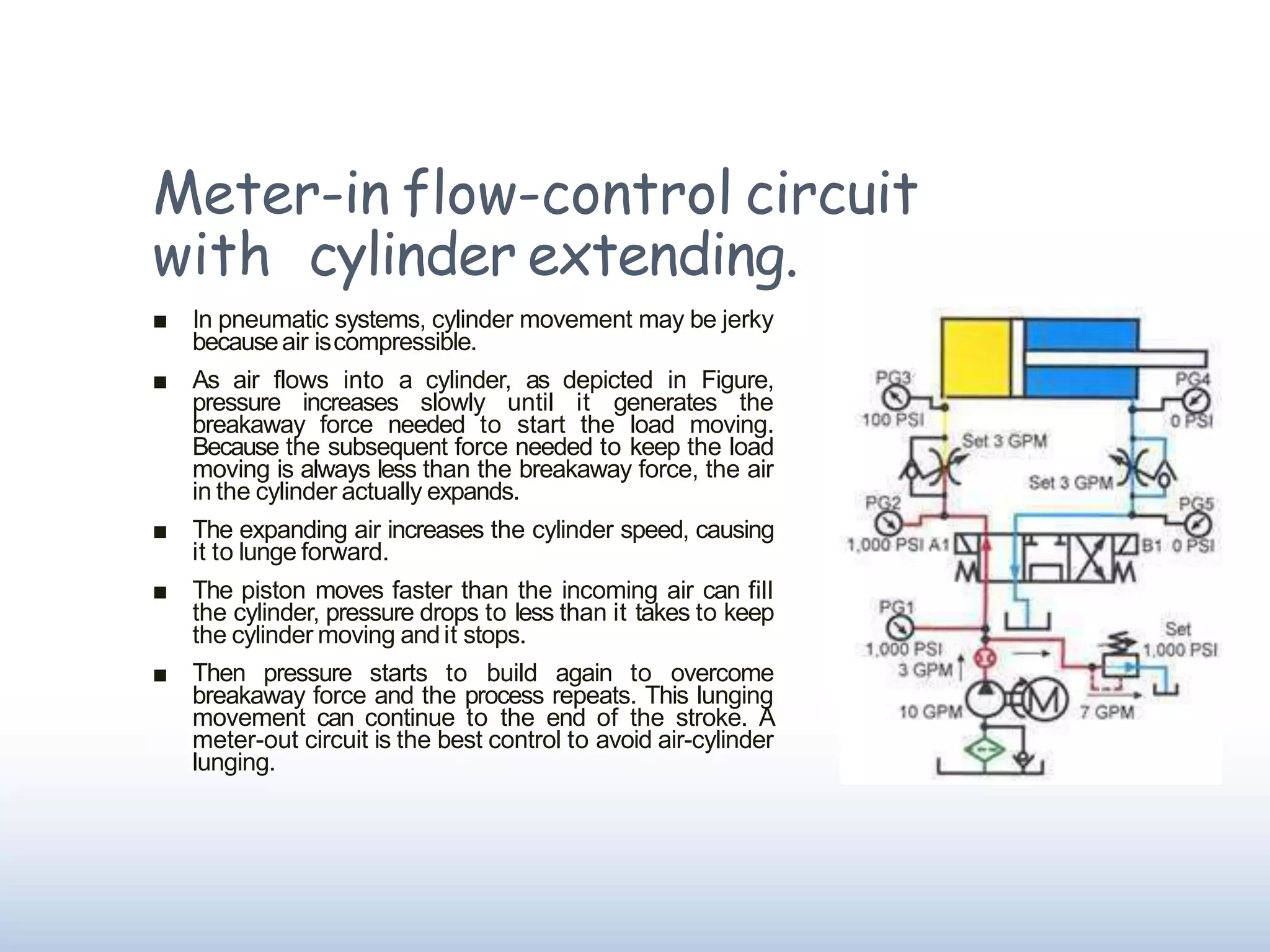
Meter-in flow-control circuit
with cylinder extending.
■ In pneumatic systems, cylinder movement may be jerky
becauseair iscompressible.
■ As air flows into a cylinder, as depicted in Figure,
pressure increases slowly until it generates the
breakaway force needed to start the load moving.
Because the subsequent force needed to keep the load
moving is always less than the breakaway force, the air
in the cylinder actually expands.
■ The expanding air increases the cylinder speed, causing
it to lunge forward.
■ The piston moves faster than the incoming air can fill
the cylinder, pressure drops to less than it takes to keep
the cylinder moving andit stops.
■ Then pressure starts to build again to overcome
breakaway force and the process repeats. This lunging
movement can continue to the end of the stroke. A
meter-out circuit is the best control to avoid air-cylinder
lunging.
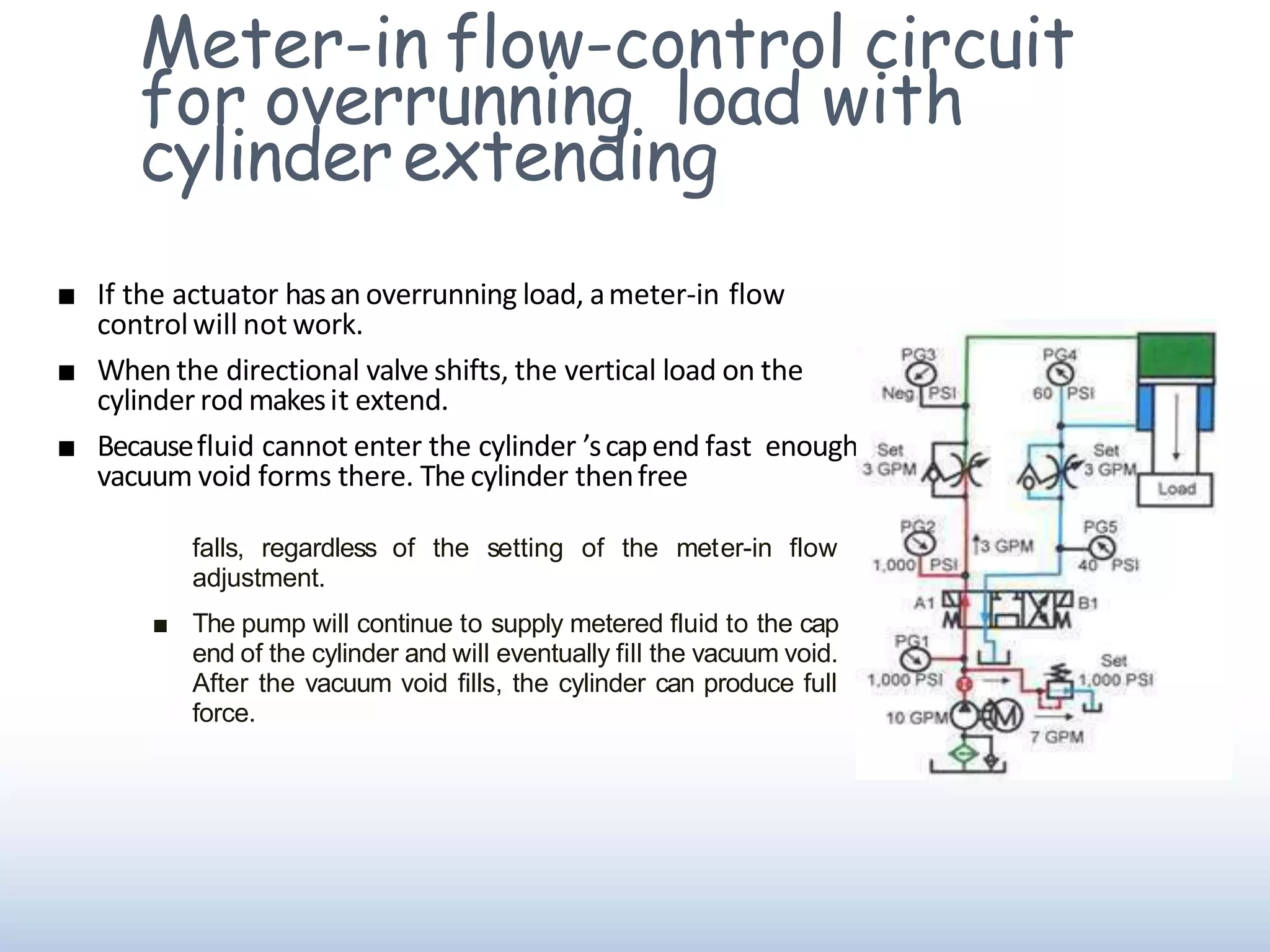
Meter-in flow-control circuit
for overrunning load with
cylinderextending
■ If the actuator hasan overrunning load, ameter-in flow
controlwill not work.
■ When the directional valve shifts, the vertical load on the
cylinder rod makesit extend.
■ Becausefluid cannot enter the cylinder ’scapend fast enough, a
vacuum void forms there. The cylinder thenfree
falls, regardless of the setting of the meter-in flow
adjustment.
■ The pump will continue to supply metered fluid to the cap
end of the cylinder and will eventually fill the vacuum void.
After the vacuum void fills, the cylinder can produce full
force.
Meter-in control circuit
Fig. shows the meter-in circuit.
In this flow control valve is
connected between the D.C valve
and blind end of the cylinder.
Here metered fluid enters the
cylinder which controls the
speed and feed of the piston.
When D.C. valve is manually shifted to
right side the flow from pump passes
through the compensated flow control
valve into blind end of cylinder and the
exhaust fluid is directed freely to the
reservoir.
Meter-out speed control circuit
Fig. shows meter-out speed control
circuit.
In this flow control valve is located
between D.C. valve and rod end of
cylinder in such a way that the fluid is
metered as it leaves the cylinder.
When D.C. valve is manually shifted to
right side the flow from pump passes to
blind end of cylinder and the exhaust
fluid is directed through flow control
valve to the reservoir. Due to this the
movement of piston is regulated as fluid
has restriction on rod end side. Thus
piston moves slowly.
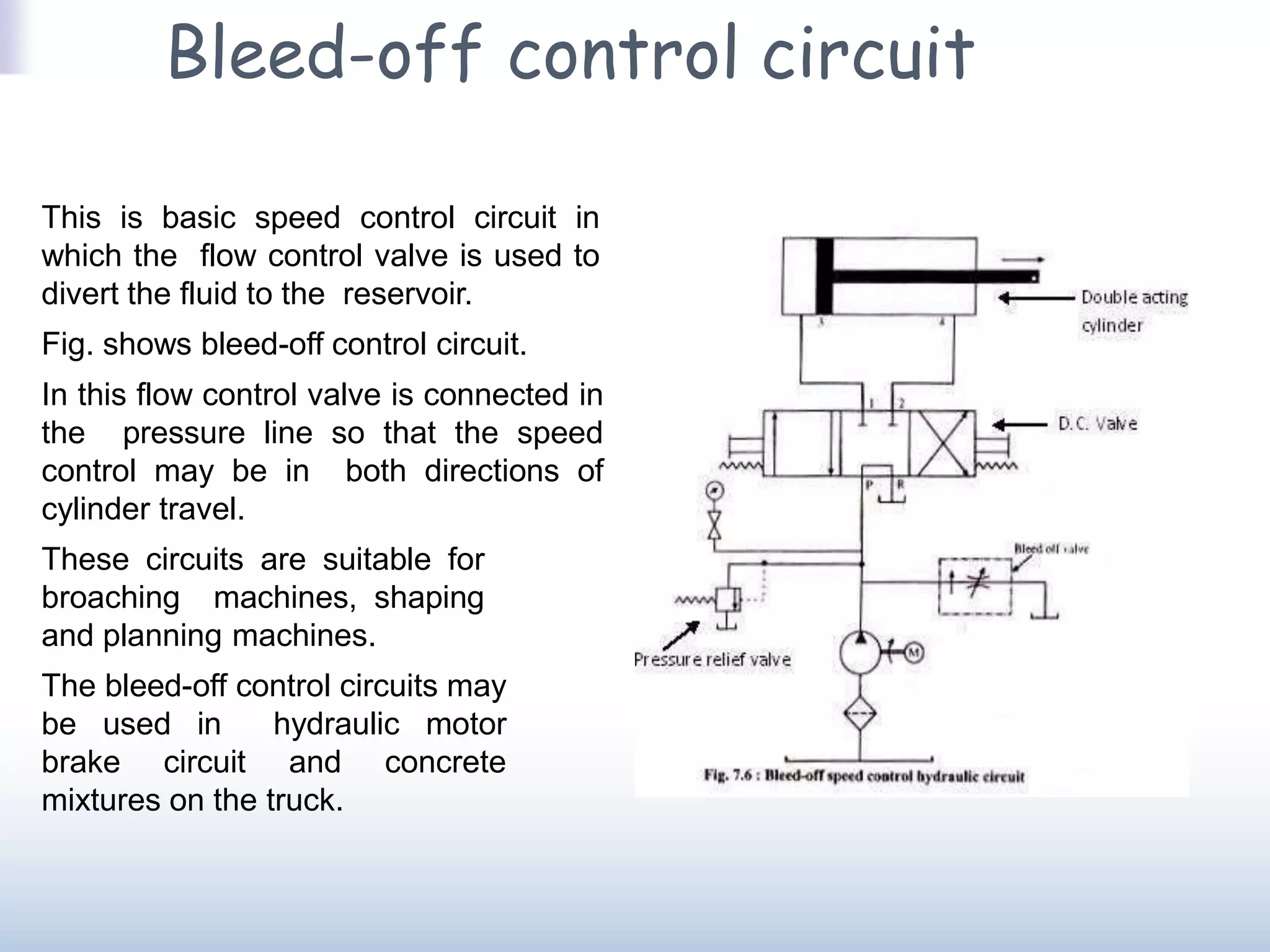
Bleed-off control circuit
This is basic speed control circuit in
which the flow control valve is used to
divert the fluid to the reservoir.
Fig. shows bleed-off control circuit.
In this flow control valve is connected in
the pressure line so that the speed
control may be in both directions of
cylinder travel.
These circuits are suitable for
broaching machines, shaping
and planning machines.
The bleed-off control circuits may
be used in hydraulic motor
brake circuit and concrete
mixtures on the truck.
Sequence circuit
In this sequence valve is
provided to do the
operations sequentially.
Fig. shows the use of two
sequence valve in hydraulic
circuit for controlling two
operations performed in the
sequence in both directions.
It consist of hydraulic power unit,
two sequence valves A & B with
integral check valve, two double
acting cylinders P & Q, and D.C.
valve
When D.C. valve is shifted to left
envelop mode, the oil from pump
enters the cylinder ‘P’ through line
1-3, causing the piston in cylinder ‘P’
to extend fully.
Application of Hydraulic circuits
Hydraulic circuit for Milling M/c
Hydraulic circuit for Shaper M/c
Hydraulic circuit for Surface grinder
Hydraulic circuit for Hydraulic Press
Hydraulic Power Steering
Reaction piston type hydraulic steering system
Hydraulic circuit of Dumpers
Hydraulic circuit of Excavators

2 c industrial hydraulic circuits

  • 1.
    Meter in flow-controlcircuits at rest. There are three types of flow control circuits from which to choose. They are: meter-in, meter-out, and bleed-off (or bypass). Air and hydraulic systems use meter-in and meter- out circuits, while only hydraulic circuits use bleed off types. Each control has certain advantages in particular situations. meter-in flow-control circuit for a cylinder. Notice that a bypass check valve forces fluid through an adjustable orifice just before it enters the actuator. extending hydraulic cylinder and indicates the pressures and flows in various parts of the circuit. With a meter-in circuit, fluid enters the actuator at a controlled rate. If the actuator has a resistive load, movement will be smooth and steady with a hydraulic circuit. This is because oil is almost non compressible.
  • 2.
    Meter-in flow-control circuit withcylinder extending. ■ In pneumatic systems, cylinder movement may be jerky becauseair iscompressible. ■ As air flows into a cylinder, as depicted in Figure, pressure increases slowly until it generates the breakaway force needed to start the load moving. Because the subsequent force needed to keep the load moving is always less than the breakaway force, the air in the cylinder actually expands. ■ The expanding air increases the cylinder speed, causing it to lunge forward. ■ The piston moves faster than the incoming air can fill the cylinder, pressure drops to less than it takes to keep the cylinder moving andit stops. ■ Then pressure starts to build again to overcome breakaway force and the process repeats. This lunging movement can continue to the end of the stroke. A meter-out circuit is the best control to avoid air-cylinder lunging.
  • 3.
    Meter-in flow-control circuit foroverrunning load with cylinderextending ■ If the actuator hasan overrunning load, ameter-in flow controlwill not work. ■ When the directional valve shifts, the vertical load on the cylinder rod makesit extend. ■ Becausefluid cannot enter the cylinder ’scapend fast enough, a vacuum void forms there. The cylinder thenfree falls, regardless of the setting of the meter-in flow adjustment. ■ The pump will continue to supply metered fluid to the cap end of the cylinder and will eventually fill the vacuum void. After the vacuum void fills, the cylinder can produce full force.
  • 4.
    Meter-in control circuit Fig.shows the meter-in circuit. In this flow control valve is connected between the D.C valve and blind end of the cylinder. Here metered fluid enters the cylinder which controls the speed and feed of the piston. When D.C. valve is manually shifted to right side the flow from pump passes through the compensated flow control valve into blind end of cylinder and the exhaust fluid is directed freely to the reservoir.
  • 5.
    Meter-out speed controlcircuit Fig. shows meter-out speed control circuit. In this flow control valve is located between D.C. valve and rod end of cylinder in such a way that the fluid is metered as it leaves the cylinder. When D.C. valve is manually shifted to right side the flow from pump passes to blind end of cylinder and the exhaust fluid is directed through flow control valve to the reservoir. Due to this the movement of piston is regulated as fluid has restriction on rod end side. Thus piston moves slowly.
  • 6.
    Bleed-off control circuit Thisis basic speed control circuit in which the flow control valve is used to divert the fluid to the reservoir. Fig. shows bleed-off control circuit. In this flow control valve is connected in the pressure line so that the speed control may be in both directions of cylinder travel. These circuits are suitable for broaching machines, shaping and planning machines. The bleed-off control circuits may be used in hydraulic motor brake circuit and concrete mixtures on the truck.
  • 7.
    Sequence circuit In thissequence valve is provided to do the operations sequentially. Fig. shows the use of two sequence valve in hydraulic circuit for controlling two operations performed in the sequence in both directions. It consist of hydraulic power unit, two sequence valves A & B with integral check valve, two double acting cylinders P & Q, and D.C. valve When D.C. valve is shifted to left envelop mode, the oil from pump enters the cylinder ‘P’ through line 1-3, causing the piston in cylinder ‘P’ to extend fully.
  • 8.
    Application of Hydrauliccircuits Hydraulic circuit for Milling M/c Hydraulic circuit for Shaper M/c Hydraulic circuit for Surface grinder Hydraulic circuit for Hydraulic Press Hydraulic Power Steering Reaction piston type hydraulic steering system Hydraulic circuit of Dumpers Hydraulic circuit of Excavators