Chandan Nagaraja
1RV08ME021
R.V.College of Engineering,
Bengaluru
OVERVIEW
 Introduction
 History
 Types of Hydraulic Accumulator
 Functions of Accumulator
 Accumulator design consideration
 Application
 Conclusion
INTRODUCTION
 A Hydraulic Accumulator is energy storage device.
 It is pressure storage reservoir in which a non-
  compressible hydraulic fluid is held under pressure by an
  external source.
 The external source used can be a spring, a raised
  weight, or a compressed gas.
 The main reasons that an accumulator is used in a
  hydraulic system, is that the pump doesn’t need to be so
  large to cope with extremes of demand and supply circuit
  can respond quickly to any temporary demand and to
  smooth pulsation.
HISTORY
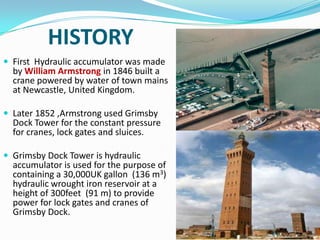
 First Hydraulic accumulator was made
  by William Armstrong in 1846 built a
  crane powered by water of town mains
  at Newcastle, United Kingdom.

 Later 1852 ,Armstrong used Grimsby
  Dock Tower for the constant pressure
  for cranes, lock gates and sluices.
 Grimsby Dock Tower is hydraulic

  accumulator is used for the purpose of
  containing a 30,000UK gallon (136 m3)
  hydraulic wrought iron reservoir at a
  height of 300feet (91 m) to provide
  power for lock gates and cranes of
  Grimsby Dock.
TYPES OF HYDRAULIC
            ACCULUMATOR
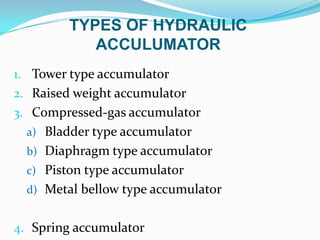
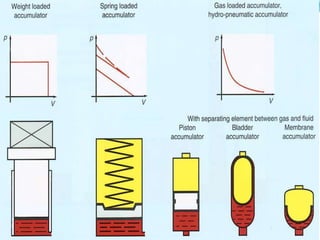
1. Tower type accumulator
2. Raised weight accumulator
3. Compressed-gas accumulator
  a) Bladder type accumulator
  b) Diaphragm type accumulator
  c) Piston type accumulator
  d) Metal bellow type accumulator


4. Spring accumulator
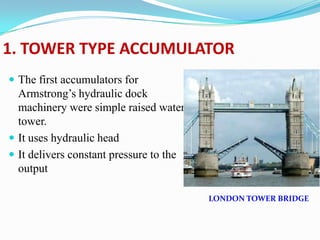
1. TOWER TYPE ACCUMULATOR
 The first accumulators for
  Armstrong’s hydraulic dock
  machinery were simple raised water
  tower.
 It uses hydraulic head
 It delivers constant pressure to the
  output

                                         LONDON TOWER BRIDGE
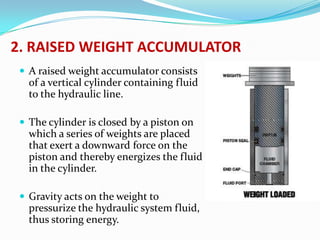
2. RAISED WEIGHT ACCUMULATOR
  A raised weight accumulator consists
   of a vertical cylinder containing fluid
   to the hydraulic line.

  The cylinder is closed by a piston on
   which a series of weights are placed
   that exert a downward force on the
   piston and thereby energizes the fluid
   in the cylinder.

  Gravity acts on the weight to
   pressurize the hydraulic system fluid,
   thus storing energy.
ADVANTGES :
 Used to meet heavy industrial
  requirements.
 Extremely high capacity at low cost.
 Rugged and durable construction.

LIMITATIONS :

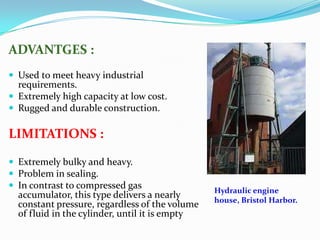
 Extremely bulky and heavy.
 Problem in sealing.
 In contrast to compressed gas
                                                Hydraulic engine
  accumulator, this type delivers a nearly
                                                house, Bristol Harbor.
  constant pressure, regardless of the volume
  of fluid in the cylinder, until it is empty
3. COMPRESSED GAS ACCUMULATOR
  It is widely used accumulator in present scenario.
  It is popularly known as “hydro-pneumatic
   accumulator”. It apply force to the liquid by using a
   compressed gas that acts as the spring.
  It uses inert gas (nitrogen) under pressure that provides
   the compressive force on fluid.
  Oxygen is not used because oxygen and oil can form an
   explosive mixture when combined under pressure
  As the volume of the compressed gas changes the
   pressure of the gas, and pressure of the fluid, changes
   inversely.
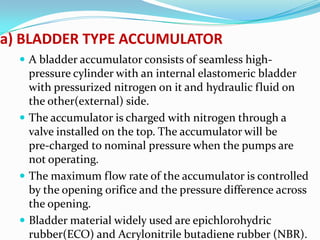
a) BLADDER TYPE ACCUMULATOR
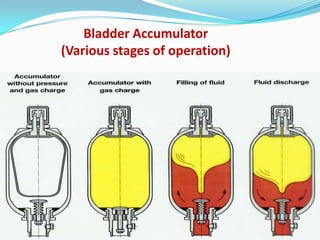
   A bladder accumulator consists of seamless high-
    pressure cylinder with an internal elastomeric bladder
    with pressurized nitrogen on it and hydraulic fluid on
    the other(external) side.
   The accumulator is charged with nitrogen through a
    valve installed on the top. The accumulator will be
    pre-charged to nominal pressure when the pumps are
    not operating.
   The maximum flow rate of the accumulator is controlled
    by the opening orifice and the pressure difference across
    the opening.
   Bladder material widely used are epichlorohydric
    rubber(ECO) and Acrylonitrile butadiene rubber (NBR).
Bladder Accumulator
(Various stages of operation)
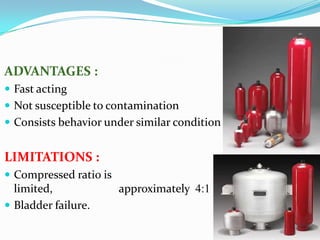
ADVANTAGES :
 Fast acting
 Not susceptible to contamination
 Consists behavior under similar condition


LIMITATIONS :
 Compressed ratio is
  limited,              approximately 4:1
 Bladder failure.
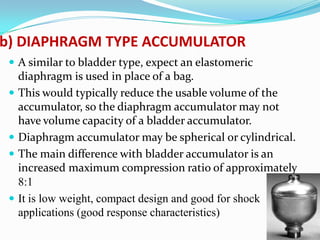
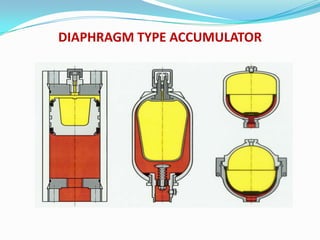
b) DIAPHRAGM TYPE ACCUMULATOR
  A similar to bladder type, expect an elastomeric
     diaphragm is used in place of a bag.
    This would typically reduce the usable volume of the
     accumulator, so the diaphragm accumulator may not
     have volume capacity of a bladder accumulator.
    Diaphragm accumulator may be spherical or cylindrical.
    The main difference with bladder accumulator is an
     increased maximum compression ratio of approximately
     8:1
    It is low weight, compact design and good for shock
     applications (good response characteristics)
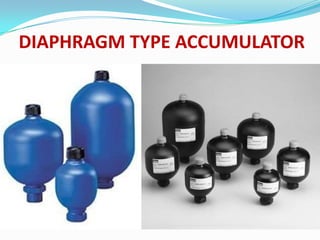
DIAPHRAGM TYPE ACCUMULATOR
c) PISTON TYPE ACCUMULATOR
   This accumulator consists of a cylinder assembly, a
   piston assembly, and two end-cap assemblies.

   An accumulator contains a free-floating piston with
   liquid on one side of the piston and pre-charged air or
   nitrogen on the other side.

   An increase of liquid volume decreases the gas volume
   and increases gas pressure, which provides a work
   potential when the liquid is allowed to dis-charged.
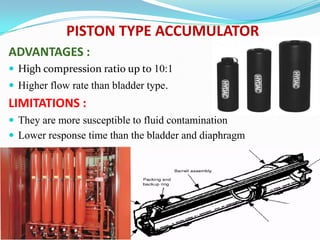
PISTON TYPE ACCUMULATOR
ADVANTAGES :
 High compression ratio up to 10:1
 Higher flow rate than bladder type.
LIMITATIONS :
 They are more susceptible to fluid contamination
 Lower response time than the bladder and diaphragm
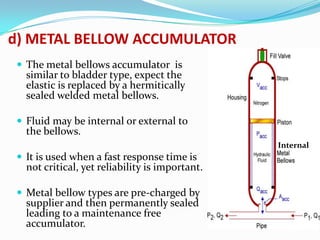
d) METAL BELLOW ACCUMULATOR
  The metal bellows accumulator is
   similar to bladder type, expect the
   elastic is replaced by a hermitically
   sealed welded metal bellows.

  Fluid may be internal or external to
   the bellows.
                                                 Internal
  It is used when a fast response time is
   not critical, yet reliability is important.

  Metal bellow types are pre-charged by
   supplier and then permanently sealed
   leading to a maintenance free
   accumulator.
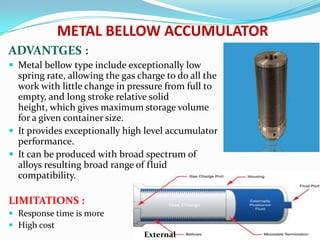
METAL BELLOW ACCUMULATOR
ADVANTGES :
 Metal bellow type include exceptionally low
  spring rate, allowing the gas charge to do all the
  work with little change in pressure from full to
  empty, and long stroke relative solid
  height, which gives maximum storage volume
  for a given container size.
 It provides exceptionally high level accumulator
  performance.
 It can be produced with broad spectrum of
  alloys resulting broad range of fluid
  compatibility.

LIMITATIONS :
 Response time is more
 High cost                                 External
                                 External
4. Spring type accumulator
   It uses the energy stored in springs to create a constant force
      on the liquid contained in an adjacent ram assembly.
     The load characteristics of a spring are such that the energy
      storage depends on the force required to compress s spring.
     The free (uncompressed) length of a spring represents zero
      energy storage.
     As a spring is compressed to the maximum installed
      length, high pressure value of the liquid in a ram assembly is
      established.
     As liquid under pressure enters the ram cylinder, causing a
      spring to compress, the pressure on the liquid will rise
      because of the increased loading required to compress the
      spring.
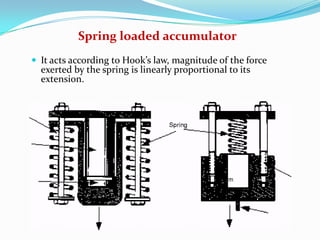
Spring loaded accumulator
 It acts according to Hook’s law, magnitude of the force
  exerted by the spring is linearly proportional to its
  extension.
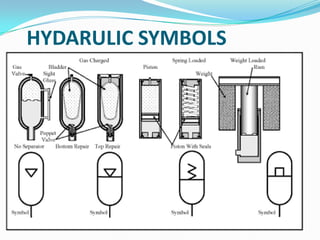
HYDARULIC SYMBOLS
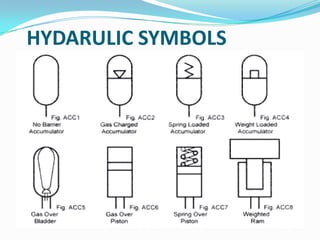
HYDARULIC SYMBOLS
FUNCTIONS : Where are accumulators used?
Accumulators can be applied creatively in any number of situations, including:
 Emergency and safety: An accumulator which is kept constantly under
  pressure is valuable in the event of an electrical power failure as it can provide
  flow and pressure to perform an additional function or complete a machine
  cycle.
 Shock or pulsation dampening: An accumulator can be used to cushion the
  pressure spike from sudden valve closure, the pulsation from pumps or the load
  reaction from sudden movement of parts connected to hydraulic cylinders.
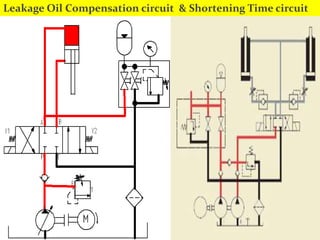
 Leakage compensation: An accumulator can be used to maintain pressure
  and make-up for lost fluid due to internal leakage of system components
  including cylinders and valves.
 Thermal expansion: An accumulator can absorb the pressure differences
  caused by temperature variations in a closed hydraulic system.
 Noise reduction: An accumulator is effective at reducing hydraulic system
  noise caused by relief valves, pump pulsations, system shock and other circuit
  generated noises.
 Energy conservation: An accumulator can be used to supplement a pump
   during peak demand thereby reducing the size of the pump and motor
   required. The accumulator is charged during low demand portions of the pump
   cycle time and then discharges during the high demand portions of the system.
  Improved response times: An accumulator (bladder type) has virtually
   instantaneous response time that can provide fluid very quickly to fast-acting
   valves such as servos and proportional to improve their effectiveness


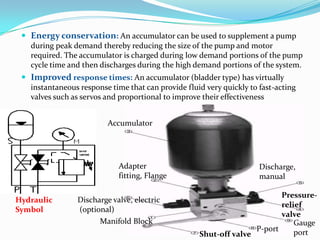
                         Accumulator


                            Adapter                                   Discharge,
                            fitting, Flange                           manual

                                                                          Pressure-
Hydraulic       Discharge valve, electric
                                                                          relief
Symbol          (optional)
                                                                          valve
                      Manifold Block                                          Gauge
                                                                   P-port     port
                                                    Shut-off valve
ACCUMULATOR DESIGN CONSIDERATION :
(What must I know to size and select an accumulator?)
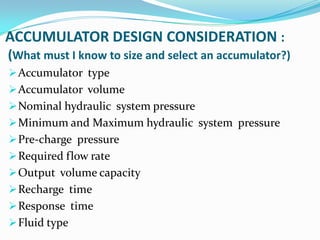
 Accumulator type
 Accumulator volume
 Nominal hydraulic system pressure
 Minimum and Maximum hydraulic system pressure
 Pre-charge pressure
 Required flow rate
 Output volume capacity
 Recharge time
 Response time
 Fluid type
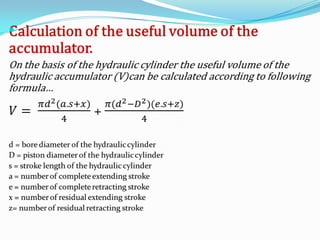
CALACULATIONS
Pressures :
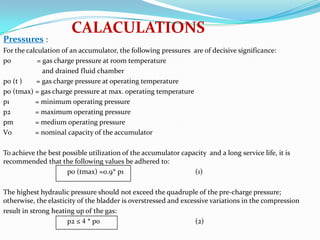
For the calculation of an accumulator, the following pressures are of decisive significance:
p0          = gas charge pressure at room temperature
              and drained fluid chamber
p0 (t )    = gas charge pressure at operating temperature
p0 (tmax) = gas charge pressure at max. operating temperature
p1         = minimum operating pressure
p2         = maximum operating pressure
pm         = medium operating pressure
V0         = nominal capacity of the accumulator

To achieve the best possible utilization of the accumulator capacity and a long service life, it is
recommended that the following values be adhered to:
                     p0 (tmax) ≈0.9* p1                         (1)

The highest hydraulic pressure should not exceed the quadruple of the pre-charge pressure;
otherwise, the elasticity of the bladder is overstressed and excessive variations in the compression
result in strong heating up of the gas:
                      p2 ≤ 4 * p0                                 (2)
Cont………
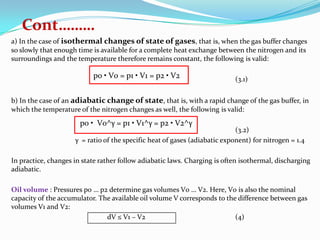
a) In the case of isothermal changes of state of gases, that is, when the gas buffer changes
so slowly that enough time is available for a complete heat exchange between the nitrogen and its
surroundings and the temperature therefore remains constant, the following is valid:

                           p0 • V0 = p1 • V1 = p2 • V2                      (3.1)


b) In the case of an adiabatic change of state, that is, with a rapid change of the gas buffer, in
which the temperature of the nitrogen changes as well, the following is valid:
                       p0 • V0^γ = p1 • V1^γ = p2 • V2^γ
                                                                            (3.2)
                     γ = ratio of the specific heat of gases (adiabatic exponent) for nitrogen = 1.4

In practice, changes in state rather follow adiabatic laws. Charging is often isothermal, discharging
adiabatic.

Oil volume : Pressures p0 … p2 determine gas volumes V0 … V2. Here, V0 is also the nominal
capacity of the accumulator. The available oil volume V corresponds to the difference between gas
volumes V1 and V2:
                               dV ≤ V1 – V2                               (4)

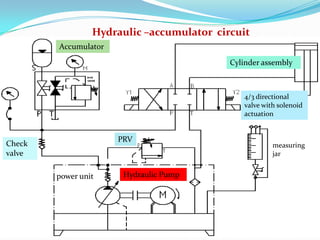
Hydraulic –accumulator circuit
        Accumulator

                                           Cylinder assembly


                                              4/3 directional
                                              valve with solenoid
                                              actuation


                      PRV
Check                                                  measuring
valve                                                  jar


        power unit     Hydraulic Pump
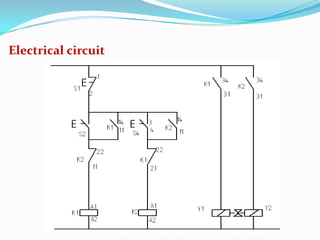
Electrical circuit
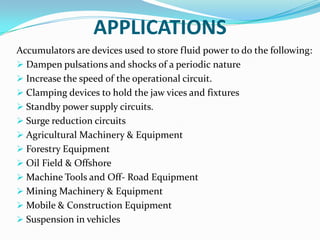
APPLICATIONS
Accumulators are devices used to store fluid power to do the following:
 Dampen pulsations and shocks of a periodic nature
 Increase the speed of the operational circuit.
 Clamping devices to hold the jaw vices and fixtures
 Standby power supply circuits.
 Surge reduction circuits
 Agricultural Machinery & Equipment
 Forestry Equipment
 Oil Field & Offshore
 Machine Tools and Off- Road Equipment
 Mining Machinery & Equipment
 Mobile & Construction Equipment
 Suspension in vehicles
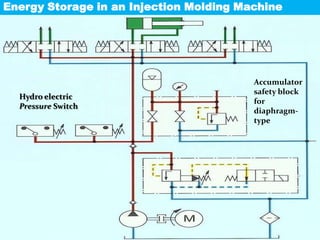
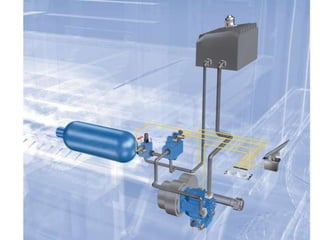
Energy Storage in an Injection Molding Machine


                                         Accumulator
                                         safety block
  Hydro electric
                                         for
  Pressure Switch
                                         diaphragm-
                                         type
Leakage Oil Compensation circuit & Shortening Time circuit
of Stroke Time
CONCLUSION
       So what are the benefits of using accumulators?
 Lower installed system costs, accumulator assisted
  hydraulics can reduce the size of the pump and electric
  motor which results in a smaller amount of oil used, a
  smaller reservoir and reduced equipment costs.

 Less leakage and maintenance costs, the ability to reduce
  system shocks will prolong component life, reduce leakage
  from pipe joints and minimize hydraulic system
  maintenance costs.

 Improved performance, low inertia bladder accumulators
  can provide instantaneous response time to meet peak flow
  requirements. They can also help to achieve constant
  pressure in systems using variable displacement pumps for
  improved productivity and quality.
 Reduced noise levels, reduced pump and motor size
 couple with system shock absorption overall machine
 sound levels and results in higher operator
 productivity.

 Flexible design approaches. A wide range of
 accumulator types and sizes, including accessory
 items, provides a versatile and easy to apply design
 approach.

 Reduced energy costs, cost savings of up to 33% are
 achievable in high performance industrial machinery
 using accumulators.
Hydraulic accumulator

Hydraulic accumulator

  • 1.
  • 2.
    OVERVIEW  Introduction  History Types of Hydraulic Accumulator  Functions of Accumulator  Accumulator design consideration  Application  Conclusion
  • 3.
    INTRODUCTION  A HydraulicAccumulator is energy storage device.  It is pressure storage reservoir in which a non- compressible hydraulic fluid is held under pressure by an external source.  The external source used can be a spring, a raised weight, or a compressed gas.  The main reasons that an accumulator is used in a hydraulic system, is that the pump doesn’t need to be so large to cope with extremes of demand and supply circuit can respond quickly to any temporary demand and to smooth pulsation.
  • 4.
    HISTORY  First Hydraulicaccumulator was made by William Armstrong in 1846 built a crane powered by water of town mains at Newcastle, United Kingdom.  Later 1852 ,Armstrong used Grimsby Dock Tower for the constant pressure for cranes, lock gates and sluices.  Grimsby Dock Tower is hydraulic accumulator is used for the purpose of containing a 30,000UK gallon (136 m3) hydraulic wrought iron reservoir at a height of 300feet (91 m) to provide power for lock gates and cranes of Grimsby Dock.
  • 5.
    TYPES OF HYDRAULIC ACCULUMATOR 1. Tower type accumulator 2. Raised weight accumulator 3. Compressed-gas accumulator a) Bladder type accumulator b) Diaphragm type accumulator c) Piston type accumulator d) Metal bellow type accumulator 4. Spring accumulator
  • 6.
    1. TOWER TYPEACCUMULATOR  The first accumulators for Armstrong’s hydraulic dock machinery were simple raised water tower.  It uses hydraulic head  It delivers constant pressure to the output LONDON TOWER BRIDGE
  • 7.
    2. RAISED WEIGHTACCUMULATOR  A raised weight accumulator consists of a vertical cylinder containing fluid to the hydraulic line.  The cylinder is closed by a piston on which a series of weights are placed that exert a downward force on the piston and thereby energizes the fluid in the cylinder.  Gravity acts on the weight to pressurize the hydraulic system fluid, thus storing energy.
  • 8.
    ADVANTGES :  Usedto meet heavy industrial requirements.  Extremely high capacity at low cost.  Rugged and durable construction. LIMITATIONS :  Extremely bulky and heavy.  Problem in sealing.  In contrast to compressed gas Hydraulic engine accumulator, this type delivers a nearly house, Bristol Harbor. constant pressure, regardless of the volume of fluid in the cylinder, until it is empty
  • 9.
    3. COMPRESSED GASACCUMULATOR  It is widely used accumulator in present scenario.  It is popularly known as “hydro-pneumatic accumulator”. It apply force to the liquid by using a compressed gas that acts as the spring.  It uses inert gas (nitrogen) under pressure that provides the compressive force on fluid.  Oxygen is not used because oxygen and oil can form an explosive mixture when combined under pressure  As the volume of the compressed gas changes the pressure of the gas, and pressure of the fluid, changes inversely.
  • 10.
    a) BLADDER TYPEACCUMULATOR  A bladder accumulator consists of seamless high- pressure cylinder with an internal elastomeric bladder with pressurized nitrogen on it and hydraulic fluid on the other(external) side.  The accumulator is charged with nitrogen through a valve installed on the top. The accumulator will be pre-charged to nominal pressure when the pumps are not operating.  The maximum flow rate of the accumulator is controlled by the opening orifice and the pressure difference across the opening.  Bladder material widely used are epichlorohydric rubber(ECO) and Acrylonitrile butadiene rubber (NBR).
  • 11.
  • 12.
    ADVANTAGES :  Fastacting  Not susceptible to contamination  Consists behavior under similar condition LIMITATIONS :  Compressed ratio is limited, approximately 4:1  Bladder failure.
  • 13.
    b) DIAPHRAGM TYPEACCUMULATOR  A similar to bladder type, expect an elastomeric diaphragm is used in place of a bag.  This would typically reduce the usable volume of the accumulator, so the diaphragm accumulator may not have volume capacity of a bladder accumulator.  Diaphragm accumulator may be spherical or cylindrical.  The main difference with bladder accumulator is an increased maximum compression ratio of approximately 8:1  It is low weight, compact design and good for shock applications (good response characteristics)
  • 14.
  • 15.
  • 16.
    c) PISTON TYPEACCUMULATOR  This accumulator consists of a cylinder assembly, a piston assembly, and two end-cap assemblies.  An accumulator contains a free-floating piston with liquid on one side of the piston and pre-charged air or nitrogen on the other side.  An increase of liquid volume decreases the gas volume and increases gas pressure, which provides a work potential when the liquid is allowed to dis-charged.
  • 17.
    PISTON TYPE ACCUMULATOR ADVANTAGES:  High compression ratio up to 10:1  Higher flow rate than bladder type. LIMITATIONS :  They are more susceptible to fluid contamination  Lower response time than the bladder and diaphragm
  • 18.
    d) METAL BELLOWACCUMULATOR  The metal bellows accumulator is similar to bladder type, expect the elastic is replaced by a hermitically sealed welded metal bellows.  Fluid may be internal or external to the bellows. Internal  It is used when a fast response time is not critical, yet reliability is important.  Metal bellow types are pre-charged by supplier and then permanently sealed leading to a maintenance free accumulator.
  • 19.
    METAL BELLOW ACCUMULATOR ADVANTGES:  Metal bellow type include exceptionally low spring rate, allowing the gas charge to do all the work with little change in pressure from full to empty, and long stroke relative solid height, which gives maximum storage volume for a given container size.  It provides exceptionally high level accumulator performance.  It can be produced with broad spectrum of alloys resulting broad range of fluid compatibility. LIMITATIONS :  Response time is more  High cost External External
  • 20.
    4. Spring typeaccumulator  It uses the energy stored in springs to create a constant force on the liquid contained in an adjacent ram assembly.  The load characteristics of a spring are such that the energy storage depends on the force required to compress s spring.  The free (uncompressed) length of a spring represents zero energy storage.  As a spring is compressed to the maximum installed length, high pressure value of the liquid in a ram assembly is established.  As liquid under pressure enters the ram cylinder, causing a spring to compress, the pressure on the liquid will rise because of the increased loading required to compress the spring.
  • 21.
    Spring loaded accumulator It acts according to Hook’s law, magnitude of the force exerted by the spring is linearly proportional to its extension.
  • 22.
  • 23.
  • 24.
    FUNCTIONS : Whereare accumulators used? Accumulators can be applied creatively in any number of situations, including:  Emergency and safety: An accumulator which is kept constantly under pressure is valuable in the event of an electrical power failure as it can provide flow and pressure to perform an additional function or complete a machine cycle.  Shock or pulsation dampening: An accumulator can be used to cushion the pressure spike from sudden valve closure, the pulsation from pumps or the load reaction from sudden movement of parts connected to hydraulic cylinders.  Leakage compensation: An accumulator can be used to maintain pressure and make-up for lost fluid due to internal leakage of system components including cylinders and valves.  Thermal expansion: An accumulator can absorb the pressure differences caused by temperature variations in a closed hydraulic system.  Noise reduction: An accumulator is effective at reducing hydraulic system noise caused by relief valves, pump pulsations, system shock and other circuit generated noises.
  • 25.
     Energy conservation:An accumulator can be used to supplement a pump during peak demand thereby reducing the size of the pump and motor required. The accumulator is charged during low demand portions of the pump cycle time and then discharges during the high demand portions of the system.  Improved response times: An accumulator (bladder type) has virtually instantaneous response time that can provide fluid very quickly to fast-acting valves such as servos and proportional to improve their effectiveness Accumulator Adapter Discharge, fitting, Flange manual Pressure- Hydraulic Discharge valve, electric relief Symbol (optional) valve Manifold Block Gauge P-port port Shut-off valve
  • 26.
    ACCUMULATOR DESIGN CONSIDERATION: (What must I know to size and select an accumulator?)  Accumulator type  Accumulator volume  Nominal hydraulic system pressure  Minimum and Maximum hydraulic system pressure  Pre-charge pressure  Required flow rate  Output volume capacity  Recharge time  Response time  Fluid type
  • 27.
    CALACULATIONS Pressures : For thecalculation of an accumulator, the following pressures are of decisive significance: p0 = gas charge pressure at room temperature and drained fluid chamber p0 (t ) = gas charge pressure at operating temperature p0 (tmax) = gas charge pressure at max. operating temperature p1 = minimum operating pressure p2 = maximum operating pressure pm = medium operating pressure V0 = nominal capacity of the accumulator To achieve the best possible utilization of the accumulator capacity and a long service life, it is recommended that the following values be adhered to: p0 (tmax) ≈0.9* p1 (1) The highest hydraulic pressure should not exceed the quadruple of the pre-charge pressure; otherwise, the elasticity of the bladder is overstressed and excessive variations in the compression result in strong heating up of the gas: p2 ≤ 4 * p0 (2)
  • 28.
    Cont……… a) In thecase of isothermal changes of state of gases, that is, when the gas buffer changes so slowly that enough time is available for a complete heat exchange between the nitrogen and its surroundings and the temperature therefore remains constant, the following is valid: p0 • V0 = p1 • V1 = p2 • V2 (3.1) b) In the case of an adiabatic change of state, that is, with a rapid change of the gas buffer, in which the temperature of the nitrogen changes as well, the following is valid: p0 • V0^γ = p1 • V1^γ = p2 • V2^γ (3.2) γ = ratio of the specific heat of gases (adiabatic exponent) for nitrogen = 1.4 In practice, changes in state rather follow adiabatic laws. Charging is often isothermal, discharging adiabatic. Oil volume : Pressures p0 … p2 determine gas volumes V0 … V2. Here, V0 is also the nominal capacity of the accumulator. The available oil volume V corresponds to the difference between gas volumes V1 and V2: dV ≤ V1 – V2 (4)
  • 30.
  • 31.
    Hydraulic –accumulator circuit Accumulator Cylinder assembly 4/3 directional valve with solenoid actuation PRV Check measuring valve jar power unit Hydraulic Pump
  • 32.
  • 33.
    APPLICATIONS Accumulators are devicesused to store fluid power to do the following:  Dampen pulsations and shocks of a periodic nature  Increase the speed of the operational circuit.  Clamping devices to hold the jaw vices and fixtures  Standby power supply circuits.  Surge reduction circuits  Agricultural Machinery & Equipment  Forestry Equipment  Oil Field & Offshore  Machine Tools and Off- Road Equipment  Mining Machinery & Equipment  Mobile & Construction Equipment  Suspension in vehicles
  • 34.
    Energy Storage inan Injection Molding Machine Accumulator safety block Hydro electric for Pressure Switch diaphragm- type
  • 36.
    Leakage Oil Compensationcircuit & Shortening Time circuit of Stroke Time
  • 37.
    CONCLUSION So what are the benefits of using accumulators?  Lower installed system costs, accumulator assisted hydraulics can reduce the size of the pump and electric motor which results in a smaller amount of oil used, a smaller reservoir and reduced equipment costs.  Less leakage and maintenance costs, the ability to reduce system shocks will prolong component life, reduce leakage from pipe joints and minimize hydraulic system maintenance costs.  Improved performance, low inertia bladder accumulators can provide instantaneous response time to meet peak flow requirements. They can also help to achieve constant pressure in systems using variable displacement pumps for improved productivity and quality.
  • 38.
     Reduced noiselevels, reduced pump and motor size couple with system shock absorption overall machine sound levels and results in higher operator productivity.  Flexible design approaches. A wide range of accumulator types and sizes, including accessory items, provides a versatile and easy to apply design approach.  Reduced energy costs, cost savings of up to 33% are achievable in high performance industrial machinery using accumulators.