HYDRAULIC CONTROL SYSTEM
PRESENTED BY :-
CHAUDHARY KALPESH (180613119003)
MALI DHAVAL .R. (180613119006)
PRAJAPATI MEHUL .S. (180613119011)
SHAH PRIYANK .P. (180613119014)
THAKOR MITESH .R. (180613119016)
GUIDED BY :-
PROF. A.R.CHAUDHARY
CONTENT
 ABSTRACT
 INTRODUCTION
 WORKING PRINCIPLE
 SCHEMATIC DIAGRAM OF HYDRAULIC SYSTEM
 COMPONENTS OF HYDRAULIC SYSTEM
 APPLICATIONS OF HYDRAULIC CONTROL SYSTEM
ABSTRACT
 Hydraulic control system of butterfly valves are presently
valve-controlled and pump-controlled. Valve-controlled
hydraulic systems have serious power loss and generate
much heat during throttling. Pump- controlled hydraulic
systems have no overflow or throttling losses but are limited
in the speed adjustment of the variable-displacement pump,
generate much noise, pollute the environment, and have
motor power that does not match load requirement,
resulting in low efficiency under light loads and wearing of
the variable-displacement pump. the system is compact,
produces a large output force, provide stable transmission.
INTRODUCTION
 The controlled movement of parts or a controlled
application of force is a common requirement in the
industries.
 These operations are performed mainly by using electrical
machines or diesel, petrol and steam engines as a prime
mover.
 The enclosed fluids (liquids and gases) can also be used as
prime movers to provide controlled motion and force to
the objects or substances.
 The specially designed enclosed fluid systems can provide
both linear as well as rotary motion.
WORKING PRINCIPLE
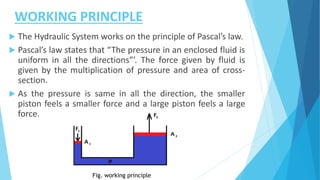
 The Hydraulic System works on the principle of Pascal’s law.
 Pascal’s law states that “The pressure in an enclosed fluid is
uniform in all the directions”’. The force given by fluid is
given by the multiplication of pressure and area of cross-
section.
 As the pressure is same in all the direction, the smaller
piston feels a smaller force and a large piston feels a large
force.
Fig. working principle
SCHEMATIC DIAGRAM OF HYDRAULIC
SYSTEM
Fig. schematic diagram of hydraulic system
COMPONENTS OF HYDRAULIC SYSTEM
 The major components of a hydraulic system are:
 Prime Mover
 Pump
 Control Valves
 Actuators(Hydraulic motors, pistons)
 Fluid
 Filters
 Protective Devices
 Control Devices
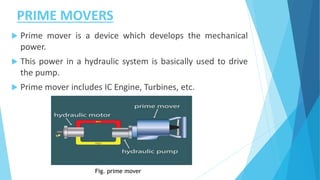
PRIME MOVERS
 Prime mover is a device which develops the mechanical
power.
 This power in a hydraulic system is basically used to drive
the pump.
 Prime mover includes IC Engine, Turbines, etc.
Fig. prime mover
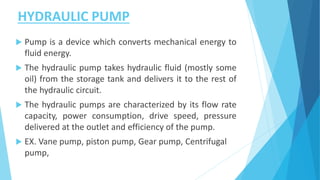
HYDRAULIC PUMP
 Pump is a device which converts mechanical energy to
fluid energy.
 The hydraulic pump takes hydraulic fluid (mostly some
oil) from the storage tank and delivers it to the rest of
the hydraulic circuit.
 The hydraulic pumps are characterized by its flow rate
capacity, power consumption, drive speed, pressure
delivered at the outlet and efficiency of the pump.
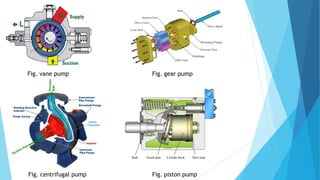
 EX. Vane pump, piston pump, Gear pump, Centrifugal
pump,
Fig. vane pump Fig. gear pump
Fig. centrifugal pump Fig. piston pump
CONTROL VALVES
 The control of the mechanical outputs (motion and force)
is one of the most important functions in a hydraulic
system.
 The proper selection of control selection ensures the
desired output and safe function of the system.
 In order to control the hydraulic outputs, different types of
control valves are required.
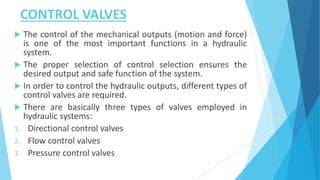
 There are basically three types of valves employed in
hydraulic systems:
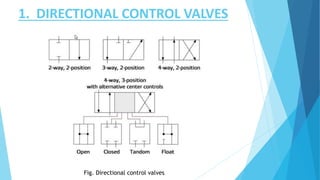
1. Directional control valves
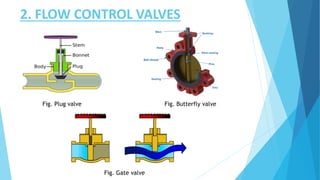
2. Flow control valves
3. Pressure control valves
1. DIRECTIONAL CONTROL VALVES
Fig. Directional control valves
2. FLOW CONTROL VALVES
Fig. Plug valve Fig. Butterfly valve
Fig. Gate valve
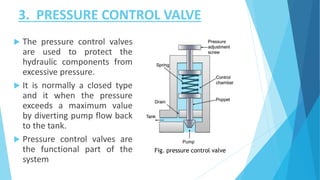
3. PRESSURE CONTROL VALVE
 The pressure control valves
are used to protect the
hydraulic components from
excessive pressure.
 It is normally a closed type
and it when the pressure
exceeds a maximum value
by diverting pump flow back
to the tank.
 Pressure control valves are
the functional part of the
system
Fig. pressure control valve
HYDRAULIC ACTUATORS
 Hydraulic Actuators employ hydraulic pressure to drive an
output member.
 These are used where high speed and large forces are
required.
 The fluid used in hydraulic actuator is highly incompressible.
 They convert fluid power into mechanical power.
 Depending on motion they can be classified as:
 1. Linear actuators: linear motion as output(cylinder
and piston) .
 2. Rotary actuator: rotary motion as output(motor).
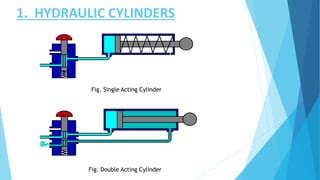
1. HYDRAULIC CYLINDERS
Fig. Single Acting Cylinder
Fig. Double Acting Cylinder
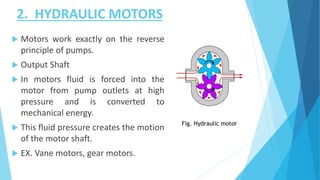
2. HYDRAULIC MOTORS
 Motors work exactly on the reverse
principle of pumps.
 Output Shaft
 In motors fluid is forced into the
motor from pump outlets at high
pressure and is converted to
mechanical energy.
 This fluid pressure creates the motion
of the motor shaft.
 EX. Vane motors, gear motors.
Fig. Hydraulic motor
HYDRAULIC FLUID
 Hydraulic fluid must be essentially non-compressible to be
able to transmit power instantaneously from one part of
the system to another.
 The most common liquid used in hydraulic systems is
petroleum oil because it is only very slightly compressible.
 Properties of hydraulic fluids:
Non compressible Fire resistance
Low toxicity Good lubricator
Low volatility Corrosion control
FILTERS
 The hydraulic fluid is kept clean in
the system with the help of filters
and strainers.
 It removes minute particles from the
fluid, which can cause blocking of
the orifices of servo-valves or cause
jamming of spools.
 EX. Suction filters, pressure side
filters, return side filters, offline
filters. Fig. Filter
APPLICATIONS OF HYDRAULIC
SYSTEMS
 Industrial: Plastic processing machineries, steel making
and primary metal extraction applications, automated
production lines, etc.
 Mobile hydraulics: Tractors, irrigation system, earthmoving
equipment, material handling equipment etc.
 Automobiles: It is used in the systems like breaks, shock
absorbers, steering system, lift and cleaning etc.
 Marine applications: It mostly covers ocean going vessels,
fishing boats and navel equipment.
 Aerospace equipment: There are equipment and systems
used for rudder control, landing gear, breaks etc.
Hydraulic control system

Hydraulic control system

  • 1.
    HYDRAULIC CONTROL SYSTEM PRESENTEDBY :- CHAUDHARY KALPESH (180613119003) MALI DHAVAL .R. (180613119006) PRAJAPATI MEHUL .S. (180613119011) SHAH PRIYANK .P. (180613119014) THAKOR MITESH .R. (180613119016) GUIDED BY :- PROF. A.R.CHAUDHARY
  • 2.
    CONTENT  ABSTRACT  INTRODUCTION WORKING PRINCIPLE  SCHEMATIC DIAGRAM OF HYDRAULIC SYSTEM  COMPONENTS OF HYDRAULIC SYSTEM  APPLICATIONS OF HYDRAULIC CONTROL SYSTEM
  • 3.
    ABSTRACT  Hydraulic controlsystem of butterfly valves are presently valve-controlled and pump-controlled. Valve-controlled hydraulic systems have serious power loss and generate much heat during throttling. Pump- controlled hydraulic systems have no overflow or throttling losses but are limited in the speed adjustment of the variable-displacement pump, generate much noise, pollute the environment, and have motor power that does not match load requirement, resulting in low efficiency under light loads and wearing of the variable-displacement pump. the system is compact, produces a large output force, provide stable transmission.
  • 4.
    INTRODUCTION  The controlledmovement of parts or a controlled application of force is a common requirement in the industries.  These operations are performed mainly by using electrical machines or diesel, petrol and steam engines as a prime mover.  The enclosed fluids (liquids and gases) can also be used as prime movers to provide controlled motion and force to the objects or substances.  The specially designed enclosed fluid systems can provide both linear as well as rotary motion.
  • 5.
    WORKING PRINCIPLE  TheHydraulic System works on the principle of Pascal’s law.  Pascal’s law states that “The pressure in an enclosed fluid is uniform in all the directions”’. The force given by fluid is given by the multiplication of pressure and area of cross- section.  As the pressure is same in all the direction, the smaller piston feels a smaller force and a large piston feels a large force. Fig. working principle
  • 6.
    SCHEMATIC DIAGRAM OFHYDRAULIC SYSTEM Fig. schematic diagram of hydraulic system
  • 7.
    COMPONENTS OF HYDRAULICSYSTEM  The major components of a hydraulic system are:  Prime Mover  Pump  Control Valves  Actuators(Hydraulic motors, pistons)  Fluid  Filters  Protective Devices  Control Devices
  • 8.
    PRIME MOVERS  Primemover is a device which develops the mechanical power.  This power in a hydraulic system is basically used to drive the pump.  Prime mover includes IC Engine, Turbines, etc. Fig. prime mover
  • 9.
    HYDRAULIC PUMP  Pumpis a device which converts mechanical energy to fluid energy.  The hydraulic pump takes hydraulic fluid (mostly some oil) from the storage tank and delivers it to the rest of the hydraulic circuit.  The hydraulic pumps are characterized by its flow rate capacity, power consumption, drive speed, pressure delivered at the outlet and efficiency of the pump.  EX. Vane pump, piston pump, Gear pump, Centrifugal pump,
  • 10.
    Fig. vane pumpFig. gear pump Fig. centrifugal pump Fig. piston pump
  • 11.
    CONTROL VALVES  Thecontrol of the mechanical outputs (motion and force) is one of the most important functions in a hydraulic system.  The proper selection of control selection ensures the desired output and safe function of the system.  In order to control the hydraulic outputs, different types of control valves are required.  There are basically three types of valves employed in hydraulic systems: 1. Directional control valves 2. Flow control valves 3. Pressure control valves
  • 12.
    1. DIRECTIONAL CONTROLVALVES Fig. Directional control valves
  • 13.
    2. FLOW CONTROLVALVES Fig. Plug valve Fig. Butterfly valve Fig. Gate valve
  • 14.
    3. PRESSURE CONTROLVALVE  The pressure control valves are used to protect the hydraulic components from excessive pressure.  It is normally a closed type and it when the pressure exceeds a maximum value by diverting pump flow back to the tank.  Pressure control valves are the functional part of the system Fig. pressure control valve
  • 15.
    HYDRAULIC ACTUATORS  HydraulicActuators employ hydraulic pressure to drive an output member.  These are used where high speed and large forces are required.  The fluid used in hydraulic actuator is highly incompressible.  They convert fluid power into mechanical power.  Depending on motion they can be classified as:  1. Linear actuators: linear motion as output(cylinder and piston) .  2. Rotary actuator: rotary motion as output(motor).
  • 16.
    1. HYDRAULIC CYLINDERS Fig.Single Acting Cylinder Fig. Double Acting Cylinder
  • 17.
    2. HYDRAULIC MOTORS Motors work exactly on the reverse principle of pumps.  Output Shaft  In motors fluid is forced into the motor from pump outlets at high pressure and is converted to mechanical energy.  This fluid pressure creates the motion of the motor shaft.  EX. Vane motors, gear motors. Fig. Hydraulic motor
  • 18.
    HYDRAULIC FLUID  Hydraulicfluid must be essentially non-compressible to be able to transmit power instantaneously from one part of the system to another.  The most common liquid used in hydraulic systems is petroleum oil because it is only very slightly compressible.  Properties of hydraulic fluids: Non compressible Fire resistance Low toxicity Good lubricator Low volatility Corrosion control
  • 19.
    FILTERS  The hydraulicfluid is kept clean in the system with the help of filters and strainers.  It removes minute particles from the fluid, which can cause blocking of the orifices of servo-valves or cause jamming of spools.  EX. Suction filters, pressure side filters, return side filters, offline filters. Fig. Filter
  • 20.
    APPLICATIONS OF HYDRAULIC SYSTEMS Industrial: Plastic processing machineries, steel making and primary metal extraction applications, automated production lines, etc.  Mobile hydraulics: Tractors, irrigation system, earthmoving equipment, material handling equipment etc.  Automobiles: It is used in the systems like breaks, shock absorbers, steering system, lift and cleaning etc.  Marine applications: It mostly covers ocean going vessels, fishing boats and navel equipment.  Aerospace equipment: There are equipment and systems used for rudder control, landing gear, breaks etc.