Performance Evaluation
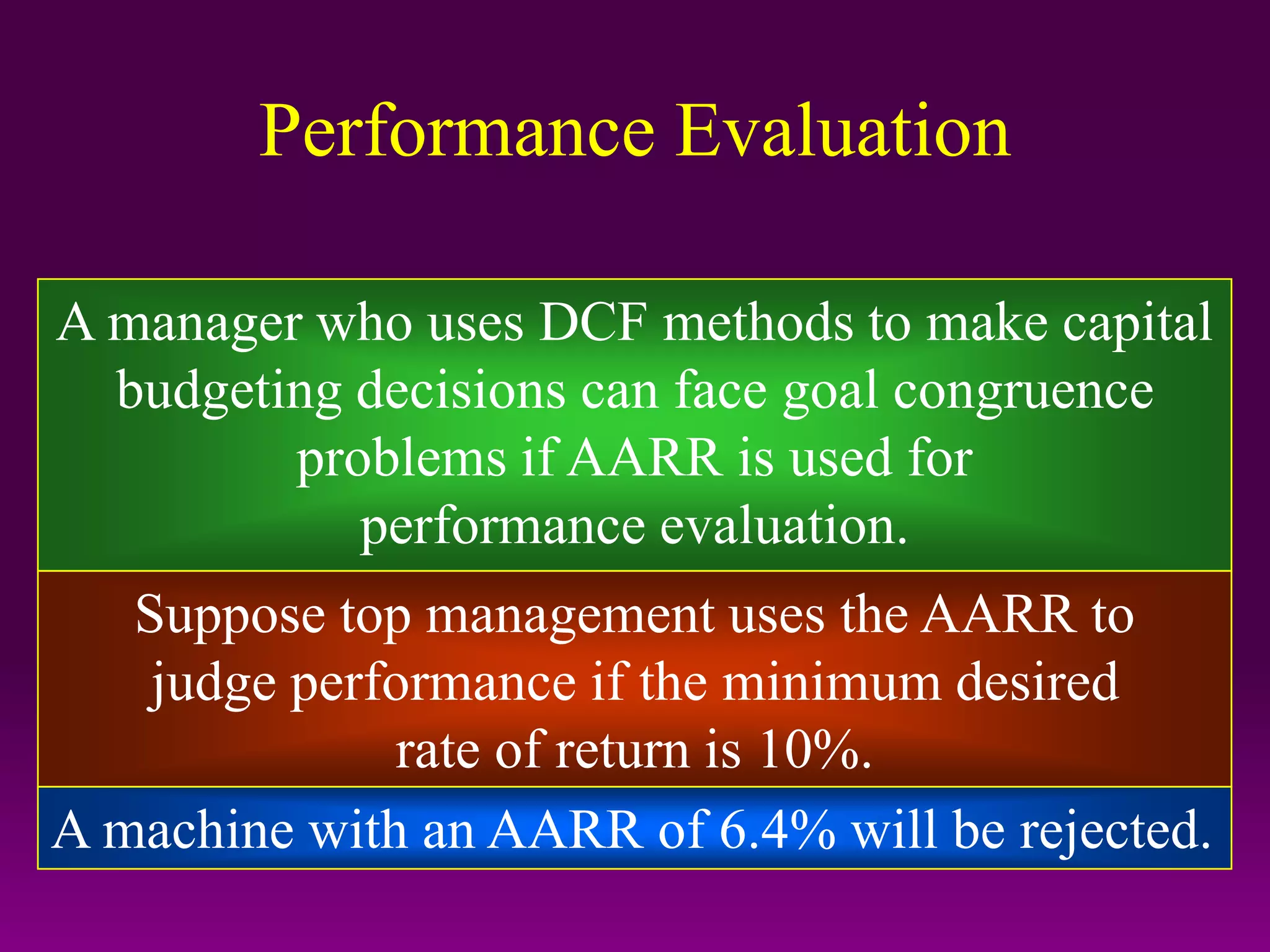
A manager who uses DCF methods to make capital
budgeting decisions can face goal congruence
problems if AARR is used for
performance evaluation.
Suppose top management uses the AARR to
judge performance if the minimum desired
rate of return is 10%.
A machine with an AARR of 6.4% will be rejected.
Performance Evaluation
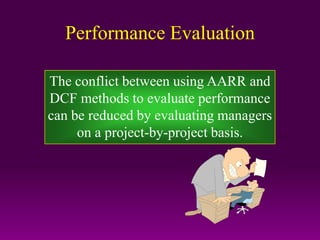
The conflict between using AARR and
DCF methods to evaluate performance
can be reduced by evaluating managers
on a project-by-project basis.
Learning Objective 7
Identify relevant cash
inflows and outflows for
capital budgeting decisions.
Relevant Cash Flows
Relevant cash flows are expected future cash
flows that differ among the alternatives.
Relevant Cash Flows
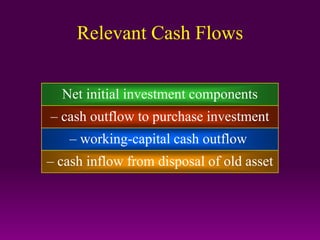
Net initial investment components
– cash outflow to purchase investment
– working-capital cash outflow
– cash inflow from disposal of old asset
Relevant Cash Flow
Analysis Example
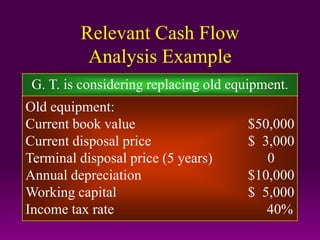
Old equipment:
Current book value $50,000
Current disposal price $ 3,000
Terminal disposal price (5 years) 0
Annual depreciation $10,000
Working capital $ 5,000
Income tax rate 40%
G. T. is considering replacing old equipment.
Relevant Cash Flow
Analysis Example
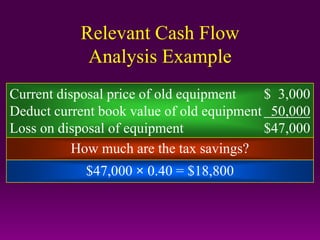
Current disposal price of old equipment $ 3,000
Deduct current book value of old equipment 50,000
Loss on disposal of equipment $47,000
How much are the tax savings?
$47,000 × 0.40 = $18,800
Relevant Cash Flow
Analysis Example
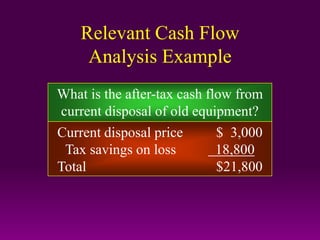
What is the after-tax cash flow from
current disposal of old equipment?
Current disposal price $ 3,000
Tax savings on loss 18,800
Total $21,800
Relevant Cash Flow
Analysis Example
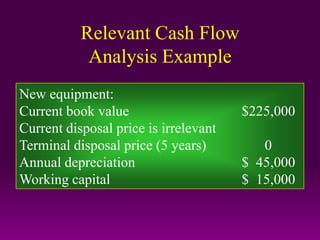
New equipment:
Current book value $225,000
Current disposal price is irrelevant
Terminal disposal price (5 years) 0
Annual depreciation $ 45,000
Working capital $ 15,000
Relevant Cash Flow
Analysis Example
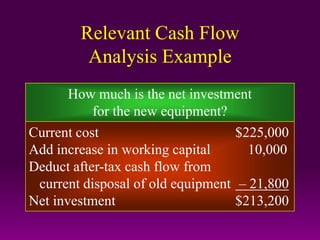
How much is the net investment
for the new equipment?
Current cost $225,000
Add increase in working capital 10,000
Deduct after-tax cash flow from
current disposal of old equipment – 21,800
Net investment $213,200
Relevant Cash Flow
Analysis Example
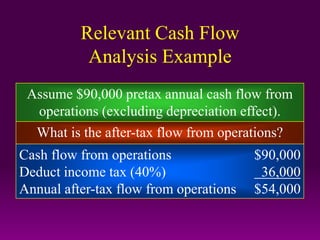
Assume $90,000 pretax annual cash flow from
operations (excluding depreciation effect).
What is the after-tax flow from operations?
Cash flow from operations $90,000
Deduct income tax (40%) 36,000
Annual after-tax flow from operations $54,000
Relevant Cash Flow
Analysis Example
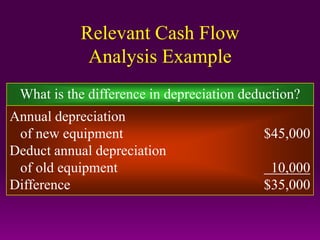
What is the difference in depreciation deduction?
Annual depreciation
of new equipment $45,000
Deduct annual depreciation
of old equipment 10,000
Difference $35,000
Relevant Cash Flow
Analysis Example
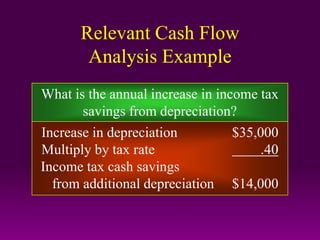
What is the annual increase in income tax
savings from depreciation?
Increase in depreciation $35,000
Multiply by tax rate .40
Income tax cash savings
from additional depreciation $14,000
Relevant Cash Flow
Analysis Example
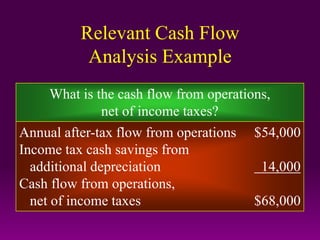
What is the cash flow from operations,
net of income taxes?
Annual after-tax flow from operations $54,000
Income tax cash savings from
additional depreciation 14,000
Cash flow from operations,
net of income taxes $68,000
Relevant Cash Flow
Analysis Example
G. T. requires a 14% rate of return
on its investments.
What is the net present value of the new
equipment incorporating income taxes?
Relevant Cash Flow
Analysis Example
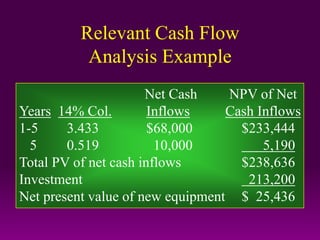
Net Cash NPV of Net
Years 14% Col. Inflows Cash Inflows
1-5 3.433 $68,000 $233,444
5 0.519 10,000 5,190
Total PV of net cash inflows $238,636
Investment 213,200
Net present value of new equipment $ 25,436
Postinvestment Audit
A postinvestment audit compares the actual
results for a project to the costs and benefits
expected at the time the project was selected.
It provides management with feedback
about performance.
Strategic Considerations
Capital investment decisions
that are strategic in nature
require managers to consider
a broad range of factors that
may be difficult to estimate.

4 b. capital budgeting and cost analysis performance evaluation

  • 1.
    Performance Evaluation A managerwho uses DCF methods to make capital budgeting decisions can face goal congruence problems if AARR is used for performance evaluation. Suppose top management uses the AARR to judge performance if the minimum desired rate of return is 10%. A machine with an AARR of 6.4% will be rejected.
  • 2.
    Performance Evaluation The conflictbetween using AARR and DCF methods to evaluate performance can be reduced by evaluating managers on a project-by-project basis.
  • 3.
    Learning Objective 7 Identifyrelevant cash inflows and outflows for capital budgeting decisions.
  • 4.
    Relevant Cash Flows Relevantcash flows are expected future cash flows that differ among the alternatives.
  • 5.
    Relevant Cash Flows Netinitial investment components – cash outflow to purchase investment – working-capital cash outflow – cash inflow from disposal of old asset
  • 6.
    Relevant Cash Flow AnalysisExample Old equipment: Current book value $50,000 Current disposal price $ 3,000 Terminal disposal price (5 years) 0 Annual depreciation $10,000 Working capital $ 5,000 Income tax rate 40% G. T. is considering replacing old equipment.
  • 7.
    Relevant Cash Flow AnalysisExample Current disposal price of old equipment $ 3,000 Deduct current book value of old equipment 50,000 Loss on disposal of equipment $47,000 How much are the tax savings? $47,000 × 0.40 = $18,800
  • 8.
    Relevant Cash Flow AnalysisExample What is the after-tax cash flow from current disposal of old equipment? Current disposal price $ 3,000 Tax savings on loss 18,800 Total $21,800
  • 9.
    Relevant Cash Flow AnalysisExample New equipment: Current book value $225,000 Current disposal price is irrelevant Terminal disposal price (5 years) 0 Annual depreciation $ 45,000 Working capital $ 15,000
  • 10.
    Relevant Cash Flow AnalysisExample How much is the net investment for the new equipment? Current cost $225,000 Add increase in working capital 10,000 Deduct after-tax cash flow from current disposal of old equipment – 21,800 Net investment $213,200
  • 11.
    Relevant Cash Flow AnalysisExample Assume $90,000 pretax annual cash flow from operations (excluding depreciation effect). What is the after-tax flow from operations? Cash flow from operations $90,000 Deduct income tax (40%) 36,000 Annual after-tax flow from operations $54,000
  • 12.
    Relevant Cash Flow AnalysisExample What is the difference in depreciation deduction? Annual depreciation of new equipment $45,000 Deduct annual depreciation of old equipment 10,000 Difference $35,000
  • 13.
    Relevant Cash Flow AnalysisExample What is the annual increase in income tax savings from depreciation? Increase in depreciation $35,000 Multiply by tax rate .40 Income tax cash savings from additional depreciation $14,000
  • 14.
    Relevant Cash Flow AnalysisExample What is the cash flow from operations, net of income taxes? Annual after-tax flow from operations $54,000 Income tax cash savings from additional depreciation 14,000 Cash flow from operations, net of income taxes $68,000
  • 15.
    Relevant Cash Flow AnalysisExample G. T. requires a 14% rate of return on its investments. What is the net present value of the new equipment incorporating income taxes?
  • 16.
    Relevant Cash Flow AnalysisExample Net Cash NPV of Net Years 14% Col. Inflows Cash Inflows 1-5 3.433 $68,000 $233,444 5 0.519 10,000 5,190 Total PV of net cash inflows $238,636 Investment 213,200 Net present value of new equipment $ 25,436
  • 17.
    Postinvestment Audit A postinvestmentaudit compares the actual results for a project to the costs and benefits expected at the time the project was selected. It provides management with feedback about performance.
  • 18.
    Strategic Considerations Capital investmentdecisions that are strategic in nature require managers to consider a broad range of factors that may be difficult to estimate.