Fluid Power with Applications
Anthony Esposito
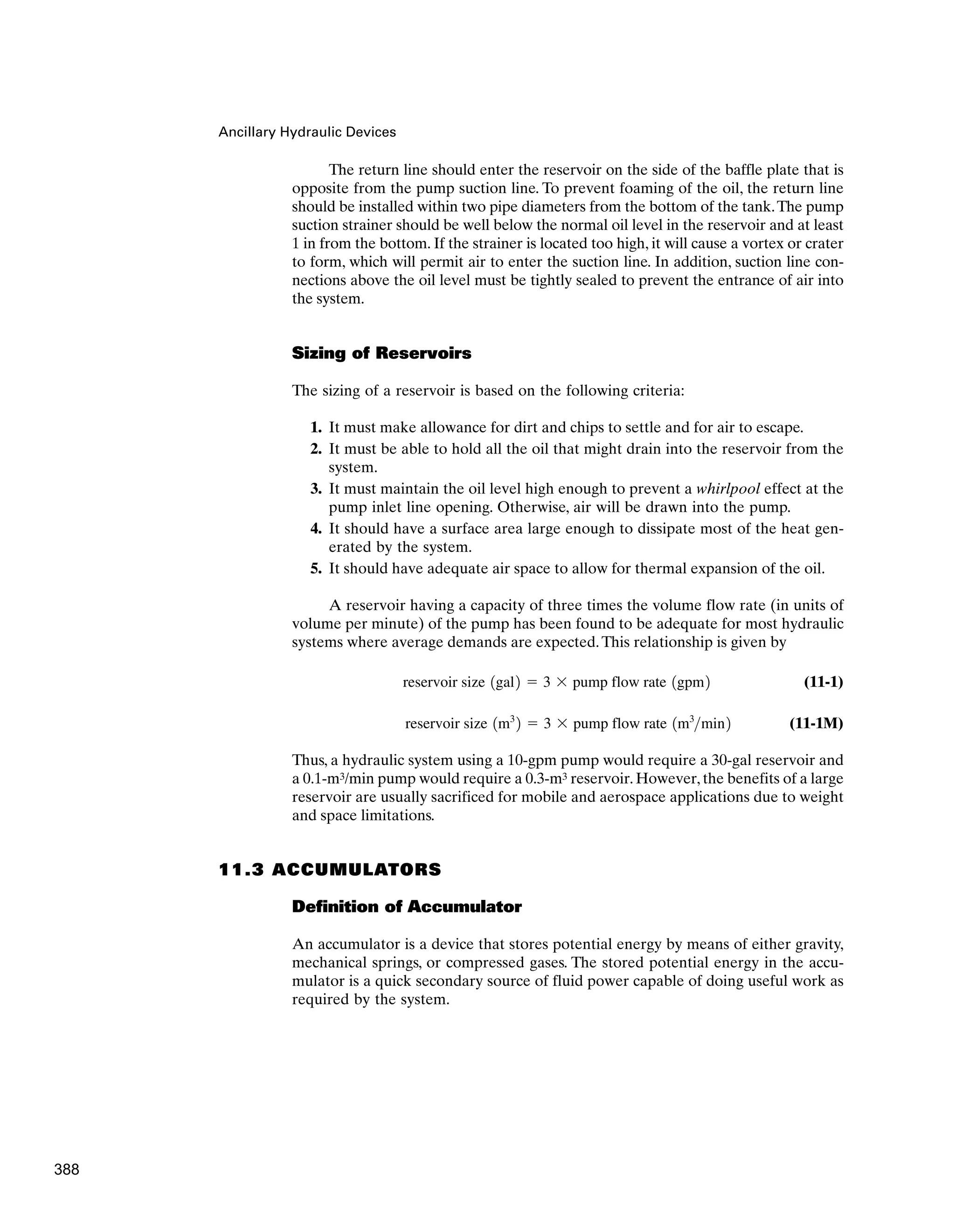
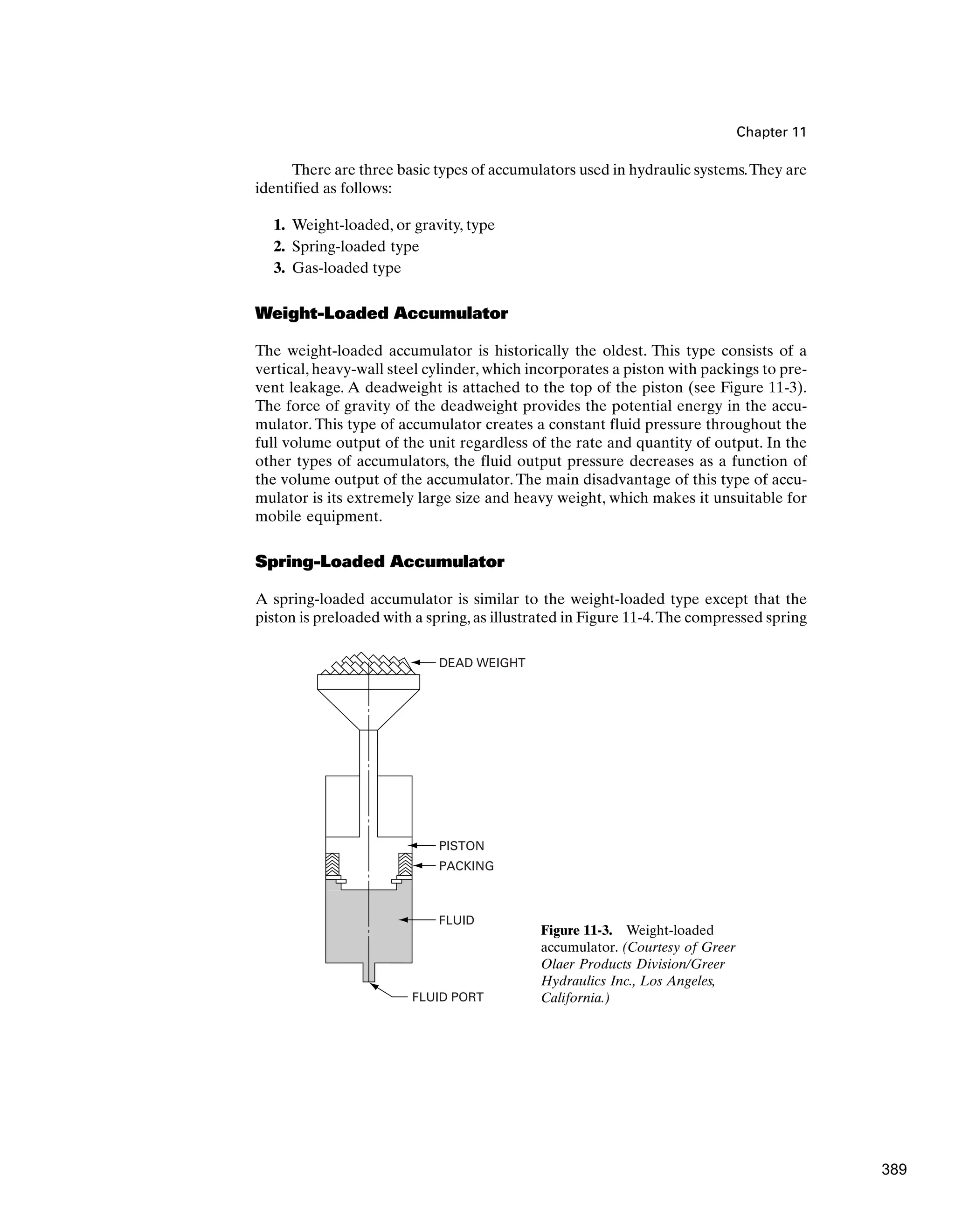
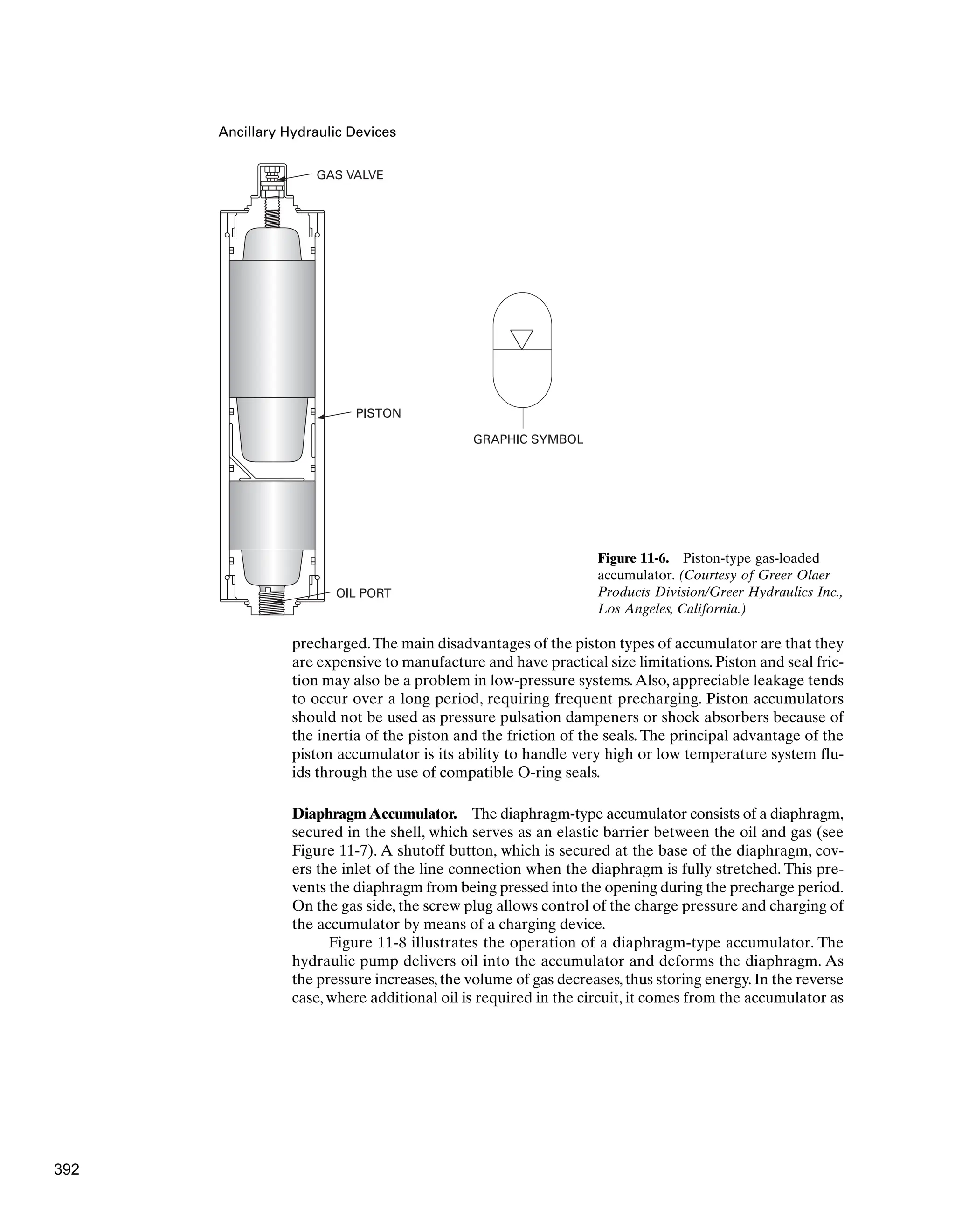
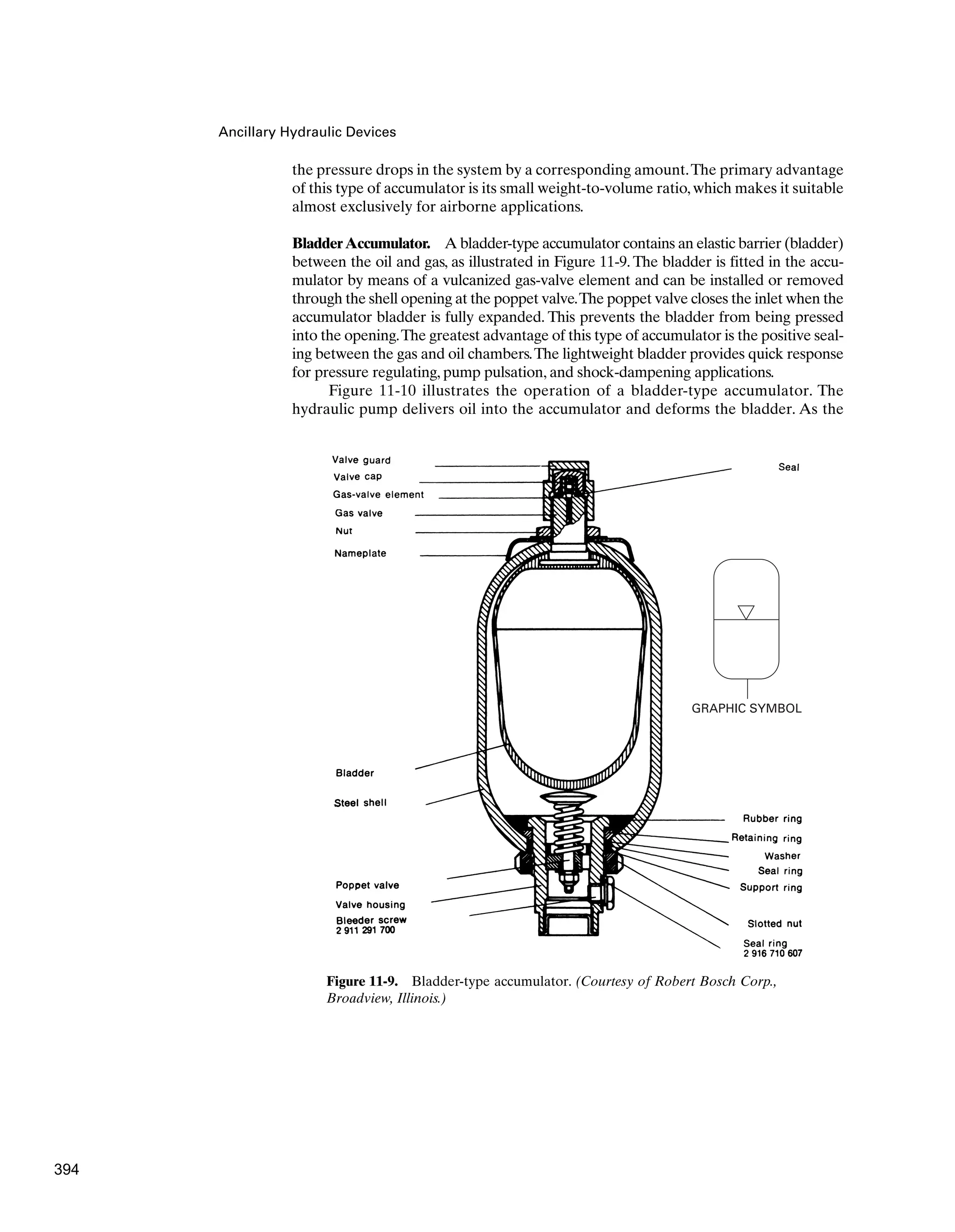
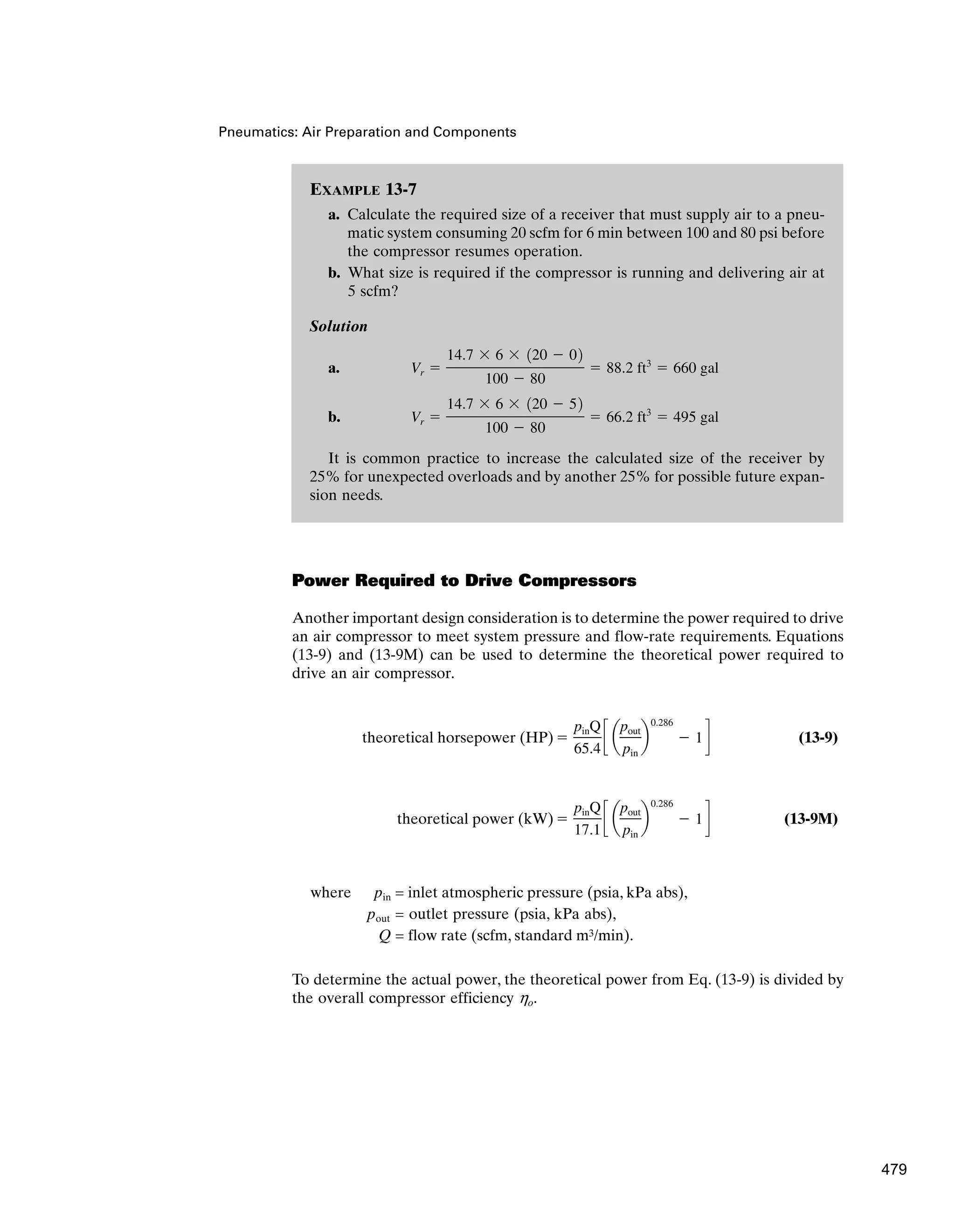
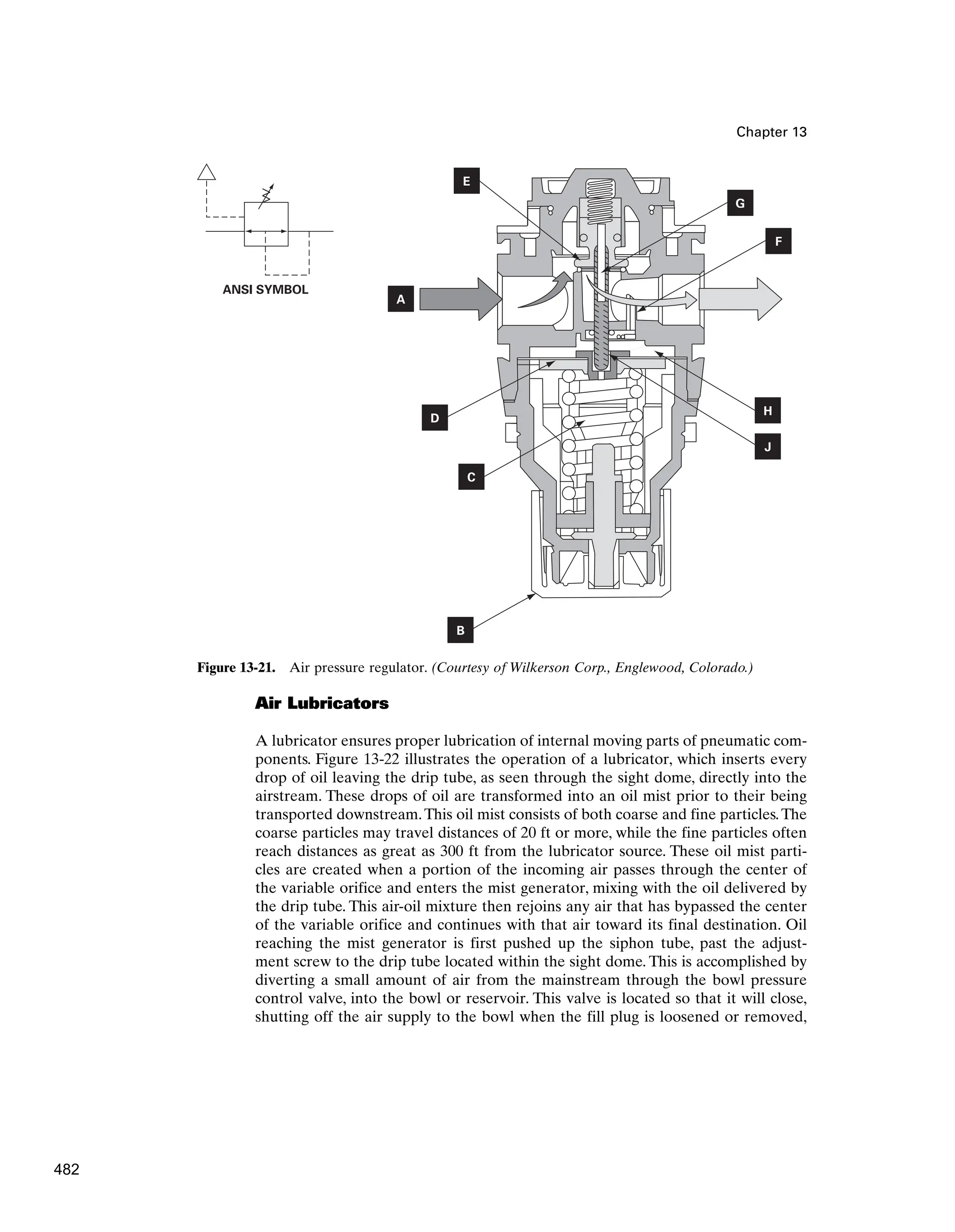
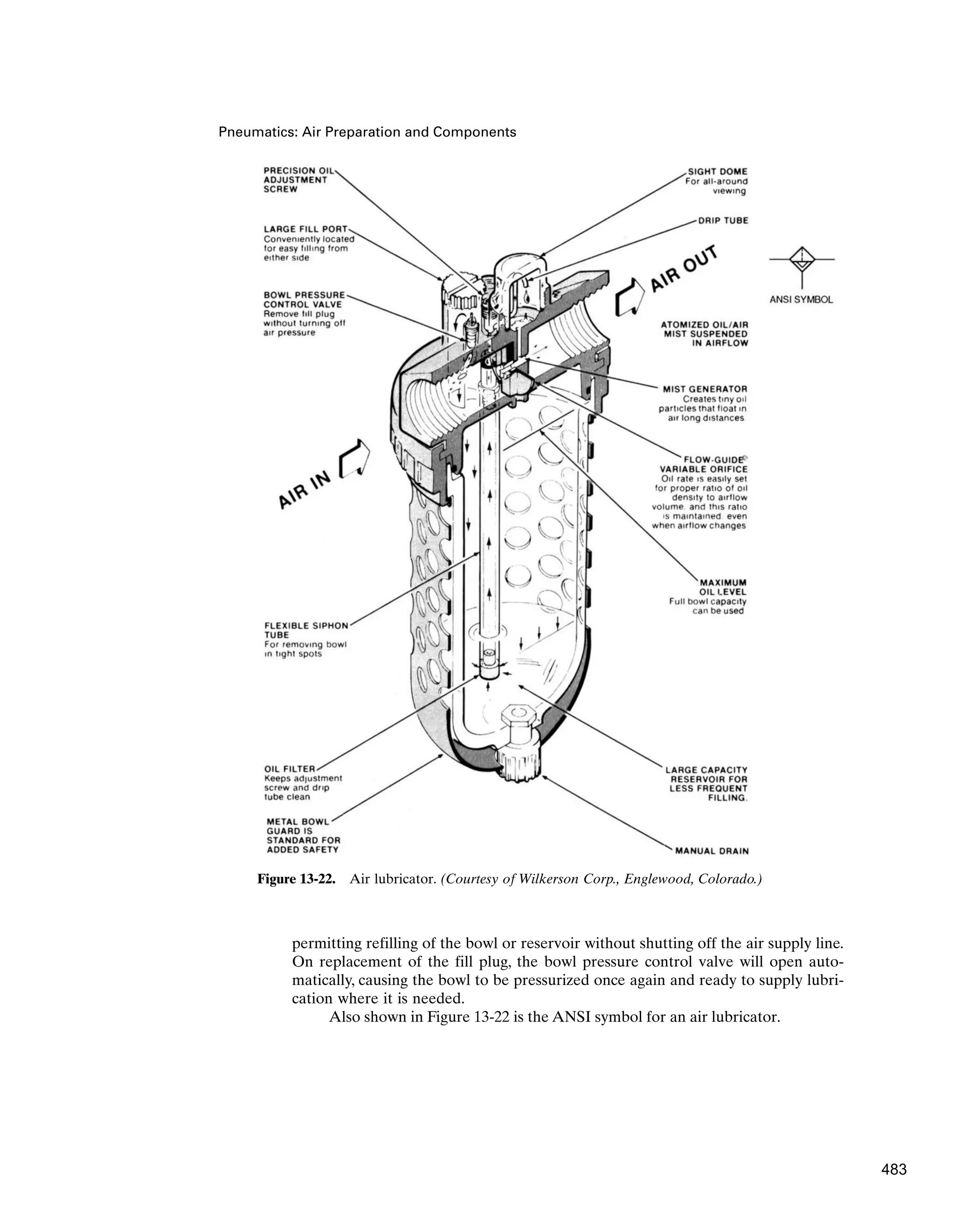
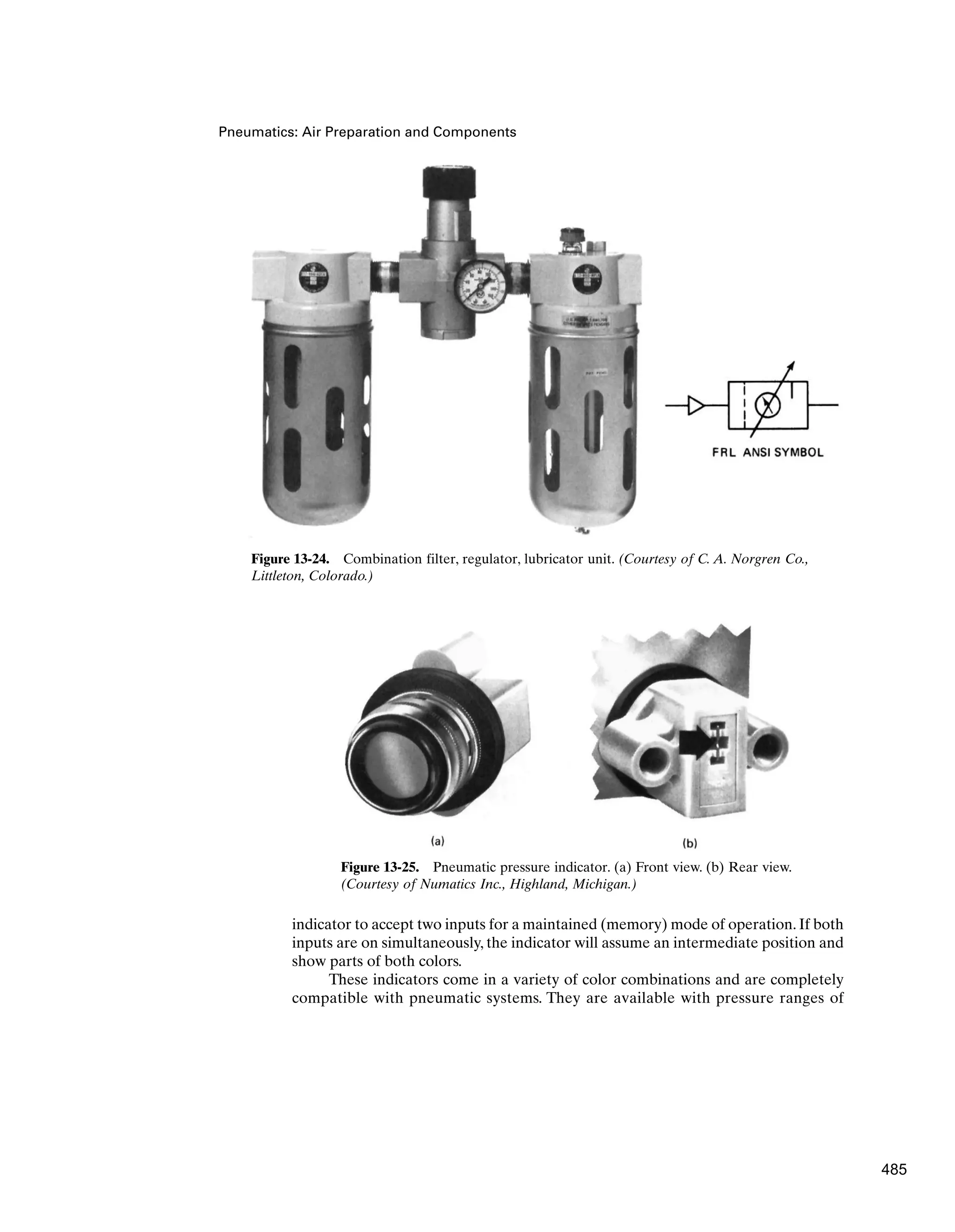
Seventh Edition
Pearson Education Limited
Edinburgh Gate
Harlow
Essex CM20 2JE
England and Associated Companies throughout the world
Visit us on the World Wide Web at: www.pearsoned.co.uk
© Pearson Education Limited 2014
All rights reserved. No part of this publication may be reproduced, stored in a retrieval system, or transmitted
in any form or by any means, electronic, mechanical, photocopying, recording or otherwise, without either the
prior written permission of the publisher or a licence permitting restricted copying in the United Kingdom
issued by the Copyright Licensing Agency Ltd, Saffron House, 6–10 Kirby Street, London EC1N 8TS.
All trademarks used herein are the property of their respective owners. The use of any trademark
in this text does not vest in the author or publisher any trademark ownership rights in such
trademarks, nor does the use of such trademarks imply any affiliation with or endorsement of this
book by such owners.
British Library Cataloguing-in-Publication Data
A catalogue record for this book is available from the British Library
Printed in the United States of America
ISBN 10: 1-292-02387-2
ISBN 13: 978-1-292-02387-8
Table of Contents
P E A R S O N C U S T O M L I B R A R Y
I
Chapter 1. Introduction to Fluid Power
1
Anthony Esposito
Chapter 2. Physical Properties of Hydraulic Fluids
23
Anthony Esposito
Chapter 3. Energy and Power in Hydraulic Systems
59
Anthony Esposito
Chapter 4. Frictional Losses in Hydraulic Pipelines
117
Anthony Esposito
Chapter 5. Hydraulic Pumps
149
Anthony Esposito
Chapter 6. Hydraulic Cylinders and Cushioning Devices
201
Anthony Esposito
Chapter 7. Hydraulic Motors
233
Anthony Esposito
Chapter 8. Hydraulic Valves
265
Anthony Esposito
Chapter 9. Hydraulic Circuit Design and Analysis
311
Anthony Esposito
Chapter 10. Hydraulic Conductors and Fittings
357
Anthony Esposito
Chapter 11. Ancillary Hydraulic Devices
385
Anthony Esposito
Chapter 12. Maintenance of Hydraulic Systems
427
Anthony Esposito
Chapter 13. Pneumatics: Air Preparation and Components
461
Anthony Esposito
II
Chapter 14. Pneumatics: Circuits and Applications
515
Anthony Esposito
Chapter 15. Basic Electrical Controls for Fluid Power Circuits
547
Anthony Esposito
Chapter 16. Fluid Logic Control Systems
569
Anthony Esposito
Chapter 17. Advanced Electrical Controls for Fluid Power Systems
593
Anthony Esposito
Chapter 18. Automation Studio Computer Software
623
Anthony Esposito
Appendix B. Sizes of Steel Pipe (Metric Units)
631
Anthony Esposito
Appendix D. Sizes of Steel Tubing (Metric Units)
633
Anthony Esposito
Answers to Selected Odd-Numbered Exercises
635
Anthony Esposito
641
Index
Learning Objectives
Upon completing this chapter, you should be able to:
1. Explain what fluid power is.
2. Differentiate between the terms hydraulics and pneumatics.
3. Understand the difference between fluid power systems and fluid trans-
port systems.
4. Appreciate the history of the fluid power industry.
5. Discuss the advantages and disadvantages of fluid power.
6. Describe key applications of fluid power.
7. Specify the basic components of fluid power systems.
8. Appreciate the size and scope of the fluid power industry.
9. Identify the categories of personnel who are employed in the fluid power
industry.
1
Introduction to
Fluid Power
1.1 WHAT IS FLUID POWER?
Definition and Terminology
Fluid power is the technology that deals with the generation, control, and trans-
mission of power, using pressurized fluids. It can be said that fluid power is the mus-
cle that moves industry. This is because fluid power is used to push, pull, regulate,
or drive virtually all the machines of modern industry. For example, fluid power
steers and brakes automobiles, launches spacecraft, moves earth, harvests crops,
mines coal, drives machine tools, controls airplanes, processes food, and even drills
teeth. In fact, it is almost impossible to find a manufactured product that hasn’t
been “fluid-powered” in some way at some stage of its production or distribution.
From Chapter 1 of Fluid Power with Applications, Seventh Edition. ­
Anthony Esposito. Copyright © 2009 by
Pearson Education, Inc. Publishing as Prentice Hall. All rights reserved.
1
Chapter 1
Fluid power is called hydraulics when the fluid is a liquid and is called pneumatics
when the fluid is a gas.Thus fluid power is the general term used for both hydraulics
and pneumatics. Hydraulic systems use liquids such as petroleum oils,synthetic oils,and
water. The first hydraulic fluid to be used was water because it is readily available.
However, water has many deficiencies in comparison to hydraulic oils. For example
water freezes more readily, is not as good a lubricant, and tends to rust metal compo-
nents. In spite of these deficiencies, there is a renewed effort underway to return to
water in certain applications because of water’s abundance,nonflammability,and envi-
ronmental cleanliness.When water hydraulics is used, the water contains additives to
improve lubricity and rust protection and prevent freezing where necessary.Hydraulic
oils are currently much more widely used than water, but as environmental concerns
continue to become more serious,water hydraulics is expected to become more preva-
lent. Section 12.17 discusses the applications where water hydraulics should be used
rather than oil hydraulics and the positive impact this would have on the environ-
ment. Pneumatic systems use air as the gas medium because air is very abundant and
can be readily exhausted into the atmosphere after completing its assigned task.
There are actually two different types of fluid systems: fluid transport and
fluid power.
Fluid transport systems have as their sole objective the delivery of a fluid from
one location to another to accomplish some useful purpose. Examples include pump-
ing stations for pumping water to homes, cross-country gas lines, and systems where
chemical processing takes place as various fluids are brought together.
Fluid power systems are designed specifically to perform work. The work is
accomplished by a pressurized fluid bearing directly on an operating fluid cylinder or
fluid motor. A fluid cylinder produces a force resulting in linear motion, whereas a
fluid motor produces a torque resulting in rotary motion. Thus in a fluid power sys-
tem, cylinders and motors (which are also called actuators), provide the muscle to do
the desired work. Of course, control components such as valves are needed to ensure
that the work is done smoothly, accurately, efficiently, and safely.
Hydraulic Chain Saw
Liquids provide a very rigid medium for transmitting power and thus can operate
under high pressures to provide huge forces and torques to drive loads with utmost
accuracy and precision. Figure 1-1 shows a hydraulic chain saw that is ideal for large
tree trimming applications from an aerial bucket as well as for cut-up removal jobs.
These chain saws are commonly used by electric power line crews because they are
lightweight, dependable, quiet, and safer than gasoline-powered saws.The chain saw,
which uses a hydraulic gear motor, has a total weight of 6.7 lb. It operates with a
flow rate range of 4 to 8 gpm and a pressure range of 1000 to 2000 psi.
Pneumatic Chain Hoist
On the other hand, pneumatics systems exhibit spongy characteristics due to the com-
pressibility of air. However, pneumatic systems are less expensive to build and operate.
In addition, provisions can be made to control the operation of the pneumatic actuators
2
Introduction to Fluid Power
Figure 1-1. Hydraulic chain saw. (Courtesy of Greenlee Textron, Inc.,
Rockford, Illinois.)
that drive the loads.Thus pneumatic systems can be used effectively in applications where
low pressures can be used because the loads to be driven do not require large forces.
Figure 1-2 shows a pneumatically powered link chain hoist that has a 4400-lb capac-
ity.The hoist motor receives air at a pressure of 90 psi and flow rates up to 70 cubic ft
per min.Loads can be lifted and lowered at variable speeds up to a maximum of 12 and
24 ft per min respectively. The power trolley traverses along the length of the support
beam at a speed of 70 ft per min.
Figure 1-2. Pneumatically
powered link chain hoist.
(Courtesy of Ingersoll-Rand
Corp., Southern Pines, North
Carolina.)
3
Chapter 1
1.2 HISTORY OF FLUID POWER
Initial Development
Fluid power is probably as old as civilization itself.Ancient historical accounts show
that water was used for centuries to produce power by means of water wheels, and
air was used to turn windmills and propel ships. However, these early uses of fluid
power required the movement of huge quantities of fluid because of the relatively
low pressures provided by nature.
Fluid power technology actually began in 1650 with the discovery of Pascal’s law:
Pressure is transmitted undiminished in a confined body of fluid.
Pascal found that when he rammed a cork down into a jug completely full of
wine, the bottom of the jug broke and fell out. Pascal’s law indicated that the pres-
sures were equal at the top and bottom of the jug. However, the jug has a small open-
ing area at the top and a large area at the bottom.Thus, the bottom absorbs a greater
force due to its larger area.
In 1750, Bernoulli developed his law of conservation of energy for a fluid flow-
ing in a pipeline. Pascal’s law and Bernoulli’s law operate at the very heart of all fluid
power applications and are used for analysis purposes. However, it was not until the
Industrial Revolution of 1850 in Great Britain that these laws would actually be
applied to industry. Up to this time, electrical energy had not been developed to
power the machines of industry. Instead, it was fluid power that, by 1870, was being
used to drive hydraulic equipment such as cranes, presses, winches, extruding
machines, hydraulic jacks, shearing machines, and riveting machines. In these systems,
steam engines drove hydraulic water pumps, which delivered water at moderate pres-
sures through pipes to industrial plants for powering the various machines. These
early hydraulic systems had a number of deficiencies such as sealing problems because
the designs had evolved more as an art than a science.
Then, late in the nineteenth century, electricity emerged as a dominant tech-
nology.This resulted in a shift of development effort away from fluid power. Electri-
cal power was soon found to be superior to hydraulics for transmitting power over
great distances.There was very little development in fluid power technology during
the last 10 years of the nineteenth century.
Beginning of Modern Era
The modern era of fluid power is considered to have begun in 1906 when a hydraulic
system was developed to replace electrical systems for elevating and controlling
guns on the battleship USS Virginia. For this application, the hydraulic system devel-
oped used oil instead of water. This change in hydraulic fluid and the subsequent
solution of sealing problems were significant milestones in the rebirth of fluid power.
In 1926 the United States developed the first unitized, packaged hydraulic sys-
tem consisting of a pump, controls, and actuator. The military requirements leading
up to World War II kept fluid power applications and developments going at a good
pace.The naval industry had used fluid power for cargo handling, winches, propeller
4
Introduction to Fluid Power
pitch control,submarine control systems,operation of shipboard aircraft elevators,and
drive systems for radar and sonar.
During World War II the aviation and aerospace industry provided the impetus
for many advances in fluid power technology. Examples include hydraulic-actuated
landing gears, cargo doors, gun drives, and flight control devices such as rudders,
ailerons, and elevons for aircraft.
Today’s Fluid Power
The expanding economy that followedWorldWar II led to the present situation where
there are virtually a limitless number of fluid power applications. Today fluid power
is used extensively in practically every branch of industry. Some typical applications
are in automobiles, tractors, airplanes, missiles, boats, robots, and machine tools. In the
automobile alone, fluid power is used in hydraulic brakes, automotive transmissions,
power steering, power brakes, air conditioning, lubrication, water coolant, and gaso-
line pumping systems. The innovative use of modern technology such as electrohy-
draulic closed-loop systems, microprocessors, and improved materials for component
construction will continue to advance the performance of fluid power systems.
Figure 1-3(a) is a photograph of a robotized panel bender system that bends
metal sheets into parts called panels. The panels are produced by taking incoming
flat sheets and bending them one or more times along one or more sides.The bend-
ing forces required for the operation of this machine (also called a press-brake) are
provided by a hydraulic press cylinder with a 150-ton capacity. The piston of the
hydraulic cylinder has a stroke of 14 in, a rapid traverse speed of 450 in per min, and
a maximum bending speed of 47 in per min.The system illustrated is computer con-
trolled and utilizes a robot whose movements are coordinated with the movements
of the press-brake. This allows the robot to automatically feed the press-brake with
the metal sheets to be formed into panels. The robot also unloads and stacks the
processed panels so that the entire system can be operated unattended without inter-
ruption.The machine station where the bending operations occur is located just to the
right of the computer console shown in Figure 1-3(a).
Figure 1-3(b) shows examples of several finished panels formed by this system.
This press-brake can handle steel sheets having a thickness in the range of 0.020 in
to 0.120 in.The maximum length and width of incoming sheets that this press-brake
can handle are 100 in and 60 in respectively.The robot gripping device uses pneumatic
suction cups, which allow for the handling of sheets and panels weighing up to 175 lb.
Figure 1-3(c) provides five views of the action of the press-brake tools as they
manipulate the sheets and perform the various bending operations. These tools can
bend sheets through an angle up to 270°.Computer programming and bending process
simulations are generated from a 3D model of the desired panel using CAD/CAM
software.An online graphics interface allows the entire bending sequence to be dis-
played on the computer screen.The software used for simulation and system opera-
tion monitoring are run on the press-brake computer.
Figure 1-4(a) shows the U.S. Air Force B-2 Stealth Bomber, which relies on an
advanced technology hydraulic flight control actuation system for its excellent handling
5
qualities.The B-2 is a low-observable,or stealth,long-range,heavy bomber capable of
penetrating sophisticated and dense air-defense shields. It is capable of all-altitude
attack missions up to 50,000 ft. It has a range of more than 6000 miles unrefueled, a
capacity to carry up to 40,000 lb of weapons and a maximum speed of 475 mph.
Chapter 1
Figure 1-3. Robotized panel bender system with hydraulic press and robot gripper with
pneumatic suction cups. (Courtesy of Salvagnini America, Hamilton, Ohio.)
(a) Robotized panel bender system.
(b) Several finished panels. (c) Five views of bending operations.
6
Introduction to Fluid Power
The B-2’s distinctive profile, which comes from a unique flying-wing construc-
tion,and a special radar-absorbing coating,provide the stealth characteristics.Its uncon-
ventional shape presented a technical challenge to meet the additional requirement of
possessing excellent handling characteristics.This was accomplished by a sophisticated
computerized flight control system that uses a hydraulic flight control servoactuation
Figure 1-4. The B-2 Stealth
Bomber. (Courtesy of
Moog, Inc., East Aurora,
New York.)
(b) B-2 hydraulic flight control servoactuator.
(a) B-2 in flight.
7
Chapter 1
system. Figure 1-4(b) shows the flight control servoactuator, which is a major compo-
nent of the flight control system.This servoactuator includes hydraulic actuators with
direct drive servovalves for controlling aerodynamic surfaces of the all-wing aircraft.
1.3 ADVANTAGES OF FLUID POWER
There are three basic methods of transmitting power: electrical, mechanical, and
fluid power. Most applications actually use a combination of the three methods to
obtain the most efficient overall system. To properly determine which method to
use, it is important to know the salient features of each type. For example, fluid sys-
tems can transmit power more economically over greater distances than can
mechanical types. However, fluid systems are restricted to shorter distances than
are electrical systems.
The secret of fluid power’s success and widespread use is its versatility and man-
ageability.Fluid power is not hindered by the geometry of the machine,as is the case in
mechanical systems.Also,power can be transmitted in almost limitless quantities because
fluid systems are not so limited by the physical limitations of materials as are electrical
systems.For example,the performance of an electromagnet is limited by the saturation
limit of steel. On the other hand, the power capacity of fluid systems is limited only by
the physical strength of the material (such as steel) used for each component.
Industry is going to depend more and more on automation in order to increase
productivity.This includes remote and direct control of production operations, man-
ufacturing processes, and materials handling. Fluid power is well suited for these
automation applications because of advantages in the following four major categories.
1. Ease and accuracy of control. By the use of simple levers and push buttons,
the operator of a fluid power system can readily start,stop,speed up or slow down,and
position forces that provide any desired horsepower with tolerances as precise as one
ten-thousandth of an inch.Figure 1-5 shows a fluid power system that allows an aircraft
pilot to raise and lower his landing gear. When the pilot moves the lever of a small
control valve in one direction, oil under pressure flows to one end of the cylinder to
lower the landing gear.To retract the landing gear, the pilot moves the valve lever in
the opposite direction, allowing oil to flow into the other end of the cylinder.
2. Multiplication of force. A fluid power system (without using cumbersome
gears, pulleys, and levers) can multiply forces simply and efficiently from a fraction
of an ounce to several hundred tons of output. Figure 1-6 shows an application
where a rugged, powerful drive is required for handling huge logs. In this case, a
turntable, which is driven by a hydraulic motor, can carry a 20,000-lb load at a
10-ft radius (a torque of 200,000 ft · lb) under rough operating conditions.
3. Constant force or torque. Only fluid power systems are capable of provid-
ing constant force or torque regardless of speed changes.This is accomplished whether
the work output moves a few inches per hour, several hundred inches per minute, a
few revolutions per hour, or thousands of revolutions per minute. Figure 1-7 shows a
commercial lawn mower that uses a hydrostatic transmission in lieu of gears or
pulleys to change ground speed.The transmission consists of a hydraulic pump that
8
Introduction to Fluid Power
Figure 1-6. Hydraulically driven turntable for handling huge logs. (Courtesy of Eaton
Corp., Fluid Power Division, Eden Prairie, Minnesota.)
Figure 1-5. Hydraulic operation of
aircraft landing gear. (Courtesy of
National Fluid Power Association,
Milwaukee, Wisconsin.)
provides oil under pressure to drive a hydraulic motor at the desired rotational
speed. The two-lever hydrostatic drive controls provide a smooth ride when chang-
ing ground speeds up to a maximum value of 11 mph. This lawn mower, with its
zero turning radius capability, 29-hp gas engine, 72-in deck, and smooth variable
ground speed control, makes quick work of large mowing jobs.
4. Simplicity, safety, economy. In general, fluid power systems use fewer moving
parts than comparable mechanical or electrical systems.Thus,they are simpler to maintain
9
Chapter 1
and operate. This, in turn, maximizes safety, compactness, and reliability. Figure 1-8
shows a fluid power steering control system designed for transportation vehicles.The
steering unit (shown attached to the steering wheel column in Figure 1-8) consists of a
manually operated directional control valve and meter in a single body. Because the
steering unit is fully fluid-linked,mechanical linkages,universal joints,bearings,reduc-
tion gears, and so forth, are eliminated. This provides a simple, compact system. In
addition, very little input torque is required to produce the steering control needed.
Figure 1-7. Commercial lawn mower
with hydrostatic transmission.
(Copyright © 1996–2007. All rights
reserved. Courtesy of Deere & Company,
Cary, North Carolina.)
Figure 1-8. Fluid power steering control
system for transportation vehicles.
(Courtesy of Eaton Corp., Fluid Power
Division, Eden Prairie, Minnesota.)
10
Introduction to Fluid Power
Additional benefits of fluid power systems include instantly reversible motion, auto-
matic protection against overloads, and infinitely variable speed control. Fluid power
systems also have the highest power-per-weight ratio of any known power source.
Drawbacks of Fluid Power
In spite of all the previously mentioned advantages of fluid power, it is not a panacea
for all power transmission applications. Fluid power systems also have some draw-
backs. For example, hydraulic components must be properly designed and installed
to prevent oil leakage from the hydraulic system into the surroundings. Hydraulic
pipeline can burst due to excessive oil pressure if proper system design is not imple-
mented. In pneumatic systems, components such as compressed air tanks and accu-
mulators must be properly selected to handle the system maximum air pressure. In
addition, proper measures must be taken to control the level of noise in the vicin-
ity of fluid power systems. Noise emanates from components such as pumps,
compressors, and pipelines. The underlining theme here is that fluid power systems
must be properly designed, installed, and maintained so that they operate in a safe,
reliable, efficient, and cost-effective manner.
1.4 APPLICATIONS OF FLUID POWER
Although a number of fluid power applications have already been presented, the
following additional examples show more fully the widespread use of fluid in
today’s world.
1. Fluid power drives high-wire overhead tram. Most overhead trams require
a tow cable to travel up or down steep inclines. However, the 22-passenger,
hydraulically powered and controlled Sky-tram shown in Figure 1-9 is unique.It is self-
propelled and travels on a stationary cable. Because the tram moves instead of the
cable, the operator can stop, start, and reverse any one car completely independently
of any other car in the tram system. Integral to the design of the Sky-tram drive is a
pump (driven by a standard eight-cylinder gasoline engine), which supplies pressur-
ized fluid to four hydraulic motors. Each motor drives two friction drive wheels.
Eight drive wheels on top of the cables support and propel the tram car. On
steep inclines, high driving torque is required for ascent and high braking torque
for descent.
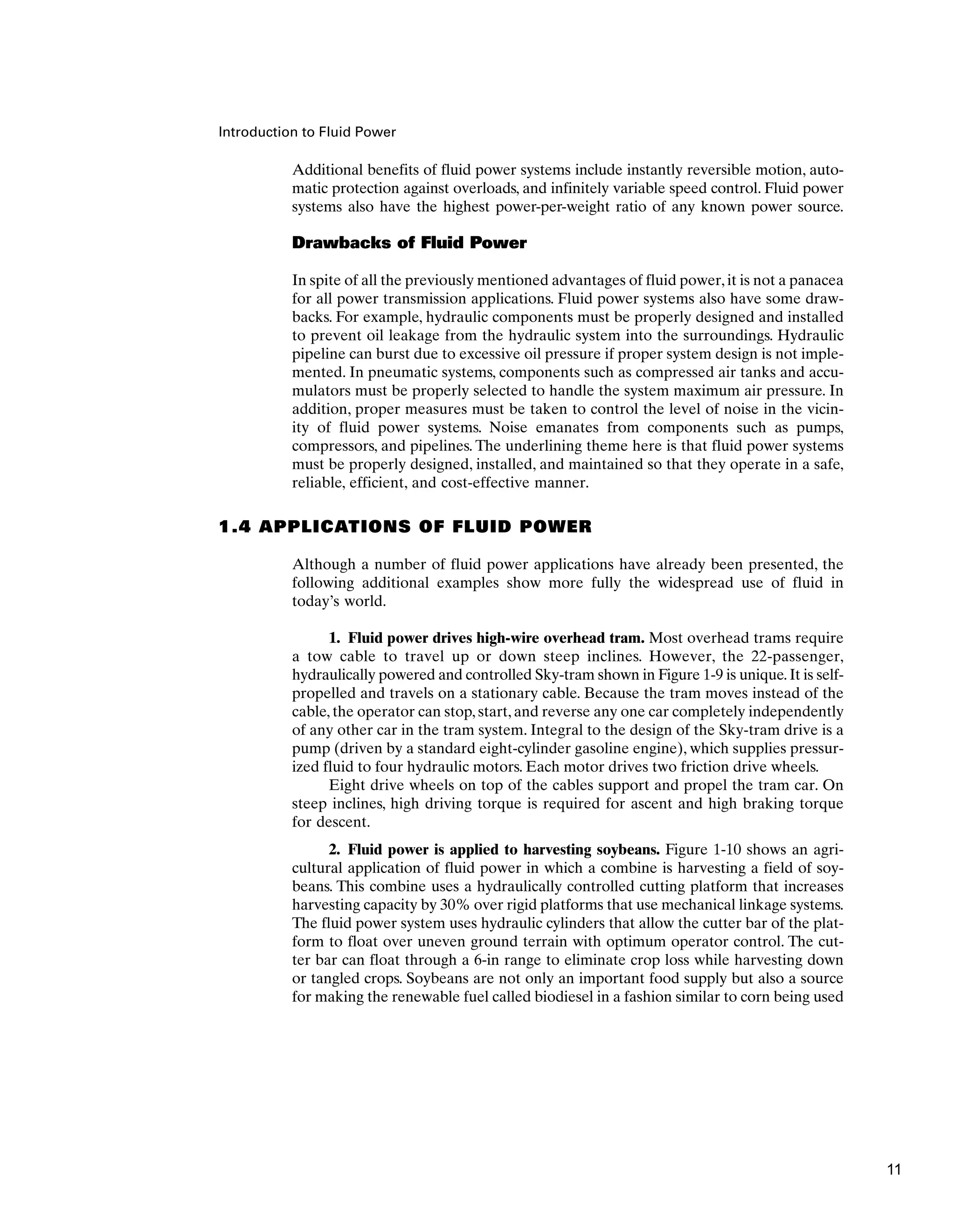
2. Fluid power is applied to harvesting soybeans. Figure 1-10 shows an agri-
cultural application of fluid power in which a combine is harvesting a field of soy-
beans. This combine uses a hydraulically controlled cutting platform that increases
harvesting capacity by 30% over rigid platforms that use mechanical linkage systems.
The fluid power system uses hydraulic cylinders that allow the cutter bar of the plat-
form to float over uneven ground terrain with optimum operator control. The cut-
ter bar can float through a 6-in range to eliminate crop loss while harvesting down
or tangled crops. Soybeans are not only an important food supply but also a source
for making the renewable fuel called biodiesel in a fashion similar to corn being used
11
Chapter 1
to make ethanol.The use of biodiesel and ethanol for transportation vehicles, in lieu
of fossil fuels, reduces greenhouse gases and thus global warming. This agricultural
application of hydraulics is of vital importance to mankind due to the increasing
worldwide demand for food as well as transportation fuels.
Figure 1-9. Hydraulically powered Sky-tram. (Courtesy of Sky-tram Systems, Inc., Scottsdale, Arizona.)
Figure 1-10. Combine with hydraulically
controlled cutting platform in process of
harvesting a field of soybeans. (Copyright ©
1996–2007. All rights reserved. Courtesy of
Deere & Company, Cary, North Carolina.)
12
Introduction to Fluid Power
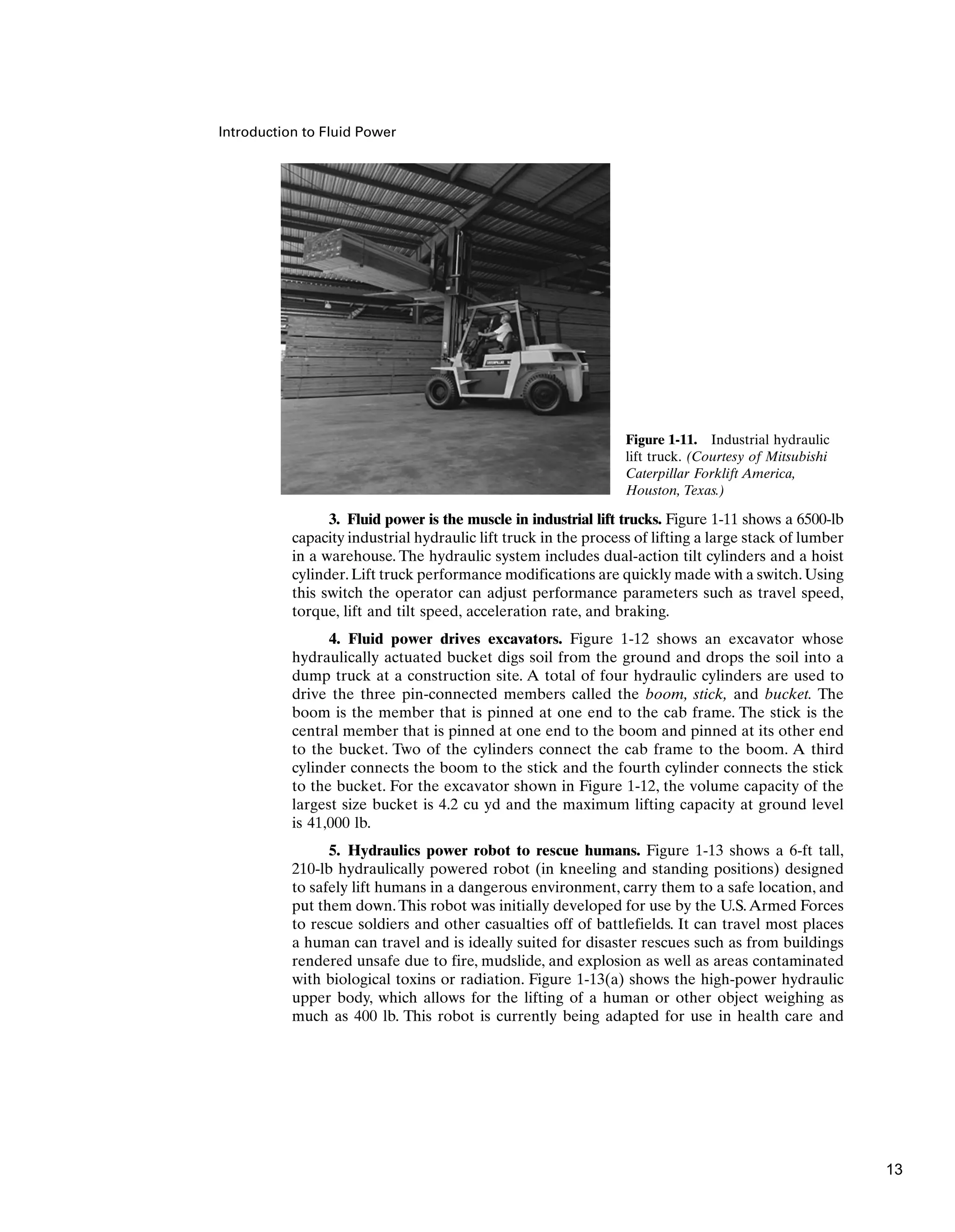
3. Fluid power is the muscle in industrial lift trucks. Figure 1-11 shows a 6500-lb
capacity industrial hydraulic lift truck in the process of lifting a large stack of lumber
in a warehouse. The hydraulic system includes dual-action tilt cylinders and a hoist
cylinder.Lift truck performance modifications are quickly made with a switch.Using
this switch the operator can adjust performance parameters such as travel speed,
torque, lift and tilt speed, acceleration rate, and braking.
4. Fluid power drives excavators. Figure 1-12 shows an excavator whose
hydraulically actuated bucket digs soil from the ground and drops the soil into a
dump truck at a construction site. A total of four hydraulic cylinders are used to
drive the three pin-connected members called the boom, stick, and bucket. The
boom is the member that is pinned at one end to the cab frame. The stick is the
central member that is pinned at one end to the boom and pinned at its other end
to the bucket. Two of the cylinders connect the cab frame to the boom. A third
cylinder connects the boom to the stick and the fourth cylinder connects the stick
to the bucket. For the excavator shown in Figure 1-12, the volume capacity of the
largest size bucket is 4.2 cu yd and the maximum lifting capacity at ground level
is 41,000 lb.
5. Hydraulics power robot to rescue humans. Figure 1-13 shows a 6-ft tall,
210-lb hydraulically powered robot (in kneeling and standing positions) designed
to safely lift humans in a dangerous environment, carry them to a safe location, and
put them down.This robot was initially developed for use by the U.S.Armed Forces
to rescue soldiers and other casualties off of battlefields. It can travel most places
a human can travel and is ideally suited for disaster rescues such as from buildings
rendered unsafe due to fire, mudslide, and explosion as well as areas contaminated
with biological toxins or radiation. Figure 1-13(a) shows the high-power hydraulic
upper body, which allows for the lifting of a human or other object weighing as
much as 400 lb. This robot is currently being adapted for use in health care and
Figure 1-11. Industrial hydraulic
lift truck. (Courtesy of Mitsubishi
Caterpillar Forklift America,
Houston, Texas.)
13
Chapter 1
elder care because lifting patients is a major cause of serious injury among health-
care workers.
6. Hydraulics control the pitch and yaw of wind turbines. Providing sustain-
able power generation is one of the greatest challenges facing mankind.This is because
there is a dire need to reduce greenhouse gases caused by the burning of fossil fuels,
which contributes to global warming. It is also vitally important to reduce the world’s
dependence on fossil fuels for producing energy. The wind is one of the promising
renewable energy sources being harnessed to meet this challenge.Wind turbines are
being installed at a rapidly increasing rate to drive generators that produce electrical
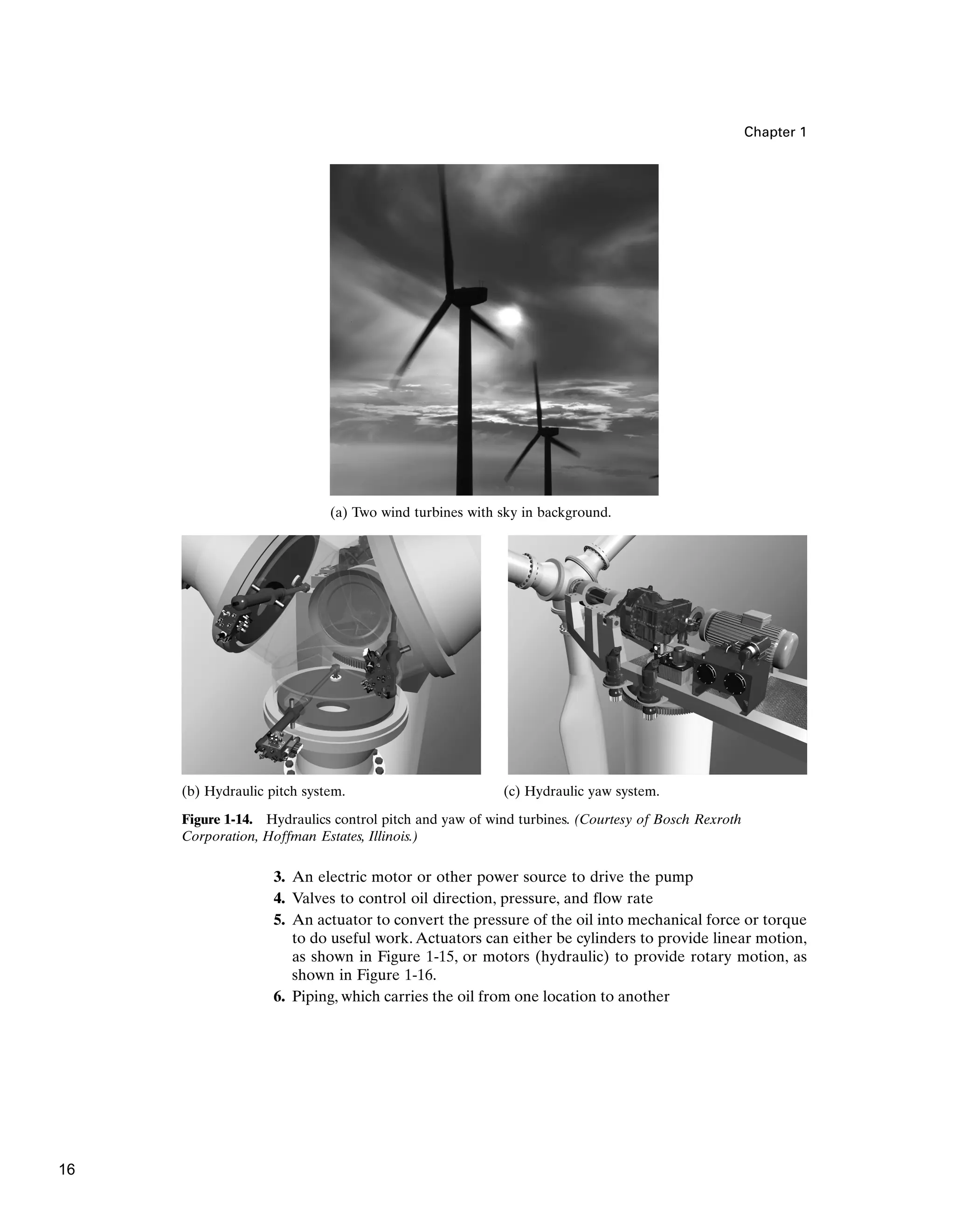
power. Figure 1-14(a) shows two such wind turbines with the sky in the background.
Current technology has made it possible to produce wind turbines with up to a
375-ft rotor diameter,a 400-ft hub height above ground level,and a 5-megawatt (MW)
electrical power output.A 5-MW wind turbine generates enough electricity for about
4000 households and replaces the burning of 15,000 tons of coal per year.
A new innovation in the field of wind turbine technology is the use of hydraulics
to control the pitch and yaw of wind turbines. In order to efficiently produce the
electrical power, it is necessary to accurately control of the pitch (angle) of the rotor
Figure 1-12. Hydraulic-powered excavator. (Courtesy of John Deere Co., Moline,
Illinois.)
14
Introduction to Fluid Power
blades as the speed of the wind changes. During normal operation while the rotor
is revolving, the hydraulic control system will continuously change the pitch a frac-
tion of a degree at a time. In addition, in order to maximize the power and efficiency,
it is necessary for the axis of the rotor, which contains the blades, to be parallel to
the direction of the wind. This is accomplished by what is called yaw control.
Figure 1-14(b) shows a portion of a wind turbine rotor containing three blades.
In this wind turbine the angle of each blade is accurately controlled by a hydraulic
cylinder. Similarly, Figure 1-14(c) shows a hydraulic yaw system that continuously
points the head of the wind turbine rotor into the wind so that it is always facing
the wind. These compact pitch and yaw hydraulic systems not only minimize space
requirements and materials but also provide excellent protection from environment
degradation and physical damage.
1.5 COMPONENTS OF A FLUID POWER SYSTEM
Hydraulic System
There are six basic components required in a hydraulic system (refer to Figure 1-15):
1. A tank (reservoir) to hold the hydraulic oil
2. A pump to force the oil through the system
Figure 1-13. The BEAR: Battlefield Extraction-Assist Robot. (Courtesy of
Vecna Technologies, Inc., Cambridge, Massachusetts.)
(a) Kneeling position. (b) Standing position.
15
Chapter 1
Figure 1-14. Hydraulics control pitch and yaw of wind turbines. (Courtesy of Bosch Rexroth
Corporation, Hoffman Estates, Illinois.)
(b) Hydraulic pitch system. (c) Hydraulic yaw system.
(a) Two wind turbines with sky in background.
3. An electric motor or other power source to drive the pump
4. Valves to control oil direction, pressure, and flow rate
5. An actuator to convert the pressure of the oil into mechanical force or torque
to do useful work. Actuators can either be cylinders to provide linear motion,
as shown in Figure 1-15, or motors (hydraulic) to provide rotary motion, as
shown in Figure 1-16.
6. Piping, which carries the oil from one location to another
16
Introduction to Fluid Power
Of course, the sophistication and complexity of hydraulic systems will vary
depending on the specific applications.This is also true of the individual components
that comprise the hydraulic system.As an example, refer to Figure 1-17, which shows
two different-sized, complete hydraulic power units designed for two uniquely dif-
ferent applications.Each unit is a complete,packaged power system containing its own
electric motor, pump, shaft coupling, reservoir and miscellaneous piping, pressure
gages,valves,and other components as required for proper operation.These hydraulic
components and systems are studied in detail in subsequent chapters.
G
F
OUT
IN
H
E
A
C
D
B
List of Components
A—Reservoir
B—Electric Motor
C—Pump
D—Maximun Pressure
(Relief) Valve
E—Directional Valve
F—Flow Control Valve
G—Right-Angle
Check Valve
H—Cylinder
Figure 1-15. Basic hydraulic system with linear hydraulic actuator (cylinder).
(Courtesy of Sperry Vickers, Sperry Rand Corp., Troy, Michigan.)
RESERVOIR
PUMP
VALVE
MOTOR
Figure 1-16. Basic hydraulic system
with rotary hydraulic actuator
(motor). (Courtesy of Sperry Vickers,
Sperry Rand Corp., Troy, Michigan.)
17
Chapter 1
Figure 1-17. Two different-sized, complete hydraulic power
units. (Courtesy of Continental Hydraulics, Division of
Continental Machines, Inc., Savage, Minnesota.)
Pneumatic System
Pneumatic systems have components that are similar to those used in hydraulic sys-
tems. Essentially the following six basic components are required for pneumatic
systems:
1. An air tank to store a given volume of compressed air
2. A compressor to compress the air that comes directly from the atmosphere
3. An electric motor or other prime mover to drive the compressor
4. Valves to control air direction, pressure, and flow rate
5. Actuators, which are similar in operation to hydraulic actuators
6. Piping to carry the pressurized air from one location to another
Figure 1-18 shows a portable pneumatic power unit with an air compressor that
is pulley driven by a 13-hp gas engine. The compressor operates at pressures up to
175 psi and has a flow rate capacity of 19 cubic ft per min. This system, which has a
30-gal compressed air tank, features truck-bed mounting to meet the needs of field
service applications.
Figure 1-19(a) displays a pneumatic impact wrench designed to tighten and
loosen bolts for maintenance and automotive applications.This impact wrench, which
18
Introduction to Fluid Power
weighs 2.4 lb, has an average air consumption rate of 4 cubic ft per min and a maxi-
mum torque capacity of 280 ft · lb. In Figure 1-19(b) we see this impact wrench in
action as it is being used by a person to torque bolts in an automotive application.An
example of the source of air supply for this impact wrench is the air compressor
system of Figure 1-18.
Figure 1-18. Portable pneumatic
power unit with a gas engine-driven air
compressor. (Courtesy of Ingersoll-Rand
Corp., Davidson, North Carolina.)
Figure 1-19. Pneumatic impact wrench. (IR logo is a registered trademark of Ingersoll-Rand
Company. Courtesy of Ingersoll-Rand Company, Montvale, New Jersey.)
(a) Impact wrench. (b) Impact wrench in action.
19
Chapter 1
In pneumatic systems, after the pressurized air is spent driving actuators, it is
then exhausted back into the atmosphere.On the other hand,in hydraulic systems the
spent oil drains back to the reservoir and is repeatedly reused after being repressur-
ized by the pump as needed by the system.
1.6 THE FLUID POWER INDUSTRY
Size and Scope
The fluid power industry is huge and is truly a global industry. Statistics from the
National Fluid Power Association show the year 2006 sales figure for fluid power
products to be $12.7 billion for U.S. companies. This large annual sales figure is
reflected in the fact that nearly all U.S. manufacturing plants rely on fluid power in
the production of goods. Over half of all U.S. industrial products have fluid power
systems or components as part of their basic design. About 75% of all fluid power
sales are hydraulic and 25% are pneumatic.
Personnel
Technical personnel who work in the fluid power field can generally be placed into
three categories:
1. Fluid power mechanics. Workers in this category are responsible for repair
and maintenance of fluid power equipment.They generally are high school graduates
who have undertaken an apprenticeship training program. Such a program usually
consists of three or four years of paid, on-the-job training plus corresponding
classroom instruction.
2. Fluid power technicians. These people usually assist engineers in areas such
as design, troubleshooting, testing, maintenance, and installation of fluid power sys-
tems. They generally are graduates of two-year technical and community colleges,
which award associate degrees in technology.The technician can advance into super-
visory positions in sales, manufacturing, or service management.
3. Fluid power engineers. This category consists of people who perform design,
development, and testing of new fluid power components or systems.The fluid power
engineer typically is a graduate of a four-year college program. Most engineers who
work on fluid power systems are manufacturing, sales, or mechanical design orient-
ed.They can advance into management positions in design, manufacturing, or sales.
Future Outlook
The future of the fluid power industry is very promising, especially when one con-
siders that the vast majority of all manufactured products have been processed in
some way by fluid power systems. As a result, career opportunities are very bright.
20
Introduction to Fluid Power
The fantastic growth of the fluid power industry has opened many new opportuni-
ties in all areas, including supervisors, engineers, technicians, mechanics, sales per-
sonnel, and operators.
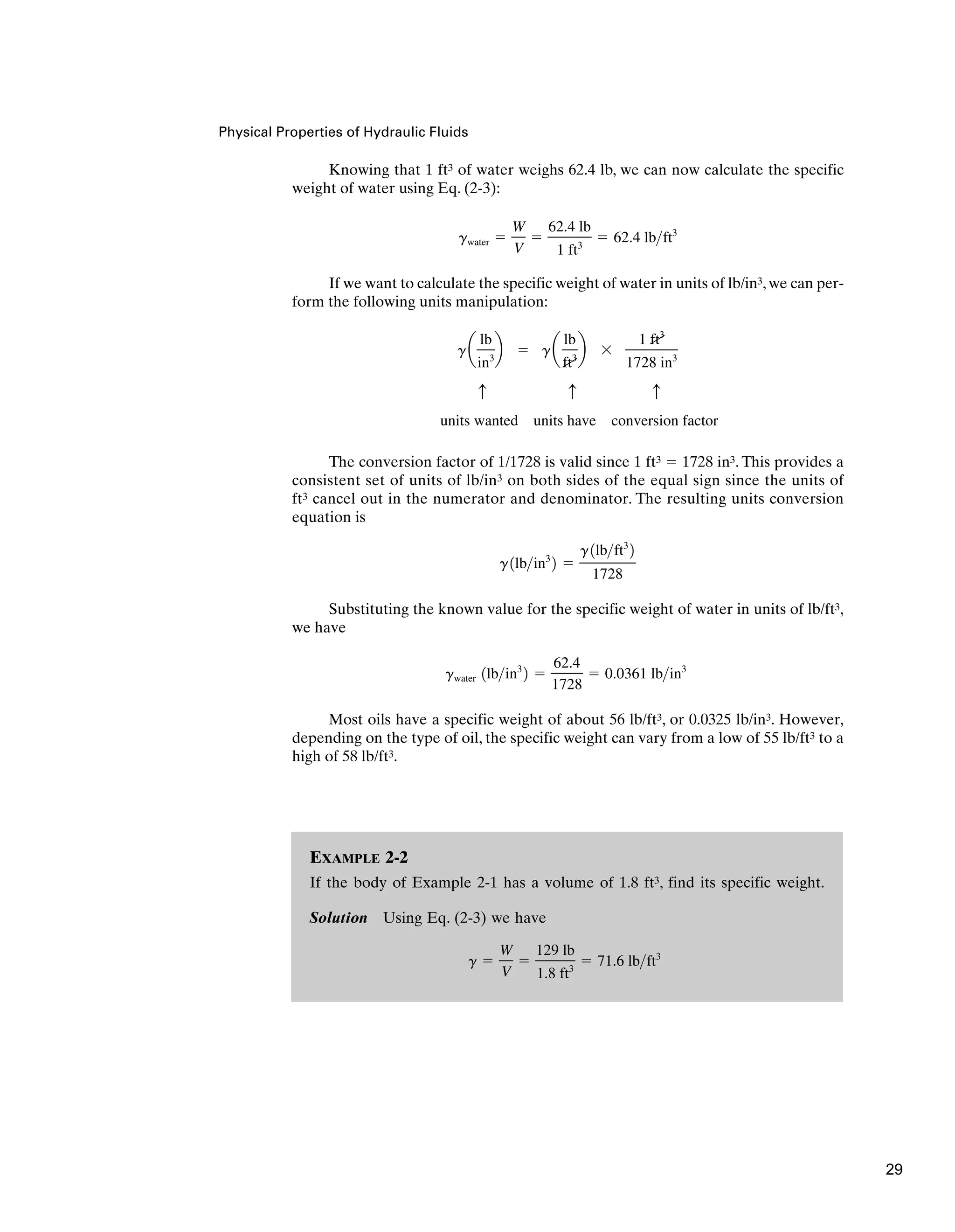
Figure 1-20 shows several engineers using computer technology to develop the
next generation of a hydraulically powered robot.
In addition, a shortage of trained, qualified instructors currently exists. This
shortage exists at universities and four-year colleges as well as at two-year technical
and community colleges. It is hoped that this book will help in some way in the edu-
cation of these fluid power–inspired people.
EXERCISES
1-1. Define the term fluid power.
1-2. Why is hydraulic power especially useful when performing heavy work?
1-3. What is the difference between the terms fluid power and hydraulics and pneumatics?
1-4. Compare the use of fluid power to a mechanical system by listing the advantages and
disadvantages of each.
Figure 1-20. Technical Engineer Jessica Reed and Robotics Product Manager
Jamie Nichol, developing the next generation of the Battlefield Extraction-Assist
Robot, or BEAR, at Vecna’s Cambridge Research Laboratory in Cambridge,
Massachusetts. Software Engineer Benjamin Bau works on related systems in
background. (Photo by Jonathan Klein. Courtesy of Vecna Technologies, Inc.,
Cambridge, Massachusetts.)
21
Chapter 1
1-5. Differentiate between fluid transport and fluid power systems.
1-6. Comment on the difference between using pneumatic fluid power and hydraulic
fluid power.
1-7. What hydraulic device creates a force that can push or pull a load?
1-8. What hydraulic device creates a torque that can rotate a shaft?
1-9. What two factors are responsible for the high responsiveness of hydraulic devices?
1-10. Why can’t air be used for all fluid power applications?
1-11. What is the prime mover?
1-12. Name the six basic components required in a hydraulic circuit.
1-13. Name the six basic components required in a pneumatic circuit.
1-14. Take a plant tour of a company that manufactures fluid power components such as
pumps, cylinders, valves, or motors.Write a report stating how at least one component
is manufactured. List the specifications and include potential customer applications.
1-15. List five applications of fluid power in the automotive industry.
1-16. Give one reason why automotive hydraulic brakes might exhibit a spongy feeling
when a driver pushes on the brake pedal.
1-17. Name five hydraulic applications and five pneumatic applications.
1-18. Approximately what percentage of all fluid power sales are for hydraulic and for
pneumatic components?
1-19. What three types of personnel work in the fluid power industry?
1-20. Discuss the phrase “the size and scope of fluid power.” Cite two facts that show the
size of the fluid power industry.
1-21. Obtain from the Fluid Power Society (www.ifps.org) the requirements to become
a certified fluid power technician.
1-22. Contact the National Fluid Power Association (www.nfpa.com) to determine the
requirements for becoming a fluid power engineer.
22
Learning Objectives
Upon completing this chapter, you should be able to:
1. Explain the primary functions of a hydraulic fluid.
2. Define the term fluid.
3. Distinguish between a liquid and a gas.
4. Appreciate the properties desired of a hydraulic fluid.
5. Define the terms specific weight, density, and specific gravity.
6. Understand the terms pressure, head, and force.
7. Differentiate between gage pressures and absolute pressures.
8. Calculate the force created by a pressure.
9. Understand the terms kinematic viscosity and absolute viscosity.
10. Convert viscosity from one set of units to another set of units.
11. Explain the difference between viscosity and viscosity index.
2
Physical Properties
of Hydraulic Fluids
2.1 INTRODUCTION
The single most important material in a hydraulic system is the working fluid itself.
Hydraulic fluid characteristics have a crucial effect on equipment performance and
life. It is important to use a clean, high-quality fluid in order to achieve efficient
hydraulic system operation.
Most modern hydraulic fluids are complex compounds that have been carefully
prepared to meet their demanding tasks. In addition to having a base fluid, hydraulic
fluids contain special additives to provide desired characteristics.
From Chapter 2 of Fluid Power with Applications, Seventh Edition. ­
Anthony Esposito. Copyright © 2009 by
Pearson Education, Inc. Publishing as Prentice Hall. All rights reserved.
23
Chapter 2
A hydraulic fluid has the following four primary functions:
1. Transmit power
2. Lubricate moving parts
3. Seal clearances between mating parts
4. Dissipate heat
In addition a hydraulic fluid must be inexpensive and readily available. To
accomplish properly the four primary functions and be practical from a safety and
cost point of view, a hydraulic fluid should have the following properties:
1. Good lubricity
2. Ideal viscosity
3. Chemical stability
4. Compatibility with system materials
5. High degree of incompressibility
6. Fire resistance
7. Good heat-transfer capability
8. Low density
9. Foam resistance
10. Nontoxicity
11. Low volatility
This is a challenging list, and no single hydraulic fluid possesses all of these
desirable characteristics.The fluid power designer must select the fluid that comes the
closest to being ideal overall for a particular application.
Hydraulic fluids must also be changed periodically, the frequency depending
not only on the fluid but also on the operating conditions. Laboratory analysis is the
best method for determining when a fluid should be changed. Generally speaking,
a fluid should be changed when its viscosity and acidity increase due to fluid break-
down or contamination. Preferably, the fluid should be changed while the system is
at operating temperature.In this way,most of the impurities are in suspension and will
be drained off.
Much hydraulic fluid has been discarded in the past due to the possibility that
contamination existed—it costs more to test the fluid than to replace it.This situation
has changed as the need to conserve hydraulic fluids has developed. Figure 2-1 shows
a hydraulic fluid test kit that provides a quick, easy method to test hydraulic system
contamination. Even small hydraulic systems may be checked. The test kit may be
used on the spot to determine whether fluid quality permits continued use.Three key
quality indicators can be evaluated: viscosity, water content, and foreign particle con-
tamination level.
In this chapter we examine the physical properties of fluids dealing with the
transmission of power. These properties include density, pressure, compressibility,
viscosity, and viscosity index. In Chapter 12 we discuss the types of fluids used in
24
Physical Properties of Hydraulic Fluids
Figure 2-1. Hydraulic fluid
test kit. (Courtesy of Gulf Oil
Corp., Houston, Texas.)
hydraulic systems and the chemical-related properties dealing with maintenance of
the quality of these hydraulic fluids. These properties include rate of oxidation, fire
resistance, foam resistance, lubricating ability, and acidity.
2.2 FLUIDS: LIQUIDS AND GASES
Liquids
The term fluid refers to both gases and liquids. A liquid is a fluid that, for a given
mass,will have a definite volume independent of the shape of its container.This means
that even though a liquid will assume the shape of the container, it will fill only that
part of the container whose volume equals the volume of the quantity of the liquid.
For example, if water is poured into a vessel and the volume of water is not sufficient
to fill the vessel, a free surface will be formed, as shown in Figure 2-2(a). A free
surface is also formed in the case of a body of water, such as a lake, exposed to the
atmosphere [see Figure 2-2(b)].
Liquids are considered to be incompressible so that their volume does not
change with pressure changes.This is not exactly true, but the change in volume due
to pressure changes is so small that it is ignored for most engineering applications.
Variations from this assumption of incompressibility are discussed in Section 2.6,
where the parameter bulk modulus is defined.
Gases
Gases, on the other hand, are fluids that are readily compressible. In addition, their
volume will vary to fill the vessel containing them. This is illustrated in Figure 2-3,
25
Chapter 2
where a gas is allowed to enter an empty, closed vessel. As shown, the gas mole-
cules always fill the entire vessel. Therefore, unlike liquids, which have a definite
volume for a given mass, the volume of a given mass of a gas will increase to fill
the vessel that contains it. Gases are greatly influenced by the pressure to which
they are subjected.An increase in pressure causes the volume of the gas to decrease,
and vice versa. Figure 2-4 summarizes the key physical differences between liquids
and gases for a given mass.
FREE SURFACE
FREE SURFACE
(a)
(b)
LAKE
WATER
Figure 2-2. Free surface of a
liquid.
GAS
MOLECULES
Figure 2-3. A gas always fills
its entire vessel.
Parameter Liquid Gas
Volume Has its own volume Volume is determined by
container
Shape Takes shape of container Expands to completely fill
but only to its volume and take the shape of
the container
Compressibility Incompressible for most Readily compressible
engineering applications
Figure 2-4. Physical differences between liquids and gases.
26
Physical Properties of Hydraulic Fluids
Air is the only gas commonly used in fluid power systems because it is inexpen-
sive and readily available.Air also has the following desirable features as a power fluid:
1. It is fire resistant.
2. It is not messy.
3. It can be exhausted back into the atmosphere.
The disadvantages of using air versus using hydraulic oil are:
1. Due to its compressibility, air cannot be used in an application where accurate
positioning or rigid holding is required.
2. Because air is compressible, it tends to be sluggish.
3. Air can be corrosive, since it contains oxygen and water.
4. A lubricant must be added to air to lubricate valves and actuators.
5. Air pressures of greater than 250 psi are typically not used due to the explosion
dangers involved if components such as air tanks should rupture.This is because
air (due to its compressibility) can store a large amount of energy as it is
compressed in a manner similar to that of a mechanical spring.
2.3 SPECIFIC WEIGHT, DENSITY, AND SPECIFIC GRAVITY
Weight Versus Mass
All objects, whether solids or fluids, are pulled toward the center of the earth by a
force of attraction. This force is called the weight of the object and is proportional
to the object’s mass, as defined by
(2-1)
where, in the English system of units (also called U.S. customary units and used
extensively in the United States) we have
F  force in units of lb,
W  weight in units of lb,
m  mass of object in units of slugs,
g proportionality constant called the acceleration of gravity, which equals
32.2 ft/s2 at sea level.
A mass of 1 slug is defined as the mass of a platinum-iridium bar at the National
Institute of Standards and Technology near Washington, DC.
From Eq. (2-1), W equals 32.2 lb if m is 1 slug. Therefore, 1 slug is the amount
of mass that weighs 32.2 lb.We can also conclude from Eq. (2-1) that 1 lb is defined
as the force that will give a mass of 1 slug an acceleration of 1 ft/s2.
F  W  mg
27
Chapter 2
Specific Weight
Figure 2-5 shows a cubic container full of water as an example for discussing the
fluid property called specific weight. Since the container has the shape of a rectan-
gular solid, its volume can be calculated using Eq. (2-2).
(2-2)
Substituting values yields
It has been found by measurement that 1 ft3 of water weighs 62.4 lb. Specific
weight is defined as weight per unit volume. Stated mathematically, we have
or
(2-3)
where γ  Greek symbol gamma  specific weight (lb/ft3),
W  weight (lb),
V  volume (ft3).
g 
W
V
specific weight 
weight
volume
volume  11 ft  1 ft2  11 ft2  1 ft3
volume  1area of base2  1height2
1 FT
1 FT
1 FT
Figure 2-5. Cubic container
full of water.
EXAMPLE 2-1
Find the weight of a body having a mass of 4 slugs.
Solution Substituting into Eq. (2-1) yields
W  mg  4 slugs  32.2 fts2
 129 lb
28
Physical Properties of Hydraulic Fluids
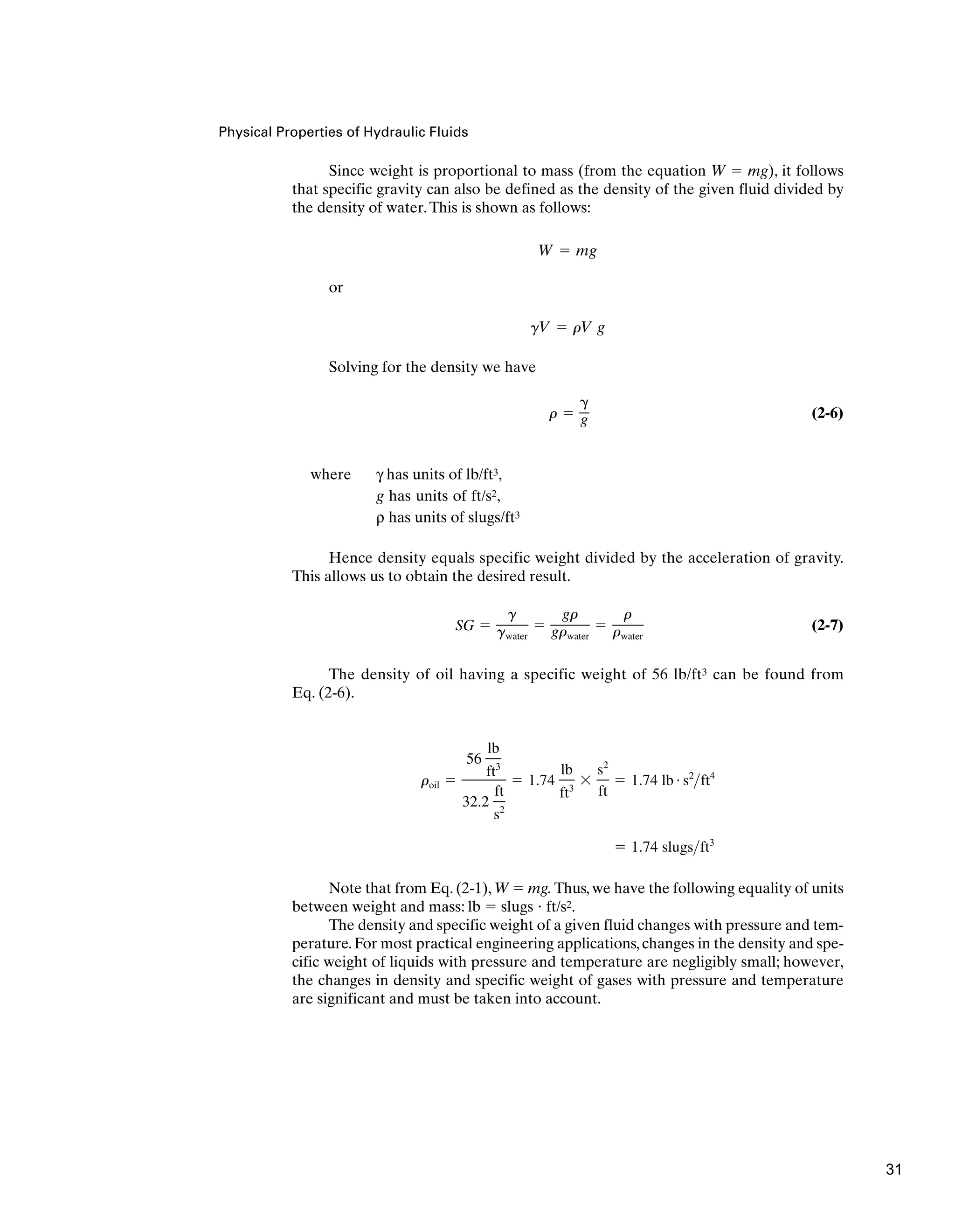
Knowing that 1 ft3 of water weighs 62.4 lb, we can now calculate the specific
weight of water using Eq. (2-3):
If we want to calculate the specific weight of water in units of lb/in3, we can per-
form the following units manipulation:
The conversion factor of 1/1728 is valid since 1 ft3  1728 in3. This provides a
consistent set of units of lb/in3 on both sides of the equal sign since the units of
ft3 cancel out in the numerator and denominator. The resulting units conversion
equation is
Substituting the known value for the specific weight of water in units of lb/ft3,
we have
Most oils have a specific weight of about 56 lb/ft3, or 0.0325 lb/in3. However,
depending on the type of oil, the specific weight can vary from a low of 55 lb/ft3 to a
high of 58 lb/ft3.
gwater 1lbin3
2 
62.4
1728
 0.0361 lbin3
g1lbin3
2 
g1lbft3
2
1728
units wanted units have conversion factor
c c c
ga
lb
in3
b  ga
lb
ft3
b 
1 ft3
1728 in3
gwater 
W
V

62.4 lb
1 ft3
 62.4 lbft3
EXAMPLE 2-2
If the body of Example 2-1 has a volume of 1.8 ft3, find its specific weight.
Solution Using Eq. (2-3) we have
g 
W
V

129 lb
1.8 ft3
 71.6 lbft3
29
Chapter 2
Specific Gravity
The specific gravity (SG) of a given fluid is defined as the specific weight of the
fluid divided by the specific weight of water.Therefore, the specific gravity of water
is unity by definition. The specific gravity of oil can be found using
(2-4)
Substituting the most typical value of specific weight for oil we have
Note that specific gravity is a dimensionless parameter (has no units).
1SG2oil 
56 lbft3
62.4 lbft3
 0.899
1SG2oil 
goil
gwater
EXAMPLE 2-3
Air at 68°F and under atmospheric pressure has a specific weight of 0.0752 lb/ft3.
Find its specific gravity.
Solution
Thus, water is 1/0.00121 times, or about 830 times, as heavy as air at 68°F
and under atmospheric pressure. It should be noted that since air is highly
compressible, the value of 0.00121 for SG is valid only at 68°F and under
atmospheric pressure.
1SG2air 
gair
gwater

0.0752 lbft3
62.4 lbft3
 0.00121
Density
In addition to specific weight,we can also talk about the fluid property called density,
which is defined as mass per unit volume:
(2-5)
where ρ  Greek symbol rho  density (slugs/ft3),
m  mass (slugs),
V  volume (ft3).
r 
m
V
30
Physical Properties of Hydraulic Fluids
Since weight is proportional to mass (from the equation W  mg), it follows
that specific gravity can also be defined as the density of the given fluid divided by
the density of water.This is shown as follows:
or
Solving for the density we have
(2-6)
where γ has units of lb/ft3,
g has units of ft/s2,
ρ has units of slugs/ft3
Hence density equals specific weight divided by the acceleration of gravity.
This allows us to obtain the desired result.
(2-7)
The density of oil having a specific weight of 56 lb/ft3 can be found from
Eq. (2-6).
Note that from Eq. (2-1), W  mg. Thus, we have the following equality of units
between weight and mass: lb  slugs  ft/s2.
The density and specific weight of a given fluid changes with pressure and tem-
perature. For most practical engineering applications, changes in the density and spe-
cific weight of liquids with pressure and temperature are negligibly small; however,
the changes in density and specific weight of gases with pressure and temperature
are significant and must be taken into account.
 1.74 slugsft3
roil 
56
lb
ft3
32.2
ft
s2
 1.74
lb
ft3

s2
ft
 1.74 lb # s2
ft4
SG 
g
gwater

gr
grwater

r
rwater
r 

g
gV  rV g
W  mg
31
Chapter 2
2.4 FORCE, PRESSURE, AND HEAD
Force and Pressure
Pressure is defined as force per unit area. Hence, pressure is the amount of force
acting over a unit area, as indicated by
(2-8)
where p  pressure,
F  force,
A  area.
Note that p will have units of lb/ft2 if F and A have units of lb and ft2, respec-
tively. Similarly, by changing the units of A from ft2 to in2, the units for p will become
lb/in2. Let’s go back to our 1-ft3 container of Figure 2-5. The pressure acting on the
bottom of the container can be calculated using Eq. (2-8), knowing that the total
force acting at the bottom equals the 62.4-lb weight of the water:
Units of lb/ft2 are commonly written as psf. Also, since 1 ft2  144 in2, the
pressure at the bottom of the container can be found in units of lb/in2 as follows using
Eq. (2-8):
Units of lb/in2 are commonly written as psi.
p 
62.4 lb
144 in2
 0.433 lbin2
 0.433 psi
p 
62.4 lb
1 ft2
 62.4 lbft2
 62.4 psf
p 
F
A
EXAMPLE 2-4
Find the density of the body of Examples 2-1 and 2-2.
Solution Using Eq. (2-5) yields
Also, noting that γ  71.6 lb/ft3 from Example 2-2, we can solve for r using
Eq. (2-6).
r 
g
g

71.6 lbft3
32.2 fts2
 2.22
lb # s2
ft4
 2.22 slugsft3
r 
m
V

4 slugs
1.8 ft3
 2.22 slugsft3
32
Physical Properties of Hydraulic Fluids
Head
We can now conclude that, due to its weight, a 1-ft column of water develops at
its base a pressure of 0.433 psi. The 1-ft height of water is commonly called a
pressure head.
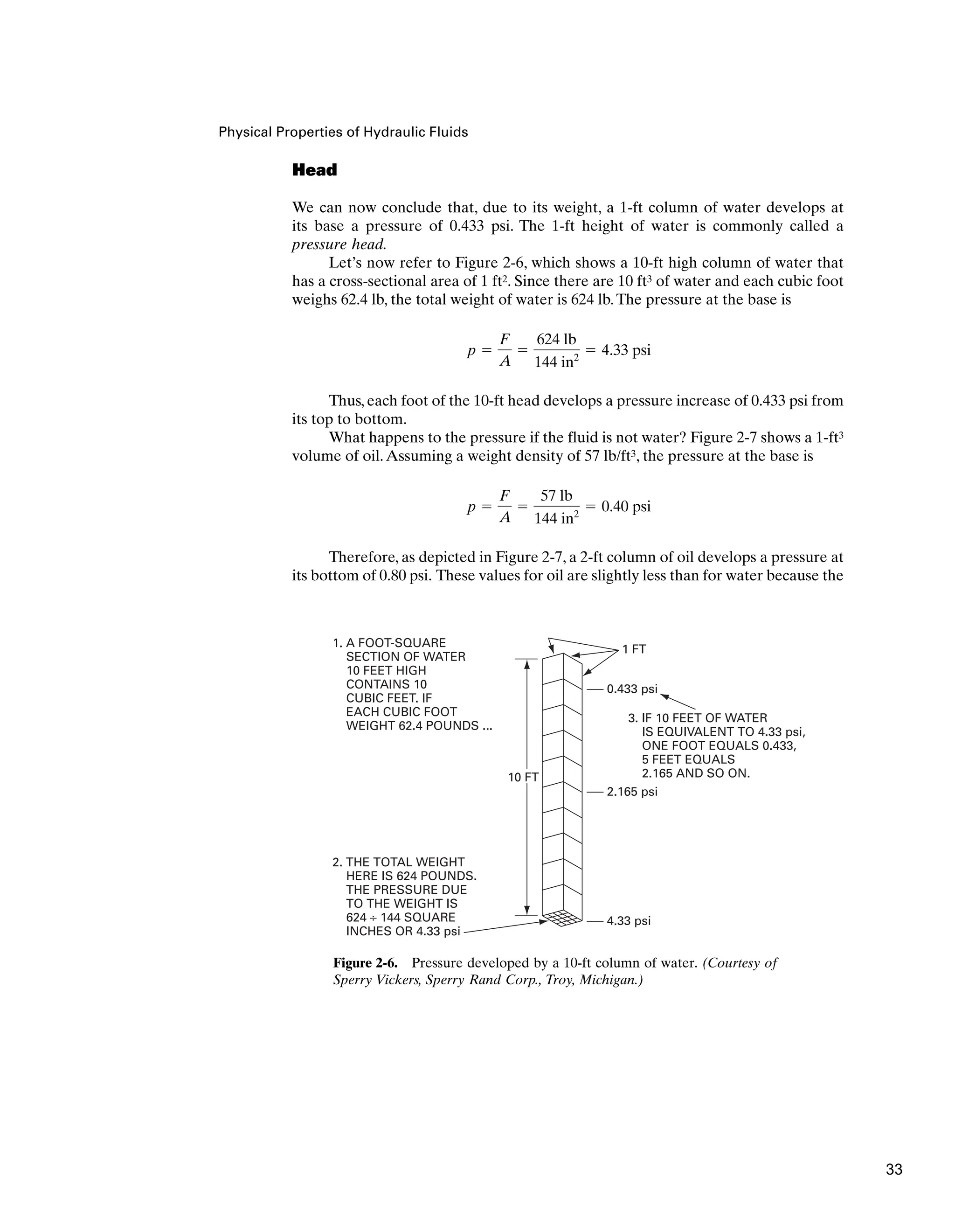
Let’s now refer to Figure 2-6, which shows a 10-ft high column of water that
has a cross-sectional area of 1 ft2. Since there are 10 ft3 of water and each cubic foot
weighs 62.4 lb, the total weight of water is 624 lb.The pressure at the base is
Thus, each foot of the 10-ft head develops a pressure increase of 0.433 psi from
its top to bottom.
What happens to the pressure if the fluid is not water? Figure 2-7 shows a 1-ft3
volume of oil.Assuming a weight density of 57 lb/ft3, the pressure at the base is
Therefore, as depicted in Figure 2-7, a 2-ft column of oil develops a pressure at
its bottom of 0.80 psi. These values for oil are slightly less than for water because the
p 
F
A

57 lb
144 in2
 0.40 psi
p 
F
A

624 lb
144 in2
 4.33 psi
1 FT
0.433 psi
2.165 psi
4.33 psi
3. IF 10 FEET OF WATER
IS EQUIVALENT TO 4.33 psi,
ONE FOOT EQUALS 0.433,
5 FEET EQUALS
2.165 AND SO ON.
1. A FOOT-SQUARE
SECTION OF WATER
10 FEET HIGH
CONTAINS 10
CUBIC FEET. IF
EACH CUBIC FOOT
WEIGHT 62.4 POUNDS ...
2. THE TOTAL WEIGHT
HERE IS 624 POUNDS.
THE PRESSURE DUE
TO THE WEIGHT IS
624 ÷ 144 SQUARE
INCHES OR 4.33 psi
10 FT
Figure 2-6. Pressure developed by a 10-ft column of water. (Courtesy of
Sperry Vickers, Sperry Rand Corp., Troy, Michigan.)
33
Chapter 2
specific weight of oil is somewhat less than that for water. Equation (2-9) allows
calculation of the pressure developed at the bottom of a column of any liquid.
(2-9)
where p  pressure at bottom of liquid column,
γ  specific weight of liquid,
H  liquid column height or head.
Observe per Eq. (2-9) that the pressure does not depend on the cross-sectional
area of the liquid column but only on the column height and the specific weight of the
liquid. The reason is simple: Changing the cross-sectional area of the liquid column
changes its weight (and thus the force at its bottom) by a proportional amount.Hence
F/A (which equals pressure) remains constant.
Substituting the correct units for  and H into Eq. (2-9) produces the proper
units for pressure:
or
A derivation of Eq. (2-9) is provided in Appendix H.
p1lbft2
2  p1psf2  g1lbft3
2  H1ft2
p1lbin2
2  p1psi2  g1lbin3
2  H1in2
p  gH
1 FT
1 FT
1 FT
3. A TWO-FOOT COLUMN
WEIGHS TWICE AS MUCH, THUS
THE PRESSURE AT THE BOTTOM
IS 0.8 psi.
1. A CUBIC FOOT OF
OIL WEIGHS ABOUT
55–58 POUNDS.
2. IF THE WEIGHT IS DIVIDED
EQUALLY OVER THE 144 SQUARE
INCHES OF BOTTOM, THE FORCE
ON EACH SQUARE INCH IS 0.4
POUNDS. PRESSURE AT THE
BOTTOM THUS IS 0.4 psi.
Figure 2-7. Pressures developed by 1- and 2-ft columns of oil.
(Courtesy of Sperry Vickers, Sperry Rand Corp., Troy, Michigan.)
34
Physical Properties of Hydraulic Fluids
Atmospheric Pressure
What about the pressure developed on Earth’s surface due to the force of attrac-
tion between the atmosphere and Earth? For all practical purposes we live at the
bottom of a huge sea of air, which extends hundreds of miles above us. Equation
(2-9) cannot be used to find this pressure because of the compressibility of air.
As a result the density of the air is not constant throughout the atmosphere. The
density is greatest at Earth’s surface and diminishes as the distance from Earth
increases.
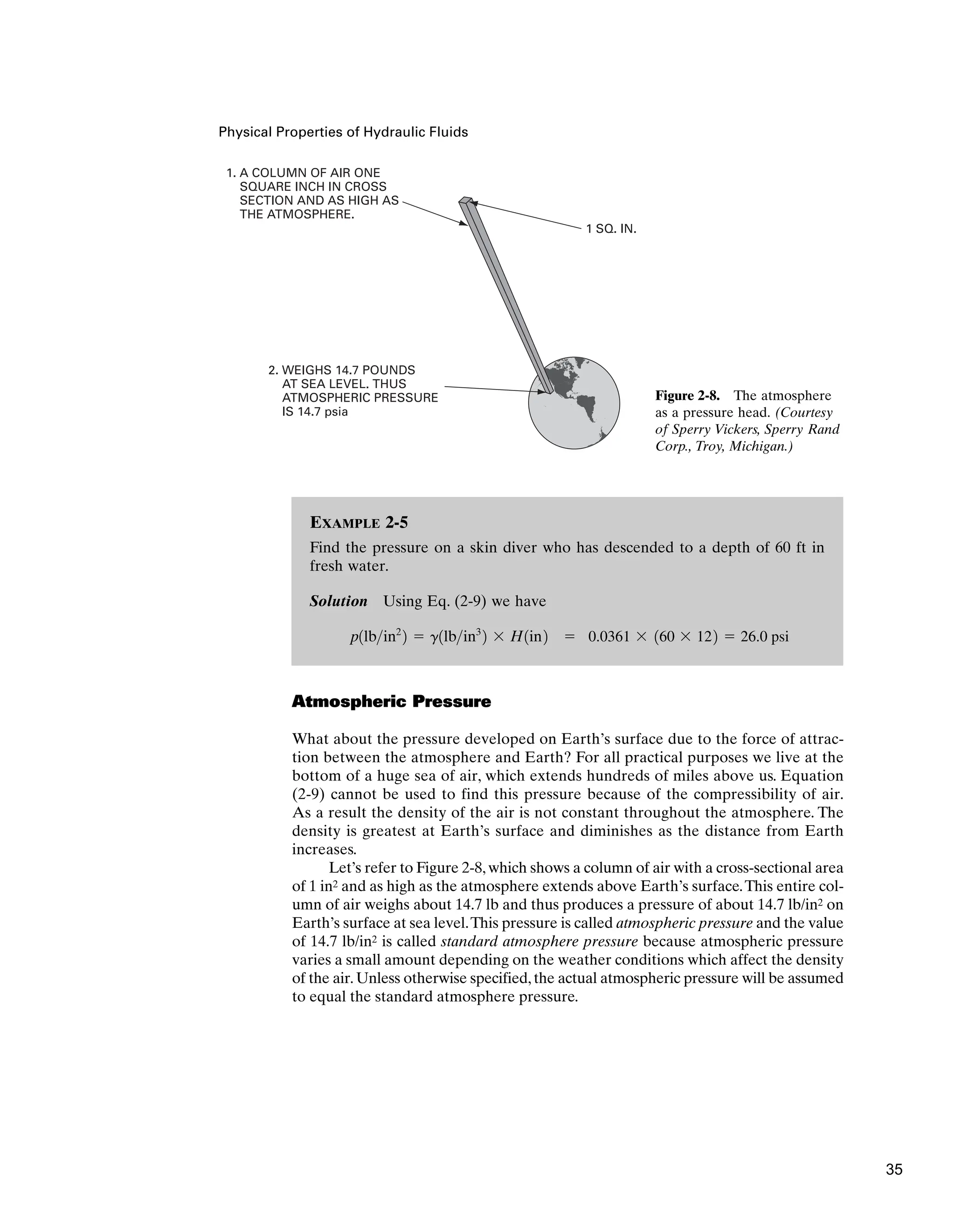
Let’s refer to Figure 2-8, which shows a column of air with a cross-sectional area
of 1 in2 and as high as the atmosphere extends above Earth’s surface.This entire col-
umn of air weighs about 14.7 lb and thus produces a pressure of about 14.7 lb/in2 on
Earth’s surface at sea level.This pressure is called atmospheric pressure and the value
of 14.7 lb/in2 is called standard atmosphere pressure because atmospheric pressure
varies a small amount depending on the weather conditions which affect the density
of the air.Unless otherwise specified,the actual atmospheric pressure will be assumed
to equal the standard atmosphere pressure.
EXAMPLE 2-5
Find the pressure on a skin diver who has descended to a depth of 60 ft in
fresh water.
Solution Using Eq. (2-9) we have
 0.0361  160  122  26.0 psi
p1lbin2
2  g1lbin3
2  H1in2
1. A COLUMN OF AIR ONE
SQUARE INCH IN CROSS
SECTION AND AS HIGH AS
THE ATMOSPHERE.
2. WEIGHS 14.7 POUNDS
AT SEA LEVEL. THUS
ATMOSPHERIC PRESSURE
IS 14.7 psia
1 SQ. IN.
Figure 2-8. The atmosphere
as a pressure head. (Courtesy
of Sperry Vickers, Sperry Rand
Corp., Troy, Michigan.)
35
Chapter 2
Gage and Absolute Pressure
Why, then, does a deflated automobile tire read zero pressure instead of 14.7 psi when
using a pressure gage? The answer lies in the fact that a pressure gage reads gage
pressure and not absolute pressure.Gage pressures are measured relative to the atmo-
sphere, whereas absolute pressures are measured relative to a perfect vacuum such
as that existing in outer space.To distinguish between them,gage pressures are labeled
psig, or simply psi, whereas absolute pressures are labeled psi (abs), or simply psia.
This means that atmospheric pressure equals 14.7 psia or 0 psig. Atmospheric
pressure is measured with special devices called barometers. Figure 2-9 shows how a
mercury barometer works. The atmospheric pressure to be measured can support a
column of mercury equal to 30.0 in because this head produces a pressure of 14.7 psi.
This can be checked by using Eq. (2-9) and noting that the specific weight of
mercury is 0.490 lb/in3:
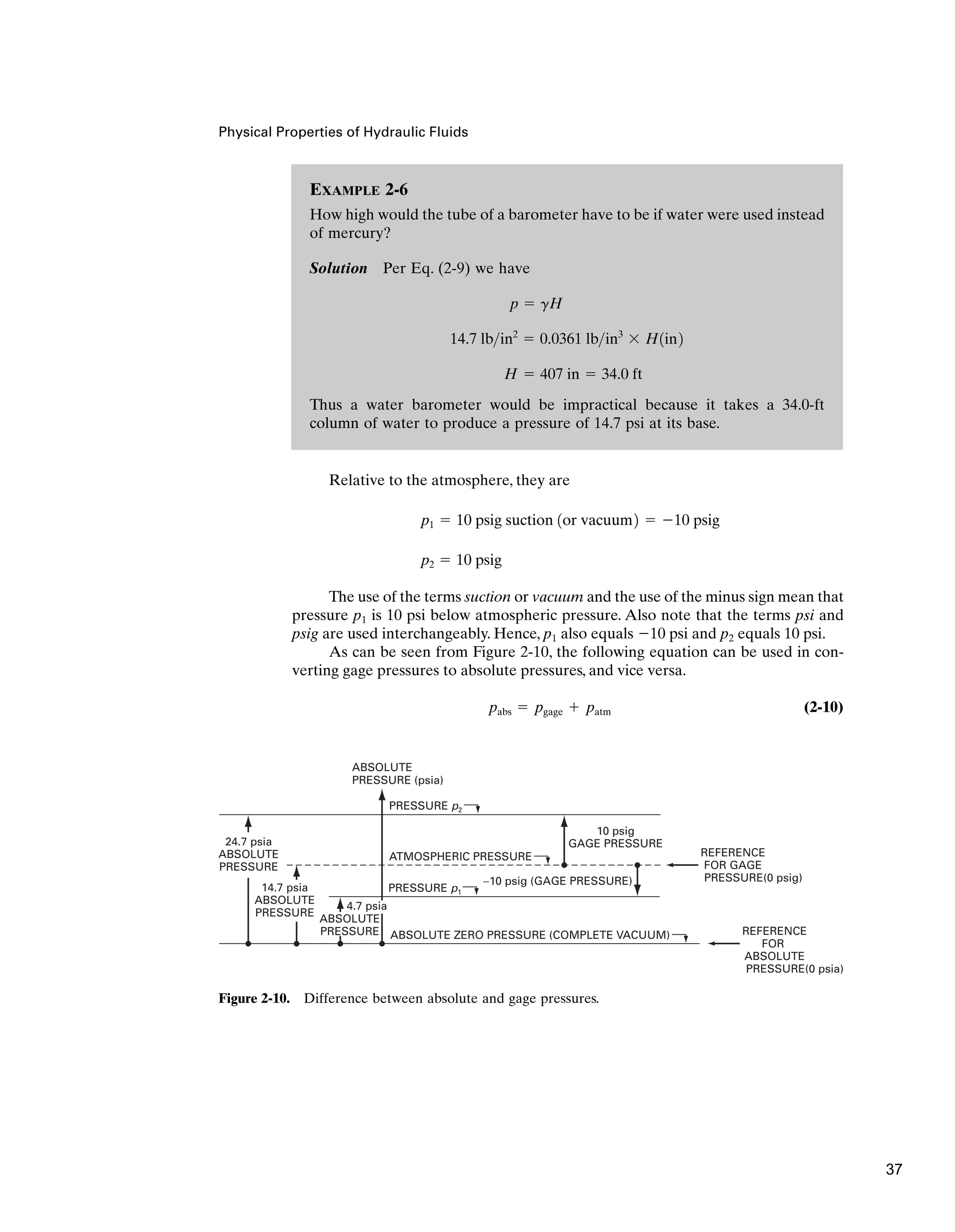
Figure 2-10 has a chart showing the difference between gage and absolute pres-
sures. Let’s examine two pressure levels: p1 and p2. Relative to a perfect vacuum
they are
p2  24.7 psia 1a pressure greater than atmospheric pressure2
p1  4.7 psia 1a pressure less than atmospheric pressure2
H  30.0 in of mercury
14.7 lbin2
 0.490 lbin3
 H1in2
p  gH
2. WOULD SUPPORT A
COLUMN OF MERCURY
THIS HIGH ...
3. WITH A PERFECT VACUUM
HERE.
1. ATMOSPHERIC PRESSURE
HERE ...
30.0 INCHES
Figure 2-9. Operation of a mercury barometer. (Courtesy of Sperry Vickers,
Sperry Rand Corp., Troy, Michigan.)
36
Physical Properties of Hydraulic Fluids
Relative to the atmosphere, they are
The use of the terms suction or vacuum and the use of the minus sign mean that
pressure p1 is 10 psi below atmospheric pressure. Also note that the terms psi and
psig are used interchangeably. Hence, p1 also equals 10 psi and p2 equals 10 psi.
As can be seen from Figure 2-10, the following equation can be used in con-
verting gage pressures to absolute pressures, and vice versa.
(2-10)
pabs  pgage  patm
p2  10 psig
p1  10 psig suction 1or vacuum2  10 psig
EXAMPLE 2-6
How high would the tube of a barometer have to be if water were used instead
of mercury?
Solution Per Eq. (2-9) we have
Thus a water barometer would be impractical because it takes a 34.0-ft
column of water to produce a pressure of 14.7 psi at its base.
H  407 in  34.0 ft
14.7 lbin2
 0.0361 lbin3
 H1in2
p  gH
ABSOLUTE
PRESSURE (psia)
ATMOSPHERIC PRESSURE
24.7 psia
ABSOLUTE
PRESSURE
14.7 psia
ABSOLUTE
PRESSURE
PRESSURE p2
PRESSURE p1
ABSOLUTE ZERO PRESSURE (COMPLETE VACUUM)
10 psig
GAGE PRESSURE
−10 psig (GAGE PRESSURE)
REFERENCE
FOR GAGE
PRESSURE(0 psig)
REFERENCE
FOR
ABSOLUTE
PRESSURE(0 psia)
4.7 psia
ABSOLUTE
PRESSURE
Figure 2-10. Difference between absolute and gage pressures.
37
Chapter 2
Vacuum or suction pressures exist in certain locations of fluid power systems (for
example, in the inlet or suction lines of pumps). Therefore, it is important to under-
stand the meaning of pressures below atmospheric pressure. One way to generate a
suction pressure is to remove some of the fluid from a closed vessel initially containing
fluid at atmospheric pressure.
2.5 THE SI METRIC SYSTEM
Introduction
The SI metric system was standardized in June 1960 when the International
Organization for Standardization approved a metric system called Le Système
International d’Unités. This system, which is abbreviated SI, has supplanted the old
CGS (centimeter-gram-second) metric system, and U.S. adoption of the SI metric
system is considered to be imminent.
In the SI metric system, the units of measurement are as follows:
Length is the meter (m).
Mass is the kilogram (kg).
Force is the newton (N).
Time is the second (s).
Temperature is the degree Celsius (°C).
A mass of 1 kilogram is defined as the mass of a platinum-iridium bar at the
International Bureau of Weights and Measures near Paris, France.
EXAMPLE 2-7
Convert a 5-psi pressure to an absolute pressure.
Solution Using Eq. (2-10) we have
absolute pressure  5  14.7  9.7 psia
EXAMPLE 2-8
Find the absolute pressure on the skin diver of Example 2-5.
Solution Using Eq. (2-10) yields
absolute pressure  26.0  14.7  40.7 psia
38
Physical Properties of Hydraulic Fluids
Length, Mass, and Force Comparisons with
English System
The relative sizes of length, mass, and force units between the metric and English
systems are given as follows:
One meter equals 39.4 in  3.28 ft.
One kilogram equals 0.0685 slugs.
One newton equals 0.225 lb.
Per Eq. (2-1) a newton is defined as the force that will give a mass of 1 kg an
acceleration of 1 m/s2. Stated mathematically, we have
Since the acceleration of gravity at sea level equals 9.80 m/s2, a mass of 1 kg
weighs 9.80 N.Also, since 1 N  0.225 lb, a mass of 1 kg also weighs 2.20 lb.
Pressure Comparisons
The SI metric system uses units of pascals (Pa) to represent pressure. A pressure
of 1 Pa is equal to a force of 1 N applied over an area of 1 m2 and thus is a very
small unit of pressure.
The conversion between pascals and psi is as follows:
Atmospheric pressure in units of pascals is found as follows, by converting 14.7 psi
into its equivalent pressure in pascals:
Thus, atmospheric pressure equals 101,000 Pa (abs) as well as 14.7 psia.
Since the pascal is a very small unit, the bar is commonly used:
Thus, atmospheric pressure equals 14.7/14.5 bars (abs), or 1.01 bars (abs).
1 bar  105
Nm2
 105
Pa  14.5 psi
patm1Pa2  14.7 psi 1abs2 
1 Pa
0.000145 psi
 101,000 Pa 1abs2
1 Pa  0.000145 psi
1 Pa  1 Nm2
1 N  1 kg  1 ms2
39
Chapter 2
Temperature Comparisons
The temperature (T) in the metric system is measured in units of degrees Celsius
(°C), whereas temperature in the English system is measured in units of degrees
Fahrenheit (°F). Figure 2-11 shows a graphical representation of these two tem-
perature scales using a mercury thermometer reading a room temperature of
68°F (20°C).
Relative to Figure 2-11 the following should be noted:The Fahrenheit temper-
ature scale is determined by dividing the temperature range between the freezing
point of water (set at 32°F) and the boiling point of water (set at 212°F) at atmos-
pheric pressure into 180 equal increments. The Celsius temperature scale is deter-
mined by dividing the temperature range between the freezing point of water (set
at 0°C) and the boiling point of water (set at 100°C) at atmospheric pressure into
100 equal increments.
The mathematical relationship between the Fahrenheit and Celsius scales is
(2-11)
Thus, to find the equivalent Celsius temperature corresponding to room tempera-
ture (68°F), we have:
T1°C2 
T1°F2  32
1.8

68  32
1.8
 20°C
T1°F2  1.8T1°C2  32
212
68
32
°F
100
20
0
BOILING
TEMPERATURE
OF WATER
ROOM
TEMPERATURE
FREEZING
TEMPERATURE
OF WATER
°C
BULB
MERCURY
CAPILLARY
TUBE
Figure 2-11. Comparison of
the Fahrenheit and Celsius
temperature scales.
40
Physical Properties of Hydraulic Fluids
Absolute temperatures (Rankine units in English system and Kelvin units in
metric system) are presented in Chapter 13 for use in the gas law equations.
SI System Prefixes
Figure 2-12 provides the prefixes used in the metric system to represent powers of 10.
Thus, for example:
This means that atmospheric pressure equals 101 kPa (abs) as well as 1010 milli-
bars (abs).
1 kPa  103
Pa  1000 Pa
EXAMPLE 2-9
An oil has a specific weight of 56 lb/ft3. Determine its specific weight in units
of N/m3.
Solution units wanted  units given × conversion factors
 157  56  8790 N冫m3
ga
N
m3
b  ga
lb
ft3
b  a
1 N
0.225 lb
b  a
3.28 ft
1 m
b
3
 157ga
lb
ft3
b
Prefix Name SI Symbol Multiplication Factor
tera T 1012
giga G 109
mega M 106
kilo k 103
centi c 102
milli m 103
micro  106
nano n 109
pico p 1012
Figure 2-12. Prefixes used in metric system to represent powers of 10.
41
Chapter 2
2.6 BULK MODULUS
The highly favorable power-to-weight ratio and the stiffness of hydraulic systems
make them the frequent choice for most high-power applications. The stiffness of
a hydraulic system is directly related to the incompressibility of the oil. Bulk mod-
ulus is a measure of this incompressibility. The higher the bulk modulus, the less
compressible or stiffer the fluid.
Mathematically the bulk modulus is defined by Eq. (2-12), where the minus
sign indicates that as the pressure increases on a given amount of oil, the oil’s volume
decreases, and vice versa:
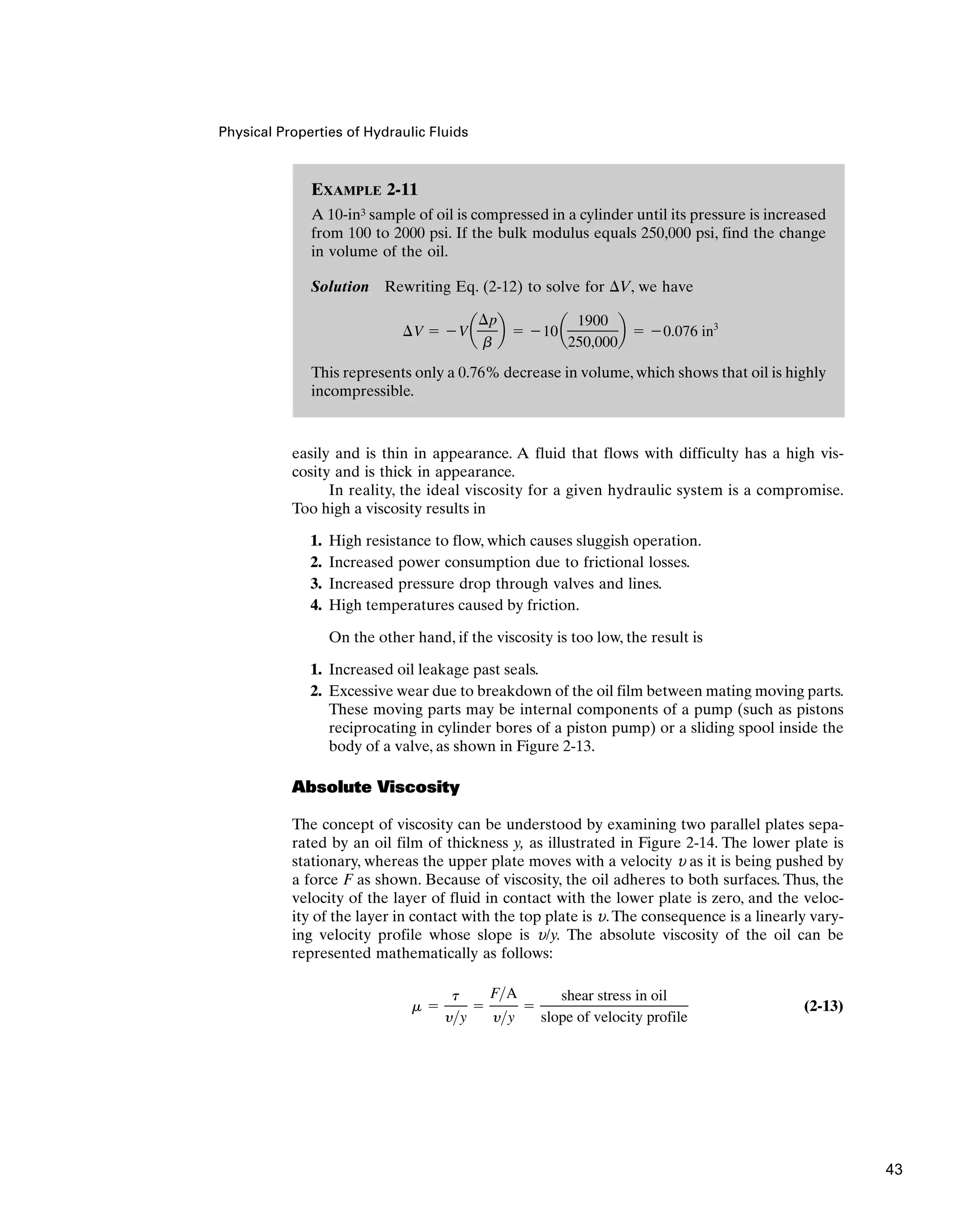
(2-12)
where β  bulk modulus (psi, kPa),
Δp  change in pressure (psi, kPa),
ΔV  change in volume (in3, m3),
V  original volume (in3, m3).
The bulk modulus of an oil changes somewhat with changes in pressure and tem-
perature. However, for the pressure and temperature variations that occur in most
fluid power systems, this factor can be neglected.A typical value for oil is 250,000 psi
(1.72 × 10⁶ kPa).
2.7 VISCOSITY
Introduction
Viscosity is probably the single most important property of a hydraulic fluid. It is
a measure of a fluid’s resistance to flow. When the viscosity is low, the fluid flows
b 
¢p
¢VV
EXAMPLE 2-10
At what temperature are the Fahrenheit and Celsius values equal?
Solution Per the problem statement we have
Substituting from Eq. (2-11) yields
Thus, 40°C  40°F.
1.8T1°C2  32  T1°C2 or T1°C2 
32
0.8
 40°
T1°F2  T1°C2
42
Physical Properties of Hydraulic Fluids
easily and is thin in appearance. A fluid that flows with difficulty has a high vis-
cosity and is thick in appearance.
In reality, the ideal viscosity for a given hydraulic system is a compromise.
Too high a viscosity results in
1. High resistance to flow, which causes sluggish operation.
2. Increased power consumption due to frictional losses.
3. Increased pressure drop through valves and lines.
4. High temperatures caused by friction.
On the other hand, if the viscosity is too low, the result is
1. Increased oil leakage past seals.
2. Excessive wear due to breakdown of the oil film between mating moving parts.
These moving parts may be internal components of a pump (such as pistons
reciprocating in cylinder bores of a piston pump) or a sliding spool inside the
body of a valve, as shown in Figure 2-13.
Absolute Viscosity
The concept of viscosity can be understood by examining two parallel plates sepa-
rated by an oil film of thickness y, as illustrated in Figure 2-14. The lower plate is
stationary, whereas the upper plate moves with a velocity u as it is being pushed by
a force F as shown. Because of viscosity, the oil adheres to both surfaces. Thus, the
velocity of the layer of fluid in contact with the lower plate is zero, and the veloc-
ity of the layer in contact with the top plate is u.The consequence is a linearly vary-
ing velocity profile whose slope is u/y. The absolute viscosity of the oil can be
represented mathematically as follows:
(2-13)
m 
t
yy

FA
yy

shear stress in oil
slope of velocity profile
EXAMPLE 2-11
A 10-in3 sample of oil is compressed in a cylinder until its pressure is increased
from 100 to 2000 psi. If the bulk modulus equals 250,000 psi, find the change
in volume of the oil.
Solution Rewriting Eq. (2-12) to solve for V, we have
This represents only a 0.76% decrease in volume, which shows that oil is highly
incompressible.
¢V  Va
¢p
b
b  10a
1900
250,000
b  0.076 in3
43
Chapter 2
where τ  Greek symbol tau  the shear stress in the fluid in units of force
per unit area (lb/ft2,N/m2);the shear stress (which is produced by the
force F) causes the sliding of adjacent layers of oil;
u  velocity of the moving plate (ft/s, m/s);
y  oil film thickness (ft, m);
µ  Greek symbol mu  the absolute viscosity of the oil;
F  force applied to the moving upper plate (lb, N);
A  area of the moving plate surface in contact with the oil (ft2, m2).
Checking units for µ in the English system using Eq. (2-13), we have
Similarly, µ has units of N s/m2 in the SI metric system.
#
m 
lbft2
1fts2ft
 lb # sft2
2. INSIDE ITS BODY...
3. ON A THIN FILM OF
HYDRAULIC FLUID (SHOWN
GREATLY EXAGGERATED).
4. IF THIS PASSAGE IS UNDER
PRESSURE, THE FLUID FILM
SEALS IT FROM ADJACENT
PASSAGE.
1. A TYPICAL SLIDING
VALVE SPOOL MOVES
BACK AND FORTH ...
Figure 2-13. Fluid film lubricates and seals moving parts. (Courtesy of Sperry
Vickers, Sperry Rand Corp., Troy, Michigan.)
STATIONARY PLATE
MOVING PLATE
VELOCITY PROFILE (SLOPE = )
OIL-FILM
THICKNESS
F v
v
y
y
v
Figure 2-14. Fluid velocity profile between parallel plates due to viscosity.
44
Physical Properties of Hydraulic Fluids
If the moving plate has unit surface area in contact with the oil, and the upper
plate velocity and oil film thickness are given unit values, Eq. (2-13) becomes
We can, therefore, define the absolute viscosity of a fluid as the force required
to move a flat plate (of unit area at unit distance from a fixed plate) with a unit veloc-
ity when the space between the plates is filled with the fluid. Thus, using a fluid of
higher viscosity requires a larger force, and vice versa. This shows that viscosity is a
measure of a fluid’s resistance to flow.
Viscosity is often expressed in the CGS (centimeter-gram-second) metric sys-
tem. In the CGS metric system, the units per Eq. (2-13) are
where a dyne is the force that will accelerate a 1-g mass at a rate of 1 cm/s2. The
conversions between dynes and newtons is as follows:
A viscosity of 1 dyn  s/cm2 is called a poise. The poise is a large unit of viscos-
ity.A more convenient unit is the centipoise, abbreviated cP.
Kinematic Viscosity
Calculations in hydraulic systems often involve the use of kinematic viscosity rather
than absolute viscosity. Kinematic viscosity equals absolute viscosity divided by
density:
(2-14)
where  Greek symbol nu  kinematic viscosity.
Units for kinematic viscosity are given as follows: English: ft2/s, SI metric: m2/s,
and CGS metric: cm2/s.
A viscosity of 1 cm2/s is called a stoke. Because the stoke is a large unit, viscos-
ity is typically reported in centistokes (cS).
Saybolt Viscometer
The viscosity of a fluid is usually measured by a Saybolt viscometer, which is shown
schematically in Figure 2-15. Basically, this device consists of an inner chamber
containing the sample of oil to be tested. A separate outer compartment, which
n 
m
r
1 N  105
dyn
m 
dyncm2
1cms2cm
 dyn # scm2
m 
FA
yy

F1
11
 F
45
Chapter 2
completely surrounds the inner chamber, contains a quantity of oil whose temper-
ature is controlled by an electrical thermostat and heater. A standard orifice is
located at the bottom of the center oil chamber.When the oil sample is at the desired
temperature, the time it takes to fill a 60-cm3 container through the metering ori-
fice is then recorded. The time, (t), measured in seconds, is the viscosity of the oil
in official units called Saybolt Universal Seconds (SUS). Since a thick liquid flows
slowly, its SUS viscosity value will be higher than that for a thin liquid.
A relationship exists between the viscosity in SUS and cS. This relationship is
provided by the following empirical equations:
(2-15)
(2-16)
where the symbol  represents the viscosity in cS and t is the viscosity as measured
in SUS, or simply seconds.
n1cS2  0.220t 
135
t
, t 7 100 SUS
n1cS2  0.226t 
195
t
, t  100 SUS
Figure 2-15. Saybolt viscometer.
46
Physical Properties of Hydraulic Fluids
Kinematic viscosity is defined as absolute viscosity divided by density. Since, in
the CGS metric system, density equals specific gravity (because ρH2O  1 g/cm3 and
thus has a value of one), the following equation can be used to find the kinematic
viscosity in cS if the absolute viscosity in cP is known, and vice versa.
(2-17)
As previously noted, in the SI metric system, N  s/m2 and m2/s are the units
used for absolute and kinematic viscosity, respectively.Although these are good units
for calculation purposes, it is common practice in the fluid power industry to use
viscosity expressed in units of SUS or cS.
n1cS2 
m 1cP2
SG
EXAMPLE 2-12
An oil has a viscosity of 230 SUS at 150°F. Find the corresponding viscosity
in units of centistokes and centipoise. The specific gravity of the oil is 0.9.
Solution
m 1cP2  SG  n1cS2  0.9n1cS2  10.92 1502  45 cP
n1cS2  0.220t 
135
t
 10.2202 12302 
135
230
 50 cS
EXAMPLE 2-13
An oil having a density of 0.89 g/cm3 is tested using a capillary tube viscometer.
The given amount of oil flowed through the capillary tube in 250 s. The cali-
bration constant is 0.100. Find the kinematic and absolute viscosities in units
of cS and cP, respectively.
Solution Kinematic viscosity equals the time in seconds multiplied by the
calibration constant:
n1cS2  12502 10.1002  25 cS
Capillary Tube Viscometer
A quick method for determining the kinematic viscosity of fluids in cS and absolute
viscosity in cP is shown in Figure 2-16. This test measures the time it takes for a
given amount of fluid to flow through a capillary tube under the force of gravity.
The time in seconds is then multiplied by the calibration constant for the viscome-
ter to obtain the kinematic viscosity of the sample fluid in centistokes.The absolute
viscosity in centipoise is then calculated using Eq. (2-17).
47
Chapter 2
2.8 VISCOSITY INDEX
Oil becomes thicker as the temperature decreases and thins when heated. Hence,
the viscosity of a given oil must be expressed at a specified temperature. For most
hydraulic applications, the viscosity normally equals about 150 SUS at 100°F. It is
a general rule of thumb that the viscosity should never fall below 45 SUS or rise
above 4000 SUS regardless of the temperature. Figure 2-17 shows how viscosity
changes with temperature for several liquid petroleum products. Note that the
change in viscosity of a hydraulic oil as a function of temperature is represented by
a straight line when using American Society for Testing and Materials (ASTM) stan-
dard viscosity temperature charts such as the one used in Figure 2-17. Displayed in
the chart of Figure 2-17 is the preferred range of viscosities and temperatures for
optimum operation of most hydraulic systems.Where extreme temperature changes
are encountered, the fluid should have a high viscosity index.
Viscosity index (VI) is a relative measure of an oil’s viscosity change with respect
to temperature change.An oil having a low VI is one that exhibits a large change in
viscosity with temperature change.A high-VI oil is one that has a relatively stable vis-
cosity, which does not change appreciably with temperature change. The original
VI scale ranged from 0 to 100, representing the poorest to best VI characteristics
known at that time.Today, with improved refining techniques and chemical additives,
oils exist with VI values well above 100. A high-VI oil is a good all-weather-type oil
100 F
OR
210 F
START
METHOD OF
CHARGING SAMPLE
PLACE IN CONSTANT
TEMPERATURE BATH
ADJUST HEAD LEVEL 5 MM
ABOVE STARTING MARK
MEASURE FLOW TIME IN SECONDS
FROM START TO STOP MARKS
STOP
START
STOP
Figure 2-16. Capillary tube viscometer.
In the CGS metric system density numerically equals specific gravity.
Therefore, SG  0.89. Solving Eq. (2-17) for ␮, we have
m 1cP2  SG  n1cS2  0.89  25  22.3 cP
48
Physical Properties of Hydraulic Fluids
for use with outdoor machines operating in extreme temperature swings.This is where
viscosity index is especially significant. For a hydraulic system where the oil temper-
ature does not change appreciably, the viscosity index of the fluid is not as critical.
The VI of any hydraulic oil can be found by using
(2-18)
VI 
L  U
L  H
 100
Figure 2-17. Preferred range of oil viscosities and temperatures. (Courtesy of Sperry
Vickers, Sperry Rand Corp., Troy, Michigan.)
49
Chapter 2
where L  viscosity in SUS of 0-VI oil at 100°F,
U  viscosity in SUS of unknown-VI oil at 100°F,
H  viscosity in SUS of 100-VI oil at 100°F.
The VI of an unknown-VI oil is determined from tests.A reference oil of 0 VI
and a reference oil of 100 VI are selected, each of which has uniquely the same
viscosity at 210°F as the unknown-VI oil. The viscosities of the three oils are then
measured at 100°F to give values for L, U, and H. Figure 2-18 provides a pictorial
representation of the H, L, and U terms in Eq. (2-18).
VISCOSITY
(SUS)
0 100 210
0
H
U
L
TEMPERATURE (°F)
O-VI OIL
UNKNOWN-VI OIL
100-VI OIL
ALL CURVES
INTERSECT AT
THIS POINT
Figure 2-18. Typical curves
for a viscosity index test.
3,000
D
Viscosity
(SUS)
C B A
2,000
1,500
1,000
750
500
400
300
200
150
100
90
80
70
60
55
50
20
0 40 60 80 100 120 140 160 180 200 220 240
All samples shown have the same
viscosity at 210˚F : 90 SUS
A : SUS at 100˚F=2115, VI is 0
B : SUS at 100˚F=1551, VI is 50
C : SUS at 100˚F=986, VI is 100
D : SUS at 100˚F=534, VI is 140
TEMPERATURE (˚F)
Figure 2-19. ASTM Standard Viscosity-Temperature Chart for Liquid Petroleum
Products.
50
Physical Properties of Hydraulic Fluids
Figure 2-19 shows the results of a viscosity index test where oil A is the 0-VI oil
and oil C is the 100-VI oil.The two unknown-VI oils B and D were found to have VI
values of 50 and 140, respectively. For example, the VI for oil B is calculated as fol-
lows using the viscosity values at 100°F for oils A (L value), B (U value), and C
(H value) from Figure 2-19:
VI1oil B2 
L  U
L  H
 100 
2115  1551
2115  986
 100  50
EXAMPLE 2-14
A sample of oil with a VI of 80 is tested with a 0-VI oil and a 100-VI oil whose
viscosity values at 100°F are 400 and 150 SUS,respectively.What is the viscosity
of the sample oil at 100°F in units of SUS?
Solution Substitute directly into Eq. (2-18):
U  200 SUS
80 
400  U
400  150
 100
VI 
L  U
L  H
 100
Another characteristic relating to viscosity is called the pour point, which is
the lowest temperature at which a fluid will flow. It is a very important parameter to
specify for hydraulic systems that will be exposed to extremely low temperatures.As
a rule of thumb, the pour point should be at least 20°F below the lowest temperature
to be experienced by the hydraulic system.
2.9 AUTOMOTIVE SHOCK ABSORBERS: VISCOSITY AT WORK
Figure 2-20(a) provides a cutaway view of an automotive shock absorber that uti-
lizes a pressurized gas and viscous oil for its operation. The operation of this shock
absorber involves the flow of oil through orifices and the compression/expansion
of a column of gas inside a cylinder. Shock absorbers reduce the bouncing effect of
traveling over rough ground leading to improved ride quality and safety. Shock
absorbers are designed to help automobiles ride more smoothly with shorter brak-
ing distances, handle better, and corner with more authority. Without shock
absorbers the automobile would have a bouncing ride because of the energy that
is stored in the suspension springs and then released back to the automobile. This
bouncing action can cause motion that exceeds the allowable range of the suspen-
sion system.
51
Chapter 2
The shock absorber shown in Figure 2-20(a) consists of an inner cylinder (B)
containing a piston (E) connected to piston rod (A), a piston rod guide (D), and a
floating piston (F).The gas (K) which is precharged to a pressure of about 350 psi, is
located in the space below the floating piston.The oil (J) is located between the two
pistons and in the space around the piston rod below the piston rod guide.The upper
end of the piston rod extends outside the top of the shock absorber so that the rod
can be connected to the suspension system of the automobile.
The rod-connected piston contains small orifices through which the oil can flow
in either direction. When an automobile tire hits a road irregularity such as a bump
or pothole, the piston rod is driven downward into the cylinder. This is called the
bump stroke.This action forces the oil to flow upward through the piston orifices and
the floating piston to move downward to further compress the gas below it.The vol-
ume of gas displaced by the floating piston equals the volume of oil displaced by the
piston rod entering the cylinder during the bump stroke.The resistance of the orifices
to the flow of the viscous oil provides the damping force that dissipates energy into
heat. During the rebound stroke the opposite direction of motions takes place as the
energy stored in the suspension springs is dissipated into heat.
Figure 2-20(b) is a photograph of the Dodge Viper ACR (American Club
Racer) that uses the shock absorber design shown in Figure 2-20(a).The combination
of the oil being forced to flow through the orifices and the compression/expansion of
(a) Cutaway view of KONI
gas-charged shock absorber.
(b) Dodge viper with KONI shock absorbers.
Figure 2-20. Automotive shock absorber application. (Courtesy of KONI North America,
Hebron, Kentucky.)
52
Physical Properties of Hydraulic Fluids
the gas (as both pistons move through the bump and rebound stroke) provides an
optimum shock absorber stiffness and means of absorbing and dissipating vibration
caused by the suspension springs as they absorb and release energy. Shock absorbers
use a high-VI oil so that the viscosity of the oil doesn’t change appreciably during
changes in weather conditions from hot summers to cold winters and vice versa.Thus
shock absorbers maintain essentially the same damping characteristics in all weather
conditions.
2.10 ILLUSTRATIVE EXAMPLES USING THE SI METRIC SYSTEM
In this section we use the metric system of units to solve several example problems.
EXAMPLE 2-15
Find the pressure on a skin diver who has descended to a depth of 18.3 m in
fresh water (γ  9800 N/m3).
Solution Per Eq. (2-9) we have
Substituting a consistent set of units yields:
 179,000 Pa  179 kPa
p  19800 N冫m3
2 118.3 m2
p  gh
EXAMPLE 2-16
Convert a 34,000 Pa pressure to an absolute pressure.
Solution
The “abs” is used to indicate that the 67,000 Pa value is an absolute
pressure (measured relative to a perfect vacuum).
absolute pressure  34,000  101,000  67,000 Pa abs
absolute pressure  gage pressure  atmospheric pressure
EXAMPLE 2-17
A 164-cm3 sample of oil is compressed in a cylinder until its pressure is
increased from 687 kPa to 13,740 kPa. If the bulk modulus equals 1718 MPa,
find the percent change in volume of the oil.
53
Chapter 2
2.11 KEY EQUATIONS
Weight-mass relationship: (2-1)
Specific weight: (2-3)
Density: (2-5)
Density-specific weight relationship: (2-6)
Specific gravity: (2-7)
SG 
g
gwater

r
rwater
r 
g
g
r 
m
V
g 
W
V
F  W  mg
EXAMPLE 2-18
In Figure 2-14 the moving plate is 1 m on a side (in contact with the oil) and
the oil film is 5 mm thick.A 10-N force is required to move the plate at veloc-
ity 1 m/s. Find the absolute viscosity of the oil in units of N  s/m2 and cP.
Solution
Using Eq. (2-13) with SI metric units yields
Using Eq. (2-13) with CGS metric units, and noting that 1 N  105 dyn, we
have
The solution to this example shows that 0.05 N  s/m2  50 cP or
1 N  s/m2  1000 cP.
 0.5 dyn # scm2
 0.5 poise  50 cP
m 
Fy
yA

10  105
dyn  0.5 cm
100 cms  1100 cm  100 cm2
m 
FA
yy

Fy
yA

10 N  0.005 m
1 ms  1 m2
 0.05 N # sm2
Solution
¢V
V

¢p
b

 113,740  6872
1,718,000
 0.0076  0.76%
54
Physical Properties of Hydraulic Fluids
Pressure-force relationship: (2-8)
Pressure-head relationship: (2-9)
Absolute pressure-gage pressure relationship: (2-10)
Fahrenheit–Celsius temperature relationship: (2-11)
Bulk modulus: (2-12)
Absolute viscosity: (2-13)
Kinematic viscosity: (2-14)
Conversion from SUS to cS
For t  100 SUS: (2-15)
For t  100 SUS: (2-16)
Viscosity index: (2-18)
EXERCISES
Questions, Concepts, and Definitions
2-1. What are the four primary functions of a hydraulic fluid?
2-2. Name 10 properties that a hydraulic fluid should possess.
2-3. Generally speaking, when should a hydraulic fluid be changed?
2-4. What are the differences between a liquid and a gas?
2-5. Name two advantages and two disadvantages that air has in comparison to oil when
used in a fluid power system.
2-6. Define the terms specific weight, density, and specific gravity.
2-7. What is the difference between pressure and force?
2-8. Differentiate between gage and absolute pressures.
2-9. What is meant by the term bulk modulus?
2-10. Differentiate between the terms viscosity and viscosity index.
2-11. Name two undesirable results when using an oil with a viscosity that is too high.
VI 
L  U
L  H
 100
n  0.220t 
135
t
n  0.226t 
195
t
n 
m
r
m 
t
yy
b 
¢p
¢VV
T 1°F2  1.8T1°C2  32
pabs  pgage  patm
p  gH
p 
F
A
55
Chapter 2
2-12. Name two undesirable results when using an oil with a viscosity that is too low.
2-13. Relative to viscosity measurement, what is a Saybolt Universal Second (SUS)?
2-14. Define the term pour point.
2-15. What is meant by the term pressure head?
2-16. How is the mercury column supported in a barometer?
2-17. How is the viscosity of hydraulic oil affected by temperature change?
2-18. Under what condition is viscosity index important?
2-19. As a fluid becomes more compressible, does the bulk modulus decrease or increase?
2-20. It is desired to select an oil of a viscosity index suitable for a hydraulic powered front end
loader that will operate year-round.What VI characteristic should be specified? Why?
Problems
Note: The letter E following an exercise number means that English units are used. Similarly,
the letter M indicates metric units.
Weight, Density, and Specific Gravity
2-21E. A hydraulic fluid has a specific weight of 55 lb/ft3.What is its specific gravity? What
is its density?
2-22E. Fifty gallons of hydraulic oil weigh 372 lb.What is the specific weight in units of lb/ft3?
2-23M. Calculate the density of a hydraulic oil in units of kg/m3 knowing that the density is
1.74 slugs/ft3.
2-24E. A container weighs 3 lb when empty,53 lb when filled with water,and 66 lb when filled
with glycerin. Find the specific gravity of the glycerin.
2-25M. Air at 20°C and atmospheric pressure has a density of 1.23 kg/m3.
a. Find its specific gravity.
b. What is the ratio of the specific gravity of water divided by the specific gravity of
air at 20°C and atmospheric pressure?
c. What is the significance of the ratio in part b?
2-26M. A cylindrical container has a diameter of 0.5 m and a height of 1 m. If it is to be
filled with a liquid having a specific weight of 2000 N/m3, how many kg of this
liquid must be added?
2-27M. A liter of SAE 30 oil weighs 8.70 N. Calculate the oil’s
a. Specific weight
b. Density
c. Specific gravity
2-28M. A tank truck contains 125,000 liters of a hydraulic fluid having a specific gravity of
0.9. Determine the fluid’s specific weight, density, and weight.
Pressure, Head, and Force
2-29E. What is the pressure at the bottom of a 30-ft column of the hydraulic fluid of
Exercise 2-21?
2-30M. Find the absolute pressure on the skin diver of Example 2-5 in units of Pa.
2-31M. Convert a 2-kPa pressure to an absolute pressure in kPa.
2-32E. A 100-gal reservoir is to be mounted within a 2-ft-by-2-ft square.What is the minimum
height of the reservoir?
56
Physical Properties of Hydraulic Fluids
2-33E. A 100-ft-long pipe is inclined at a 30° angle with the horizontal. It is filled with oil of
specific gravity 0.90.What is the pressure at the base of the pipe if the top of the pipe
is vented to the atmosphere?
2-34M. For the fluid power automotive lift system of Figure 2-21, the hydraulic piston has
a 250-mm diameter. How much oil pressure (kPa) is required to lift a 13,300-N
automobile?
Bulk Modulus
2-35E. A 20-in3 sample of oil is compressed in a cylinder until its pressure is increased from
50 to 1000 psi. If the bulk modulus equals 300,000 psi, find the change in volume of
the oil.
2-36M. A 500-cm3 sample of oil is compressed in a cylinder until its pressure is increased
from 1 atm to 50 atm. If the bulk modulus equals 1750 MPa, find the percent change
in volume of the oil.
2-37E. The load on a 2-in.-diameter hydraulic cylinder increases from 10,000 lb to 15,000 lb.
Due to the compressibility of the oil, the piston retracts 0.01 in. If the volume of oil
under compression is 10 in3, what is the bulk modulus of the oil in units of psi?
2-38M. Convert the data of Exercise 2-37 to metric units and determine the bulk modulus of
the oil in units of MPa.
Figure 2-21. System for Exercise 2-34.
57
Chapter 2
Viscosity and Viscosity Index
2-39M. An oil (SG  0.9) has a viscosity of 200 SUS at 120°F.Find the corresponding viscosity
in units of cS and cP.
2-40E. A sample of oil with a VI of 70 is tested with a 0-VI oil and a 100-VI oil whose vis-
cosity values at 100°F are 375 and 125 SUS, respectively.What is the viscosity of the
sample oil at 100°F in units of SUS?
2-41. Derive the conversion factor between viscosity in units of lb  s/ft2 and N · s/m2.
2-42. Derive the conversion factor between viscosity in units of ft2/s and m2/s.
2-43E. A fluid has a viscosity of 12.0 P and a specific gravity of 0.89. Find the kinematic
viscosity of this fluid in units of ft2/s.
2-44M. In Figure 2-14 the moving plate is 0.7 m on a side (in contact with the oil) and the oil
film is 4 mm thick. A 6-N force is required to move the plate at a velocity of 1 m/s.
If the oil has a specific gravity of 0.9, find the kinematic viscosity of the oil in units
of cS.
2-45E. A 1.0-lb force moves a piston inside a cylinder at a velocity of 10 ft/s, as shown in
Figure 2-22. The 4.0-in. diameter piston is centrally located in the 4.004-in inside-
diameter cylinder.An oil film separates the piston from the cylinder.Find the absolute
viscosity of the oil in units of lb · s/ft2.
2.0 in.
F = 1.0 lb v = 10 ft/s
PISTON
Figure 2-22. System for Exercise 2-45.
58
Learning Objectives
Upon completing this chapter, you should be able to:
1. Differentiate between hydraulic energy and hydraulic power.
2. Define the term efficiency.
3. Describe the operation of an air-to-hydraulic pressure booster.
4. Explain the conservation of energy law.
5. Calculate fluid flow rates and velocities using the continuity equation.
6. Evaluate the power delivered by a hydraulic cylinder.
7. Determine the speed of a hydraulic cylinder.
8. Describe the differences among elevation energy, pressure energy, and
kinetic energy.
9. Describe the operation of a hydraulic jack.
10. Apply Bernoulli’s equation to determine the energy transfer within a
hydraulic system.
11. Understand the meaning of the terms elevation head, pressure head, and
velocity head.
12. Differentiate between the terms pump head, motor head, and head loss.
3.1 INTRODUCTION
3
Energy and Power in
Hydraulic Systems
Energy is defined as the ability to perform work, and thus the transfer of energy is
a key consideration in the operation of hydraulic systems. Figure 3-1 provides a block
diagram illustrating how energy is transferred throughout a hydraulic system
(contained within the dashed lines). As shown, the prime mover (such as an electric
From Chapter 3 of Fluid Power with Applications, Seventh Edition. ­
Anthony Esposito. Copyright © 2009 by
Pearson Education, Inc. Publishing as Prentice Hall. All rights reserved.
59
Chapter 3
HEAT
ENERGY OUT MECHANICAL
ENERGY OUT
MECHANICAL
ENERGY IN
PRIME
MOVER
HYDRAULIC
PUMP
HYDRAULIC
CIRCUIT
HYDRAULIC
ACTUATOR
EXTERNAL
LOAD
HYDRAULIC SYSTEM
(CONTAINED WITHIN DASHED LINES)
Figure 3-1. Block diagram of hydraulic system showing major components along
with energy input and output terms.
motor or an internal combustion engine) delivers input energy to a pump of the
hydraulic system via a rotating shaft.The pump converts this mechanical energy into
hydraulic energy by increasing the fluid’s pressure and velocity. The fluid flows to
an actuator via a hydraulic circuit that consists of pipelines containing valves and
other control components.The hydraulic circuit controls the pressures and flow rates
throughout the hydraulic system.The actuator (either a hydraulic cylinder or motor)
converts the hydraulic energy from the fluid into mechanical energy to drive the
external load via a force or torque in an output shaft.
Some of the hydraulic energy of the fluid is lost due to friction as the fluid flows
through pipes, valves, fittings, and other control components.These frictional energy
losses, which are analyzed in Chapter 4, show up as heat energy which is transferred
to the environment and/or to the fluid as evident by an increase in fluid tempera-
ture. Energy transformed into heat (due to friction) is lost because the heat energy
is not available to perform useful work.
All these forms of energy are accounted for by the conservation of energy law,
which states that energy can be neither created nor destroyed. This is expressed by
the following equation for the system of Figure 3-1:
where ME ⫽ mechanical energy,
HE ⫽ heat energy.
Power is defined as the rate of doing work or expending energy. Thus the rate
at which the prime mover adds energy to the pump equals the power input to the
hydraulic system.Likewise,the rate at which the actuator delivers energy to the exter-
nal load equals the power output of the hydraulic system.The power output is deter-
mined by the requirements of the external load. The greater the force or torque
required to move the external load and the faster this work must be done, the greater
must be the power output of the hydraulic system.
Input ME ⫺ Lost HE ⫽ Output ME
60
Energy and Power in Hydraulic Systems
A hydraulic system is not a source of energy. The energy source is the prime
mover, which drives the pump.Thus, in reality, a hydraulic system is merely an energy
transfer system. Why not, then, eliminate hydraulics and simply couple the load
directly to the prime mover? The answer is that a hydraulic system is much more ver-
satile in its ability to transmit power.This versatility includes advantages of variable
speed, reversibility, overload protection, high power-to-weight ratio, and immunity
to damage under stalled conditions.
Figure 3-2 shows a hydraulically powered brush drive that is used for cleaning
roads and floors in various industrial locations. Mounted directly at the hub of the
front and side sweep-scrub brushes are compact hydraulic motors that deliver power
right where it’s needed. The hydraulic system eliminates bulky mechanical linkages
for efficient, lightweight machine operation. The result is continuous, rugged indus-
trial cleaning action at the flip of a simple valve.
3.2 REVIEW OF MECHANICS
Introduction
Since fluid power deals with the generation of forces to accomplish useful work, it
is essential that the basic laws of mechanics be clearly understood. Let’s, therefore,
have a brief review of mechanics as it relates to fluid power systems.
Forces are essential to the production of work. No motion can be generated
and hence no power can be transmitted without the application of some force. It was
in the late seventeenth century when Sir Isaac Newton formulated the three laws of
motion dealing with the effect a force has on a body:
1. A force is required to change the motion of a body.
2. If a body is acted on by a force, the body will have an acceleration propor-
tional to the magnitude of the force and inverse to the mass of the body.
3. If one body exerts a force on a second body, the second body must exert an
equal but opposite force on the first body.
Figure 3-2. Hydraulic power
brush drive. (Courtesy of Eaton
Corp., Fluid Power Division,
Eden Prairie, Minnesota.)
61
Chapter 3
The motion of a body can be either linear or angular depending on whether
the body travels along a straight line or rotates about a fixed point.
Linear Motion
If a body experiences linear motion, it has a linear velocity (or simply velocity),
which is defined as the distance traveled divided by the corresponding time.
(3-1)
where in the English system of units: s ⫽ distance (in or ft),
t ⫽ time (s or min),
υ ⫽ velocity (in/s, in/min, ft/s, or ft/min).
If the body’s velocity changes, the body has an acceleration, which is defined as
the change in velocity divided by the corresponding change in time (a ⫽ Δυ/Δt). In
accordance with Newton’s first law of motion, a force is required to produce this
change in velocity. Per Newton’s second law, we have
(3-2)
where F ⫽ force (lb),
a ⫽ acceleration (ft/s2),
m ⫽ mass (slugs).
This brings us to the concept of energy,which is defined as the ability to perform
work. Let’s assume that a force acts on a body and moves the body through a speci-
fied distance in the direction of the applied force.Then, by definition, work has been
done on the body. The amount of this work equals the product of the force and dis-
tance where both the force and distance are measured in the same direction:
(3-3)
where F ⫽ force (lb),
S ⫽ distance (in or ft),
W ⫽ work (in ⭈ lb or ft ⭈ lb).
This leads us to a discussion of power, which is defined as the rate of doing work
or expending energy.Thus, power equals work divided by time:
But since S/t equals υ we can rewrite the power equation as follows:
(3-4)
power ⫽ Fy
power ⫽
FS
t
W ⫽ FS
F ⫽ ma
y ⫽
s
t
62
where F ⫽ force (lb),
υ ⫽ velocity (in/s, in/min, ft/s, or ft/min),
power has units of in ⭈ lb/s, in ⭈ lb/min, ft ⭈ lb/s, or ft ⭈ lb/min.
Power is a measure of how fast work is done and (in the English system of units)
is usually measured in units of horsepower (hp). By definition, 1 hp equals 550 ft ⭈ lb/s
or 33,000 ft ⭈ lb/min.Thus, we have
(3-5)
The unit of horsepower was created by JamesWatt at the end of the nineteenth cen-
tury,when he attempted to compare the rate of doing work by a horse in comparison with
a steam engine. During a test he showed that a horse could raise a 150-lb weight (using
a block-and-tackle) at an average velocity of 3.67 ft/s. This rate of doing work equals
150 lb ⫻ 3.67 ft/s or 550 ft ⭈ lb/s, which he defined as 1 horsepower.
horsepower ⫽ HP ⫽
F1lb2 ⫻ y1fts2
550
⫽
F1lb2 ⫻ y1ftmin2
33,000
Energy and Power in Hydraulic Systems
EXAMPLE 3-1
A person exerts a 30-lb force to move a hand truck 100 ft in 60 s.
a. How much work is done?
b. What is the power delivered by the person?
Solution
a.
b.
HP ⫽
50 ft # lbs
1550 ft # lbs2hp
⫽ 0.091 hp
power ⫽
FS
t
⫽
130 lb2 1100 ft2
60 s
⫽ 50 ft # lbs
W ⫽ FS ⫽ 130 lb2 1100 ft2 ⫽ 3000 ft # lb
Angular Motion
Just as in the case of linear motion, angular motion is caused by the application of a
force. Consider, for example, a force F applied to a wrench to tighten a bolt as shown
in Figure 3-3.The force F has a moment arm R relative to the center of the bolt.Thus,
the force F creates a torque T about the center of the bolt. It is the torque T that
causes the wrench to rotate the bolt through a given angle until it is tightened. Note
that the moment arm is measured from the center of the bolt (center of rotation)
63
Chapter 3
perpendicularly to the line of action of the force. The resulting torque is a clockwise
torque because it rotates the bolt clockwise as shown. The magnitude of the torque
equals the product of the applied force F and its moment arm R.
(3-6)
where F ⫽ force (lb),
R ⫽ moment arm (in or ft),
T ⫽ torque (in ⭈ lb or ft ⭈ lb).
A second example of angular motion is illustrated in Figure 3-4. In this case we
have a force F applied to a flat belt wrapped around the periphery of a circular disk
mounted on a shaft.The shaft is mounted in bearings so that it can rotate as it drives
the connecting shaft of a pump. The force F creates a torque T whose magnitude
equals the product of the force F and its moment arm R that equals the radius of the
disk. The resulting torque causes the disk and thus the connecting shaft to rotate at
some angular speed measured in units of revolutions per minute (rpm).
The resulting torque is clockwise because it rotates the shaft clockwise as shown.
As the shaft rotates and overcomes the load resistance of the pump, work is done
and power is transmitted to the pump.The amount of horsepower transmitted can be
found from
(3-7)
where T ⫽ torque (in ⭈ lb),
N ⫽ rotational speed (rpm),
HP ⫽ torque horsepower or brake horsepower.
HP ⫽
TN
63,000
T ⫽ FR
R
F
90°
T = FR
DIRECTION
OF
ROTATION
Figure 3-3. Force F applied to wrench creates torque T to tighten bolt.
64
Energy and Power in Hydraulic Systems
In fluid power applications, Eq. (3-7) is used to calculate the horsepower deliv-
ered by a prime mover (such as an electric motor) to drive a pump or by a hydraulic
motor to drive an external load.The system in Figure 3-4 uses a disk with a flat belt
wrapped around its periphery to illustrate how a force can create a torque to deliver
power via a rotating shaft, per Eq. (3-7). Hence, the combination of the disk and its
force-loaded belt represents the prime mover.
Since the horsepower represented by Eq. (3-7) is transmitted by torque in a
rotating shaft, it is called torque horsepower. It is also commonly called brake horse-
power (BHP) because a prony brake is a mechanical device used to measure the
amount of horsepower transmitted by a torque-driven rotating shaft.
The derivation of Eq. (3-7) shows that the value of 63,000 for the constant in the
denominator is valid only when the torque T has units of in ⭈ lb and the rotational
speed N has units of rpm. Eq. (3-7) is derived in Appendix H.
R
F
N
T = FR
BEARING
BEARING
SHAFT
DISK
PUMP
INLET
PIPE
OUTLET
PIPE
QIN
QOUT
Figure 3-4. Force F applied to periphery of disk creates torque T in shaft to drive pump at
rotational speed N. Q is the flow rate of oil (volume per unit time) produced by pump.
65
EXAMPLE 3-3
An elevator raises a 3000-lb load through a distance of 50 ft in 10 s. If the effi-
ciency of the entire system is 80% (0.80 in decimal fraction form for use in equa-
tions), how much input horsepower is required by the elevator hoist motor?
Solution
output power ⫽
FS
t
⫽
13000 lb2 150 ft2
110 s2
⫽ 15,000 ft # lbs
EXAMPLE 3-2
How much torque is delivered by a 2-hp, 1800-rpm hydraulic motor?
Solution
Substituting known values, we have
T ⫽ 70 in # lb
2 ⫽
T118002
63,000
HP ⫽
TN
63,000
Chapter 3
Efficiency
Efficiency is defined as output power divided by input power.Mathematically we have
(3-8)
where h ⫽ Greek letter eta ⫽ efficiency.
The efficiency of any system or component is always less than 100% and is cal-
culated to determine power losses. In hydraulic systems these losses are due to fluid
leakage past close-fitting parts, fluid friction due to fluid movement, and mechanical
friction due to the rubbing of mating parts. Efficiency determines the amount of
power that is actually delivered in comparison to the power received.The power dif-
ference (input power – output power) represents loss power since it is transformed
into heat due to frictional effects and thus is not available to perform useful work.The
output power is usually computed from force and linear velocity (or torque and angu-
lar velocity) associated with the load.The input power is normally computed from the
same parameters associated with the prime mover.
h ⫽
output power
input power
66
Energy and Power in Hydraulic Systems
3.3 MULTIPLICATION OF FORCE (PASCAL’S LAW)
Introduction
Pascal’s law reveals the basic principle of how fluid power systems perform use-
ful work. This law can be stated as follows: Pressure applied to a confined fluid is
transmitted undiminished in all directions throughout the fluid and acts perpendi-
cular to the surfaces in contact with the fluid. Pascal’s law explains why a glass
bottle, filled with a liquid, can break if a stopper is forced into its open end. The
liquid transmits the pressure, created by the force of the stopper, throughout the
container, as illustrated in Figure 3-5. Let’s assume that the area of the stopper is
1 in2 and that the area of the bottom is 20 in2. Then a 10-lb force applied to the
stopper produces a pressure of 10 psi. This pressure is transmitted undiminished
to the bottom of the bottle, acting on the full 20-in2 area and producing a 200-lb
force. Therefore, it is possible to break out the bottom by pushing on the stopper
with a moderate force.
Pascal’s Law Applied to Simple Hydraulic Jack
The glass bottle example of Figure 3-5 shows how a small force exerted on a small
area can create, via Pascal’s law, a proportionally larger force on a larger area. Figure
3-6(a) shows how Pascal’s law can be applied to produce a useful amplified output
force in a simple hydraulic jack which is a device used for lifting large weights. An
input force of 10 lb is applied to a 1-in2 area piston. This develops a 10-psi pressure
throughout the oil within the housing of the jack. This 10-psi pressure acts on a 10-
in2 area piston, producing a 100-lb output force. This output force performs useful
work as it lifts the 100-lb weight.
It is interesting to note that there is a similarity between the simple hydraulic jack
of Figure 3-6(a) and the mechanical lever system of Figure 3-6(b).Note in Figure 3-6(b)
that the 10-lb input force has a moment arm (distance from force to pivot) that
is 10 times as long as the moment arm of the output force.As a result, the output force
is 10 times as large as the input force and thus equals 100 lb.This force multiplication
input power ⫽ 34.1 hp
0.80 ⫽
27.3 hp
input power
h ⫽
output power
input power
output HP ⫽
15,000
550
⫽ 27.3 hp
67
Chapter 3
in mechanical systems due to levers is similar to that produced in fluid power systems
due to Pascal’s law.
Analysis of Simple Hydraulic Jack
An interesting question relative to the hydraulic jack of Figure 3-6(a) is, Are we
getting something for nothing? That is to say, does a hydraulic jack produce more
energy than it receives? A fluid power system (like any other power system) cannot
create energy. This is in accordance with the conservation of energy law presented
in Section 3.6. To answer this question, let’s analyze the hydraulic jack illustrated
in Figure 3-7.
As shown, a downward input force F1 is applied to the small-diameter piston 1,
which has an area A1.This produces an oil pressure p1 at the bottom of piston 1.This
pressure is transmitted through the oil to the large-diameter piston 2,which has an area
A2.The pressure p2 at piston 2 pushes up on the piston to create an output force F2.
By Pascal’s law, p1 ⫽ p2. Since pressure equals force divided by area, we have
or
(3-9)
F2
F1
⫽
A2
A1
F1
A1
⫽
F2
A2
4. IF THE BOTTOM HAS
AN AREA OF 20 SQ. IN.
AND EACH SQUARE INCH
IS PUSHED ON BY 10 LB
OF FORCE, THE ENTIRE
BOTTOM RECEIVES A
200-LB PUSH.
3. RESULTS IN 10 LB
OF FORCE ON EVERY SQUARE
INCH (PRESSURE) OF THE
CONTAINER WALL.
2. A 10 LB FORCE
APPLIED TO A STOPPER
WITH A SURFACE AREA
OF 1 SQ. IN. ...
1. THE BOTTLE IS
FILLED WITH A LIQUID.
p=10 PSI
F=10 LB
Figure 3-5. Demonstration of Pascal’s law. (Courtesy of Sperry Vickers,
Sperry Rand Corp., Troy, Michigan.)
68
Energy and Power in Hydraulic Systems
Thus, a force multiplication occurs from the input to the output of the jack if the
output piston area is greater than the input piston area.The force multiplication ratio
F2/F1 equals the piston area ratio A2/A1. However, we will next show that the output
piston does not move as far as does the input piston. The ratio of the piston
movements can be determined by assuming the oil to be incompressible. Thus, the
10 LB
10 LB
1 SQ. IN. 10 SQ. IN.
2. DEVELOPS A PRESSURE
OF 10 LB PER SQUARE
INCH (psi) THROUGHOUT
THE OIL OF THE CONTAINER.
3. THIS PRESSURE WILL
SUPPORT A 100 LB
WEIGHT IF THIS IS A
10-SQ.-IN. PISTON.
4. THE FORCES ARE PROPORTIONAL
TO THE PISTON AREAS.
100 LB
100 LB
1. 10 LB HERE ...
2. WILL BALANCE100 LB HERE ...
3. IF THIS “ARM” IS 10 TIMES
AS LONG AS ... 4. THIS ARM.
(b) MECHANICAL LEVER SYSTEM
(a) SIMPLE HYDRAULIC JACK
INPUT OUTPUT
1. AN INPUT FORCE OF
10 LB ON A ONE-
SQUARE-INCH PISTON ...
10 LB
1 SQ. IN.
=
100 LB
10 SQ. IN.
OIL
Figure 3-6. Force multiplication in a simple hydraulic jack and in a
mechanical lever system. (Courtesy of Sperry Vickers, Sperry Rand
Corp., Troy, Michigan.)
69
Chapter 3
cylindrical volume of oil displaced by the input piston equals the cylindrical volume
displaced by the output piston:
Since the volume of a cylinder equals the product of its cross-sectional area and its
height we have
where S1 ⫽ the downward movement of piston 1,
S2 ⫽ the upward movement of piston 2.
Thus,
(3-10)
Equation 3-10 shows that the large output piston does not travel as far as the
small input piston. Note that the piston stroke ratio S2/S1 equals the piston area ratio
A1/A2.Thus, for a piston area ratio of 2, the output force increases by a factor of 2, but
the output motion decreases by a factor of 2. Hence, in a hydraulic jack we do not get
something for nothing.The output force is greater than the input force, but the out-
put movement is less than the input movement.Combining Eqs.(3-9) and (3-10) yields
the corresponding relationship
F2
F1
⫽
S1
S2
S2
S1
⫽
A1
A2
A1S1 ⫽ A2S2
V1 ⫽ V2
PISTON
1
OIL
FIN = F1
p1 p2
A1
S1
S2
PISTON
2
FOUT = F2
A2
Figure 3-7. Operation of
simple hydraulic jack.
70
Energy and Power in Hydraulic Systems
Hence,
(3-11)
Recall that work energy equals the product of force and the distance moved
by the force.Thus Eq. (3-11) states that the energy input to the hydraulic jack equals
the energy output from the jack.This result occurs because the force-multiplication
factor equals the motion-reduction factor. It should be noted that in a real hydraulic
jack, friction between the piston and cylindrical bore surface will produce frictional
energy losses. This causes the actual output energy to be less than the input energy.
This loss of energy is taken into account in Chapter 4 where the energy equation is
used to solve hydraulic system problems.
F1S1 ⫽ F2S2
EXAMPLE 3-4
For the hydraulic jack of Figure 3-7, the following data are given:
Determine each of the following.
a. F2
b. S2
c. The energy input
d. The energy output
Solution
a. From Eq. (3-9) we have
b. From Eq. (3-10) we have
c. Energy input ⫽ F1S1 ⫽ (100 lb) ⫻ (1 in) ⫽ 100 in ⭈ lb
d. Energy output ⫽ F2S2 ⫽ (1000 lb) ⫻ (0.1 in) ⫽ 100 in ⭈ lb
S2 ⫽
A1
A2
⫻ S1 ⫽
2
20
⫻ 1 ⫽ 0.1 in
F2 ⫽
A2
A1
⫻ F1 ⫽
20
2
⫻ 100 ⫽ 1000 lb
F1 ⫽ 100 lb
S1 ⫽ 1 in
A1 ⫽ 2 in2
A2 ⫽ 20 in2
71
Chapter 3
3.4 APPLICATIONS OF PASCAL’S LAW
In this section we examine two applications of Pascal’s law: the hand-operated
hydraulic jack and the air-to-hydraulic pressure booster.
Hand-Operated Hydraulic Jack
This system uses a piston-type hand pump to power a hydraulic load cylinder for
lifting loads, as illustrated in Figure 3-8. The operation is as follows.
A hand force is applied at point A of handle ABC, which pivots about point C.
The piston rod of the pump cylinder is pinned to the input handle at point B. The
pump cylinder contains a small-diameter piston, which is free to move up and down.
The piston and rod are rigidly connected together.When the handle is pulled up, the
piston rises and creates a vacuum in the space below it.As a result, atmospheric pres-
sure forces oil to leave the oil tank and flow through check valve 1 to fill the void cre-
ated below the pump piston.This is the suction process.A check valve allows flow to
pass in only one direction, as indicated by the arrow.
When the handle is then pushed down, oil is ejected from the small-diameter
pump cylinder and flows through check valve 2 and enters the bottom end of the
large-diameter load cylinder.The load cylinder is similar in construction to the pump
cylinder and contains a piston connected to a rod. Pressure builds up below the load
piston as oil ejected from the pump cylinder meets resistance in finding a place to go.
From Pascal’s law we know that the pressure acting on the load piston equals the
pressure generated by the pump piston.The pressure generated by the pump piston
equals the force applied to the pump piston rod divided by the area of the pump pis-
ton.The load that can be lifted equals the product of the pressure and the area of the
load piston.Also,each time the input handle is cycled up and down,a specified volume
PATM
FINPUT (HAND FORCE)
6 IN. 2 IN.
HANDLE
A B
C
OIL
OIL
PUMP
PISTON
CHECK VALVE 2
CHECK
VALVE
1
BLEED
VALVE
LOAD
PISTON
OIL TANK
LOAD
PUMP CYLINDER
LOAD
CYLINDER
Figure 3-8. Hand-operated hydraulic jack.
72
Energy and Power in Hydraulic Systems
of oil is ejected from the pump to raise the load cylinder a given distance.The bleed
valve is a hand-operated valve, which, when opened, allows the load to be lowered by
bleeding oil from the load cylinder back to the oil tank.
It should be noted that oil enters and exits from each cylinder at only one end.
Such a cylinder is called single acting because it is hydraulically powered in only one
direction.In the hydraulic jack of Figure 3-8,the retraction of the load piston is accom-
plished by the weight of the load pushing downward on the load piston rod when the
bleed valve is opened.
Figure 3-9 shows three sizes of hand-operated hydraulic jacks having rated load
capacities of 12, 20, and 30 tons respectively.The handle effort required at rated load
capacity is 60, 70, and 50 lb respectively.The jack piston strokes are 33
/4, 33
/8, and 31
/8 in
and the number of pump strokes required to achieve the piston strokes are 26, 22, and
35 respectively. These jacks operate both vertically and horizontally for use in a vari-
ety of lifting, pushing, and spreading applications. Figure 3-10 shows a hand-operated
hydraulic jack in which the pump and cylinder are separate units with an intercon-
necting hydraulic hose.These hydraulic jacks come in cylinder and pump combinations
that provide strokes up to 141
/4 in and rated load capacities up to 100 tons.
Figure 3-9. Three sizes of
hand-operated hydraulic jacks.
(Courtesy of SPX Fluid Power,
Rockford, Illinois.)
Figure 3-10. Hand-operated
hydraulic jack with separate
pump and cylinder. (Courtesy
of SPX Fluid Power, Rockford,
Illinois.)
EXAMPLE 3-5
An operator makes one complete cycle per second interval using the hydraulic
jack of Figure 3-8. Each complete cycle consists of two pump cylinder strokes
(intake and power). The pump cylinder has a 1-in-diameter piston and the
73
load cylinder has a 3.25-in-diameter piston. If the average hand force is
25 lb during the power stroke,
a. How much load can be lifted?
b. How many cycles are required to lift the load 10 in assuming no
oil leakage? The pump piston has a 2-in stroke.
c. What is the output HP assuming 100% efficiency?
d. What is the output HP assuming 80% efficiency?
Solution
a. First determine the force acting on the rod of the pump cylinder
due to the mechanical advantage of the input handle:
Next, calculate the pump cylinder discharge pressure p:
Per Pascal’s law this is also the same pressure acting on the load pis-
ton.We can now calculate the load-carrying capacity:
b. To find the load displacement, assume the oil to be incompress-
ible.Therefore, the total volume of oil ejected from the pump cylin-
der equals the volume of oil displacing the load cylinder:
Substituting, we have
no. of cycles ⫽ 52.7
1.57 in3
⫻ 1no. of cycles2 ⫽ 82.7 in3
p
4
1122
in2
⫻ 2 in ⫻ 1no. of cycles2 ⫽
p
4
13.2522
in2
⫻ 10 in
1A ⫻ S2pump piston ⫻ 1no. of cycles2 ⫽ 1A ⫻ S2load piston
Fload ⫽ pAload piston ⫽ 11272lbin2
c
p
4
13.2522
din2
⫽ 1055 lb
p ⫽
rod force
piston area
⫽
Frod
Apump piston
⫽
100 lb
1p42 1122
in2
⫽ 127 psi
Frod ⫽
8
2
⫻ Finput ⫽
8
2
1252 ⫽ 100 lb
Chapter 3
74
Energy and Power in Hydraulic Systems
Air-to-Hydraulic Pressure Booster
This device is used for converting shop air into the higher hydraulic pressure needed
for operating hydraulic cylinders requiring small to medium volumes of higher-pressure
oil. It consists of a cylinder containing a large-diameter air piston driving a small-
diameter hydraulic piston, which is actually a long rod connected to the piston
(see Figure 3-11). Any shop equipped with an air line can obtain smooth, efficient
hydraulic power from an air-to-hydraulic pressure booster hooked into the air line.
The alternative would be a complete hydraulic system including expensive pumps and
high-pressure valves. Other benefits include a space savings and a reduction in
operating costs and maintenance.
c.
The HP output value is small, as expected, since the power comes from a
human being.
d. HP ⫽ 10.802 10.032 ⫽ 0.024 hp
HP ⫽
16.7
550
⫽ 0.030 hp
Power ⫽
FS
t
⫽
11055 lb2 a
10
12
ftb
52.7 s
⫽ 16.7 ft # lbs
Figure 3-11. Cutaway view of
an air-to-hydraulic pressure
booster. (Courtesy of the
S-P Manufacturing Corp.,
Cleveland, Ohio.)
75
Chapter 3
INLET AIR
SUPPLY
AIR VALVE
100 psi AIR
AIR PISTON
(AREA = 10 in2
)
HYDRAULIC PISTON
(AREA = 1 in2
)
1000 psi
OIL
RETRACTABLE
SHORT STROKE PISTON
CLAMP
MACHINE TOOL TABLE
WORKPIECE
PRESSURE
BOOSTER
Figure 3-12. Manufac-
turing application of
air-to-hydraulic pressure
booster.
Figure 3-12 shows an application where an air-to-hydraulic pressure booster is
supplying high-pressure oil to a hydraulic cylinder whose short stroke piston is used
to clamp a workpiece to a machine tool table. Since shop air pressure normally oper-
ates at 100 psi, a pneumatically operated clamp would require an excessively large
cylinder to rigidly hold the workpiece while it is being machined.
The air-to-hydraulic pressure booster operates as follows (see Figure 3-12):
Let’s assume that the air piston has a 10-in2 area and is subjected to 100-psi air pres-
sure.This produces a 1000-lb force on the booster’s hydraulic piston.Thus, if the area
of the booster’s hydraulic piston is 1 in2, the hydraulic discharge oil pressure will be
1000 psi. Per Pascal’s law, this produces 1000-psi oil at the short stroke piston of the
hydraulic clamping cylinder mounted on the machine tool table.
The pressure ratio of an air-to-hydraulic pressure booster can be found by using
Eq. (3-12).
(3-12)
pressure ratio ⫽
output oil pressure
input air pressure
⫽
area of air piston
area of hydraulic piston
76
Energy and Power in Hydraulic Systems
EXAMPLE 3-6
Figure 3-13 shows a pressure booster used to drive a load F via a hydraulic
cylinder. The following data are given:
Find the load-carrying capacity F of the system.
Solution First, find the booster discharge pressure p2:
Per Pascal’s law, p3 ⫽ p2 ⫽ 2000 psi:
To produce this force without the booster would require a 500-in2-area load
piston (diameter ⫽ 25.2 in), assuming 100-psi air pressure.
F ⫽ p3A3 ⫽ 1200021252 ⫽ 50,000 lb
p2 ⫽
p1A1
A2
⫽ 11002 a
20
1
b ⫽ 2000 psi
p1A1 ⫽ p2A2
booster input force ⫽ booster output force
load piston area 1A3 2 ⫽ 25 in2
1diameter ⫽ 5.64 in2
oil piston area 1A2 2 ⫽ 1 in2
air piston area 1A1 2 ⫽ 20 in2
inlet air pressure 1p1 2 ⫽ 100 psi
Substituting into Eq. (3-12) for the pressure booster of Figure 3-12 we have
For a clamping cylinder piston area of 0.5 in2 (diameter ⫽ 0.798 in), the clamping
force equals 1000 lb/in2 ⫻ 0.5 in2 or 500 lb.To provide the same 500-lb clamping force
without a booster would require a clamping cylinder piston area of 5 in2
(diameter ⫽ 2.52 in), assuming 100-psi air pressure.
Air-to-hydraulic pressure boosters are available in a wide range of pressure
ratios and can provide hydraulic pressures up to 15,000 psi using 100-psi shop air.An
application circuit of a pressure booster is given in Section 11.5.
pressure ratio ⫽
1000 psi
100 psi
⫽
10 in2
1 in2
⫽ 10
77
Chapter 3
3.5 HYDROFORMING OF METAL COMPONENTS
Introduction
Metalworking companies frequently use a process called hydroforming to make
components such as sheet metal panels or stiff and strong structural parts.
Hydroforming utilizes a hydraulic liquid to form the sheet metal panel or structural
part. There are two different types of hydroforming methods that are used depend-
ing on whether a sheet metal panel or structural part is to be made. The names of
these two methods are given as follows:
1. Sheet hydroforming
2. Tube hydroforming
Sheet Hydroforming
Figure 3-14(a) through (f) shows the basic configuration and operation of sheet
hydroforming. As shown in Figure 3-14(a), the system consists of an upper section
and a lower section that are currently separated from each other. The upper sec-
tion (called a die) contains an internal cavity into which a liquid can enter via a
pipe at the top. The bottom of this die consists of a flexible member (rubber
diaphragm). Figure 3-14(a) also shows that in the lower section, a circular, flat
sheet metal blank is placed on the top of a member called a draw ring or blank
holder. The draw ring has a central opening through which a punch can be pushed
upward to bear on the sheet metal blank. In Figure 3-14(b) the die is lowered
until its diaphragm makes contact with the blank and then the die is locked into
place. Figure 3-14(c) shows liquid pressure established on the top surface of the
diaphragm to a predetermined setting. In Figure 3-14(d) we see the punch being
pushed upward into the sheet metal blank and diaphragm. As the punch moves
upward, the liquid pressure pushes down on the diaphragm uniformly along the
surface of the deforming blank. As this occurs the originally flat blank takes on
the shape of the punch. In this example the punch is a hemisphere to produce the
desired part. Figure 3-14(e) shows the die raised until the diaphragm is fully
F
PRESSURE
BOOSTER
AIR PISTON
AIR LINE
p1 = 100 psi
AIR PRESSURE
INLET
AIR SUPPLY
p1
HYDRAULIC
CYLINDER
p2
OIL PISTON
OIL LINE
LOAD PISTON
p3
Figure 3-13. An air-to-hydraulic pressure booster system.
78
Energy and Power in Hydraulic Systems
Figure 3-14. Configuration and operation of sheet hydroforming. (Courtesy of Jones Metal
Products Company, West Lafayette, Ohio.)
(a) Blank is placed on
draw ring.
(d) Punch is moved upward
into flexible die member.
(e) Flexible die
member is raised.
(f) Punch is stripped
from finished part.
(b) Flexible die member is
lowered and locked into
position.
(c) Hydraulic pressure in
flexible die member is
established to a predeter-
mined setting.
separated from the finished part. Finally, Figure 3-14(f) shows the punch lowered
from the finished part which is a semi-spherical shell. The part is then removed
from the system.
Figure 3-15 is a photograph showing a technician examining pump contain-
ment shells produced by the hydroforming machine shown in the background.This
machine can operate with hydraulic pressures up to 10,000 psi. It can handle blanks
with thicknesses up to 3/8 in for steel; 1 in for aluminum; and blanks made of other
materials such as stainless steel, brass, copper, titanium, and nickel alloys. Produc-
tion runs can accommodate blank sizes up to 32.5 in to form parts with depths to
14 in and diameters to 27 in. Figure 3-16 displays a variety of complex shaped parts,
consisting of different materials, which have been produced by the hydroforming
machine of Figure 3-15.
79
Chapter 3
Figure 3-15. Technician examining pump
containment shells produced by hydroform-
ing machine in background. (Courtesy of
Jones Metal Products Company, West
Lafayette, Ohio.)
Figure 3-16. Variety of complex
shaped parts consisting of different
materials, produced by the hydrofor-
ming machine of Figure 3-15. (Courtesy
of Jones Metal Products Company, West
Lafayette, Ohio.)
Tube Hydroforming
Tube hydroforming is the second type of hydroforming process and it is used to shape
metal tubes into lightweight, structurally stiff and strong parts. The components of a
typical tube hydroforming system are shown in Figure 3-17. Figure 3-17(a) shows the
original metal tube. In Figure 3-17(b) we see the deformed tube as it is located inside
a die that has the shape of the desired part to be produced. As shown, hydraulic liq-
uid enters the inside of the tube through a central opening in the top of the die. At
80
Energy and Power in Hydraulic Systems
Die
Tool Plug
Tool Force
Inlet for injecting
high pressure
hydraulic fluid
(a) Metal tube. (b) Deformed tube
inside die.
(c) Finished part.
Figure 3-17. Components of tube hydroforming system.
the bottom of the die is a central hole through which a tool plug is forced in to hold
the tube in place while it is being deformed by the increasing hydraulic pressure
caused by the injection of liquid into the tube by a pump. Figure 3-17(c) shows the
finished part that is removed from the die.The maximum hydraulic pressure required
for most tube hydroforming applications is about 50,000 psi.
One of the applications of tube hydroforming is in the automotive industry,
which makes use of the complex shapes made possible by hydroforming to produce
stronger, lighter, and more rigid unibody structures for vehicles. Lighter vehicles
offer the benefits of material and energy savings, and so are more environmentally
friendly.Tube hydroforming is particularly popular with the high-end sports car indus-
try and is also frequently employed in the shaping of aluminum tube bicycle frames.
One such automotive example is the Corvette, which is shown in Figure 3-18. This
Corvette has hydroformed aluminum frame rails, which are the foundation to its
agile handling because its frame rails are lighter and stiffer than the nonhydroformed
type.
Figure 3-19 shows Corvette aluminum frame rails being produced in a factory
using the tube hydroforming method. In Figure 3-20 we see the location of the
hydroformed frame rails relative to the rear and front wheel axles of the Corvette.
Figure 3-21 shows the entire Corvette chassis, which contains the hydroformed
frame rails.
81
Chapter 3
Figure 3-19. Corvette frame rails being produced in factory using tube hydro-
forming. (Courtesy of General Motors Corp. Used with permission, GM Media
Archives, Detroit, Michigan.)
3.6 CONSERVATION OF ENERGY
The conservation of energy law states that energy can be neither created nor
destroyed. This means that the total energy of a system remains constant. The total
energy includes potential energy due to elevation and pressure and also kinetic
energy due to velocity. Let’s examine each of the three types of energy.
Figure 3-18. The Corvette
convertible sports car.
(Courtesy of General Motors
Corp. Used with permission,
GM Media Archives, Detroit,
Michigan.)
82
Energy and Power in Hydraulic Systems
1. Potential energy due to elevation (EPE): Figure 3-22 shows a chunk of fluid of
weight W lb at an elevation Z with respect to a reference plane.The weight has poten-
tial energy (EPE) relative to the reference plane because work would have to be done
on the fluid to lift it through a distance Z:
(3-13)
The units of EPE are ft ⭈ lb.
EPE ⫽ WZ
Figure 3-21. Entire Corvette
chassis, which contains the hydro-
formed frame rails. (Courtesy of
General Motors Corp. Used with
permission, GM Media Archives,
Detroit, Michigan.)
Figure 3-20. Location of
hydroformed frame rails
relative to rear and front wheel
axles of Corvette. (Courtesy of
General Motors Corp. Used with
permission, GM Media Archives,
Detroit, Michigan.)
W LB
OF FLUID
ZERO ELEVATION REFERENCE
p
p p
v
p
Z
Figure 3-22. The three forms
of energy as established by
elevation (Z), pressure (p),
and velocity (υ).
83
Chapter 3
2. Potential energy due to pressure (PPE): If the W lb of fluid in Figure 3-22
possesses a pressure p, it contains pressure energy as represented by
(3-14)
where γ is the specific weight of the fluid. PPE has units of ft ⭈ lb.
3. Kinetic energy (KE): If the W lb of fluid in Figure 3-22 is moving with a
velocity υ, it contains kinetic energy, which can be found using
(3-15)
where g ⫽ acceleration of gravity.
KE has units of ft ⭈ lb.
Per the conservation of energy law we can make the following statement about
the W-lb chunk fluid in Figure 3-22:The total energy ET possessed by the W-lb chunk
of fluid remains constant (unless energy is added to the fluid via pumps or removed
from the fluid via hydraulic motors or friction) as the W-lb chunk flows through a
pipeline of a hydraulic system. Mathematically we have
(3-16)
Of course,energy can change from one form to another.For example,the chunk
of fluid may lose elevation as it flows through the hydraulic system and thus have less
potential energy.This, however, would result in an equal increase in either the fluid’s
pressure energy or kinetic energy. The energy equation (presented in Section 3.9)
takes into account the fact that energy is added to the fluid via pumps and that energy
is removed from the fluid via hydraulic motors and friction as the fluid flows through
actual hydraulic systems.
3.7 THE CONTINUITY EQUATION
Use of Weight Flow Rate
The continuity equation states that for steady flow in a pipeline, the weight flow
rate (weight of fluid passing a given station per unit time) is the same for all loca-
tions of the pipe.
To illustrate the significance of the continuity equation, refer to Figure 3-23,
which shows a pipe in which fluid is flowing at a weight flow rate w that has units of
weight per unit time.The pipe has two different-sized cross-sectional areas identified
by stations 1 and 2. The continuity equation states that if no fluid is added or
withdrawn from the pipeline between stations 1 and 2, then the weight flow rate at
stations 1 and 2 must be equal.
w1 ⫽ w2
ET ⫽ WZ ⫹ W
p
g
⫹
1
2
W
g
y2
⫽ constant
KE ⫽
1
2
W
g
y2
PPE ⫽ W
p
g
84
Energy and Power in Hydraulic Systems
or
(3-17)
where γ ⫽ specific weight of fluid (lb/ft3),
A ⫽ cross-sectional area of pipe (ft2),
υ ⫽ velocity of fluid (ft/s).
Checking units, we have
or
A derivation of the continuity equation (Eq. 3-17) is presented in Appendix H.
Use of Volume Flow Rate
If the fluid is a liquid we can cancel out the specific weight terms from the continu-
ity equation. This is because a liquid is essentially incompressible, and hence γ1 ⫽ γ2.
The result is the continuity equation for hydraulic systems:
(3-18)
where Q is the volume flow rate (volume of fluid passing a given station per unit
time). Checking units, we have
or
Hence, for hydraulic systems, the volume flow rate is also constant in a pipeline.
ft3
s ⫽ ft3
s
1ft2
21fts2 ⫽ 1ft2
21fts2
Q1 ⫽ A1y1 ⫽ A2y2 ⫽ Q2
lbs ⫽ lbs
1lbft3
21ft2
21fts2 ⫽ 1lbft3
21ft2
21fts2
g1A1y1 ⫽ g2A2y2
FLUID
IN
w OR Q
v1
v2
D2
D1
FLUID
OUT
w OR Q
1 2
Figure 3-23. Continuity of
flow.
85
Chapter 3
The continuity equation for hydraulic systems can be rewritten as follows:
where D1 and D2 are the pipe diameters at stations 1 and 2, respectively. The final
result is
(3-19)
Equation (3-19) shows that the smaller the pipe size,the greater the velocity,and
vice versa. It should be noted that the pipe diameters and areas are inside values and
do not include the pipe wall thickness.
y1
y2
⫽ a
D2
D1
b
2
y1
y2
⫽
A2
A1
⫽
1p42D2
2
1p42D1
2
EXAMPLE 3-7
For the pipe in Figure 3-23, the following data are given:
Find:
a. The volume flow rate Q
b. The fluid velocity at station 2
Solution
a.
b. Solving Eq. (3-19) for υ2, we have
y2 ⫽ y1 a
D1
D2
b
2
⫽ 4a
4
2
b
2
⫽ 16 fts
Q ⫽ 10.0873 ft2
2 14 fts2 ⫽ 0.349 ft3
s
A1 ⫽
p
4
D1
2
⫽
p
4
a
4
12
ftb
2
⫽ 0.0873 ft2
Q ⫽ Q1 ⫽ A1y1
y1 ⫽ 4 fts
D1 ⫽ 4 in D2 ⫽ 2 in
3.8 HYDRAULIC POWER
Hydraulic Cylinder Example
Now that we have established the concepts of flow rate and pressure, we can find
the power delivered by a hydraulic fluid to a load-driving device such as a hydraulic
cylinder. This power is called hydraulic power. Let’s analyze the hydraulic cylinder
86
Energy and Power in Hydraulic Systems
of Figure 3-24 by developing equations that will allow us to answer the following
three questions:
1. How do we determine how large a piston diameter is required for the cylinder?
2. What is the pump flow rate required to drive the cylinder through its stroke
in a specified time?
3. How much hydraulic horsepower does the fluid deliver to the cylinder?
Note that the horsepower delivered by the fluid to the cylinder is called
hydraulic horsepower (HHP).The output horsepower delivered by the cylinder to the
load equals the hydraulic horsepower minus any horsepower loss due to friction and
fluid leakage between the piston and bore of the cylinder.The horsepower delivered
by the cylinder to the load is called output horsepower (OHP). Output horsepower
is always less than hydraulic horsepower due to friction and leakage losses.This is con-
sistent with the fact that the efficiency of any component is always less than 100%.
Answer to Question 1. A pump receives fluid on its inlet side at about atmospheric
pressure (0 psig) and discharges the fluid on the outlet side at some elevated pressure p
sufficiently high to overcome the load.This pressure p acts on the area of the piston A
to produce the force required to overcome the load:
Solving for the piston area A, we obtain
(3-20)
The load is known from the application, and the maximum allowable pres-
sure is established based on the pump design.Thus, Eq. (3-20) allows us to calculate
the required piston area if the friction between the piston and cylinder bore is
negligibly small.
Answer to Question 2. The volumetric displacement VD of the hydraulic cylinder
equals the fluid volume swept out by the piston traveling through its stroke S:
VD1ft3
2 ⫽ A1ft2
2 ⫻ S1ft2
A ⫽
Fload
p
pA ⫽ Fload
Q
FLOAD
p
BARREL
PISTON
ROD
Figure 3-24. Cylinder example
for determining hydraulic
horsepower.
87
Chapter 3
If there is negligibly small leakage between the piston and cylinder bore, the
required pump volume flow rate Q equals the volumetric displacement of the cylin-
der divided by the time t required for the piston to travel through its stroke.
but since VD ⫽ AS, we have
(3-21)
Since stroke S and time t are basically known from the particular application,
Eq. (3-21) permits the calculation of the required pump flow.
Recall that for a pipe we determined that Q ⫽ Au where u equals the fluid
velocity. Shouldn’t we obtain the same equation for a hydraulic cylinder since it is
essentially a pipe that contains a piston moving at velocity u? The answer is yes, as
can be verified by noting that S/t can be replaced by u in Eq. (3-21) to obtain the
expected result:
(3-22)
where υ ⫽ piston velocity.
Note that the larger the piston area and velocity, the greater must be the pump
flow rate.
Answer to Question 3. It has been established that energy equals force times
distance:
Since power is the rate of doing work, we have
Since Q ⫽ Au, the final result is
(3-23)
Recalling that 1 hp ⫽ 550 ft ⭈ lb/s, we obtain
hydraulic horsepower ⫽ HHP ⫽ p1lbft2
2 ⫻ Q1ft3
s2 ⫻
1 hp
550 ft # lbs
hydraulic power 1ft # lbs2 ⫽ p1lbft2
2 ⫻ Q1ft3
s2
power ⫽
energy
time
⫽
1pA21S2
t
⫽ p1Ay2
energy ⫽ 1F21S2 ⫽ 1pA21S2
Q1ft3
s2 ⫽ A1ft2
2 ⫻ y1fts2
Q1ft3
s2 ⫽
A1ft2
2 ⫻ S1ft2
t1s2
Q1ft3
s2 ⫽
VD1ft3
2
t1s2
88
As expected, all the units cancel out except the units of hp, yielding the
following result:
(3-24)
Hydraulic Horsepower in Terms
of psi and gpm Units
Pressure in psi (lb/in2) and flow rate in gallons per minute (gpm) are the most com-
mon English units used for hydraulic systems. Thus a hydraulic horsepower equa-
tion using these most common English units is developed as follows, noting that
hydraulic power equals the product of pressure and volume flow rate:
Since all the units cancel out except hp, we have the final result:
(3-25)
Note that the constants 550 and 1714 in Eqs.(3-24) and (3-25) contain the proper
units to make these two equations have units of hp on the right side of the equal sign.
Observe the following power analogy among mechanical, electrical, and
hydraulic systems:
mechanical power ⫽ force ⫻ linear velocity
⫽ torque ⫻ angular velocity
electrical power ⫽ voltage ⫻ electric current
hydraulic power ⫽ pressure ⫻ volume flow rate
HHP ⫽
p1psi2 ⫻ Q1gpm2
1714
⫽ pa
lb
in2
b ⫻ Qa
gal
min
b ⫻
231 in3
1 gal
⫻
1 min
60 s
⫻
1 ft
12 in
⫻
1 hp
550 ft # lbs
hydraulic power ⫽ p ⫻ Q
HHP ⫽
p1lbft2
2 ⫻ Q1ft3
s2
550
Energy and Power in Hydraulic Systems
EXTERNAL
LOAD
HYDRAULIC
PUMP
HYDRAULIC
CYLINDER
OR MOTOR
V × I
VOLTAGE ×
ELECTRIC
CURRENT
T × ω
TORQUE ×
ANGULAR
VELOCITY
p × Q
PRESSURE ×
VOLUME
FLOW RATE
F × υ
FORCE ×
LINEAR VELOCITY
(FOR HYDRAULIC
CYLINDER)
T × ω
ELECTRIC
MOTOR
TORQUE ×
ANGULAR
VELOCITY
(FOR HYDRAULIC
MOTOR)
Figure 3-25. Conversion of power from input electrical to mechanical to hydraulic to output
mechanical in a hydraulic system.
89
EXAMPLE 3-9
Solve the problem of Example 3-8 assuming a frictional force of 100 lb and a
leakage of 0.2 gpm.
EXAMPLE 3-8
A hydraulic cylinder is to compress a car body down to bale size in 10 s. The
operation requires a 10-ft stroke and a 8000-lb force. If a 1000-psi pump has
been selected, and assuming the cylinder is 100% efficient, find
a. The required piston area
b. The necessary pump flow rate
c. The hydraulic horsepower delivered to the cylinder
d. The output horsepower delivered by the cylinder to the load
Solution
a.
b.
Per Appendix E, 1 ft3/s ⫽ 449 gpm. Thus,
c.
d.
Thus, assuming a 100% efficient cylinder (losses are negligibly small), the
hydraulic horsepower equals the output horsepower.
OHP ⫽ HHP ⫻ h ⫽ 14.5 ⫻ 1.0 ⫽ 14.5 hp
HHP ⫽
110002 124.92
1714
⫽ 14.5 hp
Q1gpm2 ⫽ 449Q1ft3
s2 ⫽ 14492 10.05562 ⫽ 24.9 gpm
Q1ft3
s2 ⫽
A1ft2
2 ⫻ S1ft2
t1s2
⫽
a
8
144
b 1102
10
⫽ 0.0556 ft3
s
A ⫽
Fload
p
⫽
8000 lb
1000 lbin2
⫽ 8 in2
Chapter 3
All three types of power (mechanical, electrical and hydraulic) are typically
involved in hydraulic systems, as illustrated in Figure 3-25. In this diagram an electric
motor is used as the prime mover to drive the pump. As shown, the electric motor
converts electric power into mechanical power via a rotating shaft. The pump con-
verts this mechanical power into hydraulic power. Finally, a hydraulic cylinder or
hydraulic motor transforms the hydraulic power back into mechanical power to drive
the load.A hydraulic cylinder delivers a force to move the load in a straight-line path
with a linear velocity.Conversely a hydraulic motor delivers a torque to move the load
in a rotary motion with an angular velocity.
90
3.9 BERNOULLI’S EQUATION
Derivation of Bernoulli’s Equation
Bernoulli’s equation is one of the most useful relationships for performing hydraulic
circuit analysis. Its application allows us to size components such as pumps, valves,
and piping for proper system operation. The original Bernoulli equation can be
derived by applying the conservation of energy law to a hydraulic pipeline, as shown
in Figure 3-26.At station 1 we have W lb of fluid possessing an elevation Z1, a pres-
sure p1, and a velocity υ1. When this W lb of fluid arrives at station 2, its elevation,
pressure, and velocity have become Z2, p2, and υ2, respectively.
With respect to a common zero elevation reference plane, we can identify the
various energy terms as follows:
Energy and Power in Hydraulic Systems
Solution
a.
b.
c.
d.
Thus, a hydraulic horsepower of 14.8 must be delivered by the fluid to the
cylinder to produce an output horsepower at 14.5 for driving the load. The
efficiency of the cylinder is
h ⫽
OHP
HHP
⫽
14.5
14.8
⫽ 0.980 ⫽ 98.0%
OHP ⫽
F1lb2 ⫻ y1fts2
550
⫽
8000 ⫻ 1
550
⫽ 14.5 hp
HHP ⫽
1000 ⫻ 25.4
1714
⫽ 14.8 hp
Qactual ⫽ Qtheoretical ⫹ Qleakage ⫽ 25.2 ⫹ 0.2 ⫽ 25.4 gpm
Qtheoretical ⫽
A1ft2
2 ⫻ S1ft2
t1s2
⫽
a
8.10
144
b 1102
10
⫽ 0.0563 ft3
s ⫽ 25.2 gpm
A ⫽
Fload ⫹ Ffriction
p
⫽
8000 lb ⫹ 100 lb
1000 lbin2
⫽ 8.10 in2
Type of Energy Station 1 Station 2
Elevation WZ1 WZ2
Pressure
Kinetic
Wy2
2
2g
Wy1
2
2g
W
p2
g
W
p1
g
91
Chapter 3
Q
p1
v1
v2
p2
ZERO ELEVATION REFERENCE PLANE
Q
W LB
W LB
1 2 Z2
Z1
Figure 3-26. Pipeline for deriving Bernoulli’s equation.
Daniel Bernoulli, the eighteenth-century Swiss scientist, formulated his equa-
tion by noting that the total energy possessed by the W lb of fluid at station 1 equals
the total energy possessed by the same W lb of fluid at station 2, provided frictional
losses are negligibly small:
(3-26)
If we divide both sides of Eq. (3-26) by W, we are examining the energy pos-
sessed by 1 lb of fluid rather than W lb.This yields the original Bernoulli equation for
an ideal frictionless system that does not contain pumps and hydraulic motors between
stations 1 and 2: The total energy per pound of fluid at station 1 equals the total energy
per pound of fluid at station 2:
(3-27)
Checking units, we find that each term has units of length (ft ⭈ lb/lb ⫽ ft).This
is as expected, since each term represents energy per pound of fluid:
y2
2g
⫽
1fts22
fts2
⫽ ft
p
g
⫽
lbft2
lbft3
⫽ ft
Z ⫽ ft
Z1 ⫹
p1
g
⫹
y2
1
2g
⫽ Z2 ⫹
p2
g
⫹
y2
2
2g
WZ1 ⫹ W
p1
g
⫹
Wy2
1
2g
⫽ WZ2 ⫹ W
p2
g
⫹
Wy2
2
2g
92
Energy and Power in Hydraulic Systems
Since each term of Bernoulli’s equation has units of length,the use of the expres-
sion head has picked up widespread use as follows:
Z is called elevation head.
p/γ is called pressure head.
υ2/2g is called velocity head.
The Energy Equation
Bernoulli modified his original equation to take into account that frictional losses
(HL) take place between stations 1 and 2. HL (called head loss) represents the
energy per pound of fluid loss due to friction in going from station 1 to station 2.
In addition, he took into account that a pump (which adds energy to fluid) or a
hydraulic motor (which removes energy from fluid) may exist between stations 1
and 2. HP (pump head) represents the energy per pound of fluid added by a pump,
and Hm (motor head) represents the energy per pound of fluid removed by a
hydraulic motor.
The modified Bernoulli equation (also called the energy equation), is stated as
follows for a fluid flowing in a pipeline from station 1 to station 2:
The total energy possessed by a 1-lb chunk of fluid at station 1 plus the energy added
to it by a pump minus the energy removed from it by a hydraulic motor minus the
energy it loses due to friction, equals the total energy possessed by the 1-lb chunk of
fluid when it arrives at station 2.
The energy equation is given as follows, where each term represents a head and
thus has units of length:
(3-28)
The method used for determining the head loss (HL) for a given application is
presented in Chapter 4. The equation for determining the pump head (HP) can be
derived by using Eq. (2-9):
Thus we have p ⫽ γ Hp. Then, as shown in Appendix H, substituting p ⫽ γ Hp
into Eq. (3-25) yields
(3-29)
The motor head can also be calculated using Eq. (3-29), where the Hp term is
replaced by Hm.The HHP and Q terms then represent the motor hydraulic horsepower
and gpm flow rate, respectively. Note that pump hydraulic horsepower is the power
Hp1ft2 ⫽
3950 ⫻ 1HHP2
Q1gpm2 ⫻ SG
p ⫽ gH.
Z1 ⫹
p1
g
⫹
y2
1
2g
⫹ Hp ⫺ Hm ⫺ HL ⫽ Z2 ⫹
p2
g
⫹
y2
2
2g
93
Chapter 3
the pump delivers to the fluid, whereas motor hydraulic horsepower is the power the
fluid delivers to the motor.
Venturi Application
The use of a venturi in an automobile engine carburetor is an application of
Bernoulli’s equation.
Figure 3-27 shows a venturi, which is a special pipe whose diameter is gradually
reduced until a constant-diameter throat is reached.Then the pipe gradually increases
in diameter until it reaches the original size.We know that inlet station 1 has a lower
velocity than does the throat station 2 due to the continuity equation. Therefore, υ2
is greater than υ1.
Let’s write Bernoulli’s equation between stations 1 and 2 assuming ideal flow
and equal elevations:
Solving for p1 ⫺ p2, we have
Since υ2 is greater than υ1, we know that p1 must be greater than p2.The rea-
son is simple: In going from station 1 to 2 the fluid gained kinetic energy due to
the continuity theorem. As a result, the fluid had to lose pressure energy in order
not to create or destroy energy.This venturi effect is commonly called Bernoulli’s
principle.
Figure 3-28 shows how the venturi effect is used in an automobile carburetor.
The volume of airflow is determined by the opening position of the butterfly valve.
As the air flows through the venturi, it speeds up and loses some of its pressure.The
pressure in the fuel bowl is equal to the pressure in the air horn above the venturi.
This differential pressure between the fuel bowl and the venturi throat causes gaso-
line to flow into the airstream.The reduced pressure in the venturi helps the gasoline
to vaporize.
p1 ⫺ p2 ⫽
g
2g
1y2
2 ⫺ y2
12
p1
g
⫹
y2
1
2g
⫽
p2
g
⫹
y2
2
2g
LOW PRESSURE
HIGH VELOCITY
HIGH PRESSURE
LOW VELOCITY
QOUT
QIN
1 2
Figure 3-27. Pressure
reduction in a venturi.
94
EXAMPLE 3-10
For the hydraulic system of Figure 3-29, the following data are given:
a. The pump is adding 5 hp to the fluid (pump hydraulic horsepower ⫽ 5).
b. Pump flow is 30 gpm.
c. The pipe has a 1-in. inside diameter.
d. The specific gravity of the oil is 0.9.
Find the pressure available at the inlet to the hydraulic motor (station 2).
The pressure at station 1 in the hydraulic tank is atmospheric (0 psig).The head
loss HL due to friction between stations 1 and 2 is 30 ft of oil.
Solution Writing the energy equation between stations 1 and 2, we have
Since there is no hydraulic motor between stations 1 and 2, Hm ⫽ 0. Also,
υ1 ⫽ 0 because the cross section of an oil tank is large. Thus, the velocity of the
Z1 ⫹
p1
g
⫹
y2
1
2g
⫹ Hp ⫺ Hm ⫺ HL ⫽ Z2 ⫹
p2
g
⫹
y2
2
2g
Energy and Power in Hydraulic Systems
THROAT OF
VENTURI
BUTTERFLY
VALVE
AIR-FUEL
MIXTURE
AIR
Q (AIR)
Q
FUEL BOWL
FUEL
Figure 3-28. Use of venturi to produce Bernoulli effect
in automobile carburetor.
95
oil surface is negligible, and the value of υ1 approaches zero. Per Figure
3-29, Z2 ⫺ Z1 ⫽ 20 ft. Also, HL ⫽ 30 ft, and p1 ⫽ 0 gage pressure per the
given input data.
Substituting known values, we have
Solving for p2/γ, we have
Since Z2 ⫺ Z1 ⫽ 20 ft, we have
Using Eq. (3-29) yields
Then, solve for υ2
2/2g as follows
On final substitution, we have
p2
g
⫽ 732 ⫺ 2.4 ⫺ 50 ⫽ 679.2 ft
y2
2
2g
⫽
112.2 fts22
64.4 fts2
⫽ 2.4 ft
y2 ⫽
0.0668
0.00546
ft3
s
ft2
⫽ 12.2 fts
A1ft2
2 ⫽
p
4
1D ft22
⫽
p
4
a
1
12
ftb
2
⫽ 0.00546 ft2
y2 1fts2 ⫽
Q1ft3
s2
A1ft2
2
Q1ft3
s2 ⫽
Q1gpm2
449
⫽
30
449
⫽ 0.0668
Hp ⫽
139502152
130210.92
⫽ 732 ft
p2
g
⫽ Hp ⫺
y2
2
2g
⫺ 50
p2
g
⫽ 1Z1 ⫺ Z2 2 ⫹ Hp ⫺
y2
2
2g
⫺ 30
Z1 ⫹ 0 ⫹ 0 ⫹ Hp ⫺ 0 ⫺ 30 ⫽ Z2 ⫹
p2
g
⫹
y2
2
2g
Chapter 3
96
Solving for p2 yields
where γ ⫽ (SG) γwater,
γ ⫽ (0.9)(62.4) ⫽ 56.2 lb/ft3,
p2 ⫽ (679.2)(56.2) ⫽ 38,200 lb/ft2.
Changing to units of psi yields
The answer, 265 obtained for p2 is a gage pressure since a gage pressure
value of zero was used in the energy equation for p1.
p2 ⫽
38,200
144
⫽ 265 psig
p2 1lbft2
2 ⫽ 1679.2 ft2 g 1lbft3
2
Energy and Power in Hydraulic Systems
3.10 TORRICELLI’S THEOREM
Torricelli’s theorem states that ideally the velocity of a free jet of fluid is equal to
the square root of the product of two times the acceleration of gravity times the
head producing the jet. As such, Torricelli’s theorem is essentially a special case of
Bernoulli’s equation for the system of Figure 3-30. In this system we have a tank
with an opening in its side. The tank is filled with a liquid to a height h above the
centerline of the opening. As a result, a jet of fluid flows through the opening.
STRAINER
OIL TANK
OIL LEVEL
1
2
PUMP
ELECTRIC
MOTOR
HYDRAULIC
MOTOR
1-IN
INSIDE DIA.
20-FT
ELEVATION
LOAD
M
Q
Figure 3-29. Hydraulic system
for Example 3-10.
97
Chapter 3
1
2
h
Figure 3-30. System for
Torricelli’s equation.
To derive Torricelli’s equation we shall consider a reference point (1) at the top
surface of liquid in the tank and a second reference point (2) in the jet just beyond
its opening. Since the fluid jet flows into the atmosphere, it is called a “free jet.”
Writing the energy equation between points 1 and 2, we have
For the system of Figure 3-30, we can make the following observations:
1. p1 ⫽ p2 ⫽ atmospheric pressure ⫽ 0 psig.
2. The area of the surface of liquid in the tank is large so that the velocity υ1
equals essentially zero.
3. There is no pump or motor (Hp ⫽ Hm ⫽ 0).
4. The fluid is ideal, and therefore there are no frictional losses (HL ⫽ 0).
5. Z2 can be taken as the reference zero elevation plane (Z2 ⫽ 0).
Substituting known values yields
Solving for υ2, we have
(3-30)
where υ2 ⫽ jet velocity (ft/s),
g ⫽ acceleration of gravity (ft/s2),
h ⫽ pressure head (ft).
If we do not assume an ideal fluid, frictional head losses occur, and therefore HL
does not equal zero. The solution becomes
(3-31)
y2 ⫽ 22g1h ⫺ HL 2
y2 ⫽ 22gh
h ⫹ 0 ⫹ 0 ⫹ 0 ⫺ 0 ⫺ 0 ⫽ 0 ⫹ 0 ⫹
y2
2
2g
Z1 ⫹
p1
g
⫹
y2
1
2g
⫹ Hp ⫺ Hm ⫺ HL ⫽ Z2 ⫹
p2
g
⫹
y2
2
2g
98
EXAMPLE 3-11
For the system of Figure 3-30, h ⫽ 36 ft and the diameter of the opening is 2 in.
Assuming an ideal fluid, find
a. The jet velocity in units of ft/s
b. The flow rate in units of gpm
c. The answers to parts a and b if HL ⫽ 10 ft
Solution
a. Substituting into Eq. (3-30) yields
b. Solving for Q we have
c. Use Eq. (3-31):
Since flow rate is proportional to velocity, we have
As expected, there is a greater flow rate for the ideal fluid as compared to
a real fluid possessing viscosity.
Q ⫽
40.9
48.3
⫻ 471 gpm ⫽ 399 gpm
y2 ⫽ 2 164.42 136 ⫺ 102 ⫽ 40.9 fts
Q1gpm2 ⫽ 449Q1ft3
s2 ⫽ 449 ⫻ 1.05 ⫽ 471 gpm
Q1ft3
s2 ⫽ A1ft2
2 ⫻ y1fts2 ⫽
p
4
a
2
12
ftb
2
⫻ 48.3 fts ⫽ 1.05 ft3
s
y2 ⫽ 2 122 132.2 fts2
2 ⫻ 136 ft2 ⫽ 48.3 fts
Energy and Power in Hydraulic Systems
This shows that the jet velocity is reduced if the fluid is not ideal because there is
less net pressure head to push the fluid through the opening.Thus, the actual velocity
of the jet depends on the viscosity of the fluid.
3.11 THE SIPHON
The siphon is a familiar hydraulic device. It is commonly used to cause a liquid to
flow from one container in an upward direction over an obstacle and then flow
downward into a second lower container.As shown in Figure 3-31, a siphon consists
of a U-tube with one end submerged below the surface of the liquid in the container.
The center portion of the U-tube lies above the level of the liquid surface, and the
free end lies below it on the outside of the container.
99
Chapter 3
For the fluid to flow out of the free end, two conditions must be met:
1. The elevation of the free end must be lower than the elevation of the liquid
surface inside the container.
2. The fluid must initially be forced to flow up from the container into the center
portion of the U-tube. This is normally done by temporarily providing a suc-
tion pressure at the free end of the siphon. For example, when siphoning gaso-
line from an automobile gas tank, a person can develop this suction pressure by
momentarily sucking on the free end of the hose.This allows atmospheric pres-
sure in the tank to push the gasoline up the U-tube hose, as required. For con-
tinuous flow operation, the free end of the U-tube hose must lie below the
gasoline level in the tank.
We can analyze the flow through a siphon by applying the energy equation
using points 1 and 2 in Figure 3-31:
The following conditions apply for the siphon:
1. p1 ⫽ p2 ⫽ atmospheric pressure ⫽ 0 psig.
2. The area of the surface of the liquid in the container is large so that the
velocity υ1 equals essentially zero.
3. There is no pump or motor (Hp ⫽ Hm ⫽ 0).
4. Z1 ⫺ Z2 ⫽ h ⫽ differential head between liquid level and free end of U-tube.
Substituting known values, we have
Z1 ⫹ 0 ⫹ 0 ⫹ 0 ⫺ 0 ⫺ HL ⫽ Z2 ⫹ 0 ⫹
y2
2
2g
Z1 ⫹
p1
g
⫹
y2
1
2g
⫹ Hp ⫺ Hm ⫺ HL ⫽ Z2 ⫹
p2
g
⫹
y2
2
2g
1
2
ZERO ELEVATION
U-TUBE
REFERENCE
h
Z1
Z2
Figure 3-31. Siphon.
100
EXAMPLE 3-12
For the siphon of Figure 3-31, the following information is given:
Find the velocity and flow rate through the siphon.
Solution Substitute known values into Eq. (3-32):
Solving for the flow rate we have
Q1gpm2 ⫽ 449Q1ft3
s2 ⫽ 449 ⫻ 0.195 ⫽ 87.6 gpm
Q1ft3
s2 ⫽ A1ft2
2 ⫻ y1fts2 ⫽
p
4
a
1
12
ftb
2
⫻ 35.8 fts ⫽ 0.195 ft3
s
y2 ⫽ 2122 132.22 130 ⫺ 102 ⫽ 35.8 fts
U-tube inside diameter ⫽ 1 in.
HL ⫽ 10 ft
h ⫽ 30 ft
Energy and Power in Hydraulic Systems
Solving for υ2 yields
(3-32)
Equation (3-32) is identical to Torricelli’s equation, and, as expected, the veloc-
ity inside the siphon tube is reduced as the head loss HL due to viscosity increases.The
flow rate of the siphon can be found by using the continuity equation.
y2 ⫽ 22g1Z1 ⫺ Z2 ⫺ HL 2 ⫽ 22g1h ⫺ HL 2
3.12 ENERGY, POWER, AND FLOW RATE IN THE SI METRIC SYSTEM
In this section we provide the necessary information to calculate energy, power, and
flow rate in the SI metric system.
Energy
In the SI system, the joule (J) is the work done when a force of 1 N acts through a
distance of 1 m. Since work equals force times distance, we have
Thus, we have
(3–33)
energy 1J2 ⫽ F1N2 ⫻ S1m2
1 J ⫽ 1 N ⫻ 1 m ⫽ 1 N # m
101
Chapter 3
Power
Power is the rate of doing work. In the SI system, 1 watt (W) of power is the rate
of 1 J of work per second:
Thus, we have
(3-34)
(3-35)
In the SI metric system all forms of power are expressed in watts.Appendix E,
which provides tables of conversion factors, shows that 1 hp ⫽ 746 W ⫽ 0.746 kW.
Pump head Hp in units of meters can be related to pump power in units of watts
by using Eq. (2-9): p ⫽ γ H. Thus, we have p ⫽ γ Hp. Substituting p ⫽ γ Hp into
Eq. (3-35) yields
(3-36)
Equation (3-36) can be used to solve for the pump head for use in the energy
equation.The motor head can also be calculated using Eq. (3-36), where the Hp term
is replaced by Hm. The pump hydraulic power is replaced by the motor hydraulic
power and Q represents the motor flow rate.
The mechanical output power (brake power or torque power) delivered by a
hydraulic motor can be found from Eq. (3-37), where T is torque and ω or N is
angular speed.
(3-37)
Equation (3-37) is derived in Appendix H.
Flow Rate
Volume flow rate within a pipeline equals the product of the pipe cross-sectional
area and the fluid velocity:
(3-38)
Q1m3
s2 ⫽ A1m2
2 ⫻ y1ms2
power1kW2 ⫽
T1N # m2 ⫻ v1rads2
1000
⫽
T1N # m2 ⫻ N1rpm2
9550
Hp 1m2 ⫽
pump hydraulic power 1W2
g1Nm3
2 ⫻ Q1m3
s2
hydraulic power 1W2 ⫽ p1Nm2
2 ⫻ Q1m3
s2
power 1W2 ⫽
work1N # m2
time1s2
1 W ⫽
1 J
s
⫽ 1N # ms
power ⫽
work
time
102
EXAMPLE 3-14
Oil is flowing through a 30-mm diameter pipe at 60 liters per minute (Lpm).
Determine the velocity.
Solution Per Eq. (3-38) we have
where Q1m3
s2 ⫽ Q1Lmin2 ⫻
0.001 m3
1 L
⫻
1 min
60 s
⫽ 0.0000167 Q 1Lpm2
y1ms2 ⫽
Q1m3
s2
A1m2
2
EXAMPLE 3-13
For the hydraulic jack of Figure 3-7 the following data are given:
A1 ⫽ 25 cm2 A2 ⫽ 100 cm2
F1 ⫽ 200 N
S1 ⫽ 5 cm
Determine
a. F2
b. S2
Solution
a.
b. S2 ⫽
A1
A2
⫻ S1 ⫽
25
100
⫻ 5 ⫽ 1.25 cm
F2 ⫽
A2
A1
⫻ F1 ⫽
100
25
⫻ 200 ⫽ 800 N
Energy and Power in Hydraulic Systems
A flow rate of 1 m3
/s is an extremely large flow rate (1 m3
/s ⫽ 15,800 gpm).
Thus flow rates are frequently specified in units of liters per second (Lps) or liters
per minute (Lpm). Since 1 liter ⫽ 1 L ⫽ 0.001 m3, we have
3.13 ILLUSTRATIVE EXAMPLES USING THE SI METRIC SYSTEM
In this section we show how to solve hydraulic system problems using the SI
metric system units.
Q1Lps2 ⫽ Q1Ls2 ⫽ 1000 Q1m3
s2
103
Substituting values yields
y ⫽
0.0010
0.000707
⫽ 1.41 ms
A ⫽
pD2
4
⫽
p
4
10.03 m22
⫽ 0.000707 m2
⫽ 0.0000167 ⫻ 60 ⫽ 0.0010 m3
s
EXAMPLE 3-15
A hydraulic pump delivers oil at 50 Lpm and 10,000 kPa. How much hydraulic
power does the pump deliver?
Solution Per Eq. (3-35), we have
Substituting values yields
Hydraulic power 1kW2 ⫽ 10,000 ⫻ 0.000835 ⫽ 8.35 kW
⫽ 0.0000167 ⫻ 50 ⫽ 0.000835 m3
s
where Q1m3
s2 ⫽ Q1Lmin2 ⫻
0.001 m3
1 L
⫻
1 min
60 s
⫽ 0.0000167Q 1Lpm2
hydraulic power 1kW2 ⫽
p1Pa2 ⫻ Q1m3
s2
1000
⫽ p1kPa2 ⫻ Q1m3
s2
Chapter 3
EXAMPLE 3-16
Determine the torque delivered by a hydraulic motor if the speed is 1450 rpm
and the mechanical output power is 10 kW.
Solution Solving Eq. (3-37) for torque yields
⫽
9550 ⫻ 10
1450
⫽ 65.9 N # m
T1N # m2 ⫽
9550 ⫻ power 1kW2
N1rpm2
104
EXAMPLE 3-17
For the hydraulic system of Figure 3-29, the following SI metric data are given:
a. The pump is adding 3.73 kW (pump hydraulic power ⫽ 3.73 kW) to the
fluid.
b. Pump flow is 0.001896 m3/s.
c. The pipe has a 0.0254-m inside diameter. Note that this size can also be
represented in units of centimeters or millimeters as 2.54 cm or 25.4 mm,
respectively.
d. The specific gravity of the oil is 0.9.
e. The elevation difference between stations 1 and 2 is 6.096 m.
Find the pressure available at the inlet to the hydraulic motor (station 2).
The pressure at station 1 in the hydraulic tank is atmospheric (0 Pa or 0 N/m2
gage). The head loss HL due to friction between stations 1 and 2 is 9.144 m
of oil.
Solution Writing the energy equation between stations 1 and 2, we have
Since there is no hydraulic motor between stations 1 and 2, Hm ⫽ 0. Also,
υ1 ⫽ 0 because the cross section of an oil tank is large. Also, HL ⫽ 9.144 m
and p1 ⫽ 0 per the given input data.
Substituting known values, we have
Solving for p2/γ, we have
Since Z2 ⫺ Z1 ⫽ 6.096 m, we have
From Eq. (3-36) we solve for the pump head:
Hp 1m2 ⫽
pump hydraulic power 1W2
g1Nm3
2 ⫻ Q1m3
s2
p2
g
⫽ Hp ⫺
y2
2
2g
⫺ 15.24
p2
g
⫽ 1Z1 ⫺ Z2 2 ⫹ Hp ⫺
y2
2
2g
⫺ 9.144
Z1 ⫹ 0 ⫹ 0 ⫹ Hp ⫺ 0 ⫺ 9.144 ⫽ Z2 ⫹
p2
g
⫹
y2
2
2g
Z1 ⫹
p1
g
⫹
y2
1
2g
⫹ Hp ⫺ Hm ⫺ HL ⫽ Z2 ⫹
p2
g
⫹
y2
2
2g
Energy and Power in Hydraulic Systems
105
where
Next, we solve for υ2 and υ
2
2/2g:
On final substitution, we have
Solving for p2 yields
p2 ⫽ 1207.12188172 ⫽ 1,826,000 Pa ⫽ 1826 kPa gage
p2 1Nm2
2 ⫽ 1207.1 m2g1Nm3
2
p2
g
⫽ 223.1 ⫺ 0.714 ⫺ 15.24 ⫽ 207.1 m
y2
2
2g
⫽
13.74 ms22
12219.80 ms2
2
⫽ 0.714 m
y2 1ms2 ⫽
Q1m3
s2
A1m2
2
⫽
0.001896
1p42 10.0254 m22
⫽ 3.74 ms
Hp1m2 ⫽
3730
8817 ⫻ 0.001896
⫽ 223.1 m.
goil ⫽ 1SG2 gwater ⫽ 0.9 ⫻ 9797 Nm3
⫽ 8817 Nm3
Chapter 3
3.14 KEY EQUATIONS
Newton’s law (3-2)
of motion:
Work: (3-3)
Mechanical power (3-4)
(linear):
Mechanical
(3-5)
horsepower (linear):
Torque: (3-6)
T ⫽ FR
HP ⫽
F1lb2 ⫻ y1ft/s2
550
power ⫽ Fy
W ⫽ FS
F ⫽ ma
106
Energy and Power in Hydraulic Systems
Mechanical power
(rotary)
Brake horsepower: (3-7)
Brake power
(metric units):
(3-37)
Efficiency: (3-8)
Force multiplication
ratio in hydraulic jack: (3-9)
Potential energy due (3-13)
to elevation:
Potential energy (3-14)
due to pressure:
Kinetic energy: (3-15)
Continuity equation: (3-18)
Hydraulic power
English units: (3-23)
Metric units: (3-35)
Hydraulic
horsepower: (3-25)
Bernoulli’s equation: (3-27)
Z1 ⫹
p1
g
⫹
y1
2
2g
⫽ Z2 ⫹
p2
g
⫹
y2
2
2g
HHP ⫽
p1psi2 ⫻ Q1gpm2
1714
hydraulic power 1W2 ⫽ p1N/m2
2 ⫻ Q1m3
/s2
hydraulic power 1ft # lb/s2 ⫽ p1lb/ft2
2 ⫻ Q1ft3
/s2
Q1 ⫽ A1y1 ⫽ A2y2 ⫽ Q2
KE ⫽
1
2
W
g
y2
PPE ⫽ W
p
g
EPE ⫽ WZ
F2
F1
⫽
A2
A1
h ⫽
output power
input power
⫽
T1N # m2 ⫻ N1rpm2
9550
Power1kW2 ⫽
T1N # m2 ⫻ ␻1rad/s2
1000
HP ⫽
T1in # lb2 ⫻ N1rpm2
63,000
107
Chapter 3
Energy equation
(modified
Bernoulli’s equation):
(3-28)
Pump head
Special English (3-29)
units:
Metric units: (3-36)
Fluid velocity: (3-22 and 3-38)
Energy: (3-33)
EXERCISES
Questions, Concepts, and Definitions
3-1. State Pascal’s law.
3-2. Explain the meaning of Bernoulli’s equation and how it affects the flow of a liquid
in a hydraulic circuit.
3-3. What is the continuity equation, and what are its implications relative to fluid
flow?
3-4. State Torricelli’s theorem in your own words.
3-5. Explain how a siphon operates.
3-6. State the law of conservation of energy.
3-7. Explain how a venturi is used to produce the Bernoulli effect in an automobile
carburetor.
3-8. What is meant by the terms elevation head, pressure head, and velocity head?
3-9. State Newton’s three laws of motion.
3-10. Differentiate between energy and power.
3-11. Define the term torque.
3-12. What is meant by the term efficiency?
3-13. Relative to power, there is an analogy among mechanical, electrical, and hydraulic
systems. Describe this analogy.
3-14. What is the significance of each term in the energy equation?
Problems
Note: The letter E following an exercise number means that English units are used. Similarly,
the letter M indicates metric units.
Energy ⫽ FS
y ⫽
Q
A
Hp1m2 ⫽
pump hydraulic power1W2
g1N/m3
2 ⫻ Q1m3
/s2
Hp1ft2 ⫽
3950 ⫻ 1HHP2
Q1gpm2 ⫻ 1SG2
Z1 ⫹
p1
g
⫹
y1
2
2g
⫹ Hp ⫺ Hm ⫺ HL ⫽ Z2 ⫹
p2
g
⫹
y2
2
2g
108
SMALL
PISTON
100 N
OIL
LARGE
PISTON
F = ?
Figure 3-32. System for
Exercise 3-15.
Energy and Power in Hydraulic Systems
Pascal’s Law
3-15M. In the hydraulic jack shown in Figure 3-32, a force of 100 N is exerted on the small
piston. Determine the upward force on the large piston.The area of the small piston
is 50 cm2, and the area of the large piston is 500 cm2.
3-16M. For the system in Exercise 3-15 (shown in Figure 3-32), if the small piston moves
10 cm, how far will the large piston move? Assume the oil to be incompressible.
3-17M. Figure 3-33 shows a pneumatic/hydraulic system used to lift a load. If the inlet air
pressure is 500 kPa, determine the maximum load that can be lifted.
3-18E. A pump delivers oil to a cylindrical storage tank, as shown in Figure 3-34. A faulty
electric pressure switch, which controls the electric motor driving the pump,
allows the pump to fill the tank completely.This causes the pressure p1 near the base
of the tank to build up to 15 psig.What force is exerted on the top of the tank? What
does the pressure difference between the tank top and point 1 say about Pascal’s
law? What must be true about the magnitude of system pressure if the change in pres-
sure due to elevation changes can be ignored in a fluid power system?
OIL
OIL
PISTON
OIL
PISTON
VENT
HOLE
INLET AIR
SUPPLY
AIR
PISTON
AIR LOAD
OIL
50-mm
DIA
100-mm
DIA
100-mm
DIA
Figure 3-33. System
for Exercise 3-17.
109
Chapter 3
3-19E. For the hydraulic jack of Figure 3-32, a force of 100 lb is exerted on the small piston.
Determine the upward force on the large piston.The diameter of the small piston is
2 in and the diameter of the large piston is 6 in.
3-20E. For the system in Exercise 3-19 (shown in Figure 3-32), if the small piston moves
1.5 in, how far will the large piston move? Assume the oil to be incompressible.
3-21M. For the fluid power automobile lift system of Figure 3-35, the air pressure equals
550 kPa gage. If the hydraulic piston has a 250-mm diameter, what is the maximum
weight of an automobile that can be lifted? The specific gravity of the oil is 0.90.What
percent error in the answer to this problem occurs by ignoring the 1-m head of oil
between the air-oil interface surface and the bottom surface of the piston?
3-22E. Two hydraulic cylinders are connected at their piston ends (cap ends rather than rod
ends) by a single pipe. Cylinder A has a 2-in diameter and cylinder B has a 4-in
diameter. A 500-lb retraction force is applied to the piston rod of cylinder A.
Determine the
a. Pressure in cylinder A
b. Pressure in cylinder B
c. Pressure in the connecting pipe
d. Output force of cylinder B
1
20 FT
30 FT
10-FT DIA
P1
PUMP
Figure 3-34. System for
Exercise 3-18.
1 m
PISTON
AIR FROM
COMPRESSOR
CONTROL
VALVE
OIL
AIR
OIL
Figure 3-35. System for
Exercise 3-21.
110
Energy and Power in Hydraulic Systems
3-23E. An operator makes 20 complete cycles during a 15-sec interval using the hand pump
of Figure 3-8. Each complete cycle consists of two pump strokes (intake and power).
The pump has a 2-in-diameter piston and the load cylinder has a 4-in-diameter piston.
The average hand force is 20 lb during each power stroke.
a. How much load can be lifted?
b. Through what distance will the load be moved during the 15-sec interval
assuming no oil leakage? The pump piston has a 3-in stroke.
c. What is the output HP assuming 90% efficiency?
3-24M. For the system in Exercise 3-23, change the data to metric units and solve parts
a, b, and c.
3-25E. For the pressure booster of Figure 3-13, the following data are given:
inlet air pressure (p1) ⫽ 125 psi
air piston area (A1) ⫽ 20 in2
oil piston area (A2) ⫽ 1 in2
load-carrying capacity (F) ⫽ 75,000 lb
Find the required load piston area A3.
3-26M. For the system in Exercise 3-25, change the data to metric units and solve for the
required load piston area A3.
3-27M. For the pressure booster of Figure 3-13, the following data are given:
inlet oil pressure (p1) ⫽ 1 MPa
air piston area (A1) ⫽ 0.02 m2
oil piston area (A2) ⫽ 0.001 m2
load-carrying capacity (F) ⫽ 300,000 N
Find the required load piston area A3.
3-28E. A hydraulic system has a 100-gal reservoir mounted above the pump to produce a pos-
itive pressure (above atmospheric) at the pump inlet, as shown in Figure 3-36. The
purpose of the positive pressure is to prevent the pump from cavitating when oper-
ating, especially at start-up. If the pressure at the pump inlet is to be 5 psi prior to
turning the pump on and the oil has a specific gravity of 0.90, what should the oil
level be above the pump inlet?
3-29E. For the hydraulic system of Figure 3-37, what would be the pressure at the pump
inlet if the reservoir were located below the pump so that the oil level were 4 ft below
the pump inlet? The specific gravity of the oil is 0.90. Ignore frictional losses and
changes in kinetic energy.What effect would frictional losses and changes in kinetic
energy have on the pressure at the pump inlet? Why? Would this increase or decrease
the chances for having pump cavitation? Why?
3-30E. The hydraulic jack shown in Figure 3-38 is filled with oil.The large and small pistons
have diameters of 3 in and 1 in, respectively.What force F on the handle is required
to support the 2000-lb weight? If the force moves down 5 in, how far will the weight
be lifted?
3-31M. For the system in Exercise 3-30, as shown in Figure 3-38, change the data to metric
units. Then calculate the force F in units of N and determine how far the weight
will be lifted in units of cm.
111
4 FT
p
Q
VENT
PUMP
Figure 3-37. System for
Exercise 3-29.
Chapter 3
3-32M. Figure 3-39 shows a mechanical/hydraulic system used for clamping a cylindrical
workpiece during a machining operation. If the machine operator applies a 100-N
force to the lever as shown, what clamping force is applied to the workpiece?
Continuity Equation
3-33E. At a velocity of 10 ft/s, how many gpm of fluid will flow through a 1-in-inside-
diameter pipe?
3-34E. How large an inside-diameter pipe is required to keep the velocity at 15 ft/s if the flow
rate is 20 gpm?
3-35M. For the system in Exercise 3-34, change the data to metric units and solve for the
size of inside-diameter pipe required.
3-36M. A hydraulic pump delivers fluid at 40 Lpm through a 25-mm-diameter pipe.
Determine the fluid velocity.
3-37M. The following relationship containing metric units is analogous to Eq. (3-38):
For this equation, determine the numerical value of C. Using this value of C,
calculate υ2 (m/s) for the system of Example 3-17 and resolve any numerical difference.
y1ms2 ⫽
CQ1m3
s2
3D1m2 42
h
p = 5 psig
VENT
RESERVOIR
PUMP Figure 3-36. System for
Exercise 3-28.
112
Figure 3-38. System for
Exercise 3-30.
Energy and Power in Hydraulic Systems
3-38M. At a velocity of 3 m/s, how many m3/s of fluid will flow through a 0.10-m-inside-
diameter pipe?
3-39E. How long would it take a 20-gpm pump to extend a 4-in-diameter cylinder through
a 20-in stroke?
3-40E. In Exercise 3-39, if the rod diameter is 2 in, how long will it take to retract the
cylinder?
3-41E. A double-rod cylinder is one in which the rod extends out of the cylinder at both
ends.Such a cylinder,with a 3-in-diameter piston and 2-in-diameter rod,cycles through
a 10-in stroke at 60 cycles per minute.What gpm size pump is required?
Figure 3-39. System for
Exercise 3-32.
OIL
OIL
250 mm
500 mm
100 N
50-mm-DIA
PISTON
100-mm-DIA
PISTON / CLAMP
F
2000-lb
LOAD
1 IN
OIL
15 IN
113
Chapter 3
3-42M. A cylinder with a 8-cm-diameter piston and 3-cm-diameter rod receives fluid at
30 Lpm. If the cylinder has a stroke of 35 cm, what is the maximum cycle rate that
can be accomplished?
3-43M. Oil with specific gravity 0.9 enters a tee, as shown in Figure 3-40, with velocity
υ1 ⫽ 5 m/s.The diameter at section 1 is 10 cm, the diameter at section 2 is 7 cm, and
the diameter at section 3 is 6 cm. If equal flow rates are to occur at sections 2 and 3,
find υ2 and υ3.
Hydraulic Power
3-44M. A hydraulic pump delivers a fluid at 50 Lpm and 10,000 kPa. How much hydraulic
power does the pump produce?
3-45E. A hydraulic system is powered by a 5-hp motor and operates at 1000 psi. Assuming
no losses, what is the flow rate through the system in gpm?
3-46E. A hydraulic cylinder is to compress a car body down to bale size in 8 sec. The
operation requires an 8-ft stroke and a 10,000-lb force. If a 1000-psi pump has been
selected, and assuming the cylinder is 100% efficient, find
a. The required piston area
b. The necessary pump flow rate
c. The hydraulic horsepower delivered to the cylinder
d. The output horsepower delivered by the cylinder to the load
e. Solve parts a, b, c, and d assuming a 100-lb friction force and a leakage of 0.3 gpm.
What is the efficiency of the cylinder with the given friction force and leakage?
3-47M. Show that Eq. (3-36) can be rewritten as follows:
3-48E. The power and load-carrying capacity of a hydraulic cylinder (extension direction) are
10 hp and 5000 lb, respectively. Find the piston velocity in units of ft/s.
3-49M. The power and load-carrying capacity of a hydraulic cylinder (extension direction) are
10 kW and 20,000 N, respectively. Find the piston velocity in units of m/s.
3-50M. A hydraulic system is powered by a 5-kW motor and operates at 10 MPa.Assuming
no losses, what is the flow rate through the system in units of m3/s?
3-51M. A hydraulic cylinder is to compress a car body down to bale size in 8 s.The operation
requires a 3-m stroke and a 40,000-N force. If a 10-MPa pump has been selected, and
assuming the cylinder is 100% efficient, find
a. The required piston area (m2)
b. The necessary pump flow rate (m3/s)
c. The hydraulic power (kW) delivered to the cylinder
d. The output power (kW) delivered by the cylinder to the load
e. Solve parts a, b, c, and d assuming a 400-N friction force and a leakage of 1.0 Lpm.
What is the efficiency of the cylinder with the given friction force and leakage?
3-52E. An automotive lift raises a 3500-lb car 7 ft above floor level. If the hydraulic cylinder
contains an 8-in-diameter piston and 4-in-diameter rod, determine the
a. Work necessary to lift the car
b. Required pressure
c. Power if the lift raises the car in 10 s
d. Descending speed of the lift for a 10-gpm flow rate
e. Flow rate for the auto to descend in 10 s
Hp 1m2 ⫽
0.102 ⫻ pump hydraulic power 1kW2
Q1m3
s2 ⫻ 1SG2
114
1 2
2 IN 1 IN
Figure 3-41. System for
Exercise 3-54.
Energy and Power in Hydraulic Systems
3-53M. For the system in Exercise 3-52, change the data to metric units and solve
parts a–e.
Bernoulli’s Equation
3-54E. Fluid is flowing horizontally at 100 gpm from a 2-in-diameter pipe to a 1-in-diameter
pipe, as shown in Figure 3-41. If the pressure at point 1 is 10 psi, find the pressure at
point 2.The specific gravity of the fluid is 0.9.
3-55M. For the system in Exercise 3-54, change the data to metric units and solve for the
pressure at point 2.
3-56E. What is the potential energy of 1000 gal of water at an elevation of 100 ft?
3-57E. What is the kinetic energy of 1 gal of water traveling at 20 ft/s?
3-58E. A siphon made of a 1-in-inside-diameter pipe is used to maintain a constant level in
a 20-ft-deep tank. If the siphon discharge is 30 ft below the top of the tank, what will
be the flow rate if the fluid level is 5 ft below the top of the tank?
3-59M. For the system in Exercise 3-58, change the data to metric units and solve for the
flow rate.
3-60E. For the hydraulic system of Figure 3-29, the following data are given:
1. The pump is adding 4 hp to the fluid.
2. Pump flow is 25 gpm.
3. The pipe has been changed to an 0.75-in-inside diameter size.
4. The specific gravity of the oil is 0.9.
5. The oil tank is vented to the atmosphere.
6. The head loss HL between stations 1 and 2 is 40 ft of oil.
Find the pressure available at the inlet to the hydraulic motor (station 2).
3-61E. The oil tank for the hydraulic system of Figure 3-42 is air-pressurized at 10 psig.The
inlet line to the pump is 10 ft below the oil level.The pump-flow rate is 30 gpm. Find
the pressure at station 2 if
a. There is no head loss between stations 1 and 2
b. There is a 25-ft head loss between stations 1 and 2
3-62M. Solve Exercise 3-60 using metric units.The equivalent metric data are given as follows:
1. The pump is adding 2.984 kW to the fluid.
2. Pump flow is 0.00158 m3/s.
Q
1
2
3
TEE
Figure 3-40. System for
Exercise 3-43.
115
Chapter 3
3. The pipe has a 0.01905-m inside diameter.
4. The specific gravity of the oil is 0.9.
5. The oil tank is vented to the atmosphere.
6. The head loss HL between stations 1 and 2 is 12.19 m of oil.
7. The elevation difference between stations 1 and 2 is 6.096 m.
Find the pressure available at the inlet to the hydraulic motor (station 2).
3-63M. Solve Exercise 3-61 using metric units.The equivalent metric data are given as follows:
1. Pump flow is 0.001896 m3/s.
2. The air pressure at station 1 in the hydraulic tank is 68.97-kPa gage pressure.
3. The inlet line to the pump is 3.048 m below the oil level.
4. The pipe has a 0.0381-m inside diameter.
Find the pressure at station 2 if
a. There is no head loss between stations 1 and 2
b. There is a 7.622-m head loss between stations 1 and 2
3-64E. For the pump in Figure 3-43,Qout ⫽ 30 gpm of oil having a specific gravity of 0.9.Points
A and B are at the same elevation.What is Qin?Assuming the pump efficiency is 100%,
find the pressure difference between points A and B if
a. The pump is turned off
b. The input power to the pump is 2 hp
3-65M. For the system in Exercise 3-64, change the data to metric units and solve parts a
and b.
ELECTRIC
MOTOR
1.5-IN-
INSIDE DIAMETER
STRAINER
OIL LEVEL
1
2
10 FT
PUMP
SG = 0.9
Q = 30 GPM
M
Figure 3-42. Hydraulic sys-
tem for Exercise 3-61.
QOUT
1-IN DIAMETER
QIN
A
B
2-IN DIAMETER
PUMP
Figure 3-43. System for Exercise 3-64.
116
Learning Objectives
Upon completing this chapter, you should be able to:
1. Differentiate between laminar and turbulent flow.
2. Understand the significance of the Reynolds number.
3. Determine the Reynolds number at any location in a pipeline.
4. Explain the meaning of the term friction factor.
5. Determine friction factors for laminar and turbulent flow.
6. Evaluate the head loss in a pipeline undergoing laminar or turbulent flow.
7. Calculate frictional losses in valves and fittings.
8. Explain the meaning of the term K factor.
9. Discuss the significance of the term equivalent length.
10. Perform an energy analysis of a complete hydraulic circuit.
4.1 INTRODUCTION
Up to now we have not investigated the mechanism of energy losses due to fric-
tion associated with the flow of a fluid inside a pipeline. It is intuitive that liquids,
such as water or gasoline, flow much more readily than do other liquids, such as oil.
The resistance to flow is essentially a measure of the viscosity of the fluid. The
greater the viscosity of a fluid, the less readily it flows and the more energy is
required to move it. This energy is lost because it is dissipated into heat and thus
represents wasted energy.
Energy losses also occur in valves and fittings. A fitting is a component (other
than a straight pipe) that is used to carry the fluid.Examples are bends,couplings,tees,
elbows, filters, and strainers. The nature of the flow path through valves and fittings
4
Frictional Losses in
Hydraulic Pipelines
From Chapter 4 of Fluid Power with Applications, Seventh Edition. ­
Anthony Esposito. Copyright © 2009 by
Pearson Education, Inc. Publishing as Prentice Hall. All rights reserved.
117
Chapter 4
determines the amount of energy losses. Generally speaking, the more tortuous the
path,the greater the losses.In many fluid power applications,energy losses due to flow
in valves and fittings exceed those due to flow in pipes.
It is very important to keep all energy losses in a fluid power system to a min-
imum acceptable level. This requires the proper selection of the sizes of the pipes,
valves, and fittings that make up the system. In general, the smaller the pipe diame-
ter as well as valve and fitting size, the greater the losses. However, using large-
diameter pipes, valves, and fittings results in greater cost and poor space utilization.
Thus, the selection of component sizes represents a compromise between energy
losses and component cost and space requirements.
The resistance to flow of pipes, valves, and fittings can be determined using
empirical formulas that have been developed by experimentation. This permits the
calculation of energy losses for any system component.The energy equation and the
continuity equation can then be used to perform a complete analysis of a fluid power
system.This includes calculating the pressure drops, flow rates, and power losses for
all components of the fluid power system.
Figure 4-1 depicts a hydraulic system (shown inside the dashed lines) whose
pump receives mechanical energy from an electric motor. The hydraulic system
delivers mechanical energy to an external load via a hydraulic cylinder while it also
HEAT
ENERGY OUT
MECHANICAL
ENERGY OUT
MECHANICAL
ENERGY IN
PUMP
HYDRAULIC CYLINDER
EXTERNAL
LOAD
HYDRAULIC SYSTEM
(CONTAINED WITHIN DASHED LINES)
ELECTRIC
MOTOR
CHECK
VALVE
PIPELINES
DIRECTIONAL
CONTROL VALVE
RESERVOIR
OIL
STRAINER
Figure 4-1. Energy transfer into and out of a hydraulic system includes energy loss
(in the form of heat) due to frictional fluid flow through pipes, valves, and fittings.
118
Frictional Losses in Hydraulic Pipelines
Figure 4-2. Hydraulic-powered
backhoe loader. (Courtesy of
Caterpillar Inc., Peoria, Illinois.)
transfers heat energy (such as that created by frictional fluid flow through pipes,
valves, and fittings) to the surroundings. Within the hydraulic system, the pump
receives low-pressure oil from the reservoir and delivers it at high pressure to the
hydraulic cylinder.The hydraulic cylinder uses this flow of high-pressure oil to drive
the external load as low-pressure oil returns to the reservoir.
Figure 4-2 shows a backhoe loader that uses a variable displacement, pressure-
compensated, axial-piston pump to provide optimum performance in both backhoe
and loader operations.The backhoe portion of the machine performs operations such
as digging a trench.The front loader portion can then be used to load a dump truck
with the earth removed from the trench dug by the backhoe.The pump delivers the
desired flow to the hydraulic cylinders at the required pressure to fulfill implement
demands. At an operating speed of 2200 rpm, the pump produces a maximum flow
of 43 gpm (163 Lpm) at a system pressure of 3300 psi (22,700 kPa).
4.2 LAMINAR AND TURBULENT FLOW
In our discussions of fluid flow in pipes in Chapter 3, we assumed a constant velocity
over the cross section of a pipe at any one station (see Figure 3-23). However, when
a fluid flows through a pipe, the layer of fluid at the wall has zero velocity. This is
due to viscosity, which causes fluid particles to cling to the wall. Layers of fluid at
the progressively greater distances from the pipe surface have higher velocities, with
the maximum velocity occurring at the pipe centerline, as illustrated in Figure 4-3.
There are two types of flow in pipes. The first type is laminar flow, which is
characterized by the fluid flowing in smooth layers or laminae. In this type of flow, a
particle of fluid in a given layer stays in that layer, as shown in Figure 4-4. This type
119
Chapter 4
Q
C
L
Figure 4-3. Velocity profile in pipe.
Q
C
L
Figure 4-4. Straight-line path of fluid
particles in laminar flow.
of fluid motion is called streamline flow because all the particles of fluid are moving
in parallel paths. Therefore, laminar flow is smooth with essentially no collision of
particles. For laminar flow, the friction is caused by the sliding of one layer or parti-
cle of fluid over another in a smooth continuous fashion.
If the velocity of flow reaches a high enough value, the flow ceases to be lami-
nar and becomes turbulent.As shown in Figure 4-5, in turbulent flow the movement
of a particle becomes random and fluctuates up and down in a direction perpendicular
as well as parallel to the mean flow direction. This mixing action generates turbu-
lence due to the colliding fluid particles.This causes considerably more resistance to
flow and thus greater energy losses than that produced by laminar flow.
The difference between laminar and turbulent flow can be seen when using
a water faucet. When the faucet is turned only partially open, with just a small
amount of flow, the flow pattern observed is a smooth laminar one, as depicted in
Figure 4-6(a). However, when the faucet is opened wide, the flow mixes and
becomes turbulent, as illustrated in Figure 4-6(b).
4.3 REYNOLDS NUMBER
It is important to know whether the flow pattern inside a pipe is laminar or turbu-
lent. This brings us to the experiments performed by Osborn Reynolds in 1833 to
determine the conditions governing the transition from laminar to turbulent flow.
Q
C
L
Figure 4-5. Random fluctuation of
fluid particles in turbulent flow.
120
Frictional Losses in Hydraulic Pipelines
Using the test setup shown in Figure 4-7, Reynolds allowed the fluid in the large
tank to flow through a bell-mouthed entrance and along a smooth glass pipe.He con-
trolled the flow rate by means of a valve at the end of the pipe. A capillary tube,
connected to a reservoir of dye, allowed the flow of a fine jet of dye into the main
flow stream.
If the flow in the pipe was laminar, the dye jet flowed smoothly. However, when
turbulent flow occurred in the pipe, the dye jet would mix with the main fluid.
Figure 4-6. Flow patterns from water faucet. (a) Laminar flow,
(b) turbulent flow. (Reprinted from Introduction to Fluid Mechanics by J. E.
John and W. L. Haberman, Prentice Hall, Englewood Cliffs, NJ, 1988.)
DYE
CAPILLARY
TUBE
VALVE
GLASS PIPE
TANK Figure 4-7. Reynolds’ experiment.
121
Chapter 4
Reynolds came to a very significant conclusion as a result of his experiments:
The nature of the flow depends on the dimensionless parameter υDρ/µ, where υ =
fluid velocity, D = pipe inside diameter, ρ = fluid density, and µ = absolute viscosity
of the fluid.
This parameter has been named the Reynolds number (NR) and (as Reynolds
discovered from his tests) has the following significance:
1. If NR is less than 2000, the flow is laminar.
2. If NR is greater than 4000, the flow is turbulent.
3. Reynolds numbers between 2000 and 4000 cover a critical zone between lami-
nar and turbulent flow.
It is not possible to predict the type of flow that will exist within the critical
zone.Thus if the Reynolds number lies in the critical zone, turbulent flow should be
assumed. However, since turbulent flow results in greater losses, hydraulic systems
should normally be designed to operate in the laminar flow region.
The Reynolds number (NR = υDρ/µ = υD/v), which is a dimensionless param-
eter (has no overall units), can be calculated in several ways depending on the units
used for each of its dependent variables (υ, D, ρ, µ, and v). This is shown in the
following equations, where the letter M denotes metric units.
(4-1)
(4-1M)
Using absolute viscosity in units of cP gives
(4-2)
(4-2M)
A final relationship using kinematic viscosity in units of cS is:
(4-3)
(4-3M)
Note that in Eqs. (4-2), (4-2M), (4-3), and (4-3M) the constant contains the
proper units to cause the Reynolds number to be dimensionless.
NR ⫽
1000y1ms2 ⫻ D1mm2
n1cS2
NR ⫽
7740y1fts2 ⫻ D1in2
n1cS2
NR ⫽
1000y1ms2 ⫻ D1mm2 ⫻ SG
m 1cP2
NR ⫽
7740y1fts2 ⫻ D1in2 ⫻ SG
m 1cP2
NR ⫽
y1ms2 ⫻ D1m2 ⫻ r 1kgm3
2
m 1N # sm2
2
⫽
y1ms2 ⫻ D1m2
n1m2
s2
NR ⫽
y1fts2 ⫻ D1ft2 ⫻ r1slugsft3
2
m 1lb # sft2
2
⫽
y1fts2 ⫻ D1ft2
n1ft2
s2
122
EXAMPLE 4-2
Oil (v = 0.001 m2/s) is flowing in a 50-mm-diameter pipe at a velocity of 5 m/s.
What is the Reynolds number?
Solution Per Eq. (4-1M), we have
NR ⫽
5 ⫻ 0.050
0.001
⫽ 250
EXAMPLE 4-1
The kinematic viscosity of a hydraulic oil is 100 cS. If the fluid is flowing in a
1-in-diameter pipe at a velocity of 10 ft/s, what is the Reynolds number?
Solution Substitute directly into Eq. (4-3):
NR ⫽
1774021102112
100
⫽ 774
Frictional Losses in Hydraulic Pipelines
If turbulent flow is allowed to exist, higher fluid temperatures will occur due to
greater frictional energy losses. Therefore, turbulent flow systems suffering from
excessive fluid temperatures can be helped by increasing the pipe diameter to establish
laminar flow.
4.4 DARCY’S EQUATION
Friction is the main cause of energy losses in fluid power systems. The energy loss
due to friction is transferred into heat, which is given off to the surrounding air.
The result is a loss of potential energy in the system, and this shows up as a loss
in pressure or head. In Chapter 3 we included this head loss in the energy equa-
tion as an HL term. However, we did not discuss how the magnitude of this head
loss term could be evaluated. The head loss (HL) in a system actually consists of
two components:
1. Losses in pipes
2. Losses in valves and fittings
Head losses in pipes can be found by using Darcy’s equation:
(4-4)
HL ⫽ fa
L
D
b a
y2
2g
b
123
Chapter 4
where f = friction factor (dimensionless),
L = length of pipe (ft, m),
D = pipe inside diameter (ft, m),
υ = average fluid velocity (ft/s, m/s),
g = acceleration of gravity (ft/s2, m/s2).
Darcy’s equation can be used to calculate the head loss due to friction in pipes
for both laminar and turbulent flow.The difference between the two lies in the eval-
uation of the friction factor f.The technique is discussed for laminar and turbulent flow
in Sections 4.5 and 4.6, respectively.
4.5 FRICTIONAL LOSSES IN LAMINAR FLOW
Darcy’s equation can be used to find head losses in pipes experiencing laminar flow
by noting that for laminar flow the friction factor equals the constant 64 divided by
the Reynolds number:
(4-5)
Substituting Eq. (4-5) into Eq. (4-4) yields the Hagen-Poiseuille equation, which
is valid for laminar flow only:
(4-6)
Examples 4-3 and 4-4 illustrate the use of the Hagen-Poiseuille equation.
HL ⫽
64
NR
a
L
D
b a
y2
2g
b
f ⫽
64
NR
EXAMPLE 4-3
For the system of Example 4-1, find the head loss due to friction in units of
psi for a 100-ft length of pipe. The oil has a specific gravity of 0.90.
Solution From Eq. (4-6) we solve for the head loss in units of feet of oil:
Note that the units for HL are really ft · lb/lb. Thus, we can conclude
that 154 ft · lb of energy is lost by each pound of oil as it flows through the
100-ft length of pipe.
HL ⫽
64
774
a
100
1
12
b a
102
64.4
b ⫽ 154 ft
124
Frictional Losses in Hydraulic Pipelines
4.6 FRICTIONAL LOSSES IN TURBULENT FLOW
Effect of Pipe Roughness
Darcy’s equation will be used for calculating energy losses in turbulent fluid flow.
However, the friction factor cannot be represented by a simple formula as was the
case for laminar flow. This is due to the random and fluctuating movement of the
fluid particles.
For turbulent flow, experiments have shown that the friction factor is a function
of not only the Reynolds number but also the relative roughness of the pipe.The rel-
ative roughness is defined as the pipe inside surface roughness, (Greek letter epsilon),
divided by the pipe inside diameter D:
(4-7)
Figure 4-8 illustrates the physical meaning of the pipe inside surface roughness ,
which is called the absolute roughness.
e
relative roughness ⫽
e
D
e
Using Eq. (2-9), we convert head loss in units of feet of oil to pressure loss
in units of psi:
Thus, there is a 60-psi pressure loss as the oil flows through the 100-ft length
of pipe. This pressure loss is due to friction.
⫻ 112 ⫻ 1542in ⫽ 60 psi
pL ⫽ gHL ⫽ 1SG ⫻ gH2O 2 ⫻ HL ⫽ 10.9 ⫻ 0.03612lbin3
EXAMPLE 4-4
For the system of Example 4-2, find the head loss due to friction for a 50-m
length of pipe. γoil = 8800 N/m3.
Solution From Eq. (4-6), we have
The pressure drop is
¢p ⫽ g1Nm3
2 ⫻ HL 1m2 ⫽ 8800 ⫻ 326 ⫽ 2,870,000 Pa ⫽ 2870 kPa
HL ⫽
64
250
a
50
0.050
b a
52
2 ⫻ 9.80
b ⫽ 326 m of oil
125
Chapter 4
Pipe roughness values depend on the pipe material as well as the method of man-
ufacture.Figure 4-9 gives typical values of absolute roughness for various types of pipes.
It should be noted that the values given in Figure 4-9 are average values for
new clean pipe.After the pipes have been in service for a time, the roughness values
may change significantly due to the buildup of deposits on the pipe walls.
The Moody Diagram
To determine the value of the friction factor for use in Darcy’s equation, we use
the Moody diagram shown in Figure 4-10. This diagram contains curves that were
determined by data taken by L. F. Moody. Each curve represents values of friction
factor as a function of the Reynolds number for a given value of relative rough-
ness. Thus, if we know the Reynolds number and relative roughness, we can quickly
determine the friction factor.
The following important characteristics should be noted about the Moody
diagram:
1. It is plotted on logarithmic paper because of the large range of values encoun-
tered for f and NR.
2. At the left end of the chart (Reynolds numbers less than 2000) the straight-
line curve gives the relationship for laminar flow: f = 64/NR.
C
L
D
Figure 4-8. Pipe absolute roughness ( ).
e
TYPE OF PIPE (in) (mm)
GLASS OR PLASTIC
DRAWN TUBING
COMMERCIAL STEEL OR
WROUGHT IRON
ASPHALTED CAST IRON
GALVANIZED IRON
CAST IRON
RIVETED STEEL
SMOOTH
0.00006
0.0018
0.0048
0.006
0.0102
0.072
SMOOTH
0.0015
0.046
0.12
0.15
0.26
1.8
ABSOLUTE ROUGHNESS
ε ε
Figure 4-9. Typical values of absolute
roughness.
126
Figure 4-10. The Moody diagram. (Reprinted from Introduction to Fluid Mechanics by J. E. John and
W. L. Haberman, Prentice Hall, Englewood Cliffs, NJ, 1988.)
127
Chapter 4
3. No curves are drawn in the critical zone (2000  NR  4000), because it is not
possible to predict whether the flow is laminar or turbulent in this region.
4. For Reynolds numbers greater than 4000, each curve plotted represents a par-
ticular value of /D. For intermediate values of /D, interpolation is required.
5. Once complete turbulence is reached (region to the right of the dashed line),
increasing values of NR have no effect on the value of f.
Example 4-5 illustrates the use of the Moody diagram for finding values of
friction factor f for laminar and turbulent flow.
e
e
EXAMPLE 4-5
The kinematic viscosity of a hydraulic oil is 50 cS. If the oil flows in a 1-in-
diameter commercial steel pipe, find the friction factor if
a. The velocity is 10 ft/s
b. The velocity is 40 ft/s
Solution
a. Find NR from Eq. (4-3):
Since the flow is laminar, we do not need to know the relative roughness
value. To find f, locate 1.548 × 10³ on the NR axis of the Moody diagram
(approximate value = 1.5 × 10³).Then project vertically up until the straight-
line curve ( f = 64/NR) is reached. Then project horizontally to the f axis to
obtain a value of 0.042.
b.
Since the flow is turbulent, we need the value of /D. First, the relative
roughness (a dimensionless parameter) is found using Figure 4-9 to get the
value of :
e
D
⫽
0.0018 in
1 in
⫽ 0.0018
e
e
NR ⫽
177402 1402 112
50
⫽ 6192 ⫽ 6.192 ⫻ 103
NR ⫽
177402 1102 112
50
⫽ 1548 ⫽ 1.548 ⫻ 103
128
Frictional Losses in Hydraulic Pipelines
Since approximate values of NR are used and interpolation of /D values is
required, variations in the determined value of f are expected when using the Moody
diagram. However, this normally produces variations of less than ±0.001, which is
generally acceptable for calculating frictional losses in piping systems. This type of
analysis is done for a complete system in Section 4.9.
4.7 LOSSES IN VALVES AND FITTINGS
The K Factor
In addition to losses due to friction in pipes, there also are energy losses in valves
and fittings such as tees, elbows, and bends. For many fluid power applications, the
majority of the energy losses occur in these valves and fittings in which there is a
change in the cross section of the flow path and a change in the direction of flow.
Thus, the nature of the flow through valves and fittings is very complex.
As a result, experimental techniques are used to determine losses. Tests have
shown that head losses in valves and fittings are proportional to the square of the
velocity of the fluid:
(4-8)
The constant of proportionality (K) is called the K factor (also called loss
coefficient) of the valve or fitting. Figure 4-11 gives typical K-factor values for several
common types of valves and fittings.
Common Valves and Fittings
Illustrations of several common valves and fittings are given as follows:
1. Globe valve. See Figure 4-12. In this design, the fluid changes direction when
flow occurs between the globe and seat.This construction increases resistance
to fluid flow but also permits close regulation. Figure 4-12 shows the globe valve
in its fully closed position. A threaded stem (attached to the globe by a swivel
HL ⫽ Ka
y2
2g
b
e
Now locate the value 6.192 × 10³ on the NR axis of the Moody diagram
(approximate value = 6.2 × 10³). Then project vertically up until you are
between the /D curves of 0.0010 and 0.0020 (where the 0.0018 curve
would approximately exist if it were drawn). Then project horizontally to
the f axis to obtain a value of 0.036.
e
129
Chapter 4
connection and rotated by the handwheel) not only raises and lowers the globe,
but also helps guide it squarely to its seat.
2. Gate valve. See Figure 4-13. Fluids flow through gate valves in straight-line
paths; thus, there is little resistance to flow and the resulting pressure drops
are small. A gatelike disk (actuated by a stem screw and handwheel) moves
up and down at right angles to the path of flow and seats against two seat
Figure 4-12. Globe valve.
(Courtesy of Crane Co.,
New York, New York.)
Figure 4-13. Gate valve.
(Courtesy of Crane Co.,
New York, New York.)
VALVE OR FITTING K FACTOR
GLOBE VALVE:
GATE VALVE:
RETURN BEND
STANDARD TEE
STANDARD ELBOW?
45° ELBOW
90° ELBOW
BALL CHECK VALVE
WIDE OPEN
1/2 OPEN
WIDE OPEN
3/4 OPEN
1/2 OPEN
1/4 OPEN
10.0
12.5
0.19
0.90
4.5
24.0
2.2
1.8
0.9
0.42
0.75
4.0
Figure 4-11. K factors of common
valves and fittings.
130
Frictional Losses in Hydraulic Pipelines
faces to shut off flow. Gate valves are best for services that require infre-
quent valve operation and where the disk is kept either fully opened or
closed. They are not practical for throttling. With the usual type of gate
valve, close regulation is impossible.Velocity of flow against a partly opened
disk may cause vibration and chattering and result in damage to the seating
surfaces.
3. 45° elbow. See Figure 4-14.
4. 90° elbow. See Figure 4-15.
5. Tee. See Figure 4-16.
6. Return bend. See Figure 4-17.
7. Ball check valve. See Figure 4-18.The function of a check valve is to allow flow
to pass through in only one direction. Thus, check valves are used to prevent
backflow in hydraulic lines.
Figure 4-14. 45° elbow.
(Courtesy of Crane Co.,
New York, New York.)
Figure 4-15. 90° elbow.
(Courtesy of Crane Co.,
New York, New York.)
Figure 4-16. Tee. (Courtesy
of Crane Co., New York,
New York.)
Figure 4-17. Return bend.
(Courtesy of Crane Co.,
New York, New York.)
Figure 4-18. Ball check valve.
(Courtesy of Crane Co.,
New York, New York.)
131
Chapter 4
Figure 4-19. Cutaway of a directional
control valve. (Courtesy of Continental
Hydraulics, Division of Continental
Machines, Inc., Savage, Minnesota.)
Pressure Drop versus Flow Rate Curves
For some fluid power valves, in addition to specifying K factors, empirical curves of
pressure drop versus flow rate are given by the valve manufacturer.Thus, if the flow
rate through the valve is known, the pressure drop can be determined by referring
to the curve. This is normally done for directional control valves and also for flow
control valves for various opening positions.
Figure 4-19 shows a cutaway of a directional control valve whose pressure drop
versus flow rate characteristics are provided by curves (see Figure 4-20) as well as by
K-factor values.As expected from Eq. (4-8), the curves show that the pressure drop
increases approximately as the square of the flow rate.
Most fluid power valves (including the valve of Figure 4-19) are of the spool
design. A spool is a circular shaft containing lands that are larger-diameter sections
machined to slide in a very close fitting bore of the valve body.The grooves between
the lands provide the desired flow paths through the valve for unique positions of the
sliding spool.The design and operation of hydraulic valves are discussed in detail in
Chapter 8.
4.8 EQUIVALENT-LENGTH TECHNIQUE
Darcy’s equation shows that the head loss in a pipe, due to fluid friction, is
proportional not only to the square of the fluid velocity but also to the length of the
pipe. There is a similarity between Darcy’s equation and Eq. (4-8), which states that
the head loss in a valve or fitting is proportional to the square of the fluid velocity.
This suggests we can find a length of pipe that for the same flow rate would
produce the same head loss as a valve or fitting. This length of pipe, which is called
the equivalent length of a valve or fitting, can be found by equating the head losses
across the valve or fitting and the pipe:
HL1valve or fitting2 ⫽ HL1pipe2
132
EXAMPLE 4-7
What is the head loss across a 50-mm wide-open gate valve when oil (ν = 0.001
m2/s, γ = 8800N/m3) flows through it at a rate of 0.02 m3/s?
Solution The velocity is found first.
From Figure 4-11, K = 0.19. Thus, per Eq. (4-8), we have
The pressure drop across the valve can now be found:
¢p1Nm2
2 ⫽ g1Nm3
2 ⫻ HL1m2 ⫽ 880011.012 ⫽ 8890 Pa ⫽ 8.89 kPa
HL ⫽
0.19110.222
2 ⫻ 9.80
⫽ 1.01 m of oil
y1ms2 ⫽
Q1m3
s2
A1m2
2
⫽
0.02
p
4
10.05022
⫽ 10.2 ms
Frictional Losses in Hydraulic Pipelines
EXAMPLE 4-6
What is the head loss across a 1-in wide-open globe valve when oil (SG = 0.9)
flows through it at a rate of 30 gpm?
Solution Find the fluid velocity using Eq. (3-22):
From Figure 4-11, K for a wide-open globe valve equals 10. Thus, per
Eq. (4-8), we have
The pressure drop (Δp) across the valve can now be found:
⫻ 112 ⫻ 23.12 in ⫽ 9.01 psi
¢p ⫽ gHL ⫽ 1SG ⫻ gH2O 2 ⫻ HL ⫽ 10.9 ⫻ 0.03612 lbin3
HL ⫽
1102112.222
64.4
⫽ 23.1 ft of oil
y1fts2 ⫽
Q1ft3
s2
A1ft2
2
⫽
30449
p
4
111222
⫽ 12.2 fts
133
Chapter 4
200
180
160
140
120
100
80
60
40
20
0 1 2 3
FLOW — GPM
PRESSURE
DROP
—
PSI
4 5 6 7
4
3
2
1
TYPICAL PRESSURE DROP VS. FLOW
FOR VS5M VALVE 100 SUS HYDRAULIC OIL.
FLOW PATTERN NO
SPOOL SHIFTED
SPOOL
TYPE PA PB AT BT
A
B
F
G
L
2
4
2
2
4
2
4
2
2
4
2
1
1
2
3
2
1
1
2
3
PA PB AT BT
–
3
–
4
–
–
3
–
4
–
–
3
2
–
–
–
3
2
–
–
FT
–
3
–
–
2
SPOOL CENTERED
Figure 4-20. Pressure drop (vs.) flow curves for a directional
control valve. (Courtesy of Continental Hydraulics, Division of
Continental Machines, Inc., Savage, Minnesota.)
Substituting the corresponding expressions, we have
Since the velocities are equal, we can cancel the υ2/2g terms from both sides of
the equation.The result is
(4-9)
Le ⫽
KD
f
Ka
y2
2g
b ⫽ fa
Le
D
b a
y2
2g
b
134
Frictional Losses in Hydraulic Pipelines
where Le is the equivalent length of a valve or fitting whose K factor is K. Note that
parameters K and f are both dimensionless. Therefore, Le and D will have the same
dimensions. For example, if D is measured in units of feet, then Le will be calculated
in units of feet.
Equation (4-9) permits the convenience of examining each valve or fitting of a
fluid power system as though it were a pipe of length Le. This provides a convenient
method of analyzing hydraulic circuits where frictional energy losses are to be taken
into account. Section 4.9 deals with this type of problem. Example 4-8 shows how to
find the equivalent length of a hydraulic component.
EXAMPLE 4-8
Hydraulic oil (n = 100 cS) flows through a 1-in-diameter commercial steel pipe
at a rate of 30 gpm. What is the equivalent length of a 1-in wide-open globe
valve placed in the line?
Solution We need to find the friction factor f, so let’s first find the velocity
υ from Eq. (3-22):
Using Eq. (4-3), we find the Reynolds number:
Since the flow is laminar, we do not need to know the relative roughness
to find the friction factor.
Finally, we determine the equivalent length using Eq. (4-9):
Thus, a 1-in-diameter pipe of length 12.3 ft would produce the same fric-
tional energy loss as a 1-in wide-open globe valve for a flow rate of 30 gpm.
Le ⫽
KD
f
⫽
11021 1
12 ft2
0.0678
⫽ 12.3 ft
f ⫽
64
NR
⫽
64
944
⫽ 0.0678
NR ⫽
7740112.22112
100
⫽ 944
y1fts2 ⫽
Q1ft3
s2
A1ft2
2
⫽
30449
p
4
111222
⫽ 12.2 fts
135
Chapter 4
EXAMPLE 4-9
For the hydraulic system of Figure 4-21, the following data are given:
a. The pump is adding 5 hp to the fluid (pump hydraulic horsepower = 5).
b. Pump flow is 30 gpm.
c. The pipe has a 1-in inside diameter.
d. The specific gravity of oil is 0.9.
e. The kinematic viscosity of oil is 100 cS.
Find the pressure available at the inlet to the hydraulic motor (station 2).
The pressure at the oil top surface level in the hydraulic tank is atmospheric
(0 psig).The head loss HL due to friction between stations 1 and 2 is not given.
Solution Writing the energy equation between stations 1 and 2, we have
Z1 ⫹
p1
g
⫹
y1
2
2g
⫹ Hp ⫺ Hm ⫺ HL ⫽ Z2 ⫹
p2
g
⫹
y2
2
2g
4.9 HYDRAULIC CIRCUIT ANALYSIS
We are now ready to perform a complete analysis of a hydraulic circuit, taking
into account energy losses due to friction. Let’s analyze the hydraulic system of
Figure 4-21 by doing an example problem.
VENT PUMP
OIL LEVEL
1
2
1-IN INSIDE
DIA. (4 FT LONG)
1-IN INSIDE DIA.
(16 FT LONG)
HYDRAULIC
MOTOR
ELECTRIC
MOTOR
1-IN INSIDE DIA.
(1 FT LONG)
1-IN
STD. ELBOW
20-FT
ELEVATION
M
LOAD
Figure 4-21. Hydraulic system for Example 4-9.
136
Since there is no hydraulic motor between stations 1 and 2, Hm = 0. Also,
υ1 = 0 and p1/γ = 0 (the oil tank is vented to the atmosphere). Also, Z2 - Z1 =
20 ft, per Figure 4-21.
To make use of the energy equation, let’s first solve for υ2 using Eq. (3-22):
Next, let’s evaluate the velocity head at station 2:
The Reynolds number can now be found:
Since the flow is laminar, the friction factor can be found directly from the
Reynolds number:
We can now determine the head loss due to friction between stations 1 and 2:
where
Substituting values gives the head loss.
HL ⫽ 10.06782
122.12
1
12
12.42 ⫽ 43 ft
LeTOT ⫽ 21 ⫹
10.921 1
12 ft2
0.0678
⫽ 21 ⫹ 1.1 ⫹ 22.1 ft
LeTOT ⫽ 16 ⫹ 1 ⫹ 4 ⫹ a
KD
f
b
std elbow
LeTOT ⫽ LTOT ⫹ Le 1std elbow2
HL ⫽ f a
LeTOT
D
b
y2
2g
f ⫽
64
NR
⫽
64
944
⫽ 0.0678
NR ⫽
7740y1fts2 ⫻ D1in2
n1cS2
⫽
7740112.22 112
100
⫽ 944
y2
2
2g
⫽
112.222
64.4
⫽ 2.4 ft
y21fts2 ⫽
Q1ft3
s2
A1ft2
2
⫽
30449
p
4
111222
⫽ 12.2 fts
Frictional Losses in Hydraulic Pipelines
137
Chapter 4
We can now substitute into the energy equation to solve for p2/γ:
Using Eq. (3-29) allows us to solve for the pump head:
Thus, we can solve for the pressure head at station 2:
Finally, we solve for the pressure at station 2:
where
Thus,
Note that the pressure increase across the pump (from inlet to discharge)
can be found as follows:
Thus, the pump has to produce a pressure increase of 286 psi (from inlet
to outlet) to provide a pressure of 260 psi at the inlet to the hydraulic motor.
¢ppump ⫽ gHp ⫽ 56.2 lbft3
⫻ 732 ft ⫽ 41,100 lbft2
⫽ 286 psi
p2 ⫽ 16672 156.22 ⫽ 37,500 lbft2
⫽ 260 psi
g ⫽ 1SG2gwater ⫽ 10.92162.42 ⫽ 56.2 lbft3
p21lbft2
2 ⫽ 1667 ft2 ⫻ g1lbft3
2
p2
g
⫽ 732 ⫺ 65.4 ⫽ 667 ft
Hp1ft2 ⫽
39501HHP2
Q1gpm2 ⫻ 1SG2
⫽
139502152
130210.92
⫽ 732 ft
p2
g
⫽ Hp ⫺ 65.4
p2
g
⫽ ⫺20 ⫹ Hp ⫹ 0 ⫺ 43 ⫺ 2.4
p2
g
⫽ 1Z1 ⫺ Z2 2 ⫹ Hp ⫹
p1
g
⫺ HL ⫺
y2
2
2g
4.10 CIRCUIT ANALYSIS USING THE SI METRIC SYSTEM
In this section we perform a complete analysis of a hydraulic circuit using the
SI metric system of units and taking into account energy losses due to friction.
138
EXAMPLE 4-10
For the hydraulic system of Figure 4-21, the following metric data are given:
a. The pump is adding 3.73 kW to the fluid.
b. Pump flow is 0.00190 m3/s.
c. The pipe has a 0.0254-m inside diameter.
d. The specific gravity of oil is 0.9.
e. The kinematic viscosity of oil is 100 cS.
f. The elevation difference between stations 1 and 2 is 6.10 m.
g. Pipe lengths are as follows: pump inlet pipe length = 1.53 m and pump
outlet pipe length up to hydraulic motor = 4.88 m.
Find the pressure available at the inlet to the hydraulic motor (station 2).
The pressure at the oil top surface level in the hydraulic tank is atmospheric
(0 Pa gage). The head loss, HL, due to friction between stations 1 and 2 is not
given.
Solution In the SI metric system,absolute viscosity is given in units of newton-
seconds per meter squared. Thus, we have µ = N · s/m2 = Pa · s. Our problem
is to convert viscosity in cS to the appropriate units in the SI metric system.
This is accomplished as follows: The conversion between dyn · s/cm2 or poise
and N · s/m2 is found first:
This yields a useful conversion equation dealing with absolute viscosities:
(4-10)
Since a centipoise is one-hundredth of a poise, we can develop a conver-
sion equation between N · s/m2 and centipoise:
(4-11)
Substituting Eq. (4-11) into Eq. (4-10) yields the desired result:
(4-12)
However, in this problem, we were given a kinematic viscosity value rather
than an absolute viscosity value. Therefore, we need to convert viscosity in cS
m1N # sm2
2 ⫽
m1cP2
1001102
⫽
m1cP2
1000
m1P2 ⫽
m1cP2
100
m1N # sm2
2 ⫽
m1dyn # scm2
2
10
⫽
m1poise2
10
m 1N # sm2
2 ⫽ m 1dyn # scm2
2 ⫻
1N
105
dyn
⫻ a
100 cm
1 m
b
2
Frictional Losses in Hydraulic Pipelines
139
to the appropriate units in the SI metric system. Kinematic viscosity in the SI
metric system is given in units of meters squared per second. Thus, we have
n = m2/s. The conversion between cm2/s or stokes and m2/s is found as follows:
(4-13)
Since a centistoke is one-hundredth of a stoke, we can now develop the
desired conversion between m2/s and centistokes:
(4-14)
Substituting Eq. (4-14) into Eq. (4-13) yields
(4-15)
Now back to the problem at hand. We write the energy equation between
stations 1 and 2 as:
Since there is no hydraulic motor between stations 1 and 2, Hm = 0.
Also υ1 = 0 and p1/γ = 0 (the oil tank is vented to the atmosphere).
Also, Z2 - Z1 = 6.10 m per given input data. To make use of the energy
equation, let’s first solve for υ2:
Next, let’s evaluate the velocity head at station 2:
The Reynolds number can now be found:
NR ⫽
y1ms2 ⫻ D1m2
n1m2
s2
⫽
13.742 10.02542
1001,000,000
⫽ 944
y2
2
2g
⫽
13.74 ms22
219.80 ms2
2
⫽ 0.174 m
y21ms2 ⫽
Q1m3
s2
A1m2
2
⫽
0.00190
1p4210.025422
⫽ 3.74 ms
Z1 ⫹
p1
g
⫹
y2
1
2g
⫹ Hp ⫺ Hm ⫺ HL ⫽ Z2 ⫹
p2
g
⫹
y2
2
2g
n1m2
s2 ⫽
n1stokes2
10,000
⫽
n1cS2
10,000 ⫻ 100
⫽
n1cS2
1,000,000
n1stokes2 ⫽
n1cS2
100
n1m2
s2 ⫽ n1cm2
s2 ⫻ a
1 m
100 cm
b
2
⫽
n1cm2
s2
10,000
⫽
n1stokes2
10,000
Chapter 4
140
Since the flow is laminar, the friction factor can be found directly from the
Reynolds number.
We can now determine the head loss due to friction between stations 1 and 2:
where
We can now substitute into the energy equation to solve for p2/γ:
Using Eq. (3-36) allows us to solve for the pump head:
where γ = (SG) γwater = 0.9 × 9800 N/m3 = 8820 N/m3
Thus, we can now solve for the pressure head at station 2:
Solving for p2 yields
p2 1Nm2
2 ⫽ 203.4 ⫻ 8820 ⫽ 1,790,000 Pa ⫽ 1790 kPa
p2 1Nm2
2 ⫽ 1203.4 m2 ⫻ g1Nm3
2
p2
g
⫽ 223.1 ⫺ 19.7 ⫽ 203.4 m
Hp1m2 ⫽
3730
8820 ⫻ 0.00190
⫽ 223.1 m
Hp1m2 ⫽
pump hydraulic power 1W2
g1Nm3
2 ⫻ Q1m3
s2
p2
g
⫽ ⫺6.10 ⫹ Hp ⫹ 0 ⫺ 12.9 ⫺ 0.714 ⫽ Hp ⫺ 19.7
p2
g
⫽ 1Z1 ⫺ Z2 2 ⫹ Hp ⫹
p1
g
⫺ HL ⫺
y2
2
2g
HL ⫽ 10.06782
16.752
0.0254
10.7142 ⫽ 12.9 m
LeTOT ⫽ 6.41 ⫹
10.92 10.02542
0.0678
⫽ 6.41 ⫹ 0.34 ⫽ 6.75 m
LeTOT ⫽ 4.88 ⫹ 1.53 ⫹ a
KD
f
b
std elbow
HL ⫽ fa
LeTOT
D
b
y2
2g
f ⫽
64
NR
⫽
64
944
⫽ 0.0678
Frictional Losses in Hydraulic Pipelines
141
Chapter 4
4.11 KEY EQUATIONS
Reynolds number
English or metric units: (4-1)
Special English units using cP: (4-2)
Special metric units using cP: (4-2M)
Special English units using cS: (4-3)
Special metric units using cS: (4-3M)
Darcy’s equation: (4-4)
Laminar friction factor: (4-5)
Hagen-Poiseuille equation: (4-6)
Relative roughness: (4-7)
Head loss in valves and fittings: (4-8)
Equivalent length of valves (4-9)
and fittings:
Le ⫽
KD
f
HL ⫽ Ka
y2
2g
b
relative roughness ⫽
e
D
HL ⫽
64
NR
a
L
D
b a
y2
2g
b
f ⫽
64
NR
HL ⫽ f a
L
D
b a
y2
2g
b
NR ⫽
1000y1m/s2 ⫻ D1mm2
n1cS2
NR ⫽
7740y1ft/s2 ⫻ D1in2
n1cS2
NR ⫽
1000y1m/s2 ⫻ D1mm2 ⫻ SG
µ 1cP2
NR ⫽
7740y1ft/s2 ⫻ D1in2 ⫻ SG
µ 1cP2
NR ⫽
yDp
µ
⫽
yD
v
142
Frictional Losses in Hydraulic Pipelines
EXERCISES
Questions, Concepts, and Definitions
4-1. Why is it important to select properly the size of pipes, valves, and fittings in hydraulic
systems?
4-2. What is the physical difference between laminar and turbulent flow?
4-3. What are the important conclusions resulting from Reynolds’ experiment?
4-4. Define the term relative roughness.
4-5. What is meant by the K factor of a valve or fitting?
4-6. What is meant by the equivalent length of a valve or fitting?
4-7. To minimize pressure losses, the K factor of a valve should be made as small as
possible.True or false?
4-8. Name two causes of turbulence in fluid flow.
Problems
Note: The letter E following an exercise number means that English units are used. Similarly,
the letter M indicates metric units.
Reynolds Number
4-9E. The kinematic viscosity of a hydraulic oil is 75 cS. If it is flowing in a -in-
diameter pipe at a velocity of 20 ft/s, what is the Reynolds number? Is the flow
laminar or turbulent?
4-10M. The kinematic viscosity of a hydraulic oil is 0.0001 m2/s. If it is flowing in a 30-mm-
diameter pipe at a velocity of 6 m/s, what is the Reynolds number? Is the flow
laminar or turbulent?
4-11. A hydraulic system is operating at a Reynolds number of 1000. If the temperature
increases so that the oil viscosity decreases, would the Reynolds number increase,
decrease, or remain the same?
Frictional Losses in Pipelines
4-12E. For the system in Exercise 4-9, find the head loss due to friction in units of psi for a
100-ft length of smooth pipe.The oil has a specific gravity of 0.90.
4-13E. The kinematic viscosity of a hydraulic oil is 100 cS. If it is flowing in a 3/4-in-diameter
commercial steel pipe, find the friction factor in each case.
a. The velocity is 15 ft/s.
b. The velocity is 45 ft/s.
4-14M. For the system in Exercise 4-10, find the head loss due to friction in units of bars for
a 100-m length of smooth pipe.The oil has a specific gravity of 0.90.
4-15M. The kinematic viscosity of a hydraulic oil is 0.0001 m2/s. If it is flowing in a 20-mm-
diameter commercial steel pipe, find the friction factor in each case.
a. The velocity is 2 m/s.
b. The velocity is 10 m/s.
4-16. For laminar flow of a liquid in a pipe, frictional pressure losses are ____ to the liquid
velocity.
4-17. For fully turbulent flow of a liquid in a pipe, frictional pressure losses vary as the ____
of the velocity.
1 1
2
143
Chapter 4
Losses in Valves and Fittings
4-18E. What is the head loss across a 11
⁄2-in-wide open gate valve when oil (SG = 0.90) flows
through it at a rate of 100 gpm?
4-19M. What is the head loss (in units of bars) across a 30-mm-wide open gate valve when
oil (SG = 0.90) flows through at a rate of 0.004 m3/s?
4-20. If the volume flow rate through a valve is doubled, by what factor does the pressure
drop increase?
4-21E. A directional control valve with an effective area of 0.5 in2 provides a pressure drop
of 40 psi at 60 gpm. If the fluid has a specific gravity of 0.90, what are the flow coef-
ficient and K factor for the valve?
4-22M. For the directional control valve in Exercise 4-21, if the data were converted to met-
ric units, how would the values of the flow coefficient and K factor calculated com-
pare to those determined using English units? Explain your answer.
Equivalent Length Method
4-23E. Oil (SG = 0.90, ν = 75 cS) flows at a rate of 30 gpm through a 3
⁄4-in-diameter com-
mercial steel pipe.What is the equivalent length of a 3
⁄4-in-wide open gate valve placed
in the line?
4-24M. Oil (SG = 0.90, ν = 0.0001 m2/s) flows at a rate of 0.002 m3/s through a 20-mm-
diameter commercial steel pipe.What is the equivalent length of a 20-mm-wide open
gate valve placed in the line?
Hydraulic Circuit Analysis
4-25E. For the hydraulic system of Figure 4-21, the following data are given:
1. The pump is adding 4 hp to the fluid (pump hydraulic horsepower = 4).
2. Pump flow is 25 gpm.
3. The pipe has a 0.75-in inside diameter.
4. The specific gravity of oil is 0.90.
5. The kinematic viscosity of oil is 75 cS.
Find the pressure available at the inlet to the hydraulic motor (station 2).
4-26E. The oil tank for the hydraulic system of Figure 4-22 is air-pressurized at 10 psig.
The inlet line to the pump is 10 ft below the oil level.The pump flow rate is 30 gpm.
Find the pressure at station 2. The specific gravity of the oil is 0.90, and the
kinematic viscosity of the oil is 100 cS. Assume that the pressure drop across the
strainer is 1 psi.
4-27M. Solve Exercise 4-25 using metric units. The equivalent metric data are given as
follows:
1. The pump is adding 2.984 kW to the fluid (pump hydraulic power = 2.984 kW).
2. Pump flow is 0.00158 m3/s.
3. The pipe has a 19.05-mm inside diameter.
4. The specific gravity of oil is 0.90.
5. The kinematic viscosity of oil is 75 cS.
6. The elevation difference between stations 1 and 2 is 6.096 m.
7. Pipe lengths are as follows: 1-ft length = 0.305 m, 4-ft length = 1.22 m, and 16-ft
length = 4.88 m.
144
Frictional Losses in Hydraulic Pipelines
Find the pressure available at the inlet to the hydraulic motor (station 2).
4-28M. Solve Exercise 4-26 using metric units.The equivalent metric data are given as follows:
1. The oil tank is air-pressurized at 68.97 kPa gage pressure.
2. The inlet line to the pump is 3.048 m below the oil level.
3. The pump flow rate is 0.001896 m3/s.
4. The specific gravity of the oil is 0.90.
5. The kinematic viscosity of the oil is 100 cS.
6. Assume that the pressure drop across the strainer is 6.897 kPa.
7. The pipe has a 38.1-mm inside diameter.
8. The total length of pipe is 6.097 m.
Find the pressure at station 2.
4-29E. For the system of Figure 4-23, solve for p2 - p1 in units of psi.The kinematic viscosi-
ty (ν) of the oil is 100 cS and the specific gravity (SG) is 0.90.
4-30M. For the system in Exercise 4-29, the following new data are applicable:
pipe 1: length = 8 m, ID = 25 mm
pipe 2: length = 8 m, ID = 25 mm
The globe valve is 25 mm in size and is wide open.
SG ⫽ 0.90, v ⫽ 0.0001 m2
s, Q ⫽ 0.0025 m3
s
OIL LEVEL
STRAINER
1
2
1.5-IN INSIDE DIAMETER
(TOTAL LENGTH = 20 FT)
1.5-IN STD. ELBOW
(QTY = 3)
ELECTRIC
MOTOR
HYDRAULIC
PUMP
10 FT
Q = 30 GPM
M
Figure 4-22. Hydraulic system
for Exercise 4-26.
QOIL = 40 GPM PIPE 1 PIPE 2
1-IN GLOBE VALVE
(FULLY OPEN)
p1 p2
25 FT (1-IN
INSIDE DIAMETER)
25 FT (1-IN
INSIDE DIAMETER)
Figure 4-23. Hydraulic system for Exercise 4-29.
145
Chapter 4
Find p2 - p1 in units of bars.
4-31E. For the system of Figure 4-24, if p1 = 100 psi, solve for p2 in units of psi. The pipe is
45 ft long, has a 1.5-in ID throughout, and lies in a horizontal plane. Q = 30 gpm of
oil (SG = 0.90 and ν = 100 cS).
4-32M. For the system in Exercise 4-31, the following new data are applicable:
Solve for p2 in units of bars.
4-33E. For the fluid power system shown in Figure 4-25, determine the external load F that
the hydraulic cylinder can sustain while moving in the extending direction. Take
frictional pressure losses into account. The pump produces a pressure increase of
1000 psi from the inlet port to the discharge port and a flow rate of 40 gpm. The
following data are applicable:
All elbows are 90° with K factor = 0.75. Pipe lengths and inside diameters are given in
Figure 4-25.
4-34E. For the system in Exercise 4-33,as shown in Figure 4-25,determine the heat-generation
rate due to frictional pressure losses.
4-35E. For the system in Exercise 4-33, as shown in Figure 4-25, determine the extending
and retracting speeds of the cylinder.
cylinder rod diameter ⫽ 4 in
cylinder piston diameter ⫽ 8 in
weight density of oil ⫽ 50 lbft3
kinematic viscosity of oil ⫽ 0.001 ft2
s
oil: SG ⫽ 0.90 and n ⫽ 0.0001 m2
s
pipe: L 1total2 ⫽ 15 m and ID ⫽ 38 mm
p1 ⫽ 7 bars, Q ⫽ 0.002 m3
s
Q
GLOBE VALVE
(WIDE OPEN)
p1
p2
10 FT
10 FT 20 FT LOAD FORCE
5 FT
90° ELBOW
90° ELBOW
Figure 4-24. Hydraulic system for Exercise 4-31.
146
4-36M. For the system in Exercise 4-33, as shown in Figure 4-25, change the data to metric
units and solve for the external load F that the cylinder can sustain while moving in
the extending direction.
4-37M. For the system in Exercise 4-36, determine the heat-generation rate.
4-38M. For the system in Exercise 4-36, determine the extending and retracting speeds of
the cylinder.
Frictional Losses in Hydraulic Pipelines
EXTERNAL
LOAD
CYLINDER
F
VENT
RESERVOIR
CHECK VALVE
(K = 4)
DIRECTIONAL
CONTROL VALVE
(K = 5)
PUMP
3
4
5
6 7
9 8?
13
2 12
11 10
1
Pipe No.
1
2
3
4
5
6
7
Length (ft)
2
6
2
50
10
5
5
Dia (in)
1.5
1.5
1.5
1.0
1.0
1.0
1.0
Pipe No.
8
9
10
11
12
13
Length (ft)
5
5
5
60
10
20
Dia (in)
1.0
0.75
0.75
0.75
0.75
0.75
Q
Figure 4-25 System for Exercise 4-33.
147
This page intentionally left blank
Learning Objectives
Upon completing this chapter, you should be able to:
1. Distinguish between positive displacement and dynamic (nonpositive
displacement) pumps.
2. Describe the pumping action of pumps.
3. Explain the operation of gear, vane, and piston pumps.
4. Determine the flow rate delivered by positive displacement pumps.
5. Differentiate between axial and radial piston pumps.
6. Understand the difference between fixed displacement and variable
displacement pumps.
7. Explain the operation of pressure-compensated pumps.
8. Distinguish between bent-axis-type piston pumps and the swash plate
design.
9. Differentiate between internal and external gear pumps.
10. Evaluate the performance of pumps by determining the volumetric,
mechanical, and overall efficiencies.
11. Explain the phenomenon of pump cavitation and identify ways to elim-
inate its occurrence.
12. Compare the various performance factors of gear,vane,and piston pumps.
13. Understand the significance of sound intensity levels in decibels.
14. Explain the causes of pump noise and identify ways to reduce noise
levels.
15. Describe the sequence of operations used to select a pump for a given
application.
5 Hydraulic Pumps
From Chapter 5 of Fluid Power with Applications, Seventh Edition. ­
Anthony Esposito. Copyright © 2009 by
Pearson Education, Inc. Publishing as Prentice Hall. All rights reserved.
149
Hydraulic Pumps
5.1 INTRODUCTION
A pump, which is the heart of a hydraulic system, converts mechanical energy into
hydraulic energy. The mechanical energy is delivered to the pump via a prime
mover such as an electric motor. Due to mechanical action, the pump creates a par-
tial vacuum at its inlet.This permits atmospheric pressure to force the fluid through
the inlet line and into the pump. The pump then pushes the fluid into the hydraulic
system.
There are two broad classifications of pumps as identified by the fluid power
industry.
1. Dynamic (nonpositive displacement) pumps. This type is generally used for
low-pressure, high-volume flow applications. Because they are not capable of with-
standing high pressures, they are of little use in the fluid power field. Normally their
maximum pressure capacity is limited to 250–300 psi.This type of pump is primarily
used for transporting fluids from one location to another. The two most common
types of dynamic pumps are the centrifugal and the axial flow propeller pumps.
2. Positive displacement pumps. This type is universally used for fluid power
systems. As the name implies, a positive displacement pump ejects a fixed amount
of fluid into the hydraulic system per revolution of pump shaft rotation. Such a
pump is capable of overcoming the pressure resulting from the mechanical loads
on the system as well as the resistance to flow due to friction. These are two
features that are desired of fluid power pumps. These pumps have the following
advantages over nonpositive displacement pumps:
a. High-pressure capability (up to 12,000 psi)
b. Small, compact size
c. High volumetric efficiency
d. Small changes in efficiency throughout the design pressure range
e. Great flexibility of performance (can operate over a wide range of pressure
requirements and speed ranges)
There are three main types of positive displacement pumps: gear, vane, and pis-
ton. Many variations exist in the design of each of these main types of pumps. For
example, vane and piston pumps can be of either fixed or variable displacement.
A fixed displacement pump is one in which the amount of fluid ejected per revolu-
tion (displacement) cannot be varied. In a variable displacement pump, the dis-
placement can be varied by changing the physical relationships of various pump
elements.This change in pump displacement produces a change in pump flow output
even though pump speed remains constant.
It should be understood that pumps do not pump pressure. Instead they pro-
duce fluid flow.The resistance to this flow, produced by the hydraulic system, is what
determines the pressure. For example, if a positive displacement pump has its dis-
charge line open to the atmosphere, there will be flow, but there will be no discharge
pressure above atmospheric because there is essentially no resistance to flow.However,
150
Chapter 5
if the discharge line is blocked, then we have theoretically infinite resistance to flow.
Hence, there is no place for the fluid to go.The pressure will therefore rise until some
component breaks unless pressure relief is provided.This is the reason a pressure relief
valve is needed when a positive displacement pump is used.When the pressure reaches
a set value, the relief valve will open to allow flow back to the oil tank. Thus, a pres-
sure relief valve determines the maximum pressure level that the system will experi-
ence regardless of the magnitude of the load resistance.A discussion of pressure relief
valves is provided in Chapter 8.
Some pumps are made with variable displacement, pressure compensation
capability.Such pumps are designed so that as system pressure builds up,they produce
less flow.Finally,at some predetermined maximum pressure level,the flow output goes
to zero due to zero displacement.This prevents any additional pressure buildup. Pres-
sure relief valves are not needed when pressure-compensated pumps are used.
The hydraulic power developed by pumps is converted back into mechanical
power by hydraulic cylinders and motors, which produce the useful work output.
Hydraulic cylinders and motors are presented in Chapters 6 and 7, respectively.
5.2 WATERJET CUTTING
In this section we examine a manufacturing application of hydraulics involving the
use of pumps, before delving into a discussion of the design and operation of pumps
that follows in Sections 5.3 through 5.12. Figure 5-1 illustrates this hydraulics
application, which is called waterjet cutting. In simple terms, a waterjet cutting sys-
tem pressurizes water up to about 60,000 psi and then allows the high-pressure water
to flow through a diamond orifice and nozzle. The orifice and nozzle allow for a
Figure 5-1. Operating components of a waterjet cutting system. (Courtesy of KMT
Waterjet Systems Inc., Baxter Springs, Kansas.)
151
Hydraulic Pumps
precise jet of water (with a diameter between 0.005 and 0.010 in) to exit from the
system at the nozzle tip at speeds of up to three times the speed of sound. The high
speed and precise location of the waterjet allows it to readily and accurately cut
through raw components to produce finished parts. Any material with a consistent
density can be cut, including steel, aluminum, rubber, glass, plastics, composites, and
ceramics. Cutting very hard materials such as titanium requires adding a fine mesh
abrasive to the cutting stream just upstream of the nozzle.
The hydraulics portion of the system includes a main pump that delivers oil at
pressures in the range of 2000 to 3000 psi, to a pressure intensifier. The pressure
intensifier contains a reciprocating large-diameter piston that has two small-diameter
rod ends. Reciprocation occurs because the oil alternately enters and leaves at either
side of the piston.The oil pressure bears on the piston over an area equal to the pis-
ton area minus the rod area. Ultra-high-pressure water is discharged from the inten-
sifier at the rod ends as a result of the reciprocating action of the rods.This is done when
the area of either rod end pushes on low-pressure water that has entered the cavity near
either rod end of the intensifier.The low-pressure water is delivered to the intensifier
via a small booster pump and filter.The large vessel shown above the pressure inten-
sifier in Figure 5-1 is a shock attenuator that dampens the water pressure fluctuations
to ensure the water exiting the cutting head is steady and consistent.
The ratio of the ultra-high water pressure at the outlet of the intensifier to the
moderate oil pressure at the inlet of the intensifier equals the ratio of the piston area
minus the rod area to the rod area.Thus for an area ratio of 20 to 1, in order to pro-
duce a water pressure of 60,000 psi, the pump discharge oil pressure would have to
be 3000 psi. Conversely for this same area ratio, the oil flow rate would equal 20 times
the water flow rate. Thus to produce a waterjet flow rate of 1 gpm, the pump would
have to deliver oil at a flow rate of 20 gpm.
Figure 5-2 shows a waterjet cutting a gear from a metal plate.Notice that the cut-
ting head needs to be very close to the material being cut. Figure 5-3 is a photograph
showing an actual waterjet system that includes a cutting table on which the raw com-
ponent to be cut is mounted.The cutting head moves according to outputs given by
the computer shown to the right of the table.The head cutting speeds and direction
of motion are programmed to optimize the production of parts of different shapes and
materials.
5.3 PUMPING THEORY
Pumps operate on the principle whereby a partial vacuum is created at the pump
inlet due to the internal operation of the pump. This allows atmospheric pressure
to push the fluid out of the oil tank (reservoir) and into the pump intake.The pump
then mechanically pushes the fluid out the discharge line.
This type of operation can be visualized by referring to the simple piston pump
of Figure 5-4. Note that this pump contains two ball check valves, which are described
as follows:
• Check valve 1 is connected to the pump inlet line and allows fluid to enter the
pump only at this location.
152
Chapter 5
• Check valve 2 is connected to the pump discharge line and allows fluid to leave
the pump only at this location.
As the piston is pulled to the left, a partial vacuum is generated in pump cavity 3,
because the close tolerance between the piston and cylinder (or the use of piston ring
seals) prevents air inside cavity 4 from traveling into cavity 3.This flow of air,if allowed
to occur,would destroy the vacuum.This vacuum holds the ball of check valve 2 against
its seat (lower position) and allows atmospheric pressure to push fluid from the reservoir
Figure 5-2. Waterjet cutting a gear from a metal plate.
(Courtesy of KMT Waterjet Systems Inc., Baxter Springs,
Kansas.)
Figure 5-3. Waterjet
system with cutting table
and computer. (Courtesy of
KMT Waterjet Systems Inc.,
Baxter Springs, Kansas.)
153
Hydraulic Pumps
into the pump via check valve 1. This inlet flow occurs because the force of the fluid
pushes the ball of check valve 1 off its seat.
When the piston is pushed to the right, the fluid movement closes inlet valve 1
and opens outlet valve 2. The quantity of fluid, displaced by the piston, is forcibly
ejected out the discharge line leading to the hydraulic system. The volume of oil
displaced by the piston during the discharge stroke is called the displacement volume
of the pump.
5.4 PUMP CLASSIFICATION
Dynamic Pumps
The two most common types of dynamic pumps are the centrifugal (impeller) and
axial (propeller) pumps shown in Figure 5-5.Although these pumps provide smooth
continuous flow, their flow output is reduced as circuit resistance is increased and
thus are rarely used in fluid power systems. In dynamic pumps there is a great deal
of clearance between the rotating impeller or propeller and the stationary housing.
Thus as the resistance of the external system starts to increase, some of the fluid
slips back into the clearance spaces, causing a reduction in the discharge flow rate.
This slippage is due to the fact that the fluid follows the path of least resistance.
When the resistance of the external system becomes infinitely large (for example,
a valve is closed in the outlet line), the pump will produce no flow.
These pumps are typically used for low-pressure, high-volume flow applica-
tions.Also, since there is a great deal of clearance between the rotating and station-
ary elements,dynamic pumps are not self-priming unlike positive displacement pumps.
MOTION
ATMOSPHERIC PRESSURE
TO HYDRAULIC SYSTEM
VENT
OIL LEVEL
OIL
TANK
INLET
LINE
F
PRIME
MOVER
FORCE CYLINDER
ROD 3
4
PISTON
DISCHARGE
LINE
2
1
Figure 5-4. Pumping action of a simple piston pump.
154
Chapter 5
This is because the large clearance space does not permit a suction pressure to occur
at the inlet port when the pump is first turned on. Thus if the fluid is being pumped
from a reservoir located below the pump, priming is required. Priming is the prefill-
ing of the pump housing and inlet pipe with fluid so that the pump can initially draw
in the fluid and pump it efficiently.
Figure 5-6(a) shows the construction features of a centrifugal pump, the most
commonly used type of dynamic pump.The operation of a centrifugal pump is as fol-
lows. The fluid enters at the center of the impeller and is picked up by the rotating
impeller.As the fluid rotates with the impeller, the centrifugal force causes the fluid
to move radially outward. This causes the fluid to flow through the outlet discharge
port of the housing. One of the interesting characteristics of a centrifugal pump is its
behavior when there is no demand for fluid. In such a case, there is no need for a
pressure relief valve to prevent pump damage.The tips of the impeller blades merely
slosh through the fluid, and the rotational speed maintains a fluid pressure corre-
sponding to the centrifugal force established.The fact that there is no positive internal
seal against leakage is the reason that the centrifugal pump is not forced to produce
flow against no demand. When demand for the fluid occurs (for example, the open-
ing of a valve), the pressure delivers the fluid to the source of the demand. This is
why centrifugal pumps are so desirable for pumping stations used for delivering water
to homes and factories.The demand for water may go to near zero during the evening
and reach a peak sometimes during the daytime. The centrifugal pump can readily
handle these large changes in fluid demand.
Although dynamic pumps provide smooth continuous flow (when a demand
exists), their output flow rate is reduced as resistance to flow is increased. This is
shown for centrifugal pumps in Figure 5-6(b), where pump pressure is plotted ver-
sus pump flow.The maximum pressure is called the shutoff head because an exter-
nal circuit valve is closed, which shuts off the flow. As the external resistance
decreases due to the valve being opened, the flow increases at the expense of
reduced pressure.
CENTRIFUGAL (IMPELLER) TYPE AXIAL (PROPELLER) TYPE
INLET
PROPELLER
AXIAL FLOW CREATED
BY ROTATING PROPELLER
OUTLET
INLET
IMPELLER
BLADES
EYE
IMPELLER IMPARTS
CENTRIFUGAL FORCE
TO CAUSE PUMPING
ACTION
Figure 5-5. Dynamic (nonpositive displacement) pumps. (Courtesy of Sperry
Vickers, Sperry Rand Corp., Troy, Michigan.)
155
Hydraulic Pumps
Positive Displacement Pumps
This type of pump ejects a fixed quantity of fluid per revolution of the pump shaft.
As a result, pump output flow, neglecting changes in the small internal leakage, is
constant and not dependent on system pressure. This makes them particularly well
suited for fluid power systems. However, positive displacement pumps must be pro-
tected against overpressure if the resistance to flow becomes very large. This can
happen if a valve is completely closed and there is no physical place for the fluid
to go. The reason for this is that a positive displacement pump continues to eject
fluid (even though it has no place to go), causing an extremely rapid buildup in
pressure as the fluid is compressed. A pressure relief valve is used to protect the
pump against overpressure by diverting pump flow back to the hydraulic tank,where
the fluid is stored for system use.
Figure 5-6. Centrifugal pump. (a) Construction features. (b) Pressure versus
flow curve.
ZERO
FLOW
MAX.
FLOW
0
PRESSURE (p)
FLOW (Q)
MAX. PRESSURE
(PUMP SHUTOFF
HEAD)
MIN. PRESSURE
(a) Construction features.
(b) Pressure versus flow curve.
156
Chapter 5
Positive displacement pumps can be classified by the type of motion of internal
elements. The motion may be either rotary or reciprocating. Although these pumps
come in a wide variety of different designs, there are essentially three basic types:
1. Gear pumps (fixed displacement only by geometrical necessity)
a. External gear pumps
b. Internal gear pumps
c. Lobe pumps
d. Screw pumps
2. Vane pumps
a. Unbalanced vane pumps (fixed or variable displacement)
b. Balanced vane pumps (fixed displacement only)
3. Piston pumps (fixed or variable displacement)
a. Axial design
b. Radial design
In addition, vane pumps can be of the balanced or unbalanced design. The
unbalanced design can have pressure compensation capability, which automatically
protects the pump against overpressure. In Sections 5.5, 5.6, and 5.7, we discuss the
details of the construction and operation of gear, vane, and piston pumps, respectively.
5.5 GEAR PUMPS
External Gear Pump
Figure 5-7 illustrates the operation of an external gear pump, which develops flow
by carrying fluid between the teeth of two meshing gears. One of the gears is con-
nected to a drive shaft connected to the prime mover. The second gear is driven as
it meshes with the driver gear. Oil chambers are formed between the gear teeth,
the pump housing, and the side wear plates. The suction side is where teeth come
out of mesh, and it is here that the volume expands, bringing about a reduction in
pressure to below atmospheric pressure. Fluid is pushed into this void by atmos-
pheric pressure because the oil supply tank is vented to the atmosphere. The dis-
charge side is where teeth go into mesh, and it is here that the volume decreases
between mating teeth. Since the pump has a positive internal seal against leakage,
the oil is positively ejected into the outlet port.
Volumetric Displacement
and Theoretical Flow Rate
The following analysis permits us to evaluate the theoretical flow rate of a gear
pump using specified nomenclature:
Do ⫽ outside diameter of gear teeth (in, m)
Di ⫽ inside diameter of gear teeth (in, m)
157
Hydraulic Pumps
INLET
OUTLET
DRIVE GEAR
4. OUTLET PRESSURE AGAINST
TEETH CAUSES HEAVY SIDE-
LOADING ON SHAFTS AS
INDICATED BY ARROWS.
2. OIL IS CARRIED AROUND
HOUSING IN CHAMBERS
FORMED BETWEEN TEETH,
HOUSING AND SIDE PLATES …
1. VACUUM IS CREATED HERE AS
TEETH UNMESH. OIL ENTERS FROM
RESERVOIR.
3. AND FORCED OUT
OF PRESSURE PORT AS
TEETH GO BACK INTO
MESH.
Figure 5-7. External gear pump operation. (Courtesy of Sperry Vickers, Sperry
Rand Corp., Troy, Michigan.)
L ⫽ width of gear teeth (in, m)
VD ⫽ displacement volume of pump (in3/rev, m3/rev)
N ⫽ rpm of pump
QT ⫽ theoretical pump flow rate
The volumetric displacement of a gear pump can be found by calculating the vol-
ume of a hollow cylinder of outside diameter Do and inside diameter Di, where the
length of the cylinder is L. There are actually two such cylinder volumes (because
there are two gears) where oil could fill the inside of the pump if there were no gear
teeth. However one half of these two volumes is taken up by the gear teeth of both
gears.Thus, the volumetric displacement can be represented by Eq. (5-1).
(5-1)
The theoretical flow rate (in English units) is determined next:
Since 1 gal ⫽ 231 in3, we have
(5-2)
Using metric units, we have
(5-2M)
QT 1m3
min2 ⫽ VD 1m3
rev2 ⫻ N1revmin2
QT 1gpm2 ⫽
VD 1in3
rev2 ⫻ N1revmin2
231
QT 1in3
min2 ⫽ VD 1in3
rev2 ⫻ N 1revmin2
VD ⫽
p
4
1D2
o ⫺ D2
i 2L
158
Chapter 5
Equations (5-2) and (5-2M) show that the pump flow varies directly with speed
as graphically illustrated in Figure 5-8(a). Hence, the theoretical flow is constant at a
given speed, as shown by the solid line in Figure 5-8(b).
Volumetric Efficiency
There must be a small clearance (about 0.001 in) between the teeth tip and pump
housing. As a result, some of the oil at the discharge port can leak directly back
toward the suction port. This means that the actual flow rate QA is less than the
theoretical flow rate QT, which is based on volumetric displacement and pump
speed. This internal leakage, called pump slippage, is identified by the term
volumetric efficiency, ηυ, which equals about 90% for positive displacement pumps,
operating at design pressure:
(5-3)
The higher the discharge pressure, the lower the volumetric efficiency because
internal leakage increases with pressure. This is shown by the dashed line in
Figure 5-8(b). Pump manufacturers usually specify volumetric efficiency at the
pump rated pressure. The rated pressure of a positive displacement pump is that
pressure below which no mechanical damage due to overpressure will occur to the
pump and the result will be a long, reliable service life. Too high a pressure not
only produces excessive leakage but also can damage a pump by distorting
the casing and overloading the shaft bearings. This brings to mind once again the
need for overpressure protection. High pressures occur when a high resistance
to flow is encountered, such as a large actuator load or a closed valve in the pump
outlet line.
hy ⫽
QA
QT
(a) FLOW VERSUS SPEED CURVE
0
FLOW (Q)
SPEED (N)
LINEAR
RELATIONSHIP
(b) FLOW VERSUS PRESSURE CURVE
AT CONSTANT PUMP SPEED
0
PRESSURE (p)
FLOW (Q)
INTERNAL LOSS
IN FLOW
THEORETICAL
FLOW CURVE
ACTUAL
FLOW CURVE
QT
Figure 5-8. Positive displacement pump Q versus N and p versus Q curves.
(a) Flow versus speed curve. (b) Flow versus pressure curve at constant
pump speed.
159
EXAMPLE 5-2
A gear pump has a 75-mm outside diameter, a 50-mm inside diameter, and
a 25-mm width. If the volumetric efficiency is 90% at rated pressure, what is
the corresponding actual flow rate? The pump speed is 1000 rpm.
Solution The volume displacement is
Since 1 L ⫽ 0.001 m3, VD ⫽ 0.0614 L.
Next, combine Eqs. (5-2M) and (5-3) to find the actual flow rate:
Since 1 L ⫽ 0.001 m3, we have
QA ⫽ 55.3 Lpm
⫽ 0.90 ⫻ 0.0000614 ⫻ 1000 ⫽ 0.0553 m3
min
QA ⫽ hyQT ⫽ hyVD 1m3
rev2 ⫻ N1revmin2
VD ⫽
p
4
3 10.07522
⫺ 10.05022
4 10.0252 ⫽ 0.0000614 m3
rev
EXAMPLE 5-1
A gear pump has a 3-in outside diameter, a 2-in inside diameter, and a 1-in
width. If the actual pump flow at 1800 rpm and rated pressure is 28 gpm,
what is the volumetric efficiency?
Solution Find the displacement volume using Eq. (5-1):
Next, use Eq. (5-2) to find the theoretical flow rate:
The volumetric efficiency is then found using Eq. (5-3):
hy ⫽
28
30.6
⫽ 0.913 ⫽ 91.3%
QT ⫽
VDN
231
⫽
13.932 118002
231
⫽ 30.6 gpm
VD ⫽
p
4
3 1322
⫺ 1222
4 112 ⫽ 3.93 in3
Hydraulic Pumps
Figure 5-9 shows detailed features of an external gear pump.Also shown is the
hydraulic symbol used to represent fixed displacement pumps in hydraulic circuits.
This external gear pump uses spur gears (teeth are parallel to the axis of the gear),
which are noisy at relatively high speeds. To reduce noise and provide smoother
160
Chapter 5
operation, helical gears (teeth inclined at a small angle to the axis of the gear) are
sometimes used. However, these helical gear pumps are limited to low-pressure
applications (below 200 psi) because they develop excessive end thrust due to the
action of the helical gears. Herringbone gear pumps eliminate this thrust action and
thus can be used to develop much higher pressures (up to 3000 psi). Herringbone
gears consist basically of two rows of helical teeth cut into one gear. One of the rows
of each gear is right-handed and the other is left-handed to cancel out the axial thrust
force. Herringbone gear pumps operate as smoothly as helical gear pumps and pro-
vide greater flow rates with much less pulsating action.
Internal Gear Pump
Figure 5-10 illustrates the configuration and operation of the internal gear pump.
This design consists of an internal gear, a regular spur gear, a crescent-shaped seal,
and an external housing.As power is applied to either gear, the motion of the gears
draws fluid from the reservoir and forces it around both sides of the crescent seal,
which acts as a seal between the suction and discharge ports. When the teeth mesh
on the side opposite to the crescent seal, the fluid is forced to enter the discharge
port of the pump.
Figure 5-11 provides a cutaway view of an internal gear pump that contains its
own built-in safety relief valve.
Lobe Pump
Also in the general family of gear pumps is the lobe pump, which is illustrated in
Figure 5-12. This pump operates in a fashion similar to the external gear pump. But
Figure 5-9. Detailed features of an external gear
pump. (Courtesy of Webster Electric Company,
Inc., subsidiary of STA-RITE Industries, Inc.,
Racine, Wisconsin.)
161
Hydraulic Pumps
unlike the external gear pump, both lobes are driven externally so that they do not
actually contact each other. Thus, they are quieter than other types of gear pumps.
Due to the smaller number of mating elements, the lobe pump output will have
a somewhat greater amount of pulsation, although its volumetric displacement is
generally greater than that for other types of gear pumps.
Gerotor Pump
The Gerotor pump, shown in Figure 5-13, operates very much like the internal gear
pump. The inner gear rotor (Gerotor element) is power-driven and draws the outer
1. OIL ENTERING HERE …
2. BY THE CONSTANT
WITHDRAWAL OF TEETH
ON THIS GEAR …
3. FROM THE SPACES
BETWEEN THE TEETH OF
THIS INTERNAL GEAR …
4. IS CARRIED IN THESE
SPACES …
5. TO THIS POINT,
WHERE CONSTANT
MESHING OF TWO
GEARS FORCES OIL …
6. THROUGH THIS
PORT.
INNER GEAR
CRESCENT SEAL
Figure 5-10. Operation of an internal gear pump. (Courtesy of Sperry Vickers,
Sperry Rand Corp., Troy, Michigan.)
Figure 5-11. Cutaway view
of an internal gear pump with
built-in safety relief valve.
(Courtesy of Viking Pump
Division of Houdaille
Industries Inc., Cedar Falls,
Iowa.)
162
Chapter 5
gear rotor around as they mesh together. This forms inlet and discharge pumping
chambers between the rotor lobes.The tips of the inner and outer rotors make con-
tact to seal the pumping chambers from each other. The inner gear has one tooth
less than the outer gear, and the volumetric displacement is determined by the space
formed by the extra tooth in the outer rotor.
Figure 5-14 shows an actual Gerotor pump.As can be seen, this is a simple type
of pump since there are only two moving parts.
Screw Pump
The screw pump (see Figure 5-15 for construction and nomenclature) is an axial flow
positive displacement unit. Three precision ground screws, meshing within a close-
fitting housing, deliver nonpulsating flow quietly and efficiently. The two symmetri-
cally opposed idler rotors act as rotating seals, confining the fluid in a succession of
closures or stages. The idler rotors are in rolling contact with the central power
rotor and are free to float in their respective housing bores on a hydrodynamic oil
OUTLET
INLET
Figure 5-12. Operation of the lobe pump. (Courtesy
of Sperry Vickers, Sperry Rand Corp., Troy, Michigan.)
GEROTOR ELEMENT
CASE
FEMALE GEAR ROTOR
INLET PORT
DISCHARGE PORT
Figure 5-13. Operation of
the Gerotor pump. (Courtesy
of Sperry Vickers, Sperry
Rand Corp., Troy, Michigan.)
163
Figure 5-15. Nomenclature of a screw pump. (Courtesy of DeLaval, IMO Pump Division,
Trenton, New Jersey.)
Figure 5-14. Gerotor pump. (Courtesy of
Brown  Sharpe Mfg. Co., Manchester,
Michigan.)
Hydraulic Pumps
film. There are no radial bending loads. Axial hydraulic forces on the rotor set are
balanced, eliminating any need for thrust bearings.
In Figure 5-16, we see a cutaway view of an actual screw pump. It is rated at
500 psi and can deliver up to 123 gpm. High-pressure designs are available for
3500-psi operation with output flow rates up to 88 gpm.
164
Chapter 5
5.6 VANE PUMPS
Basic Design and Operation
Figure 5-17 illustrates the operation of a vane pump.The rotor, which contains radial
slots, is splined to the drive shaft and rotates inside a cam ring. Each slot contains
a vane designed to mate with the surface of the cam ring as the rotor turns.
Centrifugal force keeps the vanes out against the surface of the cam ring. During
one-half revolution of rotor rotation, the volume increases between the rotor and
cam ring.The resulting volume expansion causes a reduction of pressure.This is the
suction process, which causes fluid to flow through the inlet port and fill the void.
As the rotor rotates through the second half revolution, the surface of the cam ring
pushes the vanes back into their slots, and the trapped volume is reduced. This pos-
itively ejects the trapped fluid through the discharge port.
Analysis of Volumetric Displacement
Careful observation of Figure 5-17 will reveal that there is an eccentricity between
the centerline of the rotor and the centerline of the cam ring. If the eccentricity is
zero, there will be no flow. The following analysis and nomenclature is applicable
to the vane pump:
DC ⫽ diameter of cam ring (in, m)
DR ⫽ diameter of rotor (in, m)
L ⫽ width of rotor (in, m)
VD ⫽ pump volumetric displacement (in3, m3)
e ⫽ eccentricity (in, m)
emax ⫽ maximum possible eccentricity (in, m)
VDmax ⫽ maximum possible volumetric displacement (in3, m3)
Figure 5-16. Screw pump. (Courtesy
of DeLaval, IMO Pump Division,
Trenton, New Jersey.)
165
Hydraulic Pumps
From geometry, we can find the maximum possible eccentricity:
This maximum value of eccentricity produces a maximum volumetric
displacement:
Noting that we have the difference between two squared terms yields
Substituting the expression for emax yields
The actual volumetric displacement occurs when emax ⫽ e:
(5-4)
Some vane pumps have provisions for mechanically varying the eccentricity.
Such a design is called a variable displacement pump and is illustrated in Figure 5-18.
A handwheel or a pressure compensator can be used to move the cam ring to change
the eccentricity.The direction of flow through the pump can be reversed by movement
of the cam ring on either side of center.
VD ⫽
p
2
1DC ⫹ DR 2eL
VDmax
⫽
p
4
1DC ⫹ DR 2 12emax 2L
VDmax
⫽
p
4
1DC ⫹ DR 2 1DC ⫺ DR 2L
VDmax
⫽
p
4
1D2
C ⫺ D2
R 2L
emax ⫽
DC ⫺ DR
2
INLET
OUTLET
VANES
CASTING
ROTOR
SHAFT
PUMPING
CHAMBERS
ECCENTRICITY
CAM RING SURFACE
3. AND IS DISCHARGED
AS SPACE DECREASES.
2. IS CARRIED AROUND RING
IN PUMPING CHAMBERS
1. OIL ENTERS AS SPACE
BETWEEN RING AND
ROTOR INCREASES
A SIDE LOAD IS EXERTED
ON BEARINGS BECAUSE
OF PRESSURE UNBALANCE.
Figure 5-17. Vane pump operation. (Courtesy of Sperry Vickers, Sperry Rand
Corp., Troy, Michigan.)
166
Chapter 5
Pressure-Compensated Vane Pump
The design we see in Figure 5-18 is a pressure-compensated one in which system
pressure acts directly on the cam ring via a hydraulic piston on the right side (not
shown). This forces the cam ring against the compensator spring-loaded piston on
the left side of the cam ring. If the discharge pressure is large enough, it overcomes
the compensator spring force and shifts the cam ring to the left. This reduces the
eccentricity, which is maximum when discharge pressure is zero. As the discharge
pressure continues to increase, zero eccentricity is finally achieved, and the pump
flow becomes zero. Such a pump basically has its own protection against excessive
pressure buildup, as shown in Figure 5-19.When the pressure reaches a value called
Figure 5-18. Variable displacement, pressure-compensated vane pump. (Courtesy of Brown 
Sharpe Mfg. Co., Manchester, Michigan.)
167
Figure 5-20. Cutaway photo-
graph of pressure-compensated
vane pump. (Courtesy of
Continental Hydraulics, Division
of Continental Machines, Inc.,
Savage, Minnesota.)
Hydraulic Pumps
pcutoff, the compensator spring force equals the hydraulic piston force. As the pres-
sure continues to increase, the compensator spring is compressed until zero eccen-
tricity is achieved.The maximum pressure achieved is called pdeadhead, at which point
the pump is protected because it produces no more flow. As a result, there is no
power wasted and fluid heating is reduced.
Figure 5-20 shows the internal configuration of an actual pressure-compensated
vane pump. This design contains a cam ring that rotates slightly during use, thereby
distributing wear over the entire inner circumference of the ring.
Note in Figures 5-17 and 5-18 that a side load is exerted on the bearings of the
vane pump because of pressure unbalance.This same undesirable side load exists for
the gear pump of Figure 5-7. Such pumps are hydraulically unbalanced.
Balanced Vane Pump
A balanced vane pump is one that has two intake and two outlet ports diametri-
cally opposite each other. Thus, pressure ports are opposite each other, and a
0
0
PRESSURE (p)
SLOPE DEPENDS
ON STIFFNESS OF
COMPENSATOR SPRING
FLOW (Q)
e = eMAX
DEADHEAD
e = 0
pCUTOFF
p
Figure 5-19. Pressure versus flow for pressure-
compensated vane pump.
168
Chapter 5
complete hydraulic balance is achieved. One disadvantage of a balanced vane pump
is that it cannot be designed as a variable displacement unit. Instead of having a cir-
cular cam ring, a balanced design vane pump has an elliptical housing, which forms
two separate pumping chambers on opposite sides of the rotor. This eliminates the
bearing side loads and thus permits higher operating pressures. Figure 5-21 shows
the balanced vane pump principle of operation.
Figure 5-22 is a cutaway view of a balanced vane pump containing 12 vanes and
a spring-loaded end plate. The inlet port is in the body, and the outlet port is in the
cover, which may be assembled in any of four positions for convenience in piping.
ROTATION ROTATION
OUTLET
OUTLET
ROTOR
CAM RING
OUTLET
OPPOSING PRESSURE PORTS
CANCEL SIDE LOADS ON
SHAFT
INLET
INLET
DRIVE SHAFT
INLET
VANE
Figure 5-21. Balanced vane pump principles. (Courtesy of Sperry Vickers,
Sperry Rand Corp., Troy, Michigan.)
Figure 5-22. Cutaway view of
balanced vane pump. (Courtesy
of Sperry Vickers, Sperry Rand
Corp., Troy, Michigan.)
169
EXAMPLE 5-5
A fixed displacement vane pump delivers 1000 psi oil to an extending hydraulic
cylinder at 20 gpm.When the cylinder is fully extended, oil leaks past its piston
at a rate of 0.7 gpm. The pressure relief valve setting is 1200 psi. If a pressure-
compensated vane pump were used it would reduce pump flow from 20 gpm
to 0.7 gpm when the cylinder is fully extended to provide the leakage flow at
the pressure relief valve setting of 1200 psi. How much hydraulic horsepower
would be saved by using the pressure-compensated pump?
Solution The fixed displacement pump produces 20 gpm at 1200 psi when
the cylinder is fully extended (0.7 gpm leakage flow through the cylinder and
19.3 gpm through the relief valve). Thus, we have
hydraulic HP lost ⫽
pQ
1714
⫽
1200 ⫻ 20
1714
⫽ 14.0 hp
EXAMPLE 5-4
A vane pump has a rotor diameter of 50 mm, a cam ring diameter of 75 mm,
and a vane width of 50 mm. If the eccentricity is 8 mm, determine the volu-
metric displacement.
Solution Substituting values into Eq. (5-4) yields
Since 1 L ⫽ 0.001 m3, VD ⫽ 0.0785 L.
VD ⫽
p
2
10.050 ⫹ 0.0752 10.0082 10.0502 ⫽ 0.0000785 m3
EXAMPLE 5-3
A vane pump is to have a volumetric displacement of 5 in3. It has a rotor
diameter of 2 in, a cam ring diameter of 3 in, and a vane width of 2 in. What
must be the eccentricity?
Solution Use Eq. (5-4):
e ⫽
2VD
p1DC ⫹ DR 2L
⫽
122 152
p12 ⫹ 32 122
⫽ 0.318 in
Hydraulic Pumps
170
A pressure-compensated pump would produce only 0.7 gpm at 1200 psi when
the cylinder is fully extended. For this case we have
Hence, the hydraulic horsepower saved ⫽ 14.0 ⫺ 0.49 ⫽ 13.51 hp. This horse-
power savings occurs only while the cylinder is fully extended because either
pump would deliver 1000 psi oil at 20 gpm while the cylinder is extending.
hydraulic HP lost ⫽
pQ
1714
⫽
1200 ⫻ 0.7
1714
⫽ 0.49 hp
Chapter 5
5.7 PISTON PUMPS
Introduction
A piston pump works on the principle that a reciprocating piston can draw in fluid
when it retracts in a cylinder bore and discharge it when it extends. The basic ques-
tion is how to mechanize a series of reciprocating pistons.There are two basic types
of piston pumps. One is the axial design, having pistons that are parallel to the axis
of the cylinder block. Axial piston pumps can be either of the bent axis configura-
tion or of the swash plate design. The second type of piston pump is the radial
design, which has pistons arranged radially in a cylinder block.
Axial Piston Pump (Bent-Axis Design)
Figure 5-23 shows an axial piston pump (bent-axis type) that contains a cylinder
block rotating with the drive shaft. However, the centerline of the cylinder block is
set at an offset angle relative to the centerline of the drive shaft. The cylinder block
contains a number of pistons arranged along a circle.The piston rods are connected
to the drive shaft flange by ball-and-socket joints. The pistons are forced in and out
of their bores as the distance between the drive shaft flange and cylinder block
changes.A universal link connects the block to the drive shaft to provide alignment
and positive drive.
The volumetric displacement of the pump varies with the offset angle q,as shown
in Figure 5-24. No flow is produced when the cylinder block centerline is parallel to
the drive shaft centerline. θ can vary from 0° to a maximum of about 30°. Fixed dis-
placement units are usually provided with 23° or 30° offset angles.
Variable displacement units are available with a yoke and some external con-
trol to change the offset angle such as a stroking cylinder. Some designs have controls
that move the yoke over the center position to reverse the direction of flow through
the pump. Figure 5-25 is a cutaway of a variable displacement piston pump in which
an external handwheel can be turned to establish the desired offset angle.Also shown
is the hydraulic symbol used to represent variable displacement pumps in hydraulic
circuits.
171
NO ANGLE
NO STROKE
LESS ANGLE
REDUCED STROKE
MAXIMUM ANGLE
MAXIMUM PISTON STROKE
θ
θ
Figure 5-24. Volumetric displacement changes
with offset angle. (Courtesy of Sperry Vickers,
Sperry Rand Corp., Troy, Michigan.)
Hydraulic Pumps
Figure 5-23. Axial piston pump (bent-axis type). (Courtesy of Sperry
Vickers, Sperry Rand Corp., Troy, Michigan.)
172
Chapter 5
Volumetric Displacement
and Theoretical Flow Rate
The following nomenclature and analysis are applicable to an axial piston pump:
q ⫽ offset angle (°)
S ⫽ piston stroke (in, m)
D ⫽ piston circle diameter (in, m)
Y ⫽ number of pistons
A ⫽ piston area (in2, m2)
N ⫽ pump speed (rpm)
QT ⫽ theoretical flow rate (gpm, m3/min)
From trigonometry we have
or
S ⫽ D tan 1u2
tan 1u2 ⫽
S
D
Figure 5-25. Variable displacement piston pump with handwheel. (Courtesy of Sperry
Vickers, Sperry Rand Corp., Troy, Michigan.)
173
EXAMPLE 5-7
Find the flow rate in units of L/s that an axial piston pump delivers at 1000 rpm.
The pump has nine 15-mm-diameter pistons arranged on a 125-mm-diameter
piston circle. The offset angle is set at 10° and the volumetric efficiency is 94%.
EXAMPLE 5-6
Find the offset angle for an axial piston pump that delivers 16 gpm at 3000 rpm.
The pump has nine -in-diameter pistons arranged on a 5-in-diameter piston
circle. The volumetric efficiency is 95%.
Solution From Eq. (5-3) we calculate the theoretical flow rate:
Using Eq. (5-6) yields
u ⫽ 8.3ⴰ
tan 1u2 ⫽
231QT
DANY
⫽
231 ⫻ 16.8
53p411222
4 ⫻ 3000 ⫻ 9
⫽ 0.146
QT ⫽
QA
hy
⫽
16 gpm
0.95
⫽ 16.8 gpm
1
2
Hydraulic Pumps
The total displacement volume equals the number of pistons multiplied by the
displacement volume per piston:
Substituting, we have
(5-5)
From Eqs. (5-2) and (5-5) we obtain a relationship for the theoretical flow rate using
English units.
(5-6)
Similarly, using Eqs. (5-2M) and (5-5), we obtain a relationship for the theoretical
flow rate in metric units.
(5-6M)
QT 1m3
min2 ⫽ DANY tan 1u2
QT 1gpm2 ⫽
DANY tan 1u2
231
VD ⫽ YAD tan 1u2
VD ⫽ YAS
174
Solution Substituting directly into Eq. (5-6M) yields
From Eq. (5-3) we calculate the actual flow rate:
To convert to flow rate in units of L/s, we perform the following manipu-
lation of units:
⫽ 0.0330 ⫻
1
60
⫻
1
0.001
⫽ 0.550 Ls
QA 1Ls2 ⫽ QA 1m3
min2 ⫻
1 min
60 s
⫻
1 L
0.001 m3
QA ⫽ QThy ⫽ 0.0351 m3
min ⫻ 0.94 ⫽ 0.0330 m3
min
⫽ 0.125 a
p
4
⫻ 0.0152
b ⫻ 1000 ⫻ 9 ⫻ tan 10ⴰ
⫽ 0.0351 m3
min
QT 1m3
min2 ⫽ D1m2 ⫻ A1m2
2 ⫻ N1revmin2 ⫻ Y tan 1u2
Chapter 5
In-Line Piston Pump (Swash Plate Design)
Figure 5-26 provides a photograph and sketch illustrating the swash plate design
in-line piston pump. In this type, the cylinder block and drive shaft are located on the
same centerline. The pistons are connected to a shoe plate, which bears against an
angled swash plate. As the cylinder rotates (see Figure 5-27), the pistons reciprocate
because the piston shoes follow the angled surface of the swash plate.The outlet and
inlet ports are located in the valve plate so that the pistons pass the inlet as they are
being pulled out and pass the outlet as they are being forced back in.
This type of pump can also be designed to have variable displacement capabil-
ity. In such a design, the swash plate is mounted in a movable yoke, as depicted in
Figure 5-28.The swash plate angle can be changed by pivoting the yoke on pintles (see
Figure 5-29 for the effect of swash plate angle on piston stroke). Positioning of the
yoke can be accomplished by manual operation, servo control, or a compensator con-
trol, as shown in Figure 5-28. The maximum swash plate angle is limited to 17 ° by
construction.
Radial Piston Pump
The operation and construction of a radial piston pump is illustrated in Figure 5-30.
This design consists of a pintle to direct fluid in and out of the cylinders, a cylinder
barrel with pistons, and a rotor containing a reaction ring. The pistons remain in
constant contact with the reaction ring due to centrifugal force and back pressure
1
2
175
Hydraulic Pumps
Figure 5-26. In-line design piston pump. (Courtesy of Sperry Vickers,
Sperry Rand Corp., Troy, Michigan.)
on the pistons. For pumping action, the reaction ring is moved eccentrically with
respect to the pintle or shaft axis. As the cylinder barrel rotates, the pistons on one
side travel outward. This draws in fluid as each cylinder passes the suction ports of
the pintle.When a piston passes the point of maximum eccentricity,it is forced inward
by the reaction ring. This forces the fluid to enter the discharge port of the pintle.
In some models,the displacement can be varied by moving the reaction ring to change
the piston stroke.
Figure 5-31 provides a cutaway view of an actual radial piston pump that has
variable displacement, pressure-compensated discharge. This pump is available in
three sizes (2.40-, 3.00-, and 4.00-in3 volumetric displacements) and weighs approxi-
mately 60 lb. Variable displacement is accomplished by hydraulic rather than
mechanical means and is responsive to discharge line pressure.
176
Chapter 5
Figure 5-27. Swash plate causes pistons to reciprocate. (Courtesy of
Sperry Vickers, Sperry Rand Corp., Troy, Michigan.)
Figure 5-28. Variable dis-
placement version of in-line
piston pump. (Courtesy of
Sperry Vickers, Sperry Rand
Corp., Troy, Michigan.)
5.8 PUMP PERFORMANCE
Introduction
The performance of a pump is primarily a function of the precision of its manufac-
ture. Components must be made to close tolerances, which must be maintained while
the pump is operating under design conditions. The maintenance of close tolerances
is accomplished by designs that have mechanical integrity and balanced pressures.
177
CENTERLINE
CASE
CYLINDER BLOCK
REACTION RING
INLET
PISTONS
PINTLE
OUTLET
CYLINDER BLOCK
CENTERLINE
REACTION RING
Figure 5-30. Operation of a
radial piston pump. (Courtesy
of Sperry Vickers, Sperry Rand
Corp., Troy, Michigan.)
Hydraulic Pumps
Figure 5-29. Variation in pump displacement. (Courtesy of Sperry Vickers,
Sperry Rand Corp., Troy, Michigan.)
Theoretically the ideal pump would be one having zero clearance between all
mating parts.Although this is not feasible, working clearances should be as small as
possible while maintaining proper oil films for lubrication between rubbing parts.
Pump Efficiencies
Pump manufacturers run tests to determine performance data for their various types
of pumps. The overall efficiency of a pump can be computed by comparing the
hydraulic power output of the pump to the mechanical input power supplied by
the prime mover. Overall efficiency can be broken into two distinct components
called volumetric efficiency and mechanical efficiency. These three efficiencies are
discussed on the following pages.
178
Chapter 5
1. Volumetric efficiency (gm). Volumetric efficiency indicates the amount of
leakage that takes place within the pump.This involves considerations such as man-
ufacturing tolerances and flexing of the pump casing under design pressure operat-
ing conditions:
hy ⫽
actual flow-rate produced by pump
theoretical flow-rate pump should produce
⫽
QA
QT
Figure 5-31. Cutaway view of
a radial piston pump. (Courtesy
of Deere  Co., Moline,
Illinois.)
Volumetric efficiencies typically run from 80% to 90% for gear pumps, 82% to
92% for vane pumps, and 90% to 98% for piston pumps. Note that when substitut-
ing efficiency values into equations, decimal fraction values should be used instead
of percentage values. For example, an efficiency value of 90% would be represented
by a value of 0.90.
2. Mechanical efficiency (gm). Mechanical efficiency indicates the amount of
energy losses that occur for reasons other than leakage. This includes friction in
bearings and between other mating parts. It also includes energy losses due to fluid
turbulence. Mechanical efficiencies typically run from 90% to 95%.
Using English units and horsepower for power yields
(5-8)
hm ⫽
pQT1714
TAN63,000
hm ⫽
pump output power assuming no leakage
actual power delivered to pump
(5-7)
179
Hydraulic Pumps
In metric units, using watts for power,
(5-8M)
The parameters of Eqs. (5-8) and (5-8M) are defined as follows in conjunc-
tion with Figure 5-32.
p ⫽ pump discharge pressure (psi, Pa)
QT ⫽ pump theoretical flow rate (gpm, m3/s)
TA ⫽ actual torque delivered to pump (in · lb, N · m)
N ⫽ pump speed (rpm, rad/s)
Mechanical efficiency can also be computed in terms of torques:
(5-9)
Note that the theoretical torque required to operate a pump (TT) is the torque
that would be required if there were no leakage.
Equations for evaluating the theoretical torque and the actual torque are as
follows:
Theoretical Torque
(5-10)
or
(5-10M)
Actual Torque
(5-11)
or
(5-11M)
where
N1rads2 ⫽
2p
60
N 1rpm2
TA ⫽
actual power delivered to pump 1W2
N1rads2
TA ⫽
actual horsepower delivered to pump ⫻ 63,000
N1rpm2
TT 1N # m2 ⫽
VD 1m3
2 ⫻ p1Pa2
2p
TT 1in # lb2 ⫽
VD 1in3
2 ⫻ p1psi2
2p
hm ⫽
theoretical torque required to operate pump
actual torque delivered to pump
⫽
TT
TA
hm ⫽
pQT
TAN
180
Chapter 5
3. Overall efficiency (ho). The overall efficiency considers all energy losses and
hence is defined as follows:
(5-12)
The overall efficiency can also be represented mathematically as follows:
(5-13)
Substituting Eq. (5-7) and (5-8) into Eq. (5-13), we have (for English units):
Canceling like terms yields the desired result showing the equivalency of Eq. (5-12)
and Eq. (5-13).
(5-14)
Repeating this substitution for metric units using Eqs. (5-7), (5-8M), and
(5-13) yields:
(5-14M)
Note that the actual power delivered to a pump from a prime mover via a rotating
shaft is called brake power and the actual power delivered by a pump to the fluid
is called hydraulic power.
ho ⫽
pQA
TAN
⫽
actual power delivered by pump
actual power delivered to pump
ho ⫽
pQA
冫1714
TAN冫63,000
⫽
actual horsepower delivered by pump
actual horsepower delivered to pump
ho ⫽ hy ⫻ hm ⫽
QA
QT
⫻
pQT1714
TAN63,000
ho ⫽ hy ⫻ hm
overall efficiency ⫽
actual power deliveed by pump
actual power delivered to pump
p
QT
QA
N TA
OIL LEVEL
OIL TANK
ELECTRIC
MOTOR
SHAFT
COUPLING
PUMP
QA
Figure 5-32. Terms involving
pump mechanical efficiency.
181
EXAMPLE 5-8
A pump has a displacement volume of 5 in3. It delivers 20 gpm at 1000 rpm
and 1000 psi. If the prime mover input torque is 900 in · lb,
a. What is the overall efficiency of the pump?
b. What is the theoretical torque required to operate the pump?
Solution
a. Use Eq. (5-2) to find the theoretical flow rate:
Next, solve for the volumetric efficiency:
Then solve for the mechanical efficiency:
Finally, we solve for the overall efficiency:
b. Using Eq. (5-9) to solve for the theoretical torque we have
Thus, due to mechanical losses within the pump, 900 in · lb of torque are
required to drive the pump instead of 793 in · lb.
TT ⫽ TAhm ⫽ 900 ⫻ 0.881 ⫽ 793 in # lb
ho ⫽ hyhm ⫽ 0.926 ⫻ 0.881 ⫽ 0.816 ⫽ 81.6%
hm ⫽
pQT1714
TAN63,000
⫽
3 110002 121.62 41714
3 19002 110002 463,000
⫽ 0.881 ⫽ 88.1%
hy ⫽
QA
QT
⫽
20
21.6
⫽ 0.926 ⫽ 92.6%
QT ⫽
VDN
231
⫽
152 110002
231
⫽ 21.6 gpm
Hydraulic Pumps
Pump Performance Curves
Pump manufacturers specify pump performance characteristics in the form of graphs.
Test data are obtained initially in tabular form and then put in graphical form for
better visual interpretation. Figure 5-33 represents typical performance curves
obtained for a 6-in3 variable displacement pump operating at full displacement. The
upper graph gives curves of overall and volumetric efficiencies as a function of pump
speed (rpm) for pressure levels of 3000 and 5000 psi. The lower graph gives curves
of pump input horsepower (hp) and pump output flow (gpm) as a function of pump
speed for the same two pressure levels.
Performance curves for the radial piston pump of Figure 5-31 are presented in
Figure 5-34. Recall that this pump comes in three different sizes:
PR24: 2.40-in3 displacement
PR30: 3.00-in3 displacement
PR40: 4.00-in3 displacement
182
Chapter 5
Figure 5-33. Performance curves for 6-in3 variable displacement piston pump.
(Courtesy of Abex Corp., Dennison Division, Columbus, Ohio.)
183
Hydraulic Pumps
Thus, there are three curves on two of the graphs. Observe the linear relation-
ship between discharge flow (gpm) and pump speed (rpm).Also note that the discharge
flow of these pumps is nearly constant over a broad pressure range. Discharge flow is
infinitely variable between the point of inflection on the constant-discharge portion of
the curve and zero flow. The volumetric and overall efficiency curves are based on a
2000-psi pump pressure.
Pump Performance Comparison Factors
Figure 5-35 compares various performance factors for hydraulic pumps. In general,
gear pumps are the least expensive but also provide the lowest level of performance.
In addition, gear pump efficiency is rapidly reduced by wear, which contributes to
high maintenance costs. The volumetric efficiency of gear pumps is greatly affected
by the following leakage losses, which can rapidly accelerate due to wear:
1. Leakage around the outer periphery of the gears
2. Leakage across the faces of the gears
3. Leakage at the points where the gear teeth make contact
Gear pumps are simple in design and compact in size. Therefore, they are the
most common type of pump used in fluid power systems. The greatest number of
applications of gear pumps are in the mobile equipment and machine tool fields.
Figure 5-34. Performance curves of radial piston pumps. (Courtesy of Deere  Co.,
Moline, Illinois.)
184
Chapter 5
Vane pump efficiencies and costs fall between those of gear and piston pumps.
Vane pumps have good efficiencies and last for a reasonably long time. However,
continued satisfactory performance necessitates clean oil with good lubricity.
Excessive shaft speeds can cause operating problems. Leakage losses in vane pumps
occur across the faces of the rotor and between the bronze wear plates and the
pressure ring.
Piston pumps are the most expensive and provide the highest level of overall
performance. They can be driven at high speeds (up to 5000 rpm) to provide a high
horsepower-to-weight ratio. They produce essentially a nonpulsating flow and can
operate at the highest pressure levels. Due to very close-fitting pistons, they have the
highest efficiencies. Since no side loads occur to the pistons, the pump life expectancy
is at least several years.However,because of their complex design,piston pumps cannot
normally be repaired in the field.
5.9 PUMP NOISE
Introduction
Noise is sound that people find undesirable. For example, prolonged exposure to
loud noise can result in loss of hearing. In addition, noise can mask sounds that peo-
ple want to hear, such as voice communication between people and warning signals
emanating from safety equipment.
The sounds that people hear come as pressure waves through the surround-
ing air medium.The pressure waves, which possess an amplitude and frequency, are
generated by a vibrating object such as a pump, hydraulic motor, or pipeline. The
human ear receives the sound waves and converts them into electrical signals that
are transmitted to the brain. The brain translates these electrical signals into the
sensation of sound.
PUMP
TYPE
EXTERNAL GEAR
PRESSURE
RATING
(PSI)
2000–
3000
SPEED
RATING
(RPM)
1200–
2500
OVERALL
EFFICIENCY
(PERCENT)
80–90
HP
PER LB
RATIO
2
FLOW
CAPACITY
(GPM)
1–150
COST
(DOLLARS
PER HP)
4–8
INTERNAL GEAR 500–
2000
1200–
2500
70–85 2 1–200 4–8
VANE 1000–
2000
1200–
1800
80–95 2 1–80 6–30
AXIAL PISTON 2000–
12,000
1200–
3000
90–98 4 1–200 6–50
RADIAL PISTON 3000–
12,000
1200–
1800
85–95 3 1–200 5–35
Figure 5-35. Comparison of various performance factors for pumps.
185
Hydraulic Pumps
Sound Intensity Levels (dB)
The strength of a sound wave, which depends on the pressure amplitude, is described
by its intensity. Intensity is defined as the rate at which sound energy is transmitted
through a unit area. Note that this is the definition of power per unit area. As such,
intensity is typically represented in units of W/m2. However, it is general practice to
express this energy-transfer rate in units of decibels (dB). Decibels give the relative
magnitudes of two intensities by comparing the one under consideration to the
intensity of a sound at the threshold of hearing (the weakest intensity that the human
ear can hear).One bel (1 B ⫽ 10 dB) represents a very large change in sound intensity.
Thus, it has become standard practice to express sound intensity in units of decibels.
Note that intensity and loudness are not the same, because loudness depends
on each person’s sense of hearing. The loudness of a sound may differ for two peo-
ple sitting next to each other and listening to the same sound. However, the intensity
of a sound, which represents the amount of energy possessed by the sound, can be
measured and thus does not depend on the person hearing it.
One decibel equals approximately the smallest change in intensity that can be
detected by most people. The weakest sound intensity that the human ear can hear
is designated as 0 dB. In contrast, sound intensities of 120 dB or greater produce pain
and may cause permanent loss of hearing.
Figure 5-36 gives examples of some common sounds and the corresponding
intensity levels in decibels.As shown in Figure 5-36,a sound level of 90 dB is considered
140
130
120
110
100
90
80
70
60
50
40
30
20
10
0
THRESHOLD OF PAIN
DEAFENING
VERY LOUD
LOUD
MODERATE
FAINT
VERY FAINT
JET TAKEOFF AT CLOSE RANGE
HYDRAULIC PRESS
NEARBY RIVETER
AMPLIFIED ROCK BAND
NOISY CITY TRAFFIC
NOISY FACTORY, GEAR PUMP
VACUUM CLEANER, VANE PUMP
NOISY OFFICE, PISTON PUMP
AVERAGE FACTORY, SCREW PUMP
AVERAGE OFFICE
PRIVATE OFFICE
QUIET CONVERSATION
RUSTLE OF LEAVES
WHISPER
THRESHOLD OF HEARING
Figure 5-36. Common sound levels (dB).
186
Chapter 5
very loud and is represented as the sound level in a noisy factory. The Occupational
Safety and Health Administration (OSHA) stipulates that 90 dB(A) is the maximum
sound level that a person may be exposed to during an 8-hr period in the workplace.The
letter A following the symbol dB signifies that the sound level–measuring equipment uses
a filtering system that more closely simulates the sensitivity of the human ear.
Calculating Sound Intensity Levels
The sound level in dB is obtained by taking the logarithm to the base 10 of the ratio
of the intensity under consideration to the threshold of hearing intensity. The loga-
rithm is used because the intensity of even a moderate sound (50 dB, per Figure 5-36)
is actually 100,000 (which equals 105) times the smallest intensity that can be detected
by the human ear (0 dB). Using a logarithmic scale reduces this huge factor to a more
comprehensible one, as shown in the following equation:
(5-15)
where
I ⫽ the intensity of a sound under consideration in units of W/m2,
I(hear. thrsh.) ⫽ the intensity of a sound at the threshold of hearing in units of
W/m2,
I(B) ⫽ the intensity of a sound under consideration in units of bels.
Thus, for a moderate sound the intensity in bels is
This means that if bels are used, the intensity varies from 0 to only 12 for the entire
sound range from threshold of hearing to threshold of pain. This is a fairly restricted
range. To increase this range by a factor of 10, the decibel is used instead of the bel
per the following equation:
(5-16)
Thus for a moderate sound, the decibel level is
Likewise, for the threshold of hearing, the sound level in dB is
These values check with those provided in Figure 5-36.
I1hear. thrsh.2 ⫽ 10 log 1 ⫽ 0 db
I1moderate sound2 ⫽ 10 log 105
⫽ 50 dB
I1dB2 ⫽ 10 log
I
I1hear. thrsh.2
I1moderate sound2 ⫽ log 105
⫽ 5 B
I1B2 ⫽ log
I
I1hear. thrsh.2
187
Hydraulic Pumps
Equation (5-16) can be rewritten to determine the amount that the intensity of
sound increases in units of dB if its intensity in W/m2 increases by a given factor.The
applicable equation is
(5-17)
Thus, for example, if the intensity (in units of W/m2) of a sound doubles, the dB
increase becomes
This result means that if the intensity of a sound increases by only 3.01 dB, the
intensity doubles in power units of W/m2. Hence the change in the intensity of a
sound of only a few dB is significant.
Control of Noise Levels
Controlling noise levels is critically important in terms of preventing human acci-
dents due to noise masking as well as protecting against permanent loss of hearing.
Masking describes the ability of one sound to make the human ear incapable of
hearing a second one, such as a safety warning signal. In general, noise reduction
can be accomplished as follows:
1. Make changes to the source of the noise, such as a noisy pump. Problems here
include misaligned pump/motor couplings, improperly installed pump/motor
mounting plates, pump cavitation, and excess pump speed or pressure.
2. Modify components connected to the primary source of the noise. An exam-
ple is the clamping of hydraulic piping at specifically located supports.
3. Use sound-absorption materials in nearby screens or partitions.This practice will
reduce the reflection of sound waves to other areas of the building where noise
can be a problem.
Pump Noise as a Performance Parameter
Noise is a significant parameter used to determine the performance of a pump.Any
increase in the noise level normally indicates increased wear and imminent pump
failure. Pumps are good generators but poor radiators of noise. As such, pumps are
one of the main contributors to noise in a fluid power system. However, the noise
we hear is not just the sound coming directly from the pump.It includes the vibration
and fluid pulsations produced by the pump as well. Pumps are compact, and because
of their relatively small size, they are poor radiators of noise, especially at lower
frequencies. Reservoirs, electric motors, and piping, being large, are better radiators.
Therefore, pump-induced vibrations or pulsations can cause them to radiate audi-
ble noise greater than that coming from the pump. In general, fixed displacement
dB increase ⫽ 10 log 2 ⫽ 3.01 dB
dB increase ⫽ 10 log
I1final2
I1initial2
188
0
100 150 200
OPERATING PARAMETER-PERCENT OF BASE
dB
(A)
INCREASE
250 300
2
4
6
8
10
12 ASSUMED BASE:
1200 RPM
20 GPM
2000 PSI
75 dB (A)
DISPLACEMENT
PRESSURE
SPEED
Figure 5-37. Data showing effect
of changing size, pressure, and
speed on noise. (Courtesy of Sperry
Vickers, Sperry Rand Corp., Troy,
Michigan.)
Chapter 5
pumps are less noisy than variable displacement units because they have a more
rigid construction.
As illustrated in Figure 5-37, pump speed has a strong effect on noise, whereas
pressure and pump size have about equal but smaller effects. Since these three fac-
tors determine horsepower, they provide a trade-off for noise.To achieve the lowest
noise levels, use the lowest practical speed (1000 or 2000 rpm where electric motors
are used, a reducer gear for engine prime movers) and select the most advantageous
combination of size and pressure to provide the needed horsepower.
Pump Cavitation
Still another noise problem, called pump cavitation, can occur due to entrained air
bubbles in the hydraulic fluid or vaporization of the hydraulic fluid.This occurs when
pump suction lift is excessive and the pump inlet pressure falls below the vapor pres-
sure of the fluid (usually about 5-psi suction).As a result, air or vapor bubbles, which
form in the low-pressure inlet region of the pump, are collapsed when they reach
the high-pressure discharge region. This produces high fluid velocity and impact
forces, which can erode the metallic components and shorten pump life.
The following rules will control or eliminate cavitation of a pump by keeping
the suction pressure above the saturation pressure of the fluid:
1. Keep suction line velocities below 4 ft/s (1.2 m/s).
2. Keep pump inlet lines as short as possible.
3. Minimize the number of fittings in the inlet line.
189
Hydraulic Pumps
4. Mount the pump as close as possible to the reservoir.
5. Use low-pressure drop inlet filters or strainers. Use indicating-type filters and
strainers so that they can be replaced at proper intervals as they become dirty.
6. Use the proper oil as recommended by the pump manufacturer. The impor-
tance of temperature control lies in the fact that increased temperatures tend
to accelerate the liberation of air or vapor bubbles. Therefore, operating oil
temperatures should be kept in the range of 120°F to 150°F (50°C to 65°C) to
provide an optimum viscosity range and maximum resistance to liberation of air
or vapor bubbles to reduce the possibility of cavitation.
Pump noise is created as the internal rotating components abruptly increase the
fluid pressure from inlet to outlet.The abruptness of the pressure increases plays a big
role in the intensity of the pump noise.Thus, the noise level at which a pump operates
depends greatly on the design of the pump. Gear and vane pumps generate a much
higher noise level than do screw pumps. Figure 5-38 provides the approximate noise
levels associated with various pump designs.
5.10 PUMP SELECTION
Pumps are selected by taking into account a number of considerations for a complete
hydraulic system involving a particular application. Among these considerations are
flow-rate requirements (gpm), operating speed (rpm), pressure rating (psi), perfor-
mance, reliability, maintenance, cost, and noise. The selection of a pump typically
entails the following sequence of operations:
1. Select the actuator (hydraulic cylinder or motor) that is appropriate based on
the loads encountered.
2. Determine the flow-rate requirements.This involves the calculation of the flow
rate necessary to drive the actuator to move the load through a specified dis-
tance within a given time limit.
3. Select the system pressure. This ties in with the actuator size and the magni-
tude of the resistive force produced by the external load on the system. Also
involved here is the total amount of power to be delivered by the pump.
4. Determine the pump speed and select the prime mover. This, together with
the flow-rate calculation,determines the pump size (volumetric displacement).
5. Select the pump type based on the application (gear, vane, or piston pump
and fixed or variable displacement).
PUMP DESIGN
GEAR
NOISE LEVEL (dB-A)
80–100
VANE 65–85
PISTON 60–80
SCREW 50–70
Figure 5-38. Noise levels for
various pump designs.
190
EXAMPLE 5-9
A pump has a displacement volume of 100 cm3. It delivers 0.0015 m3/s at
1000 rpm and 70 bars. If the prime mover input torque is 120 N · m,
a. What is the overall efficiency of the pump?
b. What is the theoretical torque required to operate the pump?
Solution
a. Using Eq. (5-2M), where the volumetric displacement is
we have
Next, solve for the volumetric efficiency:
hy ⫽
QA
QT
⫽
0.0015
0.00167
⫽ 0.898 ⫽ 89.8%
QT ⫽ VDN ⫽ 10.000100 m3
rev2 a
1000
60
revsb ⫽ 0.00167 m3
s
VD ⫽ 100 cm3
rev ⫻ a
1 m
100 cm
b
3
⫽ 0.000100 m3
rev
Chapter 5
6. Select the reservoir and associated plumbing, including piping, valving, filters
and strainers, and other miscellaneous components such as accumulators.
7. Consider factors such as noise levels,horsepower loss,need for a heat exchanger
due to generated heat, pump wear, and scheduled maintenance service to
provide a desired life of the total system.
8. Calculate the overall cost of the system.
Normally the sequence of operation is repeated several times with different
sizes and types of components. After the procedure is repeated for several alterna-
tive systems, the best overall system is selected for the given application.This process
is called optimization. It means determining the ultimate selection of a combination
of system components to produce the most efficient overall system at minimum cost
commensurate with the requirements of a particular application.
5.11 PUMP PERFORMANCE RATINGS IN METRIC UNITS
Performance data for hydraulic pumps are measured and specified in metric units as
well as English units. Figure 5-39 shows actual performance data curves for a vari-
able displacement, pressure-compensated vane pump operating at 1200 rpm. The
curves give values of flow rate (gpm), efficiency, and power (hp and kW) versus out-
put pressure (psi and bars). This particular pump (see Figure 5-39) can operate at
speeds between 1000 and 1800 rpm, is rated at 2540 psi (175 bars), and has a nomi-
nal displacement volume of 1.22 in3 (20 cm3 or 0.02 L).Although the curves give flow
rates in gpm, metric flow rates of liters per minute (Lpm) are frequently specified.
191
Then solve for the mechanical efficiency:
Note that the product TAN gives power in units of N · m/s (W) where torque
(TA) has units of N · m and shaft speed has units of rad/s. Finally, we solve
for the overall efficiency:
ho ⫽ hyhm ⫽ 0.898 ⫻ 0.930 ⫽ 0.835 ⫽ 83.5%
hm ⫽
11,690 N # ms
12,570 N # ms
⫽ 0.930 ⫽ 93.0%
hm ⫽
pQT
TAN
⫽
170 ⫻ 105
Nm2
2 10.00167 m3
s2
1120 N # m2 a1000 ⫻
2p
60
radsb
Hydraulic Pumps
Figure 5-39. English/metric performance curves for variable displacement pressure-
compensated vane pump at 1200 rpm. (Courtesy of Vickers, Inc., Troy, Michigan.)
192
EXAMPLE 5-10
The pump in Example 5-9 is driven by an electric motor having an overall
efficiency of 85%.The hydraulic system operates 12 hours per day for 250 days
per year. The cost of electricity is $0.11 per kilowatt hour. Determine
a. The yearly cost of electricity to operate the hydraulic system
b. The amount of the yearly cost of electricity that is due to the ineffi-
ciencies of the electric motor and pump
Solution
a. First, we calculate the mechanical input power the electric motor deliv-
ers to the pump. Per Eq. (3-37), we have
Next, we calculate the electrical input power the electric motor receive:
Since the electric motor output power equals the pump input power we have
Finally, we determine the yearly cost of electricity:
b. The total kW loss equals the kW loss due to the electric motor plus the
kW loss due to the pump. Thus, we have
⫽ 2.22 ⫹ 2.08 ⫽ 4.30 kW
Total kW loss ⫽ 11 ⫺ 0.852 ⫻ 14.8 ⫹ 11 ⫺ 0.8352 ⫻ 12.6
⫽ 14.8 kW ⫻ 12
hr
day
⫻ 250
days
year
⫻
$0.11
kw hr
⫽ $4884yr
yearly cost ⫽ power rate ⫻ time per year ⫻ unit cost of electricity
Electric motor input power ⫽
12.6 kW
0.85
⫽ 14.8 kW
Electric motor input power ⫽
Electric motor output power
Electric motor overall efficiency
Pump input power 1kW2 ⫽
TA 1N # m2 ⫻ N1rpm2
9550
⫽
120 ⫻ 1000
9550
⫽ 12.6 kW
Chapter 5
b.
Thus, due to mechanical losses within the pump, 120 N · m of torque are
required to drive the pump instead of 112 N · m.
TT ⫽ TAhm ⫽ 11202 10.932 ⫽ 112 N # m
193
Since 4.3/14.8 ⫽ 0.29, we conclude that 29% of the total cost of electricity is
due to the inefficiencies of the electric motor and pump. This also means that
only 71% of the electrical power entering the electric motor is transferred into
hydraulic power at the pump outlet port.
Yearly cost due to inefficiencies ⫽
4.3
14.8
⫻ $4884yr ⫽ $1419yr
Hydraulic Pumps
5.12 KEY EQUATIONS
Gear pump volu-
metric displacement: (5-1)
Theoretical flow rate of a pump
(flow rate a no-leak pump would deliver):
English or
metric units: (5-2)
English units: (5-2)
Special English (5-2)
units:
Metric units: (5-2M)
Pump
volumetric
(5-3)
efficiency:
Vane pump
volumetric (5-4)
displacement:
Piston pump
volumetric (5-5)
displacement:
VD ⫽ YAD tan 1u2
VD ⫽
p
2
1DC ⫹ DR 2eL
hy ⫽
QA
QT
QT 1m3
min2 ⫽ VD 1m3
rev2 ⫻ N1revmin2
QT 1gpm2 ⫽
VD 1in3
rev2 ⫻ N1rpm2
231
QT 1ft3
min2 ⫽ VD 1ft3
rev2 ⫻ N1revmin2
QT ⫽ VDN
VD ⫽
p
4
1D2
o ⫺ D2
i 2L
194
Chapter 5
Piston pump theoretical flow rate
Special
English (5-6)
units:
Metric units: (5-6M)
Pump mechanical efficiency
Special English
units:
(5-8)
Metric units: (5-8M)
English or (5-9)
metric units:
Theoretical torque of a pump
(input torque a frictionless
pump would require
from the prime mover)
English units: (5-10)
Metric units: (5-10M)
Actual torque a pump
receives from the prime mover
Special
English units:
(5-11)
Metric units: (5-11M)
TA 1N # m2 ⫽
actual power delivered to pump1W2
N1rads2
actual horsepower delivered to pump ⫻ 63,000
N1rpm2
TA 1in # lb2 ⫽
TT 1N # m2 ⫽
VD 1m3
2 ⫻ p1Pa2
2p
TT 1in # lb2 ⫽
VD 1in3
2 ⫻ p1psi2
2p
hm ⫽
TT
TA
hm ⫽
p1Pa2 ⫻ QT 1m3
s2
TA 1N # m2 ⫻ N 1rads2
hm ⫽
p1psi2 ⫻ QT 1gpm21714
TA 1in # lb2 ⫻ N 1rpm263,000
QT a
m3
min
b ⫽ D1m2 ⫻ A1m2
2 ⫻ Na
rev
min
b ⫻ Y tan1u2
QT 1gpm2 ⫽
D1in2 ⫻ A1in2
2 ⫻ N1rpm2 ⫻ Y tan1u2
231
195
Hydraulic Pumps
Pump overall efficiency
Definition: (5-14)
Special English (5-14)
units:
Metric units: (5-14M)
No units (5-13)
involved:
Sound intensity: (5-16)
Increase in (5-17)
sound intensity:
EXERCISES
Questions, Concepts, and Definitions
5-1. Name the three popular construction types of positive displacement pumps.
5-2. What is a positive displacement pump? In what ways does it differ from a centrifu-
gal pump?
5-3. How is the pumping action in positive displacement pumps accomplished?
5-4. How is the volumetric efficiency of a positive displacement pump determined?
5-5. How is the mechanical efficiency of a positive displacement pump determined?
5-6. How is the overall efficiency of a positive displacement pump determined?
5-7. Explain how atmospheric pressure pushes hydraulic oil up into the inlet port of a pump.
5-8. What is the difference between a fixed displacement pump and a variable displace-
ment pump?
5-9. Name three designs of external gear pumps.
5-10. Name two designs of internal gear pumps.
5-11. Why is the operation of a screw pump quiet?
5-12. Name the important considerations when selecting a pump for a particular application.
5-13. What is a pressure-compensated vane pump, and how does it work?
5-14. What is pump cavitation, and what is its cause?
5-15. How is pressure developed in a hydraulic system?
5-16. Why should the suction head of a pump not exceed 5 psi?
5-17. Why must positive displacement pumps be protected by relief valves?
5-18. Why are centrifugal pumps so little used in fluid power systems?
5-19. What is meant by a balanced-design hydraulic pump?
5-20. Name the two basic types of piston pumps.
dB increase ⫽ 10 log
I final 1Wm2
2
I initial1Wm2
2
I1dB2 ⫽ 10 log
I1Wm2
2
I1hear. thrsh.21Wm2
2
ho ⫽ hy ⫻ hm
ho ⫽
p1Pa2 ⫻ QA 1m3
s2
TA 1N # m2 ⫻ N1rads2
ho ⫽
p1psi2 ⫻ QA 1gpm21714
TA 1in # lb2 ⫻ N1rpm263,000
ho ⫽
actual power delivered by pump
actual power delivered to pump
196
Chapter 5
5-21. What parameters affect the noise level of a positive displacement pump?
5-22. What is meant by the pressure rating of a positive displacement pump?
5-23. Name four rules that will control or eliminate cavitation of a pump.
5-24. Comment on the relative comparison in performance among gear, vane, and
piston pumps.
5-25. What are two ways of expressing pump size?
5-26. What types of pumps are available in variable displacement designs?
5-27. Explain the principle of a balanced vane design pump.
5-28. How can displacement be varied in an axial piston pump?
5-29. Explain how the size of the pumping chamber of a variable displacement vane pump
is changed.
5-30. How is the capability of a variable displacement pump affected by the addition of
pressure compensation?
5-31. What distinction is made between the terms sound and noise?
5-32. What is the difference between the terms sound intensity and sound loudness?
5-33. What is a decibel?Why are decibels used instead of bels to measure sound intensity?
5-34. What two human-safety concerns exist due to excessive noise levels?
5-35. Name the three principal ways in which noise reduction can be accomplished.
Problems
Note: The letter E following an exercise number means that English units are used. Similarly,
the letter M indicates metric units.
Pump Flow Rates
5-36E. What is the theoretical flow rate from a fixed displacement axial piston pump with a
nine-bore cylinder operating at 2000 rpm? Each bore has a 0.5-in diameter and the
stroke is 0.75 in.
5-37E. A vane pump is to have a volumetric displacement of 7 in3. It has a rotor diameter
of 2 in, a cam ring diameter of 3 in, and a vane width of 2 in. What must be the
eccentricity?
5-38E. Find the offset angle for an axial piston pump that delivers 30 gpm at 3000 rpm.The
volumetric efficiency is 96%. The pump has nine -in-diameter pistons arranged on
a 5-in piston circle diameter.
5-39M. What is the theoretical flow rate from a fixed displacement axial piston pump with a
nine-bore cylinder operating at 2000 rpm? Each bore has a 15-mm diameter and the
stroke is 20 mm.
5-40M. A vane pump is to have a volumetric displacement of 115 cm3. It has a rotor diame-
ter of 63.5 mm, a cam ring diameter of 88.9 mm, and a vane width of 50.8 mm.What
must be the eccentricity?
5-41M. Find the offset angle for an axial piston pump that delivers 0.0019 m3/s at 3000 rpm.
The pump has nine 15.9-mm-diameter pistons arranged on a 127-mm piston circle
diameter.The volumetric efficiency is 95%.
5-42M. A pump having a 96% volumetric efficiency delivers 29 Lpm of oil at 1000 rpm.What
is the volumetric displacement of the pump?
5-43. What is the metric equivalent of the following equation?
QT ⫽
VDN
231
5
8
1
2
1
2
197
Hydraulic Pumps
Pump Efficiencies
5-44. A positive displacement pump has an overall efficiency of 88% and a volumetric
efficiency of 92% What is the mechanical efficiency?
5-45E. A gear pump has a 3 -in outside diameter, a 2 -in inside diameter, and a 1-in width.
If the actual pump flow rate at 1800 rpm and rated pressure is 29 gpm, what is the
volumetric efficiency?
5-46M. A gear pump has a 82.6-mm outside diameter, a 57.2-mm inside diameter, and a
25.4-mm width. If the actual pump flow rate at 1800 rpm and rated pressure is
0.00183 m3/s, what is the volumetric efficiency?
5-47E. A pump has an overall efficiency of 88% and a volumetric efficiency of 92% while
consuming 8 hp. Determine the mechanical efficiency and the horsepower loss due
to friction (not usable to pump fluid).
5-48M. Determine the overall efficiency of a pump driven by a 10-hp prime mover if the
pump delivers fluid at 40 Lpm at a pressure of 10 MPa.
5-49. The intensity (in units of W/m2) of the noise of a pump increases by a factor of 10 due
to cavitation.What is the corresponding increase in noise level in decibels?
Pump Power
5-50E. How much hydraulic horsepower would a pump produce when operating at 2000 psi
and delivering 10 gpm? What HP electric motor would be selected to drive this pump
if its overall efficiency is 85%?
5-51E. A pump has a displacement volume of 6 in3.It delivers 24 gpm at 1000 rpm and 1000 psi.
If the prime mover input torque is 1100 in · lb,
a. What is the overall efficiency of the pump?
b. What is the theoretical torque required to operate the pump?
5-52M. How much hydraulic power would a pump produce when operating at 140 bars and
delivering 0.001 m3/s of oil? What power-rated electric motor would be selected to
drive this pump if its overall efficiency is 85%?
5-53M. A pump has a displacement volume of 98.4 cm3.It delivers 0.0152 m3/s of oil at 1000 rpm
and 70 bars. If the prime mover input torque is 124.3 N · m,
a. What is the overall efficiency of the pump?
b. What is the theoretical torque required to operate the pump?
5-54E. A pump operates at 3000 psi and delivers 5 gpm. It requires 10 hp to drive the pump.
Determine the overall efficiency of the pump. If the pump is driven at 1000 rpm, what
is the input torque to the pump?
5-55E. A pump has a displacement volume of 6 in3 and delivers 29 gpm at 1200 rpm and 500
psi. If the overall efficiency of the pump is 88%, find the actual torque required to
operate the pump.
5-56E. A 1.5-in3/rev displacement pump delivers 10 gpm at a pressure of 2000 psi.At 100%
overall efficiency, what prime mover hp and speed are required?
System Problems
5-57E. For the fluid power system of Figure 5-40, the following data are given:
cylinder piston diameter ⫽ 8 in
cylinder rod diameter ⫽ 4 in
extending speed of cylinder ⫽ 3 in/s
1
4
1
4
198
Chapter 5
external load on cylinder ⫽ 40,000 lb
pump volumetric efficiency ⫽ 92%
pump mechanical efficiency ⫽ 90%
pump speed ⫽ 1800 rpm
pump inlet pressure ⫽ ⫺4.0 psi
The total pressure drop in the line from the pump discharge port to the blank end
of the cylinder is 75 psi.The total pressure drop in the return line from the rod end of
the cylinder is 50 psi. Determine the
a. Volumetric displacement of the pump
b. Input HP required to drive the pump
c. Input torque required to drive the pump
d. Percentage of pump input power delivered to the load
5-58M. For the system of Exercise 5-57, change the data to metric units and solve parts a, b,
c, and d.
5-59E. The system of Exercise 5-57 contains a fixed displacement pump with a pressure relief
valve set at 1000 psi.The system operates 20 hours per day for 250 days per year.The
cylinder is stalled in its fully extended position 70% of the time.When the cylinder is
fully extended, 1.0 gpm leaks past its piston.
a. If the electric motor driving the pump has an efficiency of 85% and the cost of
electricity is $0.10 per kilowatt hour, find the annual cost of electricity for pow-
ering the system.
b. It is being considered to replace the fixed displacement pump with a pressure-
compensated pump (compensator set at 1000 psi) that costs $2,500 more. How
long will it take for the pressure-compensated pump to pay for itself if its over-
all efficiency is the same as the fixed displacement pump?
5-60M. For the system of Exercise 5-59,change the data to metric units and solve parts a and b.
EXTERNAL
LOAD
CYLINDER
F
VENT
RESERVOIR
CHECK
VALVE
DIRECTIONAL
CONTROL VALVE
PUMP
Q
Figure 5-40. System for Exercise 5-57.
199
This page intentionally left blank
Learning Objectives
Upon completing this chapter, you should be able to:
1. Describe the construction and design features of hydraulic cylinders.
2. Identify the various types of hydraulic cylinder mountings and mechani-
cal linkages for transmitting power.
3. Calculate the load-carrying capacity, speed, and power of hydraulic
cylinders during the extending and retracting strokes.
4. Determine the maximum pressure developed by cushions at the ends of
a hydraulic cylinder.
5. Explain the operation and features of double-rod cylinders and telescop-
ing cylinders.
6. Describe the purpose, construction, and operation of hydraulic shock
absorbers.
7. Analyze hydraulic cylinder piston rod forces resulting from driving
external loads via various mechanical linkages.
6.1 INTRODUCTION
Pumps perform the function of adding energy to the fluid of a hydraulic system for
transmission to some output location. Hydraulic cylinders (covered in this chapter)
and hydraulic motors (covered in Chapter 7) do just the opposite. They extract
energy from the fluid and convert it to mechanical energy to perform useful work.
Hydraulic cylinders (also called linear actuators) extend and retract a piston rod to
provide a push or pull force to drive the external load along a straight-line path.
On the other hand, hydraulic motors (also called rotary actuators) rotate a shaft to
provide a torque to drive the load along a rotary path.
6
Hydraulic Cylinders
and Cushioning
Devices
From Chapter 6 of Fluid Power with Applications, Seventh Edition. ­
Anthony Esposito. Copyright © 2009 by
Pearson Education, Inc. Publishing as Prentice Hall. All rights reserved.
201
Chapter 6
Figure 6-1. Rough terrain forklift driven by hydraulic cylinders. (Courtesy of
National Fluid Power Association, Milwaukee, Wisconsin.)
Figure 6-1 shows a materials handling application in which hydraulic cylinders
are used to drive the boom of a forklift truck operating on a rough terrain. On the
rough ground around building construction, operating a forklift truck with a high
reach requires a high degree of skill and care. One of the most difficult operations in
this setting involves inserting loads horizontally onto scaffolds. In this system, auto-
matic leveling and insertion of the fork is accomplished with computer-controlled
electrohydraulics. Pure horizontal motion of the fork is achieved by hydraulic cylin-
ders continuously changing the boom angle and length.This is accomplished by posi-
tion sensors located on the boom. These sensors transmit signals to the on-board
computer that respond by sending commands to the servo valves for controlling the
oil flow rate to the hydraulic cylinders.
A hydraulic shock absorber is a device that brings a moving load to a gentle rest
through the use of metered hydraulic fluid. Typically hydraulic shock absorbers use
orifices to meter internal oil flow to accomplish a uniform gentle deceleration of the
moving load.Two common applications of hydraulic shock absorbers are in moving
cranes and automobile suspension systems.
202
Hydraulic Cylinders and Cushioning Devices
6.2 HYDRAULIC CYLINDER OPERATING FEATURES
The simplest type of hydraulic cylinder is the single-acting design, which is shown
schematically in Figure 6-2(a). It consists of a piston inside a cylindrical housing
called a barrel. Attached to one end of the piston is a rod, which extends outside
one end of the cylinder (rod end). At the other end (blank end) is a port for the
entrance and exit of oil.A single-acting cylinder can exert a force in only the extend-
ing direction as fluid from the pump enters the blank end of the cylinder. Single-
acting cylinders do not retract hydraulically. Retraction is accomplished by using
gravity or by the inclusion of a compression spring in the rod end. Figure 6-2(b)
shows the graphic symbol of a single-acting cylinder.
A graphic symbol implies how a component operates without showing any of
its construction details. In drawing hydraulic circuits (as done in Chapter 9) graphic
symbols of all components are used. This facilitates circuit analysis and trou-
bleshooting. The symbols, which are merely combinations of simple geometric fig-
ures such as circles, rectangles, and lines, make no attempt to show the internal
configuration of a component. However, symbols must clearly show the function of
each component.
Figure 6-3 shows the design of a double-acting hydraulic cylinder. Such a cylin-
der can be extended and retracted hydraulically.Thus, an output force can be applied
in two directions (extension and retraction). This particular cylinder has a working
pressure rating of 2000 psi for its smallest bore size of 1 in and 800 psi for its largest
bore size of 8 in.
The nomenclature of a double-acting cylinder is provided in Figure 6-3. In this
design, the barrel is made of seamless steel tubing, honed to a fine finish on the inside.
The piston, which is made of ductile iron, contains U-cup packings to seal against
leakage between the piston and barrel. The ports are located in the end caps, which
are secured to the barrel by tie rods. The tapered cushion plungers provide smooth
deceleration at both ends of the stroke.Therefore, the piston does not bang into the
1
8
ROD
BARREL
OIL FROM
PUMP
EXTENSION
RETRACTION
PISTON
(a) SCHEMATIC DRAWING (b) GRAPHIC SYMBOL
Figure 6-2. Single-acting hydraulic cylinder.
203
Figure
6-3.
Double-acting
cylinder
design.
(Courtesy
of
Sheffer
Corp.,
Cincinnati,
Ohio.)
204
Hydraulic Cylinders and Cushioning Devices
Figure 6-4. Various cylinder mountings. (Courtesy of Sperry Vickers, Sperry
Rand Corp., Troy, Michigan.)
end caps with excessive impact, which could damage the hydraulic cylinder after a
given number of cycles.The graphic symbol for a double-acting cylinder is also shown
in Figure 6-3.
6.3 CYLINDER MOUNTINGS AND MECHANICAL LINKAGES
Various types of cylinder mountings are in existence, as illustrated in Figure 6-4.
This permits versatility in the anchoring of cylinders. The rod ends are usually
threaded so that they can be attached directly to the load, a clevis, a yoke, or some
other mating device.
Through the use of various mechanical linkages, the applications of hydraulic
cylinders are limited only by the ingenuity of the fluid power designer.As illustrated
in Figure 6-5, these linkages can transform a linear motion into either an oscillating
or rotary motion. In addition, linkages can also be employed to increase or decrease
the effective leverage and stroke of a cylinder.
205
Chapter 6
Much effort has been made by manufacturers of hydraulic cylinders to reduce
or eliminate the side loading of cylinders created as a result of misalignment. It is
almost impossible to achieve perfect alignment even though the alignment of a
hydraulic cylinder has a direct bearing on its life.
A universal alignment mounting accessory designed to reduce misalignment
problems is illustrated in Figure 6-6. By using one of these accessory components and
a mating clevis at each end of the cylinder (see Figure 6-6), the following benefits are
obtained:
1. Freer range of mounting positions
2. Reduced cylinder binding and side loading
3. Allowance for universal swivel
4. Reduced bearing and tube wear
5. Elimination of piston blow-by caused by misalignment
Figure 6-5. Typical mechanical linkages that can be combined with hydraulic cylinders. (Courtesy of
Rexnord Industries, Hydraulic Components Division, Racine, Wisconsin.)
206
Hydraulic Cylinders and Cushioning Devices
6.4 CYLINDER FORCE, VELOCITY, AND POWER
The output force (F) and piston velocity (u) of double-acting cylinders are not the
same for extension and retraction strokes. This is explained as follows (in conjunc-
tion with Figure 6-7): During the extension stroke, fluid enters the blank end of the
cylinder through the entire circular area of the piston (Ap). However, during the
Figure 6-6. Universal alignment mounting accessory for fluid cylinders. (Courtesy of
Sheffer Corp., Cincinnati, Ohio.)
ROD
DURING EXTENSION, THE ENTIRE PISTON
AREA (Ap) WHICH IS SHOWN SHADED IN
THE LOWER VIEW, IS EXPOSED TO FLUID
PRESSURE.
DURING RETRACTION, ONLY THE ANNULAR
AREA AROUND THE ROD (Ap-Ar) WHICH
IS SHOWN SHADED IN THE LOWER VIEW,
IS EXPOSED TO FLUID PRESSURE.
p
PISTON
ROD
Fload ext
␷ext
Fload ext
␷ext
Qin
p
p
ROD
Fload ret
Fload ret
␷ret
Qin
PISTON
p
PISTON PISTON
p
p
ROD
␷ret
(a) EXTENSION STROKE (b) RETRACTION STROKE
Figure 6-7. The effective area of double-acting cylinders is greater for the extension
stroke than it is for the retraction stroke.
207
Chapter 6
retraction stroke, fluid enters the rod end through the smaller annular area between
the rod and cylinder bore (Ap ⫺ Ar), where Ap equals the piston area and Ar equals
the rod area. This difference in flow-path cross-sectional area accounts for the dif-
ference in piston velocities. Since Ap is greater than (Ap ⫺ Ar), the retraction veloc-
ity is greater than the extension velocity for the same input flow rate.
Similarly, during the extension stroke, fluid pressure bears on the entire circu-
lar area of the piston. However, during the retraction stroke, fluid pressure bears only
on the smaller annular area between the piston rod and cylinder bore. This differ-
ence in area accounts for the difference in output forces. Since Ap is greater than
(Ap ⫺ Ar), the extension force is greater than the retraction force for the same
operating pressure.
Equations (6-1) through (6-4) allow for the calculation of the output force and
velocity for the extension and retraction strokes of 100% efficient double-acting
cylinders.
Extension Stroke
(6-1)
(6-1M)
(6-2)
(6-2M)
Retraction Stroke
(6-3)
(6-3M)
(6-4)
(6-4M)
The power developed by a hydraulic cylinder equals the product of its force
and velocity during a given stroke. Using this relationship and Eqs. (6-1) and (6-2) for
the extending stroke and Eqs.(6-3) and (6-4) for the retraction stroke,we arrive at the
same result: Power = p × Qin.Thus, we conclude that the power developed equals the
product of pressure and cylinder input volume flow rate for both the extension and
retraction strokes.
yret 1ms2 ⫽
Qin 1m3
s2
1Ap ⫺ Ar 2m2
yret 1fts2 ⫽
Qin 1ft3
s2
1Ap ⫺ Ar 2ft2
Fret 1N2 ⫽ p1Pa2 ⫻ 1Ap ⫺ Ar 2m2
Fret 1lb2 ⫽ p1psi2 ⫻ 1Ap ⫺ Ar 2in2
yext 1ms2 ⫽
Qin 1m3
s2
Ap 1m2
2
yext 1fts2 ⫽
Qin 1ft3
s2
Ap 1ft2
2
Fext 1N2 ⫽ p1Pa2 ⫻ Ap 1m2
2
Fext 1lb2 ⫽ p1psi2 ⫻ Ap 1in2
2
208
EXAMPLE 6-1
A pump supplies oil at 20 gpm to a 2-in-diameter double-acting hydraulic
cylinder. If the load is 1000 lb (extending and retracting) and the rod diame-
ter is 1 in, find
a. The hydraulic pressure during the extending stroke
b. The piston velocity during the extending stroke
c. The cylinder horsepower during the extending stroke
d. The hydraulic pressure during the retraction stroke
e. The piston velocity during the retraction stroke
f. The cylinder horsepower during the retraction stroke
Solution
a.
b.
c.
or
d. pret ⫽
Fret 1lb2
1Ap ⫺ Ar 2in2
⫽
1000
3.14 ⫺ 1p42 1122
⫽
1000
2.355
⫽ 425 psi
HPext ⫽
Qin 1gpm2 ⫻ pext 1psi2
1714
⫽
20 ⫻ 318
1714
⫽ 3.72 hp
HPext ⫽
yext 1fts2 ⫻ Fext 1lb2
550
⫽
2.05 ⫻ 1000
550
⫽ 3.72 hp
yext ⫽
Qin 1ft3
s2
Ap 1ft2
2
⫽
20449
3.14144
⫽
0.0446
0.0218
⫽ 2.05 fts
pext ⫽
Fext 1lb2
Ap 1in2
2
⫽
1000
1p42 1222
⫽
1000
3.14
⫽ 318 psi
Hydraulic Cylinders and Cushioning Devices
The horsepower developed by a hydraulic cylinder for either the extension or
retraction stroke can be found using Eq. (6-5).
(6-5)
Using metric units, the kW power developed for either the extension or retraction
stroke can be found using Eq. (6-5M).
(6-5M)
Note that the equating of the input hydraulic power and the output mechanical power
in Eqs. (6-5) and (6-5M) assumes a 100% efficient hydraulic cylinder.
Power 1kW2 ⫽ yp 1ms2 ⫻ F1kN2 ⫽ Qin 1m3
s2 ⫻ p1kPa2
Power 1HP2 ⫽
yp 1fts2 ⫻ F1lb2
550
⫽
Qin 1gpm2 ⫻ p1psi2
1714
209
Therefore, as expected, more pressure is required to retract than to extend the
same load due to the effect of the rod.
e.
Hence, as expected (for the same pump flow), the piston retraction velocity is
greater than that for extension due to the effect of the rod.
f.
or
Thus, more horsepower is supplied by the cylinder during the retraction stroke
because the piston velocity is greater during retraction and the load force
remained the same during both strokes. This, of course, was accomplished by
the greater pressure level during the retraction stroke. Recall that the pump
output flow rate is constant, with a value of 20 gpm.
HPret ⫽
Qin 1gpm2 ⫻ pret 1psi2
1714
⫽
20 ⫻ 425
1714
⫽ 4.96 hp
HPret ⫽
yret 1fts2 ⫻ Fret 1lb2
550
⫽
2.73 ⫻ 1000
550
⫽ 4.96 hp
yret ⫽
Qin 1ft3
s2
1Ap ⫺ Ar 2ft2
⫽
0.0446
2.355144
⫽ 2.73 fts
Chapter 6
6.5 CYLINDER LOADS DUE TO MOVING OF WEIGHTS
The force a cylinder must produce equals the load the cylinder is required to over-
come.In many cases the load is due to the weight of an object the cylinder is attempt-
ing to move. In the case of a vertical cylinder, the load simply equals the weight of
the object because gravity acts in a downward, vertical direction.
Sometimes a cylinder is used to slide an object along a horizontal surface.In this
case, the cylinder load is theoretically zero.This is because there is no component of
the object’s weight acting along the axis of the cylinder (a horizontal direction). How-
ever,as the object slides across the horizontal surface,the cylinder must overcome the
frictional force created between the object and the horizontal surface.This frictional
force, which equals the load acting on the cylinder, opposes the direction of motion
of the moving object.
If the cylinder is mounted in neither a vertical nor horizontal direction, the
cylinder load equals the component of the object’s weight acting along the axis of
the cylinder,plus a frictional force if the object is sliding along an inclined surface.Thus
for an inclined cylinder, the load the cylinder must overcome is less than the weight
of the object to be moved if the object is not sliding on an inclined surface.
The cylinder loads described up to now are based on moving an object at a con-
stant velocity.However,an object to be moved at a given velocity is initially at rest.Thus
the object has to be accelerated from zero velocity up to a steady state (constant)
velocity as determined by the pump flow rate entering the cylinder.This acceleration
210
EXAMPLE 6-3
Find the cylinder force F required to lift the 6000-lb weight W of Example 6-2
along a direction which is 30° from the horizontal, as shown in Figure 6-8(a).
The weight is moved at constant velocity.
Solution
As shown in Figure 6-8(b), the cylinder force F must equal the component of
the weight acting along the centerline of the cylinder. Thus, we have a right
triangle with the hypotenuse W and the side F forming a 60° angle. From
trigonometry we have sin 30° = F/W. Solving for F yields
F ⫽ W sin 30° ⫽ 6000 lb ⫻ sin30° ⫽ 3000 lb
EXAMPLE 6-2
Find the cylinder force F required to move a 6000-lb weight W along a hori-
zontal surface at a constant velocity. The coefficient of friction (CF) between
the weight and horizontal support surface equals 0.14.
Solution
The frictional force f between the weight and its horizontal supporting sur-
face equals CF times W. Thus, we have
F ⫽ f ⫽ 1CF2 ⫻ W ⫽ 0.14 ⫻ 6000 lb ⫽ 840 lb
represents an additional force (called an inertial force) that must be added to the
weight component and any frictional force involved.
Examples 6-2, 6-3, and 6-4 illustrate how to determine loads acting on cylinders
that are moving objects in any given direction, taking into account sliding friction
and acceleration.
Hydraulic Cylinders and Cushioning Devices
30°
30°
30°
60°
60°
F
F
W
6000
LB
(a) (b)
Figure 6-8. Inclined cylinder lifting a load for Example 6-3.
211
EXAMPLE 6-4
The 6000-lb weight of Example 6-2 is to be lifted upward in a vertical direc-
tion. Find the cylinder force required to
a. Move the weight at a constant velocity of 8 ft/s
b. Accelerate the weight from zero velocity to a velocity of 8 ft/s in 0.50 s
Solution
a. For a constant velocity the cylinder force simply equals the weight of
6000 lb.
b. From Newton’s law of motion, the force required to accelerate a mass
m equals the product of the mass m and its acceleration a. Noting that
mass equals weight divided by the acceleration of gravity g, we have
Thus, the force required to accelerate the weight is
The cylinder force Fcyl required equals the sum of the weight and the accel-
eration force.
Fcyl ⫽ 6000 lb ⫹ 2980 lb ⫽ 8980 lb
Faccel ⫽
6000 lb
32.2 fts2
⫻ 16 fts2
⫽ 2980 lb
a ⫽
8 fts ⫺ 0 fts
0.50 s
⫽ 16 fts2
Chapter 6
6.6 SPECIAL CYLINDER DESIGNS
Figure 6-9 illustrates a double-rod cylinder in which the rod extends out of the cylin-
der at both ends. For such a cylinder, the words extend and retract have no mean-
ing. Since the force and speed are the same for either end, this type of cylinder is
Figure 6-9. Double-rod
cylinder. (Courtesy of Allenair
Corp., Mineola, New York.)
212
Hydraulic Cylinders and Cushioning Devices
typically used when the same task is to be performed at either end. Since each end
contains the same size rod, the velocity of the piston is the same for both strokes.
Figure 6-10 illustrates the internal design features of a telescopic cylinder.This
type actually contains multiple cylinders that slide inside each other. They are used
where long work strokes are required but the full retraction length must be mini-
mized. One application for a telescopic cylinder is the high-lift fork truck, illustrated
in Figure 6-11.As shown, this lift truck is in the process of accessing materials located
inside a second-story storage area of a warehouse, from the outside.
6.7 CYLINDER LOADINGS THROUGH MECHANICAL LINKAGES
In many applications, the load force that a hydraulic cylinder must overcome does not
act along the axis of the hydraulic cylinder.Thus,the load force and the hydraulic cylin-
der force are in general not equal. The following is an analysis on how to determine
the hydraulic cylinder force required to drive nonaxial loads using the first-class,
second-class, and third-class lever systems of Figure 6-5. Note from Figure 6-5 that in
first-class, second-class, and third-class lever systems, the cylinder rod and load rod are
pin connected by a lever that can rotate about a fixed hinge pin.A similar analysis can
be made of any of the other types of linkage arrangements shown in Figure 6-5.
Figure 6-10. Telescopic cylinder.
(Courtesy of Commercial
Shearing, Inc., Youngstown,
Ohio.)
213
Chapter 6
First-Class Lever System
Figure 6-12 shows a first-class lever system, which is characterized by the lever fixed-
hinge pin being located between the cylinder and load rod pins. Note that the length
of the lever portion from the cylinder rod pin to the fixed hinge is L1, whereas the
length of the lever portion from the load rod pin to the fixed hinge is L2.
To determine the cylinder force Fcyl required to drive a load force Fload, we
equate moments about the fixed hinge, which is the pivot point of the lever.The cylin-
der force attempts to rotate the lever counterclockwise about the pivot, and this cre-
ates a counterclockwise moment.Similarly,the load force creates a clockwise moment
about the pivot.At equilibrium, these two moments are equal in magnitude:
or
(6-6)
Fcyl ⫽
L2
L1
Fload
Fcyl 1L1 cosu2 ⫽ Fload 1L2 cosu2
Counterclockwise moment ⫽ clockwise moment
Figure 6-11. High-lift truck.
(Courtesy of Mitsubishi
Caterpillar Forklift America,
Houston, Texas.)
214
Hydraulic Cylinders and Cushioning Devices
It should be noted that the cylinder is clevis-mounted (see Figure 6-4 for the
clevis-mount design) to allow the rod-pinned end to travel along the circular path
of the lever as it rotates about its fixed-hinge pin. If the centerline of the hydraulic
cylinder becomes offset by an angle ␾ from the vertical, as shown in Figure 6-12, the
relationship becomes
or
(6-7)
Examination of Eq. (6-6) shows that when L1 (distance from cylinder rod to
hinge pin) is greater than L2, the cylinder force is less than the load force. Of course,
this results in a load stroke that is less than the cylinder stroke, as required by
the conservation of energy law. When f is 10° or less, the value of cos ␾ is very
nearly unity (cos 0° = 1 and cos 10° = 0.985) and thus Eq. (6-6) can be used instead
of Eq. (6-7).
The length of the moment arm for either the cylinder force or the load force is
the perpendicular distance from the hinge pin to the line of action of the force.Thus,
for the development of Eq. (6-6), the moment arms are L1 cos q and L2 cos q rather
than simply L1 and L2. Similarly, for the development of Eq. (6-7), the moment arm
for the cylinder force is L1 cos q × cos ␾, rather than simply L1 cos q, which is based
on the assumption that ␾ = 0°.
Fcyl ⫽
L2
L1cosf
Fload
Fcyl 1L1 cosu ⫻ cosf2 ⫽ Fload 1L2 cosu2
Fcyl
CYLINDER
CYLINDER
ROD PIN
Fload
φ
θ
L1
L2
FIXED
HINGE
PIN
LEVER
LOAD
ROD PIN
Figure 6-12. Use of a first-
class lever to drive a load.
215
Chapter 6
Second-Class Lever System
Figure 6-13 shows a second-class lever system, which is characterized by the load
rod pin being located between the fixed-hinge pin and cylinder rod pin of the lever.
The analysis is accomplished by equating moments about the fixed-hinge pin,
as follows:
or
(6-8)
Comparing Eq. (6-7) to Eq. (6-8) shows that a smaller cylinder force is required
to drive a given load force for a given lever length if a second-class lever is used
instead of a first-class lever.Thus, using a second-class lever rather than a first-class
lever reduces the required cylinder piston area for a given application. Of course,
using a second-class lever also results in a smaller load stroke for a given cylinder
stroke.
Third-Class Lever System
As shown in Figure 6-14, for a third-class lever system the cylinder rod pin lies
between the load rod pin and fixed-hinge pin of the lever.
Equating moments about the fixed-hinge pin yields
Fcylcos f1L2cos u2 ⫽ Fload 1L1 ⫹ L2 2cos u
Fcyl ⫽
L2
1L1 ⫹ L2 2 cosf
Fload
Fcyl cosf1L1 ⫹ L2 2cosu ⫽ Fload 1L2cosu2
Fcyl
CYLINDER
Fload
φ
θ
L1
L2
FIXED
HINGE
PIN
LEVER
Figure 6-13. Use of a second-
class lever system to drive a
load.
216
EXAMPLE 6-5
For the first-, second-, and third-class lever systems of Figures 6-12, 6-13, and
6-14 the following data are given:
Find the cylinder force required to overcome the load force for the
a. First-class lever
b. Second-class lever
c. Third-class lever
Solution
a. Per Eq. (6-7), we have
Fcyl ⫽
L2
L1cosf
Fload ⫽
10
10 ⫻ 1
110002 ⫽ 1000 lb
Fload ⫽ 1000 lb
f ⫽ 0°
L1 ⫽ L2 ⫽ 10 in
Hydraulic Cylinders and Cushioning Devices
or
(6-9)
Examination of Eq. (6-9) reveals that for a third-class lever, the cylinder force
is greater than the load force. The reason for using a third-class lever system would
be to produce a load stroke that is greater than the cylinder stroke, at the expense of
requiring a larger cylinder diameter.
Fcyl ⫽
L1 ⫹ L2
L2cosf
Fload
Fcyl
CYLINDER
Fload
φ
θ
L1
L2 FIXED
HINGE
PIN
LEVER
Figure 6-14. Use of a third-class
lever system to drive a load.
217
Chapter 6
Figure 6-15 shows an excavator lifting a huge concrete pipe at a construction site,
via a chain connecting the pipe to the pinned end of the hydraulically actuated bucket.
An excavator is a good example of an industrial machine in which the hydraulic cylin-
der loadings occur through mechanical linkages. Observe that there are a total of
four hydraulic cylinders used to drive the three pin-connected members called the
boom, stick, and bucket.The boom is the member that is pinned at one end to the cab
frame.The stick is the central member that is pin connected at one end to the boom
and pin connected at the other end to the bucket. Two of the cylinders connect the
b. Using Eq. (6-8) yields
c. Substituting into Eq. (6-9), we have
Thus, as expected, the second-class lever requires the smallest cylinder force,
whereas the third-class lever requires the largest cylinder force.
Fcyl ⫽
L1 ⫹ L2
L2 cosf
Fload ⫽
110 ⫹ 102
10 ⫻ 1
110002 ⫽ 2000 lb
Fcyl ⫽
L2
1L1 ⫹ L2 2cosf
Fload ⫽
10
110 ⫹ 102 ⫻ 1
110002 ⫽ 500 lb
Figure 6-15. Excavator
contains hydraulic cylinders
whose loadings occur
through mechanical linkages.
(Courtesy of Caterpillar, Inc.,
Peoria, Illinois.)
218
EXAMPLE 6-6
A pump delivers oil at a rate of 18.2 gpm into the blank end of the 3-in-diameter
hydraulic cylinder shown in Figure 6-17. The piston contains a 1-in-diameter
cushion plunger that is 0.75 in long, and therefore the piston decelerates over a
distance of 0.75 in at the end of its extension stroke. The cylinder drives a
1500-lb weight, which slides on a flat horizontal surface having a coefficient of
friction (CF) equal to 0.12. The pressure relief valve setting equals 750 psi.
Therefore, the maximum pressure (p1) at the blank end of the cylinder equals
750 psi while the cushion is decelerating the piston. Find the maximum pressure
(p2) developed by the cushion.
Solution
Step 1: Calculate the steady-state piston velocity u prior to deceleration:
Step 2: Calculate the deceleration a of the piston during the 0.75-in displace-
ment S using the constant acceleration (or deceleration) equation:
y2
⫽ 2aS
y ⫽
Qpump
Apiston
⫽
118.24492ft3
s
3 1p42 1322
1444ft2
⫽
0.0406
0.049
⫽ 0.83 fts
Hydraulic Cylinders and Cushioning Devices
cab frame to the boom.A third cylinder connects the boom to the stick,and the fourth
cylinder connects the stick to the bucket.
The problem is to determine the load on each cylinder for given positions of the
boom, stick, and bucket. In order to do this, it is necessary to make a force analysis
using the resulting mechanical linkage configuration and the given external load
applied to the bucket.To determine the load on all four cylinders also requires know-
ing the weights and center of gravity locations of the boom, stick, and bucket. For
the excavator of Figure 6-15, the maximum size bucket is 1.1 cubic yards and the max-
imum lifting capacity at ground level is 16,000 lb.
6.8 HYDRAULIC CYLINDER CUSHIONS
Double-acting cylinders sometimes contain cylinder cushions at the ends of the cylin-
der to slow the piston down near the ends of the stroke.This prevents excessive impact
when the piston is stopped by the end caps, as illustrated in Figure 6-16. As shown,
deceleration starts when the tapered plunger enters the opening in the cap.This restricts
the exhaust flow from the barrel to the port.During the last small portion of the stroke,
the oil must exhaust through an adjustable opening. The cushion design also incorpo-
rates a check valve to allow free flow to the piston during direction reversal.
The maximum pressure developed by cushions at the ends of a cylinder must be
considered since excessive pressure buildup would rupture the cylinder. Example 6-6
illustrates how to calculate this pressure, which decelerates the piston at the ends of
its extension and retraction strokes.
219
Solving for deceleration, we have
(6-10)
Substituting known values, we obtain the value of deceleration:
a ⫽
10.83 fts22
210.7512 ft2
⫽ 5.51 fts2
a ⫽
y2
2S
Chapter 6
Figure 6-16. Operation of cylinder cushions. (Courtesy of Sperry Vickers,
Sperry Rand Corp., Troy, Michigan.)
220
Hydraulic Cylinders and Cushioning Devices
Step 3: Use Newton’s law of motion: The sum of all external forces ΣF acting on
a mass m equals the product of the mass m and its acceleration or deceleration a:
When substituting into Newton’s equation, we shall consider forces that tend to
slow down the piston as being positive forces. Also, the mass m equals the mass
of all the moving members (piston, rod, and load). Since the weight of the pis-
ton and rod is small compared to the weight of the load, the weight of the pis-
ton and rod will be ignored. Also note that mass m equals weight W divided by
the acceleration of gravity g. The frictional retarding force f between the weight
W and its horizontal support surface equals CF times W. This frictional force is
the external load force acting on the cylinder while it is moving the weight.
Substituting into Newton’s equation yields
Solving for p2 yields a usable equation:
(6-11)
Substituting known values produces the desired result:
Thus, the hydraulic cylinder must be designed to withstand an operating
pressure of 856 psi rather than the pressure relief valve setting of 750 psi.
p2 ⫽
257 ⫹ 5303 ⫺ 180
7.07 ⫺ 0.785
⫽
5380
6.285
⫽ 856 psi
p2 ⫽
3 115002 15.51232.24 ⫹ 7501p42 1322
⫺ 10.122 115002
1p42 1322
⫺ 1p42 1122
p2 ⫽
1Wg2a ⫹ p1 1Apiston 2 ⫺ 1CF2W
Apiston ⫺ Acushion plunger
p2 1Apiston ⫺ Acushion plunger 2 ⫹ 1CF2W ⫺ p1 1Apiston 2 ⫽
W
g
a
©F ⫽ ma
ROD
PISTON
CUSHION
PLUNGER
Qout
p1
p2
υ
a
1500-LB
WEIGHT
Qin = 18.2 GPM
f = (CF)W
Figure 6-17. Cylinder cushion problem for Example 6-6.
221
Chapter 6
Figure 6-18. Hydraulic shock
absorber. (Courtesy of EGD
Inc., Glenview, Illinois.)
6.9 HYDRAULIC SHOCK ABSORBERS
Introduction
A hydraulic shock absorber is a device that brings a moving load to a gentle rest
through the use of metered hydraulic fluid. Figure 6-18 shows a hydraulic shock
absorber that can provide a uniform gentle deceleration of any moving load from
25 to 25,000 lb or where the velocity and weight combination equals 3300 in · lb.
Heavy-duty units are available with load capacities of over 11 million in · lb and
strokes up to 20 in.
Construction and Operation Features
The construction and operation of the shock absorber of Figure 6-18 is as follows:
These shock absorbers are filled completely with oil. Therefore, they may be
mounted in any position or at any angle. The spring-return units are entirely self-
contained, extremely compact types that require no external hoses, valves, or fittings.
In this spring-returned type a built-in cellular accumulator accommodates oil dis-
placed by the piston rod as the rod moves inward. See Figure 6-19 for a cutaway view.
Since the shock absorber is always filled with oil, there are no air pockets to cause
spongy or erratic action.
These shock absorbers are multiple-orifice hydraulic devices. The orifices are
simply holes through which a fluid can flow.When a moving load strikes the bumper
of the shock absorber, it sets the rod and piston in motion.The moving piston pushes
oil through a series of holes from an inner high-pressure chamber to an outer low-
pressure chamber.
The resistance to the oil flow caused by the holes (restrictions) creates a pres-
sure that acts against the piston to oppose the moving load. Holes are spaced geo-
metrically according to a proven formula that produces constant pressure on the side
of the piston opposite the load (constant resisting force) from the beginning to nearly
222
Figure
6-19.
Cutaway
view
of
hydraulic
shock
absorber.
(Courtesy
of
E.G.D.
Inc.,
Glenview,
Illinois.)
223
the end of the stroke. The piston progressively shuts off these orifices as the piston
and rod move inward.Therefore, the total orifice area continually decreases and the
load decelerates uniformly. At the end of the stroke, the load comes to a gentle rest
and pressure drops to zero gage pressure.This results in uniform deceleration and gen-
tle stopping, with no bounce back. In bringing a moving load to a stop, the shock
absorber converts work and kinetic energy into heat, which is dissipated to the
surroundings or through a heat exchanger.
Figure 6-20 illustrates various methods of decelerating the same weight from the
same velocity over the same distance.The area under each curve represents the energy
absorbed.The snubber or dashpot produces a high peak force at the beginning of the
stroke; then the resistance is sharply reduced during the remainder of the stopping
distance. The snubber, being a single-orifice device, provides a nonuniform deceler-
ation, and the initial peak force can produce damaging stresses on the moving load
and structural frame. Compression springs have a low initial stopping force and build
to a peak at the end of the stroke. The springs store the energy during compression
only to return it later, causing bounce-back.The rising force deflection curve requires
a longer stroke to stay below a given maximum deceleration force. Liquid springs
rely on the slight compressibility of the hydraulic fluid to stop a load.The reaction of
a liquid spring is similar to that of a mechanical spring.
Crane and Automotive Applications
One application for hydraulic shock absorbers is energy dissipation of moving cranes,
as illustrated in Figure 6-21. Shock absorbers prevent bounce-back of the bridge or
trolley and thus provide protection for the operator, crane, and building structure.
Perhaps the most common application of hydraulic shock absorbers is for the sus-
pension systems of automobiles. Figure 6-22(a) and (b) provide external and cutaway
views respectively of an actual design.When an automobile tire hits a road irregular-
ity such as a bump or pothole, the piston rod, which extends out the top of the shock
absorber, is driven downward into its cylindrical housing. This is called the bump or
compression stroke. During piston rod movement in the opposite direction (called
the rebound stroke), energy stored in the automobile suspension springs is dissipated
STROKE
STOPPING
FORCE
COMPRESSION SPRING
HANNA SHOCK ABSORBER
CONVENTIONAL SNUBBER
(dashpot)
0
Figure 6-20. Hydraulic shock
absorbers create a uniform stop-
ping force. (Courtesy of EGD
Inc., Glenview, Illinois.)
Chapter 6
224
Hydraulic Cylinders and Cushioning Devices
VELOCITY (m/s)
FORCE
(N)
Figure 6-22. Automotive hydraulic shock absorber. (Courtesy of KONI North America,
Hebron, Kentucky.)
(a) External view. (b) Cutaway view. (c) Force-velocity diagram.
Figure 6-21. Crane applica-
tion of hydraulic shock
absorbers. (Courtesy of EGD
Inc., Glenview, Illinois.)
by the shock absorber into heat. Figure 6-22(c) provides a force-velocity diagram of
this shock absorber. The curves in this diagram give the relationships between the
damping force and the speed of the piston rod during operation. In this diagram the
units of force (vertical axis) and velocity (horizontal axis) are N and m/s, respectively.
225
Chapter 6
In essence the curves indicate how stiff or soft the automobile ride will feel to a
passenger. The bottom curve represents the damping characteristics for the bump
stroke.The upper four curves (labeled 0, ⫺1, ⫺2, and ⫺3) are for the rebound stroke,
showing four different damping characteristics depending on the ride comfort desired.
This is accomplished by turning an adjustment knob through a desired angle to pro-
vide the rebound damping characteristics within the range indicated on the diagram.
6.10 KEY EQUATIONS
Cylinder (6-1)
extension
force:
Cylinder
extension
(6-2)
velocity:
Cylinder
retraction force: (6-3)
Cylinder
retraction
(6-4)
velocity:
Cylinder power for extension
and retraction strokes
English (6-5)
units:
Metric (6-5M)
units:
First-class (6-7)
lever:
Fcyl ⫽
L2
L1cos f
Fload
kW power ⫽ y 1m/s2 ⫻ F1kN2 ⫽ Qin1m3
/s2 ⫻ p1kPa2
HP ⫽
y 1ft/s2 ⫻ F1lb2
550
⫽
Qin1gpm2 ⫻ p1psi2
1714
yret ⫽
Qin
Ap ⫺ Ar
Fret ⫽ p 1Ap ⫺ Ar 2
yext ⫽
Qin
Ap
Fext ⫽ pAp
226
Hydraulic Cylinders and Cushioning Devices
Second-class (6-8)
lever:
Third-class (6-9)
lever:
Cylinder piston
deceleration due (6-10)
to cushion:
Maximum
cylinder (6-11)
pressure
developed
by cushion:
EXERCISES
Questions, Concepts, and Definitions
6-1. What is the difference between a single-acting and a double-acting hydraulic
cylinder?
6-2. Name four different types of hydraulic cylinder mountings.
6-3. What is a cylinder cushion? What is its purpose?
6-4. What is a double-rod cylinder? When would it normally be used?
6-5. What is a telescoping-rod cylinder? When would it normally be used?
6-6. Why does the rod of a double-acting cylinder retract at a greater velocity than it
extends for the same input flow rate?
6-7. How are single-acting cylinders retracted?
6-8. Differentiate between first-,second-,and third-class lever systems used with hydraulic
cylinders to drive loads.
6-9. Relative to mechanical lever systems, define the term moment.
6-10. Relative to mechanical lever systems, define the term moment arm.
6-11. When using lever systems with hydraulic cylinders, why must the cylinder be
clevis-mounted?
6-12. Using the mechanics of cylinder loadings with lever systems as an example, explain
the difference between a torque and a moment.
6-13. What is the purpose of a hydraulic shock absorber? Name two applications.
p2 ⫽
1Wg2a ⫹ p1 1Apiston 2 ⫺ 1CF2W
Apiston ⫺ Acushion plunger
a ⫽
y2
2S
Fcyl ⫽
L1 ⫹ L2
L2cos f
Fload
Fcyl ⫽
L2
1L1 ⫹ L22cos f
Fload
227
Chapter 6
Problems
Note: The letter E following an exercise number means that English units are used. Similarly,
the letter M indicates metric units.
Hydraulic Cylinder Force, Velocity, and Power
6-14. An electric motor drives a pump at constant speed and delivers power to the pump
at a constant rate.The pump delivers oil to a hydraulic cylinder. By what factor would
the cylinder force and time to travel through full stroke change during extension if
a. The cylinder stroke is doubled, and the piston and rod diameters remain the same
b. The piston and rod diameters are both doubled and the stroke remains the same
c. The stroke, piston, and rod diameters are all doubled
6-15. Repeat exercise 6-14 for the retraction stroke.
6-16M. An 8-cm-diameter hydraulic cylinder has a 4-cm-diameter rod.If the cylinder receives
flow at 100 Lpm and 12 MPa, find the
a. Extension and retraction speeds
b. Extension and retraction load-carrying capacities
6-17E. A 3-in-diameter hydraulic cylinder has a 1.5-in-diameter rod. Find the flow rate leav-
ing the cylinder when it is extending by an entering flow rate of 8 gpm.
6-18E. A pump supplies oil at 25 gpm to a 1 -in-diameter double-acting hydraulic cylinder.
If the load is 1200 lb (extending and retracting) and the rod diameter is in, find the
a. Hydraulic pressure during the extending stroke
b. Piston velocity during the extending stroke
c. Cylinder horsepower during the extending stroke
d. Hydraulic pressure during the retracting stroke
e. Piston velocity during the retracting stroke
f. Cylinder horsepower during the retracting stroke
6-19M. A pump supplies oil at 0.0016 m3/s to a 40-mm-diameter double-acting hydraulic
cylinder. If the load is 5000 N (extending and retracting) and the rod diameter is
20 mm, find the
a. Hydraulic pressure during the extending stroke
b. Piston velocity during the extending stroke
c. Cylinder kW power during the extending stroke
d. Hydraulic pressure during the retracting stroke
e. Piston velocity during the retracting stroke
f. Cylinder kW power during the retracting stroke
6-20. Determine the value of constants C1 and C2 in the following equations for deter-
mining the speed of a hydraulic cylinder.
y1inmin2 ⫽
C1Q1gpm2
A1in2
2
y1ms2 ⫽
C2Q1m3
s2
A1m2
2
3
4
1
2
228
Hydraulic Cylinders and Cushioning Devices
6-21. A hydraulic cylinder has a rod diameter equal to one-half the piston diameter.
Determine the difference in load-carrying capacity between extension and retraction
if the pressure is constant.
6-22. For the cylinder in Exercise 6-21, what would happen if the pressure were applied to
both sides of the cylinder at the same time?
Cylinder Loads Due to Moving of Weights
6-23E. The inclined cylinder of Figure 6-23 has a 3-in-diameter piston. Determine the pres-
sure required to extend the 5000-lb weight.
6-24M. A 10,000 N weight is to be lowered by a vertical cylinder, as shown in Figure 6-24.The
cylinder has a 75-mm-diameter piston and a 50-mm-diameter rod. The weight is to
decelerate from 100 m/min to a stop in 0.5 s. Determine the required pressure in the
rod end of the cylinder during the deceleration motion.
6-25E. A 6000-lb weight is being pushed up an inclined surface at constant speed by a cylin-
der, as shown in Figure 6-25. The coefficient of friction between the weight and in-
clined surface equals 0.15. For a pressure of 1000 psi, determine the required cylinder
piston diameter.
6-26E. Solve the problem of Exercise 6-25 if the weight is to accelerate from a zero
velocity to a velocity of 5 ft/s in 0.5 s.
30°
5000
LB
Figure 6-23. System for Exercise 6-23.
10,000 N
Figure 6-24. System for Exercise 6-24.
229
Chapter 6
Cylinder Loadings Through Mechanical Linkages
6-27M. Change the data of Example 6-5 to metric units.
a. Solve for the cylinder force required to overcome the load force for the first-,
second-, and third-class lever systems.
b. Repeat part a with q = 10°.
c. Repeat part a with ␾ = 5° and 20°.
6-28M. For the system of Figure 6-26, determine the hydraulic cylinder force required to
drive a 1000-N load.
6-29E. For the crane system of Figure 6-27, determine the hydraulic cylinder force required
to lift the 2000-lb load.
6-30E. For the toggle mechanism of Figure 6-28, determine the output load force for a
hydraulic cylinder force of 1000 lb.
Hydraulic Cylinder Cushions
6-31E. A pump delivers oil at a rate of 20 gpm to the blank end of a 2-in-diameter
hydraulic cylinder as shown in Figure 6-17. The piston contains a -in-diameter
cushion plunger that is 1 in long.The cylinder drives a 1000-lb weight, which slides
on a flat, horizontal surface having a coefficient of friction equal to 0.15. The
3
4
30°
6000
LB
Figure 6-25. System for Exercises 6-25
and 6-26.
Fcyl
A
B
C
CYLINDER
90°
Fload
90°
D
500 mm
400 mm
Figure 6-26. System for
Exercise 6-28.
230
Hydraulic Cylinders and Cushioning Devices
pressure relief valve setting equals 500 psi. Find the maximum pressure developed
by the cushion.
6-32M. Change the data of Exercise 6-31 to metric units and solve for the maximum pressure
developed by the cushion.
B
A
F
C
45° 75°
2.5 ft
5 ft
CYLINDER
D
2000 lb
Figure 6-27. System for Exercise 6-29.
C
Fload
Fcyl
B
D
A
CYLINDER
60°
60°
Figure 6-28. System for Exercise 6-30.
231
This page intentionally left blank
Learning Objectives
Upon completing this chapter, you should be able to:
1. Evaluate torque-pressure-displacement relationships for limited rotation
hydraulic motors.
2. Explain the operation of gear, vane, and piston hydraulic motors.
3. Evaluate the performance of hydraulic motors by determining the volu-
metric, mechanical, and overall efficiencies.
4. Make a comparison of the various performance factors of gear, vane, and
piston hydraulic motors.
5. Determine the torque and power delivered by hydraulic motors.
6. Analyze the operation and performance of hydrostatic transmissions.
7.1 INTRODUCTION
As in the case of hydraulic cylinders, hydraulic motors extract energy from a fluid
and convert it to mechanical energy to perform useful work. Hydraulic motors can
be of the limited rotation or the continuous rotation type.A limited rotation motor,
which is also called a rotary actuator or an oscillating motor, can rotate clockwise
and counterclockwise but through less than one complete revolution. A continuous
rotation hydraulic motor, which is simply called a hydraulic motor, can rotate con-
tinuously at an rpm that is determined by the motor’s input flow rate. In reality,
hydraulic motors are pumps that have been redesigned to withstand the different
forces that are involved in motor applications. As a result, hydraulic motors are
typically of the gear, vane, or piston configuration.
Figure 7-1 shows a hydraulic impact wrench, which is ideal for heavy-duty
drilling, loosening, and tightening operations. It delivers an infinitely adjustable range
7 Hydraulic Motors
From Chapter 7 of Fluid Power with Applications, Seventh Edition. ­
Anthony Esposito. Copyright © 2009 by
Pearson Education, Inc. Publishing as Prentice Hall. All rights reserved.
233
Hydraulic Motors
of speed and torque up to 5400 rpm and 400 ft · lb (540 N · m), respectively. This
impact wrench weighs 7.1 lb (3.2 kg) and uses a gear motor. It operates with a flow-
rate range of 4 to 12 gpm (15 to 45 Lpm) and a pressure range of 1000 to 2000 psi (70
to 140 bars).
Hydrostatic transmissions are hydraulic systems specifically designed to have a
pump drive a hydraulic motor. Thus, a hydrostatic transmission simply transforms
mechanical power into fluid power and then reconverts the fluid power back into
shaft power.The advantages of hydrostatic transmissions include power transmission
to remote areas, infinitely variable speed control, self-overload protection, reverse
rotation capability, dynamic braking, and a high power-to-weight ratio.Applications
include materials handling equipment, farm tractors, railway locomotives, buses, lawn
mowers, and machine tools.
7.2 LIMITED ROTATION HYDRAULIC MOTORS
Introduction
A limited rotation hydraulic motor (also called oscillation motor or rotary actuator)
provides rotary output motion over a finite angle. This device produces high
Figure 7-1. Hydraulic impact
wrench. (Courtesy of Greenlee
Textron, Inc., Rockford, Illinois.)
234
Chapter 7
Rotating
vane
Stationary
barrier
Figure 7-2. Rotary actuator.
(Courtesy of Rexnord Inc.,
Hydraulic Components
Division, Racine, Wisconsin.)
instantaneous torque in either direction and requires only a small space and sim-
ple mountings. Rotary actuators consist of a chamber or chambers containing the
working fluid and a movable surface against which the fluid acts. The movable sur-
face is connected to an output shaft to produce the output motion. A direct-
acting vane-type actuator is shown schematically along with its graphic symbol in
Figure 7-2. Fluid under pressure is directed to one side of the moving vane, caus-
ing it to rotate.This type provides about 280° of rotation.Vane unit capacity ranges
from 3 to 1 million in · lb.
Rotary actuators are available with working pressures up to 5000 psi.They are
typically mounted by foot, flange, and end mounts. Cushioning devices are available
in most designs. Figure 7-3 shows an actual rotary actuator similar to the design
depicted schematically in Figure 7-2. Since it contains two vanes, the maximum angle
of rotation is reduced to about 100°. However, the torque-carrying capacity is twice
that obtained by a single-vane design.This particular unit can operate with either air
or oil at pressures up to 1000 psi.
Figure 7-3. Rotary actuator.
(Courtesy of Ex-Cell-O Corp.,
Troy, Michigan.)
235
EXAMPLE 7-1
A single-vane rotary actuator has the following physical data:
outer radius of rotor ⫽ 0.5 in
outer radius of vane ⫽ 1.5 in
width of vane ⫽ 1 in
Hydraulic Motors
Analysis of Torque Capacity
The following nomenclature and analysis are applicable to a limited rotation
hydraulic motor containing a single rotating vane:
The force on the vane equals the pressure times the vane surface area:
The torque equals the vane force times the mean radius of the vane:
On rearranging, we have
(7-1)
A second equation for torque can be developed by noting the following relation-
ship for volumetric displacement VD:
(7-2)
Combining Eqs. (7-1) and (7-2) yields
(7-3)
Observe from Eq. (7-3) that torque capacity can be increased by increasing the
pressure or volumetric displacement or both.
T ⫽
pVD
2p
VD ⫽ p1R2
V ⫺ R2
R 2L
T ⫽
pL
2
1R2
V ⫺ R2
R 2
T ⫽ p1RV ⫺ RR 2L
1RV ⫹ RR 2
2
F ⫽ pA ⫽ p1RV ⫺ RR 2 L
T ⫽ torque capacity 1in # lb, N # m2
A ⫽ surface area of vane in contact with oil 1in2
, m2
2
F ⫽ hydraulic force acting on vane 1lb, N2
p ⫽ hydraulic pressure 1psi, Pa2
L ⫽ width of vane 1in, m2
RV ⫽ outer radius of vane 1in, m2
RR ⫽ outer radius of rotor 1in, m2
236
If the torque load is 1000 in · lb, what pressure must be developed to over-
come the load?
Solution Use Eq. (7-2) to solve for the volumetric displacement:
Then use Eq. (7-3) to solve for the pressure:
p ⫽
2pT
VD
⫽
2p110002
6.28
⫽ 1000 psi
VD ⫽ p11.52
⫺ 0.52
2 112 ⫽ 6.28 in3
Chapter 7
As shown in Figure 7-4,applications for rotary actuators include conveyor sorting;
valve turning; air bending operations; flipover between work stations; positioning for
welding; lifting; rotating; and dumping.The symbol for a rotary actuator is shown in
the lower right-hand side of Figure 7-4.
7.3 GEAR MOTORS
Hydraulic motors can rotate continuously and as such have the same basic config-
uration as pumps. However, instead of pushing on the fluid as pumps do, motors
are pushed on by the fluid. In this way, hydraulic motors develop torque and pro-
duce continuous rotary motion. Since the casing of a hydraulic motor is pressurized
from an outside source, most hydraulic motors have casing drains to protect shaft
seals. There are three basic types of hydraulic motors: gear, vane, and piston. Let’s
first examine the operation and configuration of the gear motor.
A gear motor develops torque due to hydraulic pressure acting on the surfaces
of the gear teeth,as illustrated in Figure 7-5.The direction of rotation of the motor can
be reversed by reversing the direction of flow.As is the case for gear pumps, the vol-
umetric displacement of a gear motor is fixed.The gear motor shown in Figure 7-5 is
not balanced with respect to pressure loads. The high pressure at the inlet, coupled
with the low pressure at the outlet, produces a large side load on the shaft and bear-
ings. Gear motors are normally limited to 2000-psi operating pressures and 2400-rpm
operating speeds.They are available with a maximum flow capacity of 150 gpm.
The main advantages of a gear motor are its simple design and subsequent low
cost. Figure 7-6 shows a cutaway view of an actual gear motor. Also shown is the
hydraulic symbol used in hydraulic circuits for representing fixed displacement
motors.
Hydraulic motors can also be of the internal gear design.This type can operate
at higher pressures and speeds and also has greater displacements than the external
gear motor.
As in the case of pumps, screw-type hydraulic motors exist using three meshing
screws (a power rotor and two idler rotors). Such a motor is illustrated in Figure 7-7.
The rolling screw set results in extremely quiet operation. Torque is developed by
237
Hydraulic Motors
Figure 7-4. Applications of rotary actuators. (Courtesy of Carter Controls, Inc., Lansing, Illinois.)
238
4. THESE TWO TEETH HAVE ONLY
TANK LINE PRESSURE OPPOSING
THEM
3. PRESSURE BETWEEN TEETH IN
THIS SEGMENT PUSHES BOTH WAYS
AND DOES NOT AFFECT TORQUE
AS OIL IS CARRIED AROUND TO
OUTLET
1. THESE TWO TEETH ARE SUBJECT
TO HIGH PRESSURE AND TEND TO
ROTATE GEARS IN DIRECTION OF
ARROWS
2. SEGMENTS OF TWO MESHING
TEETH TEND TO OPPOSE ROTATION
MAKING NET TORQUE AVAILABLE,
A FUNCTION OF ONE TOOTH
3. PRESSURE BETWEEN TEETH IN
THIS SEGMENT PUSHES BOTH WAYS
AND DOES NOT AFFECT TORQUE
AS OIL IS CARRIED AROUND TO
OUTLET
Figure 7-5. Torque development by a gear motor. (Courtesy of Sperry Vickers,
Sperry Rand Corp., Troy, Michigan.)
Figure 7-6. External gear motor.
(Courtesy of Webster Electric Company,
Inc., subsidiary of STA-RITE Industries,
Inc., Racine, Wisconsin.)
Chapter 7
239
Hydraulic Motors
Figure 7-7. Screw motor.
(Courtesy of DeLaval, IMO Pump
Division, Trenton, New Jersey.)
differential pressure acting on the thread area of the screw set. Motor torque is pro-
portional to differential pressure across the screw set. This particular motor can
operate at pressures up to 3000 psi and can possess volumetric displacements up
to 13.9 in3.
7.4 VANE MOTORS
Vane motors develop torque by the hydraulic pressure acting on the exposed sur-
faces of the vanes, which slide in and out of the rotor connected to the drive shaft
(see Figure 7-8, view A). As the rotor revolves, the vanes follow the surface of the
cam ring because springs (not shown in Figure 7-8) are used to force the vanes radi-
ally outward. No centrifugal force exists until the rotor starts to revolve. Therefore,
the vanes must have some means other than centrifugal force to hold them against
the cam ring. Some designs use springs, whereas other types use pressure-loaded
vanes. The sliding action of the vanes forms sealed chambers, which carry the fluid
from the inlet to the outlet.
Vane motors are universally of the balanced design illustrated in view B of
Figure 7-8. In this design, pressure buildup at either port is directed to two inter-
connected cavities located 180° apart. The side loads that are created are therefore
canceled out. Since vane motors are hydraulically balanced, they are fixed displace-
ment units.
Figure 7-9 shows a design where pivoted rocker arms are attached to the rotor
and serve as springs to force the vanes outward against the elliptical cam ring. This
type of motor is available to operate at pressures up to 2500 psi and at speeds up to
4000 rpm.The maximum flow delivery is 250 gpm.
Four hydraulic vane motors are used to drive the paddle wheel on the river
boat shown in Figure 7-10(a). Figure 7-10(b) is a photograph showing a cutaway view
of one of these motors that is rated at 5000 psi and has a 250 cubic inch volumetric
displacement.
240
Chapter 7
7.5 PISTON MOTORS
In-Line Piston Motor (Swash Plate Design)
Piston motors can be either fixed or variable displacement units. They generate
torque by pressure acting on the ends of pistons reciprocating inside a cylinder
block. Figure 7-11 illustrates the in-line design in which the motor driveshaft and
Figure 7-8. Operation of a vane motor. (Courtesy of Sperry Vickers, Sperry Rand
Corp., Troy, Michigan.)
241
Hydraulic Motors
cylinder block are centered on the same axis. Pressure acting on the ends of the
pistons generates a force against an angled swash plate. This causes the cylinder
block to rotate with a torque that is proportional to the area of the pistons. The
torque is also a function of the swash plate angle.The in-line piston motor is designed
either as a fixed or variable displacement unit (see Figure 7-12). As illustrated in
Figure 7-13, the swash plate angle determines the volumetric displacement.
In variable displacement units, the swash plate is mounted in a swinging yoke.
The angle of the swash plate can be altered by various means, such as a lever,
Figure 7-9. Vane motors with spring-loaded vanes. (Courtesy of Sperry
Vickers, Sperry Rand Corp, Troy, Michigan.)
242
Chapter 7
handwheel, or servo control. If the swash plate angle is increased, the torque capac-
ity is increased, but the driveshaft speed is decreased. Mechanical stops are usually
incorporated so that the torque and speed capacities stay within prescribed limits.
Axial Piston Motor (Bent-Axis Design)
A bent-axis piston motor is illustrated in Figure 7-14.This type of motor also devel-
ops torque due to pressure acting on reciprocating pistons. This design, however,
Figure 7-10. Riverboat with
hydraulic motor–driven
paddle wheel. (Courtesy of
Rineer, Hydraulics, Inc.,
San Antonio, Texas.)
(a) Paddle wheel–driven riverboat.
(b) Hydraulic vane motor.
243
Hydraulic Motors
has the cylinder block and driveshaft mounted at an angle to each other so that the
force is exerted on the driveshaft flange.
Speed and torque depend on the angle between the cylinder block and dri-
veshaft. The larger the angle, the greater the displacement and torque but the
smaller the speed. This angle varies from a minimum of 7 ° to a maximum of 30°.
Figure 7-15 shows a fixed displacement bent-axis motor, whereas Figure 7-16
illustrates the variable displacement design in which the displacement is varied by
a handwheel.
Piston motors are the most efficient of the three basic types and are capable of
operating at the highest speeds and pressures. Operating speeds of 12,000 rpm and
1
2
Figure 7-11. In-line piston motor operation. (Courtesy of Sperry Vickers,
Sperry Rand Corp., Troy, Michigan.)
244
Chapter 7
Figure 7-12. Two configurations of in-line piston motors. (Courtesy of Sperry
Vickers, Sperry Rand Corp., Troy, Michigan.)
pressures of 5000 psi can be obtained with piston motors. Large piston motors are
capable of delivering flows up to 450 gpm.
7.6 HYDRAULIC MOTOR THEORETICAL TORQUE,
POWER, AND FLOW RATE
Due to frictional losses, a hydraulic motor delivers less torque than it should theo-
retically. The theoretical torque (which is the torque that a frictionless hydraulic
245
Hydraulic Motors
Figure 7-14. Bent-axis
piston motor. (Courtesy
of Sperry Vickers,
Sperry Rand Corp.,
Troy, Michigan.)
STROKE LENGTH
IS MINIMUM
(MINIMUM DISPLACEMENT)
MINIMUM SWASH
PLATE ANGLE
AND
MINIMUM TORQUE
CAPABILITY
STROKE LENGTH
IS MAXIMUM
(MAXIMUM DISPLACEMENT)
MAXIMUM SWASH
PLATE ANGLE
AND
MAXIMUM TORQUE
CAPABILITY
Figure 7-13. Motor displace-
ment varies with swash plate
angle. (Courtesy of Sperry
Vickers, Sperry Rand Corp.,
Troy, Michigan.)
246
Chapter 7
motor would deliver) can be determined by the following equation developed for
limited rotation hydraulic actuators in Section 7.2:
(7-4)
TT 1in # lb2 ⫽
VD 1in3
rev2 ⫻ p1psi2
2p
Figure 7-15. Fixed displacement bent-axis piston motor. (Courtesy of Sperry
Vickers, Sperry Rand Corp., Troy, Michigan.)
Figure 7-16. Variable displacement bent-axis piston motor with handwheel control.
(Courtesy of Sperry Vickers, Sperry Rand Corp., Troy, Michigan.)
247
EXAMPLE 7-2
A hydraulic motor has a 5-in3 volumetric displacement. If it has a pressure rat-
ing of 1000 psi and it receives oil from a 10-gpm theoretical flow-rate pump,
find the motor
a. Speed
b. Theoretical torque
c. Theoretical horsepower
Hydraulic Motors
Using metric units, we have
(7-4M)
Thus, the theoretical torque is proportional not only to the pressure but also to the
volumetric displacement.
The theoretical horsepower (which is the horsepower a frictionless hydraulic
motor would develop) can also be mathematically expressed:
(7-5)
In metric units,
(7-5M)
Also, due to leakage, a hydraulic motor consumes more flow rate than it should the-
oretically. The theoretical flow rate is the flow rate a hydraulic motor would con-
sume if there were no leakage.As is the case for pumps, the following equation gives
the relationship among speed, volumetric displacement, and theoretical flow rate.
(7-6)
or
(7-6M)
The use of Eqs. (7-4), (7-5), and (7-6) can be illustrated by an example.
QT 1m3
s2 ⫽ VD 1m3
rev2 ⫻ N1revs2
QT 1gpm2 ⫽
VD 1in3
rev2 ⫻ N1rpm2
231
⫽
VD 1m3
rev2 ⫻ p1Pa2 ⫻ N1rads2
2p
theoretical power 1W2 ⫽ TT 1N # m2 ⫻ N1rads2
⫽
VD 1in3
rev2 ⫻ p1psi2 ⫻ N1rpm2
395,000
HPT ⫽
TT 1in # lb2 ⫻ N1rpm2
63,000
TT 1N # m2 ⫽
VD 1m3
rev2 ⫻ p1Pa2
2p
248
Solution
a. From Eq. (7-6) we solve for motor speed:
b. Theoretical torque is found using Eq. (7-4):
c. Theoretical horsepower is obtained from Eq. (7-5):
HPT ⫽
TTN
63,000
⫽
17952 14622
63,000
⫽ 5.83 HP
TT ⫽
VDp
2p
⫽
152 110002
2p
⫽ 795 in # lb
N ⫽
231QT
VD
⫽
12312 1102
5
⫽ 462 rpm
Chapter 7
7.7 HYDRAULIC MOTOR PERFORMANCE
Introduction
The performance of any hydraulic motor depends on the precision of its manufacture
as well as the maintenance of close tolerances under design operating conditions. As
in the case for pumps, internal leakage (slippage) between the inlet and outlet reduces
the volumetric efficiency of a hydraulic motor. Similarly, friction between mating parts
and due to fluid turbulence reduces the mechanical efficiency of a hydraulic motor.
Gear motors typically have an overall efficiency of 70 to 75% as compared to
75 to 85% for vane motors and 85 to 95% for piston motors.
Some systems require that a hydraulic motor start under load. Such systems
should include a stall-torque factor when making design calculations. For example,
only about 80% of the maximum torque can be expected if the motor is required to
start either under load or operate at speeds below 500 rpm.
Motor Efficiencies
Hydraulic motor performance is evaluated on the same three efficiencies (volu-
metric, mechanical, and overall) used for hydraulic pumps. They are defined for
motors as follows:
1. Volumetric efficiency (ηu). The volumetric efficiency of a hydraulic motor is
the inverse of that for a pump.This is because a pump does not produce as much
flow as it should theoretically, whereas a motor uses more flow than it should
theoretically due to leakage.Thus, we have
(7-7)
hy ⫽
theoretical flow-rate motor should consume
actual flow-rate consumed by motor
⫽
QT
QA
249
Hydraulic Motors
Determination of volumetric efficiency requires the calculation of the theoret-
ical flow rate, which is defined for a motor in Section 7.6 by Eqs. (7-6) and (7-6M).
Substituting values of the calculated theoretical flow rate and the actual flow rate
(which is measured) into Eq. (7-7) yields the volumetric efficiency for a given motor.
2. Mechanical efficiency (ηm). The mechanical efficiency of a hydraulic motor
is the inverse of that for a pump.This is because due to friction,a pump requires
a greater torque than it should theoretically whereas a motor produces less
torque than it should theoretically. Thus, we have
(7-8)
Equations (7-9) and (7-10) allow for the calculation of TT and TA, respectively:
(7-9)
or
(7-9M)
(7-10)
or
(7-10M)
3. Overall efficiency (ηo). As in the case for pumps, the overall efficiency of a
hydraulic motor equals the product of the volumetric and mechanical efficiencies.
(7-11)
In English units, we have
(7-12)
ho ⫽
TA 1in # lb2 ⫻ N1rpm2
63,000
p1psi2 ⫻ QA 1gpm2
1714
⫽
actual power delivered by motor
actual power delivered to motor
ho ⫽ hyhm
TA 1N # m2 ⫽
actual wattage delivered by motor
N1rads2
TA 1in # lb2 ⫽
actual HP delivered by motor ⫻ 63,000
N1rpm2
TT 1N # m2 ⫽
VD 1m3
rev2 ⫻ p1Pa2
2p
TT 1in # lb2 ⫽
VD 1in3
2 ⫻ p1psi2
2p
hm ⫽
actual torque delivered by motor
torque motor should theoretically deliver
⫽
TA
TT
250
EXAMPLE 7-3
A hydraulic motor has a displacement of 10 in3 and operates with a pressure of
1000 psi and a speed of 2000 rpm. If the actual flow rate consumed by the motor
is 95 gpm and the actual torque delivered by the motor is 1500 in · lb, find
a. ηu
b. ηm
c. ηo
d. The actual horsepower delivered by the motor
Solution
a. To find ηu, we first calculate the theoretical flow rate:
b. To find ηm, we need to calculate the theoretical torque:
c.
d. HPA ⫽
TAN
63,000
⫽
115002 120002
63,000
⫽ 47.6 hp
ho ⫽ hyhm ⫽ 0.911 ⫻ 0.942 ⫽ 0.858 ⫽ 85.8%
hm ⫽
TA
TT
⫽
1500
1592
⫽ 0.942 ⫽ 94.2%
TT ⫽
VDp
2p
⫽
1102 110002
2p
⫽ 1592 in # lb
hy ⫽
QT
QA
⫽
86.6
95
⫽ 0.911 ⫽ 91.1%
QT ⫽
VDN
231
⫽
1102 120002
231
⫽ 86.6 gpm
Chapter 7
In metric units, we have
(7-12M)
Note that the actual power delivered to a motor by the fluid is called hydraulic
power and the actual power delivered to a load by a motor via a rotating shaft is
called brake power.
Figure 7-17 represents typical performance curves obtained for a 6-in3 variable
displacement motor operating at full displacement.The upper graph gives curves of
overall and volumetric efficiencies as a function of motor speed (rpm) for pressure
levels of 3000 and 5000 psi.The lower graph gives curves of motor input flow (gpm)
and motor output torque (in · lb) as a function of motor speed (rpm) for the same two
pressure levels.
ho ⫽
TA 1N # m2 ⫻ N1rads2
p1Pa2 ⫻ QA 1m3
s2
251
3000
2500
2000
1500
1000
500
60
40
20
0
OUTPUT
TORQUE
(LBS.
INS.)
×
10
2
60
80
40
20
60
70
80
90
100
0
MOTOR
INPUT
(GPM)
EFFICIENCY
%
MOTOR OUTPUT SPEED (RPM)
VOL EFF AT
5000 PSI
VOL EFF AT
3000 PSI
OVERALL EFF AT
5000 PSI
INPUT FLOW
AT 5000 PSI
INPUT FLOW
AT 3000 PSI
5000 PSI
TORQUE AT
TORQUE AT 3000 PSI
OVERALL EFF AT
3000 PSI
Figure 7-17. Performance curves for 6-in3 variable displacement motor.
(Courtesy of Abex Corp., Denison Division, Columbus, Ohio.)
252
EXAMPLE 7-4
A hydrostatic transmission, operating at 1000-psi pressure, has the following
characteristics:
Pump Motor
VD ⫽ 5 in3
VD ⫽ ?
␩v ⫽ 82% ␩v ⫽ 92%
␩m ⫽ 88% ␩m ⫽ 90%
N ⫽ 500 rpm N ⫽ 400 rpm
Chapter 7
7.8 HYDROSTATIC TRANSMISSIONS
A system consisting of a hydraulic pump, a hydraulic motor, and appropriate valves
and pipes can be used to provide adjustable-speed drives for many practical appli-
cations. Such a system is called a hydrostatic transmission. There must, of course, be
a prime mover such as an electric motor or gasoline engine. Applications in exis-
tence include tractors, rollers, front-end loaders, hoes, and lift trucks. Some of the
advantages of hydrostatic transmissions are the following:
1. Infinitely variable speed and torque in either direction and over the full speed
and torque ranges
2. Extremely high power-to-weight ratio
3. Ability to be stalled without damage
4. Low inertia of rotating members, permitting fast starting and stopping with
smoothness and precision
5. Flexibility and simplicity of design
Figure 7-18 shows a heavy-duty hydrostatic transmission system which uses a
variable displacement piston pump and a fixed displacement piston motor. Both
pump and motor are of the swash plate in-line piston design.This type of hydrostatic
transmission is expressly designed for application in the agricultural, construction,
materials handling, garden tractor, recreational vehicle, and industrial markets.
For the transmission of Figure 7-18, the operator has complete control of the sys-
tem,with one lever for starting,stopping,forward motion,or reverse motion.Control of
the variable displacement pump is the key to controlling the vehicle.Prime mover power
is transmitted to the pump.When the operator moves the control lever, the swash plate
in the pump is tilted from neutral.When the pump swash plate is tilted,a positive stroke
of the pistons occurs.This,in turn,at any given input speed,produces a certain flow from
the pump.This flow is transferred through high-pressure lines to the motor.The ratio of
the volume of flow from the pump to the displacement of the motor determines the
speed at which the motor will run. Moving the control lever to the opposite side of neu-
tral causes the flow through the pump to reverse its direction.This reverses the direction
of rotation of the motor. Speed of the output shaft is controlled by adjusting the dis-
placement (flow) of the pump.Load (working pressure) is determined by the external con-
ditions (grade, ground conditions, etc.), and this establishes the demand on the system.
253
Hydraulic Motors
Figure 7-18. Hydrostatic transmission system. (Courtesy of Sundstrand Hydro-Transmission
Division, Sundstrand Corp., Ames, Iowa.)
254
Find the
a. Displacement of the motor
b. Motor output torque
Solution
a.
Since the motor actual flow rate equals the pump actual flow rate we have
b.
⫽
4.28 ⫻ 63,000
400
⫽ 674 in # lb
torque delivered by motor ⫽
HP delivered by motor ⫻ 63,000
motor speed
brake HP delivered by motor ⫽ 5.17 ⫻ 0.92 ⫻ 0.90 ⫽ 4.28
⫽
110002 18.862
1714
⫽ 5.17 hp
system pressure ⫻ actual flow rate to motor
1714
hydraulic HP delivered to motor ⫽
⫽
18.152 12312
400
⫽ 4.71 in3
motor displacement ⫽
motor theoretical flow rate ⫻ 231
motor speed
⫽ 18.862 10.922 ⫽ 8.15 gpm
⫻ motor volumetric efficiency
motor theoretical flow rate ⫽ pump actual flow rate
⫽ 110.82 10.822 ⫽ 8.86 gpm
⫻ pump volumetric efficiency
pump actual flow rate ⫽ pump theoretical flow rate
⫽
152 15002
231
⫽ 10.8 gpm
pump theoretical flow rate ⫽
displacement of pump ⫻ pump speed
231
Chapter 7
255
EXAMPLE 7-6
A hydraulic motor has a displacement of 164 cm3 and operates with a pressure
of 70 bars and a speed of 2000 rpm. If the actual flow rate consumed by
the motor is 0.006 m3/s and the actual torque delivered by the motor is
170 N · m, find
a. ηu
b. ηm
c. ηo
d. The actual kW delivered by the motor
Hydraulic Motors
EXAMPLE 7-5
A hydraulic motor has a 82-cm3 (0.082-L) volumetric displacement. If it has
a pressure rating of 70 bars and it receives oil from a 0.0006-m3/s (0.60-Lps or
36.0-Lpm) theoretical flow-rate pump, find the motor
a. Speed
b. Theoretical torque
c. Theoretical power
Solution
a. From Eq. (7-6M) we solve for the motor speed:
b. Theoretical torque is found using Eq. (7-4M):
c. Theoretical power is obtained as follows:
⫽ 4200 W ⫽ 4.20 kW
theoretical power ⫽ TTN ⫽ 191.4 N # m2 17.32 ⫻ 2p rads2
TT ⫽
VDp
2p
⫽
10.000082 m3
2 170 ⫻ 105
Nm2
2
2p
⫽ 91.4 N # m
N ⫽
QT
VD
⫽
0.0006 m3
s
0.000082 m3
rev
⫽ 7.32 revs ⫽ 439 rpm
7.9 HYDRAULIC MOTOR PERFORMANCE IN METRIC UNITS
As in the case for pumps, performance data for hydraulic motors are measured and
specified in metric units as well as English units. Examples 7-5, 7-6, and 7-7 show
how to analyze the performance of hydraulic motors and hydrostatic transmissions
using metric units.
256
Solution
a. To find the volumetric efficiency,we first calculate the theoretical flow rate:
b. To find ηm, we need to calculate the theoretical torque:
c.
d. actual power ⫽ TAN ⫽ 11702 a2000 ⫻
2p
60
b ⫽ 35,600 W ⫽ 35.6 kW
ho ⫽ hyhm ⫽ 0.912 ⫻ 0.930 ⫽ 0.848 ⫽ 84.8%
hm ⫽
TA
TT
⫽
170
182.8
⫽ 0.930 ⫽ 93.0%
TT ⫽
VDp
2p
⫽
10.0001642 170 ⫻ 105
2
2p
⫽ 182.8 N # m
hy ⫽
QT
QA
⫽
0.00547
0.006
⫽ 0.912 ⫽ 91.2%
QT ⫽ VDN ⫽ 10.000164 m3
rev2 a
2000
60
revsb ⫽ 0.00547 m3
s
EXAMPLE 7-7
A hydrostatic transmission, operating at 70 bars pressure, has the following
characteristics:
Pump Motor
VD ⫽ 82 cm3
VD ⫽?
␩v ⫽ 82% ␩v ⫽ 92%
␩m ⫽ 88% ␩m ⫽ 90%
N ⫽ 500 rpm N ⫽ 400 rpm
Find the
a. Displacement of the motor
b. Motor output torque
Solution
a.
⫽ 10.0000822 a
500
60
b ⫽ 0.000683 m3
s
pump theoretical flow rate ⫽ displacement of pump ⫻ pump speed
Chapter 7
257
Since the motor actual flow rate equals the pump actual flow rate, we have
b.
⫽
3246
400 ⫻ 2p60
⫽ 77.5 N # m
torque delivered by motor ⫽
power delivered by motor
motor speed
brake power delivered by motor ⫽ 139202 10.922 10.902 ⫽ 3246 W
⫽ 170 ⫻ 105
2 10.0005602 ⫽ 3920 W
⫻ actual flow rate to motor
hydraulic power delivered to motor ⫽ system pressure
⫽
0.000515
40060
⫽ 0.0000773 m3
⫽ 77.3 cm3
Motor displacement ⫽
motor theoretical flow rate
motor speed
⫽ 10.0005602 10.922 ⫽ 0.000515 m3
s
motor theoretical flow rate ⫽ pump actual flow rate ⫻ motor volumetric efficiency
⫽ 10.0006832 10.822 ⫽ 0.000560 m3
s
pump actual flow rate ⫽ pump theoretical flow rate ⫻ pump volumetric efficiency
Hydraulic Motors
7.10 KEY EQUATIONS
Theoretical torque of a hydraulic motor or rotary actuator (torque that a friction-
less hydraulic motor or rotary actuator would deliver):
English units: (7-4 and 7-9)
Metric units: (7-4M and 7-9M)
Theoretical power of a hydraulic motor (power that a frictionless hydraulic motor
would deliver):
English units: (7-5)
⫽
V
D 1in3
rev2 ⫻ p1psi2 ⫻ N1rpm2
395,000
HPT ⫽
TT 1in # lb2 ⫻ N1rpm2
63,000
TT 1N # m2 ⫽
V
D 1m3
rev2 ⫻ p1Pa2
2p
T
T 1in # lb2 ⫽
VD 1in3
rev2 ⫻ p1psi2
2p
258
Chapter 7
Metric units: (7-5M)
Theoretical flow rate of a hydraulic motor (flow rate that a no-leakage hydraulic
motor would consume)
Special (7-6)
English units:
Metric units: (7-6M)
Volumetric
efficiency of a
(7-7)
hydraulic motor:
Mechanical
efficiency of a
hydraulic (7-8)
motor:
Actual torque delivered by a hydraulic motor
English units: (7-10)
Metric units: (7-10M)
Overall efficiency of a hydraulic motor
No units
involved: (7-11)
Definition: (7-12)
ho ⫽
actual power delivered by motor
actual power delivered to motor
ho ⫽ hvhm
TA 1N # m2 ⫽
actual wattage delivered by motor
N1rads2
TA 1in # lb2 ⫽
actual HP delivered by motor ⫻ 63,000
N1rpm2
hm ⫽
actual torque delivered by motor
torque motor should theoretically deliver
⫽
TA
TT
hv ⫽
theoretical flow rate motor should consume
actual flow rate consumed by motor
⫽
QT
QA
QT 1m3
/s2 ⫽ VD1m3
/rev2 ⫻ N1rev/s2
QT 1gpm2 ⫽
VD1in3
/rev2 ⫻ N1rpm2
231
⫽
V
D1m3
/rev2 ⫻ p1Pa2 ⫻ N1rad/s2
2␲
Theoretical power 1W2 ⫽ TT 1N # m2 ⫻ N1rad/s2
259
Hydraulic Motors
Special
English units:
(7-12)
Metric units: (7-12M)
EXERCISES
Questions, Concepts, and Definitions
7-1. What is a limited rotation hydraulic motor? How does it differ from a hydraulic motor?
7-2. What are the main advantages of gear motors?
7-3. Why are vane motors fixed displacement units?
7-4. Name one way in which vane motors differ from vane pumps.
7-5. Can a piston pump be used as a piston motor?
7-6. For a hydraulic motor, define volumetric, mechanical, and overall efficiency.
7-7. Why does a hydraulic motor use more flow than it should theoretically?
7-8. What is a hydrostatic transmission? Name four advantages it typically possesses.
7-9. Why does a hydraulic motor deliver less torque than it should theoretically?
7-10. Explain why, theoretically, the torque output from a fixed displacement hydraulic
motor operating at constant pressure is the same regardless of changes in speed.
7-11. The torque output from a fixed displacement hydraulic motor operating at constant
pressure is the same regardless of changes in speed.True or false? Explain your answer.
7-12. What determines the speed of a hydraulic motor?
7-13. Define the displacement and torque ratings of a hydraulic motor.
7-14. Explain how the vanes are held in contact with the cam ring in high-performance
vane motors.
7-15. How is torque developed in an in-line-type piston motor?
7-16. If a hydraulic motor is pressure compensated, what is the effect of an increase in the
working load?
7-17. What type of hydraulic motor is generally most efficient?
7-18. Knowing the displacement and speed of a hydraulic motor, how do you calculate the
gpm flowing through it?
Problems
Note: The letter E following an exercise number means that English units are used. Similarly,
the letter M indicates metric units.
Limited Rotation Hydraulic Motors
7-19E. A rotary actuator has the following physical data:
width of vane ⫽ 0.75 in
outer radius of vane ⫽ 1.25 in
outer radius of rotor ⫽ 0.4 in
ho ⫽
TA 1N # m2 ⫻ N1rads2
p1Pa2 ⫻ QA 1m3
s2
ho ⫽
TA 1in # lb2 ⫻ N1rpm263,000
p 1psi2 ⫻ QA 1gpm21714
260
Chapter 7
If the torque load is 750 in · lb,what pressure must be developed to overcome the load?
7-20M. A rotary actuator has the following physical data:
If the torque load is 85 N · m,what pressure must be developed to overcome the load?
Hydraulic Motor Torque, Power, and Flow Rate
7-21E. A hydraulic motor receives a flow rate of 20 gpm at a pressure of 1800 psi. If
the motor speed is 800 rpm, determine the actual torque delivered by the motor
assuming it is 100% efficient.
7-22M. A hydraulic motor receives a flow rate of 72 Lpm at a pressure of 12,000 kPa. If
the motor speed is 800 rpm, determine the actual torque delivered by the motor
assuming it is 100% efficient.
7-23E. A hydraulic motor has a 6-in3 volumetric displacement. If it has a pressure rating of
2000 psi and receives oil from a 15-gpm theoretical flow-rate pump, find the motor
a. Speed
b. Theoretical torque
c. Theoretical horsepower
7-24M. A hydraulic motor has a 100-cm3 volumetric displacement. If it has a pressure rating
of 140 bars and receives oil from a 0.001-m3/s theoretical flow-rate pump, find the
motor
a. Speed
b. Theoretical torque
c. Theoretical kW power
7-25E. The pressure rating of the components in a hydraulic system is 1000 psi.The system
contains a hydraulic motor to turn a 10-in-radius drum at 30 rpm to lift a 1000-lb
weight W, as shown in Figure 7-19. Determine the flow rate in units of gpm and the
output horsepower of the 100% efficient motor.
7-26M. The system in Exercise 7-25, as shown in Figure 7-19, has the following data using
metric units:
Determine the flow rate in units of m3/s and the output power of the 100% efficient
motor in kW.
7-27E. A hydraulic system contains a pump that discharges oil at 2000 psi and 100 gpm to a
hydraulic motor, as shown in Figure 7-20.The pressure at the motor inlet is 1800 psi
due to a pressure drop in the line. If oil leaves the motor at 200 psi, determine the out-
put power delivered by the 100% efficient motor.
7-28M. Change the data in Exercise 7-27 to metric units and solve for the output power
delivered by the 100% efficient motor.
7-29E. If the pipeline between the pump and motor in Exercise 7-27 is horizontal and of
constant diameter, what is the cause of the 200-psi pressure drop?
weight of load ⫽ 4000 N
motor speed ⫽ 30 rpm
drum radius ⫽ 0.3 m
pressure ⫽ 1 ⫻ 105
kPa
width of vane ⫽ 20 mm
outer radius of vane ⫽ 32 mm
outer radius of rotor ⫽ 10 mm
261
Hydraulic Motors
1800 PSI 200 PSI
2000 PSI
Q = 100 GPM
MOTOR
PUMP
Figure 7-20. System in Exercise 7-27.
7-30M. Change the data in Exercise 7-29 to metric units and determine the cause of the pres-
sure drop in the pipeline from the pump outlet to the motor inlet.
7-31E. What torque would a hydraulic motor deliver at a speed of 1750 rpm if it produces
4 BHP (brake horsepower)?
7-32E. In Exercise 7-31, the pressure remains constant at 2000 psi.
a. What effect would doubling the speed have on the torque?
b. What effect would halving the speed have on the torque?
Hydraulic Motor Efficiencies
7-33E. A hydraulic motor receives a flow rate of 20 gpm at a pressure of 1800 psi.The motor
speed is 800 rpm. If the motor has a power loss of 4 HP, find the motor
a. Actual output torque
b. Overall efficiency
7-34M. A hydraulic motor receives a flow rate of 72 Lpm at a pressure of 12,000 kPa. The
motor speed is 800 rpm. If the motor has a power loss of 3 kW, find the motor
a. Actual output torque
b. Overall efficiency
7-35E. A hydraulic motor has a displacement of 8 in3 and operates with a pressure of 1500 psi
and a speed of 2000 rpm. If the actual flow rate consumed by the motor is 75 gpm and
the actual torque delivered by the motor is 1800 in · lb, find
a. hu
b. hm
PULLEY
DRUM
CABLE
W
Figure 7-19. System in
Exercise 7-25.
262
Chapter 7
c. ho
d. The horsepower delivered by the motor
7-36M. A hydraulic motor has a displacement of 130 cm3 and operates with a pressure of
105 bars and a speed of 2000 rpm. If the actual flow rate consumed by the motor is
0.005 m3/s and the actual torque delivered by the motor is 200 N · m, find
a. hu
b. hm
c. ho
d. kW power delivered by the motor
7-37E. A hydraulic motor has volumetric efficiency of 90% and operates at a speed of 1750 rpm
and a pressure of 1000 psi. If the actual flow rate consumed by the motor is 75 gpm
and the actual torque delivered by the motor is 1300 in · lb, find the overall efficiency
of the motor.
7-38E. A gear motor has an overall efficiency of 84% at a pressure drop of 3000 psi across
its ports and when the ratio of flow rate to speed is 0.075 gpm/rpm. Determine the
torque and displacement of the motor.
Hydrostatic Transmissions
7-39E. A hydrostatic transmission operating at 1500-psi pressure has the following
characteristics:
Find the
a. Displacement of the motor
b. Motor output torque
7-40M. A hydrostatic transmission operating at 105-bars pressure has the following
characteristics:
Pump Motor
VD ⫽ 6 in3
VD ⫽ ?
␩Y ⫽ 85% ␩Y ⫽ 94%
␩m ⫽ 90% ␩m ⫽ 92%
N ⫽ 1000 rpm N ⫽ 600 rpm
Pump Motor
VD ⫽ 100 in3
VD ⫽ ?
␩Y ⫽ 85% ␩Y ⫽ 94%
␩m ⫽ 90% ␩m ⫽ 92%
N ⫽ 1000 rpm N ⫽ 600 rpm
Find the
a. Displacement of the motor
b. Motor output torque
263
This page intentionally left blank
Learning Objectives
Upon completing this chapter, you should be able to:
1. Describe the purpose, construction, and operation of various directional
control valves.
2. Differentiate among two-way, three-way, and four-way directional con-
trol valves.
3. Identify the graphic symbols used for directional, pressure, and flow con-
trol valves.
4. Explain how valves are actuated using manual, mechanical, fluid pilot,
and electric solenoid methods.
5. Describe the purpose, construction, and operation of various pressure
control valves.
6. Differentiate between a pressure relief valve, a pressure-reducing valve,
a sequence valve, and an unloading valve.
7. Determine the cracking pressure and full pump flow pressure of pres-
sure relief valves.
8. Calculate the power loss in pressure relief and unloading valves.
9. Describe the purpose, construction, and operation of various flow
control valves.
10. Analyze how flow control valves can control the speed of hydraulic
cylinders.
11. Differentiate between a noncompensated and a compensated flow
control valve.
12. Describe the purpose, construction, and operation of mechanical-
hydraulic and electrohydraulic servo valves.
13. Discuss the purpose, construction, and operation of cartridge valves.
8 Hydraulic Valves
From Chapter 8 of Fluid Power with Applications, Seventh Edition. ­
Anthony Esposito. Copyright © 2009 by
Pearson Education, Inc. Publishing as Prentice Hall. All rights reserved.
265
Chapter 8
8.1 INTRODUCTION
One of the most important considerations in any fluid power system is control. If
control components are not properly selected, the entire system will not function
as required. Fluid power is controlled primarily through the use of control devices
called valves. The selection of these valves involves not only the type but also the
size, actuating technique, and remote-control capability. There are three basic types
of valves: (1) directional control valves, (2) pressure control valves, and (3) flow
control valves.
Directional control valves determine the path through which a fluid traverses
a given circuit. For example, they establish the direction of motion of a hydraulic
cylinder or motor. This control of the fluid path is accomplished primarily by check
valves; shuttle valves;and two-way,three-way,and four-way directional control valves.
Pressure control valves protect the system against overpressure, which
may occur due to excessive actuator loads or due to the closing of a valve. In general
pressure control is accomplished by pressure relief, pressure reducing, sequence,
unloading, and counterbalance valves.
In addition, fluid flow rate must be controlled in various lines of a hydraulic
circuit. For example, the control of actuator speeds depends on flow rates.This type
of control is accomplished through the use of flow control valves. Noncompensated
flow control valves are used where precise speed control is not required since flow
rate varies with pressure drop across a flow control valve. Pressure-compensated
flow control valves automatically adjust to changes in pressure drop to produce a
constant flow rate. Circuit applications of the valves discussed in this chapter are
presented in Chapter 9.
In Figures 8-1 and 8-2 we see a welding machine application in which a direc-
tional control valve, a check valve, and a sequence valve are used as components of
a hydraulic circuit for positioning and holding parts during a welding operation.This
particular application requires a sequencing system for fast and positive holding of
these parts.This is accomplished by placing a sequence valve in the line leading to the
second of the two hydraulic cylinders, as illustrated in Figure 8-2.When the four-way
directional control valve is actuated, the first cylinder extends to the end of its stroke
to complete the “positioning” cycle. Oil pressure then builds up, overcoming the
sequence valve setting.This opens the sequence valve to allow oil to flow to the sec-
ond cylinder so that it can extend to complete the“hold”cycle.The check valve allows
the second cylinder to retract, along with the first cylinder, when the four-way valve
is shifted to allow oil to flow to the rod end of both cylinders.
8.2 DIRECTIONAL CONTROL VALVES
Introduction
As the name implies, directional control valves are used to control the direction of
flow in a hydraulic circuit. Any valve (regardless of its design) contains ports that
are external openings through which fluid can enter and leave via connecting
266
Hydraulic Valves
Figure 8-1. Welding machine application
using hydraulic control valves. (Courtesy of
Owatonna Tool Co., Owatonna, Minnesota.)
CYLINDER
CYLINDER
PRESSURE
SWITCH
CHECK VALVE
SEQUENCE VALVE
4-WAY VALVE
GAUGE
PUMP
Figure 8-2. Hydraulic circuit
showing control valves used for
welding application. (Courtesy
of Owatonna Tool Co.,
Owatonna, Minnesota.)
pipelines. The number of ports on a directional control valve (DCV) is identified
using the term way. Thus, for example, a valve with four ports is a four-way valve.
Check Valve
The simplest type of direction control valve is a check valve (see Figure 8-3), which
is a two-way valve because it contains two ports. The purpose of a check valve is to
permit free flow in one direction and prevent any flow in the opposite direction.
267
Chapter 8
Figure 8-3. Check valve.
(Courtesy of Sperry Vickers, Sperry
Rand Corp., Troy, Michigan.)
NO FLOW
FREE FLOW
POPPET
BODY
SPRING
IN OUT
SCHEMATIC DRAWINGS
GRAPHIC SYMBOL
FREE-FLOW
DIRECTION
NO-FLOW
DIRECTION
Figure 8-4. Operation of check valve. (Courtesy of Sperry Vickers, Sperry Rand Corp.,
Troy, Michigan.)
Figure 8-4 provides two schematic drawings (one for the no-flow condition and
one for the free-flow condition) showing the internal operation of a poppet check
valve. A poppet is a specially shaped plug element held onto a seat (a surface sur-
rounding the flow path opening inside the valve body) by a spring.Fluid flows through
the valve in the space between the seat and poppet.As shown, a light spring holds the
poppet in the closed position. In the free-flow direction, the fluid pressure overcomes
the spring force at about 5 psi. If flow is attempted in the opposite direction, the fluid
pressure pushes the poppet (along with the spring force) in the closed position.There-
fore, no flow is permitted.The higher the pressure, the greater will be the force push-
ing the poppet against its seat.Thus, increased pressure will not result in any tendency
to allow flow in the no-flow direction.
268
Hydraulic Valves
Figure 8-5. Pilot-operated check valve. (Courtesy of Sperry Vickers, Sperry Rand Corp.,
Troy, Michigan.)
Figure 8-4 also shows the graphic symbol of a check valve along with its no-
flow and free-flow directions. Graphic symbols, which clearly show the function of
hydraulic components (but without the details provided in schematic drawings), are
used when drawing hydraulic circuit diagrams. Note that a check valve is analogous
to a diode in electric circuits.
Pilot-Operated Check Valve
A second type of check valve is the pilot-operated check valve, shown in Figure 8-5
along with its graphic symbol. This type of check valve always permits free flow in
one direction but permits flow in the normally blocked opposite direction only if
pilot pressure is applied at the pilot pressure port of the valve. In the design of
Figure 8-5, the check valve poppet has the pilot piston attached to the threaded
poppet stem by a nut. The light spring holds the poppet seated in a no-flow condi-
tion by pushing against the pilot piston. The purpose of the separate drain port is
to prevent oil from creating a pressure buildup on the bottom of the piston. The
dashed line (which is part of the graphic symbol shown in Figure 8-5) represents
the pilot pressure line connected to the pilot pressure port of the valve. Pilot check
valves are frequently used for locking hydraulic cylinders in position.
Three-Way Valves
Three-way directional control valves, which contain three ports, are typically of the
spool design rather than poppet design. A spool is a circular shaft containing lands
that are large diameter sections machined to slide in a very close fitting bore of
the valve body. The radial clearance between the land and bore is usually less than
269
Chapter 8
A
LAND ON VALVE SPOOL
BLOCKS PASSAGE
GROOVE BETWEEN
LANDS COMPLETES
FLOW PASSAGE
BETWEEN TWO PORTS
SLIDING THE
SPOOL TO THE
LEFT CHANGES
THE FLOW PATH
A
T P
T P
A
P TO A
T BLOCKED
P BLOCKED
A TO T
SCHEMATIC DRAWINGS
T T
P T
GRAPHIC SYMBOL
SPOOL POSITION 1 SPOOL POSITION 2
Figure 8-6. Two spool positions inside a three-way valve.
0.001 in.The grooves between the lands provide the flow paths between ports.These
valves are designed to operate with two or three unique positions of the spool. The
spool can be positioned manually, mechanically, by using pilot pressure, or by using
electrical solenoids.
Figure 8-6 shows the flow paths through a three-way valve that uses two posi-
tions of the spool. Such a valve is called a three-way, two-position directional control
valve.The flow paths are shown by two schematic drawings (one for each spool posi-
tion) as well as by a graphic symbol (containing two side-by-side rectangles). In dis-
cussing the operation of these valves,the rectangles are commonly called“envelopes.”
The following is a description of the flow paths through the three-way valve of
Figure 8-6:
Spool Position 1: Flow can go from pump port P (the port connected to the pump
discharge pipe) to outlet port A as shown by the straight line and arrow in the left
envelope. In this spool position, tank port T (the port connected to the pipe lead-
ing to the oil tank) is blocked.
Spool Position 2: Flow can go from port A to port T. Port P is blocked by the
spool. Note that the three ports are labeled for only one of the two envelopes
270
Hydraulic Valves
TANK
FROM
PUMP
P T
A
Figure 8-7. Three-way DCV controlling
flow directions to and from a single-acting
cylinder.
of the graphic symbol. Thus the reader must mentally identify the ports on the
second envelope.
Three-way valves are typically used to control the flow directions to and from
single-acting cylinders, as illustrated in Figure 8-7. As shown, the cylinder extends
under hydraulic pressure (left envelope) and retracts under spring force as oil flows
to the oil tank (right envelope). Observe that fluid entering the pump port of a three-
way valve can be directed to only a single outlet port (in this case port A).
Four-Way Valves
Figure 8-8 shows the flow paths through a four-way, two-position directional con-
trol valve. Observe that fluid entering the valve at the pump port can be directed
to either outlet port A or B.
The following is a description of the flow paths through this four-way valve:
Spool Position 1: Flow can go from P to A and B to T.
Spool Position 2: Flow can go from P to B and A to T.
Observe that the graphic symbol shows only one tank port T (for a total of four
ports) even though the actual valve may have two, as shown in the schematic draw-
ings. However, each tank port provides the same function, and thus there are only
four different ports from a functional standpoint. The two internal flow-to-tank
passageways can be combined inside the actual valve to provide a single tank port.
Recall that the graphic symbol is concerned with only the function of a component
and not its internal design.
Four-way valves are typically used to control the flow directions to and from
double-acting cylinders, as shown in Figure 8-9. As shown, a four-way valve permits
the cylinder to both extend (left envelope) and retract (right envelope) under
hydraulic pressure.
Manually Actuated Valves
Figure 8-10 shows a cutaway of a four-way valve. Note that it is manually actuated
(see hand lever). Since the spool is spring-loaded at both ends, it is a spring-centered,
271
Chapter 8
TANK
FROM
PUMP
P T
A B
Figure 8-9. Four-way DCV
controlling flow directions to and
from a double-acting cylinder.
T P T
A B
P TO A
B TO T
SPOOL POSITION 1
SCHEMATIC DRAWINGS
P TO B
A TO T
SPOOL POSITION 2
T P T
P T
A
GRAPHIC SYMBOL
A B
B
Figure 8-8. Two spool positions inside a four-way valve.
three-position directional control valve.Thus, when the valve is unactuated (no hand
force on lever), the valve will assume its center position due to the balancing oppos-
ing spring forces. Figure 8-10 also provides the graphic symbol of this four-way valve.
Note in the graphic symbol that the ports are labeled on the center envelope,
which represents the flow path configuration in the spring-centered position of the
spool.Also observe the spring and lever actuation symbols used at the ends of the right
and left envelopes.These imply a spring-centered, manually actuated valve. It should
be noted that a three-position valve is used when it is necessary to stop or hold a
hydraulic actuator at some intermediate position within its entire stroke range.
In Figure 8-11 we see a manually actuated, two-position, four-way valve that is
spring offset. In this case the lever shifts the spool, and the spring returns the spool
272
Hydraulic Valves
Figure 8-11. Manually actuated,
two-position, spring-offset, four-way
valve. (Courtesy of Sperry Vickers,
Sperry Rand Corp., Troy, Michigan.)
to its original position when the lever is released.There are only two unique operat-
ing positions, as indicated by the graphic symbol. Note that the ports are labeled at
the envelope representing the neutral (spring offset or return) or unactuated position
of the spool.
Figure 8-10. Manually actuated, spring-centered, three-position, four-way valve. (Courtesy of
Sperry Vickers, Sperry Rand Corp., Troy, Michigan.)
273
Chapter 8
Mechanically Actuated Valves
The directional control valves of Figures 8-10 and 8-11 are manually actuated by
the use of a lever. Figure 8-12 shows a two-position, four-way, spring-offset valve
that is mechanically rather than manually actuated. This is depicted in the cutaway
view, with the spool end containing a roller that is typically actuated by a cam-type
mechanism. Note that the graphic symbol is the same except that actuation is
depicted as being mechanical (the circle represents the cam-driven roller) rather
than manual.
Pilot-Actuated Valves
Directional control valves can also be shifted by applying air pressure against a pis-
ton at either end of the valve spool. Such a design is illustrated by the cutaway view
of Figure 8-13. As shown, springs (located at both ends of the spool) push against
centering washers to center the spool when no air is applied.When air is introduced
through the left end passage, its pressure pushes against the piston to shift the spool
to the right. Removal of this left end air supply and introduction of air through the
right end passage causes the spool to shift to the left. Therefore, this is a four-way,
three-position, spring-centered, air pilot–actuated directional control valve. In the
graphic symbol in Figure 8-13, the dashed lines represent pilot pressure lines.
Solenoid-Actuated Valves
A very common way to actuate a spool valve is by using a solenoid, as illustrated
in Figure 8-14. As shown, when the electric coil (solenoid) is energized, it creates a
magnetic force that pulls the armature into the coil. This causes the armature to
push on the push pin to move the spool of the valve.
Solenoids are actuators that are bolted to the valve housing, as shown in
Figure 8-15, which gives a cutaway view of an actual solenoid-actuated directional
control valve. Like mechanical or pilot actuators, solenoids work against a push pin,
Figure 8-12. Mechanically actuated,
spring-offset, two-position, four-way
valve. (Courtesy of Sperry Vickers,
Sperry Rand Corp., Troy, Michigan.)
274
Hydraulic Valves
Figure 8-13. Air pilot–actuated, three-position, spring-centered, four-way
valve. (Courtesy of Sperry Vickers, Sperry Rand Corp., Troy, Michigan.)
which is sealed to prevent external leakage of oil.There are two types of solenoid designs
used to dissipate the heat created by the electric current flowing in the wire of the coil.
The first type simply dissipates the heat to the surrounding air and is referred to as an air
gap solenoid.In the second type,a wet pin solenoid,the push pin contains an internal pas-
sageway that allows tank port oil to communicate between the housing of the valve and
the housing of the solenoid.Wet pin solenoids do a better job in dissipating heat because
the cool oil represents a good heat sink to absorb the heat from the solenoid.As the oil
circulates, the heat is carried into the hydraulic system where it can be easily dealt with.
The solenoid valve of Figure 8-15 has a flow capacity of 12 gpm and a maxi-
mum operating pressure of 3500 psi. It has a wet pin solenoid whose armature moves
in a tube that is open to the tank cavity of the valve. The fluid around the armature
serves to cool it and cushion its stroke without appreciably affecting response time.
There are no seals around this armature to wear or restrict its movement.This allows
all the power developed by the solenoid to be transmitted to the valve spool without
having to overcome seal friction. Impact loads, which frequently cause premature
solenoid failure, are eliminated with this construction. This valve has a solenoid at
each end of the spool. Specifically, it is a solenoid-actuated, four-way, three-position,
spring-centered directional control valve. Note in the graphic symbol how the
solenoid is represented at both ends of the spool.
275
Chapter 8
Figure 8-16 shows a single solenoid-actuated, four-way, two-position, spring-
offset directional control valve. Its graphic symbol is also given in Figure 8-16.
In Figure 8-17 we see a solenoid-controlled, pilot-operated directional control
valve. Note that the pilot valve is actually mounted on top of the main valve body.The
upper pilot stage spool (which is solenoid actuated) controls the pilot pressure, which
can be directed to either end of the main stage spool. This 35-gpm, 3000-psi valve is
of the four-way, three-position, spring-centered configuration and has a manual over-
ride to shift the pilot stage mechanically when troubleshooting.
Center Flow Path Configurations
for Three-Position, Four-Way Valves
Most three-position valves have a variety of possible flow path configurations. Each
four-way valve has an identical flow path configuration in the actuated position but
a different spring-centered flow path. This is illustrated in Figure 8-18.
Figure 8-15. Solenoid-actuated,
three-position, spring-centered, four-
way directional control valve.
(Courtesy of Continental Hydraulics,
Division of Continental Machines Inc.,
Savage, Minnesota.)
A B
P T
3. PUSH PIN MOVES
SPOOL
SPOOL
PUSH PIN
COIL
ARMATURE
1. WHEN COIL IS
ENERGIZED
2. ARMATURE IS
PULLED AGAINST
PUSH PIN
Figure 8-14. Operation of solenoid to shift spool of valve.
(Courtesy of Sperry Vickers, Sperry Rand Corp., Troy, Michigan.)
276
Hydraulic Valves
Figure 8-16. Single solenoid-actuated, four-way, two-position, spring-offset directional control
valve. (Courtesy of Continental Hydraulics, Division of Continental Machines Inc., Savage,
Minnesota.)
Figure 8-17. Solenoid-controlled, pilot-
operated directional control valve.
(Courtesy of Continental Hydraulics,
Division of Continental Machines Inc.,
Savage, Minnesota.)
Note that the open-center-type connects all ports together. In this design the
pump flow can return directly back to the tank at essentially atmospheric pressure.
At the same time, the actuator (cylinder or motor) can be moved freely by applying
an external force.
The closed-center design has all ports blocked, as is the case for the valve of
Figures 8-10 and 8-13. In this way the pump flow can be used for other parts of the
circuit. At the same time, the actuator connected to ports A and B is hydraulically
locked.This means it cannot be moved by the application of an external force.
277
Chapter 8
The tandem design also results in a locked actuator. However, it also unloads
the pump at essentially atmospheric pressure. For example, the closed-center design
forces the pump to produce flow at the high-pressure setting of the pressure relief
valve.This not only wastes pump power but promotes wear and shortens pump life,
especially if operation in the center position occurs for long periods.Another factor
T
T A P B
P
B
A
OPEN CENTER
T
T A P B
P
B
A
PRESSURE AND B CLOSED; A OPEN TO TANK
T
T A P B
P
B
A
CLOSED CENTER—ALL PORTS CLOSED
T
T A P B
P
B
A
PRESSURE CLOSED; A  B OPEN TO TANK
T
T A P B
P
B
A
B CLOSED; PRESSURE OPEN TO TANK THROUGH A
T
T A P B
P
B
A
TANDEM
Figure 8-18. Various center flow paths for three-position, four-
way valves. (Courtesy of Sperry Vickers, Sperry Rand Corp.,
Troy, Michigan.)
278
Hydraulic Valves
is that the wasted power shows up as heat,which raises the temperature of the oil.This
promotes oil oxidation, which increases the acidity of the oil. Such an oil tends to
corrode the critical metallic parts not only of the pump but also of the actuators and
valves. Also affected is the viscosity of the oil. Higher temperature lowers the vis-
cosity, which in turn increases leakage and reduces the lubricity of the oil.To keep the
temperature at a safe level, an expensive oil cooler may be required.
Shuttle Valves
A shuttle valve is another type of directional control valve. It permits a system to
operate from either of two fluid power sources. One application is for safety in the
event that the main pump can no longer provide hydraulic power to operate emer-
gency devices. The shuttle valve will shift to allow fluid to flow from a secondary
backup pump. As shown in Figure 8-19, a shuttle valve consists of a floating piston
that can be shuttled to one side or the other of the valve depending on which side of
the piston has the greater pressure. Shuttle valves may be spring-loaded (biased as
shown in Figure 8-19) in one direction to favor one of the supply sources or unbiased
so that the direction of flow through the valve is determined by circuit conditions.
A shuttle valve is essentially a direct-acting double-check valve with a cross-bleed, as
shown by the graphic symbol of Figure 8-19. As shown by the double arrows on the
graphic symbol, reverse flow is permitted.
8.3 PRESSURE CONTROL VALVES
Simple Pressure Relief Valves
The most widely used type of pressure control valve is the pressure relief valve,
since it is found in practically every hydraulic system. It is normally a closed valve
whose function is to limit the pressure to a specified maximum value by diverting
pump flow back to the tank. Figure 8-20 illustrates the operation of a simple relief
valve. A poppet is held seated inside the valve by the force of a stiff compression
spring. When the system pressure reaches a high enough value, the resulting
hydraulic force (acting on the piston-shaped poppet) exceeds the spring force and
the poppet is forced off its seat. This permits flow through the outlet to the tank as
PISTON
PRIMARY
SUPPLY
OUTLET
SECONDARY
SUPPLY
NORMALLY
BLOCKED
BY PISTON
Figure 8-19. Shuttle valve (schematic and graphic symbol).
279
Chapter 8
long as this high pressure level is maintained. Note the external adjusting screw,
which varies the spring force and, thus, the pressure at which the valve begins to
open (cracking pressure). Figure 8-20 also provides the graphic symbol of a simple
pressure relief valve.
It should be noted that the poppet must open sufficiently to allow full pump flow.
The pressure that exists at full pump flow can be substantially greater than the crack-
ing pressure. This is shown in Figure 8-21, where system pressure is plotted versus
flow through the relief valve.The stiffness of the spring (force required to compress
the spring 1 in or 1 cm) and the amount the poppet must open to permit full pump
Figure 8-20. Simple pressure relief valve. (Courtesy of Sperry Vickers, Sperry Rand Corp., Troy,
Michigan.)
PRESSURE
PRESSURE AT
FULL PUMP FLOW
FULL PUMP FLOW
FLOW THROUGH
RELIEF VALVE
CRACKING PRESSURE
0
0
Figure 8-21. Pressure versus flow
curve for simple relief valve.
280
EXAMPLE 8-1
A pressure relief valve contains a poppet with a 0.75 in2 area on which system
pressure acts. During assembly a spring with a spring constant of 2500 lb/in is
installed to hold the poppet against its seat. The adjustment mechanism is
then set so that the spring is initially compressed 0.20 in from its free-length
condition. In order to pass full pump flow through the valve at the PRV pres-
sure setting, the poppet must move 0.10 in from its fully closed position.
Determine the
a. Cracking pressure
b. Full pump flow pressure (PRV pressure setting)
Solution
a. The force (F) a spring exerts equals the product of the spring constant
(k) and the spring deflection (S) from its free-length condition.Thus, the
spring force exerted on the poppet when it is fully closed is
F ⫽ kS ⫽ 2500 lbin ⫻ 0.20 in ⫽ 500 lb
Hydraulic Valves
flow determine the difference between the full pump flow pressure and the cracking
pressure. The stiffness of a spring is called the spring constant and has units of lb/in
or N/cm. The pressure at full pump flow is the pressure level that is specified when
referring to the pressure setting of the relief valve. It is the maximum pressure level
permitted by the relief valve.
Figure 8-22 shows a partial hydraulic circuit containing a pump and pressure relief
valve,which are drawn symbolically.If the hydraulic system (not shown) does not accept
any flow, then all the pump flow must return to the tank via the relief valve.The pres-
sure relief valve provides protection against any overloads experienced by the actua-
tors in the hydraulic system.Obviously one important function of a pressure relief valve
is to limit the force or torque produced by hydraulic cylinders and motors.
PUMP
FILTER
TANK
HYDRAULIC LINE
TO HYDRAULIC
SYSTEM
PRESSURE
RELIEF
VALVE
Figure 8-22. Symbolic representa-
tion of partial hydraulic circuit.
281
In order to put the poppet on the verge of opening (cracking), the hydraulic
force must equal the 500-lb spring force.
Thus, when the system pressure becomes slightly greater than 667 psi, the pop-
pet lifts off its seat a small amount to allow fluid to begin flowing through the
valve.
b. When the poppet moves 0.10 in from its fully closed position, the spring
has compressed a total of 0.30 in from its free-length condition. Thus, the
spring force exerted on the poppet when it is opened 0.10 in to allow full
pump flow is
In order to move the poppet 0.10 in from its fully closed position, the hydraulic
force must equal the 750-lb spring force.
Thus,when system pressure reaches a value of 1000 psi,the poppet is lifted 0.10 in
off its seat and the flow rate through the valve equals the pump flow rate.This
means that the PRV pressure setting is 1000 psi and is 333 psi higher (or 50%
higher) than the cracking pressure.
pfull pump flow10.75 in2
2 ⫽ 750 lb or pfull pump flow ⫽ 1000 psi
pfull pump flowA ⫽ 750 lb
hydraulic force ⫽ spring force
F ⫽ kS ⫽ 2500 lbin ⫻ 0.30 in ⫽ 750 lb
pcracking10.75 in2
2 ⫽ 500 lb or pcracking ⫽ 667 psi
pcrackingA ⫽ 500 lb
hydraulic force ⫽ spring force
Chapter 8
Compound Pressure Relief Valves
A compound pressure relief valve (see Figure 8-23 for external and cutaway views
of an actual design) is one that operates in two stages. As shown in Figure 8-23,
the pilot stage is located in the upper valve body and contains a pressure-limiting
poppet that is held against a seat by an adjustable spring. The lower body contains
the port connections. Diversion of the full pump flow is accomplished by the
balanced piston in the lower body.
The operation is as follows (refer to Figure 8-24): In normal operation, the bal-
anced piston is in hydraulic balance. Pressure at the inlet port acts under the piston
and also on its top because an orifice is drilled through the large land. For pressures
less than the valve setting, the piston is held on its seat by a light spring. As soon as
pressure reaches the setting of the adjustable spring, the poppet is forced off its seat.
This limits the pressure in the upper chamber.The restricted flow through the orifice
282
Hydraulic Valves
Figure 8-23. External and cutaway views of an actual compound relief valve.
(Courtesy of Sperry Vickers, Sperry Rand Corp., Troy, Michigan.)
1. INLET PRESSURE
HERE ...
3. SPRING HOLDS
PISTON CLOSED.
4. WHEN THE VALVE
SETTING IS REACHED,
THE POPPET “OPENS”
LIMITING PRESSURE
IN UPPER CHAMBER.
7. VENT CONNECTION
PERMITS UNLOADING
PUMP THROUGH
RELIEF VALVE.
2. IS SENSED ABOVE
PISTON AND AT PILOT
VALVE THROUGH
ORIFICE IN PISTON.
6. PISTON MOVES UP TO
DIVERT PUMP OUTPUT
DIRECTLY TO TANK.
5. WHEN THIS
PRESSURE IS 20 psi
HIGHER THAN IN
UPPER CHAMBER ...
VIEW A
CLOSED
VIEW B
CRACKED
VIEW C
RELIEVING
Figure 8-24. Operation of compound pressure relief valve. (Courtesy of Sperry
Vickers, Sperry Rand Corp., Troy, Michigan.)
283
Chapter 8
and into the upper chamber results in an increase in pressure in the lower chamber.
This causes an unbalance in hydraulic forces,which tends to raise the piston off its seat.
When the pressure difference between the upper and lower chambers reaches approx-
imately 20 psi, the large piston lifts off its seat to permit flow directly to the tank. If
the flow increases through the valve, the piston lifts farther off its seat. However, this
compresses only the light spring, and hence very little override occurs. Compound
relief valves may be remotely operated by using the outlet port from the chamber
above the piston. For example, this chamber can be vented to the tank via a solenoid
directional control valve.When this valve vents the pressure relief valve to the tank,
the 20-psi pressure in the bottom chamber overcomes the light spring and unloads the
pump to the tank.
Figure 8-25 shows a compound pressure relief valve that has this remote oper-
ation capability.This particular model has its own built-in solenoid-actuated,two-way
vent valve, which is located between the cap and body of the main valve. Manual
override of the solenoid return spring is a standard feature.The pressure relief valve
is vented when the solenoid is de-energized and devented when energized.This relief
valve has a maximum flow capacity of 53 gpm and can be adjusted to limit system pres-
sures up to 5000 psi. Clockwise tightening of the hex locknut prevents accidental set-
ting changes by use of the knurled knob.
Pressure-Reducing Valves
A second type of pressure control valve is the pressure-reducing valve. This type of
valve (which is normally open) is used to maintain reduced pressures in specified
locations of hydraulic systems. It is actuated by downstream pressure and tends to
close as this pressure reaches the valve setting. Figure 8-26 illustrates the operation
of a pressure-reducing valve that uses a spring-loaded spool to control the down-
stream pressure. If downstream pressure is below the valve setting, fluid will flow
freely from the inlet to the outlet. Note that there is an internal passageway from
Figure 8-25. Compound pressure relief
valve with integral solenoid-actuated, two-
way vent valve. (Courtesy of Abex Corp.,
Denison Division, Columbus, Ohio.)
284
Hydraulic Valves
Figure 8-26. Operation of a pressure-reducing valve. (Courtesy of Sperry
Vickers, Sperry Rand Corp., Troy, Michigan.)
the outlet, which transmits outlet pressure to the spool end opposite the spring.
When the outlet (downstream) pressure increases to the valve setting, the spool
moves to the right to partially block the outlet port, as shown in Figure 8-26(b). Just
enough flow is passed to the outlet to maintain its preset pressure level. If the valve
closes completely, leakage past the spool could cause downstream pressure to build
up above the valve setting. This is prevented from occurring because a continuous
bleed to the tank is permitted via a separate drain line to the tank. Figure 8-26 also
provides the graphic symbol for a pressure-reducing valve. Observe that the sym-
bol shows that the spring cavity has a drain to the tank.
Unloading Valves
An additional pressure control device is the unloading valve. This valve is used to
permit a pump to build pressure to an adjustable pressure setting and then allow
it to discharge oil to the tank at essentially zero pressure as long as pilot pressure
is maintained on the valve from a remote source. Hence, the pump has essentially
no load and is therefore developing a minimum amount of power. This is the case
in spite of the fact that the pump is delivering a full pump flow because the pres-
sure is practically zero. This is not the same with a pressure relief valve because the
pump is delivering full pump flow at the pressure relief valve setting and thus is
operating at maximum power conditions.
Figure 8-27 shows a schematic of an unloading valve used to unload the pump
connected to port A when the pressure at port X is maintained at the value that
285
Chapter 8
Figure 8-27. Schematic of unloading valve. (Courtesy of Abex Corp., Denison
Division, Columbus, Ohio.)
Figure 8-28. Unloading valve.
(Courtesy of Abex Corp., Denison
Division, Columbus, Ohio.)
satisfies the valve setting. The high-flow poppet is controlled by the spring-loaded
ball and the pressure applied to port X. Flow entering at port A is blocked by the
poppet at low pressures.The pressure signal from A passes through the orifice in the
main poppet to the topside area and on to the ball.There is no flow through these sec-
tions of the valve until the pressure rises to the maximum permitted by the adjustably
set spring-loaded ball.When that occurs, the poppet lifts and flow goes from port A
to port B, which is typically connected to the tank.The pressure signal to port X (sus-
tained by another part of the system) acts against the solid control piston and forces
the ball farther off the seat. This causes the topside pressure on the main poppet to
go to a very low value and allows flow from A to B with a very low pressure drop as
long as signal pressure at X is maintained.The ball reseats,and the main poppet closes
with a snap action when the pressure at X falls to approximately 90% of the maxi-
mum pressure setting of the spring-loaded ball. Also included in Figure 8-27 is the
graphic symbol of an unloading valve. Figure 8-28 shows the actual unloading valve.
286
Hydraulic Valves
Sequence Valves
Still another pressure control device is the sequence valve, which is designed to
cause a hydraulic system to operate in a pressure sequence. After the components
connected to port A (see Figure 8-29) have reached the adjusted pressure of the
sequence valve, the valve passes fluid through port B to do additional work in a
different portion of the system. The high-flow poppet of the sequence valve is con-
trolled by the spring-loaded cone. Flow entering at port A is blocked by the pop-
pet at low pressures. The pressure signal at A passes through orifices to the topside
of the poppet and to the cone. There is no flow through these sections until the
pressure rises at A to the maximum permitted by the adjustably set spring-loaded
cone. When the pressure at A reaches that value, the main poppet lifts, passing flow
to port B. It maintains the adjusted pressure at port A until the pressure at B rises
to the same value. A small pilot flow (about 1/4 gpm) goes through the control pis-
ton and past the pilot cone to the external drain at this time. When the pressure at
B rises to the pressure at A, the control piston seats and prevents further pilot flow
loss. The main poppet opens fully and allows the pressure at A and B to rise to
higher values together. Flow may go either way at this time. The spring cavity of
the control cone drains externally from port Y, generally to the tank.This sequence
valve may be remotely controlled from vent port X. Figure 8-29 also includes the
EXAMPLE 8-2
A pressure relief valve has a pressure setting of 1000 psi. Compute the horse-
power loss across this valve if it returns all the flow back to the tank from a
20-gpm pump.
Solution
HP ⫽
pQ
1714
⫽
110002 1202
1714
⫽ 11.7 hp
EXAMPLE 8-3
An unloading valve is used to unload the pump of Example 8-2. If the pump
discharge pressure (during unloading) equals 25 psi, how much hydraulic
horsepower is being wasted?
Solution
HP ⫽
pQ
1714
⫽
1252 1202
1714
⫽ 0.29 hp
287
Chapter 8
Figure 8-29. Schematic of sequence valve. (Courtesy of Abex Corp., Denison
Division, Columbus, Ohio.)
graphic symbol for a sequence valve. The pilot line can come from anywhere in the
circuit and not just from directly upstream, as shown.
Counterbalance Valves
A final pressure control valve to be presented here is the counterbalance valve (CBV).
The purpose of a counterbalance valve is to maintain control of a vertical hydraulic
cylinder to prevent it from descending due to the weight of its external load.As shown
in Figure 8-30, the primary port of this valve is connected to the bottom of the cylin-
der, and the secondary port is connected to a directional control valve (DCV). The
pressure setting of the counterbalance valve is somewhat higher than is necessary to
prevent the cylinder load from falling due to its weight. As shown in Figure 8-30(a),
when pump flow is directed (via the DCV) to the top of the cylinder, the cylinder
piston is pushed downward. This causes pressure at the primary port to increase to a
value above the pressure setting of the counterbalance valve and thus raise the spool
of the CBV. This then opens a flow path through the counterbalance valve for dis-
charge through the secondary port to the DCV and back to the tank.
When raising the cylinder [see Figure 8-30(b)], an integral check valve opens to
allow free flow for retracting the cylinder. Figure 8-30(c) gives the graphic symbol
for a counterbalance valve. Section 9.7 provides a complete circuit diagram for a
counterbalance valve application.
8.4 FLOW CONTROL VALVES
Orifice as a Flow Meter or Flow Control Device
Figure 8-31 shows an orifice (a disk with a hole through which fluid flows) installed
in a pipe. Such a device can be used as a flowmeter by measuring the pressure drop
288
Hydraulic Valves
Figure 8-30. Application of counterbalance valve. (Courtesy of Sperry Vickers, Sperry
Rand Corp., Troy, Michigan.)
(Δp) across the orifice. This is because for a given orifice, there is a unique relation-
ship between (Δp) and Q (the flow rate through the orifice and thus the flow rate in
the pipe). It can be shown that the following English-units equation relates the (Δp)
vs. Q relationship for an orifice installed in a pipe to measure liquid flow rate.
(8-1)
Q ⫽ 38.1 CA
B
¢p
SG
Q Q Q Q
p1 p2
ORIFICE
SHARP
EDGE
SQUARE
EDGE
Figure 8-31. Orifice flowmeter.
289
Chapter 8
or, in metric units,
(8-1M)
where Q = flow rate (gpm, Lpm),
C = flow coefficient (C = 0.80 for sharp-edged orifice, C = 0.60 for
square-edged orifice),
A = area of orifice opening (in2, mm2),
Δp = p1 ⫺ p2 = pressure drop across orifice (psi, kPa),
SG = specific gravity of flowing fluid.
As seen from Eq. (8-1), the greater the flow rate, the greater will be the pres-
sure drop and vice versa for a given orifice.Example 8-4 shows how an orifice flowme-
ter can be used to determine flow rate.
Q ⫽ 0.0851 CA
B
¢p
SG
EXAMPLE 8-4
The pressure drop across the sharp-edged orifice of Figure 8-31 is 100 psi.The
orifice has a 1-in diameter, and the fluid has a specific gravity of 0.9. Find the
flow rate in units of gpm.
Solution Substitute directly into Eq. (8-1):
Q ⫽ 138.1210.802 a
p
4
⫻ 12
b ⫻
B
100
0.9
⫽ 252 gpm
An orifice can also be used as a flow control device.As seen from Eq. (8-1), the
smaller the orifice area,the smaller will be the flow rate and vice versa for a given pres-
sure drop.This leads us to the discussion of flow control valves.
Needle Valves
Flow control valves are used to regulate the speed of hydraulic cylinders and motors
by controlling the flow rate to these actuators.They may be as simple as a fixed ori-
fice or an adjustable needle valve. Needle valves are designed to give fine control
of flow in small-diameter piping. As illustrated in Figure 8-32, their name is derived
from their sharp, pointed conical disk and matching seat. The graphic symbol for a
needle valve (which is a variable orifice) is also given in Figure 8-32.
Figure 8-33 shows a flow control valve that is easy to read and adjust.The stem has
several color rings, which, in conjunction with a numbered knob, permits reading of a
given valve opening as shown.Charts are available that allow quick determination of the
controlled flow rate for given valve settings and pressure drops. A locknut prevents
unwanted changes in flow.
290
Hydraulic Valves
For a given opening position,a needle valve behaves as an orifice.However,unlike
an orifice,the flow area (A) in a needle valve can be varied.Thus,Eq.(8-1) can be mod-
ified as follows to represent the pressure drop versus flow rate for a needle valve:
(8-2)
where Q = volume flow rate (gpm, Lpm),
Cv = capacity coefficient
Δp = pressure drop across the valve (psi, kPa),
SG = specific gravity of the liquid.
1gpm2psi, Lpm2kPa2,
Q ⫽ Cv
B
¢p
SG
Figure 8-32. Needle valve. (Courtesy of Crane
Co., Chicago, Illinois.)
Figure 8-33. Easy read and adjust flow control valve. (Courtesy of Deltrol Corp.,
Bellwood, Illinois.)
291
Chapter 8
In English units, the capacity coefficient is defined as the flow rate of water in
gpm that will flow through the valve at a pressure drop of 1 psi. In metric units the
capacity coefficient is defined as the flow rate of water in Lpm (liters per minute)
that will flow through the valve at a pressure drop of 1 kPa.The value Cv is determined
experimentally for each type of valve in the fully open position and is listed as the
“rated Cv” in manufacturers’ catalogs.
Example 8-5 shows how to calculate the capacity coefficient for a flow control
valve using equivalent English and metric system values of flow rate and pressure
drop. Example 8-6 illustrates how to determine the required capacity coefficient for
a flow control valve that is to provide a desired hydraulic cylinder speed.
EXAMPLE 8-5
A flow control valve experiences a pressure drop of 100 psi (687 kPa) for
a flow rate of 25 gpm (94.8 Lpm). The fluid is hydraulic oil with a specific
gravity of 0.90. Determine the capacity coefficient.
Solution Solving Eq. (8-2) for the capacity coefficient, we have
Using English units yields
For metric units the result is
Cv ⫽
94.8
26870.9
⫽ 3.43 Lpm2kPa
Cv ⫽
25
21000.9
⫽ 2.37 gpm2psi
Cv ⫽
Q
2¢pSG
EXAMPLE 8-6
A needle valve is used to control the extending speed of a hydraulic cylinder.
The needle valve is placed in the outlet line of the hydraulic cylinder, as shown
in Figure 8-34. The following data are given:
1. Desired cylinder speed = 10 in/s
2. Cylinder piston diameter = 2 in (area = 3.14 in2)
3. Cylinder rod diameter = 1 in (area = 0.79 in2)
4. Cylinder load = 1000 lb
292
Hydraulic Valves
PRV
NEEDLE
VALVE
QPRV
Qcyl
Qneedle
valve
Fload
p1 p2
p3
QP
Figure 8-34. System for Example 8-6.
5. Specific gravity of oil = 0.90
6. Pressure relief valve setting (PRV setting) = 500 psi
Determine the required capacity coefficient of the needle valve.
Solution When the needle valve is fully open, all the flow from the pump
goes to the hydraulic cylinder to produce maximum hydraulic cylinder speed.
As the needle valve is partially closed, its pressure drop increases. This causes
the back pressure p2 to increase, which results in a greater resistance force at
the rod end of the cylinder. Since this back pressure force opposes the
extending motion of the cylinder, the result is an increase in cylinder blank
end pressure p1. Further closing of the needle valve ultimately results in
pressure p1 reaching and then exceeding the cracking pressure of the pressure
relief valve. The result is a slower cylinder speed since part of the pump flow
goes back to the oil tank through the pressure relief valve. When the cylinder
speed reaches the desired value, p1 approximately equals the PRV setting and
the amount of pump flow not desired by the cylinder goes through the pressure
relief valve.When this occurs, the cylinder receives the desired amount of flow
rate, which equals the pump flow rate minus the flow rate through the pressure
relief valve.
First, we solve for the rod end pressure p2 that causes the blank end pres-
sure p1 to equal the PRV setting. This is done by summing forces on the
hydraulic cylinder.
p1A1 ⫺ Fload ⫽ p2A2
293
Chapter 8
Non-Pressure-Compensated Valves
There are two basic types of flow control valves: non-pressure-compensated and
pressure-compensated. The non-pressure-compensated type is used where system
pressures are relatively constant and motoring speeds are not too critical.They work
on the principle that the flow through an orifice will be constant if the pressure drop
remains constant. Figure 8-35 gives a cutaway view of a non-pressure-compensated
flow control valve and its graphic symbol. The design shown also includes a check
valve, which permits free flow in the direction opposite to the flow control direction.
Pressure-Compensated Valves
If the load on an actuator changes significantly, system pressure will change apprecia-
bly.Thus, the flow-rate through a non-pressure-compensated valve will change for the
same flow-rate setting. Figure 8-36 illustrates the operation of a pressure-compensated
valve. This design incorporates a hydrostat that maintains a constant 20-psi differen-
tial across the throttle, which is an orifice whose area can be adjusted by an external
knob setting. The orifice area setting determines the flow rate to be controlled. The
hydrostat is held normally open by a light spring. However, it starts to close as inlet
pressure increases and overcomes the light spring force.This closes the opening through
where
A1 = piston area,
A2 = piston area minus rod area.
Substituting values yields
Next, we calculate the flow rate through the needle valve based on the desired
hydraulic cylinder speed.
Since the discharge from the needle valve flows directly to the oil tank, pres-
sure p3 = 0. Thus, p2 equals the pressure drop across the needle valve and we
can solve for Cv.
Cv ⫽
Q
2¢pSG
⫽
6.10
22430.90
⫽ 0.37 gpm2psi
⫽ 23.5 in3
s ⫻
1 gal
231 in3
⫻
60 s
1 min
⫽ 6.10 gpm
Q ⫽ A2vcylinder ⫽ 2.35 in2
⫻ 10 ins ⫽ 23.5 in3
s
p2 ⫽ 243 psi
500 lbin2
⫻ 3.14 in2
⫺ 1000 lb ⫽ p213.14 ⫺ 0.792in2
⫽ p212.35 in2
2
294
Hydraulic Valves
Figure 8-35. Non-pressure-compensated flow control valve. (Courtesy of
Sperry Vickers, Sperry Rand Corp., Troy, Michigan.)
Figure 8-36. Operation of pressure-compensated flow control valve. (Courtesy of Sperry
Vickers, Sperry Rand Corp., Troy, Michigan.)
the hydrostat and thereby blocks off all flow in excess of the throttle setting. As a
result, the only oil that will pass through the valve is the amount that 20 psi can force
through the throttle. Flow exceeding this amount can be used by other parts of the
circuit or return to the tank via the pressure relief valve. Also included in Figure 8-36
is the graphic symbol for a pressure-compensated flow control valve.
295
Chapter 8
In Figure 8-37 we have a see-through model of an actual pressure-compensated
flow control valve, which has a pressure rating of 3000 psi. Pressure compensation
will maintain preset flow within 1 to 5% depending on the basic flow rate. The dial
is calibrated for easy and repeatable flow settings. Adjustments over the complete
valve capacity of 12 gpm are obtained within a 270° arc. A dial key lock prevents
tampering with valve settings.
8.5 SERVO VALVES
Introduction
A servo valve is a directional control valve that has infinitely variable positioning
capability. Thus, it can control not only the direction of fluid flow but also the
amount. Servo valves are coupled with feedback-sensing devices, which allow for
the very accurate control of position, velocity, and acceleration of an actuator.
Mechanical-Type Servo Valves
Figure 8-38 shows the mechanical-type servo valve,which is essentially a force ampli-
fier used for positioning control. In this design, a small input force shifts the spool
of the servo valve to the right by a specified amount. The oil then flows through
port p1, retracting the hydraulic cylinder to the right. The action of the feedback
link shifts the sliding sleeve to the right until it blocks off the flow to the hydraulic
cylinder. Thus, a given input motion produces a specific and controlled amount of
output motion. Such a system, where the output is fed back to modify the input is
called a closed-loop system. One of the most common applications of this type of
Figure 8-37. Pressure-compensated
flow control valve. (Courtesy of
Continental Hydraulics, Division of
Continental Machines Inc., Savage,
Minnesota.)
296
Hydraulic Valves
p1 p2
OUTPUT
FEEDBACK
LINK
TANK INLET
OIL
TANK
CYLINDER
SLIDING
SLEEVE
INPUT
Figure 8-38. Mechanical-hydraulic servo valve.
mechanical-hydraulic servo valve is the hydraulic power steering system of auto-
mobiles and other transportation vehicles.
Electrohydraulic Servo Valves
Typical electrohydraulic servo valves use an electrical torque motor, a double-nozzle
pilot stage, and a sliding spool second stage. Figure 8-39 gives a cutaway view of an
electrohydraulic servo valve.This servo valve is an electrically controlled,proportional
metering valve suitable for a variety of mobile vehicles and industrial control appli-
cations such as earth-moving vehicles, articulated arm devices, cargo-handling cranes,
lift trucks, logging equipment, farm machinery, steel mill controls, utility construction,
fire trucks, and servicing vehicles.
The construction and operational features of an electrohydraulic servo valve can
be seen by referring to the schematic drawing of Figure 8-40. The torque motor
includes coils, pole pieces, magnets, and an armature. The armature is supported for
Figure 8-39. Electrohydraulic
servo valve. (Courtesy of Moog Inc.,
Industrial Division, East Aurora,
New York.)
297
Chapter 8
limited movement by a flexure tube. The flexure tube also provides a fluid seal
between the hydraulic and electromagnetic portions of the valve.The flapper attaches
to the center of the armature and extends down, inside the flexure tube.A nozzle is
located on each side of the flapper so that flapper motion varies the nozzle openings.
Inlet-pressurized hydraulic fluid is filtered and then supplied to each nozzle through
one of the two inlet orifices located at the ends of the filter. Differential pressure
between the ends of the spool is varied by flapper motion between the nozzles.
The four-way valve spool directs the flow from the supply pressure port to either
of the two outlet-to-load ports in an amount proportional to spool displacement.The
spool contains flow metering slots in the control lands that are uncovered by spool
motion. Spool movement deflects a feedback wire that applies a torque to the arma-
ture/flapper. Electrical current in the torque motor coils causes either clockwise or
counterclockwise torque on the armature.This torque displaces the flapper between
the two nozzles.The differential nozzle flow moves the spool to either the right or left.
The spool continues to move until the feedback torque counteracts the electromagnetic
MAGNET
COIL
NOZZLE
FILTER
OUTLET 1
TO LOAD
RETURN
TO TANK
OUTLET 2
TO LOAD
INLET
SUPPLY
PRESSURE
UPPER
POLE PIECE
FLEXURE
TUBE
FLAPPER
LOWER
POLE PIECE
FEEDBACK
WIRE
INLET
ORIFACE
ARMATURE
SPOOL
Figure 8-40. Schematic cross section of electrohydraulic servo valve. (Courtesy of
Moog Inc., Industrial Division, East Aurora, New York.)
298
Hydraulic Valves
torque.At this point the armature/flapper is returned to center,so the spool stops and
remains displaced until the electrical input changes to a new level. Therefore, valve
spool position is proportional to the electrical signal.
The actual outlet flow from the valve to the external load will depend on the
load pressure.Rated flow is achieved with either a +100% or ⫺100% electrical signal,
at which point the actual amount of rated flow depends on the valve pressure drop
(inlet pressure minus load pressure). The operation of complete electrohydraulic
servo systems is covered in Chapter 17.
8.6 PROPORTIONAL CONTROL VALVES
Proportional control valves,which are also called electrohydraulic proportional valves,
are similar to electrohydraulic servo valves in that they both are electrically con-
trolled.However,there are a number of differences between these two types of valves.
For example,servo valves are used in closed-loop systems whereas proportional valves
are used in open-loop systems. In servo valves, electrical current in a torque motor
coil causes either clockwise or counterclockwise torque on an armature to control the
movement of the valve spool. On the other hand, a proportional valve uses a solenoid
that produces a force proportional to the current in its coils. Thus, by controlling the
current in the solenoid coil, the position of the spring-loaded spool can also be con-
trolled. This means that unlike a standard solenoid valve, a proportional valve can
provide both directional and flow control capability in a single valve.
Although proportional valves are also designed to control pressure, the propor-
tional direction control valve is the most widely used.Figure 8-41 shows an external view
of a four-way proportional directional control valve along with its graphic symbol.Note
that the graphic symbol contains two horizontal lines (one at the top of the symbol and
one at the bottom) to indicate infinite positioning capability of the spool. Figures 8-42
and 8-43 provide a schematic cutaway view and a pictorial cutaway view, respectively,
of this same valve.As seen from these three figures, a proportional directional control
valve looks very similar to a conventional solenoid-actuated directional control valve.
However, the spool of a proportional valve is designed specifically to provide precise
metering of the oil for good speed control of cylinders and motors.To accomplish this
precise control, clearances between the spool lands and mating valve bore are very
small (approximately 0.0005 in).For increased precision,metering notches are machined
on the spool lands to allow oil flow to begin somewhat before the lands clear the valve
ports.The valve of Figure 8-41 provides a maximum flow rate of 7.9 gpm at a pressure
drop of 145 psi when operating with a supply voltage of 24 VDC.
8.7 CARTRIDGE VALVES
Introduction
Market pressures and worldwide competition make the need for more efficient and
economical hydraulic systems greater than ever. Integrated hydraulic circuits offer
a proven way to achieve these improvements. Integrated hydraulic circuits are
299
Chapter 8
Figure 8-42. Schematic cutaway view of four-way proportional directional control
valve. (Courtesy of Bosch Rexroth Corp., Bethlehem, Pennsylvania.)
Figure 8-41. External view of four-way proportional directional control valve.
(Courtesy of Bosch Rexroth Corp., Bethlehem, Pennsylvania.)
P T
A B
compact hydraulic systems formed by integrating various cartridge valves and other
components into a single, machined, ported manifold block.
A cartridge valve is designed to be assembled into a cavity of a ported manifold
block (alone or along with other cartridge valves and hydraulic components) in order
300
Hydraulic Valves
to perform the valve’s intended function. (See Figure 8-44 for cutaway views of sev-
eral threaded cartridge valves.) The cartridge valve is assembled into the manifold
block either by screw threads (threaded design) or by a bolted cover (slip-in design).
Figure 8-45 shows a manifold block containing a number of cartridge valves and other
hydraulic components.The world map was etched on the outside surfaces of the mani-
fold block to reflect one’s entering the “world” of integrated hydraulic circuits.
Advantages and Various Valve Functions
The use of cartridge valves in ported manifold blocks provides a number of advan-
tages over discrete, conventional, ported valves mounted at various locations in
pipelines of hydraulic systems. The advantages include the following:
1. Reduced number of fittings to connect hydraulic lines between various com-
ponents in a system
2. Reduced oil leakages and contamination due to fewer fittings
3. Lower system installation time and costs
Figure 8-43. Pictorial cutaway view of four-way proportional directional control
valve. (Courtesy of Bosch Rexroth Corp., Bethlehem, Pennsylvania.)
301
Chapter 8
4. Reduced service time since faulty cartridge valves can be easily changed with-
out disconnecting fittings
5. Smaller space requirements of overall system
A variety of different valve functions can be provided using cartridge valves.
These include directional control, pressure relief, pressure reduction, unloading,
Figure 8-44. Cutaway views of
threaded cartridge valves.
(Courtesy of Parker Hannifin
Corp., Elyria, Ohio.)
Figure 8-45. Manifold block
containing cartridge valves.
(Courtesy of Parker Hannifin
Corp., Elyria, Ohio.)
302
Hydraulic Valves
counterbalance, and sequence and flow control capability. Figure 8-46 shows five
different solenoid-operated directional control cartridge valves from left to right
as follows:
1. Two-way, spool-type, N.C. or N.O.
2. Two-position, three-way, spool-type
3. Two position, four-way, spool-type
4. Two-way, poppet-type, N.C. or N.O.
5. Three-position, four-way, spool-type
Figures 8-47 and 8-48 show a cartridge pressure relief valve and solenoid-
operated flow control (proportional) valve, respectively. Internal mechanical
design and fluid flow operating features of a cartridge pressure relief valve are
shown in Figure 8-49.
Integrated Hydraulics Technology
Integrated hydraulics technology can provide easier installation and servicing,
greater reliability, reduced leakage, expanded design flexibility, and lighter, neater
hydraulic packages for a variety of hydraulic applications. Figure 8-50 shows several
manifold blocks superimposed on a symbolic hydraulic circuit diagram to represent
a complete integrated hydraulic system.
Figure 8-46. Solenoid-operated directional control cartridge valves.
(Courtesy of Parker Hannifin Corp., Elyria, Ohio.)
303
Chapter 8
Figure 8-48. Cartridge
solenoid-operated flow control
valve. (Courtesy of Parker
Hannifin Corp., Elyria, Ohio.)
Figure 8-47. Cartridge pres-
sure relief valve. (Courtesy of
Parker Hannifin Corp., Elyria,
Ohio.)
8.8 HYDRAULIC FUSES
Figure 8-51(a) is a schematic drawing of a hydraulic fuse, which is analogous to an
electric fuse.It prevents hydraulic pressure from exceeding an allowable value in order
to protect circuit components from damage. When the hydraulic pressure exceeds a
design value, the thin metal disk ruptures to relieve the pressure as oil is drained back
to the oil tank.After rupture, a new metal disk must be inserted before operation can
be started again. Hydraulic fuses are used mainly with pressure-compensated pumps
304
Hydraulic Valves
Figure 8-49. Cartridge pressure relief valve. (Courtesy of Parker Hannifin Corp.,
Elyria, Ohio.)
305
Chapter 8
for fail-safe overload protection in case the compensator control on the pump fails
to operate. Figure 8-51(b) is the symbolic representation of a partial circuit consist-
ing of a pressure-compensated pump and a hydraulic fuse. A hydraulic fuse is anal-
ogous to an electrical fuse because they both are one-shot devices. On the other hand,
a pressure relief valve is analogous to an electrical circuit breaker because they both
are resettable devices.
Figure 8-50. Integrated
hydraulic circuit. (Courtesy
of Parker Hannifin Corp.,
Elyria, Ohio.)
HYDRAULIC
FUSE
(b) GRAPHIC SYMBOL IN
PARTIAL CIRCUIT
(a) SCHEMATIC DRAWING
DRAIN
TO
TANK
INLET
PRESSURE
THIN METAL
DISK
Figure 8-51. Hydraulic fuse.
306
Hydraulic Valves
8.9 KEY EQUATIONS
Orifice flow rate versus pressure drop
Special English units: (8-1)
Metric units: (8-1M)
Flow control valve flow rate versus pressure drop
Special English units: (8-2)
Metric units: (8-2M)
EXERCISES
Questions, Concepts, and Definitions
8-1. What is the purpose of a directional control valve?
8-2. What is a check valve? What does it accomplish?
8-3. How does a pilot check valve differ from a simple check valve?
8-4. What is a four-way directional control valve?
8-5. What is a four-way, spring-centered, three-position valve?
8-6. Name three ways in which directional control valves may be actuated.
8-7. What is a solenoid? How does it work?
8-8. What is the difference between an open-center and closed-center type of direction-
al control valve?
8-9. What is a shuttle valve? Name one application.
8-10. What is the purpose of a pressure relief valve?
8-11. What is a pressure-reducing valve? What is its purpose?
8-12. What does an unloading valve accomplish?
8-13. What is a sequence valve? What is its purpose?
8-14. Name one application of a counterbalance valve.
8-15. What is the purpose of a flow control valve?
8-16. Relative to flow control valves, define the term capacity coefficient.
8-17. What are the English and metric units of the term capacity coefficient?
8-18. What is a pressure-compensated flow control valve?
8-19. What is a servo valve? How does it work?
8-20. What is the difference between a mechanical-hydraulic and an electrohydraulic servo
valve?
8-21. What is a hydraulic fuse? What electrical device is it analogous to?
Q1Lpm2 ⫽ Cv a
Lpm
2kPa
b
B
¢p 1kPa2
SG
Q1gpm2 ⫽ Cv a
gpm
2psi
b
B
¢p 1psi2
SG
Q1Lpm2 ⫽ 0.0851 CA1mm2
2
B
¢p 1kPa2
SG
Q1gpm2 ⫽ 38.1 CA1in2
2
B
¢p 1psi2
SG
307
Chapter 8
8-22. What can be concluded about the pressures on the upstream and downstream sides
of an orifice (and thus a valve) when oil is flowing through it?
8-23. Explain how the pilot-operated check shown in Figure 8-5 works.
8-24. Name one application for a pilot-operated check valve.
8-25. Explain how the four-way directional control valve of Figure 8-8 operates.
8-26. How do a simple pressure relief valve and a compound relief valve differ in opera-
tion?
8-27. How does an unloading valve differ from a sequence valve in mechanical construc-
tion?
8-28. Explain the operational features of the pressure-compensated flow control valve of
Figure 8-36.
8-29. How many positions does a spring-offset valve have?
8-30. How many positions does a spring-centered valve have?
8-31. How are solenoids most often used in valves?
8-32. Name two ways of regulating flow to a hydraulic actuator.
8-33. What is cracking pressure?
8-34. Where are the ports of a relief valve connected?
8-35. Name the three basic functions of valves.
8-36. What is the difference in function between a pressure relief valve and a hydraulic
fuse?
8-37. Relative to directional control valves, distinguish among the terms position, way, and
port.
8-38. What is a cartridge valve?
8-39. What is the difference between slip-in and screw-type cartridge valves?
8-40. Name five benefits of using cartridge valves.
8-41. Name five different valve functions that can be provided using cartridge valves.
8-42. Relative to the use of cartridge valves, what are integrated hydraulic circuits?
Problems
Note: The letter E following an exercise number means that English units are used. Similarly,
the letter M indicates metric units.
Pressure Relief Valve Settings
8-43E. A pressure relief valve contains a poppet with a 0.65-in2 area on which system pres-
sure acts. During assembly, a spring with a spring constant of 2000 lb/in is installed in
the valve to hold the poppet against its seat. The adjustment mechanism is then set
so that the spring initially compresses 0.15 in from its free-length condition. In order
to pass full pump flow through the valve at the PRV pressure setting, the poppet must
move 0.10 in from its fully closed position. Determine the
a. Cracking pressure
b. Full pump flow pressure (PRV pressure setting)
8-44E. What should be the initial compression of the spring in the PRV in Exercise 8-43 if
the full pump flow pressure is to be 40% greater than the cracking pressure?
8-45M. A pressure relief valve contains a poppet with a 4.20-cm2 area on which system pres-
sure acts. During assembly a spring with a spring constant of 3200 N/cm is installed
in the valve to hold the poppet against its seat.The adjustment mechanism is then set
so that the spring is initially compressed 0.50 cm from its free-length condition.
308
Hydraulic Valves
In order to pass full pump flow through the valve at the PRV pressure setting,the pop-
pet must move 0.30 cm from its fully closed position. Determine the
a. Cracking pressure
b. Full pump flow pressure (PRV pressure setting)
8-46M. What should be the initial compression of the spring in the PRV in Exercise 8-45 if
the full pump flow pressure is to be 40% greater than the cracking pressure?
Power Losses in Valves
8-47E. A pressure relief valve has a pressure setting of 2000 psi. Compute the horsepower
loss across this valve if it returns all the flow back to the tank from a 25-gpm pump.
8-48E. An unloading valve is used to unload the pump in Exercise 8-47. If the pump dis-
charge pressure during unloading equals 30 psi, how much hydraulic horsepower is
being wasted?
8-49M. A pressure relief valve has a pressure setting of 140 bars. Compute the kW power loss
across this valve if it returns all the flow back to the tank from a 0.0016-m3/s pump.
8-50M. An unloading valve is used to unload the pump in Exercise 8-49. If the pump dis-
charge pressure during unloading equals 2 bars, how much hydraulic kW power is
being wasted?
Orifice Flow Rate Measurement
8-51E. A 2-in-diameter sharp-edged orifice is placed in a pipeline to measure flow rate.If the
measured pressure drop is 50 psi and the fluid specific gravity is 0.90,find the flow rate
in units of gpm.
8-52M. A 55-mm-diameter sharp-edged orifice is placed in a pipeline to measure flow rate.
If the measured pressure drop is 300 kPa and the fluid specific gravity is 0.90, find the
flow rate in units of m3/s.
8-53. For a given orifice and fluid, a graph can be generated showing the Δp-vs.-Q rela-
tionship. For the orifices and fluids in Exercises 8-51 and 8-52, plot the curves and
check the answers obtained mathematically. What advantage does the graph have
over the equation? What is the disadvantage of the graph?
Capacity Coefficient of Flow Control Valves
8-54E. Figure 4-20 in Chapter 4 shows the flow versus pressure drop curves for four valves
when the fluid has a specific gravity of 0.9. What is the capacity coefficient of the
valve identified by curve number 1 at a flow rate of 5 gpm?
8-55E. Without making any calculations, determine which of the four valves (identified by
curve numbers 1, 2, 3, and 4 in Figure 4-20) has the largest capacity coefficient?
Explain your answer.
8-56E. Determine the flow rate through a flow control valve that has a capacity coefficient
of and a pressure drop of 100 psi.The fluid is hydraulic oil with a spe-
cific gravity of 0.90.
8-57M. Determine the flow rate through a flow control valve that has a capacity coefficient
of and a pressure drop of 687 kPa. The fluid is hydraulic oil with a
specific gravity of 0.90.
2.2 Lpm2kPa
1.5 gpm2psi
309
Chapter 8
8-58E. The system of Figure 8-52 has a hydraulic cylinder with a suspended load W. The
cylinder piston and rod diameters are 2 in and 1 in respectively. The pressure relief
valve setting is 750 psi. Determine pressure p2 for a constant cylinder speed if
a. W = 2000 lb
b. W = 0 (load is removed)
8-59E. For the system in Exercise 8-58 determine the cylinder speed for parts a and b if the
flow control valve has a capacity coefficient of .The fluid is hydraulic
oil with a specific gravity of 0.90.
8-60M. Change the data in Exercise 8-58 to metric units and solve parts a and b.
8-61M. For the system in Exercise 8-60 determine the cylinder speeds for parts a and b if the
flow control valve has a capacity coefficient of .The fluid is hydraulic
oil with a specific gravity of 0.90.
0.72 Lpm2kPa
0.5 gpm2psi
QPRV
Qcyl
Qneedle
valve
p2
p1
QP
W
Figure 8-52. System for Exercise 8-58.
310
Learning Objectives
Upon completing this chapter, you should be able to:
1. Describe the operation of complete hydraulic circuits drawn using graphic
symbols for all components.
2. Troubleshoot hydraulic circuits to determine causes of malfunctions.
3. Determine the operating speeds and load-carrying capacities of regener-
ative cylinders.
4. Discuss the operation of air-over-oil circuits.
5. Understand the operation of mechanical-hydraulic servo systems.
6. Analyze hydraulic circuits to evaluate the safety of operation.
7. Design hydraulic circuits to perform a desired function.
8. Perform an analysis of hydraulic circuit operation, including the effects of
frictional losses.
9. Analyze the speed control of hydraulic cylinders.
9.1 INTRODUCTION
Definition of Hydraulic Circuits
The material presented in previous chapters dealt with essentially fundamentals
and hydraulic system components. In this chapter we discuss hydraulic circuits that
primarily do not use basic electrical control devices such as push-button switches,
pressure switches, limit switches, solenoids, relays, and timers. Similarly, Chapter 14
covers pneumatic circuits that primarily do not use these electrical control devices.
Hydraulic and pneumatic circuits that use basic electrical control devices (shown
both in the fluid power circuits and in separate electrical circuits called ladder
9
Hydraulic Circuit
Design and Analysis
From Chapter 9 of Fluid Power with Applications, Seventh Edition. ­
Anthony Esposito. Copyright © 2009 by
Pearson Education, Inc. Publishing as Prentice Hall. All rights reserved.
311
Chapter 9
diagrams) are presented in Chapter 15. Fluid power applications that use advanced
electrical controls such as electrohydraulic servo systems and programmable logic
controllers are presented in Chapter 17.
A hydraulic circuit is a group of components such as pumps, actuators, control
valves, and conductors arranged so that they will perform a useful task. There are
three important considerations when analyzing or designing hydraulic circuits:
1. Safety of operation
2. Performance of desired function
3. Efficiency of operation
It is very important for the fluid power technician or designer to have a work-
ing knowledge of components and how they operate in a circuit. Hydraulic circuits
are developed using graphic symbols for all components. Before hydraulic circuits
can be understood, it is necessary to know these fluid power symbols. Appendix G
gives a table of symbols that conforms to the American National Standards Institute
(ANSI) specifications. Many of these symbols have been presented in previous chap-
ters, and ANSI symbols are used throughout this book. Although complete memo-
rization of graphic symbols is not necessary,Appendix G should be studied so that the
symbols become familiar.The discussions that follow will cover circuits that represent
basic hydraulic technology. Convention requires that circuit diagrams be drawn with
all components shown in their unactuated position.
Figure 9-1(a) provides a photograph of a hydrostatic transmission whose com-
plete hydraulic circuit is given in Figure 9-1(b).This hydrostatic transmission, which
is driven by an electric motor, is a completely integrated unit with all the controls
and valving enclosed in a single, compact housing. Observe that the hydraulic circuit
of Figure 9-1(b) uses graphic symbols for all the hydraulic components of the hydro-
static transmission, including the electric motor, hydraulic pump, hydraulic motor, oil
reservoir, filter, and the various control valves.
Computer Analysis and Simulation
of Fluid Power Systems
There are basically two types of computer software available for solving fluid power
system problems. The first type performs only a mathematical analysis as it deals
with the equations that define the characteristics of the components of the fluid
power system.The second type recognizes the configuration of the entire fluid power
system involved and thus can provide both a simulation of the system as well as a
mathematical analysis.
The first type of software typically involves the programming of the equations
that define the performance of the fluid power system. The operation of the system
and how each component interacts within the system is defined mathematically,know-
ing the equations that define the characteristics of each component.The equations are
programmed using computer software such as BASIC and Mathcad™. Desired input
data is then fed into the computer and output results are printed out to display the
312
Hydraulic Circuit Design and Analysis
Figure 9-1. Hydrostatic transmission. (Courtesy of Sperry Vickers, Sperry Rand
Corp., Troy, Michigan.)
behavior of the fluid power system.With the use of this software, values of parame-
ters such as pump flow rate, pump discharge pressure, and cylinder diameter can be
repeatedly changed until optimum system performance is achieved. Other analysis-
type software packages are available that specifically handle fluid power systems.
One example is HydCalc, which performs a mathematical analysis without the user
having to program equations.
(a) Photograph
(b) Complete hydraulic circuit
313
Chapter 9
The second type of computer software system recognizes the configuration of
an entire fluid power circuit along with the characteristics of each component. This
computer software recognizes the circuit as it is being created by the user on a com-
puter screen.The user selects components from a computer library and hooks them
together via a click, drag, and drop procedure. Mathematical analysis along with cir-
cuit simulation is graphically displayed on a computer screen. The design of the cir-
cuit can be readily modified until an optimum and properly operating system is
obtained.The programming of component and system equations is not required.The
computer software not only provides a mathematical analysis but also provides sim-
ulations of the operation of the fluid power circuit.
Automation Studio™ is an example of the software that provides both system
simulation and mathematical analysis. Chapter 18 discusses the salient features of
Automation Studio and how it is utilized. Also included with this textbook is a CD
that illustrates Automation Studio in action in the design and simulation of 16 of the
fluid power circuits provided throughout this book.
9.2 CONTROL OF A SINGLE-ACTING
HYDRAULIC CYLINDER
Figure 9-2 shows how a two-position, three-way, manually actuated, spring-offset
directional control valve (DCV) can be used to control the operation of a single-
acting cylinder. In the spring-offset mode, full pump flow goes to the tank via the
pressure relief valve. The spring in the rod end of the cylinder retracts the piston
as oil from the blank end drains back to the tank. When the valve is manually actu-
ated into its left envelope flow path configuration, pump flow extends the cylinder.
At full extension, pump flow goes through the relief valve. Deactivation of the DCV
allows the cylinder to retract as the DCV shifts into its spring-offset mode.
Figure 9-2. Control of single-acting
hydraulic cylinder.
314
Hydraulic Circuit Design and Analysis
B
A
T
P
Fload
Figure 9-3. Control of a double-
acting hydraulic cylinder. (This
circuit is simulated on the CD
included with the textbook.)
9.3 CONTROL OF A DOUBLE-ACTING
HYDRAULIC CYLINDER
Figure 9-3 gives a circuit used to control a double-acting hydraulic cylinder.
The operation is described as follows:
1. When the four-way valve is in its spring-centered position (tandem design), the
cylinder is hydraulically locked.Also, the pump is unloaded back to the tank at
essentially atmospheric pressure.
2. When the four-way valve is actuated into the flow path configuration of the
left envelope, the cylinder is extended against its load force Fload as oil flows
from port P through port A. Also, oil in the rod end of the cylinder is free to
flow back to the tank via the four-way valve from port B through port T. Note
that the cylinder could not extend if this oil were not allowed to leave the rod
end of the cylinder.
3. When the four-way valve is deactivated, the spring-centered envelope prevails,
and the cylinder is once again hydraulically locked.
4. When the four-way valve is actuated into the right envelope configuration, the
cylinder retracts as oil flows from port P through port B. Oil in the blank end
is returned to the tank via the flow path from port A to port T.
5. At the ends of the stroke, there is no system demand for oil. Thus, the
pump flow goes through the relief valve at its pressure-level setting unless the
four-way valve is deactivated. In any event, the system is protected from any
cylinder overloads.
315
Chapter 9
9.4 REGENERATIVE CYLINDER CIRCUIT
Operation
Figure 9-4(a) shows a regenerative circuit that is used to speed up the extending
speed of a double-acting hydraulic cylinder. Note that the pipelines to both ends of
the hydraulic cylinder are connected in parallel and that one of the ports of the
four-way valve is blocked. A common method used to block a valve port is to
simply screw a threaded plug into the port opening. The operation of the cylinder
during the retraction stroke is the same as that of a regular double-acting cylinder.
Fluid flows through the DCV via the right envelope during retraction. In this mode,
fluid from the pump bypasses the DCV and enters the rod end of the cylinder. Fluid
in the blank end drains back to the tank through the DCV as the cylinder retracts.
When the DCV is shifted into its left envelope configuration, the cylinder
extends as shown in Figure 9-4(b). The speed of extension is greater than that for a
regular double-acting cylinder because flow from the rod end (QR) regenerates with
the pump flow (QP) to provide a total flow rate (QT), which is greater than the pump
flow rate to the blank end of the cylinder.
Cylinder Extending Speed
The equation for the extending speed can be obtained as follows, referring to Figure
9-4(b): The total flow rate (QT) entering the blank end of the cylinder equals the
pump flow rate (QP) plus the regenerative flow rate (QR) coming from the rod end
of the cylinder:
Solving for the pump flow rate, we have
We know that the total flow rate equals the piston area (AP) multiplied by the
extending speed of the piston . Similarly, the regenerative flow rate equals the
difference of the piston and rod areas (AP - Ar) multiplied by the extending speed
of the piston. Substituting these two relationships into the preceding equation yields
Solving for the extending speed of the piston, we have
(9-1)
From Eq. (9-1), we see that the extending speed equals the pump flow
rate divided by the area of the rod. Thus, a small rod area (which produces a large
yPext
⫽
QP
Ar
QP ⫽ APyPext
⫺ 1AP ⫺ Ar 2yPext
1yPext
2
QP ⫽ QT ⫺ QR
QT ⫽ QP ⫹ QR
316
Hydraulic Circuit Design and Analysis
(a) Complete circuit.
FLOAD
BLOCKED
Figure 9-4. Regenerative cylinder circuit.
p
Floadext
p
p
BLOCKED
QT =
QP QR
QT =
QP + QR
QP + QR
␷Pext
(b) Partial circuit showing flow paths during cylinder extension stroke.
317
Chapter 9
regenerative flow rate) provides a large extending speed. In fact the extending speed
can be greater than the retracting speed if the rod area is made small enough.
Ratio of Extending and Retracting Speeds
Let’s find the ratio of extending and retracting speeds to determine under what
conditions the extending and retracting speeds are equal.We know that the retract-
ing speed equals the pump flow rate divided by the difference of the piston
and rod areas:
(9-2)
Dividing Eq. (9-1) by Eq. (9-2), we have
On further simplification we obtain the desired equation:
(9-3)
From Eq. (9-3), we see that when the piston area equals two times the rod area,
the extension and retraction speeds are equal. In general, the greater the ratio of
piston area to rod area, the greater the ratio of extending speed to retracting speed.
Load-Carrying Capacity During Extension
It should be kept in mind that the load-carrying capacity of a regenerative cylinder
during extension is less than that obtained from a regular double-acting cylinder.
The load-carrying capacity for a regenerative cylinder during extension
equals the pressure times the piston rod area rather than the pressure times piston
area. This is because system pressure acts on both sides of the piston during the
extending stroke of the regenerative cylinder, as shown in Figure 9-4(b). This is in
accordance with Pascal’s law, and thus we have
(9-4)
Thus, we are not obtaining more power from the regenerative cylinder during
extension because the extending speed is increased at the expense of reduced load-
carrying capacity.
Floadext
⫽ pAr
1Floadext
2
yPext
yPret
⫽
AP
Ar
⫺ 1
yPext
yPret
⫽
QPAr
QP 1AP ⫺ Ar 2
⫽
AP ⫺ Ar
Ar
yPret
⫽
QP
AP ⫺ Ar
1yPret
2
318
Hydraulic Circuit Design and Analysis
EXAMPLE 9-1
A double-acting cylinder is hooked up in the regenerative circuit of Figure 9-4(a).
The cracking pressure for the relief valve is 1000 psi. The piston area is 25 in2
and the rod area is 7 in2. The pump flow is 20 gpm. Find the cylinder speed,
load-carrying capacity, and power delivered to the load (assuming the load
equals the cylinder load-carrying capacity) during the
a. Extending stroke
b. Retracting stroke
Solution
a.
b.
Note that the hydraulic horsepower delivered by the pump during both the
extending and retracting strokes can be found as follows:
Thus, as expected, the hydraulic power delivered by the pump equals the
power delivered to the loads during both the extending and retracting strokes.
HPpump ⫽
p1psi2 ⫻ Qpump 1gpm2
1714
⫽
1000 psi ⫻ 20 gpm
1714
⫽ 11.7 hp
Powerret ⫽ Floadret
ypret
⫽ 18,000 lb ⫻ 4.28 ins ⫽ 77,000 in # lbs ⫽ 11.7 hp
Floadret
⫽ p1AP ⫺ Ar 2 ⫽ 1000 lbin2
⫻ 125 ⫺ 72 in2
⫽ 18,000 lb
ypret
⫽
QP
Ap ⫺ Ar
⫽
20 ⫻
231
60
25 ⫺ 7
⫽ 4.28 ins
Powerext ⫽ Floadext
ypext
⫽ 7000 lb ⫻ 11.0 ins ⫽ 77,000 in # lbs ⫽ 11.7 hp
Floadext
⫽ pAr ⫽ 1000 lbin2
⫻ 7 in2
⫽ 7000 lb
yPext
⫽
QP
Ar
⫽
120 gpm2 1231 in3
1 gal2 11 min60 s2
7 in2
⫽ 11.0 ins
Drilling Machine Application
Figure 9-5 shows an application using a four-way valve having a spring-
centered design with a closed tank port and a pressure port open to outlet ports
A and B.
319
Chapter 9
The application is for a drilling machine, where the following operations take
place:
1. The spring-centered position gives rapid spindle advance (extension).
2. The left envelope mode gives slow feed (extension) when the drill starts to
cut into the workpiece.
3. The right envelope mode retracts the piston.
Why does the spring-centered position give rapid extension of the cylinder (drill
spindle)? The reason is simple. Oil from the rod end regenerates with the pump flow
going to the blank end.This effectively increases pump flow to the blank end of the
cylinder during the spring-centered mode of operation. Once again we have a regen-
erative cylinder. It should be noted that the cylinder used in a regenerative circuit is
actually a regular double-acting cylinder. What makes it a regenerative cylinder is
the way it is hooked up in the circuit. The blank and rod ends are connected in
parallel during the extending stroke of a regenerative cylinder.The retraction mode
is the same as a regular double-acting cylinder.
9.5 PUMP-UNLOADING CIRCUIT
In Figure 9-6 we see a circuit using an unloading valve to unload a pump. The
unloading valve opens when the cylinder reaches the end of its extension stroke
because the check valve keeps high-pressure oil in the pilot line of the unload-
ing valve. When the DCV is shifted to retract the cylinder, the motion of the pis-
ton reduces the pressure in the pilot line of the unloading valve. This resets the
unloading valve until the cylinder is fully retracted, at which point the unload-
ing valve unloads the pump. Thus, the unloading valve unloads the pump at the
ends of the extending and retraction strokes as well as in the spring-centered
position of the DCV.
B
A
T
P
Figure 9-5. Drilling machine application.
(This circuit is simulated on the CD included
with textbook.)
320
Hydraulic Circuit Design and Analysis
LOW-
FLOW
PUMP
HIGH-
FLOW
PUMP (DELIVERS NO FLOW TO EXTENDING
CYCLINDER WHEN HIGH PRESSURE
EXISTS IN HIGH-PRESSURE LINE DUE
TO PUNCHING OPERATION)
Fload
HIGH-
PRESSURE
LINE
LOW-PRESSURE LINE
PRESSURE
RELIEF
VALVE
UNLOADING VALVE
Figure 9-7. Double-pump
hydraulic system.
9.6 DOUBLE-PUMP HYDRAULIC SYSTEM
Figure 9-7 shows a circuit that uses a high-pressure, low-flow pump in conjunction
with a low-pressure, high-flow pump. A typical application is a sheet metal punch
press in which the hydraulic ram (cylinder) must extend rapidly over a great dis-
tance with very low pressure but high flow-rate requirements. This rapid extension
of the cylinder occurs under no external load as the punching tool (connected to
the end of the cylinder piston rod) approaches the sheet metal strip to be punched.
Figure 9-6. Pump-unloading circuit.
321
Chapter 9
EXAMPLE 9-2
For the double-pump system of Figure 9-7, what should be the pressure
settings of the unloading valve and pressure relief valve under the following
conditions?
a. Sheet metal punching operation requires a force of 2000 lb.
b. Hydraulic cylinder has a 1.5-in-diameter piston and 0.5-in-diameter rod.
c. During rapid extension of the cylinder, a frictional pressure loss of
100 psi occurs in the line from the high-flow pump to the blank end of the
cylinder. During the same time a 50-psi pressure loss occurs in the return
line from the rod end of the cylinder to the oil tank. Frictional pressure
losses in these lines are negligibly small during the punching operation.
d. Assume that the unloading valve and pressure relief valve pressure
settings (for their full pump flow requirements) should be 50% higher
than the pressure required to overcome frictional pressure losses and
the cylinder punching load, respectively.
Solution
Unloading Valve:
Back-pressure force on the cylinder equals the product of the pressure loss in
the return line and the effective area of the cylinder (Ap - Ar).
Pressure at the blank end of the cylinder required to overcome back-
pressure force equals the back-pressure force divided by the area of the cylin-
der piston.
pcyl blank end ⫽
78.5 lb
p
4
11.5 in22
⫽ 44.4 psi
Fback pressure ⫽ 50
lb
in2
⫻
p
4
11.52
⫺ 0.52
2in2
⫽ 78.5 lb
However, during the short motion portion when the punching operation occurs, the
pressure requirements are high due to the punching load. During the punching oper-
ation, the cylinder travel is small and thus the flow-rate requirements are low.
The circuit shown eliminates the necessity of having a very expensive high-
pressure, high-flow pump. When the punching operation begins, the increased
pressure opens the unloading valve to unload the low-pressure pump. The purpose
of the relief valve is to protect the high-pressure pump from overpressure at the end
of the cylinder stroke and when the DCV is in its spring-centered mode.The check
valve protects the low-pressure pump from high pressure, which occurs during the
punching operation, at the ends of the cylinder stroke, and when the DCV is in its
spring-centered mode.
322
Hydraulic Circuit Design and Analysis
Thus, the pressure setting of the unloading valve should be 1.50(100 + 44.4)psi =
217 psi.
Pressure Relief Valve:
The pressure required to overcome the punching operation equals the
punching load divided by the area of the cylinder piston.
Thus, the pressure setting of the pressure relief valve should be 1.50 × 1132
psi = 1698 psi.
ppunching ⫽
2000 lb
p
4
11.5 in22
⫽ 1132 psi
EXAMPLE 9-3
For the system of Example 9-2, the poppet of the pressure relief valve must
move 0.10 in from its fully closed position in order to pass the full pump flow
at the PRV setting (full pump flow pressure). The poppet has a 0.75-in2 area
on which system pressure acts. Assuming that the relief valve cracking pres-
sure should be 10% higher than the pressure required to overcome the
hydraulic cylinder punching operation, find the required
a. Spring constant of the compression spring in the PRV
b. Initial compression of the spring from its free-length condition as set by
the spring-adjustment mechanism of the PRV (poppet held against its
seat by spring)
Solution
a. At full pump flow pressure (PRV setting), the spring force equals the
hydraulic force acting on the poppet.
where
k = spring constant (lb/in),
S = total spring compression (in)
= spring initial compression (l) plus full poppet stroke
= l + 0.10.
kS ⫽ pPRV settingApoppet ⫽ 1698
lb
in2
⫻ 0.75 in2
⫽ 1274 lb
Spring force ⫽ hydraulic force
323
Chapter 9
9.7 COUNTERBALANCE VALVE APPLICATION
Figure 9-8 illustrates the use of a counterbalance or back-pressure valve to keep
a vertically mounted hydraulic cylinder in the upward position while the pump is
idling.The counterbalance valve (CBV) is set to open at somewhat above the pres-
sure required to prevent the vertical cylinder from descending due to the weight
of its load. This permits the cylinder to be forced downward when pressure is
applied on the top. The open-center directional control valve unloads the pump.
The DCV is a solenoid-actuated, spring-centered valve with an open-center flow
path configuration.
9.8 HYDRAULIC CYLINDER SEQUENCING CIRCUITS
As stated earlier, a sequence valve causes operations in a hydraulic circuit to behave
sequentially. Figure 9-9 is an example where two sequence valves are used to con-
trol the sequence of operations of two double-acting cylinders. When the DCV is
shifted into its left envelope mode, the left cylinder extends completely, and then
the right cylinder extends. If the DCV is then shifted into its right envelope mode,
the right cylinder retracts fully, and then the left cylinder retracts. This sequence of
Substituting the expression for S into the preceding equation yields the first of
two force equations.
We also know that at the cracking pressure of the relief valve, the spring
force equals the hydraulic force acting on the poppet. This yields the second
force equation.
or
Substituting the 934-lb value for kl into the first force equation yields
b. We can solve for the initial compression of the spring by substituting the
spring constant value into the second force equation.
3400 lbin ⫻ l1in2 ⫽ 934 lb or l ⫽ 0.275 in
934 ⫹ 0.10k ⫽ 1274 or k ⫽ 3400 lbin
kl ⫽ 934 lb
kl ⫽ pcrackingApoppet ⫽ 11.10 ⫻ 1132 lbin2
2 ⫻ 0.75 in2
or kl ⫹ 0.10 k ⫽ 1274 lb
k1l ⫹ 0.102 ⫽ 1274 lb
324
Hydraulic Circuit Design and Analysis
LOAD
CBV
Figure 9-8. Counterbalance valve
application.
Figure 9-9. Hydraulic cylinder sequence circuit. (This circuit is simulated on
the CD included with this textbook.)
325
Chapter 9
cylinder operation is controlled by the sequence valves. The spring-centered posi-
tion of the DCV locks both cylinders in place.
One application of this circuit is a production operation. For example, the left
cylinder could extend and clamp a workpiece via a power vise jaw. Then the right
cylinder extends to drive a spindle to drill a hole in the workpiece.The right cylinder
then retracts the drill spindle, and then the left cylinder retracts to release the work-
piece for removal. Obviously these machining operations must occur in the proper
sequence as established by the sequence valves in the circuit.
9.9 AUTOMATIC CYLINDER RECIPROCATING SYSTEM
Figure 9-10 is a circuit that produces continuous reciprocation of a hydraulic cylin-
der.This is accomplished by using two sequence valves, each of which senses a stroke
completion by the corresponding buildup of pressure. Each check valve and corre-
sponding pilot line prevents shifting of the four-way valve until the particular stroke
of the cylinder has been completed. The check valves are needed to allow pilot oil
to leave either end of the DCV while pilot pressure is applied to the opposite end.
This permits the spool of the DCV to shift as required.
9.10 LOCKED CYLINDER USING PILOT CHECK VALVES
In many cylinder applications, it is necessary to lock the cylinder so that its piston
cannot be moved due to an external force acting on the piston rod. One method
for locking a cylinder in this fashion is by using pilot check valves, as shown in
Figure 9-11. The cylinder can be extended and retracted as normally done by the
Figure 9-10. Automatic
cylinder reciprocating system.
326
Hydraulic Circuit Design and Analysis
Fload
Figure 9-11. Locked cylinder using
pilot check valves.
action of the directional control valve. If regular check valves were used, the
cylinder could not be extended or retracted by the action of the DCV. An exter-
nal force, acting on the piston rod, will not move the piston in either direction
because reverse flow through either pilot check valve is not permitted under
these conditions.
9.11 CYLINDER SYNCHRONIZING CIRCUITS
Cylinders Connected in Parallel
Figure 9-12 is a very interesting circuit, which seems to show how two identical
cylinders can be synchronized by piping them in parallel. However, even if the two
cylinders are identical, it would be necessary for the loads on the cylinders to be
identical in order for them to extend in exact synchronization. If the loads are not
exactly identical (as is always the case), the cylinder with the smaller load would
extend first because it would move at a lower pressure level. After this cylinder has
fully completed its stroke, the system pressure will increase to the higher level
required to extend the cylinder with the greater load. It should be pointed out that
no two cylinders are really identical. For example, differences in packing friction
will vary from cylinder to cylinder. This alone would prevent cylinder synchroniza-
tion for the circuit of Figure 9-12.
327
Chapter 9
Cylinders Connected in Series
The circuit of Figure 9-13 shows that hooking two cylinders in series is a simple way
to synchronize the two cylinders. For example, during the extending stroke of the
cylinders, fluid from the pump is delivered to the blank end of cylinder 1 via the
flow path shown in the upper envelope of the DCV. As cylinder 1 extends, fluid
from its rod end is delivered to the blank end of cylinder 2. Note that both ends of
cylinders and the entire pipeline between the cylinders is filled with fluid. Fluid
returns to the oil tank from the rod end of cylinder 2, as it extends, via the DCV.
For the two cylinders to be synchronized, the piston area of cylinder 2 must equal
the difference between the areas of the piston and rod for cylinder 1. This can
be shown by applying the continuity equation which states that the rate at which
fluid leaves the rod end of cylinder 1 must equal the rate at which fluid enters
cylinder 2. Thus, we have for a hydraulic fluid
Qout1cyl 12 ⫽ Qin1cyl 22
Fload
Fload
Figure 9-12. Cylinders hooked in parallel will not operate in synchronization.
F1
p1
Ap
1
AR
1
p2
CYLINDER 1
F2
p2
Ap
2
AR
2
p3
CYLINDER 2
Figure 9-13. Cylinders hooked in series will operate in synchronization.
328
Hydraulic Circuit Design and Analysis
Since Q = Aυ where A is the effective area through which fluid flows, we have
thus
Since for synchronization υ1 = υ2, we have the desired result:
It should be noted that the pump must be capable of delivering a pressure equal
to that required for the piston of cylinder 1 by itself to overcome the loads acting on
both extending cylinders. This is shown as follows, noting that the pressures are
equal at the blank end of cylinder 2 and at the rod end of cylinder 1 per Pascal’s law
(refer to Figure 9-13 for area, load, and pressure identifications):
Summing forces on cylinder 1 yields
Repeating this force summation on cylinder 2, we have
Adding the preceding two equations together and noting that
and that p3 = 0 (due to the drain line to the tank), we obtain the desired result:
(9-5)
9.12 FAIL-SAFE CIRCUITS
Protection from Inadvertent Cylinder Extension
Fail-safe circuits are those designed to prevent injury to the operator or damage to
equipment. In general they prevent the system from accidentally falling on an oper-
ator, and they also prevent overloading of the system. Figure 9-14 shows a fail-safe
circuit that prevents the cylinder from accidentally falling in the event a hydraulic
line ruptures or a person inadvertently operates the manual override on the pilot-
actuated directional control valve when the pump is not operating. To lower the
cylinder, pilot pressure from the blank end of the piston must pilot-open the check
valve at the rod end to allow oil to return through the DCV to the tank. This hap-
pens when the push-button valve is actuated to permit pilot pressure actuation of
the DCV or when the DCV is directly manually actuated while the pump is oper-
ating. The pilot-operated DCV allows free flow in the opposite direction to retract
the cylinder when this DCV returns to its spring-offset mode.
p1AP1
⫽ F1 ⫹ F2
AP2
⫽ AP1
⫺ AR1
p2AP2
⫺ p3 1AP2
⫺ AR2
2 ⫽ F2
p1AP1
⫺ p2 1AP1
⫺ AR1
2 ⫽ F1
AP1
⫺ AR1
⫽ AP2
1AP1
⫺ AR1
2y1 ⫽ AP2
y2
1Aeffy2cyl 1 ⫽ 1Aeffy2cyl 2
329
Chapter 9
Fail-Safe System with Overload Protection
Figure 9-15 shows a fail-safe circuit that provides overload protection for system
components. Directional control valve 1 is controlled by push-button, three-way
valve 2. When overload valve 3 is in its spring-offset mode, it drains the pilot line
of valve 1. If the cylinder experiences excessive resistance during the extension
stroke, sequence valve 4 pilot-actuates overload valve 3. This drains the pilot line
of valve 1, causing it to return to its spring-offset mode. If a person then operates
push-button valve 2, nothing will happen unless overload valve 3 is manually shifted
into its blocked port configuration. Thus, the system components are protected
against excessive pressure due to an excessive cylinder load during its extension
stroke.
Two-Handed Safety System
The safety circuit of Figure 9-16 is designed to protect an operator from injury.
For the circuit to function (extend and retract the cylinder), the operator must
depress both manually actuated valves via the push buttons. Furthermore, the
operator cannot circumvent this safety feature by tying down one of the buttons,
because it is necessary to release both buttons to retract the cylinder. When the
two buttons are depressed, the main three-position directional control valve is
pilot-actuated to extend the cylinder. When both push buttons are released, the
cylinder retracts.
Figure 9-14. Fail-safe circuit.
330
VALVE 2
VALVE 1
VALVE 4
VALVE 3
Figure 9-15. Fail-safe
circuit with overload
protection.
Figure 9-16. Two-handed safety circuit. (This circuit is simulated on the CD included
with this textbook.)
331
Chapter 9
9.13 SPEED CONTROL OF A HYDRAULIC CYLINDER
Operation
Figure 9-17 shows a circuit where speed control of a hydraulic cylinder is accom-
plished during the extension stroke using a flow control valve. The operation is as
follows:
1. When the directional control valve is actuated, oil flows through the flow
control valve to extend the cylinder. The extending speed of the cylinder
depends on the setting (percent of full opening position) of the flow control
valve (FCV).
2. When the directional control valve is deactuated into its spring-offset mode,
the cylinder retracts as oil flows from the cylinder to the oil tank through the
check valve as well as the flow control valve.
Analysis of Extending Speed Control
During the extension stroke, if the flow control valve is fully open, all the flow from
the pump goes to the cylinder to produce maximum cylinder speed. As the flow
control valve is partially closed its pressure drop increases. This causes an increase
Fload
Qpump
QPRV
PRV
Qcyl
p3
p1 p2
FCV
QFCV
υcyl
Qcyl QFCV
=
Figure 9-17. Meter-in speed control of hydraulic cylinder during extending stroke using
flow control valve. (DCV is in manually actuated position.)
332
Hydraulic Circuit Design and Analysis
in pressure p1. Continued closing of the flow control valve ultimately results in pres-
sure p1 reaching and exceeding the cracking pressure of the pressure relief valve
(PRV). The result is a slower cylinder speed since part of the pump flow goes back
to the oil tank through the PRV. For the desired cylinder speed, pressure p1 approx-
imately equals the PRV setting, and the amount of pump flow that is not desired
by the cylinder flows through the PRV. An analysis to determine the extending
speed is given as follows:
The flow rate to the cylinder equals pump flow rate minus the flow rate through
the PRV.
(9-6)
The flow rate through the flow control valve (FCV) is governed by Eq. (9-7).
(9-7)
where Δp = pressure drop across FCV,
Cv = capacity coefficient of FCV,
SG = specific gravity of oil,
Pressure p1 = pPRV = PRV setting.
Also, pressure p3 = 0 (ignoring small frictional pressure drop in drain line from
rod end of cylinder to oil tank).
Pressure p2 can be obtained by summing forces on the hydraulic cylinder.
(9-8)
Also,the extending speed of the cylinder can be represented as a function of the
flow rate through the flow control valve as follows:
Combining the preceding equation with Eqs. (9-7) and (9-8) yields the
final result.
(9-9)
As can be seen by Eq. (9-9), by varying the setting of the flow control valve,
and thus the value of Cv, the desired extending speed of the cylinder can be
achieved.
ycyl ⫽
Cv
ApistonB
pPRV ⫺ FloadApiston
SG
ycyl ⫽ QcylApiston ⫽ QFCVApiston
p2Apiston ⫽ Fload or p2 ⫽ FloadApiston
QFCV ⫽ Cy
B
¢p
SG
⫽ Cy
B
p1 ⫺ p2
SG
Qcyl ⫽ Qpump ⫺ QPRV
333
Chapter 9
Meter-In Versus Meter-Out Flow
Control Valve Systems
The circuit of Figure 9-17 depicts a meter-in flow control system, in which the flow
control valve is placed in the line leading to the inlet port of the cylinder. Hence a
meter-in flow control system controls the oil flow rate into the cylinder. Conversely,
a meter-out flow control system is one in which the flow control valve is placed in
the outlet line of the hydraulic cylinder. As shown in Figure 9-18, a meter-out flow
control system controls the oil flow rate out of the cylinder.
Meter-in systems are used primarily when the external load opposes the direc-
tion of motion of the hydraulic cylinder. An example of the opposite situation is
the case of a weight pulling downward on the piston rod of a vertical cylinder. In
this case the weight would suddenly drop by pulling the piston rod down if a meter-
in system is used even if the flow control valve is completely closed. Thus, the
meter-out system is generally preferred over the meter-in type. One drawback of
a meter-out system is the possibility of excessive pressure buildup in the rod end
of the cylinder while it is extending.This is due to the magnitude of back pressure
that the flow control valve can create depending on its nearness to being fully
closed as well as the size of the external load and the piston-to-rod area ratio of
the cylinder. In addition an excessive pressure buildup in the rod end of the cylin-
der results in a large pressure drop across the flow control valve. This produces
the undesirable effect of a high heat generation rate with a resulting increase in oil
temperature.
p3
p1
p2
Fload
υcyl
QFCV
PRV
FCV
Qpump
QPRV
Qpump QPRV
–
Figure 9-18. Meter-out speed control of hydraulic cylinder during extending stroke
using flow control valve. (DCV is in manually actuated position.)
334
Hydraulic Circuit Design and Analysis
EXAMPLE 9-4
For the meter-in system of Figure 9-17 the following data are given:
Determine the cylinder speed.
Solution The units for the terms in Eq. (9-9) are
Thus, from Eq. (9-9) we have
Solving for the cylinder speed we have
Note that the cylinder speed is directly proportional to the capacity coef-
ficient of the flow control valve. Thus, for example, if the flow control valve is
partially closed from its current position until its flow coefficient is cut in
half (reduced from 1.0 to 0.5), the cylinder speed is cut in half (reduced from
14.5 in/s to 7.25 in/s).
ycyl ⫽
45.4 in3
s
Apiston 1in2
2
⫽
45.4
3.14
⫽ 14.5 ins
⫽ 11.8
gal
min
⫻
231 in3
1 gal
⫻
1 min
60 s
⫽ 45.4 in3
s
1ycylApiston 2gpm ⫽ Cy
B
pPRV ⫺ FloadApiston
SG
⫽ 1.0
B
1400 ⫺ 40003.14
0.9
⫽ 11.8 gpm
FloadApiston ⫽ psi
pPRV ⫽ psi
Q ⫽ vcyl Apiston ⫽ gpm
Cy ⫽ gpm2psi
Pressure relief valve setting ⫽ 1400 psi
Specific gravity of oil ⫽ 0.90
Cylinder load ⫽ 4000 lb
Cylinder piston diameter ⫽ 2 in 1area ⫽ 3.14 in2
2
Valve capacity coefficient ⫽ 1.0 gpm 2psi
335
Chapter 9
EXAMPLE 9-5
For the meter-out system of Figure 9-19, which uses a suspended load, deter-
mine the pressure on each pressure gage during constant speed extension of
the cylinder for
a. No load
b. 20,000-N load
The cylinder piston and rod diameters are 50 mm and 25 mm, respectively,
and the PRV setting is 10 MPa.
Solution
a. During extension (load is lowered) the flow rate to the cylinder is less
than the pump flow rate due to the operation of the flow control valve
to achieve the desired cylinder speed. The excess flow goes through the
PRV.Thus, during extension, p1 equals approximately the pressure relief
valve setting of 10 MPa (assumes negligibly small pressure drops through
the DCV and the pipeline connecting the pump to the blank end of the
cylinder). This means that the downward hydraulic force acting on the
cylinder piston equals the pressure relief valve setting of 10 MPa multi-
plied by the cylinder piston area.
For a constant speed cylinder, the total net force acting on the piston and rod
combination must equal zero. Thus, for no load, we have
Finally, p3 equals approximately zero because this location is in the return
pipeline where oil drains back to the reservoir via the directional control valve
(assumes negligibly small pressure drop through the DCV and pipeline return-
ing oil back to the reservoir).
b. For the case where the load equals 20,000 N, pressures p1 and p3 are the
same as that found for the no-load case. However, pressure p2 is found
once again by noting that the total net force acting on the piston and
rod combination must equal zero. Thus, for a load of 20,000 N, we have
p2 ⫽ 26.9 MPa
19,600 N ⫹ 20,000 N ⫽ p2 ⫻
p
4
10.0502
⫺ 0.0252
2m2
p2 ⫽ 13.3 MPa
19,600 N ⫽ p2 ⫻
p
4
10.0502
⫺ 0.0252
2m2
p1Ap ⫽ p2 1Ap ⫺ Ar 2
F ⫽ 10 ⫻ 106 N
m2
⫻
p
4
10.050 m22
⫽ 19,600 N
336
Hydraulic Circuit Design and Analysis
CYL PUMP
PUMP
PRV
PRV
LOAD
CYL
FCV
DCV
PRV
p
1
p
2
p
3
FCV
Figure 9-19. System for Example 9-5.
9.14 SPEED CONTROL OF A HYDRAULIC MOTOR
Figure 9-20 shows a circuit where speed control of a hydraulic motor is accom-
plished using a pressure-compensated flow control valve.
The operation is as follows:
1. In the spring-centered position of the tandem four-way valve, the motor is
hydraulically locked.
2. When the four-way valve is actuated into the left envelope, the motor rotates
in one direction. Its speed can be varied by adjusting the setting of the throt-
tle of the flow control valve. In this way the speed can be infinitely varied as
the excess oil goes through the pressure relief valve.
3. When the four-way valve is deactivated,the motor stops suddenly and becomes
locked.
This example shows that the pressure in the rod end of the hydraulic cylinder
is 2.69 times greater than the PRV setting. This large pressure must be taken
into account in terms of its potential to damage system components. Also, the
large pressure drop of 26.9 MPa across the flow control valve must be taken
into account in terms of its potential to create a high heat generation rate and
thus a large increase in oil temperature.
337
Chapter 9
4. When the right envelope of the four-way valve is in operation, the motor turns
in the opposite direction.The pressure relief valve provides overload protection
if, for example, the motor experiences an excessive torque load.
9.15 HYDRAULIC MOTOR BRAKING SYSTEM
When using a hydraulic motor in a fluid power system,consideration should be given
to the type of loading that the motor will experience. A hydraulic motor may be
driving a machine having a large inertia. This would create a flywheel effect on the
motor, and stopping the flow of fluid to the motor would cause it to act as a pump.
In a situation such as this, the circuit should be designed to provide fluid to the
motor while it is pumping to prevent it from pulling in air. In addition, provisions
should be made for the discharge fluid from the motor to be returned to the tank
either unrestricted or through a relief valve. This would stop the motor rapidly but
without damage to the system. Figure 9-21 shows a hydraulic motor braking circuit
that possesses these desirable features for either direction of motor rotation.
9.16 HYDROSTATIC TRANSMISSION SYSTEM
Closed-Circuit Diagrams
Figures 9-20 and 9-21 are actually hydrostatic transmissions. They are called open-
circuit drives because the pump draws its fluid from a reservoir. Its output is
then directed to a hydraulic motor and discharged from the motor back into the
P
M
Figure 9-20. Speed control of hydraulic motor using pressure-compensated flow
control valve.
338
Hydraulic Circuit Design and Analysis
reservoir. In a closed-circuit drive, exhaust oil from the motor is returned directly
to the pump inlet. Figure 9-22 gives a circuit of a closed-circuit drive that allows
for only one direction of motor rotation. The motor speed is varied by changing
the pump displacement. The torque capacity of the motor can be adjusted by the
pressure setting of the relief valve. Makeup oil to replenish leakage from the
closed loop flows into the low-pressure side of the circuit through a line from
the reservoir.
Many hydrostatic transmissions are reversible closed-circuit drives that use a
variable displacement reversible pump. This allows the motor to be driven in either
direction and at infinitely variable speeds depending on the position of the pump
displacement control. Figure 9-23 shows a circuit of such a system using a fixed dis-
placement hydraulic motor. Internal leakage losses are made up by a replenishing
pump, which keeps a positive pressure on the low-pressure side of the system.There
are two check and two relief valves to accommodate the two directions of flow and
motor rotation.
Track-type Tractor Application
Figure 9-24 shows a cutaway view of a track-type tractor that is driven by two closed-
circuit, reversible-direction hydrostatic transmissions. Each of the two tracks has its
P
M
Figure 9-21. Hydraulic motor braking system.
339
Chapter 9
own separate hydraulic circuit. The two variable displacement piston pumps
are attached directly to the diesel engine flywheel housing. Each pump delivers
17.6 gpm (66.7 Lpm) at the rated speed of 2400 rpm and 1000 psi (6900 kPa) pres-
sure.The pressure relief valve setting is 2500 psi (17,200 kPa).The two piston motors
(which power the drive sprockets for the two tracks) are mounted inboard of
the main frame. These motors can run with either of two different volumetric
M
ELECTRIC
MOTOR
Figure 9-22. Closed-circuit,
one-direction hydrostatic transmission.
REVERSIBLE
PUMP REPLENISHING
PUMP
REPLENISHING
RELIEF VALVE
OVERLOAD
RELIEF VALVE
FIXED
DISPLACE-
MENT
MOTOR
REPLENISHING
CHECK VALVE
FILTER
Figure 9-23. Closed-circuit, reversible-direction hydrostatic transmission. (Courtesy
of Sperry Vickers, Sperry Rand Corp., Troy, Michigan.)
340
Hydraulic Circuit Design and Analysis
displacements, as controlled by the operator, to provide two speed ranges. With a
single joystick, the operator can control speed, machine direction, and steering.
The front variable pitch and tilt blade is driven by hydraulic cylinders to pro-
vide the necessary down force, pry-out force, and blade control for maximum pro-
duction capabilities. Applications for this tractor include finish grading, back-filling
ditches, landscaping, medium land clearing, and heavy dozing.
9.17 AIR-OVER-OIL CIRCUIT
Sometimes circuits using both air and oil are used to obtain the advantages of each
medium. Figure 9-25 shows a counterbalance system, which is an air-over-oil circuit.
Compressed air flows through a filter, regulator, lubricator unit (FRL) and into a
Figure 9-24. Track-type tractor driven by two hydrostatic transmissions.
(Courtesy of Caterpillar, Inc., Peoria, Illinois.)
341
Chapter 9
EXAMPLE 9-6
The system shown in Figure 9-26 contains a pump delivering high-pressure oil
to a hydraulic motor, which drives an external load via a rotating shaft. The
following data are given:
surge tank via a directional control valve (upper flow path configuration).Thus, the
surge tank is pressurized by compressed air. This pushes oil out the bottom of
the surge tank and to the hydraulic cylinder through a check valve and orifice
hooked in parallel.This extends the cylinder to lift a load.When the directional con-
trol valve is shifted into its lower flow path mode, the cylinder retracts at a con-
trolled rate. This happens because the variable orifice provides a controlled return
flow of oil as air leaves the surge tank and exhausts into the atmosphere via the
directional control valve. The load can be stopped at any intermediate position by
the spring-centered position of the directional control valve. This system eliminates
the need for a costly hydraulic pump and tank unit.
9.18 ANALYSIS OF HYDRAULIC SYSTEM
WITH FRICTIONAL LOSSES CONSIDERED
Example 9-6 illustrates the technique for performing the analysis of a complete
hydraulic system, taking frictional losses into account.
FLOAD
FRL EXH
EXH
AIR
OIL
Figure 9-25. Air-over-oil circuit.
342
Hydraulic Circuit Design and Analysis
Pump:
Hydraulic motor:
Pump discharge pipeline:
Pipe: 1-in schedule 40, 50 ft long (point 1 to point 2)
Fittings: two 90° elbows (K = 0.75 for each elbow), one check valve (K = 4.0)
motor discharge pressure ⫽ 5 psi
inlet pressure p2 required to drive load ⫽ 500 psi
VD ⫽ 8 in3
hv ⫽ 90%
hm ⫽ 92%
inlet pressure ⫽ ⫺4 psi
N ⫽ 1000 rpm
VD ⫽ 10 in3
hv ⫽ 92%
hm ⫽ 94%
ELECTRIC
MOTOR
LOAD
M
Npump
p1
PUMP
Q A pump
p2
Nmotor
HYDRAULIC
MOTOR
Figure 9-26. System for
Example 9-6.
343
Chapter 9
Oil:
If the hydraulic motor is 20 ft above the pump, determine the
a. Pump flow rate
b. Pump discharge pressure p1
c. Input hp required to drive the pump
d. Motor speed
e. Motor output hp
f. Motor output torque
g. Overall efficiency of system
Solution
a. To determine the pump’s actual flow rate, we first calculate the pump’s
theoretical flow rate.
b. To obtain the pump discharge pressure p1 we need to calculate the fric-
tional pressure loss (p1 - p2) in the pump discharge line. Writing the
energy equation between points 1 and 2, we have
Since there is no hydraulic motor or pump between stations 1 and 2, Hm =
Hp = 0. Also, υ1 = υ2 and Z2 - Z1 = 20 ft. Also, per Figure 10-2 for 1-in sched-
ule 40 pipe, the inside diameter equals 1.040 in.We next solve for the Reynolds
number, friction factor, and head loss due to friction.
NR ⫽
7740y1fts2 ⫻ D1in2
v1cS2
⫽
7740 ⫻ 15.4 ⫻ 1.040
125
⫽ 992
y ⫽
1QA 2pump
A
⫽
40.7449 ft3
s
p
4
a
1.040
12
ftb
2
⫽
0.0908 ft3
s
0.00590 ft2
⫽ 15.4 fts
Z1 ⫹
p1
g
⫹
y2
1
2g
⫹ Hp ⫺ Hm ⫺ HL ⫽ Z2 ⫹
p2
g
⫹
y2
2
2g
1QA 2pump ⫽ 1QT 2pump ⫻ 1hy 2pump ⫽ 43.3 ⫻ 0.94 ⫽ 40.7 gpm
1QT 2pump ⫽
1VD 2pump ⫻ Np
231
⫽
10 in3
⫻ 1000 rpm
231
⫽ 43.3 gpm
specific gravity ⫽ 0.9
viscosity ⫽ 125 cS
344
Hydraulic Circuit Design and Analysis
Since the flow is laminar, the friction factor can be found directly from the
Reynolds number.
Also,
Thus,
Next, we substitute into the energy equation to solve for
Hence,
c.
d. To obtain the motor speed we first need to determine the motor theo-
retical flow rate
Nmotor ⫽
1QT 2motor ⫻ 231
1VD 2motor
⫽
36.6 ⫻ 231
8
⫽ 1057 rpm
1QT 2motor ⫽ 1QA 2pump ⫻ 1hy 2motor ⫽ 40.7 ⫻ 0.90 ⫽ 36.6 gpm
⫽
1569 ⫹ 42psi ⫻ 40.7 gpm
1714 ⫻ 0.94 ⫻ 0.92
⫽ 15.7 hp
hp delivered to pump ⫽
pump hydraulic horsepower
1ho 2pump
p1 ⫽ p2 ⫹ 69 ⫽ 500 ⫹ 69 ⫽ 569 psi
p1 ⫺ p2 ⫽ 177.3 ft ⫻ ga
lb
ft3
b ⫽ 177.3 ft ⫻ 0.9 ⫻ 62.4
lb
ft3
⫽ 9960
lb
ft2
⫽ 69 psi
p1 ⫺ p2
g
⫽ 1Z2 ⫺ Z1 2 ⫹ HL ⫽ 20 ft ⫹ 157.3 ft ⫽ 177.3 ft
1p1 ⫺ p2 2g.
HL ⫽ 0.0645 ⫻
57.39
1.04012
⫻
115.422
2 ⫻ 32.2
⫽ 157.3 ft
⫹ 5.37 ⫽ 57.39 ft
⫽ 50 ⫹
2 ⫻ 0.75 ⫻ 1.04012
0.0645
⫹
4.0 ⫻ 1.04012
0.0645
⫽ 50 ⫹ 2.02
LeTOT ⫽ 50 ⫹ 2a
KD
f
b
90°
elbow
⫹ a
KD
f
b
check valve
HL ⫽ f a
LeTOT
D
b
y2
2g
where
f ⫽
64
NR
⫽
64
992
⫽ 0.0645
345
Chapter 9
9.19 MECHANICAL-HYDRAULIC SERVO SYSTEM
Figure 9-27 shows an automotive power-steering example of a mechanical-hydraulic
servo system (closed-loop system). Operation is as follows:
1. The input or command signal is the turning of the steering wheel.
2. This moves the valve sleeve, which ports oil to the actuator (steering cylinder).
3. The piston rod moves the wheels via the steering linkage.
4. The valve spool is attached to the linkage and thus moves with it.
5. When the valve spool has moved far enough, it cuts off oil flow to the cylin-
der. This stops the motion of this actuator.
6. Thus, mechanical feedback recenters (nulls) the valve (actually a servo valve)
to stop motion at the desired point as determined by the position of the steer-
ing wheel.Additional motion of the steering wheel is required to cause further
motion of the output wheels.
Electrohydraulic servo systems are presented in Chapter 17.
e. To obtain the motor output hp we first need to determine the motor
input hp.
Thus,
f.
g. The overall efficiency of the system is
Thus, 62.2% of the power delivered to the pump by the electric motor is
delivered to the load by the hydraulic motor.
1ho 2overall ⫽
motor output hp
pump input hp
⫽
9.77
15.7
⫽ 0.622 ⫽ 62.2%
⫽
9.77 ⫻ 63,000
1057
⫽ 582 in # lb
motor output torque ⫽
motor output hp ⫻ 63,000
Nmotor
motor output hp ⫽ motor input hp ⫻ 1ho 2motor ⫽ 11.8 ⫻ 0.92 ⫻ 0.90 ⫽ 9.77 hp
motor input hp ⫽
1500 ⫺ 52psi ⫻ 40.7 gpm
1714
⫽ 11.8 hp
346
Hydraulic Circuit Design and Analysis
9.20 KEY EQUATIONS
Regenerative cylinder
extending speed:
(9-1)
Regenerative cylinder
retracting speed:
(9-2)
Regenerative cylinder
extending to retracting
speed ratio:
(9-3)
Regenerative cylinder
extending load-carrying
capacity:
(9-4)
Total load-carrying
capacity of two cylinders
hooked in series and (9-5)
extending in
synchronization:
p1Ap1
⫽ F1 ⫹ F2
Fload ⫽ pAr
ypext
yPret
⫽
Ap
Ar
⫺ 1
yPret
⫽
QP
AP ⫺ Ar
yPext
⫽
QP
Ar
Figure 9-27. Automotive example of mechanical-hydraulic servo system.
347
Chapter 9
Flow rate through
flow control valve: (9-7)
Extending velocity of
cylinder with meter-in
flow control valve:
(9-9)
EXERCISES
Questions, Concepts, and Definitions
9-1. When analyzing or designing a hydraulic circuit, what are three important consid-
erations?
9-2. What is the purpose of a regenerative circuit?
9-3. Why is the load-carrying capacity of a regenerative cylinder small if its piston rod
area is small?
9-4. What is a fail-safe circuit?
9-5. Under what condition is a hydraulic motor braking system desirable?
9-6. What is the difference between closed-circuit and open-circuit hydrostatic trans-
missions?
9-7. What is meant by an air-over-oil system?
9-8. What is a mechanical-hydraulic servo system? Give one application.
9-9. What is the purpose of the check valve of Figure 9-7?
9-10. Can a hydraulic cylinder be designed so that for the same pump flow, the extending
and retracting speeds will be equal? Explain your answer.
9-11. In a mechanical-hydraulic servo system, what part of the servo valve moves with the
load? What part moves with the input?
9-12. For the circuit of Figure 9-13, the motions of the two cylinders are synchronized in the
extension strokes.Are the motions of the two cylinders also synchronized in the re-
traction strokes? Explain your answer.
Problems
Note: The letter E following an exercise number means that English units are used. Similarly,
the letter M indicates metric units.
Regenerative Circuits
9-13E. When the directional control valve in the system of Figure 9-5 returns to its center
position, the cylinder rod moves in a given direction. Is this direction extension or
retraction? During this movement determine the force and velocity. The piston and
rod diameters are 3 in and 1 in, respectively. The pump flow rate is 2 gpm and the
system pressure is 1000 psi.
9-14M. Repeat Exercise 9-13 with the following metric data:
System pressure ⫽ 7 MPa
Pump flow rate ⫽ 8 Lpm
Rod diameter ⫽ 25 mm
Piston diameter ⫽ 75 mm
ycyl ⫽
Cy
ApistonB
pPRV ⫺ FloadApiston
SG
QFCV ⫽ Cy
B
¢p
SG
348
Hydraulic Circuit Design and Analysis
UNLOADING
VALVE
Figure 9-29. Circuit for Exercise 9-18.
9-15E. A double-acting cylinder is hooked up in the regenerative circuit of Figure 9-4(a).The
relief valve setting is 1500 psi. The piston area is 20 in2 and the rod area is 10 in2. If
the pump flow is 25 gpm, find the cylinder speed and load-carrying capacity for the
a. Extending stroke
b. Retracting stroke
9-16M. A double-acting cylinder is hooked up in the regenerative circuit of Figure 9-4(a).The
relief valve setting is 105 bars.The piston area is 130 cm2 and the rod area is 65 cm2.
If the pump flow is 0.0016 m3/s, find the cylinder speed and load-carrying capacity
for the
a. Extending stroke
b. Retracting stroke
Troubleshooting of Circuits
9-17. Properly complete the circuit diagram of Figure 9-28.The clamp cylinder is to extend
first, and then the work cylinder extends by the action of a directional control valve
(DCV). By further action of the DCV, the work cylinder retracts, and then the clamp
cylinder retracts.
9-18. What is wrong with the circuit of Figure 9-29?
CLAMP
WORK
Figure 9-28. Partial circuit
for Exercise 9-17.
349
Chapter 9
Operation of Circuits
9-19. For the circuit of Figure 9-30, which of the following is true? Explain your answer.
a. As cylinder 1 extends, cylinder 2 extends.
b. As cylinder 1 extends, cylinder 2 retracts.
c. As cylinder 1 extends, cylinder 2 does not move.
9-20. What unique features does the circuit of Figure 9-31 provide in the operation of the
hydraulic cylinder?
9-21. For the circuit of Figure 9-32, give the sequence of operation of cylinders 1 and 2
when the pump is turned on.Assume both cylinders are initially fully retracted.
9-22. What safety feature does the circuit of Figure 9-33 possess in addition to the pressure
relief valve?
9-23. Assuming that the two double-rodded cylinders of Figure 9-34 are identical, what
unique feature does this circuit possess?
9-24. For the system in Exercise 9-33, as shown in Figure 9-35, if the load on cylinder 1 is
greater than the load on cylinder 2,how will the cylinders move when the DCV is shift-
ed into the extending or retracting mode? Explain your answer.
Analysis of Synchronized Cylinders Hooked in Series
9-25E. For the system of Figure 9-13 (for the extension strokes of the cylinders), what pump
pressure is required if the cylinder loads are 5000 lb each and cylinder 1 has a piston
area of 10 in2?
9-26E. Repeat Exercise 9-25 for the retraction strokes of the cylinders (loads pull to right).
The piston and rod areas of cylinder 2 equal 8 in2 and 2 in2, respectively.
9-27E. Solve Exercise 9-25 using a back pressure p3 of 50 psi instead of zero.The piston area
and rod area of cylinder 2 equal 8 in2 and 2 in2, respectively.
Cylinder 1
Cylinder 2
Figure 9-30. Circuit for Exercise 9-19.
350
Hydraulic Circuit Design and Analysis
Figure 9-31. Circuit for Exercise 9-20.
CYLINDER 1 CYLINDER 2
Figure 9-32. Circuit
for Exercise 9-21.
351
Chapter 9
Figure 9-33. Circuit for Exercise 9-22.
Figure 9-34. Circuit for Exercise 9-23.
352
Hydraulic Circuit Design and Analysis
9-28M. For the system of Figure 9-13 (for the extension strokes of the cylinders), what pump
pressure is required if the cylinder loads are 22,000 N each and cylinder 1 has a pis-
ton area of 65 cm2?
9-29M. Repeat Exercise 9-28 for the retraction strokes of the cylinders (loads pull to right).
The piston and rod areas of cylinder 2 equal 50 cm2 and 15 cm2, respectively.
9-30M. Solve Exercise 9-28 using a back pressure p3 of 300 kPa instead of zero. The piston
area and rod area of cylinder 2 equal 50 cm2 and 15 cm2, respectively.
Analysis of Pressure Relief Valve Pressure and Spring Settings
9-31M. For the double-pump system of Figure 9-7, what should be the pressure settings of the
unloading valve and pressure relief valve under the following conditions:
a. Sheet metal punching operation requires a force of 8000 N.
b. Hydraulic cylinder has a 3.75-cm-diameter piston and a 1.25-cm-diameter rod.
c. During rapid extension of the cylinder, a frictional pressure loss of 675 kPa occurs
in the line from the high-flow pump to the blank end of the cylinder. During the
same time, a 350-kPa pressure loss occurs in the return line from the rod end of the
cylinder to the oil tank. Frictional pressure losses in these lines are negligibly small
during the punching operation.
d. Assume that the unloading valve and relief valve pressure settings (for their full
pump flow requirements) should be 50% higher than the pressure required to
overcome frictional pressure losses and the cylinder punching load, respectively.
9-32E. A pressure relief valve contains a poppet with a 0.60-in2 area on which system pres-
sure acts.The poppet must move 0.15 in from its fully closed position in order to pass
full pump flow at the PRV setting (full pump flow pressure). The pressure required
to overcome the external load is 1000 psi. Assume that the PRV setting should be
50% higher than the pressure required to overcome the external load. If the valve-
cracking pressure should be 10% higher than the pressure required to overcome the
external load, find the required
a. Spring constant of the compression spring in the valve
b. Initial compression of the spring from its free-length condition as set by
the spring-adjustment mechanism of the PRV (poppet held against its seat
by spring)
Analysis of Circuits with Frictional Losses Considered
9-33E. For the fluid power system shown in Figure 9-35, determine the external load
(F1 and F2) that each hydraulic cylinder can sustain while moving in the extending
direction.Take frictional pressure losses into account.The pump produces a pressure
increase of 1000 psi from the inlet port to the discharge port and a flow rate of
40 gpm.The following data are applicable.
all elbows are 90° with K factor ⫽ 0.75
cylinder rod diameter ⫽ 4 in
cylinder piston diameter ⫽ 8 in
specific weight of oil ⫽ 50 lbft3
kinematic viscosity of oil ⫽ 0.001 ft2
s
353
Chapter 9
Pipe No. Length (ft) Dia (in) Pipe No. Length (ft) Dia (in)
1 6 2.0 6 10 1.0
2 30 1.25 7 10 1.0
3 20 1.25 8 40 1.25
4 10 1.0 9 40 1.25
5 10 1.0
9-34M. For the system in Exercise 9-33, as shown in Figure 9-35, convert the data to metric
units and solve for the external load that each cylinder can sustain while moving in
the retraction direction.
9-35E. For the system in Exercise 9-33,as shown in Figure 9-35,determine the heat-generation
rate due to frictional pressure losses.
9-36E. For the system in Exercise 9-33, as shown in Figure 9-35, determine the retracting
and extending speeds of both cylinders. Assume that the actual cylinder loads are
equal and are less than the loads that can be sustained during motion.
9-37M. For the system in Exercise 9-34,as shown in Figure 9-35,determine the heat-generation
rate due to frictional pressure losses.
9-38M. For the system in Exercise 9-34, as shown in Figure 9-35, determine the retracting
and extending speeds of both cylinders. Assume that the actual cylinder loads are
equal and are less than the loads that can be sustained during motion.
9-39E. Figure 9-36 shows a regenerative system in which a 25-hp electric motor drives a 90%
efficient pump. Determine the external load F that the hydraulic cylinder can sus-
tain in the regenerative mode (spring-centered position of the DCV).Pump discharge
pressure is 1000 psi. Take frictional pressure losses into account. The following data
are applicable:
all elbows are 90° with K factor ⫽ 0.75
cylinder rod diameter ⫽ 4 in
cylinder piston diameter ⫽ 8 in
specific weight of oil ⫽ 50 lbft3
kinematic viscosity of oil ⫽ 0.001 ft2
s
ELBOW
PUMP
1 ELBOW
CHECK VALVE
(K = 4)
DCV
(K = 5)
TEE (K = 1.8)
TEE (K = 1.8)
9
4
3
2
6
5
8
7
PRV
CYLINDER 1
F1
CYLINDER 2
F2
Figure 9-35. System for Exercises 9-24 and 9-33.
Pipe lengths and inside diameters are given as follows:
354
Hydraulic Circuit Design and Analysis
Pipe lengths and inside diameters are given as follows:
9-40M. For the system in Exercise 9-39, as shown in Figure 9-36, convert the data to metric
units and determine the external load F that the hydraulic cylinder can sustain in the
regenerative mode.
9-41E. For the system in Exercise 9-39, as shown in Figure 9-36, determine the heat-
generation rate (English units) due to frictional pressure losses in the regenerative mode.
9-42M. For the system in Exercise 9-40, as shown in Figure 9-36, determine the heat-
generation rate (metric units) due to frictional pressure losses in the regenerative mode.
9-43E. For the system in Exercise 9-39,as shown in Figure 9-36, determine the cylinder speed
for each position of the DCV.
9-44M. For the system in Exercise 9-40,as shown in Figure 9-36, determine the cylinder speed
for each position of the DCV.
Analysis of Meter-In Flow Control Valve Systems
9-45E. For the meter-In flow control valve system of Figure 9-37,the following data are given:
cylinder load ⫽ 3000 lb
cylinder piston diameter ⫽ 2 in 1area ⫽ 3.14 in2
2
desired cylinder speed ⫽ 10 ins
Pipe No. Length (ft) Dia (in)
1 2 2
2 20 1.75
3 30 1.75
4 30 1.75
5 20 1.75
1
ELBOW
ELBOW
ELBOW
STRAINER
IN TANK
(K = 10)
DCV
(K = 5)
5
3
2
4
CYLINDER
F
PUMP
Figure 9-36. System for Exercise 9-39.
355
Chapter 9
Determine the required capacity coefficient of the flow control valve.
9-46M. Change the data in Exercise 9-45 to metric units and determine the required capa-
city coefficient of the flow control valve.
Analysis of Meter-Out Flow Control Valve Systems
9-47E. For the system of Example 9-5, determine the pressure on each pressure gage during
constant speed extension of the cylinder for
a. No load
b. 6000-lb load
The cylinder piston and rod diameters are 2.5 in and 1.5 in, respectively, and the PRV
setting is 1600 psi.
9-48M. Solve the problem of Example 9-5 where the pressure drop equals 300 kPa in the
pipeline from the pump outlet to the blank end of the cylinder. Also, the pressure
drop equals 200 kPa in the oil return pipeline from the rod end of the cylinder to
the reservoir.
pressure relief valve setting ⫽ 1000 psi
specific gravity of oil ⫽ 0.90
p3
p1
p2
3000 lb
Figure 9-37. System for Exercise 9-45.
356
Learning Objectives
Upon completing this chapter, you should be able to:
1. Size conductors to meet flow-rate requirements.
2. Understand the significance of the term pressure rating of conductors.
3. Differentiate between the terms burst pressure and working pressure.
4. Visualize the tensile stress in the wall of a conductor and understand how
tensile stress varies with fluid pressure, pipe diameter, and wall thickness.
5. Determine the required wall thickness of a conductor to prevent bursting
under operating fluid pressure.
6. Identify the standard commercial sizes of steel pipes and tubing.
7. Describe the various types of fittings used to connect hydraulic compo-
nents to conductors.
8. Identify the construction features and function of flexible hoses.
9. Discuss the construction features and function of quick disconnect couplings.
10.1 INTRODUCTION
In a hydraulic system, the fluid flows through a distribution system consisting of
conductors and fittings, which carry the fluid from the reservoir through operating
components and back to the reservoir. Since power is transmitted throughout the
system by means of these conducting lines (conductors and fittings used to connect
system components), it follows that they must be properly designed in order for the
total system to function properly.
10
Hydraulic Conductors
and Fittings
From Chapter 10 of Fluid Power with Applications, Seventh Edition. ­
Anthony Esposito. Copyright © 2009 by
Pearson Education, Inc. Publishing as Prentice Hall. All rights reserved.
357
Chapter 10
Hydraulic systems use primarily four types of conductors:
1. Steel pipes
2. Steel tubing
3. Plastic tubing
4. Flexible hoses
The choice of which type of conductor to use depends primarily on the system’s
operating pressures and flow rates. In addition, the selection depends on environ-
mental conditions such as the type of fluid, operating temperatures, vibration, and
whether or not there is relative motion between connected components.
Conducting lines are available for handling working pressures up to 12,000 psi.
In general, steel tubing provides greater plumbing flexibility and neater appearance
and requires fewer fittings than piping. However, piping is less expensive than steel
tubing. Plastic tubing is finding increased industrial usage because it is not costly and
circuits can be very easily hooked up due to its flexibility. Flexible hoses are used pri-
marily to connect components that experience relative motion.They are made from
a large number of elastomeric (rubberlike) compounds and are capable of handling
pressures up to 12,000 psi.
Stainless steel conductors and fittings are used if extremely corrosive environ-
ments are expected. However, they are very expensive and should be used only if
necessary. Copper conductors should not be used in hydraulic systems because the
copper promotes the oxidation of petroleum oils. Zinc, magnesium, and cadmium
conductors should not be used either, because they are rapidly corroded by water-
glycol fluids. Galvanized conductors should also be avoided because the galvanized
surface has a tendency to flake off into the hydraulic fluid.When using steel pipe or
steel tubing, hydraulic fittings should be made of steel except for inlet, return, and
drain lines, where malleable iron may be used.
Conductors and fittings must be designed with human safety in mind.They must
be strong enough not only to withstand the steady-state system pressures but also
the instantaneous pressure spikes resulting from hydraulic shock.Whenever control
valves are closed suddenly, this quickly stops the flowing fluid, which possesses large
amounts of kinetic energy. This produces shock waves whose pressure levels can be
up to four times the steady-state system design values. The sudden stopping of
actuators and the rapid acceleration of heavy loads also cause pressure spikes.These
high-pressure pulses are taken into account by the application of an appropriate
factor of safety.
10.2 CONDUCTOR SIZING FOR FLOW-RATE REQUIREMENTS
A conductor must have a large enough cross-sectional area to handle the flow-rate
requirements without producing excessive fluid velocity. Whenever we speak of fluid
velocity in a conductor,we are referring to the average velocity since the actual velocity
is not constant over the cross section of the pipe. As shown in Chapter 4, the velocity
is zero at the pipe wall (fluid particles cling to a contacting surface due to viscosity)
358
EXAMPLE 10-2
A pipe handles a flow rate of 0.002 m3/s. Find the minimum inside diameter
that will provide an average fluid velocity not to exceed 6.1 m/s.
Solution First, we solve for the minimum required pipe flow area:
A1m2
2 ⫽
Q1m3
s2
y1ms2
⫽
0.002
6.1
⫽ 0.000328 m2
EXAMPLE 10-1
A pipe handles a flow rate of 30 gpm. Find the minimum inside diameter that
will provide an average fluid velocity not to exceed 20 ft/s.
Solution First, we convert the flow rate into units of ft3/s.
Next, per Eq. (3-22), we solve for the minimum required pipe flow area:
Finally, for a circular area we have
D1in2 ⫽
B
4A1in2
2
p
⫽
B
4 ⫻ 0.481
p
⫽ 0.783 in
A1ft2
2 ⫽
Q1ft3
s2
y1fts2
⫽
0.0668
20
⫽ 0.00334 ft2
⫽ 0.481 in2
Q1ft3
s2 ⫽
Q1gpm2
449
⫽
30
449
⫽ 0.0668 ft3
s
Hydraulic Conductors and Fittings
and reaches a maximum value at the centerline of the pipe. The average velocity is
defined as the volume flow rate divided by the pipe cross-sectional area:
(10-1)
In other words, the average velocity is that velocity which when multiplied by
the pipe area equals the volume flow rate. It is also understood that the term diameter
by itself always means inside diameter and that the pipe area is that area that corre-
sponds to the pipe inside diameter. The maximum recommended velocity for pump
suction lines is 4 ft/s (1.2 m/s) in order to prevent excessively low suction pressures
and resulting pump cavitation (as discussed in Chapter 6). The maximum recom-
mended velocity for pump discharge lines is 20 ft/s (6.1 m/s) in order to prevent
turbulent flow and the corresponding excessive head losses and elevated fluid
temperatures (as discussed in Chapter 5). Note that these maximum recommended
values are average velocities.
y ⫽ yavg ⫽
Q
A
359
The minimum inside diameter can now be found.
D ⫽
B
4A1m2
2
p
⫽
B
4 ⫻ 0.000328
p
⫽ 0.0204 m ⫽ 20.4 mm
Chapter 10
10.3 PRESSURE RATING OF CONDUCTORS
Tensile Stress
A conductor must be strong enough to prevent bursting due to excessive tensile
stress (also called hoop stress) in the wall of the conductor under operating fluid
pressure. The magnitude of this tensile stress, which must be sustained by the con-
ductor material, can be determined by referring to Figure 10-1. In Figure 10-1(a),
we see the fluid pressure (p) acting normal to the inside surface of a circular pipe
having a length (L). The pipe has outside diameter Do, inside diameter Di, and wall
thickness t. Because the fluid pressure acts normal to the pipe’s inside surface, a
pressure force is created that attempts to separate one half of the pipe from the
other half.
Figure 10-1(b) shows this pressure force Fp pushing downward on the bottom
half of the pipe. To prevent the bottom half of the pipe from separating from the
upper half, the upper half pulls upward with a total tensile force F. One-half of this
force (or F/2) acts on the cross-sectional area (tL) of each wall, as shown.
p
F/2
(a)
Di
Fp
t
t t
t
Do
(b)
AXIAL
SCRIBE
LINE
L L
F/2
Di
Figure 10-1. Forces in the wall of a pipe due to fluid pressure.
360
Hydraulic Conductors and Fittings
Since the pressure force and the total tensile force must be equal in magnitude,
we have
where A is the projected area of the lower half-pipe curved-wall surface onto a
horizontal plane. Thus, A equals the area of a rectangle of width Di and length L,
as shown in Figure 10-1(b). Hence,
The tensile stress in the pipe material equals the tensile force divided by the wall
cross-sectional area withstanding the tensile force.This stress is called a tensile stress
because the force (F) is a tensile force (pulls on the area over which it acts).
Substituting variables we have
(10-2)
where σ = Greek symbol (sigma) = tensile stress.
As can be seen from Eq. (10-2), the tensile stress increases as the fluid pressure
increases and also as the pipe inside diameter increases. In addition, as expected, the
tensile stress increases as the wall thickness decreases, and the length of the pipe does
not have any effect on the tensile stress.
Burst Pressure and Working Pressure
The burst pressure (BP) is the fluid pressure that will cause the pipe to burst. This
happens when the tensile stress (σ) equals the tensile strength (S) of the pipe mate-
rial. The tensile strength of a material equals the tensile stress at which the mate-
rial ruptures. Notice that an axial scribe line is shown on the pipe outer wall surface
in Figure 10-1(a). This scribe line shows where the pipe would start to crack and
thus rupture if the tensile stress reached the tensile strength of the pipe material.
This rupture will occur when the fluid pressure (p) reaches the burst pressure (BP).
Thus, from Eq. (10-2) the burst pressure is
(10-3)
The working pressure (WP) is the maximum safe operating fluid pressure and
is defined as the burst pressure divided by an appropriate factor of safety (FS).
(10-4)
WP ⫽
BP
FS
BP ⫽
2tS
Di
s ⫽
F
2tL
⫽
pA
2tL
⫽
p1LDi 2
2tL
⫽
pDi
2t
tensile stress ⫽
force pulling on the pipe wall area
pipe wall area over which force acts
F ⫽ pA ⫽ p1LDi 2
F ⫽ Fp ⫽ pA
361
Chapter 10
A factor of safety ensures the integrity of the conductor by determining the
maximum safe level of working pressure. Industry standards recommend the follow-
ing factors of safety based on corresponding operating pressures:
For systems where severe pressure shocks are expected, a factor of safety of 10 is
recommended.
Conductor Sizing Based on Flow-Rate
and Pressure Considerations
The proper size conductor for a given application is determined as follows:
1. Calculate the minimum acceptable inside diameter (Di) based on flow-rate
requirements.
2. Select a standard-size conductor with an inside diameter equal to or greater
than the value calculated based on flow-rate requirements.
3. Determine the wall thickness (t) of the selected standard-size conductor using
the following equation:
(10-5)
4. Based on the conductor material and system operating pressure (p), deter-
mine the tensile strength (S) and factor of safety (FS).
5. Calculate the burst pressure (BP) and working pressure (WP) using Eqs. (10-3)
and (10-4).
6. If the calculated working pressure is greater than the operating fluid pressure,
the selected conductor is acceptable. If not, a different standard-size conductor
with a greater wall thickness must be selected and evaluated. An acceptable
conductor is one that meets the flow-rate requirement and has a working pres-
sure equal to or greater than the system operating fluid pressure.
The nomenclature and units for the parameters of Eqs. (10-2), (10-3), (10-4),
and (10-5) are as follows:
FS ⫽ factor of safety 1dimensionless2
Do ⫽ conductor outside diameter 1in, m2
Di ⫽ conductor inside diameter 1in, m2
BP ⫽ burst pressure 1psi, MPa2
t ⫽
Do ⫺ Di
2
FS ⫽ 4 for pressures above 2500 psi
FS ⫽ 6 for pressures from 1000 to 2500 psi
FS ⫽ 8 for pressures from 0 to 1000 psi
362
EXAMPLE 10-3
A steel tubing has a 1.250-in outside diameter and a 1.060-in inside diameter.
It is made of SAE 1010 dead soft cold-drawn steel having a tensile strength
of 55,000 psi. What would be the safe working pressure for this tube assum-
ing a factor of safety of 8?
Solution First, calculate the wall thickness of the tubing using Eq. (10-5):
Next, find the burst pressure for the tubing using Eq. (10-3):
Finally, using Eq. (10-4), calculate the working pressure at which the tube can
safely operate:
WP ⫽
9860
8
⫽ 1,230 psi
BP ⫽
122 10.0952 155,0002
1.060
⫽ 9860 psi
t ⫽
1.250 ⫺ 1.060
2
⫽ 0.095 in
s ⫽ tensile stress 1psi, MPa2
WP ⫽ working pressure 1psi, MPa2
t ⫽ conductor wall thickness 1in, m2
S ⫽ tensile strength of conductor material 1psi, MPa2
p ⫽ system operating fluid pressure 1psi, MPa2
Hydraulic Conductors and Fittings
Use of Thick-Walled Conductors
Equations (10-2) and (10-3) apply only for thin-walled cylinders where the ratio
Di/t is greater than 10. This is because in thick-walled cylinders (Di/t ≤ 10), the ten-
sile stress is not uniform across the wall thickness of the tube as assumed in the
derivation of Eq. (10-2). For thick-walled cylinders Eq. (10-6) must be used to take
into account the nonuniform tensile stress:
(10-6)
Thus, if a conductor being considered is not a thin-walled cylinder, the calcu-
lations must be done using Eq. (10-6). As would be expected, the use of Eq. (10-6)
results in a smaller value of burst pressure and hence a smaller value of working
BP ⫽
2tS
Di ⫹ 1.2t
363
Chapter 10
pressure than that obtained from Eq. (10-3). This can be seen by comparing the
two equations and noting the addition of the 1.2t term in the denominator of
Eq. (10-6).
Note that the steel tubing of Example 10-3 is a thin-walled cylinder because
Di/t = 1.060 in/0.095 in = 11.2  10.Thus, the steel tubing of Example 10-3 can operate
safely with a working pressure of 1230 psi as calculated using a factor of safety of 8.
Using Eq. (10-6) for this same tubing and factor of safety yields
As expected, the working pressure of 1110 psi calculated using Eq. (10-6) is less than
the 1230-psi value calculated in Example 10-3 using Eq. (10-3).
10.4 STEEL PIPES
Size Designation
Pipes and pipe fittings are classified by nominal size and schedule number, as illus-
trated in Figure 10-2. The schedules provided are 40, 80, and 160, which are the
ones most commonly used for hydraulic systems. Note that for each nominal size
the outside diameter does not change. To increase wall thickness the next larger
schedule number is used. Also observe that the nominal size is neither the out-
side nor the inside diameter. Instead, the nominal pipe size indicates the thread
size for the mating connections. The pipe sizes given in Figure 10-2 are in units
of inches.
WP ⫽
BP
8
⫽
tS
41Di ⫹ 1.2t2
⫽
0.095 ⫻ 55,000
411.060 ⫹ 1.2 ⫻ 0.0952
⫽ 1110 psi
NOMINAL
PIPE SIZE
PIPE
OUTSIDE
DIAMETER
PIPE INSIDE DIAMETER
SCHEDULE 80 SCHEDULE 160
SCHEDULE 40
1/8
1/4
3/8
1/2
3/4
1
1-1/4
1-1/2
2
0.405
0.540
0.675
0.840
1.050
1.315
1.660
1.900
2.375
0.215
0.302
0.423
0.546
0.742
0.957
1.278
1.500
1.939
–
–
–
0.466
0.614
0.815
1.160
1.338
1.689
0.269
0.364
0.493
0.622
0.824
1.049
1.380
1.610
2.067
Figure 10-2. Common pipe sizes.
364
Hydraulic Conductors and Fittings
40 80 160
Figure 10-3. Relative size of the cross section of schedules 40, 80, and 160 pipe.
Figure 10-3 shows the relative size of the cross sections for schedules 40, 80, and
160 pipes. As shown for a given nominal pipe size, the wall thickness increases as the
schedule number increases.
Thread Design
Pipes have only tapered threads whereas tube and hose fittings have straight threads
and also tapered threads as required to connect to hydraulic components.As shown
in Figure 10-4, pipe joints are sealed by an interference fit between the male and
female threads as the pipes are tightened. This causes one of the major problems
in using pipe. When a joint is taken apart, the pipe must be tightened further to
reseal. This frequently requires replacing some of the pipe with slightly longer
sections, although this problem has been overcome somewhat by using Teflon tape
to reseal the pipe joints. Hydraulic pipe threads are the dry-seal type. They differ
from standard pipe threads because they engage the roots and crests before the
flanks. In this way, spiral clearance is avoided.
Pipes can have only male threads, and they cannot be bent around obstacles.
There are, of course, various required types of fittings to make end connections and
change direction, as shown in Figure 10-5. The large number of pipe fittings
required in a hydraulic circuit presents many opportunities for leakage, espe-
cially as pressure increases. Threaded-type fittings are used in sizes up to 1 in
diameter.Where larger pipes are required, flanges are welded to the pipe, as illus-
trated in Figure 10-6.As shown, flat gaskets or O-rings are used to seal the flanged
fittings.
It is not a good idea to make connections to a pump with pipe or steel tub-
ing. The natural vibration of the pump can, over time, damage the connection.
Using pipe for connections also amplifies the pump noise. Using hose to connect
to a pump at the pressure discharge port can help dampen the oil’s pulsations
particularly with piston pumps. All connections to pumps should be made using
flexible hose.
1
4
365
Chapter 10
1. THE TAPERED MALE
THREAD ON THE
SECTION OF PIPE . . .
2. SCREWS INTO THE
FEMALE THREAD IN THE
FITTING OR HYDRAULIC
COMPONENT. THIS
THREAD ALSO IS TAPERED.
3. AS THE JOINT IS TIGHTENED,
AN INTERFERENCE OCCURS BETWEEN
THE THREADS, SEALING THE JOINTS.
4. IN STANDARD PIPE THREADS,
THE FLANKS COME IN CONTACT
FIRST.
5. THERE CAN BE A
SPIRAL CLEARANCE
AROUND THE THREADS.
6. IN DRY-SEAL THREADS,
THE ROOTS AND CRESTS
ENGAGE FIRST, ELIMINATING
SPIRAL CLEARANCE.
Figure 10-4. Hydraulic pipe threads are the dry-seal tapered type.
(Courtesy of Sperry Vickers, Sperry Rand Corp., Troy, Michigan.)
10.5 STEEL TUBING
Size Designation
Seamless steel tubing is the most widely used type of conductor for hydraulic sys-
tems as it provides significant advantages over pipes. The tubing can be bent into
almost any shape, thereby reducing the number of required fittings.Tubing is easier
to handle and can be reused without any sealing problems. For low-volume sys-
tems, tubing can handle the pressure and flow requirements with less bulk and
weight. However, tubing and its fittings are more expensive. A tubing size
designation always refers to the outside diameter. Available sizes include 1/16-in
366
Hydraulic Conductors and Fittings
A PIPE PLUG IS
USED TO PLUG
A PORT OR
FITTING OPENING
THAT ISN’T USED.
A UNION HAS TWO
THREADED FITTINGS PLUS
AN EXTERNAL NUT
TO PERMIT MAKING
OR BREAKING A JOINT
WITHOUT TURNING
THE PIPE.
A REDUCING BUSHING IS
USED TO GO FROM ONE
PIPE SIZE TO ANOTHER.
A REDUCING COUPLING
ALSO IS USED TO CHANGE
PIPE SIZE, BUT HAS
BOTH FEMALE THREADS.
A STRAIGHT COUPLING
JOINS TWO PIPE SECTIONS
OF THE SAME SIZE.
A CAP CLOSES AN
OPEN PIPE END.
A STREET ELBOW
(OR ELL) HAS ONE
FEMALE AND ONE
MALE THREAD.
A GLOBE VALVE
IS USED FOR
THROTTLING FLOW.
A NIPPLE MAKES
SHORT CONNECTIONS
BETWEEN COMPONENTS
AND/OR FITTINGS.
A TEE IS USED TO
MAKE PARALLEL CONNECTIONS
FROM A SINGLE PIPE.
A 90° ELBOW OR ELL
IS USED TO CHANGE
DIRECTION. THERE ARE
ALSO 60° AND 45° ELLS.
Figure 10-5. Fittings make the connections between pipes and components.
(Courtesy of Sperry Vickers, Sperry Rand Corp., Troy, Michigan.)
increments from 1/8-in outside diameter up to 3/8-in outside diameter. For sizes
from 3/8 in to 1 in the increments are 1/8 in. For sizes beyond 1 in, the increments
are 1/4 in. Figure 10-7 shows some of the more common tube sizes (in units of
inches) used in fluid power systems.
SAE 1010 dead soft cold-drawn steel is the most widely used material for tub-
ing. This material is easy to work with and has a tensile strength of 55,000 psi. If
greater strength is required, the tube can be made of AISI 4130 steel, which has a
tensile strength of 75,000 psi.
367
Chapter 10
Figure 10-6. Flanged connections for large pipes. (Courtesy of
Sperry Vickers, Sperry Rand Corp., Troy, Michigan.)
Tube Fittings
Tubing is not sealed by threads but by special kinds of fittings, as illustrated in Figure
10-8. Some of these fittings are known as compression fittings.They seal by metal-to-
metal contact and may be either the flared or flareless type. Other fittings may use
O-rings for sealing purposes. The 37° flare fitting is the most widely used fitting for
tubing that can be flared.The fittings shown in Figure 10-8(a) and (b) seal by squeez-
ing the flared end of the tube against a seal as the compression nut is tightened. A
sleeve inside the nut supports the tube to dampen vibrations. The standard 45° flare
fitting is used for very high pressures. It is also made in an inverted design with male
368
Hydraulic Conductors and Fittings
TUBE
OD
(in)
1/8
3/16
1/4
5/16
3/8
WALL
THICKNESS
(in)
0.035
0.035
0.035
0.049
0.065
0.035
0.049
0.065
0.035
0.049
0.065
TUBE
ID
(in)
0.055
0.118
0.180
0.152
0.120
0.243
0.215
0.183
0.305
0.277
0.245
TUBE
OD
(in)
1/2
5/8
3/4
WALL
THICKNESS
(in)
0.035
0.049
0.065
0.095
0.035
0.049
0.065
0.095
0.049
0.065
0.109
TUBE
ID
(in)
0.430
0.402
0.370
0.310
0.555
0.527
0.495
0.435
0.652
0.620
0.532
TUBE
OD
(in)
7/8
1
1-1/4
1-1/2
WALL
THICKNESS
(in)
0.049
0.065
0.109
0.049
0.065
0.120
0.065
0.095
0.120
0.065
0.095
TUBE
ID
(in)
0.777
0.745
0.657
0.902
0.870
0.760
1.120
1.060
1.010
1.370
1.310
Figure 10-7. Common tube sizes.
threads on the compression nut. When the hydraulic component has straight thread
ports, straight thread O-ring fittings can be used, as shown in Figure 10-8(c).This type
is ideal for high pressures since the seal gets tighter as pressure increases.
Two assembly precautions when using flared fittings are:
1. The compression nut needs to be placed on the tubing before flaring the tube.
2. These fittings should not be overtightened.Too great a torque damages the seal-
ing surface and thus may cause leaks.
For tubing that can’t be flared, or if flaring is to be avoided, ferrule, O-ring, or
sleeve compression fittings can be used [see Figure 10-8(d), (e), (f)]. The O-ring fit-
ting permits considerable variations in the length and squareness of the tube cut.
Figure 10-9 shows a Swagelok tube fitting, which can contain any pressure up to
the bursting strength of the tubing without leakage.This type of fitting can be repeat-
edly taken apart and reassembled and remain perfectly sealed against leakage.Assem-
bly and disassembly can be done easily and quickly using standard tools. In the
illustration, note that the tubing is supported ahead of the ferrules by the fitting body.
Two ferrules grasp tightly around the tube with no damage to the tube wall.There is vir-
tually no constriction of the inner wall,ensuring minimum flow restriction.Exhaustive
tests have proven that the tubing will yield before a Swagelok tube fitting will leak.
The secret of the Swagelok fitting is that all the action in the fitting moves along the tube
axially instead of with a rotary motion. Since no torque is transmitted from the fitting
to the tubing,there is no initial strain that might weaken the tubing.The double ferrule
interaction overcomes variation in tube materials, wall thickness, and hardness.
In Figure 10-10 we see the 45° flare fitting.The flared-type fitting was developed
before the compression type and for some time was the only type that could suc-
cessfully seal against high pressures.
Four additional types of tube fittings are depicted in Figure 10-11: (a) union
elbow, (b) union tee, (c) union, and (d) 45° male elbow.With fittings such as these, it
is easy to install steel tubing as well as remove it for maintenance purposes.
369
EXAMPLE 10-4
Select the proper size steel tube for a flow rate of 30 gpm and an operating
pressure of 1000 psi. The maximum recommended velocity is 20 ft/s, and the
tube material is SAE 1010 dead soft cold-drawn steel having a tensile strength
of 55,000 psi.
Solution The minimum inside diameter based on the fluid velocity limitation
of 20 ft/s is the same as that found in Example 10-1 (0.783 in).
Chapter 10
Figure 10-8. Threaded fittings and connectors used with tubing.
(Courtesy of Sperry Vickers, Sperry Rand Corp., Troy, Michigan.)
370
Figure 10-9. Swagelok tube
fitting. (Courtesy of Swagelok
Co., Solon, Ohio.)
Figure 10-10. The 45° flare fitting. (Courtesy of Gould, Inc.,
Valve and Fittings Division, Chicago, Illinois.)
Figure 10-11. Various steel tube fittings. (a) Union elbow, (b) union tee,
(c) union, (d) 45° male elbow. (Courtesy of Gould, Inc., Valve and Fittings
Division, Chicago, Illinois.)
371
Chapter 10
10.6 PLASTIC TUBING
Plastic tubing has gained rapid acceptance in the fluid power industry because it is
relatively inexpensive. Also, it can be readily bent to fit around obstacles, it is easy to
handle, and it can be stored on reels.Another advantage is that it can be color-coded
to represent different parts of the circuit because it is available in many colors. Since
plastic tubing is flexible, it is less susceptible to vibration damage than steel tubing.
Fittings for plastic tubing are almost identical to those designed for steel tub-
ing. In fact many steel tube fittings can be used on plastic tubing, as is the case for the
Swagelok fitting of Figure 10-9.In another design,a sleeve is placed inside the tubing to
give it resistance to crushing at the area of compression, as illustrated in Figure 10-12.
In this particular design (called the Poly-Flo Flareless Tube Fitting), the sleeve is
fabricated onto the fitting so it cannot be accidentally left off.
Plastic tubing is used universally in pneumatic systems because air pressures
are low, normally less than 100 psi. Of course, plastic tubing is compatible with most
hydraulic fluids and hence is used in low-pressure hydraulic applications.
Materials for plastic tubing include polyethylene, polyvinyl chloride, polypropy-
lene, and nylon. Each material has special properties that are desirable for specific
From Figure 10-7, the two smallest acceptable tube sizes based on flow-rate
requirements are
Let’s check the 0.049-in wall thickness tube first since it provides the smaller
velocity:
This working pressure is not adequate, so let’s next examine the 0.065-in wall
thickness tube:
This result is acceptable, because the working pressure of 1030 psi is greater
than the system-operating pressure of 1000 psi and Di/t  10.
Dit ⫽ 0.870 in0.065 in ⫽ 12.9
WP ⫽
8220
8
⫽ 1030 psi
BP ⫽
12210.0652155,0002
0.870
⫽ 8220 psi
WP ⫽
5980
8
⫽ 748 psi
BP ⫽
12210.0492155,0002
0.902
⫽ 5980 psi
1-in OD, 0.065-in wall thickness, 0.870-in ID
1-in OD, 0.049-in wall thickness, 0.902-in ID
372
Hydraulic Conductors and Fittings
Figure 10-12. Poly-Flo Flareless Plastic
Tube Fitting. (Courtesy of Gould, Inc.,
Valve and Fittings Division, Chicago,
Illinois.)
applications. Manufacturers’ catalogs should be consulted to determine which mate-
rial should be used for a particular application.
10.7 FLEXIBLE HOSES
Design and Size Designation
The fourth major type of hydraulic conductor is the flexible hose, which is used
when hydraulic components such as actuators are subjected to movement.Examples
of this are found in portable power units, mobile equipment, and hydraulically pow-
ered machine tools. Hose is fabricated in layers of elastomer (synthetic rubber) and
braided fabric or braided wire, which permits operation at higher pressures.
As illustrated in Figure 10-13, the outer layer is normally synthetic rubber and
serves to protect the braid layer.The hose can have as few as three layers (one being
braid) or can have multiple layers to handle elevated pressures.When multiple wire
layers are used,they may alternate with synthetic rubber layers,or the wire layers may
be placed directly over one another.
Figure 10-14 gives some typical hose sizes and dimensions for single-wire braid
and double-wire braid designs.Size specifications for a single-wire braid hose represent
1. THE OUTER LAYER IS
SYNTHETIC RUBBER …
USED TO PROTECT …
2. THE SECOND LAYER
OF WIRE OR CLOTH
BRAID.
3. FOR HIGHER PRESSURE,
ADDITIONAL BRAIDED
LAYERS ARE USED.
4. THE INNER LAYER IS
A MATERIAL COMPATIBLE
WITH THE HYDRAULIC
FLUID.
Figure 10-13. Flexible hose is
constructed in layers. (Courtesy
of Sperry Vickers, Sperry Rand
Corp., Troy, Michigan.)
373
Chapter 10
the outside diameter in sixteenths of an inch of standard tubing,and the hose will have
about the same inside diameter as the tubing. For example, a size 8 single-wire braid
hose will have an inside diameter very close to an 8/16- or 1/2-in standard tubing.
For double-braided hose, the size specification equals the actual inside diameter in
sixteenths of an inch. For example, a size 8 double-wire braid hose will have a 1/2-in
inside diameter.The minimum bend radii values provide the smallest values for vari-
ous hose sizes to prevent undue strain or flow interference.
Figure 10-15 illustrates five different flexible hose designs whose constructions
are described as follows:
a. FC 194: Elastomer inner tube, single-wire braid reinforcement, and elas-
tomer cover. Working pressures vary from 375 to 2750 psi depending on
the size.
b. FC 195: Elastomer inner tube, double-wire braid reinforcement, and elas-
tomer cover. Working pressures vary from 1125 to 5000 psi depending on
the size.
c. FC 300: Elastomer inner tube, polyester inner braid, single-wire braid rein-
forcement, and polyester braid cover. Working pressures vary from 350 to
3000 psi depending on the size.
d. 1525: Elastomer inner tube, textile braid reinforcement, oil and mildew
resistant, and textile braid cover. Working pressure is 250 psi for all sizes.
e. 2791: Elastomer inner tube, partial textile braid, four heavy spiral wire rein-
forcements, and elastomer cover. Working pressure is 2500 psi for all sizes.
Hose Fittings
Hose assemblies of virtually any length and with various end fittings are available
from manufacturers. See Figure 10-16 for examples of hoses with the following
permanently attached end fittings: (a) straight fitting, (b) 45° elbow fitting, and
(c) 90° elbow fitting.
The elbow-type fittings allow access to hard-to-get-at connections. They also
permit better flexing and improve the appearance of the system.
MINIMUM
BEND
RADIUS
(in)
4
5
7
9-1/2
11
16
HOSE
OD
(in)
11/16
27/32
31/32
1-1/4
1-9/16
2
HOSE
ID
(in)
1/4
3/8
1/2
3/4
1
1-1/4
OD
TUBE
SIZE
(in)
1/4
3/8
1/2
3/4
1
1-1/4
HOSE
SIZE
4
6
8
12
16
20
DOUBLE-WIRE BRAID
MINIMUM
BEND
RADIUS
(in)
1-15/16
2-3/4
4-5/8
6-9/16
7-3/8
9
HOSE
OD
(in)
33/64
43/64
49/64
1-5/64
1-15/64
1-1/2
HOSE
ID
(in)
3/16
5/16
13/32
5/8
7/8
1-1/8
SINGLE-WIRE BRAID
Figure 10-14. Typical
hose sizes.
374
Hydraulic Conductors and Fittings
Figure 10-15. Various flexible hose designs. (a) FC 194: single-wire braid; (b) FC 195: double-
wire braid; (c) FC 300: single-wire braid, polyester inner braid; (d) 1525: single-textile braid;
(e) 2791: four heavy spiral wires, partial textile braid. (Courtesy of Aeroquip Corp., Jackson,
Michigan.)
375
Chapter 10
Figure 10-17 shows the three corresponding reusable-type end fittings.These types
can be detached from a damaged hose and reused on a replacement hose.The renew-
able fittings idea had its beginning in 1941.With the advent ofWorldWar II,it was nec-
essary to get aircraft with failed hydraulic lines back into operation as quickly as possible.
Hose Routing and Installation
Care should be taken in changing fluid in hoses since the hose and fluid materials
must be compatible. Flexible hose should be installed so there is no kinking during
operation of the system. There should always be some slack to relieve any strain
and allow for the absorption of pressure surges. It is poor practice to twist the hose
and use long loops in the plumbing operation. It may be necessary to use clamps
to prevent chafing or tangling of the hose with moving parts. If the hose is subject
to rubbing, it should be encased in a protective sleeve. Figure 10-18 gives basic infor-
mation on hose routing and installation procedures.
Figure 10-16. Flexible hoses with permanently
attached end fittings. (a) Straight fitting,
(b) 45° elbow fitting, (c) 90° elbow fitting.
(Courtesy of Aeroquip Corp., Jackson,
Michigan.)
Figure 10-17. Flexible hose reusable-type end fittings. (a) Straight fitting, (b) elbow fitting,
(c) 90° elbow fitting. (Courtesy of Aeroquip Corp., Jackson, Michigan.)
376
Hydraulic Conductors and Fittings
Figure 10-18. Hose routing and installation information. (Courtesy of Aeroquip Corp., Jackson,
Michigan.)
377
Chapter 10
10.8 QUICK DISCONNECT COUPLINGS
One additional type of fitting is the quick disconnect coupling used for both
plastic tubing and flexible hose. It is used mainly where a conductor must
be disconnected frequently from a component. This type of fitting permits
assembly and disassembly in a matter of a second or two. The three basic
designs are:
1. Straight through. This design offers minimum restriction to flow but does
not prevent fluid loss from the system when the coupling is disconnected.
2. One-way shutoff. This design locates the shutoff at the fluid source con-
nection but leaves the actuator component unblocked. Leakage from the system is
not excessive in short runs, but system contamination due to the entrance of dirt in
the open end of the fitting can be a problem, especially with mobile equipment
located at the work site.
3. Two-way shutoff. This design provides positive shutoff of both ends of pres-
surized lines when disconnected. See Figure 10-19 for a cutaway of this type of quick
disconnect coupling. Such a coupling puts an end to the loss of fluids.As soon as you
release the locking sleeve, valves in both the socket and plug close, shutting off flow.
When connecting, the plug contacts an O-ring in the socket, creating a positive seal.
There is no chance of premature flow or waste due to a partial connection.The plug
must be fully seated in the socket before the valves will open.
10.9 METRIC STEEL TUBING
In this section we examine common metric tube sizes and show how to select the
proper size tube based on flow-rate requirements and strength considerations.
Figure 10-20 shows the common tube sizes used in fluid power systems.Note that
the smallest OD size is 4 mm (0.158 in), whereas the largest OD size is 42 mm
Figure 10-19. Quick disconnect
coupling (cross-sectional view).
(Courtesy of Hansen Manufacturing
Co., Cleveland, Ohio.)
378
EXAMPLE 10-5
Select the proper metric size steel tube for a flow rate of 0.00190 m3/s and an
operating pressure of 70 bars. The maximum recommended velocity is 6.1 m/s
and the tube material is SAE 1010 dead soft cold-drawn steel having a ten-
sile strength of 379 MPa.
Solution The minimum inside diameter based on the fluid velocity limitation
of 6.1 m/s is found using Eq. (3-38):
Q1m3
s2 ⫽ A1m2
2 ⫻ y1ms2
Hydraulic Conductors and Fittings
(1.663 in). These values compare to 0.125 in and 1.500 in, respectively (from Figure
10-7), for common English units tube sizes.
Factors of safety based on corresponding operating pressures become
The corresponding tensile strengths for SAE 1010 dead soft cold-drawn steel
and AISI 4130 steel are
AISI 4130 75,000 psi or 517 MPa
SAE 1010 55,000 psi or 379 MPa
FS ⫽ 4 for pressures above 2500 psi 117.5 MPa or 175 bars2
FS ⫽ 6 for pressures from 1000 to 2500 psi 17 to 17.5 MPa or 70 to 175 bars2
FS ⫽ 8 for pressures from 0 to 1000 psi 10 to 7 MPa or 0 to 70 bars2
Tube
OD
(mm)
4
6
6
8
8
8
10
10
10
12
12
12
Wall
Thickness
(mm)
0.5
1.0
1.5
1.0
1.5
2.0
1.0
1.5
2.0
1.0
1.5
2.0
Tube
ID
(mm)
3
4
3
6
5
4
8
7
6
10
9
8
Tube
OD
(mm)
14
15
15
16
16
18
20
20
20
22
22
22
Wall
Thickness
(mm)
2.0
1.5
2.0
2.0
3.0
1.5
2.0
2.5
3.0
1.0
1.5
2.0
Tube
ID
(mm)
10
12
11
12
10
15
16
15
14
20
19
18
Tube
OD
(mm)
25
25
28
28
30
30
35
35
38
38
42
42
Wall
Thickness
(mm)
3.0
4.0
2.0
2.5
3.0
4.0
2.0
3.0
4.0
5.0
2.0
3.0
Tube
ID
(mm)
19
17
24
23
24
22
31
29
30
28
38
36
Figure 10-20. Common metric tube sizes.
379
Solving for A, we have
Since , we have the final resulting equation:
(10-7)
Substituting values we have
From Figure 10-20, the smallest acceptable OD tube size is
From Eq. (10-3) we obtain the burst pressure.
Then, we calculate the working pressure using Eq. (10-4).
This pressure is not adequate (less than operating pressure of 70 bars), so let’s
examine the next larger size OD tube having the necessary ID.
This result is acceptable.
Dit ⫽ 24 mm2 mm ⫽ 12 7 10
WP ⫽
63.2
8
⫽ 7.90 MPa ⫽ 79.0 bars
BP ⫽
122 10.0022 13792
0.024
⫽ 63.2 MPa
28-mm OD, 2.0-mm wall thickness, 24-mm ID
WP ⫽
BP
FS
⫽
37.9MPa
8
⫽ 4.74MPa ⫽ 47.4 bars
BP ⫽
2tS
Di
⫽
12210.001m21379 MNm2
2
0.020 m
⫽ 37.9 MNm2
⫽ 37.9 MPa
22-mm OD, 1.0-mm wall thickness, 20-mm ID
ID ⫽
B
142 10.001902
p16.12
⫽ 0.0199 m ⫽ 19.9 mm
ID ⫽
B
4Q
py
A ⫽
p
4
1ID22
A ⫽ Qy
Chapter 10
380
Hydraulic Conductors and Fittings
10.10 KEY EQUATIONS
Fluid velocity: (10-1)
Pipe tensile stress: (10-2)
Pipe burst pressure: (10-3)
Pipe working pressure: (10-4)
EXERCISES
Questions, Concepts, and Definitions
10-1. What is the primary purpose of the fluid distribution system?
10-2. What flow velocity is generally recommended for the discharge side of a pump?
10-3. What is the recommended flow velocity for the inlet side of a pump?
10-4. Why should conductors or fittings not be made of copper?
10-5. What metals cannot be used with water-glycol fluids?
10-6. What effect does hydraulic shock have on system pressure?
10-7. What variables determine the wall thickness and factor of safety of a conductor for
a particular operating pressure?
10-8. Why should conductors have greater strength than the system working pressure
requires?
10-9. Name the major disadvantages of steel pipes.
10-10. Name the four primary types of conductors.
10-11. What is meant by the term average fluid velocity?
10-12. Why is malleable iron sometimes used for steel pipe fittings?
10-13. Why is steel tubing more widely used than steel pipe?
10-14. What principal advantage does plastic tubing have over steel tubing?
10-15. Explain the purpose of a quick disconnect fitting.
10-16. What is the disadvantage of threaded fittings?
10-17. What is the difference between a flared fitting and a compression fitting?
10-18. Under what conditions would flexible hoses be used in hydraulic systems?
10-19. Name three factors that should be considered when installing flexible hoses.
10-20. What is the basic construction of a flexible hose?
10-21. Relative to steel pipes, for a given nominal size, does the wall thickness increase or
decrease as the schedule number is increased?
10-22. How is a pipe size classified?
10-23. What is meant by the schedule number of standard pipe?
10-24. Distinguish between thin-walled and thick-walled conductors.
10-25. Name two assembly precautions when using flared fittings.
WP ⫽
BP
FS
BP ⫽
2tS
Di
s ⫽
pDi
2t
y ⫽ yavg ⫽
Q
A
381
Chapter 10
Problems
Note: The letter E following an exercise number means that English units are used. Similarly,
the letter M indicates metric units.
Conductor Sizing for Flow Rate
10-26E. What size inlet line would you select for a 20-gpm pump?
10-27E. What size discharge line would you select for a 20-gpm pump?
10-28M. What metric-size inlet line would you select for a 0.002-m3/s pump?
10-29M. What metric-size discharge line would you select for a 0.002-m3/s pump?
10-30E. A pump produces a flow rate of 75 Lpm.It has been established that the fluid velocity
in the discharge line should be between 6 and 7.5 m/s. Determine the minimum and
maximum pipe inside diameters that should be used.
10-31. For liquid flow in a pipe, the velocity of the liquid varies inversely as the _________
of the pipe inside diameter.
10-32. For liquid flow in a pipe, doubling the pipe’s inside diameter reduces the fluid velo-
city by a factor of _________.
10-33. For liquid flow in a pipe, derive the constants C1 and C2 in the following equations:
10-34E. What minimum commercial-size tubing with a wall thickness of 0.095 in would be
required at the inlet and outlet of a 30-gpm pump if the inlet and outlet velocities are
limited to 5 ft/s and 20 ft/s, respectively? See Figure 10-7.
10-35M. Change the data in Exercise 10-34 to metric units and solve for the minimum
commercial-size tubing at the pump inlet and outlet. See Figure 10-20.
10-36M. What minimum size commercial pipe tubing with a wall thickness of 2.0 mm would
be required at the inlet and outlet of a 75-Lpm pump? The inlet and outlet velocities
are limited to 1.2 m/s and 6.1 m/s, respectively. See Figure 10-20.
Pressure Rating of Conductors
10-37E. A steel tubing has a 1.250-in outside diameter and a 1.060-in inside diameter. It is
made ofAISI 4130 steel having a tensile strength of 75,000 psi.What would be the safe
working pressure for this tube assuming a factor of safety of 8?
10-38E. For the conductor in Exercise 10-37, determine the tensile stress for an operating
pressure of 1000 psi.
10-39E. Select the proper-sized steel tube for a flow rate of 20 gpm and an operating pressure
of 1000 psi.The maximum recommended velocity is 20 ft/s and the factor of safety is 8.
a. Material is SAE 1010 with a tensile strength of 55,000 psi.
b. Material is AISI 4130 with a tensile strength of 75,000 psi.
10-40M. A steel tubing has a 30-mm outside diameter and a 24-mm inside diameter. It is made
ofAISI 4130 steel having a tensile strength of 517 MPa.What would be the safe work-
ing pressure in units of bars for this tube assuming a factor of safety of 8?
10-41M. For the conductor in Exercise 10-40, determine the tensile stress for an operating
pressure of 10 MPa.
A1in2
2 ⫽
C1Q1gpm2
ya
ft
s
b
A1m2
2 ⫽
C2Q a
m3
s
b
ya
m
s
b
382
Hydraulic Conductors and Fittings
10-42M. Select the proper-sized metric steel tube for a flow rate of 0.001 m3/s and an operating
pressure of 70 bars.The maximum recommended velocity is 6.1 m/s and the factor of
safety is 8.
a. Material is SAE 1010.
b. Material is AISI 4130.
10-43E. A steel tube of 1-in ID has a burst pressure of 8000 psi. If the tensile strength of the
tube material is 55,000 psi, find the minimum acceptable OD.
10-44M. A steel tube of 25-mm ID has a burst pressure of 50 MPa. If the tensile strength is
379 MPa, find the minimum acceptable OD.
383
This page intentionally left blank
Learning Objectives
Upon completing this chapter, you should be able to:
1. Describe the purpose, construction, and operation of various accumulators.
2. Explain the operation of accumulator circuits.
3. Describe the operation of pressure intensifiers and identify typical appli-
cations.
4. Explain the basic design features of reservoirs and determine the proper
reservoir size for a given hydraulic system.
5. Describe the ways in which the temperature of the fluid of a hydraulic
system can be controlled by heat exchangers.
6. Calculate the rise in fluid temperature as the fluid flows through restric-
tors such as pressure relief valves.
7. Describe the design features and operating characteristics of the most
widely used types of sealing devices.
8. Describe the operation of flow measurement devices such as the rotame-
ter and turbine flow meter.
9. Describe the operation of pressure measuring devices such as the Bourdon
gage and Schrader gage.
11.1 INTRODUCTION
Ancillary hydraulic devices are those important components that do not fall under
the major categories of pumps, valves, actuators, conductors, and fittings. This chap-
ter deals with these ancillary devices, which include reservoirs, accumulators, pres-
sure intensifiers, sealing devices, heat exchangers, pressure gages, and flow meters.
Two exceptions are the components called filters and strainers, which are covered
11
Ancillary Hydraulic
Devices
From Chapter 11 of Fluid Power with Applications, Seventh Edition. ­
Anthony Esposito. Copyright © 2009 by
Pearson Education, Inc. Publishing as Prentice Hall. All rights reserved.
385
Ancillary Hydraulic Devices
in Chapter 12, “Maintenance of Hydraulic Systems.” Filters and strainers are
included in Chapter 12 because these two components are specifically designed to
enhance the successful maintenance of hydraulic systems.
11.2 RESERVOIRS
Design and Construction Features
The proper design of a suitable reservoir for a hydraulic system is essential to the
overall performance and life of the individual components. The reservoir serves not
only as a storage space for the hydraulic fluid used by the system but also as the prin-
cipal location where the fluid is conditioned.The reservoir is where sludge, water, and
metal chips settle and where entrained air picked up by the oil is allowed to escape.
The dissipation of heat is also accomplished by a properly designed reservoir.
Figure 11-1 illustrates the construction features of a reservoir that satisfies indus-
try’s standards.This reservoir is constructed of welded steel plates.The inside surfaces
Figure 11-1. Reservoir construction. (Courtesy of Sperry Vickers, Sperry Rand
Corp., Troy, Michigan.)
386
Chapter 11
are painted with a sealer to prevent rust, which can occur due to condensed moisture.
Observe that this reservoir allows for easy fluid maintenance. The bottom plate is
dished and contains a drain plug at its lowest point to allow complete drainage of the
tank when required. Removable covers are included to provide easy access for clean-
ing.A sight glass is also included to permit a visual check of the fluid level.A vented
breather cap is also included and contains an air filtering screen.This allows the tank
to breathe as the oil level changes due to system demand requirements. In this way,
the tank is always vented to the atmosphere.
As shown in Figure 11-2, a baffle plate extends lengthwise across the center of
the tank. Its height is about 70% of the height of the oil level. The purpose of the
baffle plate is to separate the pump inlet line from the return line to prevent the same
fluid from recirculating continuously within the tank. In this way all the fluid is uni-
formly used by the system.
Essentially, the baffle serves the following functions:
1. Permits foreign substances to settle to the bottom
2. Allows entrained air to escape from oil
3. Prevents localized turbulence in reservoir
4. Promotes heat dissipation through reservoir walls
As illustrated in Figure 11-1, the reservoir is constructed so that the pump and
driving motor can be installed on its top surface.A smooth machined surface is pro-
vided that has adequate strength to support and hold the alignment of the two units.
TO
PUMP
RETURN
LINE
2. TURBULENCE IS AVOIDED
BY FORCING THE FLUID TO
TAKE AN INDIRECT PATH TO
THE PUMP INLET
3. OIL IS COOLED AND
AIR SEPARATED OUT WHEN
IT REACHES INLET
1. RETURN FLOW IS DIRECTED
OUTWARD TO TANK WALL
BAFFLE PLATE
Figure 11-2. Battle plate controls direction of flow in reservoir. (Courtesy of
Sperry Vickers, Sperry Rand Corp., Troy, Michigan.)
387
Ancillary Hydraulic Devices
The return line should enter the reservoir on the side of the baffle plate that is
opposite from the pump suction line. To prevent foaming of the oil, the return line
should be installed within two pipe diameters from the bottom of the tank.The pump
suction strainer should be well below the normal oil level in the reservoir and at least
1 in from the bottom. If the strainer is located too high, it will cause a vortex or crater
to form, which will permit air to enter the suction line. In addition, suction line con-
nections above the oil level must be tightly sealed to prevent the entrance of air into
the system.
Sizing of Reservoirs
The sizing of a reservoir is based on the following criteria:
1. It must make allowance for dirt and chips to settle and for air to escape.
2. It must be able to hold all the oil that might drain into the reservoir from the
system.
3. It must maintain the oil level high enough to prevent a whirlpool effect at the
pump inlet line opening. Otherwise, air will be drawn into the pump.
4. It should have a surface area large enough to dissipate most of the heat gen-
erated by the system.
5. It should have adequate air space to allow for thermal expansion of the oil.
A reservoir having a capacity of three times the volume flow rate (in units of
volume per minute) of the pump has been found to be adequate for most hydraulic
systems where average demands are expected.This relationship is given by
(11-1)
(11-1M)
Thus, a hydraulic system using a 10-gpm pump would require a 30-gal reservoir and
a 0.1-m3/min pump would require a 0.3-m3 reservoir. However, the benefits of a large
reservoir are usually sacrificed for mobile and aerospace applications due to weight
and space limitations.
11.3 ACCUMULATORS
Definition of Accumulator
An accumulator is a device that stores potential energy by means of either gravity,
mechanical springs, or compressed gases. The stored potential energy in the accu-
mulator is a quick secondary source of fluid power capable of doing useful work as
required by the system.
reservoir size 1m3
2 ⫽ 3 ⫻ pump flow rate 1m3
min2
reservoir size 1gal2 ⫽ 3 ⫻ pump flow rate 1gpm2
388
Chapter 11
There are three basic types of accumulators used in hydraulic systems.They are
identified as follows:
1. Weight-loaded, or gravity, type
2. Spring-loaded type
3. Gas-loaded type
Weight-Loaded Accumulator
The weight-loaded accumulator is historically the oldest. This type consists of a
vertical, heavy-wall steel cylinder, which incorporates a piston with packings to pre-
vent leakage. A deadweight is attached to the top of the piston (see Figure 11-3).
The force of gravity of the deadweight provides the potential energy in the accu-
mulator. This type of accumulator creates a constant fluid pressure throughout the
full volume output of the unit regardless of the rate and quantity of output. In the
other types of accumulators, the fluid output pressure decreases as a function of
the volume output of the accumulator. The main disadvantage of this type of accu-
mulator is its extremely large size and heavy weight, which makes it unsuitable for
mobile equipment.
Spring-Loaded Accumulator
A spring-loaded accumulator is similar to the weight-loaded type except that the
piston is preloaded with a spring, as illustrated in Figure 11-4.The compressed spring
DEAD WEIGHT
PISTON
FLUID
FLUID PORT
PACKING
Figure 11-3. Weight-loaded
accumulator. (Courtesy of Greer
Olaer Products Division/Greer
Hydraulics Inc., Los Angeles,
California.)
389
Ancillary Hydraulic Devices
PISTON
FLUID
FLUID PORT
SPRING
GRAPHIC SYMBOL
Figure 11-4. Spring-loaded accumula-
tor. (Courtesy of Greer Olaer Products
Division/Greer Hydraulics Inc.,
Los Angeles, California.)
is the source of energy that acts against the piston,forcing the fluid into the hydraulic
system to drive an actuator. The pressure generated by this type of accumulator
depends on the size and preloading of the spring. In addition, the pressure exerted
on the fluid is not a constant. The spring-loaded accumulator typically delivers a
relatively small volume of oil at low pressures.Thus, they tend to be heavy and large
for high-pressure, large-volume systems. This type of accumulator should not be
used for applications requiring high cycle rates because the spring will fatigue,result-
ing in an inoperative accumulator.
Gas-Loaded Accumulators
Gas-loaded accumulators (frequently called hydropneumatic accumulators) have
been found to be more practical than the weight- and spring-loaded types. The gas-
loaded type operates in accordance with Boyle’s law of gases, which states that for
a constant temperature process, the pressure of a gas varies inversely with its vol-
ume. Thus, for example, the gas volume of the accumulator would be cut in half if
the pressure were doubled. The compressibility of gases accounts for the storage of
potential energy. This energy forces the oil out of the accumulator when the gas
expands due to the reduction of system pressure when, for example, an actuator
rapidly moves a load. Nitrogen is the gas used in accumulators because (unlike air)
it contains no moisture. In addition, nitrogen is an inert gas and thus will not sup-
port combustion. The sizing of gas-loaded accumulators for given applications is
covered in Chapter 14, after Boyle’s law of gases is discussed.
390
Chapter 11
Gas-loaded accumulators fall into two main categories:
1. Nonseparator type
2. Separator type
Nonseparator-Type Accumulator. The nonseparator type of accumulator consists of
a fully enclosed shell containing an oil port on the bottom and a gas charging valve
on the top (see Figure 11-5).The gas is confined in the top and the oil at the bottom
of the shell.There is no physical separator between the gas and oil, and thus the gas
pushes directly on the oil.The main advantage of this type is its ability to handle large
volumes of oil. The main disadvantage is absorption of the gas in the oil due to the
lack of a separator.This type must be installed vertically to keep the gas confined at
the top of the shell. This type is not recommended for use with high-speed pumps
because the entrapped gas in the oil could cause cavitation and damage to the pump.
Absorption of gas in the oil also makes the oil compressible, resulting in spongy oper-
ation of the hydraulic actuators.
Separator-Type Accumulator. The commonly accepted design of gas-loaded accu-
mulators is the separator type. In this type there is a physical barrier between the gas
and the oil.This barrier effectively uses the compressibility of the gas.The three major
classifications of the separator accumulator are
1. Piston type
2. Diaphragm type
3. Bladder type
Piston Accumulator. The piston type of accumulator consists of a cylinder containing
a freely floating piston with proper seals, as illustrated in Figure 11-6. The piston
serves as the barrier between the gas and oil.A threaded lock ring provides a safety
feature, which prevents the operator from disassembling the unit while it is
OIL PORT
GAS VALVE
Figure 11-5. Nonseparator-type accumu-
lator. (Courtesy of Greer Olaer Products
Division/Greer Hydraulics Inc.,
Los Angeles, California.)
391
Ancillary Hydraulic Devices
precharged.The main disadvantages of the piston types of accumulator are that they
are expensive to manufacture and have practical size limitations. Piston and seal fric-
tion may also be a problem in low-pressure systems.Also, appreciable leakage tends
to occur over a long period, requiring frequent precharging. Piston accumulators
should not be used as pressure pulsation dampeners or shock absorbers because of
the inertia of the piston and the friction of the seals. The principal advantage of the
piston accumulator is its ability to handle very high or low temperature system flu-
ids through the use of compatible O-ring seals.
Diaphragm Accumulator. The diaphragm-type accumulator consists of a diaphragm,
secured in the shell, which serves as an elastic barrier between the oil and gas (see
Figure 11-7). A shutoff button, which is secured at the base of the diaphragm, cov-
ers the inlet of the line connection when the diaphragm is fully stretched. This pre-
vents the diaphragm from being pressed into the opening during the precharge period.
On the gas side, the screw plug allows control of the charge pressure and charging of
the accumulator by means of a charging device.
Figure 11-8 illustrates the operation of a diaphragm-type accumulator. The
hydraulic pump delivers oil into the accumulator and deforms the diaphragm. As
the pressure increases, the volume of gas decreases, thus storing energy. In the reverse
case, where additional oil is required in the circuit, it comes from the accumulator as
GAS VALVE
PISTON
OIL PORT
GRAPHIC SYMBOL
Figure 11-6. Piston-type gas-loaded
accumulator. (Courtesy of Greer Olaer
Products Division/Greer Hydraulics Inc.,
Los Angeles, California.)
392
Chapter 11
Diaphragm
Steel shell
Screw plug
Seal ring
Shut-off button
GRAPHIC SYMBOL
Figure 11-7. Diaphragm-type accumulator. (Courtesy of Robert Bosch Corp.,
Broadview, Illinois.)
Figure 11-8. Operation of a
diaphragm-type accumulator.
(Courtesy of Robert Bosch
Corp., Broadview, Illinois.)
393
the pressure drops in the system by a corresponding amount.The primary advantage
of this type of accumulator is its small weight-to-volume ratio, which makes it suitable
almost exclusively for airborne applications.
BladderAccumulator. A bladder-type accumulator contains an elastic barrier (bladder)
between the oil and gas, as illustrated in Figure 11-9. The bladder is fitted in the accu-
mulator by means of a vulcanized gas-valve element and can be installed or removed
through the shell opening at the poppet valve.The poppet valve closes the inlet when the
accumulator bladder is fully expanded. This prevents the bladder from being pressed
into the opening.The greatest advantage of this type of accumulator is the positive seal-
ing between the gas and oil chambers.The lightweight bladder provides quick response
for pressure regulating, pump pulsation, and shock-dampening applications.
Figure 11-10 illustrates the operation of a bladder-type accumulator. The
hydraulic pump delivers oil into the accumulator and deforms the bladder. As the
Ancillary Hydraulic Devices
Figure 11-9. Bladder-type accumulator. (Courtesy of Robert Bosch Corp.,
Broadview, Illinois.)
GRAPHIC SYMBOL
394
Chapter 11
pressure increases,the volume of gas decreases,thus storing energy.In the reverse case,
where additional oil is required in the circuit, it comes from the accumulator as pres-
sure drops in the system by a corresponding amount.
11.4 APPLICATIONS OF ACCUMULATORS
Basic Applications
There are four basic applications where accumulators are used in hydraulic systems.
1. An auxiliary power source
2. A leakage compensator
Figure 11-10. Operation of a bladder-
type accumulator. (Courtesy of Robert
Bosch Corp., Broadview, Illinois.)
395
Ancillary Hydraulic Devices
3. An emergency power source
4. A hydraulic shock absorber
The following is a description and the accompanying circuit diagram of each of
these four applications.
Accumulator as an Auxiliary Power Source
One of the most common applications of accumulators is as an auxiliary power
source. The purpose of the accumulator in this application is to store oil delivered
by the pump during a portion of the work cycle. The accumulator then releases
this stored oil on demand to complete the cycle, thereby serving as a secondary
power source to assist the pump. In such a system where intermittent operations
are performed, the use of an accumulator results in being able to use a smaller-
sized pump.
This application is depicted in Figure 11-11 in which a four-way valve is used in
conjunction with an accumulator.When the four-way valve is manually actuated, oil
flows from the accumulator to the blank end of the cylinder.This extends the piston
until it reaches the end of its stroke. While the desired operation is occurring (the
cylinder is in the fully extended position), the accumulator is being charged by the
pump. The four-way valve is then deactivated for the retraction of the cylinder. Oil
flows from the pump and accumulator to retract the cylinder rapidly.The accumula-
tor size is selected to supply adequate oil during the retraction stroke. The sizing of
gas-loaded accumulators as an auxiliary power source is presented in Chapter 14.
ACCUMULATOR
Figure 11-11. Accumulator as an auxiliary power source.
396
Chapter 11
Accumulator as a Leakage Compensator
A second application for accumulators is as a compensator for internal or external
leakage during an extended period of time during which the system is pressurized
but not in operation.As shown in Figure 11-12, for this application the pump charges
the accumulator and system until the maximum pressure setting on the pressure
switch is obtained. The contacts on the pressure switch then open to automatically
stop the electric motor that drives the pump. The accumulator then supplies leak-
age oil to the system during a long period. Finally, when system pressure drops to
the minimum pressure setting of the pressure switch, it closes the electrical circuit
of the pump motor (not shown) until the system has been recharged. The use of an
accumulator as a leakage compensator saves electrical power and reduces heat in
the system. Electrical circuit diagrams such as those used in this application to con-
trol the pump motor are presented in Chapter 15.
Accumulator as an Emergency Power Source
In some hydraulic systems, safety dictates that a cylinder be retracted even though
the normal supply of oil pressure is lost due to a pump or electrical power failure.
Such an application requires the use of an accumulator as an emergency power
source, as depicted in Figure 11-13. In this circuit, a solenoid-actuated, three-way
valve is used in conjunction with the accumulator.When the three-way valve is ener-
gized, oil flows to the blank end of the cylinder and also through the check valve
into the accumulator and rod end of the cylinder. The accumulator charges as the
cylinder extends. If the pump fails due to an electrical failure, the solenoid will
PRESSURE
SWITCH
Figure 11-12. Accumulator as a leakage compensator.
397
Ancillary Hydraulic Devices
Figure 11-13. Accumulator as an
emergency power source.
de-energize, shifting the valve to its spring-offset mode. Then the oil stored under
pressure is forced from the accumulator to the rod end of the cylinder.This retracts
the cylinder to its starting position.
Figure 11-14 shows an accumulator application involving a machine that trans-
ports and handles huge logs. The circuit for the hydraulic breaking system of this
machine is given in Figure 11-15. This circuit shows that in case of low oil pressure,
as sensed by a low-pressure warning switch, to gas-charged accumulators ensure that
adequate pressurized oil can be sent to the hydraulic brake valves.This would allow
for adequate hydraulic braking action to take place on the wheels to stop any travel
motion of the machine. Braking occurs if the operator pushes on the pedal of the
pedal-actuated hydraulic power brake valve.
Accumulator as a Hydraulic Shock Absorber
One of the most important industrial applications of accumulators is the elimina-
tion or reduction of high-pressure pulsations or hydraulic shock. Hydraulic shock
(or water hammer, as it is frequently called) is caused by the sudden stoppage or
deceleration of a hydraulic fluid flowing at relatively high velocity in a pipeline.
One example where this occurs is in the case of a rapidly closing valve. This cre-
ates a compression wave where the rapidly closing valve is located. This compres-
sion wave travels at the speed of sound upstream to the end of the pipe and back
again to the closed valve, causing an increase in the line pressure. This wave travels
398
Chapter 11
Figure 11-14. Log transport/
handling machine. (Courtesy
of MICO, Incorporated, North
Mankato, Minnesota.)
back and forth along the entire pipe length until its energy is finally dissipated by
friction. The resulting rapid pressure pulsations or high-pressure surges may cause
damage to the hydraulic system components. If an accumulator is installed near the
rapidly closing valve, as shown in Figure 11-16, the pressure pulsations or high-
pressure surges are suppressed.
11.5 PRESSURE INTENSIFIERS
Introduction
Although a pump is the primary power source for a hydraulic system, auxiliary units
are frequently employed for special purposes. One such auxiliary unit is the pres-
sure intensifier or booster.
399
Ancillary Hydraulic Devices
Figure 11-15. Hydraulic braking system for log transport/handling machine of Figure 11-14.
(Courtesy of MICO, Incorporated, North Mankato, Minnesota.)
EMERGENCY
SHUTOFF VALVE
TO SYSTEM
Figure 11-16. Accumulator as a hydraulic shock absorber.
400
Chapter 11
A pressure intensifier is used to increase the pressure in a hydraulic system to
a value above the pump discharge pressure. It accepts a high-volume flow at rela-
tively low pump pressure and converts a portion of this flow to high pressure.
Figure 11-17 shows a cutaway view of a Racine pressure intensifier.The inter-
nal construction consists of an automatically reciprocating large piston that has two
small rod ends (also see Figure 11-18).This piston has its large area (total area of pis-
ton) exposed to pressure from a low-pressure pump.The force of the low-pressure oil
moves the piston and causes the small area of the piston rod to force the oil out at
intensified high pressure.This device is symmetrical about a vertical centerline.Thus,
as the large piston reciprocates, the left- and right-hand halves of the unit duplicate
each other during each stroke of the large piston.
The increase in pressure is in direct proportion to the ratio of the large piston
area and the rod area.The volume output is inversely proportional to this same ratio.
Figure 11-17. Cutaway view of pres-
sure intensifier. (Courtesy of Rexnord
Inc., Hydraulic Components Division,
Racine, Wisconsin.)
Figure 11-18. Oil flow paths of
pressure intensifier. (Courtesy of
Rexnord Inc., Hydraulic Components
Division, Racine, Wisconsin.)
401
Ancillary Hydraulic Devices
(11-2)
Racine pressure intensifiers are available with area ratios of 3:1, 5:1, and
7:1, developing pressures to 5000 psi and flows to 7 gpm. There are many applica-
tions for pressure intensifiers, such as the elimination of a high-pressure/low-flow
pump used in conjunction with a low-pressure/high-flow pump. In an application
such as a punch press, it is necessary to extend a hydraulic cylinder rapidly using lit-
tle pressure to get the ram near the sheet metal strip as quickly as possible. Then
the cylinder must exert a large force using only a small flow rate.The large force is
needed to punch the workpiece from the sheet metal strip. Since the strip is thin,
only a small flow rate is required to perform the punching operation in a short time.
The use of the pressure intensifier results in a significant cost savings in this appli-
cation, because it replaces the expensive high-pressure pump that would normally
be required.
high discharge pressure
low inlet pressure
⫽
area of piston
area of rod
⫽
high inlet flow rate
low discharge flow rate
EXAMPLE 11-1
Oil at 20 gpm and 500 psi enters the low-pressure inlet of a 5:1 Racine pressure
intensifier. Find the discharge flow and pressure.
Solution Substitute directly into Eq. (11-2):
Solving for the unknown quantities, we have
low discharge flow rate ⫽
20
5
⫽ 4 gpm
high discharge pressure ⫽ 51500 psi2 ⫽ 2500 psi
high discharge pressure
500 psi
⫽
5
1
⫽
20 gpm
low discharge flow rate
Pressure Intensifier Circuit
Figure 11-19 gives the circuit for a punch press application where a pressure
intensifier is used to eliminate the need for a high-pressure/low-flow pump. This
circuit also includes a pilot check valve and sequence valve. The operation is as
follows: When the pressure in the cylinder reaches the sequence valve pressure
setting, the intensifier starts to operate. The high-pressure output of the intensi-
fier closes the pilot check valve and pressurizes the blank end of the cylinder to
perform the punching operation. A pilot check valve is used instead of a regu-
lar check valve to permit retraction of the cylinder. Very high pressures can be
supplied by a pressure intensifier operating on a low-pressure pump. The inten-
sifier should be installed near the cylinder to keep the high-pressure lines as short
as possible.
402
Chapter 11
Air-over-Oil Intensifier System
In Figure 11-20 we see an air-over-oil intensifier circuit, which drives a cylinder over
a large distance at low pressure and then over a small distance at high pressure.
Shop air can be used to extend and retract the cylinder during the low-pressure
portion of the cycle. The system operates as follows: Valve 1 extends and retracts
the cylinder using shop air at approximately 80 psi. Valve 2 applies air pressure
to the top end of the hydraulic intensifier. This produces high hydraulic pressure at
the bottom end of the intensifier. Actuation of valve 1 directs air to the approach
tank. This forces oil at 80 psi through the bottom of the intensifier to the blank end
of the cylinder. When the cylinder experiences its load (such as the punching oper-
ation in a punch press), valve 2 is actuated, which sends shop air to the top end of
the intensifier. The high-pressure oil cannot return to the approach tank because
this port is blocked off by the downward motion of the intensifier piston. Thus, the
cylinder receives high-pressure oil at the blank end to overcome the load. When
valve 2 is released, the shop air is blocked, and the top end of the intensifier is
vented to the atmosphere. This terminates the high-pressure portion of the cycle.
When valve 1 is released, the air in the approach tank is vented, and shop air is
directed to the return tank. This delivers oil at shop pressure to the rod end of the
cylinder, causing it to retract. Oil enters the bottom end of the intensifier and flows
back to the approach tank. This completes the entire cycle. Figure 11-21 shows
an air-oil intensifier and its graphic symbol. This type of intensifier is capable of
producing output hydraulic pressures up to 3000 psi.
FLOAD
INT
Figure 11-19. Pressure
intensifier circuit.
403
Ancillary Hydraulic Devices
FLOAD
FRL
VALVE 1
EXH
VALVE 2
APPROACH
TANK
EXH
AIR
OIL
RETURN
TANK
CYLINDER
INTENSIFIER
AIR
OIL
Figure 11-20. Air-over-oil intensifier circuit.
Figure 11-21. Cutaway view of an air-oil pressure
intensifier. (Courtesy of the S-P Manufacturing
Corp., Cleveland, Ohio.)
404
Chapter 11
11.6 SEALING DEVICES
Introduction
Oil leakage,located anywhere in a hydraulic system,reduces efficiency and increases
power losses.Internal leakage does not result in loss of fluid from the system because
the fluid returns to the reservoir. Most hydraulic components possess clearances
that permit a small amount of internal leakage. This leakage increases as compo-
nent clearances between mating parts increase due to wear. If the entire system
leakage becomes large enough, most of the pump’s output is bypassed, and the actu-
ators will not operate properly. External leakage represents a loss of fluid from the
system. In addition, it is unsightly and represents a safety hazard. Improper assem-
bly of pipe fittings is the most common cause of external leakage. Overtightened
fittings may become damaged, or vibration can cause properly tightened fittings to
become loose. Shaft seals on pumps and cylinders may become damaged due to
misalignment or excessive pressure.
Seals are used in hydraulic systems to prevent excessive internal and external
leakage and to keep out contamination. Seals can be of the positive or nonpositive
type and can be designed for static or dynamic applications. Positive seals do not
allow any leakage whatsoever (external or internal). Nonpositive seals (such as the
clearance used to provide a lubricating film between a valve spool and its housing
bore) permit a small amount of internal leakage.
Static seals are used between mating parts that do not move relative to each
other. Figure 11-22 shows some typical examples, which include flange gaskets and
seals. Note that these seals are compressed between two rigidly connected parts.They
represent a relatively simple and nonwearing joint, which should be trouble-free if
properly assembled. Figure 11-23 shows a number of die-cut gaskets used for flange-
type joints.
Dynamic seals are assembled between mating parts that move relative to each
other. Hence, dynamic seals are subject to wear because one of the mating parts
rubs against the seal. The following represent the most widely used types of seal
configurations:
1. O-rings
2. Compression packings (V- and U-shapes)
3. Piston cup packings
4. Piston rings
5. Wiper rings
O-Rings
The O-ring is one of the most widely used seals for hydraulic systems. It is a molded,
synthetic rubber seal that has a round cross section in its free state. See Figure 11-24
for several different-sized O-rings, which can be used for most static and dynamic
conditions.These O-ring seals give effective sealing through a wide range of pressures,
405
Ancillary Hydraulic Devices
temperatures, and movements with the added advantages of sealing pressure in both
directions and providing low running friction on moving parts.
As illustrated in Figure 11-25, an O-ring is installed in an annular groove
machined into one of the mating parts.When it is initially installed, it is compressed
at both its inside and outside diameters.When pressure is applied,the O-ring is forced
against a third surface to create a positive seal. The applied pressure also forces the
O-ring to push even harder against the surfaces in contact with its inside and outside
diameters.As a result,the O-ring is capable of sealing against high pressures.However,
GASKET
BASIC FLANGE JOINTS
METAL-TO-METAL JOINTS
Figure 11-22. Static seal flange joint applica-
tions. (Courtesy of Sperry Vickers, Sperry Rand
Corp., Troy, Michigan.)
Figure 11-23. Die-cut gas-
kets used for flanged joints.
(Courtesy of Crane Packing
Co., Morton Grove, Illinois.)
Figure 11-24. Several different-sized O-rings. (Courtesy of Crane Packing
Co., Morton Grove, Illinois.)
406
Chapter 11
2. WHEN PRESSURE IS APPLIED,
THE O-RING IS FORCED
AGAINST A THIRD SURFACE
CREATING A POSITIVE SEAL.
1. THE O-RING IS INSTALLED
IN AN ANNULAR GROOVE
AND COMPRESSED AT BOTH
DIAMETERS.
NOTE: CLEARANCES ARE
GREATLY EXAGGERATED
FOR EXPLANATION
Figure 11-25. O-ring operation.
(Courtesy of Sperry Vickers,
Sperry Rand Corp., Troy,
Michigan.)
O-rings are not generally suited for sealing rotating shafts or where vibration is a
problem.
At very high pressures,the O-ring may extrude into the clearance space between
mating parts, as illustrated in Figure 11-26. This is unacceptable in a dynamic appli-
cation because of the rapid resulting seal wear.This extrusion is prevented by installing
a backup ring, as shown in Figure 11-26. If the pressure is applied in both directions,
a backup ring must be installed on both sides of the O-ring.
Compression Packings
V-ring packings are compression-type seals that are used in virtually all types of
reciprocating motion applications. These include rod and piston seals in hydraulic
and pneumatic cylinders, press rams, jacks, and seals on plungers and pistons in recip-
rocating pumps. They are also readily suited to certain slow rotary applications such
as valve stems. These packings (which can be molded into U-shapes as well as V-
shapes) are frequently installed in multiple quantities for more effective sealing. As
illustrated in Figure 11-27, these packings are compressed by tightening a flanged
407
follower ring against them. Proper adjustment is essential since excessive tightening
will hasten wear.
In many applications these packings are spring-loaded to control the correct
force as wear takes place. However, springs are not recommended for high-speed or
quick reverse motion on reciprocating applications. Figure 11-28(a) shows several
different-sized V-ring packings, whereas Figure 11-28(b) shows two different-sized
sets of V-ring packings stacked together.
Piston Cup Packings
Piston cup packings are designed specifically for pistons in reciprocating pumps and
pneumatic and hydraulic cylinders. They offer the best service life for this type of
application, require a minimum recess space and minimum recess machining, and
are simply and quickly installed. Figure 11-29 shows the typical installation for single-
acting and double-acting operations. Sealing is accomplished when pressure pushes
the cup lip outward against the cylinder barrel. The backing plate and retainers
clamp the cup packing tightly in place, allowing it to handle very high pressures.
Figure 11-30 shows several different-sized piston cup packings.
Ancillary Hydraulic Devices
1. INCREASED PRESSURE FORCES
THE O-RING TO EXTRUDE.
NOTE: CLEARANCES ARE
GREATLY EXAGGERATED
FOR EXPLANATION
2. A BACK-UP RING
PREVENTS EXTRUSION.
Figure 11-26. Backup ring prevents
extrusion of O-ring. (Courtesy of
Sperry Vickers, Sperry Rand Corp.,
Troy, Michigan.)
408
Chapter 11
Figure 11-27. Application of V-ring packings. (Courtesy of Crane Packing Co., Morton
Grove, Illinois.)
Figure 11-28. V-ring packings. (a) Several different sizes. (b) Two sizes in stacked arrange-
ment. (Courtesy of Crane Packing Co., Morton Grove, Illinois.)
Piston Rings
Piston rings are seals that are universally used for cylinder pistons, as shown in
Figure 11-31. Metallic piston rings are made of cast iron or steel and are usually plated
or given an outer coating of materials such as zinc phosphate or manganese phosphate
to prevent rusting and corrosion. Piston rings offer substantially less opposition to
409
Ancillary Hydraulic Devices
Figure 11-29. Typical applications of piston cup packings. (Courtesy of Crane Packing Co.,
Morton Grove, Illinois.)
Figure 11-30. Several different-sized piston
cup packings. (Courtesy of Crane Packing Co.,
Morton Grove, Illinois.)
SEAL RING
CYLINDER BARREL
PISTON
“O” RING
Figure 11-31. Use of piston rings for
cylinder pistons. (Courtesy of Sperry
Vickers, Sperry Rand Corp., Troy,
Michigan.)
motion than do synthetic rubber (elastomer) seals. Sealing against high pressures is
readily handled if several rings are used, as illustrated in Figure 11-31.
Figure 11-32 shows a number of nonmetallic piston rings made out of tetrafluo-
roethylene (TFE),a chemically inert,tough,waxy solid.Their extremely low coefficient
of friction (0.04) permits them to be run completely dry and at the same time prevents
scoring of the cylinder walls. This type of piston ring is an ideal solution to many
410
Chapter 11
Figure 11-32. TFE nonmetallic piston rings. (Courtesy of Crane Packing Co.,
Troy, Michigan.)
applications where the presence of lubrication can be detrimental or even dangerous.For
instance, in an oxygen compressor, just a trace of oil is a fire or explosion hazard.
Wiper Rings
Wiper rings are seals designed to prevent foreign abrasive or corrosive materials
from entering a cylinder. They are not designed to seal against pressure. They pro-
vide insurance against rod scoring and add materially to packing life. Figure 11-33(a)
shows several different-sized wiper rings, and Figure 11-33(b) shows a typical instal-
lation arrangement. The wiper ring is molded from a synthetic rubber, which is stiff
enough to wipe all dust or dirt from the rod yet pliable enough to maintain a snug
fit. The rings are easily installed with a snap fit into a machined groove in the gland.
This eliminates the need for and expense of a separate retainer ring.
Natural rubber is rarely used as a seal material because it swells and deteriorates
with time in the presence of oil. In contrast, synthetic rubber materials are compati-
ble with most oils. The most common types of materials used for seals are leather,
Buna-N, silicone, neoprene, tetrafluoroethylene, viton, and, of course, metals.
1. Leather. This material is rugged and inexpensive. However, it tends to squeal
when dry and cannot operate above 200°F, which is inadequate for many hydraulic
systems. Leather does operate well at cold temperatures to about -60°F.
2. Buna-N. This material is rugged and inexpensive and wears well. It has a
rather wide operating temperature range (-50°F to 230°F) during which it main-
tains its good sealing characteristics.
411
Ancillary Hydraulic Devices
3. Silicone. This elastomer has an extremely wide temperature range (-90°F
to 450°F). Hence, it is widely used for rotating shaft seals and static seals where a
wide operating temperature is expected. Silicone is not used for reciprocating seal
applications because it has low tear resistance.
4. Neoprene. This material has a temperature range of -65°F to 250°F. It is
unsuitable above 250°F because it has a tendency to vulcanize.
5. Tetrafluoroethylene. This material is the most widely used plastic for seals
of hydraulic systems. It is a tough, chemically inert, waxy solid, which can be
processed only by compacting and sintering. It has excellent resistance to chemical
breakdown up to temperatures of 700°F. It also has an extremely low coefficient of
friction. One major drawback is its tendency to flow under pressure, forming thin,
feathery films.This tendency to flow can be greatly reduced by the use of filler mate-
rials such as graphite, metal wires, glass fibers, and asbestos.
6. Viton. This material contains about 65% fluorine. It has become almost a
standard material for elastomer-type seals for use at elevated temperatures up to
500°F. Its minimum operating temperature is -20°F.
Durometer Hardness Tester
Physical properties frequently used to describe the behavior of elastomers are as fol-
lows: hardness, coefficient of friction, volume change, compression set, tensile
strength, elongation modulus, tear strength, squeeze stretch, coefficient of thermal
Figure 11-33. Wiper rings. (a) Various sizes. (b) Installation arrangement.
(Courtesy of Crane Packing Co., Morton Grove, Illinois.)
412
Chapter 11
expansion, and permeability. Among these physical properties, hardness is among
the most important since it has a direct relationship to service performance.A durom-
eter (see Figure 11-34) is an instrument used to measure the indentation hardness
of rubber and rubberlike materials. As shown, the hardness scale has a range from
0 to 100.The durometer measures 100 when pressed firmly on flat glass. High durom-
eter readings indicate a great resistance to denting and thus a hard material.A durom-
eter hardness of 70 is the most common value for seal materials. A hardness of 80
is usually specified for rotating motion to eliminate the tendency toward side motion
and bunching in the groove. Values between 50 and 60 are used for static seals on
rough surfaces. Hard seal materials (values between 80 and 90) have less breakaway
friction than softer materials, which have a greater tendency to deform and flow into
surface irregularities. As a result, harder materials are used for dynamic seals.
11.7 HEAT EXCHANGERS
Introduction
Heat is generated in hydraulic systems because no component can operate at 100%
efficiency. Significant sources of heat include the pump, pressure relief valves, and
Figure 11-34. Durometer.
(Courtesy of Shore Instruments 
Mfg. Co., Jamaica, New York.)
413
Ancillary Hydraulic Devices
flow control valves. Heat can cause the hydraulic fluid temperature to exceed its
normal operating range of 110°F to 150°F. Excessive temperature hastens oxidation
of the hydraulic oil and causes it to become too thin. This promotes deterioration
of seals and packings and accelerates wear between closely fitting parts of hydraulic
components of valves, pumps, and actuators.
The steady-state temperature of the fluid of a hydraulic system depends on the
heat-generation rate and the heat-dissipation rate of the system. If the fluid operat-
ing temperature in a hydraulic system becomes excessive, this means that the heat-
generation rate is too large relative to the heat-dissipation rate. Assuming that the
system is reasonably efficient, the solution is to increase the heat-dissipation rate.
This is accomplished by the use of coolers, which are commonly called “heat exchang-
ers.” In some applications, the fluid must be heated to produce a satisfactory value of
viscosity.This is typical when, for example, mobile hydraulic equipment is to operate
in below-0°F temperatures. In these cases, the heat exchangers are called “heaters.”
However, for most hydraulic systems, the natural heat-generation rate is sufficient
to produce high enough temperatures after an initial warm-up period. Hence, the
problem usually becomes one of using a heat exchanger to provide adequate cooling.
There are two main types of heat-dissipation heat exchangers: air coolers and
water coolers. Figure 11-35 shows an air cooler in which the hydraulic fluid is pumped
through tubes banded to fins. It can handle oil flow rates up to 200 gpm and employs
a fan to increase the heat-transfer rate.
The air cooler shown uses tubes that contain special devices—turbulators to
mix the warmer and cooler oil for better heat transfer—because the oil near the cen-
ter of the tube is warmer than that near the wall. Light, hollow, metal spheres are
randomly inserted inside the tubes.These spheres cause the oil to tumble over itself
to provide thorough mixing to produce a lighter and better cooler.
Figure 11-35. Air-cooled heat exchanger.
(Courtesy of American Standard, Heat Transfer
Division, Buffalo, New York.)
414
Chapter 11
In Figure 11-36 we see a water cooler. In this type of heat exchanger, water is
circulated through the unit by flowing around the tubes, which contain the hydraulic
fluid. The design shown has a tough ductile, red-brass shell; unique flanged, yellow-
brass baffles; seamless nonferrous tubes; and cast-iron bonnets. It provides heat-
transfer surface areas up to 124 ft2 (11.5 m2).
Fluid Temperature Rise Across
Pressure Relief Valves
The following equations permit the calculation of the fluid temperature rise as it
flows through a restriction such as a pressure relief valve:
temperature
increase (°F)
⫽
(11-3)
temperature
increase (°C)
⫽
(11-3M)
(11-4)
(11-4M)
(11-5)
(11-5M)
Examples 11-2 and 11-3 show how to determine the fluid temperature rise across
pressure relief valves.
oil flow-rate 1kgs2 ⫽ 895 ⫻ oil flow-rate 1m3
s2
oil flow-rate 1lbmin2 ⫽ 7.42 ⫻ oil flow-rate 1gpm2
specific heat of oil ⫽ 1.8 kJkg°C
specific heat of oil ⫽ 0.42 Btulb°F
heat-generation rate 1kW2
oil specific heat 1kJkg°C2 ⫻ oil flow rate 1kgs2
heat-generation rate 1Btumin2
oil specific heat 1Btulb°F2 ⫻ oil flow rate 1lbmin2
Figure 11-36. Water-cooled shell and
tube heat exchanger. (Courtesy of
American Standard, Heat Transfer
Division, Buffalo, New York.)
415
Ancillary Hydraulic Devices
EXAMPLE 11-2
Oil at 120°F and 1000 psi is flowing through a pressure relief valve at 10 gpm.
What is the downstream oil temperature?
Solution First, calculate the horsepower lost and convert to the heat-
generation rate in units of Btu/min:
Since 1 HP = 42.4 Btu/min, we have
Next, calculate the oil flow rate in units of lb/min and the temperature
increase:
downstream oil temperature ⫽ 120 ⫹ 7.9 ⫽ 127.9°F
temperature increase ⫽
247
0.42 ⫻ 74.2
⫽ 7.9°F
oil flow rate ⫽ 7.421102 ⫽ 74.2 lbmin
Btumin ⫽ 5.83 ⫻ 42.4 ⫽ 247
HP ⫽
p 1psi2 ⫻ Q 1gpm2
1714
⫽
1100021102
1714
⫽ 5.83
EXAMPLE 11-3
Oil at 50°C and 70 bars is flowing through a pressure relief valve at 0.000632 m3/s.
What is the downstream oil temperature?
Solution First, calculate the heat-generation rate in units of kW:
Next, calculate the oil flow rate in units of kg/s and the temperature increase:
downstream oil temperature ⫽ 50 ⫹ 4.3 ⫽ 54.3°C
temperature increase ⫽
4.42
11.8210.5662
⫽ 4.3°C
oil flow rate ⫽ 18952 10.0006322 ⫽ 0.566 kgs
kW ⫽
p 1Pa2 ⫻ Q1m3
s2
1000
⫽
17 ⫻ 106
21632 ⫻ 10⫺6
2
1000
⫽ 4.42 kW
416
EXAMPLE 11-5
A hydraulic pump operates at 70 bars and delivers oil at 0.00126 m3/s to a
hydraulic actuator. Oil discharges through the pressure relief valve (PRV) dur-
ing 50% of the cycle time. The pump has an overall efficiency of 85%, and
10% of the power is lost due to frictional pressure losses in the hydraulic lines.
What heat-exchanger rating is required to dissipate all the generated heat?
Chapter 11
Sizing of Heat Exchangers
When sizing heat exchangers in English units, a heat load value is calculated for the
entire system in units of Btu/hr.The calculation of the system heat load can be read-
ily calculated by noting that 1 hp equals 2544 Btu/hr. Similar calculations are made
when sizing heat exchangers in metric units.
Examples 11-4 and 11-5 show how to determine the heat load value for a
hydraulic system and thereby establish the required heat-exchanger rating to dissipate
all the generated heat.
EXAMPLE 11-4
A hydraulic pump operates at 1000 psi and delivers oil at 20 gpm to a hydraulic
actuator. Oil discharges through the pressure relief valve (PRV) during 50%
of the cycle time. The pump has an overall efficiency of 85%, and 10% of the
power is lost due to frictional pressure losses in the hydraulic lines. What rat-
ing heat exchanger is required to dissipate all the generated heat?
Solution
heat-exchanger rating ⫽ 8.47 ⫻ 2544 ⫽ 21,500 Btuhr
total average HP loss ⫽ 8.47
line average HP loss ⫽ 0.50 ⫻ 0.10 ⫻
1000 ⫻ 20
1714
⫽ 0.58 hp
PRV average HP loss ⫽ 0.50 ⫻
1000 ⫻ 20
1714
⫽ 5.83 hp
⫽ a
1
0.85
⫺ 1b ⫻
1000 ⫻ 20
1714
⫽ 0.1765 ⫻
1000 ⫻ 20
1714
⫽ 2.06 hp
⫽ a
1
ho
⫺ 1bHPoutput ⫽ a
1
ho
⫺ 1b
p1psi2 ⫻ Q1gpm2
1714
pump HP loss ⫽ HPinput ⫺ HPoutput ⫽
HPoutput
ho
⫺ HPoutput
417
Ancillary Hydraulic Devices
Solution Per the solution to Example 11-4, we have
heat-exchanger rating ⫽ 6.41 kW
total kW loss ⫽ 6.41 kW
line average kW loss ⫽ 0.50 ⫻ 0.10 ⫻
7 ⫻ 106
⫻ 1260 ⫻ 10⫺6
1000
⫽ 0.44 kW
PRV average kW loss ⫽ 0.50 ⫻
7 ⫻ 106
⫻ 1260 ⫻ 10⫺6
1000
⫽ 4.41 kW
⫽ 0.1765 ⫻
17 ⫻ 106
2 ⫻ 11260 ⫻ 10⫺6
2
1000
⫽ 1.56 kW
⫽ a
1
ho
⫺ 1b ⫻
p1Pa2 ⫻ Q1m3
s2
1000
pump kW loss ⫽ a
1
ho
⫺ 1b ⫻ pump kW output
11.8 PRESSURE GAGES
Pressure-measuring devices are needed in hydraulic circuits for a number of rea-
sons. In addition to testing and troubleshooting, they are used to adjust pressure
settings of pressure control valves and to determine forces exerted by hydraulic
cylinders and torques delivered by hydraulic motors.
One of the most widely used pressure-measuring devices is the Bourdon gage
(see Figure 11-37, which shows an assortment of Bourdon gages, each having dif-
ferent pressure ranges). The Bourdon gage contains a sealed tube formed in the
shape of an arc (refer to Figure 11-38).When pressure is applied at the port open-
ing, the tube starts to straighten somewhat. This activates a linkage-gear system,
which moves the pointer to indicate the pressure on the dial. The scale of most
Bourdon gages reads zero when the gage is open to the atmosphere, because
the gages are calibrated to read pressure above atmospheric pressure or gage
pressure. Some Bourdon gages are capable of reading pressures below atmospheric
or vacuum (suction) pressures, such as those existing in pump inlet lines. The
range for vacuum gages is from 0 to 30 in of mercury, which represents a perfect
vacuum.
A second common type of pressure-measuring device is the Schrader gage.As
illustrated in Figure 11-39, pressure is applied to a spring-loaded sleeve and piston.
418
50
40
3
0
20
1
0
0
1
0
0
9
0
80
7
0
60
TUBE TENDS TO
STRAIGHTEN UNDER
PRESSURE CAUSING
POINTER TO ROTATE.
BOURDON TUBE
PRESSURE INLET
Figure 11-38. Operation of
Bourdon gage. (Courtesy of
Sperry Vickers, Sperry Rand
Corp., Troy, Michigan.)
0
1000
2000
3000
4000
5000
psig
0
1000
2000
3000
4000
5000
PIVOT
CONNECTING LINK
INLET
PISTON
SLEEVE
MOVES
LINKAGE
WHEN
PRESSURE
IS
APPLIED
Figure 11-39. Operation of a
Schrader gage. (Courtesy of
Sperry Vickers, Sperry Rand
Corp., Troy, Michigan.)
Figure 11-37. Bourdon
gages with different
pressure ranges. (Courtesy
of Span Instruments, Inc.,
Plano, Texas.)
419
As the pressure moves the sleeve, it actuates the indicating pointer through
mechanical linkages.
11.9 FLOWMETERS
Introduction
Flow-rate measurements are frequently required to evaluate the performance of
hydraulic components as well as to troubleshoot a hydraulic system. They can be
used to check the volumetric efficiency of pumps and also to determine leakage
paths within a hydraulic circuit.
Rotameter
Probably the most common type of flowmeter is the rotameter, which consists of a
metering float in a calibrated vertical tube, as shown in Figure 11-40. The operation
of the rotameter is as follows (refer to Figure 11-41):
The metering float is free to move vertically in the tapered glass tube. The
fluid flows through the tube from bottom to top.When no fluid is flowing, the float
rests at the bottom of the tapered tube, and its maximum diameter is usually so
selected that it blocks the small end of the tube almost completely. When
flow begins in the pipeline, the fluid enters the bottom of the meter and raises the
float.This increases the flow area between the float and tube until an equilibrium
position is reached. At this position, the weight of the float is balanced by the
upward force of the fluid on the float. The greater the flow rate, the higher
the float rises in the tube. The tube is graduated to allow a direct reading of the
flow rate.
Sight Flow Indicator
Sometimes it is desirable to determine whether or not fluid is flowing in a pipeline
and to observe the flowing fluid visually.Such a device for accomplishing this is called
a sight flow indicator. It does not measure the rate of flow but instead indicates only
whether or not there is flow. The sight flow indicator shown in Figure 11-42 has
two windows located on opposite sides of the body fittings to give the best possible
visibility.
Disk Piston
Figure 11-43 shows another type of flowmeter, which incorporates a disk piston.
When the fluid passes through the measuring chamber, the disk piston develops a
rotary motion, which is transmitted through gearing to a pointer on a dial.
Ancillary Hydraulic Devices
420
Figure 11-42. Sight flow indi-
cator. (Courtesy of Fischer 
Porter Co., Worminster,
Pennsylvania.)
Figure 11-40. Rotameter.
(Courtesy of Fischer 
Porter Co., Worminster,
Pennsylvania.)
Figure 11-41. Operation of rotame-
ter. (Courtesy of Fischer  Porter
Co., Worminster, Pennsylvania.)
421
Ancillary Hydraulic Devices
Figure 11-43. Flowmeter with disk piston. (Courtesy of Sperry Vickers, Sperry
Rand Corp., Troy, Michigan.)
Turbine Flowmeter
A schematic drawing of a turbine-type flowmeter is given in Figure 11-44. This
design incorporates a turbine rotor mounted in a housing connected in a pipeline
whose fluid flow rate is to be measured. The fluid causes the turbine to rotate at a
speed proportional to the flow rate. The rotation of the turbine generates an elec-
trical impulse every time a turbine blade passes a sensing device. An electronic
device connected to the sensor converts the pulses to flow-rate information.
Figure 11-44. Turbine flow-
meter. (Courtesy of Sperry
Vickers, Sperry Rand Corp.,
Troy, Michigan.)
422
Chapter 11
Electronic Digital Readout
Figure 11-45 shows a digital electronic readout device that provides five-digit dis-
plays for flow-rate and pressure and speed measurements accurate to ±0.15% of
full scale. The scale can be factory calibrated to display values in units such as gpm,
L/min, psi, Pascals, bars, rpm, in/min, m/min, and so on. Data are updated two times
per second and provide an over-range condition indication.
11.10 KEY EQUATIONS
Adequate reservoir size
English units: (11-1)
Metric units: (11-1M)
Temperature rise across a pressure relief valve
English units: (11-3)
Metric units: (11-3M)
⫽
heat-generation rate 1kW2
oil specific heat 1kJkg°C2 ⫻ oil flow rate 1kgs2
Temperature increase 1°C2
⫽
heat-generation rate 1Btumin2
oil specific heat 1Btulb°F2 ⫻ oil flow rate 1lbmin2
Temperature increase 1°F2
Reservoir size 1m3
2 ⫽ 3 ⫻ pump flow rate 1m3
min2
Reservoir size 1gal2 ⫽ 3 ⫻ pump flow rate 1gpm2
Figure 11-45. Digital Electronic
Readout. (Courtesy of Flo-Tech, Inc.,
Mundelein, Illinois.)
423
Ancillary Hydraulic Devices
EXERCISES
Questions, Concepts, and Definitions
11-1. Name four criteria by which the size of a reservoir is determined.
11-2. What are the three most common reservoir designs?
11-3. What is the purpose of the reservoir breather?
11-4. For what is a reservoir baffle plate used?
11-5. Name the three basics types of accumulators.
11-6. Name the three major classifications of gas-loaded accumulators. Give one advantage
of each classification.
11-7. Describe four applications of accumulators.
11-8. What is a pressure intensifier? List one application.
11-9. What is the difference between a positive and a nonpositive seal?
11-10. Explain, by example, the difference between internal and external leaks.
11-11. What is the difference between a static and dynamic seal?
11-12. Why are backup rings sometimes used with O-rings?
11-13. Name three types of seals in addition to an O-ring.
11-14. Are wiper seals designed to seal against pressure? Explain your answer.
11-15. Name four types of materials used for seals.
11-16. What is the purpose of a durometer?
11-17. What is the purpose of a heat exchanger?
11-18. Name the important factors to consider when selecting a heat exchanger.
11-19. Name two types of flow-measuring devices.
11-20. Name two types of pressure-measuring devices.
11-21. Why is it desirable to measure flow rates and pressures in a hydraulic system?
11-22. What advantage does a digital readout fluid parameter-measuring device have over
an analog device?
11-23. What is a sight flow indicator and what is its purpose?
Problems
Note: The letter E following an exercise number means that English units are used.
Similarly, the letter M indicates metric units.
Troubleshooting of Circuits
11-24. What is wrong with the circuit in Figure 11-46?
11-25. What is wrong with the circuit in Figure 11-47?
Reservoir Sizing
11-26E. What size reservoir should be used for a hydraulic system using a 15-gpm pump?
11-27M. What would be an adequate size reservoir for a hydraulic system using a 0.001-m3/s
pump?
Pressure Intensifiers
11-28E. Oil at 21 gpm and 1000 psi enters the low-pressure inlet of a 3:1 Racine pressure
intensifier. Find the discharge flow rate and pressure.
424
Chapter 11
Figure 11-46. Circuit for Exercise 11-24.
Figure 11-47. Circuit for Exercise 11-25.
11-29M. Oil at 0.001 m3/s and 70 bars enters the low-pressure inlet of a 3:1 Racine pressure
intensifier. Find the discharge flow rate and pressure.
Oil Temperature Rise across Pressure Relief Valves
11-30E. Oil at 130°F and 2000 psi is flowing through a pressure relief valve at 15 gpm.What
is the downstream oil temperature?
11-31M. Oil at 60°C and 140 bars is flowing through a pressure relief valve at 0.001 m3/s.What
is the downstream temperature?
Heat Exchanger Ratings
11-32E. A hydraulic pump operates at 2000 psi and delivers oil at 15 gpm to a hydraulic
actuator. Oil discharges through the pressure relief valve (PRV) during 60% of the
425
Ancillary Hydraulic Devices
cycle time.The pump has an overall efficiency of 82%, and 15% of the power is lost
due to frictional pressure losses in the hydraulic lines.What heat-exchanger rating is
required to dissipate all the generated heat?
11-33M. A hydraulic pump operates at 140 bars and delivers oil at 0.001 m3/s to a hydraulic
actuator. Oil discharges through the pressure relief valve (PRV) during 60% of the
cycle time.The pump has an overall efficiency of 82%, and 15% of the power is lost
due to frictional pressure losses in the hydraulic lines.What heat exchanger rating is
required to dissipate all the generated heat?
Heat-Generation Rate
11-34. A BTU is the amount of heat required to raise 1 lb of water 1°F. Derive the conver-
sion factor between BTUs and joules.
11-35E. A hydrostatic transmission that is driven by a 12-hp electric motor delivers 10 hp to
the output shaft. Assuming that 75% of the power loss is due to heat loss, calculate
the total BTU heat loss over a 5-hr period.
11-36E. A hydraulic press with a 12-gpm pump cycles every 6 min. During the 2-min high-
pressure portion of the cycle,oil is dumped over a high-pressure relief valve at 3000 psi.
During the 4-min low-pressure portion of the cycle, oil is dumped over a low-
pressure relief valve at 600 psi. If the travel time of the cylinder is negligibly small,
calculate the total BTU heat loss per hour generated by dumping oil through both
relief valves.
11-37M. A pump delivers oil to a hydraulic motor at 20 L/min at a pressure of 15 MPa. If the
motor delivers 4 kW, and 80% of the power loss is due to internal leakage, which
heats the oil, calculate the heat-generation rate in kJ/min.
426
Learning Objectives
Upon completing this chapter, you should be able to:
1. Identify the most common causes of hydraulic system breakdown.
2. Understand the significance of oxidation and corrosion prevention of
hydraulic fluids.
3. Discuss the various types of fire-resistant fluids.
4. Recognize the significance of foam-resistant fluids.
5. Understand the significance of the neutralization number of a hydraulic fluid.
6. Explain the environmental significance of properly maintaining and dis-
posing of hydraulic fluids.
7. Describe the operation of filters and strainers and specify the locations
where filters and strainers should be located in hydraulic circuits.
8. Understand the significance of the parameter Beta ratio relative to how
well a filter traps particles.
9. Calculate the Beta ratio and Beta efficiency of filters.
10. Understand the concept of specifying fluid cleanliness levels required for
various hydraulic components.
11. Discuss the mechanism of the wear of moving parts of hydraulic
components due to solid-particle contamination of the fluid.
12. Describe the problems caused by gases in hydraulic fluids.
13. Describe how to troubleshoot fluid power circuits effectively, depending
on the symptoms of the problem involved.
14. Understand the importance of safety and that there should be no
compromise in safety when fluid power systems are designed, installed,
operated, and maintained.
15. Describe the key environmental issues dealing with hydraulic systems.
12
Maintenance of
Hydraulic Systems
From Chapter 12 of Fluid Power with Applications, Seventh Edition. ­
Anthony Esposito. Copyright © 2009 by
Pearson Education, Inc. Publishing as Prentice Hall. All rights reserved.
427
Maintenance of Hydraulic Systems
12.1 INTRODUCTION
Causes of Hydraulic System Problems
In the early years of fluid power systems, maintenance was frequently performed
on a hit-or-miss basis. The prevailing attitude was to fix the problem when the sys-
tem broke down. However, with today’s highly sophisticated machinery and the
advent of mass production, industry can no longer afford to operate on this basis.
The cost of downtime is prohibitive.
The following is a list of the most common causes of hydraulic system breakdown:
1. Clogged or dirty oil filters
2. Inadequate supply of oil in the reservoir
3. Leaking seals
4. Loose inlet lines that cause the pump to take in air
5. Incorrect type of oil
6. Excessive oil temperature
7. Excessive oil pressure
Preventive Maintenance
Most of these kinds of problems can be eliminated if a planned preventive main-
tenance program is undertaken. This starts with the fluid power designer in the
selection of high-quality, properly sized components. The next step is the proper
assembly of the various components. This includes applying the correct amount of
torque to the various tube fittings to prevent leaks and, at the same time, not dis-
tort the fitting. Parts should be cleaned as they are assembled, and the system should
be completely flushed with clean oil prior to putting it into service. It is important
for the total system to provide easy access to components requiring periodic inspec-
tion such as filters, strainers, sight gages, drain and fill plugs, flowmeters, and pressure
and temperature gages.
Over half of all hydraulic system problems have been traced directly to the oil.
This is why the sampling and testing of the fluid is one of the most important pre-
ventive maintenance measures that can be undertaken. Figure 12-1 shows a
hydraulic fluid test kit, which provides a quick, easy method to test for hydraulic sys-
tem contamination. Even small hydraulic systems may be checked.The test kit may
be used on the spot to determine whether fluid quality permits continued use.Tests
that can be performed include the determination of viscosity, water content, and par-
ticulate contamination level. Viscosity is measured using a Visgage viscosity com-
parator. Water content is determined by the hot plate method. Contamination is
evaluated by filtering a measured amount of hydraulic fluid, examining the parti-
cles caught on the filter under a microscope, and comparing what is seen with a
series of photos indicating contamination levels. The complete test requires only
approximately 10 min.
428
Figure 12-1. Hydraulic fluid test kit. (Courtesy of Gulf Oil Corp., Houston, Texas.)
Chapter 12
Training of Maintenance Personnel
and Record Keeping
It is vitally important for maintenance personnel and machine operators
to be trained to recognize early symptoms of potential hydraulic prob-
lems. For example, a noisy pump may be due to cavitation caused by a
clogged inlet filter. This may also be due to a loose intake fitting, which
allows air to be taken into the pump. If the cavitation noise is due to
such an air leak, the oil in the reservoir will be covered with foam.When
air becomes entrained in the oil, it causes spongy operation of hydraulic
actuators. A sluggish actuator may be due to fluid having too high a vis-
cosity. However, it can also be due to excessive internal leakage through
the actuator or one of its control valves.
For preventive maintenance techniques to be truly effective, it is
necessary to have a good report and records system.These reports should
include the following:
1. The types of symptoms encountered, how they were detected, and
the date.
2. A description of the maintenance repairs performed. This should
include the replacement of parts, the amount of downtime, and
the date.
3. Records of dates when oil was tested, added, or changed. Dates of
filter changes should also be recorded.
429
Safety and Environmental Issues
Proper maintenance procedures for external oil leaks are also essential. Safety haz-
ards due to oil leaking on the floor and around machinery must be prevented. In
some process industries, external oil leakage is prohibitive because of contamina-
tion of the end product. Loose mounting bolts or brackets should be tightened as
soon as they are detected because they can cause misalignment of the shafts of actu-
ators and pumps, which can result in shaft seal or packing damage. A premature
external oil leak can occur that will require costly downtime for repair.
Environmental rules and regulations have been established concerning the
operation of fluid power systems. The fluid power industry is responding by devel-
oping efficient, cost-effective ways to meet these regulations, which deal with the fol-
lowing four issues:
1. Developing biodegradable fluids
2. Maintaining and disposing of hydraulic fluids
3. Reducing oil leakage
4. Reducing noise levels
12.2 OXIDATION AND CORROSION OF HYDRAULIC FLUIDS
Oxidation, which is caused by the chemical reaction of oxygen from the air with
particles of oil, can seriously reduce the service life of a hydraulic fluid. Petroleum
oils are especially susceptible to oxidation because oxygen readily unites with both
carbon and hydrogen molecules. Most products of oxidation are soluble in oil and
are acidic in nature, which can cause corrosion of parts throughout the system. The
products of oxidation include insoluble gums, sludge, and varnish, which tend to
increase the viscosity of the oil.
There are a number of parameters that hasten the rate of oxidation once it
begins. Included among these are heat, pressure, contaminants, water, and metal sur-
faces. However, oxidation is most dramatically affected by temperature. The rate of
oxidation is very slow below 140°F but doubles for every 20°F temperature rise.Addi-
tives are incorporated in many hydraulic oils to inhibit oxidation. Since this increases
the costs, they should be specified only if necessary, depending on temperature and
other environmental conditions.
Rust and corrosion are two different phenomena, although they both contam-
inate the system and promote wear.Rust is the chemical reaction between iron or steel
and oxygen. The presence of moisture in the hydraulic system provides the neces-
sary oxygen. One primary source of moisture is from atmospheric air, which enters
the reservoir through the breather cap. Figure 12-2 shows a steel part that has expe-
rienced rusting due to moisture in the oil.
Corrosion, on the other hand, is the chemical reaction between a metal and
acid. The result of rusting or corrosion is the “eating away” of the metal surfaces of
hydraulic components. This can cause excessive leakage past the sealing surfaces of
the affected parts. Figure 12-3 shows a new valve spool and a used one which has
Maintenance of Hydraulic Systems
430
Chapter 12
Figure 12-2. Rust caused by
moisture in the oil. (Courtesy
of Sperry Vickers, Sperry
Rand Corp., Troy, Michigan.)
Figure 12-3. Corrosion
caused by acid formation in
the hydraulic oil. (Courtesy of
Sperry Vickers, Sperry Rand
Corp., Troy, Michigan.)
areas of corrosion caused by acid formation in the hydraulic oil. Rust and corrosion
can be resisted by incorporating additives that plate on the metal surfaces to prevent
chemical reaction.
12.3 FIRE-RESISTANT FLUIDS
It is imperative that a hydraulic fluid not initiate or support a fire. Most hydraulic
fluids will, however, burn under certain conditions.There are many hazardous appli-
cations where human safety requires the use of a fire-resistant fluid. Examples
include coal mines,hot-metal processing equipment,aircraft,and marine fluid power
systems.
431
A fire-resistant fluid is one that can be ignited but will not support combustion
when the ignition source is removed. Flammability is defined as the ease of ignition
and ability to propagate a flame. The following are the usual characteristics tested
for in order to determine the flammability of a hydraulic fluid:
1. Flash point—the temperature at which the oil surface gives off sufficient
vapors to ignite when a flame is passed over the surface
2. Fire point—the temperature at which the oil will release sufficient vapor to
support combustion continuously for five seconds when a flame is passed over
the surface
3. Autogenous ignition temperature (AIT)—the temperature at which ignition
occurs spontaneously
Fire-resistant fluids have been developed to reduce fire hazards.There are basi-
cally four different types of fire-resistant hydraulic fluids in common use:
1. Water-glycol solutions. This type consists of an actual solution of about 40%
water and 60% glycol. These solutions have high viscosity index values, but the vis-
cosity rises as the water evaporates. The operating temperature range runs from
-10°F to about 180°F. Most of the newer synthetic seal materials are compatible with
water-glycol solutions. However, metals such as zinc, cadmium, and magnesium react
with water-glycol solutions and therefore should not be used. In addition, special
paints must be used.
2. Water-in-oil emulsions. This type consists of about 40% water completely
dispersed in a special oil base. It is characterized by the small droplets of water
completely surrounded by oil.The water provides a good coolant property but tends
to make the fluid more corrosive.Thus, greater amounts of corrosion inhibitor addi-
tives are necessary. The operating temperature range runs from -20°F to about
175°F. As is the case with water-glycol solutions, it is necessary to replenish evapo-
rated water to maintain proper viscosity.Water-in-oil emulsions are compatible with
most rubber seal materials found in petroleum-based hydraulic systems.
3. Straight synthetics. This type is chemically formulated to inhibit combus-
tion and in general has the highest fire-resistant temperature. Typical fluids in this
category are the phosphate esters or chlorinated hydrocarbons. Disadvantages of
straight synthetics include low viscosity index, incompatibility with most natural or
synthetic rubber seals, and high costs. In particular, the phosphate esters readily dis-
solve paints, pipe thread compounds, and electrical insulation.
4. High-water-content fluids. This type consists of about 90% water and 10%
concentrate. The concentrate consists of fluid additives that improve viscosity, lu-
bricity, rust protection, and protection against bacteria growth. Advantages of high-
water-content fluids include high fire resistance, outstanding cooling characteristics,
and low cost, which is about 20% of the cost of petroleum-based hydraulic fluids.
Maximum operating temperatures should be held to 120°F to minimize evaporation.
Due to a somewhat higher density and lower viscosity compared to petroleum-based
Maintenance of Hydraulic Systems
432
Chapter 12
fluids, pump inlet conductors should be sized to keep fluid velocities low enough to
prevent the formation of vapor bubbles, which causes cavitation. High-water-content
fluids are compatible with most rubber seal materials, but leather, paper, or cork ma-
terials should not be used since they tend to deteriorate in water.
12.4 FOAM-RESISTANT FLUIDS
Air can become dissolved or entrained in hydraulic fluids. For example, if the return
line to the reservoir is not submerged, the jet of oil entering the liquid surface will
carry air with it. This causes air bubbles to form in the oil. If these bubbles rise to
the surface too slowly, they will be drawn into the pump intake.This can cause pump
damage due to cavitation, as discussed in Chapter 5.
In a similar fashion, a small leak in the suction line can cause the entrainment
of large quantities of air from the atmosphere. This type of leak is difficult to find
since air leaks in rather than oil leaking out.Another adverse effect of entrained and
dissolved air is the great reduction in the bulk modulus of the hydraulic fluid.This can
have serious consequences in terms of stiffness and accuracy of hydraulic actuators.
The amount of dissolved air can be greatly reduced by properly designing the reser-
voir since this is where the vast majority of the air is picked up.
Another method is to use premium-grade hydraulic fluids that contain foam-
resistant additives. These additives are chemical compounds, which break out
entrained air to separate quickly the air from the oil while it is in the reservoir.
12.5 FLUID LUBRICATING ABILITY
Hydraulic fluids must have good lubricity to prevent wear between the closely fit-
ted working parts. Direct metal-to-metal contact is avoided by the film strength of
fluids having adequate viscosity, as shown in Figure 12-4. Hydraulic parts that are
affected include pump vanes, valve spools, piston rings, and rod bearings.
Wear is the actual removal of surface material due to the frictional force
between two mating surfaces. This can result in a change in component dimension,
which can lead to looseness and subsequent improper operation.
The friction force F is the force parallel to the two mating surfaces that are slid-
ing relative to each other.This friction force actually opposes the sliding movement
between the two surfaces. The greater the frictional force, the greater the wear and
heat generated.This, in turn, results in power losses and reduced life, which, in turn,
increase maintenance costs.
It has been determined that the friction force F is proportional to the normal
force N that forces the two surfaces together. The proportionality constant is called
the coefficient of friction (CF):
(12-1)
Thus,the greater the value of coefficient of friction and normal force,the greater
the frictional force and hence wear. The magnitude of the normal force depends on
F ⫽ 1CF2 ⫻ N
433
Maintenance of Hydraulic Systems
the amount of power and forces being transmitted and thus is independent of the
hydraulic fluid properties. However, the coefficient of friction depends on the abil-
ity of the fluid to prevent metal-to-metal contact of the closely fitting mating parts.
Equation (12-1) can be rewritten to solve for the coefficient of friction, which
is a dimensionless parameter:
(12-2)
It can be seen now that CF can be experimentally determined to give an
indication of the antiwear properties of a fluid if F and N can be measured.
12.6 FLUID NEUTRALIZATION NUMBER
The neutralization number is a measure of the relative acidity or alkalinity of a
hydraulic fluid and is specified by a pH factor. A fluid having a small neutraliza-
tion number is recommended because high acidity or alkalinity causes corrosion of
metal parts as well as deterioration of seals and packing glands.
For an acidic fluid, the neutralization number equals the number of milligrams
(mg) of potassium hydroxide necessary to neutralize the acid in a 1-g sample of the
fluid. In the case of an alkaline (basic) fluid, the neutralization number equals the
amount of alcoholic hydrochloric acid (expressed as an equivalent number of mil-
ligrams of potassium) that is necessary to neutralize the alkaline in a 1-g sample of
the hydraulic fluid.Hydraulic fluids normally become acidic rather than basic with use.
Hydraulic fluids that have been treated with additives to inhibit the formation of
acids are usually able to keep this number at a low value between 0 and 0.1.
CF ⫽
F
N
⫻ 100
2. BY A FILM OF FLUID ...
1. MICROSCOPIC IMPERFECTIONS
OF THE MATING PARTS ARE
SEPARATED ...
3. WHERE CLEARANCE BETWEEN THE
PARTS IS CAUSED BY DYNAMIC FORCES
AND FLUID VISCOSITY.
Figure 12-4. Lubricating film prevents metal-to-metal contact. (Courtesy
Sperry Vickers, Sperry Rand Corp., Troy, Michigan.)
434
Chapter 12
12.7 PETROLEUM-BASE VERSUS FIRE-RESISTANT FLUIDS
The petroleum-base fluid, which is the most widely used type, is refined from
selected crude oil. During the refining process, additives are included to meet the
requirements of good lubricity, high viscosity index, and oxidation/foam resistance.
Petroleum-based fluids dissipate heat well, are compatible with most seal materi-
als, and resist oxidation well for operating temperatures below 150°F.
The primary disadvantage of a petroleum-based fluid is that it will burn.As a result,
the fire-resistant fluid has been developed. This greatly reduces the danger of a fire.
However,fire-resistant fluids generally have a higher specific gravity than do petroleum-
based fluids.This may cause cavitation problems in the pump due to excessive vacuum
pressure in the pump inlet line unless proper design steps are implemented.In addition,
fire-resistant fluids generally have significantly lower lubricity than do petroleum-based
fluids.Also, most fire-resistant fluids are more expensive and have more compatibility
problems with seal materials.Therefore, fire-resistant fluids should be used only if haz-
ardous operating conditions exist.Manufacturer’s recommendations should be followed
very carefully when changing from a petroleum-based fluid to a fire-resistant fluid,and
vice versa.Normally,thorough draining,cleaning,and flushing are required.It may even
be necessary to change seals and gaskets on the various hydraulic components.
12.8 MAINTAINING AND DISPOSING OF FLUIDS
Controlling pollution and conserving natural resources are important goals to
achieve for the benefit of society. Thus, it is important to minimize the generation
of waste hydraulic fluids and to dispose of them in an environmentally sound man-
ner. These results can be accomplished by implementing fluid-control and preven-
tive maintenance programs along with following proper fluid-disposal procedures.
The following recommendations should be adhered to for properly maintaining and
disposing of hydraulic fluids:
1. Select the optimum fluid for the application involved.This includes consid-
eration of the system operating pressures and temperatures, as well as the desired
fluid properties of specific gravity, viscosity, lubricity, oxidation resistance, and bulk
modulus.
2. Use a well-designed filtration system to reduce contamination and increase
the useful life of the fluid. Filtration should be continuous, and filters should be
changed at regular intervals.
3. Follow proper storage procedures for the unused fluid supply. For exam-
ple, outdoor storage is not recommended, especially if the fluid is stored in drums.
Drum markings and labels may become illegible due to inclement weather. Also,
drum seams may weaken due to expansion and contraction, leading to fluid leak-
age and contamination. Indoor storage facilities should include racks and shelves
to provide adequate protection of drums from accidental damage. Tanks used for
bulk storage should be well constructed of sheet steel using riveted or welded seams.
435
Maintenance of Hydraulic Systems
4. Transporting the fluids from the storage containers to the hydraulic sys-
tems should be done carefully, since the chances for contamination increase greatly
with handling. Any transfer container used to deliver fluid from the storage drums
or tanks to the hydraulic systems should be clearly labeled.These transfer containers
should be covered when not in use and returned to the fluid-storage area after each
use to prevent contamination with other products.
5. Operating fluids should be checked regularly for viscosity,acidity,bulk mod-
ulus, specific gravity, water content, color, additive levels, concentration of metals,
and particle contamination.
6. The entire hydraulic system, including pumps, piping, fittings, valves, sole-
noids, filters, actuators, and the reservoir, should be maintained according to man-
ufacturer’s specifications.
7. Corrective action should be taken to reduce or eliminate leakage from oper-
ating hydraulic systems. Typically, leakage occurs due to worn seals or loose fittings.
A preventive maintenance program should be implemented to check seals,fittings,and
other equipment-operating conditions that may affect leakage, at regular intervals.
8. Disposal of fluids must be done properly, because a hydraulic fluid is con-
sidered to be a waste material when it has deteriorated to the point where it is no
longer suitable for use in hydraulic systems. The Environmental Protection Agency
(EPA) has instituted regulations that do not permit the practice of mixing hazardous
wastes (such as solvents) with waste hydraulic fluids being disposed. Also not per-
mitted is the burning of these waste fluids in nonindustrial boilers. An acceptable
way to dispose of fluid is to use a disposal company that is under contract to pick up
waste hydraulic fluids.
Pollution control and conservation of natural resources are critical environmen-
tal issues for society.Properly maintaining and disposing of hydraulic fluids represent a
cost-effective way to achieve a cleaner environment while conserving natural resources.
12.9 FILTERS AND STRAINERS
Introduction
Modern hydraulic systems must be dependable and provide high accuracy. This
requires highly precision-machined components. The worst enemy of a precision-
made hydraulic component is contamination of the fluid. Essentially, contamination
is any foreign material in the fluid that results in detrimental operation of any com-
ponent of the system. Contamination may be in the form of a liquid, gas, or solid
and can be caused by any of the following:
1. Built into system during component maintenance and assembly. Contaminants
here include metal chips, bits of pipe threads, tubing burrs, pipe dope, shreds of
plastic tape, bits of seal material, welding beads, bits of hose, and dirt.
436
Chapter 12
2. Generated within system during operation. During the operation of a
hydraulic system, many sources of contamination exist. They include moisture due
to water condensation inside the reservoir, entrained gases, scale caused by rust,
bits of worn seal materials, particles of metal due to wear, and sludges and varnishes
due to oxidation of the oil.
3. Introduced into system from external environment. The main source of con-
tamination here is due to the use of dirty maintenance equipment such as funnels,rags,
and tools. Disassembled components should be washed using clean hydraulic fluid
before assembly. Any oil added to the system should be free of contaminants and
poured from clean containers.
Strainers
As indicated in Section 11.2, reservoirs help to keep the hydraulic fluid clean. In fact,
some reservoirs contain magnetic plugs at their bottom to trap iron and steel parti-
cles carried by the fluid (see Figure 12-5). However, this is not adequate, and in real-
ity the main job of keeping the fluid clean is performed by filters and strainers.
Filters and strainers are devices for trapping contaminants. Specifically, a filter is
a device whose primary function is to retain, by some porous medium, insoluble con-
taminants from a fluid. Basically, a strainer (see Figure 12-6) is a coarse filter. Strainers
are constructed of a wire screen that rarely contains openings less than 100 mesh
(U.S.Sieve No.).The screen is wrapped around a metal frame.As shown in Figure 12-7,
a 100-mesh screen has openings of 0.0059 in,and thus a strainer removes only the larger
particles. Observe that the lower the mesh number, the coarser the screen. Because
strainers have low-pressure drops, they are usually installed in the pump suction line to
remove contaminants large enough to damage the pump.A pressure gage is normally
installed in the suction line between the pump and strainer to indicate the condition of
the strainer.A drop in pressure indicates that the strainer is becoming clogged.This can
starve the pump, resulting in cavitation and increased pump noise.
Figure 12-5. Magnetic plugs trap
iron and steel particles. (Courtesy of
Sperry Vickers, Sperry Rand Corp.,
Troy, Michigan.)
437
Filters
A filter can consist of materials in addition to a screen. Particle sizes removed by fil-
ters are measured in micrometers (or microns). As illustrated in Figure 12-7, 1 µm
is one-millionth of a meter, or 0.000039 in. The smallest-sized particle that can nor-
mally be removed by a strainer is 0.0059 in or approximately 150 µm. On the other
hand, filters can remove particles as small as 1 µm. Studies have shown that parti-
cles as small as 1 µm can have a damping effect on hydraulic systems (especially
servo systems) and can also accelerate oil deterioration. Figure 12-7 also gives the
relative sizes of micronic particles magnified 500 times.Another way to visualize the
size of a micrometer is to note the following comparisons:
A grain of salt has a diameter of about 100 µm.
A human hair has a diameter of about 70 µm.
The lower limit of visibility is about 40 µm.
One-thousandth of an inch equals about 25 µm.
There are three basic types of filtering methods used in hydraulic systems:
mechanical, absorbent, and adsorbent.
1. Mechanical. This type normally contains a metal or cloth screen or a series
of metal disks separated by thin spacers. Mechanical-type filters are capable of
removing only relatively coarse particles from the fluid.
2. Absorbent. These filters are porous and permeable materials such as paper,
wood pulp, diatomaceous earth, cloth, cellulose, and asbestos. Paper filters are nor-
mally impregnated with a resin to provide added strength. In this type of filter, the
Maintenance of Hydraulic Systems
Figure 12-6. Inlet strainer. (Courtesy
of Sperry Vickers, Sperry Rand Corp.,
Troy, Michigan.)
438
Chapter 12
149 MICRONS - 100 MESH
74 MICRONS
8 MICRONS
25 MICRONS
2 MICRONS
5 MICRONS
200 MESH
44 MICRONS
325 MESH
RELATIVE SIZE OF MICRONIC PARTICLES
MAGNIFICATION 500 TIMES
RELATIVE SIZES
LOWER LIMIT OF VISIBILITY (NAKED EYE)
WHITE BLOOD CELLS
RED BLOOD CELLS
BACTERIA (COCCI)
40 MICRONS
25 MICRONS
8 MICRONS
2 MICRONS
LINEAR EQUIVALENTS
1 INCH
1 MILLIMETER
1 MICRON
1 MICRON
25,400 MICRONS
1,000 MICRONS
.001 MILLIMETERS
.000039 INCHES
25.4 MILLIMETERS
.0394 INCHES
1/25,400 OF AN INCH
3.94 × 10⁻⁵
INCHES
SCREEN SIZES
MESHES PER
LINEAR INCH
52.36
72.45
101.01
142.86
200.00
270.26
323.00
U.S.
SIEVE NO.
50
70
100
140
200
270
325
OPENING IN
INCHES
.0117
.0083
.0059
.0041
.0029
.0021
.0017
OPENING IN
MICRONS
297
210
149
105
74
53
44
Figure 12-7. Relative and absolute sizes of micronic particles. (Courtesy of Sperry Vickers, Sperry
Rand Corp., Troy, Michigan.)
439
Maintenance of Hydraulic Systems
particles are actually absorbed as the fluid permeates the material.As a result, these
filters are used for extremely small particle filtration.
3. Adsorbent. Adsorption is a surface phenomenon and refers to the tendency
of particles to cling to the surface of the filter. Thus, the capacity of such a filter
depends on the amount of surface area available. Adsorbent materials used
include activated clay and chemically treated paper. Charcoal and Fuller’s earth
should not be used because they remove some of the essential additives from the
hydraulic fluid.
Some filters are designed to be installed in the pressure line and normally are
used in systems where high-pressure components such as valves are more dirt sensi-
tive than the pump. Pressure line filters are accordingly designed to sustain system
operating pressures. Return line filters are used in systems that do not have a very
large reservoir to permit contaminants to settle to the bottom.A return line filter is
needed in systems containing close-tolerance, high-performance pumps, because inlet
line filters, which have limited pressure drop allowance, cannot filter out extremely
small particles in the 1- to 5-µm range.
Figure 12-8 shows a versatile filter that can be directly welded into reservoirs
for suction or return line installations or mounted into the piping for pressure line
applications.This filter can remove particles as small as 3 µm. It also contains an indi-
cating element that signals the operator when cleaning is required.The operation of
this Tell-Tale filter is dependent on fluid passing through a porous filter media, which
traps contamination.TheTell-Tale indicator monitors the pressure differential buildup
due to dirt, reporting the condition of the filter element. It can handle flow rates to
700 gpm and pressures from suction to 300 psi.This filter is available with or without
Figure 12-8. Cutaway view of a Tell-Tale filter. (Courtesy of Parker
Hannifin Corp., Hazel Park, Michigan.)
440
Chapter 12
bypass relief valves. The optional bypass ensures continued flow no matter how
dirt-clogged the filter might become.The bypass valves can be set to provide the max-
imum allowable pressure drop to match system requirements.
Location of Filters in Hydraulic Circuits
Figure 12-9 shows the four typical locations where filters are installed in hydraulic
circuits. The considerations for using these four filter locations are described as
follows:
1. Single location for proportional flow filters. Figure 12-9(a) shows the loca-
tion for a proportional flow filter.As the name implies, proportional flow filters (also
called bypass filters) are exposed to only a percentage of the total system flow during
operation. It is assumed that on a recirculating basis the probability of mixture of the
fluid within the system will force all the fluid through the proportional flow filter.
The primary disadvantages of proportional flow filtration are that there is no posi-
tive protection of any specific components within the system, and there is no way to
know when the filter is dirty.
2. Three locations for full flow filters. Figure 12-9(b),(c),and (d) show the three
locations for full flow filtration filters,which accept all the flow of the pump.Figure 12-
9(b) shows the location on the suction side of the pump, whereas Figure 12-9(c)
and (d) show the filter on the pressure side of the pump and in the return line,
respectively.
In general, there is no best single place to put a filter. The basic rule of thumb
is the following: Consider where the dirt enters the system, and put the filter/filters
where they do the most good. Good hydraulic systems have multiple filters. There
should always be a filter in the pump inlet line and a high-pressure filter in the pump
discharge line. Placing the pump discharge filter between the pump and the pressure
relief valve can provide very good filtration because oil is flowing through the filter
even when the working part of the circuit is inactive and the pump discharge is going
directly to the reservoir.
Flow Capacity of Filters
One of the parameters involved in the selection of a filter for a given applica-
tion is the maximum flow rate that a filter is designed to handle. This parame-
ter, which is called the flow capacity, is specified by filter manufacturers.To assure
proper filter operation, it is necessary to determine the maximum flow rate in
the line containing the filter. This allows for the selection of a filter having a flow
capacity equal to or greater than the actual maximum flow rate through the fil-
ter. As shown in Example 12-1, the flow rate through a filter can exceed pump
flow rate.
441
Maintenance of Hydraulic Systems
Figure 12-9. Four common circuit locations for filters.
442
EXAMPLE 12-1
Determine the minimum flow capacity of the return line filter of Figure 12-9(d).
The pump flow rate is 20 gpm and the cylinder piston and rod diameters are
5 in and 3 in, respectively.
Solution Note that during the cylinder retraction stroke,the flow rate through
the return line filter exceeds the pump flow rate. Thus, the flow capacity of the
filter must equal or exceed the flow rate it receives during the cylinder retraction
stroke. The cylinder retraction speed is found first:
where
Thus, we have
The flow rate through the filter during the cylinder retraction stroke can now
be found.
Thus, the filter must have a flow capacity of at least 31.3 gpm rather than the
pump flow-rate value of 20 gpm.
Qfilter ⫽ APnret ⫽ 19.63 in2
⫻ 368
in
min
⫻
1 gal
231 in3
⫽ 31.3 gpm
nret ⫽
4620 in3
min
19.63 in2
⫺ 7.07 in2
⫽ 368 inmin
AP ⫽
p
4
15 in22
⫽ 19.63 in2
and AR ⫽
p
4
13 in22
⫽ 7.07 in2
Qpump ⫽ 20
gal
min
⫻
231 in3
1 gal
⫽ 4620 in3
min
nret ⫽
Qpump
Ap ⫺ AR
Chapter 12
12.10 BETA RATIO OF FILTERS
Filters are rated according to the smallest size of particles they can trap. Filter rat-
ings used to be identified by nominal and absolute values in micrometers. A filter
with a nominal rating of 10 µm is supposed to trap 95% of the entering particles
greater than 10 µm in size. The absolute rating represents the size of the largest
opening or pore in the filter and thus indicates the largest-size particle that could
pass through the filter. Hence, the absolute rating of a 10-µm nominal size filter
would be larger than 10 µm.
A better parameter for establishing how well a filter traps particles is called the
Beta ratio, or Beta rating. The Beta ratio is determined during laboratory testing of
443
Maintenance of Hydraulic Systems
a filter receiving a specified steady-state flow containing a fine dust of selected par-
ticle size. The test begins with a clean filter and ends when the pressure drop across
the filter reaches a specified value indicating that the filter has reached the saturation
point.This is when the contaminant capacity has been reached, which is a measure of
the service life or acceptable time interval between filter element changes in an actual
operating system.
By mathematical definition, the Beta ratio equals the number of upstream par-
ticles of greater size than N µm divided by the number of downstream particles greater
in size than N µm (as counted during the test), where N is the selected particle size
for the given filter.This ratio is represented by the following equation:
(12-3)
A Beta ratio of 1 would mean that no particles above the specified size N are trapped
by the filter. A Beta ratio of 50 means that 50 particles are trapped for every one
that gets through the filter. Most filters have Beta ratings greater than 75 when N
equals the absolute rating. A filter efficiency value can be calculated using the
following equation:
(12-4)
where the particle size is greater than a specified value of N µm.
Thus,we have the following relationship between Beta efficiency and Beta ratio:
(12-5)
Hence, a filter with a Beta ratio of 50 would have an efficiency of , or
98%. Note from Eq. (12-5), that the higher the Beta ratio the higher the Beta effi-
ciency.The designation B20 = 50 identifies a particle size of 20 µm and a Beta ratio of
50 for a particular filter.Thus, a designation of B20 = 50 means that 98% of the parti-
cles larger than 20 µm would be trapped by the filter during the time a clean filter
becomes saturated.
12.11 FLUID CLEANLINESS LEVELS
The basis for controlling the particle contamination of a hydraulic fluid is to mea-
sure the fluid’s cleanliness level. This means counting the particles per unit volume
for specific particle sizes and comparing the results to a required cleanliness level.
This allows for the selection of the proper filtration system for a given hydraulic
application. Sensitive optical instruments are used to count the number of particles
in the specified size ranges. The result of the counting is a report of the number of
particles greater than a certain size found per milliliter of fluid.
Figure 12-10 provides a table showing a cleanliness level standard accepted
by the ISO (International Standards Organization). This table shows the ISO code
1 ⫺ 1
50
Beta efficiency ⫽ 1 ⫺
1
Beta ratio
Beta efficiency ⫽
no. upstream particles ⫺ no. downstream particles
no. upstream particles
Beta ratio ⫽
no. upstream particles of size 7 N␮m
no. downstream particles of size 7 N␮m
444
Chapter 12
No. of Particles No. of Particles
Code No. per Milliliter Code No. per Milliliter
30 10,000,000 14 160
29 5,000,000 13 80
28 2,500,000 12 40
27 1,300,000 11 20
26 640,000 10 10
25 320,000 9 5
24 160,000 8 2.5
23 80,000 7 1.3
22 40,000 6 0.64
21 20,000 5 0.32
20 10,000 4 0.16
19 5,000 3 0.08
18 2,500 2 0.04
17 1,300 1 0.02
16 640 0.9 0.01
15 320 0.8 0.005
Figure 12-10. ISO code numbers for fluid cleanliness levels.
number that is used to represent either the number of particles per milliliter of fluid
of size greater than 5 micrometers or greater than 15 micrometers. In using the code,
two numbers are used, separated by a slash. The left-most number corresponds to
particle sizes greater than 5 micrometers and the right-most number corresponds to
particle sizes greater than 15 micrometers. For example, a code designation of ISO
18/15 indicates that per milliliter of fluid, there are 2500 particles of size greater than
5 micrometers and 320 particles of size greater than 15 micrometers. The ISO code
is widely used because it can easily represent most particle distributions. For exam-
ple, a fluid with a very high silt content and a low large-particle distribution can be
represented by 25/10.
The 5 micrometers number gives an indication of the silting condition of the
fluid where very fine particles collect in the space between moving parts of a com-
ponent.This leads to sticking or sluggish action of the component such as a solenoid-
actuated valve.The 15 micrometers number indicates the quantity of larger particles
that contribute to wear problems in components such as a hydraulic cylinder or pump.
Many manufacturers of hydraulic equipment specify the fluid cleanliness level
required for providing the expected life of their components.Thus, using a fluid with
a higher-than-required contamination level will result in a shorter component life.
Figure 12-11 gives typical ISO code cleanliness levels required for various hydraulic
components. These required cleanliness levels can be used to select the proper fil-
tration system for a given hydraulic application.
445
12.12 WEAR OF MOVING PARTS DUE TO SOLID-PARTICLE
CONTAMINATION OF THE FLUID
All hydraulic fluids contain solid contaminants (dirt) to one degree or another.
However, the necessity of having a proper filter in a given location in a hydraulic
system cannot be overstated. In fact, excessive solid contaminants in the hydraulic
fluid will cause premature failure of even excellently designed hydraulic systems.
One of the major problems caused by solid contaminants is that they prevent
the hydraulic fluid from providing proper lubrication of moving internal parts of
hydraulic components such as pumps, hydraulic motors, valves, and actuators.As an
example, Figure 12-12 shows a hydraulic cylinder having a radial clearance between
the bore of the cylinder and the piston’s outer cylindrical surface. This figure shows
the cylinder bore surface to be worn over a given axial length due to excessive solid
particle contamination of the fluid. Such a wear problem often includes a scored pis-
ton seal and cylinder bore.This problem typically means that channels are cut through
the outer surface of the seal and tiny grooves are cut into the cylinder bore surface.
This wear causes excessive internal leakage, prevents the cylinder from positioning
accurately, and results in premature cylinder failure.
Solid contaminants can be classified by their size relative to the clearance
between the moving parts of a hydraulic component, such as the radial clearance
between the piston and bore of the hydraulic cylinder of Figure 12-12.There are three
relative sizes: smaller than, equal to, and larger than the clearance. All three
contaminant sizes can contribute to wear problems.Contaminants that are smaller than
the clearance can collect inside the clearance when the hydraulic cylinder is not oper-
ating.These contaminants block lubricant flow through the clearance when cylinder
actuation is initiated. Contaminants of the same size as the clearance rub against the
mating surfaces,causing a breakdown in the fluid lubricating film.Large contaminants
interfere with lubrication by collecting at the entrance to the clearance and blocking
fluid flow between the mating surfaces.
In addition to the internal leakage between the piston and cylinder bore, a sim-
ilar wear and leakage problem can occur around the rod seal of a hydraulic cylinder.
This wear produces an external leakage that can create a messy leak as well as become
a safety hazard to personnel in the area.
Maintenance of Hydraulic Systems
Component ISO Code
Servo Valves 14/11
Vane and Piston Pumps/Motors 16/13
Directional and Pressure Control Valves 16/13
Gear Pumps/Motors 17/14
Flow Control Valves and Cylinders 18/15
Figure 12-11. Typical fluid cleanliness levels required for hydraulic components.
446
Chapter 12
Qin
PISTON SEAL
ROD SEAL
Qout
QL
QL
CYLINDER BORE WEAR
(EXAGGERATED)
Figure 12-12. Hydraulic cylinder with a bore that is worn due to solid-particle
contamination of the fluid.
The majority of hydraulic system breakdowns are due to excessive contamina-
tion of the hydraulic fluid.Wear of moving parts due to this contamination is one of
the major reasons for these failures.
12.13 PROBLEMS CAUSED BY GASES
IN HYDRAULIC FLUIDS
Gases can be present in a hydraulic fluid (or any other liquid) in three ways: free
air, entrained gas, and dissolved air.
Free Air
Air can exist in a free pocket located at some high point of a hydraulic system (such
as the highest elevation of a given pipeline). This free air either existed in the sys-
tem when it was initially filled or was formed due to air bubbles in the hydraulic
fluid rising into the free pocket. Free air can cause the hydraulic fluid to possess a
much lower stiffness (bulk modulus), resulting in spongy and unstable operation of
hydraulic actuators.
Entrained Gas
Entrained gas (gas bubbles within the hydraulic fluid) is created in two ways.Air bub-
bles can be created when the flowing hydraulic fluid sweeps air out of a free pocket
and carries it along the fluid stream. Entrained gas can also occur when the pressure
drops below the vapor pressure of the hydraulic fluid. When this happens, bubbles of
hydraulic fluid vapor are created within the fluid stream. Entrained gases (either in
447
Maintenance of Hydraulic Systems
the form of air bubbles or fluid vapor bubbles) can cause cavitation problems in pumps
and valves. Entrained gases can also greatly reduce the hydraulic fluid’s effective bulk
modulus, resulting in spongy and unstable operation of hydraulic actuators. Relative
to entrained gas, there are two important considerations that need to be understood:
vapor pressure and cavitation.
1.Vapor Pressure. Vapor pressure is defined as the pressure at which a liquid starts
to boil (vaporize) and thus begins changing into a vapor (gas).The vapor pressure of
a hydraulic fluid (or any other liquid) increases with an increase in temperature.
Petroleum-based hydraulic fluids and phosphate ester fire-resistant fluids have very
low vapor pressures even at the maximum operating temperatures of typical hydraulic
systems (150°F, or 65°C). However, this statement is not true for water-based fire-
resistant fluids such as water-glycol solutions and water-in-oil emulsions. Because
water-glycol solutions and water-in-oil emulsions contain a high percentage of water,
they possess vapor pressures of several inches of Hg abs at an operating temperature
of 150°F. On the other hand, petroleum-based fluids and phosphate ester possess
vapor pressures of less than 0.1 in of Hg abs at 150°F. As a result, water-glycol solu-
tions and water-in-oil emulsions have a much greater tendency to vaporize in the
suction line of a pump and cause pump cavitation.
Figure 12-13 gives the vapor pressure–vs.-temperature curves for pure water,
water-glycol solutions, and water-in-oil emulsions. Note that this relationship for pure
0
1
2
3
4
5
6
7
8
100 110 120
FLUID TEMPERATURE (°F)
VAPOR
PRESSURE
(inches
Hg
abs)
130 140 150
WATER–GLYCOL
WATER AND WATER–IN–OIL
Figure 12-13. Vapor pressure–vs.-temperature curves for water,
water-in-oil emulsions, and water-glycol solutions.
448
Chapter 12
water and water-in-oil emulsions is essentially the same and thus is represented by a
single curve. We know from experience that water starts to boil at 212°F (100°C)
when the pressure is atmospheric (30 in Hg abs). However, as shown in Figure 12-13,
water will also start to boil at 150°F when the pressure is reduced to about 7.7 in Hg
abs. Similarly, at 150°F water-glycol boils at about 5.5 in Hg abs and water-in-oil boils
at about 7.7 in Hg abs. Thus, for water-in-oil emulsions at 150°F, if the suction pres-
sure at the inlet to a pump is reduced to 7.7 in Hg abs (3.77 psia), boiling will occur
and vapor bubbles will form at the inlet port of the pump.This boiling causes cavita-
tion, which is the formation and collapse of vapor bubbles.
2. Cavitation. Cavitation occurs because the vapor bubbles collapse rapidly as they
are exposed to the high pressure at the outlet port of the pump, creating extremely
high local fluid velocities.This high-velocity fluid impacts on internal metal surfaces
of the pump.The resulting high-impact forces cause flaking or pitting of the surfaces
of internal components, such as gear teeth, vanes, and pistons.This damage results in
premature pump failure. In addition the tiny flakes or particles of metal move down-
stream of the pump and enter other parts of the hydraulic system, causing damage to
other components. Cavitation can also interfere with lubrication of mating moving
surfaces and thus produce increased wear.
One indication of pump cavitation is a loud noise emanating from the pump.The
rapid collapsing of gas bubbles produces vibrations of pump components, which are
transmitted into pump noise. Cavitation also causes a decrease in pump flow rate
because the pumping chambers do not completely fill with the hydraulic fluid. As a
result, system pressure becomes erratic.
Frequently, entrained air is present due to a leak in the suction line or a leak-
ing pump shaft seal. In addition, any entrained air that did not escape while the fluid
was in the reservoir will enter the pump suction line and cause cavitation.
Dissolved Air
Dissolved air is in solution and thus cannot be seen and does not add to the vol-
ume of the hydraulic fluid. Hydraulic fluids can hold an amazingly large amount of
air in solution. A hydraulic fluid, as received at atmospheric pressure, typically con-
tains about 6% of dissolved air by volume. After the hydraulic fluid is pumped, the
amount of dissolved air increases to about 10% by volume.
Dissolved air creates no problem in hydraulic systems as long as the air remains
dissolved. However, if the dissolved air comes out of solution, it forms bubbles in the
hydraulic fluid and thus becomes entrained air.The amount of air that can be dissolved
in the hydraulic fluid increases with pressure and decreases with temperature.Thus,
dissolved air will come out of solution as the pressure decreases or the temperature
increases.
To avoid pump cavitation, pump manufacturers specify a minimum allowable
vacuum pressure at the pump inlet port based on the type of fluid being pumped, the
maximum operating temperature, and the rated pump speed.The following rules will
449
Maintenance of Hydraulic Systems
control or eliminate pump cavitation by keeping the suction pressure above the vapor
pressure of the fluid:
1. Keep suction line velocities below 4 ft/s (1.2 m/s).
2. Keep pump inlet lines as short as possible.
3. Minimize the number of fittings in the pump inlet line.
4. Mount the pump as close as possible to the reservoir.
5. Use low-pressure drop-pump inlet filters or strainers.
6. Use a properly designed reservoir that will remove the entrained air from the
fluid before it enters the pump inlet line.
7. Use a proper oil, as recommended by the pump manufacturer.
8. Keep the oil temperature from exceeding the recommended maximum
temperature level (usually 150°F, or 65°C).
12.14 TROUBLESHOOTING HYDRAULIC SYSTEMS
Introduction
Hydraulic systems depend on proper flow and pressure from the pump to provide
the necessary actuator motion for producing useful work. Therefore, flow and pres-
sure measurements are two important means of troubleshooting faulty operating
hydraulic circuits. Temperature is a third parameter, which is frequently monitored
when troubleshooting hydraulic systems because it affects the viscosity of the oil.
Viscosity, in turn, affects leakage, pressure drops, and lubrication.
The use of flowmeters can tell whether or not the pump is producing proper
flow. Flowmeters can also indicate whether or not a particular actuator is receiving
the expected flow rate. Figure 12-14 shows a flowmeter that can be installed perma-
nently or used for hydraulic system checkout or troubleshooting in pressure lines to
3000 psi.This direct-reading flowmeter monitors fluid flow rates to determine pump
performance, flow regulator settings, or hydraulic system performance. It is intended
for use in mobile and industrial oil hydraulic circuits.It can be applied to pressure lines,
return lines, or drain lines.A moving indicator on the meter provides direct readings
and eliminates any need for electrical connections on readout devices.These flowme-
ters are available for capacities up to 100 gpm (380 Lpm) and also can be calibrated
to read pump speed or fluid velocity when connected in a pipe of known diameter.
Figure 12-14. In-line flowmeter.
(Courtesy of Heland Products,
Racine, Wisconsin.)
450
Chapter 12
Pressure measurements can provide a good indication of leakage problems and
faulty components such as pumps, flow control valves, pressure relief valves, strain-
ers, and actuators. Excessive pressure drops in pipelines can also be detected by the
use of pressure measurements.The Bourdon gage is the most commonly used type of
pressure-measuring device. This type of gage can be used to measure vacuum pres-
sures in suction lines as well as absolute pressures anywhere in a hydraulic circuit.
Figure 12-15 shows a combination flow-pressure test kit. This unit measures
both pressure (using a Bourdon gage) as well as flow rate and can be quickly installed
in a hydraulic line because it uses quick couplers at each end.
A portable hydraulic circuit tester (all components are built into a convenient-
to-carry container) is shown in Figure 12-16. This unit not only measures pressure
Figure 12-15. Flow-pressure test kit. (Courtesy of Heland Products, Racine, Wisconsin.)
Figure 12-16. Portable hydraulic cir-
cuit tester. (Courtesy of Schroeder
Brothers Corp., McKees Rock,
Pennsylvania.)
451
Maintenance of Hydraulic Systems
and flow rate but also temperature. By connecting this tester to the hydraulic circuit,
a visual means is provided to determine the efficiency of the system and to deter-
mine which component in the system, if any, is not working properly. Testing a
hydraulic system with this tester consists of the following:
1. Measure pump flow at no-load conditions.
2. Apply desired pressure with the tester load valve on each component to find
out how much of the fluid is not available for power because it may be
a. Flowing at a lower rate because of slippage inside the pump due to worn
parts.
b. Flowing over pressure relief valves due to worn seats or weak or improp-
erly set springs.
c. Leaking past valve spools and seats back into the fluid supply reservoir
without having reached the working cylinder or motor.
d. Leaking past the cylinder packing or motor parts directly into the return
line without having produced any useful work.
Probable Causes of Hydraulic System Problems
When troubleshooting hydraulic circuits, it should be kept in mind that a pump
produces the flow of a fluid. However, there must be resistance to flow in order
to have pressure. The following is a list of hydraulic system operating problems
and the corresponding probable causes that should be investigated during trou-
bleshooting:
1. Noisy pump
a. Air entering pump inlet
b. Misalignment of pump and drive unit
c. Excessive oil viscosity
d. Dirty inlet strainer
e. Chattering relief valve
f. Damaged pump
g. Excessive pump speed
h. Loose or damaged inlet line
2. Low or erratic pressure
a. Air in the fluid
b. Pressure relief valve set too low
c. Pressure relief valve not properly seated
d. Leak in hydraulic line
e. Defective or worn pump
f. Defective or worn actuator
452
Chapter 12
3. No pressure
a. Pump turning in wrong direction
b. Ruptured hydraulic line
c. Low oil level in reservoir
d. Pressure relief valve stuck open
e. Broken pump shaft
f. Full pump flow bypassed to tank due to faulty valve or actuator
4. Actuator fails to move
a. Faulty pump
b. Directional control valve fails to shift
c. System pressure too low
d. Defective actuator
e. Pressure relief valve stuck open
f. Actuator load is excessive
g. Check valve in backwards
5. Slow or erratic motion of actuator
a. Air in system
b. Viscosity of fluid too high
c. Worn or damaged pump
d. Pump speed too low
e. Excessive leakage through actuators or valves
f. Faulty or dirty flow control valves
g. Blocked air breather in reservoir
h. Low fluid level in reservoir
i. Faulty check valve
j. Defective pressure relief valve
6. Overheating of hydraulic fluid
a. Heat exchanger turned off or faulty
b. Undersized components or piping
c. Incorrect fluid
d. Continuous operation of pressure relief valve
e. Overloaded system
f. Dirty fluid
g. Reservoir too small
h. Inadequate supply of oil in reservoir
i. Excessive pump speed
j. Clogged or inadequate-sized air breather
453
Maintenance of Hydraulic Systems
12.15 SAFETY CONSIDERATIONS
There should be no compromise in safety when hydraulic circuits are designed, oper-
ated, and maintained. However, human errors are unavoidable, and accidents can
occur, resulting in injury to operating and maintenance personnel.This can be greatly
reduced by eliminating all unsafe conditions dealing with the operation and main-
tenance of the system. Many safe practices have been proven effective in preventing
safety hazards, which can be harmful to the health and safety of personnel.
The Occupational Safety and Health Administration (OSHA) of the Depart-
ment of Labor describes and enforces safety standards at the industry location where
hydraulic equipment is operated. For detailed information on OSHA standards
and requirements, the reader should request a copy of OSHA publication 2072,
General Industry Guide for Applying Safety and Health Standards, 29 CFR 1910.
These standards and requirements deal with the following categories:
1. Workplace standards. In this category are included the safety of floors, entrance
and exit areas, sanitation, and fire protection.
2. Machines and equipment standards. Important items are machine guards;
inspection and maintenance techniques; safety devices; and the mounting,
anchoring, and grounding of fluid power equipment. Of big concern are noise
levels produced by operating equipment.
3. Materials standards. These standards cover items such as toxic fumes, explo-
sive dust particles, and excessive atmospheric contamination.
4. Employee standards. Concerns here include employee training, personnel
protective equipment, and medical and first-aid services.
5. Power source standards. Standards are applied to power sources such as elec-
trohydraulic, pneumatic, and steam supply systems.
6. Process standards. Many industrial processes are included such as welding,
spraying, abrasive blasting, part dipping, and machining.
7. Administrative regulations. Industry has many administrative responsibilities
which it must meet. These include the displaying of OSHA posters stating the
rights and responsibilities of both the employer and employee. Industry is also
required to keep safety records on accidents, illnesses, and other exposure-type
occurrences.An annual summary must also be posted.
It is important that safety be incorporated into hydraulic systems to ensure
compliance with OSHA regulations. The basic rule to follow is that there should be
no compromise when it comes to the health and safety of people at their place of
employment.
12.16 ENVIRONMENTAL ISSUES
Environmental rules and regulations have been established concerning the opera-
tion of fluid power systems. The fluid power industry is responding by developing
454
Chapter 12
efficient, cost-effective ways to meet these regulations, which deal with four issues:
developing biodegradable fluids, maintaining and disposing of hydraulic fluids,
reducing oil leakage, and reducing noise levels.
1. Developing biodegradable fluids. This issue deals with preventing environ-
mental damage caused by potentially harmful material leaking from fluid power sys-
tems.Fluids commonly used in hydraulic systems are mineral based and hence are not
biodegradable. Oil companies are developing vegetable-based fluids that are
biodegradable and compatible with fluid power equipment. Fluid power–equipment
manufacturers are testing their products to ensure compatibility with the new
biodegradable fluids.
2. Maintaining and disposing of hydraulic fluids. It is important to minimize
the generation of waste hydraulic fluids and to dispose of them in an environmen-
tally sound manner.These results can be accomplished by implementing fluid control
and preventive maintenance programs along with proper fluid-disposal programs.
Proper maintenance and disposal of hydraulic fluids represent cost-effective ways of
achieving a cleaner environment while conserving natural resources.
3. Reducing oil leakage. Hydraulic fluid leakage can occur at pipe fittings in
hydraulic systems and at mist-lubricators in pneumatic systems. This leakage rep-
resents an environmental issue because the federal Environmental Protection
Agency (EPA) has identified oil as a hazardous air pollutant. To resolve this issue,
the fluid power industry is striving to produce zero-leakage systems. New seals and
fittings are being designed that can essentially eliminate oil leakage. In addition,
prelube and nonlube pneumatic components are being developed to eliminate the
need for pipeline-installed lubricators and thus prevent oil-mist leaks.
4. Reducing noise levels. Hydraulic power units such as pumps and motors can
operate at noise levels exceeding the limits established by OSHA (Occupational Safe-
ty and Health Administration). New standards for indoor systems require that pumps
and motors operate at reduced noise levels without reducing power or efficiency.
Fluid power manufacturers are offering power units that produce lower noise levels.
In addition,noise-reduction methods such as modifying hydraulic hose designs,adding
sound filters,baffles,or coatings,and providing equipment vibration-absorbing mounts
are being developed.
Meeting stricter environmental requirements represents a challenge to which
the fluid power industry is responding. These environmental issues make careers in
the fluid power industry both challenging and exciting.
12.17 WATER HYDRAULICS
Definition
Webster’s definition of hydraulics specifically refers to water as follows:“Hydraulics
is the science dealing with water and other liquids in motion, the laws of their actions
455
Maintenance of Hydraulic Systems
and their engineering applications.”The name hydraulics was used to identify liquid
fluid power systems when hydraulics was first introduced in the eighteenth century
because the working fluid was water. In the early twentieth century, oil replaced
water as the working fluid because oil allowed for more compact, high-pressure,
high-power systems.
Challenges of Water Hydraulics
Using water instead of oil increases problems with cavitation because water has a
much higher vapor pressure (about 7.7 in Hg abs versus 0.1 in Hg abs at 150°F).
Thus, for example, water has a much greater tendency to vaporize in the suction
line of a pump and cause pump cavitation. Cavitation causes erosion of metallic
components as well as noise, vibration, and reduced efficiency. Water’s lower vis-
cosity and higher specific gravity also contribute to a greater tendency for eroding
metal components. This is due to the resulting higher fluid velocity and increased
turbulent flow. To reduce erosion, components on water-based systems are often
made of expensive stainless steels and ceramics.In addition,water needs to be mixed
with additives (about 5% of total fluid volume) to improve lubricity, reduce corro-
sion, and control the growth of bacteria. Another concern when using water is the
creation of high-pressure spikes caused when fluid velocities change rapidly such
as in the case of a fast-closing valve. These pressure spikes are greater when using
water because the bulk modulus of water is about 40% greater than that of oil.
Accumulators can be used to solve this problem along with using valves designed
for controlled shifting to control fluid acceleration and deceleration. For water
hydraulic systems the operating temperature must not fall below about 35°F because
the freezing temperature of water is 32°F. In applications subject to freezing, the
appropriate amount of antifreeze is added to the water.
Advantages of Water Hydraulics
Water hydraulics does have a number of significant advantages over oil hydraulics.
Water has a lower viscosity than oil, resulting in less heat generation and thus lower
energy losses, although at the expense of greater leakage especially in values. Also,
water costs less, is nonflammable, does not contaminate the environment, and is
more compatible with a number of applications such as in the food and paper pro-
cessing industries. In addition, water is readily available and does not deteriorate
in the same manner as oil. There is also less cost associated with the disposal and
storage of water.
Promising Applications for Water Hydraulics
Where water hydraulics appears to have the greatest potential to replace oil
hydraulics is in low-pressure systems (150 to 750 psi). For pressure above 1000 psi,
water-based systems are much more expensive than oil-based systems due to the
456
Chapter 12
greater cost of materials such as stainless steel and ceramics needed to prevent
erosion. For the low-pressure systems, less expensive materials such as plastics can
be used. This means there is a greater promise of benefiting from the use of water-
based systems for applications that fall between the high pressures (greater than
750 psi) of compact oil-based hydraulic systems and the low pressures (less than
150 psi) of pneumatic systems.
12.18 KEY EQUATIONS
Beta ratio
of filters: (12-3)
Beta efficiency Beta efficiency
of filters:
(12-4)
(12-5)
EXERCISES
Questions, Concepts, and Definitions
12-1. Name five of the most common causes of hydraulic system breakdown.
12-2. To what source has over half of all hydraulic system problems been traced?
12-3. What is the difference between oxidation and corrosion?
12-4. Under what conditions should a fire-resistant fluid be used?
12-5. Define the terms flash point, fire point, and autogenous ignition temperature.
12-6. Name the four different types of fire-resistant fluids.
12-7. Name three disadvantages of fire-resistant fluids.
12-8. What is a foam-resistant fluid, and why would it be used?
12-9. Why must a hydraulic fluid have good lubricating ability?
12-10. Define the term coefficient of friction.
12-11. What is the significance of the neutralization number?
12-12. Why should normal operating temperatures be controlled below 140°F in most
hydraulic systems?
12-13. What effect does a higher specific gravity have on the inlet of a pump?
12-14. Why is it necessary to use precautions when changing from a petroleum-based fluid
to a fire-resistant fluid, and vice versa?
12-15. Explain the environmental significance of properly maintaining and disposing of
hydraulic fluids.
12-16. Identify eight recommendations that should be followed for properly maintaining
and disposing of hydraulic fluids.
12-17. Name two items that should be included in reports dealing with maintenance
procedures.
12-18. What is the difference between a filter and strainer?
Beta efficiency ⫽ 1 ⫺
1
Beta ratio
⫽
no. upstream particles ⫺ no. downstream particles
no. upstream particles
Beta ratio ⫽
no. upstream particles of size 7 N␮m
no. downstream particles of size 7 N␮m
457
Maintenance of Hydraulic Systems
12-19. Name the three ways in which hydraulic fluid becomes contaminated.
12-20. What is a 10-µm filter?
12-21. Name the three basic types of filtering methods.
12-22. What is the purpose of an indicating filter?
12-23. Name the four locations where filters are typically installed in hydraulic circuits.
12-24. What three devices are commonly used in the troubleshooting of hydraulic
circuits?
12-25. What single most important concept should be understood when troubleshooting
hydraulic systems?
12-26. Name five things that can cause a noisy pump.
12-27. Name four causes of low or erratic pressure.
12-28. Name four causes of no pressure.
12-29. If an actuator fails to move, name five possible causes.
12-30. If an actuator has slow or erratic motion, name five possible causes.
12-31. Give six reasons for the overheating of the fluid in a hydraulic system.
12-32. What does OSHA stand for? What is OSHA attempting to accomplish?
12-33. Name and give a brief explanation of the seven categories of safety for which OSHA
has established standards.
12-34. Why is loss of pressure in a hydraulic system not a symptom of pump malfunction?
12-35. What happens when a filter becomes filled with contaminants?
12-36. What factors influence cylinder friction?
12-37. What is the difference between nominal and absolute ratings of filters?
12-38. What is the significance of specifying required levels of the cleanliness of hydraulic
fluids for various hydraulic components?
12-39. Describe the ISO cleanliness level standard.
12-40. Name one of the major hydraulic system problems caused by solid contaminants in
the hydraulic fluid.
12-41. How do solid contaminants in the hydraulic fluid cause wear of the moving parts of
hydraulic components?
12-42. In what three ways can gases be present in hydraulic fluids?
12-43. What is meant by the term vapor pressure?
12-44. Explain how cavitation causes damage to hydraulic pumps.
12-45. What do pump manufacturers recommend to users to avoid pump cavitation?
12-46. Name six rules that will control or eliminate pump cavitation.
12-47. Describe the environmental issues dealing with developing biodegradable fluids,
reducing oil leakage, maintaining and disposal of hydraulic fluids, and reducing
noise levels.
Problems
Flow Capacity of Filters
12-48M. Determine the minimum flow capacity of the return line filter in Figure 12-9(d).The
pump flow rate is 75 Lpm and the cylinder piston and rod diameters are 125 mm and
75 mm, respectively.
12-49. The piping of the circuit in Figure 12-9(d) is modified as follows.First,the pipeline from
the upper discharge port of the directional control valve is connected to the rod end
of the cylinder. Then the pipeline from the lower discharge port of the directional
control valve is connected to the blank end of the cylinder.What effect does this have
on the minimum flow capacity of the return line filter?
458
Chapter 12
Beta Ratio of Filters
12-50. Determine the Beta ratio of a filter when, during test operation, 30,000 particles
greater than 20 µm enter the filter and 1050 of these particles pass through the filter.
12-51. For the filter in Exercise 12-50, what is the Beta efficiency?
12-52. What is the relationship between Beta ratio and Beta efficiency?
12-53. What is meant by the Beta ratio designation B10 = 75?
12-54. A Beta ratio of 75 means that 75 particles are trapped for every _________ that get
through the filter.
ISO Cleanliness Level Standard
12-55. What is meant by an ISO code designation of 26/9?
12-56. For the ISO code designation in Exercise 12-55, what is the significance of each of the
two numbers that are separated by the slash?
459
This page intentionally left blank
Learning Objectives
Upon completing this chapter, you should be able to:
1. Apply the perfect gas laws to determine the interactions of pressure, vol-
ume, and temperature of a gas.
2. Describe the purpose, construction, and operation of compressors.
3. Calculate the power required to drive compressors to satisfy system
requirements.
4. Determine the size of compressor air receivers for meeting system pres-
sure and flow-rate requirements.
5. Explain the purpose and operation of fluid conditioners, including filters,
regulators, lubricators, mufflers, and air dryers.
6. Calculate pressure losses in pneumatic pipelines.
7. Perform an analysis of moisture removal from air using aftercoolers and
air dryers.
8. Determine how the flow rate of air can be controlled by valves.
9. Describe the purpose, construction, and operation of pneumatic pressure
control valves, flow control valves, and directional control valves.
10. Discuss the construction and operation of pneumatic cylinders and motors.
11. Determine the air-consumption rate of pneumatically driven equipment.
13.1 INTRODUCTION
Pneumatics Versus Hydraulics
Pneumatic systems use pressurized gases to transmit and control power. As the
name implies, pneumatic systems typically use air (rather than some other gas) as
13
Pneumatics:
Air Preparation
and Components
From Chapter 13 of Fluid Power with Applications, Seventh Edition. ­
Anthony Esposito. Copyright © 2009 by
Pearson Education, Inc. Publishing as Prentice Hall. All rights reserved.
461
Chapter 13
the fluid medium, because air is a safe, low-cost, and readily available fluid. It is
particularly safe in environments where an electrical spark could ignite leaks from
system components.
There are several reasons for considering the use of pneumatic systems instead
of hydraulic systems. Liquids exhibit greater inertia than do gases. Therefore, in
hydraulic systems the weight of oil is a potential problem when accelerating and
decelerating actuators and when suddenly opening and closing valves. Liquids also
exhibit greater viscosity than do gases. This results in larger frictional pressure and
power losses.Also, since hydraulic systems use a fluid foreign to the atmosphere, they
require special reservoirs and no-leak system designs. Pneumatic systems use air that
is exhausted directly back into the surrounding environment. Generally speaking,
pneumatic systems are less expensive than hydraulic systems.
However, because of the compressibility of air, it is impossible to obtain precise,
controlled actuator velocities with pneumatic systems.Also, precise positioning con-
trol is not obtainable.In applications where actuator travel is to be smooth and steady
against a variable load,the air exhaust from the actuator is normally metered.Whereas
pneumatic pressures are quite low due to explosion dangers involved if components
such as air tanks should rupture (less than 250 psi), hydraulic pressures can be as high
as 12,000 psi.Thus,hydraulics can be high-power systems,whereas pneumatics are con-
fined to low-power applications.
Use of Compressed Air
In pneumatic systems, compressors are used to compress and supply the necessary
quantities of air.Compressors are typically of the piston,vane,or screw type.Basically,
a compressor increases the pressure of a gas by reducing its volume as described by
the perfect gas laws. Pneumatic systems normally use a large centralized air com-
pressor, which is considered to be an infinite air source similar to an electrical system
where you merely plug into an electrical outlet for electricity. In this way, pressurized
air can be piped from one source to various locations throughout an entire industrial
plant.The compressed air is piped to each circuit through an air filter to remove con-
taminants, which might harm the closely fitting parts of pneumatic components such
as valves and cylinders.The air then flows through a pressure regulator, which reduces
the pressure to the desired level for the particular circuit application. Because air is
not a good lubricant, pneumatic systems require a lubricator to inject a very fine mist
of oil into the air discharging from the pressure regulator. This prevents wear of the
closely fitting moving parts of pneumatic components.
Free air from the atmosphere contains varying amounts of moisture.This mois-
ture can be harmful in that it can wash away lubricants and thus cause excessive wear
and corrosion. Hence, in some applications, air dryers are needed to remove this
undesirable moisture. Since pneumatic systems exhaust directly into the atmosphere,
they are capable of generating excessive noise. Therefore, mufflers are mounted on
exhaust ports of air valves and actuators to reduce noise and prevent operating per-
sonnel from possible injury, resulting not only from exposure to noise but also from
high-speed airborne particles.
462
Pneumatics: Air Preparation and Components
Industrial Applications
Industrial applications of pneumatic systems are growing at a rapid pace. Typical
examples include stamping, drilling, hoisting, punching, clamping, assembling,
riveting, materials handling, and logic controlling operations. Figure 13-1 is a pho-
tograph of a pneumatically powered hoist that has a 1600-lb capacity. This hoist
is driven by a pneumatic motor that operates with 90-psi air and has a maximum
air consumption rate at a rated load of 65 standard cubic feet per min. Loads can
be lifted and lowered at rates of 12 to 25 ft/min and 14 to 51 ft/min respectively.
Figure 13-2 shows a pneumatically controlled dextrous hand designed to study
machine dexterity and human manipulation in applications such as robotics and
tactile sensing. Pneumatic actuators give the hand humanlike grasping and manip-
ulating capability. Key operating characteristics include high speed in performing
manipulation tasks, strength to easily grasp hand-sized objects that have varying
densities, and force grasping control.The hand possesses three fingers and an oppos-
ing thumb. Each joint is positioned by two pneumatic actuators (located in an
actuator pack) driving a high-strength tendon.
13.2 PROPERTIES OF AIR
Introduction
Air is actually a mixture of gases containing about 21% oxygen, 78% nitrogen, and
1% other gases such as argon and carbon dioxide. The preceding percentage values
Figure 13-1. Pneumatically powered
hoist. (Courtesy of Ingersoll-Rand
Corp., Southern Pines, North Carolina.)
463
Chapter 13
Figure 13-2. Pneumatically
controlled dextrous hand.
(Courtesy of Sarcos, Inc., Salt
Lake City, Utah.)
are based on volume. Air also contains up to 4% water vapor depending on the
humidity. The percent of water vapor in atmospheric air can vary constantly from
hour to hour even at the same location.
Earth is surrounded by a blanket of air—the atmosphere. Because air has
weight, the atmosphere exerts a pressure at any point due to the column of air above
that point. The reference point is sea level, where the atmosphere exerts a pressure
of 14.7 psia (101 kPa abs). Figure 13-3 shows how the atmospheric pressure decreases
with altitude. For the region up to an altitude of 20,000 ft (6.1 km), the relationship
is nearly linear, with a drop in pressure of about 0.5 psi per 1000-ft change in altitude
(11 kPa per km).
When making pneumatic circuit calculations, atmospheric pressure of 14.7 psia
is used as a standard. The corresponding standard specific weight value for air is
0.0752 lb/ft3 at 14.7 psia and 68°F (11.8 N/m3 at 101 kPa abs and 20°C).As shown in
Section 13.3 in a discussion of perfect gas laws, the density of a gas depends not only
on its pressure but also on its temperature.
Air is not only readily compressible, but its volume will vary to fill the vessel
containing it because the air molecules have substantial internal energy and are at a
considerable distance from each other. This accounts for the sensitivity of density
changes with respect to changes in pressure and temperature.
Free air is considered to be air at actual atmospheric conditions. Since atmos-
pheric pressure and temperature vary from day to day, the characteristics of free air
464
Pneumatics: Air Preparation and Components
PRESSURE (PSIA)
ALTITUDE
(FT
×
10
3
)
0 2 4 6 8 10 12 14 16
10
20
30
40
50
60
70
80
90
100
Figure 13-3. Pressure variation in
the atmosphere.
vary accordingly.Thus,when making pneumatic circuit calculations,the term standard
air is used. Standard air is sea-level air having a temperature of 68°F, a pressure of
14.7 psia (20°C and 101 kPa abs), and a relative humidity of 36%.
Absolute Pressures and Temperatures
Circuit calculations dealing with volume and pressure changes of air must be per-
formed using absolute pressure and absolute temperature values. Eqs. (13-1) and
(13-2) permit the calculation of absolute pressures and temperatures, respectively:
(13-1)
(13-1M)
(13-2)
(13-2M)
The units of absolute temperature in the English system are degrees Rankine,
abbreviated °R.A temperature of 0°R (-460°F) is the temperature at which all molec-
ular motion ceases to exist and the volume and pressure of a gas theoretically become
zero. The units of absolute temperature in the metric system are degrees Kelvin,
abbreviated K. From Eq. (13-2M), we note that a temperature of 0 K (absolute zero)
equals -273°C.
Figure 13-4 gives the graphical representation of these four temperature scales
using a mercury thermometer reading a room temperature of 68°F (20°C, 528°R,
293 K).As shown, absolute zero is 0°R = -460°F = -273°C = 0 K.
absolute temperature 1K2  temperature 1°
C2  273
absolute temperature 1°
R2  temperature1°
F2  460
absolute pressure 1Pa abs2  gage pressure 1Pa gage2  101,000
absolute pressure 1psia2  gage pressure 1psig2  14.7
465
Chapter 13
13.3 THE PERFECT GAS LAWS
Introduction
During the sixteenth century, scientists discovered the laws that determine the inter-
actions of pressure, volume, and temperature of a gas. These laws are called the
“perfect gas laws” because they were derived on the basis of a perfect gas. Even
though perfect gases do not exist, air behaves very closely to that predicted by
Boyle’s law, Charles’ law, Gay-Lussac’s law, and the general gas law for the pres-
sure and temperature ranges experienced by pneumatic systems. Each of these laws
(for which absolute pressure and temperature values must be used) is defined and
applied to a particular problem as follows.
Boyle’s Law
Boyle’s law states that if the temperature of a given amount of gas is held constant,
the volume of the gas will change inversely with the absolute pressure of the gas:
(13-3)
Boyle’s law is demonstrated by the cylinder piston system of Figure 13-5. As
shown, the air in the cylinder is compressed at constant temperature from volume
V1
V2

p2
p1
68
−460
°F
528
0
°R
20
−273
K
293
32
492 0 273
0
ROOM TEMPERATURE
FREEZING
TEMPERATURE
OF WATER
ABSOLUTE ZERO
TEMPERATURE
°C
212
672 100 373 BOILING
TEMPERATURE
OF WATER
Figure 13-4. A comparison
of the Fahrenheit (°F), Celsius
(°C), Rankine (°R), and
Kelvin (K) temperature scales.
466
Pneumatics: Air Preparation and Components
EXAMPLE 13-1
The 2-in-diameter piston of the pneumatic cylinder of Figure 13-6 retracts
4 in from its present position (p1 = 20 psig; V1 = 20 in3) due to the external load
on the rod. If the port at the blank end of the cylinder is blocked, find the
new pressure, assuming the temperature does not change.
Solution
Substituting into Eq. (13-3), which defines Boyle’s law, we have
p2  93.4 psia  78.7 psig
20
7.43

p2
34.7
p1  20  14.7  34.7 psia
V2  20 in3

p
4
1222
142  7.43 in3
V1  20 in3
V1 to V2 by increasing the force applied to the piston from F1 to F2. Since the volume
decreases, the pressure increases, as depicted by the pressure gage.
p1  p2
T1 = T2
V1  V2
p2
F2
T2
PISTON
V2
AIR
p1
F1
T1
PISTON
V1
AIR
CONSTANT-
TEMPERATURE
COMPRESSION
Figure 13-5. Air undergoing a constant-temperature process.
Charles’ Law
Charles’ law states that if the pressure on a given amount of gas is held constant,
the volume of the gas will change in direct proportion to the absolute temperature:
(13-4)
Charles’ law is demonstrated by the cylinder-piston system of Figure 13-7. As
shown, the air in the cylinder is heated while the piston rod is supporting a weight W.
V1
V2

T1
T2
467
EXAMPLE 13-2
The cylinder of Figure 13-6 has an initial position where p1 = 20 psig and
V1 = 20 in3 as controlled by the load on the rod. The air temperature is 60°F.
The load on the rod is held constant to maintain constant air pressure, but the
air temperature is increased to 120°F. Find the new volume of air at the blank
end of the cylinder.
Solution
Substituting into Eq. (13-4), which defines Charles’ law, yields the answer:
V2  22.3 in3
20
V2

520
580
T2  120  460  580°R
T1  60  460  520°R
Chapter 13
PISTON
AIR
p1= 20 PSIG
V1= 20 in3 Fload
BLOCKED Figure 13-6. System for Example 13-1.
p1 = p2
T1  T2
V1  V2
p2
T2
PISTON
V2
AIR
p1
T1
PISTON
V1
W
AIR
CONSTANT-
PRESSURE
HEAT
ADDITION
W
Figure 13-7. Air undergoing a constant-pressure process.
Since the weight maintains a constant force on the piston, the pressure remains
constant and the volume increases.
468
Gay-Lussac’s Law
Gay-Lussac’s law states that if the volume of a given gas is held constant, the pres-
sure exerted by the gas is directly proportional to its absolute temperature:
(13-5)
Gay-Lussac’s law is demonstrated by the closed cylinder in Figure 13-8. As
shown, heat is added to the air in the constant-volume cylinder, which causes an
increase in temperature and pressure.
p1
p2

T1
T2
Pneumatics: Air Preparation and Components
EXAMPLE 13-3
The cylinder in Figure 13-6 has a locked position (V1 = constant). p1 = 20 psig,
and T1 = 60°F. If the temperature increases to 160°F, what is the new pressure
in the blank end?
Solution
Substituting into Eq. (13-5), which defines Gay-Lussac’s law, we obtain
or
p2  41.4 psia  26.7 psig
34.7
p2

520
620
T1  60  460  520°R and T2  160  460  620°R
p1  20  14.7  34.7 psia
p1  p2
T1  T2
V1 = V2
p2
T2
V2
AIR
p1
T1
V1
AIR
CONSTANT-
VOLUME
HEAT
ADDITION
Figure 13-8. Air undergoing a constant-volume process.
469
EXAMPLE 13-5
Gas at 70 bars gage pressure and 37.8°C is contained in the 12,900-cm3 cylinder
of Figure 13-9. A piston compresses the volume to 9680 cm3 while the gas is
heated to 93.3°C. What is the final pressure in the cylinder?
Solution Solve Eq. (13-6) for p2 and substitute known values:
 111.5  105
Pa absolute  111.5 bars absolute
p2 
p1V1T2
V2T1

170  105
 1  105
2 112,9002 193.3  2732
196802 137.8  2732
EXAMPLE 13-4
Gas at 1000 psig and 100°F is contained in the 2000-in3 cylinder of Figure 13-9.
A piston compresses the volume to 1500 in3 while the gas is heated to 200°F.
What is the final pressure in the cylinder?
Solution Solve Eq. (13-6) for p2 and substitute known values:
 1594.5 psia  1579.8 psig

11000  14.72 120002 1200  4602
115002 1100  4602

11014.72 120002 16602
150015602
p2 
p1V1T2
V2T1
Chapter 13
General Gas Law
Boyle’s, Charles’, and Gay-Lussac’s laws can be combined into a single general gas
law, as defined by
(13-6)
The general gas law contains all three gas parameters (pressure, temperature, and
volume), since none are held constant during a process from state 1 to state 2.
By holding T, p, or V constant, the general gas law reduces to Boyle’s, Charles’, or
Gay-Lussac’s law, respectively. For example, if T1 = T2, the general gas law reduces
to p1V1 = p2V2, which is Boyle’s law.
The general gas law is used in Chapter 14 to size gas-loaded accumulators. In
addition, Examples 13-4 and 13-5 illustrate its use.
p1V1
T1

p2V2
T2
470
13.4 COMPRESSORS
Introduction
A compressor is a machine that compresses air or another type of gas from a low
inlet pressure (usually atmospheric) to a higher desired pressure level.This is accom-
plished by reducing the volume of the gas. Air compressors are generally positive
displacement units and are either of the reciprocating piston type or the rotary
screw or rotary vane types.
Piston Compressors
Figure 13-10 illustrates many of the design features of a piston-type compressor.
Such a design contains pistons sealed with piston rings operating in precision-bored,
close-fitting cylinders. Note that the cylinders have air fins to help dissipate heat.
Cooling is necessary with compressors to dissipate the heat generated during com-
pression. When air is compressed, it picks up heat as the molecules of air come
closer together and bounce off each other at faster and faster rates. Excessive
temperature can damage the metal components as well as increase input power
requirements. Portable and small industrial compressors are normally air-cooled,
whereas larger units must be water-cooled. Figure 13-11 shows a typical small-sized,
two-stage compressor unit. Observe that it is a complete system containing not only
a compressor but also the compressed air tank (receiver), electric motor and pulley
drive, pressure controls, and instrumentation for quick hookup and use. It is driven
by a 10-hp motor, has a 120-gal receiver, and is designed to operate in the 145- to
175-psi range with a capacity of 46.3 cfm (cubic ft per min).
Figure 13-12 gives a cutaway view of a direct-drive, two-cylinder, piston-type
compressor.The fan in the forefront accelerates the air cooling of the compressor by
providing forced airflow.
A single-piston compressor can provide pressure up to about 150 psi. Above
150 psi, the compression chamber size and heat of compression prevent efficient
pumping action. For compressors having more than one cylinder, staging can be
used to improve pumping efficiency. Staging means dividing the total pressure
among two or more cylinders by feeding the exhaust from one cylinder into the
Pneumatics: Air Preparation and Components
p2 = ?
PISTON
F
V2 = 1500 IN3
T2 = 200°F
p1 = 1000
PSIG
PISTON
V1 = 2000 IN3
T1 = 100°F
Figure 13-9. System for
Example 13-4.
471
Chapter 13
Figure 13-10. Design features of a piston-type compressor. (Courtesy of Kellogg-American, Inc.,
Oakmont, Pennsylvania.)
472
Pneumatics: Air Preparation and Components
Figure 13-11. Complete piston-
type, two-stage compressor unit.
(Courtesy of Kellogg-American, Inc.,
Oakmont, Pennsylvania.)
Figure 13-12. Direct-drive, fan-cooled,
piston-type compressor. (Courtesy of
Gast Manufacturing Corp., Benton
Harbor, Michigan.)
inlet of the next. Because effective cooling can be implemented between stages,
multistage compressors can dramatically increase the efficiency and reduce input
power requirements. In multistage piston compressors, successive cylinder sizes
decrease, and the intercooling removes a significant portion of the heat of com-
pression.This increases air density and the volumetric efficiency of the compressor.
This is shown in Figure 13-13 by the given pressure capacities for the various num-
ber of stages of a piston-type compressor.
473
Chapter 13
Compressor Starting Unloader Controls
An air compressor must start, run, deliver air to the system as needed, stop, and be
ready to start again without the attention of an operator. Since these functions usu-
ally take place after a compressed air system has been brought up to pressure, auto-
matic controls are required to work against the air pressure already established by
the compressor.
If an air compressor is started for the very first time, there is no need for a start-
ing unloader control since there is not yet an established pressure against which the
compressor must start. However, once a pressure has been established in the
compressed air piping, a starting unloader is needed to prevent the established air
pressure from pushing back against the compressor, preventing it from coming up to
speed. Figure 13-14 shows a pressure-switch-type unloader control. When the pres-
sure switch shuts the electric motor off, pressure between the compressor head and
the check valve is bled off to the atmosphere through the release valve. The
compressor is then free to start again whenever needed.
Figure 13-15 illustrates the operation of the centrifugal-type unloader control.
To provide a greater degree of protection for motors and drives, an unloader valve
operates by the air compressor itself rather than by the switch.This type is preferred
on larger compressors. A totally enclosed centrifugal unloader operated by and
installed on the compressor crankshaft is best for this purpose.
Once an air compressor is equipped with a starting unloader,it may be operated
automatically by the pressure switch, as depicted in Figure 13-16.This is the normal
method, using an adjustable start-stop control switch. Normal air compressor oper-
ation calls for 50 to 80% running time when using pressure switch controls. An air
compressor that cycles too often (more than once each 6 min) or one that runs more
than 80% of the time delivering air to the tank should be regulated by a constant-
speed control.
Screw Compressors
There is a current trend toward increased use of the rotary-type compressor due to
technological advances, which have produced stronger materials and better manu-
facturing processes. Figure 13-17 shows a cutaway view of a single-stage, screw-type
compressor, which is very similar to a screw pump that was previously discussed.
Compression is accomplished by rolling the trapped air into a progressively smaller
volume as the screws rotate. Figure 13-18 illustrates the unsymmetrical profile of
NUMBER OF STAGES
1
2
3
4
PRESSURE CAPACITY (PSI)
150
500
2500
5000
Figure 13-13. Effect of number of stages on
pressure capacity.
474
Pneumatics: Air Preparation and Components
Figure 13-14. Pressure-switch-type
unloader control. (Courtesy of Kellogg-
American, Inc., Oakmont, Pennsylvania.)
Figure 13-15. Centrifugal-type
unloader control. (Courtesy of Kellogg-
American, Inc., Oakmont, Pennsylvania.)
Figure 13-16. Typical pressure settings
for pressure switch. (Courtesy of Kellogg-
American, Inc., Oakmont, Pennsylvania.)
475
Chapter 13
the two rotors. The rotors turn freely, with a carefully controlled clearance between
both rotors and the housing, protected by a film of oil. Rotor wear will not occur,
since metal-to-metal contact is eliminated.A precisely measured amount of filtered
and cooled air is injected into the compression chamber, mixing with the air as it
is compressed. The oil lubricates the rotors, seals the rotor clearances for high-
compression efficiency, and absorbs heat of compression, resulting in low discharge
air temperatures. Single-stage screw compressors are available with capacities up
to 1450 cfm and pressures of 120 psi.
Vane Compressors
Figure 13-19 shows a cutaway view of the sliding-vane-type rotary compressor. In
this design, a cylindrical slotted rotor turns inside of a stationary outer casing. Each
rotor slot contains a rectangular vane, which slides in and out of the slot due to cen-
trifugal force. As the rotor turns, air is trapped and compressed between the vanes
Figure 13-17. Single-stage screw compressor. (Courtesy of Ingersoll-Rand
Co., Washington, New Jersey.)
Figure 13-18. Unsymmetrical profile
of screw rotors. (Courtesy of Ingersoll-
Rand Co., Washington, New Jersey.)
476
Pneumatics: Air Preparation and Components
and then discharged through a port to the receiver. Rotary sliding vane compressors
can operate up to approximately 50 psi in a single stage and up to 150 psi in a two-
stage design. This low-pressure, low-volume type of compressor is normally used
for instrument and other laboratory-type air needs.
Air Capacity Rating of Compressors
Air compressors are generally rated in terms of cfm of free air, defined as air at
actual atmospheric conditions. Cfm of free air is called scfm when the compressor
inlet air is at the standard atmospheric conditions of 14.7 psia and 68°F. The abbre-
viation scfm means standard cubic feet per minute. Therefore, a calculation is nec-
essary to determine the compressor capacity in terms of cfm of free air or scfm for
a given application. In metric units a similar calculation is made using m3/min of
free air or standard m3/min where standard atmospheric conditions are 101,000 Pa
abs and 20°C.
The equation that allows for this calculation is derived by solving the general
gas law Eq. (13-6) for V1 as follows:
In the above equation, subscript 1 represents compressor inlet atmospheric condi-
tions (standard or actual) and subscript 2 represents compressor discharge condi-
tions. Dividing both sides of this equation by time (t) converts volumes V1 and V2
into volume flow rates Q1 and Q2, respectively. Thus, we have the desired equation:
(13-7)
Note that absolute pressure and temperature values must be used in Eq. (13-7).
Q1  Q2 a
p2
p1
b a
T1
T2
b
V1  V2 a
p2
p1
b a
T1
T2
b
Figure 13-19. Sliding-vane-type
rotary compressor. (Courtesy of Gast
Manufacturing Corp., Benton Harbor,
Michigan.)
477
Chapter 13
Sizing of Air Receivers
The sizing of air receivers requires taking into account parameters such as system
pressure and flow-rate requirements, compressor output capability, and the type of
duty of operation. Basically, a receiver is an air reservoir. Its function is to supply
air at essentially constant pressure. It also serves to dampen pressure pulses either
coming from the compressor or the pneumatic system during valve shifting and
component operation. Frequently a pneumatic system demands air at a flow rate
that exceeds the compressor capability. The receiver must be capable of handling
this transient demand.
Equations (13-8) and (13-8M) can be used to determine the proper size of the
receiver in English units and metric units, respectively.
(13-8)
(13-8M)
where t = time that receiver can supply required amount of air (min),
Qr = consumption rate of pneumatic system (scfm, standard m3/min),
Qc = output flow rate of compressor (scfm, standard m3/min),
pmax = maximum pressure level in receiver (psi, kPa),
pmin = minimum pressure level in receiver (psi, kPa),
Vr = receiver size (ft3, m3).
Vr 
101t1Qr  Qc 2
pmax  pmin
Vr 
14.7t1Qr  Qc 2
pmax  pmin
EXAMPLE 13-6
Air is used at a rate of 30 cfm from a receiver at 90°F and 125 psi. If the atmos-
pheric pressure is 14.7 psia and the atmospheric temperature is 70°F,how many
cfm of free air must the compressor provide?
Solution Substituting known values into Eq. (13-7) yields
In other words, the compressor must receive atmospheric air (14.7 psia
and 70°F) at a rate of 275 cfm in order to deliver air (125 psi and 90°F) at
30 cfm.
 275 cfm of free air
Q1  Q2 a
p2
p1
b a
T1
T2
b  30 
125  14.7
14.7

70  460
90  460
478
Pneumatics: Air Preparation and Components
Power Required to Drive Compressors
Another important design consideration is to determine the power required to drive
an air compressor to meet system pressure and flow-rate requirements. Equations
(13-9) and (13-9M) can be used to determine the theoretical power required to
drive an air compressor.
theoretical horsepower (HP) (13-9)
theoretical power (kW) (13-9M)
where pin = inlet atmospheric pressure (psia, kPa abs),
pout = outlet pressure (psia, kPa abs),
Q = flow rate (scfm, standard m3/min).
To determine the actual power, the theoretical power from Eq. (13-9) is divided by
the overall compressor efficiency ho.

pinQ
17.1
c a
pout
pin
b
0.286
 1d

pinQ
65.4
c a
pout
pin
b
0.286
 1d
EXAMPLE 13-7
a. Calculate the required size of a receiver that must supply air to a pneu-
matic system consuming 20 scfm for 6 min between 100 and 80 psi before
the compressor resumes operation.
b. What size is required if the compressor is running and delivering air at
5 scfm?
Solution
a.
b.
It is common practice to increase the calculated size of the receiver by
25% for unexpected overloads and by another 25% for possible future expan-
sion needs.
Vr 
14.7  6  120  52
100  80
 66.2 ft3
 495 gal
Vr 
14.7  6  120  02
100  80
 88.2 ft3
 660 gal
479
EXAMPLE 13-8
Determine the actual power required to drive a compressor that delivers
100 scfm of air at 100 psig.The overall efficiency of the compressor is 75%.
Solution Since absolute pressures must be used in Eq. (13-9), we have pin =
14.7 psia and pout = 114.7 psia. Substituting directly into Eq. (13-9) yields the
theoretical horsepower required.
The actual horsepower required is
HPact ⫽
HPtheor
ho
⫽
18.0
0.75
⫽ 24.0 hp
HPtheor ⫽
14.7 ⫻ 100
65.4
c a
114.7
14.7
b
0.286
⫺ 1d ⫽ 18.0 hp
Chapter 13
13.5 FLUID CONDITIONERS
Introduction
The purpose of fluid conditioners is to make air a more acceptable fluid medium
for the pneumatic system as well as operating personnel. Fluid conditioners include
filters, regulators, lubricators, mufflers, and air dryers.
Air Filters
The function of a filter is to remove contaminants from the air before it reaches
pneumatic components such as valves and actuators. Generally speaking, in-line
filters contain filter elements that remove contaminants in the 5- to 50-µm range.
Figure 13-20 shows a cutaway view of a filter that uses 5-µm cellulose felt, reusable,
surface-type elements.These elements have gaskets molded permanently to each end
to prevent air bypass and make element servicing foolproof. These elements have a
large ratio of air to filter media and thus can hold an astonishing amount of con-
tamination on the surface without suffering significant pressure loss. The baffling
system used in these filters mechanically separates most of the contaminants before
they reach the filter element. In addition, a quiet zone prevents contaminants col-
lected in the bowl from reentering the airstream. Also shown in Figure 13-20 is the
ANSI symbol for an air filter.
480
Air Pressure Regulators
So that a constant pressure is available for a given pneumatic system, a pressure
regulator is used. Figure 13-21 illustrates the design features of a pressure regula-
tor whose operation is as follows:
Airflow enters the regulator at A.Turning adjusting knob B clockwise (viewed
from knob end) compresses spring C, causing diaphragm D and main valve E to
move, allowing flow across the valve seat area. Pressure in the downstream area is
sensed through aspirator tube F to the area H above diaphragm D. As downstream
pressure rises, it offsets the load of spring C. Diaphragm D and valve E move to close
the valve against its seat, stopping airflow through the regulator.The holding pressure
of spring C and downstream pressure H are in balance,at reduced outlet pressure.Any
airflow demand downstream, such as opening a valve, will cause the downstream
pressure to drop. Spring C will again push open valve E, repeating the sequence in a
modulating fashion to maintain the downstream pressure setting. A rise in down-
stream pressure above the set pressure will cause diaphragm D to lift off the top of
valve stem J, thus relieving the excess pressure to the atmosphere under knob B.
When the downstream pressure returns to the set pressure, the diaphragm reseats
on the valve stem, and the system is again in equilibrium.The ANSI symbol of an air
pressure regulator is also shown in Figure 13-21.
Pneumatics: Air Preparation and Components
Figure 13-20. Operation of air filter. (Courtesy of Wilkerson Corp., Englewood, Colorado.)
481
Chapter 13
G
F
H
J
B
C
D
A
ANSI SYMBOL
E
Figure 13-21. Air pressure regulator. (Courtesy of Wilkerson Corp., Englewood, Colorado.)
Air Lubricators
A lubricator ensures proper lubrication of internal moving parts of pneumatic com-
ponents. Figure 13-22 illustrates the operation of a lubricator, which inserts every
drop of oil leaving the drip tube, as seen through the sight dome, directly into the
airstream. These drops of oil are transformed into an oil mist prior to their being
transported downstream.This oil mist consists of both coarse and fine particles.The
coarse particles may travel distances of 20 ft or more, while the fine particles often
reach distances as great as 300 ft from the lubricator source. These oil mist parti-
cles are created when a portion of the incoming air passes through the center of
the variable orifice and enters the mist generator, mixing with the oil delivered by
the drip tube. This air-oil mixture then rejoins any air that has bypassed the center
of the variable orifice and continues with that air toward its final destination. Oil
reaching the mist generator is first pushed up the siphon tube, past the adjust-
ment screw to the drip tube located within the sight dome. This is accomplished by
diverting a small amount of air from the mainstream through the bowl pressure
control valve, into the bowl or reservoir. This valve is located so that it will close,
shutting off the air supply to the bowl when the fill plug is loosened or removed,
482
Pneumatics: Air Preparation and Components
permitting refilling of the bowl or reservoir without shutting off the air supply line.
On replacement of the fill plug, the bowl pressure control valve will open auto-
matically, causing the bowl to be pressurized once again and ready to supply lubri-
cation where it is needed.
Also shown in Figure 13-22 is the ANSI symbol for an air lubricator.
Figure 13-22. Air lubricator. (Courtesy of Wilkerson Corp., Englewood, Colorado.)
483
Chapter 13
Figure 13-23 shows an individual filter, two individual pressure regulators,
and an individual lubricator. In contrast, in Figure 13-24 we see a combination filter-
regulator-lubricator unit (FRL). Also shown is its ANSI symbol. In both Figures
13-23 and 13-24, the units with the pressure gages are the pressure regulators.
Pneumatic Pressure Indicators
Figure 13-25(a) shows a pneumatic pressure indicator that provides a two-color,
two-position visual indication of air pressure. The rounded lens configuration pro-
vides a 180° view of the indicator status, which is a fluorescent signal visible from the
front and side. This indicator is easily panel-mounted using the same holes as stan-
dard electrical pilot lights. However, they are completely pneumatic, requiring no
electrical power.
These pneumatic pressure indicators are field adjustable for either one input
with spring return or two inputs with memory. This memory does not require con-
tinuous pressure to maintain its last signal input. Field conversion may be made to
select either single-input, spring return, or two-input maintained modes of operation.
Figure 13-25(b) shows the adjustment on the rear of the indicator housing. By using
the same adjustment, either of the two display colors and its individual input may be
selected for single-input operation. In the center position, this adjustment allows the
Figure 13-23. Individual filter,
regulator, lubricator units.
(Courtesy of C. A. Norgren Co.,
Littleton, Colorado.)
484
Pneumatics: Air Preparation and Components
Figure 13-24. Combination filter, regulator, lubricator unit. (Courtesy of C. A. Norgren Co.,
Littleton, Colorado.)
Figure 13-25. Pneumatic pressure indicator. (a) Front view. (b) Rear view.
(Courtesy of Numatics Inc., Highland, Michigan.)
indicator to accept two inputs for a maintained (memory) mode of operation. If both
inputs are on simultaneously, the indicator will assume an intermediate position and
show parts of both colors.
These indicators come in a variety of color combinations and are completely
compatible with pneumatic systems. They are available with pressure ranges of
485
Chapter 13
0.5 to 30 psi, 25 to 150 psi, and 45 to 150 psi.The smallest pressure value of each pres-
sure range (0.5, 25, and 45 psi) is the pressure at which the indicator has fully trans-
ferred to the second color.The actuation time, or time elapsed until the indicator has
fully transferred to the second color, is less than 1 s.
Pneumatic Silencers
A pneumatic exhaust silencer (muffler) is used to control the noise caused by a rap-
idly exhausting airstream flowing into the atmosphere. The increased use of
compressed air in industry has created a noise problem. Compressed air exhausts
generate high-intensity sound energy, much of it in the same frequency ranges as
normal conversation. Excessive exposure to these noises can cause loss of hearing
without noticeable pain or discomfort. Noise exposure also causes fatigue and low-
ers production. It blocks out warning signals, thus causing accidents.This noise prob-
lem can be solved by installing a pneumatic silencer at each pneumatic exhaust port.
Figure 13-26 depicts several types of exhaust silencers, which are designed not to
build up back pressure with continued use.
Aftercoolers
Air from the atmosphere contains varying amounts of moisture in the form of water
vapor. Compressors do not remove this moisture. Cooling of compressed air in pip-
ing causes condensation of moisture, much of which is eventually carried along into
air-operated tools and machines. Water washes away lubricants causing excessive
wear in components containing moving parts such as cylinders, valves, and motors.
Water also causes rusting of metallic surfaces and damage to plumbing components
such as conductors and fittings.
An aftercooler is a heat exchanger that has two functions. First, it serves to cool
the hot air discharged from the compressor to a desirable level (about 80 to 100°F)
before it enters the receiver. Second, it removes most of the moisture from the air
Figure 13-26. Pneumatic
silencers. (Courtesy of
C. A. Norgren Co.,
Littleton, Colorado.)
486
discharged from the compressor by virtue of cooling the air to a lower temperature.
Figure 13-27 shows an aftercooler that is installed in the air line between the com-
pressor and the air receiver. In this aftercooler, the moist air from the compressor
flows on the outside of tubes inside of which flows cool water.The water flows in an
opposite direction to the airflow.The tubes contain internal baffles to provide proper
water velocity and turbulence for high heat transfer rates. After passing around the
tubes, the cooled air enters the moisture-separating chamber, which effectively traps
out condensed moisture.
Air Dryers
Aftercoolers remove only about 85% of the moisture from the air leaving the com-
pressor. Air dryers are installed downstream of aftercoolers when it is important to
remove enough moisture from the air so that the air will not become saturated as
it flows through the pneumatic system. There are three basic types of air dryers:
chemical, adsorption, and refrigeration.
In chemical air dryers, moisture is absorbed by pellets made of dryer agent
materials, such as dehydrated chalk or calcium chloride.A chemical process turns the
pellets into a liquid that is drained from the system. The pellets are replaced on a
planned maintenance schedule.
Adsorption dryers remove moisture, using beds made of materials such as acti-
vated alumina or silica gel. This is a mechanical process that involves the capturing
Pneumatics: Air Preparation and Components
Figure 13-27. Aftercooler.
(Courtesy of Ingersoll-Rand
Co., Washington, New Jersey.)
487
Chapter 13
of moisture in the pores of the bed material. On a planned maintenance schedule, the
beds are replenished or reactivated by the application of heat and a dryer gas.
Refrigeration dryers are basically refrigerators that use commercial refriger-
ants.In these dryers,the moist air passes through a heat exchanger where it is cooled as
it flows around coils containing a liquid refrigerant. Refrigeration dryers can achieve
lower dew points and thus lower moisture contents than can chemical or adsorption
type dryers. Small to medium-size refrigeration dryers typically pass the moist air
directly across refrigerant coils.The large-size units are called chiller dryers and oper-
ate by first cooling water and running the cool water through coils over which flows
the moist air.
Figure 13-28 shows a chiller air dryer, which removes virtually all moisture by
lowering the temperature of the pressurized air to a dew point of 40°F. It is shipped
completely assembled, piped, and wired. All that is needed are the connections to
the air line, the electric power system, the cooling water circuit, and the condensate
discharge line.
13.6 ANALYSIS OF MOISTURE REMOVAL FROM AIR
The amount of moisture in air is identified by the term humidity.When air contains
the maximum amount of moisture that it can hold at a given temperature, the air
is said to be saturated.The term relative humidity is defined as the ratio of the actual
amount of moisture contained in the air to the amount of moisture it would con-
tain if it were saturated. The relative humidity depends on the air temperature. For
example, for air containing a given amount of moisture, if the air temperature goes
down, the relative humidity goes up, and vice versa.
This brings us to the term dew point,which is defined as the temperature at which
the air is saturated and thus the relative humidity is 100%.When air is saturated (air
is at the dew point temperature),any decrease in temperature will cause water to con-
dense out of the air.This condensation process takes place in aftercoolers to remove
Figure 13-28. Chiller air dryer.
(Courtesy of Ingersoll-Rand Co.,
Washington, New Jersey.)
488
Pneumatics: Air Preparation and Components
moisture from the air. High-pressure air discharged from compressors contains much
more moisture per unit volume than does the atmospheric air entering the compres-
sor. The actual amount of moisture per cubic foot in the compressed air depends on
the amount of moisture in the entering atmospheric air and the compressor discharge
pressure.
Figure 13-29 provides a graph that shows the amount of moisture contained in
saturated air at various temperatures and pressures. For example, Figure 13-29 shows
that saturated free air entering a compressor at 80°F and 14.7 psia (zero gage pres-
sure) contains 1.58 lb of moisture per 1000 ft3.This 1.58 value is obtained at the upper
left-hand portion of the graph where the 80°F temperature curve (if extended to a
pressure value of zero gage pressure) would intersect the vertical axis containing the
pounds of moisture content values. If the compressor increases the air pressure of
this 1000 ft3 of saturated free air to 100 psig and the temperature is cooled (in an
aftercooler) back to 80°F, the maximum amount of moisture this air can hold is
reduced to 0.20 lb. The 0.20 value is obtained as follows: Find the point of intersec-
tion of the vertical axis at 100 psig and the 80°F temperature curve. Then, from this
point, follow a horizontal line to the left until it intersects the vertical axis contain-
ing the pounds of moisture content values.
Figure 13-29. Moisture content of saturated air at various temperatures and
pressures. (Courtesy of the Compressed Air and Gas Institute, Compressed Air
and Gas Handbook, 5e.)
489
EXAMPLE 13-9
A compressor delivers 100 scfm of air at 100 psig to a pneumatic system.
Saturated atmospheric air enters the compressor at 80°F.
a. If the compressor operates 8 hours per day, determine the number of
gallons of moisture delivered to the pneumatic system by the compres-
sor per day.
b. How much moisture per day would be received by the pneumatic sys-
tem if an aftercooler is installed to cool the compressed air temperature
back to 80°F?
c. How much moisture per day would be received by the pneumatic sys-
tem if an air dryer is installed to cool the compressed air temperature
to 40°F?
Solution
a. Per Figure 13-29, the atmospheric air entering the compressor contains
1.58 lb of moisture per 1000 ft3
. Thus, the rate at which moisture enters
the compressor can be found.
moisture rate (lb/min)  entering moisture content (lb/ft3
)
 entering scfm flow rate ft3
/min)
The number of gallons per day received by the pneumatic system can be found
knowing that water weighs 8.34 lb/gal.
galday  0.158
lb
min

60 min
1 hr

8 hr
day

1 gal
8.34 lb
 9.09 galday

1.58
1000
lbft3
 100 ft3
min  0.158 lbmin
Chapter 13
The value of 0.20 means that 1.38 lb out of the 1.58 lb of moisture per 1000 ft3
of saturated free air (or 87.3% of the moisture) would condense out of the air in the
form of water, to be drained away by the aftercooler.This shows that compressing air
and then cooling it back to its original temperature is an effective way to remove
moisture. Note that as a compressor compresses air, it also increases the air temper-
ature due to the heat of compression.
Air dryers remove so much of the moisture from the air that the air does not
become saturated as it flows through pneumatic systems that are located inside fac-
tory buildings. This is because the relative humidity of the air is so low that the dew
point is not reached and thus condensation does not occur.
490
Pneumatics: Air Preparation and Components
b. Per Figure 13-29, if the compressed air is cooled back to 80°F, the max-
imum amount of moisture the air (leaving the aftercooler) can hold per
1000 ft3 of free air is 0.20 lb. Since (1.58 - 0.20)/1.58 = 0.873, this means
that 87.3% of the moisture would condense out of the air and be drained
away by the aftercooler.The gallons of moisture per day received by the
pneumatic system are
c. Per Figure 13-29, the maximum amount of moisture the air (leaving the
air dryer) can hold per 1000 ft3 of free air is 0.05 lb. This represents a
96.8% moisture removal rate.Thus, the moisture received per day by the
pneumatic system is
Air leaves the dryer and enters the pneumatic system at 40°F. As long as
the air temperature in the pneumatic system stays above the 40°F value
reached in the air dryer (which is typically the case for indoor systems), none
of the moisture will condense into water. Thus, the 0.29 gal/day of moisture
entering the pneumatic system would remain in the form of water vapor.
Moisture in the air in the form of water vapor does not cause harm to com-
ponents because water vapor is a gas whereas water is a liquid. Refrigeration
dryers are capable of lowering the temperature of the compressed air to as
low as 35°F.
galday  11  0.9682 19.09 galday2  0.29 galday
galday  11  0.8732 19.09 galday2  1.15 galday
13.7 AIR FLOW-RATE CONTROL WITH ORIFICES
Flow Rate Through an Orifice
Since a valve is a variable orifice, it is important to evaluate the flow rate of air
through an orifice. Such a relationship is discussed for liquid flow in Chapter 8.
However, because of the compressibility of air, the relationship describing the flow
rate of air is more complex.
Equations (13-10) and (13-10M) provide for the calculation of air volume flow
rates through orifices using English and metric units, respectively.
(13-10)
(13-10M)
Q  0.0698Cv
B
1p1  p2 2 1p2 2
T1
Q  22.7Cv
B
1p1  p2 2 1p2 2
T1
491
Chapter 13
where Q = volume flow rate (scfm, std m3/min),
Cv = flow capacity constant,
p1 = upstream pressure (psia, kPa abs),
p2 = downstream pressure (psia, kPa abs),
T1 = upstream temperature (°R, K).
The preceding equations are valid when p2 is more than 0.53p1 or when p2 is
more than 53% of p1. Beyond this region, the flow through the orifice is said to be
choked.Thus, the volume flow rate through the orifice increases as the pressure drop
p1 - p2 increases until p2 becomes equal to 0.53p1.Any lowering of p2 to values below
0.53p1 does not produce any increase in volume flow rate, as would be predicted by
Eqs. (13-10) or (13-10M), because the downstream fluid velocity reaches the speed of
sound. Thus, the pressure ratio p2/p1 must be calculated to determine if the flow is
choked before using Eqs. (13-10) and (13-10M).
From a practical point of view, this means that a downstream pressure of 53%
of the upstream pressure is the limiting factor for passing air through a valve to an
actuator.Thus, for example, with 100-psia line pressure, if the pressure at the inlet of
an actuator drops to 53 psia, the fluid velocity is at its maximum. No higher fluid
velocity can be attained even if the pressure at the inlet of the actuator drops below
53 psia.Assuming an upstream pressure of 100 psia, the volume flow rate must be cal-
culated for a downstream pressure of 53 psia using Eqs. (13-10) or (13-10M) even
though the downstream pressure may be less than 53 psia.
By the same token, if p2 is less than 0.53p1, increasing the value of p1 will result
in a greater pressure drop across the valve but will not produce an increase in fluid
velocity, because the orifice is already choked. Thus, increasing the ratio of p1/p2
beyond 1/0.53 (or 1.89) does not produce any increase in volume flow rate. However,
it should be noted that raising the value of p1 beyond 1.89 p2 will increase the mass
flow rate because the density of air increases as the pressure rises. Thus raising the
value of p1 beyond 1.89 p2 increases the mass flow rate even though the volume flow
rate remains at the choked value.
Sizing of Valves Based on Flow Rates
Values of the flow capacity constant Cv are determined experimentally by valve
manufacturers and are usually given in table form for various sizes of valves. The
proper-size valve can be selected from manufacturers’ catalogs for a given appli-
cation. Knowing the system flow rate (Q), the upstream air temperature (T1), the
maximum acceptable pressure drop across the valve (p1 - p2), and the required
pressure downstream of the valve for driving an actuator, the corresponding flow
capacity constant (Cv) can be calculated using Eqs. (13-10) or (13-10M). Selecting a
valve with a Cv greater than or equal to that calculated from Eqs. (13-10) or (13-10M)
will provide a valve of adequate size for the application involved.A large Cv indi-
cates a large-size valve, because for the same valve pressure drop and valve down-
stream pressure, the volume flow rate increases directly with the flow capacity
constant, Cv.
492
13.8 AIR CONTROL VALVES
Pressure Regulators
Air control valves are used to control the pressure, flow rate, and direction of air
in pneumatic circuits. Pneumatic pressure control valves are air line regulators that
are installed at the inlet of each separate pneumatic circuit. As such, they establish
the working pressure of the particular circuit. Sometimes air line regulators are
installed within a circuit to provide two or more different pressure levels for sepa-
rate portions of the circuit. A cutaway view of an actual pressure regulator (whose
operation is discussed in Section 13.5) is given in Figure 13-30. The desired pres-
sure level is established by the T-handle, which exerts a compressive force on the
spring. The spring transmits a force to the diaphragm, which regulates the opening
and closing of the control valve. This regulates the airflow rate to establish the
desired downstream pressure.
Check Valves
In Figure 13-31 we see a check valve that shuts off instantaneously against reverse
flow and opens at low cracking pressures in the forward direction. As shown in the
schematic views, the disk seals before reverse flow is established, thus avoiding fluid
Pneumatics: Air Preparation and Components
EXAMPLE 13-10
Air at 80°F passes through a 1
⁄2-in-diameter orifice having a flow capacity con-
stant of 7.4. If the upstream pressure is 80 psi, what is the maximum flow rate
in units of scfm of air?
Solution
The maximum flow rate occurs when the orifice is choked (p2 = 0.53p1). Thus,
Substituting directly into Eq. (13-10) yields
 341 scfm of air
Q  22.7  7.4
B
194.7  50.22 150.22
540
 22.7  7.4  2.03
p2  0.53  94.7  50.2 psia
p1  80  14.7  94.7 psia
T1  80  460  540°R
493
Chapter 13
shock on reversal of pressure differential. Although the design shown has a metal
body, lightweight plastic body designs with fittings suitable for plastic or metal
tubing are also available.
Shuttle Valves
Figure 13-32(a) is a photograph of a pneumatic shuttle valve that automatically
selects the higher of two input pressures and connects that pressure to the output
port while blocking the lower pressure. This valve has two input ports and one out-
put port and employs a free-floating spool with an open-center action. At one end
of the spool’s travel, it connects one input with the output port. At the other end
of its travel, it connects the second input with the output port.
Figure 13-30. Cutaway of pneumatic
pressure regulator. (Courtesy of Aro
Corp., Bryan, Ohio.)
Figure 13-31. Pneumatic check valve. (Courtesy of Automatic Switch Co., Florham Park, New Jersey.)
494
Pneumatics: Air Preparation and Components
When a pressure is applied to an input port, the air shifts the spool and then
moves through the sleeve ports and out the output port.When the pressure is removed
from the input port, the air in the output port exhausts back through the shuttle valve
and out one of the input ports. It normally exhausts out the input port through which
it entered, but there is no guarantee, and it may exhaust out the other. If a signal is
applied to the second input port, a similar action takes place.
If, while one input is pressurized, the second input port receives a pressure that
is 1.5 psig greater than the first, the higher pressure will appear at the output. If the
second input is the same as the first, no change will take place until the first signal is
exhausted.Then, as it drops in pressure, the second input will predominate.
The open-center action of the shuttle valve is shown in Figure 13-32(b), where
the arrows indicate the clearance in the center position. As the spool shifts through
Figure 13-32. Shuttle valve. (a) External view. (b) Internal view and spool-port configuration.
(c) ANSI symbol. (Courtesy of Numatics Incorporated, Highland, Michigan.)
495
Chapter 13
the center position, it lacks a few thousandths of an inch of blocking the ports.Thus,
it is not possible for the spool to find a center position that will block all exhaust
action. It will always move to one position or the other.
Figure 13-32(c) gives the ANSI symbol for a pneumatic shuttle valve.
Two-Way Directional Control Valves
In Figure 13-33 we see an air-operated (air-piloted), two-way, pneumatic valve. As
shown, this valve is available to operate either normally open or normally closed.
The poppet-type construction provides a tight shutoff, and variations in the pilot
air pressure or main line pressure do not affect the operation of these valves. The
Figure 13-33. Two-way, air-piloted valve. (Courtesy of Automatic Switch Co., Florham Park,
New Jersey.)
496
Pneumatics: Air Preparation and Components
pilot pressure need not be constant. These valves will handle dry or lubricated air
and provide long life.
Three-Way and Four-Way Directional
Control Valves
Figure 13-34 shows a multipurpose three-way or open-exhaust, four-way, push-
button directional control valve. The three-way valves are three-port, multipur-
pose valves, and any port can be pressurized. The four-way valves may also be
used as normally open or closed three-ways by plugging the appropriate cylin-
der port. Exhaust is through two screened ports. The force required to operate
these valves is 2.5 lb.
Figure 13-35 shows a palm-button directional control valve. The large mush-
room heads are extra heavy-duty operators especially designed to survive the day-
after-day pounding of heavy, gloved hands in stamping press, foundry, and other
similar applications.The large, rounded button is padded with a soft synthetic rubber
cover, which favors the operator’s hand.
In Figure 13-36,we see a limit valve that uses a roller-level actuator.These direc-
tional control valves are available as multipurpose three-ways or open-exhaust four-
ways. This type of valve is normally actuated by a cylinder piston rod at the ends or
limits of its extension or retraction strokes.
In Figure 13-37,we see a hand-lever-operated,four-way directional control valve.
The hand lever is used with two- or three-position valves. Hand movement of the
lever causes the spool to move.The lever is directly connected to the spool. Detents,
which provide a definite “feel” when the spool is in a specific position, are available.
3-way 4-way
Figure 13-34. Push-button directional control valve. (Courtesy of Numatics Incorp.,
Highland, Michigan.)
497
Chapter 13
Figure 13-35. Palm-button valve. (Courtesy of Numatics Incorp., Highland,
Michigan.)
Figure 13-36. Limit valve.
(Courtesy of Numatics Incorp.,
Highland, Michigan.)
Figure 13-37. Hand-lever-operated, four-way valve. (Courtesy of Skinner Precision
Industries, Inc., New Britain, Connecticut.)
498
Pneumatics: Air Preparation and Components
Figure 13-38 illustrates the internal construction features of a four-way, two-
position, solenoid-actuated directional control valve. The single-solenoid operator
shown will move the spool when energized, and a spring will return the spool when
the solenoid is de-energized.
Using two solenoids, a two-position valve can be shifted by energizing one sole-
noid momentarily. The valve will remain in the shifted position until the opposite
solenoid is energized momentarily.
Three-position valves will remain in the spring-centered position until one of the
solenoids is energized. Energizing the solenoid causes the spool to shift and stay
shifted until the solenoid is de-energized. When the solenoid is de-energized, the
spool will return to the center position.
Flow Control Valves
A flow control valve is illustrated in Figure 13-39. As shown, a spring-loaded disk
allows free flow in one direction and an adjustable or controlled flow in the oppo-
site direction. Flow adjustment is performed by a tapered brass stem that controls
the flow through the cross hole in the disk.
The adjustable knob contains a unique locking device that consists of a plastic
metering knob and thumb latch pawl. The valve bonnet is scribed with graduations
to serve as a position indicator for the stem. When the pawl is in the up position, it
Figure 13-38. Solenoid-actuated directional control valve. (Courtesy of
Skinner Precision Industries, Inc., New Britain, Connecticut.)
499
EXAMPLE 13-11
A pneumatically powered impact tool requires 50 scfm of air at 100 psig.What
size valve (Cv) should be selected for this application if the valve pressure
drop should not exceed 12 psi, and the upstream air temperature is 80°F?
Solution Convert the upstream temperature and downstream pressure into
absolute units.
p2  100  14.7  114.7 psia
T1  80  460  540°R
Chapter 13
ANSI
SYMBOL
Figure 13-39. Flow control valve. (Courtesy of Automatic Switch Co., Florham Park, New Jersey.)
creates a friction lock on the knurled bonnet, and the knob cannot rotate.When the
pawl is at 90° to the knob, the knob is free to rotate. Mounting in any position will not
affect operation.
Sizing of Valves
As in the case of hydraulic systems, it is important that valves be properly sized in
pneumatic systems. If valves are too small, excessive pressure drops will occur, lead-
ing to high operating cost and system malfunction. Similarly, oversized valves are
undesirable due to high component costs and space requirements. Per Eq. (13-10),
the flow capacity constant is a direct indication of the size of a valve. Selecting a
valve from manufacturers’ catalogs with a Cv value equal to or greater than that
calculated from Eq. (13-10) will provide an adequately sized valve. Example 13-11
shows how this calculation is done for a particular application.
500
Next, solve Eq. (13-10) for Cv and substitute known values:
Thus, any valve with a Cv of 1.38 or greater can be selected. If a Cv less than
1.38 is selected, excessive pressure drops will occur, leading to system mal-
function. However, selecting a Cv that is much greater than 1.38 will result in
a greatly oversized valve, which increases the costs of the pneumatic system.
Cv 
Q
22.7B
T1
1p1  p2 2 1p2 2

50
22.7B
540
12  114.7
 1.38
Pneumatics: Air Preparation and Components
13.9 PNEUMATIC ACTUATORS
Introduction
Pneumatic systems make use of actuators in a fashion similar to that of hydraulic
systems. However, because air is the fluid medium rather than hydraulic oil, pres-
sures are lower, and hence pneumatic actuators are of lighter construction. For
example, air cylinders make extensive use of aluminum and other nonferrous alloys
to reduce weight, improve heat transfer characteristics, and minimize the corrosive
action of air.
Pneumatic Cylinders
Figure 13-40 illustrates the internal construction features of a typical double-acting
pneumatic cylinder. The piston uses wear-compensating, pressure-energized U-cup
seals to provide low-friction sealing and smooth chatter-free movement of this 200-psi,
pressure-rated cylinder. The end plates use ribbed aluminum alloy to provide
strength while minimizing weight. Self-aligning Buna-N seals provide a positive
leakproof cushion with check valve action, which reverts to free flow on cylinder
reversal. The cushion adjustment, which uses a tapered self-locking needle at each
end, provides positive control over the stroke, which can be as large as 20 in.
Figure 13-40. Construction of pneumatic cylinder. (Courtesy of Aro Corp., Bryan, Ohio.)
501
Chapter 13
Figure 13-41. Air cylinder-drive rotary
index table. (Courtesy of Allenair Corp.,
Mineola, New York.)
Figure 13-41 depicts a rotary index table driven by a double-acting pneumatic
cylinder. The inlet pressure can be adjusted to provide exact force for moving the
load and to prevent damage in case of accidental obstructions.A rack and gear drive
transmits the straight-line motion of the air cylinder to the rotary motion with full
power throughout its cycle.Through the use of different cams,the table can be indexed
in 90°, 60°, 45°, 30°, or 15° increments.
Pneumatic Rotary Actuators
In Figure 13-42 we see a pneumatic rotary actuator, which is available in five
basic models to provide a range of torque outputs from 100 to 10,000 in · lb using
100-psi air. Standard rotations are 94°, 184°, and 364°. The cylinder heads at each
end serve as positive internal stops for the enclosed floating pistons. The linear
motion of the piston is modified into rotary motion by a rack and pinion made of
hardened steel for durability.
Figure 13-42. Pneumatic rotary actuator.
(Courtesy of Flo-Tork, Inc., Orrville, Ohio.)
502
Pneumatics: Air Preparation and Components
Rotary Air Motors
Rotary air motors can be used to provide a smooth source of power. They are not
susceptible to overload damage and can be stalled for long periods without any heat
problems. They can be started and stopped very quickly and with pressure regula-
tion and metering of flow can provide infinitely variable torque and speed.
Figure 13-43 shows a vane air motor that contains four vanes and can deliver
up to 1.7 hp using 100-psi air.The vanes are self-sealing since they take up their own
wear, ensuring consistent output over the life of the motor. This self-sealing feature
exists because compressed air, entering the motor, forces the vanes to slide outward
in the radial slots of the eccentric-mounted rotor. In this way, the outer tips of the
vanes maintain contact with the housing cam ring throughout the entire 3000-rpm
speed range of the motor. Because of their cool running operation, these air motors
can be used in ambient temperatures up to 250°F. Typical applications for this air
motor include mixing equipment, conveyor drives, food packaging, hoists, tension
devices, and turn tables.
Figure 13-44 gives the following performance curves in both English and met-
ric units for the vane motor of Figure 13-43: output power vs. speed, torque vs. speed,
and air consumption vs. speed.These performance curves, which are given at five dif-
ferent pressure levels, are determined by actual test data. Observe that output power
increases with either speed or pressure. Note that torque also increases with pres-
sure.However,the torque vs.speed curves exhibit a different characteristic.At a given
pressure level, torque increases with speed from zero speed to about 250 rpm. From
250 rpm to the maximum speed of 3000 rpm, torque decreases with speed. Also
observe that the starting torque (torque produced under load at zero speed) is lower
than the running torque over most of the speed range.As a result, higher inlet pres-
sure (as controlled by a pressure regulator) may be required to start driving a large
load torque.Finally,note that air consumption increases with either speed or pressure.
With 100-psi air and a maximum operating speed of 3000 rpm, the motor consump-
tion rate equals 72 cfm of free air.
Figure 13-43. Vane air motor. (Courtesy of Gast
Manufacturing, Inc., Benton Harbor, Michigan.)
503
Figure 13-44. Performance curves for the vane air motor of Figure 13-43. (Courtesy of Gast Manufacturing, Inc., Benton
Harbor, Michigan.)
504
Pneumatics: Air Preparation and Components
Figure 13-45. Radial piston air motor.
(Courtesy of Gardner-Denver Co.,
Quincy, Illinois.)
Figure 13-45 shows a radial piston air motor. The five-cylinder piston design
provides even torque at all speeds due to overlap of the five power impulses occur-
ring during each revolution of the motor.At least two pistons are on the power stroke
at all times.The smooth overlapping power flow and accurate balancing make these
motors vibrationless at all speeds. This smooth operation is especially noticeable at
low speeds when the flywheel action is negligible.This air motor has relatively little
exhaust noise, and this can be further reduced by use of an exhaust muffler. It is suit-
able for continuous operation using 100-psi air pressure and can deliver up to 15 HP.
In Figure 13-46 we see an axial piston air motor, which can deliver up to 3 HP
using 100-psi air. The power pulses for these five-piston axial design motors are the
same as those for the radial piston design. At least two pistons are on the power
stroke at all times, providing even torque at all speeds.
Figure 13-46. Axial piston air motor. (Courtesy of Gardner-Denver Co.,
Quincy, Illinois.)
505
EXAMPLE 13-12
A single-acting pneumatic cylinder with a 1.75-in piston diameter and 6-in
stroke drives a power tool using 100-psig air at 80°F. If the cylinder recipro-
cates at 30 cycles/min, determine the air-consumption rate in scfm (cfm of air
at standard atmospheric conditions of 14.7 psia and 68°F).
Solution The volume per minute (Q2) of 100-psig, 80°F air consumed by the
cylinder is found first.
To obtain the volume per minute (Q1) of air (scfm) consumed by the
cylinder, we use Eq. (13-7):
Q1 ⫽ Q2 a
p2
p1
b a
T1
T2
b
⫽
p
4
a
1.75
12
b
2
⫻
6
12
⫻ 30 ⫽ 0.251 ft3
min
⫽ piston area 1ft22
⫻ piston stroke 1ft2 ⫻ recip. rate 1cyclesmin2
Q2 1ft3
min2 ⫽ displacement volume 1ft23
⫻ reciprocation rate 1cyclesmin2
PNEUMATIC TOOL
HOISTS
PAINT SPRAYERS
IMPACT WRENCHES
HAMMERS
GRINDERS
SANDERS
ROTARY DRILLS
PISTON DRILLS
STANDARD
m3
/min
0.14
0.28
0.28
0.57
0.85
1.13
1.70
2.36
scfm
5
10
10
20
30
40
60
80
Figure 13-47. Air requirements of
various average-sized pneumatic tools
designed for operations at 100 psig
(687 kPa gage).
Chapter 13
Air Requirements of Pneumatic Actuators
Pneumatic actuators are used to drive a variety of power tools for performing use-
ful work. The air requirements of these tools in terms of flow rate and pressure
depend on the application involved. Figure 13-47 gives the airflow requirements in
scfm and standard m3/min for a number of average-size pneumatic tools designed
to operate at a nominal pressure of 100 psig (687 kPa gage).
506
EXAMPLE 13-13
For the pneumatic cylinder-driven power tool of Exercise 13-12, at what rate
can reciprocation take place? The following metric data apply:
a. Piston diameter = 44.5 mm
b. Piston stroke = 152 mm
c. Air pressure and temperature (at the pnuematic cylinder) = 687 kPa gage
and 27°C
d. Available flow rate = 0.0555 standard m3/min (cfm of air at standard
atmospheric conditions of 101 kPa abs and 20°C)
Solution First, solve for Q2, which equals the volume per minute of air at 687
kPa gage and 27°C consumed by the cylinder. Using Eq. (13-7) yields
where p2 = 687 + 101 = 788 kPa abs,
p1 = patm = 101 kPa abs,
T2 = 27 + 273 = 300 K,
T1 = 20 + 273 = 293 K,
Q1 = 0.0555 standard m3/min of air.
Q2  Q1 a
p1
p2
b a
T2
T1
b
Pneumatics: Air Preparation and Components
where p2 = 100 + 14.7 = 114.7 psia,
p1 = patm = 14.7 psia,
T2 = 80 + 460 = 540°R,
T1 = 68 + 460 = 528°R.
Substituting values yields
If we ignore the temperature increase from standard atmospheric tempera-
ture (68°F) to the air temperature at the cylinder (80°F),the value of Q1 becomes
Thus, ignoring the increase in air temperature results in only a 2% error
However, if the air temperature had increased to a
value of 180°F, for instance, the percent error would equal 21%.
a
1.96  1.91
1.91
 100%b.
Q1  0.251a
114.7
14.7
b a
528
528
b  1.96 scfm
Q1  0.251a
114.7
14.7
b a
528
540
b  1.91 scfm
507
Substituting values yields an answer for Q2:
Next, solve for the corresponding reciprocation rate:
recip. rate ⫽ 30 cyclesmin
0.00728 ⫽
p
4
10.044522
⫻ 0.152 ⫻ recip. rate 1cyclesmin2
Q2 1m3
min2 ⫽ area1m2
2 ⫻ stroke1m2 ⫻ recip. rate 1cyclesmin2
Q2 ⫽ 0.0555a
101
788
b a
300
293
b ⫽ 0.00728 m3
min
Chapter 13
13.10 KEY EQUATIONS
Absolute pressure
English units: (13-1)
Metric units:
(13-1M)
Absolute temperature
English units: (13-2)
Metric units: (13-2M)
General gas law: (13-6)
Air capacity ratings of compressors: (13-7)
Air receiver size
English units: (13-8)
Vr 1ft23
⫽
14.7t1min2 ⫻ 1Qr ⫺ Qc 2scfm
1pmax ⫺ pmin 2psi
Q1 ⫽ Q2 a
p2
p1
b a
T1
T2
b
p1V1
T1
⫽
p2V2
T2
absolute temperature 1K2 ⫽ temperature 1°C2 ⫹ 273
absolute temperature 1°R2 ⫽ temperature 1°F2 ⫹ 460
⫽ gage pressure 1Pa gage2 ⫹ 101,000
absolute pressure 1Pa abs2
absolute pressure 1psia2 ⫽ gage pressure 1psig2 ⫹ 14.7
508
Pneumatics: Air Preparation and Components
Metric units: (13-8M)
Power required to drive a compressor
English units: (13-9)
Metric units: (13-9M)
where pin = inlet atmospheric pressure (psia, kPa abs),
pout = outlet pressure (psia, kPa abs),
Q = flow rate (scfm, standard m3/min).
Flow rate of air through an orifice
English units: (13-10)
Metric units: Q(standard m3
/min)
(13-10M)
EXERCISES
Questions, Concepts, and Definitions
13-1. Name three reasons for considering the use of pneumatics instead of hydraulics.
13-2. What is the difference between free air and standard air?
13-3. State Boyle’s, Charles’, and Gay-Lussac’s laws.
13-4. Name three types of air compressors.
13-5. What is a multistage compressor?
13-6. Describe the function of an air filter.
13-7. Describe the function of an air pressure regulator.
13-8. Why would a lubricator be used in a pneumatic system?
13-9. What is a pneumatic pressure indicator?
13-10. Why are exhaust silencers used in pneumatic systems?
13-11. What is the difference between an aftercooler and a chiller air dryer?
13-12. What is meant by the term dew point?
 0.0698Cv
B
1p1  p2 2kPa  p2 1kPa abs2
T1 1K2
Q1scfm2  22.7 Cv
B
1p1  p2 2psi  p2 1psia2
T1 1°R2
theoretical power 1kW2 
pinQ
17.1
c a
pout
pin
b
0.286
 1d
theoretical horsepower 1hp2 
pinQ
65.4
c a
pout
pin
b
0.286
 1d
Vr 1m23

101t1min2  1Qr  Qc 2std m3
min
1pmax  pmin 2kPa
509
Chapter 13
13-13. What is the relative humidity when the actual air temperature and the dew point
temperature are equal?
13-14. How do pneumatic actuators differ from hydraulic actuators?
13-15. Name the steps required to size an air compressor.
13-16. Name four functions of an air receiver.
13-17. Relative to air motors, define the term starting torque.
13-18. Define the term flow capacity constant when dealing with valve flow rates.
Problems
Note: The letter E following an exercise means that English units are used. Similarly, the
letter M indicates metric units.
The Perfect Gas Laws
13-19E. The 2-in-diameter piston of the pneumatic cylinder of Figure 13-6 retracts 5 in from
its present position (p1 = 30 psig, V1 = 20 in3) due to the external load on the rod. If
the port at the blank end of the cylinder is blocked, find the new pressure, assuming
the temperature does not change.
13-20E. The cylinder of Figure 13-6 has an initial position in which p1 = 30 psig and V1 = 20 in3,
as controlled by the load on the rod.The air temperature is 80°F.The load on the rod
is held constant to maintain constant air pressure, but the air temperature is increased
to 150°F. Find the new volume of air at the blank end of the cylinder.
13-21E. The cylinder of Figure 13-6 has a locked position (V1 = constant), p1 = 30 psig, and
T1 = 80°F. If the temperature increases to 160°F, what is the new pressure in the
blank end?
13-22E. Gas at 1200 psig and 120°F is contained in the 2000-in3 cylinder of Figure 13-9.A pis-
ton compresses the volume to 1500 in3 while the gas is heated to 250°F. What is the
final pressure in the cylinder?
13-23M. The 50-mm-diameter piston of the pneumatic cylinder of Figure 13-6 retracts 130 mm
from its present position (p1 = 2 bars gage, V1 = 130 cm3) due to the external load on
the rod. If the port at the blank end of the cylinders is blocked, find the new pressure,
assuming the temperature does not change.
13-24M. The cylinder of Figure 13-6 has an initial position where p1 = 2 bars gage and V1 = 130 cm3,
as controlled by the load on the rod.The air temperature is 30°C.The load on the rod
is held constant to maintain constant air pressure, but the air temperature is increased
to 65°C. Find the new volume of air at the blank end of the cylinder.
13-25M. The cylinder of Figure 13-6 has a locked position (V1 = constant), p1 = 2 bars gage,
and T1 = 25°C. If the temperature increases to 70°C, what is the new pressure in the
blank end?
13-26M. Gas at 80 bars gage and 50°C is contained in the 1290-cm3 cylinder of Figure 13-9.
A piston compresses the volume to 1000 cm3 while the gas is heated to 120°C.What
is the final pressure in the cylinder?
13-27. Convert a temperature of 160°F to degrees Celsius, Rankine, and Kelvin.
Compressor Flow and Receiver Size
13-28E. Air is used at a rate of 30 cfm from a receiver at 100°F and 150 psi. If the atmospheric
pressure is 14.7 psia and the atmospheric temperature is 80°F, how many cfm of free
air must the compressor provide?
510
Pneumatics: Air Preparation and Components
13-29E. a. Calculate the required size of a receiver that must supply air to a pneumatic system
consuming 30 scfm for 10 min between 120 psi and 100 psi before the compressor
resumes operation.
b. What size is required if the compressor is running and delivering air at 6 scfm?
13-30M. Air is used at a rate of 1.0 m3/min from a receiver at 40°C and 1000 kPa gage. If the
atmospheric pressure is 101 kPa abs and the atmospheric temperature is 20°C, how
many m3/min of free air (standard m3/min in this case) must the compressor provide?
13-31M. Change the data of Exercise 13-29 to metric units and solve parts a and b.
Compressor Power Requirements
13-32E. Determine the actual power required to drive a compressor that delivers air at
200 scfm at 120 psig.The overall efficiency of the compressor is 72%.
13-33M. Determine the output pressure of a compressor operating with the following data:
a. Actual power required to drive the compressor is 20 kW.
b. Overall efficiency of the compressor is 75%.
c. Compressor delivers four standard m3/min.
d. Compressor inlet pressure is 100 kPa abs.
Moisture Removal from Air
13-34E. A compressor delivers 50 scfm of air at 125 psig to a pneumatic system. Saturated
atmospheric air enters the compressor at 80°F.If the compressor operates 16 hr per day
a. Determine the number of gallons of moisture delivered by the compressor to
the pneumatic system per day
b. How much moisture per day would be received by the pneumatic system if an
aftercooler were installed to cool the compressed air temperature back to 80°F
c. How much moisture per day would be received by the pneumatic system if an
air dryer were installed to cool the compressed air temperature to 40°F
13-35E. What compressor discharge pressure is required for 85% of the moisture to be
removed by an aftercooler? The compressor receives saturated atmospheric air at
90°F and the aftercooler returns the compressed air temperature back to 90°F.
Air Control Valve Flow Rate
13-36E. Air at 100°F passes through a -in-diameter orifice having a flow capacity constant
of 7.If the upstream pressure is 125 psi,what is the maximum flow rate in units of scfm
of air?
13-37M. A flow control valve in a pneumatic system is providing a flow rate of 10 standard
m3/min of air.The valve upstream pressure is 400 kPa abs and the downstream pres-
sure is 180 kPa abs. Is the valve choked?
Pneumatic Actuator Flow Rate Requirements
13-38E. A single-acting air cylinder with a -in-diameter piston and 12-in stroke operates
at 100 psig and reciprocates at 30 cycles per min.Compute the air consumption in scfm
of air.
21
2
1
2
511
Chapter 13
13-39M. A single-acting air cylinder with a 6-cm-diameter piston and 30-cm stroke operates
at 700 kPa gage pressure and reciprocates at 30 cycles per min. Compute the air con-
sumption in standard m3/min.
13-40M. A double-acting air cylinder has a 50-mm-diameter piston and a 2.5-cm stroke,
operates at 600 kPa gage pressure, and reciprocates at 80 cycles/min. Determine the
time it takes to consume 100 m3 of standard atmospheric air.
13-41E. A double-acting air cylinder with a 2-in-diameter piston and 12-in stroke reciprocates
at 200 cycles/min using 100-psig air.What is the scfm flow rate of air to the cylinder?
Ignore the piston rod cross-sectional area and assume the temperature remains
constant.
13-42E. A rotary vane air motor has a displacement volume of 4 in3/rev and operates at
1750 rpm using 100-psig air. Calculate the scfm rate of consumption and HP output
of the motor.Assume the temperature remains constant.
13-43M. A rotary vane air motor has a displacement volume of 80 cm3/rev and operates at
1750 rpm using 700 kPa gage pressure air. Calculate the standard m3/min rate of
consumption and kW power output of the motor.Assume the temperature remains
constant.
12,000 LB
HYDRAULIC
CYLINDER
CHECK
VALVE
CHECK
VALVE
AIR
AIR
AIR AIR
AIR
AIR
PISTON
OIL
PISTON
OIL TANK
OIL
OIL
Figure 13-48. System for Exercise 13-44.
512
Pneumatics: Air Preparation and Components
Air-Hydraulic Intensifier
13-44E. An air-hydraulic intensifier is connected to a hydraulic cylinder driving a 12,000-lb
load, as shown in Figure 13-48.The diameter of the hydraulic cylinder piston is 1.5 in.
The following data applies to the intensifier:
air piston diameter  8 in
oil piston diameter  1 in
intensifier stroke  2 in
intensifier cycle frequency  1 stroke/s
Determine the
a. Volume displacement of the intensifier oil piston
b. Volume displacement of the hydraulic cylinder piston per intensifier stroke
c. Movement of the hydraulic cylinder piston per intensifier stroke
d. Volume displacement of the blank end of the intensifier air cylinder piston
e. Flow rate of oil from the intensifier
f. Air-consumption rate of intensifier in scfm
13-45M. Change the data of the air-hydraulic intensifier system of Exercise 13-44 to metric
units and solve parts a–f.
513
This page intentionally left blank
Learning Objectives
Upon completing this chapter, you should be able to:
1. Explain the important considerations that must be taken into account
when analyzing or designing a pneumatic circuit.
2. Determine pressure losses in pipelines of pneumatic circuits.
3. Evaluate the economic costs of energy losses due to friction in pneumatic
systems.
4. Determine the economic cost of air leakage in pneumatic systems.
5. Troubleshoot pneumatic circuits for determining causes of system mal-
function.
6. Read pneumatic circuit diagrams and describe the corresponding system
operation.
7. Analyze the operation of pneumatic vacuum systems.
8. Size gas-loaded accumulators.
14.1 INTRODUCTION
The material presented in Chapter 13 discussed the fundamentals of pneumatics in
regard to air preparation and component operation. This chapter discusses pneu-
matic circuits and applications. A pneumatic circuit consists of a variety of compo-
nents,such as compressors,receivers,filters,pressure regulators,lubricators,mufflers,
air dryers, actuators, control valves, and conductors, arranged so that a useful task
can be performed.
In a pneumatic circuit the force delivered by a cylinder and the torque delivered
by a motor are determined by the pressure levels established by pressure regulators
placed at the desired locations in the circuit. Similarly, the linear speed of a pneumatic
14
Pneumatics: Circuits
and Applications
From Chapter 14 of Fluid Power with Applications, Seventh Edition. ­
Anthony Esposito. Copyright © 2009 by
Pearson Education, Inc. Publishing as Prentice Hall. All rights reserved.
515
Pneumatics: Circuits and Applications
cylinder and the rotational speed of an air motor are determined by flow control valves
placed at desired locations in the circuit.The direction of flow in various flow paths is
established by the proper location of directional control valves.After the pressurized
air is spent driving actuators, it is then exhausted back into the atmosphere.
Figure 14-1 shows a riveting assembly machine, which performs continuous,
high-speed, repetitive production of riveted components.The control system contains
many pneumatic components such as regulators, filters, lubricators, solenoid valves,
and cylinders.These machines were designed to operate under tough production-line
conditions with a minimum of downtime for maintenance and adjustment.
Figure 14-2 shows an application of pneumatics to solve a nail polish brush
assembly problem in industry.The problem and its solution are described as follows:
A cosmetic manufacturer had been manually inserting a brush into nail polish
bottles.The process required a worker to pick up each brush and insert it into the open
nail polish bottle. The bottles were transported to and from the assembly area via a
Figure 14-1. Pneumatically controlled riveting assembly machine.
(Courtesy of C. A. Norgren Co., Littleton, Colorado.)
516
Chapter 14
Figure 14-2. Pneumatic system for inserting a brush into nail polish bottles.
(Courtesy of National Fluid Power Association, Milwaukee, Wisconsin.)
conveyor system.The bottle caps were seated and twisted onto the bottles at a later
assembly station. In addition to being labor intensive, the process required a high
degree of individual accuracy in order to fit the brush tips into the small hole in the
nail polish bottle.This greatly limited production line speeds.
It was decided to automate this brush assembly process, as shown in Figure 14-2.
The operation is as follows:A pneumatically actuated gripper is used to grasp the brush.
Pneumatic cylinders then raise the gripper holding the brush and move it over the open
nail polish bottle. The cylinders then lower the brush into the bottle and the gripper
releases the brush.The caps are again put on and tightened at a later station.The pneu-
matic cylinders employ adjustable internal stops so that different sizes of bottles and
brushes can be used on the same assembly line.As shown in Figure 14-2, an indexing
table instead of a conveyor system is used to transport the bottle to the next station.
14.2 PNEUMATIC CIRCUIT DESIGN CONSIDERATIONS
When analyzing or designing a pneumatic circuit, the following four important
considerations must be taken into account:
1. Safety of operation
2. Performance of desired function
517
Pneumatics: Circuits and Applications
3. Efficiency of operation
4. Costs
Safety of operation means that an operator must be protected by the use of
built-in emergency stop features as well as safety interlock provisions that prevent
unsafe, improper operation.Although compressed air is often quiet, it can cause sud-
den movements of machine components.These movements could injure a technician
who, while troubleshooting a circuit, inadvertently opens a flow control valve that
controls the movement of the actuator.
Performance of the desired function must be accomplished on a repeatable
basis. Thus, the system must be relatively insensitive to adverse conditions such as
high ambient temperatures,humidity,and dust.Shutting down a pneumatic system due
to failure or misoperation can result in the stoppage of a production line. Stoppage
can result in very large costs, especially if the downtime is long because of difficulty
in repairing the pneumatic system involved.
Efficiency of operation and costs are related design parameters.A low-efficiency
compressor requires more electrical power to operate, which increases the system
operating costs. Although atmospheric air is “free,” compressed air is not. Yet if a
pneumatic system leaks air into the atmosphere without making significant noise, it
is often ignored, because the air is clean. On the other hand, a hydraulic leak would
be fixed immediately, because it is messy and represents a safety hazard to person-
nel in the vicinity of the leak.
Pneumatic circuit air losses through various leakage areas with a combined area
of a 0.25-in-diameter hole would equal about 70 scfm for an operating pressure of
100 psig. Examples of such leakage areas include the imperfect sealing surfaces of
improperly installed pipe fittings.A typical cost of compressing air to 100 psig is about
$0.35 per 1000 ft3 of standard air.Therefore, it costs about $0.35 to compress 1000 ft3
of air from 14.7 psig to 100 psig. Thus, the yearly cost of such a leaking pneumatic
system operating without any downtime is
Another cause of increased operating costs is significantly undersized compo-
nents such as pipes and valves. Such components cause excessive pressure losses due
to friction.As a result the compressor must operate at much higher output pressure,
which requires greater input power. Of course, greatly oversized components result
in excessive initial installation costs along with improved operating efficiencies.Thus,
a compromise must be made between higher initial costs with lower operating energy
costs and lower initial costs with higher operating energy costs based on the expected
life of the pneumatic system.
⫽ $12,900yr
yearly cost ⫽
$0.35
1000 ft3
⫻ 70
ft3
min
⫻
60 min
1 hr
⫻
24 hr
1 day
⫻
365 days
1 yr
518
Chapter 14
14.3 AIR PRESSURE LOSSES IN PIPELINES
As in the case for liquids, when air flows through a pipe, it loses energy due to fric-
tion. The energy loss shows up as a pressure loss, which can be calculated using the
Harris formula:
(14-1)
where pf = pressure loss (psi),
c = experimentally determined coefficient,
L = length of pipe (ft),
Q = flow rate (scfm),
CR = compression ratio = pressure in pipe/atmospheric pressure,
d = inside diameter of pipe (in).
For schedule 40 commercial pipe, the experimentally determined coefficient
can be represented as a function of the pipe inside diameter:
(14-2)
Substituting Eq. (14-2) into the Harris formula yields a single usable equation
for calculating pressure drops in air pipelines:
(14-3)
Tabulated values of d and d5.31 are given in Figure 14-3 for schedule
40 common pipe sizes.
pf ⫽
0.1025LQ2
3600 1CR2 ⫻ d5.31
c ⫽
0.1025
d0.31
pf ⫽
cLQ2
3600 1CR2 ⫻ d5
Nominal
Pipe Size (in)
1
1
Nominal
Pipe Size (in)
1
2
2
3
3
d5.31
0.0234
0.0804
0.3577
1.2892
5.5304
12.538
47.256
121.419
384.771
832.550
Inside
Diameter
d (in)
0.493
0.622
0.824
1.049
1.380
Inside
Diameter
d (in)
1.610
2.067
2.469
3.068
3.548
d5.31
3
8
1
2
3
4
1
4
1
2
1
2
1
2
Figure 14-3. Tabulated values of d and d5.31 for schedule 40 common pipe sizes.
519
EXAMPLE 14-2
A compressor delivers 150 scfm of air through a pipe at a receiver pressure
of 120 psig. What minimum size schedule 40 pipe should be used if the pres-
sure loss is to be limited to 0.05 psi per foot of pipe length?
Solution First, solve for the compression ratio:
Next, solve for d5.31 from Eq. 14-3:
Thus, the minimum required inside diameter can now be found:
From Figure 14-3 the minimum size pipe that can be used is 1-1/4 in schedule
40 which has a 1.380 inside diameter. The next smaller size is a 1 in schedule
40 which has only a 1.049-in inside diameter.
d ⫽ 11.3982
1
5.31 ⫽ 11.39820.188
⫽ 1.065 in
d5.31
⫽
0.0125 Q2
3600 ⫻ 1CR2 ⫻ PfL
⫽
0.1025 ⫻ 1502
3600 ⫻ 9.16 ⫻ 0.05
⫽ 1.398
CR ⫽
120 ⫹ 14.7
14.7
⫽ 9.16
EXAMPLE 14-1
A compressor delivers 100 scfm of air through a 1-in schedule 40 pipe at a
receiver pressure of 150 psi. Find the pressure loss for a 250-ft length of pipe.
Solution First, solve for the compression ratio:
Next, find the value of d5.31 from Figure 14-3:
Finally, using the Harris formula, the pressure loss is found:
pf ⫽
0.1025 ⫻ 250 ⫻ 110022
3600 ⫻ 11.2 ⫻ 1.2892
⫽ 4.93 psi
d5.31
⫽ 1.2892
CR ⫽
150 ⫹ 14.7
14.7
⫽ 11.2
If a 3/4-in pipe is used instead of the 1-in size, the pressure loss equals 17.8 psi.
This value represents a 260% increase in pressure loss, which points out the need to
size pneumatic pipes adequately.
Pneumatics: Circuits and Applications
520
EXAMPLE 14-3
If the pipe in Example 14-1 has two gate valves, three globe valves, five tees
(through run), four 90° elbows, and six 45° elbows, find the total pressure loss.
Solution The total equivalent length of the pipe is
Substituting into the Harris formula yields the answer:
Thus, the total pressure loss in the pipes, valves, and fittings is 46% greater
than the pressure loss in only the pipes. This shows that valves and fittings
must also be adequately sized to avoid excessive pressure losses.
pf ⫽
0.1025 ⫻ 364.6 ⫻ 110022
3600 ⫻ 11.2 ⫻ 1.2892
⫽ 7.19 psi
⫽ 250 ⫹ 1.12 ⫹ 88.2 ⫹ 7.5 ⫹ 10.4 ⫹ 7.38 ⫽ 364.6 ft
L ⫽ 250 ⫹ 210.562 ⫹ 3129.42 ⫹ 511.502 ⫹ 412.602 ⫹ 611.232
Chapter 14
The frictional losses in pneumatic fittings can be computed using the Harris
formula if the equivalent lengths of the fittings are known.The term L in the Harris
formula would then represent the total equivalent length of the pipeline including its
fittings. Figure 14-4 gives equivalent length values in feet for various types of fittings.
FITTING
GATE VALVE (FULLY OPEN)
GLOBE VALVE (FULLY OPEN)
TEE (THROUGH RUN)
TEE (THROUGH BRANCH)
90° ELBOW
45° ELBOW
0.30
14.0
0.50
2.50
1.40
0.50
0.35
18.6
0.70
3.30
1.70
0.78
0.44
23.1
1.10
4.20
2.10
0.97
0.56
29.4
1.50
5.30
2.60
1.23
1
NOMINAL PIPE SIZE
0.74
38.6
1.80
7.00
3.50
1.60
1
0.86
45.2
2.20
8.10
4.10
1.90
1
1.10
58.0
3.30
10.44
5.20
2.40
2
(in)
1
2
1
4
1
2
3
8
3
4
Figure 14-4. Equivalent length of various fittings (ft).
14.4 ECONOMIC COST OF ENERGY LOSSES
IN PNEUMATIC SYSTEMS
As mentioned in Section 14.2, although atmospheric air is free, compressed air is
not. Not all the energy required to drive a compressor is actually received by pneu-
matic actuators to drive their respective loads. In between the compressor prime
mover and the pneumatic actuators are components in which frictional energy losses
occur. Because these energy losses are due to friction, they are lost forever in the
form of heat.In addition to the cost of the wasted energy,there is,of course,frictional
521
EXAMPLE 14-4
A compressor delivers air at 100 psig and 270 scfm.
a. Determine the actual hp required to drive the compressor if the overall
efficiency of the compressor is 75%.
b. Repeat part a assuming the compressor is required to provide air at
115 psig to offset a 15-psi pressure loss in the pipeline due to friction.
c. Calculate the cost of electricity per year for parts a and b. Assume the
efficiency of the electric motor driving the compressor is 92% and that
the compressor operates 3000 hr per year. The cost of electricity is
$0.11/kWh.
Solution
a. Using Eq.(13-9) and dividing by , the actual horsepower (hp) required
to drive the compressor at 100 psig is
b. The actual hp required to drive the compressor at 115 psig is
c. Since 0.746 kW = 1 hp, the actual power required to drive the compres-
sor at 100 psig equals
64.7 hp ⫻
0.746 kW
1 hp
⫽ 48.3 kW
⫽ 69.9 hp
actual hp 1at 115 psig2 ⫽
14.7 ⫻ 270
65.4 ⫻ 0.75
c a
129.7
14.7
b
0.286
⫺ 1d
⫽ 64.7 hp
⫽
14.7 ⫻ 270
65.4 ⫻ 0.75
c a
114.7
14.7
b
0.286
⫺ 1d
actual hp 1at 100 psig2 ⫽
pinQ
65.4ho
c a
pout
pin
b
0.286
⫺ 1d
ho
Pneumatics: Circuits and Applications
wear of mating sliding components (such as between the piston and wall of a pneu-
matic cylinder), which contributes to maintenance costs as well as downtime costs.
In this section we determine the dollar costs of energy losses due to friction and air
leakage in pneumatic systems. Examples 14-4 and 14-5 show how this cost analysis
is accomplished.
522
Thus, the electric power required to drive the electric motor at 100-psig air
delivery is
The cost of electricity per year at a pressure of 100 psig is now found as follows:
The electric power required to drive the electric motor at 115-psig air
delivery is
The cost of electricity per year at a pressure of 115 psig is now found as follows:
Hence, the cost of the compressor having to provide the additional 15 psi to
offset the pressure loss in the pipeline is $1400/yr.
yearly cost ⫽ 56.7 kW ⫻ 3000 hryr ⫻ $0.11kWh ⫽ $18,700yr
69.9
0.92
⫻ 0.746 ⫽ 56.7 kW
⫽ 52.5 kW ⫻ 3000 hryr ⫻ $0.11kWh ⫽ $17,300yr
yearly cost ⫽ power rate ⫻ time per year ⫻ unit cost of elec.
48.3 kW
0.92
⫽ 52.5 kW
EXAMPLE 14-5
The compressor in Example 14-4 delivers air at 100 psig. If the compressor
is required to provide an additional 70 scfm to compensate for air leakage from
the pneumatic circuit into the atmosphere,what is the yearly cost of the leakage?
Solution From Example 14-4 the actual power required to drive the
compressor at 100 psig and 270 scfm is 64.7 hp. The corresponding electric
power required to drive the electric motor is 52.5 kW. Thus, the additional
electric power required to drive the electric motor of the compressor to
compensate for the air leakage of 70 scfm is
As a result, if the pneumatic system operates with no downtime, the yearly
cost of the 70-scfm leakage is
70
270
⫻ 52.3 kW ⫽ 13.6 kW
Chapter 14
523
Pneumatics: Circuits and Applications
14.5 BASIC PNEUMATIC CIRCUITS
Introduction
In this section we present a number of basic pneumatic circuits using pneumatic
components that have been previously discussed. Pneumatic circuits are similar to
their hydraulic counterparts. One difference is that no return lines are used in pneu-
matic circuits because the exhausted air is released directly into the atmosphere.
This is depicted by a short dashed line leading from the exhaust port of each valve.
Also, no input device (such as a pump in a hydraulic circuit) is shown, because most
pneumatic circuits use a centralized compressor as their source of energy.The input
to the circuit is located at some conveniently located manifold, which leads directly
into the filter-regulator-lubricator (FRL) unit.
Operation of Single-Acting Cylinder
Figure 14-5 shows a simple pneumatic circuit, which consists of a three-way valve
controlling a single-acting cylinder. The return stroke is accomplished by a com-
pression spring located at the rod end of the cylinder. When the push-button valve
As stated in Section 14.2, 70 scfm is the amount of 100-psi air that would pass
through the area of a 0.25-in-diameter hole. Thus, if all the various leakage
areas of a pneumatic circuit (such as those existing in imperfectly sealed pipe
fittings) add up to this hole area, the total leakage into the atmosphere would
equal 70 scfm. The leakage area of a 0.25-in-diameter hole can easily occur
even if only a few pipe fittings experience small leaks. The total cost of the air
leakage plus the 15-psi pressure loss in the pipeline (from Example 14-4)
equals the very significant amount of $14,500/yr.
⫽ $13,100yr
⫽ 13.6 kW ⫻ 24 hrday ⫻ 365 daysyr ⫻ $0.11kWh
yearly cost ⫽ power rate ⫻ time per year ⫻ unit cost of elec.
V1
V2
FRL
Figure 14-5. Operation of a single-acting cylinder.
524
Chapter 14
is actuated, the cylinder extends. It retracts when the valve is deactivated. Needle
valves V1 and V2 permit speed control of the cylinder extension and retraction
strokes, respectively.
Operation of Double-Acting Cylinder
In Figure 14-6 we see the directional control of a double-acting cylinder using a
four-way valve. Note that control of a double-acting cylinder requires a DCV with
four different functioning ports (each of the two exhaust ports perform the same
function). Thus, a four-way valve has four different functioning ports. In contrast,
the control of a single-acting, spring-return cylinder requires a DCV with only three
ports. Hence a three-way valve has only three ports, as shown in Figure 14-5.
Actuation of the push-button valve extends the cylinder. The spring-offset mode
causes the cylinder to retract under air power.
Air Pilot Control of Double-Acting Cylinder
In Figure 14-7 we see a circuit in which a double-acting cylinder can be remotely
operated through the use of an air-pilot-actuated DCV. Push-button valves V1 and
V2 are used to direct airflow (at low pressure such as 10 psi) to actuate the air-
piloted DCV, which directs air at high pressure such as 100 psi to the cylinder.Thus,
operating personnel can use low-pressure push-button valves to remotely control
the operation of a cylinder that requires high-pressure air for performing its
intended function.When V1 is actuated and V2 is in its spring-offset mode, the cylin-
der extends. Deactivating V1 and then actuating V2 retracts the cylinder.
Cylinder Cycle Timing System
Figure 14-8 shows a circuit that employs a limit valve to provide a timed cylinder
extend and retract cycle.When push-button valve V3 is momentarily actuated, valve
V2 shifts to extend the cylinder. When the piston rod cam actuates limit valve V4,
it shifts V2 into its opposite mode to retract the cylinder. Flow control valve V1
controls the flow rate and thus the cylinder speed.
Figure 14-6. Operation of a double-acting cylinder.
525
Pneumatics: Circuits and Applications
100 PSI
10 PSI
V1
V2
Figure 14-7. Air pilot control of a double-acting cylinder. (This circuit is simulated on the
CD included with this textbook.)
V4
V3
V2
V1
FRL
Figure 14-8. Cylinder cycle timing system.
526
Chapter 14
Two-Step Speed Control System
A two-step speed control system is shown in Figure 14-9. The operation is as fol-
lows, assuming that flow control valve V3 is adjusted to allow a greater flow rate
than valve V4. Initially, the cylinder is fully retracted. When push-button valve V1
is actuated, airflow goes through valves V2, V3, and the shuttle valve V5 to extend
the cylinder at high speed. When the piston rod cam actuates valve V6, valve V2
shifts. The flow is therefore diverted to valve V4 and through the shuttle valve.
However, due to the low flow setting of valve V4, the extension speed of the cylin-
der is reduced. After the cylinder has fully extended, valve V1 is released by the
operator to cause retraction of the cylinder.
Two-Handed Safety Control System
Figure 14-10 shows a two-handed safety control circuit. Both palm-button valves
(V1 and V2) must be actuated to cause the cylinder to extend. Retraction of the cylin-
der will not occur unless both palm buttons are released. If both palm-button valves
are not operated together, the pilot air to the three-position valve is vented. Hence,
this three-way valve goes into its spring-centered mode, and the cylinder is locked.
Control of Air Motor
In Figure 14-11 we see a circuit used to control an air motor. The operation is as
follows.When the START push-button valve is actuated momentarily, the air pilot
V6
V4
V2
V1
FRL
V5
V3
Figure 14-9. Two-step speed control system.
527
Pneumatics: Circuits and Applications
valve shifts to supply air to the motor. When the STOP push-button valve is
actuated momentarily, the air pilot valve shifts into its opposite mode to shut off
the supply of air to the motor. The flow control valve is used to adjust the speed
of the motor.
V2
FRL
V1
Figure 14-10. Two-handed safety control circuit.
START
STOP
FRL
Figure 14-11. Control of an
air motor. (This circuit is simu-
lated on the CD included with
this textbook.)
528
Chapter 14
Deceleration Air Cushion of Cylinder
Figure 14-12 shows a circuit that provides an adjustable deceleration air cushion at
both ends of the stroke of a cylinder when it drives a load of large weight.The oper-
ation is as follows:
Valve V1 supplies air to the rod end of the cylinder and to the pilot of valve V5
through flow control valve V3. Free air exhausting from the blank end of the cylinder
permits a fast cylinder-retraction stroke until valve V5 operates due to increased pres-
sure at its pilot.When valve V5 is actuated,the cylinder blank end exhaust is restricted
by valve V7.The resulting pressure buildup in the blank end of the cylinder acts as an
air cushion to gradually slow down the large weight load. For the extension stroke,
valves V2, V4, and V6 behave in a fashion similar to that of valves V5, V7, and V3.
14.6 PNEUMATIC VACUUM SYSTEMS
Introduction
When we think of the force caused by a fluid pressure acting on the surface area
of an object, we typically envision the pressure to be greater than atmospheric pres-
sure. However, there are a number of applications where a vacuum air pressure is
used to perform a useful function. Industrial applications where a vacuum pressure
is used include materials handling, clamping, sealing, and vacuum forming.
V2
V3
V1
V5
V6
FRL
V4 V7
LOAD OF
LARGE WEIGHT
CYLINDER
Figure 14-12. Deceleration air cushion
of a pneumatic cylinder.
529
Pneumatics: Circuits and Applications
In terms of materials-handling applications, a pneumatic vacuum can be used
to lift smoothly objects that have a flat surface and are not more than several hun-
dred pounds in weight. Examples of such objects include glass plates, sheet metal,
sheets of paper, and floor-covering materials, such as ceramic tile and sheets of
linoleum.The weight limitation is due to the fact that the maximum suction pressure
equals 1 atm of pressure in magnitude.
Materials-Handling Application
Figure 14-13 shows a materials-handling application where a vacuum cup (some-
times called a “suction cup”) is used to establish the force capability to lift a flat
patm
patm
patm
VACUUM CUP
(a) SIDE VIEW
(b) BOTTOM VIEW
VACUUM CUP
CAVITY
TO VACUUM PUMP
FLAT SHEET
TO BE LIFTED
LIP OF
VACUUM
CUP
FLAT SHEET
pvacuum
Do
Di
Figure 14-13. Vacuum cup used
to lift a flat sheet.
530
Chapter 14
sheet. The cup is typically made of a flexible material such as rubber so that a seal
can be made where its lip contacts the surface of the flat sheet.
A vacuum pump (not shown) is turned on to remove air from the cavity between
the inside of the cup and top surface of the flat sheet. As the pressure in the cavity
falls below atmospheric pressure, the atmospheric pressure acting on the bottom of
the flat sheet pushes the flat sheet up against the lip of the cup.This action results in
vacuum pressure in the cavity between the cup and the flat sheet that causes an
upward force to be exerted on the flat sheet.
Analysis of Suction Lift Force
The magnitude of this force can be determined by algebraically summing the pres-
sure forces on the top and bottom surfaces of the flat sheet as follows:
(14-4)
where F = the upward force the suction cup exerts on the flat sheet (lb, N),
patm = the atmospheric pressure in absolute units (psia, Pa abs),
Ao = the area of the outer circle of the suction cup lip
Do = the diameter of the suction cup lip outer circle (in, m),
psuction = the suction pressure inside the cup cavity in absolute units (psia,
Pa abs),
Ai = the area of the inner circle of the suction cup lip
Di = the diameter of the suction cup inner lip circle (in, m).
Note in Figure 14-13(a) that the atmospheric pressure on the top and bottom
surfaces of the flat sheet cancel out away from the outer circle area of the cup lip. If
all the air were removed from the cup cavity, we would have a perfect vacuum, and
thus the suction pressure would be equal to zero in absolute pressure units.Thus, for
a perfect vacuum, Eq. (14-4) becomes
(14-5)
When a perfect vacuum exists,the maximum lift force is produced,as can be seen
by comparing Eqs. (14-4) and (14-5). Examination of Eq. (14-5) shows that the lift
force is limited by the value of atmospheric pressure and the size of the suction cup
(area of the outer circle of the cup lip).The exact amount of suction pressure devel-
oped cannot be guaranteed, and the resulting suction force must be at least as large
as the weight of the object to be lifted.Thus, a factor of safety is applied with a value
of between 2 and 4, depending on the application. When large, flat sheets are to be
F ⫽ patmAo
⫽
p
4
D2
i 1in2
, m2
2,
⫽
p
4
D2
o1in2
, m2
2,
F ⫽ patmAo ⫺ psuctionAi
531
Pneumatics: Circuits and Applications
lifted, four to eight suction cups are used. In this way the sheet can be lifted uni-
formly. In addition, the load-lifting capacity is multiplied by the number of suction
cups used.
Figure 14-14 is a photograph that shows a pneumatic vacuum system that uses
vacuum cups to lift and transport large sheet metal panels in a factory. In this appli-
cation the vacuum cups are attached to a frame that is positioned over the sheet metal
panels by an overhead crane.The frame is raised and lowered via a pulley-cable sys-
tem.A variety of actual, different-sized vacuum cups is displayed in the photograph
of Figure 14-15.
Figure 14-14. Factory application of the
lifting and transporting of large sheet metal
panels using pneumatic vacuum system
technology. (Courtesy of Schmalz, Inc.,
Raleigh, North Carolina.)
Figure 14-15. A variety of actual, different-
sized vacuum cups. (Courtesy of Schmalz, Inc.,
Raleigh, North Carolina.)
EXAMPLE 14-6
How heavy an object can be lifted with a suction cup having a 6-in lip out-
side diameter and a 5-in lip inside diameter for each suction pressure?
a. - 10 psig = 10-psi vacuum = 10-psi suction
b. Zero absolute (a perfect vacuum)
532
Solution
a. The suction pressure (which must be in absolute units) equals
The maximum weight that can be lifted can now be found using Eq. (14-4):
b. Substituting directly into Eq. (14-5), we have
If we use a factor of safety of 2, the answers to parts a and b become 162 lb
and 208 lb, respectively.
F ⫽ W ⫽ 14.7 ⫻
p
4
1622
⫽ 416 lb
⫽ 14.7 ⫻
p
4
1622
⫺ 4.7 ⫻
p
4
1522
⫽ 416 ⫺ 92 ⫽ 324 lb
F ⫽ maximum weight W ⫽ patm Ao ⫺ psuction Ai
⫽ ⫺10 ⫹ 14.7 ⫽ 4.7 psia
psuction 1abs2 ⫽ psuction 1gage2 ⫹ patm
Chapter 14
Time to Achieve Desired Vacuum Pressure
When a suction cup is placed on the top of a flat sheet and the vacuum pump is
turned on, a certain amount of time must pass before the desired vacuum pressure
is achieved.The time it takes to produce the desired vacuum pressure can be deter-
mined from Eq. (14-6):
(14-6)
where t = the time required to achieve the desired suction pressure (min),
V = the total volume of the space in the suction cup cavity and con-
necting pipeline up to the location of the vacuum pump (ft3, m3),
ln = the natural logarithm to the base e, where e is approximately 2.718,
Q = the flow rate produced by the vacuum pump (scfm, standard
m3/min),
patm = atmospheric pressure in absolute units (psia, Pa abs),
pvacuum = the desired vacuum pressure in absolute units (psia, Pa abs).
Because patm/pvacuum is a ratio, it is dimensionless.Thus, any desired units can be
used for patm and pvacuum as long as the units are the same and are absolute. For
t ⫽
V
Q
ln a
patm
pvaccum
b
533
Pneumatics: Circuits and Applications
example, inches of mercury absolute could also be used for both pressures instead of
using psia or pascals absolute.Thus, for example, if patm is five times as large as pvacuum,
the pressure ratio will equal 5 no matter what units are used, as long as they are the
same units and are absolute.
EXAMPLE 14-7
A pneumatic vacuum lift system has a total volume of 6 ft3 inside the suction
cup and associated pipeline leading to the vacuum pump. The vacuum pump
produces a flow rate of 4 scfm when turned on. The desired suction pressure
is 6 in Hg abs and atmospheric pressure is 30 in Hg abs. Determine the time
required to achieve the desired vacuum pressure.
Solution Substituting into Eq. (14-6) yields the solution:
Because division by zero cannot be done, a perfect suction pressure of zero
absolute cannot be substituted into Eq. (14-6). To find the approximate time
required to come close to obtaining a perfect vacuum, a very nearly perfect
suction pressure of 0.50 in Hg abs (or the equivalent pressure of 0.245 psia)
can be used. Substituting these values into Eq. (14-6) yields the time it takes
to achieve an almost perfect vacuum:
Thus, it takes 2.55 times (6.14 min/2.41 min) as long to achieve a very nearly
perfect vacuum as it does to achieve a vacuum of 1/5 atm (6 in Hg/30 in Hg).
t ⫽
6 ft3
4 ft3
min
ln a
30 in Hg abs
0.5 in Hg abs
b ⫽
6 ft3
4 ft3
min
ln a
14.7 psia
0.245 psia
b ⫽ 6.14 min
t ⫽
V
Q
ln a
patm
pvacuum
b ⫽
6 ft3
4 ft3
min
ln a
30 in Hg abs
6 in Hg abs
b ⫽ 2.41 min
14.7 SIZING OF GAS-LOADED ACCUMULATORS
Example 14-8 illustrates how to size gas-loaded accumulators as an auxiliary power
source in hydraulic systems. Boyle’s law is used, assuming that the gas temperature
change inside the accumulator is negligibly small.
EXAMPLE 14-8
The circuit of Figure 14-16 has been designed to crush a car body into bale
size using a gas-loaded accumulator and 6-in-diameter hydraulic cylinder.The
hydraulic cylinder is to extend 100 in during a period of 10 s.The time between
534
crushing strokes is 5 min. The following accumulator gas absolute pressures
are given:
a. Calculate the required size of the accumulator.
b. What are the pump hydraulic horsepower and flow requirements with
and without an accumulator?
Solution Figure 14-17 shows the three significant accumulator operating
conditions:
1. Preload [Figure 14-17(a)].This is the condition just after the gas has been
introduced into the top of the accumulator. Note that the piston (assum-
ing a piston design) is all the way down to the bottom of the accumulator.
2. Charge [Figure 14-17(b)].The pump has been turned on, and hydraulic
oil is pumped into the accumulator since p2 is greater than p1. During this
phase, the four-way valve is in its spring-offset position.Thus, system pres-
sure builds up to the 3000-psia level of the pressure relief valve setting.
3. Final position of accumulator piston at end of cylinder stroke [Figure
14-17(c)].The four-way valve is actuated to extend the cylinder against its
load. When the system pressure drops below 3000 psia, the accumulator
3000-psia gas pressure forces oil out of the accumulator into the system to
p3 ⫽ minimum pressure required to actuate load ⫽ 1800 psia
⫽ 3000 psia ⫽ pressure relief valve setting
p2 ⫽ gas charge pressure when pump is turned on
p1 ⫽ gas precharge pressure ⫽ 1200 psia
Chapter 14
FLOAD
Figure 14-16. Use of gas-loaded
accumulator in hydraulic system
for crushing car bodies.
535
Pneumatics: Circuits and Applications
assist the pump during the rapid extension of the cylinder.The accumula-
tor gas pressure reduces to a minimum value of p3, which must not be less
than the minimum value of 1800 psia required to drive the load.
a. Use Eq. (13-3):
where V1 = required accumulator size, and also use Vhydraulic cylinder =
V3 - V2 (assuming negligible assistance from the pump).
Thus, we have
Solving the preceding equations yields
Therefore, we have a solution:
V1 ⫽
p2V2
p1
⫽
130002142302
1200
⫽ 10,550 in3
⫽ 45.8-gal accumulator
V2 ⫽ 4230 in3
V3 ⫽ 7060 in3
Vhydraulic cylinder ⫽
p
4
1622
⫻ 100 ⫽ 2830 in3
⫽ V3 ⫺ V2
V3 ⫽
p2V2
p3
⫽
3000V2
1800
⫽ 1.67 V2
p1V1 ⫽ p2V2 ⫽ p3V3
PISTON
GAS
p1
V1
GAS INLET
PISTON
(a) PRELOAD
GAS
p2
V2
PISTON
OIL
(b) CHARGE
GAS
p3
V3
OIL
(c) FINAL POSITION
FROM
PUMP
TO
SYSTEM
Figure 14-17. Operation of gas-loaded piston accumulator.
536
EXAMPLE 14-9
A 75% efficient compressor delivers air at 687 kPa gage and 7.65 standard m3/min.
Calculate the cost of electricity per year if the efficiency of the electric motor
driving the compressor is 92% and the compressor operates 3000 hr per year.
The cost of electricity is $0.11/kWh.
Solution Using Eq. (13-8M) and dividing by ho, the actual power needed to
drive the compressor is
Note that this is a very large accumulator because it is required to do a big job.
For example,if the cylinder stroke were only 10 in,a 4.58-gal accumulator would
suffice.
b. With accumulator (pump charges accumulator twice in 5 min):
Note that in 5 min the pump must recharge the accumulator only to the extent
of the volume displaced in the cylinder during extension and retraction. Ignor-
ing the diameter of the hydraulic cylinder rod, this volume equals 2(V3 - V2) =
2(2830/231) gal = 24.5 gal.Thus, we have
Without accumulator (pump extends cylinder in 10 s):
The results show that an accumulator, by handling large transient demands, can
dramatically reduce the size and power requirements of the pump.
hppump ⫽
118002173.42
1714
⫽ 76.6 hp 1a very large horse power requirement2
Qpump ⫽
12830
231 2 gal
11
6 2 min
⫽ 73.4 gpm 1a very large pump2
hppump ⫽
13000214.902
1714
⫽ 8.58 hp 1a small horse power requirement2
Qpump ⫽
24.5 gal
5 min
⫽ 4.90 gpm 1a small size pump2
Chapter 14
14.8 PNEUMATIC CIRCUIT ANALYSIS USING METRIC UNITS
Examples 14-9 through 14-11 illustrate the analysis of pneumatic circuits using
metric units.
537
EXAMPLE 14-10
A pneumatic vacuum lift system uses four suction cups, each having a 100-mm
lip outside diameter and a 80-mm lip inside diameter.The vacuum system is to
lift large steel sheets weighing 1000 N. The total volume inside the cup cavities
and associated pipelines up to the vacuum pump is 0.15 m3. If a factor of safety
of 2 is used, what flow rate must the vacuum pump deliver if the time required
to produce the desired vacuum pressure is 1.0 min?
Solution First, solve for the required vacuum pressure using Eq. (14-4):
Now we can solve for the required vacuum pump flow rate using Eq. (14-6):
⫽ 0.0824 standard m3
min of air
Q ⫽
V
t
ln a
patm
pvacuum
b ⫽
0.15
1.0
ln a
101,000
58,300
b
pvacuum ⫽ 58,300 Pa abs
500 ⫽ 793 ⫺ 0.00503pvacuum
1000 ⫻ 2
4
⫽ 101,000 ⫻
p
4
10.10022
⫺ pvacuum ⫻
p
4
10.08022
F ⫽ patm Ao ⫺ pvacuum Ai
Pneumatics: Circuits and Applications
Thus, the electric power required to drive the electric motor is 48.2/0.92 kW =
52.4 kW. The cost of electricity per year can now be found:
⫽ 52.4 kW ⫻ 3000 hryr ⫻
$0.11
kWh
⫽ $17,300yr
yearly cost ⫽ power rate ⫻ time per year ⫻ unit cost of elec.
⫽
101 ⫻ 7.65
17.1 ⫻ 0.75
c a
788
101
b
0.286
⫺ 1d ⫽ 48.2 kW
actual power 1kW2 ⫽
pinQ
17.1ho
c a
pout
pin
b
0.286
⫺ 1d
538
EXAMPLE 14-11
The circuit of Figure 14-16 has been designed to crush a car body into bale size
using a 152-mm-diameter hydraulic cylinder.The hydraulic cylinder is to extend
2.54 m during a period of 10 s.The time between crushing strokes is 5 min.The
following accumulator gas absolute pressures are given:
a. Calculate the required size of the accumulator.
b. What are the pump hydraulic kW power and the flow requirements with
and without an accumulator?
Solution Figure 14-17 shows the three significant accumulator operating
conditions (preload, charge, and final position of accumulator piston at end
of cylinder stroke).
a. Use Eq. (13-3).
where V1 = required accumulator size, and also use
Thus, we have
Solving the preceding equations yields
Therefore, we have a solution
V1 ⫽
p2V2
p1
⫽
1210210.06882
84
⫽ 0.172 m3
⫽ 172 L
V2 ⫽ 0.0688 m3
V3 ⫽ 0.115 m3
Vhydraulic cylinder ⫽
p
4
10.15222
⫻ 2.54 ⫽ 0.0461 m3
⫽ V3 ⫺ V2
V3 ⫽
p2V2
p3
⫽
210
126
V2 ⫽ 1.67 V2
Vhydraulic cylinder ⫽ V3 ⫺ V2
p1V1 ⫽ p2V2 ⫽ p3V3
p3 ⫽ minimum pressure required to actuate load ⫽ 126 bars abs
⫽ 210 bars abs ⫽ pressure relief valve setting
p2 ⫽ gas charge pressure when pump is turned on
p1 ⫽ gas precharge pressure ⫽ 84 bars abs
Chapter 14
539
Pneumatics: Circuits and Applications
b. With accumulator (pump charges accumulator twice in 5 min):
Ignoring the diameter of the hydraulic cylinder rod yields (see solution to
Example 14-8):
Without accumulator (pump extends cylinder in 10 s):
kWpump ⫽
1126 ⫻ 105
21461 ⫻ 10⫺5
2
1000
⫽ 58.1 kW 1a very large power requirement2
Qpump ⫽
46.1 L
10 s
⫽ 4.61 Ls 1a very large pump2
kWpump ⫽
1210 ⫻ 105
2130.7 ⫻ 10⫺5
2
1000
⫽ 6.45 kW 1a small power requirement2
Qpump ⫽
21V3 ⫺ V2 2
300 s
⫽
2146.1 L2
300 s
⫽ 0.307 Ls 1a small size pump2
14.9 KEY EQUATIONS
Air pressure loss
in a pipeline: (14-3)
Pneumatic
suction (14-4)
lift force:
Time to achieve vacuum pressure
English units: (14-6)
Metric units: (14-6M)
EXERCISES
Questions, Concepts, and Definitions
14-1. Name the four important considerations that must be taken into account when
analyzing or designing a pneumatic circuit.
t1min2 ⫽
V1m3
2
Q1standard m3
min2
ln c
patm1Pa abs2
pvaccum1Pa abs2
d
t1min2 ⫽
V1ft3
2
Q1scfm2
ln c
patm1psia2
pvaccum1psia2
d
F ⫽ patmAo ⫺ psuction Ai
pf1psi2 ⫽
0.1025L1ft2 ⫻ 3Q1scfm2 42
36001CR2 ⫻ 3d1in2 45.31
540
Chapter 14
14-2. Why are air leaks into the atmosphere from a pneumatic system often ignored?
14-3. What undesirable consequence occurs when components of a pneumatic system,such
as pipes and valves, are undersized?
14-4. What undesirable consequence occurs when components of a pneumatic system,such
as pipes and valves, are oversized?
14-5. What effect do air pressure losses in pipelines have on the operation of the
compressor?
14-6. What effect do air leaks into the atmosphere from a pneumatic system have on the
operation of the compressor?
14-7. Explain what is meant by the following expression:Atmospheric air is free, but com-
pressed air is not.
14-8. What is a pneumatic vacuum system?
14-9. Name three applications of pneumatic vacuum systems.
14-10. Why is a factor of safety used when applying a vacuum lift system?
14-11. Name one disadvantage of using a vacuum lift system.
14-12. What benefit is achieved in using an accumulator as an auxiliary power source?
14-13. What are the three significant accumulator operating conditions?
Problems
Note: The letter E following an exercise number means that English units are used.
Similarly, the letter M indicates metric units.
Air Pressure Losses in Pipelines
14-14E. A compressor delivers 150 scfm of air through a 1-in schedule 40 pipe at a receiver
pressure of 125 psig. Find the pressure loss for a 150-ft length of pipe.
14-15E. If the pipe in Exercise 14-14 has three gate valves,two globe valves,four tees (through
run), and five 90° elbows, find the pressure loss.
14-16M. A compressor delivers air at 3 standard m3/min through a 25-mm inside diameter
pipe at a receiver pressure of 1000 kPa gage. Find the pressure loss for a 100-m length
of pipe.
14-17M. If the pipe in Exercise 14-16 has two gate valves, three globe valves, five tees (through
run), four 90° elbows, and six 45° elbows, find the pressure loss.
14-18E. A compressor delivers 200 scfm of air through a pipe at a receiver pressure of 140 psig.
What minimum size schedule 40 pipe should be used if the pressure loss is to be
limited to 0.10 psi per foot of pipe length?
14-19M. A compressor delivers air at 4 standard through a pipe at a receiver pressure of
800 kpa gage.What minimum size inside diameter pipe should be used if the pressure
loss is to be limited to 2 kPa per meter of pipe length?
Economic Cost of Energy Losses
14-20E. A 70% efficient compressor delivers air to a pneumatic system at 100 psig and
200 scfm.The efficiency of the electric motor driving the compressor is 90%, and the
compressor operates 4000 hours per year. If the cost of electricity is $0.10/kWh,
determine the cost of electricity per year.
14-21E. For the system in Exercise 14-20, the compressor is required to provide air at 112 psig
to offset a 12-psi pressure loss in the pipelines due to friction. In addition, the
m3
min
541
Pneumatics: Circuits and Applications
compressor is required to provide an additional 50 scfm of air to compensate for air
leakage from the pneumatic system into the atmosphere.What is the additional cost
of electricity per year due to these two types of energy losses?
14-22M. A 70% efficient compressor delivers air to a pneumatic system at 690 kPa gage and
6 standard m3/min.The efficiency of the electric motor driving the compressor is 90%,
and the compressor operates 4000 hours per year. If the cost of electricity is
$0.10/kWh, determine the cost of electricity per year.
14-23M. For the system in Exercise 14-22, the compressor is required to provide air at 790 kPa
gage to offset a 100-kPa pressure loss in the pipelines due to friction. In addition, the
compressor is required to provide an additional 1.5 standard m3/min of air to com-
pensate for air leakage from the pneumatic system into the atmosphere.What is the
additional cost of electricity per year due to these two types of energy losses?
Operation of Pneumatic Circuits
14-24. What does the circuit of Figure 14-18 accomplish when the manual shutoff valve V1
is opened?
14-25. Consider the circuit of Figure 14-19.
a. What happens to the cylinder when valve V4 is depressed?
b. What happens to the cylinder when valve V5 is depressed?
14-26. For the circuit of Figure 14-20, what happens to the cylinders in each case?
a. Valve V1 is actuated and held.
b. Valve V1 is released and valve V2 is actuated and held. Valves V3 and V4 are
sequence valves.
14-27. For the circuit in Exercise 14-26, as shown in Figure 14-20, cylinder 1 will not hold
against a load while cylinder 2 is retracting.Modify this circuit by adding a pilot check
valve and appropriate piping so that cylinder 1 will hold while cylinder 2 is retracting.
V5
V4
V2
V3
FRL
V1
Figure 14-18. Circuit for Exercise 14-24. (This circuit is simulated on the CD included
with this textbook.)
542
Chapter 14
V2
V6
V4 V5
V3
FRL
V1
Figure 14-19. Circuit for Exercise 14-25. (This circuit is simulated on the CD included
with this textbook.)
V1
V4
V2
V3
FRL
CYL. 2
CYL. 1
Figure 14-20. Circuit for
Exercise 14-26.
543
Pneumatics: Circuits and Applications
V1
FRL
V2
Figure 14-21. System for Exercise 14-28.
14-28. The pneumatic system of Figure 14-21 contains a double-rod cylinder controlled by
two three-way, two-position directional control valves. Describe the four operating
conditions for this system.
14-29. For the system of Exercise 14-28, as shown in Figure 14-21, the cylinder is free (both
ends vented to the atmosphere) in the unactuated (spring offset) position of the
directional control valves. Redesign the system using the same components to
accomplish the following operations:
a. The cylinder rod moves left when only V1 is actuated.
b. The cylinder rod moves right when only V2 is actuated.
c. The cylinder rod stops moving when a single actuated valve is unactuated (both
valves are unactuated).
d. When both valves are actuated, the cylinder is free (both ends are vented to the
atmosphere).
14-30. The pneumatic system in Figure 14-22 is designed to lift and lower two loads using
single-acting cylinders connected in parallel. If the load on cylinder 1 is larger than
FRL
CYL. 1 CYL. 2
F1 F2
Figure 14-22. System for
Exercise 14-30.
544
Chapter 14
the load on cylinder 2 (F1  F2), what will happen when the directional control valve
is shifted into the lift mode? Redesign this system so that the cylinders will extend and
retract together (synchronized at same speed).
Pneumatic Vacuum Systems
14-31E. How heavy an object can be lifted with a suction cup having a lip with a 7-in outside
diameter and a 6-in inside diameter if the vacuum pressure is
a. -8 psig
b. A perfect vacuum
Assume a factor of safety of 3.
14-32E. A pneumatic vacuum lift system has a total volume of 5 ft3 inside the cup and asso-
ciated pipeline leading to the vacuum pump.The vacuum pump produces a flow rate
of 3 scfm when turned on. The desired suction pressure is 5 psia and atmospheric
pressure is 30 in Hg abs. Determine the time required to achieve the desired suction
pressure.
14-33M. How heavy an object can be lifted with a suction cup having a lip with a 100-mm out-
side diameter and an 80-mm inside diameter for each suction pressure?
a. -50 kPa gage
b. A perfect vacuum
Assume a factor of safety of 3.
14-34M. A pneumatic vacuum lift system uses six suction cups, each having a lip with a
100-mm outside diameter and an 80-mm inside diameter.The vacuum system is to lift
large steel sheets weighing 1500 N. The total volume inside the cup cavities and
associated piping up to the vacuum pump is 0.20 m3. If a factor of safety of 2 is used,
what flow rate must the vacuum pump deliver if the time required to produce the
desired vacuum pressure is 2.0 min?
Sizing Gas-Loaded Accumulators
14-35E. The accumulator of Figure 14-23 is to supply 450 in3 of oil with a maximum pressure
of 3000 psig and a minimum pressure of 1800 psig. If the nitrogen precharge pres-
sure is 1200 psig, find the size of the accumulator.
14-36E. For the accumulator in Exercise 14-35, find the load force Fload that the cylinder can
carry over its entire stroke.What would be the total stroke of the cylinder if the entire
output of the accumulator is used?
14-37M. The accumulator of Figure 14-23 is to supply 7370 cm3 of oil with a maximum pres-
sure of 210 bars gage and a minimum pressure of 126 bars gage. If the nitrogen
precharge pressure is 84 bars gage, find the size of the accumulator. The hydraulic
cylinder piston diameter is 152 mm.
FLOAD
6-IN-DIA. PISTON
Figure 14-23. Circuit for
Exercise 14-35.
545
Pneumatics: Circuits and Applications
14-38M. For the accumulator in Exercise 14-37, find the load force Fload that the cylinder can
carry over its entire stroke.What would be the total stroke of the cylinder if the entire
output of the accumulator were used?
14-39M. An accumulator under a pressure of 10 MPa is reduced in volume from 0.04 m3 to
0.03 m3 while the temperature increases from 40°C to 180°C. Determine the final
pressure.
14-40E. When an oscillating load comes to a stop at midstroke, the charge gas in an accumu-
lator expands from 180 in3 to 275 in3 and cools from 200°F to 100°F. If the resulting
pressure in the accumulator is 1000 psig, calculate the charge gas pressure.
546
Learning Objectives
Upon completing this chapter, you should be able to:
1. Understand the operation of the various electrical components used in
electromechanical relay control systems.
2. Read and understand the operation of electrical ladder diagrams.
3. Interrelate the operation of electrical ladder logic diagrams with the cor-
responding fluid power circuits.
4. Troubleshoot basic electrohydraulic and electropneumatic circuits for
determining causes of system malfunction.
15.1 INTRODUCTION
Electrical devices have proven to be an important means of improving the overall
control flexibility of fluid power systems. In recent years, the trend has been toward
electrical control of fluid power systems and away from manual control. One of the
reasons for this trend is that more machines are being designed for automatic oper-
ation to be controlled with electrical signals from computers.
Basic Electrical Devices
There are seven basic electrical devices commonly used in the control of fluid power
systems: manually actuated push-button switches, limit switches, pressure switches,
solenoids, relays, timers, and temperature switches. Switches can be wired either nor-
mally open (NO) or normally closed (NC). A normally open switch is one in which
no electric current can flow through the switching element until the switch is actu-
ated. In a normally closed switch, electric current can flow through the switching
15
Basic Electrical
Controls for Fluid
Power Circuits
From Chapter 15 of Fluid Power with Applications, Seventh Edition. ­
Anthony Esposito. Copyright © 2009 by
Pearson Education, Inc. Publishing as Prentice Hall. All rights reserved.
547
Basic Electrical Controls for Fluid Power Circuits
element until the switch is actuated. These seven electrical devices are briefly
described as follows:
1. Push-button switches. By the use of a simple push-button switch, an opera-
tor can cause sophisticated equipment to begin performing complex operations.These
push-button switches are used mainly for starting and stopping the operation of
machinery as well as providing for manual override when an emergency arises.
2. Limit switches. Limit switches open and close circuits when they are actu-
ated either at the end of the retraction or extension strokes of hydraulic or pneu-
matic cylinders. Figure 15-1 shows a hydraulic cylinder that incorporates its own
limit switches (one at each end of the cylinder). Either switch can be wired normally
open or normally closed. The limit switch on the cap end of the cylinder is actuated
by an internal cam when the rod is fully retracted.The cam contacts the limit switch
about 3/16 in from the end of the stroke. At the end of the cylinder stroke, the cam
has moved the plunger and stem of the limit switch about 1/16 in for complete actu-
ation. The limit switch on the head end of the cylinder is similarly actuated. Since
these limit switches are built into the cylinder end plates, they are not susceptible
to accidental movement, which can cause them to malfunction.
3. Pressure switches. Pressure switches open or close their contacts based on
system pressure. They generally have a high-pressure setting and a low-pressure
setting. For example, it may be necessary to start or stop a pump to maintain a given
pressure. The low-pressure setting would start the pump, and the high-pressure
setting would stop it. Figure 15-2 shows a pressure switch that can be wired either
normally open (NO) or normally closed (NC), as marked on the screw terminals.
Figure 15-1. Cylinder with built-in
limit switches. (Courtesy of Sheffer
Corp., Cincinnati, Ohio.)
548
Chapter 15
Pressure switches have three electrical terminals: C (Common), NC (normally
closed), and NO (normally open). When wiring in a switch, only two terminals are
used. The common terminal is always used, plus either the NC or NO terminal
depending on whether the switch is to operate as a normally open or normally closed
switch. In Figure 15-2, observe the front scale that is used for visual check of the
pressure setting, which is made by the self-locking, adjusting screw located behind
the scale. Figure 15-2 also gives the graphic symbol used to represent a pressure
switch in hydraulic circuits as well as the graphic symbol used in electrical circuits.
4. Solenoids. Solenoids are electromagnets that provide a push or pull force
to operate fluid power valves remotely. When a solenoid (an electric coil wrapped
around an armature) is energized, the magnetic force created causes the armature
to shift the spool of the valve containing the solenoid.
5. Relays. Relays are switches whose contacts open or close when their cor-
responding coils are energized. These relays are commonly used for the energizing
and de-energizing of solenoids because they operate at a high current level. In this
way a manually actuated switch can be operated at low voltage levels to protect the
operator. This low-voltage circuit can be used to energize relay coils that control
high-voltage contacts used to open and close circuits containing the solenoids. The
use of relays also provides interlock capability, which prevents the accidental ener-
gizing of two solenoids at the opposite ends of a valve spool. This safety feature
can, therefore, prevent the burnout of one or both of these solenoids.
6. Timers. Time delay devices are used to control the time duration of a work-
ing cycle. In this way a dwell can be provided where needed. For example, a dwell
can be applied to a drilling machine operation, which allows the drill to pause for
Figure 15-2. Pressure switch.
(Courtesy of DeLaval Turbine
Inc., Barksdale Control Division,
Los Angeles, California.)
SYMBOL USED IN
HYDRAULIC CIRCUITS
549
Basic Electrical Controls for Fluid Power Circuits
Figure 15-3. Remotely located
temperature switch. (Courtesy of
DeLaval Turbine, Inc., Barksdale
Control Division, Los Angeles,
California.)
a predetermined time at the end of the stroke to clean out the hole. Most timers
can be adjusted to give a specified dwell to accommodate changes in feed rates and
other system variables.
7. Temperature switches. Figure 15-3 shows a temperature switch, which is an
instrument that automatically senses a change in temperature and opens or closes
an electrical switch when a predetermined temperature is reached.This switch can be
wired either normally open or normally closed. Note that at its upper end there is an
adjustment screw to change the actuation point.The capillary tube (which comes in
standard lengths of 6 or 12 ft) and bulb permit remote temperature sensing. Thus,
the actual temperature switch can be located at a substantial distance from the oil
whose temperature is to be sensed.
Temperature switches can be used to protect a fluid power system from serious
damage when a component such as a pump or strainer or cooler begins to malfunc-
tion.The resulting excessive buildup in oil temperature is sensed by the temperature
switch, which shuts off the entire system.This permits troubleshooting of the system
to repair or replace the faulty component.
Circuit Diagrams
When drawing electrohydraulic or electropneumatic circuits, a separate circuit is
drawn for the fluid system and a separate circuit is drawn for the electrical system.
550
Chapter 15
Each component is labeled to show exactly how the two systems interface. Electrical
circuits use ladder diagrams with the power connected to the left leg and the ground
connected to the right leg. It is important to know the symbols used to represent
the various electrical components. The operation of the total system can be ascer-
tained by examination of the fluid power circuit and electrical diagram, as they show
the interaction of all components.
15.2 ELECTRICAL COMPONENTS
There are five basic types of electric switches used in electrically controlled fluid
power circuits: push-button, limit, pressure, temperature, and relay switches.
1. Push-button switches. Figure 15-4 shows the four common types of push-
button switches. Figure 15-4(a) and 15-4(b) show the single-pole, single-throw type.
These single-circuit switches can be wired either normally open or closed.Figure 15-4(c)
depicts the double-pole, single-throw type.This double-contact type has one normally
open and one normally closed pair of contacts. Depressing the push button opens
the normally closed pair and closes the normally open pair of contacts.
Figure 15-4(d) illustrates the double-pole, double-throw arrangement. This
switch has two pairs of normally open and two pairs of normally closed contacts to
allow the inverting of two circuits with one input.
2. Limit switches. In Figure 15-5 we see the various types of limit switches.
Basically, limit switches perform the same functions as push-button switches. The
difference is that they are mechanically actuated rather than manually actuated.
Figure 15-5(a) shows a normally open limit switch, which is abbreviated LS-NO.
Figure 15-5(b) shows a normally open switch that is held closed. In Figure 15-5(c)
we see the normally closed type, whereas Figure 15-5(d) depicts a normally closed
type that is held open. There are a large number of different operators available
(a) SPST – NO (b) SPST – NC
(c) DPST – NO/NC (d) DPDT – NO/NC
Figure 15-4. Push-button switch symbols.
(a) LS – NO (b) LS – NO (HELD CLOSED)
(c) LS – NC (d) LS – NC (HELD OPEN)
Figure 15-5. Limit switch symbols.
551
Basic Electrical Controls for Fluid Power Circuits
for limit switches.Among these are cams, levers, rollers, and plungers. However, the
symbols used for limit switches do not indicate the type of operator used.
3. Pressure switches. The symbols used for pressure switches are given in
Figure 15-6. Figure 15-6(a) gives the normally open type, whereas Figure 15-6(b)
depicts the normally closed symbol.
4. Temperature switches. This type of switch is depicted symbolically in
Figure 15-7. Figure 15-7(a) gives the symbol for a normally open type, whereas
Figure 15-7(b) provides the normally closed symbol.
5. Electrical relays. A relay is an electrically actuated switch.As shown schemat-
ically in Figure 15-8(a), when switch 1-SW is closed, the coil (electromagnet) is ener-
gized.This pulls on the spring-loaded relay arm to open the upper set of normally closed
contacts and close the lower set of normally open contacts. Figure 15-8(b) shows the
symbol for the relay coil and the symbols for the normally open and closed contacts.
Timers are used in electrical control circuits when a time delay from the instant
of actuation to the closing of contacts is required. Figure 15-9 gives the symbol used
for timers. Figure 15-9(a) shows the symbol for the normally open switch that is time
closed when energized.This type is one that is normally open but that when energized
closes after a predetermined time interval. Figure 15-9(b) gives the normally closed
switch that is time opened when energized. Figure 15-9(c) depicts the normally open
type that is timed when de-energized.Thus, it is normally open, and when the signal
to close is removed (de-energized), it reopens after a predetermined time interval.
Figure 15-9(d) gives the symbol for the normally closed type that is time closed when
de-energized.
The symbol used to represent a solenoid, which is used to actuate valves, is
shown in Figure 15-10(a). Figure 15-10(b) gives the symbol used to represent indica-
tor lamps.An indicator lamp is often used to show the state of a specific circuit com-
ponent. For example, indicator lamps are used to determine which solenoid operator
of a directional control valve is energized. They are also used to indicate whether a
hydraulic cylinder is extending or retracting. An indicator lamp wired across each
valve solenoid provides the troubleshooter with a quick means of pinpointing trou-
ble in case of an electrical malfunction. If they are mounted on an operator’s display
panel, they should be mounted in the same order as they are actuated. Since indica-
tor lamps are not a functional part of the electrical system, their inclusion in the lad-
der diagram is left to the discretion of the designer.
The remaining portion of this chapter is devoted to discussing a number of basic
electrically controlled fluid power systems. In these systems, the standard electrical
(a) PS – NO (b) PS – NC
Figure 15-6. Pressure switch symbols.
(a) TS – NO (b) TS – NC
Figure 15-7. Temperature switch
symbols.
552
Chapter 15
RELAY COIL
(b) COMPONENT SYMBOLS
(a) SCHEMATIC DRAWING
NORMALLY OPEN CONTACTS
NORMALLY CLOSED CONTACTS
SWITCH 1-SW
LOAD
NO CONTACTS
RELAY ARM
COIL
(ELECTROMAGNET)
NC CONTACTS
HIGH
VOLTAGE
HIGH
VOLTAGE
LOW
VOLTAGE
TENSION
SPRING
FS
FMAG
Figure 15-8. Electrical relay.
symbols are combined with ANSI fluid power symbols to indicate the operation of
the total system. Electrical devices such as pressure switches and limit switches are
shown on the fluid power circuits using graphic symbols to correspond to the graphic
symbols used in the electrical diagrams.
(a) NO (TIMED CLOSED WHEN
ENERGIZED)
(b) NC (TIMED OPEN WHEN
ENERGIZED)
(c) NO (TIMED OPEN WHEN
DE-ENERGIZED)
(d) NC (TIMED CLOSED WHEN
DE-ENERGIZED)
Figure 15-9. Electrical timer
symbols.
553
Basic Electrical Controls for Fluid Power Circuits
15.3 CONTROL OF A CYLINDER USING
A SINGLE LIMIT SWITCH
Figure 15-11 shows a system that uses a single solenoid valve and a single limit
switch to control a double-acting hydraulic cylinder. Figure 15-11(a) gives the
hydraulic circuit in which the limit switch is labeled 1-LS and the solenoid is labeled
SOL A. This method of labeling is required since many systems require more than
one limit switch or solenoid.
In Figure 15-11(b) we see the electrical diagram that shows the use of one relay
with a coil designated as 1-CR and two separate, normally open sets of contacts
labeled 1-CR (NO).The limit switch is labeled 1-LS (NC), and also included are one
normally closed and one normally open push-button switch labeled STOP and
START, respectively.This electrical diagram is called a “ladder diagram” because of
its resemblance to a ladder. The two vertical electric power supply lines are called
“legs” and the horizontal lines containing electrical components are called “rungs.”
When the START button is pressed momentarily, the cylinder extends because
coil 1-CR is energized, which closes both sets of contacts of 1-CR. Thus, the upper
1-CR set of contacts serves to keep coil 1-CR energized even though the START
button is released.The lower set of contacts closes to energize solenoid A to extend
the cylinder.When 1-LS is actuated by the piston rod cam, it opens to de-energize coil
1-CR. This reopens the contacts of 1-CR to de-energize solenoid A. Thus, the valve
returns to its spring-offset mode and the cylinder retracts.This closes the contacts of
(a) SOLENOID (b) INDICATOR LAMP
Figure 15-10. Solenoid and indicator
lamp symbols.
SOL A
OIL IN
1-LS
(b)
(a)
1-CR
1-CR
1-LS (NC)
START
(NO)
STOP
(NC)
1-CR SOL A
POWER LINE
Figure 15-11. Control of hydraulic cylinder using single limit switch. (This circuit is simu-
lated on the CD included with this textbook.)
554
Chapter 15
1-LS, but coil 1-CR is not energized because the contacts of 1-CR and the START
button have returned to their normally open position.The cylinder stops at the end of
the retraction stroke,but the cycle is repeated each time the START button is momen-
tarily pressed. The STOP button is actually a panic button. When it is momentarily
pressed, it will immediately stop the extension stroke and fully retract the cylinder.
15.4 RECIPROCATION OF A CYLINDER USING
PRESSURE OR LIMIT SWITCHES
In Figure 15-12 we see how pressure switches can be substituted for limit switches
to control the operation of a double-acting hydraulic cylinder. Each of the two
pressure switches has a set of normally open contacts. When switch 1-SW is closed,
the cylinder reciprocates continuously until 1-SW is opened. The sequence of oper-
ation is as follows, assuming solenoid A was last energized: The pump is turned on,
and oil flows through the valve and into the blank end of the cylinder. When the
cylinder has fully extended, the pressure builds up to actuate pressure switch 1-PS.
This energizes SOL B to switch the valve. Oil then flows to the rod end of the cylin-
der. On full retraction, the pressure builds up to actuate 2-PS. In the meantime,
1-PS has been deactuated to de-energize SOL B. The closing of the contacts of
2-PS energizes SOL A to begin once again the extending stroke of the cylinder.
Figure 15-13 gives the exact same control capability except each pressure switch
is replaced by a normally open limit switch as illustrated. Observe that switches are
always shown in their unactuated mode in the electrical circuits.
15.5 DUAL-CYLINDER SEQUENCE CIRCUITS
Figure 15-14 shows a circuit that provides a cycle sequence of two pneumatic
cylinders. When the start button is momentarily pressed, SOL A is momentarily
1-SW
(a) (b)
SOL A
1-PS 2-PS
SOL B
OIL IN
1-PS SOL B
2-PS SOL A
Figure 15-12. Reciprocation of cylinder using pressure switches.
555
Basic Electrical Controls for Fluid Power Circuits
1-SW
(a) (b)
SOL A SOL B
OIL IN
1-LS SOL A
2-LS SOL B
1-LS 2-LS
Figure 15-13. Reciprocation of cylinder using limit switches.
(a) (b)
AIR
IN
1-LS SOL C
2-LS SOL B
START
SOL A
SOL A
Cylinder 1
SOL B
1-LS 2-LS
V1
SOL C
Cylinder 2
V2
Figure 15-14. Dual-cylinder sequencing circuit. (This circuit is simulated on the CD included with
this textbook.)
energized to shift valve V1, which extends cylinder 1. When 1-LS is actuated, SOL C
is energized, which shifts valve V2 into its left flow path mode. This extends cylin-
der 2 until it actuates 2-LS. As a result, SOL B is energized to shift valve V1 into
its right flow path mode. As cylinder 1 begins to retract, it deactuates 1-LS, which
de-energizes SOL C. This puts valve V2 into its spring-offset mode, and cylinders
1 and 2 retract together. The complete cycle sequence established by the momen-
tary pressing of the start button is as follows:
1. Cylinder 1 extends.
2. Cylinder 2 extends.
3. Both cylinders retract.
4. Cycle is ended.
556
Chapter 15
A second dual-cylinder sequencing circuit is depicted in Figure 15-15.The oper-
ation is as follows: When the START button is depressed momentarily, SOL A is
energized to allow flow through valve V1 to extend cylinder 1. Actuation of 1-LS
de-energizes SOL A and energizes SOL B. Note that limit switch 1-LS is a double-
pole, single-throw type. Its actuation opens the holding circuit for relay 1-CR and
simultaneously closes the holding circuit for relay 2-CR.This returns valve V1 to its
spring-offset mode and switches valve V2 into its solenoid-actuated mode. As a
(a)
OIL
IN
SOL A
CYLINDER 1
SOL B
1-LS 2-LS
V1
CYLINDER 2
V2
(b)
1-CR
1-CR
1-LS
1-LS
START
STOP
2-CR SOL B
1-CR SOL A
2-CR
2-LS
2-CR
Figure 15-15. Second dual-cylinder sequencing circuit. (This circuit is simulated on the
CD included with this textbook.)
557
Basic Electrical Controls for Fluid Power Circuits
result, cylinder 1 retracts while cylinder 2 extends. When 2-LS is actuated, SOL B is
de-energized to return valve V2 back to its spring-offset mode to retract cylinder 2.
The STOP button is used to retract both cylinders instantly. The complete cycle
initiated by the START button is as follows:
1. Cylinder 1 extends.
2. Cylinder 2 extends while cylinder 1 retracts.
3. Cylinder 2 retracts.
4. Cycle is ended.
15.6 BOX-SORTING SYSTEM
An electropneumatic system for sorting two different-sized boxes moving on a con-
veyor is presented in Figure 15-16. Low boxes are allowed to continue on the same
conveyor, but high boxes are pushed on to a second conveyor by a pneumatic cylin-
der. The operation is as follows: When the START button is momentarily depressed,
coil 2-CR is energized to close its two normally open sets of contacts. This turns on
the compressor and conveyor motors. When a high box actuates 1-LS, coil 1-CR is
energized. This closes the 1-CR (NO) contacts and opens the 1-CR (NC) contacts.
Thus, the conveyor motor stops, and SOL A is energized. Air then flows through the
solenoid-actuated valve to extend the sorting cylinder to the right to begin pushing
the high box onto the second conveyor. As 1-LS becomes deactuated, it does not de-
energize coil 1-CR because contact set 1-CR (NO) is in its closed position. After the
high box has been completely positioned onto the second conveyor, 2-LS is actuated.
This de-energizes coil 1-CR and SOL A. The valve returns to its spring-offset mode,
which retracts the cylinder to the left. It also returns contact set 1-CR (NC) to its nor-
mally closed position to turn the conveyor motor back on to continue the flow of boxes.
When the next high box actuates 1-LS, the cycle is repeated. Depressing the
STOP button momentarily turns off the compressor and conveyor motors because this
causes coil 2-CR to become de-energized. The production line can be put back into
operation by the use of the START button.
15.7 ELECTRICAL CONTROL OF REGENERATIVE CIRCUIT
Figure 15-17 shows a circuit that provides for the electrical control of a regenera-
tive cylinder. The operation is as follows: Switch 1-SW is manually placed into the
extend position.This energizes SOL A, which causes the cylinder to extend. Oil from
the rod end passes through check valve V3 to join the incoming oil from the pump
to provide rapid cylinder extension.When the cylinder starts to pick up its intended
load, oil pressure builds up to actuate normally open pressure switch 1-PS. As a
result, coil 1-CR and SOL C become energized. This vents rod oil directly back to
the oil tank through valve V2. Thus, the cylinder extends slowly as it drives its load.
Relay contacts 1-CR hold SOL C energized during the slow extension movement
of the cylinder to prevent any fluttering of the pressure switch. This would occur
558
Chapter 15
(a)
SOL A
SORTING CYLINDER
2-LS
1-LS
LOW
BOX
HIGH
BOX
HIGH BOXES
STOP FOR
HIGH BOXES
CONVEYORS
LOW
BOXES
ALL
BOXES
(b)
CONVEYOR
MOTOR
COMPRESSOR
MOTOR
2-CR
2-CR (NO)
2-LS (NC)
START
STOP
2-CR (NO)
1-CR (NC)
1-CR (NO)
SOL A
1-CR (NO)
1-LS (NO)
1-CR
AIR
IN
Figure 15-16. Electropneumatic box-sorting system. (This circuit is simulated on
the CD included with this textbook.)
559
Basic Electrical Controls for Fluid Power Circuits
(a)
(b)
SOL A
SOL C
1-PS
SOL B
OIL
IN
V2
V4
V3
V1
1-SW
EXTEND
RETRACT
UNLOAD
1-PS (NO)
SOL C
SOL B
SOL A
1-CR
POWER LINE
1-CR
Figure 15-17. Electrical control
of regenerative circuit.
because fluid pressure drops at the blank end of the cylinder when the regenera-
tion cycle is ended. This can cause the pressure switch to oscillate as it energizes
and de-energizes SOL C. In this design, the pressure switch is bypassed during the
cylinder’s slow-speed extension cycle. When switch 1-SW is placed into the retract
position, SOL B becomes energized while the relay coil and SOL C become
de-energized. Therefore, the cylinder retracts in a normal fashion to its fully
retracted position. When the operator puts switch 1-SW into the unload position,
all the solenoids and the relay coil are de-energized.This puts valve V1 in its spring-
centered position to unload the pump.
560
Chapter 15
15.8 COUNTING, TIMING, AND RECIPROCATION
OF HYDRAULIC CYLINDER
Figure 15-18 shows an electrohydraulic system that possesses the following operat-
ing features:
1. A momentary push button starts a cycle in which a hydraulic cylinder is con-
tinuously reciprocated.
2. A second momentary push button stops the cylinder motion immediately,
regardless of the direction of motion. It also unloads the pump.
3. If the START button is depressed after the operation has been terminated by
the STOP button, the cylinder will continue to move in the same direction.
4. An electrical counter is used to count the number of cylinder strokes deliv-
ered from the time the START button is depressed until the operation is halted
via the STOP button. The counter registers an integer increase in value each
time an electrical pulse is received and removed.
5. An electrical timer is included in the system to time how long the system has
been operating since the START button was depressed.The timer runs as long
as a voltage exists across its terminals. The timer runs only while the cylinder
is reciprocating.
6. Two lamps (L1 and L2) are wired into the electric circuit to indicate whether
the cylinder is extending or retracting. When L1 is ON, the cylinder is extend-
ing, and when L2 is ON, the cylinder is retracting.
7. The cylinder speed is controlled by the pressure- and temperature-compensated
flow control valve.
Note that the resistive components (lamps, solenoids, coils, timer, and counter)
are connected in parallel in the same branch to allow the full-line voltage to be
impressed across each resistive component. It should be noted that switches (includ-
ing relay contacts) are essentially zero-resistance components.Therefore, a line that
contains only switches will result in a short and thus should be avoided.
561
Basic Electrical Controls for Fluid Power Circuits
(a)
(b)
SOL A SOL B
1-LS 2-LS
1-CR
TIMER
2-CR
1-CR
1-CR
2-LS
START
STOP
2-CR SOL B
SOL A
2-CR
1-LS
L1
L2
COUNTER
2-CR
Figure 15-18. Counting, timing, and reciprocation of a hydraulic
cylinder. (This circuit is simulated on the CD included with this
textbook.)
562
Chapter 15
EXERCISES
Questions, Concepts, and Definitions
15-1. In recent years, the trend has been toward electrical control of fluid power systems
and away from manual controls. Give one reason for this trend.
15-2. What is the difference between a pressure switch and a temperature switch?
15-3. How does a limit switch differ from a push-button switch?
15-4. What is an electrical relay? How does it work?
15-5. What is the purpose of an electrical timer?
15-6. How much resistance do electrical switches possess?
15-7. Give one reason for having an indicator lamp in an electrical circuit for a fluid power
system.
15-8. What is the difference between a normally open switch and a normally closed switch?
Problems
Electrical Control of Fluid Power (Analysis)
15-9. What happens to the cylinder of Figure 15-19 when the push button is momentarily
depressed?
15-10. What happens to cylinders 1 and 2 of Figure 15-20 when switch 1-SW is closed? What
happens when 1-SW is opened?
15-11. For the system of Figure 15-21, what happens to the two cylinders in each case?
a. Push-button 1-PB is momentarily depressed.
b. Push-button 2-PB is momentarily depressed.
Note that cylinder 2 does not actuate 1-LS at the end of its extension stroke.
15-12. Explain the complete operation of the system shown in Figure 15-22.
15-13. What happens to cylinders 1 and 2 of Figure 15-23 when switch 1-SW is closed with
switch 2-SW open?
15-14. What happens to cylinders 1 and 2 of Figure 15-23 when switch 2-SW is closed with
1-SW open?
15-15. What happens to cylinders 1 and 2 of Figure 15-24 in each case?
a. 1-PB is momentarily depressed.
b. 2-PB is momentarily depressed.
(a) (b)
SOL A SOL B
AIR
IN
SOL A
SOL B
Figure 15-19. Circuit for Exercise 15-9.
563
Basic Electrical Controls for Fluid Power Circuits
(a) (b)
AIR
IN
SOL A
CYLINDER 1 1-LS
SOL B
CYLINDER 2
1-LS
SOL B
SOL A
1-SW
Figure 15-20. Circuit for Exercise 15-10. (This circuit is simulated on the CD included
with this textbook.)
(a) (b)
AIR
IN
SOL A SOL B
CYLINDER 1
1-LS
SOL C
CYLINDER 2
1-LS
2-PB
1-PB
SOL C
SOL B
SOL A
Figure 15-21. Circuit for Exercise 15-11. (This circuit is simulated on the CD included with this
textbook.)
Electrical Control of Fluid Power (Design)
15-16. For the system of Figure 15-24. show two design changes that can be made to the lad-
der diagram in which either design change would allow both cylinders to retract fully
when 1-PB is momentarily depressed.
564
Chapter 15
CYLINDER 1
CYLINDER 2
SOL A SOL B
OIL
IN
(a)
1-CR
I-SW
1-CR
SOL A
2-CR
2-SW
2-CR
2-CR SOL B
(b)
Figure 15-23. Circuit for Exercises 15-13 and 15-14.
(a) (b)
OIL
IN
SOL A
1-LS
1-PB
SOL A
2-PB
1-CR
1-LS
1-CR
Figure 15-22. Circuit for Exercise 15-12.
15-17. Design a ladder diagram for the electrical control of the regenerative circuit of Figure
15-25 as follows:
1. A manually actuated electric switch is placed into one of its three positions to
cause the cylinder to rapidly extend until 1-LS is actuated.
2. Then the cylinder continues to extend at a slower rate until it is fully extended.
3. Then the manually actuated electric switch is placed into a second position to
cause the cylinder to fully retract.
4. When the manually actuated electric switch is placed into its third position, the
cylinder is hydraulically locked.
565
Figure 15-24. System for Exercise 15-15. (This circuit is simulated on the CD included with
this textbook.)
566
Chapter 15
1-LS
C
B
A
Figure 15-25. Hydraulic circuit
for Exercise 15-17.
567
This page intentionally left blank
Learning Objectives
Upon completing this chapter, you should be able to:
1. Explain the operating principles of moving-part logic (MPL) devices.
2. Understand how MPL is used to control fluid power systems.
3. Read MPL-controlled fluid power circuit diagrams and explain the cor-
responding system operation.
4. Discuss the control functions and establish the truth tables for OR/NOR,
AND/NAND, NOT, EXCLUSIVE-OR, and FLIP-FLOP devices.
5. Perform the fundamental operations of Boolean algebra as related to
control technology.
6. Apply Boolean algebra techniques to control logic diagrams.
7. Apply Boolean algebra techniques to control fluid power systems.
16.1 INTRODUCTION
Fluid logic control systems use logic devices that switch a fluid, usually air, from one
outlet of the device to another outlet. Hence, an output of a fluid logic device is either
ON or OFF as it is rapidly switched from one state to the other by the application
of a control signal. Fluid logic control systems have several advantages over electri-
cal logic control systems. For example, fluid logic devices are not as adversely affected
by temperature extremes, vibration, and mechanical shock. In addition, fluid logic sys-
tems are ideally suited for applications where electric arcing or sparks can cause a
fire or an explosion.Also, fluid logic devices do not generate electric noise and there-
fore will not interfere with nearby electric equipment. Devices that use a fluid for
control logic purposes are broadly classified as either moving-part logic (MPL) devices
or fluidic devices.
16
Fluid Logic
Control Systems
From Chapter 16 of Fluid Power with Applications, Seventh Edition. ­
Anthony Esposito. Copyright © 2009 by
Pearson Education, Inc. Publishing as Prentice Hall. All rights reserved.
569
Chapter 16
Moving-part logic devices are miniature valve-type devices, which—by the
action of internal moving parts—perform switching operations in fluid logic control
circuits. MPL devices are typically available as spool, poppet, and diaphragm valves,
which can be actuated by means of mechanical displacement, electric voltage, or fluid
pressure.Moving-part logic circuits provide a variety of logic control functions for con-
trolling the operation of fluid power systems.
Figure 16-1 shows an MPL pneumatic control package with a push button for
ON/OFF operation. The subplate and the four valves mounted on it form a single
push-button input providing a binary four-way valve output that is pressure and speed
regulated by restrictions on the exhaust ports. It is an ideal control for air collet vises,
air clamps, assembly devices, indexing positioners, and other air-powered tools and
devices.
Fluidic devices use a completely different technique for providing control logic
capability as compared to MPL devices. Fluidics is the technology that uses fluid flow
phenomena in components and circuits to perform a variety of control functions such
as sensing, logic, memory, and timing. The concepts of fluidics are basically simple.
They involve the effect of one fluid stream meeting another to change its direction
of flow and the effect of a fluid stream sticking to a wall.
Since fluidic components have no moving parts, they virtually do not wear out.
However, component malfunction can occur due to clogging of critical flow pas-
sageways if contaminants in the air supply are not eliminated by proper filtration.
Fluidics is rarely used in practical industrial applications and thus is not covered in
this book.
Boolean algebra is a two-valued algebra (0 or 1) that can be used to assist in the
development of logic circuits for controlling fluid power systems. Boolean algebra
serves two useful functions relative to controlling fluid power systems:
1. It provides a means by which a logic circuit can be reduced to its simplest form
so that its operation can be more readily understood.
Figure 16-1. MPL pneumatic control
package. (Courtesy of Clippard Instrument
Laboratory, Inc., Cincinnati, Ohio.)
570
Fluid Logic Control Systems
2. It allows for a quick synthesis of a control circuit that is to perform desired logic
operations.
These two useful functions can be accomplished for both MPL control systems
and electrical control systems.
16.2 MOVING-PART LOGIC (MPL) CONTROL SYSTEMS
Introduction
Moving-part logic (MPL) control systems use miniature valve-type devices, each
small enough to fit in a person’s hand. Thus, an entire MPL control system can be
placed in a relatively small space due to miniaturization of the logic components.
Figure 16-2 shows a miniature three-way limit valve along with its outline dimen-
sions of in long by in by in. This valve, which is designed to give depend-
able performance in a small, rugged package, has a stainless steel stem extending
in from the top. The valve design is a poppet type with fast opening and high
flow 7.0 CFM at 100-psi air (working range is 0 to 150 psi). Mounted on a machine
or fixture, the valve is actuated by any moving part that contacts and depresses
the stem.
Figure 16-3(a) shows an MPL circuit manifold, which is a self-contained mod-
ular subplate with all interconnections needed to provide a “two-hand-no-tie-down”
pneumatic circuit. The manifold is designed to be used with three modular plug-in
control valves and to eliminate the piping time and materials normally associated
with circuitry. The main function of this control system is to require a machine
operator to use both hands to actuate the machinery, thus ensuring that the opera-
tor’s hands are not in a position to be injured by the machine as it is actuated.When
used with two guarded palm button valves [see Figure 16-3(b)], which have been
1
8
1
2
3
4
1 3
16
Figure 16-2. Miniature three-way limit valve. (Courtesy of Clippard Instrument Laboratory,
Inc., Cincinnati, Ohio.)
571
Chapter 16
Figure 16-3. MPL circuit manifold for two-hand, no-tie-down control. (Courtesy of Clippard
Instrument Laboratory, Inc., Cincinnati, Ohio.)
properly positioned and mounted, the control system provides an output to actuate
machinery when inputs indicate the operator’s hands are safe.
Moving-part logic circuits use four major logic control functions: AND, OR,
NOT, and MEMORY.
572
Fluid Logic Control Systems
AND Function
Figure 16-4(a) shows a circuit that provides the AND function, which requires that
two or more control signals must exist in order to obtain an output.The circuit con-
sists of three two-way, two-position, pilot-actuated, spring-offset valves connected
in series. If control signals exist at all three valves (A, B, and C), then output D will
exist. If any one of the pilot signals is removed, output D will disappear.
A second method of implementing an AND function, shown in Figure 16-4(b),
uses a single directional control valve and two shuttle valves. Pilot lines A, B, and C
must be vented to shut off the output from S to P.
OR Function
An OR circuit is one in which a control signal at any one valve will produce an out-
put. Thus, all control signals must be off in order for the output not to exist. This is
accomplished in Figure 16-5(a), in which the three valves are now hooked in par-
allel. If any one of the valves picks up an air pilot signal, it will produce an output
at D. Figure 16-5(b) shows how an OR function can be implemented using one
(b)
(a)
INPUT S
C
OUTPUT P
OUTPUT D
B
A
INPUT
A B C
Figure 16-4. AND function.
(a) Multiple directional
control valves. (b) Single
directional control valve.
573
Chapter 16
(b)
(a)
INPUT S
C
OUTPUT P
B
A
INPUT OUTPUT D
C
B
A
Figure 16-5. OR function. (a) Multiple
directional control valves. (b) Single
directional control valve.
directional valve and two shuttle valves. In this case, a signal applied at A, B, or C,
will produce an output from S to P.
NOT Function
In a NOT function, the output is ON only when the single input control signal
A is OFF, and vice versa. This is illustrated in Figure 16-6(a), which shows that the
574
Fluid Logic Control Systems
output will not exist if the control signal A is received. A second way to implement
a NOT function is to use a three-way valve, as shown in Figure 16-6(b).
MEMORY Function
MEMORY is the ability of a control system to retain information as to where a
signal it has received originated. Figure 16-7(a) shows a MEMORY circuit, which
operates as follows: If control signal A is momentarily applied, output C will come
on. Conversely, if control signal B is momentarily applied, the output will exist at
D. Thus, an output at C means the signal was applied at A, and an output at D
means the signal was applied at B. The MEMORY circuit does not function if con-
trol signals A and B are applied simultaneously because both ends of the output
pilot valve would be piloted at the same time.
A second way to implement a MEMORY function is to use two three-way,
double-piloted valves, as shown in Figure 16-7(b).
16.3 MPL CONTROL OF FLUID POWER CIRCUITS
Sequence Control of Two Double-Acting Cylinders
In this section we show the use of MPL control in fluid power circuits. Figure 16-8
shows an MPL circuit, which controls the extension and retraction strokes of two
double-acting cylinders. The operation is as follows, assuming that both cylinders
are initially fully retracted: When the START valve V1 is momentarily depressed,
pilot valve V2 shifts to extend cylinder 1. At full extension, limit valve V4 is actu-
ated to shift valve V5 and extend cylinder 2. On full extension, limit valve V6 is
actuated. This shifts valve V2 to retract cylinder 1. On full retraction, limit valve V3
is actuated.This shifts valve V5 to fully retract cylinder 2.Thus,the cylinder sequence
is as follows: Cylinder 1 extends, cylinder 2 extends, cylinder 1 retracts, and finally
cylinder 2 retracts. The cycle can be repeated by subsequent momentary actuation
of the START push-button valve.The sequence can be made continuous by remov-
ing the START valve and adding a limit switch to be actuated at the retraction end
of cylinder 2. Upon actuation, this limit switch would pilot-actuate valve V2 to
initiate the next cycle.
(b)
(a)
INPUT
OUTPUT
A
INPUT OUTPUT D
A
Figure 16-6. NOT function.
(a) Two-way valve. (b) Three-
way valve.
575
Chapter 16
(a)
(b)
A
B
OUTPUT C
INPUT
OUTPUT D
A INPUT
B
OUTPUT C OUTPUT D
Figure 16-7. MEMORY function. (a) Three-directional control valves.
(b) Two-directional control valves.
576
Fluid Logic Control Systems
FRL
V1
START
V2
V3
CYL. 1
V6
CYL. 2
V4
V 5
Figure 16-8. MPL cylinder sequencing circuit.
Control of Cylinder with Interlocks
Figure 16-9 shows an MPL circuit that controls the extension of a double-acting
cylinder by having the following features:
1. The system provides interlocks and alternative control positions.
2. In order to extend the cylinder, either one of the two manual valves (A or B)
must be actuated and valve C (controlled by a protective device such as a
guard on a press) must also be actuated.
3. The output signal is memorized while the cylinder is extending.
4. At the end of the stroke, the signal in the MEMORY is canceled.
The circuit operation is described as follows:
1. The input signals A and B are fed into an OR gate so that either A or B can be
used to extend the cylinder.The OR gate consists of one shuttle valve and two
three-way, button-actuated directional control valves.
577
Chapter 16
2. The output from the OR gate (C or D) is fed into an AND gate along with
the mechanical control signal F (guard of press actuates valve).A single three-
way directional control valve represents the AND gate in this system.
3. The output from theAND gate is fed into the MEMORY device,which remem-
bers to keep pressure on the blank end of the cylinder during extension.
4. At the end of the stroke, the inhibit (cancel) limit valve is actuated to cancel the
signal in the memory.This stops the extension motion and retracts the cylinder.
It is interesting to note that a single directional control valve (four-way,
double-piloted) can function as a MEMORY device. Also note that for the limit
valve to provide the inhibit (cancel) function, the operator must release the manual
input A and B.
16.4 INTRODUCTION TO BOOLEAN ALGEBRA
Introduction
The foundations of formal logic were developed by the Greek philosopher Aristotle
during the third century B.C. The basic premise of Aristotle’s logic is “a statement is
either true or false; it cannot be both and it cannot be neither.” Many philosophers
have tried without success to create a suitable mathematical model of the preceding
sentence based on the logical reasoning process of Aristotle. This was finally accom-
plished in 1854 when George Boole, an English mathematician, developed a two-
valued algebra that could be used in the representation of true-false propositions.
A
C
INPUT
B
D
E G H
I
INPUT
INPUT
INPUT
OR
F
AND INHIBIT
MEMORY
Figure 16-9. MPL control of a single cylinder.
578
Fluid Logic Control Systems
In developing this logical algebra (called “Boolean algebra”), Boole let a vari-
able such as A represent whether a statement was true or false.An example of such
a statement is “the valve is closed.”The variable A would have a value of either zero
(0) or one (1). If the statement is true, the value of A would equal one (A = 1).
Conversely, if the statement is false, then the value of A would equal zero (A = 0).
Boolean algebra serves two useful functions relative to controlling fluid power
systems:
1. It provides a means by which a logic circuit can be reduced to its simplest form
so that its operation can more readily be understood.
2. It allows for the quick synthesis of a control circuit that is to perform desired
logic operations.
In Boolean algebra, all variables have only two possible states (0 or 1). Multi-
plication and addition of variables are permitted. Division and subtraction are not
defined and thus cannot be performed.
The following shows how Boolean algebra can be used to represent the basic
logic functions (OR,AND, NOT, NOR, NAND, EXCLUSIVE-OR, and MEMORY).
The components that perform these functions are called gates.
OR Function
An OR function can be represented in fluid flow systems by the case where an out-
let pipe receives flow from two lines containing MPL valves controlled by input
signals A and B, as shown in Figure 16-10(a).
Thus, fluid will flow in the outlet pipe (output exists) if input signal A is ON, OR
input signal B is ON, OR both input signals are ON. Representing the flow in the
outlet pipe by Z, we have
(16-1)
Z ⫽ A ⫹ B
AIR
SUPPLY
A
OUTPUT
Z = A + B
B
A
B
A + B
Z = A + B
OUTPUT
B
A
0
0
0
1
1
0
1
0
1
1
1
1
INPUTS
(a) (b) (c)
Figure 16-10. The OR function. (a) MPL components. (b) Truth table. (c) Symbol.
579
Chapter 16
where the plus sign (+) is used to represent the OR function. In this case we are deal-
ing with only two possible output conditions (either fluid is flowing or it is not). We
give the logical value one (1) to the state when output fluid flows and zero (0) when
it does not. Thus, Z = 1 when output fluid flows and Z = 0 when it does not. Also,
A = 1 when signal A is ON and A = 0 when A is OFF. The same is true for signal B.
Applying all the possible states of values for input signals A and B to logical Eq. (16-1)
we obtain:
For these two inputs, the logical equation is: Z = A + B. For X inputs it is
(16-2)
Since each input variable has two possible states (ON and OFF), for n input
variables there are 2n
possible combinations of MPL valve settings.For our two-input-
variable case, there are 22
= 4 combinations, as shown in the truth table of Figure 16-
10(b).A truth table tells how a particular device behaves. In a truth table, number 0
means OFF and number 1 means ON for all devices.Therefore as shown by the truth
table,for an OR gate an output exists if input signal A is ON,OR input signal B is ON,
OR both input signals are ON. Figure 16-10(c) shows the graphic symbol used to rep-
resent an OR gate.This is a general symbol that is used regardless of the type of com-
ponent involved (electrical or MPL valve) in the logic system.
AND Function
The AND function can be represented for fluid flow systems by the case in which
we have a number of MPL valves connected in series in a pipeline. The simplest
case is for two valves with input signals A and B, as shown in Figure 16-11(a).
Z ⫽ A ⫹ B ⫹ p ⫹ W ⫹ X
A ON, B ON; Z ⫽ 1 ⫹ 1 ⫽ 1
A ON, B OFF; Z ⫽ 1 ⫹ 0 ⫽ 1
A OFF, B ON; Z ⫽ 0 ⫹ 1 ⫽ 1
A OFF, B OFF; Z ⫽ 0 ⫹ 0 ⫽ 0
SUPPLY
A
OUTPUT
Z = A ⋅ B
B
A
B
A ⋅ B
Z = A ⋅ B
OUTPUT
B
A
0
0
0
0
1
0
0
0
1
1
1
1
INPUTS
(a) (b) (c)
Figure 16-11. The AND function. (a) MPL components. (b) Truth table. (c) Symbol.
580
Fluid Logic Control Systems
As can be seen, the output flow is zero (Z = 0) when either valve signal is OFF
or both valve signals are OFF. Thus, fluid flows in the outlet pipe (there is an output)
only when both A and B are ON. Figure 16-11(b) and (c) show the truth table and
general symbol for the AND gate, respectively.The logic AND function for two vari-
ables is represented by the equation
(16-3)
and for X variables by
(16-4)
The dot (·) is used to indicate the logic AND connective, and this form of
equation is known as the logic product function. Inspection of each row of the truth
table shows that the numerical value of the logic product function is also equal to
the numerical value of the arithmetic product of the variables.
NOT Function
The NOT function is the process of logical inversion. This means that the output
signal is NOT equal to the input signal. Since we have only two signal states (0 and 1),
then an input of 1 gives an output of 0, and vice versa. Figure 16-12 gives the MPL
valve, the truth table, and general symbol for a NOT gate.
A NOT operation is also known as logical complementing or logical negation
in addition to logical inversion. It is represented in Boolean algebra by placing a bar
over the variable as follows:
(16-5)
Z ⫽ NOT A ⫽ A
Z ⫽ A # B p W # X
Z ⫽ A # B
(a) (b) (c)
OUTPUT
Z = A
SUPPLY
A
A A
Z = A
OUTPUT
A
1
0
0
1
INPUT
Figure 16-12. The NOT function. (a) MPL component. (b) Truth table.
(c) Symbol.
581
Chapter 16
NOR Function
The NOR function has its name derived from the following relationship:
(16-6)
Thus, the NOR function is an inverted OR function whose MPL valve system,
truth table, and general symbol are provided in Figure 16-13.Also, as shown in Figure
16-13(d), a NOR function can be created by placing a NOT gate in series with an
OR gate.The Boolean relationship is
(16-7)
As shown by the truth table, the output of a NOR gate is ON (1) only when all
inputs are OFF (0). One significant feature of a NOR gate is that it is possible to gen-
erate any logic function (AND, OR, NOT, and MEMORY) using only NOR gates.
NAND Function
The NAND function has its name derived from the relationship:
(16-8)
Thus, the NAND function is an inverted AND function whose MPL valve sys-
tem,truth table,and general symbol are provided in Figure 16-14.As can be seen,both
signals must be ON to cause a loss of output. Also, as shown in Figure 16-14(d), a
NAND ⫽ NOT AND ⫽ AND
Z ⫽ NOT 1A ⫹ B2 ⫽ A ⫹ B
NOR ⫽ NOT OR ⫽ OR
(c) (d)
Z = A + B
B
A
OR NOT
A + B
A + B
B
A
(a) (b)
OUTPUT
Z = A + B
SUPPLY
A B
Z = A + B
OUTPUT
B
A
1
0
0
0
1
0
0
0
1
0
1
1
INPUTS
Figure 16-13. The NOR function. (a) MPL components. (b) Truth table.
(c) Symbol. (d) OR/NOT combination = NOR.
582
NAND function can be created by placing a NOT gate in series with an AND gate.
The Boolean relationship is
(16-9)
Laws of Boolean Algebra
There are a number of laws of Boolean algebra that can be used in the analysis and
design of fluid logic systems. These laws are presented as follows:
1. Commutative law:
2. Associative law:
3. Distributive law:
A # 1B ⫹ C2 ⫽ 1A # B2 ⫹ 1A # C2
A ⫹ 1B # C2 ⫽ 1A ⫹ B2 # 1A ⫹ C2
A # B # C ⫽ 1A # B2 # C ⫽ A # 1B # C2 ⫽ 1A # C2 # B
A ⫹ B ⫹ C ⫽ 1A ⫹ B2 ⫹ C ⫽ A ⫹ 1B ⫹ C2 ⫽ 1A ⫹ C2 ⫹ B
A # B ⫽ B # A
A ⫹ B ⫽ B ⫹ A
Z ⫽ NOT 1A # B2 ⫽ A # B
Fluid Logic Control Systems
(a) (b)
OUTPUT
Z = A ⋅ B
SUPPLY
A B
Z = A ⋅ B
OUTPUT
B
A
1
0
0
1
1
0
1
0
1
0
1
1
INPUTS
A ⋅ B
A ⋅ B
(c) (d)
A ⋅ B
A
B
A
B
Figure 16-14. The NAND function. (a) MPL components. (b) Truth table.
(c) Symbol. (d) AND/NOT combination = NAND.
583
EXAMPLE 16-1
Prove that using a truth table.
Solution
A B
0 0 0 0
1 0 0 1
0 1 0 0
1 1 1 1
The column is obtained based on an AND function, whereas the column
is obtained based on an OR function.
A ⫹ 1A # B2
A # B
A ⫹ 1A # B2
A # B
A ⫹ 1A # B2 ⫽ A
Chapter 16
4. DeMorgan’s theorem:
Additional theorems that can be used to simplify complex equations and thus
minimize the number of components required in a logic system are
5.
6.
7.
8.
9.
10.
11.
12.
13.
14.
15.
It should be noted that all the preceding laws can be proven by the use of truth
tables.Within the truth table, all combinations of the variables are listed, and values
of both sides of the equation to be proven are computed using the definitions of the
operators. If both sides of the equation have exactly the same values for every com-
bination of the inputs, the theorem is proven.
16.5 ILLUSTRATIVE EXAMPLES USING BOOLEAN ALGEBRA
In this section we show how to use Boolean algebra to provide logic control of
fluid power.
A ⫹ A ⫽ 1
A # A ⫽ 0
1A2 ⫽ A
A # 1A ⫹ B2 ⫽ A
A ⫹ 1A # B2 ⫽ A
A # 1 ⫽ A
A # 0 ⫽ 0
A ⫹ 0 ⫽ A
A ⫹ 1 ⫽ 1
A # A ⫽ A
A ⫹ A ⫽ A
A # B # C ⫽ A ⫹ B ⫹ C
A ⫹ B ⫹ C ⫽ A # B # C
584
Fluid Logic Control Systems
EXAMPLE 16-2
Prove the first DeMorgan theorem using two variables:
Solution
A B
0 0 1 1 1 0 1
1 0 0 1 0 1 0
0 1 1 0 0 1 0
1 1 0 0 0 1 0
A ⫹ B
A ⫹ B
A # B
B
A
1A ⫹ B2 ⫽ A # B.
EXAMPLE 16-3
Generate the truth table for the function Draw the logic
circuit diagram representing the function using OR, AND, and NOT gates.
Solution
Since there are two variables A and B, there are 22 = 4 combinations of input
variable values. These are shown in the following truth table along with inter-
mediate values for and and the values of the output Z.
Inputs Output
A B
0 0 0 0 0
0 1 0 1 1
1 0 1 0 1
1 1 0 0 0
Let’s examine the first row of the truth table. Since . Likewise,
since , giving an output In the second row,
remains at zero since . However, the product equals one since
(from Theorem 10). Finally, from Theorem 8.The rest
of the truth table is completed in a similar fashion.
Z ⫽ 0 ⫹ 1 ⫽ 1
A ⫽ 1
A # B
A ⫽ 0
A # B
Z ⫽ 0.
B ⫽ 0, A # B ⫽ 0
A ⫽ 0, A # B ⫽ 0
Z ⫽ A # B ⫹ A # B
A # B
A # B
A # B
A # B
Z ⫽ A # B ⫹ A # B.
EXCLUSIVE-OR Function
Further examination of the truth table of Example 16-3 reveals that the function
is an EXCLUSIVE-OR function. This is the case because an EXCLUSIVE-OR
function gives an output only if input A or input B is ON. It differs from an OR
function (also called INCLUSIVE-OR), which gives an output when A or B is ON
585
EXAMPLE 16-4
Determine the logic function generated by the circuit in Figure 16-16. Simplify
the function expression developed as much as possible using the theorems
and laws of logical algebra.
Solution First, establish the intermediate outputs:
06 ⫽ A # 1022 ⫽ A # C
05 ⫽ 04 ⫽ A # B
04 ⫽ A # B
03 ⫽ 1012 # 1022 ⫽ 1A ⫹ B2 # C
02 ⫽ C
01 ⫽ A ⫹ B
Chapter 16
or both A and B are ON. Thus, the Boolean relationship for an EXCLUSIVE-OR
gate is
whereas for an OR gate (INCLUSIVE-OR) it is
The logic circuit diagram representing the function Z is given in Figure 16-15.Note
that inputs A and are applied to the upper AND gate, so that its output is the func-
tion .These two signals are applied to the OR gate to produce a system output:
Z ⫽ A # B ⫹ A # B.
A # B
B
Z ⫽ A ⫹ B
Z ⫽ A # B ⫹ A # B
Z = A ⋅ B + A ⋅ B
A ⋅B
B
A
A
A
B
B A ⋅B
NOT
NOT
AND
AND
OR
Figure 16-15. EXCLUSIVE-OR logic circuit.
586
Fluid Logic Control Systems
Then, the output from the entire circuit is
The simplification of the function is accomplished next.
(distributive law)
(Theorem 5)
(DeMorgan’s theorem)
(associative law)
(distributive law)
(Theorem 15)
(Theorem 10)
(Theorem 5)
This example shows how an entire circuit can possess many redundant logic
components since requires only four gates (three NOTS and one
OR), as shown in Figure 16-17.
A ⫹ B ⫹ C
⫽ A ⫹ B ⫹ C
⫽ A ⫹ C ⫹ B ⫹ C
⫽ 1 # 1A ⫹ C2 ⫹ 1 # 1B ⫹ C2
⫽ 1A ⫹ A2 # 1A ⫹ C2 ⫹ 1B ⫹ B2 # 1B ⫹ C2
⫽ 1A ⫹ A # C2 ⫹ 1B ⫹ B # C2
⫽ A # C ⫹ B # C ⫹ A # B
Z ⫽ A # C ⫹ B # C ⫹ A # B ⫹ A # C
Z ⫽ 1A ⫹ B2 # C ⫹ A # B ⫹ A # C
Z ⫽ 03 ⫹ 05 ⫹ 06
Z
A
A
B
C
B
B
C
A
NOT
NOT
AND
03
01
01
02
04 05
06
02
AND
A
AND OR
OR
Figure 16-16. Logic circuit
for Example 16-4.
MEMORY Function
A MEMORY function (SR FLIP-FLOP) can be generated by the use of two NOR
gates, as shown in Figure 16-18(a). The inputs are S (SET) and R (RESET) and the
outputs are P and P.
587
Chapter 16
Z = A + B + C
C
A
A
OR
NOT
C
B
NOT
NOT
B
Figure 16-17. Simplified circuit for
Example 16-4.
The truth table for an SR FLIP-FLOP is shown in Figure 16-18(b) and the gen-
eral symbol in Figure 16-18(c).The truth table shows that when S is ON (R is OFF),
P is the output Turning S OFF and then ON repeatedly does not
shift the output from P (system has memory). Turning S OFF and R ON causes the
output to shift to which represents the second of two stable states
possessed by an SR FLIP-FLOP.
Figure 16-19 shows a two-handed press safety control application of fluid logic.
From a safety consideration, it is necessary to ensure that both of an operator’s hands
are used to initiate the operation of a press. If either hand is removed during the
operation of the press cycle, the cylinder retracts. Both hands must be removed from
the push-button controls A and B before the next operation can be started. Push-
buttons A and B are back-pressure sensors, element C is an interruptible jet sensor,
and Ps represents the fluid pressure supply sources.
In Section 17.4 we show how Boolean algebra is used to implement the use of
programmable logic controllers (PLCs).
16.6 KEY EQUATIONS
OR function: (16-2)
AND function: (16-4)
Z ⫽ A # B p W # X
Z ⫽ A ⫹ B ⫹ p ⫹ W ⫹ X
P1P ⫽ 1, P ⫽ 02,
1P ⫽ 1, P ⫽ 02.
(a) (b) (c)
P
P
R
S
0
1
0
1
0
1
0
0
1
0
1
0
1
0
0
0
P
P
S
R
S
R
P
P
Figure 16-18. A MEMORY function (SR FLIP-FLOP). (a) Two NOR gate
combination. (b) Truth table. (c) Symbol.
588
Fluid Logic Control Systems
Ps
Ps
A
A
A
NOT
B B
P
P
R
S
NOT
AND
AND
EXHAUST
C C
NOT
B
Ps
FF
Figure 16-19. Two-handed press control system.
NOT function: (16-5)
NOR function: (16-6)
NAND function: (16-8)
Laws of Boolean algebra
1. Commutative
law:
2. Associative
law: A # B # C ⫽ 1A # B2 # C ⫽ A # 1B # C2 ⫽ 1A # C2 # B
A ⫹ B ⫹ C ⫽ 1A ⫹ B2 ⫹ C ⫽ A ⫹ 1B ⫹ C2 ⫽ 1A ⫹ C2 ⫹ B
A # B ⫽ B # A
A ⫹ B ⫽ B ⫹ A
NAND ⫽ NOT AND ⫽ AND
NOR ⫽ NOT OR ⫽ OR
Z ⫽ NOT A ⫽ A
589
Chapter 16
3. Distributive
law:
4. DeMorgan’s
theorem:
EXERCISES
Questions, Concepts, and Definitions
16-1. What are moving-part logic devices?
16-2. Name three ways in which moving-part logic devices can be actuated.
16-3. What is fluidics?
16-4. Define an AND function.
16-5. Define an OR function.
16-6. What is a FLIP-FLOP? Explain how it works.
16-7. What is the difference between an OR gate and an EXCLUSIVE-OR gate?
16-8. Define a MEMORY function.
16-9. Name two useful functions provided by Boolean algebra.
16-10. What algebraic operations are permitted in Boolean algebra?
16-11. Define the term logic inversion.
16-12. What is the difference between the commutative and associative laws?
16-13. State DeMorgan’s theorem.
Problems
Boolean Algebra
16-14. Prove that using a truth table.
16-15. Prove that the first associative law, using a truth
table.
16-16. Prove that DeMorgan’s theorem 2, using a truth table.
16-17. Prove that the second distributive law, using a
truth table.
16-18. Prove that , using a truth table.
16-19. Using DeMorgan’s theorem, show how the AND function can be developed using
NOR gates.
16-20. Using DeMorgan’s theorem, design a NOR circuit to generate the function:
General Logic Control of Fluid Power
16-21. Describe the operation of the fluid logic system of Figure 16-20.
16-22. Describe the operation of the fluid logic circuit system of Figure 16-21, when the
machine guard blocks the back pressure sensor and then unblocks.
16-23. For the logic circuit of Figure 16-22, use Boolean algebra to show that valve 3 is not
needed.
Z ⫽ A ⫹ B ⫹ C.
A # 1A ⫹ B2 ⫽ A # B
A # 1B ⫹ C2 ⫽ 1A # B2 ⫹ 1A # C2,
A # B ⫽ A ⫹ B,
A ⫹ 1B ⫹ C2 ⫽ 1A ⫹ B2 ⫹ C,
A # 1A ⫹ B2 ⫽ A
A # B # C ⫽ A ⫹ B ⫹ C
A ⫹ B ⫹ C ⫽ A # B # C
A # 1B ⫹ C2 ⫽ 1A # B2 ⫹ 1A # C2
A ⫹ 1B # C2 ⫽ 1A ⫹ B2 # 1A ⫹ C2
590
Fluid Logic Control Systems
Ps
Ps
Ps
P
Q
Q
R
S
AND
A2
A2
A1
P ⋅ A1
NOT
Ps
FF
Figure 16-20. Circuit for
Exercise 16-21.
Ps
Ps
A
M ⋅Q
Ps
A
NOT
M
M
Q
Q
R
S
NOT
MACHINE
GUARD
AND
FF
Figure 16-21. Circuit for Exercise 16-22.
591
Chapter 16
A
1
A
2
B
3
SUPPLY
OUTPUT P
Figure 16-22. Circuit for Exercise 16-23.
592
Learning Objectives
Upon completing this chapter, you should be able to:
1. Understand the operation of servo valves and transducers.
2. Explain the operation of electrohydraulic servo systems.
3. Discuss the meaning of the block diagrams of electrohydraulic closed-loop
systems.
4. Analyze the performance of electrohydraulic servo systems.
5. Explain the operation of programmable logic controllers (PLCs).
6. Appreciate the advantages of PLCs over electromechanical relay control
systems.
7. Apply Boolean algebra and ladder logic diagrams to programmable logic
control of fluid power systems.
17.1 INTRODUCTION
Electrohydraulic Servo Systems
Electrohydraulic servo systems are widely used in industry because these closed-
loop systems provide more precise control of the position and velocity of a load
than do the open-loop systems presented in previous chapters. See Figure 17-1 for
a block diagram of such a servo system, and notice the closed loop between the
electrical input signal from the command module and the mechanical output from
the hydraulic actuator that drives the load. The overall operation of an electrohy-
draulic servo system is described as follows:
An electrical feedback signal from a device called a feedback transducer (which
is mechanically connected to the hydraulic actuator output shaft) is subtracted
17
Advanced Electrical
Controls for Fluid
Power Systems
From Chapter 17 of Fluid Power with Applications, Seventh Edition. ­
Anthony Esposito. Copyright © 2009 by
Pearson Education, Inc. Publishing as Prentice Hall. All rights reserved.
593
Chapter 17
(negative feedback) from the command module electrical input signal by a device
called a summer (adds negative feedback signal to input signal). This difference
between the two signals (called the error signal) is electronically amplified to a higher
power level to drive the torque motor of a servo valve. The torque motor shifts the
spool of the servo valve,which produces hydraulic flow to drive the load actuator.The
velocity or position of the load is fed back in electrical form via the feedback trans-
ducer, which is usually either a potentiometer for position or a tachometer for veloc-
ity. A feedback device is called a transducer because it converts a mechanical signal
into a corresponding electrical signal.
The feedback signal (which is an electrical measure of load position or veloc-
ity) is continuously compared to the command module input signal. If the load posi-
tion or velocity is not that called for by the command module, an error signal is
generated by the summer to correct the discrepancy. When the desired output is
achieved, the feedback and command module signals are equal, producing a zero
error signal.Thus,no change in output will occur unless called for by a change in input
command module signal. Therefore, the ability of a closed-loop system to precisely
control the position or velocity of a load is not affected by internal leakage due to
changes in pressure (load changes) and oil viscosity (temperature changes).
Figure 17-2 shows an electrohydraulic, servo-controlled robotic arm that has
the strength and dexterity to torque down bolts with its fingers and yet can gingerly
pick up an eggshell.This robotic arm is adept at using human tools such as hammers,
electric drills, and tweezers and can even bat a baseball. The arm has a hand with a
thumb and two fingers,as well as a wrist,elbow,and shoulder.It has 10 degrees of free-
dom including a 3-degree-of-freedom hand designed to handle human tools and other
objects with humanlike dexterity. The servo control system is capable of accepting
computer or human operator control inputs. The system can be designed for carry-
ing out hazardous applications in the subsea, utilities, or nuclear environments, and
it is also available in a range of sizes from human proportions to 6 ft long.
Figure 17-3 shows an application where a closed-loop electrohydraulic system
is used to control the position of the hitch of a tractor while pulling implements such
as plows, spreaders, and cultivators through rough terrain. By maintaining the
optimum position of the implement-lifting gear and the tractor’s forward velocity,
the hitch is protected from unbalanced forces and damaging loads.
COMMAND
MODULE
AMPLIFIER
SERVO
VALVE
HYDRAULIC
ACTUATOR
LOAD
FEEDBACK
TRANSDUCER
SUMMER
ELECTRICAL
INPUT
SIGNAL
ELECTRICAL
ERROR
SIGNAL
AMPLIFIED
ELECTRICAL
SIGNAL
HYDRAULIC
FLOW
MECHANICAL
OUTPUT
ELECTRICAL
FEEDBACK SIGNAL
MECHANICAL
INPUT SIGNAL
+
–
Figure 17-1. Block diagram of an electrohydraulic servo system (closed-loop system).
594
Advanced Electrical Controls for Fluid Power Systems
Figure 17-2. Hydraulically
powered dextrous arm.
(Courtesy of Sarcos, Inc., Salt
Lake City, Utah.)
The lifting gear height is sensed with a position transducer and the pulling force
is measured by a force sensor. Electronic output signals from the position transducer
and force sensor are fed back to the electronic operating console in the driver’s cab.
This causes a change in electronic signals to the proportional pressure control valve
and likewise to the tractor speed-control throttle system.As a result, pressure to the
lifting-gear cylinder is varied by the proportional pressure control valve to raise or
lower the gear to a new position, and the tractor’s velocity is increased or decreased
to maintain the optimum pull force.
Programmable Logic Controllers
In recent years, programmable logic controllers (PLCs) have increasingly been used
in lieu of electromechanical relays to control fluid power systems. A PLC is a user-
friendly electronic computer designed to perform logic functions such as AND, OR,
and NOT for controlling the operation of industrial equipment and processes.A PLC
consists of solid-state digital logic elements for making logic decisions and providing
corresponding outputs.Unlike general-purpose computers,a PLC is designed to oper-
ate in industrial environments where high ambient temperature and humidity levels
may exist. PLCs offer a number of advantages over electromechanical relay control
systems. Unlike electromechanical relays, PLCs are not hard-wired to perform spe-
cific functions.Thus, when system operation requirements change, a software program
is readily changed instead of having to physically rewire relays. In addition, PLCs are
more reliable, faster in operation, smaller in size, and can be readily expanded.
Figure 17-4 shows a PLC-based synchronous lift system used for precise lifting
and lowering of high-tonnage objects on construction jobs.Unlike complex and costly
electronic lift systems, this hydraulic system has a minimum number of parts and can
be run effectively and efficiently by one person. The PLC enables the operator to
595
Chapter 17
Figure 17-3. Hitch control for a tractor using electrohydraulic servo system.
(Courtesy of National Fluid Power Association, Milwaukee, Wisconsin.)
quickly and easily set the number of lift points,stroke limit,system accuracy,and other
operating parameters from a single location.The PLC receives input signals from elec-
tronic sensors located at each lift point, and in turn sends output signals to the sole-
noid valve that controls fluid flow to each hydraulic cylinder to maintain the relative
position and accuracy selected by the operator. Because the sensors are attached
directly to the load, they ensure more exact measurement of the load movement.The
system accommodates a wide range of loads and is accurate to ±0.040 in (1 mm).
The PLC unit of this system (see Figure 17-5) contains an LCD display that
shows the position of the load at each lift point and the status of all system operations
so the operator can stay on top of every detail throughout the lift. The PLC unit,
which weighs only 37 pounds and has dimensions of only 16 in by 16 in by 5 in, can
596
Advanced Electrical Controls for Fluid Power Systems
Figure 17-4. PLC synchronous lift system. (Courtesy of Enerpac, Applied
Power Inc., Butler, Wisconsin.)
Figure 17-5. PLC unit of syn-
chronous lift system. (Courtesy
of Enerpac, Applied Power,
Inc., Butler, Wisconsin.)
597
Chapter 17
control up to eight lifting points.The system diagram is shown in Figure 17-6, in which
components are identified using letters as follows:
A: Programmable logic controller
B: Solenoid directional control valve
C: Electronic load displacement sensors
D: Sensor cables
E: Hydraulic cylinders with flow control valves to regulate movement
17.2 COMPONENTS OF AN ELECTROHYDRAULIC SERVO SYSTEM
The primary purpose of a fluid power circuit is to control the position or velocity of
an actuator.All the circuits discussed in previous chapters accomplished this objective
using open-loop controls. In these systems, precise control of speed is not possible.The
speed will decrease when the load increases. This is due to the higher pressures that
increase internal leakage inside pumps,actuators,and valves.Temperature changes that
affect fluid viscosity and thus leakage also affect the accuracy of open-loop systems.
In Figure 17-7 we see a closed-loop (servo) electrohydraulic control system.
It is similar to the open-loop electrohydraulic systems of Chapter 15 except the
solenoid-actuated directional control valves and flow control valves have been
replaced by electrohydraulic servo valves such as the one shown in Figure 17-8.
An electrohydraulic servo valve contains an electrical torque motor that positions a
C E
C E
C
E
C
D
D
D D
B
E
A
Figure 17-6. Diagram of PLC synchronous lift system. (Courtesy of
Enerpac, Applied Power, Inc., Butler, Wisconsin.)
598
Advanced Electrical Controls for Fluid Power Systems
SERVO
VALVE
ELECTRICAL
CONTROL
COMMAND
SIGNAL
SUMMER
AMPLIFIER
TORQUE
MOTOR
ERROR
SIGNAL
ROTARY
FEEDBACK
DEVICE
FEEDBACK
SIGNAL
Figure 17-7. Electrohydraulic servo system.
sliding spool inside the valve to produce the desired flow rates.The spool position is
proportional to the electrical signal applied to the torque motor coils (see Figure 17-9
for a schematic cross-sectional drawing of an electrohydraulic servo valve).
The system of Figure 17-7 is a servo system because the loop is closed by a feed-
back device attached to the actuator. This feedback device, either linear or rotary, as
shown in Figure 17-7, senses the actuator position or speed and transmits a correspon-
ding electrical feedback signal.This signal is compared electronically with the electri-
cal input signal. If the actuator position or speed is not that intended, an error signal is
generated by the electronic summer.This error signal is amplified and fed to the torque
motor to correct the actuator position or speed.Therefore,the accuracy of a closed-loop
system is not affected by internal leakages due to pressure and temperature changes.
Feedback devices are called transducers because they perform the function of
converting one source of energy into another, such as mechanical to electrical.
A velocity transducer is one that senses the linear or angular velocity of the system
output and generates a signal proportional to the measured velocity. The type most
commonly used is the tachometer/generator, which produces a voltage (AC or DC)
that is proportional to its rotational speed. Figure 17-10 shows a DC tachometer/gen-
erator.A positional transducer senses the linear or angular position of system output
and generates a signal proportional to the measured position. The most commonly
used type of electrical positional transducer is the potentiometer, which can be of
the linear or rotary motion type. Figure 17-11 shows a rotary potentiometer in which
the wiper is attached to the moving member of the machine and the body to the sta-
tionary member.The positional signal is taken from the wiper and one end.
The electrical control box,which generates the command signal (see Figure 17-7),
can be a manual control unit such as that shown in Figure 17-12.The scale graduations
can represent either the desired position or velocity of the hydraulic actuator. An
operator would position the hand lever to the position location or velocity level desired.
599
Chapter 17
Figure 17-9. Schematic cross section of electrohydraulic servo valve. (Courtesy of
Moog Inc., Industrial Division, East Aurora, New York.)
Figure 17-8. Electrohydraulic servo
valve. (Courtesy of Moog Inc.,
Industrial Division, East Aurora,
New York.)
600
Advanced Electrical Controls for Fluid Power Systems
Figure 17-10. DC tachometer/
generator. (Courtesy of Oil Gear
Co., Milwaukee, Wisconsin.)
Figure 17-11. Rotary feedback poten-
tiometer. (Courtesy of Bourns, Inc.,
Riverside, California.)
Figure 17-12. Remote manual control
unit. (Courtesy of Oil Gear Co.,
Milwaukee, Wisconsin.)
601
Chapter 17
17.3 ANALYSIS OF ELECTROHYDRAULIC SERVO SYSTEMS
Block Diagram of Single Component
The analysis of servo system performance is accomplished using block diagrams in
which each component is represented by a rectangle (block). The block diagram
representation of a single component is a single rectangle shown as follows:
N (rpm) Q (gpm)
Gp
The gain, G, or transfer function of the component, is defined as the output
divided by the input.
(17-1)
For example, the block diagram for a pump is as follows, where the input to the
pump is shaft speed N (rpm) and the pump output is fluid flow Q (gpm). If a pump
delivers 10 gpm when running at 2000 rpm, the pump gain is
G  gain  transfer function 
output
input
G
H
FEEDBACK
ERROR
SUMMER
OUTPUT
INPUT
+
−
Figure 17-13. Block diagram
of a closed-loop system.
INPUT OUTPUT
G
General Block Diagram of Complete System
A block diagram of a complete closed-loop servo system (or simply servo system)
is shown in Figure 17-13. Block G represents the total gain of all the system com-
ponents between the error signal and the output. This total gain (transfer function)

Q 1gpm2
N 1rpm2

10
2000
 0.005 gpmrpm
GP  pump gain  pump transfer function
602
Advanced Electrical Controls for Fluid Power Systems
is commonly called the “forward transfer function” because it is in the forward path.
Block H represents the gain of the feedback component between the output and
the summer (error detector). This transfer function is commonly called the “feed-
back transfer function” because it is in the feedback path. The sum of the input
signal and negative feedback signal represents the error signal.
Another important parameter of a servo system is the open-loop gain (trans-
fer function), which is defined as the gain from the error signal to the feedback signal.
Thus, it is the product of the forward path gain and feedback path gain.
(17-2)
The closed-loop gain (transfer function) is defined as the system output divided
by the system input.
(17-3)
It can be shown that the closed-loop transfer function (which shows how the sys-
tem output compares to the system input) equals the forward gain divided by the
expression 1 plus the product of the forward gain and feedback gain.
(17-4)
Thus, we have
(17-5)
Frequency and Transient Response
Each component of a servo system generates a phase lag as well as an amplitude
gain. For a sinusoidal input command (which can be used to determine the fre-
quency response of a servo system), if the open-loop gain is greater than unity when
the phase shift from input signal to feedback signal is 180°, the system will be unsta-
ble. This is because the feedback sine wave is in phase with the input sine wave,
causing the output oscillations to become larger and larger until something breaks
or corrective action is taken.
Figure 17-14(b)and (c) shows the transient response of a stable and an unstable,
respectively, servo system responding to a step input command. Figure 17-14(a) shows
the step input command, which is a constant input voltage applied at time t = 0 to pro-
duce a desired output.Observe that even though the stable system exhibits overshoot,
the output oscillation quickly dampens as it approaches the steady-state desired value.
The unstable system is one that depicts repeated undamped oscillations, and thus the
desired steady-state output value is not achieved.
closed-loop transfer function 
forward gain
1  open-loop gain
closed-loop transfer function 
G
1  GH
closed-loop transfer function 
system output
system input
open-loop gain  GH
603
Chapter 17
INPUT
0 TIME
(a)
OUTPUT
0
100
101
DESIRED
OUTPUT
TIME
(b)
TIME TO REACH
WITHIN 1% OF
DESIRED OUTPUT
CONSTANT
AMPLITUDE OF
OSCILLATION
OUTPUT
0
100
DESIRED
OUTPUT
TIME
(c)
Figure 17-14. Stable and unstable transient responses to a step input
command. (a) Step input command. (b) Stable (output dampens out).
(c) Unstable (output oscillations repeat).
Detailed Block Diagram of Complete System
Figure 17-15 shows a more detailed block diagram of an electrohydraulic positional
closed-loop system.The components in the forward path include the amplifier, servo
valve, and hydraulic cylinder. The gain of each component is specified as follows:
GSV  servo valve gain ain3
s per milliamp, or
in3
s
mA
b
GA  amplifier gain 1milliamps per volt, or mAV2
604
Advanced Electrical Controls for Fluid Power Systems
The open-loop gain can be determined as a product of the individual compo-
nent gains.
(17-6)
Thus, for a positional system, the units of open-loop gain are the reciprocal of time.
Deadband and Hysteresis
The accuracy of an electrohydraulic servo system depends on the system dead-
band and open-loop gain. System deadband is the composite deadband of all the
components in the system. Deadband is defined as that region or band of no
response where an input signal will not cause an output. For example, with respect
to a servo valve, no flow will occur until the electric current to the torque motor
reaches a threshold minimum value.This is shown in Figure 17-16, which is obtained
by cycling a servo valve through its rated input current range and recording the
output flow for one cycle of input current.The resulting flow curve shows the dead-
band region and hysteresis of the servo valve. Hysteresis is defined as the differ-
ence between the response of the valve to an increasing signal and the response
to a decreasing signal.

mA
V

in3
s
mA

in
in3

V
in

1
s
open-loop gain  GH  GA  GSV  Gcyl  H
H  feedback transducer gain 1volts per in, or Vin2
Gcyl  cylinder gain 1inin3
2
AMPLIFIER
TRANSDUCER
V
in
GA
H
VOLTS in
VOLTS ma
SUMMER
OUTPUT
VOLTS
INPUT
+
−
ma
V
SERVO
VALVE
GSV
in3/s
ma
in3
s
CYLINDER LOAD
GCYL
in
in
in3
Figure 17-15. Detailed block diagram of electrohydraulic positional
closed-loop system.
605
Chapter 17
System Accuracy (Repeatable Error)
The repeatable error (discrepancy from the programmed output position) can be
determined from Eq.(17-7):
(17-7)
If the transducer gain (H) has units of V/cm, the units for repeatable error (RE)
become cm.
To regulate system output accurately requires that the open-loop gain be large
enough. However, the open-loop gain is limited by the component of the loop hav-
ing the lowest natural frequency. Since hydraulic oil (although highly incompress-
ible) is more compressible than steel, the oil under compression is the lowest natural
frequency component. The following equation allows for the calculation of the nat-
ural frequency of the oil behaving as a spring-mass system.
(17-8)
where wH = natural frequency (rad/s),
A = area of cylinder (in2, m2),
b = bulk modulus of oil (lb/in2, Pa),
V = volume of oil under compression (in3, m3),
M = mass of load (lb · s2/in, kg).
vH  A
B
2b
VM
RE  repeatable error 1in2 
system deadband 1mA2
GA 1mAV2  H 1Vin2
HYSTERESIS
DEADBAND
DEADBAND
−Q (gpm)
+Q (gpm)
+ (ma)
− (ma)
Figure 17-16. Flow curve
showing deadband and
hysteresis for a servo
valve.
606
Advanced Electrical Controls for Fluid Power Systems
The volume of oil under compression equals the volume of oil between the
servo valve and cylinder in the line that is pressurized. For a typical servo system,
the approximate value of the open-loop gain is one-third of the natural frequency
of the oil under compression.
(17-9)
It should be noted that the amount of open-loop gain that can be used is lim-
ited.This is because the system would be unstable if the feedback signal has too large
a value and adds directly to the input command signal.
Examples 17-1 and 17-2 show how to determine the accuracy of an electrohy-
draulic servo system.
open-loop gain ⫽
vH 1rads2
3
EXAMPLE 17-1
An electrohydraulic servo system contains the following characteristics:
a. GSV = (0.15 in3/s)/mA. The servo valve saturates at 300 mA to provide
a maximum fluid flow of 45 in3/s.
b. Gcyl = 0.20 in/in3. The cylinder piston area equals 5 in2, allowing for a
maximum velocity of 9 in/s. Cylinder stroke is 6 in.
c. H = 4 V/in. Thus, the maximum feedback voltage is 24.
d. Volume of oil under compression = 50 in3.
e. Weight of load = 1000 lb.
f. System deadband = 4 mA.
g. Bulk modulus of oil = 175,000 lb/in2.
Determine the system accuracy.
Solution First, calculate the natural frequency of the oil.This is the resonant
frequency, which is the frequency at which oil would freely vibrate as would
a spring-mass system.
The value of the open-loop gain is
vH3 ⫽ 86.7s
vH ⫽ 5
B
122 1175,0002
1502 12.592
⫽ 260 rads
mass ⫽
1000 lb
386 1ins2
2
⫽ 2.59 lb # s2
in
607
Chapter 17
Solving for the amplifier gain from Eq.(17-6), we have
The repeatable error (RE) can now be calculated using Eq.(17-7):
RE 
4
723  4
 0.00138 in
GA 
open-loop gain
GSV  Gcyl  H

86.7
0.15  0.20  4
 723 mAV
EXAMPLE 17-2
Determine the system accuracy for a servo system containing the following
characteristics (note that this system is identical to that given in Example 17-1
except that the units are metric rather than English).
a. GSV = (2.46 cm3/s)/mA.
b. Gcyl = 0.031 cm/cm3, cylinder area = 32.3 cm2.
c. H = 1.57 V/cm.
d. Voil = 819 cm3.
e. Mass of load = 450 kg.
f. System deadband = 4 mA.
g. Bulk modulus of oil = 1200 MPa.
Solution
RE 
4
17242 11.572
 0.00352 cm  0.00138 in
GA 
86.7
2.46  0.031  1.57
 724 mAV
open-loop gain 
260
3
 86.7s
vH  32.3  104
B
122 11200  106
2
1819  106
2 14502
 260 rads
Tracking Error
Another parameter that identifies the performance of a servo system is called
tracking error, which is the distance by which the output lags the input command
608
signal while the load is moving. The maximum tracking error (TE) is mathemati-
cally defined as
(17-10)
If the transducer gain (H) has units of V/cm, the units for the maximum track-
ing error (TE) become cm.
Positional Versus Velocity Systems
Although the analysis presented here is applicable for a cylinder positional system,
the technique can be applied to hydraulic motor drive positional systems. In addi-
tion, if velocity (angular or linear) is to be controlled, then velocity units would be
used instead of distance units.
Since the block diagram of Figure 17-15 represents a positional system rather
than a velocity system, the position of the cylinder is being controlled rather than its
velocity. Thus, the transducer senses the cylinder’s position rather than its velocity.
However, the output of the servo valve is a volume flow rate that is the input to the
cylinder. Only when the servo valve output flow rate goes to zero is a given cylinder
position achieved. For a given servo valve output flow rate, the cylinder output is a
velocity rather than a fixed position, as can be seen from the following equation:
Note,however,that in order to represent a positional system in Figure 17-15,the
cylinder output is designated as a position with units of in rather than a velocity with
units of in/s.This is why the transducer has a gain with units of V/in rather than V/in/s.
The transducer senses cylinder position in inches and delivers a corresponding volt-
age to the summer.
ycyl ⫽
QSV
Acyl
⫽
in3
s
in2
⫽ ins
TE 1in2 ⫽
servo valve maximum current 1mA2
GA 1mAV2 ⫻ H 1Vin2
Advanced Electrical Controls for Fluid Power Systems
EXAMPLE 17-3
For Examples 17-1 and 17-2, find the maximum tracking error.
Solution
a. For English units:
Thus, the hydraulic cylinder position will lag its desired position by 0.104 in
based on the command signal when the cylinder is moving at the maximum
velocity of 9 in/s.
TE ⫽
300 mA
724 mAV ⫻ 4 Vin
⫽ 0.104 in
609
Chapter 17
17.4 PROGRAMMABLE LOGIC CONTROLLERS (PLCs)
Introduction
A programmable logic controller (PLC) is a user-friendly electronic computer designed
to perform logic functions such as AND, OR, and NOT for controlling the operation
of industrial equipment and processes. PLCs, which are used in lieu of electro-
mechanical relays (which are described in Chapter 15), consist of solid-state digital
logic elements for making logic decisions and providing corresponding outputs. Unlike
general-purpose computers, a PLC is designed to operate in industrial environments
where high ambient temperature and humidity levels may exist. In addition, PLCs are
designed not to be affected by electrical noise commonly found in industrial plants.
Figure 17-17 shows a PLC designed for a wide variety of automation tasks.
This PLC provides user-friendly service, from installation to troubleshooting and
maintenance. Its compact size (3.1 in by 5.1 in by 2.4 in) permits the unit to be
mounted directly onto an installation panel.
b. For metric units:
TE 
300 mA
724 mAV  1.57 Vcm
 0.264 cm  0.104 in
Figure 17-17. Programmable logic controller (PLC). (Courtesy of Festo
Corp., Hauppauge, New York.)
610
Advanced Electrical Controls for Fluid Power Systems
PLCs provide the following advantages over electromechanical relay control
systems:
1. Electromechanical relays (as shown in Chapter 15) have to be hard-wired to per-
form specific functions.Thus, when system operation requirements change, the
relays have to be rewired.
2. They are more reliable and faster in operation.
3. They are smaller in size and can be more readily expanded.
4. They require less electrical power and are less expensive for the same number
of control functions.
Major Units of a PLC
As shown in Figure 17-18, a PLC consists of the following three major units:
1. Central processing unit (CPU). This unit represents the “brains” of the PLC.
It contains a microprocessor with a fixed memory and an alterable memory.The fixed
memory contains the program set by the manufacturer. It is set into integrated cir-
cuit (IC) chips called read only memory (ROM) and this memory cannot be changed
during operation or lost when electrical power to the CPU is turned off.The alterable
memory is stored on IC chips that can be programmed and altered by the user.This
memory is stored on random access memory (RAM) chips and information stored on
RAM chips is lost (volatile memory) when electrical power is removed. In general,
the CPU receives input data from various sensing devices such as switches, executes
the stored program, and delivers corresponding output signals to various load con-
trol devices such as relay coils and solenoids.
The PLC of Figure 17-17 stores user programs in nonvolatile flash memory
for safety. Thus, no battery is needed to prevent loss of user programs if electrical
power is lost.
INPUT
MODULE
OUTPUT
MODULE
CENTRAL
PROCESSING
UNIT
(CPU)
PROGRAMMER/
MONITOR
(PM)
INPUTS
FROM
SENSING
DEVICES
OUTPUTS
TO
LOAD
DEVICES
Figure 17-18. Block diagram of a PLC.
611
Chapter 17
2. Programmer/monitor (PM). This unit allows the user to enter the desired
program into the RAM memory of the CPU.The program, which is entered in relay
ladder logic (similar to the relay ladder logic diagrams in Chapter 15), determines
the sequence of operation of the fluid power system being controlled.The PM needs
to be connected to the CPU only when entering or monitoring the program.
Programming is accomplished by pressing keys on the PM’s keypad. The program-
mer/monitor may be either a handheld device with a light-emitting diode (LED)
or a desktop device with a cathode-ray tube (CRT) display.
Figure 17-19 shows the remote keypad interface panel used for the PLC of
Figure 17-17. This remote keypad panel provides the operator with the ability to
interact with the PLC during machine setup and operation. It features a high-
visibility display with a wide viewing angle for displaying stored messages. The
keypad allows the operator to run programs continuously or in single-step mode,
monitor all real-time functions, edit or monitor programs, and print programs and
output code. Figure 17-20 shows an application of this PLC where doors are being
assembled onto automobiles using a pneumatic clamping system.
Figure 17-19. Remote keypad
interface panel for PLC.
(Courtesy of Festo Corp.,
Hauppauge, New York.)
Figure 17-20. Automobile
assembly application of PLC.
(Courtesy of Festo Corp.,
Hauppauge, New York.)
612
Advanced Electrical Controls for Fluid Power Systems
3. Input/output module (I/O). This module is the interface between the fluid
power system input sensing and output load devices and the CPU.The purpose of the
I/O module is to transform the various signals received from or sent to the fluid power
interface devices such as push-button switches,pressure switches,limit switches,motor
relay coils, solenoid coils, and indicator lights.These interface devices are hard-wired
to terminals of the I/O module.
The PLC of Figure 17-17 contains a powerful 16-bit, 20-MHz processor. Multi-
tasking of up to 64 programs allows the user to divide the control task into manage-
able objects. As shown in Figure 17-17, this PLC contains 12 inputs and 8 outputs,
each of which are monitored by light-emitting diodes.This PLC can be programmed
off-line in a ladder logic diagram using a microcomputer. Capabilities include proj-
ect creation, program editing, loading, and documentation. The system allows the
user to monitor the controlled process during operation and provides immediate
information regarding the status of timers, counters, inputs, and outputs.
PLC Control of a Hydraulic Cylinder
To show how a PLC operates, let’s look at the system of Figure 15-11 (repeated in
Figure 17-21), which shows the control of a hydraulic cylinder using a single limit
switch.
For this system, the wiring connections for the input and output modules are
shown in Figure 17-22(a) and (b), respectively. Note that there are three sensing
input devices to be connected to the input module and one output control/load
device to be connected to the output module. The electrical relay is not included
in the I/O connection diagram since its function is replaced by an internal PLC
control relay.
The PLC ladder logic diagram that would be constructed and programmed into
the memory of the CPU is shown in Figure 17-23(a). Note that the layout of the PLC
ladder diagram [Figure 17-23(a)] is similar to the layout of the hard-wired relay lad-
der diagram (Figure 17-21).The two rungs of the relay ladder diagram are converted
to two rungs of the PLC ladder logic diagram.The terminal numbers used on the I/O
connection diagram are the same numbers used to identify the electrical devices on
the PLC ladder logic diagram.The symbol — — represents a normally closed set of
contacts and the symbol —||— represents a normally open set of contacts.The sym-
bol —( )— with number 030 represents the relay coil that controls the two sets of
contacts with number 030, which is the address in memory for this internal relay.The
relay coil and its two sets of contacts are programmed as internal relay equivalents.
The symbol —( )— with number 010 represents the solenoid.
A PLC is a digital solid-state device and thus performs operations based on the
three fundamental logic functions: AND, OR, and NOT. Each rung of a ladder dia-
gram can be represented by a Boolean equation.The hard-wired ladder diagram logic
is fixed and can be changed only by modifying the way the electrical components are
wired. However, the PLC ladder diagram contains logic functions that are program-
mable and thus easily changed. Figure 17-23(b) shows the PLC ladder logic diagram
||
613
Chapter 17
of Figure 17-23(a) with capital letters used to represent each electrical component.
With the letter designation,Boolean equations can be written for each rung as follows:
Top rung:
This equation means: NOT A AND (B OR C) AND NOT D EQUALS E. It can also
be stated as follows,noting that 0 is the OFF state and 1 is the ON state:E is energized
when A is NOT actuated AND B OR C is actuated AND D is NOT actuated.
Bottom rung:
G is energized when F is actuated.
Since PLCs use ladder logic diagrams, the conversion from existing electrical
relay logic to programmed logic is easy to accomplish. Each rung contains devices
F  G
A # 1B  C2 # D  E
SOL A
OIL IN
1-LS
(b)
(a)
1-CR
1-CR
1-LS (NC)
START
(NO)
STOP
(NC)
1-CR SOL A
POWER LINE
Figure 17-21. Control of a
hydraulic cylinder using a single
limit switch.
614
Advanced Electrical Controls for Fluid Power Systems
POWER LINE
INPUT MODULE
(a) Inputs
001
002
003
POWER LINE
SOL A
OUTPUT MODULE
(b) Outputs
010
START
(NO)
STOP
(NC)
1-LS
(NC)
Figure 17-22. I/O connection diagram.
(a)
001 003 030
002
030
030 010
(b)
A D E
B
C
F G
Figure 17-23. PLC ladder logic diagrams.
615
Chapter 17
connected from left to right, with the device to the far right being the output. The
devices are connected in series or parallel to produce the desired logical result. PLC
programming can thus be readily implemented to provide the desired control capa-
bility for a particular fluid power system.
PLC Control of Electrohydraulic Servo System
Figure 17-24 shows a PLC-controlled electrohydraulic linear servo actuator designed
to move and position loads quickly, smoothly, and accurately. As shown in the cut-
away view of Figure 17-25, the linear actuator includes, in its basic configuration, a
hydraulic servo cylinder (with built-in electronic transducer) complete with electro-
hydraulic valves and control electronics so that it forms one integrated machine ele-
ment. As shown in the block diagram of Figure 17-26, the control electronics is of
the closed-loop type, and programmable cycles are capable of generating the refer-
ence command signal.Typical applications for this system include sheet metal punch-
ing and bending, lifting and mechanical handling, radar and communications control
systems, blow molding machines, machine tools, and mobile machinery.
PLC Control of Jackknife Carloader
Figure 17-27 shows an application in which an electrohydraulic robotic system is
used for loading cars onto a trailer. Conventional car-transport trailers are diffi-
cult to load and keep secure, and the cars they carry are at the mercy of the envi-
ronment. This system overcomes all these problems. It uses a closed trailer with a
built-in electrohydraulic system that picks up a car and inserts it into the trailer.
The work is done with articulating arms, flush to the inside walls of the trailer.
Figure 17-24. PLC-controlled electrohydraulic linear servo actuator.
(Courtesy of Atos Systems, Inc., East Brunswick, New Jersey.)
616
Advanced Electrical Controls for Fluid Power Systems
Figure 17-25. Cutaway view of PLC-controlled electrohydraulic linear servo actuator.
(Courtesy of Atos Systems, Inc., East Brunswick, New Jersey.)
Figure 17-26. Block diagram of PLC control for electrohydraulic linear servo actuator.
(Courtesy of Atos Systems, Inc., East Brunswick, New Jersey.)
A robot carriage rides along horizontal tracks just under the trailer’s roof.The robot
carriage travels to the designated position and deposits its load on heavy pins that
swing out automatically.
Eight hydraulic cylinders power the linkages, commanded by an integral micro-
computer that is programmed to perform the desired task. The keyboard is on a
pendant, connected to the electrohydraulic system via a plug-in umbilical. The
617
Chapter 17
operator, standing alongside, may call for fully automatic response from liftoff to full
insertion, or choose step-by-step motions such as lift and tilt forward. Proportional
directional control valves adjust hydraulic flow to each cylinder. Electronic signals to
the valve solenoids are purposely ramped by the microcomputer to control acceler-
ation and deceleration of linkage movements.
17.5 KEY EQUATIONS
Electrohydraulic servo systems
(17-2)
(17-3)
Closed-loop transfer function 
system output
system input
Open-loop gain  GH
Figure 17-27. PLC control of jackknife carloader. (Courtesy of National Fluid
Power Association, Milwaukee, Wisconsin.)
618
Advanced Electrical Controls for Fluid Power Systems
(17-4) and
(17-5)
(17-6)
(17-7)
(17-8)
(17-9)
(17-10)
EXERCISES
Questions, Concepts, and Definitions
17-1. Name two reasons an open-loop system does not provide a perfectly accurate con-
trol of its output actuator.
17-2. Name two types of feedback devices used in closed-loop systems. What does each
device accomplish?
17-3. What is the definition of a feedback transducer?
17-4. What two basic components of an open-loop system does a servo valve replace?
17-5. What is a transfer function?
17-6. What is the difference between deadband and hysteresis?
17-7. Define the term open-loop gain.
17-8. Define the term closed-loop transfer function.
17-9. What is meant by the term repeatable error?
17-10. What is meant by the term tracking error?
17-11. What is the difference between the forward and feedback paths of a closed-loop system?
17-12. What is a programmable logic controller?
17-13. How does a PLC differ from a general-purpose computer?
17-14. What is the difference between a programmable logic controller and an electro-
mechanical relay control?
17-15. Name three advantages that PLCs provide over electromechanical relay control systems.
17-16. State the main function of each of the following elements of a PLC:
a. CPU
b. Programmer/monitor
c. I/O module
17-17. What is the difference between read only memory (ROM) and random access
memory (RAM)?
Tracking error ⫽ TE 1in2 ⫽
servo valve maximum current 1mA2
GA 1mAV2 ⫻ H1Vin2
Open-loop gain ⫽
vH 1rads2
3
Natural frequency of oil ⫽ vH ⫽ A
B
2b
VM
RE ⫽ repeatable error 1in2 ⫽
system deadband 1mA2
GA 1mAV2 ⫻ H1Vin2
Open-loop gain ⫽ GH ⫽ GA ⫻ GSV ⫻ Gcyl ⫻ H
Closed-loop transfer function ⫽
forward gain
1 ⫹ open loop gain
⫽
G
1 ⫹ GH
619
Chapter 17
Problems
Note: The letter E following an exercise number means that English units are used.
Similarly, the letter M indicates metric units.
Performance of Electrohydraulic Servo Systems
17-18E. An electrohydraulic servo system contains the following characteristics:
Gcyl  0.15 in/in3
, cylinder pistion area  6.67 in2
H  3.5 V/in
Voil  40 in3
weight of load  750 lb
system deadband  3.5 mA
bulk modulus of oil  200,000 lb/in2
system accuracy  0.002 in
Determine the gain of the servo valve in units of (in3/s)/mA.
17-19E. What is the closed-loop transfer function for the system of Exercise 17-18?
17-20M. An electrohydraulic servo system contains the following characteristics:
Gcyl  0.04 cm/cm3
, cylinder piston area  25 cm2
H  1.75 V/cm
Voil  750 cm3
mass of load  300 kg
system deadband  3.5 mA
bulk modulus of oil  1400 MPa
system accuracy  0.004 cm
Determine the gain of the servo valve in units of (cm3/s)/mA.
17-21M. What is the closed-loop transfer function for the system of Exercise 17-20?
17-22E. For the system of Exercise 17-18, if the maximum amplifier current is 250 mA, find
the maximum tracking error.
17-23M. For the system of Exercise 17-20, if the maximum amplifier current is 250 mA, find
the maximum tracking error.
Programmable Logic Control of Fluid Power
17-24. Draw the PLC ladder logic diagram and write the Boolean statements and equations
for the hard-wired relay ladder diagram shown in Figure 15-12.
17-25. Draw the PLC ladder logic diagram and write the Boolean statements and equations
for the hard-wired relay ladder diagram shown in Figure 15-14.
17-26. Draw the PLC ladder logic diagram and write the Boolean statements and equations
for the hard-wired relay ladder diagram shown in Figure 15-20.
620
Advanced Electrical Controls for Fluid Power Systems
17-27. Draw the I/O connection diagram and PLC ladder logic diagram that will replace
the hard-wired relay logic diagram shown in Figure 15-21.
17-28. Draw the I/O connection diagram and PLC ladder logic diagram that will replace
the hard-wired relay logic diagram shown in Figure 15-24.
17-29. Draw the PLC ladder logic diagram rung for each of the following Boolean algebra
equations:
a.
b.
c.
d.
e. Z  A # B # C  D  E
Z  1A  B2 # C # D
Z  A # 1B  C2
Z  A # B
Z  A  B
621
This page intentionally left blank
Learning Objectives
Upon completing this chapter and playing the CD included with this textbook,
you should be able to:
1. Identify the salient features of Automation Studio computer software.
2. Obtain a dynamic and visual presentation of the creation, simulation,
analysis, and animation of many of the fluid power circuits studied in class
or assigned as homework exercises.
3. Understand how the design and creation of fluid power circuits for a given
application are accomplished using Automation Studio.
4. Explain the difference between the simulation of circuits and the anima-
tion of components.
5. Appreciate the capability of Automation Studio when connected to a fluid
power trainer or another automated system.
6. Describe the use of Automation Studio in the design and operation of
virtual systems.
18.1 INTRODUCTION
Definition of Automation Studio
Automation Studio is a computer software package that allows users to design,
simulate, and animate circuits consisting of various automation technologies
including hydraulics, pneumatics, PLCs, electrical controls, and digital electronics.
Automation Studio is readily useable by instructors and students (education ver-
sion) as well as by technicians and engineers (professional version). The profes-
sional version allows technicians and engineers to design, mathematically analyze,
18
Automation Studio™
Computer Software
From Chapter 18 of Fluid Power with Applications, Seventh Edition. ­
Anthony Esposito. Copyright © 2009 by
Pearson Education, Inc. Publishing as Prentice Hall. All rights reserved.
623
Automation Studio™ Computer Software
test, and troubleshoot projects in industry to improve product quality, reduce costs,
and increase productivity.
The education version of Automation Studio readily integrates into course con-
tent. For classroom presentations, instructors can customize their circuits and insert
faulty components or electrical sequences to enhance student troubleshooting abil-
ities. For course projects students can design/create virtual circuits, simulate circuit
behavior, animate component operation, and perform a mathematical analysis
to optimize system performance. As shown in the computer screen photograph of
Figure 18-1, Automation Studio allows for the use of multiple technologies in
projects that are linked during simulation.
Automation Studio CD
Included with this textbook is a CD (produced by Famic Technologies, Inc.) that
illustrates how Automation Studio is used to create, simulate, and animate the
following 16 fluid power circuits presented throughout the book:
• Four hydraulic circuits: Figures 9-3, 9-5, 9-9, and 9-16.
• Four pneumatic circuits: Figures 14-7, 14-11, 14-18, and 14-19.
• Four electrohydraulic circuits: Figures 15-11, 15-15, 15-18, and 15-24.
• Four electropneumatic circuits: Figures 15-14, 15-16, 15-20, and 15-21.
Figure 18-1. Automation Studio allows for the use of multiple technologies that are
linked during simulation. (Courtesy of Famic Technologies, Inc., St.-Laurent, QC, Canada.)
624
Chapter 18
A notation is made on each of the above 16 figures within the textbook, that the
corresponding circuit is represented on the CD. By playing this CD on a personal
computer, the student obtains a dynamic and visual presentation of the creation, sim-
ulation, analysis, and animation of many of the fluid power circuits studied in class or
assigned as homework exercises. Figure 18-2 is a computer screen photograph that
shows the electropneumatic box sorting system in Figure 15-16 as it is being simulated
on the CD. Sections 18.2 through 18.6 describe the salient features of the education
version of Automation Studio.
18.2 DESIGN/CREATION OF CIRCUITS
The design and creation of circuits for a given application is readily accomplished
using Automation Studio. Using a personal computer, the user simply clicks on the
selected component (shown in graphical symbol form), drags the component, and
drops it onto a workspace on the computer screen. The components desired are
found either from a main library provided or from a library customized by the user.
The library of components is displayed in drop-down menus on the left side of the
computer screen.
Complying with ISO standards, the Hydraulics Library contains all the com-
ponent symbols required to create hydraulic systems.The library includes hundreds
Figure 18-2. Simulation of the electropneumatic box sorting system in
Figure 15-16. (Courtesy of Famic Technologies, Inc., St.-Laurent, QC, Canada.)
625
Automation Studio™ Computer Software
of symbols of hydraulic components such as directional control/flow control/pressure
control valves, pumps, reservoirs, cylinders, motors, and accumulators to create all
types of systems, from simple to complex. Components are preconfigured but can be
sized to realistically reproduce the system behavior by considering parameters such
as pressure, flow, and pressure drops. Simulation parameters such as external loads,
fluid leaks, thermal phenomena, fluid viscosity, and flow characteristics can also be
configured.
The Pneumatic Library contains all the symbols necessary to create pneumatic
and moving part logic systems.As in the Hydraulic Module, the parameters of pneu-
matic components can be configured to show a realistic behavior.The Electrical Con-
trols Library interacts with all the components from other libraries to create
electrically controlled systems. It includes switches, relays, solenoids, push buttons,
and many other electrical components.
Automation Studio also contains three libraries of PLC Ladder Logic, includ-
ing all ladder logic functions such as contacts, input/output, timers, counters, logic
test, and mathematical functions. This allows the user to create and simulate the
control part of an automated system. Combined with the other libraries, the Pro-
grammable Logic Controller Libraries allow for the implementation of a complete
virtual factory. Figure 18-3 is a photograph that displays the complete library of
components in a drop-down menu located on the left side of the computer screen.
18.3 SIMULATION OF CIRCUITS
Circuit simulation begins as soon as a valve, electric switch, or some other com-
ponent is actuated on the computer screen. In this phase the operation of the
entire circuit is deployed in a dynamic and visual way showing how it actually
works. During simulation, components are animated and pipelines and elec-
tric wires are color-coded according to their state. For example, high-pressure
hydraulic pipelines are colored in red and low-pressure pipelines are colored in
blue. Simulation can then help to explain system operation, from the component
up to the system level, and allow the student to more readily assimilate theories
and concepts studied in class. The simulation paces “Normal,” “Slow Motion,”
“Step by Step,” and “Pause” allow the user to control the simulation speed of
selected diagrams.
During simulation a mathematical analysis can be performed to determine
whether all selected component characteristics are adequate for proper system oper-
ation. For example, in a hydraulic system the pump flow rate, pump discharge pres-
sure, and cylinder external load can be numerically specified.Automation Studio will
then calculate the remaining system parameters such as cylinder piston diameter and
velocity. System parameters can be readily changed and new calculations performed
until optimum components are determined.With a simple drag-and-drop operation,
the user can also plot simulated parameters and variables such as cylinder velocity and
pump discharge pressure.The results can be exported into a text file or spreadsheet
for further analysis. Figure 18-4 is a computer screen photograph showing an analy-
sis example dealing with a double-acting hydraulic cylinder.
626
Chapter 18
Figure 18-3. Complete display of components in
main library. (Courtesy of Famic Technologies, Inc.,
St.-Laurent, QC, Canada.)
18.4 ANIMATION OF COMPONENTS
While circuit simulation is occurring, any component can be animated. Automation
Studio does this by displaying in color, a cross-sectional view of the component such
as a pump, cylinder, or pressure relief valve with its internal parts in motion. These
animations thus illustrate the internal operating features of components. An
example is shown for a single-acting, spring return cylinder in the computer screen
photograph of Figure 18-5. The animations are synchronized with the circuit
simulation.
18.5 INTERFACES TO PLCs AND EQUIPMENT
Automation Studio can also be connected to a hydraulic or pneumatic trainer or
another automated system. This can be done by using an I/O interface kit or OPC
module.The I/O interface kit is a hardware solution that allows connecting 8 inputs
627
Automation Studio™ Computer Software
Figure 18-4. Analysis of a double-acting hydraulic cylinder. (Courtesy
of Famic Technologies, Inc., St.-Laurent, QC, Canada.)
Figure 18-5. Cross-section
animations illustrate the internal
functioning of components.
(Courtesy of Famic Technologies,
Inc., St.-Laurent, QC, Canada.)
and 8 outputs directly to a PLC or to real equipment such as relays, contacts, valves,
and sensors. The OPC module is a standard software interface that allows
Automation Studio to exchange data with any PLC or other control devices for
which a manufacturer supplies OPC server software.
18.6 VIRTUAL SYSTEMS
Virtual System gives the user access to inputs and outputs that can be controlled
by the Electrical Control library, PLC libraries, and the SFC (Grafcet) module. The
628
Chapter 18
Figure 18-6. Simulation of an automated drilling machine Virtual System
using Electrical, PLC, or SFC modules. (Courtesy of Famic Technologies,
Inc., St.-Laurent, QC, Canada.)
user needs to correctly link sensors, switches, lights, conveyors, etc., in order to make
the Virtual System function properly. This is accomplished in a safe, virtual envi-
ronment. Figure 18-6 is a computer screen photograph that illustrates the simula-
tion of an automated drilling machine virtual system.
629
This page intentionally left blank
B
Sizes of Steel Pipe
(Metric Units)
Nominal Outside Inside Wall Internal
Pipe Size Diameter Diameter Thickness Area
(in) (mm) (mm) (mm) (mm2)
Schedule 40
1
⁄8 10.3 6.8 1.7 36.6
1
⁄4 13.7 9.2 2.2 67.1
3
⁄8 17.1 12.5 2.3 123.1
1
⁄2 21.3 15.8 2.8 195.9
3
⁄4 26.7 20.9 2.9 343.9
1 33.4 26.6 3.4 557.3
11
⁄4 42.2 35.1 3.6 964.5
11
⁄2 48.3 40.9 3.7 1312.8
2 60.3 52.5 3.9 2163.8
21
⁄2 73.0 62.7 5.2 3087.3
3 88.9 77.9 5.5 4767.0
31
⁄2 101.6 90.1 5.7 6375.4
4 114.3 102.3 6.0 8208.9
Schedule 80
1
⁄8 10.3 5.5 2.4 23.4
1
⁄4 13.7 7.7 3.0 46.2
3
⁄8 17.1 10.7 3.2 90.6
1
⁄2 21.3 13.9 3.7 151.0
From Appendix B of Fluid Power with Applications, Seventh Edition. ­
Anthony Esposito. Copyright © 2009 by
Pearson Education, Inc. Publishing as Prentice Hall. All rights reserved.
631
Appendix B
Nominal Outside Inside Wall Internal
Pipe Size Diameter Diameter Thickness Area
(in) (mm) (mm) (mm) (mm2)
Schedule 80
3
⁄4 26.7 18.8 3.9 278.8
1 33.4 24.3 4.5 463.8
11
⁄4 42.2 32.5 4.9 827.2
11
⁄2 48.3 38.1 5.1 1139.5
2 60.3 49.3 5.5 1904.1
21
⁄2 73.0 59.0 7.0 2733.0
3 88.9 73.7 7.6 4259.2
31
⁄2 101.6 85.4 8.1 5731.2
4 114.3 97.2 8.6 7413.6
632
Outside Wall Inside Inside Outside Wall Inside Inside
Diameter Thickness Diameter Area Diameter Thickness Diameter Area
(mm) (mm) (mm) (mm2
) (mm) (mm) (mm) (mm2
)
4 0.5 3 7.1 20 2.0 16 201.0
6 1.0 4 12.6 20 2.5 15 176.6
6 1.5 3 7.1 22 3.0 14 153.9
8 1.0 6 28.3 22 1.0 20 314.0
8 1.5 5 19.6 22 1.5 19 283.4
8 2.0 4 12.6 22 2.0 18 254.3
10 1.0 8 50.2 25 3.0 19 283.4
10 1.5 7 38.5 25 4.0 17 226.9
10 2.0 6 28.3 28 2.0 24 452.2
12 1.0 10 78.5 28 2.5 23 415.3
12 1.5 9 63.4 30 3.0 24 452.2
12 2.0 8 50.2 30 4.0 22 380.0
14 2.0 10 78.5 35 2.0 31 754.4
15 1.5 12 113.0 35 3.0 29 660.2
15 2.0 11 95.0 38 4.0 30 706.5
16 2.0 12 113.0 38 5.0 28 615.4
16 3.0 10 78.5 42 2.0 38 1133.5
18 1.5 15 176.6 42 3.0 36 1017.4
D
Sizes of
Steel Tubing
(Metric Units)
From Appendix D of Fluid Power with Applications, Seventh Edition. ­
Anthony Esposito. Copyright © 2009 by
Pearson Education, Inc. Publishing as Prentice Hall. All rights reserved.
633
This page intentionally left blank
Chapter 2
2-21. 0.881, 1.71 slugs/ft3
2-23. 896 kg/m3
2-25. (a) 0.00123, (b) 813
2-27. (a) 8700 N/m3, (b) 888 kg/m3,
(c) 0.889
2-29. 11.4 psi
2-31. 99 kPa abs
2-33. 19.5 psi
2-35. -0.0633 in3
2-37. 507,000 psi
2-39. 43.3 cS, 39.0 cP
2-41. 1 lb · s/ft2 = 47.88 N · s/m2
2-43. 0.0145 ft2/s
2-45. 0.00115 lb · s/ft2
Answers to
Selected Odd-
Numbered
Exercises
Chapter 3
3-15. 1000 N
3-17. 15,700 N
3-19. 900 lb
3-21. 26,565 N, 1.63%
3-23. 320.4 lb, 0.0437 hp
3-25. 30 in2
3-27. 0.015 m2
3-29. -1.56 psig
3-31. 0.0881 cm
3-33. 24.5 gpm
3-35. 0.0188 m
3-37. 1.273
3-39. 3.27 s
3-41. 20.4 gpm
3-43. v2 = 5.12 m/s, v3 = 6.97 m/s
3-45. 8.57 gpm
3-47. Derivation
3-49. 0.5 m/s
3-51. (a) 0.004 m2, (b) 0.0015 m3/s,
(c) 15 kW, (d) 15 kW, (e) 0.00404 m2,
0.00153 m3/s, 15.3 kW, 15 kW, 98.0%
3-53. (a) 33,200 N · m, (b) 481 kPa,
(c) 3.32 kW, (d) 0.0259 m/s,
(e) 0.00518 m3/s
3-55. 3590 Pa gage
3-57. 51.8 ft · lb
3-59. 0.00618 m3/s
3-61. (a) 13.7 psig, (b) 3.94 psig
3-63. 27.4 kPa
3-65. Qin = 0.00190 m3/s, (a) pB - pA = 0,
(b) pB - pA = 781 kPa
From Answers of Fluid Power with Applications, Seventh Edition. ­
Anthony Esposito. Copyright © 2009 by Pear-
son Education, Inc. Publishing as Prentice Hall. All rights reserved.
635
Answers to Selected Odd-Numbered Exercises
Chapter 4
4-9. 3096
4-11. Increase
4-13. (a) 0.0735, (b) 0.0245
4-15. (a) 0.16, (b) 0.032
4-17. Square
4-19. 0.0274 bars
4-21. 0.473, 4.43
4-23. 0.313 ft
4-25. 231.7 psi
4-27. 1600 kPa
4-29. -65.1 psi
4-31. 91.4 psi
4-33. 38,400 lb
4-35. 0.340 ft/s
4-37. 4.15 kW
Chapter 5
5-37. 0.371 in
5-39. 0.00106 m3/s
5-41. 9.9°
5-43. Q(m3/min) = VD(m3) × N(rpm)
5-45. 86.1%
5-47. ηm = 96%, frictional HP = 0.96
5-49. 10 dB
5-51. (a) ηo = 80.2%, (b) TT = 956 in · lb
5-53. (a) 81.8%, (b) 109.6 N · m
5-55. 504.2 in · lb
5-57. (a) 5.47 in3, (b) 25.2 hp,
(c) 882 in · lb, (d) 72.2%
5-59. (a) $11,820/yr, (b) 0.30 years
Chapter 6
6-15. (a) Force does not change. Time
increases by a factor of 2, (b) Force
increases by a factor of 4. Time
increases by a factor of 4, (c) Force
increases by a factor of 4. Time
increases by a factor of 8.
6-17. 6.00 gpm
6-19. (a) 3.98 MPa, (b) 1.27 m/s,
(c) 6.37 kW, (d) 5.31 MPa,
(e) 1.70 m/s, (f) 8.50 kW
6-21. 1/4 × p × Apiston
6-23. 354 psi
6-25. 2.19 in
6-27. (a) 4444 N, 2222 N, 8888 N,
(b) 4444 N, 2222 N, 8888 N
6-29. 8480 lb
6-31. 816 psi
Chapter 7
7-19. 1423 psi
7-21. 1654 in · lb
7-23. (a) 577.5 rpm, (b) 1911 in · lb,
(c) 17.5 hp
7-25. 8.16 gpm, 4.76 hp
7-27. 93.3 hp
7-29. Friction
7-31. 144 in · lb
7-33. (a) 1339 in · lb, (b) 80.9%
7-35. (a) 92.4%, (b) 94.2%, (c) 87.0%,
(d) 57.1 hp
7-37. 82.4%
7-39. (a) 8.01 in3, (b) 1756 in · lb
Chapter 8
8-43. (a) 462 psi, (b) 769 psi
8-45. (a) 3.81 MPa, (b) 6.10 MPa
8-47. 29.2 hp
8-49. 22.4 kW
8-51. 713 gpm
8-53. Quicker to use but not as accurate.
8-55. Valve no. 1
8-57. 60.8 Lpm
8-59. (a) vp = 37.2 in/s, (b) vp = 27.4 in/s
8-61. (a) vp = 0.938 m/s, (b) vp = 0.691 m/s
636
Answers to Selected Odd-Numbered Exercises
Chapter 12
12-49. None
12-51. 96.5%
12-53. Identifies a particle size of 10 µm
and a Beta ratio of 75
12-55. Per milliliter of fluid there are
640,000 particles of size greater
than 5 µm and 5 particles of size
greater than 15 µm.
Chapter 9
9-13. 785 lb, 9.81 in/s
9-15. (a) 9.63 in/s, 15,000 lb,
(b) 9.63 in/s, 15,000 lb
9-19. As cylinder 1 extends, cylinder
2 does not move.
9-21. Cylinder 1 extends, cylinder 2 extends.
Cylinder 1 retracts, cylinder 2 retracts.
Cycle repeats.
9-23. Both cylinder strokes would be
synchronized.
9-25. 1000 psi
9-27. 1030 psi
9-29. 12.57 MPa
9-31. Unloading Valve (1480 kPa)
Pressure Relief Valve (10,860 kPa)
9-33. 47,900 lb
9-35. 2750 BTU/hr
9-37. 0.835 kW
9-39. 11,600 N
9-41. 4.20 hp, 10,700 BTU/hr
9-43. Upper position of DCV (2.96 in/s)
Spring centered position of
DCV (11.8 in/s)
Lower position of DCV (3.95 in/s)
9-45. 1.15
9-47. (a) p1 = 1600 psi, p2 = 1560 psi, p3 = 0
(b) p1 = 1600 psi, p2 = 3470 psi, p3 = 0
gpm
2psi
Chapter 10
10-27. 0.639-in ID
10-29. 22-mm ID
10-31. Square
10-33. C1 = 0.321, C2 = 1
10-35. Inlet: need larger size than
maximum given in Figure 10-7,
Outlet: 28-mm OD, 23-mm ID
10-37. 1680 psi
10-39. (a) 0.75-in OD, 0.049-in wall thick-
ness, (b) 0.75-in OD, 0.049-in wall
thickness
10-41. 40 MPa
10-43. 1.145 in
Chapter 11
11-27. 0.18 m3
11-29. 0.000333 m3/s, 210 bars
11-31. 68.7°C
11-33. 12.31 kW
11-35. 19,000 BTU
11-37. 48 kJ/min
Chapter 13
13-19. 193.7 psig
13-21. 36.6 psig
13-23. 19 bars gage
13-25. 2.45 bars gage
13-27. 71.1°C, 620°R, 344.1°K
13-29. 221 ft3, 176 ft3
13-31. (a) 6.22 m3, (b) 4.98 m3
13-33. 566 kPa abs
13-35. 80 psig
13-37. Valve is choked.
13-39. 0.203 std m3/min
13-41. 68.0 scfm
13-43. 1.11 std m3/min, 1.63 kW
13-45. (a) 0.0257 L, (b) 0.0257 L,
(c) 22.5 mm, (d) 1.64 L, (e) 0.0257
L/s, (f) 0.811 std m3/min
637
Answers to Selected Odd-Numbered Exercises
Chapter 14
14-15. 12.0 psi
14-17. 97.6 kPa
14-19. 23.7 mm
14-21. $9600/yr
14-23. $6280/yr
14-25. (a) Nothing if fully extended.
Extends and stops if fully retracted.
(b) Cylinder extends and retracts
continuously.
14-27. Insert a pilot check valve in the
line connected to the blank end of
cylinder 1.
14-31. (a) 126 lb, (b) 189 lb
14-33. (a) 179 N, (b) 264 N
14-35. 7.27 gal
14-37. 27.5 L
14-39. 19.3 MPa
Chapter 15
15-9. The cylinder extends, retracts, and
stops.
15-11. (a) Cylinder 1 extends, cylinder 2
extends. (b) Cylinder 1 and 2
retract together.
15-13. Initially cylinder 1 is fully retracted
and cylinder 2 is fully extended.
Cylinder 1 fully extends while
cylinder 2 fully retracts. End
of cycle.
15-15. (a) Cylinder 1 extends, cylinder 2
extends. (b) If 2-PB is depressed
while cylinder 1 is extending, cylin-
der 1 stops. If 2-PB is depressed
while cylinder 2 is extending, cylin-
der 2 continues to extend.
Chapter 16
16-15. 3 variables produce 23
= 8 possible
combinations.
A B C A + B B + C (A + B) + C A + (B + C)
0 0 0 0 0 0 0
1 0 0 1 0 1 1
1 1 0 1 1 1 1
1 0 1 1 1 1 1
0 1 0 1 1 1 1
0 0 1 0 1 1 1
0 1 1 1 1 1 1
1 1 1 1 1 1 1
638
Answers to Selected Odd-Numbered Exercises
16-17.
A B C B + C A · (B + C) A · B A · C (A · B) + (A · C)
0 0 0 0 0 0 0 0
1 0 0 0 0 0 0 0
1 1 0 1 1 1 0 1
1 0 1 1 1 0 1 1
0 1 0 1 0 0 0 0
0 0 1 1 0 0 0 0
0 1 1 1 0 0 0 0
1 1 1 1 1 1 1 1
16-19. From DeMorgan’s theorem we have
hence
16-21. When the cylinder is fully retracted,
the signals from A1 and A2 are both
ON. The extension stroke begins
when push-button A is pressed,
since the output P · A1 of the AND
gate produces an output Q from the
flip-flop. The push button can be re-
leased because the flip-flop main-
tains its Q output even though
P · A1 is OFF. When the cylinder is
fully extended, A2 is OFF, causing
to go ON switching the flip-flop to
output This removes the signal
to the DCV, which retracts the cylin-
der.The push button must be pressed
again to produce another cycle. If the
push button is held depressed, the
cycle repeats continuously.
16-23. P = A · (A + B)
P = A · A + A · B
P = A + A · B
(using Theorem 6)
Thus, output P is ON when A is ON,
or A and B are ON. Therefore,
control signal B (applied to valve 3)
is not needed.
Q.
A2
⫽ NOT 1A ⫹ B ⫹ C2
⫽ 1A ⫹ B ⫹ C 2
A # B # C ⫽ 1A # B # C2
A # B # C ⫽ A ⫹ B ⫹ C
Chapter 17
17-19. 0.283 in/V
17-21. 0.565 in/V
17-23. 0.286 cm
17-25.
639
This page intentionally left blank
Index
Page references followed by f indicate illustrated
figures or photographs; followed by t indicates a
table.
#, 31-32, 44-45, 54, 63, 66, 75, 88-89, 101-102, 104,
107, 122, 139, 180, 182, 192-193, 195-196,
236, 247-251, 255-260, 319, 346, 581,
583-590, 607, 614, 621, 639
3
3M, 122, 142, 208, 415, 423
A
Abrasive, 152, 411, 454
blasting, 454
machining, 454
Absolute pressure, 36-38, 53, 55-56, 465-466, 477,
508, 531
Absolute viscosity, 23, 43-45, 47, 54-55, 58, 122, 139
Accelerated, 210
Acceleration, 13, 27, 31, 39, 61-62, 84, 97-98, 124,
210-212, 219, 221, 296, 358, 456, 618
unit of, 39
Acceptance, 372
Accumulator, 222, 385, 388-400, 534-537, 539-541,
545-546
system, 385, 388, 390, 392, 394-400, 534-536,
541, 545
Accuracy, 2, 8, 433, 436, 517, 596, 598-599, 605-608,
620
Acids, 434
Actions, 455
Actuator, 4, 16-17, 60, 159, 190, 233-237, 258,
260-261, 266, 272, 277-278, 294, 296, 308,
346, 378, 390, 417, 425-426, 429, 450,
452-453, 458, 462-463, 492, 497, 502, 511,
518, 593-594, 598-599, 616-617, 619
Addition, 2, 10-11, 15, 21, 23-25, 30, 93, 129, 132,
157, 184-185, 197, 205, 266, 334, 338, 350,
358, 361, 364, 388, 390, 405, 418, 424, 432,
435, 438, 446, 449, 455-456, 468-470, 480,
517, 521, 532, 541-542, 569, 579, 581, 595,
609-610
Additives, 2, 23, 48, 430-435, 440, 456
Adjustment, 226, 281, 308, 323, 353, 408, 482, 484,
499, 501, 516, 550
Advanced, 5, 312, 593, 595, 597, 599, 601, 603, 605,
607, 609, 611, 613, 615, 617, 619, 621
Air, 2-6, 11, 18-20, 22, 27, 30, 35, 55-56, 59, 72,
75-78, 94-95, 109-111, 115-116, 123,
144-145, 153, 185, 189-190, 222, 235, 237,
274-275, 311, 338, 341-342, 348, 372,
386-388, 390, 403-404, 414, 428-430, 433,
447-450, 452-453, 455, 461-469, 471,
473-493, 495-497, 499-503, 505-513,
515-516, 518-529, 531, 537-538, 540-542,
556, 558-559, 563-564, 569-571, 573, 579
bending, 5-6, 237
blanket, 464
compressors, 11, 461-462, 471, 473-474, 476-477,
479, 486, 489, 508-509, 515
contaminants, 430, 462, 480, 570
gages, 428, 484
gases, 388, 390, 447-448, 461-463, 466
sizes of, 492
Air bending, 237
Aircraft, 5, 8-9, 376, 431
Allowance, 206, 388, 440
Alloy, 501
Alloys, 79, 501
aluminum, 79, 501
copper, 79
nickel, 79
nonferrous alloys, 501
titanium, 79
Alumina, 487
Aluminum, 79, 81, 152, 501
production, 79, 152
American National Standards Institute (ANSI), 312
American Society for Testing and Materials (ASTM),
48
Amplitude, 185-186, 603-604
Analog, 424
and, 1-22, 23-27, 29-58, 59-73, 75-116, 117-126,
128-132, 135-147, 149-171, 173-182,
184-194, 196-199, 201-203, 205-219,
221-222, 224-231, 233-237, 239-241,
243-246, 248-251, 253, 256, 258, 260-263,
265-272, 274-301, 303, 306-310, 311-330,
333-351, 353-356, 357-379, 381-383,
385-392, 394, 396-399, 401-403, 405-418,
420, 423-426, 427-441, 443-452, 454-459,
461-471, 473-497, 499-503, 505-507,
509-513, 515-542, 544-546, 547-558,
560-563, 565, 569-575, 577-591, 593-596,
598-599, 602-607, 609-614, 616-621,
623-628, 637-639
Angle, 5, 14-15, 17, 57, 63, 161, 171-175, 197, 202,
211, 215, 222, 226, 234-235, 242-244, 246,
612
Angles, 130, 171
Angular motion, 63-64
Arc, 296, 418
area, 4, 32-35, 39, 44-45, 67-70, 72, 74, 76-77, 85,
87-88, 90, 98, 100, 102, 109, 111, 114, 144,
152, 173, 186, 207-208, 213, 216, 224, 236,
240, 242, 281, 286, 290-292, 294, 308, 316,
318-319, 322-323, 328-329, 334, 336,
348-350, 353, 358-361, 372, 388, 401-402,
420, 436, 440, 446, 481, 506, 512, 516, 518,
524, 529, 531, 606-608, 620, 631-632, 633
units of, 32, 39, 44, 102, 111, 114, 144, 186, 281,
290, 359, 388, 606, 620
Area (A), 291
ARM, 63-64, 67, 69, 215, 227, 297, 552-553, 594-595
Asbestos, 412, 438
Assembly, 281, 308, 369, 378, 381, 405, 428,
436-437, 516-517, 570, 612
efficiency, 405
flexible, 378, 381
high-speed, 516
Atmosphere, 2, 18, 20, 25, 27, 35-37, 57, 98, 115-116,
137, 140, 150, 157, 342, 387, 403, 418, 433,
462, 464-465, 474, 481, 486, 516, 518,
523-524, 541-542, 544
Atmospheric pressure, 30, 35-41, 53, 56, 72, 87, 98,
100, 150, 152-154, 157, 196, 277-278, 315,
418, 449, 464, 478-479, 509-511, 519, 529,
531, 533-534, 545
Automated, 623, 626-627, 629
Automatic, 11, 202, 326, 474, 494, 496, 500, 547, 618
Automation, 8, 314, 610, 623-628
applications, 8, 623
implementation, 626
Automobiles, 1, 5, 51, 224, 297, 612
Average, 19, 63, 74, 111, 124, 126, 186, 358-359, 381,
388, 417-418, 506
Axis, 15, 128-129, 149, 160-161, 171-172, 176, 210,
213, 225, 242-244, 246-247, 489
B
Back, 20, 27, 32, 44, 51, 73, 90, 140, 151, 154, 156,
158-159, 165, 175, 224, 234, 277, 279,
287-288, 293, 296, 304, 309, 314-316, 322,
324, 333-334, 336, 338, 341, 350, 353, 357,
376, 398-399, 403, 408, 452, 462, 474, 486,
489-491, 495, 511, 516, 558, 588, 590,
594-595
Backflow, 131
Bacteria, 432, 439, 456
Baffling, 480
Ball, 130-131, 152-154, 171, 286
Band, 186, 605
Bar, 11, 27, 38-39, 581
Barometer, 36-37, 56
Barrel, 87, 175-176, 203, 219, 408, 410
Bars, 39, 143-144, 146, 191, 198, 234, 256-257, 261,
263, 309, 349, 379-380, 382-383, 416-417,
423, 425-426, 470, 510, 539, 545, 636-637
base, 23, 33, 37, 57, 109, 187, 189, 392, 432, 435,
533
Basic, 1, 8, 15, 17-18, 20, 22, 61, 67, 78, 157, 165,
171, 196, 237, 244, 266, 294, 296, 308,
311-312, 376, 378, 381, 385, 389, 395, 406,
434, 438, 441, 454, 458, 487, 502, 524,
547-548, 550-552, 554, 556, 558, 560, 562,
564, 578-579, 616, 619
size, 1, 20, 22, 266, 378, 381, 385, 389, 438
Beads, 436
Bearings, 10, 64, 159, 164, 166, 168, 179, 237, 433
Bed, 18, 488
Bend, 5, 130-131, 374
angle, 5
length, 5, 374
radius, 374
Bending, 5-6, 164, 237, 616
force, 5
binding, 206
Biodiesel, 11-12
Biological, 13
Blank, 78-79, 199, 203, 207, 219, 230, 293, 314-316,
320, 322, 328-329, 336, 353, 356, 396-397,
402-403, 458, 467-469, 510, 513, 529, 555,
560, 578, 638
design, 203, 219, 314-315, 329, 353, 560
Blasting, 454
Bleeding, 73
block diagram, 59-60, 593-594, 602, 604-605, 609,
611, 616-617
functions, 611
Blocking, 446, 494, 496
Blow, 206, 616
molding, 616
Blow molding, 616
Boilers, 436
Boiling point, 40
Bolts, 18-19, 430, 594
Boolean algebra, 569-570, 578-579, 581, 583-584,
588-590, 593, 621
Boom, 13, 202, 218-219
Booster pump, 152
Bottle, 67-68, 516-517
Bottom, 4, 32-35, 46, 56, 67-68, 72, 78, 81, 110, 226,
269, 284, 288, 299, 342, 360, 387-388, 391,
403, 420, 437, 440, 530-531, 535, 614
Bourdon tube, 419
Brake horsepower, 64-65, 107, 262
Brakes, 1, 5, 22
Brass, 79, 415, 499
Breakdown, 24, 43, 412, 427-428, 446, 457
Bridge, 224
Bronze, 185
Bubbles, 189-190, 433, 447-449
Bulk, 25, 42-43, 53, 55-57, 366, 433, 435-436,
447-448, 456, 606-608, 620
Bulk modulus, 25, 42-43, 53, 55-57, 433, 435-436,
447-448, 456, 606-608, 620
Burn, 431, 435
Burrs, 436
C
Cables, 11, 598
CAD/CAM, 5
Cadmium, 358, 432
Calculations, 45, 249, 309, 363, 417, 464-465, 626
Calibration, 47
Calls, 474
Capital, 614
Carbon, 430, 463
Career, 20
641
Carriage, 617
carry, 6, 8, 13, 18, 117, 240, 357, 433, 451, 545-546,
616
Carrying capacity, 74, 77, 111, 114, 201, 229, 235,
318-319, 347-349
Cartridge, 265, 299-305, 308
Cast, 126, 409, 415
Cast iron, 126, 409
Casting, 166
Cathode, 612
Cavitation, 111, 149, 188-190, 196-198, 359, 391, 429,
433, 435, 437, 448-450, 456, 458
cell, 235
Cells, 439
Center, 27, 46, 63, 99-100, 155, 166, 171, 219, 272,
274, 276-278, 298-299, 307, 324, 348, 387,
414, 482, 484, 494-496, 499
cracking, 324
Center of gravity, 219
Central processing unit (CPU), 611
Centrifugal, 150, 154-156, 165, 175, 196, 240,
474-476
Centrifugal force, 155, 165, 175, 240, 476
Centrifugal pump, 155-156, 196
Centrifugal pumps, 155, 196
Ceramic, 530
Ceramics, 152, 456-457
Chain, 2-3, 218
saws, 2
changing, 9, 32, 34, 97, 150, 189, 202, 339, 376, 435,
448, 457
Channels, 446
Chatter, 501
Chemical, 2, 24-25, 48, 412, 430-431, 433, 487-488
Chemically, 410, 412, 432, 440
Circles, 203
Circuit analysis, 91, 136, 138, 144, 203, 537
Circuits, 135, 160, 171, 203, 237, 269, 299, 301, 308,
311-312, 314, 324, 327, 329, 341, 348-350,
353, 358, 385, 418, 424, 427, 441, 450, 452,
454, 458, 493, 515-516, 518, 520, 522, 524,
526, 528, 530, 532, 534, 536-538, 540, 542,
544, 546, 547-556, 558, 560, 562, 564, 570,
572, 575, 598, 623-626
integrated, 299, 301, 308, 312
open, 135, 299, 324, 329, 348, 418, 516, 547-555,
558, 598
short, 450, 524
Circular, 64, 78, 132, 169, 207-208, 215, 269, 359-360
Clay, 440
Cleaning, 61, 387, 435, 440
Clearance, 154-155, 159, 178, 269, 365-366, 405,
407, 434, 446, 476, 495
fit, 365
Closed-circuit, 338-340, 348
Closed-loop system, 296, 346, 594, 599, 602,
604-605, 619
Closed-loop transfer function, 603, 618-620
Closing, 266, 293, 333, 398-399, 456, 462, 493, 552,
555
Coal, 1, 14, 431
Coatings, 455
Coefficient, 129, 144, 211, 219, 229-230, 290-293,
307, 309-310, 333, 335, 356, 410, 412,
433-434, 457, 519
of friction, 211, 219, 229-230, 410, 412, 433-434,
457
Coefficient of friction, 211, 219, 229-230, 410, 412,
433-434, 457
Cold, 53, 363, 367, 370, 379, 411
working, 363
Collapsing, 449
College, 20
Collet, 570
Columns, 34
Combustion, 60, 390, 432
Common causes, 427-428, 457
Communication, 185
Communications, 616
Competition, 299
component, 5, 8, 22, 66, 87, 117-118, 135, 151-152,
203, 210-211, 271, 312, 314, 366, 369, 378,
405, 413, 433, 436, 445-446, 452, 478, 500,
515, 550-553, 561, 570, 580-581, 602-606,
614, 624-627
name, 22
type, 8, 135, 152, 203, 312, 314, 366, 369, 378,
405, 433, 478, 551-552, 570, 580
Composites, 152
Compound, 282-284, 308
Compressed, 11, 18, 27, 43, 53, 57, 156, 168,
281-282, 308, 341-342, 388-389, 405-407,
462, 466, 471, 474, 476, 486, 489-491, 503,
511, 518, 521, 541
Compression, 51-52, 57, 203, 224, 279, 308-309,
323-324, 353, 368-369, 372, 381, 398, 405,
407, 412, 467, 471, 473-474, 476, 490,
519-520, 524, 606-607
test, 51
Compressors, 11, 461-462, 471, 473-474, 476-477,
479, 486, 489, 508-509, 515
Computer, 5, 21, 152-153, 202, 312, 314, 594-595,
610, 619, 623-629
simulation, 5, 312, 314, 623-627, 629
Computer software, 312, 314, 623-624, 626, 628
Computers, 547, 595, 610
Concentration, 436
Concrete, 218
Condensation, 437, 486, 488, 490
Conditioning, 5
Conductors, 312, 357-361, 363, 365, 367, 369, 373,
375, 377, 379, 381-383, 385, 433, 486, 515
Connectors, 370
Conservation of, 4, 59-60, 68, 82, 84, 91, 108, 215,
436
energy, 4, 59-60, 68, 82, 84, 91, 108, 215
Constants, 89, 228, 382
Construction, 5, 7, 13, 72, 129, 155-157, 163, 175,
189, 196, 201-203, 218, 222, 253, 265, 275,
297, 308, 357, 381, 385-386, 401, 461, 496,
499, 501, 595
cranes, 202, 297
materials handling, 202, 253
pneumatic, 5, 461, 496, 501
scaffolds, 202
Container, 25-26, 28, 32, 46, 56, 67-69, 99-100, 436,
451
Contaminants, 430, 436-437, 440, 446, 458, 462, 480,
570
Continuity, 59, 84-86, 94, 101, 107-108, 112, 118, 328
Continuity equation:, 107
Continuous, 61, 100, 120, 154-155, 233, 237, 285,
326, 435, 453, 484, 505, 516, 575
path, 120, 154
Contrast, 186, 411, 484, 525
Control, 1-2, 5, 7-11, 14-18, 60, 110, 118, 132, 134,
144, 147, 171, 175, 188-190, 197, 199, 234,
243, 247, 253, 265-267, 269-272, 274-277,
279, 284-288, 290-292, 294-304, 306-310,
311-312, 314-315, 324, 327, 329-330,
332-339, 341-342, 348-349, 355-356, 358,
392, 397, 408, 414, 418, 429, 435-436, 446,
450-451, 453, 455-456, 458, 461-463,
474-475, 482-483, 486, 491, 493, 496-497,
499-501, 511, 515-516, 518, 525-529,
544-545, 547, 549-550, 552, 554-555, 558,
560-561, 563-565, 569-579, 581, 583-585,
587-591, 593-596, 598-599, 601, 611,
613-614, 616-620, 626, 628, 639
charts, 290
numerical, 581
Control signal, 569, 573-575, 578, 639
Control systems, 5, 547, 569, 571, 573, 575, 577, 579,
581, 583, 585, 587, 589, 591, 593, 595, 611,
616, 619
robots, 5
Controller, 598, 610, 619, 626
Controlling, 4, 8, 188, 202, 253, 271-272, 290, 299,
435, 444, 463, 524, 570, 579, 595, 610
Controls, 1, 4, 9, 60, 109, 171, 238, 276, 297, 312,
334, 387, 471, 474, 499, 518, 525, 547-548,
550, 552, 554, 556, 558, 560, 562-564, 575,
577, 588, 593, 595-599, 601, 603, 605, 607,
609, 611, 613, 615, 617, 619, 621, 623, 626
Conversion, 29, 39, 41, 55, 58, 89, 102, 139-140, 426,
484, 614
Conveyors, 559, 629
Cooling, 414, 432, 471, 473, 486-488, 490
Cooling water, 488
cost, 11, 24, 118, 185, 190-191, 193-194, 199, 237,
402, 428, 430, 432, 436, 455-457, 462, 500,
515, 518, 521-524, 537-538, 541-542
Costs, 24, 75, 184-185, 199, 301, 430, 432-433, 456,
500-501, 515, 518, 522, 624
material, 433, 515
mixed, 456
product, 430, 624
total, 199, 456
variable, 184
Covers, 311, 387, 392
Cranes, 4, 202, 224, 297
Cross, 2, 33-35, 70, 84-85, 95, 102, 105, 119, 129,
208, 279, 298, 358-361, 365, 378, 405, 499,
512, 599-600, 627-628
Crush, 534, 539
Crushing, 372, 535, 539
Cubic feet, 33, 463, 477
Cubic yards, 219
Curves, 50, 126, 128-129, 132, 134, 159, 182-184,
191-192, 225-226, 251-252, 309, 448, 503
customer, 22
Cycles, 74, 111, 113, 205, 426, 474, 506, 508,
511-512, 616
Cylinders, 2, 11, 13, 16, 22, 75, 110, 119, 151, 175,
201-203, 205-209, 211, 213, 215, 217-219,
221, 225, 227, 229, 231, 233, 265-266, 269,
271, 281, 290, 299, 311, 324, 326-329, 341,
347-348, 350, 353-354, 363, 405, 407-408,
418, 446, 461-462, 471, 486, 501, 510,
516-517, 542, 544-545, 548, 555-556, 558,
563-564, 575, 598, 617, 626
D
Damping, 52-53, 225-226, 438
Dashpot, 224
data, 57, 71, 77, 86, 95-96, 103, 105, 111-112,
115-116, 126, 136, 139-140, 144-147, 178,
182, 189, 191, 198-199, 217, 230-231, 236,
256, 260-262, 292, 310, 312, 335, 342, 348,
353-356, 382, 423, 503, 507, 511, 513, 611,
628
sample of, 57
Decibel, 186-187, 197
Decibels, 149, 186, 197-198
Decisions, 595, 610
Defective, 452-453
Degree, 15, 24, 38, 202, 446, 474, 517, 594
Degrees of freedom, 594
delay, 549, 552
density, 23-24, 27, 30-33, 35, 45, 47-48, 54-56, 122,
146, 152, 432, 464, 473, 492
of water, 30-31, 33, 56, 152, 432, 464
Depth, 35, 53
hydraulic, 35, 53
Design, 11, 20, 52, 87, 129, 132, 149-151, 157, 159,
161, 165-169, 171, 175-177, 179, 184-185,
190, 196-197, 201, 203, 213, 215, 219, 224,
235, 237, 240-241, 243-244, 249, 253, 266,
269, 271, 274, 277-278, 282, 294, 296, 301,
303-304, 311, 313-315, 317, 319, 321, 323,
325, 327, 329, 333, 335, 337, 339, 341, 343,
345, 347, 349, 351, 353, 355, 358, 365, 368,
372-373, 378, 385-386, 391, 415, 422, 435,
471-472, 476-477, 479, 481, 494, 505,
517-518, 535, 560, 564-565, 571, 583, 590,
623-625
for welding, 237
Design considerations, 517
Design parameters, 518
Deterioration, 414, 434, 438
Dew point, 488, 490, 509-510
Diagrams, 269, 312, 338, 397, 515, 547, 550-551,
553, 569, 593, 602, 612, 614-615, 626
Die, 78-81, 405-406
Diesel, 340
Differential pressure, 94, 240, 298
Digital, 423-424, 595, 610, 613, 623
signals, 595, 613
Dimension, 433
diode, 269, 612
Direct, 8, 175, 206, 279, 401, 413, 420, 433, 450, 467,
471, 473, 500, 525
costs, 433, 500
Disassembly, 369, 378
Displacement, 74, 87-88, 119, 149-151, 154-160,
162-163, 165-167, 169-178, 182-183,
188-192, 194, 196-199, 219, 233, 236-237,
240-242, 244, 246-248, 251-253, 255-258,
260-263, 298, 339-340, 471, 506, 512-513,
570, 598
Displacement pumps, 149-150, 154, 156-157,
159-160, 171, 196
Distances, 4, 8, 51, 119, 482
Distribution, 1, 357, 381, 445
Distributions, 445
Ditches, 341
documentation, 613
642
Double, 113, 201, 203-205, 207-209, 212, 219,
227-228, 271-272, 279, 297, 315-316,
318-322, 324, 349-350, 353, 369, 373-374,
408, 501-502, 512, 525-526, 544, 551,
554-555, 575, 577-578, 626, 628
Drains, 20, 237, 287, 314, 316, 330, 336
Draw, 78-79, 155, 171, 585, 620-621
Drawing, 203, 269, 297, 304, 306, 422, 550, 553, 599
tube, 550
Drilling, 233, 319-320, 463, 549, 629
torque, 233
Drills, 1, 506, 594
driver, 22, 157, 595
Drop, 43, 125, 132-134, 144-145, 190, 199, 261-263,
266, 286, 288, 290-294, 299, 307, 309, 314,
332-334, 336-337, 356, 437, 440-441, 444,
450, 464, 481-482, 492, 500, 625-626
Drop inlet, 190
Dry, 365-366, 410-411, 497
dual, 13, 555-557
Ductile iron, 203
Dust, 411, 444, 454, 518
explosion, 411
E
Ear, 185-188
sensitivity, 187
Earth, 1, 27, 35, 119, 297, 438, 440, 464
Economy, 5, 9
Efficiency, 15, 59, 66, 74, 87, 91, 107-108, 111, 114,
116, 150, 159-160, 174, 178-182, 184-185,
191-199, 249-250, 252, 255, 257-260,
262-263, 312, 344, 346, 405, 413, 417, 420,
426, 427, 444, 452, 455-457, 459, 471, 473,
476, 479-480, 511, 518, 522, 537, 541-542
Electric, 2, 16-18, 59, 65, 89-90, 97, 109, 116, 118,
136, 145, 150, 161, 181, 188-189, 193-194,
198-199, 228, 239, 253, 265, 269, 274-275,
304, 312, 340, 343, 346, 354, 397, 426, 471,
474, 488, 522-523, 537-538, 541-542, 547,
549, 551, 554, 561, 565, 569-570, 594, 605,
626
shock, 569
utilities, 594
Electromagnetic, 298
Electromechanical, 547, 593, 595, 610-611, 619
Elements, 150, 154, 157, 162, 480, 595, 610, 619
Elevation, 59, 82-84, 91-93, 97-98, 100, 105, 107-109,
115-116, 136, 139, 144, 447
differences, 59
Elevation head, 59, 93, 108
Elevations, 94
Elevators, 5
Elongation, 412
Emergency, 279, 396-398, 400, 518, 548
Employee, 454
Emulsions, 432, 448-449
energy, 4, 14, 27, 51-53, 59-63, 65, 67-69, 71, 73, 75,
77, 79, 81-85, 87-89, 91-95, 97-103, 105,
107-109, 111, 113, 115, 117-120, 123-125,
129, 135-138, 140-141, 150, 179, 181, 186,
201, 215, 224, 233, 344-345, 358, 388-390,
392, 395, 399, 456, 464, 486, 515, 518-519,
521-522, 524, 541-542, 599
coefficient, 129, 519
head, 59, 93, 95, 97-102, 105, 108, 115, 117,
123-125, 129, 136-138, 140-141, 344
ideal, 92, 94, 98-99, 233
kinetic, 59, 82, 84, 91, 94, 107, 111, 115, 224, 358
limited, 150, 233, 541
potential, 82-84, 107, 115, 123, 388-390, 456
power and, 102, 181
renewable, 14
specific, 27, 84-85, 95, 105, 111, 115, 124, 136,
344, 456, 464
work, 51, 59-63, 67, 71, 83, 88, 101-102, 201, 224,
233, 388
Energy loss, 118, 123, 135, 519
Engineering, 25-26, 31, 456
environment, 456
food, 456
Engineers, 20-21, 623
Engines, 4
English system, 27, 39-41, 44, 62-63, 465
Environmental, 2, 358, 427, 430, 436, 454-455,
457-458
issues, 427, 430, 436, 454-455, 458
Environmental protection, 436, 455
Environmental Protection Agency (EPA), 436, 455
Equations, 41, 46, 54, 66, 87, 89, 106, 122, 142, 159,
179-180, 194, 208, 226, 228, 250, 258, 307,
312-314, 324, 329, 347, 363-364, 381-382,
415, 423, 457, 478-479, 491-492, 508, 536,
539-540, 584, 588, 614, 618, 620-621
laws, 584
Equilibrium, 214, 420, 481
Equipment, 4, 20, 23, 184-185, 187, 234, 297, 329,
373, 378, 389, 414, 431, 436-437, 445,
454-455, 461, 503, 548, 569, 595, 610,
627-628
Erosion, 456-457
Error, 110, 507, 594, 599, 602-603, 606, 608-609,
619-620
hysteresis, 606, 619
scale, 599
Errors, 454
eliminating, 454
Ethanol, 12
Evaluation, 124
event, 279, 315, 329
Exhaust, 219, 339, 462, 471, 486, 495-497, 505, 509,
524-525, 529, 570, 589
Experiments, 120, 122, 125
Exposed, 25, 51, 187, 207, 240, 401, 441, 449
Exposure, 185, 454, 462, 486
Extrusion, 407-408
F
Factors, 22, 41, 102, 117, 130, 132, 149, 184-185,
189, 191, 233, 362, 379, 381, 424, 458
Failure, 188, 275, 397, 446, 449, 518
Failures, 447
False, 143, 260, 578-579
Fatigue, 390, 486
Feed, 5, 320, 550
rod, 320
Fibers, 412
Field, 11-12, 14, 18, 20, 150, 185, 484
Figures, 168, 203, 217, 266, 274, 277, 299, 303, 338,
484, 624-625
Filler, 412
Film, 43-45, 54, 58, 164, 405, 433-434, 446, 476
Filter efficiency, 444
Filter media, 440, 480
Filtering, 187, 387, 428, 438, 458
Filters, 117, 190-191, 385-386, 427-428, 435-438,
440-444, 450, 455, 457-459, 461, 480,
515-516
Filtration, 435, 440-441, 444-445, 570
Fine, 121, 152, 203, 290, 444-445, 462, 482
Fins, 414, 471
Fire hazards, 432
Fit, 365, 372, 411, 517, 571
Fitting, 66, 117-118, 129-130, 132, 135, 143, 185, 269,
366-369, 371-374, 376, 378, 381, 414,
428-429, 434, 462, 471, 521
Flame, 432
Flash, 432, 457, 611
flash memory, 611
Flat, 5, 45, 64-65, 78, 219, 230, 365, 413, 530-531,
533
Flexibility, 150, 253, 303, 358, 547
Flexible, 78-79, 357-358, 365, 372-376, 378, 381, 531
Flexure, 298
flip-flop, 569, 587-588, 590, 639
Float, 11, 163, 420
Floors, 61, 454
Flow rate, 2, 16, 18, 65, 84-90, 93, 99, 101-103, 112,
114-115, 121, 132, 135, 144-146, 149, 152,
154-155, 157-160, 173-175, 180, 182,
190-191, 194-195, 197-198, 202, 208, 210,
227-228, 233, 245, 248, 250-251, 255-259,
261-263, 266, 282, 289-294, 296, 299, 307,
309, 313, 316, 318, 333-334, 336, 344-345,
348, 353, 359, 370, 379, 382-383, 388, 402,
415-416, 420, 422-425, 441, 443, 449-452,
458, 461, 478-479, 490-493, 506-507, 509,
511-513, 519, 525, 527, 533-534, 538, 545,
609, 626
volumetric, 87-88, 149, 157-160, 173-174, 182,
190-191, 194, 197-198, 233, 248,
250-251, 255-259, 261, 263, 420
Flowmeters, 420, 428, 450
Fluid, 1-5, 7-11, 13, 15, 17, 19-22, 23-25, 27-28,
30-31, 33, 38, 42-45, 47-49, 51, 55-58,
59-61, 65-68, 73, 81, 83-88, 91-95, 97-100,
102, 105, 108-110, 112-115, 117-125, 129,
132-133, 135-136, 139, 143-144, 146,
149-157, 161, 163, 165, 168, 171, 175-176,
179, 181, 184, 188-190, 196, 198, 201-203,
205, 207-208, 222, 224, 233-235, 237, 240,
249, 251, 265-266, 268, 271, 275, 279, 282,
284, 287-288, 290, 292, 296, 298, 303,
309-310, 311-314, 316, 328-329, 338, 353,
357-363, 367, 370, 372-373, 376, 378-379,
381-382, 385-390, 398, 405, 414-415, 420,
422, 424, 427-438, 440-441, 444-450,
452-458, 461-462, 480, 492-493, 501, 515,
517, 529, 547-554, 556, 558, 560, 562-564,
569-571, 573, 575, 577, 579-581, 583-585,
587-591, 593, 595-599, 601-603, 605, 607,
609, 611-613, 615-621, 623-626, 631, 633,
635, 637
Fluid flow, 59, 108, 118-119, 125, 129, 143, 150, 266,
296, 303, 422, 446, 450, 570, 579-580, 596,
602, 607
Fluid materials, 376
Fluid mechanics, 121
Fluid properties, 434-435
viscosity, 434-435
Fluid systems:, 2
Fluids, 1-2, 23-25, 27, 29, 31, 33, 35, 37, 39, 41, 43,
45, 47, 49, 51, 53, 55, 57, 130, 150, 309,
358, 372, 378, 381, 392, 427, 430-436,
446-449, 455, 457-458
viscosity of, 43, 45, 47, 51, 53, 430
Fluorine, 412
Force, 2, 4-5, 8, 15-16, 22, 23, 27, 32, 34-35, 38-39,
43-45, 47, 52, 54-56, 58, 60-72, 74, 76-77,
81, 87-90, 101, 107, 109-112, 114, 146, 150,
154-155, 161, 165, 167-168, 175, 190, 201,
203, 207-208, 210-219, 221-222, 224-226,
228, 230, 236, 240, 242, 244, 268, 271-272,
274, 277, 279-282, 293-296, 299, 315,
322-324, 326-327, 329, 336, 341, 348, 353,
360-361, 389, 401-402, 408, 420, 433, 441,
463, 467-468, 476, 493, 497, 502, 515,
529-531, 540, 545-546, 549, 595, 636
body, 4, 32, 43-44, 61-62, 90, 114, 268, 282, 420
centrifugal, 150, 154-155, 165, 175, 240, 476
Forklift truck, 202
Forming, 211, 412, 529
Fossil fuels, 12, 14
Foundations, 578
Foundry, 497
Frames, 81
Frequency, 24, 185, 486, 513, 603, 606-607, 619
Frequency response, 603
Friction, 11, 43, 60, 66, 71, 84, 87, 93, 95, 105, 114,
117, 120, 123-126, 128-129, 132, 135-139,
141-143, 150, 179, 198, 211, 219, 229-230,
249-250, 275, 327, 344-345, 392, 399, 406,
410, 412-413, 433-434, 457-458, 500-501,
515, 518-519, 521-522, 541-542, 636
Friction factor, 117, 124-126, 128, 135, 137, 141-143,
344-345
Darcy, 124-126, 142
Full, 4, 28, 67, 182, 213, 228, 251, 253, 265, 280-282,
285, 308-309, 314, 322-323, 332, 353, 389,
423, 441, 453, 502, 555, 561, 575, 618
Fumes, 454
Functions, 23-24, 55, 301-302, 308, 387, 474, 486,
510, 551, 569-572, 579, 590, 595, 610-613,
626
G
Gage, 23, 36-37, 53, 55, 96-97, 105-106, 110, 116,
139, 145, 224, 336, 356, 385, 418-419, 437,
451, 465, 467, 470, 489, 506-508, 510-512,
537, 541-542, 545, 635, 637
Gage pressure, 36-37, 53, 55, 96-97, 116, 145, 224,
418, 465, 470, 489, 508, 512
Gages, 17, 385, 418-419, 428, 484
Gain, 602-609, 618-620
Gains, 605
Gases, 12, 14, 25-26, 31, 388, 390, 427, 437,
447-448, 458, 461-463, 466
Gasoline, 2, 5, 11, 94, 100, 117, 253
Gate, 130-131, 133, 144, 521, 541, 577-578, 580-583,
586, 588, 590, 639
Gates, 579, 582, 585, 587, 590
Gears, 5, 8, 10, 157-158, 160-162, 184, 239
General, 2, 9, 48, 82-83, 118, 161, 184, 186, 188, 213,
266, 318, 329, 358, 432, 441, 454, 466, 470,
477, 508, 580-582, 588, 590, 595, 602,
610-611, 619
Generation, 1, 14, 21, 61, 146-147, 334, 337, 354,
643
414-416, 423, 426, 435, 455-456
Generator, 482, 599, 601
Geometric, 203
Geometry, 8, 166
Glass, 67, 121, 126, 152, 387, 412-413, 420, 530
point, 387
sheet, 530
Glass fibers, 412
Goals, 435
Grain, 438
graph, 182, 251, 309, 489
Graphite, 412
Graphs, 182, 184
Gravity, 23, 27, 30-31, 39, 47-48, 54-58, 84, 95, 97-98,
105, 110-111, 114-116, 124, 136, 139,
143-145, 203, 210, 212, 219, 221, 290-293,
309-310, 333, 335, 344, 356, 388-389,
435-436, 456-457
weight and, 31, 212, 388
Greater than, 27, 36, 69-70, 94, 122, 128, 162, 188,
208, 210, 215, 217, 280, 282, 299, 308-309,
316, 318, 337, 350, 362-363, 372, 441,
443-445, 456-457, 459, 492, 495, 500-501,
521, 529, 535, 603, 637
Greenhouse gases, 12, 14
Grounding, 454
Group, 312
technology, 312
Gun, 5
H
Hammer, 398
Hammers, 506, 594
Hand, 2, 8, 20, 25, 43, 63, 72-74, 111, 140, 201, 237,
271-272, 299, 306, 401, 430, 438, 448,
463-464, 489, 497-498, 518, 571-572, 588,
594, 599
Handling, 4-5, 7-9, 81, 202, 234, 253, 297, 358,
399-400, 436, 463, 478, 529-530, 537, 616
Hard, 152, 374, 413, 595, 611, 613, 620-621
Hardness, 369, 412-413
Hazardous wastes, 436
Hazards, 430, 432, 454
Head:, 105, 138, 141
loss, 59, 93, 95, 101, 105, 115-116, 117, 123-125,
129, 132-133, 136-137, 139, 141-144,
344
pump, 15, 59, 93, 95, 97-98, 100, 102, 105, 108,
110, 115-116, 136, 138-139, 141, 144,
152, 155-156, 196, 344, 359, 474, 548
suction, 100, 155, 196, 359
Head loss, 59, 93, 95, 101, 105, 115-116, 117,
123-125, 132-133, 136-137, 139, 141-144,
344
friction, 93, 95, 105, 117, 123-125, 132, 136-137,
139, 141-143, 344
Health, 13, 187, 454-455
Hearing, 185-188, 486
Heart, 4, 150
heat, 24, 52, 60, 66, 117-119, 123, 146-147, 191,
224-225, 275, 279, 334, 337, 354, 385-388,
397, 413-418, 423-426, 430, 433, 435, 453,
456, 468-469, 471, 473, 476, 486-488, 490,
501, 503, 521
Heat exchangers, 385, 413-414, 417
Heat transfer, 414-415, 487, 501
Height, 14, 33-34, 56, 70, 97, 387, 595
Help, 21, 51, 365, 437, 471, 626
High-speed, 391, 408, 462, 516
History, 1, 4
Hoists, 503, 506
Horizontal axis, 225
Horn, 94
Horsepower, 8, 63-66, 87-91, 93-95, 106-107, 114,
136, 144, 170-171, 179-182, 185, 189, 191,
195, 198, 209-210, 228, 248-249, 251,
261-263, 287, 309, 319, 345, 416, 479-480,
509, 522, 535
Hot, 53, 428, 431, 486
HP, 9, 18, 63-64, 66-67, 74-75, 88-91, 93, 95-96, 98,
100, 102, 105-108, 111, 114-116, 136, 138,
140-141, 144, 170-171, 182, 185, 191,
198-199, 209-210, 226, 249-251, 255, 259,
262, 287, 319, 344-346, 354, 416-417, 426,
471, 479-480, 503, 505, 512, 522-523, 537,
635-637
Human, 13, 75, 185-188, 197, 358, 431, 438, 454,
463, 594
Humans, 13
Humidity, 464-465, 488, 490, 510, 518, 595, 610
Hydraulic, 2-9, 11, 13-18, 20-22, 23-25, 27, 29, 31, 33,
35, 37, 39, 41-45, 47-49, 51, 53, 55-57,
59-61, 63, 65-73, 75-81, 83-95, 97, 99,
101-105, 107-116, 117-119, 121-123, 125,
128-129, 131-141, 143-147, 149-152, 154,
156, 158, 160, 162, 164, 166-172, 174, 176,
178, 180-182, 184-186, 188-194, 196, 198,
201-203, 205-209, 211, 213, 215, 217-219,
221-222, 224-225, 227-231, 233-238, 240,
242-251, 253-256, 258-263, 265-267, 269,
271-273, 275, 277, 279, 281-285, 287-301,
303-310, 311-317, 319, 321-329, 332-351,
353-355, 357-359, 361, 363-367, 369,
372-373, 375-377, 379, 381, 383, 385-386,
388-392, 394-408, 410-418, 420, 422,
424-426, 427-438, 440-442, 444-458, 462,
500-501, 510, 512-513, 518, 524, 534-535,
537, 539-540, 545, 548-549, 552, 554-555,
561-562, 567, 593-596, 598-599, 604, 606,
609, 613-614, 616-618, 624-628
jack, 59, 67-73, 103, 107, 109-111
Hydraulic load, 72
Hydraulic press, 5-6, 186, 426
Hydraulic servo system, 346-348
Hydrocarbons, 432
Hydrogen, 430
Hysteresis, 605-606, 619
I
Id, 145-146, 369, 372, 374, 379-380, 383, 637
Ignition, 432, 457
Impact, 2, 18-19, 189, 205, 219, 233-234, 275, 449,
500, 506
Impact loads, 275
Impurities, 24
Increased precision, 299
Index, 23-24, 48-51, 55-56, 58, 432, 435, 502
Indicators, 24, 484-485
Industrial, 4, 13, 20, 61, 218, 253, 297-298, 358, 398,
450, 454, 462-463, 471, 529, 570, 595, 600,
610
Revolution, 4
Industrial products, 20
repair, 20
Industrial Revolution, 4
Information, 101, 376-377, 422, 454, 575, 611, 613
Inhibitor, 432
Innovation, 14
Input, 10, 60, 66-72, 74, 76-77, 89, 96, 105, 107, 116,
140, 178, 182, 191, 193, 195, 198-199,
208-209, 227, 233, 251-253, 296-297, 299,
312, 344, 346, 348, 471, 473, 484, 494-495,
518, 524, 551, 570, 573-581, 585, 593-594,
596, 599, 602-605, 607-609, 611, 613, 615,
618, 626
Inputs, 484-485, 572, 579-580, 582-587, 594, 611,
613, 615, 627-628
Inserts, 482, 616
Installation, 20, 301, 303, 376-377, 408, 411-412, 518,
610
Installations, 440
Instruments, 413, 419, 444
Insurance, 411
integer, 561
Integrated, 299, 301, 303, 306, 308, 312, 611, 616
circuits, 299, 301, 308, 312
Interconnections, 571
Interference, 365-366, 374
Interlock, 518, 549
Intermediate, 128, 272, 342, 485, 585-586
Internal, 43, 60, 78, 149, 152, 155-157, 159, 161-162,
168, 185, 190, 196, 202-203, 213, 237, 249,
268, 271, 275, 284, 303, 339, 397, 401, 405,
424, 426, 429, 446, 449, 464, 482, 487, 495,
499, 501-502, 517, 548, 570, 594, 598-599,
613, 627-628, 631-632
Internal energy, 464
International standards, 444
Interpolation, 128-129
complex, 129
Intervals, 190, 435-436
Iridium, 27, 38
Iron, 126, 203, 358, 381, 409, 415, 430, 437
ISO, 444-446, 458-459, 625
J
Jacks, 4, 73, 407
K
K factor, 117, 129-130, 135, 143-144, 146, 353-354
Kinematic viscosity, 23, 45, 47, 55, 58, 122-123, 128,
136, 139-140, 143-146, 353-354
Kinetic energy, 59, 82, 84, 94, 107, 111, 115, 224, 358
L
Labor, 454, 517
intensive, 517
Lag, 603, 609
Laminar flow, 119-126, 143
Land, 269-270, 282, 341
Latch, 499
Laws, 4, 61, 108, 455, 461-462, 464, 466, 470,
509-510, 583-584, 586, 589-590
Per, 464
layers, 44, 119, 373
layout, 613
Lead, 433
Leading, 4, 51, 154, 266, 270, 334, 435, 500-501, 524,
534, 545
Leakage, 11, 43, 66, 74, 87-88, 90, 111, 114, 155-157,
159, 170, 179-180, 184-185, 203, 248-249,
259, 275, 279, 285, 303, 339, 365, 369, 378,
389, 392, 395, 397, 405, 420, 426, 429-430,
435-436, 446, 450-451, 453, 455-456, 458,
515, 518, 522-524, 542, 594, 598
Leather, 411, 433
Lens, 484
Less than, 33-34, 36, 66, 70-71, 87, 122, 126, 129,
159, 163, 210, 215, 233, 269, 282, 318, 336,
354, 364, 372, 380, 437, 448, 457, 462, 486,
492, 501, 536
Leveling, 202
Lifting, 13-14, 67, 72-73, 211, 218-219, 237, 532,
594-595, 598, 616
Light, 268-269, 282, 284, 294, 414, 612-613
Light-emitting diode, 612
Light-emitting diode (LED), 612
Limits, 243, 282, 455, 497
Line voltage, 561
Linear, 2, 16-17, 62-63, 66, 89-90, 106, 159, 184, 201,
205, 439, 464, 502, 515, 599, 609, 616-617
Lines, 2, 38, 43, 59-60, 118, 131, 189, 203, 253, 266,
274, 299, 301, 322, 353, 357-359, 376, 378,
402, 417-418, 426, 428, 450-451, 524, 554,
573, 579
Liquid, 2, 23, 25-26, 34, 46, 48, 50, 55-56, 67-68, 78,
80-81, 85, 97-100, 108, 143, 224, 289, 291,
382, 433, 436, 447-448, 456, 487-488, 491
Liquids, 2, 25-26, 31, 117, 455, 462, 519
List, 17, 22, 24, 424, 428, 452
Loading, 206, 338, 613, 616
Loads, 2-3, 72, 150, 164, 169, 185, 190, 201-202,
210-211, 213, 227, 229, 237, 240, 266, 275,
319, 327, 329, 350, 353-354, 358, 463, 521,
544, 594, 596, 616, 626
factors, 185
free, 72, 329, 353, 521, 544
sustained, 354
Locks, 326
Logic, 312, 463, 547, 569-573, 575, 577-591, 593,
595, 598, 610, 612-615, 619-621, 626
Boolean, 569-570, 578-579, 581-584, 586,
588-590, 593, 613-614, 620-621
Logic diagram, 613, 620-621
Logic elements, 595, 610
Loop, 5, 296, 299, 339, 346, 593-594, 598-599,
602-608, 616, 618-620
closed, 5, 296, 299, 339, 346, 593-594, 598-599,
602-605, 616, 618-620
Loops, 376
Loss coefficient, 129
Loudness, 186, 197
Lower, 8, 43, 78, 94, 99-100, 153, 159, 182, 188, 207,
237, 251, 282, 284, 298, 301, 327, 329, 342,
361, 432, 435, 437-439, 447, 452, 455-456,
458, 487-488, 494, 501, 503, 517-518, 544,
552, 554, 595, 637
Lubricants, 462, 486
Lubrication, 5, 178, 411, 446, 449-450, 482-483
Lumber, 13
M
Machine, 1, 5, 8, 61, 76, 79-80, 112, 119, 184, 218,
234, 266-267, 319-320, 338, 341, 373,
398-400, 429, 454, 463, 471, 516, 518, 549,
644
571, 590-591, 599, 612, 616, 629
tool, 76, 184, 267
Machinery, 297, 428, 430, 548, 571-572, 616
Machining, 112, 326, 408, 454
Machining operations, 326
Magnesium, 358, 432
Magnetic, 274, 437, 549
Magnification, 439
Magnitude:, 214
Maintenance, 18, 20, 25, 75, 177, 184, 190-191, 249,
369, 386-387, 427-430, 432-438, 440, 442,
444, 446, 448, 450, 452, 454-458, 487-488,
516, 522, 610
department, 454
items, 454, 457
preventive, 428-429, 435-436, 455
worker, 516
Malleable iron, 358, 381
Management, 20
technical, 20
Manager, 21
Manganese, 409
Manual, 175, 265, 274, 276, 284, 329, 542, 547-548,
563, 577-578, 599, 601
Manufacturing, 8, 20, 75-76, 151, 179, 378, 404,
473-474, 477, 503
Masking, 188
Mass, 25-28, 30-31, 38-39, 45, 54, 61-62, 212, 221,
428, 492, 606-608, 620
Mass production, 428
Material, 8, 23, 81, 126, 152, 311, 360-363, 367, 370,
372-373, 379, 382-383, 411-413, 433, 436,
440, 455, 488, 515, 531
cost, 436, 455, 515
handling, 8, 81, 436
movement, 373, 433
Materials, 5, 8, 15, 24, 48, 79-80, 152, 188, 202, 213,
234, 253, 369, 372, 376, 409, 411-413, 424,
432-433, 435, 437-438, 440, 454, 457, 463,
474, 487, 529-530, 571
Materials handling, 8, 202, 234, 253, 463, 529
Mathematical model, 578
Mean, 37, 120, 236, 444
Measurement, 28, 38, 56, 309, 385, 596
Measurements, 420, 423, 450-451
Mechanical, 8-11, 16, 20-21, 27, 60-61, 65-69, 74,
89-90, 102, 104, 106-108, 112, 118,
149-151, 159, 176-182, 192-193, 195-196,
198-199, 201, 205-206, 209, 213, 218-219,
224, 227, 230, 233-234, 243, 249-250,
259-260, 265, 274, 296-297, 303, 307-308,
311, 346-348, 388, 420, 438, 487, 569-570,
578, 593-594, 599, 616
advantage, 74
Mechanical integrity, 177
Mechanical shock, 569
memory, 484-485, 570, 572, 575-579, 582, 587-588,
590, 611-613, 619
Mercury, 36-37, 40, 56, 418, 465, 534
Metal, 2, 5, 78-81, 152-153, 304, 306, 321-322, 353,
368, 386, 402, 406, 412, 414, 430-431,
433-434, 436-438, 449, 456, 471, 476, 494,
530, 532, 616
Metallic, 189, 279, 409, 456, 486
Metals, 381, 411, 432, 436
Meter, 10, 38-39, 139, 202, 288, 332, 334-336, 348,
355-356, 385, 420, 438, 450, 541
Meter (m), 38
Method of, 48, 126, 135, 554, 573
Methods, 8, 78, 224, 265, 438, 455, 458
direction, 8, 224
Metric system, 38-41, 44-45, 47-48, 53, 101-103,
138-140, 292, 465
Metric units, 54, 56-57, 107-108, 111-112, 115-116,
122, 142-145, 147, 158, 174, 180-181, 191,
194-197, 199, 209, 228, 230-231, 248, 251,
256, 258-262, 290, 292, 307-308, 310, 348,
354-356, 382, 417, 423-424, 477-478, 491,
503, 508-511, 513, 537, 540-541, 610, 620,
631, 633
Microcomputer, 613, 617-618
Micrometers, 438, 443, 445
Minimum bend radius, 374
Mist, 455, 462, 482
Model, 5, 284, 296, 578
mathematical, 578
Models, 176, 502
Module, 593-594, 611, 613, 615, 619, 626-628
Modulus of, 42, 57, 433, 456, 606-608, 620
Molding machines, 616
Moments, 214, 216
Moody diagram, 126, 128-129
Motion, 2, 11, 16, 51, 61-64, 70-71, 90, 106, 108, 120,
152, 154, 157, 161, 202, 205, 210, 212,
221-222, 229, 234-235, 237, 253, 266, 293,
296, 298, 320, 322, 334, 346, 354, 358, 369,
398, 403, 407-408, 410, 413, 420, 450, 453,
455, 458, 465, 502, 561, 578, 599, 626-627
relative, 63, 108, 358, 465
Mounting, 18, 188, 206-207, 430, 454, 500
Mounts, 235, 455
N
Natural, 365, 411, 414, 432, 435-436, 455, 533,
606-607, 619
rubber, 411, 432
Natural frequency, 606-607, 619
Natural rubber, 411
Neutral, 253, 273
Neutralization, 427, 434, 457
Newton, 38-39, 61-62, 106, 108, 212, 221
Newton, Isaac, 61
Nickel alloys, 79
Nitrogen, 390, 463, 545
Noise, 11, 149, 160, 185, 188-191, 197-198, 365,
429-430, 437, 449, 454-456, 458, 462, 486,
505, 518, 569, 610
Noise exposure, 486
NOR gate, 582, 588
Normal, 15, 282, 360, 388, 397, 414, 433, 457, 474,
486, 560, 626
Not equal to, 581
Notation, 625
Numbers, 122, 126, 128, 309, 445, 459, 613
Reynolds, 122, 126, 128
Nylon, 372
O
Objectives, 1, 23, 59, 117, 149, 201, 233, 265, 311,
357, 385, 427, 461, 515, 547, 569, 593, 623
Objects, 27, 211, 463, 530, 594-595, 613
Observations, 98
Obstacles, 365, 372
Occupational Safety and Health Administration
(OSHA), 187, 454
Offset, 171-174, 197, 215, 272-274, 277, 308, 314,
329-330, 332, 398, 522-523, 525, 535,
541-542, 544, 554, 556-558, 573
Offsets, 481
Oils, 2, 29, 48, 50-51, 358, 411, 430
One, 2, 5, 8, 11, 13-14, 16, 18, 20, 22, 23, 33, 35,
38-39, 47-48, 61, 72-73, 81, 84, 91, 99, 113,
119-120, 131, 139-140, 150, 155, 157-158,
161, 163, 165, 167-169, 171, 176, 178,
186-188, 202-203, 206, 213, 218, 224, 229,
233, 235, 239-240, 253, 260, 266-271, 279,
281-282, 296, 298-299, 301, 306-308, 313,
316, 326, 330, 334, 337, 339-340, 343, 348,
360, 362, 365, 367, 373, 378, 396, 398-399,
405-406, 412, 414, 418, 424, 428-430, 432,
438, 441, 444, 446-447, 449, 458, 462, 471,
474, 484, 494-496, 499, 524, 541, 547-549,
551-552, 554, 563, 565, 569-570, 573, 577,
579-580, 582, 585, 587, 595, 598-599, 603,
605, 607, 613, 616
Open, 67, 120, 130, 133, 135, 144-146, 150-151, 275,
277-278, 280, 284, 292-294, 299, 307, 319,
324, 329, 332, 348, 367, 378, 397, 418, 453,
481, 483, 494-497, 516-517, 521, 547-555,
558, 563, 593, 598, 603, 605-608, 613,
618-619
Operating costs, 75, 518
operating system, 314, 444
Optical, 444
Optimization, 191
Optimum, 11, 48, 53, 119, 190, 313-314, 435,
594-595, 626
Order, 8, 14-15, 23, 94, 152, 219, 281-282, 300, 304,
308-309, 323, 327, 353, 357, 359, 432, 452,
478, 517, 552, 573, 577, 609, 629
OSHA (Occupational Safety and Health
Administration), 455
Out of, 100, 113, 118, 152, 157-158, 171, 175, 212,
240, 334, 390, 410, 447, 449, 476, 488,
490-491, 535
Output, 8, 14, 60, 66-71, 74-77, 87, 89-91, 102, 104,
107, 110-111, 114, 150-151, 154-156, 162,
164, 178-179, 182, 191, 193, 201, 203,
207-210, 230, 234-235, 251-253, 255, 257,
260-263, 283, 296-297, 312, 338, 344, 346,
389, 401-403, 405, 418, 426, 478, 494-495,
503, 511-512, 518, 545-546, 569-570,
572-583, 585-588, 592, 593-596, 599,
602-606, 608-609, 611-613, 615-616,
618-619, 626, 639
Output control, 613
Outputs, 152, 502, 586-587, 595, 610-611, 613, 615,
628
Overhead, 11, 532
Overlap, 505
Oxygen, 27, 411, 430, 463
P
Palm button, 571
Parameters, 13, 66, 135, 180, 197, 313, 362, 430,
441, 470, 478, 518, 596, 626
determining, 362
Particles, 119-120, 125, 358, 427-428, 430, 437-440,
443-445, 449, 454, 457, 459, 462, 482, 637
Partitions, 188
Parts, 5, 9, 24, 43-44, 66, 78-80, 99, 111, 114-116,
152, 163, 178-179, 199, 249, 266, 277, 279,
295, 310, 372, 376, 405-407, 414, 427-430,
433-434, 445-447, 449, 452, 458, 462, 482,
485-486, 511, 513, 522, 533, 570, 595, 627
Pascal, 4, 39, 67-68, 72, 74, 76-77, 108-109, 318, 329
Patterns, 121
Pedal, 22, 398
Pellets, 487
Performance curves, 182-184, 192, 251-252, 503
Period, 187, 392, 397, 414, 426, 534, 539
Permanent, 186, 188
Permeability, 413
pH, 434
Phase shift, 603
Physical properties, 23-25, 27, 29, 31, 33, 35, 37, 39,
41, 43, 45, 47, 49, 51, 53, 55, 57, 412-413
Pilot valve, 276, 283, 528, 575
pin, 13, 213-218, 274-276, 479-480, 509, 522, 538
Pipe, 57, 65, 78, 84-86, 88, 94-95, 102-103, 105, 110,
112-113, 115-116, 117-126, 128, 132,
135-136, 139, 143-147, 155, 218, 270,
288-289, 343-344, 354-355, 357-361,
364-367, 381-382, 388, 398-399, 405, 432,
436, 450, 455, 518-521, 524, 541, 579, 581,
631-632
equivalent, 115-116, 117, 132, 135, 143-145, 521
pipeline, 4, 11, 84-85, 91-93, 102, 117, 185, 261-262,
309, 328, 336, 343, 356, 398, 420, 422, 447,
455, 458, 521-524, 533-534, 540, 545, 580
Pipelines, 11, 60, 117-119, 121, 123, 125, 129, 131,
133, 135, 137, 139, 141, 143, 145, 147, 267,
301, 316, 451, 461, 515, 519, 538, 541-542,
626
energy equation, 118, 123, 137, 141
Pipes, 4, 60, 118-119, 123-124, 126, 129, 143, 253,
357-358, 364-368, 381, 518, 520-521, 541
Pitch, 5, 14-16, 341
Pitting, 449
Pivot point, 214
Plant, 22, 462
Plastics, 152, 457
Platforms, 11
Platinum, 27, 38
Plug, 81, 268, 316, 367, 378, 387, 392-393, 462,
482-483, 571, 617
Point, 24, 40, 50-51, 56, 62, 72, 98, 109, 115, 162,
168, 176, 184, 214, 299, 320, 343, 346, 387,
432, 436, 444, 447, 457, 464, 488-490, 492,
509-510, 550, 596
Points, 15, 98, 100, 116, 184, 344, 488, 520, 596, 598
Poise, 45, 54, 139
Polyester, 374-375
Polyethylene, 372
Polypropylene, 372
Polyvinyl chloride, 372
Positioners, 570
Positioning, 27, 175, 237, 266, 296, 299, 446, 462
Potential energy, 82-84, 107, 115, 123, 388-390
Power, 1-5, 7-11, 13-22, 23-24, 27, 38, 42-43, 47, 55,
57, 59-69, 71-75, 77, 79, 81, 83, 85-91,
93-95, 97, 99, 101-111, 113-116, 117-118,
123, 129, 132, 135, 141, 144, 146, 149-151,
154, 156, 161-163, 168, 178-181, 184, 186,
188, 190-196, 198-199, 201-202, 205,
207-209, 226, 228, 233-234, 237, 245, 248,
645
250-251, 253, 256-259, 261-263, 265-266,
275, 278-279, 285, 297, 309, 311-314,
318-319, 326, 338, 340, 346, 353, 357, 367,
372-373, 378, 385, 388, 395-399, 405, 417,
426, 427-428, 430-431, 433-434, 452,
454-456, 461-462, 471, 473, 479-480, 484,
488, 502-503, 505-507, 509, 511-512, 515,
517-518, 522-525, 534, 537-541, 547-554,
556, 558, 560, 562-564, 569-570, 575, 579,
584, 590, 593-599, 601, 603, 605, 607, 609,
611-621, 623-625, 631, 633, 635
static, 405
Power consumption, 43
Presentations, 624
Press, 5-6, 186, 321, 402-403, 407, 426, 497,
577-578, 588-589
brake, 5
Pressure, 2-4, 8-9, 11, 16-18, 23-26, 30-44, 52-53,
55-57, 59-60, 67-69, 72, 74-79, 81-84,
86-87, 89, 91, 93-100, 105, 107-111,
114-116, 118-119, 123, 125, 130, 132-134,
136, 138-139, 141, 143-146, 149-161,
164-171, 175-176, 179-180, 182, 184-186,
188-191, 196-199, 201, 203, 207-210, 219,
221-222, 224, 227-229, 231, 233-237,
239-243, 248, 251, 253, 255-258, 260-263,
265-271, 274-288, 290-296, 298-299,
302-310, 311, 313-315, 318-324, 326-327,
329-330, 332-340, 342-344, 348, 350,
353-356, 357-358, 360-366, 369-370,
372-374, 376, 379-383, 385, 389-390, 392,
394-395, 397-399, 401-408, 411-413,
415-420, 423-426, 428, 430, 435, 437,
440-441, 444, 446-453, 456-458, 461-462,
464-471, 473-475, 477-486, 489, 492-497,
500-503, 505-512, 515, 518-525, 529-536,
538-542, 545-546, 547-549, 551-553, 555,
558, 560-561, 563, 570, 578, 588, 590,
594-595, 599, 613, 626-627, 637
absolute, 23, 36-38, 41, 43-44, 53, 55-56, 125, 139,
444, 451, 458, 465-467, 469-470, 477,
480, 500, 508, 531-535, 539
atmospheric, 30, 35-41, 53, 56, 72, 87, 95, 98, 100,
105, 111, 136, 139, 150, 152-154, 157,
196, 277-278, 315, 418, 430, 449, 464,
471, 477-479, 489, 506-507, 509-512,
518-519, 521, 529, 531, 533-534, 541,
545
center of, 155, 219, 298, 482
control valves, 132, 265-267, 269, 274, 279, 288,
290, 294, 299, 307-309, 358, 418, 446,
451, 453, 461, 493, 496-497, 515, 626
gauge, 267
reducer, 189
vacuum, 36-38, 53, 72, 150, 152-153, 158, 186,
418, 435, 449, 451, 515, 529-534, 538,
540-541, 545
vapor, 189-190, 447-450, 456, 458, 464, 486
water hammer, 398
Pressure (p), 83, 156, 159, 168, 360-362
pressure, 83, 156, 159, 168, 360-362
Preventive maintenance, 428-429, 435-436, 455
primary, 23-24, 55, 188, 279, 288, 381, 394, 399, 430,
435, 437, 441, 598
Principal, 197, 381, 386, 392
Probability, 441
Problem statement, 42
Procedures, 376, 430, 435, 457
Process, 5, 12-13, 72, 78, 80, 165, 191, 213, 390, 430,
435, 454, 467-470, 487-488, 516-517, 578,
581, 613
capabilities, 613
information, 454, 613
Processing, 2, 431, 456, 611
Product, 1, 21, 62, 64, 70-72, 89, 97, 102, 192, 208,
212, 221, 250, 281, 322, 430, 581, 585, 603,
605, 624
Product quality, 624
Production, 1, 8, 20, 61, 79, 152, 326, 341, 428, 486,
516-518, 558
rate, 152
Production operation, 326
Productivity, 8, 624
Products, 20, 48, 50, 79-80, 389-392, 430, 436,
450-451, 455
Profile, 7, 43-44, 120, 474, 476
Programmable, 312, 588, 593, 595, 598, 610, 613,
616, 619-620, 626
logic controllers, 312, 588, 593, 595, 610
Programmable logic controllers (PLCs), 588, 593, 595,
610
Programming, 5, 312, 314, 612, 616
Programs, 435, 455, 611-613
Projects, 624
Property, 28, 30, 42, 432
Proportional control, 299
Pull, 1, 22, 201, 350, 353, 549, 595
Pulley, 18, 262, 471, 532
Pump, 4, 8, 11, 15-17, 20, 43, 59-61, 64-65, 72-74,
79-81, 87-90, 93-95, 97-98, 100, 102,
104-105, 108-116, 118-119, 136, 138-139,
141, 144-147, 149-186, 188-199, 203,
209-210, 219, 228, 230, 234, 240, 248-250,
253, 255-258, 260-263, 265, 267, 270-272,
277-285, 287-288, 293, 306, 308-309,
312-316, 318-324, 328-329, 332-333,
336-340, 342-346, 348-350, 353-356, 359,
365, 381-382, 387-388, 391-392, 394,
396-397, 399, 401-402, 405, 413, 417-418,
423-426, 428-429, 433, 435, 437, 440-441,
443, 445, 448-450, 452-453, 456-458, 474,
524, 530-531, 533-540, 545, 548, 550, 555,
558, 560-561, 602, 626-627
booster, 59, 72, 111, 152, 399
brake horsepower, 64-65, 262
discharge side, 157, 381
housing, 154-155, 157-159, 161, 163, 169, 203,
312, 340, 405
impeller, 154-155
propeller, 4, 150, 154-155
suction side, 157, 441
Pumping, 2, 5, 149, 152, 154-155, 163, 166, 169, 176,
196-197, 338, 449, 471
Pumping stations, 2, 155
Pumps, 4, 11, 22, 38, 75, 84, 91-92, 149-152,
154-162, 164-166, 168, 170-172, 174, 176,
178-180, 182, 184-186, 188-192, 194,
196-198, 201, 233, 237, 248-250, 256, 260,
304, 312, 340, 365, 385, 391, 405, 407-408,
414, 420, 430, 436, 440, 446, 448, 451, 455,
458, 598, 626
cavitation, 149, 188-190, 196-198, 391, 448, 458
Punching, 321-323, 353, 402-403, 463, 616
Q
Quality, 23-25, 51, 428, 624
Quantity, 25, 46, 154, 156, 389, 445
R
Rack, 502
Radar, 5, 7, 616
Radiation, 13
Ram, 321, 402, 611-612, 619
random access memory, 611, 619
Range, 2, 5-6, 11, 40, 48-49, 51, 77, 126, 150, 152,
184, 186-187, 190, 206, 226, 233-234, 272,
405, 411-414, 418, 423, 432, 440, 471, 480,
486, 502-503, 571, 594, 596, 605
Rapid, 5, 156, 320-322, 353, 358, 372, 399, 407, 449,
463, 536, 558
Rate control, 491
Ratios, 77, 402
Reaction, 175-176, 178, 224, 430-431
Reading, 40, 290, 418, 420, 450, 465
Reciprocating pumps, 407-408
Record, 429
Reduction, 10, 71, 75, 94, 154, 157, 165, 188, 197,
302, 390, 398, 433, 455
Redundant, 587
Refrigeration, 487-488, 491
Refrigerators, 488
Regulators, 461, 480-481, 484, 493, 515-516
Reinforcement, 374
Relationships, 91, 150, 225, 233, 316
Relative humidity, 465, 488, 490, 510
Relative motion, 358
Relative roughness, 125-126, 128, 135, 142-143
reliability, 10, 190, 303
Relief valves, 151, 196, 265, 279, 282, 284, 339, 385,
413, 415, 425-426, 441, 451-452
Renewable energy, 14
Repeat, 228, 230, 348, 350, 353, 522, 604
strokes, 348, 350, 353
Repetitive, 516
Reporting, 440
Representation, 40, 50, 281, 306, 465, 578, 602
requirements, 4, 15, 22, 60, 118, 150, 190-191, 302,
321-322, 353, 357-358, 362, 366, 372, 378,
387, 435, 441, 454-455, 461, 471, 473,
478-479, 500, 506, 511, 535, 537, 539, 595,
611
Rescue, 13
Reservoirs, 188, 385-386, 388, 437, 440, 462, 626
reset, 587
Resistance, 24-25, 42-43, 45, 52, 64, 72, 117-118,
120, 129-130, 150-151, 154-156, 159, 190,
222, 224, 293, 330, 372, 412-413, 432, 435,
452, 561, 563
Resistance force, 293
Resonant frequency, 607
Response, 275, 394, 603, 605, 618
step, 603, 618
Responses, 604
Ring, 78-79, 153, 165-170, 175-176, 178, 185, 197,
240, 260, 369, 378, 391-393, 405-411, 424,
503
rise, 48, 151, 287, 385, 415, 423, 425, 430, 433, 481
Riveting, 4, 463, 516
Robotic, 594, 616
Rolling, 163, 237, 474
Rotary, 2, 16-17, 90, 107, 157, 201, 205, 233-238,
258, 260-261, 369, 407, 420, 471, 474,
476-477, 502-503, 506, 512, 599, 601
Rotation, 63-64, 150, 165, 169, 233-237, 239, 247,
253, 260, 338-339, 422
Rotations, 502
Roughness, 125-126, 128, 135, 142-143
routing, 376-377
Rubber, 78, 152, 373, 405, 410-411, 413, 432-433,
497, 531
Rules, 189, 197, 430, 449, 454, 458
Rupture, 27, 219, 304, 361, 462
S
Safety, 9-10, 24, 51, 161-162, 185, 187-188, 197, 279,
311-312, 330-331, 350, 358, 361-364, 379,
381-383, 391, 397, 405, 427, 430-431, 446,
454-455, 458, 517-518, 527-528, 531, 533,
538, 541, 545, 549, 588, 611
factors, 185, 362, 379, 381, 458
Sample, 43, 45-48, 51, 53, 57-58, 434
Sampling, 428
Sanitation, 454
Savings, 75, 81, 171, 402
Saws, 2
Scaffolds, 202
Scale, 40, 48, 187, 413, 418, 423, 437, 549, 599
Scope, 1, 20, 22
Scoring, 410-411
Screw, 130, 157, 163-165, 186, 190, 196, 237, 240,
280, 301, 308, 316, 392-393, 462, 471, 474,
476, 482, 548-550
threads, 301
Seconds, 46-48, 432
Segments, 239
Sensing device, 422
Sensor, 422, 588, 590, 595, 598
Sensors, 202, 588, 596, 598, 628-629
Sequencing, 266, 324, 556-557, 577
Service life, 159, 408, 430, 444
Service time, 302
Servo system, 346-348, 593-594, 596, 598-599,
602-603, 605, 607-608, 616, 620
Shaft coupling, 17, 181
Shape, 7, 25-26, 28, 78, 80, 366, 418
Shear, 43-44
Shear stress, 43-44
Shearing, 4, 213
Sheet metal, 78, 321-322, 353, 402, 530, 532, 616
Shell, 79, 391-394, 415
Shock waves, 358
strong, 358
Shutoff, 155-156, 378, 392, 400, 496, 542
Side, 54, 58, 61, 87, 89, 97, 152, 157-158, 161,
166-169, 176, 185, 206, 211, 222, 235, 237,
240, 253, 270, 279, 298, 339, 381, 388, 392,
413, 441, 484, 530, 625-626
Signals, 185, 202, 440, 486, 547, 573, 575, 577,
579-582, 586, 594-596, 611, 613, 618, 639
Silica, 487
SIMPLE, 8, 10, 34, 61, 67-70, 94, 125, 151-152, 154,
163, 184, 203, 235, 237, 279-280, 290,
307-308, 320, 328, 405, 524, 548, 570, 626
Simulation, 5, 312, 314, 623-627, 629
spreadsheet, 626
switch, 626
646
Single, 10, 23-24, 42, 73, 110, 203, 224, 227, 235-236,
271, 276-277, 299-300, 312, 314, 341, 367,
373-375, 441, 449, 458, 470-471, 474,
476-477, 484, 499, 506, 511-512, 519,
524-525, 544, 551, 554, 557, 570, 573-574,
578, 596, 602, 612-614, 627
Sintering, 412
Sizing, 358, 362, 382, 388, 390, 396, 417, 424, 478,
492, 500, 534, 545
Skin, 35, 38, 53, 56
Slack, 376
Slope, 43-44, 168
Sludge, 386, 430
socket, 171, 378
Soft, 226, 363, 367, 370, 379, 497
Software, 5, 21, 312-314, 595, 623-624, 626, 628
Solid, 28, 159, 286, 410, 412, 427, 436, 446-447, 458,
595, 610, 613
Sound intensity, 149, 186-187, 196-197
Sound waves, 185, 188
Sources, 14, 279, 413, 437, 454, 588
Sparks, 569
Specific gravity, 23, 27, 30-31, 47-48, 54-58, 95, 105,
110-111, 114-116, 124, 136, 139, 143-145,
290-293, 309-310, 333, 335, 344, 356,
435-436, 456-457
Specific heat, 415, 423
Specific weight, 23, 27-31, 34, 36, 41, 54-56, 84-85,
353-354, 464
specification, 374
Speed control system, 527
Spheres, 414
Spindle, 320, 326
Spraying, 454
Spreading, 73
Springs, 51-53, 151, 153, 224, 240, 274, 388, 408,
452
Sprockets, 340
Square, 33-35, 56, 68-69, 97, 129, 132, 289-290,
636-637
Stability, 24
stable, 48, 588, 603-604
Stack, 13
Stainless steels, 456
Stamping, 463, 497
Standard, 11, 35, 46, 48, 50, 130, 186, 284, 299, 357,
362, 365-366, 368-369, 374, 381, 412,
414-415, 444, 458-459, 463-465, 477-479,
484, 502, 506-507, 509, 511-512, 518, 533,
537-538, 541-542, 550, 552, 628
atmospheric pressure, 35, 464, 478-479, 509, 511,
533
for pressure, 552
of temperature, 48
two-color, 484
Standardization, 38
standards, 27, 312, 362, 386, 444, 454-455, 458, 625
Stationary, 11, 43-44, 154, 235, 476, 599
Statistics, 20
Status, 484, 596, 613
Steady state, 210
Steady-state flow, 444
Steel, 5, 8, 79, 126, 128, 135, 143-144, 152, 203, 297,
357-358, 363-367, 369-372, 378-379,
381-383, 386, 389, 393, 409, 430, 435, 437,
457, 502, 538, 545, 571, 606, 631, 633
galvanized, 126, 358
Steels, 456
Stiffness, 42, 53, 168, 280-281, 433, 447
Stoke, 45, 140
Stops, 243, 299, 337, 346, 358, 502, 517, 544, 555,
558, 561, 578, 638
Strainer, 97, 116, 118, 144-145, 355, 388, 437-438,
452, 457, 550
Streamline, 120
Strength, 8, 186, 361-363, 367, 369-370, 378-379,
381-383, 387, 412, 433, 438, 463, 501, 594
Stress, 43-44, 357, 360-361, 363, 381-382
principal, 381
Stresses, 224
Structure, 224
Structures, 81
Substitution, 96, 106, 181
Subtraction, 579
Surface, 25-26, 35, 44-45, 68, 71, 78, 96, 98-100, 110,
119, 125, 136, 139, 165-166, 175, 210-211,
219, 221, 229-230, 235-236, 240, 268, 358,
360-361, 369, 387-388, 406-407, 413, 415,
432-433, 440, 446, 480, 529-531
roughness, 125
Surface roughness, 125
Surfaces, 8, 43, 67, 131, 237, 240, 301, 386, 406, 413,
430-431, 433, 446, 449, 486, 518, 531
shear stress, 43
Suspension systems, 202, 224
Swing, 617
Switches, 311, 547-553, 555-557, 561, 563, 611, 613,
626, 629
Synthesis, 571, 579
Synthetic, 2, 373, 405, 410-411, 432, 497
System, 2, 4-8, 10-11, 13, 15-21, 23-24, 27, 38-45,
47-49, 51-53, 55, 57-58, 59-63, 65-69,
71-72, 75, 77-82, 84, 89, 91-92, 95, 97-99,
101-103, 105, 109-116, 118-119, 123-125,
129, 135-136, 138-140, 143-147, 150-154,
156, 167, 187-188, 190-191, 193, 196,
198-199, 201-202, 214, 216-217, 229-231,
253-255, 258, 261-262, 266, 275, 279-282,
284, 286-287, 292-294, 296-297, 301-303,
308, 310, 311-315, 318, 321-323, 326-327,
329-330, 334-339, 341-344, 346-348, 350,
353-356, 357-358, 362-363, 372, 374, 376,
378, 381, 385-388, 390, 392, 394-401, 403,
405, 414, 417-418, 420, 424, 427-430,
435-437, 440-441, 444-447, 449-450,
452-454, 457-458, 461-462, 465-468, 471,
474, 478-481, 487-488, 490-492, 500-501,
509, 511-513, 515-518, 523, 525-527, 532,
534-536, 538, 541-542, 544-545, 547-548,
550-554, 558-559, 561, 563-564, 566, 569,
571-572, 575, 577-578, 580, 582, 584, 586,
588-590, 593-599, 602-609, 611-613,
616-620, 623-629
analogous, 112
of units, 23, 27, 53, 62-63, 138
System performance, 313, 450, 602, 624
T
Tachometer, 594, 599, 601
Tactile sensing, 463
Tasks, 23, 463, 610
Teflon, 365
temperature, 24, 31, 38, 40, 42, 46, 48-51, 55-56, 60,
143, 190, 279, 334, 337, 385, 390, 392,
411-412, 414-416, 423, 425, 428, 430, 432,
448-450, 452, 456-457, 461, 464-471,
477-478, 487-492, 500, 507-508, 510-512,
534, 546, 547, 550-552, 561, 563, 569,
594-595, 598-599, 610
Tensile strength, 361-363, 367, 370, 379, 382-383,
412
Terminals, 548-549, 561, 613
Test, 24-25, 47, 50-51, 63, 121, 182, 428-429, 444,
451, 459, 503, 624, 626
Testing, 20, 48, 418, 428, 443, 452, 455
Textile, 374-375
thermal, 388, 412, 626
Thermal expansion, 388
Thickness, 5, 43-45, 86, 357, 360-365, 369, 372,
379-382, 631-632, 633, 637
Thread, 240, 364-367, 369, 432
Tie-down, 571-572
timer, 553, 561-563
Titanium, 79, 152
Token, 492
Tolerances, 8, 177, 179, 249
Tool, 76, 81, 184, 267, 321, 500, 506-507
Tools, 1, 5, 234, 369, 373, 437, 486, 506, 570, 594,
616
Top, 4, 11, 33, 43, 52, 57, 78, 80, 98, 109, 115, 136,
139, 224, 276, 282, 288, 299, 324, 387, 389,
391, 403, 420, 481, 531, 533, 535, 571, 596,
614
Total, 2, 13, 32-33, 74, 82, 84, 92-93, 145, 174,
190-191, 193-194, 199, 218, 224, 271, 282,
316, 323, 336, 347, 357, 360-361, 401,
417-418, 426, 428, 441, 456, 471, 521, 524,
533-534, 538, 545-546, 551, 553, 602
Total cost, 194, 524
Total energy, 82, 84, 92-93
Total pressure, 199, 471, 521
Trace, 411
Tractors, 5, 234, 253
Trade, 189
trade-off, 189
Training, 20, 429, 454
Transducer, 593-595, 599, 605-606, 609, 616, 619
Transfer, 24, 59, 61, 118, 186, 414-415, 436, 487, 501,
602-603, 618-620
Transfer function, 602-603, 618-620
Transform, 205, 613
Transient response, 603
Transportation, 10, 12, 297
Troubleshooting, 20, 203, 276, 349, 418, 424, 450,
452, 458, 518, 550, 610, 624
truth table, 579-585, 588, 590
Truth tables, 569, 584
Tube, 37, 40, 47-48, 78, 80-82, 99-101, 121, 206, 275,
298, 363, 365, 367-374, 378-380, 382-383,
414-415, 418-420, 428, 481-482, 550, 612
hydroforming, 78, 80-82
Tubes, 80, 414-415, 487
Turbulent flow, 117, 119-125, 128, 143, 359, 456
Turning, 9, 111, 226, 237, 346, 367, 453, 481, 588
Twist, 376
Types, 2, 8, 22, 24, 78, 82, 90, 119, 126, 129, 150,
154, 157, 162, 171, 178, 191, 196-197, 201,
205, 213, 222, 227, 237, 240, 244, 266, 275,
294, 299, 312, 357-358, 365, 369, 376, 381,
385, 389-390, 392, 405, 407, 411, 414, 424,
427, 429, 432, 438, 457-458, 471, 486-487,
509, 521, 542, 551, 619, 626
U
Uniform, 202, 222, 224, 363
Units, 17-18, 23, 27, 29-32, 34, 38-41, 44-47, 51,
53-54, 56-58, 62-65, 73, 83-85, 89, 92-93,
97, 99, 102-103, 105, 107-108, 111-112,
114-116, 122, 124-125, 135, 138-140,
142-147, 158, 171, 174-175, 179-181,
186-189, 191-192, 194-199, 209, 222,
225-226, 228, 230-231, 240-242, 248,
250-251, 256, 258-262, 281, 289-290, 292,
307-310, 335, 348, 354-356, 359, 362, 364,
367, 373, 379, 382, 387-388, 399, 416-417,
423-424, 455, 465, 471, 477-478, 484, 488,
491, 493, 500, 503, 508-511, 513, 531,
533-534, 537, 540-541, 605-606, 608-611,
620, 631, 633
of time, 533, 605
of volume, 85, 388
Units of measurement, 38
Unity, 30, 215, 603
unknown, 50-51, 402
Us, 31, 35, 62, 87, 91, 120, 138, 141, 157, 290, 488
Utilities, 594
Utility, 297
V
Vacuum, 36-38, 53, 72, 150, 152-153, 158, 186, 418,
435, 449, 451, 515, 529-534, 538, 540-541,
545
Vacuum forming, 529
Vacuum pressure, 435, 449, 529, 531, 533-534, 538,
540, 545
Value, 9, 29-30, 35, 42, 46-47, 51, 53, 65, 75, 96-97,
112, 120, 126, 128-129, 139, 151, 166-167,
179, 210, 215, 220, 228, 279, 282, 285-288,
292-293, 304, 324, 333, 359, 362-364, 401,
413-414, 417, 433-434, 443-444, 464, 486,
489-492, 500, 507, 520, 531, 536, 561,
579-581, 603, 605, 607
Values, 28, 33, 42, 45, 48, 50-51, 58, 66, 86, 96, 98,
100-101, 104-105, 126, 128-129, 132, 137,
144, 170, 179, 187, 191, 220-221, 250, 287,
292, 294, 313, 358-359, 374, 379-380, 413,
423, 432, 443, 456, 463, 465-466, 470,
477-478, 489, 492, 501, 507-508, 519, 521,
534, 580, 584-585
Valve:, 130, 271, 291, 322-323, 348, 415
Valves, 2, 16-18, 22, 27, 43, 60, 75, 91, 117-119, 123,
129-132, 142-144, 151-152, 196, 202, 222,
253, 265-267, 269-271, 273-279, 281-285,
287-291, 293-297, 299-303, 305, 307-309,
312, 324, 326-327, 330, 339, 358, 378, 385,
398, 413-415, 418, 425-426, 429, 436,
440-441, 446, 448, 451-453, 456, 461-462,
480, 486, 492-494, 496-497, 499-500,
515-516, 518, 521, 525, 527, 529, 541-542,
544, 549, 552, 570-571, 573-577, 579-580,
593, 598, 616, 618, 626, 628
Vapor pressure, 189, 447-448, 450, 456, 458
Vaporization, 189
Variables, 122, 361, 381, 550, 579-581, 584-585, 626,
638
Variations, 25, 42, 129, 150, 369, 496
647
Vehicle, 253
Velocity, 43-45, 54, 58, 59-60, 62-63, 66, 82-86, 88-91,
93-95, 97-103, 108, 112-114, 119-120,
122-124, 128-129, 131-133, 135, 137, 140,
143, 189, 207-213, 219, 222, 224-229, 296,
348, 358-359, 370, 372, 379, 381-383, 398,
449-450, 456, 487, 492, 593-595, 598-599,
607, 609, 626
actual, 84, 99, 224, 296, 358
Vertical, 210, 212, 215, 225, 229, 288, 324, 334, 389,
401, 420, 489, 554
Vertical axis, 225, 489
Vibration, 53, 131, 188, 358, 365, 372, 405, 407,
455-456, 569
Vibrations, 188, 368, 449
Viper, 52
Viscosity, 23-24, 42-51, 53-56, 58, 99, 101, 117, 119,
122-123, 128, 136, 139-140, 143-146, 190,
279, 344, 353-354, 358, 414, 428-430,
432-436, 450, 452-453, 456, 462, 594, 598,
626
kinematic, 23, 45, 47, 55, 58, 122-123, 128, 136,
139-140, 143-146, 353-354
temperature of, 279, 414, 456
Viscosity index, 23-24, 48-51, 55-56, 58, 432, 435
VOL, 252
Volatile, 611
Voltage, 89, 299, 549, 553, 561, 570, 599, 603, 607,
609
Volume, 13, 18, 25-26, 28-30, 33, 42-43, 52-53, 57,
65, 70, 72, 74, 85-89, 94, 102, 144, 150,
154, 157-158, 160, 165, 174, 182, 191, 198,
208, 253, 291, 359, 366, 388-390, 392,
394-395, 401, 412, 444, 449, 456, 461-462,
464-471, 474, 477, 489, 491-492, 506-507,
510, 512-513, 533-534, 537-538, 545-546,
606-607, 609
Volumes, 75, 158, 391, 477
fill, 158
Vulcanized, 394
W
Walls, 126, 387, 410, 616
Warning, 185, 188, 398, 486
Washers, 274
Waste, 378, 435-436, 455
hazardous, 435-436, 455
Water, 2, 4-5, 24-35, 37, 40, 53, 56, 97, 115, 117,
120-121, 141, 151-152, 155, 292, 381, 386,
398, 414-415, 426, 428, 430, 432-433,
436-437, 448-449, 455-456, 464, 466, 471,
486-488, 490-491
compressibility, 2, 24, 26-27, 35, 491
cooling, 414, 432, 471, 486-488, 490
physical properties of, 24-25, 27, 29, 31, 33, 35, 37,
53
specific gravity, 27, 30-31, 56, 115, 292, 436, 456
specific heat of, 415
Water vapor, 464, 486, 491
Wave, 186, 398, 603
speed, 398
Wear, 43, 157, 168, 184-185, 188, 191, 206, 275, 278,
405, 407-408, 414, 427, 430, 433, 437,
445-447, 449, 458, 462, 476, 486, 501, 503,
522, 570
corrosive, 501
parts, 43, 405, 407, 414, 427, 430, 433, 445-447,
449, 458, 462, 486, 522, 570
Wear plates, 157, 185
Weather, 35, 48, 53, 435
Weighing, 5, 13, 538, 545
Weight, 2, 11, 23, 27-34, 36, 41-42, 54-56, 61, 63, 67,
69, 73, 83-85, 110-111, 146, 185, 210-212,
219, 221-222, 224, 229-230, 234, 253, 261,
288, 324, 334, 353-354, 366, 388-390, 394,
420, 462, 464, 467-468, 501, 529-531, 533,
607, 620
Welding, 237, 266-267, 436, 454
Well, 2, 8, 12-13, 21, 39, 41, 48, 118, 120, 126, 132,
150, 156, 188, 191, 249, 256, 270, 312, 320,
332, 334, 369, 388, 407, 411, 420, 427,
434-435, 443, 446, 451, 456, 471, 480, 518,
522, 548-549, 594, 603, 623
White, 439
Wire, 11, 275, 298, 373-375, 437
Wiring, 549, 613
Wood, 438
Work, 2, 8-9, 16, 20-22, 51, 59-64, 66-67, 71, 83, 88,
101-102, 106, 114, 151, 196, 201, 213, 224,
233, 237, 274, 287, 294, 307, 349, 367, 378,
388, 396, 450, 452, 474, 506, 563, 616
Workplace, 187, 454
Wrench, 18-19, 63-64, 233-234
Wrought iron, 126
Y
Yaw, 14-16
Yield, 369
Yielding, 89
Z
Zinc, 358, 409, 432
648

Fluid power system Anthony-Esposito-FPS.pdf.

  • 2.
    Fluid Power withApplications Anthony Esposito Seventh Edition
  • 3.
    Pearson Education Limited EdinburghGate Harlow Essex CM20 2JE England and Associated Companies throughout the world Visit us on the World Wide Web at: www.pearsoned.co.uk © Pearson Education Limited 2014 All rights reserved. No part of this publication may be reproduced, stored in a retrieval system, or transmitted in any form or by any means, electronic, mechanical, photocopying, recording or otherwise, without either the prior written permission of the publisher or a licence permitting restricted copying in the United Kingdom issued by the Copyright Licensing Agency Ltd, Saffron House, 6–10 Kirby Street, London EC1N 8TS. All trademarks used herein are the property of their respective owners. The use of any trademark in this text does not vest in the author or publisher any trademark ownership rights in such trademarks, nor does the use of such trademarks imply any affiliation with or endorsement of this book by such owners. British Library Cataloguing-in-Publication Data A catalogue record for this book is available from the British Library Printed in the United States of America ISBN 10: 1-292-02387-2 ISBN 13: 978-1-292-02387-8
  • 4.
    Table of Contents PE A R S O N C U S T O M L I B R A R Y I Chapter 1. Introduction to Fluid Power 1 Anthony Esposito Chapter 2. Physical Properties of Hydraulic Fluids 23 Anthony Esposito Chapter 3. Energy and Power in Hydraulic Systems 59 Anthony Esposito Chapter 4. Frictional Losses in Hydraulic Pipelines 117 Anthony Esposito Chapter 5. Hydraulic Pumps 149 Anthony Esposito Chapter 6. Hydraulic Cylinders and Cushioning Devices 201 Anthony Esposito Chapter 7. Hydraulic Motors 233 Anthony Esposito Chapter 8. Hydraulic Valves 265 Anthony Esposito Chapter 9. Hydraulic Circuit Design and Analysis 311 Anthony Esposito Chapter 10. Hydraulic Conductors and Fittings 357 Anthony Esposito Chapter 11. Ancillary Hydraulic Devices 385 Anthony Esposito Chapter 12. Maintenance of Hydraulic Systems 427 Anthony Esposito Chapter 13. Pneumatics: Air Preparation and Components 461 Anthony Esposito
  • 5.
    II Chapter 14. Pneumatics:Circuits and Applications 515 Anthony Esposito Chapter 15. Basic Electrical Controls for Fluid Power Circuits 547 Anthony Esposito Chapter 16. Fluid Logic Control Systems 569 Anthony Esposito Chapter 17. Advanced Electrical Controls for Fluid Power Systems 593 Anthony Esposito Chapter 18. Automation Studio Computer Software 623 Anthony Esposito Appendix B. Sizes of Steel Pipe (Metric Units) 631 Anthony Esposito Appendix D. Sizes of Steel Tubing (Metric Units) 633 Anthony Esposito Answers to Selected Odd-Numbered Exercises 635 Anthony Esposito 641 Index
  • 6.
    Learning Objectives Upon completingthis chapter, you should be able to: 1. Explain what fluid power is. 2. Differentiate between the terms hydraulics and pneumatics. 3. Understand the difference between fluid power systems and fluid trans- port systems. 4. Appreciate the history of the fluid power industry. 5. Discuss the advantages and disadvantages of fluid power. 6. Describe key applications of fluid power. 7. Specify the basic components of fluid power systems. 8. Appreciate the size and scope of the fluid power industry. 9. Identify the categories of personnel who are employed in the fluid power industry. 1 Introduction to Fluid Power 1.1 WHAT IS FLUID POWER? Definition and Terminology Fluid power is the technology that deals with the generation, control, and trans- mission of power, using pressurized fluids. It can be said that fluid power is the mus- cle that moves industry. This is because fluid power is used to push, pull, regulate, or drive virtually all the machines of modern industry. For example, fluid power steers and brakes automobiles, launches spacecraft, moves earth, harvests crops, mines coal, drives machine tools, controls airplanes, processes food, and even drills teeth. In fact, it is almost impossible to find a manufactured product that hasn’t been “fluid-powered” in some way at some stage of its production or distribution. From Chapter 1 of Fluid Power with Applications, Seventh Edition. ­ Anthony Esposito. Copyright © 2009 by Pearson Education, Inc. Publishing as Prentice Hall. All rights reserved. 1
  • 7.
    Chapter 1 Fluid poweris called hydraulics when the fluid is a liquid and is called pneumatics when the fluid is a gas.Thus fluid power is the general term used for both hydraulics and pneumatics. Hydraulic systems use liquids such as petroleum oils,synthetic oils,and water. The first hydraulic fluid to be used was water because it is readily available. However, water has many deficiencies in comparison to hydraulic oils. For example water freezes more readily, is not as good a lubricant, and tends to rust metal compo- nents. In spite of these deficiencies, there is a renewed effort underway to return to water in certain applications because of water’s abundance,nonflammability,and envi- ronmental cleanliness.When water hydraulics is used, the water contains additives to improve lubricity and rust protection and prevent freezing where necessary.Hydraulic oils are currently much more widely used than water, but as environmental concerns continue to become more serious,water hydraulics is expected to become more preva- lent. Section 12.17 discusses the applications where water hydraulics should be used rather than oil hydraulics and the positive impact this would have on the environ- ment. Pneumatic systems use air as the gas medium because air is very abundant and can be readily exhausted into the atmosphere after completing its assigned task. There are actually two different types of fluid systems: fluid transport and fluid power. Fluid transport systems have as their sole objective the delivery of a fluid from one location to another to accomplish some useful purpose. Examples include pump- ing stations for pumping water to homes, cross-country gas lines, and systems where chemical processing takes place as various fluids are brought together. Fluid power systems are designed specifically to perform work. The work is accomplished by a pressurized fluid bearing directly on an operating fluid cylinder or fluid motor. A fluid cylinder produces a force resulting in linear motion, whereas a fluid motor produces a torque resulting in rotary motion. Thus in a fluid power sys- tem, cylinders and motors (which are also called actuators), provide the muscle to do the desired work. Of course, control components such as valves are needed to ensure that the work is done smoothly, accurately, efficiently, and safely. Hydraulic Chain Saw Liquids provide a very rigid medium for transmitting power and thus can operate under high pressures to provide huge forces and torques to drive loads with utmost accuracy and precision. Figure 1-1 shows a hydraulic chain saw that is ideal for large tree trimming applications from an aerial bucket as well as for cut-up removal jobs. These chain saws are commonly used by electric power line crews because they are lightweight, dependable, quiet, and safer than gasoline-powered saws.The chain saw, which uses a hydraulic gear motor, has a total weight of 6.7 lb. It operates with a flow rate range of 4 to 8 gpm and a pressure range of 1000 to 2000 psi. Pneumatic Chain Hoist On the other hand, pneumatics systems exhibit spongy characteristics due to the com- pressibility of air. However, pneumatic systems are less expensive to build and operate. In addition, provisions can be made to control the operation of the pneumatic actuators 2
  • 8.
    Introduction to FluidPower Figure 1-1. Hydraulic chain saw. (Courtesy of Greenlee Textron, Inc., Rockford, Illinois.) that drive the loads.Thus pneumatic systems can be used effectively in applications where low pressures can be used because the loads to be driven do not require large forces. Figure 1-2 shows a pneumatically powered link chain hoist that has a 4400-lb capac- ity.The hoist motor receives air at a pressure of 90 psi and flow rates up to 70 cubic ft per min.Loads can be lifted and lowered at variable speeds up to a maximum of 12 and 24 ft per min respectively. The power trolley traverses along the length of the support beam at a speed of 70 ft per min. Figure 1-2. Pneumatically powered link chain hoist. (Courtesy of Ingersoll-Rand Corp., Southern Pines, North Carolina.) 3
  • 9.
    Chapter 1 1.2 HISTORYOF FLUID POWER Initial Development Fluid power is probably as old as civilization itself.Ancient historical accounts show that water was used for centuries to produce power by means of water wheels, and air was used to turn windmills and propel ships. However, these early uses of fluid power required the movement of huge quantities of fluid because of the relatively low pressures provided by nature. Fluid power technology actually began in 1650 with the discovery of Pascal’s law: Pressure is transmitted undiminished in a confined body of fluid. Pascal found that when he rammed a cork down into a jug completely full of wine, the bottom of the jug broke and fell out. Pascal’s law indicated that the pres- sures were equal at the top and bottom of the jug. However, the jug has a small open- ing area at the top and a large area at the bottom.Thus, the bottom absorbs a greater force due to its larger area. In 1750, Bernoulli developed his law of conservation of energy for a fluid flow- ing in a pipeline. Pascal’s law and Bernoulli’s law operate at the very heart of all fluid power applications and are used for analysis purposes. However, it was not until the Industrial Revolution of 1850 in Great Britain that these laws would actually be applied to industry. Up to this time, electrical energy had not been developed to power the machines of industry. Instead, it was fluid power that, by 1870, was being used to drive hydraulic equipment such as cranes, presses, winches, extruding machines, hydraulic jacks, shearing machines, and riveting machines. In these systems, steam engines drove hydraulic water pumps, which delivered water at moderate pres- sures through pipes to industrial plants for powering the various machines. These early hydraulic systems had a number of deficiencies such as sealing problems because the designs had evolved more as an art than a science. Then, late in the nineteenth century, electricity emerged as a dominant tech- nology.This resulted in a shift of development effort away from fluid power. Electri- cal power was soon found to be superior to hydraulics for transmitting power over great distances.There was very little development in fluid power technology during the last 10 years of the nineteenth century. Beginning of Modern Era The modern era of fluid power is considered to have begun in 1906 when a hydraulic system was developed to replace electrical systems for elevating and controlling guns on the battleship USS Virginia. For this application, the hydraulic system devel- oped used oil instead of water. This change in hydraulic fluid and the subsequent solution of sealing problems were significant milestones in the rebirth of fluid power. In 1926 the United States developed the first unitized, packaged hydraulic sys- tem consisting of a pump, controls, and actuator. The military requirements leading up to World War II kept fluid power applications and developments going at a good pace.The naval industry had used fluid power for cargo handling, winches, propeller 4
  • 10.
    Introduction to FluidPower pitch control,submarine control systems,operation of shipboard aircraft elevators,and drive systems for radar and sonar. During World War II the aviation and aerospace industry provided the impetus for many advances in fluid power technology. Examples include hydraulic-actuated landing gears, cargo doors, gun drives, and flight control devices such as rudders, ailerons, and elevons for aircraft. Today’s Fluid Power The expanding economy that followedWorldWar II led to the present situation where there are virtually a limitless number of fluid power applications. Today fluid power is used extensively in practically every branch of industry. Some typical applications are in automobiles, tractors, airplanes, missiles, boats, robots, and machine tools. In the automobile alone, fluid power is used in hydraulic brakes, automotive transmissions, power steering, power brakes, air conditioning, lubrication, water coolant, and gaso- line pumping systems. The innovative use of modern technology such as electrohy- draulic closed-loop systems, microprocessors, and improved materials for component construction will continue to advance the performance of fluid power systems. Figure 1-3(a) is a photograph of a robotized panel bender system that bends metal sheets into parts called panels. The panels are produced by taking incoming flat sheets and bending them one or more times along one or more sides.The bend- ing forces required for the operation of this machine (also called a press-brake) are provided by a hydraulic press cylinder with a 150-ton capacity. The piston of the hydraulic cylinder has a stroke of 14 in, a rapid traverse speed of 450 in per min, and a maximum bending speed of 47 in per min.The system illustrated is computer con- trolled and utilizes a robot whose movements are coordinated with the movements of the press-brake. This allows the robot to automatically feed the press-brake with the metal sheets to be formed into panels. The robot also unloads and stacks the processed panels so that the entire system can be operated unattended without inter- ruption.The machine station where the bending operations occur is located just to the right of the computer console shown in Figure 1-3(a). Figure 1-3(b) shows examples of several finished panels formed by this system. This press-brake can handle steel sheets having a thickness in the range of 0.020 in to 0.120 in.The maximum length and width of incoming sheets that this press-brake can handle are 100 in and 60 in respectively.The robot gripping device uses pneumatic suction cups, which allow for the handling of sheets and panels weighing up to 175 lb. Figure 1-3(c) provides five views of the action of the press-brake tools as they manipulate the sheets and perform the various bending operations. These tools can bend sheets through an angle up to 270°.Computer programming and bending process simulations are generated from a 3D model of the desired panel using CAD/CAM software.An online graphics interface allows the entire bending sequence to be dis- played on the computer screen.The software used for simulation and system opera- tion monitoring are run on the press-brake computer. Figure 1-4(a) shows the U.S. Air Force B-2 Stealth Bomber, which relies on an advanced technology hydraulic flight control actuation system for its excellent handling 5
  • 11.
    qualities.The B-2 isa low-observable,or stealth,long-range,heavy bomber capable of penetrating sophisticated and dense air-defense shields. It is capable of all-altitude attack missions up to 50,000 ft. It has a range of more than 6000 miles unrefueled, a capacity to carry up to 40,000 lb of weapons and a maximum speed of 475 mph. Chapter 1 Figure 1-3. Robotized panel bender system with hydraulic press and robot gripper with pneumatic suction cups. (Courtesy of Salvagnini America, Hamilton, Ohio.) (a) Robotized panel bender system. (b) Several finished panels. (c) Five views of bending operations. 6
  • 12.
    Introduction to FluidPower The B-2’s distinctive profile, which comes from a unique flying-wing construc- tion,and a special radar-absorbing coating,provide the stealth characteristics.Its uncon- ventional shape presented a technical challenge to meet the additional requirement of possessing excellent handling characteristics.This was accomplished by a sophisticated computerized flight control system that uses a hydraulic flight control servoactuation Figure 1-4. The B-2 Stealth Bomber. (Courtesy of Moog, Inc., East Aurora, New York.) (b) B-2 hydraulic flight control servoactuator. (a) B-2 in flight. 7
  • 13.
    Chapter 1 system. Figure1-4(b) shows the flight control servoactuator, which is a major compo- nent of the flight control system.This servoactuator includes hydraulic actuators with direct drive servovalves for controlling aerodynamic surfaces of the all-wing aircraft. 1.3 ADVANTAGES OF FLUID POWER There are three basic methods of transmitting power: electrical, mechanical, and fluid power. Most applications actually use a combination of the three methods to obtain the most efficient overall system. To properly determine which method to use, it is important to know the salient features of each type. For example, fluid sys- tems can transmit power more economically over greater distances than can mechanical types. However, fluid systems are restricted to shorter distances than are electrical systems. The secret of fluid power’s success and widespread use is its versatility and man- ageability.Fluid power is not hindered by the geometry of the machine,as is the case in mechanical systems.Also,power can be transmitted in almost limitless quantities because fluid systems are not so limited by the physical limitations of materials as are electrical systems.For example,the performance of an electromagnet is limited by the saturation limit of steel. On the other hand, the power capacity of fluid systems is limited only by the physical strength of the material (such as steel) used for each component. Industry is going to depend more and more on automation in order to increase productivity.This includes remote and direct control of production operations, man- ufacturing processes, and materials handling. Fluid power is well suited for these automation applications because of advantages in the following four major categories. 1. Ease and accuracy of control. By the use of simple levers and push buttons, the operator of a fluid power system can readily start,stop,speed up or slow down,and position forces that provide any desired horsepower with tolerances as precise as one ten-thousandth of an inch.Figure 1-5 shows a fluid power system that allows an aircraft pilot to raise and lower his landing gear. When the pilot moves the lever of a small control valve in one direction, oil under pressure flows to one end of the cylinder to lower the landing gear.To retract the landing gear, the pilot moves the valve lever in the opposite direction, allowing oil to flow into the other end of the cylinder. 2. Multiplication of force. A fluid power system (without using cumbersome gears, pulleys, and levers) can multiply forces simply and efficiently from a fraction of an ounce to several hundred tons of output. Figure 1-6 shows an application where a rugged, powerful drive is required for handling huge logs. In this case, a turntable, which is driven by a hydraulic motor, can carry a 20,000-lb load at a 10-ft radius (a torque of 200,000 ft · lb) under rough operating conditions. 3. Constant force or torque. Only fluid power systems are capable of provid- ing constant force or torque regardless of speed changes.This is accomplished whether the work output moves a few inches per hour, several hundred inches per minute, a few revolutions per hour, or thousands of revolutions per minute. Figure 1-7 shows a commercial lawn mower that uses a hydrostatic transmission in lieu of gears or pulleys to change ground speed.The transmission consists of a hydraulic pump that 8
  • 14.
    Introduction to FluidPower Figure 1-6. Hydraulically driven turntable for handling huge logs. (Courtesy of Eaton Corp., Fluid Power Division, Eden Prairie, Minnesota.) Figure 1-5. Hydraulic operation of aircraft landing gear. (Courtesy of National Fluid Power Association, Milwaukee, Wisconsin.) provides oil under pressure to drive a hydraulic motor at the desired rotational speed. The two-lever hydrostatic drive controls provide a smooth ride when chang- ing ground speeds up to a maximum value of 11 mph. This lawn mower, with its zero turning radius capability, 29-hp gas engine, 72-in deck, and smooth variable ground speed control, makes quick work of large mowing jobs. 4. Simplicity, safety, economy. In general, fluid power systems use fewer moving parts than comparable mechanical or electrical systems.Thus,they are simpler to maintain 9
  • 15.
    Chapter 1 and operate.This, in turn, maximizes safety, compactness, and reliability. Figure 1-8 shows a fluid power steering control system designed for transportation vehicles.The steering unit (shown attached to the steering wheel column in Figure 1-8) consists of a manually operated directional control valve and meter in a single body. Because the steering unit is fully fluid-linked,mechanical linkages,universal joints,bearings,reduc- tion gears, and so forth, are eliminated. This provides a simple, compact system. In addition, very little input torque is required to produce the steering control needed. Figure 1-7. Commercial lawn mower with hydrostatic transmission. (Copyright © 1996–2007. All rights reserved. Courtesy of Deere & Company, Cary, North Carolina.) Figure 1-8. Fluid power steering control system for transportation vehicles. (Courtesy of Eaton Corp., Fluid Power Division, Eden Prairie, Minnesota.) 10
  • 16.
    Introduction to FluidPower Additional benefits of fluid power systems include instantly reversible motion, auto- matic protection against overloads, and infinitely variable speed control. Fluid power systems also have the highest power-per-weight ratio of any known power source. Drawbacks of Fluid Power In spite of all the previously mentioned advantages of fluid power, it is not a panacea for all power transmission applications. Fluid power systems also have some draw- backs. For example, hydraulic components must be properly designed and installed to prevent oil leakage from the hydraulic system into the surroundings. Hydraulic pipeline can burst due to excessive oil pressure if proper system design is not imple- mented. In pneumatic systems, components such as compressed air tanks and accu- mulators must be properly selected to handle the system maximum air pressure. In addition, proper measures must be taken to control the level of noise in the vicin- ity of fluid power systems. Noise emanates from components such as pumps, compressors, and pipelines. The underlining theme here is that fluid power systems must be properly designed, installed, and maintained so that they operate in a safe, reliable, efficient, and cost-effective manner. 1.4 APPLICATIONS OF FLUID POWER Although a number of fluid power applications have already been presented, the following additional examples show more fully the widespread use of fluid in today’s world. 1. Fluid power drives high-wire overhead tram. Most overhead trams require a tow cable to travel up or down steep inclines. However, the 22-passenger, hydraulically powered and controlled Sky-tram shown in Figure 1-9 is unique.It is self- propelled and travels on a stationary cable. Because the tram moves instead of the cable, the operator can stop, start, and reverse any one car completely independently of any other car in the tram system. Integral to the design of the Sky-tram drive is a pump (driven by a standard eight-cylinder gasoline engine), which supplies pressur- ized fluid to four hydraulic motors. Each motor drives two friction drive wheels. Eight drive wheels on top of the cables support and propel the tram car. On steep inclines, high driving torque is required for ascent and high braking torque for descent. 2. Fluid power is applied to harvesting soybeans. Figure 1-10 shows an agri- cultural application of fluid power in which a combine is harvesting a field of soy- beans. This combine uses a hydraulically controlled cutting platform that increases harvesting capacity by 30% over rigid platforms that use mechanical linkage systems. The fluid power system uses hydraulic cylinders that allow the cutter bar of the plat- form to float over uneven ground terrain with optimum operator control. The cut- ter bar can float through a 6-in range to eliminate crop loss while harvesting down or tangled crops. Soybeans are not only an important food supply but also a source for making the renewable fuel called biodiesel in a fashion similar to corn being used 11
  • 17.
    Chapter 1 to makeethanol.The use of biodiesel and ethanol for transportation vehicles, in lieu of fossil fuels, reduces greenhouse gases and thus global warming. This agricultural application of hydraulics is of vital importance to mankind due to the increasing worldwide demand for food as well as transportation fuels. Figure 1-9. Hydraulically powered Sky-tram. (Courtesy of Sky-tram Systems, Inc., Scottsdale, Arizona.) Figure 1-10. Combine with hydraulically controlled cutting platform in process of harvesting a field of soybeans. (Copyright © 1996–2007. All rights reserved. Courtesy of Deere & Company, Cary, North Carolina.) 12
  • 18.
    Introduction to FluidPower 3. Fluid power is the muscle in industrial lift trucks. Figure 1-11 shows a 6500-lb capacity industrial hydraulic lift truck in the process of lifting a large stack of lumber in a warehouse. The hydraulic system includes dual-action tilt cylinders and a hoist cylinder.Lift truck performance modifications are quickly made with a switch.Using this switch the operator can adjust performance parameters such as travel speed, torque, lift and tilt speed, acceleration rate, and braking. 4. Fluid power drives excavators. Figure 1-12 shows an excavator whose hydraulically actuated bucket digs soil from the ground and drops the soil into a dump truck at a construction site. A total of four hydraulic cylinders are used to drive the three pin-connected members called the boom, stick, and bucket. The boom is the member that is pinned at one end to the cab frame. The stick is the central member that is pinned at one end to the boom and pinned at its other end to the bucket. Two of the cylinders connect the cab frame to the boom. A third cylinder connects the boom to the stick and the fourth cylinder connects the stick to the bucket. For the excavator shown in Figure 1-12, the volume capacity of the largest size bucket is 4.2 cu yd and the maximum lifting capacity at ground level is 41,000 lb. 5. Hydraulics power robot to rescue humans. Figure 1-13 shows a 6-ft tall, 210-lb hydraulically powered robot (in kneeling and standing positions) designed to safely lift humans in a dangerous environment, carry them to a safe location, and put them down.This robot was initially developed for use by the U.S.Armed Forces to rescue soldiers and other casualties off of battlefields. It can travel most places a human can travel and is ideally suited for disaster rescues such as from buildings rendered unsafe due to fire, mudslide, and explosion as well as areas contaminated with biological toxins or radiation. Figure 1-13(a) shows the high-power hydraulic upper body, which allows for the lifting of a human or other object weighing as much as 400 lb. This robot is currently being adapted for use in health care and Figure 1-11. Industrial hydraulic lift truck. (Courtesy of Mitsubishi Caterpillar Forklift America, Houston, Texas.) 13
  • 19.
    Chapter 1 elder carebecause lifting patients is a major cause of serious injury among health- care workers. 6. Hydraulics control the pitch and yaw of wind turbines. Providing sustain- able power generation is one of the greatest challenges facing mankind.This is because there is a dire need to reduce greenhouse gases caused by the burning of fossil fuels, which contributes to global warming. It is also vitally important to reduce the world’s dependence on fossil fuels for producing energy. The wind is one of the promising renewable energy sources being harnessed to meet this challenge.Wind turbines are being installed at a rapidly increasing rate to drive generators that produce electrical power. Figure 1-14(a) shows two such wind turbines with the sky in the background. Current technology has made it possible to produce wind turbines with up to a 375-ft rotor diameter,a 400-ft hub height above ground level,and a 5-megawatt (MW) electrical power output.A 5-MW wind turbine generates enough electricity for about 4000 households and replaces the burning of 15,000 tons of coal per year. A new innovation in the field of wind turbine technology is the use of hydraulics to control the pitch and yaw of wind turbines. In order to efficiently produce the electrical power, it is necessary to accurately control of the pitch (angle) of the rotor Figure 1-12. Hydraulic-powered excavator. (Courtesy of John Deere Co., Moline, Illinois.) 14
  • 20.
    Introduction to FluidPower blades as the speed of the wind changes. During normal operation while the rotor is revolving, the hydraulic control system will continuously change the pitch a frac- tion of a degree at a time. In addition, in order to maximize the power and efficiency, it is necessary for the axis of the rotor, which contains the blades, to be parallel to the direction of the wind. This is accomplished by what is called yaw control. Figure 1-14(b) shows a portion of a wind turbine rotor containing three blades. In this wind turbine the angle of each blade is accurately controlled by a hydraulic cylinder. Similarly, Figure 1-14(c) shows a hydraulic yaw system that continuously points the head of the wind turbine rotor into the wind so that it is always facing the wind. These compact pitch and yaw hydraulic systems not only minimize space requirements and materials but also provide excellent protection from environment degradation and physical damage. 1.5 COMPONENTS OF A FLUID POWER SYSTEM Hydraulic System There are six basic components required in a hydraulic system (refer to Figure 1-15): 1. A tank (reservoir) to hold the hydraulic oil 2. A pump to force the oil through the system Figure 1-13. The BEAR: Battlefield Extraction-Assist Robot. (Courtesy of Vecna Technologies, Inc., Cambridge, Massachusetts.) (a) Kneeling position. (b) Standing position. 15
  • 21.
    Chapter 1 Figure 1-14.Hydraulics control pitch and yaw of wind turbines. (Courtesy of Bosch Rexroth Corporation, Hoffman Estates, Illinois.) (b) Hydraulic pitch system. (c) Hydraulic yaw system. (a) Two wind turbines with sky in background. 3. An electric motor or other power source to drive the pump 4. Valves to control oil direction, pressure, and flow rate 5. An actuator to convert the pressure of the oil into mechanical force or torque to do useful work. Actuators can either be cylinders to provide linear motion, as shown in Figure 1-15, or motors (hydraulic) to provide rotary motion, as shown in Figure 1-16. 6. Piping, which carries the oil from one location to another 16
  • 22.
    Introduction to FluidPower Of course, the sophistication and complexity of hydraulic systems will vary depending on the specific applications.This is also true of the individual components that comprise the hydraulic system.As an example, refer to Figure 1-17, which shows two different-sized, complete hydraulic power units designed for two uniquely dif- ferent applications.Each unit is a complete,packaged power system containing its own electric motor, pump, shaft coupling, reservoir and miscellaneous piping, pressure gages,valves,and other components as required for proper operation.These hydraulic components and systems are studied in detail in subsequent chapters. G F OUT IN H E A C D B List of Components A—Reservoir B—Electric Motor C—Pump D—Maximun Pressure (Relief) Valve E—Directional Valve F—Flow Control Valve G—Right-Angle Check Valve H—Cylinder Figure 1-15. Basic hydraulic system with linear hydraulic actuator (cylinder). (Courtesy of Sperry Vickers, Sperry Rand Corp., Troy, Michigan.) RESERVOIR PUMP VALVE MOTOR Figure 1-16. Basic hydraulic system with rotary hydraulic actuator (motor). (Courtesy of Sperry Vickers, Sperry Rand Corp., Troy, Michigan.) 17
  • 23.
    Chapter 1 Figure 1-17.Two different-sized, complete hydraulic power units. (Courtesy of Continental Hydraulics, Division of Continental Machines, Inc., Savage, Minnesota.) Pneumatic System Pneumatic systems have components that are similar to those used in hydraulic sys- tems. Essentially the following six basic components are required for pneumatic systems: 1. An air tank to store a given volume of compressed air 2. A compressor to compress the air that comes directly from the atmosphere 3. An electric motor or other prime mover to drive the compressor 4. Valves to control air direction, pressure, and flow rate 5. Actuators, which are similar in operation to hydraulic actuators 6. Piping to carry the pressurized air from one location to another Figure 1-18 shows a portable pneumatic power unit with an air compressor that is pulley driven by a 13-hp gas engine. The compressor operates at pressures up to 175 psi and has a flow rate capacity of 19 cubic ft per min. This system, which has a 30-gal compressed air tank, features truck-bed mounting to meet the needs of field service applications. Figure 1-19(a) displays a pneumatic impact wrench designed to tighten and loosen bolts for maintenance and automotive applications.This impact wrench, which 18
  • 24.
    Introduction to FluidPower weighs 2.4 lb, has an average air consumption rate of 4 cubic ft per min and a maxi- mum torque capacity of 280 ft · lb. In Figure 1-19(b) we see this impact wrench in action as it is being used by a person to torque bolts in an automotive application.An example of the source of air supply for this impact wrench is the air compressor system of Figure 1-18. Figure 1-18. Portable pneumatic power unit with a gas engine-driven air compressor. (Courtesy of Ingersoll-Rand Corp., Davidson, North Carolina.) Figure 1-19. Pneumatic impact wrench. (IR logo is a registered trademark of Ingersoll-Rand Company. Courtesy of Ingersoll-Rand Company, Montvale, New Jersey.) (a) Impact wrench. (b) Impact wrench in action. 19
  • 25.
    Chapter 1 In pneumaticsystems, after the pressurized air is spent driving actuators, it is then exhausted back into the atmosphere.On the other hand,in hydraulic systems the spent oil drains back to the reservoir and is repeatedly reused after being repressur- ized by the pump as needed by the system. 1.6 THE FLUID POWER INDUSTRY Size and Scope The fluid power industry is huge and is truly a global industry. Statistics from the National Fluid Power Association show the year 2006 sales figure for fluid power products to be $12.7 billion for U.S. companies. This large annual sales figure is reflected in the fact that nearly all U.S. manufacturing plants rely on fluid power in the production of goods. Over half of all U.S. industrial products have fluid power systems or components as part of their basic design. About 75% of all fluid power sales are hydraulic and 25% are pneumatic. Personnel Technical personnel who work in the fluid power field can generally be placed into three categories: 1. Fluid power mechanics. Workers in this category are responsible for repair and maintenance of fluid power equipment.They generally are high school graduates who have undertaken an apprenticeship training program. Such a program usually consists of three or four years of paid, on-the-job training plus corresponding classroom instruction. 2. Fluid power technicians. These people usually assist engineers in areas such as design, troubleshooting, testing, maintenance, and installation of fluid power sys- tems. They generally are graduates of two-year technical and community colleges, which award associate degrees in technology.The technician can advance into super- visory positions in sales, manufacturing, or service management. 3. Fluid power engineers. This category consists of people who perform design, development, and testing of new fluid power components or systems.The fluid power engineer typically is a graduate of a four-year college program. Most engineers who work on fluid power systems are manufacturing, sales, or mechanical design orient- ed.They can advance into management positions in design, manufacturing, or sales. Future Outlook The future of the fluid power industry is very promising, especially when one con- siders that the vast majority of all manufactured products have been processed in some way by fluid power systems. As a result, career opportunities are very bright. 20
  • 26.
    Introduction to FluidPower The fantastic growth of the fluid power industry has opened many new opportuni- ties in all areas, including supervisors, engineers, technicians, mechanics, sales per- sonnel, and operators. Figure 1-20 shows several engineers using computer technology to develop the next generation of a hydraulically powered robot. In addition, a shortage of trained, qualified instructors currently exists. This shortage exists at universities and four-year colleges as well as at two-year technical and community colleges. It is hoped that this book will help in some way in the edu- cation of these fluid power–inspired people. EXERCISES 1-1. Define the term fluid power. 1-2. Why is hydraulic power especially useful when performing heavy work? 1-3. What is the difference between the terms fluid power and hydraulics and pneumatics? 1-4. Compare the use of fluid power to a mechanical system by listing the advantages and disadvantages of each. Figure 1-20. Technical Engineer Jessica Reed and Robotics Product Manager Jamie Nichol, developing the next generation of the Battlefield Extraction-Assist Robot, or BEAR, at Vecna’s Cambridge Research Laboratory in Cambridge, Massachusetts. Software Engineer Benjamin Bau works on related systems in background. (Photo by Jonathan Klein. Courtesy of Vecna Technologies, Inc., Cambridge, Massachusetts.) 21
  • 27.
    Chapter 1 1-5. Differentiatebetween fluid transport and fluid power systems. 1-6. Comment on the difference between using pneumatic fluid power and hydraulic fluid power. 1-7. What hydraulic device creates a force that can push or pull a load? 1-8. What hydraulic device creates a torque that can rotate a shaft? 1-9. What two factors are responsible for the high responsiveness of hydraulic devices? 1-10. Why can’t air be used for all fluid power applications? 1-11. What is the prime mover? 1-12. Name the six basic components required in a hydraulic circuit. 1-13. Name the six basic components required in a pneumatic circuit. 1-14. Take a plant tour of a company that manufactures fluid power components such as pumps, cylinders, valves, or motors.Write a report stating how at least one component is manufactured. List the specifications and include potential customer applications. 1-15. List five applications of fluid power in the automotive industry. 1-16. Give one reason why automotive hydraulic brakes might exhibit a spongy feeling when a driver pushes on the brake pedal. 1-17. Name five hydraulic applications and five pneumatic applications. 1-18. Approximately what percentage of all fluid power sales are for hydraulic and for pneumatic components? 1-19. What three types of personnel work in the fluid power industry? 1-20. Discuss the phrase “the size and scope of fluid power.” Cite two facts that show the size of the fluid power industry. 1-21. Obtain from the Fluid Power Society (www.ifps.org) the requirements to become a certified fluid power technician. 1-22. Contact the National Fluid Power Association (www.nfpa.com) to determine the requirements for becoming a fluid power engineer. 22
  • 28.
    Learning Objectives Upon completingthis chapter, you should be able to: 1. Explain the primary functions of a hydraulic fluid. 2. Define the term fluid. 3. Distinguish between a liquid and a gas. 4. Appreciate the properties desired of a hydraulic fluid. 5. Define the terms specific weight, density, and specific gravity. 6. Understand the terms pressure, head, and force. 7. Differentiate between gage pressures and absolute pressures. 8. Calculate the force created by a pressure. 9. Understand the terms kinematic viscosity and absolute viscosity. 10. Convert viscosity from one set of units to another set of units. 11. Explain the difference between viscosity and viscosity index. 2 Physical Properties of Hydraulic Fluids 2.1 INTRODUCTION The single most important material in a hydraulic system is the working fluid itself. Hydraulic fluid characteristics have a crucial effect on equipment performance and life. It is important to use a clean, high-quality fluid in order to achieve efficient hydraulic system operation. Most modern hydraulic fluids are complex compounds that have been carefully prepared to meet their demanding tasks. In addition to having a base fluid, hydraulic fluids contain special additives to provide desired characteristics. From Chapter 2 of Fluid Power with Applications, Seventh Edition. ­ Anthony Esposito. Copyright © 2009 by Pearson Education, Inc. Publishing as Prentice Hall. All rights reserved. 23
  • 29.
    Chapter 2 A hydraulicfluid has the following four primary functions: 1. Transmit power 2. Lubricate moving parts 3. Seal clearances between mating parts 4. Dissipate heat In addition a hydraulic fluid must be inexpensive and readily available. To accomplish properly the four primary functions and be practical from a safety and cost point of view, a hydraulic fluid should have the following properties: 1. Good lubricity 2. Ideal viscosity 3. Chemical stability 4. Compatibility with system materials 5. High degree of incompressibility 6. Fire resistance 7. Good heat-transfer capability 8. Low density 9. Foam resistance 10. Nontoxicity 11. Low volatility This is a challenging list, and no single hydraulic fluid possesses all of these desirable characteristics.The fluid power designer must select the fluid that comes the closest to being ideal overall for a particular application. Hydraulic fluids must also be changed periodically, the frequency depending not only on the fluid but also on the operating conditions. Laboratory analysis is the best method for determining when a fluid should be changed. Generally speaking, a fluid should be changed when its viscosity and acidity increase due to fluid break- down or contamination. Preferably, the fluid should be changed while the system is at operating temperature.In this way,most of the impurities are in suspension and will be drained off. Much hydraulic fluid has been discarded in the past due to the possibility that contamination existed—it costs more to test the fluid than to replace it.This situation has changed as the need to conserve hydraulic fluids has developed. Figure 2-1 shows a hydraulic fluid test kit that provides a quick, easy method to test hydraulic system contamination. Even small hydraulic systems may be checked. The test kit may be used on the spot to determine whether fluid quality permits continued use.Three key quality indicators can be evaluated: viscosity, water content, and foreign particle con- tamination level. In this chapter we examine the physical properties of fluids dealing with the transmission of power. These properties include density, pressure, compressibility, viscosity, and viscosity index. In Chapter 12 we discuss the types of fluids used in 24
  • 30.
    Physical Properties ofHydraulic Fluids Figure 2-1. Hydraulic fluid test kit. (Courtesy of Gulf Oil Corp., Houston, Texas.) hydraulic systems and the chemical-related properties dealing with maintenance of the quality of these hydraulic fluids. These properties include rate of oxidation, fire resistance, foam resistance, lubricating ability, and acidity. 2.2 FLUIDS: LIQUIDS AND GASES Liquids The term fluid refers to both gases and liquids. A liquid is a fluid that, for a given mass,will have a definite volume independent of the shape of its container.This means that even though a liquid will assume the shape of the container, it will fill only that part of the container whose volume equals the volume of the quantity of the liquid. For example, if water is poured into a vessel and the volume of water is not sufficient to fill the vessel, a free surface will be formed, as shown in Figure 2-2(a). A free surface is also formed in the case of a body of water, such as a lake, exposed to the atmosphere [see Figure 2-2(b)]. Liquids are considered to be incompressible so that their volume does not change with pressure changes.This is not exactly true, but the change in volume due to pressure changes is so small that it is ignored for most engineering applications. Variations from this assumption of incompressibility are discussed in Section 2.6, where the parameter bulk modulus is defined. Gases Gases, on the other hand, are fluids that are readily compressible. In addition, their volume will vary to fill the vessel containing them. This is illustrated in Figure 2-3, 25
  • 31.
    Chapter 2 where agas is allowed to enter an empty, closed vessel. As shown, the gas mole- cules always fill the entire vessel. Therefore, unlike liquids, which have a definite volume for a given mass, the volume of a given mass of a gas will increase to fill the vessel that contains it. Gases are greatly influenced by the pressure to which they are subjected.An increase in pressure causes the volume of the gas to decrease, and vice versa. Figure 2-4 summarizes the key physical differences between liquids and gases for a given mass. FREE SURFACE FREE SURFACE (a) (b) LAKE WATER Figure 2-2. Free surface of a liquid. GAS MOLECULES Figure 2-3. A gas always fills its entire vessel. Parameter Liquid Gas Volume Has its own volume Volume is determined by container Shape Takes shape of container Expands to completely fill but only to its volume and take the shape of the container Compressibility Incompressible for most Readily compressible engineering applications Figure 2-4. Physical differences between liquids and gases. 26
  • 32.
    Physical Properties ofHydraulic Fluids Air is the only gas commonly used in fluid power systems because it is inexpen- sive and readily available.Air also has the following desirable features as a power fluid: 1. It is fire resistant. 2. It is not messy. 3. It can be exhausted back into the atmosphere. The disadvantages of using air versus using hydraulic oil are: 1. Due to its compressibility, air cannot be used in an application where accurate positioning or rigid holding is required. 2. Because air is compressible, it tends to be sluggish. 3. Air can be corrosive, since it contains oxygen and water. 4. A lubricant must be added to air to lubricate valves and actuators. 5. Air pressures of greater than 250 psi are typically not used due to the explosion dangers involved if components such as air tanks should rupture.This is because air (due to its compressibility) can store a large amount of energy as it is compressed in a manner similar to that of a mechanical spring. 2.3 SPECIFIC WEIGHT, DENSITY, AND SPECIFIC GRAVITY Weight Versus Mass All objects, whether solids or fluids, are pulled toward the center of the earth by a force of attraction. This force is called the weight of the object and is proportional to the object’s mass, as defined by (2-1) where, in the English system of units (also called U.S. customary units and used extensively in the United States) we have F force in units of lb, W weight in units of lb, m mass of object in units of slugs, g proportionality constant called the acceleration of gravity, which equals 32.2 ft/s2 at sea level. A mass of 1 slug is defined as the mass of a platinum-iridium bar at the National Institute of Standards and Technology near Washington, DC. From Eq. (2-1), W equals 32.2 lb if m is 1 slug. Therefore, 1 slug is the amount of mass that weighs 32.2 lb.We can also conclude from Eq. (2-1) that 1 lb is defined as the force that will give a mass of 1 slug an acceleration of 1 ft/s2. F W mg 27
  • 33.
    Chapter 2 Specific Weight Figure2-5 shows a cubic container full of water as an example for discussing the fluid property called specific weight. Since the container has the shape of a rectan- gular solid, its volume can be calculated using Eq. (2-2). (2-2) Substituting values yields It has been found by measurement that 1 ft3 of water weighs 62.4 lb. Specific weight is defined as weight per unit volume. Stated mathematically, we have or (2-3) where γ Greek symbol gamma specific weight (lb/ft3), W weight (lb), V volume (ft3). g W V specific weight weight volume volume 11 ft 1 ft2 11 ft2 1 ft3 volume 1area of base2 1height2 1 FT 1 FT 1 FT Figure 2-5. Cubic container full of water. EXAMPLE 2-1 Find the weight of a body having a mass of 4 slugs. Solution Substituting into Eq. (2-1) yields W mg 4 slugs 32.2 fts2 129 lb 28
  • 34.
    Physical Properties ofHydraulic Fluids Knowing that 1 ft3 of water weighs 62.4 lb, we can now calculate the specific weight of water using Eq. (2-3): If we want to calculate the specific weight of water in units of lb/in3, we can per- form the following units manipulation: The conversion factor of 1/1728 is valid since 1 ft3 1728 in3. This provides a consistent set of units of lb/in3 on both sides of the equal sign since the units of ft3 cancel out in the numerator and denominator. The resulting units conversion equation is Substituting the known value for the specific weight of water in units of lb/ft3, we have Most oils have a specific weight of about 56 lb/ft3, or 0.0325 lb/in3. However, depending on the type of oil, the specific weight can vary from a low of 55 lb/ft3 to a high of 58 lb/ft3. gwater 1lbin3 2 62.4 1728 0.0361 lbin3 g1lbin3 2 g1lbft3 2 1728 units wanted units have conversion factor c c c ga lb in3 b ga lb ft3 b 1 ft3 1728 in3 gwater W V 62.4 lb 1 ft3 62.4 lbft3 EXAMPLE 2-2 If the body of Example 2-1 has a volume of 1.8 ft3, find its specific weight. Solution Using Eq. (2-3) we have g W V 129 lb 1.8 ft3 71.6 lbft3 29
  • 35.
    Chapter 2 Specific Gravity Thespecific gravity (SG) of a given fluid is defined as the specific weight of the fluid divided by the specific weight of water.Therefore, the specific gravity of water is unity by definition. The specific gravity of oil can be found using (2-4) Substituting the most typical value of specific weight for oil we have Note that specific gravity is a dimensionless parameter (has no units). 1SG2oil 56 lbft3 62.4 lbft3 0.899 1SG2oil goil gwater EXAMPLE 2-3 Air at 68°F and under atmospheric pressure has a specific weight of 0.0752 lb/ft3. Find its specific gravity. Solution Thus, water is 1/0.00121 times, or about 830 times, as heavy as air at 68°F and under atmospheric pressure. It should be noted that since air is highly compressible, the value of 0.00121 for SG is valid only at 68°F and under atmospheric pressure. 1SG2air gair gwater 0.0752 lbft3 62.4 lbft3 0.00121 Density In addition to specific weight,we can also talk about the fluid property called density, which is defined as mass per unit volume: (2-5) where ρ Greek symbol rho density (slugs/ft3), m mass (slugs), V volume (ft3). r m V 30
  • 36.
    Physical Properties ofHydraulic Fluids Since weight is proportional to mass (from the equation W mg), it follows that specific gravity can also be defined as the density of the given fluid divided by the density of water.This is shown as follows: or Solving for the density we have (2-6) where γ has units of lb/ft3, g has units of ft/s2, ρ has units of slugs/ft3 Hence density equals specific weight divided by the acceleration of gravity. This allows us to obtain the desired result. (2-7) The density of oil having a specific weight of 56 lb/ft3 can be found from Eq. (2-6). Note that from Eq. (2-1), W mg. Thus, we have the following equality of units between weight and mass: lb slugs ft/s2. The density and specific weight of a given fluid changes with pressure and tem- perature. For most practical engineering applications, changes in the density and spe- cific weight of liquids with pressure and temperature are negligibly small; however, the changes in density and specific weight of gases with pressure and temperature are significant and must be taken into account. 1.74 slugsft3 roil 56 lb ft3 32.2 ft s2 1.74 lb ft3 s2 ft 1.74 lb # s2 ft4 SG g gwater gr grwater r rwater r g gV rV g W mg 31
  • 37.
    Chapter 2 2.4 FORCE,PRESSURE, AND HEAD Force and Pressure Pressure is defined as force per unit area. Hence, pressure is the amount of force acting over a unit area, as indicated by (2-8) where p pressure, F force, A area. Note that p will have units of lb/ft2 if F and A have units of lb and ft2, respec- tively. Similarly, by changing the units of A from ft2 to in2, the units for p will become lb/in2. Let’s go back to our 1-ft3 container of Figure 2-5. The pressure acting on the bottom of the container can be calculated using Eq. (2-8), knowing that the total force acting at the bottom equals the 62.4-lb weight of the water: Units of lb/ft2 are commonly written as psf. Also, since 1 ft2 144 in2, the pressure at the bottom of the container can be found in units of lb/in2 as follows using Eq. (2-8): Units of lb/in2 are commonly written as psi. p 62.4 lb 144 in2 0.433 lbin2 0.433 psi p 62.4 lb 1 ft2 62.4 lbft2 62.4 psf p F A EXAMPLE 2-4 Find the density of the body of Examples 2-1 and 2-2. Solution Using Eq. (2-5) yields Also, noting that γ 71.6 lb/ft3 from Example 2-2, we can solve for r using Eq. (2-6). r g g 71.6 lbft3 32.2 fts2 2.22 lb # s2 ft4 2.22 slugsft3 r m V 4 slugs 1.8 ft3 2.22 slugsft3 32
  • 38.
    Physical Properties ofHydraulic Fluids Head We can now conclude that, due to its weight, a 1-ft column of water develops at its base a pressure of 0.433 psi. The 1-ft height of water is commonly called a pressure head. Let’s now refer to Figure 2-6, which shows a 10-ft high column of water that has a cross-sectional area of 1 ft2. Since there are 10 ft3 of water and each cubic foot weighs 62.4 lb, the total weight of water is 624 lb.The pressure at the base is Thus, each foot of the 10-ft head develops a pressure increase of 0.433 psi from its top to bottom. What happens to the pressure if the fluid is not water? Figure 2-7 shows a 1-ft3 volume of oil.Assuming a weight density of 57 lb/ft3, the pressure at the base is Therefore, as depicted in Figure 2-7, a 2-ft column of oil develops a pressure at its bottom of 0.80 psi. These values for oil are slightly less than for water because the p F A 57 lb 144 in2 0.40 psi p F A 624 lb 144 in2 4.33 psi 1 FT 0.433 psi 2.165 psi 4.33 psi 3. IF 10 FEET OF WATER IS EQUIVALENT TO 4.33 psi, ONE FOOT EQUALS 0.433, 5 FEET EQUALS 2.165 AND SO ON. 1. A FOOT-SQUARE SECTION OF WATER 10 FEET HIGH CONTAINS 10 CUBIC FEET. IF EACH CUBIC FOOT WEIGHT 62.4 POUNDS ... 2. THE TOTAL WEIGHT HERE IS 624 POUNDS. THE PRESSURE DUE TO THE WEIGHT IS 624 ÷ 144 SQUARE INCHES OR 4.33 psi 10 FT Figure 2-6. Pressure developed by a 10-ft column of water. (Courtesy of Sperry Vickers, Sperry Rand Corp., Troy, Michigan.) 33
  • 39.
    Chapter 2 specific weightof oil is somewhat less than that for water. Equation (2-9) allows calculation of the pressure developed at the bottom of a column of any liquid. (2-9) where p pressure at bottom of liquid column, γ specific weight of liquid, H liquid column height or head. Observe per Eq. (2-9) that the pressure does not depend on the cross-sectional area of the liquid column but only on the column height and the specific weight of the liquid. The reason is simple: Changing the cross-sectional area of the liquid column changes its weight (and thus the force at its bottom) by a proportional amount.Hence F/A (which equals pressure) remains constant. Substituting the correct units for and H into Eq. (2-9) produces the proper units for pressure: or A derivation of Eq. (2-9) is provided in Appendix H. p1lbft2 2 p1psf2 g1lbft3 2 H1ft2 p1lbin2 2 p1psi2 g1lbin3 2 H1in2 p gH 1 FT 1 FT 1 FT 3. A TWO-FOOT COLUMN WEIGHS TWICE AS MUCH, THUS THE PRESSURE AT THE BOTTOM IS 0.8 psi. 1. A CUBIC FOOT OF OIL WEIGHS ABOUT 55–58 POUNDS. 2. IF THE WEIGHT IS DIVIDED EQUALLY OVER THE 144 SQUARE INCHES OF BOTTOM, THE FORCE ON EACH SQUARE INCH IS 0.4 POUNDS. PRESSURE AT THE BOTTOM THUS IS 0.4 psi. Figure 2-7. Pressures developed by 1- and 2-ft columns of oil. (Courtesy of Sperry Vickers, Sperry Rand Corp., Troy, Michigan.) 34
  • 40.
    Physical Properties ofHydraulic Fluids Atmospheric Pressure What about the pressure developed on Earth’s surface due to the force of attrac- tion between the atmosphere and Earth? For all practical purposes we live at the bottom of a huge sea of air, which extends hundreds of miles above us. Equation (2-9) cannot be used to find this pressure because of the compressibility of air. As a result the density of the air is not constant throughout the atmosphere. The density is greatest at Earth’s surface and diminishes as the distance from Earth increases. Let’s refer to Figure 2-8, which shows a column of air with a cross-sectional area of 1 in2 and as high as the atmosphere extends above Earth’s surface.This entire col- umn of air weighs about 14.7 lb and thus produces a pressure of about 14.7 lb/in2 on Earth’s surface at sea level.This pressure is called atmospheric pressure and the value of 14.7 lb/in2 is called standard atmosphere pressure because atmospheric pressure varies a small amount depending on the weather conditions which affect the density of the air.Unless otherwise specified,the actual atmospheric pressure will be assumed to equal the standard atmosphere pressure. EXAMPLE 2-5 Find the pressure on a skin diver who has descended to a depth of 60 ft in fresh water. Solution Using Eq. (2-9) we have 0.0361 160 122 26.0 psi p1lbin2 2 g1lbin3 2 H1in2 1. A COLUMN OF AIR ONE SQUARE INCH IN CROSS SECTION AND AS HIGH AS THE ATMOSPHERE. 2. WEIGHS 14.7 POUNDS AT SEA LEVEL. THUS ATMOSPHERIC PRESSURE IS 14.7 psia 1 SQ. IN. Figure 2-8. The atmosphere as a pressure head. (Courtesy of Sperry Vickers, Sperry Rand Corp., Troy, Michigan.) 35
  • 41.
    Chapter 2 Gage andAbsolute Pressure Why, then, does a deflated automobile tire read zero pressure instead of 14.7 psi when using a pressure gage? The answer lies in the fact that a pressure gage reads gage pressure and not absolute pressure.Gage pressures are measured relative to the atmo- sphere, whereas absolute pressures are measured relative to a perfect vacuum such as that existing in outer space.To distinguish between them,gage pressures are labeled psig, or simply psi, whereas absolute pressures are labeled psi (abs), or simply psia. This means that atmospheric pressure equals 14.7 psia or 0 psig. Atmospheric pressure is measured with special devices called barometers. Figure 2-9 shows how a mercury barometer works. The atmospheric pressure to be measured can support a column of mercury equal to 30.0 in because this head produces a pressure of 14.7 psi. This can be checked by using Eq. (2-9) and noting that the specific weight of mercury is 0.490 lb/in3: Figure 2-10 has a chart showing the difference between gage and absolute pres- sures. Let’s examine two pressure levels: p1 and p2. Relative to a perfect vacuum they are p2 24.7 psia 1a pressure greater than atmospheric pressure2 p1 4.7 psia 1a pressure less than atmospheric pressure2 H 30.0 in of mercury 14.7 lbin2 0.490 lbin3 H1in2 p gH 2. WOULD SUPPORT A COLUMN OF MERCURY THIS HIGH ... 3. WITH A PERFECT VACUUM HERE. 1. ATMOSPHERIC PRESSURE HERE ... 30.0 INCHES Figure 2-9. Operation of a mercury barometer. (Courtesy of Sperry Vickers, Sperry Rand Corp., Troy, Michigan.) 36
  • 42.
    Physical Properties ofHydraulic Fluids Relative to the atmosphere, they are The use of the terms suction or vacuum and the use of the minus sign mean that pressure p1 is 10 psi below atmospheric pressure. Also note that the terms psi and psig are used interchangeably. Hence, p1 also equals 10 psi and p2 equals 10 psi. As can be seen from Figure 2-10, the following equation can be used in con- verting gage pressures to absolute pressures, and vice versa. (2-10) pabs pgage patm p2 10 psig p1 10 psig suction 1or vacuum2 10 psig EXAMPLE 2-6 How high would the tube of a barometer have to be if water were used instead of mercury? Solution Per Eq. (2-9) we have Thus a water barometer would be impractical because it takes a 34.0-ft column of water to produce a pressure of 14.7 psi at its base. H 407 in 34.0 ft 14.7 lbin2 0.0361 lbin3 H1in2 p gH ABSOLUTE PRESSURE (psia) ATMOSPHERIC PRESSURE 24.7 psia ABSOLUTE PRESSURE 14.7 psia ABSOLUTE PRESSURE PRESSURE p2 PRESSURE p1 ABSOLUTE ZERO PRESSURE (COMPLETE VACUUM) 10 psig GAGE PRESSURE −10 psig (GAGE PRESSURE) REFERENCE FOR GAGE PRESSURE(0 psig) REFERENCE FOR ABSOLUTE PRESSURE(0 psia) 4.7 psia ABSOLUTE PRESSURE Figure 2-10. Difference between absolute and gage pressures. 37
  • 43.
    Chapter 2 Vacuum orsuction pressures exist in certain locations of fluid power systems (for example, in the inlet or suction lines of pumps). Therefore, it is important to under- stand the meaning of pressures below atmospheric pressure. One way to generate a suction pressure is to remove some of the fluid from a closed vessel initially containing fluid at atmospheric pressure. 2.5 THE SI METRIC SYSTEM Introduction The SI metric system was standardized in June 1960 when the International Organization for Standardization approved a metric system called Le Système International d’Unités. This system, which is abbreviated SI, has supplanted the old CGS (centimeter-gram-second) metric system, and U.S. adoption of the SI metric system is considered to be imminent. In the SI metric system, the units of measurement are as follows: Length is the meter (m). Mass is the kilogram (kg). Force is the newton (N). Time is the second (s). Temperature is the degree Celsius (°C). A mass of 1 kilogram is defined as the mass of a platinum-iridium bar at the International Bureau of Weights and Measures near Paris, France. EXAMPLE 2-7 Convert a 5-psi pressure to an absolute pressure. Solution Using Eq. (2-10) we have absolute pressure 5 14.7 9.7 psia EXAMPLE 2-8 Find the absolute pressure on the skin diver of Example 2-5. Solution Using Eq. (2-10) yields absolute pressure 26.0 14.7 40.7 psia 38
  • 44.
    Physical Properties ofHydraulic Fluids Length, Mass, and Force Comparisons with English System The relative sizes of length, mass, and force units between the metric and English systems are given as follows: One meter equals 39.4 in 3.28 ft. One kilogram equals 0.0685 slugs. One newton equals 0.225 lb. Per Eq. (2-1) a newton is defined as the force that will give a mass of 1 kg an acceleration of 1 m/s2. Stated mathematically, we have Since the acceleration of gravity at sea level equals 9.80 m/s2, a mass of 1 kg weighs 9.80 N.Also, since 1 N 0.225 lb, a mass of 1 kg also weighs 2.20 lb. Pressure Comparisons The SI metric system uses units of pascals (Pa) to represent pressure. A pressure of 1 Pa is equal to a force of 1 N applied over an area of 1 m2 and thus is a very small unit of pressure. The conversion between pascals and psi is as follows: Atmospheric pressure in units of pascals is found as follows, by converting 14.7 psi into its equivalent pressure in pascals: Thus, atmospheric pressure equals 101,000 Pa (abs) as well as 14.7 psia. Since the pascal is a very small unit, the bar is commonly used: Thus, atmospheric pressure equals 14.7/14.5 bars (abs), or 1.01 bars (abs). 1 bar 105 Nm2 105 Pa 14.5 psi patm1Pa2 14.7 psi 1abs2 1 Pa 0.000145 psi 101,000 Pa 1abs2 1 Pa 0.000145 psi 1 Pa 1 Nm2 1 N 1 kg 1 ms2 39
  • 45.
    Chapter 2 Temperature Comparisons Thetemperature (T) in the metric system is measured in units of degrees Celsius (°C), whereas temperature in the English system is measured in units of degrees Fahrenheit (°F). Figure 2-11 shows a graphical representation of these two tem- perature scales using a mercury thermometer reading a room temperature of 68°F (20°C). Relative to Figure 2-11 the following should be noted:The Fahrenheit temper- ature scale is determined by dividing the temperature range between the freezing point of water (set at 32°F) and the boiling point of water (set at 212°F) at atmos- pheric pressure into 180 equal increments. The Celsius temperature scale is deter- mined by dividing the temperature range between the freezing point of water (set at 0°C) and the boiling point of water (set at 100°C) at atmospheric pressure into 100 equal increments. The mathematical relationship between the Fahrenheit and Celsius scales is (2-11) Thus, to find the equivalent Celsius temperature corresponding to room tempera- ture (68°F), we have: T1°C2 T1°F2 32 1.8 68 32 1.8 20°C T1°F2 1.8T1°C2 32 212 68 32 °F 100 20 0 BOILING TEMPERATURE OF WATER ROOM TEMPERATURE FREEZING TEMPERATURE OF WATER °C BULB MERCURY CAPILLARY TUBE Figure 2-11. Comparison of the Fahrenheit and Celsius temperature scales. 40
  • 46.
    Physical Properties ofHydraulic Fluids Absolute temperatures (Rankine units in English system and Kelvin units in metric system) are presented in Chapter 13 for use in the gas law equations. SI System Prefixes Figure 2-12 provides the prefixes used in the metric system to represent powers of 10. Thus, for example: This means that atmospheric pressure equals 101 kPa (abs) as well as 1010 milli- bars (abs). 1 kPa 103 Pa 1000 Pa EXAMPLE 2-9 An oil has a specific weight of 56 lb/ft3. Determine its specific weight in units of N/m3. Solution units wanted units given × conversion factors 157 56 8790 N冫m3 ga N m3 b ga lb ft3 b a 1 N 0.225 lb b a 3.28 ft 1 m b 3 157ga lb ft3 b Prefix Name SI Symbol Multiplication Factor tera T 1012 giga G 109 mega M 106 kilo k 103 centi c 102 milli m 103 micro 106 nano n 109 pico p 1012 Figure 2-12. Prefixes used in metric system to represent powers of 10. 41
  • 47.
    Chapter 2 2.6 BULKMODULUS The highly favorable power-to-weight ratio and the stiffness of hydraulic systems make them the frequent choice for most high-power applications. The stiffness of a hydraulic system is directly related to the incompressibility of the oil. Bulk mod- ulus is a measure of this incompressibility. The higher the bulk modulus, the less compressible or stiffer the fluid. Mathematically the bulk modulus is defined by Eq. (2-12), where the minus sign indicates that as the pressure increases on a given amount of oil, the oil’s volume decreases, and vice versa: (2-12) where β bulk modulus (psi, kPa), Δp change in pressure (psi, kPa), ΔV change in volume (in3, m3), V original volume (in3, m3). The bulk modulus of an oil changes somewhat with changes in pressure and tem- perature. However, for the pressure and temperature variations that occur in most fluid power systems, this factor can be neglected.A typical value for oil is 250,000 psi (1.72 × 10⁶ kPa). 2.7 VISCOSITY Introduction Viscosity is probably the single most important property of a hydraulic fluid. It is a measure of a fluid’s resistance to flow. When the viscosity is low, the fluid flows b ¢p ¢VV EXAMPLE 2-10 At what temperature are the Fahrenheit and Celsius values equal? Solution Per the problem statement we have Substituting from Eq. (2-11) yields Thus, 40°C 40°F. 1.8T1°C2 32 T1°C2 or T1°C2 32 0.8 40° T1°F2 T1°C2 42
  • 48.
    Physical Properties ofHydraulic Fluids easily and is thin in appearance. A fluid that flows with difficulty has a high vis- cosity and is thick in appearance. In reality, the ideal viscosity for a given hydraulic system is a compromise. Too high a viscosity results in 1. High resistance to flow, which causes sluggish operation. 2. Increased power consumption due to frictional losses. 3. Increased pressure drop through valves and lines. 4. High temperatures caused by friction. On the other hand, if the viscosity is too low, the result is 1. Increased oil leakage past seals. 2. Excessive wear due to breakdown of the oil film between mating moving parts. These moving parts may be internal components of a pump (such as pistons reciprocating in cylinder bores of a piston pump) or a sliding spool inside the body of a valve, as shown in Figure 2-13. Absolute Viscosity The concept of viscosity can be understood by examining two parallel plates sepa- rated by an oil film of thickness y, as illustrated in Figure 2-14. The lower plate is stationary, whereas the upper plate moves with a velocity u as it is being pushed by a force F as shown. Because of viscosity, the oil adheres to both surfaces. Thus, the velocity of the layer of fluid in contact with the lower plate is zero, and the veloc- ity of the layer in contact with the top plate is u.The consequence is a linearly vary- ing velocity profile whose slope is u/y. The absolute viscosity of the oil can be represented mathematically as follows: (2-13) m t yy FA yy shear stress in oil slope of velocity profile EXAMPLE 2-11 A 10-in3 sample of oil is compressed in a cylinder until its pressure is increased from 100 to 2000 psi. If the bulk modulus equals 250,000 psi, find the change in volume of the oil. Solution Rewriting Eq. (2-12) to solve for V, we have This represents only a 0.76% decrease in volume, which shows that oil is highly incompressible. ¢V Va ¢p b b 10a 1900 250,000 b 0.076 in3 43
  • 49.
    Chapter 2 where τ Greek symbol tau the shear stress in the fluid in units of force per unit area (lb/ft2,N/m2);the shear stress (which is produced by the force F) causes the sliding of adjacent layers of oil; u velocity of the moving plate (ft/s, m/s); y oil film thickness (ft, m); µ Greek symbol mu the absolute viscosity of the oil; F force applied to the moving upper plate (lb, N); A area of the moving plate surface in contact with the oil (ft2, m2). Checking units for µ in the English system using Eq. (2-13), we have Similarly, µ has units of N s/m2 in the SI metric system. # m lbft2 1fts2ft lb # sft2 2. INSIDE ITS BODY... 3. ON A THIN FILM OF HYDRAULIC FLUID (SHOWN GREATLY EXAGGERATED). 4. IF THIS PASSAGE IS UNDER PRESSURE, THE FLUID FILM SEALS IT FROM ADJACENT PASSAGE. 1. A TYPICAL SLIDING VALVE SPOOL MOVES BACK AND FORTH ... Figure 2-13. Fluid film lubricates and seals moving parts. (Courtesy of Sperry Vickers, Sperry Rand Corp., Troy, Michigan.) STATIONARY PLATE MOVING PLATE VELOCITY PROFILE (SLOPE = ) OIL-FILM THICKNESS F v v y y v Figure 2-14. Fluid velocity profile between parallel plates due to viscosity. 44
  • 50.
    Physical Properties ofHydraulic Fluids If the moving plate has unit surface area in contact with the oil, and the upper plate velocity and oil film thickness are given unit values, Eq. (2-13) becomes We can, therefore, define the absolute viscosity of a fluid as the force required to move a flat plate (of unit area at unit distance from a fixed plate) with a unit veloc- ity when the space between the plates is filled with the fluid. Thus, using a fluid of higher viscosity requires a larger force, and vice versa. This shows that viscosity is a measure of a fluid’s resistance to flow. Viscosity is often expressed in the CGS (centimeter-gram-second) metric sys- tem. In the CGS metric system, the units per Eq. (2-13) are where a dyne is the force that will accelerate a 1-g mass at a rate of 1 cm/s2. The conversions between dynes and newtons is as follows: A viscosity of 1 dyn s/cm2 is called a poise. The poise is a large unit of viscos- ity.A more convenient unit is the centipoise, abbreviated cP. Kinematic Viscosity Calculations in hydraulic systems often involve the use of kinematic viscosity rather than absolute viscosity. Kinematic viscosity equals absolute viscosity divided by density: (2-14) where Greek symbol nu kinematic viscosity. Units for kinematic viscosity are given as follows: English: ft2/s, SI metric: m2/s, and CGS metric: cm2/s. A viscosity of 1 cm2/s is called a stoke. Because the stoke is a large unit, viscos- ity is typically reported in centistokes (cS). Saybolt Viscometer The viscosity of a fluid is usually measured by a Saybolt viscometer, which is shown schematically in Figure 2-15. Basically, this device consists of an inner chamber containing the sample of oil to be tested. A separate outer compartment, which n m r 1 N 105 dyn m dyncm2 1cms2cm dyn # scm2 m FA yy F1 11 F 45
  • 51.
    Chapter 2 completely surroundsthe inner chamber, contains a quantity of oil whose temper- ature is controlled by an electrical thermostat and heater. A standard orifice is located at the bottom of the center oil chamber.When the oil sample is at the desired temperature, the time it takes to fill a 60-cm3 container through the metering ori- fice is then recorded. The time, (t), measured in seconds, is the viscosity of the oil in official units called Saybolt Universal Seconds (SUS). Since a thick liquid flows slowly, its SUS viscosity value will be higher than that for a thin liquid. A relationship exists between the viscosity in SUS and cS. This relationship is provided by the following empirical equations: (2-15) (2-16) where the symbol represents the viscosity in cS and t is the viscosity as measured in SUS, or simply seconds. n1cS2 0.220t 135 t , t 7 100 SUS n1cS2 0.226t 195 t , t 100 SUS Figure 2-15. Saybolt viscometer. 46
  • 52.
    Physical Properties ofHydraulic Fluids Kinematic viscosity is defined as absolute viscosity divided by density. Since, in the CGS metric system, density equals specific gravity (because ρH2O 1 g/cm3 and thus has a value of one), the following equation can be used to find the kinematic viscosity in cS if the absolute viscosity in cP is known, and vice versa. (2-17) As previously noted, in the SI metric system, N s/m2 and m2/s are the units used for absolute and kinematic viscosity, respectively.Although these are good units for calculation purposes, it is common practice in the fluid power industry to use viscosity expressed in units of SUS or cS. n1cS2 m 1cP2 SG EXAMPLE 2-12 An oil has a viscosity of 230 SUS at 150°F. Find the corresponding viscosity in units of centistokes and centipoise. The specific gravity of the oil is 0.9. Solution m 1cP2 SG n1cS2 0.9n1cS2 10.92 1502 45 cP n1cS2 0.220t 135 t 10.2202 12302 135 230 50 cS EXAMPLE 2-13 An oil having a density of 0.89 g/cm3 is tested using a capillary tube viscometer. The given amount of oil flowed through the capillary tube in 250 s. The cali- bration constant is 0.100. Find the kinematic and absolute viscosities in units of cS and cP, respectively. Solution Kinematic viscosity equals the time in seconds multiplied by the calibration constant: n1cS2 12502 10.1002 25 cS Capillary Tube Viscometer A quick method for determining the kinematic viscosity of fluids in cS and absolute viscosity in cP is shown in Figure 2-16. This test measures the time it takes for a given amount of fluid to flow through a capillary tube under the force of gravity. The time in seconds is then multiplied by the calibration constant for the viscome- ter to obtain the kinematic viscosity of the sample fluid in centistokes.The absolute viscosity in centipoise is then calculated using Eq. (2-17). 47
  • 53.
    Chapter 2 2.8 VISCOSITYINDEX Oil becomes thicker as the temperature decreases and thins when heated. Hence, the viscosity of a given oil must be expressed at a specified temperature. For most hydraulic applications, the viscosity normally equals about 150 SUS at 100°F. It is a general rule of thumb that the viscosity should never fall below 45 SUS or rise above 4000 SUS regardless of the temperature. Figure 2-17 shows how viscosity changes with temperature for several liquid petroleum products. Note that the change in viscosity of a hydraulic oil as a function of temperature is represented by a straight line when using American Society for Testing and Materials (ASTM) stan- dard viscosity temperature charts such as the one used in Figure 2-17. Displayed in the chart of Figure 2-17 is the preferred range of viscosities and temperatures for optimum operation of most hydraulic systems.Where extreme temperature changes are encountered, the fluid should have a high viscosity index. Viscosity index (VI) is a relative measure of an oil’s viscosity change with respect to temperature change.An oil having a low VI is one that exhibits a large change in viscosity with temperature change.A high-VI oil is one that has a relatively stable vis- cosity, which does not change appreciably with temperature change. The original VI scale ranged from 0 to 100, representing the poorest to best VI characteristics known at that time.Today, with improved refining techniques and chemical additives, oils exist with VI values well above 100. A high-VI oil is a good all-weather-type oil 100 F OR 210 F START METHOD OF CHARGING SAMPLE PLACE IN CONSTANT TEMPERATURE BATH ADJUST HEAD LEVEL 5 MM ABOVE STARTING MARK MEASURE FLOW TIME IN SECONDS FROM START TO STOP MARKS STOP START STOP Figure 2-16. Capillary tube viscometer. In the CGS metric system density numerically equals specific gravity. Therefore, SG 0.89. Solving Eq. (2-17) for ␮, we have m 1cP2 SG n1cS2 0.89 25 22.3 cP 48
  • 54.
    Physical Properties ofHydraulic Fluids for use with outdoor machines operating in extreme temperature swings.This is where viscosity index is especially significant. For a hydraulic system where the oil temper- ature does not change appreciably, the viscosity index of the fluid is not as critical. The VI of any hydraulic oil can be found by using (2-18) VI L U L H 100 Figure 2-17. Preferred range of oil viscosities and temperatures. (Courtesy of Sperry Vickers, Sperry Rand Corp., Troy, Michigan.) 49
  • 55.
    Chapter 2 where L viscosity in SUS of 0-VI oil at 100°F, U viscosity in SUS of unknown-VI oil at 100°F, H viscosity in SUS of 100-VI oil at 100°F. The VI of an unknown-VI oil is determined from tests.A reference oil of 0 VI and a reference oil of 100 VI are selected, each of which has uniquely the same viscosity at 210°F as the unknown-VI oil. The viscosities of the three oils are then measured at 100°F to give values for L, U, and H. Figure 2-18 provides a pictorial representation of the H, L, and U terms in Eq. (2-18). VISCOSITY (SUS) 0 100 210 0 H U L TEMPERATURE (°F) O-VI OIL UNKNOWN-VI OIL 100-VI OIL ALL CURVES INTERSECT AT THIS POINT Figure 2-18. Typical curves for a viscosity index test. 3,000 D Viscosity (SUS) C B A 2,000 1,500 1,000 750 500 400 300 200 150 100 90 80 70 60 55 50 20 0 40 60 80 100 120 140 160 180 200 220 240 All samples shown have the same viscosity at 210˚F : 90 SUS A : SUS at 100˚F=2115, VI is 0 B : SUS at 100˚F=1551, VI is 50 C : SUS at 100˚F=986, VI is 100 D : SUS at 100˚F=534, VI is 140 TEMPERATURE (˚F) Figure 2-19. ASTM Standard Viscosity-Temperature Chart for Liquid Petroleum Products. 50
  • 56.
    Physical Properties ofHydraulic Fluids Figure 2-19 shows the results of a viscosity index test where oil A is the 0-VI oil and oil C is the 100-VI oil.The two unknown-VI oils B and D were found to have VI values of 50 and 140, respectively. For example, the VI for oil B is calculated as fol- lows using the viscosity values at 100°F for oils A (L value), B (U value), and C (H value) from Figure 2-19: VI1oil B2 L U L H 100 2115 1551 2115 986 100 50 EXAMPLE 2-14 A sample of oil with a VI of 80 is tested with a 0-VI oil and a 100-VI oil whose viscosity values at 100°F are 400 and 150 SUS,respectively.What is the viscosity of the sample oil at 100°F in units of SUS? Solution Substitute directly into Eq. (2-18): U 200 SUS 80 400 U 400 150 100 VI L U L H 100 Another characteristic relating to viscosity is called the pour point, which is the lowest temperature at which a fluid will flow. It is a very important parameter to specify for hydraulic systems that will be exposed to extremely low temperatures.As a rule of thumb, the pour point should be at least 20°F below the lowest temperature to be experienced by the hydraulic system. 2.9 AUTOMOTIVE SHOCK ABSORBERS: VISCOSITY AT WORK Figure 2-20(a) provides a cutaway view of an automotive shock absorber that uti- lizes a pressurized gas and viscous oil for its operation. The operation of this shock absorber involves the flow of oil through orifices and the compression/expansion of a column of gas inside a cylinder. Shock absorbers reduce the bouncing effect of traveling over rough ground leading to improved ride quality and safety. Shock absorbers are designed to help automobiles ride more smoothly with shorter brak- ing distances, handle better, and corner with more authority. Without shock absorbers the automobile would have a bouncing ride because of the energy that is stored in the suspension springs and then released back to the automobile. This bouncing action can cause motion that exceeds the allowable range of the suspen- sion system. 51
  • 57.
    Chapter 2 The shockabsorber shown in Figure 2-20(a) consists of an inner cylinder (B) containing a piston (E) connected to piston rod (A), a piston rod guide (D), and a floating piston (F).The gas (K) which is precharged to a pressure of about 350 psi, is located in the space below the floating piston.The oil (J) is located between the two pistons and in the space around the piston rod below the piston rod guide.The upper end of the piston rod extends outside the top of the shock absorber so that the rod can be connected to the suspension system of the automobile. The rod-connected piston contains small orifices through which the oil can flow in either direction. When an automobile tire hits a road irregularity such as a bump or pothole, the piston rod is driven downward into the cylinder. This is called the bump stroke.This action forces the oil to flow upward through the piston orifices and the floating piston to move downward to further compress the gas below it.The vol- ume of gas displaced by the floating piston equals the volume of oil displaced by the piston rod entering the cylinder during the bump stroke.The resistance of the orifices to the flow of the viscous oil provides the damping force that dissipates energy into heat. During the rebound stroke the opposite direction of motions takes place as the energy stored in the suspension springs is dissipated into heat. Figure 2-20(b) is a photograph of the Dodge Viper ACR (American Club Racer) that uses the shock absorber design shown in Figure 2-20(a).The combination of the oil being forced to flow through the orifices and the compression/expansion of (a) Cutaway view of KONI gas-charged shock absorber. (b) Dodge viper with KONI shock absorbers. Figure 2-20. Automotive shock absorber application. (Courtesy of KONI North America, Hebron, Kentucky.) 52
  • 58.
    Physical Properties ofHydraulic Fluids the gas (as both pistons move through the bump and rebound stroke) provides an optimum shock absorber stiffness and means of absorbing and dissipating vibration caused by the suspension springs as they absorb and release energy. Shock absorbers use a high-VI oil so that the viscosity of the oil doesn’t change appreciably during changes in weather conditions from hot summers to cold winters and vice versa.Thus shock absorbers maintain essentially the same damping characteristics in all weather conditions. 2.10 ILLUSTRATIVE EXAMPLES USING THE SI METRIC SYSTEM In this section we use the metric system of units to solve several example problems. EXAMPLE 2-15 Find the pressure on a skin diver who has descended to a depth of 18.3 m in fresh water (γ 9800 N/m3). Solution Per Eq. (2-9) we have Substituting a consistent set of units yields: 179,000 Pa 179 kPa p 19800 N冫m3 2 118.3 m2 p gh EXAMPLE 2-16 Convert a 34,000 Pa pressure to an absolute pressure. Solution The “abs” is used to indicate that the 67,000 Pa value is an absolute pressure (measured relative to a perfect vacuum). absolute pressure 34,000 101,000 67,000 Pa abs absolute pressure gage pressure atmospheric pressure EXAMPLE 2-17 A 164-cm3 sample of oil is compressed in a cylinder until its pressure is increased from 687 kPa to 13,740 kPa. If the bulk modulus equals 1718 MPa, find the percent change in volume of the oil. 53
  • 59.
    Chapter 2 2.11 KEYEQUATIONS Weight-mass relationship: (2-1) Specific weight: (2-3) Density: (2-5) Density-specific weight relationship: (2-6) Specific gravity: (2-7) SG g gwater r rwater r g g r m V g W V F W mg EXAMPLE 2-18 In Figure 2-14 the moving plate is 1 m on a side (in contact with the oil) and the oil film is 5 mm thick.A 10-N force is required to move the plate at veloc- ity 1 m/s. Find the absolute viscosity of the oil in units of N s/m2 and cP. Solution Using Eq. (2-13) with SI metric units yields Using Eq. (2-13) with CGS metric units, and noting that 1 N 105 dyn, we have The solution to this example shows that 0.05 N s/m2 50 cP or 1 N s/m2 1000 cP. 0.5 dyn # scm2 0.5 poise 50 cP m Fy yA 10 105 dyn 0.5 cm 100 cms 1100 cm 100 cm2 m FA yy Fy yA 10 N 0.005 m 1 ms 1 m2 0.05 N # sm2 Solution ¢V V ¢p b 113,740 6872 1,718,000 0.0076 0.76% 54
  • 60.
    Physical Properties ofHydraulic Fluids Pressure-force relationship: (2-8) Pressure-head relationship: (2-9) Absolute pressure-gage pressure relationship: (2-10) Fahrenheit–Celsius temperature relationship: (2-11) Bulk modulus: (2-12) Absolute viscosity: (2-13) Kinematic viscosity: (2-14) Conversion from SUS to cS For t 100 SUS: (2-15) For t 100 SUS: (2-16) Viscosity index: (2-18) EXERCISES Questions, Concepts, and Definitions 2-1. What are the four primary functions of a hydraulic fluid? 2-2. Name 10 properties that a hydraulic fluid should possess. 2-3. Generally speaking, when should a hydraulic fluid be changed? 2-4. What are the differences between a liquid and a gas? 2-5. Name two advantages and two disadvantages that air has in comparison to oil when used in a fluid power system. 2-6. Define the terms specific weight, density, and specific gravity. 2-7. What is the difference between pressure and force? 2-8. Differentiate between gage and absolute pressures. 2-9. What is meant by the term bulk modulus? 2-10. Differentiate between the terms viscosity and viscosity index. 2-11. Name two undesirable results when using an oil with a viscosity that is too high. VI L U L H 100 n 0.220t 135 t n 0.226t 195 t n m r m t yy b ¢p ¢VV T 1°F2 1.8T1°C2 32 pabs pgage patm p gH p F A 55
  • 61.
    Chapter 2 2-12. Nametwo undesirable results when using an oil with a viscosity that is too low. 2-13. Relative to viscosity measurement, what is a Saybolt Universal Second (SUS)? 2-14. Define the term pour point. 2-15. What is meant by the term pressure head? 2-16. How is the mercury column supported in a barometer? 2-17. How is the viscosity of hydraulic oil affected by temperature change? 2-18. Under what condition is viscosity index important? 2-19. As a fluid becomes more compressible, does the bulk modulus decrease or increase? 2-20. It is desired to select an oil of a viscosity index suitable for a hydraulic powered front end loader that will operate year-round.What VI characteristic should be specified? Why? Problems Note: The letter E following an exercise number means that English units are used. Similarly, the letter M indicates metric units. Weight, Density, and Specific Gravity 2-21E. A hydraulic fluid has a specific weight of 55 lb/ft3.What is its specific gravity? What is its density? 2-22E. Fifty gallons of hydraulic oil weigh 372 lb.What is the specific weight in units of lb/ft3? 2-23M. Calculate the density of a hydraulic oil in units of kg/m3 knowing that the density is 1.74 slugs/ft3. 2-24E. A container weighs 3 lb when empty,53 lb when filled with water,and 66 lb when filled with glycerin. Find the specific gravity of the glycerin. 2-25M. Air at 20°C and atmospheric pressure has a density of 1.23 kg/m3. a. Find its specific gravity. b. What is the ratio of the specific gravity of water divided by the specific gravity of air at 20°C and atmospheric pressure? c. What is the significance of the ratio in part b? 2-26M. A cylindrical container has a diameter of 0.5 m and a height of 1 m. If it is to be filled with a liquid having a specific weight of 2000 N/m3, how many kg of this liquid must be added? 2-27M. A liter of SAE 30 oil weighs 8.70 N. Calculate the oil’s a. Specific weight b. Density c. Specific gravity 2-28M. A tank truck contains 125,000 liters of a hydraulic fluid having a specific gravity of 0.9. Determine the fluid’s specific weight, density, and weight. Pressure, Head, and Force 2-29E. What is the pressure at the bottom of a 30-ft column of the hydraulic fluid of Exercise 2-21? 2-30M. Find the absolute pressure on the skin diver of Example 2-5 in units of Pa. 2-31M. Convert a 2-kPa pressure to an absolute pressure in kPa. 2-32E. A 100-gal reservoir is to be mounted within a 2-ft-by-2-ft square.What is the minimum height of the reservoir? 56
  • 62.
    Physical Properties ofHydraulic Fluids 2-33E. A 100-ft-long pipe is inclined at a 30° angle with the horizontal. It is filled with oil of specific gravity 0.90.What is the pressure at the base of the pipe if the top of the pipe is vented to the atmosphere? 2-34M. For the fluid power automotive lift system of Figure 2-21, the hydraulic piston has a 250-mm diameter. How much oil pressure (kPa) is required to lift a 13,300-N automobile? Bulk Modulus 2-35E. A 20-in3 sample of oil is compressed in a cylinder until its pressure is increased from 50 to 1000 psi. If the bulk modulus equals 300,000 psi, find the change in volume of the oil. 2-36M. A 500-cm3 sample of oil is compressed in a cylinder until its pressure is increased from 1 atm to 50 atm. If the bulk modulus equals 1750 MPa, find the percent change in volume of the oil. 2-37E. The load on a 2-in.-diameter hydraulic cylinder increases from 10,000 lb to 15,000 lb. Due to the compressibility of the oil, the piston retracts 0.01 in. If the volume of oil under compression is 10 in3, what is the bulk modulus of the oil in units of psi? 2-38M. Convert the data of Exercise 2-37 to metric units and determine the bulk modulus of the oil in units of MPa. Figure 2-21. System for Exercise 2-34. 57
  • 63.
    Chapter 2 Viscosity andViscosity Index 2-39M. An oil (SG 0.9) has a viscosity of 200 SUS at 120°F.Find the corresponding viscosity in units of cS and cP. 2-40E. A sample of oil with a VI of 70 is tested with a 0-VI oil and a 100-VI oil whose vis- cosity values at 100°F are 375 and 125 SUS, respectively.What is the viscosity of the sample oil at 100°F in units of SUS? 2-41. Derive the conversion factor between viscosity in units of lb s/ft2 and N · s/m2. 2-42. Derive the conversion factor between viscosity in units of ft2/s and m2/s. 2-43E. A fluid has a viscosity of 12.0 P and a specific gravity of 0.89. Find the kinematic viscosity of this fluid in units of ft2/s. 2-44M. In Figure 2-14 the moving plate is 0.7 m on a side (in contact with the oil) and the oil film is 4 mm thick. A 6-N force is required to move the plate at a velocity of 1 m/s. If the oil has a specific gravity of 0.9, find the kinematic viscosity of the oil in units of cS. 2-45E. A 1.0-lb force moves a piston inside a cylinder at a velocity of 10 ft/s, as shown in Figure 2-22. The 4.0-in. diameter piston is centrally located in the 4.004-in inside- diameter cylinder.An oil film separates the piston from the cylinder.Find the absolute viscosity of the oil in units of lb · s/ft2. 2.0 in. F = 1.0 lb v = 10 ft/s PISTON Figure 2-22. System for Exercise 2-45. 58
  • 64.
    Learning Objectives Upon completingthis chapter, you should be able to: 1. Differentiate between hydraulic energy and hydraulic power. 2. Define the term efficiency. 3. Describe the operation of an air-to-hydraulic pressure booster. 4. Explain the conservation of energy law. 5. Calculate fluid flow rates and velocities using the continuity equation. 6. Evaluate the power delivered by a hydraulic cylinder. 7. Determine the speed of a hydraulic cylinder. 8. Describe the differences among elevation energy, pressure energy, and kinetic energy. 9. Describe the operation of a hydraulic jack. 10. Apply Bernoulli’s equation to determine the energy transfer within a hydraulic system. 11. Understand the meaning of the terms elevation head, pressure head, and velocity head. 12. Differentiate between the terms pump head, motor head, and head loss. 3.1 INTRODUCTION 3 Energy and Power in Hydraulic Systems Energy is defined as the ability to perform work, and thus the transfer of energy is a key consideration in the operation of hydraulic systems. Figure 3-1 provides a block diagram illustrating how energy is transferred throughout a hydraulic system (contained within the dashed lines). As shown, the prime mover (such as an electric From Chapter 3 of Fluid Power with Applications, Seventh Edition. ­ Anthony Esposito. Copyright © 2009 by Pearson Education, Inc. Publishing as Prentice Hall. All rights reserved. 59
  • 65.
    Chapter 3 HEAT ENERGY OUTMECHANICAL ENERGY OUT MECHANICAL ENERGY IN PRIME MOVER HYDRAULIC PUMP HYDRAULIC CIRCUIT HYDRAULIC ACTUATOR EXTERNAL LOAD HYDRAULIC SYSTEM (CONTAINED WITHIN DASHED LINES) Figure 3-1. Block diagram of hydraulic system showing major components along with energy input and output terms. motor or an internal combustion engine) delivers input energy to a pump of the hydraulic system via a rotating shaft.The pump converts this mechanical energy into hydraulic energy by increasing the fluid’s pressure and velocity. The fluid flows to an actuator via a hydraulic circuit that consists of pipelines containing valves and other control components.The hydraulic circuit controls the pressures and flow rates throughout the hydraulic system.The actuator (either a hydraulic cylinder or motor) converts the hydraulic energy from the fluid into mechanical energy to drive the external load via a force or torque in an output shaft. Some of the hydraulic energy of the fluid is lost due to friction as the fluid flows through pipes, valves, fittings, and other control components.These frictional energy losses, which are analyzed in Chapter 4, show up as heat energy which is transferred to the environment and/or to the fluid as evident by an increase in fluid tempera- ture. Energy transformed into heat (due to friction) is lost because the heat energy is not available to perform useful work. All these forms of energy are accounted for by the conservation of energy law, which states that energy can be neither created nor destroyed. This is expressed by the following equation for the system of Figure 3-1: where ME ⫽ mechanical energy, HE ⫽ heat energy. Power is defined as the rate of doing work or expending energy. Thus the rate at which the prime mover adds energy to the pump equals the power input to the hydraulic system.Likewise,the rate at which the actuator delivers energy to the exter- nal load equals the power output of the hydraulic system.The power output is deter- mined by the requirements of the external load. The greater the force or torque required to move the external load and the faster this work must be done, the greater must be the power output of the hydraulic system. Input ME ⫺ Lost HE ⫽ Output ME 60
  • 66.
    Energy and Powerin Hydraulic Systems A hydraulic system is not a source of energy. The energy source is the prime mover, which drives the pump.Thus, in reality, a hydraulic system is merely an energy transfer system. Why not, then, eliminate hydraulics and simply couple the load directly to the prime mover? The answer is that a hydraulic system is much more ver- satile in its ability to transmit power.This versatility includes advantages of variable speed, reversibility, overload protection, high power-to-weight ratio, and immunity to damage under stalled conditions. Figure 3-2 shows a hydraulically powered brush drive that is used for cleaning roads and floors in various industrial locations. Mounted directly at the hub of the front and side sweep-scrub brushes are compact hydraulic motors that deliver power right where it’s needed. The hydraulic system eliminates bulky mechanical linkages for efficient, lightweight machine operation. The result is continuous, rugged indus- trial cleaning action at the flip of a simple valve. 3.2 REVIEW OF MECHANICS Introduction Since fluid power deals with the generation of forces to accomplish useful work, it is essential that the basic laws of mechanics be clearly understood. Let’s, therefore, have a brief review of mechanics as it relates to fluid power systems. Forces are essential to the production of work. No motion can be generated and hence no power can be transmitted without the application of some force. It was in the late seventeenth century when Sir Isaac Newton formulated the three laws of motion dealing with the effect a force has on a body: 1. A force is required to change the motion of a body. 2. If a body is acted on by a force, the body will have an acceleration propor- tional to the magnitude of the force and inverse to the mass of the body. 3. If one body exerts a force on a second body, the second body must exert an equal but opposite force on the first body. Figure 3-2. Hydraulic power brush drive. (Courtesy of Eaton Corp., Fluid Power Division, Eden Prairie, Minnesota.) 61
  • 67.
    Chapter 3 The motionof a body can be either linear or angular depending on whether the body travels along a straight line or rotates about a fixed point. Linear Motion If a body experiences linear motion, it has a linear velocity (or simply velocity), which is defined as the distance traveled divided by the corresponding time. (3-1) where in the English system of units: s ⫽ distance (in or ft), t ⫽ time (s or min), υ ⫽ velocity (in/s, in/min, ft/s, or ft/min). If the body’s velocity changes, the body has an acceleration, which is defined as the change in velocity divided by the corresponding change in time (a ⫽ Δυ/Δt). In accordance with Newton’s first law of motion, a force is required to produce this change in velocity. Per Newton’s second law, we have (3-2) where F ⫽ force (lb), a ⫽ acceleration (ft/s2), m ⫽ mass (slugs). This brings us to the concept of energy,which is defined as the ability to perform work. Let’s assume that a force acts on a body and moves the body through a speci- fied distance in the direction of the applied force.Then, by definition, work has been done on the body. The amount of this work equals the product of the force and dis- tance where both the force and distance are measured in the same direction: (3-3) where F ⫽ force (lb), S ⫽ distance (in or ft), W ⫽ work (in ⭈ lb or ft ⭈ lb). This leads us to a discussion of power, which is defined as the rate of doing work or expending energy.Thus, power equals work divided by time: But since S/t equals υ we can rewrite the power equation as follows: (3-4) power ⫽ Fy power ⫽ FS t W ⫽ FS F ⫽ ma y ⫽ s t 62
  • 68.
    where F ⫽force (lb), υ ⫽ velocity (in/s, in/min, ft/s, or ft/min), power has units of in ⭈ lb/s, in ⭈ lb/min, ft ⭈ lb/s, or ft ⭈ lb/min. Power is a measure of how fast work is done and (in the English system of units) is usually measured in units of horsepower (hp). By definition, 1 hp equals 550 ft ⭈ lb/s or 33,000 ft ⭈ lb/min.Thus, we have (3-5) The unit of horsepower was created by JamesWatt at the end of the nineteenth cen- tury,when he attempted to compare the rate of doing work by a horse in comparison with a steam engine. During a test he showed that a horse could raise a 150-lb weight (using a block-and-tackle) at an average velocity of 3.67 ft/s. This rate of doing work equals 150 lb ⫻ 3.67 ft/s or 550 ft ⭈ lb/s, which he defined as 1 horsepower. horsepower ⫽ HP ⫽ F1lb2 ⫻ y1fts2 550 ⫽ F1lb2 ⫻ y1ftmin2 33,000 Energy and Power in Hydraulic Systems EXAMPLE 3-1 A person exerts a 30-lb force to move a hand truck 100 ft in 60 s. a. How much work is done? b. What is the power delivered by the person? Solution a. b. HP ⫽ 50 ft # lbs 1550 ft # lbs2hp ⫽ 0.091 hp power ⫽ FS t ⫽ 130 lb2 1100 ft2 60 s ⫽ 50 ft # lbs W ⫽ FS ⫽ 130 lb2 1100 ft2 ⫽ 3000 ft # lb Angular Motion Just as in the case of linear motion, angular motion is caused by the application of a force. Consider, for example, a force F applied to a wrench to tighten a bolt as shown in Figure 3-3.The force F has a moment arm R relative to the center of the bolt.Thus, the force F creates a torque T about the center of the bolt. It is the torque T that causes the wrench to rotate the bolt through a given angle until it is tightened. Note that the moment arm is measured from the center of the bolt (center of rotation) 63
  • 69.
    Chapter 3 perpendicularly tothe line of action of the force. The resulting torque is a clockwise torque because it rotates the bolt clockwise as shown. The magnitude of the torque equals the product of the applied force F and its moment arm R. (3-6) where F ⫽ force (lb), R ⫽ moment arm (in or ft), T ⫽ torque (in ⭈ lb or ft ⭈ lb). A second example of angular motion is illustrated in Figure 3-4. In this case we have a force F applied to a flat belt wrapped around the periphery of a circular disk mounted on a shaft.The shaft is mounted in bearings so that it can rotate as it drives the connecting shaft of a pump. The force F creates a torque T whose magnitude equals the product of the force F and its moment arm R that equals the radius of the disk. The resulting torque causes the disk and thus the connecting shaft to rotate at some angular speed measured in units of revolutions per minute (rpm). The resulting torque is clockwise because it rotates the shaft clockwise as shown. As the shaft rotates and overcomes the load resistance of the pump, work is done and power is transmitted to the pump.The amount of horsepower transmitted can be found from (3-7) where T ⫽ torque (in ⭈ lb), N ⫽ rotational speed (rpm), HP ⫽ torque horsepower or brake horsepower. HP ⫽ TN 63,000 T ⫽ FR R F 90° T = FR DIRECTION OF ROTATION Figure 3-3. Force F applied to wrench creates torque T to tighten bolt. 64
  • 70.
    Energy and Powerin Hydraulic Systems In fluid power applications, Eq. (3-7) is used to calculate the horsepower deliv- ered by a prime mover (such as an electric motor) to drive a pump or by a hydraulic motor to drive an external load.The system in Figure 3-4 uses a disk with a flat belt wrapped around its periphery to illustrate how a force can create a torque to deliver power via a rotating shaft, per Eq. (3-7). Hence, the combination of the disk and its force-loaded belt represents the prime mover. Since the horsepower represented by Eq. (3-7) is transmitted by torque in a rotating shaft, it is called torque horsepower. It is also commonly called brake horse- power (BHP) because a prony brake is a mechanical device used to measure the amount of horsepower transmitted by a torque-driven rotating shaft. The derivation of Eq. (3-7) shows that the value of 63,000 for the constant in the denominator is valid only when the torque T has units of in ⭈ lb and the rotational speed N has units of rpm. Eq. (3-7) is derived in Appendix H. R F N T = FR BEARING BEARING SHAFT DISK PUMP INLET PIPE OUTLET PIPE QIN QOUT Figure 3-4. Force F applied to periphery of disk creates torque T in shaft to drive pump at rotational speed N. Q is the flow rate of oil (volume per unit time) produced by pump. 65
  • 71.
    EXAMPLE 3-3 An elevatorraises a 3000-lb load through a distance of 50 ft in 10 s. If the effi- ciency of the entire system is 80% (0.80 in decimal fraction form for use in equa- tions), how much input horsepower is required by the elevator hoist motor? Solution output power ⫽ FS t ⫽ 13000 lb2 150 ft2 110 s2 ⫽ 15,000 ft # lbs EXAMPLE 3-2 How much torque is delivered by a 2-hp, 1800-rpm hydraulic motor? Solution Substituting known values, we have T ⫽ 70 in # lb 2 ⫽ T118002 63,000 HP ⫽ TN 63,000 Chapter 3 Efficiency Efficiency is defined as output power divided by input power.Mathematically we have (3-8) where h ⫽ Greek letter eta ⫽ efficiency. The efficiency of any system or component is always less than 100% and is cal- culated to determine power losses. In hydraulic systems these losses are due to fluid leakage past close-fitting parts, fluid friction due to fluid movement, and mechanical friction due to the rubbing of mating parts. Efficiency determines the amount of power that is actually delivered in comparison to the power received.The power dif- ference (input power – output power) represents loss power since it is transformed into heat due to frictional effects and thus is not available to perform useful work.The output power is usually computed from force and linear velocity (or torque and angu- lar velocity) associated with the load.The input power is normally computed from the same parameters associated with the prime mover. h ⫽ output power input power 66
  • 72.
    Energy and Powerin Hydraulic Systems 3.3 MULTIPLICATION OF FORCE (PASCAL’S LAW) Introduction Pascal’s law reveals the basic principle of how fluid power systems perform use- ful work. This law can be stated as follows: Pressure applied to a confined fluid is transmitted undiminished in all directions throughout the fluid and acts perpendi- cular to the surfaces in contact with the fluid. Pascal’s law explains why a glass bottle, filled with a liquid, can break if a stopper is forced into its open end. The liquid transmits the pressure, created by the force of the stopper, throughout the container, as illustrated in Figure 3-5. Let’s assume that the area of the stopper is 1 in2 and that the area of the bottom is 20 in2. Then a 10-lb force applied to the stopper produces a pressure of 10 psi. This pressure is transmitted undiminished to the bottom of the bottle, acting on the full 20-in2 area and producing a 200-lb force. Therefore, it is possible to break out the bottom by pushing on the stopper with a moderate force. Pascal’s Law Applied to Simple Hydraulic Jack The glass bottle example of Figure 3-5 shows how a small force exerted on a small area can create, via Pascal’s law, a proportionally larger force on a larger area. Figure 3-6(a) shows how Pascal’s law can be applied to produce a useful amplified output force in a simple hydraulic jack which is a device used for lifting large weights. An input force of 10 lb is applied to a 1-in2 area piston. This develops a 10-psi pressure throughout the oil within the housing of the jack. This 10-psi pressure acts on a 10- in2 area piston, producing a 100-lb output force. This output force performs useful work as it lifts the 100-lb weight. It is interesting to note that there is a similarity between the simple hydraulic jack of Figure 3-6(a) and the mechanical lever system of Figure 3-6(b).Note in Figure 3-6(b) that the 10-lb input force has a moment arm (distance from force to pivot) that is 10 times as long as the moment arm of the output force.As a result, the output force is 10 times as large as the input force and thus equals 100 lb.This force multiplication input power ⫽ 34.1 hp 0.80 ⫽ 27.3 hp input power h ⫽ output power input power output HP ⫽ 15,000 550 ⫽ 27.3 hp 67
  • 73.
    Chapter 3 in mechanicalsystems due to levers is similar to that produced in fluid power systems due to Pascal’s law. Analysis of Simple Hydraulic Jack An interesting question relative to the hydraulic jack of Figure 3-6(a) is, Are we getting something for nothing? That is to say, does a hydraulic jack produce more energy than it receives? A fluid power system (like any other power system) cannot create energy. This is in accordance with the conservation of energy law presented in Section 3.6. To answer this question, let’s analyze the hydraulic jack illustrated in Figure 3-7. As shown, a downward input force F1 is applied to the small-diameter piston 1, which has an area A1.This produces an oil pressure p1 at the bottom of piston 1.This pressure is transmitted through the oil to the large-diameter piston 2,which has an area A2.The pressure p2 at piston 2 pushes up on the piston to create an output force F2. By Pascal’s law, p1 ⫽ p2. Since pressure equals force divided by area, we have or (3-9) F2 F1 ⫽ A2 A1 F1 A1 ⫽ F2 A2 4. IF THE BOTTOM HAS AN AREA OF 20 SQ. IN. AND EACH SQUARE INCH IS PUSHED ON BY 10 LB OF FORCE, THE ENTIRE BOTTOM RECEIVES A 200-LB PUSH. 3. RESULTS IN 10 LB OF FORCE ON EVERY SQUARE INCH (PRESSURE) OF THE CONTAINER WALL. 2. A 10 LB FORCE APPLIED TO A STOPPER WITH A SURFACE AREA OF 1 SQ. IN. ... 1. THE BOTTLE IS FILLED WITH A LIQUID. p=10 PSI F=10 LB Figure 3-5. Demonstration of Pascal’s law. (Courtesy of Sperry Vickers, Sperry Rand Corp., Troy, Michigan.) 68
  • 74.
    Energy and Powerin Hydraulic Systems Thus, a force multiplication occurs from the input to the output of the jack if the output piston area is greater than the input piston area.The force multiplication ratio F2/F1 equals the piston area ratio A2/A1. However, we will next show that the output piston does not move as far as does the input piston. The ratio of the piston movements can be determined by assuming the oil to be incompressible. Thus, the 10 LB 10 LB 1 SQ. IN. 10 SQ. IN. 2. DEVELOPS A PRESSURE OF 10 LB PER SQUARE INCH (psi) THROUGHOUT THE OIL OF THE CONTAINER. 3. THIS PRESSURE WILL SUPPORT A 100 LB WEIGHT IF THIS IS A 10-SQ.-IN. PISTON. 4. THE FORCES ARE PROPORTIONAL TO THE PISTON AREAS. 100 LB 100 LB 1. 10 LB HERE ... 2. WILL BALANCE100 LB HERE ... 3. IF THIS “ARM” IS 10 TIMES AS LONG AS ... 4. THIS ARM. (b) MECHANICAL LEVER SYSTEM (a) SIMPLE HYDRAULIC JACK INPUT OUTPUT 1. AN INPUT FORCE OF 10 LB ON A ONE- SQUARE-INCH PISTON ... 10 LB 1 SQ. IN. = 100 LB 10 SQ. IN. OIL Figure 3-6. Force multiplication in a simple hydraulic jack and in a mechanical lever system. (Courtesy of Sperry Vickers, Sperry Rand Corp., Troy, Michigan.) 69
  • 75.
    Chapter 3 cylindrical volumeof oil displaced by the input piston equals the cylindrical volume displaced by the output piston: Since the volume of a cylinder equals the product of its cross-sectional area and its height we have where S1 ⫽ the downward movement of piston 1, S2 ⫽ the upward movement of piston 2. Thus, (3-10) Equation 3-10 shows that the large output piston does not travel as far as the small input piston. Note that the piston stroke ratio S2/S1 equals the piston area ratio A1/A2.Thus, for a piston area ratio of 2, the output force increases by a factor of 2, but the output motion decreases by a factor of 2. Hence, in a hydraulic jack we do not get something for nothing.The output force is greater than the input force, but the out- put movement is less than the input movement.Combining Eqs.(3-9) and (3-10) yields the corresponding relationship F2 F1 ⫽ S1 S2 S2 S1 ⫽ A1 A2 A1S1 ⫽ A2S2 V1 ⫽ V2 PISTON 1 OIL FIN = F1 p1 p2 A1 S1 S2 PISTON 2 FOUT = F2 A2 Figure 3-7. Operation of simple hydraulic jack. 70
  • 76.
    Energy and Powerin Hydraulic Systems Hence, (3-11) Recall that work energy equals the product of force and the distance moved by the force.Thus Eq. (3-11) states that the energy input to the hydraulic jack equals the energy output from the jack.This result occurs because the force-multiplication factor equals the motion-reduction factor. It should be noted that in a real hydraulic jack, friction between the piston and cylindrical bore surface will produce frictional energy losses. This causes the actual output energy to be less than the input energy. This loss of energy is taken into account in Chapter 4 where the energy equation is used to solve hydraulic system problems. F1S1 ⫽ F2S2 EXAMPLE 3-4 For the hydraulic jack of Figure 3-7, the following data are given: Determine each of the following. a. F2 b. S2 c. The energy input d. The energy output Solution a. From Eq. (3-9) we have b. From Eq. (3-10) we have c. Energy input ⫽ F1S1 ⫽ (100 lb) ⫻ (1 in) ⫽ 100 in ⭈ lb d. Energy output ⫽ F2S2 ⫽ (1000 lb) ⫻ (0.1 in) ⫽ 100 in ⭈ lb S2 ⫽ A1 A2 ⫻ S1 ⫽ 2 20 ⫻ 1 ⫽ 0.1 in F2 ⫽ A2 A1 ⫻ F1 ⫽ 20 2 ⫻ 100 ⫽ 1000 lb F1 ⫽ 100 lb S1 ⫽ 1 in A1 ⫽ 2 in2 A2 ⫽ 20 in2 71
  • 77.
    Chapter 3 3.4 APPLICATIONSOF PASCAL’S LAW In this section we examine two applications of Pascal’s law: the hand-operated hydraulic jack and the air-to-hydraulic pressure booster. Hand-Operated Hydraulic Jack This system uses a piston-type hand pump to power a hydraulic load cylinder for lifting loads, as illustrated in Figure 3-8. The operation is as follows. A hand force is applied at point A of handle ABC, which pivots about point C. The piston rod of the pump cylinder is pinned to the input handle at point B. The pump cylinder contains a small-diameter piston, which is free to move up and down. The piston and rod are rigidly connected together.When the handle is pulled up, the piston rises and creates a vacuum in the space below it.As a result, atmospheric pres- sure forces oil to leave the oil tank and flow through check valve 1 to fill the void cre- ated below the pump piston.This is the suction process.A check valve allows flow to pass in only one direction, as indicated by the arrow. When the handle is then pushed down, oil is ejected from the small-diameter pump cylinder and flows through check valve 2 and enters the bottom end of the large-diameter load cylinder.The load cylinder is similar in construction to the pump cylinder and contains a piston connected to a rod. Pressure builds up below the load piston as oil ejected from the pump cylinder meets resistance in finding a place to go. From Pascal’s law we know that the pressure acting on the load piston equals the pressure generated by the pump piston.The pressure generated by the pump piston equals the force applied to the pump piston rod divided by the area of the pump pis- ton.The load that can be lifted equals the product of the pressure and the area of the load piston.Also,each time the input handle is cycled up and down,a specified volume PATM FINPUT (HAND FORCE) 6 IN. 2 IN. HANDLE A B C OIL OIL PUMP PISTON CHECK VALVE 2 CHECK VALVE 1 BLEED VALVE LOAD PISTON OIL TANK LOAD PUMP CYLINDER LOAD CYLINDER Figure 3-8. Hand-operated hydraulic jack. 72
  • 78.
    Energy and Powerin Hydraulic Systems of oil is ejected from the pump to raise the load cylinder a given distance.The bleed valve is a hand-operated valve, which, when opened, allows the load to be lowered by bleeding oil from the load cylinder back to the oil tank. It should be noted that oil enters and exits from each cylinder at only one end. Such a cylinder is called single acting because it is hydraulically powered in only one direction.In the hydraulic jack of Figure 3-8,the retraction of the load piston is accom- plished by the weight of the load pushing downward on the load piston rod when the bleed valve is opened. Figure 3-9 shows three sizes of hand-operated hydraulic jacks having rated load capacities of 12, 20, and 30 tons respectively.The handle effort required at rated load capacity is 60, 70, and 50 lb respectively.The jack piston strokes are 33 /4, 33 /8, and 31 /8 in and the number of pump strokes required to achieve the piston strokes are 26, 22, and 35 respectively. These jacks operate both vertically and horizontally for use in a vari- ety of lifting, pushing, and spreading applications. Figure 3-10 shows a hand-operated hydraulic jack in which the pump and cylinder are separate units with an intercon- necting hydraulic hose.These hydraulic jacks come in cylinder and pump combinations that provide strokes up to 141 /4 in and rated load capacities up to 100 tons. Figure 3-9. Three sizes of hand-operated hydraulic jacks. (Courtesy of SPX Fluid Power, Rockford, Illinois.) Figure 3-10. Hand-operated hydraulic jack with separate pump and cylinder. (Courtesy of SPX Fluid Power, Rockford, Illinois.) EXAMPLE 3-5 An operator makes one complete cycle per second interval using the hydraulic jack of Figure 3-8. Each complete cycle consists of two pump cylinder strokes (intake and power). The pump cylinder has a 1-in-diameter piston and the 73
  • 79.
    load cylinder hasa 3.25-in-diameter piston. If the average hand force is 25 lb during the power stroke, a. How much load can be lifted? b. How many cycles are required to lift the load 10 in assuming no oil leakage? The pump piston has a 2-in stroke. c. What is the output HP assuming 100% efficiency? d. What is the output HP assuming 80% efficiency? Solution a. First determine the force acting on the rod of the pump cylinder due to the mechanical advantage of the input handle: Next, calculate the pump cylinder discharge pressure p: Per Pascal’s law this is also the same pressure acting on the load pis- ton.We can now calculate the load-carrying capacity: b. To find the load displacement, assume the oil to be incompress- ible.Therefore, the total volume of oil ejected from the pump cylin- der equals the volume of oil displacing the load cylinder: Substituting, we have no. of cycles ⫽ 52.7 1.57 in3 ⫻ 1no. of cycles2 ⫽ 82.7 in3 p 4 1122 in2 ⫻ 2 in ⫻ 1no. of cycles2 ⫽ p 4 13.2522 in2 ⫻ 10 in 1A ⫻ S2pump piston ⫻ 1no. of cycles2 ⫽ 1A ⫻ S2load piston Fload ⫽ pAload piston ⫽ 11272lbin2 c p 4 13.2522 din2 ⫽ 1055 lb p ⫽ rod force piston area ⫽ Frod Apump piston ⫽ 100 lb 1p42 1122 in2 ⫽ 127 psi Frod ⫽ 8 2 ⫻ Finput ⫽ 8 2 1252 ⫽ 100 lb Chapter 3 74
  • 80.
    Energy and Powerin Hydraulic Systems Air-to-Hydraulic Pressure Booster This device is used for converting shop air into the higher hydraulic pressure needed for operating hydraulic cylinders requiring small to medium volumes of higher-pressure oil. It consists of a cylinder containing a large-diameter air piston driving a small- diameter hydraulic piston, which is actually a long rod connected to the piston (see Figure 3-11). Any shop equipped with an air line can obtain smooth, efficient hydraulic power from an air-to-hydraulic pressure booster hooked into the air line. The alternative would be a complete hydraulic system including expensive pumps and high-pressure valves. Other benefits include a space savings and a reduction in operating costs and maintenance. c. The HP output value is small, as expected, since the power comes from a human being. d. HP ⫽ 10.802 10.032 ⫽ 0.024 hp HP ⫽ 16.7 550 ⫽ 0.030 hp Power ⫽ FS t ⫽ 11055 lb2 a 10 12 ftb 52.7 s ⫽ 16.7 ft # lbs Figure 3-11. Cutaway view of an air-to-hydraulic pressure booster. (Courtesy of the S-P Manufacturing Corp., Cleveland, Ohio.) 75
  • 81.
    Chapter 3 INLET AIR SUPPLY AIRVALVE 100 psi AIR AIR PISTON (AREA = 10 in2 ) HYDRAULIC PISTON (AREA = 1 in2 ) 1000 psi OIL RETRACTABLE SHORT STROKE PISTON CLAMP MACHINE TOOL TABLE WORKPIECE PRESSURE BOOSTER Figure 3-12. Manufac- turing application of air-to-hydraulic pressure booster. Figure 3-12 shows an application where an air-to-hydraulic pressure booster is supplying high-pressure oil to a hydraulic cylinder whose short stroke piston is used to clamp a workpiece to a machine tool table. Since shop air pressure normally oper- ates at 100 psi, a pneumatically operated clamp would require an excessively large cylinder to rigidly hold the workpiece while it is being machined. The air-to-hydraulic pressure booster operates as follows (see Figure 3-12): Let’s assume that the air piston has a 10-in2 area and is subjected to 100-psi air pres- sure.This produces a 1000-lb force on the booster’s hydraulic piston.Thus, if the area of the booster’s hydraulic piston is 1 in2, the hydraulic discharge oil pressure will be 1000 psi. Per Pascal’s law, this produces 1000-psi oil at the short stroke piston of the hydraulic clamping cylinder mounted on the machine tool table. The pressure ratio of an air-to-hydraulic pressure booster can be found by using Eq. (3-12). (3-12) pressure ratio ⫽ output oil pressure input air pressure ⫽ area of air piston area of hydraulic piston 76
  • 82.
    Energy and Powerin Hydraulic Systems EXAMPLE 3-6 Figure 3-13 shows a pressure booster used to drive a load F via a hydraulic cylinder. The following data are given: Find the load-carrying capacity F of the system. Solution First, find the booster discharge pressure p2: Per Pascal’s law, p3 ⫽ p2 ⫽ 2000 psi: To produce this force without the booster would require a 500-in2-area load piston (diameter ⫽ 25.2 in), assuming 100-psi air pressure. F ⫽ p3A3 ⫽ 1200021252 ⫽ 50,000 lb p2 ⫽ p1A1 A2 ⫽ 11002 a 20 1 b ⫽ 2000 psi p1A1 ⫽ p2A2 booster input force ⫽ booster output force load piston area 1A3 2 ⫽ 25 in2 1diameter ⫽ 5.64 in2 oil piston area 1A2 2 ⫽ 1 in2 air piston area 1A1 2 ⫽ 20 in2 inlet air pressure 1p1 2 ⫽ 100 psi Substituting into Eq. (3-12) for the pressure booster of Figure 3-12 we have For a clamping cylinder piston area of 0.5 in2 (diameter ⫽ 0.798 in), the clamping force equals 1000 lb/in2 ⫻ 0.5 in2 or 500 lb.To provide the same 500-lb clamping force without a booster would require a clamping cylinder piston area of 5 in2 (diameter ⫽ 2.52 in), assuming 100-psi air pressure. Air-to-hydraulic pressure boosters are available in a wide range of pressure ratios and can provide hydraulic pressures up to 15,000 psi using 100-psi shop air.An application circuit of a pressure booster is given in Section 11.5. pressure ratio ⫽ 1000 psi 100 psi ⫽ 10 in2 1 in2 ⫽ 10 77
  • 83.
    Chapter 3 3.5 HYDROFORMINGOF METAL COMPONENTS Introduction Metalworking companies frequently use a process called hydroforming to make components such as sheet metal panels or stiff and strong structural parts. Hydroforming utilizes a hydraulic liquid to form the sheet metal panel or structural part. There are two different types of hydroforming methods that are used depend- ing on whether a sheet metal panel or structural part is to be made. The names of these two methods are given as follows: 1. Sheet hydroforming 2. Tube hydroforming Sheet Hydroforming Figure 3-14(a) through (f) shows the basic configuration and operation of sheet hydroforming. As shown in Figure 3-14(a), the system consists of an upper section and a lower section that are currently separated from each other. The upper sec- tion (called a die) contains an internal cavity into which a liquid can enter via a pipe at the top. The bottom of this die consists of a flexible member (rubber diaphragm). Figure 3-14(a) also shows that in the lower section, a circular, flat sheet metal blank is placed on the top of a member called a draw ring or blank holder. The draw ring has a central opening through which a punch can be pushed upward to bear on the sheet metal blank. In Figure 3-14(b) the die is lowered until its diaphragm makes contact with the blank and then the die is locked into place. Figure 3-14(c) shows liquid pressure established on the top surface of the diaphragm to a predetermined setting. In Figure 3-14(d) we see the punch being pushed upward into the sheet metal blank and diaphragm. As the punch moves upward, the liquid pressure pushes down on the diaphragm uniformly along the surface of the deforming blank. As this occurs the originally flat blank takes on the shape of the punch. In this example the punch is a hemisphere to produce the desired part. Figure 3-14(e) shows the die raised until the diaphragm is fully F PRESSURE BOOSTER AIR PISTON AIR LINE p1 = 100 psi AIR PRESSURE INLET AIR SUPPLY p1 HYDRAULIC CYLINDER p2 OIL PISTON OIL LINE LOAD PISTON p3 Figure 3-13. An air-to-hydraulic pressure booster system. 78
  • 84.
    Energy and Powerin Hydraulic Systems Figure 3-14. Configuration and operation of sheet hydroforming. (Courtesy of Jones Metal Products Company, West Lafayette, Ohio.) (a) Blank is placed on draw ring. (d) Punch is moved upward into flexible die member. (e) Flexible die member is raised. (f) Punch is stripped from finished part. (b) Flexible die member is lowered and locked into position. (c) Hydraulic pressure in flexible die member is established to a predeter- mined setting. separated from the finished part. Finally, Figure 3-14(f) shows the punch lowered from the finished part which is a semi-spherical shell. The part is then removed from the system. Figure 3-15 is a photograph showing a technician examining pump contain- ment shells produced by the hydroforming machine shown in the background.This machine can operate with hydraulic pressures up to 10,000 psi. It can handle blanks with thicknesses up to 3/8 in for steel; 1 in for aluminum; and blanks made of other materials such as stainless steel, brass, copper, titanium, and nickel alloys. Produc- tion runs can accommodate blank sizes up to 32.5 in to form parts with depths to 14 in and diameters to 27 in. Figure 3-16 displays a variety of complex shaped parts, consisting of different materials, which have been produced by the hydroforming machine of Figure 3-15. 79
  • 85.
    Chapter 3 Figure 3-15.Technician examining pump containment shells produced by hydroform- ing machine in background. (Courtesy of Jones Metal Products Company, West Lafayette, Ohio.) Figure 3-16. Variety of complex shaped parts consisting of different materials, produced by the hydrofor- ming machine of Figure 3-15. (Courtesy of Jones Metal Products Company, West Lafayette, Ohio.) Tube Hydroforming Tube hydroforming is the second type of hydroforming process and it is used to shape metal tubes into lightweight, structurally stiff and strong parts. The components of a typical tube hydroforming system are shown in Figure 3-17. Figure 3-17(a) shows the original metal tube. In Figure 3-17(b) we see the deformed tube as it is located inside a die that has the shape of the desired part to be produced. As shown, hydraulic liq- uid enters the inside of the tube through a central opening in the top of the die. At 80
  • 86.
    Energy and Powerin Hydraulic Systems Die Tool Plug Tool Force Inlet for injecting high pressure hydraulic fluid (a) Metal tube. (b) Deformed tube inside die. (c) Finished part. Figure 3-17. Components of tube hydroforming system. the bottom of the die is a central hole through which a tool plug is forced in to hold the tube in place while it is being deformed by the increasing hydraulic pressure caused by the injection of liquid into the tube by a pump. Figure 3-17(c) shows the finished part that is removed from the die.The maximum hydraulic pressure required for most tube hydroforming applications is about 50,000 psi. One of the applications of tube hydroforming is in the automotive industry, which makes use of the complex shapes made possible by hydroforming to produce stronger, lighter, and more rigid unibody structures for vehicles. Lighter vehicles offer the benefits of material and energy savings, and so are more environmentally friendly.Tube hydroforming is particularly popular with the high-end sports car indus- try and is also frequently employed in the shaping of aluminum tube bicycle frames. One such automotive example is the Corvette, which is shown in Figure 3-18. This Corvette has hydroformed aluminum frame rails, which are the foundation to its agile handling because its frame rails are lighter and stiffer than the nonhydroformed type. Figure 3-19 shows Corvette aluminum frame rails being produced in a factory using the tube hydroforming method. In Figure 3-20 we see the location of the hydroformed frame rails relative to the rear and front wheel axles of the Corvette. Figure 3-21 shows the entire Corvette chassis, which contains the hydroformed frame rails. 81
  • 87.
    Chapter 3 Figure 3-19.Corvette frame rails being produced in factory using tube hydro- forming. (Courtesy of General Motors Corp. Used with permission, GM Media Archives, Detroit, Michigan.) 3.6 CONSERVATION OF ENERGY The conservation of energy law states that energy can be neither created nor destroyed. This means that the total energy of a system remains constant. The total energy includes potential energy due to elevation and pressure and also kinetic energy due to velocity. Let’s examine each of the three types of energy. Figure 3-18. The Corvette convertible sports car. (Courtesy of General Motors Corp. Used with permission, GM Media Archives, Detroit, Michigan.) 82
  • 88.
    Energy and Powerin Hydraulic Systems 1. Potential energy due to elevation (EPE): Figure 3-22 shows a chunk of fluid of weight W lb at an elevation Z with respect to a reference plane.The weight has poten- tial energy (EPE) relative to the reference plane because work would have to be done on the fluid to lift it through a distance Z: (3-13) The units of EPE are ft ⭈ lb. EPE ⫽ WZ Figure 3-21. Entire Corvette chassis, which contains the hydro- formed frame rails. (Courtesy of General Motors Corp. Used with permission, GM Media Archives, Detroit, Michigan.) Figure 3-20. Location of hydroformed frame rails relative to rear and front wheel axles of Corvette. (Courtesy of General Motors Corp. Used with permission, GM Media Archives, Detroit, Michigan.) W LB OF FLUID ZERO ELEVATION REFERENCE p p p v p Z Figure 3-22. The three forms of energy as established by elevation (Z), pressure (p), and velocity (υ). 83
  • 89.
    Chapter 3 2. Potentialenergy due to pressure (PPE): If the W lb of fluid in Figure 3-22 possesses a pressure p, it contains pressure energy as represented by (3-14) where γ is the specific weight of the fluid. PPE has units of ft ⭈ lb. 3. Kinetic energy (KE): If the W lb of fluid in Figure 3-22 is moving with a velocity υ, it contains kinetic energy, which can be found using (3-15) where g ⫽ acceleration of gravity. KE has units of ft ⭈ lb. Per the conservation of energy law we can make the following statement about the W-lb chunk fluid in Figure 3-22:The total energy ET possessed by the W-lb chunk of fluid remains constant (unless energy is added to the fluid via pumps or removed from the fluid via hydraulic motors or friction) as the W-lb chunk flows through a pipeline of a hydraulic system. Mathematically we have (3-16) Of course,energy can change from one form to another.For example,the chunk of fluid may lose elevation as it flows through the hydraulic system and thus have less potential energy.This, however, would result in an equal increase in either the fluid’s pressure energy or kinetic energy. The energy equation (presented in Section 3.9) takes into account the fact that energy is added to the fluid via pumps and that energy is removed from the fluid via hydraulic motors and friction as the fluid flows through actual hydraulic systems. 3.7 THE CONTINUITY EQUATION Use of Weight Flow Rate The continuity equation states that for steady flow in a pipeline, the weight flow rate (weight of fluid passing a given station per unit time) is the same for all loca- tions of the pipe. To illustrate the significance of the continuity equation, refer to Figure 3-23, which shows a pipe in which fluid is flowing at a weight flow rate w that has units of weight per unit time.The pipe has two different-sized cross-sectional areas identified by stations 1 and 2. The continuity equation states that if no fluid is added or withdrawn from the pipeline between stations 1 and 2, then the weight flow rate at stations 1 and 2 must be equal. w1 ⫽ w2 ET ⫽ WZ ⫹ W p g ⫹ 1 2 W g y2 ⫽ constant KE ⫽ 1 2 W g y2 PPE ⫽ W p g 84
  • 90.
    Energy and Powerin Hydraulic Systems or (3-17) where γ ⫽ specific weight of fluid (lb/ft3), A ⫽ cross-sectional area of pipe (ft2), υ ⫽ velocity of fluid (ft/s). Checking units, we have or A derivation of the continuity equation (Eq. 3-17) is presented in Appendix H. Use of Volume Flow Rate If the fluid is a liquid we can cancel out the specific weight terms from the continu- ity equation. This is because a liquid is essentially incompressible, and hence γ1 ⫽ γ2. The result is the continuity equation for hydraulic systems: (3-18) where Q is the volume flow rate (volume of fluid passing a given station per unit time). Checking units, we have or Hence, for hydraulic systems, the volume flow rate is also constant in a pipeline. ft3 s ⫽ ft3 s 1ft2 21fts2 ⫽ 1ft2 21fts2 Q1 ⫽ A1y1 ⫽ A2y2 ⫽ Q2 lbs ⫽ lbs 1lbft3 21ft2 21fts2 ⫽ 1lbft3 21ft2 21fts2 g1A1y1 ⫽ g2A2y2 FLUID IN w OR Q v1 v2 D2 D1 FLUID OUT w OR Q 1 2 Figure 3-23. Continuity of flow. 85
  • 91.
    Chapter 3 The continuityequation for hydraulic systems can be rewritten as follows: where D1 and D2 are the pipe diameters at stations 1 and 2, respectively. The final result is (3-19) Equation (3-19) shows that the smaller the pipe size,the greater the velocity,and vice versa. It should be noted that the pipe diameters and areas are inside values and do not include the pipe wall thickness. y1 y2 ⫽ a D2 D1 b 2 y1 y2 ⫽ A2 A1 ⫽ 1p42D2 2 1p42D1 2 EXAMPLE 3-7 For the pipe in Figure 3-23, the following data are given: Find: a. The volume flow rate Q b. The fluid velocity at station 2 Solution a. b. Solving Eq. (3-19) for υ2, we have y2 ⫽ y1 a D1 D2 b 2 ⫽ 4a 4 2 b 2 ⫽ 16 fts Q ⫽ 10.0873 ft2 2 14 fts2 ⫽ 0.349 ft3 s A1 ⫽ p 4 D1 2 ⫽ p 4 a 4 12 ftb 2 ⫽ 0.0873 ft2 Q ⫽ Q1 ⫽ A1y1 y1 ⫽ 4 fts D1 ⫽ 4 in D2 ⫽ 2 in 3.8 HYDRAULIC POWER Hydraulic Cylinder Example Now that we have established the concepts of flow rate and pressure, we can find the power delivered by a hydraulic fluid to a load-driving device such as a hydraulic cylinder. This power is called hydraulic power. Let’s analyze the hydraulic cylinder 86
  • 92.
    Energy and Powerin Hydraulic Systems of Figure 3-24 by developing equations that will allow us to answer the following three questions: 1. How do we determine how large a piston diameter is required for the cylinder? 2. What is the pump flow rate required to drive the cylinder through its stroke in a specified time? 3. How much hydraulic horsepower does the fluid deliver to the cylinder? Note that the horsepower delivered by the fluid to the cylinder is called hydraulic horsepower (HHP).The output horsepower delivered by the cylinder to the load equals the hydraulic horsepower minus any horsepower loss due to friction and fluid leakage between the piston and bore of the cylinder.The horsepower delivered by the cylinder to the load is called output horsepower (OHP). Output horsepower is always less than hydraulic horsepower due to friction and leakage losses.This is con- sistent with the fact that the efficiency of any component is always less than 100%. Answer to Question 1. A pump receives fluid on its inlet side at about atmospheric pressure (0 psig) and discharges the fluid on the outlet side at some elevated pressure p sufficiently high to overcome the load.This pressure p acts on the area of the piston A to produce the force required to overcome the load: Solving for the piston area A, we obtain (3-20) The load is known from the application, and the maximum allowable pres- sure is established based on the pump design.Thus, Eq. (3-20) allows us to calculate the required piston area if the friction between the piston and cylinder bore is negligibly small. Answer to Question 2. The volumetric displacement VD of the hydraulic cylinder equals the fluid volume swept out by the piston traveling through its stroke S: VD1ft3 2 ⫽ A1ft2 2 ⫻ S1ft2 A ⫽ Fload p pA ⫽ Fload Q FLOAD p BARREL PISTON ROD Figure 3-24. Cylinder example for determining hydraulic horsepower. 87
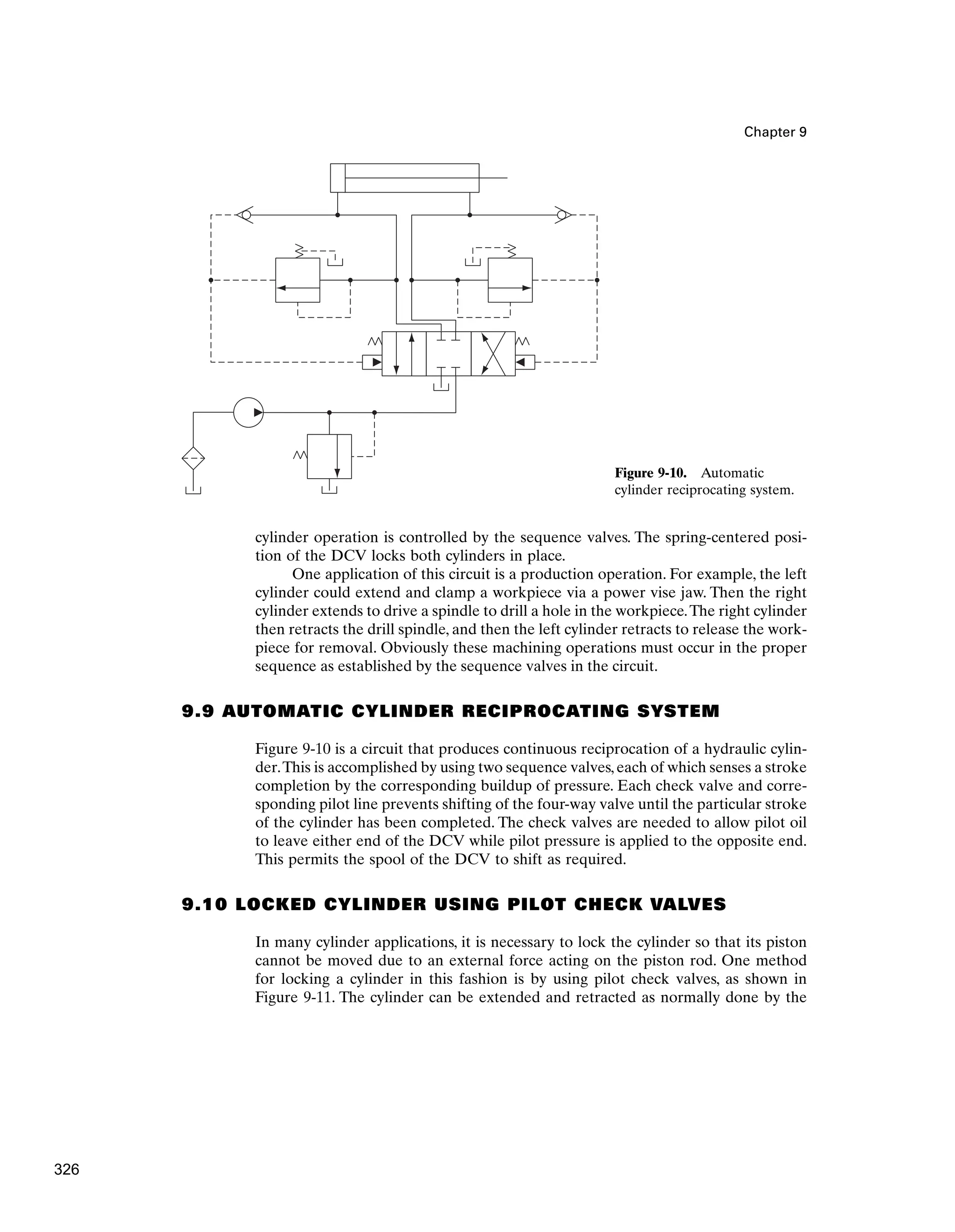
  • 93.
    Chapter 3 If thereis negligibly small leakage between the piston and cylinder bore, the required pump volume flow rate Q equals the volumetric displacement of the cylin- der divided by the time t required for the piston to travel through its stroke. but since VD ⫽ AS, we have (3-21) Since stroke S and time t are basically known from the particular application, Eq. (3-21) permits the calculation of the required pump flow. Recall that for a pipe we determined that Q ⫽ Au where u equals the fluid velocity. Shouldn’t we obtain the same equation for a hydraulic cylinder since it is essentially a pipe that contains a piston moving at velocity u? The answer is yes, as can be verified by noting that S/t can be replaced by u in Eq. (3-21) to obtain the expected result: (3-22) where υ ⫽ piston velocity. Note that the larger the piston area and velocity, the greater must be the pump flow rate. Answer to Question 3. It has been established that energy equals force times distance: Since power is the rate of doing work, we have Since Q ⫽ Au, the final result is (3-23) Recalling that 1 hp ⫽ 550 ft ⭈ lb/s, we obtain hydraulic horsepower ⫽ HHP ⫽ p1lbft2 2 ⫻ Q1ft3 s2 ⫻ 1 hp 550 ft # lbs hydraulic power 1ft # lbs2 ⫽ p1lbft2 2 ⫻ Q1ft3 s2 power ⫽ energy time ⫽ 1pA21S2 t ⫽ p1Ay2 energy ⫽ 1F21S2 ⫽ 1pA21S2 Q1ft3 s2 ⫽ A1ft2 2 ⫻ y1fts2 Q1ft3 s2 ⫽ A1ft2 2 ⫻ S1ft2 t1s2 Q1ft3 s2 ⫽ VD1ft3 2 t1s2 88
  • 94.
    As expected, allthe units cancel out except the units of hp, yielding the following result: (3-24) Hydraulic Horsepower in Terms of psi and gpm Units Pressure in psi (lb/in2) and flow rate in gallons per minute (gpm) are the most com- mon English units used for hydraulic systems. Thus a hydraulic horsepower equa- tion using these most common English units is developed as follows, noting that hydraulic power equals the product of pressure and volume flow rate: Since all the units cancel out except hp, we have the final result: (3-25) Note that the constants 550 and 1714 in Eqs.(3-24) and (3-25) contain the proper units to make these two equations have units of hp on the right side of the equal sign. Observe the following power analogy among mechanical, electrical, and hydraulic systems: mechanical power ⫽ force ⫻ linear velocity ⫽ torque ⫻ angular velocity electrical power ⫽ voltage ⫻ electric current hydraulic power ⫽ pressure ⫻ volume flow rate HHP ⫽ p1psi2 ⫻ Q1gpm2 1714 ⫽ pa lb in2 b ⫻ Qa gal min b ⫻ 231 in3 1 gal ⫻ 1 min 60 s ⫻ 1 ft 12 in ⫻ 1 hp 550 ft # lbs hydraulic power ⫽ p ⫻ Q HHP ⫽ p1lbft2 2 ⫻ Q1ft3 s2 550 Energy and Power in Hydraulic Systems EXTERNAL LOAD HYDRAULIC PUMP HYDRAULIC CYLINDER OR MOTOR V × I VOLTAGE × ELECTRIC CURRENT T × ω TORQUE × ANGULAR VELOCITY p × Q PRESSURE × VOLUME FLOW RATE F × υ FORCE × LINEAR VELOCITY (FOR HYDRAULIC CYLINDER) T × ω ELECTRIC MOTOR TORQUE × ANGULAR VELOCITY (FOR HYDRAULIC MOTOR) Figure 3-25. Conversion of power from input electrical to mechanical to hydraulic to output mechanical in a hydraulic system. 89
  • 95.
    EXAMPLE 3-9 Solve theproblem of Example 3-8 assuming a frictional force of 100 lb and a leakage of 0.2 gpm. EXAMPLE 3-8 A hydraulic cylinder is to compress a car body down to bale size in 10 s. The operation requires a 10-ft stroke and a 8000-lb force. If a 1000-psi pump has been selected, and assuming the cylinder is 100% efficient, find a. The required piston area b. The necessary pump flow rate c. The hydraulic horsepower delivered to the cylinder d. The output horsepower delivered by the cylinder to the load Solution a. b. Per Appendix E, 1 ft3/s ⫽ 449 gpm. Thus, c. d. Thus, assuming a 100% efficient cylinder (losses are negligibly small), the hydraulic horsepower equals the output horsepower. OHP ⫽ HHP ⫻ h ⫽ 14.5 ⫻ 1.0 ⫽ 14.5 hp HHP ⫽ 110002 124.92 1714 ⫽ 14.5 hp Q1gpm2 ⫽ 449Q1ft3 s2 ⫽ 14492 10.05562 ⫽ 24.9 gpm Q1ft3 s2 ⫽ A1ft2 2 ⫻ S1ft2 t1s2 ⫽ a 8 144 b 1102 10 ⫽ 0.0556 ft3 s A ⫽ Fload p ⫽ 8000 lb 1000 lbin2 ⫽ 8 in2 Chapter 3 All three types of power (mechanical, electrical and hydraulic) are typically involved in hydraulic systems, as illustrated in Figure 3-25. In this diagram an electric motor is used as the prime mover to drive the pump. As shown, the electric motor converts electric power into mechanical power via a rotating shaft. The pump con- verts this mechanical power into hydraulic power. Finally, a hydraulic cylinder or hydraulic motor transforms the hydraulic power back into mechanical power to drive the load.A hydraulic cylinder delivers a force to move the load in a straight-line path with a linear velocity.Conversely a hydraulic motor delivers a torque to move the load in a rotary motion with an angular velocity. 90
  • 96.
    3.9 BERNOULLI’S EQUATION Derivationof Bernoulli’s Equation Bernoulli’s equation is one of the most useful relationships for performing hydraulic circuit analysis. Its application allows us to size components such as pumps, valves, and piping for proper system operation. The original Bernoulli equation can be derived by applying the conservation of energy law to a hydraulic pipeline, as shown in Figure 3-26.At station 1 we have W lb of fluid possessing an elevation Z1, a pres- sure p1, and a velocity υ1. When this W lb of fluid arrives at station 2, its elevation, pressure, and velocity have become Z2, p2, and υ2, respectively. With respect to a common zero elevation reference plane, we can identify the various energy terms as follows: Energy and Power in Hydraulic Systems Solution a. b. c. d. Thus, a hydraulic horsepower of 14.8 must be delivered by the fluid to the cylinder to produce an output horsepower at 14.5 for driving the load. The efficiency of the cylinder is h ⫽ OHP HHP ⫽ 14.5 14.8 ⫽ 0.980 ⫽ 98.0% OHP ⫽ F1lb2 ⫻ y1fts2 550 ⫽ 8000 ⫻ 1 550 ⫽ 14.5 hp HHP ⫽ 1000 ⫻ 25.4 1714 ⫽ 14.8 hp Qactual ⫽ Qtheoretical ⫹ Qleakage ⫽ 25.2 ⫹ 0.2 ⫽ 25.4 gpm Qtheoretical ⫽ A1ft2 2 ⫻ S1ft2 t1s2 ⫽ a 8.10 144 b 1102 10 ⫽ 0.0563 ft3 s ⫽ 25.2 gpm A ⫽ Fload ⫹ Ffriction p ⫽ 8000 lb ⫹ 100 lb 1000 lbin2 ⫽ 8.10 in2 Type of Energy Station 1 Station 2 Elevation WZ1 WZ2 Pressure Kinetic Wy2 2 2g Wy1 2 2g W p2 g W p1 g 91
  • 97.
    Chapter 3 Q p1 v1 v2 p2 ZERO ELEVATIONREFERENCE PLANE Q W LB W LB 1 2 Z2 Z1 Figure 3-26. Pipeline for deriving Bernoulli’s equation. Daniel Bernoulli, the eighteenth-century Swiss scientist, formulated his equa- tion by noting that the total energy possessed by the W lb of fluid at station 1 equals the total energy possessed by the same W lb of fluid at station 2, provided frictional losses are negligibly small: (3-26) If we divide both sides of Eq. (3-26) by W, we are examining the energy pos- sessed by 1 lb of fluid rather than W lb.This yields the original Bernoulli equation for an ideal frictionless system that does not contain pumps and hydraulic motors between stations 1 and 2: The total energy per pound of fluid at station 1 equals the total energy per pound of fluid at station 2: (3-27) Checking units, we find that each term has units of length (ft ⭈ lb/lb ⫽ ft).This is as expected, since each term represents energy per pound of fluid: y2 2g ⫽ 1fts22 fts2 ⫽ ft p g ⫽ lbft2 lbft3 ⫽ ft Z ⫽ ft Z1 ⫹ p1 g ⫹ y2 1 2g ⫽ Z2 ⫹ p2 g ⫹ y2 2 2g WZ1 ⫹ W p1 g ⫹ Wy2 1 2g ⫽ WZ2 ⫹ W p2 g ⫹ Wy2 2 2g 92
  • 98.
    Energy and Powerin Hydraulic Systems Since each term of Bernoulli’s equation has units of length,the use of the expres- sion head has picked up widespread use as follows: Z is called elevation head. p/γ is called pressure head. υ2/2g is called velocity head. The Energy Equation Bernoulli modified his original equation to take into account that frictional losses (HL) take place between stations 1 and 2. HL (called head loss) represents the energy per pound of fluid loss due to friction in going from station 1 to station 2. In addition, he took into account that a pump (which adds energy to fluid) or a hydraulic motor (which removes energy from fluid) may exist between stations 1 and 2. HP (pump head) represents the energy per pound of fluid added by a pump, and Hm (motor head) represents the energy per pound of fluid removed by a hydraulic motor. The modified Bernoulli equation (also called the energy equation), is stated as follows for a fluid flowing in a pipeline from station 1 to station 2: The total energy possessed by a 1-lb chunk of fluid at station 1 plus the energy added to it by a pump minus the energy removed from it by a hydraulic motor minus the energy it loses due to friction, equals the total energy possessed by the 1-lb chunk of fluid when it arrives at station 2. The energy equation is given as follows, where each term represents a head and thus has units of length: (3-28) The method used for determining the head loss (HL) for a given application is presented in Chapter 4. The equation for determining the pump head (HP) can be derived by using Eq. (2-9): Thus we have p ⫽ γ Hp. Then, as shown in Appendix H, substituting p ⫽ γ Hp into Eq. (3-25) yields (3-29) The motor head can also be calculated using Eq. (3-29), where the Hp term is replaced by Hm.The HHP and Q terms then represent the motor hydraulic horsepower and gpm flow rate, respectively. Note that pump hydraulic horsepower is the power Hp1ft2 ⫽ 3950 ⫻ 1HHP2 Q1gpm2 ⫻ SG p ⫽ gH. Z1 ⫹ p1 g ⫹ y2 1 2g ⫹ Hp ⫺ Hm ⫺ HL ⫽ Z2 ⫹ p2 g ⫹ y2 2 2g 93
  • 99.
    Chapter 3 the pumpdelivers to the fluid, whereas motor hydraulic horsepower is the power the fluid delivers to the motor. Venturi Application The use of a venturi in an automobile engine carburetor is an application of Bernoulli’s equation. Figure 3-27 shows a venturi, which is a special pipe whose diameter is gradually reduced until a constant-diameter throat is reached.Then the pipe gradually increases in diameter until it reaches the original size.We know that inlet station 1 has a lower velocity than does the throat station 2 due to the continuity equation. Therefore, υ2 is greater than υ1. Let’s write Bernoulli’s equation between stations 1 and 2 assuming ideal flow and equal elevations: Solving for p1 ⫺ p2, we have Since υ2 is greater than υ1, we know that p1 must be greater than p2.The rea- son is simple: In going from station 1 to 2 the fluid gained kinetic energy due to the continuity theorem. As a result, the fluid had to lose pressure energy in order not to create or destroy energy.This venturi effect is commonly called Bernoulli’s principle. Figure 3-28 shows how the venturi effect is used in an automobile carburetor. The volume of airflow is determined by the opening position of the butterfly valve. As the air flows through the venturi, it speeds up and loses some of its pressure.The pressure in the fuel bowl is equal to the pressure in the air horn above the venturi. This differential pressure between the fuel bowl and the venturi throat causes gaso- line to flow into the airstream.The reduced pressure in the venturi helps the gasoline to vaporize. p1 ⫺ p2 ⫽ g 2g 1y2 2 ⫺ y2 12 p1 g ⫹ y2 1 2g ⫽ p2 g ⫹ y2 2 2g LOW PRESSURE HIGH VELOCITY HIGH PRESSURE LOW VELOCITY QOUT QIN 1 2 Figure 3-27. Pressure reduction in a venturi. 94
  • 100.
    EXAMPLE 3-10 For thehydraulic system of Figure 3-29, the following data are given: a. The pump is adding 5 hp to the fluid (pump hydraulic horsepower ⫽ 5). b. Pump flow is 30 gpm. c. The pipe has a 1-in. inside diameter. d. The specific gravity of the oil is 0.9. Find the pressure available at the inlet to the hydraulic motor (station 2). The pressure at station 1 in the hydraulic tank is atmospheric (0 psig).The head loss HL due to friction between stations 1 and 2 is 30 ft of oil. Solution Writing the energy equation between stations 1 and 2, we have Since there is no hydraulic motor between stations 1 and 2, Hm ⫽ 0. Also, υ1 ⫽ 0 because the cross section of an oil tank is large. Thus, the velocity of the Z1 ⫹ p1 g ⫹ y2 1 2g ⫹ Hp ⫺ Hm ⫺ HL ⫽ Z2 ⫹ p2 g ⫹ y2 2 2g Energy and Power in Hydraulic Systems THROAT OF VENTURI BUTTERFLY VALVE AIR-FUEL MIXTURE AIR Q (AIR) Q FUEL BOWL FUEL Figure 3-28. Use of venturi to produce Bernoulli effect in automobile carburetor. 95
  • 101.
    oil surface isnegligible, and the value of υ1 approaches zero. Per Figure 3-29, Z2 ⫺ Z1 ⫽ 20 ft. Also, HL ⫽ 30 ft, and p1 ⫽ 0 gage pressure per the given input data. Substituting known values, we have Solving for p2/γ, we have Since Z2 ⫺ Z1 ⫽ 20 ft, we have Using Eq. (3-29) yields Then, solve for υ2 2/2g as follows On final substitution, we have p2 g ⫽ 732 ⫺ 2.4 ⫺ 50 ⫽ 679.2 ft y2 2 2g ⫽ 112.2 fts22 64.4 fts2 ⫽ 2.4 ft y2 ⫽ 0.0668 0.00546 ft3 s ft2 ⫽ 12.2 fts A1ft2 2 ⫽ p 4 1D ft22 ⫽ p 4 a 1 12 ftb 2 ⫽ 0.00546 ft2 y2 1fts2 ⫽ Q1ft3 s2 A1ft2 2 Q1ft3 s2 ⫽ Q1gpm2 449 ⫽ 30 449 ⫽ 0.0668 Hp ⫽ 139502152 130210.92 ⫽ 732 ft p2 g ⫽ Hp ⫺ y2 2 2g ⫺ 50 p2 g ⫽ 1Z1 ⫺ Z2 2 ⫹ Hp ⫺ y2 2 2g ⫺ 30 Z1 ⫹ 0 ⫹ 0 ⫹ Hp ⫺ 0 ⫺ 30 ⫽ Z2 ⫹ p2 g ⫹ y2 2 2g Chapter 3 96
  • 102.
    Solving for p2yields where γ ⫽ (SG) γwater, γ ⫽ (0.9)(62.4) ⫽ 56.2 lb/ft3, p2 ⫽ (679.2)(56.2) ⫽ 38,200 lb/ft2. Changing to units of psi yields The answer, 265 obtained for p2 is a gage pressure since a gage pressure value of zero was used in the energy equation for p1. p2 ⫽ 38,200 144 ⫽ 265 psig p2 1lbft2 2 ⫽ 1679.2 ft2 g 1lbft3 2 Energy and Power in Hydraulic Systems 3.10 TORRICELLI’S THEOREM Torricelli’s theorem states that ideally the velocity of a free jet of fluid is equal to the square root of the product of two times the acceleration of gravity times the head producing the jet. As such, Torricelli’s theorem is essentially a special case of Bernoulli’s equation for the system of Figure 3-30. In this system we have a tank with an opening in its side. The tank is filled with a liquid to a height h above the centerline of the opening. As a result, a jet of fluid flows through the opening. STRAINER OIL TANK OIL LEVEL 1 2 PUMP ELECTRIC MOTOR HYDRAULIC MOTOR 1-IN INSIDE DIA. 20-FT ELEVATION LOAD M Q Figure 3-29. Hydraulic system for Example 3-10. 97
  • 103.
    Chapter 3 1 2 h Figure 3-30.System for Torricelli’s equation. To derive Torricelli’s equation we shall consider a reference point (1) at the top surface of liquid in the tank and a second reference point (2) in the jet just beyond its opening. Since the fluid jet flows into the atmosphere, it is called a “free jet.” Writing the energy equation between points 1 and 2, we have For the system of Figure 3-30, we can make the following observations: 1. p1 ⫽ p2 ⫽ atmospheric pressure ⫽ 0 psig. 2. The area of the surface of liquid in the tank is large so that the velocity υ1 equals essentially zero. 3. There is no pump or motor (Hp ⫽ Hm ⫽ 0). 4. The fluid is ideal, and therefore there are no frictional losses (HL ⫽ 0). 5. Z2 can be taken as the reference zero elevation plane (Z2 ⫽ 0). Substituting known values yields Solving for υ2, we have (3-30) where υ2 ⫽ jet velocity (ft/s), g ⫽ acceleration of gravity (ft/s2), h ⫽ pressure head (ft). If we do not assume an ideal fluid, frictional head losses occur, and therefore HL does not equal zero. The solution becomes (3-31) y2 ⫽ 22g1h ⫺ HL 2 y2 ⫽ 22gh h ⫹ 0 ⫹ 0 ⫹ 0 ⫺ 0 ⫺ 0 ⫽ 0 ⫹ 0 ⫹ y2 2 2g Z1 ⫹ p1 g ⫹ y2 1 2g ⫹ Hp ⫺ Hm ⫺ HL ⫽ Z2 ⫹ p2 g ⫹ y2 2 2g 98
  • 104.
    EXAMPLE 3-11 For thesystem of Figure 3-30, h ⫽ 36 ft and the diameter of the opening is 2 in. Assuming an ideal fluid, find a. The jet velocity in units of ft/s b. The flow rate in units of gpm c. The answers to parts a and b if HL ⫽ 10 ft Solution a. Substituting into Eq. (3-30) yields b. Solving for Q we have c. Use Eq. (3-31): Since flow rate is proportional to velocity, we have As expected, there is a greater flow rate for the ideal fluid as compared to a real fluid possessing viscosity. Q ⫽ 40.9 48.3 ⫻ 471 gpm ⫽ 399 gpm y2 ⫽ 2 164.42 136 ⫺ 102 ⫽ 40.9 fts Q1gpm2 ⫽ 449Q1ft3 s2 ⫽ 449 ⫻ 1.05 ⫽ 471 gpm Q1ft3 s2 ⫽ A1ft2 2 ⫻ y1fts2 ⫽ p 4 a 2 12 ftb 2 ⫻ 48.3 fts ⫽ 1.05 ft3 s y2 ⫽ 2 122 132.2 fts2 2 ⫻ 136 ft2 ⫽ 48.3 fts Energy and Power in Hydraulic Systems This shows that the jet velocity is reduced if the fluid is not ideal because there is less net pressure head to push the fluid through the opening.Thus, the actual velocity of the jet depends on the viscosity of the fluid. 3.11 THE SIPHON The siphon is a familiar hydraulic device. It is commonly used to cause a liquid to flow from one container in an upward direction over an obstacle and then flow downward into a second lower container.As shown in Figure 3-31, a siphon consists of a U-tube with one end submerged below the surface of the liquid in the container. The center portion of the U-tube lies above the level of the liquid surface, and the free end lies below it on the outside of the container. 99
  • 105.
    Chapter 3 For thefluid to flow out of the free end, two conditions must be met: 1. The elevation of the free end must be lower than the elevation of the liquid surface inside the container. 2. The fluid must initially be forced to flow up from the container into the center portion of the U-tube. This is normally done by temporarily providing a suc- tion pressure at the free end of the siphon. For example, when siphoning gaso- line from an automobile gas tank, a person can develop this suction pressure by momentarily sucking on the free end of the hose.This allows atmospheric pres- sure in the tank to push the gasoline up the U-tube hose, as required. For con- tinuous flow operation, the free end of the U-tube hose must lie below the gasoline level in the tank. We can analyze the flow through a siphon by applying the energy equation using points 1 and 2 in Figure 3-31: The following conditions apply for the siphon: 1. p1 ⫽ p2 ⫽ atmospheric pressure ⫽ 0 psig. 2. The area of the surface of the liquid in the container is large so that the velocity υ1 equals essentially zero. 3. There is no pump or motor (Hp ⫽ Hm ⫽ 0). 4. Z1 ⫺ Z2 ⫽ h ⫽ differential head between liquid level and free end of U-tube. Substituting known values, we have Z1 ⫹ 0 ⫹ 0 ⫹ 0 ⫺ 0 ⫺ HL ⫽ Z2 ⫹ 0 ⫹ y2 2 2g Z1 ⫹ p1 g ⫹ y2 1 2g ⫹ Hp ⫺ Hm ⫺ HL ⫽ Z2 ⫹ p2 g ⫹ y2 2 2g 1 2 ZERO ELEVATION U-TUBE REFERENCE h Z1 Z2 Figure 3-31. Siphon. 100
  • 106.
    EXAMPLE 3-12 For thesiphon of Figure 3-31, the following information is given: Find the velocity and flow rate through the siphon. Solution Substitute known values into Eq. (3-32): Solving for the flow rate we have Q1gpm2 ⫽ 449Q1ft3 s2 ⫽ 449 ⫻ 0.195 ⫽ 87.6 gpm Q1ft3 s2 ⫽ A1ft2 2 ⫻ y1fts2 ⫽ p 4 a 1 12 ftb 2 ⫻ 35.8 fts ⫽ 0.195 ft3 s y2 ⫽ 2122 132.22 130 ⫺ 102 ⫽ 35.8 fts U-tube inside diameter ⫽ 1 in. HL ⫽ 10 ft h ⫽ 30 ft Energy and Power in Hydraulic Systems Solving for υ2 yields (3-32) Equation (3-32) is identical to Torricelli’s equation, and, as expected, the veloc- ity inside the siphon tube is reduced as the head loss HL due to viscosity increases.The flow rate of the siphon can be found by using the continuity equation. y2 ⫽ 22g1Z1 ⫺ Z2 ⫺ HL 2 ⫽ 22g1h ⫺ HL 2 3.12 ENERGY, POWER, AND FLOW RATE IN THE SI METRIC SYSTEM In this section we provide the necessary information to calculate energy, power, and flow rate in the SI metric system. Energy In the SI system, the joule (J) is the work done when a force of 1 N acts through a distance of 1 m. Since work equals force times distance, we have Thus, we have (3–33) energy 1J2 ⫽ F1N2 ⫻ S1m2 1 J ⫽ 1 N ⫻ 1 m ⫽ 1 N # m 101
  • 107.
    Chapter 3 Power Power isthe rate of doing work. In the SI system, 1 watt (W) of power is the rate of 1 J of work per second: Thus, we have (3-34) (3-35) In the SI metric system all forms of power are expressed in watts.Appendix E, which provides tables of conversion factors, shows that 1 hp ⫽ 746 W ⫽ 0.746 kW. Pump head Hp in units of meters can be related to pump power in units of watts by using Eq. (2-9): p ⫽ γ H. Thus, we have p ⫽ γ Hp. Substituting p ⫽ γ Hp into Eq. (3-35) yields (3-36) Equation (3-36) can be used to solve for the pump head for use in the energy equation.The motor head can also be calculated using Eq. (3-36), where the Hp term is replaced by Hm. The pump hydraulic power is replaced by the motor hydraulic power and Q represents the motor flow rate. The mechanical output power (brake power or torque power) delivered by a hydraulic motor can be found from Eq. (3-37), where T is torque and ω or N is angular speed. (3-37) Equation (3-37) is derived in Appendix H. Flow Rate Volume flow rate within a pipeline equals the product of the pipe cross-sectional area and the fluid velocity: (3-38) Q1m3 s2 ⫽ A1m2 2 ⫻ y1ms2 power1kW2 ⫽ T1N # m2 ⫻ v1rads2 1000 ⫽ T1N # m2 ⫻ N1rpm2 9550 Hp 1m2 ⫽ pump hydraulic power 1W2 g1Nm3 2 ⫻ Q1m3 s2 hydraulic power 1W2 ⫽ p1Nm2 2 ⫻ Q1m3 s2 power 1W2 ⫽ work1N # m2 time1s2 1 W ⫽ 1 J s ⫽ 1N # ms power ⫽ work time 102
  • 108.
    EXAMPLE 3-14 Oil isflowing through a 30-mm diameter pipe at 60 liters per minute (Lpm). Determine the velocity. Solution Per Eq. (3-38) we have where Q1m3 s2 ⫽ Q1Lmin2 ⫻ 0.001 m3 1 L ⫻ 1 min 60 s ⫽ 0.0000167 Q 1Lpm2 y1ms2 ⫽ Q1m3 s2 A1m2 2 EXAMPLE 3-13 For the hydraulic jack of Figure 3-7 the following data are given: A1 ⫽ 25 cm2 A2 ⫽ 100 cm2 F1 ⫽ 200 N S1 ⫽ 5 cm Determine a. F2 b. S2 Solution a. b. S2 ⫽ A1 A2 ⫻ S1 ⫽ 25 100 ⫻ 5 ⫽ 1.25 cm F2 ⫽ A2 A1 ⫻ F1 ⫽ 100 25 ⫻ 200 ⫽ 800 N Energy and Power in Hydraulic Systems A flow rate of 1 m3 /s is an extremely large flow rate (1 m3 /s ⫽ 15,800 gpm). Thus flow rates are frequently specified in units of liters per second (Lps) or liters per minute (Lpm). Since 1 liter ⫽ 1 L ⫽ 0.001 m3, we have 3.13 ILLUSTRATIVE EXAMPLES USING THE SI METRIC SYSTEM In this section we show how to solve hydraulic system problems using the SI metric system units. Q1Lps2 ⫽ Q1Ls2 ⫽ 1000 Q1m3 s2 103
  • 109.
    Substituting values yields y⫽ 0.0010 0.000707 ⫽ 1.41 ms A ⫽ pD2 4 ⫽ p 4 10.03 m22 ⫽ 0.000707 m2 ⫽ 0.0000167 ⫻ 60 ⫽ 0.0010 m3 s EXAMPLE 3-15 A hydraulic pump delivers oil at 50 Lpm and 10,000 kPa. How much hydraulic power does the pump deliver? Solution Per Eq. (3-35), we have Substituting values yields Hydraulic power 1kW2 ⫽ 10,000 ⫻ 0.000835 ⫽ 8.35 kW ⫽ 0.0000167 ⫻ 50 ⫽ 0.000835 m3 s where Q1m3 s2 ⫽ Q1Lmin2 ⫻ 0.001 m3 1 L ⫻ 1 min 60 s ⫽ 0.0000167Q 1Lpm2 hydraulic power 1kW2 ⫽ p1Pa2 ⫻ Q1m3 s2 1000 ⫽ p1kPa2 ⫻ Q1m3 s2 Chapter 3 EXAMPLE 3-16 Determine the torque delivered by a hydraulic motor if the speed is 1450 rpm and the mechanical output power is 10 kW. Solution Solving Eq. (3-37) for torque yields ⫽ 9550 ⫻ 10 1450 ⫽ 65.9 N # m T1N # m2 ⫽ 9550 ⫻ power 1kW2 N1rpm2 104
  • 110.
    EXAMPLE 3-17 For thehydraulic system of Figure 3-29, the following SI metric data are given: a. The pump is adding 3.73 kW (pump hydraulic power ⫽ 3.73 kW) to the fluid. b. Pump flow is 0.001896 m3/s. c. The pipe has a 0.0254-m inside diameter. Note that this size can also be represented in units of centimeters or millimeters as 2.54 cm or 25.4 mm, respectively. d. The specific gravity of the oil is 0.9. e. The elevation difference between stations 1 and 2 is 6.096 m. Find the pressure available at the inlet to the hydraulic motor (station 2). The pressure at station 1 in the hydraulic tank is atmospheric (0 Pa or 0 N/m2 gage). The head loss HL due to friction between stations 1 and 2 is 9.144 m of oil. Solution Writing the energy equation between stations 1 and 2, we have Since there is no hydraulic motor between stations 1 and 2, Hm ⫽ 0. Also, υ1 ⫽ 0 because the cross section of an oil tank is large. Also, HL ⫽ 9.144 m and p1 ⫽ 0 per the given input data. Substituting known values, we have Solving for p2/γ, we have Since Z2 ⫺ Z1 ⫽ 6.096 m, we have From Eq. (3-36) we solve for the pump head: Hp 1m2 ⫽ pump hydraulic power 1W2 g1Nm3 2 ⫻ Q1m3 s2 p2 g ⫽ Hp ⫺ y2 2 2g ⫺ 15.24 p2 g ⫽ 1Z1 ⫺ Z2 2 ⫹ Hp ⫺ y2 2 2g ⫺ 9.144 Z1 ⫹ 0 ⫹ 0 ⫹ Hp ⫺ 0 ⫺ 9.144 ⫽ Z2 ⫹ p2 g ⫹ y2 2 2g Z1 ⫹ p1 g ⫹ y2 1 2g ⫹ Hp ⫺ Hm ⫺ HL ⫽ Z2 ⫹ p2 g ⫹ y2 2 2g Energy and Power in Hydraulic Systems 105
  • 111.
    where Next, we solvefor υ2 and υ 2 2/2g: On final substitution, we have Solving for p2 yields p2 ⫽ 1207.12188172 ⫽ 1,826,000 Pa ⫽ 1826 kPa gage p2 1Nm2 2 ⫽ 1207.1 m2g1Nm3 2 p2 g ⫽ 223.1 ⫺ 0.714 ⫺ 15.24 ⫽ 207.1 m y2 2 2g ⫽ 13.74 ms22 12219.80 ms2 2 ⫽ 0.714 m y2 1ms2 ⫽ Q1m3 s2 A1m2 2 ⫽ 0.001896 1p42 10.0254 m22 ⫽ 3.74 ms Hp1m2 ⫽ 3730 8817 ⫻ 0.001896 ⫽ 223.1 m. goil ⫽ 1SG2 gwater ⫽ 0.9 ⫻ 9797 Nm3 ⫽ 8817 Nm3 Chapter 3 3.14 KEY EQUATIONS Newton’s law (3-2) of motion: Work: (3-3) Mechanical power (3-4) (linear): Mechanical (3-5) horsepower (linear): Torque: (3-6) T ⫽ FR HP ⫽ F1lb2 ⫻ y1ft/s2 550 power ⫽ Fy W ⫽ FS F ⫽ ma 106
  • 112.
    Energy and Powerin Hydraulic Systems Mechanical power (rotary) Brake horsepower: (3-7) Brake power (metric units): (3-37) Efficiency: (3-8) Force multiplication ratio in hydraulic jack: (3-9) Potential energy due (3-13) to elevation: Potential energy (3-14) due to pressure: Kinetic energy: (3-15) Continuity equation: (3-18) Hydraulic power English units: (3-23) Metric units: (3-35) Hydraulic horsepower: (3-25) Bernoulli’s equation: (3-27) Z1 ⫹ p1 g ⫹ y1 2 2g ⫽ Z2 ⫹ p2 g ⫹ y2 2 2g HHP ⫽ p1psi2 ⫻ Q1gpm2 1714 hydraulic power 1W2 ⫽ p1N/m2 2 ⫻ Q1m3 /s2 hydraulic power 1ft # lb/s2 ⫽ p1lb/ft2 2 ⫻ Q1ft3 /s2 Q1 ⫽ A1y1 ⫽ A2y2 ⫽ Q2 KE ⫽ 1 2 W g y2 PPE ⫽ W p g EPE ⫽ WZ F2 F1 ⫽ A2 A1 h ⫽ output power input power ⫽ T1N # m2 ⫻ N1rpm2 9550 Power1kW2 ⫽ T1N # m2 ⫻ ␻1rad/s2 1000 HP ⫽ T1in # lb2 ⫻ N1rpm2 63,000 107
  • 113.
    Chapter 3 Energy equation (modified Bernoulli’sequation): (3-28) Pump head Special English (3-29) units: Metric units: (3-36) Fluid velocity: (3-22 and 3-38) Energy: (3-33) EXERCISES Questions, Concepts, and Definitions 3-1. State Pascal’s law. 3-2. Explain the meaning of Bernoulli’s equation and how it affects the flow of a liquid in a hydraulic circuit. 3-3. What is the continuity equation, and what are its implications relative to fluid flow? 3-4. State Torricelli’s theorem in your own words. 3-5. Explain how a siphon operates. 3-6. State the law of conservation of energy. 3-7. Explain how a venturi is used to produce the Bernoulli effect in an automobile carburetor. 3-8. What is meant by the terms elevation head, pressure head, and velocity head? 3-9. State Newton’s three laws of motion. 3-10. Differentiate between energy and power. 3-11. Define the term torque. 3-12. What is meant by the term efficiency? 3-13. Relative to power, there is an analogy among mechanical, electrical, and hydraulic systems. Describe this analogy. 3-14. What is the significance of each term in the energy equation? Problems Note: The letter E following an exercise number means that English units are used. Similarly, the letter M indicates metric units. Energy ⫽ FS y ⫽ Q A Hp1m2 ⫽ pump hydraulic power1W2 g1N/m3 2 ⫻ Q1m3 /s2 Hp1ft2 ⫽ 3950 ⫻ 1HHP2 Q1gpm2 ⫻ 1SG2 Z1 ⫹ p1 g ⫹ y1 2 2g ⫹ Hp ⫺ Hm ⫺ HL ⫽ Z2 ⫹ p2 g ⫹ y2 2 2g 108
  • 114.
    SMALL PISTON 100 N OIL LARGE PISTON F =? Figure 3-32. System for Exercise 3-15. Energy and Power in Hydraulic Systems Pascal’s Law 3-15M. In the hydraulic jack shown in Figure 3-32, a force of 100 N is exerted on the small piston. Determine the upward force on the large piston.The area of the small piston is 50 cm2, and the area of the large piston is 500 cm2. 3-16M. For the system in Exercise 3-15 (shown in Figure 3-32), if the small piston moves 10 cm, how far will the large piston move? Assume the oil to be incompressible. 3-17M. Figure 3-33 shows a pneumatic/hydraulic system used to lift a load. If the inlet air pressure is 500 kPa, determine the maximum load that can be lifted. 3-18E. A pump delivers oil to a cylindrical storage tank, as shown in Figure 3-34. A faulty electric pressure switch, which controls the electric motor driving the pump, allows the pump to fill the tank completely.This causes the pressure p1 near the base of the tank to build up to 15 psig.What force is exerted on the top of the tank? What does the pressure difference between the tank top and point 1 say about Pascal’s law? What must be true about the magnitude of system pressure if the change in pres- sure due to elevation changes can be ignored in a fluid power system? OIL OIL PISTON OIL PISTON VENT HOLE INLET AIR SUPPLY AIR PISTON AIR LOAD OIL 50-mm DIA 100-mm DIA 100-mm DIA Figure 3-33. System for Exercise 3-17. 109
  • 115.
    Chapter 3 3-19E. Forthe hydraulic jack of Figure 3-32, a force of 100 lb is exerted on the small piston. Determine the upward force on the large piston.The diameter of the small piston is 2 in and the diameter of the large piston is 6 in. 3-20E. For the system in Exercise 3-19 (shown in Figure 3-32), if the small piston moves 1.5 in, how far will the large piston move? Assume the oil to be incompressible. 3-21M. For the fluid power automobile lift system of Figure 3-35, the air pressure equals 550 kPa gage. If the hydraulic piston has a 250-mm diameter, what is the maximum weight of an automobile that can be lifted? The specific gravity of the oil is 0.90.What percent error in the answer to this problem occurs by ignoring the 1-m head of oil between the air-oil interface surface and the bottom surface of the piston? 3-22E. Two hydraulic cylinders are connected at their piston ends (cap ends rather than rod ends) by a single pipe. Cylinder A has a 2-in diameter and cylinder B has a 4-in diameter. A 500-lb retraction force is applied to the piston rod of cylinder A. Determine the a. Pressure in cylinder A b. Pressure in cylinder B c. Pressure in the connecting pipe d. Output force of cylinder B 1 20 FT 30 FT 10-FT DIA P1 PUMP Figure 3-34. System for Exercise 3-18. 1 m PISTON AIR FROM COMPRESSOR CONTROL VALVE OIL AIR OIL Figure 3-35. System for Exercise 3-21. 110
  • 116.
    Energy and Powerin Hydraulic Systems 3-23E. An operator makes 20 complete cycles during a 15-sec interval using the hand pump of Figure 3-8. Each complete cycle consists of two pump strokes (intake and power). The pump has a 2-in-diameter piston and the load cylinder has a 4-in-diameter piston. The average hand force is 20 lb during each power stroke. a. How much load can be lifted? b. Through what distance will the load be moved during the 15-sec interval assuming no oil leakage? The pump piston has a 3-in stroke. c. What is the output HP assuming 90% efficiency? 3-24M. For the system in Exercise 3-23, change the data to metric units and solve parts a, b, and c. 3-25E. For the pressure booster of Figure 3-13, the following data are given: inlet air pressure (p1) ⫽ 125 psi air piston area (A1) ⫽ 20 in2 oil piston area (A2) ⫽ 1 in2 load-carrying capacity (F) ⫽ 75,000 lb Find the required load piston area A3. 3-26M. For the system in Exercise 3-25, change the data to metric units and solve for the required load piston area A3. 3-27M. For the pressure booster of Figure 3-13, the following data are given: inlet oil pressure (p1) ⫽ 1 MPa air piston area (A1) ⫽ 0.02 m2 oil piston area (A2) ⫽ 0.001 m2 load-carrying capacity (F) ⫽ 300,000 N Find the required load piston area A3. 3-28E. A hydraulic system has a 100-gal reservoir mounted above the pump to produce a pos- itive pressure (above atmospheric) at the pump inlet, as shown in Figure 3-36. The purpose of the positive pressure is to prevent the pump from cavitating when oper- ating, especially at start-up. If the pressure at the pump inlet is to be 5 psi prior to turning the pump on and the oil has a specific gravity of 0.90, what should the oil level be above the pump inlet? 3-29E. For the hydraulic system of Figure 3-37, what would be the pressure at the pump inlet if the reservoir were located below the pump so that the oil level were 4 ft below the pump inlet? The specific gravity of the oil is 0.90. Ignore frictional losses and changes in kinetic energy.What effect would frictional losses and changes in kinetic energy have on the pressure at the pump inlet? Why? Would this increase or decrease the chances for having pump cavitation? Why? 3-30E. The hydraulic jack shown in Figure 3-38 is filled with oil.The large and small pistons have diameters of 3 in and 1 in, respectively.What force F on the handle is required to support the 2000-lb weight? If the force moves down 5 in, how far will the weight be lifted? 3-31M. For the system in Exercise 3-30, as shown in Figure 3-38, change the data to metric units. Then calculate the force F in units of N and determine how far the weight will be lifted in units of cm. 111
  • 117.
    4 FT p Q VENT PUMP Figure 3-37.System for Exercise 3-29. Chapter 3 3-32M. Figure 3-39 shows a mechanical/hydraulic system used for clamping a cylindrical workpiece during a machining operation. If the machine operator applies a 100-N force to the lever as shown, what clamping force is applied to the workpiece? Continuity Equation 3-33E. At a velocity of 10 ft/s, how many gpm of fluid will flow through a 1-in-inside- diameter pipe? 3-34E. How large an inside-diameter pipe is required to keep the velocity at 15 ft/s if the flow rate is 20 gpm? 3-35M. For the system in Exercise 3-34, change the data to metric units and solve for the size of inside-diameter pipe required. 3-36M. A hydraulic pump delivers fluid at 40 Lpm through a 25-mm-diameter pipe. Determine the fluid velocity. 3-37M. The following relationship containing metric units is analogous to Eq. (3-38): For this equation, determine the numerical value of C. Using this value of C, calculate υ2 (m/s) for the system of Example 3-17 and resolve any numerical difference. y1ms2 ⫽ CQ1m3 s2 3D1m2 42 h p = 5 psig VENT RESERVOIR PUMP Figure 3-36. System for Exercise 3-28. 112
  • 118.
    Figure 3-38. Systemfor Exercise 3-30. Energy and Power in Hydraulic Systems 3-38M. At a velocity of 3 m/s, how many m3/s of fluid will flow through a 0.10-m-inside- diameter pipe? 3-39E. How long would it take a 20-gpm pump to extend a 4-in-diameter cylinder through a 20-in stroke? 3-40E. In Exercise 3-39, if the rod diameter is 2 in, how long will it take to retract the cylinder? 3-41E. A double-rod cylinder is one in which the rod extends out of the cylinder at both ends.Such a cylinder,with a 3-in-diameter piston and 2-in-diameter rod,cycles through a 10-in stroke at 60 cycles per minute.What gpm size pump is required? Figure 3-39. System for Exercise 3-32. OIL OIL 250 mm 500 mm 100 N 50-mm-DIA PISTON 100-mm-DIA PISTON / CLAMP F 2000-lb LOAD 1 IN OIL 15 IN 113
  • 119.
    Chapter 3 3-42M. Acylinder with a 8-cm-diameter piston and 3-cm-diameter rod receives fluid at 30 Lpm. If the cylinder has a stroke of 35 cm, what is the maximum cycle rate that can be accomplished? 3-43M. Oil with specific gravity 0.9 enters a tee, as shown in Figure 3-40, with velocity υ1 ⫽ 5 m/s.The diameter at section 1 is 10 cm, the diameter at section 2 is 7 cm, and the diameter at section 3 is 6 cm. If equal flow rates are to occur at sections 2 and 3, find υ2 and υ3. Hydraulic Power 3-44M. A hydraulic pump delivers a fluid at 50 Lpm and 10,000 kPa. How much hydraulic power does the pump produce? 3-45E. A hydraulic system is powered by a 5-hp motor and operates at 1000 psi. Assuming no losses, what is the flow rate through the system in gpm? 3-46E. A hydraulic cylinder is to compress a car body down to bale size in 8 sec. The operation requires an 8-ft stroke and a 10,000-lb force. If a 1000-psi pump has been selected, and assuming the cylinder is 100% efficient, find a. The required piston area b. The necessary pump flow rate c. The hydraulic horsepower delivered to the cylinder d. The output horsepower delivered by the cylinder to the load e. Solve parts a, b, c, and d assuming a 100-lb friction force and a leakage of 0.3 gpm. What is the efficiency of the cylinder with the given friction force and leakage? 3-47M. Show that Eq. (3-36) can be rewritten as follows: 3-48E. The power and load-carrying capacity of a hydraulic cylinder (extension direction) are 10 hp and 5000 lb, respectively. Find the piston velocity in units of ft/s. 3-49M. The power and load-carrying capacity of a hydraulic cylinder (extension direction) are 10 kW and 20,000 N, respectively. Find the piston velocity in units of m/s. 3-50M. A hydraulic system is powered by a 5-kW motor and operates at 10 MPa.Assuming no losses, what is the flow rate through the system in units of m3/s? 3-51M. A hydraulic cylinder is to compress a car body down to bale size in 8 s.The operation requires a 3-m stroke and a 40,000-N force. If a 10-MPa pump has been selected, and assuming the cylinder is 100% efficient, find a. The required piston area (m2) b. The necessary pump flow rate (m3/s) c. The hydraulic power (kW) delivered to the cylinder d. The output power (kW) delivered by the cylinder to the load e. Solve parts a, b, c, and d assuming a 400-N friction force and a leakage of 1.0 Lpm. What is the efficiency of the cylinder with the given friction force and leakage? 3-52E. An automotive lift raises a 3500-lb car 7 ft above floor level. If the hydraulic cylinder contains an 8-in-diameter piston and 4-in-diameter rod, determine the a. Work necessary to lift the car b. Required pressure c. Power if the lift raises the car in 10 s d. Descending speed of the lift for a 10-gpm flow rate e. Flow rate for the auto to descend in 10 s Hp 1m2 ⫽ 0.102 ⫻ pump hydraulic power 1kW2 Q1m3 s2 ⫻ 1SG2 114
  • 120.
    1 2 2 IN1 IN Figure 3-41. System for Exercise 3-54. Energy and Power in Hydraulic Systems 3-53M. For the system in Exercise 3-52, change the data to metric units and solve parts a–e. Bernoulli’s Equation 3-54E. Fluid is flowing horizontally at 100 gpm from a 2-in-diameter pipe to a 1-in-diameter pipe, as shown in Figure 3-41. If the pressure at point 1 is 10 psi, find the pressure at point 2.The specific gravity of the fluid is 0.9. 3-55M. For the system in Exercise 3-54, change the data to metric units and solve for the pressure at point 2. 3-56E. What is the potential energy of 1000 gal of water at an elevation of 100 ft? 3-57E. What is the kinetic energy of 1 gal of water traveling at 20 ft/s? 3-58E. A siphon made of a 1-in-inside-diameter pipe is used to maintain a constant level in a 20-ft-deep tank. If the siphon discharge is 30 ft below the top of the tank, what will be the flow rate if the fluid level is 5 ft below the top of the tank? 3-59M. For the system in Exercise 3-58, change the data to metric units and solve for the flow rate. 3-60E. For the hydraulic system of Figure 3-29, the following data are given: 1. The pump is adding 4 hp to the fluid. 2. Pump flow is 25 gpm. 3. The pipe has been changed to an 0.75-in-inside diameter size. 4. The specific gravity of the oil is 0.9. 5. The oil tank is vented to the atmosphere. 6. The head loss HL between stations 1 and 2 is 40 ft of oil. Find the pressure available at the inlet to the hydraulic motor (station 2). 3-61E. The oil tank for the hydraulic system of Figure 3-42 is air-pressurized at 10 psig.The inlet line to the pump is 10 ft below the oil level.The pump-flow rate is 30 gpm. Find the pressure at station 2 if a. There is no head loss between stations 1 and 2 b. There is a 25-ft head loss between stations 1 and 2 3-62M. Solve Exercise 3-60 using metric units.The equivalent metric data are given as follows: 1. The pump is adding 2.984 kW to the fluid. 2. Pump flow is 0.00158 m3/s. Q 1 2 3 TEE Figure 3-40. System for Exercise 3-43. 115
  • 121.
    Chapter 3 3. Thepipe has a 0.01905-m inside diameter. 4. The specific gravity of the oil is 0.9. 5. The oil tank is vented to the atmosphere. 6. The head loss HL between stations 1 and 2 is 12.19 m of oil. 7. The elevation difference between stations 1 and 2 is 6.096 m. Find the pressure available at the inlet to the hydraulic motor (station 2). 3-63M. Solve Exercise 3-61 using metric units.The equivalent metric data are given as follows: 1. Pump flow is 0.001896 m3/s. 2. The air pressure at station 1 in the hydraulic tank is 68.97-kPa gage pressure. 3. The inlet line to the pump is 3.048 m below the oil level. 4. The pipe has a 0.0381-m inside diameter. Find the pressure at station 2 if a. There is no head loss between stations 1 and 2 b. There is a 7.622-m head loss between stations 1 and 2 3-64E. For the pump in Figure 3-43,Qout ⫽ 30 gpm of oil having a specific gravity of 0.9.Points A and B are at the same elevation.What is Qin?Assuming the pump efficiency is 100%, find the pressure difference between points A and B if a. The pump is turned off b. The input power to the pump is 2 hp 3-65M. For the system in Exercise 3-64, change the data to metric units and solve parts a and b. ELECTRIC MOTOR 1.5-IN- INSIDE DIAMETER STRAINER OIL LEVEL 1 2 10 FT PUMP SG = 0.9 Q = 30 GPM M Figure 3-42. Hydraulic sys- tem for Exercise 3-61. QOUT 1-IN DIAMETER QIN A B 2-IN DIAMETER PUMP Figure 3-43. System for Exercise 3-64. 116
  • 122.
    Learning Objectives Upon completingthis chapter, you should be able to: 1. Differentiate between laminar and turbulent flow. 2. Understand the significance of the Reynolds number. 3. Determine the Reynolds number at any location in a pipeline. 4. Explain the meaning of the term friction factor. 5. Determine friction factors for laminar and turbulent flow. 6. Evaluate the head loss in a pipeline undergoing laminar or turbulent flow. 7. Calculate frictional losses in valves and fittings. 8. Explain the meaning of the term K factor. 9. Discuss the significance of the term equivalent length. 10. Perform an energy analysis of a complete hydraulic circuit. 4.1 INTRODUCTION Up to now we have not investigated the mechanism of energy losses due to fric- tion associated with the flow of a fluid inside a pipeline. It is intuitive that liquids, such as water or gasoline, flow much more readily than do other liquids, such as oil. The resistance to flow is essentially a measure of the viscosity of the fluid. The greater the viscosity of a fluid, the less readily it flows and the more energy is required to move it. This energy is lost because it is dissipated into heat and thus represents wasted energy. Energy losses also occur in valves and fittings. A fitting is a component (other than a straight pipe) that is used to carry the fluid.Examples are bends,couplings,tees, elbows, filters, and strainers. The nature of the flow path through valves and fittings 4 Frictional Losses in Hydraulic Pipelines From Chapter 4 of Fluid Power with Applications, Seventh Edition. ­ Anthony Esposito. Copyright © 2009 by Pearson Education, Inc. Publishing as Prentice Hall. All rights reserved. 117
  • 123.
    Chapter 4 determines theamount of energy losses. Generally speaking, the more tortuous the path,the greater the losses.In many fluid power applications,energy losses due to flow in valves and fittings exceed those due to flow in pipes. It is very important to keep all energy losses in a fluid power system to a min- imum acceptable level. This requires the proper selection of the sizes of the pipes, valves, and fittings that make up the system. In general, the smaller the pipe diame- ter as well as valve and fitting size, the greater the losses. However, using large- diameter pipes, valves, and fittings results in greater cost and poor space utilization. Thus, the selection of component sizes represents a compromise between energy losses and component cost and space requirements. The resistance to flow of pipes, valves, and fittings can be determined using empirical formulas that have been developed by experimentation. This permits the calculation of energy losses for any system component.The energy equation and the continuity equation can then be used to perform a complete analysis of a fluid power system.This includes calculating the pressure drops, flow rates, and power losses for all components of the fluid power system. Figure 4-1 depicts a hydraulic system (shown inside the dashed lines) whose pump receives mechanical energy from an electric motor. The hydraulic system delivers mechanical energy to an external load via a hydraulic cylinder while it also HEAT ENERGY OUT MECHANICAL ENERGY OUT MECHANICAL ENERGY IN PUMP HYDRAULIC CYLINDER EXTERNAL LOAD HYDRAULIC SYSTEM (CONTAINED WITHIN DASHED LINES) ELECTRIC MOTOR CHECK VALVE PIPELINES DIRECTIONAL CONTROL VALVE RESERVOIR OIL STRAINER Figure 4-1. Energy transfer into and out of a hydraulic system includes energy loss (in the form of heat) due to frictional fluid flow through pipes, valves, and fittings. 118
  • 124.
    Frictional Losses inHydraulic Pipelines Figure 4-2. Hydraulic-powered backhoe loader. (Courtesy of Caterpillar Inc., Peoria, Illinois.) transfers heat energy (such as that created by frictional fluid flow through pipes, valves, and fittings) to the surroundings. Within the hydraulic system, the pump receives low-pressure oil from the reservoir and delivers it at high pressure to the hydraulic cylinder.The hydraulic cylinder uses this flow of high-pressure oil to drive the external load as low-pressure oil returns to the reservoir. Figure 4-2 shows a backhoe loader that uses a variable displacement, pressure- compensated, axial-piston pump to provide optimum performance in both backhoe and loader operations.The backhoe portion of the machine performs operations such as digging a trench.The front loader portion can then be used to load a dump truck with the earth removed from the trench dug by the backhoe.The pump delivers the desired flow to the hydraulic cylinders at the required pressure to fulfill implement demands. At an operating speed of 2200 rpm, the pump produces a maximum flow of 43 gpm (163 Lpm) at a system pressure of 3300 psi (22,700 kPa). 4.2 LAMINAR AND TURBULENT FLOW In our discussions of fluid flow in pipes in Chapter 3, we assumed a constant velocity over the cross section of a pipe at any one station (see Figure 3-23). However, when a fluid flows through a pipe, the layer of fluid at the wall has zero velocity. This is due to viscosity, which causes fluid particles to cling to the wall. Layers of fluid at the progressively greater distances from the pipe surface have higher velocities, with the maximum velocity occurring at the pipe centerline, as illustrated in Figure 4-3. There are two types of flow in pipes. The first type is laminar flow, which is characterized by the fluid flowing in smooth layers or laminae. In this type of flow, a particle of fluid in a given layer stays in that layer, as shown in Figure 4-4. This type 119
  • 125.
    Chapter 4 Q C L Figure 4-3.Velocity profile in pipe. Q C L Figure 4-4. Straight-line path of fluid particles in laminar flow. of fluid motion is called streamline flow because all the particles of fluid are moving in parallel paths. Therefore, laminar flow is smooth with essentially no collision of particles. For laminar flow, the friction is caused by the sliding of one layer or parti- cle of fluid over another in a smooth continuous fashion. If the velocity of flow reaches a high enough value, the flow ceases to be lami- nar and becomes turbulent.As shown in Figure 4-5, in turbulent flow the movement of a particle becomes random and fluctuates up and down in a direction perpendicular as well as parallel to the mean flow direction. This mixing action generates turbu- lence due to the colliding fluid particles.This causes considerably more resistance to flow and thus greater energy losses than that produced by laminar flow. The difference between laminar and turbulent flow can be seen when using a water faucet. When the faucet is turned only partially open, with just a small amount of flow, the flow pattern observed is a smooth laminar one, as depicted in Figure 4-6(a). However, when the faucet is opened wide, the flow mixes and becomes turbulent, as illustrated in Figure 4-6(b). 4.3 REYNOLDS NUMBER It is important to know whether the flow pattern inside a pipe is laminar or turbu- lent. This brings us to the experiments performed by Osborn Reynolds in 1833 to determine the conditions governing the transition from laminar to turbulent flow. Q C L Figure 4-5. Random fluctuation of fluid particles in turbulent flow. 120
  • 126.
    Frictional Losses inHydraulic Pipelines Using the test setup shown in Figure 4-7, Reynolds allowed the fluid in the large tank to flow through a bell-mouthed entrance and along a smooth glass pipe.He con- trolled the flow rate by means of a valve at the end of the pipe. A capillary tube, connected to a reservoir of dye, allowed the flow of a fine jet of dye into the main flow stream. If the flow in the pipe was laminar, the dye jet flowed smoothly. However, when turbulent flow occurred in the pipe, the dye jet would mix with the main fluid. Figure 4-6. Flow patterns from water faucet. (a) Laminar flow, (b) turbulent flow. (Reprinted from Introduction to Fluid Mechanics by J. E. John and W. L. Haberman, Prentice Hall, Englewood Cliffs, NJ, 1988.) DYE CAPILLARY TUBE VALVE GLASS PIPE TANK Figure 4-7. Reynolds’ experiment. 121
  • 127.
    Chapter 4 Reynolds cameto a very significant conclusion as a result of his experiments: The nature of the flow depends on the dimensionless parameter υDρ/µ, where υ = fluid velocity, D = pipe inside diameter, ρ = fluid density, and µ = absolute viscosity of the fluid. This parameter has been named the Reynolds number (NR) and (as Reynolds discovered from his tests) has the following significance: 1. If NR is less than 2000, the flow is laminar. 2. If NR is greater than 4000, the flow is turbulent. 3. Reynolds numbers between 2000 and 4000 cover a critical zone between lami- nar and turbulent flow. It is not possible to predict the type of flow that will exist within the critical zone.Thus if the Reynolds number lies in the critical zone, turbulent flow should be assumed. However, since turbulent flow results in greater losses, hydraulic systems should normally be designed to operate in the laminar flow region. The Reynolds number (NR = υDρ/µ = υD/v), which is a dimensionless param- eter (has no overall units), can be calculated in several ways depending on the units used for each of its dependent variables (υ, D, ρ, µ, and v). This is shown in the following equations, where the letter M denotes metric units. (4-1) (4-1M) Using absolute viscosity in units of cP gives (4-2) (4-2M) A final relationship using kinematic viscosity in units of cS is: (4-3) (4-3M) Note that in Eqs. (4-2), (4-2M), (4-3), and (4-3M) the constant contains the proper units to cause the Reynolds number to be dimensionless. NR ⫽ 1000y1ms2 ⫻ D1mm2 n1cS2 NR ⫽ 7740y1fts2 ⫻ D1in2 n1cS2 NR ⫽ 1000y1ms2 ⫻ D1mm2 ⫻ SG m 1cP2 NR ⫽ 7740y1fts2 ⫻ D1in2 ⫻ SG m 1cP2 NR ⫽ y1ms2 ⫻ D1m2 ⫻ r 1kgm3 2 m 1N # sm2 2 ⫽ y1ms2 ⫻ D1m2 n1m2 s2 NR ⫽ y1fts2 ⫻ D1ft2 ⫻ r1slugsft3 2 m 1lb # sft2 2 ⫽ y1fts2 ⫻ D1ft2 n1ft2 s2 122
  • 128.
    EXAMPLE 4-2 Oil (v= 0.001 m2/s) is flowing in a 50-mm-diameter pipe at a velocity of 5 m/s. What is the Reynolds number? Solution Per Eq. (4-1M), we have NR ⫽ 5 ⫻ 0.050 0.001 ⫽ 250 EXAMPLE 4-1 The kinematic viscosity of a hydraulic oil is 100 cS. If the fluid is flowing in a 1-in-diameter pipe at a velocity of 10 ft/s, what is the Reynolds number? Solution Substitute directly into Eq. (4-3): NR ⫽ 1774021102112 100 ⫽ 774 Frictional Losses in Hydraulic Pipelines If turbulent flow is allowed to exist, higher fluid temperatures will occur due to greater frictional energy losses. Therefore, turbulent flow systems suffering from excessive fluid temperatures can be helped by increasing the pipe diameter to establish laminar flow. 4.4 DARCY’S EQUATION Friction is the main cause of energy losses in fluid power systems. The energy loss due to friction is transferred into heat, which is given off to the surrounding air. The result is a loss of potential energy in the system, and this shows up as a loss in pressure or head. In Chapter 3 we included this head loss in the energy equa- tion as an HL term. However, we did not discuss how the magnitude of this head loss term could be evaluated. The head loss (HL) in a system actually consists of two components: 1. Losses in pipes 2. Losses in valves and fittings Head losses in pipes can be found by using Darcy’s equation: (4-4) HL ⫽ fa L D b a y2 2g b 123
  • 129.
    Chapter 4 where f= friction factor (dimensionless), L = length of pipe (ft, m), D = pipe inside diameter (ft, m), υ = average fluid velocity (ft/s, m/s), g = acceleration of gravity (ft/s2, m/s2). Darcy’s equation can be used to calculate the head loss due to friction in pipes for both laminar and turbulent flow.The difference between the two lies in the eval- uation of the friction factor f.The technique is discussed for laminar and turbulent flow in Sections 4.5 and 4.6, respectively. 4.5 FRICTIONAL LOSSES IN LAMINAR FLOW Darcy’s equation can be used to find head losses in pipes experiencing laminar flow by noting that for laminar flow the friction factor equals the constant 64 divided by the Reynolds number: (4-5) Substituting Eq. (4-5) into Eq. (4-4) yields the Hagen-Poiseuille equation, which is valid for laminar flow only: (4-6) Examples 4-3 and 4-4 illustrate the use of the Hagen-Poiseuille equation. HL ⫽ 64 NR a L D b a y2 2g b f ⫽ 64 NR EXAMPLE 4-3 For the system of Example 4-1, find the head loss due to friction in units of psi for a 100-ft length of pipe. The oil has a specific gravity of 0.90. Solution From Eq. (4-6) we solve for the head loss in units of feet of oil: Note that the units for HL are really ft · lb/lb. Thus, we can conclude that 154 ft · lb of energy is lost by each pound of oil as it flows through the 100-ft length of pipe. HL ⫽ 64 774 a 100 1 12 b a 102 64.4 b ⫽ 154 ft 124
  • 130.
    Frictional Losses inHydraulic Pipelines 4.6 FRICTIONAL LOSSES IN TURBULENT FLOW Effect of Pipe Roughness Darcy’s equation will be used for calculating energy losses in turbulent fluid flow. However, the friction factor cannot be represented by a simple formula as was the case for laminar flow. This is due to the random and fluctuating movement of the fluid particles. For turbulent flow, experiments have shown that the friction factor is a function of not only the Reynolds number but also the relative roughness of the pipe.The rel- ative roughness is defined as the pipe inside surface roughness, (Greek letter epsilon), divided by the pipe inside diameter D: (4-7) Figure 4-8 illustrates the physical meaning of the pipe inside surface roughness , which is called the absolute roughness. e relative roughness ⫽ e D e Using Eq. (2-9), we convert head loss in units of feet of oil to pressure loss in units of psi: Thus, there is a 60-psi pressure loss as the oil flows through the 100-ft length of pipe. This pressure loss is due to friction. ⫻ 112 ⫻ 1542in ⫽ 60 psi pL ⫽ gHL ⫽ 1SG ⫻ gH2O 2 ⫻ HL ⫽ 10.9 ⫻ 0.03612lbin3 EXAMPLE 4-4 For the system of Example 4-2, find the head loss due to friction for a 50-m length of pipe. γoil = 8800 N/m3. Solution From Eq. (4-6), we have The pressure drop is ¢p ⫽ g1Nm3 2 ⫻ HL 1m2 ⫽ 8800 ⫻ 326 ⫽ 2,870,000 Pa ⫽ 2870 kPa HL ⫽ 64 250 a 50 0.050 b a 52 2 ⫻ 9.80 b ⫽ 326 m of oil 125
  • 131.
    Chapter 4 Pipe roughnessvalues depend on the pipe material as well as the method of man- ufacture.Figure 4-9 gives typical values of absolute roughness for various types of pipes. It should be noted that the values given in Figure 4-9 are average values for new clean pipe.After the pipes have been in service for a time, the roughness values may change significantly due to the buildup of deposits on the pipe walls. The Moody Diagram To determine the value of the friction factor for use in Darcy’s equation, we use the Moody diagram shown in Figure 4-10. This diagram contains curves that were determined by data taken by L. F. Moody. Each curve represents values of friction factor as a function of the Reynolds number for a given value of relative rough- ness. Thus, if we know the Reynolds number and relative roughness, we can quickly determine the friction factor. The following important characteristics should be noted about the Moody diagram: 1. It is plotted on logarithmic paper because of the large range of values encoun- tered for f and NR. 2. At the left end of the chart (Reynolds numbers less than 2000) the straight- line curve gives the relationship for laminar flow: f = 64/NR. C L D Figure 4-8. Pipe absolute roughness ( ). e TYPE OF PIPE (in) (mm) GLASS OR PLASTIC DRAWN TUBING COMMERCIAL STEEL OR WROUGHT IRON ASPHALTED CAST IRON GALVANIZED IRON CAST IRON RIVETED STEEL SMOOTH 0.00006 0.0018 0.0048 0.006 0.0102 0.072 SMOOTH 0.0015 0.046 0.12 0.15 0.26 1.8 ABSOLUTE ROUGHNESS ε ε Figure 4-9. Typical values of absolute roughness. 126
  • 132.
    Figure 4-10. TheMoody diagram. (Reprinted from Introduction to Fluid Mechanics by J. E. John and W. L. Haberman, Prentice Hall, Englewood Cliffs, NJ, 1988.) 127
  • 133.
    Chapter 4 3. Nocurves are drawn in the critical zone (2000 NR 4000), because it is not possible to predict whether the flow is laminar or turbulent in this region. 4. For Reynolds numbers greater than 4000, each curve plotted represents a par- ticular value of /D. For intermediate values of /D, interpolation is required. 5. Once complete turbulence is reached (region to the right of the dashed line), increasing values of NR have no effect on the value of f. Example 4-5 illustrates the use of the Moody diagram for finding values of friction factor f for laminar and turbulent flow. e e EXAMPLE 4-5 The kinematic viscosity of a hydraulic oil is 50 cS. If the oil flows in a 1-in- diameter commercial steel pipe, find the friction factor if a. The velocity is 10 ft/s b. The velocity is 40 ft/s Solution a. Find NR from Eq. (4-3): Since the flow is laminar, we do not need to know the relative roughness value. To find f, locate 1.548 × 10³ on the NR axis of the Moody diagram (approximate value = 1.5 × 10³).Then project vertically up until the straight- line curve ( f = 64/NR) is reached. Then project horizontally to the f axis to obtain a value of 0.042. b. Since the flow is turbulent, we need the value of /D. First, the relative roughness (a dimensionless parameter) is found using Figure 4-9 to get the value of : e D ⫽ 0.0018 in 1 in ⫽ 0.0018 e e NR ⫽ 177402 1402 112 50 ⫽ 6192 ⫽ 6.192 ⫻ 103 NR ⫽ 177402 1102 112 50 ⫽ 1548 ⫽ 1.548 ⫻ 103 128
  • 134.
    Frictional Losses inHydraulic Pipelines Since approximate values of NR are used and interpolation of /D values is required, variations in the determined value of f are expected when using the Moody diagram. However, this normally produces variations of less than ±0.001, which is generally acceptable for calculating frictional losses in piping systems. This type of analysis is done for a complete system in Section 4.9. 4.7 LOSSES IN VALVES AND FITTINGS The K Factor In addition to losses due to friction in pipes, there also are energy losses in valves and fittings such as tees, elbows, and bends. For many fluid power applications, the majority of the energy losses occur in these valves and fittings in which there is a change in the cross section of the flow path and a change in the direction of flow. Thus, the nature of the flow through valves and fittings is very complex. As a result, experimental techniques are used to determine losses. Tests have shown that head losses in valves and fittings are proportional to the square of the velocity of the fluid: (4-8) The constant of proportionality (K) is called the K factor (also called loss coefficient) of the valve or fitting. Figure 4-11 gives typical K-factor values for several common types of valves and fittings. Common Valves and Fittings Illustrations of several common valves and fittings are given as follows: 1. Globe valve. See Figure 4-12. In this design, the fluid changes direction when flow occurs between the globe and seat.This construction increases resistance to fluid flow but also permits close regulation. Figure 4-12 shows the globe valve in its fully closed position. A threaded stem (attached to the globe by a swivel HL ⫽ Ka y2 2g b e Now locate the value 6.192 × 10³ on the NR axis of the Moody diagram (approximate value = 6.2 × 10³). Then project vertically up until you are between the /D curves of 0.0010 and 0.0020 (where the 0.0018 curve would approximately exist if it were drawn). Then project horizontally to the f axis to obtain a value of 0.036. e 129
  • 135.
    Chapter 4 connection androtated by the handwheel) not only raises and lowers the globe, but also helps guide it squarely to its seat. 2. Gate valve. See Figure 4-13. Fluids flow through gate valves in straight-line paths; thus, there is little resistance to flow and the resulting pressure drops are small. A gatelike disk (actuated by a stem screw and handwheel) moves up and down at right angles to the path of flow and seats against two seat Figure 4-12. Globe valve. (Courtesy of Crane Co., New York, New York.) Figure 4-13. Gate valve. (Courtesy of Crane Co., New York, New York.) VALVE OR FITTING K FACTOR GLOBE VALVE: GATE VALVE: RETURN BEND STANDARD TEE STANDARD ELBOW? 45° ELBOW 90° ELBOW BALL CHECK VALVE WIDE OPEN 1/2 OPEN WIDE OPEN 3/4 OPEN 1/2 OPEN 1/4 OPEN 10.0 12.5 0.19 0.90 4.5 24.0 2.2 1.8 0.9 0.42 0.75 4.0 Figure 4-11. K factors of common valves and fittings. 130
  • 136.
    Frictional Losses inHydraulic Pipelines faces to shut off flow. Gate valves are best for services that require infre- quent valve operation and where the disk is kept either fully opened or closed. They are not practical for throttling. With the usual type of gate valve, close regulation is impossible.Velocity of flow against a partly opened disk may cause vibration and chattering and result in damage to the seating surfaces. 3. 45° elbow. See Figure 4-14. 4. 90° elbow. See Figure 4-15. 5. Tee. See Figure 4-16. 6. Return bend. See Figure 4-17. 7. Ball check valve. See Figure 4-18.The function of a check valve is to allow flow to pass through in only one direction. Thus, check valves are used to prevent backflow in hydraulic lines. Figure 4-14. 45° elbow. (Courtesy of Crane Co., New York, New York.) Figure 4-15. 90° elbow. (Courtesy of Crane Co., New York, New York.) Figure 4-16. Tee. (Courtesy of Crane Co., New York, New York.) Figure 4-17. Return bend. (Courtesy of Crane Co., New York, New York.) Figure 4-18. Ball check valve. (Courtesy of Crane Co., New York, New York.) 131
  • 137.
    Chapter 4 Figure 4-19.Cutaway of a directional control valve. (Courtesy of Continental Hydraulics, Division of Continental Machines, Inc., Savage, Minnesota.) Pressure Drop versus Flow Rate Curves For some fluid power valves, in addition to specifying K factors, empirical curves of pressure drop versus flow rate are given by the valve manufacturer.Thus, if the flow rate through the valve is known, the pressure drop can be determined by referring to the curve. This is normally done for directional control valves and also for flow control valves for various opening positions. Figure 4-19 shows a cutaway of a directional control valve whose pressure drop versus flow rate characteristics are provided by curves (see Figure 4-20) as well as by K-factor values.As expected from Eq. (4-8), the curves show that the pressure drop increases approximately as the square of the flow rate. Most fluid power valves (including the valve of Figure 4-19) are of the spool design. A spool is a circular shaft containing lands that are larger-diameter sections machined to slide in a very close fitting bore of the valve body.The grooves between the lands provide the desired flow paths through the valve for unique positions of the sliding spool.The design and operation of hydraulic valves are discussed in detail in Chapter 8. 4.8 EQUIVALENT-LENGTH TECHNIQUE Darcy’s equation shows that the head loss in a pipe, due to fluid friction, is proportional not only to the square of the fluid velocity but also to the length of the pipe. There is a similarity between Darcy’s equation and Eq. (4-8), which states that the head loss in a valve or fitting is proportional to the square of the fluid velocity. This suggests we can find a length of pipe that for the same flow rate would produce the same head loss as a valve or fitting. This length of pipe, which is called the equivalent length of a valve or fitting, can be found by equating the head losses across the valve or fitting and the pipe: HL1valve or fitting2 ⫽ HL1pipe2 132
  • 138.
    EXAMPLE 4-7 What isthe head loss across a 50-mm wide-open gate valve when oil (ν = 0.001 m2/s, γ = 8800N/m3) flows through it at a rate of 0.02 m3/s? Solution The velocity is found first. From Figure 4-11, K = 0.19. Thus, per Eq. (4-8), we have The pressure drop across the valve can now be found: ¢p1Nm2 2 ⫽ g1Nm3 2 ⫻ HL1m2 ⫽ 880011.012 ⫽ 8890 Pa ⫽ 8.89 kPa HL ⫽ 0.19110.222 2 ⫻ 9.80 ⫽ 1.01 m of oil y1ms2 ⫽ Q1m3 s2 A1m2 2 ⫽ 0.02 p 4 10.05022 ⫽ 10.2 ms Frictional Losses in Hydraulic Pipelines EXAMPLE 4-6 What is the head loss across a 1-in wide-open globe valve when oil (SG = 0.9) flows through it at a rate of 30 gpm? Solution Find the fluid velocity using Eq. (3-22): From Figure 4-11, K for a wide-open globe valve equals 10. Thus, per Eq. (4-8), we have The pressure drop (Δp) across the valve can now be found: ⫻ 112 ⫻ 23.12 in ⫽ 9.01 psi ¢p ⫽ gHL ⫽ 1SG ⫻ gH2O 2 ⫻ HL ⫽ 10.9 ⫻ 0.03612 lbin3 HL ⫽ 1102112.222 64.4 ⫽ 23.1 ft of oil y1fts2 ⫽ Q1ft3 s2 A1ft2 2 ⫽ 30449 p 4 111222 ⫽ 12.2 fts 133
  • 139.
    Chapter 4 200 180 160 140 120 100 80 60 40 20 0 12 3 FLOW — GPM PRESSURE DROP — PSI 4 5 6 7 4 3 2 1 TYPICAL PRESSURE DROP VS. FLOW FOR VS5M VALVE 100 SUS HYDRAULIC OIL. FLOW PATTERN NO SPOOL SHIFTED SPOOL TYPE PA PB AT BT A B F G L 2 4 2 2 4 2 4 2 2 4 2 1 1 2 3 2 1 1 2 3 PA PB AT BT – 3 – 4 – – 3 – 4 – – 3 2 – – – 3 2 – – FT – 3 – – 2 SPOOL CENTERED Figure 4-20. Pressure drop (vs.) flow curves for a directional control valve. (Courtesy of Continental Hydraulics, Division of Continental Machines, Inc., Savage, Minnesota.) Substituting the corresponding expressions, we have Since the velocities are equal, we can cancel the υ2/2g terms from both sides of the equation.The result is (4-9) Le ⫽ KD f Ka y2 2g b ⫽ fa Le D b a y2 2g b 134
  • 140.
    Frictional Losses inHydraulic Pipelines where Le is the equivalent length of a valve or fitting whose K factor is K. Note that parameters K and f are both dimensionless. Therefore, Le and D will have the same dimensions. For example, if D is measured in units of feet, then Le will be calculated in units of feet. Equation (4-9) permits the convenience of examining each valve or fitting of a fluid power system as though it were a pipe of length Le. This provides a convenient method of analyzing hydraulic circuits where frictional energy losses are to be taken into account. Section 4.9 deals with this type of problem. Example 4-8 shows how to find the equivalent length of a hydraulic component. EXAMPLE 4-8 Hydraulic oil (n = 100 cS) flows through a 1-in-diameter commercial steel pipe at a rate of 30 gpm. What is the equivalent length of a 1-in wide-open globe valve placed in the line? Solution We need to find the friction factor f, so let’s first find the velocity υ from Eq. (3-22): Using Eq. (4-3), we find the Reynolds number: Since the flow is laminar, we do not need to know the relative roughness to find the friction factor. Finally, we determine the equivalent length using Eq. (4-9): Thus, a 1-in-diameter pipe of length 12.3 ft would produce the same fric- tional energy loss as a 1-in wide-open globe valve for a flow rate of 30 gpm. Le ⫽ KD f ⫽ 11021 1 12 ft2 0.0678 ⫽ 12.3 ft f ⫽ 64 NR ⫽ 64 944 ⫽ 0.0678 NR ⫽ 7740112.22112 100 ⫽ 944 y1fts2 ⫽ Q1ft3 s2 A1ft2 2 ⫽ 30449 p 4 111222 ⫽ 12.2 fts 135
  • 141.
    Chapter 4 EXAMPLE 4-9 Forthe hydraulic system of Figure 4-21, the following data are given: a. The pump is adding 5 hp to the fluid (pump hydraulic horsepower = 5). b. Pump flow is 30 gpm. c. The pipe has a 1-in inside diameter. d. The specific gravity of oil is 0.9. e. The kinematic viscosity of oil is 100 cS. Find the pressure available at the inlet to the hydraulic motor (station 2). The pressure at the oil top surface level in the hydraulic tank is atmospheric (0 psig).The head loss HL due to friction between stations 1 and 2 is not given. Solution Writing the energy equation between stations 1 and 2, we have Z1 ⫹ p1 g ⫹ y1 2 2g ⫹ Hp ⫺ Hm ⫺ HL ⫽ Z2 ⫹ p2 g ⫹ y2 2 2g 4.9 HYDRAULIC CIRCUIT ANALYSIS We are now ready to perform a complete analysis of a hydraulic circuit, taking into account energy losses due to friction. Let’s analyze the hydraulic system of Figure 4-21 by doing an example problem. VENT PUMP OIL LEVEL 1 2 1-IN INSIDE DIA. (4 FT LONG) 1-IN INSIDE DIA. (16 FT LONG) HYDRAULIC MOTOR ELECTRIC MOTOR 1-IN INSIDE DIA. (1 FT LONG) 1-IN STD. ELBOW 20-FT ELEVATION M LOAD Figure 4-21. Hydraulic system for Example 4-9. 136
  • 142.
    Since there isno hydraulic motor between stations 1 and 2, Hm = 0. Also, υ1 = 0 and p1/γ = 0 (the oil tank is vented to the atmosphere). Also, Z2 - Z1 = 20 ft, per Figure 4-21. To make use of the energy equation, let’s first solve for υ2 using Eq. (3-22): Next, let’s evaluate the velocity head at station 2: The Reynolds number can now be found: Since the flow is laminar, the friction factor can be found directly from the Reynolds number: We can now determine the head loss due to friction between stations 1 and 2: where Substituting values gives the head loss. HL ⫽ 10.06782 122.12 1 12 12.42 ⫽ 43 ft LeTOT ⫽ 21 ⫹ 10.921 1 12 ft2 0.0678 ⫽ 21 ⫹ 1.1 ⫹ 22.1 ft LeTOT ⫽ 16 ⫹ 1 ⫹ 4 ⫹ a KD f b std elbow LeTOT ⫽ LTOT ⫹ Le 1std elbow2 HL ⫽ f a LeTOT D b y2 2g f ⫽ 64 NR ⫽ 64 944 ⫽ 0.0678 NR ⫽ 7740y1fts2 ⫻ D1in2 n1cS2 ⫽ 7740112.22 112 100 ⫽ 944 y2 2 2g ⫽ 112.222 64.4 ⫽ 2.4 ft y21fts2 ⫽ Q1ft3 s2 A1ft2 2 ⫽ 30449 p 4 111222 ⫽ 12.2 fts Frictional Losses in Hydraulic Pipelines 137
  • 143.
    Chapter 4 We cannow substitute into the energy equation to solve for p2/γ: Using Eq. (3-29) allows us to solve for the pump head: Thus, we can solve for the pressure head at station 2: Finally, we solve for the pressure at station 2: where Thus, Note that the pressure increase across the pump (from inlet to discharge) can be found as follows: Thus, the pump has to produce a pressure increase of 286 psi (from inlet to outlet) to provide a pressure of 260 psi at the inlet to the hydraulic motor. ¢ppump ⫽ gHp ⫽ 56.2 lbft3 ⫻ 732 ft ⫽ 41,100 lbft2 ⫽ 286 psi p2 ⫽ 16672 156.22 ⫽ 37,500 lbft2 ⫽ 260 psi g ⫽ 1SG2gwater ⫽ 10.92162.42 ⫽ 56.2 lbft3 p21lbft2 2 ⫽ 1667 ft2 ⫻ g1lbft3 2 p2 g ⫽ 732 ⫺ 65.4 ⫽ 667 ft Hp1ft2 ⫽ 39501HHP2 Q1gpm2 ⫻ 1SG2 ⫽ 139502152 130210.92 ⫽ 732 ft p2 g ⫽ Hp ⫺ 65.4 p2 g ⫽ ⫺20 ⫹ Hp ⫹ 0 ⫺ 43 ⫺ 2.4 p2 g ⫽ 1Z1 ⫺ Z2 2 ⫹ Hp ⫹ p1 g ⫺ HL ⫺ y2 2 2g 4.10 CIRCUIT ANALYSIS USING THE SI METRIC SYSTEM In this section we perform a complete analysis of a hydraulic circuit using the SI metric system of units and taking into account energy losses due to friction. 138
  • 144.
    EXAMPLE 4-10 For thehydraulic system of Figure 4-21, the following metric data are given: a. The pump is adding 3.73 kW to the fluid. b. Pump flow is 0.00190 m3/s. c. The pipe has a 0.0254-m inside diameter. d. The specific gravity of oil is 0.9. e. The kinematic viscosity of oil is 100 cS. f. The elevation difference between stations 1 and 2 is 6.10 m. g. Pipe lengths are as follows: pump inlet pipe length = 1.53 m and pump outlet pipe length up to hydraulic motor = 4.88 m. Find the pressure available at the inlet to the hydraulic motor (station 2). The pressure at the oil top surface level in the hydraulic tank is atmospheric (0 Pa gage). The head loss, HL, due to friction between stations 1 and 2 is not given. Solution In the SI metric system,absolute viscosity is given in units of newton- seconds per meter squared. Thus, we have µ = N · s/m2 = Pa · s. Our problem is to convert viscosity in cS to the appropriate units in the SI metric system. This is accomplished as follows: The conversion between dyn · s/cm2 or poise and N · s/m2 is found first: This yields a useful conversion equation dealing with absolute viscosities: (4-10) Since a centipoise is one-hundredth of a poise, we can develop a conver- sion equation between N · s/m2 and centipoise: (4-11) Substituting Eq. (4-11) into Eq. (4-10) yields the desired result: (4-12) However, in this problem, we were given a kinematic viscosity value rather than an absolute viscosity value. Therefore, we need to convert viscosity in cS m1N # sm2 2 ⫽ m1cP2 1001102 ⫽ m1cP2 1000 m1P2 ⫽ m1cP2 100 m1N # sm2 2 ⫽ m1dyn # scm2 2 10 ⫽ m1poise2 10 m 1N # sm2 2 ⫽ m 1dyn # scm2 2 ⫻ 1N 105 dyn ⫻ a 100 cm 1 m b 2 Frictional Losses in Hydraulic Pipelines 139
  • 145.
    to the appropriateunits in the SI metric system. Kinematic viscosity in the SI metric system is given in units of meters squared per second. Thus, we have n = m2/s. The conversion between cm2/s or stokes and m2/s is found as follows: (4-13) Since a centistoke is one-hundredth of a stoke, we can now develop the desired conversion between m2/s and centistokes: (4-14) Substituting Eq. (4-14) into Eq. (4-13) yields (4-15) Now back to the problem at hand. We write the energy equation between stations 1 and 2 as: Since there is no hydraulic motor between stations 1 and 2, Hm = 0. Also υ1 = 0 and p1/γ = 0 (the oil tank is vented to the atmosphere). Also, Z2 - Z1 = 6.10 m per given input data. To make use of the energy equation, let’s first solve for υ2: Next, let’s evaluate the velocity head at station 2: The Reynolds number can now be found: NR ⫽ y1ms2 ⫻ D1m2 n1m2 s2 ⫽ 13.742 10.02542 1001,000,000 ⫽ 944 y2 2 2g ⫽ 13.74 ms22 219.80 ms2 2 ⫽ 0.174 m y21ms2 ⫽ Q1m3 s2 A1m2 2 ⫽ 0.00190 1p4210.025422 ⫽ 3.74 ms Z1 ⫹ p1 g ⫹ y2 1 2g ⫹ Hp ⫺ Hm ⫺ HL ⫽ Z2 ⫹ p2 g ⫹ y2 2 2g n1m2 s2 ⫽ n1stokes2 10,000 ⫽ n1cS2 10,000 ⫻ 100 ⫽ n1cS2 1,000,000 n1stokes2 ⫽ n1cS2 100 n1m2 s2 ⫽ n1cm2 s2 ⫻ a 1 m 100 cm b 2 ⫽ n1cm2 s2 10,000 ⫽ n1stokes2 10,000 Chapter 4 140
  • 146.
    Since the flowis laminar, the friction factor can be found directly from the Reynolds number. We can now determine the head loss due to friction between stations 1 and 2: where We can now substitute into the energy equation to solve for p2/γ: Using Eq. (3-36) allows us to solve for the pump head: where γ = (SG) γwater = 0.9 × 9800 N/m3 = 8820 N/m3 Thus, we can now solve for the pressure head at station 2: Solving for p2 yields p2 1Nm2 2 ⫽ 203.4 ⫻ 8820 ⫽ 1,790,000 Pa ⫽ 1790 kPa p2 1Nm2 2 ⫽ 1203.4 m2 ⫻ g1Nm3 2 p2 g ⫽ 223.1 ⫺ 19.7 ⫽ 203.4 m Hp1m2 ⫽ 3730 8820 ⫻ 0.00190 ⫽ 223.1 m Hp1m2 ⫽ pump hydraulic power 1W2 g1Nm3 2 ⫻ Q1m3 s2 p2 g ⫽ ⫺6.10 ⫹ Hp ⫹ 0 ⫺ 12.9 ⫺ 0.714 ⫽ Hp ⫺ 19.7 p2 g ⫽ 1Z1 ⫺ Z2 2 ⫹ Hp ⫹ p1 g ⫺ HL ⫺ y2 2 2g HL ⫽ 10.06782 16.752 0.0254 10.7142 ⫽ 12.9 m LeTOT ⫽ 6.41 ⫹ 10.92 10.02542 0.0678 ⫽ 6.41 ⫹ 0.34 ⫽ 6.75 m LeTOT ⫽ 4.88 ⫹ 1.53 ⫹ a KD f b std elbow HL ⫽ fa LeTOT D b y2 2g f ⫽ 64 NR ⫽ 64 944 ⫽ 0.0678 Frictional Losses in Hydraulic Pipelines 141
  • 147.
    Chapter 4 4.11 KEYEQUATIONS Reynolds number English or metric units: (4-1) Special English units using cP: (4-2) Special metric units using cP: (4-2M) Special English units using cS: (4-3) Special metric units using cS: (4-3M) Darcy’s equation: (4-4) Laminar friction factor: (4-5) Hagen-Poiseuille equation: (4-6) Relative roughness: (4-7) Head loss in valves and fittings: (4-8) Equivalent length of valves (4-9) and fittings: Le ⫽ KD f HL ⫽ Ka y2 2g b relative roughness ⫽ e D HL ⫽ 64 NR a L D b a y2 2g b f ⫽ 64 NR HL ⫽ f a L D b a y2 2g b NR ⫽ 1000y1m/s2 ⫻ D1mm2 n1cS2 NR ⫽ 7740y1ft/s2 ⫻ D1in2 n1cS2 NR ⫽ 1000y1m/s2 ⫻ D1mm2 ⫻ SG µ 1cP2 NR ⫽ 7740y1ft/s2 ⫻ D1in2 ⫻ SG µ 1cP2 NR ⫽ yDp µ ⫽ yD v 142
  • 148.
    Frictional Losses inHydraulic Pipelines EXERCISES Questions, Concepts, and Definitions 4-1. Why is it important to select properly the size of pipes, valves, and fittings in hydraulic systems? 4-2. What is the physical difference between laminar and turbulent flow? 4-3. What are the important conclusions resulting from Reynolds’ experiment? 4-4. Define the term relative roughness. 4-5. What is meant by the K factor of a valve or fitting? 4-6. What is meant by the equivalent length of a valve or fitting? 4-7. To minimize pressure losses, the K factor of a valve should be made as small as possible.True or false? 4-8. Name two causes of turbulence in fluid flow. Problems Note: The letter E following an exercise number means that English units are used. Similarly, the letter M indicates metric units. Reynolds Number 4-9E. The kinematic viscosity of a hydraulic oil is 75 cS. If it is flowing in a -in- diameter pipe at a velocity of 20 ft/s, what is the Reynolds number? Is the flow laminar or turbulent? 4-10M. The kinematic viscosity of a hydraulic oil is 0.0001 m2/s. If it is flowing in a 30-mm- diameter pipe at a velocity of 6 m/s, what is the Reynolds number? Is the flow laminar or turbulent? 4-11. A hydraulic system is operating at a Reynolds number of 1000. If the temperature increases so that the oil viscosity decreases, would the Reynolds number increase, decrease, or remain the same? Frictional Losses in Pipelines 4-12E. For the system in Exercise 4-9, find the head loss due to friction in units of psi for a 100-ft length of smooth pipe.The oil has a specific gravity of 0.90. 4-13E. The kinematic viscosity of a hydraulic oil is 100 cS. If it is flowing in a 3/4-in-diameter commercial steel pipe, find the friction factor in each case. a. The velocity is 15 ft/s. b. The velocity is 45 ft/s. 4-14M. For the system in Exercise 4-10, find the head loss due to friction in units of bars for a 100-m length of smooth pipe.The oil has a specific gravity of 0.90. 4-15M. The kinematic viscosity of a hydraulic oil is 0.0001 m2/s. If it is flowing in a 20-mm- diameter commercial steel pipe, find the friction factor in each case. a. The velocity is 2 m/s. b. The velocity is 10 m/s. 4-16. For laminar flow of a liquid in a pipe, frictional pressure losses are ____ to the liquid velocity. 4-17. For fully turbulent flow of a liquid in a pipe, frictional pressure losses vary as the ____ of the velocity. 1 1 2 143
  • 149.
    Chapter 4 Losses inValves and Fittings 4-18E. What is the head loss across a 11 ⁄2-in-wide open gate valve when oil (SG = 0.90) flows through it at a rate of 100 gpm? 4-19M. What is the head loss (in units of bars) across a 30-mm-wide open gate valve when oil (SG = 0.90) flows through at a rate of 0.004 m3/s? 4-20. If the volume flow rate through a valve is doubled, by what factor does the pressure drop increase? 4-21E. A directional control valve with an effective area of 0.5 in2 provides a pressure drop of 40 psi at 60 gpm. If the fluid has a specific gravity of 0.90, what are the flow coef- ficient and K factor for the valve? 4-22M. For the directional control valve in Exercise 4-21, if the data were converted to met- ric units, how would the values of the flow coefficient and K factor calculated com- pare to those determined using English units? Explain your answer. Equivalent Length Method 4-23E. Oil (SG = 0.90, ν = 75 cS) flows at a rate of 30 gpm through a 3 ⁄4-in-diameter com- mercial steel pipe.What is the equivalent length of a 3 ⁄4-in-wide open gate valve placed in the line? 4-24M. Oil (SG = 0.90, ν = 0.0001 m2/s) flows at a rate of 0.002 m3/s through a 20-mm- diameter commercial steel pipe.What is the equivalent length of a 20-mm-wide open gate valve placed in the line? Hydraulic Circuit Analysis 4-25E. For the hydraulic system of Figure 4-21, the following data are given: 1. The pump is adding 4 hp to the fluid (pump hydraulic horsepower = 4). 2. Pump flow is 25 gpm. 3. The pipe has a 0.75-in inside diameter. 4. The specific gravity of oil is 0.90. 5. The kinematic viscosity of oil is 75 cS. Find the pressure available at the inlet to the hydraulic motor (station 2). 4-26E. The oil tank for the hydraulic system of Figure 4-22 is air-pressurized at 10 psig. The inlet line to the pump is 10 ft below the oil level.The pump flow rate is 30 gpm. Find the pressure at station 2. The specific gravity of the oil is 0.90, and the kinematic viscosity of the oil is 100 cS. Assume that the pressure drop across the strainer is 1 psi. 4-27M. Solve Exercise 4-25 using metric units. The equivalent metric data are given as follows: 1. The pump is adding 2.984 kW to the fluid (pump hydraulic power = 2.984 kW). 2. Pump flow is 0.00158 m3/s. 3. The pipe has a 19.05-mm inside diameter. 4. The specific gravity of oil is 0.90. 5. The kinematic viscosity of oil is 75 cS. 6. The elevation difference between stations 1 and 2 is 6.096 m. 7. Pipe lengths are as follows: 1-ft length = 0.305 m, 4-ft length = 1.22 m, and 16-ft length = 4.88 m. 144
  • 150.
    Frictional Losses inHydraulic Pipelines Find the pressure available at the inlet to the hydraulic motor (station 2). 4-28M. Solve Exercise 4-26 using metric units.The equivalent metric data are given as follows: 1. The oil tank is air-pressurized at 68.97 kPa gage pressure. 2. The inlet line to the pump is 3.048 m below the oil level. 3. The pump flow rate is 0.001896 m3/s. 4. The specific gravity of the oil is 0.90. 5. The kinematic viscosity of the oil is 100 cS. 6. Assume that the pressure drop across the strainer is 6.897 kPa. 7. The pipe has a 38.1-mm inside diameter. 8. The total length of pipe is 6.097 m. Find the pressure at station 2. 4-29E. For the system of Figure 4-23, solve for p2 - p1 in units of psi.The kinematic viscosi- ty (ν) of the oil is 100 cS and the specific gravity (SG) is 0.90. 4-30M. For the system in Exercise 4-29, the following new data are applicable: pipe 1: length = 8 m, ID = 25 mm pipe 2: length = 8 m, ID = 25 mm The globe valve is 25 mm in size and is wide open. SG ⫽ 0.90, v ⫽ 0.0001 m2 s, Q ⫽ 0.0025 m3 s OIL LEVEL STRAINER 1 2 1.5-IN INSIDE DIAMETER (TOTAL LENGTH = 20 FT) 1.5-IN STD. ELBOW (QTY = 3) ELECTRIC MOTOR HYDRAULIC PUMP 10 FT Q = 30 GPM M Figure 4-22. Hydraulic system for Exercise 4-26. QOIL = 40 GPM PIPE 1 PIPE 2 1-IN GLOBE VALVE (FULLY OPEN) p1 p2 25 FT (1-IN INSIDE DIAMETER) 25 FT (1-IN INSIDE DIAMETER) Figure 4-23. Hydraulic system for Exercise 4-29. 145
  • 151.
    Chapter 4 Find p2- p1 in units of bars. 4-31E. For the system of Figure 4-24, if p1 = 100 psi, solve for p2 in units of psi. The pipe is 45 ft long, has a 1.5-in ID throughout, and lies in a horizontal plane. Q = 30 gpm of oil (SG = 0.90 and ν = 100 cS). 4-32M. For the system in Exercise 4-31, the following new data are applicable: Solve for p2 in units of bars. 4-33E. For the fluid power system shown in Figure 4-25, determine the external load F that the hydraulic cylinder can sustain while moving in the extending direction. Take frictional pressure losses into account. The pump produces a pressure increase of 1000 psi from the inlet port to the discharge port and a flow rate of 40 gpm. The following data are applicable: All elbows are 90° with K factor = 0.75. Pipe lengths and inside diameters are given in Figure 4-25. 4-34E. For the system in Exercise 4-33,as shown in Figure 4-25,determine the heat-generation rate due to frictional pressure losses. 4-35E. For the system in Exercise 4-33, as shown in Figure 4-25, determine the extending and retracting speeds of the cylinder. cylinder rod diameter ⫽ 4 in cylinder piston diameter ⫽ 8 in weight density of oil ⫽ 50 lbft3 kinematic viscosity of oil ⫽ 0.001 ft2 s oil: SG ⫽ 0.90 and n ⫽ 0.0001 m2 s pipe: L 1total2 ⫽ 15 m and ID ⫽ 38 mm p1 ⫽ 7 bars, Q ⫽ 0.002 m3 s Q GLOBE VALVE (WIDE OPEN) p1 p2 10 FT 10 FT 20 FT LOAD FORCE 5 FT 90° ELBOW 90° ELBOW Figure 4-24. Hydraulic system for Exercise 4-31. 146
  • 152.
    4-36M. For thesystem in Exercise 4-33, as shown in Figure 4-25, change the data to metric units and solve for the external load F that the cylinder can sustain while moving in the extending direction. 4-37M. For the system in Exercise 4-36, determine the heat-generation rate. 4-38M. For the system in Exercise 4-36, determine the extending and retracting speeds of the cylinder. Frictional Losses in Hydraulic Pipelines EXTERNAL LOAD CYLINDER F VENT RESERVOIR CHECK VALVE (K = 4) DIRECTIONAL CONTROL VALVE (K = 5) PUMP 3 4 5 6 7 9 8? 13 2 12 11 10 1 Pipe No. 1 2 3 4 5 6 7 Length (ft) 2 6 2 50 10 5 5 Dia (in) 1.5 1.5 1.5 1.0 1.0 1.0 1.0 Pipe No. 8 9 10 11 12 13 Length (ft) 5 5 5 60 10 20 Dia (in) 1.0 0.75 0.75 0.75 0.75 0.75 Q Figure 4-25 System for Exercise 4-33. 147
  • 153.
  • 154.
    Learning Objectives Upon completingthis chapter, you should be able to: 1. Distinguish between positive displacement and dynamic (nonpositive displacement) pumps. 2. Describe the pumping action of pumps. 3. Explain the operation of gear, vane, and piston pumps. 4. Determine the flow rate delivered by positive displacement pumps. 5. Differentiate between axial and radial piston pumps. 6. Understand the difference between fixed displacement and variable displacement pumps. 7. Explain the operation of pressure-compensated pumps. 8. Distinguish between bent-axis-type piston pumps and the swash plate design. 9. Differentiate between internal and external gear pumps. 10. Evaluate the performance of pumps by determining the volumetric, mechanical, and overall efficiencies. 11. Explain the phenomenon of pump cavitation and identify ways to elim- inate its occurrence. 12. Compare the various performance factors of gear,vane,and piston pumps. 13. Understand the significance of sound intensity levels in decibels. 14. Explain the causes of pump noise and identify ways to reduce noise levels. 15. Describe the sequence of operations used to select a pump for a given application. 5 Hydraulic Pumps From Chapter 5 of Fluid Power with Applications, Seventh Edition. ­ Anthony Esposito. Copyright © 2009 by Pearson Education, Inc. Publishing as Prentice Hall. All rights reserved. 149
  • 155.
    Hydraulic Pumps 5.1 INTRODUCTION Apump, which is the heart of a hydraulic system, converts mechanical energy into hydraulic energy. The mechanical energy is delivered to the pump via a prime mover such as an electric motor. Due to mechanical action, the pump creates a par- tial vacuum at its inlet.This permits atmospheric pressure to force the fluid through the inlet line and into the pump. The pump then pushes the fluid into the hydraulic system. There are two broad classifications of pumps as identified by the fluid power industry. 1. Dynamic (nonpositive displacement) pumps. This type is generally used for low-pressure, high-volume flow applications. Because they are not capable of with- standing high pressures, they are of little use in the fluid power field. Normally their maximum pressure capacity is limited to 250–300 psi.This type of pump is primarily used for transporting fluids from one location to another. The two most common types of dynamic pumps are the centrifugal and the axial flow propeller pumps. 2. Positive displacement pumps. This type is universally used for fluid power systems. As the name implies, a positive displacement pump ejects a fixed amount of fluid into the hydraulic system per revolution of pump shaft rotation. Such a pump is capable of overcoming the pressure resulting from the mechanical loads on the system as well as the resistance to flow due to friction. These are two features that are desired of fluid power pumps. These pumps have the following advantages over nonpositive displacement pumps: a. High-pressure capability (up to 12,000 psi) b. Small, compact size c. High volumetric efficiency d. Small changes in efficiency throughout the design pressure range e. Great flexibility of performance (can operate over a wide range of pressure requirements and speed ranges) There are three main types of positive displacement pumps: gear, vane, and pis- ton. Many variations exist in the design of each of these main types of pumps. For example, vane and piston pumps can be of either fixed or variable displacement. A fixed displacement pump is one in which the amount of fluid ejected per revolu- tion (displacement) cannot be varied. In a variable displacement pump, the dis- placement can be varied by changing the physical relationships of various pump elements.This change in pump displacement produces a change in pump flow output even though pump speed remains constant. It should be understood that pumps do not pump pressure. Instead they pro- duce fluid flow.The resistance to this flow, produced by the hydraulic system, is what determines the pressure. For example, if a positive displacement pump has its dis- charge line open to the atmosphere, there will be flow, but there will be no discharge pressure above atmospheric because there is essentially no resistance to flow.However, 150
  • 156.
    Chapter 5 if thedischarge line is blocked, then we have theoretically infinite resistance to flow. Hence, there is no place for the fluid to go.The pressure will therefore rise until some component breaks unless pressure relief is provided.This is the reason a pressure relief valve is needed when a positive displacement pump is used.When the pressure reaches a set value, the relief valve will open to allow flow back to the oil tank. Thus, a pres- sure relief valve determines the maximum pressure level that the system will experi- ence regardless of the magnitude of the load resistance.A discussion of pressure relief valves is provided in Chapter 8. Some pumps are made with variable displacement, pressure compensation capability.Such pumps are designed so that as system pressure builds up,they produce less flow.Finally,at some predetermined maximum pressure level,the flow output goes to zero due to zero displacement.This prevents any additional pressure buildup. Pres- sure relief valves are not needed when pressure-compensated pumps are used. The hydraulic power developed by pumps is converted back into mechanical power by hydraulic cylinders and motors, which produce the useful work output. Hydraulic cylinders and motors are presented in Chapters 6 and 7, respectively. 5.2 WATERJET CUTTING In this section we examine a manufacturing application of hydraulics involving the use of pumps, before delving into a discussion of the design and operation of pumps that follows in Sections 5.3 through 5.12. Figure 5-1 illustrates this hydraulics application, which is called waterjet cutting. In simple terms, a waterjet cutting sys- tem pressurizes water up to about 60,000 psi and then allows the high-pressure water to flow through a diamond orifice and nozzle. The orifice and nozzle allow for a Figure 5-1. Operating components of a waterjet cutting system. (Courtesy of KMT Waterjet Systems Inc., Baxter Springs, Kansas.) 151
  • 157.
    Hydraulic Pumps precise jetof water (with a diameter between 0.005 and 0.010 in) to exit from the system at the nozzle tip at speeds of up to three times the speed of sound. The high speed and precise location of the waterjet allows it to readily and accurately cut through raw components to produce finished parts. Any material with a consistent density can be cut, including steel, aluminum, rubber, glass, plastics, composites, and ceramics. Cutting very hard materials such as titanium requires adding a fine mesh abrasive to the cutting stream just upstream of the nozzle. The hydraulics portion of the system includes a main pump that delivers oil at pressures in the range of 2000 to 3000 psi, to a pressure intensifier. The pressure intensifier contains a reciprocating large-diameter piston that has two small-diameter rod ends. Reciprocation occurs because the oil alternately enters and leaves at either side of the piston.The oil pressure bears on the piston over an area equal to the pis- ton area minus the rod area. Ultra-high-pressure water is discharged from the inten- sifier at the rod ends as a result of the reciprocating action of the rods.This is done when the area of either rod end pushes on low-pressure water that has entered the cavity near either rod end of the intensifier.The low-pressure water is delivered to the intensifier via a small booster pump and filter.The large vessel shown above the pressure inten- sifier in Figure 5-1 is a shock attenuator that dampens the water pressure fluctuations to ensure the water exiting the cutting head is steady and consistent. The ratio of the ultra-high water pressure at the outlet of the intensifier to the moderate oil pressure at the inlet of the intensifier equals the ratio of the piston area minus the rod area to the rod area.Thus for an area ratio of 20 to 1, in order to pro- duce a water pressure of 60,000 psi, the pump discharge oil pressure would have to be 3000 psi. Conversely for this same area ratio, the oil flow rate would equal 20 times the water flow rate. Thus to produce a waterjet flow rate of 1 gpm, the pump would have to deliver oil at a flow rate of 20 gpm. Figure 5-2 shows a waterjet cutting a gear from a metal plate.Notice that the cut- ting head needs to be very close to the material being cut. Figure 5-3 is a photograph showing an actual waterjet system that includes a cutting table on which the raw com- ponent to be cut is mounted.The cutting head moves according to outputs given by the computer shown to the right of the table.The head cutting speeds and direction of motion are programmed to optimize the production of parts of different shapes and materials. 5.3 PUMPING THEORY Pumps operate on the principle whereby a partial vacuum is created at the pump inlet due to the internal operation of the pump. This allows atmospheric pressure to push the fluid out of the oil tank (reservoir) and into the pump intake.The pump then mechanically pushes the fluid out the discharge line. This type of operation can be visualized by referring to the simple piston pump of Figure 5-4. Note that this pump contains two ball check valves, which are described as follows: • Check valve 1 is connected to the pump inlet line and allows fluid to enter the pump only at this location. 152
  • 158.
    Chapter 5 • Checkvalve 2 is connected to the pump discharge line and allows fluid to leave the pump only at this location. As the piston is pulled to the left, a partial vacuum is generated in pump cavity 3, because the close tolerance between the piston and cylinder (or the use of piston ring seals) prevents air inside cavity 4 from traveling into cavity 3.This flow of air,if allowed to occur,would destroy the vacuum.This vacuum holds the ball of check valve 2 against its seat (lower position) and allows atmospheric pressure to push fluid from the reservoir Figure 5-2. Waterjet cutting a gear from a metal plate. (Courtesy of KMT Waterjet Systems Inc., Baxter Springs, Kansas.) Figure 5-3. Waterjet system with cutting table and computer. (Courtesy of KMT Waterjet Systems Inc., Baxter Springs, Kansas.) 153
  • 159.
    Hydraulic Pumps into thepump via check valve 1. This inlet flow occurs because the force of the fluid pushes the ball of check valve 1 off its seat. When the piston is pushed to the right, the fluid movement closes inlet valve 1 and opens outlet valve 2. The quantity of fluid, displaced by the piston, is forcibly ejected out the discharge line leading to the hydraulic system. The volume of oil displaced by the piston during the discharge stroke is called the displacement volume of the pump. 5.4 PUMP CLASSIFICATION Dynamic Pumps The two most common types of dynamic pumps are the centrifugal (impeller) and axial (propeller) pumps shown in Figure 5-5.Although these pumps provide smooth continuous flow, their flow output is reduced as circuit resistance is increased and thus are rarely used in fluid power systems. In dynamic pumps there is a great deal of clearance between the rotating impeller or propeller and the stationary housing. Thus as the resistance of the external system starts to increase, some of the fluid slips back into the clearance spaces, causing a reduction in the discharge flow rate. This slippage is due to the fact that the fluid follows the path of least resistance. When the resistance of the external system becomes infinitely large (for example, a valve is closed in the outlet line), the pump will produce no flow. These pumps are typically used for low-pressure, high-volume flow applica- tions.Also, since there is a great deal of clearance between the rotating and station- ary elements,dynamic pumps are not self-priming unlike positive displacement pumps. MOTION ATMOSPHERIC PRESSURE TO HYDRAULIC SYSTEM VENT OIL LEVEL OIL TANK INLET LINE F PRIME MOVER FORCE CYLINDER ROD 3 4 PISTON DISCHARGE LINE 2 1 Figure 5-4. Pumping action of a simple piston pump. 154
  • 160.
    Chapter 5 This isbecause the large clearance space does not permit a suction pressure to occur at the inlet port when the pump is first turned on. Thus if the fluid is being pumped from a reservoir located below the pump, priming is required. Priming is the prefill- ing of the pump housing and inlet pipe with fluid so that the pump can initially draw in the fluid and pump it efficiently. Figure 5-6(a) shows the construction features of a centrifugal pump, the most commonly used type of dynamic pump.The operation of a centrifugal pump is as fol- lows. The fluid enters at the center of the impeller and is picked up by the rotating impeller.As the fluid rotates with the impeller, the centrifugal force causes the fluid to move radially outward. This causes the fluid to flow through the outlet discharge port of the housing. One of the interesting characteristics of a centrifugal pump is its behavior when there is no demand for fluid. In such a case, there is no need for a pressure relief valve to prevent pump damage.The tips of the impeller blades merely slosh through the fluid, and the rotational speed maintains a fluid pressure corre- sponding to the centrifugal force established.The fact that there is no positive internal seal against leakage is the reason that the centrifugal pump is not forced to produce flow against no demand. When demand for the fluid occurs (for example, the open- ing of a valve), the pressure delivers the fluid to the source of the demand. This is why centrifugal pumps are so desirable for pumping stations used for delivering water to homes and factories.The demand for water may go to near zero during the evening and reach a peak sometimes during the daytime. The centrifugal pump can readily handle these large changes in fluid demand. Although dynamic pumps provide smooth continuous flow (when a demand exists), their output flow rate is reduced as resistance to flow is increased. This is shown for centrifugal pumps in Figure 5-6(b), where pump pressure is plotted ver- sus pump flow.The maximum pressure is called the shutoff head because an exter- nal circuit valve is closed, which shuts off the flow. As the external resistance decreases due to the valve being opened, the flow increases at the expense of reduced pressure. CENTRIFUGAL (IMPELLER) TYPE AXIAL (PROPELLER) TYPE INLET PROPELLER AXIAL FLOW CREATED BY ROTATING PROPELLER OUTLET INLET IMPELLER BLADES EYE IMPELLER IMPARTS CENTRIFUGAL FORCE TO CAUSE PUMPING ACTION Figure 5-5. Dynamic (nonpositive displacement) pumps. (Courtesy of Sperry Vickers, Sperry Rand Corp., Troy, Michigan.) 155
  • 161.
    Hydraulic Pumps Positive DisplacementPumps This type of pump ejects a fixed quantity of fluid per revolution of the pump shaft. As a result, pump output flow, neglecting changes in the small internal leakage, is constant and not dependent on system pressure. This makes them particularly well suited for fluid power systems. However, positive displacement pumps must be pro- tected against overpressure if the resistance to flow becomes very large. This can happen if a valve is completely closed and there is no physical place for the fluid to go. The reason for this is that a positive displacement pump continues to eject fluid (even though it has no place to go), causing an extremely rapid buildup in pressure as the fluid is compressed. A pressure relief valve is used to protect the pump against overpressure by diverting pump flow back to the hydraulic tank,where the fluid is stored for system use. Figure 5-6. Centrifugal pump. (a) Construction features. (b) Pressure versus flow curve. ZERO FLOW MAX. FLOW 0 PRESSURE (p) FLOW (Q) MAX. PRESSURE (PUMP SHUTOFF HEAD) MIN. PRESSURE (a) Construction features. (b) Pressure versus flow curve. 156
  • 162.
    Chapter 5 Positive displacementpumps can be classified by the type of motion of internal elements. The motion may be either rotary or reciprocating. Although these pumps come in a wide variety of different designs, there are essentially three basic types: 1. Gear pumps (fixed displacement only by geometrical necessity) a. External gear pumps b. Internal gear pumps c. Lobe pumps d. Screw pumps 2. Vane pumps a. Unbalanced vane pumps (fixed or variable displacement) b. Balanced vane pumps (fixed displacement only) 3. Piston pumps (fixed or variable displacement) a. Axial design b. Radial design In addition, vane pumps can be of the balanced or unbalanced design. The unbalanced design can have pressure compensation capability, which automatically protects the pump against overpressure. In Sections 5.5, 5.6, and 5.7, we discuss the details of the construction and operation of gear, vane, and piston pumps, respectively. 5.5 GEAR PUMPS External Gear Pump Figure 5-7 illustrates the operation of an external gear pump, which develops flow by carrying fluid between the teeth of two meshing gears. One of the gears is con- nected to a drive shaft connected to the prime mover. The second gear is driven as it meshes with the driver gear. Oil chambers are formed between the gear teeth, the pump housing, and the side wear plates. The suction side is where teeth come out of mesh, and it is here that the volume expands, bringing about a reduction in pressure to below atmospheric pressure. Fluid is pushed into this void by atmos- pheric pressure because the oil supply tank is vented to the atmosphere. The dis- charge side is where teeth go into mesh, and it is here that the volume decreases between mating teeth. Since the pump has a positive internal seal against leakage, the oil is positively ejected into the outlet port. Volumetric Displacement and Theoretical Flow Rate The following analysis permits us to evaluate the theoretical flow rate of a gear pump using specified nomenclature: Do ⫽ outside diameter of gear teeth (in, m) Di ⫽ inside diameter of gear teeth (in, m) 157
  • 163.
    Hydraulic Pumps INLET OUTLET DRIVE GEAR 4.OUTLET PRESSURE AGAINST TEETH CAUSES HEAVY SIDE- LOADING ON SHAFTS AS INDICATED BY ARROWS. 2. OIL IS CARRIED AROUND HOUSING IN CHAMBERS FORMED BETWEEN TEETH, HOUSING AND SIDE PLATES … 1. VACUUM IS CREATED HERE AS TEETH UNMESH. OIL ENTERS FROM RESERVOIR. 3. AND FORCED OUT OF PRESSURE PORT AS TEETH GO BACK INTO MESH. Figure 5-7. External gear pump operation. (Courtesy of Sperry Vickers, Sperry Rand Corp., Troy, Michigan.) L ⫽ width of gear teeth (in, m) VD ⫽ displacement volume of pump (in3/rev, m3/rev) N ⫽ rpm of pump QT ⫽ theoretical pump flow rate The volumetric displacement of a gear pump can be found by calculating the vol- ume of a hollow cylinder of outside diameter Do and inside diameter Di, where the length of the cylinder is L. There are actually two such cylinder volumes (because there are two gears) where oil could fill the inside of the pump if there were no gear teeth. However one half of these two volumes is taken up by the gear teeth of both gears.Thus, the volumetric displacement can be represented by Eq. (5-1). (5-1) The theoretical flow rate (in English units) is determined next: Since 1 gal ⫽ 231 in3, we have (5-2) Using metric units, we have (5-2M) QT 1m3 min2 ⫽ VD 1m3 rev2 ⫻ N1revmin2 QT 1gpm2 ⫽ VD 1in3 rev2 ⫻ N1revmin2 231 QT 1in3 min2 ⫽ VD 1in3 rev2 ⫻ N 1revmin2 VD ⫽ p 4 1D2 o ⫺ D2 i 2L 158
  • 164.
    Chapter 5 Equations (5-2)and (5-2M) show that the pump flow varies directly with speed as graphically illustrated in Figure 5-8(a). Hence, the theoretical flow is constant at a given speed, as shown by the solid line in Figure 5-8(b). Volumetric Efficiency There must be a small clearance (about 0.001 in) between the teeth tip and pump housing. As a result, some of the oil at the discharge port can leak directly back toward the suction port. This means that the actual flow rate QA is less than the theoretical flow rate QT, which is based on volumetric displacement and pump speed. This internal leakage, called pump slippage, is identified by the term volumetric efficiency, ηυ, which equals about 90% for positive displacement pumps, operating at design pressure: (5-3) The higher the discharge pressure, the lower the volumetric efficiency because internal leakage increases with pressure. This is shown by the dashed line in Figure 5-8(b). Pump manufacturers usually specify volumetric efficiency at the pump rated pressure. The rated pressure of a positive displacement pump is that pressure below which no mechanical damage due to overpressure will occur to the pump and the result will be a long, reliable service life. Too high a pressure not only produces excessive leakage but also can damage a pump by distorting the casing and overloading the shaft bearings. This brings to mind once again the need for overpressure protection. High pressures occur when a high resistance to flow is encountered, such as a large actuator load or a closed valve in the pump outlet line. hy ⫽ QA QT (a) FLOW VERSUS SPEED CURVE 0 FLOW (Q) SPEED (N) LINEAR RELATIONSHIP (b) FLOW VERSUS PRESSURE CURVE AT CONSTANT PUMP SPEED 0 PRESSURE (p) FLOW (Q) INTERNAL LOSS IN FLOW THEORETICAL FLOW CURVE ACTUAL FLOW CURVE QT Figure 5-8. Positive displacement pump Q versus N and p versus Q curves. (a) Flow versus speed curve. (b) Flow versus pressure curve at constant pump speed. 159
  • 165.
    EXAMPLE 5-2 A gearpump has a 75-mm outside diameter, a 50-mm inside diameter, and a 25-mm width. If the volumetric efficiency is 90% at rated pressure, what is the corresponding actual flow rate? The pump speed is 1000 rpm. Solution The volume displacement is Since 1 L ⫽ 0.001 m3, VD ⫽ 0.0614 L. Next, combine Eqs. (5-2M) and (5-3) to find the actual flow rate: Since 1 L ⫽ 0.001 m3, we have QA ⫽ 55.3 Lpm ⫽ 0.90 ⫻ 0.0000614 ⫻ 1000 ⫽ 0.0553 m3 min QA ⫽ hyQT ⫽ hyVD 1m3 rev2 ⫻ N1revmin2 VD ⫽ p 4 3 10.07522 ⫺ 10.05022 4 10.0252 ⫽ 0.0000614 m3 rev EXAMPLE 5-1 A gear pump has a 3-in outside diameter, a 2-in inside diameter, and a 1-in width. If the actual pump flow at 1800 rpm and rated pressure is 28 gpm, what is the volumetric efficiency? Solution Find the displacement volume using Eq. (5-1): Next, use Eq. (5-2) to find the theoretical flow rate: The volumetric efficiency is then found using Eq. (5-3): hy ⫽ 28 30.6 ⫽ 0.913 ⫽ 91.3% QT ⫽ VDN 231 ⫽ 13.932 118002 231 ⫽ 30.6 gpm VD ⫽ p 4 3 1322 ⫺ 1222 4 112 ⫽ 3.93 in3 Hydraulic Pumps Figure 5-9 shows detailed features of an external gear pump.Also shown is the hydraulic symbol used to represent fixed displacement pumps in hydraulic circuits. This external gear pump uses spur gears (teeth are parallel to the axis of the gear), which are noisy at relatively high speeds. To reduce noise and provide smoother 160
  • 166.
    Chapter 5 operation, helicalgears (teeth inclined at a small angle to the axis of the gear) are sometimes used. However, these helical gear pumps are limited to low-pressure applications (below 200 psi) because they develop excessive end thrust due to the action of the helical gears. Herringbone gear pumps eliminate this thrust action and thus can be used to develop much higher pressures (up to 3000 psi). Herringbone gears consist basically of two rows of helical teeth cut into one gear. One of the rows of each gear is right-handed and the other is left-handed to cancel out the axial thrust force. Herringbone gear pumps operate as smoothly as helical gear pumps and pro- vide greater flow rates with much less pulsating action. Internal Gear Pump Figure 5-10 illustrates the configuration and operation of the internal gear pump. This design consists of an internal gear, a regular spur gear, a crescent-shaped seal, and an external housing.As power is applied to either gear, the motion of the gears draws fluid from the reservoir and forces it around both sides of the crescent seal, which acts as a seal between the suction and discharge ports. When the teeth mesh on the side opposite to the crescent seal, the fluid is forced to enter the discharge port of the pump. Figure 5-11 provides a cutaway view of an internal gear pump that contains its own built-in safety relief valve. Lobe Pump Also in the general family of gear pumps is the lobe pump, which is illustrated in Figure 5-12. This pump operates in a fashion similar to the external gear pump. But Figure 5-9. Detailed features of an external gear pump. (Courtesy of Webster Electric Company, Inc., subsidiary of STA-RITE Industries, Inc., Racine, Wisconsin.) 161
  • 167.
    Hydraulic Pumps unlike theexternal gear pump, both lobes are driven externally so that they do not actually contact each other. Thus, they are quieter than other types of gear pumps. Due to the smaller number of mating elements, the lobe pump output will have a somewhat greater amount of pulsation, although its volumetric displacement is generally greater than that for other types of gear pumps. Gerotor Pump The Gerotor pump, shown in Figure 5-13, operates very much like the internal gear pump. The inner gear rotor (Gerotor element) is power-driven and draws the outer 1. OIL ENTERING HERE … 2. BY THE CONSTANT WITHDRAWAL OF TEETH ON THIS GEAR … 3. FROM THE SPACES BETWEEN THE TEETH OF THIS INTERNAL GEAR … 4. IS CARRIED IN THESE SPACES … 5. TO THIS POINT, WHERE CONSTANT MESHING OF TWO GEARS FORCES OIL … 6. THROUGH THIS PORT. INNER GEAR CRESCENT SEAL Figure 5-10. Operation of an internal gear pump. (Courtesy of Sperry Vickers, Sperry Rand Corp., Troy, Michigan.) Figure 5-11. Cutaway view of an internal gear pump with built-in safety relief valve. (Courtesy of Viking Pump Division of Houdaille Industries Inc., Cedar Falls, Iowa.) 162
  • 168.
    Chapter 5 gear rotoraround as they mesh together. This forms inlet and discharge pumping chambers between the rotor lobes.The tips of the inner and outer rotors make con- tact to seal the pumping chambers from each other. The inner gear has one tooth less than the outer gear, and the volumetric displacement is determined by the space formed by the extra tooth in the outer rotor. Figure 5-14 shows an actual Gerotor pump.As can be seen, this is a simple type of pump since there are only two moving parts. Screw Pump The screw pump (see Figure 5-15 for construction and nomenclature) is an axial flow positive displacement unit. Three precision ground screws, meshing within a close- fitting housing, deliver nonpulsating flow quietly and efficiently. The two symmetri- cally opposed idler rotors act as rotating seals, confining the fluid in a succession of closures or stages. The idler rotors are in rolling contact with the central power rotor and are free to float in their respective housing bores on a hydrodynamic oil OUTLET INLET Figure 5-12. Operation of the lobe pump. (Courtesy of Sperry Vickers, Sperry Rand Corp., Troy, Michigan.) GEROTOR ELEMENT CASE FEMALE GEAR ROTOR INLET PORT DISCHARGE PORT Figure 5-13. Operation of the Gerotor pump. (Courtesy of Sperry Vickers, Sperry Rand Corp., Troy, Michigan.) 163
  • 169.
    Figure 5-15. Nomenclatureof a screw pump. (Courtesy of DeLaval, IMO Pump Division, Trenton, New Jersey.) Figure 5-14. Gerotor pump. (Courtesy of Brown Sharpe Mfg. Co., Manchester, Michigan.) Hydraulic Pumps film. There are no radial bending loads. Axial hydraulic forces on the rotor set are balanced, eliminating any need for thrust bearings. In Figure 5-16, we see a cutaway view of an actual screw pump. It is rated at 500 psi and can deliver up to 123 gpm. High-pressure designs are available for 3500-psi operation with output flow rates up to 88 gpm. 164
  • 170.
    Chapter 5 5.6 VANEPUMPS Basic Design and Operation Figure 5-17 illustrates the operation of a vane pump.The rotor, which contains radial slots, is splined to the drive shaft and rotates inside a cam ring. Each slot contains a vane designed to mate with the surface of the cam ring as the rotor turns. Centrifugal force keeps the vanes out against the surface of the cam ring. During one-half revolution of rotor rotation, the volume increases between the rotor and cam ring.The resulting volume expansion causes a reduction of pressure.This is the suction process, which causes fluid to flow through the inlet port and fill the void. As the rotor rotates through the second half revolution, the surface of the cam ring pushes the vanes back into their slots, and the trapped volume is reduced. This pos- itively ejects the trapped fluid through the discharge port. Analysis of Volumetric Displacement Careful observation of Figure 5-17 will reveal that there is an eccentricity between the centerline of the rotor and the centerline of the cam ring. If the eccentricity is zero, there will be no flow. The following analysis and nomenclature is applicable to the vane pump: DC ⫽ diameter of cam ring (in, m) DR ⫽ diameter of rotor (in, m) L ⫽ width of rotor (in, m) VD ⫽ pump volumetric displacement (in3, m3) e ⫽ eccentricity (in, m) emax ⫽ maximum possible eccentricity (in, m) VDmax ⫽ maximum possible volumetric displacement (in3, m3) Figure 5-16. Screw pump. (Courtesy of DeLaval, IMO Pump Division, Trenton, New Jersey.) 165
  • 171.
    Hydraulic Pumps From geometry,we can find the maximum possible eccentricity: This maximum value of eccentricity produces a maximum volumetric displacement: Noting that we have the difference between two squared terms yields Substituting the expression for emax yields The actual volumetric displacement occurs when emax ⫽ e: (5-4) Some vane pumps have provisions for mechanically varying the eccentricity. Such a design is called a variable displacement pump and is illustrated in Figure 5-18. A handwheel or a pressure compensator can be used to move the cam ring to change the eccentricity.The direction of flow through the pump can be reversed by movement of the cam ring on either side of center. VD ⫽ p 2 1DC ⫹ DR 2eL VDmax ⫽ p 4 1DC ⫹ DR 2 12emax 2L VDmax ⫽ p 4 1DC ⫹ DR 2 1DC ⫺ DR 2L VDmax ⫽ p 4 1D2 C ⫺ D2 R 2L emax ⫽ DC ⫺ DR 2 INLET OUTLET VANES CASTING ROTOR SHAFT PUMPING CHAMBERS ECCENTRICITY CAM RING SURFACE 3. AND IS DISCHARGED AS SPACE DECREASES. 2. IS CARRIED AROUND RING IN PUMPING CHAMBERS 1. OIL ENTERS AS SPACE BETWEEN RING AND ROTOR INCREASES A SIDE LOAD IS EXERTED ON BEARINGS BECAUSE OF PRESSURE UNBALANCE. Figure 5-17. Vane pump operation. (Courtesy of Sperry Vickers, Sperry Rand Corp., Troy, Michigan.) 166
  • 172.
    Chapter 5 Pressure-Compensated VanePump The design we see in Figure 5-18 is a pressure-compensated one in which system pressure acts directly on the cam ring via a hydraulic piston on the right side (not shown). This forces the cam ring against the compensator spring-loaded piston on the left side of the cam ring. If the discharge pressure is large enough, it overcomes the compensator spring force and shifts the cam ring to the left. This reduces the eccentricity, which is maximum when discharge pressure is zero. As the discharge pressure continues to increase, zero eccentricity is finally achieved, and the pump flow becomes zero. Such a pump basically has its own protection against excessive pressure buildup, as shown in Figure 5-19.When the pressure reaches a value called Figure 5-18. Variable displacement, pressure-compensated vane pump. (Courtesy of Brown Sharpe Mfg. Co., Manchester, Michigan.) 167
  • 173.
    Figure 5-20. Cutawayphoto- graph of pressure-compensated vane pump. (Courtesy of Continental Hydraulics, Division of Continental Machines, Inc., Savage, Minnesota.) Hydraulic Pumps pcutoff, the compensator spring force equals the hydraulic piston force. As the pres- sure continues to increase, the compensator spring is compressed until zero eccen- tricity is achieved.The maximum pressure achieved is called pdeadhead, at which point the pump is protected because it produces no more flow. As a result, there is no power wasted and fluid heating is reduced. Figure 5-20 shows the internal configuration of an actual pressure-compensated vane pump. This design contains a cam ring that rotates slightly during use, thereby distributing wear over the entire inner circumference of the ring. Note in Figures 5-17 and 5-18 that a side load is exerted on the bearings of the vane pump because of pressure unbalance.This same undesirable side load exists for the gear pump of Figure 5-7. Such pumps are hydraulically unbalanced. Balanced Vane Pump A balanced vane pump is one that has two intake and two outlet ports diametri- cally opposite each other. Thus, pressure ports are opposite each other, and a 0 0 PRESSURE (p) SLOPE DEPENDS ON STIFFNESS OF COMPENSATOR SPRING FLOW (Q) e = eMAX DEADHEAD e = 0 pCUTOFF p Figure 5-19. Pressure versus flow for pressure- compensated vane pump. 168
  • 174.
    Chapter 5 complete hydraulicbalance is achieved. One disadvantage of a balanced vane pump is that it cannot be designed as a variable displacement unit. Instead of having a cir- cular cam ring, a balanced design vane pump has an elliptical housing, which forms two separate pumping chambers on opposite sides of the rotor. This eliminates the bearing side loads and thus permits higher operating pressures. Figure 5-21 shows the balanced vane pump principle of operation. Figure 5-22 is a cutaway view of a balanced vane pump containing 12 vanes and a spring-loaded end plate. The inlet port is in the body, and the outlet port is in the cover, which may be assembled in any of four positions for convenience in piping. ROTATION ROTATION OUTLET OUTLET ROTOR CAM RING OUTLET OPPOSING PRESSURE PORTS CANCEL SIDE LOADS ON SHAFT INLET INLET DRIVE SHAFT INLET VANE Figure 5-21. Balanced vane pump principles. (Courtesy of Sperry Vickers, Sperry Rand Corp., Troy, Michigan.) Figure 5-22. Cutaway view of balanced vane pump. (Courtesy of Sperry Vickers, Sperry Rand Corp., Troy, Michigan.) 169
  • 175.
    EXAMPLE 5-5 A fixeddisplacement vane pump delivers 1000 psi oil to an extending hydraulic cylinder at 20 gpm.When the cylinder is fully extended, oil leaks past its piston at a rate of 0.7 gpm. The pressure relief valve setting is 1200 psi. If a pressure- compensated vane pump were used it would reduce pump flow from 20 gpm to 0.7 gpm when the cylinder is fully extended to provide the leakage flow at the pressure relief valve setting of 1200 psi. How much hydraulic horsepower would be saved by using the pressure-compensated pump? Solution The fixed displacement pump produces 20 gpm at 1200 psi when the cylinder is fully extended (0.7 gpm leakage flow through the cylinder and 19.3 gpm through the relief valve). Thus, we have hydraulic HP lost ⫽ pQ 1714 ⫽ 1200 ⫻ 20 1714 ⫽ 14.0 hp EXAMPLE 5-4 A vane pump has a rotor diameter of 50 mm, a cam ring diameter of 75 mm, and a vane width of 50 mm. If the eccentricity is 8 mm, determine the volu- metric displacement. Solution Substituting values into Eq. (5-4) yields Since 1 L ⫽ 0.001 m3, VD ⫽ 0.0785 L. VD ⫽ p 2 10.050 ⫹ 0.0752 10.0082 10.0502 ⫽ 0.0000785 m3 EXAMPLE 5-3 A vane pump is to have a volumetric displacement of 5 in3. It has a rotor diameter of 2 in, a cam ring diameter of 3 in, and a vane width of 2 in. What must be the eccentricity? Solution Use Eq. (5-4): e ⫽ 2VD p1DC ⫹ DR 2L ⫽ 122 152 p12 ⫹ 32 122 ⫽ 0.318 in Hydraulic Pumps 170
  • 176.
    A pressure-compensated pumpwould produce only 0.7 gpm at 1200 psi when the cylinder is fully extended. For this case we have Hence, the hydraulic horsepower saved ⫽ 14.0 ⫺ 0.49 ⫽ 13.51 hp. This horse- power savings occurs only while the cylinder is fully extended because either pump would deliver 1000 psi oil at 20 gpm while the cylinder is extending. hydraulic HP lost ⫽ pQ 1714 ⫽ 1200 ⫻ 0.7 1714 ⫽ 0.49 hp Chapter 5 5.7 PISTON PUMPS Introduction A piston pump works on the principle that a reciprocating piston can draw in fluid when it retracts in a cylinder bore and discharge it when it extends. The basic ques- tion is how to mechanize a series of reciprocating pistons.There are two basic types of piston pumps. One is the axial design, having pistons that are parallel to the axis of the cylinder block. Axial piston pumps can be either of the bent axis configura- tion or of the swash plate design. The second type of piston pump is the radial design, which has pistons arranged radially in a cylinder block. Axial Piston Pump (Bent-Axis Design) Figure 5-23 shows an axial piston pump (bent-axis type) that contains a cylinder block rotating with the drive shaft. However, the centerline of the cylinder block is set at an offset angle relative to the centerline of the drive shaft. The cylinder block contains a number of pistons arranged along a circle.The piston rods are connected to the drive shaft flange by ball-and-socket joints. The pistons are forced in and out of their bores as the distance between the drive shaft flange and cylinder block changes.A universal link connects the block to the drive shaft to provide alignment and positive drive. The volumetric displacement of the pump varies with the offset angle q,as shown in Figure 5-24. No flow is produced when the cylinder block centerline is parallel to the drive shaft centerline. θ can vary from 0° to a maximum of about 30°. Fixed dis- placement units are usually provided with 23° or 30° offset angles. Variable displacement units are available with a yoke and some external con- trol to change the offset angle such as a stroking cylinder. Some designs have controls that move the yoke over the center position to reverse the direction of flow through the pump. Figure 5-25 is a cutaway of a variable displacement piston pump in which an external handwheel can be turned to establish the desired offset angle.Also shown is the hydraulic symbol used to represent variable displacement pumps in hydraulic circuits. 171
  • 177.
    NO ANGLE NO STROKE LESSANGLE REDUCED STROKE MAXIMUM ANGLE MAXIMUM PISTON STROKE θ θ Figure 5-24. Volumetric displacement changes with offset angle. (Courtesy of Sperry Vickers, Sperry Rand Corp., Troy, Michigan.) Hydraulic Pumps Figure 5-23. Axial piston pump (bent-axis type). (Courtesy of Sperry Vickers, Sperry Rand Corp., Troy, Michigan.) 172
  • 178.
    Chapter 5 Volumetric Displacement andTheoretical Flow Rate The following nomenclature and analysis are applicable to an axial piston pump: q ⫽ offset angle (°) S ⫽ piston stroke (in, m) D ⫽ piston circle diameter (in, m) Y ⫽ number of pistons A ⫽ piston area (in2, m2) N ⫽ pump speed (rpm) QT ⫽ theoretical flow rate (gpm, m3/min) From trigonometry we have or S ⫽ D tan 1u2 tan 1u2 ⫽ S D Figure 5-25. Variable displacement piston pump with handwheel. (Courtesy of Sperry Vickers, Sperry Rand Corp., Troy, Michigan.) 173
  • 179.
    EXAMPLE 5-7 Find theflow rate in units of L/s that an axial piston pump delivers at 1000 rpm. The pump has nine 15-mm-diameter pistons arranged on a 125-mm-diameter piston circle. The offset angle is set at 10° and the volumetric efficiency is 94%. EXAMPLE 5-6 Find the offset angle for an axial piston pump that delivers 16 gpm at 3000 rpm. The pump has nine -in-diameter pistons arranged on a 5-in-diameter piston circle. The volumetric efficiency is 95%. Solution From Eq. (5-3) we calculate the theoretical flow rate: Using Eq. (5-6) yields u ⫽ 8.3ⴰ tan 1u2 ⫽ 231QT DANY ⫽ 231 ⫻ 16.8 53p411222 4 ⫻ 3000 ⫻ 9 ⫽ 0.146 QT ⫽ QA hy ⫽ 16 gpm 0.95 ⫽ 16.8 gpm 1 2 Hydraulic Pumps The total displacement volume equals the number of pistons multiplied by the displacement volume per piston: Substituting, we have (5-5) From Eqs. (5-2) and (5-5) we obtain a relationship for the theoretical flow rate using English units. (5-6) Similarly, using Eqs. (5-2M) and (5-5), we obtain a relationship for the theoretical flow rate in metric units. (5-6M) QT 1m3 min2 ⫽ DANY tan 1u2 QT 1gpm2 ⫽ DANY tan 1u2 231 VD ⫽ YAD tan 1u2 VD ⫽ YAS 174
  • 180.
    Solution Substituting directlyinto Eq. (5-6M) yields From Eq. (5-3) we calculate the actual flow rate: To convert to flow rate in units of L/s, we perform the following manipu- lation of units: ⫽ 0.0330 ⫻ 1 60 ⫻ 1 0.001 ⫽ 0.550 Ls QA 1Ls2 ⫽ QA 1m3 min2 ⫻ 1 min 60 s ⫻ 1 L 0.001 m3 QA ⫽ QThy ⫽ 0.0351 m3 min ⫻ 0.94 ⫽ 0.0330 m3 min ⫽ 0.125 a p 4 ⫻ 0.0152 b ⫻ 1000 ⫻ 9 ⫻ tan 10ⴰ ⫽ 0.0351 m3 min QT 1m3 min2 ⫽ D1m2 ⫻ A1m2 2 ⫻ N1revmin2 ⫻ Y tan 1u2 Chapter 5 In-Line Piston Pump (Swash Plate Design) Figure 5-26 provides a photograph and sketch illustrating the swash plate design in-line piston pump. In this type, the cylinder block and drive shaft are located on the same centerline. The pistons are connected to a shoe plate, which bears against an angled swash plate. As the cylinder rotates (see Figure 5-27), the pistons reciprocate because the piston shoes follow the angled surface of the swash plate.The outlet and inlet ports are located in the valve plate so that the pistons pass the inlet as they are being pulled out and pass the outlet as they are being forced back in. This type of pump can also be designed to have variable displacement capabil- ity. In such a design, the swash plate is mounted in a movable yoke, as depicted in Figure 5-28.The swash plate angle can be changed by pivoting the yoke on pintles (see Figure 5-29 for the effect of swash plate angle on piston stroke). Positioning of the yoke can be accomplished by manual operation, servo control, or a compensator con- trol, as shown in Figure 5-28. The maximum swash plate angle is limited to 17 ° by construction. Radial Piston Pump The operation and construction of a radial piston pump is illustrated in Figure 5-30. This design consists of a pintle to direct fluid in and out of the cylinders, a cylinder barrel with pistons, and a rotor containing a reaction ring. The pistons remain in constant contact with the reaction ring due to centrifugal force and back pressure 1 2 175
  • 181.
    Hydraulic Pumps Figure 5-26.In-line design piston pump. (Courtesy of Sperry Vickers, Sperry Rand Corp., Troy, Michigan.) on the pistons. For pumping action, the reaction ring is moved eccentrically with respect to the pintle or shaft axis. As the cylinder barrel rotates, the pistons on one side travel outward. This draws in fluid as each cylinder passes the suction ports of the pintle.When a piston passes the point of maximum eccentricity,it is forced inward by the reaction ring. This forces the fluid to enter the discharge port of the pintle. In some models,the displacement can be varied by moving the reaction ring to change the piston stroke. Figure 5-31 provides a cutaway view of an actual radial piston pump that has variable displacement, pressure-compensated discharge. This pump is available in three sizes (2.40-, 3.00-, and 4.00-in3 volumetric displacements) and weighs approxi- mately 60 lb. Variable displacement is accomplished by hydraulic rather than mechanical means and is responsive to discharge line pressure. 176
  • 182.
    Chapter 5 Figure 5-27.Swash plate causes pistons to reciprocate. (Courtesy of Sperry Vickers, Sperry Rand Corp., Troy, Michigan.) Figure 5-28. Variable dis- placement version of in-line piston pump. (Courtesy of Sperry Vickers, Sperry Rand Corp., Troy, Michigan.) 5.8 PUMP PERFORMANCE Introduction The performance of a pump is primarily a function of the precision of its manufac- ture. Components must be made to close tolerances, which must be maintained while the pump is operating under design conditions. The maintenance of close tolerances is accomplished by designs that have mechanical integrity and balanced pressures. 177
  • 183.
    CENTERLINE CASE CYLINDER BLOCK REACTION RING INLET PISTONS PINTLE OUTLET CYLINDERBLOCK CENTERLINE REACTION RING Figure 5-30. Operation of a radial piston pump. (Courtesy of Sperry Vickers, Sperry Rand Corp., Troy, Michigan.) Hydraulic Pumps Figure 5-29. Variation in pump displacement. (Courtesy of Sperry Vickers, Sperry Rand Corp., Troy, Michigan.) Theoretically the ideal pump would be one having zero clearance between all mating parts.Although this is not feasible, working clearances should be as small as possible while maintaining proper oil films for lubrication between rubbing parts. Pump Efficiencies Pump manufacturers run tests to determine performance data for their various types of pumps. The overall efficiency of a pump can be computed by comparing the hydraulic power output of the pump to the mechanical input power supplied by the prime mover. Overall efficiency can be broken into two distinct components called volumetric efficiency and mechanical efficiency. These three efficiencies are discussed on the following pages. 178
  • 184.
    Chapter 5 1. Volumetricefficiency (gm). Volumetric efficiency indicates the amount of leakage that takes place within the pump.This involves considerations such as man- ufacturing tolerances and flexing of the pump casing under design pressure operat- ing conditions: hy ⫽ actual flow-rate produced by pump theoretical flow-rate pump should produce ⫽ QA QT Figure 5-31. Cutaway view of a radial piston pump. (Courtesy of Deere Co., Moline, Illinois.) Volumetric efficiencies typically run from 80% to 90% for gear pumps, 82% to 92% for vane pumps, and 90% to 98% for piston pumps. Note that when substitut- ing efficiency values into equations, decimal fraction values should be used instead of percentage values. For example, an efficiency value of 90% would be represented by a value of 0.90. 2. Mechanical efficiency (gm). Mechanical efficiency indicates the amount of energy losses that occur for reasons other than leakage. This includes friction in bearings and between other mating parts. It also includes energy losses due to fluid turbulence. Mechanical efficiencies typically run from 90% to 95%. Using English units and horsepower for power yields (5-8) hm ⫽ pQT1714 TAN63,000 hm ⫽ pump output power assuming no leakage actual power delivered to pump (5-7) 179
  • 185.
    Hydraulic Pumps In metricunits, using watts for power, (5-8M) The parameters of Eqs. (5-8) and (5-8M) are defined as follows in conjunc- tion with Figure 5-32. p ⫽ pump discharge pressure (psi, Pa) QT ⫽ pump theoretical flow rate (gpm, m3/s) TA ⫽ actual torque delivered to pump (in · lb, N · m) N ⫽ pump speed (rpm, rad/s) Mechanical efficiency can also be computed in terms of torques: (5-9) Note that the theoretical torque required to operate a pump (TT) is the torque that would be required if there were no leakage. Equations for evaluating the theoretical torque and the actual torque are as follows: Theoretical Torque (5-10) or (5-10M) Actual Torque (5-11) or (5-11M) where N1rads2 ⫽ 2p 60 N 1rpm2 TA ⫽ actual power delivered to pump 1W2 N1rads2 TA ⫽ actual horsepower delivered to pump ⫻ 63,000 N1rpm2 TT 1N # m2 ⫽ VD 1m3 2 ⫻ p1Pa2 2p TT 1in # lb2 ⫽ VD 1in3 2 ⫻ p1psi2 2p hm ⫽ theoretical torque required to operate pump actual torque delivered to pump ⫽ TT TA hm ⫽ pQT TAN 180
  • 186.
    Chapter 5 3. Overallefficiency (ho). The overall efficiency considers all energy losses and hence is defined as follows: (5-12) The overall efficiency can also be represented mathematically as follows: (5-13) Substituting Eq. (5-7) and (5-8) into Eq. (5-13), we have (for English units): Canceling like terms yields the desired result showing the equivalency of Eq. (5-12) and Eq. (5-13). (5-14) Repeating this substitution for metric units using Eqs. (5-7), (5-8M), and (5-13) yields: (5-14M) Note that the actual power delivered to a pump from a prime mover via a rotating shaft is called brake power and the actual power delivered by a pump to the fluid is called hydraulic power. ho ⫽ pQA TAN ⫽ actual power delivered by pump actual power delivered to pump ho ⫽ pQA 冫1714 TAN冫63,000 ⫽ actual horsepower delivered by pump actual horsepower delivered to pump ho ⫽ hy ⫻ hm ⫽ QA QT ⫻ pQT1714 TAN63,000 ho ⫽ hy ⫻ hm overall efficiency ⫽ actual power deliveed by pump actual power delivered to pump p QT QA N TA OIL LEVEL OIL TANK ELECTRIC MOTOR SHAFT COUPLING PUMP QA Figure 5-32. Terms involving pump mechanical efficiency. 181
  • 187.
    EXAMPLE 5-8 A pumphas a displacement volume of 5 in3. It delivers 20 gpm at 1000 rpm and 1000 psi. If the prime mover input torque is 900 in · lb, a. What is the overall efficiency of the pump? b. What is the theoretical torque required to operate the pump? Solution a. Use Eq. (5-2) to find the theoretical flow rate: Next, solve for the volumetric efficiency: Then solve for the mechanical efficiency: Finally, we solve for the overall efficiency: b. Using Eq. (5-9) to solve for the theoretical torque we have Thus, due to mechanical losses within the pump, 900 in · lb of torque are required to drive the pump instead of 793 in · lb. TT ⫽ TAhm ⫽ 900 ⫻ 0.881 ⫽ 793 in # lb ho ⫽ hyhm ⫽ 0.926 ⫻ 0.881 ⫽ 0.816 ⫽ 81.6% hm ⫽ pQT1714 TAN63,000 ⫽ 3 110002 121.62 41714 3 19002 110002 463,000 ⫽ 0.881 ⫽ 88.1% hy ⫽ QA QT ⫽ 20 21.6 ⫽ 0.926 ⫽ 92.6% QT ⫽ VDN 231 ⫽ 152 110002 231 ⫽ 21.6 gpm Hydraulic Pumps Pump Performance Curves Pump manufacturers specify pump performance characteristics in the form of graphs. Test data are obtained initially in tabular form and then put in graphical form for better visual interpretation. Figure 5-33 represents typical performance curves obtained for a 6-in3 variable displacement pump operating at full displacement. The upper graph gives curves of overall and volumetric efficiencies as a function of pump speed (rpm) for pressure levels of 3000 and 5000 psi. The lower graph gives curves of pump input horsepower (hp) and pump output flow (gpm) as a function of pump speed for the same two pressure levels. Performance curves for the radial piston pump of Figure 5-31 are presented in Figure 5-34. Recall that this pump comes in three different sizes: PR24: 2.40-in3 displacement PR30: 3.00-in3 displacement PR40: 4.00-in3 displacement 182
  • 188.
    Chapter 5 Figure 5-33.Performance curves for 6-in3 variable displacement piston pump. (Courtesy of Abex Corp., Dennison Division, Columbus, Ohio.) 183
  • 189.
    Hydraulic Pumps Thus, thereare three curves on two of the graphs. Observe the linear relation- ship between discharge flow (gpm) and pump speed (rpm).Also note that the discharge flow of these pumps is nearly constant over a broad pressure range. Discharge flow is infinitely variable between the point of inflection on the constant-discharge portion of the curve and zero flow. The volumetric and overall efficiency curves are based on a 2000-psi pump pressure. Pump Performance Comparison Factors Figure 5-35 compares various performance factors for hydraulic pumps. In general, gear pumps are the least expensive but also provide the lowest level of performance. In addition, gear pump efficiency is rapidly reduced by wear, which contributes to high maintenance costs. The volumetric efficiency of gear pumps is greatly affected by the following leakage losses, which can rapidly accelerate due to wear: 1. Leakage around the outer periphery of the gears 2. Leakage across the faces of the gears 3. Leakage at the points where the gear teeth make contact Gear pumps are simple in design and compact in size. Therefore, they are the most common type of pump used in fluid power systems. The greatest number of applications of gear pumps are in the mobile equipment and machine tool fields. Figure 5-34. Performance curves of radial piston pumps. (Courtesy of Deere Co., Moline, Illinois.) 184
  • 190.
    Chapter 5 Vane pumpefficiencies and costs fall between those of gear and piston pumps. Vane pumps have good efficiencies and last for a reasonably long time. However, continued satisfactory performance necessitates clean oil with good lubricity. Excessive shaft speeds can cause operating problems. Leakage losses in vane pumps occur across the faces of the rotor and between the bronze wear plates and the pressure ring. Piston pumps are the most expensive and provide the highest level of overall performance. They can be driven at high speeds (up to 5000 rpm) to provide a high horsepower-to-weight ratio. They produce essentially a nonpulsating flow and can operate at the highest pressure levels. Due to very close-fitting pistons, they have the highest efficiencies. Since no side loads occur to the pistons, the pump life expectancy is at least several years.However,because of their complex design,piston pumps cannot normally be repaired in the field. 5.9 PUMP NOISE Introduction Noise is sound that people find undesirable. For example, prolonged exposure to loud noise can result in loss of hearing. In addition, noise can mask sounds that peo- ple want to hear, such as voice communication between people and warning signals emanating from safety equipment. The sounds that people hear come as pressure waves through the surround- ing air medium.The pressure waves, which possess an amplitude and frequency, are generated by a vibrating object such as a pump, hydraulic motor, or pipeline. The human ear receives the sound waves and converts them into electrical signals that are transmitted to the brain. The brain translates these electrical signals into the sensation of sound. PUMP TYPE EXTERNAL GEAR PRESSURE RATING (PSI) 2000– 3000 SPEED RATING (RPM) 1200– 2500 OVERALL EFFICIENCY (PERCENT) 80–90 HP PER LB RATIO 2 FLOW CAPACITY (GPM) 1–150 COST (DOLLARS PER HP) 4–8 INTERNAL GEAR 500– 2000 1200– 2500 70–85 2 1–200 4–8 VANE 1000– 2000 1200– 1800 80–95 2 1–80 6–30 AXIAL PISTON 2000– 12,000 1200– 3000 90–98 4 1–200 6–50 RADIAL PISTON 3000– 12,000 1200– 1800 85–95 3 1–200 5–35 Figure 5-35. Comparison of various performance factors for pumps. 185
  • 191.
    Hydraulic Pumps Sound IntensityLevels (dB) The strength of a sound wave, which depends on the pressure amplitude, is described by its intensity. Intensity is defined as the rate at which sound energy is transmitted through a unit area. Note that this is the definition of power per unit area. As such, intensity is typically represented in units of W/m2. However, it is general practice to express this energy-transfer rate in units of decibels (dB). Decibels give the relative magnitudes of two intensities by comparing the one under consideration to the intensity of a sound at the threshold of hearing (the weakest intensity that the human ear can hear).One bel (1 B ⫽ 10 dB) represents a very large change in sound intensity. Thus, it has become standard practice to express sound intensity in units of decibels. Note that intensity and loudness are not the same, because loudness depends on each person’s sense of hearing. The loudness of a sound may differ for two peo- ple sitting next to each other and listening to the same sound. However, the intensity of a sound, which represents the amount of energy possessed by the sound, can be measured and thus does not depend on the person hearing it. One decibel equals approximately the smallest change in intensity that can be detected by most people. The weakest sound intensity that the human ear can hear is designated as 0 dB. In contrast, sound intensities of 120 dB or greater produce pain and may cause permanent loss of hearing. Figure 5-36 gives examples of some common sounds and the corresponding intensity levels in decibels.As shown in Figure 5-36,a sound level of 90 dB is considered 140 130 120 110 100 90 80 70 60 50 40 30 20 10 0 THRESHOLD OF PAIN DEAFENING VERY LOUD LOUD MODERATE FAINT VERY FAINT JET TAKEOFF AT CLOSE RANGE HYDRAULIC PRESS NEARBY RIVETER AMPLIFIED ROCK BAND NOISY CITY TRAFFIC NOISY FACTORY, GEAR PUMP VACUUM CLEANER, VANE PUMP NOISY OFFICE, PISTON PUMP AVERAGE FACTORY, SCREW PUMP AVERAGE OFFICE PRIVATE OFFICE QUIET CONVERSATION RUSTLE OF LEAVES WHISPER THRESHOLD OF HEARING Figure 5-36. Common sound levels (dB). 186
  • 192.
    Chapter 5 very loudand is represented as the sound level in a noisy factory. The Occupational Safety and Health Administration (OSHA) stipulates that 90 dB(A) is the maximum sound level that a person may be exposed to during an 8-hr period in the workplace.The letter A following the symbol dB signifies that the sound level–measuring equipment uses a filtering system that more closely simulates the sensitivity of the human ear. Calculating Sound Intensity Levels The sound level in dB is obtained by taking the logarithm to the base 10 of the ratio of the intensity under consideration to the threshold of hearing intensity. The loga- rithm is used because the intensity of even a moderate sound (50 dB, per Figure 5-36) is actually 100,000 (which equals 105) times the smallest intensity that can be detected by the human ear (0 dB). Using a logarithmic scale reduces this huge factor to a more comprehensible one, as shown in the following equation: (5-15) where I ⫽ the intensity of a sound under consideration in units of W/m2, I(hear. thrsh.) ⫽ the intensity of a sound at the threshold of hearing in units of W/m2, I(B) ⫽ the intensity of a sound under consideration in units of bels. Thus, for a moderate sound the intensity in bels is This means that if bels are used, the intensity varies from 0 to only 12 for the entire sound range from threshold of hearing to threshold of pain. This is a fairly restricted range. To increase this range by a factor of 10, the decibel is used instead of the bel per the following equation: (5-16) Thus for a moderate sound, the decibel level is Likewise, for the threshold of hearing, the sound level in dB is These values check with those provided in Figure 5-36. I1hear. thrsh.2 ⫽ 10 log 1 ⫽ 0 db I1moderate sound2 ⫽ 10 log 105 ⫽ 50 dB I1dB2 ⫽ 10 log I I1hear. thrsh.2 I1moderate sound2 ⫽ log 105 ⫽ 5 B I1B2 ⫽ log I I1hear. thrsh.2 187
  • 193.
    Hydraulic Pumps Equation (5-16)can be rewritten to determine the amount that the intensity of sound increases in units of dB if its intensity in W/m2 increases by a given factor.The applicable equation is (5-17) Thus, for example, if the intensity (in units of W/m2) of a sound doubles, the dB increase becomes This result means that if the intensity of a sound increases by only 3.01 dB, the intensity doubles in power units of W/m2. Hence the change in the intensity of a sound of only a few dB is significant. Control of Noise Levels Controlling noise levels is critically important in terms of preventing human acci- dents due to noise masking as well as protecting against permanent loss of hearing. Masking describes the ability of one sound to make the human ear incapable of hearing a second one, such as a safety warning signal. In general, noise reduction can be accomplished as follows: 1. Make changes to the source of the noise, such as a noisy pump. Problems here include misaligned pump/motor couplings, improperly installed pump/motor mounting plates, pump cavitation, and excess pump speed or pressure. 2. Modify components connected to the primary source of the noise. An exam- ple is the clamping of hydraulic piping at specifically located supports. 3. Use sound-absorption materials in nearby screens or partitions.This practice will reduce the reflection of sound waves to other areas of the building where noise can be a problem. Pump Noise as a Performance Parameter Noise is a significant parameter used to determine the performance of a pump.Any increase in the noise level normally indicates increased wear and imminent pump failure. Pumps are good generators but poor radiators of noise. As such, pumps are one of the main contributors to noise in a fluid power system. However, the noise we hear is not just the sound coming directly from the pump.It includes the vibration and fluid pulsations produced by the pump as well. Pumps are compact, and because of their relatively small size, they are poor radiators of noise, especially at lower frequencies. Reservoirs, electric motors, and piping, being large, are better radiators. Therefore, pump-induced vibrations or pulsations can cause them to radiate audi- ble noise greater than that coming from the pump. In general, fixed displacement dB increase ⫽ 10 log 2 ⫽ 3.01 dB dB increase ⫽ 10 log I1final2 I1initial2 188
  • 194.
    0 100 150 200 OPERATINGPARAMETER-PERCENT OF BASE dB (A) INCREASE 250 300 2 4 6 8 10 12 ASSUMED BASE: 1200 RPM 20 GPM 2000 PSI 75 dB (A) DISPLACEMENT PRESSURE SPEED Figure 5-37. Data showing effect of changing size, pressure, and speed on noise. (Courtesy of Sperry Vickers, Sperry Rand Corp., Troy, Michigan.) Chapter 5 pumps are less noisy than variable displacement units because they have a more rigid construction. As illustrated in Figure 5-37, pump speed has a strong effect on noise, whereas pressure and pump size have about equal but smaller effects. Since these three fac- tors determine horsepower, they provide a trade-off for noise.To achieve the lowest noise levels, use the lowest practical speed (1000 or 2000 rpm where electric motors are used, a reducer gear for engine prime movers) and select the most advantageous combination of size and pressure to provide the needed horsepower. Pump Cavitation Still another noise problem, called pump cavitation, can occur due to entrained air bubbles in the hydraulic fluid or vaporization of the hydraulic fluid.This occurs when pump suction lift is excessive and the pump inlet pressure falls below the vapor pres- sure of the fluid (usually about 5-psi suction).As a result, air or vapor bubbles, which form in the low-pressure inlet region of the pump, are collapsed when they reach the high-pressure discharge region. This produces high fluid velocity and impact forces, which can erode the metallic components and shorten pump life. The following rules will control or eliminate cavitation of a pump by keeping the suction pressure above the saturation pressure of the fluid: 1. Keep suction line velocities below 4 ft/s (1.2 m/s). 2. Keep pump inlet lines as short as possible. 3. Minimize the number of fittings in the inlet line. 189
  • 195.
    Hydraulic Pumps 4. Mountthe pump as close as possible to the reservoir. 5. Use low-pressure drop inlet filters or strainers. Use indicating-type filters and strainers so that they can be replaced at proper intervals as they become dirty. 6. Use the proper oil as recommended by the pump manufacturer. The impor- tance of temperature control lies in the fact that increased temperatures tend to accelerate the liberation of air or vapor bubbles. Therefore, operating oil temperatures should be kept in the range of 120°F to 150°F (50°C to 65°C) to provide an optimum viscosity range and maximum resistance to liberation of air or vapor bubbles to reduce the possibility of cavitation. Pump noise is created as the internal rotating components abruptly increase the fluid pressure from inlet to outlet.The abruptness of the pressure increases plays a big role in the intensity of the pump noise.Thus, the noise level at which a pump operates depends greatly on the design of the pump. Gear and vane pumps generate a much higher noise level than do screw pumps. Figure 5-38 provides the approximate noise levels associated with various pump designs. 5.10 PUMP SELECTION Pumps are selected by taking into account a number of considerations for a complete hydraulic system involving a particular application. Among these considerations are flow-rate requirements (gpm), operating speed (rpm), pressure rating (psi), perfor- mance, reliability, maintenance, cost, and noise. The selection of a pump typically entails the following sequence of operations: 1. Select the actuator (hydraulic cylinder or motor) that is appropriate based on the loads encountered. 2. Determine the flow-rate requirements.This involves the calculation of the flow rate necessary to drive the actuator to move the load through a specified dis- tance within a given time limit. 3. Select the system pressure. This ties in with the actuator size and the magni- tude of the resistive force produced by the external load on the system. Also involved here is the total amount of power to be delivered by the pump. 4. Determine the pump speed and select the prime mover. This, together with the flow-rate calculation,determines the pump size (volumetric displacement). 5. Select the pump type based on the application (gear, vane, or piston pump and fixed or variable displacement). PUMP DESIGN GEAR NOISE LEVEL (dB-A) 80–100 VANE 65–85 PISTON 60–80 SCREW 50–70 Figure 5-38. Noise levels for various pump designs. 190
  • 196.
    EXAMPLE 5-9 A pumphas a displacement volume of 100 cm3. It delivers 0.0015 m3/s at 1000 rpm and 70 bars. If the prime mover input torque is 120 N · m, a. What is the overall efficiency of the pump? b. What is the theoretical torque required to operate the pump? Solution a. Using Eq. (5-2M), where the volumetric displacement is we have Next, solve for the volumetric efficiency: hy ⫽ QA QT ⫽ 0.0015 0.00167 ⫽ 0.898 ⫽ 89.8% QT ⫽ VDN ⫽ 10.000100 m3 rev2 a 1000 60 revsb ⫽ 0.00167 m3 s VD ⫽ 100 cm3 rev ⫻ a 1 m 100 cm b 3 ⫽ 0.000100 m3 rev Chapter 5 6. Select the reservoir and associated plumbing, including piping, valving, filters and strainers, and other miscellaneous components such as accumulators. 7. Consider factors such as noise levels,horsepower loss,need for a heat exchanger due to generated heat, pump wear, and scheduled maintenance service to provide a desired life of the total system. 8. Calculate the overall cost of the system. Normally the sequence of operation is repeated several times with different sizes and types of components. After the procedure is repeated for several alterna- tive systems, the best overall system is selected for the given application.This process is called optimization. It means determining the ultimate selection of a combination of system components to produce the most efficient overall system at minimum cost commensurate with the requirements of a particular application. 5.11 PUMP PERFORMANCE RATINGS IN METRIC UNITS Performance data for hydraulic pumps are measured and specified in metric units as well as English units. Figure 5-39 shows actual performance data curves for a vari- able displacement, pressure-compensated vane pump operating at 1200 rpm. The curves give values of flow rate (gpm), efficiency, and power (hp and kW) versus out- put pressure (psi and bars). This particular pump (see Figure 5-39) can operate at speeds between 1000 and 1800 rpm, is rated at 2540 psi (175 bars), and has a nomi- nal displacement volume of 1.22 in3 (20 cm3 or 0.02 L).Although the curves give flow rates in gpm, metric flow rates of liters per minute (Lpm) are frequently specified. 191
  • 197.
    Then solve forthe mechanical efficiency: Note that the product TAN gives power in units of N · m/s (W) where torque (TA) has units of N · m and shaft speed has units of rad/s. Finally, we solve for the overall efficiency: ho ⫽ hyhm ⫽ 0.898 ⫻ 0.930 ⫽ 0.835 ⫽ 83.5% hm ⫽ 11,690 N # ms 12,570 N # ms ⫽ 0.930 ⫽ 93.0% hm ⫽ pQT TAN ⫽ 170 ⫻ 105 Nm2 2 10.00167 m3 s2 1120 N # m2 a1000 ⫻ 2p 60 radsb Hydraulic Pumps Figure 5-39. English/metric performance curves for variable displacement pressure- compensated vane pump at 1200 rpm. (Courtesy of Vickers, Inc., Troy, Michigan.) 192
  • 198.
    EXAMPLE 5-10 The pumpin Example 5-9 is driven by an electric motor having an overall efficiency of 85%.The hydraulic system operates 12 hours per day for 250 days per year. The cost of electricity is $0.11 per kilowatt hour. Determine a. The yearly cost of electricity to operate the hydraulic system b. The amount of the yearly cost of electricity that is due to the ineffi- ciencies of the electric motor and pump Solution a. First, we calculate the mechanical input power the electric motor deliv- ers to the pump. Per Eq. (3-37), we have Next, we calculate the electrical input power the electric motor receive: Since the electric motor output power equals the pump input power we have Finally, we determine the yearly cost of electricity: b. The total kW loss equals the kW loss due to the electric motor plus the kW loss due to the pump. Thus, we have ⫽ 2.22 ⫹ 2.08 ⫽ 4.30 kW Total kW loss ⫽ 11 ⫺ 0.852 ⫻ 14.8 ⫹ 11 ⫺ 0.8352 ⫻ 12.6 ⫽ 14.8 kW ⫻ 12 hr day ⫻ 250 days year ⫻ $0.11 kw hr ⫽ $4884yr yearly cost ⫽ power rate ⫻ time per year ⫻ unit cost of electricity Electric motor input power ⫽ 12.6 kW 0.85 ⫽ 14.8 kW Electric motor input power ⫽ Electric motor output power Electric motor overall efficiency Pump input power 1kW2 ⫽ TA 1N # m2 ⫻ N1rpm2 9550 ⫽ 120 ⫻ 1000 9550 ⫽ 12.6 kW Chapter 5 b. Thus, due to mechanical losses within the pump, 120 N · m of torque are required to drive the pump instead of 112 N · m. TT ⫽ TAhm ⫽ 11202 10.932 ⫽ 112 N # m 193
  • 199.
    Since 4.3/14.8 ⫽0.29, we conclude that 29% of the total cost of electricity is due to the inefficiencies of the electric motor and pump. This also means that only 71% of the electrical power entering the electric motor is transferred into hydraulic power at the pump outlet port. Yearly cost due to inefficiencies ⫽ 4.3 14.8 ⫻ $4884yr ⫽ $1419yr Hydraulic Pumps 5.12 KEY EQUATIONS Gear pump volu- metric displacement: (5-1) Theoretical flow rate of a pump (flow rate a no-leak pump would deliver): English or metric units: (5-2) English units: (5-2) Special English (5-2) units: Metric units: (5-2M) Pump volumetric (5-3) efficiency: Vane pump volumetric (5-4) displacement: Piston pump volumetric (5-5) displacement: VD ⫽ YAD tan 1u2 VD ⫽ p 2 1DC ⫹ DR 2eL hy ⫽ QA QT QT 1m3 min2 ⫽ VD 1m3 rev2 ⫻ N1revmin2 QT 1gpm2 ⫽ VD 1in3 rev2 ⫻ N1rpm2 231 QT 1ft3 min2 ⫽ VD 1ft3 rev2 ⫻ N1revmin2 QT ⫽ VDN VD ⫽ p 4 1D2 o ⫺ D2 i 2L 194
  • 200.
    Chapter 5 Piston pumptheoretical flow rate Special English (5-6) units: Metric units: (5-6M) Pump mechanical efficiency Special English units: (5-8) Metric units: (5-8M) English or (5-9) metric units: Theoretical torque of a pump (input torque a frictionless pump would require from the prime mover) English units: (5-10) Metric units: (5-10M) Actual torque a pump receives from the prime mover Special English units: (5-11) Metric units: (5-11M) TA 1N # m2 ⫽ actual power delivered to pump1W2 N1rads2 actual horsepower delivered to pump ⫻ 63,000 N1rpm2 TA 1in # lb2 ⫽ TT 1N # m2 ⫽ VD 1m3 2 ⫻ p1Pa2 2p TT 1in # lb2 ⫽ VD 1in3 2 ⫻ p1psi2 2p hm ⫽ TT TA hm ⫽ p1Pa2 ⫻ QT 1m3 s2 TA 1N # m2 ⫻ N 1rads2 hm ⫽ p1psi2 ⫻ QT 1gpm21714 TA 1in # lb2 ⫻ N 1rpm263,000 QT a m3 min b ⫽ D1m2 ⫻ A1m2 2 ⫻ Na rev min b ⫻ Y tan1u2 QT 1gpm2 ⫽ D1in2 ⫻ A1in2 2 ⫻ N1rpm2 ⫻ Y tan1u2 231 195
  • 201.
    Hydraulic Pumps Pump overallefficiency Definition: (5-14) Special English (5-14) units: Metric units: (5-14M) No units (5-13) involved: Sound intensity: (5-16) Increase in (5-17) sound intensity: EXERCISES Questions, Concepts, and Definitions 5-1. Name the three popular construction types of positive displacement pumps. 5-2. What is a positive displacement pump? In what ways does it differ from a centrifu- gal pump? 5-3. How is the pumping action in positive displacement pumps accomplished? 5-4. How is the volumetric efficiency of a positive displacement pump determined? 5-5. How is the mechanical efficiency of a positive displacement pump determined? 5-6. How is the overall efficiency of a positive displacement pump determined? 5-7. Explain how atmospheric pressure pushes hydraulic oil up into the inlet port of a pump. 5-8. What is the difference between a fixed displacement pump and a variable displace- ment pump? 5-9. Name three designs of external gear pumps. 5-10. Name two designs of internal gear pumps. 5-11. Why is the operation of a screw pump quiet? 5-12. Name the important considerations when selecting a pump for a particular application. 5-13. What is a pressure-compensated vane pump, and how does it work? 5-14. What is pump cavitation, and what is its cause? 5-15. How is pressure developed in a hydraulic system? 5-16. Why should the suction head of a pump not exceed 5 psi? 5-17. Why must positive displacement pumps be protected by relief valves? 5-18. Why are centrifugal pumps so little used in fluid power systems? 5-19. What is meant by a balanced-design hydraulic pump? 5-20. Name the two basic types of piston pumps. dB increase ⫽ 10 log I final 1Wm2 2 I initial1Wm2 2 I1dB2 ⫽ 10 log I1Wm2 2 I1hear. thrsh.21Wm2 2 ho ⫽ hy ⫻ hm ho ⫽ p1Pa2 ⫻ QA 1m3 s2 TA 1N # m2 ⫻ N1rads2 ho ⫽ p1psi2 ⫻ QA 1gpm21714 TA 1in # lb2 ⫻ N1rpm263,000 ho ⫽ actual power delivered by pump actual power delivered to pump 196
  • 202.
    Chapter 5 5-21. Whatparameters affect the noise level of a positive displacement pump? 5-22. What is meant by the pressure rating of a positive displacement pump? 5-23. Name four rules that will control or eliminate cavitation of a pump. 5-24. Comment on the relative comparison in performance among gear, vane, and piston pumps. 5-25. What are two ways of expressing pump size? 5-26. What types of pumps are available in variable displacement designs? 5-27. Explain the principle of a balanced vane design pump. 5-28. How can displacement be varied in an axial piston pump? 5-29. Explain how the size of the pumping chamber of a variable displacement vane pump is changed. 5-30. How is the capability of a variable displacement pump affected by the addition of pressure compensation? 5-31. What distinction is made between the terms sound and noise? 5-32. What is the difference between the terms sound intensity and sound loudness? 5-33. What is a decibel?Why are decibels used instead of bels to measure sound intensity? 5-34. What two human-safety concerns exist due to excessive noise levels? 5-35. Name the three principal ways in which noise reduction can be accomplished. Problems Note: The letter E following an exercise number means that English units are used. Similarly, the letter M indicates metric units. Pump Flow Rates 5-36E. What is the theoretical flow rate from a fixed displacement axial piston pump with a nine-bore cylinder operating at 2000 rpm? Each bore has a 0.5-in diameter and the stroke is 0.75 in. 5-37E. A vane pump is to have a volumetric displacement of 7 in3. It has a rotor diameter of 2 in, a cam ring diameter of 3 in, and a vane width of 2 in. What must be the eccentricity? 5-38E. Find the offset angle for an axial piston pump that delivers 30 gpm at 3000 rpm.The volumetric efficiency is 96%. The pump has nine -in-diameter pistons arranged on a 5-in piston circle diameter. 5-39M. What is the theoretical flow rate from a fixed displacement axial piston pump with a nine-bore cylinder operating at 2000 rpm? Each bore has a 15-mm diameter and the stroke is 20 mm. 5-40M. A vane pump is to have a volumetric displacement of 115 cm3. It has a rotor diame- ter of 63.5 mm, a cam ring diameter of 88.9 mm, and a vane width of 50.8 mm.What must be the eccentricity? 5-41M. Find the offset angle for an axial piston pump that delivers 0.0019 m3/s at 3000 rpm. The pump has nine 15.9-mm-diameter pistons arranged on a 127-mm piston circle diameter.The volumetric efficiency is 95%. 5-42M. A pump having a 96% volumetric efficiency delivers 29 Lpm of oil at 1000 rpm.What is the volumetric displacement of the pump? 5-43. What is the metric equivalent of the following equation? QT ⫽ VDN 231 5 8 1 2 1 2 197
  • 203.
    Hydraulic Pumps Pump Efficiencies 5-44.A positive displacement pump has an overall efficiency of 88% and a volumetric efficiency of 92% What is the mechanical efficiency? 5-45E. A gear pump has a 3 -in outside diameter, a 2 -in inside diameter, and a 1-in width. If the actual pump flow rate at 1800 rpm and rated pressure is 29 gpm, what is the volumetric efficiency? 5-46M. A gear pump has a 82.6-mm outside diameter, a 57.2-mm inside diameter, and a 25.4-mm width. If the actual pump flow rate at 1800 rpm and rated pressure is 0.00183 m3/s, what is the volumetric efficiency? 5-47E. A pump has an overall efficiency of 88% and a volumetric efficiency of 92% while consuming 8 hp. Determine the mechanical efficiency and the horsepower loss due to friction (not usable to pump fluid). 5-48M. Determine the overall efficiency of a pump driven by a 10-hp prime mover if the pump delivers fluid at 40 Lpm at a pressure of 10 MPa. 5-49. The intensity (in units of W/m2) of the noise of a pump increases by a factor of 10 due to cavitation.What is the corresponding increase in noise level in decibels? Pump Power 5-50E. How much hydraulic horsepower would a pump produce when operating at 2000 psi and delivering 10 gpm? What HP electric motor would be selected to drive this pump if its overall efficiency is 85%? 5-51E. A pump has a displacement volume of 6 in3.It delivers 24 gpm at 1000 rpm and 1000 psi. If the prime mover input torque is 1100 in · lb, a. What is the overall efficiency of the pump? b. What is the theoretical torque required to operate the pump? 5-52M. How much hydraulic power would a pump produce when operating at 140 bars and delivering 0.001 m3/s of oil? What power-rated electric motor would be selected to drive this pump if its overall efficiency is 85%? 5-53M. A pump has a displacement volume of 98.4 cm3.It delivers 0.0152 m3/s of oil at 1000 rpm and 70 bars. If the prime mover input torque is 124.3 N · m, a. What is the overall efficiency of the pump? b. What is the theoretical torque required to operate the pump? 5-54E. A pump operates at 3000 psi and delivers 5 gpm. It requires 10 hp to drive the pump. Determine the overall efficiency of the pump. If the pump is driven at 1000 rpm, what is the input torque to the pump? 5-55E. A pump has a displacement volume of 6 in3 and delivers 29 gpm at 1200 rpm and 500 psi. If the overall efficiency of the pump is 88%, find the actual torque required to operate the pump. 5-56E. A 1.5-in3/rev displacement pump delivers 10 gpm at a pressure of 2000 psi.At 100% overall efficiency, what prime mover hp and speed are required? System Problems 5-57E. For the fluid power system of Figure 5-40, the following data are given: cylinder piston diameter ⫽ 8 in cylinder rod diameter ⫽ 4 in extending speed of cylinder ⫽ 3 in/s 1 4 1 4 198
  • 204.
    Chapter 5 external loadon cylinder ⫽ 40,000 lb pump volumetric efficiency ⫽ 92% pump mechanical efficiency ⫽ 90% pump speed ⫽ 1800 rpm pump inlet pressure ⫽ ⫺4.0 psi The total pressure drop in the line from the pump discharge port to the blank end of the cylinder is 75 psi.The total pressure drop in the return line from the rod end of the cylinder is 50 psi. Determine the a. Volumetric displacement of the pump b. Input HP required to drive the pump c. Input torque required to drive the pump d. Percentage of pump input power delivered to the load 5-58M. For the system of Exercise 5-57, change the data to metric units and solve parts a, b, c, and d. 5-59E. The system of Exercise 5-57 contains a fixed displacement pump with a pressure relief valve set at 1000 psi.The system operates 20 hours per day for 250 days per year.The cylinder is stalled in its fully extended position 70% of the time.When the cylinder is fully extended, 1.0 gpm leaks past its piston. a. If the electric motor driving the pump has an efficiency of 85% and the cost of electricity is $0.10 per kilowatt hour, find the annual cost of electricity for pow- ering the system. b. It is being considered to replace the fixed displacement pump with a pressure- compensated pump (compensator set at 1000 psi) that costs $2,500 more. How long will it take for the pressure-compensated pump to pay for itself if its over- all efficiency is the same as the fixed displacement pump? 5-60M. For the system of Exercise 5-59,change the data to metric units and solve parts a and b. EXTERNAL LOAD CYLINDER F VENT RESERVOIR CHECK VALVE DIRECTIONAL CONTROL VALVE PUMP Q Figure 5-40. System for Exercise 5-57. 199
  • 205.
  • 206.
    Learning Objectives Upon completingthis chapter, you should be able to: 1. Describe the construction and design features of hydraulic cylinders. 2. Identify the various types of hydraulic cylinder mountings and mechani- cal linkages for transmitting power. 3. Calculate the load-carrying capacity, speed, and power of hydraulic cylinders during the extending and retracting strokes. 4. Determine the maximum pressure developed by cushions at the ends of a hydraulic cylinder. 5. Explain the operation and features of double-rod cylinders and telescop- ing cylinders. 6. Describe the purpose, construction, and operation of hydraulic shock absorbers. 7. Analyze hydraulic cylinder piston rod forces resulting from driving external loads via various mechanical linkages. 6.1 INTRODUCTION Pumps perform the function of adding energy to the fluid of a hydraulic system for transmission to some output location. Hydraulic cylinders (covered in this chapter) and hydraulic motors (covered in Chapter 7) do just the opposite. They extract energy from the fluid and convert it to mechanical energy to perform useful work. Hydraulic cylinders (also called linear actuators) extend and retract a piston rod to provide a push or pull force to drive the external load along a straight-line path. On the other hand, hydraulic motors (also called rotary actuators) rotate a shaft to provide a torque to drive the load along a rotary path. 6 Hydraulic Cylinders and Cushioning Devices From Chapter 6 of Fluid Power with Applications, Seventh Edition. ­ Anthony Esposito. Copyright © 2009 by Pearson Education, Inc. Publishing as Prentice Hall. All rights reserved. 201
  • 207.
    Chapter 6 Figure 6-1.Rough terrain forklift driven by hydraulic cylinders. (Courtesy of National Fluid Power Association, Milwaukee, Wisconsin.) Figure 6-1 shows a materials handling application in which hydraulic cylinders are used to drive the boom of a forklift truck operating on a rough terrain. On the rough ground around building construction, operating a forklift truck with a high reach requires a high degree of skill and care. One of the most difficult operations in this setting involves inserting loads horizontally onto scaffolds. In this system, auto- matic leveling and insertion of the fork is accomplished with computer-controlled electrohydraulics. Pure horizontal motion of the fork is achieved by hydraulic cylin- ders continuously changing the boom angle and length.This is accomplished by posi- tion sensors located on the boom. These sensors transmit signals to the on-board computer that respond by sending commands to the servo valves for controlling the oil flow rate to the hydraulic cylinders. A hydraulic shock absorber is a device that brings a moving load to a gentle rest through the use of metered hydraulic fluid. Typically hydraulic shock absorbers use orifices to meter internal oil flow to accomplish a uniform gentle deceleration of the moving load.Two common applications of hydraulic shock absorbers are in moving cranes and automobile suspension systems. 202
  • 208.
    Hydraulic Cylinders andCushioning Devices 6.2 HYDRAULIC CYLINDER OPERATING FEATURES The simplest type of hydraulic cylinder is the single-acting design, which is shown schematically in Figure 6-2(a). It consists of a piston inside a cylindrical housing called a barrel. Attached to one end of the piston is a rod, which extends outside one end of the cylinder (rod end). At the other end (blank end) is a port for the entrance and exit of oil.A single-acting cylinder can exert a force in only the extend- ing direction as fluid from the pump enters the blank end of the cylinder. Single- acting cylinders do not retract hydraulically. Retraction is accomplished by using gravity or by the inclusion of a compression spring in the rod end. Figure 6-2(b) shows the graphic symbol of a single-acting cylinder. A graphic symbol implies how a component operates without showing any of its construction details. In drawing hydraulic circuits (as done in Chapter 9) graphic symbols of all components are used. This facilitates circuit analysis and trou- bleshooting. The symbols, which are merely combinations of simple geometric fig- ures such as circles, rectangles, and lines, make no attempt to show the internal configuration of a component. However, symbols must clearly show the function of each component. Figure 6-3 shows the design of a double-acting hydraulic cylinder. Such a cylin- der can be extended and retracted hydraulically.Thus, an output force can be applied in two directions (extension and retraction). This particular cylinder has a working pressure rating of 2000 psi for its smallest bore size of 1 in and 800 psi for its largest bore size of 8 in. The nomenclature of a double-acting cylinder is provided in Figure 6-3. In this design, the barrel is made of seamless steel tubing, honed to a fine finish on the inside. The piston, which is made of ductile iron, contains U-cup packings to seal against leakage between the piston and barrel. The ports are located in the end caps, which are secured to the barrel by tie rods. The tapered cushion plungers provide smooth deceleration at both ends of the stroke.Therefore, the piston does not bang into the 1 8 ROD BARREL OIL FROM PUMP EXTENSION RETRACTION PISTON (a) SCHEMATIC DRAWING (b) GRAPHIC SYMBOL Figure 6-2. Single-acting hydraulic cylinder. 203
  • 209.
  • 210.
    Hydraulic Cylinders andCushioning Devices Figure 6-4. Various cylinder mountings. (Courtesy of Sperry Vickers, Sperry Rand Corp., Troy, Michigan.) end caps with excessive impact, which could damage the hydraulic cylinder after a given number of cycles.The graphic symbol for a double-acting cylinder is also shown in Figure 6-3. 6.3 CYLINDER MOUNTINGS AND MECHANICAL LINKAGES Various types of cylinder mountings are in existence, as illustrated in Figure 6-4. This permits versatility in the anchoring of cylinders. The rod ends are usually threaded so that they can be attached directly to the load, a clevis, a yoke, or some other mating device. Through the use of various mechanical linkages, the applications of hydraulic cylinders are limited only by the ingenuity of the fluid power designer.As illustrated in Figure 6-5, these linkages can transform a linear motion into either an oscillating or rotary motion. In addition, linkages can also be employed to increase or decrease the effective leverage and stroke of a cylinder. 205
  • 211.
    Chapter 6 Much efforthas been made by manufacturers of hydraulic cylinders to reduce or eliminate the side loading of cylinders created as a result of misalignment. It is almost impossible to achieve perfect alignment even though the alignment of a hydraulic cylinder has a direct bearing on its life. A universal alignment mounting accessory designed to reduce misalignment problems is illustrated in Figure 6-6. By using one of these accessory components and a mating clevis at each end of the cylinder (see Figure 6-6), the following benefits are obtained: 1. Freer range of mounting positions 2. Reduced cylinder binding and side loading 3. Allowance for universal swivel 4. Reduced bearing and tube wear 5. Elimination of piston blow-by caused by misalignment Figure 6-5. Typical mechanical linkages that can be combined with hydraulic cylinders. (Courtesy of Rexnord Industries, Hydraulic Components Division, Racine, Wisconsin.) 206
  • 212.
    Hydraulic Cylinders andCushioning Devices 6.4 CYLINDER FORCE, VELOCITY, AND POWER The output force (F) and piston velocity (u) of double-acting cylinders are not the same for extension and retraction strokes. This is explained as follows (in conjunc- tion with Figure 6-7): During the extension stroke, fluid enters the blank end of the cylinder through the entire circular area of the piston (Ap). However, during the Figure 6-6. Universal alignment mounting accessory for fluid cylinders. (Courtesy of Sheffer Corp., Cincinnati, Ohio.) ROD DURING EXTENSION, THE ENTIRE PISTON AREA (Ap) WHICH IS SHOWN SHADED IN THE LOWER VIEW, IS EXPOSED TO FLUID PRESSURE. DURING RETRACTION, ONLY THE ANNULAR AREA AROUND THE ROD (Ap-Ar) WHICH IS SHOWN SHADED IN THE LOWER VIEW, IS EXPOSED TO FLUID PRESSURE. p PISTON ROD Fload ext ␷ext Fload ext ␷ext Qin p p ROD Fload ret Fload ret ␷ret Qin PISTON p PISTON PISTON p p ROD ␷ret (a) EXTENSION STROKE (b) RETRACTION STROKE Figure 6-7. The effective area of double-acting cylinders is greater for the extension stroke than it is for the retraction stroke. 207
  • 213.
    Chapter 6 retraction stroke,fluid enters the rod end through the smaller annular area between the rod and cylinder bore (Ap ⫺ Ar), where Ap equals the piston area and Ar equals the rod area. This difference in flow-path cross-sectional area accounts for the dif- ference in piston velocities. Since Ap is greater than (Ap ⫺ Ar), the retraction veloc- ity is greater than the extension velocity for the same input flow rate. Similarly, during the extension stroke, fluid pressure bears on the entire circu- lar area of the piston. However, during the retraction stroke, fluid pressure bears only on the smaller annular area between the piston rod and cylinder bore. This differ- ence in area accounts for the difference in output forces. Since Ap is greater than (Ap ⫺ Ar), the extension force is greater than the retraction force for the same operating pressure. Equations (6-1) through (6-4) allow for the calculation of the output force and velocity for the extension and retraction strokes of 100% efficient double-acting cylinders. Extension Stroke (6-1) (6-1M) (6-2) (6-2M) Retraction Stroke (6-3) (6-3M) (6-4) (6-4M) The power developed by a hydraulic cylinder equals the product of its force and velocity during a given stroke. Using this relationship and Eqs. (6-1) and (6-2) for the extending stroke and Eqs.(6-3) and (6-4) for the retraction stroke,we arrive at the same result: Power = p × Qin.Thus, we conclude that the power developed equals the product of pressure and cylinder input volume flow rate for both the extension and retraction strokes. yret 1ms2 ⫽ Qin 1m3 s2 1Ap ⫺ Ar 2m2 yret 1fts2 ⫽ Qin 1ft3 s2 1Ap ⫺ Ar 2ft2 Fret 1N2 ⫽ p1Pa2 ⫻ 1Ap ⫺ Ar 2m2 Fret 1lb2 ⫽ p1psi2 ⫻ 1Ap ⫺ Ar 2in2 yext 1ms2 ⫽ Qin 1m3 s2 Ap 1m2 2 yext 1fts2 ⫽ Qin 1ft3 s2 Ap 1ft2 2 Fext 1N2 ⫽ p1Pa2 ⫻ Ap 1m2 2 Fext 1lb2 ⫽ p1psi2 ⫻ Ap 1in2 2 208
  • 214.
    EXAMPLE 6-1 A pumpsupplies oil at 20 gpm to a 2-in-diameter double-acting hydraulic cylinder. If the load is 1000 lb (extending and retracting) and the rod diame- ter is 1 in, find a. The hydraulic pressure during the extending stroke b. The piston velocity during the extending stroke c. The cylinder horsepower during the extending stroke d. The hydraulic pressure during the retraction stroke e. The piston velocity during the retraction stroke f. The cylinder horsepower during the retraction stroke Solution a. b. c. or d. pret ⫽ Fret 1lb2 1Ap ⫺ Ar 2in2 ⫽ 1000 3.14 ⫺ 1p42 1122 ⫽ 1000 2.355 ⫽ 425 psi HPext ⫽ Qin 1gpm2 ⫻ pext 1psi2 1714 ⫽ 20 ⫻ 318 1714 ⫽ 3.72 hp HPext ⫽ yext 1fts2 ⫻ Fext 1lb2 550 ⫽ 2.05 ⫻ 1000 550 ⫽ 3.72 hp yext ⫽ Qin 1ft3 s2 Ap 1ft2 2 ⫽ 20449 3.14144 ⫽ 0.0446 0.0218 ⫽ 2.05 fts pext ⫽ Fext 1lb2 Ap 1in2 2 ⫽ 1000 1p42 1222 ⫽ 1000 3.14 ⫽ 318 psi Hydraulic Cylinders and Cushioning Devices The horsepower developed by a hydraulic cylinder for either the extension or retraction stroke can be found using Eq. (6-5). (6-5) Using metric units, the kW power developed for either the extension or retraction stroke can be found using Eq. (6-5M). (6-5M) Note that the equating of the input hydraulic power and the output mechanical power in Eqs. (6-5) and (6-5M) assumes a 100% efficient hydraulic cylinder. Power 1kW2 ⫽ yp 1ms2 ⫻ F1kN2 ⫽ Qin 1m3 s2 ⫻ p1kPa2 Power 1HP2 ⫽ yp 1fts2 ⫻ F1lb2 550 ⫽ Qin 1gpm2 ⫻ p1psi2 1714 209
  • 215.
    Therefore, as expected,more pressure is required to retract than to extend the same load due to the effect of the rod. e. Hence, as expected (for the same pump flow), the piston retraction velocity is greater than that for extension due to the effect of the rod. f. or Thus, more horsepower is supplied by the cylinder during the retraction stroke because the piston velocity is greater during retraction and the load force remained the same during both strokes. This, of course, was accomplished by the greater pressure level during the retraction stroke. Recall that the pump output flow rate is constant, with a value of 20 gpm. HPret ⫽ Qin 1gpm2 ⫻ pret 1psi2 1714 ⫽ 20 ⫻ 425 1714 ⫽ 4.96 hp HPret ⫽ yret 1fts2 ⫻ Fret 1lb2 550 ⫽ 2.73 ⫻ 1000 550 ⫽ 4.96 hp yret ⫽ Qin 1ft3 s2 1Ap ⫺ Ar 2ft2 ⫽ 0.0446 2.355144 ⫽ 2.73 fts Chapter 6 6.5 CYLINDER LOADS DUE TO MOVING OF WEIGHTS The force a cylinder must produce equals the load the cylinder is required to over- come.In many cases the load is due to the weight of an object the cylinder is attempt- ing to move. In the case of a vertical cylinder, the load simply equals the weight of the object because gravity acts in a downward, vertical direction. Sometimes a cylinder is used to slide an object along a horizontal surface.In this case, the cylinder load is theoretically zero.This is because there is no component of the object’s weight acting along the axis of the cylinder (a horizontal direction). How- ever,as the object slides across the horizontal surface,the cylinder must overcome the frictional force created between the object and the horizontal surface.This frictional force, which equals the load acting on the cylinder, opposes the direction of motion of the moving object. If the cylinder is mounted in neither a vertical nor horizontal direction, the cylinder load equals the component of the object’s weight acting along the axis of the cylinder,plus a frictional force if the object is sliding along an inclined surface.Thus for an inclined cylinder, the load the cylinder must overcome is less than the weight of the object to be moved if the object is not sliding on an inclined surface. The cylinder loads described up to now are based on moving an object at a con- stant velocity.However,an object to be moved at a given velocity is initially at rest.Thus the object has to be accelerated from zero velocity up to a steady state (constant) velocity as determined by the pump flow rate entering the cylinder.This acceleration 210
  • 216.
    EXAMPLE 6-3 Find thecylinder force F required to lift the 6000-lb weight W of Example 6-2 along a direction which is 30° from the horizontal, as shown in Figure 6-8(a). The weight is moved at constant velocity. Solution As shown in Figure 6-8(b), the cylinder force F must equal the component of the weight acting along the centerline of the cylinder. Thus, we have a right triangle with the hypotenuse W and the side F forming a 60° angle. From trigonometry we have sin 30° = F/W. Solving for F yields F ⫽ W sin 30° ⫽ 6000 lb ⫻ sin30° ⫽ 3000 lb EXAMPLE 6-2 Find the cylinder force F required to move a 6000-lb weight W along a hori- zontal surface at a constant velocity. The coefficient of friction (CF) between the weight and horizontal support surface equals 0.14. Solution The frictional force f between the weight and its horizontal supporting sur- face equals CF times W. Thus, we have F ⫽ f ⫽ 1CF2 ⫻ W ⫽ 0.14 ⫻ 6000 lb ⫽ 840 lb represents an additional force (called an inertial force) that must be added to the weight component and any frictional force involved. Examples 6-2, 6-3, and 6-4 illustrate how to determine loads acting on cylinders that are moving objects in any given direction, taking into account sliding friction and acceleration. Hydraulic Cylinders and Cushioning Devices 30° 30° 30° 60° 60° F F W 6000 LB (a) (b) Figure 6-8. Inclined cylinder lifting a load for Example 6-3. 211
  • 217.
    EXAMPLE 6-4 The 6000-lbweight of Example 6-2 is to be lifted upward in a vertical direc- tion. Find the cylinder force required to a. Move the weight at a constant velocity of 8 ft/s b. Accelerate the weight from zero velocity to a velocity of 8 ft/s in 0.50 s Solution a. For a constant velocity the cylinder force simply equals the weight of 6000 lb. b. From Newton’s law of motion, the force required to accelerate a mass m equals the product of the mass m and its acceleration a. Noting that mass equals weight divided by the acceleration of gravity g, we have Thus, the force required to accelerate the weight is The cylinder force Fcyl required equals the sum of the weight and the accel- eration force. Fcyl ⫽ 6000 lb ⫹ 2980 lb ⫽ 8980 lb Faccel ⫽ 6000 lb 32.2 fts2 ⫻ 16 fts2 ⫽ 2980 lb a ⫽ 8 fts ⫺ 0 fts 0.50 s ⫽ 16 fts2 Chapter 6 6.6 SPECIAL CYLINDER DESIGNS Figure 6-9 illustrates a double-rod cylinder in which the rod extends out of the cylin- der at both ends. For such a cylinder, the words extend and retract have no mean- ing. Since the force and speed are the same for either end, this type of cylinder is Figure 6-9. Double-rod cylinder. (Courtesy of Allenair Corp., Mineola, New York.) 212
  • 218.
    Hydraulic Cylinders andCushioning Devices typically used when the same task is to be performed at either end. Since each end contains the same size rod, the velocity of the piston is the same for both strokes. Figure 6-10 illustrates the internal design features of a telescopic cylinder.This type actually contains multiple cylinders that slide inside each other. They are used where long work strokes are required but the full retraction length must be mini- mized. One application for a telescopic cylinder is the high-lift fork truck, illustrated in Figure 6-11.As shown, this lift truck is in the process of accessing materials located inside a second-story storage area of a warehouse, from the outside. 6.7 CYLINDER LOADINGS THROUGH MECHANICAL LINKAGES In many applications, the load force that a hydraulic cylinder must overcome does not act along the axis of the hydraulic cylinder.Thus,the load force and the hydraulic cylin- der force are in general not equal. The following is an analysis on how to determine the hydraulic cylinder force required to drive nonaxial loads using the first-class, second-class, and third-class lever systems of Figure 6-5. Note from Figure 6-5 that in first-class, second-class, and third-class lever systems, the cylinder rod and load rod are pin connected by a lever that can rotate about a fixed hinge pin.A similar analysis can be made of any of the other types of linkage arrangements shown in Figure 6-5. Figure 6-10. Telescopic cylinder. (Courtesy of Commercial Shearing, Inc., Youngstown, Ohio.) 213
  • 219.
    Chapter 6 First-Class LeverSystem Figure 6-12 shows a first-class lever system, which is characterized by the lever fixed- hinge pin being located between the cylinder and load rod pins. Note that the length of the lever portion from the cylinder rod pin to the fixed hinge is L1, whereas the length of the lever portion from the load rod pin to the fixed hinge is L2. To determine the cylinder force Fcyl required to drive a load force Fload, we equate moments about the fixed hinge, which is the pivot point of the lever.The cylin- der force attempts to rotate the lever counterclockwise about the pivot, and this cre- ates a counterclockwise moment.Similarly,the load force creates a clockwise moment about the pivot.At equilibrium, these two moments are equal in magnitude: or (6-6) Fcyl ⫽ L2 L1 Fload Fcyl 1L1 cosu2 ⫽ Fload 1L2 cosu2 Counterclockwise moment ⫽ clockwise moment Figure 6-11. High-lift truck. (Courtesy of Mitsubishi Caterpillar Forklift America, Houston, Texas.) 214
  • 220.
    Hydraulic Cylinders andCushioning Devices It should be noted that the cylinder is clevis-mounted (see Figure 6-4 for the clevis-mount design) to allow the rod-pinned end to travel along the circular path of the lever as it rotates about its fixed-hinge pin. If the centerline of the hydraulic cylinder becomes offset by an angle ␾ from the vertical, as shown in Figure 6-12, the relationship becomes or (6-7) Examination of Eq. (6-6) shows that when L1 (distance from cylinder rod to hinge pin) is greater than L2, the cylinder force is less than the load force. Of course, this results in a load stroke that is less than the cylinder stroke, as required by the conservation of energy law. When f is 10° or less, the value of cos ␾ is very nearly unity (cos 0° = 1 and cos 10° = 0.985) and thus Eq. (6-6) can be used instead of Eq. (6-7). The length of the moment arm for either the cylinder force or the load force is the perpendicular distance from the hinge pin to the line of action of the force.Thus, for the development of Eq. (6-6), the moment arms are L1 cos q and L2 cos q rather than simply L1 and L2. Similarly, for the development of Eq. (6-7), the moment arm for the cylinder force is L1 cos q × cos ␾, rather than simply L1 cos q, which is based on the assumption that ␾ = 0°. Fcyl ⫽ L2 L1cosf Fload Fcyl 1L1 cosu ⫻ cosf2 ⫽ Fload 1L2 cosu2 Fcyl CYLINDER CYLINDER ROD PIN Fload φ θ L1 L2 FIXED HINGE PIN LEVER LOAD ROD PIN Figure 6-12. Use of a first- class lever to drive a load. 215
  • 221.
    Chapter 6 Second-Class LeverSystem Figure 6-13 shows a second-class lever system, which is characterized by the load rod pin being located between the fixed-hinge pin and cylinder rod pin of the lever. The analysis is accomplished by equating moments about the fixed-hinge pin, as follows: or (6-8) Comparing Eq. (6-7) to Eq. (6-8) shows that a smaller cylinder force is required to drive a given load force for a given lever length if a second-class lever is used instead of a first-class lever.Thus, using a second-class lever rather than a first-class lever reduces the required cylinder piston area for a given application. Of course, using a second-class lever also results in a smaller load stroke for a given cylinder stroke. Third-Class Lever System As shown in Figure 6-14, for a third-class lever system the cylinder rod pin lies between the load rod pin and fixed-hinge pin of the lever. Equating moments about the fixed-hinge pin yields Fcylcos f1L2cos u2 ⫽ Fload 1L1 ⫹ L2 2cos u Fcyl ⫽ L2 1L1 ⫹ L2 2 cosf Fload Fcyl cosf1L1 ⫹ L2 2cosu ⫽ Fload 1L2cosu2 Fcyl CYLINDER Fload φ θ L1 L2 FIXED HINGE PIN LEVER Figure 6-13. Use of a second- class lever system to drive a load. 216
  • 222.
    EXAMPLE 6-5 For thefirst-, second-, and third-class lever systems of Figures 6-12, 6-13, and 6-14 the following data are given: Find the cylinder force required to overcome the load force for the a. First-class lever b. Second-class lever c. Third-class lever Solution a. Per Eq. (6-7), we have Fcyl ⫽ L2 L1cosf Fload ⫽ 10 10 ⫻ 1 110002 ⫽ 1000 lb Fload ⫽ 1000 lb f ⫽ 0° L1 ⫽ L2 ⫽ 10 in Hydraulic Cylinders and Cushioning Devices or (6-9) Examination of Eq. (6-9) reveals that for a third-class lever, the cylinder force is greater than the load force. The reason for using a third-class lever system would be to produce a load stroke that is greater than the cylinder stroke, at the expense of requiring a larger cylinder diameter. Fcyl ⫽ L1 ⫹ L2 L2cosf Fload Fcyl CYLINDER Fload φ θ L1 L2 FIXED HINGE PIN LEVER Figure 6-14. Use of a third-class lever system to drive a load. 217
  • 223.
    Chapter 6 Figure 6-15shows an excavator lifting a huge concrete pipe at a construction site, via a chain connecting the pipe to the pinned end of the hydraulically actuated bucket. An excavator is a good example of an industrial machine in which the hydraulic cylin- der loadings occur through mechanical linkages. Observe that there are a total of four hydraulic cylinders used to drive the three pin-connected members called the boom, stick, and bucket.The boom is the member that is pinned at one end to the cab frame.The stick is the central member that is pin connected at one end to the boom and pin connected at the other end to the bucket. Two of the cylinders connect the b. Using Eq. (6-8) yields c. Substituting into Eq. (6-9), we have Thus, as expected, the second-class lever requires the smallest cylinder force, whereas the third-class lever requires the largest cylinder force. Fcyl ⫽ L1 ⫹ L2 L2 cosf Fload ⫽ 110 ⫹ 102 10 ⫻ 1 110002 ⫽ 2000 lb Fcyl ⫽ L2 1L1 ⫹ L2 2cosf Fload ⫽ 10 110 ⫹ 102 ⫻ 1 110002 ⫽ 500 lb Figure 6-15. Excavator contains hydraulic cylinders whose loadings occur through mechanical linkages. (Courtesy of Caterpillar, Inc., Peoria, Illinois.) 218
  • 224.
    EXAMPLE 6-6 A pumpdelivers oil at a rate of 18.2 gpm into the blank end of the 3-in-diameter hydraulic cylinder shown in Figure 6-17. The piston contains a 1-in-diameter cushion plunger that is 0.75 in long, and therefore the piston decelerates over a distance of 0.75 in at the end of its extension stroke. The cylinder drives a 1500-lb weight, which slides on a flat horizontal surface having a coefficient of friction (CF) equal to 0.12. The pressure relief valve setting equals 750 psi. Therefore, the maximum pressure (p1) at the blank end of the cylinder equals 750 psi while the cushion is decelerating the piston. Find the maximum pressure (p2) developed by the cushion. Solution Step 1: Calculate the steady-state piston velocity u prior to deceleration: Step 2: Calculate the deceleration a of the piston during the 0.75-in displace- ment S using the constant acceleration (or deceleration) equation: y2 ⫽ 2aS y ⫽ Qpump Apiston ⫽ 118.24492ft3 s 3 1p42 1322 1444ft2 ⫽ 0.0406 0.049 ⫽ 0.83 fts Hydraulic Cylinders and Cushioning Devices cab frame to the boom.A third cylinder connects the boom to the stick,and the fourth cylinder connects the stick to the bucket. The problem is to determine the load on each cylinder for given positions of the boom, stick, and bucket. In order to do this, it is necessary to make a force analysis using the resulting mechanical linkage configuration and the given external load applied to the bucket.To determine the load on all four cylinders also requires know- ing the weights and center of gravity locations of the boom, stick, and bucket. For the excavator of Figure 6-15, the maximum size bucket is 1.1 cubic yards and the max- imum lifting capacity at ground level is 16,000 lb. 6.8 HYDRAULIC CYLINDER CUSHIONS Double-acting cylinders sometimes contain cylinder cushions at the ends of the cylin- der to slow the piston down near the ends of the stroke.This prevents excessive impact when the piston is stopped by the end caps, as illustrated in Figure 6-16. As shown, deceleration starts when the tapered plunger enters the opening in the cap.This restricts the exhaust flow from the barrel to the port.During the last small portion of the stroke, the oil must exhaust through an adjustable opening. The cushion design also incorpo- rates a check valve to allow free flow to the piston during direction reversal. The maximum pressure developed by cushions at the ends of a cylinder must be considered since excessive pressure buildup would rupture the cylinder. Example 6-6 illustrates how to calculate this pressure, which decelerates the piston at the ends of its extension and retraction strokes. 219
  • 225.
    Solving for deceleration,we have (6-10) Substituting known values, we obtain the value of deceleration: a ⫽ 10.83 fts22 210.7512 ft2 ⫽ 5.51 fts2 a ⫽ y2 2S Chapter 6 Figure 6-16. Operation of cylinder cushions. (Courtesy of Sperry Vickers, Sperry Rand Corp., Troy, Michigan.) 220
  • 226.
    Hydraulic Cylinders andCushioning Devices Step 3: Use Newton’s law of motion: The sum of all external forces ΣF acting on a mass m equals the product of the mass m and its acceleration or deceleration a: When substituting into Newton’s equation, we shall consider forces that tend to slow down the piston as being positive forces. Also, the mass m equals the mass of all the moving members (piston, rod, and load). Since the weight of the pis- ton and rod is small compared to the weight of the load, the weight of the pis- ton and rod will be ignored. Also note that mass m equals weight W divided by the acceleration of gravity g. The frictional retarding force f between the weight W and its horizontal support surface equals CF times W. This frictional force is the external load force acting on the cylinder while it is moving the weight. Substituting into Newton’s equation yields Solving for p2 yields a usable equation: (6-11) Substituting known values produces the desired result: Thus, the hydraulic cylinder must be designed to withstand an operating pressure of 856 psi rather than the pressure relief valve setting of 750 psi. p2 ⫽ 257 ⫹ 5303 ⫺ 180 7.07 ⫺ 0.785 ⫽ 5380 6.285 ⫽ 856 psi p2 ⫽ 3 115002 15.51232.24 ⫹ 7501p42 1322 ⫺ 10.122 115002 1p42 1322 ⫺ 1p42 1122 p2 ⫽ 1Wg2a ⫹ p1 1Apiston 2 ⫺ 1CF2W Apiston ⫺ Acushion plunger p2 1Apiston ⫺ Acushion plunger 2 ⫹ 1CF2W ⫺ p1 1Apiston 2 ⫽ W g a ©F ⫽ ma ROD PISTON CUSHION PLUNGER Qout p1 p2 υ a 1500-LB WEIGHT Qin = 18.2 GPM f = (CF)W Figure 6-17. Cylinder cushion problem for Example 6-6. 221
  • 227.
    Chapter 6 Figure 6-18.Hydraulic shock absorber. (Courtesy of EGD Inc., Glenview, Illinois.) 6.9 HYDRAULIC SHOCK ABSORBERS Introduction A hydraulic shock absorber is a device that brings a moving load to a gentle rest through the use of metered hydraulic fluid. Figure 6-18 shows a hydraulic shock absorber that can provide a uniform gentle deceleration of any moving load from 25 to 25,000 lb or where the velocity and weight combination equals 3300 in · lb. Heavy-duty units are available with load capacities of over 11 million in · lb and strokes up to 20 in. Construction and Operation Features The construction and operation of the shock absorber of Figure 6-18 is as follows: These shock absorbers are filled completely with oil. Therefore, they may be mounted in any position or at any angle. The spring-return units are entirely self- contained, extremely compact types that require no external hoses, valves, or fittings. In this spring-returned type a built-in cellular accumulator accommodates oil dis- placed by the piston rod as the rod moves inward. See Figure 6-19 for a cutaway view. Since the shock absorber is always filled with oil, there are no air pockets to cause spongy or erratic action. These shock absorbers are multiple-orifice hydraulic devices. The orifices are simply holes through which a fluid can flow.When a moving load strikes the bumper of the shock absorber, it sets the rod and piston in motion.The moving piston pushes oil through a series of holes from an inner high-pressure chamber to an outer low- pressure chamber. The resistance to the oil flow caused by the holes (restrictions) creates a pres- sure that acts against the piston to oppose the moving load. Holes are spaced geo- metrically according to a proven formula that produces constant pressure on the side of the piston opposite the load (constant resisting force) from the beginning to nearly 222
  • 228.
  • 229.
    the end ofthe stroke. The piston progressively shuts off these orifices as the piston and rod move inward.Therefore, the total orifice area continually decreases and the load decelerates uniformly. At the end of the stroke, the load comes to a gentle rest and pressure drops to zero gage pressure.This results in uniform deceleration and gen- tle stopping, with no bounce back. In bringing a moving load to a stop, the shock absorber converts work and kinetic energy into heat, which is dissipated to the surroundings or through a heat exchanger. Figure 6-20 illustrates various methods of decelerating the same weight from the same velocity over the same distance.The area under each curve represents the energy absorbed.The snubber or dashpot produces a high peak force at the beginning of the stroke; then the resistance is sharply reduced during the remainder of the stopping distance. The snubber, being a single-orifice device, provides a nonuniform deceler- ation, and the initial peak force can produce damaging stresses on the moving load and structural frame. Compression springs have a low initial stopping force and build to a peak at the end of the stroke. The springs store the energy during compression only to return it later, causing bounce-back.The rising force deflection curve requires a longer stroke to stay below a given maximum deceleration force. Liquid springs rely on the slight compressibility of the hydraulic fluid to stop a load.The reaction of a liquid spring is similar to that of a mechanical spring. Crane and Automotive Applications One application for hydraulic shock absorbers is energy dissipation of moving cranes, as illustrated in Figure 6-21. Shock absorbers prevent bounce-back of the bridge or trolley and thus provide protection for the operator, crane, and building structure. Perhaps the most common application of hydraulic shock absorbers is for the sus- pension systems of automobiles. Figure 6-22(a) and (b) provide external and cutaway views respectively of an actual design.When an automobile tire hits a road irregular- ity such as a bump or pothole, the piston rod, which extends out the top of the shock absorber, is driven downward into its cylindrical housing. This is called the bump or compression stroke. During piston rod movement in the opposite direction (called the rebound stroke), energy stored in the automobile suspension springs is dissipated STROKE STOPPING FORCE COMPRESSION SPRING HANNA SHOCK ABSORBER CONVENTIONAL SNUBBER (dashpot) 0 Figure 6-20. Hydraulic shock absorbers create a uniform stop- ping force. (Courtesy of EGD Inc., Glenview, Illinois.) Chapter 6 224
  • 230.
    Hydraulic Cylinders andCushioning Devices VELOCITY (m/s) FORCE (N) Figure 6-22. Automotive hydraulic shock absorber. (Courtesy of KONI North America, Hebron, Kentucky.) (a) External view. (b) Cutaway view. (c) Force-velocity diagram. Figure 6-21. Crane applica- tion of hydraulic shock absorbers. (Courtesy of EGD Inc., Glenview, Illinois.) by the shock absorber into heat. Figure 6-22(c) provides a force-velocity diagram of this shock absorber. The curves in this diagram give the relationships between the damping force and the speed of the piston rod during operation. In this diagram the units of force (vertical axis) and velocity (horizontal axis) are N and m/s, respectively. 225
  • 231.
    Chapter 6 In essencethe curves indicate how stiff or soft the automobile ride will feel to a passenger. The bottom curve represents the damping characteristics for the bump stroke.The upper four curves (labeled 0, ⫺1, ⫺2, and ⫺3) are for the rebound stroke, showing four different damping characteristics depending on the ride comfort desired. This is accomplished by turning an adjustment knob through a desired angle to pro- vide the rebound damping characteristics within the range indicated on the diagram. 6.10 KEY EQUATIONS Cylinder (6-1) extension force: Cylinder extension (6-2) velocity: Cylinder retraction force: (6-3) Cylinder retraction (6-4) velocity: Cylinder power for extension and retraction strokes English (6-5) units: Metric (6-5M) units: First-class (6-7) lever: Fcyl ⫽ L2 L1cos f Fload kW power ⫽ y 1m/s2 ⫻ F1kN2 ⫽ Qin1m3 /s2 ⫻ p1kPa2 HP ⫽ y 1ft/s2 ⫻ F1lb2 550 ⫽ Qin1gpm2 ⫻ p1psi2 1714 yret ⫽ Qin Ap ⫺ Ar Fret ⫽ p 1Ap ⫺ Ar 2 yext ⫽ Qin Ap Fext ⫽ pAp 226
  • 232.
    Hydraulic Cylinders andCushioning Devices Second-class (6-8) lever: Third-class (6-9) lever: Cylinder piston deceleration due (6-10) to cushion: Maximum cylinder (6-11) pressure developed by cushion: EXERCISES Questions, Concepts, and Definitions 6-1. What is the difference between a single-acting and a double-acting hydraulic cylinder? 6-2. Name four different types of hydraulic cylinder mountings. 6-3. What is a cylinder cushion? What is its purpose? 6-4. What is a double-rod cylinder? When would it normally be used? 6-5. What is a telescoping-rod cylinder? When would it normally be used? 6-6. Why does the rod of a double-acting cylinder retract at a greater velocity than it extends for the same input flow rate? 6-7. How are single-acting cylinders retracted? 6-8. Differentiate between first-,second-,and third-class lever systems used with hydraulic cylinders to drive loads. 6-9. Relative to mechanical lever systems, define the term moment. 6-10. Relative to mechanical lever systems, define the term moment arm. 6-11. When using lever systems with hydraulic cylinders, why must the cylinder be clevis-mounted? 6-12. Using the mechanics of cylinder loadings with lever systems as an example, explain the difference between a torque and a moment. 6-13. What is the purpose of a hydraulic shock absorber? Name two applications. p2 ⫽ 1Wg2a ⫹ p1 1Apiston 2 ⫺ 1CF2W Apiston ⫺ Acushion plunger a ⫽ y2 2S Fcyl ⫽ L1 ⫹ L2 L2cos f Fload Fcyl ⫽ L2 1L1 ⫹ L22cos f Fload 227
  • 233.
    Chapter 6 Problems Note: Theletter E following an exercise number means that English units are used. Similarly, the letter M indicates metric units. Hydraulic Cylinder Force, Velocity, and Power 6-14. An electric motor drives a pump at constant speed and delivers power to the pump at a constant rate.The pump delivers oil to a hydraulic cylinder. By what factor would the cylinder force and time to travel through full stroke change during extension if a. The cylinder stroke is doubled, and the piston and rod diameters remain the same b. The piston and rod diameters are both doubled and the stroke remains the same c. The stroke, piston, and rod diameters are all doubled 6-15. Repeat exercise 6-14 for the retraction stroke. 6-16M. An 8-cm-diameter hydraulic cylinder has a 4-cm-diameter rod.If the cylinder receives flow at 100 Lpm and 12 MPa, find the a. Extension and retraction speeds b. Extension and retraction load-carrying capacities 6-17E. A 3-in-diameter hydraulic cylinder has a 1.5-in-diameter rod. Find the flow rate leav- ing the cylinder when it is extending by an entering flow rate of 8 gpm. 6-18E. A pump supplies oil at 25 gpm to a 1 -in-diameter double-acting hydraulic cylinder. If the load is 1200 lb (extending and retracting) and the rod diameter is in, find the a. Hydraulic pressure during the extending stroke b. Piston velocity during the extending stroke c. Cylinder horsepower during the extending stroke d. Hydraulic pressure during the retracting stroke e. Piston velocity during the retracting stroke f. Cylinder horsepower during the retracting stroke 6-19M. A pump supplies oil at 0.0016 m3/s to a 40-mm-diameter double-acting hydraulic cylinder. If the load is 5000 N (extending and retracting) and the rod diameter is 20 mm, find the a. Hydraulic pressure during the extending stroke b. Piston velocity during the extending stroke c. Cylinder kW power during the extending stroke d. Hydraulic pressure during the retracting stroke e. Piston velocity during the retracting stroke f. Cylinder kW power during the retracting stroke 6-20. Determine the value of constants C1 and C2 in the following equations for deter- mining the speed of a hydraulic cylinder. y1inmin2 ⫽ C1Q1gpm2 A1in2 2 y1ms2 ⫽ C2Q1m3 s2 A1m2 2 3 4 1 2 228
  • 234.
    Hydraulic Cylinders andCushioning Devices 6-21. A hydraulic cylinder has a rod diameter equal to one-half the piston diameter. Determine the difference in load-carrying capacity between extension and retraction if the pressure is constant. 6-22. For the cylinder in Exercise 6-21, what would happen if the pressure were applied to both sides of the cylinder at the same time? Cylinder Loads Due to Moving of Weights 6-23E. The inclined cylinder of Figure 6-23 has a 3-in-diameter piston. Determine the pres- sure required to extend the 5000-lb weight. 6-24M. A 10,000 N weight is to be lowered by a vertical cylinder, as shown in Figure 6-24.The cylinder has a 75-mm-diameter piston and a 50-mm-diameter rod. The weight is to decelerate from 100 m/min to a stop in 0.5 s. Determine the required pressure in the rod end of the cylinder during the deceleration motion. 6-25E. A 6000-lb weight is being pushed up an inclined surface at constant speed by a cylin- der, as shown in Figure 6-25. The coefficient of friction between the weight and in- clined surface equals 0.15. For a pressure of 1000 psi, determine the required cylinder piston diameter. 6-26E. Solve the problem of Exercise 6-25 if the weight is to accelerate from a zero velocity to a velocity of 5 ft/s in 0.5 s. 30° 5000 LB Figure 6-23. System for Exercise 6-23. 10,000 N Figure 6-24. System for Exercise 6-24. 229
  • 235.
    Chapter 6 Cylinder LoadingsThrough Mechanical Linkages 6-27M. Change the data of Example 6-5 to metric units. a. Solve for the cylinder force required to overcome the load force for the first-, second-, and third-class lever systems. b. Repeat part a with q = 10°. c. Repeat part a with ␾ = 5° and 20°. 6-28M. For the system of Figure 6-26, determine the hydraulic cylinder force required to drive a 1000-N load. 6-29E. For the crane system of Figure 6-27, determine the hydraulic cylinder force required to lift the 2000-lb load. 6-30E. For the toggle mechanism of Figure 6-28, determine the output load force for a hydraulic cylinder force of 1000 lb. Hydraulic Cylinder Cushions 6-31E. A pump delivers oil at a rate of 20 gpm to the blank end of a 2-in-diameter hydraulic cylinder as shown in Figure 6-17. The piston contains a -in-diameter cushion plunger that is 1 in long.The cylinder drives a 1000-lb weight, which slides on a flat, horizontal surface having a coefficient of friction equal to 0.15. The 3 4 30° 6000 LB Figure 6-25. System for Exercises 6-25 and 6-26. Fcyl A B C CYLINDER 90° Fload 90° D 500 mm 400 mm Figure 6-26. System for Exercise 6-28. 230
  • 236.
    Hydraulic Cylinders andCushioning Devices pressure relief valve setting equals 500 psi. Find the maximum pressure developed by the cushion. 6-32M. Change the data of Exercise 6-31 to metric units and solve for the maximum pressure developed by the cushion. B A F C 45° 75° 2.5 ft 5 ft CYLINDER D 2000 lb Figure 6-27. System for Exercise 6-29. C Fload Fcyl B D A CYLINDER 60° 60° Figure 6-28. System for Exercise 6-30. 231
  • 237.
  • 238.
    Learning Objectives Upon completingthis chapter, you should be able to: 1. Evaluate torque-pressure-displacement relationships for limited rotation hydraulic motors. 2. Explain the operation of gear, vane, and piston hydraulic motors. 3. Evaluate the performance of hydraulic motors by determining the volu- metric, mechanical, and overall efficiencies. 4. Make a comparison of the various performance factors of gear, vane, and piston hydraulic motors. 5. Determine the torque and power delivered by hydraulic motors. 6. Analyze the operation and performance of hydrostatic transmissions. 7.1 INTRODUCTION As in the case of hydraulic cylinders, hydraulic motors extract energy from a fluid and convert it to mechanical energy to perform useful work. Hydraulic motors can be of the limited rotation or the continuous rotation type.A limited rotation motor, which is also called a rotary actuator or an oscillating motor, can rotate clockwise and counterclockwise but through less than one complete revolution. A continuous rotation hydraulic motor, which is simply called a hydraulic motor, can rotate con- tinuously at an rpm that is determined by the motor’s input flow rate. In reality, hydraulic motors are pumps that have been redesigned to withstand the different forces that are involved in motor applications. As a result, hydraulic motors are typically of the gear, vane, or piston configuration. Figure 7-1 shows a hydraulic impact wrench, which is ideal for heavy-duty drilling, loosening, and tightening operations. It delivers an infinitely adjustable range 7 Hydraulic Motors From Chapter 7 of Fluid Power with Applications, Seventh Edition. ­ Anthony Esposito. Copyright © 2009 by Pearson Education, Inc. Publishing as Prentice Hall. All rights reserved. 233
  • 239.
    Hydraulic Motors of speedand torque up to 5400 rpm and 400 ft · lb (540 N · m), respectively. This impact wrench weighs 7.1 lb (3.2 kg) and uses a gear motor. It operates with a flow- rate range of 4 to 12 gpm (15 to 45 Lpm) and a pressure range of 1000 to 2000 psi (70 to 140 bars). Hydrostatic transmissions are hydraulic systems specifically designed to have a pump drive a hydraulic motor. Thus, a hydrostatic transmission simply transforms mechanical power into fluid power and then reconverts the fluid power back into shaft power.The advantages of hydrostatic transmissions include power transmission to remote areas, infinitely variable speed control, self-overload protection, reverse rotation capability, dynamic braking, and a high power-to-weight ratio.Applications include materials handling equipment, farm tractors, railway locomotives, buses, lawn mowers, and machine tools. 7.2 LIMITED ROTATION HYDRAULIC MOTORS Introduction A limited rotation hydraulic motor (also called oscillation motor or rotary actuator) provides rotary output motion over a finite angle. This device produces high Figure 7-1. Hydraulic impact wrench. (Courtesy of Greenlee Textron, Inc., Rockford, Illinois.) 234
  • 240.
    Chapter 7 Rotating vane Stationary barrier Figure 7-2.Rotary actuator. (Courtesy of Rexnord Inc., Hydraulic Components Division, Racine, Wisconsin.) instantaneous torque in either direction and requires only a small space and sim- ple mountings. Rotary actuators consist of a chamber or chambers containing the working fluid and a movable surface against which the fluid acts. The movable sur- face is connected to an output shaft to produce the output motion. A direct- acting vane-type actuator is shown schematically along with its graphic symbol in Figure 7-2. Fluid under pressure is directed to one side of the moving vane, caus- ing it to rotate.This type provides about 280° of rotation.Vane unit capacity ranges from 3 to 1 million in · lb. Rotary actuators are available with working pressures up to 5000 psi.They are typically mounted by foot, flange, and end mounts. Cushioning devices are available in most designs. Figure 7-3 shows an actual rotary actuator similar to the design depicted schematically in Figure 7-2. Since it contains two vanes, the maximum angle of rotation is reduced to about 100°. However, the torque-carrying capacity is twice that obtained by a single-vane design.This particular unit can operate with either air or oil at pressures up to 1000 psi. Figure 7-3. Rotary actuator. (Courtesy of Ex-Cell-O Corp., Troy, Michigan.) 235
  • 241.
    EXAMPLE 7-1 A single-vanerotary actuator has the following physical data: outer radius of rotor ⫽ 0.5 in outer radius of vane ⫽ 1.5 in width of vane ⫽ 1 in Hydraulic Motors Analysis of Torque Capacity The following nomenclature and analysis are applicable to a limited rotation hydraulic motor containing a single rotating vane: The force on the vane equals the pressure times the vane surface area: The torque equals the vane force times the mean radius of the vane: On rearranging, we have (7-1) A second equation for torque can be developed by noting the following relation- ship for volumetric displacement VD: (7-2) Combining Eqs. (7-1) and (7-2) yields (7-3) Observe from Eq. (7-3) that torque capacity can be increased by increasing the pressure or volumetric displacement or both. T ⫽ pVD 2p VD ⫽ p1R2 V ⫺ R2 R 2L T ⫽ pL 2 1R2 V ⫺ R2 R 2 T ⫽ p1RV ⫺ RR 2L 1RV ⫹ RR 2 2 F ⫽ pA ⫽ p1RV ⫺ RR 2 L T ⫽ torque capacity 1in # lb, N # m2 A ⫽ surface area of vane in contact with oil 1in2 , m2 2 F ⫽ hydraulic force acting on vane 1lb, N2 p ⫽ hydraulic pressure 1psi, Pa2 L ⫽ width of vane 1in, m2 RV ⫽ outer radius of vane 1in, m2 RR ⫽ outer radius of rotor 1in, m2 236
  • 242.
    If the torqueload is 1000 in · lb, what pressure must be developed to over- come the load? Solution Use Eq. (7-2) to solve for the volumetric displacement: Then use Eq. (7-3) to solve for the pressure: p ⫽ 2pT VD ⫽ 2p110002 6.28 ⫽ 1000 psi VD ⫽ p11.52 ⫺ 0.52 2 112 ⫽ 6.28 in3 Chapter 7 As shown in Figure 7-4,applications for rotary actuators include conveyor sorting; valve turning; air bending operations; flipover between work stations; positioning for welding; lifting; rotating; and dumping.The symbol for a rotary actuator is shown in the lower right-hand side of Figure 7-4. 7.3 GEAR MOTORS Hydraulic motors can rotate continuously and as such have the same basic config- uration as pumps. However, instead of pushing on the fluid as pumps do, motors are pushed on by the fluid. In this way, hydraulic motors develop torque and pro- duce continuous rotary motion. Since the casing of a hydraulic motor is pressurized from an outside source, most hydraulic motors have casing drains to protect shaft seals. There are three basic types of hydraulic motors: gear, vane, and piston. Let’s first examine the operation and configuration of the gear motor. A gear motor develops torque due to hydraulic pressure acting on the surfaces of the gear teeth,as illustrated in Figure 7-5.The direction of rotation of the motor can be reversed by reversing the direction of flow.As is the case for gear pumps, the vol- umetric displacement of a gear motor is fixed.The gear motor shown in Figure 7-5 is not balanced with respect to pressure loads. The high pressure at the inlet, coupled with the low pressure at the outlet, produces a large side load on the shaft and bear- ings. Gear motors are normally limited to 2000-psi operating pressures and 2400-rpm operating speeds.They are available with a maximum flow capacity of 150 gpm. The main advantages of a gear motor are its simple design and subsequent low cost. Figure 7-6 shows a cutaway view of an actual gear motor. Also shown is the hydraulic symbol used in hydraulic circuits for representing fixed displacement motors. Hydraulic motors can also be of the internal gear design.This type can operate at higher pressures and speeds and also has greater displacements than the external gear motor. As in the case of pumps, screw-type hydraulic motors exist using three meshing screws (a power rotor and two idler rotors). Such a motor is illustrated in Figure 7-7. The rolling screw set results in extremely quiet operation. Torque is developed by 237
  • 243.
    Hydraulic Motors Figure 7-4.Applications of rotary actuators. (Courtesy of Carter Controls, Inc., Lansing, Illinois.) 238
  • 244.
    4. THESE TWOTEETH HAVE ONLY TANK LINE PRESSURE OPPOSING THEM 3. PRESSURE BETWEEN TEETH IN THIS SEGMENT PUSHES BOTH WAYS AND DOES NOT AFFECT TORQUE AS OIL IS CARRIED AROUND TO OUTLET 1. THESE TWO TEETH ARE SUBJECT TO HIGH PRESSURE AND TEND TO ROTATE GEARS IN DIRECTION OF ARROWS 2. SEGMENTS OF TWO MESHING TEETH TEND TO OPPOSE ROTATION MAKING NET TORQUE AVAILABLE, A FUNCTION OF ONE TOOTH 3. PRESSURE BETWEEN TEETH IN THIS SEGMENT PUSHES BOTH WAYS AND DOES NOT AFFECT TORQUE AS OIL IS CARRIED AROUND TO OUTLET Figure 7-5. Torque development by a gear motor. (Courtesy of Sperry Vickers, Sperry Rand Corp., Troy, Michigan.) Figure 7-6. External gear motor. (Courtesy of Webster Electric Company, Inc., subsidiary of STA-RITE Industries, Inc., Racine, Wisconsin.) Chapter 7 239
  • 245.
    Hydraulic Motors Figure 7-7.Screw motor. (Courtesy of DeLaval, IMO Pump Division, Trenton, New Jersey.) differential pressure acting on the thread area of the screw set. Motor torque is pro- portional to differential pressure across the screw set. This particular motor can operate at pressures up to 3000 psi and can possess volumetric displacements up to 13.9 in3. 7.4 VANE MOTORS Vane motors develop torque by the hydraulic pressure acting on the exposed sur- faces of the vanes, which slide in and out of the rotor connected to the drive shaft (see Figure 7-8, view A). As the rotor revolves, the vanes follow the surface of the cam ring because springs (not shown in Figure 7-8) are used to force the vanes radi- ally outward. No centrifugal force exists until the rotor starts to revolve. Therefore, the vanes must have some means other than centrifugal force to hold them against the cam ring. Some designs use springs, whereas other types use pressure-loaded vanes. The sliding action of the vanes forms sealed chambers, which carry the fluid from the inlet to the outlet. Vane motors are universally of the balanced design illustrated in view B of Figure 7-8. In this design, pressure buildup at either port is directed to two inter- connected cavities located 180° apart. The side loads that are created are therefore canceled out. Since vane motors are hydraulically balanced, they are fixed displace- ment units. Figure 7-9 shows a design where pivoted rocker arms are attached to the rotor and serve as springs to force the vanes outward against the elliptical cam ring. This type of motor is available to operate at pressures up to 2500 psi and at speeds up to 4000 rpm.The maximum flow delivery is 250 gpm. Four hydraulic vane motors are used to drive the paddle wheel on the river boat shown in Figure 7-10(a). Figure 7-10(b) is a photograph showing a cutaway view of one of these motors that is rated at 5000 psi and has a 250 cubic inch volumetric displacement. 240
  • 246.
    Chapter 7 7.5 PISTONMOTORS In-Line Piston Motor (Swash Plate Design) Piston motors can be either fixed or variable displacement units. They generate torque by pressure acting on the ends of pistons reciprocating inside a cylinder block. Figure 7-11 illustrates the in-line design in which the motor driveshaft and Figure 7-8. Operation of a vane motor. (Courtesy of Sperry Vickers, Sperry Rand Corp., Troy, Michigan.) 241
  • 247.
    Hydraulic Motors cylinder blockare centered on the same axis. Pressure acting on the ends of the pistons generates a force against an angled swash plate. This causes the cylinder block to rotate with a torque that is proportional to the area of the pistons. The torque is also a function of the swash plate angle.The in-line piston motor is designed either as a fixed or variable displacement unit (see Figure 7-12). As illustrated in Figure 7-13, the swash plate angle determines the volumetric displacement. In variable displacement units, the swash plate is mounted in a swinging yoke. The angle of the swash plate can be altered by various means, such as a lever, Figure 7-9. Vane motors with spring-loaded vanes. (Courtesy of Sperry Vickers, Sperry Rand Corp, Troy, Michigan.) 242
  • 248.
    Chapter 7 handwheel, orservo control. If the swash plate angle is increased, the torque capac- ity is increased, but the driveshaft speed is decreased. Mechanical stops are usually incorporated so that the torque and speed capacities stay within prescribed limits. Axial Piston Motor (Bent-Axis Design) A bent-axis piston motor is illustrated in Figure 7-14.This type of motor also devel- ops torque due to pressure acting on reciprocating pistons. This design, however, Figure 7-10. Riverboat with hydraulic motor–driven paddle wheel. (Courtesy of Rineer, Hydraulics, Inc., San Antonio, Texas.) (a) Paddle wheel–driven riverboat. (b) Hydraulic vane motor. 243
  • 249.
    Hydraulic Motors has thecylinder block and driveshaft mounted at an angle to each other so that the force is exerted on the driveshaft flange. Speed and torque depend on the angle between the cylinder block and dri- veshaft. The larger the angle, the greater the displacement and torque but the smaller the speed. This angle varies from a minimum of 7 ° to a maximum of 30°. Figure 7-15 shows a fixed displacement bent-axis motor, whereas Figure 7-16 illustrates the variable displacement design in which the displacement is varied by a handwheel. Piston motors are the most efficient of the three basic types and are capable of operating at the highest speeds and pressures. Operating speeds of 12,000 rpm and 1 2 Figure 7-11. In-line piston motor operation. (Courtesy of Sperry Vickers, Sperry Rand Corp., Troy, Michigan.) 244
  • 250.
    Chapter 7 Figure 7-12.Two configurations of in-line piston motors. (Courtesy of Sperry Vickers, Sperry Rand Corp., Troy, Michigan.) pressures of 5000 psi can be obtained with piston motors. Large piston motors are capable of delivering flows up to 450 gpm. 7.6 HYDRAULIC MOTOR THEORETICAL TORQUE, POWER, AND FLOW RATE Due to frictional losses, a hydraulic motor delivers less torque than it should theo- retically. The theoretical torque (which is the torque that a frictionless hydraulic 245
  • 251.
    Hydraulic Motors Figure 7-14.Bent-axis piston motor. (Courtesy of Sperry Vickers, Sperry Rand Corp., Troy, Michigan.) STROKE LENGTH IS MINIMUM (MINIMUM DISPLACEMENT) MINIMUM SWASH PLATE ANGLE AND MINIMUM TORQUE CAPABILITY STROKE LENGTH IS MAXIMUM (MAXIMUM DISPLACEMENT) MAXIMUM SWASH PLATE ANGLE AND MAXIMUM TORQUE CAPABILITY Figure 7-13. Motor displace- ment varies with swash plate angle. (Courtesy of Sperry Vickers, Sperry Rand Corp., Troy, Michigan.) 246
  • 252.
    Chapter 7 motor woulddeliver) can be determined by the following equation developed for limited rotation hydraulic actuators in Section 7.2: (7-4) TT 1in # lb2 ⫽ VD 1in3 rev2 ⫻ p1psi2 2p Figure 7-15. Fixed displacement bent-axis piston motor. (Courtesy of Sperry Vickers, Sperry Rand Corp., Troy, Michigan.) Figure 7-16. Variable displacement bent-axis piston motor with handwheel control. (Courtesy of Sperry Vickers, Sperry Rand Corp., Troy, Michigan.) 247
  • 253.
    EXAMPLE 7-2 A hydraulicmotor has a 5-in3 volumetric displacement. If it has a pressure rat- ing of 1000 psi and it receives oil from a 10-gpm theoretical flow-rate pump, find the motor a. Speed b. Theoretical torque c. Theoretical horsepower Hydraulic Motors Using metric units, we have (7-4M) Thus, the theoretical torque is proportional not only to the pressure but also to the volumetric displacement. The theoretical horsepower (which is the horsepower a frictionless hydraulic motor would develop) can also be mathematically expressed: (7-5) In metric units, (7-5M) Also, due to leakage, a hydraulic motor consumes more flow rate than it should the- oretically. The theoretical flow rate is the flow rate a hydraulic motor would con- sume if there were no leakage.As is the case for pumps, the following equation gives the relationship among speed, volumetric displacement, and theoretical flow rate. (7-6) or (7-6M) The use of Eqs. (7-4), (7-5), and (7-6) can be illustrated by an example. QT 1m3 s2 ⫽ VD 1m3 rev2 ⫻ N1revs2 QT 1gpm2 ⫽ VD 1in3 rev2 ⫻ N1rpm2 231 ⫽ VD 1m3 rev2 ⫻ p1Pa2 ⫻ N1rads2 2p theoretical power 1W2 ⫽ TT 1N # m2 ⫻ N1rads2 ⫽ VD 1in3 rev2 ⫻ p1psi2 ⫻ N1rpm2 395,000 HPT ⫽ TT 1in # lb2 ⫻ N1rpm2 63,000 TT 1N # m2 ⫽ VD 1m3 rev2 ⫻ p1Pa2 2p 248
  • 254.
    Solution a. From Eq.(7-6) we solve for motor speed: b. Theoretical torque is found using Eq. (7-4): c. Theoretical horsepower is obtained from Eq. (7-5): HPT ⫽ TTN 63,000 ⫽ 17952 14622 63,000 ⫽ 5.83 HP TT ⫽ VDp 2p ⫽ 152 110002 2p ⫽ 795 in # lb N ⫽ 231QT VD ⫽ 12312 1102 5 ⫽ 462 rpm Chapter 7 7.7 HYDRAULIC MOTOR PERFORMANCE Introduction The performance of any hydraulic motor depends on the precision of its manufacture as well as the maintenance of close tolerances under design operating conditions. As in the case for pumps, internal leakage (slippage) between the inlet and outlet reduces the volumetric efficiency of a hydraulic motor. Similarly, friction between mating parts and due to fluid turbulence reduces the mechanical efficiency of a hydraulic motor. Gear motors typically have an overall efficiency of 70 to 75% as compared to 75 to 85% for vane motors and 85 to 95% for piston motors. Some systems require that a hydraulic motor start under load. Such systems should include a stall-torque factor when making design calculations. For example, only about 80% of the maximum torque can be expected if the motor is required to start either under load or operate at speeds below 500 rpm. Motor Efficiencies Hydraulic motor performance is evaluated on the same three efficiencies (volu- metric, mechanical, and overall) used for hydraulic pumps. They are defined for motors as follows: 1. Volumetric efficiency (ηu). The volumetric efficiency of a hydraulic motor is the inverse of that for a pump.This is because a pump does not produce as much flow as it should theoretically, whereas a motor uses more flow than it should theoretically due to leakage.Thus, we have (7-7) hy ⫽ theoretical flow-rate motor should consume actual flow-rate consumed by motor ⫽ QT QA 249
  • 255.
    Hydraulic Motors Determination ofvolumetric efficiency requires the calculation of the theoret- ical flow rate, which is defined for a motor in Section 7.6 by Eqs. (7-6) and (7-6M). Substituting values of the calculated theoretical flow rate and the actual flow rate (which is measured) into Eq. (7-7) yields the volumetric efficiency for a given motor. 2. Mechanical efficiency (ηm). The mechanical efficiency of a hydraulic motor is the inverse of that for a pump.This is because due to friction,a pump requires a greater torque than it should theoretically whereas a motor produces less torque than it should theoretically. Thus, we have (7-8) Equations (7-9) and (7-10) allow for the calculation of TT and TA, respectively: (7-9) or (7-9M) (7-10) or (7-10M) 3. Overall efficiency (ηo). As in the case for pumps, the overall efficiency of a hydraulic motor equals the product of the volumetric and mechanical efficiencies. (7-11) In English units, we have (7-12) ho ⫽ TA 1in # lb2 ⫻ N1rpm2 63,000 p1psi2 ⫻ QA 1gpm2 1714 ⫽ actual power delivered by motor actual power delivered to motor ho ⫽ hyhm TA 1N # m2 ⫽ actual wattage delivered by motor N1rads2 TA 1in # lb2 ⫽ actual HP delivered by motor ⫻ 63,000 N1rpm2 TT 1N # m2 ⫽ VD 1m3 rev2 ⫻ p1Pa2 2p TT 1in # lb2 ⫽ VD 1in3 2 ⫻ p1psi2 2p hm ⫽ actual torque delivered by motor torque motor should theoretically deliver ⫽ TA TT 250
  • 256.
    EXAMPLE 7-3 A hydraulicmotor has a displacement of 10 in3 and operates with a pressure of 1000 psi and a speed of 2000 rpm. If the actual flow rate consumed by the motor is 95 gpm and the actual torque delivered by the motor is 1500 in · lb, find a. ηu b. ηm c. ηo d. The actual horsepower delivered by the motor Solution a. To find ηu, we first calculate the theoretical flow rate: b. To find ηm, we need to calculate the theoretical torque: c. d. HPA ⫽ TAN 63,000 ⫽ 115002 120002 63,000 ⫽ 47.6 hp ho ⫽ hyhm ⫽ 0.911 ⫻ 0.942 ⫽ 0.858 ⫽ 85.8% hm ⫽ TA TT ⫽ 1500 1592 ⫽ 0.942 ⫽ 94.2% TT ⫽ VDp 2p ⫽ 1102 110002 2p ⫽ 1592 in # lb hy ⫽ QT QA ⫽ 86.6 95 ⫽ 0.911 ⫽ 91.1% QT ⫽ VDN 231 ⫽ 1102 120002 231 ⫽ 86.6 gpm Chapter 7 In metric units, we have (7-12M) Note that the actual power delivered to a motor by the fluid is called hydraulic power and the actual power delivered to a load by a motor via a rotating shaft is called brake power. Figure 7-17 represents typical performance curves obtained for a 6-in3 variable displacement motor operating at full displacement.The upper graph gives curves of overall and volumetric efficiencies as a function of motor speed (rpm) for pressure levels of 3000 and 5000 psi.The lower graph gives curves of motor input flow (gpm) and motor output torque (in · lb) as a function of motor speed (rpm) for the same two pressure levels. ho ⫽ TA 1N # m2 ⫻ N1rads2 p1Pa2 ⫻ QA 1m3 s2 251
  • 257.
    3000 2500 2000 1500 1000 500 60 40 20 0 OUTPUT TORQUE (LBS. INS.) × 10 2 60 80 40 20 60 70 80 90 100 0 MOTOR INPUT (GPM) EFFICIENCY % MOTOR OUTPUT SPEED(RPM) VOL EFF AT 5000 PSI VOL EFF AT 3000 PSI OVERALL EFF AT 5000 PSI INPUT FLOW AT 5000 PSI INPUT FLOW AT 3000 PSI 5000 PSI TORQUE AT TORQUE AT 3000 PSI OVERALL EFF AT 3000 PSI Figure 7-17. Performance curves for 6-in3 variable displacement motor. (Courtesy of Abex Corp., Denison Division, Columbus, Ohio.) 252
  • 258.
    EXAMPLE 7-4 A hydrostatictransmission, operating at 1000-psi pressure, has the following characteristics: Pump Motor VD ⫽ 5 in3 VD ⫽ ? ␩v ⫽ 82% ␩v ⫽ 92% ␩m ⫽ 88% ␩m ⫽ 90% N ⫽ 500 rpm N ⫽ 400 rpm Chapter 7 7.8 HYDROSTATIC TRANSMISSIONS A system consisting of a hydraulic pump, a hydraulic motor, and appropriate valves and pipes can be used to provide adjustable-speed drives for many practical appli- cations. Such a system is called a hydrostatic transmission. There must, of course, be a prime mover such as an electric motor or gasoline engine. Applications in exis- tence include tractors, rollers, front-end loaders, hoes, and lift trucks. Some of the advantages of hydrostatic transmissions are the following: 1. Infinitely variable speed and torque in either direction and over the full speed and torque ranges 2. Extremely high power-to-weight ratio 3. Ability to be stalled without damage 4. Low inertia of rotating members, permitting fast starting and stopping with smoothness and precision 5. Flexibility and simplicity of design Figure 7-18 shows a heavy-duty hydrostatic transmission system which uses a variable displacement piston pump and a fixed displacement piston motor. Both pump and motor are of the swash plate in-line piston design.This type of hydrostatic transmission is expressly designed for application in the agricultural, construction, materials handling, garden tractor, recreational vehicle, and industrial markets. For the transmission of Figure 7-18, the operator has complete control of the sys- tem,with one lever for starting,stopping,forward motion,or reverse motion.Control of the variable displacement pump is the key to controlling the vehicle.Prime mover power is transmitted to the pump.When the operator moves the control lever, the swash plate in the pump is tilted from neutral.When the pump swash plate is tilted,a positive stroke of the pistons occurs.This,in turn,at any given input speed,produces a certain flow from the pump.This flow is transferred through high-pressure lines to the motor.The ratio of the volume of flow from the pump to the displacement of the motor determines the speed at which the motor will run. Moving the control lever to the opposite side of neu- tral causes the flow through the pump to reverse its direction.This reverses the direction of rotation of the motor. Speed of the output shaft is controlled by adjusting the dis- placement (flow) of the pump.Load (working pressure) is determined by the external con- ditions (grade, ground conditions, etc.), and this establishes the demand on the system. 253
  • 259.
    Hydraulic Motors Figure 7-18.Hydrostatic transmission system. (Courtesy of Sundstrand Hydro-Transmission Division, Sundstrand Corp., Ames, Iowa.) 254
  • 260.
    Find the a. Displacementof the motor b. Motor output torque Solution a. Since the motor actual flow rate equals the pump actual flow rate we have b. ⫽ 4.28 ⫻ 63,000 400 ⫽ 674 in # lb torque delivered by motor ⫽ HP delivered by motor ⫻ 63,000 motor speed brake HP delivered by motor ⫽ 5.17 ⫻ 0.92 ⫻ 0.90 ⫽ 4.28 ⫽ 110002 18.862 1714 ⫽ 5.17 hp system pressure ⫻ actual flow rate to motor 1714 hydraulic HP delivered to motor ⫽ ⫽ 18.152 12312 400 ⫽ 4.71 in3 motor displacement ⫽ motor theoretical flow rate ⫻ 231 motor speed ⫽ 18.862 10.922 ⫽ 8.15 gpm ⫻ motor volumetric efficiency motor theoretical flow rate ⫽ pump actual flow rate ⫽ 110.82 10.822 ⫽ 8.86 gpm ⫻ pump volumetric efficiency pump actual flow rate ⫽ pump theoretical flow rate ⫽ 152 15002 231 ⫽ 10.8 gpm pump theoretical flow rate ⫽ displacement of pump ⫻ pump speed 231 Chapter 7 255
  • 261.
    EXAMPLE 7-6 A hydraulicmotor has a displacement of 164 cm3 and operates with a pressure of 70 bars and a speed of 2000 rpm. If the actual flow rate consumed by the motor is 0.006 m3/s and the actual torque delivered by the motor is 170 N · m, find a. ηu b. ηm c. ηo d. The actual kW delivered by the motor Hydraulic Motors EXAMPLE 7-5 A hydraulic motor has a 82-cm3 (0.082-L) volumetric displacement. If it has a pressure rating of 70 bars and it receives oil from a 0.0006-m3/s (0.60-Lps or 36.0-Lpm) theoretical flow-rate pump, find the motor a. Speed b. Theoretical torque c. Theoretical power Solution a. From Eq. (7-6M) we solve for the motor speed: b. Theoretical torque is found using Eq. (7-4M): c. Theoretical power is obtained as follows: ⫽ 4200 W ⫽ 4.20 kW theoretical power ⫽ TTN ⫽ 191.4 N # m2 17.32 ⫻ 2p rads2 TT ⫽ VDp 2p ⫽ 10.000082 m3 2 170 ⫻ 105 Nm2 2 2p ⫽ 91.4 N # m N ⫽ QT VD ⫽ 0.0006 m3 s 0.000082 m3 rev ⫽ 7.32 revs ⫽ 439 rpm 7.9 HYDRAULIC MOTOR PERFORMANCE IN METRIC UNITS As in the case for pumps, performance data for hydraulic motors are measured and specified in metric units as well as English units. Examples 7-5, 7-6, and 7-7 show how to analyze the performance of hydraulic motors and hydrostatic transmissions using metric units. 256
  • 262.
    Solution a. To findthe volumetric efficiency,we first calculate the theoretical flow rate: b. To find ηm, we need to calculate the theoretical torque: c. d. actual power ⫽ TAN ⫽ 11702 a2000 ⫻ 2p 60 b ⫽ 35,600 W ⫽ 35.6 kW ho ⫽ hyhm ⫽ 0.912 ⫻ 0.930 ⫽ 0.848 ⫽ 84.8% hm ⫽ TA TT ⫽ 170 182.8 ⫽ 0.930 ⫽ 93.0% TT ⫽ VDp 2p ⫽ 10.0001642 170 ⫻ 105 2 2p ⫽ 182.8 N # m hy ⫽ QT QA ⫽ 0.00547 0.006 ⫽ 0.912 ⫽ 91.2% QT ⫽ VDN ⫽ 10.000164 m3 rev2 a 2000 60 revsb ⫽ 0.00547 m3 s EXAMPLE 7-7 A hydrostatic transmission, operating at 70 bars pressure, has the following characteristics: Pump Motor VD ⫽ 82 cm3 VD ⫽? ␩v ⫽ 82% ␩v ⫽ 92% ␩m ⫽ 88% ␩m ⫽ 90% N ⫽ 500 rpm N ⫽ 400 rpm Find the a. Displacement of the motor b. Motor output torque Solution a. ⫽ 10.0000822 a 500 60 b ⫽ 0.000683 m3 s pump theoretical flow rate ⫽ displacement of pump ⫻ pump speed Chapter 7 257
  • 263.
    Since the motoractual flow rate equals the pump actual flow rate, we have b. ⫽ 3246 400 ⫻ 2p60 ⫽ 77.5 N # m torque delivered by motor ⫽ power delivered by motor motor speed brake power delivered by motor ⫽ 139202 10.922 10.902 ⫽ 3246 W ⫽ 170 ⫻ 105 2 10.0005602 ⫽ 3920 W ⫻ actual flow rate to motor hydraulic power delivered to motor ⫽ system pressure ⫽ 0.000515 40060 ⫽ 0.0000773 m3 ⫽ 77.3 cm3 Motor displacement ⫽ motor theoretical flow rate motor speed ⫽ 10.0005602 10.922 ⫽ 0.000515 m3 s motor theoretical flow rate ⫽ pump actual flow rate ⫻ motor volumetric efficiency ⫽ 10.0006832 10.822 ⫽ 0.000560 m3 s pump actual flow rate ⫽ pump theoretical flow rate ⫻ pump volumetric efficiency Hydraulic Motors 7.10 KEY EQUATIONS Theoretical torque of a hydraulic motor or rotary actuator (torque that a friction- less hydraulic motor or rotary actuator would deliver): English units: (7-4 and 7-9) Metric units: (7-4M and 7-9M) Theoretical power of a hydraulic motor (power that a frictionless hydraulic motor would deliver): English units: (7-5) ⫽ V D 1in3 rev2 ⫻ p1psi2 ⫻ N1rpm2 395,000 HPT ⫽ TT 1in # lb2 ⫻ N1rpm2 63,000 TT 1N # m2 ⫽ V D 1m3 rev2 ⫻ p1Pa2 2p T T 1in # lb2 ⫽ VD 1in3 rev2 ⫻ p1psi2 2p 258
  • 264.
    Chapter 7 Metric units:(7-5M) Theoretical flow rate of a hydraulic motor (flow rate that a no-leakage hydraulic motor would consume) Special (7-6) English units: Metric units: (7-6M) Volumetric efficiency of a (7-7) hydraulic motor: Mechanical efficiency of a hydraulic (7-8) motor: Actual torque delivered by a hydraulic motor English units: (7-10) Metric units: (7-10M) Overall efficiency of a hydraulic motor No units involved: (7-11) Definition: (7-12) ho ⫽ actual power delivered by motor actual power delivered to motor ho ⫽ hvhm TA 1N # m2 ⫽ actual wattage delivered by motor N1rads2 TA 1in # lb2 ⫽ actual HP delivered by motor ⫻ 63,000 N1rpm2 hm ⫽ actual torque delivered by motor torque motor should theoretically deliver ⫽ TA TT hv ⫽ theoretical flow rate motor should consume actual flow rate consumed by motor ⫽ QT QA QT 1m3 /s2 ⫽ VD1m3 /rev2 ⫻ N1rev/s2 QT 1gpm2 ⫽ VD1in3 /rev2 ⫻ N1rpm2 231 ⫽ V D1m3 /rev2 ⫻ p1Pa2 ⫻ N1rad/s2 2␲ Theoretical power 1W2 ⫽ TT 1N # m2 ⫻ N1rad/s2 259
  • 265.
    Hydraulic Motors Special English units: (7-12) Metricunits: (7-12M) EXERCISES Questions, Concepts, and Definitions 7-1. What is a limited rotation hydraulic motor? How does it differ from a hydraulic motor? 7-2. What are the main advantages of gear motors? 7-3. Why are vane motors fixed displacement units? 7-4. Name one way in which vane motors differ from vane pumps. 7-5. Can a piston pump be used as a piston motor? 7-6. For a hydraulic motor, define volumetric, mechanical, and overall efficiency. 7-7. Why does a hydraulic motor use more flow than it should theoretically? 7-8. What is a hydrostatic transmission? Name four advantages it typically possesses. 7-9. Why does a hydraulic motor deliver less torque than it should theoretically? 7-10. Explain why, theoretically, the torque output from a fixed displacement hydraulic motor operating at constant pressure is the same regardless of changes in speed. 7-11. The torque output from a fixed displacement hydraulic motor operating at constant pressure is the same regardless of changes in speed.True or false? Explain your answer. 7-12. What determines the speed of a hydraulic motor? 7-13. Define the displacement and torque ratings of a hydraulic motor. 7-14. Explain how the vanes are held in contact with the cam ring in high-performance vane motors. 7-15. How is torque developed in an in-line-type piston motor? 7-16. If a hydraulic motor is pressure compensated, what is the effect of an increase in the working load? 7-17. What type of hydraulic motor is generally most efficient? 7-18. Knowing the displacement and speed of a hydraulic motor, how do you calculate the gpm flowing through it? Problems Note: The letter E following an exercise number means that English units are used. Similarly, the letter M indicates metric units. Limited Rotation Hydraulic Motors 7-19E. A rotary actuator has the following physical data: width of vane ⫽ 0.75 in outer radius of vane ⫽ 1.25 in outer radius of rotor ⫽ 0.4 in ho ⫽ TA 1N # m2 ⫻ N1rads2 p1Pa2 ⫻ QA 1m3 s2 ho ⫽ TA 1in # lb2 ⫻ N1rpm263,000 p 1psi2 ⫻ QA 1gpm21714 260
  • 266.
    Chapter 7 If thetorque load is 750 in · lb,what pressure must be developed to overcome the load? 7-20M. A rotary actuator has the following physical data: If the torque load is 85 N · m,what pressure must be developed to overcome the load? Hydraulic Motor Torque, Power, and Flow Rate 7-21E. A hydraulic motor receives a flow rate of 20 gpm at a pressure of 1800 psi. If the motor speed is 800 rpm, determine the actual torque delivered by the motor assuming it is 100% efficient. 7-22M. A hydraulic motor receives a flow rate of 72 Lpm at a pressure of 12,000 kPa. If the motor speed is 800 rpm, determine the actual torque delivered by the motor assuming it is 100% efficient. 7-23E. A hydraulic motor has a 6-in3 volumetric displacement. If it has a pressure rating of 2000 psi and receives oil from a 15-gpm theoretical flow-rate pump, find the motor a. Speed b. Theoretical torque c. Theoretical horsepower 7-24M. A hydraulic motor has a 100-cm3 volumetric displacement. If it has a pressure rating of 140 bars and receives oil from a 0.001-m3/s theoretical flow-rate pump, find the motor a. Speed b. Theoretical torque c. Theoretical kW power 7-25E. The pressure rating of the components in a hydraulic system is 1000 psi.The system contains a hydraulic motor to turn a 10-in-radius drum at 30 rpm to lift a 1000-lb weight W, as shown in Figure 7-19. Determine the flow rate in units of gpm and the output horsepower of the 100% efficient motor. 7-26M. The system in Exercise 7-25, as shown in Figure 7-19, has the following data using metric units: Determine the flow rate in units of m3/s and the output power of the 100% efficient motor in kW. 7-27E. A hydraulic system contains a pump that discharges oil at 2000 psi and 100 gpm to a hydraulic motor, as shown in Figure 7-20.The pressure at the motor inlet is 1800 psi due to a pressure drop in the line. If oil leaves the motor at 200 psi, determine the out- put power delivered by the 100% efficient motor. 7-28M. Change the data in Exercise 7-27 to metric units and solve for the output power delivered by the 100% efficient motor. 7-29E. If the pipeline between the pump and motor in Exercise 7-27 is horizontal and of constant diameter, what is the cause of the 200-psi pressure drop? weight of load ⫽ 4000 N motor speed ⫽ 30 rpm drum radius ⫽ 0.3 m pressure ⫽ 1 ⫻ 105 kPa width of vane ⫽ 20 mm outer radius of vane ⫽ 32 mm outer radius of rotor ⫽ 10 mm 261
  • 267.
    Hydraulic Motors 1800 PSI200 PSI 2000 PSI Q = 100 GPM MOTOR PUMP Figure 7-20. System in Exercise 7-27. 7-30M. Change the data in Exercise 7-29 to metric units and determine the cause of the pres- sure drop in the pipeline from the pump outlet to the motor inlet. 7-31E. What torque would a hydraulic motor deliver at a speed of 1750 rpm if it produces 4 BHP (brake horsepower)? 7-32E. In Exercise 7-31, the pressure remains constant at 2000 psi. a. What effect would doubling the speed have on the torque? b. What effect would halving the speed have on the torque? Hydraulic Motor Efficiencies 7-33E. A hydraulic motor receives a flow rate of 20 gpm at a pressure of 1800 psi.The motor speed is 800 rpm. If the motor has a power loss of 4 HP, find the motor a. Actual output torque b. Overall efficiency 7-34M. A hydraulic motor receives a flow rate of 72 Lpm at a pressure of 12,000 kPa. The motor speed is 800 rpm. If the motor has a power loss of 3 kW, find the motor a. Actual output torque b. Overall efficiency 7-35E. A hydraulic motor has a displacement of 8 in3 and operates with a pressure of 1500 psi and a speed of 2000 rpm. If the actual flow rate consumed by the motor is 75 gpm and the actual torque delivered by the motor is 1800 in · lb, find a. hu b. hm PULLEY DRUM CABLE W Figure 7-19. System in Exercise 7-25. 262
  • 268.
    Chapter 7 c. ho d.The horsepower delivered by the motor 7-36M. A hydraulic motor has a displacement of 130 cm3 and operates with a pressure of 105 bars and a speed of 2000 rpm. If the actual flow rate consumed by the motor is 0.005 m3/s and the actual torque delivered by the motor is 200 N · m, find a. hu b. hm c. ho d. kW power delivered by the motor 7-37E. A hydraulic motor has volumetric efficiency of 90% and operates at a speed of 1750 rpm and a pressure of 1000 psi. If the actual flow rate consumed by the motor is 75 gpm and the actual torque delivered by the motor is 1300 in · lb, find the overall efficiency of the motor. 7-38E. A gear motor has an overall efficiency of 84% at a pressure drop of 3000 psi across its ports and when the ratio of flow rate to speed is 0.075 gpm/rpm. Determine the torque and displacement of the motor. Hydrostatic Transmissions 7-39E. A hydrostatic transmission operating at 1500-psi pressure has the following characteristics: Find the a. Displacement of the motor b. Motor output torque 7-40M. A hydrostatic transmission operating at 105-bars pressure has the following characteristics: Pump Motor VD ⫽ 6 in3 VD ⫽ ? ␩Y ⫽ 85% ␩Y ⫽ 94% ␩m ⫽ 90% ␩m ⫽ 92% N ⫽ 1000 rpm N ⫽ 600 rpm Pump Motor VD ⫽ 100 in3 VD ⫽ ? ␩Y ⫽ 85% ␩Y ⫽ 94% ␩m ⫽ 90% ␩m ⫽ 92% N ⫽ 1000 rpm N ⫽ 600 rpm Find the a. Displacement of the motor b. Motor output torque 263
  • 269.
  • 270.
    Learning Objectives Upon completingthis chapter, you should be able to: 1. Describe the purpose, construction, and operation of various directional control valves. 2. Differentiate among two-way, three-way, and four-way directional con- trol valves. 3. Identify the graphic symbols used for directional, pressure, and flow con- trol valves. 4. Explain how valves are actuated using manual, mechanical, fluid pilot, and electric solenoid methods. 5. Describe the purpose, construction, and operation of various pressure control valves. 6. Differentiate between a pressure relief valve, a pressure-reducing valve, a sequence valve, and an unloading valve. 7. Determine the cracking pressure and full pump flow pressure of pres- sure relief valves. 8. Calculate the power loss in pressure relief and unloading valves. 9. Describe the purpose, construction, and operation of various flow control valves. 10. Analyze how flow control valves can control the speed of hydraulic cylinders. 11. Differentiate between a noncompensated and a compensated flow control valve. 12. Describe the purpose, construction, and operation of mechanical- hydraulic and electrohydraulic servo valves. 13. Discuss the purpose, construction, and operation of cartridge valves. 8 Hydraulic Valves From Chapter 8 of Fluid Power with Applications, Seventh Edition. ­ Anthony Esposito. Copyright © 2009 by Pearson Education, Inc. Publishing as Prentice Hall. All rights reserved. 265
  • 271.
    Chapter 8 8.1 INTRODUCTION Oneof the most important considerations in any fluid power system is control. If control components are not properly selected, the entire system will not function as required. Fluid power is controlled primarily through the use of control devices called valves. The selection of these valves involves not only the type but also the size, actuating technique, and remote-control capability. There are three basic types of valves: (1) directional control valves, (2) pressure control valves, and (3) flow control valves. Directional control valves determine the path through which a fluid traverses a given circuit. For example, they establish the direction of motion of a hydraulic cylinder or motor. This control of the fluid path is accomplished primarily by check valves; shuttle valves;and two-way,three-way,and four-way directional control valves. Pressure control valves protect the system against overpressure, which may occur due to excessive actuator loads or due to the closing of a valve. In general pressure control is accomplished by pressure relief, pressure reducing, sequence, unloading, and counterbalance valves. In addition, fluid flow rate must be controlled in various lines of a hydraulic circuit. For example, the control of actuator speeds depends on flow rates.This type of control is accomplished through the use of flow control valves. Noncompensated flow control valves are used where precise speed control is not required since flow rate varies with pressure drop across a flow control valve. Pressure-compensated flow control valves automatically adjust to changes in pressure drop to produce a constant flow rate. Circuit applications of the valves discussed in this chapter are presented in Chapter 9. In Figures 8-1 and 8-2 we see a welding machine application in which a direc- tional control valve, a check valve, and a sequence valve are used as components of a hydraulic circuit for positioning and holding parts during a welding operation.This particular application requires a sequencing system for fast and positive holding of these parts.This is accomplished by placing a sequence valve in the line leading to the second of the two hydraulic cylinders, as illustrated in Figure 8-2.When the four-way directional control valve is actuated, the first cylinder extends to the end of its stroke to complete the “positioning” cycle. Oil pressure then builds up, overcoming the sequence valve setting.This opens the sequence valve to allow oil to flow to the sec- ond cylinder so that it can extend to complete the“hold”cycle.The check valve allows the second cylinder to retract, along with the first cylinder, when the four-way valve is shifted to allow oil to flow to the rod end of both cylinders. 8.2 DIRECTIONAL CONTROL VALVES Introduction As the name implies, directional control valves are used to control the direction of flow in a hydraulic circuit. Any valve (regardless of its design) contains ports that are external openings through which fluid can enter and leave via connecting 266
  • 272.
    Hydraulic Valves Figure 8-1.Welding machine application using hydraulic control valves. (Courtesy of Owatonna Tool Co., Owatonna, Minnesota.) CYLINDER CYLINDER PRESSURE SWITCH CHECK VALVE SEQUENCE VALVE 4-WAY VALVE GAUGE PUMP Figure 8-2. Hydraulic circuit showing control valves used for welding application. (Courtesy of Owatonna Tool Co., Owatonna, Minnesota.) pipelines. The number of ports on a directional control valve (DCV) is identified using the term way. Thus, for example, a valve with four ports is a four-way valve. Check Valve The simplest type of direction control valve is a check valve (see Figure 8-3), which is a two-way valve because it contains two ports. The purpose of a check valve is to permit free flow in one direction and prevent any flow in the opposite direction. 267
  • 273.
    Chapter 8 Figure 8-3.Check valve. (Courtesy of Sperry Vickers, Sperry Rand Corp., Troy, Michigan.) NO FLOW FREE FLOW POPPET BODY SPRING IN OUT SCHEMATIC DRAWINGS GRAPHIC SYMBOL FREE-FLOW DIRECTION NO-FLOW DIRECTION Figure 8-4. Operation of check valve. (Courtesy of Sperry Vickers, Sperry Rand Corp., Troy, Michigan.) Figure 8-4 provides two schematic drawings (one for the no-flow condition and one for the free-flow condition) showing the internal operation of a poppet check valve. A poppet is a specially shaped plug element held onto a seat (a surface sur- rounding the flow path opening inside the valve body) by a spring.Fluid flows through the valve in the space between the seat and poppet.As shown, a light spring holds the poppet in the closed position. In the free-flow direction, the fluid pressure overcomes the spring force at about 5 psi. If flow is attempted in the opposite direction, the fluid pressure pushes the poppet (along with the spring force) in the closed position.There- fore, no flow is permitted.The higher the pressure, the greater will be the force push- ing the poppet against its seat.Thus, increased pressure will not result in any tendency to allow flow in the no-flow direction. 268
  • 274.
    Hydraulic Valves Figure 8-5.Pilot-operated check valve. (Courtesy of Sperry Vickers, Sperry Rand Corp., Troy, Michigan.) Figure 8-4 also shows the graphic symbol of a check valve along with its no- flow and free-flow directions. Graphic symbols, which clearly show the function of hydraulic components (but without the details provided in schematic drawings), are used when drawing hydraulic circuit diagrams. Note that a check valve is analogous to a diode in electric circuits. Pilot-Operated Check Valve A second type of check valve is the pilot-operated check valve, shown in Figure 8-5 along with its graphic symbol. This type of check valve always permits free flow in one direction but permits flow in the normally blocked opposite direction only if pilot pressure is applied at the pilot pressure port of the valve. In the design of Figure 8-5, the check valve poppet has the pilot piston attached to the threaded poppet stem by a nut. The light spring holds the poppet seated in a no-flow condi- tion by pushing against the pilot piston. The purpose of the separate drain port is to prevent oil from creating a pressure buildup on the bottom of the piston. The dashed line (which is part of the graphic symbol shown in Figure 8-5) represents the pilot pressure line connected to the pilot pressure port of the valve. Pilot check valves are frequently used for locking hydraulic cylinders in position. Three-Way Valves Three-way directional control valves, which contain three ports, are typically of the spool design rather than poppet design. A spool is a circular shaft containing lands that are large diameter sections machined to slide in a very close fitting bore of the valve body. The radial clearance between the land and bore is usually less than 269
  • 275.
    Chapter 8 A LAND ONVALVE SPOOL BLOCKS PASSAGE GROOVE BETWEEN LANDS COMPLETES FLOW PASSAGE BETWEEN TWO PORTS SLIDING THE SPOOL TO THE LEFT CHANGES THE FLOW PATH A T P T P A P TO A T BLOCKED P BLOCKED A TO T SCHEMATIC DRAWINGS T T P T GRAPHIC SYMBOL SPOOL POSITION 1 SPOOL POSITION 2 Figure 8-6. Two spool positions inside a three-way valve. 0.001 in.The grooves between the lands provide the flow paths between ports.These valves are designed to operate with two or three unique positions of the spool. The spool can be positioned manually, mechanically, by using pilot pressure, or by using electrical solenoids. Figure 8-6 shows the flow paths through a three-way valve that uses two posi- tions of the spool. Such a valve is called a three-way, two-position directional control valve.The flow paths are shown by two schematic drawings (one for each spool posi- tion) as well as by a graphic symbol (containing two side-by-side rectangles). In dis- cussing the operation of these valves,the rectangles are commonly called“envelopes.” The following is a description of the flow paths through the three-way valve of Figure 8-6: Spool Position 1: Flow can go from pump port P (the port connected to the pump discharge pipe) to outlet port A as shown by the straight line and arrow in the left envelope. In this spool position, tank port T (the port connected to the pipe lead- ing to the oil tank) is blocked. Spool Position 2: Flow can go from port A to port T. Port P is blocked by the spool. Note that the three ports are labeled for only one of the two envelopes 270
  • 276.
    Hydraulic Valves TANK FROM PUMP P T A Figure8-7. Three-way DCV controlling flow directions to and from a single-acting cylinder. of the graphic symbol. Thus the reader must mentally identify the ports on the second envelope. Three-way valves are typically used to control the flow directions to and from single-acting cylinders, as illustrated in Figure 8-7. As shown, the cylinder extends under hydraulic pressure (left envelope) and retracts under spring force as oil flows to the oil tank (right envelope). Observe that fluid entering the pump port of a three- way valve can be directed to only a single outlet port (in this case port A). Four-Way Valves Figure 8-8 shows the flow paths through a four-way, two-position directional con- trol valve. Observe that fluid entering the valve at the pump port can be directed to either outlet port A or B. The following is a description of the flow paths through this four-way valve: Spool Position 1: Flow can go from P to A and B to T. Spool Position 2: Flow can go from P to B and A to T. Observe that the graphic symbol shows only one tank port T (for a total of four ports) even though the actual valve may have two, as shown in the schematic draw- ings. However, each tank port provides the same function, and thus there are only four different ports from a functional standpoint. The two internal flow-to-tank passageways can be combined inside the actual valve to provide a single tank port. Recall that the graphic symbol is concerned with only the function of a component and not its internal design. Four-way valves are typically used to control the flow directions to and from double-acting cylinders, as shown in Figure 8-9. As shown, a four-way valve permits the cylinder to both extend (left envelope) and retract (right envelope) under hydraulic pressure. Manually Actuated Valves Figure 8-10 shows a cutaway of a four-way valve. Note that it is manually actuated (see hand lever). Since the spool is spring-loaded at both ends, it is a spring-centered, 271
  • 277.
    Chapter 8 TANK FROM PUMP P T AB Figure 8-9. Four-way DCV controlling flow directions to and from a double-acting cylinder. T P T A B P TO A B TO T SPOOL POSITION 1 SCHEMATIC DRAWINGS P TO B A TO T SPOOL POSITION 2 T P T P T A GRAPHIC SYMBOL A B B Figure 8-8. Two spool positions inside a four-way valve. three-position directional control valve.Thus, when the valve is unactuated (no hand force on lever), the valve will assume its center position due to the balancing oppos- ing spring forces. Figure 8-10 also provides the graphic symbol of this four-way valve. Note in the graphic symbol that the ports are labeled on the center envelope, which represents the flow path configuration in the spring-centered position of the spool.Also observe the spring and lever actuation symbols used at the ends of the right and left envelopes.These imply a spring-centered, manually actuated valve. It should be noted that a three-position valve is used when it is necessary to stop or hold a hydraulic actuator at some intermediate position within its entire stroke range. In Figure 8-11 we see a manually actuated, two-position, four-way valve that is spring offset. In this case the lever shifts the spool, and the spring returns the spool 272
  • 278.
    Hydraulic Valves Figure 8-11.Manually actuated, two-position, spring-offset, four-way valve. (Courtesy of Sperry Vickers, Sperry Rand Corp., Troy, Michigan.) to its original position when the lever is released.There are only two unique operat- ing positions, as indicated by the graphic symbol. Note that the ports are labeled at the envelope representing the neutral (spring offset or return) or unactuated position of the spool. Figure 8-10. Manually actuated, spring-centered, three-position, four-way valve. (Courtesy of Sperry Vickers, Sperry Rand Corp., Troy, Michigan.) 273
  • 279.
    Chapter 8 Mechanically ActuatedValves The directional control valves of Figures 8-10 and 8-11 are manually actuated by the use of a lever. Figure 8-12 shows a two-position, four-way, spring-offset valve that is mechanically rather than manually actuated. This is depicted in the cutaway view, with the spool end containing a roller that is typically actuated by a cam-type mechanism. Note that the graphic symbol is the same except that actuation is depicted as being mechanical (the circle represents the cam-driven roller) rather than manual. Pilot-Actuated Valves Directional control valves can also be shifted by applying air pressure against a pis- ton at either end of the valve spool. Such a design is illustrated by the cutaway view of Figure 8-13. As shown, springs (located at both ends of the spool) push against centering washers to center the spool when no air is applied.When air is introduced through the left end passage, its pressure pushes against the piston to shift the spool to the right. Removal of this left end air supply and introduction of air through the right end passage causes the spool to shift to the left. Therefore, this is a four-way, three-position, spring-centered, air pilot–actuated directional control valve. In the graphic symbol in Figure 8-13, the dashed lines represent pilot pressure lines. Solenoid-Actuated Valves A very common way to actuate a spool valve is by using a solenoid, as illustrated in Figure 8-14. As shown, when the electric coil (solenoid) is energized, it creates a magnetic force that pulls the armature into the coil. This causes the armature to push on the push pin to move the spool of the valve. Solenoids are actuators that are bolted to the valve housing, as shown in Figure 8-15, which gives a cutaway view of an actual solenoid-actuated directional control valve. Like mechanical or pilot actuators, solenoids work against a push pin, Figure 8-12. Mechanically actuated, spring-offset, two-position, four-way valve. (Courtesy of Sperry Vickers, Sperry Rand Corp., Troy, Michigan.) 274
  • 280.
    Hydraulic Valves Figure 8-13.Air pilot–actuated, three-position, spring-centered, four-way valve. (Courtesy of Sperry Vickers, Sperry Rand Corp., Troy, Michigan.) which is sealed to prevent external leakage of oil.There are two types of solenoid designs used to dissipate the heat created by the electric current flowing in the wire of the coil. The first type simply dissipates the heat to the surrounding air and is referred to as an air gap solenoid.In the second type,a wet pin solenoid,the push pin contains an internal pas- sageway that allows tank port oil to communicate between the housing of the valve and the housing of the solenoid.Wet pin solenoids do a better job in dissipating heat because the cool oil represents a good heat sink to absorb the heat from the solenoid.As the oil circulates, the heat is carried into the hydraulic system where it can be easily dealt with. The solenoid valve of Figure 8-15 has a flow capacity of 12 gpm and a maxi- mum operating pressure of 3500 psi. It has a wet pin solenoid whose armature moves in a tube that is open to the tank cavity of the valve. The fluid around the armature serves to cool it and cushion its stroke without appreciably affecting response time. There are no seals around this armature to wear or restrict its movement.This allows all the power developed by the solenoid to be transmitted to the valve spool without having to overcome seal friction. Impact loads, which frequently cause premature solenoid failure, are eliminated with this construction. This valve has a solenoid at each end of the spool. Specifically, it is a solenoid-actuated, four-way, three-position, spring-centered directional control valve. Note in the graphic symbol how the solenoid is represented at both ends of the spool. 275
  • 281.
    Chapter 8 Figure 8-16shows a single solenoid-actuated, four-way, two-position, spring- offset directional control valve. Its graphic symbol is also given in Figure 8-16. In Figure 8-17 we see a solenoid-controlled, pilot-operated directional control valve. Note that the pilot valve is actually mounted on top of the main valve body.The upper pilot stage spool (which is solenoid actuated) controls the pilot pressure, which can be directed to either end of the main stage spool. This 35-gpm, 3000-psi valve is of the four-way, three-position, spring-centered configuration and has a manual over- ride to shift the pilot stage mechanically when troubleshooting. Center Flow Path Configurations for Three-Position, Four-Way Valves Most three-position valves have a variety of possible flow path configurations. Each four-way valve has an identical flow path configuration in the actuated position but a different spring-centered flow path. This is illustrated in Figure 8-18. Figure 8-15. Solenoid-actuated, three-position, spring-centered, four- way directional control valve. (Courtesy of Continental Hydraulics, Division of Continental Machines Inc., Savage, Minnesota.) A B P T 3. PUSH PIN MOVES SPOOL SPOOL PUSH PIN COIL ARMATURE 1. WHEN COIL IS ENERGIZED 2. ARMATURE IS PULLED AGAINST PUSH PIN Figure 8-14. Operation of solenoid to shift spool of valve. (Courtesy of Sperry Vickers, Sperry Rand Corp., Troy, Michigan.) 276
  • 282.
    Hydraulic Valves Figure 8-16.Single solenoid-actuated, four-way, two-position, spring-offset directional control valve. (Courtesy of Continental Hydraulics, Division of Continental Machines Inc., Savage, Minnesota.) Figure 8-17. Solenoid-controlled, pilot- operated directional control valve. (Courtesy of Continental Hydraulics, Division of Continental Machines Inc., Savage, Minnesota.) Note that the open-center-type connects all ports together. In this design the pump flow can return directly back to the tank at essentially atmospheric pressure. At the same time, the actuator (cylinder or motor) can be moved freely by applying an external force. The closed-center design has all ports blocked, as is the case for the valve of Figures 8-10 and 8-13. In this way the pump flow can be used for other parts of the circuit. At the same time, the actuator connected to ports A and B is hydraulically locked.This means it cannot be moved by the application of an external force. 277
  • 283.
    Chapter 8 The tandemdesign also results in a locked actuator. However, it also unloads the pump at essentially atmospheric pressure. For example, the closed-center design forces the pump to produce flow at the high-pressure setting of the pressure relief valve.This not only wastes pump power but promotes wear and shortens pump life, especially if operation in the center position occurs for long periods.Another factor T T A P B P B A OPEN CENTER T T A P B P B A PRESSURE AND B CLOSED; A OPEN TO TANK T T A P B P B A CLOSED CENTER—ALL PORTS CLOSED T T A P B P B A PRESSURE CLOSED; A B OPEN TO TANK T T A P B P B A B CLOSED; PRESSURE OPEN TO TANK THROUGH A T T A P B P B A TANDEM Figure 8-18. Various center flow paths for three-position, four- way valves. (Courtesy of Sperry Vickers, Sperry Rand Corp., Troy, Michigan.) 278
  • 284.
    Hydraulic Valves is thatthe wasted power shows up as heat,which raises the temperature of the oil.This promotes oil oxidation, which increases the acidity of the oil. Such an oil tends to corrode the critical metallic parts not only of the pump but also of the actuators and valves. Also affected is the viscosity of the oil. Higher temperature lowers the vis- cosity, which in turn increases leakage and reduces the lubricity of the oil.To keep the temperature at a safe level, an expensive oil cooler may be required. Shuttle Valves A shuttle valve is another type of directional control valve. It permits a system to operate from either of two fluid power sources. One application is for safety in the event that the main pump can no longer provide hydraulic power to operate emer- gency devices. The shuttle valve will shift to allow fluid to flow from a secondary backup pump. As shown in Figure 8-19, a shuttle valve consists of a floating piston that can be shuttled to one side or the other of the valve depending on which side of the piston has the greater pressure. Shuttle valves may be spring-loaded (biased as shown in Figure 8-19) in one direction to favor one of the supply sources or unbiased so that the direction of flow through the valve is determined by circuit conditions. A shuttle valve is essentially a direct-acting double-check valve with a cross-bleed, as shown by the graphic symbol of Figure 8-19. As shown by the double arrows on the graphic symbol, reverse flow is permitted. 8.3 PRESSURE CONTROL VALVES Simple Pressure Relief Valves The most widely used type of pressure control valve is the pressure relief valve, since it is found in practically every hydraulic system. It is normally a closed valve whose function is to limit the pressure to a specified maximum value by diverting pump flow back to the tank. Figure 8-20 illustrates the operation of a simple relief valve. A poppet is held seated inside the valve by the force of a stiff compression spring. When the system pressure reaches a high enough value, the resulting hydraulic force (acting on the piston-shaped poppet) exceeds the spring force and the poppet is forced off its seat. This permits flow through the outlet to the tank as PISTON PRIMARY SUPPLY OUTLET SECONDARY SUPPLY NORMALLY BLOCKED BY PISTON Figure 8-19. Shuttle valve (schematic and graphic symbol). 279
  • 285.
    Chapter 8 long asthis high pressure level is maintained. Note the external adjusting screw, which varies the spring force and, thus, the pressure at which the valve begins to open (cracking pressure). Figure 8-20 also provides the graphic symbol of a simple pressure relief valve. It should be noted that the poppet must open sufficiently to allow full pump flow. The pressure that exists at full pump flow can be substantially greater than the crack- ing pressure. This is shown in Figure 8-21, where system pressure is plotted versus flow through the relief valve.The stiffness of the spring (force required to compress the spring 1 in or 1 cm) and the amount the poppet must open to permit full pump Figure 8-20. Simple pressure relief valve. (Courtesy of Sperry Vickers, Sperry Rand Corp., Troy, Michigan.) PRESSURE PRESSURE AT FULL PUMP FLOW FULL PUMP FLOW FLOW THROUGH RELIEF VALVE CRACKING PRESSURE 0 0 Figure 8-21. Pressure versus flow curve for simple relief valve. 280
  • 286.
    EXAMPLE 8-1 A pressurerelief valve contains a poppet with a 0.75 in2 area on which system pressure acts. During assembly a spring with a spring constant of 2500 lb/in is installed to hold the poppet against its seat. The adjustment mechanism is then set so that the spring is initially compressed 0.20 in from its free-length condition. In order to pass full pump flow through the valve at the PRV pres- sure setting, the poppet must move 0.10 in from its fully closed position. Determine the a. Cracking pressure b. Full pump flow pressure (PRV pressure setting) Solution a. The force (F) a spring exerts equals the product of the spring constant (k) and the spring deflection (S) from its free-length condition.Thus, the spring force exerted on the poppet when it is fully closed is F ⫽ kS ⫽ 2500 lbin ⫻ 0.20 in ⫽ 500 lb Hydraulic Valves flow determine the difference between the full pump flow pressure and the cracking pressure. The stiffness of a spring is called the spring constant and has units of lb/in or N/cm. The pressure at full pump flow is the pressure level that is specified when referring to the pressure setting of the relief valve. It is the maximum pressure level permitted by the relief valve. Figure 8-22 shows a partial hydraulic circuit containing a pump and pressure relief valve,which are drawn symbolically.If the hydraulic system (not shown) does not accept any flow, then all the pump flow must return to the tank via the relief valve.The pres- sure relief valve provides protection against any overloads experienced by the actua- tors in the hydraulic system.Obviously one important function of a pressure relief valve is to limit the force or torque produced by hydraulic cylinders and motors. PUMP FILTER TANK HYDRAULIC LINE TO HYDRAULIC SYSTEM PRESSURE RELIEF VALVE Figure 8-22. Symbolic representa- tion of partial hydraulic circuit. 281
  • 287.
    In order toput the poppet on the verge of opening (cracking), the hydraulic force must equal the 500-lb spring force. Thus, when the system pressure becomes slightly greater than 667 psi, the pop- pet lifts off its seat a small amount to allow fluid to begin flowing through the valve. b. When the poppet moves 0.10 in from its fully closed position, the spring has compressed a total of 0.30 in from its free-length condition. Thus, the spring force exerted on the poppet when it is opened 0.10 in to allow full pump flow is In order to move the poppet 0.10 in from its fully closed position, the hydraulic force must equal the 750-lb spring force. Thus,when system pressure reaches a value of 1000 psi,the poppet is lifted 0.10 in off its seat and the flow rate through the valve equals the pump flow rate.This means that the PRV pressure setting is 1000 psi and is 333 psi higher (or 50% higher) than the cracking pressure. pfull pump flow10.75 in2 2 ⫽ 750 lb or pfull pump flow ⫽ 1000 psi pfull pump flowA ⫽ 750 lb hydraulic force ⫽ spring force F ⫽ kS ⫽ 2500 lbin ⫻ 0.30 in ⫽ 750 lb pcracking10.75 in2 2 ⫽ 500 lb or pcracking ⫽ 667 psi pcrackingA ⫽ 500 lb hydraulic force ⫽ spring force Chapter 8 Compound Pressure Relief Valves A compound pressure relief valve (see Figure 8-23 for external and cutaway views of an actual design) is one that operates in two stages. As shown in Figure 8-23, the pilot stage is located in the upper valve body and contains a pressure-limiting poppet that is held against a seat by an adjustable spring. The lower body contains the port connections. Diversion of the full pump flow is accomplished by the balanced piston in the lower body. The operation is as follows (refer to Figure 8-24): In normal operation, the bal- anced piston is in hydraulic balance. Pressure at the inlet port acts under the piston and also on its top because an orifice is drilled through the large land. For pressures less than the valve setting, the piston is held on its seat by a light spring. As soon as pressure reaches the setting of the adjustable spring, the poppet is forced off its seat. This limits the pressure in the upper chamber.The restricted flow through the orifice 282
  • 288.
    Hydraulic Valves Figure 8-23.External and cutaway views of an actual compound relief valve. (Courtesy of Sperry Vickers, Sperry Rand Corp., Troy, Michigan.) 1. INLET PRESSURE HERE ... 3. SPRING HOLDS PISTON CLOSED. 4. WHEN THE VALVE SETTING IS REACHED, THE POPPET “OPENS” LIMITING PRESSURE IN UPPER CHAMBER. 7. VENT CONNECTION PERMITS UNLOADING PUMP THROUGH RELIEF VALVE. 2. IS SENSED ABOVE PISTON AND AT PILOT VALVE THROUGH ORIFICE IN PISTON. 6. PISTON MOVES UP TO DIVERT PUMP OUTPUT DIRECTLY TO TANK. 5. WHEN THIS PRESSURE IS 20 psi HIGHER THAN IN UPPER CHAMBER ... VIEW A CLOSED VIEW B CRACKED VIEW C RELIEVING Figure 8-24. Operation of compound pressure relief valve. (Courtesy of Sperry Vickers, Sperry Rand Corp., Troy, Michigan.) 283
  • 289.
    Chapter 8 and intothe upper chamber results in an increase in pressure in the lower chamber. This causes an unbalance in hydraulic forces,which tends to raise the piston off its seat. When the pressure difference between the upper and lower chambers reaches approx- imately 20 psi, the large piston lifts off its seat to permit flow directly to the tank. If the flow increases through the valve, the piston lifts farther off its seat. However, this compresses only the light spring, and hence very little override occurs. Compound relief valves may be remotely operated by using the outlet port from the chamber above the piston. For example, this chamber can be vented to the tank via a solenoid directional control valve.When this valve vents the pressure relief valve to the tank, the 20-psi pressure in the bottom chamber overcomes the light spring and unloads the pump to the tank. Figure 8-25 shows a compound pressure relief valve that has this remote oper- ation capability.This particular model has its own built-in solenoid-actuated,two-way vent valve, which is located between the cap and body of the main valve. Manual override of the solenoid return spring is a standard feature.The pressure relief valve is vented when the solenoid is de-energized and devented when energized.This relief valve has a maximum flow capacity of 53 gpm and can be adjusted to limit system pres- sures up to 5000 psi. Clockwise tightening of the hex locknut prevents accidental set- ting changes by use of the knurled knob. Pressure-Reducing Valves A second type of pressure control valve is the pressure-reducing valve. This type of valve (which is normally open) is used to maintain reduced pressures in specified locations of hydraulic systems. It is actuated by downstream pressure and tends to close as this pressure reaches the valve setting. Figure 8-26 illustrates the operation of a pressure-reducing valve that uses a spring-loaded spool to control the down- stream pressure. If downstream pressure is below the valve setting, fluid will flow freely from the inlet to the outlet. Note that there is an internal passageway from Figure 8-25. Compound pressure relief valve with integral solenoid-actuated, two- way vent valve. (Courtesy of Abex Corp., Denison Division, Columbus, Ohio.) 284
  • 290.
    Hydraulic Valves Figure 8-26.Operation of a pressure-reducing valve. (Courtesy of Sperry Vickers, Sperry Rand Corp., Troy, Michigan.) the outlet, which transmits outlet pressure to the spool end opposite the spring. When the outlet (downstream) pressure increases to the valve setting, the spool moves to the right to partially block the outlet port, as shown in Figure 8-26(b). Just enough flow is passed to the outlet to maintain its preset pressure level. If the valve closes completely, leakage past the spool could cause downstream pressure to build up above the valve setting. This is prevented from occurring because a continuous bleed to the tank is permitted via a separate drain line to the tank. Figure 8-26 also provides the graphic symbol for a pressure-reducing valve. Observe that the sym- bol shows that the spring cavity has a drain to the tank. Unloading Valves An additional pressure control device is the unloading valve. This valve is used to permit a pump to build pressure to an adjustable pressure setting and then allow it to discharge oil to the tank at essentially zero pressure as long as pilot pressure is maintained on the valve from a remote source. Hence, the pump has essentially no load and is therefore developing a minimum amount of power. This is the case in spite of the fact that the pump is delivering a full pump flow because the pres- sure is practically zero. This is not the same with a pressure relief valve because the pump is delivering full pump flow at the pressure relief valve setting and thus is operating at maximum power conditions. Figure 8-27 shows a schematic of an unloading valve used to unload the pump connected to port A when the pressure at port X is maintained at the value that 285
  • 291.
    Chapter 8 Figure 8-27.Schematic of unloading valve. (Courtesy of Abex Corp., Denison Division, Columbus, Ohio.) Figure 8-28. Unloading valve. (Courtesy of Abex Corp., Denison Division, Columbus, Ohio.) satisfies the valve setting. The high-flow poppet is controlled by the spring-loaded ball and the pressure applied to port X. Flow entering at port A is blocked by the poppet at low pressures.The pressure signal from A passes through the orifice in the main poppet to the topside area and on to the ball.There is no flow through these sec- tions of the valve until the pressure rises to the maximum permitted by the adjustably set spring-loaded ball.When that occurs, the poppet lifts and flow goes from port A to port B, which is typically connected to the tank.The pressure signal to port X (sus- tained by another part of the system) acts against the solid control piston and forces the ball farther off the seat. This causes the topside pressure on the main poppet to go to a very low value and allows flow from A to B with a very low pressure drop as long as signal pressure at X is maintained.The ball reseats,and the main poppet closes with a snap action when the pressure at X falls to approximately 90% of the maxi- mum pressure setting of the spring-loaded ball. Also included in Figure 8-27 is the graphic symbol of an unloading valve. Figure 8-28 shows the actual unloading valve. 286
  • 292.
    Hydraulic Valves Sequence Valves Stillanother pressure control device is the sequence valve, which is designed to cause a hydraulic system to operate in a pressure sequence. After the components connected to port A (see Figure 8-29) have reached the adjusted pressure of the sequence valve, the valve passes fluid through port B to do additional work in a different portion of the system. The high-flow poppet of the sequence valve is con- trolled by the spring-loaded cone. Flow entering at port A is blocked by the pop- pet at low pressures. The pressure signal at A passes through orifices to the topside of the poppet and to the cone. There is no flow through these sections until the pressure rises at A to the maximum permitted by the adjustably set spring-loaded cone. When the pressure at A reaches that value, the main poppet lifts, passing flow to port B. It maintains the adjusted pressure at port A until the pressure at B rises to the same value. A small pilot flow (about 1/4 gpm) goes through the control pis- ton and past the pilot cone to the external drain at this time. When the pressure at B rises to the pressure at A, the control piston seats and prevents further pilot flow loss. The main poppet opens fully and allows the pressure at A and B to rise to higher values together. Flow may go either way at this time. The spring cavity of the control cone drains externally from port Y, generally to the tank.This sequence valve may be remotely controlled from vent port X. Figure 8-29 also includes the EXAMPLE 8-2 A pressure relief valve has a pressure setting of 1000 psi. Compute the horse- power loss across this valve if it returns all the flow back to the tank from a 20-gpm pump. Solution HP ⫽ pQ 1714 ⫽ 110002 1202 1714 ⫽ 11.7 hp EXAMPLE 8-3 An unloading valve is used to unload the pump of Example 8-2. If the pump discharge pressure (during unloading) equals 25 psi, how much hydraulic horsepower is being wasted? Solution HP ⫽ pQ 1714 ⫽ 1252 1202 1714 ⫽ 0.29 hp 287
  • 293.
    Chapter 8 Figure 8-29.Schematic of sequence valve. (Courtesy of Abex Corp., Denison Division, Columbus, Ohio.) graphic symbol for a sequence valve. The pilot line can come from anywhere in the circuit and not just from directly upstream, as shown. Counterbalance Valves A final pressure control valve to be presented here is the counterbalance valve (CBV). The purpose of a counterbalance valve is to maintain control of a vertical hydraulic cylinder to prevent it from descending due to the weight of its external load.As shown in Figure 8-30, the primary port of this valve is connected to the bottom of the cylin- der, and the secondary port is connected to a directional control valve (DCV). The pressure setting of the counterbalance valve is somewhat higher than is necessary to prevent the cylinder load from falling due to its weight. As shown in Figure 8-30(a), when pump flow is directed (via the DCV) to the top of the cylinder, the cylinder piston is pushed downward. This causes pressure at the primary port to increase to a value above the pressure setting of the counterbalance valve and thus raise the spool of the CBV. This then opens a flow path through the counterbalance valve for dis- charge through the secondary port to the DCV and back to the tank. When raising the cylinder [see Figure 8-30(b)], an integral check valve opens to allow free flow for retracting the cylinder. Figure 8-30(c) gives the graphic symbol for a counterbalance valve. Section 9.7 provides a complete circuit diagram for a counterbalance valve application. 8.4 FLOW CONTROL VALVES Orifice as a Flow Meter or Flow Control Device Figure 8-31 shows an orifice (a disk with a hole through which fluid flows) installed in a pipe. Such a device can be used as a flowmeter by measuring the pressure drop 288
  • 294.
    Hydraulic Valves Figure 8-30.Application of counterbalance valve. (Courtesy of Sperry Vickers, Sperry Rand Corp., Troy, Michigan.) (Δp) across the orifice. This is because for a given orifice, there is a unique relation- ship between (Δp) and Q (the flow rate through the orifice and thus the flow rate in the pipe). It can be shown that the following English-units equation relates the (Δp) vs. Q relationship for an orifice installed in a pipe to measure liquid flow rate. (8-1) Q ⫽ 38.1 CA B ¢p SG Q Q Q Q p1 p2 ORIFICE SHARP EDGE SQUARE EDGE Figure 8-31. Orifice flowmeter. 289
  • 295.
    Chapter 8 or, inmetric units, (8-1M) where Q = flow rate (gpm, Lpm), C = flow coefficient (C = 0.80 for sharp-edged orifice, C = 0.60 for square-edged orifice), A = area of orifice opening (in2, mm2), Δp = p1 ⫺ p2 = pressure drop across orifice (psi, kPa), SG = specific gravity of flowing fluid. As seen from Eq. (8-1), the greater the flow rate, the greater will be the pres- sure drop and vice versa for a given orifice.Example 8-4 shows how an orifice flowme- ter can be used to determine flow rate. Q ⫽ 0.0851 CA B ¢p SG EXAMPLE 8-4 The pressure drop across the sharp-edged orifice of Figure 8-31 is 100 psi.The orifice has a 1-in diameter, and the fluid has a specific gravity of 0.9. Find the flow rate in units of gpm. Solution Substitute directly into Eq. (8-1): Q ⫽ 138.1210.802 a p 4 ⫻ 12 b ⫻ B 100 0.9 ⫽ 252 gpm An orifice can also be used as a flow control device.As seen from Eq. (8-1), the smaller the orifice area,the smaller will be the flow rate and vice versa for a given pres- sure drop.This leads us to the discussion of flow control valves. Needle Valves Flow control valves are used to regulate the speed of hydraulic cylinders and motors by controlling the flow rate to these actuators.They may be as simple as a fixed ori- fice or an adjustable needle valve. Needle valves are designed to give fine control of flow in small-diameter piping. As illustrated in Figure 8-32, their name is derived from their sharp, pointed conical disk and matching seat. The graphic symbol for a needle valve (which is a variable orifice) is also given in Figure 8-32. Figure 8-33 shows a flow control valve that is easy to read and adjust.The stem has several color rings, which, in conjunction with a numbered knob, permits reading of a given valve opening as shown.Charts are available that allow quick determination of the controlled flow rate for given valve settings and pressure drops. A locknut prevents unwanted changes in flow. 290
  • 296.
    Hydraulic Valves For agiven opening position,a needle valve behaves as an orifice.However,unlike an orifice,the flow area (A) in a needle valve can be varied.Thus,Eq.(8-1) can be mod- ified as follows to represent the pressure drop versus flow rate for a needle valve: (8-2) where Q = volume flow rate (gpm, Lpm), Cv = capacity coefficient Δp = pressure drop across the valve (psi, kPa), SG = specific gravity of the liquid. 1gpm2psi, Lpm2kPa2, Q ⫽ Cv B ¢p SG Figure 8-32. Needle valve. (Courtesy of Crane Co., Chicago, Illinois.) Figure 8-33. Easy read and adjust flow control valve. (Courtesy of Deltrol Corp., Bellwood, Illinois.) 291
  • 297.
    Chapter 8 In Englishunits, the capacity coefficient is defined as the flow rate of water in gpm that will flow through the valve at a pressure drop of 1 psi. In metric units the capacity coefficient is defined as the flow rate of water in Lpm (liters per minute) that will flow through the valve at a pressure drop of 1 kPa.The value Cv is determined experimentally for each type of valve in the fully open position and is listed as the “rated Cv” in manufacturers’ catalogs. Example 8-5 shows how to calculate the capacity coefficient for a flow control valve using equivalent English and metric system values of flow rate and pressure drop. Example 8-6 illustrates how to determine the required capacity coefficient for a flow control valve that is to provide a desired hydraulic cylinder speed. EXAMPLE 8-5 A flow control valve experiences a pressure drop of 100 psi (687 kPa) for a flow rate of 25 gpm (94.8 Lpm). The fluid is hydraulic oil with a specific gravity of 0.90. Determine the capacity coefficient. Solution Solving Eq. (8-2) for the capacity coefficient, we have Using English units yields For metric units the result is Cv ⫽ 94.8 26870.9 ⫽ 3.43 Lpm2kPa Cv ⫽ 25 21000.9 ⫽ 2.37 gpm2psi Cv ⫽ Q 2¢pSG EXAMPLE 8-6 A needle valve is used to control the extending speed of a hydraulic cylinder. The needle valve is placed in the outlet line of the hydraulic cylinder, as shown in Figure 8-34. The following data are given: 1. Desired cylinder speed = 10 in/s 2. Cylinder piston diameter = 2 in (area = 3.14 in2) 3. Cylinder rod diameter = 1 in (area = 0.79 in2) 4. Cylinder load = 1000 lb 292
  • 298.
    Hydraulic Valves PRV NEEDLE VALVE QPRV Qcyl Qneedle valve Fload p1 p2 p3 QP Figure8-34. System for Example 8-6. 5. Specific gravity of oil = 0.90 6. Pressure relief valve setting (PRV setting) = 500 psi Determine the required capacity coefficient of the needle valve. Solution When the needle valve is fully open, all the flow from the pump goes to the hydraulic cylinder to produce maximum hydraulic cylinder speed. As the needle valve is partially closed, its pressure drop increases. This causes the back pressure p2 to increase, which results in a greater resistance force at the rod end of the cylinder. Since this back pressure force opposes the extending motion of the cylinder, the result is an increase in cylinder blank end pressure p1. Further closing of the needle valve ultimately results in pressure p1 reaching and then exceeding the cracking pressure of the pressure relief valve. The result is a slower cylinder speed since part of the pump flow goes back to the oil tank through the pressure relief valve. When the cylinder speed reaches the desired value, p1 approximately equals the PRV setting and the amount of pump flow not desired by the cylinder goes through the pressure relief valve.When this occurs, the cylinder receives the desired amount of flow rate, which equals the pump flow rate minus the flow rate through the pressure relief valve. First, we solve for the rod end pressure p2 that causes the blank end pres- sure p1 to equal the PRV setting. This is done by summing forces on the hydraulic cylinder. p1A1 ⫺ Fload ⫽ p2A2 293
  • 299.
    Chapter 8 Non-Pressure-Compensated Valves Thereare two basic types of flow control valves: non-pressure-compensated and pressure-compensated. The non-pressure-compensated type is used where system pressures are relatively constant and motoring speeds are not too critical.They work on the principle that the flow through an orifice will be constant if the pressure drop remains constant. Figure 8-35 gives a cutaway view of a non-pressure-compensated flow control valve and its graphic symbol. The design shown also includes a check valve, which permits free flow in the direction opposite to the flow control direction. Pressure-Compensated Valves If the load on an actuator changes significantly, system pressure will change apprecia- bly.Thus, the flow-rate through a non-pressure-compensated valve will change for the same flow-rate setting. Figure 8-36 illustrates the operation of a pressure-compensated valve. This design incorporates a hydrostat that maintains a constant 20-psi differen- tial across the throttle, which is an orifice whose area can be adjusted by an external knob setting. The orifice area setting determines the flow rate to be controlled. The hydrostat is held normally open by a light spring. However, it starts to close as inlet pressure increases and overcomes the light spring force.This closes the opening through where A1 = piston area, A2 = piston area minus rod area. Substituting values yields Next, we calculate the flow rate through the needle valve based on the desired hydraulic cylinder speed. Since the discharge from the needle valve flows directly to the oil tank, pres- sure p3 = 0. Thus, p2 equals the pressure drop across the needle valve and we can solve for Cv. Cv ⫽ Q 2¢pSG ⫽ 6.10 22430.90 ⫽ 0.37 gpm2psi ⫽ 23.5 in3 s ⫻ 1 gal 231 in3 ⫻ 60 s 1 min ⫽ 6.10 gpm Q ⫽ A2vcylinder ⫽ 2.35 in2 ⫻ 10 ins ⫽ 23.5 in3 s p2 ⫽ 243 psi 500 lbin2 ⫻ 3.14 in2 ⫺ 1000 lb ⫽ p213.14 ⫺ 0.792in2 ⫽ p212.35 in2 2 294
  • 300.
    Hydraulic Valves Figure 8-35.Non-pressure-compensated flow control valve. (Courtesy of Sperry Vickers, Sperry Rand Corp., Troy, Michigan.) Figure 8-36. Operation of pressure-compensated flow control valve. (Courtesy of Sperry Vickers, Sperry Rand Corp., Troy, Michigan.) the hydrostat and thereby blocks off all flow in excess of the throttle setting. As a result, the only oil that will pass through the valve is the amount that 20 psi can force through the throttle. Flow exceeding this amount can be used by other parts of the circuit or return to the tank via the pressure relief valve. Also included in Figure 8-36 is the graphic symbol for a pressure-compensated flow control valve. 295
  • 301.
    Chapter 8 In Figure8-37 we have a see-through model of an actual pressure-compensated flow control valve, which has a pressure rating of 3000 psi. Pressure compensation will maintain preset flow within 1 to 5% depending on the basic flow rate. The dial is calibrated for easy and repeatable flow settings. Adjustments over the complete valve capacity of 12 gpm are obtained within a 270° arc. A dial key lock prevents tampering with valve settings. 8.5 SERVO VALVES Introduction A servo valve is a directional control valve that has infinitely variable positioning capability. Thus, it can control not only the direction of fluid flow but also the amount. Servo valves are coupled with feedback-sensing devices, which allow for the very accurate control of position, velocity, and acceleration of an actuator. Mechanical-Type Servo Valves Figure 8-38 shows the mechanical-type servo valve,which is essentially a force ampli- fier used for positioning control. In this design, a small input force shifts the spool of the servo valve to the right by a specified amount. The oil then flows through port p1, retracting the hydraulic cylinder to the right. The action of the feedback link shifts the sliding sleeve to the right until it blocks off the flow to the hydraulic cylinder. Thus, a given input motion produces a specific and controlled amount of output motion. Such a system, where the output is fed back to modify the input is called a closed-loop system. One of the most common applications of this type of Figure 8-37. Pressure-compensated flow control valve. (Courtesy of Continental Hydraulics, Division of Continental Machines Inc., Savage, Minnesota.) 296
  • 302.
    Hydraulic Valves p1 p2 OUTPUT FEEDBACK LINK TANKINLET OIL TANK CYLINDER SLIDING SLEEVE INPUT Figure 8-38. Mechanical-hydraulic servo valve. mechanical-hydraulic servo valve is the hydraulic power steering system of auto- mobiles and other transportation vehicles. Electrohydraulic Servo Valves Typical electrohydraulic servo valves use an electrical torque motor, a double-nozzle pilot stage, and a sliding spool second stage. Figure 8-39 gives a cutaway view of an electrohydraulic servo valve.This servo valve is an electrically controlled,proportional metering valve suitable for a variety of mobile vehicles and industrial control appli- cations such as earth-moving vehicles, articulated arm devices, cargo-handling cranes, lift trucks, logging equipment, farm machinery, steel mill controls, utility construction, fire trucks, and servicing vehicles. The construction and operational features of an electrohydraulic servo valve can be seen by referring to the schematic drawing of Figure 8-40. The torque motor includes coils, pole pieces, magnets, and an armature. The armature is supported for Figure 8-39. Electrohydraulic servo valve. (Courtesy of Moog Inc., Industrial Division, East Aurora, New York.) 297
  • 303.
    Chapter 8 limited movementby a flexure tube. The flexure tube also provides a fluid seal between the hydraulic and electromagnetic portions of the valve.The flapper attaches to the center of the armature and extends down, inside the flexure tube.A nozzle is located on each side of the flapper so that flapper motion varies the nozzle openings. Inlet-pressurized hydraulic fluid is filtered and then supplied to each nozzle through one of the two inlet orifices located at the ends of the filter. Differential pressure between the ends of the spool is varied by flapper motion between the nozzles. The four-way valve spool directs the flow from the supply pressure port to either of the two outlet-to-load ports in an amount proportional to spool displacement.The spool contains flow metering slots in the control lands that are uncovered by spool motion. Spool movement deflects a feedback wire that applies a torque to the arma- ture/flapper. Electrical current in the torque motor coils causes either clockwise or counterclockwise torque on the armature.This torque displaces the flapper between the two nozzles.The differential nozzle flow moves the spool to either the right or left. The spool continues to move until the feedback torque counteracts the electromagnetic MAGNET COIL NOZZLE FILTER OUTLET 1 TO LOAD RETURN TO TANK OUTLET 2 TO LOAD INLET SUPPLY PRESSURE UPPER POLE PIECE FLEXURE TUBE FLAPPER LOWER POLE PIECE FEEDBACK WIRE INLET ORIFACE ARMATURE SPOOL Figure 8-40. Schematic cross section of electrohydraulic servo valve. (Courtesy of Moog Inc., Industrial Division, East Aurora, New York.) 298
  • 304.
    Hydraulic Valves torque.At thispoint the armature/flapper is returned to center,so the spool stops and remains displaced until the electrical input changes to a new level. Therefore, valve spool position is proportional to the electrical signal. The actual outlet flow from the valve to the external load will depend on the load pressure.Rated flow is achieved with either a +100% or ⫺100% electrical signal, at which point the actual amount of rated flow depends on the valve pressure drop (inlet pressure minus load pressure). The operation of complete electrohydraulic servo systems is covered in Chapter 17. 8.6 PROPORTIONAL CONTROL VALVES Proportional control valves,which are also called electrohydraulic proportional valves, are similar to electrohydraulic servo valves in that they both are electrically con- trolled.However,there are a number of differences between these two types of valves. For example,servo valves are used in closed-loop systems whereas proportional valves are used in open-loop systems. In servo valves, electrical current in a torque motor coil causes either clockwise or counterclockwise torque on an armature to control the movement of the valve spool. On the other hand, a proportional valve uses a solenoid that produces a force proportional to the current in its coils. Thus, by controlling the current in the solenoid coil, the position of the spring-loaded spool can also be con- trolled. This means that unlike a standard solenoid valve, a proportional valve can provide both directional and flow control capability in a single valve. Although proportional valves are also designed to control pressure, the propor- tional direction control valve is the most widely used.Figure 8-41 shows an external view of a four-way proportional directional control valve along with its graphic symbol.Note that the graphic symbol contains two horizontal lines (one at the top of the symbol and one at the bottom) to indicate infinite positioning capability of the spool. Figures 8-42 and 8-43 provide a schematic cutaway view and a pictorial cutaway view, respectively, of this same valve.As seen from these three figures, a proportional directional control valve looks very similar to a conventional solenoid-actuated directional control valve. However, the spool of a proportional valve is designed specifically to provide precise metering of the oil for good speed control of cylinders and motors.To accomplish this precise control, clearances between the spool lands and mating valve bore are very small (approximately 0.0005 in).For increased precision,metering notches are machined on the spool lands to allow oil flow to begin somewhat before the lands clear the valve ports.The valve of Figure 8-41 provides a maximum flow rate of 7.9 gpm at a pressure drop of 145 psi when operating with a supply voltage of 24 VDC. 8.7 CARTRIDGE VALVES Introduction Market pressures and worldwide competition make the need for more efficient and economical hydraulic systems greater than ever. Integrated hydraulic circuits offer a proven way to achieve these improvements. Integrated hydraulic circuits are 299
  • 305.
    Chapter 8 Figure 8-42.Schematic cutaway view of four-way proportional directional control valve. (Courtesy of Bosch Rexroth Corp., Bethlehem, Pennsylvania.) Figure 8-41. External view of four-way proportional directional control valve. (Courtesy of Bosch Rexroth Corp., Bethlehem, Pennsylvania.) P T A B compact hydraulic systems formed by integrating various cartridge valves and other components into a single, machined, ported manifold block. A cartridge valve is designed to be assembled into a cavity of a ported manifold block (alone or along with other cartridge valves and hydraulic components) in order 300
  • 306.
    Hydraulic Valves to performthe valve’s intended function. (See Figure 8-44 for cutaway views of sev- eral threaded cartridge valves.) The cartridge valve is assembled into the manifold block either by screw threads (threaded design) or by a bolted cover (slip-in design). Figure 8-45 shows a manifold block containing a number of cartridge valves and other hydraulic components.The world map was etched on the outside surfaces of the mani- fold block to reflect one’s entering the “world” of integrated hydraulic circuits. Advantages and Various Valve Functions The use of cartridge valves in ported manifold blocks provides a number of advan- tages over discrete, conventional, ported valves mounted at various locations in pipelines of hydraulic systems. The advantages include the following: 1. Reduced number of fittings to connect hydraulic lines between various com- ponents in a system 2. Reduced oil leakages and contamination due to fewer fittings 3. Lower system installation time and costs Figure 8-43. Pictorial cutaway view of four-way proportional directional control valve. (Courtesy of Bosch Rexroth Corp., Bethlehem, Pennsylvania.) 301
  • 307.
    Chapter 8 4. Reducedservice time since faulty cartridge valves can be easily changed with- out disconnecting fittings 5. Smaller space requirements of overall system A variety of different valve functions can be provided using cartridge valves. These include directional control, pressure relief, pressure reduction, unloading, Figure 8-44. Cutaway views of threaded cartridge valves. (Courtesy of Parker Hannifin Corp., Elyria, Ohio.) Figure 8-45. Manifold block containing cartridge valves. (Courtesy of Parker Hannifin Corp., Elyria, Ohio.) 302
  • 308.
    Hydraulic Valves counterbalance, andsequence and flow control capability. Figure 8-46 shows five different solenoid-operated directional control cartridge valves from left to right as follows: 1. Two-way, spool-type, N.C. or N.O. 2. Two-position, three-way, spool-type 3. Two position, four-way, spool-type 4. Two-way, poppet-type, N.C. or N.O. 5. Three-position, four-way, spool-type Figures 8-47 and 8-48 show a cartridge pressure relief valve and solenoid- operated flow control (proportional) valve, respectively. Internal mechanical design and fluid flow operating features of a cartridge pressure relief valve are shown in Figure 8-49. Integrated Hydraulics Technology Integrated hydraulics technology can provide easier installation and servicing, greater reliability, reduced leakage, expanded design flexibility, and lighter, neater hydraulic packages for a variety of hydraulic applications. Figure 8-50 shows several manifold blocks superimposed on a symbolic hydraulic circuit diagram to represent a complete integrated hydraulic system. Figure 8-46. Solenoid-operated directional control cartridge valves. (Courtesy of Parker Hannifin Corp., Elyria, Ohio.) 303
  • 309.
    Chapter 8 Figure 8-48.Cartridge solenoid-operated flow control valve. (Courtesy of Parker Hannifin Corp., Elyria, Ohio.) Figure 8-47. Cartridge pres- sure relief valve. (Courtesy of Parker Hannifin Corp., Elyria, Ohio.) 8.8 HYDRAULIC FUSES Figure 8-51(a) is a schematic drawing of a hydraulic fuse, which is analogous to an electric fuse.It prevents hydraulic pressure from exceeding an allowable value in order to protect circuit components from damage. When the hydraulic pressure exceeds a design value, the thin metal disk ruptures to relieve the pressure as oil is drained back to the oil tank.After rupture, a new metal disk must be inserted before operation can be started again. Hydraulic fuses are used mainly with pressure-compensated pumps 304
  • 310.
    Hydraulic Valves Figure 8-49.Cartridge pressure relief valve. (Courtesy of Parker Hannifin Corp., Elyria, Ohio.) 305
  • 311.
    Chapter 8 for fail-safeoverload protection in case the compensator control on the pump fails to operate. Figure 8-51(b) is the symbolic representation of a partial circuit consist- ing of a pressure-compensated pump and a hydraulic fuse. A hydraulic fuse is anal- ogous to an electrical fuse because they both are one-shot devices. On the other hand, a pressure relief valve is analogous to an electrical circuit breaker because they both are resettable devices. Figure 8-50. Integrated hydraulic circuit. (Courtesy of Parker Hannifin Corp., Elyria, Ohio.) HYDRAULIC FUSE (b) GRAPHIC SYMBOL IN PARTIAL CIRCUIT (a) SCHEMATIC DRAWING DRAIN TO TANK INLET PRESSURE THIN METAL DISK Figure 8-51. Hydraulic fuse. 306
  • 312.
    Hydraulic Valves 8.9 KEYEQUATIONS Orifice flow rate versus pressure drop Special English units: (8-1) Metric units: (8-1M) Flow control valve flow rate versus pressure drop Special English units: (8-2) Metric units: (8-2M) EXERCISES Questions, Concepts, and Definitions 8-1. What is the purpose of a directional control valve? 8-2. What is a check valve? What does it accomplish? 8-3. How does a pilot check valve differ from a simple check valve? 8-4. What is a four-way directional control valve? 8-5. What is a four-way, spring-centered, three-position valve? 8-6. Name three ways in which directional control valves may be actuated. 8-7. What is a solenoid? How does it work? 8-8. What is the difference between an open-center and closed-center type of direction- al control valve? 8-9. What is a shuttle valve? Name one application. 8-10. What is the purpose of a pressure relief valve? 8-11. What is a pressure-reducing valve? What is its purpose? 8-12. What does an unloading valve accomplish? 8-13. What is a sequence valve? What is its purpose? 8-14. Name one application of a counterbalance valve. 8-15. What is the purpose of a flow control valve? 8-16. Relative to flow control valves, define the term capacity coefficient. 8-17. What are the English and metric units of the term capacity coefficient? 8-18. What is a pressure-compensated flow control valve? 8-19. What is a servo valve? How does it work? 8-20. What is the difference between a mechanical-hydraulic and an electrohydraulic servo valve? 8-21. What is a hydraulic fuse? What electrical device is it analogous to? Q1Lpm2 ⫽ Cv a Lpm 2kPa b B ¢p 1kPa2 SG Q1gpm2 ⫽ Cv a gpm 2psi b B ¢p 1psi2 SG Q1Lpm2 ⫽ 0.0851 CA1mm2 2 B ¢p 1kPa2 SG Q1gpm2 ⫽ 38.1 CA1in2 2 B ¢p 1psi2 SG 307
  • 313.
    Chapter 8 8-22. Whatcan be concluded about the pressures on the upstream and downstream sides of an orifice (and thus a valve) when oil is flowing through it? 8-23. Explain how the pilot-operated check shown in Figure 8-5 works. 8-24. Name one application for a pilot-operated check valve. 8-25. Explain how the four-way directional control valve of Figure 8-8 operates. 8-26. How do a simple pressure relief valve and a compound relief valve differ in opera- tion? 8-27. How does an unloading valve differ from a sequence valve in mechanical construc- tion? 8-28. Explain the operational features of the pressure-compensated flow control valve of Figure 8-36. 8-29. How many positions does a spring-offset valve have? 8-30. How many positions does a spring-centered valve have? 8-31. How are solenoids most often used in valves? 8-32. Name two ways of regulating flow to a hydraulic actuator. 8-33. What is cracking pressure? 8-34. Where are the ports of a relief valve connected? 8-35. Name the three basic functions of valves. 8-36. What is the difference in function between a pressure relief valve and a hydraulic fuse? 8-37. Relative to directional control valves, distinguish among the terms position, way, and port. 8-38. What is a cartridge valve? 8-39. What is the difference between slip-in and screw-type cartridge valves? 8-40. Name five benefits of using cartridge valves. 8-41. Name five different valve functions that can be provided using cartridge valves. 8-42. Relative to the use of cartridge valves, what are integrated hydraulic circuits? Problems Note: The letter E following an exercise number means that English units are used. Similarly, the letter M indicates metric units. Pressure Relief Valve Settings 8-43E. A pressure relief valve contains a poppet with a 0.65-in2 area on which system pres- sure acts. During assembly, a spring with a spring constant of 2000 lb/in is installed in the valve to hold the poppet against its seat. The adjustment mechanism is then set so that the spring initially compresses 0.15 in from its free-length condition. In order to pass full pump flow through the valve at the PRV pressure setting, the poppet must move 0.10 in from its fully closed position. Determine the a. Cracking pressure b. Full pump flow pressure (PRV pressure setting) 8-44E. What should be the initial compression of the spring in the PRV in Exercise 8-43 if the full pump flow pressure is to be 40% greater than the cracking pressure? 8-45M. A pressure relief valve contains a poppet with a 4.20-cm2 area on which system pres- sure acts. During assembly a spring with a spring constant of 3200 N/cm is installed in the valve to hold the poppet against its seat.The adjustment mechanism is then set so that the spring is initially compressed 0.50 cm from its free-length condition. 308
  • 314.
    Hydraulic Valves In orderto pass full pump flow through the valve at the PRV pressure setting,the pop- pet must move 0.30 cm from its fully closed position. Determine the a. Cracking pressure b. Full pump flow pressure (PRV pressure setting) 8-46M. What should be the initial compression of the spring in the PRV in Exercise 8-45 if the full pump flow pressure is to be 40% greater than the cracking pressure? Power Losses in Valves 8-47E. A pressure relief valve has a pressure setting of 2000 psi. Compute the horsepower loss across this valve if it returns all the flow back to the tank from a 25-gpm pump. 8-48E. An unloading valve is used to unload the pump in Exercise 8-47. If the pump dis- charge pressure during unloading equals 30 psi, how much hydraulic horsepower is being wasted? 8-49M. A pressure relief valve has a pressure setting of 140 bars. Compute the kW power loss across this valve if it returns all the flow back to the tank from a 0.0016-m3/s pump. 8-50M. An unloading valve is used to unload the pump in Exercise 8-49. If the pump dis- charge pressure during unloading equals 2 bars, how much hydraulic kW power is being wasted? Orifice Flow Rate Measurement 8-51E. A 2-in-diameter sharp-edged orifice is placed in a pipeline to measure flow rate.If the measured pressure drop is 50 psi and the fluid specific gravity is 0.90,find the flow rate in units of gpm. 8-52M. A 55-mm-diameter sharp-edged orifice is placed in a pipeline to measure flow rate. If the measured pressure drop is 300 kPa and the fluid specific gravity is 0.90, find the flow rate in units of m3/s. 8-53. For a given orifice and fluid, a graph can be generated showing the Δp-vs.-Q rela- tionship. For the orifices and fluids in Exercises 8-51 and 8-52, plot the curves and check the answers obtained mathematically. What advantage does the graph have over the equation? What is the disadvantage of the graph? Capacity Coefficient of Flow Control Valves 8-54E. Figure 4-20 in Chapter 4 shows the flow versus pressure drop curves for four valves when the fluid has a specific gravity of 0.9. What is the capacity coefficient of the valve identified by curve number 1 at a flow rate of 5 gpm? 8-55E. Without making any calculations, determine which of the four valves (identified by curve numbers 1, 2, 3, and 4 in Figure 4-20) has the largest capacity coefficient? Explain your answer. 8-56E. Determine the flow rate through a flow control valve that has a capacity coefficient of and a pressure drop of 100 psi.The fluid is hydraulic oil with a spe- cific gravity of 0.90. 8-57M. Determine the flow rate through a flow control valve that has a capacity coefficient of and a pressure drop of 687 kPa. The fluid is hydraulic oil with a specific gravity of 0.90. 2.2 Lpm2kPa 1.5 gpm2psi 309
  • 315.
    Chapter 8 8-58E. Thesystem of Figure 8-52 has a hydraulic cylinder with a suspended load W. The cylinder piston and rod diameters are 2 in and 1 in respectively. The pressure relief valve setting is 750 psi. Determine pressure p2 for a constant cylinder speed if a. W = 2000 lb b. W = 0 (load is removed) 8-59E. For the system in Exercise 8-58 determine the cylinder speed for parts a and b if the flow control valve has a capacity coefficient of .The fluid is hydraulic oil with a specific gravity of 0.90. 8-60M. Change the data in Exercise 8-58 to metric units and solve parts a and b. 8-61M. For the system in Exercise 8-60 determine the cylinder speeds for parts a and b if the flow control valve has a capacity coefficient of .The fluid is hydraulic oil with a specific gravity of 0.90. 0.72 Lpm2kPa 0.5 gpm2psi QPRV Qcyl Qneedle valve p2 p1 QP W Figure 8-52. System for Exercise 8-58. 310
  • 316.
    Learning Objectives Upon completingthis chapter, you should be able to: 1. Describe the operation of complete hydraulic circuits drawn using graphic symbols for all components. 2. Troubleshoot hydraulic circuits to determine causes of malfunctions. 3. Determine the operating speeds and load-carrying capacities of regener- ative cylinders. 4. Discuss the operation of air-over-oil circuits. 5. Understand the operation of mechanical-hydraulic servo systems. 6. Analyze hydraulic circuits to evaluate the safety of operation. 7. Design hydraulic circuits to perform a desired function. 8. Perform an analysis of hydraulic circuit operation, including the effects of frictional losses. 9. Analyze the speed control of hydraulic cylinders. 9.1 INTRODUCTION Definition of Hydraulic Circuits The material presented in previous chapters dealt with essentially fundamentals and hydraulic system components. In this chapter we discuss hydraulic circuits that primarily do not use basic electrical control devices such as push-button switches, pressure switches, limit switches, solenoids, relays, and timers. Similarly, Chapter 14 covers pneumatic circuits that primarily do not use these electrical control devices. Hydraulic and pneumatic circuits that use basic electrical control devices (shown both in the fluid power circuits and in separate electrical circuits called ladder 9 Hydraulic Circuit Design and Analysis From Chapter 9 of Fluid Power with Applications, Seventh Edition. ­ Anthony Esposito. Copyright © 2009 by Pearson Education, Inc. Publishing as Prentice Hall. All rights reserved. 311
  • 317.
    Chapter 9 diagrams) arepresented in Chapter 15. Fluid power applications that use advanced electrical controls such as electrohydraulic servo systems and programmable logic controllers are presented in Chapter 17. A hydraulic circuit is a group of components such as pumps, actuators, control valves, and conductors arranged so that they will perform a useful task. There are three important considerations when analyzing or designing hydraulic circuits: 1. Safety of operation 2. Performance of desired function 3. Efficiency of operation It is very important for the fluid power technician or designer to have a work- ing knowledge of components and how they operate in a circuit. Hydraulic circuits are developed using graphic symbols for all components. Before hydraulic circuits can be understood, it is necessary to know these fluid power symbols. Appendix G gives a table of symbols that conforms to the American National Standards Institute (ANSI) specifications. Many of these symbols have been presented in previous chap- ters, and ANSI symbols are used throughout this book. Although complete memo- rization of graphic symbols is not necessary,Appendix G should be studied so that the symbols become familiar.The discussions that follow will cover circuits that represent basic hydraulic technology. Convention requires that circuit diagrams be drawn with all components shown in their unactuated position. Figure 9-1(a) provides a photograph of a hydrostatic transmission whose com- plete hydraulic circuit is given in Figure 9-1(b).This hydrostatic transmission, which is driven by an electric motor, is a completely integrated unit with all the controls and valving enclosed in a single, compact housing. Observe that the hydraulic circuit of Figure 9-1(b) uses graphic symbols for all the hydraulic components of the hydro- static transmission, including the electric motor, hydraulic pump, hydraulic motor, oil reservoir, filter, and the various control valves. Computer Analysis and Simulation of Fluid Power Systems There are basically two types of computer software available for solving fluid power system problems. The first type performs only a mathematical analysis as it deals with the equations that define the characteristics of the components of the fluid power system.The second type recognizes the configuration of the entire fluid power system involved and thus can provide both a simulation of the system as well as a mathematical analysis. The first type of software typically involves the programming of the equations that define the performance of the fluid power system. The operation of the system and how each component interacts within the system is defined mathematically,know- ing the equations that define the characteristics of each component.The equations are programmed using computer software such as BASIC and Mathcad™. Desired input data is then fed into the computer and output results are printed out to display the 312
  • 318.
    Hydraulic Circuit Designand Analysis Figure 9-1. Hydrostatic transmission. (Courtesy of Sperry Vickers, Sperry Rand Corp., Troy, Michigan.) behavior of the fluid power system.With the use of this software, values of parame- ters such as pump flow rate, pump discharge pressure, and cylinder diameter can be repeatedly changed until optimum system performance is achieved. Other analysis- type software packages are available that specifically handle fluid power systems. One example is HydCalc, which performs a mathematical analysis without the user having to program equations. (a) Photograph (b) Complete hydraulic circuit 313
  • 319.
    Chapter 9 The secondtype of computer software system recognizes the configuration of an entire fluid power circuit along with the characteristics of each component. This computer software recognizes the circuit as it is being created by the user on a com- puter screen.The user selects components from a computer library and hooks them together via a click, drag, and drop procedure. Mathematical analysis along with cir- cuit simulation is graphically displayed on a computer screen. The design of the cir- cuit can be readily modified until an optimum and properly operating system is obtained.The programming of component and system equations is not required.The computer software not only provides a mathematical analysis but also provides sim- ulations of the operation of the fluid power circuit. Automation Studio™ is an example of the software that provides both system simulation and mathematical analysis. Chapter 18 discusses the salient features of Automation Studio and how it is utilized. Also included with this textbook is a CD that illustrates Automation Studio in action in the design and simulation of 16 of the fluid power circuits provided throughout this book. 9.2 CONTROL OF A SINGLE-ACTING HYDRAULIC CYLINDER Figure 9-2 shows how a two-position, three-way, manually actuated, spring-offset directional control valve (DCV) can be used to control the operation of a single- acting cylinder. In the spring-offset mode, full pump flow goes to the tank via the pressure relief valve. The spring in the rod end of the cylinder retracts the piston as oil from the blank end drains back to the tank. When the valve is manually actu- ated into its left envelope flow path configuration, pump flow extends the cylinder. At full extension, pump flow goes through the relief valve. Deactivation of the DCV allows the cylinder to retract as the DCV shifts into its spring-offset mode. Figure 9-2. Control of single-acting hydraulic cylinder. 314
  • 320.
    Hydraulic Circuit Designand Analysis B A T P Fload Figure 9-3. Control of a double- acting hydraulic cylinder. (This circuit is simulated on the CD included with the textbook.) 9.3 CONTROL OF A DOUBLE-ACTING HYDRAULIC CYLINDER Figure 9-3 gives a circuit used to control a double-acting hydraulic cylinder. The operation is described as follows: 1. When the four-way valve is in its spring-centered position (tandem design), the cylinder is hydraulically locked.Also, the pump is unloaded back to the tank at essentially atmospheric pressure. 2. When the four-way valve is actuated into the flow path configuration of the left envelope, the cylinder is extended against its load force Fload as oil flows from port P through port A. Also, oil in the rod end of the cylinder is free to flow back to the tank via the four-way valve from port B through port T. Note that the cylinder could not extend if this oil were not allowed to leave the rod end of the cylinder. 3. When the four-way valve is deactivated, the spring-centered envelope prevails, and the cylinder is once again hydraulically locked. 4. When the four-way valve is actuated into the right envelope configuration, the cylinder retracts as oil flows from port P through port B. Oil in the blank end is returned to the tank via the flow path from port A to port T. 5. At the ends of the stroke, there is no system demand for oil. Thus, the pump flow goes through the relief valve at its pressure-level setting unless the four-way valve is deactivated. In any event, the system is protected from any cylinder overloads. 315
  • 321.
    Chapter 9 9.4 REGENERATIVECYLINDER CIRCUIT Operation Figure 9-4(a) shows a regenerative circuit that is used to speed up the extending speed of a double-acting hydraulic cylinder. Note that the pipelines to both ends of the hydraulic cylinder are connected in parallel and that one of the ports of the four-way valve is blocked. A common method used to block a valve port is to simply screw a threaded plug into the port opening. The operation of the cylinder during the retraction stroke is the same as that of a regular double-acting cylinder. Fluid flows through the DCV via the right envelope during retraction. In this mode, fluid from the pump bypasses the DCV and enters the rod end of the cylinder. Fluid in the blank end drains back to the tank through the DCV as the cylinder retracts. When the DCV is shifted into its left envelope configuration, the cylinder extends as shown in Figure 9-4(b). The speed of extension is greater than that for a regular double-acting cylinder because flow from the rod end (QR) regenerates with the pump flow (QP) to provide a total flow rate (QT), which is greater than the pump flow rate to the blank end of the cylinder. Cylinder Extending Speed The equation for the extending speed can be obtained as follows, referring to Figure 9-4(b): The total flow rate (QT) entering the blank end of the cylinder equals the pump flow rate (QP) plus the regenerative flow rate (QR) coming from the rod end of the cylinder: Solving for the pump flow rate, we have We know that the total flow rate equals the piston area (AP) multiplied by the extending speed of the piston . Similarly, the regenerative flow rate equals the difference of the piston and rod areas (AP - Ar) multiplied by the extending speed of the piston. Substituting these two relationships into the preceding equation yields Solving for the extending speed of the piston, we have (9-1) From Eq. (9-1), we see that the extending speed equals the pump flow rate divided by the area of the rod. Thus, a small rod area (which produces a large yPext ⫽ QP Ar QP ⫽ APyPext ⫺ 1AP ⫺ Ar 2yPext 1yPext 2 QP ⫽ QT ⫺ QR QT ⫽ QP ⫹ QR 316
  • 322.
    Hydraulic Circuit Designand Analysis (a) Complete circuit. FLOAD BLOCKED Figure 9-4. Regenerative cylinder circuit. p Floadext p p BLOCKED QT = QP QR QT = QP + QR QP + QR ␷Pext (b) Partial circuit showing flow paths during cylinder extension stroke. 317
  • 323.
    Chapter 9 regenerative flowrate) provides a large extending speed. In fact the extending speed can be greater than the retracting speed if the rod area is made small enough. Ratio of Extending and Retracting Speeds Let’s find the ratio of extending and retracting speeds to determine under what conditions the extending and retracting speeds are equal.We know that the retract- ing speed equals the pump flow rate divided by the difference of the piston and rod areas: (9-2) Dividing Eq. (9-1) by Eq. (9-2), we have On further simplification we obtain the desired equation: (9-3) From Eq. (9-3), we see that when the piston area equals two times the rod area, the extension and retraction speeds are equal. In general, the greater the ratio of piston area to rod area, the greater the ratio of extending speed to retracting speed. Load-Carrying Capacity During Extension It should be kept in mind that the load-carrying capacity of a regenerative cylinder during extension is less than that obtained from a regular double-acting cylinder. The load-carrying capacity for a regenerative cylinder during extension equals the pressure times the piston rod area rather than the pressure times piston area. This is because system pressure acts on both sides of the piston during the extending stroke of the regenerative cylinder, as shown in Figure 9-4(b). This is in accordance with Pascal’s law, and thus we have (9-4) Thus, we are not obtaining more power from the regenerative cylinder during extension because the extending speed is increased at the expense of reduced load- carrying capacity. Floadext ⫽ pAr 1Floadext 2 yPext yPret ⫽ AP Ar ⫺ 1 yPext yPret ⫽ QPAr QP 1AP ⫺ Ar 2 ⫽ AP ⫺ Ar Ar yPret ⫽ QP AP ⫺ Ar 1yPret 2 318
  • 324.
    Hydraulic Circuit Designand Analysis EXAMPLE 9-1 A double-acting cylinder is hooked up in the regenerative circuit of Figure 9-4(a). The cracking pressure for the relief valve is 1000 psi. The piston area is 25 in2 and the rod area is 7 in2. The pump flow is 20 gpm. Find the cylinder speed, load-carrying capacity, and power delivered to the load (assuming the load equals the cylinder load-carrying capacity) during the a. Extending stroke b. Retracting stroke Solution a. b. Note that the hydraulic horsepower delivered by the pump during both the extending and retracting strokes can be found as follows: Thus, as expected, the hydraulic power delivered by the pump equals the power delivered to the loads during both the extending and retracting strokes. HPpump ⫽ p1psi2 ⫻ Qpump 1gpm2 1714 ⫽ 1000 psi ⫻ 20 gpm 1714 ⫽ 11.7 hp Powerret ⫽ Floadret ypret ⫽ 18,000 lb ⫻ 4.28 ins ⫽ 77,000 in # lbs ⫽ 11.7 hp Floadret ⫽ p1AP ⫺ Ar 2 ⫽ 1000 lbin2 ⫻ 125 ⫺ 72 in2 ⫽ 18,000 lb ypret ⫽ QP Ap ⫺ Ar ⫽ 20 ⫻ 231 60 25 ⫺ 7 ⫽ 4.28 ins Powerext ⫽ Floadext ypext ⫽ 7000 lb ⫻ 11.0 ins ⫽ 77,000 in # lbs ⫽ 11.7 hp Floadext ⫽ pAr ⫽ 1000 lbin2 ⫻ 7 in2 ⫽ 7000 lb yPext ⫽ QP Ar ⫽ 120 gpm2 1231 in3 1 gal2 11 min60 s2 7 in2 ⫽ 11.0 ins Drilling Machine Application Figure 9-5 shows an application using a four-way valve having a spring- centered design with a closed tank port and a pressure port open to outlet ports A and B. 319
  • 325.
    Chapter 9 The applicationis for a drilling machine, where the following operations take place: 1. The spring-centered position gives rapid spindle advance (extension). 2. The left envelope mode gives slow feed (extension) when the drill starts to cut into the workpiece. 3. The right envelope mode retracts the piston. Why does the spring-centered position give rapid extension of the cylinder (drill spindle)? The reason is simple. Oil from the rod end regenerates with the pump flow going to the blank end.This effectively increases pump flow to the blank end of the cylinder during the spring-centered mode of operation. Once again we have a regen- erative cylinder. It should be noted that the cylinder used in a regenerative circuit is actually a regular double-acting cylinder. What makes it a regenerative cylinder is the way it is hooked up in the circuit. The blank and rod ends are connected in parallel during the extending stroke of a regenerative cylinder.The retraction mode is the same as a regular double-acting cylinder. 9.5 PUMP-UNLOADING CIRCUIT In Figure 9-6 we see a circuit using an unloading valve to unload a pump. The unloading valve opens when the cylinder reaches the end of its extension stroke because the check valve keeps high-pressure oil in the pilot line of the unload- ing valve. When the DCV is shifted to retract the cylinder, the motion of the pis- ton reduces the pressure in the pilot line of the unloading valve. This resets the unloading valve until the cylinder is fully retracted, at which point the unload- ing valve unloads the pump. Thus, the unloading valve unloads the pump at the ends of the extending and retraction strokes as well as in the spring-centered position of the DCV. B A T P Figure 9-5. Drilling machine application. (This circuit is simulated on the CD included with textbook.) 320
  • 326.
    Hydraulic Circuit Designand Analysis LOW- FLOW PUMP HIGH- FLOW PUMP (DELIVERS NO FLOW TO EXTENDING CYCLINDER WHEN HIGH PRESSURE EXISTS IN HIGH-PRESSURE LINE DUE TO PUNCHING OPERATION) Fload HIGH- PRESSURE LINE LOW-PRESSURE LINE PRESSURE RELIEF VALVE UNLOADING VALVE Figure 9-7. Double-pump hydraulic system. 9.6 DOUBLE-PUMP HYDRAULIC SYSTEM Figure 9-7 shows a circuit that uses a high-pressure, low-flow pump in conjunction with a low-pressure, high-flow pump. A typical application is a sheet metal punch press in which the hydraulic ram (cylinder) must extend rapidly over a great dis- tance with very low pressure but high flow-rate requirements. This rapid extension of the cylinder occurs under no external load as the punching tool (connected to the end of the cylinder piston rod) approaches the sheet metal strip to be punched. Figure 9-6. Pump-unloading circuit. 321
  • 327.
    Chapter 9 EXAMPLE 9-2 Forthe double-pump system of Figure 9-7, what should be the pressure settings of the unloading valve and pressure relief valve under the following conditions? a. Sheet metal punching operation requires a force of 2000 lb. b. Hydraulic cylinder has a 1.5-in-diameter piston and 0.5-in-diameter rod. c. During rapid extension of the cylinder, a frictional pressure loss of 100 psi occurs in the line from the high-flow pump to the blank end of the cylinder. During the same time a 50-psi pressure loss occurs in the return line from the rod end of the cylinder to the oil tank. Frictional pressure losses in these lines are negligibly small during the punching operation. d. Assume that the unloading valve and pressure relief valve pressure settings (for their full pump flow requirements) should be 50% higher than the pressure required to overcome frictional pressure losses and the cylinder punching load, respectively. Solution Unloading Valve: Back-pressure force on the cylinder equals the product of the pressure loss in the return line and the effective area of the cylinder (Ap - Ar). Pressure at the blank end of the cylinder required to overcome back- pressure force equals the back-pressure force divided by the area of the cylin- der piston. pcyl blank end ⫽ 78.5 lb p 4 11.5 in22 ⫽ 44.4 psi Fback pressure ⫽ 50 lb in2 ⫻ p 4 11.52 ⫺ 0.52 2in2 ⫽ 78.5 lb However, during the short motion portion when the punching operation occurs, the pressure requirements are high due to the punching load. During the punching oper- ation, the cylinder travel is small and thus the flow-rate requirements are low. The circuit shown eliminates the necessity of having a very expensive high- pressure, high-flow pump. When the punching operation begins, the increased pressure opens the unloading valve to unload the low-pressure pump. The purpose of the relief valve is to protect the high-pressure pump from overpressure at the end of the cylinder stroke and when the DCV is in its spring-centered mode.The check valve protects the low-pressure pump from high pressure, which occurs during the punching operation, at the ends of the cylinder stroke, and when the DCV is in its spring-centered mode. 322
  • 328.
    Hydraulic Circuit Designand Analysis Thus, the pressure setting of the unloading valve should be 1.50(100 + 44.4)psi = 217 psi. Pressure Relief Valve: The pressure required to overcome the punching operation equals the punching load divided by the area of the cylinder piston. Thus, the pressure setting of the pressure relief valve should be 1.50 × 1132 psi = 1698 psi. ppunching ⫽ 2000 lb p 4 11.5 in22 ⫽ 1132 psi EXAMPLE 9-3 For the system of Example 9-2, the poppet of the pressure relief valve must move 0.10 in from its fully closed position in order to pass the full pump flow at the PRV setting (full pump flow pressure). The poppet has a 0.75-in2 area on which system pressure acts. Assuming that the relief valve cracking pres- sure should be 10% higher than the pressure required to overcome the hydraulic cylinder punching operation, find the required a. Spring constant of the compression spring in the PRV b. Initial compression of the spring from its free-length condition as set by the spring-adjustment mechanism of the PRV (poppet held against its seat by spring) Solution a. At full pump flow pressure (PRV setting), the spring force equals the hydraulic force acting on the poppet. where k = spring constant (lb/in), S = total spring compression (in) = spring initial compression (l) plus full poppet stroke = l + 0.10. kS ⫽ pPRV settingApoppet ⫽ 1698 lb in2 ⫻ 0.75 in2 ⫽ 1274 lb Spring force ⫽ hydraulic force 323
  • 329.
    Chapter 9 9.7 COUNTERBALANCEVALVE APPLICATION Figure 9-8 illustrates the use of a counterbalance or back-pressure valve to keep a vertically mounted hydraulic cylinder in the upward position while the pump is idling.The counterbalance valve (CBV) is set to open at somewhat above the pres- sure required to prevent the vertical cylinder from descending due to the weight of its load. This permits the cylinder to be forced downward when pressure is applied on the top. The open-center directional control valve unloads the pump. The DCV is a solenoid-actuated, spring-centered valve with an open-center flow path configuration. 9.8 HYDRAULIC CYLINDER SEQUENCING CIRCUITS As stated earlier, a sequence valve causes operations in a hydraulic circuit to behave sequentially. Figure 9-9 is an example where two sequence valves are used to con- trol the sequence of operations of two double-acting cylinders. When the DCV is shifted into its left envelope mode, the left cylinder extends completely, and then the right cylinder extends. If the DCV is then shifted into its right envelope mode, the right cylinder retracts fully, and then the left cylinder retracts. This sequence of Substituting the expression for S into the preceding equation yields the first of two force equations. We also know that at the cracking pressure of the relief valve, the spring force equals the hydraulic force acting on the poppet. This yields the second force equation. or Substituting the 934-lb value for kl into the first force equation yields b. We can solve for the initial compression of the spring by substituting the spring constant value into the second force equation. 3400 lbin ⫻ l1in2 ⫽ 934 lb or l ⫽ 0.275 in 934 ⫹ 0.10k ⫽ 1274 or k ⫽ 3400 lbin kl ⫽ 934 lb kl ⫽ pcrackingApoppet ⫽ 11.10 ⫻ 1132 lbin2 2 ⫻ 0.75 in2 or kl ⫹ 0.10 k ⫽ 1274 lb k1l ⫹ 0.102 ⫽ 1274 lb 324
  • 330.
    Hydraulic Circuit Designand Analysis LOAD CBV Figure 9-8. Counterbalance valve application. Figure 9-9. Hydraulic cylinder sequence circuit. (This circuit is simulated on the CD included with this textbook.) 325
  • 331.
    Chapter 9 cylinder operationis controlled by the sequence valves. The spring-centered posi- tion of the DCV locks both cylinders in place. One application of this circuit is a production operation. For example, the left cylinder could extend and clamp a workpiece via a power vise jaw. Then the right cylinder extends to drive a spindle to drill a hole in the workpiece.The right cylinder then retracts the drill spindle, and then the left cylinder retracts to release the work- piece for removal. Obviously these machining operations must occur in the proper sequence as established by the sequence valves in the circuit. 9.9 AUTOMATIC CYLINDER RECIPROCATING SYSTEM Figure 9-10 is a circuit that produces continuous reciprocation of a hydraulic cylin- der.This is accomplished by using two sequence valves, each of which senses a stroke completion by the corresponding buildup of pressure. Each check valve and corre- sponding pilot line prevents shifting of the four-way valve until the particular stroke of the cylinder has been completed. The check valves are needed to allow pilot oil to leave either end of the DCV while pilot pressure is applied to the opposite end. This permits the spool of the DCV to shift as required. 9.10 LOCKED CYLINDER USING PILOT CHECK VALVES In many cylinder applications, it is necessary to lock the cylinder so that its piston cannot be moved due to an external force acting on the piston rod. One method for locking a cylinder in this fashion is by using pilot check valves, as shown in Figure 9-11. The cylinder can be extended and retracted as normally done by the Figure 9-10. Automatic cylinder reciprocating system. 326
  • 332.
    Hydraulic Circuit Designand Analysis Fload Figure 9-11. Locked cylinder using pilot check valves. action of the directional control valve. If regular check valves were used, the cylinder could not be extended or retracted by the action of the DCV. An exter- nal force, acting on the piston rod, will not move the piston in either direction because reverse flow through either pilot check valve is not permitted under these conditions. 9.11 CYLINDER SYNCHRONIZING CIRCUITS Cylinders Connected in Parallel Figure 9-12 is a very interesting circuit, which seems to show how two identical cylinders can be synchronized by piping them in parallel. However, even if the two cylinders are identical, it would be necessary for the loads on the cylinders to be identical in order for them to extend in exact synchronization. If the loads are not exactly identical (as is always the case), the cylinder with the smaller load would extend first because it would move at a lower pressure level. After this cylinder has fully completed its stroke, the system pressure will increase to the higher level required to extend the cylinder with the greater load. It should be pointed out that no two cylinders are really identical. For example, differences in packing friction will vary from cylinder to cylinder. This alone would prevent cylinder synchroniza- tion for the circuit of Figure 9-12. 327
  • 333.
    Chapter 9 Cylinders Connectedin Series The circuit of Figure 9-13 shows that hooking two cylinders in series is a simple way to synchronize the two cylinders. For example, during the extending stroke of the cylinders, fluid from the pump is delivered to the blank end of cylinder 1 via the flow path shown in the upper envelope of the DCV. As cylinder 1 extends, fluid from its rod end is delivered to the blank end of cylinder 2. Note that both ends of cylinders and the entire pipeline between the cylinders is filled with fluid. Fluid returns to the oil tank from the rod end of cylinder 2, as it extends, via the DCV. For the two cylinders to be synchronized, the piston area of cylinder 2 must equal the difference between the areas of the piston and rod for cylinder 1. This can be shown by applying the continuity equation which states that the rate at which fluid leaves the rod end of cylinder 1 must equal the rate at which fluid enters cylinder 2. Thus, we have for a hydraulic fluid Qout1cyl 12 ⫽ Qin1cyl 22 Fload Fload Figure 9-12. Cylinders hooked in parallel will not operate in synchronization. F1 p1 Ap 1 AR 1 p2 CYLINDER 1 F2 p2 Ap 2 AR 2 p3 CYLINDER 2 Figure 9-13. Cylinders hooked in series will operate in synchronization. 328
  • 334.
    Hydraulic Circuit Designand Analysis Since Q = Aυ where A is the effective area through which fluid flows, we have thus Since for synchronization υ1 = υ2, we have the desired result: It should be noted that the pump must be capable of delivering a pressure equal to that required for the piston of cylinder 1 by itself to overcome the loads acting on both extending cylinders. This is shown as follows, noting that the pressures are equal at the blank end of cylinder 2 and at the rod end of cylinder 1 per Pascal’s law (refer to Figure 9-13 for area, load, and pressure identifications): Summing forces on cylinder 1 yields Repeating this force summation on cylinder 2, we have Adding the preceding two equations together and noting that and that p3 = 0 (due to the drain line to the tank), we obtain the desired result: (9-5) 9.12 FAIL-SAFE CIRCUITS Protection from Inadvertent Cylinder Extension Fail-safe circuits are those designed to prevent injury to the operator or damage to equipment. In general they prevent the system from accidentally falling on an oper- ator, and they also prevent overloading of the system. Figure 9-14 shows a fail-safe circuit that prevents the cylinder from accidentally falling in the event a hydraulic line ruptures or a person inadvertently operates the manual override on the pilot- actuated directional control valve when the pump is not operating. To lower the cylinder, pilot pressure from the blank end of the piston must pilot-open the check valve at the rod end to allow oil to return through the DCV to the tank. This hap- pens when the push-button valve is actuated to permit pilot pressure actuation of the DCV or when the DCV is directly manually actuated while the pump is oper- ating. The pilot-operated DCV allows free flow in the opposite direction to retract the cylinder when this DCV returns to its spring-offset mode. p1AP1 ⫽ F1 ⫹ F2 AP2 ⫽ AP1 ⫺ AR1 p2AP2 ⫺ p3 1AP2 ⫺ AR2 2 ⫽ F2 p1AP1 ⫺ p2 1AP1 ⫺ AR1 2 ⫽ F1 AP1 ⫺ AR1 ⫽ AP2 1AP1 ⫺ AR1 2y1 ⫽ AP2 y2 1Aeffy2cyl 1 ⫽ 1Aeffy2cyl 2 329
  • 335.
    Chapter 9 Fail-Safe Systemwith Overload Protection Figure 9-15 shows a fail-safe circuit that provides overload protection for system components. Directional control valve 1 is controlled by push-button, three-way valve 2. When overload valve 3 is in its spring-offset mode, it drains the pilot line of valve 1. If the cylinder experiences excessive resistance during the extension stroke, sequence valve 4 pilot-actuates overload valve 3. This drains the pilot line of valve 1, causing it to return to its spring-offset mode. If a person then operates push-button valve 2, nothing will happen unless overload valve 3 is manually shifted into its blocked port configuration. Thus, the system components are protected against excessive pressure due to an excessive cylinder load during its extension stroke. Two-Handed Safety System The safety circuit of Figure 9-16 is designed to protect an operator from injury. For the circuit to function (extend and retract the cylinder), the operator must depress both manually actuated valves via the push buttons. Furthermore, the operator cannot circumvent this safety feature by tying down one of the buttons, because it is necessary to release both buttons to retract the cylinder. When the two buttons are depressed, the main three-position directional control valve is pilot-actuated to extend the cylinder. When both push buttons are released, the cylinder retracts. Figure 9-14. Fail-safe circuit. 330
  • 336.
    VALVE 2 VALVE 1 VALVE4 VALVE 3 Figure 9-15. Fail-safe circuit with overload protection. Figure 9-16. Two-handed safety circuit. (This circuit is simulated on the CD included with this textbook.) 331
  • 337.
    Chapter 9 9.13 SPEEDCONTROL OF A HYDRAULIC CYLINDER Operation Figure 9-17 shows a circuit where speed control of a hydraulic cylinder is accom- plished during the extension stroke using a flow control valve. The operation is as follows: 1. When the directional control valve is actuated, oil flows through the flow control valve to extend the cylinder. The extending speed of the cylinder depends on the setting (percent of full opening position) of the flow control valve (FCV). 2. When the directional control valve is deactuated into its spring-offset mode, the cylinder retracts as oil flows from the cylinder to the oil tank through the check valve as well as the flow control valve. Analysis of Extending Speed Control During the extension stroke, if the flow control valve is fully open, all the flow from the pump goes to the cylinder to produce maximum cylinder speed. As the flow control valve is partially closed its pressure drop increases. This causes an increase Fload Qpump QPRV PRV Qcyl p3 p1 p2 FCV QFCV υcyl Qcyl QFCV = Figure 9-17. Meter-in speed control of hydraulic cylinder during extending stroke using flow control valve. (DCV is in manually actuated position.) 332
  • 338.
    Hydraulic Circuit Designand Analysis in pressure p1. Continued closing of the flow control valve ultimately results in pres- sure p1 reaching and exceeding the cracking pressure of the pressure relief valve (PRV). The result is a slower cylinder speed since part of the pump flow goes back to the oil tank through the PRV. For the desired cylinder speed, pressure p1 approx- imately equals the PRV setting, and the amount of pump flow that is not desired by the cylinder flows through the PRV. An analysis to determine the extending speed is given as follows: The flow rate to the cylinder equals pump flow rate minus the flow rate through the PRV. (9-6) The flow rate through the flow control valve (FCV) is governed by Eq. (9-7). (9-7) where Δp = pressure drop across FCV, Cv = capacity coefficient of FCV, SG = specific gravity of oil, Pressure p1 = pPRV = PRV setting. Also, pressure p3 = 0 (ignoring small frictional pressure drop in drain line from rod end of cylinder to oil tank). Pressure p2 can be obtained by summing forces on the hydraulic cylinder. (9-8) Also,the extending speed of the cylinder can be represented as a function of the flow rate through the flow control valve as follows: Combining the preceding equation with Eqs. (9-7) and (9-8) yields the final result. (9-9) As can be seen by Eq. (9-9), by varying the setting of the flow control valve, and thus the value of Cv, the desired extending speed of the cylinder can be achieved. ycyl ⫽ Cv ApistonB pPRV ⫺ FloadApiston SG ycyl ⫽ QcylApiston ⫽ QFCVApiston p2Apiston ⫽ Fload or p2 ⫽ FloadApiston QFCV ⫽ Cy B ¢p SG ⫽ Cy B p1 ⫺ p2 SG Qcyl ⫽ Qpump ⫺ QPRV 333
  • 339.
    Chapter 9 Meter-In VersusMeter-Out Flow Control Valve Systems The circuit of Figure 9-17 depicts a meter-in flow control system, in which the flow control valve is placed in the line leading to the inlet port of the cylinder. Hence a meter-in flow control system controls the oil flow rate into the cylinder. Conversely, a meter-out flow control system is one in which the flow control valve is placed in the outlet line of the hydraulic cylinder. As shown in Figure 9-18, a meter-out flow control system controls the oil flow rate out of the cylinder. Meter-in systems are used primarily when the external load opposes the direc- tion of motion of the hydraulic cylinder. An example of the opposite situation is the case of a weight pulling downward on the piston rod of a vertical cylinder. In this case the weight would suddenly drop by pulling the piston rod down if a meter- in system is used even if the flow control valve is completely closed. Thus, the meter-out system is generally preferred over the meter-in type. One drawback of a meter-out system is the possibility of excessive pressure buildup in the rod end of the cylinder while it is extending.This is due to the magnitude of back pressure that the flow control valve can create depending on its nearness to being fully closed as well as the size of the external load and the piston-to-rod area ratio of the cylinder. In addition an excessive pressure buildup in the rod end of the cylin- der results in a large pressure drop across the flow control valve. This produces the undesirable effect of a high heat generation rate with a resulting increase in oil temperature. p3 p1 p2 Fload υcyl QFCV PRV FCV Qpump QPRV Qpump QPRV – Figure 9-18. Meter-out speed control of hydraulic cylinder during extending stroke using flow control valve. (DCV is in manually actuated position.) 334
  • 340.
    Hydraulic Circuit Designand Analysis EXAMPLE 9-4 For the meter-in system of Figure 9-17 the following data are given: Determine the cylinder speed. Solution The units for the terms in Eq. (9-9) are Thus, from Eq. (9-9) we have Solving for the cylinder speed we have Note that the cylinder speed is directly proportional to the capacity coef- ficient of the flow control valve. Thus, for example, if the flow control valve is partially closed from its current position until its flow coefficient is cut in half (reduced from 1.0 to 0.5), the cylinder speed is cut in half (reduced from 14.5 in/s to 7.25 in/s). ycyl ⫽ 45.4 in3 s Apiston 1in2 2 ⫽ 45.4 3.14 ⫽ 14.5 ins ⫽ 11.8 gal min ⫻ 231 in3 1 gal ⫻ 1 min 60 s ⫽ 45.4 in3 s 1ycylApiston 2gpm ⫽ Cy B pPRV ⫺ FloadApiston SG ⫽ 1.0 B 1400 ⫺ 40003.14 0.9 ⫽ 11.8 gpm FloadApiston ⫽ psi pPRV ⫽ psi Q ⫽ vcyl Apiston ⫽ gpm Cy ⫽ gpm2psi Pressure relief valve setting ⫽ 1400 psi Specific gravity of oil ⫽ 0.90 Cylinder load ⫽ 4000 lb Cylinder piston diameter ⫽ 2 in 1area ⫽ 3.14 in2 2 Valve capacity coefficient ⫽ 1.0 gpm 2psi 335
  • 341.
    Chapter 9 EXAMPLE 9-5 Forthe meter-out system of Figure 9-19, which uses a suspended load, deter- mine the pressure on each pressure gage during constant speed extension of the cylinder for a. No load b. 20,000-N load The cylinder piston and rod diameters are 50 mm and 25 mm, respectively, and the PRV setting is 10 MPa. Solution a. During extension (load is lowered) the flow rate to the cylinder is less than the pump flow rate due to the operation of the flow control valve to achieve the desired cylinder speed. The excess flow goes through the PRV.Thus, during extension, p1 equals approximately the pressure relief valve setting of 10 MPa (assumes negligibly small pressure drops through the DCV and the pipeline connecting the pump to the blank end of the cylinder). This means that the downward hydraulic force acting on the cylinder piston equals the pressure relief valve setting of 10 MPa multi- plied by the cylinder piston area. For a constant speed cylinder, the total net force acting on the piston and rod combination must equal zero. Thus, for no load, we have Finally, p3 equals approximately zero because this location is in the return pipeline where oil drains back to the reservoir via the directional control valve (assumes negligibly small pressure drop through the DCV and pipeline return- ing oil back to the reservoir). b. For the case where the load equals 20,000 N, pressures p1 and p3 are the same as that found for the no-load case. However, pressure p2 is found once again by noting that the total net force acting on the piston and rod combination must equal zero. Thus, for a load of 20,000 N, we have p2 ⫽ 26.9 MPa 19,600 N ⫹ 20,000 N ⫽ p2 ⫻ p 4 10.0502 ⫺ 0.0252 2m2 p2 ⫽ 13.3 MPa 19,600 N ⫽ p2 ⫻ p 4 10.0502 ⫺ 0.0252 2m2 p1Ap ⫽ p2 1Ap ⫺ Ar 2 F ⫽ 10 ⫻ 106 N m2 ⫻ p 4 10.050 m22 ⫽ 19,600 N 336
  • 342.
    Hydraulic Circuit Designand Analysis CYL PUMP PUMP PRV PRV LOAD CYL FCV DCV PRV p 1 p 2 p 3 FCV Figure 9-19. System for Example 9-5. 9.14 SPEED CONTROL OF A HYDRAULIC MOTOR Figure 9-20 shows a circuit where speed control of a hydraulic motor is accom- plished using a pressure-compensated flow control valve. The operation is as follows: 1. In the spring-centered position of the tandem four-way valve, the motor is hydraulically locked. 2. When the four-way valve is actuated into the left envelope, the motor rotates in one direction. Its speed can be varied by adjusting the setting of the throt- tle of the flow control valve. In this way the speed can be infinitely varied as the excess oil goes through the pressure relief valve. 3. When the four-way valve is deactivated,the motor stops suddenly and becomes locked. This example shows that the pressure in the rod end of the hydraulic cylinder is 2.69 times greater than the PRV setting. This large pressure must be taken into account in terms of its potential to damage system components. Also, the large pressure drop of 26.9 MPa across the flow control valve must be taken into account in terms of its potential to create a high heat generation rate and thus a large increase in oil temperature. 337
  • 343.
    Chapter 9 4. Whenthe right envelope of the four-way valve is in operation, the motor turns in the opposite direction.The pressure relief valve provides overload protection if, for example, the motor experiences an excessive torque load. 9.15 HYDRAULIC MOTOR BRAKING SYSTEM When using a hydraulic motor in a fluid power system,consideration should be given to the type of loading that the motor will experience. A hydraulic motor may be driving a machine having a large inertia. This would create a flywheel effect on the motor, and stopping the flow of fluid to the motor would cause it to act as a pump. In a situation such as this, the circuit should be designed to provide fluid to the motor while it is pumping to prevent it from pulling in air. In addition, provisions should be made for the discharge fluid from the motor to be returned to the tank either unrestricted or through a relief valve. This would stop the motor rapidly but without damage to the system. Figure 9-21 shows a hydraulic motor braking circuit that possesses these desirable features for either direction of motor rotation. 9.16 HYDROSTATIC TRANSMISSION SYSTEM Closed-Circuit Diagrams Figures 9-20 and 9-21 are actually hydrostatic transmissions. They are called open- circuit drives because the pump draws its fluid from a reservoir. Its output is then directed to a hydraulic motor and discharged from the motor back into the P M Figure 9-20. Speed control of hydraulic motor using pressure-compensated flow control valve. 338
  • 344.
    Hydraulic Circuit Designand Analysis reservoir. In a closed-circuit drive, exhaust oil from the motor is returned directly to the pump inlet. Figure 9-22 gives a circuit of a closed-circuit drive that allows for only one direction of motor rotation. The motor speed is varied by changing the pump displacement. The torque capacity of the motor can be adjusted by the pressure setting of the relief valve. Makeup oil to replenish leakage from the closed loop flows into the low-pressure side of the circuit through a line from the reservoir. Many hydrostatic transmissions are reversible closed-circuit drives that use a variable displacement reversible pump. This allows the motor to be driven in either direction and at infinitely variable speeds depending on the position of the pump displacement control. Figure 9-23 shows a circuit of such a system using a fixed dis- placement hydraulic motor. Internal leakage losses are made up by a replenishing pump, which keeps a positive pressure on the low-pressure side of the system.There are two check and two relief valves to accommodate the two directions of flow and motor rotation. Track-type Tractor Application Figure 9-24 shows a cutaway view of a track-type tractor that is driven by two closed- circuit, reversible-direction hydrostatic transmissions. Each of the two tracks has its P M Figure 9-21. Hydraulic motor braking system. 339
  • 345.
    Chapter 9 own separatehydraulic circuit. The two variable displacement piston pumps are attached directly to the diesel engine flywheel housing. Each pump delivers 17.6 gpm (66.7 Lpm) at the rated speed of 2400 rpm and 1000 psi (6900 kPa) pres- sure.The pressure relief valve setting is 2500 psi (17,200 kPa).The two piston motors (which power the drive sprockets for the two tracks) are mounted inboard of the main frame. These motors can run with either of two different volumetric M ELECTRIC MOTOR Figure 9-22. Closed-circuit, one-direction hydrostatic transmission. REVERSIBLE PUMP REPLENISHING PUMP REPLENISHING RELIEF VALVE OVERLOAD RELIEF VALVE FIXED DISPLACE- MENT MOTOR REPLENISHING CHECK VALVE FILTER Figure 9-23. Closed-circuit, reversible-direction hydrostatic transmission. (Courtesy of Sperry Vickers, Sperry Rand Corp., Troy, Michigan.) 340
  • 346.
    Hydraulic Circuit Designand Analysis displacements, as controlled by the operator, to provide two speed ranges. With a single joystick, the operator can control speed, machine direction, and steering. The front variable pitch and tilt blade is driven by hydraulic cylinders to pro- vide the necessary down force, pry-out force, and blade control for maximum pro- duction capabilities. Applications for this tractor include finish grading, back-filling ditches, landscaping, medium land clearing, and heavy dozing. 9.17 AIR-OVER-OIL CIRCUIT Sometimes circuits using both air and oil are used to obtain the advantages of each medium. Figure 9-25 shows a counterbalance system, which is an air-over-oil circuit. Compressed air flows through a filter, regulator, lubricator unit (FRL) and into a Figure 9-24. Track-type tractor driven by two hydrostatic transmissions. (Courtesy of Caterpillar, Inc., Peoria, Illinois.) 341
  • 347.
    Chapter 9 EXAMPLE 9-6 Thesystem shown in Figure 9-26 contains a pump delivering high-pressure oil to a hydraulic motor, which drives an external load via a rotating shaft. The following data are given: surge tank via a directional control valve (upper flow path configuration).Thus, the surge tank is pressurized by compressed air. This pushes oil out the bottom of the surge tank and to the hydraulic cylinder through a check valve and orifice hooked in parallel.This extends the cylinder to lift a load.When the directional con- trol valve is shifted into its lower flow path mode, the cylinder retracts at a con- trolled rate. This happens because the variable orifice provides a controlled return flow of oil as air leaves the surge tank and exhausts into the atmosphere via the directional control valve. The load can be stopped at any intermediate position by the spring-centered position of the directional control valve. This system eliminates the need for a costly hydraulic pump and tank unit. 9.18 ANALYSIS OF HYDRAULIC SYSTEM WITH FRICTIONAL LOSSES CONSIDERED Example 9-6 illustrates the technique for performing the analysis of a complete hydraulic system, taking frictional losses into account. FLOAD FRL EXH EXH AIR OIL Figure 9-25. Air-over-oil circuit. 342
  • 348.
    Hydraulic Circuit Designand Analysis Pump: Hydraulic motor: Pump discharge pipeline: Pipe: 1-in schedule 40, 50 ft long (point 1 to point 2) Fittings: two 90° elbows (K = 0.75 for each elbow), one check valve (K = 4.0) motor discharge pressure ⫽ 5 psi inlet pressure p2 required to drive load ⫽ 500 psi VD ⫽ 8 in3 hv ⫽ 90% hm ⫽ 92% inlet pressure ⫽ ⫺4 psi N ⫽ 1000 rpm VD ⫽ 10 in3 hv ⫽ 92% hm ⫽ 94% ELECTRIC MOTOR LOAD M Npump p1 PUMP Q A pump p2 Nmotor HYDRAULIC MOTOR Figure 9-26. System for Example 9-6. 343
  • 349.
    Chapter 9 Oil: If thehydraulic motor is 20 ft above the pump, determine the a. Pump flow rate b. Pump discharge pressure p1 c. Input hp required to drive the pump d. Motor speed e. Motor output hp f. Motor output torque g. Overall efficiency of system Solution a. To determine the pump’s actual flow rate, we first calculate the pump’s theoretical flow rate. b. To obtain the pump discharge pressure p1 we need to calculate the fric- tional pressure loss (p1 - p2) in the pump discharge line. Writing the energy equation between points 1 and 2, we have Since there is no hydraulic motor or pump between stations 1 and 2, Hm = Hp = 0. Also, υ1 = υ2 and Z2 - Z1 = 20 ft. Also, per Figure 10-2 for 1-in sched- ule 40 pipe, the inside diameter equals 1.040 in.We next solve for the Reynolds number, friction factor, and head loss due to friction. NR ⫽ 7740y1fts2 ⫻ D1in2 v1cS2 ⫽ 7740 ⫻ 15.4 ⫻ 1.040 125 ⫽ 992 y ⫽ 1QA 2pump A ⫽ 40.7449 ft3 s p 4 a 1.040 12 ftb 2 ⫽ 0.0908 ft3 s 0.00590 ft2 ⫽ 15.4 fts Z1 ⫹ p1 g ⫹ y2 1 2g ⫹ Hp ⫺ Hm ⫺ HL ⫽ Z2 ⫹ p2 g ⫹ y2 2 2g 1QA 2pump ⫽ 1QT 2pump ⫻ 1hy 2pump ⫽ 43.3 ⫻ 0.94 ⫽ 40.7 gpm 1QT 2pump ⫽ 1VD 2pump ⫻ Np 231 ⫽ 10 in3 ⫻ 1000 rpm 231 ⫽ 43.3 gpm specific gravity ⫽ 0.9 viscosity ⫽ 125 cS 344
  • 350.
    Hydraulic Circuit Designand Analysis Since the flow is laminar, the friction factor can be found directly from the Reynolds number. Also, Thus, Next, we substitute into the energy equation to solve for Hence, c. d. To obtain the motor speed we first need to determine the motor theo- retical flow rate Nmotor ⫽ 1QT 2motor ⫻ 231 1VD 2motor ⫽ 36.6 ⫻ 231 8 ⫽ 1057 rpm 1QT 2motor ⫽ 1QA 2pump ⫻ 1hy 2motor ⫽ 40.7 ⫻ 0.90 ⫽ 36.6 gpm ⫽ 1569 ⫹ 42psi ⫻ 40.7 gpm 1714 ⫻ 0.94 ⫻ 0.92 ⫽ 15.7 hp hp delivered to pump ⫽ pump hydraulic horsepower 1ho 2pump p1 ⫽ p2 ⫹ 69 ⫽ 500 ⫹ 69 ⫽ 569 psi p1 ⫺ p2 ⫽ 177.3 ft ⫻ ga lb ft3 b ⫽ 177.3 ft ⫻ 0.9 ⫻ 62.4 lb ft3 ⫽ 9960 lb ft2 ⫽ 69 psi p1 ⫺ p2 g ⫽ 1Z2 ⫺ Z1 2 ⫹ HL ⫽ 20 ft ⫹ 157.3 ft ⫽ 177.3 ft 1p1 ⫺ p2 2g. HL ⫽ 0.0645 ⫻ 57.39 1.04012 ⫻ 115.422 2 ⫻ 32.2 ⫽ 157.3 ft ⫹ 5.37 ⫽ 57.39 ft ⫽ 50 ⫹ 2 ⫻ 0.75 ⫻ 1.04012 0.0645 ⫹ 4.0 ⫻ 1.04012 0.0645 ⫽ 50 ⫹ 2.02 LeTOT ⫽ 50 ⫹ 2a KD f b 90° elbow ⫹ a KD f b check valve HL ⫽ f a LeTOT D b y2 2g where f ⫽ 64 NR ⫽ 64 992 ⫽ 0.0645 345
  • 351.
    Chapter 9 9.19 MECHANICAL-HYDRAULICSERVO SYSTEM Figure 9-27 shows an automotive power-steering example of a mechanical-hydraulic servo system (closed-loop system). Operation is as follows: 1. The input or command signal is the turning of the steering wheel. 2. This moves the valve sleeve, which ports oil to the actuator (steering cylinder). 3. The piston rod moves the wheels via the steering linkage. 4. The valve spool is attached to the linkage and thus moves with it. 5. When the valve spool has moved far enough, it cuts off oil flow to the cylin- der. This stops the motion of this actuator. 6. Thus, mechanical feedback recenters (nulls) the valve (actually a servo valve) to stop motion at the desired point as determined by the position of the steer- ing wheel.Additional motion of the steering wheel is required to cause further motion of the output wheels. Electrohydraulic servo systems are presented in Chapter 17. e. To obtain the motor output hp we first need to determine the motor input hp. Thus, f. g. The overall efficiency of the system is Thus, 62.2% of the power delivered to the pump by the electric motor is delivered to the load by the hydraulic motor. 1ho 2overall ⫽ motor output hp pump input hp ⫽ 9.77 15.7 ⫽ 0.622 ⫽ 62.2% ⫽ 9.77 ⫻ 63,000 1057 ⫽ 582 in # lb motor output torque ⫽ motor output hp ⫻ 63,000 Nmotor motor output hp ⫽ motor input hp ⫻ 1ho 2motor ⫽ 11.8 ⫻ 0.92 ⫻ 0.90 ⫽ 9.77 hp motor input hp ⫽ 1500 ⫺ 52psi ⫻ 40.7 gpm 1714 ⫽ 11.8 hp 346
  • 352.
    Hydraulic Circuit Designand Analysis 9.20 KEY EQUATIONS Regenerative cylinder extending speed: (9-1) Regenerative cylinder retracting speed: (9-2) Regenerative cylinder extending to retracting speed ratio: (9-3) Regenerative cylinder extending load-carrying capacity: (9-4) Total load-carrying capacity of two cylinders hooked in series and (9-5) extending in synchronization: p1Ap1 ⫽ F1 ⫹ F2 Fload ⫽ pAr ypext yPret ⫽ Ap Ar ⫺ 1 yPret ⫽ QP AP ⫺ Ar yPext ⫽ QP Ar Figure 9-27. Automotive example of mechanical-hydraulic servo system. 347
  • 353.
    Chapter 9 Flow ratethrough flow control valve: (9-7) Extending velocity of cylinder with meter-in flow control valve: (9-9) EXERCISES Questions, Concepts, and Definitions 9-1. When analyzing or designing a hydraulic circuit, what are three important consid- erations? 9-2. What is the purpose of a regenerative circuit? 9-3. Why is the load-carrying capacity of a regenerative cylinder small if its piston rod area is small? 9-4. What is a fail-safe circuit? 9-5. Under what condition is a hydraulic motor braking system desirable? 9-6. What is the difference between closed-circuit and open-circuit hydrostatic trans- missions? 9-7. What is meant by an air-over-oil system? 9-8. What is a mechanical-hydraulic servo system? Give one application. 9-9. What is the purpose of the check valve of Figure 9-7? 9-10. Can a hydraulic cylinder be designed so that for the same pump flow, the extending and retracting speeds will be equal? Explain your answer. 9-11. In a mechanical-hydraulic servo system, what part of the servo valve moves with the load? What part moves with the input? 9-12. For the circuit of Figure 9-13, the motions of the two cylinders are synchronized in the extension strokes.Are the motions of the two cylinders also synchronized in the re- traction strokes? Explain your answer. Problems Note: The letter E following an exercise number means that English units are used. Similarly, the letter M indicates metric units. Regenerative Circuits 9-13E. When the directional control valve in the system of Figure 9-5 returns to its center position, the cylinder rod moves in a given direction. Is this direction extension or retraction? During this movement determine the force and velocity. The piston and rod diameters are 3 in and 1 in, respectively. The pump flow rate is 2 gpm and the system pressure is 1000 psi. 9-14M. Repeat Exercise 9-13 with the following metric data: System pressure ⫽ 7 MPa Pump flow rate ⫽ 8 Lpm Rod diameter ⫽ 25 mm Piston diameter ⫽ 75 mm ycyl ⫽ Cy ApistonB pPRV ⫺ FloadApiston SG QFCV ⫽ Cy B ¢p SG 348
  • 354.
    Hydraulic Circuit Designand Analysis UNLOADING VALVE Figure 9-29. Circuit for Exercise 9-18. 9-15E. A double-acting cylinder is hooked up in the regenerative circuit of Figure 9-4(a).The relief valve setting is 1500 psi. The piston area is 20 in2 and the rod area is 10 in2. If the pump flow is 25 gpm, find the cylinder speed and load-carrying capacity for the a. Extending stroke b. Retracting stroke 9-16M. A double-acting cylinder is hooked up in the regenerative circuit of Figure 9-4(a).The relief valve setting is 105 bars.The piston area is 130 cm2 and the rod area is 65 cm2. If the pump flow is 0.0016 m3/s, find the cylinder speed and load-carrying capacity for the a. Extending stroke b. Retracting stroke Troubleshooting of Circuits 9-17. Properly complete the circuit diagram of Figure 9-28.The clamp cylinder is to extend first, and then the work cylinder extends by the action of a directional control valve (DCV). By further action of the DCV, the work cylinder retracts, and then the clamp cylinder retracts. 9-18. What is wrong with the circuit of Figure 9-29? CLAMP WORK Figure 9-28. Partial circuit for Exercise 9-17. 349
  • 355.
    Chapter 9 Operation ofCircuits 9-19. For the circuit of Figure 9-30, which of the following is true? Explain your answer. a. As cylinder 1 extends, cylinder 2 extends. b. As cylinder 1 extends, cylinder 2 retracts. c. As cylinder 1 extends, cylinder 2 does not move. 9-20. What unique features does the circuit of Figure 9-31 provide in the operation of the hydraulic cylinder? 9-21. For the circuit of Figure 9-32, give the sequence of operation of cylinders 1 and 2 when the pump is turned on.Assume both cylinders are initially fully retracted. 9-22. What safety feature does the circuit of Figure 9-33 possess in addition to the pressure relief valve? 9-23. Assuming that the two double-rodded cylinders of Figure 9-34 are identical, what unique feature does this circuit possess? 9-24. For the system in Exercise 9-33, as shown in Figure 9-35, if the load on cylinder 1 is greater than the load on cylinder 2,how will the cylinders move when the DCV is shift- ed into the extending or retracting mode? Explain your answer. Analysis of Synchronized Cylinders Hooked in Series 9-25E. For the system of Figure 9-13 (for the extension strokes of the cylinders), what pump pressure is required if the cylinder loads are 5000 lb each and cylinder 1 has a piston area of 10 in2? 9-26E. Repeat Exercise 9-25 for the retraction strokes of the cylinders (loads pull to right). The piston and rod areas of cylinder 2 equal 8 in2 and 2 in2, respectively. 9-27E. Solve Exercise 9-25 using a back pressure p3 of 50 psi instead of zero.The piston area and rod area of cylinder 2 equal 8 in2 and 2 in2, respectively. Cylinder 1 Cylinder 2 Figure 9-30. Circuit for Exercise 9-19. 350
  • 356.
    Hydraulic Circuit Designand Analysis Figure 9-31. Circuit for Exercise 9-20. CYLINDER 1 CYLINDER 2 Figure 9-32. Circuit for Exercise 9-21. 351
  • 357.
    Chapter 9 Figure 9-33.Circuit for Exercise 9-22. Figure 9-34. Circuit for Exercise 9-23. 352
  • 358.
    Hydraulic Circuit Designand Analysis 9-28M. For the system of Figure 9-13 (for the extension strokes of the cylinders), what pump pressure is required if the cylinder loads are 22,000 N each and cylinder 1 has a pis- ton area of 65 cm2? 9-29M. Repeat Exercise 9-28 for the retraction strokes of the cylinders (loads pull to right). The piston and rod areas of cylinder 2 equal 50 cm2 and 15 cm2, respectively. 9-30M. Solve Exercise 9-28 using a back pressure p3 of 300 kPa instead of zero. The piston area and rod area of cylinder 2 equal 50 cm2 and 15 cm2, respectively. Analysis of Pressure Relief Valve Pressure and Spring Settings 9-31M. For the double-pump system of Figure 9-7, what should be the pressure settings of the unloading valve and pressure relief valve under the following conditions: a. Sheet metal punching operation requires a force of 8000 N. b. Hydraulic cylinder has a 3.75-cm-diameter piston and a 1.25-cm-diameter rod. c. During rapid extension of the cylinder, a frictional pressure loss of 675 kPa occurs in the line from the high-flow pump to the blank end of the cylinder. During the same time, a 350-kPa pressure loss occurs in the return line from the rod end of the cylinder to the oil tank. Frictional pressure losses in these lines are negligibly small during the punching operation. d. Assume that the unloading valve and relief valve pressure settings (for their full pump flow requirements) should be 50% higher than the pressure required to overcome frictional pressure losses and the cylinder punching load, respectively. 9-32E. A pressure relief valve contains a poppet with a 0.60-in2 area on which system pres- sure acts.The poppet must move 0.15 in from its fully closed position in order to pass full pump flow at the PRV setting (full pump flow pressure). The pressure required to overcome the external load is 1000 psi. Assume that the PRV setting should be 50% higher than the pressure required to overcome the external load. If the valve- cracking pressure should be 10% higher than the pressure required to overcome the external load, find the required a. Spring constant of the compression spring in the valve b. Initial compression of the spring from its free-length condition as set by the spring-adjustment mechanism of the PRV (poppet held against its seat by spring) Analysis of Circuits with Frictional Losses Considered 9-33E. For the fluid power system shown in Figure 9-35, determine the external load (F1 and F2) that each hydraulic cylinder can sustain while moving in the extending direction.Take frictional pressure losses into account.The pump produces a pressure increase of 1000 psi from the inlet port to the discharge port and a flow rate of 40 gpm.The following data are applicable. all elbows are 90° with K factor ⫽ 0.75 cylinder rod diameter ⫽ 4 in cylinder piston diameter ⫽ 8 in specific weight of oil ⫽ 50 lbft3 kinematic viscosity of oil ⫽ 0.001 ft2 s 353
  • 359.
    Chapter 9 Pipe No.Length (ft) Dia (in) Pipe No. Length (ft) Dia (in) 1 6 2.0 6 10 1.0 2 30 1.25 7 10 1.0 3 20 1.25 8 40 1.25 4 10 1.0 9 40 1.25 5 10 1.0 9-34M. For the system in Exercise 9-33, as shown in Figure 9-35, convert the data to metric units and solve for the external load that each cylinder can sustain while moving in the retraction direction. 9-35E. For the system in Exercise 9-33,as shown in Figure 9-35,determine the heat-generation rate due to frictional pressure losses. 9-36E. For the system in Exercise 9-33, as shown in Figure 9-35, determine the retracting and extending speeds of both cylinders. Assume that the actual cylinder loads are equal and are less than the loads that can be sustained during motion. 9-37M. For the system in Exercise 9-34,as shown in Figure 9-35,determine the heat-generation rate due to frictional pressure losses. 9-38M. For the system in Exercise 9-34, as shown in Figure 9-35, determine the retracting and extending speeds of both cylinders. Assume that the actual cylinder loads are equal and are less than the loads that can be sustained during motion. 9-39E. Figure 9-36 shows a regenerative system in which a 25-hp electric motor drives a 90% efficient pump. Determine the external load F that the hydraulic cylinder can sus- tain in the regenerative mode (spring-centered position of the DCV).Pump discharge pressure is 1000 psi. Take frictional pressure losses into account. The following data are applicable: all elbows are 90° with K factor ⫽ 0.75 cylinder rod diameter ⫽ 4 in cylinder piston diameter ⫽ 8 in specific weight of oil ⫽ 50 lbft3 kinematic viscosity of oil ⫽ 0.001 ft2 s ELBOW PUMP 1 ELBOW CHECK VALVE (K = 4) DCV (K = 5) TEE (K = 1.8) TEE (K = 1.8) 9 4 3 2 6 5 8 7 PRV CYLINDER 1 F1 CYLINDER 2 F2 Figure 9-35. System for Exercises 9-24 and 9-33. Pipe lengths and inside diameters are given as follows: 354
  • 360.
    Hydraulic Circuit Designand Analysis Pipe lengths and inside diameters are given as follows: 9-40M. For the system in Exercise 9-39, as shown in Figure 9-36, convert the data to metric units and determine the external load F that the hydraulic cylinder can sustain in the regenerative mode. 9-41E. For the system in Exercise 9-39, as shown in Figure 9-36, determine the heat- generation rate (English units) due to frictional pressure losses in the regenerative mode. 9-42M. For the system in Exercise 9-40, as shown in Figure 9-36, determine the heat- generation rate (metric units) due to frictional pressure losses in the regenerative mode. 9-43E. For the system in Exercise 9-39,as shown in Figure 9-36, determine the cylinder speed for each position of the DCV. 9-44M. For the system in Exercise 9-40,as shown in Figure 9-36, determine the cylinder speed for each position of the DCV. Analysis of Meter-In Flow Control Valve Systems 9-45E. For the meter-In flow control valve system of Figure 9-37,the following data are given: cylinder load ⫽ 3000 lb cylinder piston diameter ⫽ 2 in 1area ⫽ 3.14 in2 2 desired cylinder speed ⫽ 10 ins Pipe No. Length (ft) Dia (in) 1 2 2 2 20 1.75 3 30 1.75 4 30 1.75 5 20 1.75 1 ELBOW ELBOW ELBOW STRAINER IN TANK (K = 10) DCV (K = 5) 5 3 2 4 CYLINDER F PUMP Figure 9-36. System for Exercise 9-39. 355
  • 361.
    Chapter 9 Determine therequired capacity coefficient of the flow control valve. 9-46M. Change the data in Exercise 9-45 to metric units and determine the required capa- city coefficient of the flow control valve. Analysis of Meter-Out Flow Control Valve Systems 9-47E. For the system of Example 9-5, determine the pressure on each pressure gage during constant speed extension of the cylinder for a. No load b. 6000-lb load The cylinder piston and rod diameters are 2.5 in and 1.5 in, respectively, and the PRV setting is 1600 psi. 9-48M. Solve the problem of Example 9-5 where the pressure drop equals 300 kPa in the pipeline from the pump outlet to the blank end of the cylinder. Also, the pressure drop equals 200 kPa in the oil return pipeline from the rod end of the cylinder to the reservoir. pressure relief valve setting ⫽ 1000 psi specific gravity of oil ⫽ 0.90 p3 p1 p2 3000 lb Figure 9-37. System for Exercise 9-45. 356
  • 362.
    Learning Objectives Upon completingthis chapter, you should be able to: 1. Size conductors to meet flow-rate requirements. 2. Understand the significance of the term pressure rating of conductors. 3. Differentiate between the terms burst pressure and working pressure. 4. Visualize the tensile stress in the wall of a conductor and understand how tensile stress varies with fluid pressure, pipe diameter, and wall thickness. 5. Determine the required wall thickness of a conductor to prevent bursting under operating fluid pressure. 6. Identify the standard commercial sizes of steel pipes and tubing. 7. Describe the various types of fittings used to connect hydraulic compo- nents to conductors. 8. Identify the construction features and function of flexible hoses. 9. Discuss the construction features and function of quick disconnect couplings. 10.1 INTRODUCTION In a hydraulic system, the fluid flows through a distribution system consisting of conductors and fittings, which carry the fluid from the reservoir through operating components and back to the reservoir. Since power is transmitted throughout the system by means of these conducting lines (conductors and fittings used to connect system components), it follows that they must be properly designed in order for the total system to function properly. 10 Hydraulic Conductors and Fittings From Chapter 10 of Fluid Power with Applications, Seventh Edition. ­ Anthony Esposito. Copyright © 2009 by Pearson Education, Inc. Publishing as Prentice Hall. All rights reserved. 357
  • 363.
    Chapter 10 Hydraulic systemsuse primarily four types of conductors: 1. Steel pipes 2. Steel tubing 3. Plastic tubing 4. Flexible hoses The choice of which type of conductor to use depends primarily on the system’s operating pressures and flow rates. In addition, the selection depends on environ- mental conditions such as the type of fluid, operating temperatures, vibration, and whether or not there is relative motion between connected components. Conducting lines are available for handling working pressures up to 12,000 psi. In general, steel tubing provides greater plumbing flexibility and neater appearance and requires fewer fittings than piping. However, piping is less expensive than steel tubing. Plastic tubing is finding increased industrial usage because it is not costly and circuits can be very easily hooked up due to its flexibility. Flexible hoses are used pri- marily to connect components that experience relative motion.They are made from a large number of elastomeric (rubberlike) compounds and are capable of handling pressures up to 12,000 psi. Stainless steel conductors and fittings are used if extremely corrosive environ- ments are expected. However, they are very expensive and should be used only if necessary. Copper conductors should not be used in hydraulic systems because the copper promotes the oxidation of petroleum oils. Zinc, magnesium, and cadmium conductors should not be used either, because they are rapidly corroded by water- glycol fluids. Galvanized conductors should also be avoided because the galvanized surface has a tendency to flake off into the hydraulic fluid.When using steel pipe or steel tubing, hydraulic fittings should be made of steel except for inlet, return, and drain lines, where malleable iron may be used. Conductors and fittings must be designed with human safety in mind.They must be strong enough not only to withstand the steady-state system pressures but also the instantaneous pressure spikes resulting from hydraulic shock.Whenever control valves are closed suddenly, this quickly stops the flowing fluid, which possesses large amounts of kinetic energy. This produces shock waves whose pressure levels can be up to four times the steady-state system design values. The sudden stopping of actuators and the rapid acceleration of heavy loads also cause pressure spikes.These high-pressure pulses are taken into account by the application of an appropriate factor of safety. 10.2 CONDUCTOR SIZING FOR FLOW-RATE REQUIREMENTS A conductor must have a large enough cross-sectional area to handle the flow-rate requirements without producing excessive fluid velocity. Whenever we speak of fluid velocity in a conductor,we are referring to the average velocity since the actual velocity is not constant over the cross section of the pipe. As shown in Chapter 4, the velocity is zero at the pipe wall (fluid particles cling to a contacting surface due to viscosity) 358
  • 364.
    EXAMPLE 10-2 A pipehandles a flow rate of 0.002 m3/s. Find the minimum inside diameter that will provide an average fluid velocity not to exceed 6.1 m/s. Solution First, we solve for the minimum required pipe flow area: A1m2 2 ⫽ Q1m3 s2 y1ms2 ⫽ 0.002 6.1 ⫽ 0.000328 m2 EXAMPLE 10-1 A pipe handles a flow rate of 30 gpm. Find the minimum inside diameter that will provide an average fluid velocity not to exceed 20 ft/s. Solution First, we convert the flow rate into units of ft3/s. Next, per Eq. (3-22), we solve for the minimum required pipe flow area: Finally, for a circular area we have D1in2 ⫽ B 4A1in2 2 p ⫽ B 4 ⫻ 0.481 p ⫽ 0.783 in A1ft2 2 ⫽ Q1ft3 s2 y1fts2 ⫽ 0.0668 20 ⫽ 0.00334 ft2 ⫽ 0.481 in2 Q1ft3 s2 ⫽ Q1gpm2 449 ⫽ 30 449 ⫽ 0.0668 ft3 s Hydraulic Conductors and Fittings and reaches a maximum value at the centerline of the pipe. The average velocity is defined as the volume flow rate divided by the pipe cross-sectional area: (10-1) In other words, the average velocity is that velocity which when multiplied by the pipe area equals the volume flow rate. It is also understood that the term diameter by itself always means inside diameter and that the pipe area is that area that corre- sponds to the pipe inside diameter. The maximum recommended velocity for pump suction lines is 4 ft/s (1.2 m/s) in order to prevent excessively low suction pressures and resulting pump cavitation (as discussed in Chapter 6). The maximum recom- mended velocity for pump discharge lines is 20 ft/s (6.1 m/s) in order to prevent turbulent flow and the corresponding excessive head losses and elevated fluid temperatures (as discussed in Chapter 5). Note that these maximum recommended values are average velocities. y ⫽ yavg ⫽ Q A 359
  • 365.
    The minimum insidediameter can now be found. D ⫽ B 4A1m2 2 p ⫽ B 4 ⫻ 0.000328 p ⫽ 0.0204 m ⫽ 20.4 mm Chapter 10 10.3 PRESSURE RATING OF CONDUCTORS Tensile Stress A conductor must be strong enough to prevent bursting due to excessive tensile stress (also called hoop stress) in the wall of the conductor under operating fluid pressure. The magnitude of this tensile stress, which must be sustained by the con- ductor material, can be determined by referring to Figure 10-1. In Figure 10-1(a), we see the fluid pressure (p) acting normal to the inside surface of a circular pipe having a length (L). The pipe has outside diameter Do, inside diameter Di, and wall thickness t. Because the fluid pressure acts normal to the pipe’s inside surface, a pressure force is created that attempts to separate one half of the pipe from the other half. Figure 10-1(b) shows this pressure force Fp pushing downward on the bottom half of the pipe. To prevent the bottom half of the pipe from separating from the upper half, the upper half pulls upward with a total tensile force F. One-half of this force (or F/2) acts on the cross-sectional area (tL) of each wall, as shown. p F/2 (a) Di Fp t t t t Do (b) AXIAL SCRIBE LINE L L F/2 Di Figure 10-1. Forces in the wall of a pipe due to fluid pressure. 360
  • 366.
    Hydraulic Conductors andFittings Since the pressure force and the total tensile force must be equal in magnitude, we have where A is the projected area of the lower half-pipe curved-wall surface onto a horizontal plane. Thus, A equals the area of a rectangle of width Di and length L, as shown in Figure 10-1(b). Hence, The tensile stress in the pipe material equals the tensile force divided by the wall cross-sectional area withstanding the tensile force.This stress is called a tensile stress because the force (F) is a tensile force (pulls on the area over which it acts). Substituting variables we have (10-2) where σ = Greek symbol (sigma) = tensile stress. As can be seen from Eq. (10-2), the tensile stress increases as the fluid pressure increases and also as the pipe inside diameter increases. In addition, as expected, the tensile stress increases as the wall thickness decreases, and the length of the pipe does not have any effect on the tensile stress. Burst Pressure and Working Pressure The burst pressure (BP) is the fluid pressure that will cause the pipe to burst. This happens when the tensile stress (σ) equals the tensile strength (S) of the pipe mate- rial. The tensile strength of a material equals the tensile stress at which the mate- rial ruptures. Notice that an axial scribe line is shown on the pipe outer wall surface in Figure 10-1(a). This scribe line shows where the pipe would start to crack and thus rupture if the tensile stress reached the tensile strength of the pipe material. This rupture will occur when the fluid pressure (p) reaches the burst pressure (BP). Thus, from Eq. (10-2) the burst pressure is (10-3) The working pressure (WP) is the maximum safe operating fluid pressure and is defined as the burst pressure divided by an appropriate factor of safety (FS). (10-4) WP ⫽ BP FS BP ⫽ 2tS Di s ⫽ F 2tL ⫽ pA 2tL ⫽ p1LDi 2 2tL ⫽ pDi 2t tensile stress ⫽ force pulling on the pipe wall area pipe wall area over which force acts F ⫽ pA ⫽ p1LDi 2 F ⫽ Fp ⫽ pA 361
  • 367.
    Chapter 10 A factorof safety ensures the integrity of the conductor by determining the maximum safe level of working pressure. Industry standards recommend the follow- ing factors of safety based on corresponding operating pressures: For systems where severe pressure shocks are expected, a factor of safety of 10 is recommended. Conductor Sizing Based on Flow-Rate and Pressure Considerations The proper size conductor for a given application is determined as follows: 1. Calculate the minimum acceptable inside diameter (Di) based on flow-rate requirements. 2. Select a standard-size conductor with an inside diameter equal to or greater than the value calculated based on flow-rate requirements. 3. Determine the wall thickness (t) of the selected standard-size conductor using the following equation: (10-5) 4. Based on the conductor material and system operating pressure (p), deter- mine the tensile strength (S) and factor of safety (FS). 5. Calculate the burst pressure (BP) and working pressure (WP) using Eqs. (10-3) and (10-4). 6. If the calculated working pressure is greater than the operating fluid pressure, the selected conductor is acceptable. If not, a different standard-size conductor with a greater wall thickness must be selected and evaluated. An acceptable conductor is one that meets the flow-rate requirement and has a working pres- sure equal to or greater than the system operating fluid pressure. The nomenclature and units for the parameters of Eqs. (10-2), (10-3), (10-4), and (10-5) are as follows: FS ⫽ factor of safety 1dimensionless2 Do ⫽ conductor outside diameter 1in, m2 Di ⫽ conductor inside diameter 1in, m2 BP ⫽ burst pressure 1psi, MPa2 t ⫽ Do ⫺ Di 2 FS ⫽ 4 for pressures above 2500 psi FS ⫽ 6 for pressures from 1000 to 2500 psi FS ⫽ 8 for pressures from 0 to 1000 psi 362
  • 368.
    EXAMPLE 10-3 A steeltubing has a 1.250-in outside diameter and a 1.060-in inside diameter. It is made of SAE 1010 dead soft cold-drawn steel having a tensile strength of 55,000 psi. What would be the safe working pressure for this tube assum- ing a factor of safety of 8? Solution First, calculate the wall thickness of the tubing using Eq. (10-5): Next, find the burst pressure for the tubing using Eq. (10-3): Finally, using Eq. (10-4), calculate the working pressure at which the tube can safely operate: WP ⫽ 9860 8 ⫽ 1,230 psi BP ⫽ 122 10.0952 155,0002 1.060 ⫽ 9860 psi t ⫽ 1.250 ⫺ 1.060 2 ⫽ 0.095 in s ⫽ tensile stress 1psi, MPa2 WP ⫽ working pressure 1psi, MPa2 t ⫽ conductor wall thickness 1in, m2 S ⫽ tensile strength of conductor material 1psi, MPa2 p ⫽ system operating fluid pressure 1psi, MPa2 Hydraulic Conductors and Fittings Use of Thick-Walled Conductors Equations (10-2) and (10-3) apply only for thin-walled cylinders where the ratio Di/t is greater than 10. This is because in thick-walled cylinders (Di/t ≤ 10), the ten- sile stress is not uniform across the wall thickness of the tube as assumed in the derivation of Eq. (10-2). For thick-walled cylinders Eq. (10-6) must be used to take into account the nonuniform tensile stress: (10-6) Thus, if a conductor being considered is not a thin-walled cylinder, the calcu- lations must be done using Eq. (10-6). As would be expected, the use of Eq. (10-6) results in a smaller value of burst pressure and hence a smaller value of working BP ⫽ 2tS Di ⫹ 1.2t 363
  • 369.
    Chapter 10 pressure thanthat obtained from Eq. (10-3). This can be seen by comparing the two equations and noting the addition of the 1.2t term in the denominator of Eq. (10-6). Note that the steel tubing of Example 10-3 is a thin-walled cylinder because Di/t = 1.060 in/0.095 in = 11.2 10.Thus, the steel tubing of Example 10-3 can operate safely with a working pressure of 1230 psi as calculated using a factor of safety of 8. Using Eq. (10-6) for this same tubing and factor of safety yields As expected, the working pressure of 1110 psi calculated using Eq. (10-6) is less than the 1230-psi value calculated in Example 10-3 using Eq. (10-3). 10.4 STEEL PIPES Size Designation Pipes and pipe fittings are classified by nominal size and schedule number, as illus- trated in Figure 10-2. The schedules provided are 40, 80, and 160, which are the ones most commonly used for hydraulic systems. Note that for each nominal size the outside diameter does not change. To increase wall thickness the next larger schedule number is used. Also observe that the nominal size is neither the out- side nor the inside diameter. Instead, the nominal pipe size indicates the thread size for the mating connections. The pipe sizes given in Figure 10-2 are in units of inches. WP ⫽ BP 8 ⫽ tS 41Di ⫹ 1.2t2 ⫽ 0.095 ⫻ 55,000 411.060 ⫹ 1.2 ⫻ 0.0952 ⫽ 1110 psi NOMINAL PIPE SIZE PIPE OUTSIDE DIAMETER PIPE INSIDE DIAMETER SCHEDULE 80 SCHEDULE 160 SCHEDULE 40 1/8 1/4 3/8 1/2 3/4 1 1-1/4 1-1/2 2 0.405 0.540 0.675 0.840 1.050 1.315 1.660 1.900 2.375 0.215 0.302 0.423 0.546 0.742 0.957 1.278 1.500 1.939 – – – 0.466 0.614 0.815 1.160 1.338 1.689 0.269 0.364 0.493 0.622 0.824 1.049 1.380 1.610 2.067 Figure 10-2. Common pipe sizes. 364
  • 370.
    Hydraulic Conductors andFittings 40 80 160 Figure 10-3. Relative size of the cross section of schedules 40, 80, and 160 pipe. Figure 10-3 shows the relative size of the cross sections for schedules 40, 80, and 160 pipes. As shown for a given nominal pipe size, the wall thickness increases as the schedule number increases. Thread Design Pipes have only tapered threads whereas tube and hose fittings have straight threads and also tapered threads as required to connect to hydraulic components.As shown in Figure 10-4, pipe joints are sealed by an interference fit between the male and female threads as the pipes are tightened. This causes one of the major problems in using pipe. When a joint is taken apart, the pipe must be tightened further to reseal. This frequently requires replacing some of the pipe with slightly longer sections, although this problem has been overcome somewhat by using Teflon tape to reseal the pipe joints. Hydraulic pipe threads are the dry-seal type. They differ from standard pipe threads because they engage the roots and crests before the flanks. In this way, spiral clearance is avoided. Pipes can have only male threads, and they cannot be bent around obstacles. There are, of course, various required types of fittings to make end connections and change direction, as shown in Figure 10-5. The large number of pipe fittings required in a hydraulic circuit presents many opportunities for leakage, espe- cially as pressure increases. Threaded-type fittings are used in sizes up to 1 in diameter.Where larger pipes are required, flanges are welded to the pipe, as illus- trated in Figure 10-6.As shown, flat gaskets or O-rings are used to seal the flanged fittings. It is not a good idea to make connections to a pump with pipe or steel tub- ing. The natural vibration of the pump can, over time, damage the connection. Using pipe for connections also amplifies the pump noise. Using hose to connect to a pump at the pressure discharge port can help dampen the oil’s pulsations particularly with piston pumps. All connections to pumps should be made using flexible hose. 1 4 365
  • 371.
    Chapter 10 1. THETAPERED MALE THREAD ON THE SECTION OF PIPE . . . 2. SCREWS INTO THE FEMALE THREAD IN THE FITTING OR HYDRAULIC COMPONENT. THIS THREAD ALSO IS TAPERED. 3. AS THE JOINT IS TIGHTENED, AN INTERFERENCE OCCURS BETWEEN THE THREADS, SEALING THE JOINTS. 4. IN STANDARD PIPE THREADS, THE FLANKS COME IN CONTACT FIRST. 5. THERE CAN BE A SPIRAL CLEARANCE AROUND THE THREADS. 6. IN DRY-SEAL THREADS, THE ROOTS AND CRESTS ENGAGE FIRST, ELIMINATING SPIRAL CLEARANCE. Figure 10-4. Hydraulic pipe threads are the dry-seal tapered type. (Courtesy of Sperry Vickers, Sperry Rand Corp., Troy, Michigan.) 10.5 STEEL TUBING Size Designation Seamless steel tubing is the most widely used type of conductor for hydraulic sys- tems as it provides significant advantages over pipes. The tubing can be bent into almost any shape, thereby reducing the number of required fittings.Tubing is easier to handle and can be reused without any sealing problems. For low-volume sys- tems, tubing can handle the pressure and flow requirements with less bulk and weight. However, tubing and its fittings are more expensive. A tubing size designation always refers to the outside diameter. Available sizes include 1/16-in 366
  • 372.
    Hydraulic Conductors andFittings A PIPE PLUG IS USED TO PLUG A PORT OR FITTING OPENING THAT ISN’T USED. A UNION HAS TWO THREADED FITTINGS PLUS AN EXTERNAL NUT TO PERMIT MAKING OR BREAKING A JOINT WITHOUT TURNING THE PIPE. A REDUCING BUSHING IS USED TO GO FROM ONE PIPE SIZE TO ANOTHER. A REDUCING COUPLING ALSO IS USED TO CHANGE PIPE SIZE, BUT HAS BOTH FEMALE THREADS. A STRAIGHT COUPLING JOINS TWO PIPE SECTIONS OF THE SAME SIZE. A CAP CLOSES AN OPEN PIPE END. A STREET ELBOW (OR ELL) HAS ONE FEMALE AND ONE MALE THREAD. A GLOBE VALVE IS USED FOR THROTTLING FLOW. A NIPPLE MAKES SHORT CONNECTIONS BETWEEN COMPONENTS AND/OR FITTINGS. A TEE IS USED TO MAKE PARALLEL CONNECTIONS FROM A SINGLE PIPE. A 90° ELBOW OR ELL IS USED TO CHANGE DIRECTION. THERE ARE ALSO 60° AND 45° ELLS. Figure 10-5. Fittings make the connections between pipes and components. (Courtesy of Sperry Vickers, Sperry Rand Corp., Troy, Michigan.) increments from 1/8-in outside diameter up to 3/8-in outside diameter. For sizes from 3/8 in to 1 in the increments are 1/8 in. For sizes beyond 1 in, the increments are 1/4 in. Figure 10-7 shows some of the more common tube sizes (in units of inches) used in fluid power systems. SAE 1010 dead soft cold-drawn steel is the most widely used material for tub- ing. This material is easy to work with and has a tensile strength of 55,000 psi. If greater strength is required, the tube can be made of AISI 4130 steel, which has a tensile strength of 75,000 psi. 367
  • 373.
    Chapter 10 Figure 10-6.Flanged connections for large pipes. (Courtesy of Sperry Vickers, Sperry Rand Corp., Troy, Michigan.) Tube Fittings Tubing is not sealed by threads but by special kinds of fittings, as illustrated in Figure 10-8. Some of these fittings are known as compression fittings.They seal by metal-to- metal contact and may be either the flared or flareless type. Other fittings may use O-rings for sealing purposes. The 37° flare fitting is the most widely used fitting for tubing that can be flared.The fittings shown in Figure 10-8(a) and (b) seal by squeez- ing the flared end of the tube against a seal as the compression nut is tightened. A sleeve inside the nut supports the tube to dampen vibrations. The standard 45° flare fitting is used for very high pressures. It is also made in an inverted design with male 368
  • 374.
    Hydraulic Conductors andFittings TUBE OD (in) 1/8 3/16 1/4 5/16 3/8 WALL THICKNESS (in) 0.035 0.035 0.035 0.049 0.065 0.035 0.049 0.065 0.035 0.049 0.065 TUBE ID (in) 0.055 0.118 0.180 0.152 0.120 0.243 0.215 0.183 0.305 0.277 0.245 TUBE OD (in) 1/2 5/8 3/4 WALL THICKNESS (in) 0.035 0.049 0.065 0.095 0.035 0.049 0.065 0.095 0.049 0.065 0.109 TUBE ID (in) 0.430 0.402 0.370 0.310 0.555 0.527 0.495 0.435 0.652 0.620 0.532 TUBE OD (in) 7/8 1 1-1/4 1-1/2 WALL THICKNESS (in) 0.049 0.065 0.109 0.049 0.065 0.120 0.065 0.095 0.120 0.065 0.095 TUBE ID (in) 0.777 0.745 0.657 0.902 0.870 0.760 1.120 1.060 1.010 1.370 1.310 Figure 10-7. Common tube sizes. threads on the compression nut. When the hydraulic component has straight thread ports, straight thread O-ring fittings can be used, as shown in Figure 10-8(c).This type is ideal for high pressures since the seal gets tighter as pressure increases. Two assembly precautions when using flared fittings are: 1. The compression nut needs to be placed on the tubing before flaring the tube. 2. These fittings should not be overtightened.Too great a torque damages the seal- ing surface and thus may cause leaks. For tubing that can’t be flared, or if flaring is to be avoided, ferrule, O-ring, or sleeve compression fittings can be used [see Figure 10-8(d), (e), (f)]. The O-ring fit- ting permits considerable variations in the length and squareness of the tube cut. Figure 10-9 shows a Swagelok tube fitting, which can contain any pressure up to the bursting strength of the tubing without leakage.This type of fitting can be repeat- edly taken apart and reassembled and remain perfectly sealed against leakage.Assem- bly and disassembly can be done easily and quickly using standard tools. In the illustration, note that the tubing is supported ahead of the ferrules by the fitting body. Two ferrules grasp tightly around the tube with no damage to the tube wall.There is vir- tually no constriction of the inner wall,ensuring minimum flow restriction.Exhaustive tests have proven that the tubing will yield before a Swagelok tube fitting will leak. The secret of the Swagelok fitting is that all the action in the fitting moves along the tube axially instead of with a rotary motion. Since no torque is transmitted from the fitting to the tubing,there is no initial strain that might weaken the tubing.The double ferrule interaction overcomes variation in tube materials, wall thickness, and hardness. In Figure 10-10 we see the 45° flare fitting.The flared-type fitting was developed before the compression type and for some time was the only type that could suc- cessfully seal against high pressures. Four additional types of tube fittings are depicted in Figure 10-11: (a) union elbow, (b) union tee, (c) union, and (d) 45° male elbow.With fittings such as these, it is easy to install steel tubing as well as remove it for maintenance purposes. 369
  • 375.
    EXAMPLE 10-4 Select theproper size steel tube for a flow rate of 30 gpm and an operating pressure of 1000 psi. The maximum recommended velocity is 20 ft/s, and the tube material is SAE 1010 dead soft cold-drawn steel having a tensile strength of 55,000 psi. Solution The minimum inside diameter based on the fluid velocity limitation of 20 ft/s is the same as that found in Example 10-1 (0.783 in). Chapter 10 Figure 10-8. Threaded fittings and connectors used with tubing. (Courtesy of Sperry Vickers, Sperry Rand Corp., Troy, Michigan.) 370
  • 376.
    Figure 10-9. Swageloktube fitting. (Courtesy of Swagelok Co., Solon, Ohio.) Figure 10-10. The 45° flare fitting. (Courtesy of Gould, Inc., Valve and Fittings Division, Chicago, Illinois.) Figure 10-11. Various steel tube fittings. (a) Union elbow, (b) union tee, (c) union, (d) 45° male elbow. (Courtesy of Gould, Inc., Valve and Fittings Division, Chicago, Illinois.) 371
  • 377.
    Chapter 10 10.6 PLASTICTUBING Plastic tubing has gained rapid acceptance in the fluid power industry because it is relatively inexpensive. Also, it can be readily bent to fit around obstacles, it is easy to handle, and it can be stored on reels.Another advantage is that it can be color-coded to represent different parts of the circuit because it is available in many colors. Since plastic tubing is flexible, it is less susceptible to vibration damage than steel tubing. Fittings for plastic tubing are almost identical to those designed for steel tub- ing. In fact many steel tube fittings can be used on plastic tubing, as is the case for the Swagelok fitting of Figure 10-9.In another design,a sleeve is placed inside the tubing to give it resistance to crushing at the area of compression, as illustrated in Figure 10-12. In this particular design (called the Poly-Flo Flareless Tube Fitting), the sleeve is fabricated onto the fitting so it cannot be accidentally left off. Plastic tubing is used universally in pneumatic systems because air pressures are low, normally less than 100 psi. Of course, plastic tubing is compatible with most hydraulic fluids and hence is used in low-pressure hydraulic applications. Materials for plastic tubing include polyethylene, polyvinyl chloride, polypropy- lene, and nylon. Each material has special properties that are desirable for specific From Figure 10-7, the two smallest acceptable tube sizes based on flow-rate requirements are Let’s check the 0.049-in wall thickness tube first since it provides the smaller velocity: This working pressure is not adequate, so let’s next examine the 0.065-in wall thickness tube: This result is acceptable, because the working pressure of 1030 psi is greater than the system-operating pressure of 1000 psi and Di/t 10. Dit ⫽ 0.870 in0.065 in ⫽ 12.9 WP ⫽ 8220 8 ⫽ 1030 psi BP ⫽ 12210.0652155,0002 0.870 ⫽ 8220 psi WP ⫽ 5980 8 ⫽ 748 psi BP ⫽ 12210.0492155,0002 0.902 ⫽ 5980 psi 1-in OD, 0.065-in wall thickness, 0.870-in ID 1-in OD, 0.049-in wall thickness, 0.902-in ID 372
  • 378.
    Hydraulic Conductors andFittings Figure 10-12. Poly-Flo Flareless Plastic Tube Fitting. (Courtesy of Gould, Inc., Valve and Fittings Division, Chicago, Illinois.) applications. Manufacturers’ catalogs should be consulted to determine which mate- rial should be used for a particular application. 10.7 FLEXIBLE HOSES Design and Size Designation The fourth major type of hydraulic conductor is the flexible hose, which is used when hydraulic components such as actuators are subjected to movement.Examples of this are found in portable power units, mobile equipment, and hydraulically pow- ered machine tools. Hose is fabricated in layers of elastomer (synthetic rubber) and braided fabric or braided wire, which permits operation at higher pressures. As illustrated in Figure 10-13, the outer layer is normally synthetic rubber and serves to protect the braid layer.The hose can have as few as three layers (one being braid) or can have multiple layers to handle elevated pressures.When multiple wire layers are used,they may alternate with synthetic rubber layers,or the wire layers may be placed directly over one another. Figure 10-14 gives some typical hose sizes and dimensions for single-wire braid and double-wire braid designs.Size specifications for a single-wire braid hose represent 1. THE OUTER LAYER IS SYNTHETIC RUBBER … USED TO PROTECT … 2. THE SECOND LAYER OF WIRE OR CLOTH BRAID. 3. FOR HIGHER PRESSURE, ADDITIONAL BRAIDED LAYERS ARE USED. 4. THE INNER LAYER IS A MATERIAL COMPATIBLE WITH THE HYDRAULIC FLUID. Figure 10-13. Flexible hose is constructed in layers. (Courtesy of Sperry Vickers, Sperry Rand Corp., Troy, Michigan.) 373
  • 379.
    Chapter 10 the outsidediameter in sixteenths of an inch of standard tubing,and the hose will have about the same inside diameter as the tubing. For example, a size 8 single-wire braid hose will have an inside diameter very close to an 8/16- or 1/2-in standard tubing. For double-braided hose, the size specification equals the actual inside diameter in sixteenths of an inch. For example, a size 8 double-wire braid hose will have a 1/2-in inside diameter.The minimum bend radii values provide the smallest values for vari- ous hose sizes to prevent undue strain or flow interference. Figure 10-15 illustrates five different flexible hose designs whose constructions are described as follows: a. FC 194: Elastomer inner tube, single-wire braid reinforcement, and elas- tomer cover. Working pressures vary from 375 to 2750 psi depending on the size. b. FC 195: Elastomer inner tube, double-wire braid reinforcement, and elas- tomer cover. Working pressures vary from 1125 to 5000 psi depending on the size. c. FC 300: Elastomer inner tube, polyester inner braid, single-wire braid rein- forcement, and polyester braid cover. Working pressures vary from 350 to 3000 psi depending on the size. d. 1525: Elastomer inner tube, textile braid reinforcement, oil and mildew resistant, and textile braid cover. Working pressure is 250 psi for all sizes. e. 2791: Elastomer inner tube, partial textile braid, four heavy spiral wire rein- forcements, and elastomer cover. Working pressure is 2500 psi for all sizes. Hose Fittings Hose assemblies of virtually any length and with various end fittings are available from manufacturers. See Figure 10-16 for examples of hoses with the following permanently attached end fittings: (a) straight fitting, (b) 45° elbow fitting, and (c) 90° elbow fitting. The elbow-type fittings allow access to hard-to-get-at connections. They also permit better flexing and improve the appearance of the system. MINIMUM BEND RADIUS (in) 4 5 7 9-1/2 11 16 HOSE OD (in) 11/16 27/32 31/32 1-1/4 1-9/16 2 HOSE ID (in) 1/4 3/8 1/2 3/4 1 1-1/4 OD TUBE SIZE (in) 1/4 3/8 1/2 3/4 1 1-1/4 HOSE SIZE 4 6 8 12 16 20 DOUBLE-WIRE BRAID MINIMUM BEND RADIUS (in) 1-15/16 2-3/4 4-5/8 6-9/16 7-3/8 9 HOSE OD (in) 33/64 43/64 49/64 1-5/64 1-15/64 1-1/2 HOSE ID (in) 3/16 5/16 13/32 5/8 7/8 1-1/8 SINGLE-WIRE BRAID Figure 10-14. Typical hose sizes. 374
  • 380.
    Hydraulic Conductors andFittings Figure 10-15. Various flexible hose designs. (a) FC 194: single-wire braid; (b) FC 195: double- wire braid; (c) FC 300: single-wire braid, polyester inner braid; (d) 1525: single-textile braid; (e) 2791: four heavy spiral wires, partial textile braid. (Courtesy of Aeroquip Corp., Jackson, Michigan.) 375
  • 381.
    Chapter 10 Figure 10-17shows the three corresponding reusable-type end fittings.These types can be detached from a damaged hose and reused on a replacement hose.The renew- able fittings idea had its beginning in 1941.With the advent ofWorldWar II,it was nec- essary to get aircraft with failed hydraulic lines back into operation as quickly as possible. Hose Routing and Installation Care should be taken in changing fluid in hoses since the hose and fluid materials must be compatible. Flexible hose should be installed so there is no kinking during operation of the system. There should always be some slack to relieve any strain and allow for the absorption of pressure surges. It is poor practice to twist the hose and use long loops in the plumbing operation. It may be necessary to use clamps to prevent chafing or tangling of the hose with moving parts. If the hose is subject to rubbing, it should be encased in a protective sleeve. Figure 10-18 gives basic infor- mation on hose routing and installation procedures. Figure 10-16. Flexible hoses with permanently attached end fittings. (a) Straight fitting, (b) 45° elbow fitting, (c) 90° elbow fitting. (Courtesy of Aeroquip Corp., Jackson, Michigan.) Figure 10-17. Flexible hose reusable-type end fittings. (a) Straight fitting, (b) elbow fitting, (c) 90° elbow fitting. (Courtesy of Aeroquip Corp., Jackson, Michigan.) 376
  • 382.
    Hydraulic Conductors andFittings Figure 10-18. Hose routing and installation information. (Courtesy of Aeroquip Corp., Jackson, Michigan.) 377
  • 383.
    Chapter 10 10.8 QUICKDISCONNECT COUPLINGS One additional type of fitting is the quick disconnect coupling used for both plastic tubing and flexible hose. It is used mainly where a conductor must be disconnected frequently from a component. This type of fitting permits assembly and disassembly in a matter of a second or two. The three basic designs are: 1. Straight through. This design offers minimum restriction to flow but does not prevent fluid loss from the system when the coupling is disconnected. 2. One-way shutoff. This design locates the shutoff at the fluid source con- nection but leaves the actuator component unblocked. Leakage from the system is not excessive in short runs, but system contamination due to the entrance of dirt in the open end of the fitting can be a problem, especially with mobile equipment located at the work site. 3. Two-way shutoff. This design provides positive shutoff of both ends of pres- surized lines when disconnected. See Figure 10-19 for a cutaway of this type of quick disconnect coupling. Such a coupling puts an end to the loss of fluids.As soon as you release the locking sleeve, valves in both the socket and plug close, shutting off flow. When connecting, the plug contacts an O-ring in the socket, creating a positive seal. There is no chance of premature flow or waste due to a partial connection.The plug must be fully seated in the socket before the valves will open. 10.9 METRIC STEEL TUBING In this section we examine common metric tube sizes and show how to select the proper size tube based on flow-rate requirements and strength considerations. Figure 10-20 shows the common tube sizes used in fluid power systems.Note that the smallest OD size is 4 mm (0.158 in), whereas the largest OD size is 42 mm Figure 10-19. Quick disconnect coupling (cross-sectional view). (Courtesy of Hansen Manufacturing Co., Cleveland, Ohio.) 378
  • 384.
    EXAMPLE 10-5 Select theproper metric size steel tube for a flow rate of 0.00190 m3/s and an operating pressure of 70 bars. The maximum recommended velocity is 6.1 m/s and the tube material is SAE 1010 dead soft cold-drawn steel having a ten- sile strength of 379 MPa. Solution The minimum inside diameter based on the fluid velocity limitation of 6.1 m/s is found using Eq. (3-38): Q1m3 s2 ⫽ A1m2 2 ⫻ y1ms2 Hydraulic Conductors and Fittings (1.663 in). These values compare to 0.125 in and 1.500 in, respectively (from Figure 10-7), for common English units tube sizes. Factors of safety based on corresponding operating pressures become The corresponding tensile strengths for SAE 1010 dead soft cold-drawn steel and AISI 4130 steel are AISI 4130 75,000 psi or 517 MPa SAE 1010 55,000 psi or 379 MPa FS ⫽ 4 for pressures above 2500 psi 117.5 MPa or 175 bars2 FS ⫽ 6 for pressures from 1000 to 2500 psi 17 to 17.5 MPa or 70 to 175 bars2 FS ⫽ 8 for pressures from 0 to 1000 psi 10 to 7 MPa or 0 to 70 bars2 Tube OD (mm) 4 6 6 8 8 8 10 10 10 12 12 12 Wall Thickness (mm) 0.5 1.0 1.5 1.0 1.5 2.0 1.0 1.5 2.0 1.0 1.5 2.0 Tube ID (mm) 3 4 3 6 5 4 8 7 6 10 9 8 Tube OD (mm) 14 15 15 16 16 18 20 20 20 22 22 22 Wall Thickness (mm) 2.0 1.5 2.0 2.0 3.0 1.5 2.0 2.5 3.0 1.0 1.5 2.0 Tube ID (mm) 10 12 11 12 10 15 16 15 14 20 19 18 Tube OD (mm) 25 25 28 28 30 30 35 35 38 38 42 42 Wall Thickness (mm) 3.0 4.0 2.0 2.5 3.0 4.0 2.0 3.0 4.0 5.0 2.0 3.0 Tube ID (mm) 19 17 24 23 24 22 31 29 30 28 38 36 Figure 10-20. Common metric tube sizes. 379
  • 385.
    Solving for A,we have Since , we have the final resulting equation: (10-7) Substituting values we have From Figure 10-20, the smallest acceptable OD tube size is From Eq. (10-3) we obtain the burst pressure. Then, we calculate the working pressure using Eq. (10-4). This pressure is not adequate (less than operating pressure of 70 bars), so let’s examine the next larger size OD tube having the necessary ID. This result is acceptable. Dit ⫽ 24 mm2 mm ⫽ 12 7 10 WP ⫽ 63.2 8 ⫽ 7.90 MPa ⫽ 79.0 bars BP ⫽ 122 10.0022 13792 0.024 ⫽ 63.2 MPa 28-mm OD, 2.0-mm wall thickness, 24-mm ID WP ⫽ BP FS ⫽ 37.9MPa 8 ⫽ 4.74MPa ⫽ 47.4 bars BP ⫽ 2tS Di ⫽ 12210.001m21379 MNm2 2 0.020 m ⫽ 37.9 MNm2 ⫽ 37.9 MPa 22-mm OD, 1.0-mm wall thickness, 20-mm ID ID ⫽ B 142 10.001902 p16.12 ⫽ 0.0199 m ⫽ 19.9 mm ID ⫽ B 4Q py A ⫽ p 4 1ID22 A ⫽ Qy Chapter 10 380
  • 386.
    Hydraulic Conductors andFittings 10.10 KEY EQUATIONS Fluid velocity: (10-1) Pipe tensile stress: (10-2) Pipe burst pressure: (10-3) Pipe working pressure: (10-4) EXERCISES Questions, Concepts, and Definitions 10-1. What is the primary purpose of the fluid distribution system? 10-2. What flow velocity is generally recommended for the discharge side of a pump? 10-3. What is the recommended flow velocity for the inlet side of a pump? 10-4. Why should conductors or fittings not be made of copper? 10-5. What metals cannot be used with water-glycol fluids? 10-6. What effect does hydraulic shock have on system pressure? 10-7. What variables determine the wall thickness and factor of safety of a conductor for a particular operating pressure? 10-8. Why should conductors have greater strength than the system working pressure requires? 10-9. Name the major disadvantages of steel pipes. 10-10. Name the four primary types of conductors. 10-11. What is meant by the term average fluid velocity? 10-12. Why is malleable iron sometimes used for steel pipe fittings? 10-13. Why is steel tubing more widely used than steel pipe? 10-14. What principal advantage does plastic tubing have over steel tubing? 10-15. Explain the purpose of a quick disconnect fitting. 10-16. What is the disadvantage of threaded fittings? 10-17. What is the difference between a flared fitting and a compression fitting? 10-18. Under what conditions would flexible hoses be used in hydraulic systems? 10-19. Name three factors that should be considered when installing flexible hoses. 10-20. What is the basic construction of a flexible hose? 10-21. Relative to steel pipes, for a given nominal size, does the wall thickness increase or decrease as the schedule number is increased? 10-22. How is a pipe size classified? 10-23. What is meant by the schedule number of standard pipe? 10-24. Distinguish between thin-walled and thick-walled conductors. 10-25. Name two assembly precautions when using flared fittings. WP ⫽ BP FS BP ⫽ 2tS Di s ⫽ pDi 2t y ⫽ yavg ⫽ Q A 381
  • 387.
    Chapter 10 Problems Note: Theletter E following an exercise number means that English units are used. Similarly, the letter M indicates metric units. Conductor Sizing for Flow Rate 10-26E. What size inlet line would you select for a 20-gpm pump? 10-27E. What size discharge line would you select for a 20-gpm pump? 10-28M. What metric-size inlet line would you select for a 0.002-m3/s pump? 10-29M. What metric-size discharge line would you select for a 0.002-m3/s pump? 10-30E. A pump produces a flow rate of 75 Lpm.It has been established that the fluid velocity in the discharge line should be between 6 and 7.5 m/s. Determine the minimum and maximum pipe inside diameters that should be used. 10-31. For liquid flow in a pipe, the velocity of the liquid varies inversely as the _________ of the pipe inside diameter. 10-32. For liquid flow in a pipe, doubling the pipe’s inside diameter reduces the fluid velo- city by a factor of _________. 10-33. For liquid flow in a pipe, derive the constants C1 and C2 in the following equations: 10-34E. What minimum commercial-size tubing with a wall thickness of 0.095 in would be required at the inlet and outlet of a 30-gpm pump if the inlet and outlet velocities are limited to 5 ft/s and 20 ft/s, respectively? See Figure 10-7. 10-35M. Change the data in Exercise 10-34 to metric units and solve for the minimum commercial-size tubing at the pump inlet and outlet. See Figure 10-20. 10-36M. What minimum size commercial pipe tubing with a wall thickness of 2.0 mm would be required at the inlet and outlet of a 75-Lpm pump? The inlet and outlet velocities are limited to 1.2 m/s and 6.1 m/s, respectively. See Figure 10-20. Pressure Rating of Conductors 10-37E. A steel tubing has a 1.250-in outside diameter and a 1.060-in inside diameter. It is made ofAISI 4130 steel having a tensile strength of 75,000 psi.What would be the safe working pressure for this tube assuming a factor of safety of 8? 10-38E. For the conductor in Exercise 10-37, determine the tensile stress for an operating pressure of 1000 psi. 10-39E. Select the proper-sized steel tube for a flow rate of 20 gpm and an operating pressure of 1000 psi.The maximum recommended velocity is 20 ft/s and the factor of safety is 8. a. Material is SAE 1010 with a tensile strength of 55,000 psi. b. Material is AISI 4130 with a tensile strength of 75,000 psi. 10-40M. A steel tubing has a 30-mm outside diameter and a 24-mm inside diameter. It is made ofAISI 4130 steel having a tensile strength of 517 MPa.What would be the safe work- ing pressure in units of bars for this tube assuming a factor of safety of 8? 10-41M. For the conductor in Exercise 10-40, determine the tensile stress for an operating pressure of 10 MPa. A1in2 2 ⫽ C1Q1gpm2 ya ft s b A1m2 2 ⫽ C2Q a m3 s b ya m s b 382
  • 388.
    Hydraulic Conductors andFittings 10-42M. Select the proper-sized metric steel tube for a flow rate of 0.001 m3/s and an operating pressure of 70 bars.The maximum recommended velocity is 6.1 m/s and the factor of safety is 8. a. Material is SAE 1010. b. Material is AISI 4130. 10-43E. A steel tube of 1-in ID has a burst pressure of 8000 psi. If the tensile strength of the tube material is 55,000 psi, find the minimum acceptable OD. 10-44M. A steel tube of 25-mm ID has a burst pressure of 50 MPa. If the tensile strength is 379 MPa, find the minimum acceptable OD. 383
  • 389.
  • 390.
    Learning Objectives Upon completingthis chapter, you should be able to: 1. Describe the purpose, construction, and operation of various accumulators. 2. Explain the operation of accumulator circuits. 3. Describe the operation of pressure intensifiers and identify typical appli- cations. 4. Explain the basic design features of reservoirs and determine the proper reservoir size for a given hydraulic system. 5. Describe the ways in which the temperature of the fluid of a hydraulic system can be controlled by heat exchangers. 6. Calculate the rise in fluid temperature as the fluid flows through restric- tors such as pressure relief valves. 7. Describe the design features and operating characteristics of the most widely used types of sealing devices. 8. Describe the operation of flow measurement devices such as the rotame- ter and turbine flow meter. 9. Describe the operation of pressure measuring devices such as the Bourdon gage and Schrader gage. 11.1 INTRODUCTION Ancillary hydraulic devices are those important components that do not fall under the major categories of pumps, valves, actuators, conductors, and fittings. This chap- ter deals with these ancillary devices, which include reservoirs, accumulators, pres- sure intensifiers, sealing devices, heat exchangers, pressure gages, and flow meters. Two exceptions are the components called filters and strainers, which are covered 11 Ancillary Hydraulic Devices From Chapter 11 of Fluid Power with Applications, Seventh Edition. ­ Anthony Esposito. Copyright © 2009 by Pearson Education, Inc. Publishing as Prentice Hall. All rights reserved. 385
  • 391.
    Ancillary Hydraulic Devices inChapter 12, “Maintenance of Hydraulic Systems.” Filters and strainers are included in Chapter 12 because these two components are specifically designed to enhance the successful maintenance of hydraulic systems. 11.2 RESERVOIRS Design and Construction Features The proper design of a suitable reservoir for a hydraulic system is essential to the overall performance and life of the individual components. The reservoir serves not only as a storage space for the hydraulic fluid used by the system but also as the prin- cipal location where the fluid is conditioned.The reservoir is where sludge, water, and metal chips settle and where entrained air picked up by the oil is allowed to escape. The dissipation of heat is also accomplished by a properly designed reservoir. Figure 11-1 illustrates the construction features of a reservoir that satisfies indus- try’s standards.This reservoir is constructed of welded steel plates.The inside surfaces Figure 11-1. Reservoir construction. (Courtesy of Sperry Vickers, Sperry Rand Corp., Troy, Michigan.) 386
  • 392.
    Chapter 11 are paintedwith a sealer to prevent rust, which can occur due to condensed moisture. Observe that this reservoir allows for easy fluid maintenance. The bottom plate is dished and contains a drain plug at its lowest point to allow complete drainage of the tank when required. Removable covers are included to provide easy access for clean- ing.A sight glass is also included to permit a visual check of the fluid level.A vented breather cap is also included and contains an air filtering screen.This allows the tank to breathe as the oil level changes due to system demand requirements. In this way, the tank is always vented to the atmosphere. As shown in Figure 11-2, a baffle plate extends lengthwise across the center of the tank. Its height is about 70% of the height of the oil level. The purpose of the baffle plate is to separate the pump inlet line from the return line to prevent the same fluid from recirculating continuously within the tank. In this way all the fluid is uni- formly used by the system. Essentially, the baffle serves the following functions: 1. Permits foreign substances to settle to the bottom 2. Allows entrained air to escape from oil 3. Prevents localized turbulence in reservoir 4. Promotes heat dissipation through reservoir walls As illustrated in Figure 11-1, the reservoir is constructed so that the pump and driving motor can be installed on its top surface.A smooth machined surface is pro- vided that has adequate strength to support and hold the alignment of the two units. TO PUMP RETURN LINE 2. TURBULENCE IS AVOIDED BY FORCING THE FLUID TO TAKE AN INDIRECT PATH TO THE PUMP INLET 3. OIL IS COOLED AND AIR SEPARATED OUT WHEN IT REACHES INLET 1. RETURN FLOW IS DIRECTED OUTWARD TO TANK WALL BAFFLE PLATE Figure 11-2. Battle plate controls direction of flow in reservoir. (Courtesy of Sperry Vickers, Sperry Rand Corp., Troy, Michigan.) 387
  • 393.
    Ancillary Hydraulic Devices Thereturn line should enter the reservoir on the side of the baffle plate that is opposite from the pump suction line. To prevent foaming of the oil, the return line should be installed within two pipe diameters from the bottom of the tank.The pump suction strainer should be well below the normal oil level in the reservoir and at least 1 in from the bottom. If the strainer is located too high, it will cause a vortex or crater to form, which will permit air to enter the suction line. In addition, suction line con- nections above the oil level must be tightly sealed to prevent the entrance of air into the system. Sizing of Reservoirs The sizing of a reservoir is based on the following criteria: 1. It must make allowance for dirt and chips to settle and for air to escape. 2. It must be able to hold all the oil that might drain into the reservoir from the system. 3. It must maintain the oil level high enough to prevent a whirlpool effect at the pump inlet line opening. Otherwise, air will be drawn into the pump. 4. It should have a surface area large enough to dissipate most of the heat gen- erated by the system. 5. It should have adequate air space to allow for thermal expansion of the oil. A reservoir having a capacity of three times the volume flow rate (in units of volume per minute) of the pump has been found to be adequate for most hydraulic systems where average demands are expected.This relationship is given by (11-1) (11-1M) Thus, a hydraulic system using a 10-gpm pump would require a 30-gal reservoir and a 0.1-m3/min pump would require a 0.3-m3 reservoir. However, the benefits of a large reservoir are usually sacrificed for mobile and aerospace applications due to weight and space limitations. 11.3 ACCUMULATORS Definition of Accumulator An accumulator is a device that stores potential energy by means of either gravity, mechanical springs, or compressed gases. The stored potential energy in the accu- mulator is a quick secondary source of fluid power capable of doing useful work as required by the system. reservoir size 1m3 2 ⫽ 3 ⫻ pump flow rate 1m3 min2 reservoir size 1gal2 ⫽ 3 ⫻ pump flow rate 1gpm2 388
  • 394.
    Chapter 11 There arethree basic types of accumulators used in hydraulic systems.They are identified as follows: 1. Weight-loaded, or gravity, type 2. Spring-loaded type 3. Gas-loaded type Weight-Loaded Accumulator The weight-loaded accumulator is historically the oldest. This type consists of a vertical, heavy-wall steel cylinder, which incorporates a piston with packings to pre- vent leakage. A deadweight is attached to the top of the piston (see Figure 11-3). The force of gravity of the deadweight provides the potential energy in the accu- mulator. This type of accumulator creates a constant fluid pressure throughout the full volume output of the unit regardless of the rate and quantity of output. In the other types of accumulators, the fluid output pressure decreases as a function of the volume output of the accumulator. The main disadvantage of this type of accu- mulator is its extremely large size and heavy weight, which makes it unsuitable for mobile equipment. Spring-Loaded Accumulator A spring-loaded accumulator is similar to the weight-loaded type except that the piston is preloaded with a spring, as illustrated in Figure 11-4.The compressed spring DEAD WEIGHT PISTON FLUID FLUID PORT PACKING Figure 11-3. Weight-loaded accumulator. (Courtesy of Greer Olaer Products Division/Greer Hydraulics Inc., Los Angeles, California.) 389
  • 395.
    Ancillary Hydraulic Devices PISTON FLUID FLUIDPORT SPRING GRAPHIC SYMBOL Figure 11-4. Spring-loaded accumula- tor. (Courtesy of Greer Olaer Products Division/Greer Hydraulics Inc., Los Angeles, California.) is the source of energy that acts against the piston,forcing the fluid into the hydraulic system to drive an actuator. The pressure generated by this type of accumulator depends on the size and preloading of the spring. In addition, the pressure exerted on the fluid is not a constant. The spring-loaded accumulator typically delivers a relatively small volume of oil at low pressures.Thus, they tend to be heavy and large for high-pressure, large-volume systems. This type of accumulator should not be used for applications requiring high cycle rates because the spring will fatigue,result- ing in an inoperative accumulator. Gas-Loaded Accumulators Gas-loaded accumulators (frequently called hydropneumatic accumulators) have been found to be more practical than the weight- and spring-loaded types. The gas- loaded type operates in accordance with Boyle’s law of gases, which states that for a constant temperature process, the pressure of a gas varies inversely with its vol- ume. Thus, for example, the gas volume of the accumulator would be cut in half if the pressure were doubled. The compressibility of gases accounts for the storage of potential energy. This energy forces the oil out of the accumulator when the gas expands due to the reduction of system pressure when, for example, an actuator rapidly moves a load. Nitrogen is the gas used in accumulators because (unlike air) it contains no moisture. In addition, nitrogen is an inert gas and thus will not sup- port combustion. The sizing of gas-loaded accumulators for given applications is covered in Chapter 14, after Boyle’s law of gases is discussed. 390
  • 396.
    Chapter 11 Gas-loaded accumulatorsfall into two main categories: 1. Nonseparator type 2. Separator type Nonseparator-Type Accumulator. The nonseparator type of accumulator consists of a fully enclosed shell containing an oil port on the bottom and a gas charging valve on the top (see Figure 11-5).The gas is confined in the top and the oil at the bottom of the shell.There is no physical separator between the gas and oil, and thus the gas pushes directly on the oil.The main advantage of this type is its ability to handle large volumes of oil. The main disadvantage is absorption of the gas in the oil due to the lack of a separator.This type must be installed vertically to keep the gas confined at the top of the shell. This type is not recommended for use with high-speed pumps because the entrapped gas in the oil could cause cavitation and damage to the pump. Absorption of gas in the oil also makes the oil compressible, resulting in spongy oper- ation of the hydraulic actuators. Separator-Type Accumulator. The commonly accepted design of gas-loaded accu- mulators is the separator type. In this type there is a physical barrier between the gas and the oil.This barrier effectively uses the compressibility of the gas.The three major classifications of the separator accumulator are 1. Piston type 2. Diaphragm type 3. Bladder type Piston Accumulator. The piston type of accumulator consists of a cylinder containing a freely floating piston with proper seals, as illustrated in Figure 11-6. The piston serves as the barrier between the gas and oil.A threaded lock ring provides a safety feature, which prevents the operator from disassembling the unit while it is OIL PORT GAS VALVE Figure 11-5. Nonseparator-type accumu- lator. (Courtesy of Greer Olaer Products Division/Greer Hydraulics Inc., Los Angeles, California.) 391
  • 397.
    Ancillary Hydraulic Devices precharged.Themain disadvantages of the piston types of accumulator are that they are expensive to manufacture and have practical size limitations. Piston and seal fric- tion may also be a problem in low-pressure systems.Also, appreciable leakage tends to occur over a long period, requiring frequent precharging. Piston accumulators should not be used as pressure pulsation dampeners or shock absorbers because of the inertia of the piston and the friction of the seals. The principal advantage of the piston accumulator is its ability to handle very high or low temperature system flu- ids through the use of compatible O-ring seals. Diaphragm Accumulator. The diaphragm-type accumulator consists of a diaphragm, secured in the shell, which serves as an elastic barrier between the oil and gas (see Figure 11-7). A shutoff button, which is secured at the base of the diaphragm, cov- ers the inlet of the line connection when the diaphragm is fully stretched. This pre- vents the diaphragm from being pressed into the opening during the precharge period. On the gas side, the screw plug allows control of the charge pressure and charging of the accumulator by means of a charging device. Figure 11-8 illustrates the operation of a diaphragm-type accumulator. The hydraulic pump delivers oil into the accumulator and deforms the diaphragm. As the pressure increases, the volume of gas decreases, thus storing energy. In the reverse case, where additional oil is required in the circuit, it comes from the accumulator as GAS VALVE PISTON OIL PORT GRAPHIC SYMBOL Figure 11-6. Piston-type gas-loaded accumulator. (Courtesy of Greer Olaer Products Division/Greer Hydraulics Inc., Los Angeles, California.) 392
  • 398.
    Chapter 11 Diaphragm Steel shell Screwplug Seal ring Shut-off button GRAPHIC SYMBOL Figure 11-7. Diaphragm-type accumulator. (Courtesy of Robert Bosch Corp., Broadview, Illinois.) Figure 11-8. Operation of a diaphragm-type accumulator. (Courtesy of Robert Bosch Corp., Broadview, Illinois.) 393
  • 399.
    the pressure dropsin the system by a corresponding amount.The primary advantage of this type of accumulator is its small weight-to-volume ratio, which makes it suitable almost exclusively for airborne applications. BladderAccumulator. A bladder-type accumulator contains an elastic barrier (bladder) between the oil and gas, as illustrated in Figure 11-9. The bladder is fitted in the accu- mulator by means of a vulcanized gas-valve element and can be installed or removed through the shell opening at the poppet valve.The poppet valve closes the inlet when the accumulator bladder is fully expanded. This prevents the bladder from being pressed into the opening.The greatest advantage of this type of accumulator is the positive seal- ing between the gas and oil chambers.The lightweight bladder provides quick response for pressure regulating, pump pulsation, and shock-dampening applications. Figure 11-10 illustrates the operation of a bladder-type accumulator. The hydraulic pump delivers oil into the accumulator and deforms the bladder. As the Ancillary Hydraulic Devices Figure 11-9. Bladder-type accumulator. (Courtesy of Robert Bosch Corp., Broadview, Illinois.) GRAPHIC SYMBOL 394
  • 400.
    Chapter 11 pressure increases,thevolume of gas decreases,thus storing energy.In the reverse case, where additional oil is required in the circuit, it comes from the accumulator as pres- sure drops in the system by a corresponding amount. 11.4 APPLICATIONS OF ACCUMULATORS Basic Applications There are four basic applications where accumulators are used in hydraulic systems. 1. An auxiliary power source 2. A leakage compensator Figure 11-10. Operation of a bladder- type accumulator. (Courtesy of Robert Bosch Corp., Broadview, Illinois.) 395
  • 401.
    Ancillary Hydraulic Devices 3.An emergency power source 4. A hydraulic shock absorber The following is a description and the accompanying circuit diagram of each of these four applications. Accumulator as an Auxiliary Power Source One of the most common applications of accumulators is as an auxiliary power source. The purpose of the accumulator in this application is to store oil delivered by the pump during a portion of the work cycle. The accumulator then releases this stored oil on demand to complete the cycle, thereby serving as a secondary power source to assist the pump. In such a system where intermittent operations are performed, the use of an accumulator results in being able to use a smaller- sized pump. This application is depicted in Figure 11-11 in which a four-way valve is used in conjunction with an accumulator.When the four-way valve is manually actuated, oil flows from the accumulator to the blank end of the cylinder.This extends the piston until it reaches the end of its stroke. While the desired operation is occurring (the cylinder is in the fully extended position), the accumulator is being charged by the pump. The four-way valve is then deactivated for the retraction of the cylinder. Oil flows from the pump and accumulator to retract the cylinder rapidly.The accumula- tor size is selected to supply adequate oil during the retraction stroke. The sizing of gas-loaded accumulators as an auxiliary power source is presented in Chapter 14. ACCUMULATOR Figure 11-11. Accumulator as an auxiliary power source. 396
  • 402.
    Chapter 11 Accumulator asa Leakage Compensator A second application for accumulators is as a compensator for internal or external leakage during an extended period of time during which the system is pressurized but not in operation.As shown in Figure 11-12, for this application the pump charges the accumulator and system until the maximum pressure setting on the pressure switch is obtained. The contacts on the pressure switch then open to automatically stop the electric motor that drives the pump. The accumulator then supplies leak- age oil to the system during a long period. Finally, when system pressure drops to the minimum pressure setting of the pressure switch, it closes the electrical circuit of the pump motor (not shown) until the system has been recharged. The use of an accumulator as a leakage compensator saves electrical power and reduces heat in the system. Electrical circuit diagrams such as those used in this application to con- trol the pump motor are presented in Chapter 15. Accumulator as an Emergency Power Source In some hydraulic systems, safety dictates that a cylinder be retracted even though the normal supply of oil pressure is lost due to a pump or electrical power failure. Such an application requires the use of an accumulator as an emergency power source, as depicted in Figure 11-13. In this circuit, a solenoid-actuated, three-way valve is used in conjunction with the accumulator.When the three-way valve is ener- gized, oil flows to the blank end of the cylinder and also through the check valve into the accumulator and rod end of the cylinder. The accumulator charges as the cylinder extends. If the pump fails due to an electrical failure, the solenoid will PRESSURE SWITCH Figure 11-12. Accumulator as a leakage compensator. 397
  • 403.
    Ancillary Hydraulic Devices Figure11-13. Accumulator as an emergency power source. de-energize, shifting the valve to its spring-offset mode. Then the oil stored under pressure is forced from the accumulator to the rod end of the cylinder.This retracts the cylinder to its starting position. Figure 11-14 shows an accumulator application involving a machine that trans- ports and handles huge logs. The circuit for the hydraulic breaking system of this machine is given in Figure 11-15. This circuit shows that in case of low oil pressure, as sensed by a low-pressure warning switch, to gas-charged accumulators ensure that adequate pressurized oil can be sent to the hydraulic brake valves.This would allow for adequate hydraulic braking action to take place on the wheels to stop any travel motion of the machine. Braking occurs if the operator pushes on the pedal of the pedal-actuated hydraulic power brake valve. Accumulator as a Hydraulic Shock Absorber One of the most important industrial applications of accumulators is the elimina- tion or reduction of high-pressure pulsations or hydraulic shock. Hydraulic shock (or water hammer, as it is frequently called) is caused by the sudden stoppage or deceleration of a hydraulic fluid flowing at relatively high velocity in a pipeline. One example where this occurs is in the case of a rapidly closing valve. This cre- ates a compression wave where the rapidly closing valve is located. This compres- sion wave travels at the speed of sound upstream to the end of the pipe and back again to the closed valve, causing an increase in the line pressure. This wave travels 398
  • 404.
    Chapter 11 Figure 11-14.Log transport/ handling machine. (Courtesy of MICO, Incorporated, North Mankato, Minnesota.) back and forth along the entire pipe length until its energy is finally dissipated by friction. The resulting rapid pressure pulsations or high-pressure surges may cause damage to the hydraulic system components. If an accumulator is installed near the rapidly closing valve, as shown in Figure 11-16, the pressure pulsations or high- pressure surges are suppressed. 11.5 PRESSURE INTENSIFIERS Introduction Although a pump is the primary power source for a hydraulic system, auxiliary units are frequently employed for special purposes. One such auxiliary unit is the pres- sure intensifier or booster. 399
  • 405.
    Ancillary Hydraulic Devices Figure11-15. Hydraulic braking system for log transport/handling machine of Figure 11-14. (Courtesy of MICO, Incorporated, North Mankato, Minnesota.) EMERGENCY SHUTOFF VALVE TO SYSTEM Figure 11-16. Accumulator as a hydraulic shock absorber. 400
  • 406.
    Chapter 11 A pressureintensifier is used to increase the pressure in a hydraulic system to a value above the pump discharge pressure. It accepts a high-volume flow at rela- tively low pump pressure and converts a portion of this flow to high pressure. Figure 11-17 shows a cutaway view of a Racine pressure intensifier.The inter- nal construction consists of an automatically reciprocating large piston that has two small rod ends (also see Figure 11-18).This piston has its large area (total area of pis- ton) exposed to pressure from a low-pressure pump.The force of the low-pressure oil moves the piston and causes the small area of the piston rod to force the oil out at intensified high pressure.This device is symmetrical about a vertical centerline.Thus, as the large piston reciprocates, the left- and right-hand halves of the unit duplicate each other during each stroke of the large piston. The increase in pressure is in direct proportion to the ratio of the large piston area and the rod area.The volume output is inversely proportional to this same ratio. Figure 11-17. Cutaway view of pres- sure intensifier. (Courtesy of Rexnord Inc., Hydraulic Components Division, Racine, Wisconsin.) Figure 11-18. Oil flow paths of pressure intensifier. (Courtesy of Rexnord Inc., Hydraulic Components Division, Racine, Wisconsin.) 401
  • 407.
    Ancillary Hydraulic Devices (11-2) Racinepressure intensifiers are available with area ratios of 3:1, 5:1, and 7:1, developing pressures to 5000 psi and flows to 7 gpm. There are many applica- tions for pressure intensifiers, such as the elimination of a high-pressure/low-flow pump used in conjunction with a low-pressure/high-flow pump. In an application such as a punch press, it is necessary to extend a hydraulic cylinder rapidly using lit- tle pressure to get the ram near the sheet metal strip as quickly as possible. Then the cylinder must exert a large force using only a small flow rate.The large force is needed to punch the workpiece from the sheet metal strip. Since the strip is thin, only a small flow rate is required to perform the punching operation in a short time. The use of the pressure intensifier results in a significant cost savings in this appli- cation, because it replaces the expensive high-pressure pump that would normally be required. high discharge pressure low inlet pressure ⫽ area of piston area of rod ⫽ high inlet flow rate low discharge flow rate EXAMPLE 11-1 Oil at 20 gpm and 500 psi enters the low-pressure inlet of a 5:1 Racine pressure intensifier. Find the discharge flow and pressure. Solution Substitute directly into Eq. (11-2): Solving for the unknown quantities, we have low discharge flow rate ⫽ 20 5 ⫽ 4 gpm high discharge pressure ⫽ 51500 psi2 ⫽ 2500 psi high discharge pressure 500 psi ⫽ 5 1 ⫽ 20 gpm low discharge flow rate Pressure Intensifier Circuit Figure 11-19 gives the circuit for a punch press application where a pressure intensifier is used to eliminate the need for a high-pressure/low-flow pump. This circuit also includes a pilot check valve and sequence valve. The operation is as follows: When the pressure in the cylinder reaches the sequence valve pressure setting, the intensifier starts to operate. The high-pressure output of the intensi- fier closes the pilot check valve and pressurizes the blank end of the cylinder to perform the punching operation. A pilot check valve is used instead of a regu- lar check valve to permit retraction of the cylinder. Very high pressures can be supplied by a pressure intensifier operating on a low-pressure pump. The inten- sifier should be installed near the cylinder to keep the high-pressure lines as short as possible. 402
  • 408.
    Chapter 11 Air-over-Oil IntensifierSystem In Figure 11-20 we see an air-over-oil intensifier circuit, which drives a cylinder over a large distance at low pressure and then over a small distance at high pressure. Shop air can be used to extend and retract the cylinder during the low-pressure portion of the cycle. The system operates as follows: Valve 1 extends and retracts the cylinder using shop air at approximately 80 psi. Valve 2 applies air pressure to the top end of the hydraulic intensifier. This produces high hydraulic pressure at the bottom end of the intensifier. Actuation of valve 1 directs air to the approach tank. This forces oil at 80 psi through the bottom of the intensifier to the blank end of the cylinder. When the cylinder experiences its load (such as the punching oper- ation in a punch press), valve 2 is actuated, which sends shop air to the top end of the intensifier. The high-pressure oil cannot return to the approach tank because this port is blocked off by the downward motion of the intensifier piston. Thus, the cylinder receives high-pressure oil at the blank end to overcome the load. When valve 2 is released, the shop air is blocked, and the top end of the intensifier is vented to the atmosphere. This terminates the high-pressure portion of the cycle. When valve 1 is released, the air in the approach tank is vented, and shop air is directed to the return tank. This delivers oil at shop pressure to the rod end of the cylinder, causing it to retract. Oil enters the bottom end of the intensifier and flows back to the approach tank. This completes the entire cycle. Figure 11-21 shows an air-oil intensifier and its graphic symbol. This type of intensifier is capable of producing output hydraulic pressures up to 3000 psi. FLOAD INT Figure 11-19. Pressure intensifier circuit. 403
  • 409.
    Ancillary Hydraulic Devices FLOAD FRL VALVE1 EXH VALVE 2 APPROACH TANK EXH AIR OIL RETURN TANK CYLINDER INTENSIFIER AIR OIL Figure 11-20. Air-over-oil intensifier circuit. Figure 11-21. Cutaway view of an air-oil pressure intensifier. (Courtesy of the S-P Manufacturing Corp., Cleveland, Ohio.) 404
  • 410.
    Chapter 11 11.6 SEALINGDEVICES Introduction Oil leakage,located anywhere in a hydraulic system,reduces efficiency and increases power losses.Internal leakage does not result in loss of fluid from the system because the fluid returns to the reservoir. Most hydraulic components possess clearances that permit a small amount of internal leakage. This leakage increases as compo- nent clearances between mating parts increase due to wear. If the entire system leakage becomes large enough, most of the pump’s output is bypassed, and the actu- ators will not operate properly. External leakage represents a loss of fluid from the system. In addition, it is unsightly and represents a safety hazard. Improper assem- bly of pipe fittings is the most common cause of external leakage. Overtightened fittings may become damaged, or vibration can cause properly tightened fittings to become loose. Shaft seals on pumps and cylinders may become damaged due to misalignment or excessive pressure. Seals are used in hydraulic systems to prevent excessive internal and external leakage and to keep out contamination. Seals can be of the positive or nonpositive type and can be designed for static or dynamic applications. Positive seals do not allow any leakage whatsoever (external or internal). Nonpositive seals (such as the clearance used to provide a lubricating film between a valve spool and its housing bore) permit a small amount of internal leakage. Static seals are used between mating parts that do not move relative to each other. Figure 11-22 shows some typical examples, which include flange gaskets and seals. Note that these seals are compressed between two rigidly connected parts.They represent a relatively simple and nonwearing joint, which should be trouble-free if properly assembled. Figure 11-23 shows a number of die-cut gaskets used for flange- type joints. Dynamic seals are assembled between mating parts that move relative to each other. Hence, dynamic seals are subject to wear because one of the mating parts rubs against the seal. The following represent the most widely used types of seal configurations: 1. O-rings 2. Compression packings (V- and U-shapes) 3. Piston cup packings 4. Piston rings 5. Wiper rings O-Rings The O-ring is one of the most widely used seals for hydraulic systems. It is a molded, synthetic rubber seal that has a round cross section in its free state. See Figure 11-24 for several different-sized O-rings, which can be used for most static and dynamic conditions.These O-ring seals give effective sealing through a wide range of pressures, 405
  • 411.
    Ancillary Hydraulic Devices temperatures,and movements with the added advantages of sealing pressure in both directions and providing low running friction on moving parts. As illustrated in Figure 11-25, an O-ring is installed in an annular groove machined into one of the mating parts.When it is initially installed, it is compressed at both its inside and outside diameters.When pressure is applied,the O-ring is forced against a third surface to create a positive seal. The applied pressure also forces the O-ring to push even harder against the surfaces in contact with its inside and outside diameters.As a result,the O-ring is capable of sealing against high pressures.However, GASKET BASIC FLANGE JOINTS METAL-TO-METAL JOINTS Figure 11-22. Static seal flange joint applica- tions. (Courtesy of Sperry Vickers, Sperry Rand Corp., Troy, Michigan.) Figure 11-23. Die-cut gas- kets used for flanged joints. (Courtesy of Crane Packing Co., Morton Grove, Illinois.) Figure 11-24. Several different-sized O-rings. (Courtesy of Crane Packing Co., Morton Grove, Illinois.) 406
  • 412.
    Chapter 11 2. WHENPRESSURE IS APPLIED, THE O-RING IS FORCED AGAINST A THIRD SURFACE CREATING A POSITIVE SEAL. 1. THE O-RING IS INSTALLED IN AN ANNULAR GROOVE AND COMPRESSED AT BOTH DIAMETERS. NOTE: CLEARANCES ARE GREATLY EXAGGERATED FOR EXPLANATION Figure 11-25. O-ring operation. (Courtesy of Sperry Vickers, Sperry Rand Corp., Troy, Michigan.) O-rings are not generally suited for sealing rotating shafts or where vibration is a problem. At very high pressures,the O-ring may extrude into the clearance space between mating parts, as illustrated in Figure 11-26. This is unacceptable in a dynamic appli- cation because of the rapid resulting seal wear.This extrusion is prevented by installing a backup ring, as shown in Figure 11-26. If the pressure is applied in both directions, a backup ring must be installed on both sides of the O-ring. Compression Packings V-ring packings are compression-type seals that are used in virtually all types of reciprocating motion applications. These include rod and piston seals in hydraulic and pneumatic cylinders, press rams, jacks, and seals on plungers and pistons in recip- rocating pumps. They are also readily suited to certain slow rotary applications such as valve stems. These packings (which can be molded into U-shapes as well as V- shapes) are frequently installed in multiple quantities for more effective sealing. As illustrated in Figure 11-27, these packings are compressed by tightening a flanged 407
  • 413.
    follower ring againstthem. Proper adjustment is essential since excessive tightening will hasten wear. In many applications these packings are spring-loaded to control the correct force as wear takes place. However, springs are not recommended for high-speed or quick reverse motion on reciprocating applications. Figure 11-28(a) shows several different-sized V-ring packings, whereas Figure 11-28(b) shows two different-sized sets of V-ring packings stacked together. Piston Cup Packings Piston cup packings are designed specifically for pistons in reciprocating pumps and pneumatic and hydraulic cylinders. They offer the best service life for this type of application, require a minimum recess space and minimum recess machining, and are simply and quickly installed. Figure 11-29 shows the typical installation for single- acting and double-acting operations. Sealing is accomplished when pressure pushes the cup lip outward against the cylinder barrel. The backing plate and retainers clamp the cup packing tightly in place, allowing it to handle very high pressures. Figure 11-30 shows several different-sized piston cup packings. Ancillary Hydraulic Devices 1. INCREASED PRESSURE FORCES THE O-RING TO EXTRUDE. NOTE: CLEARANCES ARE GREATLY EXAGGERATED FOR EXPLANATION 2. A BACK-UP RING PREVENTS EXTRUSION. Figure 11-26. Backup ring prevents extrusion of O-ring. (Courtesy of Sperry Vickers, Sperry Rand Corp., Troy, Michigan.) 408
  • 414.
    Chapter 11 Figure 11-27.Application of V-ring packings. (Courtesy of Crane Packing Co., Morton Grove, Illinois.) Figure 11-28. V-ring packings. (a) Several different sizes. (b) Two sizes in stacked arrange- ment. (Courtesy of Crane Packing Co., Morton Grove, Illinois.) Piston Rings Piston rings are seals that are universally used for cylinder pistons, as shown in Figure 11-31. Metallic piston rings are made of cast iron or steel and are usually plated or given an outer coating of materials such as zinc phosphate or manganese phosphate to prevent rusting and corrosion. Piston rings offer substantially less opposition to 409
  • 415.
    Ancillary Hydraulic Devices Figure11-29. Typical applications of piston cup packings. (Courtesy of Crane Packing Co., Morton Grove, Illinois.) Figure 11-30. Several different-sized piston cup packings. (Courtesy of Crane Packing Co., Morton Grove, Illinois.) SEAL RING CYLINDER BARREL PISTON “O” RING Figure 11-31. Use of piston rings for cylinder pistons. (Courtesy of Sperry Vickers, Sperry Rand Corp., Troy, Michigan.) motion than do synthetic rubber (elastomer) seals. Sealing against high pressures is readily handled if several rings are used, as illustrated in Figure 11-31. Figure 11-32 shows a number of nonmetallic piston rings made out of tetrafluo- roethylene (TFE),a chemically inert,tough,waxy solid.Their extremely low coefficient of friction (0.04) permits them to be run completely dry and at the same time prevents scoring of the cylinder walls. This type of piston ring is an ideal solution to many 410
  • 416.
    Chapter 11 Figure 11-32.TFE nonmetallic piston rings. (Courtesy of Crane Packing Co., Troy, Michigan.) applications where the presence of lubrication can be detrimental or even dangerous.For instance, in an oxygen compressor, just a trace of oil is a fire or explosion hazard. Wiper Rings Wiper rings are seals designed to prevent foreign abrasive or corrosive materials from entering a cylinder. They are not designed to seal against pressure. They pro- vide insurance against rod scoring and add materially to packing life. Figure 11-33(a) shows several different-sized wiper rings, and Figure 11-33(b) shows a typical instal- lation arrangement. The wiper ring is molded from a synthetic rubber, which is stiff enough to wipe all dust or dirt from the rod yet pliable enough to maintain a snug fit. The rings are easily installed with a snap fit into a machined groove in the gland. This eliminates the need for and expense of a separate retainer ring. Natural rubber is rarely used as a seal material because it swells and deteriorates with time in the presence of oil. In contrast, synthetic rubber materials are compati- ble with most oils. The most common types of materials used for seals are leather, Buna-N, silicone, neoprene, tetrafluoroethylene, viton, and, of course, metals. 1. Leather. This material is rugged and inexpensive. However, it tends to squeal when dry and cannot operate above 200°F, which is inadequate for many hydraulic systems. Leather does operate well at cold temperatures to about -60°F. 2. Buna-N. This material is rugged and inexpensive and wears well. It has a rather wide operating temperature range (-50°F to 230°F) during which it main- tains its good sealing characteristics. 411
  • 417.
    Ancillary Hydraulic Devices 3.Silicone. This elastomer has an extremely wide temperature range (-90°F to 450°F). Hence, it is widely used for rotating shaft seals and static seals where a wide operating temperature is expected. Silicone is not used for reciprocating seal applications because it has low tear resistance. 4. Neoprene. This material has a temperature range of -65°F to 250°F. It is unsuitable above 250°F because it has a tendency to vulcanize. 5. Tetrafluoroethylene. This material is the most widely used plastic for seals of hydraulic systems. It is a tough, chemically inert, waxy solid, which can be processed only by compacting and sintering. It has excellent resistance to chemical breakdown up to temperatures of 700°F. It also has an extremely low coefficient of friction. One major drawback is its tendency to flow under pressure, forming thin, feathery films.This tendency to flow can be greatly reduced by the use of filler mate- rials such as graphite, metal wires, glass fibers, and asbestos. 6. Viton. This material contains about 65% fluorine. It has become almost a standard material for elastomer-type seals for use at elevated temperatures up to 500°F. Its minimum operating temperature is -20°F. Durometer Hardness Tester Physical properties frequently used to describe the behavior of elastomers are as fol- lows: hardness, coefficient of friction, volume change, compression set, tensile strength, elongation modulus, tear strength, squeeze stretch, coefficient of thermal Figure 11-33. Wiper rings. (a) Various sizes. (b) Installation arrangement. (Courtesy of Crane Packing Co., Morton Grove, Illinois.) 412
  • 418.
    Chapter 11 expansion, andpermeability. Among these physical properties, hardness is among the most important since it has a direct relationship to service performance.A durom- eter (see Figure 11-34) is an instrument used to measure the indentation hardness of rubber and rubberlike materials. As shown, the hardness scale has a range from 0 to 100.The durometer measures 100 when pressed firmly on flat glass. High durom- eter readings indicate a great resistance to denting and thus a hard material.A durom- eter hardness of 70 is the most common value for seal materials. A hardness of 80 is usually specified for rotating motion to eliminate the tendency toward side motion and bunching in the groove. Values between 50 and 60 are used for static seals on rough surfaces. Hard seal materials (values between 80 and 90) have less breakaway friction than softer materials, which have a greater tendency to deform and flow into surface irregularities. As a result, harder materials are used for dynamic seals. 11.7 HEAT EXCHANGERS Introduction Heat is generated in hydraulic systems because no component can operate at 100% efficiency. Significant sources of heat include the pump, pressure relief valves, and Figure 11-34. Durometer. (Courtesy of Shore Instruments Mfg. Co., Jamaica, New York.) 413
  • 419.
    Ancillary Hydraulic Devices flowcontrol valves. Heat can cause the hydraulic fluid temperature to exceed its normal operating range of 110°F to 150°F. Excessive temperature hastens oxidation of the hydraulic oil and causes it to become too thin. This promotes deterioration of seals and packings and accelerates wear between closely fitting parts of hydraulic components of valves, pumps, and actuators. The steady-state temperature of the fluid of a hydraulic system depends on the heat-generation rate and the heat-dissipation rate of the system. If the fluid operat- ing temperature in a hydraulic system becomes excessive, this means that the heat- generation rate is too large relative to the heat-dissipation rate. Assuming that the system is reasonably efficient, the solution is to increase the heat-dissipation rate. This is accomplished by the use of coolers, which are commonly called “heat exchang- ers.” In some applications, the fluid must be heated to produce a satisfactory value of viscosity.This is typical when, for example, mobile hydraulic equipment is to operate in below-0°F temperatures. In these cases, the heat exchangers are called “heaters.” However, for most hydraulic systems, the natural heat-generation rate is sufficient to produce high enough temperatures after an initial warm-up period. Hence, the problem usually becomes one of using a heat exchanger to provide adequate cooling. There are two main types of heat-dissipation heat exchangers: air coolers and water coolers. Figure 11-35 shows an air cooler in which the hydraulic fluid is pumped through tubes banded to fins. It can handle oil flow rates up to 200 gpm and employs a fan to increase the heat-transfer rate. The air cooler shown uses tubes that contain special devices—turbulators to mix the warmer and cooler oil for better heat transfer—because the oil near the cen- ter of the tube is warmer than that near the wall. Light, hollow, metal spheres are randomly inserted inside the tubes.These spheres cause the oil to tumble over itself to provide thorough mixing to produce a lighter and better cooler. Figure 11-35. Air-cooled heat exchanger. (Courtesy of American Standard, Heat Transfer Division, Buffalo, New York.) 414
  • 420.
    Chapter 11 In Figure11-36 we see a water cooler. In this type of heat exchanger, water is circulated through the unit by flowing around the tubes, which contain the hydraulic fluid. The design shown has a tough ductile, red-brass shell; unique flanged, yellow- brass baffles; seamless nonferrous tubes; and cast-iron bonnets. It provides heat- transfer surface areas up to 124 ft2 (11.5 m2). Fluid Temperature Rise Across Pressure Relief Valves The following equations permit the calculation of the fluid temperature rise as it flows through a restriction such as a pressure relief valve: temperature increase (°F) ⫽ (11-3) temperature increase (°C) ⫽ (11-3M) (11-4) (11-4M) (11-5) (11-5M) Examples 11-2 and 11-3 show how to determine the fluid temperature rise across pressure relief valves. oil flow-rate 1kgs2 ⫽ 895 ⫻ oil flow-rate 1m3 s2 oil flow-rate 1lbmin2 ⫽ 7.42 ⫻ oil flow-rate 1gpm2 specific heat of oil ⫽ 1.8 kJkg°C specific heat of oil ⫽ 0.42 Btulb°F heat-generation rate 1kW2 oil specific heat 1kJkg°C2 ⫻ oil flow rate 1kgs2 heat-generation rate 1Btumin2 oil specific heat 1Btulb°F2 ⫻ oil flow rate 1lbmin2 Figure 11-36. Water-cooled shell and tube heat exchanger. (Courtesy of American Standard, Heat Transfer Division, Buffalo, New York.) 415
  • 421.
    Ancillary Hydraulic Devices EXAMPLE11-2 Oil at 120°F and 1000 psi is flowing through a pressure relief valve at 10 gpm. What is the downstream oil temperature? Solution First, calculate the horsepower lost and convert to the heat- generation rate in units of Btu/min: Since 1 HP = 42.4 Btu/min, we have Next, calculate the oil flow rate in units of lb/min and the temperature increase: downstream oil temperature ⫽ 120 ⫹ 7.9 ⫽ 127.9°F temperature increase ⫽ 247 0.42 ⫻ 74.2 ⫽ 7.9°F oil flow rate ⫽ 7.421102 ⫽ 74.2 lbmin Btumin ⫽ 5.83 ⫻ 42.4 ⫽ 247 HP ⫽ p 1psi2 ⫻ Q 1gpm2 1714 ⫽ 1100021102 1714 ⫽ 5.83 EXAMPLE 11-3 Oil at 50°C and 70 bars is flowing through a pressure relief valve at 0.000632 m3/s. What is the downstream oil temperature? Solution First, calculate the heat-generation rate in units of kW: Next, calculate the oil flow rate in units of kg/s and the temperature increase: downstream oil temperature ⫽ 50 ⫹ 4.3 ⫽ 54.3°C temperature increase ⫽ 4.42 11.8210.5662 ⫽ 4.3°C oil flow rate ⫽ 18952 10.0006322 ⫽ 0.566 kgs kW ⫽ p 1Pa2 ⫻ Q1m3 s2 1000 ⫽ 17 ⫻ 106 21632 ⫻ 10⫺6 2 1000 ⫽ 4.42 kW 416
  • 422.
    EXAMPLE 11-5 A hydraulicpump operates at 70 bars and delivers oil at 0.00126 m3/s to a hydraulic actuator. Oil discharges through the pressure relief valve (PRV) dur- ing 50% of the cycle time. The pump has an overall efficiency of 85%, and 10% of the power is lost due to frictional pressure losses in the hydraulic lines. What heat-exchanger rating is required to dissipate all the generated heat? Chapter 11 Sizing of Heat Exchangers When sizing heat exchangers in English units, a heat load value is calculated for the entire system in units of Btu/hr.The calculation of the system heat load can be read- ily calculated by noting that 1 hp equals 2544 Btu/hr. Similar calculations are made when sizing heat exchangers in metric units. Examples 11-4 and 11-5 show how to determine the heat load value for a hydraulic system and thereby establish the required heat-exchanger rating to dissipate all the generated heat. EXAMPLE 11-4 A hydraulic pump operates at 1000 psi and delivers oil at 20 gpm to a hydraulic actuator. Oil discharges through the pressure relief valve (PRV) during 50% of the cycle time. The pump has an overall efficiency of 85%, and 10% of the power is lost due to frictional pressure losses in the hydraulic lines. What rat- ing heat exchanger is required to dissipate all the generated heat? Solution heat-exchanger rating ⫽ 8.47 ⫻ 2544 ⫽ 21,500 Btuhr total average HP loss ⫽ 8.47 line average HP loss ⫽ 0.50 ⫻ 0.10 ⫻ 1000 ⫻ 20 1714 ⫽ 0.58 hp PRV average HP loss ⫽ 0.50 ⫻ 1000 ⫻ 20 1714 ⫽ 5.83 hp ⫽ a 1 0.85 ⫺ 1b ⫻ 1000 ⫻ 20 1714 ⫽ 0.1765 ⫻ 1000 ⫻ 20 1714 ⫽ 2.06 hp ⫽ a 1 ho ⫺ 1bHPoutput ⫽ a 1 ho ⫺ 1b p1psi2 ⫻ Q1gpm2 1714 pump HP loss ⫽ HPinput ⫺ HPoutput ⫽ HPoutput ho ⫺ HPoutput 417
  • 423.
    Ancillary Hydraulic Devices SolutionPer the solution to Example 11-4, we have heat-exchanger rating ⫽ 6.41 kW total kW loss ⫽ 6.41 kW line average kW loss ⫽ 0.50 ⫻ 0.10 ⫻ 7 ⫻ 106 ⫻ 1260 ⫻ 10⫺6 1000 ⫽ 0.44 kW PRV average kW loss ⫽ 0.50 ⫻ 7 ⫻ 106 ⫻ 1260 ⫻ 10⫺6 1000 ⫽ 4.41 kW ⫽ 0.1765 ⫻ 17 ⫻ 106 2 ⫻ 11260 ⫻ 10⫺6 2 1000 ⫽ 1.56 kW ⫽ a 1 ho ⫺ 1b ⫻ p1Pa2 ⫻ Q1m3 s2 1000 pump kW loss ⫽ a 1 ho ⫺ 1b ⫻ pump kW output 11.8 PRESSURE GAGES Pressure-measuring devices are needed in hydraulic circuits for a number of rea- sons. In addition to testing and troubleshooting, they are used to adjust pressure settings of pressure control valves and to determine forces exerted by hydraulic cylinders and torques delivered by hydraulic motors. One of the most widely used pressure-measuring devices is the Bourdon gage (see Figure 11-37, which shows an assortment of Bourdon gages, each having dif- ferent pressure ranges). The Bourdon gage contains a sealed tube formed in the shape of an arc (refer to Figure 11-38).When pressure is applied at the port open- ing, the tube starts to straighten somewhat. This activates a linkage-gear system, which moves the pointer to indicate the pressure on the dial. The scale of most Bourdon gages reads zero when the gage is open to the atmosphere, because the gages are calibrated to read pressure above atmospheric pressure or gage pressure. Some Bourdon gages are capable of reading pressures below atmospheric or vacuum (suction) pressures, such as those existing in pump inlet lines. The range for vacuum gages is from 0 to 30 in of mercury, which represents a perfect vacuum. A second common type of pressure-measuring device is the Schrader gage.As illustrated in Figure 11-39, pressure is applied to a spring-loaded sleeve and piston. 418
  • 424.
    50 40 3 0 20 1 0 0 1 0 0 9 0 80 7 0 60 TUBE TENDS TO STRAIGHTENUNDER PRESSURE CAUSING POINTER TO ROTATE. BOURDON TUBE PRESSURE INLET Figure 11-38. Operation of Bourdon gage. (Courtesy of Sperry Vickers, Sperry Rand Corp., Troy, Michigan.) 0 1000 2000 3000 4000 5000 psig 0 1000 2000 3000 4000 5000 PIVOT CONNECTING LINK INLET PISTON SLEEVE MOVES LINKAGE WHEN PRESSURE IS APPLIED Figure 11-39. Operation of a Schrader gage. (Courtesy of Sperry Vickers, Sperry Rand Corp., Troy, Michigan.) Figure 11-37. Bourdon gages with different pressure ranges. (Courtesy of Span Instruments, Inc., Plano, Texas.) 419
  • 425.
    As the pressuremoves the sleeve, it actuates the indicating pointer through mechanical linkages. 11.9 FLOWMETERS Introduction Flow-rate measurements are frequently required to evaluate the performance of hydraulic components as well as to troubleshoot a hydraulic system. They can be used to check the volumetric efficiency of pumps and also to determine leakage paths within a hydraulic circuit. Rotameter Probably the most common type of flowmeter is the rotameter, which consists of a metering float in a calibrated vertical tube, as shown in Figure 11-40. The operation of the rotameter is as follows (refer to Figure 11-41): The metering float is free to move vertically in the tapered glass tube. The fluid flows through the tube from bottom to top.When no fluid is flowing, the float rests at the bottom of the tapered tube, and its maximum diameter is usually so selected that it blocks the small end of the tube almost completely. When flow begins in the pipeline, the fluid enters the bottom of the meter and raises the float.This increases the flow area between the float and tube until an equilibrium position is reached. At this position, the weight of the float is balanced by the upward force of the fluid on the float. The greater the flow rate, the higher the float rises in the tube. The tube is graduated to allow a direct reading of the flow rate. Sight Flow Indicator Sometimes it is desirable to determine whether or not fluid is flowing in a pipeline and to observe the flowing fluid visually.Such a device for accomplishing this is called a sight flow indicator. It does not measure the rate of flow but instead indicates only whether or not there is flow. The sight flow indicator shown in Figure 11-42 has two windows located on opposite sides of the body fittings to give the best possible visibility. Disk Piston Figure 11-43 shows another type of flowmeter, which incorporates a disk piston. When the fluid passes through the measuring chamber, the disk piston develops a rotary motion, which is transmitted through gearing to a pointer on a dial. Ancillary Hydraulic Devices 420
  • 426.
    Figure 11-42. Sightflow indi- cator. (Courtesy of Fischer Porter Co., Worminster, Pennsylvania.) Figure 11-40. Rotameter. (Courtesy of Fischer Porter Co., Worminster, Pennsylvania.) Figure 11-41. Operation of rotame- ter. (Courtesy of Fischer Porter Co., Worminster, Pennsylvania.) 421
  • 427.
    Ancillary Hydraulic Devices Figure11-43. Flowmeter with disk piston. (Courtesy of Sperry Vickers, Sperry Rand Corp., Troy, Michigan.) Turbine Flowmeter A schematic drawing of a turbine-type flowmeter is given in Figure 11-44. This design incorporates a turbine rotor mounted in a housing connected in a pipeline whose fluid flow rate is to be measured. The fluid causes the turbine to rotate at a speed proportional to the flow rate. The rotation of the turbine generates an elec- trical impulse every time a turbine blade passes a sensing device. An electronic device connected to the sensor converts the pulses to flow-rate information. Figure 11-44. Turbine flow- meter. (Courtesy of Sperry Vickers, Sperry Rand Corp., Troy, Michigan.) 422
  • 428.
    Chapter 11 Electronic DigitalReadout Figure 11-45 shows a digital electronic readout device that provides five-digit dis- plays for flow-rate and pressure and speed measurements accurate to ±0.15% of full scale. The scale can be factory calibrated to display values in units such as gpm, L/min, psi, Pascals, bars, rpm, in/min, m/min, and so on. Data are updated two times per second and provide an over-range condition indication. 11.10 KEY EQUATIONS Adequate reservoir size English units: (11-1) Metric units: (11-1M) Temperature rise across a pressure relief valve English units: (11-3) Metric units: (11-3M) ⫽ heat-generation rate 1kW2 oil specific heat 1kJkg°C2 ⫻ oil flow rate 1kgs2 Temperature increase 1°C2 ⫽ heat-generation rate 1Btumin2 oil specific heat 1Btulb°F2 ⫻ oil flow rate 1lbmin2 Temperature increase 1°F2 Reservoir size 1m3 2 ⫽ 3 ⫻ pump flow rate 1m3 min2 Reservoir size 1gal2 ⫽ 3 ⫻ pump flow rate 1gpm2 Figure 11-45. Digital Electronic Readout. (Courtesy of Flo-Tech, Inc., Mundelein, Illinois.) 423
  • 429.
    Ancillary Hydraulic Devices EXERCISES Questions,Concepts, and Definitions 11-1. Name four criteria by which the size of a reservoir is determined. 11-2. What are the three most common reservoir designs? 11-3. What is the purpose of the reservoir breather? 11-4. For what is a reservoir baffle plate used? 11-5. Name the three basics types of accumulators. 11-6. Name the three major classifications of gas-loaded accumulators. Give one advantage of each classification. 11-7. Describe four applications of accumulators. 11-8. What is a pressure intensifier? List one application. 11-9. What is the difference between a positive and a nonpositive seal? 11-10. Explain, by example, the difference between internal and external leaks. 11-11. What is the difference between a static and dynamic seal? 11-12. Why are backup rings sometimes used with O-rings? 11-13. Name three types of seals in addition to an O-ring. 11-14. Are wiper seals designed to seal against pressure? Explain your answer. 11-15. Name four types of materials used for seals. 11-16. What is the purpose of a durometer? 11-17. What is the purpose of a heat exchanger? 11-18. Name the important factors to consider when selecting a heat exchanger. 11-19. Name two types of flow-measuring devices. 11-20. Name two types of pressure-measuring devices. 11-21. Why is it desirable to measure flow rates and pressures in a hydraulic system? 11-22. What advantage does a digital readout fluid parameter-measuring device have over an analog device? 11-23. What is a sight flow indicator and what is its purpose? Problems Note: The letter E following an exercise number means that English units are used. Similarly, the letter M indicates metric units. Troubleshooting of Circuits 11-24. What is wrong with the circuit in Figure 11-46? 11-25. What is wrong with the circuit in Figure 11-47? Reservoir Sizing 11-26E. What size reservoir should be used for a hydraulic system using a 15-gpm pump? 11-27M. What would be an adequate size reservoir for a hydraulic system using a 0.001-m3/s pump? Pressure Intensifiers 11-28E. Oil at 21 gpm and 1000 psi enters the low-pressure inlet of a 3:1 Racine pressure intensifier. Find the discharge flow rate and pressure. 424
  • 430.
    Chapter 11 Figure 11-46.Circuit for Exercise 11-24. Figure 11-47. Circuit for Exercise 11-25. 11-29M. Oil at 0.001 m3/s and 70 bars enters the low-pressure inlet of a 3:1 Racine pressure intensifier. Find the discharge flow rate and pressure. Oil Temperature Rise across Pressure Relief Valves 11-30E. Oil at 130°F and 2000 psi is flowing through a pressure relief valve at 15 gpm.What is the downstream oil temperature? 11-31M. Oil at 60°C and 140 bars is flowing through a pressure relief valve at 0.001 m3/s.What is the downstream temperature? Heat Exchanger Ratings 11-32E. A hydraulic pump operates at 2000 psi and delivers oil at 15 gpm to a hydraulic actuator. Oil discharges through the pressure relief valve (PRV) during 60% of the 425
  • 431.
    Ancillary Hydraulic Devices cycletime.The pump has an overall efficiency of 82%, and 15% of the power is lost due to frictional pressure losses in the hydraulic lines.What heat-exchanger rating is required to dissipate all the generated heat? 11-33M. A hydraulic pump operates at 140 bars and delivers oil at 0.001 m3/s to a hydraulic actuator. Oil discharges through the pressure relief valve (PRV) during 60% of the cycle time.The pump has an overall efficiency of 82%, and 15% of the power is lost due to frictional pressure losses in the hydraulic lines.What heat exchanger rating is required to dissipate all the generated heat? Heat-Generation Rate 11-34. A BTU is the amount of heat required to raise 1 lb of water 1°F. Derive the conver- sion factor between BTUs and joules. 11-35E. A hydrostatic transmission that is driven by a 12-hp electric motor delivers 10 hp to the output shaft. Assuming that 75% of the power loss is due to heat loss, calculate the total BTU heat loss over a 5-hr period. 11-36E. A hydraulic press with a 12-gpm pump cycles every 6 min. During the 2-min high- pressure portion of the cycle,oil is dumped over a high-pressure relief valve at 3000 psi. During the 4-min low-pressure portion of the cycle, oil is dumped over a low- pressure relief valve at 600 psi. If the travel time of the cylinder is negligibly small, calculate the total BTU heat loss per hour generated by dumping oil through both relief valves. 11-37M. A pump delivers oil to a hydraulic motor at 20 L/min at a pressure of 15 MPa. If the motor delivers 4 kW, and 80% of the power loss is due to internal leakage, which heats the oil, calculate the heat-generation rate in kJ/min. 426
  • 432.
    Learning Objectives Upon completingthis chapter, you should be able to: 1. Identify the most common causes of hydraulic system breakdown. 2. Understand the significance of oxidation and corrosion prevention of hydraulic fluids. 3. Discuss the various types of fire-resistant fluids. 4. Recognize the significance of foam-resistant fluids. 5. Understand the significance of the neutralization number of a hydraulic fluid. 6. Explain the environmental significance of properly maintaining and dis- posing of hydraulic fluids. 7. Describe the operation of filters and strainers and specify the locations where filters and strainers should be located in hydraulic circuits. 8. Understand the significance of the parameter Beta ratio relative to how well a filter traps particles. 9. Calculate the Beta ratio and Beta efficiency of filters. 10. Understand the concept of specifying fluid cleanliness levels required for various hydraulic components. 11. Discuss the mechanism of the wear of moving parts of hydraulic components due to solid-particle contamination of the fluid. 12. Describe the problems caused by gases in hydraulic fluids. 13. Describe how to troubleshoot fluid power circuits effectively, depending on the symptoms of the problem involved. 14. Understand the importance of safety and that there should be no compromise in safety when fluid power systems are designed, installed, operated, and maintained. 15. Describe the key environmental issues dealing with hydraulic systems. 12 Maintenance of Hydraulic Systems From Chapter 12 of Fluid Power with Applications, Seventh Edition. ­ Anthony Esposito. Copyright © 2009 by Pearson Education, Inc. Publishing as Prentice Hall. All rights reserved. 427
  • 433.
    Maintenance of HydraulicSystems 12.1 INTRODUCTION Causes of Hydraulic System Problems In the early years of fluid power systems, maintenance was frequently performed on a hit-or-miss basis. The prevailing attitude was to fix the problem when the sys- tem broke down. However, with today’s highly sophisticated machinery and the advent of mass production, industry can no longer afford to operate on this basis. The cost of downtime is prohibitive. The following is a list of the most common causes of hydraulic system breakdown: 1. Clogged or dirty oil filters 2. Inadequate supply of oil in the reservoir 3. Leaking seals 4. Loose inlet lines that cause the pump to take in air 5. Incorrect type of oil 6. Excessive oil temperature 7. Excessive oil pressure Preventive Maintenance Most of these kinds of problems can be eliminated if a planned preventive main- tenance program is undertaken. This starts with the fluid power designer in the selection of high-quality, properly sized components. The next step is the proper assembly of the various components. This includes applying the correct amount of torque to the various tube fittings to prevent leaks and, at the same time, not dis- tort the fitting. Parts should be cleaned as they are assembled, and the system should be completely flushed with clean oil prior to putting it into service. It is important for the total system to provide easy access to components requiring periodic inspec- tion such as filters, strainers, sight gages, drain and fill plugs, flowmeters, and pressure and temperature gages. Over half of all hydraulic system problems have been traced directly to the oil. This is why the sampling and testing of the fluid is one of the most important pre- ventive maintenance measures that can be undertaken. Figure 12-1 shows a hydraulic fluid test kit, which provides a quick, easy method to test for hydraulic sys- tem contamination. Even small hydraulic systems may be checked.The test kit may be used on the spot to determine whether fluid quality permits continued use.Tests that can be performed include the determination of viscosity, water content, and par- ticulate contamination level. Viscosity is measured using a Visgage viscosity com- parator. Water content is determined by the hot plate method. Contamination is evaluated by filtering a measured amount of hydraulic fluid, examining the parti- cles caught on the filter under a microscope, and comparing what is seen with a series of photos indicating contamination levels. The complete test requires only approximately 10 min. 428
  • 434.
    Figure 12-1. Hydraulicfluid test kit. (Courtesy of Gulf Oil Corp., Houston, Texas.) Chapter 12 Training of Maintenance Personnel and Record Keeping It is vitally important for maintenance personnel and machine operators to be trained to recognize early symptoms of potential hydraulic prob- lems. For example, a noisy pump may be due to cavitation caused by a clogged inlet filter. This may also be due to a loose intake fitting, which allows air to be taken into the pump. If the cavitation noise is due to such an air leak, the oil in the reservoir will be covered with foam.When air becomes entrained in the oil, it causes spongy operation of hydraulic actuators. A sluggish actuator may be due to fluid having too high a vis- cosity. However, it can also be due to excessive internal leakage through the actuator or one of its control valves. For preventive maintenance techniques to be truly effective, it is necessary to have a good report and records system.These reports should include the following: 1. The types of symptoms encountered, how they were detected, and the date. 2. A description of the maintenance repairs performed. This should include the replacement of parts, the amount of downtime, and the date. 3. Records of dates when oil was tested, added, or changed. Dates of filter changes should also be recorded. 429
  • 435.
    Safety and EnvironmentalIssues Proper maintenance procedures for external oil leaks are also essential. Safety haz- ards due to oil leaking on the floor and around machinery must be prevented. In some process industries, external oil leakage is prohibitive because of contamina- tion of the end product. Loose mounting bolts or brackets should be tightened as soon as they are detected because they can cause misalignment of the shafts of actu- ators and pumps, which can result in shaft seal or packing damage. A premature external oil leak can occur that will require costly downtime for repair. Environmental rules and regulations have been established concerning the operation of fluid power systems. The fluid power industry is responding by devel- oping efficient, cost-effective ways to meet these regulations, which deal with the fol- lowing four issues: 1. Developing biodegradable fluids 2. Maintaining and disposing of hydraulic fluids 3. Reducing oil leakage 4. Reducing noise levels 12.2 OXIDATION AND CORROSION OF HYDRAULIC FLUIDS Oxidation, which is caused by the chemical reaction of oxygen from the air with particles of oil, can seriously reduce the service life of a hydraulic fluid. Petroleum oils are especially susceptible to oxidation because oxygen readily unites with both carbon and hydrogen molecules. Most products of oxidation are soluble in oil and are acidic in nature, which can cause corrosion of parts throughout the system. The products of oxidation include insoluble gums, sludge, and varnish, which tend to increase the viscosity of the oil. There are a number of parameters that hasten the rate of oxidation once it begins. Included among these are heat, pressure, contaminants, water, and metal sur- faces. However, oxidation is most dramatically affected by temperature. The rate of oxidation is very slow below 140°F but doubles for every 20°F temperature rise.Addi- tives are incorporated in many hydraulic oils to inhibit oxidation. Since this increases the costs, they should be specified only if necessary, depending on temperature and other environmental conditions. Rust and corrosion are two different phenomena, although they both contam- inate the system and promote wear.Rust is the chemical reaction between iron or steel and oxygen. The presence of moisture in the hydraulic system provides the neces- sary oxygen. One primary source of moisture is from atmospheric air, which enters the reservoir through the breather cap. Figure 12-2 shows a steel part that has expe- rienced rusting due to moisture in the oil. Corrosion, on the other hand, is the chemical reaction between a metal and acid. The result of rusting or corrosion is the “eating away” of the metal surfaces of hydraulic components. This can cause excessive leakage past the sealing surfaces of the affected parts. Figure 12-3 shows a new valve spool and a used one which has Maintenance of Hydraulic Systems 430
  • 436.
    Chapter 12 Figure 12-2.Rust caused by moisture in the oil. (Courtesy of Sperry Vickers, Sperry Rand Corp., Troy, Michigan.) Figure 12-3. Corrosion caused by acid formation in the hydraulic oil. (Courtesy of Sperry Vickers, Sperry Rand Corp., Troy, Michigan.) areas of corrosion caused by acid formation in the hydraulic oil. Rust and corrosion can be resisted by incorporating additives that plate on the metal surfaces to prevent chemical reaction. 12.3 FIRE-RESISTANT FLUIDS It is imperative that a hydraulic fluid not initiate or support a fire. Most hydraulic fluids will, however, burn under certain conditions.There are many hazardous appli- cations where human safety requires the use of a fire-resistant fluid. Examples include coal mines,hot-metal processing equipment,aircraft,and marine fluid power systems. 431
  • 437.
    A fire-resistant fluidis one that can be ignited but will not support combustion when the ignition source is removed. Flammability is defined as the ease of ignition and ability to propagate a flame. The following are the usual characteristics tested for in order to determine the flammability of a hydraulic fluid: 1. Flash point—the temperature at which the oil surface gives off sufficient vapors to ignite when a flame is passed over the surface 2. Fire point—the temperature at which the oil will release sufficient vapor to support combustion continuously for five seconds when a flame is passed over the surface 3. Autogenous ignition temperature (AIT)—the temperature at which ignition occurs spontaneously Fire-resistant fluids have been developed to reduce fire hazards.There are basi- cally four different types of fire-resistant hydraulic fluids in common use: 1. Water-glycol solutions. This type consists of an actual solution of about 40% water and 60% glycol. These solutions have high viscosity index values, but the vis- cosity rises as the water evaporates. The operating temperature range runs from -10°F to about 180°F. Most of the newer synthetic seal materials are compatible with water-glycol solutions. However, metals such as zinc, cadmium, and magnesium react with water-glycol solutions and therefore should not be used. In addition, special paints must be used. 2. Water-in-oil emulsions. This type consists of about 40% water completely dispersed in a special oil base. It is characterized by the small droplets of water completely surrounded by oil.The water provides a good coolant property but tends to make the fluid more corrosive.Thus, greater amounts of corrosion inhibitor addi- tives are necessary. The operating temperature range runs from -20°F to about 175°F. As is the case with water-glycol solutions, it is necessary to replenish evapo- rated water to maintain proper viscosity.Water-in-oil emulsions are compatible with most rubber seal materials found in petroleum-based hydraulic systems. 3. Straight synthetics. This type is chemically formulated to inhibit combus- tion and in general has the highest fire-resistant temperature. Typical fluids in this category are the phosphate esters or chlorinated hydrocarbons. Disadvantages of straight synthetics include low viscosity index, incompatibility with most natural or synthetic rubber seals, and high costs. In particular, the phosphate esters readily dis- solve paints, pipe thread compounds, and electrical insulation. 4. High-water-content fluids. This type consists of about 90% water and 10% concentrate. The concentrate consists of fluid additives that improve viscosity, lu- bricity, rust protection, and protection against bacteria growth. Advantages of high- water-content fluids include high fire resistance, outstanding cooling characteristics, and low cost, which is about 20% of the cost of petroleum-based hydraulic fluids. Maximum operating temperatures should be held to 120°F to minimize evaporation. Due to a somewhat higher density and lower viscosity compared to petroleum-based Maintenance of Hydraulic Systems 432
  • 438.
    Chapter 12 fluids, pumpinlet conductors should be sized to keep fluid velocities low enough to prevent the formation of vapor bubbles, which causes cavitation. High-water-content fluids are compatible with most rubber seal materials, but leather, paper, or cork ma- terials should not be used since they tend to deteriorate in water. 12.4 FOAM-RESISTANT FLUIDS Air can become dissolved or entrained in hydraulic fluids. For example, if the return line to the reservoir is not submerged, the jet of oil entering the liquid surface will carry air with it. This causes air bubbles to form in the oil. If these bubbles rise to the surface too slowly, they will be drawn into the pump intake.This can cause pump damage due to cavitation, as discussed in Chapter 5. In a similar fashion, a small leak in the suction line can cause the entrainment of large quantities of air from the atmosphere. This type of leak is difficult to find since air leaks in rather than oil leaking out.Another adverse effect of entrained and dissolved air is the great reduction in the bulk modulus of the hydraulic fluid.This can have serious consequences in terms of stiffness and accuracy of hydraulic actuators. The amount of dissolved air can be greatly reduced by properly designing the reser- voir since this is where the vast majority of the air is picked up. Another method is to use premium-grade hydraulic fluids that contain foam- resistant additives. These additives are chemical compounds, which break out entrained air to separate quickly the air from the oil while it is in the reservoir. 12.5 FLUID LUBRICATING ABILITY Hydraulic fluids must have good lubricity to prevent wear between the closely fit- ted working parts. Direct metal-to-metal contact is avoided by the film strength of fluids having adequate viscosity, as shown in Figure 12-4. Hydraulic parts that are affected include pump vanes, valve spools, piston rings, and rod bearings. Wear is the actual removal of surface material due to the frictional force between two mating surfaces. This can result in a change in component dimension, which can lead to looseness and subsequent improper operation. The friction force F is the force parallel to the two mating surfaces that are slid- ing relative to each other.This friction force actually opposes the sliding movement between the two surfaces. The greater the frictional force, the greater the wear and heat generated.This, in turn, results in power losses and reduced life, which, in turn, increase maintenance costs. It has been determined that the friction force F is proportional to the normal force N that forces the two surfaces together. The proportionality constant is called the coefficient of friction (CF): (12-1) Thus,the greater the value of coefficient of friction and normal force,the greater the frictional force and hence wear. The magnitude of the normal force depends on F ⫽ 1CF2 ⫻ N 433
  • 439.
    Maintenance of HydraulicSystems the amount of power and forces being transmitted and thus is independent of the hydraulic fluid properties. However, the coefficient of friction depends on the abil- ity of the fluid to prevent metal-to-metal contact of the closely fitting mating parts. Equation (12-1) can be rewritten to solve for the coefficient of friction, which is a dimensionless parameter: (12-2) It can be seen now that CF can be experimentally determined to give an indication of the antiwear properties of a fluid if F and N can be measured. 12.6 FLUID NEUTRALIZATION NUMBER The neutralization number is a measure of the relative acidity or alkalinity of a hydraulic fluid and is specified by a pH factor. A fluid having a small neutraliza- tion number is recommended because high acidity or alkalinity causes corrosion of metal parts as well as deterioration of seals and packing glands. For an acidic fluid, the neutralization number equals the number of milligrams (mg) of potassium hydroxide necessary to neutralize the acid in a 1-g sample of the fluid. In the case of an alkaline (basic) fluid, the neutralization number equals the amount of alcoholic hydrochloric acid (expressed as an equivalent number of mil- ligrams of potassium) that is necessary to neutralize the alkaline in a 1-g sample of the hydraulic fluid.Hydraulic fluids normally become acidic rather than basic with use. Hydraulic fluids that have been treated with additives to inhibit the formation of acids are usually able to keep this number at a low value between 0 and 0.1. CF ⫽ F N ⫻ 100 2. BY A FILM OF FLUID ... 1. MICROSCOPIC IMPERFECTIONS OF THE MATING PARTS ARE SEPARATED ... 3. WHERE CLEARANCE BETWEEN THE PARTS IS CAUSED BY DYNAMIC FORCES AND FLUID VISCOSITY. Figure 12-4. Lubricating film prevents metal-to-metal contact. (Courtesy Sperry Vickers, Sperry Rand Corp., Troy, Michigan.) 434
  • 440.
    Chapter 12 12.7 PETROLEUM-BASEVERSUS FIRE-RESISTANT FLUIDS The petroleum-base fluid, which is the most widely used type, is refined from selected crude oil. During the refining process, additives are included to meet the requirements of good lubricity, high viscosity index, and oxidation/foam resistance. Petroleum-based fluids dissipate heat well, are compatible with most seal materi- als, and resist oxidation well for operating temperatures below 150°F. The primary disadvantage of a petroleum-based fluid is that it will burn.As a result, the fire-resistant fluid has been developed. This greatly reduces the danger of a fire. However,fire-resistant fluids generally have a higher specific gravity than do petroleum- based fluids.This may cause cavitation problems in the pump due to excessive vacuum pressure in the pump inlet line unless proper design steps are implemented.In addition, fire-resistant fluids generally have significantly lower lubricity than do petroleum-based fluids.Also, most fire-resistant fluids are more expensive and have more compatibility problems with seal materials.Therefore, fire-resistant fluids should be used only if haz- ardous operating conditions exist.Manufacturer’s recommendations should be followed very carefully when changing from a petroleum-based fluid to a fire-resistant fluid,and vice versa.Normally,thorough draining,cleaning,and flushing are required.It may even be necessary to change seals and gaskets on the various hydraulic components. 12.8 MAINTAINING AND DISPOSING OF FLUIDS Controlling pollution and conserving natural resources are important goals to achieve for the benefit of society. Thus, it is important to minimize the generation of waste hydraulic fluids and to dispose of them in an environmentally sound man- ner. These results can be accomplished by implementing fluid-control and preven- tive maintenance programs along with following proper fluid-disposal procedures. The following recommendations should be adhered to for properly maintaining and disposing of hydraulic fluids: 1. Select the optimum fluid for the application involved.This includes consid- eration of the system operating pressures and temperatures, as well as the desired fluid properties of specific gravity, viscosity, lubricity, oxidation resistance, and bulk modulus. 2. Use a well-designed filtration system to reduce contamination and increase the useful life of the fluid. Filtration should be continuous, and filters should be changed at regular intervals. 3. Follow proper storage procedures for the unused fluid supply. For exam- ple, outdoor storage is not recommended, especially if the fluid is stored in drums. Drum markings and labels may become illegible due to inclement weather. Also, drum seams may weaken due to expansion and contraction, leading to fluid leak- age and contamination. Indoor storage facilities should include racks and shelves to provide adequate protection of drums from accidental damage. Tanks used for bulk storage should be well constructed of sheet steel using riveted or welded seams. 435
  • 441.
    Maintenance of HydraulicSystems 4. Transporting the fluids from the storage containers to the hydraulic sys- tems should be done carefully, since the chances for contamination increase greatly with handling. Any transfer container used to deliver fluid from the storage drums or tanks to the hydraulic systems should be clearly labeled.These transfer containers should be covered when not in use and returned to the fluid-storage area after each use to prevent contamination with other products. 5. Operating fluids should be checked regularly for viscosity,acidity,bulk mod- ulus, specific gravity, water content, color, additive levels, concentration of metals, and particle contamination. 6. The entire hydraulic system, including pumps, piping, fittings, valves, sole- noids, filters, actuators, and the reservoir, should be maintained according to man- ufacturer’s specifications. 7. Corrective action should be taken to reduce or eliminate leakage from oper- ating hydraulic systems. Typically, leakage occurs due to worn seals or loose fittings. A preventive maintenance program should be implemented to check seals,fittings,and other equipment-operating conditions that may affect leakage, at regular intervals. 8. Disposal of fluids must be done properly, because a hydraulic fluid is con- sidered to be a waste material when it has deteriorated to the point where it is no longer suitable for use in hydraulic systems. The Environmental Protection Agency (EPA) has instituted regulations that do not permit the practice of mixing hazardous wastes (such as solvents) with waste hydraulic fluids being disposed. Also not per- mitted is the burning of these waste fluids in nonindustrial boilers. An acceptable way to dispose of fluid is to use a disposal company that is under contract to pick up waste hydraulic fluids. Pollution control and conservation of natural resources are critical environmen- tal issues for society.Properly maintaining and disposing of hydraulic fluids represent a cost-effective way to achieve a cleaner environment while conserving natural resources. 12.9 FILTERS AND STRAINERS Introduction Modern hydraulic systems must be dependable and provide high accuracy. This requires highly precision-machined components. The worst enemy of a precision- made hydraulic component is contamination of the fluid. Essentially, contamination is any foreign material in the fluid that results in detrimental operation of any com- ponent of the system. Contamination may be in the form of a liquid, gas, or solid and can be caused by any of the following: 1. Built into system during component maintenance and assembly. Contaminants here include metal chips, bits of pipe threads, tubing burrs, pipe dope, shreds of plastic tape, bits of seal material, welding beads, bits of hose, and dirt. 436
  • 442.
    Chapter 12 2. Generatedwithin system during operation. During the operation of a hydraulic system, many sources of contamination exist. They include moisture due to water condensation inside the reservoir, entrained gases, scale caused by rust, bits of worn seal materials, particles of metal due to wear, and sludges and varnishes due to oxidation of the oil. 3. Introduced into system from external environment. The main source of con- tamination here is due to the use of dirty maintenance equipment such as funnels,rags, and tools. Disassembled components should be washed using clean hydraulic fluid before assembly. Any oil added to the system should be free of contaminants and poured from clean containers. Strainers As indicated in Section 11.2, reservoirs help to keep the hydraulic fluid clean. In fact, some reservoirs contain magnetic plugs at their bottom to trap iron and steel parti- cles carried by the fluid (see Figure 12-5). However, this is not adequate, and in real- ity the main job of keeping the fluid clean is performed by filters and strainers. Filters and strainers are devices for trapping contaminants. Specifically, a filter is a device whose primary function is to retain, by some porous medium, insoluble con- taminants from a fluid. Basically, a strainer (see Figure 12-6) is a coarse filter. Strainers are constructed of a wire screen that rarely contains openings less than 100 mesh (U.S.Sieve No.).The screen is wrapped around a metal frame.As shown in Figure 12-7, a 100-mesh screen has openings of 0.0059 in,and thus a strainer removes only the larger particles. Observe that the lower the mesh number, the coarser the screen. Because strainers have low-pressure drops, they are usually installed in the pump suction line to remove contaminants large enough to damage the pump.A pressure gage is normally installed in the suction line between the pump and strainer to indicate the condition of the strainer.A drop in pressure indicates that the strainer is becoming clogged.This can starve the pump, resulting in cavitation and increased pump noise. Figure 12-5. Magnetic plugs trap iron and steel particles. (Courtesy of Sperry Vickers, Sperry Rand Corp., Troy, Michigan.) 437
  • 443.
    Filters A filter canconsist of materials in addition to a screen. Particle sizes removed by fil- ters are measured in micrometers (or microns). As illustrated in Figure 12-7, 1 µm is one-millionth of a meter, or 0.000039 in. The smallest-sized particle that can nor- mally be removed by a strainer is 0.0059 in or approximately 150 µm. On the other hand, filters can remove particles as small as 1 µm. Studies have shown that parti- cles as small as 1 µm can have a damping effect on hydraulic systems (especially servo systems) and can also accelerate oil deterioration. Figure 12-7 also gives the relative sizes of micronic particles magnified 500 times.Another way to visualize the size of a micrometer is to note the following comparisons: A grain of salt has a diameter of about 100 µm. A human hair has a diameter of about 70 µm. The lower limit of visibility is about 40 µm. One-thousandth of an inch equals about 25 µm. There are three basic types of filtering methods used in hydraulic systems: mechanical, absorbent, and adsorbent. 1. Mechanical. This type normally contains a metal or cloth screen or a series of metal disks separated by thin spacers. Mechanical-type filters are capable of removing only relatively coarse particles from the fluid. 2. Absorbent. These filters are porous and permeable materials such as paper, wood pulp, diatomaceous earth, cloth, cellulose, and asbestos. Paper filters are nor- mally impregnated with a resin to provide added strength. In this type of filter, the Maintenance of Hydraulic Systems Figure 12-6. Inlet strainer. (Courtesy of Sperry Vickers, Sperry Rand Corp., Troy, Michigan.) 438
  • 444.
    Chapter 12 149 MICRONS- 100 MESH 74 MICRONS 8 MICRONS 25 MICRONS 2 MICRONS 5 MICRONS 200 MESH 44 MICRONS 325 MESH RELATIVE SIZE OF MICRONIC PARTICLES MAGNIFICATION 500 TIMES RELATIVE SIZES LOWER LIMIT OF VISIBILITY (NAKED EYE) WHITE BLOOD CELLS RED BLOOD CELLS BACTERIA (COCCI) 40 MICRONS 25 MICRONS 8 MICRONS 2 MICRONS LINEAR EQUIVALENTS 1 INCH 1 MILLIMETER 1 MICRON 1 MICRON 25,400 MICRONS 1,000 MICRONS .001 MILLIMETERS .000039 INCHES 25.4 MILLIMETERS .0394 INCHES 1/25,400 OF AN INCH 3.94 × 10⁻⁵ INCHES SCREEN SIZES MESHES PER LINEAR INCH 52.36 72.45 101.01 142.86 200.00 270.26 323.00 U.S. SIEVE NO. 50 70 100 140 200 270 325 OPENING IN INCHES .0117 .0083 .0059 .0041 .0029 .0021 .0017 OPENING IN MICRONS 297 210 149 105 74 53 44 Figure 12-7. Relative and absolute sizes of micronic particles. (Courtesy of Sperry Vickers, Sperry Rand Corp., Troy, Michigan.) 439
  • 445.
    Maintenance of HydraulicSystems particles are actually absorbed as the fluid permeates the material.As a result, these filters are used for extremely small particle filtration. 3. Adsorbent. Adsorption is a surface phenomenon and refers to the tendency of particles to cling to the surface of the filter. Thus, the capacity of such a filter depends on the amount of surface area available. Adsorbent materials used include activated clay and chemically treated paper. Charcoal and Fuller’s earth should not be used because they remove some of the essential additives from the hydraulic fluid. Some filters are designed to be installed in the pressure line and normally are used in systems where high-pressure components such as valves are more dirt sensi- tive than the pump. Pressure line filters are accordingly designed to sustain system operating pressures. Return line filters are used in systems that do not have a very large reservoir to permit contaminants to settle to the bottom.A return line filter is needed in systems containing close-tolerance, high-performance pumps, because inlet line filters, which have limited pressure drop allowance, cannot filter out extremely small particles in the 1- to 5-µm range. Figure 12-8 shows a versatile filter that can be directly welded into reservoirs for suction or return line installations or mounted into the piping for pressure line applications.This filter can remove particles as small as 3 µm. It also contains an indi- cating element that signals the operator when cleaning is required.The operation of this Tell-Tale filter is dependent on fluid passing through a porous filter media, which traps contamination.TheTell-Tale indicator monitors the pressure differential buildup due to dirt, reporting the condition of the filter element. It can handle flow rates to 700 gpm and pressures from suction to 300 psi.This filter is available with or without Figure 12-8. Cutaway view of a Tell-Tale filter. (Courtesy of Parker Hannifin Corp., Hazel Park, Michigan.) 440
  • 446.
    Chapter 12 bypass reliefvalves. The optional bypass ensures continued flow no matter how dirt-clogged the filter might become.The bypass valves can be set to provide the max- imum allowable pressure drop to match system requirements. Location of Filters in Hydraulic Circuits Figure 12-9 shows the four typical locations where filters are installed in hydraulic circuits. The considerations for using these four filter locations are described as follows: 1. Single location for proportional flow filters. Figure 12-9(a) shows the loca- tion for a proportional flow filter.As the name implies, proportional flow filters (also called bypass filters) are exposed to only a percentage of the total system flow during operation. It is assumed that on a recirculating basis the probability of mixture of the fluid within the system will force all the fluid through the proportional flow filter. The primary disadvantages of proportional flow filtration are that there is no posi- tive protection of any specific components within the system, and there is no way to know when the filter is dirty. 2. Three locations for full flow filters. Figure 12-9(b),(c),and (d) show the three locations for full flow filtration filters,which accept all the flow of the pump.Figure 12- 9(b) shows the location on the suction side of the pump, whereas Figure 12-9(c) and (d) show the filter on the pressure side of the pump and in the return line, respectively. In general, there is no best single place to put a filter. The basic rule of thumb is the following: Consider where the dirt enters the system, and put the filter/filters where they do the most good. Good hydraulic systems have multiple filters. There should always be a filter in the pump inlet line and a high-pressure filter in the pump discharge line. Placing the pump discharge filter between the pump and the pressure relief valve can provide very good filtration because oil is flowing through the filter even when the working part of the circuit is inactive and the pump discharge is going directly to the reservoir. Flow Capacity of Filters One of the parameters involved in the selection of a filter for a given applica- tion is the maximum flow rate that a filter is designed to handle. This parame- ter, which is called the flow capacity, is specified by filter manufacturers.To assure proper filter operation, it is necessary to determine the maximum flow rate in the line containing the filter. This allows for the selection of a filter having a flow capacity equal to or greater than the actual maximum flow rate through the fil- ter. As shown in Example 12-1, the flow rate through a filter can exceed pump flow rate. 441
  • 447.
    Maintenance of HydraulicSystems Figure 12-9. Four common circuit locations for filters. 442
  • 448.
    EXAMPLE 12-1 Determine theminimum flow capacity of the return line filter of Figure 12-9(d). The pump flow rate is 20 gpm and the cylinder piston and rod diameters are 5 in and 3 in, respectively. Solution Note that during the cylinder retraction stroke,the flow rate through the return line filter exceeds the pump flow rate. Thus, the flow capacity of the filter must equal or exceed the flow rate it receives during the cylinder retraction stroke. The cylinder retraction speed is found first: where Thus, we have The flow rate through the filter during the cylinder retraction stroke can now be found. Thus, the filter must have a flow capacity of at least 31.3 gpm rather than the pump flow-rate value of 20 gpm. Qfilter ⫽ APnret ⫽ 19.63 in2 ⫻ 368 in min ⫻ 1 gal 231 in3 ⫽ 31.3 gpm nret ⫽ 4620 in3 min 19.63 in2 ⫺ 7.07 in2 ⫽ 368 inmin AP ⫽ p 4 15 in22 ⫽ 19.63 in2 and AR ⫽ p 4 13 in22 ⫽ 7.07 in2 Qpump ⫽ 20 gal min ⫻ 231 in3 1 gal ⫽ 4620 in3 min nret ⫽ Qpump Ap ⫺ AR Chapter 12 12.10 BETA RATIO OF FILTERS Filters are rated according to the smallest size of particles they can trap. Filter rat- ings used to be identified by nominal and absolute values in micrometers. A filter with a nominal rating of 10 µm is supposed to trap 95% of the entering particles greater than 10 µm in size. The absolute rating represents the size of the largest opening or pore in the filter and thus indicates the largest-size particle that could pass through the filter. Hence, the absolute rating of a 10-µm nominal size filter would be larger than 10 µm. A better parameter for establishing how well a filter traps particles is called the Beta ratio, or Beta rating. The Beta ratio is determined during laboratory testing of 443
  • 449.
    Maintenance of HydraulicSystems a filter receiving a specified steady-state flow containing a fine dust of selected par- ticle size. The test begins with a clean filter and ends when the pressure drop across the filter reaches a specified value indicating that the filter has reached the saturation point.This is when the contaminant capacity has been reached, which is a measure of the service life or acceptable time interval between filter element changes in an actual operating system. By mathematical definition, the Beta ratio equals the number of upstream par- ticles of greater size than N µm divided by the number of downstream particles greater in size than N µm (as counted during the test), where N is the selected particle size for the given filter.This ratio is represented by the following equation: (12-3) A Beta ratio of 1 would mean that no particles above the specified size N are trapped by the filter. A Beta ratio of 50 means that 50 particles are trapped for every one that gets through the filter. Most filters have Beta ratings greater than 75 when N equals the absolute rating. A filter efficiency value can be calculated using the following equation: (12-4) where the particle size is greater than a specified value of N µm. Thus,we have the following relationship between Beta efficiency and Beta ratio: (12-5) Hence, a filter with a Beta ratio of 50 would have an efficiency of , or 98%. Note from Eq. (12-5), that the higher the Beta ratio the higher the Beta effi- ciency.The designation B20 = 50 identifies a particle size of 20 µm and a Beta ratio of 50 for a particular filter.Thus, a designation of B20 = 50 means that 98% of the parti- cles larger than 20 µm would be trapped by the filter during the time a clean filter becomes saturated. 12.11 FLUID CLEANLINESS LEVELS The basis for controlling the particle contamination of a hydraulic fluid is to mea- sure the fluid’s cleanliness level. This means counting the particles per unit volume for specific particle sizes and comparing the results to a required cleanliness level. This allows for the selection of the proper filtration system for a given hydraulic application. Sensitive optical instruments are used to count the number of particles in the specified size ranges. The result of the counting is a report of the number of particles greater than a certain size found per milliliter of fluid. Figure 12-10 provides a table showing a cleanliness level standard accepted by the ISO (International Standards Organization). This table shows the ISO code 1 ⫺ 1 50 Beta efficiency ⫽ 1 ⫺ 1 Beta ratio Beta efficiency ⫽ no. upstream particles ⫺ no. downstream particles no. upstream particles Beta ratio ⫽ no. upstream particles of size 7 N␮m no. downstream particles of size 7 N␮m 444
  • 450.
    Chapter 12 No. ofParticles No. of Particles Code No. per Milliliter Code No. per Milliliter 30 10,000,000 14 160 29 5,000,000 13 80 28 2,500,000 12 40 27 1,300,000 11 20 26 640,000 10 10 25 320,000 9 5 24 160,000 8 2.5 23 80,000 7 1.3 22 40,000 6 0.64 21 20,000 5 0.32 20 10,000 4 0.16 19 5,000 3 0.08 18 2,500 2 0.04 17 1,300 1 0.02 16 640 0.9 0.01 15 320 0.8 0.005 Figure 12-10. ISO code numbers for fluid cleanliness levels. number that is used to represent either the number of particles per milliliter of fluid of size greater than 5 micrometers or greater than 15 micrometers. In using the code, two numbers are used, separated by a slash. The left-most number corresponds to particle sizes greater than 5 micrometers and the right-most number corresponds to particle sizes greater than 15 micrometers. For example, a code designation of ISO 18/15 indicates that per milliliter of fluid, there are 2500 particles of size greater than 5 micrometers and 320 particles of size greater than 15 micrometers. The ISO code is widely used because it can easily represent most particle distributions. For exam- ple, a fluid with a very high silt content and a low large-particle distribution can be represented by 25/10. The 5 micrometers number gives an indication of the silting condition of the fluid where very fine particles collect in the space between moving parts of a com- ponent.This leads to sticking or sluggish action of the component such as a solenoid- actuated valve.The 15 micrometers number indicates the quantity of larger particles that contribute to wear problems in components such as a hydraulic cylinder or pump. Many manufacturers of hydraulic equipment specify the fluid cleanliness level required for providing the expected life of their components.Thus, using a fluid with a higher-than-required contamination level will result in a shorter component life. Figure 12-11 gives typical ISO code cleanliness levels required for various hydraulic components. These required cleanliness levels can be used to select the proper fil- tration system for a given hydraulic application. 445
  • 451.
    12.12 WEAR OFMOVING PARTS DUE TO SOLID-PARTICLE CONTAMINATION OF THE FLUID All hydraulic fluids contain solid contaminants (dirt) to one degree or another. However, the necessity of having a proper filter in a given location in a hydraulic system cannot be overstated. In fact, excessive solid contaminants in the hydraulic fluid will cause premature failure of even excellently designed hydraulic systems. One of the major problems caused by solid contaminants is that they prevent the hydraulic fluid from providing proper lubrication of moving internal parts of hydraulic components such as pumps, hydraulic motors, valves, and actuators.As an example, Figure 12-12 shows a hydraulic cylinder having a radial clearance between the bore of the cylinder and the piston’s outer cylindrical surface. This figure shows the cylinder bore surface to be worn over a given axial length due to excessive solid particle contamination of the fluid. Such a wear problem often includes a scored pis- ton seal and cylinder bore.This problem typically means that channels are cut through the outer surface of the seal and tiny grooves are cut into the cylinder bore surface. This wear causes excessive internal leakage, prevents the cylinder from positioning accurately, and results in premature cylinder failure. Solid contaminants can be classified by their size relative to the clearance between the moving parts of a hydraulic component, such as the radial clearance between the piston and bore of the hydraulic cylinder of Figure 12-12.There are three relative sizes: smaller than, equal to, and larger than the clearance. All three contaminant sizes can contribute to wear problems.Contaminants that are smaller than the clearance can collect inside the clearance when the hydraulic cylinder is not oper- ating.These contaminants block lubricant flow through the clearance when cylinder actuation is initiated. Contaminants of the same size as the clearance rub against the mating surfaces,causing a breakdown in the fluid lubricating film.Large contaminants interfere with lubrication by collecting at the entrance to the clearance and blocking fluid flow between the mating surfaces. In addition to the internal leakage between the piston and cylinder bore, a sim- ilar wear and leakage problem can occur around the rod seal of a hydraulic cylinder. This wear produces an external leakage that can create a messy leak as well as become a safety hazard to personnel in the area. Maintenance of Hydraulic Systems Component ISO Code Servo Valves 14/11 Vane and Piston Pumps/Motors 16/13 Directional and Pressure Control Valves 16/13 Gear Pumps/Motors 17/14 Flow Control Valves and Cylinders 18/15 Figure 12-11. Typical fluid cleanliness levels required for hydraulic components. 446
  • 452.
    Chapter 12 Qin PISTON SEAL RODSEAL Qout QL QL CYLINDER BORE WEAR (EXAGGERATED) Figure 12-12. Hydraulic cylinder with a bore that is worn due to solid-particle contamination of the fluid. The majority of hydraulic system breakdowns are due to excessive contamina- tion of the hydraulic fluid.Wear of moving parts due to this contamination is one of the major reasons for these failures. 12.13 PROBLEMS CAUSED BY GASES IN HYDRAULIC FLUIDS Gases can be present in a hydraulic fluid (or any other liquid) in three ways: free air, entrained gas, and dissolved air. Free Air Air can exist in a free pocket located at some high point of a hydraulic system (such as the highest elevation of a given pipeline). This free air either existed in the sys- tem when it was initially filled or was formed due to air bubbles in the hydraulic fluid rising into the free pocket. Free air can cause the hydraulic fluid to possess a much lower stiffness (bulk modulus), resulting in spongy and unstable operation of hydraulic actuators. Entrained Gas Entrained gas (gas bubbles within the hydraulic fluid) is created in two ways.Air bub- bles can be created when the flowing hydraulic fluid sweeps air out of a free pocket and carries it along the fluid stream. Entrained gas can also occur when the pressure drops below the vapor pressure of the hydraulic fluid. When this happens, bubbles of hydraulic fluid vapor are created within the fluid stream. Entrained gases (either in 447
  • 453.
    Maintenance of HydraulicSystems the form of air bubbles or fluid vapor bubbles) can cause cavitation problems in pumps and valves. Entrained gases can also greatly reduce the hydraulic fluid’s effective bulk modulus, resulting in spongy and unstable operation of hydraulic actuators. Relative to entrained gas, there are two important considerations that need to be understood: vapor pressure and cavitation. 1.Vapor Pressure. Vapor pressure is defined as the pressure at which a liquid starts to boil (vaporize) and thus begins changing into a vapor (gas).The vapor pressure of a hydraulic fluid (or any other liquid) increases with an increase in temperature. Petroleum-based hydraulic fluids and phosphate ester fire-resistant fluids have very low vapor pressures even at the maximum operating temperatures of typical hydraulic systems (150°F, or 65°C). However, this statement is not true for water-based fire- resistant fluids such as water-glycol solutions and water-in-oil emulsions. Because water-glycol solutions and water-in-oil emulsions contain a high percentage of water, they possess vapor pressures of several inches of Hg abs at an operating temperature of 150°F. On the other hand, petroleum-based fluids and phosphate ester possess vapor pressures of less than 0.1 in of Hg abs at 150°F. As a result, water-glycol solu- tions and water-in-oil emulsions have a much greater tendency to vaporize in the suction line of a pump and cause pump cavitation. Figure 12-13 gives the vapor pressure–vs.-temperature curves for pure water, water-glycol solutions, and water-in-oil emulsions. Note that this relationship for pure 0 1 2 3 4 5 6 7 8 100 110 120 FLUID TEMPERATURE (°F) VAPOR PRESSURE (inches Hg abs) 130 140 150 WATER–GLYCOL WATER AND WATER–IN–OIL Figure 12-13. Vapor pressure–vs.-temperature curves for water, water-in-oil emulsions, and water-glycol solutions. 448
  • 454.
    Chapter 12 water andwater-in-oil emulsions is essentially the same and thus is represented by a single curve. We know from experience that water starts to boil at 212°F (100°C) when the pressure is atmospheric (30 in Hg abs). However, as shown in Figure 12-13, water will also start to boil at 150°F when the pressure is reduced to about 7.7 in Hg abs. Similarly, at 150°F water-glycol boils at about 5.5 in Hg abs and water-in-oil boils at about 7.7 in Hg abs. Thus, for water-in-oil emulsions at 150°F, if the suction pres- sure at the inlet to a pump is reduced to 7.7 in Hg abs (3.77 psia), boiling will occur and vapor bubbles will form at the inlet port of the pump.This boiling causes cavita- tion, which is the formation and collapse of vapor bubbles. 2. Cavitation. Cavitation occurs because the vapor bubbles collapse rapidly as they are exposed to the high pressure at the outlet port of the pump, creating extremely high local fluid velocities.This high-velocity fluid impacts on internal metal surfaces of the pump.The resulting high-impact forces cause flaking or pitting of the surfaces of internal components, such as gear teeth, vanes, and pistons.This damage results in premature pump failure. In addition the tiny flakes or particles of metal move down- stream of the pump and enter other parts of the hydraulic system, causing damage to other components. Cavitation can also interfere with lubrication of mating moving surfaces and thus produce increased wear. One indication of pump cavitation is a loud noise emanating from the pump.The rapid collapsing of gas bubbles produces vibrations of pump components, which are transmitted into pump noise. Cavitation also causes a decrease in pump flow rate because the pumping chambers do not completely fill with the hydraulic fluid. As a result, system pressure becomes erratic. Frequently, entrained air is present due to a leak in the suction line or a leak- ing pump shaft seal. In addition, any entrained air that did not escape while the fluid was in the reservoir will enter the pump suction line and cause cavitation. Dissolved Air Dissolved air is in solution and thus cannot be seen and does not add to the vol- ume of the hydraulic fluid. Hydraulic fluids can hold an amazingly large amount of air in solution. A hydraulic fluid, as received at atmospheric pressure, typically con- tains about 6% of dissolved air by volume. After the hydraulic fluid is pumped, the amount of dissolved air increases to about 10% by volume. Dissolved air creates no problem in hydraulic systems as long as the air remains dissolved. However, if the dissolved air comes out of solution, it forms bubbles in the hydraulic fluid and thus becomes entrained air.The amount of air that can be dissolved in the hydraulic fluid increases with pressure and decreases with temperature.Thus, dissolved air will come out of solution as the pressure decreases or the temperature increases. To avoid pump cavitation, pump manufacturers specify a minimum allowable vacuum pressure at the pump inlet port based on the type of fluid being pumped, the maximum operating temperature, and the rated pump speed.The following rules will 449
  • 455.
    Maintenance of HydraulicSystems control or eliminate pump cavitation by keeping the suction pressure above the vapor pressure of the fluid: 1. Keep suction line velocities below 4 ft/s (1.2 m/s). 2. Keep pump inlet lines as short as possible. 3. Minimize the number of fittings in the pump inlet line. 4. Mount the pump as close as possible to the reservoir. 5. Use low-pressure drop-pump inlet filters or strainers. 6. Use a properly designed reservoir that will remove the entrained air from the fluid before it enters the pump inlet line. 7. Use a proper oil, as recommended by the pump manufacturer. 8. Keep the oil temperature from exceeding the recommended maximum temperature level (usually 150°F, or 65°C). 12.14 TROUBLESHOOTING HYDRAULIC SYSTEMS Introduction Hydraulic systems depend on proper flow and pressure from the pump to provide the necessary actuator motion for producing useful work. Therefore, flow and pres- sure measurements are two important means of troubleshooting faulty operating hydraulic circuits. Temperature is a third parameter, which is frequently monitored when troubleshooting hydraulic systems because it affects the viscosity of the oil. Viscosity, in turn, affects leakage, pressure drops, and lubrication. The use of flowmeters can tell whether or not the pump is producing proper flow. Flowmeters can also indicate whether or not a particular actuator is receiving the expected flow rate. Figure 12-14 shows a flowmeter that can be installed perma- nently or used for hydraulic system checkout or troubleshooting in pressure lines to 3000 psi.This direct-reading flowmeter monitors fluid flow rates to determine pump performance, flow regulator settings, or hydraulic system performance. It is intended for use in mobile and industrial oil hydraulic circuits.It can be applied to pressure lines, return lines, or drain lines.A moving indicator on the meter provides direct readings and eliminates any need for electrical connections on readout devices.These flowme- ters are available for capacities up to 100 gpm (380 Lpm) and also can be calibrated to read pump speed or fluid velocity when connected in a pipe of known diameter. Figure 12-14. In-line flowmeter. (Courtesy of Heland Products, Racine, Wisconsin.) 450
  • 456.
    Chapter 12 Pressure measurementscan provide a good indication of leakage problems and faulty components such as pumps, flow control valves, pressure relief valves, strain- ers, and actuators. Excessive pressure drops in pipelines can also be detected by the use of pressure measurements.The Bourdon gage is the most commonly used type of pressure-measuring device. This type of gage can be used to measure vacuum pres- sures in suction lines as well as absolute pressures anywhere in a hydraulic circuit. Figure 12-15 shows a combination flow-pressure test kit. This unit measures both pressure (using a Bourdon gage) as well as flow rate and can be quickly installed in a hydraulic line because it uses quick couplers at each end. A portable hydraulic circuit tester (all components are built into a convenient- to-carry container) is shown in Figure 12-16. This unit not only measures pressure Figure 12-15. Flow-pressure test kit. (Courtesy of Heland Products, Racine, Wisconsin.) Figure 12-16. Portable hydraulic cir- cuit tester. (Courtesy of Schroeder Brothers Corp., McKees Rock, Pennsylvania.) 451
  • 457.
    Maintenance of HydraulicSystems and flow rate but also temperature. By connecting this tester to the hydraulic circuit, a visual means is provided to determine the efficiency of the system and to deter- mine which component in the system, if any, is not working properly. Testing a hydraulic system with this tester consists of the following: 1. Measure pump flow at no-load conditions. 2. Apply desired pressure with the tester load valve on each component to find out how much of the fluid is not available for power because it may be a. Flowing at a lower rate because of slippage inside the pump due to worn parts. b. Flowing over pressure relief valves due to worn seats or weak or improp- erly set springs. c. Leaking past valve spools and seats back into the fluid supply reservoir without having reached the working cylinder or motor. d. Leaking past the cylinder packing or motor parts directly into the return line without having produced any useful work. Probable Causes of Hydraulic System Problems When troubleshooting hydraulic circuits, it should be kept in mind that a pump produces the flow of a fluid. However, there must be resistance to flow in order to have pressure. The following is a list of hydraulic system operating problems and the corresponding probable causes that should be investigated during trou- bleshooting: 1. Noisy pump a. Air entering pump inlet b. Misalignment of pump and drive unit c. Excessive oil viscosity d. Dirty inlet strainer e. Chattering relief valve f. Damaged pump g. Excessive pump speed h. Loose or damaged inlet line 2. Low or erratic pressure a. Air in the fluid b. Pressure relief valve set too low c. Pressure relief valve not properly seated d. Leak in hydraulic line e. Defective or worn pump f. Defective or worn actuator 452
  • 458.
    Chapter 12 3. Nopressure a. Pump turning in wrong direction b. Ruptured hydraulic line c. Low oil level in reservoir d. Pressure relief valve stuck open e. Broken pump shaft f. Full pump flow bypassed to tank due to faulty valve or actuator 4. Actuator fails to move a. Faulty pump b. Directional control valve fails to shift c. System pressure too low d. Defective actuator e. Pressure relief valve stuck open f. Actuator load is excessive g. Check valve in backwards 5. Slow or erratic motion of actuator a. Air in system b. Viscosity of fluid too high c. Worn or damaged pump d. Pump speed too low e. Excessive leakage through actuators or valves f. Faulty or dirty flow control valves g. Blocked air breather in reservoir h. Low fluid level in reservoir i. Faulty check valve j. Defective pressure relief valve 6. Overheating of hydraulic fluid a. Heat exchanger turned off or faulty b. Undersized components or piping c. Incorrect fluid d. Continuous operation of pressure relief valve e. Overloaded system f. Dirty fluid g. Reservoir too small h. Inadequate supply of oil in reservoir i. Excessive pump speed j. Clogged or inadequate-sized air breather 453
  • 459.
    Maintenance of HydraulicSystems 12.15 SAFETY CONSIDERATIONS There should be no compromise in safety when hydraulic circuits are designed, oper- ated, and maintained. However, human errors are unavoidable, and accidents can occur, resulting in injury to operating and maintenance personnel.This can be greatly reduced by eliminating all unsafe conditions dealing with the operation and main- tenance of the system. Many safe practices have been proven effective in preventing safety hazards, which can be harmful to the health and safety of personnel. The Occupational Safety and Health Administration (OSHA) of the Depart- ment of Labor describes and enforces safety standards at the industry location where hydraulic equipment is operated. For detailed information on OSHA standards and requirements, the reader should request a copy of OSHA publication 2072, General Industry Guide for Applying Safety and Health Standards, 29 CFR 1910. These standards and requirements deal with the following categories: 1. Workplace standards. In this category are included the safety of floors, entrance and exit areas, sanitation, and fire protection. 2. Machines and equipment standards. Important items are machine guards; inspection and maintenance techniques; safety devices; and the mounting, anchoring, and grounding of fluid power equipment. Of big concern are noise levels produced by operating equipment. 3. Materials standards. These standards cover items such as toxic fumes, explo- sive dust particles, and excessive atmospheric contamination. 4. Employee standards. Concerns here include employee training, personnel protective equipment, and medical and first-aid services. 5. Power source standards. Standards are applied to power sources such as elec- trohydraulic, pneumatic, and steam supply systems. 6. Process standards. Many industrial processes are included such as welding, spraying, abrasive blasting, part dipping, and machining. 7. Administrative regulations. Industry has many administrative responsibilities which it must meet. These include the displaying of OSHA posters stating the rights and responsibilities of both the employer and employee. Industry is also required to keep safety records on accidents, illnesses, and other exposure-type occurrences.An annual summary must also be posted. It is important that safety be incorporated into hydraulic systems to ensure compliance with OSHA regulations. The basic rule to follow is that there should be no compromise when it comes to the health and safety of people at their place of employment. 12.16 ENVIRONMENTAL ISSUES Environmental rules and regulations have been established concerning the opera- tion of fluid power systems. The fluid power industry is responding by developing 454
  • 460.
    Chapter 12 efficient, cost-effectiveways to meet these regulations, which deal with four issues: developing biodegradable fluids, maintaining and disposing of hydraulic fluids, reducing oil leakage, and reducing noise levels. 1. Developing biodegradable fluids. This issue deals with preventing environ- mental damage caused by potentially harmful material leaking from fluid power sys- tems.Fluids commonly used in hydraulic systems are mineral based and hence are not biodegradable. Oil companies are developing vegetable-based fluids that are biodegradable and compatible with fluid power equipment. Fluid power–equipment manufacturers are testing their products to ensure compatibility with the new biodegradable fluids. 2. Maintaining and disposing of hydraulic fluids. It is important to minimize the generation of waste hydraulic fluids and to dispose of them in an environmen- tally sound manner.These results can be accomplished by implementing fluid control and preventive maintenance programs along with proper fluid-disposal programs. Proper maintenance and disposal of hydraulic fluids represent cost-effective ways of achieving a cleaner environment while conserving natural resources. 3. Reducing oil leakage. Hydraulic fluid leakage can occur at pipe fittings in hydraulic systems and at mist-lubricators in pneumatic systems. This leakage rep- resents an environmental issue because the federal Environmental Protection Agency (EPA) has identified oil as a hazardous air pollutant. To resolve this issue, the fluid power industry is striving to produce zero-leakage systems. New seals and fittings are being designed that can essentially eliminate oil leakage. In addition, prelube and nonlube pneumatic components are being developed to eliminate the need for pipeline-installed lubricators and thus prevent oil-mist leaks. 4. Reducing noise levels. Hydraulic power units such as pumps and motors can operate at noise levels exceeding the limits established by OSHA (Occupational Safe- ty and Health Administration). New standards for indoor systems require that pumps and motors operate at reduced noise levels without reducing power or efficiency. Fluid power manufacturers are offering power units that produce lower noise levels. In addition,noise-reduction methods such as modifying hydraulic hose designs,adding sound filters,baffles,or coatings,and providing equipment vibration-absorbing mounts are being developed. Meeting stricter environmental requirements represents a challenge to which the fluid power industry is responding. These environmental issues make careers in the fluid power industry both challenging and exciting. 12.17 WATER HYDRAULICS Definition Webster’s definition of hydraulics specifically refers to water as follows:“Hydraulics is the science dealing with water and other liquids in motion, the laws of their actions 455
  • 461.
    Maintenance of HydraulicSystems and their engineering applications.”The name hydraulics was used to identify liquid fluid power systems when hydraulics was first introduced in the eighteenth century because the working fluid was water. In the early twentieth century, oil replaced water as the working fluid because oil allowed for more compact, high-pressure, high-power systems. Challenges of Water Hydraulics Using water instead of oil increases problems with cavitation because water has a much higher vapor pressure (about 7.7 in Hg abs versus 0.1 in Hg abs at 150°F). Thus, for example, water has a much greater tendency to vaporize in the suction line of a pump and cause pump cavitation. Cavitation causes erosion of metallic components as well as noise, vibration, and reduced efficiency. Water’s lower vis- cosity and higher specific gravity also contribute to a greater tendency for eroding metal components. This is due to the resulting higher fluid velocity and increased turbulent flow. To reduce erosion, components on water-based systems are often made of expensive stainless steels and ceramics.In addition,water needs to be mixed with additives (about 5% of total fluid volume) to improve lubricity, reduce corro- sion, and control the growth of bacteria. Another concern when using water is the creation of high-pressure spikes caused when fluid velocities change rapidly such as in the case of a fast-closing valve. These pressure spikes are greater when using water because the bulk modulus of water is about 40% greater than that of oil. Accumulators can be used to solve this problem along with using valves designed for controlled shifting to control fluid acceleration and deceleration. For water hydraulic systems the operating temperature must not fall below about 35°F because the freezing temperature of water is 32°F. In applications subject to freezing, the appropriate amount of antifreeze is added to the water. Advantages of Water Hydraulics Water hydraulics does have a number of significant advantages over oil hydraulics. Water has a lower viscosity than oil, resulting in less heat generation and thus lower energy losses, although at the expense of greater leakage especially in values. Also, water costs less, is nonflammable, does not contaminate the environment, and is more compatible with a number of applications such as in the food and paper pro- cessing industries. In addition, water is readily available and does not deteriorate in the same manner as oil. There is also less cost associated with the disposal and storage of water. Promising Applications for Water Hydraulics Where water hydraulics appears to have the greatest potential to replace oil hydraulics is in low-pressure systems (150 to 750 psi). For pressure above 1000 psi, water-based systems are much more expensive than oil-based systems due to the 456
  • 462.
    Chapter 12 greater costof materials such as stainless steel and ceramics needed to prevent erosion. For the low-pressure systems, less expensive materials such as plastics can be used. This means there is a greater promise of benefiting from the use of water- based systems for applications that fall between the high pressures (greater than 750 psi) of compact oil-based hydraulic systems and the low pressures (less than 150 psi) of pneumatic systems. 12.18 KEY EQUATIONS Beta ratio of filters: (12-3) Beta efficiency Beta efficiency of filters: (12-4) (12-5) EXERCISES Questions, Concepts, and Definitions 12-1. Name five of the most common causes of hydraulic system breakdown. 12-2. To what source has over half of all hydraulic system problems been traced? 12-3. What is the difference between oxidation and corrosion? 12-4. Under what conditions should a fire-resistant fluid be used? 12-5. Define the terms flash point, fire point, and autogenous ignition temperature. 12-6. Name the four different types of fire-resistant fluids. 12-7. Name three disadvantages of fire-resistant fluids. 12-8. What is a foam-resistant fluid, and why would it be used? 12-9. Why must a hydraulic fluid have good lubricating ability? 12-10. Define the term coefficient of friction. 12-11. What is the significance of the neutralization number? 12-12. Why should normal operating temperatures be controlled below 140°F in most hydraulic systems? 12-13. What effect does a higher specific gravity have on the inlet of a pump? 12-14. Why is it necessary to use precautions when changing from a petroleum-based fluid to a fire-resistant fluid, and vice versa? 12-15. Explain the environmental significance of properly maintaining and disposing of hydraulic fluids. 12-16. Identify eight recommendations that should be followed for properly maintaining and disposing of hydraulic fluids. 12-17. Name two items that should be included in reports dealing with maintenance procedures. 12-18. What is the difference between a filter and strainer? Beta efficiency ⫽ 1 ⫺ 1 Beta ratio ⫽ no. upstream particles ⫺ no. downstream particles no. upstream particles Beta ratio ⫽ no. upstream particles of size 7 N␮m no. downstream particles of size 7 N␮m 457
  • 463.
    Maintenance of HydraulicSystems 12-19. Name the three ways in which hydraulic fluid becomes contaminated. 12-20. What is a 10-µm filter? 12-21. Name the three basic types of filtering methods. 12-22. What is the purpose of an indicating filter? 12-23. Name the four locations where filters are typically installed in hydraulic circuits. 12-24. What three devices are commonly used in the troubleshooting of hydraulic circuits? 12-25. What single most important concept should be understood when troubleshooting hydraulic systems? 12-26. Name five things that can cause a noisy pump. 12-27. Name four causes of low or erratic pressure. 12-28. Name four causes of no pressure. 12-29. If an actuator fails to move, name five possible causes. 12-30. If an actuator has slow or erratic motion, name five possible causes. 12-31. Give six reasons for the overheating of the fluid in a hydraulic system. 12-32. What does OSHA stand for? What is OSHA attempting to accomplish? 12-33. Name and give a brief explanation of the seven categories of safety for which OSHA has established standards. 12-34. Why is loss of pressure in a hydraulic system not a symptom of pump malfunction? 12-35. What happens when a filter becomes filled with contaminants? 12-36. What factors influence cylinder friction? 12-37. What is the difference between nominal and absolute ratings of filters? 12-38. What is the significance of specifying required levels of the cleanliness of hydraulic fluids for various hydraulic components? 12-39. Describe the ISO cleanliness level standard. 12-40. Name one of the major hydraulic system problems caused by solid contaminants in the hydraulic fluid. 12-41. How do solid contaminants in the hydraulic fluid cause wear of the moving parts of hydraulic components? 12-42. In what three ways can gases be present in hydraulic fluids? 12-43. What is meant by the term vapor pressure? 12-44. Explain how cavitation causes damage to hydraulic pumps. 12-45. What do pump manufacturers recommend to users to avoid pump cavitation? 12-46. Name six rules that will control or eliminate pump cavitation. 12-47. Describe the environmental issues dealing with developing biodegradable fluids, reducing oil leakage, maintaining and disposal of hydraulic fluids, and reducing noise levels. Problems Flow Capacity of Filters 12-48M. Determine the minimum flow capacity of the return line filter in Figure 12-9(d).The pump flow rate is 75 Lpm and the cylinder piston and rod diameters are 125 mm and 75 mm, respectively. 12-49. The piping of the circuit in Figure 12-9(d) is modified as follows.First,the pipeline from the upper discharge port of the directional control valve is connected to the rod end of the cylinder. Then the pipeline from the lower discharge port of the directional control valve is connected to the blank end of the cylinder.What effect does this have on the minimum flow capacity of the return line filter? 458
  • 464.
    Chapter 12 Beta Ratioof Filters 12-50. Determine the Beta ratio of a filter when, during test operation, 30,000 particles greater than 20 µm enter the filter and 1050 of these particles pass through the filter. 12-51. For the filter in Exercise 12-50, what is the Beta efficiency? 12-52. What is the relationship between Beta ratio and Beta efficiency? 12-53. What is meant by the Beta ratio designation B10 = 75? 12-54. A Beta ratio of 75 means that 75 particles are trapped for every _________ that get through the filter. ISO Cleanliness Level Standard 12-55. What is meant by an ISO code designation of 26/9? 12-56. For the ISO code designation in Exercise 12-55, what is the significance of each of the two numbers that are separated by the slash? 459
  • 465.
  • 466.
    Learning Objectives Upon completingthis chapter, you should be able to: 1. Apply the perfect gas laws to determine the interactions of pressure, vol- ume, and temperature of a gas. 2. Describe the purpose, construction, and operation of compressors. 3. Calculate the power required to drive compressors to satisfy system requirements. 4. Determine the size of compressor air receivers for meeting system pres- sure and flow-rate requirements. 5. Explain the purpose and operation of fluid conditioners, including filters, regulators, lubricators, mufflers, and air dryers. 6. Calculate pressure losses in pneumatic pipelines. 7. Perform an analysis of moisture removal from air using aftercoolers and air dryers. 8. Determine how the flow rate of air can be controlled by valves. 9. Describe the purpose, construction, and operation of pneumatic pressure control valves, flow control valves, and directional control valves. 10. Discuss the construction and operation of pneumatic cylinders and motors. 11. Determine the air-consumption rate of pneumatically driven equipment. 13.1 INTRODUCTION Pneumatics Versus Hydraulics Pneumatic systems use pressurized gases to transmit and control power. As the name implies, pneumatic systems typically use air (rather than some other gas) as 13 Pneumatics: Air Preparation and Components From Chapter 13 of Fluid Power with Applications, Seventh Edition. ­ Anthony Esposito. Copyright © 2009 by Pearson Education, Inc. Publishing as Prentice Hall. All rights reserved. 461
  • 467.
    Chapter 13 the fluidmedium, because air is a safe, low-cost, and readily available fluid. It is particularly safe in environments where an electrical spark could ignite leaks from system components. There are several reasons for considering the use of pneumatic systems instead of hydraulic systems. Liquids exhibit greater inertia than do gases. Therefore, in hydraulic systems the weight of oil is a potential problem when accelerating and decelerating actuators and when suddenly opening and closing valves. Liquids also exhibit greater viscosity than do gases. This results in larger frictional pressure and power losses.Also, since hydraulic systems use a fluid foreign to the atmosphere, they require special reservoirs and no-leak system designs. Pneumatic systems use air that is exhausted directly back into the surrounding environment. Generally speaking, pneumatic systems are less expensive than hydraulic systems. However, because of the compressibility of air, it is impossible to obtain precise, controlled actuator velocities with pneumatic systems.Also, precise positioning con- trol is not obtainable.In applications where actuator travel is to be smooth and steady against a variable load,the air exhaust from the actuator is normally metered.Whereas pneumatic pressures are quite low due to explosion dangers involved if components such as air tanks should rupture (less than 250 psi), hydraulic pressures can be as high as 12,000 psi.Thus,hydraulics can be high-power systems,whereas pneumatics are con- fined to low-power applications. Use of Compressed Air In pneumatic systems, compressors are used to compress and supply the necessary quantities of air.Compressors are typically of the piston,vane,or screw type.Basically, a compressor increases the pressure of a gas by reducing its volume as described by the perfect gas laws. Pneumatic systems normally use a large centralized air com- pressor, which is considered to be an infinite air source similar to an electrical system where you merely plug into an electrical outlet for electricity. In this way, pressurized air can be piped from one source to various locations throughout an entire industrial plant.The compressed air is piped to each circuit through an air filter to remove con- taminants, which might harm the closely fitting parts of pneumatic components such as valves and cylinders.The air then flows through a pressure regulator, which reduces the pressure to the desired level for the particular circuit application. Because air is not a good lubricant, pneumatic systems require a lubricator to inject a very fine mist of oil into the air discharging from the pressure regulator. This prevents wear of the closely fitting moving parts of pneumatic components. Free air from the atmosphere contains varying amounts of moisture.This mois- ture can be harmful in that it can wash away lubricants and thus cause excessive wear and corrosion. Hence, in some applications, air dryers are needed to remove this undesirable moisture. Since pneumatic systems exhaust directly into the atmosphere, they are capable of generating excessive noise. Therefore, mufflers are mounted on exhaust ports of air valves and actuators to reduce noise and prevent operating per- sonnel from possible injury, resulting not only from exposure to noise but also from high-speed airborne particles. 462
  • 468.
    Pneumatics: Air Preparationand Components Industrial Applications Industrial applications of pneumatic systems are growing at a rapid pace. Typical examples include stamping, drilling, hoisting, punching, clamping, assembling, riveting, materials handling, and logic controlling operations. Figure 13-1 is a pho- tograph of a pneumatically powered hoist that has a 1600-lb capacity. This hoist is driven by a pneumatic motor that operates with 90-psi air and has a maximum air consumption rate at a rated load of 65 standard cubic feet per min. Loads can be lifted and lowered at rates of 12 to 25 ft/min and 14 to 51 ft/min respectively. Figure 13-2 shows a pneumatically controlled dextrous hand designed to study machine dexterity and human manipulation in applications such as robotics and tactile sensing. Pneumatic actuators give the hand humanlike grasping and manip- ulating capability. Key operating characteristics include high speed in performing manipulation tasks, strength to easily grasp hand-sized objects that have varying densities, and force grasping control.The hand possesses three fingers and an oppos- ing thumb. Each joint is positioned by two pneumatic actuators (located in an actuator pack) driving a high-strength tendon. 13.2 PROPERTIES OF AIR Introduction Air is actually a mixture of gases containing about 21% oxygen, 78% nitrogen, and 1% other gases such as argon and carbon dioxide. The preceding percentage values Figure 13-1. Pneumatically powered hoist. (Courtesy of Ingersoll-Rand Corp., Southern Pines, North Carolina.) 463
  • 469.
    Chapter 13 Figure 13-2.Pneumatically controlled dextrous hand. (Courtesy of Sarcos, Inc., Salt Lake City, Utah.) are based on volume. Air also contains up to 4% water vapor depending on the humidity. The percent of water vapor in atmospheric air can vary constantly from hour to hour even at the same location. Earth is surrounded by a blanket of air—the atmosphere. Because air has weight, the atmosphere exerts a pressure at any point due to the column of air above that point. The reference point is sea level, where the atmosphere exerts a pressure of 14.7 psia (101 kPa abs). Figure 13-3 shows how the atmospheric pressure decreases with altitude. For the region up to an altitude of 20,000 ft (6.1 km), the relationship is nearly linear, with a drop in pressure of about 0.5 psi per 1000-ft change in altitude (11 kPa per km). When making pneumatic circuit calculations, atmospheric pressure of 14.7 psia is used as a standard. The corresponding standard specific weight value for air is 0.0752 lb/ft3 at 14.7 psia and 68°F (11.8 N/m3 at 101 kPa abs and 20°C).As shown in Section 13.3 in a discussion of perfect gas laws, the density of a gas depends not only on its pressure but also on its temperature. Air is not only readily compressible, but its volume will vary to fill the vessel containing it because the air molecules have substantial internal energy and are at a considerable distance from each other. This accounts for the sensitivity of density changes with respect to changes in pressure and temperature. Free air is considered to be air at actual atmospheric conditions. Since atmos- pheric pressure and temperature vary from day to day, the characteristics of free air 464
  • 470.
    Pneumatics: Air Preparationand Components PRESSURE (PSIA) ALTITUDE (FT × 10 3 ) 0 2 4 6 8 10 12 14 16 10 20 30 40 50 60 70 80 90 100 Figure 13-3. Pressure variation in the atmosphere. vary accordingly.Thus,when making pneumatic circuit calculations,the term standard air is used. Standard air is sea-level air having a temperature of 68°F, a pressure of 14.7 psia (20°C and 101 kPa abs), and a relative humidity of 36%. Absolute Pressures and Temperatures Circuit calculations dealing with volume and pressure changes of air must be per- formed using absolute pressure and absolute temperature values. Eqs. (13-1) and (13-2) permit the calculation of absolute pressures and temperatures, respectively: (13-1) (13-1M) (13-2) (13-2M) The units of absolute temperature in the English system are degrees Rankine, abbreviated °R.A temperature of 0°R (-460°F) is the temperature at which all molec- ular motion ceases to exist and the volume and pressure of a gas theoretically become zero. The units of absolute temperature in the metric system are degrees Kelvin, abbreviated K. From Eq. (13-2M), we note that a temperature of 0 K (absolute zero) equals -273°C. Figure 13-4 gives the graphical representation of these four temperature scales using a mercury thermometer reading a room temperature of 68°F (20°C, 528°R, 293 K).As shown, absolute zero is 0°R = -460°F = -273°C = 0 K. absolute temperature 1K2 temperature 1° C2 273 absolute temperature 1° R2 temperature1° F2 460 absolute pressure 1Pa abs2 gage pressure 1Pa gage2 101,000 absolute pressure 1psia2 gage pressure 1psig2 14.7 465
  • 471.
    Chapter 13 13.3 THEPERFECT GAS LAWS Introduction During the sixteenth century, scientists discovered the laws that determine the inter- actions of pressure, volume, and temperature of a gas. These laws are called the “perfect gas laws” because they were derived on the basis of a perfect gas. Even though perfect gases do not exist, air behaves very closely to that predicted by Boyle’s law, Charles’ law, Gay-Lussac’s law, and the general gas law for the pres- sure and temperature ranges experienced by pneumatic systems. Each of these laws (for which absolute pressure and temperature values must be used) is defined and applied to a particular problem as follows. Boyle’s Law Boyle’s law states that if the temperature of a given amount of gas is held constant, the volume of the gas will change inversely with the absolute pressure of the gas: (13-3) Boyle’s law is demonstrated by the cylinder piston system of Figure 13-5. As shown, the air in the cylinder is compressed at constant temperature from volume V1 V2 p2 p1 68 −460 °F 528 0 °R 20 −273 K 293 32 492 0 273 0 ROOM TEMPERATURE FREEZING TEMPERATURE OF WATER ABSOLUTE ZERO TEMPERATURE °C 212 672 100 373 BOILING TEMPERATURE OF WATER Figure 13-4. A comparison of the Fahrenheit (°F), Celsius (°C), Rankine (°R), and Kelvin (K) temperature scales. 466
  • 472.
    Pneumatics: Air Preparationand Components EXAMPLE 13-1 The 2-in-diameter piston of the pneumatic cylinder of Figure 13-6 retracts 4 in from its present position (p1 = 20 psig; V1 = 20 in3) due to the external load on the rod. If the port at the blank end of the cylinder is blocked, find the new pressure, assuming the temperature does not change. Solution Substituting into Eq. (13-3), which defines Boyle’s law, we have p2 93.4 psia 78.7 psig 20 7.43 p2 34.7 p1 20 14.7 34.7 psia V2 20 in3 p 4 1222 142 7.43 in3 V1 20 in3 V1 to V2 by increasing the force applied to the piston from F1 to F2. Since the volume decreases, the pressure increases, as depicted by the pressure gage. p1 p2 T1 = T2 V1 V2 p2 F2 T2 PISTON V2 AIR p1 F1 T1 PISTON V1 AIR CONSTANT- TEMPERATURE COMPRESSION Figure 13-5. Air undergoing a constant-temperature process. Charles’ Law Charles’ law states that if the pressure on a given amount of gas is held constant, the volume of the gas will change in direct proportion to the absolute temperature: (13-4) Charles’ law is demonstrated by the cylinder-piston system of Figure 13-7. As shown, the air in the cylinder is heated while the piston rod is supporting a weight W. V1 V2 T1 T2 467
  • 473.
    EXAMPLE 13-2 The cylinderof Figure 13-6 has an initial position where p1 = 20 psig and V1 = 20 in3 as controlled by the load on the rod. The air temperature is 60°F. The load on the rod is held constant to maintain constant air pressure, but the air temperature is increased to 120°F. Find the new volume of air at the blank end of the cylinder. Solution Substituting into Eq. (13-4), which defines Charles’ law, yields the answer: V2 22.3 in3 20 V2 520 580 T2 120 460 580°R T1 60 460 520°R Chapter 13 PISTON AIR p1= 20 PSIG V1= 20 in3 Fload BLOCKED Figure 13-6. System for Example 13-1. p1 = p2 T1 T2 V1 V2 p2 T2 PISTON V2 AIR p1 T1 PISTON V1 W AIR CONSTANT- PRESSURE HEAT ADDITION W Figure 13-7. Air undergoing a constant-pressure process. Since the weight maintains a constant force on the piston, the pressure remains constant and the volume increases. 468
  • 474.
    Gay-Lussac’s Law Gay-Lussac’s lawstates that if the volume of a given gas is held constant, the pres- sure exerted by the gas is directly proportional to its absolute temperature: (13-5) Gay-Lussac’s law is demonstrated by the closed cylinder in Figure 13-8. As shown, heat is added to the air in the constant-volume cylinder, which causes an increase in temperature and pressure. p1 p2 T1 T2 Pneumatics: Air Preparation and Components EXAMPLE 13-3 The cylinder in Figure 13-6 has a locked position (V1 = constant). p1 = 20 psig, and T1 = 60°F. If the temperature increases to 160°F, what is the new pressure in the blank end? Solution Substituting into Eq. (13-5), which defines Gay-Lussac’s law, we obtain or p2 41.4 psia 26.7 psig 34.7 p2 520 620 T1 60 460 520°R and T2 160 460 620°R p1 20 14.7 34.7 psia p1 p2 T1 T2 V1 = V2 p2 T2 V2 AIR p1 T1 V1 AIR CONSTANT- VOLUME HEAT ADDITION Figure 13-8. Air undergoing a constant-volume process. 469
  • 475.
    EXAMPLE 13-5 Gas at70 bars gage pressure and 37.8°C is contained in the 12,900-cm3 cylinder of Figure 13-9. A piston compresses the volume to 9680 cm3 while the gas is heated to 93.3°C. What is the final pressure in the cylinder? Solution Solve Eq. (13-6) for p2 and substitute known values: 111.5 105 Pa absolute 111.5 bars absolute p2 p1V1T2 V2T1 170 105 1 105 2 112,9002 193.3 2732 196802 137.8 2732 EXAMPLE 13-4 Gas at 1000 psig and 100°F is contained in the 2000-in3 cylinder of Figure 13-9. A piston compresses the volume to 1500 in3 while the gas is heated to 200°F. What is the final pressure in the cylinder? Solution Solve Eq. (13-6) for p2 and substitute known values: 1594.5 psia 1579.8 psig 11000 14.72 120002 1200 4602 115002 1100 4602 11014.72 120002 16602 150015602 p2 p1V1T2 V2T1 Chapter 13 General Gas Law Boyle’s, Charles’, and Gay-Lussac’s laws can be combined into a single general gas law, as defined by (13-6) The general gas law contains all three gas parameters (pressure, temperature, and volume), since none are held constant during a process from state 1 to state 2. By holding T, p, or V constant, the general gas law reduces to Boyle’s, Charles’, or Gay-Lussac’s law, respectively. For example, if T1 = T2, the general gas law reduces to p1V1 = p2V2, which is Boyle’s law. The general gas law is used in Chapter 14 to size gas-loaded accumulators. In addition, Examples 13-4 and 13-5 illustrate its use. p1V1 T1 p2V2 T2 470
  • 476.
    13.4 COMPRESSORS Introduction A compressoris a machine that compresses air or another type of gas from a low inlet pressure (usually atmospheric) to a higher desired pressure level.This is accom- plished by reducing the volume of the gas. Air compressors are generally positive displacement units and are either of the reciprocating piston type or the rotary screw or rotary vane types. Piston Compressors Figure 13-10 illustrates many of the design features of a piston-type compressor. Such a design contains pistons sealed with piston rings operating in precision-bored, close-fitting cylinders. Note that the cylinders have air fins to help dissipate heat. Cooling is necessary with compressors to dissipate the heat generated during com- pression. When air is compressed, it picks up heat as the molecules of air come closer together and bounce off each other at faster and faster rates. Excessive temperature can damage the metal components as well as increase input power requirements. Portable and small industrial compressors are normally air-cooled, whereas larger units must be water-cooled. Figure 13-11 shows a typical small-sized, two-stage compressor unit. Observe that it is a complete system containing not only a compressor but also the compressed air tank (receiver), electric motor and pulley drive, pressure controls, and instrumentation for quick hookup and use. It is driven by a 10-hp motor, has a 120-gal receiver, and is designed to operate in the 145- to 175-psi range with a capacity of 46.3 cfm (cubic ft per min). Figure 13-12 gives a cutaway view of a direct-drive, two-cylinder, piston-type compressor.The fan in the forefront accelerates the air cooling of the compressor by providing forced airflow. A single-piston compressor can provide pressure up to about 150 psi. Above 150 psi, the compression chamber size and heat of compression prevent efficient pumping action. For compressors having more than one cylinder, staging can be used to improve pumping efficiency. Staging means dividing the total pressure among two or more cylinders by feeding the exhaust from one cylinder into the Pneumatics: Air Preparation and Components p2 = ? PISTON F V2 = 1500 IN3 T2 = 200°F p1 = 1000 PSIG PISTON V1 = 2000 IN3 T1 = 100°F Figure 13-9. System for Example 13-4. 471
  • 477.
    Chapter 13 Figure 13-10.Design features of a piston-type compressor. (Courtesy of Kellogg-American, Inc., Oakmont, Pennsylvania.) 472
  • 478.
    Pneumatics: Air Preparationand Components Figure 13-11. Complete piston- type, two-stage compressor unit. (Courtesy of Kellogg-American, Inc., Oakmont, Pennsylvania.) Figure 13-12. Direct-drive, fan-cooled, piston-type compressor. (Courtesy of Gast Manufacturing Corp., Benton Harbor, Michigan.) inlet of the next. Because effective cooling can be implemented between stages, multistage compressors can dramatically increase the efficiency and reduce input power requirements. In multistage piston compressors, successive cylinder sizes decrease, and the intercooling removes a significant portion of the heat of com- pression.This increases air density and the volumetric efficiency of the compressor. This is shown in Figure 13-13 by the given pressure capacities for the various num- ber of stages of a piston-type compressor. 473
  • 479.
    Chapter 13 Compressor StartingUnloader Controls An air compressor must start, run, deliver air to the system as needed, stop, and be ready to start again without the attention of an operator. Since these functions usu- ally take place after a compressed air system has been brought up to pressure, auto- matic controls are required to work against the air pressure already established by the compressor. If an air compressor is started for the very first time, there is no need for a start- ing unloader control since there is not yet an established pressure against which the compressor must start. However, once a pressure has been established in the compressed air piping, a starting unloader is needed to prevent the established air pressure from pushing back against the compressor, preventing it from coming up to speed. Figure 13-14 shows a pressure-switch-type unloader control. When the pres- sure switch shuts the electric motor off, pressure between the compressor head and the check valve is bled off to the atmosphere through the release valve. The compressor is then free to start again whenever needed. Figure 13-15 illustrates the operation of the centrifugal-type unloader control. To provide a greater degree of protection for motors and drives, an unloader valve operates by the air compressor itself rather than by the switch.This type is preferred on larger compressors. A totally enclosed centrifugal unloader operated by and installed on the compressor crankshaft is best for this purpose. Once an air compressor is equipped with a starting unloader,it may be operated automatically by the pressure switch, as depicted in Figure 13-16.This is the normal method, using an adjustable start-stop control switch. Normal air compressor oper- ation calls for 50 to 80% running time when using pressure switch controls. An air compressor that cycles too often (more than once each 6 min) or one that runs more than 80% of the time delivering air to the tank should be regulated by a constant- speed control. Screw Compressors There is a current trend toward increased use of the rotary-type compressor due to technological advances, which have produced stronger materials and better manu- facturing processes. Figure 13-17 shows a cutaway view of a single-stage, screw-type compressor, which is very similar to a screw pump that was previously discussed. Compression is accomplished by rolling the trapped air into a progressively smaller volume as the screws rotate. Figure 13-18 illustrates the unsymmetrical profile of NUMBER OF STAGES 1 2 3 4 PRESSURE CAPACITY (PSI) 150 500 2500 5000 Figure 13-13. Effect of number of stages on pressure capacity. 474
  • 480.
    Pneumatics: Air Preparationand Components Figure 13-14. Pressure-switch-type unloader control. (Courtesy of Kellogg- American, Inc., Oakmont, Pennsylvania.) Figure 13-15. Centrifugal-type unloader control. (Courtesy of Kellogg- American, Inc., Oakmont, Pennsylvania.) Figure 13-16. Typical pressure settings for pressure switch. (Courtesy of Kellogg- American, Inc., Oakmont, Pennsylvania.) 475
  • 481.
    Chapter 13 the tworotors. The rotors turn freely, with a carefully controlled clearance between both rotors and the housing, protected by a film of oil. Rotor wear will not occur, since metal-to-metal contact is eliminated.A precisely measured amount of filtered and cooled air is injected into the compression chamber, mixing with the air as it is compressed. The oil lubricates the rotors, seals the rotor clearances for high- compression efficiency, and absorbs heat of compression, resulting in low discharge air temperatures. Single-stage screw compressors are available with capacities up to 1450 cfm and pressures of 120 psi. Vane Compressors Figure 13-19 shows a cutaway view of the sliding-vane-type rotary compressor. In this design, a cylindrical slotted rotor turns inside of a stationary outer casing. Each rotor slot contains a rectangular vane, which slides in and out of the slot due to cen- trifugal force. As the rotor turns, air is trapped and compressed between the vanes Figure 13-17. Single-stage screw compressor. (Courtesy of Ingersoll-Rand Co., Washington, New Jersey.) Figure 13-18. Unsymmetrical profile of screw rotors. (Courtesy of Ingersoll- Rand Co., Washington, New Jersey.) 476
  • 482.
    Pneumatics: Air Preparationand Components and then discharged through a port to the receiver. Rotary sliding vane compressors can operate up to approximately 50 psi in a single stage and up to 150 psi in a two- stage design. This low-pressure, low-volume type of compressor is normally used for instrument and other laboratory-type air needs. Air Capacity Rating of Compressors Air compressors are generally rated in terms of cfm of free air, defined as air at actual atmospheric conditions. Cfm of free air is called scfm when the compressor inlet air is at the standard atmospheric conditions of 14.7 psia and 68°F. The abbre- viation scfm means standard cubic feet per minute. Therefore, a calculation is nec- essary to determine the compressor capacity in terms of cfm of free air or scfm for a given application. In metric units a similar calculation is made using m3/min of free air or standard m3/min where standard atmospheric conditions are 101,000 Pa abs and 20°C. The equation that allows for this calculation is derived by solving the general gas law Eq. (13-6) for V1 as follows: In the above equation, subscript 1 represents compressor inlet atmospheric condi- tions (standard or actual) and subscript 2 represents compressor discharge condi- tions. Dividing both sides of this equation by time (t) converts volumes V1 and V2 into volume flow rates Q1 and Q2, respectively. Thus, we have the desired equation: (13-7) Note that absolute pressure and temperature values must be used in Eq. (13-7). Q1 Q2 a p2 p1 b a T1 T2 b V1 V2 a p2 p1 b a T1 T2 b Figure 13-19. Sliding-vane-type rotary compressor. (Courtesy of Gast Manufacturing Corp., Benton Harbor, Michigan.) 477
  • 483.
    Chapter 13 Sizing ofAir Receivers The sizing of air receivers requires taking into account parameters such as system pressure and flow-rate requirements, compressor output capability, and the type of duty of operation. Basically, a receiver is an air reservoir. Its function is to supply air at essentially constant pressure. It also serves to dampen pressure pulses either coming from the compressor or the pneumatic system during valve shifting and component operation. Frequently a pneumatic system demands air at a flow rate that exceeds the compressor capability. The receiver must be capable of handling this transient demand. Equations (13-8) and (13-8M) can be used to determine the proper size of the receiver in English units and metric units, respectively. (13-8) (13-8M) where t = time that receiver can supply required amount of air (min), Qr = consumption rate of pneumatic system (scfm, standard m3/min), Qc = output flow rate of compressor (scfm, standard m3/min), pmax = maximum pressure level in receiver (psi, kPa), pmin = minimum pressure level in receiver (psi, kPa), Vr = receiver size (ft3, m3). Vr 101t1Qr Qc 2 pmax pmin Vr 14.7t1Qr Qc 2 pmax pmin EXAMPLE 13-6 Air is used at a rate of 30 cfm from a receiver at 90°F and 125 psi. If the atmos- pheric pressure is 14.7 psia and the atmospheric temperature is 70°F,how many cfm of free air must the compressor provide? Solution Substituting known values into Eq. (13-7) yields In other words, the compressor must receive atmospheric air (14.7 psia and 70°F) at a rate of 275 cfm in order to deliver air (125 psi and 90°F) at 30 cfm. 275 cfm of free air Q1 Q2 a p2 p1 b a T1 T2 b 30 125 14.7 14.7 70 460 90 460 478
  • 484.
    Pneumatics: Air Preparationand Components Power Required to Drive Compressors Another important design consideration is to determine the power required to drive an air compressor to meet system pressure and flow-rate requirements. Equations (13-9) and (13-9M) can be used to determine the theoretical power required to drive an air compressor. theoretical horsepower (HP) (13-9) theoretical power (kW) (13-9M) where pin = inlet atmospheric pressure (psia, kPa abs), pout = outlet pressure (psia, kPa abs), Q = flow rate (scfm, standard m3/min). To determine the actual power, the theoretical power from Eq. (13-9) is divided by the overall compressor efficiency ho. pinQ 17.1 c a pout pin b 0.286 1d pinQ 65.4 c a pout pin b 0.286 1d EXAMPLE 13-7 a. Calculate the required size of a receiver that must supply air to a pneu- matic system consuming 20 scfm for 6 min between 100 and 80 psi before the compressor resumes operation. b. What size is required if the compressor is running and delivering air at 5 scfm? Solution a. b. It is common practice to increase the calculated size of the receiver by 25% for unexpected overloads and by another 25% for possible future expan- sion needs. Vr 14.7 6 120 52 100 80 66.2 ft3 495 gal Vr 14.7 6 120 02 100 80 88.2 ft3 660 gal 479
  • 485.
    EXAMPLE 13-8 Determine theactual power required to drive a compressor that delivers 100 scfm of air at 100 psig.The overall efficiency of the compressor is 75%. Solution Since absolute pressures must be used in Eq. (13-9), we have pin = 14.7 psia and pout = 114.7 psia. Substituting directly into Eq. (13-9) yields the theoretical horsepower required. The actual horsepower required is HPact ⫽ HPtheor ho ⫽ 18.0 0.75 ⫽ 24.0 hp HPtheor ⫽ 14.7 ⫻ 100 65.4 c a 114.7 14.7 b 0.286 ⫺ 1d ⫽ 18.0 hp Chapter 13 13.5 FLUID CONDITIONERS Introduction The purpose of fluid conditioners is to make air a more acceptable fluid medium for the pneumatic system as well as operating personnel. Fluid conditioners include filters, regulators, lubricators, mufflers, and air dryers. Air Filters The function of a filter is to remove contaminants from the air before it reaches pneumatic components such as valves and actuators. Generally speaking, in-line filters contain filter elements that remove contaminants in the 5- to 50-µm range. Figure 13-20 shows a cutaway view of a filter that uses 5-µm cellulose felt, reusable, surface-type elements.These elements have gaskets molded permanently to each end to prevent air bypass and make element servicing foolproof. These elements have a large ratio of air to filter media and thus can hold an astonishing amount of con- tamination on the surface without suffering significant pressure loss. The baffling system used in these filters mechanically separates most of the contaminants before they reach the filter element. In addition, a quiet zone prevents contaminants col- lected in the bowl from reentering the airstream. Also shown in Figure 13-20 is the ANSI symbol for an air filter. 480
  • 486.
    Air Pressure Regulators Sothat a constant pressure is available for a given pneumatic system, a pressure regulator is used. Figure 13-21 illustrates the design features of a pressure regula- tor whose operation is as follows: Airflow enters the regulator at A.Turning adjusting knob B clockwise (viewed from knob end) compresses spring C, causing diaphragm D and main valve E to move, allowing flow across the valve seat area. Pressure in the downstream area is sensed through aspirator tube F to the area H above diaphragm D. As downstream pressure rises, it offsets the load of spring C. Diaphragm D and valve E move to close the valve against its seat, stopping airflow through the regulator.The holding pressure of spring C and downstream pressure H are in balance,at reduced outlet pressure.Any airflow demand downstream, such as opening a valve, will cause the downstream pressure to drop. Spring C will again push open valve E, repeating the sequence in a modulating fashion to maintain the downstream pressure setting. A rise in down- stream pressure above the set pressure will cause diaphragm D to lift off the top of valve stem J, thus relieving the excess pressure to the atmosphere under knob B. When the downstream pressure returns to the set pressure, the diaphragm reseats on the valve stem, and the system is again in equilibrium.The ANSI symbol of an air pressure regulator is also shown in Figure 13-21. Pneumatics: Air Preparation and Components Figure 13-20. Operation of air filter. (Courtesy of Wilkerson Corp., Englewood, Colorado.) 481
  • 487.
    Chapter 13 G F H J B C D A ANSI SYMBOL E Figure13-21. Air pressure regulator. (Courtesy of Wilkerson Corp., Englewood, Colorado.) Air Lubricators A lubricator ensures proper lubrication of internal moving parts of pneumatic com- ponents. Figure 13-22 illustrates the operation of a lubricator, which inserts every drop of oil leaving the drip tube, as seen through the sight dome, directly into the airstream. These drops of oil are transformed into an oil mist prior to their being transported downstream.This oil mist consists of both coarse and fine particles.The coarse particles may travel distances of 20 ft or more, while the fine particles often reach distances as great as 300 ft from the lubricator source. These oil mist parti- cles are created when a portion of the incoming air passes through the center of the variable orifice and enters the mist generator, mixing with the oil delivered by the drip tube. This air-oil mixture then rejoins any air that has bypassed the center of the variable orifice and continues with that air toward its final destination. Oil reaching the mist generator is first pushed up the siphon tube, past the adjust- ment screw to the drip tube located within the sight dome. This is accomplished by diverting a small amount of air from the mainstream through the bowl pressure control valve, into the bowl or reservoir. This valve is located so that it will close, shutting off the air supply to the bowl when the fill plug is loosened or removed, 482
  • 488.
    Pneumatics: Air Preparationand Components permitting refilling of the bowl or reservoir without shutting off the air supply line. On replacement of the fill plug, the bowl pressure control valve will open auto- matically, causing the bowl to be pressurized once again and ready to supply lubri- cation where it is needed. Also shown in Figure 13-22 is the ANSI symbol for an air lubricator. Figure 13-22. Air lubricator. (Courtesy of Wilkerson Corp., Englewood, Colorado.) 483
  • 489.
    Chapter 13 Figure 13-23shows an individual filter, two individual pressure regulators, and an individual lubricator. In contrast, in Figure 13-24 we see a combination filter- regulator-lubricator unit (FRL). Also shown is its ANSI symbol. In both Figures 13-23 and 13-24, the units with the pressure gages are the pressure regulators. Pneumatic Pressure Indicators Figure 13-25(a) shows a pneumatic pressure indicator that provides a two-color, two-position visual indication of air pressure. The rounded lens configuration pro- vides a 180° view of the indicator status, which is a fluorescent signal visible from the front and side. This indicator is easily panel-mounted using the same holes as stan- dard electrical pilot lights. However, they are completely pneumatic, requiring no electrical power. These pneumatic pressure indicators are field adjustable for either one input with spring return or two inputs with memory. This memory does not require con- tinuous pressure to maintain its last signal input. Field conversion may be made to select either single-input, spring return, or two-input maintained modes of operation. Figure 13-25(b) shows the adjustment on the rear of the indicator housing. By using the same adjustment, either of the two display colors and its individual input may be selected for single-input operation. In the center position, this adjustment allows the Figure 13-23. Individual filter, regulator, lubricator units. (Courtesy of C. A. Norgren Co., Littleton, Colorado.) 484
  • 490.
    Pneumatics: Air Preparationand Components Figure 13-24. Combination filter, regulator, lubricator unit. (Courtesy of C. A. Norgren Co., Littleton, Colorado.) Figure 13-25. Pneumatic pressure indicator. (a) Front view. (b) Rear view. (Courtesy of Numatics Inc., Highland, Michigan.) indicator to accept two inputs for a maintained (memory) mode of operation. If both inputs are on simultaneously, the indicator will assume an intermediate position and show parts of both colors. These indicators come in a variety of color combinations and are completely compatible with pneumatic systems. They are available with pressure ranges of 485
  • 491.
    Chapter 13 0.5 to30 psi, 25 to 150 psi, and 45 to 150 psi.The smallest pressure value of each pres- sure range (0.5, 25, and 45 psi) is the pressure at which the indicator has fully trans- ferred to the second color.The actuation time, or time elapsed until the indicator has fully transferred to the second color, is less than 1 s. Pneumatic Silencers A pneumatic exhaust silencer (muffler) is used to control the noise caused by a rap- idly exhausting airstream flowing into the atmosphere. The increased use of compressed air in industry has created a noise problem. Compressed air exhausts generate high-intensity sound energy, much of it in the same frequency ranges as normal conversation. Excessive exposure to these noises can cause loss of hearing without noticeable pain or discomfort. Noise exposure also causes fatigue and low- ers production. It blocks out warning signals, thus causing accidents.This noise prob- lem can be solved by installing a pneumatic silencer at each pneumatic exhaust port. Figure 13-26 depicts several types of exhaust silencers, which are designed not to build up back pressure with continued use. Aftercoolers Air from the atmosphere contains varying amounts of moisture in the form of water vapor. Compressors do not remove this moisture. Cooling of compressed air in pip- ing causes condensation of moisture, much of which is eventually carried along into air-operated tools and machines. Water washes away lubricants causing excessive wear in components containing moving parts such as cylinders, valves, and motors. Water also causes rusting of metallic surfaces and damage to plumbing components such as conductors and fittings. An aftercooler is a heat exchanger that has two functions. First, it serves to cool the hot air discharged from the compressor to a desirable level (about 80 to 100°F) before it enters the receiver. Second, it removes most of the moisture from the air Figure 13-26. Pneumatic silencers. (Courtesy of C. A. Norgren Co., Littleton, Colorado.) 486
  • 492.
    discharged from thecompressor by virtue of cooling the air to a lower temperature. Figure 13-27 shows an aftercooler that is installed in the air line between the com- pressor and the air receiver. In this aftercooler, the moist air from the compressor flows on the outside of tubes inside of which flows cool water.The water flows in an opposite direction to the airflow.The tubes contain internal baffles to provide proper water velocity and turbulence for high heat transfer rates. After passing around the tubes, the cooled air enters the moisture-separating chamber, which effectively traps out condensed moisture. Air Dryers Aftercoolers remove only about 85% of the moisture from the air leaving the com- pressor. Air dryers are installed downstream of aftercoolers when it is important to remove enough moisture from the air so that the air will not become saturated as it flows through the pneumatic system. There are three basic types of air dryers: chemical, adsorption, and refrigeration. In chemical air dryers, moisture is absorbed by pellets made of dryer agent materials, such as dehydrated chalk or calcium chloride.A chemical process turns the pellets into a liquid that is drained from the system. The pellets are replaced on a planned maintenance schedule. Adsorption dryers remove moisture, using beds made of materials such as acti- vated alumina or silica gel. This is a mechanical process that involves the capturing Pneumatics: Air Preparation and Components Figure 13-27. Aftercooler. (Courtesy of Ingersoll-Rand Co., Washington, New Jersey.) 487
  • 493.
    Chapter 13 of moisturein the pores of the bed material. On a planned maintenance schedule, the beds are replenished or reactivated by the application of heat and a dryer gas. Refrigeration dryers are basically refrigerators that use commercial refriger- ants.In these dryers,the moist air passes through a heat exchanger where it is cooled as it flows around coils containing a liquid refrigerant. Refrigeration dryers can achieve lower dew points and thus lower moisture contents than can chemical or adsorption type dryers. Small to medium-size refrigeration dryers typically pass the moist air directly across refrigerant coils.The large-size units are called chiller dryers and oper- ate by first cooling water and running the cool water through coils over which flows the moist air. Figure 13-28 shows a chiller air dryer, which removes virtually all moisture by lowering the temperature of the pressurized air to a dew point of 40°F. It is shipped completely assembled, piped, and wired. All that is needed are the connections to the air line, the electric power system, the cooling water circuit, and the condensate discharge line. 13.6 ANALYSIS OF MOISTURE REMOVAL FROM AIR The amount of moisture in air is identified by the term humidity.When air contains the maximum amount of moisture that it can hold at a given temperature, the air is said to be saturated.The term relative humidity is defined as the ratio of the actual amount of moisture contained in the air to the amount of moisture it would con- tain if it were saturated. The relative humidity depends on the air temperature. For example, for air containing a given amount of moisture, if the air temperature goes down, the relative humidity goes up, and vice versa. This brings us to the term dew point,which is defined as the temperature at which the air is saturated and thus the relative humidity is 100%.When air is saturated (air is at the dew point temperature),any decrease in temperature will cause water to con- dense out of the air.This condensation process takes place in aftercoolers to remove Figure 13-28. Chiller air dryer. (Courtesy of Ingersoll-Rand Co., Washington, New Jersey.) 488
  • 494.
    Pneumatics: Air Preparationand Components moisture from the air. High-pressure air discharged from compressors contains much more moisture per unit volume than does the atmospheric air entering the compres- sor. The actual amount of moisture per cubic foot in the compressed air depends on the amount of moisture in the entering atmospheric air and the compressor discharge pressure. Figure 13-29 provides a graph that shows the amount of moisture contained in saturated air at various temperatures and pressures. For example, Figure 13-29 shows that saturated free air entering a compressor at 80°F and 14.7 psia (zero gage pres- sure) contains 1.58 lb of moisture per 1000 ft3.This 1.58 value is obtained at the upper left-hand portion of the graph where the 80°F temperature curve (if extended to a pressure value of zero gage pressure) would intersect the vertical axis containing the pounds of moisture content values. If the compressor increases the air pressure of this 1000 ft3 of saturated free air to 100 psig and the temperature is cooled (in an aftercooler) back to 80°F, the maximum amount of moisture this air can hold is reduced to 0.20 lb. The 0.20 value is obtained as follows: Find the point of intersec- tion of the vertical axis at 100 psig and the 80°F temperature curve. Then, from this point, follow a horizontal line to the left until it intersects the vertical axis contain- ing the pounds of moisture content values. Figure 13-29. Moisture content of saturated air at various temperatures and pressures. (Courtesy of the Compressed Air and Gas Institute, Compressed Air and Gas Handbook, 5e.) 489
  • 495.
    EXAMPLE 13-9 A compressordelivers 100 scfm of air at 100 psig to a pneumatic system. Saturated atmospheric air enters the compressor at 80°F. a. If the compressor operates 8 hours per day, determine the number of gallons of moisture delivered to the pneumatic system by the compres- sor per day. b. How much moisture per day would be received by the pneumatic sys- tem if an aftercooler is installed to cool the compressed air temperature back to 80°F? c. How much moisture per day would be received by the pneumatic sys- tem if an air dryer is installed to cool the compressed air temperature to 40°F? Solution a. Per Figure 13-29, the atmospheric air entering the compressor contains 1.58 lb of moisture per 1000 ft3 . Thus, the rate at which moisture enters the compressor can be found. moisture rate (lb/min) entering moisture content (lb/ft3 ) entering scfm flow rate ft3 /min) The number of gallons per day received by the pneumatic system can be found knowing that water weighs 8.34 lb/gal. galday 0.158 lb min 60 min 1 hr 8 hr day 1 gal 8.34 lb 9.09 galday 1.58 1000 lbft3 100 ft3 min 0.158 lbmin Chapter 13 The value of 0.20 means that 1.38 lb out of the 1.58 lb of moisture per 1000 ft3 of saturated free air (or 87.3% of the moisture) would condense out of the air in the form of water, to be drained away by the aftercooler.This shows that compressing air and then cooling it back to its original temperature is an effective way to remove moisture. Note that as a compressor compresses air, it also increases the air temper- ature due to the heat of compression. Air dryers remove so much of the moisture from the air that the air does not become saturated as it flows through pneumatic systems that are located inside fac- tory buildings. This is because the relative humidity of the air is so low that the dew point is not reached and thus condensation does not occur. 490
  • 496.
    Pneumatics: Air Preparationand Components b. Per Figure 13-29, if the compressed air is cooled back to 80°F, the max- imum amount of moisture the air (leaving the aftercooler) can hold per 1000 ft3 of free air is 0.20 lb. Since (1.58 - 0.20)/1.58 = 0.873, this means that 87.3% of the moisture would condense out of the air and be drained away by the aftercooler.The gallons of moisture per day received by the pneumatic system are c. Per Figure 13-29, the maximum amount of moisture the air (leaving the air dryer) can hold per 1000 ft3 of free air is 0.05 lb. This represents a 96.8% moisture removal rate.Thus, the moisture received per day by the pneumatic system is Air leaves the dryer and enters the pneumatic system at 40°F. As long as the air temperature in the pneumatic system stays above the 40°F value reached in the air dryer (which is typically the case for indoor systems), none of the moisture will condense into water. Thus, the 0.29 gal/day of moisture entering the pneumatic system would remain in the form of water vapor. Moisture in the air in the form of water vapor does not cause harm to com- ponents because water vapor is a gas whereas water is a liquid. Refrigeration dryers are capable of lowering the temperature of the compressed air to as low as 35°F. galday 11 0.9682 19.09 galday2 0.29 galday galday 11 0.8732 19.09 galday2 1.15 galday 13.7 AIR FLOW-RATE CONTROL WITH ORIFICES Flow Rate Through an Orifice Since a valve is a variable orifice, it is important to evaluate the flow rate of air through an orifice. Such a relationship is discussed for liquid flow in Chapter 8. However, because of the compressibility of air, the relationship describing the flow rate of air is more complex. Equations (13-10) and (13-10M) provide for the calculation of air volume flow rates through orifices using English and metric units, respectively. (13-10) (13-10M) Q 0.0698Cv B 1p1 p2 2 1p2 2 T1 Q 22.7Cv B 1p1 p2 2 1p2 2 T1 491
  • 497.
    Chapter 13 where Q= volume flow rate (scfm, std m3/min), Cv = flow capacity constant, p1 = upstream pressure (psia, kPa abs), p2 = downstream pressure (psia, kPa abs), T1 = upstream temperature (°R, K). The preceding equations are valid when p2 is more than 0.53p1 or when p2 is more than 53% of p1. Beyond this region, the flow through the orifice is said to be choked.Thus, the volume flow rate through the orifice increases as the pressure drop p1 - p2 increases until p2 becomes equal to 0.53p1.Any lowering of p2 to values below 0.53p1 does not produce any increase in volume flow rate, as would be predicted by Eqs. (13-10) or (13-10M), because the downstream fluid velocity reaches the speed of sound. Thus, the pressure ratio p2/p1 must be calculated to determine if the flow is choked before using Eqs. (13-10) and (13-10M). From a practical point of view, this means that a downstream pressure of 53% of the upstream pressure is the limiting factor for passing air through a valve to an actuator.Thus, for example, with 100-psia line pressure, if the pressure at the inlet of an actuator drops to 53 psia, the fluid velocity is at its maximum. No higher fluid velocity can be attained even if the pressure at the inlet of the actuator drops below 53 psia.Assuming an upstream pressure of 100 psia, the volume flow rate must be cal- culated for a downstream pressure of 53 psia using Eqs. (13-10) or (13-10M) even though the downstream pressure may be less than 53 psia. By the same token, if p2 is less than 0.53p1, increasing the value of p1 will result in a greater pressure drop across the valve but will not produce an increase in fluid velocity, because the orifice is already choked. Thus, increasing the ratio of p1/p2 beyond 1/0.53 (or 1.89) does not produce any increase in volume flow rate. However, it should be noted that raising the value of p1 beyond 1.89 p2 will increase the mass flow rate because the density of air increases as the pressure rises. Thus raising the value of p1 beyond 1.89 p2 increases the mass flow rate even though the volume flow rate remains at the choked value. Sizing of Valves Based on Flow Rates Values of the flow capacity constant Cv are determined experimentally by valve manufacturers and are usually given in table form for various sizes of valves. The proper-size valve can be selected from manufacturers’ catalogs for a given appli- cation. Knowing the system flow rate (Q), the upstream air temperature (T1), the maximum acceptable pressure drop across the valve (p1 - p2), and the required pressure downstream of the valve for driving an actuator, the corresponding flow capacity constant (Cv) can be calculated using Eqs. (13-10) or (13-10M). Selecting a valve with a Cv greater than or equal to that calculated from Eqs. (13-10) or (13-10M) will provide a valve of adequate size for the application involved.A large Cv indi- cates a large-size valve, because for the same valve pressure drop and valve down- stream pressure, the volume flow rate increases directly with the flow capacity constant, Cv. 492
  • 498.
    13.8 AIR CONTROLVALVES Pressure Regulators Air control valves are used to control the pressure, flow rate, and direction of air in pneumatic circuits. Pneumatic pressure control valves are air line regulators that are installed at the inlet of each separate pneumatic circuit. As such, they establish the working pressure of the particular circuit. Sometimes air line regulators are installed within a circuit to provide two or more different pressure levels for sepa- rate portions of the circuit. A cutaway view of an actual pressure regulator (whose operation is discussed in Section 13.5) is given in Figure 13-30. The desired pres- sure level is established by the T-handle, which exerts a compressive force on the spring. The spring transmits a force to the diaphragm, which regulates the opening and closing of the control valve. This regulates the airflow rate to establish the desired downstream pressure. Check Valves In Figure 13-31 we see a check valve that shuts off instantaneously against reverse flow and opens at low cracking pressures in the forward direction. As shown in the schematic views, the disk seals before reverse flow is established, thus avoiding fluid Pneumatics: Air Preparation and Components EXAMPLE 13-10 Air at 80°F passes through a 1 ⁄2-in-diameter orifice having a flow capacity con- stant of 7.4. If the upstream pressure is 80 psi, what is the maximum flow rate in units of scfm of air? Solution The maximum flow rate occurs when the orifice is choked (p2 = 0.53p1). Thus, Substituting directly into Eq. (13-10) yields 341 scfm of air Q 22.7 7.4 B 194.7 50.22 150.22 540 22.7 7.4 2.03 p2 0.53 94.7 50.2 psia p1 80 14.7 94.7 psia T1 80 460 540°R 493
  • 499.
    Chapter 13 shock onreversal of pressure differential. Although the design shown has a metal body, lightweight plastic body designs with fittings suitable for plastic or metal tubing are also available. Shuttle Valves Figure 13-32(a) is a photograph of a pneumatic shuttle valve that automatically selects the higher of two input pressures and connects that pressure to the output port while blocking the lower pressure. This valve has two input ports and one out- put port and employs a free-floating spool with an open-center action. At one end of the spool’s travel, it connects one input with the output port. At the other end of its travel, it connects the second input with the output port. Figure 13-30. Cutaway of pneumatic pressure regulator. (Courtesy of Aro Corp., Bryan, Ohio.) Figure 13-31. Pneumatic check valve. (Courtesy of Automatic Switch Co., Florham Park, New Jersey.) 494
  • 500.
    Pneumatics: Air Preparationand Components When a pressure is applied to an input port, the air shifts the spool and then moves through the sleeve ports and out the output port.When the pressure is removed from the input port, the air in the output port exhausts back through the shuttle valve and out one of the input ports. It normally exhausts out the input port through which it entered, but there is no guarantee, and it may exhaust out the other. If a signal is applied to the second input port, a similar action takes place. If, while one input is pressurized, the second input port receives a pressure that is 1.5 psig greater than the first, the higher pressure will appear at the output. If the second input is the same as the first, no change will take place until the first signal is exhausted.Then, as it drops in pressure, the second input will predominate. The open-center action of the shuttle valve is shown in Figure 13-32(b), where the arrows indicate the clearance in the center position. As the spool shifts through Figure 13-32. Shuttle valve. (a) External view. (b) Internal view and spool-port configuration. (c) ANSI symbol. (Courtesy of Numatics Incorporated, Highland, Michigan.) 495
  • 501.
    Chapter 13 the centerposition, it lacks a few thousandths of an inch of blocking the ports.Thus, it is not possible for the spool to find a center position that will block all exhaust action. It will always move to one position or the other. Figure 13-32(c) gives the ANSI symbol for a pneumatic shuttle valve. Two-Way Directional Control Valves In Figure 13-33 we see an air-operated (air-piloted), two-way, pneumatic valve. As shown, this valve is available to operate either normally open or normally closed. The poppet-type construction provides a tight shutoff, and variations in the pilot air pressure or main line pressure do not affect the operation of these valves. The Figure 13-33. Two-way, air-piloted valve. (Courtesy of Automatic Switch Co., Florham Park, New Jersey.) 496
  • 502.
    Pneumatics: Air Preparationand Components pilot pressure need not be constant. These valves will handle dry or lubricated air and provide long life. Three-Way and Four-Way Directional Control Valves Figure 13-34 shows a multipurpose three-way or open-exhaust, four-way, push- button directional control valve. The three-way valves are three-port, multipur- pose valves, and any port can be pressurized. The four-way valves may also be used as normally open or closed three-ways by plugging the appropriate cylin- der port. Exhaust is through two screened ports. The force required to operate these valves is 2.5 lb. Figure 13-35 shows a palm-button directional control valve. The large mush- room heads are extra heavy-duty operators especially designed to survive the day- after-day pounding of heavy, gloved hands in stamping press, foundry, and other similar applications.The large, rounded button is padded with a soft synthetic rubber cover, which favors the operator’s hand. In Figure 13-36,we see a limit valve that uses a roller-level actuator.These direc- tional control valves are available as multipurpose three-ways or open-exhaust four- ways. This type of valve is normally actuated by a cylinder piston rod at the ends or limits of its extension or retraction strokes. In Figure 13-37,we see a hand-lever-operated,four-way directional control valve. The hand lever is used with two- or three-position valves. Hand movement of the lever causes the spool to move.The lever is directly connected to the spool. Detents, which provide a definite “feel” when the spool is in a specific position, are available. 3-way 4-way Figure 13-34. Push-button directional control valve. (Courtesy of Numatics Incorp., Highland, Michigan.) 497
  • 503.
    Chapter 13 Figure 13-35.Palm-button valve. (Courtesy of Numatics Incorp., Highland, Michigan.) Figure 13-36. Limit valve. (Courtesy of Numatics Incorp., Highland, Michigan.) Figure 13-37. Hand-lever-operated, four-way valve. (Courtesy of Skinner Precision Industries, Inc., New Britain, Connecticut.) 498
  • 504.
    Pneumatics: Air Preparationand Components Figure 13-38 illustrates the internal construction features of a four-way, two- position, solenoid-actuated directional control valve. The single-solenoid operator shown will move the spool when energized, and a spring will return the spool when the solenoid is de-energized. Using two solenoids, a two-position valve can be shifted by energizing one sole- noid momentarily. The valve will remain in the shifted position until the opposite solenoid is energized momentarily. Three-position valves will remain in the spring-centered position until one of the solenoids is energized. Energizing the solenoid causes the spool to shift and stay shifted until the solenoid is de-energized. When the solenoid is de-energized, the spool will return to the center position. Flow Control Valves A flow control valve is illustrated in Figure 13-39. As shown, a spring-loaded disk allows free flow in one direction and an adjustable or controlled flow in the oppo- site direction. Flow adjustment is performed by a tapered brass stem that controls the flow through the cross hole in the disk. The adjustable knob contains a unique locking device that consists of a plastic metering knob and thumb latch pawl. The valve bonnet is scribed with graduations to serve as a position indicator for the stem. When the pawl is in the up position, it Figure 13-38. Solenoid-actuated directional control valve. (Courtesy of Skinner Precision Industries, Inc., New Britain, Connecticut.) 499
  • 505.
    EXAMPLE 13-11 A pneumaticallypowered impact tool requires 50 scfm of air at 100 psig.What size valve (Cv) should be selected for this application if the valve pressure drop should not exceed 12 psi, and the upstream air temperature is 80°F? Solution Convert the upstream temperature and downstream pressure into absolute units. p2 100 14.7 114.7 psia T1 80 460 540°R Chapter 13 ANSI SYMBOL Figure 13-39. Flow control valve. (Courtesy of Automatic Switch Co., Florham Park, New Jersey.) creates a friction lock on the knurled bonnet, and the knob cannot rotate.When the pawl is at 90° to the knob, the knob is free to rotate. Mounting in any position will not affect operation. Sizing of Valves As in the case of hydraulic systems, it is important that valves be properly sized in pneumatic systems. If valves are too small, excessive pressure drops will occur, lead- ing to high operating cost and system malfunction. Similarly, oversized valves are undesirable due to high component costs and space requirements. Per Eq. (13-10), the flow capacity constant is a direct indication of the size of a valve. Selecting a valve from manufacturers’ catalogs with a Cv value equal to or greater than that calculated from Eq. (13-10) will provide an adequately sized valve. Example 13-11 shows how this calculation is done for a particular application. 500
  • 506.
    Next, solve Eq.(13-10) for Cv and substitute known values: Thus, any valve with a Cv of 1.38 or greater can be selected. If a Cv less than 1.38 is selected, excessive pressure drops will occur, leading to system mal- function. However, selecting a Cv that is much greater than 1.38 will result in a greatly oversized valve, which increases the costs of the pneumatic system. Cv Q 22.7B T1 1p1 p2 2 1p2 2 50 22.7B 540 12 114.7 1.38 Pneumatics: Air Preparation and Components 13.9 PNEUMATIC ACTUATORS Introduction Pneumatic systems make use of actuators in a fashion similar to that of hydraulic systems. However, because air is the fluid medium rather than hydraulic oil, pres- sures are lower, and hence pneumatic actuators are of lighter construction. For example, air cylinders make extensive use of aluminum and other nonferrous alloys to reduce weight, improve heat transfer characteristics, and minimize the corrosive action of air. Pneumatic Cylinders Figure 13-40 illustrates the internal construction features of a typical double-acting pneumatic cylinder. The piston uses wear-compensating, pressure-energized U-cup seals to provide low-friction sealing and smooth chatter-free movement of this 200-psi, pressure-rated cylinder. The end plates use ribbed aluminum alloy to provide strength while minimizing weight. Self-aligning Buna-N seals provide a positive leakproof cushion with check valve action, which reverts to free flow on cylinder reversal. The cushion adjustment, which uses a tapered self-locking needle at each end, provides positive control over the stroke, which can be as large as 20 in. Figure 13-40. Construction of pneumatic cylinder. (Courtesy of Aro Corp., Bryan, Ohio.) 501
  • 507.
    Chapter 13 Figure 13-41.Air cylinder-drive rotary index table. (Courtesy of Allenair Corp., Mineola, New York.) Figure 13-41 depicts a rotary index table driven by a double-acting pneumatic cylinder. The inlet pressure can be adjusted to provide exact force for moving the load and to prevent damage in case of accidental obstructions.A rack and gear drive transmits the straight-line motion of the air cylinder to the rotary motion with full power throughout its cycle.Through the use of different cams,the table can be indexed in 90°, 60°, 45°, 30°, or 15° increments. Pneumatic Rotary Actuators In Figure 13-42 we see a pneumatic rotary actuator, which is available in five basic models to provide a range of torque outputs from 100 to 10,000 in · lb using 100-psi air. Standard rotations are 94°, 184°, and 364°. The cylinder heads at each end serve as positive internal stops for the enclosed floating pistons. The linear motion of the piston is modified into rotary motion by a rack and pinion made of hardened steel for durability. Figure 13-42. Pneumatic rotary actuator. (Courtesy of Flo-Tork, Inc., Orrville, Ohio.) 502
  • 508.
    Pneumatics: Air Preparationand Components Rotary Air Motors Rotary air motors can be used to provide a smooth source of power. They are not susceptible to overload damage and can be stalled for long periods without any heat problems. They can be started and stopped very quickly and with pressure regula- tion and metering of flow can provide infinitely variable torque and speed. Figure 13-43 shows a vane air motor that contains four vanes and can deliver up to 1.7 hp using 100-psi air.The vanes are self-sealing since they take up their own wear, ensuring consistent output over the life of the motor. This self-sealing feature exists because compressed air, entering the motor, forces the vanes to slide outward in the radial slots of the eccentric-mounted rotor. In this way, the outer tips of the vanes maintain contact with the housing cam ring throughout the entire 3000-rpm speed range of the motor. Because of their cool running operation, these air motors can be used in ambient temperatures up to 250°F. Typical applications for this air motor include mixing equipment, conveyor drives, food packaging, hoists, tension devices, and turn tables. Figure 13-44 gives the following performance curves in both English and met- ric units for the vane motor of Figure 13-43: output power vs. speed, torque vs. speed, and air consumption vs. speed.These performance curves, which are given at five dif- ferent pressure levels, are determined by actual test data. Observe that output power increases with either speed or pressure. Note that torque also increases with pres- sure.However,the torque vs.speed curves exhibit a different characteristic.At a given pressure level, torque increases with speed from zero speed to about 250 rpm. From 250 rpm to the maximum speed of 3000 rpm, torque decreases with speed. Also observe that the starting torque (torque produced under load at zero speed) is lower than the running torque over most of the speed range.As a result, higher inlet pres- sure (as controlled by a pressure regulator) may be required to start driving a large load torque.Finally,note that air consumption increases with either speed or pressure. With 100-psi air and a maximum operating speed of 3000 rpm, the motor consump- tion rate equals 72 cfm of free air. Figure 13-43. Vane air motor. (Courtesy of Gast Manufacturing, Inc., Benton Harbor, Michigan.) 503
  • 509.
    Figure 13-44. Performancecurves for the vane air motor of Figure 13-43. (Courtesy of Gast Manufacturing, Inc., Benton Harbor, Michigan.) 504
  • 510.
    Pneumatics: Air Preparationand Components Figure 13-45. Radial piston air motor. (Courtesy of Gardner-Denver Co., Quincy, Illinois.) Figure 13-45 shows a radial piston air motor. The five-cylinder piston design provides even torque at all speeds due to overlap of the five power impulses occur- ring during each revolution of the motor.At least two pistons are on the power stroke at all times.The smooth overlapping power flow and accurate balancing make these motors vibrationless at all speeds. This smooth operation is especially noticeable at low speeds when the flywheel action is negligible.This air motor has relatively little exhaust noise, and this can be further reduced by use of an exhaust muffler. It is suit- able for continuous operation using 100-psi air pressure and can deliver up to 15 HP. In Figure 13-46 we see an axial piston air motor, which can deliver up to 3 HP using 100-psi air. The power pulses for these five-piston axial design motors are the same as those for the radial piston design. At least two pistons are on the power stroke at all times, providing even torque at all speeds. Figure 13-46. Axial piston air motor. (Courtesy of Gardner-Denver Co., Quincy, Illinois.) 505
  • 511.
    EXAMPLE 13-12 A single-actingpneumatic cylinder with a 1.75-in piston diameter and 6-in stroke drives a power tool using 100-psig air at 80°F. If the cylinder recipro- cates at 30 cycles/min, determine the air-consumption rate in scfm (cfm of air at standard atmospheric conditions of 14.7 psia and 68°F). Solution The volume per minute (Q2) of 100-psig, 80°F air consumed by the cylinder is found first. To obtain the volume per minute (Q1) of air (scfm) consumed by the cylinder, we use Eq. (13-7): Q1 ⫽ Q2 a p2 p1 b a T1 T2 b ⫽ p 4 a 1.75 12 b 2 ⫻ 6 12 ⫻ 30 ⫽ 0.251 ft3 min ⫽ piston area 1ft22 ⫻ piston stroke 1ft2 ⫻ recip. rate 1cyclesmin2 Q2 1ft3 min2 ⫽ displacement volume 1ft23 ⫻ reciprocation rate 1cyclesmin2 PNEUMATIC TOOL HOISTS PAINT SPRAYERS IMPACT WRENCHES HAMMERS GRINDERS SANDERS ROTARY DRILLS PISTON DRILLS STANDARD m3 /min 0.14 0.28 0.28 0.57 0.85 1.13 1.70 2.36 scfm 5 10 10 20 30 40 60 80 Figure 13-47. Air requirements of various average-sized pneumatic tools designed for operations at 100 psig (687 kPa gage). Chapter 13 Air Requirements of Pneumatic Actuators Pneumatic actuators are used to drive a variety of power tools for performing use- ful work. The air requirements of these tools in terms of flow rate and pressure depend on the application involved. Figure 13-47 gives the airflow requirements in scfm and standard m3/min for a number of average-size pneumatic tools designed to operate at a nominal pressure of 100 psig (687 kPa gage). 506
  • 512.
    EXAMPLE 13-13 For thepneumatic cylinder-driven power tool of Exercise 13-12, at what rate can reciprocation take place? The following metric data apply: a. Piston diameter = 44.5 mm b. Piston stroke = 152 mm c. Air pressure and temperature (at the pnuematic cylinder) = 687 kPa gage and 27°C d. Available flow rate = 0.0555 standard m3/min (cfm of air at standard atmospheric conditions of 101 kPa abs and 20°C) Solution First, solve for Q2, which equals the volume per minute of air at 687 kPa gage and 27°C consumed by the cylinder. Using Eq. (13-7) yields where p2 = 687 + 101 = 788 kPa abs, p1 = patm = 101 kPa abs, T2 = 27 + 273 = 300 K, T1 = 20 + 273 = 293 K, Q1 = 0.0555 standard m3/min of air. Q2 Q1 a p1 p2 b a T2 T1 b Pneumatics: Air Preparation and Components where p2 = 100 + 14.7 = 114.7 psia, p1 = patm = 14.7 psia, T2 = 80 + 460 = 540°R, T1 = 68 + 460 = 528°R. Substituting values yields If we ignore the temperature increase from standard atmospheric tempera- ture (68°F) to the air temperature at the cylinder (80°F),the value of Q1 becomes Thus, ignoring the increase in air temperature results in only a 2% error However, if the air temperature had increased to a value of 180°F, for instance, the percent error would equal 21%. a 1.96 1.91 1.91 100%b. Q1 0.251a 114.7 14.7 b a 528 528 b 1.96 scfm Q1 0.251a 114.7 14.7 b a 528 540 b 1.91 scfm 507
  • 513.
    Substituting values yieldsan answer for Q2: Next, solve for the corresponding reciprocation rate: recip. rate ⫽ 30 cyclesmin 0.00728 ⫽ p 4 10.044522 ⫻ 0.152 ⫻ recip. rate 1cyclesmin2 Q2 1m3 min2 ⫽ area1m2 2 ⫻ stroke1m2 ⫻ recip. rate 1cyclesmin2 Q2 ⫽ 0.0555a 101 788 b a 300 293 b ⫽ 0.00728 m3 min Chapter 13 13.10 KEY EQUATIONS Absolute pressure English units: (13-1) Metric units: (13-1M) Absolute temperature English units: (13-2) Metric units: (13-2M) General gas law: (13-6) Air capacity ratings of compressors: (13-7) Air receiver size English units: (13-8) Vr 1ft23 ⫽ 14.7t1min2 ⫻ 1Qr ⫺ Qc 2scfm 1pmax ⫺ pmin 2psi Q1 ⫽ Q2 a p2 p1 b a T1 T2 b p1V1 T1 ⫽ p2V2 T2 absolute temperature 1K2 ⫽ temperature 1°C2 ⫹ 273 absolute temperature 1°R2 ⫽ temperature 1°F2 ⫹ 460 ⫽ gage pressure 1Pa gage2 ⫹ 101,000 absolute pressure 1Pa abs2 absolute pressure 1psia2 ⫽ gage pressure 1psig2 ⫹ 14.7 508
  • 514.
    Pneumatics: Air Preparationand Components Metric units: (13-8M) Power required to drive a compressor English units: (13-9) Metric units: (13-9M) where pin = inlet atmospheric pressure (psia, kPa abs), pout = outlet pressure (psia, kPa abs), Q = flow rate (scfm, standard m3/min). Flow rate of air through an orifice English units: (13-10) Metric units: Q(standard m3 /min) (13-10M) EXERCISES Questions, Concepts, and Definitions 13-1. Name three reasons for considering the use of pneumatics instead of hydraulics. 13-2. What is the difference between free air and standard air? 13-3. State Boyle’s, Charles’, and Gay-Lussac’s laws. 13-4. Name three types of air compressors. 13-5. What is a multistage compressor? 13-6. Describe the function of an air filter. 13-7. Describe the function of an air pressure regulator. 13-8. Why would a lubricator be used in a pneumatic system? 13-9. What is a pneumatic pressure indicator? 13-10. Why are exhaust silencers used in pneumatic systems? 13-11. What is the difference between an aftercooler and a chiller air dryer? 13-12. What is meant by the term dew point? 0.0698Cv B 1p1 p2 2kPa p2 1kPa abs2 T1 1K2 Q1scfm2 22.7 Cv B 1p1 p2 2psi p2 1psia2 T1 1°R2 theoretical power 1kW2 pinQ 17.1 c a pout pin b 0.286 1d theoretical horsepower 1hp2 pinQ 65.4 c a pout pin b 0.286 1d Vr 1m23 101t1min2 1Qr Qc 2std m3 min 1pmax pmin 2kPa 509
  • 515.
    Chapter 13 13-13. Whatis the relative humidity when the actual air temperature and the dew point temperature are equal? 13-14. How do pneumatic actuators differ from hydraulic actuators? 13-15. Name the steps required to size an air compressor. 13-16. Name four functions of an air receiver. 13-17. Relative to air motors, define the term starting torque. 13-18. Define the term flow capacity constant when dealing with valve flow rates. Problems Note: The letter E following an exercise means that English units are used. Similarly, the letter M indicates metric units. The Perfect Gas Laws 13-19E. The 2-in-diameter piston of the pneumatic cylinder of Figure 13-6 retracts 5 in from its present position (p1 = 30 psig, V1 = 20 in3) due to the external load on the rod. If the port at the blank end of the cylinder is blocked, find the new pressure, assuming the temperature does not change. 13-20E. The cylinder of Figure 13-6 has an initial position in which p1 = 30 psig and V1 = 20 in3, as controlled by the load on the rod.The air temperature is 80°F.The load on the rod is held constant to maintain constant air pressure, but the air temperature is increased to 150°F. Find the new volume of air at the blank end of the cylinder. 13-21E. The cylinder of Figure 13-6 has a locked position (V1 = constant), p1 = 30 psig, and T1 = 80°F. If the temperature increases to 160°F, what is the new pressure in the blank end? 13-22E. Gas at 1200 psig and 120°F is contained in the 2000-in3 cylinder of Figure 13-9.A pis- ton compresses the volume to 1500 in3 while the gas is heated to 250°F. What is the final pressure in the cylinder? 13-23M. The 50-mm-diameter piston of the pneumatic cylinder of Figure 13-6 retracts 130 mm from its present position (p1 = 2 bars gage, V1 = 130 cm3) due to the external load on the rod. If the port at the blank end of the cylinders is blocked, find the new pressure, assuming the temperature does not change. 13-24M. The cylinder of Figure 13-6 has an initial position where p1 = 2 bars gage and V1 = 130 cm3, as controlled by the load on the rod.The air temperature is 30°C.The load on the rod is held constant to maintain constant air pressure, but the air temperature is increased to 65°C. Find the new volume of air at the blank end of the cylinder. 13-25M. The cylinder of Figure 13-6 has a locked position (V1 = constant), p1 = 2 bars gage, and T1 = 25°C. If the temperature increases to 70°C, what is the new pressure in the blank end? 13-26M. Gas at 80 bars gage and 50°C is contained in the 1290-cm3 cylinder of Figure 13-9. A piston compresses the volume to 1000 cm3 while the gas is heated to 120°C.What is the final pressure in the cylinder? 13-27. Convert a temperature of 160°F to degrees Celsius, Rankine, and Kelvin. Compressor Flow and Receiver Size 13-28E. Air is used at a rate of 30 cfm from a receiver at 100°F and 150 psi. If the atmospheric pressure is 14.7 psia and the atmospheric temperature is 80°F, how many cfm of free air must the compressor provide? 510
  • 516.
    Pneumatics: Air Preparationand Components 13-29E. a. Calculate the required size of a receiver that must supply air to a pneumatic system consuming 30 scfm for 10 min between 120 psi and 100 psi before the compressor resumes operation. b. What size is required if the compressor is running and delivering air at 6 scfm? 13-30M. Air is used at a rate of 1.0 m3/min from a receiver at 40°C and 1000 kPa gage. If the atmospheric pressure is 101 kPa abs and the atmospheric temperature is 20°C, how many m3/min of free air (standard m3/min in this case) must the compressor provide? 13-31M. Change the data of Exercise 13-29 to metric units and solve parts a and b. Compressor Power Requirements 13-32E. Determine the actual power required to drive a compressor that delivers air at 200 scfm at 120 psig.The overall efficiency of the compressor is 72%. 13-33M. Determine the output pressure of a compressor operating with the following data: a. Actual power required to drive the compressor is 20 kW. b. Overall efficiency of the compressor is 75%. c. Compressor delivers four standard m3/min. d. Compressor inlet pressure is 100 kPa abs. Moisture Removal from Air 13-34E. A compressor delivers 50 scfm of air at 125 psig to a pneumatic system. Saturated atmospheric air enters the compressor at 80°F.If the compressor operates 16 hr per day a. Determine the number of gallons of moisture delivered by the compressor to the pneumatic system per day b. How much moisture per day would be received by the pneumatic system if an aftercooler were installed to cool the compressed air temperature back to 80°F c. How much moisture per day would be received by the pneumatic system if an air dryer were installed to cool the compressed air temperature to 40°F 13-35E. What compressor discharge pressure is required for 85% of the moisture to be removed by an aftercooler? The compressor receives saturated atmospheric air at 90°F and the aftercooler returns the compressed air temperature back to 90°F. Air Control Valve Flow Rate 13-36E. Air at 100°F passes through a -in-diameter orifice having a flow capacity constant of 7.If the upstream pressure is 125 psi,what is the maximum flow rate in units of scfm of air? 13-37M. A flow control valve in a pneumatic system is providing a flow rate of 10 standard m3/min of air.The valve upstream pressure is 400 kPa abs and the downstream pres- sure is 180 kPa abs. Is the valve choked? Pneumatic Actuator Flow Rate Requirements 13-38E. A single-acting air cylinder with a -in-diameter piston and 12-in stroke operates at 100 psig and reciprocates at 30 cycles per min.Compute the air consumption in scfm of air. 21 2 1 2 511
  • 517.
    Chapter 13 13-39M. Asingle-acting air cylinder with a 6-cm-diameter piston and 30-cm stroke operates at 700 kPa gage pressure and reciprocates at 30 cycles per min. Compute the air con- sumption in standard m3/min. 13-40M. A double-acting air cylinder has a 50-mm-diameter piston and a 2.5-cm stroke, operates at 600 kPa gage pressure, and reciprocates at 80 cycles/min. Determine the time it takes to consume 100 m3 of standard atmospheric air. 13-41E. A double-acting air cylinder with a 2-in-diameter piston and 12-in stroke reciprocates at 200 cycles/min using 100-psig air.What is the scfm flow rate of air to the cylinder? Ignore the piston rod cross-sectional area and assume the temperature remains constant. 13-42E. A rotary vane air motor has a displacement volume of 4 in3/rev and operates at 1750 rpm using 100-psig air. Calculate the scfm rate of consumption and HP output of the motor.Assume the temperature remains constant. 13-43M. A rotary vane air motor has a displacement volume of 80 cm3/rev and operates at 1750 rpm using 700 kPa gage pressure air. Calculate the standard m3/min rate of consumption and kW power output of the motor.Assume the temperature remains constant. 12,000 LB HYDRAULIC CYLINDER CHECK VALVE CHECK VALVE AIR AIR AIR AIR AIR AIR PISTON OIL PISTON OIL TANK OIL OIL Figure 13-48. System for Exercise 13-44. 512
  • 518.
    Pneumatics: Air Preparationand Components Air-Hydraulic Intensifier 13-44E. An air-hydraulic intensifier is connected to a hydraulic cylinder driving a 12,000-lb load, as shown in Figure 13-48.The diameter of the hydraulic cylinder piston is 1.5 in. The following data applies to the intensifier: air piston diameter 8 in oil piston diameter 1 in intensifier stroke 2 in intensifier cycle frequency 1 stroke/s Determine the a. Volume displacement of the intensifier oil piston b. Volume displacement of the hydraulic cylinder piston per intensifier stroke c. Movement of the hydraulic cylinder piston per intensifier stroke d. Volume displacement of the blank end of the intensifier air cylinder piston e. Flow rate of oil from the intensifier f. Air-consumption rate of intensifier in scfm 13-45M. Change the data of the air-hydraulic intensifier system of Exercise 13-44 to metric units and solve parts a–f. 513
  • 519.
  • 520.
    Learning Objectives Upon completingthis chapter, you should be able to: 1. Explain the important considerations that must be taken into account when analyzing or designing a pneumatic circuit. 2. Determine pressure losses in pipelines of pneumatic circuits. 3. Evaluate the economic costs of energy losses due to friction in pneumatic systems. 4. Determine the economic cost of air leakage in pneumatic systems. 5. Troubleshoot pneumatic circuits for determining causes of system mal- function. 6. Read pneumatic circuit diagrams and describe the corresponding system operation. 7. Analyze the operation of pneumatic vacuum systems. 8. Size gas-loaded accumulators. 14.1 INTRODUCTION The material presented in Chapter 13 discussed the fundamentals of pneumatics in regard to air preparation and component operation. This chapter discusses pneu- matic circuits and applications. A pneumatic circuit consists of a variety of compo- nents,such as compressors,receivers,filters,pressure regulators,lubricators,mufflers, air dryers, actuators, control valves, and conductors, arranged so that a useful task can be performed. In a pneumatic circuit the force delivered by a cylinder and the torque delivered by a motor are determined by the pressure levels established by pressure regulators placed at the desired locations in the circuit. Similarly, the linear speed of a pneumatic 14 Pneumatics: Circuits and Applications From Chapter 14 of Fluid Power with Applications, Seventh Edition. ­ Anthony Esposito. Copyright © 2009 by Pearson Education, Inc. Publishing as Prentice Hall. All rights reserved. 515
  • 521.
    Pneumatics: Circuits andApplications cylinder and the rotational speed of an air motor are determined by flow control valves placed at desired locations in the circuit.The direction of flow in various flow paths is established by the proper location of directional control valves.After the pressurized air is spent driving actuators, it is then exhausted back into the atmosphere. Figure 14-1 shows a riveting assembly machine, which performs continuous, high-speed, repetitive production of riveted components.The control system contains many pneumatic components such as regulators, filters, lubricators, solenoid valves, and cylinders.These machines were designed to operate under tough production-line conditions with a minimum of downtime for maintenance and adjustment. Figure 14-2 shows an application of pneumatics to solve a nail polish brush assembly problem in industry.The problem and its solution are described as follows: A cosmetic manufacturer had been manually inserting a brush into nail polish bottles.The process required a worker to pick up each brush and insert it into the open nail polish bottle. The bottles were transported to and from the assembly area via a Figure 14-1. Pneumatically controlled riveting assembly machine. (Courtesy of C. A. Norgren Co., Littleton, Colorado.) 516
  • 522.
    Chapter 14 Figure 14-2.Pneumatic system for inserting a brush into nail polish bottles. (Courtesy of National Fluid Power Association, Milwaukee, Wisconsin.) conveyor system.The bottle caps were seated and twisted onto the bottles at a later assembly station. In addition to being labor intensive, the process required a high degree of individual accuracy in order to fit the brush tips into the small hole in the nail polish bottle.This greatly limited production line speeds. It was decided to automate this brush assembly process, as shown in Figure 14-2. The operation is as follows:A pneumatically actuated gripper is used to grasp the brush. Pneumatic cylinders then raise the gripper holding the brush and move it over the open nail polish bottle. The cylinders then lower the brush into the bottle and the gripper releases the brush.The caps are again put on and tightened at a later station.The pneu- matic cylinders employ adjustable internal stops so that different sizes of bottles and brushes can be used on the same assembly line.As shown in Figure 14-2, an indexing table instead of a conveyor system is used to transport the bottle to the next station. 14.2 PNEUMATIC CIRCUIT DESIGN CONSIDERATIONS When analyzing or designing a pneumatic circuit, the following four important considerations must be taken into account: 1. Safety of operation 2. Performance of desired function 517
  • 523.
    Pneumatics: Circuits andApplications 3. Efficiency of operation 4. Costs Safety of operation means that an operator must be protected by the use of built-in emergency stop features as well as safety interlock provisions that prevent unsafe, improper operation.Although compressed air is often quiet, it can cause sud- den movements of machine components.These movements could injure a technician who, while troubleshooting a circuit, inadvertently opens a flow control valve that controls the movement of the actuator. Performance of the desired function must be accomplished on a repeatable basis. Thus, the system must be relatively insensitive to adverse conditions such as high ambient temperatures,humidity,and dust.Shutting down a pneumatic system due to failure or misoperation can result in the stoppage of a production line. Stoppage can result in very large costs, especially if the downtime is long because of difficulty in repairing the pneumatic system involved. Efficiency of operation and costs are related design parameters.A low-efficiency compressor requires more electrical power to operate, which increases the system operating costs. Although atmospheric air is “free,” compressed air is not. Yet if a pneumatic system leaks air into the atmosphere without making significant noise, it is often ignored, because the air is clean. On the other hand, a hydraulic leak would be fixed immediately, because it is messy and represents a safety hazard to person- nel in the vicinity of the leak. Pneumatic circuit air losses through various leakage areas with a combined area of a 0.25-in-diameter hole would equal about 70 scfm for an operating pressure of 100 psig. Examples of such leakage areas include the imperfect sealing surfaces of improperly installed pipe fittings.A typical cost of compressing air to 100 psig is about $0.35 per 1000 ft3 of standard air.Therefore, it costs about $0.35 to compress 1000 ft3 of air from 14.7 psig to 100 psig. Thus, the yearly cost of such a leaking pneumatic system operating without any downtime is Another cause of increased operating costs is significantly undersized compo- nents such as pipes and valves. Such components cause excessive pressure losses due to friction.As a result the compressor must operate at much higher output pressure, which requires greater input power. Of course, greatly oversized components result in excessive initial installation costs along with improved operating efficiencies.Thus, a compromise must be made between higher initial costs with lower operating energy costs and lower initial costs with higher operating energy costs based on the expected life of the pneumatic system. ⫽ $12,900yr yearly cost ⫽ $0.35 1000 ft3 ⫻ 70 ft3 min ⫻ 60 min 1 hr ⫻ 24 hr 1 day ⫻ 365 days 1 yr 518
  • 524.
    Chapter 14 14.3 AIRPRESSURE LOSSES IN PIPELINES As in the case for liquids, when air flows through a pipe, it loses energy due to fric- tion. The energy loss shows up as a pressure loss, which can be calculated using the Harris formula: (14-1) where pf = pressure loss (psi), c = experimentally determined coefficient, L = length of pipe (ft), Q = flow rate (scfm), CR = compression ratio = pressure in pipe/atmospheric pressure, d = inside diameter of pipe (in). For schedule 40 commercial pipe, the experimentally determined coefficient can be represented as a function of the pipe inside diameter: (14-2) Substituting Eq. (14-2) into the Harris formula yields a single usable equation for calculating pressure drops in air pipelines: (14-3) Tabulated values of d and d5.31 are given in Figure 14-3 for schedule 40 common pipe sizes. pf ⫽ 0.1025LQ2 3600 1CR2 ⫻ d5.31 c ⫽ 0.1025 d0.31 pf ⫽ cLQ2 3600 1CR2 ⫻ d5 Nominal Pipe Size (in) 1 1 Nominal Pipe Size (in) 1 2 2 3 3 d5.31 0.0234 0.0804 0.3577 1.2892 5.5304 12.538 47.256 121.419 384.771 832.550 Inside Diameter d (in) 0.493 0.622 0.824 1.049 1.380 Inside Diameter d (in) 1.610 2.067 2.469 3.068 3.548 d5.31 3 8 1 2 3 4 1 4 1 2 1 2 1 2 Figure 14-3. Tabulated values of d and d5.31 for schedule 40 common pipe sizes. 519
  • 525.
    EXAMPLE 14-2 A compressordelivers 150 scfm of air through a pipe at a receiver pressure of 120 psig. What minimum size schedule 40 pipe should be used if the pres- sure loss is to be limited to 0.05 psi per foot of pipe length? Solution First, solve for the compression ratio: Next, solve for d5.31 from Eq. 14-3: Thus, the minimum required inside diameter can now be found: From Figure 14-3 the minimum size pipe that can be used is 1-1/4 in schedule 40 which has a 1.380 inside diameter. The next smaller size is a 1 in schedule 40 which has only a 1.049-in inside diameter. d ⫽ 11.3982 1 5.31 ⫽ 11.39820.188 ⫽ 1.065 in d5.31 ⫽ 0.0125 Q2 3600 ⫻ 1CR2 ⫻ PfL ⫽ 0.1025 ⫻ 1502 3600 ⫻ 9.16 ⫻ 0.05 ⫽ 1.398 CR ⫽ 120 ⫹ 14.7 14.7 ⫽ 9.16 EXAMPLE 14-1 A compressor delivers 100 scfm of air through a 1-in schedule 40 pipe at a receiver pressure of 150 psi. Find the pressure loss for a 250-ft length of pipe. Solution First, solve for the compression ratio: Next, find the value of d5.31 from Figure 14-3: Finally, using the Harris formula, the pressure loss is found: pf ⫽ 0.1025 ⫻ 250 ⫻ 110022 3600 ⫻ 11.2 ⫻ 1.2892 ⫽ 4.93 psi d5.31 ⫽ 1.2892 CR ⫽ 150 ⫹ 14.7 14.7 ⫽ 11.2 If a 3/4-in pipe is used instead of the 1-in size, the pressure loss equals 17.8 psi. This value represents a 260% increase in pressure loss, which points out the need to size pneumatic pipes adequately. Pneumatics: Circuits and Applications 520
  • 526.
    EXAMPLE 14-3 If thepipe in Example 14-1 has two gate valves, three globe valves, five tees (through run), four 90° elbows, and six 45° elbows, find the total pressure loss. Solution The total equivalent length of the pipe is Substituting into the Harris formula yields the answer: Thus, the total pressure loss in the pipes, valves, and fittings is 46% greater than the pressure loss in only the pipes. This shows that valves and fittings must also be adequately sized to avoid excessive pressure losses. pf ⫽ 0.1025 ⫻ 364.6 ⫻ 110022 3600 ⫻ 11.2 ⫻ 1.2892 ⫽ 7.19 psi ⫽ 250 ⫹ 1.12 ⫹ 88.2 ⫹ 7.5 ⫹ 10.4 ⫹ 7.38 ⫽ 364.6 ft L ⫽ 250 ⫹ 210.562 ⫹ 3129.42 ⫹ 511.502 ⫹ 412.602 ⫹ 611.232 Chapter 14 The frictional losses in pneumatic fittings can be computed using the Harris formula if the equivalent lengths of the fittings are known.The term L in the Harris formula would then represent the total equivalent length of the pipeline including its fittings. Figure 14-4 gives equivalent length values in feet for various types of fittings. FITTING GATE VALVE (FULLY OPEN) GLOBE VALVE (FULLY OPEN) TEE (THROUGH RUN) TEE (THROUGH BRANCH) 90° ELBOW 45° ELBOW 0.30 14.0 0.50 2.50 1.40 0.50 0.35 18.6 0.70 3.30 1.70 0.78 0.44 23.1 1.10 4.20 2.10 0.97 0.56 29.4 1.50 5.30 2.60 1.23 1 NOMINAL PIPE SIZE 0.74 38.6 1.80 7.00 3.50 1.60 1 0.86 45.2 2.20 8.10 4.10 1.90 1 1.10 58.0 3.30 10.44 5.20 2.40 2 (in) 1 2 1 4 1 2 3 8 3 4 Figure 14-4. Equivalent length of various fittings (ft). 14.4 ECONOMIC COST OF ENERGY LOSSES IN PNEUMATIC SYSTEMS As mentioned in Section 14.2, although atmospheric air is free, compressed air is not. Not all the energy required to drive a compressor is actually received by pneu- matic actuators to drive their respective loads. In between the compressor prime mover and the pneumatic actuators are components in which frictional energy losses occur. Because these energy losses are due to friction, they are lost forever in the form of heat.In addition to the cost of the wasted energy,there is,of course,frictional 521
  • 527.
    EXAMPLE 14-4 A compressordelivers air at 100 psig and 270 scfm. a. Determine the actual hp required to drive the compressor if the overall efficiency of the compressor is 75%. b. Repeat part a assuming the compressor is required to provide air at 115 psig to offset a 15-psi pressure loss in the pipeline due to friction. c. Calculate the cost of electricity per year for parts a and b. Assume the efficiency of the electric motor driving the compressor is 92% and that the compressor operates 3000 hr per year. The cost of electricity is $0.11/kWh. Solution a. Using Eq.(13-9) and dividing by , the actual horsepower (hp) required to drive the compressor at 100 psig is b. The actual hp required to drive the compressor at 115 psig is c. Since 0.746 kW = 1 hp, the actual power required to drive the compres- sor at 100 psig equals 64.7 hp ⫻ 0.746 kW 1 hp ⫽ 48.3 kW ⫽ 69.9 hp actual hp 1at 115 psig2 ⫽ 14.7 ⫻ 270 65.4 ⫻ 0.75 c a 129.7 14.7 b 0.286 ⫺ 1d ⫽ 64.7 hp ⫽ 14.7 ⫻ 270 65.4 ⫻ 0.75 c a 114.7 14.7 b 0.286 ⫺ 1d actual hp 1at 100 psig2 ⫽ pinQ 65.4ho c a pout pin b 0.286 ⫺ 1d ho Pneumatics: Circuits and Applications wear of mating sliding components (such as between the piston and wall of a pneu- matic cylinder), which contributes to maintenance costs as well as downtime costs. In this section we determine the dollar costs of energy losses due to friction and air leakage in pneumatic systems. Examples 14-4 and 14-5 show how this cost analysis is accomplished. 522
  • 528.
    Thus, the electricpower required to drive the electric motor at 100-psig air delivery is The cost of electricity per year at a pressure of 100 psig is now found as follows: The electric power required to drive the electric motor at 115-psig air delivery is The cost of electricity per year at a pressure of 115 psig is now found as follows: Hence, the cost of the compressor having to provide the additional 15 psi to offset the pressure loss in the pipeline is $1400/yr. yearly cost ⫽ 56.7 kW ⫻ 3000 hryr ⫻ $0.11kWh ⫽ $18,700yr 69.9 0.92 ⫻ 0.746 ⫽ 56.7 kW ⫽ 52.5 kW ⫻ 3000 hryr ⫻ $0.11kWh ⫽ $17,300yr yearly cost ⫽ power rate ⫻ time per year ⫻ unit cost of elec. 48.3 kW 0.92 ⫽ 52.5 kW EXAMPLE 14-5 The compressor in Example 14-4 delivers air at 100 psig. If the compressor is required to provide an additional 70 scfm to compensate for air leakage from the pneumatic circuit into the atmosphere,what is the yearly cost of the leakage? Solution From Example 14-4 the actual power required to drive the compressor at 100 psig and 270 scfm is 64.7 hp. The corresponding electric power required to drive the electric motor is 52.5 kW. Thus, the additional electric power required to drive the electric motor of the compressor to compensate for the air leakage of 70 scfm is As a result, if the pneumatic system operates with no downtime, the yearly cost of the 70-scfm leakage is 70 270 ⫻ 52.3 kW ⫽ 13.6 kW Chapter 14 523
  • 529.
    Pneumatics: Circuits andApplications 14.5 BASIC PNEUMATIC CIRCUITS Introduction In this section we present a number of basic pneumatic circuits using pneumatic components that have been previously discussed. Pneumatic circuits are similar to their hydraulic counterparts. One difference is that no return lines are used in pneu- matic circuits because the exhausted air is released directly into the atmosphere. This is depicted by a short dashed line leading from the exhaust port of each valve. Also, no input device (such as a pump in a hydraulic circuit) is shown, because most pneumatic circuits use a centralized compressor as their source of energy.The input to the circuit is located at some conveniently located manifold, which leads directly into the filter-regulator-lubricator (FRL) unit. Operation of Single-Acting Cylinder Figure 14-5 shows a simple pneumatic circuit, which consists of a three-way valve controlling a single-acting cylinder. The return stroke is accomplished by a com- pression spring located at the rod end of the cylinder. When the push-button valve As stated in Section 14.2, 70 scfm is the amount of 100-psi air that would pass through the area of a 0.25-in-diameter hole. Thus, if all the various leakage areas of a pneumatic circuit (such as those existing in imperfectly sealed pipe fittings) add up to this hole area, the total leakage into the atmosphere would equal 70 scfm. The leakage area of a 0.25-in-diameter hole can easily occur even if only a few pipe fittings experience small leaks. The total cost of the air leakage plus the 15-psi pressure loss in the pipeline (from Example 14-4) equals the very significant amount of $14,500/yr. ⫽ $13,100yr ⫽ 13.6 kW ⫻ 24 hrday ⫻ 365 daysyr ⫻ $0.11kWh yearly cost ⫽ power rate ⫻ time per year ⫻ unit cost of elec. V1 V2 FRL Figure 14-5. Operation of a single-acting cylinder. 524
  • 530.
    Chapter 14 is actuated,the cylinder extends. It retracts when the valve is deactivated. Needle valves V1 and V2 permit speed control of the cylinder extension and retraction strokes, respectively. Operation of Double-Acting Cylinder In Figure 14-6 we see the directional control of a double-acting cylinder using a four-way valve. Note that control of a double-acting cylinder requires a DCV with four different functioning ports (each of the two exhaust ports perform the same function). Thus, a four-way valve has four different functioning ports. In contrast, the control of a single-acting, spring-return cylinder requires a DCV with only three ports. Hence a three-way valve has only three ports, as shown in Figure 14-5. Actuation of the push-button valve extends the cylinder. The spring-offset mode causes the cylinder to retract under air power. Air Pilot Control of Double-Acting Cylinder In Figure 14-7 we see a circuit in which a double-acting cylinder can be remotely operated through the use of an air-pilot-actuated DCV. Push-button valves V1 and V2 are used to direct airflow (at low pressure such as 10 psi) to actuate the air- piloted DCV, which directs air at high pressure such as 100 psi to the cylinder.Thus, operating personnel can use low-pressure push-button valves to remotely control the operation of a cylinder that requires high-pressure air for performing its intended function.When V1 is actuated and V2 is in its spring-offset mode, the cylin- der extends. Deactivating V1 and then actuating V2 retracts the cylinder. Cylinder Cycle Timing System Figure 14-8 shows a circuit that employs a limit valve to provide a timed cylinder extend and retract cycle.When push-button valve V3 is momentarily actuated, valve V2 shifts to extend the cylinder. When the piston rod cam actuates limit valve V4, it shifts V2 into its opposite mode to retract the cylinder. Flow control valve V1 controls the flow rate and thus the cylinder speed. Figure 14-6. Operation of a double-acting cylinder. 525
  • 531.
    Pneumatics: Circuits andApplications 100 PSI 10 PSI V1 V2 Figure 14-7. Air pilot control of a double-acting cylinder. (This circuit is simulated on the CD included with this textbook.) V4 V3 V2 V1 FRL Figure 14-8. Cylinder cycle timing system. 526
  • 532.
    Chapter 14 Two-Step SpeedControl System A two-step speed control system is shown in Figure 14-9. The operation is as fol- lows, assuming that flow control valve V3 is adjusted to allow a greater flow rate than valve V4. Initially, the cylinder is fully retracted. When push-button valve V1 is actuated, airflow goes through valves V2, V3, and the shuttle valve V5 to extend the cylinder at high speed. When the piston rod cam actuates valve V6, valve V2 shifts. The flow is therefore diverted to valve V4 and through the shuttle valve. However, due to the low flow setting of valve V4, the extension speed of the cylin- der is reduced. After the cylinder has fully extended, valve V1 is released by the operator to cause retraction of the cylinder. Two-Handed Safety Control System Figure 14-10 shows a two-handed safety control circuit. Both palm-button valves (V1 and V2) must be actuated to cause the cylinder to extend. Retraction of the cylin- der will not occur unless both palm buttons are released. If both palm-button valves are not operated together, the pilot air to the three-position valve is vented. Hence, this three-way valve goes into its spring-centered mode, and the cylinder is locked. Control of Air Motor In Figure 14-11 we see a circuit used to control an air motor. The operation is as follows.When the START push-button valve is actuated momentarily, the air pilot V6 V4 V2 V1 FRL V5 V3 Figure 14-9. Two-step speed control system. 527
  • 533.
    Pneumatics: Circuits andApplications valve shifts to supply air to the motor. When the STOP push-button valve is actuated momentarily, the air pilot valve shifts into its opposite mode to shut off the supply of air to the motor. The flow control valve is used to adjust the speed of the motor. V2 FRL V1 Figure 14-10. Two-handed safety control circuit. START STOP FRL Figure 14-11. Control of an air motor. (This circuit is simu- lated on the CD included with this textbook.) 528
  • 534.
    Chapter 14 Deceleration AirCushion of Cylinder Figure 14-12 shows a circuit that provides an adjustable deceleration air cushion at both ends of the stroke of a cylinder when it drives a load of large weight.The oper- ation is as follows: Valve V1 supplies air to the rod end of the cylinder and to the pilot of valve V5 through flow control valve V3. Free air exhausting from the blank end of the cylinder permits a fast cylinder-retraction stroke until valve V5 operates due to increased pres- sure at its pilot.When valve V5 is actuated,the cylinder blank end exhaust is restricted by valve V7.The resulting pressure buildup in the blank end of the cylinder acts as an air cushion to gradually slow down the large weight load. For the extension stroke, valves V2, V4, and V6 behave in a fashion similar to that of valves V5, V7, and V3. 14.6 PNEUMATIC VACUUM SYSTEMS Introduction When we think of the force caused by a fluid pressure acting on the surface area of an object, we typically envision the pressure to be greater than atmospheric pres- sure. However, there are a number of applications where a vacuum air pressure is used to perform a useful function. Industrial applications where a vacuum pressure is used include materials handling, clamping, sealing, and vacuum forming. V2 V3 V1 V5 V6 FRL V4 V7 LOAD OF LARGE WEIGHT CYLINDER Figure 14-12. Deceleration air cushion of a pneumatic cylinder. 529
  • 535.
    Pneumatics: Circuits andApplications In terms of materials-handling applications, a pneumatic vacuum can be used to lift smoothly objects that have a flat surface and are not more than several hun- dred pounds in weight. Examples of such objects include glass plates, sheet metal, sheets of paper, and floor-covering materials, such as ceramic tile and sheets of linoleum.The weight limitation is due to the fact that the maximum suction pressure equals 1 atm of pressure in magnitude. Materials-Handling Application Figure 14-13 shows a materials-handling application where a vacuum cup (some- times called a “suction cup”) is used to establish the force capability to lift a flat patm patm patm VACUUM CUP (a) SIDE VIEW (b) BOTTOM VIEW VACUUM CUP CAVITY TO VACUUM PUMP FLAT SHEET TO BE LIFTED LIP OF VACUUM CUP FLAT SHEET pvacuum Do Di Figure 14-13. Vacuum cup used to lift a flat sheet. 530
  • 536.
    Chapter 14 sheet. Thecup is typically made of a flexible material such as rubber so that a seal can be made where its lip contacts the surface of the flat sheet. A vacuum pump (not shown) is turned on to remove air from the cavity between the inside of the cup and top surface of the flat sheet. As the pressure in the cavity falls below atmospheric pressure, the atmospheric pressure acting on the bottom of the flat sheet pushes the flat sheet up against the lip of the cup.This action results in vacuum pressure in the cavity between the cup and the flat sheet that causes an upward force to be exerted on the flat sheet. Analysis of Suction Lift Force The magnitude of this force can be determined by algebraically summing the pres- sure forces on the top and bottom surfaces of the flat sheet as follows: (14-4) where F = the upward force the suction cup exerts on the flat sheet (lb, N), patm = the atmospheric pressure in absolute units (psia, Pa abs), Ao = the area of the outer circle of the suction cup lip Do = the diameter of the suction cup lip outer circle (in, m), psuction = the suction pressure inside the cup cavity in absolute units (psia, Pa abs), Ai = the area of the inner circle of the suction cup lip Di = the diameter of the suction cup inner lip circle (in, m). Note in Figure 14-13(a) that the atmospheric pressure on the top and bottom surfaces of the flat sheet cancel out away from the outer circle area of the cup lip. If all the air were removed from the cup cavity, we would have a perfect vacuum, and thus the suction pressure would be equal to zero in absolute pressure units.Thus, for a perfect vacuum, Eq. (14-4) becomes (14-5) When a perfect vacuum exists,the maximum lift force is produced,as can be seen by comparing Eqs. (14-4) and (14-5). Examination of Eq. (14-5) shows that the lift force is limited by the value of atmospheric pressure and the size of the suction cup (area of the outer circle of the cup lip).The exact amount of suction pressure devel- oped cannot be guaranteed, and the resulting suction force must be at least as large as the weight of the object to be lifted.Thus, a factor of safety is applied with a value of between 2 and 4, depending on the application. When large, flat sheets are to be F ⫽ patmAo ⫽ p 4 D2 i 1in2 , m2 2, ⫽ p 4 D2 o1in2 , m2 2, F ⫽ patmAo ⫺ psuctionAi 531
  • 537.
    Pneumatics: Circuits andApplications lifted, four to eight suction cups are used. In this way the sheet can be lifted uni- formly. In addition, the load-lifting capacity is multiplied by the number of suction cups used. Figure 14-14 is a photograph that shows a pneumatic vacuum system that uses vacuum cups to lift and transport large sheet metal panels in a factory. In this appli- cation the vacuum cups are attached to a frame that is positioned over the sheet metal panels by an overhead crane.The frame is raised and lowered via a pulley-cable sys- tem.A variety of actual, different-sized vacuum cups is displayed in the photograph of Figure 14-15. Figure 14-14. Factory application of the lifting and transporting of large sheet metal panels using pneumatic vacuum system technology. (Courtesy of Schmalz, Inc., Raleigh, North Carolina.) Figure 14-15. A variety of actual, different- sized vacuum cups. (Courtesy of Schmalz, Inc., Raleigh, North Carolina.) EXAMPLE 14-6 How heavy an object can be lifted with a suction cup having a 6-in lip out- side diameter and a 5-in lip inside diameter for each suction pressure? a. - 10 psig = 10-psi vacuum = 10-psi suction b. Zero absolute (a perfect vacuum) 532
  • 538.
    Solution a. The suctionpressure (which must be in absolute units) equals The maximum weight that can be lifted can now be found using Eq. (14-4): b. Substituting directly into Eq. (14-5), we have If we use a factor of safety of 2, the answers to parts a and b become 162 lb and 208 lb, respectively. F ⫽ W ⫽ 14.7 ⫻ p 4 1622 ⫽ 416 lb ⫽ 14.7 ⫻ p 4 1622 ⫺ 4.7 ⫻ p 4 1522 ⫽ 416 ⫺ 92 ⫽ 324 lb F ⫽ maximum weight W ⫽ patm Ao ⫺ psuction Ai ⫽ ⫺10 ⫹ 14.7 ⫽ 4.7 psia psuction 1abs2 ⫽ psuction 1gage2 ⫹ patm Chapter 14 Time to Achieve Desired Vacuum Pressure When a suction cup is placed on the top of a flat sheet and the vacuum pump is turned on, a certain amount of time must pass before the desired vacuum pressure is achieved.The time it takes to produce the desired vacuum pressure can be deter- mined from Eq. (14-6): (14-6) where t = the time required to achieve the desired suction pressure (min), V = the total volume of the space in the suction cup cavity and con- necting pipeline up to the location of the vacuum pump (ft3, m3), ln = the natural logarithm to the base e, where e is approximately 2.718, Q = the flow rate produced by the vacuum pump (scfm, standard m3/min), patm = atmospheric pressure in absolute units (psia, Pa abs), pvacuum = the desired vacuum pressure in absolute units (psia, Pa abs). Because patm/pvacuum is a ratio, it is dimensionless.Thus, any desired units can be used for patm and pvacuum as long as the units are the same and are absolute. For t ⫽ V Q ln a patm pvaccum b 533
  • 539.
    Pneumatics: Circuits andApplications example, inches of mercury absolute could also be used for both pressures instead of using psia or pascals absolute.Thus, for example, if patm is five times as large as pvacuum, the pressure ratio will equal 5 no matter what units are used, as long as they are the same units and are absolute. EXAMPLE 14-7 A pneumatic vacuum lift system has a total volume of 6 ft3 inside the suction cup and associated pipeline leading to the vacuum pump. The vacuum pump produces a flow rate of 4 scfm when turned on. The desired suction pressure is 6 in Hg abs and atmospheric pressure is 30 in Hg abs. Determine the time required to achieve the desired vacuum pressure. Solution Substituting into Eq. (14-6) yields the solution: Because division by zero cannot be done, a perfect suction pressure of zero absolute cannot be substituted into Eq. (14-6). To find the approximate time required to come close to obtaining a perfect vacuum, a very nearly perfect suction pressure of 0.50 in Hg abs (or the equivalent pressure of 0.245 psia) can be used. Substituting these values into Eq. (14-6) yields the time it takes to achieve an almost perfect vacuum: Thus, it takes 2.55 times (6.14 min/2.41 min) as long to achieve a very nearly perfect vacuum as it does to achieve a vacuum of 1/5 atm (6 in Hg/30 in Hg). t ⫽ 6 ft3 4 ft3 min ln a 30 in Hg abs 0.5 in Hg abs b ⫽ 6 ft3 4 ft3 min ln a 14.7 psia 0.245 psia b ⫽ 6.14 min t ⫽ V Q ln a patm pvacuum b ⫽ 6 ft3 4 ft3 min ln a 30 in Hg abs 6 in Hg abs b ⫽ 2.41 min 14.7 SIZING OF GAS-LOADED ACCUMULATORS Example 14-8 illustrates how to size gas-loaded accumulators as an auxiliary power source in hydraulic systems. Boyle’s law is used, assuming that the gas temperature change inside the accumulator is negligibly small. EXAMPLE 14-8 The circuit of Figure 14-16 has been designed to crush a car body into bale size using a gas-loaded accumulator and 6-in-diameter hydraulic cylinder.The hydraulic cylinder is to extend 100 in during a period of 10 s.The time between 534
  • 540.
    crushing strokes is5 min. The following accumulator gas absolute pressures are given: a. Calculate the required size of the accumulator. b. What are the pump hydraulic horsepower and flow requirements with and without an accumulator? Solution Figure 14-17 shows the three significant accumulator operating conditions: 1. Preload [Figure 14-17(a)].This is the condition just after the gas has been introduced into the top of the accumulator. Note that the piston (assum- ing a piston design) is all the way down to the bottom of the accumulator. 2. Charge [Figure 14-17(b)].The pump has been turned on, and hydraulic oil is pumped into the accumulator since p2 is greater than p1. During this phase, the four-way valve is in its spring-offset position.Thus, system pres- sure builds up to the 3000-psia level of the pressure relief valve setting. 3. Final position of accumulator piston at end of cylinder stroke [Figure 14-17(c)].The four-way valve is actuated to extend the cylinder against its load. When the system pressure drops below 3000 psia, the accumulator 3000-psia gas pressure forces oil out of the accumulator into the system to p3 ⫽ minimum pressure required to actuate load ⫽ 1800 psia ⫽ 3000 psia ⫽ pressure relief valve setting p2 ⫽ gas charge pressure when pump is turned on p1 ⫽ gas precharge pressure ⫽ 1200 psia Chapter 14 FLOAD Figure 14-16. Use of gas-loaded accumulator in hydraulic system for crushing car bodies. 535
  • 541.
    Pneumatics: Circuits andApplications assist the pump during the rapid extension of the cylinder.The accumula- tor gas pressure reduces to a minimum value of p3, which must not be less than the minimum value of 1800 psia required to drive the load. a. Use Eq. (13-3): where V1 = required accumulator size, and also use Vhydraulic cylinder = V3 - V2 (assuming negligible assistance from the pump). Thus, we have Solving the preceding equations yields Therefore, we have a solution: V1 ⫽ p2V2 p1 ⫽ 130002142302 1200 ⫽ 10,550 in3 ⫽ 45.8-gal accumulator V2 ⫽ 4230 in3 V3 ⫽ 7060 in3 Vhydraulic cylinder ⫽ p 4 1622 ⫻ 100 ⫽ 2830 in3 ⫽ V3 ⫺ V2 V3 ⫽ p2V2 p3 ⫽ 3000V2 1800 ⫽ 1.67 V2 p1V1 ⫽ p2V2 ⫽ p3V3 PISTON GAS p1 V1 GAS INLET PISTON (a) PRELOAD GAS p2 V2 PISTON OIL (b) CHARGE GAS p3 V3 OIL (c) FINAL POSITION FROM PUMP TO SYSTEM Figure 14-17. Operation of gas-loaded piston accumulator. 536
  • 542.
    EXAMPLE 14-9 A 75%efficient compressor delivers air at 687 kPa gage and 7.65 standard m3/min. Calculate the cost of electricity per year if the efficiency of the electric motor driving the compressor is 92% and the compressor operates 3000 hr per year. The cost of electricity is $0.11/kWh. Solution Using Eq. (13-8M) and dividing by ho, the actual power needed to drive the compressor is Note that this is a very large accumulator because it is required to do a big job. For example,if the cylinder stroke were only 10 in,a 4.58-gal accumulator would suffice. b. With accumulator (pump charges accumulator twice in 5 min): Note that in 5 min the pump must recharge the accumulator only to the extent of the volume displaced in the cylinder during extension and retraction. Ignor- ing the diameter of the hydraulic cylinder rod, this volume equals 2(V3 - V2) = 2(2830/231) gal = 24.5 gal.Thus, we have Without accumulator (pump extends cylinder in 10 s): The results show that an accumulator, by handling large transient demands, can dramatically reduce the size and power requirements of the pump. hppump ⫽ 118002173.42 1714 ⫽ 76.6 hp 1a very large horse power requirement2 Qpump ⫽ 12830 231 2 gal 11 6 2 min ⫽ 73.4 gpm 1a very large pump2 hppump ⫽ 13000214.902 1714 ⫽ 8.58 hp 1a small horse power requirement2 Qpump ⫽ 24.5 gal 5 min ⫽ 4.90 gpm 1a small size pump2 Chapter 14 14.8 PNEUMATIC CIRCUIT ANALYSIS USING METRIC UNITS Examples 14-9 through 14-11 illustrate the analysis of pneumatic circuits using metric units. 537
  • 543.
    EXAMPLE 14-10 A pneumaticvacuum lift system uses four suction cups, each having a 100-mm lip outside diameter and a 80-mm lip inside diameter.The vacuum system is to lift large steel sheets weighing 1000 N. The total volume inside the cup cavities and associated pipelines up to the vacuum pump is 0.15 m3. If a factor of safety of 2 is used, what flow rate must the vacuum pump deliver if the time required to produce the desired vacuum pressure is 1.0 min? Solution First, solve for the required vacuum pressure using Eq. (14-4): Now we can solve for the required vacuum pump flow rate using Eq. (14-6): ⫽ 0.0824 standard m3 min of air Q ⫽ V t ln a patm pvacuum b ⫽ 0.15 1.0 ln a 101,000 58,300 b pvacuum ⫽ 58,300 Pa abs 500 ⫽ 793 ⫺ 0.00503pvacuum 1000 ⫻ 2 4 ⫽ 101,000 ⫻ p 4 10.10022 ⫺ pvacuum ⫻ p 4 10.08022 F ⫽ patm Ao ⫺ pvacuum Ai Pneumatics: Circuits and Applications Thus, the electric power required to drive the electric motor is 48.2/0.92 kW = 52.4 kW. The cost of electricity per year can now be found: ⫽ 52.4 kW ⫻ 3000 hryr ⫻ $0.11 kWh ⫽ $17,300yr yearly cost ⫽ power rate ⫻ time per year ⫻ unit cost of elec. ⫽ 101 ⫻ 7.65 17.1 ⫻ 0.75 c a 788 101 b 0.286 ⫺ 1d ⫽ 48.2 kW actual power 1kW2 ⫽ pinQ 17.1ho c a pout pin b 0.286 ⫺ 1d 538
  • 544.
    EXAMPLE 14-11 The circuitof Figure 14-16 has been designed to crush a car body into bale size using a 152-mm-diameter hydraulic cylinder.The hydraulic cylinder is to extend 2.54 m during a period of 10 s.The time between crushing strokes is 5 min.The following accumulator gas absolute pressures are given: a. Calculate the required size of the accumulator. b. What are the pump hydraulic kW power and the flow requirements with and without an accumulator? Solution Figure 14-17 shows the three significant accumulator operating conditions (preload, charge, and final position of accumulator piston at end of cylinder stroke). a. Use Eq. (13-3). where V1 = required accumulator size, and also use Thus, we have Solving the preceding equations yields Therefore, we have a solution V1 ⫽ p2V2 p1 ⫽ 1210210.06882 84 ⫽ 0.172 m3 ⫽ 172 L V2 ⫽ 0.0688 m3 V3 ⫽ 0.115 m3 Vhydraulic cylinder ⫽ p 4 10.15222 ⫻ 2.54 ⫽ 0.0461 m3 ⫽ V3 ⫺ V2 V3 ⫽ p2V2 p3 ⫽ 210 126 V2 ⫽ 1.67 V2 Vhydraulic cylinder ⫽ V3 ⫺ V2 p1V1 ⫽ p2V2 ⫽ p3V3 p3 ⫽ minimum pressure required to actuate load ⫽ 126 bars abs ⫽ 210 bars abs ⫽ pressure relief valve setting p2 ⫽ gas charge pressure when pump is turned on p1 ⫽ gas precharge pressure ⫽ 84 bars abs Chapter 14 539
  • 545.
    Pneumatics: Circuits andApplications b. With accumulator (pump charges accumulator twice in 5 min): Ignoring the diameter of the hydraulic cylinder rod yields (see solution to Example 14-8): Without accumulator (pump extends cylinder in 10 s): kWpump ⫽ 1126 ⫻ 105 21461 ⫻ 10⫺5 2 1000 ⫽ 58.1 kW 1a very large power requirement2 Qpump ⫽ 46.1 L 10 s ⫽ 4.61 Ls 1a very large pump2 kWpump ⫽ 1210 ⫻ 105 2130.7 ⫻ 10⫺5 2 1000 ⫽ 6.45 kW 1a small power requirement2 Qpump ⫽ 21V3 ⫺ V2 2 300 s ⫽ 2146.1 L2 300 s ⫽ 0.307 Ls 1a small size pump2 14.9 KEY EQUATIONS Air pressure loss in a pipeline: (14-3) Pneumatic suction (14-4) lift force: Time to achieve vacuum pressure English units: (14-6) Metric units: (14-6M) EXERCISES Questions, Concepts, and Definitions 14-1. Name the four important considerations that must be taken into account when analyzing or designing a pneumatic circuit. t1min2 ⫽ V1m3 2 Q1standard m3 min2 ln c patm1Pa abs2 pvaccum1Pa abs2 d t1min2 ⫽ V1ft3 2 Q1scfm2 ln c patm1psia2 pvaccum1psia2 d F ⫽ patmAo ⫺ psuction Ai pf1psi2 ⫽ 0.1025L1ft2 ⫻ 3Q1scfm2 42 36001CR2 ⫻ 3d1in2 45.31 540
  • 546.
    Chapter 14 14-2. Whyare air leaks into the atmosphere from a pneumatic system often ignored? 14-3. What undesirable consequence occurs when components of a pneumatic system,such as pipes and valves, are undersized? 14-4. What undesirable consequence occurs when components of a pneumatic system,such as pipes and valves, are oversized? 14-5. What effect do air pressure losses in pipelines have on the operation of the compressor? 14-6. What effect do air leaks into the atmosphere from a pneumatic system have on the operation of the compressor? 14-7. Explain what is meant by the following expression:Atmospheric air is free, but com- pressed air is not. 14-8. What is a pneumatic vacuum system? 14-9. Name three applications of pneumatic vacuum systems. 14-10. Why is a factor of safety used when applying a vacuum lift system? 14-11. Name one disadvantage of using a vacuum lift system. 14-12. What benefit is achieved in using an accumulator as an auxiliary power source? 14-13. What are the three significant accumulator operating conditions? Problems Note: The letter E following an exercise number means that English units are used. Similarly, the letter M indicates metric units. Air Pressure Losses in Pipelines 14-14E. A compressor delivers 150 scfm of air through a 1-in schedule 40 pipe at a receiver pressure of 125 psig. Find the pressure loss for a 150-ft length of pipe. 14-15E. If the pipe in Exercise 14-14 has three gate valves,two globe valves,four tees (through run), and five 90° elbows, find the pressure loss. 14-16M. A compressor delivers air at 3 standard m3/min through a 25-mm inside diameter pipe at a receiver pressure of 1000 kPa gage. Find the pressure loss for a 100-m length of pipe. 14-17M. If the pipe in Exercise 14-16 has two gate valves, three globe valves, five tees (through run), four 90° elbows, and six 45° elbows, find the pressure loss. 14-18E. A compressor delivers 200 scfm of air through a pipe at a receiver pressure of 140 psig. What minimum size schedule 40 pipe should be used if the pressure loss is to be limited to 0.10 psi per foot of pipe length? 14-19M. A compressor delivers air at 4 standard through a pipe at a receiver pressure of 800 kpa gage.What minimum size inside diameter pipe should be used if the pressure loss is to be limited to 2 kPa per meter of pipe length? Economic Cost of Energy Losses 14-20E. A 70% efficient compressor delivers air to a pneumatic system at 100 psig and 200 scfm.The efficiency of the electric motor driving the compressor is 90%, and the compressor operates 4000 hours per year. If the cost of electricity is $0.10/kWh, determine the cost of electricity per year. 14-21E. For the system in Exercise 14-20, the compressor is required to provide air at 112 psig to offset a 12-psi pressure loss in the pipelines due to friction. In addition, the m3 min 541
  • 547.
    Pneumatics: Circuits andApplications compressor is required to provide an additional 50 scfm of air to compensate for air leakage from the pneumatic system into the atmosphere.What is the additional cost of electricity per year due to these two types of energy losses? 14-22M. A 70% efficient compressor delivers air to a pneumatic system at 690 kPa gage and 6 standard m3/min.The efficiency of the electric motor driving the compressor is 90%, and the compressor operates 4000 hours per year. If the cost of electricity is $0.10/kWh, determine the cost of electricity per year. 14-23M. For the system in Exercise 14-22, the compressor is required to provide air at 790 kPa gage to offset a 100-kPa pressure loss in the pipelines due to friction. In addition, the compressor is required to provide an additional 1.5 standard m3/min of air to com- pensate for air leakage from the pneumatic system into the atmosphere.What is the additional cost of electricity per year due to these two types of energy losses? Operation of Pneumatic Circuits 14-24. What does the circuit of Figure 14-18 accomplish when the manual shutoff valve V1 is opened? 14-25. Consider the circuit of Figure 14-19. a. What happens to the cylinder when valve V4 is depressed? b. What happens to the cylinder when valve V5 is depressed? 14-26. For the circuit of Figure 14-20, what happens to the cylinders in each case? a. Valve V1 is actuated and held. b. Valve V1 is released and valve V2 is actuated and held. Valves V3 and V4 are sequence valves. 14-27. For the circuit in Exercise 14-26, as shown in Figure 14-20, cylinder 1 will not hold against a load while cylinder 2 is retracting.Modify this circuit by adding a pilot check valve and appropriate piping so that cylinder 1 will hold while cylinder 2 is retracting. V5 V4 V2 V3 FRL V1 Figure 14-18. Circuit for Exercise 14-24. (This circuit is simulated on the CD included with this textbook.) 542
  • 548.
    Chapter 14 V2 V6 V4 V5 V3 FRL V1 Figure14-19. Circuit for Exercise 14-25. (This circuit is simulated on the CD included with this textbook.) V1 V4 V2 V3 FRL CYL. 2 CYL. 1 Figure 14-20. Circuit for Exercise 14-26. 543
  • 549.
    Pneumatics: Circuits andApplications V1 FRL V2 Figure 14-21. System for Exercise 14-28. 14-28. The pneumatic system of Figure 14-21 contains a double-rod cylinder controlled by two three-way, two-position directional control valves. Describe the four operating conditions for this system. 14-29. For the system of Exercise 14-28, as shown in Figure 14-21, the cylinder is free (both ends vented to the atmosphere) in the unactuated (spring offset) position of the directional control valves. Redesign the system using the same components to accomplish the following operations: a. The cylinder rod moves left when only V1 is actuated. b. The cylinder rod moves right when only V2 is actuated. c. The cylinder rod stops moving when a single actuated valve is unactuated (both valves are unactuated). d. When both valves are actuated, the cylinder is free (both ends are vented to the atmosphere). 14-30. The pneumatic system in Figure 14-22 is designed to lift and lower two loads using single-acting cylinders connected in parallel. If the load on cylinder 1 is larger than FRL CYL. 1 CYL. 2 F1 F2 Figure 14-22. System for Exercise 14-30. 544
  • 550.
    Chapter 14 the loadon cylinder 2 (F1 F2), what will happen when the directional control valve is shifted into the lift mode? Redesign this system so that the cylinders will extend and retract together (synchronized at same speed). Pneumatic Vacuum Systems 14-31E. How heavy an object can be lifted with a suction cup having a lip with a 7-in outside diameter and a 6-in inside diameter if the vacuum pressure is a. -8 psig b. A perfect vacuum Assume a factor of safety of 3. 14-32E. A pneumatic vacuum lift system has a total volume of 5 ft3 inside the cup and asso- ciated pipeline leading to the vacuum pump.The vacuum pump produces a flow rate of 3 scfm when turned on. The desired suction pressure is 5 psia and atmospheric pressure is 30 in Hg abs. Determine the time required to achieve the desired suction pressure. 14-33M. How heavy an object can be lifted with a suction cup having a lip with a 100-mm out- side diameter and an 80-mm inside diameter for each suction pressure? a. -50 kPa gage b. A perfect vacuum Assume a factor of safety of 3. 14-34M. A pneumatic vacuum lift system uses six suction cups, each having a lip with a 100-mm outside diameter and an 80-mm inside diameter.The vacuum system is to lift large steel sheets weighing 1500 N. The total volume inside the cup cavities and associated piping up to the vacuum pump is 0.20 m3. If a factor of safety of 2 is used, what flow rate must the vacuum pump deliver if the time required to produce the desired vacuum pressure is 2.0 min? Sizing Gas-Loaded Accumulators 14-35E. The accumulator of Figure 14-23 is to supply 450 in3 of oil with a maximum pressure of 3000 psig and a minimum pressure of 1800 psig. If the nitrogen precharge pres- sure is 1200 psig, find the size of the accumulator. 14-36E. For the accumulator in Exercise 14-35, find the load force Fload that the cylinder can carry over its entire stroke.What would be the total stroke of the cylinder if the entire output of the accumulator is used? 14-37M. The accumulator of Figure 14-23 is to supply 7370 cm3 of oil with a maximum pres- sure of 210 bars gage and a minimum pressure of 126 bars gage. If the nitrogen precharge pressure is 84 bars gage, find the size of the accumulator. The hydraulic cylinder piston diameter is 152 mm. FLOAD 6-IN-DIA. PISTON Figure 14-23. Circuit for Exercise 14-35. 545
  • 551.
    Pneumatics: Circuits andApplications 14-38M. For the accumulator in Exercise 14-37, find the load force Fload that the cylinder can carry over its entire stroke.What would be the total stroke of the cylinder if the entire output of the accumulator were used? 14-39M. An accumulator under a pressure of 10 MPa is reduced in volume from 0.04 m3 to 0.03 m3 while the temperature increases from 40°C to 180°C. Determine the final pressure. 14-40E. When an oscillating load comes to a stop at midstroke, the charge gas in an accumu- lator expands from 180 in3 to 275 in3 and cools from 200°F to 100°F. If the resulting pressure in the accumulator is 1000 psig, calculate the charge gas pressure. 546
  • 552.
    Learning Objectives Upon completingthis chapter, you should be able to: 1. Understand the operation of the various electrical components used in electromechanical relay control systems. 2. Read and understand the operation of electrical ladder diagrams. 3. Interrelate the operation of electrical ladder logic diagrams with the cor- responding fluid power circuits. 4. Troubleshoot basic electrohydraulic and electropneumatic circuits for determining causes of system malfunction. 15.1 INTRODUCTION Electrical devices have proven to be an important means of improving the overall control flexibility of fluid power systems. In recent years, the trend has been toward electrical control of fluid power systems and away from manual control. One of the reasons for this trend is that more machines are being designed for automatic oper- ation to be controlled with electrical signals from computers. Basic Electrical Devices There are seven basic electrical devices commonly used in the control of fluid power systems: manually actuated push-button switches, limit switches, pressure switches, solenoids, relays, timers, and temperature switches. Switches can be wired either nor- mally open (NO) or normally closed (NC). A normally open switch is one in which no electric current can flow through the switching element until the switch is actu- ated. In a normally closed switch, electric current can flow through the switching 15 Basic Electrical Controls for Fluid Power Circuits From Chapter 15 of Fluid Power with Applications, Seventh Edition. ­ Anthony Esposito. Copyright © 2009 by Pearson Education, Inc. Publishing as Prentice Hall. All rights reserved. 547
  • 553.
    Basic Electrical Controlsfor Fluid Power Circuits element until the switch is actuated. These seven electrical devices are briefly described as follows: 1. Push-button switches. By the use of a simple push-button switch, an opera- tor can cause sophisticated equipment to begin performing complex operations.These push-button switches are used mainly for starting and stopping the operation of machinery as well as providing for manual override when an emergency arises. 2. Limit switches. Limit switches open and close circuits when they are actu- ated either at the end of the retraction or extension strokes of hydraulic or pneu- matic cylinders. Figure 15-1 shows a hydraulic cylinder that incorporates its own limit switches (one at each end of the cylinder). Either switch can be wired normally open or normally closed. The limit switch on the cap end of the cylinder is actuated by an internal cam when the rod is fully retracted.The cam contacts the limit switch about 3/16 in from the end of the stroke. At the end of the cylinder stroke, the cam has moved the plunger and stem of the limit switch about 1/16 in for complete actu- ation. The limit switch on the head end of the cylinder is similarly actuated. Since these limit switches are built into the cylinder end plates, they are not susceptible to accidental movement, which can cause them to malfunction. 3. Pressure switches. Pressure switches open or close their contacts based on system pressure. They generally have a high-pressure setting and a low-pressure setting. For example, it may be necessary to start or stop a pump to maintain a given pressure. The low-pressure setting would start the pump, and the high-pressure setting would stop it. Figure 15-2 shows a pressure switch that can be wired either normally open (NO) or normally closed (NC), as marked on the screw terminals. Figure 15-1. Cylinder with built-in limit switches. (Courtesy of Sheffer Corp., Cincinnati, Ohio.) 548
  • 554.
    Chapter 15 Pressure switcheshave three electrical terminals: C (Common), NC (normally closed), and NO (normally open). When wiring in a switch, only two terminals are used. The common terminal is always used, plus either the NC or NO terminal depending on whether the switch is to operate as a normally open or normally closed switch. In Figure 15-2, observe the front scale that is used for visual check of the pressure setting, which is made by the self-locking, adjusting screw located behind the scale. Figure 15-2 also gives the graphic symbol used to represent a pressure switch in hydraulic circuits as well as the graphic symbol used in electrical circuits. 4. Solenoids. Solenoids are electromagnets that provide a push or pull force to operate fluid power valves remotely. When a solenoid (an electric coil wrapped around an armature) is energized, the magnetic force created causes the armature to shift the spool of the valve containing the solenoid. 5. Relays. Relays are switches whose contacts open or close when their cor- responding coils are energized. These relays are commonly used for the energizing and de-energizing of solenoids because they operate at a high current level. In this way a manually actuated switch can be operated at low voltage levels to protect the operator. This low-voltage circuit can be used to energize relay coils that control high-voltage contacts used to open and close circuits containing the solenoids. The use of relays also provides interlock capability, which prevents the accidental ener- gizing of two solenoids at the opposite ends of a valve spool. This safety feature can, therefore, prevent the burnout of one or both of these solenoids. 6. Timers. Time delay devices are used to control the time duration of a work- ing cycle. In this way a dwell can be provided where needed. For example, a dwell can be applied to a drilling machine operation, which allows the drill to pause for Figure 15-2. Pressure switch. (Courtesy of DeLaval Turbine Inc., Barksdale Control Division, Los Angeles, California.) SYMBOL USED IN HYDRAULIC CIRCUITS 549
  • 555.
    Basic Electrical Controlsfor Fluid Power Circuits Figure 15-3. Remotely located temperature switch. (Courtesy of DeLaval Turbine, Inc., Barksdale Control Division, Los Angeles, California.) a predetermined time at the end of the stroke to clean out the hole. Most timers can be adjusted to give a specified dwell to accommodate changes in feed rates and other system variables. 7. Temperature switches. Figure 15-3 shows a temperature switch, which is an instrument that automatically senses a change in temperature and opens or closes an electrical switch when a predetermined temperature is reached.This switch can be wired either normally open or normally closed. Note that at its upper end there is an adjustment screw to change the actuation point.The capillary tube (which comes in standard lengths of 6 or 12 ft) and bulb permit remote temperature sensing. Thus, the actual temperature switch can be located at a substantial distance from the oil whose temperature is to be sensed. Temperature switches can be used to protect a fluid power system from serious damage when a component such as a pump or strainer or cooler begins to malfunc- tion.The resulting excessive buildup in oil temperature is sensed by the temperature switch, which shuts off the entire system.This permits troubleshooting of the system to repair or replace the faulty component. Circuit Diagrams When drawing electrohydraulic or electropneumatic circuits, a separate circuit is drawn for the fluid system and a separate circuit is drawn for the electrical system. 550
  • 556.
    Chapter 15 Each componentis labeled to show exactly how the two systems interface. Electrical circuits use ladder diagrams with the power connected to the left leg and the ground connected to the right leg. It is important to know the symbols used to represent the various electrical components. The operation of the total system can be ascer- tained by examination of the fluid power circuit and electrical diagram, as they show the interaction of all components. 15.2 ELECTRICAL COMPONENTS There are five basic types of electric switches used in electrically controlled fluid power circuits: push-button, limit, pressure, temperature, and relay switches. 1. Push-button switches. Figure 15-4 shows the four common types of push- button switches. Figure 15-4(a) and 15-4(b) show the single-pole, single-throw type. These single-circuit switches can be wired either normally open or closed.Figure 15-4(c) depicts the double-pole, single-throw type.This double-contact type has one normally open and one normally closed pair of contacts. Depressing the push button opens the normally closed pair and closes the normally open pair of contacts. Figure 15-4(d) illustrates the double-pole, double-throw arrangement. This switch has two pairs of normally open and two pairs of normally closed contacts to allow the inverting of two circuits with one input. 2. Limit switches. In Figure 15-5 we see the various types of limit switches. Basically, limit switches perform the same functions as push-button switches. The difference is that they are mechanically actuated rather than manually actuated. Figure 15-5(a) shows a normally open limit switch, which is abbreviated LS-NO. Figure 15-5(b) shows a normally open switch that is held closed. In Figure 15-5(c) we see the normally closed type, whereas Figure 15-5(d) depicts a normally closed type that is held open. There are a large number of different operators available (a) SPST – NO (b) SPST – NC (c) DPST – NO/NC (d) DPDT – NO/NC Figure 15-4. Push-button switch symbols. (a) LS – NO (b) LS – NO (HELD CLOSED) (c) LS – NC (d) LS – NC (HELD OPEN) Figure 15-5. Limit switch symbols. 551
  • 557.
    Basic Electrical Controlsfor Fluid Power Circuits for limit switches.Among these are cams, levers, rollers, and plungers. However, the symbols used for limit switches do not indicate the type of operator used. 3. Pressure switches. The symbols used for pressure switches are given in Figure 15-6. Figure 15-6(a) gives the normally open type, whereas Figure 15-6(b) depicts the normally closed symbol. 4. Temperature switches. This type of switch is depicted symbolically in Figure 15-7. Figure 15-7(a) gives the symbol for a normally open type, whereas Figure 15-7(b) provides the normally closed symbol. 5. Electrical relays. A relay is an electrically actuated switch.As shown schemat- ically in Figure 15-8(a), when switch 1-SW is closed, the coil (electromagnet) is ener- gized.This pulls on the spring-loaded relay arm to open the upper set of normally closed contacts and close the lower set of normally open contacts. Figure 15-8(b) shows the symbol for the relay coil and the symbols for the normally open and closed contacts. Timers are used in electrical control circuits when a time delay from the instant of actuation to the closing of contacts is required. Figure 15-9 gives the symbol used for timers. Figure 15-9(a) shows the symbol for the normally open switch that is time closed when energized.This type is one that is normally open but that when energized closes after a predetermined time interval. Figure 15-9(b) gives the normally closed switch that is time opened when energized. Figure 15-9(c) depicts the normally open type that is timed when de-energized.Thus, it is normally open, and when the signal to close is removed (de-energized), it reopens after a predetermined time interval. Figure 15-9(d) gives the symbol for the normally closed type that is time closed when de-energized. The symbol used to represent a solenoid, which is used to actuate valves, is shown in Figure 15-10(a). Figure 15-10(b) gives the symbol used to represent indica- tor lamps.An indicator lamp is often used to show the state of a specific circuit com- ponent. For example, indicator lamps are used to determine which solenoid operator of a directional control valve is energized. They are also used to indicate whether a hydraulic cylinder is extending or retracting. An indicator lamp wired across each valve solenoid provides the troubleshooter with a quick means of pinpointing trou- ble in case of an electrical malfunction. If they are mounted on an operator’s display panel, they should be mounted in the same order as they are actuated. Since indica- tor lamps are not a functional part of the electrical system, their inclusion in the lad- der diagram is left to the discretion of the designer. The remaining portion of this chapter is devoted to discussing a number of basic electrically controlled fluid power systems. In these systems, the standard electrical (a) PS – NO (b) PS – NC Figure 15-6. Pressure switch symbols. (a) TS – NO (b) TS – NC Figure 15-7. Temperature switch symbols. 552
  • 558.
    Chapter 15 RELAY COIL (b)COMPONENT SYMBOLS (a) SCHEMATIC DRAWING NORMALLY OPEN CONTACTS NORMALLY CLOSED CONTACTS SWITCH 1-SW LOAD NO CONTACTS RELAY ARM COIL (ELECTROMAGNET) NC CONTACTS HIGH VOLTAGE HIGH VOLTAGE LOW VOLTAGE TENSION SPRING FS FMAG Figure 15-8. Electrical relay. symbols are combined with ANSI fluid power symbols to indicate the operation of the total system. Electrical devices such as pressure switches and limit switches are shown on the fluid power circuits using graphic symbols to correspond to the graphic symbols used in the electrical diagrams. (a) NO (TIMED CLOSED WHEN ENERGIZED) (b) NC (TIMED OPEN WHEN ENERGIZED) (c) NO (TIMED OPEN WHEN DE-ENERGIZED) (d) NC (TIMED CLOSED WHEN DE-ENERGIZED) Figure 15-9. Electrical timer symbols. 553
  • 559.
    Basic Electrical Controlsfor Fluid Power Circuits 15.3 CONTROL OF A CYLINDER USING A SINGLE LIMIT SWITCH Figure 15-11 shows a system that uses a single solenoid valve and a single limit switch to control a double-acting hydraulic cylinder. Figure 15-11(a) gives the hydraulic circuit in which the limit switch is labeled 1-LS and the solenoid is labeled SOL A. This method of labeling is required since many systems require more than one limit switch or solenoid. In Figure 15-11(b) we see the electrical diagram that shows the use of one relay with a coil designated as 1-CR and two separate, normally open sets of contacts labeled 1-CR (NO).The limit switch is labeled 1-LS (NC), and also included are one normally closed and one normally open push-button switch labeled STOP and START, respectively.This electrical diagram is called a “ladder diagram” because of its resemblance to a ladder. The two vertical electric power supply lines are called “legs” and the horizontal lines containing electrical components are called “rungs.” When the START button is pressed momentarily, the cylinder extends because coil 1-CR is energized, which closes both sets of contacts of 1-CR. Thus, the upper 1-CR set of contacts serves to keep coil 1-CR energized even though the START button is released.The lower set of contacts closes to energize solenoid A to extend the cylinder.When 1-LS is actuated by the piston rod cam, it opens to de-energize coil 1-CR. This reopens the contacts of 1-CR to de-energize solenoid A. Thus, the valve returns to its spring-offset mode and the cylinder retracts.This closes the contacts of (a) SOLENOID (b) INDICATOR LAMP Figure 15-10. Solenoid and indicator lamp symbols. SOL A OIL IN 1-LS (b) (a) 1-CR 1-CR 1-LS (NC) START (NO) STOP (NC) 1-CR SOL A POWER LINE Figure 15-11. Control of hydraulic cylinder using single limit switch. (This circuit is simu- lated on the CD included with this textbook.) 554
  • 560.
    Chapter 15 1-LS, butcoil 1-CR is not energized because the contacts of 1-CR and the START button have returned to their normally open position.The cylinder stops at the end of the retraction stroke,but the cycle is repeated each time the START button is momen- tarily pressed. The STOP button is actually a panic button. When it is momentarily pressed, it will immediately stop the extension stroke and fully retract the cylinder. 15.4 RECIPROCATION OF A CYLINDER USING PRESSURE OR LIMIT SWITCHES In Figure 15-12 we see how pressure switches can be substituted for limit switches to control the operation of a double-acting hydraulic cylinder. Each of the two pressure switches has a set of normally open contacts. When switch 1-SW is closed, the cylinder reciprocates continuously until 1-SW is opened. The sequence of oper- ation is as follows, assuming solenoid A was last energized: The pump is turned on, and oil flows through the valve and into the blank end of the cylinder. When the cylinder has fully extended, the pressure builds up to actuate pressure switch 1-PS. This energizes SOL B to switch the valve. Oil then flows to the rod end of the cylin- der. On full retraction, the pressure builds up to actuate 2-PS. In the meantime, 1-PS has been deactuated to de-energize SOL B. The closing of the contacts of 2-PS energizes SOL A to begin once again the extending stroke of the cylinder. Figure 15-13 gives the exact same control capability except each pressure switch is replaced by a normally open limit switch as illustrated. Observe that switches are always shown in their unactuated mode in the electrical circuits. 15.5 DUAL-CYLINDER SEQUENCE CIRCUITS Figure 15-14 shows a circuit that provides a cycle sequence of two pneumatic cylinders. When the start button is momentarily pressed, SOL A is momentarily 1-SW (a) (b) SOL A 1-PS 2-PS SOL B OIL IN 1-PS SOL B 2-PS SOL A Figure 15-12. Reciprocation of cylinder using pressure switches. 555
  • 561.
    Basic Electrical Controlsfor Fluid Power Circuits 1-SW (a) (b) SOL A SOL B OIL IN 1-LS SOL A 2-LS SOL B 1-LS 2-LS Figure 15-13. Reciprocation of cylinder using limit switches. (a) (b) AIR IN 1-LS SOL C 2-LS SOL B START SOL A SOL A Cylinder 1 SOL B 1-LS 2-LS V1 SOL C Cylinder 2 V2 Figure 15-14. Dual-cylinder sequencing circuit. (This circuit is simulated on the CD included with this textbook.) energized to shift valve V1, which extends cylinder 1. When 1-LS is actuated, SOL C is energized, which shifts valve V2 into its left flow path mode. This extends cylin- der 2 until it actuates 2-LS. As a result, SOL B is energized to shift valve V1 into its right flow path mode. As cylinder 1 begins to retract, it deactuates 1-LS, which de-energizes SOL C. This puts valve V2 into its spring-offset mode, and cylinders 1 and 2 retract together. The complete cycle sequence established by the momen- tary pressing of the start button is as follows: 1. Cylinder 1 extends. 2. Cylinder 2 extends. 3. Both cylinders retract. 4. Cycle is ended. 556
  • 562.
    Chapter 15 A seconddual-cylinder sequencing circuit is depicted in Figure 15-15.The oper- ation is as follows: When the START button is depressed momentarily, SOL A is energized to allow flow through valve V1 to extend cylinder 1. Actuation of 1-LS de-energizes SOL A and energizes SOL B. Note that limit switch 1-LS is a double- pole, single-throw type. Its actuation opens the holding circuit for relay 1-CR and simultaneously closes the holding circuit for relay 2-CR.This returns valve V1 to its spring-offset mode and switches valve V2 into its solenoid-actuated mode. As a (a) OIL IN SOL A CYLINDER 1 SOL B 1-LS 2-LS V1 CYLINDER 2 V2 (b) 1-CR 1-CR 1-LS 1-LS START STOP 2-CR SOL B 1-CR SOL A 2-CR 2-LS 2-CR Figure 15-15. Second dual-cylinder sequencing circuit. (This circuit is simulated on the CD included with this textbook.) 557
  • 563.
    Basic Electrical Controlsfor Fluid Power Circuits result, cylinder 1 retracts while cylinder 2 extends. When 2-LS is actuated, SOL B is de-energized to return valve V2 back to its spring-offset mode to retract cylinder 2. The STOP button is used to retract both cylinders instantly. The complete cycle initiated by the START button is as follows: 1. Cylinder 1 extends. 2. Cylinder 2 extends while cylinder 1 retracts. 3. Cylinder 2 retracts. 4. Cycle is ended. 15.6 BOX-SORTING SYSTEM An electropneumatic system for sorting two different-sized boxes moving on a con- veyor is presented in Figure 15-16. Low boxes are allowed to continue on the same conveyor, but high boxes are pushed on to a second conveyor by a pneumatic cylin- der. The operation is as follows: When the START button is momentarily depressed, coil 2-CR is energized to close its two normally open sets of contacts. This turns on the compressor and conveyor motors. When a high box actuates 1-LS, coil 1-CR is energized. This closes the 1-CR (NO) contacts and opens the 1-CR (NC) contacts. Thus, the conveyor motor stops, and SOL A is energized. Air then flows through the solenoid-actuated valve to extend the sorting cylinder to the right to begin pushing the high box onto the second conveyor. As 1-LS becomes deactuated, it does not de- energize coil 1-CR because contact set 1-CR (NO) is in its closed position. After the high box has been completely positioned onto the second conveyor, 2-LS is actuated. This de-energizes coil 1-CR and SOL A. The valve returns to its spring-offset mode, which retracts the cylinder to the left. It also returns contact set 1-CR (NC) to its nor- mally closed position to turn the conveyor motor back on to continue the flow of boxes. When the next high box actuates 1-LS, the cycle is repeated. Depressing the STOP button momentarily turns off the compressor and conveyor motors because this causes coil 2-CR to become de-energized. The production line can be put back into operation by the use of the START button. 15.7 ELECTRICAL CONTROL OF REGENERATIVE CIRCUIT Figure 15-17 shows a circuit that provides for the electrical control of a regenera- tive cylinder. The operation is as follows: Switch 1-SW is manually placed into the extend position.This energizes SOL A, which causes the cylinder to extend. Oil from the rod end passes through check valve V3 to join the incoming oil from the pump to provide rapid cylinder extension.When the cylinder starts to pick up its intended load, oil pressure builds up to actuate normally open pressure switch 1-PS. As a result, coil 1-CR and SOL C become energized. This vents rod oil directly back to the oil tank through valve V2. Thus, the cylinder extends slowly as it drives its load. Relay contacts 1-CR hold SOL C energized during the slow extension movement of the cylinder to prevent any fluttering of the pressure switch. This would occur 558
  • 564.
    Chapter 15 (a) SOL A SORTINGCYLINDER 2-LS 1-LS LOW BOX HIGH BOX HIGH BOXES STOP FOR HIGH BOXES CONVEYORS LOW BOXES ALL BOXES (b) CONVEYOR MOTOR COMPRESSOR MOTOR 2-CR 2-CR (NO) 2-LS (NC) START STOP 2-CR (NO) 1-CR (NC) 1-CR (NO) SOL A 1-CR (NO) 1-LS (NO) 1-CR AIR IN Figure 15-16. Electropneumatic box-sorting system. (This circuit is simulated on the CD included with this textbook.) 559
  • 565.
    Basic Electrical Controlsfor Fluid Power Circuits (a) (b) SOL A SOL C 1-PS SOL B OIL IN V2 V4 V3 V1 1-SW EXTEND RETRACT UNLOAD 1-PS (NO) SOL C SOL B SOL A 1-CR POWER LINE 1-CR Figure 15-17. Electrical control of regenerative circuit. because fluid pressure drops at the blank end of the cylinder when the regenera- tion cycle is ended. This can cause the pressure switch to oscillate as it energizes and de-energizes SOL C. In this design, the pressure switch is bypassed during the cylinder’s slow-speed extension cycle. When switch 1-SW is placed into the retract position, SOL B becomes energized while the relay coil and SOL C become de-energized. Therefore, the cylinder retracts in a normal fashion to its fully retracted position. When the operator puts switch 1-SW into the unload position, all the solenoids and the relay coil are de-energized.This puts valve V1 in its spring- centered position to unload the pump. 560
  • 566.
    Chapter 15 15.8 COUNTING,TIMING, AND RECIPROCATION OF HYDRAULIC CYLINDER Figure 15-18 shows an electrohydraulic system that possesses the following operat- ing features: 1. A momentary push button starts a cycle in which a hydraulic cylinder is con- tinuously reciprocated. 2. A second momentary push button stops the cylinder motion immediately, regardless of the direction of motion. It also unloads the pump. 3. If the START button is depressed after the operation has been terminated by the STOP button, the cylinder will continue to move in the same direction. 4. An electrical counter is used to count the number of cylinder strokes deliv- ered from the time the START button is depressed until the operation is halted via the STOP button. The counter registers an integer increase in value each time an electrical pulse is received and removed. 5. An electrical timer is included in the system to time how long the system has been operating since the START button was depressed.The timer runs as long as a voltage exists across its terminals. The timer runs only while the cylinder is reciprocating. 6. Two lamps (L1 and L2) are wired into the electric circuit to indicate whether the cylinder is extending or retracting. When L1 is ON, the cylinder is extend- ing, and when L2 is ON, the cylinder is retracting. 7. The cylinder speed is controlled by the pressure- and temperature-compensated flow control valve. Note that the resistive components (lamps, solenoids, coils, timer, and counter) are connected in parallel in the same branch to allow the full-line voltage to be impressed across each resistive component. It should be noted that switches (includ- ing relay contacts) are essentially zero-resistance components.Therefore, a line that contains only switches will result in a short and thus should be avoided. 561
  • 567.
    Basic Electrical Controlsfor Fluid Power Circuits (a) (b) SOL A SOL B 1-LS 2-LS 1-CR TIMER 2-CR 1-CR 1-CR 2-LS START STOP 2-CR SOL B SOL A 2-CR 1-LS L1 L2 COUNTER 2-CR Figure 15-18. Counting, timing, and reciprocation of a hydraulic cylinder. (This circuit is simulated on the CD included with this textbook.) 562
  • 568.
    Chapter 15 EXERCISES Questions, Concepts,and Definitions 15-1. In recent years, the trend has been toward electrical control of fluid power systems and away from manual controls. Give one reason for this trend. 15-2. What is the difference between a pressure switch and a temperature switch? 15-3. How does a limit switch differ from a push-button switch? 15-4. What is an electrical relay? How does it work? 15-5. What is the purpose of an electrical timer? 15-6. How much resistance do electrical switches possess? 15-7. Give one reason for having an indicator lamp in an electrical circuit for a fluid power system. 15-8. What is the difference between a normally open switch and a normally closed switch? Problems Electrical Control of Fluid Power (Analysis) 15-9. What happens to the cylinder of Figure 15-19 when the push button is momentarily depressed? 15-10. What happens to cylinders 1 and 2 of Figure 15-20 when switch 1-SW is closed? What happens when 1-SW is opened? 15-11. For the system of Figure 15-21, what happens to the two cylinders in each case? a. Push-button 1-PB is momentarily depressed. b. Push-button 2-PB is momentarily depressed. Note that cylinder 2 does not actuate 1-LS at the end of its extension stroke. 15-12. Explain the complete operation of the system shown in Figure 15-22. 15-13. What happens to cylinders 1 and 2 of Figure 15-23 when switch 1-SW is closed with switch 2-SW open? 15-14. What happens to cylinders 1 and 2 of Figure 15-23 when switch 2-SW is closed with 1-SW open? 15-15. What happens to cylinders 1 and 2 of Figure 15-24 in each case? a. 1-PB is momentarily depressed. b. 2-PB is momentarily depressed. (a) (b) SOL A SOL B AIR IN SOL A SOL B Figure 15-19. Circuit for Exercise 15-9. 563
  • 569.
    Basic Electrical Controlsfor Fluid Power Circuits (a) (b) AIR IN SOL A CYLINDER 1 1-LS SOL B CYLINDER 2 1-LS SOL B SOL A 1-SW Figure 15-20. Circuit for Exercise 15-10. (This circuit is simulated on the CD included with this textbook.) (a) (b) AIR IN SOL A SOL B CYLINDER 1 1-LS SOL C CYLINDER 2 1-LS 2-PB 1-PB SOL C SOL B SOL A Figure 15-21. Circuit for Exercise 15-11. (This circuit is simulated on the CD included with this textbook.) Electrical Control of Fluid Power (Design) 15-16. For the system of Figure 15-24. show two design changes that can be made to the lad- der diagram in which either design change would allow both cylinders to retract fully when 1-PB is momentarily depressed. 564
  • 570.
    Chapter 15 CYLINDER 1 CYLINDER2 SOL A SOL B OIL IN (a) 1-CR I-SW 1-CR SOL A 2-CR 2-SW 2-CR 2-CR SOL B (b) Figure 15-23. Circuit for Exercises 15-13 and 15-14. (a) (b) OIL IN SOL A 1-LS 1-PB SOL A 2-PB 1-CR 1-LS 1-CR Figure 15-22. Circuit for Exercise 15-12. 15-17. Design a ladder diagram for the electrical control of the regenerative circuit of Figure 15-25 as follows: 1. A manually actuated electric switch is placed into one of its three positions to cause the cylinder to rapidly extend until 1-LS is actuated. 2. Then the cylinder continues to extend at a slower rate until it is fully extended. 3. Then the manually actuated electric switch is placed into a second position to cause the cylinder to fully retract. 4. When the manually actuated electric switch is placed into its third position, the cylinder is hydraulically locked. 565
  • 571.
    Figure 15-24. Systemfor Exercise 15-15. (This circuit is simulated on the CD included with this textbook.) 566
  • 572.
    Chapter 15 1-LS C B A Figure 15-25.Hydraulic circuit for Exercise 15-17. 567
  • 573.
  • 574.
    Learning Objectives Upon completingthis chapter, you should be able to: 1. Explain the operating principles of moving-part logic (MPL) devices. 2. Understand how MPL is used to control fluid power systems. 3. Read MPL-controlled fluid power circuit diagrams and explain the cor- responding system operation. 4. Discuss the control functions and establish the truth tables for OR/NOR, AND/NAND, NOT, EXCLUSIVE-OR, and FLIP-FLOP devices. 5. Perform the fundamental operations of Boolean algebra as related to control technology. 6. Apply Boolean algebra techniques to control logic diagrams. 7. Apply Boolean algebra techniques to control fluid power systems. 16.1 INTRODUCTION Fluid logic control systems use logic devices that switch a fluid, usually air, from one outlet of the device to another outlet. Hence, an output of a fluid logic device is either ON or OFF as it is rapidly switched from one state to the other by the application of a control signal. Fluid logic control systems have several advantages over electri- cal logic control systems. For example, fluid logic devices are not as adversely affected by temperature extremes, vibration, and mechanical shock. In addition, fluid logic sys- tems are ideally suited for applications where electric arcing or sparks can cause a fire or an explosion.Also, fluid logic devices do not generate electric noise and there- fore will not interfere with nearby electric equipment. Devices that use a fluid for control logic purposes are broadly classified as either moving-part logic (MPL) devices or fluidic devices. 16 Fluid Logic Control Systems From Chapter 16 of Fluid Power with Applications, Seventh Edition. ­ Anthony Esposito. Copyright © 2009 by Pearson Education, Inc. Publishing as Prentice Hall. All rights reserved. 569
  • 575.
    Chapter 16 Moving-part logicdevices are miniature valve-type devices, which—by the action of internal moving parts—perform switching operations in fluid logic control circuits. MPL devices are typically available as spool, poppet, and diaphragm valves, which can be actuated by means of mechanical displacement, electric voltage, or fluid pressure.Moving-part logic circuits provide a variety of logic control functions for con- trolling the operation of fluid power systems. Figure 16-1 shows an MPL pneumatic control package with a push button for ON/OFF operation. The subplate and the four valves mounted on it form a single push-button input providing a binary four-way valve output that is pressure and speed regulated by restrictions on the exhaust ports. It is an ideal control for air collet vises, air clamps, assembly devices, indexing positioners, and other air-powered tools and devices. Fluidic devices use a completely different technique for providing control logic capability as compared to MPL devices. Fluidics is the technology that uses fluid flow phenomena in components and circuits to perform a variety of control functions such as sensing, logic, memory, and timing. The concepts of fluidics are basically simple. They involve the effect of one fluid stream meeting another to change its direction of flow and the effect of a fluid stream sticking to a wall. Since fluidic components have no moving parts, they virtually do not wear out. However, component malfunction can occur due to clogging of critical flow pas- sageways if contaminants in the air supply are not eliminated by proper filtration. Fluidics is rarely used in practical industrial applications and thus is not covered in this book. Boolean algebra is a two-valued algebra (0 or 1) that can be used to assist in the development of logic circuits for controlling fluid power systems. Boolean algebra serves two useful functions relative to controlling fluid power systems: 1. It provides a means by which a logic circuit can be reduced to its simplest form so that its operation can be more readily understood. Figure 16-1. MPL pneumatic control package. (Courtesy of Clippard Instrument Laboratory, Inc., Cincinnati, Ohio.) 570
  • 576.
    Fluid Logic ControlSystems 2. It allows for a quick synthesis of a control circuit that is to perform desired logic operations. These two useful functions can be accomplished for both MPL control systems and electrical control systems. 16.2 MOVING-PART LOGIC (MPL) CONTROL SYSTEMS Introduction Moving-part logic (MPL) control systems use miniature valve-type devices, each small enough to fit in a person’s hand. Thus, an entire MPL control system can be placed in a relatively small space due to miniaturization of the logic components. Figure 16-2 shows a miniature three-way limit valve along with its outline dimen- sions of in long by in by in. This valve, which is designed to give depend- able performance in a small, rugged package, has a stainless steel stem extending in from the top. The valve design is a poppet type with fast opening and high flow 7.0 CFM at 100-psi air (working range is 0 to 150 psi). Mounted on a machine or fixture, the valve is actuated by any moving part that contacts and depresses the stem. Figure 16-3(a) shows an MPL circuit manifold, which is a self-contained mod- ular subplate with all interconnections needed to provide a “two-hand-no-tie-down” pneumatic circuit. The manifold is designed to be used with three modular plug-in control valves and to eliminate the piping time and materials normally associated with circuitry. The main function of this control system is to require a machine operator to use both hands to actuate the machinery, thus ensuring that the opera- tor’s hands are not in a position to be injured by the machine as it is actuated.When used with two guarded palm button valves [see Figure 16-3(b)], which have been 1 8 1 2 3 4 1 3 16 Figure 16-2. Miniature three-way limit valve. (Courtesy of Clippard Instrument Laboratory, Inc., Cincinnati, Ohio.) 571
  • 577.
    Chapter 16 Figure 16-3.MPL circuit manifold for two-hand, no-tie-down control. (Courtesy of Clippard Instrument Laboratory, Inc., Cincinnati, Ohio.) properly positioned and mounted, the control system provides an output to actuate machinery when inputs indicate the operator’s hands are safe. Moving-part logic circuits use four major logic control functions: AND, OR, NOT, and MEMORY. 572
  • 578.
    Fluid Logic ControlSystems AND Function Figure 16-4(a) shows a circuit that provides the AND function, which requires that two or more control signals must exist in order to obtain an output.The circuit con- sists of three two-way, two-position, pilot-actuated, spring-offset valves connected in series. If control signals exist at all three valves (A, B, and C), then output D will exist. If any one of the pilot signals is removed, output D will disappear. A second method of implementing an AND function, shown in Figure 16-4(b), uses a single directional control valve and two shuttle valves. Pilot lines A, B, and C must be vented to shut off the output from S to P. OR Function An OR circuit is one in which a control signal at any one valve will produce an out- put. Thus, all control signals must be off in order for the output not to exist. This is accomplished in Figure 16-5(a), in which the three valves are now hooked in par- allel. If any one of the valves picks up an air pilot signal, it will produce an output at D. Figure 16-5(b) shows how an OR function can be implemented using one (b) (a) INPUT S C OUTPUT P OUTPUT D B A INPUT A B C Figure 16-4. AND function. (a) Multiple directional control valves. (b) Single directional control valve. 573
  • 579.
    Chapter 16 (b) (a) INPUT S C OUTPUTP B A INPUT OUTPUT D C B A Figure 16-5. OR function. (a) Multiple directional control valves. (b) Single directional control valve. directional valve and two shuttle valves. In this case, a signal applied at A, B, or C, will produce an output from S to P. NOT Function In a NOT function, the output is ON only when the single input control signal A is OFF, and vice versa. This is illustrated in Figure 16-6(a), which shows that the 574
  • 580.
    Fluid Logic ControlSystems output will not exist if the control signal A is received. A second way to implement a NOT function is to use a three-way valve, as shown in Figure 16-6(b). MEMORY Function MEMORY is the ability of a control system to retain information as to where a signal it has received originated. Figure 16-7(a) shows a MEMORY circuit, which operates as follows: If control signal A is momentarily applied, output C will come on. Conversely, if control signal B is momentarily applied, the output will exist at D. Thus, an output at C means the signal was applied at A, and an output at D means the signal was applied at B. The MEMORY circuit does not function if con- trol signals A and B are applied simultaneously because both ends of the output pilot valve would be piloted at the same time. A second way to implement a MEMORY function is to use two three-way, double-piloted valves, as shown in Figure 16-7(b). 16.3 MPL CONTROL OF FLUID POWER CIRCUITS Sequence Control of Two Double-Acting Cylinders In this section we show the use of MPL control in fluid power circuits. Figure 16-8 shows an MPL circuit, which controls the extension and retraction strokes of two double-acting cylinders. The operation is as follows, assuming that both cylinders are initially fully retracted: When the START valve V1 is momentarily depressed, pilot valve V2 shifts to extend cylinder 1. At full extension, limit valve V4 is actu- ated to shift valve V5 and extend cylinder 2. On full extension, limit valve V6 is actuated. This shifts valve V2 to retract cylinder 1. On full retraction, limit valve V3 is actuated.This shifts valve V5 to fully retract cylinder 2.Thus,the cylinder sequence is as follows: Cylinder 1 extends, cylinder 2 extends, cylinder 1 retracts, and finally cylinder 2 retracts. The cycle can be repeated by subsequent momentary actuation of the START push-button valve.The sequence can be made continuous by remov- ing the START valve and adding a limit switch to be actuated at the retraction end of cylinder 2. Upon actuation, this limit switch would pilot-actuate valve V2 to initiate the next cycle. (b) (a) INPUT OUTPUT A INPUT OUTPUT D A Figure 16-6. NOT function. (a) Two-way valve. (b) Three- way valve. 575
  • 581.
    Chapter 16 (a) (b) A B OUTPUT C INPUT OUTPUTD A INPUT B OUTPUT C OUTPUT D Figure 16-7. MEMORY function. (a) Three-directional control valves. (b) Two-directional control valves. 576
  • 582.
    Fluid Logic ControlSystems FRL V1 START V2 V3 CYL. 1 V6 CYL. 2 V4 V 5 Figure 16-8. MPL cylinder sequencing circuit. Control of Cylinder with Interlocks Figure 16-9 shows an MPL circuit that controls the extension of a double-acting cylinder by having the following features: 1. The system provides interlocks and alternative control positions. 2. In order to extend the cylinder, either one of the two manual valves (A or B) must be actuated and valve C (controlled by a protective device such as a guard on a press) must also be actuated. 3. The output signal is memorized while the cylinder is extending. 4. At the end of the stroke, the signal in the MEMORY is canceled. The circuit operation is described as follows: 1. The input signals A and B are fed into an OR gate so that either A or B can be used to extend the cylinder.The OR gate consists of one shuttle valve and two three-way, button-actuated directional control valves. 577
  • 583.
    Chapter 16 2. Theoutput from the OR gate (C or D) is fed into an AND gate along with the mechanical control signal F (guard of press actuates valve).A single three- way directional control valve represents the AND gate in this system. 3. The output from theAND gate is fed into the MEMORY device,which remem- bers to keep pressure on the blank end of the cylinder during extension. 4. At the end of the stroke, the inhibit (cancel) limit valve is actuated to cancel the signal in the memory.This stops the extension motion and retracts the cylinder. It is interesting to note that a single directional control valve (four-way, double-piloted) can function as a MEMORY device. Also note that for the limit valve to provide the inhibit (cancel) function, the operator must release the manual input A and B. 16.4 INTRODUCTION TO BOOLEAN ALGEBRA Introduction The foundations of formal logic were developed by the Greek philosopher Aristotle during the third century B.C. The basic premise of Aristotle’s logic is “a statement is either true or false; it cannot be both and it cannot be neither.” Many philosophers have tried without success to create a suitable mathematical model of the preceding sentence based on the logical reasoning process of Aristotle. This was finally accom- plished in 1854 when George Boole, an English mathematician, developed a two- valued algebra that could be used in the representation of true-false propositions. A C INPUT B D E G H I INPUT INPUT INPUT OR F AND INHIBIT MEMORY Figure 16-9. MPL control of a single cylinder. 578
  • 584.
    Fluid Logic ControlSystems In developing this logical algebra (called “Boolean algebra”), Boole let a vari- able such as A represent whether a statement was true or false.An example of such a statement is “the valve is closed.”The variable A would have a value of either zero (0) or one (1). If the statement is true, the value of A would equal one (A = 1). Conversely, if the statement is false, then the value of A would equal zero (A = 0). Boolean algebra serves two useful functions relative to controlling fluid power systems: 1. It provides a means by which a logic circuit can be reduced to its simplest form so that its operation can more readily be understood. 2. It allows for the quick synthesis of a control circuit that is to perform desired logic operations. In Boolean algebra, all variables have only two possible states (0 or 1). Multi- plication and addition of variables are permitted. Division and subtraction are not defined and thus cannot be performed. The following shows how Boolean algebra can be used to represent the basic logic functions (OR,AND, NOT, NOR, NAND, EXCLUSIVE-OR, and MEMORY). The components that perform these functions are called gates. OR Function An OR function can be represented in fluid flow systems by the case where an out- let pipe receives flow from two lines containing MPL valves controlled by input signals A and B, as shown in Figure 16-10(a). Thus, fluid will flow in the outlet pipe (output exists) if input signal A is ON, OR input signal B is ON, OR both input signals are ON. Representing the flow in the outlet pipe by Z, we have (16-1) Z ⫽ A ⫹ B AIR SUPPLY A OUTPUT Z = A + B B A B A + B Z = A + B OUTPUT B A 0 0 0 1 1 0 1 0 1 1 1 1 INPUTS (a) (b) (c) Figure 16-10. The OR function. (a) MPL components. (b) Truth table. (c) Symbol. 579
  • 585.
    Chapter 16 where theplus sign (+) is used to represent the OR function. In this case we are deal- ing with only two possible output conditions (either fluid is flowing or it is not). We give the logical value one (1) to the state when output fluid flows and zero (0) when it does not. Thus, Z = 1 when output fluid flows and Z = 0 when it does not. Also, A = 1 when signal A is ON and A = 0 when A is OFF. The same is true for signal B. Applying all the possible states of values for input signals A and B to logical Eq. (16-1) we obtain: For these two inputs, the logical equation is: Z = A + B. For X inputs it is (16-2) Since each input variable has two possible states (ON and OFF), for n input variables there are 2n possible combinations of MPL valve settings.For our two-input- variable case, there are 22 = 4 combinations, as shown in the truth table of Figure 16- 10(b).A truth table tells how a particular device behaves. In a truth table, number 0 means OFF and number 1 means ON for all devices.Therefore as shown by the truth table,for an OR gate an output exists if input signal A is ON,OR input signal B is ON, OR both input signals are ON. Figure 16-10(c) shows the graphic symbol used to rep- resent an OR gate.This is a general symbol that is used regardless of the type of com- ponent involved (electrical or MPL valve) in the logic system. AND Function The AND function can be represented for fluid flow systems by the case in which we have a number of MPL valves connected in series in a pipeline. The simplest case is for two valves with input signals A and B, as shown in Figure 16-11(a). Z ⫽ A ⫹ B ⫹ p ⫹ W ⫹ X A ON, B ON; Z ⫽ 1 ⫹ 1 ⫽ 1 A ON, B OFF; Z ⫽ 1 ⫹ 0 ⫽ 1 A OFF, B ON; Z ⫽ 0 ⫹ 1 ⫽ 1 A OFF, B OFF; Z ⫽ 0 ⫹ 0 ⫽ 0 SUPPLY A OUTPUT Z = A ⋅ B B A B A ⋅ B Z = A ⋅ B OUTPUT B A 0 0 0 0 1 0 0 0 1 1 1 1 INPUTS (a) (b) (c) Figure 16-11. The AND function. (a) MPL components. (b) Truth table. (c) Symbol. 580
  • 586.
    Fluid Logic ControlSystems As can be seen, the output flow is zero (Z = 0) when either valve signal is OFF or both valve signals are OFF. Thus, fluid flows in the outlet pipe (there is an output) only when both A and B are ON. Figure 16-11(b) and (c) show the truth table and general symbol for the AND gate, respectively.The logic AND function for two vari- ables is represented by the equation (16-3) and for X variables by (16-4) The dot (·) is used to indicate the logic AND connective, and this form of equation is known as the logic product function. Inspection of each row of the truth table shows that the numerical value of the logic product function is also equal to the numerical value of the arithmetic product of the variables. NOT Function The NOT function is the process of logical inversion. This means that the output signal is NOT equal to the input signal. Since we have only two signal states (0 and 1), then an input of 1 gives an output of 0, and vice versa. Figure 16-12 gives the MPL valve, the truth table, and general symbol for a NOT gate. A NOT operation is also known as logical complementing or logical negation in addition to logical inversion. It is represented in Boolean algebra by placing a bar over the variable as follows: (16-5) Z ⫽ NOT A ⫽ A Z ⫽ A # B p W # X Z ⫽ A # B (a) (b) (c) OUTPUT Z = A SUPPLY A A A Z = A OUTPUT A 1 0 0 1 INPUT Figure 16-12. The NOT function. (a) MPL component. (b) Truth table. (c) Symbol. 581
  • 587.
    Chapter 16 NOR Function TheNOR function has its name derived from the following relationship: (16-6) Thus, the NOR function is an inverted OR function whose MPL valve system, truth table, and general symbol are provided in Figure 16-13.Also, as shown in Figure 16-13(d), a NOR function can be created by placing a NOT gate in series with an OR gate.The Boolean relationship is (16-7) As shown by the truth table, the output of a NOR gate is ON (1) only when all inputs are OFF (0). One significant feature of a NOR gate is that it is possible to gen- erate any logic function (AND, OR, NOT, and MEMORY) using only NOR gates. NAND Function The NAND function has its name derived from the relationship: (16-8) Thus, the NAND function is an inverted AND function whose MPL valve sys- tem,truth table,and general symbol are provided in Figure 16-14.As can be seen,both signals must be ON to cause a loss of output. Also, as shown in Figure 16-14(d), a NAND ⫽ NOT AND ⫽ AND Z ⫽ NOT 1A ⫹ B2 ⫽ A ⫹ B NOR ⫽ NOT OR ⫽ OR (c) (d) Z = A + B B A OR NOT A + B A + B B A (a) (b) OUTPUT Z = A + B SUPPLY A B Z = A + B OUTPUT B A 1 0 0 0 1 0 0 0 1 0 1 1 INPUTS Figure 16-13. The NOR function. (a) MPL components. (b) Truth table. (c) Symbol. (d) OR/NOT combination = NOR. 582
  • 588.
    NAND function canbe created by placing a NOT gate in series with an AND gate. The Boolean relationship is (16-9) Laws of Boolean Algebra There are a number of laws of Boolean algebra that can be used in the analysis and design of fluid logic systems. These laws are presented as follows: 1. Commutative law: 2. Associative law: 3. Distributive law: A # 1B ⫹ C2 ⫽ 1A # B2 ⫹ 1A # C2 A ⫹ 1B # C2 ⫽ 1A ⫹ B2 # 1A ⫹ C2 A # B # C ⫽ 1A # B2 # C ⫽ A # 1B # C2 ⫽ 1A # C2 # B A ⫹ B ⫹ C ⫽ 1A ⫹ B2 ⫹ C ⫽ A ⫹ 1B ⫹ C2 ⫽ 1A ⫹ C2 ⫹ B A # B ⫽ B # A A ⫹ B ⫽ B ⫹ A Z ⫽ NOT 1A # B2 ⫽ A # B Fluid Logic Control Systems (a) (b) OUTPUT Z = A ⋅ B SUPPLY A B Z = A ⋅ B OUTPUT B A 1 0 0 1 1 0 1 0 1 0 1 1 INPUTS A ⋅ B A ⋅ B (c) (d) A ⋅ B A B A B Figure 16-14. The NAND function. (a) MPL components. (b) Truth table. (c) Symbol. (d) AND/NOT combination = NAND. 583
  • 589.
    EXAMPLE 16-1 Prove thatusing a truth table. Solution A B 0 0 0 0 1 0 0 1 0 1 0 0 1 1 1 1 The column is obtained based on an AND function, whereas the column is obtained based on an OR function. A ⫹ 1A # B2 A # B A ⫹ 1A # B2 A # B A ⫹ 1A # B2 ⫽ A Chapter 16 4. DeMorgan’s theorem: Additional theorems that can be used to simplify complex equations and thus minimize the number of components required in a logic system are 5. 6. 7. 8. 9. 10. 11. 12. 13. 14. 15. It should be noted that all the preceding laws can be proven by the use of truth tables.Within the truth table, all combinations of the variables are listed, and values of both sides of the equation to be proven are computed using the definitions of the operators. If both sides of the equation have exactly the same values for every com- bination of the inputs, the theorem is proven. 16.5 ILLUSTRATIVE EXAMPLES USING BOOLEAN ALGEBRA In this section we show how to use Boolean algebra to provide logic control of fluid power. A ⫹ A ⫽ 1 A # A ⫽ 0 1A2 ⫽ A A # 1A ⫹ B2 ⫽ A A ⫹ 1A # B2 ⫽ A A # 1 ⫽ A A # 0 ⫽ 0 A ⫹ 0 ⫽ A A ⫹ 1 ⫽ 1 A # A ⫽ A A ⫹ A ⫽ A A # B # C ⫽ A ⫹ B ⫹ C A ⫹ B ⫹ C ⫽ A # B # C 584
  • 590.
    Fluid Logic ControlSystems EXAMPLE 16-2 Prove the first DeMorgan theorem using two variables: Solution A B 0 0 1 1 1 0 1 1 0 0 1 0 1 0 0 1 1 0 0 1 0 1 1 0 0 0 1 0 A ⫹ B A ⫹ B A # B B A 1A ⫹ B2 ⫽ A # B. EXAMPLE 16-3 Generate the truth table for the function Draw the logic circuit diagram representing the function using OR, AND, and NOT gates. Solution Since there are two variables A and B, there are 22 = 4 combinations of input variable values. These are shown in the following truth table along with inter- mediate values for and and the values of the output Z. Inputs Output A B 0 0 0 0 0 0 1 0 1 1 1 0 1 0 1 1 1 0 0 0 Let’s examine the first row of the truth table. Since . Likewise, since , giving an output In the second row, remains at zero since . However, the product equals one since (from Theorem 10). Finally, from Theorem 8.The rest of the truth table is completed in a similar fashion. Z ⫽ 0 ⫹ 1 ⫽ 1 A ⫽ 1 A # B A ⫽ 0 A # B Z ⫽ 0. B ⫽ 0, A # B ⫽ 0 A ⫽ 0, A # B ⫽ 0 Z ⫽ A # B ⫹ A # B A # B A # B A # B A # B Z ⫽ A # B ⫹ A # B. EXCLUSIVE-OR Function Further examination of the truth table of Example 16-3 reveals that the function is an EXCLUSIVE-OR function. This is the case because an EXCLUSIVE-OR function gives an output only if input A or input B is ON. It differs from an OR function (also called INCLUSIVE-OR), which gives an output when A or B is ON 585
  • 591.
    EXAMPLE 16-4 Determine thelogic function generated by the circuit in Figure 16-16. Simplify the function expression developed as much as possible using the theorems and laws of logical algebra. Solution First, establish the intermediate outputs: 06 ⫽ A # 1022 ⫽ A # C 05 ⫽ 04 ⫽ A # B 04 ⫽ A # B 03 ⫽ 1012 # 1022 ⫽ 1A ⫹ B2 # C 02 ⫽ C 01 ⫽ A ⫹ B Chapter 16 or both A and B are ON. Thus, the Boolean relationship for an EXCLUSIVE-OR gate is whereas for an OR gate (INCLUSIVE-OR) it is The logic circuit diagram representing the function Z is given in Figure 16-15.Note that inputs A and are applied to the upper AND gate, so that its output is the func- tion .These two signals are applied to the OR gate to produce a system output: Z ⫽ A # B ⫹ A # B. A # B B Z ⫽ A ⫹ B Z ⫽ A # B ⫹ A # B Z = A ⋅ B + A ⋅ B A ⋅B B A A A B B A ⋅B NOT NOT AND AND OR Figure 16-15. EXCLUSIVE-OR logic circuit. 586
  • 592.
    Fluid Logic ControlSystems Then, the output from the entire circuit is The simplification of the function is accomplished next. (distributive law) (Theorem 5) (DeMorgan’s theorem) (associative law) (distributive law) (Theorem 15) (Theorem 10) (Theorem 5) This example shows how an entire circuit can possess many redundant logic components since requires only four gates (three NOTS and one OR), as shown in Figure 16-17. A ⫹ B ⫹ C ⫽ A ⫹ B ⫹ C ⫽ A ⫹ C ⫹ B ⫹ C ⫽ 1 # 1A ⫹ C2 ⫹ 1 # 1B ⫹ C2 ⫽ 1A ⫹ A2 # 1A ⫹ C2 ⫹ 1B ⫹ B2 # 1B ⫹ C2 ⫽ 1A ⫹ A # C2 ⫹ 1B ⫹ B # C2 ⫽ A # C ⫹ B # C ⫹ A # B ⫽ A # C ⫹ B # C ⫹ A # B Z ⫽ A # C ⫹ B # C ⫹ A # B ⫹ A # C Z ⫽ 1A ⫹ B2 # C ⫹ A # B ⫹ A # C Z ⫽ 03 ⫹ 05 ⫹ 06 Z A A B C B B C A NOT NOT AND 03 01 01 02 04 05 06 02 AND A AND OR OR Figure 16-16. Logic circuit for Example 16-4. MEMORY Function A MEMORY function (SR FLIP-FLOP) can be generated by the use of two NOR gates, as shown in Figure 16-18(a). The inputs are S (SET) and R (RESET) and the outputs are P and P. 587
  • 593.
    Chapter 16 Z =A + B + C C A A OR NOT C B NOT NOT B Figure 16-17. Simplified circuit for Example 16-4. The truth table for an SR FLIP-FLOP is shown in Figure 16-18(b) and the gen- eral symbol in Figure 16-18(c).The truth table shows that when S is ON (R is OFF), P is the output Turning S OFF and then ON repeatedly does not shift the output from P (system has memory). Turning S OFF and R ON causes the output to shift to which represents the second of two stable states possessed by an SR FLIP-FLOP. Figure 16-19 shows a two-handed press safety control application of fluid logic. From a safety consideration, it is necessary to ensure that both of an operator’s hands are used to initiate the operation of a press. If either hand is removed during the operation of the press cycle, the cylinder retracts. Both hands must be removed from the push-button controls A and B before the next operation can be started. Push- buttons A and B are back-pressure sensors, element C is an interruptible jet sensor, and Ps represents the fluid pressure supply sources. In Section 17.4 we show how Boolean algebra is used to implement the use of programmable logic controllers (PLCs). 16.6 KEY EQUATIONS OR function: (16-2) AND function: (16-4) Z ⫽ A # B p W # X Z ⫽ A ⫹ B ⫹ p ⫹ W ⫹ X P1P ⫽ 1, P ⫽ 02, 1P ⫽ 1, P ⫽ 02. (a) (b) (c) P P R S 0 1 0 1 0 1 0 0 1 0 1 0 1 0 0 0 P P S R S R P P Figure 16-18. A MEMORY function (SR FLIP-FLOP). (a) Two NOR gate combination. (b) Truth table. (c) Symbol. 588
  • 594.
    Fluid Logic ControlSystems Ps Ps A A A NOT B B P P R S NOT AND AND EXHAUST C C NOT B Ps FF Figure 16-19. Two-handed press control system. NOT function: (16-5) NOR function: (16-6) NAND function: (16-8) Laws of Boolean algebra 1. Commutative law: 2. Associative law: A # B # C ⫽ 1A # B2 # C ⫽ A # 1B # C2 ⫽ 1A # C2 # B A ⫹ B ⫹ C ⫽ 1A ⫹ B2 ⫹ C ⫽ A ⫹ 1B ⫹ C2 ⫽ 1A ⫹ C2 ⫹ B A # B ⫽ B # A A ⫹ B ⫽ B ⫹ A NAND ⫽ NOT AND ⫽ AND NOR ⫽ NOT OR ⫽ OR Z ⫽ NOT A ⫽ A 589
  • 595.
    Chapter 16 3. Distributive law: 4.DeMorgan’s theorem: EXERCISES Questions, Concepts, and Definitions 16-1. What are moving-part logic devices? 16-2. Name three ways in which moving-part logic devices can be actuated. 16-3. What is fluidics? 16-4. Define an AND function. 16-5. Define an OR function. 16-6. What is a FLIP-FLOP? Explain how it works. 16-7. What is the difference between an OR gate and an EXCLUSIVE-OR gate? 16-8. Define a MEMORY function. 16-9. Name two useful functions provided by Boolean algebra. 16-10. What algebraic operations are permitted in Boolean algebra? 16-11. Define the term logic inversion. 16-12. What is the difference between the commutative and associative laws? 16-13. State DeMorgan’s theorem. Problems Boolean Algebra 16-14. Prove that using a truth table. 16-15. Prove that the first associative law, using a truth table. 16-16. Prove that DeMorgan’s theorem 2, using a truth table. 16-17. Prove that the second distributive law, using a truth table. 16-18. Prove that , using a truth table. 16-19. Using DeMorgan’s theorem, show how the AND function can be developed using NOR gates. 16-20. Using DeMorgan’s theorem, design a NOR circuit to generate the function: General Logic Control of Fluid Power 16-21. Describe the operation of the fluid logic system of Figure 16-20. 16-22. Describe the operation of the fluid logic circuit system of Figure 16-21, when the machine guard blocks the back pressure sensor and then unblocks. 16-23. For the logic circuit of Figure 16-22, use Boolean algebra to show that valve 3 is not needed. Z ⫽ A ⫹ B ⫹ C. A # 1A ⫹ B2 ⫽ A # B A # 1B ⫹ C2 ⫽ 1A # B2 ⫹ 1A # C2, A # B ⫽ A ⫹ B, A ⫹ 1B ⫹ C2 ⫽ 1A ⫹ B2 ⫹ C, A # 1A ⫹ B2 ⫽ A A # B # C ⫽ A ⫹ B ⫹ C A ⫹ B ⫹ C ⫽ A # B # C A # 1B ⫹ C2 ⫽ 1A # B2 ⫹ 1A # C2 A ⫹ 1B # C2 ⫽ 1A ⫹ B2 # 1A ⫹ C2 590
  • 596.
    Fluid Logic ControlSystems Ps Ps Ps P Q Q R S AND A2 A2 A1 P ⋅ A1 NOT Ps FF Figure 16-20. Circuit for Exercise 16-21. Ps Ps A M ⋅Q Ps A NOT M M Q Q R S NOT MACHINE GUARD AND FF Figure 16-21. Circuit for Exercise 16-22. 591
  • 597.
    Chapter 16 A 1 A 2 B 3 SUPPLY OUTPUT P Figure16-22. Circuit for Exercise 16-23. 592
  • 598.
    Learning Objectives Upon completingthis chapter, you should be able to: 1. Understand the operation of servo valves and transducers. 2. Explain the operation of electrohydraulic servo systems. 3. Discuss the meaning of the block diagrams of electrohydraulic closed-loop systems. 4. Analyze the performance of electrohydraulic servo systems. 5. Explain the operation of programmable logic controllers (PLCs). 6. Appreciate the advantages of PLCs over electromechanical relay control systems. 7. Apply Boolean algebra and ladder logic diagrams to programmable logic control of fluid power systems. 17.1 INTRODUCTION Electrohydraulic Servo Systems Electrohydraulic servo systems are widely used in industry because these closed- loop systems provide more precise control of the position and velocity of a load than do the open-loop systems presented in previous chapters. See Figure 17-1 for a block diagram of such a servo system, and notice the closed loop between the electrical input signal from the command module and the mechanical output from the hydraulic actuator that drives the load. The overall operation of an electrohy- draulic servo system is described as follows: An electrical feedback signal from a device called a feedback transducer (which is mechanically connected to the hydraulic actuator output shaft) is subtracted 17 Advanced Electrical Controls for Fluid Power Systems From Chapter 17 of Fluid Power with Applications, Seventh Edition. ­ Anthony Esposito. Copyright © 2009 by Pearson Education, Inc. Publishing as Prentice Hall. All rights reserved. 593
  • 599.
    Chapter 17 (negative feedback)from the command module electrical input signal by a device called a summer (adds negative feedback signal to input signal). This difference between the two signals (called the error signal) is electronically amplified to a higher power level to drive the torque motor of a servo valve. The torque motor shifts the spool of the servo valve,which produces hydraulic flow to drive the load actuator.The velocity or position of the load is fed back in electrical form via the feedback trans- ducer, which is usually either a potentiometer for position or a tachometer for veloc- ity. A feedback device is called a transducer because it converts a mechanical signal into a corresponding electrical signal. The feedback signal (which is an electrical measure of load position or veloc- ity) is continuously compared to the command module input signal. If the load posi- tion or velocity is not that called for by the command module, an error signal is generated by the summer to correct the discrepancy. When the desired output is achieved, the feedback and command module signals are equal, producing a zero error signal.Thus,no change in output will occur unless called for by a change in input command module signal. Therefore, the ability of a closed-loop system to precisely control the position or velocity of a load is not affected by internal leakage due to changes in pressure (load changes) and oil viscosity (temperature changes). Figure 17-2 shows an electrohydraulic, servo-controlled robotic arm that has the strength and dexterity to torque down bolts with its fingers and yet can gingerly pick up an eggshell.This robotic arm is adept at using human tools such as hammers, electric drills, and tweezers and can even bat a baseball. The arm has a hand with a thumb and two fingers,as well as a wrist,elbow,and shoulder.It has 10 degrees of free- dom including a 3-degree-of-freedom hand designed to handle human tools and other objects with humanlike dexterity. The servo control system is capable of accepting computer or human operator control inputs. The system can be designed for carry- ing out hazardous applications in the subsea, utilities, or nuclear environments, and it is also available in a range of sizes from human proportions to 6 ft long. Figure 17-3 shows an application where a closed-loop electrohydraulic system is used to control the position of the hitch of a tractor while pulling implements such as plows, spreaders, and cultivators through rough terrain. By maintaining the optimum position of the implement-lifting gear and the tractor’s forward velocity, the hitch is protected from unbalanced forces and damaging loads. COMMAND MODULE AMPLIFIER SERVO VALVE HYDRAULIC ACTUATOR LOAD FEEDBACK TRANSDUCER SUMMER ELECTRICAL INPUT SIGNAL ELECTRICAL ERROR SIGNAL AMPLIFIED ELECTRICAL SIGNAL HYDRAULIC FLOW MECHANICAL OUTPUT ELECTRICAL FEEDBACK SIGNAL MECHANICAL INPUT SIGNAL + – Figure 17-1. Block diagram of an electrohydraulic servo system (closed-loop system). 594
  • 600.
    Advanced Electrical Controlsfor Fluid Power Systems Figure 17-2. Hydraulically powered dextrous arm. (Courtesy of Sarcos, Inc., Salt Lake City, Utah.) The lifting gear height is sensed with a position transducer and the pulling force is measured by a force sensor. Electronic output signals from the position transducer and force sensor are fed back to the electronic operating console in the driver’s cab. This causes a change in electronic signals to the proportional pressure control valve and likewise to the tractor speed-control throttle system.As a result, pressure to the lifting-gear cylinder is varied by the proportional pressure control valve to raise or lower the gear to a new position, and the tractor’s velocity is increased or decreased to maintain the optimum pull force. Programmable Logic Controllers In recent years, programmable logic controllers (PLCs) have increasingly been used in lieu of electromechanical relays to control fluid power systems. A PLC is a user- friendly electronic computer designed to perform logic functions such as AND, OR, and NOT for controlling the operation of industrial equipment and processes.A PLC consists of solid-state digital logic elements for making logic decisions and providing corresponding outputs.Unlike general-purpose computers,a PLC is designed to oper- ate in industrial environments where high ambient temperature and humidity levels may exist. PLCs offer a number of advantages over electromechanical relay control systems. Unlike electromechanical relays, PLCs are not hard-wired to perform spe- cific functions.Thus, when system operation requirements change, a software program is readily changed instead of having to physically rewire relays. In addition, PLCs are more reliable, faster in operation, smaller in size, and can be readily expanded. Figure 17-4 shows a PLC-based synchronous lift system used for precise lifting and lowering of high-tonnage objects on construction jobs.Unlike complex and costly electronic lift systems, this hydraulic system has a minimum number of parts and can be run effectively and efficiently by one person. The PLC enables the operator to 595
  • 601.
    Chapter 17 Figure 17-3.Hitch control for a tractor using electrohydraulic servo system. (Courtesy of National Fluid Power Association, Milwaukee, Wisconsin.) quickly and easily set the number of lift points,stroke limit,system accuracy,and other operating parameters from a single location.The PLC receives input signals from elec- tronic sensors located at each lift point, and in turn sends output signals to the sole- noid valve that controls fluid flow to each hydraulic cylinder to maintain the relative position and accuracy selected by the operator. Because the sensors are attached directly to the load, they ensure more exact measurement of the load movement.The system accommodates a wide range of loads and is accurate to ±0.040 in (1 mm). The PLC unit of this system (see Figure 17-5) contains an LCD display that shows the position of the load at each lift point and the status of all system operations so the operator can stay on top of every detail throughout the lift. The PLC unit, which weighs only 37 pounds and has dimensions of only 16 in by 16 in by 5 in, can 596
  • 602.
    Advanced Electrical Controlsfor Fluid Power Systems Figure 17-4. PLC synchronous lift system. (Courtesy of Enerpac, Applied Power Inc., Butler, Wisconsin.) Figure 17-5. PLC unit of syn- chronous lift system. (Courtesy of Enerpac, Applied Power, Inc., Butler, Wisconsin.) 597
  • 603.
    Chapter 17 control upto eight lifting points.The system diagram is shown in Figure 17-6, in which components are identified using letters as follows: A: Programmable logic controller B: Solenoid directional control valve C: Electronic load displacement sensors D: Sensor cables E: Hydraulic cylinders with flow control valves to regulate movement 17.2 COMPONENTS OF AN ELECTROHYDRAULIC SERVO SYSTEM The primary purpose of a fluid power circuit is to control the position or velocity of an actuator.All the circuits discussed in previous chapters accomplished this objective using open-loop controls. In these systems, precise control of speed is not possible.The speed will decrease when the load increases. This is due to the higher pressures that increase internal leakage inside pumps,actuators,and valves.Temperature changes that affect fluid viscosity and thus leakage also affect the accuracy of open-loop systems. In Figure 17-7 we see a closed-loop (servo) electrohydraulic control system. It is similar to the open-loop electrohydraulic systems of Chapter 15 except the solenoid-actuated directional control valves and flow control valves have been replaced by electrohydraulic servo valves such as the one shown in Figure 17-8. An electrohydraulic servo valve contains an electrical torque motor that positions a C E C E C E C D D D D B E A Figure 17-6. Diagram of PLC synchronous lift system. (Courtesy of Enerpac, Applied Power, Inc., Butler, Wisconsin.) 598
  • 604.
    Advanced Electrical Controlsfor Fluid Power Systems SERVO VALVE ELECTRICAL CONTROL COMMAND SIGNAL SUMMER AMPLIFIER TORQUE MOTOR ERROR SIGNAL ROTARY FEEDBACK DEVICE FEEDBACK SIGNAL Figure 17-7. Electrohydraulic servo system. sliding spool inside the valve to produce the desired flow rates.The spool position is proportional to the electrical signal applied to the torque motor coils (see Figure 17-9 for a schematic cross-sectional drawing of an electrohydraulic servo valve). The system of Figure 17-7 is a servo system because the loop is closed by a feed- back device attached to the actuator. This feedback device, either linear or rotary, as shown in Figure 17-7, senses the actuator position or speed and transmits a correspon- ding electrical feedback signal.This signal is compared electronically with the electri- cal input signal. If the actuator position or speed is not that intended, an error signal is generated by the electronic summer.This error signal is amplified and fed to the torque motor to correct the actuator position or speed.Therefore,the accuracy of a closed-loop system is not affected by internal leakages due to pressure and temperature changes. Feedback devices are called transducers because they perform the function of converting one source of energy into another, such as mechanical to electrical. A velocity transducer is one that senses the linear or angular velocity of the system output and generates a signal proportional to the measured velocity. The type most commonly used is the tachometer/generator, which produces a voltage (AC or DC) that is proportional to its rotational speed. Figure 17-10 shows a DC tachometer/gen- erator.A positional transducer senses the linear or angular position of system output and generates a signal proportional to the measured position. The most commonly used type of electrical positional transducer is the potentiometer, which can be of the linear or rotary motion type. Figure 17-11 shows a rotary potentiometer in which the wiper is attached to the moving member of the machine and the body to the sta- tionary member.The positional signal is taken from the wiper and one end. The electrical control box,which generates the command signal (see Figure 17-7), can be a manual control unit such as that shown in Figure 17-12.The scale graduations can represent either the desired position or velocity of the hydraulic actuator. An operator would position the hand lever to the position location or velocity level desired. 599
  • 605.
    Chapter 17 Figure 17-9.Schematic cross section of electrohydraulic servo valve. (Courtesy of Moog Inc., Industrial Division, East Aurora, New York.) Figure 17-8. Electrohydraulic servo valve. (Courtesy of Moog Inc., Industrial Division, East Aurora, New York.) 600
  • 606.
    Advanced Electrical Controlsfor Fluid Power Systems Figure 17-10. DC tachometer/ generator. (Courtesy of Oil Gear Co., Milwaukee, Wisconsin.) Figure 17-11. Rotary feedback poten- tiometer. (Courtesy of Bourns, Inc., Riverside, California.) Figure 17-12. Remote manual control unit. (Courtesy of Oil Gear Co., Milwaukee, Wisconsin.) 601
  • 607.
    Chapter 17 17.3 ANALYSISOF ELECTROHYDRAULIC SERVO SYSTEMS Block Diagram of Single Component The analysis of servo system performance is accomplished using block diagrams in which each component is represented by a rectangle (block). The block diagram representation of a single component is a single rectangle shown as follows: N (rpm) Q (gpm) Gp The gain, G, or transfer function of the component, is defined as the output divided by the input. (17-1) For example, the block diagram for a pump is as follows, where the input to the pump is shaft speed N (rpm) and the pump output is fluid flow Q (gpm). If a pump delivers 10 gpm when running at 2000 rpm, the pump gain is G gain transfer function output input G H FEEDBACK ERROR SUMMER OUTPUT INPUT + − Figure 17-13. Block diagram of a closed-loop system. INPUT OUTPUT G General Block Diagram of Complete System A block diagram of a complete closed-loop servo system (or simply servo system) is shown in Figure 17-13. Block G represents the total gain of all the system com- ponents between the error signal and the output. This total gain (transfer function) Q 1gpm2 N 1rpm2 10 2000 0.005 gpmrpm GP pump gain pump transfer function 602
  • 608.
    Advanced Electrical Controlsfor Fluid Power Systems is commonly called the “forward transfer function” because it is in the forward path. Block H represents the gain of the feedback component between the output and the summer (error detector). This transfer function is commonly called the “feed- back transfer function” because it is in the feedback path. The sum of the input signal and negative feedback signal represents the error signal. Another important parameter of a servo system is the open-loop gain (trans- fer function), which is defined as the gain from the error signal to the feedback signal. Thus, it is the product of the forward path gain and feedback path gain. (17-2) The closed-loop gain (transfer function) is defined as the system output divided by the system input. (17-3) It can be shown that the closed-loop transfer function (which shows how the sys- tem output compares to the system input) equals the forward gain divided by the expression 1 plus the product of the forward gain and feedback gain. (17-4) Thus, we have (17-5) Frequency and Transient Response Each component of a servo system generates a phase lag as well as an amplitude gain. For a sinusoidal input command (which can be used to determine the fre- quency response of a servo system), if the open-loop gain is greater than unity when the phase shift from input signal to feedback signal is 180°, the system will be unsta- ble. This is because the feedback sine wave is in phase with the input sine wave, causing the output oscillations to become larger and larger until something breaks or corrective action is taken. Figure 17-14(b)and (c) shows the transient response of a stable and an unstable, respectively, servo system responding to a step input command. Figure 17-14(a) shows the step input command, which is a constant input voltage applied at time t = 0 to pro- duce a desired output.Observe that even though the stable system exhibits overshoot, the output oscillation quickly dampens as it approaches the steady-state desired value. The unstable system is one that depicts repeated undamped oscillations, and thus the desired steady-state output value is not achieved. closed-loop transfer function forward gain 1 open-loop gain closed-loop transfer function G 1 GH closed-loop transfer function system output system input open-loop gain GH 603
  • 609.
    Chapter 17 INPUT 0 TIME (a) OUTPUT 0 100 101 DESIRED OUTPUT TIME (b) TIMETO REACH WITHIN 1% OF DESIRED OUTPUT CONSTANT AMPLITUDE OF OSCILLATION OUTPUT 0 100 DESIRED OUTPUT TIME (c) Figure 17-14. Stable and unstable transient responses to a step input command. (a) Step input command. (b) Stable (output dampens out). (c) Unstable (output oscillations repeat). Detailed Block Diagram of Complete System Figure 17-15 shows a more detailed block diagram of an electrohydraulic positional closed-loop system.The components in the forward path include the amplifier, servo valve, and hydraulic cylinder. The gain of each component is specified as follows: GSV servo valve gain ain3 s per milliamp, or in3 s mA b GA amplifier gain 1milliamps per volt, or mAV2 604
  • 610.
    Advanced Electrical Controlsfor Fluid Power Systems The open-loop gain can be determined as a product of the individual compo- nent gains. (17-6) Thus, for a positional system, the units of open-loop gain are the reciprocal of time. Deadband and Hysteresis The accuracy of an electrohydraulic servo system depends on the system dead- band and open-loop gain. System deadband is the composite deadband of all the components in the system. Deadband is defined as that region or band of no response where an input signal will not cause an output. For example, with respect to a servo valve, no flow will occur until the electric current to the torque motor reaches a threshold minimum value.This is shown in Figure 17-16, which is obtained by cycling a servo valve through its rated input current range and recording the output flow for one cycle of input current.The resulting flow curve shows the dead- band region and hysteresis of the servo valve. Hysteresis is defined as the differ- ence between the response of the valve to an increasing signal and the response to a decreasing signal. mA V in3 s mA in in3 V in 1 s open-loop gain GH GA GSV Gcyl H H feedback transducer gain 1volts per in, or Vin2 Gcyl cylinder gain 1inin3 2 AMPLIFIER TRANSDUCER V in GA H VOLTS in VOLTS ma SUMMER OUTPUT VOLTS INPUT + − ma V SERVO VALVE GSV in3/s ma in3 s CYLINDER LOAD GCYL in in in3 Figure 17-15. Detailed block diagram of electrohydraulic positional closed-loop system. 605
  • 611.
    Chapter 17 System Accuracy(Repeatable Error) The repeatable error (discrepancy from the programmed output position) can be determined from Eq.(17-7): (17-7) If the transducer gain (H) has units of V/cm, the units for repeatable error (RE) become cm. To regulate system output accurately requires that the open-loop gain be large enough. However, the open-loop gain is limited by the component of the loop hav- ing the lowest natural frequency. Since hydraulic oil (although highly incompress- ible) is more compressible than steel, the oil under compression is the lowest natural frequency component. The following equation allows for the calculation of the nat- ural frequency of the oil behaving as a spring-mass system. (17-8) where wH = natural frequency (rad/s), A = area of cylinder (in2, m2), b = bulk modulus of oil (lb/in2, Pa), V = volume of oil under compression (in3, m3), M = mass of load (lb · s2/in, kg). vH A B 2b VM RE repeatable error 1in2 system deadband 1mA2 GA 1mAV2 H 1Vin2 HYSTERESIS DEADBAND DEADBAND −Q (gpm) +Q (gpm) + (ma) − (ma) Figure 17-16. Flow curve showing deadband and hysteresis for a servo valve. 606
  • 612.
    Advanced Electrical Controlsfor Fluid Power Systems The volume of oil under compression equals the volume of oil between the servo valve and cylinder in the line that is pressurized. For a typical servo system, the approximate value of the open-loop gain is one-third of the natural frequency of the oil under compression. (17-9) It should be noted that the amount of open-loop gain that can be used is lim- ited.This is because the system would be unstable if the feedback signal has too large a value and adds directly to the input command signal. Examples 17-1 and 17-2 show how to determine the accuracy of an electrohy- draulic servo system. open-loop gain ⫽ vH 1rads2 3 EXAMPLE 17-1 An electrohydraulic servo system contains the following characteristics: a. GSV = (0.15 in3/s)/mA. The servo valve saturates at 300 mA to provide a maximum fluid flow of 45 in3/s. b. Gcyl = 0.20 in/in3. The cylinder piston area equals 5 in2, allowing for a maximum velocity of 9 in/s. Cylinder stroke is 6 in. c. H = 4 V/in. Thus, the maximum feedback voltage is 24. d. Volume of oil under compression = 50 in3. e. Weight of load = 1000 lb. f. System deadband = 4 mA. g. Bulk modulus of oil = 175,000 lb/in2. Determine the system accuracy. Solution First, calculate the natural frequency of the oil.This is the resonant frequency, which is the frequency at which oil would freely vibrate as would a spring-mass system. The value of the open-loop gain is vH3 ⫽ 86.7s vH ⫽ 5 B 122 1175,0002 1502 12.592 ⫽ 260 rads mass ⫽ 1000 lb 386 1ins2 2 ⫽ 2.59 lb # s2 in 607
  • 613.
    Chapter 17 Solving forthe amplifier gain from Eq.(17-6), we have The repeatable error (RE) can now be calculated using Eq.(17-7): RE 4 723 4 0.00138 in GA open-loop gain GSV Gcyl H 86.7 0.15 0.20 4 723 mAV EXAMPLE 17-2 Determine the system accuracy for a servo system containing the following characteristics (note that this system is identical to that given in Example 17-1 except that the units are metric rather than English). a. GSV = (2.46 cm3/s)/mA. b. Gcyl = 0.031 cm/cm3, cylinder area = 32.3 cm2. c. H = 1.57 V/cm. d. Voil = 819 cm3. e. Mass of load = 450 kg. f. System deadband = 4 mA. g. Bulk modulus of oil = 1200 MPa. Solution RE 4 17242 11.572 0.00352 cm 0.00138 in GA 86.7 2.46 0.031 1.57 724 mAV open-loop gain 260 3 86.7s vH 32.3 104 B 122 11200 106 2 1819 106 2 14502 260 rads Tracking Error Another parameter that identifies the performance of a servo system is called tracking error, which is the distance by which the output lags the input command 608
  • 614.
    signal while theload is moving. The maximum tracking error (TE) is mathemati- cally defined as (17-10) If the transducer gain (H) has units of V/cm, the units for the maximum track- ing error (TE) become cm. Positional Versus Velocity Systems Although the analysis presented here is applicable for a cylinder positional system, the technique can be applied to hydraulic motor drive positional systems. In addi- tion, if velocity (angular or linear) is to be controlled, then velocity units would be used instead of distance units. Since the block diagram of Figure 17-15 represents a positional system rather than a velocity system, the position of the cylinder is being controlled rather than its velocity. Thus, the transducer senses the cylinder’s position rather than its velocity. However, the output of the servo valve is a volume flow rate that is the input to the cylinder. Only when the servo valve output flow rate goes to zero is a given cylinder position achieved. For a given servo valve output flow rate, the cylinder output is a velocity rather than a fixed position, as can be seen from the following equation: Note,however,that in order to represent a positional system in Figure 17-15,the cylinder output is designated as a position with units of in rather than a velocity with units of in/s.This is why the transducer has a gain with units of V/in rather than V/in/s. The transducer senses cylinder position in inches and delivers a corresponding volt- age to the summer. ycyl ⫽ QSV Acyl ⫽ in3 s in2 ⫽ ins TE 1in2 ⫽ servo valve maximum current 1mA2 GA 1mAV2 ⫻ H 1Vin2 Advanced Electrical Controls for Fluid Power Systems EXAMPLE 17-3 For Examples 17-1 and 17-2, find the maximum tracking error. Solution a. For English units: Thus, the hydraulic cylinder position will lag its desired position by 0.104 in based on the command signal when the cylinder is moving at the maximum velocity of 9 in/s. TE ⫽ 300 mA 724 mAV ⫻ 4 Vin ⫽ 0.104 in 609
  • 615.
    Chapter 17 17.4 PROGRAMMABLELOGIC CONTROLLERS (PLCs) Introduction A programmable logic controller (PLC) is a user-friendly electronic computer designed to perform logic functions such as AND, OR, and NOT for controlling the operation of industrial equipment and processes. PLCs, which are used in lieu of electro- mechanical relays (which are described in Chapter 15), consist of solid-state digital logic elements for making logic decisions and providing corresponding outputs. Unlike general-purpose computers, a PLC is designed to operate in industrial environments where high ambient temperature and humidity levels may exist. In addition, PLCs are designed not to be affected by electrical noise commonly found in industrial plants. Figure 17-17 shows a PLC designed for a wide variety of automation tasks. This PLC provides user-friendly service, from installation to troubleshooting and maintenance. Its compact size (3.1 in by 5.1 in by 2.4 in) permits the unit to be mounted directly onto an installation panel. b. For metric units: TE 300 mA 724 mAV 1.57 Vcm 0.264 cm 0.104 in Figure 17-17. Programmable logic controller (PLC). (Courtesy of Festo Corp., Hauppauge, New York.) 610
  • 616.
    Advanced Electrical Controlsfor Fluid Power Systems PLCs provide the following advantages over electromechanical relay control systems: 1. Electromechanical relays (as shown in Chapter 15) have to be hard-wired to per- form specific functions.Thus, when system operation requirements change, the relays have to be rewired. 2. They are more reliable and faster in operation. 3. They are smaller in size and can be more readily expanded. 4. They require less electrical power and are less expensive for the same number of control functions. Major Units of a PLC As shown in Figure 17-18, a PLC consists of the following three major units: 1. Central processing unit (CPU). This unit represents the “brains” of the PLC. It contains a microprocessor with a fixed memory and an alterable memory.The fixed memory contains the program set by the manufacturer. It is set into integrated cir- cuit (IC) chips called read only memory (ROM) and this memory cannot be changed during operation or lost when electrical power to the CPU is turned off.The alterable memory is stored on IC chips that can be programmed and altered by the user.This memory is stored on random access memory (RAM) chips and information stored on RAM chips is lost (volatile memory) when electrical power is removed. In general, the CPU receives input data from various sensing devices such as switches, executes the stored program, and delivers corresponding output signals to various load con- trol devices such as relay coils and solenoids. The PLC of Figure 17-17 stores user programs in nonvolatile flash memory for safety. Thus, no battery is needed to prevent loss of user programs if electrical power is lost. INPUT MODULE OUTPUT MODULE CENTRAL PROCESSING UNIT (CPU) PROGRAMMER/ MONITOR (PM) INPUTS FROM SENSING DEVICES OUTPUTS TO LOAD DEVICES Figure 17-18. Block diagram of a PLC. 611
  • 617.
    Chapter 17 2. Programmer/monitor(PM). This unit allows the user to enter the desired program into the RAM memory of the CPU.The program, which is entered in relay ladder logic (similar to the relay ladder logic diagrams in Chapter 15), determines the sequence of operation of the fluid power system being controlled.The PM needs to be connected to the CPU only when entering or monitoring the program. Programming is accomplished by pressing keys on the PM’s keypad. The program- mer/monitor may be either a handheld device with a light-emitting diode (LED) or a desktop device with a cathode-ray tube (CRT) display. Figure 17-19 shows the remote keypad interface panel used for the PLC of Figure 17-17. This remote keypad panel provides the operator with the ability to interact with the PLC during machine setup and operation. It features a high- visibility display with a wide viewing angle for displaying stored messages. The keypad allows the operator to run programs continuously or in single-step mode, monitor all real-time functions, edit or monitor programs, and print programs and output code. Figure 17-20 shows an application of this PLC where doors are being assembled onto automobiles using a pneumatic clamping system. Figure 17-19. Remote keypad interface panel for PLC. (Courtesy of Festo Corp., Hauppauge, New York.) Figure 17-20. Automobile assembly application of PLC. (Courtesy of Festo Corp., Hauppauge, New York.) 612
  • 618.
    Advanced Electrical Controlsfor Fluid Power Systems 3. Input/output module (I/O). This module is the interface between the fluid power system input sensing and output load devices and the CPU.The purpose of the I/O module is to transform the various signals received from or sent to the fluid power interface devices such as push-button switches,pressure switches,limit switches,motor relay coils, solenoid coils, and indicator lights.These interface devices are hard-wired to terminals of the I/O module. The PLC of Figure 17-17 contains a powerful 16-bit, 20-MHz processor. Multi- tasking of up to 64 programs allows the user to divide the control task into manage- able objects. As shown in Figure 17-17, this PLC contains 12 inputs and 8 outputs, each of which are monitored by light-emitting diodes.This PLC can be programmed off-line in a ladder logic diagram using a microcomputer. Capabilities include proj- ect creation, program editing, loading, and documentation. The system allows the user to monitor the controlled process during operation and provides immediate information regarding the status of timers, counters, inputs, and outputs. PLC Control of a Hydraulic Cylinder To show how a PLC operates, let’s look at the system of Figure 15-11 (repeated in Figure 17-21), which shows the control of a hydraulic cylinder using a single limit switch. For this system, the wiring connections for the input and output modules are shown in Figure 17-22(a) and (b), respectively. Note that there are three sensing input devices to be connected to the input module and one output control/load device to be connected to the output module. The electrical relay is not included in the I/O connection diagram since its function is replaced by an internal PLC control relay. The PLC ladder logic diagram that would be constructed and programmed into the memory of the CPU is shown in Figure 17-23(a). Note that the layout of the PLC ladder diagram [Figure 17-23(a)] is similar to the layout of the hard-wired relay lad- der diagram (Figure 17-21).The two rungs of the relay ladder diagram are converted to two rungs of the PLC ladder logic diagram.The terminal numbers used on the I/O connection diagram are the same numbers used to identify the electrical devices on the PLC ladder logic diagram.The symbol — — represents a normally closed set of contacts and the symbol —||— represents a normally open set of contacts.The sym- bol —( )— with number 030 represents the relay coil that controls the two sets of contacts with number 030, which is the address in memory for this internal relay.The relay coil and its two sets of contacts are programmed as internal relay equivalents. The symbol —( )— with number 010 represents the solenoid. A PLC is a digital solid-state device and thus performs operations based on the three fundamental logic functions: AND, OR, and NOT. Each rung of a ladder dia- gram can be represented by a Boolean equation.The hard-wired ladder diagram logic is fixed and can be changed only by modifying the way the electrical components are wired. However, the PLC ladder diagram contains logic functions that are program- mable and thus easily changed. Figure 17-23(b) shows the PLC ladder logic diagram || 613
  • 619.
    Chapter 17 of Figure17-23(a) with capital letters used to represent each electrical component. With the letter designation,Boolean equations can be written for each rung as follows: Top rung: This equation means: NOT A AND (B OR C) AND NOT D EQUALS E. It can also be stated as follows,noting that 0 is the OFF state and 1 is the ON state:E is energized when A is NOT actuated AND B OR C is actuated AND D is NOT actuated. Bottom rung: G is energized when F is actuated. Since PLCs use ladder logic diagrams, the conversion from existing electrical relay logic to programmed logic is easy to accomplish. Each rung contains devices F G A # 1B C2 # D E SOL A OIL IN 1-LS (b) (a) 1-CR 1-CR 1-LS (NC) START (NO) STOP (NC) 1-CR SOL A POWER LINE Figure 17-21. Control of a hydraulic cylinder using a single limit switch. 614
  • 620.
    Advanced Electrical Controlsfor Fluid Power Systems POWER LINE INPUT MODULE (a) Inputs 001 002 003 POWER LINE SOL A OUTPUT MODULE (b) Outputs 010 START (NO) STOP (NC) 1-LS (NC) Figure 17-22. I/O connection diagram. (a) 001 003 030 002 030 030 010 (b) A D E B C F G Figure 17-23. PLC ladder logic diagrams. 615
  • 621.
    Chapter 17 connected fromleft to right, with the device to the far right being the output. The devices are connected in series or parallel to produce the desired logical result. PLC programming can thus be readily implemented to provide the desired control capa- bility for a particular fluid power system. PLC Control of Electrohydraulic Servo System Figure 17-24 shows a PLC-controlled electrohydraulic linear servo actuator designed to move and position loads quickly, smoothly, and accurately. As shown in the cut- away view of Figure 17-25, the linear actuator includes, in its basic configuration, a hydraulic servo cylinder (with built-in electronic transducer) complete with electro- hydraulic valves and control electronics so that it forms one integrated machine ele- ment. As shown in the block diagram of Figure 17-26, the control electronics is of the closed-loop type, and programmable cycles are capable of generating the refer- ence command signal.Typical applications for this system include sheet metal punch- ing and bending, lifting and mechanical handling, radar and communications control systems, blow molding machines, machine tools, and mobile machinery. PLC Control of Jackknife Carloader Figure 17-27 shows an application in which an electrohydraulic robotic system is used for loading cars onto a trailer. Conventional car-transport trailers are diffi- cult to load and keep secure, and the cars they carry are at the mercy of the envi- ronment. This system overcomes all these problems. It uses a closed trailer with a built-in electrohydraulic system that picks up a car and inserts it into the trailer. The work is done with articulating arms, flush to the inside walls of the trailer. Figure 17-24. PLC-controlled electrohydraulic linear servo actuator. (Courtesy of Atos Systems, Inc., East Brunswick, New Jersey.) 616
  • 622.
    Advanced Electrical Controlsfor Fluid Power Systems Figure 17-25. Cutaway view of PLC-controlled electrohydraulic linear servo actuator. (Courtesy of Atos Systems, Inc., East Brunswick, New Jersey.) Figure 17-26. Block diagram of PLC control for electrohydraulic linear servo actuator. (Courtesy of Atos Systems, Inc., East Brunswick, New Jersey.) A robot carriage rides along horizontal tracks just under the trailer’s roof.The robot carriage travels to the designated position and deposits its load on heavy pins that swing out automatically. Eight hydraulic cylinders power the linkages, commanded by an integral micro- computer that is programmed to perform the desired task. The keyboard is on a pendant, connected to the electrohydraulic system via a plug-in umbilical. The 617
  • 623.
    Chapter 17 operator, standingalongside, may call for fully automatic response from liftoff to full insertion, or choose step-by-step motions such as lift and tilt forward. Proportional directional control valves adjust hydraulic flow to each cylinder. Electronic signals to the valve solenoids are purposely ramped by the microcomputer to control acceler- ation and deceleration of linkage movements. 17.5 KEY EQUATIONS Electrohydraulic servo systems (17-2) (17-3) Closed-loop transfer function system output system input Open-loop gain GH Figure 17-27. PLC control of jackknife carloader. (Courtesy of National Fluid Power Association, Milwaukee, Wisconsin.) 618
  • 624.
    Advanced Electrical Controlsfor Fluid Power Systems (17-4) and (17-5) (17-6) (17-7) (17-8) (17-9) (17-10) EXERCISES Questions, Concepts, and Definitions 17-1. Name two reasons an open-loop system does not provide a perfectly accurate con- trol of its output actuator. 17-2. Name two types of feedback devices used in closed-loop systems. What does each device accomplish? 17-3. What is the definition of a feedback transducer? 17-4. What two basic components of an open-loop system does a servo valve replace? 17-5. What is a transfer function? 17-6. What is the difference between deadband and hysteresis? 17-7. Define the term open-loop gain. 17-8. Define the term closed-loop transfer function. 17-9. What is meant by the term repeatable error? 17-10. What is meant by the term tracking error? 17-11. What is the difference between the forward and feedback paths of a closed-loop system? 17-12. What is a programmable logic controller? 17-13. How does a PLC differ from a general-purpose computer? 17-14. What is the difference between a programmable logic controller and an electro- mechanical relay control? 17-15. Name three advantages that PLCs provide over electromechanical relay control systems. 17-16. State the main function of each of the following elements of a PLC: a. CPU b. Programmer/monitor c. I/O module 17-17. What is the difference between read only memory (ROM) and random access memory (RAM)? Tracking error ⫽ TE 1in2 ⫽ servo valve maximum current 1mA2 GA 1mAV2 ⫻ H1Vin2 Open-loop gain ⫽ vH 1rads2 3 Natural frequency of oil ⫽ vH ⫽ A B 2b VM RE ⫽ repeatable error 1in2 ⫽ system deadband 1mA2 GA 1mAV2 ⫻ H1Vin2 Open-loop gain ⫽ GH ⫽ GA ⫻ GSV ⫻ Gcyl ⫻ H Closed-loop transfer function ⫽ forward gain 1 ⫹ open loop gain ⫽ G 1 ⫹ GH 619
  • 625.
    Chapter 17 Problems Note: Theletter E following an exercise number means that English units are used. Similarly, the letter M indicates metric units. Performance of Electrohydraulic Servo Systems 17-18E. An electrohydraulic servo system contains the following characteristics: Gcyl 0.15 in/in3 , cylinder pistion area 6.67 in2 H 3.5 V/in Voil 40 in3 weight of load 750 lb system deadband 3.5 mA bulk modulus of oil 200,000 lb/in2 system accuracy 0.002 in Determine the gain of the servo valve in units of (in3/s)/mA. 17-19E. What is the closed-loop transfer function for the system of Exercise 17-18? 17-20M. An electrohydraulic servo system contains the following characteristics: Gcyl 0.04 cm/cm3 , cylinder piston area 25 cm2 H 1.75 V/cm Voil 750 cm3 mass of load 300 kg system deadband 3.5 mA bulk modulus of oil 1400 MPa system accuracy 0.004 cm Determine the gain of the servo valve in units of (cm3/s)/mA. 17-21M. What is the closed-loop transfer function for the system of Exercise 17-20? 17-22E. For the system of Exercise 17-18, if the maximum amplifier current is 250 mA, find the maximum tracking error. 17-23M. For the system of Exercise 17-20, if the maximum amplifier current is 250 mA, find the maximum tracking error. Programmable Logic Control of Fluid Power 17-24. Draw the PLC ladder logic diagram and write the Boolean statements and equations for the hard-wired relay ladder diagram shown in Figure 15-12. 17-25. Draw the PLC ladder logic diagram and write the Boolean statements and equations for the hard-wired relay ladder diagram shown in Figure 15-14. 17-26. Draw the PLC ladder logic diagram and write the Boolean statements and equations for the hard-wired relay ladder diagram shown in Figure 15-20. 620
  • 626.
    Advanced Electrical Controlsfor Fluid Power Systems 17-27. Draw the I/O connection diagram and PLC ladder logic diagram that will replace the hard-wired relay logic diagram shown in Figure 15-21. 17-28. Draw the I/O connection diagram and PLC ladder logic diagram that will replace the hard-wired relay logic diagram shown in Figure 15-24. 17-29. Draw the PLC ladder logic diagram rung for each of the following Boolean algebra equations: a. b. c. d. e. Z A # B # C D E Z 1A B2 # C # D Z A # 1B C2 Z A # B Z A B 621
  • 627.
  • 628.
    Learning Objectives Upon completingthis chapter and playing the CD included with this textbook, you should be able to: 1. Identify the salient features of Automation Studio computer software. 2. Obtain a dynamic and visual presentation of the creation, simulation, analysis, and animation of many of the fluid power circuits studied in class or assigned as homework exercises. 3. Understand how the design and creation of fluid power circuits for a given application are accomplished using Automation Studio. 4. Explain the difference between the simulation of circuits and the anima- tion of components. 5. Appreciate the capability of Automation Studio when connected to a fluid power trainer or another automated system. 6. Describe the use of Automation Studio in the design and operation of virtual systems. 18.1 INTRODUCTION Definition of Automation Studio Automation Studio is a computer software package that allows users to design, simulate, and animate circuits consisting of various automation technologies including hydraulics, pneumatics, PLCs, electrical controls, and digital electronics. Automation Studio is readily useable by instructors and students (education ver- sion) as well as by technicians and engineers (professional version). The profes- sional version allows technicians and engineers to design, mathematically analyze, 18 Automation Studio™ Computer Software From Chapter 18 of Fluid Power with Applications, Seventh Edition. ­ Anthony Esposito. Copyright © 2009 by Pearson Education, Inc. Publishing as Prentice Hall. All rights reserved. 623
  • 629.
    Automation Studio™ ComputerSoftware test, and troubleshoot projects in industry to improve product quality, reduce costs, and increase productivity. The education version of Automation Studio readily integrates into course con- tent. For classroom presentations, instructors can customize their circuits and insert faulty components or electrical sequences to enhance student troubleshooting abil- ities. For course projects students can design/create virtual circuits, simulate circuit behavior, animate component operation, and perform a mathematical analysis to optimize system performance. As shown in the computer screen photograph of Figure 18-1, Automation Studio allows for the use of multiple technologies in projects that are linked during simulation. Automation Studio CD Included with this textbook is a CD (produced by Famic Technologies, Inc.) that illustrates how Automation Studio is used to create, simulate, and animate the following 16 fluid power circuits presented throughout the book: • Four hydraulic circuits: Figures 9-3, 9-5, 9-9, and 9-16. • Four pneumatic circuits: Figures 14-7, 14-11, 14-18, and 14-19. • Four electrohydraulic circuits: Figures 15-11, 15-15, 15-18, and 15-24. • Four electropneumatic circuits: Figures 15-14, 15-16, 15-20, and 15-21. Figure 18-1. Automation Studio allows for the use of multiple technologies that are linked during simulation. (Courtesy of Famic Technologies, Inc., St.-Laurent, QC, Canada.) 624
  • 630.
    Chapter 18 A notationis made on each of the above 16 figures within the textbook, that the corresponding circuit is represented on the CD. By playing this CD on a personal computer, the student obtains a dynamic and visual presentation of the creation, sim- ulation, analysis, and animation of many of the fluid power circuits studied in class or assigned as homework exercises. Figure 18-2 is a computer screen photograph that shows the electropneumatic box sorting system in Figure 15-16 as it is being simulated on the CD. Sections 18.2 through 18.6 describe the salient features of the education version of Automation Studio. 18.2 DESIGN/CREATION OF CIRCUITS The design and creation of circuits for a given application is readily accomplished using Automation Studio. Using a personal computer, the user simply clicks on the selected component (shown in graphical symbol form), drags the component, and drops it onto a workspace on the computer screen. The components desired are found either from a main library provided or from a library customized by the user. The library of components is displayed in drop-down menus on the left side of the computer screen. Complying with ISO standards, the Hydraulics Library contains all the com- ponent symbols required to create hydraulic systems.The library includes hundreds Figure 18-2. Simulation of the electropneumatic box sorting system in Figure 15-16. (Courtesy of Famic Technologies, Inc., St.-Laurent, QC, Canada.) 625
  • 631.
    Automation Studio™ ComputerSoftware of symbols of hydraulic components such as directional control/flow control/pressure control valves, pumps, reservoirs, cylinders, motors, and accumulators to create all types of systems, from simple to complex. Components are preconfigured but can be sized to realistically reproduce the system behavior by considering parameters such as pressure, flow, and pressure drops. Simulation parameters such as external loads, fluid leaks, thermal phenomena, fluid viscosity, and flow characteristics can also be configured. The Pneumatic Library contains all the symbols necessary to create pneumatic and moving part logic systems.As in the Hydraulic Module, the parameters of pneu- matic components can be configured to show a realistic behavior.The Electrical Con- trols Library interacts with all the components from other libraries to create electrically controlled systems. It includes switches, relays, solenoids, push buttons, and many other electrical components. Automation Studio also contains three libraries of PLC Ladder Logic, includ- ing all ladder logic functions such as contacts, input/output, timers, counters, logic test, and mathematical functions. This allows the user to create and simulate the control part of an automated system. Combined with the other libraries, the Pro- grammable Logic Controller Libraries allow for the implementation of a complete virtual factory. Figure 18-3 is a photograph that displays the complete library of components in a drop-down menu located on the left side of the computer screen. 18.3 SIMULATION OF CIRCUITS Circuit simulation begins as soon as a valve, electric switch, or some other com- ponent is actuated on the computer screen. In this phase the operation of the entire circuit is deployed in a dynamic and visual way showing how it actually works. During simulation, components are animated and pipelines and elec- tric wires are color-coded according to their state. For example, high-pressure hydraulic pipelines are colored in red and low-pressure pipelines are colored in blue. Simulation can then help to explain system operation, from the component up to the system level, and allow the student to more readily assimilate theories and concepts studied in class. The simulation paces “Normal,” “Slow Motion,” “Step by Step,” and “Pause” allow the user to control the simulation speed of selected diagrams. During simulation a mathematical analysis can be performed to determine whether all selected component characteristics are adequate for proper system oper- ation. For example, in a hydraulic system the pump flow rate, pump discharge pres- sure, and cylinder external load can be numerically specified.Automation Studio will then calculate the remaining system parameters such as cylinder piston diameter and velocity. System parameters can be readily changed and new calculations performed until optimum components are determined.With a simple drag-and-drop operation, the user can also plot simulated parameters and variables such as cylinder velocity and pump discharge pressure.The results can be exported into a text file or spreadsheet for further analysis. Figure 18-4 is a computer screen photograph showing an analy- sis example dealing with a double-acting hydraulic cylinder. 626
  • 632.
    Chapter 18 Figure 18-3.Complete display of components in main library. (Courtesy of Famic Technologies, Inc., St.-Laurent, QC, Canada.) 18.4 ANIMATION OF COMPONENTS While circuit simulation is occurring, any component can be animated. Automation Studio does this by displaying in color, a cross-sectional view of the component such as a pump, cylinder, or pressure relief valve with its internal parts in motion. These animations thus illustrate the internal operating features of components. An example is shown for a single-acting, spring return cylinder in the computer screen photograph of Figure 18-5. The animations are synchronized with the circuit simulation. 18.5 INTERFACES TO PLCs AND EQUIPMENT Automation Studio can also be connected to a hydraulic or pneumatic trainer or another automated system. This can be done by using an I/O interface kit or OPC module.The I/O interface kit is a hardware solution that allows connecting 8 inputs 627
  • 633.
    Automation Studio™ ComputerSoftware Figure 18-4. Analysis of a double-acting hydraulic cylinder. (Courtesy of Famic Technologies, Inc., St.-Laurent, QC, Canada.) Figure 18-5. Cross-section animations illustrate the internal functioning of components. (Courtesy of Famic Technologies, Inc., St.-Laurent, QC, Canada.) and 8 outputs directly to a PLC or to real equipment such as relays, contacts, valves, and sensors. The OPC module is a standard software interface that allows Automation Studio to exchange data with any PLC or other control devices for which a manufacturer supplies OPC server software. 18.6 VIRTUAL SYSTEMS Virtual System gives the user access to inputs and outputs that can be controlled by the Electrical Control library, PLC libraries, and the SFC (Grafcet) module. The 628
  • 634.
    Chapter 18 Figure 18-6.Simulation of an automated drilling machine Virtual System using Electrical, PLC, or SFC modules. (Courtesy of Famic Technologies, Inc., St.-Laurent, QC, Canada.) user needs to correctly link sensors, switches, lights, conveyors, etc., in order to make the Virtual System function properly. This is accomplished in a safe, virtual envi- ronment. Figure 18-6 is a computer screen photograph that illustrates the simula- tion of an automated drilling machine virtual system. 629
  • 635.
  • 636.
    B Sizes of SteelPipe (Metric Units) Nominal Outside Inside Wall Internal Pipe Size Diameter Diameter Thickness Area (in) (mm) (mm) (mm) (mm2) Schedule 40 1 ⁄8 10.3 6.8 1.7 36.6 1 ⁄4 13.7 9.2 2.2 67.1 3 ⁄8 17.1 12.5 2.3 123.1 1 ⁄2 21.3 15.8 2.8 195.9 3 ⁄4 26.7 20.9 2.9 343.9 1 33.4 26.6 3.4 557.3 11 ⁄4 42.2 35.1 3.6 964.5 11 ⁄2 48.3 40.9 3.7 1312.8 2 60.3 52.5 3.9 2163.8 21 ⁄2 73.0 62.7 5.2 3087.3 3 88.9 77.9 5.5 4767.0 31 ⁄2 101.6 90.1 5.7 6375.4 4 114.3 102.3 6.0 8208.9 Schedule 80 1 ⁄8 10.3 5.5 2.4 23.4 1 ⁄4 13.7 7.7 3.0 46.2 3 ⁄8 17.1 10.7 3.2 90.6 1 ⁄2 21.3 13.9 3.7 151.0 From Appendix B of Fluid Power with Applications, Seventh Edition. ­ Anthony Esposito. Copyright © 2009 by Pearson Education, Inc. Publishing as Prentice Hall. All rights reserved. 631
  • 637.
    Appendix B Nominal OutsideInside Wall Internal Pipe Size Diameter Diameter Thickness Area (in) (mm) (mm) (mm) (mm2) Schedule 80 3 ⁄4 26.7 18.8 3.9 278.8 1 33.4 24.3 4.5 463.8 11 ⁄4 42.2 32.5 4.9 827.2 11 ⁄2 48.3 38.1 5.1 1139.5 2 60.3 49.3 5.5 1904.1 21 ⁄2 73.0 59.0 7.0 2733.0 3 88.9 73.7 7.6 4259.2 31 ⁄2 101.6 85.4 8.1 5731.2 4 114.3 97.2 8.6 7413.6 632
  • 638.
    Outside Wall InsideInside Outside Wall Inside Inside Diameter Thickness Diameter Area Diameter Thickness Diameter Area (mm) (mm) (mm) (mm2 ) (mm) (mm) (mm) (mm2 ) 4 0.5 3 7.1 20 2.0 16 201.0 6 1.0 4 12.6 20 2.5 15 176.6 6 1.5 3 7.1 22 3.0 14 153.9 8 1.0 6 28.3 22 1.0 20 314.0 8 1.5 5 19.6 22 1.5 19 283.4 8 2.0 4 12.6 22 2.0 18 254.3 10 1.0 8 50.2 25 3.0 19 283.4 10 1.5 7 38.5 25 4.0 17 226.9 10 2.0 6 28.3 28 2.0 24 452.2 12 1.0 10 78.5 28 2.5 23 415.3 12 1.5 9 63.4 30 3.0 24 452.2 12 2.0 8 50.2 30 4.0 22 380.0 14 2.0 10 78.5 35 2.0 31 754.4 15 1.5 12 113.0 35 3.0 29 660.2 15 2.0 11 95.0 38 4.0 30 706.5 16 2.0 12 113.0 38 5.0 28 615.4 16 3.0 10 78.5 42 2.0 38 1133.5 18 1.5 15 176.6 42 3.0 36 1017.4 D Sizes of Steel Tubing (Metric Units) From Appendix D of Fluid Power with Applications, Seventh Edition. ­ Anthony Esposito. Copyright © 2009 by Pearson Education, Inc. Publishing as Prentice Hall. All rights reserved. 633
  • 639.
  • 640.
    Chapter 2 2-21. 0.881,1.71 slugs/ft3 2-23. 896 kg/m3 2-25. (a) 0.00123, (b) 813 2-27. (a) 8700 N/m3, (b) 888 kg/m3, (c) 0.889 2-29. 11.4 psi 2-31. 99 kPa abs 2-33. 19.5 psi 2-35. -0.0633 in3 2-37. 507,000 psi 2-39. 43.3 cS, 39.0 cP 2-41. 1 lb · s/ft2 = 47.88 N · s/m2 2-43. 0.0145 ft2/s 2-45. 0.00115 lb · s/ft2 Answers to Selected Odd- Numbered Exercises Chapter 3 3-15. 1000 N 3-17. 15,700 N 3-19. 900 lb 3-21. 26,565 N, 1.63% 3-23. 320.4 lb, 0.0437 hp 3-25. 30 in2 3-27. 0.015 m2 3-29. -1.56 psig 3-31. 0.0881 cm 3-33. 24.5 gpm 3-35. 0.0188 m 3-37. 1.273 3-39. 3.27 s 3-41. 20.4 gpm 3-43. v2 = 5.12 m/s, v3 = 6.97 m/s 3-45. 8.57 gpm 3-47. Derivation 3-49. 0.5 m/s 3-51. (a) 0.004 m2, (b) 0.0015 m3/s, (c) 15 kW, (d) 15 kW, (e) 0.00404 m2, 0.00153 m3/s, 15.3 kW, 15 kW, 98.0% 3-53. (a) 33,200 N · m, (b) 481 kPa, (c) 3.32 kW, (d) 0.0259 m/s, (e) 0.00518 m3/s 3-55. 3590 Pa gage 3-57. 51.8 ft · lb 3-59. 0.00618 m3/s 3-61. (a) 13.7 psig, (b) 3.94 psig 3-63. 27.4 kPa 3-65. Qin = 0.00190 m3/s, (a) pB - pA = 0, (b) pB - pA = 781 kPa From Answers of Fluid Power with Applications, Seventh Edition. ­ Anthony Esposito. Copyright © 2009 by Pear- son Education, Inc. Publishing as Prentice Hall. All rights reserved. 635
  • 641.
    Answers to SelectedOdd-Numbered Exercises Chapter 4 4-9. 3096 4-11. Increase 4-13. (a) 0.0735, (b) 0.0245 4-15. (a) 0.16, (b) 0.032 4-17. Square 4-19. 0.0274 bars 4-21. 0.473, 4.43 4-23. 0.313 ft 4-25. 231.7 psi 4-27. 1600 kPa 4-29. -65.1 psi 4-31. 91.4 psi 4-33. 38,400 lb 4-35. 0.340 ft/s 4-37. 4.15 kW Chapter 5 5-37. 0.371 in 5-39. 0.00106 m3/s 5-41. 9.9° 5-43. Q(m3/min) = VD(m3) × N(rpm) 5-45. 86.1% 5-47. ηm = 96%, frictional HP = 0.96 5-49. 10 dB 5-51. (a) ηo = 80.2%, (b) TT = 956 in · lb 5-53. (a) 81.8%, (b) 109.6 N · m 5-55. 504.2 in · lb 5-57. (a) 5.47 in3, (b) 25.2 hp, (c) 882 in · lb, (d) 72.2% 5-59. (a) $11,820/yr, (b) 0.30 years Chapter 6 6-15. (a) Force does not change. Time increases by a factor of 2, (b) Force increases by a factor of 4. Time increases by a factor of 4, (c) Force increases by a factor of 4. Time increases by a factor of 8. 6-17. 6.00 gpm 6-19. (a) 3.98 MPa, (b) 1.27 m/s, (c) 6.37 kW, (d) 5.31 MPa, (e) 1.70 m/s, (f) 8.50 kW 6-21. 1/4 × p × Apiston 6-23. 354 psi 6-25. 2.19 in 6-27. (a) 4444 N, 2222 N, 8888 N, (b) 4444 N, 2222 N, 8888 N 6-29. 8480 lb 6-31. 816 psi Chapter 7 7-19. 1423 psi 7-21. 1654 in · lb 7-23. (a) 577.5 rpm, (b) 1911 in · lb, (c) 17.5 hp 7-25. 8.16 gpm, 4.76 hp 7-27. 93.3 hp 7-29. Friction 7-31. 144 in · lb 7-33. (a) 1339 in · lb, (b) 80.9% 7-35. (a) 92.4%, (b) 94.2%, (c) 87.0%, (d) 57.1 hp 7-37. 82.4% 7-39. (a) 8.01 in3, (b) 1756 in · lb Chapter 8 8-43. (a) 462 psi, (b) 769 psi 8-45. (a) 3.81 MPa, (b) 6.10 MPa 8-47. 29.2 hp 8-49. 22.4 kW 8-51. 713 gpm 8-53. Quicker to use but not as accurate. 8-55. Valve no. 1 8-57. 60.8 Lpm 8-59. (a) vp = 37.2 in/s, (b) vp = 27.4 in/s 8-61. (a) vp = 0.938 m/s, (b) vp = 0.691 m/s 636
  • 642.
    Answers to SelectedOdd-Numbered Exercises Chapter 12 12-49. None 12-51. 96.5% 12-53. Identifies a particle size of 10 µm and a Beta ratio of 75 12-55. Per milliliter of fluid there are 640,000 particles of size greater than 5 µm and 5 particles of size greater than 15 µm. Chapter 9 9-13. 785 lb, 9.81 in/s 9-15. (a) 9.63 in/s, 15,000 lb, (b) 9.63 in/s, 15,000 lb 9-19. As cylinder 1 extends, cylinder 2 does not move. 9-21. Cylinder 1 extends, cylinder 2 extends. Cylinder 1 retracts, cylinder 2 retracts. Cycle repeats. 9-23. Both cylinder strokes would be synchronized. 9-25. 1000 psi 9-27. 1030 psi 9-29. 12.57 MPa 9-31. Unloading Valve (1480 kPa) Pressure Relief Valve (10,860 kPa) 9-33. 47,900 lb 9-35. 2750 BTU/hr 9-37. 0.835 kW 9-39. 11,600 N 9-41. 4.20 hp, 10,700 BTU/hr 9-43. Upper position of DCV (2.96 in/s) Spring centered position of DCV (11.8 in/s) Lower position of DCV (3.95 in/s) 9-45. 1.15 9-47. (a) p1 = 1600 psi, p2 = 1560 psi, p3 = 0 (b) p1 = 1600 psi, p2 = 3470 psi, p3 = 0 gpm 2psi Chapter 10 10-27. 0.639-in ID 10-29. 22-mm ID 10-31. Square 10-33. C1 = 0.321, C2 = 1 10-35. Inlet: need larger size than maximum given in Figure 10-7, Outlet: 28-mm OD, 23-mm ID 10-37. 1680 psi 10-39. (a) 0.75-in OD, 0.049-in wall thick- ness, (b) 0.75-in OD, 0.049-in wall thickness 10-41. 40 MPa 10-43. 1.145 in Chapter 11 11-27. 0.18 m3 11-29. 0.000333 m3/s, 210 bars 11-31. 68.7°C 11-33. 12.31 kW 11-35. 19,000 BTU 11-37. 48 kJ/min Chapter 13 13-19. 193.7 psig 13-21. 36.6 psig 13-23. 19 bars gage 13-25. 2.45 bars gage 13-27. 71.1°C, 620°R, 344.1°K 13-29. 221 ft3, 176 ft3 13-31. (a) 6.22 m3, (b) 4.98 m3 13-33. 566 kPa abs 13-35. 80 psig 13-37. Valve is choked. 13-39. 0.203 std m3/min 13-41. 68.0 scfm 13-43. 1.11 std m3/min, 1.63 kW 13-45. (a) 0.0257 L, (b) 0.0257 L, (c) 22.5 mm, (d) 1.64 L, (e) 0.0257 L/s, (f) 0.811 std m3/min 637
  • 643.
    Answers to SelectedOdd-Numbered Exercises Chapter 14 14-15. 12.0 psi 14-17. 97.6 kPa 14-19. 23.7 mm 14-21. $9600/yr 14-23. $6280/yr 14-25. (a) Nothing if fully extended. Extends and stops if fully retracted. (b) Cylinder extends and retracts continuously. 14-27. Insert a pilot check valve in the line connected to the blank end of cylinder 1. 14-31. (a) 126 lb, (b) 189 lb 14-33. (a) 179 N, (b) 264 N 14-35. 7.27 gal 14-37. 27.5 L 14-39. 19.3 MPa Chapter 15 15-9. The cylinder extends, retracts, and stops. 15-11. (a) Cylinder 1 extends, cylinder 2 extends. (b) Cylinder 1 and 2 retract together. 15-13. Initially cylinder 1 is fully retracted and cylinder 2 is fully extended. Cylinder 1 fully extends while cylinder 2 fully retracts. End of cycle. 15-15. (a) Cylinder 1 extends, cylinder 2 extends. (b) If 2-PB is depressed while cylinder 1 is extending, cylin- der 1 stops. If 2-PB is depressed while cylinder 2 is extending, cylin- der 2 continues to extend. Chapter 16 16-15. 3 variables produce 23 = 8 possible combinations. A B C A + B B + C (A + B) + C A + (B + C) 0 0 0 0 0 0 0 1 0 0 1 0 1 1 1 1 0 1 1 1 1 1 0 1 1 1 1 1 0 1 0 1 1 1 1 0 0 1 0 1 1 1 0 1 1 1 1 1 1 1 1 1 1 1 1 1 638
  • 644.
    Answers to SelectedOdd-Numbered Exercises 16-17. A B C B + C A · (B + C) A · B A · C (A · B) + (A · C) 0 0 0 0 0 0 0 0 1 0 0 0 0 0 0 0 1 1 0 1 1 1 0 1 1 0 1 1 1 0 1 1 0 1 0 1 0 0 0 0 0 0 1 1 0 0 0 0 0 1 1 1 0 0 0 0 1 1 1 1 1 1 1 1 16-19. From DeMorgan’s theorem we have hence 16-21. When the cylinder is fully retracted, the signals from A1 and A2 are both ON. The extension stroke begins when push-button A is pressed, since the output P · A1 of the AND gate produces an output Q from the flip-flop. The push button can be re- leased because the flip-flop main- tains its Q output even though P · A1 is OFF. When the cylinder is fully extended, A2 is OFF, causing to go ON switching the flip-flop to output This removes the signal to the DCV, which retracts the cylin- der.The push button must be pressed again to produce another cycle. If the push button is held depressed, the cycle repeats continuously. 16-23. P = A · (A + B) P = A · A + A · B P = A + A · B (using Theorem 6) Thus, output P is ON when A is ON, or A and B are ON. Therefore, control signal B (applied to valve 3) is not needed. Q. A2 ⫽ NOT 1A ⫹ B ⫹ C2 ⫽ 1A ⫹ B ⫹ C 2 A # B # C ⫽ 1A # B # C2 A # B # C ⫽ A ⫹ B ⫹ C Chapter 17 17-19. 0.283 in/V 17-21. 0.565 in/V 17-23. 0.286 cm 17-25. 639
  • 645.
  • 646.
    Index Page references followedby f indicate illustrated figures or photographs; followed by t indicates a table. #, 31-32, 44-45, 54, 63, 66, 75, 88-89, 101-102, 104, 107, 122, 139, 180, 182, 192-193, 195-196, 236, 247-251, 255-260, 319, 346, 581, 583-590, 607, 614, 621, 639 3 3M, 122, 142, 208, 415, 423 A Abrasive, 152, 411, 454 blasting, 454 machining, 454 Absolute pressure, 36-38, 53, 55-56, 465-466, 477, 508, 531 Absolute viscosity, 23, 43-45, 47, 54-55, 58, 122, 139 Accelerated, 210 Acceleration, 13, 27, 31, 39, 61-62, 84, 97-98, 124, 210-212, 219, 221, 296, 358, 456, 618 unit of, 39 Acceptance, 372 Accumulator, 222, 385, 388-400, 534-537, 539-541, 545-546 system, 385, 388, 390, 392, 394-400, 534-536, 541, 545 Accuracy, 2, 8, 433, 436, 517, 596, 598-599, 605-608, 620 Acids, 434 Actions, 455 Actuator, 4, 16-17, 60, 159, 190, 233-237, 258, 260-261, 266, 272, 277-278, 294, 296, 308, 346, 378, 390, 417, 425-426, 429, 450, 452-453, 458, 462-463, 492, 497, 502, 511, 518, 593-594, 598-599, 616-617, 619 Addition, 2, 10-11, 15, 21, 23-25, 30, 93, 129, 132, 157, 184-185, 197, 205, 266, 334, 338, 350, 358, 361, 364, 388, 390, 405, 418, 424, 432, 435, 438, 446, 449, 455-456, 468-470, 480, 517, 521, 532, 541-542, 569, 579, 581, 595, 609-610 Additives, 2, 23, 48, 430-435, 440, 456 Adjustment, 226, 281, 308, 323, 353, 408, 482, 484, 499, 501, 516, 550 Advanced, 5, 312, 593, 595, 597, 599, 601, 603, 605, 607, 609, 611, 613, 615, 617, 619, 621 Air, 2-6, 11, 18-20, 22, 27, 30, 35, 55-56, 59, 72, 75-78, 94-95, 109-111, 115-116, 123, 144-145, 153, 185, 189-190, 222, 235, 237, 274-275, 311, 338, 341-342, 348, 372, 386-388, 390, 403-404, 414, 428-430, 433, 447-450, 452-453, 455, 461-469, 471, 473-493, 495-497, 499-503, 505-513, 515-516, 518-529, 531, 537-538, 540-542, 556, 558-559, 563-564, 569-571, 573, 579 bending, 5-6, 237 blanket, 464 compressors, 11, 461-462, 471, 473-474, 476-477, 479, 486, 489, 508-509, 515 contaminants, 430, 462, 480, 570 gages, 428, 484 gases, 388, 390, 447-448, 461-463, 466 sizes of, 492 Air bending, 237 Aircraft, 5, 8-9, 376, 431 Allowance, 206, 388, 440 Alloy, 501 Alloys, 79, 501 aluminum, 79, 501 copper, 79 nickel, 79 nonferrous alloys, 501 titanium, 79 Alumina, 487 Aluminum, 79, 81, 152, 501 production, 79, 152 American National Standards Institute (ANSI), 312 American Society for Testing and Materials (ASTM), 48 Amplitude, 185-186, 603-604 Analog, 424 and, 1-22, 23-27, 29-58, 59-73, 75-116, 117-126, 128-132, 135-147, 149-171, 173-182, 184-194, 196-199, 201-203, 205-219, 221-222, 224-231, 233-237, 239-241, 243-246, 248-251, 253, 256, 258, 260-263, 265-272, 274-301, 303, 306-310, 311-330, 333-351, 353-356, 357-379, 381-383, 385-392, 394, 396-399, 401-403, 405-418, 420, 423-426, 427-441, 443-452, 454-459, 461-471, 473-497, 499-503, 505-507, 509-513, 515-542, 544-546, 547-558, 560-563, 565, 569-575, 577-591, 593-596, 598-599, 602-607, 609-614, 616-621, 623-628, 637-639 Angle, 5, 14-15, 17, 57, 63, 161, 171-175, 197, 202, 211, 215, 222, 226, 234-235, 242-244, 246, 612 Angles, 130, 171 Angular motion, 63-64 Arc, 296, 418 area, 4, 32-35, 39, 44-45, 67-70, 72, 74, 76-77, 85, 87-88, 90, 98, 100, 102, 109, 111, 114, 144, 152, 173, 186, 207-208, 213, 216, 224, 236, 240, 242, 281, 286, 290-292, 294, 308, 316, 318-319, 322-323, 328-329, 334, 336, 348-350, 353, 358-361, 372, 388, 401-402, 420, 436, 440, 446, 481, 506, 512, 516, 518, 524, 529, 531, 606-608, 620, 631-632, 633 units of, 32, 39, 44, 102, 111, 114, 144, 186, 281, 290, 359, 388, 606, 620 Area (A), 291 ARM, 63-64, 67, 69, 215, 227, 297, 552-553, 594-595 Asbestos, 412, 438 Assembly, 281, 308, 369, 378, 381, 405, 428, 436-437, 516-517, 570, 612 efficiency, 405 flexible, 378, 381 high-speed, 516 Atmosphere, 2, 18, 20, 25, 27, 35-37, 57, 98, 115-116, 137, 140, 150, 157, 342, 387, 403, 418, 433, 462, 464-465, 474, 481, 486, 516, 518, 523-524, 541-542, 544 Atmospheric pressure, 30, 35-41, 53, 56, 72, 87, 98, 100, 150, 152-154, 157, 196, 277-278, 315, 418, 449, 464, 478-479, 509-511, 519, 529, 531, 533-534, 545 Automated, 623, 626-627, 629 Automatic, 11, 202, 326, 474, 494, 496, 500, 547, 618 Automation, 8, 314, 610, 623-628 applications, 8, 623 implementation, 626 Automobiles, 1, 5, 51, 224, 297, 612 Average, 19, 63, 74, 111, 124, 126, 186, 358-359, 381, 388, 417-418, 506 Axis, 15, 128-129, 149, 160-161, 171-172, 176, 210, 213, 225, 242-244, 246-247, 489 B Back, 20, 27, 32, 44, 51, 73, 90, 140, 151, 154, 156, 158-159, 165, 175, 224, 234, 277, 279, 287-288, 293, 296, 304, 309, 314-316, 322, 324, 333-334, 336, 338, 341, 350, 353, 357, 376, 398-399, 403, 408, 452, 462, 474, 486, 489-491, 495, 511, 516, 558, 588, 590, 594-595 Backflow, 131 Bacteria, 432, 439, 456 Baffling, 480 Ball, 130-131, 152-154, 171, 286 Band, 186, 605 Bar, 11, 27, 38-39, 581 Barometer, 36-37, 56 Barrel, 87, 175-176, 203, 219, 408, 410 Bars, 39, 143-144, 146, 191, 198, 234, 256-257, 261, 263, 309, 349, 379-380, 382-383, 416-417, 423, 425-426, 470, 510, 539, 545, 636-637 base, 23, 33, 37, 57, 109, 187, 189, 392, 432, 435, 533 Basic, 1, 8, 15, 17-18, 20, 22, 61, 67, 78, 157, 165, 171, 196, 237, 244, 266, 294, 296, 308, 311-312, 376, 378, 381, 385, 389, 395, 406, 434, 438, 441, 454, 458, 487, 502, 524, 547-548, 550-552, 554, 556, 558, 560, 562, 564, 578-579, 616, 619 size, 1, 20, 22, 266, 378, 381, 385, 389, 438 Beads, 436 Bearings, 10, 64, 159, 164, 166, 168, 179, 237, 433 Bed, 18, 488 Bend, 5, 130-131, 374 angle, 5 length, 5, 374 radius, 374 Bending, 5-6, 164, 237, 616 force, 5 binding, 206 Biodiesel, 11-12 Biological, 13 Blank, 78-79, 199, 203, 207, 219, 230, 293, 314-316, 320, 322, 328-329, 336, 353, 356, 396-397, 402-403, 458, 467-469, 510, 513, 529, 555, 560, 578, 638 design, 203, 219, 314-315, 329, 353, 560 Blasting, 454 Bleeding, 73 block diagram, 59-60, 593-594, 602, 604-605, 609, 611, 616-617 functions, 611 Blocking, 446, 494, 496 Blow, 206, 616 molding, 616 Blow molding, 616 Boilers, 436 Boiling point, 40 Bolts, 18-19, 430, 594 Boolean algebra, 569-570, 578-579, 581, 583-584, 588-590, 593, 621 Boom, 13, 202, 218-219 Booster pump, 152 Bottle, 67-68, 516-517 Bottom, 4, 32-35, 46, 56, 67-68, 72, 78, 81, 110, 226, 269, 284, 288, 299, 342, 360, 387-388, 391, 403, 420, 437, 440, 530-531, 535, 614 Bourdon tube, 419 Brake horsepower, 64-65, 107, 262 Brakes, 1, 5, 22 Brass, 79, 415, 499 Breakdown, 24, 43, 412, 427-428, 446, 457 Bridge, 224 Bronze, 185 Bubbles, 189-190, 433, 447-449 Bulk, 25, 42-43, 53, 55-57, 366, 433, 435-436, 447-448, 456, 606-608, 620 Bulk modulus, 25, 42-43, 53, 55-57, 433, 435-436, 447-448, 456, 606-608, 620 Burn, 431, 435 Burrs, 436 C Cables, 11, 598 CAD/CAM, 5 Cadmium, 358, 432 Calculations, 45, 249, 309, 363, 417, 464-465, 626 Calibration, 47 Calls, 474 Capital, 614 Carbon, 430, 463 Career, 20 641
  • 647.
    Carriage, 617 carry, 6,8, 13, 18, 117, 240, 357, 433, 451, 545-546, 616 Carrying capacity, 74, 77, 111, 114, 201, 229, 235, 318-319, 347-349 Cartridge, 265, 299-305, 308 Cast, 126, 409, 415 Cast iron, 126, 409 Casting, 166 Cathode, 612 Cavitation, 111, 149, 188-190, 196-198, 359, 391, 429, 433, 435, 437, 448-450, 456, 458 cell, 235 Cells, 439 Center, 27, 46, 63, 99-100, 155, 166, 171, 219, 272, 274, 276-278, 298-299, 307, 324, 348, 387, 414, 482, 484, 494-496, 499 cracking, 324 Center of gravity, 219 Central processing unit (CPU), 611 Centrifugal, 150, 154-156, 165, 175, 196, 240, 474-476 Centrifugal force, 155, 165, 175, 240, 476 Centrifugal pump, 155-156, 196 Centrifugal pumps, 155, 196 Ceramic, 530 Ceramics, 152, 456-457 Chain, 2-3, 218 saws, 2 changing, 9, 32, 34, 97, 150, 189, 202, 339, 376, 435, 448, 457 Channels, 446 Chatter, 501 Chemical, 2, 24-25, 48, 412, 430-431, 433, 487-488 Chemically, 410, 412, 432, 440 Circles, 203 Circuit analysis, 91, 136, 138, 144, 203, 537 Circuits, 135, 160, 171, 203, 237, 269, 299, 301, 308, 311-312, 314, 324, 327, 329, 341, 348-350, 353, 358, 385, 418, 424, 427, 441, 450, 452, 454, 458, 493, 515-516, 518, 520, 522, 524, 526, 528, 530, 532, 534, 536-538, 540, 542, 544, 546, 547-556, 558, 560, 562, 564, 570, 572, 575, 598, 623-626 integrated, 299, 301, 308, 312 open, 135, 299, 324, 329, 348, 418, 516, 547-555, 558, 598 short, 450, 524 Circular, 64, 78, 132, 169, 207-208, 215, 269, 359-360 Clay, 440 Cleaning, 61, 387, 435, 440 Clearance, 154-155, 159, 178, 269, 365-366, 405, 407, 434, 446, 476, 495 fit, 365 Closed-circuit, 338-340, 348 Closed-loop system, 296, 346, 594, 599, 602, 604-605, 619 Closed-loop transfer function, 603, 618-620 Closing, 266, 293, 333, 398-399, 456, 462, 493, 552, 555 Coal, 1, 14, 431 Coatings, 455 Coefficient, 129, 144, 211, 219, 229-230, 290-293, 307, 309-310, 333, 335, 356, 410, 412, 433-434, 457, 519 of friction, 211, 219, 229-230, 410, 412, 433-434, 457 Coefficient of friction, 211, 219, 229-230, 410, 412, 433-434, 457 Cold, 53, 363, 367, 370, 379, 411 working, 363 Collapsing, 449 College, 20 Collet, 570 Columns, 34 Combustion, 60, 390, 432 Common causes, 427-428, 457 Communication, 185 Communications, 616 Competition, 299 component, 5, 8, 22, 66, 87, 117-118, 135, 151-152, 203, 210-211, 271, 312, 314, 366, 369, 378, 405, 413, 433, 436, 445-446, 452, 478, 500, 515, 550-553, 561, 570, 580-581, 602-606, 614, 624-627 name, 22 type, 8, 135, 152, 203, 312, 314, 366, 369, 378, 405, 433, 478, 551-552, 570, 580 Composites, 152 Compound, 282-284, 308 Compressed, 11, 18, 27, 43, 53, 57, 156, 168, 281-282, 308, 341-342, 388-389, 405-407, 462, 466, 471, 474, 476, 486, 489-491, 503, 511, 518, 521, 541 Compression, 51-52, 57, 203, 224, 279, 308-309, 323-324, 353, 368-369, 372, 381, 398, 405, 407, 412, 467, 471, 473-474, 476, 490, 519-520, 524, 606-607 test, 51 Compressors, 11, 461-462, 471, 473-474, 476-477, 479, 486, 489, 508-509, 515 Computer, 5, 21, 152-153, 202, 312, 314, 594-595, 610, 619, 623-629 simulation, 5, 312, 314, 623-627, 629 Computer software, 312, 314, 623-624, 626, 628 Computers, 547, 595, 610 Concentration, 436 Concrete, 218 Condensation, 437, 486, 488, 490 Conditioning, 5 Conductors, 312, 357-361, 363, 365, 367, 369, 373, 375, 377, 379, 381-383, 385, 433, 486, 515 Connectors, 370 Conservation of, 4, 59-60, 68, 82, 84, 91, 108, 215, 436 energy, 4, 59-60, 68, 82, 84, 91, 108, 215 Constants, 89, 228, 382 Construction, 5, 7, 13, 72, 129, 155-157, 163, 175, 189, 196, 201-203, 218, 222, 253, 265, 275, 297, 308, 357, 381, 385-386, 401, 461, 496, 499, 501, 595 cranes, 202, 297 materials handling, 202, 253 pneumatic, 5, 461, 496, 501 scaffolds, 202 Container, 25-26, 28, 32, 46, 56, 67-69, 99-100, 436, 451 Contaminants, 430, 436-437, 440, 446, 458, 462, 480, 570 Continuity, 59, 84-86, 94, 101, 107-108, 112, 118, 328 Continuity equation:, 107 Continuous, 61, 100, 120, 154-155, 233, 237, 285, 326, 435, 453, 484, 505, 516, 575 path, 120, 154 Contrast, 186, 411, 484, 525 Control, 1-2, 5, 7-11, 14-18, 60, 110, 118, 132, 134, 144, 147, 171, 175, 188-190, 197, 199, 234, 243, 247, 253, 265-267, 269-272, 274-277, 279, 284-288, 290-292, 294-304, 306-310, 311-312, 314-315, 324, 327, 329-330, 332-339, 341-342, 348-349, 355-356, 358, 392, 397, 408, 414, 418, 429, 435-436, 446, 450-451, 453, 455-456, 458, 461-463, 474-475, 482-483, 486, 491, 493, 496-497, 499-501, 511, 515-516, 518, 525-529, 544-545, 547, 549-550, 552, 554-555, 558, 560-561, 563-565, 569-579, 581, 583-585, 587-591, 593-596, 598-599, 601, 611, 613-614, 616-620, 626, 628, 639 charts, 290 numerical, 581 Control signal, 569, 573-575, 578, 639 Control systems, 5, 547, 569, 571, 573, 575, 577, 579, 581, 583, 585, 587, 589, 591, 593, 595, 611, 616, 619 robots, 5 Controller, 598, 610, 619, 626 Controlling, 4, 8, 188, 202, 253, 271-272, 290, 299, 435, 444, 463, 524, 570, 579, 595, 610 Controls, 1, 4, 9, 60, 109, 171, 238, 276, 297, 312, 334, 387, 471, 474, 499, 518, 525, 547-548, 550, 552, 554, 556, 558, 560, 562-564, 575, 577, 588, 593, 595-599, 601, 603, 605, 607, 609, 611, 613, 615, 617, 619, 621, 623, 626 Conversion, 29, 39, 41, 55, 58, 89, 102, 139-140, 426, 484, 614 Conveyors, 559, 629 Cooling, 414, 432, 471, 473, 486-488, 490 Cooling water, 488 cost, 11, 24, 118, 185, 190-191, 193-194, 199, 237, 402, 428, 430, 432, 436, 455-457, 462, 500, 515, 518, 521-524, 537-538, 541-542 Costs, 24, 75, 184-185, 199, 301, 430, 432-433, 456, 500-501, 515, 518, 522, 624 material, 433, 515 mixed, 456 product, 430, 624 total, 199, 456 variable, 184 Covers, 311, 387, 392 Cranes, 4, 202, 224, 297 Cross, 2, 33-35, 70, 84-85, 95, 102, 105, 119, 129, 208, 279, 298, 358-361, 365, 378, 405, 499, 512, 599-600, 627-628 Crush, 534, 539 Crushing, 372, 535, 539 Cubic feet, 33, 463, 477 Cubic yards, 219 Curves, 50, 126, 128-129, 132, 134, 159, 182-184, 191-192, 225-226, 251-252, 309, 448, 503 customer, 22 Cycles, 74, 111, 113, 205, 426, 474, 506, 508, 511-512, 616 Cylinders, 2, 11, 13, 16, 22, 75, 110, 119, 151, 175, 201-203, 205-209, 211, 213, 215, 217-219, 221, 225, 227, 229, 231, 233, 265-266, 269, 271, 281, 290, 299, 311, 324, 326-329, 341, 347-348, 350, 353-354, 363, 405, 407-408, 418, 446, 461-462, 471, 486, 501, 510, 516-517, 542, 544-545, 548, 555-556, 558, 563-564, 575, 598, 617, 626 D Damping, 52-53, 225-226, 438 Dashpot, 224 data, 57, 71, 77, 86, 95-96, 103, 105, 111-112, 115-116, 126, 136, 139-140, 144-147, 178, 182, 189, 191, 198-199, 217, 230-231, 236, 256, 260-262, 292, 310, 312, 335, 342, 348, 353-356, 382, 423, 503, 507, 511, 513, 611, 628 sample of, 57 Decibel, 186-187, 197 Decibels, 149, 186, 197-198 Decisions, 595, 610 Defective, 452-453 Degree, 15, 24, 38, 202, 446, 474, 517, 594 Degrees of freedom, 594 delay, 549, 552 density, 23-24, 27, 30-33, 35, 45, 47-48, 54-56, 122, 146, 152, 432, 464, 473, 492 of water, 30-31, 33, 56, 152, 432, 464 Depth, 35, 53 hydraulic, 35, 53 Design, 11, 20, 52, 87, 129, 132, 149-151, 157, 159, 161, 165-169, 171, 175-177, 179, 184-185, 190, 196-197, 201, 203, 213, 215, 219, 224, 235, 237, 240-241, 243-244, 249, 253, 266, 269, 271, 274, 277-278, 282, 294, 296, 301, 303-304, 311, 313-315, 317, 319, 321, 323, 325, 327, 329, 333, 335, 337, 339, 341, 343, 345, 347, 349, 351, 353, 355, 358, 365, 368, 372-373, 378, 385-386, 391, 415, 422, 435, 471-472, 476-477, 479, 481, 494, 505, 517-518, 535, 560, 564-565, 571, 583, 590, 623-625 for welding, 237 Design considerations, 517 Design parameters, 518 Deterioration, 414, 434, 438 Dew point, 488, 490, 509-510 Diagrams, 269, 312, 338, 397, 515, 547, 550-551, 553, 569, 593, 602, 612, 614-615, 626 Die, 78-81, 405-406 Diesel, 340 Differential pressure, 94, 240, 298 Digital, 423-424, 595, 610, 613, 623 signals, 595, 613 Dimension, 433 diode, 269, 612 Direct, 8, 175, 206, 279, 401, 413, 420, 433, 450, 467, 471, 473, 500, 525 costs, 433, 500 Disassembly, 369, 378 Displacement, 74, 87-88, 119, 149-151, 154-160, 162-163, 165-167, 169-178, 182-183, 188-192, 194, 196-199, 219, 233, 236-237, 240-242, 244, 246-248, 251-253, 255-258, 260-263, 298, 339-340, 471, 506, 512-513, 570, 598 Displacement pumps, 149-150, 154, 156-157, 159-160, 171, 196 Distances, 4, 8, 51, 119, 482 Distribution, 1, 357, 381, 445 Distributions, 445 Ditches, 341 documentation, 613 642
  • 648.
    Double, 113, 201,203-205, 207-209, 212, 219, 227-228, 271-272, 279, 297, 315-316, 318-322, 324, 349-350, 353, 369, 373-374, 408, 501-502, 512, 525-526, 544, 551, 554-555, 575, 577-578, 626, 628 Drains, 20, 237, 287, 314, 316, 330, 336 Draw, 78-79, 155, 171, 585, 620-621 Drawing, 203, 269, 297, 304, 306, 422, 550, 553, 599 tube, 550 Drilling, 233, 319-320, 463, 549, 629 torque, 233 Drills, 1, 506, 594 driver, 22, 157, 595 Drop, 43, 125, 132-134, 144-145, 190, 199, 261-263, 266, 286, 288, 290-294, 299, 307, 309, 314, 332-334, 336-337, 356, 437, 440-441, 444, 450, 464, 481-482, 492, 500, 625-626 Drop inlet, 190 Dry, 365-366, 410-411, 497 dual, 13, 555-557 Ductile iron, 203 Dust, 411, 444, 454, 518 explosion, 411 E Ear, 185-188 sensitivity, 187 Earth, 1, 27, 35, 119, 297, 438, 440, 464 Economy, 5, 9 Efficiency, 15, 59, 66, 74, 87, 91, 107-108, 111, 114, 116, 150, 159-160, 174, 178-182, 184-185, 191-199, 249-250, 252, 255, 257-260, 262-263, 312, 344, 346, 405, 413, 417, 420, 426, 427, 444, 452, 455-457, 459, 471, 473, 476, 479-480, 511, 518, 522, 537, 541-542 Electric, 2, 16-18, 59, 65, 89-90, 97, 109, 116, 118, 136, 145, 150, 161, 181, 188-189, 193-194, 198-199, 228, 239, 253, 265, 269, 274-275, 304, 312, 340, 343, 346, 354, 397, 426, 471, 474, 488, 522-523, 537-538, 541-542, 547, 549, 551, 554, 561, 565, 569-570, 594, 605, 626 shock, 569 utilities, 594 Electromagnetic, 298 Electromechanical, 547, 593, 595, 610-611, 619 Elements, 150, 154, 157, 162, 480, 595, 610, 619 Elevation, 59, 82-84, 91-93, 97-98, 100, 105, 107-109, 115-116, 136, 139, 144, 447 differences, 59 Elevation head, 59, 93, 108 Elevations, 94 Elevators, 5 Elongation, 412 Emergency, 279, 396-398, 400, 518, 548 Employee, 454 Emulsions, 432, 448-449 energy, 4, 14, 27, 51-53, 59-63, 65, 67-69, 71, 73, 75, 77, 79, 81-85, 87-89, 91-95, 97-103, 105, 107-109, 111, 113, 115, 117-120, 123-125, 129, 135-138, 140-141, 150, 179, 181, 186, 201, 215, 224, 233, 344-345, 358, 388-390, 392, 395, 399, 456, 464, 486, 515, 518-519, 521-522, 524, 541-542, 599 coefficient, 129, 519 head, 59, 93, 95, 97-102, 105, 108, 115, 117, 123-125, 129, 136-138, 140-141, 344 ideal, 92, 94, 98-99, 233 kinetic, 59, 82, 84, 91, 94, 107, 111, 115, 224, 358 limited, 150, 233, 541 potential, 82-84, 107, 115, 123, 388-390, 456 power and, 102, 181 renewable, 14 specific, 27, 84-85, 95, 105, 111, 115, 124, 136, 344, 456, 464 work, 51, 59-63, 67, 71, 83, 88, 101-102, 201, 224, 233, 388 Energy loss, 118, 123, 135, 519 Engineering, 25-26, 31, 456 environment, 456 food, 456 Engineers, 20-21, 623 Engines, 4 English system, 27, 39-41, 44, 62-63, 465 Environmental, 2, 358, 427, 430, 436, 454-455, 457-458 issues, 427, 430, 436, 454-455, 458 Environmental protection, 436, 455 Environmental Protection Agency (EPA), 436, 455 Equations, 41, 46, 54, 66, 87, 89, 106, 122, 142, 159, 179-180, 194, 208, 226, 228, 250, 258, 307, 312-314, 324, 329, 347, 363-364, 381-382, 415, 423, 457, 478-479, 491-492, 508, 536, 539-540, 584, 588, 614, 618, 620-621 laws, 584 Equilibrium, 214, 420, 481 Equipment, 4, 20, 23, 184-185, 187, 234, 297, 329, 373, 378, 389, 414, 431, 436-437, 445, 454-455, 461, 503, 548, 569, 595, 610, 627-628 Erosion, 456-457 Error, 110, 507, 594, 599, 602-603, 606, 608-609, 619-620 hysteresis, 606, 619 scale, 599 Errors, 454 eliminating, 454 Ethanol, 12 Evaluation, 124 event, 279, 315, 329 Exhaust, 219, 339, 462, 471, 486, 495-497, 505, 509, 524-525, 529, 570, 589 Experiments, 120, 122, 125 Exposed, 25, 51, 187, 207, 240, 401, 441, 449 Exposure, 185, 454, 462, 486 Extrusion, 407-408 F Factors, 22, 41, 102, 117, 130, 132, 149, 184-185, 189, 191, 233, 362, 379, 381, 424, 458 Failure, 188, 275, 397, 446, 449, 518 Failures, 447 False, 143, 260, 578-579 Fatigue, 390, 486 Feed, 5, 320, 550 rod, 320 Fibers, 412 Field, 11-12, 14, 18, 20, 150, 185, 484 Figures, 168, 203, 217, 266, 274, 277, 299, 303, 338, 484, 624-625 Filler, 412 Film, 43-45, 54, 58, 164, 405, 433-434, 446, 476 Filter efficiency, 444 Filter media, 440, 480 Filtering, 187, 387, 428, 438, 458 Filters, 117, 190-191, 385-386, 427-428, 435-438, 440-444, 450, 455, 457-459, 461, 480, 515-516 Filtration, 435, 440-441, 444-445, 570 Fine, 121, 152, 203, 290, 444-445, 462, 482 Fins, 414, 471 Fire hazards, 432 Fit, 365, 372, 411, 517, 571 Fitting, 66, 117-118, 129-130, 132, 135, 143, 185, 269, 366-369, 371-374, 376, 378, 381, 414, 428-429, 434, 462, 471, 521 Flame, 432 Flash, 432, 457, 611 flash memory, 611 Flat, 5, 45, 64-65, 78, 219, 230, 365, 413, 530-531, 533 Flexibility, 150, 253, 303, 358, 547 Flexible, 78-79, 357-358, 365, 372-376, 378, 381, 531 Flexure, 298 flip-flop, 569, 587-588, 590, 639 Float, 11, 163, 420 Floors, 61, 454 Flow rate, 2, 16, 18, 65, 84-90, 93, 99, 101-103, 112, 114-115, 121, 132, 135, 144-146, 149, 152, 154-155, 157-160, 173-175, 180, 182, 190-191, 194-195, 197-198, 202, 208, 210, 227-228, 233, 245, 248, 250-251, 255-259, 261-263, 266, 282, 289-294, 296, 299, 307, 309, 313, 316, 318, 333-334, 336, 344-345, 348, 353, 359, 370, 379, 382-383, 388, 402, 415-416, 420, 422-425, 441, 443, 449-452, 458, 461, 478-479, 490-493, 506-507, 509, 511-513, 519, 525, 527, 533-534, 538, 545, 609, 626 volumetric, 87-88, 149, 157-160, 173-174, 182, 190-191, 194, 197-198, 233, 248, 250-251, 255-259, 261, 263, 420 Flowmeters, 420, 428, 450 Fluid, 1-5, 7-11, 13, 15, 17, 19-22, 23-25, 27-28, 30-31, 33, 38, 42-45, 47-49, 51, 55-58, 59-61, 65-68, 73, 81, 83-88, 91-95, 97-100, 102, 105, 108-110, 112-115, 117-125, 129, 132-133, 135-136, 139, 143-144, 146, 149-157, 161, 163, 165, 168, 171, 175-176, 179, 181, 184, 188-190, 196, 198, 201-203, 205, 207-208, 222, 224, 233-235, 237, 240, 249, 251, 265-266, 268, 271, 275, 279, 282, 284, 287-288, 290, 292, 296, 298, 303, 309-310, 311-314, 316, 328-329, 338, 353, 357-363, 367, 370, 372-373, 376, 378-379, 381-382, 385-390, 398, 405, 414-415, 420, 422, 424, 427-438, 440-441, 444-450, 452-458, 461-462, 480, 492-493, 501, 515, 517, 529, 547-554, 556, 558, 560, 562-564, 569-571, 573, 575, 577, 579-581, 583-585, 587-591, 593, 595-599, 601-603, 605, 607, 609, 611-613, 615-621, 623-626, 631, 633, 635, 637 Fluid flow, 59, 108, 118-119, 125, 129, 143, 150, 266, 296, 303, 422, 446, 450, 570, 579-580, 596, 602, 607 Fluid materials, 376 Fluid mechanics, 121 Fluid properties, 434-435 viscosity, 434-435 Fluid systems:, 2 Fluids, 1-2, 23-25, 27, 29, 31, 33, 35, 37, 39, 41, 43, 45, 47, 49, 51, 53, 55, 57, 130, 150, 309, 358, 372, 378, 381, 392, 427, 430-436, 446-449, 455, 457-458 viscosity of, 43, 45, 47, 51, 53, 430 Fluorine, 412 Force, 2, 4-5, 8, 15-16, 22, 23, 27, 32, 34-35, 38-39, 43-45, 47, 52, 54-56, 58, 60-72, 74, 76-77, 81, 87-90, 101, 107, 109-112, 114, 146, 150, 154-155, 161, 165, 167-168, 175, 190, 201, 203, 207-208, 210-219, 221-222, 224-226, 228, 230, 236, 240, 242, 244, 268, 271-272, 274, 277, 279-282, 293-296, 299, 315, 322-324, 326-327, 329, 336, 341, 348, 353, 360-361, 389, 401-402, 408, 420, 433, 441, 463, 467-468, 476, 493, 497, 502, 515, 529-531, 540, 545-546, 549, 595, 636 body, 4, 32, 43-44, 61-62, 90, 114, 268, 282, 420 centrifugal, 150, 154-155, 165, 175, 240, 476 Forklift truck, 202 Forming, 211, 412, 529 Fossil fuels, 12, 14 Foundations, 578 Foundry, 497 Frames, 81 Frequency, 24, 185, 486, 513, 603, 606-607, 619 Frequency response, 603 Friction, 11, 43, 60, 66, 71, 84, 87, 93, 95, 105, 114, 117, 120, 123-126, 128-129, 132, 135-139, 141-143, 150, 179, 198, 211, 219, 229-230, 249-250, 275, 327, 344-345, 392, 399, 406, 410, 412-413, 433-434, 457-458, 500-501, 515, 518-519, 521-522, 541-542, 636 Friction factor, 117, 124-126, 128, 135, 137, 141-143, 344-345 Darcy, 124-126, 142 Full, 4, 28, 67, 182, 213, 228, 251, 253, 265, 280-282, 285, 308-309, 314, 322-323, 332, 353, 389, 423, 441, 453, 502, 555, 561, 575, 618 Fumes, 454 Functions, 23-24, 55, 301-302, 308, 387, 474, 486, 510, 551, 569-572, 579, 590, 595, 610-613, 626 G Gage, 23, 36-37, 53, 55, 96-97, 105-106, 110, 116, 139, 145, 224, 336, 356, 385, 418-419, 437, 451, 465, 467, 470, 489, 506-508, 510-512, 537, 541-542, 545, 635, 637 Gage pressure, 36-37, 53, 55, 96-97, 116, 145, 224, 418, 465, 470, 489, 508, 512 Gages, 17, 385, 418-419, 428, 484 Gain, 602-609, 618-620 Gains, 605 Gases, 12, 14, 25-26, 31, 388, 390, 427, 437, 447-448, 458, 461-463, 466 Gasoline, 2, 5, 11, 94, 100, 117, 253 Gate, 130-131, 133, 144, 521, 541, 577-578, 580-583, 586, 588, 590, 639 Gates, 579, 582, 585, 587, 590 Gears, 5, 8, 10, 157-158, 160-162, 184, 239 General, 2, 9, 48, 82-83, 118, 161, 184, 186, 188, 213, 266, 318, 329, 358, 432, 441, 454, 466, 470, 477, 508, 580-582, 588, 590, 595, 602, 610-611, 619 Generation, 1, 14, 21, 61, 146-147, 334, 337, 354, 643
  • 649.
    414-416, 423, 426,435, 455-456 Generator, 482, 599, 601 Geometric, 203 Geometry, 8, 166 Glass, 67, 121, 126, 152, 387, 412-413, 420, 530 point, 387 sheet, 530 Glass fibers, 412 Goals, 435 Grain, 438 graph, 182, 251, 309, 489 Graphite, 412 Graphs, 182, 184 Gravity, 23, 27, 30-31, 39, 47-48, 54-58, 84, 95, 97-98, 105, 110-111, 114-116, 124, 136, 139, 143-145, 203, 210, 212, 219, 221, 290-293, 309-310, 333, 335, 344, 356, 388-389, 435-436, 456-457 weight and, 31, 212, 388 Greater than, 27, 36, 69-70, 94, 122, 128, 162, 188, 208, 210, 215, 217, 280, 282, 299, 308-309, 316, 318, 337, 350, 362-363, 372, 441, 443-445, 456-457, 459, 492, 495, 500-501, 521, 529, 535, 603, 637 Greenhouse gases, 12, 14 Grounding, 454 Group, 312 technology, 312 Gun, 5 H Hammer, 398 Hammers, 506, 594 Hand, 2, 8, 20, 25, 43, 63, 72-74, 111, 140, 201, 237, 271-272, 299, 306, 401, 430, 438, 448, 463-464, 489, 497-498, 518, 571-572, 588, 594, 599 Handling, 4-5, 7-9, 81, 202, 234, 253, 297, 358, 399-400, 436, 463, 478, 529-530, 537, 616 Hard, 152, 374, 413, 595, 611, 613, 620-621 Hardness, 369, 412-413 Hazardous wastes, 436 Hazards, 430, 432, 454 Head:, 105, 138, 141 loss, 59, 93, 95, 101, 105, 115-116, 117, 123-125, 129, 132-133, 136-137, 139, 141-144, 344 pump, 15, 59, 93, 95, 97-98, 100, 102, 105, 108, 110, 115-116, 136, 138-139, 141, 144, 152, 155-156, 196, 344, 359, 474, 548 suction, 100, 155, 196, 359 Head loss, 59, 93, 95, 101, 105, 115-116, 117, 123-125, 132-133, 136-137, 139, 141-144, 344 friction, 93, 95, 105, 117, 123-125, 132, 136-137, 139, 141-143, 344 Health, 13, 187, 454-455 Hearing, 185-188, 486 Heart, 4, 150 heat, 24, 52, 60, 66, 117-119, 123, 146-147, 191, 224-225, 275, 279, 334, 337, 354, 385-388, 397, 413-418, 423-426, 430, 433, 435, 453, 456, 468-469, 471, 473, 476, 486-488, 490, 501, 503, 521 Heat exchangers, 385, 413-414, 417 Heat transfer, 414-415, 487, 501 Height, 14, 33-34, 56, 70, 97, 387, 595 Help, 21, 51, 365, 437, 471, 626 High-speed, 391, 408, 462, 516 History, 1, 4 Hoists, 503, 506 Horizontal axis, 225 Horn, 94 Horsepower, 8, 63-66, 87-91, 93-95, 106-107, 114, 136, 144, 170-171, 179-182, 185, 189, 191, 195, 198, 209-210, 228, 248-249, 251, 261-263, 287, 309, 319, 345, 416, 479-480, 509, 522, 535 Hot, 53, 428, 431, 486 HP, 9, 18, 63-64, 66-67, 74-75, 88-91, 93, 95-96, 98, 100, 102, 105-108, 111, 114-116, 136, 138, 140-141, 144, 170-171, 182, 185, 191, 198-199, 209-210, 226, 249-251, 255, 259, 262, 287, 319, 344-346, 354, 416-417, 426, 471, 479-480, 503, 505, 512, 522-523, 537, 635-637 Human, 13, 75, 185-188, 197, 358, 431, 438, 454, 463, 594 Humans, 13 Humidity, 464-465, 488, 490, 510, 518, 595, 610 Hydraulic, 2-9, 11, 13-18, 20-22, 23-25, 27, 29, 31, 33, 35, 37, 39, 41-45, 47-49, 51, 53, 55-57, 59-61, 63, 65-73, 75-81, 83-95, 97, 99, 101-105, 107-116, 117-119, 121-123, 125, 128-129, 131-141, 143-147, 149-152, 154, 156, 158, 160, 162, 164, 166-172, 174, 176, 178, 180-182, 184-186, 188-194, 196, 198, 201-203, 205-209, 211, 213, 215, 217-219, 221-222, 224-225, 227-231, 233-238, 240, 242-251, 253-256, 258-263, 265-267, 269, 271-273, 275, 277, 279, 281-285, 287-301, 303-310, 311-317, 319, 321-329, 332-351, 353-355, 357-359, 361, 363-367, 369, 372-373, 375-377, 379, 381, 383, 385-386, 388-392, 394-408, 410-418, 420, 422, 424-426, 427-438, 440-442, 444-458, 462, 500-501, 510, 512-513, 518, 524, 534-535, 537, 539-540, 545, 548-549, 552, 554-555, 561-562, 567, 593-596, 598-599, 604, 606, 609, 613-614, 616-618, 624-628 jack, 59, 67-73, 103, 107, 109-111 Hydraulic load, 72 Hydraulic press, 5-6, 186, 426 Hydraulic servo system, 346-348 Hydrocarbons, 432 Hydrogen, 430 Hysteresis, 605-606, 619 I Id, 145-146, 369, 372, 374, 379-380, 383, 637 Ignition, 432, 457 Impact, 2, 18-19, 189, 205, 219, 233-234, 275, 449, 500, 506 Impact loads, 275 Impurities, 24 Increased precision, 299 Index, 23-24, 48-51, 55-56, 58, 432, 435, 502 Indicators, 24, 484-485 Industrial, 4, 13, 20, 61, 218, 253, 297-298, 358, 398, 450, 454, 462-463, 471, 529, 570, 595, 600, 610 Revolution, 4 Industrial products, 20 repair, 20 Industrial Revolution, 4 Information, 101, 376-377, 422, 454, 575, 611, 613 Inhibitor, 432 Innovation, 14 Input, 10, 60, 66-72, 74, 76-77, 89, 96, 105, 107, 116, 140, 178, 182, 191, 193, 195, 198-199, 208-209, 227, 233, 251-253, 296-297, 299, 312, 344, 346, 348, 471, 473, 484, 494-495, 518, 524, 551, 570, 573-581, 585, 593-594, 596, 599, 602-605, 607-609, 611, 613, 615, 618, 626 Inputs, 484-485, 572, 579-580, 582-587, 594, 611, 613, 615, 627-628 Inserts, 482, 616 Installation, 20, 301, 303, 376-377, 408, 411-412, 518, 610 Installations, 440 Instruments, 413, 419, 444 Insurance, 411 integer, 561 Integrated, 299, 301, 303, 306, 308, 312, 611, 616 circuits, 299, 301, 308, 312 Interconnections, 571 Interference, 365-366, 374 Interlock, 518, 549 Intermediate, 128, 272, 342, 485, 585-586 Internal, 43, 60, 78, 149, 152, 155-157, 159, 161-162, 168, 185, 190, 196, 202-203, 213, 237, 249, 268, 271, 275, 284, 303, 339, 397, 401, 405, 424, 426, 429, 446, 449, 464, 482, 487, 495, 499, 501-502, 517, 548, 570, 594, 598-599, 613, 627-628, 631-632 Internal energy, 464 International standards, 444 Interpolation, 128-129 complex, 129 Intervals, 190, 435-436 Iridium, 27, 38 Iron, 126, 203, 358, 381, 409, 415, 430, 437 ISO, 444-446, 458-459, 625 J Jacks, 4, 73, 407 K K factor, 117, 129-130, 135, 143-144, 146, 353-354 Kinematic viscosity, 23, 45, 47, 55, 58, 122-123, 128, 136, 139-140, 143-146, 353-354 Kinetic energy, 59, 82, 84, 94, 107, 111, 115, 224, 358 L Labor, 454, 517 intensive, 517 Lag, 603, 609 Laminar flow, 119-126, 143 Land, 269-270, 282, 341 Latch, 499 Laws, 4, 61, 108, 455, 461-462, 464, 466, 470, 509-510, 583-584, 586, 589-590 Per, 464 layers, 44, 119, 373 layout, 613 Lead, 433 Leading, 4, 51, 154, 266, 270, 334, 435, 500-501, 524, 534, 545 Leakage, 11, 43, 66, 74, 87-88, 90, 111, 114, 155-157, 159, 170, 179-180, 184-185, 203, 248-249, 259, 275, 279, 285, 303, 339, 365, 369, 378, 389, 392, 395, 397, 405, 420, 426, 429-430, 435-436, 446, 450-451, 453, 455-456, 458, 515, 518, 522-524, 542, 594, 598 Leather, 411, 433 Lens, 484 Less than, 33-34, 36, 66, 70-71, 87, 122, 126, 129, 159, 163, 210, 215, 233, 269, 282, 318, 336, 354, 364, 372, 380, 437, 448, 457, 462, 486, 492, 501, 536 Leveling, 202 Lifting, 13-14, 67, 72-73, 211, 218-219, 237, 532, 594-595, 598, 616 Light, 268-269, 282, 284, 294, 414, 612-613 Light-emitting diode, 612 Light-emitting diode (LED), 612 Limits, 243, 282, 455, 497 Line voltage, 561 Linear, 2, 16-17, 62-63, 66, 89-90, 106, 159, 184, 201, 205, 439, 464, 502, 515, 599, 609, 616-617 Lines, 2, 38, 43, 59-60, 118, 131, 189, 203, 253, 266, 274, 299, 301, 322, 353, 357-359, 376, 378, 402, 417-418, 426, 428, 450-451, 524, 554, 573, 579 Liquid, 2, 23, 25-26, 34, 46, 48, 50, 55-56, 67-68, 78, 80-81, 85, 97-100, 108, 143, 224, 289, 291, 382, 433, 436, 447-448, 456, 487-488, 491 Liquids, 2, 25-26, 31, 117, 455, 462, 519 List, 17, 22, 24, 424, 428, 452 Loading, 206, 338, 613, 616 Loads, 2-3, 72, 150, 164, 169, 185, 190, 201-202, 210-211, 213, 227, 229, 237, 240, 266, 275, 319, 327, 329, 350, 353-354, 358, 463, 521, 544, 594, 596, 616, 626 factors, 185 free, 72, 329, 353, 521, 544 sustained, 354 Locks, 326 Logic, 312, 463, 547, 569-573, 575, 577-591, 593, 595, 598, 610, 612-615, 619-621, 626 Boolean, 569-570, 578-579, 581-584, 586, 588-590, 593, 613-614, 620-621 Logic diagram, 613, 620-621 Logic elements, 595, 610 Loop, 5, 296, 299, 339, 346, 593-594, 598-599, 602-608, 616, 618-620 closed, 5, 296, 299, 339, 346, 593-594, 598-599, 602-605, 616, 618-620 Loops, 376 Loss coefficient, 129 Loudness, 186, 197 Lower, 8, 43, 78, 94, 99-100, 153, 159, 182, 188, 207, 237, 251, 282, 284, 298, 301, 327, 329, 342, 361, 432, 435, 437-439, 447, 452, 455-456, 458, 487-488, 494, 501, 503, 517-518, 544, 552, 554, 595, 637 Lubricants, 462, 486 Lubrication, 5, 178, 411, 446, 449-450, 482-483 Lumber, 13 M Machine, 1, 5, 8, 61, 76, 79-80, 112, 119, 184, 218, 234, 266-267, 319-320, 338, 341, 373, 398-400, 429, 454, 463, 471, 516, 518, 549, 644
  • 650.
    571, 590-591, 599,612, 616, 629 tool, 76, 184, 267 Machinery, 297, 428, 430, 548, 571-572, 616 Machining, 112, 326, 408, 454 Machining operations, 326 Magnesium, 358, 432 Magnetic, 274, 437, 549 Magnification, 439 Magnitude:, 214 Maintenance, 18, 20, 25, 75, 177, 184, 190-191, 249, 369, 386-387, 427-430, 432-438, 440, 442, 444, 446, 448, 450, 452, 454-458, 487-488, 516, 522, 610 department, 454 items, 454, 457 preventive, 428-429, 435-436, 455 worker, 516 Malleable iron, 358, 381 Management, 20 technical, 20 Manager, 21 Manganese, 409 Manual, 175, 265, 274, 276, 284, 329, 542, 547-548, 563, 577-578, 599, 601 Manufacturing, 8, 20, 75-76, 151, 179, 378, 404, 473-474, 477, 503 Masking, 188 Mass, 25-28, 30-31, 38-39, 45, 54, 61-62, 212, 221, 428, 492, 606-608, 620 Mass production, 428 Material, 8, 23, 81, 126, 152, 311, 360-363, 367, 370, 372-373, 379, 382-383, 411-413, 433, 436, 440, 455, 488, 515, 531 cost, 436, 455, 515 handling, 8, 81, 436 movement, 373, 433 Materials, 5, 8, 15, 24, 48, 79-80, 152, 188, 202, 213, 234, 253, 369, 372, 376, 409, 411-413, 424, 432-433, 435, 437-438, 440, 454, 457, 463, 474, 487, 529-530, 571 Materials handling, 8, 202, 234, 253, 463, 529 Mathematical model, 578 Mean, 37, 120, 236, 444 Measurement, 28, 38, 56, 309, 385, 596 Measurements, 420, 423, 450-451 Mechanical, 8-11, 16, 20-21, 27, 60-61, 65-69, 74, 89-90, 102, 104, 106-108, 112, 118, 149-151, 159, 176-182, 192-193, 195-196, 198-199, 201, 205-206, 209, 213, 218-219, 224, 227, 230, 233-234, 243, 249-250, 259-260, 265, 274, 296-297, 303, 307-308, 311, 346-348, 388, 420, 438, 487, 569-570, 578, 593-594, 599, 616 advantage, 74 Mechanical integrity, 177 Mechanical shock, 569 memory, 484-485, 570, 572, 575-579, 582, 587-588, 590, 611-613, 619 Mercury, 36-37, 40, 56, 418, 465, 534 Metal, 2, 5, 78-81, 152-153, 304, 306, 321-322, 353, 368, 386, 402, 406, 412, 414, 430-431, 433-434, 436-438, 449, 456, 471, 476, 494, 530, 532, 616 Metallic, 189, 279, 409, 456, 486 Metals, 381, 411, 432, 436 Meter, 10, 38-39, 139, 202, 288, 332, 334-336, 348, 355-356, 385, 420, 438, 450, 541 Meter (m), 38 Method of, 48, 126, 135, 554, 573 Methods, 8, 78, 224, 265, 438, 455, 458 direction, 8, 224 Metric system, 38-41, 44-45, 47-48, 53, 101-103, 138-140, 292, 465 Metric units, 54, 56-57, 107-108, 111-112, 115-116, 122, 142-145, 147, 158, 174, 180-181, 191, 194-197, 199, 209, 228, 230-231, 248, 251, 256, 258-262, 290, 292, 307-308, 310, 348, 354-356, 382, 417, 423-424, 477-478, 491, 503, 508-511, 513, 537, 540-541, 610, 620, 631, 633 Microcomputer, 613, 617-618 Micrometers, 438, 443, 445 Minimum bend radius, 374 Mist, 455, 462, 482 Model, 5, 284, 296, 578 mathematical, 578 Models, 176, 502 Module, 593-594, 611, 613, 615, 619, 626-628 Modulus of, 42, 57, 433, 456, 606-608, 620 Molding machines, 616 Moments, 214, 216 Moody diagram, 126, 128-129 Motion, 2, 11, 16, 51, 61-64, 70-71, 90, 106, 108, 120, 152, 154, 157, 161, 202, 205, 210, 212, 221-222, 229, 234-235, 237, 253, 266, 293, 296, 298, 320, 322, 334, 346, 354, 358, 369, 398, 403, 407-408, 410, 413, 420, 450, 453, 455, 458, 465, 502, 561, 578, 599, 626-627 relative, 63, 108, 358, 465 Mounting, 18, 188, 206-207, 430, 454, 500 Mounts, 235, 455 N Natural, 365, 411, 414, 432, 435-436, 455, 533, 606-607, 619 rubber, 411, 432 Natural frequency, 606-607, 619 Natural rubber, 411 Neutral, 253, 273 Neutralization, 427, 434, 457 Newton, 38-39, 61-62, 106, 108, 212, 221 Newton, Isaac, 61 Nickel alloys, 79 Nitrogen, 390, 463, 545 Noise, 11, 149, 160, 185, 188-191, 197-198, 365, 429-430, 437, 449, 454-456, 458, 462, 486, 505, 518, 569, 610 Noise exposure, 486 NOR gate, 582, 588 Normal, 15, 282, 360, 388, 397, 414, 433, 457, 474, 486, 560, 626 Not equal to, 581 Notation, 625 Numbers, 122, 126, 128, 309, 445, 459, 613 Reynolds, 122, 126, 128 Nylon, 372 O Objectives, 1, 23, 59, 117, 149, 201, 233, 265, 311, 357, 385, 427, 461, 515, 547, 569, 593, 623 Objects, 27, 211, 463, 530, 594-595, 613 Observations, 98 Obstacles, 365, 372 Occupational Safety and Health Administration (OSHA), 187, 454 Offset, 171-174, 197, 215, 272-274, 277, 308, 314, 329-330, 332, 398, 522-523, 525, 535, 541-542, 544, 554, 556-558, 573 Offsets, 481 Oils, 2, 29, 48, 50-51, 358, 411, 430 One, 2, 5, 8, 11, 13-14, 16, 18, 20, 22, 23, 33, 35, 38-39, 47-48, 61, 72-73, 81, 84, 91, 99, 113, 119-120, 131, 139-140, 150, 155, 157-158, 161, 163, 165, 167-169, 171, 176, 178, 186-188, 202-203, 206, 213, 218, 224, 229, 233, 235, 239-240, 253, 260, 266-271, 279, 281-282, 296, 298-299, 301, 306-308, 313, 316, 326, 330, 334, 337, 339-340, 343, 348, 360, 362, 365, 367, 373, 378, 396, 398-399, 405-406, 412, 414, 418, 424, 428-430, 432, 438, 441, 444, 446-447, 449, 458, 462, 471, 474, 484, 494-496, 499, 524, 541, 547-549, 551-552, 554, 563, 565, 569-570, 573, 577, 579-580, 582, 585, 587, 595, 598-599, 603, 605, 607, 613, 616 Open, 67, 120, 130, 133, 135, 144-146, 150-151, 275, 277-278, 280, 284, 292-294, 299, 307, 319, 324, 329, 332, 348, 367, 378, 397, 418, 453, 481, 483, 494-497, 516-517, 521, 547-555, 558, 563, 593, 598, 603, 605-608, 613, 618-619 Operating costs, 75, 518 operating system, 314, 444 Optical, 444 Optimization, 191 Optimum, 11, 48, 53, 119, 190, 313-314, 435, 594-595, 626 Order, 8, 14-15, 23, 94, 152, 219, 281-282, 300, 304, 308-309, 323, 327, 353, 357, 359, 432, 452, 478, 517, 552, 573, 577, 609, 629 OSHA (Occupational Safety and Health Administration), 455 Out of, 100, 113, 118, 152, 157-158, 171, 175, 212, 240, 334, 390, 410, 447, 449, 476, 488, 490-491, 535 Output, 8, 14, 60, 66-71, 74-77, 87, 89-91, 102, 104, 107, 110-111, 114, 150-151, 154-156, 162, 164, 178-179, 182, 191, 193, 201, 203, 207-210, 230, 234-235, 251-253, 255, 257, 260-263, 283, 296-297, 312, 338, 344, 346, 389, 401-403, 405, 418, 426, 478, 494-495, 503, 511-512, 518, 545-546, 569-570, 572-583, 585-588, 592, 593-596, 599, 602-606, 608-609, 611-613, 615-616, 618-619, 626, 639 Output control, 613 Outputs, 152, 502, 586-587, 595, 610-611, 613, 615, 628 Overhead, 11, 532 Overlap, 505 Oxygen, 27, 411, 430, 463 P Palm button, 571 Parameters, 13, 66, 135, 180, 197, 313, 362, 430, 441, 470, 478, 518, 596, 626 determining, 362 Particles, 119-120, 125, 358, 427-428, 430, 437-440, 443-445, 449, 454, 457, 459, 462, 482, 637 Partitions, 188 Parts, 5, 9, 24, 43-44, 66, 78-80, 99, 111, 114-116, 152, 163, 178-179, 199, 249, 266, 277, 279, 295, 310, 372, 376, 405-407, 414, 427-430, 433-434, 445-447, 449, 452, 458, 462, 482, 485-486, 511, 513, 522, 533, 570, 595, 627 Pascal, 4, 39, 67-68, 72, 74, 76-77, 108-109, 318, 329 Patterns, 121 Pedal, 22, 398 Pellets, 487 Performance curves, 182-184, 192, 251-252, 503 Period, 187, 392, 397, 414, 426, 534, 539 Permanent, 186, 188 Permeability, 413 pH, 434 Phase shift, 603 Physical properties, 23-25, 27, 29, 31, 33, 35, 37, 39, 41, 43, 45, 47, 49, 51, 53, 55, 57, 412-413 Pilot valve, 276, 283, 528, 575 pin, 13, 213-218, 274-276, 479-480, 509, 522, 538 Pipe, 57, 65, 78, 84-86, 88, 94-95, 102-103, 105, 110, 112-113, 115-116, 117-126, 128, 132, 135-136, 139, 143-147, 155, 218, 270, 288-289, 343-344, 354-355, 357-361, 364-367, 381-382, 388, 398-399, 405, 432, 436, 450, 455, 518-521, 524, 541, 579, 581, 631-632 equivalent, 115-116, 117, 132, 135, 143-145, 521 pipeline, 4, 11, 84-85, 91-93, 102, 117, 185, 261-262, 309, 328, 336, 343, 356, 398, 420, 422, 447, 455, 458, 521-524, 533-534, 540, 545, 580 Pipelines, 11, 60, 117-119, 121, 123, 125, 129, 131, 133, 135, 137, 139, 141, 143, 145, 147, 267, 301, 316, 451, 461, 515, 519, 538, 541-542, 626 energy equation, 118, 123, 137, 141 Pipes, 4, 60, 118-119, 123-124, 126, 129, 143, 253, 357-358, 364-368, 381, 518, 520-521, 541 Pitch, 5, 14-16, 341 Pitting, 449 Pivot point, 214 Plant, 22, 462 Plastics, 152, 457 Platforms, 11 Platinum, 27, 38 Plug, 81, 268, 316, 367, 378, 387, 392-393, 462, 482-483, 571, 617 Point, 24, 40, 50-51, 56, 62, 72, 98, 109, 115, 162, 168, 176, 184, 214, 299, 320, 343, 346, 387, 432, 436, 444, 447, 457, 464, 488-490, 492, 509-510, 550, 596 Points, 15, 98, 100, 116, 184, 344, 488, 520, 596, 598 Poise, 45, 54, 139 Polyester, 374-375 Polyethylene, 372 Polypropylene, 372 Polyvinyl chloride, 372 Positioners, 570 Positioning, 27, 175, 237, 266, 296, 299, 446, 462 Potential energy, 82-84, 107, 115, 123, 388-390 Power, 1-5, 7-11, 13-22, 23-24, 27, 38, 42-43, 47, 55, 57, 59-69, 71-75, 77, 79, 81, 83, 85-91, 93-95, 97, 99, 101-111, 113-116, 117-118, 123, 129, 132, 135, 141, 144, 146, 149-151, 154, 156, 161-163, 168, 178-181, 184, 186, 188, 190-196, 198-199, 201-202, 205, 207-209, 226, 228, 233-234, 237, 245, 248, 645
  • 651.
    250-251, 253, 256-259,261-263, 265-266, 275, 278-279, 285, 297, 309, 311-314, 318-319, 326, 338, 340, 346, 353, 357, 367, 372-373, 378, 385, 388, 395-399, 405, 417, 426, 427-428, 430-431, 433-434, 452, 454-456, 461-462, 471, 473, 479-480, 484, 488, 502-503, 505-507, 509, 511-512, 515, 517-518, 522-525, 534, 537-541, 547-554, 556, 558, 560, 562-564, 569-570, 575, 579, 584, 590, 593-599, 601, 603, 605, 607, 609, 611-621, 623-625, 631, 633, 635 static, 405 Power consumption, 43 Presentations, 624 Press, 5-6, 186, 321, 402-403, 407, 426, 497, 577-578, 588-589 brake, 5 Pressure, 2-4, 8-9, 11, 16-18, 23-26, 30-44, 52-53, 55-57, 59-60, 67-69, 72, 74-79, 81-84, 86-87, 89, 91, 93-100, 105, 107-111, 114-116, 118-119, 123, 125, 130, 132-134, 136, 138-139, 141, 143-146, 149-161, 164-171, 175-176, 179-180, 182, 184-186, 188-191, 196-199, 201, 203, 207-210, 219, 221-222, 224, 227-229, 231, 233-237, 239-243, 248, 251, 253, 255-258, 260-263, 265-271, 274-288, 290-296, 298-299, 302-310, 311, 313-315, 318-324, 326-327, 329-330, 332-340, 342-344, 348, 350, 353-356, 357-358, 360-366, 369-370, 372-374, 376, 379-383, 385, 389-390, 392, 394-395, 397-399, 401-408, 411-413, 415-420, 423-426, 428, 430, 435, 437, 440-441, 444, 446-453, 456-458, 461-462, 464-471, 473-475, 477-486, 489, 492-497, 500-503, 505-512, 515, 518-525, 529-536, 538-542, 545-546, 547-549, 551-553, 555, 558, 560-561, 563, 570, 578, 588, 590, 594-595, 599, 613, 626-627, 637 absolute, 23, 36-38, 41, 43-44, 53, 55-56, 125, 139, 444, 451, 458, 465-467, 469-470, 477, 480, 500, 508, 531-535, 539 atmospheric, 30, 35-41, 53, 56, 72, 87, 95, 98, 100, 105, 111, 136, 139, 150, 152-154, 157, 196, 277-278, 315, 418, 430, 449, 464, 471, 477-479, 489, 506-507, 509-512, 518-519, 521, 529, 531, 533-534, 541, 545 center of, 155, 219, 298, 482 control valves, 132, 265-267, 269, 274, 279, 288, 290, 294, 299, 307-309, 358, 418, 446, 451, 453, 461, 493, 496-497, 515, 626 gauge, 267 reducer, 189 vacuum, 36-38, 53, 72, 150, 152-153, 158, 186, 418, 435, 449, 451, 515, 529-534, 538, 540-541, 545 vapor, 189-190, 447-450, 456, 458, 464, 486 water hammer, 398 Pressure (p), 83, 156, 159, 168, 360-362 pressure, 83, 156, 159, 168, 360-362 Preventive maintenance, 428-429, 435-436, 455 primary, 23-24, 55, 188, 279, 288, 381, 394, 399, 430, 435, 437, 441, 598 Principal, 197, 381, 386, 392 Probability, 441 Problem statement, 42 Procedures, 376, 430, 435, 457 Process, 5, 12-13, 72, 78, 80, 165, 191, 213, 390, 430, 435, 454, 467-470, 487-488, 516-517, 578, 581, 613 capabilities, 613 information, 454, 613 Processing, 2, 431, 456, 611 Product, 1, 21, 62, 64, 70-72, 89, 97, 102, 192, 208, 212, 221, 250, 281, 322, 430, 581, 585, 603, 605, 624 Product quality, 624 Production, 1, 8, 20, 61, 79, 152, 326, 341, 428, 486, 516-518, 558 rate, 152 Production operation, 326 Productivity, 8, 624 Products, 20, 48, 50, 79-80, 389-392, 430, 436, 450-451, 455 Profile, 7, 43-44, 120, 474, 476 Programmable, 312, 588, 593, 595, 598, 610, 613, 616, 619-620, 626 logic controllers, 312, 588, 593, 595, 610 Programmable logic controllers (PLCs), 588, 593, 595, 610 Programming, 5, 312, 314, 612, 616 Programs, 435, 455, 611-613 Projects, 624 Property, 28, 30, 42, 432 Proportional control, 299 Pull, 1, 22, 201, 350, 353, 549, 595 Pulley, 18, 262, 471, 532 Pump, 4, 8, 11, 15-17, 20, 43, 59-61, 64-65, 72-74, 79-81, 87-90, 93-95, 97-98, 100, 102, 104-105, 108-116, 118-119, 136, 138-139, 141, 144-147, 149-186, 188-199, 203, 209-210, 219, 228, 230, 234, 240, 248-250, 253, 255-258, 260-263, 265, 267, 270-272, 277-285, 287-288, 293, 306, 308-309, 312-316, 318-324, 328-329, 332-333, 336-340, 342-346, 348-350, 353-356, 359, 365, 381-382, 387-388, 391-392, 394, 396-397, 399, 401-402, 405, 413, 417-418, 423-426, 428-429, 433, 435, 437, 440-441, 443, 445, 448-450, 452-453, 456-458, 474, 524, 530-531, 533-540, 545, 548, 550, 555, 558, 560-561, 602, 626-627 booster, 59, 72, 111, 152, 399 brake horsepower, 64-65, 262 discharge side, 157, 381 housing, 154-155, 157-159, 161, 163, 169, 203, 312, 340, 405 impeller, 154-155 propeller, 4, 150, 154-155 suction side, 157, 441 Pumping, 2, 5, 149, 152, 154-155, 163, 166, 169, 176, 196-197, 338, 449, 471 Pumping stations, 2, 155 Pumps, 4, 11, 22, 38, 75, 84, 91-92, 149-152, 154-162, 164-166, 168, 170-172, 174, 176, 178-180, 182, 184-186, 188-192, 194, 196-198, 201, 233, 237, 248-250, 256, 260, 304, 312, 340, 365, 385, 391, 405, 407-408, 414, 420, 430, 436, 440, 446, 448, 451, 455, 458, 598, 626 cavitation, 149, 188-190, 196-198, 391, 448, 458 Punching, 321-323, 353, 402-403, 463, 616 Q Quality, 23-25, 51, 428, 624 Quantity, 25, 46, 154, 156, 389, 445 R Rack, 502 Radar, 5, 7, 616 Radiation, 13 Ram, 321, 402, 611-612, 619 random access memory, 611, 619 Range, 2, 5-6, 11, 40, 48-49, 51, 77, 126, 150, 152, 184, 186-187, 190, 206, 226, 233-234, 272, 405, 411-414, 418, 423, 432, 440, 471, 480, 486, 502-503, 571, 594, 596, 605 Rapid, 5, 156, 320-322, 353, 358, 372, 399, 407, 449, 463, 536, 558 Rate control, 491 Ratios, 77, 402 Reaction, 175-176, 178, 224, 430-431 Reading, 40, 290, 418, 420, 450, 465 Reciprocating pumps, 407-408 Record, 429 Reduction, 10, 71, 75, 94, 154, 157, 165, 188, 197, 302, 390, 398, 433, 455 Redundant, 587 Refrigeration, 487-488, 491 Refrigerators, 488 Regulators, 461, 480-481, 484, 493, 515-516 Reinforcement, 374 Relationships, 91, 150, 225, 233, 316 Relative humidity, 465, 488, 490, 510 Relative motion, 358 Relative roughness, 125-126, 128, 135, 142-143 reliability, 10, 190, 303 Relief valves, 151, 196, 265, 279, 282, 284, 339, 385, 413, 415, 425-426, 441, 451-452 Renewable energy, 14 Repeat, 228, 230, 348, 350, 353, 522, 604 strokes, 348, 350, 353 Repetitive, 516 Reporting, 440 Representation, 40, 50, 281, 306, 465, 578, 602 requirements, 4, 15, 22, 60, 118, 150, 190-191, 302, 321-322, 353, 357-358, 362, 366, 372, 378, 387, 435, 441, 454-455, 461, 471, 473, 478-479, 500, 506, 511, 535, 537, 539, 595, 611 Rescue, 13 Reservoirs, 188, 385-386, 388, 437, 440, 462, 626 reset, 587 Resistance, 24-25, 42-43, 45, 52, 64, 72, 117-118, 120, 129-130, 150-151, 154-156, 159, 190, 222, 224, 293, 330, 372, 412-413, 432, 435, 452, 561, 563 Resistance force, 293 Resonant frequency, 607 Response, 275, 394, 603, 605, 618 step, 603, 618 Responses, 604 Ring, 78-79, 153, 165-170, 175-176, 178, 185, 197, 240, 260, 369, 378, 391-393, 405-411, 424, 503 rise, 48, 151, 287, 385, 415, 423, 425, 430, 433, 481 Riveting, 4, 463, 516 Robotic, 594, 616 Rolling, 163, 237, 474 Rotary, 2, 16-17, 90, 107, 157, 201, 205, 233-238, 258, 260-261, 369, 407, 420, 471, 474, 476-477, 502-503, 506, 512, 599, 601 Rotation, 63-64, 150, 165, 169, 233-237, 239, 247, 253, 260, 338-339, 422 Rotations, 502 Roughness, 125-126, 128, 135, 142-143 routing, 376-377 Rubber, 78, 152, 373, 405, 410-411, 413, 432-433, 497, 531 Rules, 189, 197, 430, 449, 454, 458 Rupture, 27, 219, 304, 361, 462 S Safety, 9-10, 24, 51, 161-162, 185, 187-188, 197, 279, 311-312, 330-331, 350, 358, 361-364, 379, 381-383, 391, 397, 405, 427, 430-431, 446, 454-455, 458, 517-518, 527-528, 531, 533, 538, 541, 545, 549, 588, 611 factors, 185, 362, 379, 381, 458 Sample, 43, 45-48, 51, 53, 57-58, 434 Sampling, 428 Sanitation, 454 Savings, 75, 81, 171, 402 Saws, 2 Scaffolds, 202 Scale, 40, 48, 187, 413, 418, 423, 437, 549, 599 Scope, 1, 20, 22 Scoring, 410-411 Screw, 130, 157, 163-165, 186, 190, 196, 237, 240, 280, 301, 308, 316, 392-393, 462, 471, 474, 476, 482, 548-550 threads, 301 Seconds, 46-48, 432 Segments, 239 Sensing device, 422 Sensor, 422, 588, 590, 595, 598 Sensors, 202, 588, 596, 598, 628-629 Sequencing, 266, 324, 556-557, 577 Service life, 159, 408, 430, 444 Service time, 302 Servo system, 346-348, 593-594, 596, 598-599, 602-603, 605, 607-608, 616, 620 Shaft coupling, 17, 181 Shape, 7, 25-26, 28, 78, 80, 366, 418 Shear, 43-44 Shear stress, 43-44 Shearing, 4, 213 Sheet metal, 78, 321-322, 353, 402, 530, 532, 616 Shell, 79, 391-394, 415 Shock waves, 358 strong, 358 Shutoff, 155-156, 378, 392, 400, 496, 542 Side, 54, 58, 61, 87, 89, 97, 152, 157-158, 161, 166-169, 176, 185, 206, 211, 222, 235, 237, 240, 253, 270, 279, 298, 339, 381, 388, 392, 413, 441, 484, 530, 625-626 Signals, 185, 202, 440, 486, 547, 573, 575, 577, 579-582, 586, 594-596, 611, 613, 618, 639 Silica, 487 SIMPLE, 8, 10, 34, 61, 67-70, 94, 125, 151-152, 154, 163, 184, 203, 235, 237, 279-280, 290, 307-308, 320, 328, 405, 524, 548, 570, 626 Simulation, 5, 312, 314, 623-627, 629 spreadsheet, 626 switch, 626 646
  • 652.
    Single, 10, 23-24,42, 73, 110, 203, 224, 227, 235-236, 271, 276-277, 299-300, 312, 314, 341, 367, 373-375, 441, 449, 458, 470-471, 474, 476-477, 484, 499, 506, 511-512, 519, 524-525, 544, 551, 554, 557, 570, 573-574, 578, 596, 602, 612-614, 627 Sintering, 412 Sizing, 358, 362, 382, 388, 390, 396, 417, 424, 478, 492, 500, 534, 545 Skin, 35, 38, 53, 56 Slack, 376 Slope, 43-44, 168 Sludge, 386, 430 socket, 171, 378 Soft, 226, 363, 367, 370, 379, 497 Software, 5, 21, 312-314, 595, 623-624, 626, 628 Solid, 28, 159, 286, 410, 412, 427, 436, 446-447, 458, 595, 610, 613 Sound intensity, 149, 186-187, 196-197 Sound waves, 185, 188 Sources, 14, 279, 413, 437, 454, 588 Sparks, 569 Specific gravity, 23, 27, 30-31, 47-48, 54-58, 95, 105, 110-111, 114-116, 124, 136, 139, 143-145, 290-293, 309-310, 333, 335, 344, 356, 435-436, 456-457 Specific heat, 415, 423 Specific weight, 23, 27-31, 34, 36, 41, 54-56, 84-85, 353-354, 464 specification, 374 Speed control system, 527 Spheres, 414 Spindle, 320, 326 Spraying, 454 Spreading, 73 Springs, 51-53, 151, 153, 224, 240, 274, 388, 408, 452 Sprockets, 340 Square, 33-35, 56, 68-69, 97, 129, 132, 289-290, 636-637 Stability, 24 stable, 48, 588, 603-604 Stack, 13 Stainless steels, 456 Stamping, 463, 497 Standard, 11, 35, 46, 48, 50, 130, 186, 284, 299, 357, 362, 365-366, 368-369, 374, 381, 412, 414-415, 444, 458-459, 463-465, 477-479, 484, 502, 506-507, 509, 511-512, 518, 533, 537-538, 541-542, 550, 552, 628 atmospheric pressure, 35, 464, 478-479, 509, 511, 533 for pressure, 552 of temperature, 48 two-color, 484 Standardization, 38 standards, 27, 312, 362, 386, 444, 454-455, 458, 625 Stationary, 11, 43-44, 154, 235, 476, 599 Statistics, 20 Status, 484, 596, 613 Steady state, 210 Steady-state flow, 444 Steel, 5, 8, 79, 126, 128, 135, 143-144, 152, 203, 297, 357-358, 363-367, 369-372, 378-379, 381-383, 386, 389, 393, 409, 430, 435, 437, 457, 502, 538, 545, 571, 606, 631, 633 galvanized, 126, 358 Steels, 456 Stiffness, 42, 53, 168, 280-281, 433, 447 Stoke, 45, 140 Stops, 243, 299, 337, 346, 358, 502, 517, 544, 555, 558, 561, 578, 638 Strainer, 97, 116, 118, 144-145, 355, 388, 437-438, 452, 457, 550 Streamline, 120 Strength, 8, 186, 361-363, 367, 369-370, 378-379, 381-383, 387, 412, 433, 438, 463, 501, 594 Stress, 43-44, 357, 360-361, 363, 381-382 principal, 381 Stresses, 224 Structure, 224 Structures, 81 Substitution, 96, 106, 181 Subtraction, 579 Surface, 25-26, 35, 44-45, 68, 71, 78, 96, 98-100, 110, 119, 125, 136, 139, 165-166, 175, 210-211, 219, 221, 229-230, 235-236, 240, 268, 358, 360-361, 369, 387-388, 406-407, 413, 415, 432-433, 440, 446, 480, 529-531 roughness, 125 Surface roughness, 125 Surfaces, 8, 43, 67, 131, 237, 240, 301, 386, 406, 413, 430-431, 433, 446, 449, 486, 518, 531 shear stress, 43 Suspension systems, 202, 224 Swing, 617 Switches, 311, 547-553, 555-557, 561, 563, 611, 613, 626, 629 Synthesis, 571, 579 Synthetic, 2, 373, 405, 410-411, 432, 497 System, 2, 4-8, 10-11, 13, 15-21, 23-24, 27, 38-45, 47-49, 51-53, 55, 57-58, 59-63, 65-69, 71-72, 75, 77-82, 84, 89, 91-92, 95, 97-99, 101-103, 105, 109-116, 118-119, 123-125, 129, 135-136, 138-140, 143-147, 150-154, 156, 167, 187-188, 190-191, 193, 196, 198-199, 201-202, 214, 216-217, 229-231, 253-255, 258, 261-262, 266, 275, 279-282, 284, 286-287, 292-294, 296-297, 301-303, 308, 310, 311-315, 318, 321-323, 326-327, 329-330, 334-339, 341-344, 346-348, 350, 353-356, 357-358, 362-363, 372, 374, 376, 378, 381, 385-388, 390, 392, 394-401, 403, 405, 414, 417-418, 420, 424, 427-430, 435-437, 440-441, 444-447, 449-450, 452-454, 457-458, 461-462, 465-468, 471, 474, 478-481, 487-488, 490-492, 500-501, 509, 511-513, 515-518, 523, 525-527, 532, 534-536, 538, 541-542, 544-545, 547-548, 550-554, 558-559, 561, 563-564, 566, 569, 571-572, 575, 577-578, 580, 582, 584, 586, 588-590, 593-599, 602-609, 611-613, 616-620, 623-629 analogous, 112 of units, 23, 27, 53, 62-63, 138 System performance, 313, 450, 602, 624 T Tachometer, 594, 599, 601 Tactile sensing, 463 Tasks, 23, 463, 610 Teflon, 365 temperature, 24, 31, 38, 40, 42, 46, 48-51, 55-56, 60, 143, 190, 279, 334, 337, 385, 390, 392, 411-412, 414-416, 423, 425, 428, 430, 432, 448-450, 452, 456-457, 461, 464-471, 477-478, 487-492, 500, 507-508, 510-512, 534, 546, 547, 550-552, 561, 563, 569, 594-595, 598-599, 610 Tensile strength, 361-363, 367, 370, 379, 382-383, 412 Terminals, 548-549, 561, 613 Test, 24-25, 47, 50-51, 63, 121, 182, 428-429, 444, 451, 459, 503, 624, 626 Testing, 20, 48, 418, 428, 443, 452, 455 Textile, 374-375 thermal, 388, 412, 626 Thermal expansion, 388 Thickness, 5, 43-45, 86, 357, 360-365, 369, 372, 379-382, 631-632, 633, 637 Thread, 240, 364-367, 369, 432 Tie-down, 571-572 timer, 553, 561-563 Titanium, 79, 152 Token, 492 Tolerances, 8, 177, 179, 249 Tool, 76, 81, 184, 267, 321, 500, 506-507 Tools, 1, 5, 234, 369, 373, 437, 486, 506, 570, 594, 616 Top, 4, 11, 33, 43, 52, 57, 78, 80, 98, 109, 115, 136, 139, 224, 276, 282, 288, 299, 324, 387, 389, 391, 403, 420, 481, 531, 533, 535, 571, 596, 614 Total, 2, 13, 32-33, 74, 82, 84, 92-93, 145, 174, 190-191, 193-194, 199, 218, 224, 271, 282, 316, 323, 336, 347, 357, 360-361, 401, 417-418, 426, 428, 441, 456, 471, 521, 524, 533-534, 538, 545-546, 551, 553, 602 Total cost, 194, 524 Total energy, 82, 84, 92-93 Total pressure, 199, 471, 521 Trace, 411 Tractors, 5, 234, 253 Trade, 189 trade-off, 189 Training, 20, 429, 454 Transducer, 593-595, 599, 605-606, 609, 616, 619 Transfer, 24, 59, 61, 118, 186, 414-415, 436, 487, 501, 602-603, 618-620 Transfer function, 602-603, 618-620 Transform, 205, 613 Transient response, 603 Transportation, 10, 12, 297 Troubleshooting, 20, 203, 276, 349, 418, 424, 450, 452, 458, 518, 550, 610, 624 truth table, 579-585, 588, 590 Truth tables, 569, 584 Tube, 37, 40, 47-48, 78, 80-82, 99-101, 121, 206, 275, 298, 363, 365, 367-374, 378-380, 382-383, 414-415, 418-420, 428, 481-482, 550, 612 hydroforming, 78, 80-82 Tubes, 80, 414-415, 487 Turbulent flow, 117, 119-125, 128, 143, 359, 456 Turning, 9, 111, 226, 237, 346, 367, 453, 481, 588 Twist, 376 Types, 2, 8, 22, 24, 78, 82, 90, 119, 126, 129, 150, 154, 157, 162, 171, 178, 191, 196-197, 201, 205, 213, 222, 227, 237, 240, 244, 266, 275, 294, 299, 312, 357-358, 365, 369, 376, 381, 385, 389-390, 392, 405, 407, 411, 414, 424, 427, 429, 432, 438, 457-458, 471, 486-487, 509, 521, 542, 551, 619, 626 U Uniform, 202, 222, 224, 363 Units, 17-18, 23, 27, 29-32, 34, 38-41, 44-47, 51, 53-54, 56-58, 62-65, 73, 83-85, 89, 92-93, 97, 99, 102-103, 105, 107-108, 111-112, 114-116, 122, 124-125, 135, 138-140, 142-147, 158, 171, 174-175, 179-181, 186-189, 191-192, 194-199, 209, 222, 225-226, 228, 230-231, 240-242, 248, 250-251, 256, 258-262, 281, 289-290, 292, 307-310, 335, 348, 354-356, 359, 362, 364, 367, 373, 379, 382, 387-388, 399, 416-417, 423-424, 455, 465, 471, 477-478, 484, 488, 491, 493, 500, 503, 508-511, 513, 531, 533-534, 537, 540-541, 605-606, 608-611, 620, 631, 633 of time, 533, 605 of volume, 85, 388 Units of measurement, 38 Unity, 30, 215, 603 unknown, 50-51, 402 Us, 31, 35, 62, 87, 91, 120, 138, 141, 157, 290, 488 Utilities, 594 Utility, 297 V Vacuum, 36-38, 53, 72, 150, 152-153, 158, 186, 418, 435, 449, 451, 515, 529-534, 538, 540-541, 545 Vacuum forming, 529 Vacuum pressure, 435, 449, 529, 531, 533-534, 538, 540, 545 Value, 9, 29-30, 35, 42, 46-47, 51, 53, 65, 75, 96-97, 112, 120, 126, 128-129, 139, 151, 166-167, 179, 210, 215, 220, 228, 279, 282, 285-288, 292-293, 304, 324, 333, 359, 362-364, 401, 413-414, 417, 433-434, 443-444, 464, 486, 489-492, 500, 507, 520, 531, 536, 561, 579-581, 603, 605, 607 Values, 28, 33, 42, 45, 48, 50-51, 58, 66, 86, 96, 98, 100-101, 104-105, 126, 128-129, 132, 137, 144, 170, 179, 187, 191, 220-221, 250, 287, 292, 294, 313, 358-359, 374, 379-380, 413, 423, 432, 443, 456, 463, 465-466, 470, 477-478, 489, 492, 501, 507-508, 519, 521, 534, 580, 584-585 Valve:, 130, 271, 291, 322-323, 348, 415 Valves, 2, 16-18, 22, 27, 43, 60, 75, 91, 117-119, 123, 129-132, 142-144, 151-152, 196, 202, 222, 253, 265-267, 269-271, 273-279, 281-285, 287-291, 293-297, 299-303, 305, 307-309, 312, 324, 326-327, 330, 339, 358, 378, 385, 398, 413-415, 418, 425-426, 429, 436, 440-441, 446, 448, 451-453, 456, 461-462, 480, 486, 492-494, 496-497, 499-500, 515-516, 518, 521, 525, 527, 529, 541-542, 544, 549, 552, 570-571, 573-577, 579-580, 593, 598, 616, 618, 626, 628 Vapor pressure, 189, 447-448, 450, 456, 458 Vaporization, 189 Variables, 122, 361, 381, 550, 579-581, 584-585, 626, 638 Variations, 25, 42, 129, 150, 369, 496 647
  • 653.
    Vehicle, 253 Velocity, 43-45,54, 58, 59-60, 62-63, 66, 82-86, 88-91, 93-95, 97-103, 108, 112-114, 119-120, 122-124, 128-129, 131-133, 135, 137, 140, 143, 189, 207-213, 219, 222, 224-229, 296, 348, 358-359, 370, 372, 379, 381-383, 398, 449-450, 456, 487, 492, 593-595, 598-599, 607, 609, 626 actual, 84, 99, 224, 296, 358 Vertical, 210, 212, 215, 225, 229, 288, 324, 334, 389, 401, 420, 489, 554 Vertical axis, 225, 489 Vibration, 53, 131, 188, 358, 365, 372, 405, 407, 455-456, 569 Vibrations, 188, 368, 449 Viper, 52 Viscosity, 23-24, 42-51, 53-56, 58, 99, 101, 117, 119, 122-123, 128, 136, 139-140, 143-146, 190, 279, 344, 353-354, 358, 414, 428-430, 432-436, 450, 452-453, 456, 462, 594, 598, 626 kinematic, 23, 45, 47, 55, 58, 122-123, 128, 136, 139-140, 143-146, 353-354 temperature of, 279, 414, 456 Viscosity index, 23-24, 48-51, 55-56, 58, 432, 435 VOL, 252 Volatile, 611 Voltage, 89, 299, 549, 553, 561, 570, 599, 603, 607, 609 Volume, 13, 18, 25-26, 28-30, 33, 42-43, 52-53, 57, 65, 70, 72, 74, 85-89, 94, 102, 144, 150, 154, 157-158, 160, 165, 174, 182, 191, 198, 208, 253, 291, 359, 366, 388-390, 392, 394-395, 401, 412, 444, 449, 456, 461-462, 464-471, 474, 477, 489, 491-492, 506-507, 510, 512-513, 533-534, 537-538, 545-546, 606-607, 609 Volumes, 75, 158, 391, 477 fill, 158 Vulcanized, 394 W Walls, 126, 387, 410, 616 Warning, 185, 188, 398, 486 Washers, 274 Waste, 378, 435-436, 455 hazardous, 435-436, 455 Water, 2, 4-5, 24-35, 37, 40, 53, 56, 97, 115, 117, 120-121, 141, 151-152, 155, 292, 381, 386, 398, 414-415, 426, 428, 430, 432-433, 436-437, 448-449, 455-456, 464, 466, 471, 486-488, 490-491 compressibility, 2, 24, 26-27, 35, 491 cooling, 414, 432, 471, 486-488, 490 physical properties of, 24-25, 27, 29, 31, 33, 35, 37, 53 specific gravity, 27, 30-31, 56, 115, 292, 436, 456 specific heat of, 415 Water vapor, 464, 486, 491 Wave, 186, 398, 603 speed, 398 Wear, 43, 157, 168, 184-185, 188, 191, 206, 275, 278, 405, 407-408, 414, 427, 430, 433, 437, 445-447, 449, 458, 462, 476, 486, 501, 503, 522, 570 corrosive, 501 parts, 43, 405, 407, 414, 427, 430, 433, 445-447, 449, 458, 462, 486, 522, 570 Wear plates, 157, 185 Weather, 35, 48, 53, 435 Weighing, 5, 13, 538, 545 Weight, 2, 11, 23, 27-34, 36, 41-42, 54-56, 61, 63, 67, 69, 73, 83-85, 110-111, 146, 185, 210-212, 219, 221-222, 224, 229-230, 234, 253, 261, 288, 324, 334, 353-354, 366, 388-390, 394, 420, 462, 464, 467-468, 501, 529-531, 533, 607, 620 Welding, 237, 266-267, 436, 454 Well, 2, 8, 12-13, 21, 39, 41, 48, 118, 120, 126, 132, 150, 156, 188, 191, 249, 256, 270, 312, 320, 332, 334, 369, 388, 407, 411, 420, 427, 434-435, 443, 446, 451, 456, 471, 480, 518, 522, 548-549, 594, 603, 623 White, 439 Wire, 11, 275, 298, 373-375, 437 Wiring, 549, 613 Wood, 438 Work, 2, 8-9, 16, 20-22, 51, 59-64, 66-67, 71, 83, 88, 101-102, 106, 114, 151, 196, 201, 213, 224, 233, 237, 274, 287, 294, 307, 349, 367, 378, 388, 396, 450, 452, 474, 506, 563, 616 Workplace, 187, 454 Wrench, 18-19, 63-64, 233-234 Wrought iron, 126 Y Yaw, 14-16 Yield, 369 Yielding, 89 Z Zinc, 358, 409, 432 648