Syphilis
DR. BIJAY KR.YADAV
Holly vision technical campus
Shankhamul, Kathmandu
Syphilis
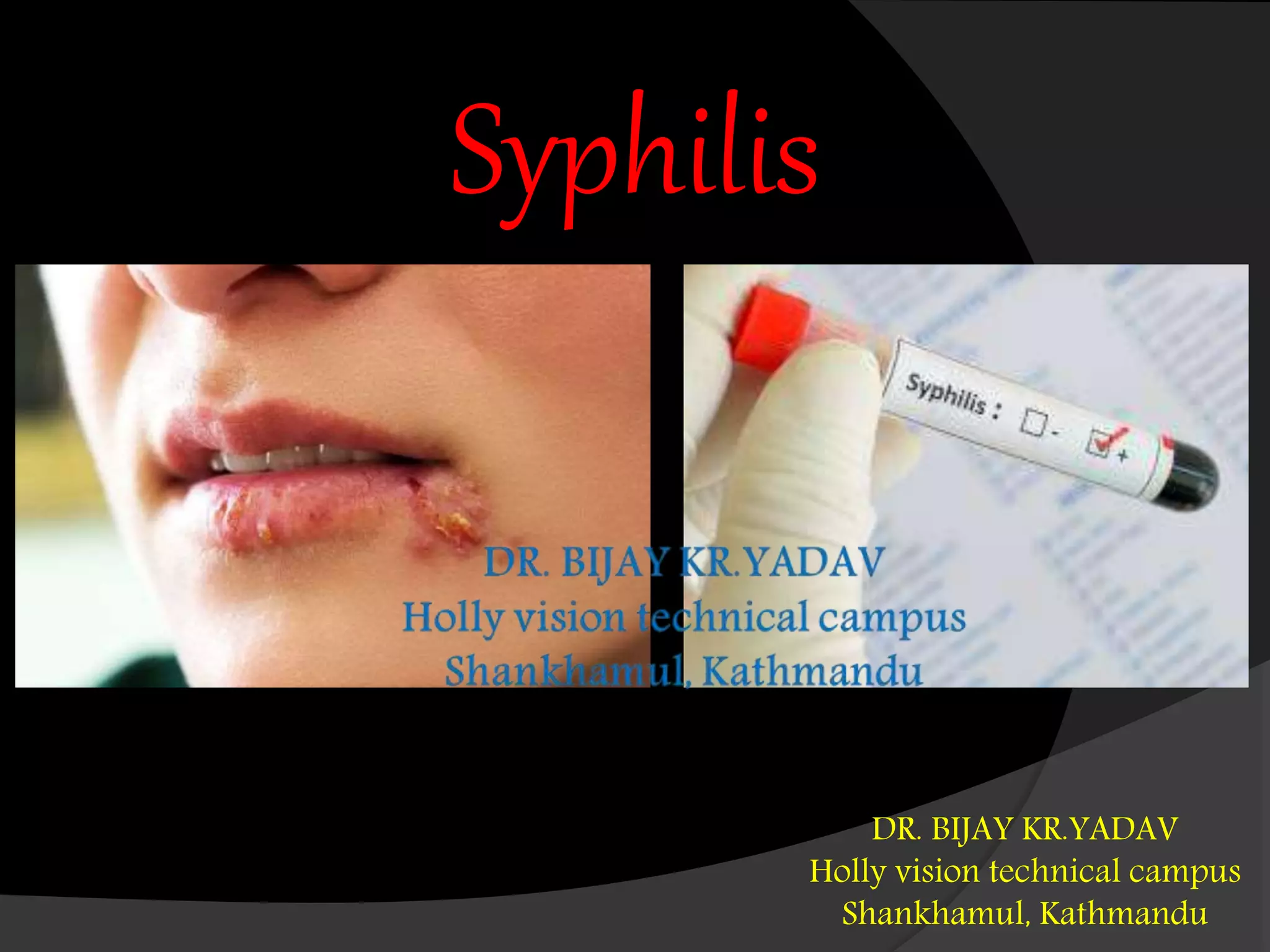
 Syphilis is a STD caused by Treponema pallidum
characterized by the appearance of a painless ulcer
initially and secondary and tertiary stages later.
 It is caused by infection, through abrasions in the skin
or mucous membranes
Mode of transmission :
Transmitted by :
i. Contact with infections, moist lesions, most commonly during oral,
anal or vaginal sexual intercourse
ii. Kissing
iii. Blood Transfusion
iv. Mother to child transmission
Not transmitted by :
i. Toilet seats
ii. Swimming pool
iii. Hot tubs
iv. Sharing clothes
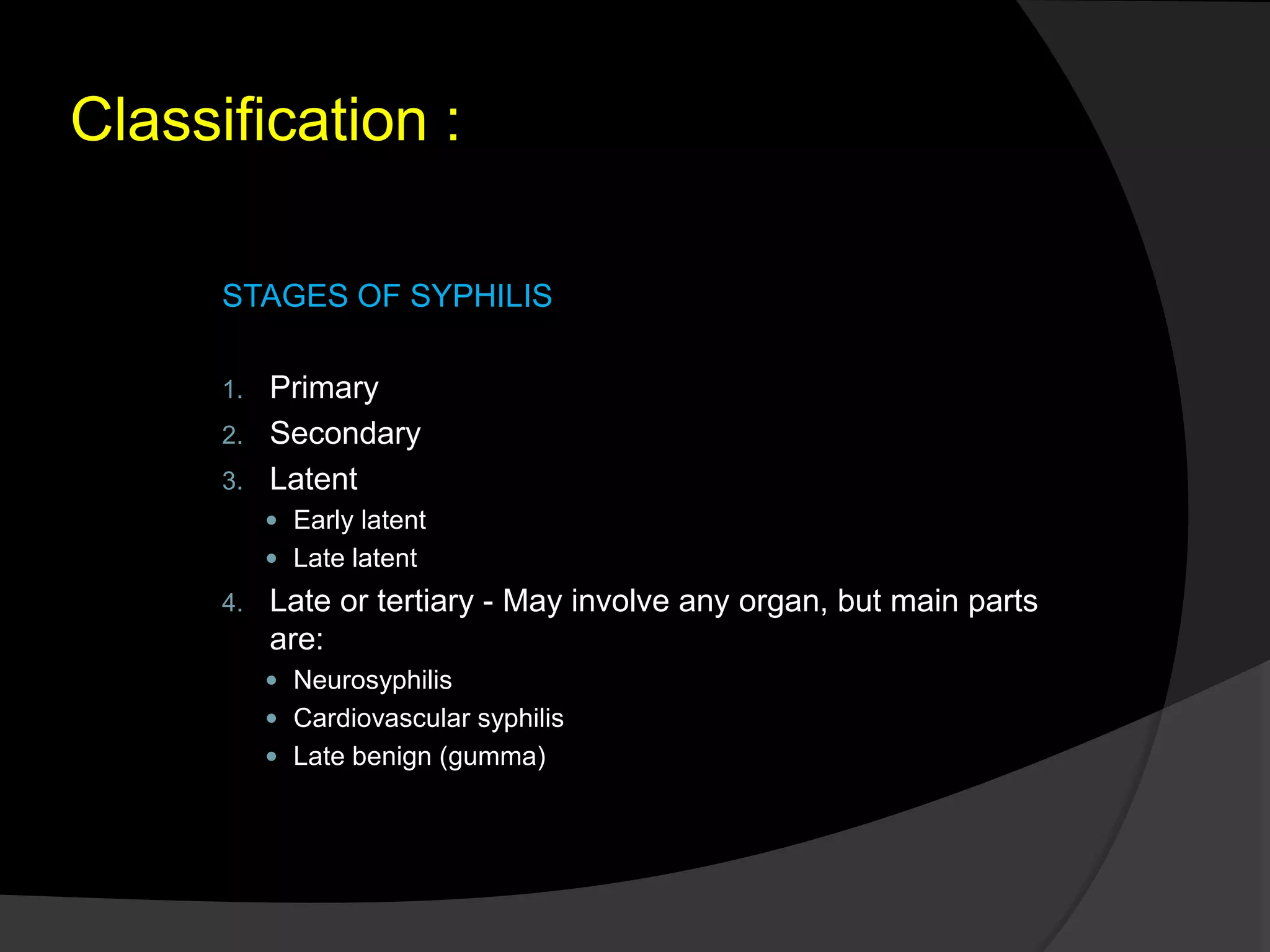
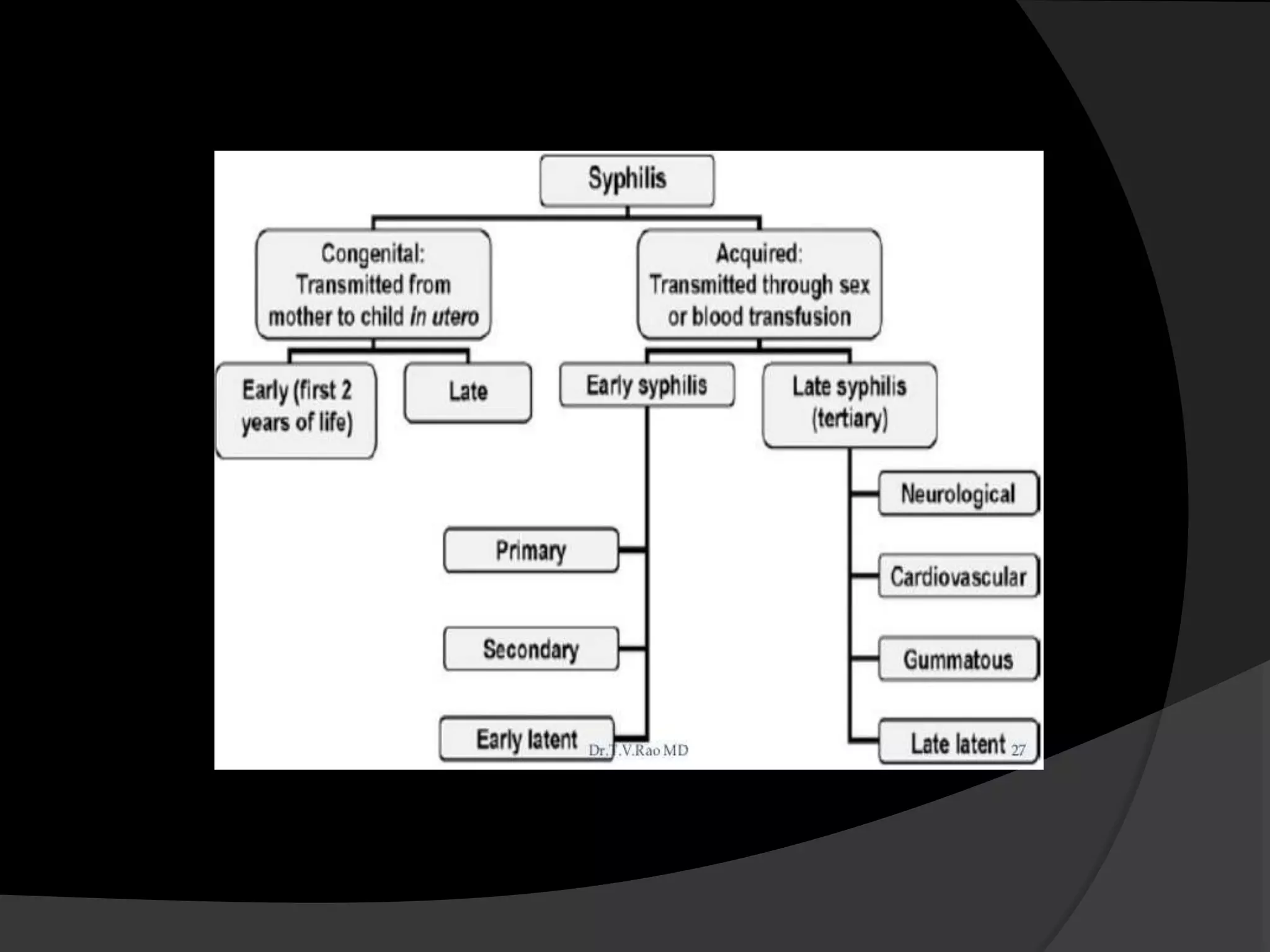
Classification :
STAGES OF SYPHILIS
1. Primary
2. Secondary
3. Latent
 Early latent
 Late latent
4. Late or tertiary - May involve any organ, but main parts
are:
 Neurosyphilis
 Cardiovascular syphilis
 Late benign (gumma)
Primary syphilis
 Incubation period : 21 days (average). range : 9 to 90
days.
 Skin Lesion:
Chancre (Hunterian): A non-tender firm papule that
ulcerates with raised border and clean surface.
 Lesions most common on the genital sites
 Regional lymphadenopathy : Appears within a week.
 Nodes are firm ,non-tender, discreet and usually
unilateral.
11
12
13
14
Laboratory Diagnosis
 Dark field examination.
 Serological tests for syphilis (STS).—Reaction develops 1
week after appearance of chancre.
Two type STS:
1. Non specific tests: Veneral disease research laboratory
test.( VDRL.)
2. Specific tests: Treponemal Haemagglutin assay (TPHA).
Fluorescent treponemal antibody absorption test.(FTA-
ABS)
15
Secondary Syphilis
 Usually appears 2 to 6 months after
primary infection or 2 to 10 weeks after
appearance of chancre.
 Acute illness syndrome: headache,
chills, fever, arthalgia, malaise.
16
17
Disseminated spirochetemia
8 weeks after infection
Skin rash is common feature
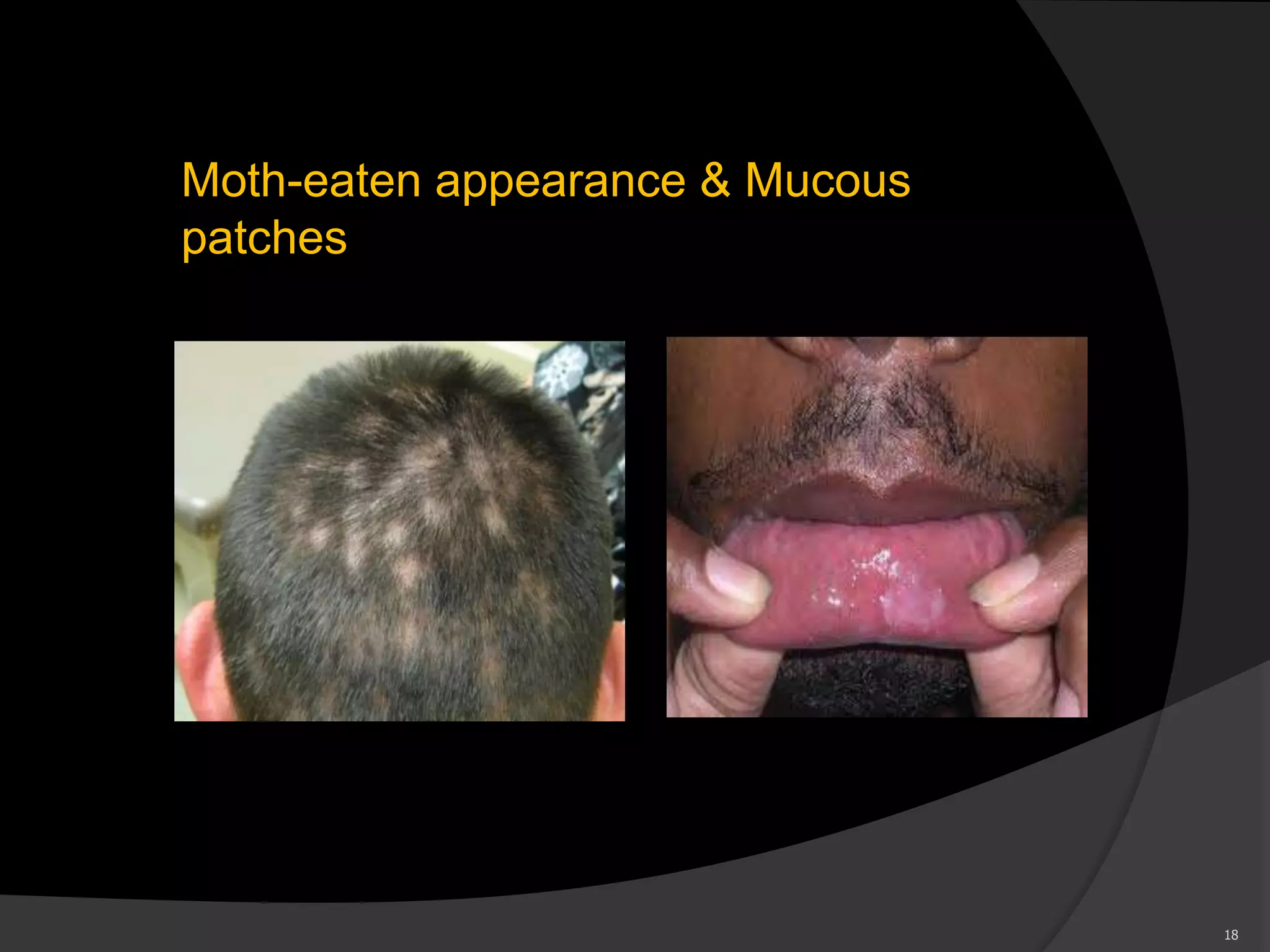
Alopecia ; moth-eaten appearance
Atypical facial plaques
Mucosal ulcerations
Condylomata lata
Painless generalized lymphadenopathy
Moth-eaten appearance & Mucous
patches
18
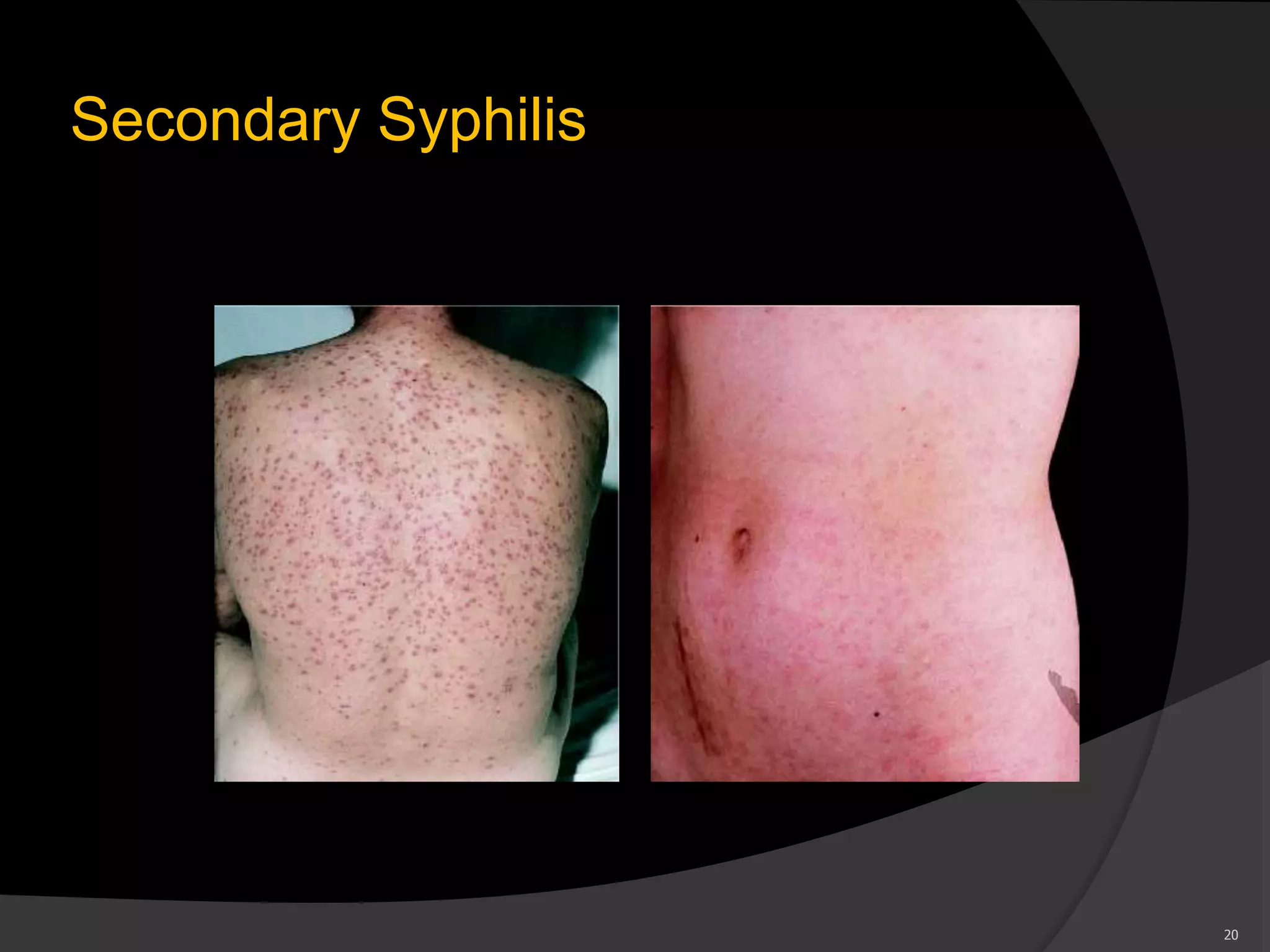
Skin lesions
 Asymptomatic Maculo-papular rash on the trunk
palms and soles.
 Later lesions maybe papulosquamous, pustular
 Lesions are scattered, discrete and symmetric.
19
Secondary Syphilis
20
Secondary syphilis
21
Secondary Syphilis
 Generalized lymphadenopathy
 Condylomata lata:
Lesions are soft ,flat ,topped, moist, papules or
plaques which may become confluent.
22
Mucous membranes
 Mucous patches - small asymptomatic, round or oval
slightly elevated flat topped macules and papules covered
by white or gray membrane.
 Other findings : Fever(+-) splenomegaly, iritis, hair loss,
Arthritis, Periostitis
23
Latent Syphilis (LS)
 There are no clinical S/S of infection. Only the
serological tests for syphilis are positive. CSF is
normal.
 Early latent <2 years
 Late latent >2 years.
 A pregnant woman with LS can infect her fetus.
24
Tertiary Syphilis :
 It is now very rare.
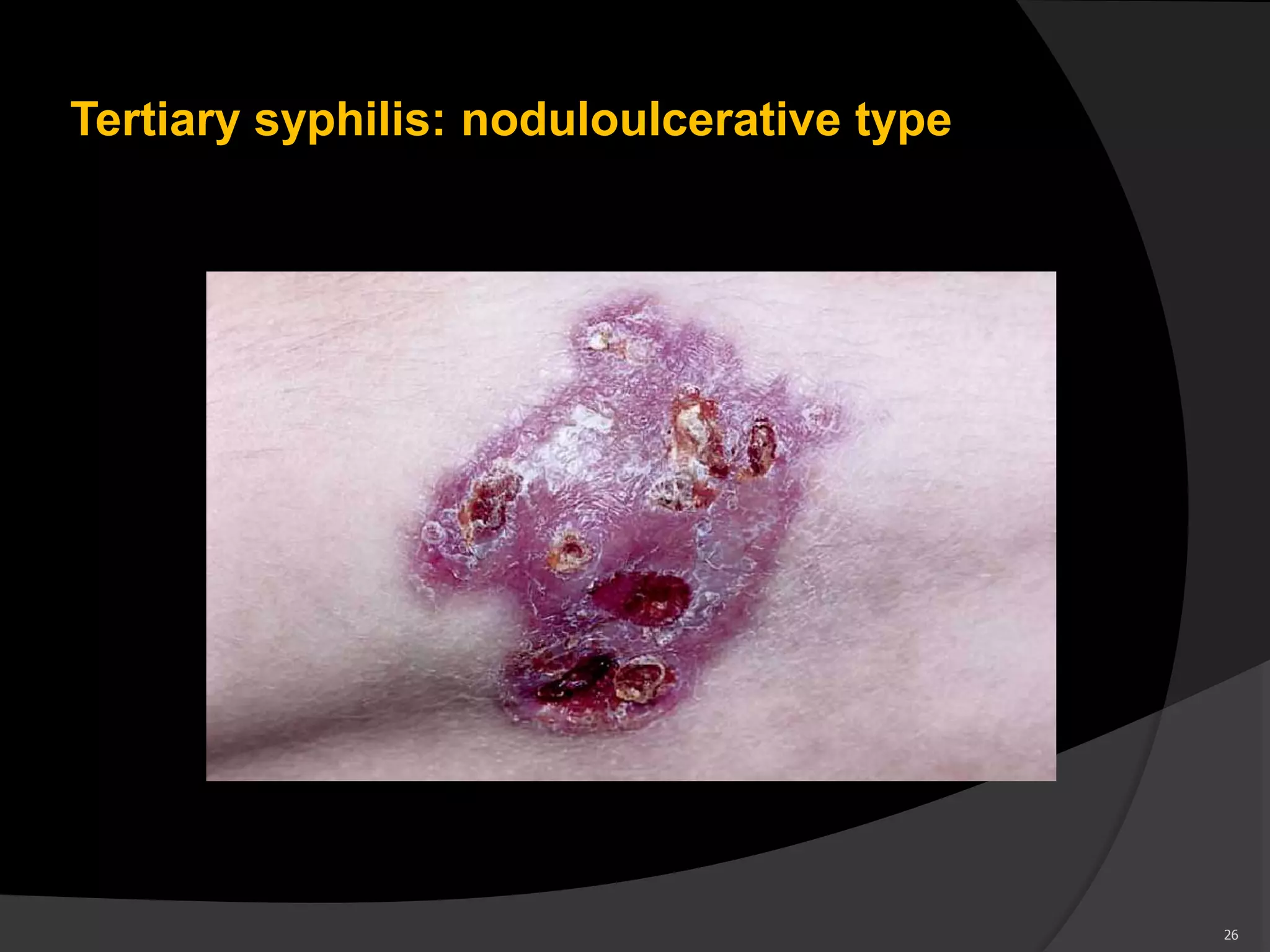
 Noduloulcerative syphilides : Simulate lupus
vulgaris.
 Gumma : Deep granulomatous lesion found in
the S/C tissue having tendency for necrosis
25
Tertiary syphilis: noduloulcerative type
26
Tertiary syphilis - Gumma
27
Management
1. Primary and secondary Syphilis:
Recommended regimen:
Benzathine penicillin 2.4 million units I/M in one
dose.
Children: Benzathine Penicillin 50,000 units /kg
IM in a single dose
28
Alternative regimen
 Doxycycline 100mg bid for 2 weeks
 Erythromycin 5oomgqid for 2 weeks.
 Inj. Ceftriaxone 250mgIM OD for 10 days.
29
2. Tertiary Syphilis or syphilis : of unknown
duration : 7.2 million units total given in 3
doses of 2.4 m IM weekly.
Management of Sex Partners.
 Sex partners should be reffered for evaluation and
treatment.
31
Complications of syphilis
:
 Chancre
 Neck stiffness
 Numbness
 Weakness
 Fever
 Seizures
 Headache
 Sore throat
 Patchy hair loss
 Swollen glands through the body
 Mental illness
 Blindness
 Neurological problems
 Heart disease
 Death
THANK YOU

17. Syphilis

  • 1.
    Syphilis DR. BIJAY KR.YADAV Hollyvision technical campus Shankhamul, Kathmandu
  • 6.
    Syphilis  Syphilis isa STD caused by Treponema pallidum characterized by the appearance of a painless ulcer initially and secondary and tertiary stages later.  It is caused by infection, through abrasions in the skin or mucous membranes
  • 7.
    Mode of transmission: Transmitted by : i. Contact with infections, moist lesions, most commonly during oral, anal or vaginal sexual intercourse ii. Kissing iii. Blood Transfusion iv. Mother to child transmission
  • 8.
    Not transmitted by: i. Toilet seats ii. Swimming pool iii. Hot tubs iv. Sharing clothes
  • 9.
    Classification : STAGES OFSYPHILIS 1. Primary 2. Secondary 3. Latent  Early latent  Late latent 4. Late or tertiary - May involve any organ, but main parts are:  Neurosyphilis  Cardiovascular syphilis  Late benign (gumma)
  • 11.
    Primary syphilis  Incubationperiod : 21 days (average). range : 9 to 90 days.  Skin Lesion: Chancre (Hunterian): A non-tender firm papule that ulcerates with raised border and clean surface.  Lesions most common on the genital sites  Regional lymphadenopathy : Appears within a week.  Nodes are firm ,non-tender, discreet and usually unilateral. 11
  • 12.
  • 13.
  • 14.
  • 15.
    Laboratory Diagnosis  Darkfield examination.  Serological tests for syphilis (STS).—Reaction develops 1 week after appearance of chancre. Two type STS: 1. Non specific tests: Veneral disease research laboratory test.( VDRL.) 2. Specific tests: Treponemal Haemagglutin assay (TPHA). Fluorescent treponemal antibody absorption test.(FTA- ABS) 15
  • 16.
    Secondary Syphilis  Usuallyappears 2 to 6 months after primary infection or 2 to 10 weeks after appearance of chancre.  Acute illness syndrome: headache, chills, fever, arthalgia, malaise. 16
  • 17.
    17 Disseminated spirochetemia 8 weeksafter infection Skin rash is common feature Alopecia ; moth-eaten appearance Atypical facial plaques Mucosal ulcerations Condylomata lata Painless generalized lymphadenopathy
  • 18.
    Moth-eaten appearance &Mucous patches 18
  • 19.
    Skin lesions  AsymptomaticMaculo-papular rash on the trunk palms and soles.  Later lesions maybe papulosquamous, pustular  Lesions are scattered, discrete and symmetric. 19
  • 20.
  • 21.
  • 22.
    Secondary Syphilis  Generalizedlymphadenopathy  Condylomata lata: Lesions are soft ,flat ,topped, moist, papules or plaques which may become confluent. 22
  • 23.
    Mucous membranes  Mucouspatches - small asymptomatic, round or oval slightly elevated flat topped macules and papules covered by white or gray membrane.  Other findings : Fever(+-) splenomegaly, iritis, hair loss, Arthritis, Periostitis 23
  • 24.
    Latent Syphilis (LS) There are no clinical S/S of infection. Only the serological tests for syphilis are positive. CSF is normal.  Early latent <2 years  Late latent >2 years.  A pregnant woman with LS can infect her fetus. 24
  • 25.
    Tertiary Syphilis : It is now very rare.  Noduloulcerative syphilides : Simulate lupus vulgaris.  Gumma : Deep granulomatous lesion found in the S/C tissue having tendency for necrosis 25
  • 26.
  • 27.
  • 28.
    Management 1. Primary andsecondary Syphilis: Recommended regimen: Benzathine penicillin 2.4 million units I/M in one dose. Children: Benzathine Penicillin 50,000 units /kg IM in a single dose 28
  • 29.
    Alternative regimen  Doxycycline100mg bid for 2 weeks  Erythromycin 5oomgqid for 2 weeks.  Inj. Ceftriaxone 250mgIM OD for 10 days. 29
  • 30.
    2. Tertiary Syphilisor syphilis : of unknown duration : 7.2 million units total given in 3 doses of 2.4 m IM weekly.
  • 31.
    Management of SexPartners.  Sex partners should be reffered for evaluation and treatment. 31
  • 32.
    Complications of syphilis : Chancre  Neck stiffness  Numbness  Weakness  Fever  Seizures  Headache  Sore throat  Patchy hair loss  Swollen glands through the body  Mental illness  Blindness  Neurological problems  Heart disease  Death
  • 33.