DEFINITION
Pruritus(Itch) can be defined
subjectively as a poorly localized,
non-adapting, usually unpleasant
sensation which elicits an immediate
desire to scratch
---Samuel Hafenreffer
(1660)
Itch has recently been classified by
Twycross et al. as
●pruritoceptive
●neuropathic
 neurogenic
 Psychogenic
Measurement
 Results from animal models of pruritus need to be
interpreted with caution.
 Hind limb scratching in response to intradermal
injection of a pruritogen has been widely used.
Methods used in humans :
 visual analogue scales (VAS)
 Recording of scratch movements using limb
movement meters.
 The ‘Symtrack’ computerized continuous itch-
rating system, which is based on the VAS, or a
variant of it, is the most widely used.
 New method for quantifying scratching
piezoelectrical device is attached to the middle
fingernail
Pathophysiology of Itch –
Receptors involved
 No specific receptor structure has been
identified for itch
 Itch nerve endings are unmyelinated, confined
to the skin and cornea, and are members of the
polymodal nociceptor class
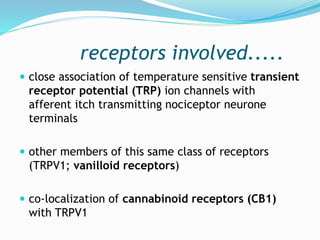
receptors involved.....
 close association of temperature sensitive transient
receptor potential (TRP) ion channels with
afferent itch transmitting nociceptor neurone
terminals
 other members of this same class of receptors
(TRPV1; vanilloid receptors)
 co-localization of cannabinoid receptors (CB1)
with TRPV1
receptors involved.....
 Apart from TRPV1 ion channels,
keratinocytes also express voltage-gated
ATP channels, adenosine receptors,
cannabinoid receptors, opioid receptors
and PAR-2 (proteinase activated
receptors-2) neurotrophic tyrosine
kinase receptor type 1 (NTRK1[TRKA])
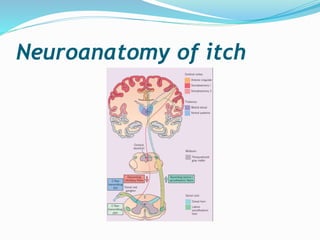
Neuroanatomy of itch
Central itch
 ‘Central itch’ is itching which is
perceived as occurring in the skin but
which actually originates in the
central nervous system due to
dysfunctional processing of sensory
information in the central pathways.
Central itch
 Melzack and Wall proposed the
involvement of large, fast-conducting,
myelinated sensory fibres in modulation of
the discharge of the unmyelinated itch- or
pain-transmitting fibres via the substantia
gelatinosa (‘gate’ control of pain).
Central itch
 According to this proposal, itch is due to a
combination of peripheral excitation and
central disinhibition.
 Scratching, by activating inhibitory fast-
conducting myelinated fibres, closes the ‘gate’
by activation of suppressor neurones of the
substantia gelatinosa and reduces the itch.
Central itch
 Alloknesis (slight mechanical stimulation
of skin causing intense itching)
characteristically occurs in some patients
with atopic eczema. It is thought to be
due to excitation of central itch-
transmission neurones due to reduced
gating
Central itch
 Opioid peptides have important crucial
central role.
 μ-opioid receptor ligation causes central
pruritus, κ-opioids are antipruritic so
central pruritus may result from an
imbalance of the two systems.
Peripheral mediators of itching in skin
diseases
• peripheral pharmacological mediators
play a key role in the production of
itching in inflammatory skin disease,
originally proposed by Lewis as his ‘H-
substances’
Important mediators and receptors for itch
Histamine and its receptors
 Histamine is released from dermal mast cells via
a range of receptors
 high affinity IgE receptor (FceR1),
 the KIT receptor for stem cell factor,
 receptors for neuropeptides (e.g. substance P, NGF)
 complement C5a.
Histamine and its receptors
 In acute IgE-mediated urticaria, histamine is
released when specific antigen cross-links
adjacent FceR1 via the a-chains.
 In an important subset of chronic urticaria
(autoimmune urticaria), cross-linking occurs via
functional circulating IgG autoantibodies that
react with epitopes expressed on the a-chain of
FceR1 or, less commonly, IgE.
Proteinases
Human dermal mast cells produce two proteases:
Tryptase
Chymase
 The activated mast cell releases tryptase
(along with other mediators, including
histamine), which in turn activates the
proteinase-activated receptor-2 (PAR-2)
present on C fiber terminals.
Proteinases.....
 The activated C fibers transmit this
information to the CNS, where it may
cause the sensation of itch. Additionally,
activation leads to local release of
neuropeptides, including substance P and
calcitonin gene-related peptide, which
induce neurogenic inflammation
Role of proteinase-activated receptor-2 (PAR-2). SP, substance P; MC, mast cell
and C neurone terminals and dermal mast cells
Proteinases in skin diseases
 PAR-2, the receptor for tryptase, is significantly
elevated in the epidermis and cutaneous nerve fibers
of eczematous lesions,
 proteinase (e.g. cathepsin B) activity can also be found
in common allergens (e.g. grass pollen, house dust
mites)27, and staphylococcal skin infections
 Netherton syndrome (AR) mutations in the serine
proteinase inhibitor lymphoepithelial Kazal-type
inhibitor (LEKTI), leads to increased protease activity.
Substance P
 Substance P is synthesized in the cell bodies of C
neurons, transported towards the peripheral nerve
terminals, and released by antidromic depolarization
to cause vasodilation and increased vascular
permeability
 Elevated in the serum of patients with atopic
dermatitis.
Opioid Peptides
 Activation of mu-opioid receptors stimulates
itch perception, whereas k-opioid receptor
stimulation inhibits mu-receptor effects, both
centrally and peripherally.
 Nociceptin, the endogenous peptide ligand for
the opioid receptorlike 1 (ORL1) receptor, has
also been implicated in itch.
Neurotrophins
 Neurotrophins are factors that regulate the
growth and function of nerve cells.
 prototypic neurotrophic factor is nerve growth
factor (NGF). Other members of this family
include neurotrophins 3, 4 and 5 and brain-
derived neurotrophic factor (BDNF)
Neurotrophins in skin diseases
 Increased expression of NGF was noted in
cutaneous mast cells, keratinocytes and
fibroblasts of atopic dermatitis.
Prostanoids
 Prostaglandins enhance histamine-induced
itch.
 only pruritic neurons that display lasting
activation following exposure to histamine are
excited by PGE2.
 PGE2 has also been shown to have a direct,
low-level pruritogenic effect both in healthy
individuals and atopic dermatitis patients.
Calcitonin gene-related
peptide (CGRP)
 This 37 amino acid peptide is the most highly
expressed neuropeptide in human skin.
 Like substance P, CGRP appears to act as a
modulator of itch rather than as a pruritogen.
 Found in abundant amounts in involved skin of
prurigo nodularis.
Cytokines
 IL-31 is involved in the pruritus of atopic
dermatitis in man .Targeting IL-31 may be a
promising approach to improved drug treatment
of atopic eczema.
 a role for IL-2 has been proposed in atopic
dermatitis.
Acetyl choline
 Acetyl choline behaves as a pruritic in atopic
eczema via muscarinic receptors, although it
does not cause pruritus in healthy subjects.
 This may explain the pruritus commonly
experienced by atopic eczema patients when
they sweat.
Scratching
 Scratching is a reflex functioning at a spinal
level, although modified greatly by higher
centres.
 Exact mechanism of relief of itch by
scratching is unknown.
Scratching...probable mechanisms
 the sensation of itching is reinforced by
facilitating circuits in the relay synapses of the
spinal cord, the prolonged scratch-induced
relief could be due to temporary suppression of
these circuits. Stimulation of fast-conducting
myelinated afferents inhibits these circuits via
pre- and postsynaptic mechanisms.
 Alternatively, scratching could simply damage
sensory nerve endings, repair occupying several
minutes.
Causes of Pruritus(Itch)
A. Itch in response to systemic/internal
disease
 Uraemia
 Cholestasis and liver disease
 Haematological disease
 Iron deficiency
 Polycythaemia vera
 Malignant disease
 Solid tumours
 Lymphomas
 Endocrine disease
 Thyroid disease
 Diabetes mellitus (localized itch only)
 HIV infection
 Adverse drug reaction
 Pruritus due to morphine and related drugs
B. DERMATOLOGIC DISEASES WITH PRURITUS
Dermatologic disease Cause
Infestation • Scabies
• Pediculosis
• Arthropod bites
• Schistosomal cercarial dermatitis
Inflammation • Atopic dermatitis
• Stasis dermatitis
• Allergic or irritant contact dermatitis
• Lichen simplex chronicus
• Urticaria
• Prurigo nodularis
• Prurigo pigmentosa
• Bullous diseases, e.g. DH, BP
• PUPPP
• Eosinophilic pustular folliculitis
• Drug hypersensitivity
• Mastocytosis
• Psoriasis, parapsoriasis
• Pityriasis rubra pilaris
• Polymorphous light eruption
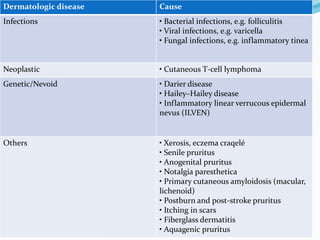
Dermatologic disease Cause
Infections • Bacterial infections, e.g. folliculitis
• Viral infections, e.g. varicella
• Fungal infections, e.g. inflammatory tinea
Neoplastic • Cutaneous T-cell lymphoma
Genetic/Nevoid • Darier disease
• Hailey–Hailey disease
• Inflammatory linear verrucous epidermal
nevus (ILVEN)
Others • Xerosis, eczema craqelé
• Senile pruritus
• Anogenital pruritus
• Notalgia paresthetica
• Primary cutaneous amyloidosis (macular,
lichenoid)
• Postburn and post-stroke pruritus
• Itching in scars
• Fiberglass dermatitis
• Aquagenic pruritus
Thank You

Pruritus

  • 2.
    DEFINITION Pruritus(Itch) can bedefined subjectively as a poorly localized, non-adapting, usually unpleasant sensation which elicits an immediate desire to scratch ---Samuel Hafenreffer (1660)
  • 3.
    Itch has recentlybeen classified by Twycross et al. as ●pruritoceptive ●neuropathic  neurogenic  Psychogenic
  • 4.
    Measurement  Results fromanimal models of pruritus need to be interpreted with caution.  Hind limb scratching in response to intradermal injection of a pruritogen has been widely used. Methods used in humans :  visual analogue scales (VAS)  Recording of scratch movements using limb movement meters.
  • 5.
     The ‘Symtrack’computerized continuous itch- rating system, which is based on the VAS, or a variant of it, is the most widely used.  New method for quantifying scratching piezoelectrical device is attached to the middle fingernail
  • 6.
    Pathophysiology of Itch– Receptors involved  No specific receptor structure has been identified for itch  Itch nerve endings are unmyelinated, confined to the skin and cornea, and are members of the polymodal nociceptor class
  • 8.
    receptors involved.....  closeassociation of temperature sensitive transient receptor potential (TRP) ion channels with afferent itch transmitting nociceptor neurone terminals  other members of this same class of receptors (TRPV1; vanilloid receptors)  co-localization of cannabinoid receptors (CB1) with TRPV1
  • 9.
    receptors involved.....  Apartfrom TRPV1 ion channels, keratinocytes also express voltage-gated ATP channels, adenosine receptors, cannabinoid receptors, opioid receptors and PAR-2 (proteinase activated receptors-2) neurotrophic tyrosine kinase receptor type 1 (NTRK1[TRKA])
  • 10.
  • 11.
  • 12.
    Central itch  ‘Centralitch’ is itching which is perceived as occurring in the skin but which actually originates in the central nervous system due to dysfunctional processing of sensory information in the central pathways.
  • 13.
    Central itch  Melzackand Wall proposed the involvement of large, fast-conducting, myelinated sensory fibres in modulation of the discharge of the unmyelinated itch- or pain-transmitting fibres via the substantia gelatinosa (‘gate’ control of pain).
  • 14.
    Central itch  Accordingto this proposal, itch is due to a combination of peripheral excitation and central disinhibition.  Scratching, by activating inhibitory fast- conducting myelinated fibres, closes the ‘gate’ by activation of suppressor neurones of the substantia gelatinosa and reduces the itch.
  • 15.
    Central itch  Alloknesis(slight mechanical stimulation of skin causing intense itching) characteristically occurs in some patients with atopic eczema. It is thought to be due to excitation of central itch- transmission neurones due to reduced gating
  • 16.
    Central itch  Opioidpeptides have important crucial central role.  μ-opioid receptor ligation causes central pruritus, κ-opioids are antipruritic so central pruritus may result from an imbalance of the two systems.
  • 17.
    Peripheral mediators ofitching in skin diseases • peripheral pharmacological mediators play a key role in the production of itching in inflammatory skin disease, originally proposed by Lewis as his ‘H- substances’
  • 18.
    Important mediators andreceptors for itch
  • 19.
    Histamine and itsreceptors  Histamine is released from dermal mast cells via a range of receptors  high affinity IgE receptor (FceR1),  the KIT receptor for stem cell factor,  receptors for neuropeptides (e.g. substance P, NGF)  complement C5a.
  • 20.
    Histamine and itsreceptors  In acute IgE-mediated urticaria, histamine is released when specific antigen cross-links adjacent FceR1 via the a-chains.  In an important subset of chronic urticaria (autoimmune urticaria), cross-linking occurs via functional circulating IgG autoantibodies that react with epitopes expressed on the a-chain of FceR1 or, less commonly, IgE.
  • 22.
    Proteinases Human dermal mastcells produce two proteases: Tryptase Chymase  The activated mast cell releases tryptase (along with other mediators, including histamine), which in turn activates the proteinase-activated receptor-2 (PAR-2) present on C fiber terminals.
  • 23.
    Proteinases.....  The activatedC fibers transmit this information to the CNS, where it may cause the sensation of itch. Additionally, activation leads to local release of neuropeptides, including substance P and calcitonin gene-related peptide, which induce neurogenic inflammation
  • 24.
    Role of proteinase-activatedreceptor-2 (PAR-2). SP, substance P; MC, mast cell and C neurone terminals and dermal mast cells
  • 25.
    Proteinases in skindiseases  PAR-2, the receptor for tryptase, is significantly elevated in the epidermis and cutaneous nerve fibers of eczematous lesions,  proteinase (e.g. cathepsin B) activity can also be found in common allergens (e.g. grass pollen, house dust mites)27, and staphylococcal skin infections  Netherton syndrome (AR) mutations in the serine proteinase inhibitor lymphoepithelial Kazal-type inhibitor (LEKTI), leads to increased protease activity.
  • 26.
    Substance P  SubstanceP is synthesized in the cell bodies of C neurons, transported towards the peripheral nerve terminals, and released by antidromic depolarization to cause vasodilation and increased vascular permeability  Elevated in the serum of patients with atopic dermatitis.
  • 27.
    Opioid Peptides  Activationof mu-opioid receptors stimulates itch perception, whereas k-opioid receptor stimulation inhibits mu-receptor effects, both centrally and peripherally.  Nociceptin, the endogenous peptide ligand for the opioid receptorlike 1 (ORL1) receptor, has also been implicated in itch.
  • 28.
    Neurotrophins  Neurotrophins arefactors that regulate the growth and function of nerve cells.  prototypic neurotrophic factor is nerve growth factor (NGF). Other members of this family include neurotrophins 3, 4 and 5 and brain- derived neurotrophic factor (BDNF)
  • 29.
    Neurotrophins in skindiseases  Increased expression of NGF was noted in cutaneous mast cells, keratinocytes and fibroblasts of atopic dermatitis.
  • 30.
    Prostanoids  Prostaglandins enhancehistamine-induced itch.  only pruritic neurons that display lasting activation following exposure to histamine are excited by PGE2.  PGE2 has also been shown to have a direct, low-level pruritogenic effect both in healthy individuals and atopic dermatitis patients.
  • 31.
    Calcitonin gene-related peptide (CGRP) This 37 amino acid peptide is the most highly expressed neuropeptide in human skin.  Like substance P, CGRP appears to act as a modulator of itch rather than as a pruritogen.  Found in abundant amounts in involved skin of prurigo nodularis.
  • 32.
    Cytokines  IL-31 isinvolved in the pruritus of atopic dermatitis in man .Targeting IL-31 may be a promising approach to improved drug treatment of atopic eczema.  a role for IL-2 has been proposed in atopic dermatitis.
  • 33.
    Acetyl choline  Acetylcholine behaves as a pruritic in atopic eczema via muscarinic receptors, although it does not cause pruritus in healthy subjects.  This may explain the pruritus commonly experienced by atopic eczema patients when they sweat.
  • 34.
    Scratching  Scratching isa reflex functioning at a spinal level, although modified greatly by higher centres.  Exact mechanism of relief of itch by scratching is unknown.
  • 35.
    Scratching...probable mechanisms  thesensation of itching is reinforced by facilitating circuits in the relay synapses of the spinal cord, the prolonged scratch-induced relief could be due to temporary suppression of these circuits. Stimulation of fast-conducting myelinated afferents inhibits these circuits via pre- and postsynaptic mechanisms.  Alternatively, scratching could simply damage sensory nerve endings, repair occupying several minutes.
  • 36.
  • 37.
    A. Itch inresponse to systemic/internal disease  Uraemia  Cholestasis and liver disease  Haematological disease  Iron deficiency  Polycythaemia vera  Malignant disease  Solid tumours  Lymphomas  Endocrine disease  Thyroid disease  Diabetes mellitus (localized itch only)  HIV infection  Adverse drug reaction  Pruritus due to morphine and related drugs
  • 38.
  • 39.
    Dermatologic disease Cause Infestation• Scabies • Pediculosis • Arthropod bites • Schistosomal cercarial dermatitis Inflammation • Atopic dermatitis • Stasis dermatitis • Allergic or irritant contact dermatitis • Lichen simplex chronicus • Urticaria • Prurigo nodularis • Prurigo pigmentosa • Bullous diseases, e.g. DH, BP • PUPPP • Eosinophilic pustular folliculitis • Drug hypersensitivity • Mastocytosis • Psoriasis, parapsoriasis • Pityriasis rubra pilaris • Polymorphous light eruption
  • 40.
    Dermatologic disease Cause Infections• Bacterial infections, e.g. folliculitis • Viral infections, e.g. varicella • Fungal infections, e.g. inflammatory tinea Neoplastic • Cutaneous T-cell lymphoma Genetic/Nevoid • Darier disease • Hailey–Hailey disease • Inflammatory linear verrucous epidermal nevus (ILVEN) Others • Xerosis, eczema craqelé • Senile pruritus • Anogenital pruritus • Notalgia paresthetica • Primary cutaneous amyloidosis (macular, lichenoid) • Postburn and post-stroke pruritus • Itching in scars • Fiberglass dermatitis • Aquagenic pruritus
  • 41.