DR. BIJAY Kr. Yadav
Holy Vision Technical Campus
Shankhmul, Kathmandu
Dermatology Department
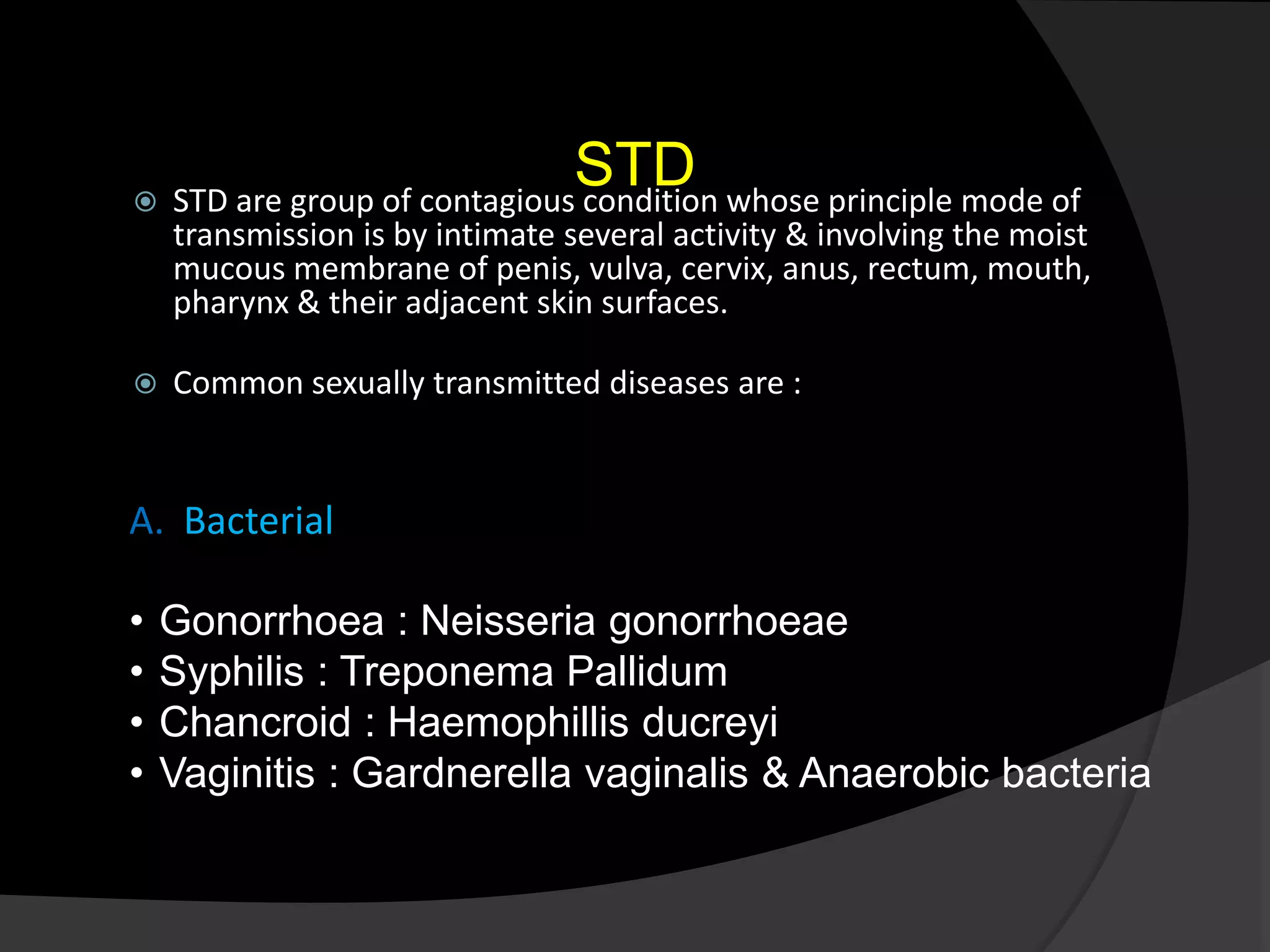
STD STD are group of contagious condition whose principle mode of
transmission is by intimate several activity & involving the moist
mucous membrane of penis, vulva, cervix, anus, rectum, mouth,
pharynx & their adjacent skin surfaces.
 Common sexually transmitted diseases are :
A. Bacterial
• Gonorrhoea : Neisseria gonorrhoeae
• Syphilis : Treponema Pallidum
• Chancroid : Haemophillis ducreyi
• Vaginitis : Gardnerella vaginalis & Anaerobic bacteria
B. Chlamydia :
C. Viral :
• Genital herpes : Herpes simplex I & II
• Genital warts : Human papilloma virus
• AIDs : HIV I & II
• Hepatitis : Hep B virus
• Molluscum contagiosum : Pox virus
• Non-Specific Urethritis
• Chlamydia trachomatis
• Ureaplasma urealyticum
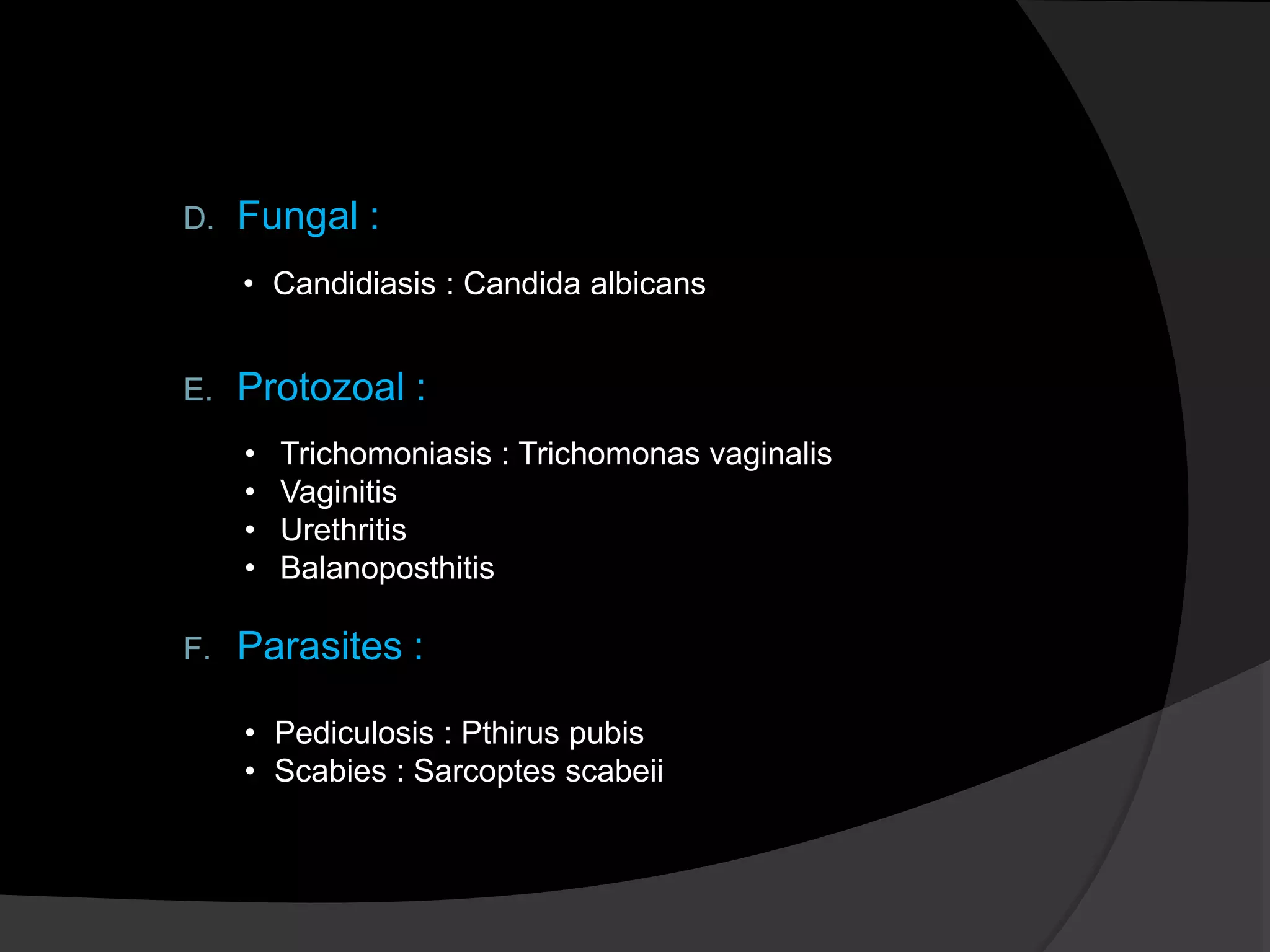
D. Fungal :
E. Protozoal :
F. Parasites :
• Candidiasis : Candida albicans
• Trichomoniasis : Trichomonas vaginalis
• Vaginitis
• Urethritis
• Balanoposthitis
• Pediculosis : Pthirus pubis
• Scabies : Sarcoptes scabeii
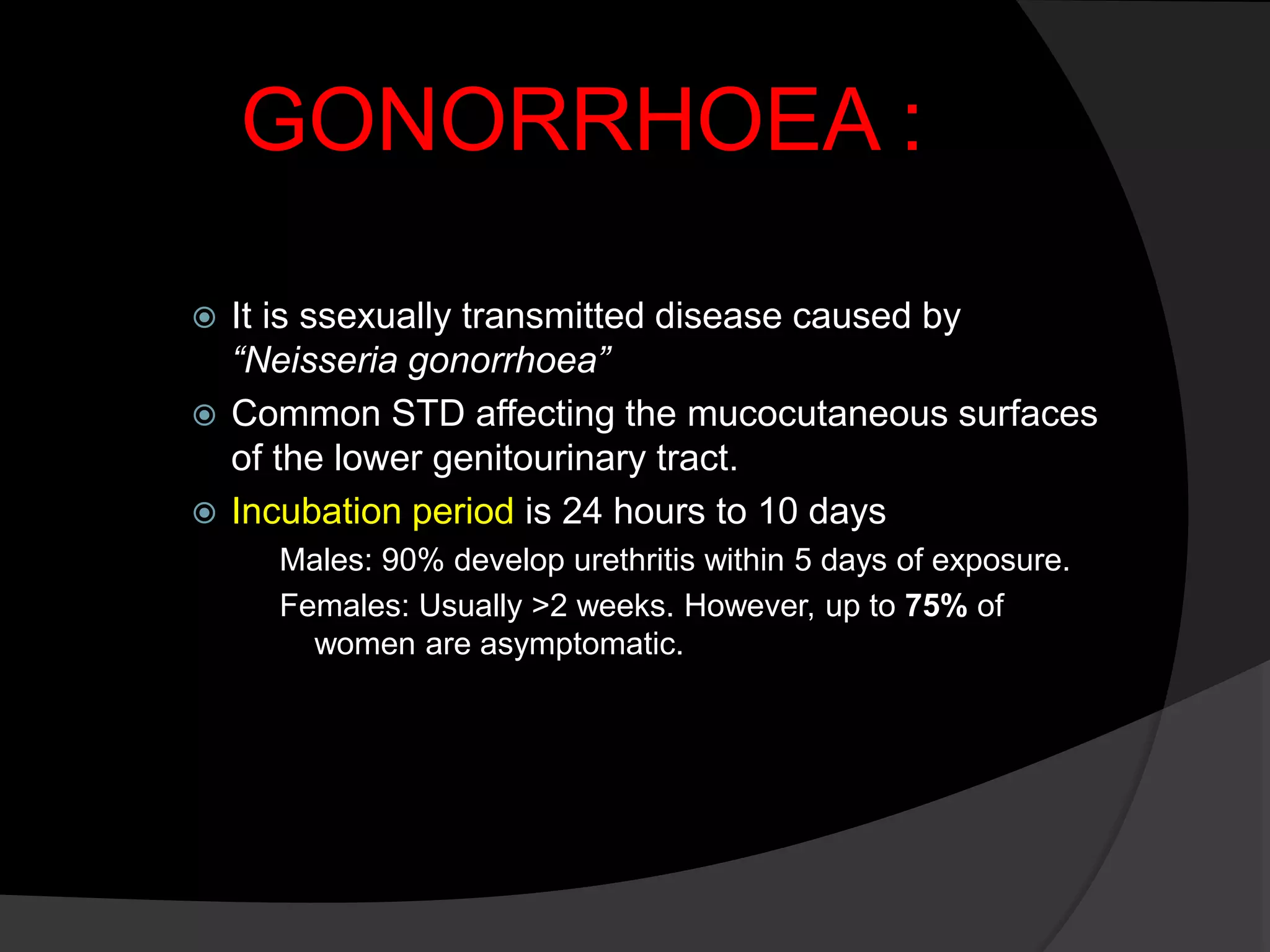
GONORRHOEA :
 It is ssexually transmitted disease caused by
“Neisseria gonorrhoea”
 Common STD affecting the mucocutaneous surfaces
of the lower genitourinary tract.
 Incubation period is 24 hours to 10 days
Males: 90% develop urethritis within 5 days of exposure.
Females: Usually >2 weeks. However, up to 75% of
women are asymptomatic.
Mode of Transmission :
 Male to female via semen
 Female to male urethra
 Rectal intercourse
 Pharyngeal infection
 Perinatal transmission ( mother to infant)
Pathogenesis
 Gonococcus has affinity for columnar epithelium
 Stratified and squamous epithelium are more resistant
7
Risk factors :
 Multiple or change of sex partners
 Not using condoms
 Casual sex
 Sex with CSW ( commercial sex workers ) & Partners
 Urban residence in areas with disease prevalence
 Adolescent , female particularly
 Low socio-economic status
 Alcohol & substance use
 Poverty
Clinical features :
1. In Male :
Symptoms:
• Pain & burning sensation in urethra during micturation
• Copious, thick, yellow purulent discharge from urethra
• Fever
• Frequency of micturation
• Malaise
Signs:
• Copious, thick, yellow purulent discharge from
urethra
• External urethral meatus may become red,
swollen & tender
• Tenderness
2. In Female :
Symptoms :
• Purulent discharge
• The infection can become much more as
 Bartholinitis
 Cervicitis
 Vulvitis
 Salphingitis
 Lower abdominal pain
 Cervical discharge
 Contact bleeding
 Dyspareunia
 Fever
Signs :
• Pus may be from urethra, bartholin duct
• Cervix :
• Inflammed with mucopurulent discharge
• Bleed to touch
• Sign of PID:
• Lower abdominal tenderness
3. Rectal involvement
• Common in homosexual
• Purulent discharge
4. Pharyngeal gonorrhoea
• Result of oral sex
5. Gonococcal conjunctivitis
• Purulent discharge from eyes
• Severe inflammation of conjunctivitis
• Oedema of eyelids
• Pain
• photophobia
6. Disseminated Gonococcal infection
• Arthritis
• Myocarditis
• Endocarditis
• Pericarditis
• Meningitis
• Fever
• Cutaneous lesion
Investigations
 The specimens are taken from urethra & rectum in
males
1. Gram staining :
kidney shaped Gram –ve non motile,
non sporing, aerobic bacteria ( Neisseria
gonorrhoea) can be demonstrated.
2. Culture in Thayer martin medium :
Neisseria gonorrhoea can be cultured &
demonstrated.
3. Biochemical test
4. Cutaneous biopsy
Treatment
 Prevention : use of condom should be encouraged.
 There is high frequency of Chlamydia infection in
persons with gonorrhea and should be treated for both.
1. For uncomplicated cases:
Procaine penicillin G 4.8 million IU IM.
+
Probenecid 1 gm orally stat.
&
Doxycycline 100 mg BD for 7 days
Ampicillin / Amoxicillin 2gm or 3 gm orally stat
+
Probenecid 1 gm orally stat
&
Doxycycline 100 mg BD for 7 days
 If patient is allergic to penicillin then give
• Ciprofloxacin 500 mg orally stat
• Ofloxacin 400 mg orally stat ( contraindicated in
pregnancy)
• Azithromycin 1000 mg stat &
• Doxycycline 100 mg BD for 7 days
 If pregnancy & lactation
• Ceftriaxone 250 mg im stat
• Cefixime 400 mg orally as a single dose
• Spectinomycin 2 gm im stat
2. For complicated infection :
 Ceftriaxone 1 gm IV or IM daily for 7-10 days
or
Spectinomycin 2 gm IM BD for 7-10 days
 Note : The inportant part of management is
that both partner should be treated at the
same time.
Course and Prognosis
 In men symptoms are usually acute and seek relief .
 In women initial symptoms are usually mild and
often ignored.
 Often women present with Pelvic Inflammatory
Disease.
21
THANK YOU

14. sexually transmitted diseases gonorrhoea

  • 1.
    DR. BIJAY Kr.Yadav Holy Vision Technical Campus Shankhmul, Kathmandu Dermatology Department
  • 2.
    STD STD aregroup of contagious condition whose principle mode of transmission is by intimate several activity & involving the moist mucous membrane of penis, vulva, cervix, anus, rectum, mouth, pharynx & their adjacent skin surfaces.  Common sexually transmitted diseases are : A. Bacterial • Gonorrhoea : Neisseria gonorrhoeae • Syphilis : Treponema Pallidum • Chancroid : Haemophillis ducreyi • Vaginitis : Gardnerella vaginalis & Anaerobic bacteria
  • 3.
    B. Chlamydia : C.Viral : • Genital herpes : Herpes simplex I & II • Genital warts : Human papilloma virus • AIDs : HIV I & II • Hepatitis : Hep B virus • Molluscum contagiosum : Pox virus • Non-Specific Urethritis • Chlamydia trachomatis • Ureaplasma urealyticum
  • 4.
    D. Fungal : E.Protozoal : F. Parasites : • Candidiasis : Candida albicans • Trichomoniasis : Trichomonas vaginalis • Vaginitis • Urethritis • Balanoposthitis • Pediculosis : Pthirus pubis • Scabies : Sarcoptes scabeii
  • 5.
    GONORRHOEA :  Itis ssexually transmitted disease caused by “Neisseria gonorrhoea”  Common STD affecting the mucocutaneous surfaces of the lower genitourinary tract.  Incubation period is 24 hours to 10 days Males: 90% develop urethritis within 5 days of exposure. Females: Usually >2 weeks. However, up to 75% of women are asymptomatic.
  • 6.
    Mode of Transmission:  Male to female via semen  Female to male urethra  Rectal intercourse  Pharyngeal infection  Perinatal transmission ( mother to infant)
  • 7.
    Pathogenesis  Gonococcus hasaffinity for columnar epithelium  Stratified and squamous epithelium are more resistant 7
  • 8.
    Risk factors : Multiple or change of sex partners  Not using condoms  Casual sex  Sex with CSW ( commercial sex workers ) & Partners  Urban residence in areas with disease prevalence  Adolescent , female particularly  Low socio-economic status  Alcohol & substance use  Poverty
  • 9.
    Clinical features : 1.In Male : Symptoms: • Pain & burning sensation in urethra during micturation • Copious, thick, yellow purulent discharge from urethra • Fever • Frequency of micturation • Malaise
  • 10.
    Signs: • Copious, thick,yellow purulent discharge from urethra • External urethral meatus may become red, swollen & tender • Tenderness
  • 12.
    2. In Female: Symptoms : • Purulent discharge • The infection can become much more as  Bartholinitis  Cervicitis  Vulvitis  Salphingitis  Lower abdominal pain  Cervical discharge  Contact bleeding  Dyspareunia  Fever
  • 13.
    Signs : • Pusmay be from urethra, bartholin duct • Cervix : • Inflammed with mucopurulent discharge • Bleed to touch • Sign of PID: • Lower abdominal tenderness
  • 14.
    3. Rectal involvement •Common in homosexual • Purulent discharge 4. Pharyngeal gonorrhoea • Result of oral sex 5. Gonococcal conjunctivitis • Purulent discharge from eyes • Severe inflammation of conjunctivitis • Oedema of eyelids • Pain • photophobia
  • 15.
    6. Disseminated Gonococcalinfection • Arthritis • Myocarditis • Endocarditis • Pericarditis • Meningitis • Fever • Cutaneous lesion
  • 16.
    Investigations  The specimensare taken from urethra & rectum in males 1. Gram staining : kidney shaped Gram –ve non motile, non sporing, aerobic bacteria ( Neisseria gonorrhoea) can be demonstrated. 2. Culture in Thayer martin medium : Neisseria gonorrhoea can be cultured & demonstrated. 3. Biochemical test 4. Cutaneous biopsy
  • 17.
    Treatment  Prevention :use of condom should be encouraged.  There is high frequency of Chlamydia infection in persons with gonorrhea and should be treated for both. 1. For uncomplicated cases: Procaine penicillin G 4.8 million IU IM. + Probenecid 1 gm orally stat. & Doxycycline 100 mg BD for 7 days
  • 18.
    Ampicillin / Amoxicillin2gm or 3 gm orally stat + Probenecid 1 gm orally stat & Doxycycline 100 mg BD for 7 days  If patient is allergic to penicillin then give • Ciprofloxacin 500 mg orally stat • Ofloxacin 400 mg orally stat ( contraindicated in pregnancy) • Azithromycin 1000 mg stat & • Doxycycline 100 mg BD for 7 days
  • 19.
     If pregnancy& lactation • Ceftriaxone 250 mg im stat • Cefixime 400 mg orally as a single dose • Spectinomycin 2 gm im stat
  • 20.
    2. For complicatedinfection :  Ceftriaxone 1 gm IV or IM daily for 7-10 days or Spectinomycin 2 gm IM BD for 7-10 days  Note : The inportant part of management is that both partner should be treated at the same time.
  • 21.
    Course and Prognosis In men symptoms are usually acute and seek relief .  In women initial symptoms are usually mild and often ignored.  Often women present with Pelvic Inflammatory Disease. 21
  • 22.