PSORIASIS
DR. BIJAY KR.YADAV
Holly vision technical campus
Shankhamul, Kathmandu
PSORIASIS :
Greek word; psora-itching,
iasis-condition
Challenge to the physician
Definition :
It is a common, genetically determined, inflammatory and
chronic disease of the skin with unpredictable course of
remission and relapses, the most characteristic lesions
consisting of sharply demarcated, dull red, scaly papule and
plaque particularly on the extensor prominences and the
scalp.
CLASSIFICATION
 Nonpustular psoriasis:
Psoriasis vulgaris.
Guttate psoriasis.
Psoriatic erythroderma.
Flexural psoriasis.
Palmo-plantar psoriasis
 Pustular psoriasis:
Generalized pustular psoriasis.
Palmo-plantar pustular psoriasis.
EPIDEMIOLOGY
 Incidence :1-3% of population.
 Age of onset: Peak incidence at 22.5 years and
55 years of life.
 Early onset predicts: more severe form &
Probability of positive family hx.
 Race : Low incidence in Asian pop.
 Sex: Equal
 Season: Worse in winter.
CLINICAL FEATURES :
1. Sites of psoriasis :
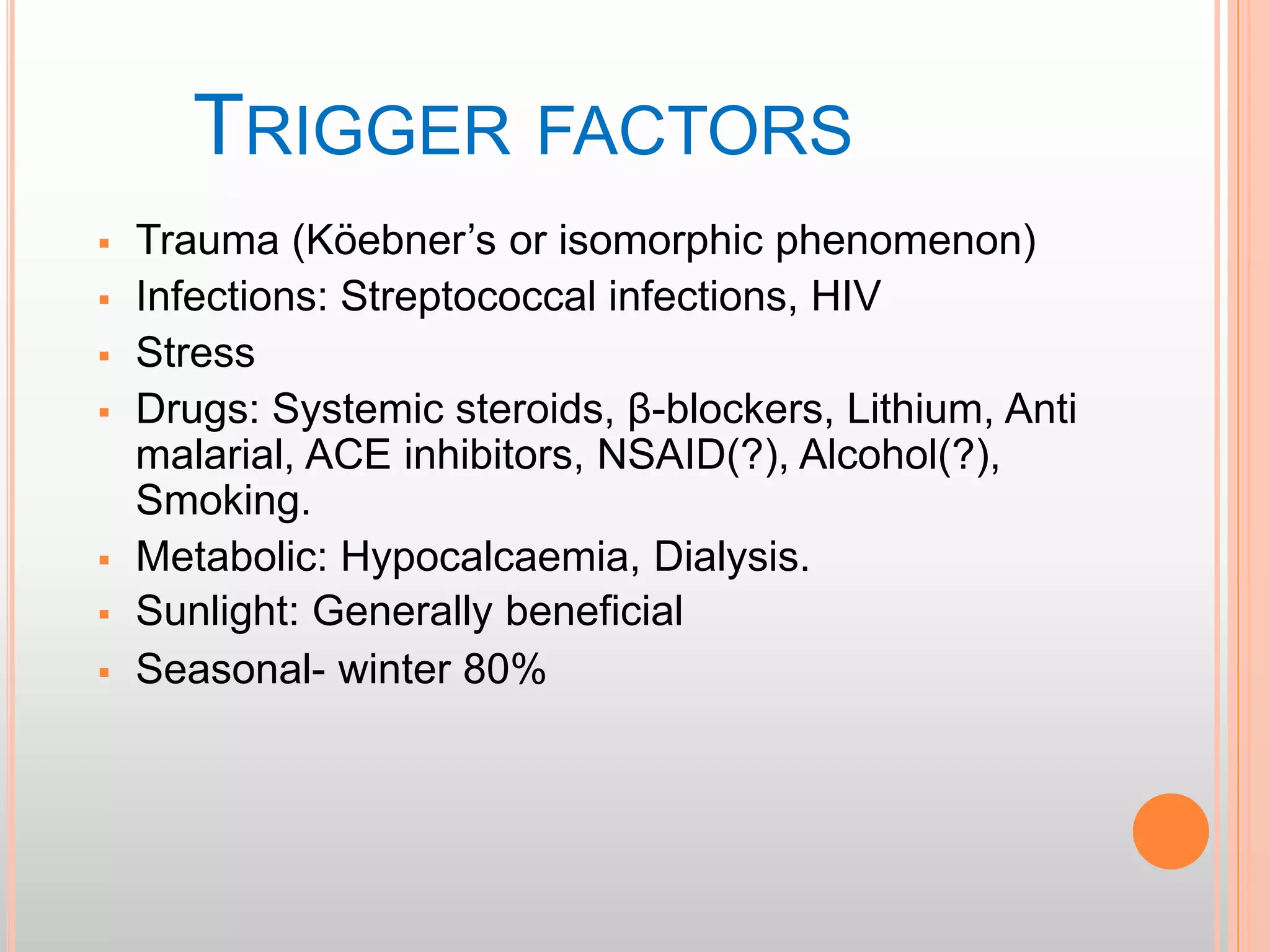
 Mainly on extenser surface of limbs i.e Knee, elbow, sacral area.
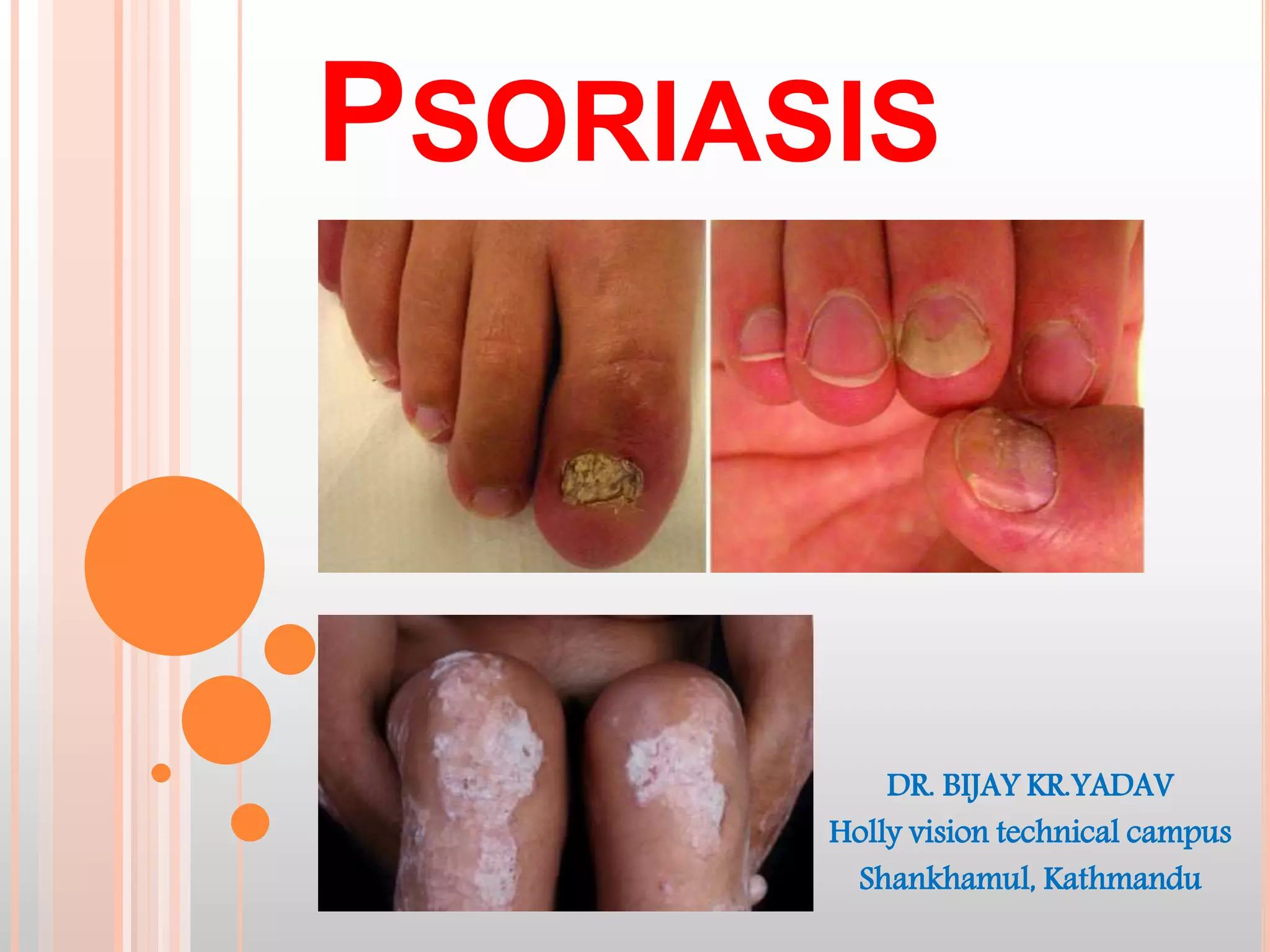
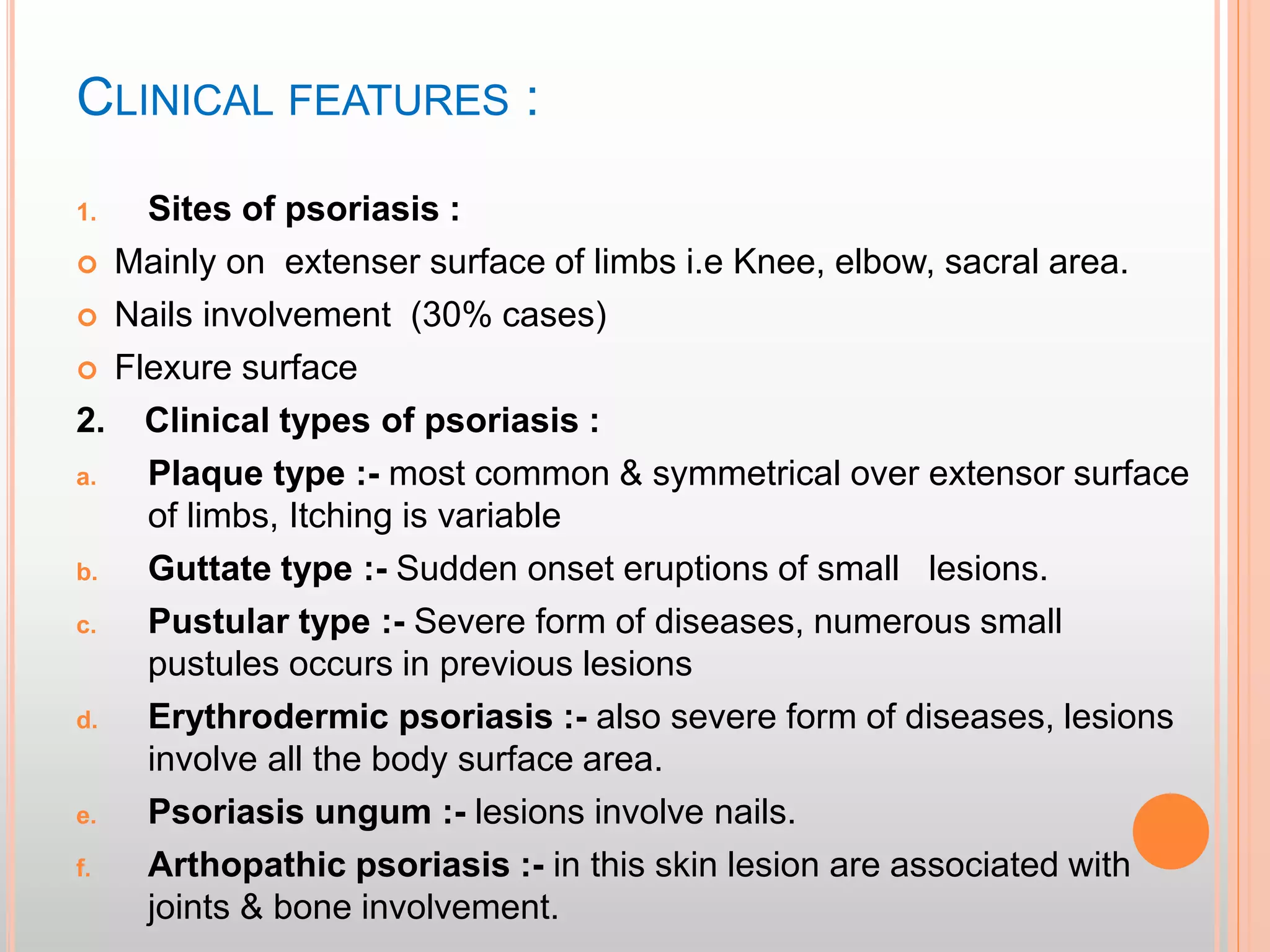
 Nails involvement (30% cases)
 Flexure surface
2. Clinical types of psoriasis :
a. Plaque type :- most common & symmetrical over extensor surface
of limbs, Itching is variable
b. Guttate type :- Sudden onset eruptions of small lesions.
c. Pustular type :- Severe form of diseases, numerous small
pustules occurs in previous lesions
d. Erythrodermic psoriasis :- also severe form of diseases, lesions
involve all the body surface area.
e. Psoriasis ungum :- lesions involve nails.
f. Arthopathic psoriasis :- in this skin lesion are associated with
joints & bone involvement.
TRIGGER FACTORS
 Trauma (Köebner’s or isomorphic phenomenon)
 Infections: Streptococcal infections, HIV
 Stress
 Drugs: Systemic steroids, β-blockers, Lithium, Anti
malarial, ACE inhibitors, NSAID(?), Alcohol(?),
Smoking.
 Metabolic: Hypocalcaemia, Dialysis.
 Sunlight: Generally beneficial
 Seasonal- winter 80%
KOEBNER PHENOMENON
SKIN LESIONS
 Usually well defined, salmon-pink papules and
plaques, sharply marginated with marked silvery
white scale which are lameller, loose and easily
removable (mica-like)
BED SIDE TESTS
 Grattage test: Scales in a psoriatic plaques can be
accentuated by grating with glass slide.
 Auspitz sign :
 Step A: Positive grattage test
 Step B: Burkley’s membrane
 Step C: Puntate visible bleeding points.
Grattage test
NAIL CHANGES
 Pitting
 Onycholysis
 Onychodystrophy
 Oil drop sign
 Sub ungual hyperkeratosis
 Discoloration
NAIL CHANGES
JOINT
 10% of patients with psoriasis have joint
involvement.
Four patterns
 Polyarticular variety
 Monoarticular variety
 Rheumatoid arthritis like
 Axial variety
DIAGNOSIS
 Typical distribution
 Well defined, dry, erythematous areas with silvery white
scales.
 Grattage test, Koebner’s phenomenon, Auspitz’s sign.
 Mild itching
 H/O prev. attack, seasonal variation, Fam. Hx
 Typical histopathology-
MANAGEMENT
1. Topical therapy :-
a. Emollients – reduces scales scales & decreases itching
b. Dithranol – decreases the proliferation of keratinocytes
Ingram regimen : Dithranol + Zinc oxide application over
lesion
Uv radiation & tar bath
Application of talcum powder & bandage
c. Coal tar – Decrease DNA synthesis ( it will decrease the cell
devision)
d. Topical steroids – betamethasone / Hydrocortisone
e. Salicyclic acid – causes softening of lesions & scales.
2. PUVA / Psoralen / Ultravoilet therapy :
 In moderate to severe form of disease
 Psoralen is given orally & lesion exposed to
ultravoilet light or sunlight
3. Systemic therapy :
 Useful in failure of topical therapy & in cases of
severe disease as pustular or erythrodermic
 Drugs used are :
a. Methotrexate (5-25 mg / week)
b. Oral retinoids
c. Hydroxyurea
d. Corticosteroids – prednisolone .
MANAGEMENT IN HEALTH POST
 After diagnosis of the lesions mainly by clinical ways, initially the lesions
should be treated with topical therapy.
 Most commonly used is psoriatic cream
composition is – coal tar 6% + Salicyclic acid 3% + Ammoniated mercury 1%
 The cases should be followed regularly & according to the progression of
lesion additional agents as topical steroid can be added.
 If the lesions become extensive or generalized or turn into pustular form then
the case should be reffered to higher center as further management will be
required.
 In case of following condition special attention should be given :
o pregnancy
o Infection
o Local irritation
o Sudden steroid withdrawl
o Hypocalcemia
11. Psoriasis

11. Psoriasis

  • 1.
    PSORIASIS DR. BIJAY KR.YADAV Hollyvision technical campus Shankhamul, Kathmandu
  • 2.
    PSORIASIS : Greek word;psora-itching, iasis-condition Challenge to the physician Definition : It is a common, genetically determined, inflammatory and chronic disease of the skin with unpredictable course of remission and relapses, the most characteristic lesions consisting of sharply demarcated, dull red, scaly papule and plaque particularly on the extensor prominences and the scalp.
  • 3.
    CLASSIFICATION  Nonpustular psoriasis: Psoriasisvulgaris. Guttate psoriasis. Psoriatic erythroderma. Flexural psoriasis. Palmo-plantar psoriasis  Pustular psoriasis: Generalized pustular psoriasis. Palmo-plantar pustular psoriasis.
  • 4.
    EPIDEMIOLOGY  Incidence :1-3%of population.  Age of onset: Peak incidence at 22.5 years and 55 years of life.  Early onset predicts: more severe form & Probability of positive family hx.  Race : Low incidence in Asian pop.  Sex: Equal  Season: Worse in winter.
  • 5.
    CLINICAL FEATURES : 1.Sites of psoriasis :  Mainly on extenser surface of limbs i.e Knee, elbow, sacral area.  Nails involvement (30% cases)  Flexure surface 2. Clinical types of psoriasis : a. Plaque type :- most common & symmetrical over extensor surface of limbs, Itching is variable b. Guttate type :- Sudden onset eruptions of small lesions. c. Pustular type :- Severe form of diseases, numerous small pustules occurs in previous lesions d. Erythrodermic psoriasis :- also severe form of diseases, lesions involve all the body surface area. e. Psoriasis ungum :- lesions involve nails. f. Arthopathic psoriasis :- in this skin lesion are associated with joints & bone involvement.
  • 6.
    TRIGGER FACTORS  Trauma(Köebner’s or isomorphic phenomenon)  Infections: Streptococcal infections, HIV  Stress  Drugs: Systemic steroids, β-blockers, Lithium, Anti malarial, ACE inhibitors, NSAID(?), Alcohol(?), Smoking.  Metabolic: Hypocalcaemia, Dialysis.  Sunlight: Generally beneficial  Seasonal- winter 80%
  • 7.
  • 8.
    SKIN LESIONS  Usuallywell defined, salmon-pink papules and plaques, sharply marginated with marked silvery white scale which are lameller, loose and easily removable (mica-like)
  • 9.
    BED SIDE TESTS Grattage test: Scales in a psoriatic plaques can be accentuated by grating with glass slide.  Auspitz sign :  Step A: Positive grattage test  Step B: Burkley’s membrane  Step C: Puntate visible bleeding points.
  • 10.
  • 14.
    NAIL CHANGES  Pitting Onycholysis  Onychodystrophy  Oil drop sign  Sub ungual hyperkeratosis  Discoloration
  • 15.
  • 17.
    JOINT  10% ofpatients with psoriasis have joint involvement. Four patterns  Polyarticular variety  Monoarticular variety  Rheumatoid arthritis like  Axial variety
  • 18.
    DIAGNOSIS  Typical distribution Well defined, dry, erythematous areas with silvery white scales.  Grattage test, Koebner’s phenomenon, Auspitz’s sign.  Mild itching  H/O prev. attack, seasonal variation, Fam. Hx  Typical histopathology-
  • 19.
    MANAGEMENT 1. Topical therapy:- a. Emollients – reduces scales scales & decreases itching b. Dithranol – decreases the proliferation of keratinocytes Ingram regimen : Dithranol + Zinc oxide application over lesion Uv radiation & tar bath Application of talcum powder & bandage c. Coal tar – Decrease DNA synthesis ( it will decrease the cell devision) d. Topical steroids – betamethasone / Hydrocortisone e. Salicyclic acid – causes softening of lesions & scales.
  • 20.
    2. PUVA /Psoralen / Ultravoilet therapy :  In moderate to severe form of disease  Psoralen is given orally & lesion exposed to ultravoilet light or sunlight 3. Systemic therapy :  Useful in failure of topical therapy & in cases of severe disease as pustular or erythrodermic  Drugs used are : a. Methotrexate (5-25 mg / week) b. Oral retinoids c. Hydroxyurea d. Corticosteroids – prednisolone .
  • 21.
    MANAGEMENT IN HEALTHPOST  After diagnosis of the lesions mainly by clinical ways, initially the lesions should be treated with topical therapy.  Most commonly used is psoriatic cream composition is – coal tar 6% + Salicyclic acid 3% + Ammoniated mercury 1%  The cases should be followed regularly & according to the progression of lesion additional agents as topical steroid can be added.  If the lesions become extensive or generalized or turn into pustular form then the case should be reffered to higher center as further management will be required.  In case of following condition special attention should be given : o pregnancy o Infection o Local irritation o Sudden steroid withdrawl o Hypocalcemia