CHANCROID
Chancroid :
 It is an acute STD characterized by a
painful ulcer at the site of inoculation
and development of suppurative
regional lymphadenopathy.
2
Chancroid :
 Etiology : Hemophilus ducreyi , a gram –ve
streptobacillus.
 High incidence of HIV infection in patients
with chancroid . Known to enhance infection
rate.
 Incubation period : 4 to 7 days.
 Endemic in tropical 3rd world countries.
3
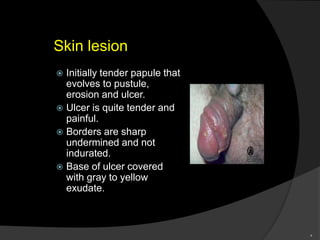
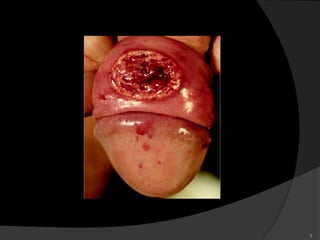
Skin lesion
 Initially tender papule that
evolves to pustule,
erosion and ulcer.
 Ulcer is quite tender and
painful.
 Borders are sharp
undermined and not
indurated.
 Base of ulcer covered
with gray to yellow
exudate.
4
5
6
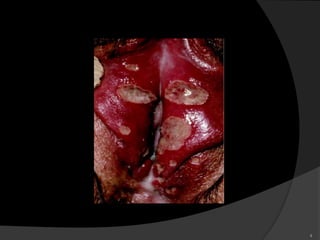
Skin lesions :
 Ulcers may be single or multiple or merge to
form large ulcers.
 Suppurative Lymphadenopathy ,painful,
(usually unilateral) occur within 1 to 2 weeks
of the lesion.
 Buboes may drain spontaneously.
7
Investigations :
 Gram stain: Scrapings from base of ulcer may
show clusters of gram negative rods
(SCHOOL OF FISH).
 Culture : Difficult, special media, Sensitivity
< 80%.
 Serologic tests : None, Should be tested for
syphilis and HIV. Repeat after 3 months if –
ve initially.
8
Management :
 Azithromycin : 1 gm Single dose.
 Inj. Ceftriaxone : 250 mg IM single dose.
 Ciprofloxacin : 500mg bid for 3 days.
 Reexamination after 3 to 7 days.
 Buboes may need to be aspirated.
9
Complications :
 Large inguinal abscess may develop & rupture to form
draining sinus or giant ulcer
 Superinfection by Fusarium & Bacteroides
 Phimosis- in long standing lesions
THANK YOU

15. Chancroid

  • 1.
  • 2.
    Chancroid :  Itis an acute STD characterized by a painful ulcer at the site of inoculation and development of suppurative regional lymphadenopathy. 2
  • 3.
    Chancroid :  Etiology: Hemophilus ducreyi , a gram –ve streptobacillus.  High incidence of HIV infection in patients with chancroid . Known to enhance infection rate.  Incubation period : 4 to 7 days.  Endemic in tropical 3rd world countries. 3
  • 4.
    Skin lesion  Initiallytender papule that evolves to pustule, erosion and ulcer.  Ulcer is quite tender and painful.  Borders are sharp undermined and not indurated.  Base of ulcer covered with gray to yellow exudate. 4
  • 5.
  • 6.
  • 7.
    Skin lesions : Ulcers may be single or multiple or merge to form large ulcers.  Suppurative Lymphadenopathy ,painful, (usually unilateral) occur within 1 to 2 weeks of the lesion.  Buboes may drain spontaneously. 7
  • 8.
    Investigations :  Gramstain: Scrapings from base of ulcer may show clusters of gram negative rods (SCHOOL OF FISH).  Culture : Difficult, special media, Sensitivity < 80%.  Serologic tests : None, Should be tested for syphilis and HIV. Repeat after 3 months if – ve initially. 8
  • 9.
    Management :  Azithromycin: 1 gm Single dose.  Inj. Ceftriaxone : 250 mg IM single dose.  Ciprofloxacin : 500mg bid for 3 days.  Reexamination after 3 to 7 days.  Buboes may need to be aspirated. 9
  • 10.
    Complications :  Largeinguinal abscess may develop & rupture to form draining sinus or giant ulcer  Superinfection by Fusarium & Bacteroides  Phimosis- in long standing lesions
  • 11.