Stoichiometry
Stoichiometry
“stochio” = Greek for element
“metry” = measurement
Stoichiometry is about measuring the
amounts of elements and compounds
involved in a reaction.
SOI -Transformation of one quantitative
relationship into another leads to balance
and innovation in the real world.
Key Concept- Relationships
Related Concept- Balance , Transformation
Global Context - Scientific and Technical Innovation
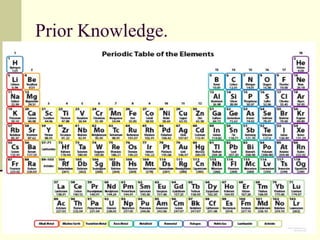
Prior Knowledge.
How is mass of an atom measured?
One grain of sand contains millions of atoms, so atoms
must be really small.
Atoms are so small that their masses are not measured
directly.
Instead, all atoms are compared with the mass of
carbon-12.
The mass of an atom on this scale is called its relative
atomic mass.
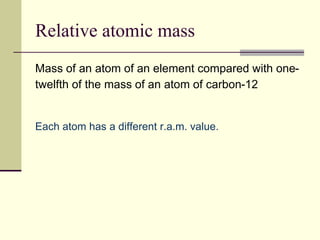
Relative atomic mass
Mass of an atom of an element compared with one-
twelfth of the mass of an atom of carbon-12
Each atom has a different r.a.m. value.
Where are r.a.m. values
found?
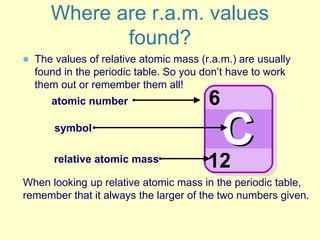
● The values of relative atomic mass (r.a.m.) are usually
found in the periodic table. So you don’t have to work
them out or remember them all!
atomic number
symbol
relative atomic mass
When looking up relative atomic mass in the periodic table,
remember that it always the larger of the two numbers given.
Why isn’t r.a.m. always a
whole number?
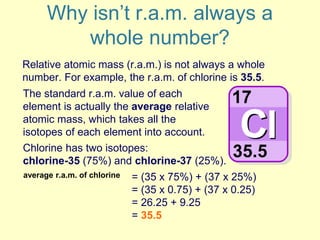
Relative atomic mass (r.a.m.) is not always a whole
number. For example, the r.a.m. of chlorine is 35.5.
The standard r.a.m. value of each
element is actually the average relative
atomic mass, which takes all the
isotopes of each element into account.
Chlorine has two isotopes:
chlorine-35 (75%) and chlorine-37 (25%).
average r.a.m. of chlorine = (35 x 75%) + (37 x 25%)
= (35 x 0.75) + (37 x 0.25)
= 26.25 + 9.25
= 35.5
Calculating average r.a.m.
from isotopes
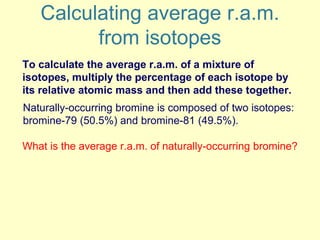
To calculate the average r.a.m. of a mixture of
isotopes, multiply the percentage of each isotope by
its relative atomic mass and then add these together.
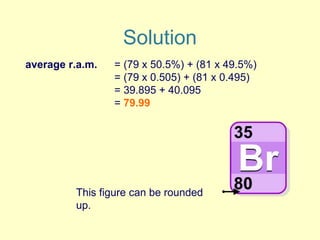
Naturally-occurring bromine is composed of two isotopes:
bromine-79 (50.5%) and bromine-81 (49.5%).
What is the average r.a.m. of naturally-occurring bromine?
Solution
average r.a.m. = (79 x 50.5%) + (81 x 49.5%)
= (79 x 0.505) + (81 x 0.495)
= 39.895 + 40.095
= 79.99
This figure can be rounded
up.
What about the mass of
compounds?
Most substances are made of molecules, not individual
atoms. Molecules are really small too, so can we work out
their masses in the same kind of way?
Of course! The mass of a molecule is
called the relative formula mass. This is
calculated by adding up the relative atomic
masses of all the atoms in the molecule.
How is relative formula mass
calculated?
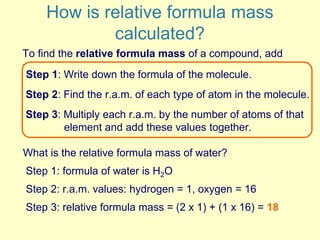
To find the relative formula mass of a compound, add
up the relative atomic masses of all the atoms in its
formula.
Step 1: Write down the formula of the molecule.
Step 2: Find the r.a.m. of each type of atom in the molecule.
Step 3: Multiply each r.a.m. by the number of atoms of that
element and add these values together.
What is the relative formula mass of water?
Step 1: formula of water is H2O
Step 2: r.a.m. values: hydrogen = 1, oxygen = 16
Step 3: relative formula mass = (2 x 1) + (1 x 16) = 18
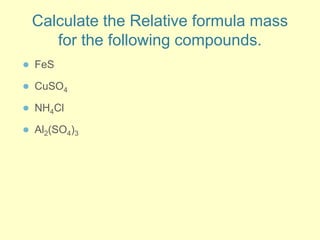
Calculate the Relative formula mass
for the following compounds.
● FeS
● CuSO4
● NH4Cl
● Al2(SO4)3
The Mole Concept
MOLE- the chemical counting unit
● It is difficult to find out the weight of a single atom or
molecule- too small.
● A ‘counting unit’ has to be found- practical chemistry.
● The counting unit plays an important role when dealing with
large no. of small objects.
● Eg 1. Banks weigh coins rather than count them
● Eg 2. no. of sweets from a jar can be found out from their
mass
How can we find the no. of iron atoms
in an iron block?
● Chemists count atoms and molecules by weighing
them.
● The amount of the substance is taken as the relative
formula mass of substance in grams.
● This is known as 1 mole of a substance (1 mol) .
● Each mole contains same no. of atoms, molecules or
formula units.
● The no. per mole has been given by an Italian chemist
named Amedeo Avogadro.
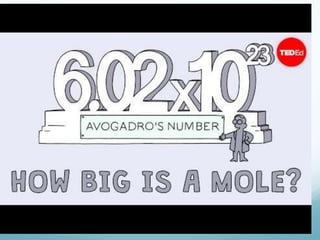
Avogadro’s Number
● Avogadro’s Number (symbol N) is the number of atoms in 12.01
grams of carbon.
● Its numerical value is 6.02 × 10²³.
● Therefore, a 12.01 g sample of carbon contains 6.02 × 10²³ carbon
atoms.
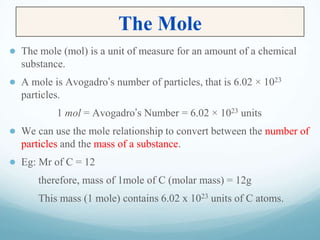
The Mole
● The mole (mol) is a unit of measure for an amount of a chemical
substance.
● A mole is Avogadro’s number of particles, that is 6.02 × 10²³
particles.
1 mol = Avogadro’s Number = 6.02 × 10²³ units
● We can use the mole relationship to convert between the number of
particles and the mass of a substance.
● Eg: Mr of C = 12
therefore, mass of 1mole of C (molar mass) = 12g
This mass (1 mole) contains 6.02 x 10²³ units of C atoms.
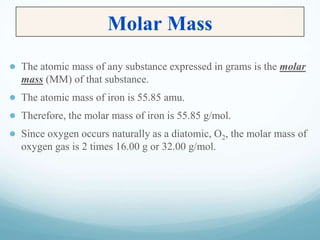
Molar Mass
● The atomic mass of any substance expressed in grams is the molar
mass (MM) of that substance.
● The atomic mass of iron is 55.85 amu.
● Therefore, the molar mass of iron is 55.85 g/mol.
● Since oxygen occurs naturally as a diatomic, O2, the molar mass of
oxygen gas is 2 times 16.00 g or 32.00 g/mol.
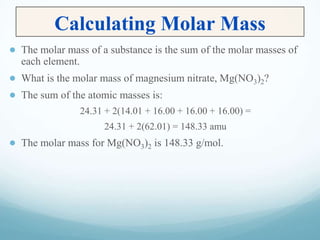
Calculating Molar Mass
● The molar mass of a substance is the sum of the molar masses of
each element.
● What is the molar mass of magnesium nitrate, Mg(NO3)2?
● The sum of the atomic masses is:
24.31 + 2(14.01 + 16.00 + 16.00 + 16.00) =
24.31 + 2(62.01) = 148.33 amu
● The molar mass for Mg(NO3)2 is 148.33 g/mol.
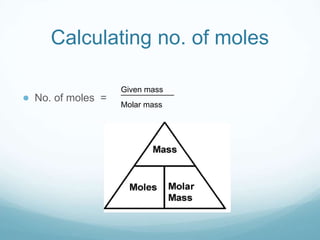
Calculating no. of moles
● No. of moles =
Given mass
____________
Molar mass
Solve
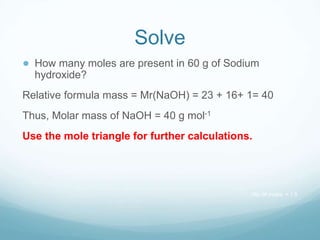
● How many moles are present in 60 g of Sodium
hydroxide?
Relative formula mass = Mr(NaOH) = 23 + 16+ 1= 40
Thus, Molar mass of NaOH = 40 g mol-1
Use the mole triangle for further calculations.
No. of moles = 1.5
Mass-Mole Calculations
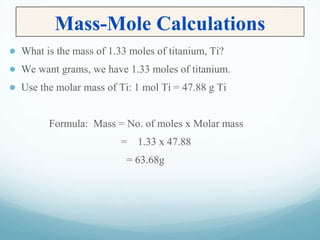
● What is the mass of 1.33 moles of titanium, Ti?
● We want grams, we have 1.33 moles of titanium.
● Use the molar mass of Ti: 1 mol Ti = 47.88 g Ti
Formula: Mass = No. of moles x Molar mass
= 1.33 x 47.88
= 63.68g
Percent Composition
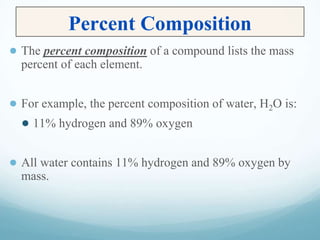
● The percent composition of a compound lists the mass
percent of each element.
● For example, the percent composition of water, H2O is:
● 11% hydrogen and 89% oxygen
● All water contains 11% hydrogen and 89% oxygen by
mass.
Calculating Percent Composition
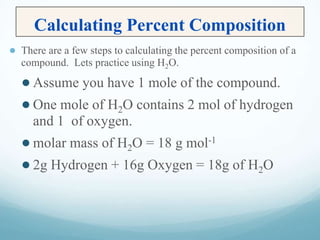
● There are a few steps to calculating the percent composition of a
compound. Lets practice using H2O.
● Assume you have 1 mole of the compound.
● One mole of H2O contains 2 mol of hydrogen
and 1 of oxygen.
● molar mass of H2O = 18 g mol-1
● 2g Hydrogen + 16g Oxygen = 18g of H2O
Calculating Percent Composition
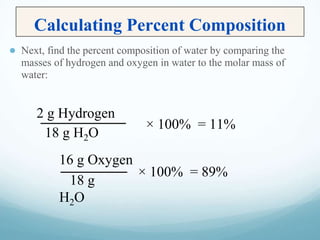
● Next, find the percent composition of water by comparing the
masses of hydrogen and oxygen in water to the molar mass of
water:
16 g Oxygen
18 g
H2O
× 100% = 89%
2 g Hydrogen
18 g H2O
× 100% = 11%
Percent Composition Problem
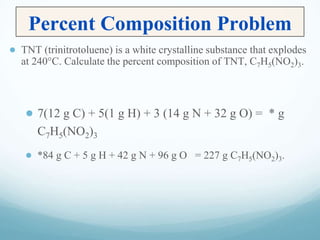
● TNT (trinitrotoluene) is a white crystalline substance that explodes
at 240°C. Calculate the percent composition of TNT, C7H5(NO2)3.
● 7(12 g C) + 5(1 g H) + 3 (14 g N + 32 g O) = * g
C7H5(NO2)3
● *84 g C + 5 g H + 42 g N + 96 g O = 227 g C7H5(NO2)3.
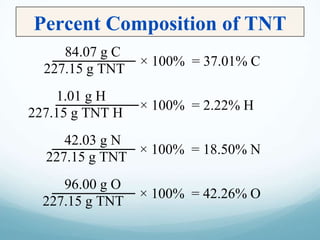
Percent Composition of TNT
84.07 g C
227.15 g TNT
× 100% = 37.01% C
1.01 g H
227.15 g TNT H
× 100% = 2.22% H
42.03 g N
227.15 g TNT
× 100% = 18.50% N
96.00 g O
227.15 g TNT
× 100% = 42.26% O
Empirical Formulas
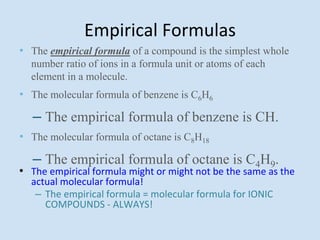
• The empirical formula of a compound is the simplest whole
number ratio of ions in a formula unit or atoms of each
element in a molecule.
• The molecular formula of benzene is C6H6
– The empirical formula of benzene is CH.
• The molecular formula of octane is C8H18
– The empirical formula of octane is C4H9.
• The empirical formula might or might not be the same as the
actual molecular formula!
– The empirical formula = molecular formula for IONIC
COMPOUNDS - ALWAYS!
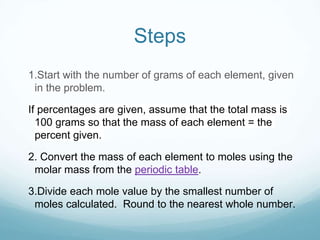
Steps
1.Start with the number of grams of each element, given
in the problem.
If percentages are given, assume that the total mass is
100 grams so that the mass of each element = the
percent given.
2. Convert the mass of each element to moles using the
molar mass from the periodic table.
3.Divide each mole value by the smallest number of
moles calculated. Round to the nearest whole number.
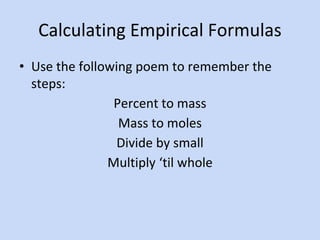
Calculating Empirical Formulas
• Use the following poem to remember the
steps:
Percent to mass
Mass to moles
Divide by small
Multiply ‘til whole
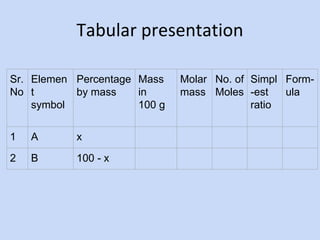
Tabular presentation
Sr.
No
Elemen
t
symbol
Percentage
by mass
Mass
in
100 g
Molar
mass
No. of
Moles
Simpl
-est
ratio
Form-
ula
1 A x
2 B 100 - x
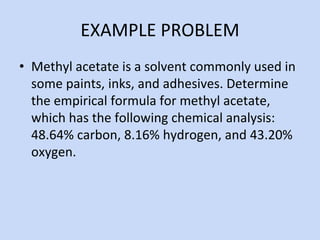
EXAMPLE PROBLEM
• Methyl acetate is a solvent commonly used in
some paints, inks, and adhesives. Determine
the empirical formula for methyl acetate,
which has the following chemical analysis:
48.64% carbon, 8.16% hydrogen, and 43.20%
oxygen.
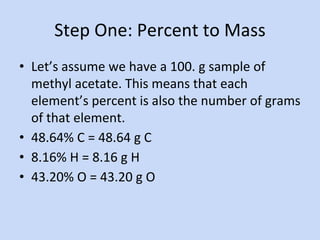
Step One: Percent to Mass
• Let’s assume we have a 100. g sample of
methyl acetate. This means that each
element’s percent is also the number of grams
of that element.
• 48.64% C = 48.64 g C
• 8.16% H = 8.16 g H
• 43.20% O = 43.20 g O
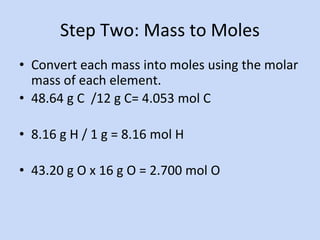
Step Two: Mass to Moles
• Convert each mass into moles using the molar
mass of each element.
• 48.64 g C /12 g C= 4.053 mol C
• 8.16 g H / 1 g = 8.16 mol H
• 43.20 g O x 16 g O = 2.700 mol O
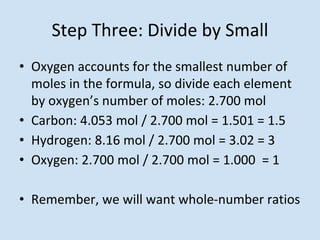
Step Three: Divide by Small
• Oxygen accounts for the smallest number of
moles in the formula, so divide each element
by oxygen’s number of moles: 2.700 mol
• Carbon: 4.053 mol / 2.700 mol = 1.501 = 1.5
• Hydrogen: 8.16 mol / 2.700 mol = 3.02 = 3
• Oxygen: 2.700 mol / 2.700 mol = 1.000 = 1
• Remember, we will want whole-number ratios
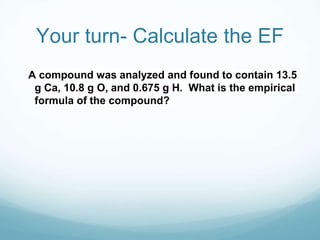
Your turn- Calculate the EF
A compound was analyzed and found to contain 13.5
g Ca, 10.8 g O, and 0.675 g H. What is the empirical
formula of the compound?
Molecular Formulas
• If the empirical formula is different from the
molecular formula, the molecular formula will
always be a simple multiple of the empirical
formula.
– EX: The empirical formula for hydrogen peroxide
is HO; the molecular formula is H2O2.
– In both formulas, the ratio of oxygen to hydrogen
is 1:1
Molecular Formulas
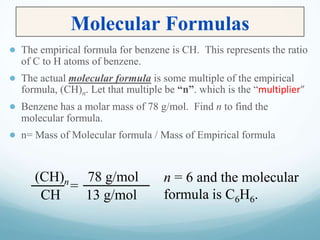
● The empirical formula for benzene is CH. This represents the ratio
of C to H atoms of benzene.
● The actual molecular formula is some multiple of the empirical
formula, (CH)n. Let that multiple be “n”. which is the “multiplier”
● Benzene has a molar mass of 78 g/mol. Find n to find the
molecular formula.
● n= Mass of Molecular formula / Mass of Empirical formula
=
CH
(CH)n 78 g/mol
13 g/mol
n = 6 and the molecular
formula is C6H6.
Calculating Molecular Formulas
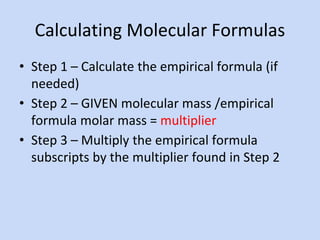
• Step 1 – Calculate the empirical formula (if
needed)
• Step 2 – GIVEN molecular mass /empirical
formula molar mass = multiplier
• Step 3 – Multiply the empirical formula
subscripts by the multiplier found in Step 2
EXAMPLE PROBLEM
• Succinic acid is a substance produced by
lichens. Chemical analysis indicates it is
composed of 40.68% carbon, 5.08% hydrogen,
and 52.24% oxygen and has a molar mass of
118.1 g/mol. Determine the empirical and
molecular formulas for succinic acid.