Chapter 8:
Hydraulic jump and its analysis
1
Hydraulics
Er. Binu Karki
Lecturer
Hydraulic jump
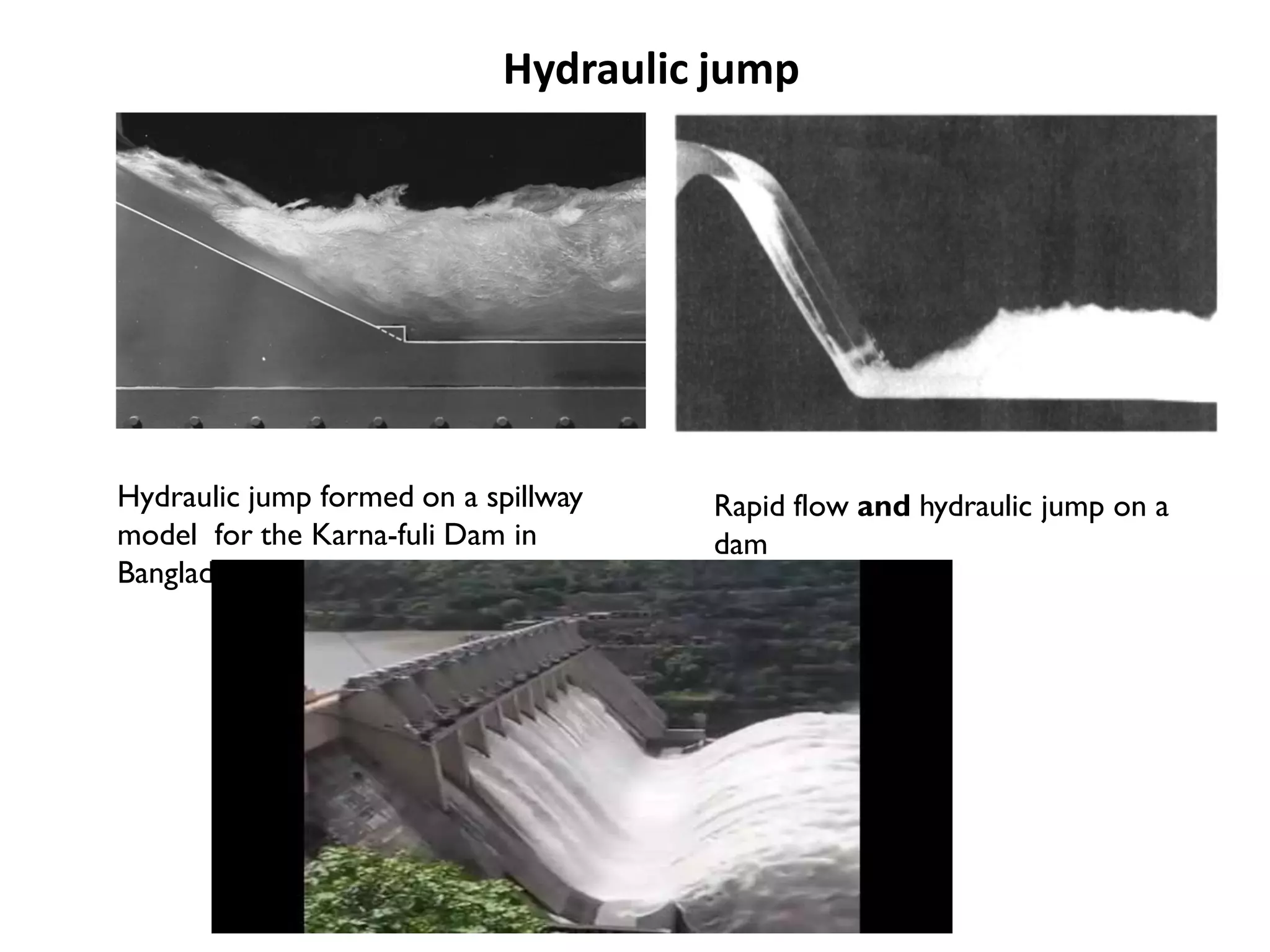
Hydraulic jump formed on a spillway
model for the Karna-fuli Dam in
Bangladesh.
Rapid flow and hydraulic jump on a
dam
Characteristics of R.V.F
• A rapid variation of flow depth and velocity
occurs in short reach of channel
• R.V.F occurs in small reach so friction force
is quite small compared to other forces and
may be neglected.
• Velocity coefficient, alpha and momentum
coefficients, beta are greater than unity
and difficult to ascertain accurately
• In R.V.F, the flow pattern and velocity
distribution is complicated
Hydraulics Jump or Standing Wave
 Hydraulics jump is local non-
uniform flow phenomenon
resulting from the change in
flow from super critical to sub
critical.
In Hydraulic jump there is
discontinuity in the surface
characterized by a steep
upward slope of the profile
accompanied by lot of
turbulence and eddies. The
eddies cause energy loss and
depth after the jump is slightly
less than the corresponding
alternate depth.
The depth before and after the
hydraulic jump are known as
conjugate depths or sequent
depths.
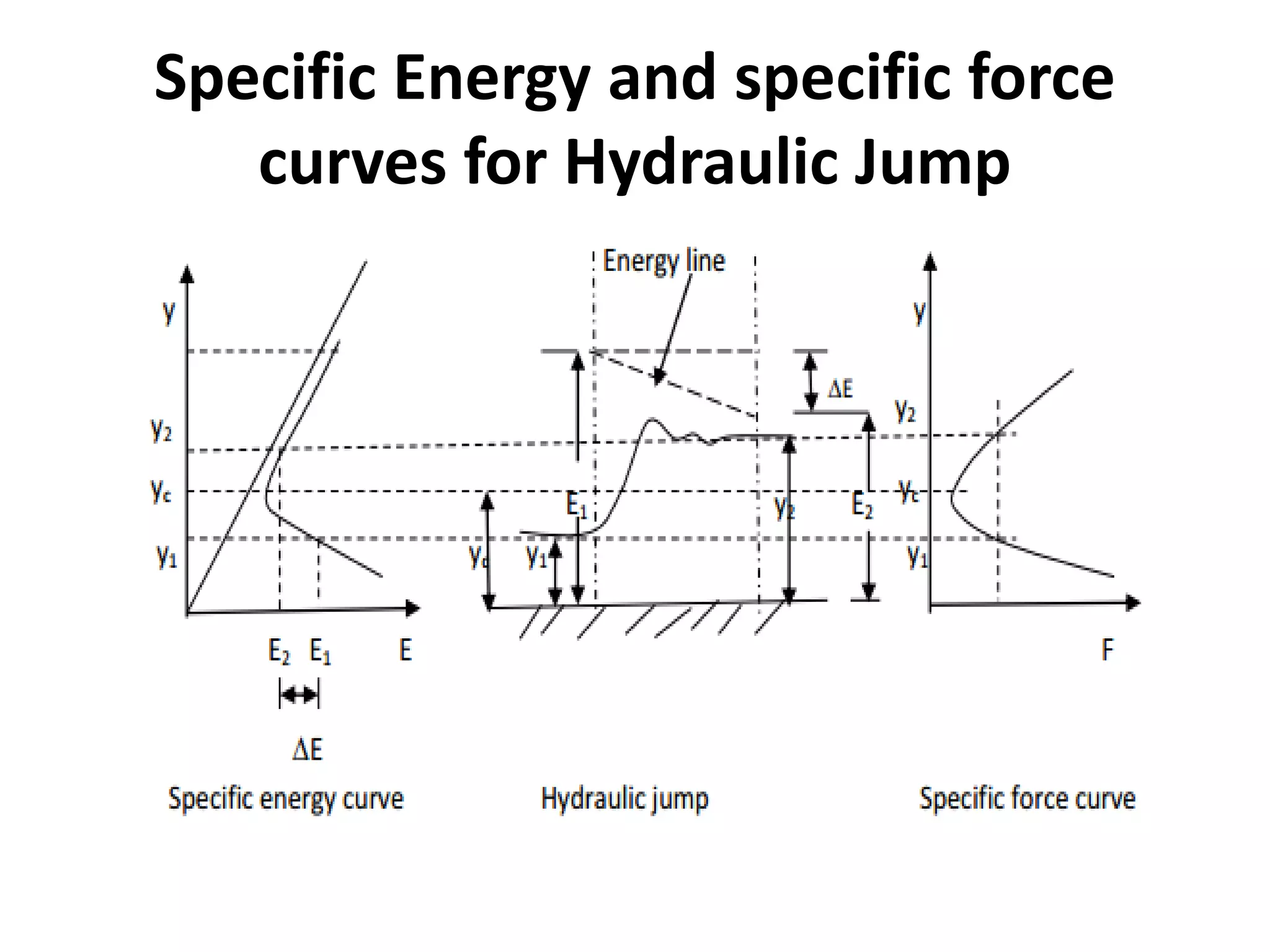
Specific Energy and specific force
curves for Hydraulic Jump
Uses of Hydraulic Jump/Practical
applications
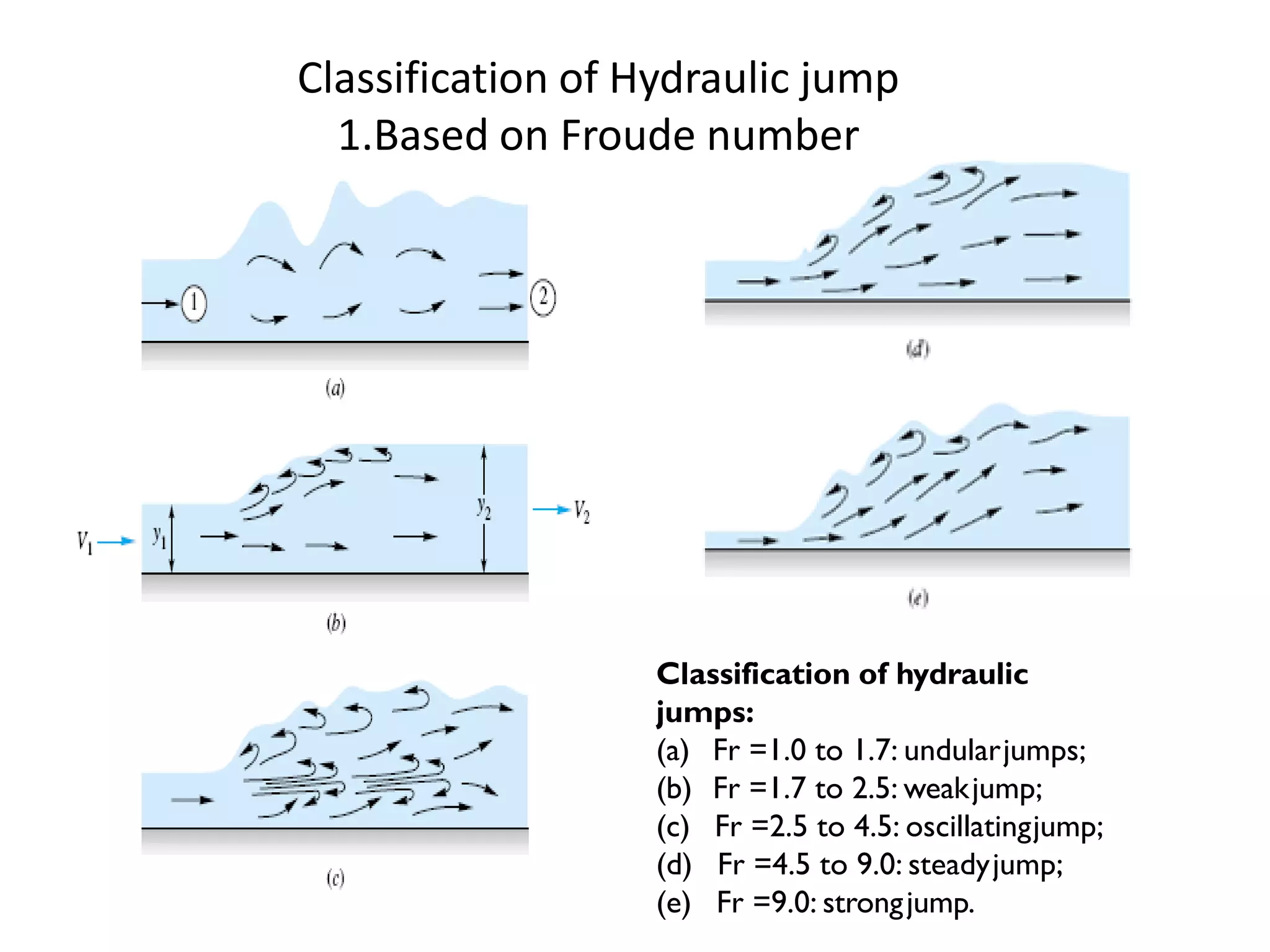
Classification of Hydraulic jump
1.Based on Froude number
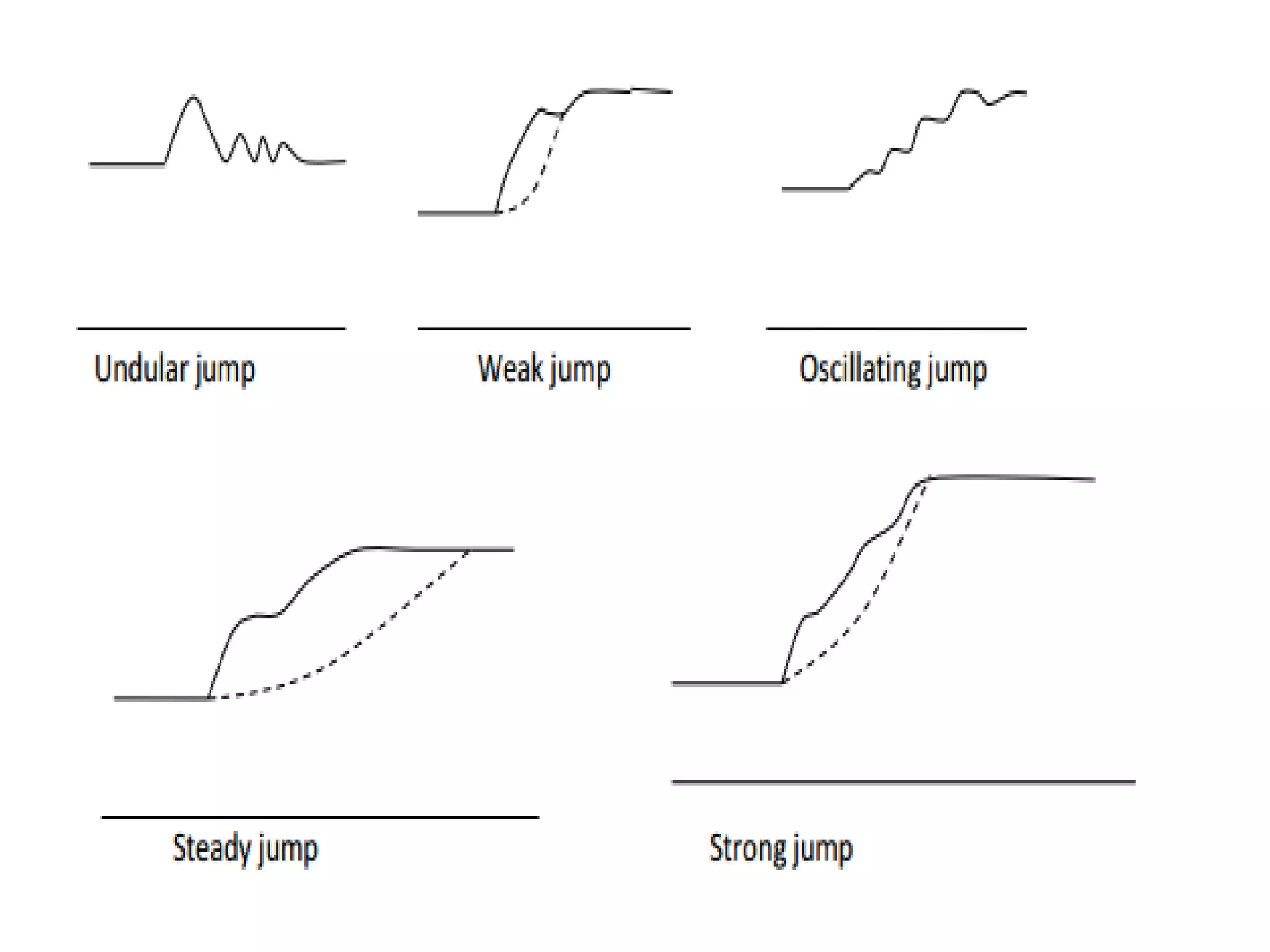
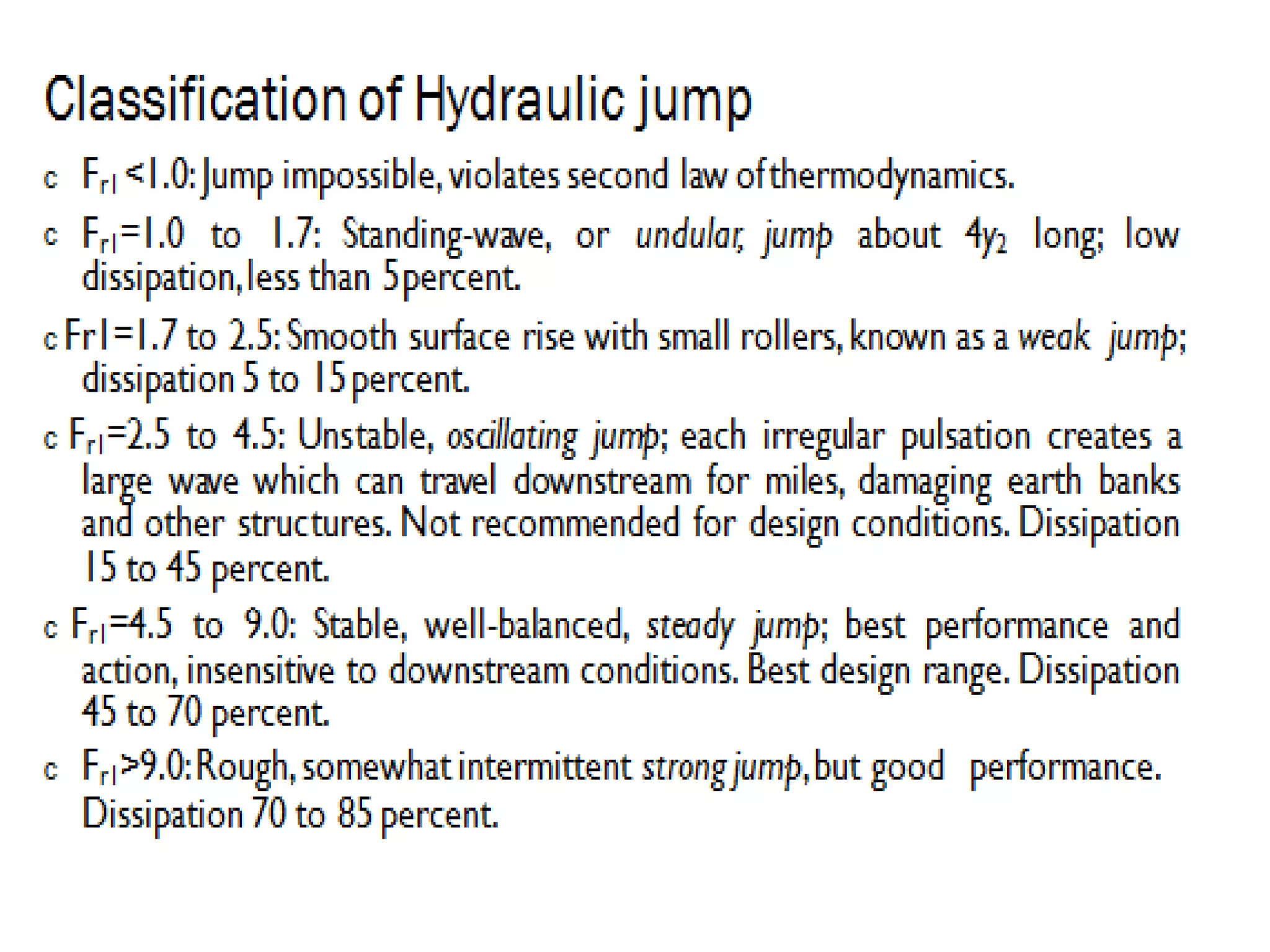
Classification of hydraulic
jumps:
(a) Fr =1.0 to 1.7: undularjumps;
(b) Fr =1.7 to 2.5: weakjump;
(c) Fr =2.5 to 4.5: oscillatingjump;
(d) Fr =4.5 to 9.0: steadyjump;
(e) Fr =9.0: strongjump.
Based on Tail water depth
• The depth downstream of a hydraulic structure is called
tailwater depth.
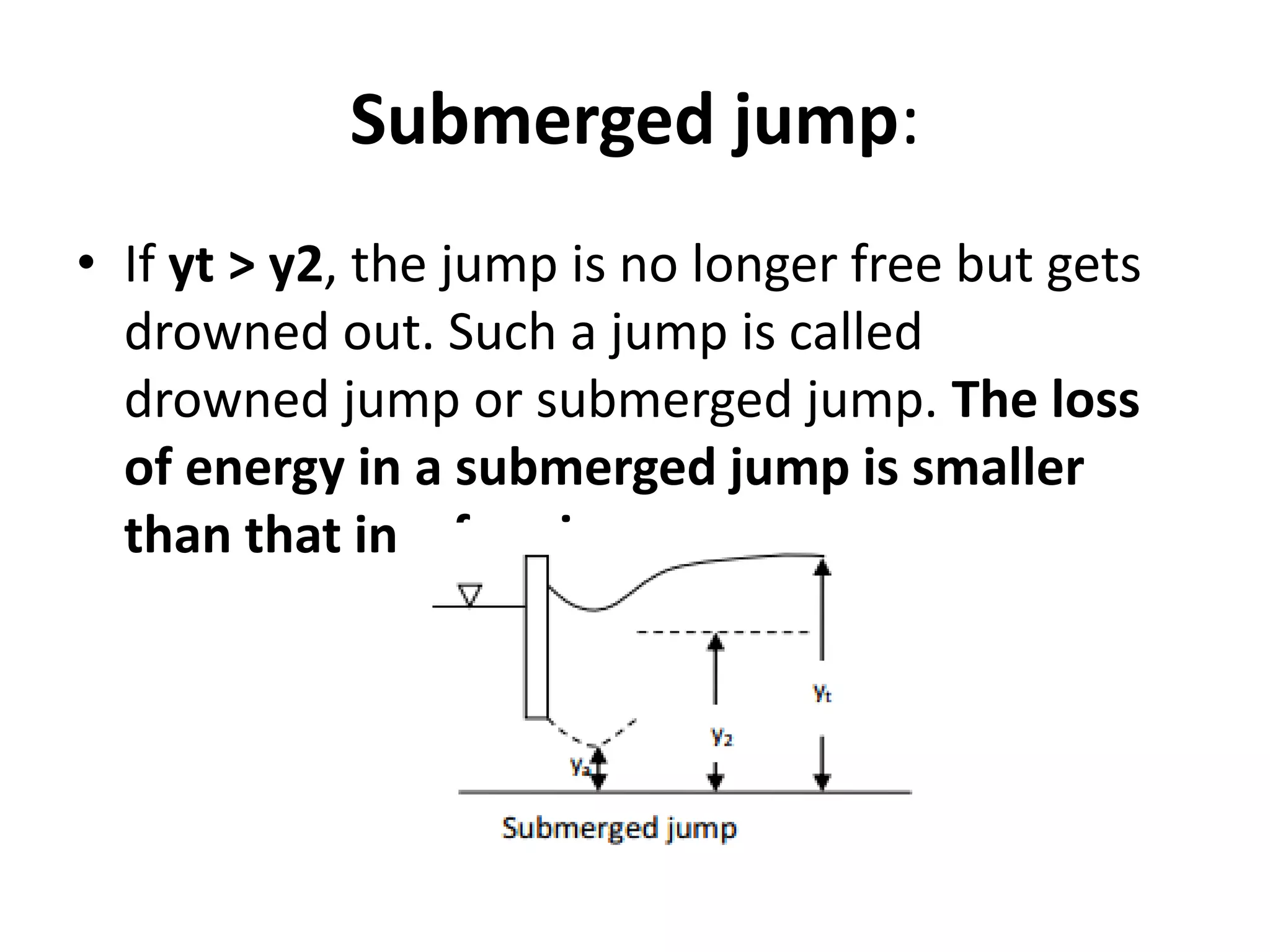
yt = tailwater depth, ya = Depth at the vena-contracta, y2 =
sequent depth to ya
 Free jump: The jump with yt equal to or less than y2 is
called free jump. When yt = y2, a free jump will form at the
vena-contracta.
Repelled jump:
• If yt < y2, the jump is repelled downstream of
the vena-contracta through an M3 curve (or
may be H3). The depth at the toe of the jump
is larger than ya. Such a jump is called a
repelled jump.
Submerged jump:
• If yt > y2, the jump is no longer free but gets
drowned out. Such a jump is called
drowned jump or submerged jump. The loss
of energy in a submerged jump is smaller
than that in a free jump
Jump Variables
• Conjugate depth=y1 and y2
• Height of jump(hj)=y2-y1
• Length of jump(Lj)
It is the distance measured from front face of
hump to a point on surface immediately
downstream of roller.
Experimentally,
For rectangular channel, Lj=(5 to 7 )*hj
Equation for Conjugate Depths
Hydraulic Jump in a retangular channel
Equation for Conjugate Depths
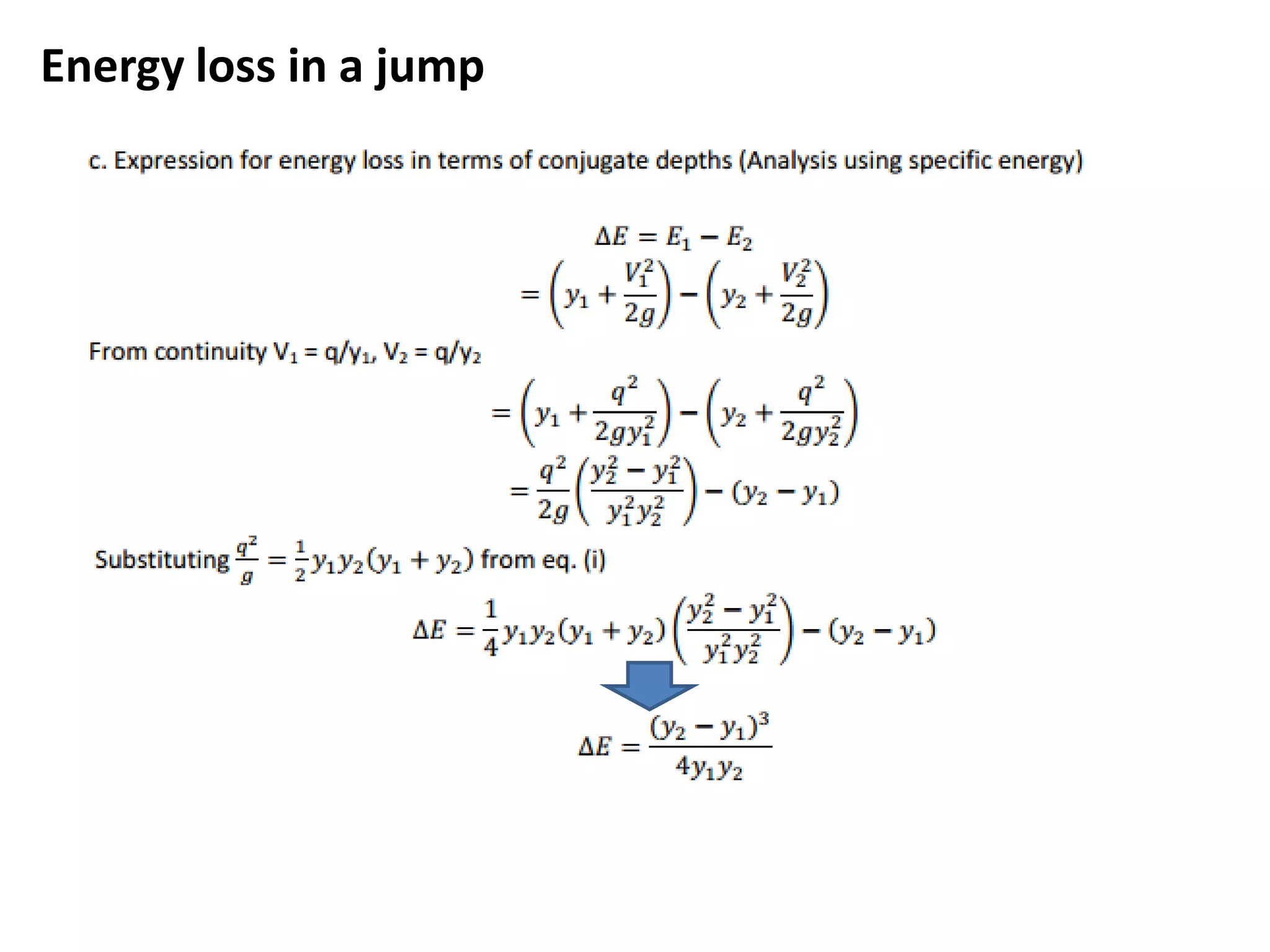
Energy loss in a jump

Chapter 8 hydraulic jump

  • 1.
    Chapter 8: Hydraulic jumpand its analysis 1 Hydraulics Er. Binu Karki Lecturer
  • 2.
    Hydraulic jump Hydraulic jumpformed on a spillway model for the Karna-fuli Dam in Bangladesh. Rapid flow and hydraulic jump on a dam
  • 3.
    Characteristics of R.V.F •A rapid variation of flow depth and velocity occurs in short reach of channel • R.V.F occurs in small reach so friction force is quite small compared to other forces and may be neglected. • Velocity coefficient, alpha and momentum coefficients, beta are greater than unity and difficult to ascertain accurately • In R.V.F, the flow pattern and velocity distribution is complicated
  • 4.
    Hydraulics Jump orStanding Wave  Hydraulics jump is local non- uniform flow phenomenon resulting from the change in flow from super critical to sub critical. In Hydraulic jump there is discontinuity in the surface characterized by a steep upward slope of the profile accompanied by lot of turbulence and eddies. The eddies cause energy loss and depth after the jump is slightly less than the corresponding alternate depth. The depth before and after the hydraulic jump are known as conjugate depths or sequent depths.
  • 5.
    Specific Energy andspecific force curves for Hydraulic Jump
  • 6.
    Uses of HydraulicJump/Practical applications
  • 7.
    Classification of Hydraulicjump 1.Based on Froude number Classification of hydraulic jumps: (a) Fr =1.0 to 1.7: undularjumps; (b) Fr =1.7 to 2.5: weakjump; (c) Fr =2.5 to 4.5: oscillatingjump; (d) Fr =4.5 to 9.0: steadyjump; (e) Fr =9.0: strongjump.
  • 10.
    Based on Tailwater depth • The depth downstream of a hydraulic structure is called tailwater depth. yt = tailwater depth, ya = Depth at the vena-contracta, y2 = sequent depth to ya  Free jump: The jump with yt equal to or less than y2 is called free jump. When yt = y2, a free jump will form at the vena-contracta.
  • 11.
    Repelled jump: • Ifyt < y2, the jump is repelled downstream of the vena-contracta through an M3 curve (or may be H3). The depth at the toe of the jump is larger than ya. Such a jump is called a repelled jump.
  • 12.
    Submerged jump: • Ifyt > y2, the jump is no longer free but gets drowned out. Such a jump is called drowned jump or submerged jump. The loss of energy in a submerged jump is smaller than that in a free jump
  • 13.
    Jump Variables • Conjugatedepth=y1 and y2 • Height of jump(hj)=y2-y1 • Length of jump(Lj) It is the distance measured from front face of hump to a point on surface immediately downstream of roller. Experimentally, For rectangular channel, Lj=(5 to 7 )*hj
  • 14.
    Equation for ConjugateDepths Hydraulic Jump in a retangular channel
  • 15.
  • 16.
  • 17.