Chapter 7
Non uniform Gradually varied
flow(GVF)
1
Hydraulics
Er. Binu Karki
Lecturer
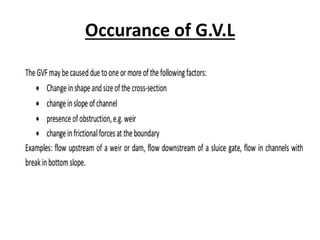
Occurance of G.V.L
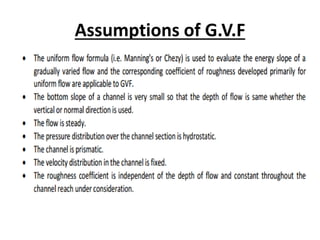
Assumptions of G.V.F
Energy Equation for Gradually Varied Flow.
Z1
V2
1
2g
Datu
m
S
o
y1
Z2
V2
2
2g
y2
HG
L
E
L
Water
Level
VV
 hl
2
2
2 g
 Z  y 2 2
2
1
2 g
Z 1  y 1 
Theoretical
EL
Sw
hL
∆
X
∆
L
S
Remember: Both sections are subject to atmospheric
pressure
6
Energy Equation for Gradually Varied Flow.
7
V
ohL
Sf So

X LL
Sf 
(1)
, So 
2g2g
L 
E1  E2
Now
E1  E2  So L SfL
Z1  Z2  Z1  Z2 
 Z1  Z2  hL
2
2
2
2
y 
V1
 y 1
for   6
Where L  length of water surface profile
An approximate analysis of gradually varied, non uniform flow can
be achieved by considering a length of stream consisting of a
number of successive reaches, in each of which uniform occurs.
Greater accuracy results from smaller depth variation in each reach.
V
2g2g
Z2  hL
2
2
2
2
y 
V1
 y 1Z1 +
Energy Equation for Gradually Varied Flow.
8
m
m
mm
R4/3
V2
n2
n
V
S 

1
R2 /3
S1/ 2
The Manning's formula (or Chezy’s formula) is applied to average
conditions in each reach to provide an estimate of the value of S for that
reach as follows;
2
R
V
m
m
2

R1  R2

V1 V2
In practical, depth range of the interest is divided into small increments,
usually equal, which define the reaches whose lengths can be found by
equation (1)
Water Surface Profiles in Gradually Varied
Flow.
Z1
V2
1
2g
Datu
m
S
o
y1
Z2
V2
2
2g
y2
HG
L
E
L
Water
Level
V
HeadTotal
2 g
2
 Z  y 
Theoretical
EL
Sw
h
9
L
∆
X
∆
L
Water Surface Profiles in Gradually Varied Flow.
(2)
2
2
2
2

2
3 


  1



 
  
r
r
o r
1 F

So  Sf
0
For uniform flow
dy
0
dx
1 Fdx
dy

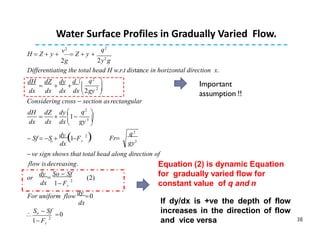
So  Sf
or
flow isdecreasing.
ve sign shows that total head along direction of
q
gy3
dx
 Sf  S 
dy
1F
q2
dx dx dx  gy
dH dZ dy 
Considering cross  section asrectangular
q2
dx dx dx dx 2gy
dH dZ dy d 
Differentiating the total head H w.r.t distance in horizontal direction x.
2y2
g
q2
v2
H  Z  y   Z  y 
2g
Fr
Equation (2) is dynamic Equation
for gradually varied flow for
constant value of q and n
If dy/dx is +ve the depth of flow
increases in the direction of flow
and vice versa 38
Important
assumption !!
Water Surface Profiles in Gradually Varied Flow.
y10/3
n2
q2
S 
orq 
1
y5/3
S1/ 2
n
orV 
1
y2 / 3
S1/ 2
n
For a wide rectangular channel
R  y dx 1 Fr2
dy

So  Sf
c Consequently, for constant q and n,
when y>yo, S<So, and the numerator
is +ve.
c Conversely, when y<yo, S>So, and
the numerator is –ve.
c To investigate the denominator we
observe that,
c if F=1,dy/dx=infinity;
c if F>1,the denominator is -ve; and
c if F<1,the denominator is +ve.
39
Types of Bed Slopes
12
 Mild Slope (M)
yo > yc
So < Sc
 Critical Slope (C)
yo = yc
So = Sc
 Steep Slope (S)
yo < yc
So > Sc
So1<S
c
yo1
yc
yo2
Break
So2>Sc
y = normal depth of flowo
yc= critical depth
So= channel bed slope
Sc=critical channel bed slope
Occurrence of Critical Depth
13
 Change in Bed Slope
 Sub-critical to Super-Critical
 Control Section
 Super-Critical to Sub-Critical
 Hydraulics Jump
Control Section
So1<S
c
So2>S
c
yo1
yo2
y
c
Break where
Slope
changes
Dropdown Curve
So1>S
c
yo1
yo2
y
c
Hydraulic Jump
So2<S
c
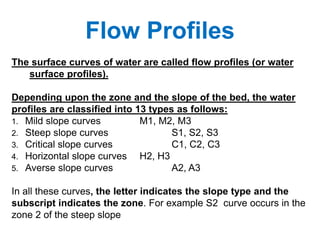
Flow Profiles
The surface curves of water are called flow profiles (or water
surface profiles).
Depending upon the zone and the slope of the bed, the water
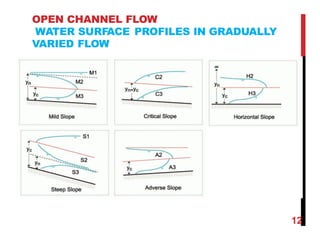
profiles are classified into 13 types as follows:
1. Mild slope curves M1, M2, M3
2. Steep slope curves S1, S2, S3
3. Critical slope curves C1, C2, C3
4. Horizontal slope curves H2, H3
5. Averse slope curves A2, A3
In all these curves, the letter indicates the slope type and the
subscript indicates the zone. For example S2 curve occurs in the
zone 2 of the steep slope
Classification of Surface Profiles
15
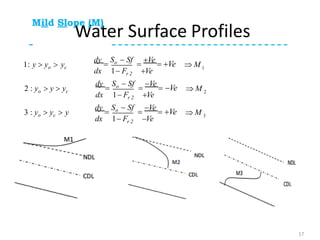
Water Surface Profiles
17
Mild Slope (M)
1
2
3
1: y  yo  yc
dy

So  Sf

Ve
 Ve  M
dx 1 Fr 2 Ve
2 : yo  y  yc
dy

So  Sf

Ve
 Ve  M
dx 1 Fr 2 Ve
3 : yo  yc  y
dy

So  Sf

Ve
 Ve  M
dx 1 Fr 2 Ve
Water Surface Profiles
Steep Slope (S)
1
2
3
1: y  yc  yo
dy

So  Sf

Ve
 Ve  S
dx 1 Fr 2 Ve
2 : yc  y  yo
dy

So  Sf

Ve
 Ve  S
dx 1 Fr 2 Ve
3 : yc  yo  y
dy

So  Sf

Ve
 Ve  S
dx 1 Fr 2 Ve
Water Surface Profiles
Critical (C)
19
1
3
1: y  yo  yc
dy

So  Sf

Ve
 Ve  C
dx 1 Fr 2 Ve
2 : yo  yc  y
dy

So  Sf

Ve
 Ve  C
dx 1 Fr 2 Ve
C2 is not
possible
Water Surface Profiles
Horizontal (H)
20
2
3
c
c
o()
o()
1: y  y 
y
dy 
So Sf Ve
 Ve 
H
Ve
2 : y  y  y
dx 1 Fr 2
dy 
So-Sf
dx 1 Fr 2
 Ve
 Ve 
H
Ve
H1 is not possible bcz water has to lower
down
Water Surface
Profiles
Adverse (A)
2
3
c
c
o()
o()
1: y  y  y
dy

So  Sf 
Ve
 Ve  A
Ve
2: y  y  y
dx 1 Fr2
dy

So-Sf
dx 1 Fr2

Ve
 Ve  A
Ve
A1 is not possible bcz water has to lower
down
OPEN CHANNEL FLOW
WATER SURFACE PROFILES IN GRADUALLY
VARIED FLOW
12
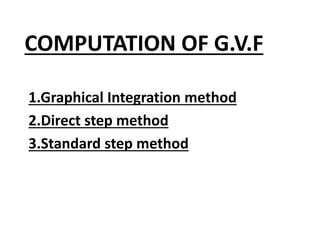
COMPUTATION OF G.V.F
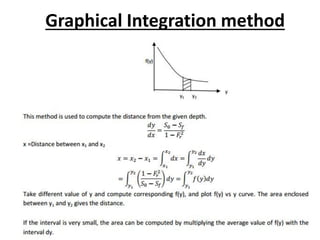
1.Graphical Integration method
2.Direct step method
3.Standard step method
Graphical Integration method
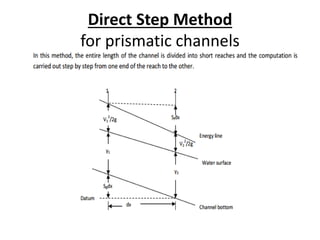
Direct Step Method
for prismatic channels
xS
g
V
yxS
g
V
y fo 
22
2
2
2
2
1
1
of SS
g
V
g
V
yy
x



22
2
2
2
1
21
energy equation
solve for x
1
1
y
q
V 
2
2
y
q
V 
2
2
A
Q
V 
1
1
A
Q
V 
rectangular channel prismatic channel
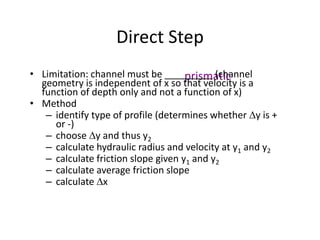
prismatic
Direct Step
• Limitation: channel must be _________ (channel
geometry is independent of x so that velocity is a
function of depth only and not a function of x)
• Method
– identify type of profile (determines whether y is +
or -)
– choose y and thus y2
– calculate hydraulic radius and velocity at y1 and y2
– calculate friction slope given y1 and y2
– calculate average friction slope
– calculate x
Direct Step Method
of SS
g
V
g
V
yy
x



22
2
2
2
1
21
Standard Step
For natural channels
• Given a depth at one location, determine the depth at a
second given location
• Step size (x) must be small enough so that changes in
water depth aren’t very large. Otherwise estimates of
the friction slope and the velocity head are inaccurate
• Can solve in upstream or downstream direction
– Usually solved upstream for subcritical
– Usually solved downstream for supercritical
• Find a depth that satisfies the energy equation
xS
g
V
yxS
g
V
y fo 
22
2
2
2
2
1
1

Chapter 7 gvf

  • 1.
    Chapter 7 Non uniformGradually varied flow(GVF) 1 Hydraulics Er. Binu Karki Lecturer
  • 4.
  • 5.
  • 6.
    Energy Equation forGradually Varied Flow. Z1 V2 1 2g Datu m S o y1 Z2 V2 2 2g y2 HG L E L Water Level VV  hl 2 2 2 g  Z  y 2 2 2 1 2 g Z 1  y 1  Theoretical EL Sw hL ∆ X ∆ L S Remember: Both sections are subject to atmospheric pressure 6
  • 7.
    Energy Equation forGradually Varied Flow. 7 V ohL Sf So  X LL Sf  (1) , So  2g2g L  E1  E2 Now E1  E2  So L SfL Z1  Z2  Z1  Z2   Z1  Z2  hL 2 2 2 2 y  V1  y 1 for   6 Where L  length of water surface profile An approximate analysis of gradually varied, non uniform flow can be achieved by considering a length of stream consisting of a number of successive reaches, in each of which uniform occurs. Greater accuracy results from smaller depth variation in each reach. V 2g2g Z2  hL 2 2 2 2 y  V1  y 1Z1 +
  • 8.
    Energy Equation forGradually Varied Flow. 8 m m mm R4/3 V2 n2 n V S   1 R2 /3 S1/ 2 The Manning's formula (or Chezy’s formula) is applied to average conditions in each reach to provide an estimate of the value of S for that reach as follows; 2 R V m m 2  R1  R2  V1 V2 In practical, depth range of the interest is divided into small increments, usually equal, which define the reaches whose lengths can be found by equation (1)
  • 9.
    Water Surface Profilesin Gradually Varied Flow. Z1 V2 1 2g Datu m S o y1 Z2 V2 2 2g y2 HG L E L Water Level V HeadTotal 2 g 2  Z  y  Theoretical EL Sw h 9 L ∆ X ∆ L
  • 10.
    Water Surface Profilesin Gradually Varied Flow. (2) 2 2 2 2  2 3      1         r r o r 1 F  So  Sf 0 For uniform flow dy 0 dx 1 Fdx dy  So  Sf or flow isdecreasing. ve sign shows that total head along direction of q gy3 dx  Sf  S  dy 1F q2 dx dx dx  gy dH dZ dy  Considering cross  section asrectangular q2 dx dx dx dx 2gy dH dZ dy d  Differentiating the total head H w.r.t distance in horizontal direction x. 2y2 g q2 v2 H  Z  y   Z  y  2g Fr Equation (2) is dynamic Equation for gradually varied flow for constant value of q and n If dy/dx is +ve the depth of flow increases in the direction of flow and vice versa 38 Important assumption !!
  • 11.
    Water Surface Profilesin Gradually Varied Flow. y10/3 n2 q2 S  orq  1 y5/3 S1/ 2 n orV  1 y2 / 3 S1/ 2 n For a wide rectangular channel R  y dx 1 Fr2 dy  So  Sf c Consequently, for constant q and n, when y>yo, S<So, and the numerator is +ve. c Conversely, when y<yo, S>So, and the numerator is –ve. c To investigate the denominator we observe that, c if F=1,dy/dx=infinity; c if F>1,the denominator is -ve; and c if F<1,the denominator is +ve. 39
  • 12.
    Types of BedSlopes 12  Mild Slope (M) yo > yc So < Sc  Critical Slope (C) yo = yc So = Sc  Steep Slope (S) yo < yc So > Sc So1<S c yo1 yc yo2 Break So2>Sc y = normal depth of flowo yc= critical depth So= channel bed slope Sc=critical channel bed slope
  • 13.
    Occurrence of CriticalDepth 13  Change in Bed Slope  Sub-critical to Super-Critical  Control Section  Super-Critical to Sub-Critical  Hydraulics Jump Control Section So1<S c So2>S c yo1 yo2 y c Break where Slope changes Dropdown Curve So1>S c yo1 yo2 y c Hydraulic Jump So2<S c
  • 14.
    Flow Profiles The surfacecurves of water are called flow profiles (or water surface profiles). Depending upon the zone and the slope of the bed, the water profiles are classified into 13 types as follows: 1. Mild slope curves M1, M2, M3 2. Steep slope curves S1, S2, S3 3. Critical slope curves C1, C2, C3 4. Horizontal slope curves H2, H3 5. Averse slope curves A2, A3 In all these curves, the letter indicates the slope type and the subscript indicates the zone. For example S2 curve occurs in the zone 2 of the steep slope
  • 15.
  • 17.
    Water Surface Profiles 17 MildSlope (M) 1 2 3 1: y  yo  yc dy  So  Sf  Ve  Ve  M dx 1 Fr 2 Ve 2 : yo  y  yc dy  So  Sf  Ve  Ve  M dx 1 Fr 2 Ve 3 : yo  yc  y dy  So  Sf  Ve  Ve  M dx 1 Fr 2 Ve
  • 18.
    Water Surface Profiles SteepSlope (S) 1 2 3 1: y  yc  yo dy  So  Sf  Ve  Ve  S dx 1 Fr 2 Ve 2 : yc  y  yo dy  So  Sf  Ve  Ve  S dx 1 Fr 2 Ve 3 : yc  yo  y dy  So  Sf  Ve  Ve  S dx 1 Fr 2 Ve
  • 19.
    Water Surface Profiles Critical(C) 19 1 3 1: y  yo  yc dy  So  Sf  Ve  Ve  C dx 1 Fr 2 Ve 2 : yo  yc  y dy  So  Sf  Ve  Ve  C dx 1 Fr 2 Ve C2 is not possible
  • 20.
    Water Surface Profiles Horizontal(H) 20 2 3 c c o() o() 1: y  y  y dy  So Sf Ve  Ve  H Ve 2 : y  y  y dx 1 Fr 2 dy  So-Sf dx 1 Fr 2  Ve  Ve  H Ve H1 is not possible bcz water has to lower down
  • 21.
    Water Surface Profiles Adverse (A) 2 3 c c o() o() 1:y  y  y dy  So  Sf  Ve  Ve  A Ve 2: y  y  y dx 1 Fr2 dy  So-Sf dx 1 Fr2  Ve  Ve  A Ve A1 is not possible bcz water has to lower down
  • 22.
    OPEN CHANNEL FLOW WATERSURFACE PROFILES IN GRADUALLY VARIED FLOW 12
  • 23.
    COMPUTATION OF G.V.F 1.GraphicalIntegration method 2.Direct step method 3.Standard step method
  • 24.
  • 25.
    Direct Step Method forprismatic channels
  • 26.
    xS g V yxS g V y fo  22 2 2 2 2 1 1 ofSS g V g V yy x    22 2 2 2 1 21 energy equation solve for x 1 1 y q V  2 2 y q V  2 2 A Q V  1 1 A Q V  rectangular channel prismatic channel
  • 27.
    prismatic Direct Step • Limitation:channel must be _________ (channel geometry is independent of x so that velocity is a function of depth only and not a function of x) • Method – identify type of profile (determines whether y is + or -) – choose y and thus y2 – calculate hydraulic radius and velocity at y1 and y2 – calculate friction slope given y1 and y2 – calculate average friction slope – calculate x
  • 28.
    Direct Step Method ofSS g V g V yy x    22 2 2 2 1 21
  • 29.
    Standard Step For naturalchannels • Given a depth at one location, determine the depth at a second given location • Step size (x) must be small enough so that changes in water depth aren’t very large. Otherwise estimates of the friction slope and the velocity head are inaccurate • Can solve in upstream or downstream direction – Usually solved upstream for subcritical – Usually solved downstream for supercritical • Find a depth that satisfies the energy equation xS g V yxS g V y fo  22 2 2 2 2 1 1