Chapter 10
Micro-hydropower plant
Prepared by:
Binu karki
Msc iWRM
Layout/Components of
micro-hydro “1”
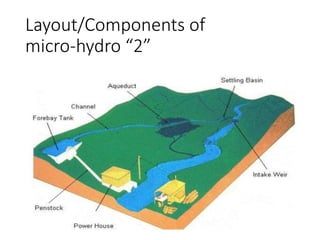
Layout/Components of
micro-hydro “2”
Micro-hydro plant VIDEO!!
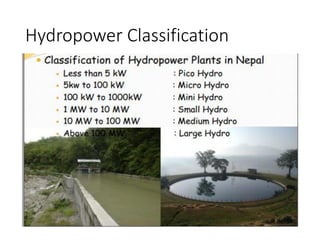
Hydropower Classification
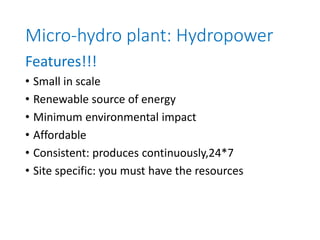
Micro-hydro plant: Hydropower
Features!!!
• Small in scale
• Renewable source of energy
• Minimum environmental impact
• Affordable
• Consistent: produces continuously,24*7
• Site specific: you must have the resources
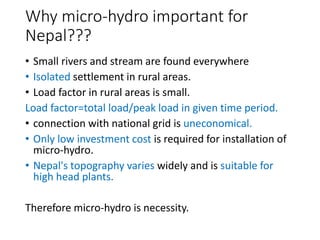
Why micro-hydro important for
Nepal???
• Small rivers and stream are found everywhere
• Isolated settlement in rural areas.
• Load factor in rural areas is small.
Load factor=total load/peak load in given time period.
• connection with national grid is uneconomical.
• Only low investment cost is required for installation of
micro-hydro.
• Nepal's topography varies widely and is suitable for
high head plants.
Therefore micro-hydro is necessity.
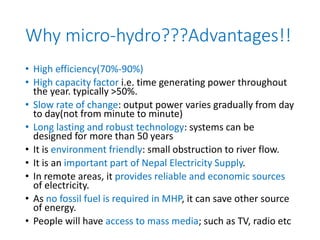
Why micro-hydro???Advantages!!
• High efficiency(70%-90%)
• High capacity factor i.e. time generating power throughout
the year. typically >50%.
• Slow rate of change: output power varies gradually from day
to day(not from minute to minute)
• Long lasting and robust technology: systems can be
designed for more than 50 years
• It is environment friendly: small obstruction to river flow.
• It is an important part of Nepal Electricity Supply.
• In remote areas, it provides reliable and economic sources
of electricity.
• As no fossil fuel is required in MHP, it can save other source
of energy.
• People will have access to mass media; such as TV, radio etc
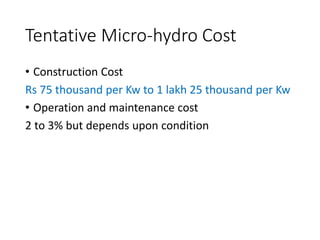
Tentative Micro-hydro Cost
• Construction Cost
Rs 75 thousand per Kw to 1 lakh 25 thousand per Kw
• Operation and maintenance cost
2 to 3% but depends upon condition
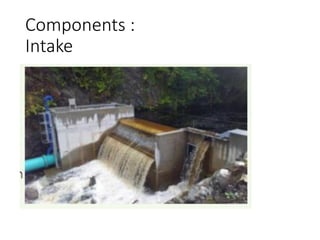
Components :
Intake
Intake
The intake of a hydro scheme is designed to divert a
certain part of the river flow. This part can go up to
100 % as the total flow of the river is diverted via the
hydro installation.
The following points are required for an intake:
• the desired flow must be diverted,
• the peak flow of the river must be able to pass the intake
and weir without causing damage to them,
• as less as possible maintenance and repairs,
• it must prevent large quantities of loose material from
entering the channel,
• it must have the possibility to remove piled up sediment.
For micro hydro schemes only the smaller intakes will
be suitable like the side intake with and without a weir.
Micro-hydro in Nepal
• The first micro hydropower plant of 5 kW capacity
was installed in Godavari, Kathmandu with the
Swiss Assistance in 1962 AD
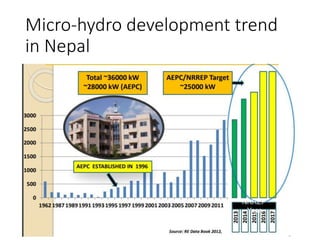
• Around 3,300 MHPs have been installed in the
country in hilly and mountains
locations(http://microhydro.org.np/).
• The establishment of Alternative Energy Promotion
Centre (AEPC) in November, 1996 was a historical
event for the sector. It comes under Ministry of
Environment, Science and Technology
• Mandate of AEPC for hydropower is upto 1MW.
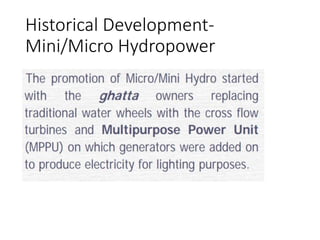
Historical Development-
Mini/Micro Hydropower
Relevance of Micro-hydro in Nepal
• Electricity has provided opportunity to get latest
and useful information to the users like useful tips
for their occupational betterment as well.
• Students can study in the evenings in bright lights.
• Lighting has been the main benefit of MHPs.
• Grinding, hulling(De-husking of Paddy Grains),
water pumping, powering of computers, photo
studios, poultry farms and some small industries.
Micro-hydro development trend
in Nepal
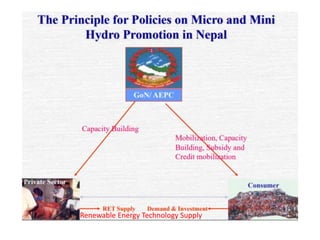
Renewable Energy Technology Supply
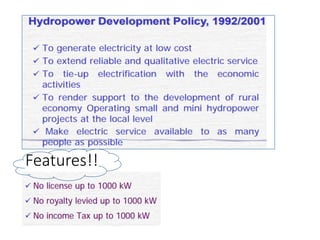
Features!!
050218 chapter 10 microhydro plant

050218 chapter 10 microhydro plant

  • 1.
  • 2.
  • 3.
  • 4.
  • 5.
  • 6.
    Micro-hydro plant: Hydropower Features!!! •Small in scale • Renewable source of energy • Minimum environmental impact • Affordable • Consistent: produces continuously,24*7 • Site specific: you must have the resources
  • 7.
    Why micro-hydro importantfor Nepal??? • Small rivers and stream are found everywhere • Isolated settlement in rural areas. • Load factor in rural areas is small. Load factor=total load/peak load in given time period. • connection with national grid is uneconomical. • Only low investment cost is required for installation of micro-hydro. • Nepal's topography varies widely and is suitable for high head plants. Therefore micro-hydro is necessity.
  • 8.
    Why micro-hydro???Advantages!! • Highefficiency(70%-90%) • High capacity factor i.e. time generating power throughout the year. typically >50%. • Slow rate of change: output power varies gradually from day to day(not from minute to minute) • Long lasting and robust technology: systems can be designed for more than 50 years • It is environment friendly: small obstruction to river flow. • It is an important part of Nepal Electricity Supply. • In remote areas, it provides reliable and economic sources of electricity. • As no fossil fuel is required in MHP, it can save other source of energy. • People will have access to mass media; such as TV, radio etc
  • 9.
    Tentative Micro-hydro Cost •Construction Cost Rs 75 thousand per Kw to 1 lakh 25 thousand per Kw • Operation and maintenance cost 2 to 3% but depends upon condition
  • 10.
  • 11.
    Intake The intake ofa hydro scheme is designed to divert a certain part of the river flow. This part can go up to 100 % as the total flow of the river is diverted via the hydro installation. The following points are required for an intake: • the desired flow must be diverted, • the peak flow of the river must be able to pass the intake and weir without causing damage to them, • as less as possible maintenance and repairs, • it must prevent large quantities of loose material from entering the channel, • it must have the possibility to remove piled up sediment. For micro hydro schemes only the smaller intakes will be suitable like the side intake with and without a weir.
  • 20.
    Micro-hydro in Nepal •The first micro hydropower plant of 5 kW capacity was installed in Godavari, Kathmandu with the Swiss Assistance in 1962 AD • Around 3,300 MHPs have been installed in the country in hilly and mountains locations(http://microhydro.org.np/). • The establishment of Alternative Energy Promotion Centre (AEPC) in November, 1996 was a historical event for the sector. It comes under Ministry of Environment, Science and Technology • Mandate of AEPC for hydropower is upto 1MW.
  • 21.
  • 22.
    Relevance of Micro-hydroin Nepal • Electricity has provided opportunity to get latest and useful information to the users like useful tips for their occupational betterment as well. • Students can study in the evenings in bright lights. • Lighting has been the main benefit of MHPs. • Grinding, hulling(De-husking of Paddy Grains), water pumping, powering of computers, photo studios, poultry farms and some small industries.
  • 23.
  • 24.
  • 27.