Ramchandran Plot
 Ramachandran plot – to visualize the
backbone of aminoacid residues
 Used for structural validation and to
calculate the possible phi and psi angles that
accounts for the aminoacid residues
 Done by several software namely
WHATIF RAMACHANDRAN PLOT
Work of Ramachandran
A Ramachandran plot (also known as a
Ramachandran diagram or a [φ,ψ] plot),
originally developed in 1963 by G. N.
Ramachandran, C. Ramakrishnan, and V.
Sasisekharan
Initially proposed a modelled structure on
collagen as a two bonded system based on the
formation of two inter hydrogen bonds between
their structures
The first Ramachandran plot was calculated
just after the first protein structure at atomic
resolution was determined (myoglobin, in 1960)
Now, many decades later, there are tens of
thousands of high-resolution protein structures
determined by X-ray crystallography and
deposited in the Protein Data Bank (PDB)
Basics of map
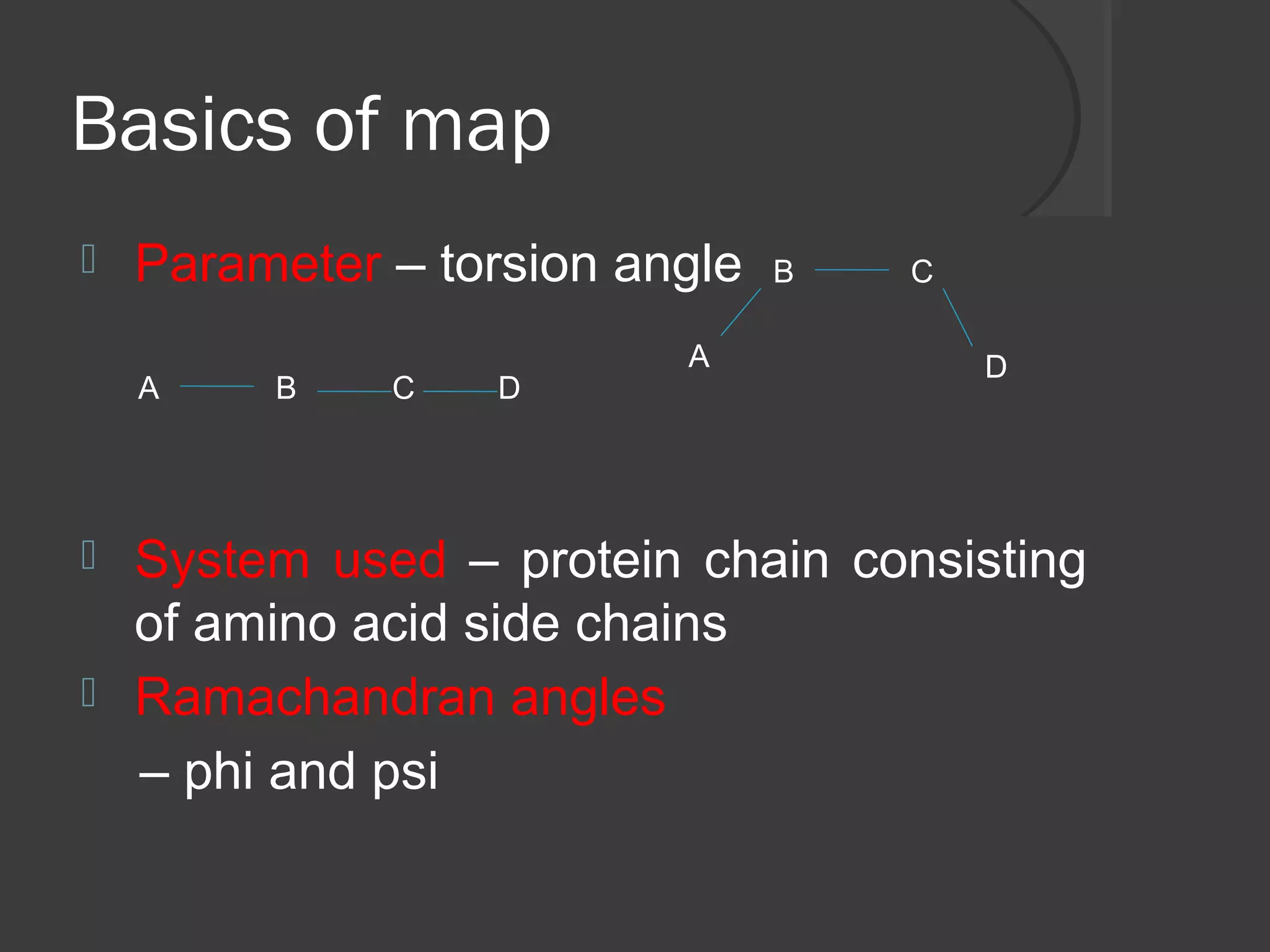
 Parameter – torsion angle
 System used – protein chain consisting
of amino acid side chains
 Ramachandran angles
– phi and psi
A B C D
B C
A D
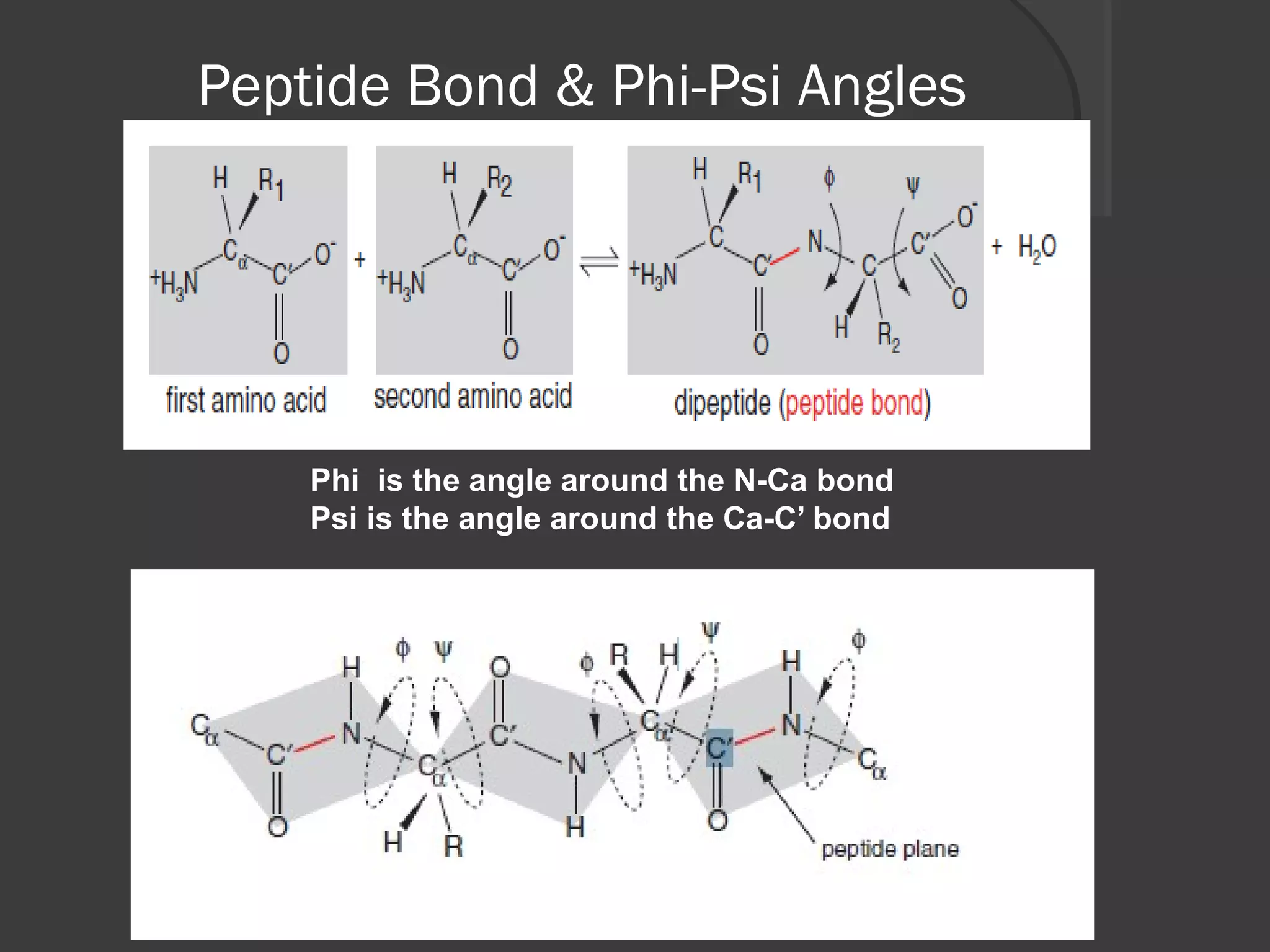
Peptide Bond & Phi-Psi Angles
Phi is the angle around the N-Ca bond
Psi is the angle around the Ca-C’ bond
Principle within the formation
 Using the analysis of crystal structure data.
Two limiting condition was approached
- normal limits
- outer limits
 Using phi and psi angles conformation of
linked peptide units are calculated
 This gave three results (color variations)
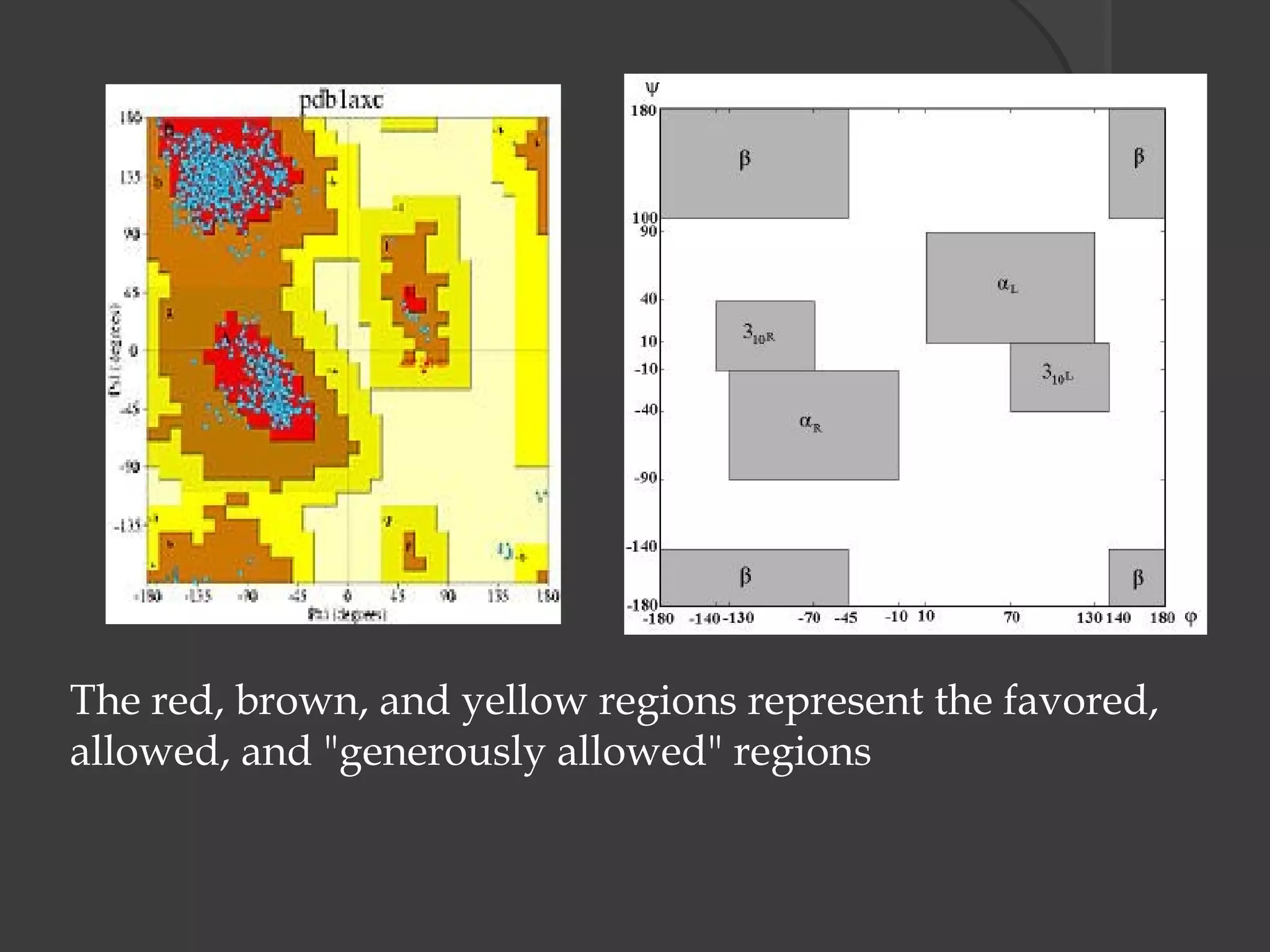
The red, brown, and yellow regions represent the favored,
allowed, and "generously allowed" regions
Distribution over the map
 The distribution of phi and psi angles for
a total of 9,156 amino acid residues from
4,413 protein chains, based on
crystallographic data
 2 areas where the density of points is
high
(1) Around phi= -60° and psi= -60°
corresponds to the a-helix
(2) Around phi= -90° and psi= -120°
corresponds to the b-structure
Aminoacid preferences
 Usually glycine and proline are not peffered in
ramachandran plot.
Glycine has only a hydrogen atom for its side
chain, with a much smaller van der Waals radius
than the CH3, CH2, or CH group that starts the
side chain of all other amino acids. Hence it is least
restricted.
 The aminoacids with larger side chains will show less
number of allowed region within the ramachandran
plot.
 Proline gives a very less number of phi and psi values
since the possess five carbon ring.
USES
A Ramachandran plot can be used in two ways.
● One is to show in theory which values, or
conformations, of the ψ and φ angles are possible
for an amino-acid residue in a protein.
● A second is to show the empirical distribution of
datapoints observed in a single structure in usage
for structure validation, or else in a database of
many structures

11.ramachandran plot

  • 1.
  • 2.
     Ramachandran plot– to visualize the backbone of aminoacid residues  Used for structural validation and to calculate the possible phi and psi angles that accounts for the aminoacid residues  Done by several software namely WHATIF RAMACHANDRAN PLOT
  • 3.
    Work of Ramachandran ARamachandran plot (also known as a Ramachandran diagram or a [φ,ψ] plot), originally developed in 1963 by G. N. Ramachandran, C. Ramakrishnan, and V. Sasisekharan Initially proposed a modelled structure on collagen as a two bonded system based on the formation of two inter hydrogen bonds between their structures
  • 4.
    The first Ramachandranplot was calculated just after the first protein structure at atomic resolution was determined (myoglobin, in 1960) Now, many decades later, there are tens of thousands of high-resolution protein structures determined by X-ray crystallography and deposited in the Protein Data Bank (PDB)
  • 5.
    Basics of map Parameter – torsion angle  System used – protein chain consisting of amino acid side chains  Ramachandran angles – phi and psi A B C D B C A D
  • 6.
    Peptide Bond &Phi-Psi Angles Phi is the angle around the N-Ca bond Psi is the angle around the Ca-C’ bond
  • 7.
    Principle within theformation  Using the analysis of crystal structure data. Two limiting condition was approached - normal limits - outer limits  Using phi and psi angles conformation of linked peptide units are calculated  This gave three results (color variations)
  • 8.
    The red, brown,and yellow regions represent the favored, allowed, and "generously allowed" regions
  • 9.
    Distribution over themap  The distribution of phi and psi angles for a total of 9,156 amino acid residues from 4,413 protein chains, based on crystallographic data  2 areas where the density of points is high (1) Around phi= -60° and psi= -60° corresponds to the a-helix (2) Around phi= -90° and psi= -120° corresponds to the b-structure
  • 10.
    Aminoacid preferences  Usuallyglycine and proline are not peffered in ramachandran plot. Glycine has only a hydrogen atom for its side chain, with a much smaller van der Waals radius than the CH3, CH2, or CH group that starts the side chain of all other amino acids. Hence it is least restricted.  The aminoacids with larger side chains will show less number of allowed region within the ramachandran plot.  Proline gives a very less number of phi and psi values since the possess five carbon ring.
  • 11.
    USES A Ramachandran plotcan be used in two ways. ● One is to show in theory which values, or conformations, of the ψ and φ angles are possible for an amino-acid residue in a protein. ● A second is to show the empirical distribution of datapoints observed in a single structure in usage for structure validation, or else in a database of many structures