Drug Designing
Optimizing access to target
Introduction
● Once the lead compound has been discovered it can be
used as the starting point for drug design.
● There are various aims in drug design:
– 1.The drug should have a good selectivity for its target
– 2.The drug should have a good level of activity for its target
– 3.The drug should have minimum side effects
– 4.The drug should be easily synthesized
– 5.The drug should be chemically stable
– 6.The drug should have acceptable pharmacokinetics properties
– 7.The drug should be non-toxic
● There are two important aspects in drug
design and drug strategies to optimize the
interaction of the drug with its target i.e.
1. Pharmacodynamics properties: to improve
the drug's ability to reach its target
2. Pharmacokinetics properties: to have
acceptable lifetime.
Optimizing access to the target
● The compound with the best binding interaction
is not necessarily the best drug to use in
medicine.
● The drug needs to pass through many barriers to
reach its target in the body.
● There are many ways to make the drug to
reach its target such as linking the drug to
polymers or antibodies or encapsulation it within
a polymeric carrier.
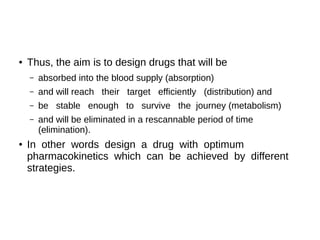
● Thus, the aim is to design drugs that will be
– absorbed into the blood supply (absorption)
– and will reach their target efficiently (distribution) and
– be stable enough to survive the journey (metabolism)
– and will be eliminated in a rescannable period of time
(elimination).
● In other words design a drug with optimum
pharmacokinetics which can be achieved by different
strategies.
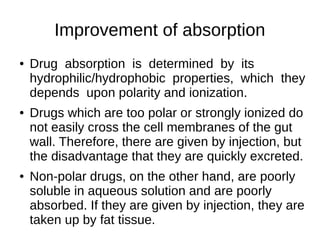
Improvement of absorption
● Drug absorption is determined by its
hydrophilic/hydrophobic properties, which they
depends upon polarity and ionization.
● Drugs which are too polar or strongly ionized do
not easily cross the cell membranes of the gut
wall. Therefore, there are given by injection, but
the disadvantage that they are quickly excreted.
● Non-polar drugs, on the other hand, are poorly
soluble in aqueous solution and are poorly
absorbed. If they are given by injection, they are
taken up by fat tissue.
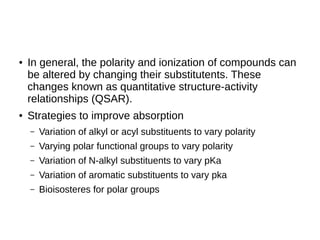
● In general, the polarity and ionization of compounds can
be altered by changing their substitutents. These
changes known as quantitative structure-activity
relationships (QSAR).
● Strategies to improve absorption
– Variation of alkyl or acyl substituents to vary polarity
– Varying polar functional groups to vary polarity
– Variation of N-alkyl substituents to vary pKa
– Variation of aromatic substituents to vary pka
– Bioisosteres for polar groups
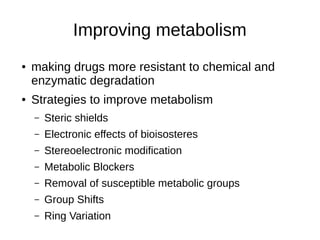
Improving metabolism
● making drugs more resistant to chemical and
enzymatic degradation
● Strategies to improve metabolism
– Steric shields
– Electronic effects of bioisosteres
– Stereoelectronic modification
– Metabolic Blockers
– Removal of susceptible metabolic groups
– Group Shifts
– Ring Variation
Improving excreation
● Drug that is extremely stable to metabolism and
is very slowly excreted can cause problems as
that is susceptible to metabolism. Such as
cause toxicity and side effects.
● Strategies to improve excreation
– Introducing metabolically susceptible groups
– Self-destruct drugs
Improving excreation
● Drug that is extremely stable to metabolism and
is very slowly excreted can cause problems as
that is susceptible to metabolism. Such as
cause toxicity and side effects.
● Strategies to improve excreation
– Introducing metabolically susceptible groups
– Self-destruct drugs

23.optimizing access to target

  • 1.
  • 2.
    Introduction ● Once thelead compound has been discovered it can be used as the starting point for drug design. ● There are various aims in drug design: – 1.The drug should have a good selectivity for its target – 2.The drug should have a good level of activity for its target – 3.The drug should have minimum side effects – 4.The drug should be easily synthesized – 5.The drug should be chemically stable – 6.The drug should have acceptable pharmacokinetics properties – 7.The drug should be non-toxic
  • 3.
    ● There aretwo important aspects in drug design and drug strategies to optimize the interaction of the drug with its target i.e. 1. Pharmacodynamics properties: to improve the drug's ability to reach its target 2. Pharmacokinetics properties: to have acceptable lifetime.
  • 4.
    Optimizing access tothe target ● The compound with the best binding interaction is not necessarily the best drug to use in medicine. ● The drug needs to pass through many barriers to reach its target in the body. ● There are many ways to make the drug to reach its target such as linking the drug to polymers or antibodies or encapsulation it within a polymeric carrier.
  • 5.
    ● Thus, theaim is to design drugs that will be – absorbed into the blood supply (absorption) – and will reach their target efficiently (distribution) and – be stable enough to survive the journey (metabolism) – and will be eliminated in a rescannable period of time (elimination). ● In other words design a drug with optimum pharmacokinetics which can be achieved by different strategies.
  • 6.
    Improvement of absorption ●Drug absorption is determined by its hydrophilic/hydrophobic properties, which they depends upon polarity and ionization. ● Drugs which are too polar or strongly ionized do not easily cross the cell membranes of the gut wall. Therefore, there are given by injection, but the disadvantage that they are quickly excreted. ● Non-polar drugs, on the other hand, are poorly soluble in aqueous solution and are poorly absorbed. If they are given by injection, they are taken up by fat tissue.
  • 7.
    ● In general,the polarity and ionization of compounds can be altered by changing their substitutents. These changes known as quantitative structure-activity relationships (QSAR). ● Strategies to improve absorption – Variation of alkyl or acyl substituents to vary polarity – Varying polar functional groups to vary polarity – Variation of N-alkyl substituents to vary pKa – Variation of aromatic substituents to vary pka – Bioisosteres for polar groups
  • 8.
    Improving metabolism ● makingdrugs more resistant to chemical and enzymatic degradation ● Strategies to improve metabolism – Steric shields – Electronic effects of bioisosteres – Stereoelectronic modification – Metabolic Blockers – Removal of susceptible metabolic groups – Group Shifts – Ring Variation
  • 9.
    Improving excreation ● Drugthat is extremely stable to metabolism and is very slowly excreted can cause problems as that is susceptible to metabolism. Such as cause toxicity and side effects. ● Strategies to improve excreation – Introducing metabolically susceptible groups – Self-destruct drugs
  • 10.
    Improving excreation ● Drugthat is extremely stable to metabolism and is very slowly excreted can cause problems as that is susceptible to metabolism. Such as cause toxicity and side effects. ● Strategies to improve excreation – Introducing metabolically susceptible groups – Self-destruct drugs