PROTEIN STRUCTURE
AND RAMACHANDRAN
PLOT
- AMIT TIWARI
1
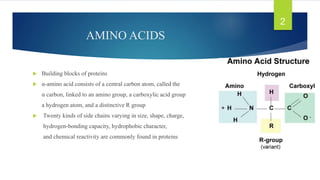
AMINO ACIDS
 Building blocks of proteins
 α-amino acid consists of a central carbon atom, called the
α carbon, linked to an amino group, a carboxylic acid group
a hydrogen atom, and a distinctive R group
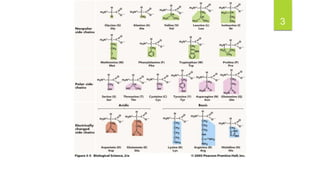
 Twenty kinds of side chains varying in size, shape, charge,
hydrogen-bonding capacity, hydrophobic character,
and chemical reactivity are commonly found in proteins
2
3
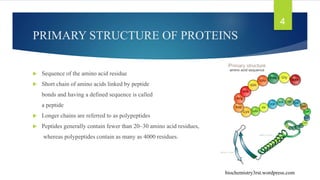
PRIMARY STRUCTURE OF PROTEINS
 Sequence of the amino acid residue
 Short chain of amino acids linked by peptide
bonds and having a defined sequence is called
a peptide
 Longer chains are referred to as polypeptides
 Peptides generally contain fewer than 20–30 amino acid residues,
whereas polypeptides contain as many as 4000 residues.
biochemistry3rst.wordpress.com
4
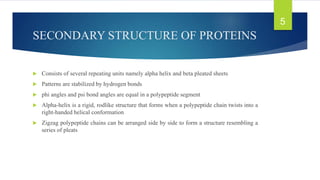
SECONDARY STRUCTURE OF PROTEINS
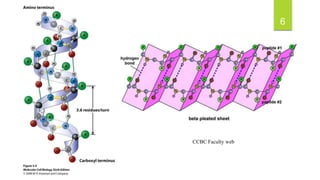
 Consists of several repeating units namely alpha helix and beta pleated sheets
 Patterns are stabilized by hydrogen bonds
 phi angles and psi bond angles are equal in a polypeptide segment
 Alpha-helix is a rigid, rodlike structure that forms when a polypeptide chain twists into a
right-handed helical conformation
 Zigzag polypeptide chains can be arranged side by side to form a structure resembling a
series of pleats
5
CCBC Faculty web
6
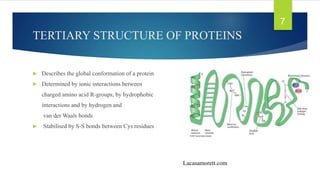
TERTIARY STRUCTURE OF PROTEINS
 Describes the global conformation of a protein
 Determined by ionic interactions between
charged amino acid R-groups, by hydrophobic
interactions and by hydrogen and
van der Waals bonds
 Stabilised by S-S bonds between Cys residues
Lacasamorett.com
7
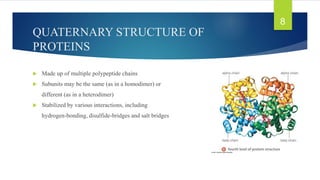
QUATERNARY STRUCTURE OF
PROTEINS
 Made up of multiple polypeptide chains
 Subunits may be the same (as in a homodimer) or
different (as in a heterodimer)
 Stabilized by various interactions, including
hydrogen-bonding, disulfide-bridges and salt bridges
8
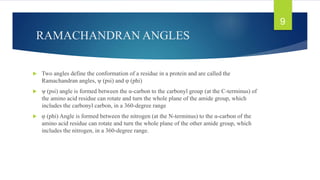
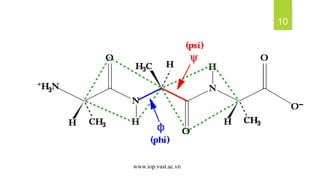
RAMACHANDRAN ANGLES
 Two angles define the conformation of a residue in a protein and are called the
Ramachandran angles, ψ (psi) and φ (phi)
 ψ (psi) angle is formed between the α-carbon to the carbonyl group (at the C-terminus) of
the amino acid residue can rotate and turn the whole plane of the amide group, which
includes the carbonyl carbon, in a 360-degree range
 φ (phi) Angle is formed between the nitrogen (at the N-terminus) to the α-carbon of the
amino acid residue can rotate and turn the whole plane of the other amide group, which
includes the nitrogen, in a 360-degree range.
9
www.iop.vast.ac.vn
10
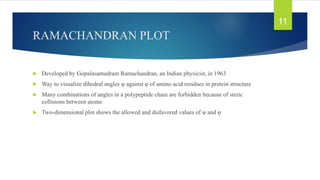
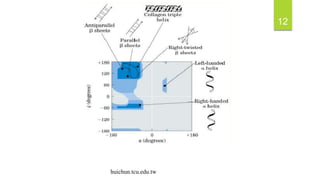
RAMACHANDRAN PLOT
 Developed by Gopalasamudram Ramachandran, an Indian physicist, in 1963
 Way to visualize dihedral angles ψ against φ of amino acid residues in protein structure
 Many combinations of angles in a polypeptide chain are forbidden because of steric
collisions between atoms
 Two-dimensional plot shows the allowed and disfavored values of ψ and φ
11
huichun.tcu.edu.tw
12
CONCLUSION
 Proline is often found at the end of helices and functions as a helix disruptor.
 Glycine does not have a complex side chain, which allows high flexibility in the
polypeptide chain as well as torsion angles.
 Many combinations of angles in a polypeptide chain are forbidden because of steric
collisions between atoms
 Functionally relevant residues are more likely than others to have torsion angles that plot
to the allowed but disfavored regions of a Ramachandran plot.
13
REFERENCES
BOOKS REFERRED:-
 Donald Voet, Judith G Voet, Biochemistry, 4th edition, Wiley, 2011
 Engelbert Buxbaum, Fundamentals of Protein Structure and Function, Springer,2007
 David.E.Metzler, Biochemistry- The chemical reactions of living cell, 2nd edition, Elsevier
 David.L.Nelson, Michael.M.Cox, Lehninger- Principles of Biochemistry, 4th edition,
W.H.Freeman, 2005
WEBLINKS :-
 https://proteinstructures.com
 www.cryst.bbk.ac.uk
 https://swissmodel.expasy.org
 https://www.cgl.ucsf.edu
14
THANK YOU!
15

Protein structure and ramachandran plot

  • 1.
  • 2.
    AMINO ACIDS  Buildingblocks of proteins  α-amino acid consists of a central carbon atom, called the α carbon, linked to an amino group, a carboxylic acid group a hydrogen atom, and a distinctive R group  Twenty kinds of side chains varying in size, shape, charge, hydrogen-bonding capacity, hydrophobic character, and chemical reactivity are commonly found in proteins 2
  • 3.
  • 4.
    PRIMARY STRUCTURE OFPROTEINS  Sequence of the amino acid residue  Short chain of amino acids linked by peptide bonds and having a defined sequence is called a peptide  Longer chains are referred to as polypeptides  Peptides generally contain fewer than 20–30 amino acid residues, whereas polypeptides contain as many as 4000 residues. biochemistry3rst.wordpress.com 4
  • 5.
    SECONDARY STRUCTURE OFPROTEINS  Consists of several repeating units namely alpha helix and beta pleated sheets  Patterns are stabilized by hydrogen bonds  phi angles and psi bond angles are equal in a polypeptide segment  Alpha-helix is a rigid, rodlike structure that forms when a polypeptide chain twists into a right-handed helical conformation  Zigzag polypeptide chains can be arranged side by side to form a structure resembling a series of pleats 5
  • 6.
  • 7.
    TERTIARY STRUCTURE OFPROTEINS  Describes the global conformation of a protein  Determined by ionic interactions between charged amino acid R-groups, by hydrophobic interactions and by hydrogen and van der Waals bonds  Stabilised by S-S bonds between Cys residues Lacasamorett.com 7
  • 8.
    QUATERNARY STRUCTURE OF PROTEINS Made up of multiple polypeptide chains  Subunits may be the same (as in a homodimer) or different (as in a heterodimer)  Stabilized by various interactions, including hydrogen-bonding, disulfide-bridges and salt bridges 8
  • 9.
    RAMACHANDRAN ANGLES  Twoangles define the conformation of a residue in a protein and are called the Ramachandran angles, ψ (psi) and φ (phi)  ψ (psi) angle is formed between the α-carbon to the carbonyl group (at the C-terminus) of the amino acid residue can rotate and turn the whole plane of the amide group, which includes the carbonyl carbon, in a 360-degree range  φ (phi) Angle is formed between the nitrogen (at the N-terminus) to the α-carbon of the amino acid residue can rotate and turn the whole plane of the other amide group, which includes the nitrogen, in a 360-degree range. 9
  • 10.
  • 11.
    RAMACHANDRAN PLOT  Developedby Gopalasamudram Ramachandran, an Indian physicist, in 1963  Way to visualize dihedral angles ψ against φ of amino acid residues in protein structure  Many combinations of angles in a polypeptide chain are forbidden because of steric collisions between atoms  Two-dimensional plot shows the allowed and disfavored values of ψ and φ 11
  • 12.
  • 13.
    CONCLUSION  Proline isoften found at the end of helices and functions as a helix disruptor.  Glycine does not have a complex side chain, which allows high flexibility in the polypeptide chain as well as torsion angles.  Many combinations of angles in a polypeptide chain are forbidden because of steric collisions between atoms  Functionally relevant residues are more likely than others to have torsion angles that plot to the allowed but disfavored regions of a Ramachandran plot. 13
  • 14.
    REFERENCES BOOKS REFERRED:-  DonaldVoet, Judith G Voet, Biochemistry, 4th edition, Wiley, 2011  Engelbert Buxbaum, Fundamentals of Protein Structure and Function, Springer,2007  David.E.Metzler, Biochemistry- The chemical reactions of living cell, 2nd edition, Elsevier  David.L.Nelson, Michael.M.Cox, Lehninger- Principles of Biochemistry, 4th edition, W.H.Freeman, 2005 WEBLINKS :-  https://proteinstructures.com  www.cryst.bbk.ac.uk  https://swissmodel.expasy.org  https://www.cgl.ucsf.edu 14
  • 15.