

Dr. Kalpeshkumar C Nakarani
Tutor cum Second year Resident
Backbone linkages of
Peptide chain
General
 The –COOH group of one amino acid can be joined to the –NH2 group of
another amino acid by a covalent bond called as peptide bond.
 Thus it is the peptide linkage which holds various amino acids together in
a specific sequence and number.
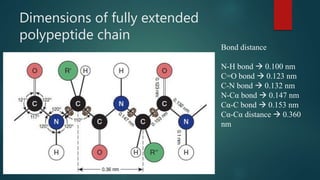
Dimensions of fully extended
polypeptide chain
Bond distance
N-H bond  0.100 nm
C=O bond  0.123 nm
C-N bond  0.132 nm
N-Cα bond  0.147 nm
Cα-C bond  0.153 nm
Cα-Cα distance  0.360
nm
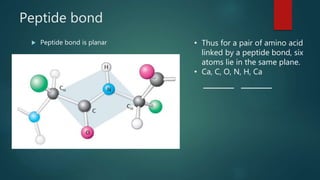
Peptide bond
 Peptide bond is planar • Thus for a pair of amino acid
linked by a peptide bond, six
atoms lie in the same plane.
• Ca, C, O, N, H, Ca
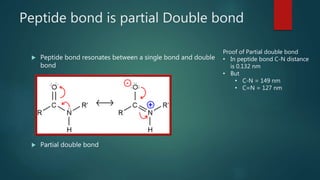
Peptide bond is partial Double bond
 Peptide bond resonates between a single bond and double
bond
 Partial double bond
Proof of Partial double bond
• In peptide bond C-N distance
is 0.132 nm
• But
• C-N = 149 nm
• C=N = 127 nm
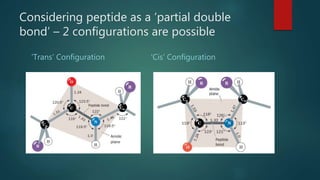
Considering peptide as a ‘partial double
bond’ – 2 configurations are possible
‘Trans’ Configuration ‘Cis’ Configuration
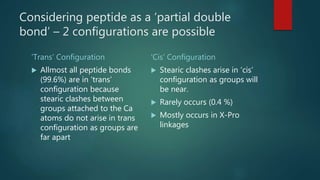
Considering peptide as a ‘partial double
bond’ – 2 configurations are possible
‘Trans’ Configuration ‘Cis’ Configuration
 Allmost all peptide bonds
(99.6%) are in ‘trans’
configuration because
stearic clashes between
groups attached to the Ca
atoms do not arise in trans
configuration as groups are
far apart
 Stearic clashes arise in ‘cis’
configuration as groups will
be near.
 Rarely occurs (0.4 %)
 Mostly occurs in X-Pro
linkages
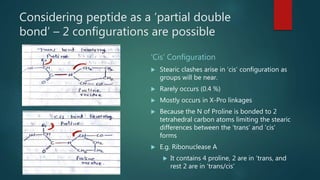
Considering peptide as a ‘partial double
bond’ – 2 configurations are possible
‘Cis’ Configuration
 Stearic clashes arise in ‘cis’ configuration as
groups will be near.
 Rarely occurs (0.4 %)
 Mostly occurs in X-Pro linkages
 Because the N of Proline is bonded to 2
tetrahedral carbon atoms limiting the stearic
differences between the ‘trans’ and ‘cis’
forms
 E.g. Ribonuclease A
 It contains 4 proline, 2 are in ‘trans, and
rest 2 are in ‘trans/cis’
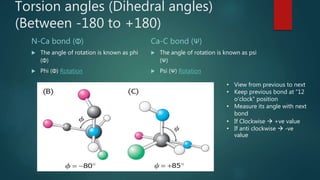
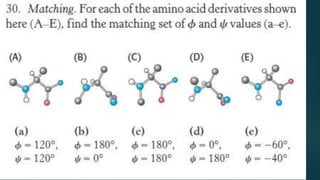
Torsion angles (Dihedral angles)
(Between -180 to +180)
N-Ca bond (Φ)
 The angle of rotation is known as phi
(Φ)
 Phi (Φ) Rotation
Ca-C bond (Ψ)
 The angle of rotation is known as psi
(Ψ)
 Psi (Ψ) Rotation
• View from previous to next
• Keep previous bond at “12
o’clock” position
• Measure its angle with next
bond
• If Clockwise  +ve value
• If anti clockwise  -ve
value
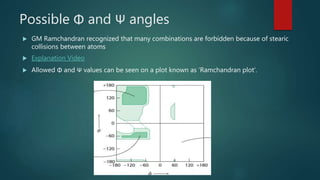
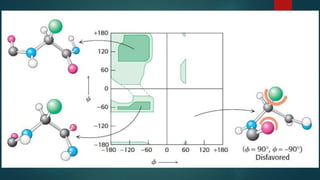
Possible Φ and Ψ angles
 GM Ramchandran recognized that many combinations are forbidden because of stearic
collisions between atoms
 Explanation Video
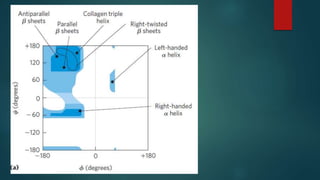
 Allowed Φ and Ψ values can be seen on a plot known as ‘Ramchandran plot’.
Thank You
Backbone of peptide chain

Backbone of peptide chain

  • 1.
    Dr. Kalpeshkumar CNakarani Tutor cum Second year Resident Backbone linkages of Peptide chain
  • 2.
    General  The –COOHgroup of one amino acid can be joined to the –NH2 group of another amino acid by a covalent bond called as peptide bond.  Thus it is the peptide linkage which holds various amino acids together in a specific sequence and number.
  • 3.
    Dimensions of fullyextended polypeptide chain Bond distance N-H bond  0.100 nm C=O bond  0.123 nm C-N bond  0.132 nm N-Cα bond  0.147 nm Cα-C bond  0.153 nm Cα-Cα distance  0.360 nm
  • 4.
    Peptide bond  Peptidebond is planar • Thus for a pair of amino acid linked by a peptide bond, six atoms lie in the same plane. • Ca, C, O, N, H, Ca
  • 5.
    Peptide bond ispartial Double bond  Peptide bond resonates between a single bond and double bond  Partial double bond Proof of Partial double bond • In peptide bond C-N distance is 0.132 nm • But • C-N = 149 nm • C=N = 127 nm
  • 6.
    Considering peptide asa ‘partial double bond’ – 2 configurations are possible ‘Trans’ Configuration ‘Cis’ Configuration
  • 7.
    Considering peptide asa ‘partial double bond’ – 2 configurations are possible ‘Trans’ Configuration ‘Cis’ Configuration  Allmost all peptide bonds (99.6%) are in ‘trans’ configuration because stearic clashes between groups attached to the Ca atoms do not arise in trans configuration as groups are far apart  Stearic clashes arise in ‘cis’ configuration as groups will be near.  Rarely occurs (0.4 %)  Mostly occurs in X-Pro linkages
  • 8.
    Considering peptide asa ‘partial double bond’ – 2 configurations are possible ‘Cis’ Configuration  Stearic clashes arise in ‘cis’ configuration as groups will be near.  Rarely occurs (0.4 %)  Mostly occurs in X-Pro linkages  Because the N of Proline is bonded to 2 tetrahedral carbon atoms limiting the stearic differences between the ‘trans’ and ‘cis’ forms  E.g. Ribonuclease A  It contains 4 proline, 2 are in ‘trans, and rest 2 are in ‘trans/cis’
  • 9.
    Torsion angles (Dihedralangles) (Between -180 to +180) N-Ca bond (Φ)  The angle of rotation is known as phi (Φ)  Phi (Φ) Rotation Ca-C bond (Ψ)  The angle of rotation is known as psi (Ψ)  Psi (Ψ) Rotation • View from previous to next • Keep previous bond at “12 o’clock” position • Measure its angle with next bond • If Clockwise  +ve value • If anti clockwise  -ve value
  • 10.
    Possible Φ andΨ angles  GM Ramchandran recognized that many combinations are forbidden because of stearic collisions between atoms  Explanation Video  Allowed Φ and Ψ values can be seen on a plot known as ‘Ramchandran plot’.
  • 13.

Editor's Notes

  • #10 In contrast to peptide bond, which is partial double bond, phi and psi are purely single bond