1
Quantum Mechanics
Ab-Initio
Abhijeet Kadam
TSEC
BioTechnology
2
Schrodinger equation
● The Schrodinger equation is the name of the basic non-relativistic
wave equation used in one version of quantum mechanics to describe
the behaviour of a particle in a field of force.
● Non-relativistic quantum mechanics refers to the mathematical
formulation of quantum mechanics applied in the context of Galilean
relativity, more specifically quantizing the equations of classical
mechanics by replacing dynamical variables by operators.
● In quantum mechanics, the analogue of Newton's law (F = ma) is
Schrödinger's equation for a quantum system.
● It is not a simple algebraic equation, but in general a linear partial
differential equation, describing the time-evolution of the system's
wave function (also called a "state function").
●
3
Ab-Initio
● Schrodinger equation + Approximations = Semiempirical QM
● Schrodinger equation – Approximations = Ab-Initio QM
● Ab-Initio is the Highest level of Quantum Mechanics
● 2 approaches
– Calibrated – Pople and coworkers
– Converged – Chemical Physicist
4
Calibrated
● Full exact equations without approximations
● Basic set is fixed
● Calculations are calibrated
● Errors measured on average error w.r.t.
Experiment
● More practical and used routinely
5
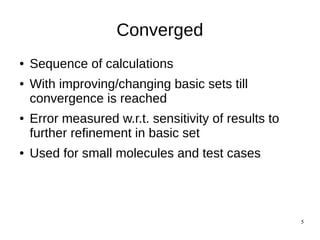
Converged
● Sequence of calculations
● With improving/changing basic sets till
convergence is reached
● Error measured w.r.t. sensitivity of results to
further refinement in basic set
● Used for small molecules and test cases
6
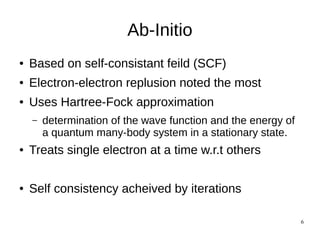
Ab-Initio
● Based on self-consistant feild (SCF)
● Electron-electron replusion noted the most
● Uses Hartree-Fock approximation
– determination of the wave function and the energy of
a quantum many-body system in a stationary state.
● Treats single electron at a time w.r.t others
● Self consistency acheived by iterations
7
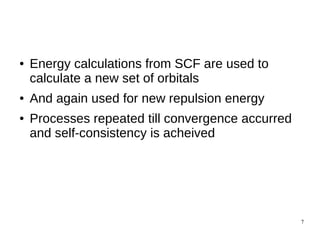
● Energy calculations from SCF are used to
calculate a new set of orbitals
● And again used for new repulsion energy
● Processes repeated till convergence accurred
and self-consistency is acheived
8
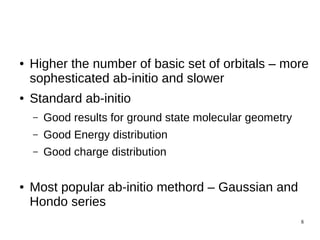
● Higher the number of basic set of orbitals – more
sophesticated ab-initio and slower
● Standard ab-initio
– Good results for ground state molecular geometry
– Good Energy distribution
– Good charge distribution
● Most popular ab-initio methord – Gaussian and
Hondo series

6.ab initio qm

  • 1.
  • 2.
    2 Schrodinger equation ● TheSchrodinger equation is the name of the basic non-relativistic wave equation used in one version of quantum mechanics to describe the behaviour of a particle in a field of force. ● Non-relativistic quantum mechanics refers to the mathematical formulation of quantum mechanics applied in the context of Galilean relativity, more specifically quantizing the equations of classical mechanics by replacing dynamical variables by operators. ● In quantum mechanics, the analogue of Newton's law (F = ma) is Schrödinger's equation for a quantum system. ● It is not a simple algebraic equation, but in general a linear partial differential equation, describing the time-evolution of the system's wave function (also called a "state function"). ●
  • 3.
    3 Ab-Initio ● Schrodinger equation+ Approximations = Semiempirical QM ● Schrodinger equation – Approximations = Ab-Initio QM ● Ab-Initio is the Highest level of Quantum Mechanics ● 2 approaches – Calibrated – Pople and coworkers – Converged – Chemical Physicist
  • 4.
    4 Calibrated ● Full exactequations without approximations ● Basic set is fixed ● Calculations are calibrated ● Errors measured on average error w.r.t. Experiment ● More practical and used routinely
  • 5.
    5 Converged ● Sequence ofcalculations ● With improving/changing basic sets till convergence is reached ● Error measured w.r.t. sensitivity of results to further refinement in basic set ● Used for small molecules and test cases
  • 6.
    6 Ab-Initio ● Based onself-consistant feild (SCF) ● Electron-electron replusion noted the most ● Uses Hartree-Fock approximation – determination of the wave function and the energy of a quantum many-body system in a stationary state. ● Treats single electron at a time w.r.t others ● Self consistency acheived by iterations
  • 7.
    7 ● Energy calculationsfrom SCF are used to calculate a new set of orbitals ● And again used for new repulsion energy ● Processes repeated till convergence accurred and self-consistency is acheived
  • 8.
    8 ● Higher thenumber of basic set of orbitals – more sophesticated ab-initio and slower ● Standard ab-initio – Good results for ground state molecular geometry – Good Energy distribution – Good charge distribution ● Most popular ab-initio methord – Gaussian and Hondo series