RAMACHANDRAN PLOT
Presented by,
Sabhyata Chaubey
M.Sc. [Bt] Semester- 1st
Roll No. - 201810901010011
Under the guidance of
Dr. Neeraj Gupta
Associate Professor1
2
G.N. Ramachandran (8 October 1922 – 7
April 2001) was an Indian physicist who
was known for his work that led to his
creation of the Ramachandran plot for
understanding peptide structure. He was
the first to propose a triple-helical model
for the structure of collagen. He
subsequently went on to make other
major contributions in biology and physics
WHAT EXACTLY IS A RAMACHANDRAN PLOT??
Originally developed in 1963 by G. N. Ramachandran, C.
Ramakrishnan, and V. Sasisekharan.
Ramachandran plot- provides an easy way to view the distribution
of torsion angles in a protein structure.
Used to visualize the backbone of amino acid residue.
Used for structural validation.
3
4
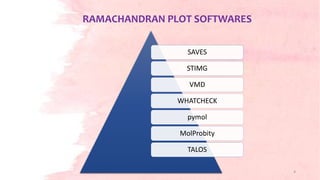
SAVES
STIMG
VMD
WHATCHECK
pymol
MolProbity
TALOS
RAMACHANDRAN PLOT SOFTWARES
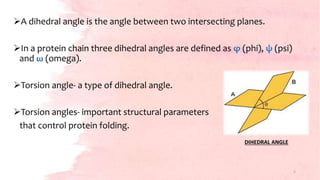
A dihedral angle is the angle between two intersecting planes.
In a protein chain three dihedral angles are defined as φ (phi), ψ (psi)
and ω (omega).
Torsion angle- a type of dihedral angle.
Torsion angles- important structural parameters
that control protein folding.
DIHEDRAL ANGLE
5
Torsion angles- φ and ψ provide the flexibility required for the
polypeptide backbone to adopt a certain fold.
Third torsion angle ω- flat and fixed to 180 degrees.
[due to the partial double-bond character of the peptide bond, which
restricts rotation around the C-N bond, placing two successive α-carbons
and C, O, N and H between them in one plane.]
6
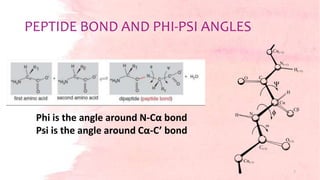
PEPTIDE BOND AND PHI-PSI ANGLES
7
Phi is the angle around N-Cα bond
Psi is the angle around Cα-C’ bond
WORK OF RAMACHANDRAN
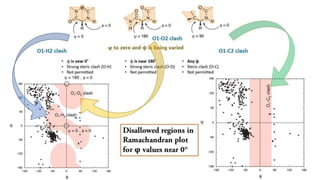
Used computer models of small polypeptides to vary phi and psi to find
stable conformations.
Atoms- treated as hard spheres with dimensions corresponding to their
van der Waals radii.
Allowed rotations and stable structures were checked.
Therefore, psi and phi angles which cause spheres to collide
corresponds to sterically disallowed conformations of polypeptide
backbone.
8
FORBIDDEN ROTATIONS-
9
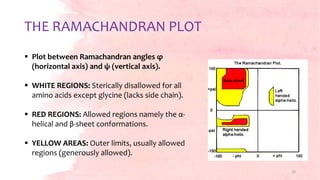
THE RAMACHANDRAN PLOT
10
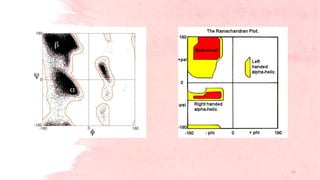
 Plot between Ramachandran angles φ
(horizontal axis) and ψ (vertical axis).
 WHITE REGIONS: Sterically disallowed for all
amino acids except glycine (lacks side chain).
 RED REGIONS: Allowed regions namely the α-
helical and β-sheet conformations.
 YELLOW AREAS: Outer limits, usually allowed
regions (generously allowed).
11
12
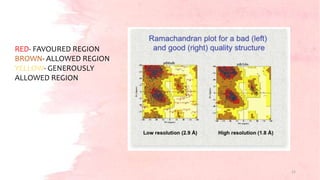
RED- FAVOURED REGION
BROWN- ALLOWED REGION
YELLOW- GENEROUSLY
ALLOWED REGION
13
AMINO ACIDS PREFERENCES
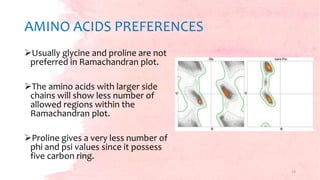
Usually glycine and proline are not
preferred in Ramachandran plot.
The amino acids with larger side
chains will show less number of
allowed regions within the
Ramachandran plot.
Proline gives a very less number of
phi and psi values since it possess
five carbon ring.
14
APPLICATIONS OF RAMACHANDRAN
PLOTS-
• Validation of protein structures: Three-dimensional protein
structures produced by crystallography, NMR spectroscopy and
computational modelling.
• Improvement of structure determination methods by NMR
spectroscopy: φ and ψ restraints must always be taken into
account while developing tools for protein solution structure
prediction.
• Assessing side-chains effects on the protein backbone.
15
REFERENCES-
• https://proteinstructures.com/Structure/Structure/Ramachandran-
plot.html
• https://en.wikipedia.org/wiki/G._N._Ramachandran
• http://proteopedia.org/wiki/index.php/Ramachandran_Plots
• https://www.ncbi.nlm.nih.gov/pmc/articles/PMC3061398/
16

RAMACHANDRAN PLOT

  • 1.
    RAMACHANDRAN PLOT Presented by, SabhyataChaubey M.Sc. [Bt] Semester- 1st Roll No. - 201810901010011 Under the guidance of Dr. Neeraj Gupta Associate Professor1
  • 2.
    2 G.N. Ramachandran (8October 1922 – 7 April 2001) was an Indian physicist who was known for his work that led to his creation of the Ramachandran plot for understanding peptide structure. He was the first to propose a triple-helical model for the structure of collagen. He subsequently went on to make other major contributions in biology and physics
  • 3.
    WHAT EXACTLY ISA RAMACHANDRAN PLOT?? Originally developed in 1963 by G. N. Ramachandran, C. Ramakrishnan, and V. Sasisekharan. Ramachandran plot- provides an easy way to view the distribution of torsion angles in a protein structure. Used to visualize the backbone of amino acid residue. Used for structural validation. 3
  • 4.
  • 5.
    A dihedral angleis the angle between two intersecting planes. In a protein chain three dihedral angles are defined as φ (phi), ψ (psi) and ω (omega). Torsion angle- a type of dihedral angle. Torsion angles- important structural parameters that control protein folding. DIHEDRAL ANGLE 5
  • 6.
    Torsion angles- φand ψ provide the flexibility required for the polypeptide backbone to adopt a certain fold. Third torsion angle ω- flat and fixed to 180 degrees. [due to the partial double-bond character of the peptide bond, which restricts rotation around the C-N bond, placing two successive α-carbons and C, O, N and H between them in one plane.] 6
  • 7.
    PEPTIDE BOND ANDPHI-PSI ANGLES 7 Phi is the angle around N-Cα bond Psi is the angle around Cα-C’ bond
  • 8.
    WORK OF RAMACHANDRAN Usedcomputer models of small polypeptides to vary phi and psi to find stable conformations. Atoms- treated as hard spheres with dimensions corresponding to their van der Waals radii. Allowed rotations and stable structures were checked. Therefore, psi and phi angles which cause spheres to collide corresponds to sterically disallowed conformations of polypeptide backbone. 8
  • 9.
  • 10.
    THE RAMACHANDRAN PLOT 10 Plot between Ramachandran angles φ (horizontal axis) and ψ (vertical axis).  WHITE REGIONS: Sterically disallowed for all amino acids except glycine (lacks side chain).  RED REGIONS: Allowed regions namely the α- helical and β-sheet conformations.  YELLOW AREAS: Outer limits, usually allowed regions (generously allowed).
  • 11.
  • 12.
    12 RED- FAVOURED REGION BROWN-ALLOWED REGION YELLOW- GENEROUSLY ALLOWED REGION
  • 13.
  • 14.
    AMINO ACIDS PREFERENCES Usuallyglycine and proline are not preferred in Ramachandran plot. The amino acids with larger side chains will show less number of allowed regions within the Ramachandran plot. Proline gives a very less number of phi and psi values since it possess five carbon ring. 14
  • 15.
    APPLICATIONS OF RAMACHANDRAN PLOTS- •Validation of protein structures: Three-dimensional protein structures produced by crystallography, NMR spectroscopy and computational modelling. • Improvement of structure determination methods by NMR spectroscopy: φ and ψ restraints must always be taken into account while developing tools for protein solution structure prediction. • Assessing side-chains effects on the protein backbone. 15
  • 16.
    REFERENCES- • https://proteinstructures.com/Structure/Structure/Ramachandran- plot.html • https://en.wikipedia.org/wiki/G._N._Ramachandran •http://proteopedia.org/wiki/index.php/Ramachandran_Plots • https://www.ncbi.nlm.nih.gov/pmc/articles/PMC3061398/ 16