PROTEOGLYCANS
SHRUTHI SHREE GANDHI.S
1 MSC BIOCHEMISTRY
Proteoglycans are protein chains that are covalently bonded at multiple sites to
a class of polysaccharides, known as glycosaminoglycans.Glycosaminoglycans
constitute 95% of proteins.Proteoglycans are synthesised in RE and transported
to GA where they are modified in to various forms.Proteoglycans are major
component of ECM and their role is depended on the type of GAGs they
associate with.
Proteoglycans insight
PROTEOGLYCANS
● Proteoglycans are proteins that are covalently bonded at multiple
sites to heteropolysaccharides, known as glycosaminoglycans.
● Hyaluronic acid is a unique one among the GAGs as it does not
contain any sulfate group and is non-covalently linked with
proteoglycans in the ECM.
● The physiological properties of proteoglycans are determined by
the type of GAGs attached to it.
STRUCTURE
ORGANISATION
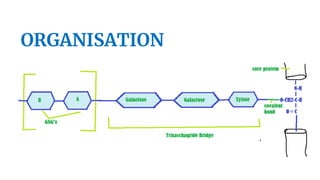
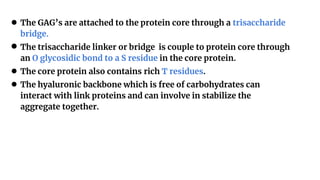
● The GAG’s are attached to the protein core through a trisaccharide
bridge.
● The trisaccharide linker or bridge is couple to protein core through
an O glycosidic bond to a S residue in the core protein.
● The core protein also contains rich T residues.
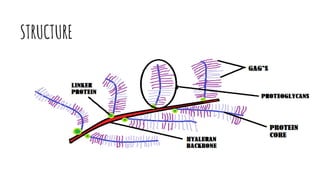
● The hyaluronic backbone which is free of carbohydrates can
interact with link proteins and can involve in stabilize the
aggregate together.
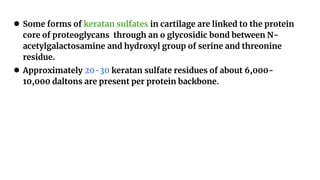
● Some forms of keratan sulfates in cartilage are linked to the protein
core of proteoglycans through an o glycosidic bond between N-
acetylgalactosamine and hydroxyl group of serine and threonine
residue.
● Approximately 20-30 keratan sulfate residues of about 6,000-
10,000 daltons are present per protein backbone.
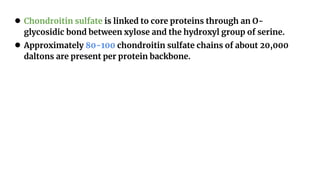
● Chondroitin sulfate is linked to core proteins through an O-
glycosidic bond between xylose and the hydroxyl group of serine.
● Approximately 80-100 chondroitin sulfate chains of about 20,000
daltons are present per protein backbone.
There are number of varying types
proteoglycans
● Proteoglycans can vary depending on tissues and cells.
And can also be differentiated by the number of glycosaminoglycan chains attached to
it.
●
Proteoglycans can be classified according to their location ,size and also the type of the
Glycosaminoglycan chains attached to them.
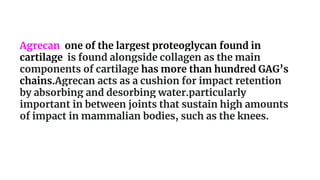
Agrecan one of the largest proteoglycan found in
cartilage is found alongside collagen as the main
components of cartilage has more than hundred GAG’s
chains.Agrecan acts as a cushion for impact retention
by absorbing and desorbing water.particularly
important in between joints that sustain high amounts
of impact in mammalian bodies, such as the knees.
Syndecan a class of transmembrane proteoglycans that would connect
(from the Greek syndein, “bind together”) the surface of the cells to the
underlying extracellular matrix .It is a core protein allows three to
five heparin sulfate and chondroitin sulfate GAGs chains attach to
them. syndecans are transmembrane domain proteins which act
as a co receptor for variety of signaling molecules such as
fibroblast growth factors, endothelial growth factors etc.,.
serglycin
It is only one intracellular proteoglycan that carries heparin side chains
Serglycin, also known as hematopoietic proteoglycan core protein,encoded by the SRGN
gene.
It is primarily expressed in hematopoietic cells and endothelial cells.
Serglycin is a proteoglycan composed of a relatively small (∼17 kDa) core
protein to which sulfated glycosaminoglycans of either heparin, heparan
sulfate or chondroitin sulfate types are attached.
Lumican
It belongs to a family of proteoglycans called Small Leucine-Rich
Proteoglycans. It is most well known for its importance in healing and
scar tissue formation in mammals.
Neurocan core protein are members of chondroitin
sulfate proteoglycans and they contain neurocan core
protein which has chondroitin sulfate GAG’S attach to
them.
They are component of the extracellular matrix and
involve in cell migration and adhesion.
references
1. Iozzo RV, Schaefer L. Proteoglycan form and function: A comprehensive
nomenclature of proteoglycans. Matrix Biol. 2015 Mar;42:11-55. doi:
10.1016/j.matbio.2015.02.003. Epub 2015 Feb 18. PMID: 25701227; PMCID:
PMC4859157.
1. Structural Biochemistry/Carbohydrates/Proteoglycans,Wikibooks.
●Thank you

Proteoglycans

  • 1.
  • 2.
    Proteoglycans are proteinchains that are covalently bonded at multiple sites to a class of polysaccharides, known as glycosaminoglycans.Glycosaminoglycans constitute 95% of proteins.Proteoglycans are synthesised in RE and transported to GA where they are modified in to various forms.Proteoglycans are major component of ECM and their role is depended on the type of GAGs they associate with. Proteoglycans insight
  • 3.
    PROTEOGLYCANS ● Proteoglycans areproteins that are covalently bonded at multiple sites to heteropolysaccharides, known as glycosaminoglycans. ● Hyaluronic acid is a unique one among the GAGs as it does not contain any sulfate group and is non-covalently linked with proteoglycans in the ECM. ● The physiological properties of proteoglycans are determined by the type of GAGs attached to it.
  • 4.
  • 5.
  • 6.
    ● The GAG’sare attached to the protein core through a trisaccharide bridge. ● The trisaccharide linker or bridge is couple to protein core through an O glycosidic bond to a S residue in the core protein. ● The core protein also contains rich T residues. ● The hyaluronic backbone which is free of carbohydrates can interact with link proteins and can involve in stabilize the aggregate together.
  • 7.
    ● Some formsof keratan sulfates in cartilage are linked to the protein core of proteoglycans through an o glycosidic bond between N- acetylgalactosamine and hydroxyl group of serine and threonine residue. ● Approximately 20-30 keratan sulfate residues of about 6,000- 10,000 daltons are present per protein backbone.
  • 8.
    ● Chondroitin sulfateis linked to core proteins through an O- glycosidic bond between xylose and the hydroxyl group of serine. ● Approximately 80-100 chondroitin sulfate chains of about 20,000 daltons are present per protein backbone.
  • 9.
    There are numberof varying types proteoglycans ● Proteoglycans can vary depending on tissues and cells. And can also be differentiated by the number of glycosaminoglycan chains attached to it. ● Proteoglycans can be classified according to their location ,size and also the type of the Glycosaminoglycan chains attached to them.
  • 10.
    Agrecan one ofthe largest proteoglycan found in cartilage is found alongside collagen as the main components of cartilage has more than hundred GAG’s chains.Agrecan acts as a cushion for impact retention by absorbing and desorbing water.particularly important in between joints that sustain high amounts of impact in mammalian bodies, such as the knees.
  • 11.
    Syndecan a classof transmembrane proteoglycans that would connect (from the Greek syndein, “bind together”) the surface of the cells to the underlying extracellular matrix .It is a core protein allows three to five heparin sulfate and chondroitin sulfate GAGs chains attach to them. syndecans are transmembrane domain proteins which act as a co receptor for variety of signaling molecules such as fibroblast growth factors, endothelial growth factors etc.,.
  • 12.
    serglycin It is onlyone intracellular proteoglycan that carries heparin side chains Serglycin, also known as hematopoietic proteoglycan core protein,encoded by the SRGN gene. It is primarily expressed in hematopoietic cells and endothelial cells. Serglycin is a proteoglycan composed of a relatively small (∼17 kDa) core protein to which sulfated glycosaminoglycans of either heparin, heparan sulfate or chondroitin sulfate types are attached.
  • 13.
    Lumican It belongs toa family of proteoglycans called Small Leucine-Rich Proteoglycans. It is most well known for its importance in healing and scar tissue formation in mammals.
  • 14.
    Neurocan core proteinare members of chondroitin sulfate proteoglycans and they contain neurocan core protein which has chondroitin sulfate GAG’S attach to them. They are component of the extracellular matrix and involve in cell migration and adhesion.
  • 15.
    references 1. Iozzo RV,Schaefer L. Proteoglycan form and function: A comprehensive nomenclature of proteoglycans. Matrix Biol. 2015 Mar;42:11-55. doi: 10.1016/j.matbio.2015.02.003. Epub 2015 Feb 18. PMID: 25701227; PMCID: PMC4859157. 1. Structural Biochemistry/Carbohydrates/Proteoglycans,Wikibooks.
  • 16.