QSAR
Abhijeet Kadam
TSEC
BioTechnology
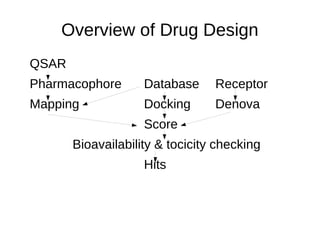
Overview of Drug Design
QSAR
Pharmacophore Database Receptor
Mapping Docking Denova
Score
Bioavailability & tocicity checking
Hits
3 Approaches
● Ligand based
● Structure based
● Denova
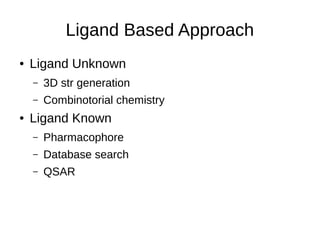
Ligand Based Approach
● Ligand Unknown
– 3D str generation
– Combinotorial chemistry
● Ligand Known
– Pharmacophore
– Database search
– QSAR
Ligand Based Approach
● Tries to identify characteristics common to known
ligands
– To use in screening for new or improved drugs
● If set of active ligand molecules is known for the
marcomolecule target, but littile or NO info of
structure of target, LBA is used
● 2 ways
– QSAR
– Pharmacophore
QSAR
● Developed by Hansch and co workers in sixties
● Started as a simple comparision between 2 or
more molecules using numbers
● QSAR establishes relationship between
– Ability of a molecule to perform its desired function
– And Properties of the molecule
QSAR
● Involves stastistical analysis of a set of
properties or DESCRIPTORS for a series of
biologically active molecules
● Drugs can be from highly active to inactive
● QSAR helps us to quantify the relationship
between structure and biological data
– This data is used optimize the groups that modulate
the activeness of molecule
QSAR
● Example
– Dimensionality – 1D, 2D, 3D
– Physio-chemical – Steric, electrical, hydrophobic
– Chemical
● Stastical model is developed
● And used to predict the activity of additional
compounds against the target
QSAR
● Example
– QSAR is used to predict which member of a series of
proposeed compounds are likely to be active
– And be selected for testing
– New data is received
– Used to refine the model
● QSAR methods
– POMONA college
– CLOGP program
QSAR
● Example
– QSAR is used to predict which member of a series of
proposeed compounds are likely to be active
– And be selected for testing
– New data is received
– Used to refine the model
● QSAR methods
– POMONA college
– CLOGP program

25.qsar

  • 1.
  • 2.
    Overview of DrugDesign QSAR Pharmacophore Database Receptor Mapping Docking Denova Score Bioavailability & tocicity checking Hits
  • 3.
    3 Approaches ● Ligandbased ● Structure based ● Denova
  • 4.
    Ligand Based Approach ●Ligand Unknown – 3D str generation – Combinotorial chemistry ● Ligand Known – Pharmacophore – Database search – QSAR
  • 5.
    Ligand Based Approach ●Tries to identify characteristics common to known ligands – To use in screening for new or improved drugs ● If set of active ligand molecules is known for the marcomolecule target, but littile or NO info of structure of target, LBA is used ● 2 ways – QSAR – Pharmacophore
  • 6.
    QSAR ● Developed byHansch and co workers in sixties ● Started as a simple comparision between 2 or more molecules using numbers ● QSAR establishes relationship between – Ability of a molecule to perform its desired function – And Properties of the molecule
  • 7.
    QSAR ● Involves stastisticalanalysis of a set of properties or DESCRIPTORS for a series of biologically active molecules ● Drugs can be from highly active to inactive ● QSAR helps us to quantify the relationship between structure and biological data – This data is used optimize the groups that modulate the activeness of molecule
  • 8.
    QSAR ● Example – Dimensionality– 1D, 2D, 3D – Physio-chemical – Steric, electrical, hydrophobic – Chemical ● Stastical model is developed ● And used to predict the activity of additional compounds against the target
  • 9.
    QSAR ● Example – QSARis used to predict which member of a series of proposeed compounds are likely to be active – And be selected for testing – New data is received – Used to refine the model ● QSAR methods – POMONA college – CLOGP program
  • 10.
    QSAR ● Example – QSARis used to predict which member of a series of proposeed compounds are likely to be active – And be selected for testing – New data is received – Used to refine the model ● QSAR methods – POMONA college – CLOGP program