VECTORS:
TYPES AND CHARACTERISTICS
E.g. PLASMIDS, PHAGES, HYBRID VECTORS,
ARTIFICIAL CHROMOSOMES
VECTORS
 Small DNA molecule capable of self replication.
 Cloning vehicle or Cloning DNA.
 Carrier of DNA fragment.
 E.g. Plasmid, Phage, Hybrid vector, Artificial
Chromosomes.
CHARACTERISTICS
 Self replication, multiple copies.
 Replication origin site.
 Cloning site.
 Selectable marker gene.
 Small size.
 Low molecular weight.
 Easily isolated & purified.
 Easily isolated into host cell.
 Control elements – promoter, operator, ribosome
binding site.
TYPES
Two types :-
1) Cloning Vectors
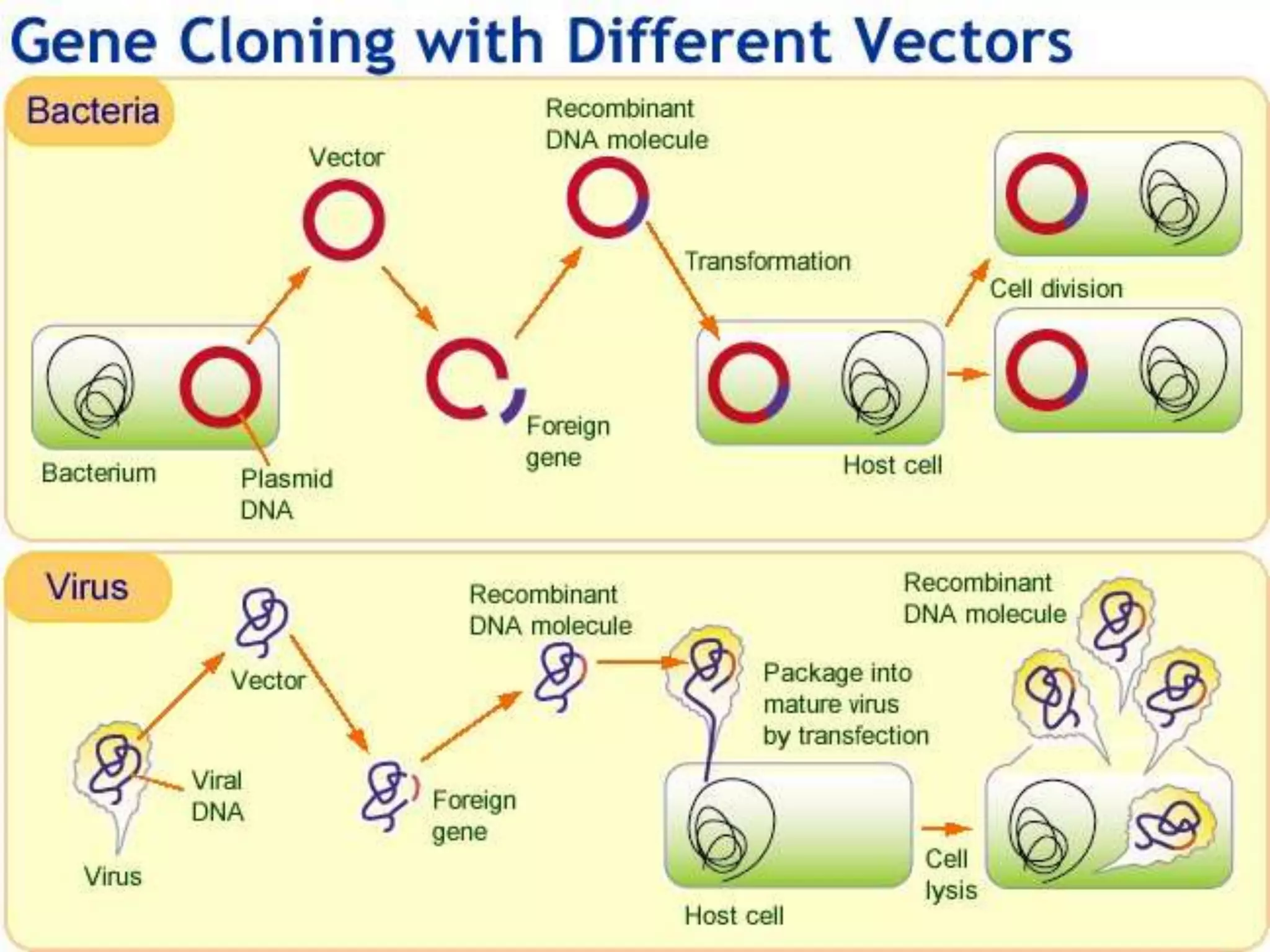
Propagation or cloning of DNA insert inside a suitable host cells.
Examples: Plasmids, Phage or Virus
 Obtaining millions of copies.
Uses :-
Genomic library.
Preparing probes.
Genetic Engineering Experiments.
 Selection of cloning vector depends on :-
(a) Objective of cloning experiment
(b) Ease of working.
(c) Knowledge existing about the vector.
(d) Suitability.
(e) Reliability.
2) Expression Vectors
 Express the DNA insert producing specific protein.
 They have prokaryotic promoter.
 Ribosome binding site.
 Origin of replication.
 Antibiotic resistance gene.
 Expression vectors with strong promoters.
 Inducible Expression Vectors.
 Eukaryotic expression vectors.
VECTOR
• Plasmid
• Bacteriophages
• Cosmid
• Yeast Cloning Vectors
• Ti & Ri Plasmids
TARGET HOST CELL
Bacteria, Streptomyces
Bacteria
Bacteria
Yeasts
Transformation of
cloned gene in higher
plants.
AGENTS USED AS VECTORS
 PLASMIDS
BACTERIOPHAGES
COSMID
ARTIFICIAL CHROMOSOME VECTORS
In 1973, Cohen described first successful
construction of recombinant vector.
Plasmid PSC101 - Ecoli
PLASMID
 Extra chromosomal DNA molecules.
 Self replicating.
 Double stranded.
 Short sequence of DNA.
 Circular DNA molecules.
 Found in prokaryotes.
CHARACTERISTICS
a. Minimum amount of DNA.
b. Two suitable markers for identification .
c. Single restriction site.
d. More restriction enzyme.
e. Size range 1kg – 200kg.
f. Relaxed replication control.
g. Restriction endonuclease enzyme.
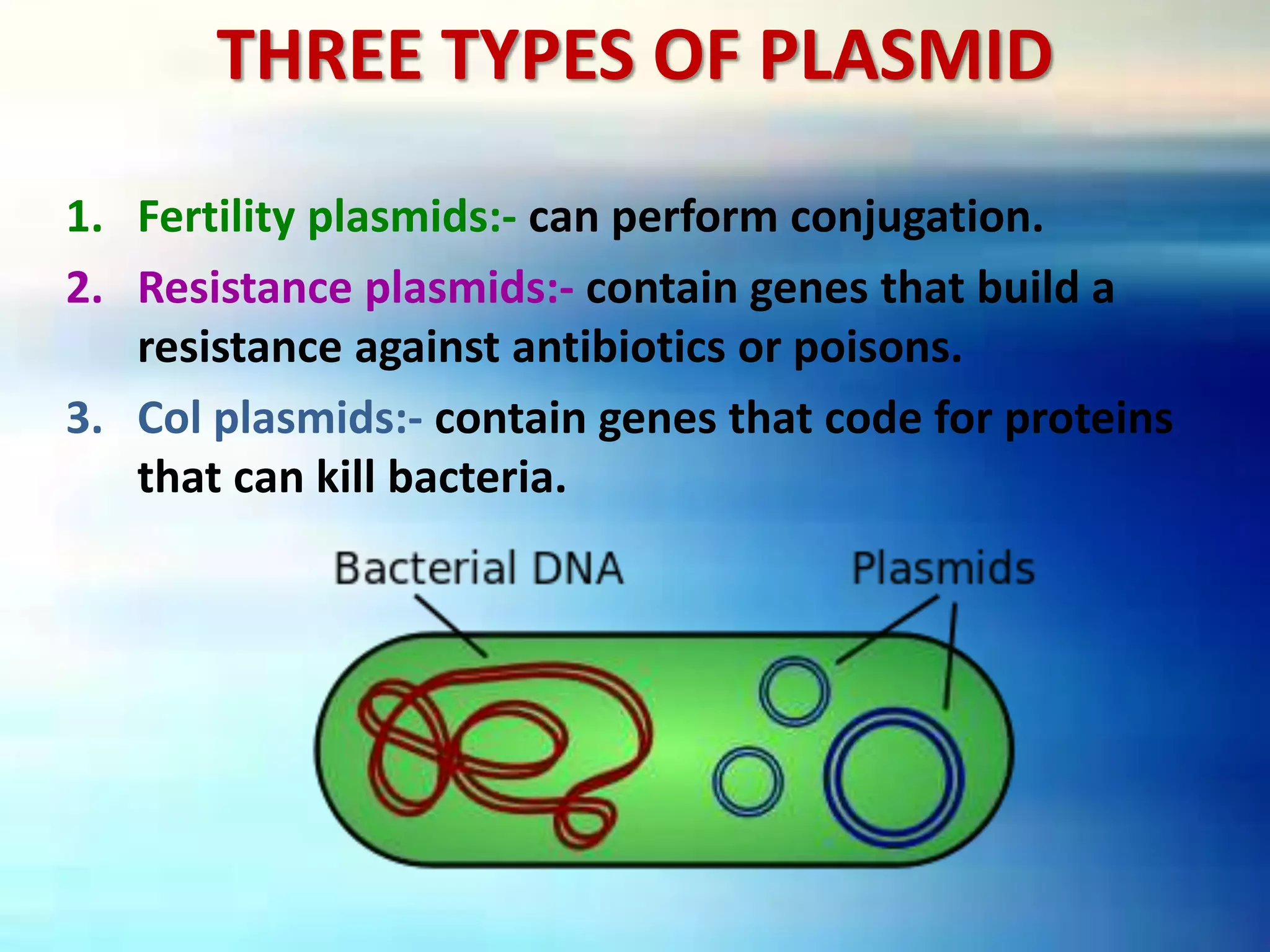
THREE TYPES OF PLASMID
1. Fertility plasmids:- can perform conjugation.
2. Resistance plasmids:- contain genes that build a
resistance against antibiotics or poisons.
3. Col plasmids:- contain genes that code for proteins
that can kill bacteria.
EXAMPLES OF PLASMID VECTORS
 pBR322
 pBR327
 pBR325
 pBR328
 pUC8
 pUC9
 pUC12
 pUC13
 pGEM3Z
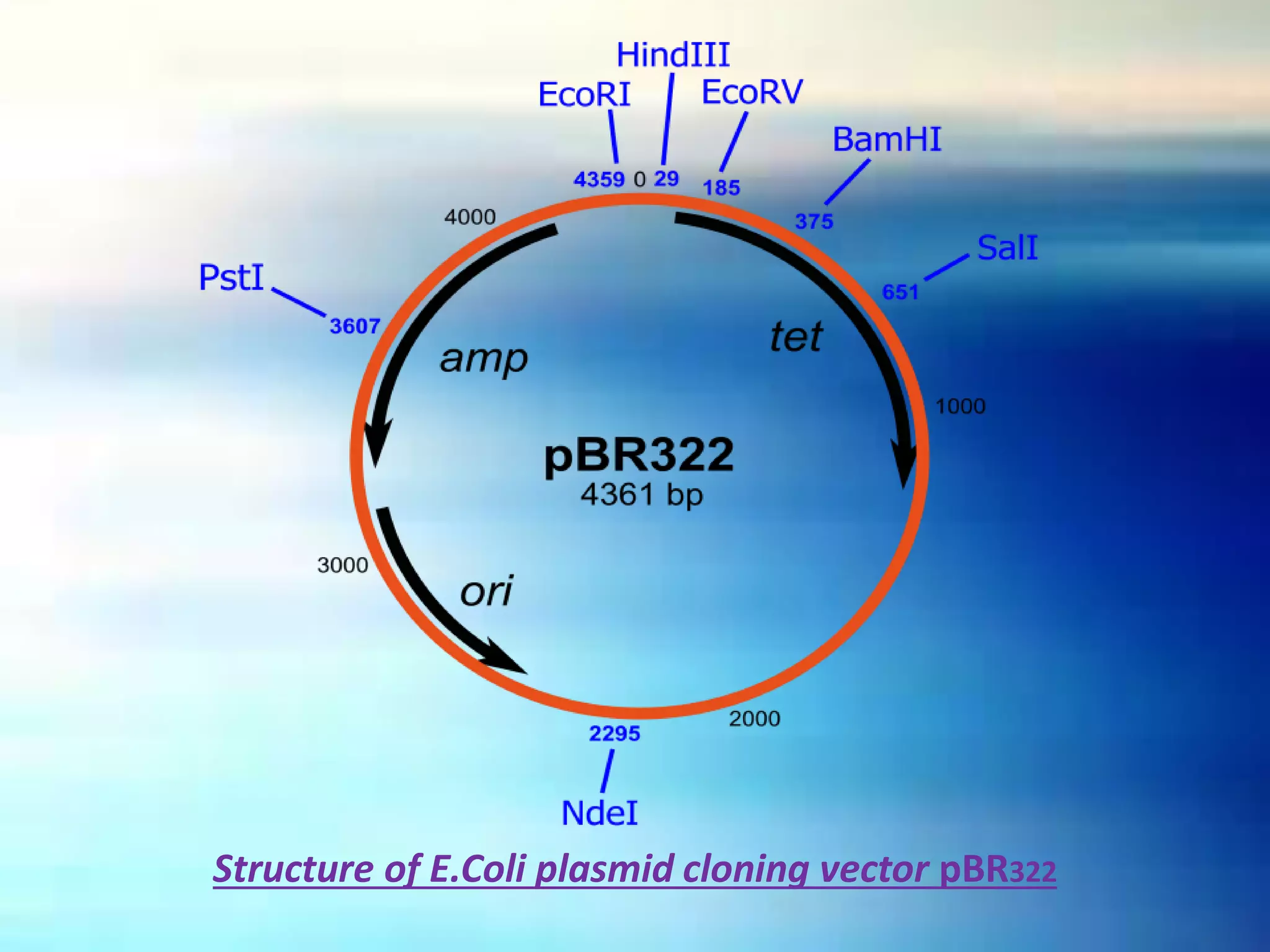
PBR322
 Cloning Vector.
 15 copies.
 Reconstructed plasmid.
 Derived from Ecoli plasmid- ColE1.
PBR322 – 4362 base pairs
P – denotes Plasmid
B – Scientific Boliver
R - Rodriguez
322 – number given to distinguish.
 Ampilicin resistance gene derived from RSF2124.
 Tetracycline resistance gene from PSC101.
 Origin of replication from PMB1.
 Two selectable markers
ampr tetr
Structure of E.Coli plasmid cloning vector pBR322
PBR327
 Derived from PBR322.
 30 – 40 copies.
 Expression plasmid.
 Ampilicin resistance gene.
 Tetracycline resistance gene.
 Deletion of nucleotide between 1427 & 2516.
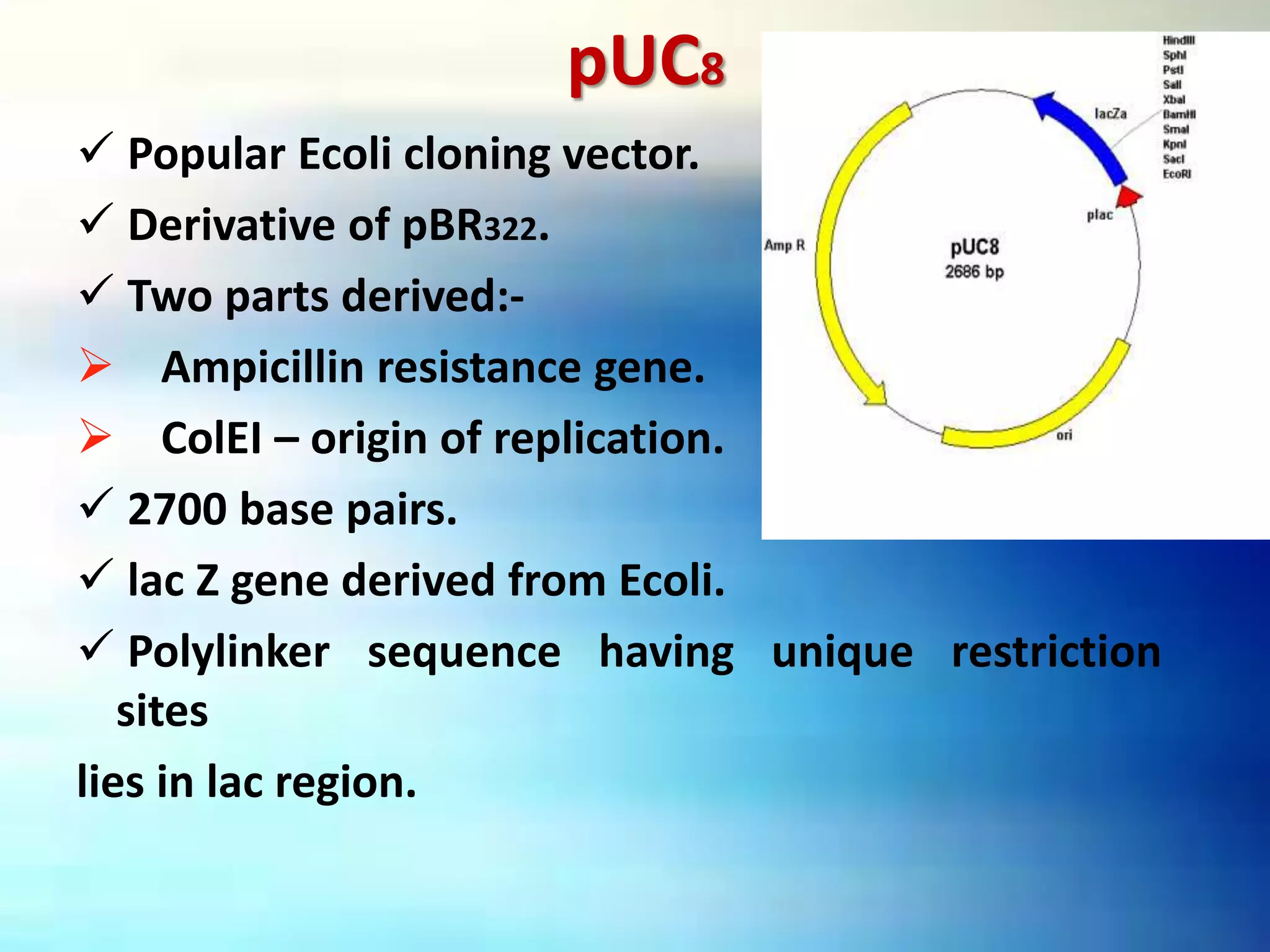
pUC8
 Popular Ecoli cloning vector.
 Derivative of pBR322.
 Two parts derived:-
 Ampicillin resistance gene.
 ColEI – origin of replication.
 2700 base pairs.
 lac Z gene derived from Ecoli.
 Polylinker sequence having unique restriction
sites
lies in lac region.
PHAGE
 Cloning large DNA fragmance.
 Linear Phage molecule.
 Efficient than plasmid.
 Used in storage of recombinant DNA.
 Commonly used Ecoli phages :-
λ phage
M13 Phage
BACTERIOPHAGE VECTORS
Cloning Vectors.
It infects bacteria.
Commonly used Ecoli phages :-
λ phage
M13 Phage
Lambda phage vector
Genome size is 48,502 bp.
High transformation efficiency.
1000 times more efficient than the plasmid vector.
Origin of replication.
Genome linear in head.
Single- stranded protruding cohesive ends of 12 bases.
Cos site – site of cleavage of phage DNA.
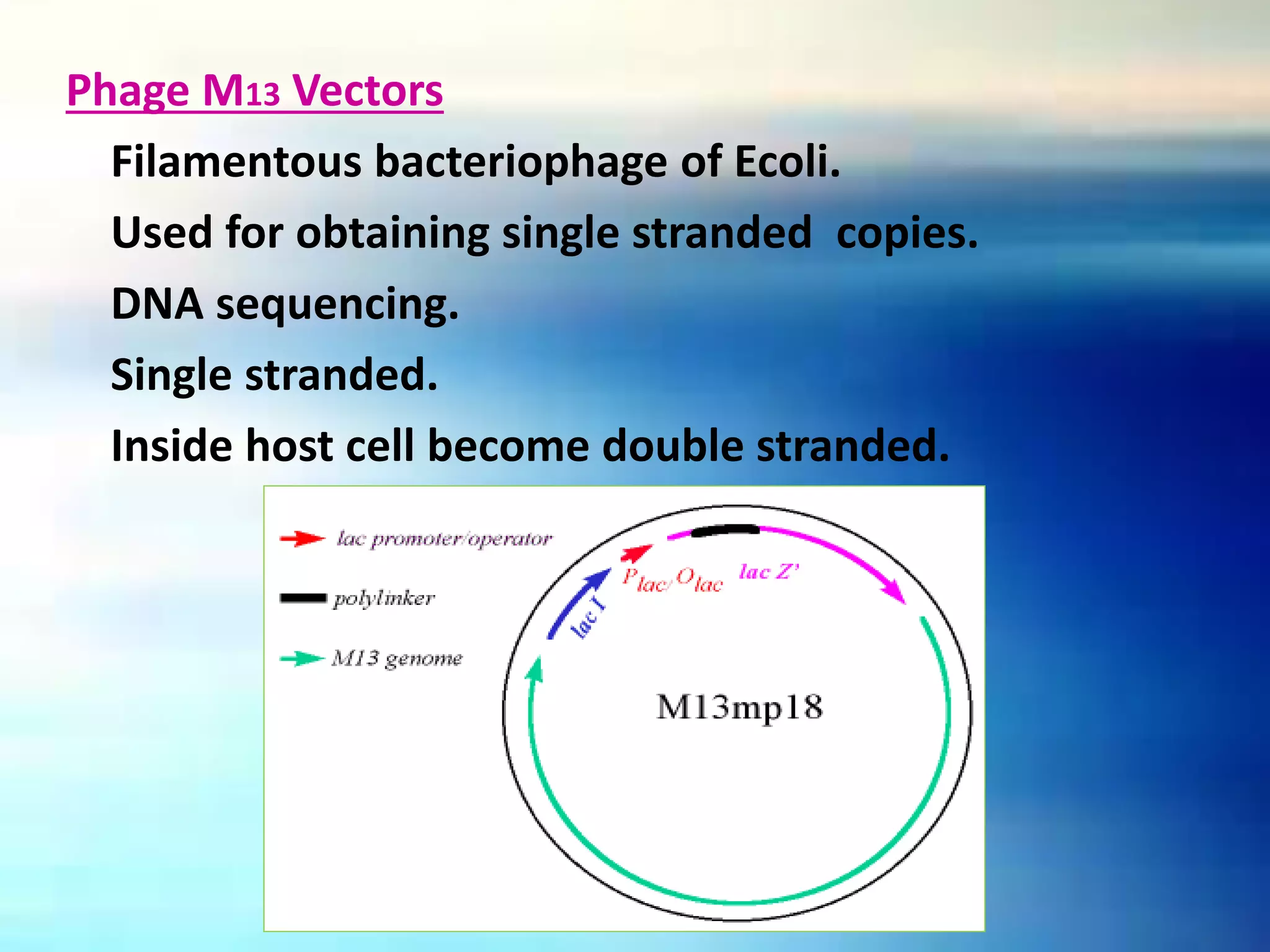
Phage M13 Vectors
Filamentous bacteriophage of Ecoli.
Used for obtaining single stranded copies.
DNA sequencing.
Single stranded.
Inside host cell become double stranded.
HYBRID VECTOR
 Component from both plasmid & phage chromosomes.
 Helper phage provided.
 Developed in 1978 by Barbara Hohn & John Collins.
 30 – 40 Kb
 Origin of replication, cloning site, marker gene, DNA cos
site.
 Smaller than plasmid.
 Use – construction of genomic libraries of eukaryotes.
 e.g. Cosmid
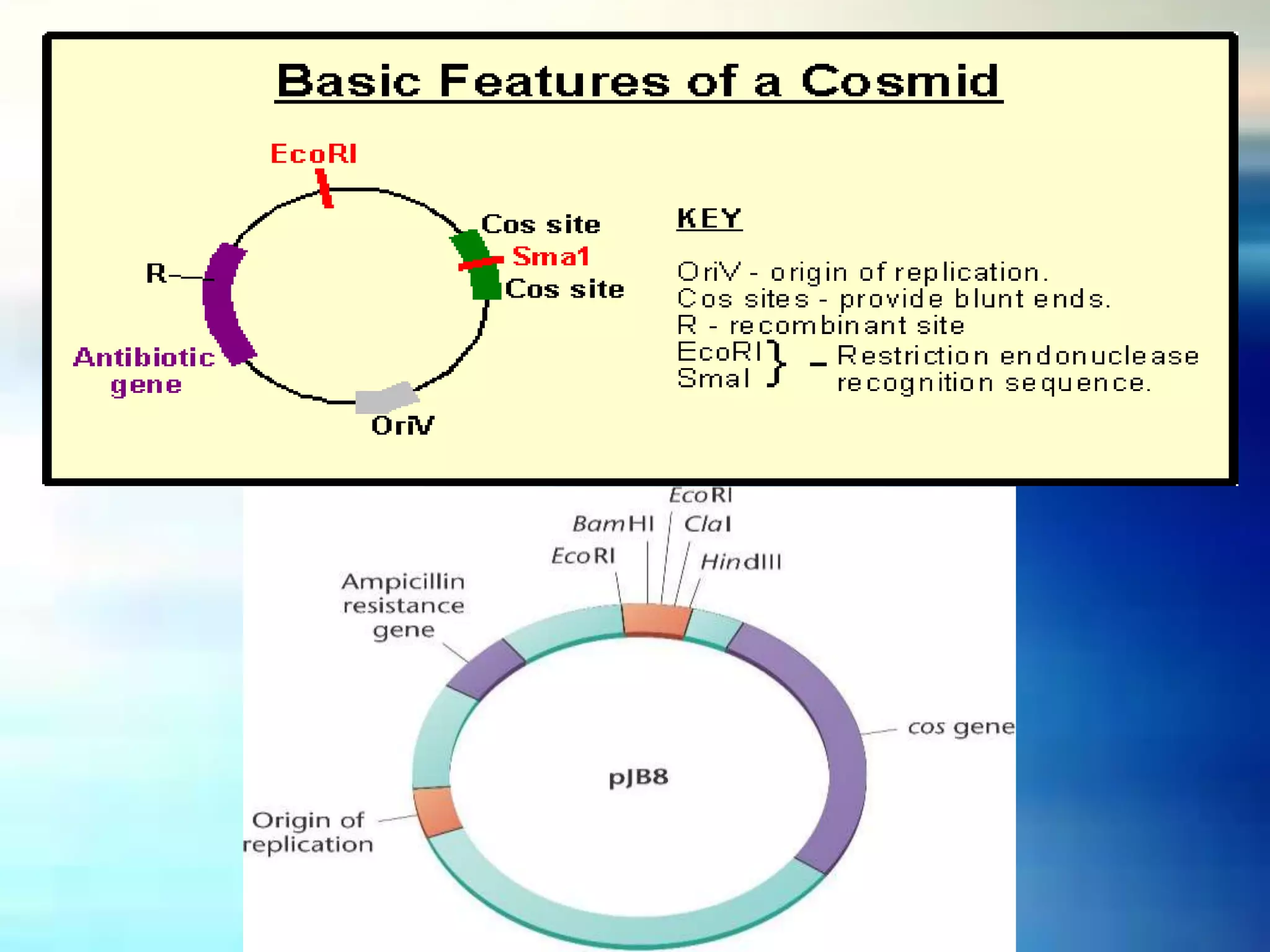
COSMIDS
Combine parts of the lambda chromosome with parts of
plasmids.
Contain the cos sites of λ and plasmid origin of
replication.
Behave both as plasmids and as phages.
Cosmids can carry up to 50 kb of inserted DNA.
Structure of Cosmid
Origin of replication (ori).
Restriction sites for cleavage and insertion of foreign
DNA.
Selectable marker from plasmid.
A cos site - a sequence yield cohesive end (12 bases).
Ampicillin resistance gene (amp).
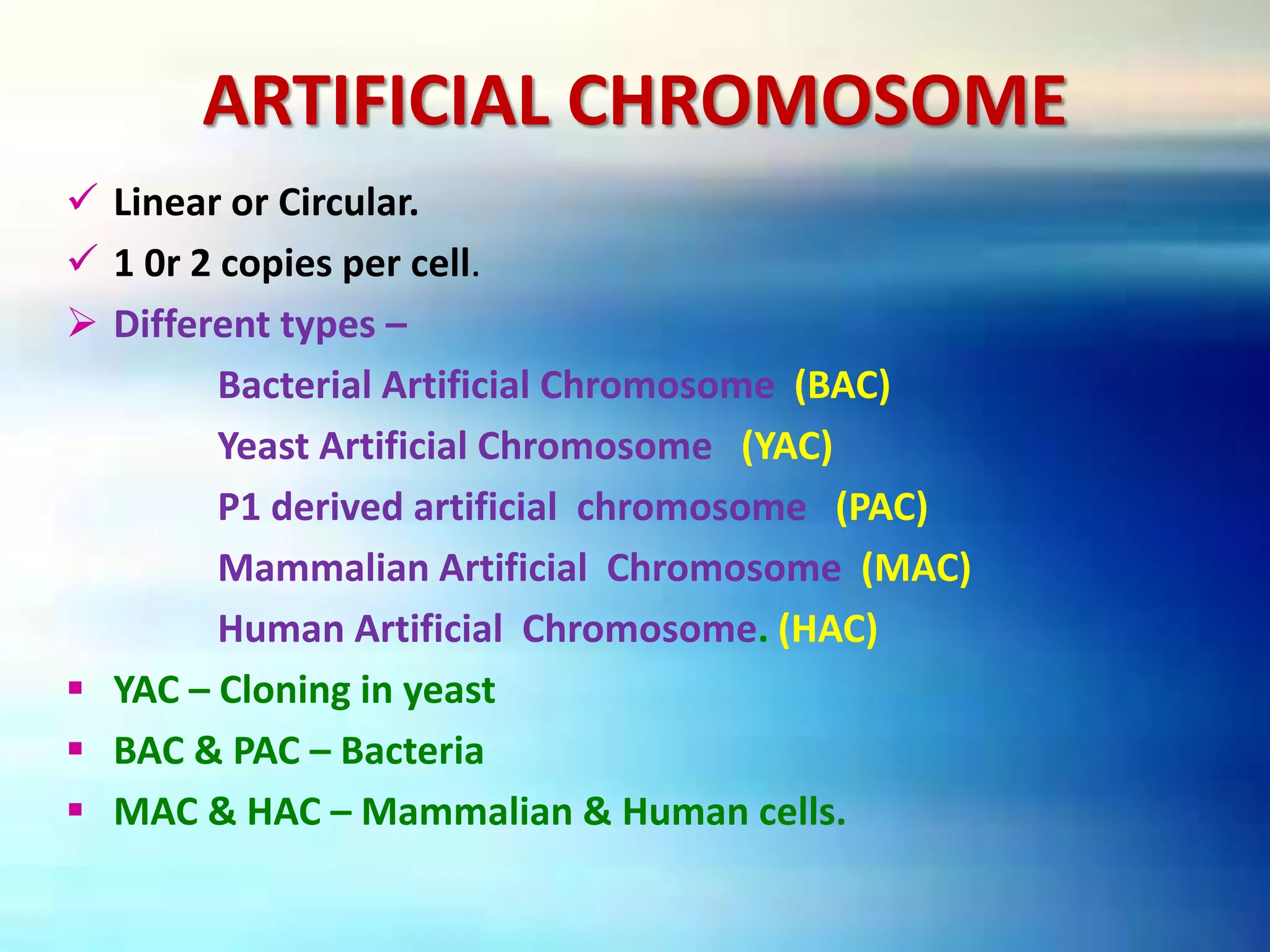
ARTIFICIAL CHROMOSOME
 Linear or Circular.
 1 0r 2 copies per cell.
 Different types –
Bacterial Artificial Chromosome (BAC)
Yeast Artificial Chromosome (YAC)
P1 derived artificial chromosome (PAC)
Mammalian Artificial Chromosome (MAC)
Human Artificial Chromosome. (HAC)
 YAC – Cloning in yeast
 BAC & PAC – Bacteria
 MAC & HAC – Mammalian & Human cells.
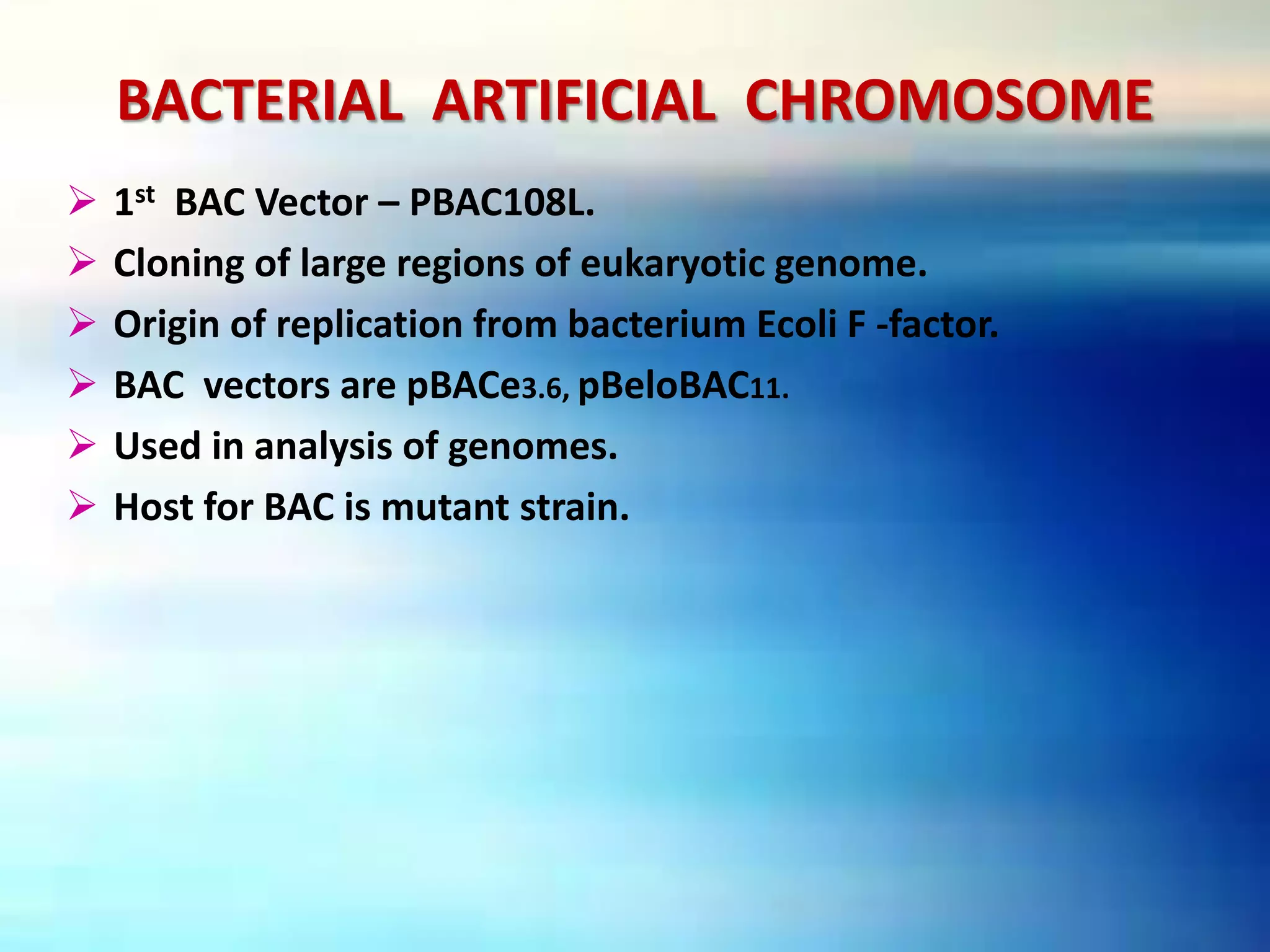
BACTERIAL ARTIFICIAL CHROMOSOME
 1st BAC Vector – PBAC108L.
 Cloning of large regions of eukaryotic genome.
 Origin of replication from bacterium Ecoli F -factor.
 BAC vectors are pBACe3.6, pBeloBAC11.
 Used in analysis of genomes.
 Host for BAC is mutant strain.
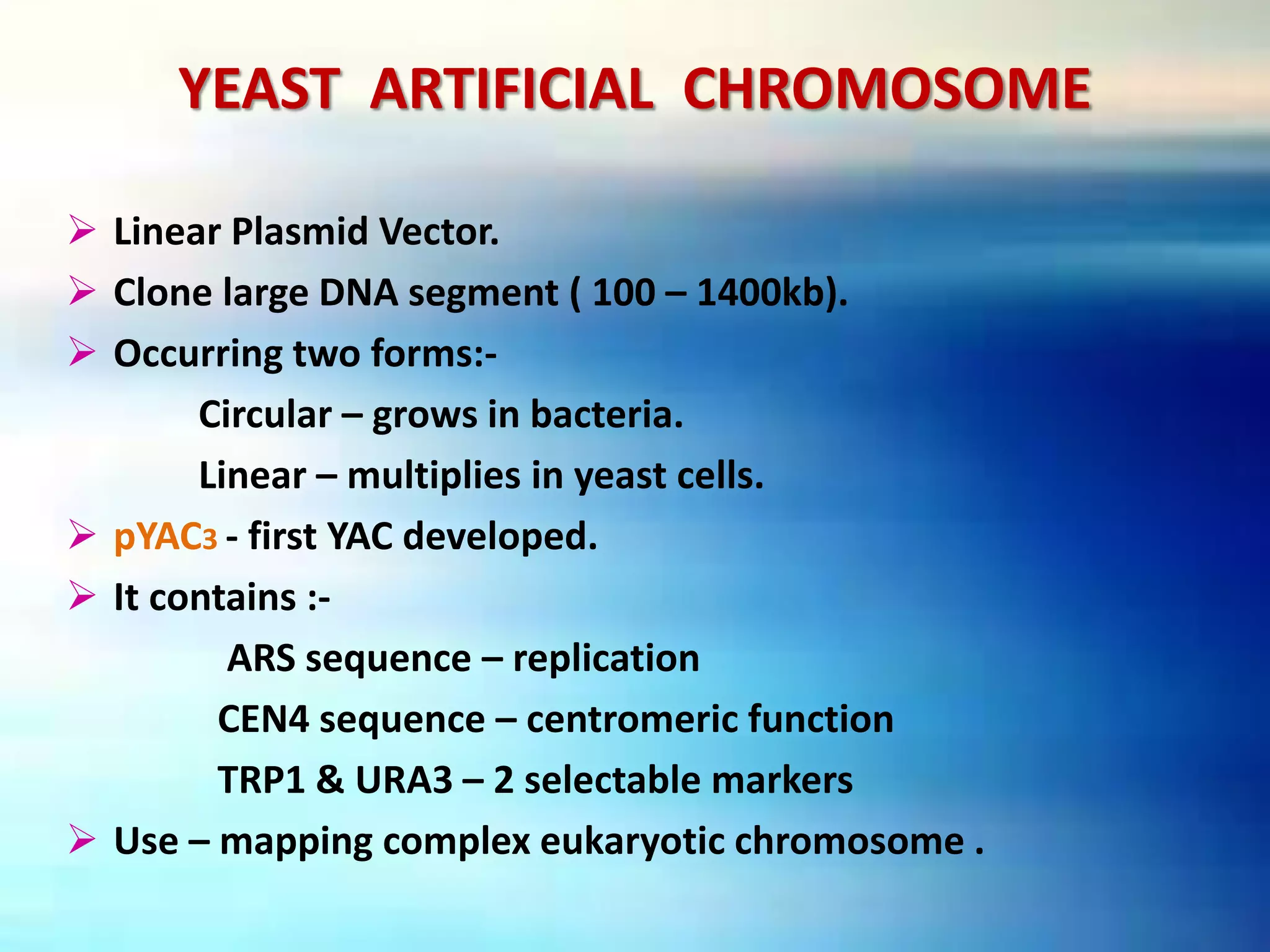
YEAST ARTIFICIAL CHROMOSOME
 Linear Plasmid Vector.
 Clone large DNA segment ( 100 – 1400kb).
 Occurring two forms:-
Circular – grows in bacteria.
Linear – multiplies in yeast cells.
 pYAC3 - first YAC developed.
 It contains :-
ARS sequence – replication
CEN4 sequence – centromeric function
TRP1 & URA3 – 2 selectable markers
 Use – mapping complex eukaryotic chromosome .
Molecular Cloning -  Vectors: Types & Characteristics

Molecular Cloning - Vectors: Types & Characteristics

  • 2.
    VECTORS: TYPES AND CHARACTERISTICS E.g.PLASMIDS, PHAGES, HYBRID VECTORS, ARTIFICIAL CHROMOSOMES
  • 3.
    VECTORS  Small DNAmolecule capable of self replication.  Cloning vehicle or Cloning DNA.  Carrier of DNA fragment.  E.g. Plasmid, Phage, Hybrid vector, Artificial Chromosomes.
  • 4.
    CHARACTERISTICS  Self replication,multiple copies.  Replication origin site.  Cloning site.  Selectable marker gene.  Small size.  Low molecular weight.  Easily isolated & purified.  Easily isolated into host cell.  Control elements – promoter, operator, ribosome binding site.
  • 5.
    TYPES Two types :- 1)Cloning Vectors Propagation or cloning of DNA insert inside a suitable host cells. Examples: Plasmids, Phage or Virus  Obtaining millions of copies. Uses :- Genomic library. Preparing probes. Genetic Engineering Experiments.  Selection of cloning vector depends on :- (a) Objective of cloning experiment (b) Ease of working. (c) Knowledge existing about the vector. (d) Suitability. (e) Reliability.
  • 6.
    2) Expression Vectors Express the DNA insert producing specific protein.  They have prokaryotic promoter.  Ribosome binding site.  Origin of replication.  Antibiotic resistance gene.  Expression vectors with strong promoters.  Inducible Expression Vectors.  Eukaryotic expression vectors.
  • 7.
    VECTOR • Plasmid • Bacteriophages •Cosmid • Yeast Cloning Vectors • Ti & Ri Plasmids TARGET HOST CELL Bacteria, Streptomyces Bacteria Bacteria Yeasts Transformation of cloned gene in higher plants.
  • 8.
    AGENTS USED ASVECTORS  PLASMIDS BACTERIOPHAGES COSMID ARTIFICIAL CHROMOSOME VECTORS In 1973, Cohen described first successful construction of recombinant vector. Plasmid PSC101 - Ecoli
  • 9.
    PLASMID  Extra chromosomalDNA molecules.  Self replicating.  Double stranded.  Short sequence of DNA.  Circular DNA molecules.  Found in prokaryotes. CHARACTERISTICS a. Minimum amount of DNA. b. Two suitable markers for identification . c. Single restriction site. d. More restriction enzyme. e. Size range 1kg – 200kg. f. Relaxed replication control. g. Restriction endonuclease enzyme.
  • 10.
    THREE TYPES OFPLASMID 1. Fertility plasmids:- can perform conjugation. 2. Resistance plasmids:- contain genes that build a resistance against antibiotics or poisons. 3. Col plasmids:- contain genes that code for proteins that can kill bacteria.
  • 11.
    EXAMPLES OF PLASMIDVECTORS  pBR322  pBR327  pBR325  pBR328  pUC8  pUC9  pUC12  pUC13  pGEM3Z
  • 12.
    PBR322  Cloning Vector. 15 copies.  Reconstructed plasmid.  Derived from Ecoli plasmid- ColE1. PBR322 – 4362 base pairs P – denotes Plasmid B – Scientific Boliver R - Rodriguez 322 – number given to distinguish.  Ampilicin resistance gene derived from RSF2124.  Tetracycline resistance gene from PSC101.  Origin of replication from PMB1.  Two selectable markers ampr tetr
  • 13.
    Structure of E.Coliplasmid cloning vector pBR322
  • 14.
    PBR327  Derived fromPBR322.  30 – 40 copies.  Expression plasmid.  Ampilicin resistance gene.  Tetracycline resistance gene.  Deletion of nucleotide between 1427 & 2516.
  • 15.
    pUC8  Popular Ecolicloning vector.  Derivative of pBR322.  Two parts derived:-  Ampicillin resistance gene.  ColEI – origin of replication.  2700 base pairs.  lac Z gene derived from Ecoli.  Polylinker sequence having unique restriction sites lies in lac region.
  • 16.
    PHAGE  Cloning largeDNA fragmance.  Linear Phage molecule.  Efficient than plasmid.  Used in storage of recombinant DNA.  Commonly used Ecoli phages :- λ phage M13 Phage
  • 17.
    BACTERIOPHAGE VECTORS Cloning Vectors. Itinfects bacteria. Commonly used Ecoli phages :- λ phage M13 Phage Lambda phage vector Genome size is 48,502 bp. High transformation efficiency. 1000 times more efficient than the plasmid vector. Origin of replication. Genome linear in head. Single- stranded protruding cohesive ends of 12 bases. Cos site – site of cleavage of phage DNA.
  • 18.
    Phage M13 Vectors Filamentousbacteriophage of Ecoli. Used for obtaining single stranded copies. DNA sequencing. Single stranded. Inside host cell become double stranded.
  • 19.
    HYBRID VECTOR  Componentfrom both plasmid & phage chromosomes.  Helper phage provided.  Developed in 1978 by Barbara Hohn & John Collins.  30 – 40 Kb  Origin of replication, cloning site, marker gene, DNA cos site.  Smaller than plasmid.  Use – construction of genomic libraries of eukaryotes.  e.g. Cosmid
  • 20.
    COSMIDS Combine parts ofthe lambda chromosome with parts of plasmids. Contain the cos sites of λ and plasmid origin of replication. Behave both as plasmids and as phages. Cosmids can carry up to 50 kb of inserted DNA. Structure of Cosmid Origin of replication (ori). Restriction sites for cleavage and insertion of foreign DNA. Selectable marker from plasmid. A cos site - a sequence yield cohesive end (12 bases). Ampicillin resistance gene (amp).
  • 22.
    ARTIFICIAL CHROMOSOME  Linearor Circular.  1 0r 2 copies per cell.  Different types – Bacterial Artificial Chromosome (BAC) Yeast Artificial Chromosome (YAC) P1 derived artificial chromosome (PAC) Mammalian Artificial Chromosome (MAC) Human Artificial Chromosome. (HAC)  YAC – Cloning in yeast  BAC & PAC – Bacteria  MAC & HAC – Mammalian & Human cells.
  • 23.
    BACTERIAL ARTIFICIAL CHROMOSOME 1st BAC Vector – PBAC108L.  Cloning of large regions of eukaryotic genome.  Origin of replication from bacterium Ecoli F -factor.  BAC vectors are pBACe3.6, pBeloBAC11.  Used in analysis of genomes.  Host for BAC is mutant strain.
  • 24.
    YEAST ARTIFICIAL CHROMOSOME Linear Plasmid Vector.  Clone large DNA segment ( 100 – 1400kb).  Occurring two forms:- Circular – grows in bacteria. Linear – multiplies in yeast cells.  pYAC3 - first YAC developed.  It contains :- ARS sequence – replication CEN4 sequence – centromeric function TRP1 & URA3 – 2 selectable markers  Use – mapping complex eukaryotic chromosome .