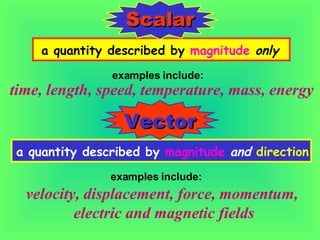
Scalar a quantity described by  magnitude   only examples include: time, length, speed, temperature, mass, energy Vector a quantity described by   magnitude   and   direction examples include: velocity, displacement, force, momentum,  electric and magnetic fields
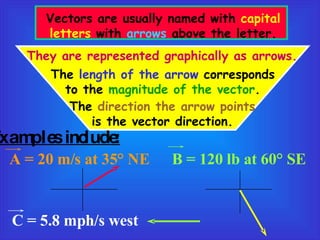
Vectors are usually named with  capital letters  with  arrows  above the letter. They are represented graphically as arrows.   The  length of the arrow  corresponds to the  magnitude of the vector . The  direction the arrow points is the vector direction. Examples include: A = 20 m/s at 35 °  NE B = 120 lb at 60 °  SE C = 5.8 mph/s west
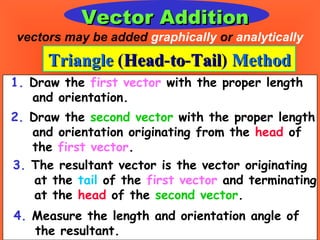
Vector Addition  vectors may be added  graphically  or  analytically Triangle  ( Head - to - Tail )  Method 1.  Draw the  first vector  with the proper length and orientation. 2.  Draw the  second vector  with the proper length and orientation originating from the  head  of  the  first vector . 3.  The resultant vector is the vector originating at the  tail  of the  first vector  and terminating at the  head  of the  second vector . 4.  Measure the length and orientation angle of the resultant.
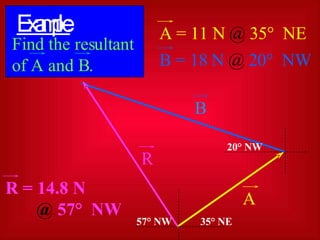
Find the resultant  of A and B. A = 11 N  @  35 °   NE A 35 °  NE B = 18 N  @  20 °   NW B 20 °  NW R Example: 57 °  NW R =   14.8 N   @   57 °   NW
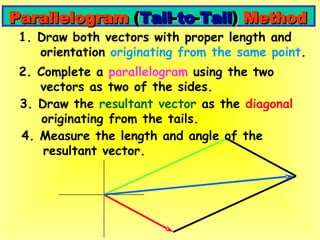
Parallelogram  ( Tail - to - Tail )  Method 1. Draw both vectors with proper length and orientation  originating from the same point . 2. Complete a  parallelogram  using the two vectors as two of the sides. 3. Draw the  resultant vector  as the  diagonal originating from the tails. 4. Measure the length and angle of the resultant vector.
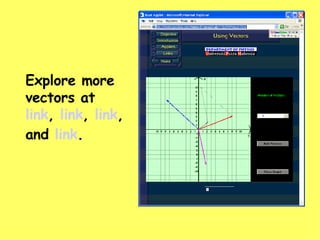
Explore more vectors at link ,  link ,  link , and  link .
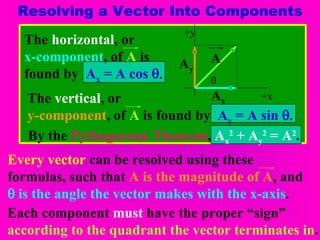
Resolving a Vector Into Components +x +y A A x A y  The  horizontal , or  x-component , of  A  is  found by  A x  = A cos    The  vertical , or y-component , of  A  is found by  A y  = A sin    By the  Pythagorean Theorem ,  A x 2  + A y 2  = A 2 . Every vector  can be resolved using these  formulas, such that  A is the magnitude of A , and    is the angle the vector makes with the x-axis . Each component  must  have the proper “sign” according to the quadrant the vector terminates in .
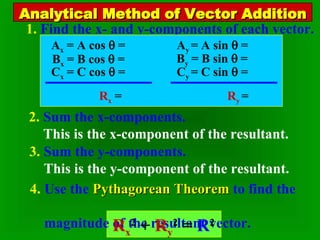
Analytical Method of Vector Addition 1.   Find the x- and y-components of each vector. A x  = A cos    = A y  = A sin   =   B x  = B cos   =  B y  = B sin   = C x  = C cos   = C y  = C sin    = 2.   Sum the x-components. This is the x-component of the resultant. R x   =   3.   Sum the y-components.   This is the y-component of the resultant. R y  =  4.   Use the  Pythagorean Theorem  to find the  magnitude of the resultant vector. R x 2  +  R y 2  =  R 2
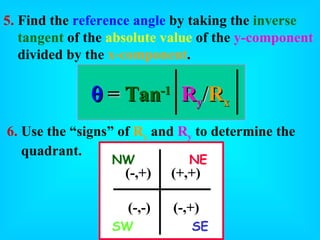
5.  Find the  reference angle  by taking the  inverse  tangent  of the  absolute value  of the  y-component   divided by the  x-component .    =  Tan -1   R y / R x 6.  Use the “signs” of  R x  and  R y  to determine the  quadrant. NE (+,+) NW (-,+) SW (-,-) SE (-,+)

11-28-07 - Vectors

  • 1.
  • 2.
    Scalar a quantitydescribed by magnitude only examples include: time, length, speed, temperature, mass, energy Vector a quantity described by magnitude and direction examples include: velocity, displacement, force, momentum, electric and magnetic fields
  • 3.
    Vectors are usuallynamed with capital letters with arrows above the letter. They are represented graphically as arrows. The length of the arrow corresponds to the magnitude of the vector . The direction the arrow points is the vector direction. Examples include: A = 20 m/s at 35 ° NE B = 120 lb at 60 ° SE C = 5.8 mph/s west
  • 4.
    Vector Addition vectors may be added graphically or analytically Triangle ( Head - to - Tail ) Method 1. Draw the first vector with the proper length and orientation. 2. Draw the second vector with the proper length and orientation originating from the head of the first vector . 3. The resultant vector is the vector originating at the tail of the first vector and terminating at the head of the second vector . 4. Measure the length and orientation angle of the resultant.
  • 5.
    Find the resultant of A and B. A = 11 N @ 35 ° NE A 35 ° NE B = 18 N @ 20 ° NW B 20 ° NW R Example: 57 ° NW R = 14.8 N @ 57 ° NW
  • 6.
    Parallelogram (Tail - to - Tail ) Method 1. Draw both vectors with proper length and orientation originating from the same point . 2. Complete a parallelogram using the two vectors as two of the sides. 3. Draw the resultant vector as the diagonal originating from the tails. 4. Measure the length and angle of the resultant vector.
  • 7.
    Explore more vectorsat link , link , link , and link .
  • 8.
    Resolving a VectorInto Components +x +y A A x A y  The horizontal , or x-component , of A is found by A x = A cos   The vertical , or y-component , of A is found by A y = A sin   By the Pythagorean Theorem , A x 2 + A y 2 = A 2 . Every vector can be resolved using these formulas, such that A is the magnitude of A , and  is the angle the vector makes with the x-axis . Each component must have the proper “sign” according to the quadrant the vector terminates in .
  • 9.
    Analytical Method ofVector Addition 1. Find the x- and y-components of each vector. A x = A cos  = A y = A sin  = B x = B cos  = B y = B sin  = C x = C cos  = C y = C sin  = 2. Sum the x-components. This is the x-component of the resultant. R x = 3. Sum the y-components. This is the y-component of the resultant. R y = 4. Use the Pythagorean Theorem to find the magnitude of the resultant vector. R x 2 + R y 2 = R 2
  • 10.
    5. Findthe reference angle by taking the inverse tangent of the absolute value of the y-component divided by the x-component .  = Tan -1 R y / R x 6. Use the “signs” of R x and R y to determine the quadrant. NE (+,+) NW (-,+) SW (-,-) SE (-,+)