Vectors Notes
VELOCITY VECTORS VECTOR: An arrow drawn to scale that represents the magnitude and direction of a given velocity. 10m/s left 5m/s rt
Scaled Vector Diagrams There are several characteristics of this diagram which make it an appropriately drawn vector diagram. a scale is clearly listed  a vector arrow (with arrowhead) is drawn in a specified direction. The vector arrow has a  head  and a  tail .  the magnitude and direction of the vector is clearly labeled.
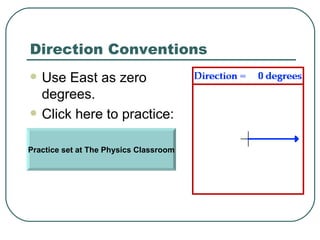
Direction Conventions Use East as zero degrees. Click here to practice: Practice set at The Physics Classroom
RESULTANT: The single vector that  results  when two vectors are combined. 10m/s left 5m/s rt 5m/s left
Turn to the question on Page 17: A motor boat is moving 10 km/h relative to the water.  If the boat travels in a river that flows at 10km/h, what is the velocity relative to the shore when it heads directly up stream? When it heads directly downstream?
Adding Noncollinear vectors The Pythagorean theorem is a useful method for determining the result of adding two (and only two) vectors  which make a right angle  to each other.
Graphical Vector Addition: A + B Step 1- Draw a start point. Step 2- Decide on a scale. Step 3- Draw Vector A to scale. Step 4- Vector B’s tail begins at Vector A’s head. Draw Vector B to scale. Step 5- Draw a line connecting the initial start point to the head of B. This is the resultant. Step 6- Measure the resultant’s length with a ruler and direction with a protractor.  Step 7- Convert back to the given units using your scale.
Animation of head-to-tail vector addition – three times
Practice Graphical Addition Practice Set at The Physics Classroom
Resultants and Equilibrants The  resultant  is the vector sum of two or more vectors. It is  the result  of adding two or more vectors together.  The  equilibrant  is the balancing vector… the vector equal in magnitude but opposite in direction to the resultant.
Vector Components Some vectors are directed at angles to the coordinate axes, and will need to be  transformed  into two parts with each part being directed along the axes. Each part of a two-dimensional vector is known as a  component .  Any vector directed in two dimensions can be thought of as having an influence in two different directions. The components of a vector depict the influence of that vector in a given direction.

Vectors

  • 1.
  • 2.
    VELOCITY VECTORS VECTOR:An arrow drawn to scale that represents the magnitude and direction of a given velocity. 10m/s left 5m/s rt
  • 3.
    Scaled Vector DiagramsThere are several characteristics of this diagram which make it an appropriately drawn vector diagram. a scale is clearly listed a vector arrow (with arrowhead) is drawn in a specified direction. The vector arrow has a head and a tail . the magnitude and direction of the vector is clearly labeled.
  • 4.
    Direction Conventions UseEast as zero degrees. Click here to practice: Practice set at The Physics Classroom
  • 5.
    RESULTANT: The singlevector that results when two vectors are combined. 10m/s left 5m/s rt 5m/s left
  • 6.
    Turn to thequestion on Page 17: A motor boat is moving 10 km/h relative to the water. If the boat travels in a river that flows at 10km/h, what is the velocity relative to the shore when it heads directly up stream? When it heads directly downstream?
  • 7.
    Adding Noncollinear vectorsThe Pythagorean theorem is a useful method for determining the result of adding two (and only two) vectors which make a right angle to each other.
  • 8.
    Graphical Vector Addition:A + B Step 1- Draw a start point. Step 2- Decide on a scale. Step 3- Draw Vector A to scale. Step 4- Vector B’s tail begins at Vector A’s head. Draw Vector B to scale. Step 5- Draw a line connecting the initial start point to the head of B. This is the resultant. Step 6- Measure the resultant’s length with a ruler and direction with a protractor. Step 7- Convert back to the given units using your scale.
  • 9.
    Animation of head-to-tailvector addition – three times
  • 10.
    Practice Graphical AdditionPractice Set at The Physics Classroom
  • 11.
    Resultants and EquilibrantsThe resultant is the vector sum of two or more vectors. It is the result of adding two or more vectors together. The equilibrant is the balancing vector… the vector equal in magnitude but opposite in direction to the resultant.
  • 12.
    Vector Components Somevectors are directed at angles to the coordinate axes, and will need to be transformed into two parts with each part being directed along the axes. Each part of a two-dimensional vector is known as a component . Any vector directed in two dimensions can be thought of as having an influence in two different directions. The components of a vector depict the influence of that vector in a given direction.