Rates of change
Rate of change
• Tell me something which …
a)Changes
b)Doesn't change
c)Changes at a constant rate
d)Changes slowly / quickly
e)Does not change at a constant rate
f) Whose rate of change is constant
g)Whose rate of change is not constant
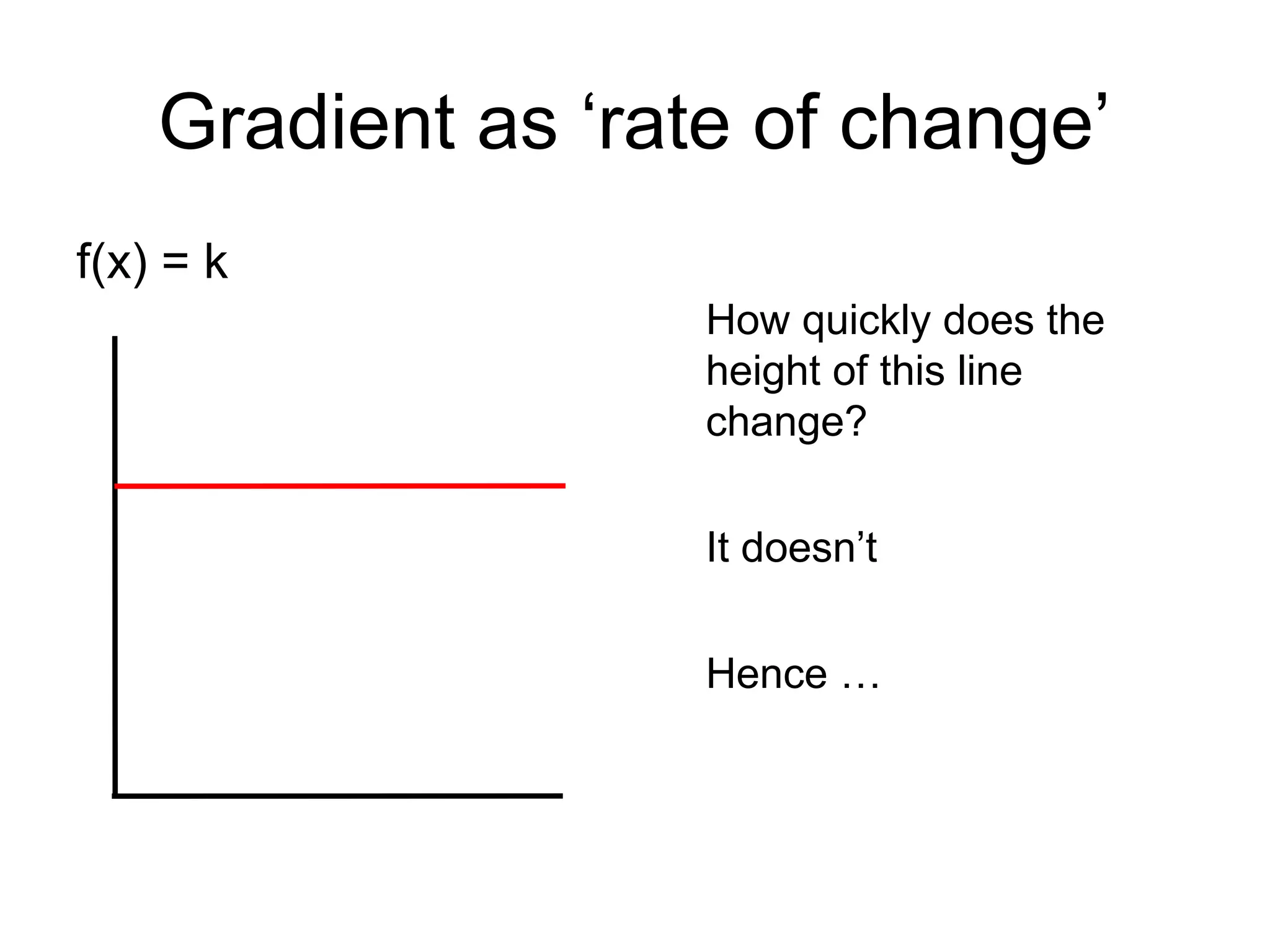
Gradient as ‘rate of change’
f(x) = k
How quickly does the
height of this line
change?
It doesn’t
Hence …
Differentiation as ‘rate of change’
What can you say about:
f’(x)? [the rate of change of
f(x)?]
f’’(x)? [the rate of change of
f’(x)?]
f(x) = kx
g(x) = jx
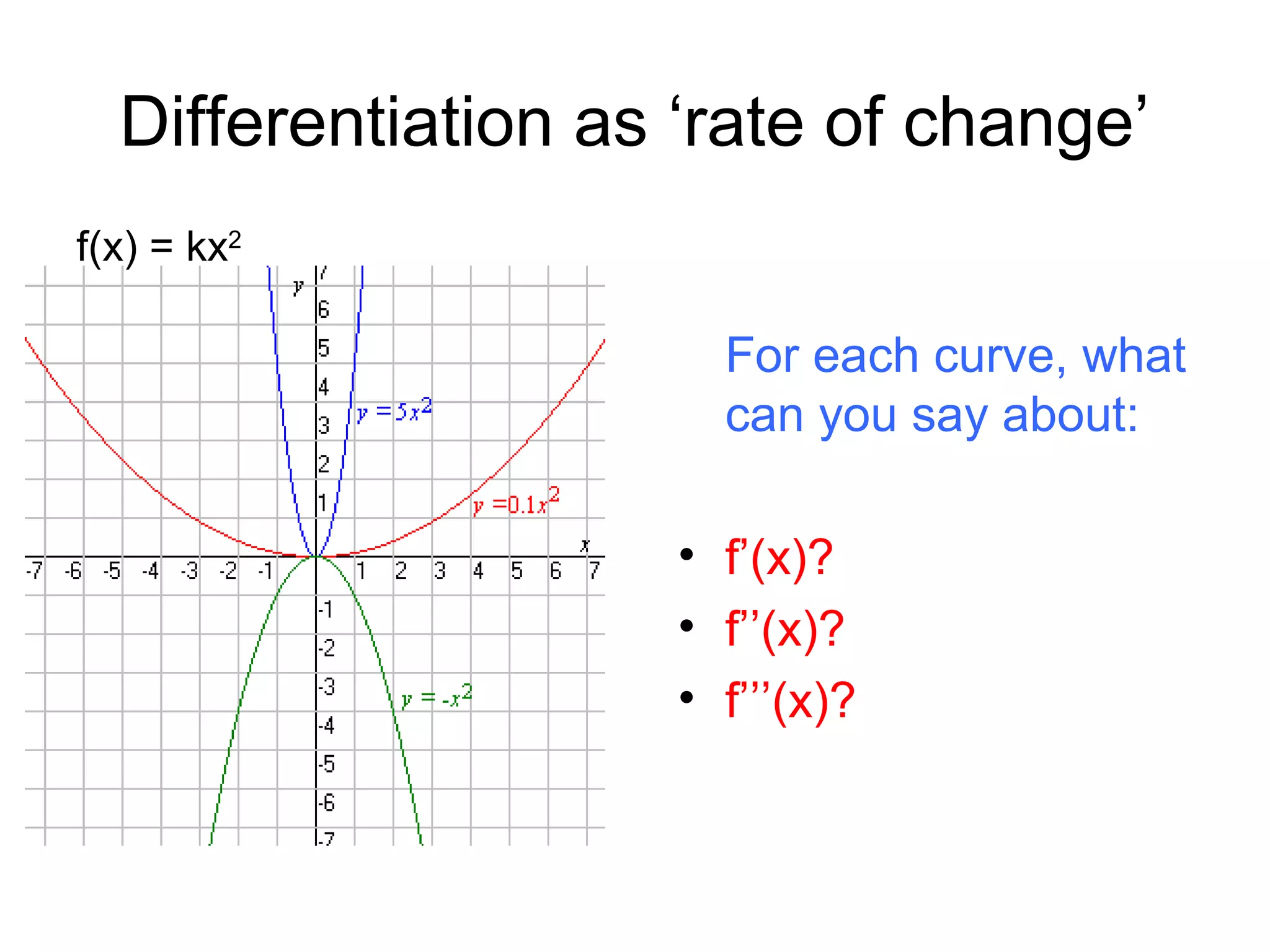
Differentiation as ‘rate of change’
f(x) = kx2
For each curve, what
can you say about:
• f’(x)?
• f’’(x)?
• f’’’(x)?
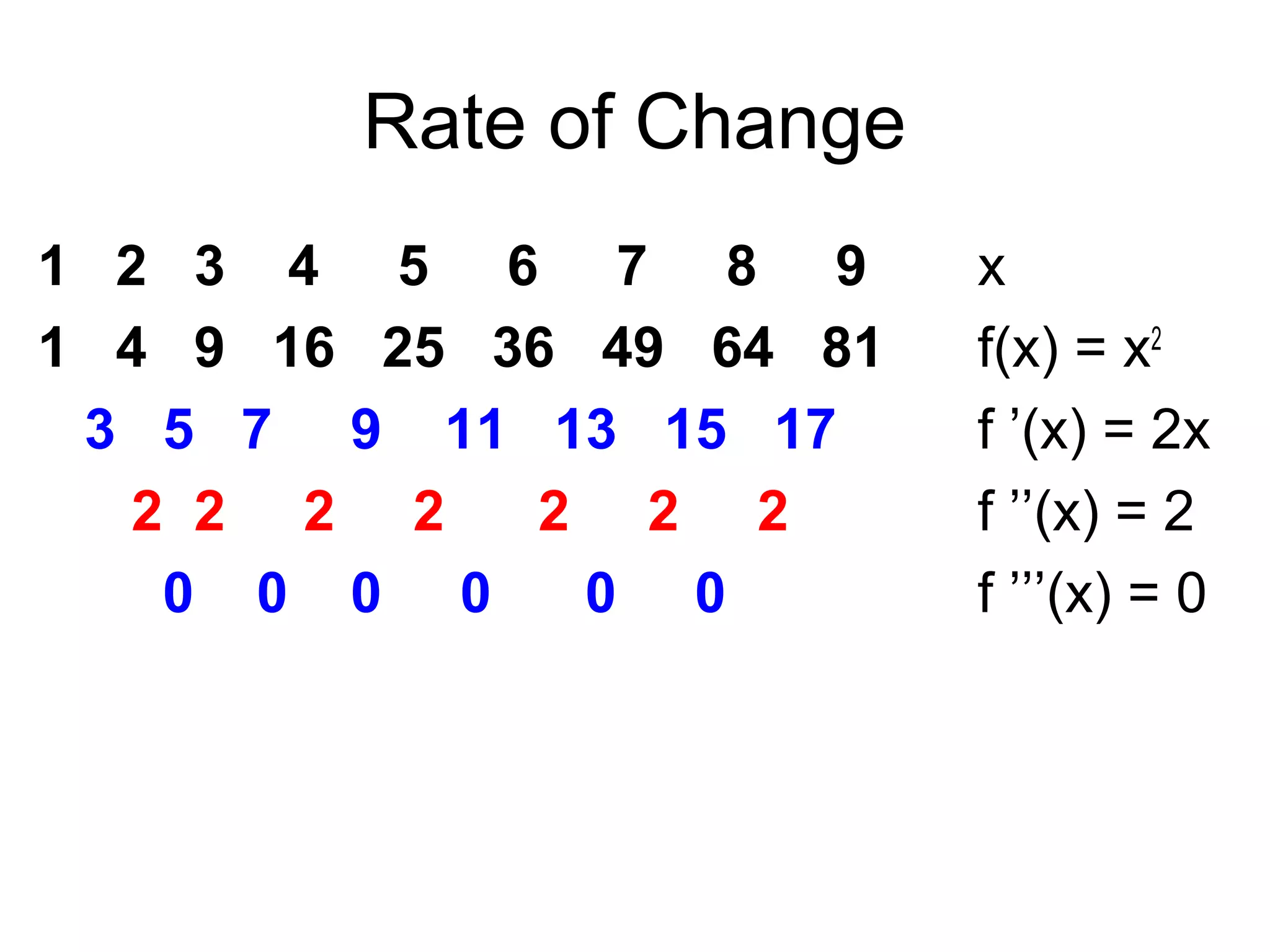
Rate of Change
x
f(x) = x2
f ’(x) = 2x
f ’’(x) = 2
f ’’’(x) = 0
1 2 3 4 5 6 7 8 9
1 4 9 16 25 36 49 64 81
3 5 7 9 11 13 15 17
2 2 2 2 2 2 2
0 0 0 0 0 0
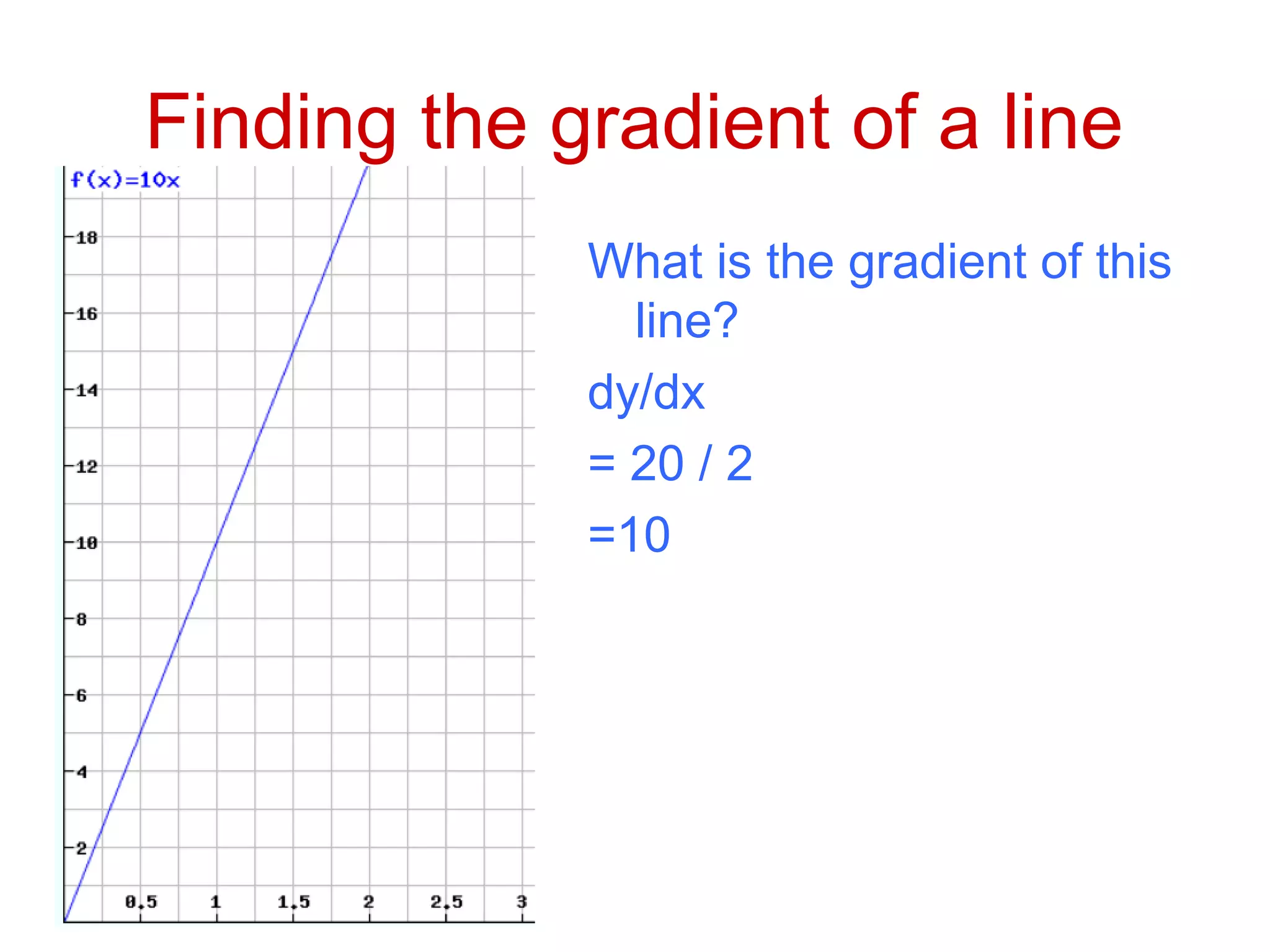
Finding the gradient of a line
What is the gradient of this
line?
dy/dx
= 20 / 2
=10
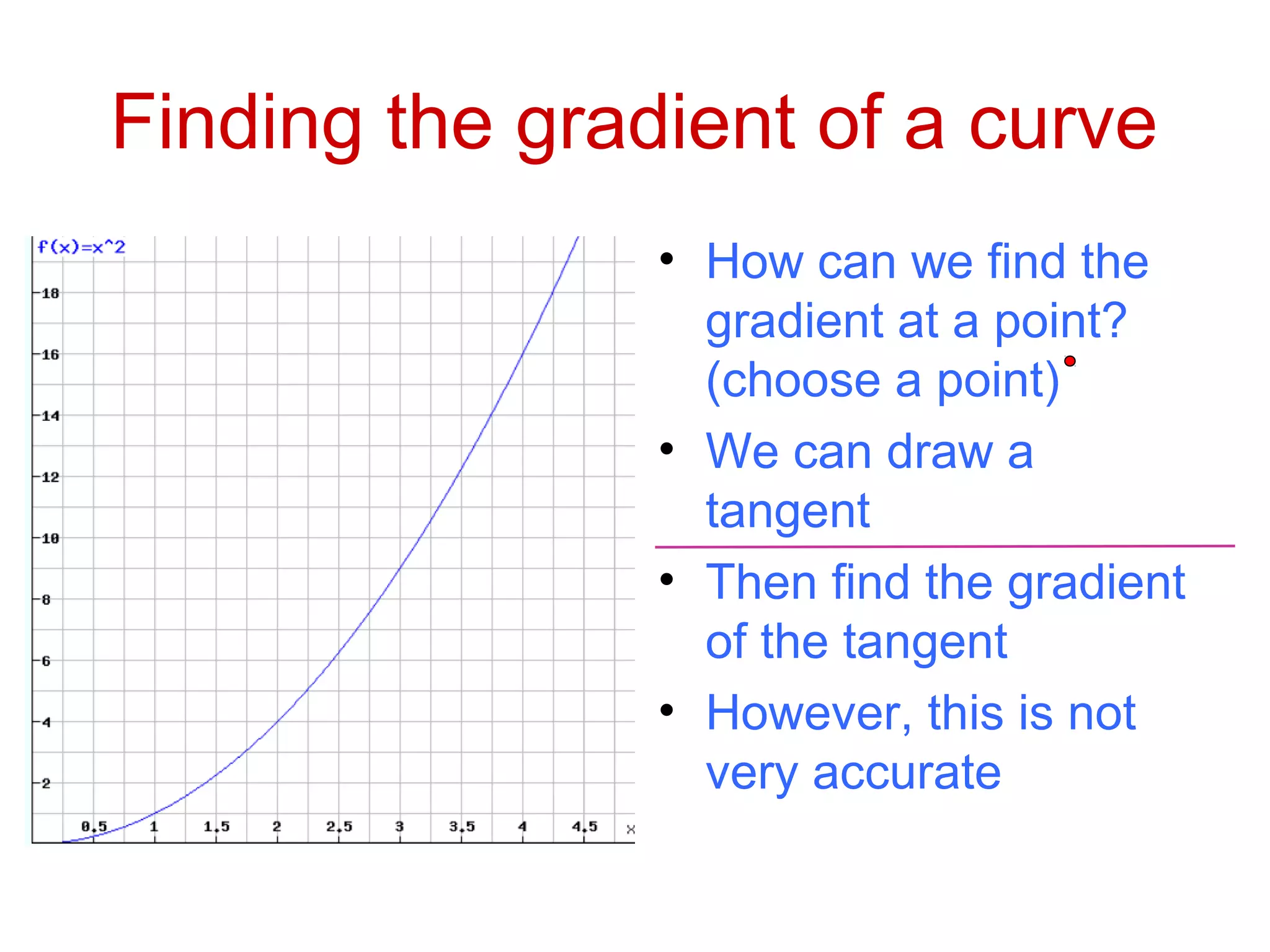
Finding the gradient of a curve
• How can we find the
gradient at a point?
(choose a point)
• We can draw a
tangent
• Then find the gradient
of the tangent
• However, this is not
very accurate
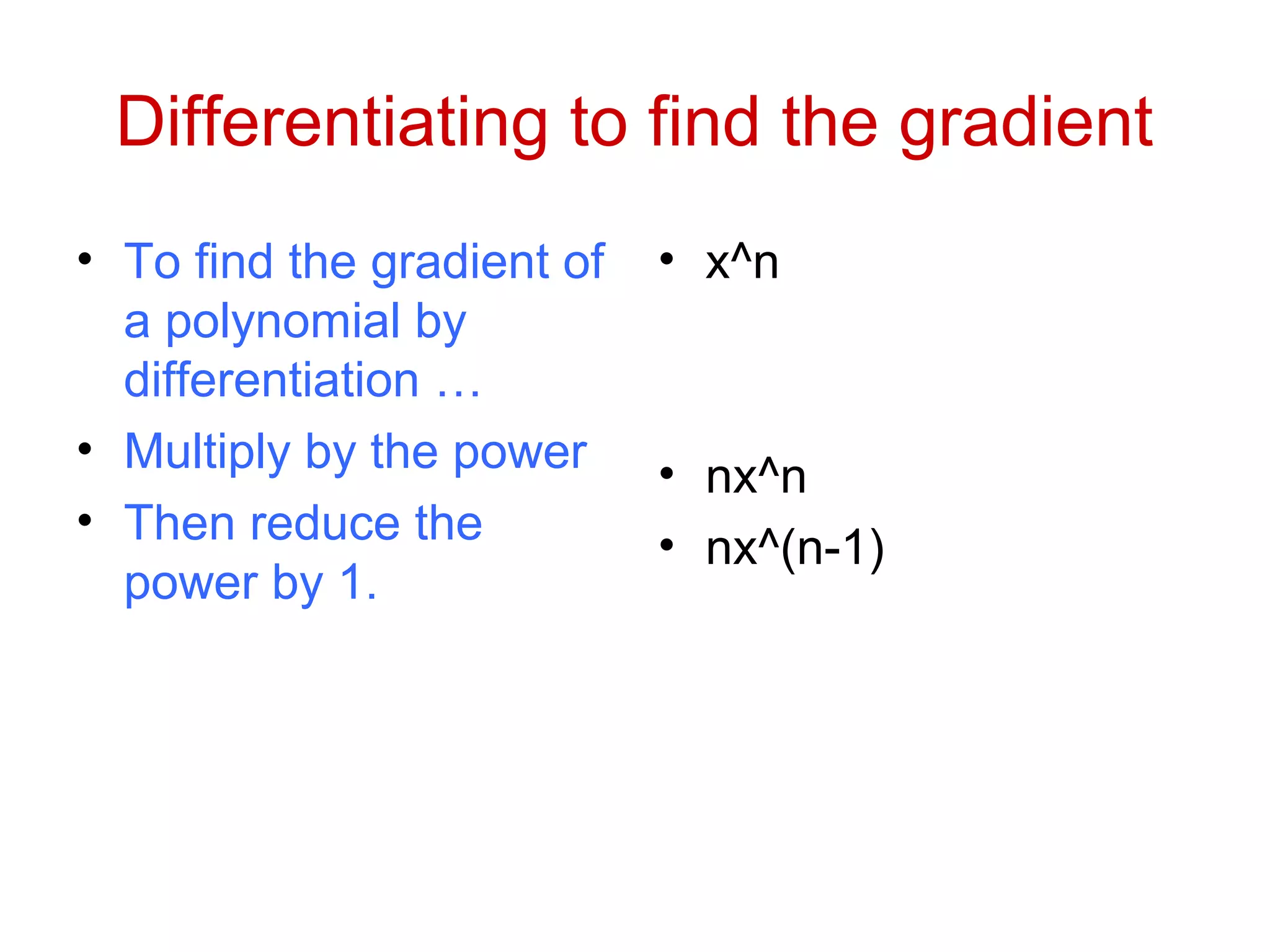
Differentiating to find the gradient
• To find the gradient of
a polynomial by
differentiation …
• Multiply by the power
• Then reduce the
power by 1.
• x^n
• nx^n
• nx^(n-1)
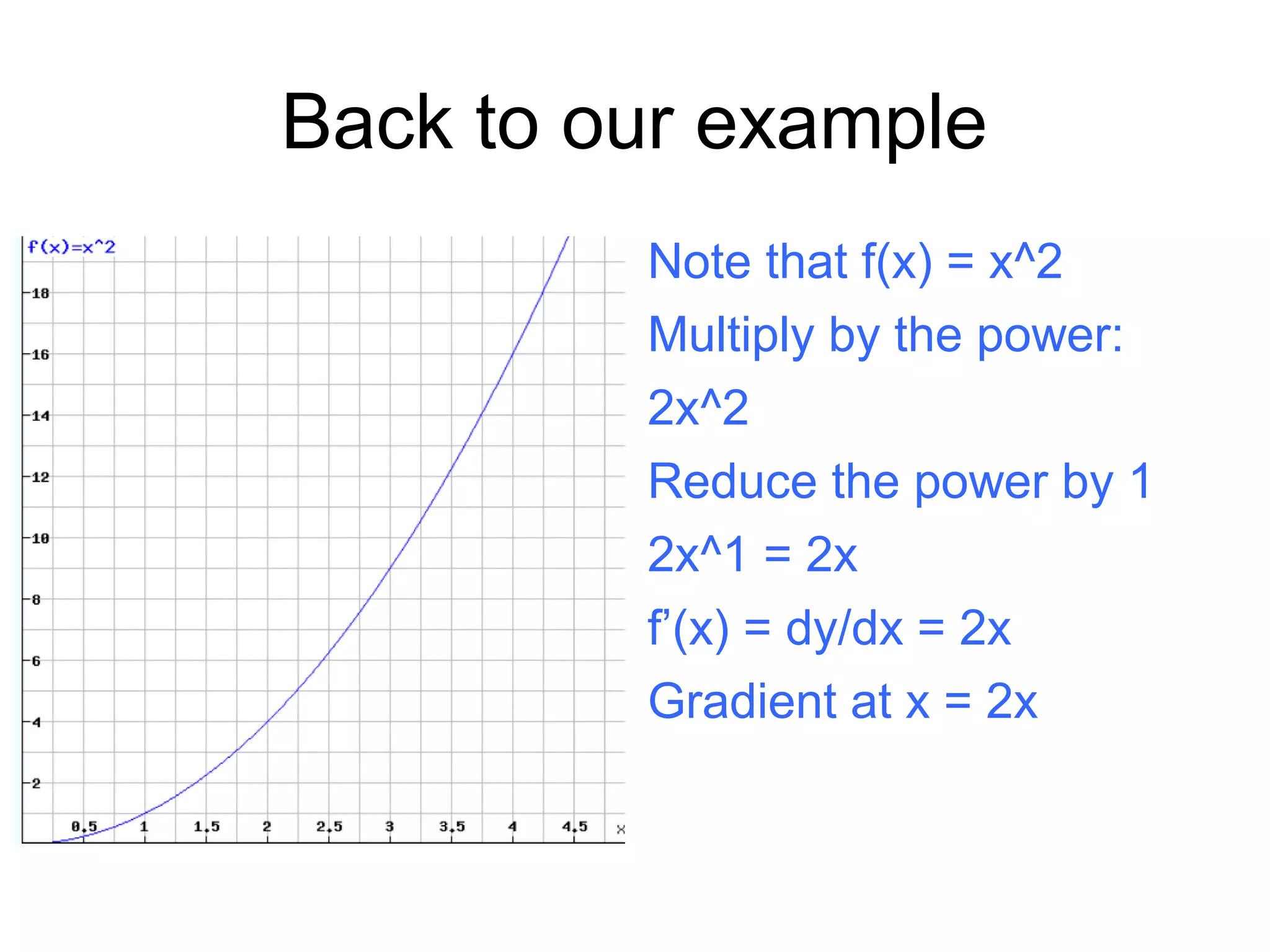
Back to our example
Note that f(x) = x^2
Multiply by the power:
2x^2
Reduce the power by 1
2x^1 = 2x
f’(x) = dy/dx = 2x
Gradient at x = 2x
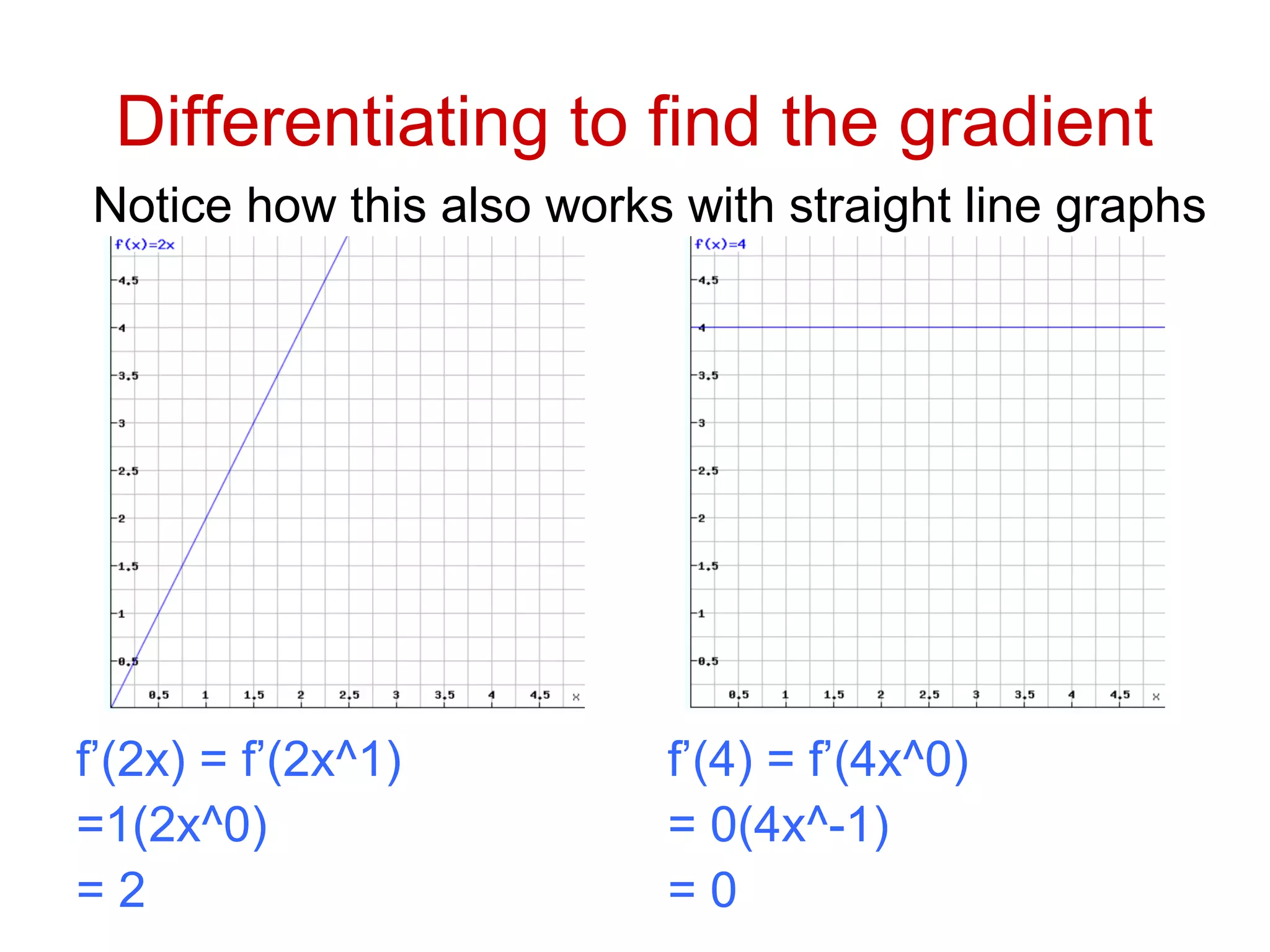
Differentiating to find the gradient
f’(2x) = f’(2x^1)
=1(2x^0)
= 2
Notice how this also works with straight line graphs
f’(4) = f’(4x^0)
= 0(4x^-1)
= 0
Integration (the reverse)
If DIFFERENTIATION seeks to find the rate at
which something changes
INTEGRATION seeks to find the total change that
occurs
For example
A man walks away from his house, and after 2
hours, finds himself 4 km away from his house.
DIFFERENTIATION finds his displacement’s
RATE OF CHANGE to be …
In contrast, a man walks away from his house for 2
hours at a rate of 2km / hr.
INTEGRATION finds his displacement’s TOTAL
CHANGE to be …
For example
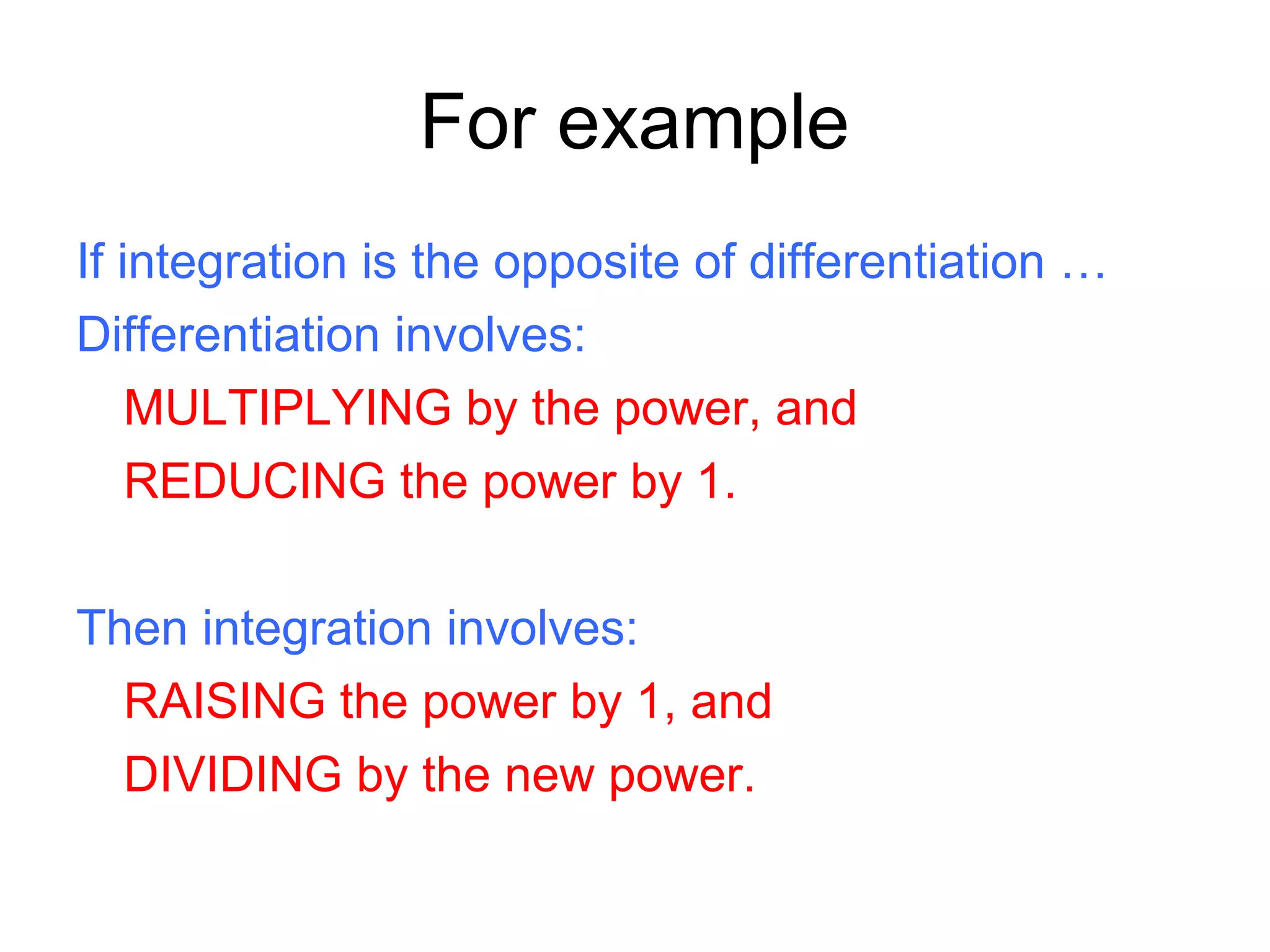
If integration is the opposite of differentiation …
Differentiation involves:
MULTIPLYING by the power, and
REDUCING the power by 1.
Then integration involves:
RAISING the power by 1, and
DIVIDING by the new power.
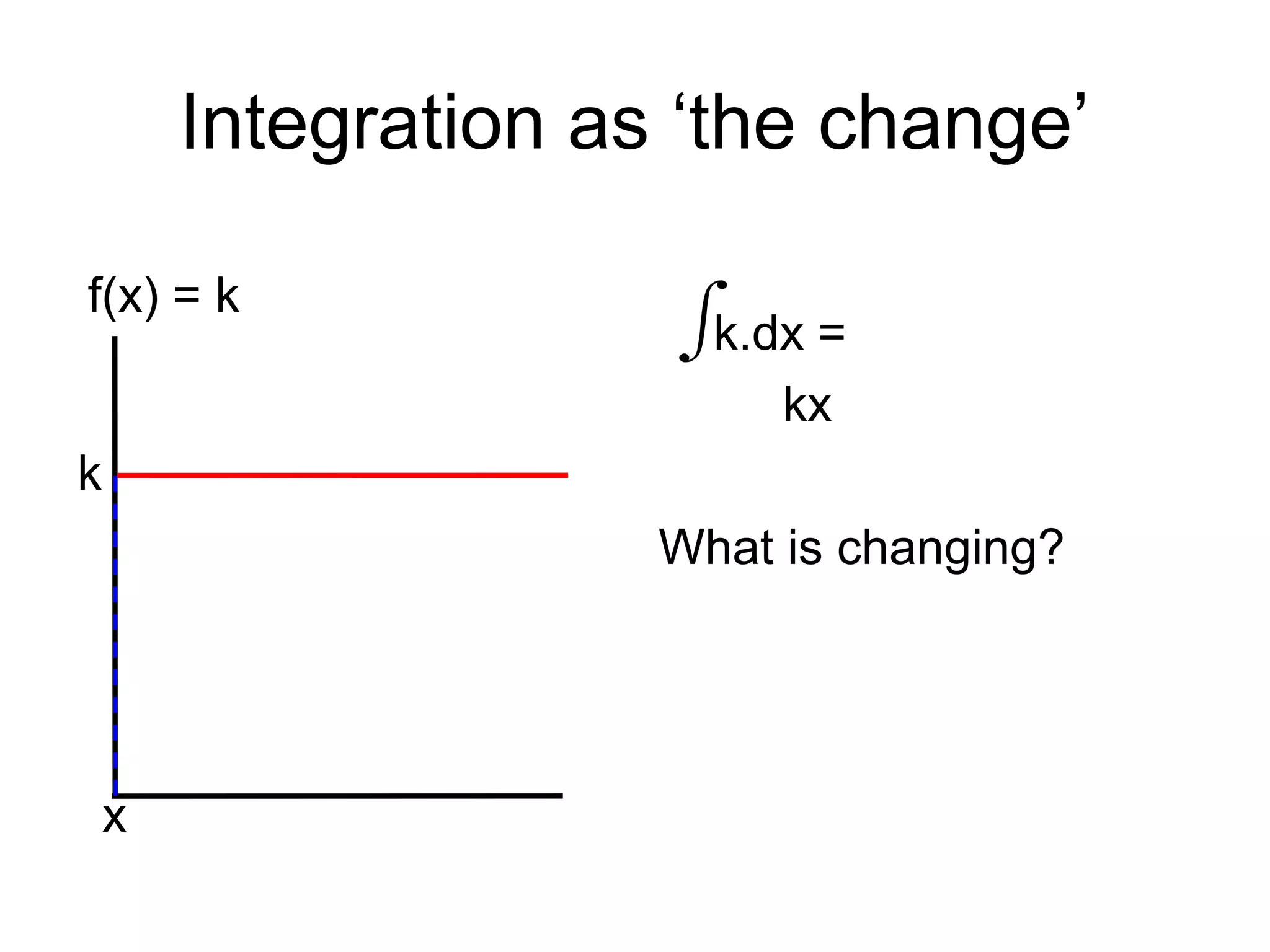
Integration as ‘the change’
k.dx =
kx
What is changing?
f(x) = k
x
k
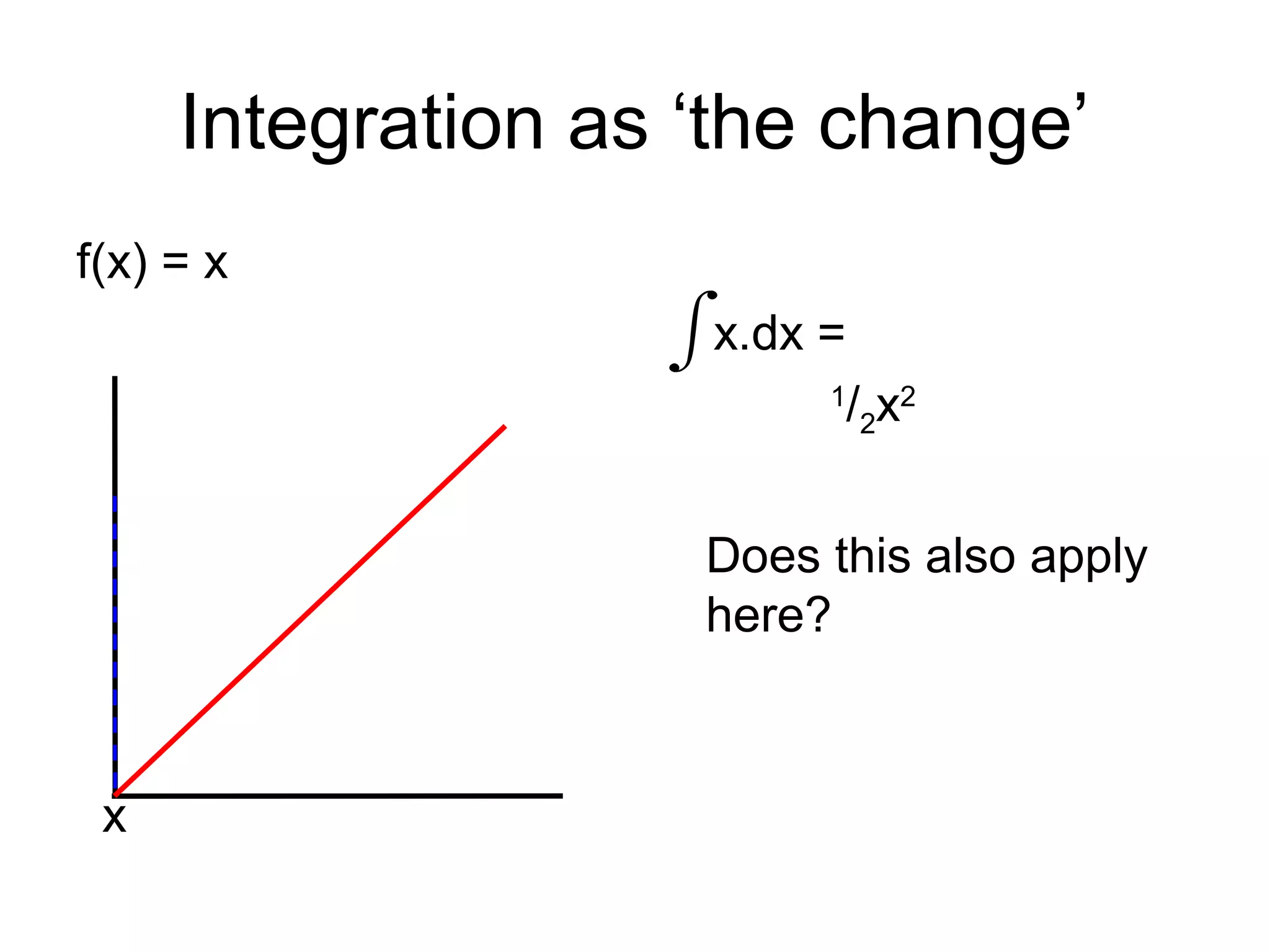
Integration as ‘the change’
f(x) = x
x.dx =
1
/2x2
Does this also apply
here?
x
x
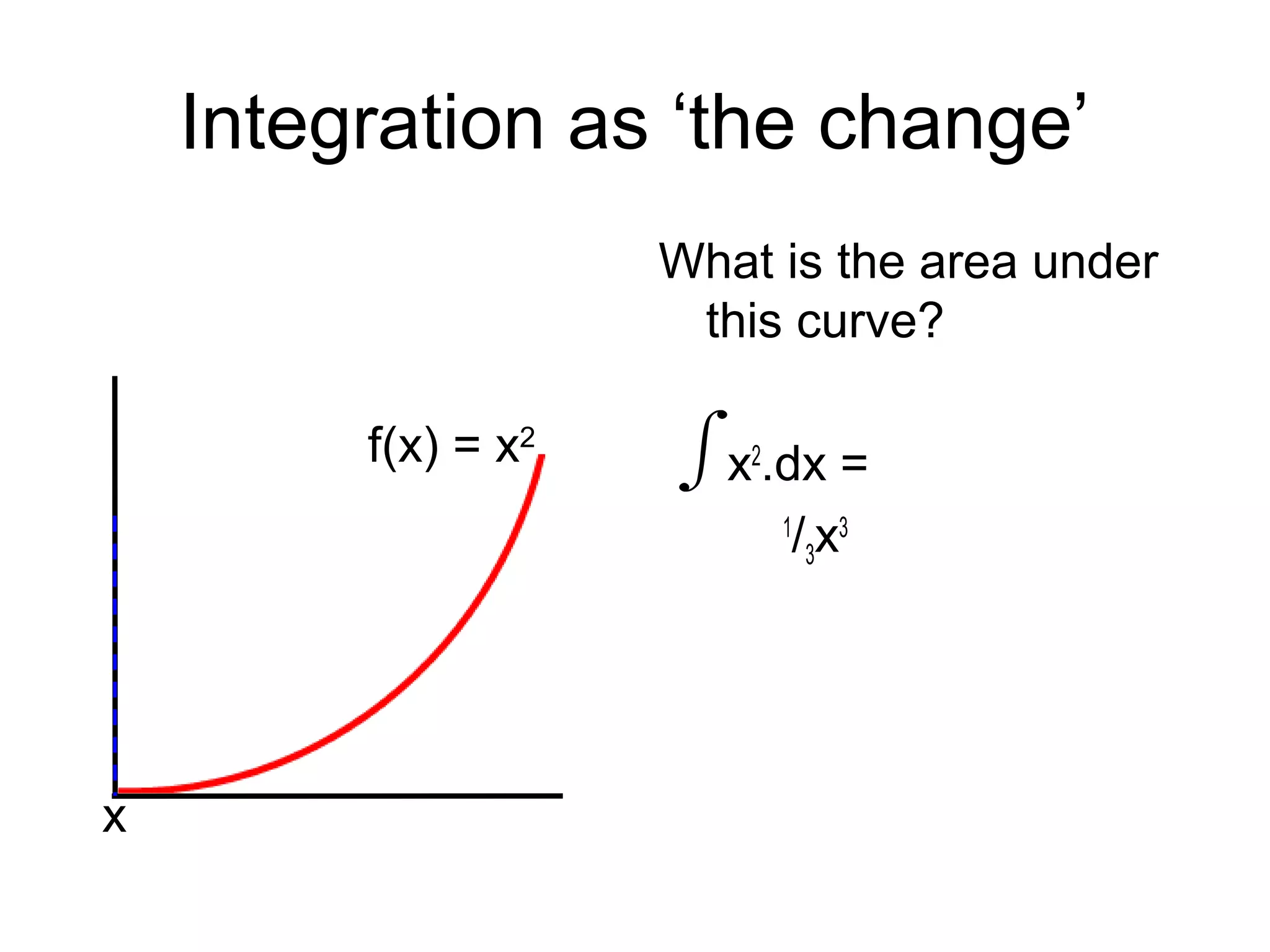
Integration as ‘the change’
What is the area under
this curve?
x2
.dx =
1
/3x3
f(x) = x2

2a. Introduction to Calculus (change)

  • 1.
  • 2.
    Rate of change •Tell me something which … a)Changes b)Doesn't change c)Changes at a constant rate d)Changes slowly / quickly e)Does not change at a constant rate f) Whose rate of change is constant g)Whose rate of change is not constant
  • 3.
    Gradient as ‘rateof change’ f(x) = k How quickly does the height of this line change? It doesn’t Hence …
  • 4.
    Differentiation as ‘rateof change’ What can you say about: f’(x)? [the rate of change of f(x)?] f’’(x)? [the rate of change of f’(x)?] f(x) = kx g(x) = jx
  • 5.
    Differentiation as ‘rateof change’ f(x) = kx2 For each curve, what can you say about: • f’(x)? • f’’(x)? • f’’’(x)?
  • 6.
    Rate of Change x f(x)= x2 f ’(x) = 2x f ’’(x) = 2 f ’’’(x) = 0 1 2 3 4 5 6 7 8 9 1 4 9 16 25 36 49 64 81 3 5 7 9 11 13 15 17 2 2 2 2 2 2 2 0 0 0 0 0 0
  • 7.
    Finding the gradientof a line What is the gradient of this line? dy/dx = 20 / 2 =10
  • 8.
    Finding the gradientof a curve • How can we find the gradient at a point? (choose a point) • We can draw a tangent • Then find the gradient of the tangent • However, this is not very accurate
  • 9.
    Differentiating to findthe gradient • To find the gradient of a polynomial by differentiation … • Multiply by the power • Then reduce the power by 1. • x^n • nx^n • nx^(n-1)
  • 10.
    Back to ourexample Note that f(x) = x^2 Multiply by the power: 2x^2 Reduce the power by 1 2x^1 = 2x f’(x) = dy/dx = 2x Gradient at x = 2x
  • 11.
    Differentiating to findthe gradient f’(2x) = f’(2x^1) =1(2x^0) = 2 Notice how this also works with straight line graphs f’(4) = f’(4x^0) = 0(4x^-1) = 0
  • 12.
    Integration (the reverse) IfDIFFERENTIATION seeks to find the rate at which something changes INTEGRATION seeks to find the total change that occurs
  • 13.
    For example A manwalks away from his house, and after 2 hours, finds himself 4 km away from his house. DIFFERENTIATION finds his displacement’s RATE OF CHANGE to be … In contrast, a man walks away from his house for 2 hours at a rate of 2km / hr. INTEGRATION finds his displacement’s TOTAL CHANGE to be …
  • 14.
    For example If integrationis the opposite of differentiation … Differentiation involves: MULTIPLYING by the power, and REDUCING the power by 1. Then integration involves: RAISING the power by 1, and DIVIDING by the new power.
  • 15.
    Integration as ‘thechange’ k.dx = kx What is changing? f(x) = k x k
  • 16.
    Integration as ‘thechange’ f(x) = x x.dx = 1 /2x2 Does this also apply here? x
  • 17.
    x Integration as ‘thechange’ What is the area under this curve? x2 .dx = 1 /3x3 f(x) = x2