Presentation Title
VECTOR
1
INTERNATIONAL UNIVERSITY OF
BUSINESS AGRICULTURE
AND TECHNOLOGY (IUBAT)
COURSE NAME - PHY 109
SECTION - A
CONTENT
1. Introduction
2. Importance of vector
3. Properties of vector
4. Types of vector
5. Addition of vector
6. Subtraction of vectors
7. Resolution of a vector
8. Product of vectors
9. Scalar product
10. Scalar product in component from
11. Laws of dot product
12. What is cross product
13. Cross product
2
VECTOR
 Vector is a physical quantity which
have both magnitude and direction.
 Some examples are :
Displacement velocity
acceleration force momentum magnetic
density and
electric intensity.
3
WHY VECTORS ARE IMPORTANT
 Vectors are fundamental in the physical sciences. They can be used to
represent any quantity that has both a magnitude and direction, such
as velocity, the magnitude of which is speed.
4
PROPERTIES OF A VECTOR

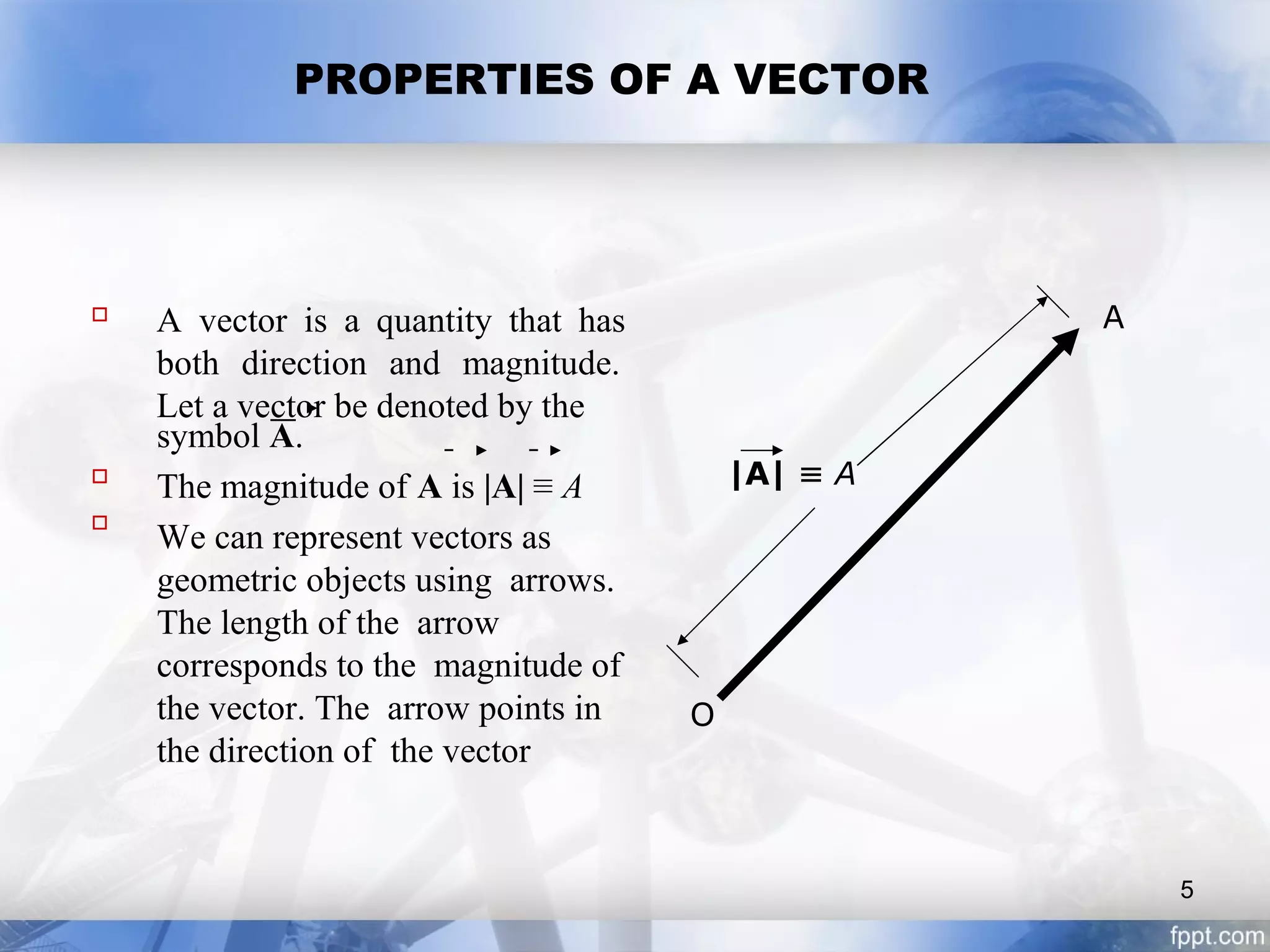
A vector is a quantity that has
both direction and magnitude.
Let a vector be denoted by the


symbol A.
The magnitude of A is |A| ≡ A
We can represent vectors as
geometric objects using arrows.
The length of the arrow
corresponds to the magnitude of
the vector. The arrow points in
the direction of the vector
O
A
|A| ≡ A
5
TYPES OF VECTOR
 Null Vector

Vector with zero
magnitude Position Vector
Vector starting from
origin
Vector starting from anywhere but
origin

Free Vector

Unit Vector

Vector with magnitude of
1 Equal Vectors
 Two vectors equal in magnitude and
direction Opposite Vectors
 Two vectors equal in magnitude but opposite in
direction.
6
ADDITION OF VECTORS
 The addition of two vectors yields another vector known as Resultant
Vector.
 For example if vector A and vector B are added their sum will be equal to
(A+B).
7
SUBTRACTION OF VECTORS
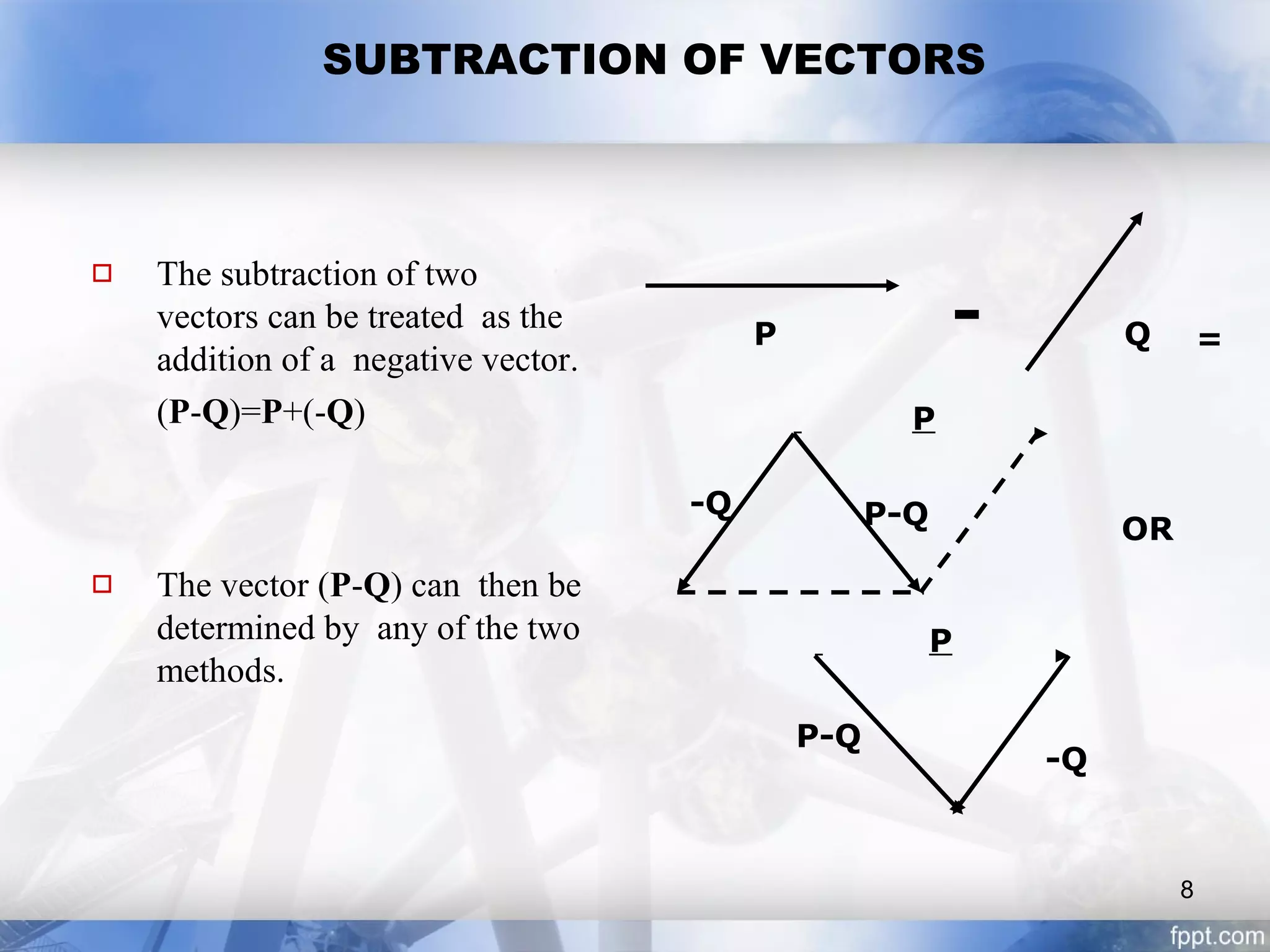
 The subtraction of two
vectors can be treated as the
addition of a negative vector.
(P-Q)=P+(-Q)
 The vector (P-Q) can then be
determined by any of the two
methods.
P Q-
P
-Q
P-Q
P
-Q P-Q
=
OR
8
RESOLUTION OF A VECTOR
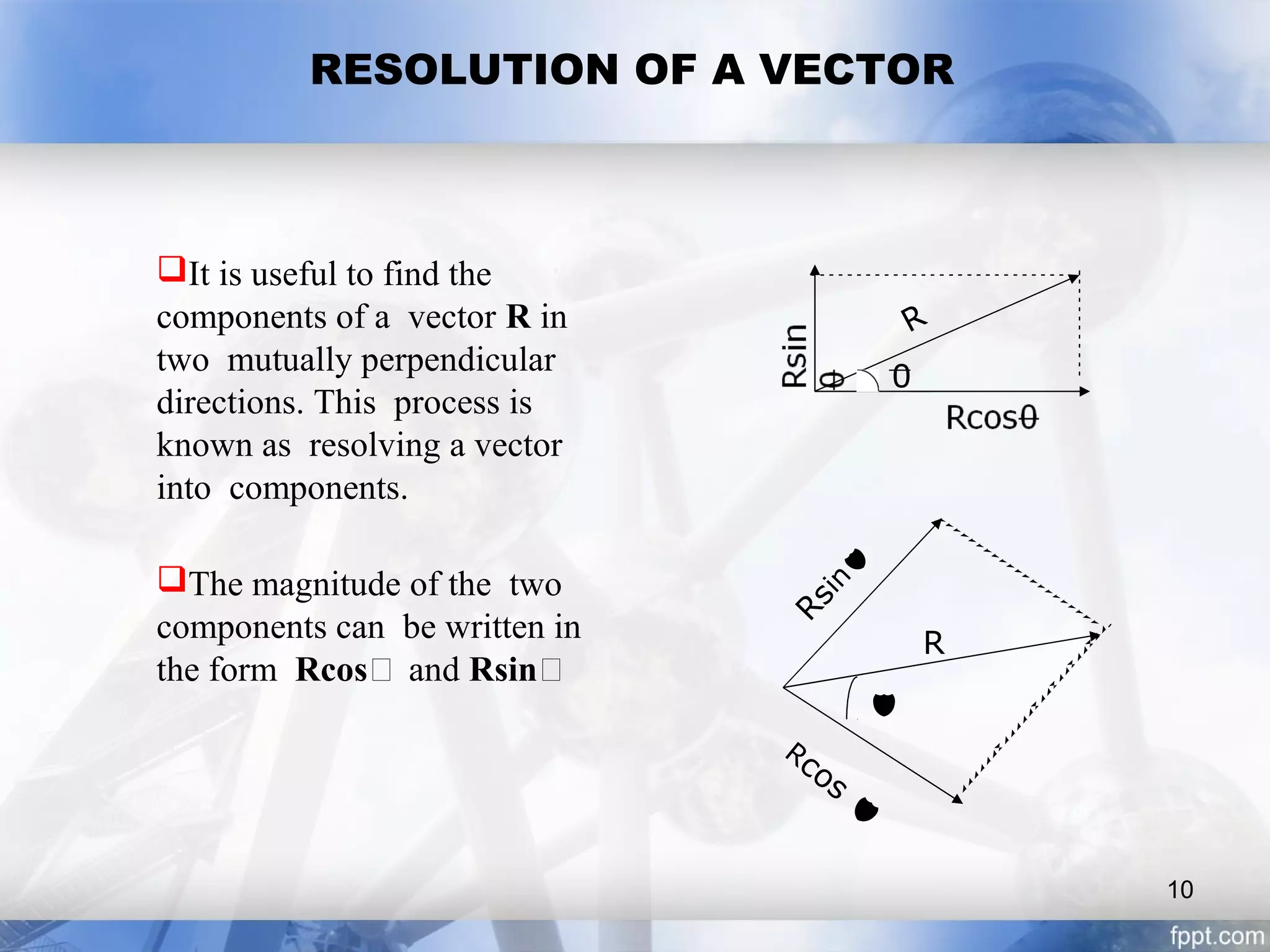
 Vector R could be considered to be the resultant of two vectors.
R=A+B
 Here the vectors A and B are known as the components of vectors.
9
RESOLUTION OF A VECTOR
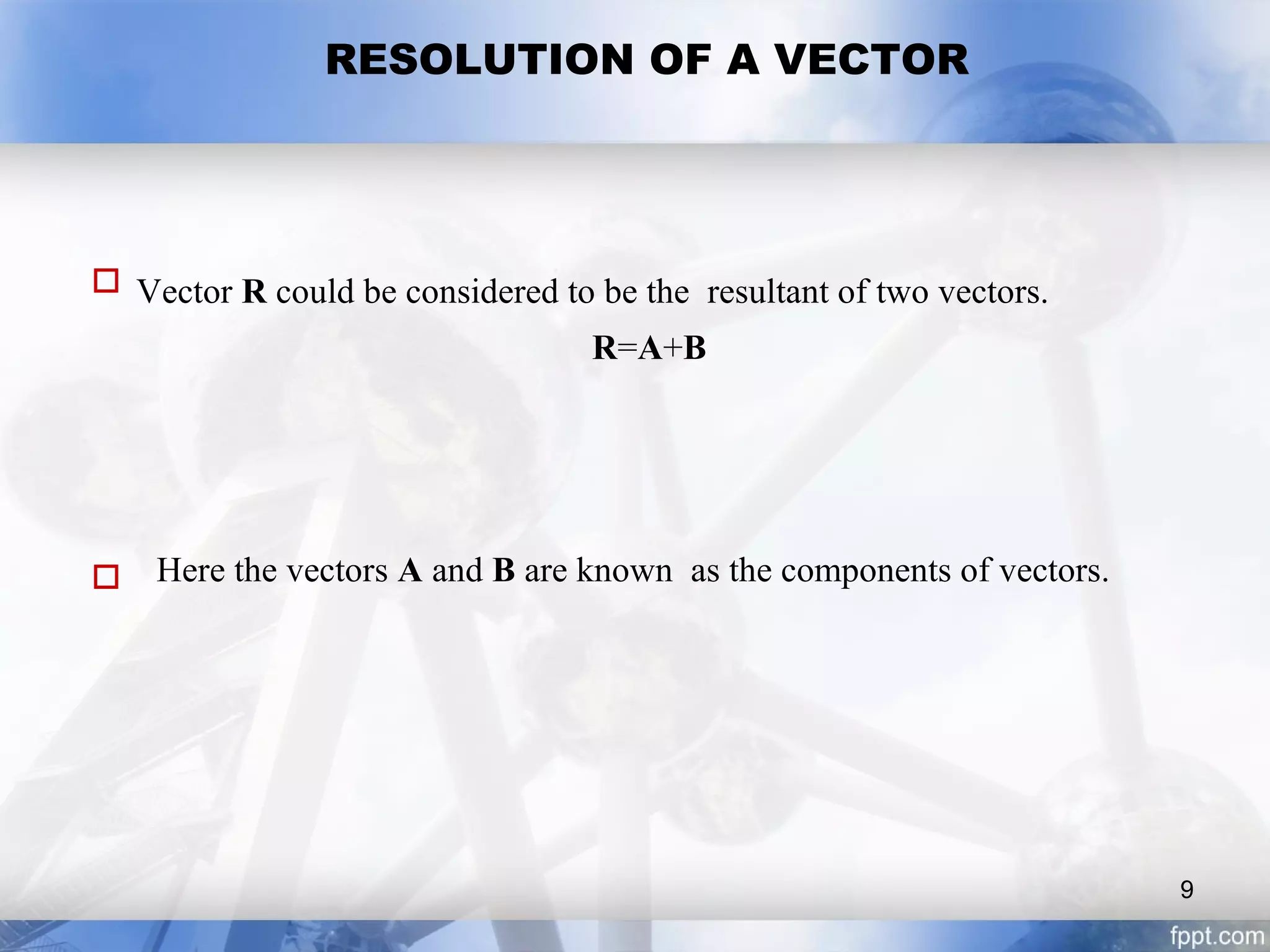
It is useful to find the
components of a vector R in
two mutually perpendicular
directions. This process is
known as resolving a vector
into components.
The magnitude of the two
components can be written in
the form Rcos and Rsin
R
0
R

Rcos
Rsin
10
When vector is multiplied by another vector in some cases a scalar
quantity is obtained whereas in some other cases a vector quantity
obtained .There are two types of product.
Scalar product
Vector product
PRODUCT OF VECTORS
11
SCALAR PRODUCT
LENGTH/MAGNITUDE OF A VECTOR
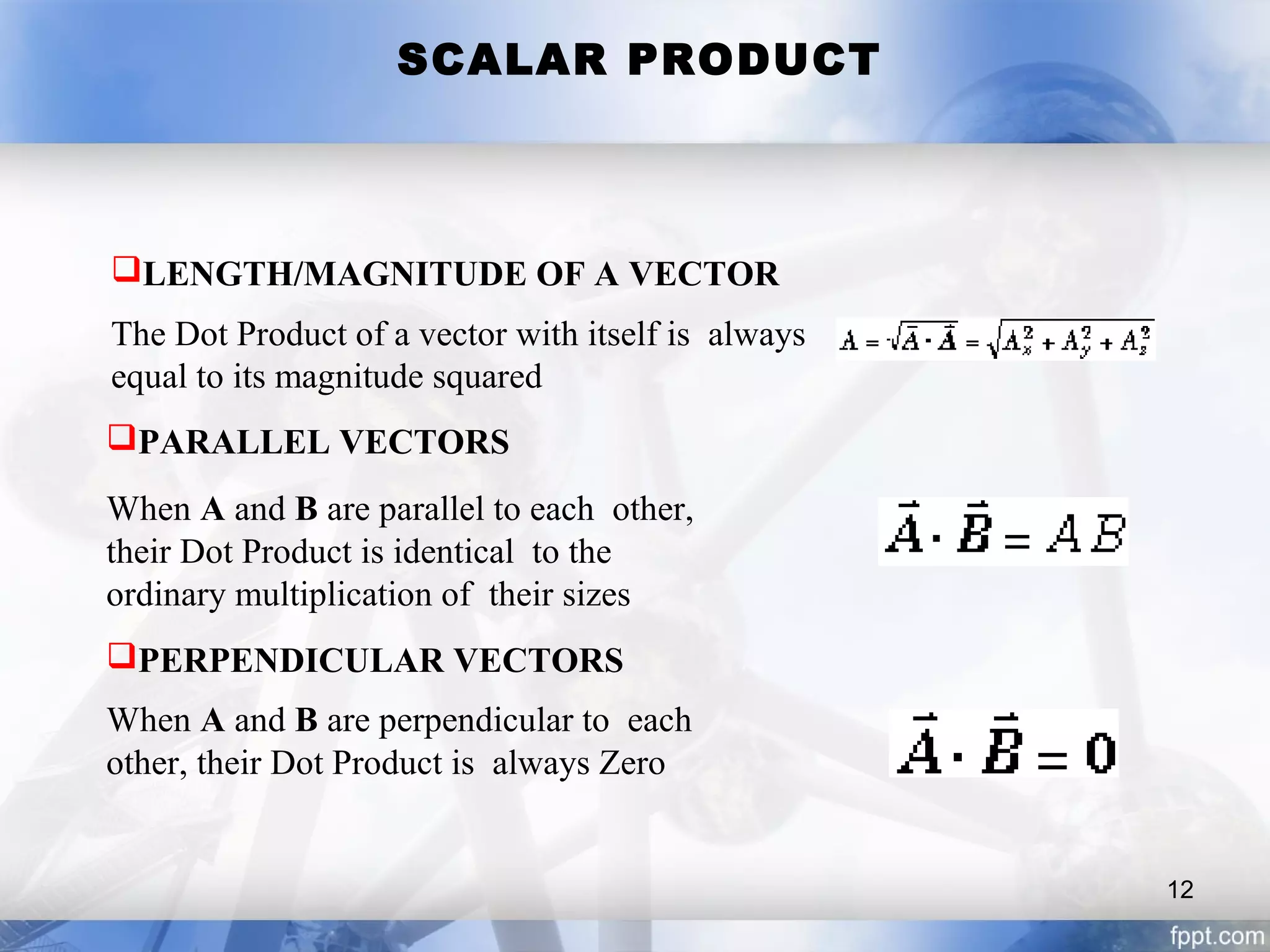
The Dot Product of a vector with itself is always
equal to its magnitude squared
PARALLEL VECTORS
When A and B are parallel to each other,
their Dot Product is identical to the
ordinary multiplication of their sizes
PERPENDICULAR VECTORS
When A and B are perpendicular to each
other, their Dot Product is always Zero
12
SCALAR PRODUCT
 Since i and j and k are all one unit in length and they are all
mutually perpendicular, we have
i. i = j. j = k. k = 1
and i. j = j. i = i. k = k. i
= j. k = k. j = 0.
13
SCALAR PRODUCT IN COMPONENT FORM
Two vectors in component forms are written as
a=axi+ayj+azk b=bxi+byj+bzk
In evaluating the product, we make use of the fact that
multiplication of the same unit vectors is 1, while multiplication of
different unit vectors is zero. The dot product evaluates to scalar
terms as :
a.b=(axi+ayj+azk).(bxi+byj+bzk)
⇒a.b=axi.bxi+ayj.byj+azk.bzk
⇒a.b=axbx+ayby+azbz
14
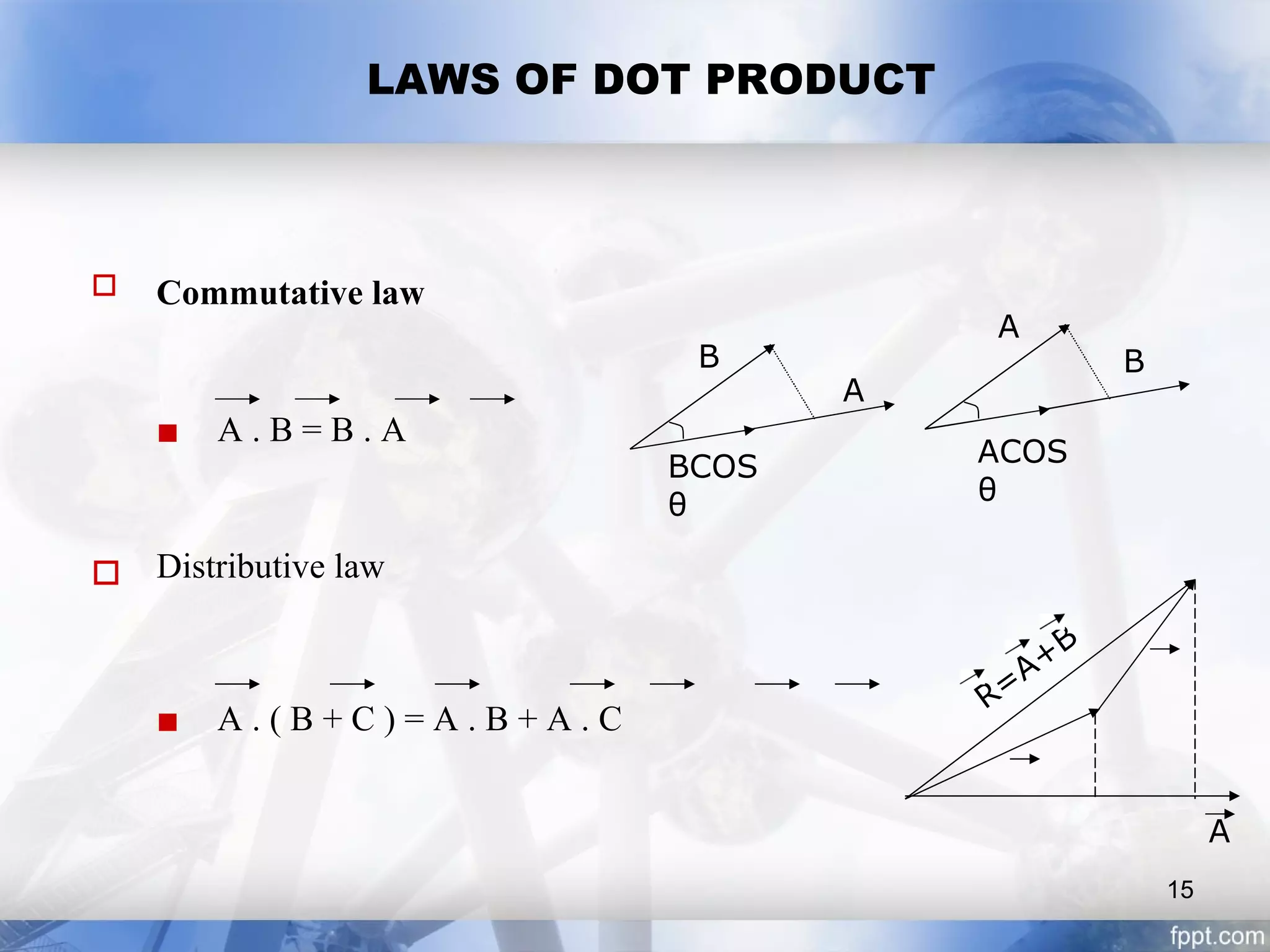
LAWS OF DOT PRODUCT
 Commutative law
 A . B = B . A
 Distributive law
 A . ( B + C ) = A . B + A . C
B
BCOS
θ
A
B
ACOS
θ
A
A
R=A+B
15
WHAT IS CROSS PRODUCT
 In mathematics, the Cross Product is a binary operation on two vectors in thre
dimensional space that results in another vector which is perpendicular to the tw
input vectors.
 However the Dot Product produces a scalar result.
16
CROSS PRODUCT

 The cross product of two vectors a
and b is denoted by a × b.
The cross product is given by the formula :
 Where θ is the measure of the angle between a and b, a and b are
the magnitudes of vectors a and b, and is a unit vector
perpendicular to the plane containing a and b.
17
THE END
18

Vector

  • 1.
    Presentation Title VECTOR 1 INTERNATIONAL UNIVERSITYOF BUSINESS AGRICULTURE AND TECHNOLOGY (IUBAT) COURSE NAME - PHY 109 SECTION - A
  • 2.
    CONTENT 1. Introduction 2. Importanceof vector 3. Properties of vector 4. Types of vector 5. Addition of vector 6. Subtraction of vectors 7. Resolution of a vector 8. Product of vectors 9. Scalar product 10. Scalar product in component from 11. Laws of dot product 12. What is cross product 13. Cross product 2
  • 3.
    VECTOR  Vector isa physical quantity which have both magnitude and direction.  Some examples are : Displacement velocity acceleration force momentum magnetic density and electric intensity. 3
  • 4.
    WHY VECTORS AREIMPORTANT  Vectors are fundamental in the physical sciences. They can be used to represent any quantity that has both a magnitude and direction, such as velocity, the magnitude of which is speed. 4
  • 5.
    PROPERTIES OF AVECTOR  A vector is a quantity that has both direction and magnitude. Let a vector be denoted by the   symbol A. The magnitude of A is |A| ≡ A We can represent vectors as geometric objects using arrows. The length of the arrow corresponds to the magnitude of the vector. The arrow points in the direction of the vector O A |A| ≡ A 5
  • 6.
    TYPES OF VECTOR Null Vector  Vector with zero magnitude Position Vector Vector starting from origin Vector starting from anywhere but origin  Free Vector  Unit Vector  Vector with magnitude of 1 Equal Vectors  Two vectors equal in magnitude and direction Opposite Vectors  Two vectors equal in magnitude but opposite in direction. 6
  • 7.
    ADDITION OF VECTORS The addition of two vectors yields another vector known as Resultant Vector.  For example if vector A and vector B are added their sum will be equal to (A+B). 7
  • 8.
    SUBTRACTION OF VECTORS The subtraction of two vectors can be treated as the addition of a negative vector. (P-Q)=P+(-Q)  The vector (P-Q) can then be determined by any of the two methods. P Q- P -Q P-Q P -Q P-Q = OR 8
  • 9.
    RESOLUTION OF AVECTOR  Vector R could be considered to be the resultant of two vectors. R=A+B  Here the vectors A and B are known as the components of vectors. 9
  • 10.
    RESOLUTION OF AVECTOR It is useful to find the components of a vector R in two mutually perpendicular directions. This process is known as resolving a vector into components. The magnitude of the two components can be written in the form Rcos and Rsin R 0 R  Rcos Rsin 10
  • 11.
    When vector ismultiplied by another vector in some cases a scalar quantity is obtained whereas in some other cases a vector quantity obtained .There are two types of product. Scalar product Vector product PRODUCT OF VECTORS 11
  • 12.
    SCALAR PRODUCT LENGTH/MAGNITUDE OFA VECTOR The Dot Product of a vector with itself is always equal to its magnitude squared PARALLEL VECTORS When A and B are parallel to each other, their Dot Product is identical to the ordinary multiplication of their sizes PERPENDICULAR VECTORS When A and B are perpendicular to each other, their Dot Product is always Zero 12
  • 13.
    SCALAR PRODUCT  Sincei and j and k are all one unit in length and they are all mutually perpendicular, we have i. i = j. j = k. k = 1 and i. j = j. i = i. k = k. i = j. k = k. j = 0. 13
  • 14.
    SCALAR PRODUCT INCOMPONENT FORM Two vectors in component forms are written as a=axi+ayj+azk b=bxi+byj+bzk In evaluating the product, we make use of the fact that multiplication of the same unit vectors is 1, while multiplication of different unit vectors is zero. The dot product evaluates to scalar terms as : a.b=(axi+ayj+azk).(bxi+byj+bzk) ⇒a.b=axi.bxi+ayj.byj+azk.bzk ⇒a.b=axbx+ayby+azbz 14
  • 15.
    LAWS OF DOTPRODUCT  Commutative law  A . B = B . A  Distributive law  A . ( B + C ) = A . B + A . C B BCOS θ A B ACOS θ A A R=A+B 15
  • 16.
    WHAT IS CROSSPRODUCT  In mathematics, the Cross Product is a binary operation on two vectors in thre dimensional space that results in another vector which is perpendicular to the tw input vectors.  However the Dot Product produces a scalar result. 16
  • 17.
    CROSS PRODUCT   Thecross product of two vectors a and b is denoted by a × b. The cross product is given by the formula :  Where θ is the measure of the angle between a and b, a and b are the magnitudes of vectors a and b, and is a unit vector perpendicular to the plane containing a and b. 17
  • 18.