Qwertyuiopasdfghjklzxcvbnmqwe
rtyuiopasdfghjklzxcvbnmqwertyui
opasdfghjklzxcvbnmqwertyuiopas
dfghjklzxcvbnmqwertyuiopasdfghj
klzxcvbnmqwertyuiopasdfghjklzxc
vbnmqwertyuiopasdfghjklzxcvbn
mqwertyuiopasdfghjklzxcvbnmqw
ertyuiopasdfghjklzxcvbnmqwerty
uiopasdfghjklzxcvbnmqwertyuiop
asdfghjklzxcvbnmqwertyuiopasdf
ghjklzxcvbnmqwertyuiopasdfghjkl
zxcvbnmqwerty[uioSubmitted by
xcxcvblzxcvbnmqwerShivam Rathi
rstyuiopasdfgghjklzxcvbnmqXI B2
Physics Investigatory Project
2014-15
I'd like to express my greatest gratitude to the people who
have helped & supported me throughout my project. I’ m
grateful to my Physics Teacher Mr. Chhotelal Gupta for his
continuous support for the project, from initial advice &
encouragement to this day. Special thanks of mine goes to
my colleagues who helped me in completing the project by
giving interesting ideas, thoughts & made this project easy
and accurate.
____________
Shivam Rathi





Vectors
Content
1. Introduction
2. Representation of Vectors
3. Addition and Subtraction of Vectors
4. Resolution of vector
(i ) Rectangular Component
(ii) 3-D resolution of vector
5. Unit Vector
6. Multiplication of Vector
( i ) Dot Product
(ii) Cross Product
Introduction
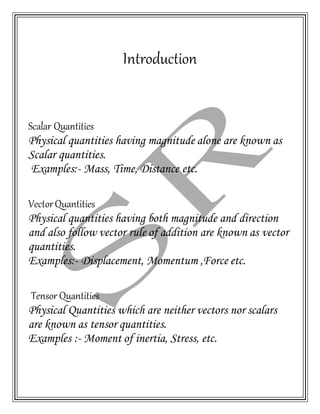
Scalar Quantities
Physical quantities having magnitude alone are known as
Scalar quantities.
Examples:- Mass, Time, Distance etc.
VectorQuantities
Physical quantities having both magnitude and direction
and also follow vector rule of addition are known as vector
quantities.
Examples:- Displacement, Momentum ,Force etc.
Tensor Quantities
Physical Quantities which are neither vectors nor scalars
are known as tensor quantities.
Examples :- Moment of inertia, Stress, etc.
Note:- Some quantities like area, length, angular velocity,
etc. are treated as both scalars as well as vectors.
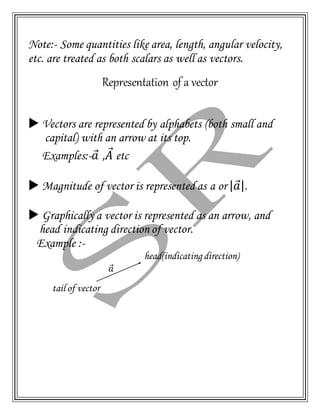
Representation of a vector
 Vectors are represented by alphabets (both small and
capital) with an arrow at its top.
Examples:-𝑎⃗ ,𝐴⃗ etc
 Magnitude of vector is represented as a or | 𝑎⃗|.
 Graphically a vector is represented as an arrow, and
head indicating direction of vector.
Example :-
head(indicating direction)
𝑎⃗
tail of vector
Addition of vectors
Graphical Law
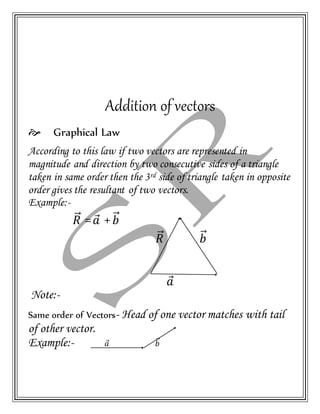
According to this law if two vectors are represented in
magnitude and direction by two consecutive sides of a triangle
taken in same order then the 3rd side of triangle taken in opposite
order gives the resultant of two vectors.
Example:-
𝑅⃗⃗ = 𝑎⃗ + 𝑏⃗⃗
𝑅⃗⃗ 𝑏⃗⃗
𝑎⃗
Note:-
Same order of Vectors- Head of one vector matches with tail
of other vector.
Example:- 𝑎⃗ 𝑏⃗⃗
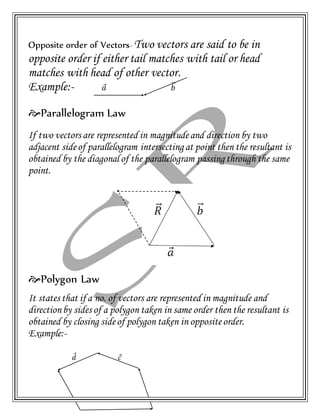
Opposite order of Vectors- Two vectors are said to be in
opposite order if either tail matches with tail or head
matches with head of other vector.
Example:- 𝑎⃗ 𝑏⃗⃗
Parallelogram Law
If two vectors are represented in magnitudeand direction by two
adjacent sideof parallelogram intersecting at point then the resultant is
obtained by the diagonal of the parallelogram passing through the same
point.
Polygon Law
It states that if a no. of vectors are represented in magnitude and
directionby sides of a polygon taken in same order then the resultant is
obtained by closing sideof polygon taken in oppositeorder.
Example:-
𝑑⃗ 𝑐⃗
𝑅⃗⃗ 𝑏⃗⃗
𝑎⃗
𝑅⃗⃗=𝑎⃗+𝑏⃗⃗+𝑐⃗+𝑑⃗
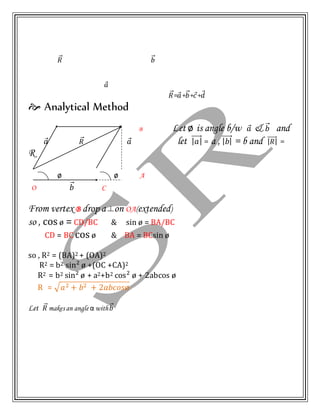
 Analytical Method
B Let ø is angle b/w 𝑎⃗ & 𝑏⃗⃗ and
𝑎⃗ 𝑅⃗⃗ 𝑎⃗ let | 𝑎|⃗⃗⃗⃗⃗⃗ = a , | 𝑏|⃗⃗⃗⃗⃗⃗ = b and | 𝑅|⃗⃗⃗⃗⃗⃗ =
R
ø ø A
O 𝑏⃗⃗ C
From vertex B drop a on OA(extended)
so , cos ø = CD/BC & sin ø = BA/BC
CD = BC cos ø & BA = BCsin ø
so , R2 = (BA)2 + (OA)2
R2 = b2 sin2
ø +(OC +CA)2
R2 = b2 sin2
ø + a2+b2 cos2
ø + 2abcos ø
R = √ 𝑎2 + 𝑏2 + 2𝑎𝑏𝑐𝑜𝑠ø
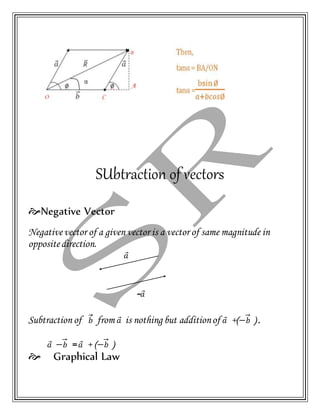
Let 𝑅⃗⃗ makes an angle α with 𝑏⃗⃗
SUbtraction of vectors
Negative Vector
Negativevector of a given vector is a vector of same magnitude in
oppositedirection.
𝑎⃗
- 𝑎⃗
Subtraction of 𝑏⃗ from 𝑎⃗ is nothing but additionof 𝑎⃗ +(− 𝑏⃗⃗ ) .
𝑎⃗ − 𝑏⃗⃗ = 𝑎⃗ + (− 𝑏⃗⃗ )
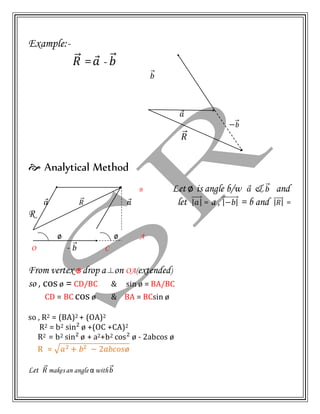
Graphical Law
Example:-
𝑅⃗⃗ = 𝑎⃗ - 𝑏⃗⃗
𝑏⃗⃗
𝑎⃗
− 𝑏⃗⃗
𝑅⃗⃗
 Analytical Method
B Let ø is angle b/w 𝑎⃗ & 𝑏⃗⃗ and
𝑎⃗ 𝑅⃗⃗ 𝑎⃗ let | 𝑎|⃗⃗⃗⃗⃗⃗ = a , |−𝑏|⃗⃗⃗⃗⃗⃗⃗⃗⃗⃗ = b and | 𝑅|⃗⃗⃗⃗⃗⃗ =
R
ø ø A
O - 𝑏⃗⃗ C
From vertex B drop a on OA(extended)
so , cos ø = CD/BC & sin ø = BA/BC
CD = BC cos ø & BA = BCsin ø
so , R2 = (BA)2 + (OA)2
R2 = b2 sin2
ø +(OC +CA)2
R2 = b2 sin2
ø + a2+b2 cos2
ø - 2abcos ø
R = √ 𝑎2 + 𝑏2 − 2𝑎𝑏𝑐𝑜𝑠ø
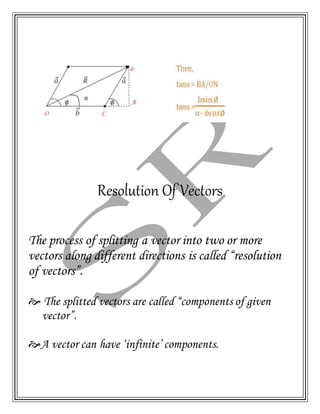
Let 𝑅⃗⃗ makes an angle α with 𝑏⃗⃗
Resolution Of Vectors
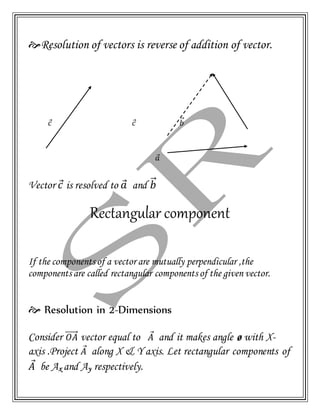
The process of splitting a vector into two or more
vectors along different directions is called “resolution
of vectors”.
 The splitted vectors are called “components of given
vector”.
A vector can have ‘infinite’ components.
Resolution of vectors is reverse of addition of vector.
𝑐⃗ 𝑐⃗ 𝑏⃗⃗
𝑎⃗
Vector 𝑐⃗ is resolved to 𝑎⃗ and 𝑏⃗⃗
Rectangular component
If the components of a vector are mutually perpendicular ,the
components are called rectangular components of the given vector.
 Resolution in 2-Dimensions
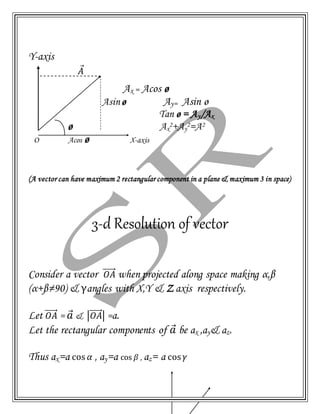
Consider 𝑂𝐴⃗⃗⃗⃗⃗⃗ vector equal to 𝐴⃗ and it makes angle ø with X-
axis .Project 𝐴⃗ along X & Y axis. Let rectangular components of
𝐴⃗ be Ax and Ay respectively.
Y-axis
𝐴⃗
Ax = Acos ø
Asinø Ay= Asin ø
Tan ø = Ay/Ax
ø Ax
2+Ay
2=A2
O Acos ø X-axis
(A vector can have maximum 2 rectangular component in a plane & maximum 3 in space)
3-d Resolution of vector
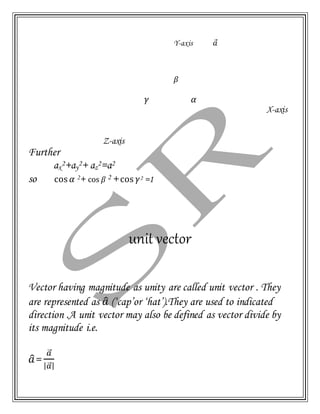
Consider a vector 𝑂𝐴⃗⃗⃗⃗⃗⃗ when projected along space making α,β
(α+β≠90) & γangles with X,Y & Z axis respectively.
Let 𝑂𝐴⃗⃗⃗⃗⃗⃗ = 𝑎⃗ & |𝑂𝐴⃗⃗⃗⃗⃗⃗| =a.
Let the rectangular components of 𝑎⃗ be ax ,ay& az.
Thus ax=a cos 𝛼 , ay=a cos 𝛽 , az= a cos 𝛾
Y-axis 𝑎⃗
𝛽
𝛾 𝛼
X-axis
Z-axis
Further
ax
2+ay
2+ az
2=a2
so cos 𝛼 2+ cos 𝛽 2 + cos 𝛾2 =1
unit vector
Vector having magnitude as unity are called unit vector . They
are represented as 𝑎̂ (‘cap’or ‘hat’).They are used to indicated
direction .A unit vector may also be defined as vector divide by
its magnitude i.e.
𝑎̂=
𝑎⃗⃗
| 𝑎⃗⃗|
Orthogonal Unit Vectors
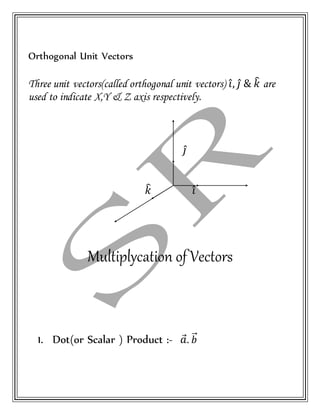
Three unit vectors(called orthogonal unit vectors) 𝑖̂, 𝑗̂ & 𝑘̂ are
used to indicate X,Y & Z axis respectively.
𝑗̂
𝑘̂ 𝑖̂
Multiplycation of Vectors
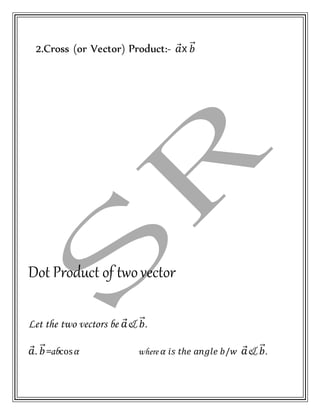
1. Dot(or Scalar ) Product :- 𝑎⃗. 𝑏⃗⃗
2.Cross (or Vector) Product:- 𝑎⃗x 𝑏⃗⃗
Dot Product of twovector
Let the two vectors be 𝑎⃗& 𝑏⃗⃗.
𝑎⃗. 𝑏⃗⃗=abcos 𝛼 where 𝛼 𝑖𝑠 𝑡ℎ𝑒 𝑎𝑛𝑔𝑙𝑒 𝑏/𝑤 𝑎⃗& 𝑏⃗⃗.
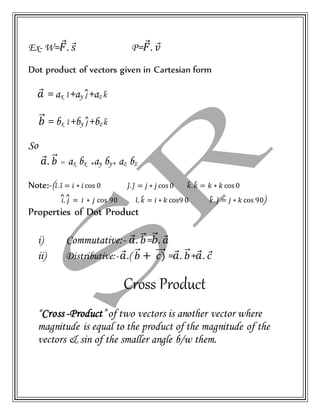
Ex- W= 𝐹⃗. 𝑠⃗ P= 𝐹⃗. 𝑣⃗
Dot product of vectors given in Cartesian form
𝑎⃗ = ax 𝑖̂+ay 𝑗̂+az 𝑘̂
𝑏⃗⃗ = bx 𝑖̂+by 𝑗̂+bz 𝑘̂
So
𝑎⃗. 𝑏⃗⃗ = ax bx +ay by+ az bz
Note:-(𝑖̂. 𝑖̂ = 𝑖 ∗ 𝑖 cos 0 𝑗̂. 𝑗̂ = 𝑗 ∗ 𝑗 cos 0 𝑘̂. 𝑘̂ = 𝑘 ∗ 𝑘 cos 0
𝑖̂. 𝑗̂ = 𝑖 ∗ 𝑗 cos 90 𝑖̂. 𝑘̂ = 𝑖 ∗ 𝑘 cos9 0 𝑘̂. 𝑗̂ = 𝑗 ∗ 𝑘 cos 90)
Properties of Dot Product
i) Commutative:- 𝑎⃗. 𝑏⃗⃗= 𝑏⃗⃗. 𝑎⃗
ii) Distributive:- 𝑎⃗.( 𝑏⃗⃗ + 𝑐)⃗⃗⃗⃗ = 𝑎⃗. 𝑏⃗⃗+ 𝑎⃗. 𝑐⃗
Cross Product
“Cross -Product”of two vectors is another vector where
magnitude is equal to the product of the magnitude of the
vectors & sin of the smaller angle b/w them.
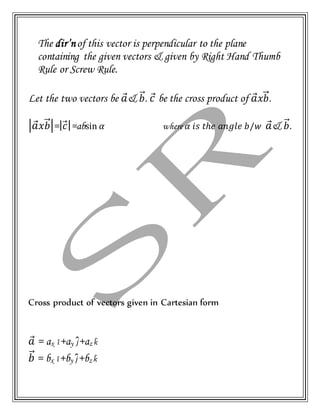
The dir’nof this vector is perpendicular to the plane
containing the given vectors & given by Right Hand Thumb
Rule or Screw Rule.
Let the two vectors be 𝑎⃗& 𝑏⃗⃗. 𝑐⃗ be the cross product of 𝑎⃗ 𝑥𝑏⃗⃗.
|𝑎⃗ 𝑥𝑏⃗⃗|=| 𝑐⃗|=absin 𝛼 where 𝛼 𝑖𝑠 𝑡ℎ𝑒 𝑎𝑛𝑔𝑙𝑒 𝑏/𝑤 𝑎⃗& 𝑏⃗⃗.
Cross product of vectors given in Cartesian form
𝑎⃗ = ax 𝑖̂+ay 𝑗̂+az 𝑘̂
𝑏⃗⃗ = bx 𝑖̂+by 𝑗̂+bz 𝑘̂
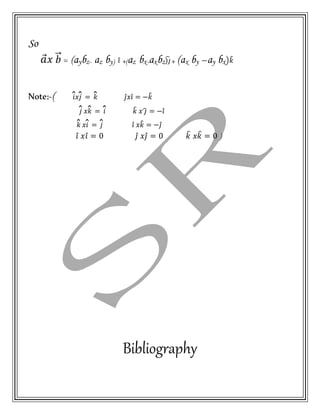
So
𝑎⃗ 𝑥 𝑏⃗⃗ = (aybz- az by) 𝑖̂ +(az bx-axbz)𝑗̂+ (ax by –ay bx) 𝑘̂
Note:-( 𝑖̂𝑥 𝑗̂ = 𝑘̂ 𝑗̂ 𝑥 𝑖̂ = −𝑘̂
𝑗̂ 𝑥𝑘̂ = 𝑖̂ 𝑘̂ 𝑥 𝑗̂ = −𝑖̂
𝑘̂ 𝑥𝑖̂ = 𝑗̂ 𝑖̂ 𝑥𝑘̂ = −𝑗̂
𝑖̂ 𝑥𝑖̂ = 0 𝑗̂ 𝑥𝑗̂ = 0 𝑘̂ 𝑥𝑘̂ = 0 )
Bibliography
 WWW.GOOGLE.com
 www.wikipedia.com
 www.ncert.nic.in/ncerts/textbook/textbook.htm

Notes on vectors

  • 1.
  • 2.
    I'd like toexpress my greatest gratitude to the people who have helped & supported me throughout my project. I’ m grateful to my Physics Teacher Mr. Chhotelal Gupta for his continuous support for the project, from initial advice & encouragement to this day. Special thanks of mine goes to my colleagues who helped me in completing the project by giving interesting ideas, thoughts & made this project easy and accurate. ____________ Shivam Rathi  
  • 3.
  • 4.
    Content 1. Introduction 2. Representationof Vectors 3. Addition and Subtraction of Vectors 4. Resolution of vector (i ) Rectangular Component (ii) 3-D resolution of vector 5. Unit Vector 6. Multiplication of Vector ( i ) Dot Product (ii) Cross Product
  • 5.
    Introduction Scalar Quantities Physical quantitieshaving magnitude alone are known as Scalar quantities. Examples:- Mass, Time, Distance etc. VectorQuantities Physical quantities having both magnitude and direction and also follow vector rule of addition are known as vector quantities. Examples:- Displacement, Momentum ,Force etc. Tensor Quantities Physical Quantities which are neither vectors nor scalars are known as tensor quantities. Examples :- Moment of inertia, Stress, etc.
  • 6.
    Note:- Some quantitieslike area, length, angular velocity, etc. are treated as both scalars as well as vectors. Representation of a vector  Vectors are represented by alphabets (both small and capital) with an arrow at its top. Examples:-𝑎⃗ ,𝐴⃗ etc  Magnitude of vector is represented as a or | 𝑎⃗|.  Graphically a vector is represented as an arrow, and head indicating direction of vector. Example :- head(indicating direction) 𝑎⃗ tail of vector
  • 7.
    Addition of vectors GraphicalLaw According to this law if two vectors are represented in magnitude and direction by two consecutive sides of a triangle taken in same order then the 3rd side of triangle taken in opposite order gives the resultant of two vectors. Example:- 𝑅⃗⃗ = 𝑎⃗ + 𝑏⃗⃗ 𝑅⃗⃗ 𝑏⃗⃗ 𝑎⃗ Note:- Same order of Vectors- Head of one vector matches with tail of other vector. Example:- 𝑎⃗ 𝑏⃗⃗
  • 8.
    Opposite order ofVectors- Two vectors are said to be in opposite order if either tail matches with tail or head matches with head of other vector. Example:- 𝑎⃗ 𝑏⃗⃗ Parallelogram Law If two vectors are represented in magnitudeand direction by two adjacent sideof parallelogram intersecting at point then the resultant is obtained by the diagonal of the parallelogram passing through the same point. Polygon Law It states that if a no. of vectors are represented in magnitude and directionby sides of a polygon taken in same order then the resultant is obtained by closing sideof polygon taken in oppositeorder. Example:- 𝑑⃗ 𝑐⃗
  • 9.
    𝑅⃗⃗ 𝑏⃗⃗ 𝑎⃗ 𝑅⃗⃗=𝑎⃗+𝑏⃗⃗+𝑐⃗+𝑑⃗  AnalyticalMethod B Let ø is angle b/w 𝑎⃗ & 𝑏⃗⃗ and 𝑎⃗ 𝑅⃗⃗ 𝑎⃗ let | 𝑎|⃗⃗⃗⃗⃗⃗ = a , | 𝑏|⃗⃗⃗⃗⃗⃗ = b and | 𝑅|⃗⃗⃗⃗⃗⃗ = R ø ø A O 𝑏⃗⃗ C From vertex B drop a on OA(extended) so , cos ø = CD/BC & sin ø = BA/BC CD = BC cos ø & BA = BCsin ø so , R2 = (BA)2 + (OA)2 R2 = b2 sin2 ø +(OC +CA)2 R2 = b2 sin2 ø + a2+b2 cos2 ø + 2abcos ø R = √ 𝑎2 + 𝑏2 + 2𝑎𝑏𝑐𝑜𝑠ø Let 𝑅⃗⃗ makes an angle α with 𝑏⃗⃗
  • 10.
    SUbtraction of vectors NegativeVector Negativevector of a given vector is a vector of same magnitude in oppositedirection. 𝑎⃗ - 𝑎⃗ Subtraction of 𝑏⃗ from 𝑎⃗ is nothing but additionof 𝑎⃗ +(− 𝑏⃗⃗ ) . 𝑎⃗ − 𝑏⃗⃗ = 𝑎⃗ + (− 𝑏⃗⃗ ) Graphical Law
  • 11.
    Example:- 𝑅⃗⃗ = 𝑎⃗- 𝑏⃗⃗ 𝑏⃗⃗ 𝑎⃗ − 𝑏⃗⃗ 𝑅⃗⃗  Analytical Method B Let ø is angle b/w 𝑎⃗ & 𝑏⃗⃗ and 𝑎⃗ 𝑅⃗⃗ 𝑎⃗ let | 𝑎|⃗⃗⃗⃗⃗⃗ = a , |−𝑏|⃗⃗⃗⃗⃗⃗⃗⃗⃗⃗ = b and | 𝑅|⃗⃗⃗⃗⃗⃗ = R ø ø A O - 𝑏⃗⃗ C From vertex B drop a on OA(extended) so , cos ø = CD/BC & sin ø = BA/BC CD = BC cos ø & BA = BCsin ø so , R2 = (BA)2 + (OA)2 R2 = b2 sin2 ø +(OC +CA)2 R2 = b2 sin2 ø + a2+b2 cos2 ø - 2abcos ø R = √ 𝑎2 + 𝑏2 − 2𝑎𝑏𝑐𝑜𝑠ø Let 𝑅⃗⃗ makes an angle α with 𝑏⃗⃗
  • 12.
    Resolution Of Vectors Theprocess of splitting a vector into two or more vectors along different directions is called “resolution of vectors”.  The splitted vectors are called “components of given vector”. A vector can have ‘infinite’ components.
  • 13.
    Resolution of vectorsis reverse of addition of vector. 𝑐⃗ 𝑐⃗ 𝑏⃗⃗ 𝑎⃗ Vector 𝑐⃗ is resolved to 𝑎⃗ and 𝑏⃗⃗ Rectangular component If the components of a vector are mutually perpendicular ,the components are called rectangular components of the given vector.  Resolution in 2-Dimensions Consider 𝑂𝐴⃗⃗⃗⃗⃗⃗ vector equal to 𝐴⃗ and it makes angle ø with X- axis .Project 𝐴⃗ along X & Y axis. Let rectangular components of 𝐴⃗ be Ax and Ay respectively.
  • 14.
    Y-axis 𝐴⃗ Ax = Acosø Asinø Ay= Asin ø Tan ø = Ay/Ax ø Ax 2+Ay 2=A2 O Acos ø X-axis (A vector can have maximum 2 rectangular component in a plane & maximum 3 in space) 3-d Resolution of vector Consider a vector 𝑂𝐴⃗⃗⃗⃗⃗⃗ when projected along space making α,β (α+β≠90) & γangles with X,Y & Z axis respectively. Let 𝑂𝐴⃗⃗⃗⃗⃗⃗ = 𝑎⃗ & |𝑂𝐴⃗⃗⃗⃗⃗⃗| =a. Let the rectangular components of 𝑎⃗ be ax ,ay& az. Thus ax=a cos 𝛼 , ay=a cos 𝛽 , az= a cos 𝛾
  • 15.
    Y-axis 𝑎⃗ 𝛽 𝛾 𝛼 X-axis Z-axis Further ax 2+ay 2+az 2=a2 so cos 𝛼 2+ cos 𝛽 2 + cos 𝛾2 =1 unit vector Vector having magnitude as unity are called unit vector . They are represented as 𝑎̂ (‘cap’or ‘hat’).They are used to indicated direction .A unit vector may also be defined as vector divide by its magnitude i.e. 𝑎̂= 𝑎⃗⃗ | 𝑎⃗⃗|
  • 16.
    Orthogonal Unit Vectors Threeunit vectors(called orthogonal unit vectors) 𝑖̂, 𝑗̂ & 𝑘̂ are used to indicate X,Y & Z axis respectively. 𝑗̂ 𝑘̂ 𝑖̂ Multiplycation of Vectors 1. Dot(or Scalar ) Product :- 𝑎⃗. 𝑏⃗⃗
  • 17.
    2.Cross (or Vector)Product:- 𝑎⃗x 𝑏⃗⃗ Dot Product of twovector Let the two vectors be 𝑎⃗& 𝑏⃗⃗. 𝑎⃗. 𝑏⃗⃗=abcos 𝛼 where 𝛼 𝑖𝑠 𝑡ℎ𝑒 𝑎𝑛𝑔𝑙𝑒 𝑏/𝑤 𝑎⃗& 𝑏⃗⃗.
  • 18.
    Ex- W= 𝐹⃗.𝑠⃗ P= 𝐹⃗. 𝑣⃗ Dot product of vectors given in Cartesian form 𝑎⃗ = ax 𝑖̂+ay 𝑗̂+az 𝑘̂ 𝑏⃗⃗ = bx 𝑖̂+by 𝑗̂+bz 𝑘̂ So 𝑎⃗. 𝑏⃗⃗ = ax bx +ay by+ az bz Note:-(𝑖̂. 𝑖̂ = 𝑖 ∗ 𝑖 cos 0 𝑗̂. 𝑗̂ = 𝑗 ∗ 𝑗 cos 0 𝑘̂. 𝑘̂ = 𝑘 ∗ 𝑘 cos 0 𝑖̂. 𝑗̂ = 𝑖 ∗ 𝑗 cos 90 𝑖̂. 𝑘̂ = 𝑖 ∗ 𝑘 cos9 0 𝑘̂. 𝑗̂ = 𝑗 ∗ 𝑘 cos 90) Properties of Dot Product i) Commutative:- 𝑎⃗. 𝑏⃗⃗= 𝑏⃗⃗. 𝑎⃗ ii) Distributive:- 𝑎⃗.( 𝑏⃗⃗ + 𝑐)⃗⃗⃗⃗ = 𝑎⃗. 𝑏⃗⃗+ 𝑎⃗. 𝑐⃗ Cross Product “Cross -Product”of two vectors is another vector where magnitude is equal to the product of the magnitude of the vectors & sin of the smaller angle b/w them.
  • 19.
    The dir’nof thisvector is perpendicular to the plane containing the given vectors & given by Right Hand Thumb Rule or Screw Rule. Let the two vectors be 𝑎⃗& 𝑏⃗⃗. 𝑐⃗ be the cross product of 𝑎⃗ 𝑥𝑏⃗⃗. |𝑎⃗ 𝑥𝑏⃗⃗|=| 𝑐⃗|=absin 𝛼 where 𝛼 𝑖𝑠 𝑡ℎ𝑒 𝑎𝑛𝑔𝑙𝑒 𝑏/𝑤 𝑎⃗& 𝑏⃗⃗. Cross product of vectors given in Cartesian form 𝑎⃗ = ax 𝑖̂+ay 𝑗̂+az 𝑘̂ 𝑏⃗⃗ = bx 𝑖̂+by 𝑗̂+bz 𝑘̂
  • 20.
    So 𝑎⃗ 𝑥 𝑏⃗⃗= (aybz- az by) 𝑖̂ +(az bx-axbz)𝑗̂+ (ax by –ay bx) 𝑘̂ Note:-( 𝑖̂𝑥 𝑗̂ = 𝑘̂ 𝑗̂ 𝑥 𝑖̂ = −𝑘̂ 𝑗̂ 𝑥𝑘̂ = 𝑖̂ 𝑘̂ 𝑥 𝑗̂ = −𝑖̂ 𝑘̂ 𝑥𝑖̂ = 𝑗̂ 𝑖̂ 𝑥𝑘̂ = −𝑗̂ 𝑖̂ 𝑥𝑖̂ = 0 𝑗̂ 𝑥𝑗̂ = 0 𝑘̂ 𝑥𝑘̂ = 0 ) Bibliography
  • 21.
     WWW.GOOGLE.com  www.wikipedia.com www.ncert.nic.in/ncerts/textbook/textbook.htm