Motion in one dimension
Position functions
A function which calculates the position of something using:
• Displacement
• Velocity
• Acceleration
Position Functions
A function of x
A function of time
Distance
Distance as a function of time
f(x)
f(t)
d
d(t)
Graphs
t
t
t
d
v
a
t
t
t
d
v
a
t
t
t
d
v
a
Situation 1 Situation 2 Situation 3
Graphs
Sketch the following position functions using displacement, velocity and
acceleration
1. A tree standing 100m from the origin (a house)
2. A light rail train between stations
Position functions
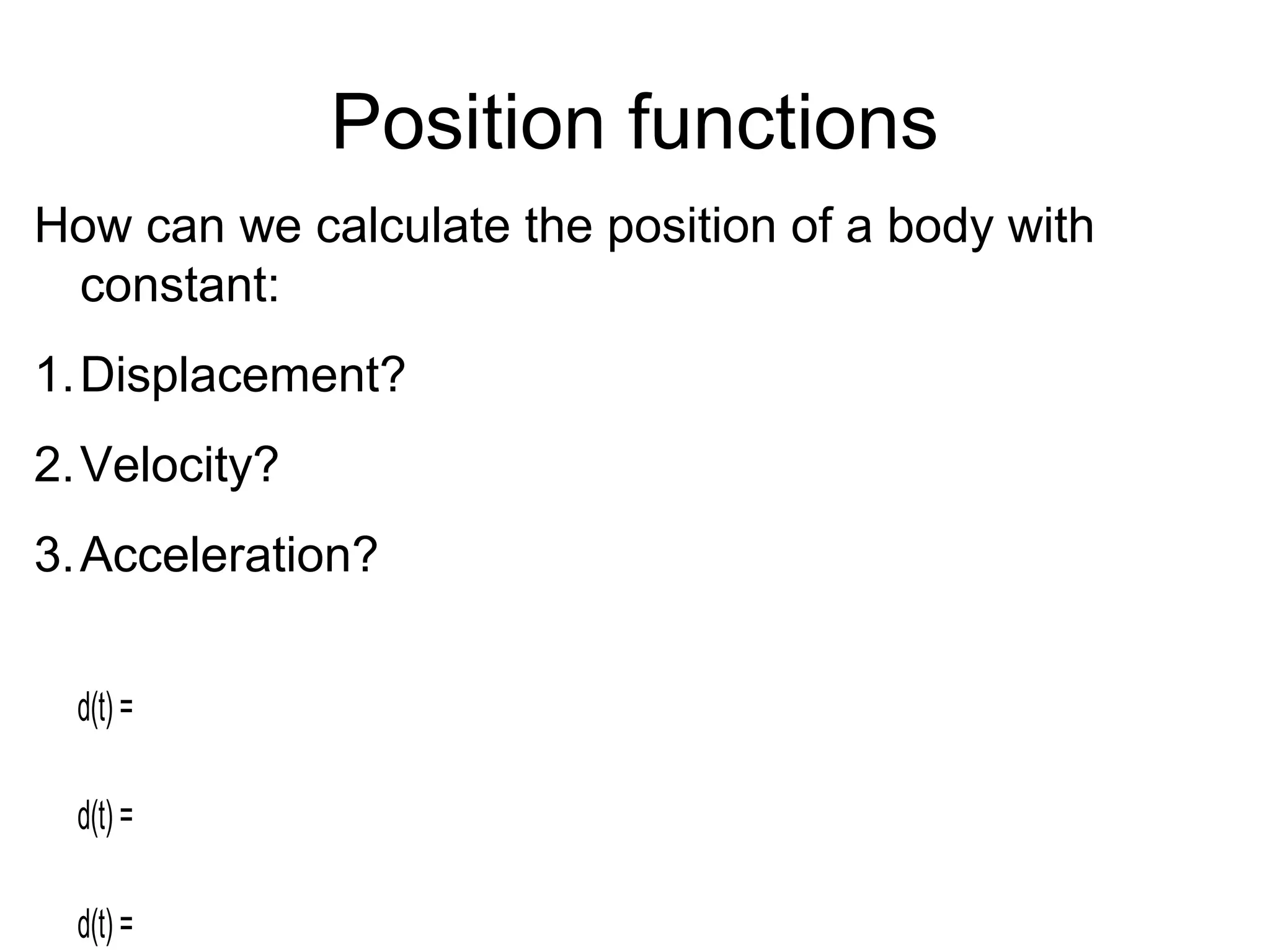
d(t) =
d(t) =
d(t) =
How can we calculate the position of a body with
constant:
1.Displacement?
2.Velocity?
3.Acceleration?
Rates of change
• Note that:
–Displacement’s rate of change is
measured by …
• Velocity (d/t=v) [d’(t)]
–Velocity’s rate of change is measured by
…
• Acceleration (v/t=a) [d’’(t)]
Back to position functions
d(t) = c
d’(t) = v
d’’(t) = a
d(t) = [d’(t)].dt = v.dt = vt + c
v(t) = [v’(t)].dt = a.dt = at + c
1 2
(what do ‘c’ and ‘d’ represent?)
(‘d’ think of a light rail between stations)
(‘c’ why don’t supersonic jets shoot themselves down?)
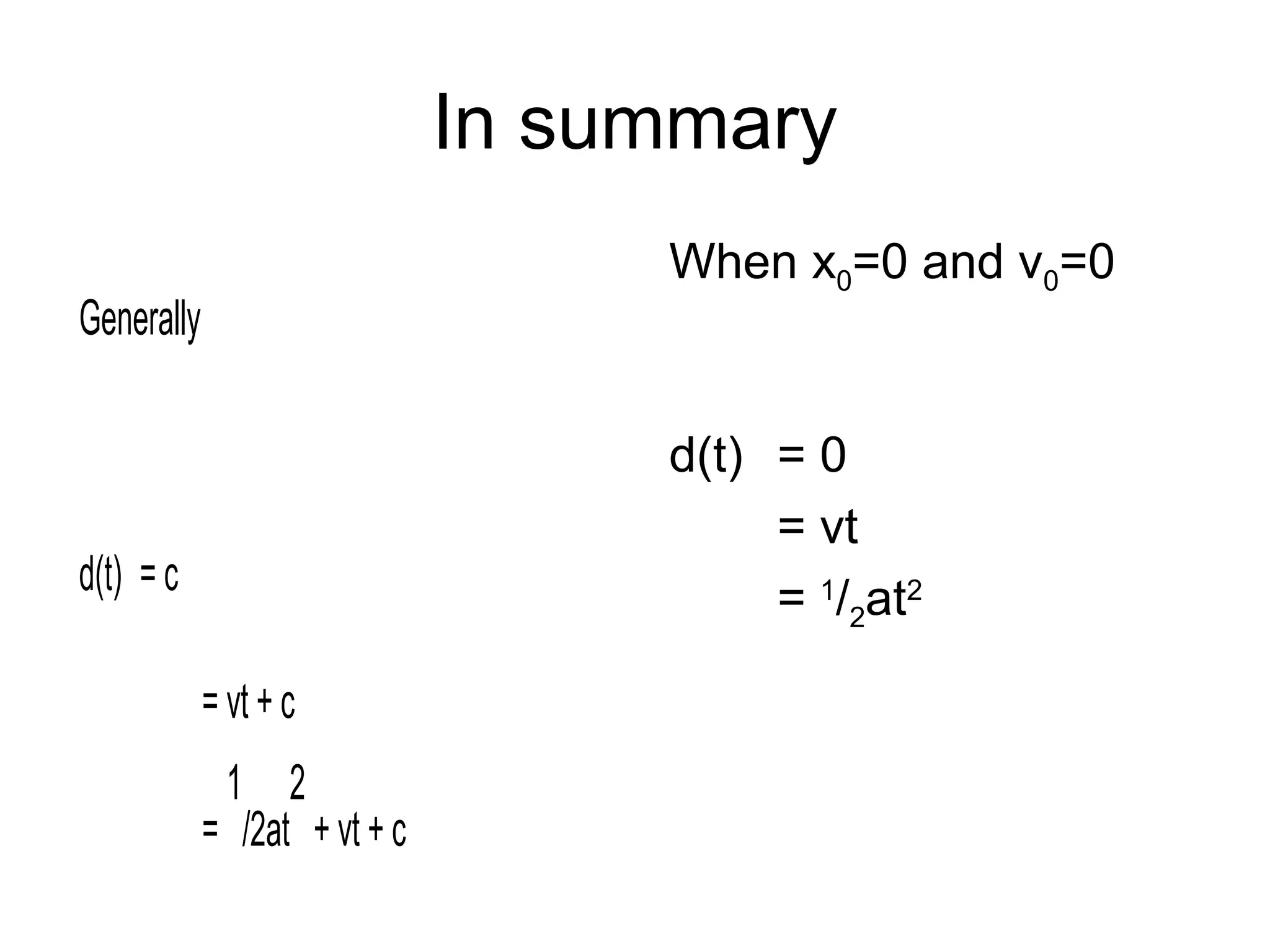
In summary
Generally
d(t) = c
= vt + c
=
1
/2at
2
+ vt + c
When x0=0 and v0=0
d(t) = 0
= vt
= 1
/2at2
Simple harmonic motion
Sketch the position, velocity and acceleration functions for
a simple harmonic oscillator, (assume no energy is lost)
d(t) = cos(t)
v(t) = -sin(t)
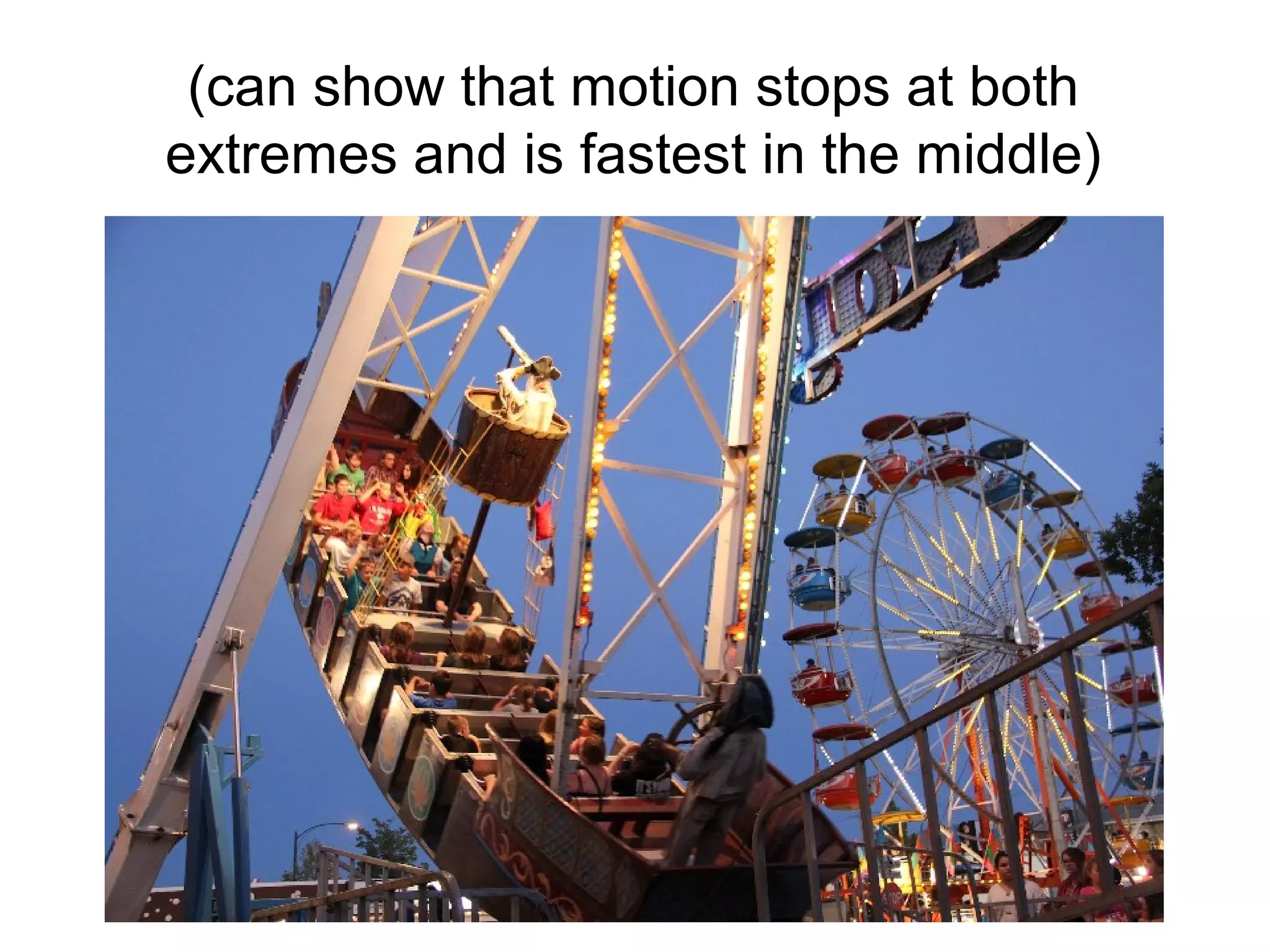
(can show that motion stops at both
extremes and is fastest in the middle)
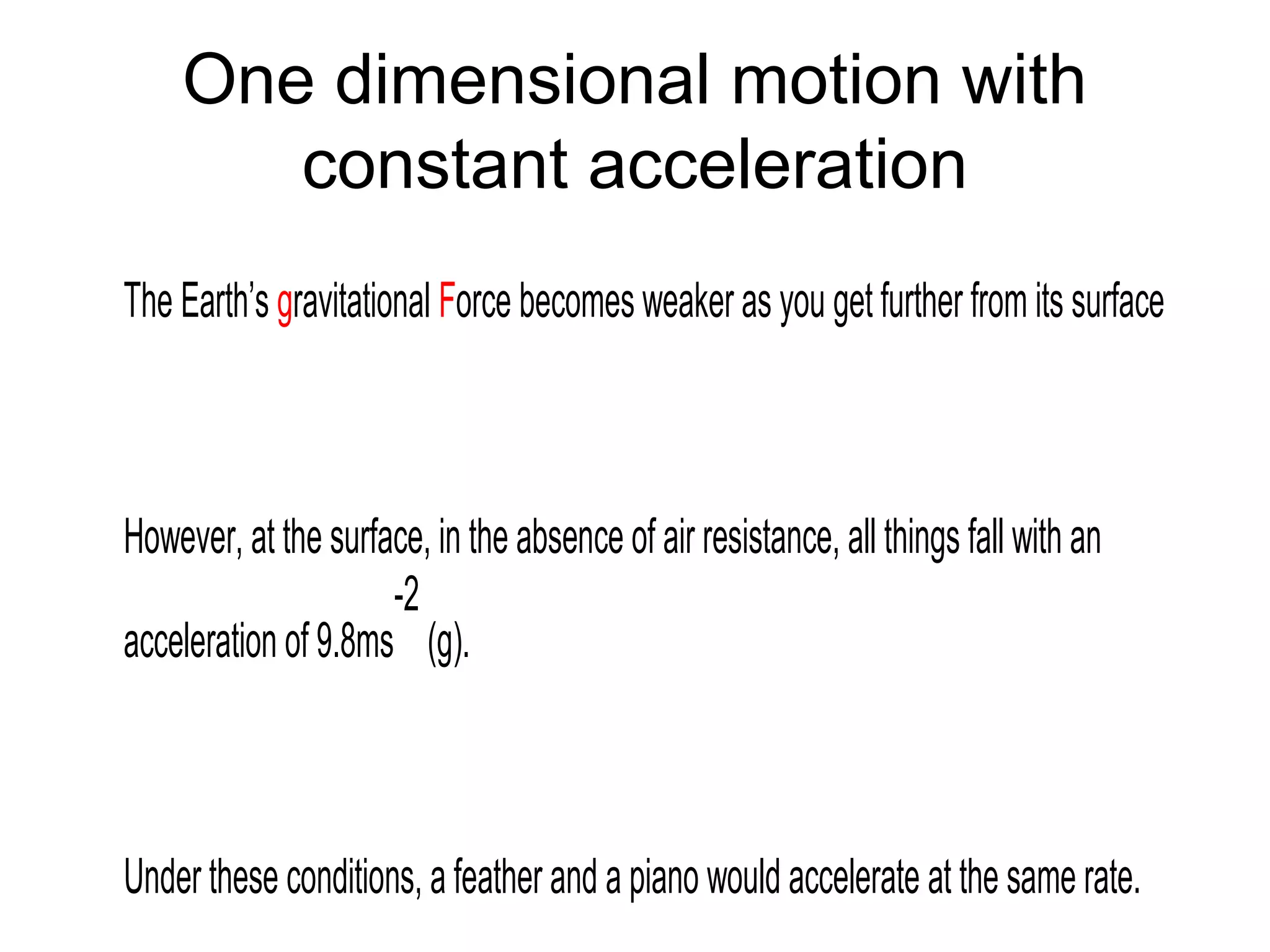
One dimensional motion with
constant acceleration
The Earth’s gravitational Force becomes weaker as you get further from its surface
However, at the surface, in the absence of air resistance, all things fall with an
acceleration of 9.8ms
-2
(g).
Under these conditions, a feather and a piano would accelerate at the same rate.
Too
warm
Too cold Scared
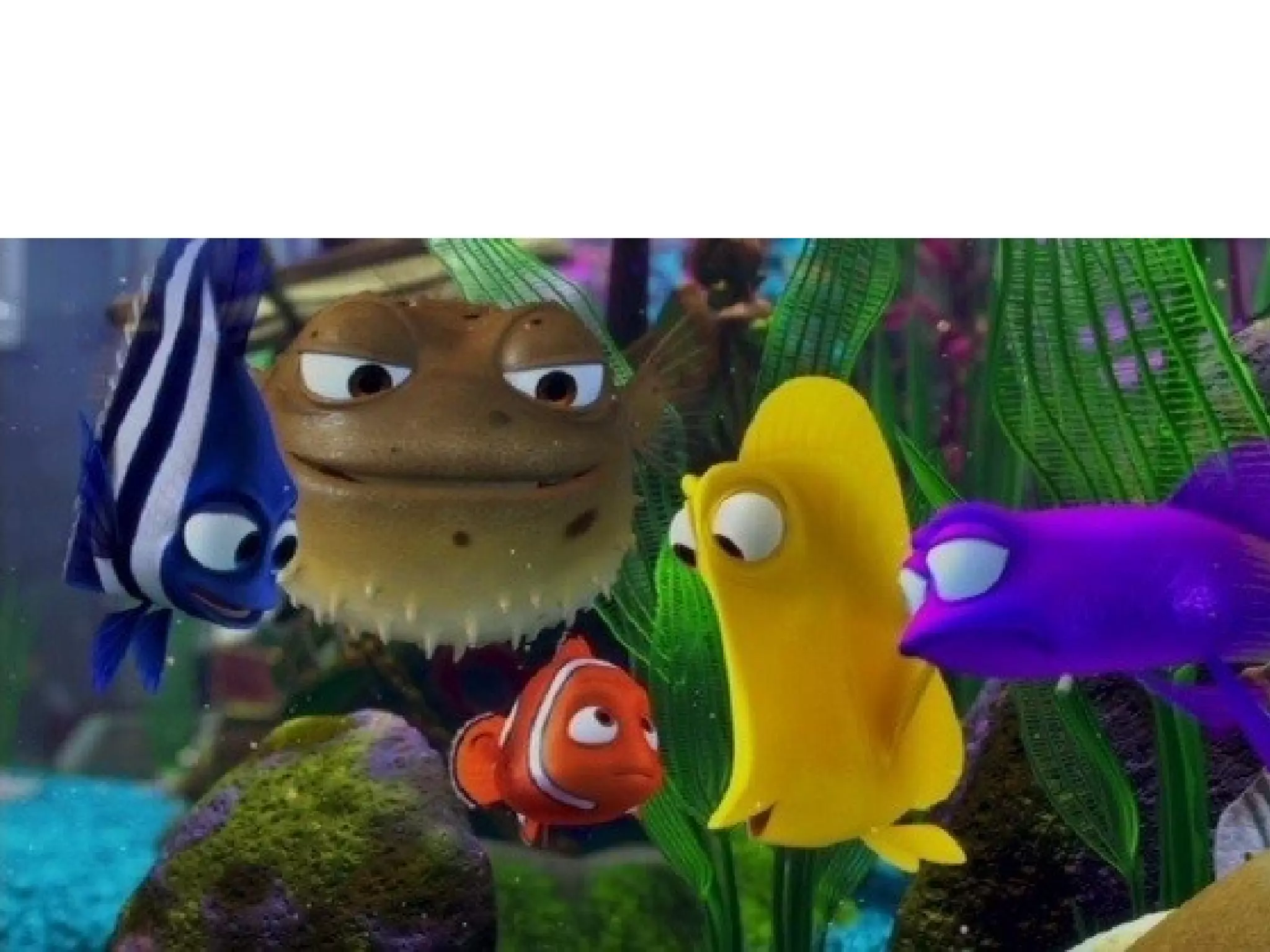
Puffer
Falls
asleep
Swims
fast in
circles
Blows up into
a ball
Bluey
Presses
against the
cool glass
Swims
into the
plants
Swims in
random
directions
Flatty
Jumps out
of the
water
Tries to
swim into
Puffer's
mouth
faints
•
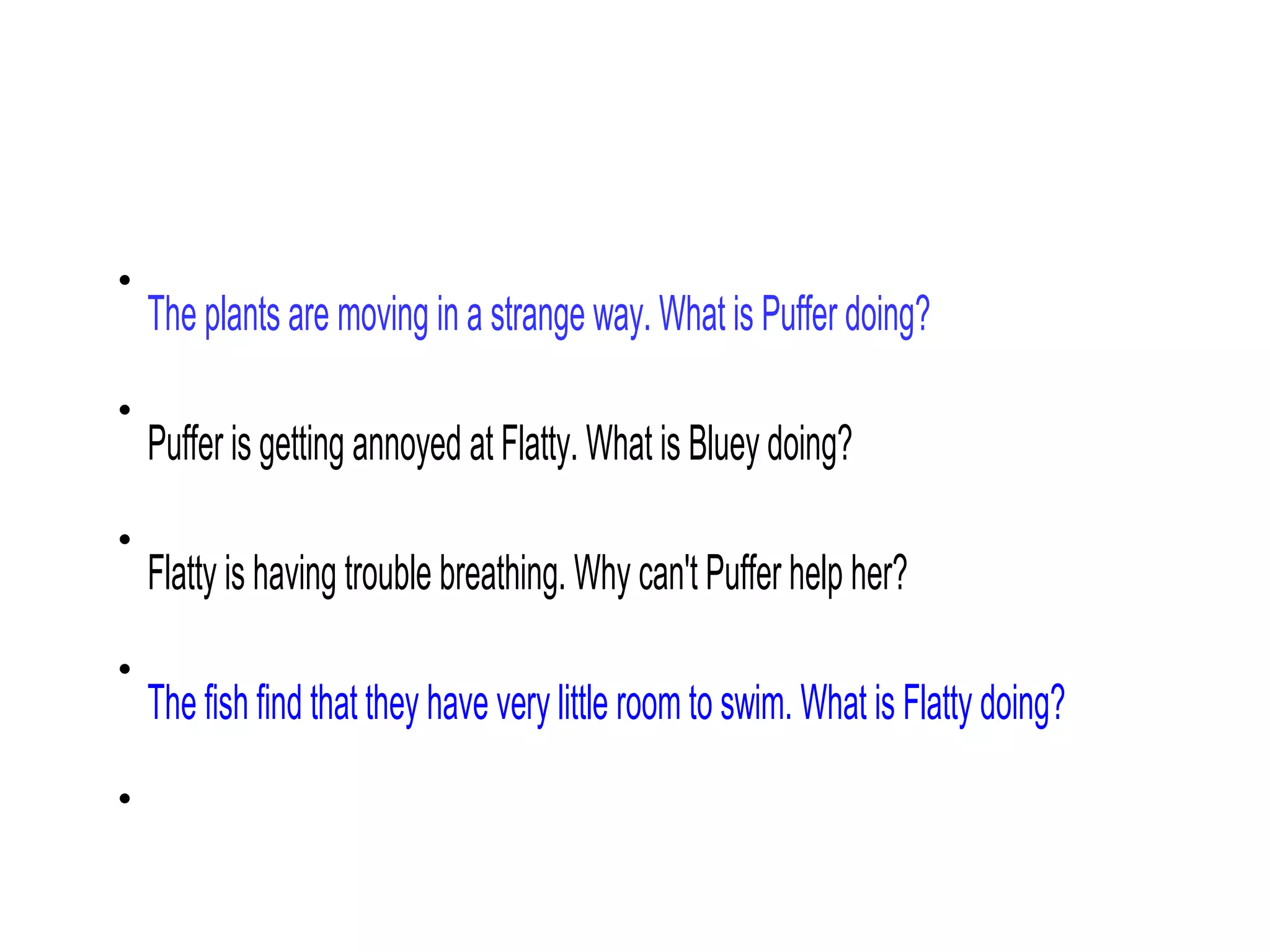
The plants are moving in a strange way. What is Puffer doing?
•
Puffer is getting annoyed at Flatty. What is Bluey doing?
•
Flatty is having trouble breathing. Why can't Puffer help her?
•
The fish find that they have very little room to swim. What is Flatty doing?
•
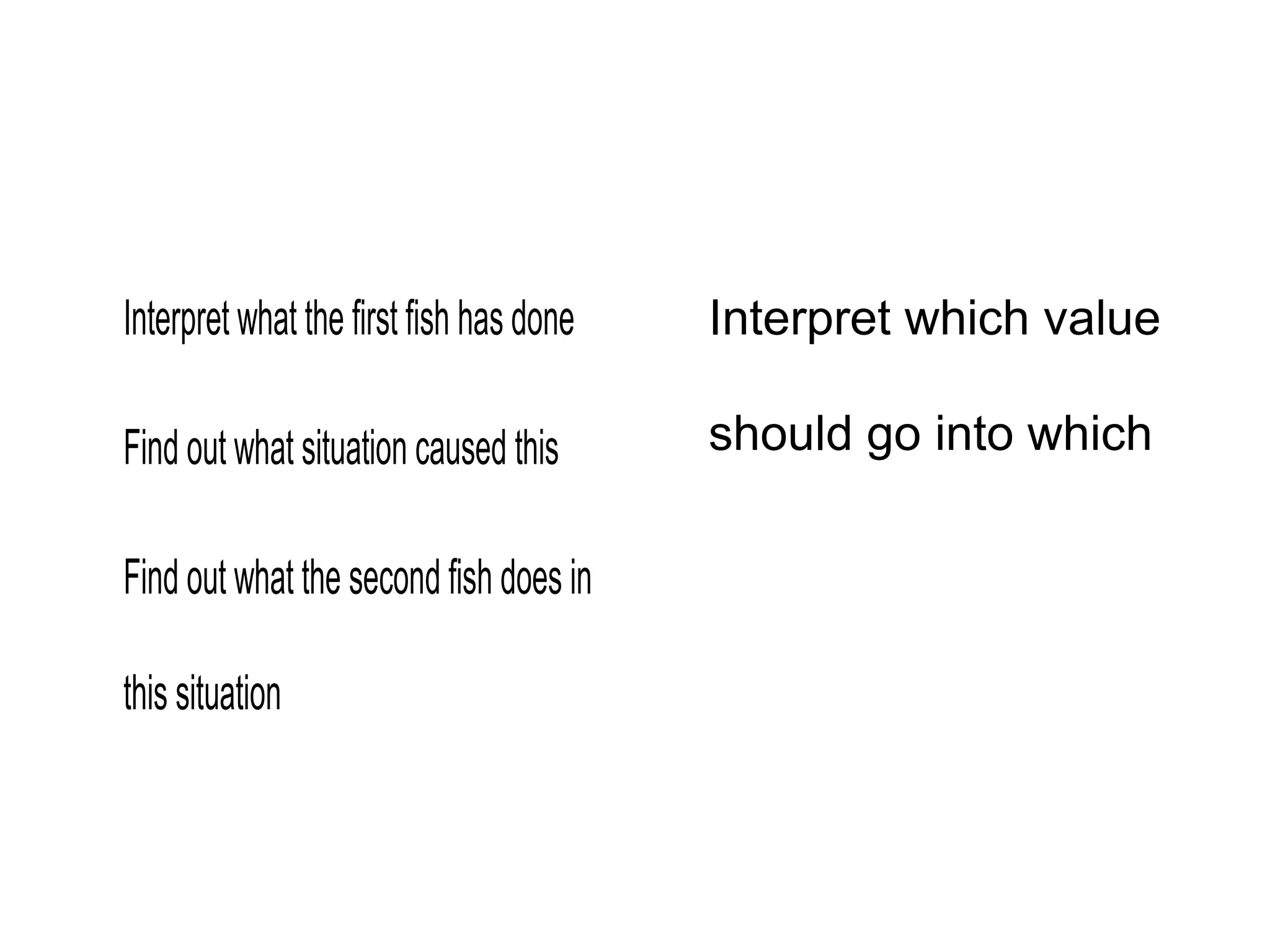
Interpret what the first fish has done
Find out what situation caused this
Find out what the second fish does in
this situation
Interpret which value
should go into which
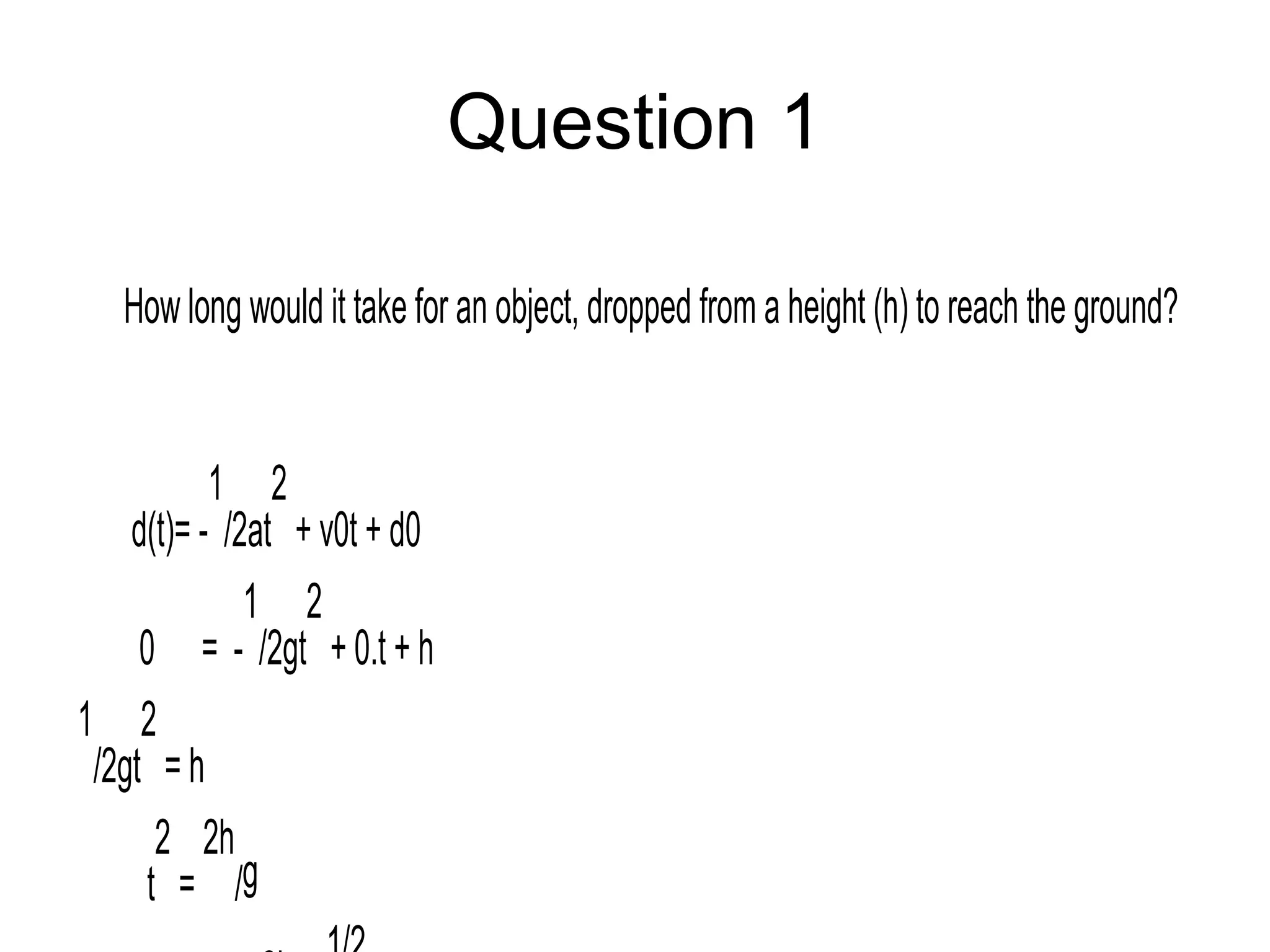
Question 1
How long would it take for an object, dropped from a height (h) to reach the ground?
d(t)= -
1
/2at
2
+ v0t + d0
0 = -
1
/2gt
2
+ 0.t + h
1
/2gt
2
= h
t
2
=
2h
/g
Check ‘t’
for h=9.
t =
+/-(2h/g)1/2
Question 2
A bullet is fired directly upwards at an initial speed of v0. How fast will the bullet be
travelling when it returns and hits the Earth?
d(t)= -
1
/2at
2
+ v0t + d0
0 = -
1
/2gt
2
+ v0t + 0
0 = t(v0-
1
/2gt)
t = 0 or v0 -
1
/2gt = 0
v0 =
1
/2gt
t = 2v0/g
v(t) =
x’(t) = -gt + v0
Check ‘t’ for
v0=12
t = 2v0/g
Question 3
A bouncy ball has the property that if it hits the ground with velocity ‘v’, it bounces
back up with velocity -0.8v. If this ball is dropped from a height ‘h’ above the ground,
howhigh will it bounce?
1.Position function in freefall:
• d1(t)= -1
/2gt2
+ h
1.Position function after bouncing:
• d2(t)= -1
/2gt2
+ vbt
Equation 1: x1(t)= -1
/2gt2
+ h
Time to hit the ground
0 = -
1
/2gt
2
+ h
t = (
2h
/g)
1/2
Velocity when hitting the ground
v(t) = -gt + v0
1/2
Equation 2: x2(t)= -1
/2gt2
+ vbt
Velocity function:
v(t) = -gt + vb
Velocity at maximum height:
0 = -gt + vb
t = vb/g
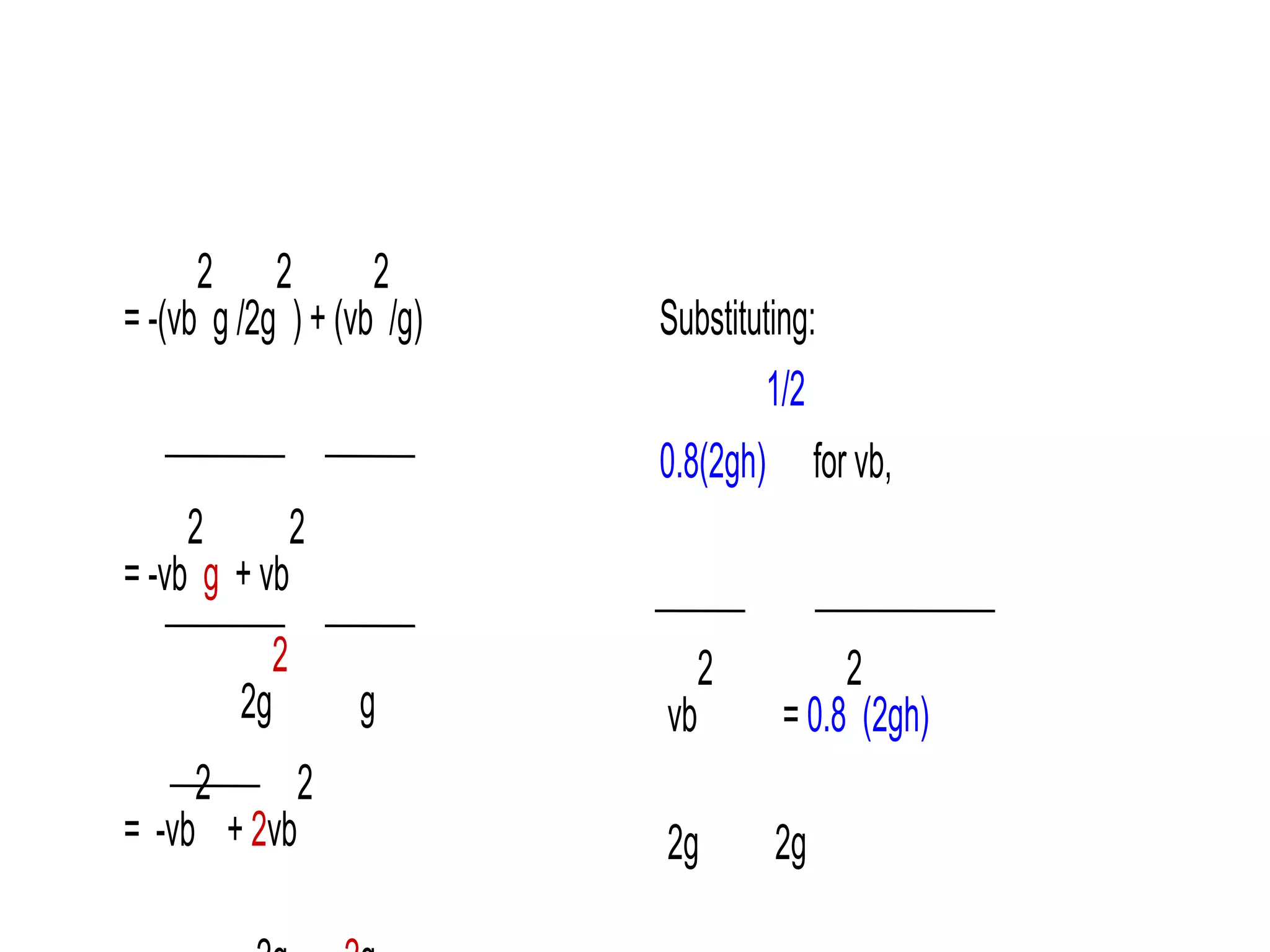
= -(vb
2
g /2g
2
) + (vb
2
/g)
= -vb
2
g + vb
2
2g
2
g
= -vb
2
+ 2vb
2
Substituting:
0.8(2gh)
1/2
for vb,
vb
2
= 0.8
2
(2gh)
2g 2g
Dropped
height
Bounce
height
Check ‘hb’
for h=9 and
bounce
coefficient
=0.8
hb = 0.64h

2b. motion in one dimension

  • 1.
    Motion in onedimension
  • 2.
    Position functions A functionwhich calculates the position of something using: • Displacement • Velocity • Acceleration
  • 3.
    Position Functions A functionof x A function of time Distance Distance as a function of time f(x) f(t) d d(t)
  • 4.
  • 5.
    Graphs Sketch the followingposition functions using displacement, velocity and acceleration 1. A tree standing 100m from the origin (a house) 2. A light rail train between stations
  • 6.
    Position functions d(t) = d(t)= d(t) = How can we calculate the position of a body with constant: 1.Displacement? 2.Velocity? 3.Acceleration?
  • 7.
    Rates of change •Note that: –Displacement’s rate of change is measured by … • Velocity (d/t=v) [d’(t)] –Velocity’s rate of change is measured by … • Acceleration (v/t=a) [d’’(t)]
  • 8.
    Back to positionfunctions d(t) = c d’(t) = v d’’(t) = a d(t) = [d’(t)].dt = v.dt = vt + c v(t) = [v’(t)].dt = a.dt = at + c 1 2 (what do ‘c’ and ‘d’ represent?) (‘d’ think of a light rail between stations) (‘c’ why don’t supersonic jets shoot themselves down?)
  • 9.
    In summary Generally d(t) =c = vt + c = 1 /2at 2 + vt + c When x0=0 and v0=0 d(t) = 0 = vt = 1 /2at2
  • 10.
    Simple harmonic motion Sketchthe position, velocity and acceleration functions for a simple harmonic oscillator, (assume no energy is lost) d(t) = cos(t) v(t) = -sin(t)
  • 11.
    (can show thatmotion stops at both extremes and is fastest in the middle)
  • 12.
    One dimensional motionwith constant acceleration The Earth’s gravitational Force becomes weaker as you get further from its surface However, at the surface, in the absence of air resistance, all things fall with an acceleration of 9.8ms -2 (g). Under these conditions, a feather and a piano would accelerate at the same rate.
  • 14.
    Too warm Too cold Scared Puffer Falls asleep Swims fastin circles Blows up into a ball Bluey Presses against the cool glass Swims into the plants Swims in random directions Flatty Jumps out of the water Tries to swim into Puffer's mouth faints
  • 15.
    • The plants aremoving in a strange way. What is Puffer doing? • Puffer is getting annoyed at Flatty. What is Bluey doing? • Flatty is having trouble breathing. Why can't Puffer help her? • The fish find that they have very little room to swim. What is Flatty doing? •
  • 16.
    Interpret what thefirst fish has done Find out what situation caused this Find out what the second fish does in this situation Interpret which value should go into which
  • 17.
    Question 1 How longwould it take for an object, dropped from a height (h) to reach the ground? d(t)= - 1 /2at 2 + v0t + d0 0 = - 1 /2gt 2 + 0.t + h 1 /2gt 2 = h t 2 = 2h /g
  • 18.
  • 19.
    Question 2 A bulletis fired directly upwards at an initial speed of v0. How fast will the bullet be travelling when it returns and hits the Earth?
  • 20.
    d(t)= - 1 /2at 2 + v0t+ d0 0 = - 1 /2gt 2 + v0t + 0 0 = t(v0- 1 /2gt) t = 0 or v0 - 1 /2gt = 0 v0 = 1 /2gt t = 2v0/g v(t) = x’(t) = -gt + v0
  • 21.
  • 22.
    Question 3 A bouncyball has the property that if it hits the ground with velocity ‘v’, it bounces back up with velocity -0.8v. If this ball is dropped from a height ‘h’ above the ground, howhigh will it bounce?
  • 23.
    1.Position function infreefall: • d1(t)= -1 /2gt2 + h 1.Position function after bouncing: • d2(t)= -1 /2gt2 + vbt
  • 24.
    Equation 1: x1(t)=-1 /2gt2 + h Time to hit the ground 0 = - 1 /2gt 2 + h t = ( 2h /g) 1/2 Velocity when hitting the ground v(t) = -gt + v0 1/2
  • 25.
    Equation 2: x2(t)=-1 /2gt2 + vbt Velocity function: v(t) = -gt + vb Velocity at maximum height: 0 = -gt + vb t = vb/g
  • 26.
    = -(vb 2 g /2g 2 )+ (vb 2 /g) = -vb 2 g + vb 2 2g 2 g = -vb 2 + 2vb 2 Substituting: 0.8(2gh) 1/2 for vb, vb 2 = 0.8 2 (2gh) 2g 2g
  • 27.
    Dropped height Bounce height Check ‘hb’ for h=9and bounce coefficient =0.8 hb = 0.64h