M4 Chemistry Matter I: Matters
Slide   of 29 Learning Objectives Concepts  Chemistry, matter, substance, element, compound, mixture  Homogeneous mixture, heterogeneous mixture, solution, colloid, alloy  Microscopic, macroscopic, sub-microscopic, atom, molecule, ion  Skills  Define chemistry as the study of matter and how it changes.  Define matter and distinguish it from forces and energy.  Differentiate between pure matter and mixtures.  Explain that matter that consists of only one type of particle (which includes elements and compounds) is classified as pure and has fixed properties
Slide   of 29 Learning Objectives Explain that matter that consists of more than one type of particle is classified as a mixture and has properties that vary.  Be able to distinguish between element, compound and mixture.  State that most matter exists as mixtures.  Classify mixtures as homogeneous or heterogeneous.  Classify homogeneous mixtures as solutions or colloids.  Explain the difference between a compound and a mixture
M4 Chemistry Matter: Matters  Slide   of 29 Birth of the earth Earth was born approx. 4600 million years ago – a bit before I was born.  Earth’s atmosphere would have been made of the  elements  hydrogen and helium (just like 99% of the universe was).  The Earth was a very very very hot  ball  of molten ( li q uid ) rock.  It took millions of years for the Earth to gradually cool down.     As it cooled down a  solid  crust formed on the outside surface   SPACE
M4 Chemistry Matter: Matters  Slide   of 29 Formation of the atmosphere  The  molten ( li q uid ) rock underneath often burst through the thin crust.   Volcanoes were  erupting  all over the Earth’s surface giving out gases. volcanic  gases   carbon dioxide gas  CO 2   methane gas  CH 4 ammonia gas  NH 3 Steam (water)  H 2 O
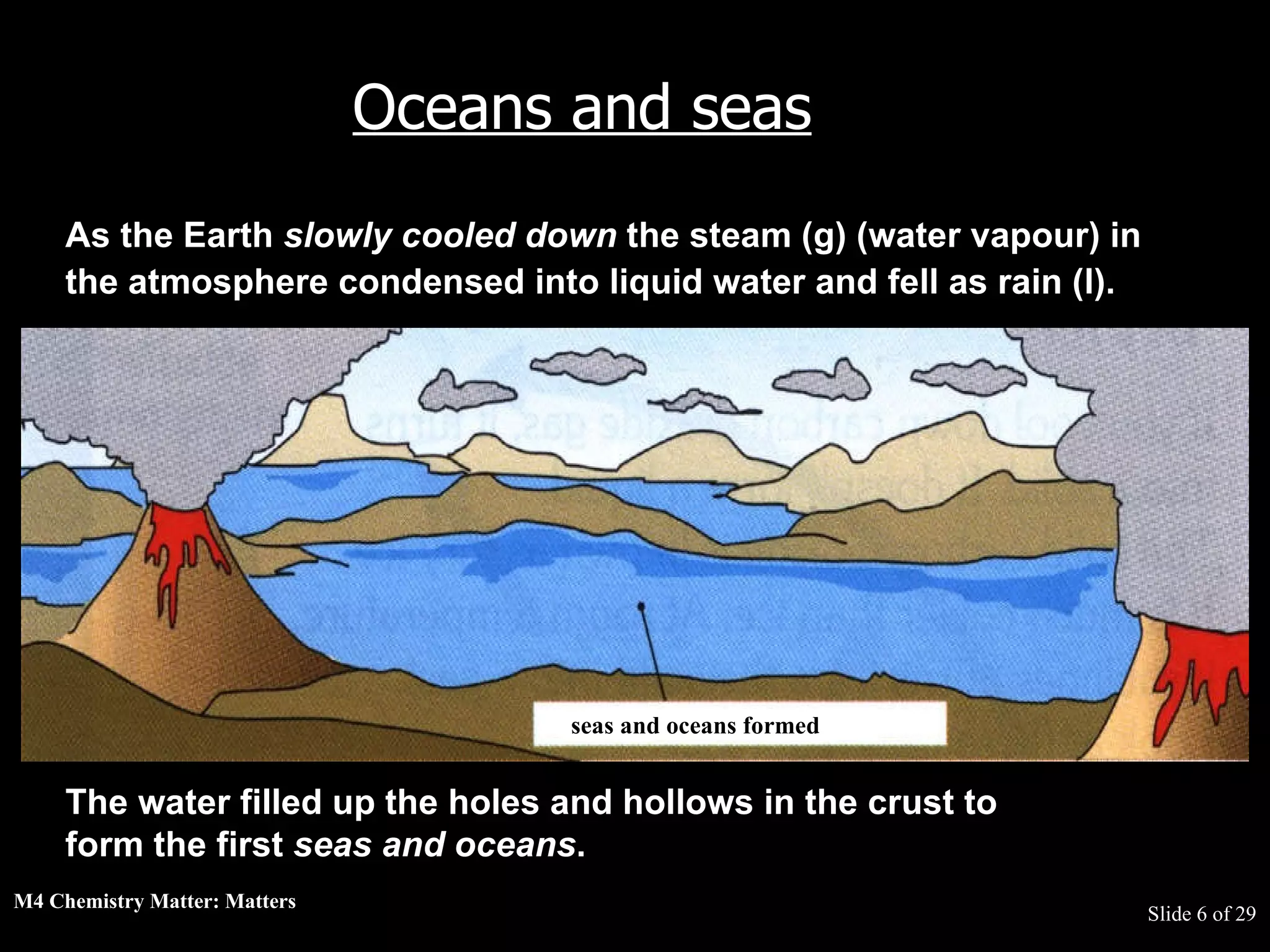
M4 Chemistry Matter: Matters  Slide   of 29 Oceans and seas As the Earth  slowly cooled down  the steam (g) (water vapour) in the atmosphere condensed into liquid water and fell as rain (l).   The water filled up the holes and hollows in the crust to form the first  seas and oceans . seas and oceans formed
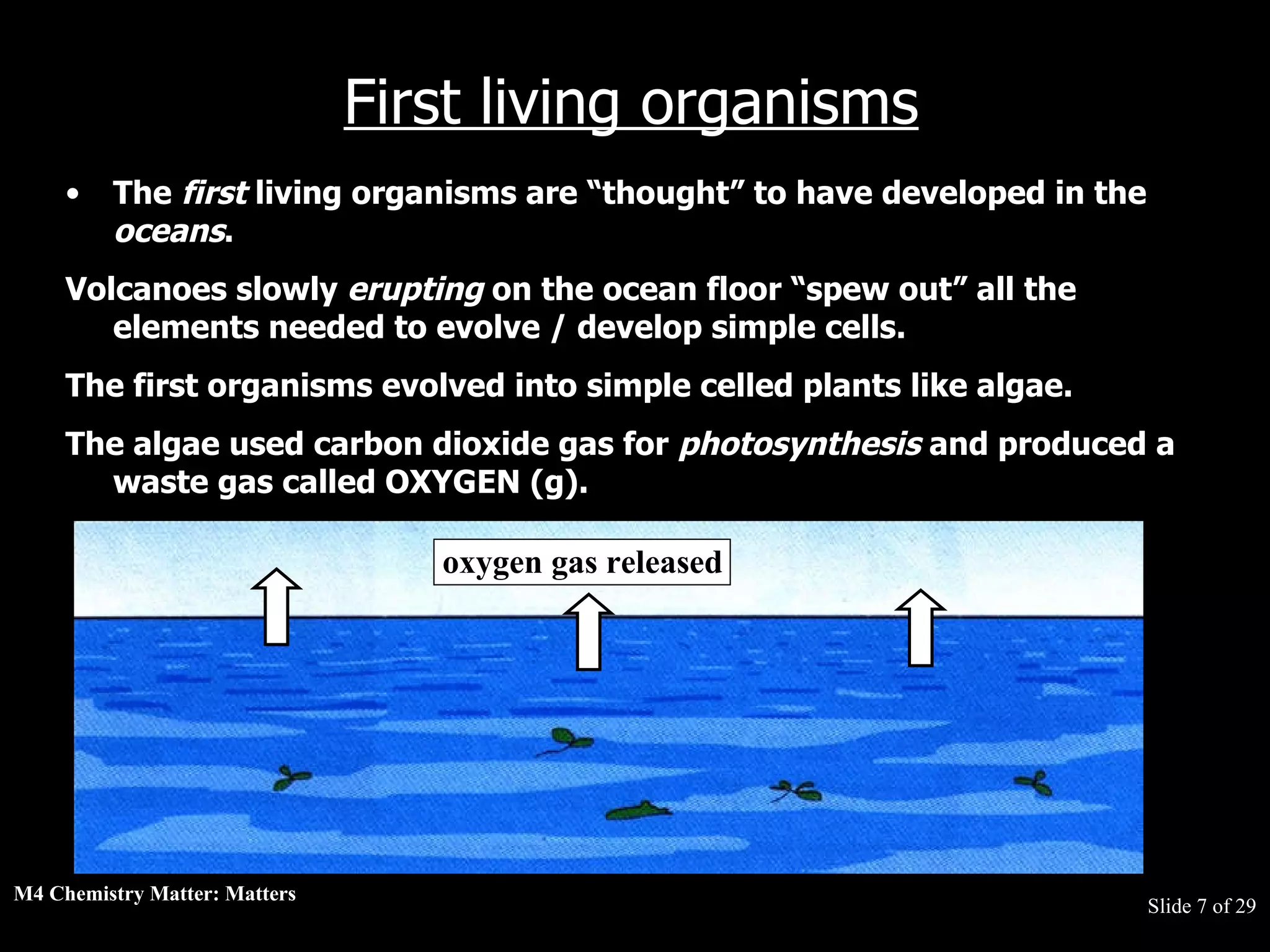
M4 Chemistry Matter: Matters  Slide   of 29 First living organisms The  first  living organisms are “thought” to have developed in the  oceans .  Volcanoes slowly  erupting  on the ocean floor “spew out” all the elements needed to evolve / develop simple cells.  The first organisms evolved into simple celled plants like algae.  The algae used carbon dioxide gas for  photosynthesis  and produced a waste gas called OXYGEN (g). oxygen gas released
M4 Chemistry Matter: Matters  Slide   of 29 Oxygen Some of the waste oxygen, O 2 , released by the plants formed into ozone, O 3 .  An ozone layer eventually formed in the atmosphere.  The ozone layer p revented  harmful high energy  ultra-violet light  rays from the  sun  from reaching the Earth’s surface. The formation of the ozone layer meant that life no longer needed the p rotection  of the sea and could now develop on land.
M4 Chemistry Matter: Matters  Slide   of 29 Atmosphere Some of the oxygen gas  reacted  with the ammonia gas in the atmosphere to give off nitrogen gas.  Lar g e amounts  of nitrogen was being produced by bacteria in the soil.   Methane gas also  reacted  with oxygen gas forming more nitrogen gas.  Ammonia and methane levels decreased & nitrogen levels increased.   Eventually , about 200 million years ago, the atmosphere we still have today had formed:   78% Nitrogen gas 21% Oxygen gas small amount of CO 2  and CH 4
M4 Chemistry Matter: Matters  Slide   of 29 The history of the atmosphere   Early Volcanic Atmosphere Our atmosphere now Noble gases  Remaining 1%  (Argon = 0.09%)   bacteria  in the soil  OXYGEN  O 2  21%   Photosynthesis Some  carbon  trapped  as fossil  fuels.   Methane carbon dioxide  ammonia  steam  CH 4 CO 2 NH 3   H 2 0 reacted with oxygen to form plants some CO 2  gas dissolved in the oceans dissolved CO 2  used by many sea animals to form  calcium carbonate  shells, CaCO 3   Sedimentary Rocks  e.g. limestone or chalk condense oceans Reacted with  oxygen NITROGEN  N 2   78%
M4 Chemistry Matter: Matters  Slide   of 29 Matters of Chemistry Thus matter was formed.  Chemistry is study of how matter interact, react and can be made to interact and react with each other.  What is matter?  Matter is the “stuff” that makes up all and every thing.  Matter has mass and occupies volume.  How can matter be identified?  Matter can be identified both macroscopically and sub-microscopically.  Macro - by its properties.  Properties such as appearance, hardness, color, odor, malleability, ductility, viscosity, electrical conductivity, MP, BP, magnetism, etc.  Sub-micro - by the particles (atoms and molecules) that make it up
M4 Chemistry Matter: Matters  Slide   of 29 Macroscopic Properties & Submicroscopic Composition Why do different types of matter have different properties?  The properties of matter macroscopically can be explained by the sub-microscopic particles that make them up.  If substances have different properties, then  they must be made up of different sub-microscopic particles .  They must be made up of different building blocks, such as atoms, molecules and ions.
M4 Chemistry Matter: Matters  Slide   of 29 Creation of New Matter How many different forms of matter exist?  Millions, Billlions, Trillions  There are approximately 115 elements. Eg. carbon, gold  All of these elements can bond together to form millions of compounds. eg. Carbon dioxide, water, carbon monoxide, sodium chloride.  The elements and compounds can combine physically to create mixtures. Ex. cookies, salt water  How can substances with new properties be created?  By combing substances either  chemically to form new compounds  or  physically to create new mixtures .  Both mixtures and compounds have  different properties  than the substances that they are made up of.
M4 Chemistry Matter: Matters  Slide   of 29 Categories of Matter So matter can be divided into two categories: (pure) substances and mixtures.  A substance is matter that is made up of the same sub-microscopic particles, such as atoms or molecules.  If a substance is made up of one kind of atom, then it is classified as an element.  E.g. helium, sodium, carbon, oxygen, nitrogen, sulfur.  If a substance is made up of particles that contain two or more kind of atoms  bonded together  (molecules or ion units), it is classified as a compound.  E.g. water, carbon monoxide, ammonia, sodium chloride, carbon dioxide, copper sulfate
M4 Chemistry Matter: Matters  Slide   of 29 Categories of Matter: Mixture A mixture on the other hand is matter that is made up of two more kinds of particles or substances put together physically.  A mixture retains the properties of the elements and/or compound it is made of.  For example sea water is a mixture and it retains the saltiness of salt and fluidity of water.  Vinegar is a mixture of acetic acid and water.  Salad dressing is a mixture of a whole variety of spices, oil, and water with the texture and taste of the components.  Air is a mixture of different gases (nitrogen, oxygen, argon and a few others).  Alloys are mixtures of two or more metals. Steel is an alloy of iron, chromium and nickel; bronze: copper & tin.
M4 Chemistry Matter: Matters  Slide   of 29 Mixtures Mixture can further be divided into  homogeneous  and  heterogeneous .  Homogeneous mixtures  are those that do not have visibly different parts.  In other words, homogeneous mixtures will be uniform, in appearance, and other physical properties such as taste, melting point, boiling point, density etc.  Sea water, vinegar, air, alloys, tea and coffee for instance are examples.  Different parts of a cup of tea do not look different from each other, they won’t taste different either and nor will they boil at different temperature.  Heterogeneous mixtures  are those that have visibly different parts.  These mixtures you can distinguish the components of by just looking at it.  What that means is that it is non-uniform in appearance and other physical properties such as taste, melting point, boiling point, density etc.  Italian salad dressing for instance is heterogeneous—you can see the herbs, oil and vinegar/water components etc. and will also be able to taste the difference.
M4 Chemistry Matter: Matters  Slide   of 29 Two variety of homogeneous mixture Solution :   A homogeneous mixture of two or more substances.  A solution can be solid, liquid or gas.  Examples of solutions are air, sea water, pond and river water, alcohol (ethanol and water), tea, coffee, alloys such as steel (iron and carbon), brass (zinc and copper), and bronze (tin and copper).  Colloids  are a mixture that are kind of in between homogeneous and heterogeneous solutions.  Like solutions, colloids can be solids, liquids, or gases.  Examples include egg white (both solids), gelatin desserts (both solids), smoke (both gaseous), aerosol sprays (both gaseous), oil and vinegar (both liquid), marshmellow (solid and gas), cotton candy (solid and gas). polystyrene cups (colloid of air and polystyrene).  The difference between the two is that you can generally see the boundary between the components of colloids.
M4 Chemistry Matter: Matters  Slide   of 29 Practice Questions 1. Choose  from the list  the most suitable method for each of the following separations.  [4]  chromatography dissolving  distillation evaporation  filtration fractional distillation  (a)   To separate the mixture of liquids in crude oil. (b)   To obtain some solid salt from a solution of salt in water. (c)   To separate a mixture of different colored inks. (d)   To obtain a sample of pure water from some tap water.
M4 Chemistry Matter: Matters  Slide   of 29 Practice Questions 2. Distillation has been used in some parts of the world to obtain drinking water from sea water. The diagram shows a small scale distillation apparatus that could be used to demonstrate this process in a school laboratory.  (a) Explain, as fully as you can, how the apparatus makes drinking water from salt water. You may use the letters A, B, C and D to help with your answer.  [4]
M4 Chemistry Matter: Matters  Slide   of 29 Practice Questions (b) Why is this method of making drinking water very expensive?  [1]
M4 Chemistry Matter: Matters  Slide   of 29 Practice Questions 3. There are millions of different substances that make up our world.  All these substances are made from chemical elements.  (a)   About how many different elements have been discovered?  The Periodic table may help you to answer this question. [1]  (b)   What is an element?  [1]  (c)   Many substances are compounds.  What is a compound?  [2]
M4 Chemistry Matter: Matters  Slide   of 29 Practice Questions 4.   (a) The list below gives six substances.  Aluminum beer copper milk  pure water sodium chloride  Put each substance in the correct column of the table.  [3]   (b) Elements can be divided into two groups, metals and non-metals. The list below gives some properties of elements.  brittle  can be hammered into shape  Dull  good conductors of electricity Mixtures Compounds Elements
M4 Chemistry Matter: Matters  Slide   of 29 Practice Questions poor conductors of electricity  shiny  Put each property into the correct column.  [3] Properties of Non-metals Properties of Metals
M4 Chemistry Matter: Matters  Slide   of 29 Practice Questions: Multiple Choice 1. In the following list, only __________ is  not  an example of matter.  A) planets  B) light  C) dust  D) elemental phosphorus  E) table salt  2. What is the physical state in which matter has no specific shape but does have a specific volume?  A) gas  B)  solid  C)  liquid  D) salts  E)  ice  3. Solids have a __________ shape and are not appreciably __________.  A) definite, compressible  B) definite, incompressible  C) indefinite, compressible  D) indefinite, incompressible  E) sharp, convertible
M4 Chemistry Matter: Matters  Slide   of 29 Practice Questions: Multiple Choice 4. The law of constant composition applies to __________.  A) solutions    B) heterogeneous mixtures  C) compounds  D) homogeneous mixtures  E) solids  5. A combination of sand, salt, and water is an example of a __________.  A) homogeneous mixture B) heterogeneous mixture  C) compound  D) pure substance  E) solid  6. Consider a mixture consisting of sand in salt water.  This mixture could be separated into its three components (sand, salt, and water) by first __________ the mixture and then __________ the remaining mixture.  A) distilling, distilling  B) distilling, filtering  C) filtering, distilling  D) filtering, filtering  E) evaporating, grinding
M4 Chemistry Matter: Matters  Slide   of 29 Practice Questions: Multiple Choice 7. Which one of the following is a pure substance?  A) concrete  B) wood    C) salt water  D) elemental copper  E) milk  8. Which one of the following is often easily separated into its components by simple techniques such as filtering or decanting?  A) heterogeneous mixture  B) compounds  C) homogeneous mixture  D) elements  E) solutions  9. For which of the following can the composition vary?  A) pure substance  B) element  C) both homogeneous and heterogeneous mixtures  D) homogeneous mixture  E) heterogeneous mixture
M4 Chemistry Matter: Matters  Slide   of 29 Practice Questions: Multiple Choice 10. If matter is uniform throughout, cannot be separated into other substances by physical processes, but can be decomposed into other substances by chemical processes, it is __________.  A) a heterogeneous mixture  B) an element  C) a homogeneous mixture  D) a compound  E) a mixture of elements  11. If matter is uniform throughout, cannot be separated into other substances by physical processes, and cannot be decomposed into other substances by chemical processes, it is __________.  A) an element  B) a compound  C) a homogeneous mixture  D) a heterogeneous mixture  E) a mixture of compounds
M4 Chemistry Matter: Matters  Slide   of 29 Practice Questions: Multiple Choice 12. If matter is uniform throughout and cannot be separated into other substances by physical means, it is __________.  A) a compound  B) either an element or a compound  C) a homogeneous mixture  D) a heterogeneous mixture  E) an element  13. An element cannot __________.  A) be part of a heterogeneous mixture  B) be part of a homogeneous mixture  C) be separated into other substances by chemical means  D) interact with other elements to form compounds  E) be a pure substance  14. Homogeneous mixtures are also known as __________.  A) solids  B) compounds  C) elements  D) substances  E) solutions
M4 Chemistry Matter: Matters  Slide   of 29 Practice Questions: Multiple Choice 15. Which one of the following is not a physical property of water?  A) It boils at 100  C at 1 atm pressure.  B) It freezes at 0  C at 1 atm pressure.  C) It is clear and colorless.  D) Water exists in solid, liquid and gaseous forms.  E) It reacts rapidly with potassium metal to form potassium hydroxide.

1 myp chemistry matter

  • 1.
  • 2.
    Slide of 29 Learning Objectives Concepts Chemistry, matter, substance, element, compound, mixture Homogeneous mixture, heterogeneous mixture, solution, colloid, alloy Microscopic, macroscopic, sub-microscopic, atom, molecule, ion Skills Define chemistry as the study of matter and how it changes. Define matter and distinguish it from forces and energy. Differentiate between pure matter and mixtures. Explain that matter that consists of only one type of particle (which includes elements and compounds) is classified as pure and has fixed properties
  • 3.
    Slide of 29 Learning Objectives Explain that matter that consists of more than one type of particle is classified as a mixture and has properties that vary. Be able to distinguish between element, compound and mixture. State that most matter exists as mixtures. Classify mixtures as homogeneous or heterogeneous. Classify homogeneous mixtures as solutions or colloids. Explain the difference between a compound and a mixture
  • 4.
    M4 Chemistry Matter:Matters Slide of 29 Birth of the earth Earth was born approx. 4600 million years ago – a bit before I was born. Earth’s atmosphere would have been made of the elements hydrogen and helium (just like 99% of the universe was). The Earth was a very very very hot ball of molten ( li q uid ) rock. It took millions of years for the Earth to gradually cool down.   As it cooled down a solid crust formed on the outside surface SPACE
  • 5.
    M4 Chemistry Matter:Matters Slide of 29 Formation of the atmosphere The molten ( li q uid ) rock underneath often burst through the thin crust. Volcanoes were erupting all over the Earth’s surface giving out gases. volcanic gases carbon dioxide gas CO 2 methane gas CH 4 ammonia gas NH 3 Steam (water) H 2 O
  • 6.
    M4 Chemistry Matter:Matters Slide of 29 Oceans and seas As the Earth slowly cooled down the steam (g) (water vapour) in the atmosphere condensed into liquid water and fell as rain (l). The water filled up the holes and hollows in the crust to form the first seas and oceans . seas and oceans formed
  • 7.
    M4 Chemistry Matter:Matters Slide of 29 First living organisms The first living organisms are “thought” to have developed in the oceans . Volcanoes slowly erupting on the ocean floor “spew out” all the elements needed to evolve / develop simple cells. The first organisms evolved into simple celled plants like algae. The algae used carbon dioxide gas for photosynthesis and produced a waste gas called OXYGEN (g). oxygen gas released
  • 8.
    M4 Chemistry Matter:Matters Slide of 29 Oxygen Some of the waste oxygen, O 2 , released by the plants formed into ozone, O 3 . An ozone layer eventually formed in the atmosphere. The ozone layer p revented harmful high energy ultra-violet light rays from the sun from reaching the Earth’s surface. The formation of the ozone layer meant that life no longer needed the p rotection of the sea and could now develop on land.
  • 9.
    M4 Chemistry Matter:Matters Slide of 29 Atmosphere Some of the oxygen gas reacted with the ammonia gas in the atmosphere to give off nitrogen gas. Lar g e amounts of nitrogen was being produced by bacteria in the soil.  Methane gas also reacted with oxygen gas forming more nitrogen gas. Ammonia and methane levels decreased & nitrogen levels increased.  Eventually , about 200 million years ago, the atmosphere we still have today had formed:  78% Nitrogen gas 21% Oxygen gas small amount of CO 2 and CH 4
  • 10.
    M4 Chemistry Matter:Matters Slide of 29 The history of the atmosphere Early Volcanic Atmosphere Our atmosphere now Noble gases Remaining 1% (Argon = 0.09%) bacteria in the soil OXYGEN O 2 21% Photosynthesis Some carbon trapped as fossil fuels. Methane carbon dioxide ammonia steam CH 4 CO 2 NH 3 H 2 0 reacted with oxygen to form plants some CO 2 gas dissolved in the oceans dissolved CO 2 used by many sea animals to form calcium carbonate shells, CaCO 3 Sedimentary Rocks e.g. limestone or chalk condense oceans Reacted with oxygen NITROGEN N 2 78%
  • 11.
    M4 Chemistry Matter:Matters Slide of 29 Matters of Chemistry Thus matter was formed. Chemistry is study of how matter interact, react and can be made to interact and react with each other. What is matter? Matter is the “stuff” that makes up all and every thing. Matter has mass and occupies volume. How can matter be identified? Matter can be identified both macroscopically and sub-microscopically. Macro - by its properties. Properties such as appearance, hardness, color, odor, malleability, ductility, viscosity, electrical conductivity, MP, BP, magnetism, etc. Sub-micro - by the particles (atoms and molecules) that make it up
  • 12.
    M4 Chemistry Matter:Matters Slide of 29 Macroscopic Properties & Submicroscopic Composition Why do different types of matter have different properties? The properties of matter macroscopically can be explained by the sub-microscopic particles that make them up. If substances have different properties, then they must be made up of different sub-microscopic particles . They must be made up of different building blocks, such as atoms, molecules and ions.
  • 13.
    M4 Chemistry Matter:Matters Slide of 29 Creation of New Matter How many different forms of matter exist? Millions, Billlions, Trillions There are approximately 115 elements. Eg. carbon, gold All of these elements can bond together to form millions of compounds. eg. Carbon dioxide, water, carbon monoxide, sodium chloride. The elements and compounds can combine physically to create mixtures. Ex. cookies, salt water How can substances with new properties be created? By combing substances either chemically to form new compounds or physically to create new mixtures . Both mixtures and compounds have different properties than the substances that they are made up of.
  • 14.
    M4 Chemistry Matter:Matters Slide of 29 Categories of Matter So matter can be divided into two categories: (pure) substances and mixtures. A substance is matter that is made up of the same sub-microscopic particles, such as atoms or molecules. If a substance is made up of one kind of atom, then it is classified as an element. E.g. helium, sodium, carbon, oxygen, nitrogen, sulfur. If a substance is made up of particles that contain two or more kind of atoms bonded together (molecules or ion units), it is classified as a compound. E.g. water, carbon monoxide, ammonia, sodium chloride, carbon dioxide, copper sulfate
  • 15.
    M4 Chemistry Matter:Matters Slide of 29 Categories of Matter: Mixture A mixture on the other hand is matter that is made up of two more kinds of particles or substances put together physically. A mixture retains the properties of the elements and/or compound it is made of. For example sea water is a mixture and it retains the saltiness of salt and fluidity of water. Vinegar is a mixture of acetic acid and water. Salad dressing is a mixture of a whole variety of spices, oil, and water with the texture and taste of the components. Air is a mixture of different gases (nitrogen, oxygen, argon and a few others). Alloys are mixtures of two or more metals. Steel is an alloy of iron, chromium and nickel; bronze: copper & tin.
  • 16.
    M4 Chemistry Matter:Matters Slide of 29 Mixtures Mixture can further be divided into homogeneous and heterogeneous . Homogeneous mixtures are those that do not have visibly different parts. In other words, homogeneous mixtures will be uniform, in appearance, and other physical properties such as taste, melting point, boiling point, density etc. Sea water, vinegar, air, alloys, tea and coffee for instance are examples. Different parts of a cup of tea do not look different from each other, they won’t taste different either and nor will they boil at different temperature. Heterogeneous mixtures are those that have visibly different parts. These mixtures you can distinguish the components of by just looking at it. What that means is that it is non-uniform in appearance and other physical properties such as taste, melting point, boiling point, density etc. Italian salad dressing for instance is heterogeneous—you can see the herbs, oil and vinegar/water components etc. and will also be able to taste the difference.
  • 17.
    M4 Chemistry Matter:Matters Slide of 29 Two variety of homogeneous mixture Solution : A homogeneous mixture of two or more substances. A solution can be solid, liquid or gas. Examples of solutions are air, sea water, pond and river water, alcohol (ethanol and water), tea, coffee, alloys such as steel (iron and carbon), brass (zinc and copper), and bronze (tin and copper). Colloids are a mixture that are kind of in between homogeneous and heterogeneous solutions. Like solutions, colloids can be solids, liquids, or gases. Examples include egg white (both solids), gelatin desserts (both solids), smoke (both gaseous), aerosol sprays (both gaseous), oil and vinegar (both liquid), marshmellow (solid and gas), cotton candy (solid and gas). polystyrene cups (colloid of air and polystyrene). The difference between the two is that you can generally see the boundary between the components of colloids.
  • 18.
    M4 Chemistry Matter:Matters Slide of 29 Practice Questions 1. Choose from the list the most suitable method for each of the following separations. [4] chromatography dissolving distillation evaporation filtration fractional distillation (a) To separate the mixture of liquids in crude oil. (b) To obtain some solid salt from a solution of salt in water. (c) To separate a mixture of different colored inks. (d) To obtain a sample of pure water from some tap water.
  • 19.
    M4 Chemistry Matter:Matters Slide of 29 Practice Questions 2. Distillation has been used in some parts of the world to obtain drinking water from sea water. The diagram shows a small scale distillation apparatus that could be used to demonstrate this process in a school laboratory. (a) Explain, as fully as you can, how the apparatus makes drinking water from salt water. You may use the letters A, B, C and D to help with your answer. [4]
  • 20.
    M4 Chemistry Matter:Matters Slide of 29 Practice Questions (b) Why is this method of making drinking water very expensive? [1]
  • 21.
    M4 Chemistry Matter:Matters Slide of 29 Practice Questions 3. There are millions of different substances that make up our world. All these substances are made from chemical elements. (a) About how many different elements have been discovered? The Periodic table may help you to answer this question. [1] (b) What is an element? [1] (c) Many substances are compounds. What is a compound? [2]
  • 22.
    M4 Chemistry Matter:Matters Slide of 29 Practice Questions 4. (a) The list below gives six substances. Aluminum beer copper milk pure water sodium chloride Put each substance in the correct column of the table. [3] (b) Elements can be divided into two groups, metals and non-metals. The list below gives some properties of elements. brittle can be hammered into shape Dull good conductors of electricity Mixtures Compounds Elements
  • 23.
    M4 Chemistry Matter:Matters Slide of 29 Practice Questions poor conductors of electricity shiny Put each property into the correct column. [3] Properties of Non-metals Properties of Metals
  • 24.
    M4 Chemistry Matter:Matters Slide of 29 Practice Questions: Multiple Choice 1. In the following list, only __________ is not an example of matter. A) planets B) light C) dust D) elemental phosphorus E) table salt 2. What is the physical state in which matter has no specific shape but does have a specific volume? A) gas B) solid C) liquid D) salts E) ice 3. Solids have a __________ shape and are not appreciably __________. A) definite, compressible B) definite, incompressible C) indefinite, compressible D) indefinite, incompressible E) sharp, convertible
  • 25.
    M4 Chemistry Matter:Matters Slide of 29 Practice Questions: Multiple Choice 4. The law of constant composition applies to __________. A) solutions B) heterogeneous mixtures C) compounds D) homogeneous mixtures E) solids 5. A combination of sand, salt, and water is an example of a __________. A) homogeneous mixture B) heterogeneous mixture C) compound D) pure substance E) solid 6. Consider a mixture consisting of sand in salt water. This mixture could be separated into its three components (sand, salt, and water) by first __________ the mixture and then __________ the remaining mixture. A) distilling, distilling B) distilling, filtering C) filtering, distilling D) filtering, filtering E) evaporating, grinding
  • 26.
    M4 Chemistry Matter:Matters Slide of 29 Practice Questions: Multiple Choice 7. Which one of the following is a pure substance? A) concrete B) wood C) salt water D) elemental copper E) milk 8. Which one of the following is often easily separated into its components by simple techniques such as filtering or decanting? A) heterogeneous mixture B) compounds C) homogeneous mixture D) elements E) solutions 9. For which of the following can the composition vary? A) pure substance B) element C) both homogeneous and heterogeneous mixtures D) homogeneous mixture E) heterogeneous mixture
  • 27.
    M4 Chemistry Matter:Matters Slide of 29 Practice Questions: Multiple Choice 10. If matter is uniform throughout, cannot be separated into other substances by physical processes, but can be decomposed into other substances by chemical processes, it is __________. A) a heterogeneous mixture B) an element C) a homogeneous mixture D) a compound E) a mixture of elements 11. If matter is uniform throughout, cannot be separated into other substances by physical processes, and cannot be decomposed into other substances by chemical processes, it is __________. A) an element B) a compound C) a homogeneous mixture D) a heterogeneous mixture E) a mixture of compounds
  • 28.
    M4 Chemistry Matter:Matters Slide of 29 Practice Questions: Multiple Choice 12. If matter is uniform throughout and cannot be separated into other substances by physical means, it is __________. A) a compound B) either an element or a compound C) a homogeneous mixture D) a heterogeneous mixture E) an element 13. An element cannot __________. A) be part of a heterogeneous mixture B) be part of a homogeneous mixture C) be separated into other substances by chemical means D) interact with other elements to form compounds E) be a pure substance 14. Homogeneous mixtures are also known as __________. A) solids B) compounds C) elements D) substances E) solutions
  • 29.
    M4 Chemistry Matter:Matters Slide of 29 Practice Questions: Multiple Choice 15. Which one of the following is not a physical property of water? A) It boils at 100  C at 1 atm pressure. B) It freezes at 0  C at 1 atm pressure. C) It is clear and colorless. D) Water exists in solid, liquid and gaseous forms. E) It reacts rapidly with potassium metal to form potassium hydroxide.