METALS AND
NON-METALS
CHEMISTRY
WHATMETALSARE?
• A metal is a material that is typically hard, opaque, shiny,
and has good electrical and thermal conductivity.
• In chemistry, a metal is an element that readily
forms positive ions and has metallic bonds.
• Examples of metals are aluminium, copper, iron,
tin, gold, lead, silver and titanium.
CHEMISTRY
NON-METALS
• Non-metals are not able to conduct electricity or heat very well.
• As opposed to metals, non-metallic elements are very brittle, and
cannot be rolled into wires or pounded into sheets.
• They form most of the matter in the Earth’s crust, the oceans, the
atmosphere and even living things
AN EXAMPLE
OF NON-
METALS IS
PHOSPHORUS
CHEMISTRY
INTHEPERIODICTABLE!
• This periodic shows the distribution of metals,
non-metals and metalloids.
• Elements that have properties of both metals and
non-metals are called metalloids.
CHEMISTRY
THEUSESANDPROPERTIESOF
METALS
• Most of the metals that we use are not in their
pure elemental form
• We use metals mostly in alloys or in compounds
with other metals and with non-metals.
• The table starting from the next slide shows their
range of features, uses and some of their
physical properties.
CHEMISTRY
THETABLE!
METAL NOTABLE
FEATURES
uses
Sodium • can be easily cut up
with a knife.
• floats and burns on
water
• orange street lamps
Magnesium • strips and powder
catch fire easily
• flares for the rescue of
shipwrecked people.
• camera flashbulbs.
CHEMISTRY
THETABLE!
METAL NOTABLE
FEATURES
uses
Aluminium • has a low density
which makes it light-
weight
• does not corrode in air
• aircraft
• power cables
Potassium • can be easily cut up
with a knife
• explodes with water
• dyes, inks
• fertiliser
• weed killer
CHEMISTRY
THETABLE!
METAL NOTABLEFEATURES uses
Calcium • some effort is needed to
cut it up with a knife
• very reactive and present
in many compounds
• huge numbers of uses
including cement and
concrete, cosmetics,
toothpaste, insecticides,
paints and cheese making.
Iron • a hard substance that
can be shaped to make a
wide variety of strong,
hard objects
• can decompose into
flakes or rust
• cast iron used to make utility-
hole covers
• combined with carbon to make
steel cutlery and car bodies.
THETABLE!
METAL NOTABLEFEATURES uses
Copper • a red-orange metal which
is soft enough to pull
easily into wires or press
into sheets
• very good conductor of
heat
• wires in electrical circuits
• lightning conductors
• hot water cylinders
• copper-bottomed pans
Zinc • a brittle blue-white metal
which does not corrode
in the air.
• rust prevention
• used in making some cells to
generate electricity
THETABLE!
METAL NOTABLEFEATURES uses
Silver • a shiny white metal that
is soft enough to be
made into complicated
shapes by pulling into
wires and pressing into
sheets
• jewellery, coins, ornaments
• mirrors
Mercury • a shiny silver liquid. • thermometers
• fluorescent lamps
• tooth fillings
• liquid mirror telescopes
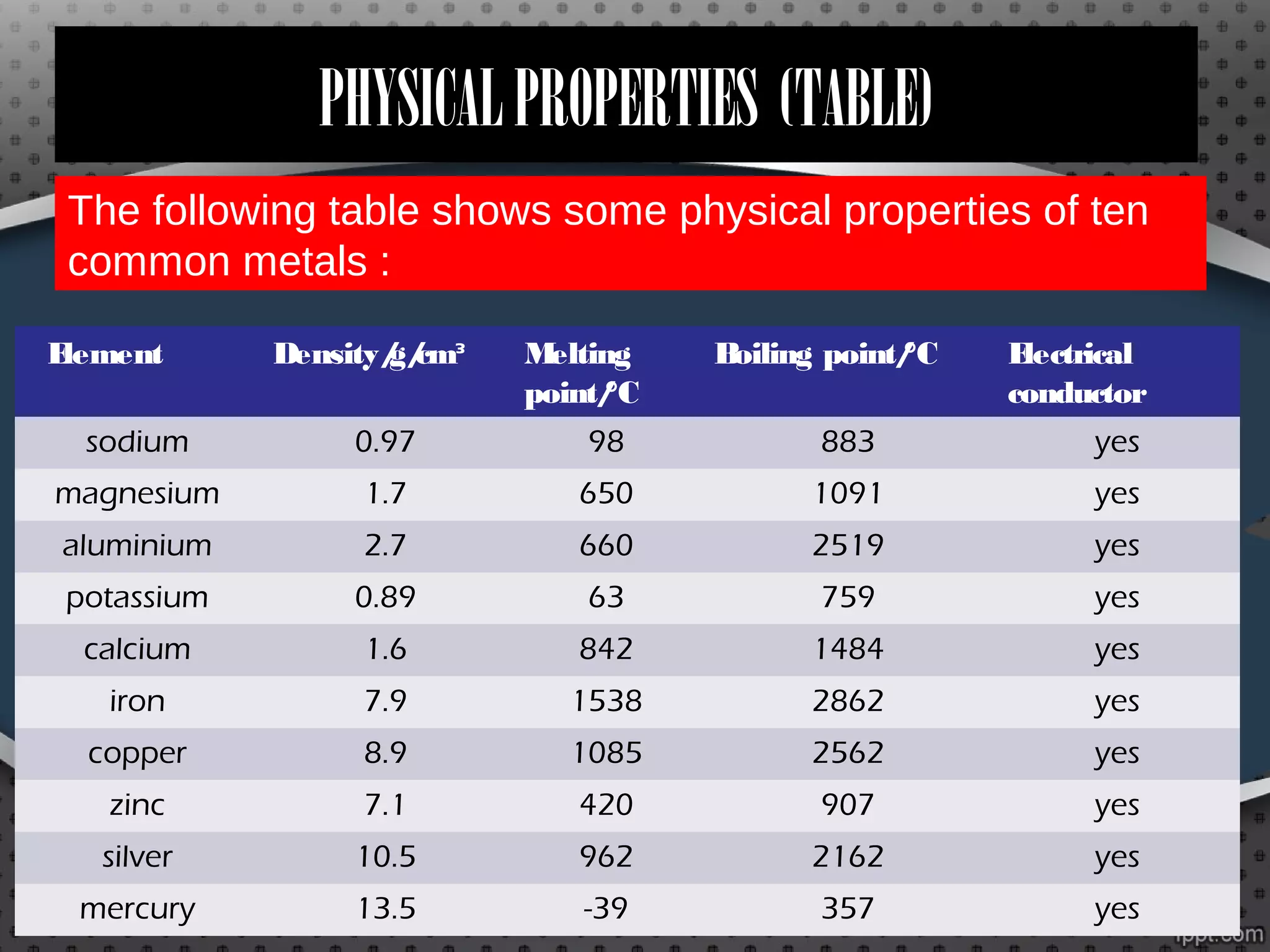
PHYSICALPROPERTIES (TABLE)
The following table shows some physical properties of ten
common metals :
Element Density/g/cmᵌ Melting
point/°C
Boiling point/°C Electrical
conductor
sodium 0.97 98 883 yes
magnesium 1.7 650 1091 yes
aluminium 2.7 660 2519 yes
potassium 0.89 63 759 yes
calcium 1.6 842 1484 yes
iron 7.9 1538 2862 yes
copper 8.9 1085 2562 yes
zinc 7.1 420 907 yes
silver 10.5 962 2162 yes
mercury 13.5 -39 357 yes
THEUSESANDPROPERTIESOF
NON-METALS
• Most of the non-metals that we use are not in
their pure elemental form.
• We use them in compounds with metals and
other non-metals.
• The table starting from the next slide next shows
the range of features, uses and some physical
properties of seven common non-metals….!
CHEMISTRY
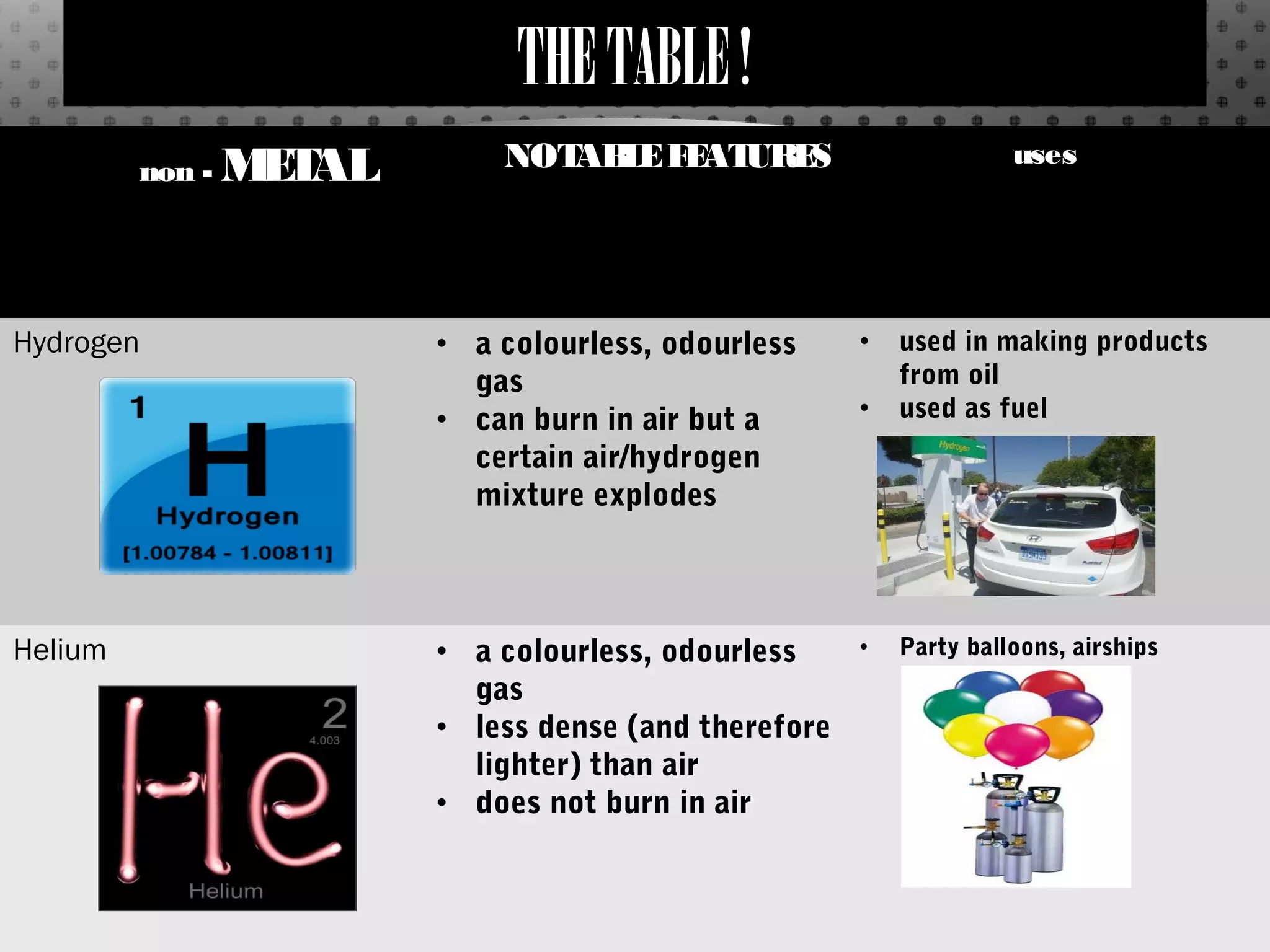
THETABLE!
non - METAL NOTABLEFEATURES uses
Hydrogen • a colourless, odourless
gas
• can burn in air but a
certain air/hydrogen
mixture explodes
• used in making products
from oil
• used as fuel
Helium • a colourless, odourless
gas
• less dense (and therefore
lighter) than air
• does not burn in air
• Party balloons, airships
THETABLE!
non - METAL NOTABLEFEATURES uses
Carbon two main forms:
•diamond – hard,
transparent crystal
•graphite – a grey, shiny,
slippery solid which
conducts electricity.
• diamond – jewellery, saws,
drills and certain types of
scalpel.
• graphite – used with clay to
make pencil leads,
lubricants for machinery
and in some kinds of
batteries and electric
motors
THETABLE!
non - METAL NOTABLEFEATURES uses
Nitrogen • a colourless, odourless
gas
• does not allow things to
burn in it
• slows down chemical
reactions which cause
decay
• food storage bags
• to provide a low
temperature for the storage
of blood
• aircraft tyres
Oxygen • a colourless, odourless
gas
• supports burning
• is needed for respiration
• life support systems in hospital
to help breathing
• in industry for welding and
cutting metals
THETABLE!
non - METAL NOTABLEFEATURES uses
Sulfur • yellow, brittle solid
• does not dissolve in
water
• burns in air to produce
sulfur dioxide gas
• to make rubber harder for
use as tyres
• as a fungicide to protect
crops
Bromine • a red-brown liquid which
is slightly transparent
• produces red-brown
toxic fumes with an
unpleasant smell
• soluble in water
• Present in seawater from
which it is extracted.
• flame retardants
• dyes
• Disinfectants
PHYSICALPROPERTIES (TABLE)
The following table shows some physical properties of
seven common non - metals :
Element Density/g/cmᵌ Melting
point/°C
Boiling point/°C Electrical
conductor
hydrogen 0.000 09 -259 -253 no
helium 0.00017 -272 -269 no
carbon
(graphite)
2.5 3642 sublimes yes
nitrogen 0.0012 -210 -196 no
oxygen 0.0013 -219 -183 no
sulfur 2.0 115 445 no
bromine 3.1 -7 59 no
CHEMISTRY
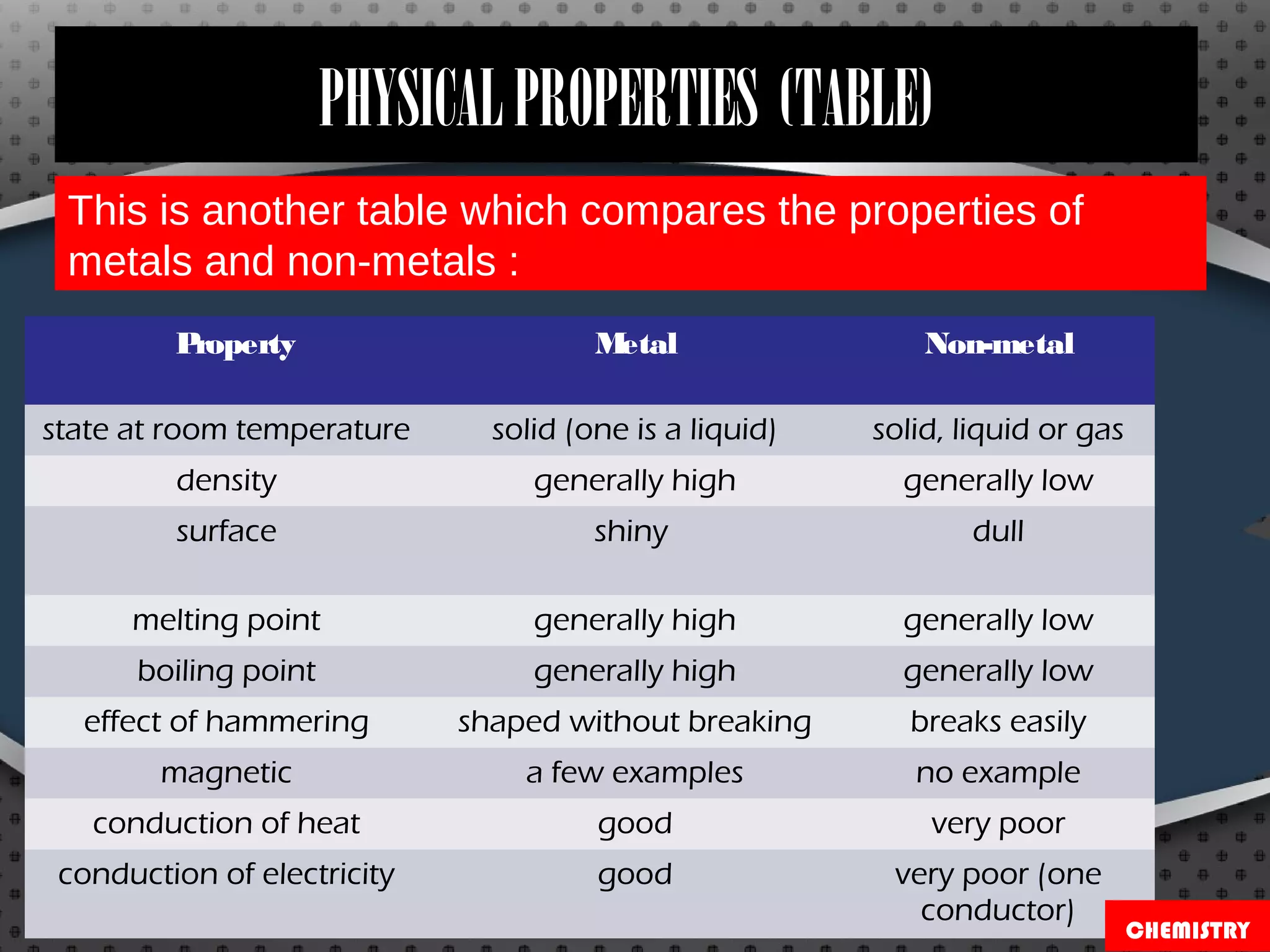
PHYSICALPROPERTIES (TABLE)
This is another table which compares the properties of
metals and non-metals :
Property Metal Non-metal
state at room temperature solid (one is a liquid) solid, liquid or gas
density generally high generally low
surface shiny dull
melting point generally high generally low
boiling point generally high generally low
effect of hammering shaped without breaking breaks easily
magnetic a few examples no example
conduction of heat good very poor
conduction of electricity good very poor (one
conductor)
CHEMISTRY
CHEMICALPROPERTIESOF
METALSANDNON-METALS
•Each element also has chemical
properties.
•A chemical property reveals itself when
a chemical reaction takes place.
•When this happens, the element
changes in some way.
•For example, the sodium and chlorine
were present as elements but after the
chemical reaction they formed the
compound sodium chloride.
•Two properties which are investigated by
carrying out chemical reactions are how
metals and non-metals react together
and how they react with oxygen.
CHEMISTRY
METALSREACTINGWITHNON-METALS
• Some metals and non-metals react together to produce
compounds (of two elements).
• If zinc or copper is heated with sulfur, the metal sulfide
is formed. The word equations for these reactions are:
a. zinc + sulfur zinc sulfide
b. copper + sulfur copper sulfide
CHEMISTRY
REACTIONWITHOXYGEN
• Oxygen is a non-metal and reacts with many metals
and non-metals to form oxides.
• The reaction of metals and non-metals with oxygen
forms a separate property to the general one about the
reaction between metals and non-metals such as
chlorine and sulfur.
CHEMISTRY
REACTIONofMETALSwithOxygen
• If a metal takes part in a chemical reaction
with oxygen, a metal oxide is formed. Here
is an example:
• When sulphur burns in air, it forms a gas
sulphur dioxide.
• Metal oxides are called bases.
• A base is a substance which takes part in
a chemical reaction with an acid and
neutralises it.
• Examples are sodium oxide and calcium
oxide which dissolve in water and form
alkalis.
• Other metal oxides, such as copper oxide,
do not dissolve in water but they do react
with acids and neutralise them.
CHEMISTRY
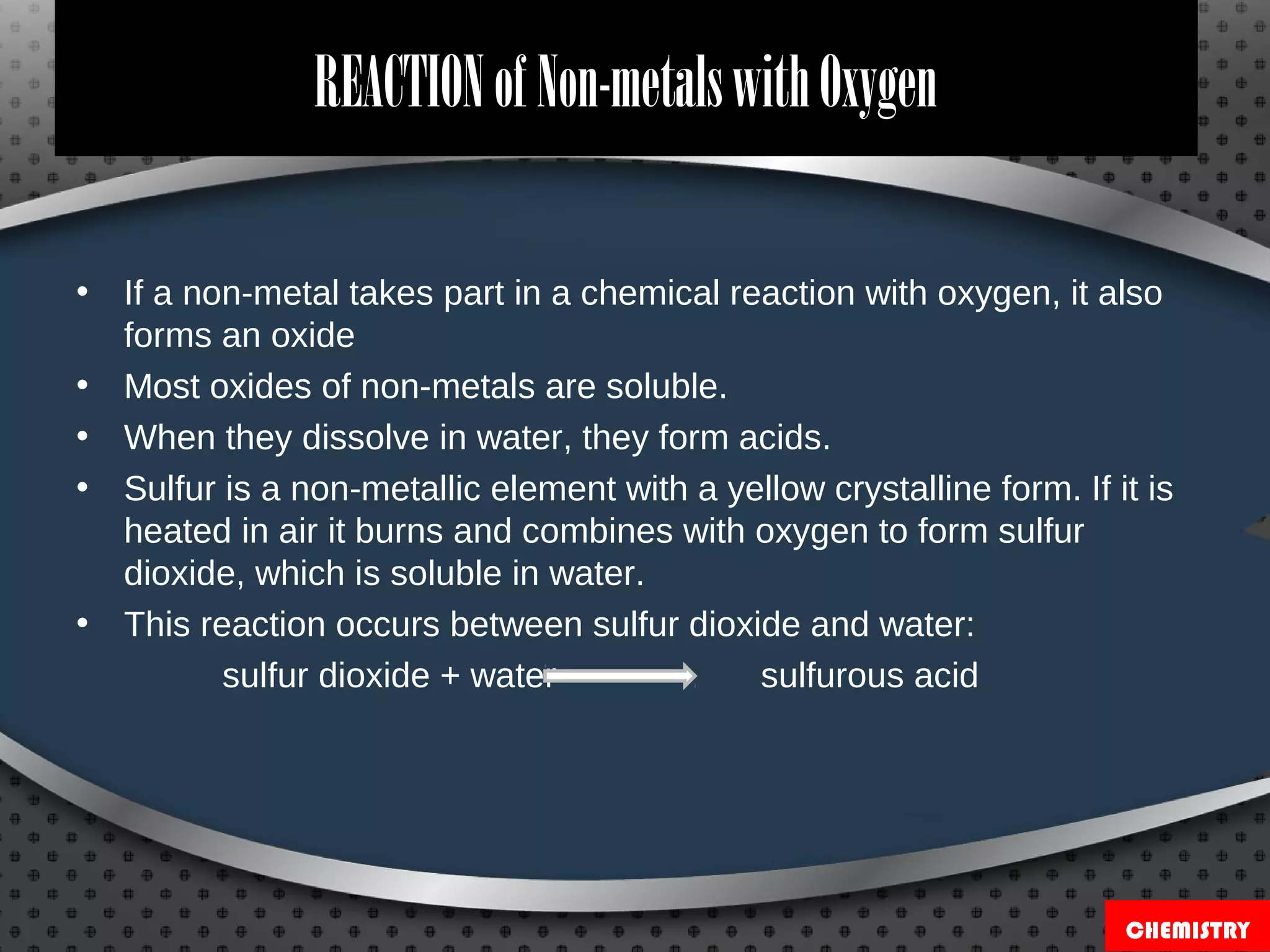
REACTIONofNon-metalswithOxygen
• If a non-metal takes part in a chemical reaction with oxygen, it also
forms an oxide
• Most oxides of non-metals are soluble.
• When they dissolve in water, they form acids.
• Sulfur is a non-metallic element with a yellow crystalline form. If it is
heated in air it burns and combines with oxygen to form sulfur
dioxide, which is soluble in water.
• This reaction occurs between sulfur dioxide and water:
sulfur dioxide + water sulfurous acid
CHEMISTRY
Metals and Non-metals

Metals and Non-metals

  • 1.
  • 2.
    WHATMETALSARE? • A metalis a material that is typically hard, opaque, shiny, and has good electrical and thermal conductivity. • In chemistry, a metal is an element that readily forms positive ions and has metallic bonds. • Examples of metals are aluminium, copper, iron, tin, gold, lead, silver and titanium. CHEMISTRY
  • 3.
    NON-METALS • Non-metals arenot able to conduct electricity or heat very well. • As opposed to metals, non-metallic elements are very brittle, and cannot be rolled into wires or pounded into sheets. • They form most of the matter in the Earth’s crust, the oceans, the atmosphere and even living things AN EXAMPLE OF NON- METALS IS PHOSPHORUS CHEMISTRY
  • 4.
    INTHEPERIODICTABLE! • This periodicshows the distribution of metals, non-metals and metalloids. • Elements that have properties of both metals and non-metals are called metalloids. CHEMISTRY
  • 5.
    THEUSESANDPROPERTIESOF METALS • Most ofthe metals that we use are not in their pure elemental form • We use metals mostly in alloys or in compounds with other metals and with non-metals. • The table starting from the next slide shows their range of features, uses and some of their physical properties. CHEMISTRY
  • 6.
    THETABLE! METAL NOTABLE FEATURES uses Sodium •can be easily cut up with a knife. • floats and burns on water • orange street lamps Magnesium • strips and powder catch fire easily • flares for the rescue of shipwrecked people. • camera flashbulbs. CHEMISTRY
  • 7.
    THETABLE! METAL NOTABLE FEATURES uses Aluminium •has a low density which makes it light- weight • does not corrode in air • aircraft • power cables Potassium • can be easily cut up with a knife • explodes with water • dyes, inks • fertiliser • weed killer CHEMISTRY
  • 8.
    THETABLE! METAL NOTABLEFEATURES uses Calcium• some effort is needed to cut it up with a knife • very reactive and present in many compounds • huge numbers of uses including cement and concrete, cosmetics, toothpaste, insecticides, paints and cheese making. Iron • a hard substance that can be shaped to make a wide variety of strong, hard objects • can decompose into flakes or rust • cast iron used to make utility- hole covers • combined with carbon to make steel cutlery and car bodies.
  • 9.
    THETABLE! METAL NOTABLEFEATURES uses Copper• a red-orange metal which is soft enough to pull easily into wires or press into sheets • very good conductor of heat • wires in electrical circuits • lightning conductors • hot water cylinders • copper-bottomed pans Zinc • a brittle blue-white metal which does not corrode in the air. • rust prevention • used in making some cells to generate electricity
  • 10.
    THETABLE! METAL NOTABLEFEATURES uses Silver• a shiny white metal that is soft enough to be made into complicated shapes by pulling into wires and pressing into sheets • jewellery, coins, ornaments • mirrors Mercury • a shiny silver liquid. • thermometers • fluorescent lamps • tooth fillings • liquid mirror telescopes
  • 11.
    PHYSICALPROPERTIES (TABLE) The followingtable shows some physical properties of ten common metals : Element Density/g/cmᵌ Melting point/°C Boiling point/°C Electrical conductor sodium 0.97 98 883 yes magnesium 1.7 650 1091 yes aluminium 2.7 660 2519 yes potassium 0.89 63 759 yes calcium 1.6 842 1484 yes iron 7.9 1538 2862 yes copper 8.9 1085 2562 yes zinc 7.1 420 907 yes silver 10.5 962 2162 yes mercury 13.5 -39 357 yes
  • 12.
    THEUSESANDPROPERTIESOF NON-METALS • Most ofthe non-metals that we use are not in their pure elemental form. • We use them in compounds with metals and other non-metals. • The table starting from the next slide next shows the range of features, uses and some physical properties of seven common non-metals….! CHEMISTRY
  • 13.
    THETABLE! non - METALNOTABLEFEATURES uses Hydrogen • a colourless, odourless gas • can burn in air but a certain air/hydrogen mixture explodes • used in making products from oil • used as fuel Helium • a colourless, odourless gas • less dense (and therefore lighter) than air • does not burn in air • Party balloons, airships
  • 14.
    THETABLE! non - METALNOTABLEFEATURES uses Carbon two main forms: •diamond – hard, transparent crystal •graphite – a grey, shiny, slippery solid which conducts electricity. • diamond – jewellery, saws, drills and certain types of scalpel. • graphite – used with clay to make pencil leads, lubricants for machinery and in some kinds of batteries and electric motors
  • 15.
    THETABLE! non - METALNOTABLEFEATURES uses Nitrogen • a colourless, odourless gas • does not allow things to burn in it • slows down chemical reactions which cause decay • food storage bags • to provide a low temperature for the storage of blood • aircraft tyres Oxygen • a colourless, odourless gas • supports burning • is needed for respiration • life support systems in hospital to help breathing • in industry for welding and cutting metals
  • 16.
    THETABLE! non - METALNOTABLEFEATURES uses Sulfur • yellow, brittle solid • does not dissolve in water • burns in air to produce sulfur dioxide gas • to make rubber harder for use as tyres • as a fungicide to protect crops Bromine • a red-brown liquid which is slightly transparent • produces red-brown toxic fumes with an unpleasant smell • soluble in water • Present in seawater from which it is extracted. • flame retardants • dyes • Disinfectants
  • 17.
    PHYSICALPROPERTIES (TABLE) The followingtable shows some physical properties of seven common non - metals : Element Density/g/cmᵌ Melting point/°C Boiling point/°C Electrical conductor hydrogen 0.000 09 -259 -253 no helium 0.00017 -272 -269 no carbon (graphite) 2.5 3642 sublimes yes nitrogen 0.0012 -210 -196 no oxygen 0.0013 -219 -183 no sulfur 2.0 115 445 no bromine 3.1 -7 59 no CHEMISTRY
  • 18.
    PHYSICALPROPERTIES (TABLE) This isanother table which compares the properties of metals and non-metals : Property Metal Non-metal state at room temperature solid (one is a liquid) solid, liquid or gas density generally high generally low surface shiny dull melting point generally high generally low boiling point generally high generally low effect of hammering shaped without breaking breaks easily magnetic a few examples no example conduction of heat good very poor conduction of electricity good very poor (one conductor) CHEMISTRY
  • 19.
    CHEMICALPROPERTIESOF METALSANDNON-METALS •Each element alsohas chemical properties. •A chemical property reveals itself when a chemical reaction takes place. •When this happens, the element changes in some way. •For example, the sodium and chlorine were present as elements but after the chemical reaction they formed the compound sodium chloride. •Two properties which are investigated by carrying out chemical reactions are how metals and non-metals react together and how they react with oxygen. CHEMISTRY
  • 20.
    METALSREACTINGWITHNON-METALS • Some metalsand non-metals react together to produce compounds (of two elements). • If zinc or copper is heated with sulfur, the metal sulfide is formed. The word equations for these reactions are: a. zinc + sulfur zinc sulfide b. copper + sulfur copper sulfide CHEMISTRY
  • 21.
    REACTIONWITHOXYGEN • Oxygen isa non-metal and reacts with many metals and non-metals to form oxides. • The reaction of metals and non-metals with oxygen forms a separate property to the general one about the reaction between metals and non-metals such as chlorine and sulfur. CHEMISTRY
  • 22.
    REACTIONofMETALSwithOxygen • If ametal takes part in a chemical reaction with oxygen, a metal oxide is formed. Here is an example: • When sulphur burns in air, it forms a gas sulphur dioxide. • Metal oxides are called bases. • A base is a substance which takes part in a chemical reaction with an acid and neutralises it. • Examples are sodium oxide and calcium oxide which dissolve in water and form alkalis. • Other metal oxides, such as copper oxide, do not dissolve in water but they do react with acids and neutralise them. CHEMISTRY
  • 23.
    REACTIONofNon-metalswithOxygen • If anon-metal takes part in a chemical reaction with oxygen, it also forms an oxide • Most oxides of non-metals are soluble. • When they dissolve in water, they form acids. • Sulfur is a non-metallic element with a yellow crystalline form. If it is heated in air it burns and combines with oxygen to form sulfur dioxide, which is soluble in water. • This reaction occurs between sulfur dioxide and water: sulfur dioxide + water sulfurous acid CHEMISTRY