1
Atoms and Elements
3.6
Isotopes and Atomic Mass
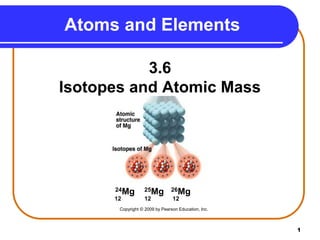
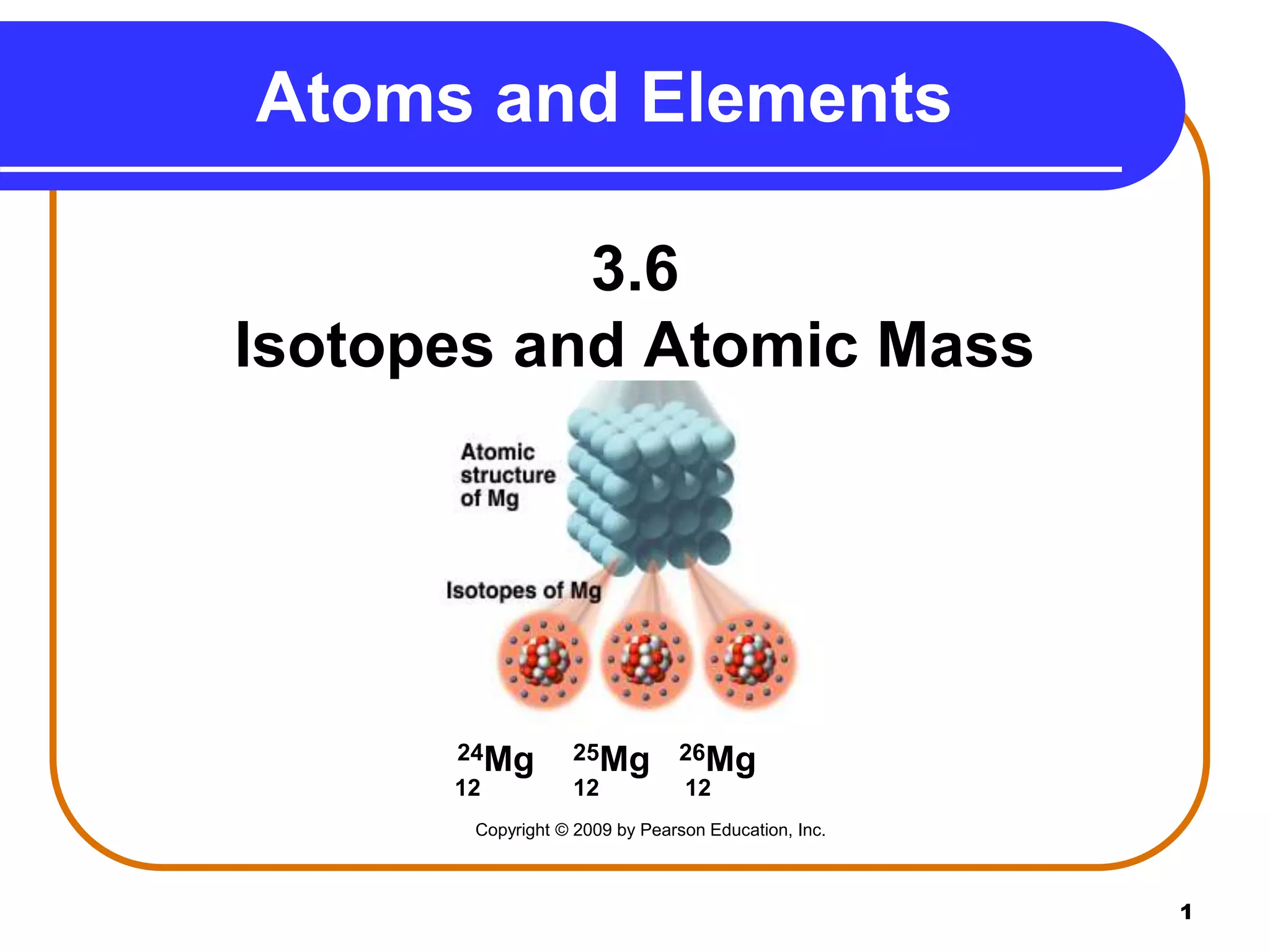
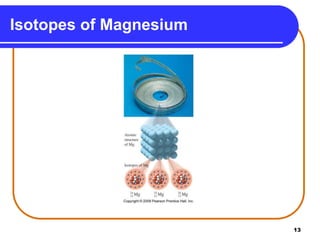
24Mg 25Mg 26Mg
12 12 12
Copyright © 2009 by Pearson Education, Inc.
2
Isotopes
• are atoms of the same element that have different
mass numbers.
• have the same number of protons, but different
numbers of neutrons.
Isotopes
3
An atomic symbol
• represents a particular atom of an element.
• gives the mass number in the upper left corner and
the atomic number in the lower left corner.
Example: An atom of sodium with atomic number 11
and a mass number 23 has the following atomic
symbol:
mass number 23
Na
atomic number 11
Atomic Symbol
The atomic symbol for a specific atom of an element
gives the
• number of protons (p+),
• number of neutrons (n),
• and number of electrons (e-).
Information from Atomic Symbols
4
5
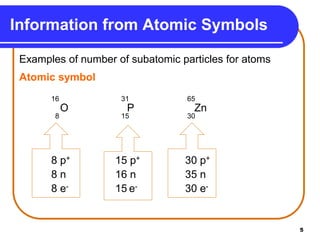
Examples of number of subatomic particles for atoms
Atomic symbol
16 31 65
O P Zn
8 15 30
8 p+ 15 p+ 30 p+
8 n 16 n 35 n
8 e- 15 e- 30 e-
Information from Atomic Symbols
6
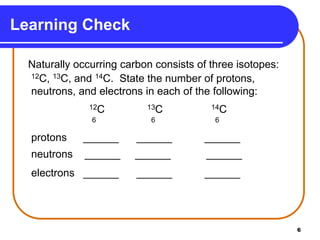
Naturally occurring carbon consists of three isotopes:
12C, 13C, and 14C. State the number of protons,
neutrons, and electrons in each of the following:
12C 13C 14C
6 6 6
protons ______ ______ ______
neutrons ______ ______ ______
electrons ______ ______ ______
Learning Check
7
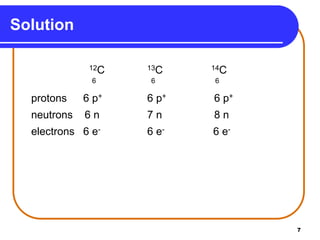
12C 13C 14C
6 6 6
protons 6 p+ 6 p+ 6 p+
neutrons 6 n 7 n 8 n
electrons 6 e- 6 e- 6 e-
Solution
8
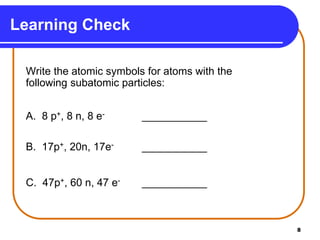
Write the atomic symbols for atoms with the
following subatomic particles:
A. 8 p+, 8 n, 8 e- ___________
B. 17p+, 20n, 17e- ___________
C. 47p+, 60 n, 47 e- ___________
Learning Check
9
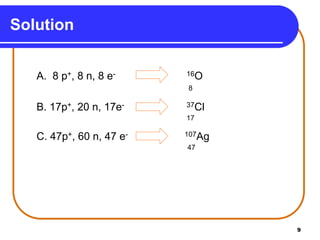
A. 8 p+, 8 n, 8 e- 16O
8
B. 17p+, 20 n, 17e- 37Cl
17
C. 47p+, 60 n, 47 e- 107Ag
47
Solution
10
Learning Check
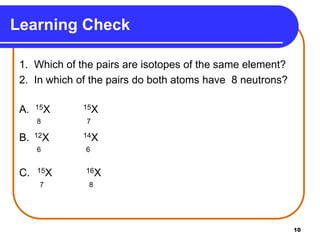
1. Which of the pairs are isotopes of the same element?
2. In which of the pairs do both atoms have 8 neutrons?
A. 15X 15X
8 7
B. 12X 14X
6 6
C. 15X 16X
7 8
11
Solution
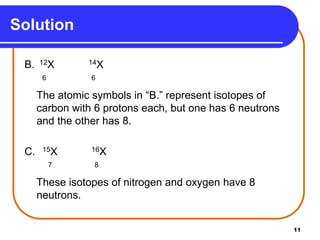
B. 12X 14X
6 6
The atomic symbols in “B.” represent isotopes of
carbon with 6 protons each, but one has 6 neutrons
and the other has 8.
C. 15X 16X
7 8
These isotopes of nitrogen and oxygen have 8
neutrons.
12
Isotopes of Magnesium
13
Isotopes of Magnesium
14
Isotopes of Sulfur
A sample of naturally
occurring sulfur contains
several isotopes with the
following abundances
Isotope % abundance
32S 95.02
33S 0.75
34S 4.21
36S 0.02
32S, 33S, 34S, 36S
16 16 16 16
Copyright © 2009 by Pearson Education, Inc.
15
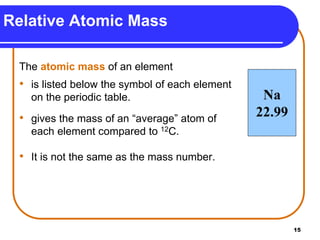
Relative Atomic Mass
The atomic mass of an element
• is listed below the symbol of each element
on the periodic table.
• gives the mass of an “average” atom of
each element compared to 12C.
• It is not the same as the mass number.
Na
22.99
16
Isotopes of Some Elements and
Their Atomic Mass
Most elements have two or more isotopes that
contribute to the atomic mass of that element.
17
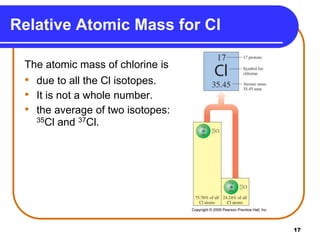
Relative Atomic Mass for Cl
The atomic mass of chlorine is
• due to all the Cl isotopes.
• It is not a whole number.
• the average of two isotopes:
35Cl and 37Cl.
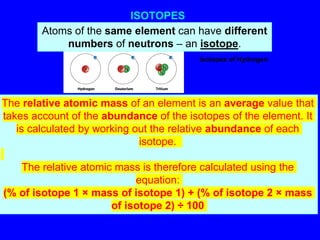
ISOTOPES
Atoms of the same element can have different
numbers of neutrons – an isotope.
The relative atomic mass of an element is an average value that
takes account of the abundance of the isotopes of the element. It
is calculated by working out the relative abundance of each
isotope.
The relative atomic mass is therefore calculated using the
equation:
(% of isotope 1 × mass of isotope 1) + (% of isotope 2 × mass
of isotope 2) ÷ 100
Isotopes of Hydrogen
19
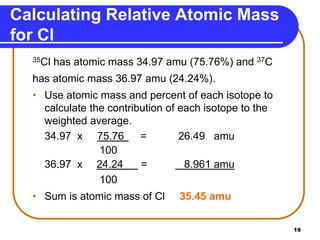
35Cl has atomic mass 34.97 amu (75.76%) and 37C
has atomic mass 36.97 amu (24.24%).
• Use atomic mass and percent of each isotope to
calculate the contribution of each isotope to the
weighted average.
34.97 x 75.76 = 26.49 amu
100
36.97 x 24.24 = 8.961 amu
100
• Sum is atomic mass of Cl 35.45 amu
Calculating Relative Atomic Mass
for Cl
20
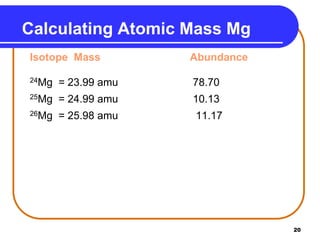
Calculating Atomic Mass Mg
Isotope Mass Abundance
24Mg = 23.99 amu 78.70
25Mg = 24.99 amu 10.13
26Mg = 25.98 amu 11.17
21
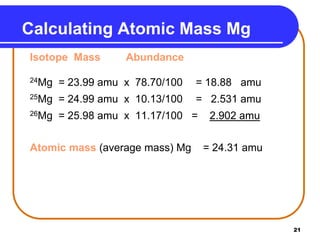
Calculating Atomic Mass Mg
Isotope Mass Abundance
24Mg = 23.99 amu x 78.70/100 = 18.88 amu
25Mg = 24.99 amu x 10.13/100 = 2.531 amu
26Mg = 25.98 amu x 11.17/100 = 2.902 amu
Atomic mass (average mass) Mg = 24.31 amu
22
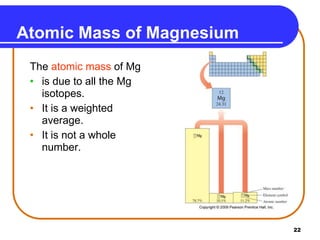
Atomic Mass of Magnesium
The atomic mass of Mg
• is due to all the Mg
isotopes.
• It is a weighted
average.
• It is not a whole
number.
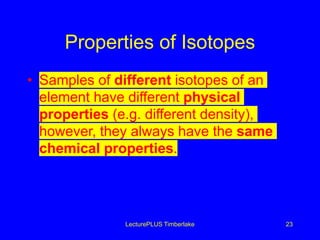
Properties of Isotopes
• Samples of different isotopes of an
element have different physical
properties (e.g. different density),
however, they always have the same
chemical properties.
LecturePLUS Timberlake 23
Radioactive Isotopes
• The term radioactive refers to the ability to emit
particles or radiation . Radioactive isotopes are
atoms which spontaneously emit particles or radiation
from their nuclei. This occurs because some nuclei
become unstable.
• The time taken for half of the nuclei in a sample of a
radioactive isotope to undergo radioactive decay is
known as the half-life of the isotope
LecturePLUS Timberlake 24
Types of Radiation
• Alpha particles – This is made up of 2 protons
and 2 neutron and have a charge of 2+
• Beta particles –A neutron changes into a
negative electron and a proton. The proton
remains in the nucleus and the electron is
ejected
Gamma radiation – this is a form of high
energy electromagnetic radiation and has
neither mass nor charge.
LecturePLUS Timberlake 25
Uses of RadioIsotopes
1. Carbon dating- this is the use of
Carbon-14 to determine the age of
plant and animal and remains up to
about 60,000 years old, which have
been discovered in places such as
archeological sites.
LecturePLUS Timberlake 26
Uses of Radioactive Isotopes
2. Radiotherapy- this involves the use of
radiation to control or cure cancer.
E.g. Iodine -131 is use to treat thyroid
cancer
Iridium -192, Palladium-103 and Iodine-
125 is used to treat breast and prostate
cancer and brain tumours.
LecturePLUS Timberlake 27
Uses of RadadioIsotopes
3. Tracers- Tracers are used in medicine
to diagnose illnesses.
Iodine-131 is used to image and carry our
functional studies of the thyroid gland
4. Production of Energy – Atom Bomb-
Uranium -235 or plutonium are used to
generate electricity.
LecturePLUS Timberlake 28
Uses of Radioactive Isotopes
• 5. Use in pacemakers. Plutonium- 238
is placed in the pacemakers as batteries
to power them
LecturePLUS Timberlake 29

ISOTOPES_AND_ATOMIC_MASS.ppt

  • 1.
    1 Atoms and Elements 3.6 Isotopesand Atomic Mass 24Mg 25Mg 26Mg 12 12 12 Copyright © 2009 by Pearson Education, Inc.
  • 2.
    2 Isotopes • are atomsof the same element that have different mass numbers. • have the same number of protons, but different numbers of neutrons. Isotopes
  • 3.
    3 An atomic symbol •represents a particular atom of an element. • gives the mass number in the upper left corner and the atomic number in the lower left corner. Example: An atom of sodium with atomic number 11 and a mass number 23 has the following atomic symbol: mass number 23 Na atomic number 11 Atomic Symbol
  • 4.
    The atomic symbolfor a specific atom of an element gives the • number of protons (p+), • number of neutrons (n), • and number of electrons (e-). Information from Atomic Symbols 4
  • 5.
    5 Examples of numberof subatomic particles for atoms Atomic symbol 16 31 65 O P Zn 8 15 30 8 p+ 15 p+ 30 p+ 8 n 16 n 35 n 8 e- 15 e- 30 e- Information from Atomic Symbols
  • 6.
    6 Naturally occurring carbonconsists of three isotopes: 12C, 13C, and 14C. State the number of protons, neutrons, and electrons in each of the following: 12C 13C 14C 6 6 6 protons ______ ______ ______ neutrons ______ ______ ______ electrons ______ ______ ______ Learning Check
  • 7.
    7 12C 13C 14C 66 6 protons 6 p+ 6 p+ 6 p+ neutrons 6 n 7 n 8 n electrons 6 e- 6 e- 6 e- Solution
  • 8.
    8 Write the atomicsymbols for atoms with the following subatomic particles: A. 8 p+, 8 n, 8 e- ___________ B. 17p+, 20n, 17e- ___________ C. 47p+, 60 n, 47 e- ___________ Learning Check
  • 9.
    9 A. 8 p+,8 n, 8 e- 16O 8 B. 17p+, 20 n, 17e- 37Cl 17 C. 47p+, 60 n, 47 e- 107Ag 47 Solution
  • 10.
    10 Learning Check 1. Whichof the pairs are isotopes of the same element? 2. In which of the pairs do both atoms have 8 neutrons? A. 15X 15X 8 7 B. 12X 14X 6 6 C. 15X 16X 7 8
  • 11.
    11 Solution B. 12X 14X 66 The atomic symbols in “B.” represent isotopes of carbon with 6 protons each, but one has 6 neutrons and the other has 8. C. 15X 16X 7 8 These isotopes of nitrogen and oxygen have 8 neutrons.
  • 12.
  • 13.
  • 14.
    14 Isotopes of Sulfur Asample of naturally occurring sulfur contains several isotopes with the following abundances Isotope % abundance 32S 95.02 33S 0.75 34S 4.21 36S 0.02 32S, 33S, 34S, 36S 16 16 16 16 Copyright © 2009 by Pearson Education, Inc.
  • 15.
    15 Relative Atomic Mass Theatomic mass of an element • is listed below the symbol of each element on the periodic table. • gives the mass of an “average” atom of each element compared to 12C. • It is not the same as the mass number. Na 22.99
  • 16.
    16 Isotopes of SomeElements and Their Atomic Mass Most elements have two or more isotopes that contribute to the atomic mass of that element.
  • 17.
    17 Relative Atomic Massfor Cl The atomic mass of chlorine is • due to all the Cl isotopes. • It is not a whole number. • the average of two isotopes: 35Cl and 37Cl.
  • 18.
    ISOTOPES Atoms of thesame element can have different numbers of neutrons – an isotope. The relative atomic mass of an element is an average value that takes account of the abundance of the isotopes of the element. It is calculated by working out the relative abundance of each isotope. The relative atomic mass is therefore calculated using the equation: (% of isotope 1 × mass of isotope 1) + (% of isotope 2 × mass of isotope 2) ÷ 100 Isotopes of Hydrogen
  • 19.
    19 35Cl has atomicmass 34.97 amu (75.76%) and 37C has atomic mass 36.97 amu (24.24%). • Use atomic mass and percent of each isotope to calculate the contribution of each isotope to the weighted average. 34.97 x 75.76 = 26.49 amu 100 36.97 x 24.24 = 8.961 amu 100 • Sum is atomic mass of Cl 35.45 amu Calculating Relative Atomic Mass for Cl
  • 20.
    20 Calculating Atomic MassMg Isotope Mass Abundance 24Mg = 23.99 amu 78.70 25Mg = 24.99 amu 10.13 26Mg = 25.98 amu 11.17
  • 21.
    21 Calculating Atomic MassMg Isotope Mass Abundance 24Mg = 23.99 amu x 78.70/100 = 18.88 amu 25Mg = 24.99 amu x 10.13/100 = 2.531 amu 26Mg = 25.98 amu x 11.17/100 = 2.902 amu Atomic mass (average mass) Mg = 24.31 amu
  • 22.
    22 Atomic Mass ofMagnesium The atomic mass of Mg • is due to all the Mg isotopes. • It is a weighted average. • It is not a whole number.
  • 23.
    Properties of Isotopes •Samples of different isotopes of an element have different physical properties (e.g. different density), however, they always have the same chemical properties. LecturePLUS Timberlake 23
  • 24.
    Radioactive Isotopes • Theterm radioactive refers to the ability to emit particles or radiation . Radioactive isotopes are atoms which spontaneously emit particles or radiation from their nuclei. This occurs because some nuclei become unstable. • The time taken for half of the nuclei in a sample of a radioactive isotope to undergo radioactive decay is known as the half-life of the isotope LecturePLUS Timberlake 24
  • 25.
    Types of Radiation •Alpha particles – This is made up of 2 protons and 2 neutron and have a charge of 2+ • Beta particles –A neutron changes into a negative electron and a proton. The proton remains in the nucleus and the electron is ejected Gamma radiation – this is a form of high energy electromagnetic radiation and has neither mass nor charge. LecturePLUS Timberlake 25
  • 26.
    Uses of RadioIsotopes 1.Carbon dating- this is the use of Carbon-14 to determine the age of plant and animal and remains up to about 60,000 years old, which have been discovered in places such as archeological sites. LecturePLUS Timberlake 26
  • 27.
    Uses of RadioactiveIsotopes 2. Radiotherapy- this involves the use of radiation to control or cure cancer. E.g. Iodine -131 is use to treat thyroid cancer Iridium -192, Palladium-103 and Iodine- 125 is used to treat breast and prostate cancer and brain tumours. LecturePLUS Timberlake 27
  • 28.
    Uses of RadadioIsotopes 3.Tracers- Tracers are used in medicine to diagnose illnesses. Iodine-131 is used to image and carry our functional studies of the thyroid gland 4. Production of Energy – Atom Bomb- Uranium -235 or plutonium are used to generate electricity. LecturePLUS Timberlake 28
  • 29.
    Uses of RadioactiveIsotopes • 5. Use in pacemakers. Plutonium- 238 is placed in the pacemakers as batteries to power them LecturePLUS Timberlake 29