8.Nature of Matter: Elements,
Compounds, and Mixtures/8th
science curiosity
By : K Sandeep Swamy(M.Sc,B.Ed)
For Online Classes (IITJEE & NEET foundation and academics) contact : 9491878325
Subscribe Samyans Eduhub youtube channel
Have you ever wondered what the world around you is made of? Everything we see
and touch is composed of matter - from the air we breathe to the water we drink. In
this presentation, we'll explore the fascinating world of matter and discover how
elements, compounds, and mixtures form the building blocks of our universe.
What is Matter?
Definition
Matter is anything that has mass
and takes up space. It makes up the
physical world around us - from the
staircase you use to the air you
breathe.
Composition
All matter is made up of tiny
particles. Most things around us are
not made of just one substance, but
rather two or more substances
mixed together.
Non-Matter
Not everything is matter. Light, heat, electricity, thoughts, and emotions are
important parts of our world but are not made of matter.
What Are Mixtures?
When two or more substances are mixed, where each substance
retains its properties, it is called a mixture. The individual substances
that make up a mixture are called its components.
The components of a mixture do not react chemically with each other.
They can often be separated by physical methods.
Examples of mixtures include:
Poha (flattened rice with vegetables)
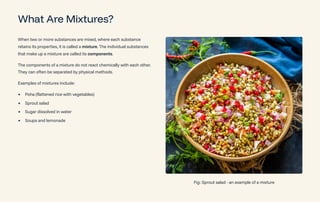
Sprout salad
Sugar dissolved in water
Soups and lemonade
Fig: Sprout salad - an example of a mixture
Types of Mixtures
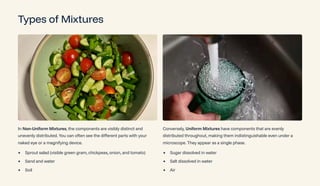
In Non-Uniform Mixtures, the components are visibly distinct and
unevenly distributed. You can often see the different parts with your
naked eye or a magnifying device.
Sprout salad (visible green gram, chickpeas, onion, and tomato)
Sand and water
Soil
Conversely, Uniform Mixtures have components that are evenly
distributed throughout, making them indistinguishable even under a
microscope. They appear as a single phase.
Sugar dissolved in water
Salt dissolved in water
Air
Alloys: Special Uniform Mixtures
Alloys are special uniform mixtures of metals or a metal and a non-
metal. They are mixed so uniformly that the entire mixture appears the
same throughout.
Examples of alloys include:
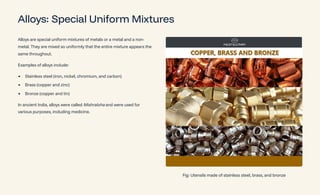
Stainless steel (iron, nickel, chromium, and carbon)
Brass (copper and zinc)
Bronze (copper and tin)
In ancient India, alloys were called Mishraloha and were used for
various purposes, including medicine.
Fig: Utensils made of stainless steel, brass, and bronze
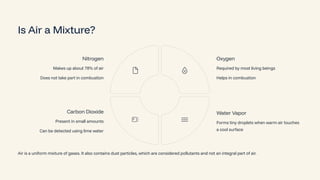
Is Air a Mixture?
Air is a uniform mixture of gases. It also contains dust particles, which are considered pollutants and not an integral part of air.
Nitrogen
Makes up about 78% of air
Does not take part in combustion
Oxygen
Required by most living beings
Helps in combustion
Water Vapor
Forms tiny droplets when warm air touches
a cool surface
Carbon Dioxide
Present in small amounts
Can be detected using lime water
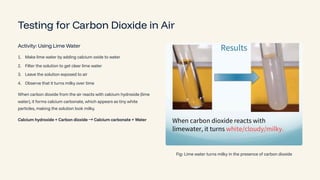
Testing for Carbon Dioxide in Air
Activity: Using Lime Water
Make lime water by adding calcium oxide to water
1.
Filter the solution to get clear lime water
2.
Leave the solution exposed to air
3.
Observe that it turns milky over time
4.
When carbon dioxide from the air reacts with calcium hydroxide (lime
water), it forms calcium carbonate, which appears as tiny white
particles, making the solution look milky.
Calcium hydroxide + Carbon dioxide ³Calcium carbonate + Water
Fig: Lime water turns milky in the presence of carbon dioxide
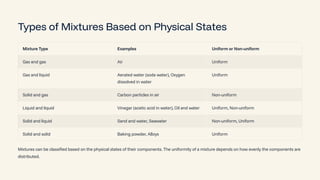
Types of Mixtures Based on Physical States
Mixture Type Examples Uniform or Non-uniform
Gas and gas Air Uniform
Gas and liquid Aerated water (soda water), Oxygen
dissolved in water
Uniform
Solid and gas Carbon particles in air Non-uniform
Liquid and liquid Vinegar (acetic acid in water), Oil and water Uniform, Non-uniform
Solid and liquid Sand and water, Seawater Non-uniform, Uniform
Solid and solid Baking powder, Alloys Uniform
Mixtures can be classified based on the physical states of their components. The uniformity of a mixture depends on how evenly the components are
distributed.
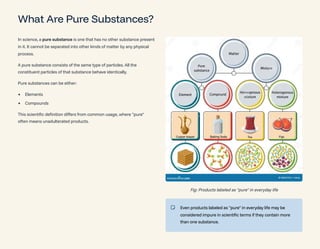
What Are Pure Substances?
In science, a pure substance is one that has no other substance present
in it. It cannot be separated into other kinds of matter by any physical
process.
A pure substance consists of the same type of particles. All the
constituent particles of that substance behave identically.
Pure substances can be either:
Elements
Compounds
This scientific definition differs from common usage, where "pure"
often means unadulterated products.
Fig: Products labeled as "pure" in everyday life
Even products labeled as "pure" in everyday life may be
considered impure in scientific terms if they contain more
than one substance.
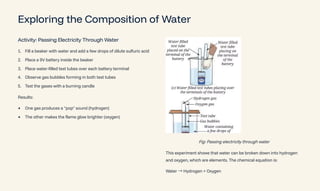
Exploring the Composition of Water
Activity: Passing Electricity Through Water
Fill a beaker with water and add a few drops of dilute sulfuric acid
1.
Place a 9V battery inside the beaker
2.
Place water-filled test tubes over each battery terminal
3.
Observe gas bubbles forming in both test tubes
4.
Test the gases with a burning candle
5.
Results:
One gas produces a "pop" sound (hydrogen)
The other makes the flame glow brighter (oxygen)
Fig: Passing electricity through water
This experiment shows that water can be broken down into hydrogen
and oxygen, which are elements. The chemical equation is:
Water ³Hydrogen + Oxygen
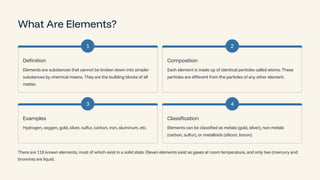
What Are Elements?
1
Definition
Elements are substances that cannot be broken down into simpler
substances by chemical means. They are the building blocks of all
matter.
2
Composition
Each element is made up of identical particles called atoms. These
particles are different from the particles of any other element.
3
Examples
Hydrogen, oxygen, gold, silver, sulfur, carbon, iron, aluminum, etc.
4
Classification
Elements can be classified as metals (gold, silver), non-metals
(carbon, sulfur), or metalloids (silicon, boron).
There are 118 known elements, most of which exist in a solid state. Eleven elements exist as gases at room temperature, and only two (mercury and
bromine) are liquid.
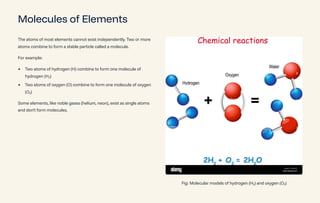
Molecules of Elements
The atoms of most elements cannot exist independently. Two or more
atoms combine to form a stable particle called a molecule.
For example:
Two atoms of hydrogen (H) combine to form one molecule of
hydrogen (H¢)
Two atoms of oxygen (O) combine to form one molecule of oxygen
(O¢)
Some elements, like noble gases (helium, neon), exist as single atoms
and don't form molecules.
Fig: Molecular models of hydrogen (H¢) and oxygen (O¢)
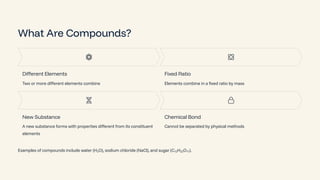
What Are Compounds?
Different Elements
Two or more different elements combine
Fixed Ratio
Elements combine in a fixed ratio by mass
New Substance
A new substance forms with properties different from its constituent
elements
Chemical Bond
Cannot be separated by physical methods
Examples of compounds include water (H¢O), sodium chloride (NaCl), and sugar (C¡¢H¢¢O¡¡).
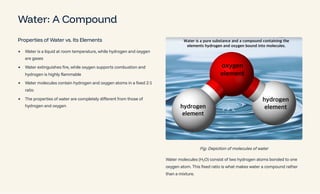
Water: A Compound
Properties of Water vs. Its Elements
Water is a liquid at room temperature, while hydrogen and oxygen
are gases
Water extinguishes fire, while oxygen supports combustion and
hydrogen is highly flammable
Water molecules contain hydrogen and oxygen atoms in a fixed 2:1
ratio
The properties of water are completely different from those of
hydrogen and oxygen
Fig: Depiction of molecules of water
Water molecules (H¢O) consist of two hydrogen atoms bonded to one
oxygen atom. This fixed ratio is what makes water a compound rather
than a mixture.
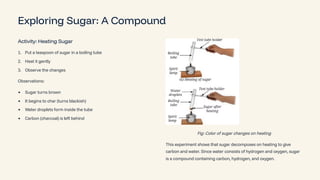
Exploring Sugar: A Compound
Activity: Heating Sugar
Put a teaspoon of sugar in a boiling tube
1.
Heat it gently
2.
Observe the changes
3.
Observations:
Sugar turns brown
It begins to char (turns blackish)
Water droplets form inside the tube
Carbon (charcoal) is left behind
Fig: Color of sugar changes on heating
This experiment shows that sugar decomposes on heating to give
carbon and water. Since water consists of hydrogen and oxygen, sugar
is a compound containing carbon, hydrogen, and oxygen.
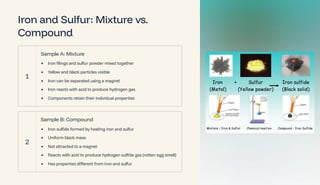
Iron and Sulfur: Mixture vs.
Compound
1
Sample A: Mixture
Iron filings and sulfur powder mixed together
Yellow and black particles visible
Iron can be separated using a magnet
Iron reacts with acid to produce hydrogen gas
Components retain their individual properties
2
Sample B: Compound
Iron sulfide formed by heating iron and sulfur
Uniform black mass
Not attracted to a magnet
Reacts with acid to produce hydrogen sulfide gas (rotten egg smell)
Has properties different from iron and sulfur
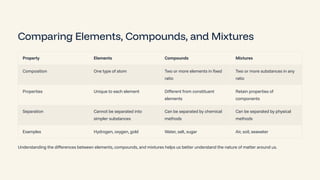
Comparing Elements, Compounds, and Mixtures
Property Elements Compounds Mixtures
Composition One type of atom Two or more elements in fixed
ratio
Two or more substances in any
ratio
Properties Unique to each element Different from constituent
elements
Retain properties of
components
Separation Cannot be separated into
simpler substances
Can be separated by chemical
methods
Can be separated by physical
methods
Examples Hydrogen, oxygen, gold Water, salt, sugar Air, soil, seawater
Understanding the differences between elements, compounds, and mixtures helps us better understand the nature of matter around us.
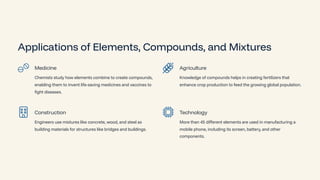
Applications of Elements, Compounds, and Mixtures
Medicine
Chemists study how elements combine to create compounds,
enabling them to invent life-saving medicines and vaccines to
fight diseases.
Agriculture
Knowledge of compounds helps in creating fertilizers that
enhance crop production to feed the growing global population.
Construction
Engineers use mixtures like concrete, wood, and steel as
building materials for structures like bridges and buildings.
Technology
More than 45 different elements are used in manufacturing a
mobile phone, including its screen, battery, and other
components.
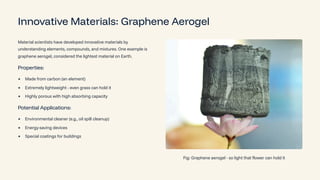
Innovative Materials: Graphene Aerogel
Material scientists have developed innovative materials by
understanding elements, compounds, and mixtures. One example is
graphene aerogel, considered the lightest material on Earth.
Properties:
Made from carbon (an element)
Extremely lightweight - even grass can hold it
Highly porous with high absorbing capacity
Potential Applications:
Environmental cleaner (e.g., oil spill cleanup)
Energy-saving devices
Special coatings for buildings
Fig: Graphene aerogel - so light that flower can hold it
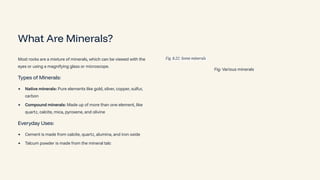
What Are Minerals?
Most rocks are a mixture of minerals, which can be viewed with the
eyes or using a magnifying glass or microscope.
Types of Minerals:
Native minerals: Pure elements like gold, silver, copper, sulfur,
carbon
Compound minerals: Made up of more than one element, like
quartz, calcite, mica, pyroxene, and olivine
Everyday Uses:
Cement is made from calcite, quartz, alumina, and iron oxide
Talcum powder is made from the mineral talc
Fig: Various minerals
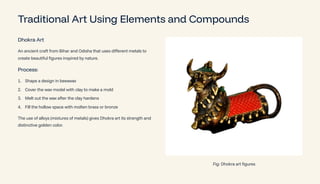
Traditional Art Using Elements and Compounds
Dhokra Art
An ancient craft from Bihar and Odisha that uses different metals to
create beautiful figures inspired by nature.
Process:
Shape a design in beeswax
1.
Cover the wax model with clay to make a mold
2.
Melt out the wax after the clay hardens
3.
Fill the hollow space with molten brass or bronze
4.
The use of alloys (mixtures of metals) gives Dhokra art its strength and
distinctive golden color.
Fig: Dhokra art figures
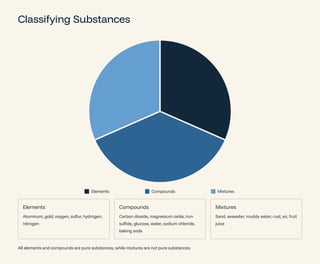
Classifying Substances
Elements Compounds Mixtures
Elements
Aluminum, gold, oxygen, sulfur, hydrogen,
nitrogen
Compounds
Carbon dioxide, magnesium oxide, iron
sulfide, glucose, water, sodium chloride,
baking soda
Mixtures
Sand, seawater, muddy water, rust, air, fruit
juice
All elements and compounds are pure substances, while mixtures are not pure substances.
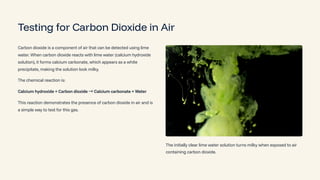
Testing for Carbon Dioxide in Air
Carbon dioxide is a component of air that can be detected using lime
water. When carbon dioxide reacts with lime water (calcium hydroxide
solution), it forms calcium carbonate, which appears as a white
precipitate, making the solution look milky.
The chemical reaction is:
Calcium hydroxide + Carbon dioxide ³Calcium carbonate + Water
This reaction demonstrates the presence of carbon dioxide in air and is
a simple way to test for this gas.
The initially clear lime water solution turns milky when exposed to air
containing carbon dioxide.
Practical Applications and Future Innovations
118
Known Elements
Building blocks that form all matter in our
universe
10M+
Known Compounds
Created through chemical combinations of
elements
45+
Elements in a Phone
Different elements used in manufacturing a
mobile phone
Understanding elements, compounds, and mixtures has led to countless innovations in medicine, technology, construction, and environmental
science. Future discoveries could lead to new materials with extraordinary properties, more effective medicines, and solutions to environmental
challenges like carbon dioxide absorption.
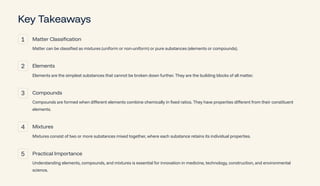
Key Takeaways
1 Matter Classification
Matter can be classified as mixtures (uniform or non-uniform) or pure substances (elements or compounds).
2 Elements
Elements are the simplest substances that cannot be broken down further. They are the building blocks of all matter.
3 Compounds
Compounds are formed when different elements combine chemically in fixed ratios. They have properties different from their constituent
elements.
4 Mixtures
Mixtures consist of two or more substances mixed together, where each substance retains its individual properties.
5 Practical Importance
Understanding elements, compounds, and mixtures is essential for innovation in medicine, technology, construction, and environmental
science.