A Matter of FactA Matter of Fact
Mixtures, Elements andMixtures, Elements and
CompoundsCompounds
Mixtures, elements, compoundsMixtures, elements, compounds
 Scientists like to classify things.Scientists like to classify things.
 One way that scientists classify matter isOne way that scientists classify matter is
by its composition.by its composition.
 Ultimately, all matter can be classified asUltimately, all matter can be classified as
mixtures, elements and compounds.mixtures, elements and compounds.
Why isn’t it a good idea toWhy isn’t it a good idea to
classify matter by its phases?classify matter by its phases?
 Because one kind of substance can exist in more thanBecause one kind of substance can exist in more than
one phase – such as Hone phase – such as H220. And matter changes phases0. And matter changes phases
rather easily.rather easily.
Why isn’t matter classifiedWhy isn’t matter classified
according to its physicalaccording to its physical
characteristics, such as color?characteristics, such as color?
 Scientists wouldn’t find it very useful to groupScientists wouldn’t find it very useful to group
gold, sunflowers, and the sun together.gold, sunflowers, and the sun together.
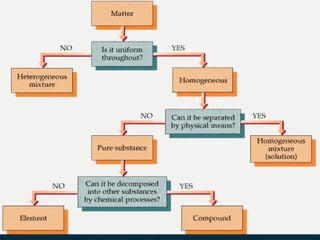
 Scientists ask themselves theseScientists ask themselves these
questions?questions?
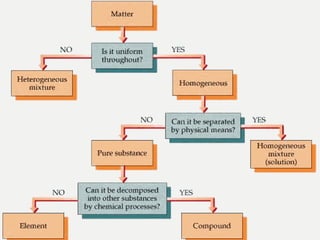
 Is the matter uniform throughout?Is the matter uniform throughout?
 Can it be separated by physical means?Can it be separated by physical means?
 Can it be separated by chemical means?Can it be separated by chemical means?
By asking these questions scientists can classifyBy asking these questions scientists can classify
matter into:matter into:
 MixturesMixtures – two or more substances that are not– two or more substances that are not
chemically combined with each other and can bechemically combined with each other and can be
separated by physical means. The substances inseparated by physical means. The substances in
a mixture retain their individual properties.a mixture retain their individual properties.
 Solutions – a special kind of mixture where oneSolutions – a special kind of mixture where one
substance dissolves in another.substance dissolves in another.
 ElementsElements – simplest form of pure substance.– simplest form of pure substance.
They cannot be broken into anything else byThey cannot be broken into anything else by
physical or chemical means.physical or chemical means.
 CompoundsCompounds – pure substances that are the– pure substances that are the
unions of two or more elements. They can beunions of two or more elements. They can be
broken into simpler substances by chemicalbroken into simpler substances by chemical
means.means.
Is it uniform throughout?Is it uniform throughout?
 If the answer is no, the matter is aIf the answer is no, the matter is a
heterogeneous mixture.heterogeneous mixture.
 Considered the “least mixed.”Considered the “least mixed.”
 Does not appear to be the same throughout.Does not appear to be the same throughout.
 Particles are large enough to be seen and toParticles are large enough to be seen and to
be separated from the mixture.be separated from the mixture.
Examples of heterogeneousExamples of heterogeneous
mixturesmixtures
 Sand and pebblesSand and pebbles
 Oil and waterOil and water
 Powdered iron and powdered sulfurPowdered iron and powdered sulfur
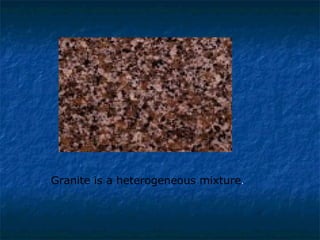
Granite is a heterogeneous mixture.
Is it uniform throughout?Is it uniform throughout?
 If the answer is yes, the matter isIf the answer is yes, the matter is
homogeneous (looks the samehomogeneous (looks the same
throughout).throughout).
 That leads us to another question.That leads us to another question.
Can it be separated by physicalCan it be separated by physical
means?means?
 If the answer is yes, the matter is aIf the answer is yes, the matter is a
homogeneous mixture or solution.homogeneous mixture or solution.
Homogeneous MixturesHomogeneous Mixtures
 A mixture that appears to be the sameA mixture that appears to be the same
throughout.throughout.
 It is “well mixed.”It is “well mixed.”
 The particles that make up the mixture areThe particles that make up the mixture are
very small and not easily recognizable.very small and not easily recognizable.
Examples of homogeneousExamples of homogeneous
mixturesmixtures
Milk, toothpaste, and mayonnaise are homogeneous
mixtures. They are also colloids.
ColloidsColloids
 In a colloid theIn a colloid the
particles are mixedparticles are mixed
together but nottogether but not
dissolved.dissolved.
 The particles areThe particles are
relatively large andrelatively large and
are kept permanentlyare kept permanently
suspended.suspended.
0
20
40
60
80
100
1st
Qtr
2nd
Qtr
3rd
Qtr
4th
Qtr
East
West
North
ColloidsColloids
 A colloid will notA colloid will not
separate uponseparate upon
standing.standing.
 The particles areThe particles are
constantly colliding,constantly colliding,
and this allows aand this allows a
colloid to scatter lightcolloid to scatter light
– thus colloids often– thus colloids often
seem cloudy.seem cloudy.
SolutionsSolutions
 A solution is a type of homogeneous mixtureA solution is a type of homogeneous mixture
formed when one substance dissolves informed when one substance dissolves in
another.another.
 It is the best mixed of all mixtures.It is the best mixed of all mixtures.
 A solution always has a substance that isA solution always has a substance that is
dissolved and a substance that does thedissolved and a substance that does the
dissolving.dissolving.
 The substance that is dissolved is the solute andThe substance that is dissolved is the solute and
the substance that does the dissolving is thethe substance that does the dissolving is the
solvent.solvent.
Ocean water is a solutionOcean water is a solution
The universal solvent: WaterThe universal solvent: Water
Water as a solventWater as a solvent
 Many liquid solutions contain water as theMany liquid solutions contain water as the
solvent.solvent.
 Ocean water is basically a water solutionOcean water is basically a water solution
that contains many salts.that contains many salts.
 Body fluids are also water solutions.Body fluids are also water solutions.
Types of solutionsTypes of solutions
GasGas GasGas Air (oxygen in nitrogen)Air (oxygen in nitrogen)
GasGas LiquidLiquid Soda water (carbon dioxide inSoda water (carbon dioxide in
water)water)
SolidSolid LiquidLiquid Ocean water (salt in water)Ocean water (salt in water)
Solute Solvent Example
SolidSolid SolidSolid Gold jewelryGold jewelry (copper in gold)(copper in gold)
Metals dissolved in
metals are called
alloys.
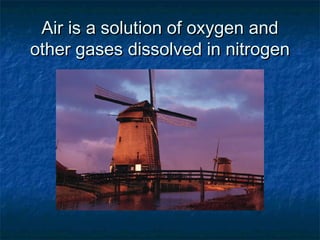
Air is a solution of oxygen andAir is a solution of oxygen and
other gases dissolved in nitrogenother gases dissolved in nitrogen
AlloysAlloys
Brass is an alloy of copper
and zinc.
Stainless steel is a mixture
of iron and chromium.
Can it be separated by physicalCan it be separated by physical
means?means?
 If the answer is no, the matter is a pureIf the answer is no, the matter is a pure
substance.substance.
 An elementAn element
 Or a compoundOr a compound
ElementsElements
 Elements are the simplest pure substance.Elements are the simplest pure substance.
 An element can not be changed into a simplerAn element can not be changed into a simpler
substance by heating or any chemical process.substance by heating or any chemical process.
 The smallest particle of an element that has theThe smallest particle of an element that has the
properties of that element is called an atom.properties of that element is called an atom.
 An atom is the basic building block of matter.An atom is the basic building block of matter.
 There are more than one hundred knownThere are more than one hundred known
elements in the universe listed on the periodicelements in the universe listed on the periodic
table of elements.table of elements.
 These elements combine in such a way to createThese elements combine in such a way to create
millions of compounds.millions of compounds.
ElementsElements
 All elements areAll elements are
made of atoms.made of atoms.
 Atoms of the sameAtoms of the same
element are alike.element are alike.
 Atoms of differentAtoms of different
elements areelements are
different.different.
ElementsElements
 In 1813, a systemIn 1813, a system
of representingof representing
elements withelements with
symbols wassymbols was
introduced.introduced.
 Each symbol consists of oneEach symbol consists of one
or two letters.or two letters.
 Two letters are needed for aTwo letters are needed for a
chemical symbol when the firstchemical symbol when the first
letter of that element’s nameletter of that element’s name
has already been used.has already been used.
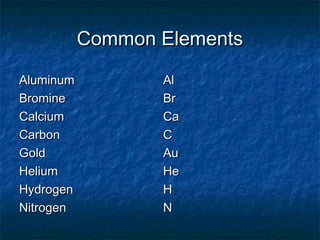
Common ElementsCommon Elements
AluminumAluminum AlAl
BromineBromine BrBr
CalciumCalcium CaCa
CarbonCarbon CC
GoldGold AuAu
HeliumHelium HeHe
HydrogenHydrogen HH
NitrogenNitrogen NN
CompoundsCompounds
 Compounds are alsoCompounds are also
pure substances.pure substances.
 But compounds areBut compounds are
made from more thanmade from more than
one element.one element.
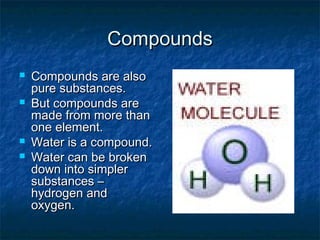
 Water is a compound.Water is a compound.
 Water can be brokenWater can be broken
down into simplerdown into simpler
substances –substances –
hydrogen andhydrogen and
oxygen.oxygen.
Elements Compounds Mixtures

Elements Compounds Mixtures

  • 1.
    A Matter ofFactA Matter of Fact Mixtures, Elements andMixtures, Elements and CompoundsCompounds
  • 2.
    Mixtures, elements, compoundsMixtures,elements, compounds  Scientists like to classify things.Scientists like to classify things.  One way that scientists classify matter isOne way that scientists classify matter is by its composition.by its composition.  Ultimately, all matter can be classified asUltimately, all matter can be classified as mixtures, elements and compounds.mixtures, elements and compounds.
  • 3.
    Why isn’t ita good idea toWhy isn’t it a good idea to classify matter by its phases?classify matter by its phases?  Because one kind of substance can exist in more thanBecause one kind of substance can exist in more than one phase – such as Hone phase – such as H220. And matter changes phases0. And matter changes phases rather easily.rather easily.
  • 4.
    Why isn’t matterclassifiedWhy isn’t matter classified according to its physicalaccording to its physical characteristics, such as color?characteristics, such as color?  Scientists wouldn’t find it very useful to groupScientists wouldn’t find it very useful to group gold, sunflowers, and the sun together.gold, sunflowers, and the sun together.
  • 5.
     Scientists askthemselves theseScientists ask themselves these questions?questions?  Is the matter uniform throughout?Is the matter uniform throughout?  Can it be separated by physical means?Can it be separated by physical means?  Can it be separated by chemical means?Can it be separated by chemical means?
  • 6.
    By asking thesequestions scientists can classifyBy asking these questions scientists can classify matter into:matter into:  MixturesMixtures – two or more substances that are not– two or more substances that are not chemically combined with each other and can bechemically combined with each other and can be separated by physical means. The substances inseparated by physical means. The substances in a mixture retain their individual properties.a mixture retain their individual properties.  Solutions – a special kind of mixture where oneSolutions – a special kind of mixture where one substance dissolves in another.substance dissolves in another.  ElementsElements – simplest form of pure substance.– simplest form of pure substance. They cannot be broken into anything else byThey cannot be broken into anything else by physical or chemical means.physical or chemical means.  CompoundsCompounds – pure substances that are the– pure substances that are the unions of two or more elements. They can beunions of two or more elements. They can be broken into simpler substances by chemicalbroken into simpler substances by chemical means.means.
  • 8.
    Is it uniformthroughout?Is it uniform throughout?  If the answer is no, the matter is aIf the answer is no, the matter is a heterogeneous mixture.heterogeneous mixture.  Considered the “least mixed.”Considered the “least mixed.”  Does not appear to be the same throughout.Does not appear to be the same throughout.  Particles are large enough to be seen and toParticles are large enough to be seen and to be separated from the mixture.be separated from the mixture.
  • 9.
    Examples of heterogeneousExamplesof heterogeneous mixturesmixtures  Sand and pebblesSand and pebbles  Oil and waterOil and water  Powdered iron and powdered sulfurPowdered iron and powdered sulfur
  • 10.
    Granite is aheterogeneous mixture.
  • 12.
    Is it uniformthroughout?Is it uniform throughout?  If the answer is yes, the matter isIf the answer is yes, the matter is homogeneous (looks the samehomogeneous (looks the same throughout).throughout).  That leads us to another question.That leads us to another question.
  • 13.
    Can it beseparated by physicalCan it be separated by physical means?means?  If the answer is yes, the matter is aIf the answer is yes, the matter is a homogeneous mixture or solution.homogeneous mixture or solution.
  • 14.
    Homogeneous MixturesHomogeneous Mixtures A mixture that appears to be the sameA mixture that appears to be the same throughout.throughout.  It is “well mixed.”It is “well mixed.”  The particles that make up the mixture areThe particles that make up the mixture are very small and not easily recognizable.very small and not easily recognizable.
  • 15.
    Examples of homogeneousExamplesof homogeneous mixturesmixtures Milk, toothpaste, and mayonnaise are homogeneous mixtures. They are also colloids.
  • 16.
    ColloidsColloids  In acolloid theIn a colloid the particles are mixedparticles are mixed together but nottogether but not dissolved.dissolved.  The particles areThe particles are relatively large andrelatively large and are kept permanentlyare kept permanently suspended.suspended. 0 20 40 60 80 100 1st Qtr 2nd Qtr 3rd Qtr 4th Qtr East West North
  • 17.
    ColloidsColloids  A colloidwill notA colloid will not separate uponseparate upon standing.standing.  The particles areThe particles are constantly colliding,constantly colliding, and this allows aand this allows a colloid to scatter lightcolloid to scatter light – thus colloids often– thus colloids often seem cloudy.seem cloudy.
  • 20.
    SolutionsSolutions  A solutionis a type of homogeneous mixtureA solution is a type of homogeneous mixture formed when one substance dissolves informed when one substance dissolves in another.another.  It is the best mixed of all mixtures.It is the best mixed of all mixtures.  A solution always has a substance that isA solution always has a substance that is dissolved and a substance that does thedissolved and a substance that does the dissolving.dissolving.  The substance that is dissolved is the solute andThe substance that is dissolved is the solute and the substance that does the dissolving is thethe substance that does the dissolving is the solvent.solvent.
  • 21.
    Ocean water isa solutionOcean water is a solution
  • 22.
    The universal solvent:WaterThe universal solvent: Water
  • 23.
    Water as asolventWater as a solvent  Many liquid solutions contain water as theMany liquid solutions contain water as the solvent.solvent.  Ocean water is basically a water solutionOcean water is basically a water solution that contains many salts.that contains many salts.  Body fluids are also water solutions.Body fluids are also water solutions.
  • 24.
    Types of solutionsTypesof solutions GasGas GasGas Air (oxygen in nitrogen)Air (oxygen in nitrogen) GasGas LiquidLiquid Soda water (carbon dioxide inSoda water (carbon dioxide in water)water) SolidSolid LiquidLiquid Ocean water (salt in water)Ocean water (salt in water) Solute Solvent Example SolidSolid SolidSolid Gold jewelryGold jewelry (copper in gold)(copper in gold) Metals dissolved in metals are called alloys.
  • 25.
    Air is asolution of oxygen andAir is a solution of oxygen and other gases dissolved in nitrogenother gases dissolved in nitrogen
  • 26.
    AlloysAlloys Brass is analloy of copper and zinc. Stainless steel is a mixture of iron and chromium.
  • 28.
    Can it beseparated by physicalCan it be separated by physical means?means?  If the answer is no, the matter is a pureIf the answer is no, the matter is a pure substance.substance.  An elementAn element  Or a compoundOr a compound
  • 29.
    ElementsElements  Elements arethe simplest pure substance.Elements are the simplest pure substance.  An element can not be changed into a simplerAn element can not be changed into a simpler substance by heating or any chemical process.substance by heating or any chemical process.  The smallest particle of an element that has theThe smallest particle of an element that has the properties of that element is called an atom.properties of that element is called an atom.  An atom is the basic building block of matter.An atom is the basic building block of matter.  There are more than one hundred knownThere are more than one hundred known elements in the universe listed on the periodicelements in the universe listed on the periodic table of elements.table of elements.  These elements combine in such a way to createThese elements combine in such a way to create millions of compounds.millions of compounds.
  • 30.
    ElementsElements  All elementsareAll elements are made of atoms.made of atoms.  Atoms of the sameAtoms of the same element are alike.element are alike.  Atoms of differentAtoms of different elements areelements are different.different.
  • 31.
    ElementsElements  In 1813,a systemIn 1813, a system of representingof representing elements withelements with symbols wassymbols was introduced.introduced.  Each symbol consists of oneEach symbol consists of one or two letters.or two letters.  Two letters are needed for aTwo letters are needed for a chemical symbol when the firstchemical symbol when the first letter of that element’s nameletter of that element’s name has already been used.has already been used.
  • 32.
    Common ElementsCommon Elements AluminumAluminumAlAl BromineBromine BrBr CalciumCalcium CaCa CarbonCarbon CC GoldGold AuAu HeliumHelium HeHe HydrogenHydrogen HH NitrogenNitrogen NN
  • 33.
    CompoundsCompounds  Compounds arealsoCompounds are also pure substances.pure substances.  But compounds areBut compounds are made from more thanmade from more than one element.one element.  Water is a compound.Water is a compound.  Water can be brokenWater can be broken down into simplerdown into simpler substances –substances – hydrogen andhydrogen and oxygen.oxygen.