Chapter 17
Solubility and
Complex−Ion
Equilibria

Copyright © Cengage Learning. All rights reserved.

17 | 1
Contents and Concepts
Solubility Equilibria
1. The Solubility Product Constant
2. Solubility and the Common−Ion Effect
3. Precipitation Calculations
4. Effect of pH on Solubility
Complex−Ion Equilibria
5. Complex−Ion Formation
6. Complex Ions and Solubility
An Application of Solubility Equilibria
7. Qualitative Analysis of Metal Ions
Copyright © Cengage Learning. All rights reserved.

17 | 2
Learning Objectives
Solubility Equilibria
1. The Solubility Product Constant
a. Define the solubility product constant, Ksp.
b. Write solubility product expressions.
c. Define molar solubility.
d. Calculate Ksp from the solubility (simple
example).
e. Calculate Ksp from the solubility (more
complicated example).
f. Calculate the solubility from Ksp.
Copyright © Cengage Learning. All rights reserved.

17 | 3
2. Solubility and the Common−Ion Effect
a. Explain how the solubility of a salt is
affected by another salt that has the same
cation or anion (common ion).
b. Calculate the solubility of a slightly soluble
salt in a solution of a common ion.

Copyright © Cengage Learning. All rights reserved.

17 | 4
3. Precipitation Calculations
a. Define ion product.
b. State the criterion for precipitation.
c. Predict whether precipitation will occur,
given ion concentrations.
d. Predict whether precipitation will occur,
given solution volumes and
concentrations.
e. Define fractional precipitation.
f. Explain how two ions can be separated
using fractional precipitation.
Copyright © Cengage Learning. All rights reserved.

17 | 5
4. Effect of pH on Solubility
a. Explain the qualitative effect of pH on
solubility of a slightly soluble salt.
b. Determine the qualitative effect of pH on
solubility.
c. Explain the basis for the sulfide scheme to
separate a mixture of metal ions.

Copyright © Cengage Learning. All rights reserved.

17 | 6
Complex−Ion Equilibria
5. Complex−Ion Formation
a. Define complex ion and ligand.
b. Define formation constant or stability
constant, Kf, and dissociation constant, Kd.
c. Calculate the concentration of a metal ion
in equilibrium with a complex ion.
d. Define amphoteric hydroxide.

Copyright © Cengage Learning. All rights reserved.

17 | 7
6. Complex Ions and Solubility
a. Predict whether a precipitate will form in
the presence of the complex ion.
b. Calculate the solubility of a slightly soluble
ionic compound in a solution of the
complex ion.

Copyright © Cengage Learning. All rights reserved.

17 | 8
An Application of Solubility Equilibria
7. Qualitative Analysis of Metal Ions
a. Define qualitative analysis.
b. Describe the main outline of the sulfide
scheme for qualitative analysis.

Copyright © Cengage Learning. All rights reserved.

17 | 9
To deal quantitatively with an equilibrium, you must
know the equilibrium constant.
We will look at the equilibria of slightly soluble (or
nearly insoluble) ionic compounds and show how
you can determine their equilibrium constants.
Once you find these values for various ionic
compounds, you can use them to answer
questions about solubility or precipitation.

Copyright © Cengage Learning. All rights reserved.

17 | 10
When an ionic compound is insoluble or slightly
soluble, an equilibrium is established:
MX(s)  M+(aq) + X−(aq)
The equilibrium constant for this type of reaction is
called the solubility−product constant, Ksp.
For the above reaction,
Ksp = [M+][X−]
Copyright © Cengage Learning. All rights reserved.

17 | 11
?

Write the solubility−product expression
for the following salts:
a. Hg2Cl2
b. HgCl2

Copyright © Cengage Learning. All rights reserved.

17 | 12
a. Hg2Cl2
Hg2Cl2(s)  Hg22+(aq) + 2Cl−(aq)
Ksp = [Hg22+][Cl−]2
b. HgCl2
HgCl2(s)  Hg2+(aq) + 2Cl−(aq)
Ksp = [Hg2+][Cl−]2

Copyright © Cengage Learning. All rights reserved.

17 | 13
The solubility−product constant, Ksp, of a slightly
soluble ionic compound is expressed in terms of
the molar concentrations of ions in the saturated
solution.
These ion concentrations are, in turn, related to
the molar solubility of the ionic compound, which
is the number of moles of compound that dissolve
to give one liter of saturated solution.

Copyright © Cengage Learning. All rights reserved.

17 | 14
?

Exactly 0.133 mg of AgBr will dissolve
in 1.00 L of water. What is the value of
Ksp for AgBr?

Solubility equilibrium:
AgBr(s)  Ag+(aq) + Br−(aq)
Solubility−product constant expression:
Ksp = [Ag+][Br−]

Copyright © Cengage Learning. All rights reserved.

17 | 15
The solubility is given as 0.133 mg/1.00 L, but Ksp
uses molarity:
0.133 × 10⁻³ g
1 mol
−7
×
= 7.083 × 10 M
1.00 L
187.77 g
AgBr(s) 

Ag+(aq) +

Br−(aq)

Initial

0

0

Change

+x

+x

Equilibrium

x

x

Copyright © Cengage Learning. All rights reserved.

17 | 16
[Ag+] = [Cl−] = x = 7.083 × 10⁻⁷ M
Ksp = (7.083 × 10⁻⁷)2
Ksp = 5.02 × 10⁻¹³

Copyright © Cengage Learning. All rights reserved.

17 | 17
Copyright © Cengage Learning. All rights reserved.

17 | 18
Copyright © Cengage Learning. All rights reserved.

17 | 19
Copyright © Cengage Learning. All rights reserved.

17 | 20
Copyright © Cengage Learning. All rights reserved.

17 | 21
?

An experimenter finds that the solubility
of barium fluoride is 1.1 g in 1.00 L of
water at 25°C. What is the value of Ksp
for barium fluoride, BaF2, at this
temperature?

Solubility equilibrium:
BaF2(s)  Ba2+(aq) + 2F−(aq)
Solubility−product constant expression:
Ksp = [Ba2+][F−]2
Copyright © Cengage Learning. All rights reserved.

17 | 22
The solubility is given as 1.1 g/1.00 L, but Ksp uses
molarity:
1.1 g
1 mol
x=
×
= 6.27 × 10 −3 M
1.00 L 175.32 g
BaF2(s) 
Initial
Change
Equilibrium
Copyright © Cengage Learning. All rights reserved.

Ba2+(aq)
+

2F−(aq)

0

0

+x

+2x

x

2x
17 | 23
[Ba2+] = x = 6.27 × 10⁻³ M
[F−] = 2x = 2(6.27 × 10⁻³) = 1.25 × 10⁻² M
Ksp = (6.27 × 10⁻³)(1.25 × 10⁻²)2
Ksp = 9.8 × 10⁻⁷

Copyright © Cengage Learning. All rights reserved.

17 | 24
When Ksp is known, we can find the molar solubility.

Copyright © Cengage Learning. All rights reserved.

17 | 25
?

Calomel, whose chemical name is
mercury(I) chloride, Hg2Cl2, was once
used in medicine (as a laxative and
diuretic).
It has a Ksp equal to 1.3 × 10⁻¹⁸.
What is the solubility of Hg2Cl2 in grams
per liter?

Solubility equilibrium:
Hg2Cl2(s)  Hg22+(aq) + 2Cl−(aq)
Solubility−product constant expression:
Ksp = [Hg22+][Cl−]2
Copyright © Cengage Learning. All rights reserved.

17 | 26
Hg2Cl2(s) 

Hg22+(aq) + 2Cl−(aq)

Initial

0

0

Change

+x

+2x

Equilibrium

x

2x

Ksp = x(2x)2
Ksp = x(4x2)
Ksp = 4x3
1.3 × 10−18 = 4x3
x3 = 3.25 × 10⁻¹⁹
x = 6.88 × 10⁻⁷ M
Copyright © Cengage Learning. All rights reserved.

17 | 27
The molar solubility is 6.9 × 10⁻⁷ M, but we also
need the solubility in g/L:

6.88 × 10 -7 mol 472.086 g
×
= 3.2 × 10 − 4 g/L
L
1 mol
= 0.32 mg/L

Copyright © Cengage Learning. All rights reserved.

17 | 28
Concept Check 17.1
Lead compounds have been used as paint pigments, but
because the lead(II) ion is toxic, the use of lead paints in
homes is now prohibited. Which of the following lead(II)
compounds would yield the greatest number of lead(II) ions
when added to the same quantity of water (assuming that
some undissolved solid always remains): PbCrO4, PbSO4, or
PbS?
We can begin by identifying the value of Ksp for each
compound:
PbCrO4
1.8 × 10⁻¹⁴
PbSO4 1.7 × 10⁻⁸
PbS
2.5 × 10⁻²⁷
Each salt produces two ions, so each has the same
expression for the solubility−product constant: Ksp= x2.
The solubility will be largest for PbSO4.
Copyright © Cengage Learning. All rights reserved.

17 | 29
What effect does the presence of a common ion
have on solubility?
Given:

MX(s)

M+(aq) + X−(aq)

Qualitatively, we can use Le Châtelier’s principle to
predict that the reaction will shift in the reverse
direction when M+ or X− is added, reducing the
solubility.
In the next problem, we will explore this situation
quantitatively.
Copyright © Cengage Learning. All rights reserved.

17 | 30
?

What is the molar solubility of silver
chloride in 1.0 L of solution that
contains 2.0 × 10⁻² mol of HCl?

First, using Table 17.1, we find that the Ksp for
AgCl at 25°C is 1.8 × 10⁻¹⁰.
Next, we construct the ICE chart with the initial
[Cl−] = 0.020 M. We then solve for x, the molar
solubility.
Copyright © Cengage Learning. All rights reserved.

17 | 31
AgCl(s) 

Ag+(aq)
+

Cl−(aq)

Initial

0

0.020

Change

+x

+x

Equilibrium

x

0.020 + x

Ksp = [Ag+][Cl−]
1.8 × 10−10 = x(0.020 + x)
We make the following simplifying assumption:
0.020 + x ≈ 0.020.
1.8 × 10−10 = 0.020x
Copyright © Cengage Learning. All rights reserved.

17 | 32
The molar solubility is given by x:
x = 9.0 × 10⁻⁹ M
Let’s compare this result to the solubility of AgCl in
water:
Ksp = x2
1.8 × 10−10 = x2
x = 1.3 × 10⁻⁵ M
The solubility was reduced by a factor of about
1400!
Copyright © Cengage Learning. All rights reserved.

17 | 33
We can use the reaction quotient, Q, to determine
whether precipitation will occur.

Copyright © Cengage Learning. All rights reserved.

17 | 34
?

One form of kidney stones is calcium
phosphate, Ca3(PO4)2, which has a
Ksp of 1.0 × 10⁻²⁶.
A sample of urine contains 1.0 × 10⁻³ M
Ca2+ and 1.0 × 10⁻⁸ M PO43− ion.
Calculate Qc and predict whether
Ca3(PO4)2 will precipitate.

Copyright © Cengage Learning. All rights reserved.

17 | 35
Ca3(PO4)2(s)  3Ca2+(aq) + 2PO43−(aq)
Ksp = [Ca2+]3 [PO43−]2
Ksp = 1.0 × 10⁻²⁶
Qc = (1.0 × 10⁻³)3 (1.0 × 10⁻⁸)2
Qc = 1.0 × 10⁻²⁵
Ksp < Qc
A precipitate will form.
Copyright © Cengage Learning. All rights reserved.

17 | 36
When a problem gives the amounts and
concentrations of two samples that are then mixed,
the first step in solving the problem is to calculate
the new initial concentrations.

Copyright © Cengage Learning. All rights reserved.

17 | 37
?

Exactly 0.400 L of 0.500 M Pb2+ and
1.60 L of 2.50 × 10⁻² M Cl− are mixed
together to form 2.00 L of solution.
Calculate Qc and predict whether PbCl2
will precipitate.
Ksp for PbCl2 is 1.6 × 10⁻⁵.

Copyright © Cengage Learning. All rights reserved.

17 | 38
(0.500 M ) (0.400 L)
[Pb ] =
= 0.100 M
(2.00 L)
(2.50 × 10 -2 M) (1.60 L)
−
[Cl ] =
= 0.0200 M
(2.00 L)
2+

PbCl2(s)

Pb2+(aq) + 2Cl−(aq)

Ksp = [Pb2+] [Cl−]2 = 1.6 × 10⁻⁵
Qc = (0.100)(0.0200)2 = 4.00 × 10⁻⁵
Ksp < Qc
A precipitate will form.

17 | 39
Fractional Precipitation
Fractional precipitation is the technique of
separating two or more ions from a solution by
adding a reactant that precipitates first one ion,
then another ion, and so forth.

Copyright © Cengage Learning. All rights reserved.

17 | 40
The solubility of an insoluble salt can be
manipulated by adding a species that reacts with
either the cation or the anion.

Copyright © Cengage Learning. All rights reserved.

17 | 41
Effect of pH on Solubility
When a salt contains the conjugate base of a weak
acid, the pH will affect the solubility of the salt.

Copyright © Cengage Learning. All rights reserved.

17 | 42
We will qualitatively explore the situation involving
a generic salt, MX, where X is the conjugate base
of a weak acid.
MX(s)

M+(aq) + X−(aq)

As the acid concentration increases, X− reacts with
the H3O+, forming HX and reducing the X−
concentration. As a result, more MX dissolves,
increasing the solubility.

Copyright © Cengage Learning. All rights reserved.

17 | 43
?

Consider the two slightly soluble salts
barium fluoride and silver bromide.
Which of these would have its solubility
more affected by the addition of strong
acid?
Would the solubility of that salt
increase or decrease?

HF is a weak acid, while HBr is a strong acid.
BaF2 is more soluble in an acidic solution.
AgBr is unaffected by an acidic solution.
Copyright © Cengage Learning. All rights reserved.

17 | 44
Ksp for MgC2O4 is 8.5 × 10⁻⁵.
Ksp for CaC2O4 is 2.3 × 10⁻⁹.
MgC2O4 is more soluble.
If a dilute acidic solution is added, it will increase
the solubility of both salts. MgC2O4 is still more
soluble.
Copyright © Cengage Learning. All rights reserved.

17 | 45
It is possible to use these differences to separate
compounds.
This is common practice when the goal is to
separate sulfides from one another.
The qualitative analysis scheme for the separation
of metal ions uses sulfide solubility to separate
Co2+, Fe2+, Mn2+, Ni2+, and Zn2+ (Analytical Group III).

Copyright © Cengage Learning. All rights reserved.

17 | 46
Complex−Ion Formation
Some cations form soluble complex ions. Their
formation increases the solubility of a salt
containing those cations.

Copyright © Cengage Learning. All rights reserved.

17 | 47
Metal ions that form complex ions include Ag +, Cd2+,
Cu2+, Fe2+, Fe3+, Ni2+, and Zn2+.
Complexing agents, called ligands, are Lewis
bases. They include CN−, NH3, S2O32−, and OH−.
In each case, an equilibrium is established, called
the complex−ion formation equilibrium.

Copyright © Cengage Learning. All rights reserved.

17 | 48
Ag+(aq) + 2NH3(aq) ⇌ Ag(NH3)2+(aq)
+

[Ag(NH3 )2 ]
Kf =
[Ag+ ] [NH3 ]2

Zn2+(aq) + 4OH−(aq) ⇌ Zn(OH)42−(aq)
2-

[Zn(OH)4 ]
Kf =
[Zn2+ ] [OH- ]4

Copyright © Cengage Learning. All rights reserved.

17 | 49
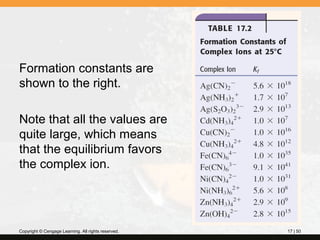
Formation constants are
shown to the right.
Note that all the values are
quite large, which means
that the equilibrium favors
the complex ion.

Copyright © Cengage Learning. All rights reserved.

17 | 50
?

What is the concentration of Ag+ (aq)
ion in 0.00010 M AgNO3 that is also 1.0
M CN−?
Kf for Ag(CN)2− is 5.6 × 10¹⁸.

First, we assume that all the Ag+ forms the complex
ion.
Then, we calculate [Ag+] using the dissociation
equilibrium—the reverse of the formation
equilibrium.
Copyright © Cengage Learning. All rights reserved.

17 | 51
Let’s assume we have 1.0 L of solution. It will
contain 0.00010 mol Ag+ and 1.0 mol CN−.
Ag+(aq)

+ 2NH3(aq)

Initial

0.00010

Change

−0.00010 −2(0.00010)

Equilibrium

0

1.0
0.9998

 Ag(NH3)2+(aq)
0
+0.00010
0.00010

We now calculate the concentrations and use the
dissociation equilibrium to find [Ag+].
Copyright © Cengage Learning. All rights reserved.

17 | 52
[Ag(NH3)2+] = 0.00010 M; [NH3] = 0.9998 M

Ag(NH3)2+(aq)  Ag+(aq)
Initital
Change
Equilibrium

0.000100
−x
0.000100 − x

0
+x
x

+ 2NH3(aq)
0.9998
+x
0.9998 + x

[Ag+ ] [NH3 ]2
1
1
−19
Kd =
=
=
= 1.8 × 10
+
18
[Ag(NH3 )2 ] K f 5.6 × 10

1.8 × 10 −19
Copyright © Cengage Learning. All rights reserved.

x (0.9998 + x ) 2
=
(0.00010 − x )
17 | 53
We can assume that 0.9998 + x ≈ 0.9998 and
0.00010 – x ≈ 0.00010.
x (0.9998) 2
1.8 × 10 −19 =
0.00010

1.8 × 10 −19 = 9996 x
x = 1.8 × 10 −23 M
The assumptions are valid.
[Ag+] = 1.8 × 10⁻²³ M
Copyright © Cengage Learning. All rights reserved.

17 | 54
?

Silver chloride usually does not
precipitate in solutions of 1.00 M NH3.
However, silver bromide has a smaller
Ksp than silver chloride.
Will silver bromide precipitate from a
solution containing 0.010 M AgNO3,
0.010 M NaBr, and 1.00 M NH3?
Calculate the Qc value and compare it
with silver bromide’s Ksp of 5.0 × 10⁻¹³.

Copyright © Cengage Learning. All rights reserved.

17 | 55
We’ll begin with the complex−ion formation, and
then find the concentration of Ag+ in solution.
Finally, we’ll find the value of Qc for AgBr and
compare it to Ksp.
1.00 L of solution contains 0.010 mol Ag+ and
1.00 mol NH3.
Ag+(aq) + 2NH3(aq)  Ag(NH3)2+(aq)
Initial

0.010

1.00

0

Change

−0.010

−2(0.010)

+0.010

0

0.98

0.010

Equilibrium

Copyright © Cengage Learning. All rights reserved.

17 | 56
[Ag(NH3)2+] = 0.010 M; [NH3] = 0.98 M
Ag(NH3)2+(aq)  Ag+(aq)
Initial
Change
Equilibrium

0.010
−x
0.010 − x
+

0
+x
x

+ 2NH3(aq)
0.98
+x
0.98 + x

2

[Ag ] [NH3 ]
1
1
Kd =
=
=
= 5.9 × 10 −8
+
7
[Ag(NH3 )2 ] K f 1.7 × 10

5.9 × 10
Copyright © Cengage Learning. All rights reserved.

−8

x (0.98 + x )2
=
(0.010 − x )
17 | 57
We can assume that 0.98 + x ≈ 0.98 and 0.010 – x
≈ 0.010.
x (0.98)2
5.9 × 10−8 =
0.010

5.9 × 10 −8 = 96.0 x
x = 6.1 × 10 −10 M
The assumptions are valid.
[Ag+] = 6.1 × 10⁻¹⁰ M
Copyright © Cengage Learning. All rights reserved.

17 | 58
Next we’ll use the solubility equilibrium to find Qc.
Qc = [Ag+] [Br−]
Qc = (6.1 × 10⁻¹⁰)(0.010)
Qc = 6.1 × 10⁻¹²
Ksp = 5.0 × 10⁻¹³
Ksp < Qc
The precipitate forms.
Copyright © Cengage Learning. All rights reserved.

17 | 59
?

Calculate the molar solubility of AgBr in
1.0 M NH3 at 25°C.

We will first combine the two equilibria and find the
combined equilibrium constant.
AgBr(s)  Ag+(aq) + Br−(aq); Ksp
Ag+(aq) + 2NH3(aq)  Ag(NH3)2+(aq); Kf
AgBr(s) + 2NH3(aq)  Br−(aq) + Ag(NH3)2+(aq)
K = Ksp Kf = (5.0 × 10⁻¹³)(1.7 × 10⁷) = 8.5 × 10⁻⁶
Copyright © Cengage Learning. All rights reserved.

17 | 60
Now, we’ll use the combined equilibrium to find the
solubility of AgBr in 1.0 M NH3.
AgBr(s) + 2NH3(aq)  Br−(aq)
I
C
E

+ Ag(NH3)2+(aq)

1.0
−2x
1.0 – 2x

0
+x
x

0
+x
x

[Br − ][Ag(NH3 )2+ ]
K=
[NH3 ]2
8.5 × 10
Copyright © Cengage Learning. All rights reserved.

−6

2

x
=
(1.0 − 2 x )2
17 | 61
The right side of the equation is a perfect square.
x
−3
2.9 × 10 =
(1.0 − 2 x )

0.0029 − 0.0058 x = x
0.0029 = 1.0058 x
x = 2.9 × 10 −3
The molar solubility of AgBr in 1.0 M NH3 is
2.9 × 10⁻³ M.
Copyright © Cengage Learning. All rights reserved.

17 | 62
The combination of solubility and complex−ion
equilibria can be applied to separate metal ions.
Cations can be separated into groups according to
their precipitation properties.
In each major step, one group of cations
precipitates out. After separating the precipitate,
the remaining solution is treated with the next
reagent, precipitating the next group of cations.

Copyright © Cengage Learning. All rights reserved.

17 | 63
Copyright © Cengage Learning. All rights reserved.

17 | 64
Copyright © Cengage Learning. All rights reserved.

17 | 65

Chapter17

  • 1.
    Chapter 17 Solubility and Complex−Ion Equilibria Copyright© Cengage Learning. All rights reserved. 17 | 1
  • 2.
    Contents and Concepts SolubilityEquilibria 1. The Solubility Product Constant 2. Solubility and the Common−Ion Effect 3. Precipitation Calculations 4. Effect of pH on Solubility Complex−Ion Equilibria 5. Complex−Ion Formation 6. Complex Ions and Solubility An Application of Solubility Equilibria 7. Qualitative Analysis of Metal Ions Copyright © Cengage Learning. All rights reserved. 17 | 2
  • 3.
    Learning Objectives Solubility Equilibria 1.The Solubility Product Constant a. Define the solubility product constant, Ksp. b. Write solubility product expressions. c. Define molar solubility. d. Calculate Ksp from the solubility (simple example). e. Calculate Ksp from the solubility (more complicated example). f. Calculate the solubility from Ksp. Copyright © Cengage Learning. All rights reserved. 17 | 3
  • 4.
    2. Solubility andthe Common−Ion Effect a. Explain how the solubility of a salt is affected by another salt that has the same cation or anion (common ion). b. Calculate the solubility of a slightly soluble salt in a solution of a common ion. Copyright © Cengage Learning. All rights reserved. 17 | 4
  • 5.
    3. Precipitation Calculations a.Define ion product. b. State the criterion for precipitation. c. Predict whether precipitation will occur, given ion concentrations. d. Predict whether precipitation will occur, given solution volumes and concentrations. e. Define fractional precipitation. f. Explain how two ions can be separated using fractional precipitation. Copyright © Cengage Learning. All rights reserved. 17 | 5
  • 6.
    4. Effect ofpH on Solubility a. Explain the qualitative effect of pH on solubility of a slightly soluble salt. b. Determine the qualitative effect of pH on solubility. c. Explain the basis for the sulfide scheme to separate a mixture of metal ions. Copyright © Cengage Learning. All rights reserved. 17 | 6
  • 7.
    Complex−Ion Equilibria 5. Complex−IonFormation a. Define complex ion and ligand. b. Define formation constant or stability constant, Kf, and dissociation constant, Kd. c. Calculate the concentration of a metal ion in equilibrium with a complex ion. d. Define amphoteric hydroxide. Copyright © Cengage Learning. All rights reserved. 17 | 7
  • 8.
    6. Complex Ionsand Solubility a. Predict whether a precipitate will form in the presence of the complex ion. b. Calculate the solubility of a slightly soluble ionic compound in a solution of the complex ion. Copyright © Cengage Learning. All rights reserved. 17 | 8
  • 9.
    An Application ofSolubility Equilibria 7. Qualitative Analysis of Metal Ions a. Define qualitative analysis. b. Describe the main outline of the sulfide scheme for qualitative analysis. Copyright © Cengage Learning. All rights reserved. 17 | 9
  • 10.
    To deal quantitativelywith an equilibrium, you must know the equilibrium constant. We will look at the equilibria of slightly soluble (or nearly insoluble) ionic compounds and show how you can determine their equilibrium constants. Once you find these values for various ionic compounds, you can use them to answer questions about solubility or precipitation. Copyright © Cengage Learning. All rights reserved. 17 | 10
  • 11.
    When an ioniccompound is insoluble or slightly soluble, an equilibrium is established: MX(s)  M+(aq) + X−(aq) The equilibrium constant for this type of reaction is called the solubility−product constant, Ksp. For the above reaction, Ksp = [M+][X−] Copyright © Cengage Learning. All rights reserved. 17 | 11
  • 12.
    ? Write the solubility−productexpression for the following salts: a. Hg2Cl2 b. HgCl2 Copyright © Cengage Learning. All rights reserved. 17 | 12
  • 13.
    a. Hg2Cl2 Hg2Cl2(s) Hg22+(aq) + 2Cl−(aq) Ksp = [Hg22+][Cl−]2 b. HgCl2 HgCl2(s)  Hg2+(aq) + 2Cl−(aq) Ksp = [Hg2+][Cl−]2 Copyright © Cengage Learning. All rights reserved. 17 | 13
  • 14.
    The solubility−product constant,Ksp, of a slightly soluble ionic compound is expressed in terms of the molar concentrations of ions in the saturated solution. These ion concentrations are, in turn, related to the molar solubility of the ionic compound, which is the number of moles of compound that dissolve to give one liter of saturated solution. Copyright © Cengage Learning. All rights reserved. 17 | 14
  • 15.
    ? Exactly 0.133 mgof AgBr will dissolve in 1.00 L of water. What is the value of Ksp for AgBr? Solubility equilibrium: AgBr(s)  Ag+(aq) + Br−(aq) Solubility−product constant expression: Ksp = [Ag+][Br−] Copyright © Cengage Learning. All rights reserved. 17 | 15
  • 16.
    The solubility isgiven as 0.133 mg/1.00 L, but Ksp uses molarity: 0.133 × 10⁻³ g 1 mol −7 × = 7.083 × 10 M 1.00 L 187.77 g AgBr(s)  Ag+(aq) + Br−(aq) Initial 0 0 Change +x +x Equilibrium x x Copyright © Cengage Learning. All rights reserved. 17 | 16
  • 17.
    [Ag+] = [Cl−]= x = 7.083 × 10⁻⁷ M Ksp = (7.083 × 10⁻⁷)2 Ksp = 5.02 × 10⁻¹³ Copyright © Cengage Learning. All rights reserved. 17 | 17
  • 18.
    Copyright © CengageLearning. All rights reserved. 17 | 18
  • 19.
    Copyright © CengageLearning. All rights reserved. 17 | 19
  • 20.
    Copyright © CengageLearning. All rights reserved. 17 | 20
  • 21.
    Copyright © CengageLearning. All rights reserved. 17 | 21
  • 22.
    ? An experimenter findsthat the solubility of barium fluoride is 1.1 g in 1.00 L of water at 25°C. What is the value of Ksp for barium fluoride, BaF2, at this temperature? Solubility equilibrium: BaF2(s)  Ba2+(aq) + 2F−(aq) Solubility−product constant expression: Ksp = [Ba2+][F−]2 Copyright © Cengage Learning. All rights reserved. 17 | 22
  • 23.
    The solubility isgiven as 1.1 g/1.00 L, but Ksp uses molarity: 1.1 g 1 mol x= × = 6.27 × 10 −3 M 1.00 L 175.32 g BaF2(s)  Initial Change Equilibrium Copyright © Cengage Learning. All rights reserved. Ba2+(aq) + 2F−(aq) 0 0 +x +2x x 2x 17 | 23
  • 24.
    [Ba2+] = x= 6.27 × 10⁻³ M [F−] = 2x = 2(6.27 × 10⁻³) = 1.25 × 10⁻² M Ksp = (6.27 × 10⁻³)(1.25 × 10⁻²)2 Ksp = 9.8 × 10⁻⁷ Copyright © Cengage Learning. All rights reserved. 17 | 24
  • 25.
    When Ksp isknown, we can find the molar solubility. Copyright © Cengage Learning. All rights reserved. 17 | 25
  • 26.
    ? Calomel, whose chemicalname is mercury(I) chloride, Hg2Cl2, was once used in medicine (as a laxative and diuretic). It has a Ksp equal to 1.3 × 10⁻¹⁸. What is the solubility of Hg2Cl2 in grams per liter? Solubility equilibrium: Hg2Cl2(s)  Hg22+(aq) + 2Cl−(aq) Solubility−product constant expression: Ksp = [Hg22+][Cl−]2 Copyright © Cengage Learning. All rights reserved. 17 | 26
  • 27.
    Hg2Cl2(s)  Hg22+(aq) +2Cl−(aq) Initial 0 0 Change +x +2x Equilibrium x 2x Ksp = x(2x)2 Ksp = x(4x2) Ksp = 4x3 1.3 × 10−18 = 4x3 x3 = 3.25 × 10⁻¹⁹ x = 6.88 × 10⁻⁷ M Copyright © Cengage Learning. All rights reserved. 17 | 27
  • 28.
    The molar solubilityis 6.9 × 10⁻⁷ M, but we also need the solubility in g/L: 6.88 × 10 -7 mol 472.086 g × = 3.2 × 10 − 4 g/L L 1 mol = 0.32 mg/L Copyright © Cengage Learning. All rights reserved. 17 | 28
  • 29.
    Concept Check 17.1 Leadcompounds have been used as paint pigments, but because the lead(II) ion is toxic, the use of lead paints in homes is now prohibited. Which of the following lead(II) compounds would yield the greatest number of lead(II) ions when added to the same quantity of water (assuming that some undissolved solid always remains): PbCrO4, PbSO4, or PbS? We can begin by identifying the value of Ksp for each compound: PbCrO4 1.8 × 10⁻¹⁴ PbSO4 1.7 × 10⁻⁸ PbS 2.5 × 10⁻²⁷ Each salt produces two ions, so each has the same expression for the solubility−product constant: Ksp= x2. The solubility will be largest for PbSO4. Copyright © Cengage Learning. All rights reserved. 17 | 29
  • 30.
    What effect doesthe presence of a common ion have on solubility? Given: MX(s) M+(aq) + X−(aq) Qualitatively, we can use Le Châtelier’s principle to predict that the reaction will shift in the reverse direction when M+ or X− is added, reducing the solubility. In the next problem, we will explore this situation quantitatively. Copyright © Cengage Learning. All rights reserved. 17 | 30
  • 31.
    ? What is themolar solubility of silver chloride in 1.0 L of solution that contains 2.0 × 10⁻² mol of HCl? First, using Table 17.1, we find that the Ksp for AgCl at 25°C is 1.8 × 10⁻¹⁰. Next, we construct the ICE chart with the initial [Cl−] = 0.020 M. We then solve for x, the molar solubility. Copyright © Cengage Learning. All rights reserved. 17 | 31
  • 32.
    AgCl(s)  Ag+(aq) + Cl−(aq) Initial 0 0.020 Change +x +x Equilibrium x 0.020 +x Ksp = [Ag+][Cl−] 1.8 × 10−10 = x(0.020 + x) We make the following simplifying assumption: 0.020 + x ≈ 0.020. 1.8 × 10−10 = 0.020x Copyright © Cengage Learning. All rights reserved. 17 | 32
  • 33.
    The molar solubilityis given by x: x = 9.0 × 10⁻⁹ M Let’s compare this result to the solubility of AgCl in water: Ksp = x2 1.8 × 10−10 = x2 x = 1.3 × 10⁻⁵ M The solubility was reduced by a factor of about 1400! Copyright © Cengage Learning. All rights reserved. 17 | 33
  • 34.
    We can usethe reaction quotient, Q, to determine whether precipitation will occur. Copyright © Cengage Learning. All rights reserved. 17 | 34
  • 35.
    ? One form ofkidney stones is calcium phosphate, Ca3(PO4)2, which has a Ksp of 1.0 × 10⁻²⁶. A sample of urine contains 1.0 × 10⁻³ M Ca2+ and 1.0 × 10⁻⁸ M PO43− ion. Calculate Qc and predict whether Ca3(PO4)2 will precipitate. Copyright © Cengage Learning. All rights reserved. 17 | 35
  • 36.
    Ca3(PO4)2(s)  3Ca2+(aq)+ 2PO43−(aq) Ksp = [Ca2+]3 [PO43−]2 Ksp = 1.0 × 10⁻²⁶ Qc = (1.0 × 10⁻³)3 (1.0 × 10⁻⁸)2 Qc = 1.0 × 10⁻²⁵ Ksp < Qc A precipitate will form. Copyright © Cengage Learning. All rights reserved. 17 | 36
  • 37.
    When a problemgives the amounts and concentrations of two samples that are then mixed, the first step in solving the problem is to calculate the new initial concentrations. Copyright © Cengage Learning. All rights reserved. 17 | 37
  • 38.
    ? Exactly 0.400 Lof 0.500 M Pb2+ and 1.60 L of 2.50 × 10⁻² M Cl− are mixed together to form 2.00 L of solution. Calculate Qc and predict whether PbCl2 will precipitate. Ksp for PbCl2 is 1.6 × 10⁻⁵. Copyright © Cengage Learning. All rights reserved. 17 | 38
  • 39.
    (0.500 M )(0.400 L) [Pb ] = = 0.100 M (2.00 L) (2.50 × 10 -2 M) (1.60 L) − [Cl ] = = 0.0200 M (2.00 L) 2+ PbCl2(s) Pb2+(aq) + 2Cl−(aq) Ksp = [Pb2+] [Cl−]2 = 1.6 × 10⁻⁵ Qc = (0.100)(0.0200)2 = 4.00 × 10⁻⁵ Ksp < Qc A precipitate will form. 17 | 39
  • 40.
    Fractional Precipitation Fractional precipitationis the technique of separating two or more ions from a solution by adding a reactant that precipitates first one ion, then another ion, and so forth. Copyright © Cengage Learning. All rights reserved. 17 | 40
  • 41.
    The solubility ofan insoluble salt can be manipulated by adding a species that reacts with either the cation or the anion. Copyright © Cengage Learning. All rights reserved. 17 | 41
  • 42.
    Effect of pHon Solubility When a salt contains the conjugate base of a weak acid, the pH will affect the solubility of the salt. Copyright © Cengage Learning. All rights reserved. 17 | 42
  • 43.
    We will qualitativelyexplore the situation involving a generic salt, MX, where X is the conjugate base of a weak acid. MX(s) M+(aq) + X−(aq) As the acid concentration increases, X− reacts with the H3O+, forming HX and reducing the X− concentration. As a result, more MX dissolves, increasing the solubility. Copyright © Cengage Learning. All rights reserved. 17 | 43
  • 44.
    ? Consider the twoslightly soluble salts barium fluoride and silver bromide. Which of these would have its solubility more affected by the addition of strong acid? Would the solubility of that salt increase or decrease? HF is a weak acid, while HBr is a strong acid. BaF2 is more soluble in an acidic solution. AgBr is unaffected by an acidic solution. Copyright © Cengage Learning. All rights reserved. 17 | 44
  • 45.
    Ksp for MgC2O4is 8.5 × 10⁻⁵. Ksp for CaC2O4 is 2.3 × 10⁻⁹. MgC2O4 is more soluble. If a dilute acidic solution is added, it will increase the solubility of both salts. MgC2O4 is still more soluble. Copyright © Cengage Learning. All rights reserved. 17 | 45
  • 46.
    It is possibleto use these differences to separate compounds. This is common practice when the goal is to separate sulfides from one another. The qualitative analysis scheme for the separation of metal ions uses sulfide solubility to separate Co2+, Fe2+, Mn2+, Ni2+, and Zn2+ (Analytical Group III). Copyright © Cengage Learning. All rights reserved. 17 | 46
  • 47.
    Complex−Ion Formation Some cationsform soluble complex ions. Their formation increases the solubility of a salt containing those cations. Copyright © Cengage Learning. All rights reserved. 17 | 47
  • 48.
    Metal ions thatform complex ions include Ag +, Cd2+, Cu2+, Fe2+, Fe3+, Ni2+, and Zn2+. Complexing agents, called ligands, are Lewis bases. They include CN−, NH3, S2O32−, and OH−. In each case, an equilibrium is established, called the complex−ion formation equilibrium. Copyright © Cengage Learning. All rights reserved. 17 | 48
  • 49.
    Ag+(aq) + 2NH3(aq)⇌ Ag(NH3)2+(aq) + [Ag(NH3 )2 ] Kf = [Ag+ ] [NH3 ]2 Zn2+(aq) + 4OH−(aq) ⇌ Zn(OH)42−(aq) 2- [Zn(OH)4 ] Kf = [Zn2+ ] [OH- ]4 Copyright © Cengage Learning. All rights reserved. 17 | 49
  • 50.
    Formation constants are shownto the right. Note that all the values are quite large, which means that the equilibrium favors the complex ion. Copyright © Cengage Learning. All rights reserved. 17 | 50
  • 51.
    ? What is theconcentration of Ag+ (aq) ion in 0.00010 M AgNO3 that is also 1.0 M CN−? Kf for Ag(CN)2− is 5.6 × 10¹⁸. First, we assume that all the Ag+ forms the complex ion. Then, we calculate [Ag+] using the dissociation equilibrium—the reverse of the formation equilibrium. Copyright © Cengage Learning. All rights reserved. 17 | 51
  • 52.
    Let’s assume wehave 1.0 L of solution. It will contain 0.00010 mol Ag+ and 1.0 mol CN−. Ag+(aq) + 2NH3(aq) Initial 0.00010 Change −0.00010 −2(0.00010) Equilibrium 0 1.0 0.9998  Ag(NH3)2+(aq) 0 +0.00010 0.00010 We now calculate the concentrations and use the dissociation equilibrium to find [Ag+]. Copyright © Cengage Learning. All rights reserved. 17 | 52
  • 53.
    [Ag(NH3)2+] = 0.00010M; [NH3] = 0.9998 M Ag(NH3)2+(aq)  Ag+(aq) Initital Change Equilibrium 0.000100 −x 0.000100 − x 0 +x x + 2NH3(aq) 0.9998 +x 0.9998 + x [Ag+ ] [NH3 ]2 1 1 −19 Kd = = = = 1.8 × 10 + 18 [Ag(NH3 )2 ] K f 5.6 × 10 1.8 × 10 −19 Copyright © Cengage Learning. All rights reserved. x (0.9998 + x ) 2 = (0.00010 − x ) 17 | 53
  • 54.
    We can assumethat 0.9998 + x ≈ 0.9998 and 0.00010 – x ≈ 0.00010. x (0.9998) 2 1.8 × 10 −19 = 0.00010 1.8 × 10 −19 = 9996 x x = 1.8 × 10 −23 M The assumptions are valid. [Ag+] = 1.8 × 10⁻²³ M Copyright © Cengage Learning. All rights reserved. 17 | 54
  • 55.
    ? Silver chloride usuallydoes not precipitate in solutions of 1.00 M NH3. However, silver bromide has a smaller Ksp than silver chloride. Will silver bromide precipitate from a solution containing 0.010 M AgNO3, 0.010 M NaBr, and 1.00 M NH3? Calculate the Qc value and compare it with silver bromide’s Ksp of 5.0 × 10⁻¹³. Copyright © Cengage Learning. All rights reserved. 17 | 55
  • 56.
    We’ll begin withthe complex−ion formation, and then find the concentration of Ag+ in solution. Finally, we’ll find the value of Qc for AgBr and compare it to Ksp. 1.00 L of solution contains 0.010 mol Ag+ and 1.00 mol NH3. Ag+(aq) + 2NH3(aq)  Ag(NH3)2+(aq) Initial 0.010 1.00 0 Change −0.010 −2(0.010) +0.010 0 0.98 0.010 Equilibrium Copyright © Cengage Learning. All rights reserved. 17 | 56
  • 57.
    [Ag(NH3)2+] = 0.010M; [NH3] = 0.98 M Ag(NH3)2+(aq)  Ag+(aq) Initial Change Equilibrium 0.010 −x 0.010 − x + 0 +x x + 2NH3(aq) 0.98 +x 0.98 + x 2 [Ag ] [NH3 ] 1 1 Kd = = = = 5.9 × 10 −8 + 7 [Ag(NH3 )2 ] K f 1.7 × 10 5.9 × 10 Copyright © Cengage Learning. All rights reserved. −8 x (0.98 + x )2 = (0.010 − x ) 17 | 57
  • 58.
    We can assumethat 0.98 + x ≈ 0.98 and 0.010 – x ≈ 0.010. x (0.98)2 5.9 × 10−8 = 0.010 5.9 × 10 −8 = 96.0 x x = 6.1 × 10 −10 M The assumptions are valid. [Ag+] = 6.1 × 10⁻¹⁰ M Copyright © Cengage Learning. All rights reserved. 17 | 58
  • 59.
    Next we’ll usethe solubility equilibrium to find Qc. Qc = [Ag+] [Br−] Qc = (6.1 × 10⁻¹⁰)(0.010) Qc = 6.1 × 10⁻¹² Ksp = 5.0 × 10⁻¹³ Ksp < Qc The precipitate forms. Copyright © Cengage Learning. All rights reserved. 17 | 59
  • 60.
    ? Calculate the molarsolubility of AgBr in 1.0 M NH3 at 25°C. We will first combine the two equilibria and find the combined equilibrium constant. AgBr(s)  Ag+(aq) + Br−(aq); Ksp Ag+(aq) + 2NH3(aq)  Ag(NH3)2+(aq); Kf AgBr(s) + 2NH3(aq)  Br−(aq) + Ag(NH3)2+(aq) K = Ksp Kf = (5.0 × 10⁻¹³)(1.7 × 10⁷) = 8.5 × 10⁻⁶ Copyright © Cengage Learning. All rights reserved. 17 | 60
  • 61.
    Now, we’ll usethe combined equilibrium to find the solubility of AgBr in 1.0 M NH3. AgBr(s) + 2NH3(aq)  Br−(aq) I C E + Ag(NH3)2+(aq) 1.0 −2x 1.0 – 2x 0 +x x 0 +x x [Br − ][Ag(NH3 )2+ ] K= [NH3 ]2 8.5 × 10 Copyright © Cengage Learning. All rights reserved. −6 2 x = (1.0 − 2 x )2 17 | 61
  • 62.
    The right sideof the equation is a perfect square. x −3 2.9 × 10 = (1.0 − 2 x ) 0.0029 − 0.0058 x = x 0.0029 = 1.0058 x x = 2.9 × 10 −3 The molar solubility of AgBr in 1.0 M NH3 is 2.9 × 10⁻³ M. Copyright © Cengage Learning. All rights reserved. 17 | 62
  • 63.
    The combination ofsolubility and complex−ion equilibria can be applied to separate metal ions. Cations can be separated into groups according to their precipitation properties. In each major step, one group of cations precipitates out. After separating the precipitate, the remaining solution is treated with the next reagent, precipitating the next group of cations. Copyright © Cengage Learning. All rights reserved. 17 | 63
  • 64.
    Copyright © CengageLearning. All rights reserved. 17 | 64
  • 65.
    Copyright © CengageLearning. All rights reserved. 17 | 65

Editor's Notes

  • #3 This slide should be followed by the set of Learning Objectives slides; please add them. I was told not to use my time doing this.
  • #40 This slide is missing the Houghton Mifflin copyright line. Please add it.
  • #46 Change to Concept Check 17.4
  • #51 Change to Table 17.2
  • #65 Change to Figure 17.9 top three “lines” only