The slides will provide you with: The following slides are designed to help you in your study of matter.  Matter is the basis for the second half of this course.  1)  Basic definitions Relationships between those definitions and the concepts  they help explain. Pictures and diagrams to help visualize and understand  new concepts. Sample problems to help prepare you for mastery  assignments and quizzes. There are fill-in-the-blank notes associated with these powerpoints.  You may complete those notes for one of your graded mastery assignments.
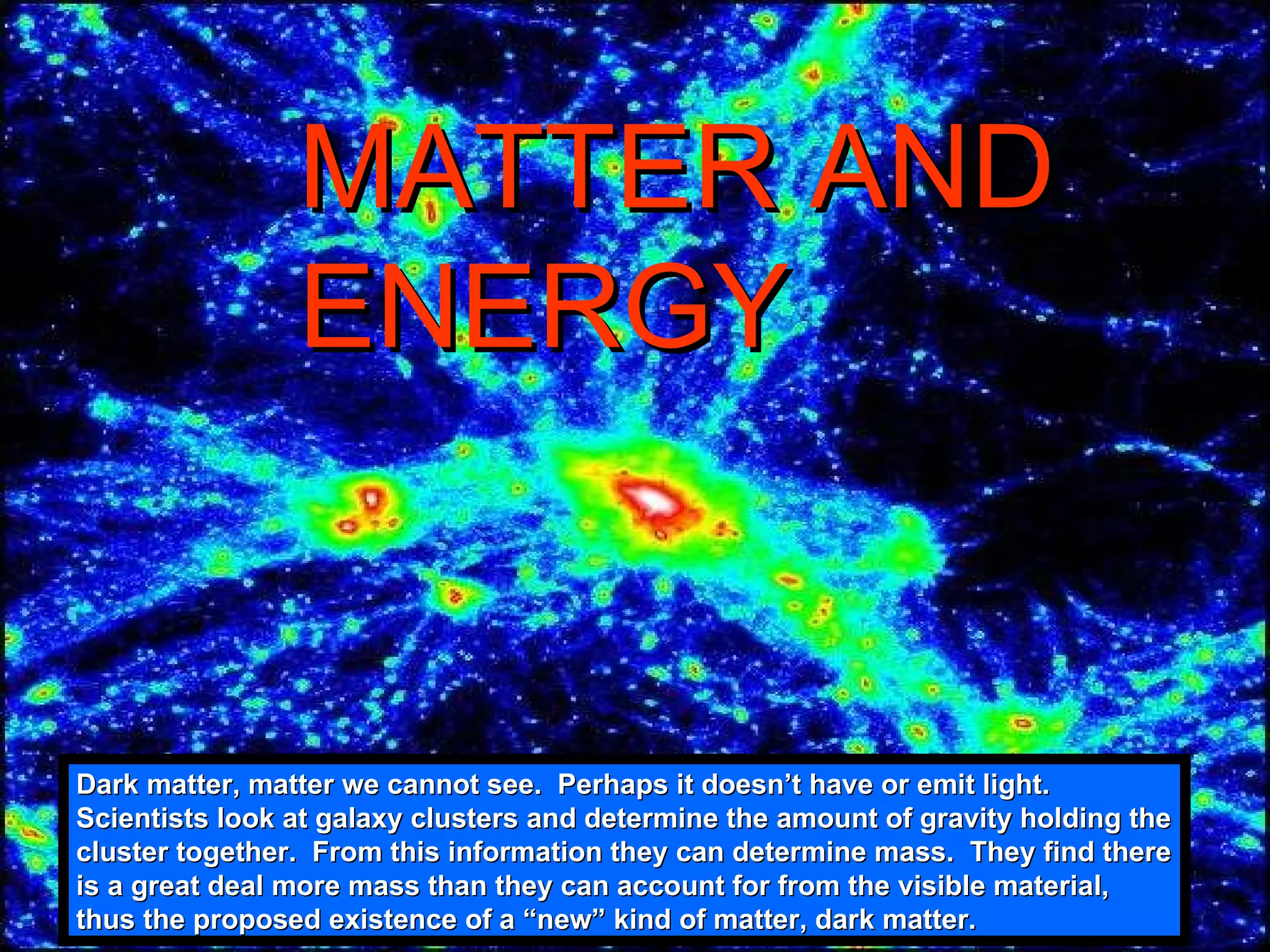
MATTER AND ENERGY   Dark matter, matter we cannot see.  Perhaps it doesn’t have or emit light.  Scientists look at galaxy clusters and determine the amount of gravity holding the cluster together.  From this information they can determine mass.  They find there is a great deal more mass than they can account for from the visible material, thus the proposed existence of a “new” kind of matter, dark matter.
UNIT 5: CLASSIFICATION AND STRUCTURE OF MATTER Basic matter definitions   (4-9) General classification of matter   (10-27) Practice problems #1  (16) Practice problems #2   (25) Practice problems #3   (27) Practice problems #4  (28)
MATTER PART  I CLASSIFYING MATTER
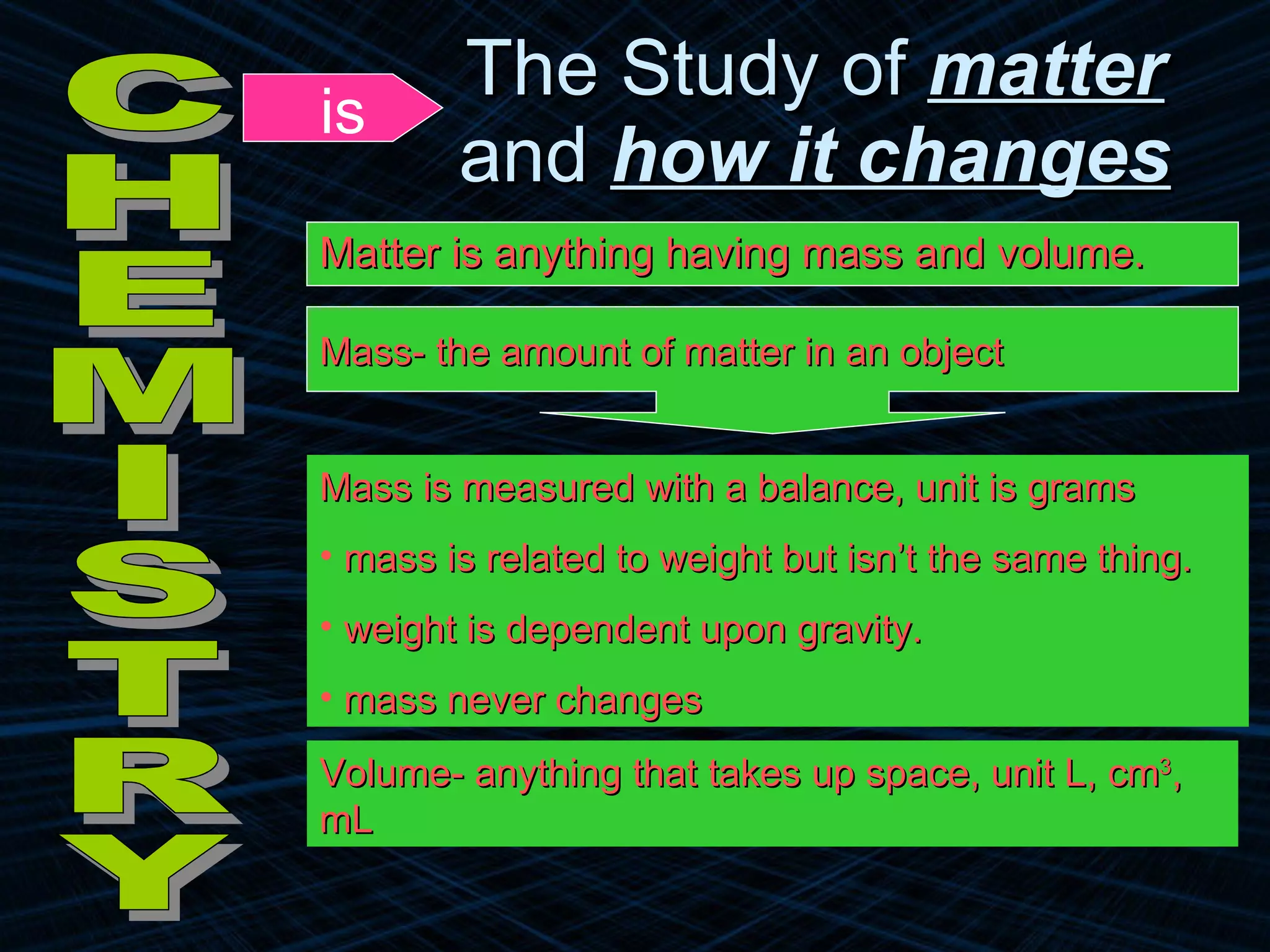
Matter is anything having mass and volume. The Study of  matter  and  how it changes CHEMISTRY Mass- the amount of matter in an object Mass is measured with a balance, unit is grams mass is related to weight but isn’t the same thing. weight is dependent upon gravity. mass never changes Volume- anything that takes up space, unit L, cm 3 , mL is
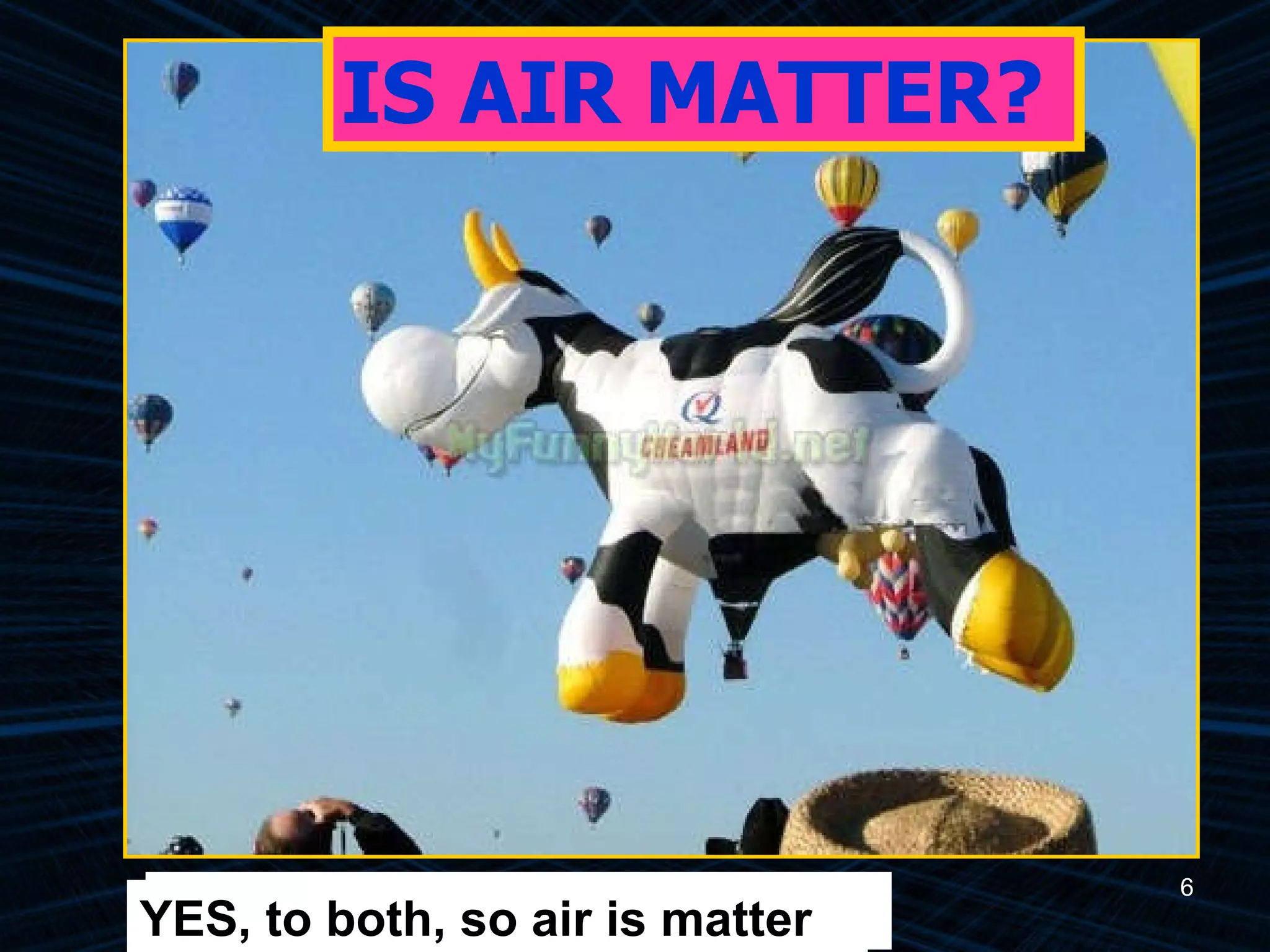
IS AIR MATTER? Does air have mass? Does air have volume? YES, to both, so air is matter
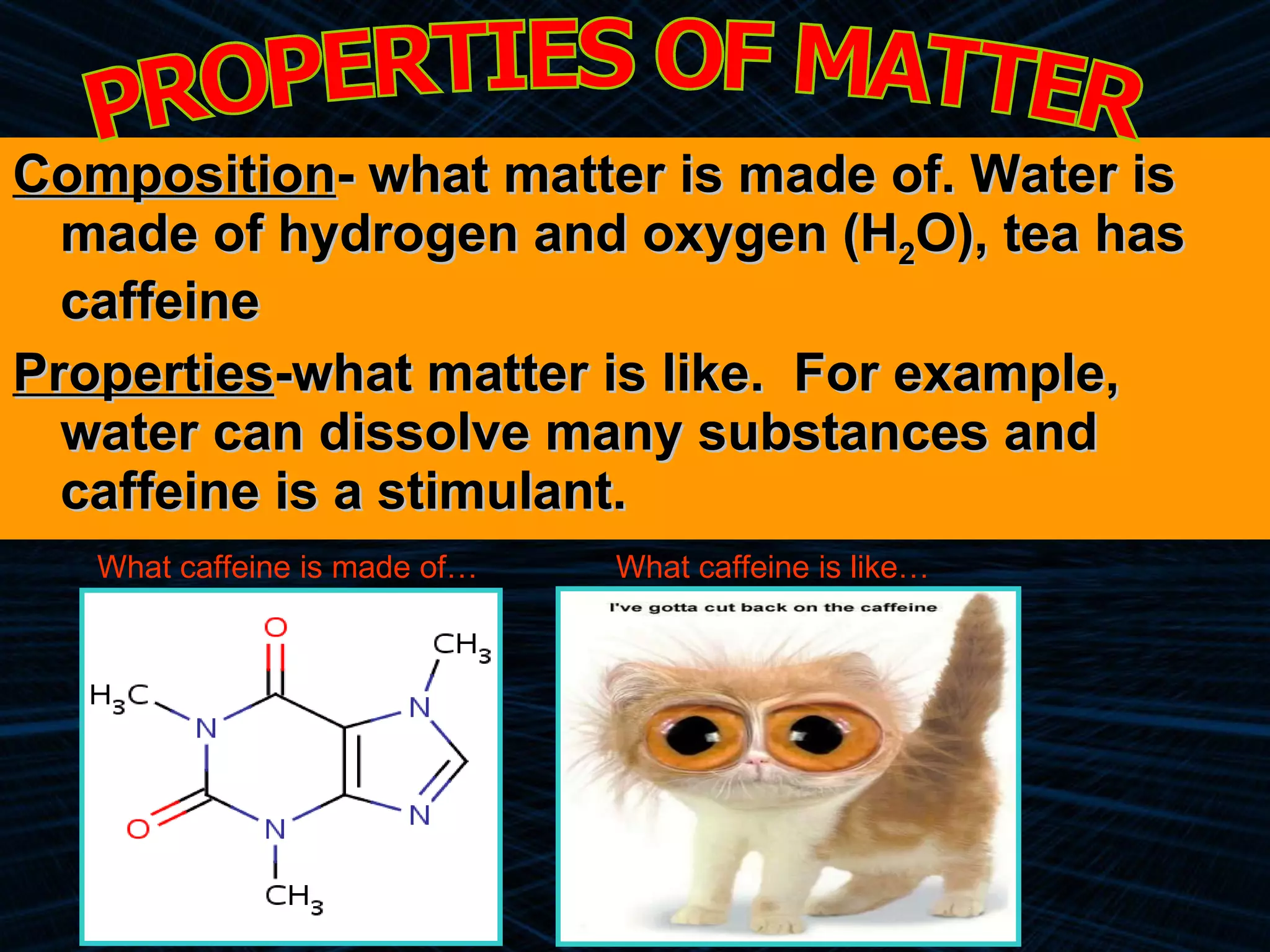
Composition - what matter is made of. Water is made of hydrogen and oxygen (H 2 O), tea has caffeine Properties -what matter is like.  For example, water can dissolve many substances and caffeine is a stimulant. PROPERTIES OF MATTER What caffeine is made of… What caffeine is like…
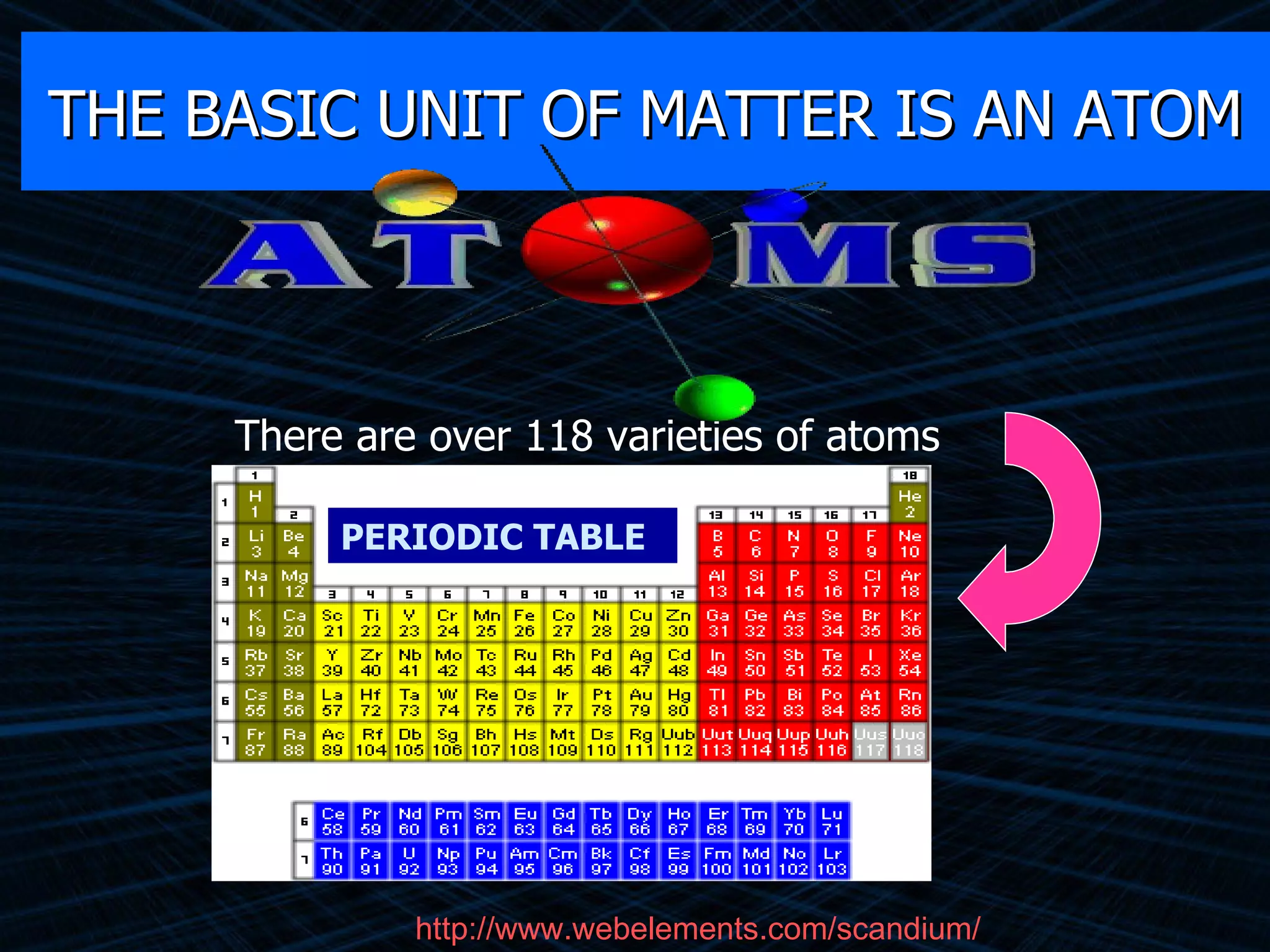
THE BASIC UNIT OF MATTER IS AN ATOM There are over 118 varieties of atoms PERIODIC TABLE http:// www.webelements.com /scandium/
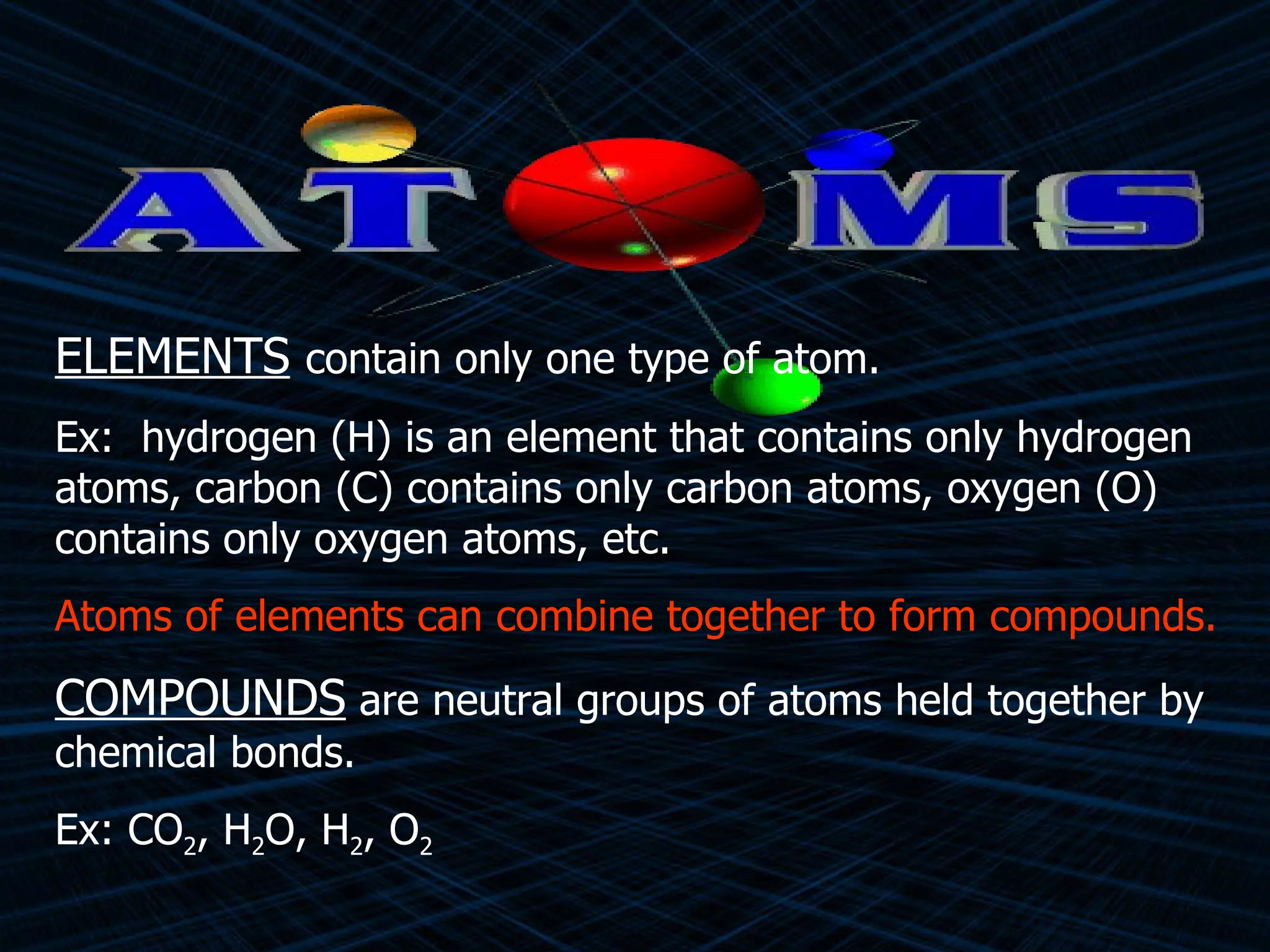
ELEMENTS   contain only one type of atom. Ex:  hydrogen (H) is an element that contains only hydrogen atoms, carbon (C) contains only carbon atoms, oxygen (O) contains only oxygen atoms, etc. Atoms of elements can combine together to form compounds. COMPOUNDS  are neutral groups of atoms held together by chemical bonds. Ex: CO 2 , H 2 O, H 2 , O 2
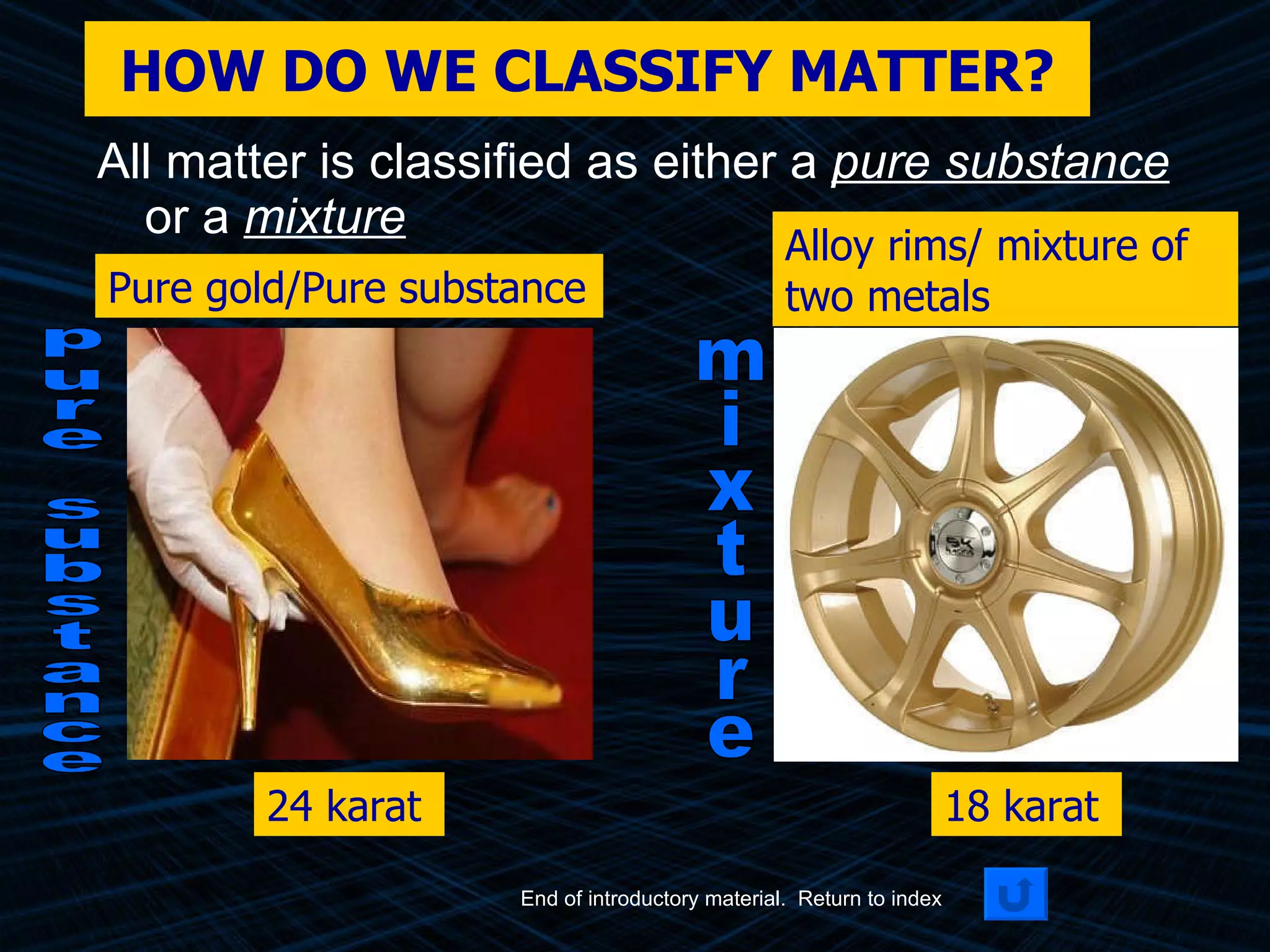
HOW DO WE CLASSIFY MATTER? All matter is classified as either a  pure substance  or a  mixture Pure gold/Pure substance 24 karat End of introductory material.  Return to index Alloy rims/ mixture of two metals 18 karat pure substance mixture
CLASSIFYING MATTER Pure substance -a type of matter where all samples, no matter how big or small, have the same properties…they behave in exactly the same way. Elements Compounds Elements  contain one type of atom, thus they  CANNOT  be broken down into simpler substances by chemical means. Elements  consist of either: single atoms, such as Carbon (C), or Sodium (Na) groups of atoms of the same type (molecules), such  as H 2 , O 2 , Br 2 , etc.
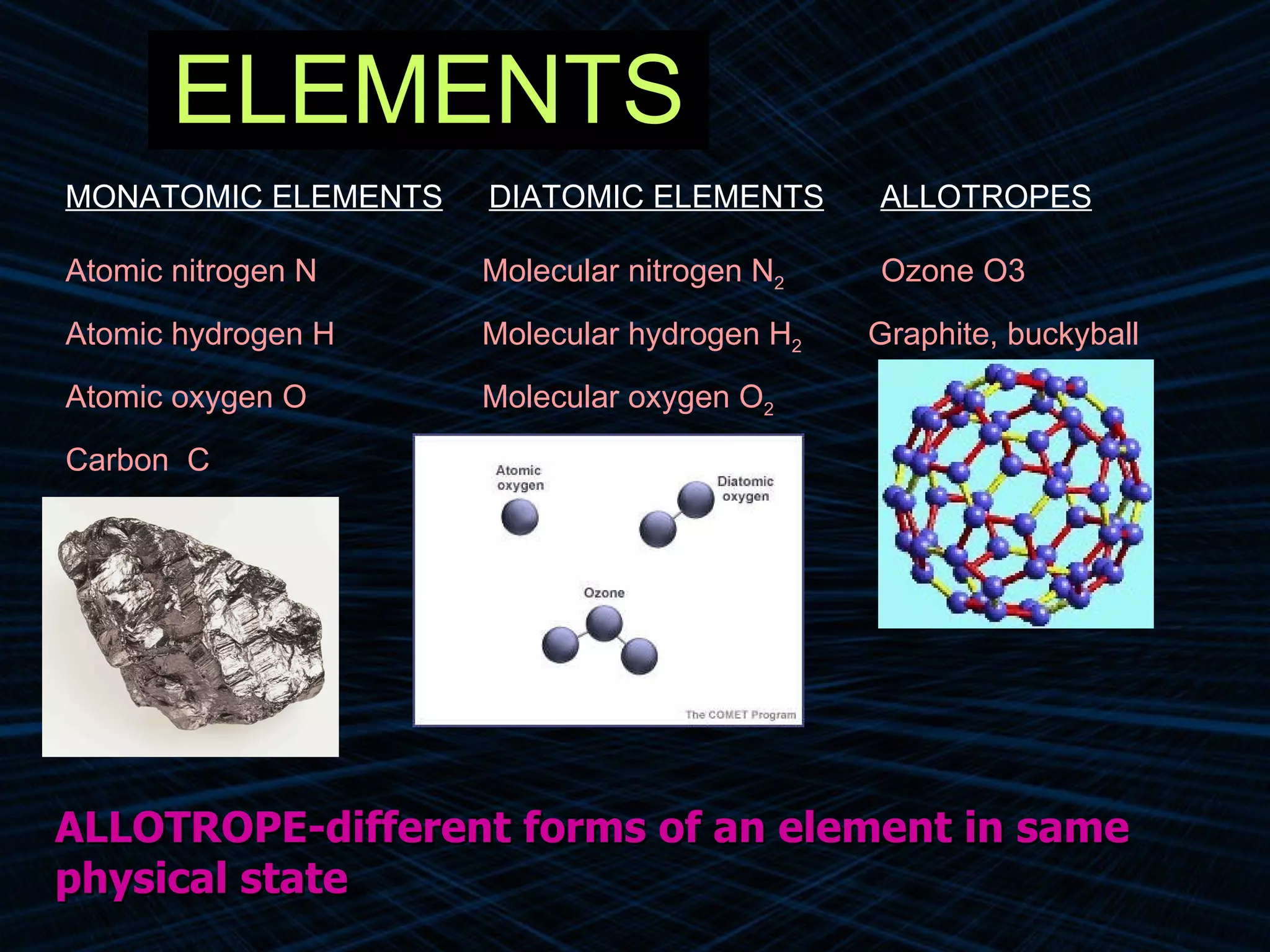
ELEMENTS MONATOMIC ELEMENTS DIATOMIC ELEMENTS ALLOTROPES Atomic nitrogen N   Molecular nitrogen N 2     Ozone O3 Atomic hydrogen H   Molecular hydrogen H 2  Graphite, buckyball   Atomic oxygen O   Molecular oxygen O 2 Carbon  C   ALLOTROPE-different forms of an element in same physical state
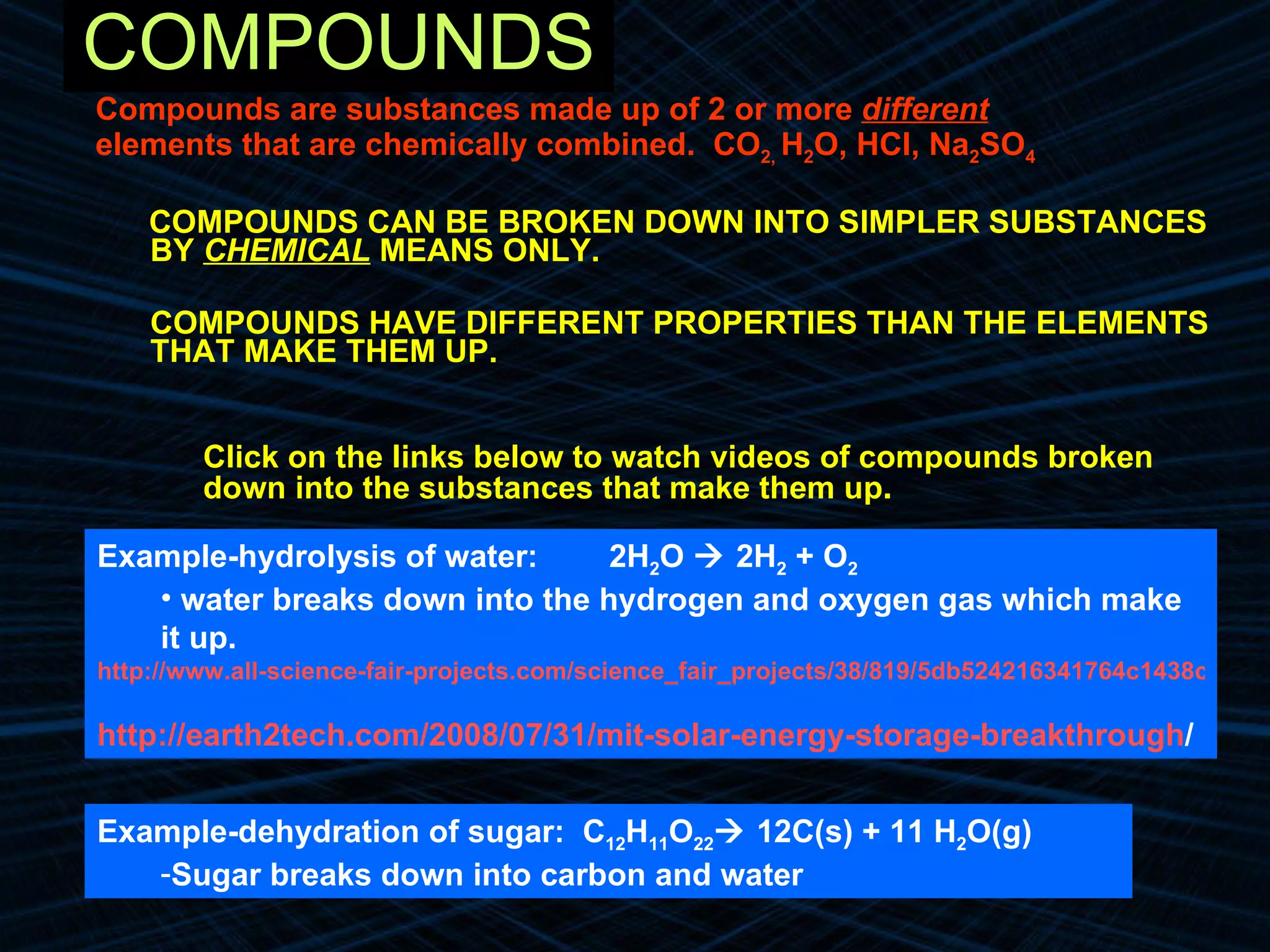
COMPOUNDS Compounds are substances made up of 2 or more  different elements that are chemically combined.  CO 2,  H 2 O, HCl, Na 2 SO 4 COMPOUNDS CAN BE BROKEN DOWN INTO SIMPLER SUBSTANCES BY  CHEMICAL  MEANS ONLY. COMPOUNDS HAVE DIFFERENT PROPERTIES THAN THE ELEMENTS THAT MAKE THEM UP. Click on the links below to watch videos of compounds broken down into the substances that make them up . Example-dehydration of sugar:  C 12 H 11 O 22   12C(s) + 11 H 2 O(g) Sugar breaks down into carbon and water Example-hydrolysis of water:  2H 2 O    2H 2  + O 2  water breaks down into the hydrogen and oxygen gas which make it up. http://www.all-science-fair-projects.com/science_fair_projects/38/819/5db524216341764c1438c1f760fddff8.html http://earth2tech.com/2008/07/31/mit-solar-energy-storage-breakthrough /
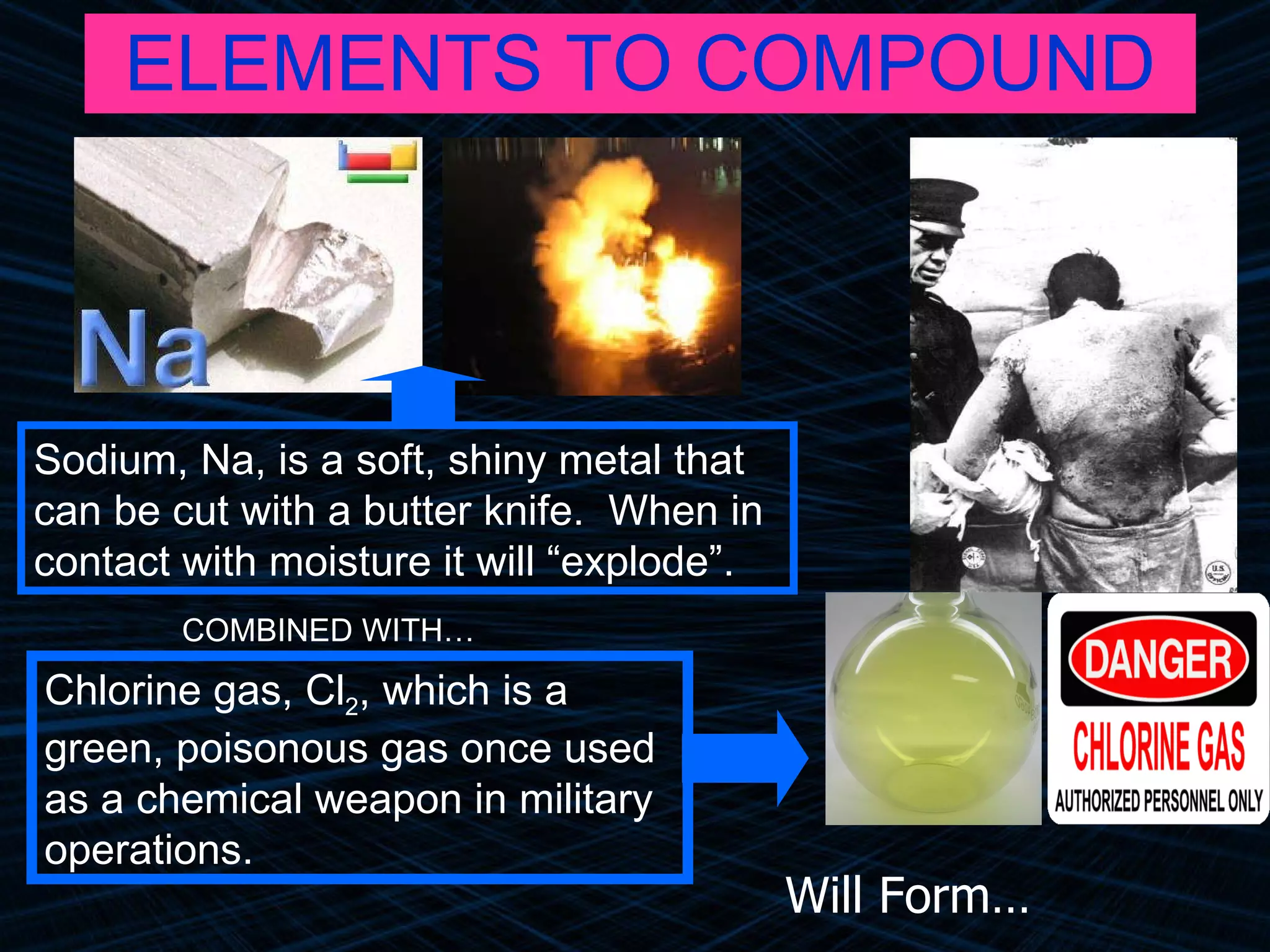
ELEMENTS TO COMPOUND COMBINED WITH… Will Form… Sodium, Na, is a soft, shiny metal that can be cut with a butter knife.  When in contact with moisture it will “explode”. Chlorine gas, Cl 2 , which is a green, poisonous gas once used as a chemical weapon in military operations.
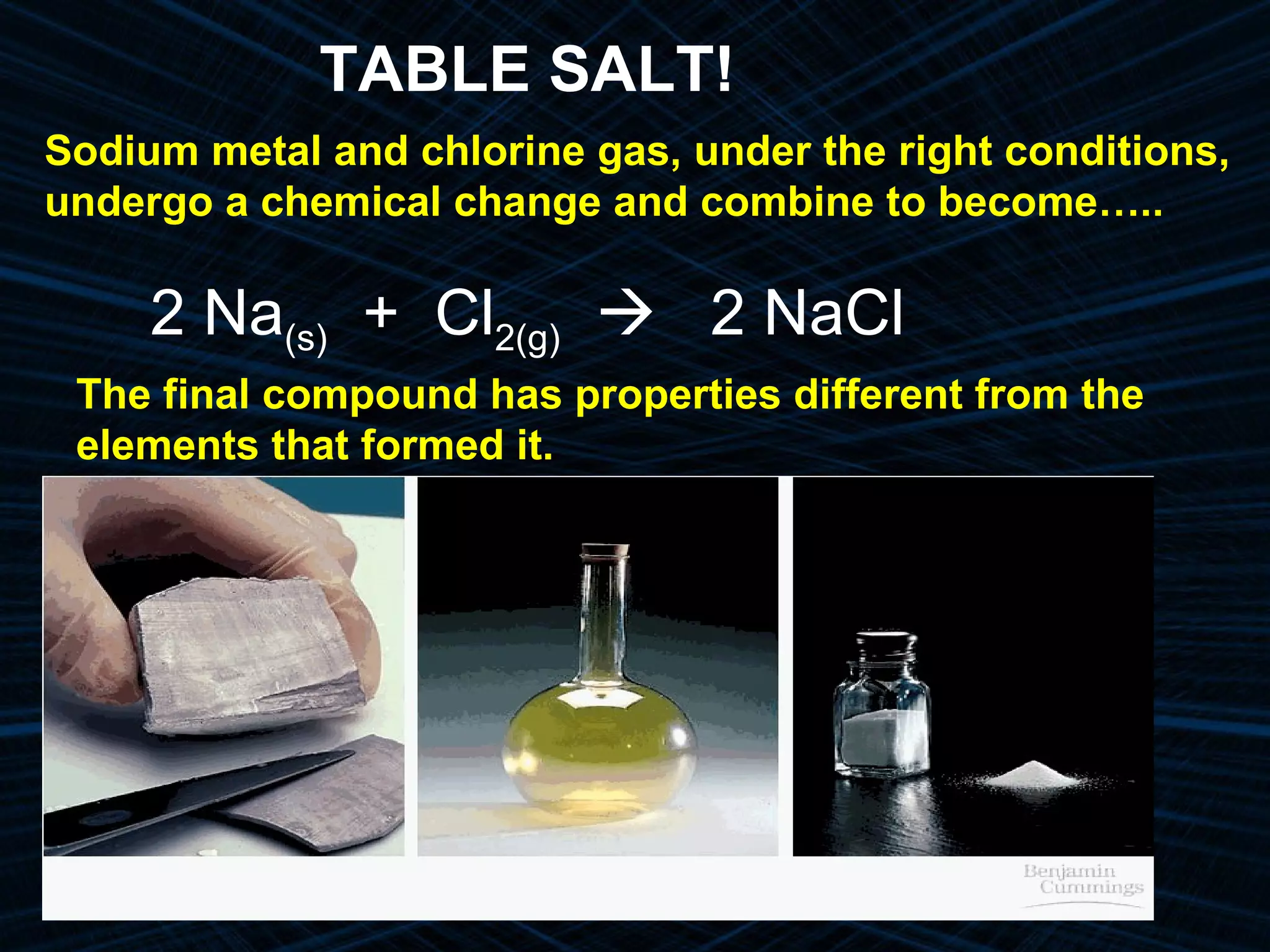
Sodium metal and chlorine gas, under the right conditions, undergo a chemical change and combine to become…..  2 Na (s)   +  Cl 2(g)      2 NaCl The final compound has properties different from the elements that formed it. TABLE SALT!
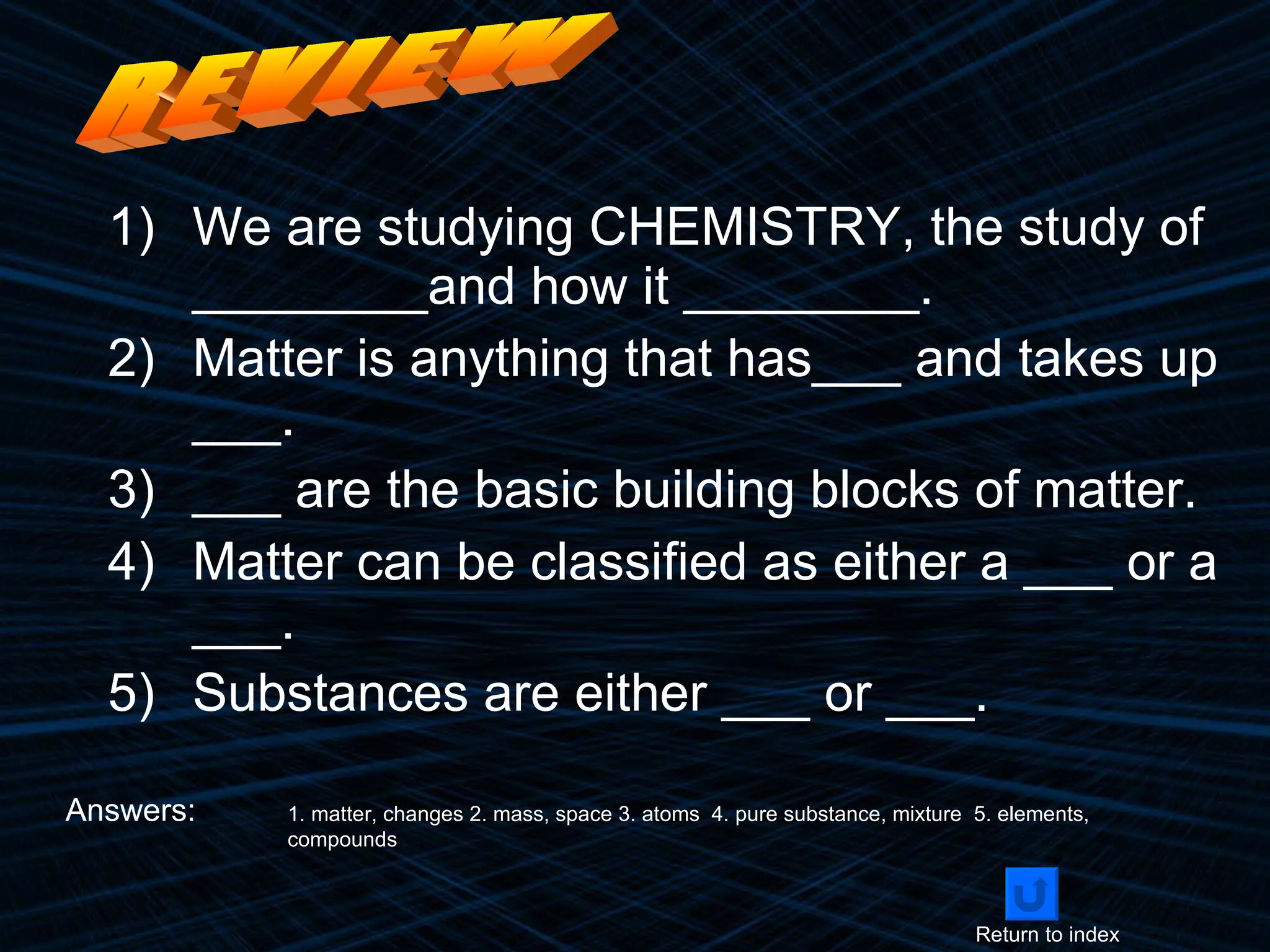
We are studying CHEMISTRY, the study of ________and how it ________. Matter is anything that has___ and takes up ___. ___ are the basic building blocks of matter. Matter can be classified as either a ___ or a ___. Substances are either ___ or ___.  REVIEW 1. matter, changes 2. mass, space 3. atoms  4. pure substance, mixture  5. elements, compounds Return to index Answers:
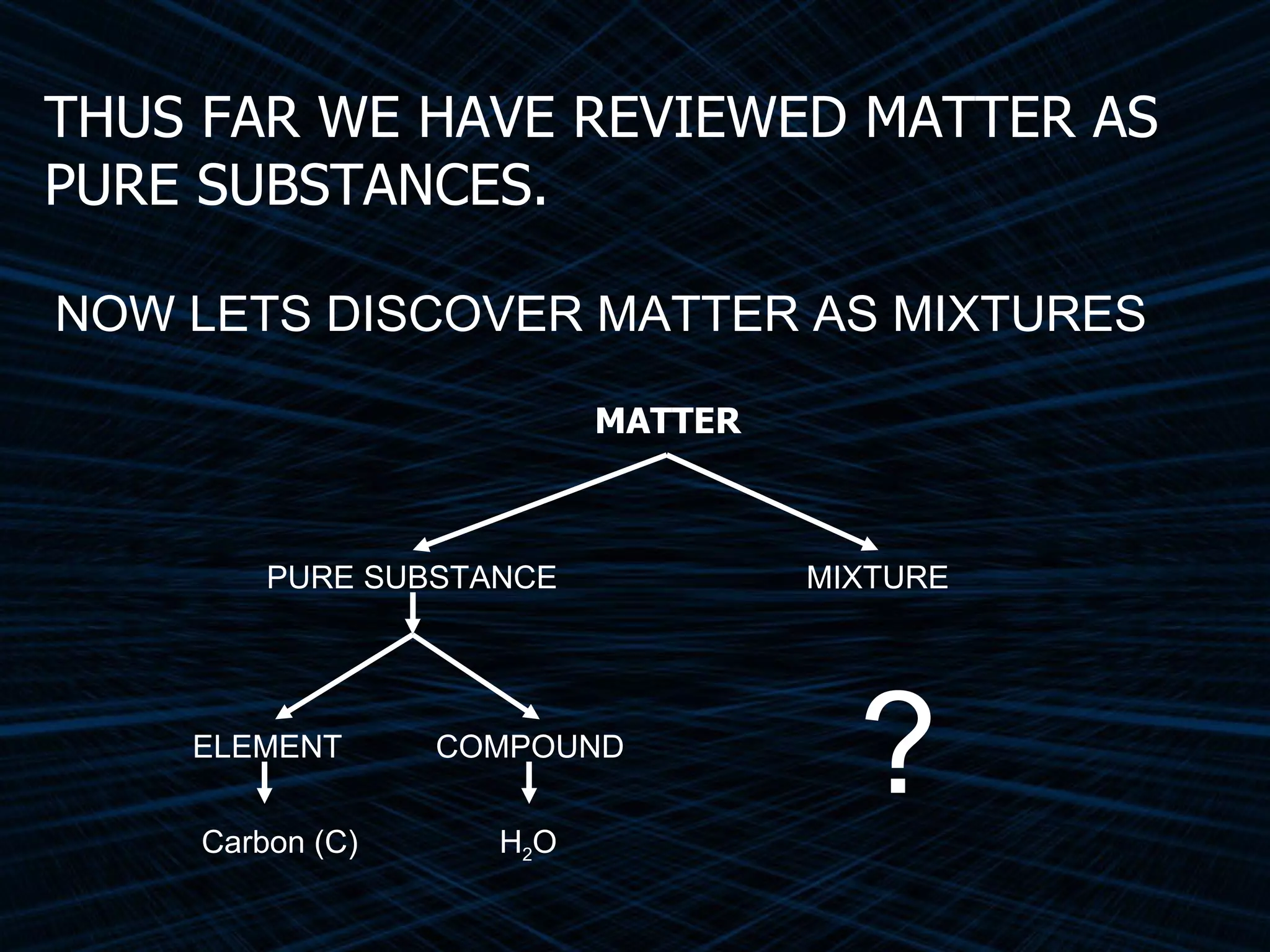
MATTER NOW LETS DISCOVER MATTER AS MIXTURES THUS FAR WE HAVE REVIEWED MATTER AS PURE SUBSTANCES. PURE SUBSTANCE ELEMENT COMPOUND Carbon (C) H 2 O MIXTURE ?
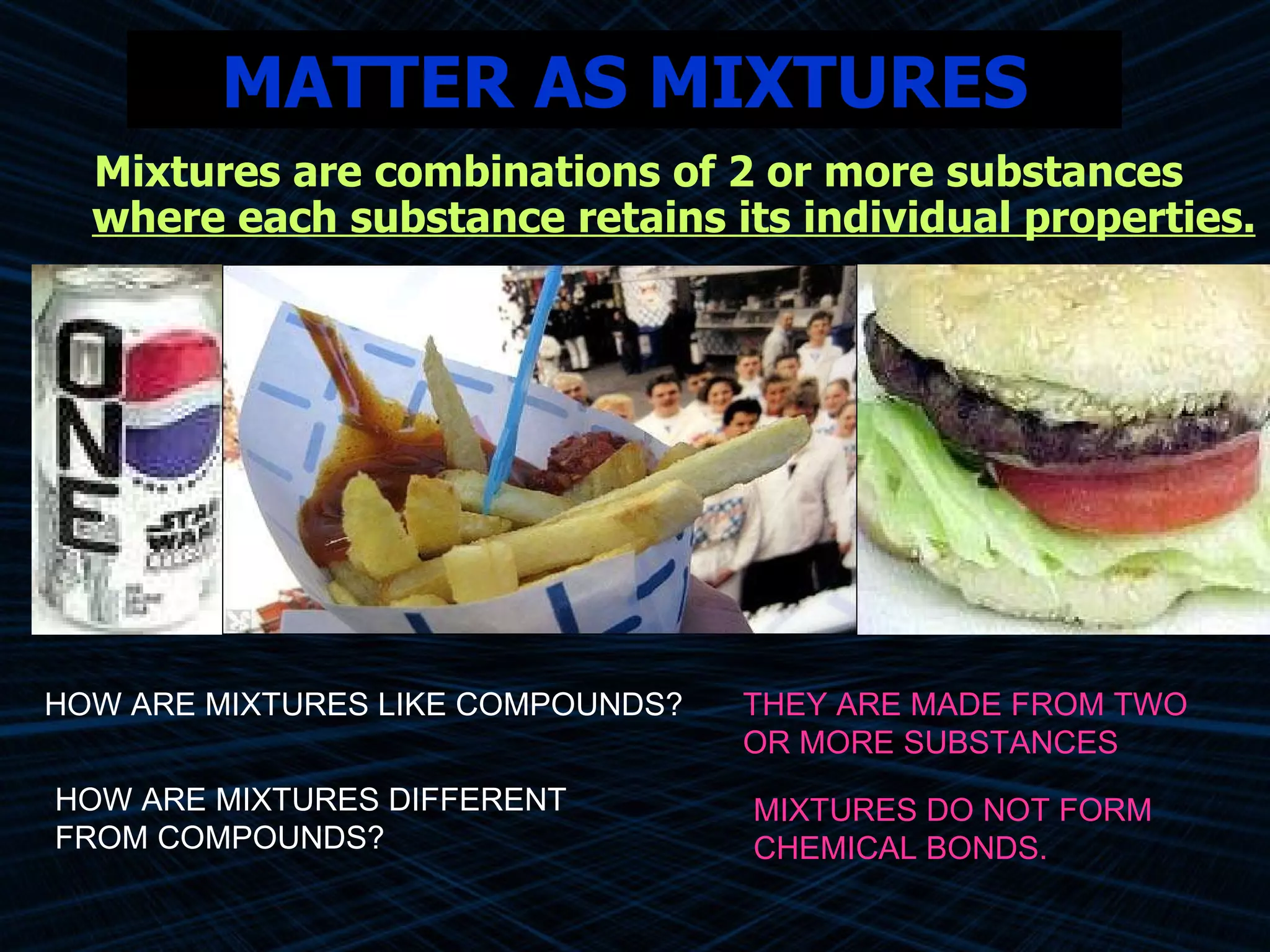
MATTER AS MIXTURES Mixtures are combinations of 2 or more substances  where each substance retains its individual properties. HOW ARE MIXTURES DIFFERENT FROM COMPOUNDS? HOW ARE MIXTURES LIKE COMPOUNDS? THEY ARE MADE FROM TWO OR MORE SUBSTANCES MIXTURES DO NOT FORM CHEMICAL BONDS.
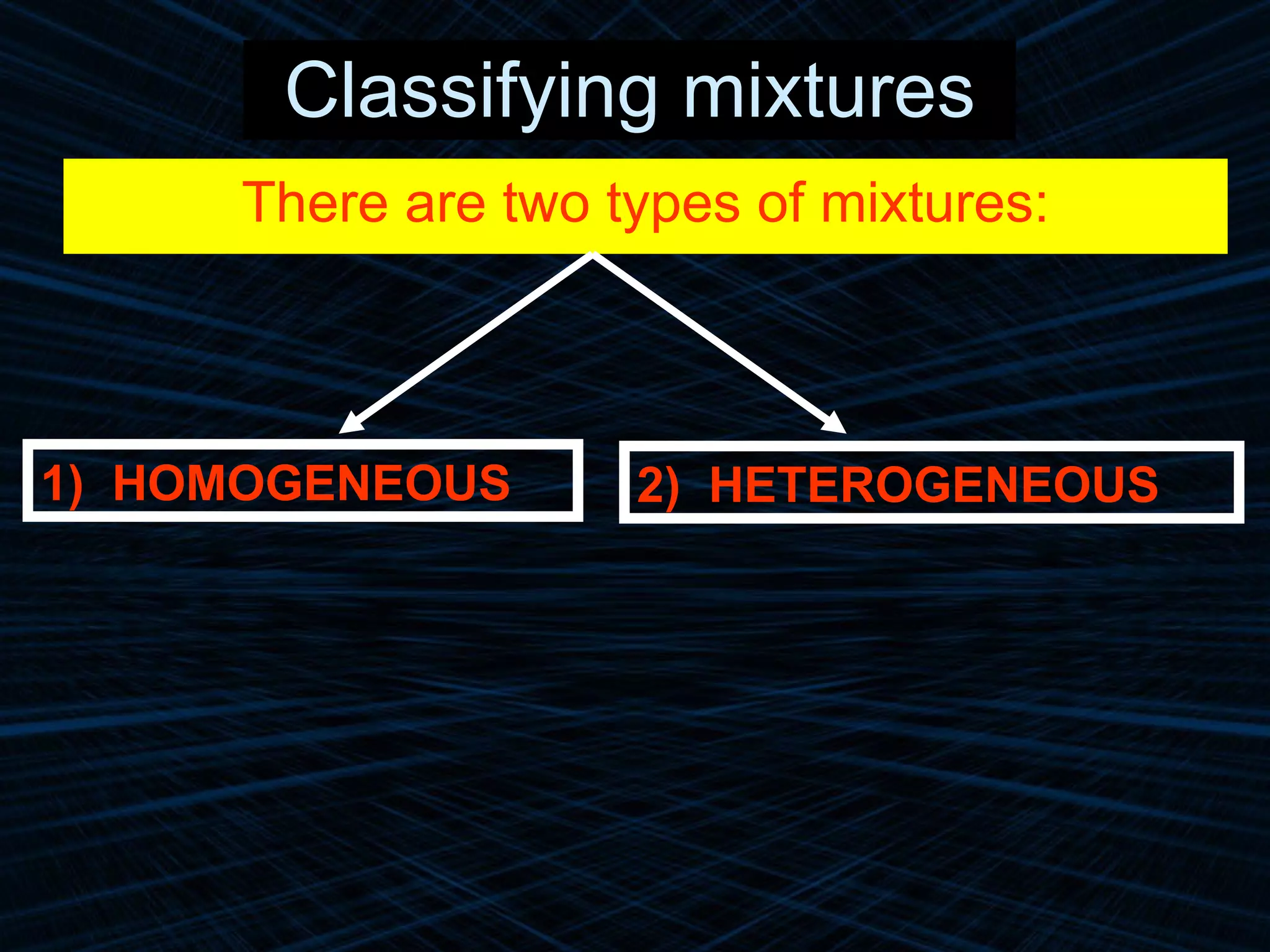
Classifying mixtures There are two types of mixtures: 2)  HETEROGENEOUS 1)  HOMOGENEOUS
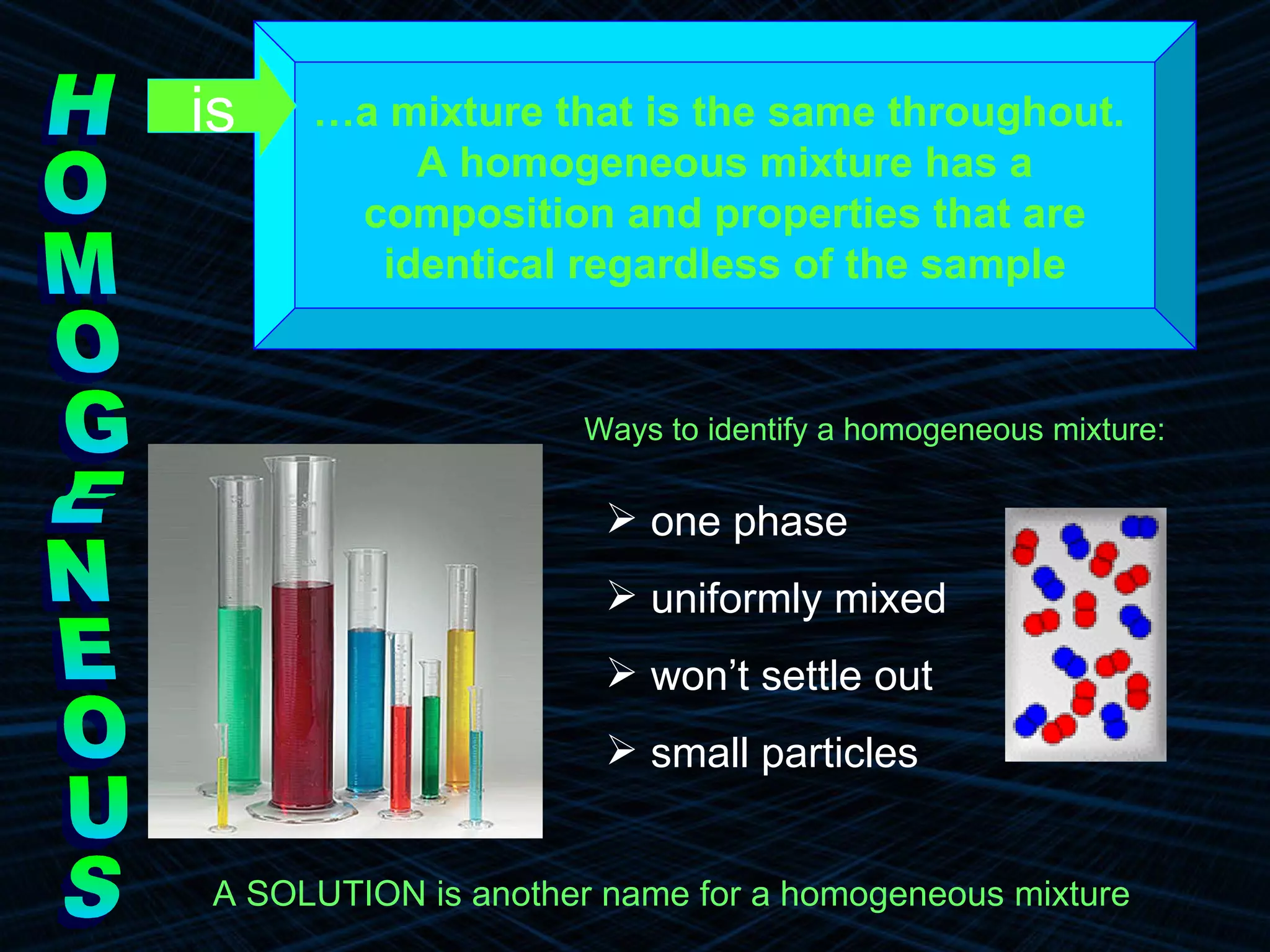
HOMOGENEOUS … a mixture that is the same throughout.  A homogeneous mixture has a  composition and properties that are  identical regardless of the sample Ways to identify a homogeneous mixture: A SOLUTION is another name for a homogeneous mixture   is one phase uniformly mixed won’t settle out small particles
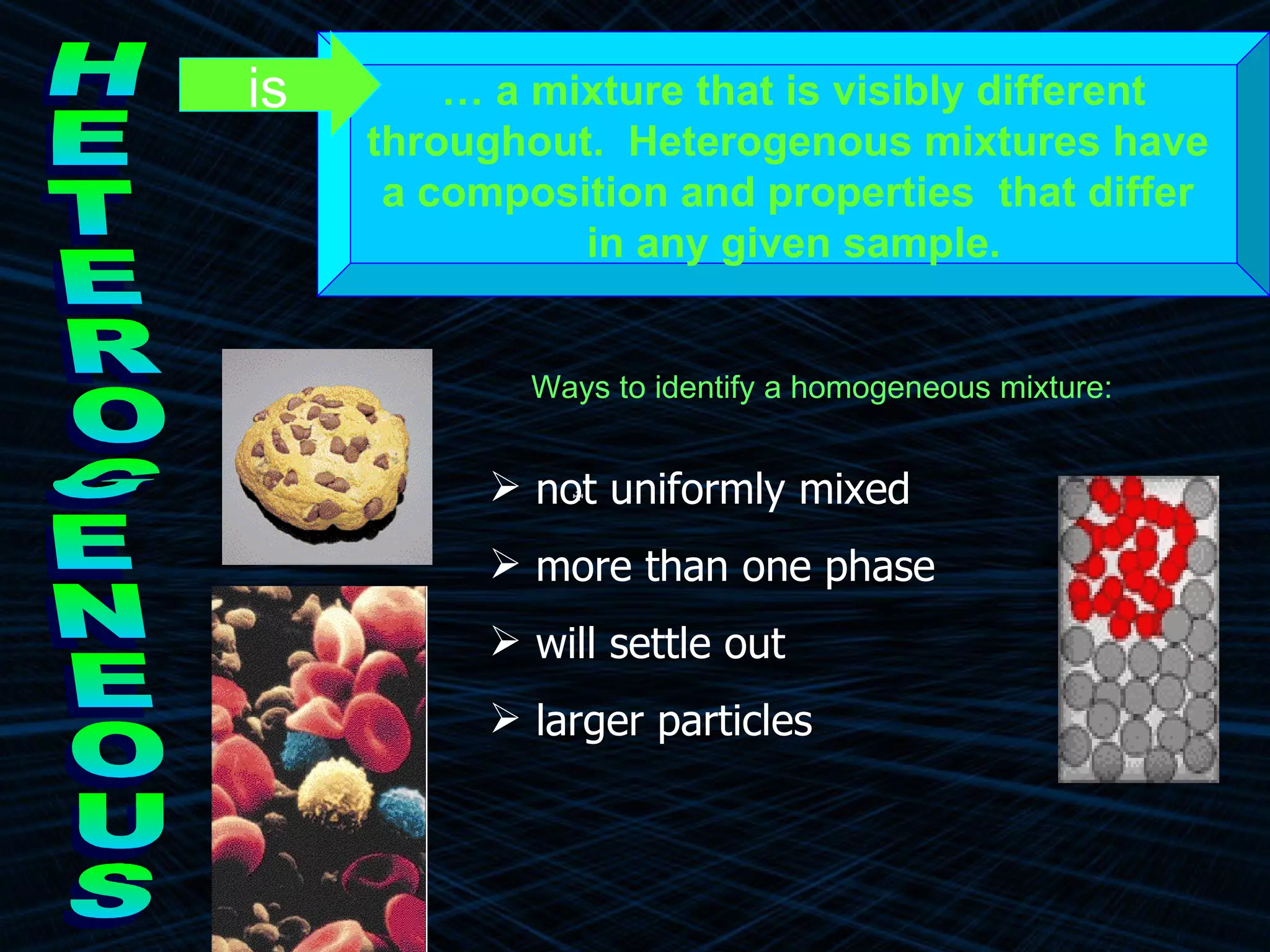
HETEROGENEOUS …  a mixture that is visibly different throughout.  Heterogenous mixtures have  a composition and properties  that differ  in any given sample. is Ways to identify a homogeneous mixture: not uniformly mixed more than one phase will settle out larger particles
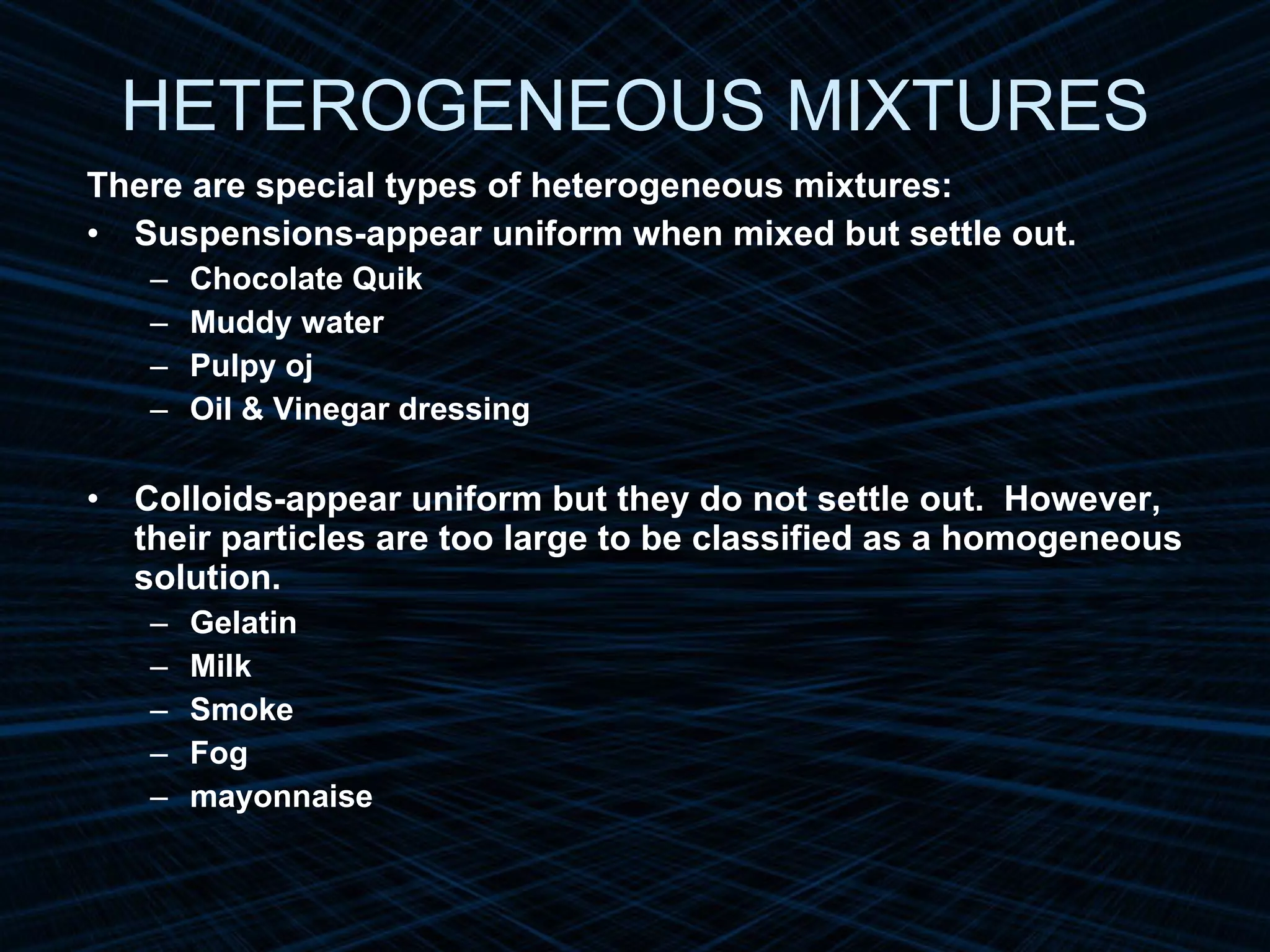
HETEROGENEOUS MIXTURES There are special types of heterogeneous mixtures: Suspensions-appear uniform when mixed but settle out. Chocolate Quik Muddy water Pulpy oj Oil & Vinegar dressing Colloids-appear uniform but they do not settle out.  However, their particles are too large to be classified as a homogeneous solution. Gelatin Milk Smoke Fog mayonnaise
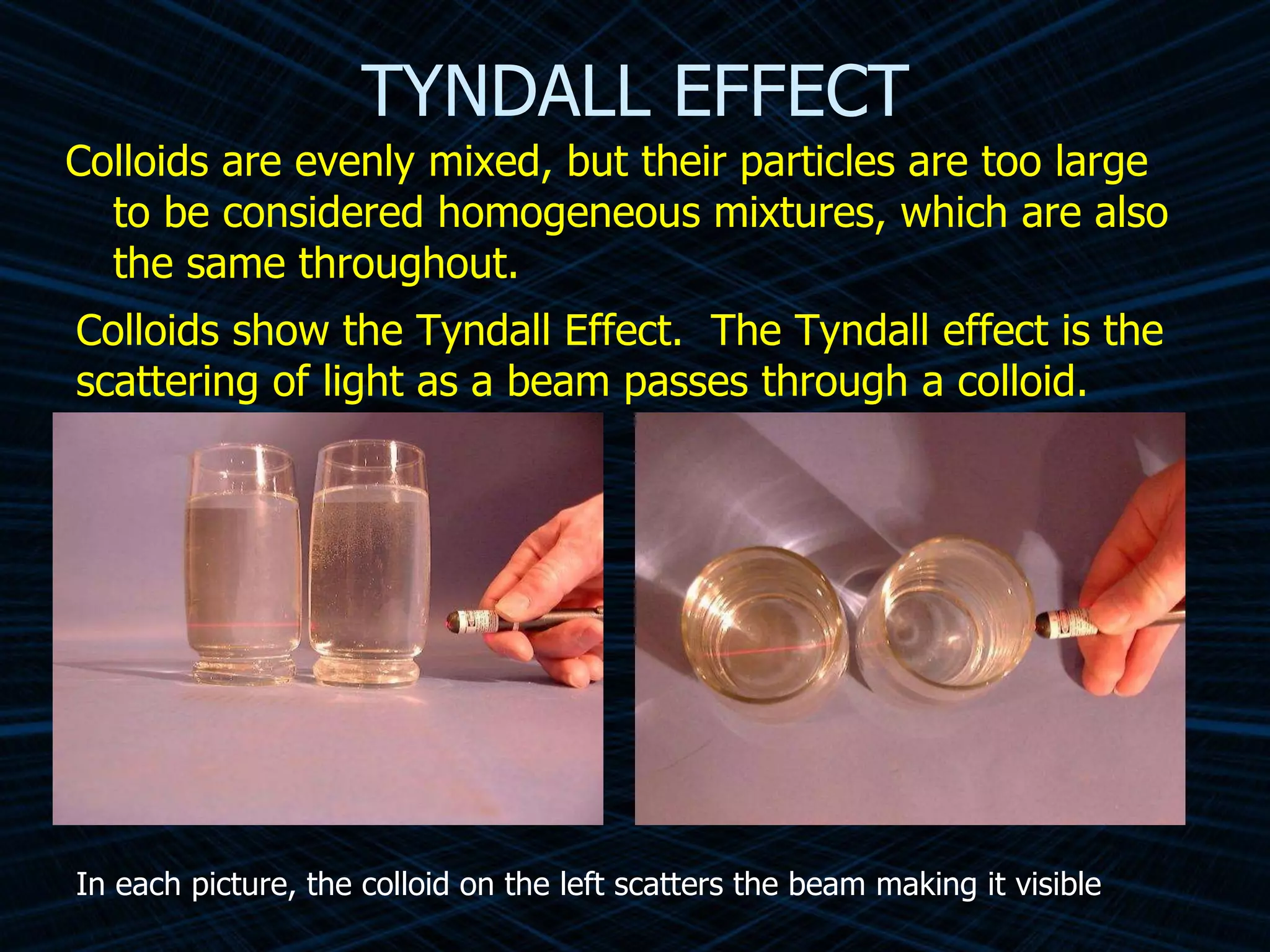
TYNDALL EFFECT Colloids are evenly mixed, but their particles are too large to be considered homogeneous mixtures, which are also the same throughout.   Colloids show the Tyndall Effect.  The Tyndall effect is the scattering of light as a beam passes through a colloid. In each picture, the colloid on the left scatters the beam making it visible
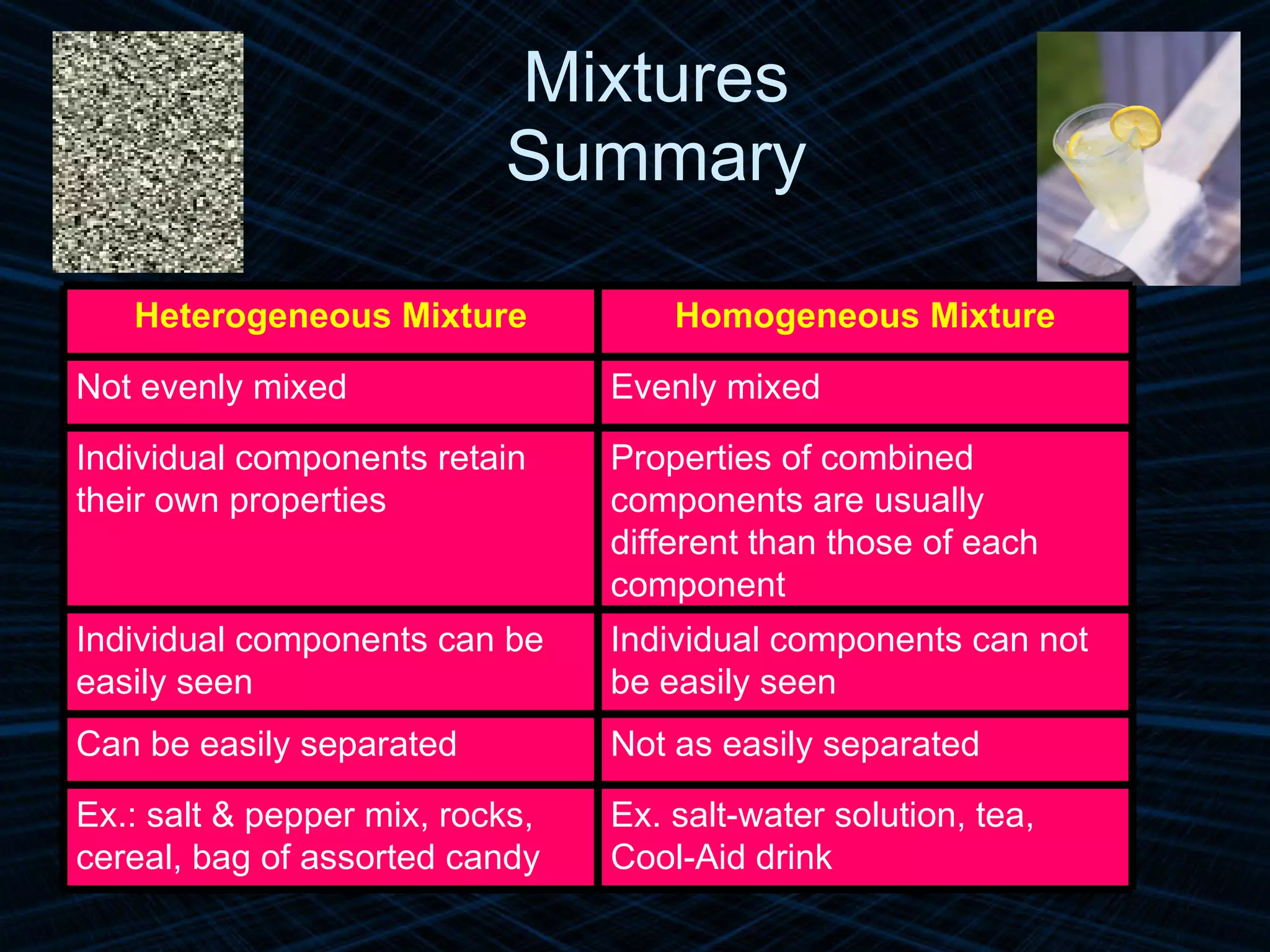
Mixtures Summary Ex. salt-water solution, tea, Cool-Aid drink Ex.: salt & pepper mix, rocks, cereal, bag of assorted candy Not as easily separated Can be easily separated Individual components can not be easily seen Individual components can be easily seen Properties of combined components are usually different than those of each component Individual components retain their own properties Evenly mixed Not evenly mixed Homogeneous Mixture Heterogeneous Mixture
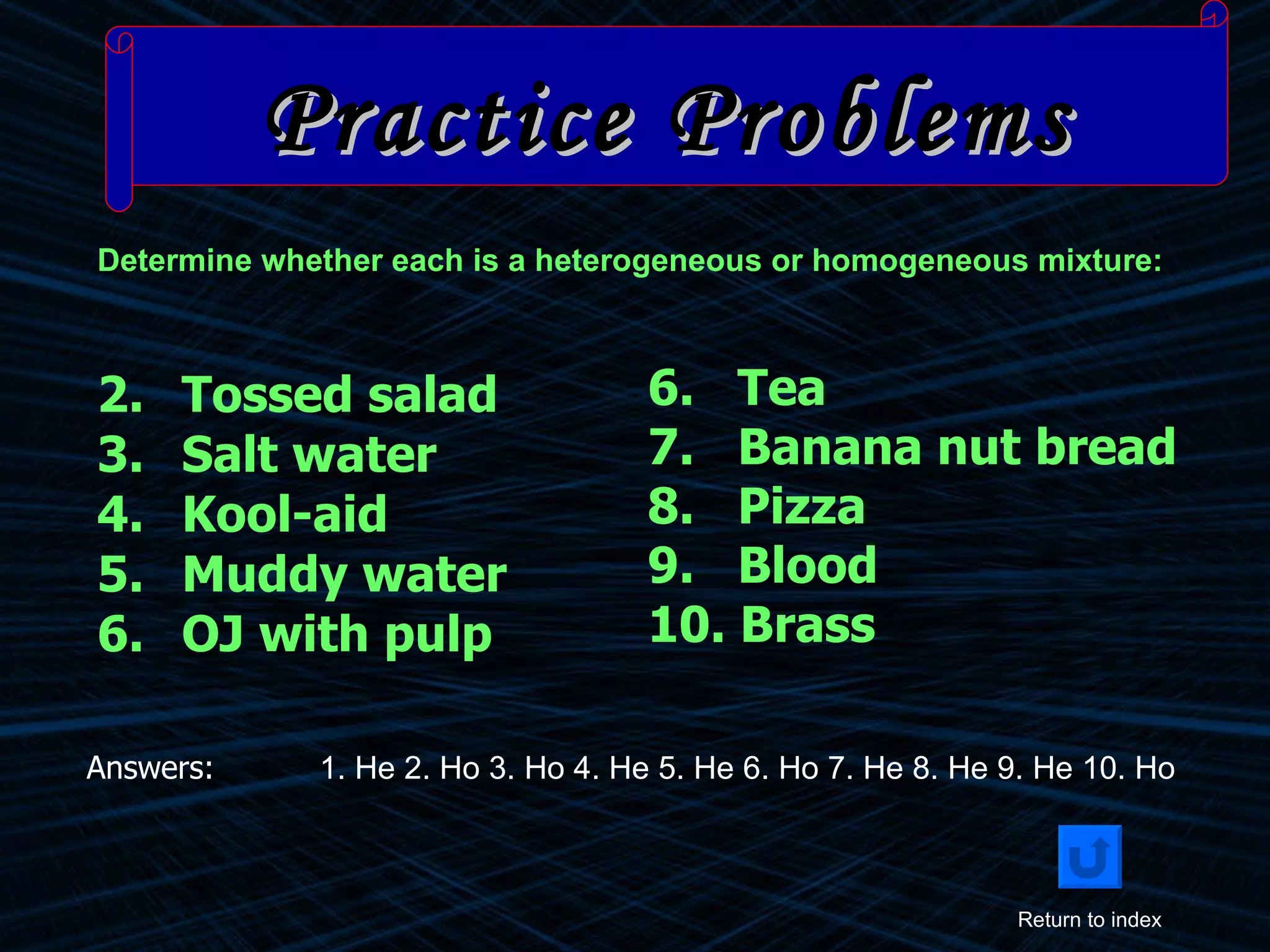
Tossed salad Salt water Kool-aid Muddy water OJ with pulp Practice Problems 1. He 2. Ho 3. Ho 4. He 5. He 6. Ho 7. He 8. He 9. He 10. Ho 6.  Tea 7.  Banana nut bread 8.  Pizza 9.  Blood 10. Brass Determine whether each is a heterogeneous or homogeneous mixture: Answers: Return to index
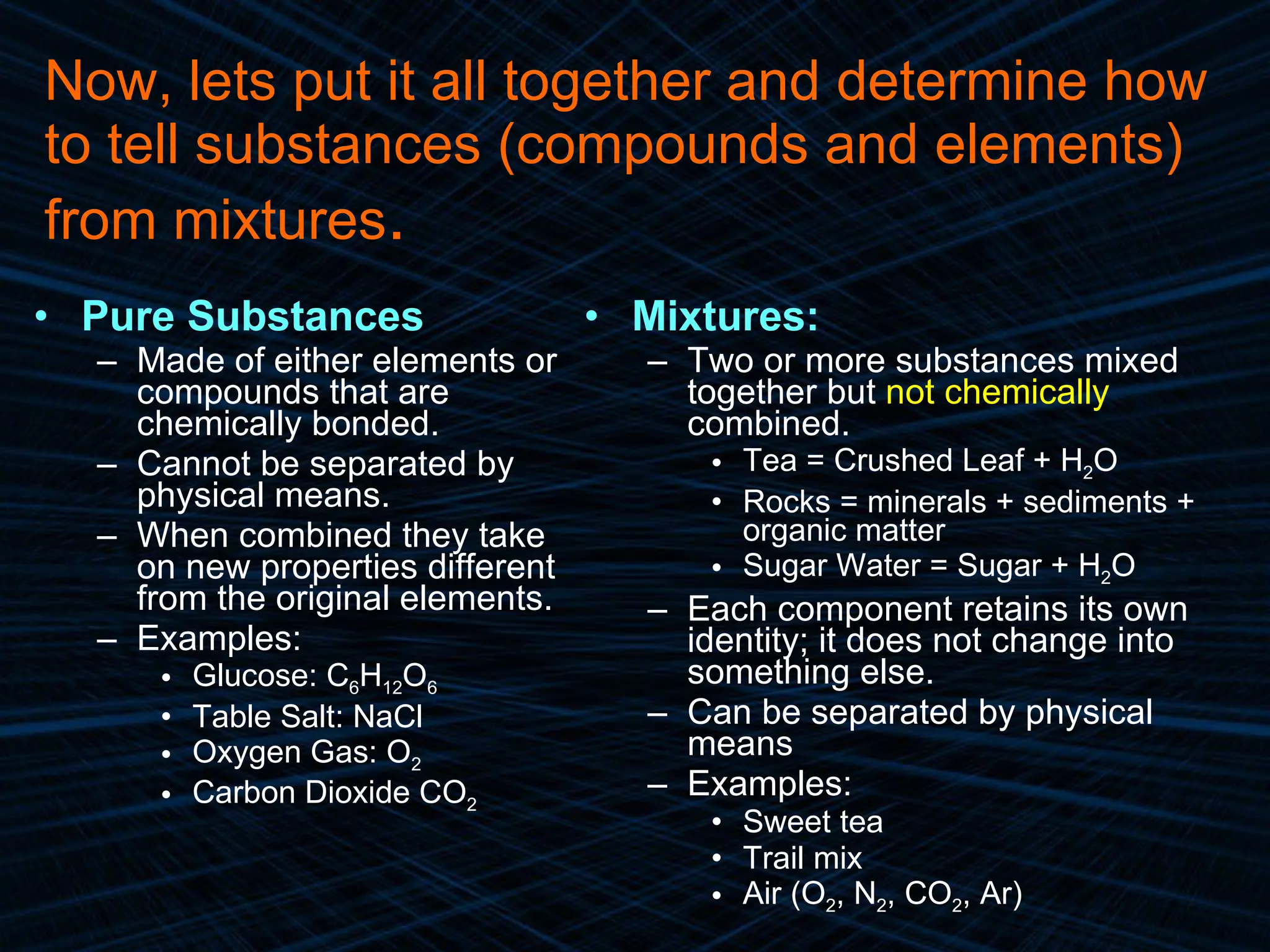
Pure Substances Made of either elements or compounds that are chemically bonded. Cannot be separated by physical means. When combined they take on new properties different from the original elements. Examples: Glucose: C 6 H 12 O 6  Table Salt: NaCl Oxygen Gas: O 2 Carbon Dioxide CO 2 Mixtures: Two or more substances mixed together but  not chemically  combined. Tea = Crushed Leaf + H 2 O Rocks = minerals + sediments + organic matter Sugar Water = Sugar + H 2 O Each component retains its own identity; it does not change into something else. Can be separated by physical means Examples: Sweet tea Trail mix Air (O 2 , N 2 , CO 2 , Ar) Now, lets put it all together and determine how to tell substances (compounds and elements) from mixtures .
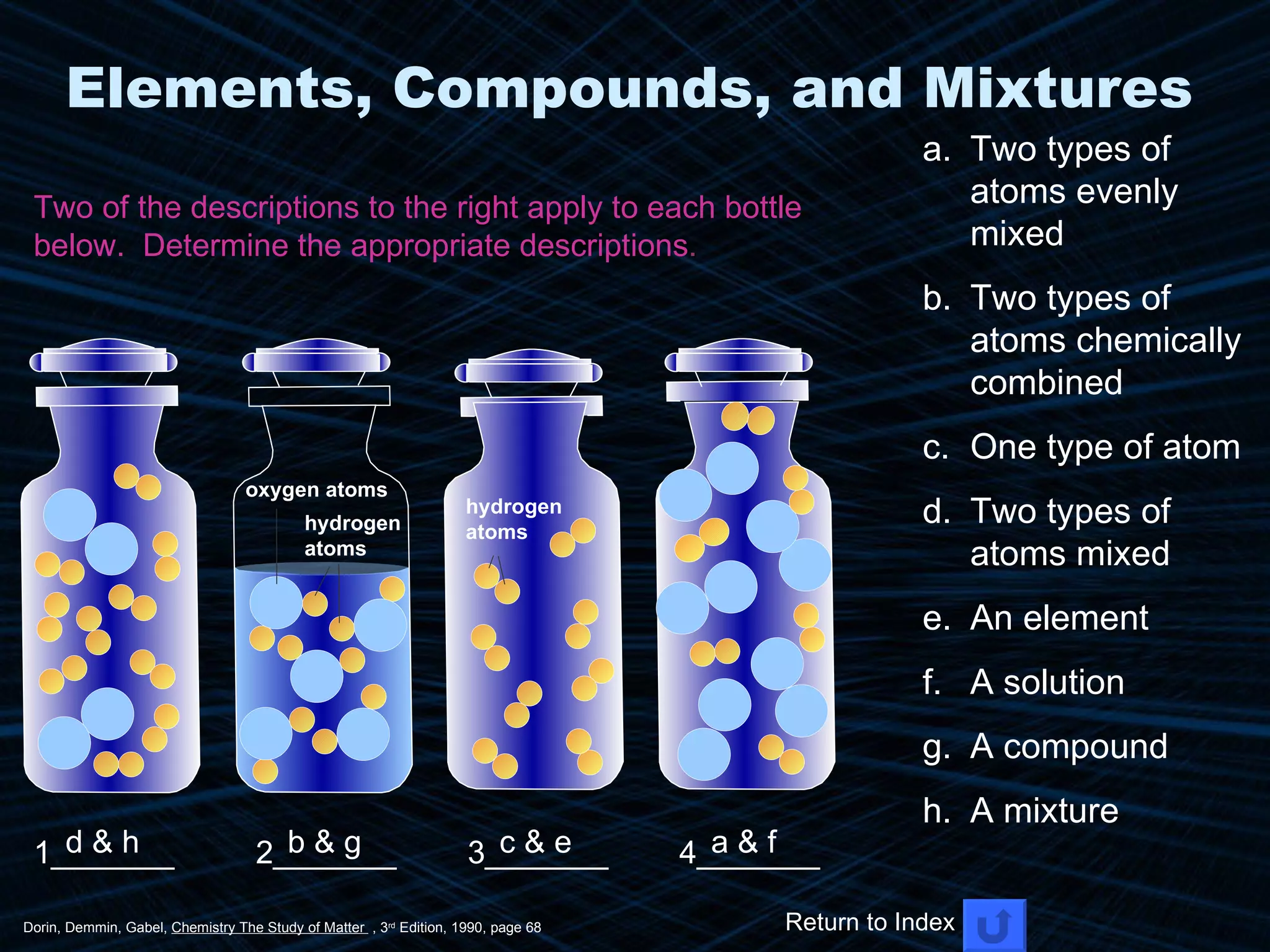
Elements, Compounds, and Mixtures Dorin, Demmin, Gabel,  Chemistry The Study of Matter  , 3 rd  Edition, 1990, page 68 Two of the descriptions to the right apply to each bottle below.  Determine the appropriate descriptions . Two types of  atoms evenly mixed Two types of atoms chemically combined One type of atom Two types of atoms mixed An element  A solution A compound  A mixture 2_______ 1_______ 3_______ 4_______ d & h b & g c & e a & f Return to Index hydrogen atoms oxygen atoms hydrogen atoms
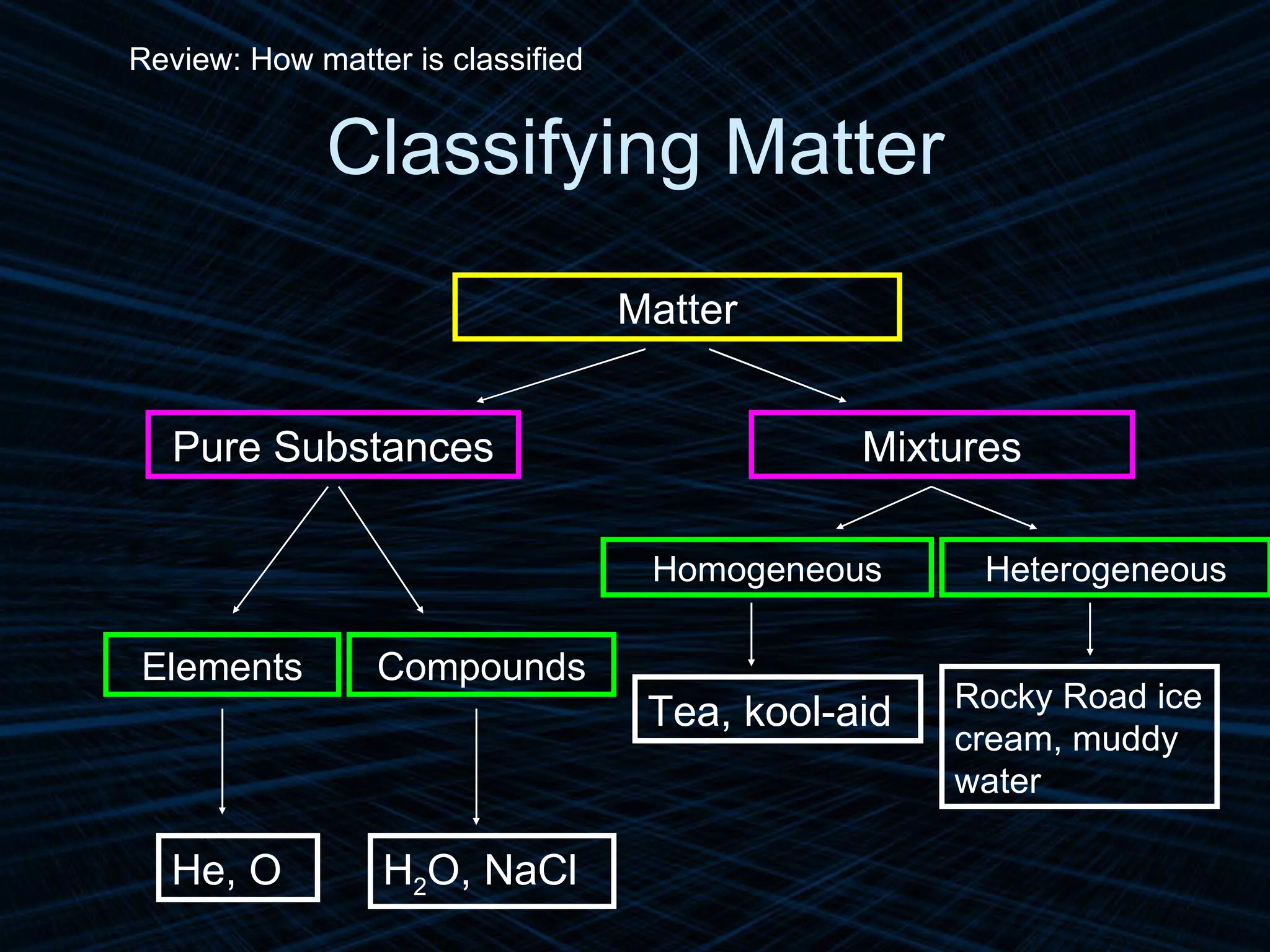
Classifying Matter Matter Pure Substances Mixtures Elements Compounds Homogeneous Heterogeneous He, O H 2 O, NaCl Tea, kool-aid Rocky Road ice cream, muddy water Review: How matter is classified
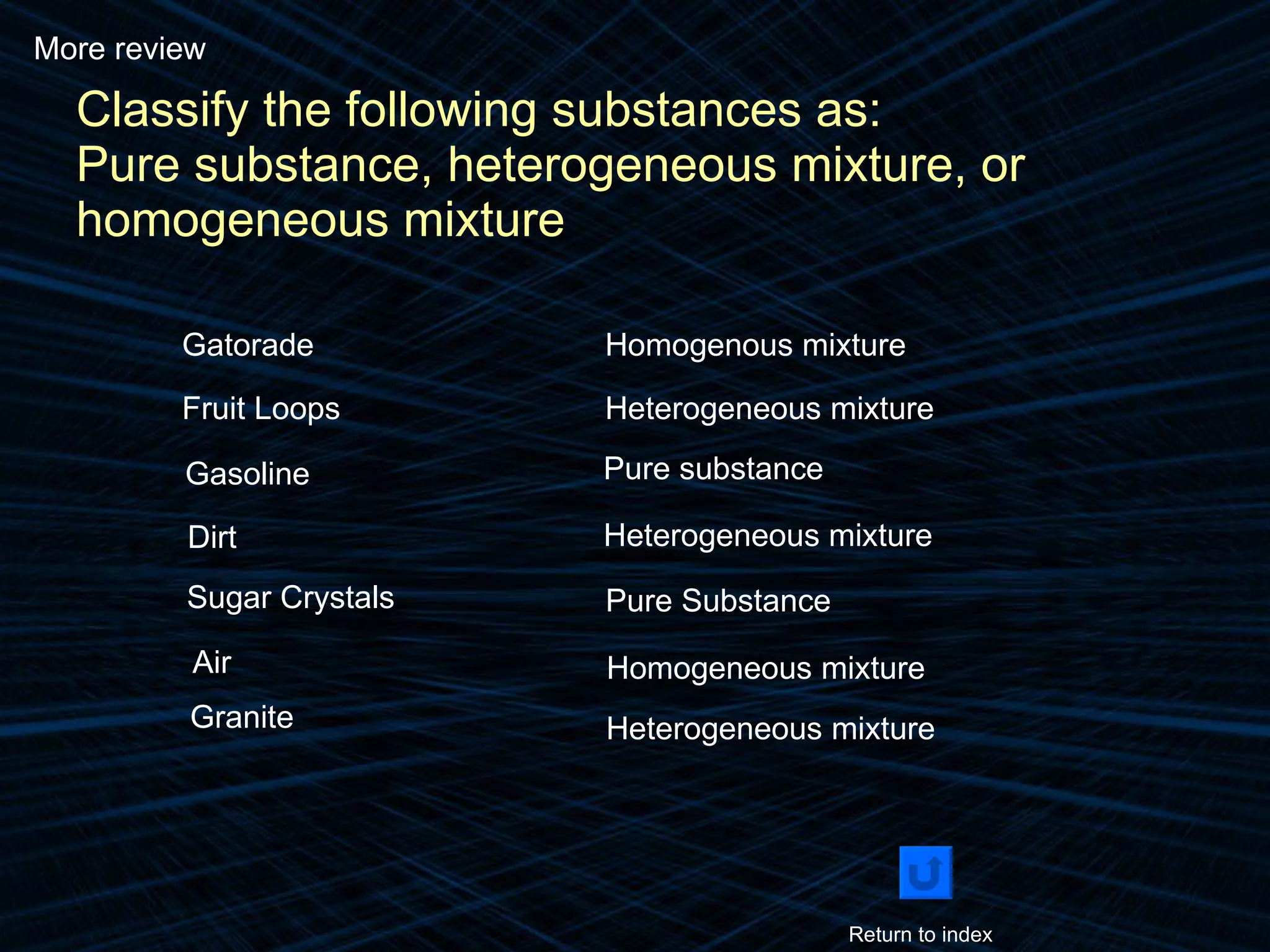
Classify the following substances as: Pure substance, heterogeneous mixture, or homogeneous mixture Return to index More review Gatorade Homogenous mixture Fruit Loops Heterogeneous mixture Pure substance Gasoline Dirt Heterogeneous mixture Sugar Crystals Pure Substance Air Homogeneous mixture Granite Heterogeneous mixture

5 1.1 Matter Powerpoint Part A Classification Of Matter

  • 1.
    The slides willprovide you with: The following slides are designed to help you in your study of matter. Matter is the basis for the second half of this course. 1) Basic definitions Relationships between those definitions and the concepts they help explain. Pictures and diagrams to help visualize and understand new concepts. Sample problems to help prepare you for mastery assignments and quizzes. There are fill-in-the-blank notes associated with these powerpoints. You may complete those notes for one of your graded mastery assignments.
  • 2.
    MATTER AND ENERGY Dark matter, matter we cannot see. Perhaps it doesn’t have or emit light. Scientists look at galaxy clusters and determine the amount of gravity holding the cluster together. From this information they can determine mass. They find there is a great deal more mass than they can account for from the visible material, thus the proposed existence of a “new” kind of matter, dark matter.
  • 3.
    UNIT 5: CLASSIFICATIONAND STRUCTURE OF MATTER Basic matter definitions (4-9) General classification of matter (10-27) Practice problems #1 (16) Practice problems #2 (25) Practice problems #3 (27) Practice problems #4 (28)
  • 4.
    MATTER PART I CLASSIFYING MATTER
  • 5.
    Matter is anythinghaving mass and volume. The Study of matter and how it changes CHEMISTRY Mass- the amount of matter in an object Mass is measured with a balance, unit is grams mass is related to weight but isn’t the same thing. weight is dependent upon gravity. mass never changes Volume- anything that takes up space, unit L, cm 3 , mL is
  • 6.
    IS AIR MATTER?Does air have mass? Does air have volume? YES, to both, so air is matter
  • 7.
    Composition - whatmatter is made of. Water is made of hydrogen and oxygen (H 2 O), tea has caffeine Properties -what matter is like. For example, water can dissolve many substances and caffeine is a stimulant. PROPERTIES OF MATTER What caffeine is made of… What caffeine is like…
  • 8.
    THE BASIC UNITOF MATTER IS AN ATOM There are over 118 varieties of atoms PERIODIC TABLE http:// www.webelements.com /scandium/
  • 9.
    ELEMENTS contain only one type of atom. Ex: hydrogen (H) is an element that contains only hydrogen atoms, carbon (C) contains only carbon atoms, oxygen (O) contains only oxygen atoms, etc. Atoms of elements can combine together to form compounds. COMPOUNDS are neutral groups of atoms held together by chemical bonds. Ex: CO 2 , H 2 O, H 2 , O 2
  • 10.
    HOW DO WECLASSIFY MATTER? All matter is classified as either a pure substance or a mixture Pure gold/Pure substance 24 karat End of introductory material. Return to index Alloy rims/ mixture of two metals 18 karat pure substance mixture
  • 11.
    CLASSIFYING MATTER Puresubstance -a type of matter where all samples, no matter how big or small, have the same properties…they behave in exactly the same way. Elements Compounds Elements contain one type of atom, thus they CANNOT be broken down into simpler substances by chemical means. Elements consist of either: single atoms, such as Carbon (C), or Sodium (Na) groups of atoms of the same type (molecules), such as H 2 , O 2 , Br 2 , etc.
  • 12.
    ELEMENTS MONATOMIC ELEMENTSDIATOMIC ELEMENTS ALLOTROPES Atomic nitrogen N Molecular nitrogen N 2 Ozone O3 Atomic hydrogen H Molecular hydrogen H 2 Graphite, buckyball Atomic oxygen O Molecular oxygen O 2 Carbon C ALLOTROPE-different forms of an element in same physical state
  • 13.
    COMPOUNDS Compounds aresubstances made up of 2 or more different elements that are chemically combined. CO 2, H 2 O, HCl, Na 2 SO 4 COMPOUNDS CAN BE BROKEN DOWN INTO SIMPLER SUBSTANCES BY CHEMICAL MEANS ONLY. COMPOUNDS HAVE DIFFERENT PROPERTIES THAN THE ELEMENTS THAT MAKE THEM UP. Click on the links below to watch videos of compounds broken down into the substances that make them up . Example-dehydration of sugar: C 12 H 11 O 22  12C(s) + 11 H 2 O(g) Sugar breaks down into carbon and water Example-hydrolysis of water: 2H 2 O  2H 2 + O 2 water breaks down into the hydrogen and oxygen gas which make it up. http://www.all-science-fair-projects.com/science_fair_projects/38/819/5db524216341764c1438c1f760fddff8.html http://earth2tech.com/2008/07/31/mit-solar-energy-storage-breakthrough /
  • 14.
    ELEMENTS TO COMPOUNDCOMBINED WITH… Will Form… Sodium, Na, is a soft, shiny metal that can be cut with a butter knife. When in contact with moisture it will “explode”. Chlorine gas, Cl 2 , which is a green, poisonous gas once used as a chemical weapon in military operations.
  • 15.
    Sodium metal andchlorine gas, under the right conditions, undergo a chemical change and combine to become….. 2 Na (s) + Cl 2(g)  2 NaCl The final compound has properties different from the elements that formed it. TABLE SALT!
  • 16.
    We are studyingCHEMISTRY, the study of ________and how it ________. Matter is anything that has___ and takes up ___. ___ are the basic building blocks of matter. Matter can be classified as either a ___ or a ___. Substances are either ___ or ___. REVIEW 1. matter, changes 2. mass, space 3. atoms 4. pure substance, mixture 5. elements, compounds Return to index Answers:
  • 17.
    MATTER NOW LETSDISCOVER MATTER AS MIXTURES THUS FAR WE HAVE REVIEWED MATTER AS PURE SUBSTANCES. PURE SUBSTANCE ELEMENT COMPOUND Carbon (C) H 2 O MIXTURE ?
  • 18.
    MATTER AS MIXTURESMixtures are combinations of 2 or more substances where each substance retains its individual properties. HOW ARE MIXTURES DIFFERENT FROM COMPOUNDS? HOW ARE MIXTURES LIKE COMPOUNDS? THEY ARE MADE FROM TWO OR MORE SUBSTANCES MIXTURES DO NOT FORM CHEMICAL BONDS.
  • 19.
    Classifying mixtures Thereare two types of mixtures: 2) HETEROGENEOUS 1) HOMOGENEOUS
  • 20.
    HOMOGENEOUS … amixture that is the same throughout. A homogeneous mixture has a composition and properties that are identical regardless of the sample Ways to identify a homogeneous mixture: A SOLUTION is another name for a homogeneous mixture is one phase uniformly mixed won’t settle out small particles
  • 21.
    HETEROGENEOUS … a mixture that is visibly different throughout. Heterogenous mixtures have a composition and properties that differ in any given sample. is Ways to identify a homogeneous mixture: not uniformly mixed more than one phase will settle out larger particles
  • 22.
    HETEROGENEOUS MIXTURES Thereare special types of heterogeneous mixtures: Suspensions-appear uniform when mixed but settle out. Chocolate Quik Muddy water Pulpy oj Oil & Vinegar dressing Colloids-appear uniform but they do not settle out. However, their particles are too large to be classified as a homogeneous solution. Gelatin Milk Smoke Fog mayonnaise
  • 23.
    TYNDALL EFFECT Colloidsare evenly mixed, but their particles are too large to be considered homogeneous mixtures, which are also the same throughout. Colloids show the Tyndall Effect. The Tyndall effect is the scattering of light as a beam passes through a colloid. In each picture, the colloid on the left scatters the beam making it visible
  • 24.
    Mixtures Summary Ex.salt-water solution, tea, Cool-Aid drink Ex.: salt & pepper mix, rocks, cereal, bag of assorted candy Not as easily separated Can be easily separated Individual components can not be easily seen Individual components can be easily seen Properties of combined components are usually different than those of each component Individual components retain their own properties Evenly mixed Not evenly mixed Homogeneous Mixture Heterogeneous Mixture
  • 25.
    Tossed salad Saltwater Kool-aid Muddy water OJ with pulp Practice Problems 1. He 2. Ho 3. Ho 4. He 5. He 6. Ho 7. He 8. He 9. He 10. Ho 6. Tea 7. Banana nut bread 8. Pizza 9. Blood 10. Brass Determine whether each is a heterogeneous or homogeneous mixture: Answers: Return to index
  • 26.
    Pure Substances Madeof either elements or compounds that are chemically bonded. Cannot be separated by physical means. When combined they take on new properties different from the original elements. Examples: Glucose: C 6 H 12 O 6 Table Salt: NaCl Oxygen Gas: O 2 Carbon Dioxide CO 2 Mixtures: Two or more substances mixed together but not chemically combined. Tea = Crushed Leaf + H 2 O Rocks = minerals + sediments + organic matter Sugar Water = Sugar + H 2 O Each component retains its own identity; it does not change into something else. Can be separated by physical means Examples: Sweet tea Trail mix Air (O 2 , N 2 , CO 2 , Ar) Now, lets put it all together and determine how to tell substances (compounds and elements) from mixtures .
  • 27.
    Elements, Compounds, andMixtures Dorin, Demmin, Gabel, Chemistry The Study of Matter , 3 rd Edition, 1990, page 68 Two of the descriptions to the right apply to each bottle below. Determine the appropriate descriptions . Two types of atoms evenly mixed Two types of atoms chemically combined One type of atom Two types of atoms mixed An element A solution A compound A mixture 2_______ 1_______ 3_______ 4_______ d & h b & g c & e a & f Return to Index hydrogen atoms oxygen atoms hydrogen atoms
  • 28.
    Classifying Matter MatterPure Substances Mixtures Elements Compounds Homogeneous Heterogeneous He, O H 2 O, NaCl Tea, kool-aid Rocky Road ice cream, muddy water Review: How matter is classified
  • 29.
    Classify the followingsubstances as: Pure substance, heterogeneous mixture, or homogeneous mixture Return to index More review Gatorade Homogenous mixture Fruit Loops Heterogeneous mixture Pure substance Gasoline Dirt Heterogeneous mixture Sugar Crystals Pure Substance Air Homogeneous mixture Granite Heterogeneous mixture

Editor's Notes

  • #3 Dark matter, matter we cannot see. Perhaps doesn’t have or emit light. Scientists look at galaxy clusters and determine the amount of gravity holding cluster together. From this information they can determine mass. They find there is a great deal more mass than they can account for of the visible material. Maintain there is dark matter that we cannot see or yet detect. Think it might be nuetrinos or baryonic particles.
  • #7 Have a balloon both empty and inflated, and an electronic scale. Weigh balloon.
  • #14 Check web site 1, only a lab, no video access