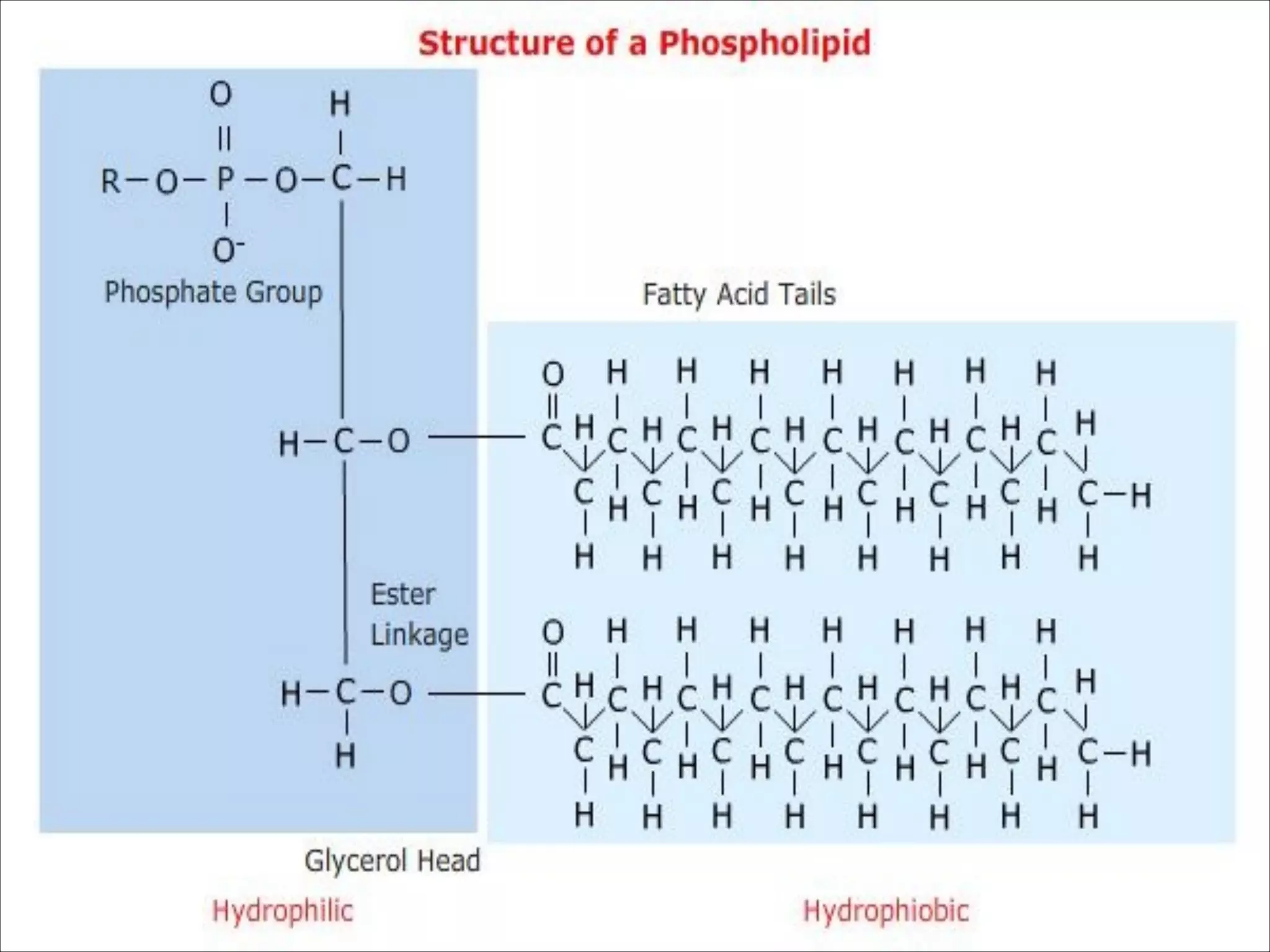
Bonding
Topic 4
Describe the ionic bond
The ionic bond
• Electrostatic attraction between
oppositely charged ions.	

• Elements in groups 1-7 (Analogy).	

• Transition elements can form more than
one ion (Fe+2, Fe+3).	

• Some compounds exist as ions
(Polyatomic ions).
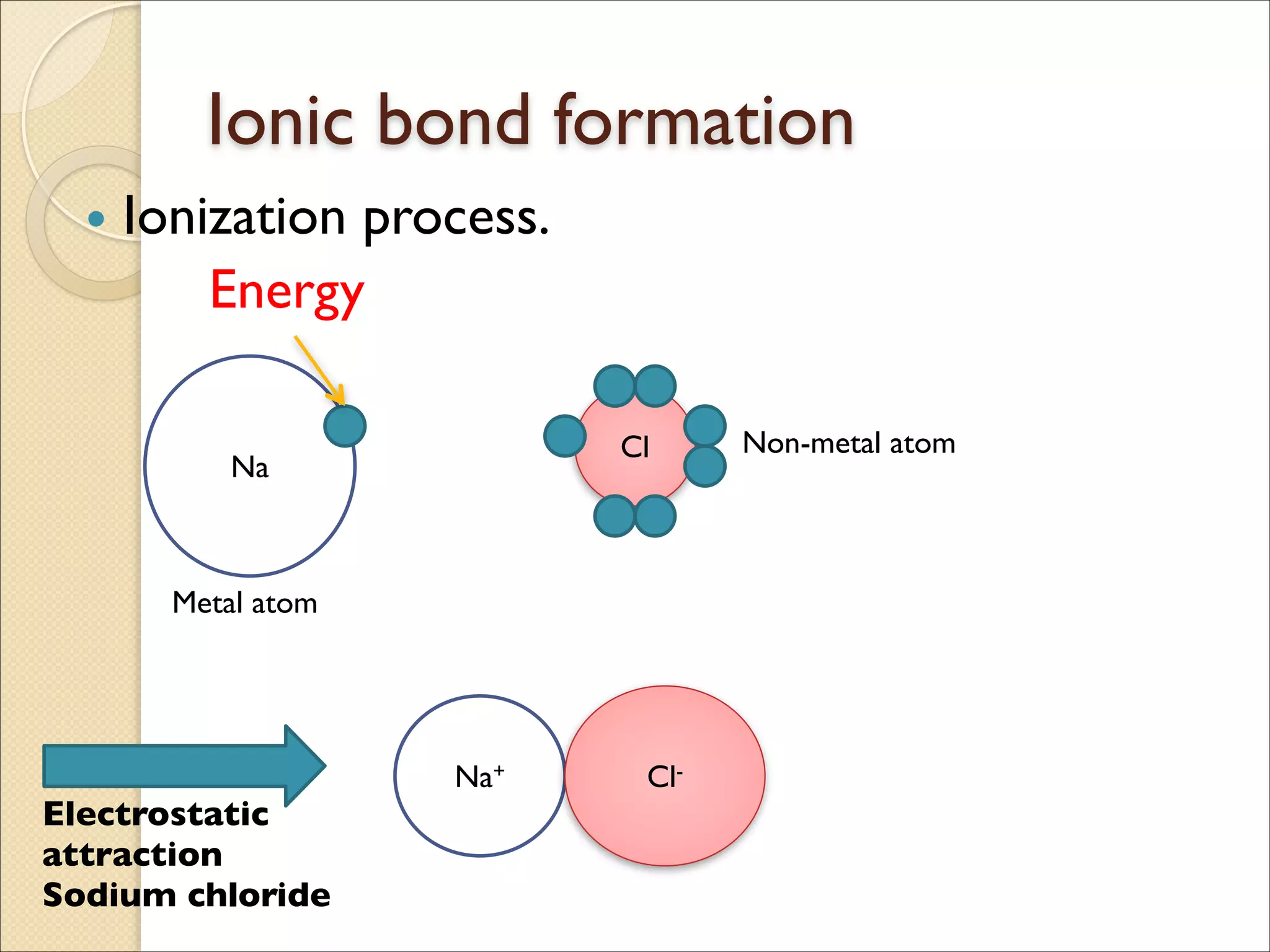
Ionic bond formation
• Ionization process.	

Energy
Na
Cl
Metal atom
Non-metal atom
Na+ Cl-
Electrostatic
attraction	

Sodium chloride
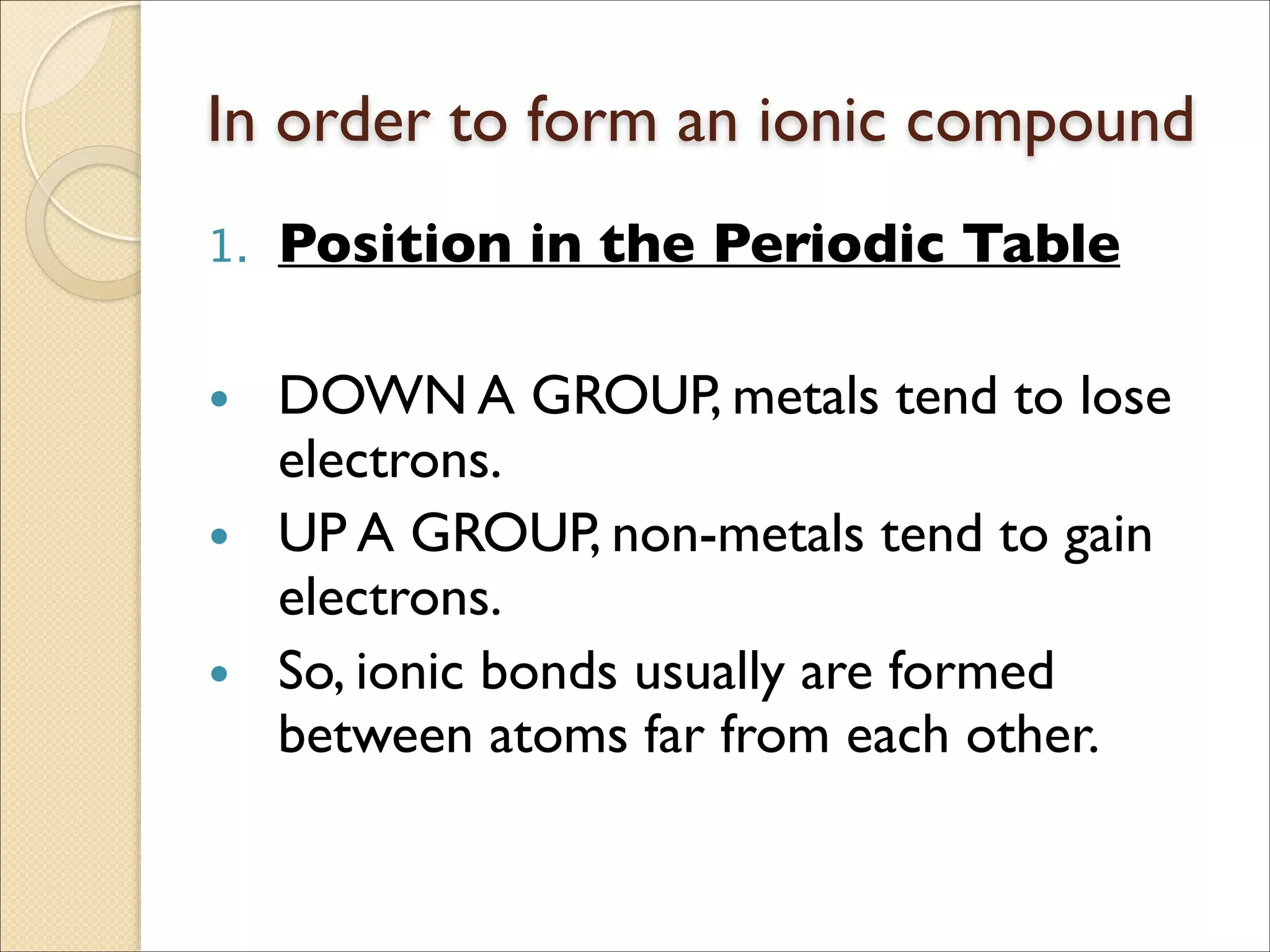
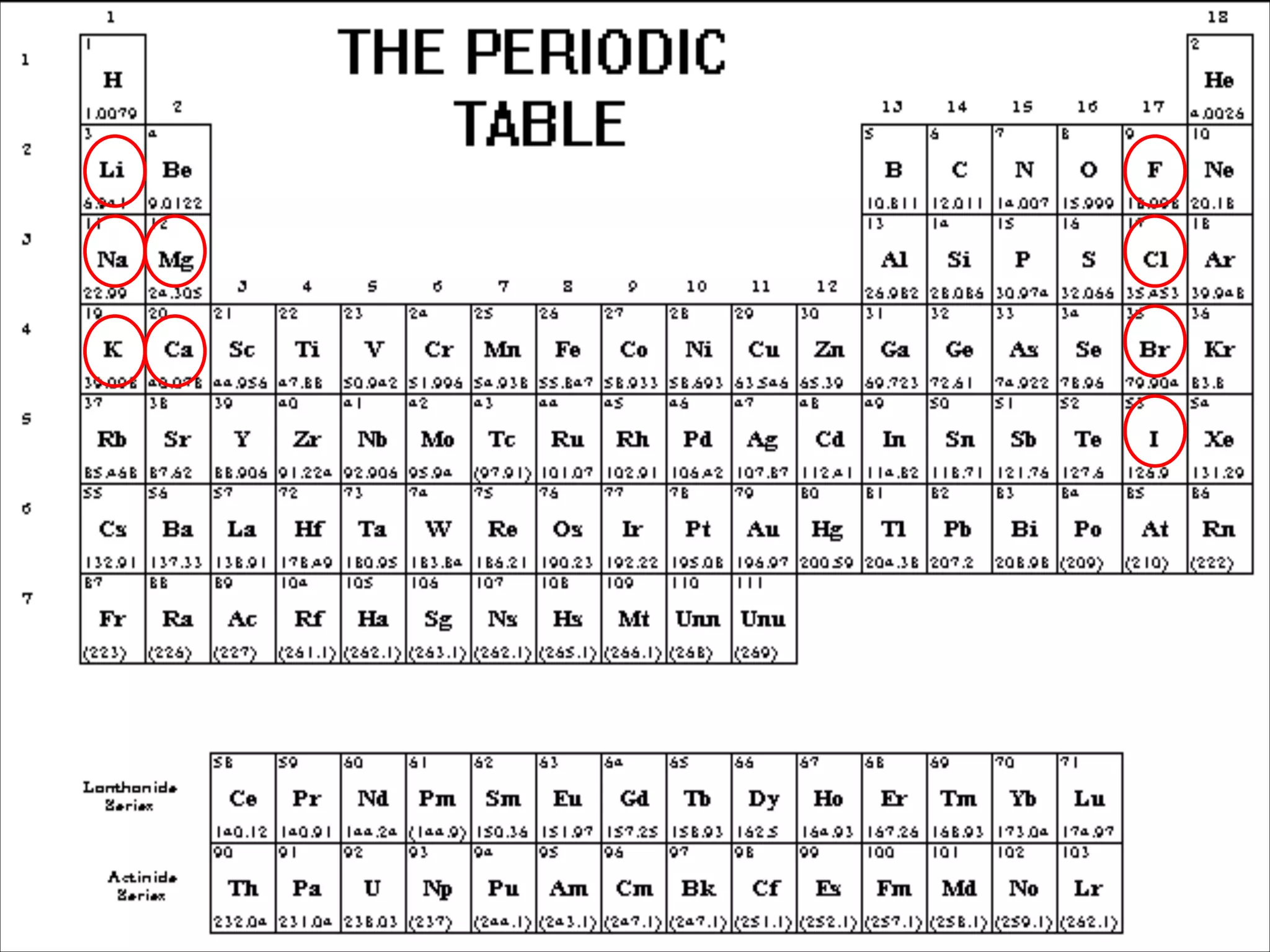
In order to form an ionic compound
1. Position in the Periodic Table	

!
• DOWN A GROUP, metals tend to lose
electrons.	

• UP A GROUP, non-metals tend to gain
electrons.	

• So, ionic bonds usually are formed
between atoms far from each other.
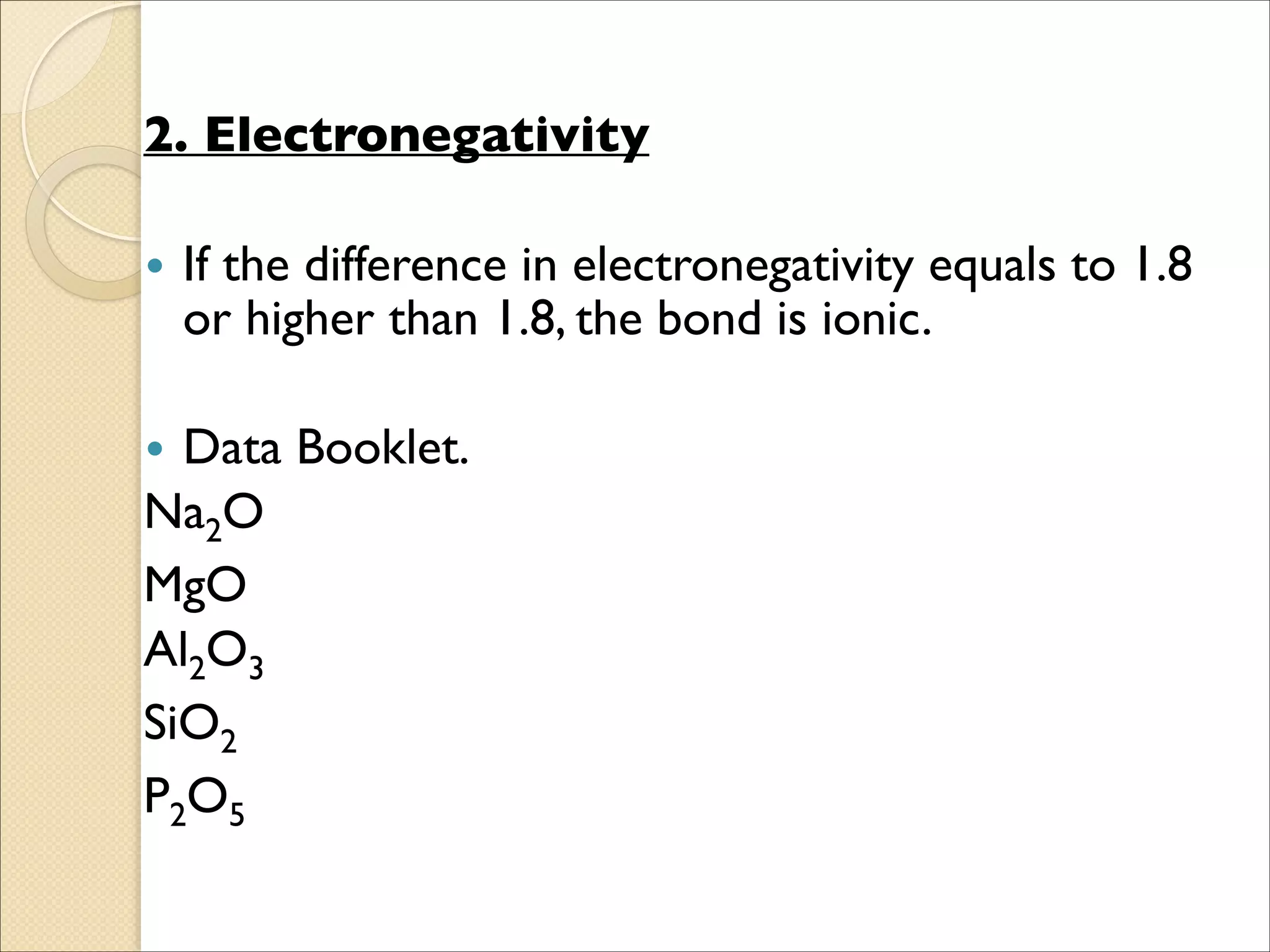
2. Electronegativity	

!
• If the difference in electronegativity equals to 1.8
or higher than 1.8, the bond is ionic.	

!
• Data Booklet.	

Na2O	

MgO	

Al2O3	

SiO2	

P2O5
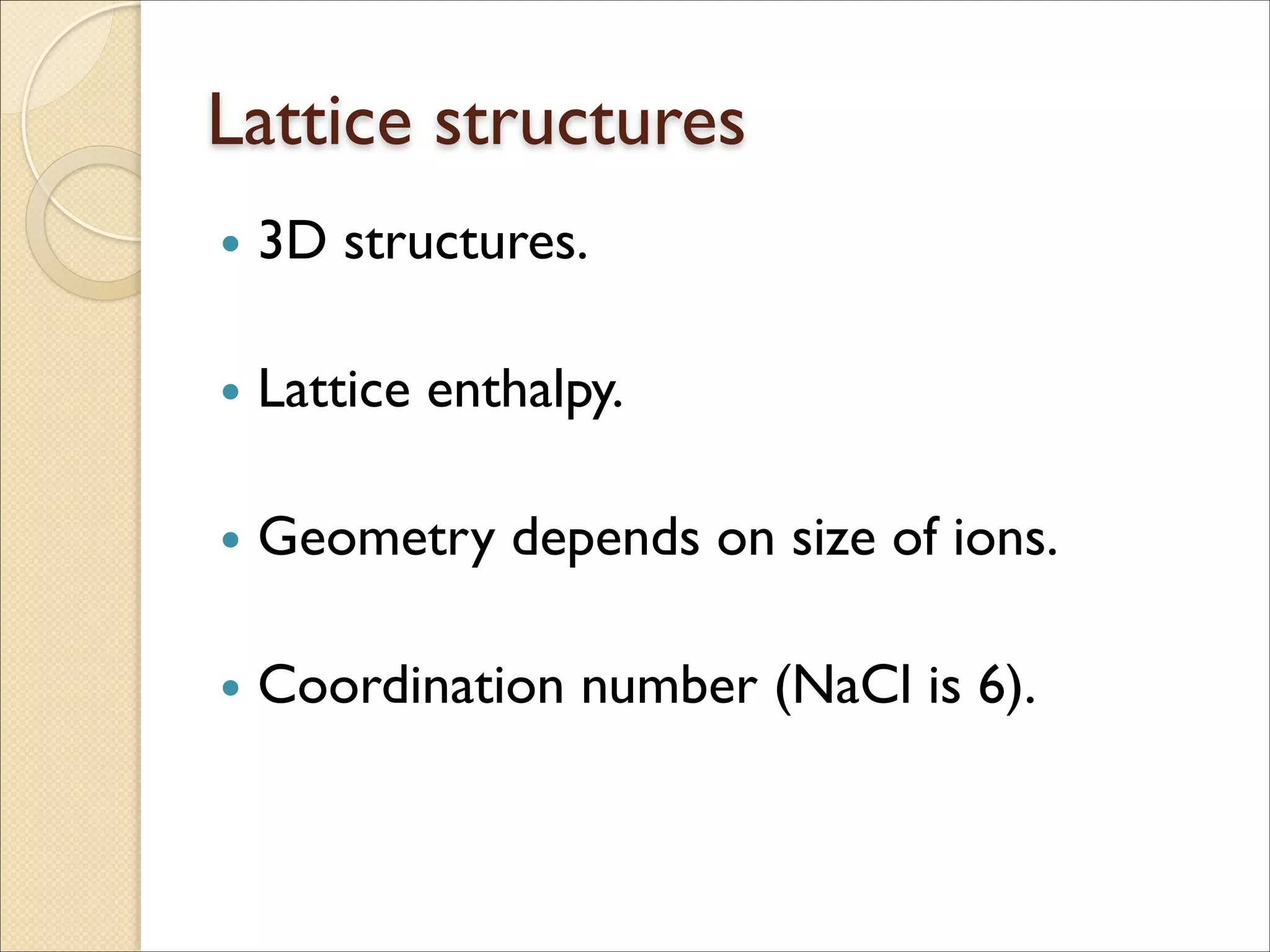
Lattice structures
• 3D structures.	

!
• Lattice enthalpy.	

!
• Geometry depends on size of ions.	

!
• Coordination number (NaCl is 6).
• Ionic structures http://
www.chemguide.co.uk/atoms/structures/
ionicstruct.html#top	

!
• Jmol: http://www.chemeddl.org/resources/
models360/solids.php#nacl
Practice
1. Solve some problems in pages 112 and
114.	

!
2. Class will be divided in 4 groups; each
one will build and describe an ionic
molecule. Once they are built, the class
will discuss them and order them in
increasing ionic character.	

!
3. HW #2: Solve problems on Edmodo.
Covalent bonds
http://www.mhhe.com/physsci/chemistry/
animations/chang_7e_esp/bom1s2_11.swf
Lewis structure
• Represents the valence shell.	

!
• Ethane, hydroxide ion, ammonium, ethyne,
CF3Cl.	

!
• Incomplete or expanded octate.	

BeCl2 and BF3. 	

They tend to form dative bonds (CO).
Strength of a bond
• What affects the strength?	

!
• Electrons can spend more time in the
neighbouring atom.	

!
Polar bonds (assymetrical bond).	

Higher than 0 and smaller than 1.8	

Non-polar = 0
VSEPR theory
• Valence Shell Electron Pair Repulsion.	

!
• Deduce geometry.	

!
• Importance.	

!
• Negative charge center.
VSEPR theory
• http://www.mhhe.com/physsci/chemistry/
animations/chang_7e_esp/bom3s2_7.swf
Shapes
!
!
http://phet.colorado.edu/en/simulation/
molecule-shapes
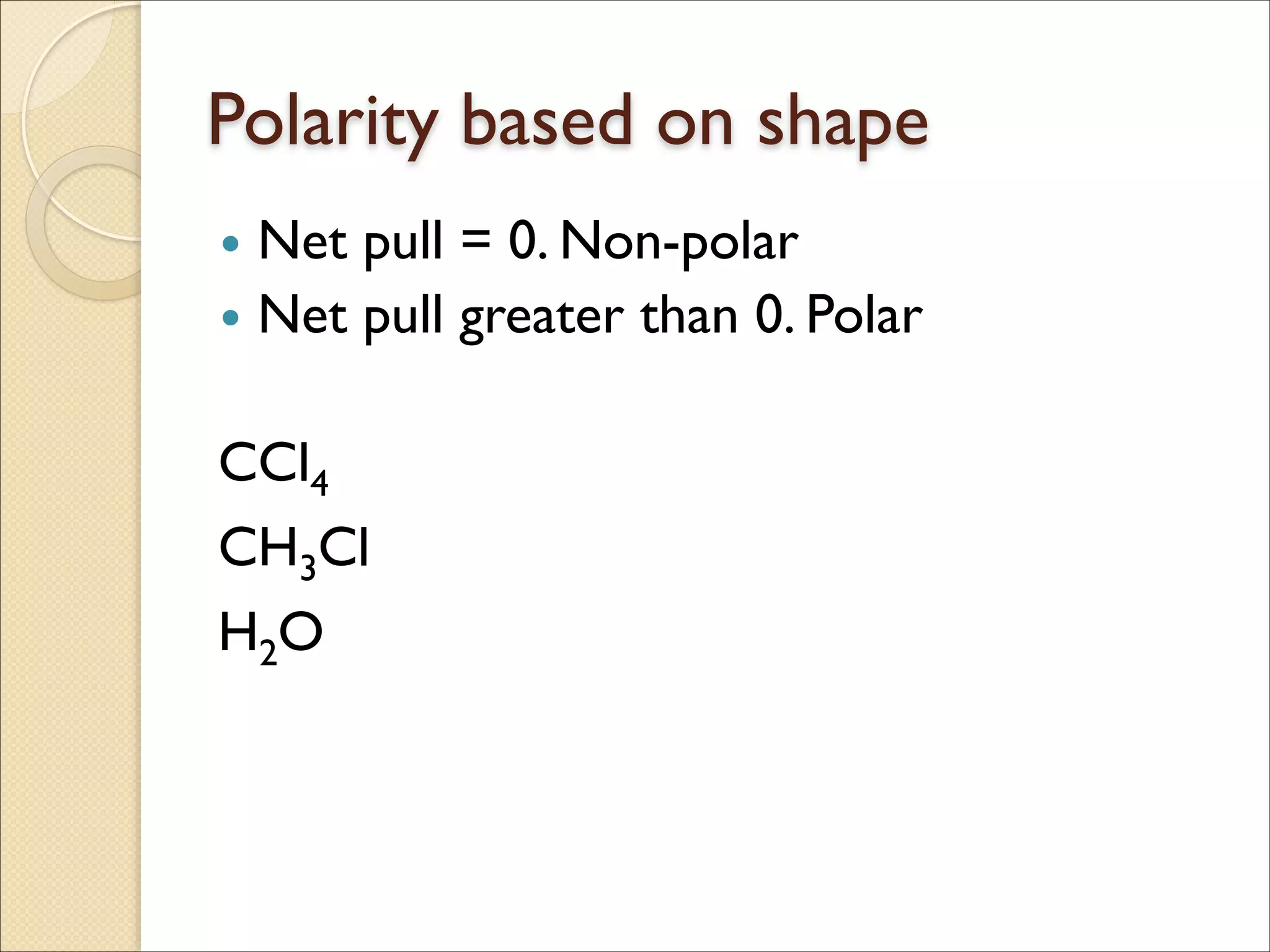
Polarity based on shape
• Net pull = 0. Non-polar	

• Net pull greater than 0. Polar	

!
CCl4	

CH3Cl	

H2O
Polarity based on shape
• http://www.mhhe.com/physsci/chemistry/
animations/chang_7e_esp/bom4s2_7.swf
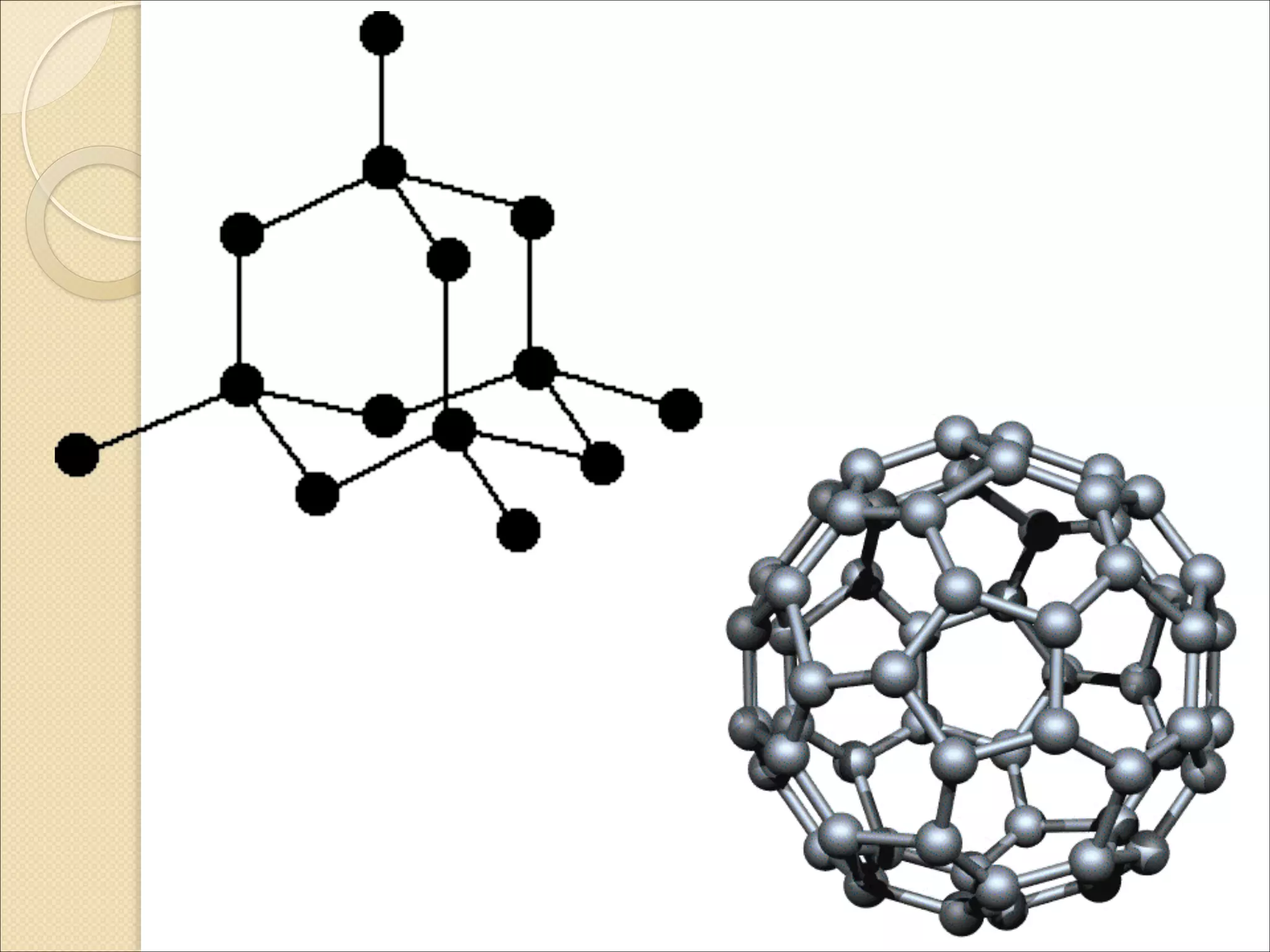
Allotropes
http://www.chemeddl.org/resources/
models360/solids.php#diamond
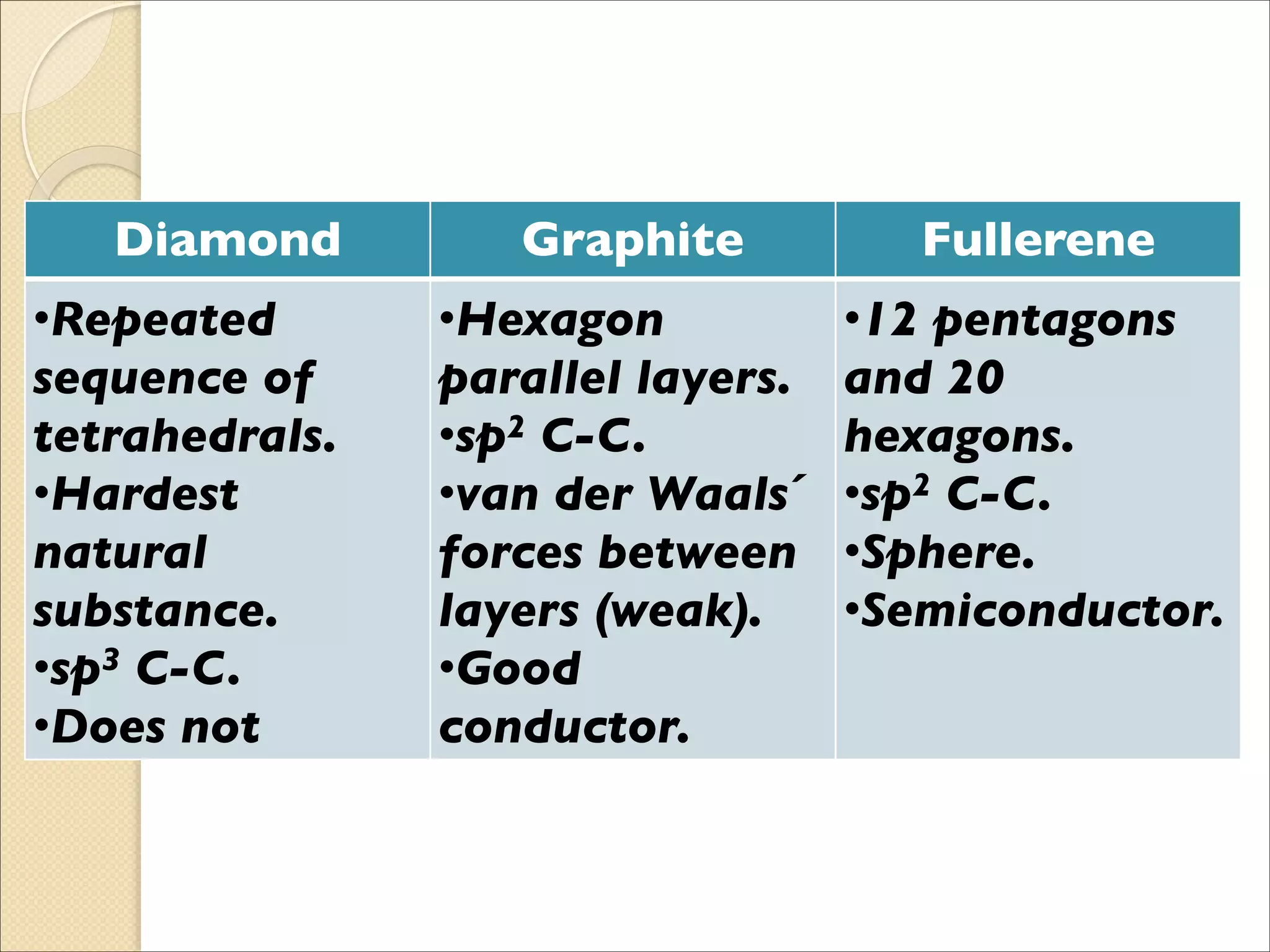
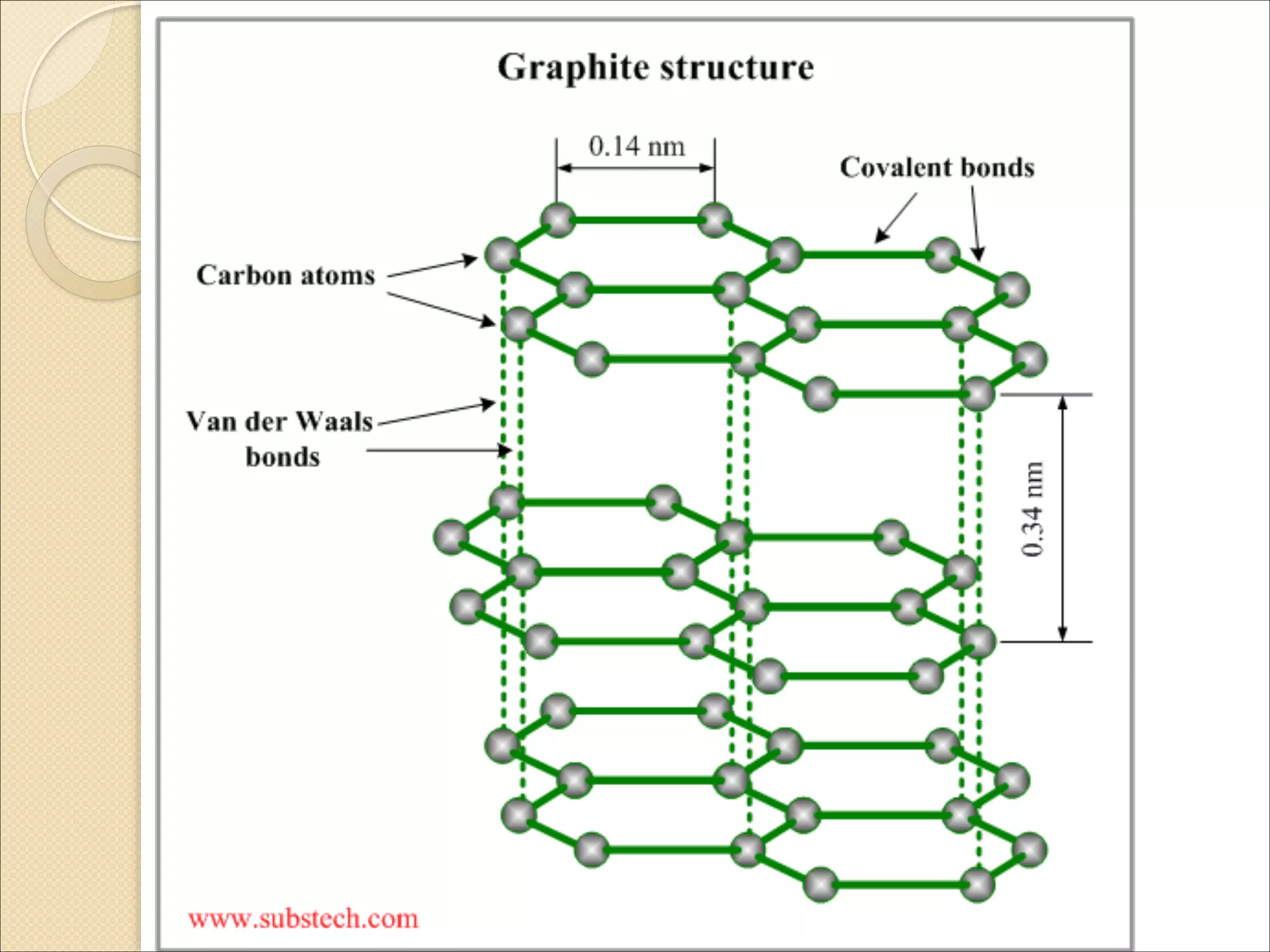
Diamond Graphite Fullerene
•Repeated
sequence of
tetrahedrals.	

•Hardest
natural
substance.	

•sp3 C-C.	

•Does not
conduct
•Hexagon
parallel layers.	

•sp2 C-C.	

•van der Waals´
forces between
layers (weak).	

•Good
conductor.
•12 pentagons
and 20
hexagons.	

•sp2 C-C.	

•Sphere.	

•Semiconductor.
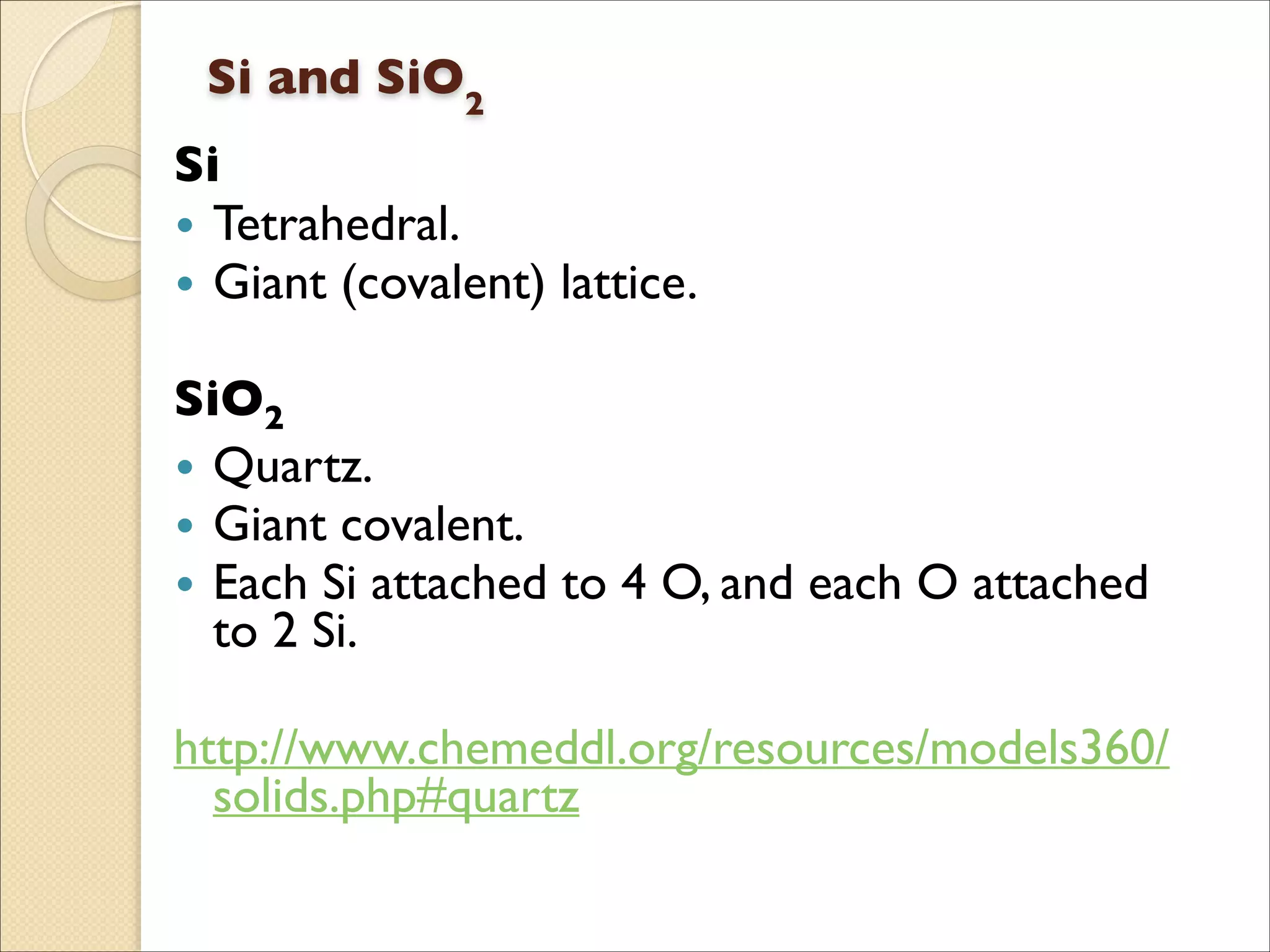
Si and SiO2

Si 	

• Tetrahedral.	

• Giant (covalent) lattice.	

!
SiO2	

• Quartz.	

• Giant covalent.	

• Each Si attached to 4 O, and each O attached
to 2 Si.	

!
http://www.chemeddl.org/resources/models360/
solids.php#quartz
Shapes of molecules and ions
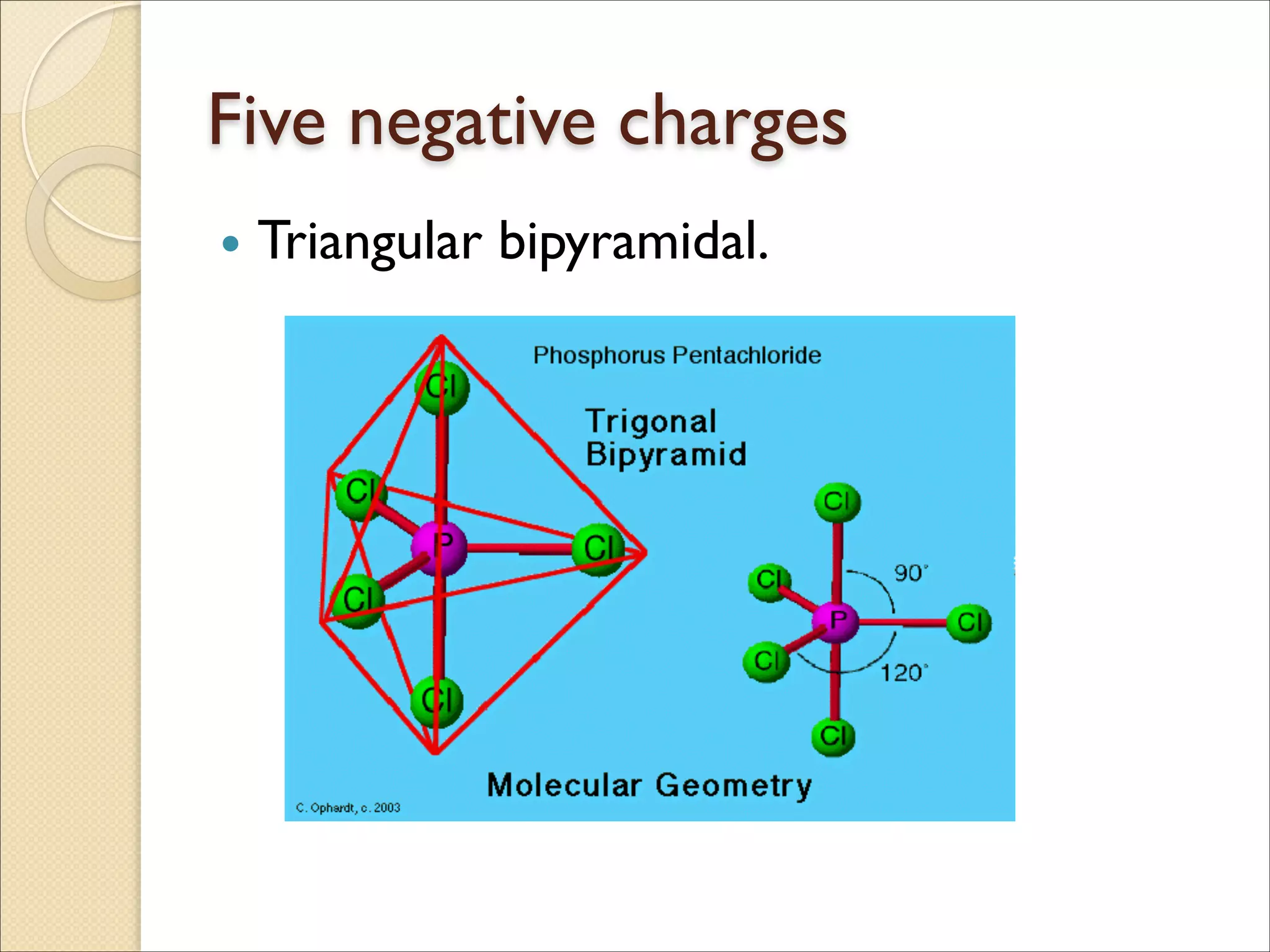
Five negative charges
• Triangular bipyramidal.
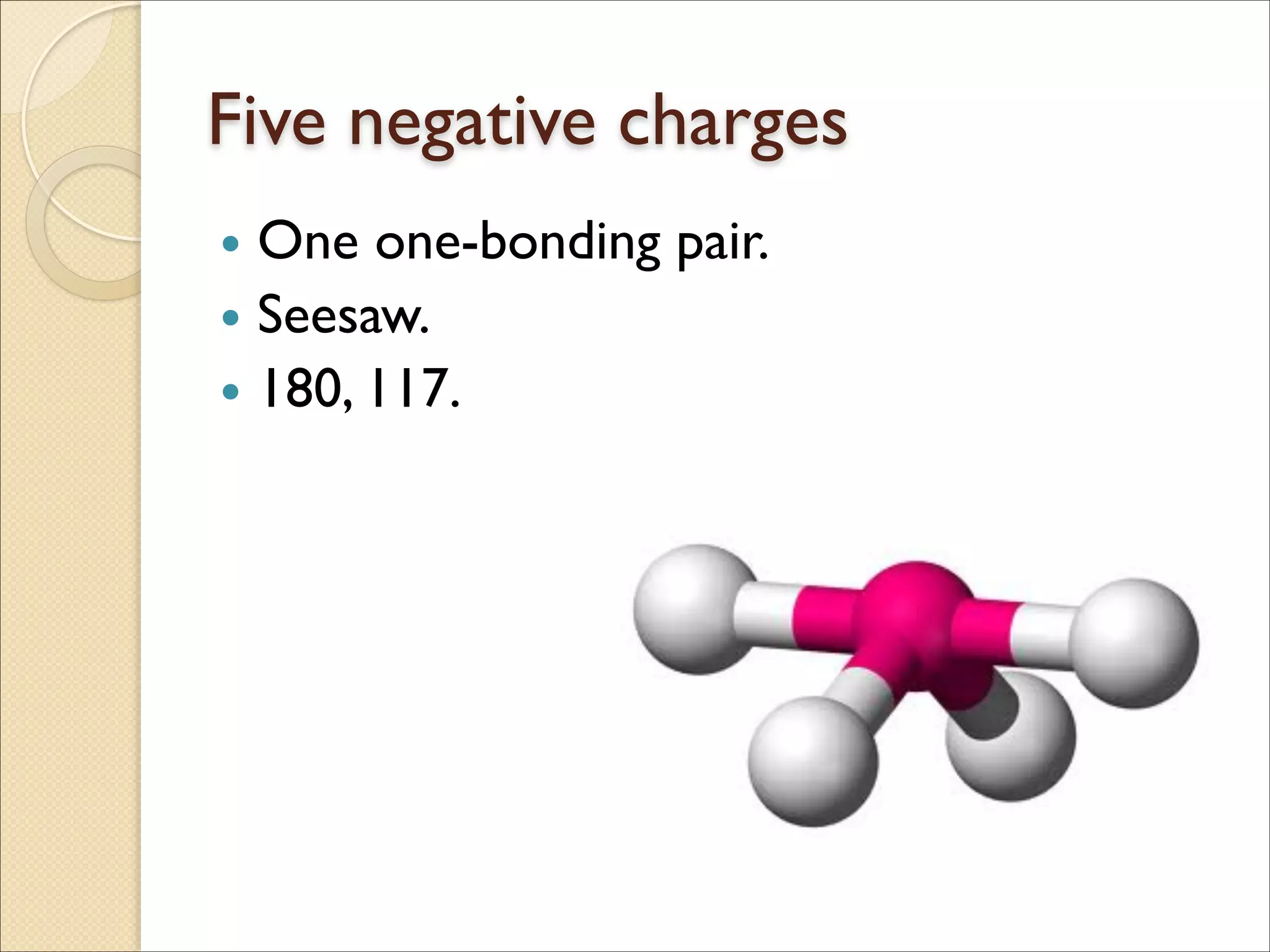
Five negative charges
• One one-bonding pair.	

• Seesaw.	

• 180, 117.
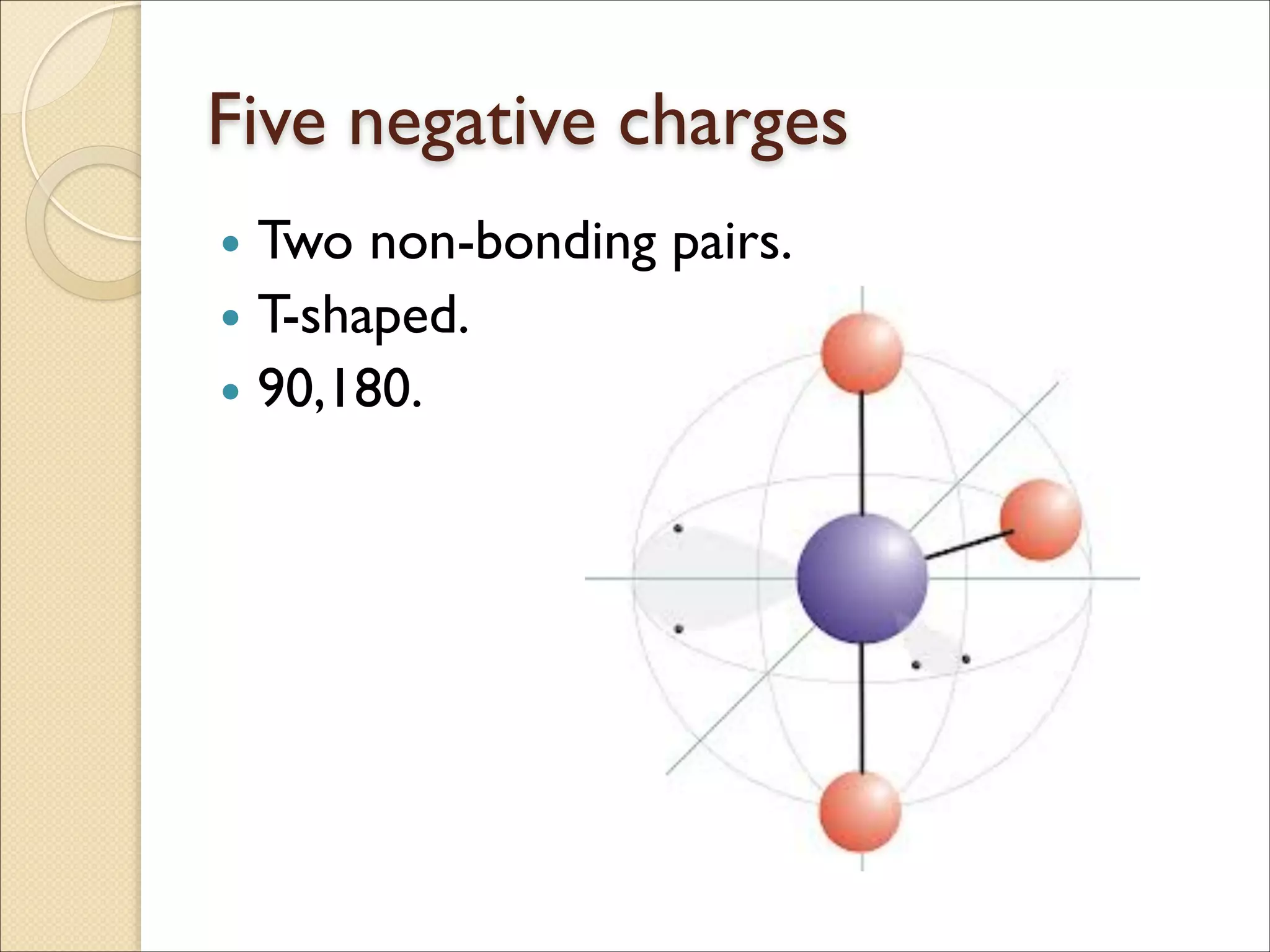
Five negative charges
• Two non-bonding pairs.	

• T-shaped.	

• 90,180.
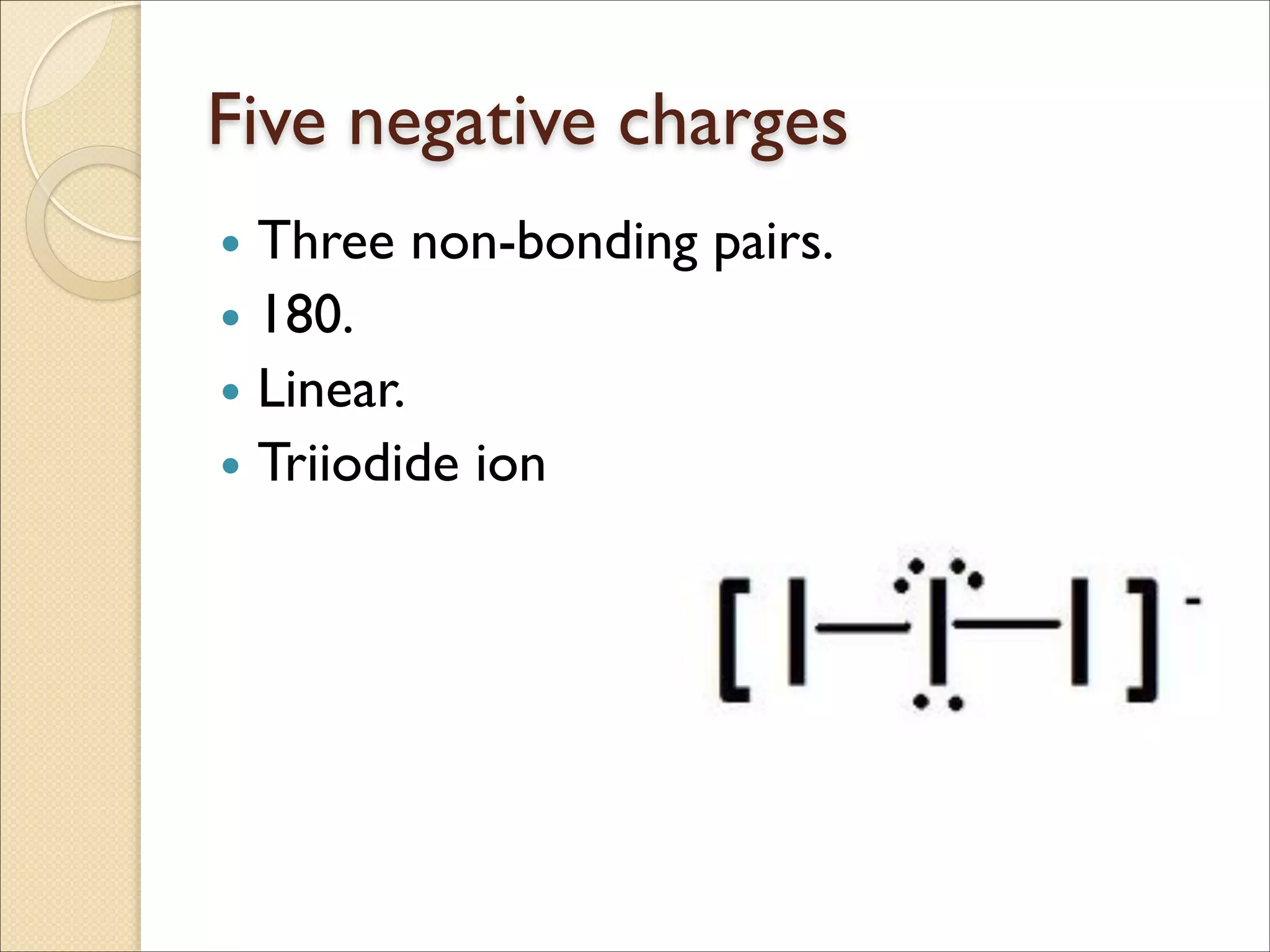
Five negative charges
• Three non-bonding pairs.	

• 180.	

• Linear.	

• Triiodide ion
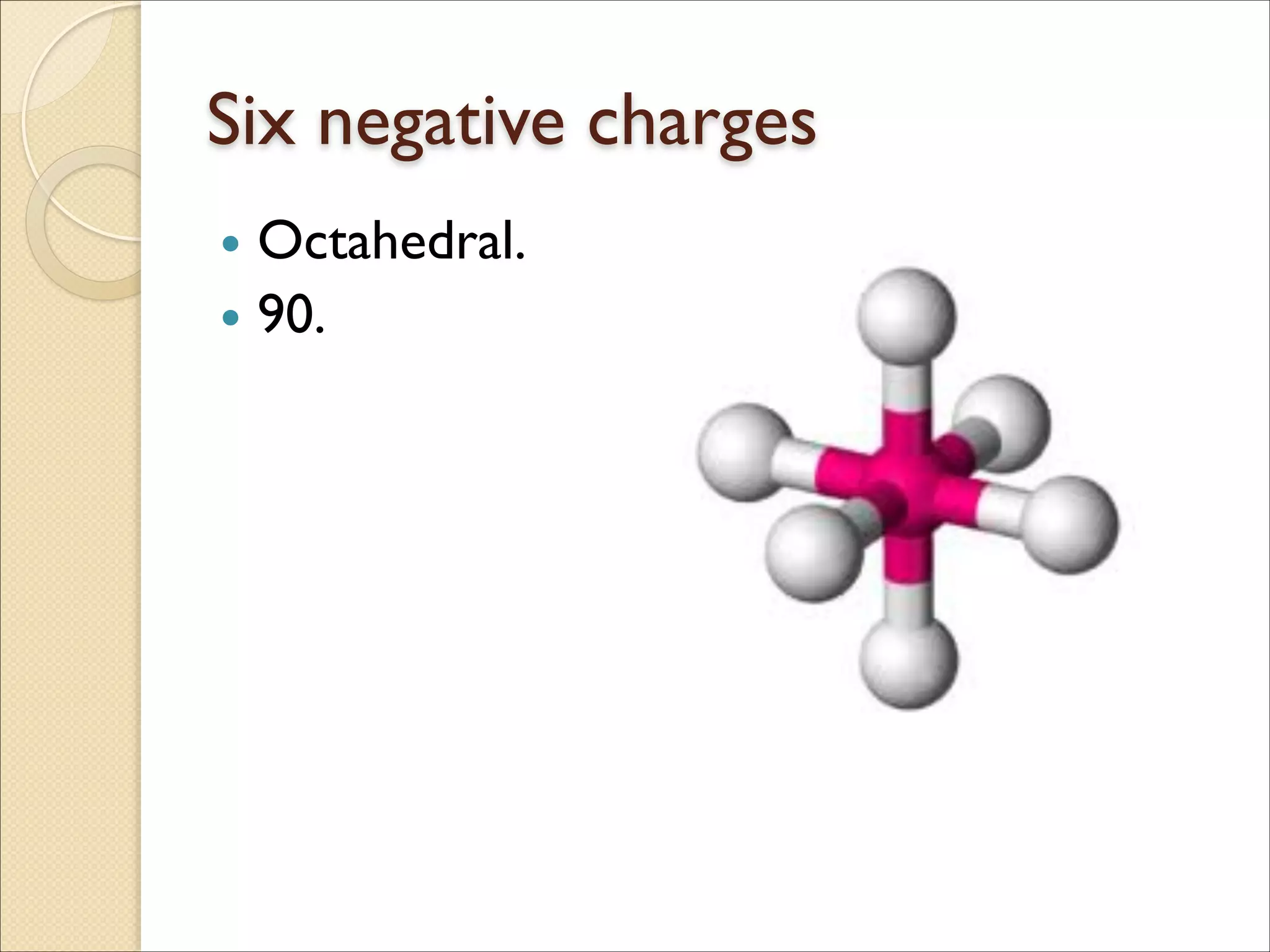
Six negative charges
• Octahedral.	

• 90.
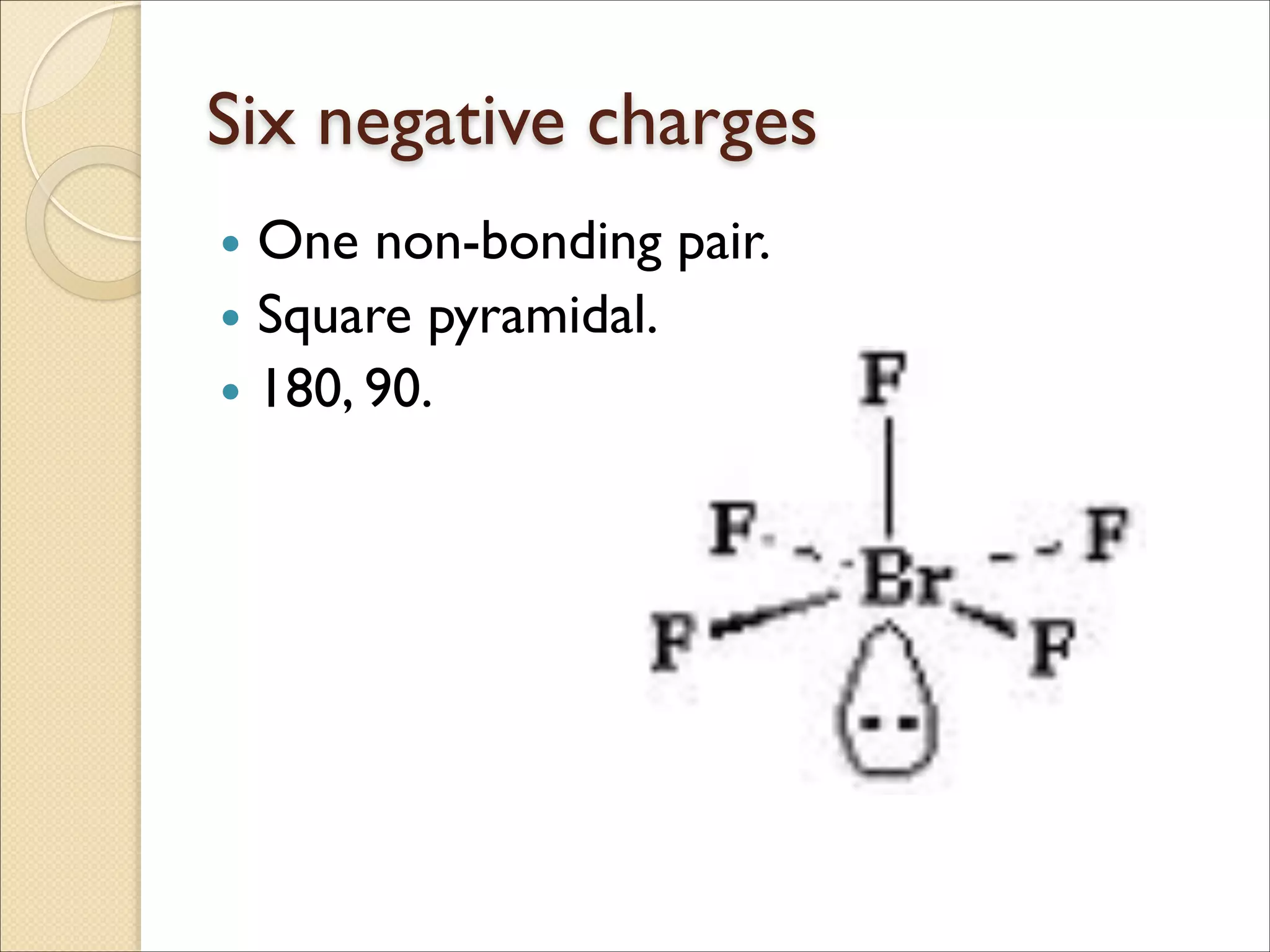
Six negative charges
• One non-bonding pair.	

• Square pyramidal.	

• 180, 90.
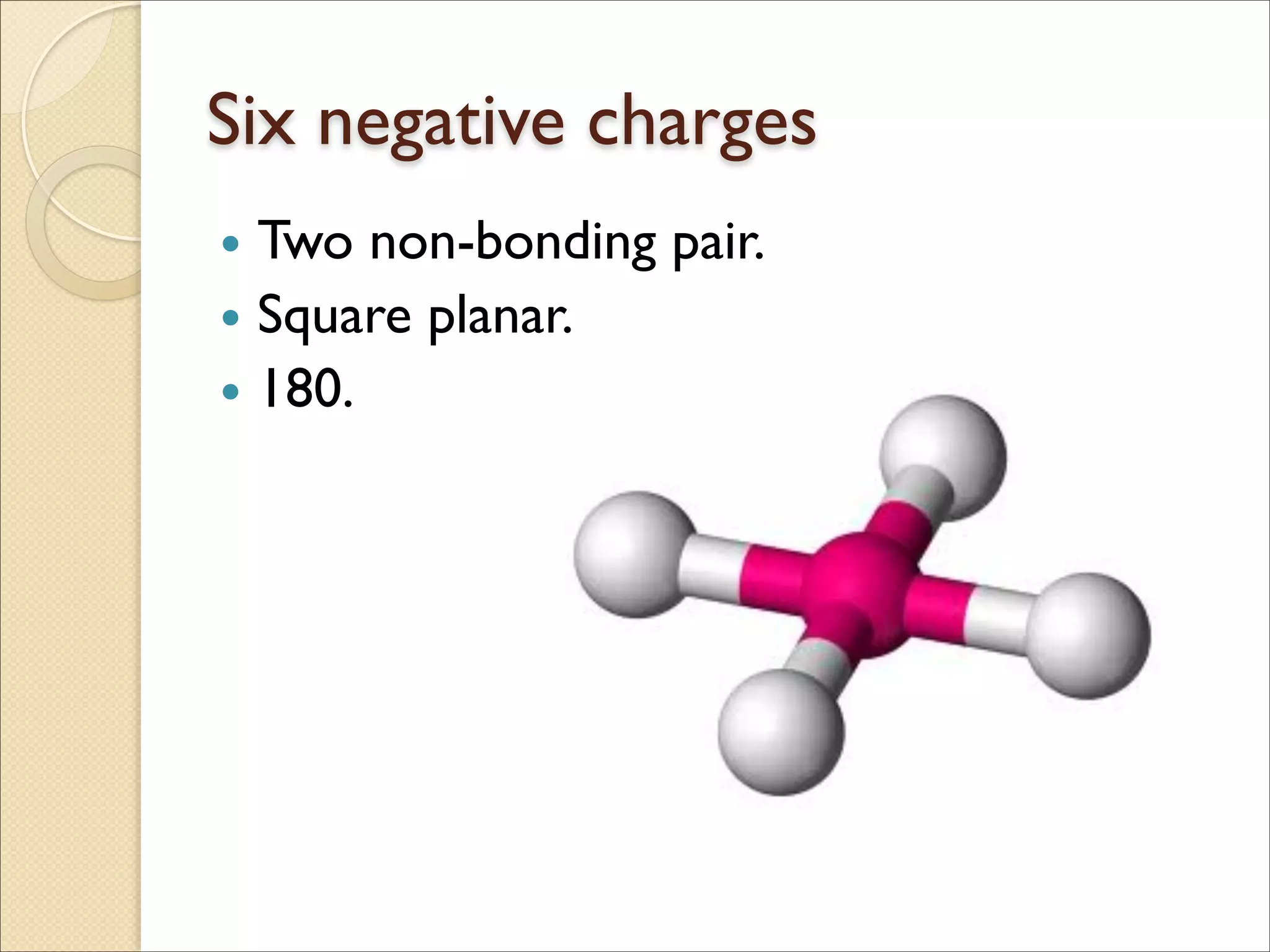
Six negative charges
• Two non-bonding pair.	

• Square planar.	

• 180.
Hybridization
Sigma bonds (simple) and Pi bonds (double-triple)	

!
• http://www.mhhe.com/physsci/chemistry/
essentialchemistry/flash/hybrv18.swf	

!
Hybridizations and geometry	

!
• http://www.mhhe.com/physsci/chemistry/
animations/chang_7e_esp/bom5s2_6.swf
Intermolecular forces
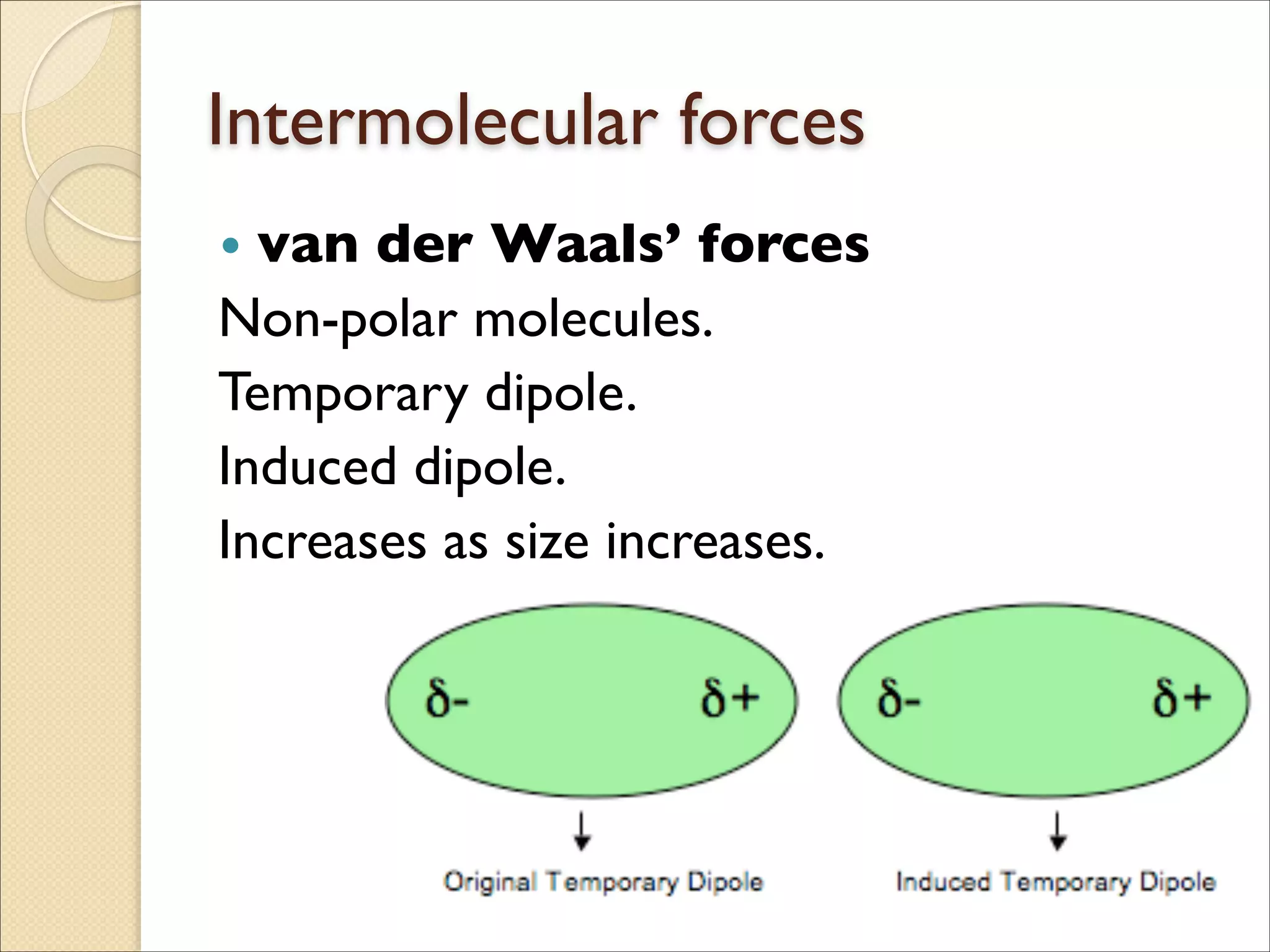
• van der Waals’ forces	

Non-polar molecules.	

Temporary dipole.	

Induced dipole.	

Increases as size increases.
Intermolecular forces
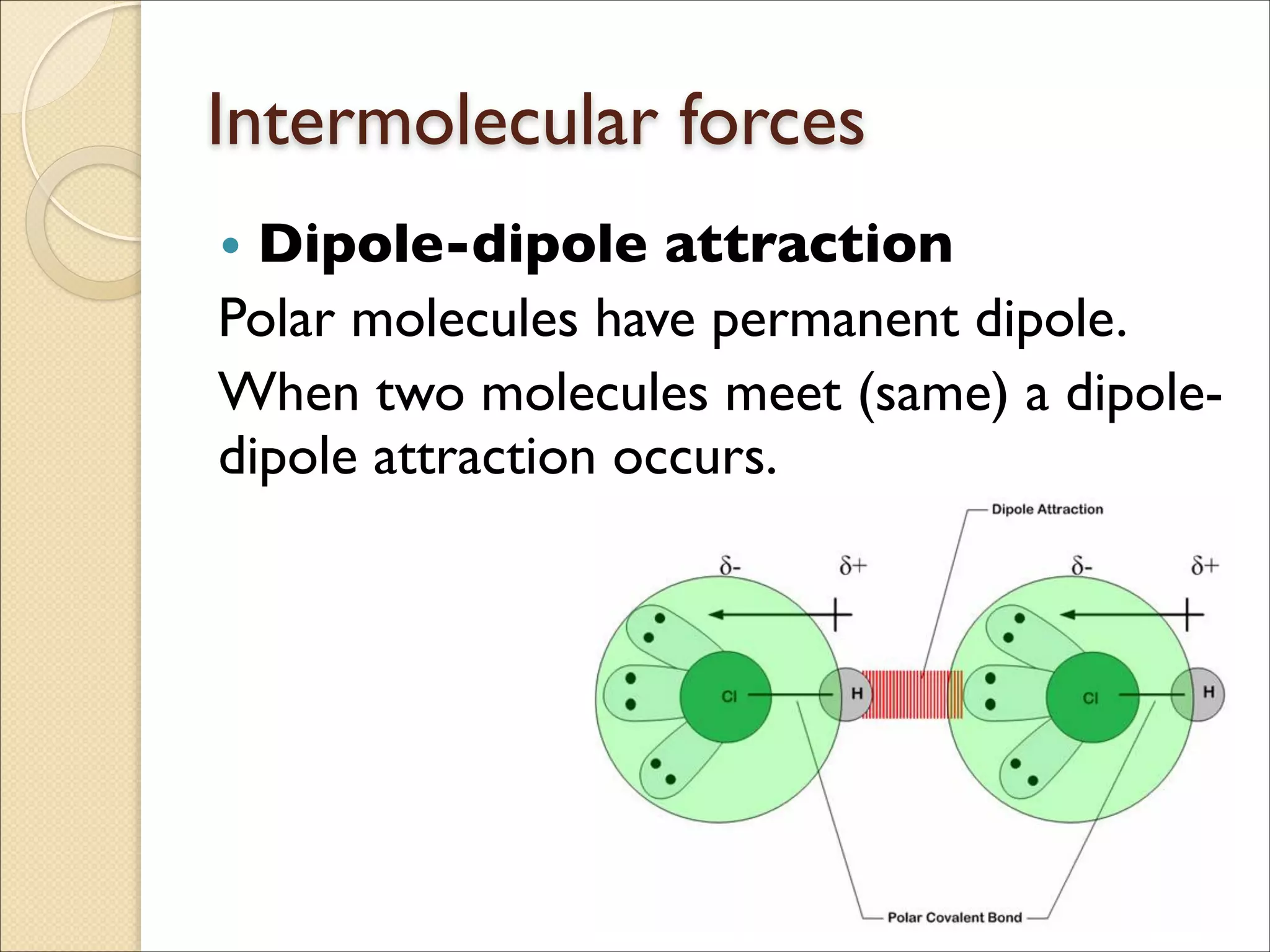
• Dipole-dipole attraction	

Polar molecules have permanent dipole.	

When two molecules meet (same) a dipole-
dipole attraction occurs.
Intermolecular forces
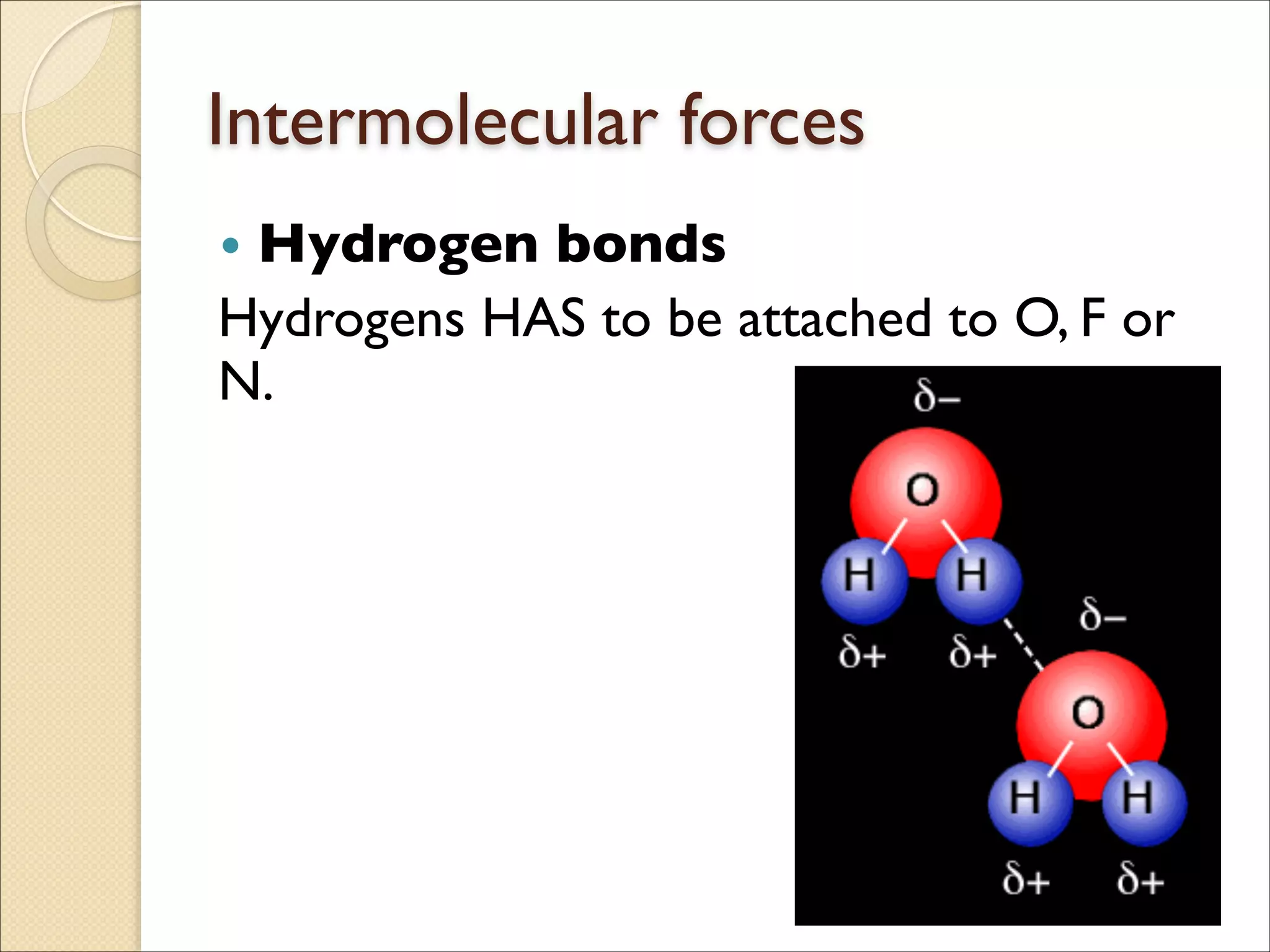
• Hydrogen bonds	

Hydrogens HAS to be attached to O, F or
N.
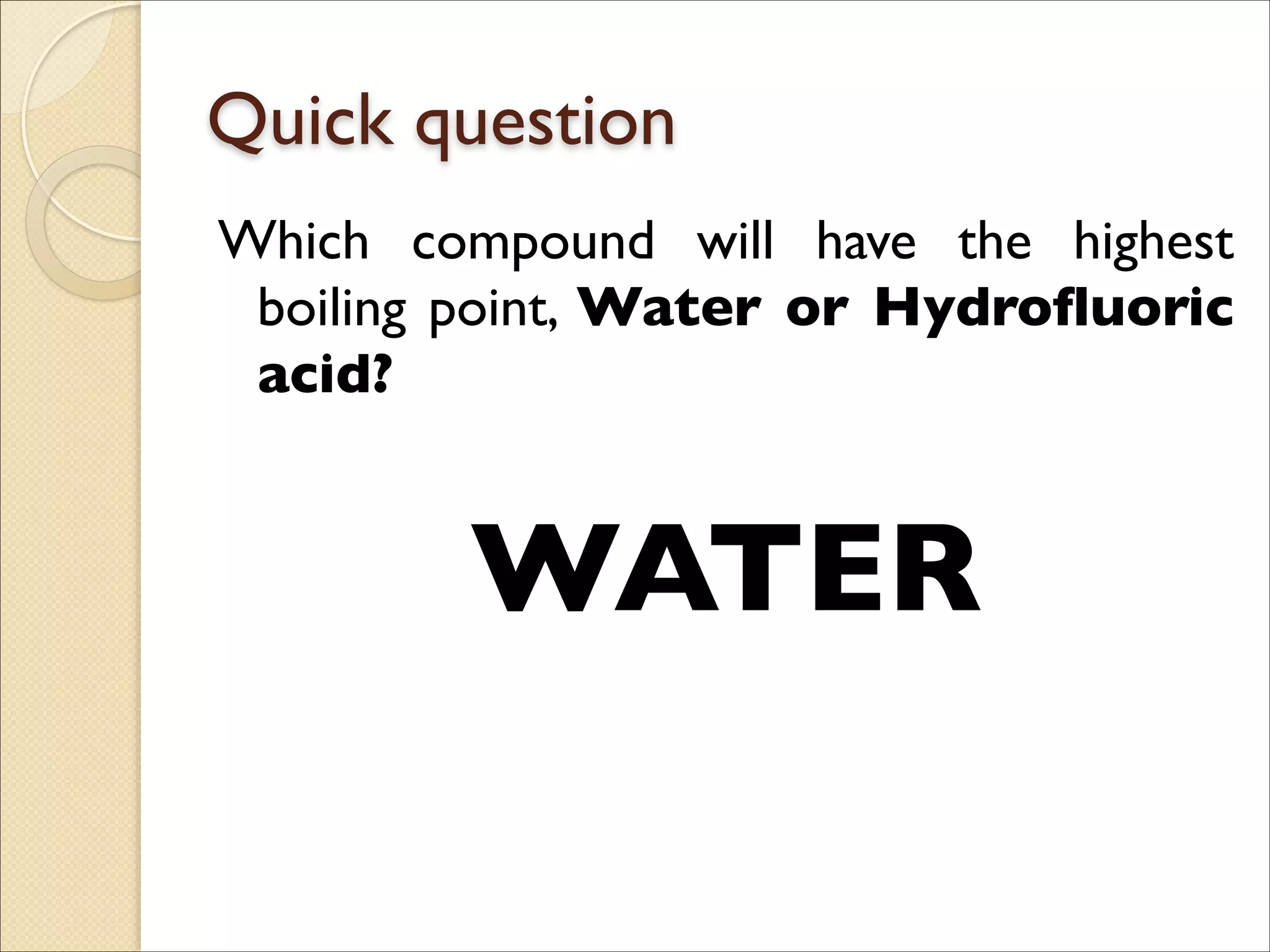
Quick question
Which compound will have the highest
boiling point, Water or Hydrofluoric
acid?	

!
WATER
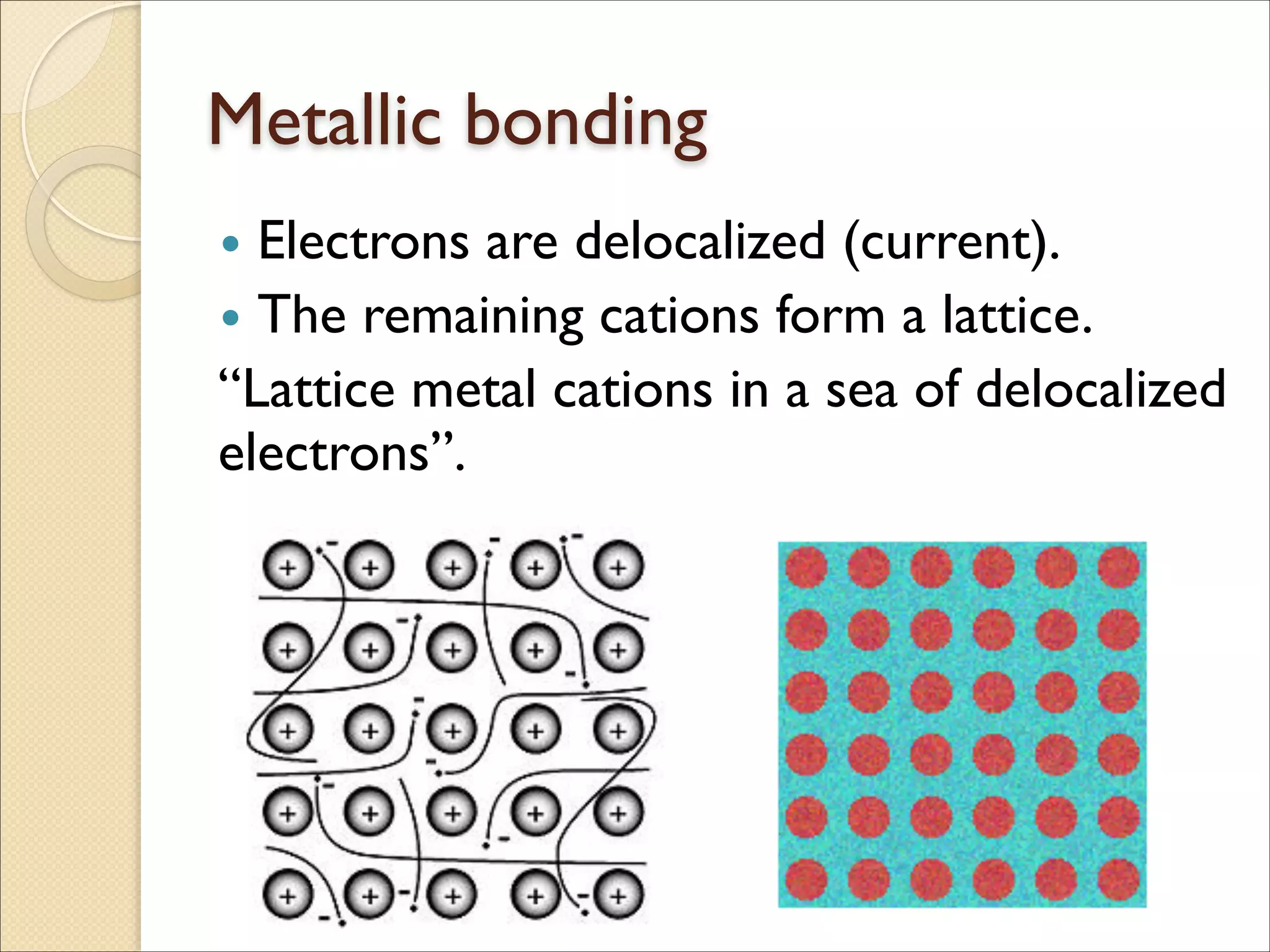
Metallic bonding
• Electrons are delocalized (current).	

• The remaining cations form a lattice.	

“Lattice metal cations in a sea of delocalized
electrons”.
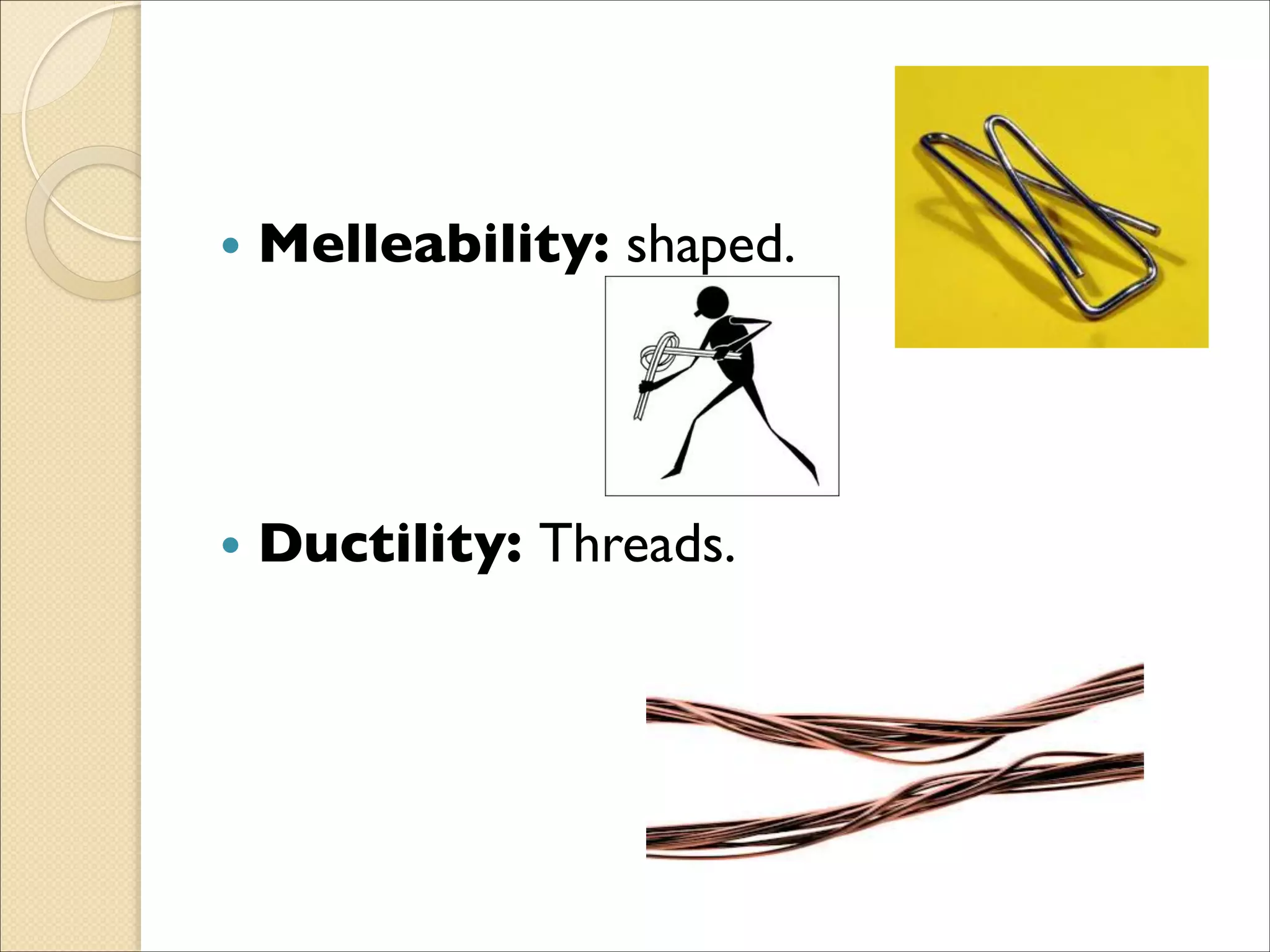
• Melleability: shaped.	

!
!
!
• Ductility: Threads.
Physical properties
1. Solubility	

• How easy can a solute disperse a
solvent.	

• Polar dissolves polar.	

• H-bonds are also responsible.	

!
2. Melting-boiling point	

• Ionic compounds tend to have high
melting points because of the lattice.
3. Electrical conductivity	

!
• Depends on movile ions.	

• Covalent compounds do not conduct
electricity, except some, like HCl
(Electronegativity difference = 1.2)
THANKYOU FORYOUR
ATTENTION

IB Chemistry: Topic 4: bonding