ENDURANCE
What is endurance?
Having endurance enables you to
repeatedly perform a skill, or take part
in an activity for a long time.
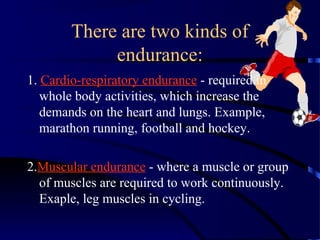
There are two kinds of
endurance:
1. Cardio-respiratory endurance - required in
whole body activities, which increase the
demands on the heart and lungs. Example,
marathon running, football and hockey.
2.Muscular endurance - where a muscle or group
of muscles are required to work continuously.
Exaple, leg muscles in cycling.
A high level of Cardio-
Respiratory Endurance allows:
• You to work for a longer period of time before
becoming tired.
• You to maintain a high work level with less effort.
• A quicker recovery after taking part in activity.
• Longer levels of concentration = fewer mistakes
How can Cardio-respiratory endurance
be improved?
Through Training
Firstly:
Decide what level of fitness is required
Then:
Find out your ‘training zone’
220 (The body’s max pulse/min) - your age.
Types or training:
• ‘continuous running’- gradually increasing
the distance or speed.
• ‘varied pace running’ - steady running
including some sprints.
• ‘interval running’ - running in a set time,
over a set distance, with recovery in
between.
What if you do not have enough
energy to keep working?
If the work level is too demanding, and you
cannot supply the working muscles with
enough oxygen, then you are working
‘anaerobic’, (without oxygen). This is
known as ‘oxygen debt’.
Working anaerobic can allow lactic acid to
build up in the muscles, causing pain and
stiffness.
How do you improve muscular
endurance?
You can use circuit training
Circuits can be based on:
Time - increasing the time spent at each
station, or decreasing the rest time.
Or
Number - Using a programme based on the
maximum number of repetitions you can
perform at each station
Effects Of Training
• More effective lungs (Vital capacity)
• More oxygen reaches the working muscles
(Aerobic threshold)
• Increase in the size of the heart, allowing
more blood to be pumped to the working
muscles (Stroke volume)
Fitness training levels
flexibility
• Capacity to do movements in a great amplitude
• Factors
- joint mobility
- muscular elasticity
• Types
-active
- passive
- dinamic
- static
Endurance

Endurance

  • 1.
  • 2.
    What is endurance? Havingendurance enables you to repeatedly perform a skill, or take part in an activity for a long time.
  • 3.
    There are twokinds of endurance: 1. Cardio-respiratory endurance - required in whole body activities, which increase the demands on the heart and lungs. Example, marathon running, football and hockey. 2.Muscular endurance - where a muscle or group of muscles are required to work continuously. Exaple, leg muscles in cycling.
  • 4.
    A high levelof Cardio- Respiratory Endurance allows: • You to work for a longer period of time before becoming tired. • You to maintain a high work level with less effort. • A quicker recovery after taking part in activity. • Longer levels of concentration = fewer mistakes
  • 5.
    How can Cardio-respiratoryendurance be improved? Through Training Firstly: Decide what level of fitness is required Then: Find out your ‘training zone’ 220 (The body’s max pulse/min) - your age.
  • 6.
    Types or training: •‘continuous running’- gradually increasing the distance or speed. • ‘varied pace running’ - steady running including some sprints. • ‘interval running’ - running in a set time, over a set distance, with recovery in between.
  • 7.
    What if youdo not have enough energy to keep working? If the work level is too demanding, and you cannot supply the working muscles with enough oxygen, then you are working ‘anaerobic’, (without oxygen). This is known as ‘oxygen debt’. Working anaerobic can allow lactic acid to build up in the muscles, causing pain and stiffness.
  • 8.
    How do youimprove muscular endurance? You can use circuit training Circuits can be based on: Time - increasing the time spent at each station, or decreasing the rest time. Or Number - Using a programme based on the maximum number of repetitions you can perform at each station
  • 9.
    Effects Of Training •More effective lungs (Vital capacity) • More oxygen reaches the working muscles (Aerobic threshold) • Increase in the size of the heart, allowing more blood to be pumped to the working muscles (Stroke volume)
  • 10.
  • 11.
    flexibility • Capacity todo movements in a great amplitude • Factors - joint mobility - muscular elasticity • Types -active - passive - dinamic - static