Introduction:-
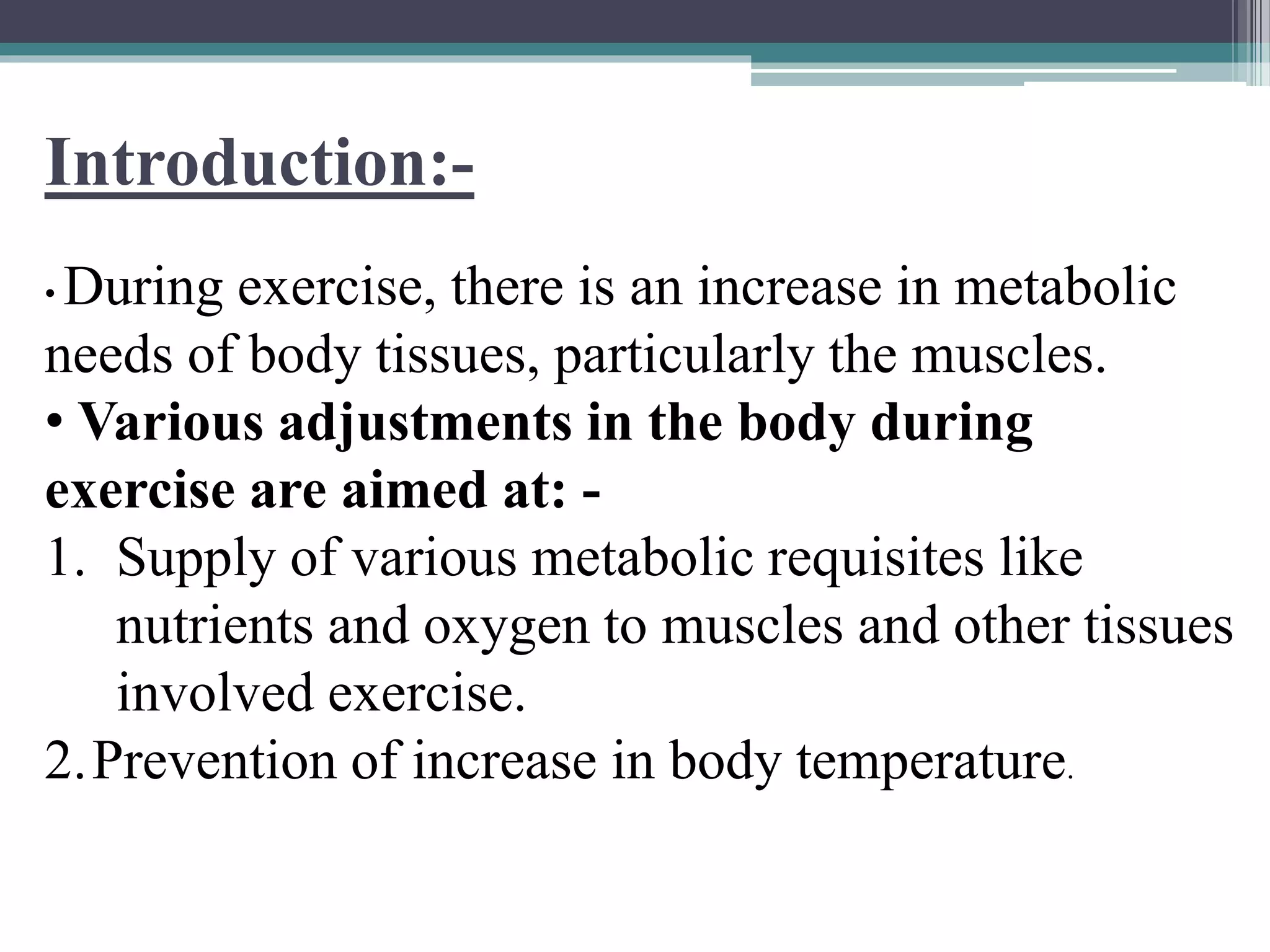
• During exercise, there is an increase in metabolic
needs of body tissues, particularly the muscles.
• Various adjustments in the body during
exercise are aimed at: -
1. Supply of various metabolic requisites like
nutrients and oxygen to muscles and other tissues
involved exercise.
2.Prevention of increase in body temperature.
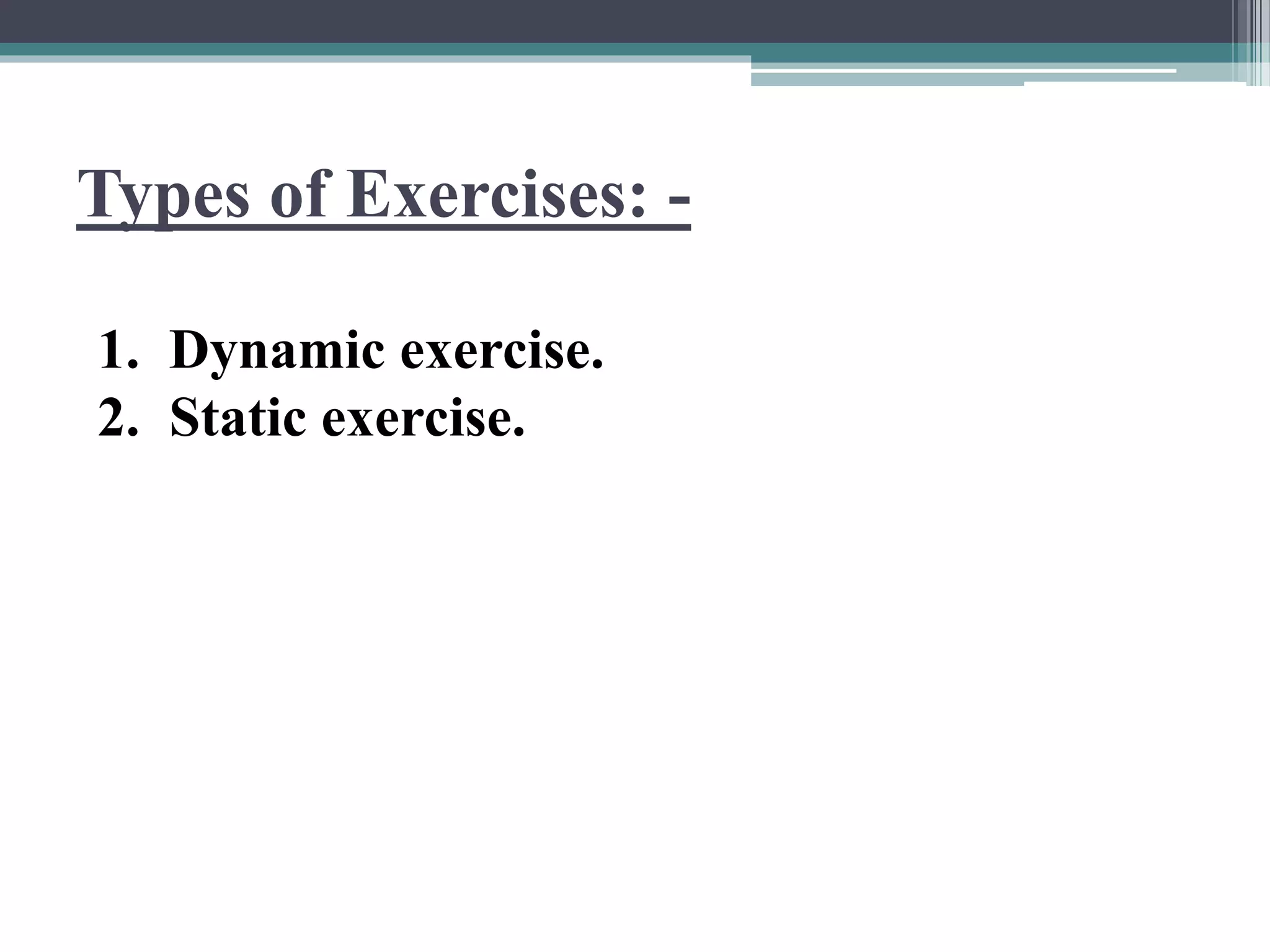
Types of Exercises: -
1. Dynamic exercise.
2. Static exercise.
1. Dynamic Exercise: -
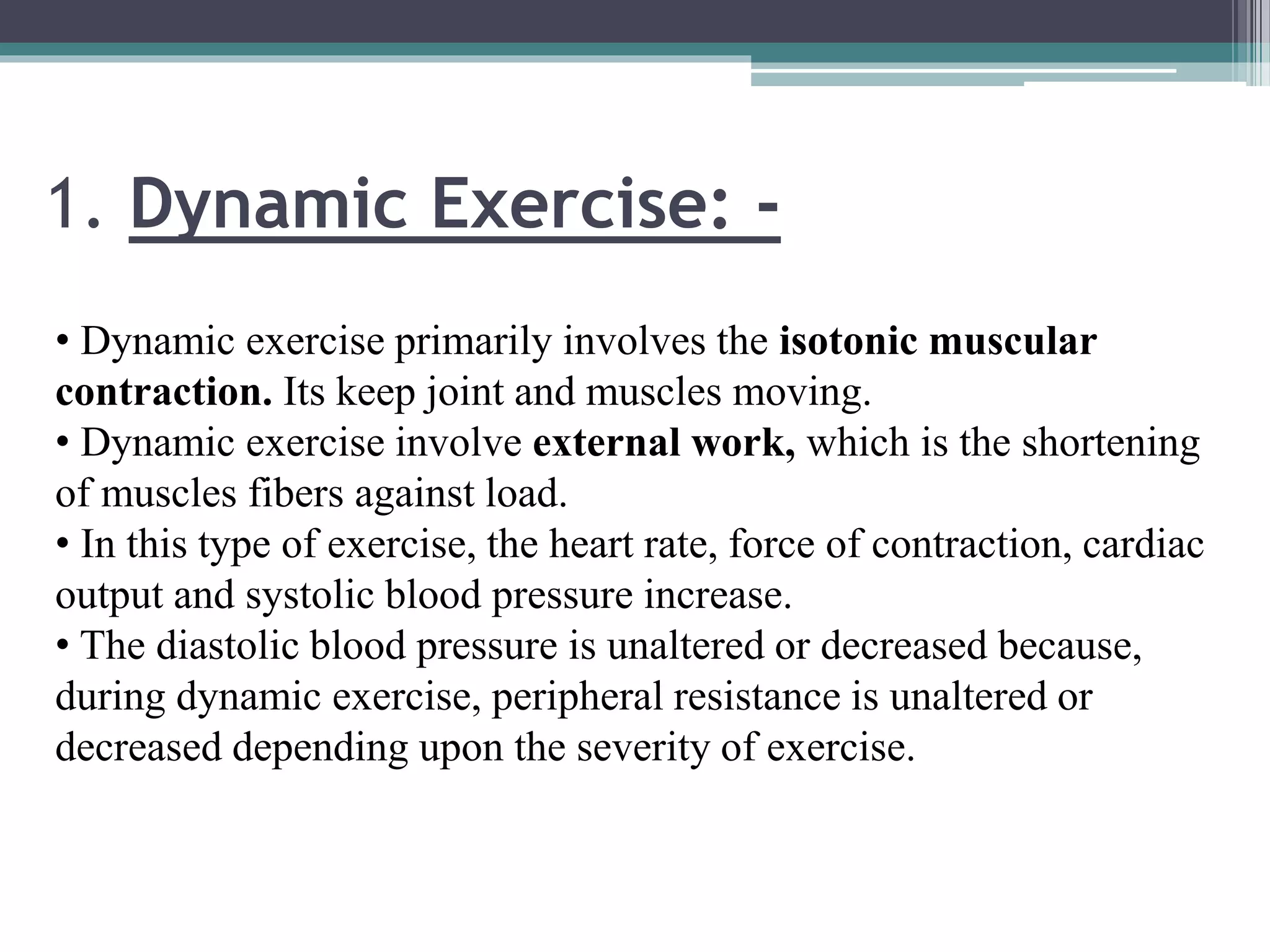
• Dynamic exercise primarily involves the isotonic muscular
contraction. Its keep joint and muscles moving.
• Dynamic exercise involve external work, which is the shortening
of muscles fibers against load.
• In this type of exercise, the heart rate, force of contraction, cardiac
output and systolic blood pressure increase.
• The diastolic blood pressure is unaltered or decreased because,
during dynamic exercise, peripheral resistance is unaltered or
decreased depending upon the severity of exercise.
2. Static Exercise: -
• Static exercise involves isometric muscular
contraction without movement of joints. Example is
pushing heavy object.
• Static exercise does not involve external work.
• During this exercise, apart from increase in heart rate,
force of contraction, cardiac output and systolic
pressure, the diastolic pressure also increase because of
increase in peripheral resistance during static exercise.
Based on the type of metabolism
involved: -
1. Aerobic exercise.
2.Anaerobic exercise.
1. Aerobic exercise: - ( with air or with
oxygen )
• It involves activities with lower intensity, which is performed
for longer period.
• The energy is obtained by utilizing nutrients in the presence of
oxygen and hence it is called aerobic exercise.
• Aerobic exercise requires large amount of oxygen to obtain
energy needed for prolonged exercise.
• Example of aerobic exercise: -
1. Fast walking.
2. Jogging
3. Running.
4. Bicycling.
5. Skiing.
6. Skating etc.
2. Anaerobic exercise: - ( without air or
without oxygen )
• It involve exertion for short periods followed by periods of rest.
• It uses the muscles at high intensity and a high rate of work for a
short period.
• Body obtain energy by burning glycogen stored in the muscles
without oxygen hence it is called anaerobic exercise.
•Example of anaerobic exercises: -
1. Pull ups.
2. Push ups.
3. Weightlifting.
4. Sprinting.
5. Any other rapid burst of strenuous exercise.
Metabolism in aerobic and anaerobic
exercises :-
• When a person starts doing some exercise like jogging, bicycling,
or swimming, the muscles start utilizing energy. In order to have
quick energy during the first few minutes, the muscles burn
glycogen stored them.
• During this period, fat is not burnt. Only glycogen is burnt and it is
burnt without using oxygen. This is called anaerobic metabolism.
• Lactic acid is produced during this period.
• Muscles burn all the muscle glycogen within 3-5 minutes. If the
person continues the exercise beyond this, glycogen stored in liver
is converted into glucose, which is transported to muscles through
the blood. Now the body moves into aerobic metabolism.
• The glucose obtained from liver is burnt in the presence of oxygen.
Severity of exercise: -
• Based on severity, the exercise is classified into three
types: -
1. Mild exercise.
2. Moderate exercise.
3. Severe exercise.
1. Mild exercise: -
• It is a very simple form of exercise like
slow walking. Little or no change occurs in
cardiovascular system during mild exercise.
2. Moderate exercise: -
• Moderate exercise does not involve strenuous
muscular activity. So, this type of exercise can be
performed for a longer period.
• Exhaustion does not occur at the end of moderate
exercise.
• The example of this type of exercise are fast walking
and slow running.
3. Severe exercise: -
• Severe exercise involves strenuous muscular
activity. The severity can be maintained only for
short duration.
• Fast running for a distance of 100 or 400 meters
is the best example of this type of exercise.
• Complete exhaustion occurs at the end of severe
exercise.
Effect of exercise on cardiovascular
system :-
1. On blood:-
• Mild hypoxia developed during exercise stimulates the
juxtaglomerular apparatus to secrete erythropoietin. It
stimulates the bone marrow and causes release of
RBCs. Increased carbon dioxide content in blood
decreases the pH of blood.
2. On Blood Volume: -
• More heat is produce during exercise and the thermoregulatory system
is activated. This in turn, causes secretion of large amount of sweating
leading to :-
1. Fluid loss.
2. Reduced blood volume.
3. Hemoconcentration.
4. Sometimes, severe exercise leads to even dehydration.
3. On Heart Rate: -
• Increased heart rate during exercise is due to four factors: -
1. Impulses from proprioceptors, which present in the exercising
muscles; these impulses act through higher centers and
increases heart rate.
2. Increased carbon dioxide tension, which acts through
medullary centers.
3. Rise in body temperature, which act on cardiac centers via
hypothalamus, increased temperature also stimulates SA node
directly.
4. Circulating catecholamine's, secreted in large quantities during
exercise.
Cont……
• In moderate exercise, the heart rate increases to
180 beats per minutes.
•In severe exercise, the heart rate increases 240 to
260 beats per minutes.
• Increased heart rate during exercise is mainly
because of vagal withdrawal.
4. On cardiac output: -
• Cardiac Output increases up to 20L/min in moderate
exercise and up to 35L/min during severe exercise.
• Increase in cardiac output is directly proportional to the
increase in the amount of oxygen consumed during
exercise.
• Heart rate because of vagal withdrawal.
• Stroke volume increases due to increased force of
contraction.
• Because of vagal withdrawal, sympathetic activity
increases leading to increase in rate and force of
contraction.
5. On Venous Return: -
• Venous return increases remarkably during
exercise because of muscle pump, respiratory
pump and splanchnic vasoconstriction.
6. On Blood flow To Skeletal Muscles: -
• There is a great increase in the amount of blood flowing to skeletal
muscle during exercise. In resting condition, the blood supply to the
skeletal muscles is 3 to 4 ml/100g of the muscle per minute.
• It increase up to 60 to 80 ml in moderate exercise and up to 90 to 120
ml in severe exercise.
• During muscular activity, stoppage of blood flow occurs when the
muscles contract. It is because of compression of blood vessels during
contraction.
• The sympathetic nerve fibers causing vasodilatation in skeletal muscle
are called Sympathetic cholinergic fibers since these fibers secrete
Acetylcholine instead of nor adrenaline.
Cont…
•Some other factors are responsible for increase
in blood flow to muscles during exercise.
• Such factors are :-
1.Hypercapnia.
2.Hypoxia.
3.Potassium ion.
4.Metabolites like lactic acid.
5.Rise in temperature etc.
7. On Blood Pressure: -
• During moderate isotonic exercise, the systolic pressure increased. It
is due to increase in heart rate and stroke volume.
• Diastolic pressure is not alter because peripheral resistance is not
affected during moderate isotonic exercise.
• In severe exercise involving isotonic muscular contraction, the
systolic pressure enormously increases but diastolic pressure
decreases.
• Decrease in diastolic pressure is because of the decrease in
peripheral resistance.
• Decrease in peripheral resistance is due to vasodilatation caused by
metabolites.
Blood pressure after exercise :-
• Large quantities of metabolic end products are produced
during exercise. These substances accumulate in tissues,
particularly the skeletal muscles.
• Metabolic end products causes vasodilatation, So, the
blood pressure falls slightly below the resting level after
the exercise.
• The pressure returns to resting level quickly as soon as
the metabolic end products are removed from muscles.
Effect of exercise on CardioVascular System

Effect of exercise on CardioVascular System

  • 2.
    Introduction:- • During exercise,there is an increase in metabolic needs of body tissues, particularly the muscles. • Various adjustments in the body during exercise are aimed at: - 1. Supply of various metabolic requisites like nutrients and oxygen to muscles and other tissues involved exercise. 2.Prevention of increase in body temperature.
  • 3.
    Types of Exercises:- 1. Dynamic exercise. 2. Static exercise.
  • 4.
    1. Dynamic Exercise:- • Dynamic exercise primarily involves the isotonic muscular contraction. Its keep joint and muscles moving. • Dynamic exercise involve external work, which is the shortening of muscles fibers against load. • In this type of exercise, the heart rate, force of contraction, cardiac output and systolic blood pressure increase. • The diastolic blood pressure is unaltered or decreased because, during dynamic exercise, peripheral resistance is unaltered or decreased depending upon the severity of exercise.
  • 5.
    2. Static Exercise:- • Static exercise involves isometric muscular contraction without movement of joints. Example is pushing heavy object. • Static exercise does not involve external work. • During this exercise, apart from increase in heart rate, force of contraction, cardiac output and systolic pressure, the diastolic pressure also increase because of increase in peripheral resistance during static exercise.
  • 6.
    Based on thetype of metabolism involved: - 1. Aerobic exercise. 2.Anaerobic exercise.
  • 7.
    1. Aerobic exercise:- ( with air or with oxygen ) • It involves activities with lower intensity, which is performed for longer period. • The energy is obtained by utilizing nutrients in the presence of oxygen and hence it is called aerobic exercise. • Aerobic exercise requires large amount of oxygen to obtain energy needed for prolonged exercise. • Example of aerobic exercise: - 1. Fast walking. 2. Jogging 3. Running. 4. Bicycling. 5. Skiing. 6. Skating etc.
  • 8.
    2. Anaerobic exercise:- ( without air or without oxygen ) • It involve exertion for short periods followed by periods of rest. • It uses the muscles at high intensity and a high rate of work for a short period. • Body obtain energy by burning glycogen stored in the muscles without oxygen hence it is called anaerobic exercise. •Example of anaerobic exercises: - 1. Pull ups. 2. Push ups. 3. Weightlifting. 4. Sprinting. 5. Any other rapid burst of strenuous exercise.
  • 9.
    Metabolism in aerobicand anaerobic exercises :- • When a person starts doing some exercise like jogging, bicycling, or swimming, the muscles start utilizing energy. In order to have quick energy during the first few minutes, the muscles burn glycogen stored them. • During this period, fat is not burnt. Only glycogen is burnt and it is burnt without using oxygen. This is called anaerobic metabolism. • Lactic acid is produced during this period. • Muscles burn all the muscle glycogen within 3-5 minutes. If the person continues the exercise beyond this, glycogen stored in liver is converted into glucose, which is transported to muscles through the blood. Now the body moves into aerobic metabolism. • The glucose obtained from liver is burnt in the presence of oxygen.
  • 10.
    Severity of exercise:- • Based on severity, the exercise is classified into three types: - 1. Mild exercise. 2. Moderate exercise. 3. Severe exercise.
  • 11.
    1. Mild exercise:- • It is a very simple form of exercise like slow walking. Little or no change occurs in cardiovascular system during mild exercise.
  • 12.
    2. Moderate exercise:- • Moderate exercise does not involve strenuous muscular activity. So, this type of exercise can be performed for a longer period. • Exhaustion does not occur at the end of moderate exercise. • The example of this type of exercise are fast walking and slow running.
  • 13.
    3. Severe exercise:- • Severe exercise involves strenuous muscular activity. The severity can be maintained only for short duration. • Fast running for a distance of 100 or 400 meters is the best example of this type of exercise. • Complete exhaustion occurs at the end of severe exercise.
  • 14.
    Effect of exerciseon cardiovascular system :- 1. On blood:- • Mild hypoxia developed during exercise stimulates the juxtaglomerular apparatus to secrete erythropoietin. It stimulates the bone marrow and causes release of RBCs. Increased carbon dioxide content in blood decreases the pH of blood.
  • 15.
    2. On BloodVolume: - • More heat is produce during exercise and the thermoregulatory system is activated. This in turn, causes secretion of large amount of sweating leading to :- 1. Fluid loss. 2. Reduced blood volume. 3. Hemoconcentration. 4. Sometimes, severe exercise leads to even dehydration.
  • 16.
    3. On HeartRate: - • Increased heart rate during exercise is due to four factors: - 1. Impulses from proprioceptors, which present in the exercising muscles; these impulses act through higher centers and increases heart rate. 2. Increased carbon dioxide tension, which acts through medullary centers. 3. Rise in body temperature, which act on cardiac centers via hypothalamus, increased temperature also stimulates SA node directly. 4. Circulating catecholamine's, secreted in large quantities during exercise.
  • 17.
    Cont…… • In moderateexercise, the heart rate increases to 180 beats per minutes. •In severe exercise, the heart rate increases 240 to 260 beats per minutes. • Increased heart rate during exercise is mainly because of vagal withdrawal.
  • 18.
    4. On cardiacoutput: - • Cardiac Output increases up to 20L/min in moderate exercise and up to 35L/min during severe exercise. • Increase in cardiac output is directly proportional to the increase in the amount of oxygen consumed during exercise. • Heart rate because of vagal withdrawal. • Stroke volume increases due to increased force of contraction. • Because of vagal withdrawal, sympathetic activity increases leading to increase in rate and force of contraction.
  • 19.
    5. On VenousReturn: - • Venous return increases remarkably during exercise because of muscle pump, respiratory pump and splanchnic vasoconstriction.
  • 20.
    6. On Bloodflow To Skeletal Muscles: - • There is a great increase in the amount of blood flowing to skeletal muscle during exercise. In resting condition, the blood supply to the skeletal muscles is 3 to 4 ml/100g of the muscle per minute. • It increase up to 60 to 80 ml in moderate exercise and up to 90 to 120 ml in severe exercise. • During muscular activity, stoppage of blood flow occurs when the muscles contract. It is because of compression of blood vessels during contraction. • The sympathetic nerve fibers causing vasodilatation in skeletal muscle are called Sympathetic cholinergic fibers since these fibers secrete Acetylcholine instead of nor adrenaline.
  • 21.
    Cont… •Some other factorsare responsible for increase in blood flow to muscles during exercise. • Such factors are :- 1.Hypercapnia. 2.Hypoxia. 3.Potassium ion. 4.Metabolites like lactic acid. 5.Rise in temperature etc.
  • 22.
    7. On BloodPressure: - • During moderate isotonic exercise, the systolic pressure increased. It is due to increase in heart rate and stroke volume. • Diastolic pressure is not alter because peripheral resistance is not affected during moderate isotonic exercise. • In severe exercise involving isotonic muscular contraction, the systolic pressure enormously increases but diastolic pressure decreases. • Decrease in diastolic pressure is because of the decrease in peripheral resistance. • Decrease in peripheral resistance is due to vasodilatation caused by metabolites.
  • 23.
    Blood pressure afterexercise :- • Large quantities of metabolic end products are produced during exercise. These substances accumulate in tissues, particularly the skeletal muscles. • Metabolic end products causes vasodilatation, So, the blood pressure falls slightly below the resting level after the exercise. • The pressure returns to resting level quickly as soon as the metabolic end products are removed from muscles.