CARDIO-PULMONARY
CHANGES DURING
EXERCISE
PRESENTED BY:
DR. SHAZEENA QAISER
CONTENTS
1. Exercise physiology
2. Responses Vs adaptations
3. Cardiovascular changes- short term and long term
4. Respiratory changes- short term and long term
5. Therapeutic benefits of exercise
6. References
EXERCISE PHYSIOLOGY
 EXERCISE : defined as intentional increased muscular activities, planned structured
and basically repetitive contraction and relaxation of group of muscles.
 EXERCISE PHYSIOLOGY: Study of physio-chemical processes in the body that allow
conversion of chemical energy into mechanical work and the changes in the organ
systems in response to the effects of the work.
 Continued skeletal muscle activity utilises energy that depends on the rate of
nutrients and oxygen supply to the exercising muscles.
Movement requires activation and control of the
MUSCULOSKELETAL SYSTEM.
However, the CARDIOVASCULAR AND RESPIRATORY
SYSTEMS provide the ability to sustain this movement
over extended periods.
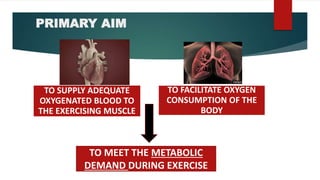
PRIMARY AIM
TO SUPPLY ADEQUATE
OXYGENATED BLOOD TO
THE EXERCISING MUSCLE
TO FACILITATE OXYGEN
CONSUMPTION OF THE
BODY
TO MEET THE METABOLIC
DEMAND DURING EXERCISE
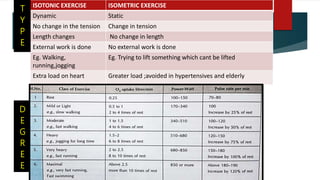
ISOTONIC EXERCISE ISOMETRIC EXERCISE
Dynamic Static
No change in the tension Change in tension
Length changes No change in length
External work is done No external work is done
Eg. Walking,
running,jogging
Eg. Trying to lift something which cant be lifted
Extra load on heart Greater load ;avoided in hypertensives and elderly
T
Y
P
E
D
E
G
R
E
E
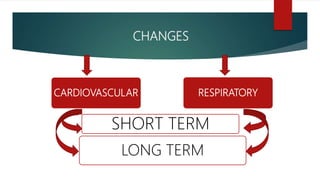
CHANGES
CARDIOVASCULAR
SHORT TERM
LONG TERM
RESPIRATORY
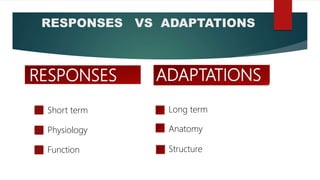
RESPONSES VS ADAPTATIONS
RESPONSES
Short term
Physiology
Function
ADAPTATIONS
Long term
Anatomy
Structure
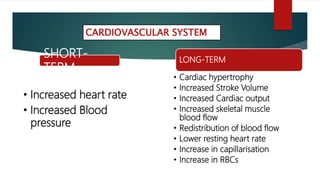
CARDIOVASCULAR SYSTEM
SHORT-
TERM
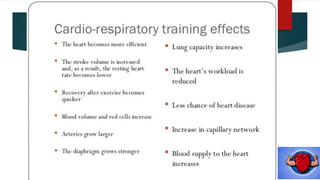
• Increased heart rate
• Increased Blood
pressure
LONG-TERM
• Cardiac hypertrophy
• Increased Stroke Volume
• Increased Cardiac output
• Increased skeletal muscle
blood flow
• Redistribution of blood flow
• Lower resting heart rate
• Increase in capillarisation
• Increase in RBCs
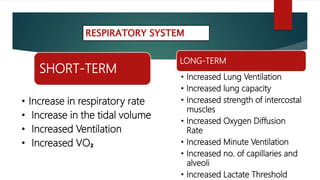
SHORT-TERM
• Increase in respiratory rate
• Increase in the tidal volume
• Increased Ventilation
• Increased VO₂
LONG-TERM
• Increased Lung Ventilation
• Increased lung capacity
• Increased strength of intercostal
muscles
• Increased Oxygen Diffusion
Rate
• Increased Minute Ventilation
• Increased no. of capillaries and
alveoli
• Increased Lactate Threshold
RESPIRATORY SYSTEM
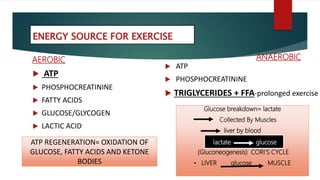
AEROBIC
 ATP
 PHOSPHOCREATININE
 FATTY ACIDS
 GLUCOSE/GLYCOGEN
 LACTIC ACID
ANAEROBIC
 ATP
 PHOSPHOCREATININE
 TRIGLYCERIDES + FFA-prolonged exercise
ATP REGENERATION= OXIDATION OF
GLUCOSE, FATTY ACIDS AND KETONE
BODIES
Glucose breakdown= lactate
• Collected By Muscles
liver by blood
(Gluconeogenesis) CORI’S CYCLE
• LIVER glucose MUSCLE
ENERGY SOURCE FOR EXERCISE
lactate glucose
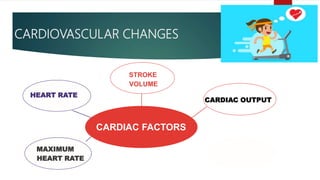
CARDIOVASCULAR CHANGES
CARDIAC FACTORS
STROKE
VOLUME
HEART RATE
MAXIMUM
HEART RATE
CARDIAC OUTPUT
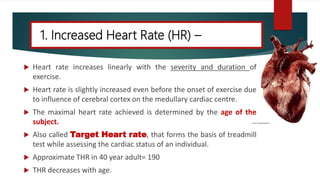
1. Increased Heart Rate (HR) –
 Heart rate increases linearly with the severity and duration of
exercise.
 Heart rate is slightly increased even before the onset of exercise due
to influence of cerebral cortex on the medullary cardiac centre.
 The maximal heart rate achieved is determined by the age of the
subject.
 Also called Target Heart rate, that forms the basis of treadmill
test while assessing the cardiac status of an individual.
 Approximate THR in 40 year adult= 190
 THR decreases with age.
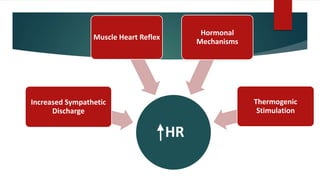
HR
Increased Sympathetic
Discharge
Muscle Heart Reflex
Hormonal
Mechanisms
Thermogenic
Stimulation
Helps to :
 Increase O2 delivery to working muscles
 Aid removal waste products
 Will increase until point of exhaustion
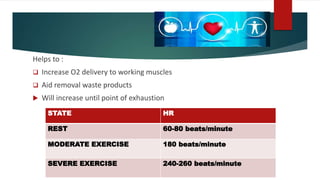
STATE HR
REST 60-80 beats/minute
MODERATE EXERCISE 180 beats/minute
SEVERE EXERCISE 240-260 beats/minute
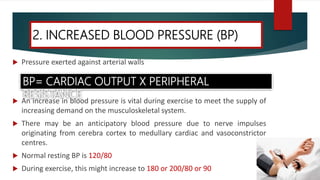
 Pressure exerted against arterial walls
 An increase in blood pressure is vital during exercise to meet the supply of
increasing demand on the musculoskeletal system.
 There may be an anticipatory blood pressure due to nerve impulses
originating from cerebra cortex to medullary cardiac and vasoconstrictor
centres.
 Normal resting BP is 120/80
 During exercise, this might increase to 180 or 200/80 or 90
2. INCREASED BLOOD PRESSURE (BP)
BP= CARDIAC OUTPUT X PERIPHERAL
RESISTANCE
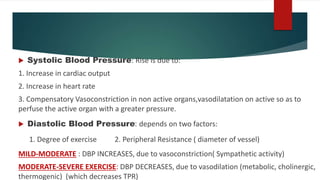
 Systolic Blood Pressure: Rise is due to:
1. Increase in cardiac output
2. Increase in heart rate
3. Compensatory Vasoconstriction in non active organs,vasodilatation on active so as to
perfuse the active organ with a greater pressure.
 Diastolic Blood Pressure: depends on two factors:
1. Degree of exercise 2. Peripheral Resistance ( diameter of vessel)
MILD-MODERATE : DBP INCREASES, due to vasoconstriction( Sympathetic activity)
MODERATE-SEVERE EXERCISE: DBP DECREASES, due to vasodilation (metabolic, cholinergic,
thermogenic) (which decreases TPR)
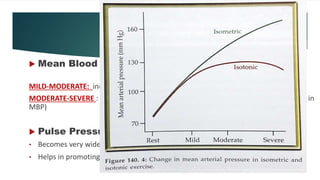
 Mean Blood Pressure:
MILD-MODERATE: increases
MODERATE-SEVERE : decreases as DBP decreases ( except isometric- overall increase in
MBP)
 Pulse Pressure:
• Becomes very wide.
• Helps in promoting perfusion of skeletal muscles.
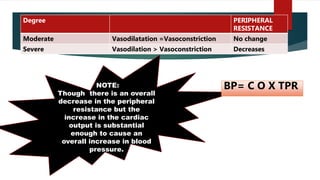
NOTE:
Though there is an overall
decrease in the peripheral
resistance but the
increase in the cardiac
output is substantial
enough to cause an
overall increase in blood
pressure.
Degree PERIPHERAL
RESISTANCE
Moderate Vasodilatation =Vasoconstriction No change
Severe Vasodilation > Vasoconstriction Decreases
BP= C O X TPR
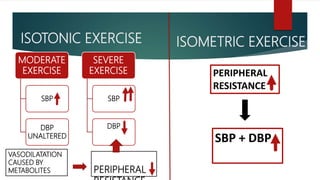
ISOTONIC EXERCISE
MODERATE
EXERCISE
SBP
DBP
UNALTERED
SEVERE
EXERCISE
SBP
DBP
VASODILATATION
CAUSED BY
METABOLITES PERIPHERAL
ISOMETRIC EXERCISE
PERIPHERAL
RESISTANCE
SBP + DBP
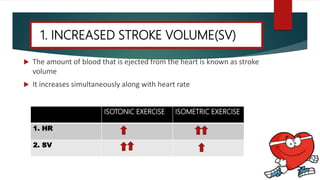
 The amount of blood that is ejected from the heart is known as stroke
volume
 It increases simultaneously along with heart rate
1. INCREASED STROKE VOLUME(SV)
ISOTONIC EXERCISE ISOMETRIC EXERCISE
1. HR
2. SV
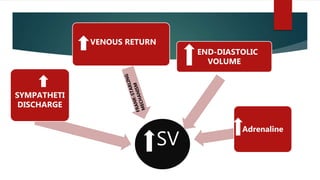
SV
SYMPATHETI
DISCHARGE
END-DIASTOLIC
VOLUME
Adrenaline
VENOUS RETURN
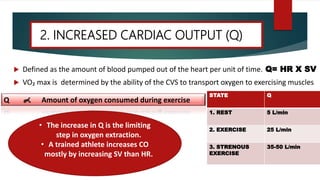
 Defined as the amount of blood pumped out of the heart per unit of time. Q= HR X SV
 VO₂ max is determined by the ability of the CVS to transport oxygen to exercising muscles
2. INCREASED CARDIAC OUTPUT (Q)
Q Amount of oxygen consumed during exercise
STATE Q
1. REST 5 L/min
2. EXERCISE 25 L/min
3. STRENOUS
EXERCISE
35-50 L/min
• The increase in Q is the limiting
step in oxygen extraction.
• A trained athlete increases CO
mostly by increasing SV than HR.
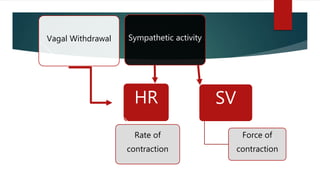
HR
Vagal Withdrawal Sympathetic activity
SV
Force of
contraction
Rate of
contraction
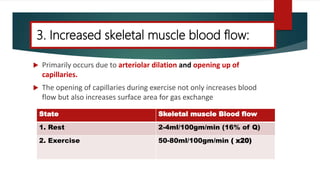
 Primarily occurs due to arteriolar dilation and opening up of
capillaries.
 The opening of capillaries during exercise not only increases blood
flow but also increases surface area for gas exchange
3. Increased skeletal muscle blood flow:
State Skeletal muscle Blood flow
1. Rest 2-4ml/100gm/min (16% of Q)
2. Exercise 50-80ml/100gm/min ( x20)
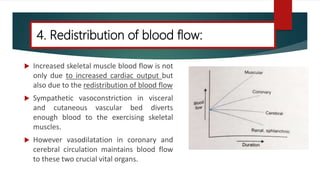
 Increased skeletal muscle blood flow is not
only due to increased cardiac output but
also due to the redistribution of blood flow
 Sympathetic vasoconstriction in visceral
and cutaneous vascular bed diverts
enough blood to the exercising skeletal
muscles.
 However vasodilatation in coronary and
cerebral circulation maintains blood flow
to these two crucial vital organs.
4. Redistribution of blood flow:
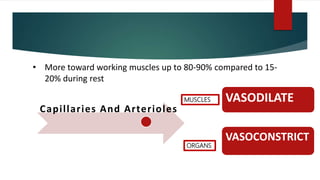
Capillaries And Arterioles
• More toward working muscles up to 80-90% compared to 15-
20% during rest
VASODILATE
VASOCONSTRICT
MUSCLES
ORGANS
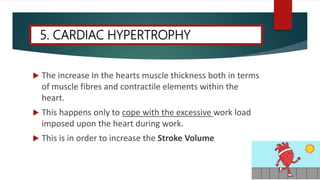
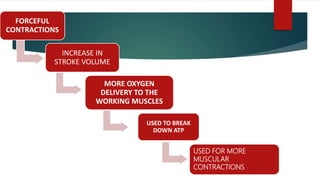
 The increase In the hearts muscle thickness both in terms
of muscle fibres and contractile elements within the
heart.
 This happens only to cope with the excessive work load
imposed upon the heart during work.
 This is in order to increase the Stroke Volume
5. CARDIAC HYPERTROPHY
FORCEFUL
CONTRACTIONS
INCREASE IN
STROKE VOLUME
MORE OXYGEN
DELIVERY TO THE
WORKING MUSCLES
USED TO BREAK
DOWN ATP
USED FOR MORE
MUSCULAR
CONTRACTIONS
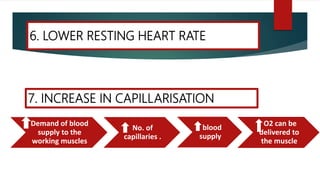
6. LOWER RESTING HEART RATE
Demand of blood
supply to the
working muscles
No. of
capillaries .
blood
supply
O2 can be
delivered to
the muscle
7. INCREASE IN CAPILLARISATION
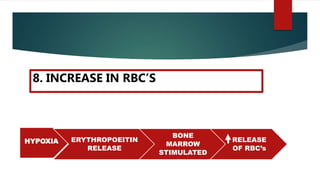
HYPOXIA ERYTHROPOEITIN
RELEASE
BONE
MARROW
STIMULATED
RELEASE
OF RBC’s
8. INCREASE IN RBC’S
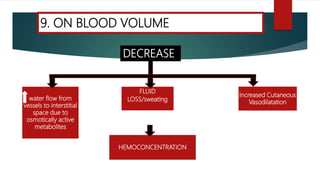
FLUID
LOSS/sweatingwater flow from
vessels to interstitial
space due to
osmotically active
metabolites
HEMOCONCENTRATION
Increased Cutaneous
Vasodilatation
9. ON BLOOD VOLUME
DECREASE
DEGREE
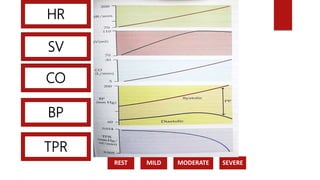
REST MILD MODERATE SEVERE
HR
CO
BP
TPR
SV
RESPIRATORY CHANGES
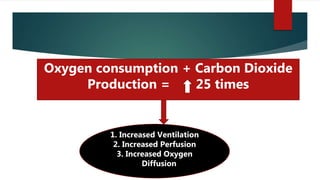
Oxygen consumption + Carbon Dioxide
Production = 25 times
1. Increased Ventilation
2. Increased Perfusion
3. Increased Oxygen
Diffusion
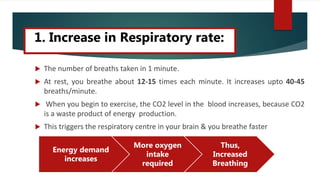
 The number of breaths taken in 1 minute.
 At rest, you breathe about 12-15 times each minute. It increases upto 40-45
breaths/minute.
 When you begin to exercise, the CO2 level in the blood increases, because CO2
is a waste product of energy production.
 This triggers the respiratory centre in your brain & you breathe faster
Energy demand
increases
More oxygen
intake
required
Thus,
Increased
Breathing
1. Increase in Respiratory rate:
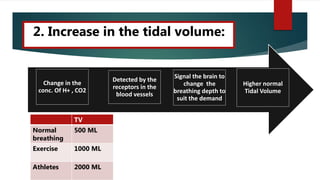
A. Increase in the tidal volume:
Higher normal
Tidal Volume
Signal the brain to
change the
breathing depth to
suit the demand
Detected by the
receptors in the
blood vessels
Change in the
conc. Of H+ , CO2
2. Increase in the tidal volume:
TV
Normal
breathing
500 ML
Exercise 1000 ML
Athletes 2000 ML
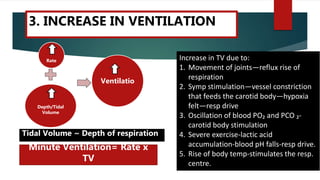
Rate
Depth/Tidal
Volume
Ventilatio
Increase in TV due to:
1. Movement of joints—reflux rise of
respiration
2. Symp stimulation—vessel constriction
that feeds the carotid body—hypoxia
felt—resp drive
3. Oscillation of blood PO₂ and PCO ₂-
carotid body stimulation
4. Severe exercise-lactic acid
accumulation-blood pH falls-resp drive.
5. Rise of body temp-stimulates the resp.
centre.
Tidal Volume ~ Depth of respiration
Minute Ventilation= Rate x
TV
3. INCREASE IN VENTILATION
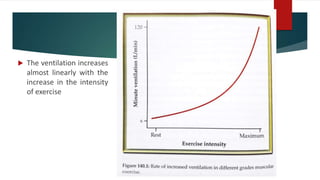
 The ventilation increases
almost linearly with the
increase in the intensity
of exercise
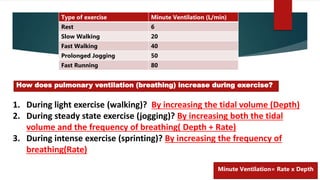
1. During light exercise (walking)? By increasing the tidal volume (Depth)
2. During steady state exercise (jogging)? By increasing both the tidal
volume and the frequency of breathing( Depth + Rate)
3. During intense exercise (sprinting)? By increasing the frequency of
breathing(Rate)
How does pulmonary ventilation (breathing) increase during exercise?
Type of exercise Minute Ventilation (L/min)
Rest 6
Slow Walking 20
Fast Walking 40
Prolonged Jogging 50
Fast Running 80
Minute Ventilation= Rate x Depth
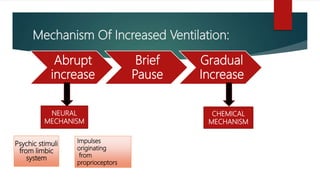
Mechanism Of Increased Ventilation:
Abrupt
increase
Brief
Pause
Gradual
Increase
NEURAL
MECHANISM
CHEMICAL
MECHANISM
Psychic stimuli
from limbic
system
Impulses
originating
from
proprioceptors
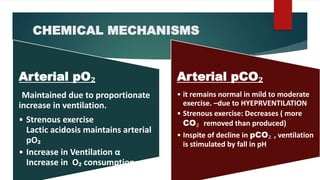
CHEMICAL MECHANISMS
Arterial pO₂
Maintained due to proportionate
increase in ventilation.
• Strenous exercise
Lactic acidosis maintains arterial
pO₂
• Increase in Ventilation α
Increase in O₂ consumption
Arterial pCO₂
• it remains normal in mild to moderate
exercise. –due to HYEPRVENTILATION
• Strenous exercise: Decreases ( more
CO₂ removed than produced)
• Inspite of decline in pCO₂ , ventilation
is stimulated by fall in pH
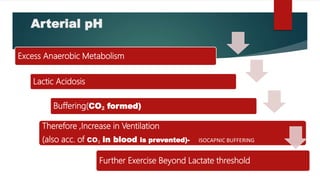
Arterial pH
Excess Anaerobic Metabolism
Lactic Acidosis
Buffering(CO₂ formed)
Therefore ,Increase in Ventilation
(also acc. of CO₂ in blood is prevented)- ISOCAPNIC BUFFERING
Further Exercise Beyond Lactate threshold
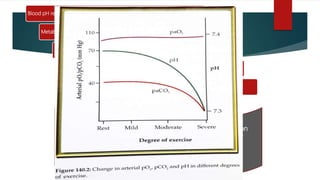
Blood pH reduces
Metabolic Acidosis
Supralinear Stimulation of Ventilation
Ventilation stimulated (activation of peripheral chemoreceptors in
carotid and aortic bodies)
pCO₂ falls significantly
 Decline in arterial pCO₂ induced by excessive ventilation
becomes the physiological mechanism for respiratory
compensation of metabolic acidosis.
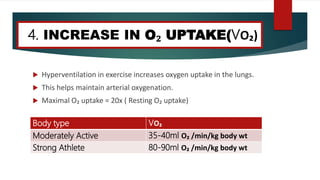
 Hyperventilation in exercise increases oxygen uptake in the lungs.
 This helps maintain arterial oxygenation.
 Maximal O₂ uptake = 20x ( Resting O₂ uptake)
Body type VO₂
Moderately Active 35-40ml O₂ /min/kg body wt
Strong Athlete 80-90ml O₂ /min/kg body wt
4. INCREASE IN O₂ UPTAKE(VO₂)
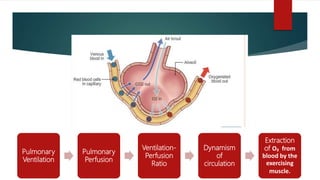
Pulmonary
Ventilation
Pulmonary
Perfusion
Ventilation-
Perfusion
Ratio
Dynamism
of
circulation
Extraction
of O₂ from
blood by the
exercising
muscle.
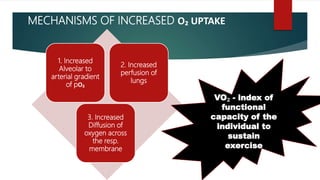
MECHANISMS OF INCREASED O₂ UPTAKE
1. Increased
Alveolar to
arterial gradient
of pO₂
2. Increased
perfusion of
lungs
3. Increased
Diffusion of
oxygen across
the resp.
membrane
VO₂ - index of
functional
capacity of the
individual to
sustain
exercise
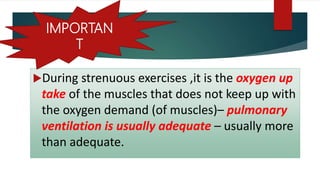
During strenuous exercises ,it is the oxygen up
take of the muscles that does not keep up with
the oxygen demand (of muscles)– pulmonary
ventilation is usually adequate – usually more
than adequate.
IMPORTAN
T
NOTE:
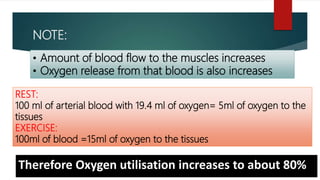
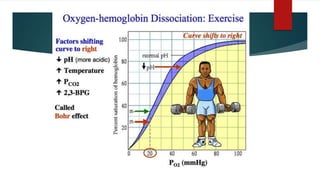
• Amount of blood flow to the muscles increases
• Oxygen release from that blood is also increases
REST:
100 ml of arterial blood with 19.4 ml of oxygen= 5ml of oxygen to the
tissues
EXERCISE:
100ml of blood =15ml of oxygen to the tissues
Therefore Oxygen utilisation increases to about 80%
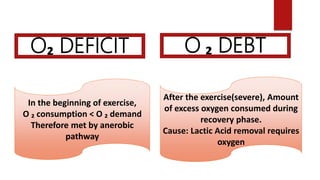
O₂ DEFICIT O ₂ DEBT
In the beginning of exercise,
O ₂ consumption < O ₂ demand
Therefore met by anerobic
pathway
After the exercise(severe), Amount
of excess oxygen consumed during
recovery phase.
Cause: Lactic Acid removal requires
oxygen
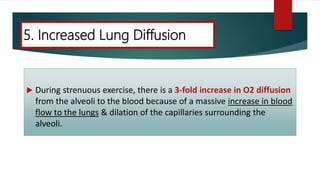
 During strenuous exercise, there is a 3-fold increase in O2 diffusion
from the alveoli to the blood because of a massive increase in blood
flow to the lungs & dilation of the capillaries surrounding the
alveoli.
5. Increased Lung Diffusion
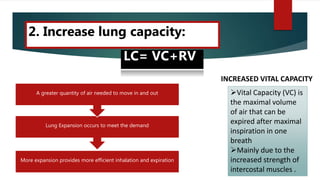
2. Increase lung capacity:
More expansion provides more efficient inhalation and expiration
Lung Expansion occurs to meet the demand
A greater quantity of air needed to move in and out
LC= VC+RV
Vital Capacity (VC) is
the maximal volume
of air that can be
expired after maximal
inspiration in one
breath
Mainly due to the
increased strength of
intercostal muscles .
INCREASED VITAL CAPACITY
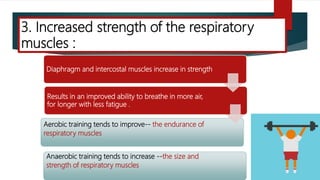
Diaphragm and intercostal muscles increase in strength
Results in an improved ability to breathe in more air,
for longer with less fatigue .
Aerobic training tends to improve-- the endurance of
respiratory muscles
Anaerobic training tends to increase --the size and
strength of respiratory muscles
3. Increased strength of the respiratory
muscles :
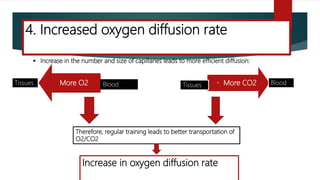
More O2 More CO2BloodTissues Tissues Blood
Therefore, regular training leads to better transportation of
O2/CO2
Increase in oxygen diffusion rate
 Increase in the number and size of capillaries leads to more efficient diffusion:
4. Increased oxygen diffusion rate
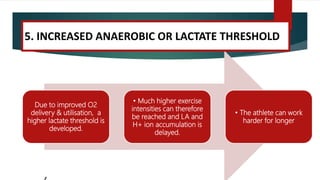
Due to improved O2
delivery & utilisation, a
higher lactate threshold is
developed.
• Much higher exercise
intensities can therefore
be reached and LA and
H+ ion accumulation is
delayed.
• The athlete can work
harder for longer
5. INCREASED ANAEROBIC OR LACTATE THRESHOLD
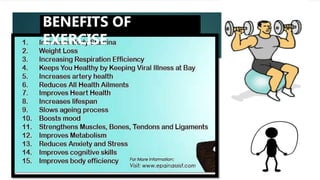
BENEFITS OF
EXERCISE
REFERENCES
1. Textbook of Medical Physiology- Prof G. K. Pal
2. Textbook of Medical Physiology- Sembulingam
3. Textbook of Medical Physiology-A. P Krishna
4. Textbook of Medical Physiology- Guyton
5. Healthy & Active Lifestyles- Book
6. Physiologic responses and long-term adaptations to
exercise-Article
7. Effects of exercise on the cardiovascular system-Article

Cardio-Pulmonary Changes during Exercise

Cardio-Pulmonary Changes during Exercise

  • 1.
  • 2.
    CONTENTS 1. Exercise physiology 2.Responses Vs adaptations 3. Cardiovascular changes- short term and long term 4. Respiratory changes- short term and long term 5. Therapeutic benefits of exercise 6. References
  • 3.
    EXERCISE PHYSIOLOGY  EXERCISE: defined as intentional increased muscular activities, planned structured and basically repetitive contraction and relaxation of group of muscles.  EXERCISE PHYSIOLOGY: Study of physio-chemical processes in the body that allow conversion of chemical energy into mechanical work and the changes in the organ systems in response to the effects of the work.  Continued skeletal muscle activity utilises energy that depends on the rate of nutrients and oxygen supply to the exercising muscles.
  • 4.
    Movement requires activationand control of the MUSCULOSKELETAL SYSTEM. However, the CARDIOVASCULAR AND RESPIRATORY SYSTEMS provide the ability to sustain this movement over extended periods.
  • 5.
    PRIMARY AIM TO SUPPLYADEQUATE OXYGENATED BLOOD TO THE EXERCISING MUSCLE TO FACILITATE OXYGEN CONSUMPTION OF THE BODY TO MEET THE METABOLIC DEMAND DURING EXERCISE
  • 6.
    ISOTONIC EXERCISE ISOMETRICEXERCISE Dynamic Static No change in the tension Change in tension Length changes No change in length External work is done No external work is done Eg. Walking, running,jogging Eg. Trying to lift something which cant be lifted Extra load on heart Greater load ;avoided in hypertensives and elderly T Y P E D E G R E E
  • 7.
  • 8.
    RESPONSES VS ADAPTATIONS RESPONSES Shortterm Physiology Function ADAPTATIONS Long term Anatomy Structure
  • 9.
    CARDIOVASCULAR SYSTEM SHORT- TERM • Increasedheart rate • Increased Blood pressure LONG-TERM • Cardiac hypertrophy • Increased Stroke Volume • Increased Cardiac output • Increased skeletal muscle blood flow • Redistribution of blood flow • Lower resting heart rate • Increase in capillarisation • Increase in RBCs
  • 10.
    SHORT-TERM • Increase inrespiratory rate • Increase in the tidal volume • Increased Ventilation • Increased VO₂ LONG-TERM • Increased Lung Ventilation • Increased lung capacity • Increased strength of intercostal muscles • Increased Oxygen Diffusion Rate • Increased Minute Ventilation • Increased no. of capillaries and alveoli • Increased Lactate Threshold RESPIRATORY SYSTEM
  • 11.
    AEROBIC  ATP  PHOSPHOCREATININE FATTY ACIDS  GLUCOSE/GLYCOGEN  LACTIC ACID ANAEROBIC  ATP  PHOSPHOCREATININE  TRIGLYCERIDES + FFA-prolonged exercise ATP REGENERATION= OXIDATION OF GLUCOSE, FATTY ACIDS AND KETONE BODIES Glucose breakdown= lactate • Collected By Muscles liver by blood (Gluconeogenesis) CORI’S CYCLE • LIVER glucose MUSCLE ENERGY SOURCE FOR EXERCISE lactate glucose
  • 12.
    CARDIOVASCULAR CHANGES CARDIAC FACTORS STROKE VOLUME HEARTRATE MAXIMUM HEART RATE CARDIAC OUTPUT
  • 14.
    1. Increased HeartRate (HR) –  Heart rate increases linearly with the severity and duration of exercise.  Heart rate is slightly increased even before the onset of exercise due to influence of cerebral cortex on the medullary cardiac centre.  The maximal heart rate achieved is determined by the age of the subject.  Also called Target Heart rate, that forms the basis of treadmill test while assessing the cardiac status of an individual.  Approximate THR in 40 year adult= 190  THR decreases with age.
  • 15.
    HR Increased Sympathetic Discharge Muscle HeartReflex Hormonal Mechanisms Thermogenic Stimulation
  • 16.
    Helps to : Increase O2 delivery to working muscles  Aid removal waste products  Will increase until point of exhaustion STATE HR REST 60-80 beats/minute MODERATE EXERCISE 180 beats/minute SEVERE EXERCISE 240-260 beats/minute
  • 17.
     Pressure exertedagainst arterial walls  An increase in blood pressure is vital during exercise to meet the supply of increasing demand on the musculoskeletal system.  There may be an anticipatory blood pressure due to nerve impulses originating from cerebra cortex to medullary cardiac and vasoconstrictor centres.  Normal resting BP is 120/80  During exercise, this might increase to 180 or 200/80 or 90 2. INCREASED BLOOD PRESSURE (BP) BP= CARDIAC OUTPUT X PERIPHERAL RESISTANCE
  • 18.
     Systolic BloodPressure: Rise is due to: 1. Increase in cardiac output 2. Increase in heart rate 3. Compensatory Vasoconstriction in non active organs,vasodilatation on active so as to perfuse the active organ with a greater pressure.  Diastolic Blood Pressure: depends on two factors: 1. Degree of exercise 2. Peripheral Resistance ( diameter of vessel) MILD-MODERATE : DBP INCREASES, due to vasoconstriction( Sympathetic activity) MODERATE-SEVERE EXERCISE: DBP DECREASES, due to vasodilation (metabolic, cholinergic, thermogenic) (which decreases TPR)
  • 19.
     Mean BloodPressure: MILD-MODERATE: increases MODERATE-SEVERE : decreases as DBP decreases ( except isometric- overall increase in MBP)  Pulse Pressure: • Becomes very wide. • Helps in promoting perfusion of skeletal muscles.
  • 20.
    NOTE: Though there isan overall decrease in the peripheral resistance but the increase in the cardiac output is substantial enough to cause an overall increase in blood pressure. Degree PERIPHERAL RESISTANCE Moderate Vasodilatation =Vasoconstriction No change Severe Vasodilation > Vasoconstriction Decreases BP= C O X TPR
  • 21.
  • 23.
     The amountof blood that is ejected from the heart is known as stroke volume  It increases simultaneously along with heart rate 1. INCREASED STROKE VOLUME(SV) ISOTONIC EXERCISE ISOMETRIC EXERCISE 1. HR 2. SV
  • 24.
  • 25.
     Defined asthe amount of blood pumped out of the heart per unit of time. Q= HR X SV  VO₂ max is determined by the ability of the CVS to transport oxygen to exercising muscles 2. INCREASED CARDIAC OUTPUT (Q) Q Amount of oxygen consumed during exercise STATE Q 1. REST 5 L/min 2. EXERCISE 25 L/min 3. STRENOUS EXERCISE 35-50 L/min • The increase in Q is the limiting step in oxygen extraction. • A trained athlete increases CO mostly by increasing SV than HR.
  • 26.
    HR Vagal Withdrawal Sympatheticactivity SV Force of contraction Rate of contraction
  • 27.
     Primarily occursdue to arteriolar dilation and opening up of capillaries.  The opening of capillaries during exercise not only increases blood flow but also increases surface area for gas exchange 3. Increased skeletal muscle blood flow: State Skeletal muscle Blood flow 1. Rest 2-4ml/100gm/min (16% of Q) 2. Exercise 50-80ml/100gm/min ( x20)
  • 28.
     Increased skeletalmuscle blood flow is not only due to increased cardiac output but also due to the redistribution of blood flow  Sympathetic vasoconstriction in visceral and cutaneous vascular bed diverts enough blood to the exercising skeletal muscles.  However vasodilatation in coronary and cerebral circulation maintains blood flow to these two crucial vital organs. 4. Redistribution of blood flow:
  • 29.
    Capillaries And Arterioles •More toward working muscles up to 80-90% compared to 15- 20% during rest VASODILATE VASOCONSTRICT MUSCLES ORGANS
  • 30.
     The increaseIn the hearts muscle thickness both in terms of muscle fibres and contractile elements within the heart.  This happens only to cope with the excessive work load imposed upon the heart during work.  This is in order to increase the Stroke Volume 5. CARDIAC HYPERTROPHY
  • 31.
    FORCEFUL CONTRACTIONS INCREASE IN STROKE VOLUME MOREOXYGEN DELIVERY TO THE WORKING MUSCLES USED TO BREAK DOWN ATP USED FOR MORE MUSCULAR CONTRACTIONS
  • 32.
    6. LOWER RESTINGHEART RATE Demand of blood supply to the working muscles No. of capillaries . blood supply O2 can be delivered to the muscle 7. INCREASE IN CAPILLARISATION
  • 33.
  • 34.
    FLUID LOSS/sweatingwater flow from vesselsto interstitial space due to osmotically active metabolites HEMOCONCENTRATION Increased Cutaneous Vasodilatation 9. ON BLOOD VOLUME DECREASE
  • 35.
    DEGREE REST MILD MODERATESEVERE HR CO BP TPR SV
  • 36.
  • 37.
    Oxygen consumption +Carbon Dioxide Production = 25 times 1. Increased Ventilation 2. Increased Perfusion 3. Increased Oxygen Diffusion
  • 39.
     The numberof breaths taken in 1 minute.  At rest, you breathe about 12-15 times each minute. It increases upto 40-45 breaths/minute.  When you begin to exercise, the CO2 level in the blood increases, because CO2 is a waste product of energy production.  This triggers the respiratory centre in your brain & you breathe faster Energy demand increases More oxygen intake required Thus, Increased Breathing 1. Increase in Respiratory rate:
  • 40.
    A. Increase inthe tidal volume: Higher normal Tidal Volume Signal the brain to change the breathing depth to suit the demand Detected by the receptors in the blood vessels Change in the conc. Of H+ , CO2 2. Increase in the tidal volume: TV Normal breathing 500 ML Exercise 1000 ML Athletes 2000 ML
  • 41.
    Rate Depth/Tidal Volume Ventilatio Increase in TVdue to: 1. Movement of joints—reflux rise of respiration 2. Symp stimulation—vessel constriction that feeds the carotid body—hypoxia felt—resp drive 3. Oscillation of blood PO₂ and PCO ₂- carotid body stimulation 4. Severe exercise-lactic acid accumulation-blood pH falls-resp drive. 5. Rise of body temp-stimulates the resp. centre. Tidal Volume ~ Depth of respiration Minute Ventilation= Rate x TV 3. INCREASE IN VENTILATION
  • 42.
     The ventilationincreases almost linearly with the increase in the intensity of exercise
  • 43.
    1. During lightexercise (walking)? By increasing the tidal volume (Depth) 2. During steady state exercise (jogging)? By increasing both the tidal volume and the frequency of breathing( Depth + Rate) 3. During intense exercise (sprinting)? By increasing the frequency of breathing(Rate) How does pulmonary ventilation (breathing) increase during exercise? Type of exercise Minute Ventilation (L/min) Rest 6 Slow Walking 20 Fast Walking 40 Prolonged Jogging 50 Fast Running 80 Minute Ventilation= Rate x Depth
  • 44.
    Mechanism Of IncreasedVentilation: Abrupt increase Brief Pause Gradual Increase NEURAL MECHANISM CHEMICAL MECHANISM Psychic stimuli from limbic system Impulses originating from proprioceptors
  • 45.
    CHEMICAL MECHANISMS Arterial pO₂ Maintaineddue to proportionate increase in ventilation. • Strenous exercise Lactic acidosis maintains arterial pO₂ • Increase in Ventilation α Increase in O₂ consumption Arterial pCO₂ • it remains normal in mild to moderate exercise. –due to HYEPRVENTILATION • Strenous exercise: Decreases ( more CO₂ removed than produced) • Inspite of decline in pCO₂ , ventilation is stimulated by fall in pH
  • 46.
    Arterial pH Excess AnaerobicMetabolism Lactic Acidosis Buffering(CO₂ formed) Therefore ,Increase in Ventilation (also acc. of CO₂ in blood is prevented)- ISOCAPNIC BUFFERING Further Exercise Beyond Lactate threshold
  • 47.
    Blood pH reduces MetabolicAcidosis Supralinear Stimulation of Ventilation Ventilation stimulated (activation of peripheral chemoreceptors in carotid and aortic bodies) pCO₂ falls significantly  Decline in arterial pCO₂ induced by excessive ventilation becomes the physiological mechanism for respiratory compensation of metabolic acidosis.
  • 48.
     Hyperventilation inexercise increases oxygen uptake in the lungs.  This helps maintain arterial oxygenation.  Maximal O₂ uptake = 20x ( Resting O₂ uptake) Body type VO₂ Moderately Active 35-40ml O₂ /min/kg body wt Strong Athlete 80-90ml O₂ /min/kg body wt 4. INCREASE IN O₂ UPTAKE(VO₂)
  • 49.
  • 50.
    MECHANISMS OF INCREASEDO₂ UPTAKE 1. Increased Alveolar to arterial gradient of pO₂ 2. Increased perfusion of lungs 3. Increased Diffusion of oxygen across the resp. membrane VO₂ - index of functional capacity of the individual to sustain exercise
  • 51.
    During strenuous exercises,it is the oxygen up take of the muscles that does not keep up with the oxygen demand (of muscles)– pulmonary ventilation is usually adequate – usually more than adequate. IMPORTAN T
  • 52.
    NOTE: • Amount ofblood flow to the muscles increases • Oxygen release from that blood is also increases REST: 100 ml of arterial blood with 19.4 ml of oxygen= 5ml of oxygen to the tissues EXERCISE: 100ml of blood =15ml of oxygen to the tissues Therefore Oxygen utilisation increases to about 80%
  • 54.
    O₂ DEFICIT O₂ DEBT In the beginning of exercise, O ₂ consumption < O ₂ demand Therefore met by anerobic pathway After the exercise(severe), Amount of excess oxygen consumed during recovery phase. Cause: Lactic Acid removal requires oxygen
  • 55.
     During strenuousexercise, there is a 3-fold increase in O2 diffusion from the alveoli to the blood because of a massive increase in blood flow to the lungs & dilation of the capillaries surrounding the alveoli. 5. Increased Lung Diffusion
  • 57.
    2. Increase lungcapacity: More expansion provides more efficient inhalation and expiration Lung Expansion occurs to meet the demand A greater quantity of air needed to move in and out LC= VC+RV Vital Capacity (VC) is the maximal volume of air that can be expired after maximal inspiration in one breath Mainly due to the increased strength of intercostal muscles . INCREASED VITAL CAPACITY
  • 58.
    Diaphragm and intercostalmuscles increase in strength Results in an improved ability to breathe in more air, for longer with less fatigue . Aerobic training tends to improve-- the endurance of respiratory muscles Anaerobic training tends to increase --the size and strength of respiratory muscles 3. Increased strength of the respiratory muscles :
  • 59.
    More O2 MoreCO2BloodTissues Tissues Blood Therefore, regular training leads to better transportation of O2/CO2 Increase in oxygen diffusion rate  Increase in the number and size of capillaries leads to more efficient diffusion: 4. Increased oxygen diffusion rate
  • 60.
    Due to improvedO2 delivery & utilisation, a higher lactate threshold is developed. • Much higher exercise intensities can therefore be reached and LA and H+ ion accumulation is delayed. • The athlete can work harder for longer 5. INCREASED ANAEROBIC OR LACTATE THRESHOLD
  • 62.
  • 64.
    REFERENCES 1. Textbook ofMedical Physiology- Prof G. K. Pal 2. Textbook of Medical Physiology- Sembulingam 3. Textbook of Medical Physiology-A. P Krishna 4. Textbook of Medical Physiology- Guyton 5. Healthy & Active Lifestyles- Book 6. Physiologic responses and long-term adaptations to exercise-Article 7. Effects of exercise on the cardiovascular system-Article