Proprioceptive neuromuscular fasiculation Tecniques
Name: Sehrish Hayat
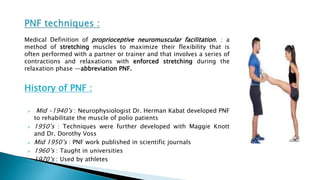
Medical Definition of proprioceptive neuromuscular facilitation. : a
method of stretching muscles to maximize their flexibility that is
often performed with a partner or trainer and that involves a series of
contractions and relaxations with enforced stretching during the
relaxation phase —abbreviation PNF.
History of PNF :
 Mid -1940’s : Neurophysiologist Dr. Herman Kabat developed PNF
to rehabilitate the muscle of polio patients
 1950’s : Techniques were further developed with Maggie Knott
and Dr. Dorothy Voss
 Mid 1950’s : PNF work published in scientific journals
 1960’s : Taught in universities
 1970’s : Used by athletes
 Rhythmic initiation (RI)
 Hold-Relax (HR)
 Contract-Relax (CR)
 Hold-Relax-Active Contraction (HRAC)
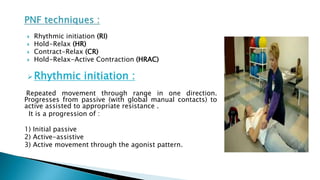
 Rhythmic initiation :
Repeated movement through range in one direction.
Progresses from passive (with global manual contacts) to
active assisted to appropriate resistance .
It is a progression of :
1) Initial passive
2) Active-assistive
3) Active movement through the agonist pattern.
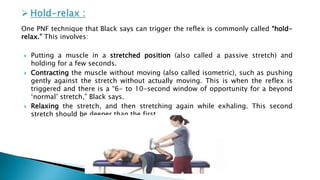
One PNF technique that Black says can trigger the reflex is commonly called “hold-
relax.” This involves:
 Putting a muscle in a stretched position (also called a passive stretch) and
holding for a few seconds.
 Contracting the muscle without moving (also called isometric), such as pushing
gently against the stretch without actually moving. This is when the reflex is
triggered and there is a “6- to 10-second window of opportunity for a beyond
‘normal’ stretch,” Black says.
 Relaxing the stretch, and then stretching again while exhaling. This second
stretch should be deeper than the first.
 Another common PNF technique is the contract-relax stretch. It is almost
identical to hold-relax, except that instead of contracting the muscle without
moving, the muscle is contracted while moving. This is sometimes called
isotonic stretching.
 For example, in a hamstring stretch, this could mean a trainer provides
resistance as an athlete contracts the muscle and pushes the leg down to the
floor.
Another technique, hold-relax-contract, is similar to hold-relax, except that after
pushing against the stretch, instead of relaxing into a passive stretch, the athlete
actively pushes into the stretch.
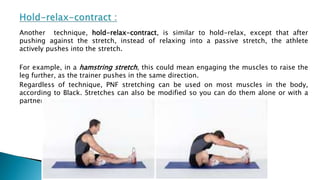
For example, in a hamstring stretch, this could mean engaging the muscles to raise the
leg further, as the trainer pushes in the same direction.
Regardless of technique, PNF stretching can be used on most muscles in the body,
according to Black. Stretches can also be modified so you can do them alone or with a
partner.
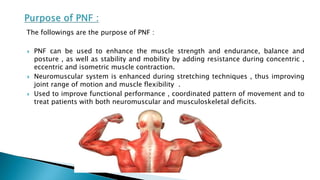
The followings are the purpose of PNF :
 PNF can be used to enhance the muscle strength and endurance, balance and
posture , as well as stability and mobility by adding resistance during concentric ,
eccentric and isometric muscle contraction.
 Neuromuscular system is enhanced during stretching techniques , thus improving
joint range of motion and muscle flexibility .
 Used to improve functional performance , coordinated pattern of movement and to
treat patients with both neuromuscular and musculoskeletal deficits.
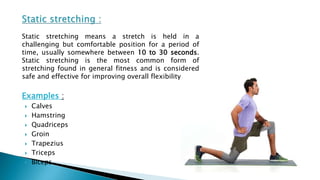
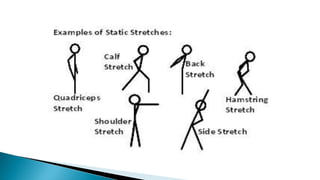
Static stretching means a stretch is held in a
challenging but comfortable position for a period of
time, usually somewhere between 10 to 30 seconds.
Static stretching is the most common form of
stretching found in general fitness and is considered
safe and effective for improving overall flexibility.
Examples :
 Calves
 Hamstring
 Quadriceps
 Groin
 Trapezius
 Triceps
 Biceps
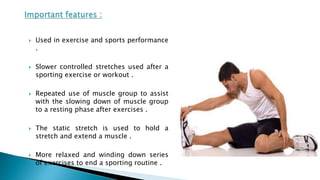
 Used in exercise and sports performance
.
 Slower controlled stretches used after a
sporting exercise or workout .
 Repeated use of muscle group to assist
with the slowing down of muscle group
to a resting phase after exercises .
 The static stretch is used to hold a
stretch and extend a muscle .
 More relaxed and winding down series
of exercises to end a sporting routine .
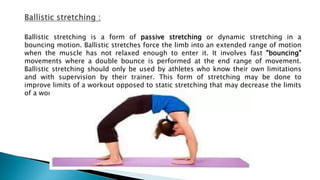
Ballistic stretching is a form of passive stretching or dynamic stretching in a
bouncing motion. Ballistic stretches force the limb into an extended range of motion
when the muscle has not relaxed enough to enter it. It involves fast "bouncing"
movements where a double bounce is performed at the end range of movement.
Ballistic stretching should only be used by athletes who know their own limitations
and with supervision by their trainer. This form of stretching may be done to
improve limits of a workout opposed to static stretching that may decrease the limits
of a workout.
 Uses quick movements that impose a change in
length of muscle or connective tissue .
 Appear to be jerky in nature .
 Advantages :
 Assist in preparing for plyometric activities
 Can increase long term flexibility in athletes
 Disadvantages :
 Greater chance of muscle soreness and injury
 Excessive uncontrolled forces
 Proposed neurologic inhibitory influences
associated with rapid-type stretching
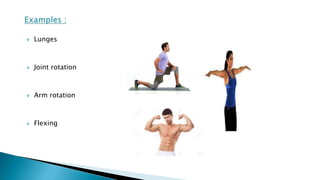
 Lunges
 Joint rotation
 Arm rotation
 Flexing

Pnf techniques

  • 1.
    Proprioceptive neuromuscular fasiculationTecniques Name: Sehrish Hayat
  • 2.
    Medical Definition ofproprioceptive neuromuscular facilitation. : a method of stretching muscles to maximize their flexibility that is often performed with a partner or trainer and that involves a series of contractions and relaxations with enforced stretching during the relaxation phase —abbreviation PNF. History of PNF :  Mid -1940’s : Neurophysiologist Dr. Herman Kabat developed PNF to rehabilitate the muscle of polio patients  1950’s : Techniques were further developed with Maggie Knott and Dr. Dorothy Voss  Mid 1950’s : PNF work published in scientific journals  1960’s : Taught in universities  1970’s : Used by athletes
  • 3.
     Rhythmic initiation(RI)  Hold-Relax (HR)  Contract-Relax (CR)  Hold-Relax-Active Contraction (HRAC)  Rhythmic initiation : Repeated movement through range in one direction. Progresses from passive (with global manual contacts) to active assisted to appropriate resistance . It is a progression of : 1) Initial passive 2) Active-assistive 3) Active movement through the agonist pattern.
  • 4.
    One PNF techniquethat Black says can trigger the reflex is commonly called “hold- relax.” This involves:  Putting a muscle in a stretched position (also called a passive stretch) and holding for a few seconds.  Contracting the muscle without moving (also called isometric), such as pushing gently against the stretch without actually moving. This is when the reflex is triggered and there is a “6- to 10-second window of opportunity for a beyond ‘normal’ stretch,” Black says.  Relaxing the stretch, and then stretching again while exhaling. This second stretch should be deeper than the first.
  • 5.
     Another commonPNF technique is the contract-relax stretch. It is almost identical to hold-relax, except that instead of contracting the muscle without moving, the muscle is contracted while moving. This is sometimes called isotonic stretching.  For example, in a hamstring stretch, this could mean a trainer provides resistance as an athlete contracts the muscle and pushes the leg down to the floor.
  • 6.
    Another technique, hold-relax-contract,is similar to hold-relax, except that after pushing against the stretch, instead of relaxing into a passive stretch, the athlete actively pushes into the stretch. For example, in a hamstring stretch, this could mean engaging the muscles to raise the leg further, as the trainer pushes in the same direction. Regardless of technique, PNF stretching can be used on most muscles in the body, according to Black. Stretches can also be modified so you can do them alone or with a partner.
  • 7.
    The followings arethe purpose of PNF :  PNF can be used to enhance the muscle strength and endurance, balance and posture , as well as stability and mobility by adding resistance during concentric , eccentric and isometric muscle contraction.  Neuromuscular system is enhanced during stretching techniques , thus improving joint range of motion and muscle flexibility .  Used to improve functional performance , coordinated pattern of movement and to treat patients with both neuromuscular and musculoskeletal deficits.
  • 8.
    Static stretching meansa stretch is held in a challenging but comfortable position for a period of time, usually somewhere between 10 to 30 seconds. Static stretching is the most common form of stretching found in general fitness and is considered safe and effective for improving overall flexibility. Examples :  Calves  Hamstring  Quadriceps  Groin  Trapezius  Triceps  Biceps
  • 9.
     Used inexercise and sports performance .  Slower controlled stretches used after a sporting exercise or workout .  Repeated use of muscle group to assist with the slowing down of muscle group to a resting phase after exercises .  The static stretch is used to hold a stretch and extend a muscle .  More relaxed and winding down series of exercises to end a sporting routine .
  • 11.
    Ballistic stretching isa form of passive stretching or dynamic stretching in a bouncing motion. Ballistic stretches force the limb into an extended range of motion when the muscle has not relaxed enough to enter it. It involves fast "bouncing" movements where a double bounce is performed at the end range of movement. Ballistic stretching should only be used by athletes who know their own limitations and with supervision by their trainer. This form of stretching may be done to improve limits of a workout opposed to static stretching that may decrease the limits of a workout.
  • 12.
     Uses quickmovements that impose a change in length of muscle or connective tissue .  Appear to be jerky in nature .  Advantages :  Assist in preparing for plyometric activities  Can increase long term flexibility in athletes  Disadvantages :  Greater chance of muscle soreness and injury  Excessive uncontrolled forces  Proposed neurologic inhibitory influences associated with rapid-type stretching
  • 13.
     Lunges  Jointrotation  Arm rotation  Flexing