Chronic adaptations to training.
Chronic adaptations to training. What is Chronic adaptations to training? How long does it take? Read Chapter 11 Nelson Physical Education
Chronic adaptations to training Athletes train to adapt their bodies to a particular sport/activity. These changes or adaptations in the body is specific to the training method/s applied Adaptation = “a long-term physiological change in response to training loads that allows the body to meet new demands. If training load is not sufficient to challenge the body, no adaptations occur and a plateau will occur.
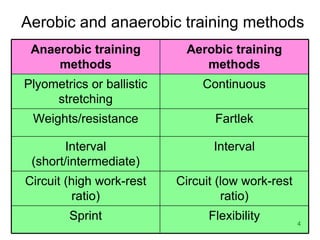
Aerobic and anaerobic training methods Flexibility Sprint Circuit (low work-rest ratio) Circuit (high work-rest ratio) Interval Interval (short/intermediate) Fartlek Weights/resistance Continuous Plyometrics or ballistic stretching Aerobic training methods Anaerobic training methods
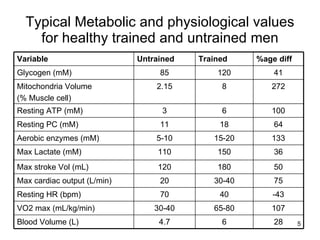
Typical Metabolic and physiological values for healthy trained and untrained men 28 6 4.7 Blood Volume (L) 107 65-80 30-40 VO2 max (mL/kg/min) -43 40 70 Resting HR (bpm) 75 30-40 20 Max cardiac output (L/min) 50 180 120 Max stroke Vol (mL) 36 150 110 Max Lactate (mM) 133 15-20 5-10 Aerobic enzymes (mM) 64 18 11 Resting PC (mM) 100 6 3 Resting ATP (mM) 272 8 2.15 Mitochondria Volume  (% Muscle cell) 41 120 85 Glycogen (mM) %age diff Trained Untrained Variable
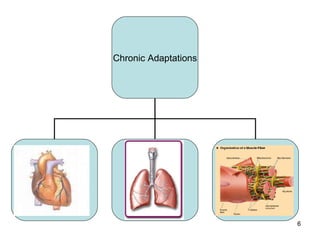
Chronic Adaptations Cardiovascular  adaptations Respiratory  adaptations Muscular  adaptations
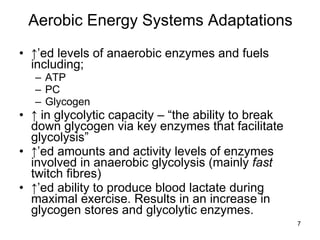
Aerobic Energy Systems Adaptations ↑’ ed levels of anaerobic enzymes and fuels including; ATP PC Glycogen ↑  in glycolytic capacity – “the ability to break down glycogen via key enzymes that facilitate  glycolysis” ↑’ ed amounts and activity levels of enzymes involved in anaerobic glycolysis (mainly  fast  twitch fibres) ↑’ ed ability to produce blood lactate during maximal exercise. Results in an increase in glycogen stores and glycolytic enzymes.
Aerobic Energy Systems Adaptations ↑  in oxygen uptake, transport and utilisation ↑’ ed enhanced fat breakdown (from an ↑ in fat metabolising and ↑’ed fat mobilising enzymes) Improved fatty acid oxidation and respiratory ATP production ↑  reduced CHO use during sub-maximal exercise.  Therefore these factors assist in glycogen sparing which leads to better endurance
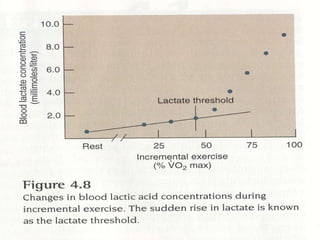
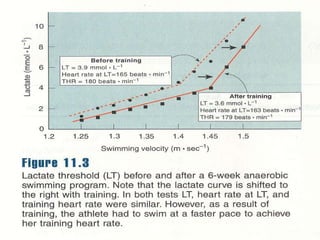
Aerobic training also causes important changes in the anaerobic threshold! Ie the point where LA beings to accumulate. Generally this id at 85% of  Max HR. But with the aerobic training comes; ↑’ ed capillarisation ↑’ ed mitochondria density ↑’ ed oxidative enzymes Structural changes to the cardiovascular system.  Therefore the anaerobic threshold can improve closer to 90% of Max HR.  Aerobic Energy Systems Adaptations
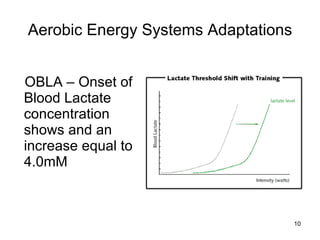
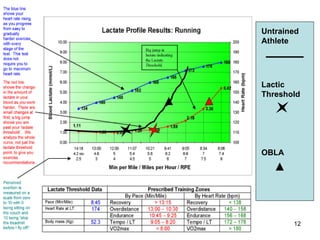
Aerobic Energy Systems Adaptations OBLA – Onset of Blood Lactate concentration shows and an increase equal to 4.0mM
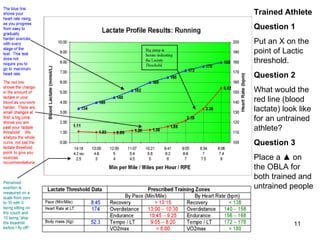
Trained Athlete Question 1 Put an X on the point of Lactic threshold. Question 2 What would the red line (blood lactate) look like for an untrained athlete?  Question 3 Place a  ▲ on the OBLA for both trained and untrained people
Untrained Athlete  Lactic Threshold OBLA
 
 
Questions a. List 3 methods of training that will predominantly bring about training adaptations to the aerobic system b. List 3 methods of training that will predominantly bring about training adaptations to the anaerobic system Under sub-maximal aerobic conditions explain why it is better to use Fats over CHO’s as a fuel source? What is the relevance of anaerobic threshold? How does it respond to aerobic training? Resting heart rate is one of the few variables that decrease as a result of training especially aerobically. It has been said that this is because the heart is more efficient. What does this mean? What does the vascular system refer to?
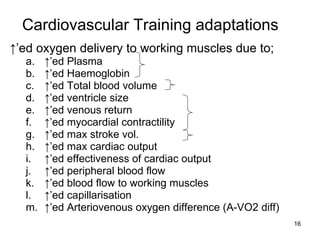
↑’ ed oxygen delivery to working muscles due to; ↑’ ed Plasma ↑’ ed Haemoglobin ↑’ ed Total blood volume ↑’ ed ventricle size ↑’ ed venous return ↑’ ed myocardial contractility  ↑’ ed max stroke vol. ↑’ ed max cardiac output ↑’ ed effectiveness of cardiac output ↑’ ed peripheral blood flow ↑’ ed blood flow to working muscles ↑’ ed capillarisation  ↑’ ed Arteriovenous oxygen difference (A-VO2 diff) Cardiovascular Training adaptations
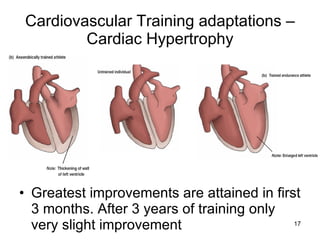
Cardiovascular Training adaptations – Cardiac Hypertrophy Greatest improvements are attained in first 3 months. After 3 years of training only very slight improvement
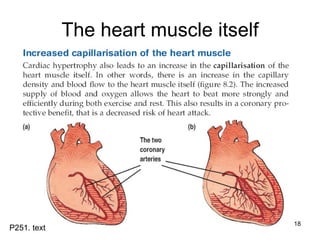
The heart muscle itself P251. text
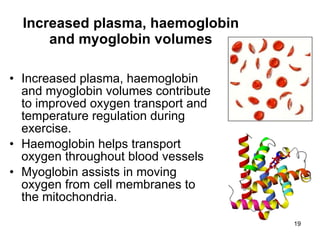
Increased plasma, haemoglobin and myoglobin volumes Increased plasma, haemoglobin and myoglobin volumes contribute to improved oxygen transport and temperature regulation during exercise. Haemoglobin helps transport oxygen throughout blood vessels Myoglobin assists in moving oxygen from cell membranes to the mitochondria.
Changes in Heart Rate Resting and sub-maximal HR’s will decrease as a result of aerobic training.  Mainly due to  ↑  in stroke volume ↑  in Q Therefore to supply the same amount of oxygen, the heart needs fewer beats per min. Therefore the heart  becomes more efficient. It pumping the same amt of blood with fewer beats.
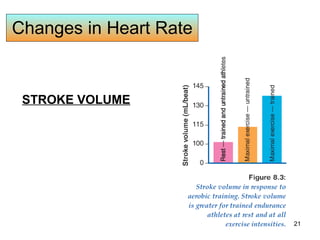
Changes in Heart Rate STROKE VOLUME
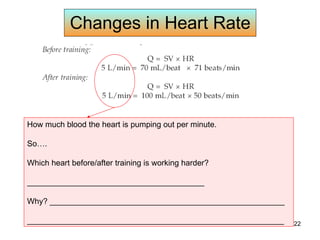
Changes in Heart Rate How much blood the heart is pumping out per minute.  So…. Which heart before/after training is working harder?  ________________________________________ Why? _____________________________________________________ __________________________________________________________
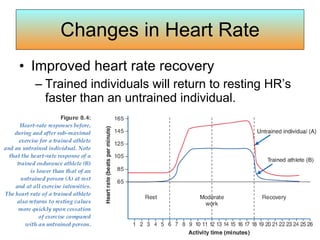
Improved heart rate recovery Trained individuals will return to resting HR’s faster than an untrained individual. Changes in Heart Rate
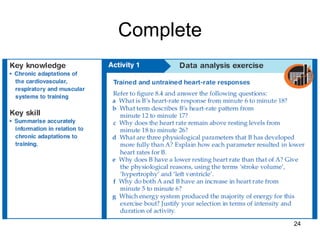
Complete
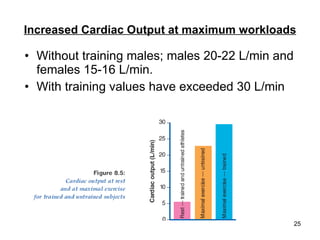
Increased Cardiac Output at maximum workloads Without training males; males 20-22 L/min and females 15-16 L/min. With training values have exceeded 30 L/min
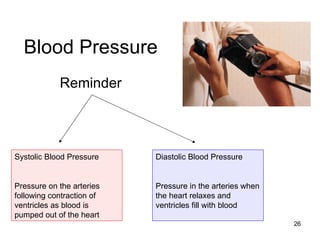
Blood Pressure Reminder Systolic Blood Pressure Pressure on the arteries following contraction of ventricles as blood is pumped out of the heart  Diastolic Blood Pressure  Pressure in the arteries when the heart relaxes and ventricles fill with blood
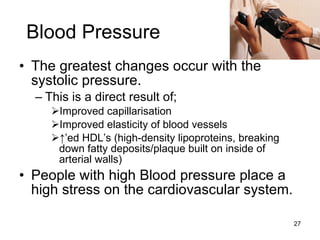
The greatest changes occur with the systolic pressure.  This is a direct result of; Improved capillarisation  Improved elasticity of blood vessels ↑’ ed HDL’s (high-density lipoproteins, breaking down fatty deposits/plaque built on inside of arterial walls) People with high Blood pressure place a high stress on the cardiovascular system. Blood Pressure
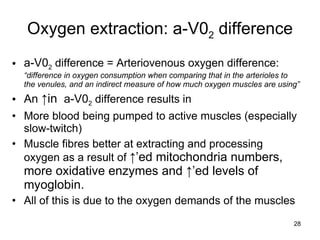
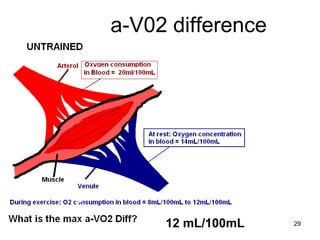
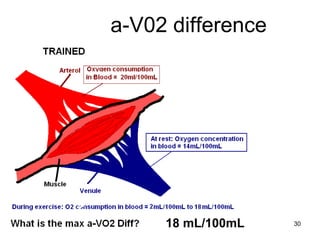
Oxygen extraction: a-V0 2  difference a-V0 2  difference = Arteriovenous oxygen difference:  “difference in oxygen consumption when comparing that in the arterioles to the venules, and an indirect measure of how much oxygen muscles are using” An  ↑in  a-V0 2  difference results in More blood being pumped to active muscles (especially slow-twitch) Muscle fibres better at extracting and processing oxygen as a result of  ↑’ed mitochondria numbers, more oxidative enzymes and ↑’ed levels of myoglobin.  All of this is due to the oxygen demands of the muscles
a-V02 difference 12 mL/100mL
a-V02 difference 18 mL/100mL
Respiratory Adaptations Tidal volume – amount of air inspired and expired during normal breathing. Number per minute decreases at rest Minute Ventilation – at rest MV decreases, at Maximum 02 uptake MV increases to allow more air into the lunge and greater breathing frequency.  Improved lung function – increased surface area for the gas exchange
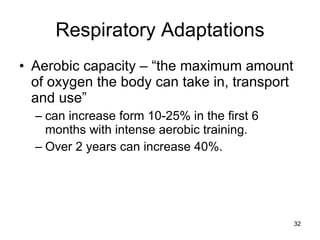
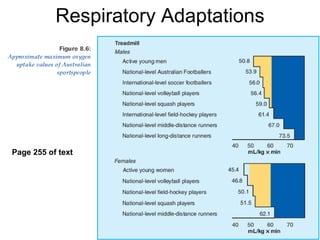
Respiratory Adaptations Aerobic capacity – “the maximum amount of oxygen the body can take in, transport and use” can increase form 10-25% in the first 6 months with intense aerobic training. Over 2 years can increase 40%.
Respiratory Adaptations Page 255 of text
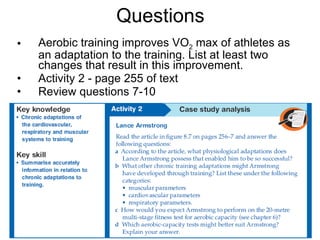
Questions Aerobic training improves VO 2  max of athletes as an adaptation to the training. List at least two changes that result in this improvement. Activity 2 - page 255 of text Review questions 7-10
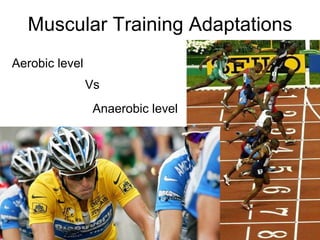
Muscular Training Adaptations Aerobic level Anaerobic level Vs
Muscular Training Adaptations Genetics a big advantage to start with x amount of fibre percentage You are born with x amount of fast and slow twitch fibres. BUT you can train and gain more of one type.  MYTH – “with training you can change from fast twitch to slow twitch or vice versa.” IMPOSSIBLE HOWEVER – fast twitch fibres have been known to take on slow twitch characteristics in response to aerobic training
Muscular Training Adaptations - Anaerobic level  Strength/power and speed training Greatest adaptations occur at tissue level Muscular Hypertrophy Fast twitch fibres (type II) High intensity loads, low reps Males have greater results due to presence of testosterone
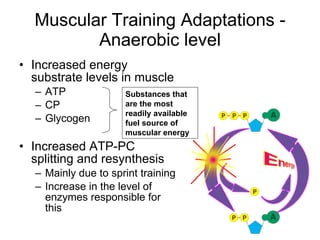
Muscular Training Adaptations - Anaerobic level Increased energy substrate levels in muscle ATP CP Glycogen Increased ATP-PC splitting and resynthesis Mainly due to sprint training Increase in the level of enzymes responsible for this Substances that are the most readily available fuel source of muscular energy
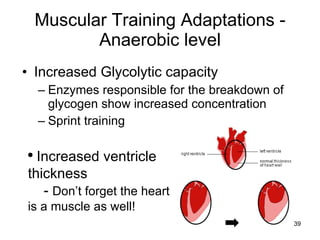
Muscular Training Adaptations - Anaerobic level Increased Glycolytic capacity Enzymes responsible for the breakdown of glycogen show increased concentration Sprint training Increased ventricle thickness -  Don’t forget the heart is a muscle as well!
Muscular Training Adaptations - Anaerobic level Increased contractile proteins in muscles Strength training tends to add to the protein of the muscle that generates tension hence greater force generated at any given speed  Increased myosin ATPase This is the enzyme that splits ATP to yield energy for muscular contractions More of this enzyme = more energy released allowing contractions to occur at a quicker rate
Muscular Training Adaptations - Anaerobic level THANKS TO THE RESEARCH SCIENTISTS Increased muscle buffering Greater LA tolerance is evident when vigorous anaerobic training has taken place possibly due to body’s improved capacity for acid-base regulation Muscle hyperplasia (new fibres formed) We knew that muscle fibres increased in size but anaerobically they have been seen to also increase in number via longitudinal splitting Changes occur due to chronic overload to the skeletal muscle NEW
Muscular Training Adaptations - Aerobic level Increased Mitochondria density and number Aerobic powerhouse of the body Where ATP production occurs Results in an increase in the capacity for aerobic metabolism from oxidation of FFA’s and CHO for endurance work Mitochondria numbers can double under the right training  NOTE: anaerobic resistance training will reduce this effect  Eg – Soccer players Vs AFL players
Muscular Training Adaptations - Aerobic level Increased myoglobin stores Similar to haemoglobin (transports oxygen in the blood) Myoglobin provides intramuscular oxygen storage.  More myoglobin = more oxygen can be stored at the muscles Hence more ATP production.
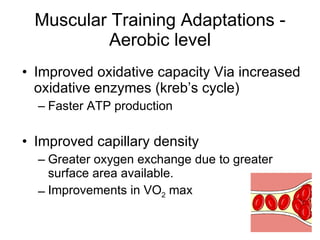
Muscular Training Adaptations - Aerobic level Improved oxidative capacity Via increased oxidative enzymes (kreb’s cycle)  Faster ATP production Improved capillary density Greater oxygen exchange due to greater surface area available.  Improvements in VO 2  max
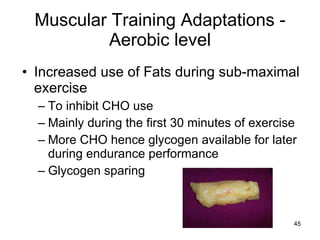
Muscular Training Adaptations - Aerobic level Increased use of Fats during sub-maximal exercise To inhibit CHO use Mainly during the first 30 minutes of exercise More CHO hence glycogen available for later during endurance performance Glycogen sparing
Muscular Training Adaptations - Aerobic level Increased stores and use of intramuscular triglycerides  (Triglycerides, which are chains of high-energy fatty acids, provide much of the energy needed for cells to function.) Assists with glycogen sparing Ideal fuel for low-intensity and sub-maximal exercise
Muscular Training Adaptations - Aerobic level Increased muscle glycogen synthase and storage Glycogen synthase is the enzyme responsible for converting glucose to glycogen. Aerobic glycolysis is faster and more efficient Therefore increase in performance
Adaptations are reversible When an athlete ceases training they experience a rapid loss of their acquired adaptations. And endurance athlete confined to bed for 3 weeks can lose  Max stroke volume Q Aerobic capacity 1% per day
Questions What is the main difference between fast and slow twitch fibres? Muscle hypertrophy occurs in response to both aerobic and anaerobic training. Briefly discuss what this means and how it brings about improved performance levels under each situation. How do mitochondria bring about improved aerobic performances? As a result of aerobic training, muscles ‘learn’ to make earlier and greater use of fats as a fuel (especially under sub-maximal exercise conditions). Explain how this leads to improved endurance performances.
Chronic Adaptations To Training

  • 1.
  • 2.
    Chronic adaptations totraining. What is Chronic adaptations to training? How long does it take? Read Chapter 11 Nelson Physical Education
  • 3.
    Chronic adaptations totraining Athletes train to adapt their bodies to a particular sport/activity. These changes or adaptations in the body is specific to the training method/s applied Adaptation = “a long-term physiological change in response to training loads that allows the body to meet new demands. If training load is not sufficient to challenge the body, no adaptations occur and a plateau will occur.
  • 4.
    Aerobic and anaerobictraining methods Flexibility Sprint Circuit (low work-rest ratio) Circuit (high work-rest ratio) Interval Interval (short/intermediate) Fartlek Weights/resistance Continuous Plyometrics or ballistic stretching Aerobic training methods Anaerobic training methods
  • 5.
    Typical Metabolic andphysiological values for healthy trained and untrained men 28 6 4.7 Blood Volume (L) 107 65-80 30-40 VO2 max (mL/kg/min) -43 40 70 Resting HR (bpm) 75 30-40 20 Max cardiac output (L/min) 50 180 120 Max stroke Vol (mL) 36 150 110 Max Lactate (mM) 133 15-20 5-10 Aerobic enzymes (mM) 64 18 11 Resting PC (mM) 100 6 3 Resting ATP (mM) 272 8 2.15 Mitochondria Volume (% Muscle cell) 41 120 85 Glycogen (mM) %age diff Trained Untrained Variable
  • 6.
    Chronic Adaptations Cardiovascular adaptations Respiratory adaptations Muscular adaptations
  • 7.
    Aerobic Energy SystemsAdaptations ↑’ ed levels of anaerobic enzymes and fuels including; ATP PC Glycogen ↑ in glycolytic capacity – “the ability to break down glycogen via key enzymes that facilitate glycolysis” ↑’ ed amounts and activity levels of enzymes involved in anaerobic glycolysis (mainly fast twitch fibres) ↑’ ed ability to produce blood lactate during maximal exercise. Results in an increase in glycogen stores and glycolytic enzymes.
  • 8.
    Aerobic Energy SystemsAdaptations ↑ in oxygen uptake, transport and utilisation ↑’ ed enhanced fat breakdown (from an ↑ in fat metabolising and ↑’ed fat mobilising enzymes) Improved fatty acid oxidation and respiratory ATP production ↑ reduced CHO use during sub-maximal exercise. Therefore these factors assist in glycogen sparing which leads to better endurance
  • 9.
    Aerobic training alsocauses important changes in the anaerobic threshold! Ie the point where LA beings to accumulate. Generally this id at 85% of Max HR. But with the aerobic training comes; ↑’ ed capillarisation ↑’ ed mitochondria density ↑’ ed oxidative enzymes Structural changes to the cardiovascular system. Therefore the anaerobic threshold can improve closer to 90% of Max HR. Aerobic Energy Systems Adaptations
  • 10.
    Aerobic Energy SystemsAdaptations OBLA – Onset of Blood Lactate concentration shows and an increase equal to 4.0mM
  • 11.
    Trained Athlete Question1 Put an X on the point of Lactic threshold. Question 2 What would the red line (blood lactate) look like for an untrained athlete? Question 3 Place a ▲ on the OBLA for both trained and untrained people
  • 12.
    Untrained Athlete Lactic Threshold OBLA
  • 13.
  • 14.
  • 15.
    Questions a. List3 methods of training that will predominantly bring about training adaptations to the aerobic system b. List 3 methods of training that will predominantly bring about training adaptations to the anaerobic system Under sub-maximal aerobic conditions explain why it is better to use Fats over CHO’s as a fuel source? What is the relevance of anaerobic threshold? How does it respond to aerobic training? Resting heart rate is one of the few variables that decrease as a result of training especially aerobically. It has been said that this is because the heart is more efficient. What does this mean? What does the vascular system refer to?
  • 16.
    ↑’ ed oxygendelivery to working muscles due to; ↑’ ed Plasma ↑’ ed Haemoglobin ↑’ ed Total blood volume ↑’ ed ventricle size ↑’ ed venous return ↑’ ed myocardial contractility ↑’ ed max stroke vol. ↑’ ed max cardiac output ↑’ ed effectiveness of cardiac output ↑’ ed peripheral blood flow ↑’ ed blood flow to working muscles ↑’ ed capillarisation ↑’ ed Arteriovenous oxygen difference (A-VO2 diff) Cardiovascular Training adaptations
  • 17.
    Cardiovascular Training adaptations– Cardiac Hypertrophy Greatest improvements are attained in first 3 months. After 3 years of training only very slight improvement
  • 18.
    The heart muscleitself P251. text
  • 19.
    Increased plasma, haemoglobinand myoglobin volumes Increased plasma, haemoglobin and myoglobin volumes contribute to improved oxygen transport and temperature regulation during exercise. Haemoglobin helps transport oxygen throughout blood vessels Myoglobin assists in moving oxygen from cell membranes to the mitochondria.
  • 20.
    Changes in HeartRate Resting and sub-maximal HR’s will decrease as a result of aerobic training. Mainly due to ↑ in stroke volume ↑ in Q Therefore to supply the same amount of oxygen, the heart needs fewer beats per min. Therefore the heart becomes more efficient. It pumping the same amt of blood with fewer beats.
  • 21.
    Changes in HeartRate STROKE VOLUME
  • 22.
    Changes in HeartRate How much blood the heart is pumping out per minute. So…. Which heart before/after training is working harder? ________________________________________ Why? _____________________________________________________ __________________________________________________________
  • 23.
    Improved heart raterecovery Trained individuals will return to resting HR’s faster than an untrained individual. Changes in Heart Rate
  • 24.
  • 25.
    Increased Cardiac Outputat maximum workloads Without training males; males 20-22 L/min and females 15-16 L/min. With training values have exceeded 30 L/min
  • 26.
    Blood Pressure ReminderSystolic Blood Pressure Pressure on the arteries following contraction of ventricles as blood is pumped out of the heart Diastolic Blood Pressure Pressure in the arteries when the heart relaxes and ventricles fill with blood
  • 27.
    The greatest changesoccur with the systolic pressure. This is a direct result of; Improved capillarisation Improved elasticity of blood vessels ↑’ ed HDL’s (high-density lipoproteins, breaking down fatty deposits/plaque built on inside of arterial walls) People with high Blood pressure place a high stress on the cardiovascular system. Blood Pressure
  • 28.
    Oxygen extraction: a-V02 difference a-V0 2 difference = Arteriovenous oxygen difference: “difference in oxygen consumption when comparing that in the arterioles to the venules, and an indirect measure of how much oxygen muscles are using” An ↑in a-V0 2 difference results in More blood being pumped to active muscles (especially slow-twitch) Muscle fibres better at extracting and processing oxygen as a result of ↑’ed mitochondria numbers, more oxidative enzymes and ↑’ed levels of myoglobin. All of this is due to the oxygen demands of the muscles
  • 29.
  • 30.
  • 31.
    Respiratory Adaptations Tidalvolume – amount of air inspired and expired during normal breathing. Number per minute decreases at rest Minute Ventilation – at rest MV decreases, at Maximum 02 uptake MV increases to allow more air into the lunge and greater breathing frequency. Improved lung function – increased surface area for the gas exchange
  • 32.
    Respiratory Adaptations Aerobiccapacity – “the maximum amount of oxygen the body can take in, transport and use” can increase form 10-25% in the first 6 months with intense aerobic training. Over 2 years can increase 40%.
  • 33.
  • 34.
    Questions Aerobic trainingimproves VO 2 max of athletes as an adaptation to the training. List at least two changes that result in this improvement. Activity 2 - page 255 of text Review questions 7-10
  • 35.
    Muscular Training AdaptationsAerobic level Anaerobic level Vs
  • 36.
    Muscular Training AdaptationsGenetics a big advantage to start with x amount of fibre percentage You are born with x amount of fast and slow twitch fibres. BUT you can train and gain more of one type. MYTH – “with training you can change from fast twitch to slow twitch or vice versa.” IMPOSSIBLE HOWEVER – fast twitch fibres have been known to take on slow twitch characteristics in response to aerobic training
  • 37.
    Muscular Training Adaptations- Anaerobic level Strength/power and speed training Greatest adaptations occur at tissue level Muscular Hypertrophy Fast twitch fibres (type II) High intensity loads, low reps Males have greater results due to presence of testosterone
  • 38.
    Muscular Training Adaptations- Anaerobic level Increased energy substrate levels in muscle ATP CP Glycogen Increased ATP-PC splitting and resynthesis Mainly due to sprint training Increase in the level of enzymes responsible for this Substances that are the most readily available fuel source of muscular energy
  • 39.
    Muscular Training Adaptations- Anaerobic level Increased Glycolytic capacity Enzymes responsible for the breakdown of glycogen show increased concentration Sprint training Increased ventricle thickness - Don’t forget the heart is a muscle as well!
  • 40.
    Muscular Training Adaptations- Anaerobic level Increased contractile proteins in muscles Strength training tends to add to the protein of the muscle that generates tension hence greater force generated at any given speed Increased myosin ATPase This is the enzyme that splits ATP to yield energy for muscular contractions More of this enzyme = more energy released allowing contractions to occur at a quicker rate
  • 41.
    Muscular Training Adaptations- Anaerobic level THANKS TO THE RESEARCH SCIENTISTS Increased muscle buffering Greater LA tolerance is evident when vigorous anaerobic training has taken place possibly due to body’s improved capacity for acid-base regulation Muscle hyperplasia (new fibres formed) We knew that muscle fibres increased in size but anaerobically they have been seen to also increase in number via longitudinal splitting Changes occur due to chronic overload to the skeletal muscle NEW
  • 42.
    Muscular Training Adaptations- Aerobic level Increased Mitochondria density and number Aerobic powerhouse of the body Where ATP production occurs Results in an increase in the capacity for aerobic metabolism from oxidation of FFA’s and CHO for endurance work Mitochondria numbers can double under the right training NOTE: anaerobic resistance training will reduce this effect Eg – Soccer players Vs AFL players
  • 43.
    Muscular Training Adaptations- Aerobic level Increased myoglobin stores Similar to haemoglobin (transports oxygen in the blood) Myoglobin provides intramuscular oxygen storage. More myoglobin = more oxygen can be stored at the muscles Hence more ATP production.
  • 44.
    Muscular Training Adaptations- Aerobic level Improved oxidative capacity Via increased oxidative enzymes (kreb’s cycle) Faster ATP production Improved capillary density Greater oxygen exchange due to greater surface area available. Improvements in VO 2 max
  • 45.
    Muscular Training Adaptations- Aerobic level Increased use of Fats during sub-maximal exercise To inhibit CHO use Mainly during the first 30 minutes of exercise More CHO hence glycogen available for later during endurance performance Glycogen sparing
  • 46.
    Muscular Training Adaptations- Aerobic level Increased stores and use of intramuscular triglycerides (Triglycerides, which are chains of high-energy fatty acids, provide much of the energy needed for cells to function.) Assists with glycogen sparing Ideal fuel for low-intensity and sub-maximal exercise
  • 47.
    Muscular Training Adaptations- Aerobic level Increased muscle glycogen synthase and storage Glycogen synthase is the enzyme responsible for converting glucose to glycogen. Aerobic glycolysis is faster and more efficient Therefore increase in performance
  • 48.
    Adaptations are reversibleWhen an athlete ceases training they experience a rapid loss of their acquired adaptations. And endurance athlete confined to bed for 3 weeks can lose Max stroke volume Q Aerobic capacity 1% per day
  • 49.
    Questions What isthe main difference between fast and slow twitch fibres? Muscle hypertrophy occurs in response to both aerobic and anaerobic training. Briefly discuss what this means and how it brings about improved performance levels under each situation. How do mitochondria bring about improved aerobic performances? As a result of aerobic training, muscles ‘learn’ to make earlier and greater use of fats as a fuel (especially under sub-maximal exercise conditions). Explain how this leads to improved endurance performances.