Edited By :- Dr. Bindesh D. Patel, PT
Deputy Registrar
P P Savani University
Prepared By:- Sakshi Yede
Fracture of the forearm bones,
Monteggia and Galeazzi fracture
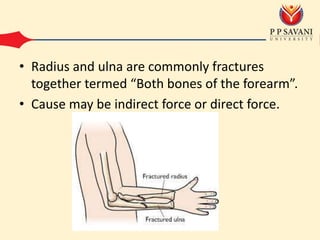
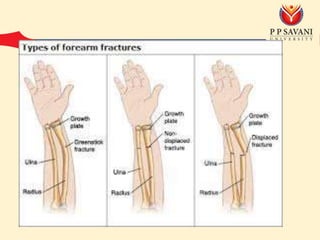
• Radius and ulna are commonly fractures
together termed “Both bones of the forearm”.
• Cause may be indirect force or direct force.
Displacement
• In children :- No or minimal displacement
• In adult prone to more displacement
• Types
1. Angulation :- Medial and anterior
2. Shift in any direction
3. Rotation :- Proximal segment in supination and
distal segment in pronation
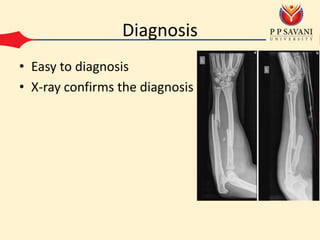
Diagnosis
• Easy to diagnosis
• X-ray confirms the diagnosis
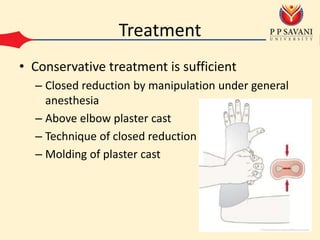
Treatment
• Conservative treatment is sufficient
– Closed reduction by manipulation under general
anesthesia
– Above elbow plaster cast
– Technique of closed reduction
– Molding of plaster cast
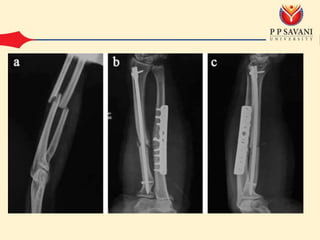
• ORIF
– Radius and ulna should be approached through
separation incisions to avoid cross union
– Compression plating and intra medullary nailing is
preferred method
– Bone grafting should be used in fracture older then 3
weeks
– Limb should be mobilized depending upon rigidity of
the fixation
– External fixation is used in some compound fracture
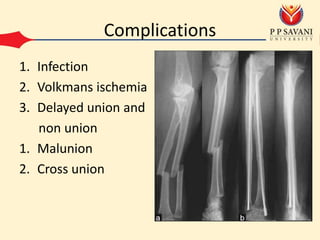
Complications
1. Infection
2. Volkmans ischemia
3. Delayed union and
non union
1. Malunion
2. Cross union
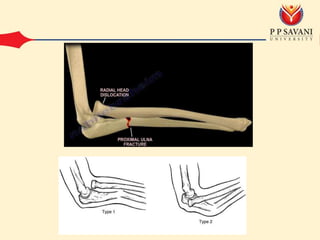
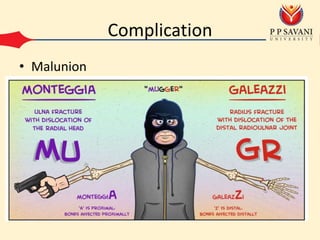
Monteggia fracture dislocation
• Fracture of upper third of the ulna with
dislocation of head of radius
• Caused by fall on out stretched hand or direct
blow on the back of the upper forearm
• Types
– Flexion :- Ulna fracture angulates posteriorly and
radial head dislocates posteriorly
– Extension :- Ulna fracture angulates anteriorly and
radial head dislocates anteriorly
Diagnosis
• History of injury/fall
• X-ray confirm the diagnosis
Treatment
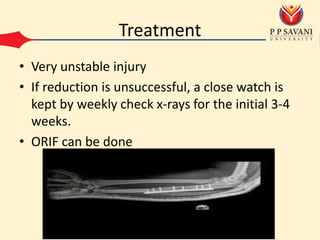
• Very unstable injury
• If reduction is unsuccessful, a close watch is
kept by weekly check x-rays for the initial 3-4
weeks.
• ORIF can be done
Complications
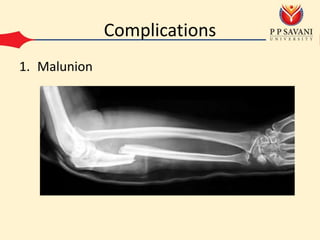
1. Malunion
Galeazzi fracture dislocation
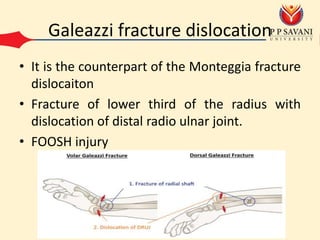
• It is the counterpart of the Monteggia fracture
dislocaiton
• Fracture of lower third of the radius with
dislocation of distal radio ulnar joint.
• FOOSH injury
Displacement and diagnosis
• Radius fracture is angulated medially and
anteriorly
• Distal radio ulnar joint is disrupted resulting in
dorsal dislocation of the distal end of the ulna
• History of fall or injury
• X-ray confirm the diagnosis
Treatment
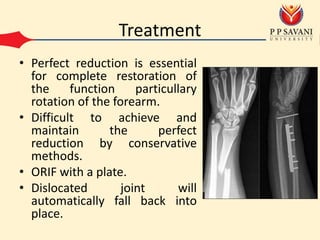
• Perfect reduction is essential
for complete restoration of
the function particullary
rotation of the forearm.
• Difficult to achieve and
maintain the perfect
reduction by conservative
methods.
• ORIF with a plate.
• Dislocated joint will
automatically fall back into
place.
Complication
• Malunion
Thank you
Please share the video and subscribe my
channel.

8. Forearm bone fractures

  • 1.
    Edited By :-Dr. Bindesh D. Patel, PT Deputy Registrar P P Savani University Prepared By:- Sakshi Yede Fracture of the forearm bones, Monteggia and Galeazzi fracture
  • 2.
    • Radius andulna are commonly fractures together termed “Both bones of the forearm”. • Cause may be indirect force or direct force.
  • 3.
    Displacement • In children:- No or minimal displacement • In adult prone to more displacement • Types 1. Angulation :- Medial and anterior 2. Shift in any direction 3. Rotation :- Proximal segment in supination and distal segment in pronation
  • 5.
    Diagnosis • Easy todiagnosis • X-ray confirms the diagnosis
  • 6.
    Treatment • Conservative treatmentis sufficient – Closed reduction by manipulation under general anesthesia – Above elbow plaster cast – Technique of closed reduction – Molding of plaster cast
  • 7.
    • ORIF – Radiusand ulna should be approached through separation incisions to avoid cross union – Compression plating and intra medullary nailing is preferred method – Bone grafting should be used in fracture older then 3 weeks – Limb should be mobilized depending upon rigidity of the fixation – External fixation is used in some compound fracture
  • 9.
    Complications 1. Infection 2. Volkmansischemia 3. Delayed union and non union 1. Malunion 2. Cross union
  • 10.
    Monteggia fracture dislocation •Fracture of upper third of the ulna with dislocation of head of radius • Caused by fall on out stretched hand or direct blow on the back of the upper forearm • Types – Flexion :- Ulna fracture angulates posteriorly and radial head dislocates posteriorly – Extension :- Ulna fracture angulates anteriorly and radial head dislocates anteriorly
  • 12.
    Diagnosis • History ofinjury/fall • X-ray confirm the diagnosis
  • 13.
    Treatment • Very unstableinjury • If reduction is unsuccessful, a close watch is kept by weekly check x-rays for the initial 3-4 weeks. • ORIF can be done
  • 14.
  • 15.
    Galeazzi fracture dislocation •It is the counterpart of the Monteggia fracture dislocaiton • Fracture of lower third of the radius with dislocation of distal radio ulnar joint. • FOOSH injury
  • 16.
    Displacement and diagnosis •Radius fracture is angulated medially and anteriorly • Distal radio ulnar joint is disrupted resulting in dorsal dislocation of the distal end of the ulna • History of fall or injury • X-ray confirm the diagnosis
  • 17.
    Treatment • Perfect reductionis essential for complete restoration of the function particullary rotation of the forearm. • Difficult to achieve and maintain the perfect reduction by conservative methods. • ORIF with a plate. • Dislocated joint will automatically fall back into place.
  • 18.
  • 19.
  • 20.
    Please share thevideo and subscribe my channel.