RESISTED EXERCISE
Quratulain Mughal
Isra University
Batch 4
Doctor Of Physical Therapy
Content
 The principles of resistance
 Variation of the power of the muscles in
different parts of their range
 Techniques of resisted exercises
 Resistance
 Progressive resistance exercise
 Progression
 Effects
 Uses of resistance exercise
RESISTANCE
 Load OR resistance is given to a
muscle to increase muscle performance
(strength, endurance & power)
PRINCIPLES OF RESISTANCE
EXERCISES
 Overload principle
 SAID principle
 Reversibility principle
OVERLOAD PRINCIPLE
 Load must exceed the metabolic capacity
of a muscle
 Muscle is challenged to perform at greater
level
 In strength training programs amount of
resistance applied to a muscle increased
 In endurance training we focus on increase
time or number of repetition increase
SAID PRINCIPLES
(SPECIFIC ADAPTATION TO IMPOSED DEMAND)
 Applied to all body system
 This is the extension of the wolf’s law in which body
system adapts overtime to the stresses placed on
them
USES
 Helps therapist to determine the exercise prescription
 Which parameters of exercise should be selected to
create specific training effects that best meet specific
functional needs and goals.
SPECIFICITY OF TRAINING
 Also called specificity of exercise
 Use to improve strength, power & endurance
of muscle.
 Means if the muscular endurance require
more than the strength, the intensity &
duration of exercises should be geared.
 The training is depend on the type , velocity,
joint angle & movt. Pattern of the exercise
REVERSIBILITY PRINCIPLE
 The resistance is transmitted to gain the
strength & endurance.
 Use for the patient who forget movt.
e.g. C.P child
VARIATION OF THE POWER OF
MUSCLE IN DIFFERENT PART OF
THEIR RANGE
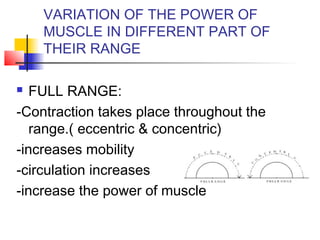
 FULL RANGE:
-Contraction takes place throughout the
range.( eccentric & concentric)
-increases mobility
-circulation increases
-increase the power of muscle
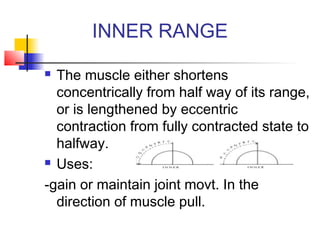
INNER RANGE
 The muscle either shortens
concentrically from half way of its range,
or is lengthened by eccentric
contraction from fully contracted state to
halfway.
 Uses:
-gain or maintain joint movt. In the
direction of muscle pull.
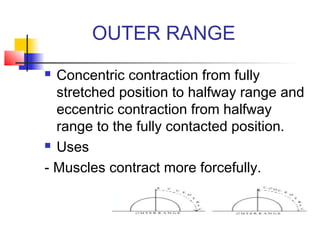
OUTER RANGE
 Concentric contraction from fully
stretched position to halfway range and
eccentric contraction from halfway
range to the fully contacted position.
 Uses
- Muscles contract more forcefully.
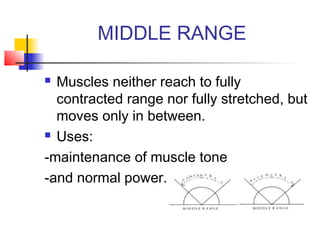
MIDDLE RANGE
 Muscles neither reach to fully
contracted range nor fully stretched, but
moves only in between.
 Uses:
-maintenance of muscle tone
-and normal power.
TECHNIQUES OF
RESISTED
EXERCISE
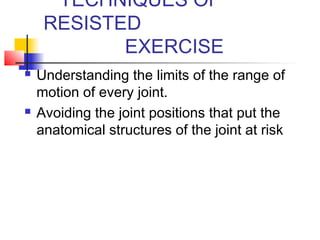
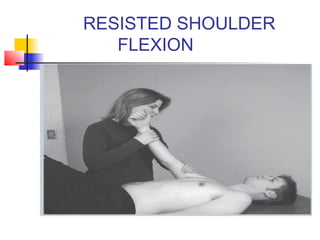
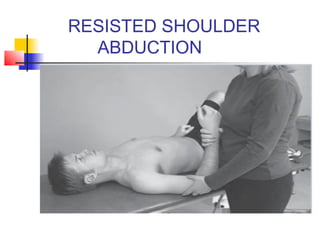
 Understanding the limits of the range of
motion of every joint.
 Avoiding the joint positions that put the
anatomical structures of the joint at risk
RESISTED SHOULDER
FLEXION
RESISTED SHOULDER
ABDUCTION
ELEVATION OF SHOULDER,
BILATERALLY RESISTED
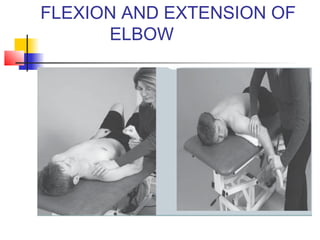
FLEXION AND EXTENSION OF
ELBOW
PROGRESSIVE RESISTED
EXERCISES
 “Is a method of increasing the ability of
muscles to generate force “
 reduce risk factors associated with
osteoporosis as well as diseases such
as cardiovascular disease
USES OF RESISTED
EXERCISE
 Physical and mental health benefits that can be achieved through resistance
training include:
 improved muscle strength and tone – to protect your joints from injury. It also
helps you maintain flexibility and balance and helps you remain independent as
you age
 weight management and increased muscle-to-fat ratio – as you gain muscle,
your body burns more kilojoules when at rest
 greater stamina – as you grow stronger, you won’t get tired as easily
 prevention or control of chronic conditions such as diabetes, heart disease,
arthritis, back pain, depression and obesity
 pain management
 improved mobility and balance
 improved posture
 decreased risk of injury
 increased bone density and strength and reduced risk of osteoporosis
 improved sense of wellbeing – resistance training may boost your self-
confidence, improve your body image and your mood
 a better night’s sleep and avoidance of insomnia
 increased self-esteem
 enhanced performance of everyday tasks.
THANKYOU!!
ANY QUESTIONS??

resisted exercises

  • 1.
    RESISTED EXERCISE Quratulain Mughal IsraUniversity Batch 4 Doctor Of Physical Therapy
  • 2.
    Content  The principlesof resistance  Variation of the power of the muscles in different parts of their range  Techniques of resisted exercises  Resistance  Progressive resistance exercise  Progression  Effects  Uses of resistance exercise
  • 3.
    RESISTANCE  Load ORresistance is given to a muscle to increase muscle performance (strength, endurance & power)
  • 4.
    PRINCIPLES OF RESISTANCE EXERCISES Overload principle  SAID principle  Reversibility principle
  • 5.
    OVERLOAD PRINCIPLE  Loadmust exceed the metabolic capacity of a muscle  Muscle is challenged to perform at greater level  In strength training programs amount of resistance applied to a muscle increased  In endurance training we focus on increase time or number of repetition increase
  • 6.
    SAID PRINCIPLES (SPECIFIC ADAPTATIONTO IMPOSED DEMAND)  Applied to all body system  This is the extension of the wolf’s law in which body system adapts overtime to the stresses placed on them USES  Helps therapist to determine the exercise prescription  Which parameters of exercise should be selected to create specific training effects that best meet specific functional needs and goals.
  • 7.
    SPECIFICITY OF TRAINING Also called specificity of exercise  Use to improve strength, power & endurance of muscle.  Means if the muscular endurance require more than the strength, the intensity & duration of exercises should be geared.  The training is depend on the type , velocity, joint angle & movt. Pattern of the exercise
  • 8.
    REVERSIBILITY PRINCIPLE  Theresistance is transmitted to gain the strength & endurance.  Use for the patient who forget movt. e.g. C.P child
  • 9.
    VARIATION OF THEPOWER OF MUSCLE IN DIFFERENT PART OF THEIR RANGE  FULL RANGE: -Contraction takes place throughout the range.( eccentric & concentric) -increases mobility -circulation increases -increase the power of muscle
  • 10.
    INNER RANGE  Themuscle either shortens concentrically from half way of its range, or is lengthened by eccentric contraction from fully contracted state to halfway.  Uses: -gain or maintain joint movt. In the direction of muscle pull.
  • 11.
    OUTER RANGE  Concentriccontraction from fully stretched position to halfway range and eccentric contraction from halfway range to the fully contacted position.  Uses - Muscles contract more forcefully.
  • 12.
    MIDDLE RANGE  Musclesneither reach to fully contracted range nor fully stretched, but moves only in between.  Uses: -maintenance of muscle tone -and normal power.
  • 13.
    TECHNIQUES OF RESISTED EXERCISE  Understandingthe limits of the range of motion of every joint.  Avoiding the joint positions that put the anatomical structures of the joint at risk
  • 14.
  • 15.
  • 16.
  • 17.
  • 18.
    PROGRESSIVE RESISTED EXERCISES  “Isa method of increasing the ability of muscles to generate force “  reduce risk factors associated with osteoporosis as well as diseases such as cardiovascular disease
  • 19.
    USES OF RESISTED EXERCISE Physical and mental health benefits that can be achieved through resistance training include:  improved muscle strength and tone – to protect your joints from injury. It also helps you maintain flexibility and balance and helps you remain independent as you age  weight management and increased muscle-to-fat ratio – as you gain muscle, your body burns more kilojoules when at rest  greater stamina – as you grow stronger, you won’t get tired as easily  prevention or control of chronic conditions such as diabetes, heart disease, arthritis, back pain, depression and obesity  pain management  improved mobility and balance  improved posture  decreased risk of injury  increased bone density and strength and reduced risk of osteoporosis  improved sense of wellbeing – resistance training may boost your self- confidence, improve your body image and your mood  a better night’s sleep and avoidance of insomnia  increased self-esteem  enhanced performance of everyday tasks.
  • 20.