1) Atoms are the smallest particle of an element that retains the properties of that element.
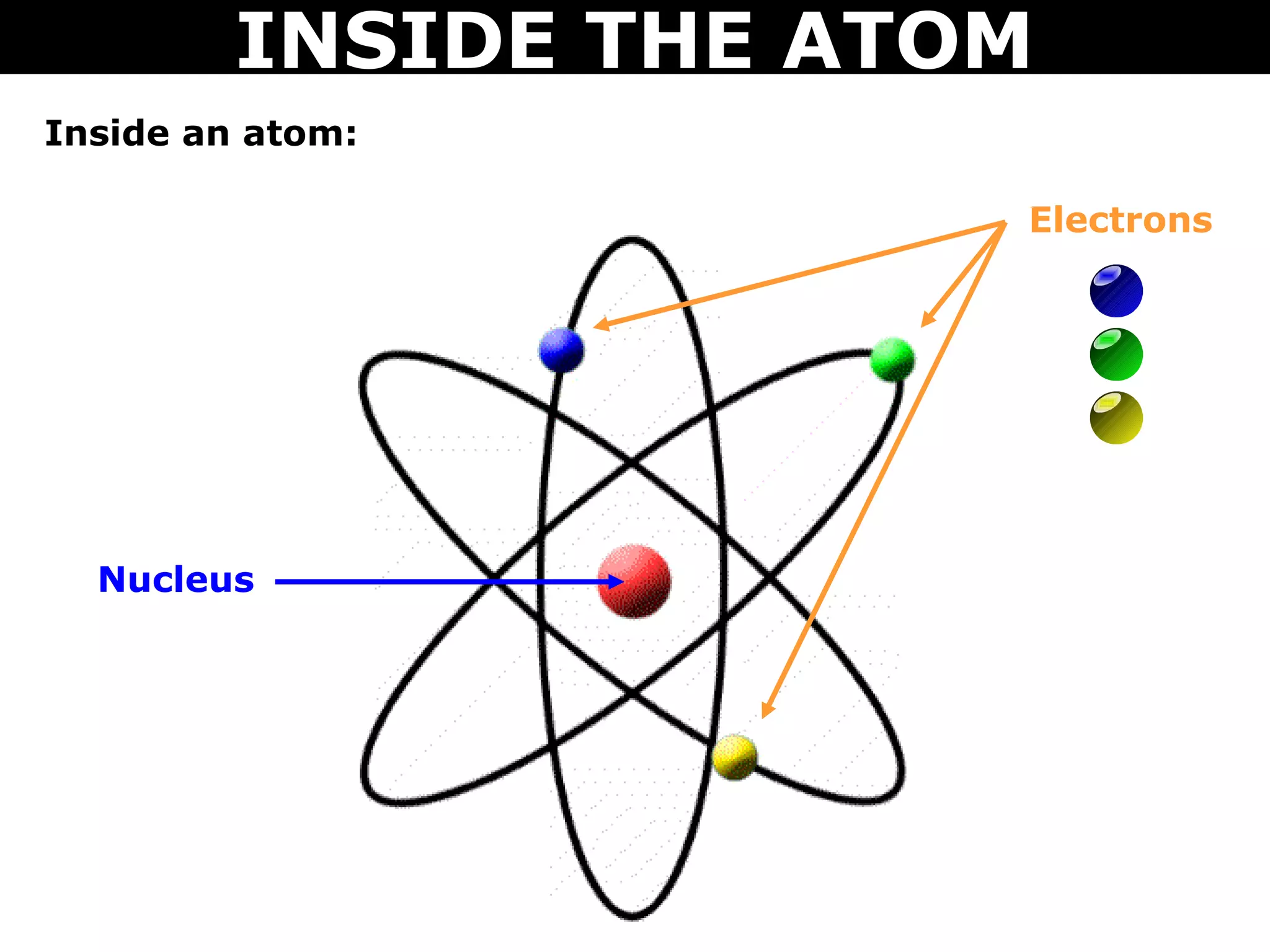
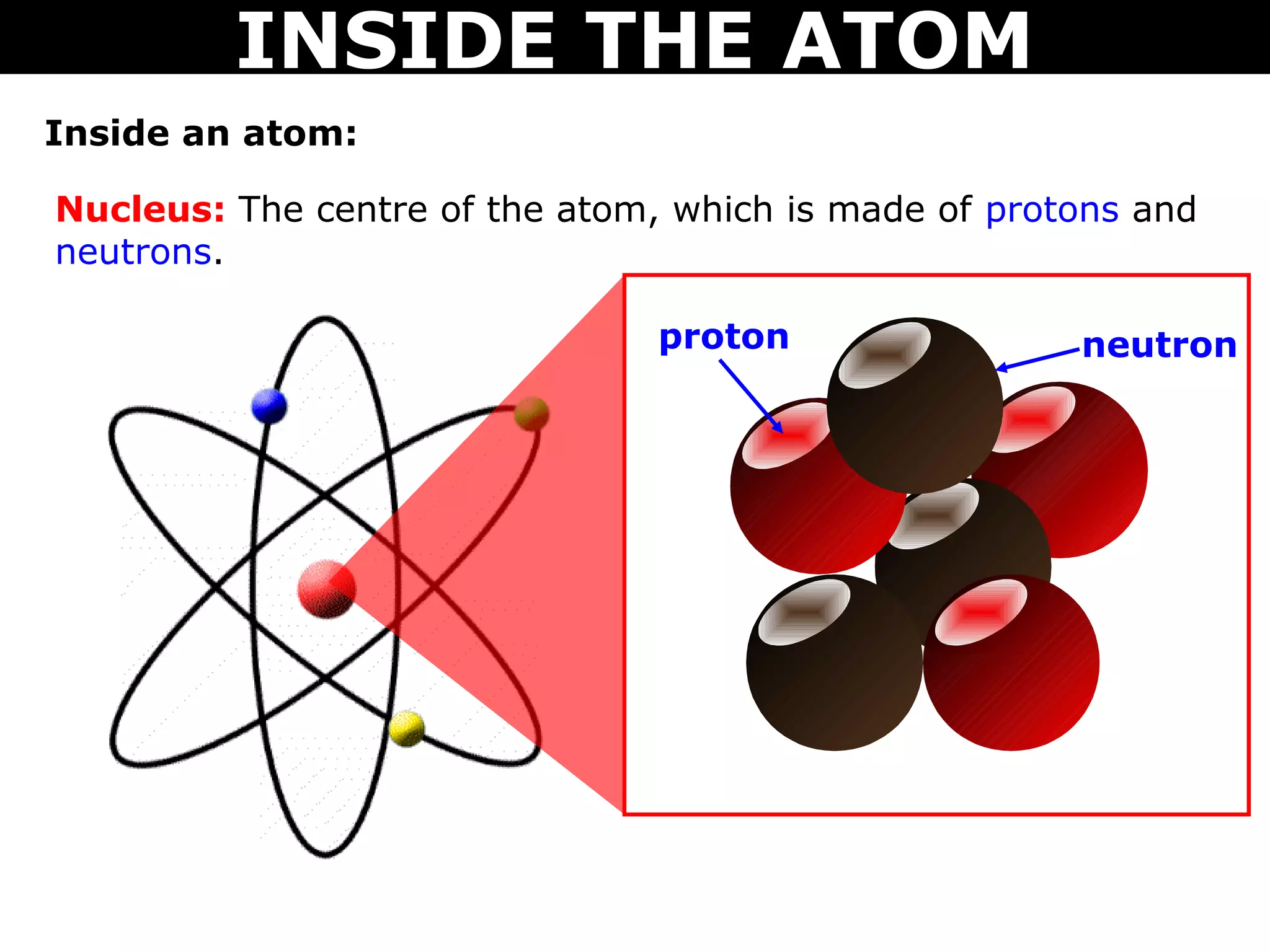
2) Atoms consist of electrons that orbit a nucleus, which contains protons and neutrons.
3) Protons have a positive charge, electrons have a negative charge, and neutrons have no charge. The number of protons defines the element.
4) Atoms are electrically neutral when they contain an equal number of protons and electrons. Ions are formed when atoms gain or lose electrons.
In this document
Powered by AI
Introduction to elements as pure substances and compounds formed from chemical combinations.
There are over 112 different elements known in the universe, such as gold and oxygen.
Atoms are the smallest units of an element, consisting of a nucleus and electrons.
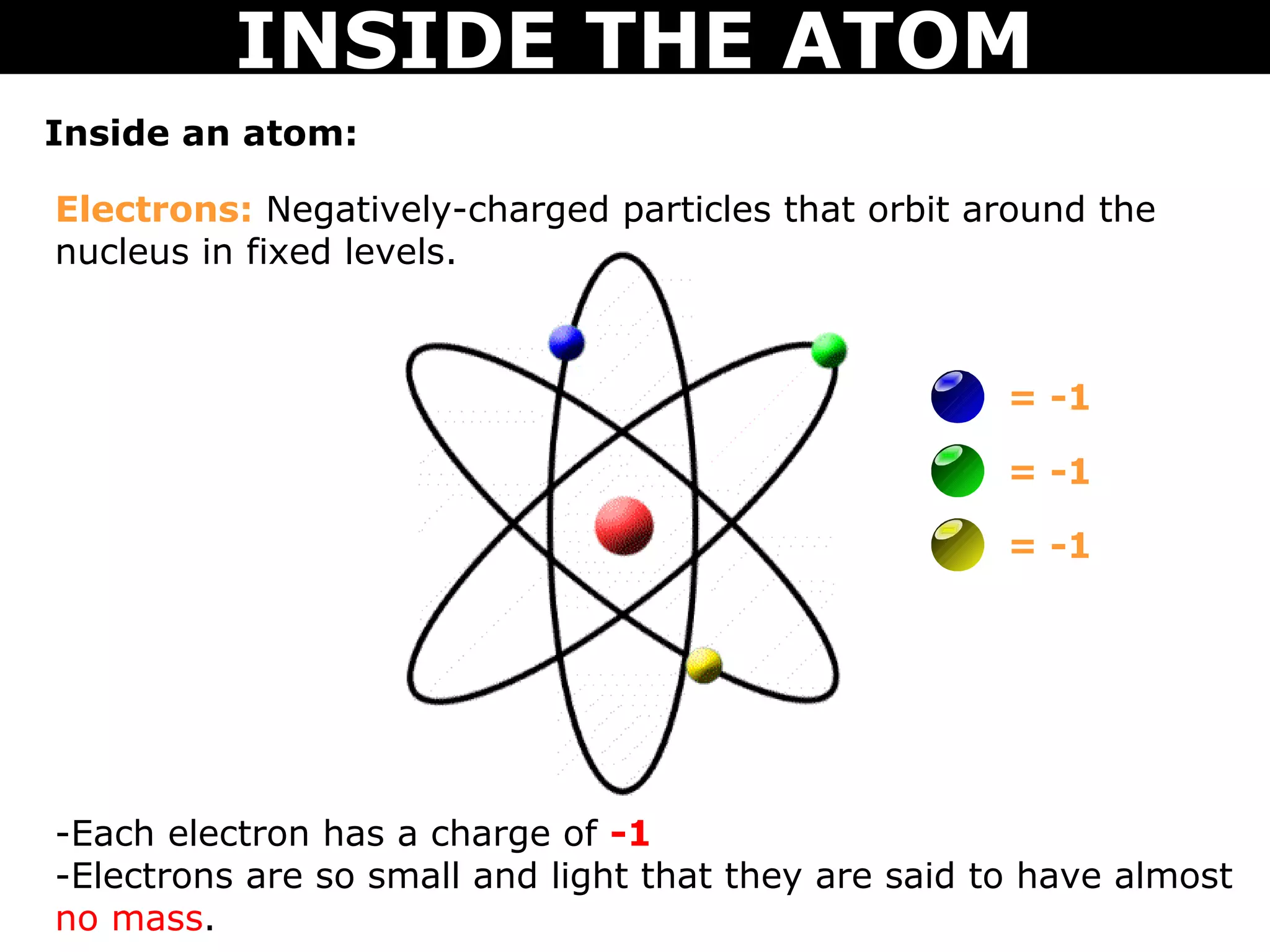
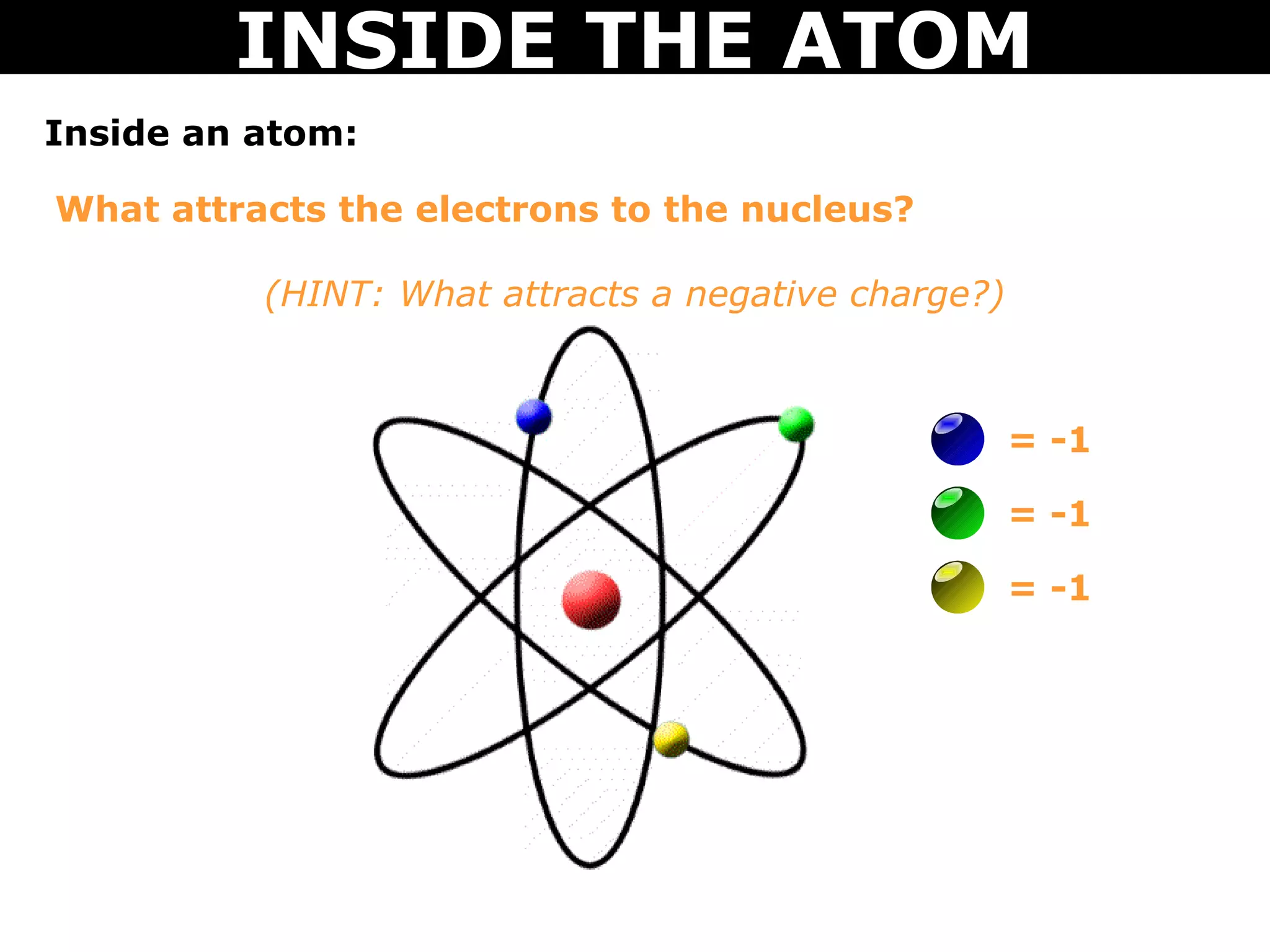
Electrons are negatively charged particles orbiting the nucleus and are attracted to positively charged protons.
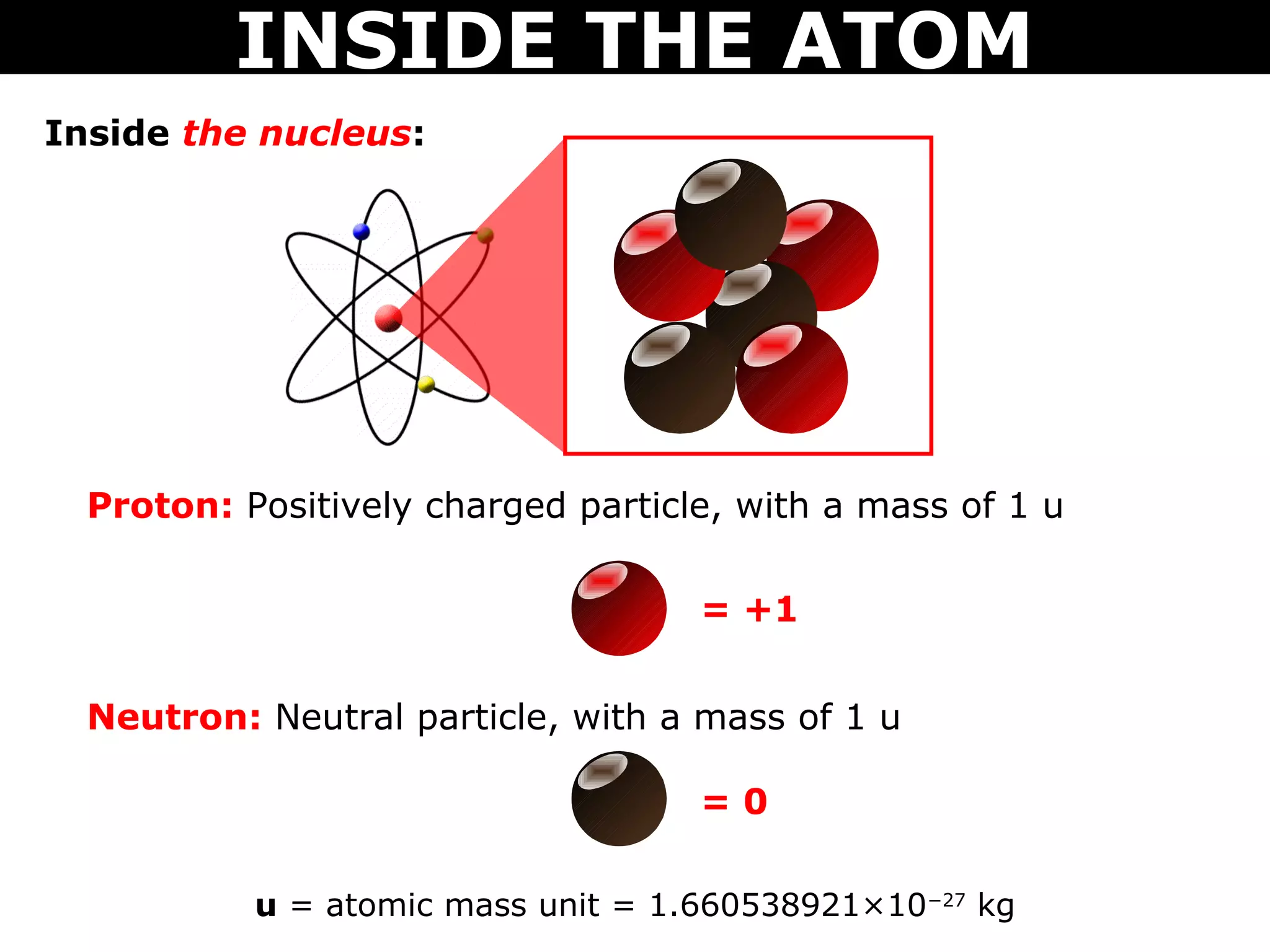
Nucleus contains protons and neutrons with specific charges and masses defined in atomic mass units.
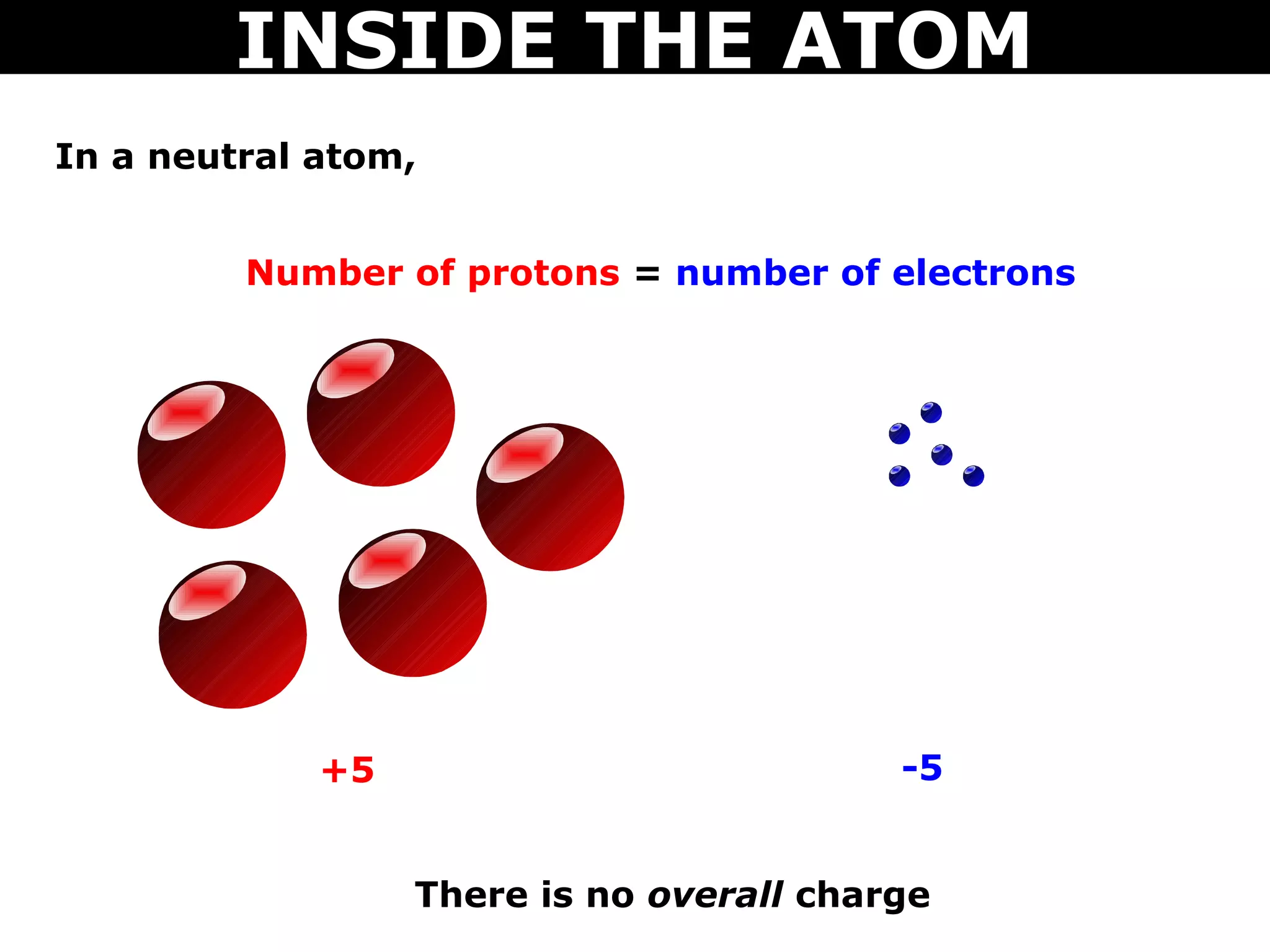
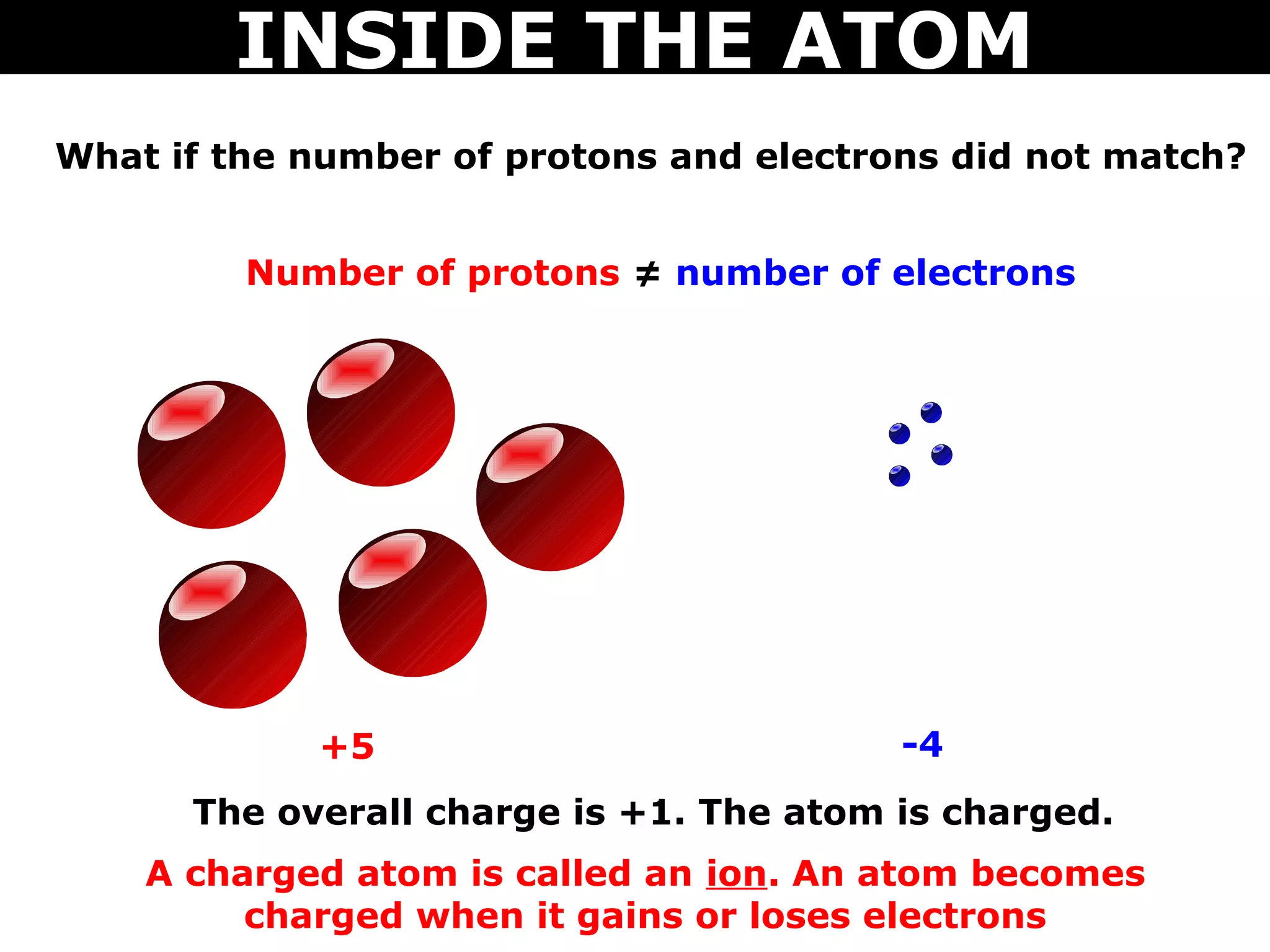
Neutral atoms have equal protons and electrons. An imbalance creates ions.
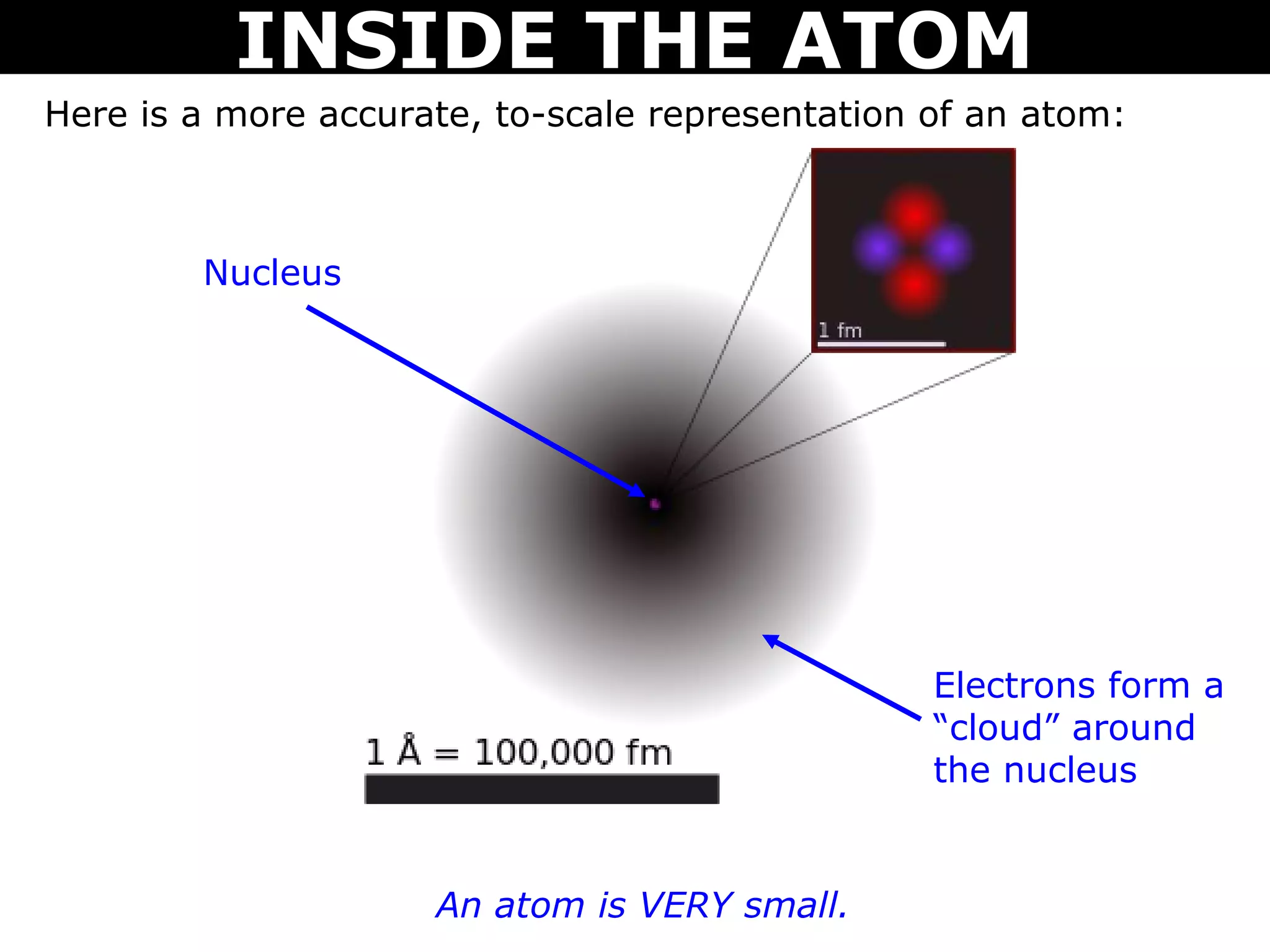
Illustration of atomic structure showing the nucleus and surrounding electron cloud.
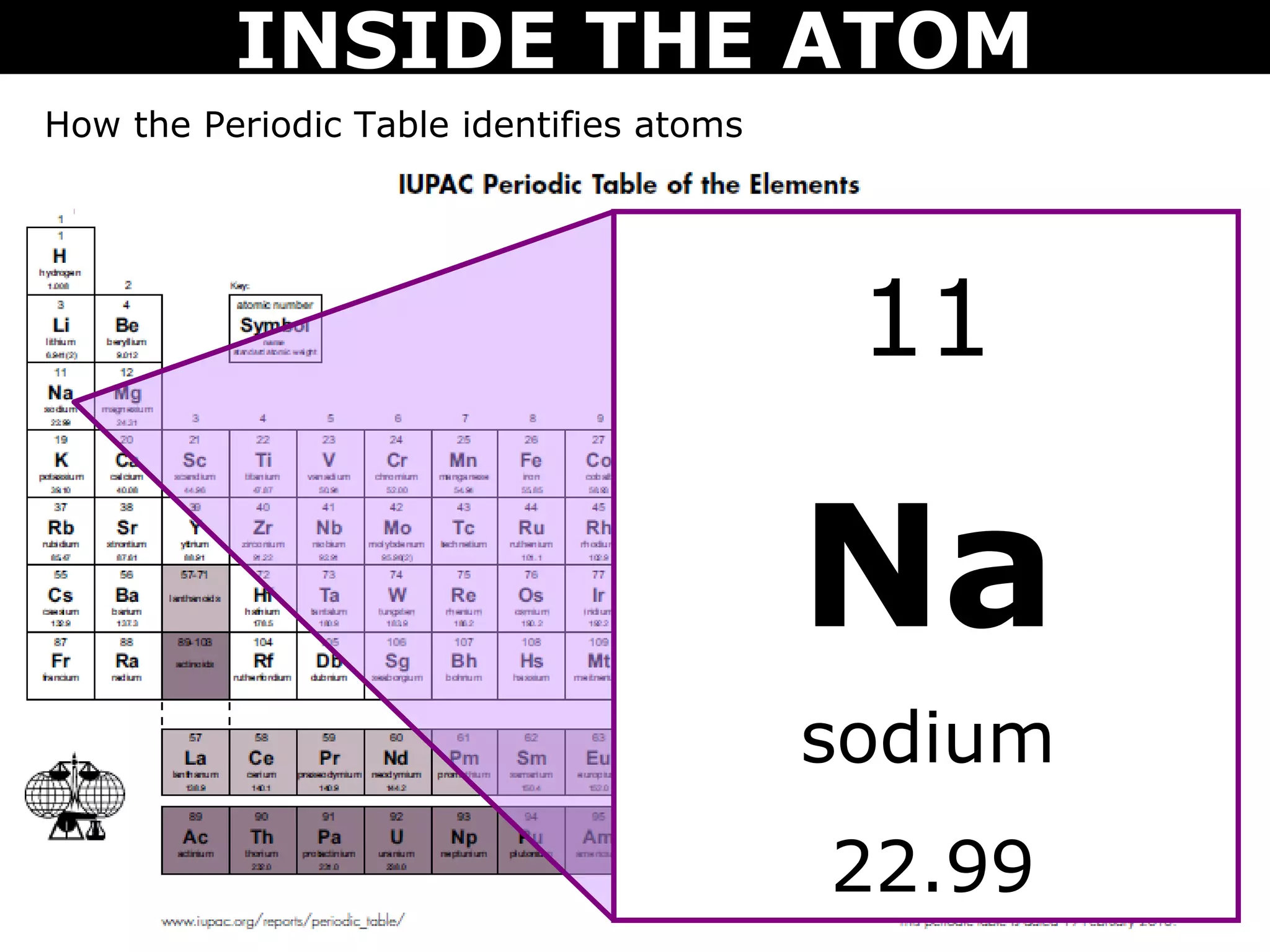
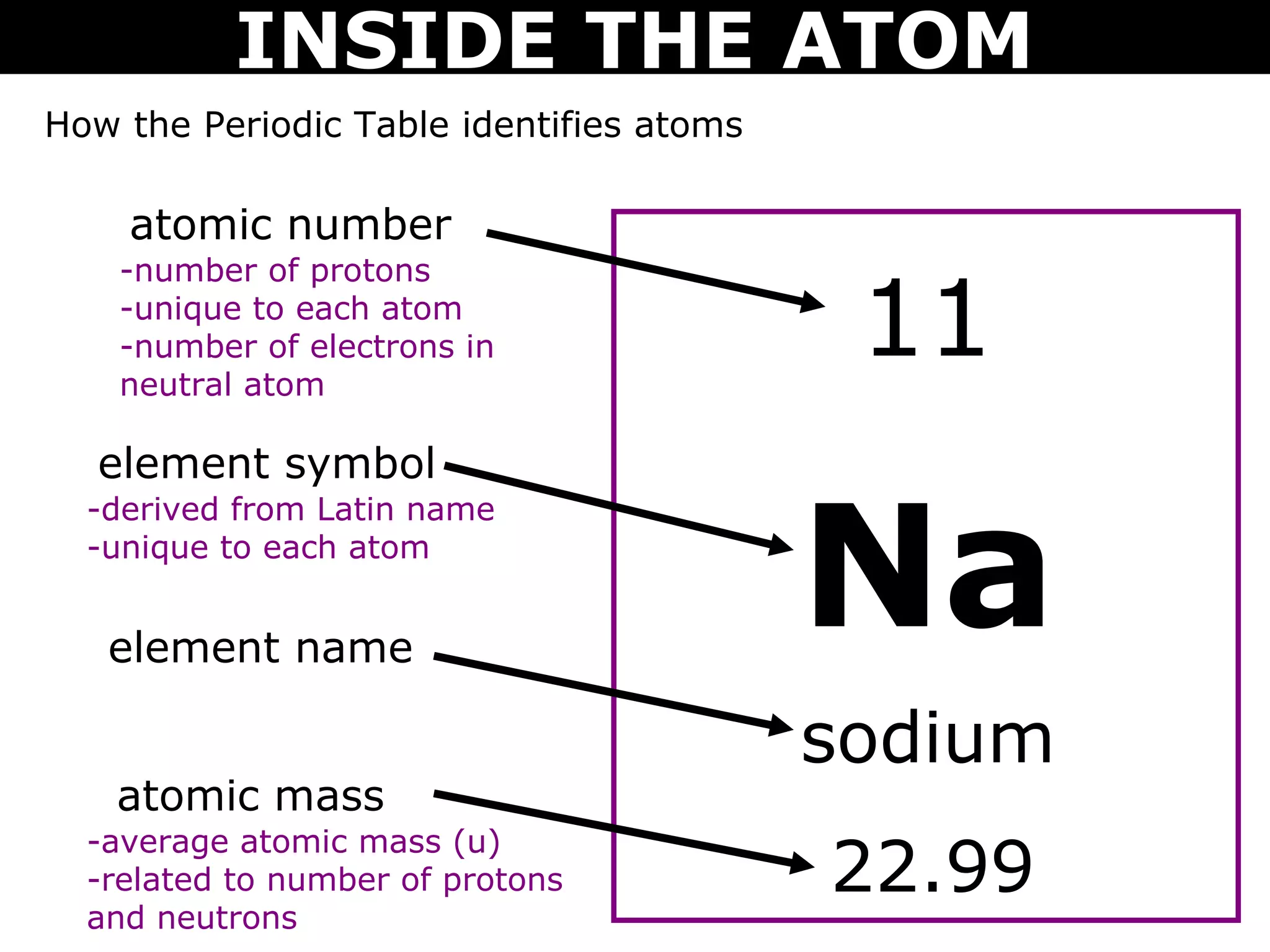
The periodic table organizes elements by atomic number, mass, and unique symbols, indicating protons and neutrons.
Standard Atomic Notation shows mass and atomic numbers; identification of neutral atoms and ions.
Examples to distinguish between ions and neutral elements based on the number of protons and electrons.
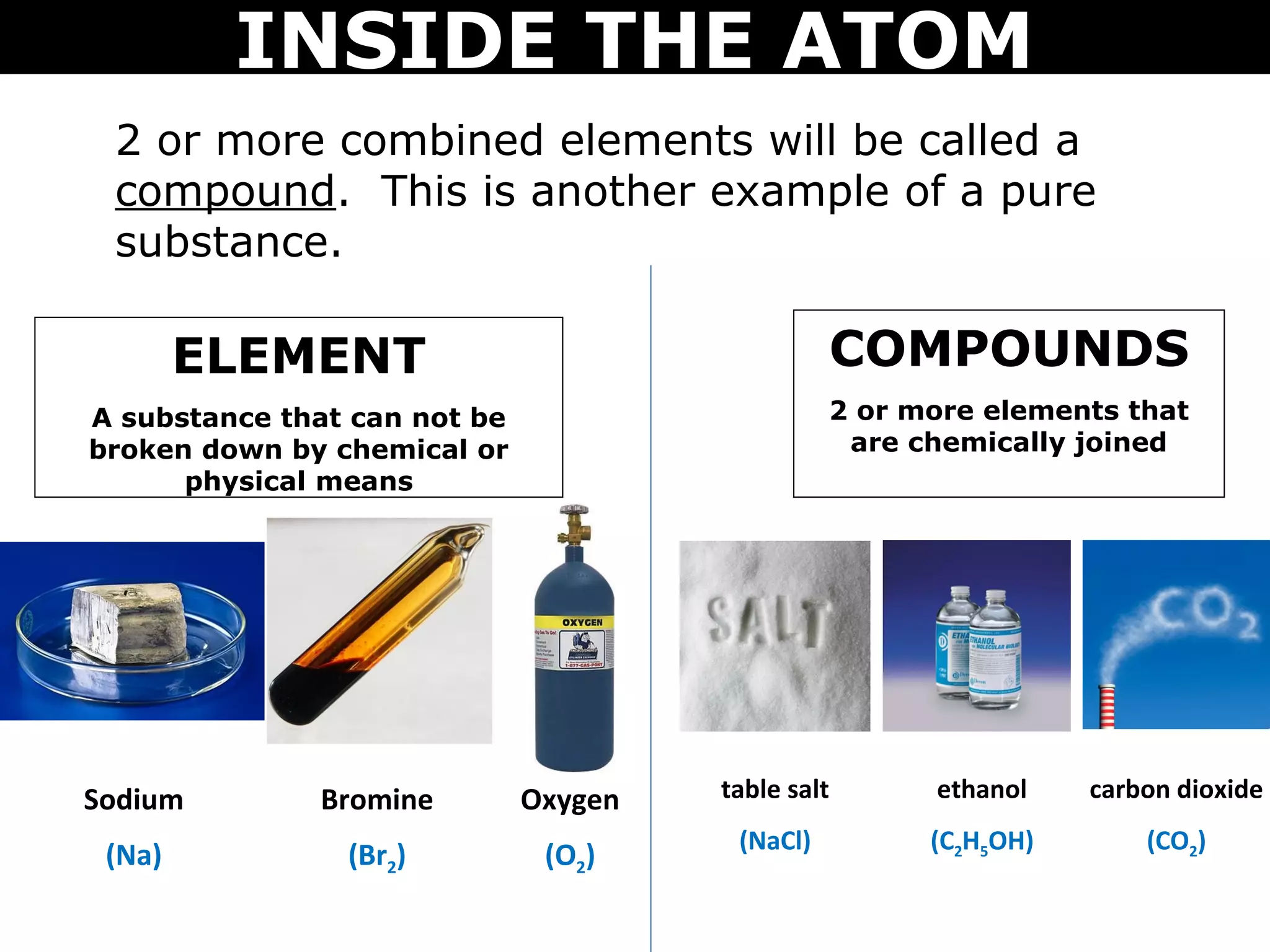
Explanation of compounds formed by chemical combinations of two or more elements.
INSIDE THE ATOM
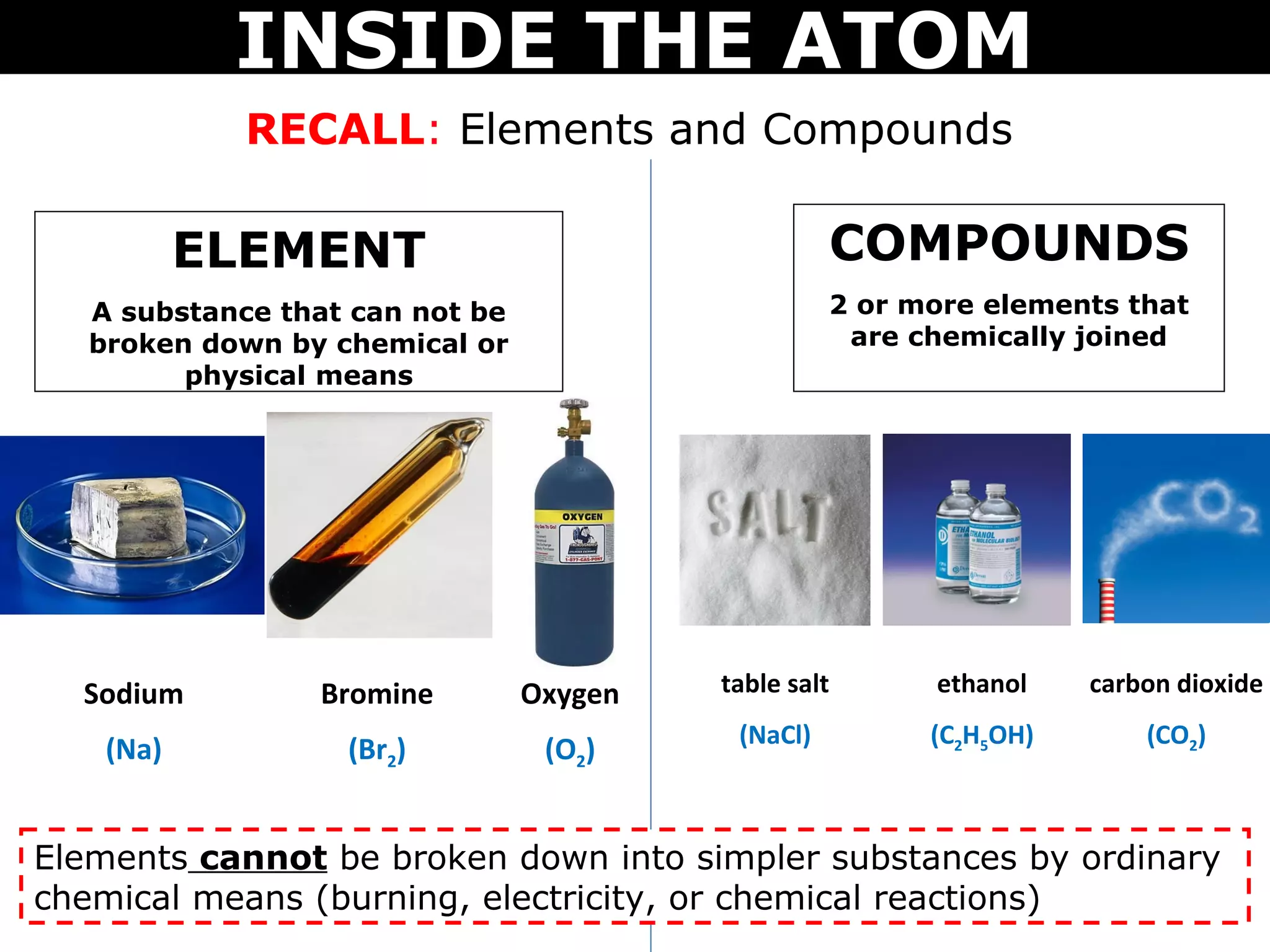
RECALL: Elements and Compounds
ELEMENT COMPOUNDS
A substance that can not be 2 or more elements that
broken down by chemical or are chemically joined
physical means
Sodium Bromine Oxygen table salt ethanol carbon dioxide
(NaCl) (C2H5OH) (CO2)
(Na) (Br2) (O2)
Elements cannot be broken down into simpler substances by ordinary
chemical means (burning, electricity, or chemical reactions)
3.
INSIDE THE ATOM
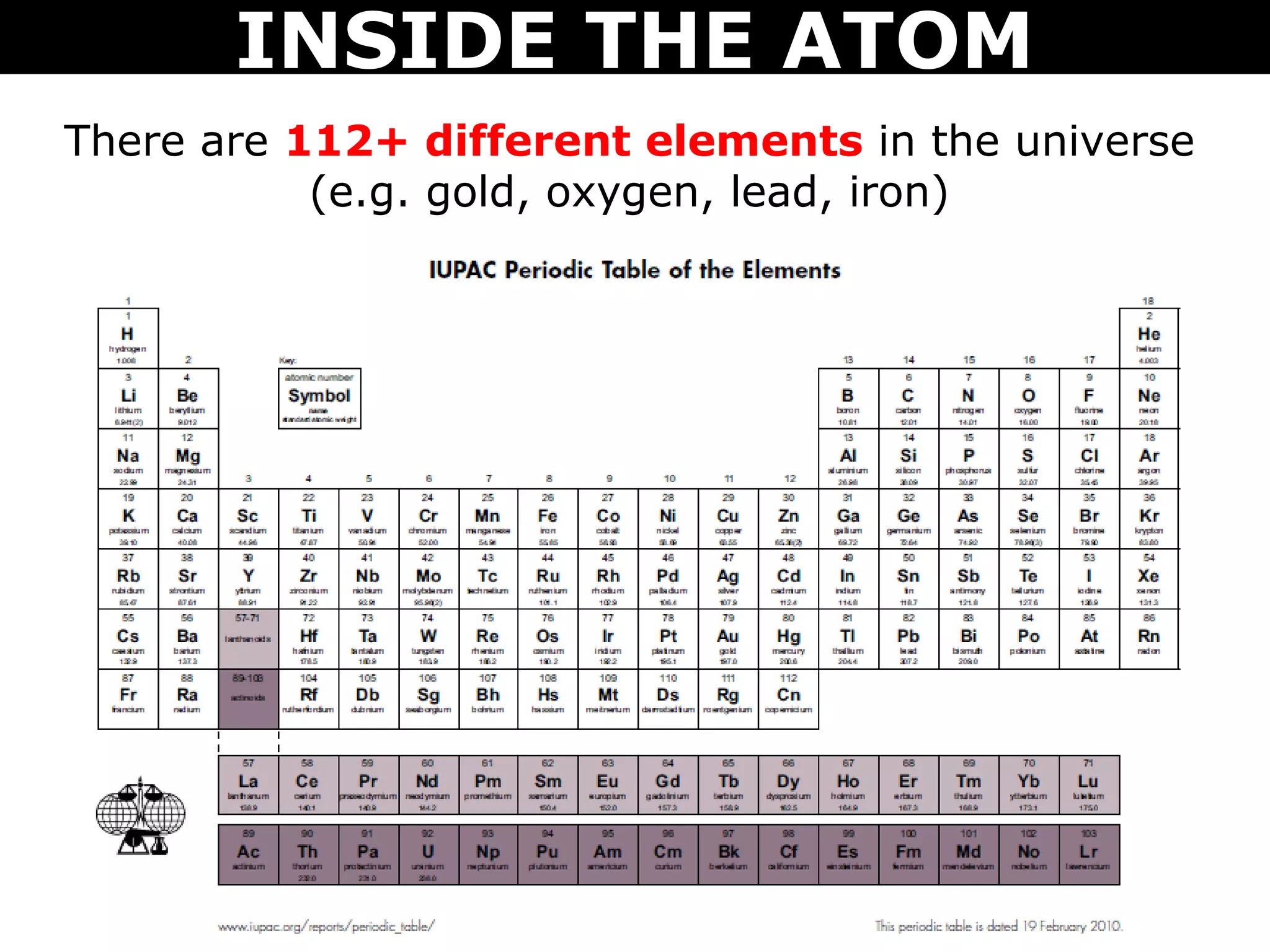
Thereare 112+ different elements in the universe
(e.g. gold, oxygen, lead, iron)
4.
INSIDE THE ATOM
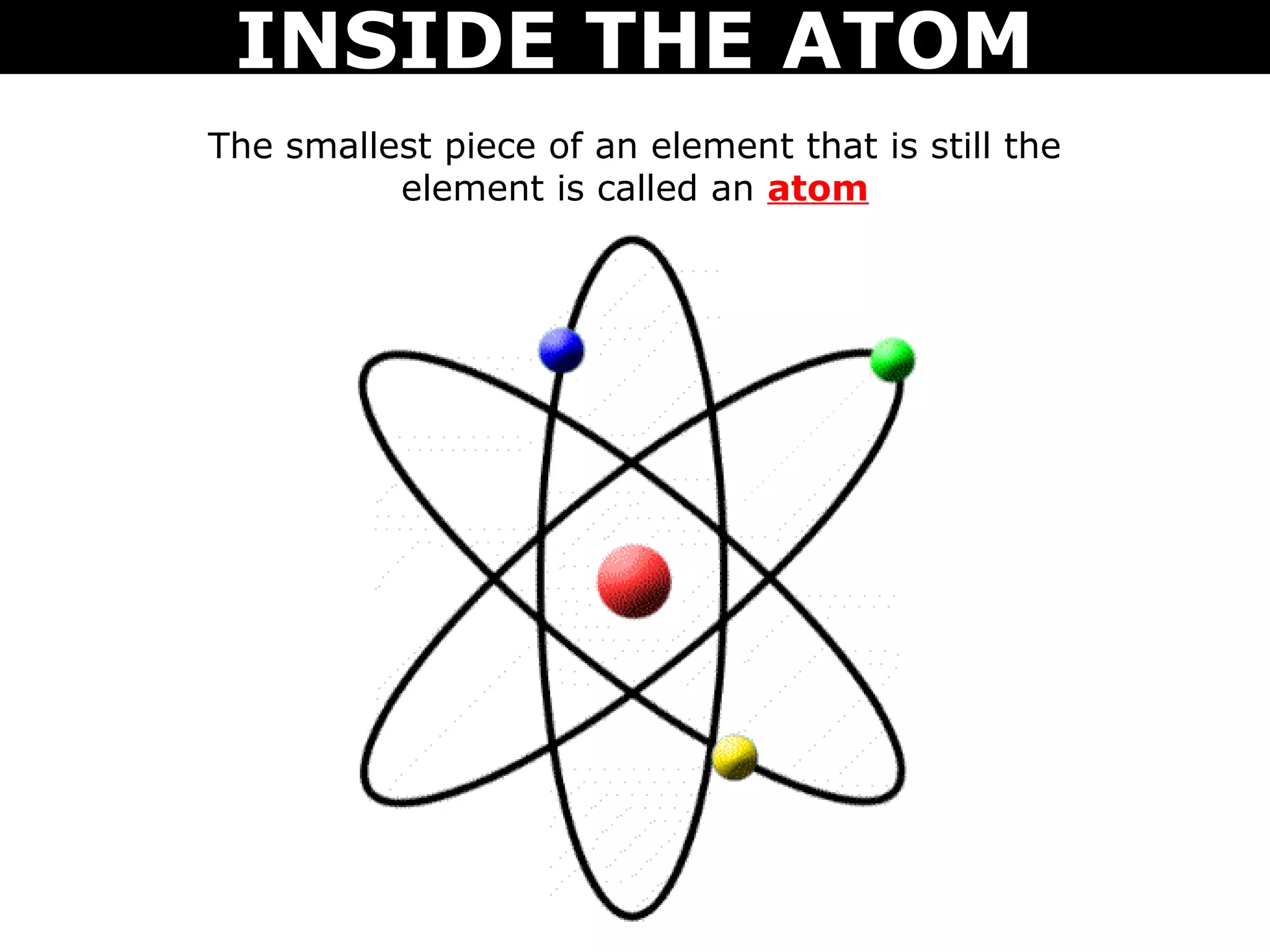
Thesmallest piece of an element that is still the
element is called an atom
INSIDE THE ATOM
Insidean atom:
Electrons: Negatively-charged particles that orbit around the
nucleus in fixed levels.
= -1
= -1
= -1
-Each electron has a charge of -1
-Electrons are so small and light that they are said to have almost
no mass.
7.
INSIDE THE ATOM
Insidean atom:
What attracts the electrons to the nucleus?
(HINT: What attracts a negative charge?)
= -1
= -1
= -1
8.
INSIDE THE ATOM
Insidean atom:
Nucleus: The centre of the atom, which is made of protons and
neutrons.
proton neutron
9.
INSIDE THE ATOM
Insidethe nucleus:
Proton: Positively charged particle, with a mass of 1 u
= +1
Neutron: Neutral particle, with a mass of 1 u
=0
u = atomic mass unit = 1.660538921×10⁻²⁷ kg
10.
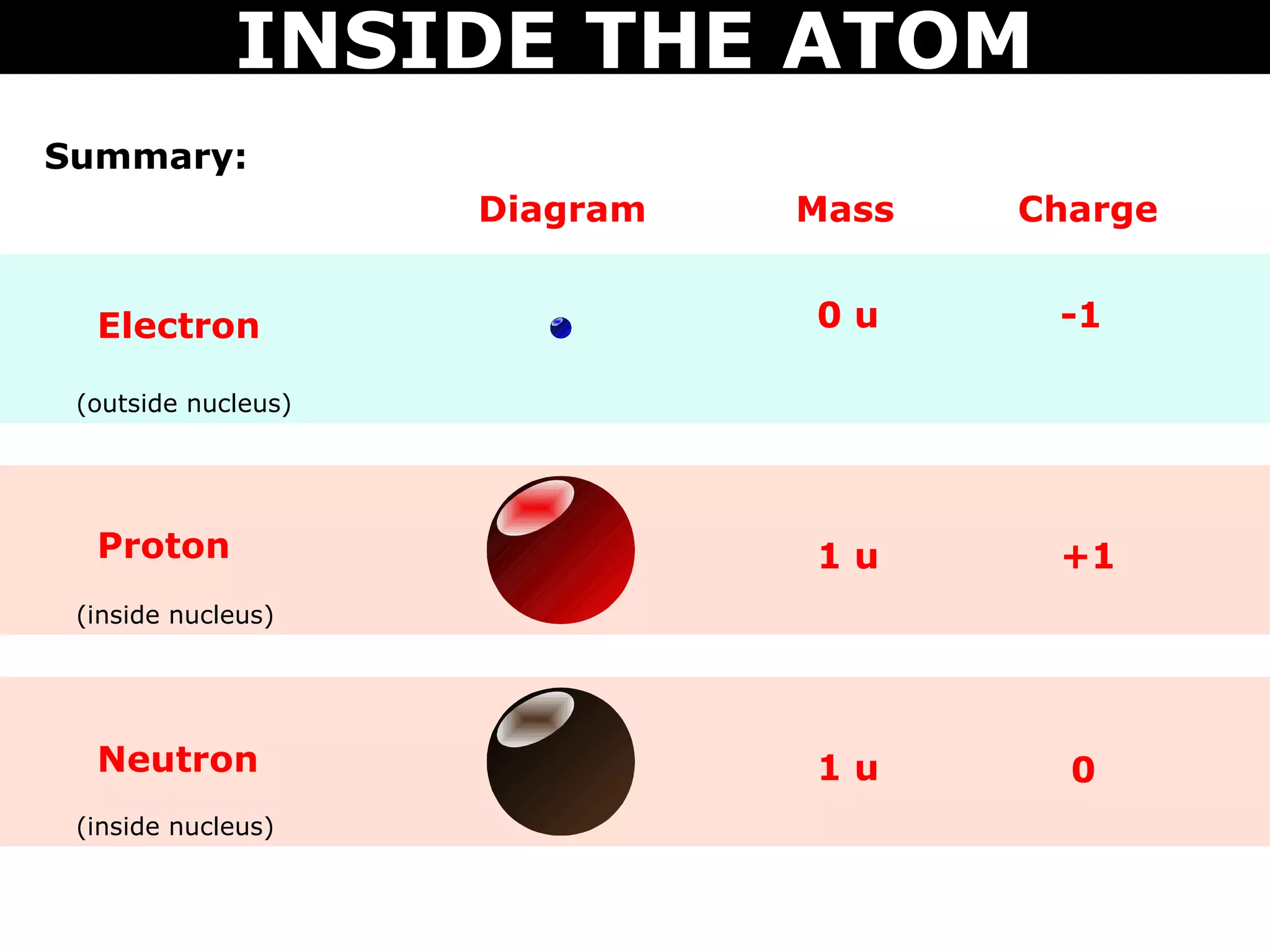
INSIDE THE ATOM
Summary:
Diagram Mass Charge
Electron 0u -1
(outside nucleus)
Proton 1u +1
(inside nucleus)
Neutron 1u 0
(inside nucleus)
11.
INSIDE THE ATOM
Ina neutral atom,
Number of protons = number of electrons
+5 -5
There is no overall charge
12.
INSIDE THE ATOM
Whatif the number of protons and electrons did not match?
Number of protons ≠ number of electrons
+5 -4
The overall charge is +1. The atom is charged.
A charged atom is called an ion. An atom becomes
charged when it gains or loses electrons
13.
INSIDE THE ATOM
Hereis a more accurate, to-scale representation of an atom:
Nucleus
Electrons form a
“cloud” around
the nucleus
An atom is VERY small.
INSIDE THE ATOM
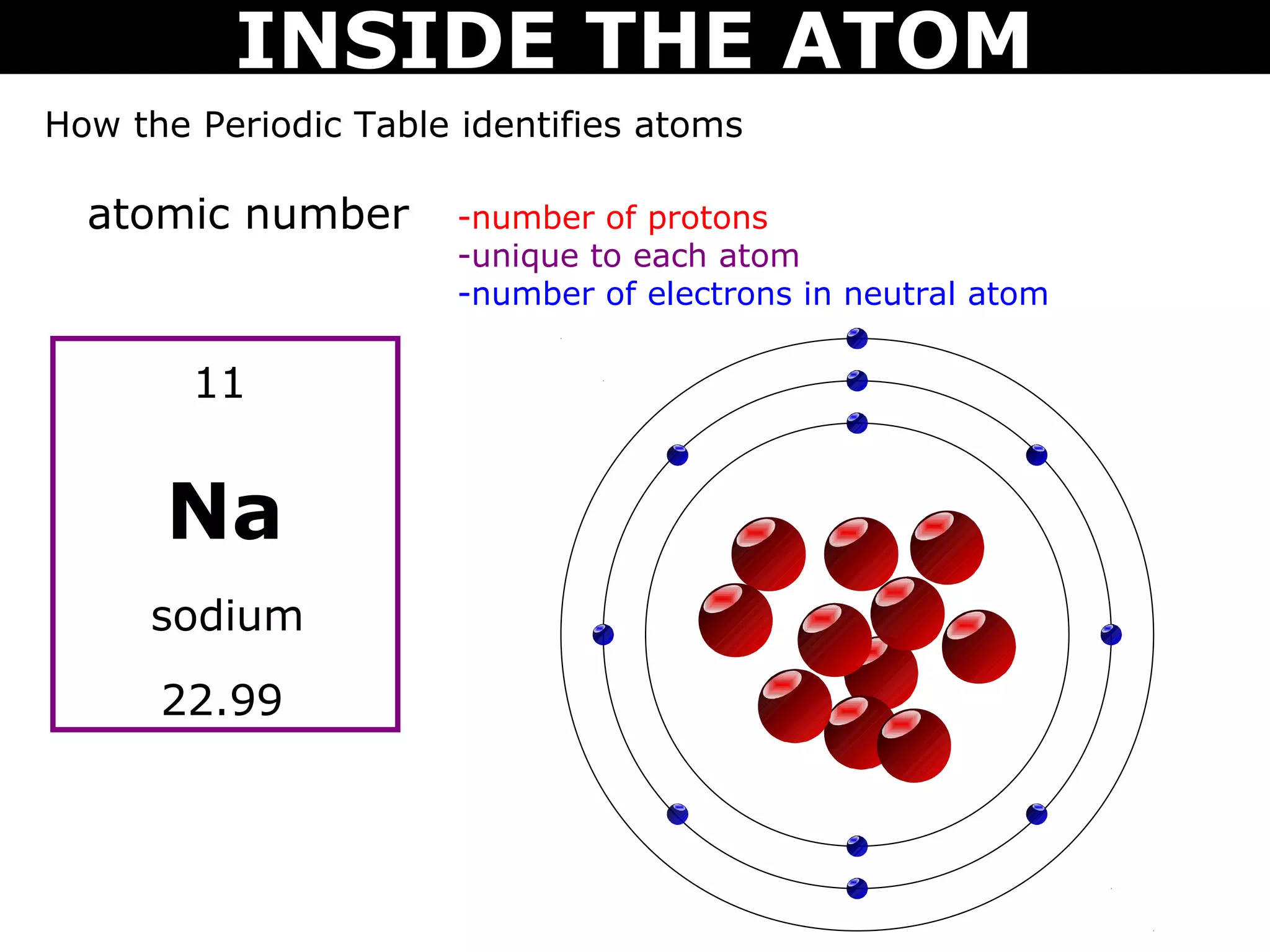
Howthe Periodic Table identifies atoms
atomic number
11
-number of protons
-unique to each atom
-number of electrons in
neutral atom
element symbol
Na
-derived from Latin name
-unique to each atom
element name
sodium
atomic mass
-average atomic mass (u)
-related to number of protons 22.99
and neutrons
16.
INSIDE THE ATOM
Howthe Periodic Table identifies atoms
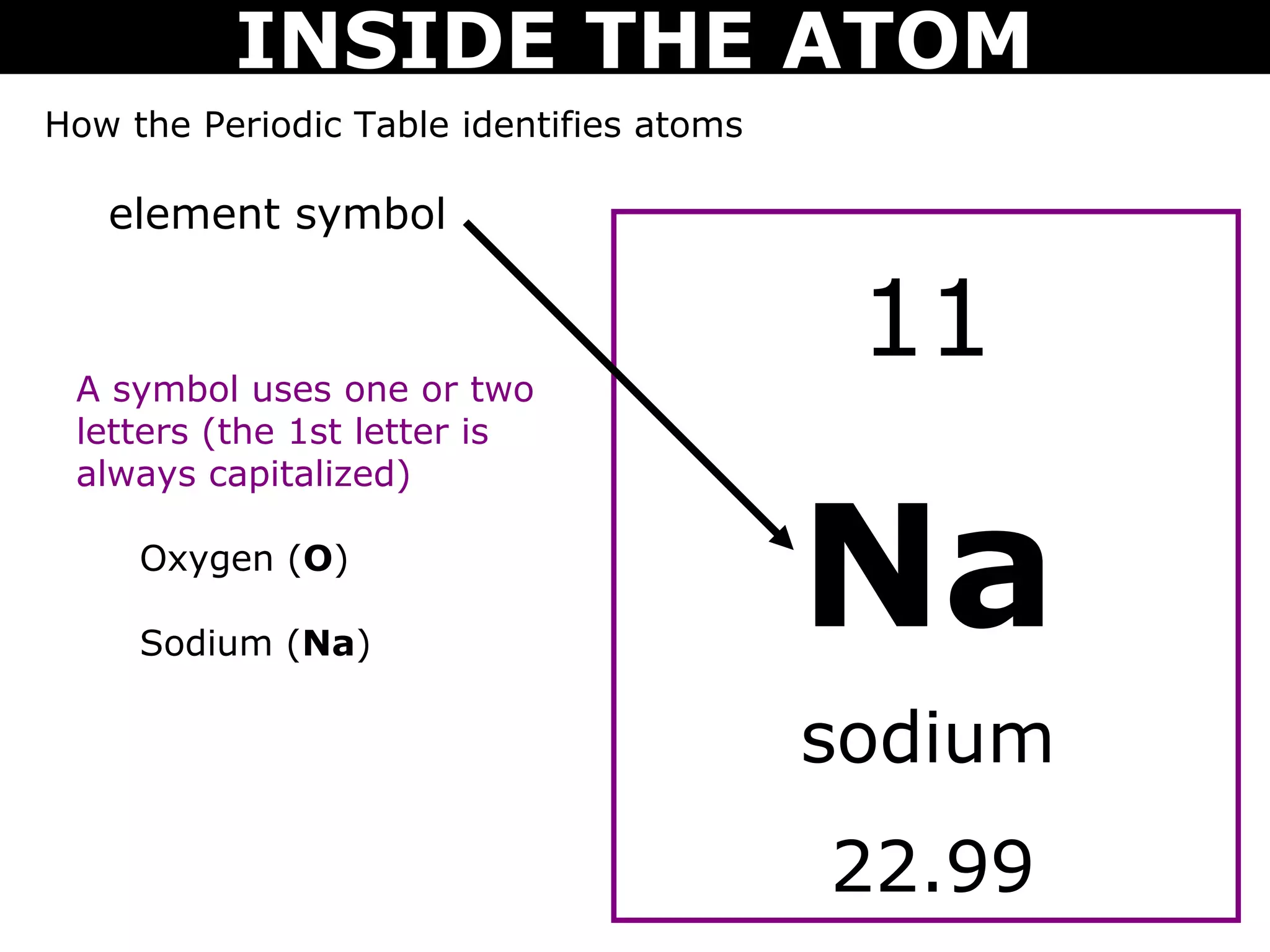
element symbol
A symbol uses one or two
11
letters (the 1st letter is
always capitalized)
Oxygen (O)
Sodium (Na)
Na
sodium
22.99
17.
INSIDE THE ATOM
Howthe Periodic Table identifies atoms
atomic number -number of protons
-unique to each atom
-number of electrons in neutral atom
11
Na
sodium
22.99
18.
INSIDE THE ATOM
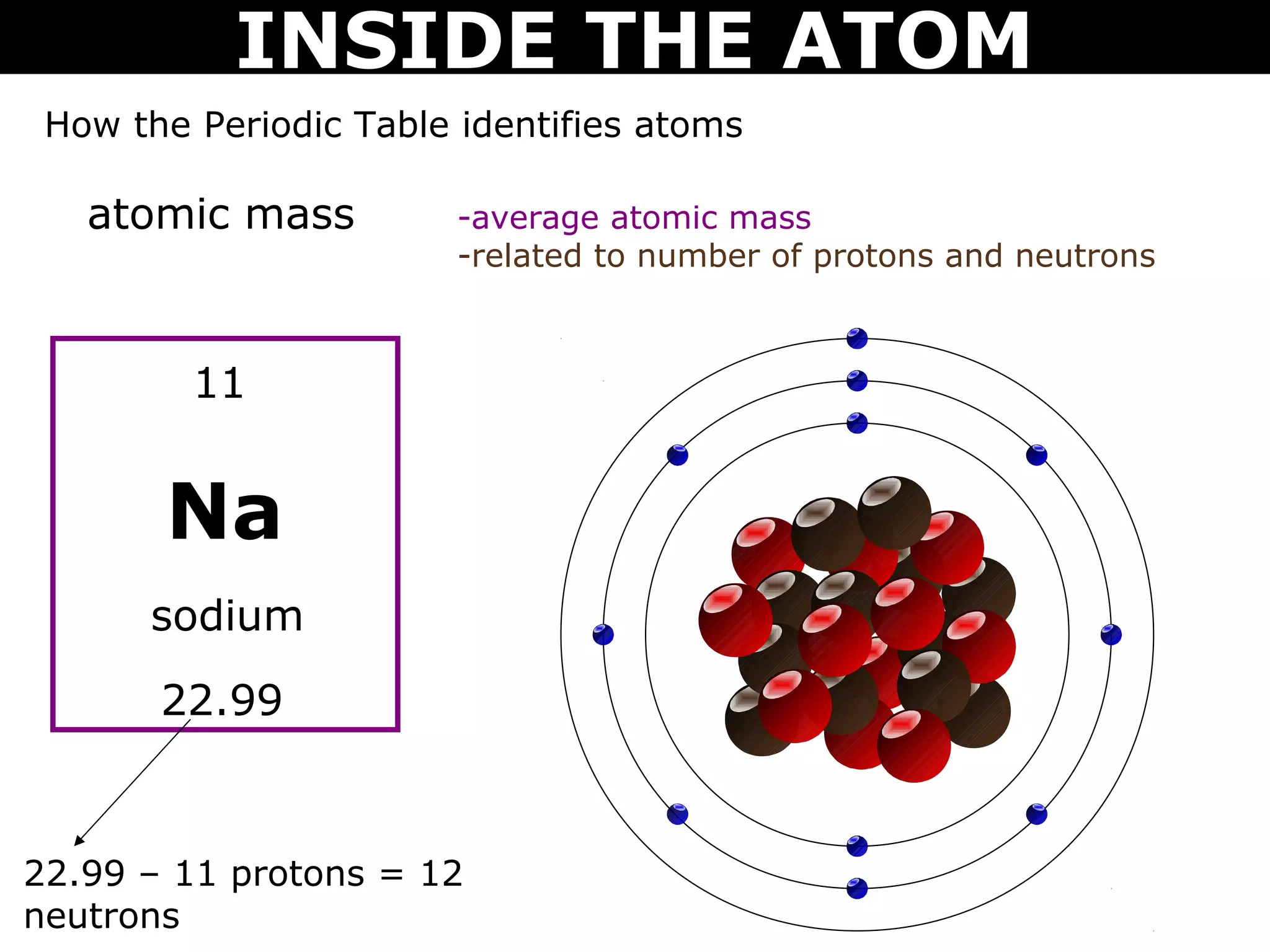
How the Periodic Table identifies atoms
atomic mass -average atomic mass
-related to number of protons and neutrons
11
Na
sodium
22.99
22.99 – 11 protons = 12
neutrons
19.
INSIDE THE ATOM
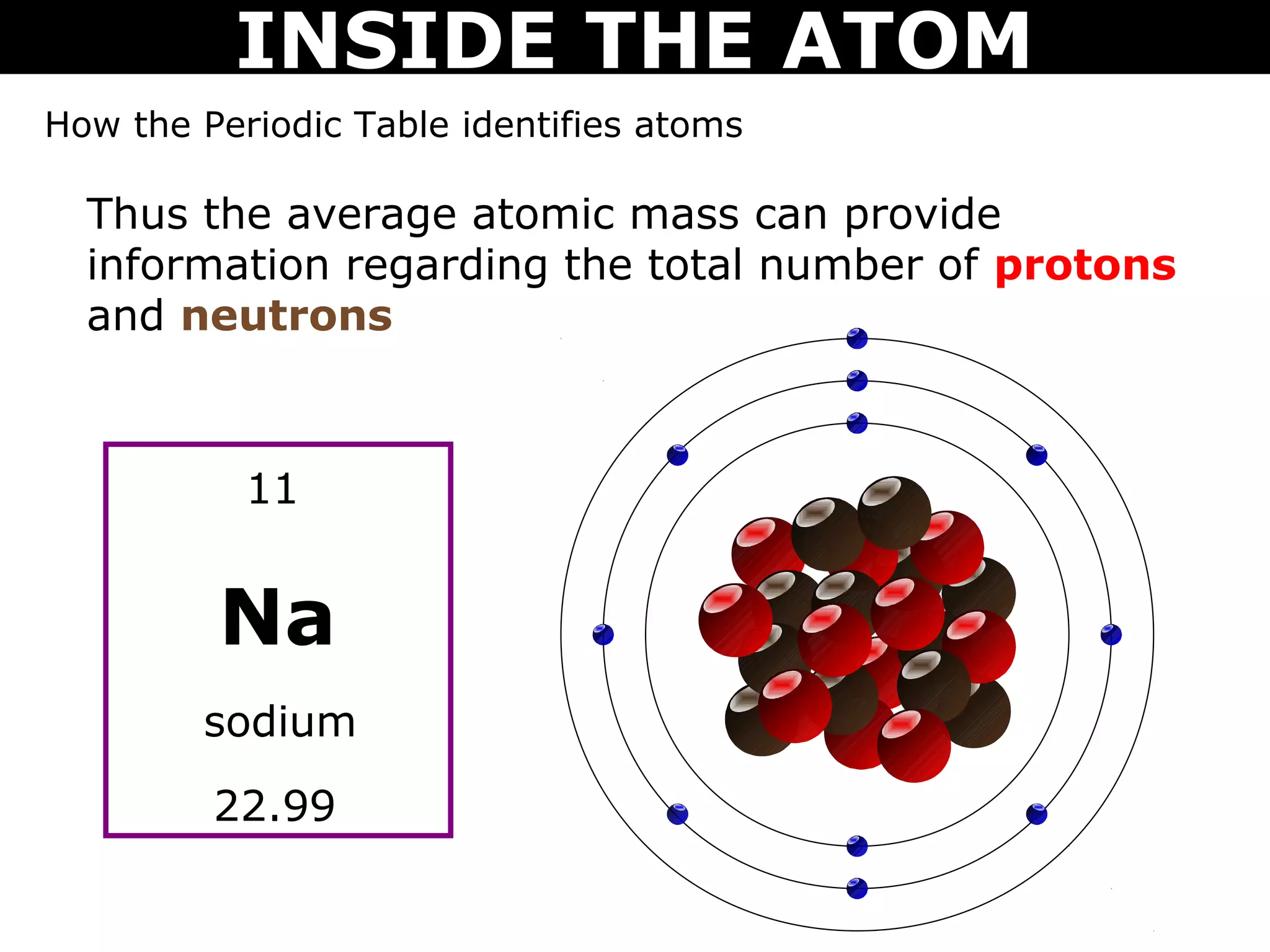
Howthe Periodic Table identifies atoms
Thus the average atomic mass can provide
information regarding the total number of protons
and neutrons
11
Na
sodium
22.99
20.
INSIDE THE ATOM
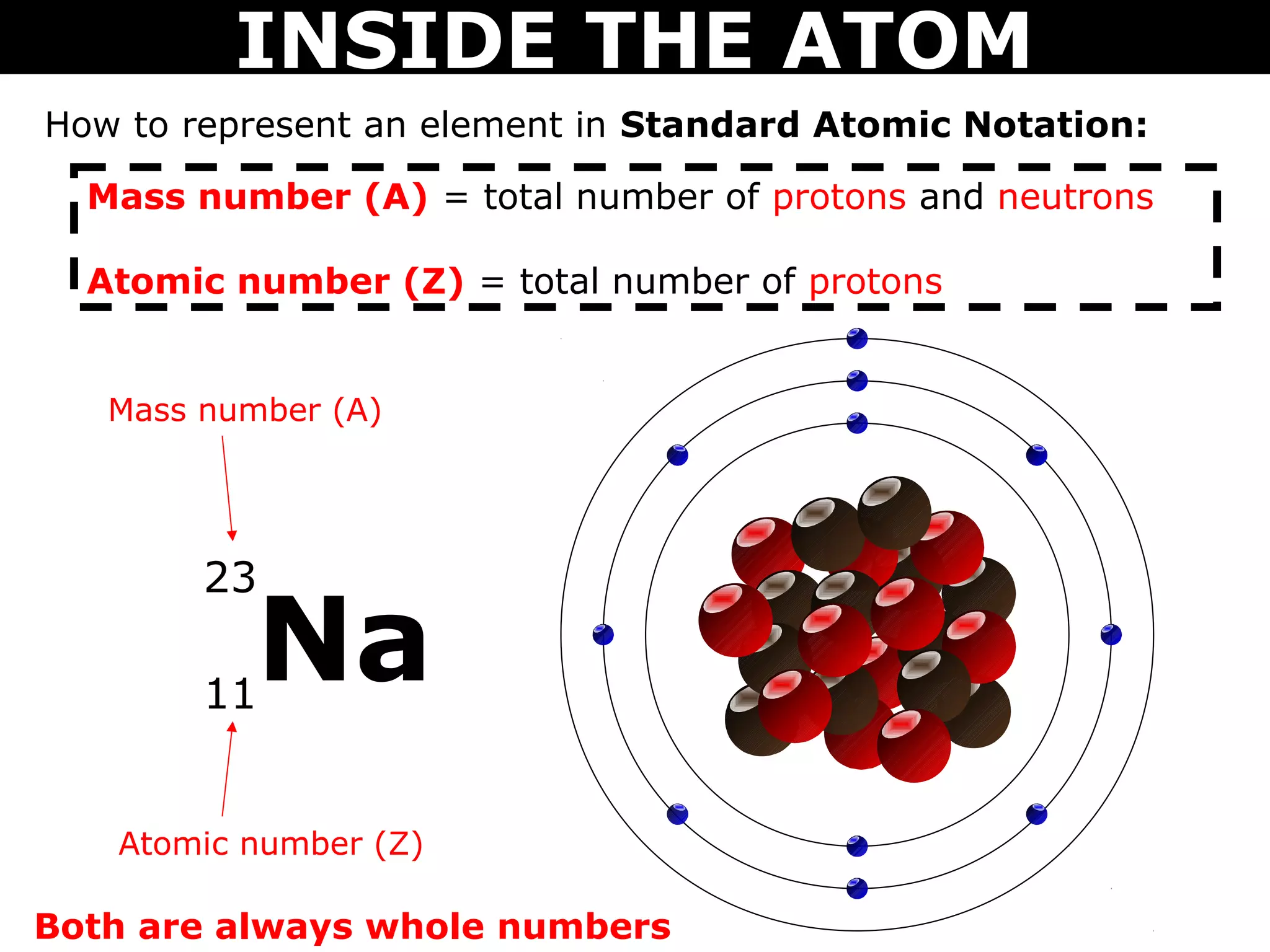
Howto represent an element in Standard Atomic Notation:
Mass number (A) = total number of protons and neutrons
Atomic number (Z) = total number of protons
Mass number (A)
23
11
Na
Atomic number (Z)
Both are always whole numbers
21.
INSIDE THE ATOM
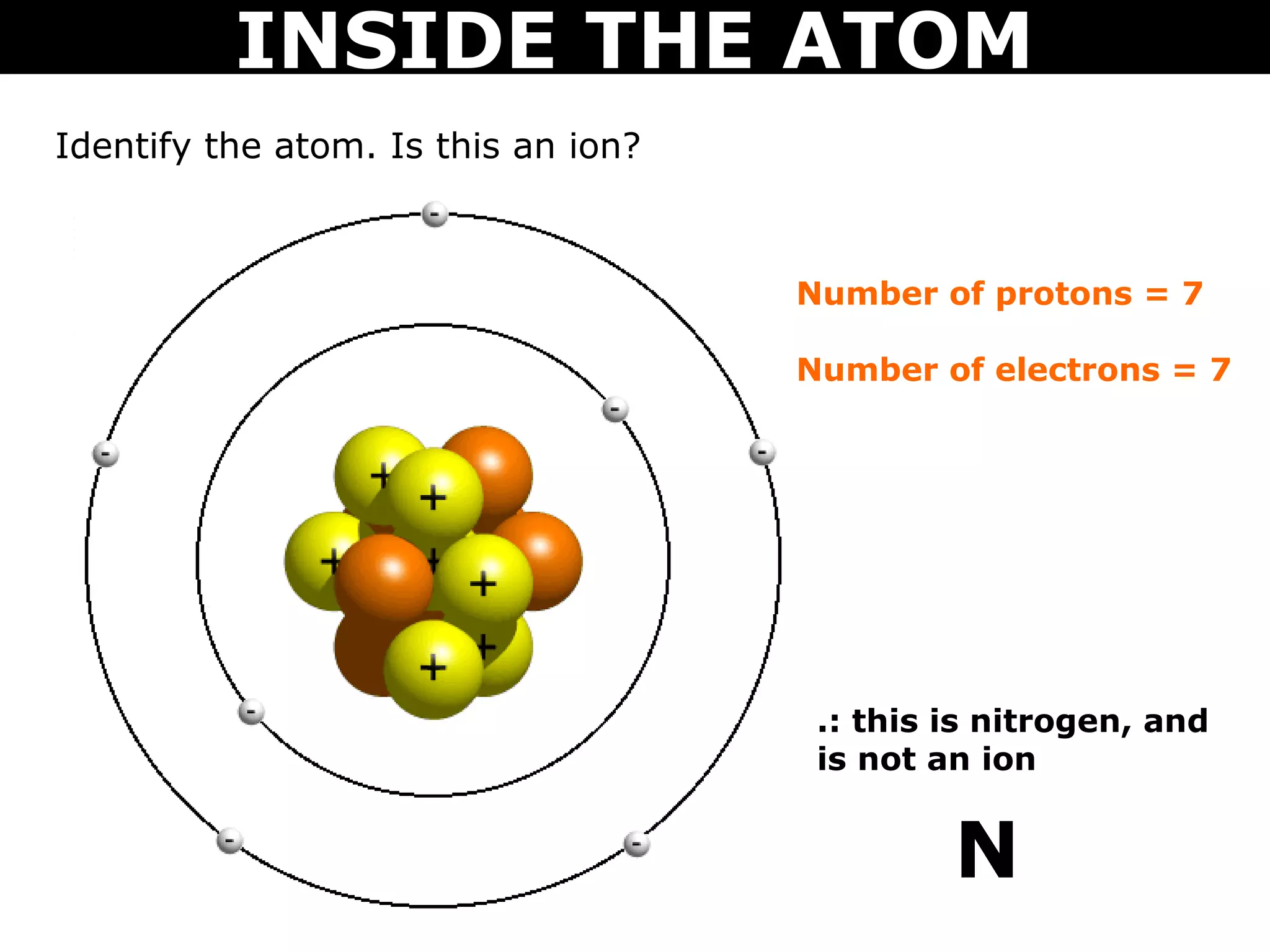
Identifythe atom. Is this an ion?
Number of protons = 7
Number of electrons = 7
.: this is nitrogen, and
is not an ion
N
22.
INSIDE THE ATOM
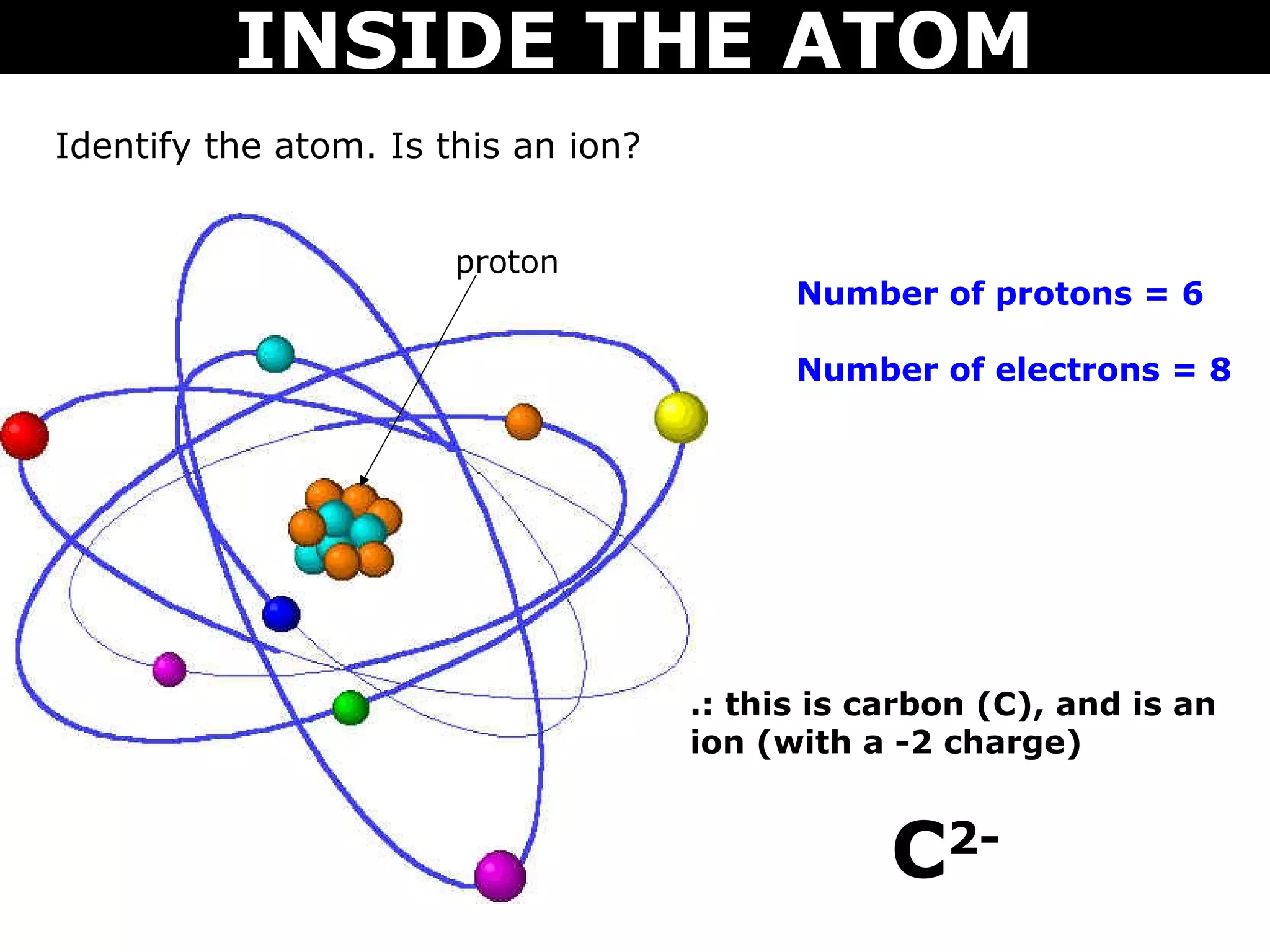
Identifythe atom. Is this an ion?
proton
Number of protons = 6
Number of electrons = 8
.: this is carbon (C), and is an
ion (with a -2 charge)
C2-
23.
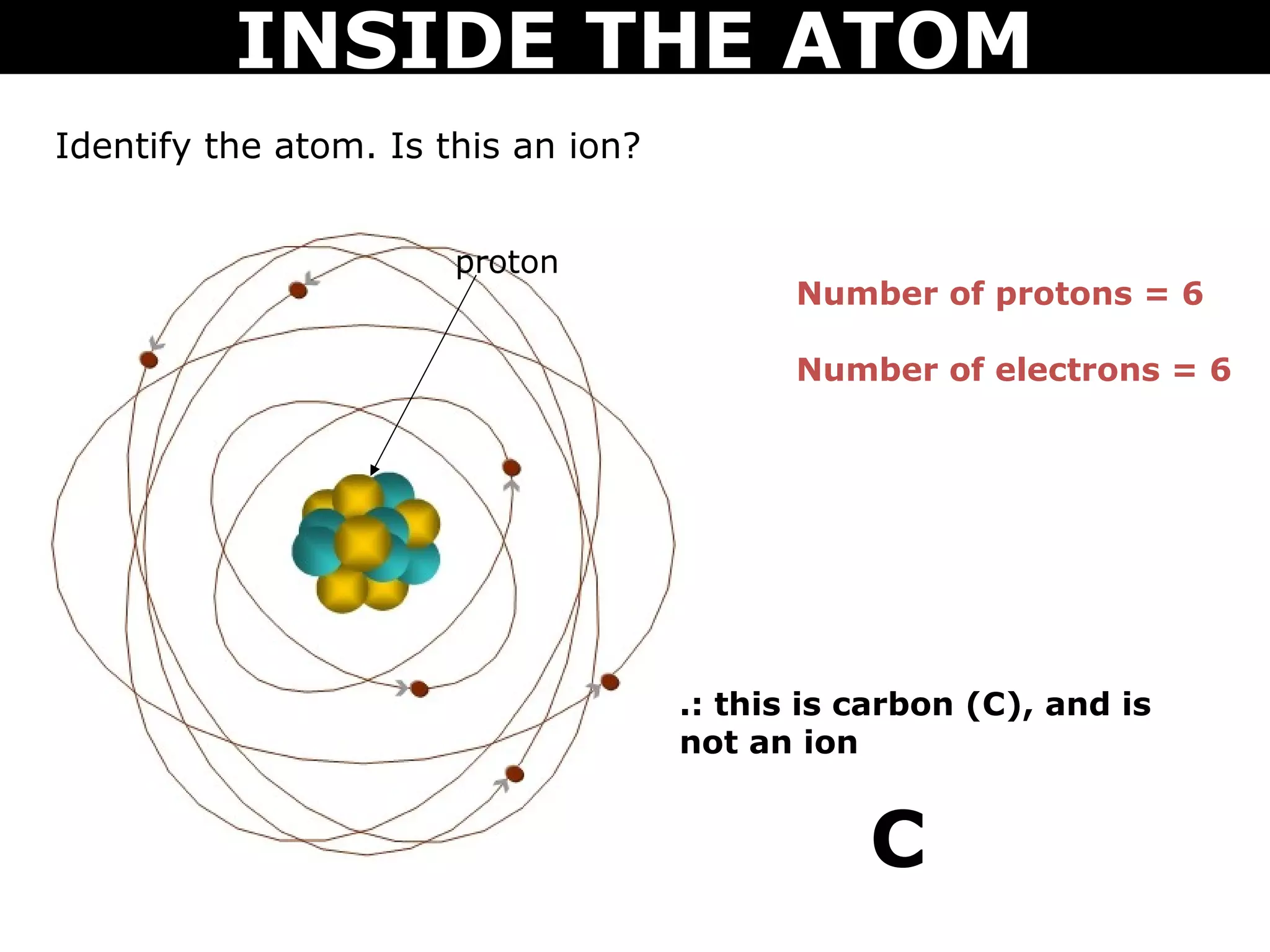
INSIDE THE ATOM
Identifythe atom. Is this an ion?
proton
Number of protons = 6
Number of electrons = 6
.: this is carbon (C), and is
not an ion
C
24.
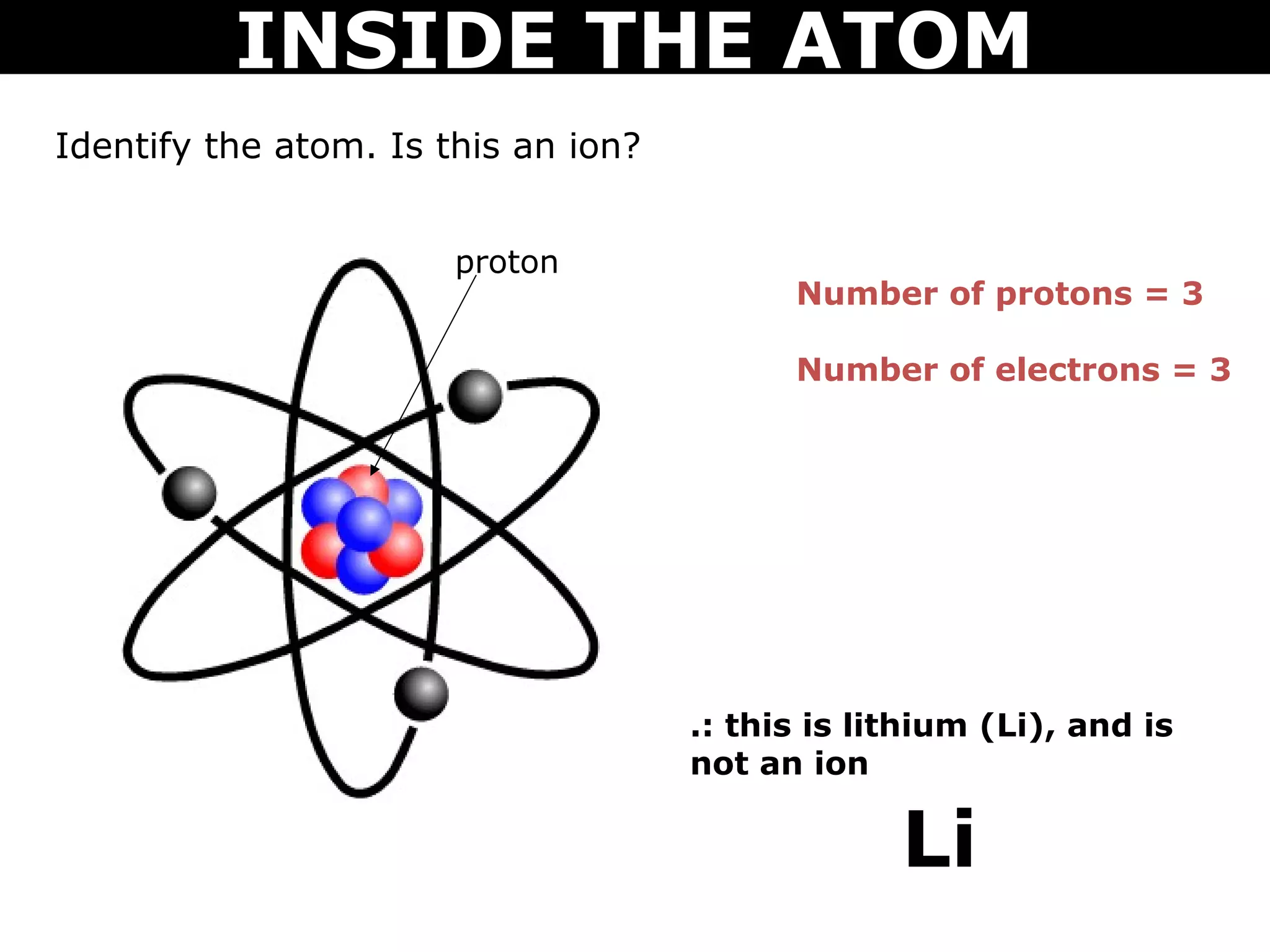
INSIDE THE ATOM
Identifythe atom. Is this an ion?
proton
Number of protons = 3
Number of electrons = 3
.: this is lithium (Li), and is
not an ion
Li
25.
INSIDE THE ATOM
2 or more combined elements will be called a
compound. This is another example of a pure
substance.
ELEMENT COMPOUNDS
A substance that can not be 2 or more elements that
broken down by chemical or are chemically joined
physical means
Sodium Bromine Oxygen table salt ethanol carbon dioxide
(NaCl) (C2H5OH) (CO2)
(Na) (Br2) (O2)


![Structure Of Atom[1] Monika Khurana](https://cdn.slidesharecdn.com/ss_thumbnails/structure-of-atom1-monika-khurana-1193579725970972-1-thumbnail.jpg?width=640&height=640&fit=bounds)


