ATOMS AND MOLECULES
 Laws of Chemical Combination:
The process of combination of two or more elements to form new compounds is governed by
certain laws called laws of chemical combination. These are:
1. Law of conservation of mass.
2. Law of constant proportions.
1. Law of conservation of mass (by Antoine Lavoisier in 1744):
This law states that mass can neither be created nor destroyed in a chemical reaction.
e.g., A + B → C + D
Reactants → Products
Mass of reactants = Mass of products
2. Law of constant proportions (by Joseph Louis Proust in 1797):
This law states that in a chemical substance the elements are always present in definite proportions by
mass.
E.g., in water, the ratio of the mass of hydrogen to the mass of oxygen is always 1 : 8 respectively.
This law is also called law of definite proportions
 Dalton’s Atomic Theory
According to Dalton’s atomic theory, all matter, whether an element, a compound or a mixture is
composed of small particles called atoms
 Postulates Of Dalton’s Atomic Theory
• Matter is made up of extremely small indivisible particles called atoms that can neither be
created nor destroyed.
• Atoms of the same substance are identical in all aspects, i.e., they possess same size, shape,
mass, chemical properties etc.
• Atoms of different substances are different in all aspects, i.e., they possess different size,
shape, mass etc.
• Atom is the smallest particle that takes part in a chemical reaction.
• Atoms of different elements combine with each other in a simple whole number ratio to
form compound.
• The relative number and kinds of atoms are constant in a given compound.
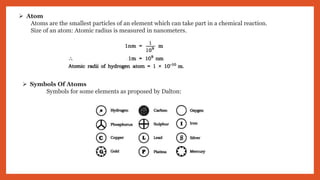
 Atom
Atoms are the smallest particles of an element which can take part in a chemical reaction.
Size of an atom: Atomic radius is measured in nanometers.
 Symbols Of Atoms
Symbols for some elements as proposed by Dalton:
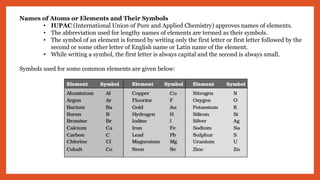
Names of Atoms or Elements and Their Symbols
• IUPAC (International Union of Pure and Applied Chemistry) approves names of elements.
• The abbreviation used for lengthy names of elements are termed as their symbols.
• The symbol of an element is formed by writing only the first letter or first letter followed by the
second or some other letter of English name or Latin name of the element.
• While writing a symbol, the first letter is always capital and the second is always small.
Symbols used for some common elements are given below:
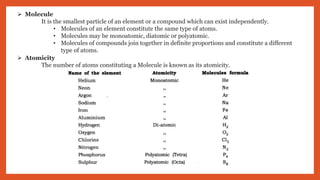
 Molecule
It is the smallest particle of an element or a compound which can exist independently.
• Molecules of an element constitute the same type of atoms.
• Molecules may be monoatomic, diatomic or polyatomic.
• Molecules of compounds join together in definite proportions and constitute a different
type of atoms.
 Atomicity
The number of atoms constituting a Molecule is known as its atomicity.
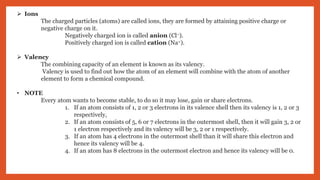
 Ions
The charged particles (atoms) are called ions, they are formed by attaining positive charge or
negative charge on it.
Negatively charged ion is called anion (Cl–).
Positively charged ion is called cation (Na+).
 Valency
The combining capacity of an element is known as its valency.
Valency is used to find out how the atom of an element will combine with the atom of another
element to form a chemical compound.
• NOTE
Every atom wants to become stable, to do so it may lose, gain or share electrons.
1. If an atom consists of 1, 2 or 3 electrons in its valence shell then its valency is 1, 2 or 3
respectively,
2. If an atom consists of 5, 6 or 7 electrons in the outermost shell, then it will gain 3, 2 or
1 electron respectively and its valency will be 3, 2 or 1 respectively.
3. If an atom has 4 electrons in the outermost shell than it will share this electron and
hence its valency will be 4.
4. If an atom has 8 electrons in the outermost electron and hence its valency will be 0.
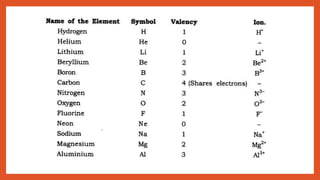
Some elements show more than one valency, hence termed as variable valency.
 Chemical Formulae
Rules:
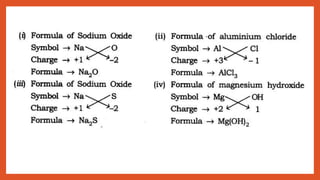
1. The valencies or charges on the ion must balance.
2. Metal and non-metal compound should show the name or symbol of the metal first.
e.g., Na+ Cl– → NaCl
3. If a compound consists of polyatomic ions. The ion is enclosed in a bracket before writing the number to
indicate the ratio.
e.g., [SO4]2- → polyatomic radical
H1+ SO4
2- → H2SO4
 Atomic Mass
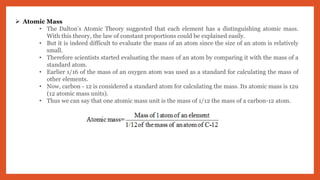
• The Dalton’s Atomic Theory suggested that each element has a distinguishing atomic mass.
With this theory, the law of constant proportions could be explained easily.
• But it is indeed difficult to evaluate the mass of an atom since the size of an atom is relatively
small.
• Therefore scientists started evaluating the mass of an atom by comparing it with the mass of a
standard atom.
• Earlier 1/16 of the mass of an oxygen atom was used as a standard for calculating the mass of
other elements.
• Now, carbon - 12 is considered a standard atom for calculating the mass. Its atomic mass is 12u
(12 atomic mass units).
• Thus we can say that one atomic mass unit is the mass of 1/12 the mass of a carbon-12 atom.
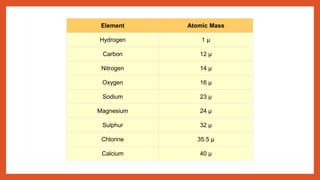
Element Atomic Mass
Hydrogen 1 µ
Carbon 12 µ
Nitrogen 14 µ
Oxygen 16 µ
Sodium 23 µ
Magnesium 24 µ
Sulphur 32 µ
Chlorine 35.5 µ
Calcium 40 µ
 Molecular Mass
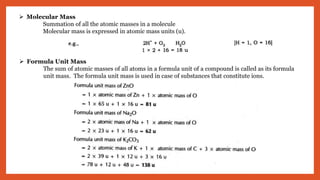
Summation of all the atomic masses in a molecule
Molecular mass is expressed in atomic mass units (u).
 Formula Unit Mass
The sum of atomic masses of all atoms in a formula unit of a compound is called as its formula
unit mass. The formula unit mass is used in case of substances that constitute ions.
 Mole Concept
Mole:- A mole of a substance is that quantity in number having a mass equal to its atomic or
molecular mass in grams.
The number of particles (atoms) present in 1 mol of any substance is fixed which is 6.023 x 10²³.
This number is called Avagadro Number or Avagadro Constant represented by NA or N0 .
A mole represents two things :-
1. It represents a definite number of particles (atoms, molecules or ions) equal to 6.023 x 10²³.
2. It represents a definite mass of a substance.
 Molar Mass
The molar mass of a substance is defined as the total mass of one mole of the substance.
It is often represented in terms of ‘grams per mole’ (g/mol).
The SI unit of this quantity is kg/mol.
Molar mass can be represented by the following formula:
Molar mass of a Substance = (Mass of the Substance in grams)/(Number of Moles)
 Molar Mass
The molar mass of a substance is defined as the total mass of one mole of the substance.
It is often represented in terms of ‘grams per mole’ (g/mol).
The SI unit of this quantity is kg/mol.
Molar mass can be represented by the following formula:
Molar mass of a Substance = (Mass of the Substance in grams)/(Number of Moles)
 Gram atomic mass of an element :- is its atomic mass expressed in grams.
Eg :- Gram atomic mass of Oxygen = O2 = 16 x 2 = 32g.
 Gram molecular mass of a compound :- is its molecular mass expressed in grams.
Eg :- Gram molecular mass of water = H2O = 1 x 2 + 16 = 2 + 16 = 18g.
• The number of moles in a given sample of an element/compound can be calculated by dividing the
total mass of the sample by the molar mass of the element/compound, as described by the following
formula.
Number of Moles = (Mass of the Sample)/(Molar Mass)

Class 9 atom and molecules

  • 1.
  • 2.
     Laws ofChemical Combination: The process of combination of two or more elements to form new compounds is governed by certain laws called laws of chemical combination. These are: 1. Law of conservation of mass. 2. Law of constant proportions. 1. Law of conservation of mass (by Antoine Lavoisier in 1744): This law states that mass can neither be created nor destroyed in a chemical reaction. e.g., A + B → C + D Reactants → Products Mass of reactants = Mass of products 2. Law of constant proportions (by Joseph Louis Proust in 1797): This law states that in a chemical substance the elements are always present in definite proportions by mass. E.g., in water, the ratio of the mass of hydrogen to the mass of oxygen is always 1 : 8 respectively. This law is also called law of definite proportions
  • 3.
     Dalton’s AtomicTheory According to Dalton’s atomic theory, all matter, whether an element, a compound or a mixture is composed of small particles called atoms  Postulates Of Dalton’s Atomic Theory • Matter is made up of extremely small indivisible particles called atoms that can neither be created nor destroyed. • Atoms of the same substance are identical in all aspects, i.e., they possess same size, shape, mass, chemical properties etc. • Atoms of different substances are different in all aspects, i.e., they possess different size, shape, mass etc. • Atom is the smallest particle that takes part in a chemical reaction. • Atoms of different elements combine with each other in a simple whole number ratio to form compound. • The relative number and kinds of atoms are constant in a given compound.
  • 4.
     Atom Atoms arethe smallest particles of an element which can take part in a chemical reaction. Size of an atom: Atomic radius is measured in nanometers.  Symbols Of Atoms Symbols for some elements as proposed by Dalton:
  • 5.
    Names of Atomsor Elements and Their Symbols • IUPAC (International Union of Pure and Applied Chemistry) approves names of elements. • The abbreviation used for lengthy names of elements are termed as their symbols. • The symbol of an element is formed by writing only the first letter or first letter followed by the second or some other letter of English name or Latin name of the element. • While writing a symbol, the first letter is always capital and the second is always small. Symbols used for some common elements are given below:
  • 6.
     Molecule It isthe smallest particle of an element or a compound which can exist independently. • Molecules of an element constitute the same type of atoms. • Molecules may be monoatomic, diatomic or polyatomic. • Molecules of compounds join together in definite proportions and constitute a different type of atoms.  Atomicity The number of atoms constituting a Molecule is known as its atomicity.
  • 7.
     Ions The chargedparticles (atoms) are called ions, they are formed by attaining positive charge or negative charge on it. Negatively charged ion is called anion (Cl–). Positively charged ion is called cation (Na+).  Valency The combining capacity of an element is known as its valency. Valency is used to find out how the atom of an element will combine with the atom of another element to form a chemical compound. • NOTE Every atom wants to become stable, to do so it may lose, gain or share electrons. 1. If an atom consists of 1, 2 or 3 electrons in its valence shell then its valency is 1, 2 or 3 respectively, 2. If an atom consists of 5, 6 or 7 electrons in the outermost shell, then it will gain 3, 2 or 1 electron respectively and its valency will be 3, 2 or 1 respectively. 3. If an atom has 4 electrons in the outermost shell than it will share this electron and hence its valency will be 4. 4. If an atom has 8 electrons in the outermost electron and hence its valency will be 0.
  • 9.
    Some elements showmore than one valency, hence termed as variable valency.  Chemical Formulae Rules: 1. The valencies or charges on the ion must balance. 2. Metal and non-metal compound should show the name or symbol of the metal first. e.g., Na+ Cl– → NaCl 3. If a compound consists of polyatomic ions. The ion is enclosed in a bracket before writing the number to indicate the ratio. e.g., [SO4]2- → polyatomic radical H1+ SO4 2- → H2SO4
  • 11.
     Atomic Mass •The Dalton’s Atomic Theory suggested that each element has a distinguishing atomic mass. With this theory, the law of constant proportions could be explained easily. • But it is indeed difficult to evaluate the mass of an atom since the size of an atom is relatively small. • Therefore scientists started evaluating the mass of an atom by comparing it with the mass of a standard atom. • Earlier 1/16 of the mass of an oxygen atom was used as a standard for calculating the mass of other elements. • Now, carbon - 12 is considered a standard atom for calculating the mass. Its atomic mass is 12u (12 atomic mass units). • Thus we can say that one atomic mass unit is the mass of 1/12 the mass of a carbon-12 atom.
  • 12.
    Element Atomic Mass Hydrogen1 µ Carbon 12 µ Nitrogen 14 µ Oxygen 16 µ Sodium 23 µ Magnesium 24 µ Sulphur 32 µ Chlorine 35.5 µ Calcium 40 µ
  • 13.
     Molecular Mass Summationof all the atomic masses in a molecule Molecular mass is expressed in atomic mass units (u).  Formula Unit Mass The sum of atomic masses of all atoms in a formula unit of a compound is called as its formula unit mass. The formula unit mass is used in case of substances that constitute ions.
  • 14.
     Mole Concept Mole:-A mole of a substance is that quantity in number having a mass equal to its atomic or molecular mass in grams. The number of particles (atoms) present in 1 mol of any substance is fixed which is 6.023 x 10²³. This number is called Avagadro Number or Avagadro Constant represented by NA or N0 . A mole represents two things :- 1. It represents a definite number of particles (atoms, molecules or ions) equal to 6.023 x 10²³. 2. It represents a definite mass of a substance.  Molar Mass The molar mass of a substance is defined as the total mass of one mole of the substance. It is often represented in terms of ‘grams per mole’ (g/mol). The SI unit of this quantity is kg/mol. Molar mass can be represented by the following formula: Molar mass of a Substance = (Mass of the Substance in grams)/(Number of Moles)
  • 15.
     Molar Mass Themolar mass of a substance is defined as the total mass of one mole of the substance. It is often represented in terms of ‘grams per mole’ (g/mol). The SI unit of this quantity is kg/mol. Molar mass can be represented by the following formula: Molar mass of a Substance = (Mass of the Substance in grams)/(Number of Moles)  Gram atomic mass of an element :- is its atomic mass expressed in grams. Eg :- Gram atomic mass of Oxygen = O2 = 16 x 2 = 32g.  Gram molecular mass of a compound :- is its molecular mass expressed in grams. Eg :- Gram molecular mass of water = H2O = 1 x 2 + 16 = 2 + 16 = 18g. • The number of moles in a given sample of an element/compound can be calculated by dividing the total mass of the sample by the molar mass of the element/compound, as described by the following formula. Number of Moles = (Mass of the Sample)/(Molar Mass)