ATOMS
AND
MOLECULE
PART-1
BY:
MISS RITIMA
APS RAKHMUTHI
DIFFERENT IDEAS
The idea of divisibility by Indian philosophers
Maharishi Kanad – He postulated that if we keep
on dividing the matter (called as ‘padarth’) we will
get smaller and smaller particles. And soon we will
achieve the smallest of particles (called as
‘parmanu’) which may not divide further.
Pakudha Katyayama – He postulated that there are
various forms of matter because the particles of
matter exist together in combinations.
.
.
The idea of divisibility by Greek philosophers
Democritus and Leucippus – They suggested that
when we keep on dividing the matter there comes
a time when no more division of particles can take
place. Such particles are called atoms which
means being invisible.
But all these ideas were not backed up by many
experimental pieces of evidence until Antoine L.
Lavoisier provided two laws of chemical
combination.
Laws of Chemical Combination
 Antoine Lavoisier gave this law in the year 1789
based on the data he obtained after carefully
studying numerous combustion reactions.
 This law states that matter can neither be
created nor destroyed.
In other words, the total mass, that is, the sum of
mass of reacting mixture and the products formed
remains constant.
Law of Definite Proportions
 Joseph Proust, a French chemist stated that the
proportion of elements by weight in a given
compound will always remain exactly the same.
 In simple terms we can say that, irrespective of
its source, origin or its quantity, the percent
composition of elements by weight in a given
compound will always remain the same.
The Atomic Theory
The postulates of the atomic theory by John Dalton
1. The matter is made up of tiny particles called atoms
that cannot be divided.
2. Atoms are never formed or destroyed during a
chemical reaction.
3. Atoms of an element exhibit same nature. They
have the same size, mass, and character.
4. Atoms of different elements exhibit variant nature.
They do not have same characteristics.
5. Atoms form compounds by combining in a ratio of
whole numbers.
6. A compound contains a constant number and kinds
of atoms.
Atoms
 Atoms as the building blocks of matter. Just like
bricks are the building blocks of a building.
 Atoms are extremely small. Their size is
measured in nanometers where 1nm = 1/109 m.
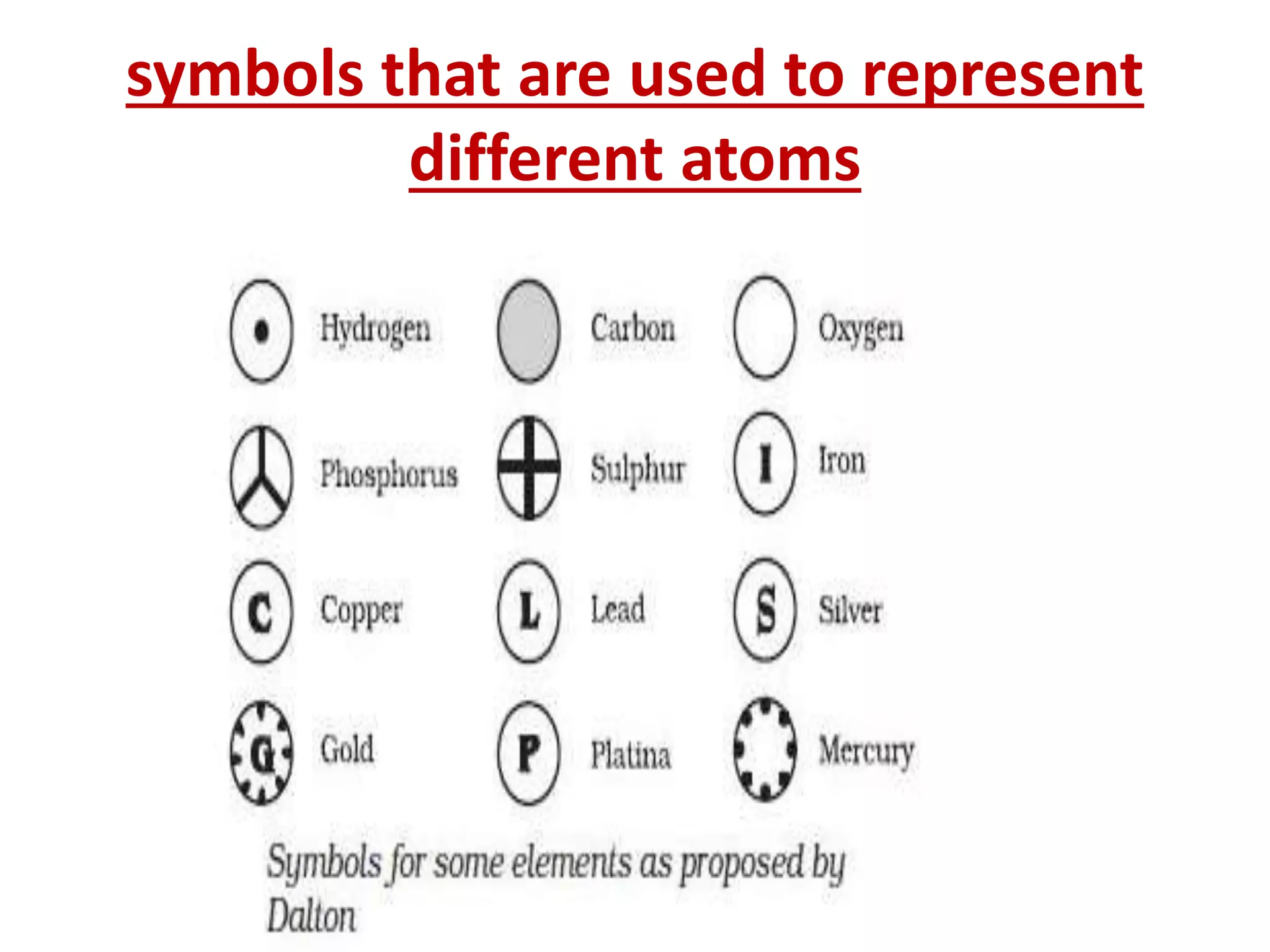
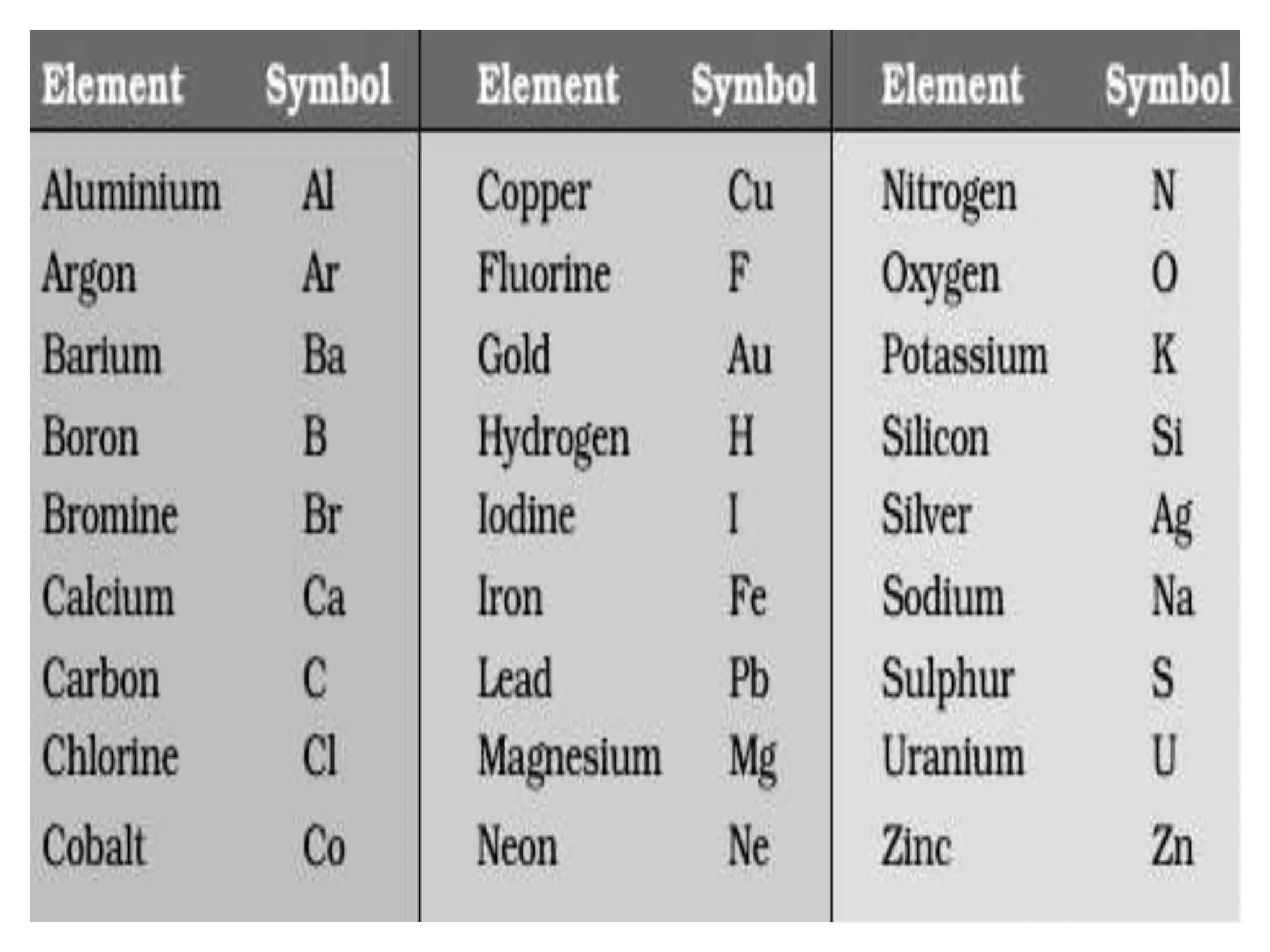
symbols that are used to represent
different atoms
writing symbol
The symbols for representing an atom are
generated from the first two letters of the
element’s name. The first letter is always in
uppercase (capital letter) while the second letter
is written in lowercase.
The Atomic Mass
Earlier 1/16 of the mass of an oxygen atom was used as
a standard for calculating the mass of other elements.
 Now, carbon - 12 is considered a standard atom for
calculating the mass.
Molecule
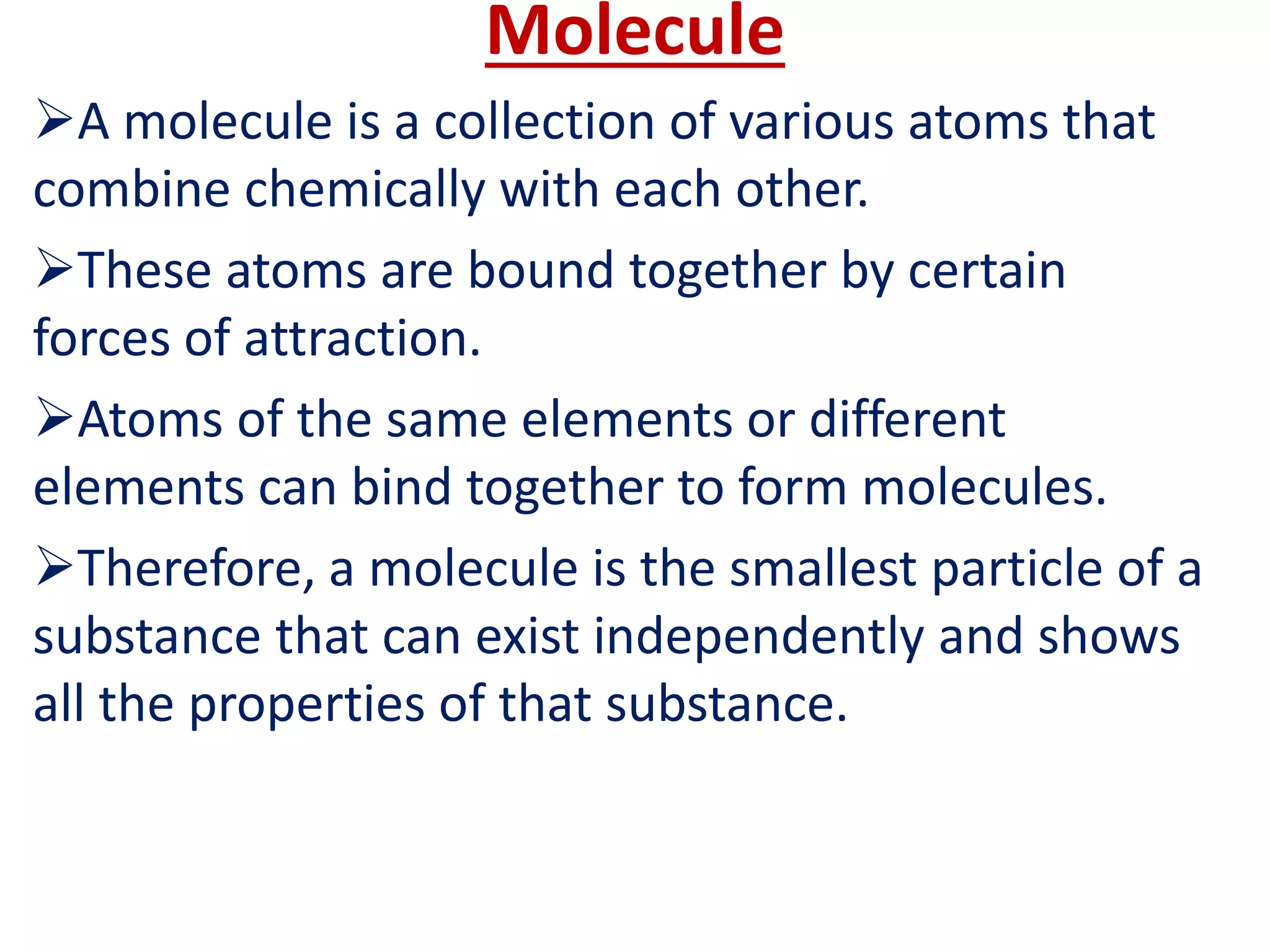
A molecule is a collection of various atoms that
combine chemically with each other.
These atoms are bound together by certain
forces of attraction.
Atoms of the same elements or different
elements can bind together to form molecules.
Therefore, a molecule is the smallest particle of a
substance that can exist independently and shows
all the properties of that substance.
Molecules of Elements
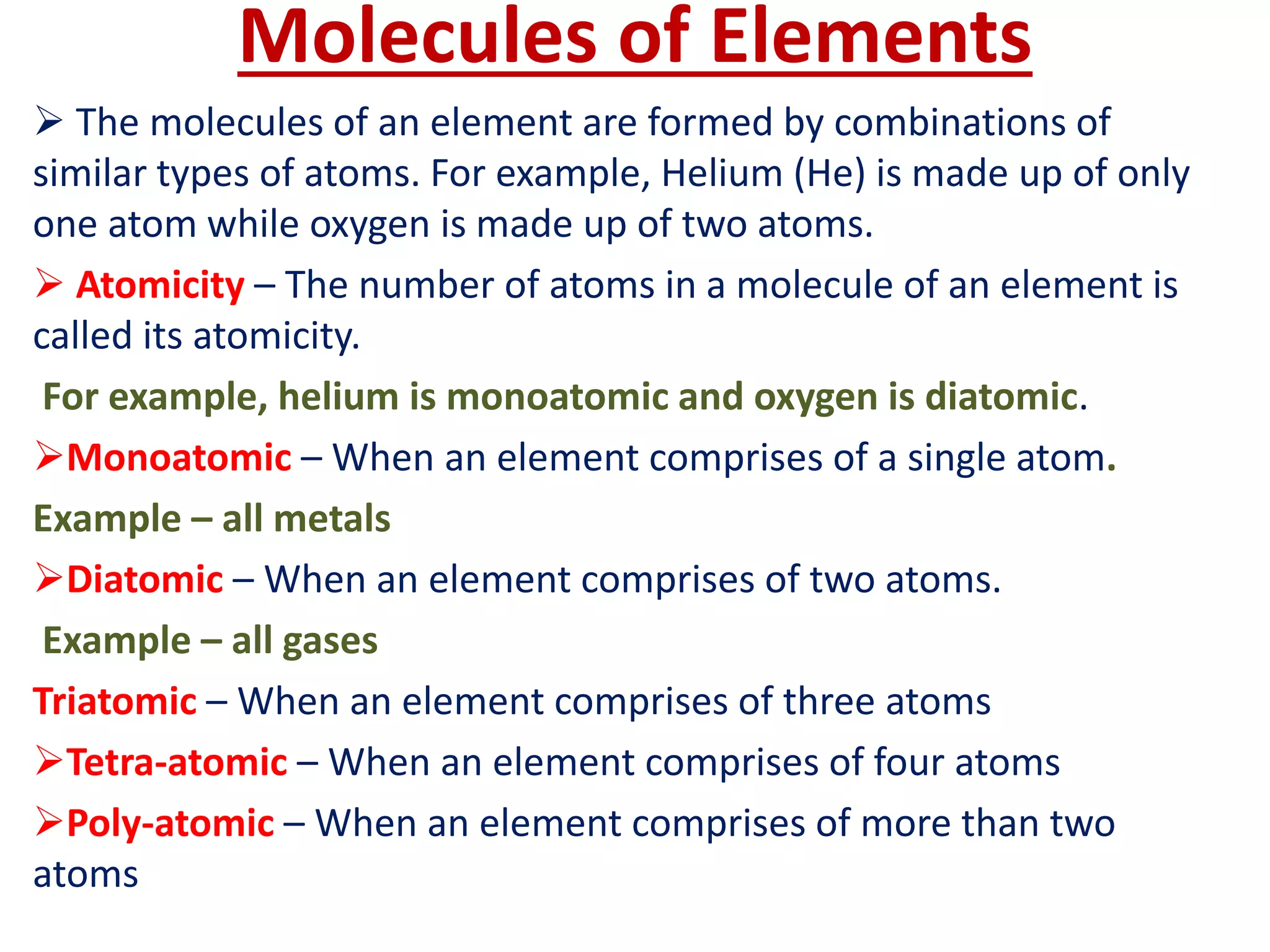
 The molecules of an element are formed by combinations of
similar types of atoms. For example, Helium (He) is made up of only
one atom while oxygen is made up of two atoms.
 Atomicity – The number of atoms in a molecule of an element is
called its atomicity.
For example, helium is monoatomic and oxygen is diatomic.
Monoatomic – When an element comprises of a single atom.
Example – all metals
Diatomic – When an element comprises of two atoms.
Example – all gases
Triatomic – When an element comprises of three atoms
Tetra-atomic – When an element comprises of four atoms
Poly-atomic – When an element comprises of more than two
atoms
Molecules of Compounds
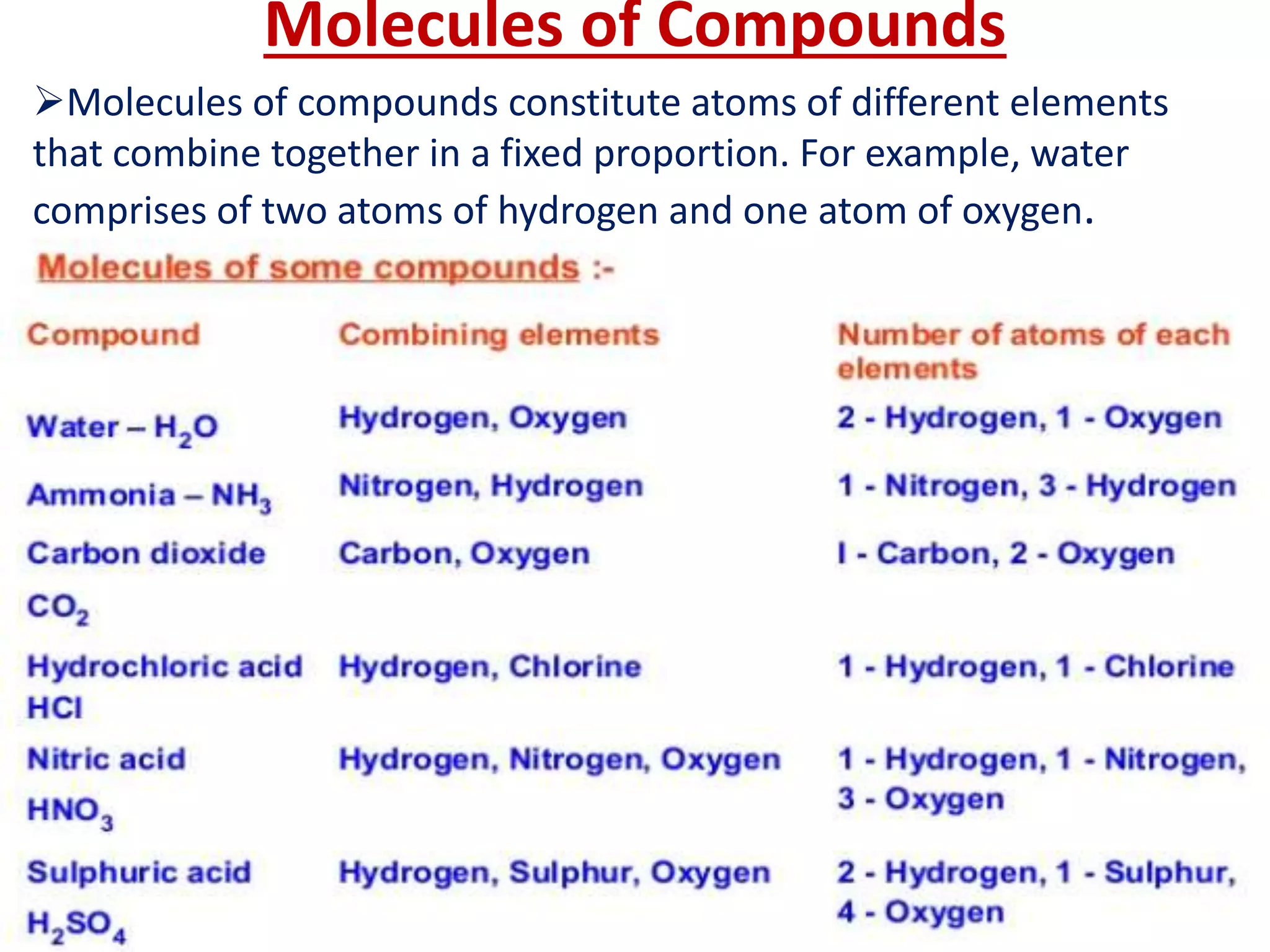
Molecules of compounds constitute atoms of different elements
that combine together in a fixed proportion. For example, water
comprises of two atoms of hydrogen and one atom of oxygen.
Ions
Compounds contain metals as well as non-metals.
These elements include charged species which are
known as ions.
Thus, ion is a particle that has a positive or
negative charge.
Anion – negatively charged ion
Cation – positively charged ion
There can be a single charged atom in an ion or
there may be a group of charged atoms in an ion that
have a net charge on the compound.
When a group of atoms carries a charge in a
compound it is called as a polyatomic ion.
Chemical Formula
We use a chemical formula to represent the
composition of a compound in the form of symbols.
To write a chemical formula you must know two
things:
1. Symbols of elements
2. Valency
Valency – It is also known as the combining capacity
of an element. In other words, valency explains how
atoms of one element will mix with atoms of another
element.
For example, the hydrogen ion is represented as H+
which means that its valency is 1. Similarly, the oxygen
ion is represented as O2- which means that its valency
is 2.
Rules of writing a Chemical Formula
Valencies of on the ions must balance.
In a case where both metal and non-metal
substances are present in a compound, the name
of the metal is always written first in the chemical
formula.
For example, Sodium Chloride is written as NaCl
In case of polyatomic ions, the ion is written in
brackets before writing the number of ions
associated to it. In case of a single ion, there is no
need to mention the ion in brackets.
How to write a Formula of a
Compound
Write the symbols of the corresponding
elements of the compound as explained above.
Write the valencies of the elements of the
compound.
Crossover the valencies of the elements.
Writing of chemical formula

ATOMS AND MOLECULE PART -1

  • 1.
  • 2.
    DIFFERENT IDEAS The ideaof divisibility by Indian philosophers Maharishi Kanad – He postulated that if we keep on dividing the matter (called as ‘padarth’) we will get smaller and smaller particles. And soon we will achieve the smallest of particles (called as ‘parmanu’) which may not divide further. Pakudha Katyayama – He postulated that there are various forms of matter because the particles of matter exist together in combinations. .
  • 3.
    . The idea ofdivisibility by Greek philosophers Democritus and Leucippus – They suggested that when we keep on dividing the matter there comes a time when no more division of particles can take place. Such particles are called atoms which means being invisible. But all these ideas were not backed up by many experimental pieces of evidence until Antoine L. Lavoisier provided two laws of chemical combination.
  • 5.
    Laws of ChemicalCombination  Antoine Lavoisier gave this law in the year 1789 based on the data he obtained after carefully studying numerous combustion reactions.  This law states that matter can neither be created nor destroyed. In other words, the total mass, that is, the sum of mass of reacting mixture and the products formed remains constant.
  • 6.
    Law of DefiniteProportions  Joseph Proust, a French chemist stated that the proportion of elements by weight in a given compound will always remain exactly the same.  In simple terms we can say that, irrespective of its source, origin or its quantity, the percent composition of elements by weight in a given compound will always remain the same.
  • 7.
    The Atomic Theory Thepostulates of the atomic theory by John Dalton 1. The matter is made up of tiny particles called atoms that cannot be divided. 2. Atoms are never formed or destroyed during a chemical reaction. 3. Atoms of an element exhibit same nature. They have the same size, mass, and character. 4. Atoms of different elements exhibit variant nature. They do not have same characteristics. 5. Atoms form compounds by combining in a ratio of whole numbers. 6. A compound contains a constant number and kinds of atoms.
  • 8.
    Atoms  Atoms asthe building blocks of matter. Just like bricks are the building blocks of a building.  Atoms are extremely small. Their size is measured in nanometers where 1nm = 1/109 m.
  • 9.
    symbols that areused to represent different atoms
  • 10.
    writing symbol The symbolsfor representing an atom are generated from the first two letters of the element’s name. The first letter is always in uppercase (capital letter) while the second letter is written in lowercase.
  • 12.
    The Atomic Mass Earlier1/16 of the mass of an oxygen atom was used as a standard for calculating the mass of other elements.  Now, carbon - 12 is considered a standard atom for calculating the mass.
  • 13.
    Molecule A molecule isa collection of various atoms that combine chemically with each other. These atoms are bound together by certain forces of attraction. Atoms of the same elements or different elements can bind together to form molecules. Therefore, a molecule is the smallest particle of a substance that can exist independently and shows all the properties of that substance.
  • 14.
    Molecules of Elements The molecules of an element are formed by combinations of similar types of atoms. For example, Helium (He) is made up of only one atom while oxygen is made up of two atoms.  Atomicity – The number of atoms in a molecule of an element is called its atomicity. For example, helium is monoatomic and oxygen is diatomic. Monoatomic – When an element comprises of a single atom. Example – all metals Diatomic – When an element comprises of two atoms. Example – all gases Triatomic – When an element comprises of three atoms Tetra-atomic – When an element comprises of four atoms Poly-atomic – When an element comprises of more than two atoms
  • 16.
    Molecules of Compounds Moleculesof compounds constitute atoms of different elements that combine together in a fixed proportion. For example, water comprises of two atoms of hydrogen and one atom of oxygen.
  • 17.
    Ions Compounds contain metalsas well as non-metals. These elements include charged species which are known as ions. Thus, ion is a particle that has a positive or negative charge. Anion – negatively charged ion Cation – positively charged ion There can be a single charged atom in an ion or there may be a group of charged atoms in an ion that have a net charge on the compound. When a group of atoms carries a charge in a compound it is called as a polyatomic ion.
  • 18.
    Chemical Formula We usea chemical formula to represent the composition of a compound in the form of symbols. To write a chemical formula you must know two things: 1. Symbols of elements 2. Valency Valency – It is also known as the combining capacity of an element. In other words, valency explains how atoms of one element will mix with atoms of another element. For example, the hydrogen ion is represented as H+ which means that its valency is 1. Similarly, the oxygen ion is represented as O2- which means that its valency is 2.
  • 20.
    Rules of writinga Chemical Formula Valencies of on the ions must balance. In a case where both metal and non-metal substances are present in a compound, the name of the metal is always written first in the chemical formula. For example, Sodium Chloride is written as NaCl In case of polyatomic ions, the ion is written in brackets before writing the number of ions associated to it. In case of a single ion, there is no need to mention the ion in brackets.
  • 21.
    How to writea Formula of a Compound Write the symbols of the corresponding elements of the compound as explained above. Write the valencies of the elements of the compound. Crossover the valencies of the elements.
  • 22.