Exploring Inner Space 
TEKS 8.5A describe the structure of atoms including the masses, electrical charges and locations, of protons and neutrons in the nucleus and electrons in the electron cloud 
TEKS 8.5B identify that protons determine an element’s identity and valence electrons determine its chemical properties, including reactivity
Each element on the Periodic Table is made of the same kind of atom.
Each atom in an element has the same number of protons.
The number of protons present in the atom is what determines the element’s identity and is shown by the atomic number.
Structure of the Atom
The Nucleus 
The center of the atom is called the nucleus . 
proton 
neutron 
nucleus 
3 
Li 
6.941 
Lithium
The nucleus contains protons and neutrons.
Since each proton and neutron in the nucleus has a mass of 1 atomic mass unit (amu), we can add the number of protons and neutrons together to find the atomic mass.
On your Periodic Table, fill in this information. 
# protons = element’s identity = atomic number
# protons + # neutrons = atomic mass 
On your Periodic Table, fill in this information.
The Periodic Table shows the mass for each element as a decimal. 
We will usually round the atomic mass number.
 
If the mass number is known, and you know the number of protons, how can you find the number of neutrons? 
Mass # - # Protons = # Neutrons
fill in this information on your Periodic Table 
mass - # protons = # neutrons 
# protons = # electrons in a stable atom
electron 
energy levels 
3 
Li 
6.941 
Lithium 
electron cloud 
The Electron Cloud and Energy Levels
Surrounding the nucleus is an area called the electron cloud. 
Inside the electron cloud, electrons orbit around in different energy levels.
The electrons are so small that they basically have no mass, so they are not included in finding the atomic mass. 
electronneutronproton
first energy level 
The first energy level, which is closest to the nucleus, holds up to 2 electrons.
second energy level 
The second energy level holds up to 8 electrons.
third energy level 
The third energy level may hold 8 or more electrons. 
8 or more!
How many electrons are in each energy level of the element Lithium? 
electron 
energy levels 
3 
Li 
6.941 
Lithium 
electron cloud 
1st – 2, 2nd – 1
By numbering the periods (rows) on the Periodic Table, you can determine how many energy levels are in an atom. 
For example, Lithium is in period 2, therefore it has 2 energy levels. 
Number the first three periods on your Periodic Table.
How many energy levels does sodium contain? 
Period 3, 3 energy levels
The most stable form of an atom is electrically neutral. This means that the number of protons and electrons is equal. 
Atomic # = Protons = Electrons
Valence Electrons 
The numbers of electrons in an atom’s outermost energy level are called valence electrons.
These electrons are important because they determine how reactive the element is with other elements.
Valence electrons….. 
valence electrons are found here!
For example, look at the element oxygen. Oxygen is atomic number 8, which means it has 8 protons (+).
Therefore, in a stable oxygen atom, there are 8 electrons (-). The positive and negative charges are balanced.
6 
Look at your Periodic Table. Find the element Carbon. 
How many positive (protons) charges does carbon have?
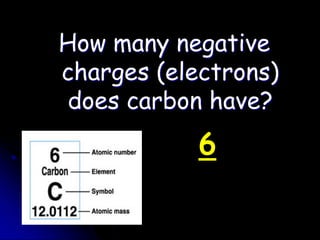
How many negative charges (electrons) does carbon have? 
6
What is the mass of carbon? 12.0112 How can the number of neutrons be determined? (atomic mass - # protons = # neutrons) Carbon has 6 neutrons.

Atom notesshort

  • 1.
    Exploring Inner Space TEKS 8.5A describe the structure of atoms including the masses, electrical charges and locations, of protons and neutrons in the nucleus and electrons in the electron cloud TEKS 8.5B identify that protons determine an element’s identity and valence electrons determine its chemical properties, including reactivity
  • 2.
    Each element onthe Periodic Table is made of the same kind of atom.
  • 3.
    Each atom inan element has the same number of protons.
  • 4.
    The number ofprotons present in the atom is what determines the element’s identity and is shown by the atomic number.
  • 5.
  • 6.
    The Nucleus Thecenter of the atom is called the nucleus . proton neutron nucleus 3 Li 6.941 Lithium
  • 7.
    The nucleus containsprotons and neutrons.
  • 8.
    Since each protonand neutron in the nucleus has a mass of 1 atomic mass unit (amu), we can add the number of protons and neutrons together to find the atomic mass.
  • 9.
    On your PeriodicTable, fill in this information. # protons = element’s identity = atomic number
  • 10.
    # protons +# neutrons = atomic mass On your Periodic Table, fill in this information.
  • 11.
    The Periodic Tableshows the mass for each element as a decimal. We will usually round the atomic mass number.
  • 12.
     If themass number is known, and you know the number of protons, how can you find the number of neutrons? Mass # - # Protons = # Neutrons
  • 13.
    fill in thisinformation on your Periodic Table mass - # protons = # neutrons # protons = # electrons in a stable atom
  • 14.
    electron energy levels 3 Li 6.941 Lithium electron cloud The Electron Cloud and Energy Levels
  • 15.
    Surrounding the nucleusis an area called the electron cloud. Inside the electron cloud, electrons orbit around in different energy levels.
  • 16.
    The electrons areso small that they basically have no mass, so they are not included in finding the atomic mass. electronneutronproton
  • 17.
    first energy level The first energy level, which is closest to the nucleus, holds up to 2 electrons.
  • 18.
    second energy level The second energy level holds up to 8 electrons.
  • 19.
    third energy level The third energy level may hold 8 or more electrons. 8 or more!
  • 20.
    How many electronsare in each energy level of the element Lithium? electron energy levels 3 Li 6.941 Lithium electron cloud 1st – 2, 2nd – 1
  • 21.
    By numbering theperiods (rows) on the Periodic Table, you can determine how many energy levels are in an atom. For example, Lithium is in period 2, therefore it has 2 energy levels. Number the first three periods on your Periodic Table.
  • 23.
    How many energylevels does sodium contain? Period 3, 3 energy levels
  • 24.
    The most stableform of an atom is electrically neutral. This means that the number of protons and electrons is equal. Atomic # = Protons = Electrons
  • 25.
    Valence Electrons Thenumbers of electrons in an atom’s outermost energy level are called valence electrons.
  • 26.
    These electrons areimportant because they determine how reactive the element is with other elements.
  • 27.
    Valence electrons….. valenceelectrons are found here!
  • 28.
    For example, lookat the element oxygen. Oxygen is atomic number 8, which means it has 8 protons (+).
  • 29.
    Therefore, in astable oxygen atom, there are 8 electrons (-). The positive and negative charges are balanced.
  • 30.
    6 Look atyour Periodic Table. Find the element Carbon. How many positive (protons) charges does carbon have?
  • 31.
    How many negativecharges (electrons) does carbon have? 6
  • 32.
    What is themass of carbon? 12.0112 How can the number of neutrons be determined? (atomic mass - # protons = # neutrons) Carbon has 6 neutrons.