Chapter 8:
FET Amplifiers
IntroductionIntroduction
FETs provide:FETs provide:FETs provide:FETs provide:
• Excellent voltage gain
Hi h i i d• High input impedance
• Low-power consumption
• Good frequency range
Copyright ©2009 by Pearson Education, Inc.
Upper Saddle River, New Jersey 07458 • All rights reserved.
Electronic Devices and Circuit Theory, 10/e
Robert L. Boylestad and Louis Nashelsky
22
FET SmallFET Small--Signal ModelSignal Modelgg
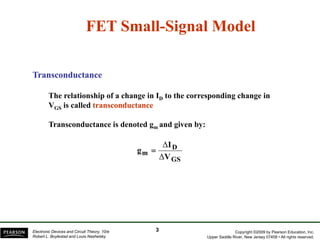
TransconductanceTransconductance
Th l ti hi f h i I t th di h iThe relationship of a change in ID to the corresponding change in
VGS is called transconductancetransconductance
Transconductance is denoted g and given by:Transconductance is denoted gm and given by:
D
m
I
g
Δ
=
GS
m
V
g
Δ
Copyright ©2009 by Pearson Education, Inc.
Upper Saddle River, New Jersey 07458 • All rights reserved.
Electronic Devices and Circuit Theory, 10/e
Robert L. Boylestad and Louis Nashelsky
33
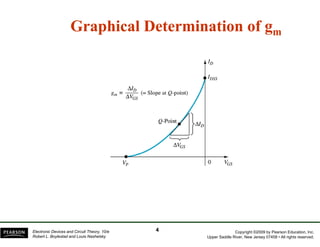
Graphical Determination of gGraphical Determination of gmmp gp gmm
Copyright ©2009 by Pearson Education, Inc.
Upper Saddle River, New Jersey 07458 • All rights reserved.
Electronic Devices and Circuit Theory, 10/e
Robert L. Boylestad and Louis Nashelsky
44
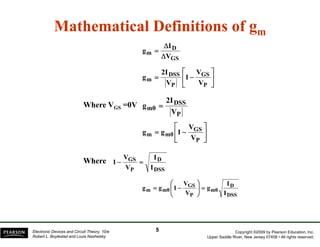
Mathematical Definitions of gMathematical Definitions of gmmggmm
GS
D
m
V
I
g
Δ
Δ
=
⎥
⎦
⎤
⎢
⎣
⎡
−=
P
GS
P
DSS
m
V
V
1
V
2I
g
P
DSS
m0
V
2I
g =
⎤⎡
Where VGS =0V
⎥
⎦
⎤
⎢
⎣
⎡
−=
P
GS
m0m
V
V
1gg
DSS
D
P
GS
I
I
V
V
1 =−
IV ⎞⎛
Where
DSS
D
m0
P
GS
m0m
I
I
g
V
V
1gg =⎟⎟
⎠
⎞
⎜⎜
⎝
⎛
−=
Copyright ©2009 by Pearson Education, Inc.
Upper Saddle River, New Jersey 07458 • All rights reserved.
Electronic Devices and Circuit Theory, 10/e
Robert L. Boylestad and Louis Nashelsky
55
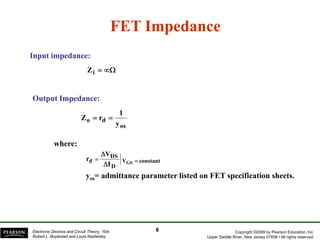
FET ImpedanceFET Impedance
Input impedance:Input impedance:
pp
Ω∞=iZ
do
y
1
rZ ==
Output Impedance:Output Impedance:
osy
VΔ
where:
constantV
D
DS
d GSI
V
r ==
Δ
Δ
yos= admittance parameter listed on FET specification sheets.
Copyright ©2009 by Pearson Education, Inc.
Upper Saddle River, New Jersey 07458 • All rights reserved.
Electronic Devices and Circuit Theory, 10/e
Robert L. Boylestad and Louis Nashelsky
66
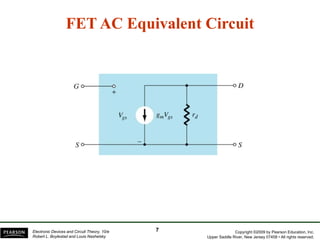
FET AC Equivalent CircuitFET AC Equivalent Circuit
Copyright ©2009 by Pearson Education, Inc.
Upper Saddle River, New Jersey 07458 • All rights reserved.
Electronic Devices and Circuit Theory, 10/e
Robert L. Boylestad and Louis Nashelsky
77
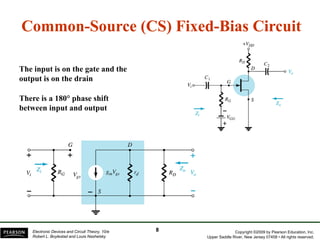
CommonCommon--Source (CS) FixedSource (CS) Fixed--Bias CircuitBias Circuit( )( )
The input is on the gate and the
output is on the drain
There is a 180° phase shift
between input and output
Copyright ©2009 by Pearson Education, Inc.
Upper Saddle River, New Jersey 07458 • All rights reserved.
Electronic Devices and Circuit Theory, 10/e
Robert L. Boylestad and Louis Nashelsky
88
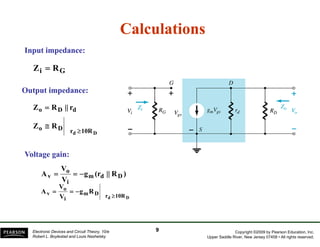
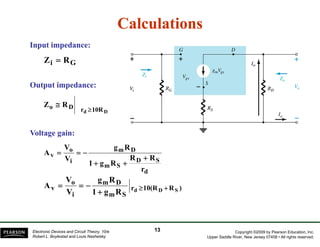
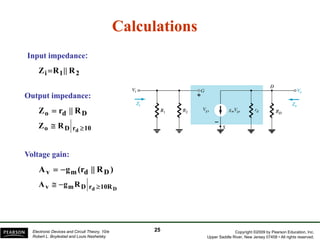
CalculationsCalculationsCalculationsCalculations
Input impedance:Input impedance:
Gi RZ =
Output impedance:Output impedance:
dDo r||RZ =
RZ
p pp p
10RrDo
Dd
RZ
≥
≅
Voltage gain:Voltage gain:
)R||(rg
V
V
A Ddm
i
o
v −==
Voltage gain:Voltage gain:
i
Dd 10RrDm
i
o
v Rg
V
V
A
≥
−==
Copyright ©2009 by Pearson Education, Inc.
Upper Saddle River, New Jersey 07458 • All rights reserved.
Electronic Devices and Circuit Theory, 10/e
Robert L. Boylestad and Louis Nashelsky
99
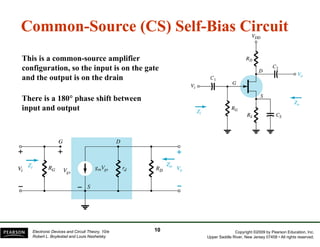
CommonCommon--Source (CS) SelfSource (CS) Self--Bias CircuitBias Circuit( )( )
This is a common-source amplifier
configuration, so the input is on the gate
and the output is on the drain
There is a 180° phase shift between
input and output
Copyright ©2009 by Pearson Education, Inc.
Upper Saddle River, New Jersey 07458 • All rights reserved.
Electronic Devices and Circuit Theory, 10/e
Robert L. Boylestad and Louis Nashelsky
1010
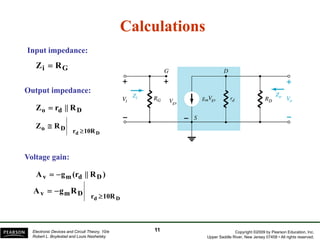
CalculationsCalculations
RZ
Input impedance:Input impedance:
Gi RZ =
Output impedance:Output impedance:
Ddo R||rZ =
RZ
p pp p
10RrDo
Dd
RZ
≥
≅
)R||(rgA Ddmv −=
Voltage gain:Voltage gain:
Dd 10RrDmv RgA
≥
−=
Copyright ©2009 by Pearson Education, Inc.
Upper Saddle River, New Jersey 07458 • All rights reserved.
Electronic Devices and Circuit Theory, 10/e
Robert L. Boylestad and Louis Nashelsky
1111
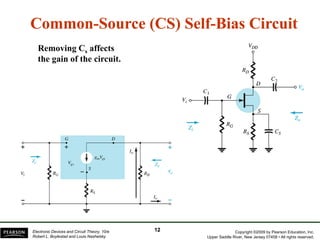
CommonCommon--Source (CS) SelfSource (CS) Self--Bias CircuitBias Circuit
Removing Cs affects
the gain of the circuit.g
Copyright ©2009 by Pearson Education, Inc.
Upper Saddle River, New Jersey 07458 • All rights reserved.
Electronic Devices and Circuit Theory, 10/e
Robert L. Boylestad and Louis Nashelsky
1212
CalculationsCalculations
Gi RZ =
Input impedance:Input impedance:
Gi
Output impedance:Output impedance:
10RrDo
Dd
RZ
≥
≅
Dmo RgV
A −==
Voltage gain:Voltage gain:
d
SD
Sm
i
v
r
RR
Rg1
V
A
+
++
==
Dmo RgV
A )R(R01r
Sm
Dm
i
o
v SDdRg1
g
V
A +≥
+
−==
Copyright ©2009 by Pearson Education, Inc.
Upper Saddle River, New Jersey 07458 • All rights reserved.
Electronic Devices and Circuit Theory, 10/e
Robert L. Boylestad and Louis Nashelsky
1313
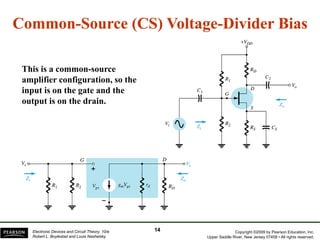
CommonCommon--Source (CS) VoltageSource (CS) Voltage--Divider BiasDivider Bias
This is a common-source
amplifier configuration, so the
input is on the gate and thep g
output is on the drain.
Copyright ©2009 by Pearson Education, Inc.
Upper Saddle River, New Jersey 07458 • All rights reserved.
Electronic Devices and Circuit Theory, 10/e
Robert L. Boylestad and Louis Nashelsky
1414
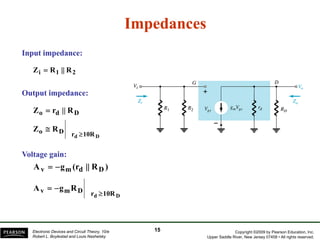
ImpedancesImpedances
Input impedance:Input impedance:
21i R||RZ =
Output impedance:Output impedance:
Ddo R||rZ =
Output impedance:Output impedance:
10RrDo
Dd
RZ
≥
≅
Voltage gain:Voltage gain:
)R||(rgA Ddmv −=
Voltage gain:Voltage gain:
Dd 10RrDmv RgA
≥
−=
Copyright ©2009 by Pearson Education, Inc.
Upper Saddle River, New Jersey 07458 • All rights reserved.
Electronic Devices and Circuit Theory, 10/e
Robert L. Boylestad and Louis Nashelsky
1515
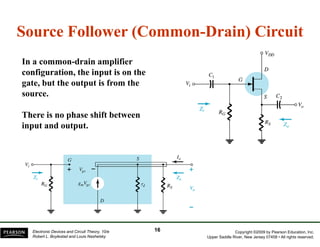
Source Follower (CommonSource Follower (Common--Drain) CircuitDrain) CircuitSource Follower (CommonSource Follower (Common--Drain) CircuitDrain) Circuit
In a common-drain amplifierIn a common drain amplifier
configuration, the input is on the
gate, but the output is from the
sourcesource.
There is no phase shift between
i t d t tinput and output.
Copyright ©2009 by Pearson Education, Inc.
Upper Saddle River, New Jersey 07458 • All rights reserved.
Electronic Devices and Circuit Theory, 10/e
Robert L. Boylestad and Louis Nashelsky
1616
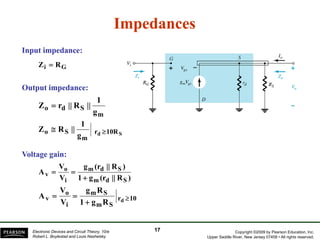
ImpedancesImpedances
RZ
Input impedance:Input impedance:
Gi RZ =
Output impedance:Output impedance:
m
Sdo
g
1
||R||rZ =
1
Sd 10Rr
m
So
g
1
||RZ ≥≅
Voltage gain:Voltage gain:
)R||(rg1
)R||(rg
V
V
A
Sdm
Sdm
i
o
v
+
==
Voltage gain:Voltage gain:
10r
Sm
Sm
i
o
v dRg1
Rg
V
V
A ≥
+
==
Copyright ©2009 by Pearson Education, Inc.
Upper Saddle River, New Jersey 07458 • All rights reserved.
Electronic Devices and Circuit Theory, 10/e
Robert L. Boylestad and Louis Nashelsky
1717
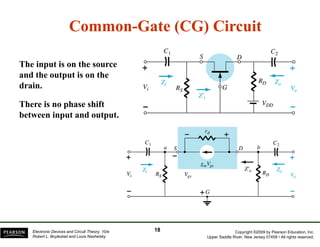
CommonCommon--Gate (CG) CircuitGate (CG) Circuit( )( )
The input is on the sourceThe input is on the source
and the output is on the
drain.
There is no phase shift
between input and output.
Copyright ©2009 by Pearson Education, Inc.
Upper Saddle River, New Jersey 07458 • All rights reserved.
Electronic Devices and Circuit Theory, 10/e
Robert L. Boylestad and Louis Nashelsky
1818
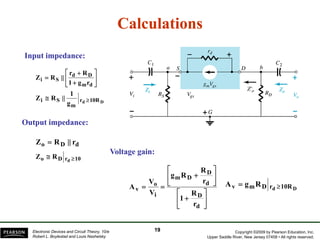
CalculationsCalculations
Input impedance:Input impedance:
⎥
⎦
⎤
⎢
⎣
⎡
+
+
=
dm
Dd
Si
rg1
Rr
||RZ
1
Output impedance:Output impedance:
Dd 10Rr
m
Si
g
1
||RZ ≥≅
Output impedance:Output impedance:
dDo r||RZ =
Voltage gain:Voltage gain:
10rDo d
RZ ≥≅
⎥
⎦
⎤
⎢
⎣
⎡
+
d
D
Dm
o r
R
Rg
V RgA
Voltage gain:Voltage gain:
⎥
⎦
⎤
⎢
⎣
⎡
+
⎦⎣==
d
D
d
i
o
v
r
R
1
V
V
A 10RrDmv Dd
RgA ≥=
Copyright ©2009 by Pearson Education, Inc.
Upper Saddle River, New Jersey 07458 • All rights reserved.
Electronic Devices and Circuit Theory, 10/e
Robert L. Boylestad and Louis Nashelsky
1919
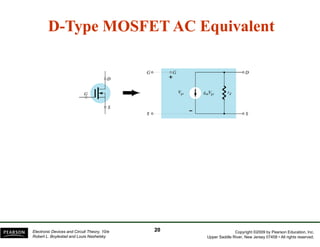
DD--Type MOSFET AC EquivalentType MOSFET AC Equivalentyp qyp q
Copyright ©2009 by Pearson Education, Inc.
Upper Saddle River, New Jersey 07458 • All rights reserved.
Electronic Devices and Circuit Theory, 10/e
Robert L. Boylestad and Louis Nashelsky
2020
EE--Type MOSFET AC EquivalentType MOSFET AC EquivalentEE--Type MOSFET AC EquivalentType MOSFET AC Equivalent
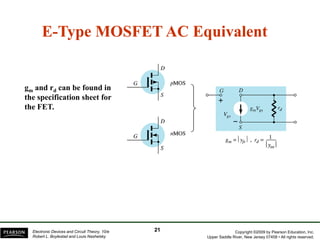
gm and rd can be found in
the specification sheet for
the FET.
Copyright ©2009 by Pearson Education, Inc.
Upper Saddle River, New Jersey 07458 • All rights reserved.
Electronic Devices and Circuit Theory, 10/e
Robert L. Boylestad and Louis Nashelsky
2121
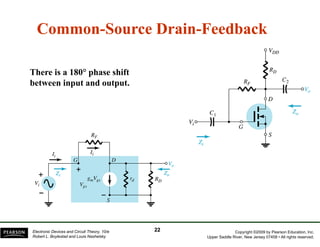
CommonCommon--Source DrainSource Drain--FeedbackFeedbackCommonCommon Source DrainSource Drain FeedbackFeedback
There is a 180° phase shift
between input and output.
Copyright ©2009 by Pearson Education, Inc.
Upper Saddle River, New Jersey 07458 • All rights reserved.
Electronic Devices and Circuit Theory, 10/e
Robert L. Boylestad and Louis Nashelsky
2222
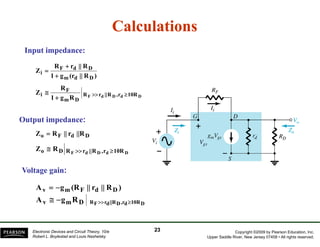
CalculationsCalculations
Input impedance:Input impedance:
)R||(rg1
R||rR
Z
Ddm
DdF
i
+
+
=
10RR||R
F
i
R
Z ≥≅
Output impedanceOutput impedance::
DdDdF 10Rr,R||rR
Dm
i
Rg1
Z ≥>>
+
≅
p pp p
DdFo ||Rr||RZ =
DdDdF 10Rr,R||rRDo RZ ≥>>≅ DdDdF ,||
Voltage gainVoltage gain::
)R||r||(RgA DdFmv −=
Dmv D10Rd,rD||RdrFRRgA ≥>>−≅
Copyright ©2009 by Pearson Education, Inc.
Upper Saddle River, New Jersey 07458 • All rights reserved.
Electronic Devices and Circuit Theory, 10/e
Robert L. Boylestad and Louis Nashelsky
2323
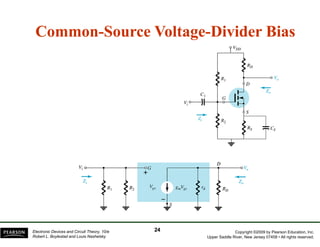
CommonCommon--Source VoltageSource Voltage--Divider BiasDivider BiasCommonCommon--Source VoltageSource Voltage--Divider BiasDivider Bias
Copyright ©2009 by Pearson Education, Inc.
Upper Saddle River, New Jersey 07458 • All rights reserved.
Electronic Devices and Circuit Theory, 10/e
Robert L. Boylestad and Louis Nashelsky
2424
CalculationsCalculations
Input impedanceInput impedance::
21i R||RZ =
O t t i dO t t i d
Ddo R||rZ =
Output impedance:Output impedance:
RZ 10rDo d
RZ ≥≅
Voltage gain:Voltage gain:
)R||(rgA Ddmv −=
RgA ≅
Voltage gain:Voltage gain:
Dd 10RrDmv RgA ≥−≅
Copyright ©2009 by Pearson Education, Inc.
Upper Saddle River, New Jersey 07458 • All rights reserved.
Electronic Devices and Circuit Theory, 10/e
Robert L. Boylestad and Louis Nashelsky
2525
Summary TableSummary Tableyy
Copyright ©2009 by Pearson Education, Inc.
Upper Saddle River, New Jersey 07458 • All rights reserved.
Electronic Devices and Circuit Theory, 10/e
Robert L. Boylestad and Louis Nashelsky
more…
2626
Summary TableSummary Tableyy
Copyright ©2009 by Pearson Education, Inc.
Upper Saddle River, New Jersey 07458 • All rights reserved.
Electronic Devices and Circuit Theory, 10/e
Robert L. Boylestad and Louis Nashelsky
2727
TroubleshootingTroubleshootingTroubleshootingTroubleshooting
Check the DC bias voltages:Check the DC bias voltages:
If not correct check power supply, resistors, FET. Also check to ensure
that the coupling capacitor between amplifier stages is OK.
.
Check the AC voltages:Check the AC voltages:
If not correct check FET capacitors and the loading effect of the nextIf not correct check FET, capacitors and the loading effect of the next
stage
Copyright ©2009 by Pearson Education, Inc.
Upper Saddle River, New Jersey 07458 • All rights reserved.
Electronic Devices and Circuit Theory, 10/e
Robert L. Boylestad and Louis Nashelsky
2828
Practical ApplicationsPractical Applicationspppp
ThreeThree--Channel Audio MixerChannel Audio Mixer
Silent SwitchingSilent Switching
Phase Shift NetworksPhase Shift Networks
Motion Detection SystemMotion Detection SystemMotion Detection SystemMotion Detection System
Copyright ©2009 by Pearson Education, Inc.
Upper Saddle River, New Jersey 07458 • All rights reserved.
Electronic Devices and Circuit Theory, 10/e
Robert L. Boylestad and Louis Nashelsky
2929

08 fet amplifiers

  • 1.
  • 2.
    IntroductionIntroduction FETs provide:FETs provide:FETsprovide:FETs provide: • Excellent voltage gain Hi h i i d• High input impedance • Low-power consumption • Good frequency range Copyright ©2009 by Pearson Education, Inc. Upper Saddle River, New Jersey 07458 • All rights reserved. Electronic Devices and Circuit Theory, 10/e Robert L. Boylestad and Louis Nashelsky 22
  • 3.
    FET SmallFET Small--SignalModelSignal Modelgg TransconductanceTransconductance Th l ti hi f h i I t th di h iThe relationship of a change in ID to the corresponding change in VGS is called transconductancetransconductance Transconductance is denoted g and given by:Transconductance is denoted gm and given by: D m I g Δ = GS m V g Δ Copyright ©2009 by Pearson Education, Inc. Upper Saddle River, New Jersey 07458 • All rights reserved. Electronic Devices and Circuit Theory, 10/e Robert L. Boylestad and Louis Nashelsky 33
  • 4.
    Graphical Determination ofgGraphical Determination of gmmp gp gmm Copyright ©2009 by Pearson Education, Inc. Upper Saddle River, New Jersey 07458 • All rights reserved. Electronic Devices and Circuit Theory, 10/e Robert L. Boylestad and Louis Nashelsky 44
  • 5.
    Mathematical Definitions ofgMathematical Definitions of gmmggmm GS D m V I g Δ Δ = ⎥ ⎦ ⎤ ⎢ ⎣ ⎡ −= P GS P DSS m V V 1 V 2I g P DSS m0 V 2I g = ⎤⎡ Where VGS =0V ⎥ ⎦ ⎤ ⎢ ⎣ ⎡ −= P GS m0m V V 1gg DSS D P GS I I V V 1 =− IV ⎞⎛ Where DSS D m0 P GS m0m I I g V V 1gg =⎟⎟ ⎠ ⎞ ⎜⎜ ⎝ ⎛ −= Copyright ©2009 by Pearson Education, Inc. Upper Saddle River, New Jersey 07458 • All rights reserved. Electronic Devices and Circuit Theory, 10/e Robert L. Boylestad and Louis Nashelsky 55
  • 6.
    FET ImpedanceFET Impedance Inputimpedance:Input impedance: pp Ω∞=iZ do y 1 rZ == Output Impedance:Output Impedance: osy VΔ where: constantV D DS d GSI V r == Δ Δ yos= admittance parameter listed on FET specification sheets. Copyright ©2009 by Pearson Education, Inc. Upper Saddle River, New Jersey 07458 • All rights reserved. Electronic Devices and Circuit Theory, 10/e Robert L. Boylestad and Louis Nashelsky 66
  • 7.
    FET AC EquivalentCircuitFET AC Equivalent Circuit Copyright ©2009 by Pearson Education, Inc. Upper Saddle River, New Jersey 07458 • All rights reserved. Electronic Devices and Circuit Theory, 10/e Robert L. Boylestad and Louis Nashelsky 77
  • 8.
    CommonCommon--Source (CS) FixedSource(CS) Fixed--Bias CircuitBias Circuit( )( ) The input is on the gate and the output is on the drain There is a 180° phase shift between input and output Copyright ©2009 by Pearson Education, Inc. Upper Saddle River, New Jersey 07458 • All rights reserved. Electronic Devices and Circuit Theory, 10/e Robert L. Boylestad and Louis Nashelsky 88
  • 9.
    CalculationsCalculationsCalculationsCalculations Input impedance:Input impedance: GiRZ = Output impedance:Output impedance: dDo r||RZ = RZ p pp p 10RrDo Dd RZ ≥ ≅ Voltage gain:Voltage gain: )R||(rg V V A Ddm i o v −== Voltage gain:Voltage gain: i Dd 10RrDm i o v Rg V V A ≥ −== Copyright ©2009 by Pearson Education, Inc. Upper Saddle River, New Jersey 07458 • All rights reserved. Electronic Devices and Circuit Theory, 10/e Robert L. Boylestad and Louis Nashelsky 99
  • 10.
    CommonCommon--Source (CS) SelfSource(CS) Self--Bias CircuitBias Circuit( )( ) This is a common-source amplifier configuration, so the input is on the gate and the output is on the drain There is a 180° phase shift between input and output Copyright ©2009 by Pearson Education, Inc. Upper Saddle River, New Jersey 07458 • All rights reserved. Electronic Devices and Circuit Theory, 10/e Robert L. Boylestad and Louis Nashelsky 1010
  • 11.
    CalculationsCalculations RZ Input impedance:Input impedance: GiRZ = Output impedance:Output impedance: Ddo R||rZ = RZ p pp p 10RrDo Dd RZ ≥ ≅ )R||(rgA Ddmv −= Voltage gain:Voltage gain: Dd 10RrDmv RgA ≥ −= Copyright ©2009 by Pearson Education, Inc. Upper Saddle River, New Jersey 07458 • All rights reserved. Electronic Devices and Circuit Theory, 10/e Robert L. Boylestad and Louis Nashelsky 1111
  • 12.
    CommonCommon--Source (CS) SelfSource(CS) Self--Bias CircuitBias Circuit Removing Cs affects the gain of the circuit.g Copyright ©2009 by Pearson Education, Inc. Upper Saddle River, New Jersey 07458 • All rights reserved. Electronic Devices and Circuit Theory, 10/e Robert L. Boylestad and Louis Nashelsky 1212
  • 13.
    CalculationsCalculations Gi RZ = Inputimpedance:Input impedance: Gi Output impedance:Output impedance: 10RrDo Dd RZ ≥ ≅ Dmo RgV A −== Voltage gain:Voltage gain: d SD Sm i v r RR Rg1 V A + ++ == Dmo RgV A )R(R01r Sm Dm i o v SDdRg1 g V A +≥ + −== Copyright ©2009 by Pearson Education, Inc. Upper Saddle River, New Jersey 07458 • All rights reserved. Electronic Devices and Circuit Theory, 10/e Robert L. Boylestad and Louis Nashelsky 1313
  • 14.
    CommonCommon--Source (CS) VoltageSource(CS) Voltage--Divider BiasDivider Bias This is a common-source amplifier configuration, so the input is on the gate and thep g output is on the drain. Copyright ©2009 by Pearson Education, Inc. Upper Saddle River, New Jersey 07458 • All rights reserved. Electronic Devices and Circuit Theory, 10/e Robert L. Boylestad and Louis Nashelsky 1414
  • 15.
    ImpedancesImpedances Input impedance:Input impedance: 21iR||RZ = Output impedance:Output impedance: Ddo R||rZ = Output impedance:Output impedance: 10RrDo Dd RZ ≥ ≅ Voltage gain:Voltage gain: )R||(rgA Ddmv −= Voltage gain:Voltage gain: Dd 10RrDmv RgA ≥ −= Copyright ©2009 by Pearson Education, Inc. Upper Saddle River, New Jersey 07458 • All rights reserved. Electronic Devices and Circuit Theory, 10/e Robert L. Boylestad and Louis Nashelsky 1515
  • 16.
    Source Follower (CommonSourceFollower (Common--Drain) CircuitDrain) CircuitSource Follower (CommonSource Follower (Common--Drain) CircuitDrain) Circuit In a common-drain amplifierIn a common drain amplifier configuration, the input is on the gate, but the output is from the sourcesource. There is no phase shift between i t d t tinput and output. Copyright ©2009 by Pearson Education, Inc. Upper Saddle River, New Jersey 07458 • All rights reserved. Electronic Devices and Circuit Theory, 10/e Robert L. Boylestad and Louis Nashelsky 1616
  • 17.
    ImpedancesImpedances RZ Input impedance:Input impedance: GiRZ = Output impedance:Output impedance: m Sdo g 1 ||R||rZ = 1 Sd 10Rr m So g 1 ||RZ ≥≅ Voltage gain:Voltage gain: )R||(rg1 )R||(rg V V A Sdm Sdm i o v + == Voltage gain:Voltage gain: 10r Sm Sm i o v dRg1 Rg V V A ≥ + == Copyright ©2009 by Pearson Education, Inc. Upper Saddle River, New Jersey 07458 • All rights reserved. Electronic Devices and Circuit Theory, 10/e Robert L. Boylestad and Louis Nashelsky 1717
  • 18.
    CommonCommon--Gate (CG) CircuitGate(CG) Circuit( )( ) The input is on the sourceThe input is on the source and the output is on the drain. There is no phase shift between input and output. Copyright ©2009 by Pearson Education, Inc. Upper Saddle River, New Jersey 07458 • All rights reserved. Electronic Devices and Circuit Theory, 10/e Robert L. Boylestad and Louis Nashelsky 1818
  • 19.
    CalculationsCalculations Input impedance:Input impedance: ⎥ ⎦ ⎤ ⎢ ⎣ ⎡ + + = dm Dd Si rg1 Rr ||RZ 1 Outputimpedance:Output impedance: Dd 10Rr m Si g 1 ||RZ ≥≅ Output impedance:Output impedance: dDo r||RZ = Voltage gain:Voltage gain: 10rDo d RZ ≥≅ ⎥ ⎦ ⎤ ⎢ ⎣ ⎡ + d D Dm o r R Rg V RgA Voltage gain:Voltage gain: ⎥ ⎦ ⎤ ⎢ ⎣ ⎡ + ⎦⎣== d D d i o v r R 1 V V A 10RrDmv Dd RgA ≥= Copyright ©2009 by Pearson Education, Inc. Upper Saddle River, New Jersey 07458 • All rights reserved. Electronic Devices and Circuit Theory, 10/e Robert L. Boylestad and Louis Nashelsky 1919
  • 20.
    DD--Type MOSFET ACEquivalentType MOSFET AC Equivalentyp qyp q Copyright ©2009 by Pearson Education, Inc. Upper Saddle River, New Jersey 07458 • All rights reserved. Electronic Devices and Circuit Theory, 10/e Robert L. Boylestad and Louis Nashelsky 2020
  • 21.
    EE--Type MOSFET ACEquivalentType MOSFET AC EquivalentEE--Type MOSFET AC EquivalentType MOSFET AC Equivalent gm and rd can be found in the specification sheet for the FET. Copyright ©2009 by Pearson Education, Inc. Upper Saddle River, New Jersey 07458 • All rights reserved. Electronic Devices and Circuit Theory, 10/e Robert L. Boylestad and Louis Nashelsky 2121
  • 22.
    CommonCommon--Source DrainSource Drain--FeedbackFeedbackCommonCommonSource DrainSource Drain FeedbackFeedback There is a 180° phase shift between input and output. Copyright ©2009 by Pearson Education, Inc. Upper Saddle River, New Jersey 07458 • All rights reserved. Electronic Devices and Circuit Theory, 10/e Robert L. Boylestad and Louis Nashelsky 2222
  • 23.
    CalculationsCalculations Input impedance:Input impedance: )R||(rg1 R||rR Z Ddm DdF i + + = 10RR||R F i R Z≥≅ Output impedanceOutput impedance:: DdDdF 10Rr,R||rR Dm i Rg1 Z ≥>> + ≅ p pp p DdFo ||Rr||RZ = DdDdF 10Rr,R||rRDo RZ ≥>>≅ DdDdF ,|| Voltage gainVoltage gain:: )R||r||(RgA DdFmv −= Dmv D10Rd,rD||RdrFRRgA ≥>>−≅ Copyright ©2009 by Pearson Education, Inc. Upper Saddle River, New Jersey 07458 • All rights reserved. Electronic Devices and Circuit Theory, 10/e Robert L. Boylestad and Louis Nashelsky 2323
  • 24.
    CommonCommon--Source VoltageSource Voltage--DividerBiasDivider BiasCommonCommon--Source VoltageSource Voltage--Divider BiasDivider Bias Copyright ©2009 by Pearson Education, Inc. Upper Saddle River, New Jersey 07458 • All rights reserved. Electronic Devices and Circuit Theory, 10/e Robert L. Boylestad and Louis Nashelsky 2424
  • 25.
    CalculationsCalculations Input impedanceInput impedance:: 21iR||RZ = O t t i dO t t i d Ddo R||rZ = Output impedance:Output impedance: RZ 10rDo d RZ ≥≅ Voltage gain:Voltage gain: )R||(rgA Ddmv −= RgA ≅ Voltage gain:Voltage gain: Dd 10RrDmv RgA ≥−≅ Copyright ©2009 by Pearson Education, Inc. Upper Saddle River, New Jersey 07458 • All rights reserved. Electronic Devices and Circuit Theory, 10/e Robert L. Boylestad and Louis Nashelsky 2525
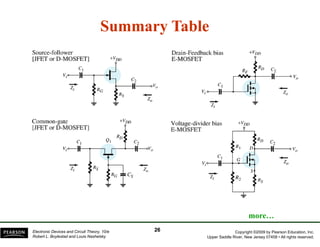
  • 26.
    Summary TableSummary Tableyy Copyright©2009 by Pearson Education, Inc. Upper Saddle River, New Jersey 07458 • All rights reserved. Electronic Devices and Circuit Theory, 10/e Robert L. Boylestad and Louis Nashelsky more… 2626
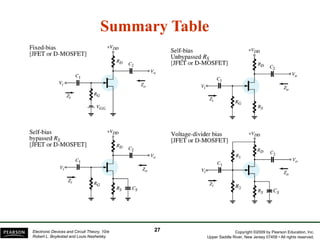
  • 27.
    Summary TableSummary Tableyy Copyright©2009 by Pearson Education, Inc. Upper Saddle River, New Jersey 07458 • All rights reserved. Electronic Devices and Circuit Theory, 10/e Robert L. Boylestad and Louis Nashelsky 2727
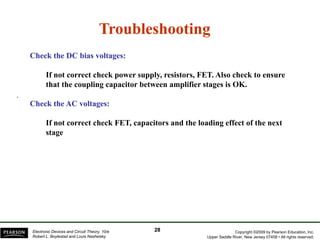
  • 28.
    TroubleshootingTroubleshootingTroubleshootingTroubleshooting Check the DCbias voltages:Check the DC bias voltages: If not correct check power supply, resistors, FET. Also check to ensure that the coupling capacitor between amplifier stages is OK. . Check the AC voltages:Check the AC voltages: If not correct check FET capacitors and the loading effect of the nextIf not correct check FET, capacitors and the loading effect of the next stage Copyright ©2009 by Pearson Education, Inc. Upper Saddle River, New Jersey 07458 • All rights reserved. Electronic Devices and Circuit Theory, 10/e Robert L. Boylestad and Louis Nashelsky 2828
  • 29.
    Practical ApplicationsPractical Applicationspppp ThreeThree--ChannelAudio MixerChannel Audio Mixer Silent SwitchingSilent Switching Phase Shift NetworksPhase Shift Networks Motion Detection SystemMotion Detection SystemMotion Detection SystemMotion Detection System Copyright ©2009 by Pearson Education, Inc. Upper Saddle River, New Jersey 07458 • All rights reserved. Electronic Devices and Circuit Theory, 10/e Robert L. Boylestad and Louis Nashelsky 2929