Chapter 8: 
FET Amplifiers
Introduction 
FETs provide: 
• Excellent voltage gain 
• High input impedance 
• Low-power consumption 
• Good frequency range 
Copyright ©2009 by Pearson Education, Inc. 
Upper Saddle River, New Jersey 07458 • All rights reserved. 
Electronic Devices and Circuit Theory, 10/e 
Robert L. Boylestad and Louis Nashelsky 
2
FET Small-Signal Model 
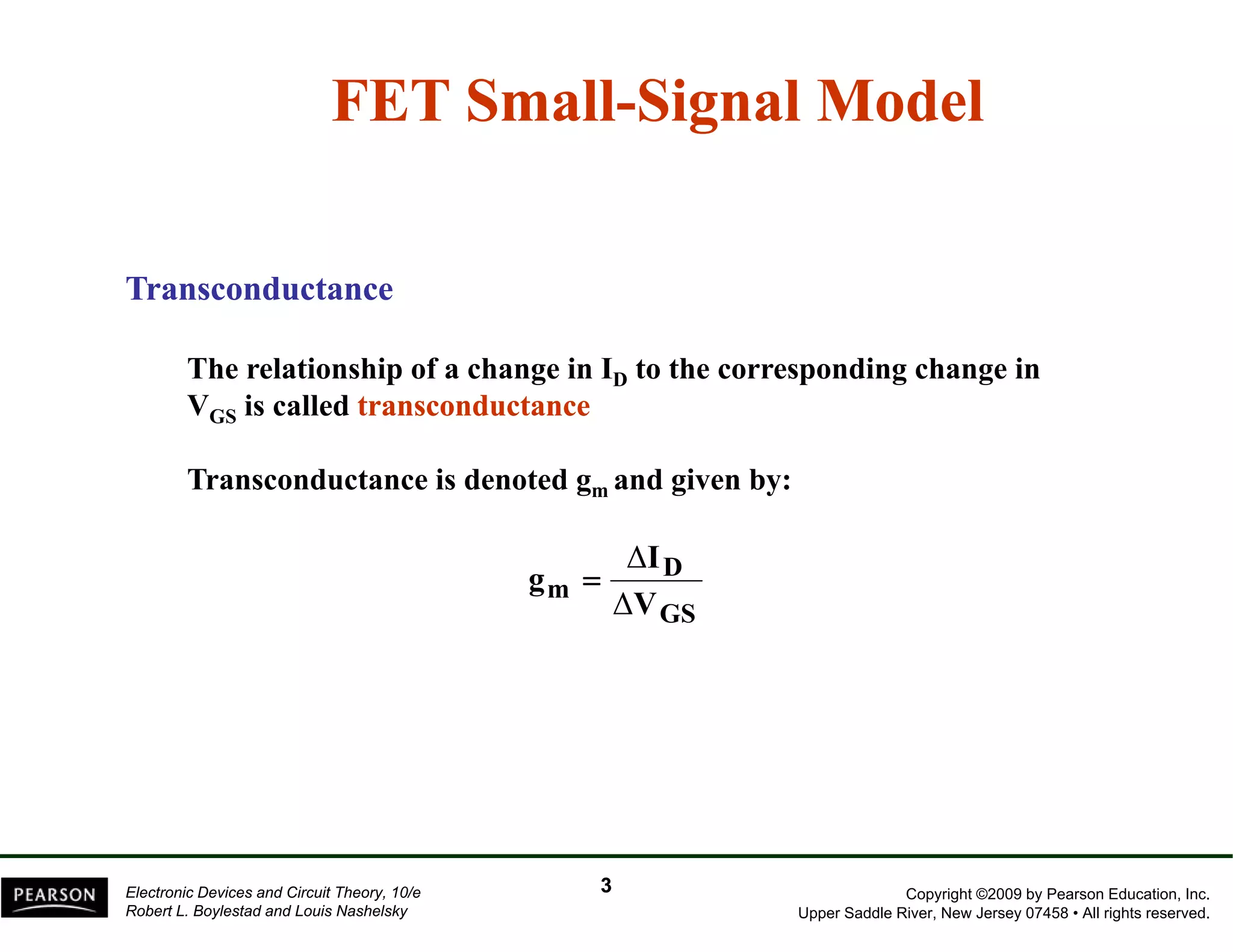
Transconductance 
The relationship of a change in ID to the corresponding change in 
VGS is called transconductance 
Transconductance is denoted gm and given by: 
D 
m 
I 
g 
Δ = 
GS 
V 
Δ 
Copyright ©2009 by Pearson Education, Inc. 
Upper Saddle River, New Jersey 07458 • All rights reserved. 
Electronic Devices and Circuit Theory, 10/e 
Robert L. Boylestad and Louis Nashelsky 
3
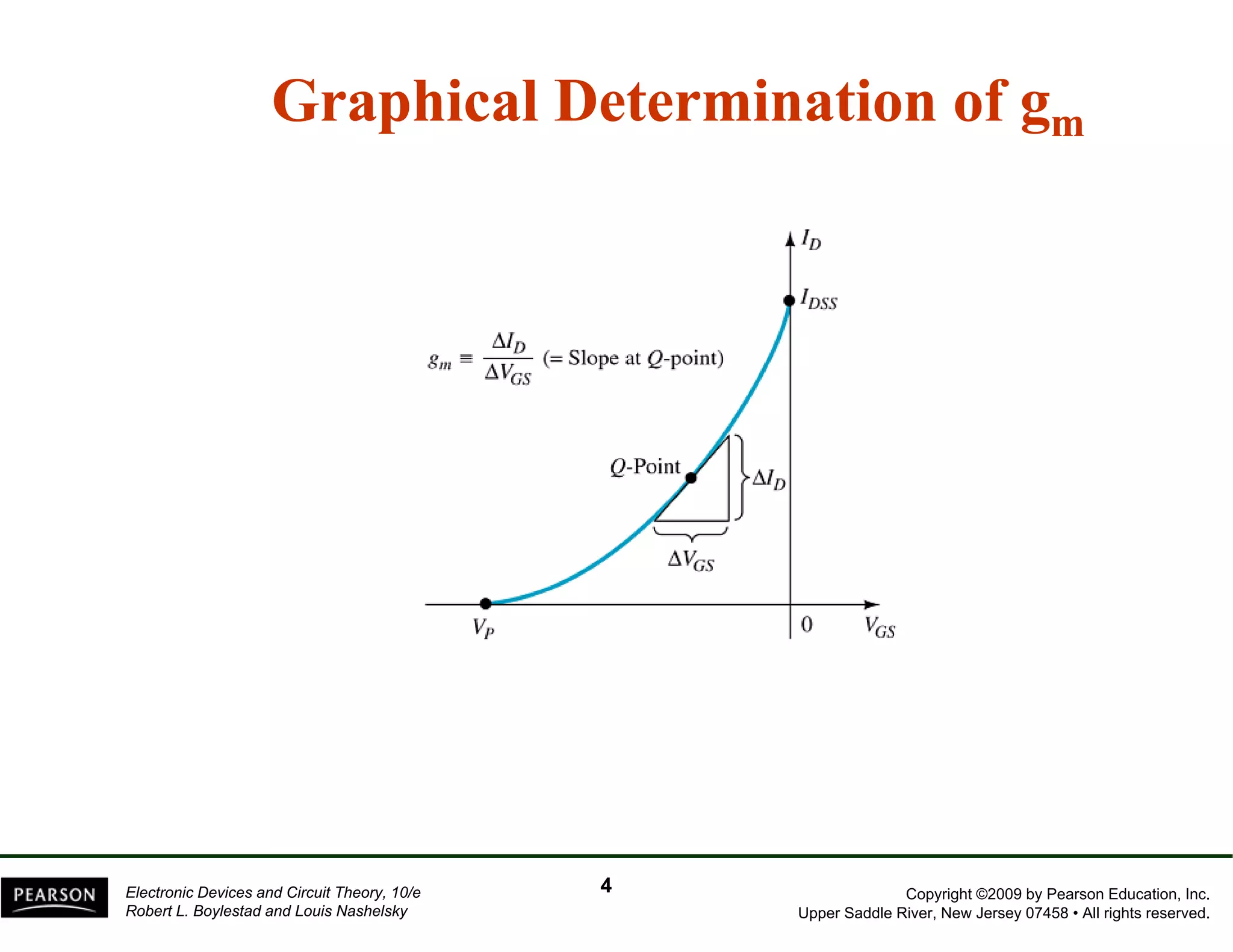
Graphical Determination of gm 
Copyright ©2009 by Pearson Education, Inc. 
Upper Saddle River, New Jersey 07458 • All rights reserved. 
Electronic Devices and Circuit Theory, 10/e 
Robert L. Boylestad and Louis Nashelsky 
4
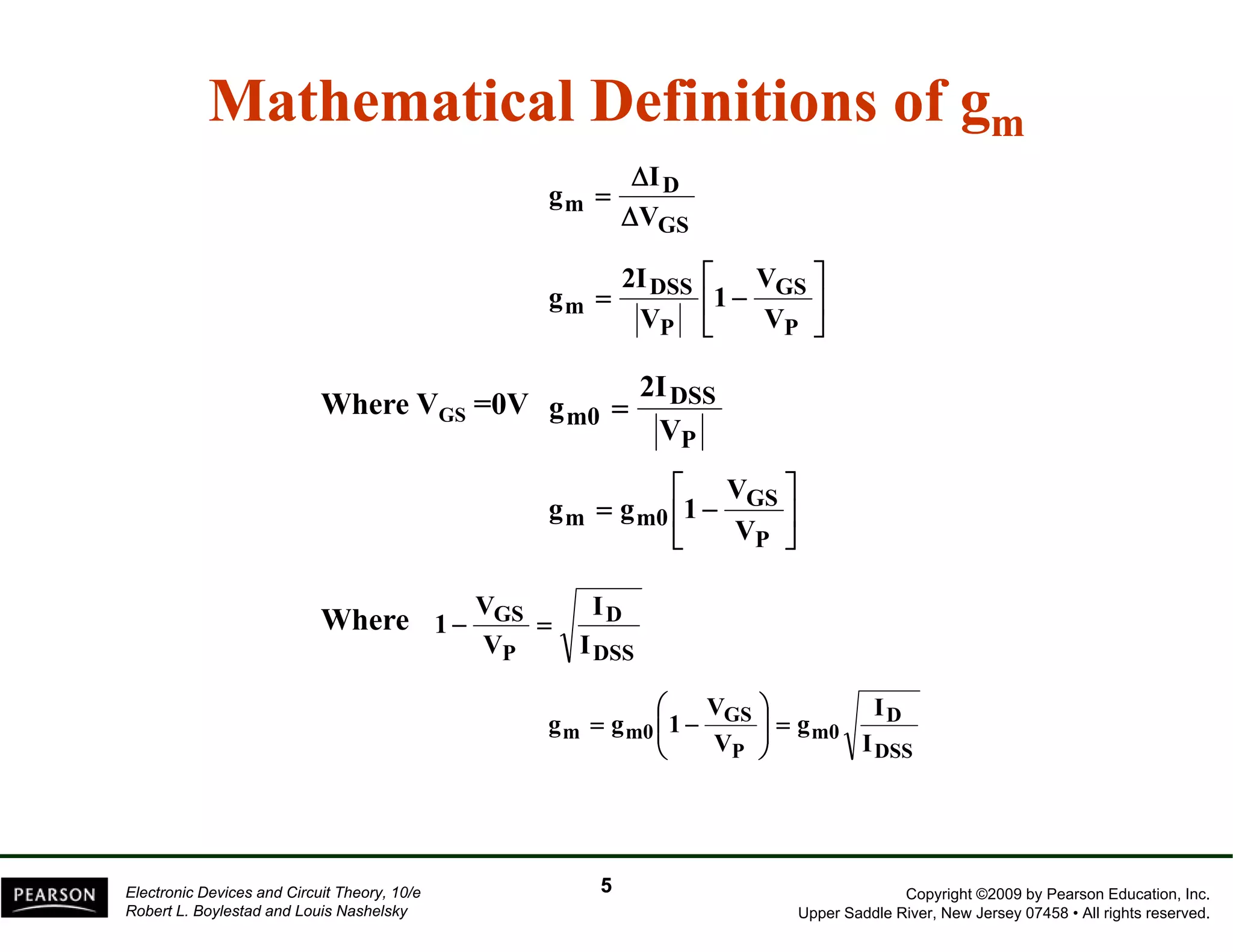
Mathematical Definitions of gm 
D 
I 
Δ 
m V 
GS 
g 
Δ 
= 
⎤ 
⎥⎦ 
⎡ 
DSS 
2I 
= − 
⎢⎣ 
GS 
m V 
P 
P 
V 
1 
V 
g 
DSS 
m0 V 
P 
2I 
g = 
⎡ 
⎤ 
Where VGS =0V 
⎥⎦ 
= − 
⎢⎣ 
GS 
m m0 V 
P 
V 
g g 1 
D 
DSS 
V 
GS 
1 − = 
P 
I 
I 
V 
⎛ 
V 
⎞ 
I 
Where 
D 
DSS 
m0 
GS 
1 g g = ⎟⎟⎠ 
m m0 I 
P 
g 
V 
⎜ ⎜⎝ 
= − 
Copyright ©2009 by Pearson Education, Inc. 
Upper Saddle River, New Jersey 07458 • All rights reserved. 
Electronic Devices and Circuit Theory, 10/e 
Robert L. Boylestad and Louis Nashelsky 
5
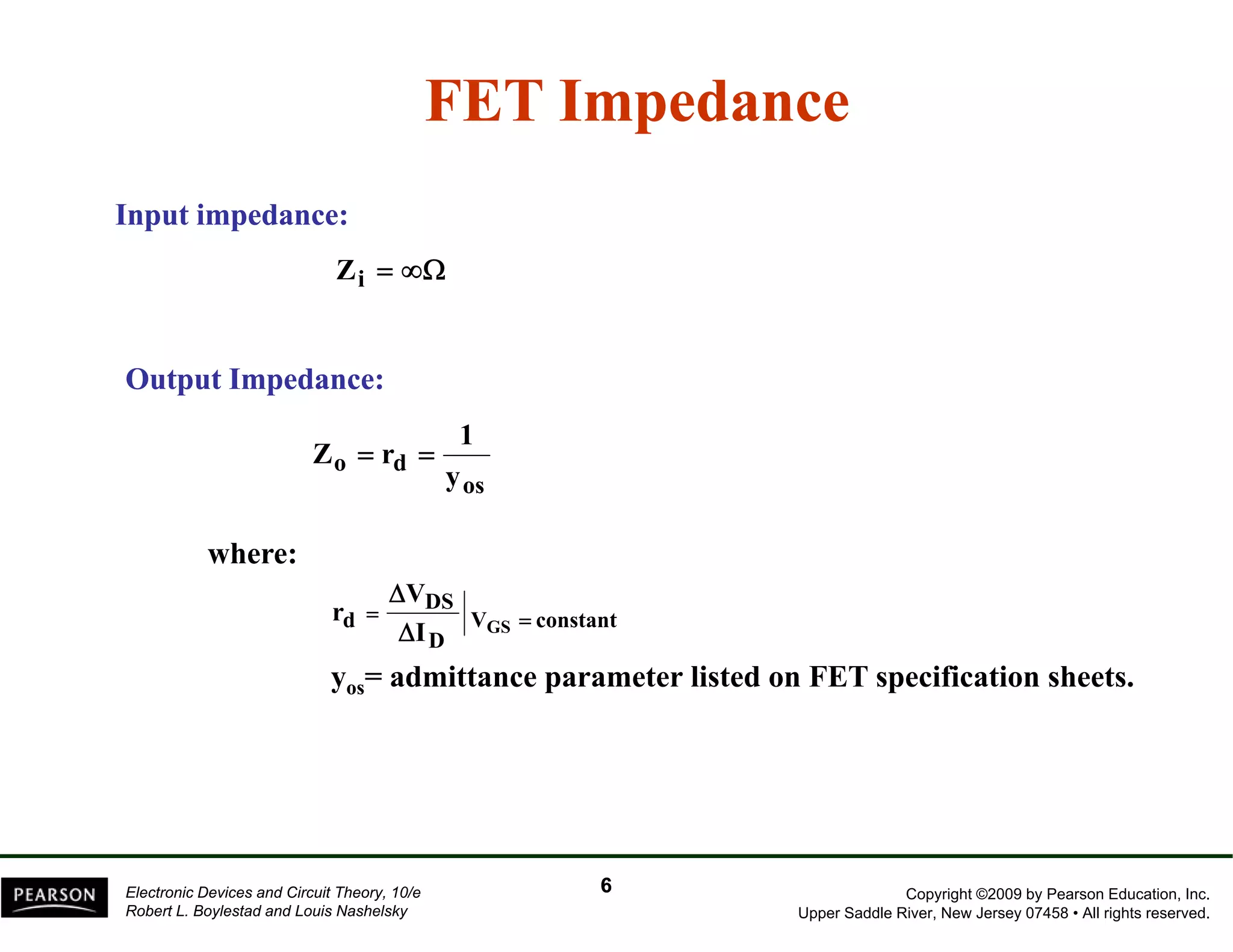
FET Impedance 
Input impedance: 
p 
Zi = ∞Ω 
Output Impedance: 
Z = r = 1 
o d y 
yos 
ΔV 
where: 
Δ 
d I GS 
V constant 
DS 
D 
V 
r = = 
Δ 
yos= admittance parameter listed on FET specification sheets. 
Copyright ©2009 by Pearson Education, Inc. 
Upper Saddle River, New Jersey 07458 • All rights reserved. 
Electronic Devices and Circuit Theory, 10/e 
Robert L. Boylestad and Louis Nashelsky 
6
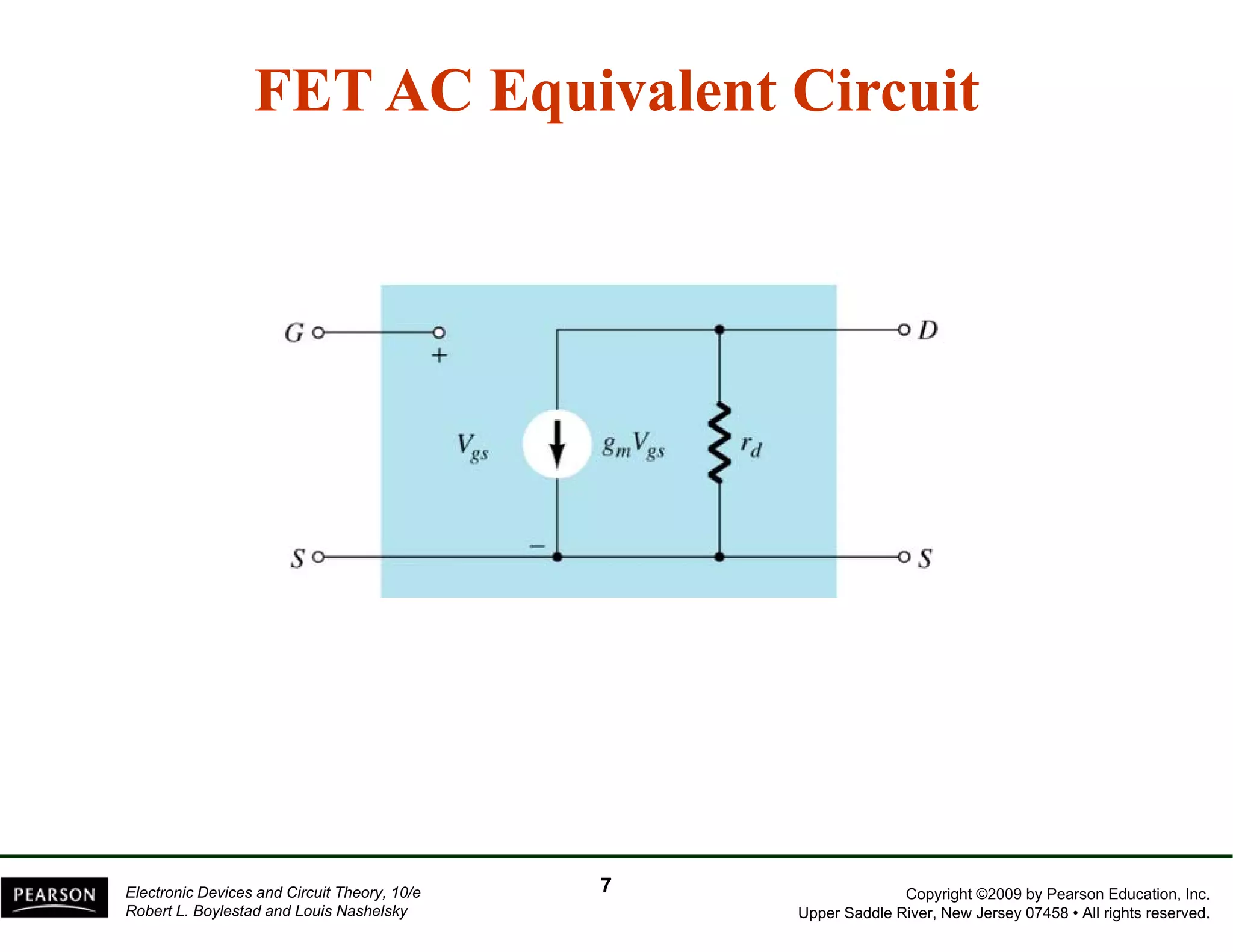
FET AC Equivalent Circuit 
Copyright ©2009 by Pearson Education, Inc. 
Upper Saddle River, New Jersey 07458 • All rights reserved. 
Electronic Devices and Circuit Theory, 10/e 
Robert L. Boylestad and Louis Nashelsky 
7
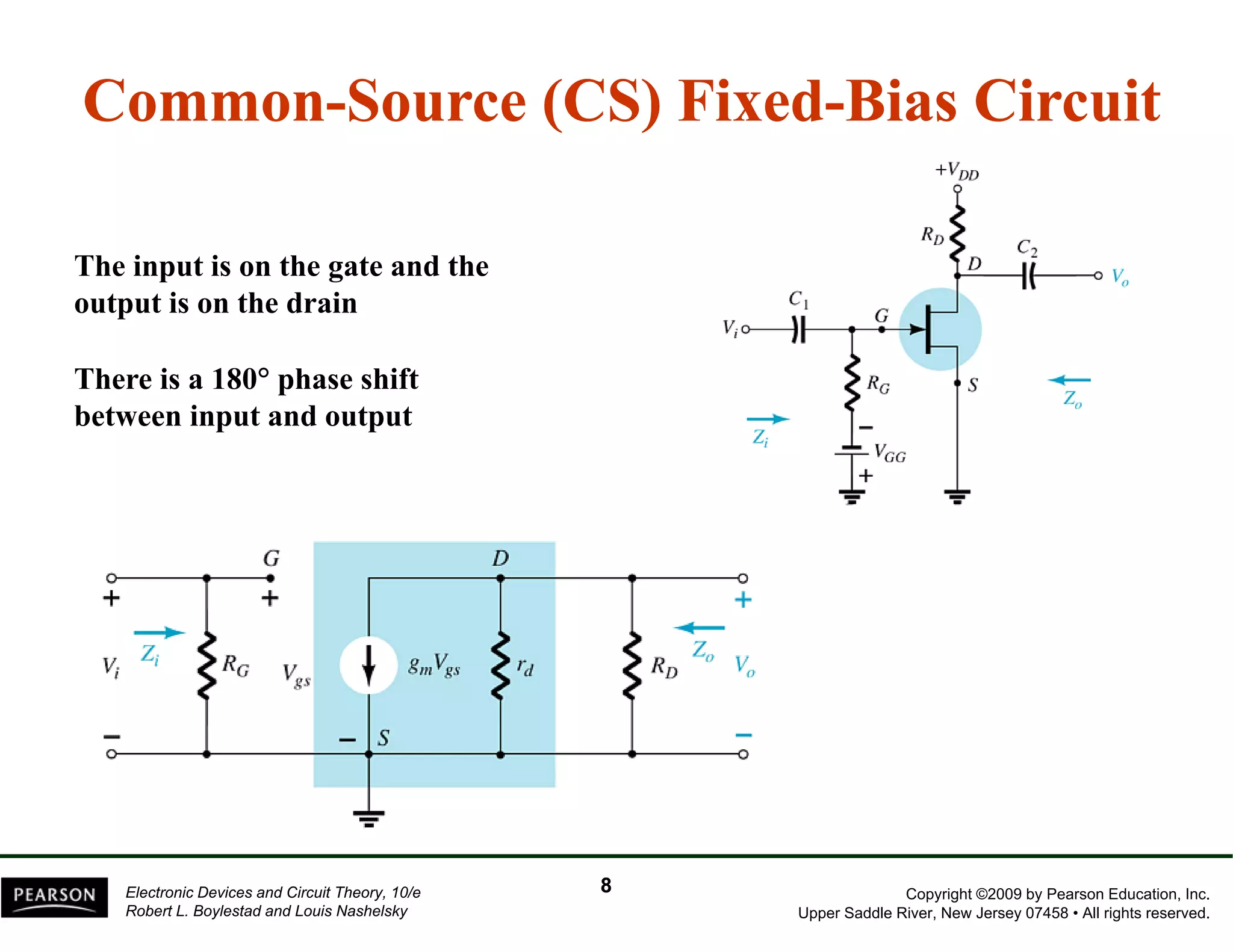
Common-Source (CS) Fixed-Bias Circuit 
The input is on the gate and the 
output is on the drain 
There is a 180° phase shift 
between input and output 
Copyright ©2009 by Pearson Education, Inc. 
Upper Saddle River, New Jersey 07458 • All rights reserved. 
Electronic Devices and Circuit Theory, 10/e 
Robert L. Boylestad and Louis Nashelsky 
8
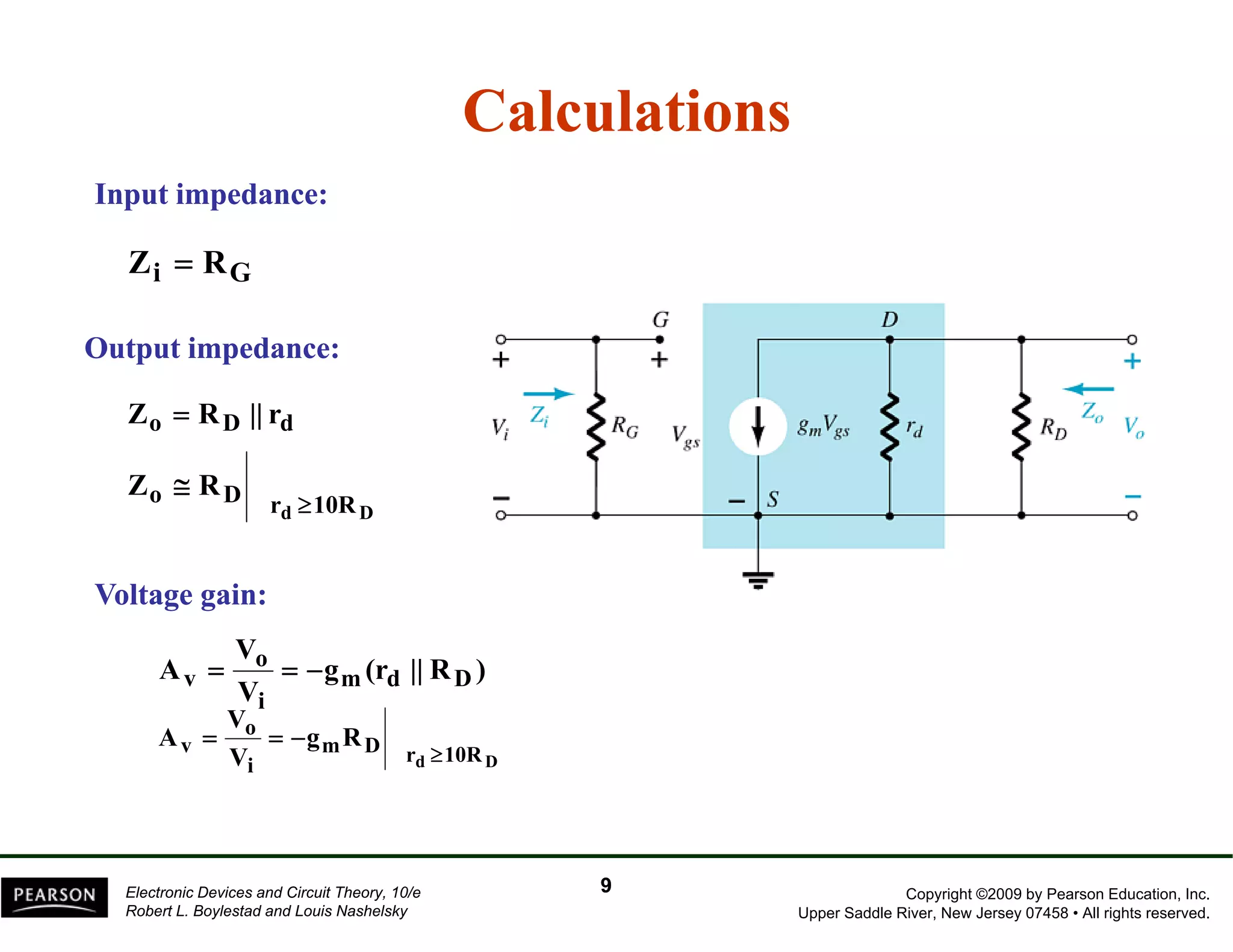
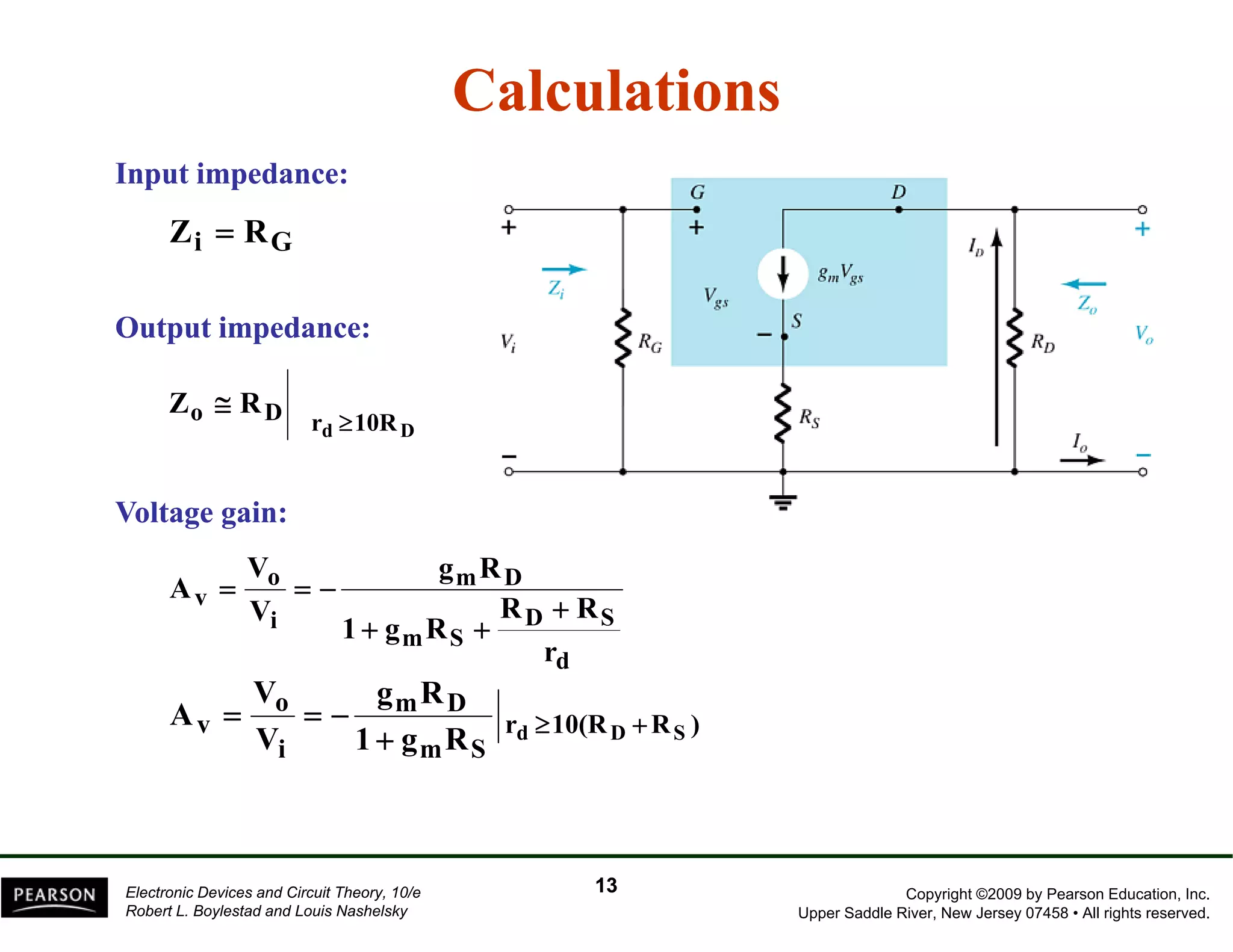
Calculations 
Input impedance: 
Zi = RG 
p Output p 
impedance: 
Zo = RD || rd 
Z R 
o D r ≥ 
10R 
d D 
≅ 
Voltage gain: 
o 
A m d D 
g (r || R ) 
V 
v = = − 
V 
i 
v g R 
rd 10RD m D 
o 
V 
i 
V 
A = = − 
≥ 
Copyright ©2009 by Pearson Education, Inc. 
Upper Saddle River, New Jersey 07458 • All rights reserved. 
Electronic Devices and Circuit Theory, 10/e 
Robert L. Boylestad and Louis Nashelsky 
9
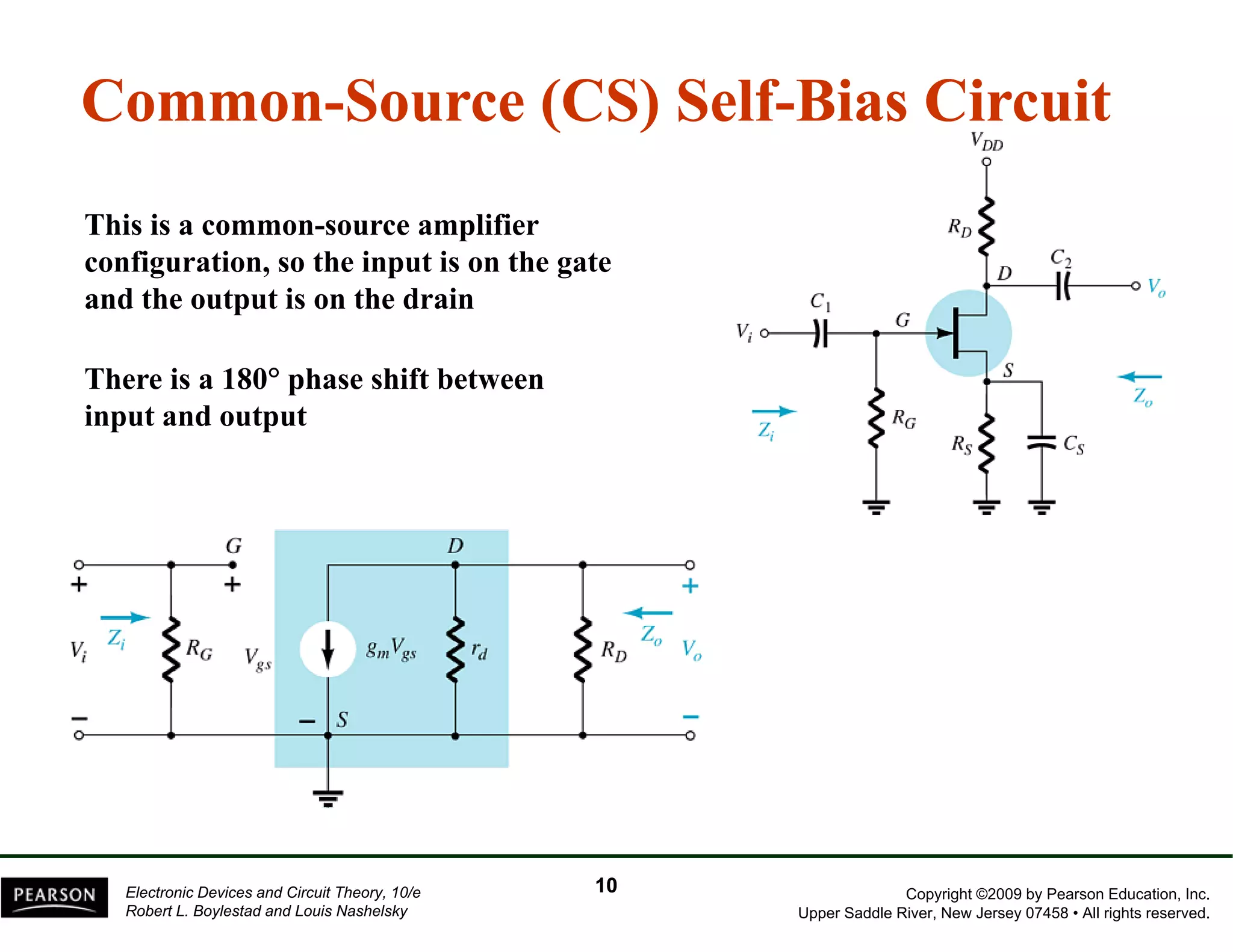
Common-Source (CS) Self-Bias Circuit 
This is a common-source amplifier 
configuration, so the input is on the gate 
and the output is on the drain 
There is a 180° phase shift between 
input and output 
Copyright ©2009 by Pearson Education, Inc. 
Upper Saddle River, New Jersey 07458 • All rights reserved. 
Electronic Devices and Circuit Theory, 10/e 
Robert L. Boylestad and Louis Nashelsky 
10
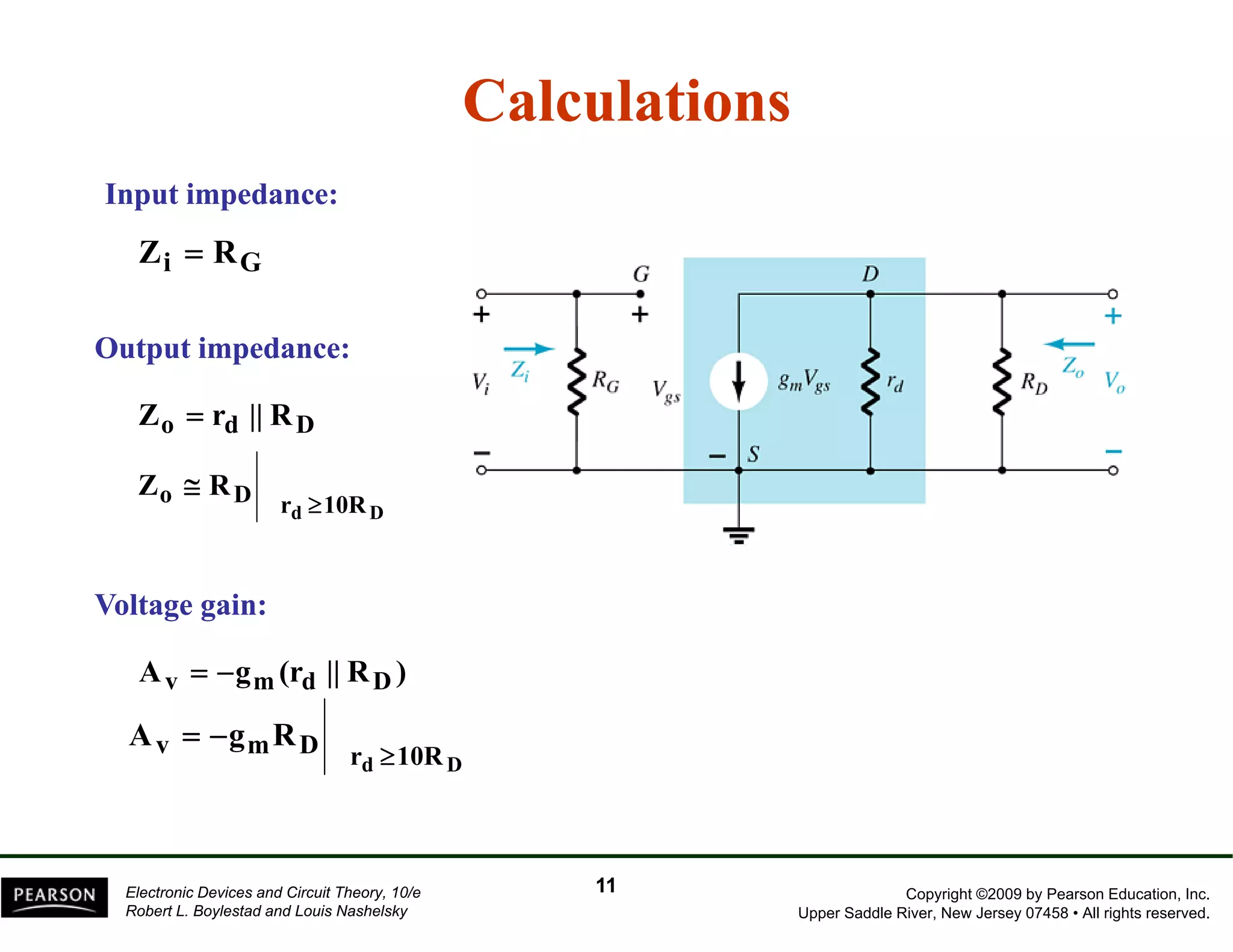
Calculations 
Input impedance: 
Z Zi = R 
RG 
p Output p 
impedance: 
Zo = rd || RD 
Z R 
o D r ≥ 
10R 
d D 
≅ 
Voltage gain: 
Av = −gm(rd || RD) 
Av = − 
gmRD rd ≥ 
10RD Copyright ©2009 by Pearson Education, Inc. 
Upper Saddle River, New Jersey 07458 • All rights reserved. 
Electronic Devices and Circuit Theory, 10/e 
Robert L. Boylestad and Louis Nashelsky 
11
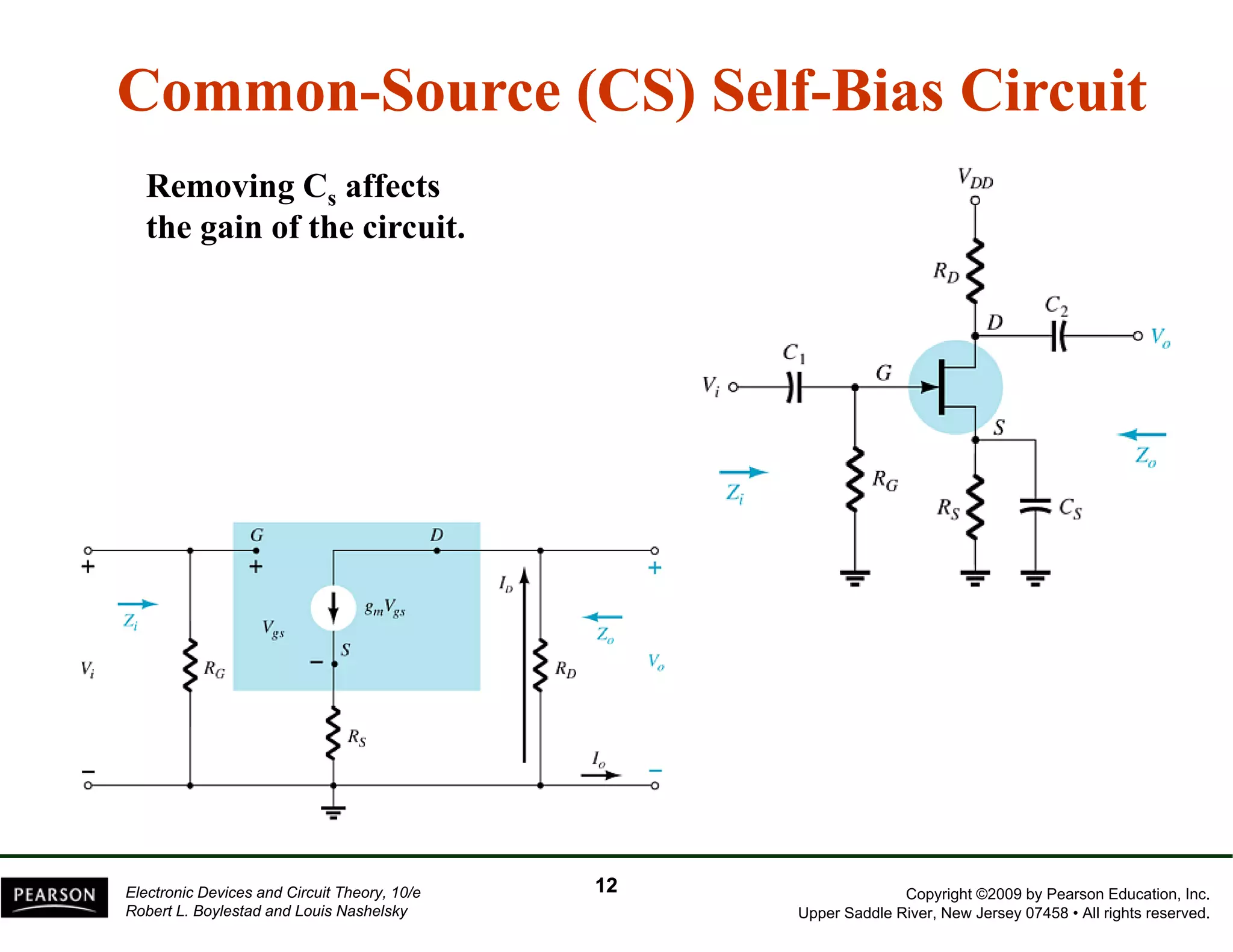
Common-Source (CS) Self-Bias Circuit 
Removing Cs affects 
the gain of the circuit. 
Copyright ©2009 by Pearson Education, Inc. 
Upper Saddle River, New Jersey 07458 • All rights reserved. 
Electronic Devices and Circuit Theory, 10/e 
Robert L. Boylestad and Louis Nashelsky 
12
Calculations 
Input impedance: 
Zi i = G 
RG 
Output impedance: 
Z R ≥ 
o D r 10R 
d D 
≅ 
Voltage gain: 
Vo gmRD 
A = = 
− 
R R 
D S 
d 
m S 
i 
v 
r 
V 1 g R 
+ 
+ + 
Vo o 
m gmRD 
D 
A r 10(R R ) 
v 1 g R d D S 
m S 
i 
g 
V 
≥ + + 
= = − 
Copyright ©2009 by Pearson Education, Inc. 
Upper Saddle River, New Jersey 07458 • All rights reserved. 
Electronic Devices and Circuit Theory, 10/e 
Robert L. Boylestad and Louis Nashelsky 
13
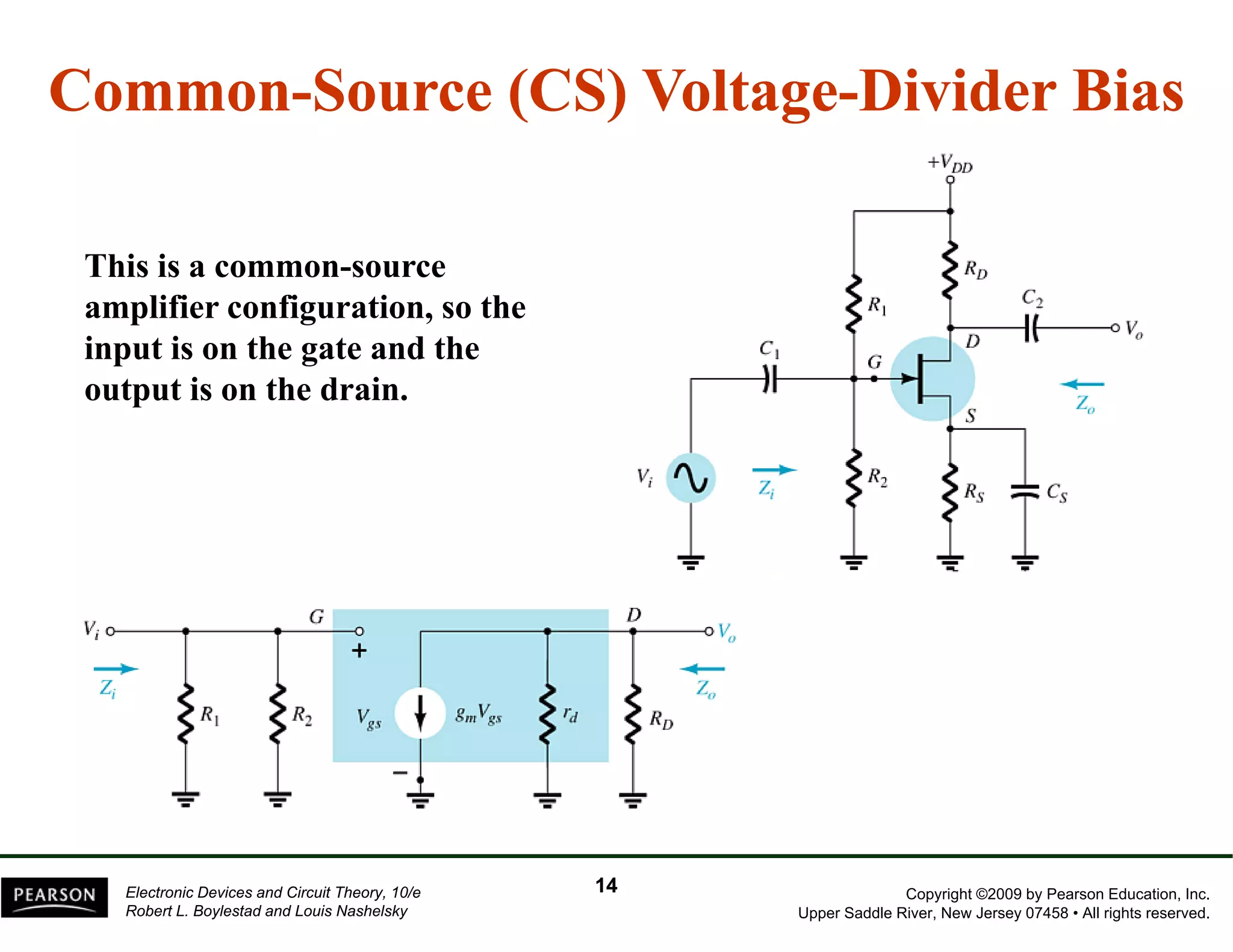
Common-Source (CS) Voltage-Divider Bias 
This is a common-source 
amplifier configuration, so the 
input is on the gate and the 
output is on the drain. 
Copyright ©2009 by Pearson Education, Inc. 
Upper Saddle River, New Jersey 07458 • All rights reserved. 
Electronic Devices and Circuit Theory, 10/e 
Robert L. Boylestad and Louis Nashelsky 
14
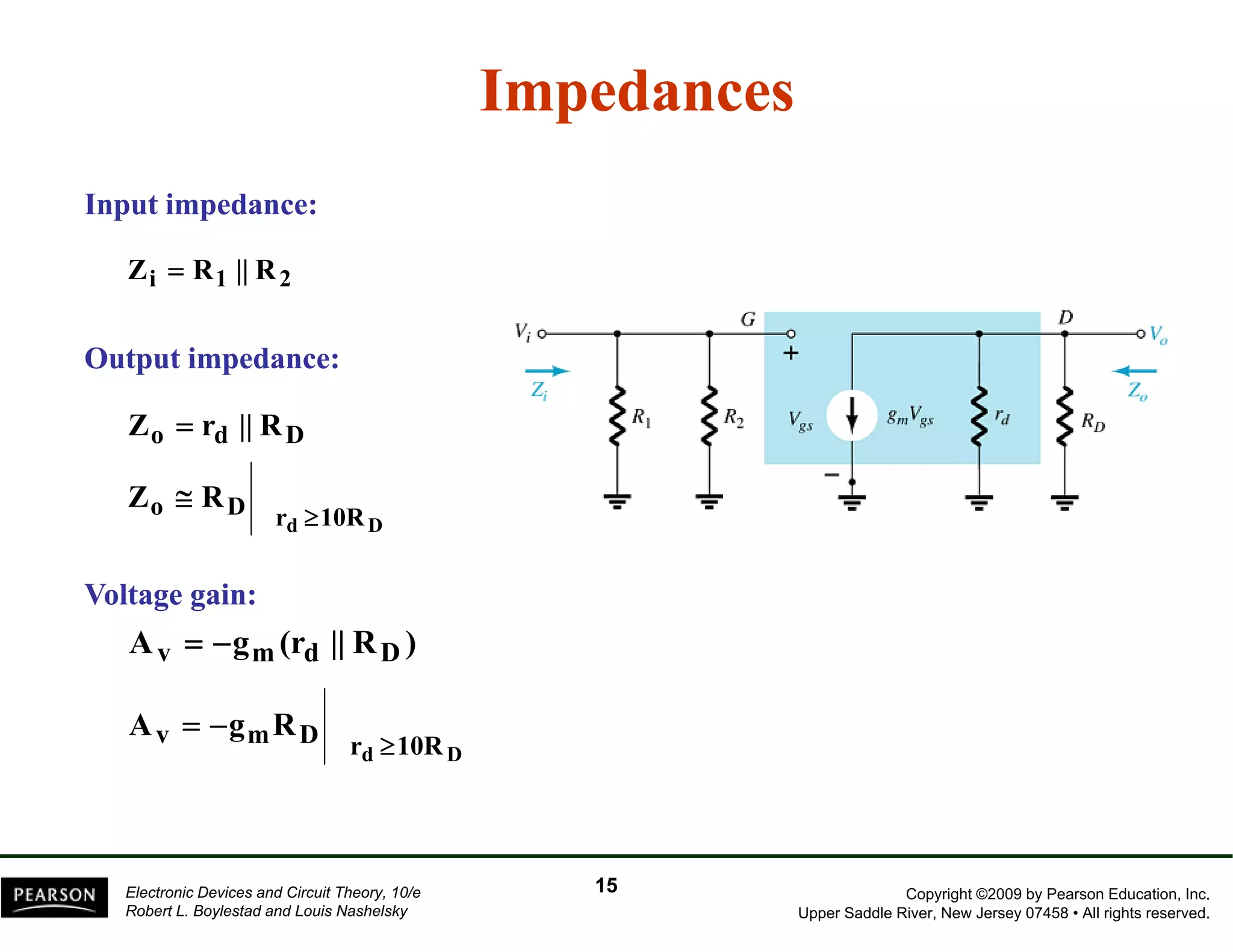
Impedances 
Input impedance: 
Zi = R1 || R2 
Output impedance: 
Zo = rd || RD 
Z R ≥ 
o D r 10R 
d D 
≅ 
Voltage gain: 
Av = −gm(rd || RD ) 
Av = − 
gmRD rd ≥ 
10RD Copyright ©2009 by Pearson Education, Inc. 
Upper Saddle River, New Jersey 07458 • All rights reserved. 
Electronic Devices and Circuit Theory, 10/e 
Robert L. Boylestad and Louis Nashelsky 
15
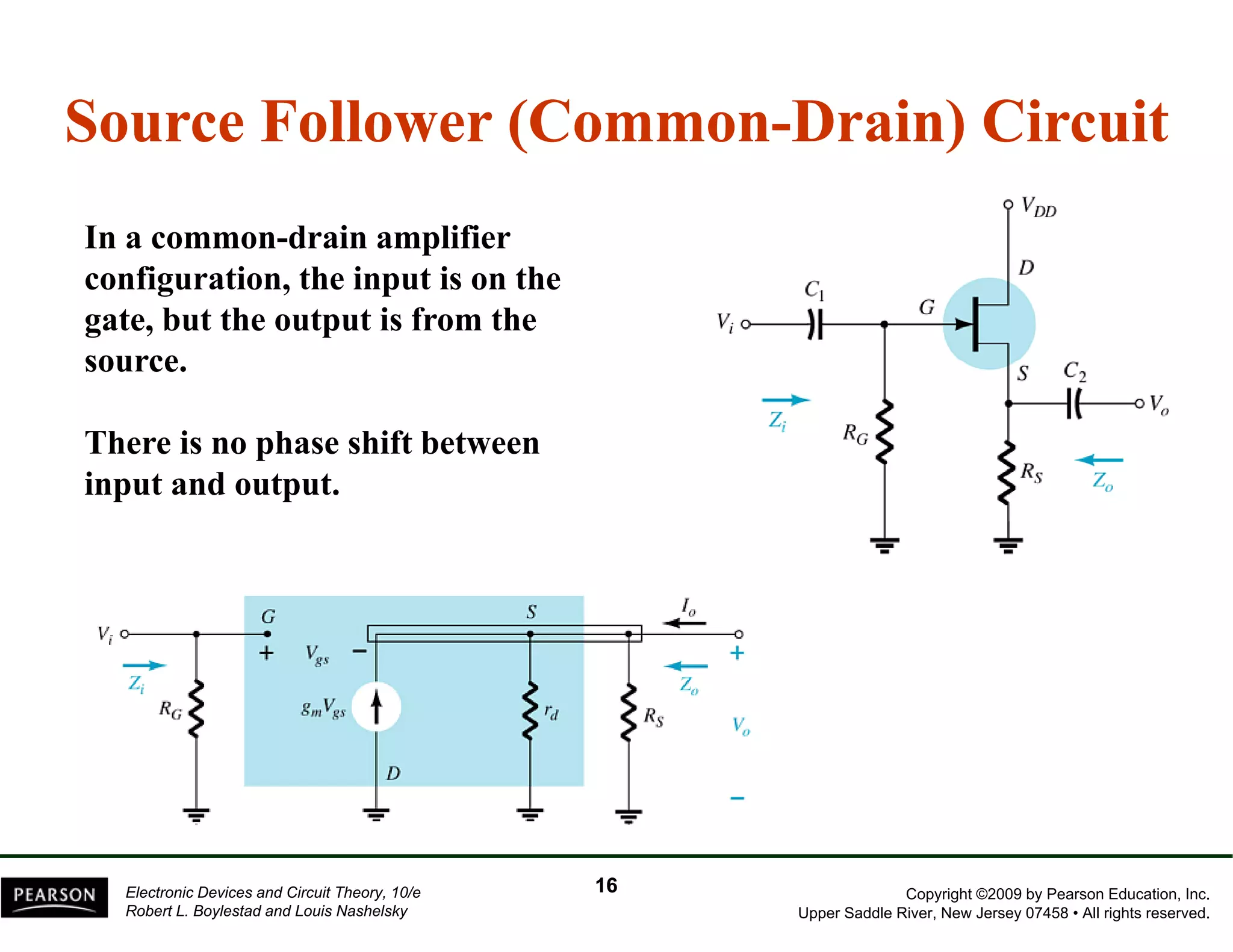
Source Follower (Common-Drain) Circuit 
In a common-drain amplifier 
configuration, the input is on the 
gate, but the output is from the 
source. 
There is no phase shift between 
input and output. 
Copyright ©2009 by Pearson Education, Inc. 
Upper Saddle River, New Jersey 07458 • All rights reserved. 
Electronic Devices and Circuit Theory, 10/e 
Robert L. Boylestad and Louis Nashelsky 
16
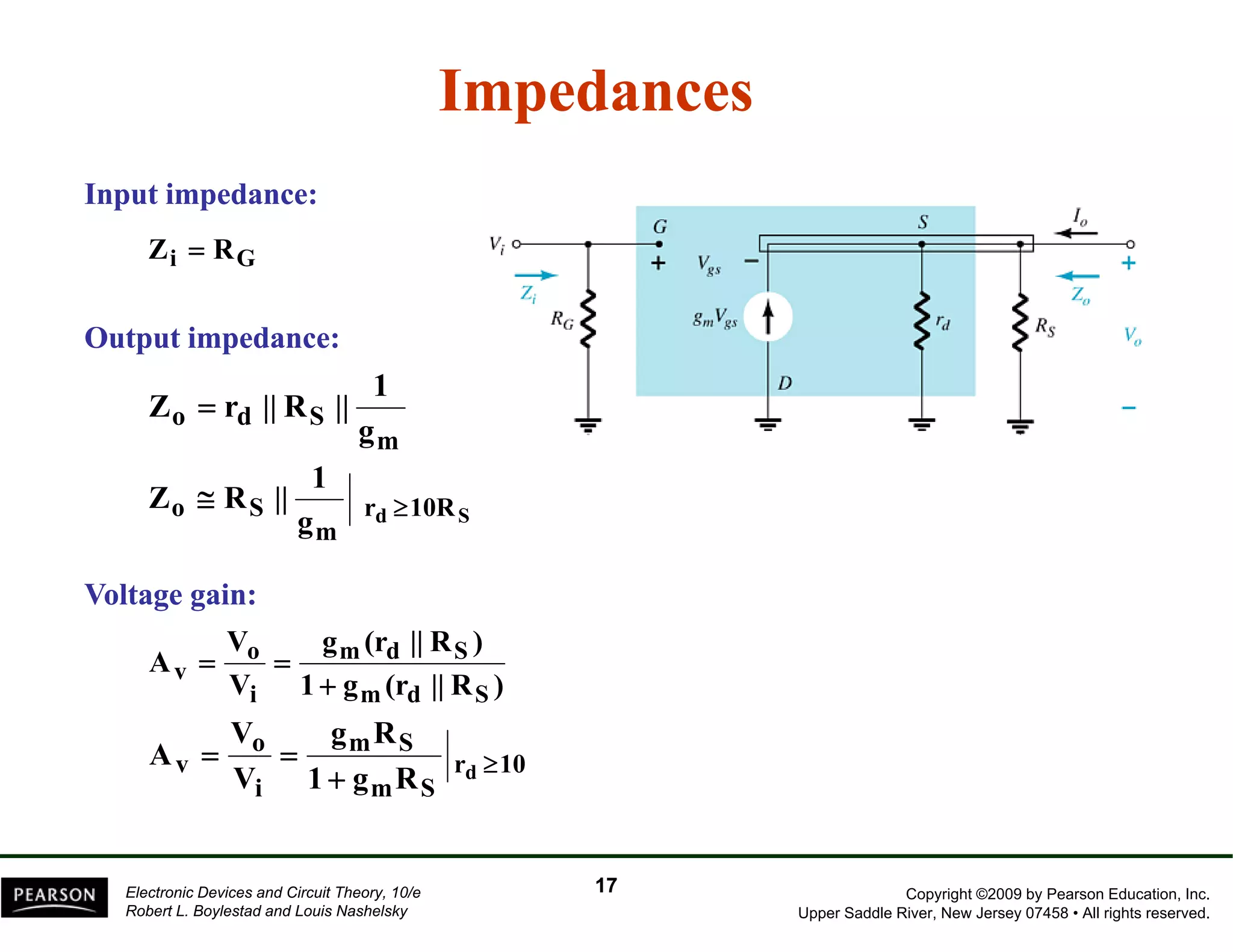
Impedances 
Input impedance: 
Z Zi = R 
RG 
Output impedance: 
Z = r || R || 1 
m 
o d S g 
1 
Z R || ≅ ≥ 
rd 10RS 
m 
o S g 
Voltage g (r || R ) 
m d S 
gain: 
= = 
v + 
1 g (r || R ) 
V 
o 
V 
A 
m d S 
i 
V 
A = = 
+ 
≥ v 1 g R d 
r 10 
m S 
m S 
o 
i 
g R 
V 
Copyright ©2009 by Pearson Education, Inc. 
Upper Saddle River, New Jersey 07458 • All rights reserved. 
Electronic Devices and Circuit Theory, 10/e 
Robert L. Boylestad and Louis Nashelsky 
17
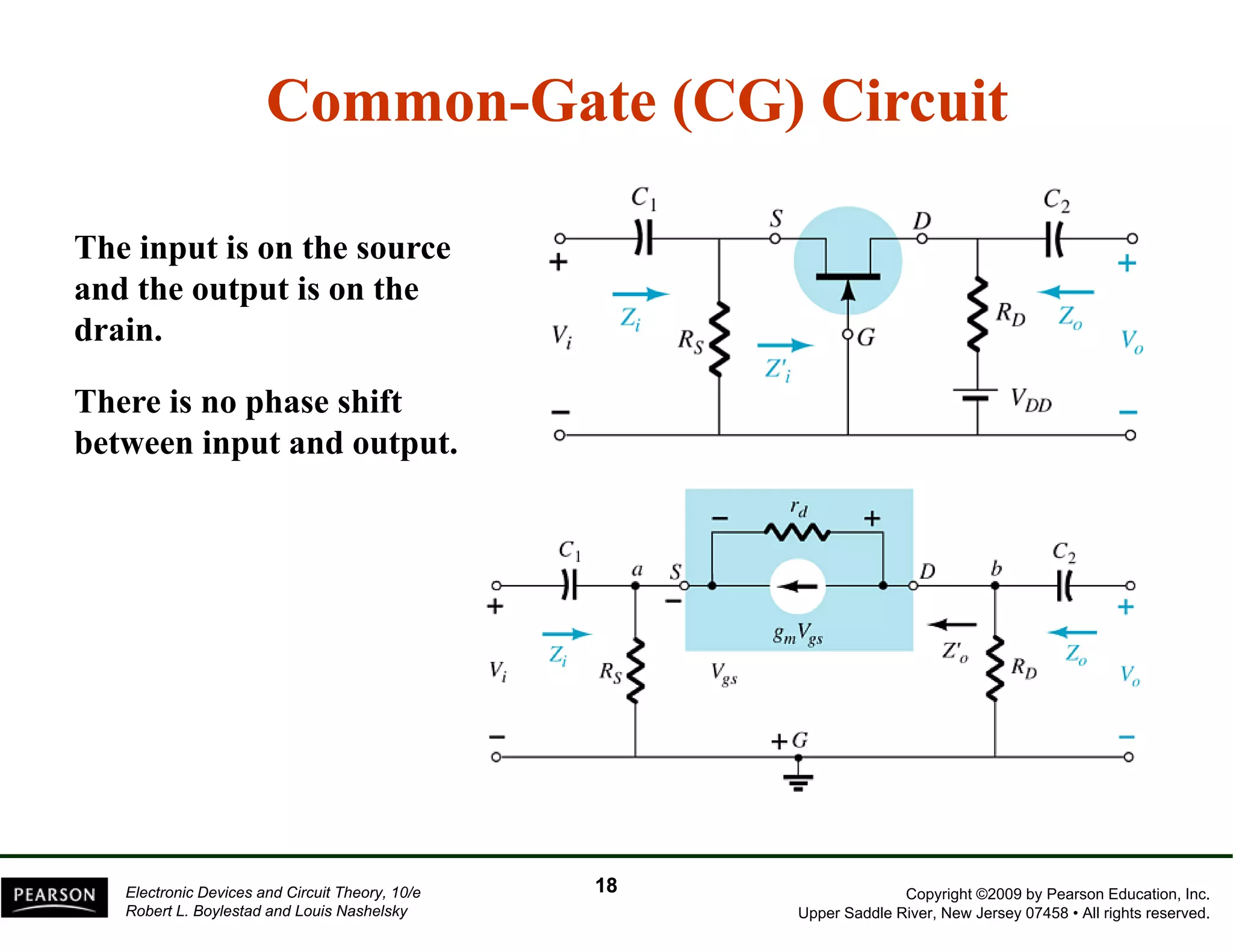
Common-Gate (CG) Circuit 
The input is on the source 
and the output is on the 
drain. 
There is no phase shift 
between input and output. 
Copyright ©2009 by Pearson Education, Inc. 
Upper Saddle River, New Jersey 07458 • All rights reserved. 
Electronic Devices and Circuit Theory, 10/e 
Robert L. Boylestad and Louis Nashelsky 
18
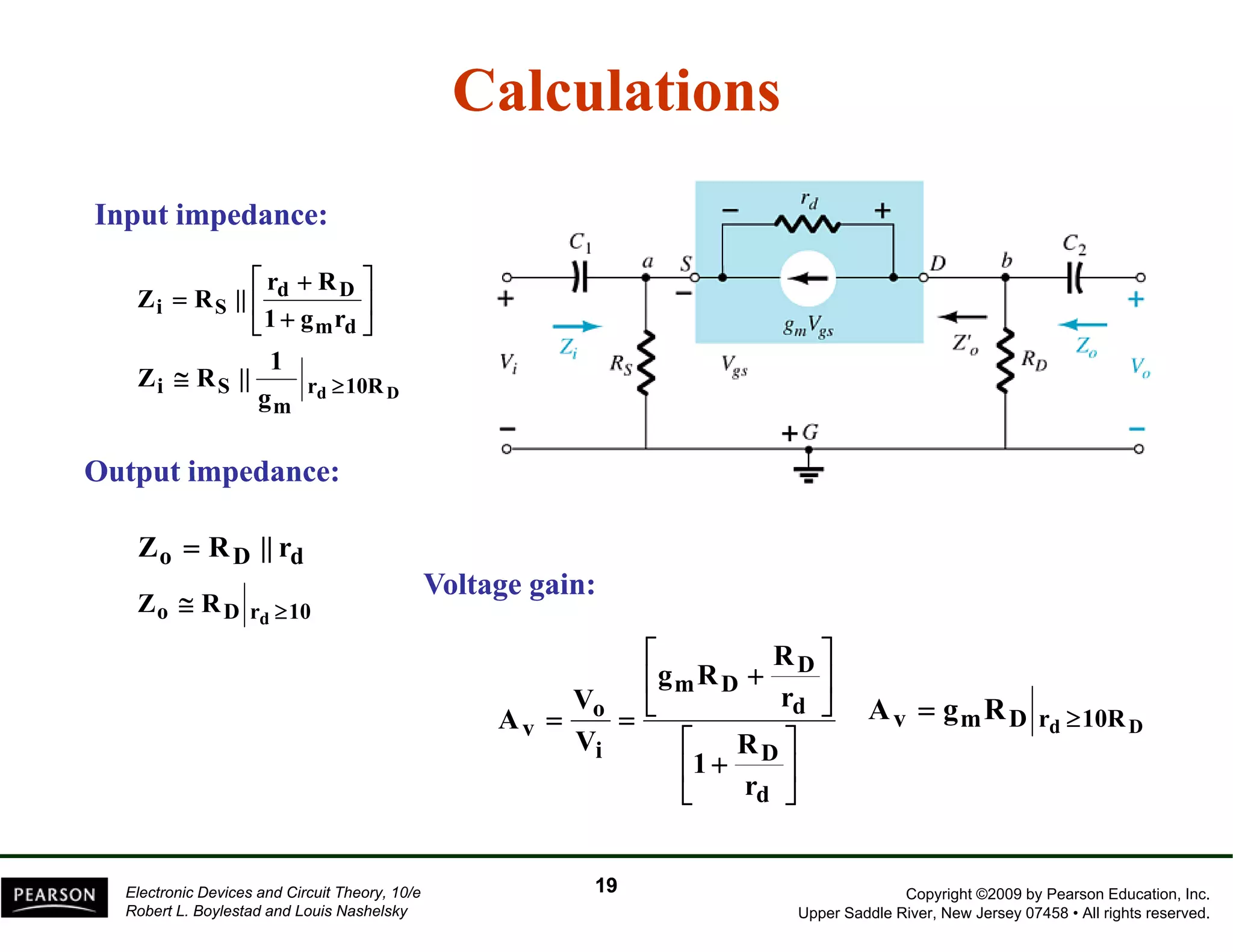
Calculations 
Input impedance: 
⎤ 
⎥⎦ 
⎡ 
+ 
⎢⎣ 
r + 
R 
= 
d D 
i S 1 g r 
m d 
Z R || 
1 
Z R || ≅ ≥ 
rd 10RD 
m 
i S g 
Output impedance: 
Zo = RD || rd 
Voltage o D rd 10 Z ≅ R ≥ 
⎤ 
⎥⎦ 
⎡ 
⎢ 
⎣ 
+ 
D 
R 
= = ⎦ 
A d 
v = m D rd ≥ 
10RD g R 
m D 
gain: 
o 
r 
V 
A g R 
⎤ 
⎥⎦ 
⎡ 
+ 
⎢⎣ 
D 
R 
d 
i 
v 
r 
1 
V 
Copyright ©2009 by Pearson Education, Inc. 
Upper Saddle River, New Jersey 07458 • All rights reserved. 
Electronic Devices and Circuit Theory, 10/e 
Robert L. Boylestad and Louis Nashelsky 
19
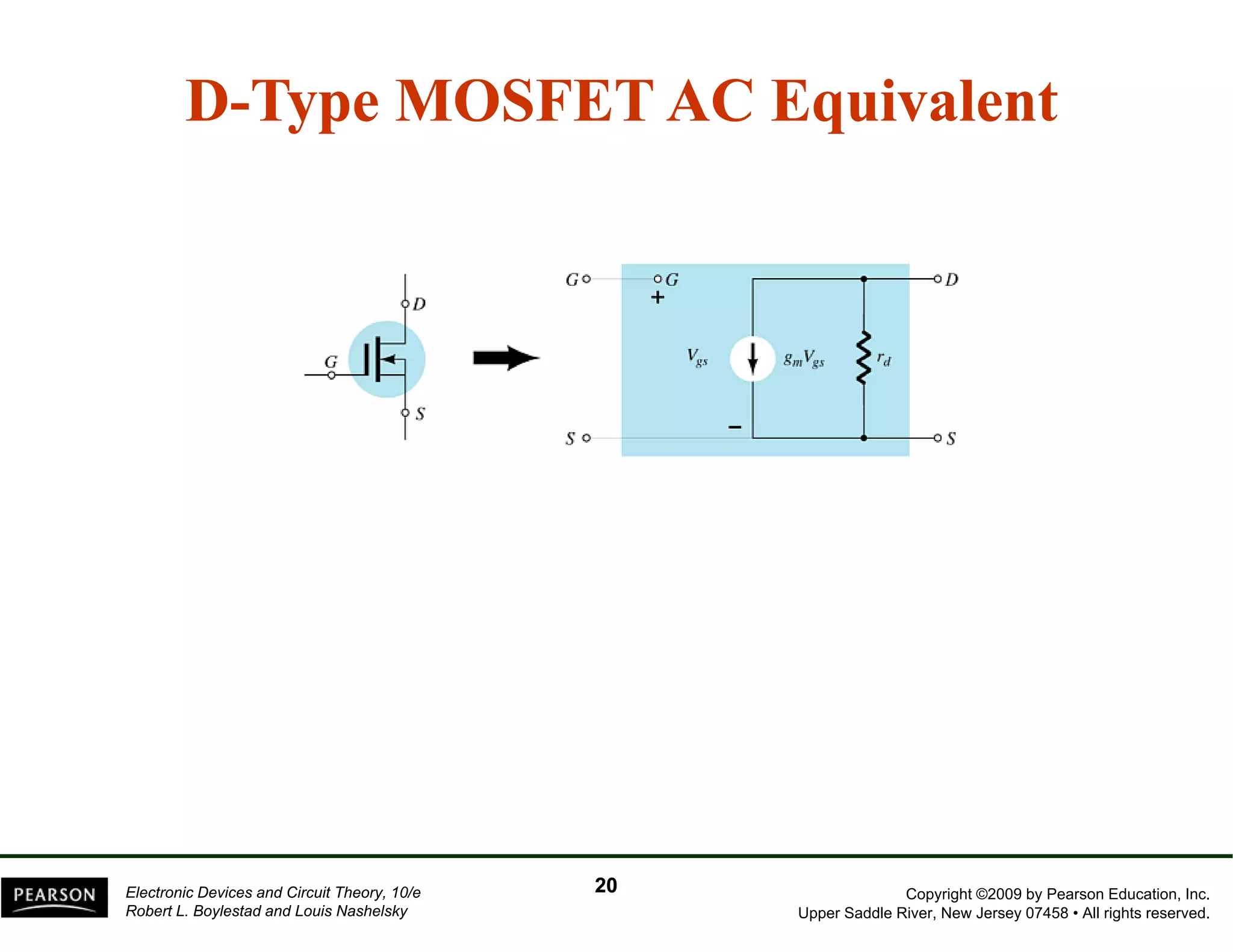
D-Type MOSFET AC Equivalent 
Copyright ©2009 by Pearson Education, Inc. 
Upper Saddle River, New Jersey 07458 • All rights reserved. 
Electronic Devices and Circuit Theory, 10/e 
Robert L. Boylestad and Louis Nashelsky 
20
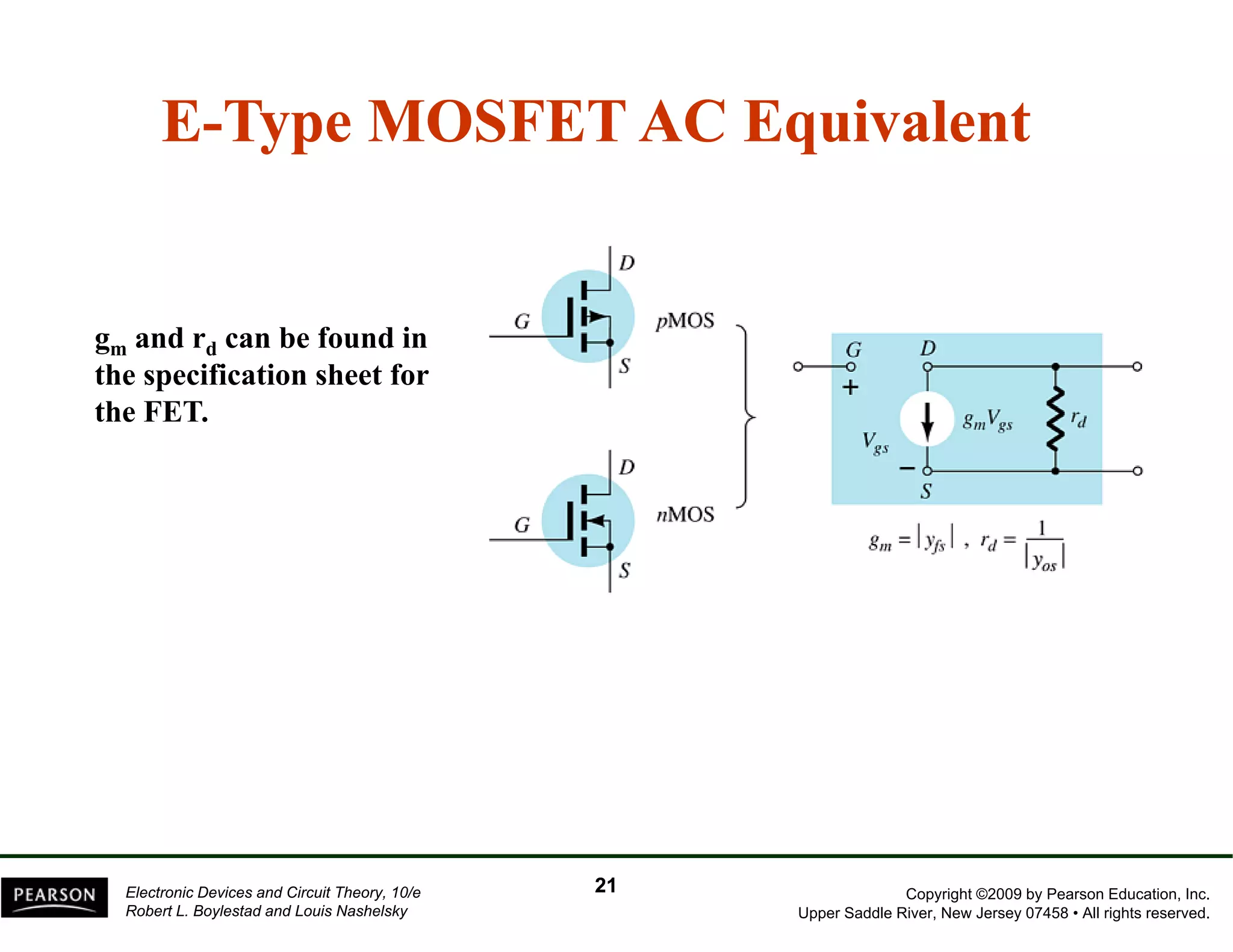
E-Type MOSFETAC Equivalent 
gm and rd can be found in 
the specification sheet for 
the FET. 
Copyright ©2009 by Pearson Education, Inc. 
Upper Saddle River, New Jersey 07458 • All rights reserved. 
Electronic Devices and Circuit Theory, 10/e 
Robert L. Boylestad and Louis Nashelsky 
21
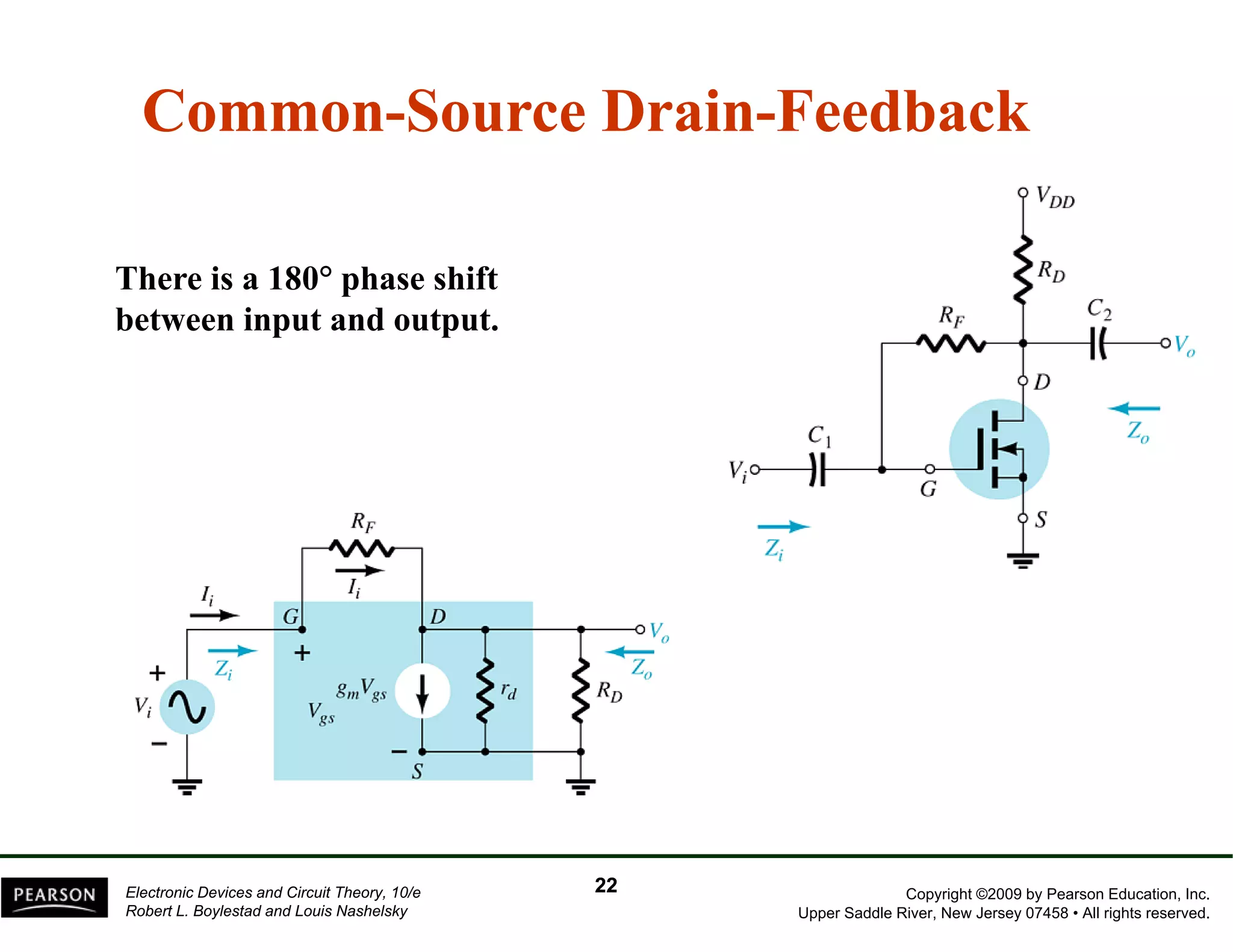
Common-Source Drain-Feedback 
There is a 180° phase shift 
between input and output. 
Copyright ©2009 by Pearson Education, Inc. 
Upper Saddle River, New Jersey 07458 • All rights reserved. 
Electronic Devices and Circuit Theory, 10/e 
Robert L. Boylestad and Louis Nashelsky 
22
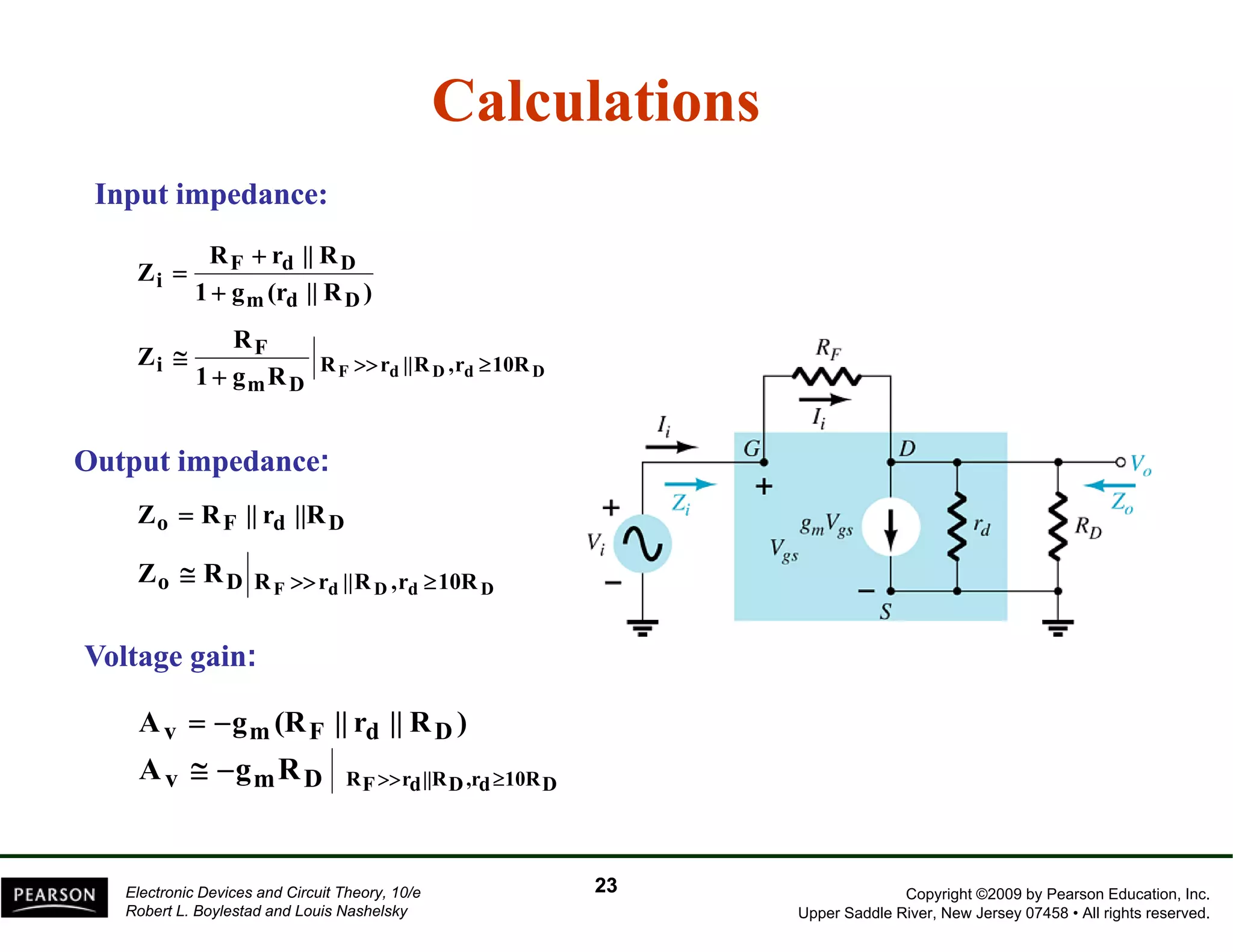
Calculations 
Input impedance: 
R r || R 
F d D 
1 g (r || R ) 
Z 
m d D 
i + 
+ 
= 
R ||R 10R 
F 
i 
R 
Z ≅ 
≥ 
RF rd RD ,rd 10RD 
>> + 
1 g R 
m D 
Output impedance: 
p p 
Zo = RF || rd ||RD 
Zo ≅ RD RF >>rd || RD , rd ≥10RF d D d D 
Voltage gain: 
Av = −gm(RF || rd || RD ) 
Av ≅ −gmRD RF>>rd||RD,rd≥10RD 
Copyright ©2009 by Pearson Education, Inc. 
Upper Saddle River, New Jersey 07458 • All rights reserved. 
Electronic Devices and Circuit Theory, 10/e 
Robert L. Boylestad and Louis Nashelsky 
23
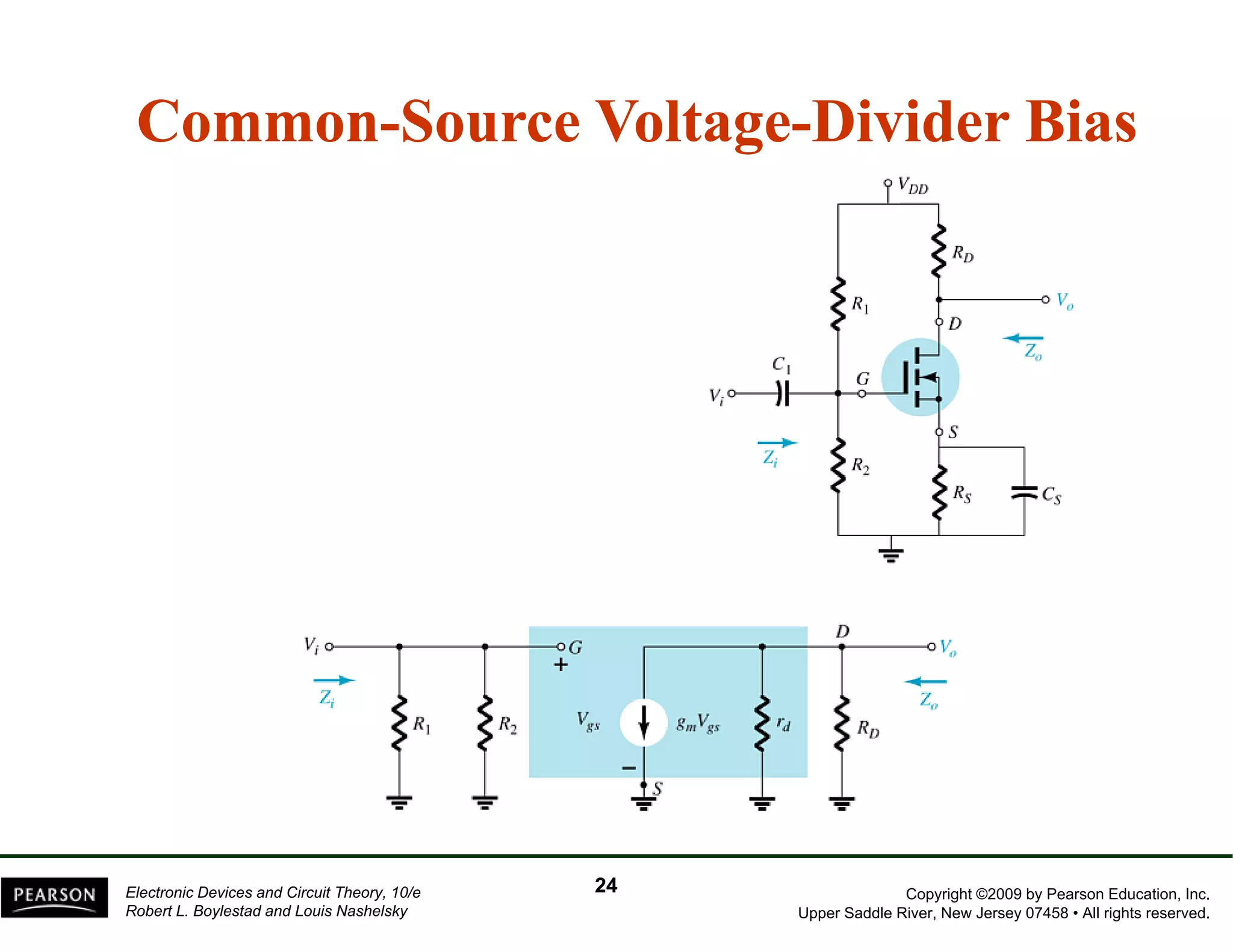
Common-Source Voltage-Divider Bias 
Copyright ©2009 by Pearson Education, Inc. 
Upper Saddle River, New Jersey 07458 • All rights reserved. 
Electronic Devices and Circuit Theory, 10/e 
Robert L. Boylestad and Louis Nashelsky 
24
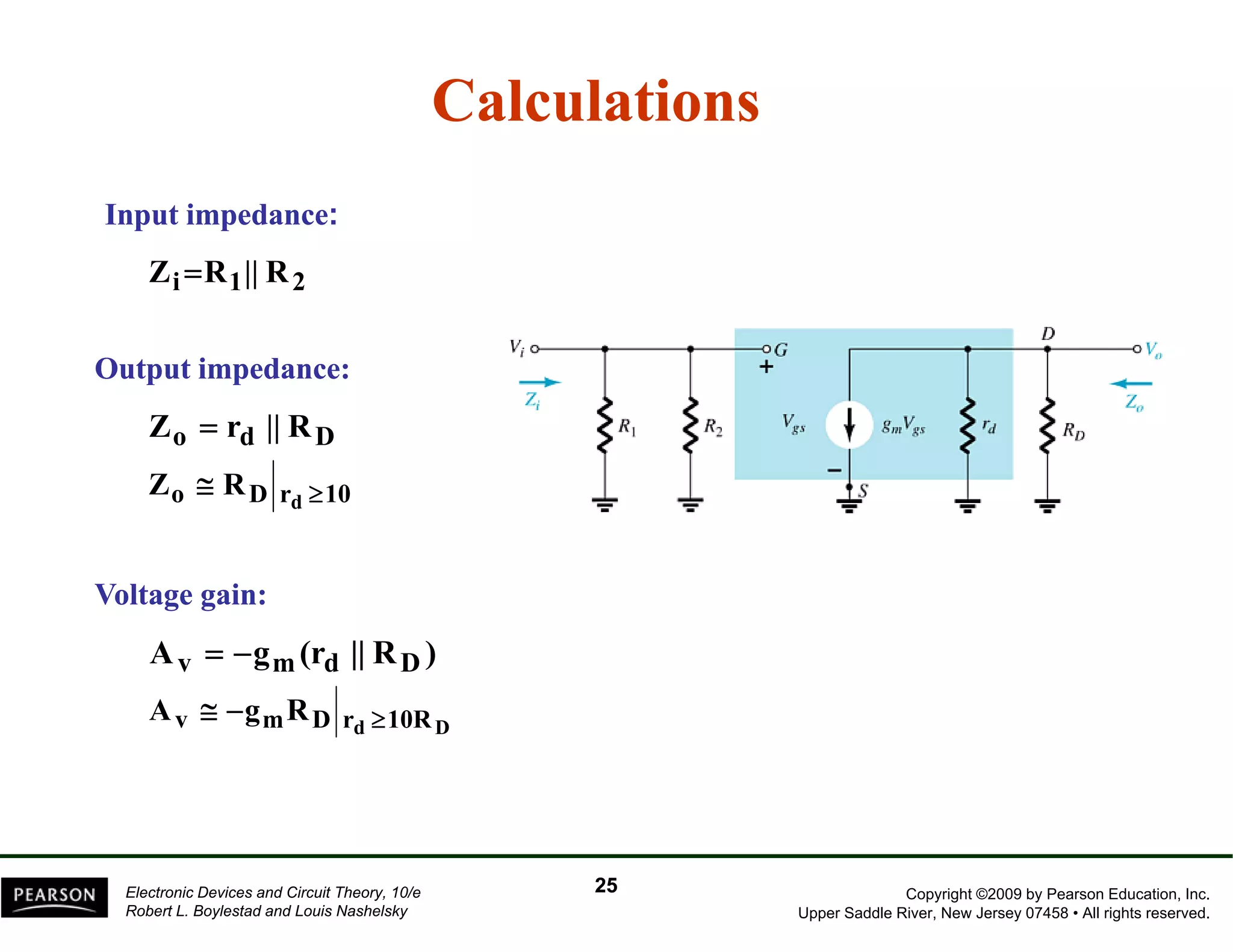
Calculations 
Input impedance: 
Zi=R1|| R2 
O t Output t i d 
impedance: 
Zo = rd || RD 
Zo RD rd 10 Z ≅ R ≥ 
Voltage gain: 
Av = −gm(rd || RD) 
A ≅ g R 
Av −gmRD rd ≥10RD 
Copyright ©2009 by Pearson Education, Inc. 
Upper Saddle River, New Jersey 07458 • All rights reserved. 
Electronic Devices and Circuit Theory, 10/e 
Robert L. Boylestad and Louis Nashelsky 
25
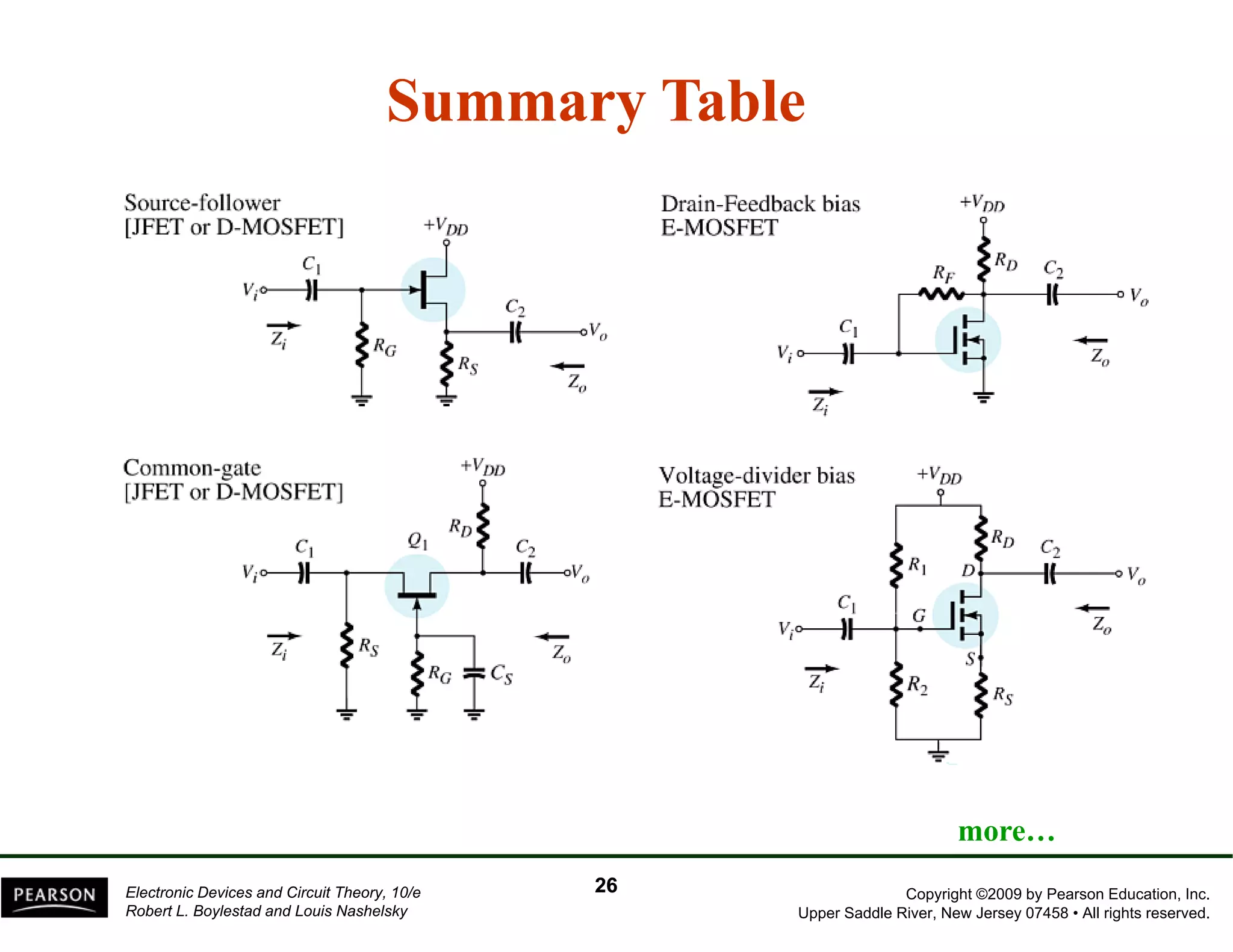
Summary Table 
Copyright ©2009 by Pearson Education, Inc. 
Upper Saddle River, New Jersey 07458 • All rights reserved. 
Electronic Devices and Circuit Theory, 10/e 
Robert L. Boylestad and Louis Nashelsky 
more… 
26
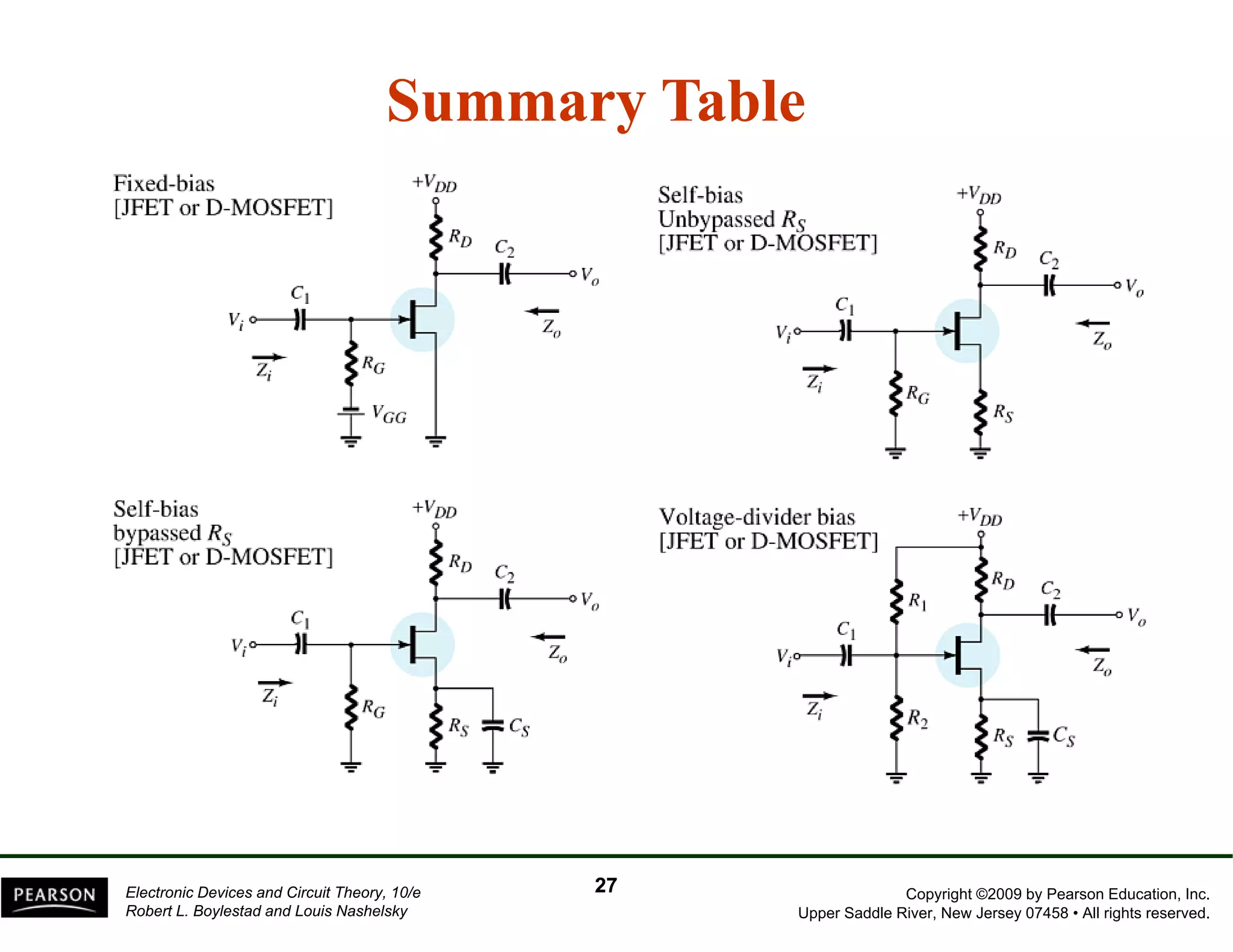
Summary Table 
Copyright ©2009 by Pearson Education, Inc. 
Upper Saddle River, New Jersey 07458 • All rights reserved. 
Electronic Devices and Circuit Theory, 10/e 
Robert L. Boylestad and Louis Nashelsky 
27
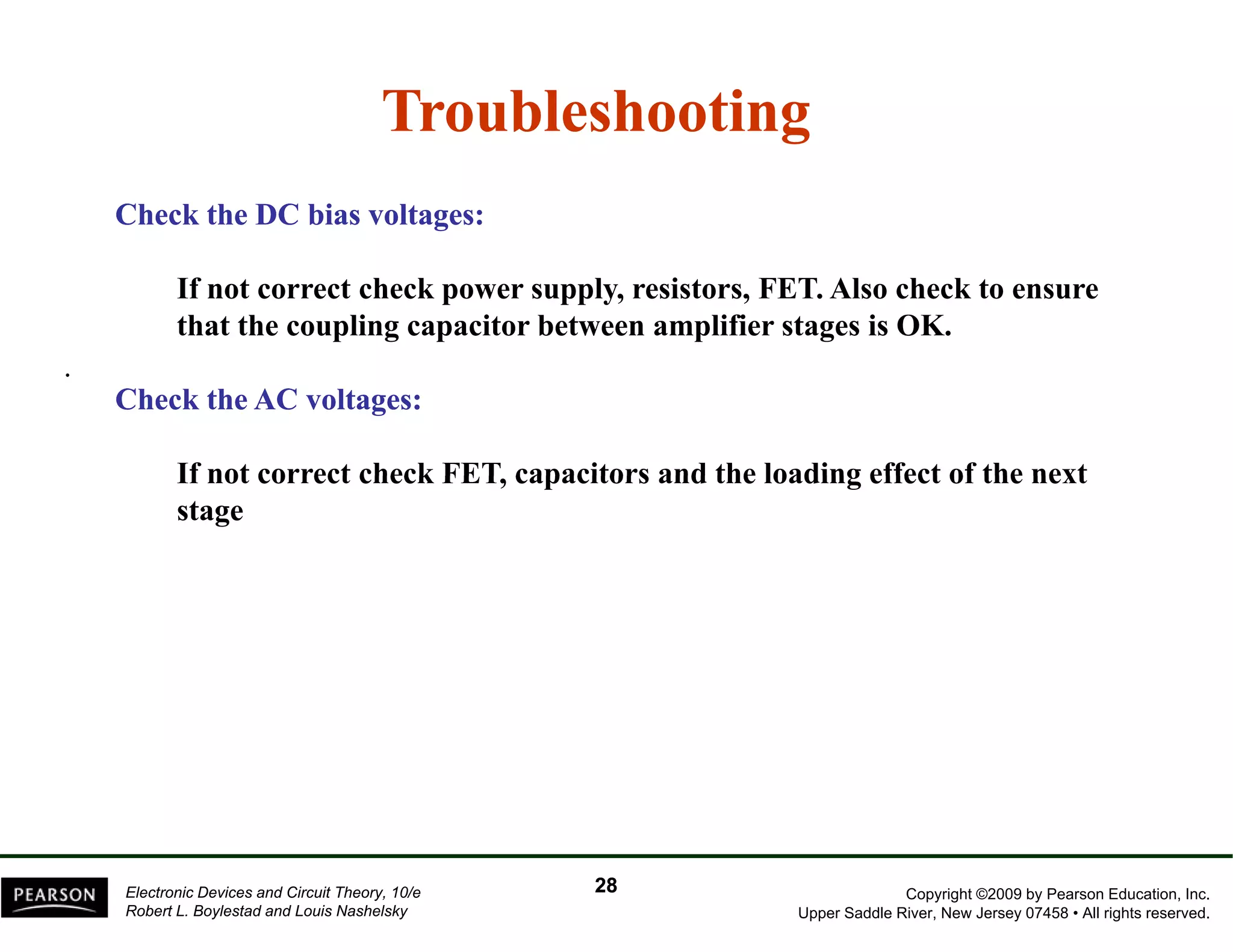
Troubleshooting 
Check the DC bias voltages: 
If not correct check power supply, resistors, FET. Also check to ensure 
that the coupling capacitor between amplifier stages is OK. 
. 
Check the AC voltages: 
If not correct check FET, capacitors and the loading effect of the next 
stage 
Copyright ©2009 by Pearson Education, Inc. 
Upper Saddle River, New Jersey 07458 • All rights reserved. 
Electronic Devices and Circuit Theory, 10/e 
Robert L. Boylestad and Louis Nashelsky 
28
Practical Applications 
Three-Channel Audio Mixer 
Silent Switching 
Phase Shift Networks 
Motion Detection System 
Copyright ©2009 by Pearson Education, Inc. 
Upper Saddle River, New Jersey 07458 • All rights reserved. 
Electronic Devices and Circuit Theory, 10/e 
Robert L. Boylestad and Louis Nashelsky 
29

Electronic devices-and-circuit-theory-10th-ed-boylestad-chapter-8

  • 1.
    Chapter 8: FETAmplifiers
  • 2.
    Introduction FETs provide: • Excellent voltage gain • High input impedance • Low-power consumption • Good frequency range Copyright ©2009 by Pearson Education, Inc. Upper Saddle River, New Jersey 07458 • All rights reserved. Electronic Devices and Circuit Theory, 10/e Robert L. Boylestad and Louis Nashelsky 2
  • 3.
    FET Small-Signal Model Transconductance The relationship of a change in ID to the corresponding change in VGS is called transconductance Transconductance is denoted gm and given by: D m I g Δ = GS V Δ Copyright ©2009 by Pearson Education, Inc. Upper Saddle River, New Jersey 07458 • All rights reserved. Electronic Devices and Circuit Theory, 10/e Robert L. Boylestad and Louis Nashelsky 3
  • 4.
    Graphical Determination ofgm Copyright ©2009 by Pearson Education, Inc. Upper Saddle River, New Jersey 07458 • All rights reserved. Electronic Devices and Circuit Theory, 10/e Robert L. Boylestad and Louis Nashelsky 4
  • 5.
    Mathematical Definitions ofgm D I Δ m V GS g Δ = ⎤ ⎥⎦ ⎡ DSS 2I = − ⎢⎣ GS m V P P V 1 V g DSS m0 V P 2I g = ⎡ ⎤ Where VGS =0V ⎥⎦ = − ⎢⎣ GS m m0 V P V g g 1 D DSS V GS 1 − = P I I V ⎛ V ⎞ I Where D DSS m0 GS 1 g g = ⎟⎟⎠ m m0 I P g V ⎜ ⎜⎝ = − Copyright ©2009 by Pearson Education, Inc. Upper Saddle River, New Jersey 07458 • All rights reserved. Electronic Devices and Circuit Theory, 10/e Robert L. Boylestad and Louis Nashelsky 5
  • 6.
    FET Impedance Inputimpedance: p Zi = ∞Ω Output Impedance: Z = r = 1 o d y yos ΔV where: Δ d I GS V constant DS D V r = = Δ yos= admittance parameter listed on FET specification sheets. Copyright ©2009 by Pearson Education, Inc. Upper Saddle River, New Jersey 07458 • All rights reserved. Electronic Devices and Circuit Theory, 10/e Robert L. Boylestad and Louis Nashelsky 6
  • 7.
    FET AC EquivalentCircuit Copyright ©2009 by Pearson Education, Inc. Upper Saddle River, New Jersey 07458 • All rights reserved. Electronic Devices and Circuit Theory, 10/e Robert L. Boylestad and Louis Nashelsky 7
  • 8.
    Common-Source (CS) Fixed-BiasCircuit The input is on the gate and the output is on the drain There is a 180° phase shift between input and output Copyright ©2009 by Pearson Education, Inc. Upper Saddle River, New Jersey 07458 • All rights reserved. Electronic Devices and Circuit Theory, 10/e Robert L. Boylestad and Louis Nashelsky 8
  • 9.
    Calculations Input impedance: Zi = RG p Output p impedance: Zo = RD || rd Z R o D r ≥ 10R d D ≅ Voltage gain: o A m d D g (r || R ) V v = = − V i v g R rd 10RD m D o V i V A = = − ≥ Copyright ©2009 by Pearson Education, Inc. Upper Saddle River, New Jersey 07458 • All rights reserved. Electronic Devices and Circuit Theory, 10/e Robert L. Boylestad and Louis Nashelsky 9
  • 10.
    Common-Source (CS) Self-BiasCircuit This is a common-source amplifier configuration, so the input is on the gate and the output is on the drain There is a 180° phase shift between input and output Copyright ©2009 by Pearson Education, Inc. Upper Saddle River, New Jersey 07458 • All rights reserved. Electronic Devices and Circuit Theory, 10/e Robert L. Boylestad and Louis Nashelsky 10
  • 11.
    Calculations Input impedance: Z Zi = R RG p Output p impedance: Zo = rd || RD Z R o D r ≥ 10R d D ≅ Voltage gain: Av = −gm(rd || RD) Av = − gmRD rd ≥ 10RD Copyright ©2009 by Pearson Education, Inc. Upper Saddle River, New Jersey 07458 • All rights reserved. Electronic Devices and Circuit Theory, 10/e Robert L. Boylestad and Louis Nashelsky 11
  • 12.
    Common-Source (CS) Self-BiasCircuit Removing Cs affects the gain of the circuit. Copyright ©2009 by Pearson Education, Inc. Upper Saddle River, New Jersey 07458 • All rights reserved. Electronic Devices and Circuit Theory, 10/e Robert L. Boylestad and Louis Nashelsky 12
  • 13.
    Calculations Input impedance: Zi i = G RG Output impedance: Z R ≥ o D r 10R d D ≅ Voltage gain: Vo gmRD A = = − R R D S d m S i v r V 1 g R + + + Vo o m gmRD D A r 10(R R ) v 1 g R d D S m S i g V ≥ + + = = − Copyright ©2009 by Pearson Education, Inc. Upper Saddle River, New Jersey 07458 • All rights reserved. Electronic Devices and Circuit Theory, 10/e Robert L. Boylestad and Louis Nashelsky 13
  • 14.
    Common-Source (CS) Voltage-DividerBias This is a common-source amplifier configuration, so the input is on the gate and the output is on the drain. Copyright ©2009 by Pearson Education, Inc. Upper Saddle River, New Jersey 07458 • All rights reserved. Electronic Devices and Circuit Theory, 10/e Robert L. Boylestad and Louis Nashelsky 14
  • 15.
    Impedances Input impedance: Zi = R1 || R2 Output impedance: Zo = rd || RD Z R ≥ o D r 10R d D ≅ Voltage gain: Av = −gm(rd || RD ) Av = − gmRD rd ≥ 10RD Copyright ©2009 by Pearson Education, Inc. Upper Saddle River, New Jersey 07458 • All rights reserved. Electronic Devices and Circuit Theory, 10/e Robert L. Boylestad and Louis Nashelsky 15
  • 16.
    Source Follower (Common-Drain)Circuit In a common-drain amplifier configuration, the input is on the gate, but the output is from the source. There is no phase shift between input and output. Copyright ©2009 by Pearson Education, Inc. Upper Saddle River, New Jersey 07458 • All rights reserved. Electronic Devices and Circuit Theory, 10/e Robert L. Boylestad and Louis Nashelsky 16
  • 17.
    Impedances Input impedance: Z Zi = R RG Output impedance: Z = r || R || 1 m o d S g 1 Z R || ≅ ≥ rd 10RS m o S g Voltage g (r || R ) m d S gain: = = v + 1 g (r || R ) V o V A m d S i V A = = + ≥ v 1 g R d r 10 m S m S o i g R V Copyright ©2009 by Pearson Education, Inc. Upper Saddle River, New Jersey 07458 • All rights reserved. Electronic Devices and Circuit Theory, 10/e Robert L. Boylestad and Louis Nashelsky 17
  • 18.
    Common-Gate (CG) Circuit The input is on the source and the output is on the drain. There is no phase shift between input and output. Copyright ©2009 by Pearson Education, Inc. Upper Saddle River, New Jersey 07458 • All rights reserved. Electronic Devices and Circuit Theory, 10/e Robert L. Boylestad and Louis Nashelsky 18
  • 19.
    Calculations Input impedance: ⎤ ⎥⎦ ⎡ + ⎢⎣ r + R = d D i S 1 g r m d Z R || 1 Z R || ≅ ≥ rd 10RD m i S g Output impedance: Zo = RD || rd Voltage o D rd 10 Z ≅ R ≥ ⎤ ⎥⎦ ⎡ ⎢ ⎣ + D R = = ⎦ A d v = m D rd ≥ 10RD g R m D gain: o r V A g R ⎤ ⎥⎦ ⎡ + ⎢⎣ D R d i v r 1 V Copyright ©2009 by Pearson Education, Inc. Upper Saddle River, New Jersey 07458 • All rights reserved. Electronic Devices and Circuit Theory, 10/e Robert L. Boylestad and Louis Nashelsky 19
  • 20.
    D-Type MOSFET ACEquivalent Copyright ©2009 by Pearson Education, Inc. Upper Saddle River, New Jersey 07458 • All rights reserved. Electronic Devices and Circuit Theory, 10/e Robert L. Boylestad and Louis Nashelsky 20
  • 21.
    E-Type MOSFETAC Equivalent gm and rd can be found in the specification sheet for the FET. Copyright ©2009 by Pearson Education, Inc. Upper Saddle River, New Jersey 07458 • All rights reserved. Electronic Devices and Circuit Theory, 10/e Robert L. Boylestad and Louis Nashelsky 21
  • 22.
    Common-Source Drain-Feedback Thereis a 180° phase shift between input and output. Copyright ©2009 by Pearson Education, Inc. Upper Saddle River, New Jersey 07458 • All rights reserved. Electronic Devices and Circuit Theory, 10/e Robert L. Boylestad and Louis Nashelsky 22
  • 23.
    Calculations Input impedance: R r || R F d D 1 g (r || R ) Z m d D i + + = R ||R 10R F i R Z ≅ ≥ RF rd RD ,rd 10RD >> + 1 g R m D Output impedance: p p Zo = RF || rd ||RD Zo ≅ RD RF >>rd || RD , rd ≥10RF d D d D Voltage gain: Av = −gm(RF || rd || RD ) Av ≅ −gmRD RF>>rd||RD,rd≥10RD Copyright ©2009 by Pearson Education, Inc. Upper Saddle River, New Jersey 07458 • All rights reserved. Electronic Devices and Circuit Theory, 10/e Robert L. Boylestad and Louis Nashelsky 23
  • 24.
    Common-Source Voltage-Divider Bias Copyright ©2009 by Pearson Education, Inc. Upper Saddle River, New Jersey 07458 • All rights reserved. Electronic Devices and Circuit Theory, 10/e Robert L. Boylestad and Louis Nashelsky 24
  • 25.
    Calculations Input impedance: Zi=R1|| R2 O t Output t i d impedance: Zo = rd || RD Zo RD rd 10 Z ≅ R ≥ Voltage gain: Av = −gm(rd || RD) A ≅ g R Av −gmRD rd ≥10RD Copyright ©2009 by Pearson Education, Inc. Upper Saddle River, New Jersey 07458 • All rights reserved. Electronic Devices and Circuit Theory, 10/e Robert L. Boylestad and Louis Nashelsky 25
  • 26.
    Summary Table Copyright©2009 by Pearson Education, Inc. Upper Saddle River, New Jersey 07458 • All rights reserved. Electronic Devices and Circuit Theory, 10/e Robert L. Boylestad and Louis Nashelsky more… 26
  • 27.
    Summary Table Copyright©2009 by Pearson Education, Inc. Upper Saddle River, New Jersey 07458 • All rights reserved. Electronic Devices and Circuit Theory, 10/e Robert L. Boylestad and Louis Nashelsky 27
  • 28.
    Troubleshooting Check theDC bias voltages: If not correct check power supply, resistors, FET. Also check to ensure that the coupling capacitor between amplifier stages is OK. . Check the AC voltages: If not correct check FET, capacitors and the loading effect of the next stage Copyright ©2009 by Pearson Education, Inc. Upper Saddle River, New Jersey 07458 • All rights reserved. Electronic Devices and Circuit Theory, 10/e Robert L. Boylestad and Louis Nashelsky 28
  • 29.
    Practical Applications Three-ChannelAudio Mixer Silent Switching Phase Shift Networks Motion Detection System Copyright ©2009 by Pearson Education, Inc. Upper Saddle River, New Jersey 07458 • All rights reserved. Electronic Devices and Circuit Theory, 10/e Robert L. Boylestad and Louis Nashelsky 29